FILM / Alan Waldman : A Look Back at My Favorite Films

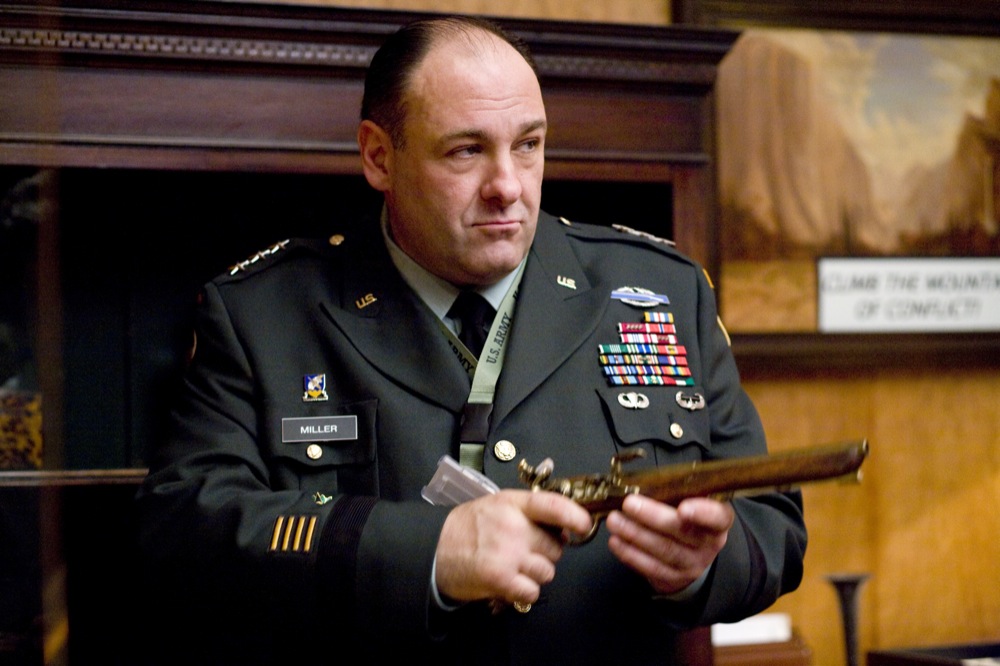
James Gandolfini in the British film, In the Loop.

From 2003 to 2010:
Looking back at my favorite films

By Alan Waldman / The Rag Blog / January 18, 2012

[Last week we posted Alan Waldman’s 10 Favorite Films of 2011, with his list headed by The Help, The King’s Speech, and The Guard. Now Alan presents his favorites, by year, going back to 2003.]

2010:

  1. CITY ISLAND is a wonderful comedy drama about keeping secrets from your family. Andy Garcia, Julianna Margulies, Emily Mortimer, Alan Arkin, and three unknowns are absolutely terrific. The script is great—funny, insightful, surprising, sweet, offbeat, warm hearted and thoroughly enjoyable. It is a real treasure.
  2. INSIDE JOB (documentary) accomplishes the difficult task of making the labyrinthine financial crisis of 2008-2009 understandable — and therefore infuriating. The film is smart, brilliantly edited and compelling. It includes succinct interviews with top financial insiders, politicians, journalists, and academics. Despite the seemingly dry subject matter, it never stalls out but keeps driving forward.
  3. IN THE LOOP (U.K.) is one of the most hilarious films of the decade. I recommend watching it with the English subtitles, because although it is in English, the jokes and funny insults come so fast and furiously that you sometimes have to back up and read them to catch everything. Scottish actor Peter Capaldi steals the film with his astonishing range of insults and wisecracks, but the fine American/British cast also includes James Gandolfini, Tom Hollander, Gina McKee, and some funny folks with whom we are unfamiliar. The plot deals with the efforts of British and American bureaucrats and officials to prevent their countries from going to war in the Middle East.


Christoph Waltz in Quentin Tarantino’s Inglorious Basterds.

2009:

  1. STATE OF PLAY is a terrific two-hour American remake of the even better British six-hour miniseries about murder, political corruption and journalism. The American film stars Helen Mirren, Josh Mostel, Ben Affleck, Russell Crowe, Jeff Daniels, Rachel McAdams, Robin Wright Penn, and Jason Bateman. This is a smart, exciting, nicely detailed film, beautifully acted (in both versions), that is very timely and believable.
  2. INGLORIOUS BASTERDS is the most enjoyable Quentin Tarantino film in years. It is a surprising thriller about a group of American Jewish soldiers in Germany who are out to execute as many Nazis as they can. The plot has several exciting sequences, including a terrific (although historically inaccurate) sequence where they try to blow up a movie theater containing Hitler, Himmler, and Goering. Gripping, brilliantly executed and surprising. Brad Pitt plays the American group leader as a loony, bloodthirsty Southerner. Germany’s Christoph Waltz’s richly complex and compelling performance won him the Oscar.
  3. GOODBYE SOLO is an emotionally rich, superbly detailed human drama. A deeply depressed older man hires an African immigrant taxi driver to take him to the top of a North Carolina mountain, presumably so he can throw himself off to his death. An unlikely friendship develops between these two very opposite people. Although the cast is largely unknown, it is superb. A little gem.


2008:

  1. FROST/NIXON (U.K.) is a mind-blowing movie featuring Frank Langella as Nixon (nominated for an Oscar) and a great script by Peter Morgan (also Oscar-nominated). It tells the dramatic true story of how British talk show host David Frost, considered a lightweight, interviewed former president Richard Nixon for an eight-hour/four-night television broadcast in an attempt to get him to confess his crimes and apologize to the American people. For the first three talks, Nixon completely triumphs in this tense contest of wills, but before the fourth and final meeting Frost unexpectedly grows a set of testicles and stands up to him, with astonishing results.
  2. THE VISITOR In a great, Oscar-nominated performance, Richard Jenkins plays Walter, an obnoxious 62-year-old college prof who goes to NYC to attend a conference and finds two illegal aliens living in his rarely used Greenwich Village apartment. He develops a surprising, rich, and wonderful relationship with them. Then the plot takes a dramatic turn and moves into new territory whose demands deepen and enrich Walter’s character and humanity. This is a satisfying, intelligent, involving, and surprising work of art that is well worth your time.
  3. THE BAND’S VISIT (Israel) is a lovely, nuanced, funny, and touching film, full of wonderful characters. It tells of an eight-man Egyptian police band’s attempt to perform traditional music at a small Arab community in Israel. The band is mistakenly sent to an Israeli small town with a similar-sounding name. For 24 hours the band members interact with the Jewish Israelis they meet, and those encounters are surprising and enjoyable. Great writing, direction, and performing make this little sleeper a real treat.
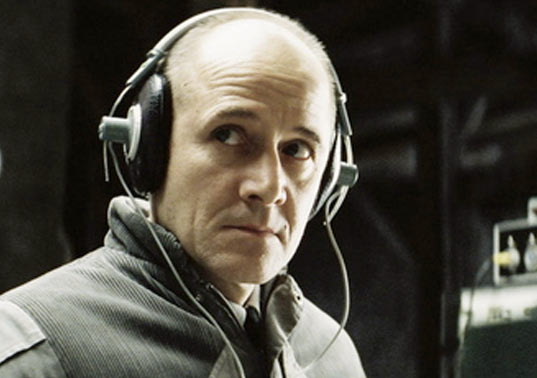
Ulrich Mühe is an East German secret policeman in The Lives of Others.

2007:

  1. THE LIVES OF OTHERS (Germany) is a sensational 2006 film that I saw in 2007. It justifiably won the Best Foreign Language Film Oscar, as well as 58 other major awards in 10 countries. I found it riveting, intelligent, and brilliantly realized. It dramatizes the efforts of the East German secret police to spy on a popular playwright and his beautiful actress girlfriend. It has sensational character work, offers compelling plot elements and surprises, and holds you from beginning to end. This is a truly great film that will appeal to most people — one that even subtitle-phobics should take a chance on.
  2. SICKO (documentary) Michael Moore’s searing indictment of the insurance industry’s endless, cruel, greedy assault on the U.S. healthcare system (and the millions of patients who are harmed by it) is a must-see. Besides being dramatic, informative, and involving, it has moments of high humor and irony.
  3. WAITRESS is a surprising, delightful, highly original film. It was written and directed by, and co-stars, brilliant Adrienne Shelley, who also composed the songs. It is both a wonderfully whimsical, sly romantic comedy and a scary marital drama, starring excellent Keri Russell as the pie-baking heroine. Andy Griffith is wonderful as a crotchety customer. This is such a fresh, charming, character-rich movie that few will be able to resist.


2006:

  1. THE HISTORY BOYS (U.K.) This extraordinary film, from the Tony-award-winning Broadway play, features the original West End and Broadway cast — including the brilliant Richard Griffiths and wonderful Francis de la Tour. It is witty, dramatic, touching, funny, surprising, very intelligent, verbally dazzling, and bursting with ideas and insights. I experienced the full range of human emotions watching this one — from tears, to surprise, to laughter, to cheers.
  2. THE QUEEN (U.K.) Helen Mirren won the Best Actress Oscar for her performance as Queen Elizabeth II in this powerful, beautifully written and produced movie. Mirren makes the queen human and likable. Michael Sheen is outstanding as Prime Minister Tony Blair. Brilliant British director Stephen Frears is at the top of his game here, bringing subtlety, humor, irony, keen observation, and a great honesty to a true story.
  3. VOLVER (Spain) One of genius Pedro Almodovar’s best films ever. A strong female cast features Penelope Cruz and Carmen Maura. This story is rich, smart, tricky, sly, moving, and brilliantly assembled. This is a treat for everyone brave enough to read subtitles.
  4. AN INCONVENIENT TRUTH (documentary) A brilliant, chilling, mind-blowing, detailed, and highly persuasive documentary on how unchecked corporate greed is destroying our environment, weather, and health, and threatening human survival. Al Gore is wonderful in this — regardless of your political persuasion — as he explains why this has been the issue closest to his heart for decades. This is a movie that intelligent, concerned world citizens must not miss!

Rachel Weisz and Ralph Fiennes in The Constant Gardener.

2005:

  1. THE CONSTANT GARDENER (U.K.) is a smart, brave, beautifully realized film of the John Le Carre novel that won 20 major awards, including a Best Actress Oscar for Rachel Weisz. It is a gripping thriller about a husband’s (Ralph Fiennes) quest to discover how and why his wife was murdered in Kenya.
  2. MARCH OF THE PENGUINS (documentary) (France) is a thoroughly enjoyable, Oscar-winning documentary about Antarctic penguins and what they go through each year. Morgan Freeman’s narration is terrific and the story is dramatic, visually stunning, and heartwarming.
  3. MUNICH is a great historical drama which earned five Oscar nominations, including Best Picture, Best Director (Steven Spielberg) and Best Screenplay (Tony Kushner and Eric Roth). It dramatizes the efforts of Israeli agents to track down and murder all the Black September assassins. It is complex, surprising, pulse-pounding, and very intelligent.


2004:

  1. HOTEL RWANDA features a powerfully dramatic true story, two Oscar-nominated, great lead performances from Sophie Okonedo and Don Cheadle, a sensational script, and truly inspired direction. This one is not to be missed. Although it deals with a horribly violent historic period in Rwanda, it is not gratuitously graphic.
  2. A VERY LONG ENGAGEMENT (France) combines the enormous talents of director Jean-Pierre Jeunet and star Audrey Tatou (both dazzling in the marvelous 2001 film Amelie). This World War I mystery/love story/historical epic is touching, surprising, funny and visually stunning — as Jeunet continues to stretch the visual possibilities of cinema again and again.
  3. MOTORCYCLE DIARIES (Brazil) is a masterful movie from Brazilian genius director Walter Salles that movingly captures the political awakening of young Che Guevara and a pal, who are out for babes and booze in a breathtaking trip through South America. The visuals in this one will blow you away. It is witty, touching, surprising, and wonderfully nuanced.
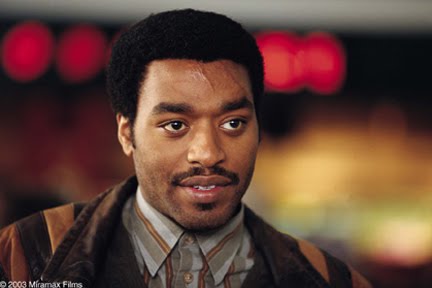
Chitwetel Ejiofor in Stephen Frears’ Dirty Pretty Things.

2003:

  1. THE BARBARIAN INVASIONS (Canada, in French) Denys Arcand’s examination of friendship, parent-child relationships, and the worries that beset one as life’s end approaches, is beautiful, brilliant, moving, funny, surprising, visually stunning, beautifully acted, and easily the most intelligent picture of the year. Virtually every scene of this enjoyable film is a little polished jewel.
  2. WINGED MIGRATION (France, in English) This Oscar-nominated documentary about flocks of beautiful birds flying over gorgeous corners of the earth, to delightful music and very little dialogue, is masterful. It evokes every human emotion, including laughter, tears, fear, surprise, and exhilaration. This is as close to flying as you will ever come. Don’t dismiss this as simply another dull nature film: this one is very emotionally and visually rich; everyone I have recommended it to so far has loved it.
  3. DIRTY PRETTY THINGS (U.K.) Stephen Frears’ gripping, highly original look at illegal workers in Britain is beautifully written, directed, and performed, while being an important social statement. This is the kind of movie I like best — about sane people facing difficult challenges and dealing with them in fresh, unexpected ways.
  • See Alan Waldman’s full lists of favorite films from 2011 and 2010 on The Rag Blog.
  • [Houston native Alan Waldman is a former editor at Honolulu Magazine and The Hollywood Reporter.]

    The Rag Blog

    Posted in Rag Bloggers | Tagged , , | 2 Comments

    Jorge Rivas and Jamilah King : SOPA and the Internet Blackout


    What is SOPA?
    Here are five things you need to know

    Wikipedia was among several websites to shut down Wednesday in protest of anti-piracy bills now in Congress that critics say could amount to censorship.

    Instead of the usual encyclopedia articles, visitors to Wikipedia’s English-language site were greeted by a message about the decision to black out its Web page for an entire day.

    “Imagine a World Without Free Knowledge,” said the stark message in white letters on a black and gray background.

    “For over a decade, we have spent millions of hours building the largest encyclopedia in human history. Right now, the U.S. Congress is considering legislation that could fatally damage the free and open Internet. For 24 hours, to raise awareness, we are blacking out Wikipedia.” — CNN

    By Jorge Rivas and Jamilah King / AlterNet / January 18, 2012

    The Stop Online Piracy Act (SOPA) has the entire Internet up in arms today. Media justice advocates say the bill is anathema to basic functioning of the Internet; for a system that’s based on relative freedom and connectivity, SOPA would work as the online world’s stingy gatekeeper, giving government the power to shutdown websites altogether.

    Today, hundreds of websites are joining in a day of action to SOPA’s threat to freedom of expression on the Internet. Several civil rights and racial justice organizations are joining in what’s been called an “Internet strike,” by closing their websites from 8 a.m. to 8 p.m. eastern time. Colorlines.com’s Jamilah King, who covers media policy, explains why:

    The Internet’s been an important space for communities of color to tell their own stories and advocate for issues they don’t often see in film or on television. SOPA puts that independence in jeopardy. It’ll add yet another barrier to how and what we can communicate.

    So, here are the basics on what you need to know.

    Who’s behind SOPA? Rep. Lamar Smith, a Texas politician who’s been known mostly for his anti-immigrant stances in recent years. Smith’s got big industry backers, namely: the Recording Industry Association of America, the Motion Picture Association of America (now led by former U.S. Senator Chris Dodd), and the U.S. Chamber of Commerce.

    What’s the justification for SOPA? Supporters of the bill claim that it’ll help copyright holders (think big record labels) protect their content. Rep. Smith has criticized the bill’s opponents and explained that SOPA would only target foreign websites that put American businesses at risk.

    But opponents argue that the definition of “foreign infringing sites” is too vague. As it’s written now, they argue, the bill will fundamentally alter the relative freedom with which the Internet currently operates. What’s certain is that it’ll add a level of supervision to the Internet that’s never existed before.

    Who’s opposed to SOPA? Basically, every website that you visit regularly. Most notably, Wikipedia, Craigslist, and Reddit, along with at least 200 other websites, have chosen to go dark in opposition to the bill and to help educate users about its potential impact. But the list doesn’t stop there: Google [they’re putting a black bar across their logo today], Yahoo, YouTube, and Twitter have also publicly opposed the bill. The White House has also announced that, should the bill reach President Obama’s desk, he will veto it.

    How would SOPA work? It allows the U.S. attorney general to seek a court order against the targeted offshore website that would, in turn, be served on Internet providers in an effort to make the target virtually disappear. It’s kind of an Internet death penalty.

    More specifically, section 102 of SOPA says that, after being served with a removal order:

    A service provider shall take technically feasible and reasonable measures designed to prevent access by its subscribers located within the United States to the foreign infringing site (or portion thereof) that is subject to the order… Such actions shall be taken as expeditiously as possible, but in any case within five days after being served with a copy of the order, or within such time as the court may order.

    How would it impact me? If you create or consume content on the Internet, under SOPA the government would have the power to pull the plug on your website. If you’re a casual consumer, your favorite websites could be penalized and shut down if they seem to be illegally supporting copyrighted material.

    This is especially important for human rights groups and advocates in communities of color, who could faced increased censorship if the bill is passed. The language of the bill makes it easy for the US Attorney General to go after websites it simply sees as a threat.

    [Jorge Rivas is multimedia editor and pop culture blogger and Jamilah King is the news editor at Colorlines.com. This article was sourced from Colorlines and distributed by AlterNet.]

    The Rag Blog

    Posted in RagBlog | Tagged | 1 Comment

    Lamar W. Hankins : Funeral Costs Need not Require Charity


    Making an informed decision:
    Paying for a funeral need not require charity

    Many families succumb to grief, social pressures, and salesmanship by a funeral director and spend much more on the funeral than they can afford.

    By Lamar W. Hankins / The Rag Blog / January 18, 2012

    I was startled last Friday to see a news item in the Austin American-Statesman about a family that needs $8,700 in additional donations to pay for a funeral. It struck me as peculiar for two reasons. I’m surprised that the leading commercial newspaper in central Texas considered the circumstance newsworthy, and in my experience, soliciting money to give to a funeral home does not generate charitable impulses in most people.

    For 20 years, I have been an advocate for families who have to deal with the funeral industry. Most of that work has been done with the Austin Memorial and Burial Information Society (AMBIS) and with the national organization with which it is affiliated, the Funeral Consumers Alliance (FCA).

    I’ve learned a lot about the funeral industry over that time. I have testified before a U.S. Senate committee looking into fraud and deception in the preneed funeral business, and many times before committees of the Texas Legislature.

    I’ve learned that many funeral businesses are operated by kind and caring people who have chosen funeral service as their life’s work. I’ve experienced some of the satisfaction that many of them find in helping people at one of the most difficult times in their lives — handling the death of a loved one. I’ve also learned that there are vast differences in costs among funeral businesses. What costs $10,000 at one costs only $4,000 at another.

    Certainly, there are differences in services from one establishment to the next, but those differences have little to do with the cost of the funeral. They have more to do with the amount of money the funeral business has put into its building, landscaping, and funeral vehicles, as well as its location.

    The funeral home chosen by the donation-seeking family is one of the more expensive ones in the Austin area, including the counties of Travis, Williamson, Bastrop, Caldwell, and Hays. Consumers can easily find out about those costs. AMBIS publishes an annual survey of funeral costs it provides free to anyone with access to a computer. The 2012 survey will be available in February.

    A quick look at the 2011 price chart reveals that the funeral home chosen by the family seeking donations offers a hypothetical full-service funeral (used to make fair comparisons among all area funeral homes) for about $7,000. That same hypothetical funeral could be purchased at another area funeral home for less than $3,500. In fact, 22 funeral businesses in the survey offered the same funeral for less than $7,000. The description of the hypothetical funeral can be found in the survey’s narrative at the same website link given above.

    I don’t begrudge anyone choosing the kind of funeral they want for a loved one, but this family appears to have arranged for a $10,000-plus funeral, including the obituary (from which the Statesman makes a lot of money) and cemetery costs.

    It reminded me that the Executive Director of FCA, Josh Slocum, often points out that it is not necessary for any family to spend beyond its means on a funeral if the family will just be diligent consumers and adjust its thinking about how the family can honor the memory of the deceased without spending money it does not have.

    After all, we needn’t all drive luxury automobiles, and we needn’t all be buried in $12,000 caskets, especially if we can’t afford those purchases. To read some of Slocum’s ideas about what to do when you can’t afford a funeral, go here.

    Many families succumb to grief, social pressures, and salesmanship by a funeral director and spend much more on the funeral than they had intended or can afford. I meet people regularly who borrow $8,000 to $15,000 to pay for a funeral and are left saddled with debt for many years.

    Just as there are differences in the costs charged by funeral businesses for the same or similar goods and services, there are differences among funeral directors about how they sell funerals to families. Some actively discourage families from spending beyond their means; others encourage spending as much as they can convince a family to spend.

    Families can avoid spending beyond their means in several ways: be prepared for family deaths by having a general idea about what sort of funeral will be wanted when that time comes; ask for help in purchasing the funeral from someone not emotionally involved with the decedent; take advantage of the free resources available to learn about cost differences among the area’s funeral businesses; or do some research on your own.

    All funeral establishments are required by federal and state regulations to give out price information over the telephone, and to provide a copy of their General Price List if it is requested in person. In addition, prices are available at many funeral providers’ websites.

    When a death is unexpected, families may not have enough money to pay for the kind of funeral they prefer, necessitating a reevaluation of their expectations, or relying on charity to pay for their choices. If a family is indigent, Texas law requires that the county pay for burial or cremation, though such services are usually minimal and families have little or no say about the arrangements.

    AMBIS offers in its survey narrative some “Cost-saving suggestions for consumers.” Below is a slightly edited version:

    1. Choose immediate burial, a graveside service, or direct cremation followed by a religious or secular memorial service held almost anywhere people can gather together. This choice can reduce funeral costs by 75%. Or choose a reasonably-priced funeral home for 50% savings over average costs. If all services are held at a religious or other facility, the location of the funeral home is not important.
    2. Avoid embalming and viewing of the body in the funeral home’s parlor, a practice falsely promoted by many funeral directors as essential to the grief process. Instead, display pictures and mementos of the deceased at a gathering where sharing and visiting can occur that focuses on the memories of the deceased, rather than on an elaborately displayed body.

      (Embalming is not required by Texas law for any reason, and it has no public health benefits that have been recognized by any public health authority. The industry uses embalming to increase funeral costs dramatically by appealing to a person’s desire to preserve and protect the body. Embalming merely slows the natural decomposition process.)

    3. If you need a casket, choose the least expensive available (including a cremation casket) and cover it with a flag, the deceased’s favorite quilt, a religious pall, or other cloth. The looks of the casket will be unimportant, and the money saved can be put to a use significant to the deceased and survivors. (Remember, consumers can buy a casket from any source or supply their own homemade one without incurring any additional funeral home fees or charges.)
    4. Don’t be led to believe that the more spent on the funeral or the casket, the greater the love felt for the deceased. Most funeral directors have always been salespeople. To persuade consumers to spend lavishly, unscrupulous funeral directors appeal to feelings of guilt, family pride, and social pressures.
    5. Become informed consumers now. The funeral industry has depended on the fact that most consumers avoid death and its trappings until they are in the throes of grief just after the death of a loved one. Such feelings can make anyone vulnerable to exploitation. If faced with this situation, take along a trusted friend for assistance — one who is less emotionally involved with the dozens of decisions to be made and who can give sound advice and help.
    6. Check out religious questions with your minister, priest, rabbi, pastor, or other religious leader, rather than with the funeral director.
    7. Compare all the prices in the survey. If a funeral home is willing to gouge consumers for any service, consumers should beware.

    By following these and similar suggestions, no family should ever have to beg the public for money to pay a funeral director.

    [Lamar W. Hankins, a former San Marcos, Texas, city attorney, is also a columnist for the San Marcos Mercury. This article © Freethought San Marcos, Lamar W. Hankins. Read more articles by Lamar W. Hankins on The Rag Blog.]

    The Rag Blog

    Posted in Rag Bloggers | Tagged , , | 3 Comments

    Scott Galindez : Black Churches to ‘Occupy the Dream’

    Young people participating in the Occupy the Dream rally in front of the Federal Reserve in Washington DC, January 16, 2012. Photo by Scott Galindez / RSN.

    Occupy the Dream:
    Black churches join the Occupy movement

    Rallies throughout the country are designed to pick up the mantle of Dr. Martin Luther King, Jr.’s dream.

    By Scott Galindez / Reader Supported News / January 18, 2012

    In 16 cities around the country, ministers from African-American churches offered a unified set of demands as they served notice that they are joining the Occupy movement. The demonstrations took place at Federal Reserve banks because, as the organizers explained, it was the Fed that bailed out the banks and Wall Street while Main Street was left to suffer.

    In Washington, D.C., the Reverend Jamal Bryant of the Empowerment Temple AME Church in Baltimore spelled out the demands in front of the Federal Reserve headquarters.

    The first demand is campaign finance reform. Rev. Bryant said elections should not be about who can raise the most money, and for any reform to come out of Washington money has to be removed from the equation.

    The second demand is to expand Pell Grants so our youth will no longer be burdened by debt from student loans. Rev. Bryant said, “It is a travesty that there is more student loan debt in this country than there is credit card debt. There are more students struggling to pay their debt than people paying off their flat screen TVs.”

    Occupy the Dream’s third demand is an immediate moratorium on foreclosures. Rev. Bryant said current estimates are that four million families will lose their homes between now and April. The demand is for foreclosures to halt until a plan is put in place to assist the victims of predatory lending.

    The fourth demand is for Congress to allocate $100 billion to put people back to work. They are calling for the money to be allocated in three areas: job training, seed money for entrepreneurs, and money to rebuild our infrastructure.

    Occupy the Dream Youth Coordinator Farajii Muhammad speaks in front of the Federal Reserve in Washington DC, January 16, 2012. Photo by Scott Galindez / RSN.

    These rallies were designed to pick up the mantle of Dr. Martin Luther King Jr.’s dream. Many in Dr. King’s family believe that one of the reasons he was killed was that he was planning to occupy the National Mall until the Vietnam War ended. Rev. Bryant said this year, instead of “…resting and reflecting on the past, we are honoring Dr. King by making history, and beginning a new push to achieve his dream.”

    Another focus of the Occupy the Dream movement will be to hit the banks where it will hurt. They are calling for everyone to move their money from the big banks to minority-owned or community banks and credit unions. February 14th will be the day of the initial push. They will then extend the effort to professionals in the African-American community — doctors, lawyers, and others. The third push will encourage churches to move their money. Rev. Bryant said the goal was to “Let the banks know that it’s our money and they need to treat us with respect.”

    Rev. Bryant is a national co-chair for the Occupy the Dream movement. The other co-chair is former NAACP Director Dr. Ben Chavis. Dr. Chavis led the Occupy the Dream rally in New York City, where hundreds marched and four were arrested.

    Occupy the Dream is also building a National Mobilization to Washington DC, which is scheduled for April 4-7.

    [Scott Galindez is the Political Director of Reader Supported News, and the co-founder of Truthout. This article was distributed by Reader Supported News.]

    The Rag Blog

    Posted in RagBlog | Tagged , , , , , , , | 1 Comment

    Tom Hayden : Preventing the Coming War with Iran

    Image from Antinews.

    Preventing the coming war with Iran

    Rational self-interest is not always enough to prevent what Barbara Tuchman has called ‘the march to folly.’

    By Tom Hayden | The Rag Blog | January 17, 2012

    Peace and justice activist Tom Hayden and Rag Blog editor Thorne Dreyer will continue their discussion on Rag Radio this Friday, January 20, 2-3 p.m. (CST) on KOOP 91.7-FM in Austin, and streamed live to the world. To listen to our January 6, 2012, interview with Hayden, go here.

    During the past decade, this writer has remained skeptical about prospects of a U.S.-supported war against Iran. The potential costs outweighed the benefits. Now, as the 2012 election year unfolds, I am not certain. The political and geopolitical dynamics underscore the growing threat of war.

    It’s not that Barack Obama wants an airstrike against Iran, whether by the Israelis, the Americans, or the Israelis with covert U.S. support. My respected friends Juan Cole and Mark Weisbrot are not so sure. They think Obama is laying the groundwork, and they may be right.

    Obama hardly needs another war with unknown costs and consequences. But presidents are not all-powerful, and Obama can be forced to acquiesce unless there is a sharp increase in serious public opposition. As Trita Parsi, director of the National Iranian American Council, told Democracy Now on January 12:

    We may very well end up in a situation in which, rather than the governments controlling the dynamic, the dynamics will control the government…this could escalate into a full-scale war.

    Here’s the dynamic at work:

    First, the Israeli government and the powerful Israeli lobby, in evaluating the Arab revolutions in Egypt and beyond, are extremely concerned that time is against them. They perceive the diplomatic efforts of the Palestinians to secure United Nations recognition as a mortal peril, and went to great extremes to pressure Obama to threaten a veto of the Palestinian bid.

    This was an overreaction inimical to U.S. interests, leaving the Obama administration extremely isolated from the rest of the world on these issues. Employing a U.S. veto threat played into the hands of all those in the Palestinian and Islamic worlds who believe that armed struggle is the only path open to them.

    Second, the Israeli Lobby, or AIPAC, already has learned that Obama is isolated at home, or at least from Congress, on these questions. Obama was forced under pressure to back down on his demand for an end to settlements. His more progressive appointees, whether Chas Freeman or George Mitchell, were forced from their positions or resigned in frustration.

    Third, the Iranians have been far from helpful, if they ever intended to be. They reinforce the depiction of themselves as irrational, unstable, fundamentalist, theocratic extremists. Any ideas that they are rational actors in an ongoing crisis — which began with the U.S. overthrow of their democratically-elected government in 1954; which continues to threaten regime change on a daily basis; in which the Israelis have scores of nuclear weapons available for use — are dismissed as fuzzy foolishness.

    Fourth, and most important at the moment, the Israeli Lobby is using the Republican Party as a Trojan Horse. Mitt Romney is a former business partner of Benjamin Netanyahu (see the excellent screed at Daily Kos). And if the Romney-Netanyahu alliance doesn’t work out, there’s always Newt Gingrich to call the Palestinians an “invented people,” the better to collect millions from his chief financier Sheldon Adelson, a Las Vegas casino developer, and close ally of Netanyahu.

    Adelson, who says the Palestinians have no historical claims to statehood, just saved Gingrich with a $5 million bailout for the South Carolina primary, on top of millions more, including $7 million to Gingrich committees in 2006 alone. Adelson not only saved Gingrich this month, but his free newspapers in Israel are credited with having saved Netanyahu, too. (The New York Times, January 10, 2012)

    Fifth, the latest rationale is “Time To Strike Iran” in the current issue of Foreign Affairs, by Matthew Kroenig, who until July was Obama’s special adviser on Iran at the Pentagon.

    Koenig asserts that the U.S., not Israel, should attack Iran as the least-bad option. Koenig claims the goal should not be regime change, but merely the careful destruction of Iran’s nuclear sites. He assures us that an attack on Iran’s Natanz nuclear facility with a 30,000 pound bunker-busting bomb can be so carefully done that Teheran will not react by closing the Straits of Hormuz or launch missile assaults on European cities. The U.S. should assure Iran that we have no interest in overthrowing their government, only in destroying their nuclear facilities.

    Sounds neat, and perhaps Kroenig should not be dismissed as a Dr. Strangelove. But if the U.S. considers Iran’s leadership irrational now, why would Teheran become more reasonable after being attacked at Natanz, Isfahan, Arak, and centrifuge-manufacturing sites near Teheran itself? (The target list is Kroenig’s.)

    As the presidential campaign proceeds, Obama will be hammered by Romney and/or Gingrich, backed by the neocons and Israeli hawks, who will be legitimized by mainstream media commentary about Iran’s alleged menacing intentions. In the deep background there are concerns about oil supplies in the Straits of Hormuz. There may be an October Surprise.

    Who will back Obama against these pressures, especially if they seem to threaten his re-election? At this point, there is no serious organized opposition, although public opinion is on his side.

    There may be 200 House members against Iraq and Afghanistan, but few if any against striking Iran. The media prefers sanctions and diplomatic pressure but will not draw a red line against military intervention. The humanitarian hawks want regime change. Russia, China, and the UN General Assembly count for little in American presidential elections. That leaves Ron Paul and a small unfunded anti-war chorus of protesters.

    The national security and diplomatic implications may be too great to permit a U.S.-Israeli intervention. But rational self-interest is not always enough to prevent what Barbara Tuchman has called “the march to folly.” Only a serious campaign to protect Obama from repeating the same concessions to neocon pressure that led to Iraq and Afghanistan might have a chance in 2012.

    Perhaps the clergy should lead, the intellectual experts should engage and, at the grass-roots level, the peace movements in both Israel and America will expand a serious dialogue in the Jewish communities — and all communities —where reason might prevail against extremism.

    Otherwise, the barking you will hear all this year is from the dogs of war.

    [Tom Hayden is a former California state senator and leader of Sixties peace, justice, and environmental movements. He currently teaches at Pitzer College in Los Angeles. His latest book is The Long Sixties. This article was also published at Tom Hayden’s Peace and Justice Resource Center. Read more of Tom Hayden’s writing on The Rag Blog.]

    The Rag Blog

    Posted in Rag Bloggers | Tagged , , , , | Leave a comment

    Harry Targ : ‘Right to Work (for Less)’ in Indiana

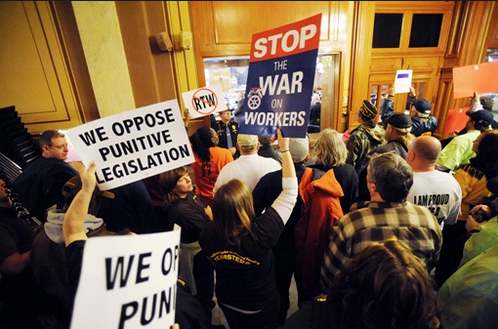
    Workers in Indiana opposing HB 1104. Image from PR Watch.

    ‘Right to Work (for Less)’ in Indiana:
    The historic battle against workers

    By Harry Targ / The Rag Blog / January 17, 2012

    WEST LAFAYETTE, Indiana — Fifty working people assembled at a town hall meeting in West Lafayette, Indiana, on Saturday, January 14, to share information about the latest phase of Indiana’s battle over a new “Right-to-Work-for-Less” bill. The bill will be voted upon some time in the coming week.

    One of the minority Democrats in the State House, Sheila Klinker, described the Republicans’ fast-track effort to get their Right-to-Work bill through the legislature and signed by Governor Mitch Daniels well before the National Football League Super Bowl game on February 5. The NFL players union has strongly condemned the bill.

    Labor activists had attended the Governor’s State-of-the-State address three days earlier and booed him loudly as he made claims about how Right-to-Work would bring jobs to Indiana (even though he has already praised himself for alleged increases in new investors and jobs in the state during the first seven years of his reign without being a Right-to-Work state).

    The Klinker update included reference to the upcoming meeting of the Indiana House of Representatives at which time that body will vote for and probably endorse the bill. Republicans have a 60-to-40 vote majority in that body (and an even bigger majority in the State Senate). Despite the odds, she and her Democratic colleagues support an amendment to the bill which would bring the issue to voters next fall in a referendum.

    Although chances of blocking the national reactionary big money juggernaut and the state Chamber of Commerce from getting their way are slim, those for the referendum argue that, because the issue is not well-understood, many Hoosiers remain undecided about it. Since the bill would have such great consequences for workers, union and non-union alike, time to get educated and discuss it is desirable. Also, from the standpoint of most Democrats, a referendum would defuse the escalating political conflict around the state.

    Most Indiana Republicans and the big money outside interests represented by such groups as the National Right to Work Committee and the America Legislative Exchange Council (ALEC), want to move as quickly as possible. For them Indiana is a bellwether state in the former industrial heartland where unions have been historically strong, wages and benefits were good, and workers had a greater voice in the work place and the voting booth.

    Generally, worker rights of all kinds have been superior in the Midwest compared with the 22 states of the South and Southwest where Right to Work is the law. After the 2010 election these national organizations increased efforts to apply their own “domino theory” to destroy worker rights.

    With the victories of reactionary candidates in Wisconsin, Ohio, Michigan, and Indiana reestablishing Right to Work in one state would lead, like a series of falling dominoes, to victories in the rest. (They have already suffered setbacks in this plan in Wisconsin and Ohio.) Indiana, the most conservative of these would be the best place to start. Reestablish Right to Work in Indiana (for a short time in the 60s, Indiana was a RTW state), and the other states would follow.

    The Klinker update was followed by two impressive presentations by Tippecanoe County Building and Construction Trade Council President Eric Clawson and Treasurer James Ogden. Clawson gave an impassioned description of what unions meant to all workers. With both heart and intellect he made it clear that the quality of life and work would be made immeasurably worse if union rights were weakened by the Right-To-Work bill.

    Ogden referred to numerous studies as he meticulously challenged each claim made by the bill’s supporters. These studies, often based on comparative data between the 22 Right-to-Work states and the rest, have overwhelmingly shown that the 22 have had less job creation, lower wages, worsened health and safety standards, and lowered public school graduation rates.

    Even though factors other than Right-to-Work status are also causally connected to these negative worker outcomes, Ogden and Clawson made it clear that the basic standard of living of most workers is hurt by any weakening of the right of workers to form and participate in unions.

    It is important to understand that the struggle today in Indiana is part of a 250 year struggle waged off and on between capital and labor in the United States. From the formation of craft unions during the 1780s to the battle for the eight-hour day in the 1880s, to the use of police power, public and private, to destroy railroad and steel workers unions in the 1890s, to the massive general strikes, sit-ins, and other occupy movements of the 1930s, to the PATCO and Pittston strikes of the 1980s, workers have sought to defend their rights and their very survival.

    Capitalists have set out to make labor cheaper, more pliable, and vulnerable to shifts in profit-making from investments in factories to stocks, bonds and derivatives.

    This latest phase of the struggle has its roots in the passage of the National Labor Relations (or Wagner) Act in 1935. This Act, based on efforts by Congress and President Roosevelt to mollify workers, who were striking all over the country, established the machinery for workers to form unions and procedures for collective bargaining.

    From the time of the Unemployment Councils in big cities in 1931, to general strikes in 1934, to factory sit-ins, to the establishment of 40 unions of industrial workers, four million workers strong, in the Congress of Industrial Organizations (CIO) in 1936, labor became a force to be reckoned with in national politics.

    The peak of labor strength was reflected in the 1946 strike wave, the largest in U.S. labor history. Four million workers walked off the job in electronics, steel, auto, meat packing, mining, and the railroads. Workers wanted wartime caps on wages lifted, continuation of wartime price controls, greater union recognition at the workplace, health and pension systems, and the creation of a political system in which the political power of labor would be as strong as capital.

    However, in the 1946 elections, Republicans gained control of both houses of Congress. A first order of business (much as in the 2012 Indiana legislature) was to destroy the power of organized labor. They passed the odious Taft-Hartley Act which was designed to defend the rights of capital in opposition to the National Labor Relations Act which was seen as special interest labor legislation.

    Taft-Hartley banned the closed shop, wildcat strikes, strikes in solidarity with other workers, secondary boycotts, and picketing, and gave the federal government the right to order striking workers to abandon strikes and return to work for 80 days. The act also established rules regarding reporting of finances and constricted the rights of unions to support political campaigns.

    Taft-Hartley also required union leaders to sign affidavits proclaiming that they were not members of the Communist Party. Refusal to sign such statements could allow workers to challenge the authority of their unions to continue to represent them. Anti-Communist unions, it was hoped, would replace unions in which leaders failed to sign the affidavits.

    Since labor radicals played an instrumental role in organizing the CIO, Taft-Hartley saw undercutting labor militancy as central to winning the battle for capital against labor in post-war America.

    To further limit the power of unions to represent the interests of all workers, Taft Hartley included Section 14b. This section allowed states to establish so-called Right-to-Work provisions. These provisions would allow workers to not join the unions that existed in their work sites. Unions were required to represent all workers in unionized work places, even those workers who refused to join their union.

    This meant that workers might take a “free ride” by getting important services, including negotiation of contracts and defense in grievances against bosses, without paying for them. The long-term impact, it was hoped, was to reduce the size and resources of organized labor.

    In 1947, when Taft-Hartley was passed, powerful economic actors such as the National Association of Manufacturers, the Chamber of Commerce, and huge auto, electronics, and meat packing corporations wanted to achieve several inter-connected goals.

    They wanted to destroy the power of organized labor which had grown from the streets and the workplaces to the Democratic Party.

    They wanted to launch an anti-Communist crusade to convince a skeptical American public that the United States needed to launch a Cold War against the Soviet Union, and alleged “communist” surrogates at home.

    And, Southern politicians, particularly, wanted to defeat “Operation Dixie,” a CIO campaign to organize integrated trade unions in the South.

    And, for sure, these economic interests wanted to disabuse American workers, unionized or not, of the idea that they had the right to participate in the political process equal to the wealthy and powerful.

    So listening to Hoosier union brothers and sisters speak out now at rallies, before television cameras, at town hall meetings, and in their communities and family gatherings, one feels pride and inspiration from the campaign to defeat Right to Work in Indiana.

    And any kind of historical reflection has to lead to the conclusion that today’s struggle is part of the same struggles that go back years and years. These struggles, dare to say, are class struggles. But today the occupy movement has made it clear that this historic battle is one between the 99 percent, for all its variation and the one percent. “Right-To-Work for Less” may pass in Indiana in 2012, but with odds like 99 percent versus one percent, it is clear which side will achieve lasting victory in the years ahead.

    [Harry Targ is a professor of political science at Purdue University who lives in West Lafayette, Indiana. He blogs at Diary of a Heartland Radical — and that’s also the name of his new book which can be found at Lulu.com. Read more of Harry Targ’s articles on The Rag Blog.]

    Harry Targ interviewed about ‘Right to Work’

    The Rag Blog

    Posted in Rag Bloggers | Tagged , , , , | Leave a comment

    William Rogers : Austin Workers Rally to Recall Scott Walker

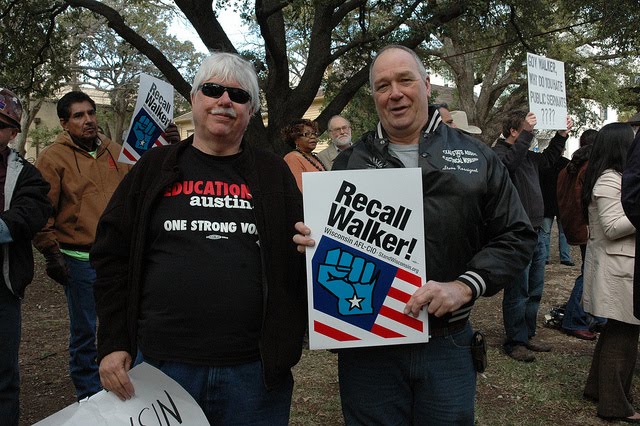
    At the Recall Walker rally in Austin: Travis Donoho, left, organizer for Education Austin (American Federation of Teachers) and Steve Rossignol, Texas State Association of Electrical Workers. Photo by Carlos Lowry / The Rag Blog.

    As Scott Walker speaks in Austin:
    Unions rally to support recall
    efforts of Wisconsin workers

    By William Rogers / The Rag Blog / January 16, 2012

    See more photos, Below.

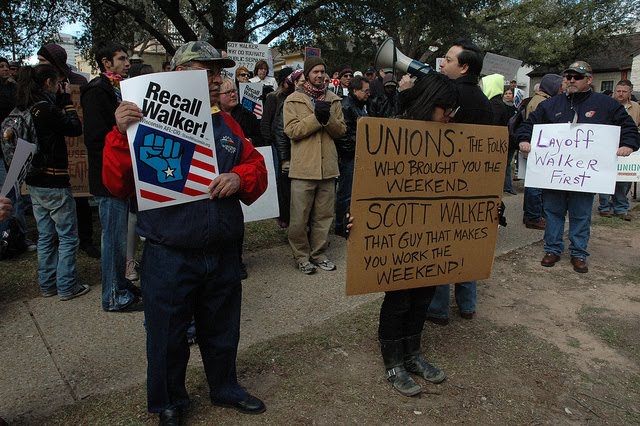
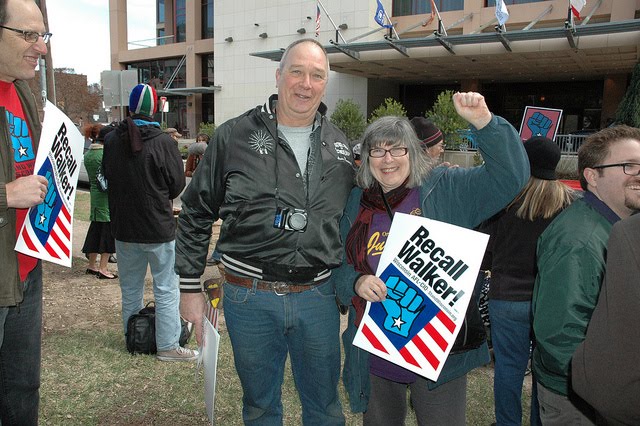
    AUSTIN — They carried “Recall Walker” signs, but they weren’t in Wisconsin. They were standing across the street from the Hilton Hotel in downtown Austin, Texas, where Wisconsin Gov. Scott Walker had come to address a gathering of conservative Texas lawmakers hosted by the Texas Public Policy Foundation on Thursday, January 12.

    They were numerous — as many as 150 — and they were loud. They chanted “Recall Walker” and “Do you like the unions? YES! Do you like Scott Walker? NO!”

    “We’re here today,” said Becky Moeller, Texas AFL-CIO president. “To support our brothers and sisters in Wisconsin in their effort to recall Gov. Walker.”

    Moeller went on to say that what happened last year in Wisconsin when Gov. Walker led the charge to roll back collective bargaining rights for public sector workers is happening all across the US. Right-wing billionaires like the Koch brothers and the organizations that they support like the Texas Public Policy Foundation (TPPF) and the American Legislative Exchange Council (ALEC) are working in unison with politicians like Gov. Walker to take back gains won by unions that have made possible a decent middle-class life for millions of workers in both the public and private sector.

    It happened in Ohio where last year lawmakers passed at the governor’s request a law restricting collective bargaining for public workers. (The law was subsequently overturned in November by a popular vote in a referendum.) It’s happening now in Indiana where the governor and lawmakers are trying to make Indiana a right-to-work-for-less state.

    They’re inside planning how to make it happen in Texas next year when the Legislature meets. That’s why, today, We are Wisconsin, Moeller said.

    The reality is that for the last 30 years, the rich have been waging class war on working people, said Snehal Shengavi, a member of the Texas State Employees Union CWA Local 6186 and the labor magnet for Occupy Austin. They have eroded our standard of living, frozen and cut our wages, taken away our jobs, cut our health care benefits, and made our retirement less secure.

    “The rich have gotten richer while the rest of us suffer,” Shengavi said. “It’s time to put them on notice that we know what class warfare is, and we’re going to take it to them. We’re putting class warfare on the agenda, and it’s going to be on our own terms. Occupy everything!”

    While demonstrators on the outside expressed their ire, TPPF welcomed Texas lawmakers and Gov. Walker to a luncheon at its annual forum where they discussed TPPF’s legislative agenda for the session that begins next year. Foremost on the agenda is a proposal to eliminate public pensions in Texas.

    Last summer a group of Houston millionaires led by hedge fund operator Bill King announced that they were kicking off a campaign to eliminate public pensions for Texas’ teachers, public safety employees, and other local and state government workers.

    In October, TPPF announced a plan for implementing King’s proposal. The plan would require legislative action, but if it passed, newly hired public employees would be diverted away from the state’s two public pension funds the Employee Retirement System for state employees and the Teacher Retirement System for teachers and into 401(k) type savings plans.

    Local government new hires would also be diverted from their traditional pension plans. People already working in the public sector would have their pensions frozen. With the severe cut in state contributions envisioned in this plan, it would be difficult to maintain benefits for retirees at their current levels.

    In the past, TPPF has supported legislation to privatize public services and give tax breaks to corporations. It also supports maintaining Texas’ right-to-work for less laws.

    A long list of unions were represented at the demonstration: American Postal Workers Union, National Letter Carriers Union, AFSCME, Teamsters, Texas State Employees Union, Machinist, IBEW, CWA, Stagehands (IATSE), Transport Communications Union, Texas Federation of Teachers, Education Austin, Texas State Teachers Association, Screen Actors Guild, Steelworkers, and IWW all had members there. Members of Occupy Austin were also on hand.

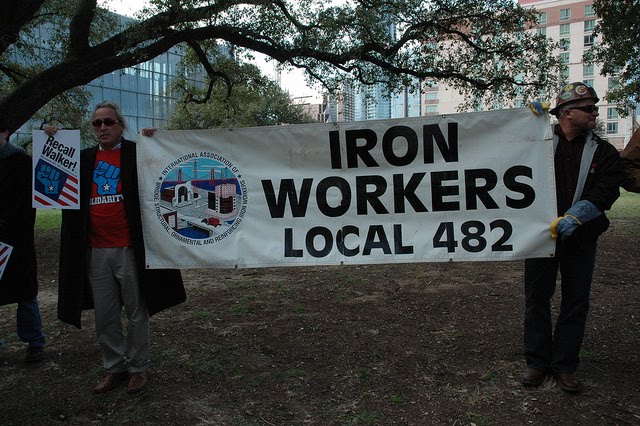
    As demonstrators chanted “We are the 99 percent,” a group of construction workers wearing their hardhats walked across the park next to the sidewalk where demonstrators gathered, stopped at the back edge of the demonstration, unfurled their banner that read Iron Workers Local 462, and began chanting.

    [William Rogers is a member of the Texas State Employees Union/CWA Local 6186. He blogs at Left Labor Reporter where this article also appears.]

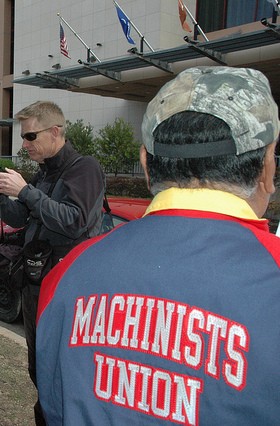
    Above, The Rag Blog‘s Alice Embree, Texas State Employees Union, with Steve Rossignol of the electrical workers. Photos by Carlos Lowry / The Rag Blog.

    The Rag Blog

    Posted in Rag Bloggers | Tagged , , , , , | 1 Comment

    Kate Braun : Dark Moon Magick

    Dark Moon. Image from The Sage Grove.

    Moon Musings:
    Dark Moon
    (January 20 – 22, 2012)

    By Kate Braun | The Rag Blog | January 16, 2012

    10 a.m. is the best time to perform Dark Moon magick for the garden. This moon-phase is excellent for removing what’s not needed, as gardening lore states that whatever is pruned, trimmed, weeded out, etc. during the moon’s fourth quarter and dark phases will not grow back.

    As you tidy your outside spaces, keep in mind that not only can you use this moon phase to create physical changes to your garden beds, you can also set forces in motion to effect change in your life on many levels.

    Whatever the area is that requires change (addiction, divorce, enemies, justice, obstacles, quarrels, removal, separation, stopping stalkers and theft are but some examples), a Dark Moon phase is when negative energies can be uprooted, removed, put into the spiritual compost pile and allowed to naturally decompose.

    While outdoor magicking is best done earlier in the day, the dark night is an excellent time to access Spirit via a scrying mirror or bowl because there will be no moon to reflect in the mirror or water. Be sure to have a notepad and pen nearby to record whatever you see in your scrying.

    To use a scrying mirror (which should be made of black glass, not glass painted black), prop the mirror up in a position where you will not see either your source of illumination or your reflection it in, using enough light to be able to see your hand in front of your face.

    Keep your focus soft as you contemplate the mirror’s inky surface. Relax. Do seven easy yoga-breaths (in through the nose, out through the mouth, breathing slowly and gently so that each inhalation fills all the empty spaces in the body and each exhalation empties those spaces; no gasping, no huffing and puffing) to settle into an Alpha-rhythm.

    Notice the mirror’s surface. You are likely to notice a change from black to smoky, rather like fog over a pond. You may see images form in the fog, you may see the fog clear to let you see images in the mirror. Make a note of what you see as the meaning may not be clear at the time you see the image.

    Scrying may also be done using a bowl of water instead of a mirror. It is best to use a dark-colored bowl, not a pale one. Position the bowl of water as you would the mirror: set it so that you can see the surface but not your face reflected in the surface or the light-source reflected on the surface. Then proceed as if you were using a mirror and see what visions come.

    If Friday, 1/20/12 is the best day for you to work with Dark Moon energies, the planetary influence will come from Venus, and rituals for love and attraction will work best. Use the color Green, touch the elements Earth and Water, and repeat your incantations seven times. Remember that you are working to manifest positive changes in your life; this is likely to mean that you should be prepared to release unwanted/unneeded things so as to make room for the newness you are seeking.

    If Saturday, 1/21/12, is a better day for this work, Saturn is the planet to invoke. Saturn’s color is black, appropriate for dark-moon magick; Saturn energy is helpful in rituals designed to control and focus your attention in ways that generate changes for the better. Ideally, let your bare feet make contact with Mother Earth, and recite your incantations three times.

    If Sunday, 1/21/12, is your choice for honoring this month’s Dark Moon, use the color yellow (for Lord Sun), use rituals that promote opportunities for money, health, and positive friendship-related matters. Use candles for the Fire element Lord Sun requires as well as to illuminate your scrying efforts. Repeat your incantations six times.

    There is no right or wrong way to celebrate the various moon phases. Remember that intent is the most important part of any ritual. From this choice of days to honor the Dark Moon, the best day is Saturday, 1/21/12; that does not mean that to perform Dark Moon ceremonies on either of the other two days would generate results different from what you intend, only that your focus will need to be sharper and stronger on Friday and Sunday than on Saturday. The choice is always yours.

    [Kate Braun‘s website is www.tarotbykatebraun.com. She can be reached at kate_braun2000@yahoo.com. Read more of Kate Braun’s writing on The Rag Blog.]

    The Rag Blog

    Posted in Rag Bloggers | Tagged , , , , , | Leave a comment

    Ted McLaughlin : Class Conflict and the Disappearance of the Middle Class


    Class conflict rises
    as middle class disappears

    The growing inequality of wealth and income in this country has reached a point where it is now causing a conflict between the rich (the 1%) and the vast majority of Americans.

    By Ted McLaughlin / The Rag Blog / January 16, 2012

    The graphic above (from Think Progress) shows what has been happening to the American middle class in the last 40 years. To put it bluntly, it is disappearing. While the rich continue to get much richer (with their income growing by over 240% since 1980), the loss of millions of jobs and the stagnant non-growth of wages for most Americans has shrunk the middle class and thrown many more Americans into working class status (if they’re lucky) or even worse, into abject poverty.

    The Republican “trickle-down” economic policies, instituted by Ronald Reagan and accelerated by George W. Bush, deregulated financial institutions and encouraged Wall Street to play dangerous games with investor funds — culminating in the loss of trillions of dollars, many millions of jobs, and the start of the most serious recession since the Great Depression. In addition, these same politicians encouraged corporations to outsource millions more American jobs by rewarding them with tax breaks.

    The idea was that when the rich and corporations had a lot of money they would use that money to create jobs and the growing wealth would be shared by everyone. It didn’t work, because the wealthy aren’t the real job creators — no matter how much money they have. This is clearly illustrated by our current situation — where the rich have a larger share of the country’s wealth and income since before the Great Depression and American corporations are sitting on trillions of dollars in cash. And yet only a pitiful handful of jobs are being created.

    There is only one thing that creates jobs — demand for goods and services. When the working and middle classes have money to spend demand is created, and jobs are created to meet that demand — and all classes in society benefit (including the rich). But Republican policies have taken money from the working and middle classes and given it to the rich. Since the mass of our society no longer has much money to spend, demand is depressed and the recession continues with little or no job creation.

    The chairman of the President’s Council of Economic Advisors, Alan Krueger, says the shift in income over the last three decades is the equivalent of moving $1.1 trillion from the 99% to the 1% every single year of those three decades. Is it any wonder that the middle class is disappearing, and we look more like a banana republic every day?

    Class distinctions were not important when our economy was working for everyone. But in this current economy, where the rich get richer and everyone else becomes poorer, class is again becoming an issue. It’s become an issue because the gap between the “haves” and “have-nots” is huge, and growing larger all the time.

    The Republicans and the 1% call this “class warfare,” but the truth is that the class war has been going on for the last 30 years — and it has been waged by the rich against the rest of America. But Americans are finally waking to realize what has been done to them over the last three decades by the rich (and their Republican lackeys).

    A recent survey by the Pew Research Center shows that a full two thirds of the population (66%) now believe there are “strong” or “very strong” class conflicts between the rich and the poor. That’s a jump of 19% over just two years ago, in 2009, when only 47% believed that. And this increased belief in this strong class conflict cuts across all ethnic, political, income, age, and education demographics. In the following list, I give the current percentage who believe this (followed by the 2009 percentage in parentheses):

    Total population……………66% (47%)

    Whites……………65% (43%)
    African-Americans……………74% (66%)
    Hispanics……………61% (55%)

    Republicans……………55% (38%)
    Democrats……………73% (55%)
    Independents……………68% (45%)

    Less than $20k……………64% (47%)
    $20k to $40k……………66% (46%)
    $40k to $75k……………71% (47%)
    Over $75k……………67% (49%)

    Age 18 to 34……………71% (54%)
    Age 35 to 49……………64% (48%)
    Age 50 to 64……………67% (45%)
    Over age 65……………55% (36%)

    College grad……………66% (48%)
    Some college……………70% (50%)
    High school or less……………64% (44%)

    The growing inequality of wealth and income in this country has reached a point where it is now causing a conflict between the rich (the 1%) and the vast majority of Americans. And it has also caused an erosion of the American dream.

    Many no longer believe the old canard that anyone can get rich in America because America has a vibrant class mobility. About 72% of those who say there is a strong class conflict, also say the rich got that way either because they were born into it or because they knew the right people — not because they earned it by working for it.

    The rich, through their Republican cohorts, may have started the class war back in 1980, but the rest of America is waking up and starting to fight back. It will be a long and tough fight though, because the rich and the corporations own far too many members of Congress. But that fight can be won — it must be won if democracy is to survive in America.

    [Ted McLaughlin also posts at jobsanger. Read more articles by Ted McLaughlin on The Rag Blog.]

    The Rag Blog

    Posted in Rag Bloggers | Tagged , , , , , | Leave a comment

    Paul Krassner : Predictions for 2012

    Lessee here: Paul Krassner will bring The Realist out of retirement, resurrect cartoonist Wally Wood, and publish a Republican Party Orgy centerfold. The Republican Party will not be amused.

    Predictions for 2012

    Ron Paul will unite with Ru Paul and they’ll perform on Dancing With the Stars.

    By Paul Krassner /The Rag Blog / January 12, 2012

    Politics: The electoral college will be replaced by a system where voters will choose the polling firm they trust the most. Barack Obama will be reelected because his vice-presidential running mate Joe Biden will be replaced by Hillary Clinton, thereby gaining the women’s vote. Failed Republican campaigners will all take other jobs. Mitt Romney will start smoking a pipe and portray the character Bob Dobbs in a movie about the cultish Church of the Subgenius. Newt Gingrich and Herman Cain will launch the bipartisan Adultery Party in 2016, joined by Democrats John Edwards and Bill Clinton.

    Ron Paul will unite with Ru Paul and they’ll perform on Dancing With the Stars. Rick Santorum will be caught in an airport bathroom stall enjoying a gay encounter. Michelle Bachmann will launch a lie-detector company. Rick Perry will copyright the word “Oops.” And it will be revealed that Donald Trump was actually born on Mars; he will have a birth certificate to prove it, along with a photo of him as a typical Martian baby with a comb-over.

    Show Business: Vegetarian converts will include Lady Gaga, who will wear a dress made entirely of heirloom tomatoes, and Meatloaf will change his name to Tofuloaf. Kermit the Frog and Miss Piggy will win Academy Awards for best male and female actors. Angelina Jolie will legally adopt Brad Pitt. Kim Kardashian will get married and divorced on the same day. The Tea Party will become a popular sitcom.

    Capital-punishment executions will become a top-rated reality-TV series. The Second Coming of Jesus Christ will occur live on a three-hour special to be telecast on every single channel simultaneously, with an offstage voiceover narration by God. Atheists and agnostics will picket the production, only to be struck by lightning. Howard Stern will expose himself on America’s Got Talent. The Taliban and al-Quaeda will be the final competitors on The Biggest Terrorists. Hulu and Netflix will merge as Huflix.

    Fashion Trends: Square Hitler-style mustaches will finally become stylish after decades of ridicule. Botox will become a soft drink that will get rid of unwanted wrinkles from the inside. Pornography will be allowed in public libraries, but moaning out loud will definitely not be permitted. Fetus transplants from poor pregnant girls to wealthy anti-abortion women will become a controversial new fad.

    Arizona, Mississippi, and Tennessee will refuse to recognize Leap Year. Lottery winners will be fingerprinted. Private prisons will be turned into ashrams. Inspired by Steve Jobs, many industries will continue his legacy by transforming planned obsolescence into a virtue. Prescription drugs will become children’s names, such as Ambien and Lipitor. Travel agents will begin arranging guilt trips for clients who have given up on airplanes.

    Combination vibrators and insomnia cures will be invented, trademarked as Dildoze. Pope Benedict XVI will permit condoms to be marketed if there are tiny pinhole pricks in the reservoir tips in order to ensure a fighting chance for spermatozoa to get through. Serial pedophiles, gay bashers, and Internet hackers will form unions.

    The Economy: The Department of Energy will release a report concluding that so-called “clean coal” is, in point of fact, “filthy dirty.” The Bank of America will stop doing business with Verizon and switch to Credo. The largest protest in history will take place by ongoing Occupy-the-Federal-Reserve-System demonstrations.

    The recession will evolve into a depression, which will end quickly as the war on drugs morphs into the legalization of every single strain of cannabis which will be designated as medical marijuana. Facebook members will be taxed for every friend, Twitter users will be taxed for every tweet, Monsanto will be taxed for every genetically modified food, and masturbators will be taxed for every ejaculation. The Supreme Court will download all corporations into embryos. Several million jobs will be created as Unemployment Insurance clerks.

    International Relations: North Korea’s new Beloved Leader will be caught cheating on his SAT examination, but he will redeem himself when he
    allows almost 70 McDonalds restaurants to open all over his dictatorial realm; however, in keeping with his father’s policies, he won’t allow them to sell any food. Saudi-Arabia will outlaw laughter. Iraq will become our 51st state. Afghanistan will require all men to wear burkas. Iran will develop a nuclear bomb, than drop it by accident on Libya and Syria.

    World War III will be fought entirely by drone planes attempting to destroy each other in the air. Products made in China will be increasingly pirated by American entrepreneurs. Global warming will continue to melt icebergs as well as Sarah Palin’s cold heart. The world will end on December 21st, but will begin all over again on December 23rd, just in time for last-minute Christmas shopping. The most popular gift will be cans of pepper-spray in a variety of flavors. Pakistan will continue to be bribed by us. And the Nobel Peace Prize will be secretly awarded to Anonymous.

    [These predictions for 2012 were originally published in Metro Newspapers. Paul Krassner publishes the infamous Disneyland Memorial Orgy poster. His latest book is an expanded and updated edition of his autobiography, Confessions of a Raving, Unconfined Nut: Misadventures in the Counterculture, available at paulkrassner.com and as a Kindle e-book. Read more articles by Paul Krassner on The Rag Blog.]

    The Rag Blog

    Posted in Rag Bloggers | Tagged , , , | 2 Comments

    Tony Platt : Remembering Alex Haley and Mario Savio

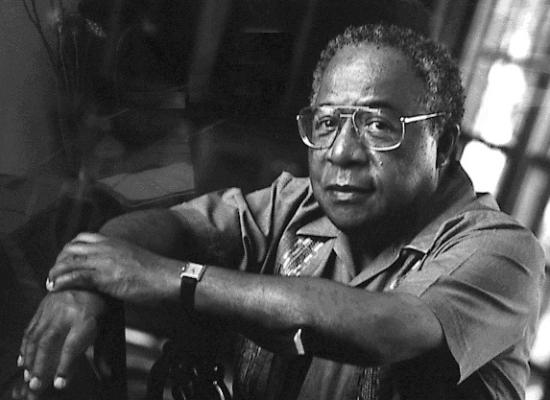
    Alex Haley. Image from Gather.

    A Better Day:
    Remembering Alex Haley and Mario Savio

    By Tony Platt / The Rag Blog / January 12, 2012

    Let me drink from the waters
    where the mountain streams flood
    Let the smell of wildflowers
    flow free through my blood
    Let me sleep in your meadows
    with the green grassy leaves
    Let me walk down the highway
    with my brother in peace
    Let me die in my footsteps
    
Before I go down under the ground

    — Bob Dylan, “Let Me Die in My Footsteps,” 1963

    In 1963 I moved from England to California, in part to get as far away as possible from my father’s overbearing influence. The political divide between us had deepened as I embraced Marxism and the New Left, while he shunned anything smacking of isms, except capitalism.

    As he soured on politics, I was ready to be inspired by Mario Savio standing on a police car in Berkeley’s Sproul Plaza, urging us to put our bodies on the gears and wheels of the machine in order to make it stop; and by Malcolm X, as channeled by Alex Haley, saying it was possible for black and white to unite and fight. “In our mutual sincerity we might be able to show a road to the salvation of America’s very soul.”

    My father and I, as it turns out, shared a very similar political trajectory: unrealistic optimism followed by pessimistic realism. For Monty, the 30s promised global socialism. For me, the 60s was a vibrant and hopeful era, with socialism spreading throughout the world, social democracy coming to the West, and colonialism on the run in the Third World.

    The collapse of utopian dreams is always rupturing, and always unexpected. The rise and fall of Alex Haley, and the spirit and untimely death of Mario Savio epitomize for me the hope and demise of the New Left.

    Alex Haley was an unlikely hero. Without any formal training in history, not even a college degree, he wrote two bestsellers that more than any other books written about the United States in the twentieth century changed the public conversation about race.

    In The Autobiography of Malcolm X (1965), he made a black revolutionary into a popular, cultural icon and a model of redemption. And his book Roots: The Saga of an American Family (1976) – and, more important, the television mini-series on which it was based — are credited with generating an unprecedented black-white dialogue, as well as a compelling origins story.

    Six million copies of Malcolm X were sold by 1977 and 130 million viewers watched Roots.

    Haley wasn’t a particularly good historian. He lifted whole sections from another author’s book for Roots; his ties to his supposed African ancestor, Kunta Kinte, are likely fictional; and recent research on Malcolm X has blown huge holes in Haley’s hagiography. But he was a hell of a good storyteller and the stories he told resonated with millions of people.

    I got a sense of his rock-star popularity in 1989 when he visited Sacramento State University, where I was teaching at the time. Nobody seemed to care about his oddly Republican politics, or the plagiarism charges, or sloppy scholarship. “You are the answer to the prayer of our ancestors who hoped during uncertain, terrible times that there would be a better day,” was his upbeat message spoken to a large, mostly youthful crowd on a crisp, fall day.

    He seemed to look each of us directly in the eye, urging us to find common ground, telling us what we had come to hear. He was on the road, giving his stump speech, the talk that he had delivered so many times since Roots that the only notes he needed were the ones reminding him where he was and to whom he was speaking.

    Some of my friends were disappointed because they expected something new or different. But most people there wanted to hear the familiar speech, delivered in his unpretentious style, a message of reassurance and comfort. He told us the story about how he came to write Roots. Like all good folk tales, we wanted to hear the ending that we already knew.

    Although Haley’s speech seemed to ramble from anecdote to anecdote, it was in fact finely honed and crafted, a mosaic of disparate threads. Constructed around a narrative that traced his life from childhood to the present, his story was crammed full of moral lessons, biographies, autobiography, motherwit, and parables.

    Haley’s message was relentless: a people whose voice has been long silenced and whose vision has been long hidden from history in fact possess a wondrous past that can’t be denied. The crowd listened closely, imagining the untold stories of our individual pasts and the unexplored potentiality of our collective futures. And in case we missed the point, the motif on his stationary proclaims: “Find The Good – And Praise It.”

    Haley’s stories moved easily between experience and imagination, a talent that upset critics who prefer writers to come packaged in appropriate boxes — fictional or non-fictional. By this time, Haley probably wasn’t sure which was which. In Roots, he invented dialogue. Malcolm X wanted Haley to serve as his recorder and clean up his grammar, but Haley engaged his subject in a passionate dialogue that resulted in a memorable book of many voices.

    Haley left the Coast Guard in 1959 after a 21-year enlistment. He was 38 years old, searching for a new career. He was an outsider to academia — he had quit college after two unsuccessful years, despite the advice of his professorial father — and regarded as an interloper by the Negro literati who, with one notable exception, had no time for a writer who had learned his craft writing love letters for illiterate sailors and public relations pieces for Uncle Sam.

    When C. Eric Lincoln, a fellow writer and authority on black Muslims, proposed Haley’s membership in an African American academic group in the early 1960s, years before he became a celebrity, he was voted down because he lacked proper credentials. In response to his inquiry to leading black writers, asking for their advice about how to make it as a freelance journalist, James Baldwin, fresh from his success with Go Tell It On The Mountain and Notes of a Native Son, was the only who took time to see Haley and give him tips about how to survive in New York’s cutthroat literary circles.

    Years later, the tables were turned: Haley’s books were selling in the millions and Baldwin was struggling to survive, economically and physically. When Baldwin called, asking for advice and a “loan,” Haley quickly wrote him the first of many checks, “never more than just a few thousand.” Haley told me that he would never forget the “thin-as-a-willow-reed” writer whose generosity defied the snobbish intellectuals who had turned their backs on a struggling writer without status. Later, when Roots made Haley a rich man, he turned over the royalties of The Autobiography to Malcolm X’s widow, Betty Shabazz.

    Though he got paid well to visit Sacramento State for half a day, there was no show-biz glamour or phalanx of security guards. He walked slowly through the campus, portly and easy-going, stopping to greet the constant stream of admirers who let out squeals usually reserved for movie stars. They came up asking for autographs or to shake his hand, but quickly found themselves answering his questions about their roots.

    Still, he was never really comfortable in the public spotlight or around intellectuals. He preferred writing about legends than being one. And so every year, once in the summer and once in the winter for two months at a time, he would retreat to the “fruitful writing isolation of a cargo ship,” crisscrossing the Atlantic and Pacific just as he had done in the Coast Guard.

    “It is my impression,” Haley wrote to me during a slow trip to Australia, “that academia contains some of the more grudging folk in this world. With no respect whatever to the institution of academia, I counted one of my luckier things that I did not become a scholar, as my professor father very strongly intended. In fact, there were three sons of us for whom he had this intention, and we turned out to be writer, lawyer, and architect. Dad, bless his heart, was still nonetheless proud of us.”

    When Haley finished his talk in Sacramento and the audience rose to give him a standing ovation, I realized that this was the first time I had ever been part of a truly multicultural audience on campus. For a brief moment, the university actually reflected the diversity of our community.

    Hundreds of black high school kids, most of whom will never make it to any university under our current system, had come to witness the rare spectacle of an African American as an American hero. They were loud and boisterous during Haley’s speech and, after it was over, they had a purposeful gleam in their eyes, a renewed determination to envision a better day.

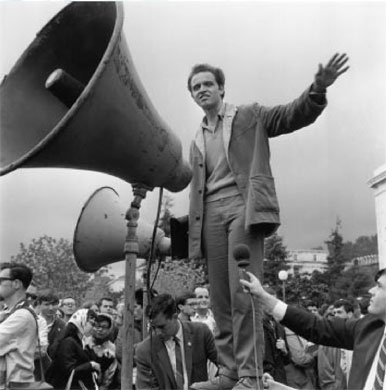
    Mario Savio on the steps of Sproul Hall, Berkeley, December 2, 1964. Image from WSU Libraries.

    Alex Haley’s ability to reach and move a crowd reminded me of the time that 22-year-old Mario Savio reached and moved me. I was in my second year as a graduate student in Berkeley in 1964 when Savio, in protest of the university’s ban on political speech, told a campus crowd on December 2nd that “there’s a time when the operation of the machine becomes so odious — makes you so sick at heart — that you can’t take part.” Drawing upon imagery from Thoreau, he called upon to us practice civil disobedience and to jam the gears of the machine.

    That day, Savio and 800 others were arrested in Sproul Plaza. I supported the Free Speech Movement, but avoided arrest then since I was nervous about my immigration status. (About a decade later, I’d make amends by getting arrested twice during People’s Park protests at the same site.)

    The FSM was a defining moment for activism in the 1960s and for my own political development. Poised between the civil rights struggles of the previous decade and the promise of the antiwar and feminist movements ahead, it offered our generation of students the opportunity to participate in history, to be activists in our own right rather than vicarious participants in other people’s struggles.

    It was a joy to feel that we might be part of an emergent majority, with the moral authority of justice on our side for once. Savio was not the only leader of the student movement, but his example of self-sacrifice moved many people like myself to deeply consider our political commitments and to put our beliefs into practice. Also, it helped that we were on the winning side: the university revoked its ban on political speech.

    Thirty years later, in 1994, I was back in Sproul Plaza for the Free Speech Movement’s reunion. In the intervening years, my political activism cost me my job at Berkeley, but I was lucky to get a tenure-track job at Sacramento State. Mario had not been as lucky. It took him until 1984 to get a science degree and until 1989 to get his master’s degree.

    He was nearly 50 years old when he started teaching math and philosophy as a lecturer at Sonoma State University. By then the boom years in academia were over and part-time jobs were the norm.

    There was a large crowd on hand at the reunion, including a new generation of activists who were eager to witness a slice of history and hear old-timers justify our pasts. Mario Savio — now graying, balding, and pony-tailed, like many of us in the crowd — spoke with vigor and eloquence about our legacy, likening us in the words of T.S. Eliot to “the hidden laughter of children in the foliage.” There we had been, in the margins and shadows of political power, but still alive and kicking, “sudden in a shaft of sunlight even while the dust moves.”

    Mario was not there that December day in 1994 to sentimentalize or bury our movement. If it had been hard on him to live with fame and notoriety in the aftermath of the 1960s, it was even harder to be treated in the 1990s as an icon of a long-gone past. He insistently spoke to the present, of the growing boldness of an increasingly reactionary political system, attacks on immigrant and women’s rights, and the rollback of civil rights gains. Be vigilant, don’t mourn, and get organized, he told us.

    A few months later, Mario and I worked together in the Campus Coalitions for Human Rights and Social Justice, a loose-knit organization of campus activists in northern California. Our challenge, no less, was to go against the tide of immigrant bashing, prison building, and welfare cutting. In particular, we focused our efforts on opposing the so-called California Civil Rights Initiative, which as Proposition 209 on the 1996 ballot asked voters to go beyond even the most conservative Supreme Court decisions to end all forms of state-supported affirmative action.

    It was an uphill battle. Mario had been more hopeful than most of us that the attack on affirmative action would generate a political revival by combining youthful idealism with wise experience, creating the basis for a new, vibrant, cross-generational movement. Pity he didn’t live to see the rise of the Occupy movement; he would have been out there on the front lines.

    It was difficult for him to accept the degree to which universities had by the 1990s become sites of demobilization and cynicism. When his health, already a problem for many years, got worse, his friends urged him to slow down and take it easy, which, for a short while, he did. “Obviously I needed to pull back,” he wrote me in May of 1996. “In the past I have not had the good sense to read my own signals right. Guess I’m growing up — at last, and just in time!”

    But, quickly, he was back in the fray, compelled by the news that the anti-affirmative action forces were in disarray and that, with enough effort and work, we had a chance to defeat Proposition 209. Mario worked with his son Nadav day and night to produce a pamphlet, “In Defense of Affirmative Action,” which was used widely on campuses in the last few weeks of the campaign. It helped to close the gap in the polls, but with insufficient money, the damning of faint support by the National Democratic Party, and a low voter turnout, our anti-209 campaign failed by eight points.

    Mario suffered a heart attack and went into a coma a few days before the elections, and died the day after without regaining consciousness. He left life as he lived it, intensely committed and passionate in his public politics, gracious in private to his friends. I miss his shaft of sunlight.

    • Alex Haley (1921-1992)
    • Mario Savio (1942-1996)

    [Tony Platt is the author of 10 books and 150 essays and articles dealing with issues of race, inequality, and social justice in American history. He has written for the Los Angeles Times, San Francisco Chronicle, Truthdig, History News Network, Z Magazine, Monthly Review, and the Guardian. Platt, now an emeritus professor living in Berkeley, California, taught at the University of Chicago, University of California (Berkeley), and California State University (Sacramento). This article was also posted to his blog, GoodToGo. Read more articles by Tony Platt on The Rag Blog.]

    The Rag Blog

    Posted in Rag Bloggers | Tagged , , , , , , , | Leave a comment

    Alan Waldman : My 10 Favorite Films of 2011

    Octavia Spencer in The Help.

    The Help is powerful, complex:
    My 10 favorite films of 2011

    By Alan Waldman / The Rag Blog / January 11, 2012

    As was the case last year, some of the films I was most anticipating (The King’s Speech then, The Descendants now) hadn’t played in my hometown of Corvallis, Oregon, by the time I was compiling my list, so they will be eligible for next year’s list.

    In addition to those 2011 films listed below (in order of preference) my wife Sharon and I also really enjoyed these slightly older films that we saw via Netflix: the 2007 French film Farewell, the 1998 Australian film 15 Amore and the 2007 American film Honeydripper; we strongly recommend all of them to you.

    Years ago my list of favorite films numbered as many as 30, but it has gotten shorter as more stupid films are made for teenagers and fewer good, smart films for adults make it to U.S. screens. And this year, as for each of the past dozen or so, we have seen many more excellent TV series (including foreign ones, via Netflix) than we have feature films, because TV writers are given more creative freedom and are constrained much less by studio executives who are trying to replicate what worked previously with audiences.

    (Most of the listed films are currently available on DVD and Netflix.)

    1. THE HELP, justifiably nominated for more than 60 awards — many of them for stunning newcomer Jessica Chastain — is a powerful, complex, wonderfully detailed period drama about middle-class racism in the 1960s in Jackson, Mississippi. Viola Davis and Octavia Spencer were outstanding and also have numerous award nominations for their performances as maids who reveal their mistreatment by their white employers to a young book writer. This film is extremely moving, but it also has humor, drama, surprise, and lots of fascinating characters. This topic has been covered many times before, but this film brought a fresh take to it that makes it especially satisfying.
    2. THE KING’S SPEECH was nominated for 12 Oscars last year, winning Best Picture, Best Screenplay, Best Director, and Best Actor (Colin Firth). It should also have won for best supporting actor (Geoffrey Rush), who took the top two British acting awards for it. Fully 95% of the 215 critics polled at rottentomatoes.com gave it thumbs up. It wonderfully dramatizes the true story of England’s King George VI, who went to an eccentric speech therapist in order to overcome a terrible stutter and be able to powerfully address his nation on the radio at the brink of World War II. Outstanding and not to be missed.
    3. THE GUARD is a hilarious Irish film, brilliantly written and directed by John Michael McDonagh (whose brother Martin McDonagh wrote and helmed the great 2008 film In Bruges). In both films, the dialogue is unexpected, fresh, intelligent and very, very funny. The Guard stars Irish treasure Brendan Gleeson as a rural Western Ireland cop who is partnered with an American FBI agent (Don Cheadle — terrific as usual) in pursuing international drug dealers. This comedy thriller is satisfying on many levels and is constantly surprising. It was a hit with 95% of critics and has been nominated for 18 awards in six countries so far. (I recommend watching the DVD with the English subtitles, because the jokes come fast and are sometimes a little difficult to catch in the Irish accent.)
    4. TINKER, TAILOR, SOLDIER, SPY is a terrific, smart, gripping remake of the classic John Le Carré novel and miniseries about the Cold War search for a mole near the top of Britain’s MI-6 spy agency. Gary Oldman, one of Britain’s finest actors, leads a strong cast, including Colin Firth, John Hurt, Toby Jones, Ciarán Hinds, and Mark Strong. The script is wonderfully twisty and suspenseful, and everything about the production is first-class.
    5. P0TICHE (TROPHY WIFE) is an excellent French comedy starring Catherine Deneuve as the woman who is forced to replace her tyrannical umbrella factory owner husband when the workers strike and take him hostage. Gérard Depardieu, France’s greatest actor for the past 37 years, is superb, as always. This is a zestful production with a witty script and fine performances.
    6. Michael Nyqvist stars in As It Is in Heaven.

    7. AS IT IS IN HEAVEN is a charming, Oscar-nominated Swedish film about a symphony conductor, well played by Michael Nyqvist (co-star of the Girl With the Dragon Tatoo trilogy and villain of the latest Mission Impossible) who retires to his small hometown in northern Sweden and is lured into listening to his church choir and giving them suggestions. Great characters; great fun.
    8. THE CONCERT is a highly enjoyable Russian/French film about a Bolshoi Orchestra conductor who was fired years before for using Jewish musicians, but who now intercepts an invitation to perform in Paris and who puts his old orchestra back together. This film is full of quirky characters, great music and charming surprises.
    9. HUGO is another monumental film from America’s greatest filmmaker, Martin Scorsese. In 3-D or the 2-D version, it is visually stunning, emotionally stirring, and very well played by a diverse cast including Ben Kingsley, Sasha Baron Cohen, and Emily Mortimer. It tells the story of an orphan who secretly winds the clocks at a Paris railroad station and who meets an eccentric toy shop owner who turns out to be the legendary French filmmaker Georges Méliés. Among the many, many delights in this masterwork are the recreations of Melies’s pioneering movies. Hugo was loved by 94% of critics.
    10. THE LINCOLN LAWYER is a sharp, suspenseful, beautifully realized treatment of an outstanding Michael Connelly novel. Matthew McConaughey is very good as a lawyer who works out of his car and who seeks to defend a realtor (Ryan Phillipe) who is accused of rape, but who may not be innocent.
    11. BRIDESMAIDS is one of the funniest movies of the year, starring and wonderfully co-scripted by SNL’s Kristin Wiig. A Canadian critic called it “touching and funny and a little bit sickening — just like a real wedding.” Contains some outrageous comedy bits.

    We saw and loved lots of top TV series (mostly British) via Netflix, including episodes of Poirot, Law & Order: UK, Identity, The Robinsons, Reggie Perrin, Kavanagh QC, Murder Investigation Team, Gavin & Stacey, Inspector Lynley, Midsomer Murders, Murderland, Damages, Justified, Leverage, Inspector Morse, Inspector Lewis, Treme, Boardwalk Empire, New Street Law, MI-5, Boomtown, Life, Nurse Jackie, Luther, The Hour, The Pillars of the Earth, and The Tudors.

    [Houston native Alan Waldman is a former editor at Honolulu Magazine and The Hollywood Reporter.]

    The Rag Blog

    Posted in Rag Bloggers | Tagged , , , | 5 Comments