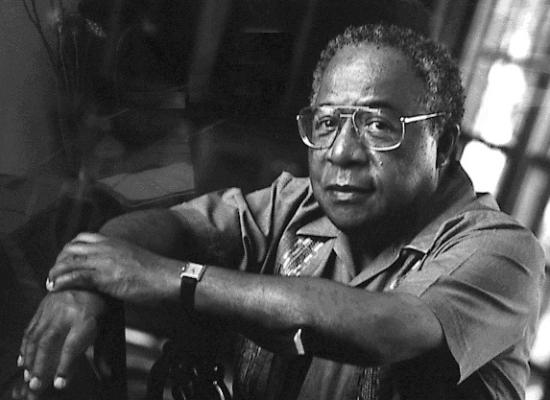
Alex Haley. Image from Gather.

A Better Day:
Remembering Alex Haley and Mario Savio

By Tony Platt | The Rag Blog | January 10, 2012

Let me drink from the waters
where the mountain streams flood
Let the smell of wildflowers
flow free through my blood
Let me sleep in your meadows
with the green grassy leaves
Let me walk down the highway
with my brother in peace
Let me die in my footsteps

Before I go down under the ground

— Bob Dylan, “Let Me Die in My Footsteps,” 1963

In 1963 I moved from England to California, in part to get as far away as possible from my father’s overbearing influence. The political divide between us had deepened as I embraced Marxism and the New Left, while he shunned anything smacking of isms, except capitalism.

As he soured on politics, I was ready to be inspired by Mario Savio standing on a police car in Berkeley’s Sproul Plaza, urging us to put our bodies on the gears and wheels of the machine in order to make it stop; and by Malcolm X, as channeled by Alex Haley, saying it was possible for black and white to unite and fight. “In our mutual sincerity we might be able to show a road to the salvation of America’s very soul.”

My father and I, as it turns out, shared a very similar political trajectory: unrealistic optimism followed by pessimistic realism. For Monty, the 30s promised global socialism. For me, the 60s was a vibrant and hopeful era, with socialism spreading throughout the world, social democracy coming to the West, and colonialism on the run in the Third World.

The collapse of utopian dreams is always rupturing, and always unexpected. The rise and fall of Alex Haley, and the spirit and untimely death of Mario Savio epitomize for me the hope and demise of the New Left.

Alex Haley was an unlikely hero. Without any formal training in history, not even a college degree, he wrote two bestsellers that more than any other books written about the United States in the twentieth century changed the public conversation about race.

In The Autobiography of Malcolm X (1965), he made a black revolutionary into a popular, cultural icon and a model of redemption. And his book Roots: The Saga of an American Family (1976) – and, more important, the television mini-series on which it was based — are credited with generating an unprecedented black-white dialogue, as well as a compelling origins story.

Six million copies of Malcolm X were sold by 1977 and 130 million viewers watched Roots.

Haley wasn’t a particularly good historian. He lifted whole sections from another author’s book for Roots; his ties to his supposed African ancestor, Kunta Kinte, are likely fictional; and recent research on Malcolm X has blown huge holes in Haley’s hagiography. But he was a hell of a good storyteller and the stories he told resonated with millions of people.

I got a sense of his rock-star popularity in 1989 when he visited Sacramento State University, where I was teaching at the time. Nobody seemed to care about his oddly Republican politics, or the plagiarism charges, or sloppy scholarship. “You are the answer to the prayer of our ancestors who hoped during uncertain, terrible times that there would be a better day,” was his upbeat message spoken to a large, mostly youthful crowd on a crisp, fall day.

He seemed to look each of us directly in the eye, urging us to find common ground, telling us what we had come to hear. He was on the road, giving his stump speech, the talk that he had delivered so many times since Roots that the only notes he needed were the ones reminding him where he was and to whom he was speaking.

Some of my friends were disappointed because they expected something new or different. But most people there wanted to hear the familiar speech, delivered in his unpretentious style, a message of reassurance and comfort. He told us the story about how he came to write Roots. Like all good folk tales, we wanted to hear the ending that we already knew.

Although Haley’s speech seemed to ramble from anecdote to anecdote, it was in fact finely honed and crafted, a mosaic of disparate threads. Constructed around a narrative that traced his life from childhood to the present, his story was crammed full of moral lessons, biographies, autobiography, motherwit, and parables.

Haley’s message was relentless: a people whose voice has been long silenced and whose vision has been long hidden from history in fact possess a wondrous past that can’t be denied. The crowd listened closely, imagining the untold stories of our individual pasts and the unexplored potentiality of our collective futures. And in case we missed the point, the motif on his stationary proclaims: “Find The Good – And Praise It.”

Haley’s stories moved easily between experience and imagination, a talent that upset critics who prefer writers to come packaged in appropriate boxes — fictional or non-fictional. By this time, Haley probably wasn’t sure which was which. In Roots, he invented dialogue. Malcolm X wanted Haley to serve as his recorder and clean up his grammar, but Haley engaged his subject in a passionate dialogue that resulted in a memorable book of many voices.

Haley left the Coast Guard in 1959 after a 21-year enlistment. He was 38 years old, searching for a new career. He was an outsider to academia — he had quit college after two unsuccessful years, despite the advice of his professorial father — and regarded as an interloper by the Negro literati who, with one notable exception, had no time for a writer who had learned his craft writing love letters for illiterate sailors and public relations pieces for Uncle Sam.

When C. Eric Lincoln, a fellow writer and authority on black Muslims, proposed Haley’s membership in an African American academic group in the early 1960s, years before he became a celebrity, he was voted down because he lacked proper credentials. In response to his inquiry to leading black writers, asking for their advice about how to make it as a freelance journalist, James Baldwin, fresh from his success with Go Tell It On The Mountain and Notes of a Native Son, was the only who took time to see Haley and give him tips about how to survive in New York’s cutthroat literary circles.

Years later, the tables were turned: Haley’s books were selling in the millions and Baldwin was struggling to survive, economically and physically. When Baldwin called, asking for advice and a “loan,” Haley quickly wrote him the first of many checks, “never more than just a few thousand.” Haley told me that he would never forget the “thin-as-a-willow-reed” writer whose generosity defied the snobbish intellectuals who had turned their backs on a struggling writer without status. Later, when Roots made Haley a rich man, he turned over the royalties of The Autobiography to Malcolm X’s widow, Betty Shabazz.

Though he got paid well to visit Sacramento State for half a day, there was no show-biz glamour or phalanx of security guards. He walked slowly through the campus, portly and easy-going, stopping to greet the constant stream of admirers who let out squeals usually reserved for movie stars. They came up asking for autographs or to shake his hand, but quickly found themselves answering his questions about their roots.

Still, he was never really comfortable in the public spotlight or around intellectuals. He preferred writing about legends than being one. And so every year, once in the summer and once in the winter for two months at a time, he would retreat to the “fruitful writing isolation of a cargo ship,” crisscrossing the Atlantic and Pacific just as he had done in the Coast Guard.

“It is my impression,” Haley wrote to me during a slow trip to Australia, “that academia contains some of the more grudging folk in this world. With no respect whatever to the institution of academia, I counted one of my luckier things that I did not become a scholar, as my professor father very strongly intended. In fact, there were three sons of us for whom he had this intention, and we turned out to be writer, lawyer, and architect. Dad, bless his heart, was still nonetheless proud of us.”

When Haley finished his talk in Sacramento and the audience rose to give him a standing ovation, I realized that this was the first time I had ever been part of a truly multicultural audience on campus. For a brief moment, the university actually reflected the diversity of our community.

Hundreds of black high school kids, most of whom will never make it to any university under our current system, had come to witness the rare spectacle of an African American as an American hero. They were loud and boisterous during Haley’s speech and, after it was over, they had a purposeful gleam in their eyes, a renewed determination to envision a better day.

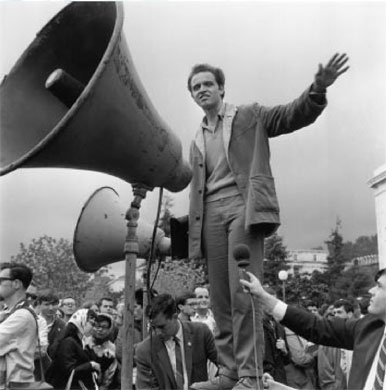
Mario Savio on the steps of Sproul Hall, Berkeley, December 2, 1964. Image from WSU Libraries.

Alex Haley’s ability to reach and move a crowd reminded me of the time that 22-year-old Mario Savio reached and moved me. I was in my second year as a graduate student in Berkeley in 1964 when Savio, in protest of the university’s ban on political speech, told a campus crowd on December 2nd that “there’s a time when the operation of the machine becomes so odious — makes you so sick at heart — that you can’t take part.” Drawing upon imagery from Thoreau, he called upon to us practice civil disobedience and to jam the gears of the machine.

That day, Savio and 800 others were arrested in Sproul Plaza. I supported the Free Speech Movement, but avoided arrest then since I was nervous about my immigration status. (About a decade later, I’d make amends by getting arrested twice during People’s Park protests at the same site.)

The FSM was a defining moment for activism in the 1960s and for my own political development. Poised between the civil rights struggles of the previous decade and the promise of the antiwar and feminist movements ahead, it offered our generation of students the opportunity to participate in history, to be activists in our own right rather than vicarious participants in other people’s struggles.

It was a joy to feel that we might be part of an emergent majority, with the moral authority of justice on our side for once. Savio was not the only leader of the student movement, but his example of self-sacrifice moved many people like myself to deeply consider our political commitments and to put our beliefs into practice. Also, it helped that we were on the winning side: the university revoked its ban on political speech.

Thirty years later, in 1994, I was back in Sproul Plaza for the Free Speech Movement’s reunion. In the intervening years, my political activism cost me my job at Berkeley, but I was lucky to get a tenure-track job at Sacramento State. Mario had not been as lucky. It took him until 1984 to get a science degree and until 1989 to get his master’s degree.

He was nearly 50 years old when he started teaching math and philosophy as a lecturer at Sonoma State University. By then the boom years in academia were over and part-time jobs were the norm.

There was a large crowd on hand at the reunion, including a new generation of activists who were eager to witness a slice of history and hear old-timers justify our pasts. Mario Savio — now graying, balding, and pony-tailed, like many of us in the crowd — spoke with vigor and eloquence about our legacy, likening us in the words of T.S. Eliot to “the hidden laughter of children in the foliage.” There we had been, in the margins and shadows of political power, but still alive and kicking, “sudden in a shaft of sunlight even while the dust moves.”

Mario was not there that December day in 1994 to sentimentalize or bury our movement. If it had been hard on him to live with fame and notoriety in the aftermath of the 1960s, it was even harder to be treated in the 1990s as an icon of a long-gone past. He insistently spoke to the present, of the growing boldness of an increasingly reactionary political system, attacks on immigrant and women’s rights, and the rollback of civil rights gains. Be vigilant, don’t mourn, and get organized, he told us.

A few months later, Mario and I worked together in the Campus Coalitions for Human Rights and Social Justice, a loose-knit organization of campus activists in northern California. Our challenge, no less, was to go against the tide of immigrant bashing, prison building, and welfare cutting. In particular, we focused our efforts on opposing the so-called California Civil Rights Initiative, which as Proposition 209 on the 1996 ballot asked voters to go beyond even the most conservative Supreme Court decisions to end all forms of state-supported affirmative action.

It was an uphill battle. Mario had been more hopeful than most of us that the attack on affirmative action would generate a political revival by combining youthful idealism with wise experience, creating the basis for a new, vibrant, cross-generational movement. Pity he didn’t live to see the rise of the Occupy movement; he would have been out there on the front lines.

It was difficult for him to accept the degree to which universities had by the 1990s become sites of demobilization and cynicism. When his health, already a problem for many years, got worse, his friends urged him to slow down and take it easy, which, for a short while, he did. “Obviously I needed to pull back,” he wrote me in May of 1996. “In the past I have not had the good sense to read my own signals right. Guess I’m growing up — at last, and just in time!”

But, quickly, he was back in the fray, compelled by the news that the anti-affirmative action forces were in disarray and that, with enough effort and work, we had a chance to defeat Proposition 209. Mario worked with his son Nadav day and night to produce a pamphlet, “In Defense of Affirmative Action,” which was used widely on campuses in the last few weeks of the campaign. It helped to close the gap in the polls, but with insufficient money, the damning of faint support by the National Democratic Party, and a low voter turnout, our anti-209 campaign failed by eight points.

Mario suffered a heart attack and went into a coma a few days before the elections, and died the day after without regaining consciousness. He left life as he lived it, intensely committed and passionate in his public politics, gracious in private to his friends. I miss his shaft of sunlight.

  • Alex Haley (1921-1992)
  • Mario Savio (1942-1996)

[Tony Platt is the author of 10 books and 150 essays and articles dealing with issues of race, inequality, and social justice in American history. He has written for the Los Angeles Times, San Francisco Chronicle, Truthdig, History News Network, Z Magazine, Monthly Review, and the Guardian. Platt, now an emeritus professor living in Berkeley, California, taught at the University of Chicago, University of California (Berkeley), and California State University (Sacramento). This article was also posted to his blog, GoodToGo. Read more articles by Tony Platt on The Rag Blog.]

The Rag Blog

Posted in RagBlog | Leave a comment

Carl Gibson : Grow Up, Ron Paul

Running away from home. Image from goodbuddies inc.

Grow up, Ron Paul

Ron Paul’s right-libertarian ideology does espouse a new kind of freedom, just as rebellious children who fantasize about running away from home dream of a new kind of freedom.

By Carl Gibson / Reader Supported News / January 9, 2012

Like most other little kids, all I wanted to do was eat junk food, play video games, and goof around with my friends. I didn’t like being made to go to school, going to bed at 9 p.m., eating vegetables, doing homework after school, or taking out the garbage. And like most other little kids who don’t like abiding by the rules of their parents, I sometimes fantasized about what it would be like to run away from home.

But when I packed my backpack full of clothes and individually-wrapped packs of peanut butter crackers from the pantry, I could never go through with my plan. I knew if I ran away I’d be hungry, cold, lost, and eventually found by the police and returned home.

Libertarian views of government regulation are very similar to how six-year-olds view the authority exerted by their parents. Ron Paul’s every-individual-for-themselves rhetoric appeals to young, radical libertarians with simplistic views of authority and an ignorance about why government exists in the first place.

In Ron Paul’s ideal America, safety regulations imposed on employers by the Occupational Safety and Health Administration would be a thing of the past. Clean air and water regulations imposed by the Environmental Protection Agency would be no more.

Taxpayers would save money, since Ron Paul would abolish the Department of Education and cut the Food and Drug Administration’s budget by 40%. Employers would save money by paying workers as little as they wish, since Ron Paul would abolish the Davis-Bacon Act.

Corporate giants would be free to monopolize markets, since Ron Paul opposes federal anti-trust legislation. And employees would no longer be required to pay into Social Security.

So what would this libertarian utopia look like, if Ron Paul were elected and followed through on his campaign promises?

  • Families grieving for loved ones lost due to Massey Energy’s negligence in the Upper Big Branch coal mine explosion would have to accept that their relatives were casualties of the invisible hand of the unfettered free market. And Massey would get off scot-free for polluting Martin County, Kentucky’s drinking water supply with 300 million gallons of coal slurry.
  • Millions of college students dependent on Pell grants would be forced to move back home and work minimum-wage jobs, no longer financially able to further their education. Oh wait — what minimum wage?
  • Food recalls would be a regular occurrence when tainted meat and vegetables hit supermarket shelves, causing record outbreaks of e-coli. And risky new drugs would avoid FDA tests and hit the express lane to the pharmacy, endangering the health of millions.
  • Too-big-to-fail banks like Wells Fargo, Citi, Chas, and Bank of America would be allowed to merge and/or buy out their competitors, as would oil giants like ExxonMobil and Chevron, and cellphone service-providers like AT&T and Verizon.
  • The Social Security trust fund would become insolvent, making retirement that much harder for those who paid into it all their lives.

Ron Paul’s right-libertarian ideology does espouse a new kind of freedom, just as rebellious children who fantasize about running away from home dream of a new kind of freedom. But, as much as we may have rebelled against our parents as little kids, we eventually matured and realized that the rules and regulations our parents imposed on us were meant so we’d grow up to be responsible, functioning adults in society.

An unregulated little kid free to eat junk food and play video games all day won’t ever learn the responsibilities of adulthood. And an unregulated society where all individuals are out for themselves will quickly collapse.

[Carl Gibson, 24, of Lexington, Kentucky, is a spokesman and organizer for US Uncut, a nonviolent, creative direct-action movement to stop budget cuts by getting corporations to pay their fair share of taxes. Since its founding in February 2011, over 20,000 US Uncut activists have carried out more than 300 actions in over 100 cities nationwide. You may contact Carl at carl@rsnorg.org . This article was published at and distributed by Reader Supported News.]

The Rag Blog

Posted in RagBlog | Tagged , , , | 3 Comments

Ted McLaughlin : Are We Marching to War With Iran?

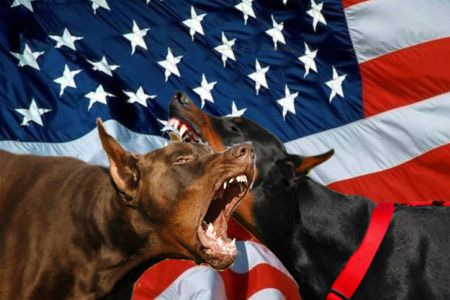
Dogs of war. Graphic from Press TV.

Dogs are barking:
Are we marching to war with Iran?

By Ted McLaughlin / The Rag Blog / January 9, 2012

The animosity between the United States and Iran has a longer history than most Americans realize. Before 1950, most of the oil assets of that country were owned by Western powers (mainly the United Kingdom and the United States).

The countries paid the Shah (King) of Iran for the right to take Iran’s oil, but most of those funds went into the Shah’s many bank accounts and very little was ever actually used for the benefit of the people of Iran. That changed for a short while in 1951.

It was in that year that the Iranian Majlis (parliament) put a socialist prime minister in power, Mohammad Mossadegh. Mossadegh nationalized the country’s oil and proposed using oil revenues to help the people of Iran. This created a power struggle between the Shah and Mossadegh, and the Shah fled the country. This angered the United States (and United Kingdom). How dare these people try to own and control their own resources, and interfere with the profits of Western oil companies!

In 1953, the American CIA overthrew Prime Minister Mossadegh, and reinstalled the Shah as the absolute ruler of Iran. The Shah (Mohammed Reza Pahlavi) then ruled as an even more brutal dictator, using his SAVAK (secret police) to take care of any political opponents. He was able to retain his power for over 20 years, but was hated by the people and viewed as a puppet of the United States.

In the late seventies, the people rose up against the Shah. They were led by Muslim clerics, especially Ayatollah Ruhollah Khomeini, and in early 1979 they seized power and the Shah fled the country. An elected government was set up, but most real power lay with the religious leaders (and still does).

This new government was understandably anti-American, since it was the United States that had overthrown their elected government and put the Shah back on the throne (and then supported him until his overthrow).

This anger at America resulted in the destruction of the American embassy and the taking of embassy employees as hostages. This was a ridiculous and unnecessary action, and is still used by the U.S. to convince others the government in Iran cannot be trusted. The employees were eventually released in January of 1981, but the stage had been set for the current bad relations between the two countries.

And since 1981 the tension between Iran and the United States has only grown worse — and neither seems ready to institute talks to restore diplomatic relations and lessen that tension. The latest charge from the United States is that Iran is building a nuclear weapon. There is no evidence of this, but it has not stopped politicians from making the accusations and the American media from reporting the same.

While it is true that Iran is developing nuclear power plants to supply energy to its people, and is purifying its own uranium (since sanctions have cut off their ability to buy it from other countries), there is no evidence at all that they have started to develop a military application for this nuclear power or have attempted to build a bomb.

Even the International Atomic Energy Agency admits this is true. All they have said is that the Iranians might soon have the capability to do that — not that they are doing it or will do it in the future. The idea that Iran is building a nuclear weapon resides only in the fevered imaginations of fear-mongering politicians.

But the United States and other countries have used this fear to attack Iran with sanctions, the most recent of which were just imposed. The latest sanctions say any country or company that does business with Iran cannot have access to the financial services of the United States.

The Iranians see this as an attempt to choke off the sale of their oil, upon which they depend. And they are right — that is exactly what the U.S. is trying to do. They want to force regime change in Iran by bankrupting the country.

And the Iranians have overreacted to this move. They have now threatened to block the Strait of Hormuz, through which about 16% of the world’s oil supply flows. And they recently held naval maneuvers in that area to emphasize that point.

These actions have brought both countries to the brink of war — and neither seems willing to back down, or even discuss reducing tensions. It seems like the leaders of both countries want war, because both are escalating the rhetoric and trying to justify their own positions.

The crazy thing about this is that neither country can afford a war. It would take the United States only a couple of weeks to use their air power to destroy Iran’s infrastructure. But although the U.S. could seriously damage Iran, it could not win by air attacks alone. And the U.S. simply doesn’t have the ground strength for another prolonged ground war (and a ground war in Iran would be even worse than what we experienced in Iraq, and are still experiencing in Afghanistan).

There are some who believe the war with Iran has already started, and there is some evidence for that view. The Iranians recently shot down a U.S. drone that had invaded Iranian airspace, and several U.S. rockets have landed in an Iranian border area, killing several people.

The United States says the rocket attacks were accidental, but how are we to know? Have the first shots in the coming war with Iran already been fired?

There is still time to back away from the brink, but it would take the people of both countries demanding a stop to the hostilities and warlike rhetoric. And so far, that is not happening. The people of Iran are convinced the U.S. wants to destroy them, and the people of the U.S. are convinced Iran is building a bomb to attack them. Truth has become a victim of fear in both countries.

I wish it wasn’t true, but I think there will be a war with Iran. And we may already be a lot closer to that war than anyone realizes.

[Ted McLaughlin also posts at jobsanger. Read more articles by Ted McLaughlin on The Rag Blog.]

The Rag Blog

Posted in Rag Bloggers | Tagged , , , , | 3 Comments

Harry Targ : Brute Facts and Political Choices, 2012

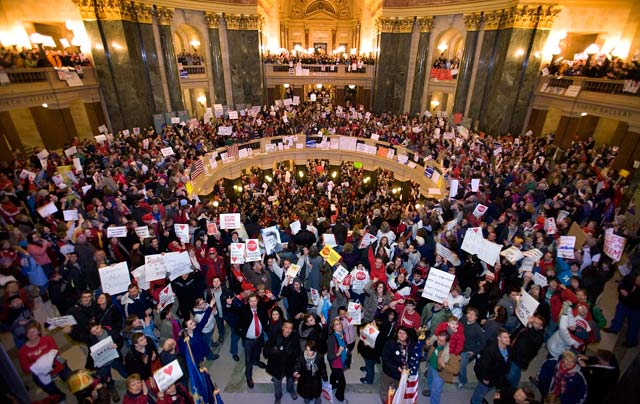
Protesters at the State Capitol building in Madison, WI., demonstrating against Gov. Scott Walker’s anti-union legislation. Photo by Mark Hirsch / Getty Images.

Brute facts and political choices:
Thinking about 2012

By Harry Targ / The Rag Blog / January 9, 2012

The year 2011 was truly an exciting year for progressives. Arab spring sent shock waves across the Middle East, launching a campaign for democratization that will ultimately impact every regime in the region. Also Arab spring confirmed to the rest of the world, including the United States, and particularly those engaged in Occupy movements, that mass mobilization, challenging economic control and military might with people power, can affect history.

The spirit of grassroots anger, activism, a growing sense of solidarity across races, gender, class, and national boundaries, planted the seeds for the rise of a new age out of the old. As the young people in Tahrir Square knew from the beginning of their protest, the struggle will be long, sometimes bloody, but the 99 per cent, in the end, will win.

But 2011 also showed the world that politics can be ruthless. Masses of people died in Egypt, Yemen, Libya, Afghanistan, and in various locations in Africa, Europe, and North America. The United States shifted priorities from sending the military everywhere to supporting private armies and high tech drone warfare. Secret intelligence agencies now define the threats to the United States who are targeted for assassination.

Meanwhile the mass media has celebrated executions abroad and at home and the deaths of ostracized leaders. In many ways 21st century global culture has become a “death culture,” in its entertainment as well as its politics. Killing has become fun.

Within the United States, political forces have been unleashed that are trying to return politics to the Dark Ages:

  • escalating the shift in wealth and power from the many to the few
  • destroying the historic right of workers to organize to better articulate their interests
  • privatizing education, health care, and basic concern for the environment
  • transferring control of women’s bodies from themselves to various churches and private interest groups
  • increasing the power of police to control people’s lives, using pepper spray, SWAT teams, covert operations, and spying to serve the status quo
  • eliminating longstanding legal procedures that have given some protection to people, particularly minorities, who have been accused of crimes
  • using, abusing, and disposing of immigrant workers.

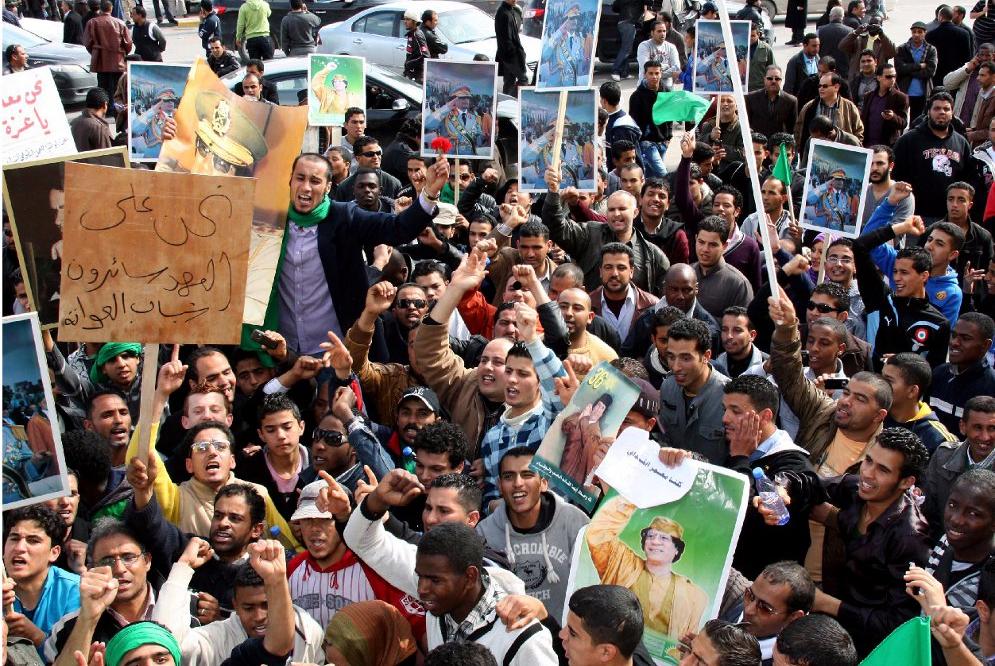
Protests against the regime of Muammar Gaddafi in Libya, February 2011. Image from News4Europe.

So at the dawn of the 2012 the world continues its contradictory path. And as the forces of light and darkness contend, progressives once again are confronted with political choices. As the debates escalate, particularly in the electoral arena, some of the summary data I accumulated just after the 2010 election remains relevant:

From data reported in the media between November 3rd and 10th, 2010 the new United States Senate will be comprised of 51 Democratic Senators and two Independents and 47 Republicans. The Republicans experienced their biggest gains in the House of Representatives winning 239 seats to 189 for the Democrats… The 2011 distribution of the governorships will include at least 29 Republicans and 18 Democrats. In sum, the elections brought Republican control to the House of Representatives and significant shifts in gubernatorial contests which will impact on the redistricting of House of Representative districts for the next decade.

At the state level, Republican candidates won 650 seats in legislative assemblies, taking control of 19 legislative bodies from Democrats. For example, Republicans gained both state houses in Alabama, Maine, Minnesota, New Hampshire, North Carolina, and Wisconsin. They won an additional house to take control of both houses in Colorado, Indiana, Iowa, Michigan, Montana, Ohio, and Pennsylvania.

Through gubernatorial and legislative victories at the state level Republicans will control the designation of 170 congressional districts while Democrats will control 70. The rest, about 200, will be determined by bipartisan bodies.

Republicans won three state legislatures in the Northeast, eight in the South, nine in the Midwest, and five in the West. Looking at a USA map of red and blue states, 27 states will be red in the next period.

As I write, Indiana workers are marching inside and outside the state capital protesting the backroom passage of a new right-to-work law. Indiana has not been a right-to-work state since the 1960s. In 2008, the Indiana House of Representatives consisted of 52 Democrats and 47 Republicans. Today the House has 60 Republicans and 40 Democrats.

And as a result of the 2010 election, not only is it likely that right-to-work legislation will become a reality in Indiana but education and resources for women’s reproductive health will be even more vulnerable.

There are similar stories to be told in each and every state, as well as in the national political arena. And, at the same time, there are differences in politics and history in each state and locale. And make note: none of this has much to do with the selection of nominees for president of the United States. That story is the circus, the Super Bowl — Romney or Santorum, the “moderate” Republican or the “social conservative.”

So progressives have a lot to think about in 2012: how to protect the people, the 99 percent, from all the hurt that they increasingly will experience in the short run while at the same time moving “inch by inch, row by row” to the vision that animated Arab Spring, Ohio, and Madison, Wisconsin.

[Harry Targ is a professor of political science at Purdue University who lives in West Lafayette, Indiana. He blogs at Diary of a Heartland Radical — and that’s also the name of his new book which can be found at Lulu.com. Read more of Harry Targ’s articles on The Rag Blog.]

The Rag Blog

Posted in Rag Bloggers | Tagged , , , , | Leave a comment

Chellis Glendinning : In Bolivia, ‘The Repression Strengthened Us!’

Native demonstrators march on La Paz to protest highway construction. Photo from AFP.

Letter from Bolivia:
‘The repression strengthened us!’

The ragtag band walked day and night in flip-flops, and the hearts of Bolivians went out to them…

By Chellis Glendinning | The Rag Blog | January 5, 2012

LA PAZ, Bolivia — One wrong move, forgetting to take your hat off, the interruption of a phone ringing notwithstanding, after a spell a trip to the bank to pay the light bill — alongside men carrying machine guns — does get to feel normal.

Such a transit of mind is a testimony to the human ability to adapt, yes? — and I am reminded of a tale that dear friend anthropologist Francis Huxley tells.

It was the 1950s, and he was called to transport a Native of the Brazilian Xingu tribe to Sao Paulo for emergency medical treatment. After success with that, they strolled through the streets of the city — for the Native man, the first time ever in such a scene. Upon passing a bank heavily guarded by men in military uniform, bearing epaulets, badges, and heavy black boots and carting machine guns — the man turned and asked what this strange display was all about.

Grappling for words, Francis reported that this was where the jefe kept his riches. The Native man immediately quipped, “Well! He must not be a very good jefe!”

And so it is here, just over the border from Brazil and 60 years later.

Jefe Evo Morales has — to quote one of Nicole Hollander’s “Sylvia” cartoons — “made (him)self unpopular.” To tell the truth, he already had accomplished that feat, but the Moxeño-Chimare-Yurakerés march to the capital hammered the final nail in.

On 15 August, some 700 indígenas set out to protest a Brazil-funded intra-continental superhighway the Bolivian state was erecting through their constitutionally-protected, sovereign eco-reserve, the Territorio Indígena and Parque Nacional Isibro Sécure (TIPNIS) — where the last of the planet’s gatherer-hunter cultures thrive, while flora and fauna in danger of extinction make their fragile way. The purpose of the highway: to carry petroleum from Brazil across Bolivia to Chile’s ports to be shipped to your cars in the U.S.

The ragtag band walked day and night in flip-flops, and the hearts of Bolivians went out to them in the form of a nationwide drive to send shoes, clothes, food, and medicines.

First the government blocked the road from passage, including the arrival of food and water. Then, on Sunday 25 September, the police attacked the encampment! Bursting in with tear gas, they chased down fleeing indígenas, sometimes five officers in full riot gear against a single boy in cotton shorts; with their night sticks they beat them on their backs and chests and heads; they bound their arms, legs, and mouths with silver duct tape making it almost impossible to breathe; they dragged some 300 dirigente-leaders, women, children, and ancianos to waiting trucks and hauled them away to unknown locations. It was claimed that one child died in the violence.

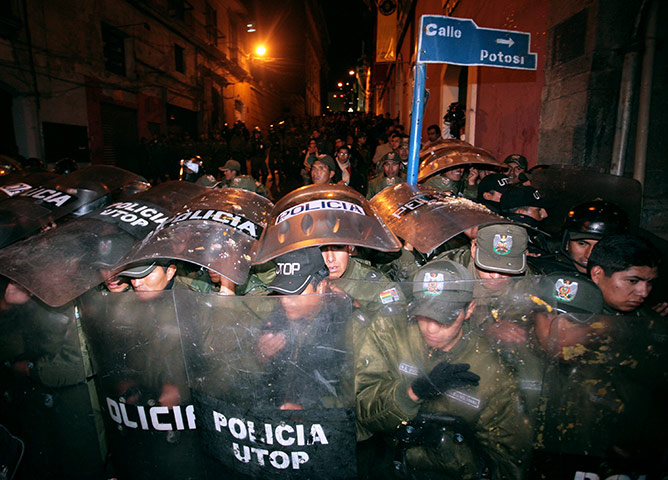
Riot police in La Paz. Photo from The Guardian (U.K).

By Monday morning a pall of shock had settled over Bolivia; everyone was glued to a television somewhere — and then the popular response burst forth. All over, including at the Bolivian embassy in New York where Morales was presenting at the United Nations, people took to the streets. And the venting allowed for long pent-up emotions to flow into the public vocabulary.

Ya no tiene máscara indígena”/”Morales can no longer wear his mask of so-called indigenous support,” proclaimed Native social analyst Fernando Untoja. Long-time activist Rafael Quispe trotted out the as-yet unspoken words: “dictadura”/”dictatorship.” And ex-government official Alex Contreras termed the actions “métodos del fascismo”/”methods of fascism.”

Astoundingly, one marcher was quoted in a 20 October newspaper report, “La represión nos fortaleció”/”The repression strengthened us.”

On 19 October what had started, two months before, as a march of 700 had now swelled to 3,000. After two months of treking/camping, treking/camping; after the sweltering heat of the tropics and the driving sleet of the mountains; after bearing inadequate shoes, too thin jackets, foot sores, injuries, dehydration, diarrhea, and exhaustion; after enduring disregard, insults, and arguments for disqualification spouting from the mouths of government officials: after the official withholding of water and food; and then having endured violent repression — the TIPNIS marchers rounded the last crag before the descent into the capital city.

What lay below, they say, was unexpected.

The streets of La Paz were teeming with supporters from every hamlet and municipality in Bolivia and beyond! Red flags were blowing in the wind. Green flags. Yellow flags. Wiphala flags. Workers. Taxi drivers. Housekeepers. University students. Mothers with babies. Union leaders. Theater groups. Supporting indigenous groups boasting traditional dress, flutes, and drums Former government officials who had left the MAS party. The press. International support teams.

Trumpets blared. Flutes sang. Mariachi bands blasted accordion music. Placards proclaimed: “TIPNIS=VIDA, EVO=MUERTE,” “EL TIPNIS: NO SE TOCA, CARAJO!” and “¡TIPNIS SOMOS TODOS!” People rushed to meet the marchers, hugged them, kissed them on the lips. Men and women were sobbing in the streets! Whole schools had been liberated to play a role in history, and uniformed children were waving flags, holding up their drawings of tropical flowers, and cheering.

Along the boulevards the welcomers flanked the marchers like a thick envelope of protection from potential police action; in some parts the shield extended five times thicker than the march itself.

It was the largest gathering of humanity in the history of Bolivia.

After all his grandstanding about how the state would never, ever, give in — not! the president ventured into the plaza with his phony smile — this after months of badmouthing the marchers as dupes of the imperialist state to the north, denying them a meeting, sending para-protestors out to harm them, cutting off food and water, and finally unleashing the military.

Against the very real possibility of his government going under, he gave in. No highway through TIPNIS. As we say in baseball, though, “It’s not over ‘till it’s over.” Now the government is finding ways to backpedal. But this was a major triumphant event that went unreported in the EE.UU — and I wanted you, for this moment, to bask in the heroism that our human spirit is capable of mustering.

[Chellis Glendinning is the author of five books, including When Technology Wounds, Off the Map: An Expedition Deep into Empire and the Global Economy and Chiva: A Village Takes on the Global Heroin Trade. She lives in Bolivia and may be contacted via www.chellisglendinning.org. A version of this article was published at CounterPunch. Read more of Chellis Glendinning’s writing on The Rag Blog.]

The Rag Blog

Posted in Rag Bloggers | Tagged , , , , | 1 Comment

THEATER / Jonah Raskin : Zayd Dohrn’s ‘Outside People’

Cast of Outside People at the Vineyard theater in New York. Inset photo: playwright Zayd Dohrn.

We’re all outsiders now:
Zayd Dohrn’s new play, Outside People

The play — which is part situation comedy, part soap opera, and part prophecy — plays with and deconstructs stereotypes of Americans and Chinese.

By Jonah Raskin | The Rag Blog | January 5, 2012

Zayd Dohrn’s new 90-minute drama, Outside People, doesn’t advertise any of its influences — and that’s not a criticism. Authors aren’t obligated to make disclosures to audiences about the individuals, the creative works, and the sources that impact their imaginations.

An earlier play, Reborning, that was reviewed in The Rag Blog in 2011, seemed to bear the imprint of his parents, Bernardine Dohrn and William Ayers. His newest work might have been shaped in part by the experience of his wife, Rachel Dewoskin, who lived and worked in China and appeared in a popular Chinese soap opera entitled “Foreign Babes in Beijing.”

Outside People reminded me when I saw it recently at the Vineyard theater in New York — where it’s currently on stage — of two books from the 1950s — Colin Wilson’s The Outsider and Eugene Burdick’s and William Lederer’s The Ugly American.

Dohrn’s 21st-century version of the outsider and the ugly American is named Malcolm and for most of the time that he’s on stage he’s holed up in a hotel room in Beijing, China, all dressed up in jeans and a T-shirt and with nowhere to go but back home, after he’s caused a little mayhem among the locals.

Unlike the American characters in The Ugly American, he isn’t loud and ostentatious and unlike the hero of the novel he doesn’t come to understand and appreciate the needs of the Asians he meets. Dohrn’s Malcolm is shy, quiet, neurotic, and needy in an obnoxious sort of way. He doesn’t look and see or hear and understand.

A twenty-something-year-old kid from New Jersey, he has a diploma from Stanford and a passport from the U.S. State Department that gives him political clout and makes him sexier than he’s ever believed possible. His college buddy, Da Wei, an Americanized Chinese entrepreneur, has brought him to Beijing to repay a social debt incurred while the two young men were undergraduates. It seems that once upon a time Malcolm was outgoing and hospitable.

Two women — the babes of the play — round out the compact cast. Xiao Mei is a Chinese woman from the countryside who has come to Beijing to work and hopefully escape her lot in life as the daughter of peasants. Samanya is the privileged daughter of an African diplomat from the Cameroon who speaks Chinese and feels Chinese, though she doesn’t look Chinese.

They’re all outside people in their own individual ways. Malcolm is way outside his own stomping grounds and his comfort zone. Da Wei, or David as he’s called, is an outsider in his own country after life at Stanford. Indeed, with his foul mouth and his sexual vocabulary — he tells David to stop using “pussy repellant” — he seems more American than Malcolm.

Da Wei is the connector in the group. Samanya is the spark plug who supplies much of the electrical current that keeps the drama on edge. Xiao Mei provides the sex and the sincerity, too. Malcolm offers the key line in the drama when he asks in a state of bemused innocence, “Are we all using one another?” The word “we” is crucial here. Malcolm is all about Malcolm; he’s all about me; “Do it for me,” he tells Xiao Mei when he invites her to go back to America with him.

As the play unfolds, and his layers are peeled away, it’s apparent that he’s really incapable of taking responsibility for his own actions and unable to make “I” statements all, of which makes him not only ugly but dangerous when it comes to personal relationships.

Ambiguity infuses many of Dohrn’s plays and it infuses Outside People. Xiao Mei seems innocent enough; she cries real tears and her heart seems to be broken at the end of the play, but she also appears to be using Malcolm as a stepping stone out of China and into her own version of the American Dream — whether she knows it or not.

Da Wei claims to be Malcolm’s friend, but he also tries to seduce Xiao Mei behind Malcolm’s back, and while he brings the two lovers together he also pushes them apart. If he’s meant to be emblematic of the new Chinese economy, than we’d all better watch our own backs or we’ll lose the shirts that are on them and everything else we own.

The play — which is part situation comedy, part soap opera, and part prophecy — plays with and deconstructs stereotypes of Americans and Chinese. It moves along very quickly with punchy one-liners and real sizzle. The actors — Matt Dellapina as Malcolm, Nelson Lee as Da Wei, Li Jun Li as Xiao Mei, and Sonequa Martin-Green as Samanya — are all good for 90 minutes in a play that has no intermissions.

Portions of the dialogue are in Chinese and with no translation into English. One scene between Da Wei and Xiao Mei even takes place only in Chinese. The audience becomes the outsider here and has to become the insider by listening to the tone of voice and by watching the body language and the facial expressions of the actors.

We’re all outsiders now, Dohrn seems to be saying; we’re all pushed and pulled here and there with little if any psychological or existential advantages attached to the status of the outsider. Once upon a time — back in the 1950s when Colin Wilson wrote the classic The Outsider — it was supposedly cool and hip to be an outsider.

But not now, or so Dohrn’s “Outside People” seems to suggest. Better hold on to your American passport if you don’t want to be on the outs permanently. Moreover, if you want a kind of insurance policy it might be a good idea to learn to speak Chinese and to try to feel at home in Beijing, even if you’re a long way from home.

[Jonah Raskin is the author of For The Hell of It: The Life and Times of Abbie Hoffman, and The Radical Jack London. A professor at Sonoma State University, Jonah is a regular contributor to The Rag Blog. Read more articles by Jonah Raskin on The Rag Blog.]

The Rag Blog

Posted in Rag Bloggers | Tagged , , , | Leave a comment

Bruce Melton : Has Texas Crossed a Climate Threshold?

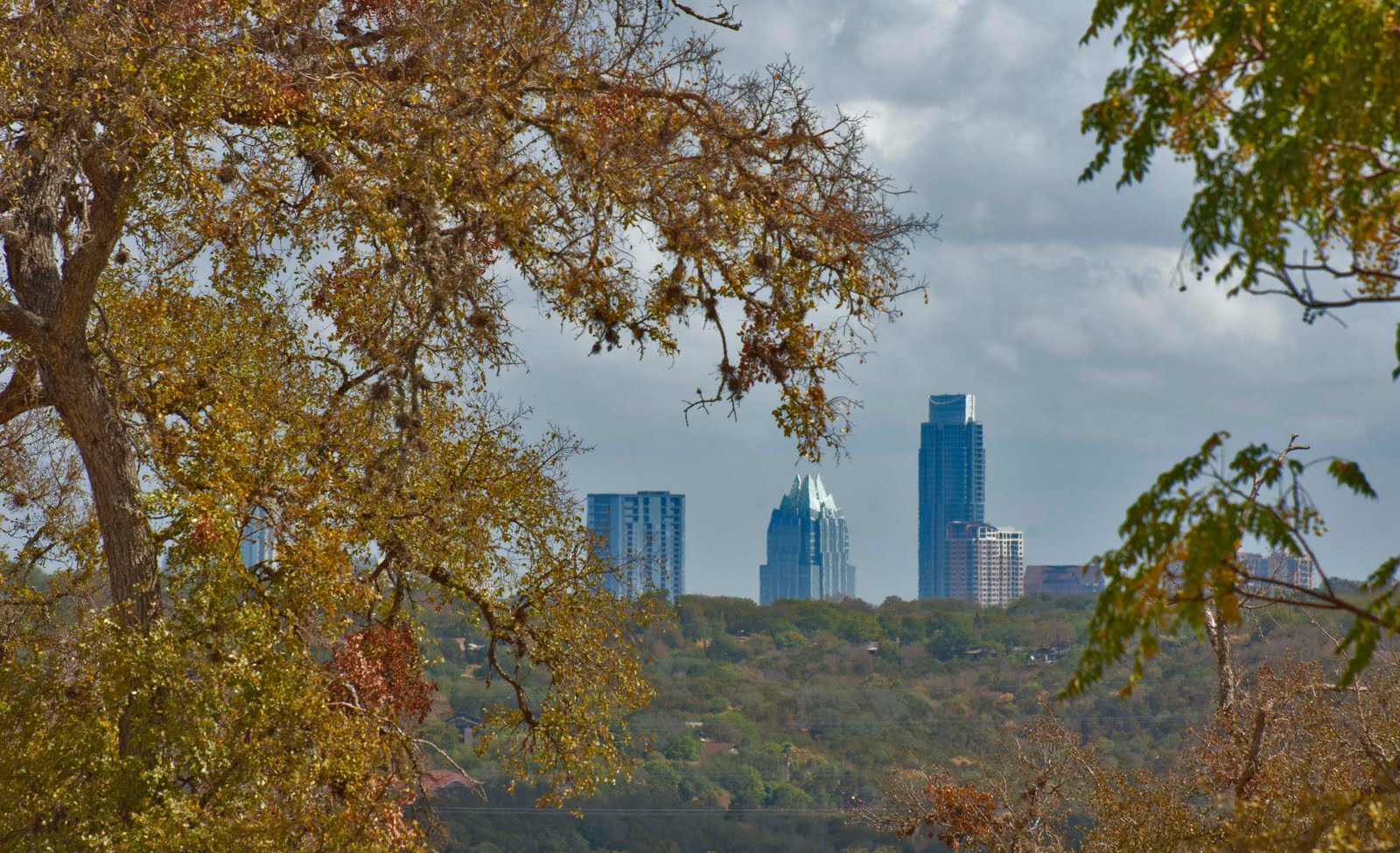
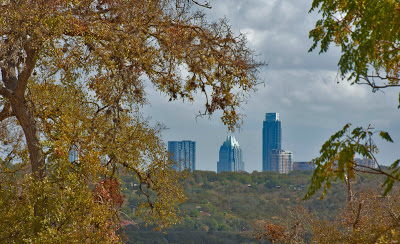
Downtown Austin seen from near the intersection of Loop 360 and US 290/71 West. This photo was taken in early September 2011. The brownish yellow- and red-leaved trees in the left and bottom right foreground are elms. They naturally shed their leaves early during our hottest summers and September is still summertime in Central Texas! The fall leaf drop does not start until October. This year is different however. Normal drought stress creates a leaf drop where elms go dormant, their leaves yellow and fall to the ground, very similar to the normal autumn leaf drop. In this year’s unprecedented drought however, many of the elms around Austin turned bright brown or reddish brown. This more than likely means they have died. In the middle ground of the photo you can also see many yellow, brown, and gray trees that have already gone dormant or died. A preliminary report by the Texas Forest Service has looked at forest mortality across Texas and tells us that up to a half billion (with a “B”) trees may have died in this drought. — B.M.

Have we crossed a threshold?
Welcome to climate change in Texas / 2

By Bruce Melton | The Rag Blog | January 4, 2012

[This is the second in a three-part series.]

AUSTIN — The driest 12 month period in Austin, since record keeping began in 1854, happened October 2010 to September 2011. The 100 degree day record was more than shattered, it was obliterated. Three times in the last six years Lake Travis inflows have fallen below the minimum levels set in the Drought of the 50s.

The Lower Colorado River Authority Board of Directors has voted to take drastic measures. They have received permission to deviate from the Water Management Plan to significantly cut back or even cut off water to farmers next year.

Obviously, this string of droughts is as bad as they come, or is it? The news that the drought will be over when La Niña goes away is ever present, but will it really go away when La Niña leaves?

And what about all this heat? What about all of these 100 degree-plus days that we have had recently? How big was this 100 degree day record that we broke and how does all this unprecedented heat influence this string of droughts?

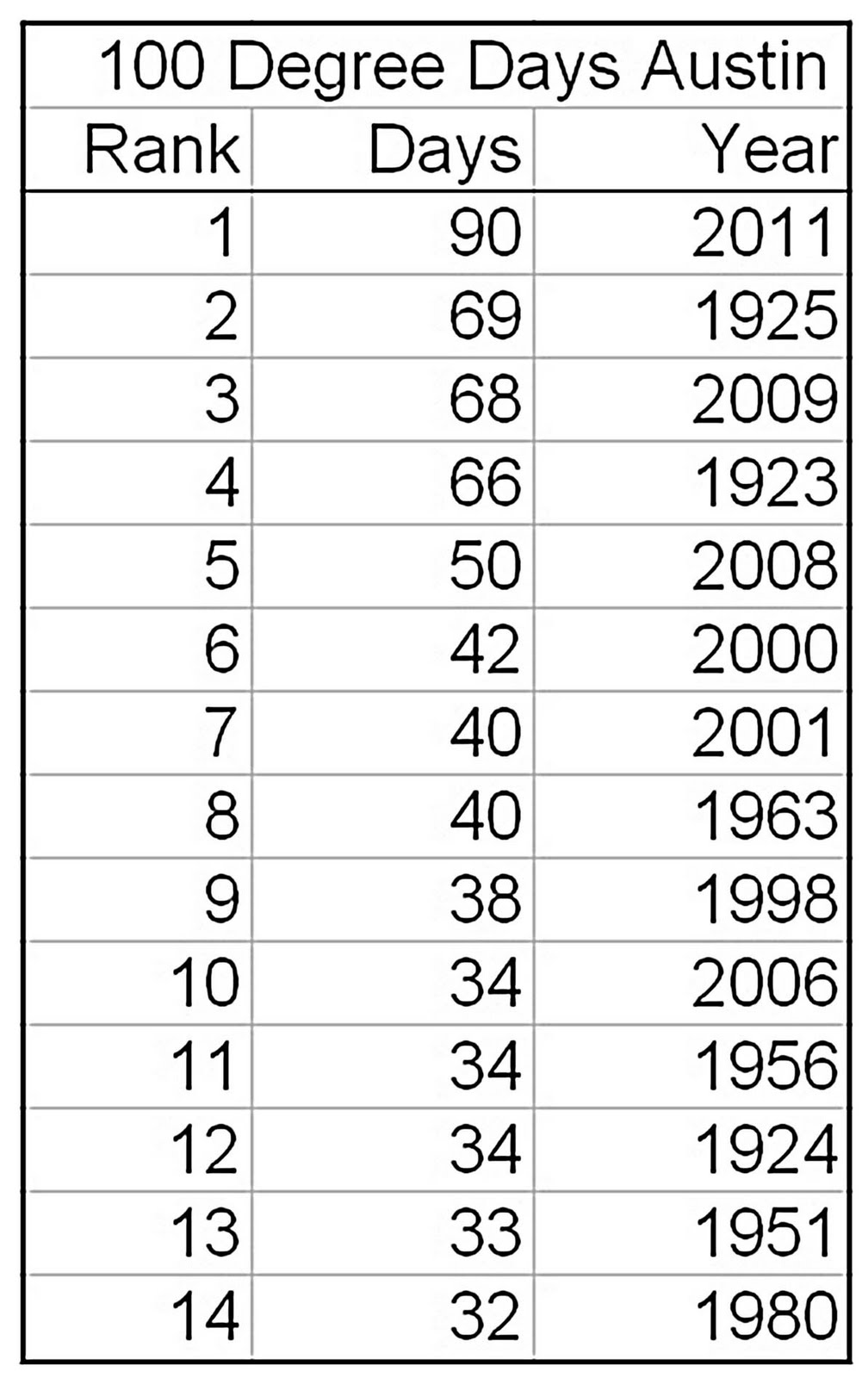
The official record shows that we beat the 100 degree day record by at least 30 percent this year. The previous top two records for Austin were 69 set in 1925 and 66 set in 1923. The state climatologist (John Nielson-Gammon) calls 2011 an outlier because we endured 21 more days of 100 degree temperatures than the previous record of 69 days set in 1925.

So, what is an outlier and what do scientists do with them? Outliers are pieces of data that for some reason do not belong to the sample being analyzed. In this case we are analyzing the number of days every year with high temperatures above 100 degrees.

An example describing outliers could be the normal water level in the closed basin lakes in Nevada and Utah. The Great Salt Lake is a 1,700 square mile remnant of the great 8,500 mile Lake Lahontan from ice age times. Lake Lahontan grew and shrank maybe dozens of times over the last 100,000 or so years. The evidence is clear in the raised beaches hundreds of feet above the existing water level and the submerged forests of preserved stumps hundreds of feet below current water levels.

The Great Basin has no natural discharge in this area so the level of Lake Lohontan is an indicator of how much precipitation falls there. When the climate was really warm (like today) or really cold, like any of the two dozen or more abrupt climate changes over the period, rainfall was low.

Statistically, rainfall data from the wet periods would be deemed outlier if they were mixed in with rainfall data from the dry periods. Different climates create different data. Another example would be a broken thermometer. If it is 165 degrees in February, something is broken.

Our State climatologists calling the 2011 heat wave of 90 days of 100 degree plus temperature an outliers means that this piece of data is suspect and is likely the result of an error or fundamental system change. The years 1923 and 1925 were certainly hot, but surrounding weather stations from Del Rio to Dallas come nowhere near the intensity of heat experienced at the Austin weather station.
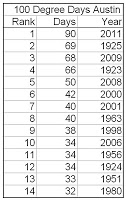
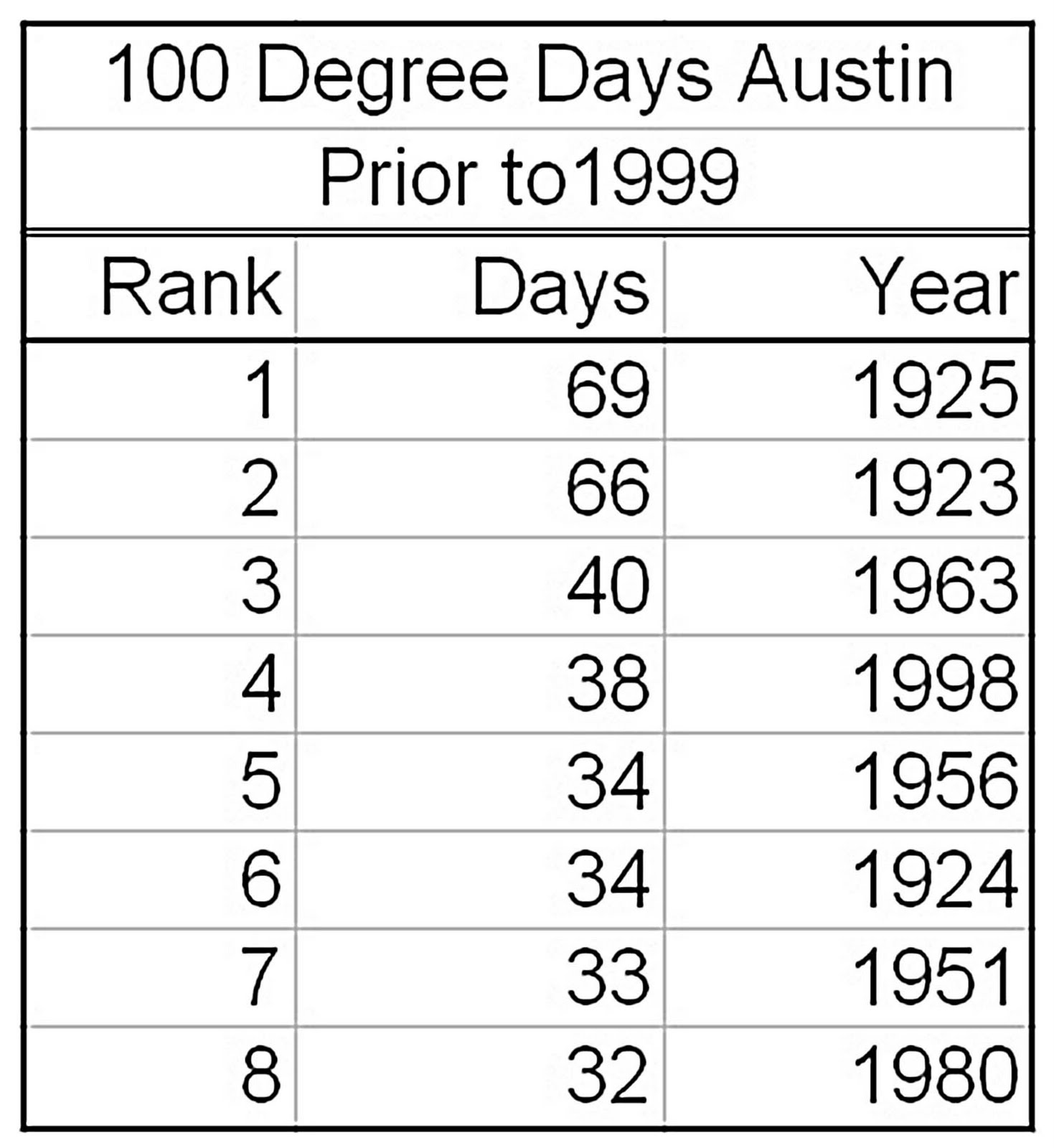
Has our regional climate seen a fundamental change? Why did this outlier occur and what does it mean? What’s up with 1923 and 1925? To try and answer these questions we need to first clean up the rest of the data. If we look at 100 degree days before the year 2000, we find that 1923 and 1925 were 65 and 73 percent greater than the third ranked most extreme summer ever recorded in Texas.

So if 2011’s 90 days of 100 degree heat was an outlier, and 2011 was 30 percent greater than the previous record, then 1923 and 1925 are outliers two times over!

Now you are thinking, why did I say before 2000? The weather really started freaking out about the turn of the century. This is when “The Big Melt,” as the climate scientists call it, started in Greenland. It’s when the great pine beetle pandemic in the Rockies really got going. Just a few years later is when we started having snowmaggedons and snowtastrophes in the northeast and northern Europe where Arctic warming has enhanced the jet stream, increasing winter storms across the Northeast and other areas.

The ranking of 100 degree days in Austin prior to 1999 shows the tremendous gap between the 1923 and 1925 records and the rest of the pack. These records stood for 75 years. But if you disregard the 1923 and 1925 outliers, seven of the top 10 100 degree day records have been set since 1998.
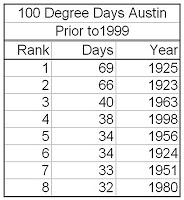
Beyond rational association, as well as using statistical data validation tools, it is significantly likely that these two records are in error for some reason and should be ignored. When the true nature of the 1923 and 1925 records is understood, the incredible record smashing that we thought happened with 100 degree days in 2011 more than doubles! What I am getting at here is that we have likely crossed one of those climate thresholds the climate scientists keep talking about.

Does more evidence cast doubt on the 1923 and 1925 records? The years 1922, 1923, 1925, and 1926 are incomplete. They have a lot of missing data. These are the last years in the record to have missing data and there were no years for the previous 18 years that had missing data. Prior to 1903, years with missing data were much more common.

Then there are the rainfall records. Rainfall is an excellent indicator of extreme heat. The hotter it is, the greater is the evaporation and the drier things are. This allows the temperature to become even hotter because moisture in the air prevents the temperature from going even higher. It’s a feedback loop.

Nielson-Gammon says that the extreme heat was responsible for 90% of our unprecedented heat records in Texas in 2011 and that climate change was only responsible for 10% (0.5 degrees.) (Nielson-Gammon’s 90% is 4.9 degrees out of the 5.4 degrees Texas’ temperature was above average in the summer of 2011.)
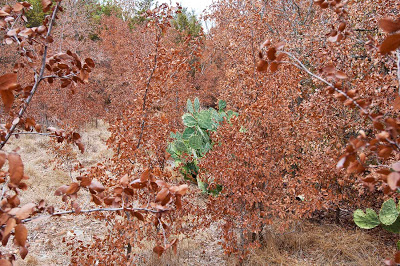
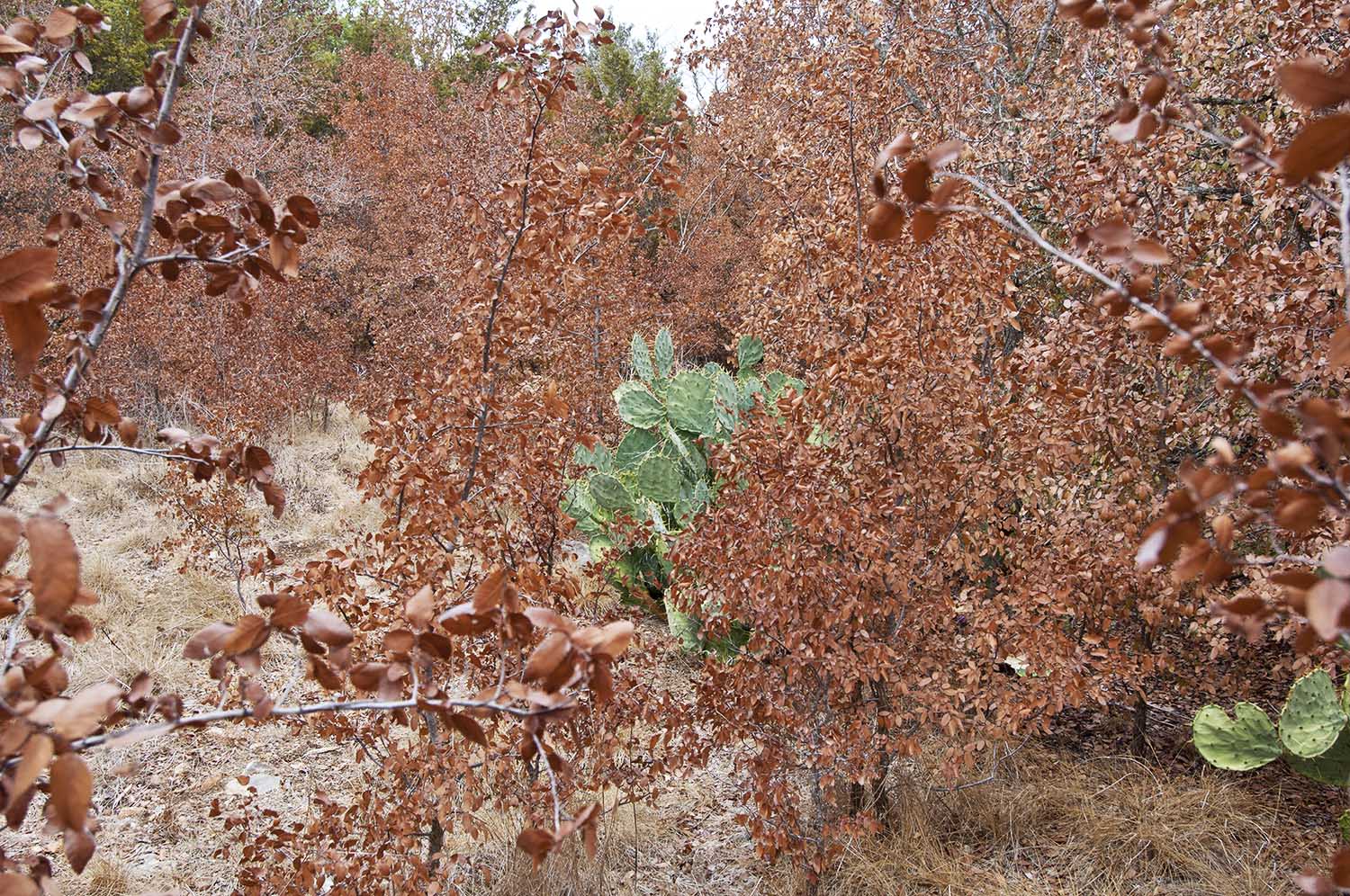
This visually startling photo was taken in southwest Austin. These trees are young elms and they have very likely been killed by the drought and have not just gone dormant. They are maybe 15 to 20 years old. The photo was taken in mid-September and these trees normally do not ever turn this color, especially at this time of year. When these trees go dormant, their leaves yellow, not redden, before they fall. Young trees are especially susceptible to the effects of drought because of their immature root systems. It is also important to note that the 500 million trees killed by the drought, cited by the Texas Forest Services, are all trees with a trunk diameter greater than five inches. None, or very few of these trees, or countless others across the state, come close to five inches. — B.M.

Based on numerous evaluations of ongoing climate changes from Stanford, Purdue, the National Center for Atmospheric Research (NCAR) and the U.S. Global Change Research Program (USGCRP), Nielson-Gammon’s evaluation is dated. According to the IPCC and the Climate Change Congress in Copenhagen, our climate is progressing along the worst-case scenario.

These assessments and evaluations (Diffenbaugh and Ashfaq 2010) show that we can expect the hottest season experienced since 1950 (including the drought of the 1950s) to happen two to three times within the next century, four to five times in the 2020s, and largely become average conditions after 2030.

Aigou Dia (NCAR) tells us that we will see Dust Bowl conditions as the average climate across much of the nation by the decade 2020 to 2030. By 2030 to 2040, Dia says the Palmer Drought Severity Index for most of the country will be worse than during the Dust Bowl, with some parts of the country being unimaginably worse than the Dust Bowl.

The USGCRP, founded by President Reagan, says that Austin will be nearly 50 percent hotter than the Sonoran Desert Researcher Station (the one with the giant saguaro cactus outside of Tuscon) beginning about 2080. We can expect every year to have 90 to 120 days of 100 degree heat. The average number of days of 100 degree-plus at the Research Station is 87. In Austin the average number of days over 100 degrees is 11.

Also remember, the three studies above are an excellent demonstration of the “conservative climate science” reality. All three (as do almost all climate research) show the results of modeling that is based on the A1B scenario. This scenario is what is commonly referred to as the “most likely” scenario. It is one where we follow a path similar to Kyoto. This is the climate path that we were expected to follow.

But the United States’ refusal to ratify Kyoto, as the only nation on the planet to do so, has almost certainly relegated the A1B scenario to the infeasible category. The path that our actual global emissions are on is the A1FI (Fossil Intensive) scenario, otherwise known as the worst-case scenario. So as outrageous as it sounds, these projections are conservative — impacts will likely be more extreme.

Back to last summer: Rainfall makes a huge difference with summer temperatures. May, June, and July of 2008 saw 22 inches of rain. That summer we only experienced three days of 100 degree heat in Austin.

The second driest period of the drought of the 50s had just an inch more rain than we had here in 2011 (1956 at 12.2 inches) and they had 34 days of 100 degree heat. We had nearly three times that many days over 100 last summer with virtually the same rainfall. What about the big heat waves in 1923 and 1925?
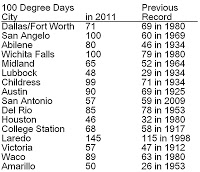
In 1925 we had almost 13 inches of rain. This was great for the heat wave-inducing temperature feedback that supposedly produced 69 days of 100 degrees-plus temps that year. But what happened in 1923 with 66 days over 100? It rained 51 inches in 1923! Why in the world were there so many 100 degree days in that year? May through August 1923 had six inches including three inches-plus in July. February through April saw 12.5 inches. In 1923 there was no extreme dryness contributing to the 66 days over 100 degrees supposedly recorded.

The years where 100 degree days do not match up with extremely low rainfall in the record are too numerous to print here. The relationship that our State Climatologist talks about simply is not well-supported. So, glaringly, there is a problem with Nielson-Gammon’s hypothesis. Extreme drought may be responsible for the heat wave feedback, but it does not appear to have a definitive relationship with the 14 most extreme 100 degree day years in the record. What about the rest of Texas in 2011?

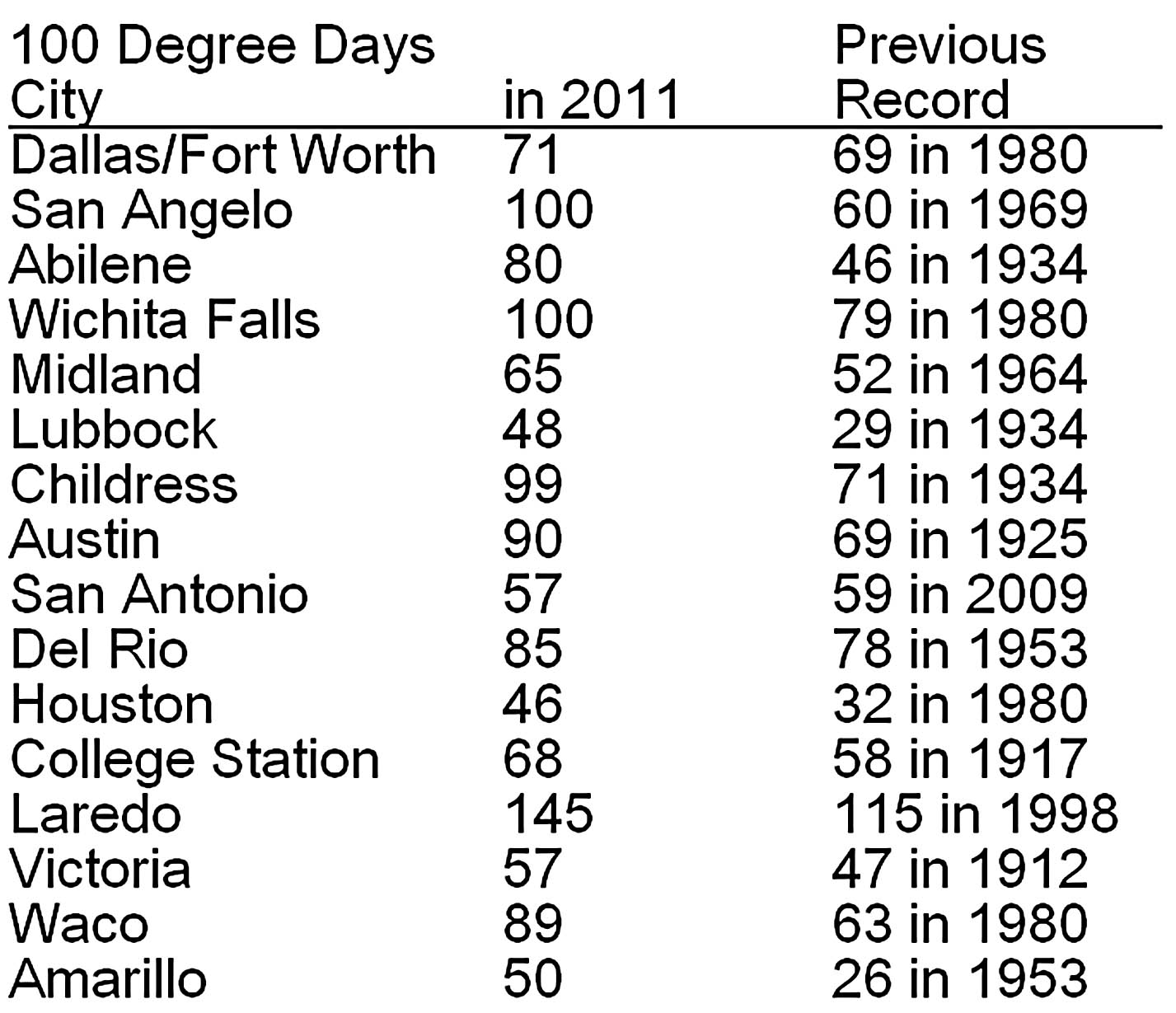
The only number two-ranked record was San Antonio. They had 57 days of 100-plus this year, second to 59 days they endured in 2009. Prior to 1998, the most San Antonio had seen was 33 days over 100 in 1948. All the rest suffered through the hottest summer ever. A few of them shattered their previous records. The remainder annihilated their records. But most important for this discussion, notice how the 1920’s are completely absent from the previous record list except for Austin.

Even if Austin’s 1923 and 1925 records are absolutely valid, something big has happened across Texas. Have we really crossed a climate threshold? As unambiguous as all of these obliterated 100-degree day records seem to be, it may be decades before we know. Remember when the climate change debate began 30 years ago and the climate scientists said it could be 20 or 30 years before we knew for sure if it was real? Same smell here. A scientific certainty requires lots of data.

Scientific truths and moral truths however, are very different things. A murder suspect sentenced to death based on circumstantial evidence… is sentenced to death by moral truths. But circumstantial evidence — moral truths — are almost never allowed in science.

Climate scientists have been telling us for nearly three decades that these kinds of things would happen: that the weather would become more extreme, that droughts would become the norm, that extreme heat waves would surpass all heat waves of the past, that we would see desertification and forest die-off, agricultural failure, and unimaginable water shortages.

They told us that all of these things would be unprecedentedly extreme. They have been telling us that the longer we delayed the greater would be the extremeness of the changes that we would have to endure. They told us that it was not the average temperature increase that would be the problem, it would be the extremes.

Many of us have heard by now that it was much drier during the droughts of the 1600s, 1700s, and 1800s before reliable record keeping began in Texas. These droughts however, do not hold a candle to what scientists have discovered to be true “megadroughts.” Two of them happened between the 900’s and about 1350. These droughts saw rainfall drop to 25% of normal and they lasted for centuries — hundreds of years! These periods were when Lake Lahontan dropped so low.

There is also evidence that large portions of the Great Plains desertified, changing to a sea of shifting sand. This desertification was much larger than that at the turn of the 19th century that fostered the term “Great American Desert.”

Sure, there have been bigger droughts and bigger fires in the early 1900’s or the 1800’s or the 1300’s or 3,000 years BC, but our complicated society did not have 1.7 million people in the Austin-Round Rock Metropolitan Area then. Now the climate scientists are warning us of upcoming weather far more extreme than our civilization has ever experienced.

This is no longer business as usual. We have to do something. The only way that we are going to overcome the momentum of political ignorance though is for each and every one of us to do something.

I’m not talking about fluorescent light bulbs or Priuses. Each and every one of us CAN make a difference. Contact your local, state, and national leaders and tell them to listen to what the people, not corporations, are telling them to do about our climate. Tell them that this is the single most important issue of our time and they need to treat it like it is so.

Tell them what professor Alley says in his book Earth: The Operators Manual. Alley says that fixing our climate will be no more difficult than creating our planetary wastewater collection and treatment infrastructure.

Then tell them that those who say it will ruin our economy are the same ones who tell us that climate change is not real, it is not bad, it is good for us, or it is a world-wide conspiracy by almost all climate scientists.

And ask them why is it that we still believe these climate change deniers when they tell us the solutions to the climate challenge will ruin our economy?

[Bruce Melton is a professional engineer, environmental researcher, filmmaker, writer, and front man for the band Climate Change. Information on Melton’s new book, Climate Discovery Chronicles, can be found, along with more climate change writing and outreach, critical environmental issue films, and the band’s original blues, rock, and folk music tuned to climate change lyrics at his website. Read more articles by Bruce Melton on The Rag Blog.]

References:

Preliminary estimates show hundreds of millions of trees killed by 2011 drought:
Texas Forest Service, December 19, 2011.
http://txforestservice.tamu.edu/main/default.aspx

2020 to 2029 will include three to five droughts as bad as or worse than the worst drought that we have seen since 1951:
Diffenbaugh and Ashfaq, Intensification of hot extremes in the United States, Geophysical Research Letters, August 2010. http://www.stanford.edu/~omramom/Diffenbaugh_GRL_10.pdf

Dust Bowl conditions will be the average condition beginning in 2020:
Dia, Characteristics and trends in various forms of the Palmer Drought Severity Index 1900 to 2008, Journal of Geophysical Research, March 16, 2011, revised. `
Press Release: http://www2.ucar.edu/news/2904/climate-change-drought-may-threaten-much-globe-within-decades
Article: http://www.cgd.ucar.edu/cas/adai/papers/Dai_JGR2011.pdf

100 degree days:
Global Climate Change Impacts in the United States, A State of Knowledge Report from the U.S. Global Change Research Program, 2009. http://downloads.globalchange.gov/usimpacts/pdfs/climate-impacts-report.pdf

Weather Data: U.S. Weather Service

Lake Travis Information: Lower Colorado River Authority

Megadroughts of the last 10,000 years:
Cleveland, Extended Chronology of Drought in the San Antonio Area, 2006. Tree-Ring Laboratory, Geosciences Department, University of Arkansas.
http://www.gbra.org/documents/studies/treering/TreeRingStudy.pdf

Cook, et. al., Long Term Aridity Changes in the Western United States, Science 306, 1015, 2004.
http://www.sciencemag.org/content/306/5698/1015.short

deMenocal, et. al., Coherent high and low latitude variability during the Holocene warm period, Science, June 2000.
http://www.ncdc.noaa.gov/paleo/pubs/demenocal2000/demenocal2000.html

Miao, et. al., High resolution proxy record of Holocene climate from a loess section in Southwest Nebraska, Paleoclimatology, September 2006.
http://snr.unl.edu/sandhills-biocomplexity/download/miaopalaeo2007.pdf

USGCRP History of drought variability in the central United States – implications for the future, 1999.
http://www.usgcrp.gov/usgcrp/seminars/990120FO.html

Fixing our climate will be no more difficult than creating our planetary wastewater collection and treatment infrastructure:
Alley, Earth: The Operators Manual, W.W. Norton, 2011.

The Rag Blog

Posted in Rag Bloggers | Tagged , , , , | 2 Comments

Rag Radio : Bruce Melton on the Real-World Effects of Climate Change

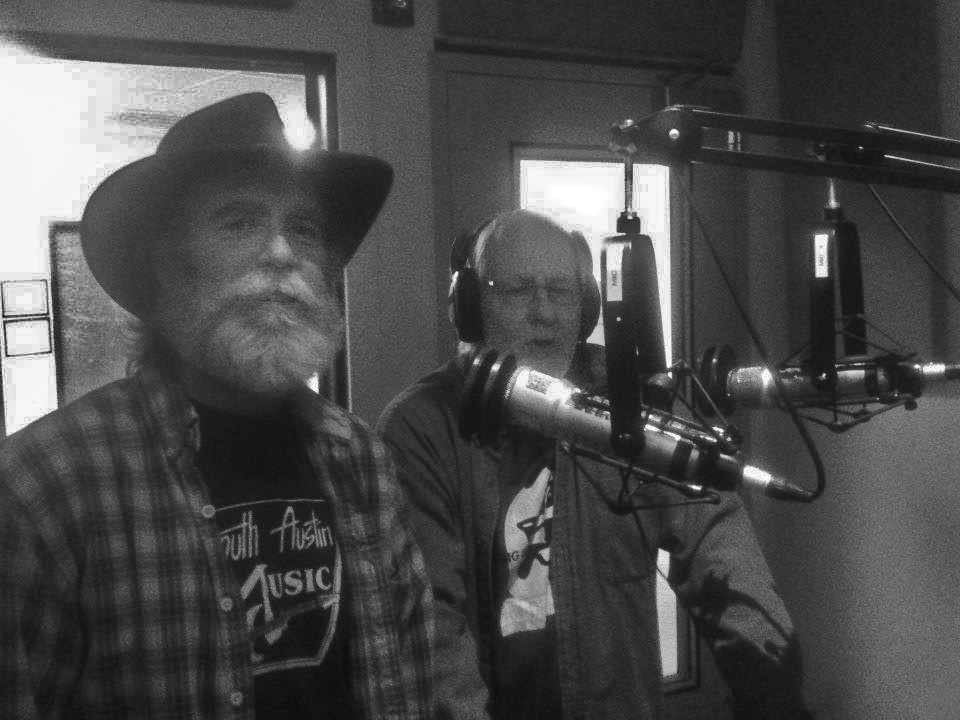
Climate change activist Bruce Melton, left, with Rag Radio host Thorne Dreyer, in the KOOP studios in Austin, Texas, Friday, Dec. 30, 2011. Photo by Tracey Schulz / Rag Radio.

Environmental activist Bruce Melton discusses
the real-world effects of climate change on Rag Radio
with Thorne Dreyer. Listen to it here:

Tom Hayden, progressive political activist and SDS founder, will be Thorne Dreyer‘s guest in a New Years’ Special on Rag Radio, Friday, January 6, 2012, from 2-3 p.m. CST on KOOP 91.7-FM in Austin and streamed live to the world.

Bruce Melton was Thorne Dreyer’s guest on Rag Radio, Friday, December 30, 2011.

Melton is an Austin-based professional engineer, environmental researcher, filmmaker, writer, green builder, and front man for the band, Climate Change. His main mission is filming and reporting on the impacts of climate change happening now. Bruce Melton’s new book is Climate Discovery Chronicles. He is a regular contributor to The Rag Blog and his Rag Blog articles about climate change can be found here.

This is Bruce Melton’s second visit to Rag Radio. (Listen to our first interview, on December 3, 2010, here.) On the show we discuss the current real-world effects of climate change and global warming, including events like the great Texas drought, wildfires, and tree kill of 2011; the North American Pine Beetle Pandemic; the Arctic “icequakes”; and the effect of global warming on the Amazon Rain Forest.

The program includes recorded music by Bruce Melton’s band, Climate Change.

Ah, irony! In an AP story run in the Houston Chronicle, climate change activist Bruce Melton is shown wetting down the roof of his house during wildfires in Central Texas earlier this year. CLICK ON IMAGE TO ENLARGE.

Rag Radio — hosted and produced by Rag Blog editor Thorne Dreyer — is broadcast every Friday from 2-3 p.m. (CST) on KOOP 91.7-FM in Austin, and streamed live on the web. KOOP is an all-volunteer cooperatively-run community radio station in Austin, Texas.

Rag Radio, which has been aired since September 2009, features hour-long in-depth interviews and discussion about issues of progressive politics, culture, and history. After broadcast, all episodes are posted as podcasts and can be downloaded at the Internet Archive. Tracey Schulz is the show’s engineer and co-producer.

Rag Radio is also rebroadcast on Sundays at 10 a.m. (Eastern) on WFTE, 90.3-FM in Mt. Cobb, PA, and 105.7-FM in Scranton, PA. Rag Radio is produced in the KOOP studios, in association with The Rag Blog, a progressive internet newsmagazine, and the New Journalism Project, a Texas 501(c)(3) nonprofit corporation.

Coming up on Rag Radio:

  • Jan. 6, 2012: New Years Special with progressive political activist and SDS founder Tom Hayden.
  • Jan. 13, 2012: UT-Austin government professor David Edwards on transformative trends in international relations.
  • Feb. 3, 2012: Historian and political economist Gar Alperovitz, author of America Beyond Capitalism.

The Rag Blog
Posted in RagBlog | Tagged , , , , , , , , | Leave a comment

Bob Feldman : Populism, Labor Organizing, and White Chauvinism in Texas, 1876-1890

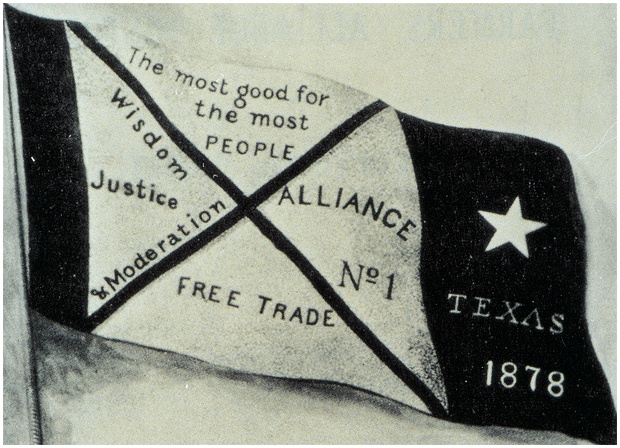
Flag of the Texas Farmers Alliance. Image from HHS AP US History.

The hidden history of Texas

Part VIII: Populism, labor organizing, and white chauvinism in Texas, 1876-1890

By Bob Feldman / The Rag Blog / January 4, 2012

[This is Part 8 of Bob Feldman’s Rag Blog series on the hidden history of Texas.]

Between 1870 and 1890 the number of people who lived in Texas increased from 818,000 to 2,235,000 and most of the people residing in Texas in 1890 had previously lived in the southeastern United States.

Although the number of Texas residents who were of African descent increased from 253,000 to 488,000 during these same 20 years, the percentage of all Texas residents who were African-American decreased from 32 to 22 percent during this period. And by 1890, 125,000 people of German descent now also lived in Texas. The number of people of Mexican descent then living in Texas was only 105,000.

Between 1876 and 1890, most of the people who lived in Texas were also still farmers. In 1890, for example, 84 percent of Texans still lived in rural areas on about 228,000 farms.

The number of Native Americans who were able to live in Texas, however, continued to decrease between 1870 and 1890 as U.S. government “military pressure on the Indians began to intensify during the early 1870s,” and “white hunters started to inflict an equally serious blow by destroying the great buffalo herds,” according to Randolph Campbell’s Gone To Texas.

Following the summer of 1874 incursion of 5,000 U.S. Army troops, during the Red River War, into the areas of Texas where Native American tribes like the Comanche and Kiowa tribes still lived, “the way for Texans to cover the prairies and Panhandle with cattle and cowboys” was opened, and “by the mid-1870s, the success of trailing cattle to market, combined with the elimination of Indians and buffaloes from northwestern Texas, encouraged the establishment of ranches in that region,” according to the same book.

By 1890, absentee foreign investors from the UK had helped quickly transform Texas’s cattle ranching industry into one dominated by corporate ranchers who paid their Texas cowboys and ranch workers low wages. So, not surprisingly, in 1883 “a group of cowboys” had “demanded higher wages” and gone “on strike against five ranches,” according to Gone To Texas.

But, although “the Cowboy Strike” involved “as many as 300 men” and “lasted more than two months,” it failed to win higher wages primarily because the corporate “ranchers had no trouble hiring replacements,” according to the same book.

The first assembly of the Knights of Labor organization of U.S. workers was held in Texas in 1882, and by 1886 about 30,000 workers in Texas were members of the Knights of Labor. So when a Knights of Labor foreman for union activities at the Texas & Pacific railroad shops in Marshall, Texas, was fired in 1886, the Knights of Labor in Texas began its Great Southwest Strike against all of Robber Baron Jay Gould’s Southwest railroad lines.

After Gould’s Texas & Pacific railroad executives refused to negotiate with its Knights of Labor-led strikers and hired strikebreakers, Texas Rangers and Texas state militia were ordered to break the strike by state government officials. In several Texas cities during the 1880s, Knights of Labor union locals also “accepted black members,” and an African-American worker named David Black also served on the Knights of Labor’s state executive board during the 1880s, according to Alwyn Barr’s Black Texans.

Between 1876 and 1890 more and more of the people who lived in rural Texas did not own the land on which they farmed. In the 1880s, for example, “the number of Texas farms worked by landless tenants rose by more than 30,000,” according to Gone To Texas, and “most farmed as either share tenants or sharecroppers paying rent with portions of the crop they produced.”

The same book noted that “by 1890, 42 percent of all Texas farms were worked by tenants,” the percentage “continued to rise year by year,” and “Texas farmers by the tens of thousands seemed doomed to live endlessly in near poverty — working someone else’s land.”

So in response to the increasing impoverishment and loss of land ownership experienced by Texas farmers between 1876 and 1890, many Texas farmers, not surprisingly, became politically active in farmer protest groups like the Grange (during the 1870s) and the Texas Farmers Alliance (during the 1880s).

According to John Hicks’ The Populist Revolt: A History of the Farmer’s Alliance and the People’s Party, during the 1880s the Texas Farmers Alliance “soon achieved considerable prominence throughout central and northern Texas,” and “by December 1885, the claim was made that the Alliance had about 50,000 members scattered among not less than 1,200 locals.”

At its 1886 state meeting in Cleburne, the Texas Farmers Alliance adopted resolutions which “put the Alliance on record as favoring the higher taxation of lands held for speculative purposes, the prohibition of alien landownership, the prevention of dealing in futures, so far as agricultural products were concerned, more adequate taxation of the railways, new issues of paper money” and “an interstate commerce law.”

As Gone To Texas recalled, “by 1890… many Texas farmers… thought that their desperate situation required drastic steps” and “a good many Texans had found the `New South’ an empty promise and wanted something better.”

The Texas Farmers Alliance still refused — on white chauvinist grounds — to allow Texas farmers of African descent to become members of that organization. So, “a southern white man, R. M. Humphrey, who had been a Baptist missionary” among African-Americans, according to The Populist Revolt, apparently joined with Texas African-American farmers in organizing and forming a Colored Farmers Alliance group in Houston in December 1886, which soon attracted many African-American farmers in Texas as members.

Between 1876 and 1890, white supremacist racist Democratic Party-oriented groups in Texas also apparently began to use both violent and legal means to deny many African-Americans their democratic right to vote and participate as equals in Texas state electoral politics. As Black Texans recalled:

In the late 1870s white men’s parties or intimidation of Negro voters developed in the town of Navasota and in Leon, Montgomery, Colorado, DeWitt, and Washington counties. Similar events occurred in Waller, Harris, Washington, Matagorda, and Wharton counties in the 1880s.

White Democrats in Fort Bend County organized in 1888 a club known as the Jaybirds… whippings, assaults, and killings followed… White men’s associations organized in Colorado, Matagorda, Brazoria, Grimes, Milam, and Marion counties to assure `that white supremacy must obtain.’ In Robertson County Democrats stopped black Populists from voting with rifles, pistols and baseball bats.

Given the role that the Democratic Party-oriented white supremacist groups played in denying democratic political rights to African-Americans in Texas between 1876 and 1890, most African-Americans in Texas, not surprisingly, supported either the Republican Party or the Greenback Party between 1876 and 1890.

During the 1880s, around 90 percent of all members of Texas’s Republican Party were African-Americans, and after the Greenback insurgent third party of the 1870s began organizing in Texas in 1877, “black delegates appeared in the earliest third-party meetings and represented 70 Greenback clubs for Negroes at the state convention in 1878,” according to Black Texans.

The same book also noted that “in addition to their economic program, Greenbackers appealed for black votes by calling for a better public school system” in Texas during the late 1870s; and the nine African-American GOP or Greenback Party candidates who were elected to the Texas state legislature during the late 1870s also (at that time) “helped defeat a poll tax measure when the Democratic majority divided on the issue.”

[Bob Feldman is an East Coast-based writer-activist and a former member of the Columbia SDS Steering Committee of the late 1960s. Read more articles by Bob Feldman on The Rag Blog.]

The Rag Blog

Posted in Rag Bloggers | Tagged , , , , , | 1 Comment

Ryan Holeywell : Meet Occupy Wall Street’s Favorite Banker

The Bank of North Dakota: The country’s only publicly-owned state bank.

The Case for public state banks:
Meet Occupy Wall Street’s favorite banker

By Ryan Holeywell / SolidarityEconomy.Net / January 4, 2012

See clip from Michael Moore’s Capitalism: A Love Story, Below.

Try to find a bank president that’s beloved by supporters of the Occupy Wall Street movement. It’s not impossible. You’ll just have to travel to North Dakota.

Meet Eric Hardmeyer, who bears the unlikely distinction of being perhaps the only banker in America who, in addition to being embraced by Wall Street protesters, has been exalted by the likes of Michael Moore, Mother Jones magazine, and the Progressive States Network, among other progressive stalwarts.

That’s because Hardmeyer heads the Bank of North Dakota (BND), the country’s only publicly-owned state bank. The institution, located ironically enough in a solidly red state, has become the darling of progressives who have become frustrated with corporate banks they say helped cause the financial crisis and resulting credit crunch.

Now, state lawmakers nationwide are pushing for the North Dakota model to be replicated in their home states. Since 2010, state lawmakers in at least 16 states have introduced bills to create a state bank, something similar, or study the issue, according to a study by the National Conference of State Legislatures.

So far, momentum is slow. The movement has yet to produce another Bank of North Dakota, but advocates are hoping to raise the issue again in 2012 legislative sessions. Their pitch: publicly-owned banks can help create jobs, generate revenue for the state, strengthen small banks, and lower the cost of borrowing for local governments by offering loans below market rate.

Hardmeyer, who was named bank president in 2001, hasn’t always been such a well-known figure. But his profile has been raised over the last year — including in Bloomberg BusinessWeek — and now he regularly fields calls from state lawmakers and other officials inquiring about his institution.

“There hasn’t been a big push anywhere that I’m aware of until recently,” said Hardmeyer in a late December interview with Governing. “They’re interested in how it works, why it works, [and] what the roadblocks are.”

The bank was formed in 1919 with $2 million in bonds as a response to farmers who found they couldn’t get credit from out-of-state banks in Chicago, Minneapolis, and New York. Today, the bank helps implement state economic development programs, lends money to businesses, serves as the depository of state funds, and also functions as a “banker’s bank” that performs tasks like check clearing for smaller institutions.

Much of the renewed interest in the bank stems from the same frustration driving the Occupy Wall Street movement, and Hardmeyer’s institution has come to represent something of an anti-bank. After all, advocates argue, the best way for taxpayers to occupy a bank is to own it. Instead of being bailed out by the government, Bank of North Dakota actually pays dividends to the state that shore up its coffers. Bloomberg Businessweek reported that since 1945, it has sent $555 million to the state general fund.

The Bank of North Dakota’s Eric Hardmeyer. Image from Firstpost.

Instead of tightening up lending in response to the recession, BND actively tries to facilitate loans that traditional banks shy away from. “With this institution [and] its mission, it comes with a higher degree risk than what a traditional bank might be willing to tolerate,” Hardmeyer said.

When floods destroyed affordable housing in Minot, N.D., last year, the bank developed programs to help finance rebuilding. And as the western half of the state struggles with strained infrastructure in the wake of an oil boom, BND programs are helping to ensure capital is flowing to fund much-needed projects.

Yet BND doesn’t operate as a charity, and its finances are remarkably strong. Bloomberg Businessweek reported that it earned a profit of $62 million in 2010 — the seventh consecutive year it turned a record profit — and it has profited every year since at least 1971.

Standard & Poor’s just increased BND’s credit rating. The returns on its assets have consistently been larger than those of similarly-sized private banks, and a smaller portion of its loans have gone delinquent, according to a report by the Federal Reserve Bank of Boston. The bank has likely benefited from more successful lending, lower costs, and its tax-exempt status.

Yet most North Dakotans’ interaction with the bank is minimal. The institution operates from a single location in Bismarck, doesn’t have ATMs, and doesn’t generally serve as a consumer bank. It lacks federal oversight, its loans aren’t insured by the FDIC, and its staff members are considered state government employees.

What it does do is partner with smaller, local banks throughout the state on various loan programs. In a typical transaction, a smaller bank would originate a loan, and BND could guarantee part of it or buy down the interest rate. The effect is that a business loan that might otherwise not have been made — or that might have only happened at a high interest rate — can suddenly be offered at a reasonable price, prompting business growth and job creation.

The main intent is for the bank to serve as an economic development tool, said Hardmeyer. It works closely with the state’s commerce department, economic development corporations, and the legislature to develop programs that serve the mission. It’s overseen by a triumvirate of state officials that include the governor, the attorney general, and the agriculture commissioner, while the legislature sets its budget.

Many BND fans see North Dakota’s economy, currently enjoying a best-in-the-country jobless rate of just 3.4 percent, and believe a similar publicly-owned bank could help fix financial problems elsewhere. But Hardmeyer himself downplays that optimism, pointing out that although his bank plays an important role in the state economy, North Dakota’s boom likely has more to do with the energy sector.

The Fed concurs: “With the possible exception of the Great Depression, BND’s contributions to stabilizing the state economy and finances appear to have been relatively minor.”

Still, advocates remain undeterred in their desire for public banks. “I’d much rather have my risk be put in a public institution than trust these bankers in Wall Street, who have proven themselves untrustworthy,” said Marc Armstrong, executive director of the Public Banking Institute, one of the issue’s leading champions.

But there are serious challenges to the creation of a new state bank. One is the initial cost of capitalizing one. Another is the opposition from existing banks. The president of the community banks’ trade association calls the model “socialistic.”

“Why don’t we just relabel the state capitols the Kremlin?” Camden Fine, president of the Independent Community Bankers of America, told Bloomberg BusinessWeek. (Ironically, the Fed wrote that BND may actually be strengthening the role of community banks in North Dakota and limiting the presence of the big banks that they often struggle to compete with.)

Meanwhile, the big banks would inevitably fight the measure, since they don’t want to lose out on the opportunity to serve as the depository for state funds. “They’re the biggest lobby ever in the history of mankind,” Armstrong said. In a conference call with activists last year, North Dakota State Sen. Tim Mathern said that if the bank didn’t exist, the state likely wouldn’t be able to create one in today’s political climate.

And there are some potential downsides to a state-owned bank. One of the greatest concerns is that a state official could somehow become involved in making lending decisions. That doesn’t happen in North Dakota, Hardmeyer insists, stressing the bank’s independence and the business-first mentality of its bankers.

Critics also say that public banks created today could disrupt the economy, since public funds would likely be withdrawn from existing commercial banks. And they cite the ever-present risk to state taxpayers of guaranteeing the deposits.

It’s no surprise that several public banking efforts have stalled relatively quickly.

A Massachusetts commission that generated significant attention recommended against a state bank in August, citing the start-up costs, risks, and existing network of quasi-public lenders. And last year, California Gov. Jerry Brown vetoed legislation calling for a study to consider the viability of a state bank.

Yet backers of public banks remain optimistic. They argue that the concept is so different from the existing idea of banking that they it will likely take several legislative sessions for the movement to gain steam.

The DVD of Michael Moore’s Capitalism: A Love Story featured the Bank of North Dakota. A short introduction on BND’s creation is provided in this clip below.

[Ryan Holeywell is a staff writer at Governing, where this article first appeared. It was distributed by SolidarityEconomy.Net.]

The Rag Blog

Posted in RagBlog | Tagged , , | Leave a comment

Harry Targ : Sleeping Through the News

Talking heads. Image from Today’s Word on Journalism.

Sleeping through the news:
‘I suppose there is nothing we can do…’

By Harry Targ / The Rag Blog / January 3, 2012

While I sleep through some of the news shows hosted by Ed Shultz, Rachel Maddow, and Lawrence O’Donnell on MSNBC every night I am conscious of at least part of each. In addition, I watch an hour’s worth of whoever is hosting the daytime news program on this “liberal” channel as I limp along on the treadmill at the gymnasium.

The framing and information about the world provided by MSNBC is often useful. Some stories I would not have access to any other way, such as the growing Michigan program to replace local officials with state-appointed financial officers who will have authority to supersede the decisions of those elected.

Sometimes hosts present materials on grassroots struggles that more “mainstream” media would not dare cover. We who engage in such grassroots politics know that the world is changing. But most of the media have ignored uprisings, until the Occupy Movement temporarily made such inattention impossible.

Contrary to providing useful information, the cable liberals of MSNBC have done a disastrous job on other stories. They ridicule U.S.-defined enemy leaders without providing any context for their disdain. This is the case for Kim Jong Il, Muammar Gaddafi, the leadership of Iran and others from the Global South.

More damaging still, the liberal cable stations provide little coverage of world affairs aside from an occasional report from Afghanistan or an anti-drone story, which is good.

Even more negative, in my view, are the hours upon hours of coverage of the Republican presidential nominating process. We have heard more about the daily ups and downs in the fortunes of the various Republican candidates for president in Iowa than any combination of stories on jobs, the environment, or the European debt crisis.

Since I occasionally doze off, I may have missed coverage of the Durban conference on the environment, the recent formation of a bloc of Latin American and Caribbean countries, the Community of Latin America and Caribbean States (CELAC) to assert regional self-determination, the post-war Libyan political situation, or the decision by the Obama administration to send U.S. marines to protect Australia from Chinese aggression.

MSNBC communicates some good information, exaggerates the importance of certain stories, and ignores material that represents the bulk of the experiences of humankind. This may be OK. We have the internet, left blogs, list-serves, and web pages (which raise different issues of left censorship) to supplement our knowledge about the world.

Political junkies, particularly activists, find ways to build cognitive data banks and analytical abilities. Good alternative radio, television, and internet outlets exist. Amy Goodman’s qualitatively different news program, “Democracy Now,” can be seen and heard on radio and television stations and online around the country. Even though it has its own agenda (don’t we all) the English language Aljazeera, which is available mostly on the internet, at least portrays a world that does not begin and end with the United States and Western Europe.

So while liberal media informs consumers, it also distorts or ignores news. Watching MSNBC on the treadmill yesterday raised to my awareness a level of media malevolence I had not thought about before. A glib panel of inside-the-beltway commentators provided useful information about the disparity of wealth and income between our political leaders, such as Congresspersons, and average Americans.

They portrayed, with some data, a political system that is at best an aristocracy and at worst a system driven by an economic ruling class that has bought and paid for political elites who serve its interests. One can only recall Marx’s profound assertion that the state represents the “executive committee of the ruling class.”

These five pundits skillfully presented the data, albeit with a posture suggesting that the data was humorous. After discussing whether all people who are part of the one percent lack empathy for the poor (after all FDR and JFK were concerned about the poor), one of the professional hacks concluded by saying that he supposed that “there is nothing we can do.” Alas, inequality, poverty, powerlessness, and the multitude of problems humankind faces will always be with us.

Many thoughts raced through my mind (I almost fell off the treadmill). This conversation did not include any reference to the Occupy Movement. No mention was made of the recent Supreme Court decision that legitimized massive private spending in elections. It failed to include a discussion of campaign finance reform.

And it ignored the fleeting possibility of grassroots activists such as the Progressive Democrats of America, the Green Party, the Peace and Freedom Party in California, the recall movement in Wisconsin, the successful campaign to overcome anti-worker laws in Ohio, and on and on.

Of course, not all of these or many other campaigns can fully and/or successfully address the problem. But there are millions of people in the United States and around the world who are giving their time, resources — and sometimes their lives — to change rule by the few.

And finally, such discussions willfully ignore the proposition that the economic and political systems that dominate our lives are the problem. At least some would say that these systems must be overturned and new institutions created. And, if history is any guide, such things have happened before.

But where would these pompous, overpaid, and underworked journalists be if the society did change? They in fact have a stake in promoting the message that nothing can be done.

This speaks, then, to an alternative media, education, and role for intellectuals, which can present information about the world and realistically analyze the programs and possibilities for action that work on behalf of the interests of the many, not the few.

[Harry Targ is a professor of political science at Purdue University who lives in West Lafayette, Indiana. He blogs at Diary of a Heartland Radical — and that’s also the name of his new book which can be found at Lulu.com. Read more of Harry Targ’s articles on The Rag Blog.]

The Rag Blog

Posted in Rag Bloggers | Tagged , , , | Leave a comment

David Van Os : The Homeland Battlefield Bill

Image from Chocolate City.

The Homeland Battlefield Bill

With the stroke of Obama’s pen, the United States military has become a domestic law enforcement authority and American citizens on American soil are subject to the loss of every fundamental right to due process of law.

By David Van Os / The Rag Blog / January 3, 2012

At this turn of the standard solar calendar from the year 2011 to the year 2012, my country has taken another step down the terrible path of abandoning its dedication to the principles that made it stand out with unique brilliance in the history of the human race.

On December 31, 2011, President Barack Obama signed the National Defense Authorization Act for Fiscal Year 2012
(NDAA). Such bills are normally routine authorization and appropriation acts. This one is different. Known as the “Homeland Battlefield Bill” this act contains a section that aims a dagger at the heart of our most cherished constitutional freedoms.

Section 1031 includes the following language:

(a) In General – Congress affirms that the authority of the President to use all necessary and appropriate force pursuant to the Authorization for Use of Military Force (Public Law 107-40) includes the authority for the Armed Forces of the United States to detain covered persons (as defined in subsection (b)) pending disposition under the law of war.
——
(c) Disposition under law of war – The disposition of a person under the law of war as described in subsection (a) may include the following:
(1) Detention under the law of war without trial until the end of the hostilities authorized by the Authorization for the Use of Military Force.”

Translation: a “covered person” may be treated as a prisoner of war.

Prisoners of war don’t get trials. They don’t get to call lawyers. They don’t get hearings to determine probable cause. They don’t get to make bail. They don’t get to apply for writs of habeas corpus.

They have no rights to any components of due process of law. They are simply detained until the war between their country and the other country is over. (Recent world history is full of brutal atrocities illegally committed against prisoners of war, but that is a different topic for a different essay.)

These are standard expectations for enemy soldiers captured in war. So what’s new?

Under this bill, every square inch of the 50 states of the United States is considered a battlefield, and American citizens suspected of supporting the so-called enemy army of terrorists may be treated as prisoners of war. With the stroke of Obama’s pen, the United States military has become a domestic law enforcement authority and American citizens on American soil are subject to the loss of every fundamental right to due process of law.

It might be a different thing if the “war on terrorism” were a war with identifiable armies and soldiers, fought by nation-states, with identifiable targets and objectives. Indeed, the standard first definition of war, according to the Merriam-Webster Dictionary, is “a state of usually open and declared armed hostile conflict between states or nations.”

But this so-called war is, as Rep. Dennis Kucinich calls it, a “war without end.” It is not a conflict with a nation-state. It is a conflict with criminal gangs. There is no territory or capital city that can be occupied in a visible manifestation of victory. There will be no end until the politicians decide they no longer need it as a scapegoat to distract voters from the piracy they are suffering every day at the hands of the Wall Street robber barons and their politician stooges.

In other words, it may never end. Persons detained “under the law of war without trial until the end of the hostilities” may never be released.

As Senator Al Franken said in explaining why he voted against the bill:

And what we are talking about here is that Americans could be subjected to life imprisonment without ever being charged, tried, or convicted of a crime, without ever having an opportunity to prove their innocence to a judge or a jury of their peers. And without the government ever having to prove their guilt beyond a reasonable doubt.

Franken continued that the bill

denigrates the very foundations of this country. It denigrates the Bill of Rights. It denigrates what our Founders intended when they created a civilian, non-military justice system for trying and punishing people for crimes committed on U.S. soil. Our Founders were fearful of the military — and they purposely created a system of checks and balances to ensure we did not become a country under military rule. This bill undermines that core principle.

A “covered person” under the bill is:

(b)(1) A person who planned, authorized, committed, or aided the terrorist attacks that occurred on September 11, 2001, or harbored those responsible for those attacks.
(b)(2) A person who was a part of or substantially supported al-Qaeda, the Taliban, or associated forces that are engaged in hostilities against the United States or its coalition partners, including any person who has committed a belligerent act or has directly supported such hostilities in aid of such enemy forces.

Well, you might think, no problem. This law only targets the bad guys. Innocent citizens are not in any danger of “disposition under the law of war.”

But the whole point of due process of law, the whole point of the English nobles who forced King John to sign the Magna Charta in 1215, the whole point of our fundamental concept that a person accused of a crime is innocent until proven guilty, the whole point of the requirements of probable cause and warrants, the whole point of the right to a fair trial, the whole point of the right to call a lawyer, the whole point of being able to apply to a court for a writ of habeas corpus, is that there are checks and balances to prevent false accusations, false arrests, false convictions, and false imprisonment.

Under the power that has been handed over to the federal government in the new Defense Authorization Act, the checks and balances, the very essence of Constitutional democracy, will be abolished for any American at any time against whom the government decides to level a charge of supporting terrorists. The accusation may be a complete fabrication but there will be nothing the accused citizen can do about it.

The unprincipled politicians who passed this bill occupy both major political parties. Many Democrats in the House and Senate supported it, and a few Democrats opposed it. Many Republicans in the House and Senate supported it, and a few Republicans opposed it.

The apologists for the bill will point to subsection (e), which states:

Nothing in this section shall be construed to affect existing law or authorities, relating to the detention of United States citizens, lawful resident aliens of the United States or any other persons who are captured or arrested in the United States.

Don’t be fooled by this hollow exercise of political pacification. If you are locked up in a military jail as a prisoner of war with no right to call a lawyer and no right to a hearing or to see the evidence against you, how will you invoke the purported “existing law” this sop extends to you? The same people who locked you up will decide what the “existing law and authorities” are and what they mean. Without due process of law or checks and balances, the “law” is nothing.

Basically, the Homeland Battlefield Bill subjects all Americans to the awful possibility of being treated the way thousands of innocent Japanese-American citizens were treated during World War II, their freedoms abolished through internment in camps for the duration of the war.

Remember John Yoo and Alberto Gonzales? Basically, the Congress in passing this bill, and the President in signing it, rehabilitated the sick and subversive constitutional theories that Yoo and Gonzales promoted during the darkest days of the Cheney-Bush regime.

The apologists may also say that under the U.S. Supreme Court decision in Hamdi v. Rumsfeld the federal courts will recognize a right of access to the judiciary to challenge military detentions. Speaking as a lawyer, I agree it is possible that may happen in the federal courts. Also speaking as a lawyer, I remind the apologists that it takes courageous lawyers, piles of money, and years of languishing to get major constitutional cases resolved in the courts.

I am glad for the possibility of judicial correction, but it does not excuse the politicians for what they have done, nor will any successful court challenge give a citizen back the years of freedom lost waiting for the fulfillment of judicial review. Speaking as an American who loves my country and its Constitutional heritage, I am appalled, disgusted, sick at heart, and mad as hell.

[David Van Os is a populist Texas democrat and a civil rights attorney now living in Austin. He is a former candidate for Attorney General of Texas and for the Texas Supreme Court. To receive his Notes of a Texas Patriot — circulated whenever he gets the urge (and published on The Rag Blog whenever we get the urge) — contact him at david@texas-patriot.com. Read more articles by David Van Os on The Rag Blog.]

The Rag Blog

Posted in Rag Bloggers | Tagged , , , , , | 2 Comments