Willie Nelson : Occupy the Food System

Willie Nelson at Farm Aid 2011.

Occupy the food system

From seed to plate, our food system is now even more concentrated than our banking system.

By Willie Nelson / Reader Supported News / December 18, 2011

Thanks to the Occupy Wall Street movement, there’s a deeper understanding about the power that corporations wield over the great majority of us. It’s not just in the financial sector, but in all facets of our lives. The disparity between the top 1 percent and everyone else has been laid bare — there’s no more denying that those at the top get their share at the expense of the 99 percent. Lobbyists, loopholes, tax breaks… how can ordinary folks expect a fair shake?

No one knows this better than family farmers, whose struggle to make a living on the land has gotten far more difficult since corporations came to dominate our farm and food system. We saw signs of it when Farm Aid started in 1985, but corporate control of our food system has since exploded.

From seed to plate, our food system is now even more concentrated than our banking system. Most economic sectors have concentration ratios hovering around 40 percent, meaning that the top four firms in the industry control 40 percent of the market. Anything beyond this level is considered “highly concentrated,” where experts believe competition is severely threatened and market abuses are likely to occur.

Many key agricultural markets like soybeans and beef exceed the 40 percent threshold, meaning the seeds and inputs that farmers need to grow our crops come from just a handful of companies. Ninety-three percent of soybeans and 80 percent of corn grown in the United States are under the control of just one company. Four companies control up to 90 percent of the global trade in grain. Today, three companies process more than 70 percent of beef in the U.S.; four companies dominate close to 60 percent of the pork and chicken markets.

Our banks were deemed too big to fail, yet our food system’s corporations are even bigger. Their power puts our entire food system at stake. Last year the U.S. Departments of Agriculture (USDA) and Justice (DOJ) acknowledged this, hosting a series of workshops that examined corporate concentration in our farm and food system.

Despite the hundreds of thousands of comments from farmers and eaters all over the country, a year later the USDA and DOJ have taken no action to address the issue. Recent decisions in Washington make clear that corporate lobbyists have tremendous power to maintain the status quo.

In November, the Obama administration delivered a crushing blow to a crucial rule proposed by the USDA (known as the GIPSA rule), which was meant to level the playing field for independent cattle ranchers. The large meat packers, who would have lost some of their power, lobbied hard and won to leave the beef market as it is — ruled by corporate giants.

In the same month, new school lunch rules proposed by the USDA that would have brought more fresh food to school cafeterias were weakened by Congress. Food processors — the corporations that turn potatoes into French fries and chicken into nuggets– spent $5.6 million to lobby against the new rules and won, with Congress going so far as agreeing to call pizza a vegetable. Both decisions demonstrate that corporate power wins and the health of our markets and our children loses.

Despite all they’re up against, family farmers persevere. Each and every day they work to sustain a better alternative — an agricultural system that guarantees farmers a fair living, strengthens our communities, protects our natural resources, and delivers good food for all.

Nothing is more important than the food we eat and the family farmers who grow it. Corporate control of our food system has led to the loss of millions of family farmers, destruction of our soil, pollution of our water, and health epidemics of obesity and diabetes.

We simply can’t afford it. Our food system belongs in the hands of many family farmers, not under the control of a handful of corporations.

[Country musician, poet, and activist Willie Nelson, an American legend, is the president of Farm Aid. This article was distributed by Reader Supported News.]

The Rag Blog

Posted in RagBlog | Tagged , , , , , | 1 Comment

Lamar W. Hankins : The Gospel According to Tebow

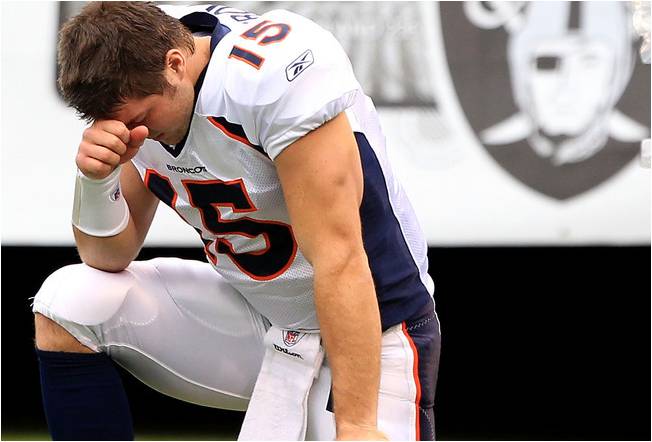
Denver Broncos quarterback Tim Tebow shown “Tebowing.”

Whose side is God on?
The Gospel according to Tebow

By Lamar W. Hankins | The Rag Blog | December 18, 2011

I don’t normally write about an individual’s religious beliefs unless that person is a politician using religion to further his or her political career. But the religion of Tim Tebow, the current quarterback for the Denver Broncos, fits into that genre, although Tebow uses his religion to boost the performance and popularity of a pro football team and his ambition to be a winner, rather than to boost political ambitions.

For those who don’t know, whenever Tebow scores a touchdown, he drops to one knee and assumes a prayerful stance, presumably thanking his God for making his success possible. Tebow is not alone in such public demonstrations of piety. Many football players who score for their teams engage in similar acts of religious fealty.

Some touch an area near their heart and point upward to the sky, the usually accepted location for God’s residence, as though giving God credit for their athletic accomplishment. Others kneel and make the sign of the cross, or some combination of religious demonstrations. Often, field goal kickers, just before the ball is snapped, cross their chests in the manner of priests invoking the blessing of the Father, Son, and Holy Ghost.

I’ve never understood why linemen don’t do the same for an excellent block they have made which allowed a halfback to break through the line and score, or gave time for the quarterback to throw a touchdown pass. Maybe players think God deserves credit only for the points on the scoreboard, not the grunt work it takes to make those scores. When Tebow gets around to writing his gospel for all to read, perhaps he will explain this aspect of the game.

There are other things I don’t understand about Tebow’s Gospel. Why doesn’t God help him throw better passes? He is a weak passer, with a lousy passing percentage. One would think that making Tebow a better passer would take some of the work out of making the Broncos a winning team. But maybe God likes to keep Broncos fans on edge. It makes the games more exciting than would a five touchdown lead.

But Tebow doesn’t stop with such public displays of righteousness. He talks up his religion constantly to fans, reporters, and teammates. Apparently, the entire Bronco team has embraced Tebow’s religion; maybe they figure it wins games for them.

I always thought that Jimmy Johnson, the former winning coach at the University of Miami and the Dallas Cowboys, was smart to study psychology as an undergraduate, even if he never intended to use that knowledge to produce winning football teams. He parlayed what he learned about motivation and human nature into an exceptional career in football that any coach would be pleased with.

Tebow may not have knowledge of psychology to help him, but he has learned the basics about group solidarity, optimism, and Norman Vincent Peale’s “Power of Positive Thinking.” He uses his religion to motivate, inspire, and achieve cohesiveness among his teammates. As long as he continues to give them confidence and help them win, few people in Denver are likely to object to his public displays of religious fervor. But if the winning stops, belief in Tebow’s leadership may wane, as may the Broncos’ reliance on religion to augment a mediocre team.

What Tebow has learned, whether intentionally or as a by-product of his piety, is nothing new to those who have played team sports, especially football. My high school football coaches encouraged (though, as a practical matter, we had no choice) the team to gather on bended knee before games (and sometimes afterwards) to recite The Lord’s Prayer in unison. The coaches knew that this praying together created group cohesion, especially in a demographically select group of Christians. I don’t know what might have happened if one of the few Jewish boys in our high school had been a football player.

The practice also resulted in an aura of supernatural power hovering over the team. If the players thought that God was on their side, it might give them more confidence to stomp the hell out of the other team. This was not a time to think about the Beatitudes.

In trying to understand the Gospel of Tebow, I have wondered why he doesn’t thank God for his mistakes as well as his accomplishments. After all, if God is helping him score touchdowns, the opposite must be true as well. When the team runs three lackluster plays and has to punt, why doesn’t Tebow thank God for helping him be more humble?

The huddle is a perfect place for all the players to take a knee for three seconds, praise Jesus, and call the next play, which might just be a doozy after paying homage to a God so awesome that he takes sides in a football game.

But such God-directed football inevitably leads to the problem of what God might do if two opposing football teams had a similar, if not equal, adherence to the Gospel of Tebow. How would God split the football baby?

We know that Solomon was wise enough when confronted with claims by two women that they were both the mother of a baby to offer a solution that demonstrated the superior compassion of one of the women, who was then awarded the baby. But how does this story relate to who wins a football game?

After all, in pro football we have “sudden death” to decide the winner in games that are tied after four quarters of regulation play. Of course, God could just not allow a score for 15 minutes of sudden death overtime play and the game would end a tie. Somehow, this doesn’t seem particularly Solomonic, however.

Lest someone think I am begrudging Tebow his heart-felt religion, be assured that I believe Tebow is entitled to practice his religion in any stadium anywhere. His practice does me no harm. What it does do is cause me to question the depth and wisdom of his belief in a God that cares about the score of a football game. What sort of God is so trivial that he/she/it would be concerned with football while there is so much suffering of innocents in this world?

Biblical scholar and historian Bart Ehrman wrote recently,

I simply couldn’t understand how there could be a good and powerful God who’s in control of this world given all the pain and misery in it. We live in a world in which a child starves to death every five seconds, a world where almost 300 people die every hour of malaria. We live in a world ravaged by earthquakes and tsunamis and hurricanes and drought and famine and epidemics…

And I wonder why Tebow’s “good and powerful God” gives a damn about the Denver Broncos or any other football team, but not about the millions who suffer through no fault of their own. When Tebow can explain that to me, his public piety may make some sense. Until then, it appears to be nothing more than the same crass use of religion for private gain practiced by so many of our politicians.

“Go Broncos! Amen.”

[Lamar W. Hankins, a former San Marcos, Texas, city attorney, is also a columnist for the San Marcos Mercury. This article © Freethought San Marcos, Lamar W. Hankins. Read more articles by Lamar W. Hankins on The Rag Blog.]

The Rag Blog

Posted in Rag Bloggers | Tagged , , , , , | 2 Comments

Harvey Wasserman : The Timeless Joy of George Whitman’s Shakespeare & Company

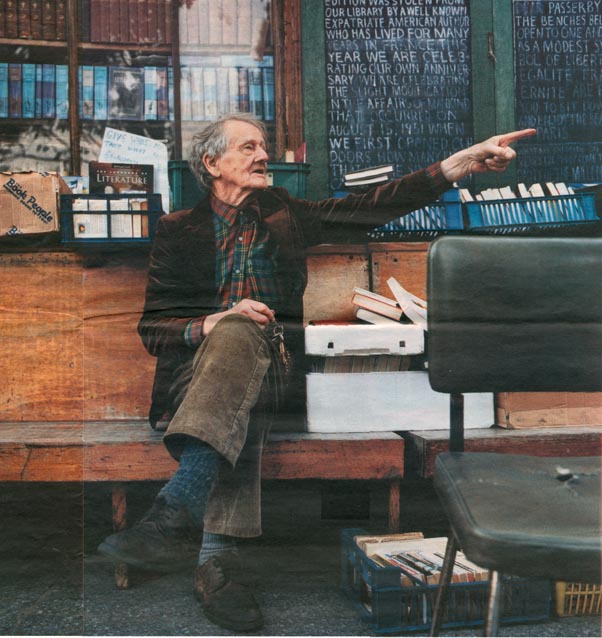
George Whitman at Shakespeare & Company. Image from Oh, by the way…

The timeless joy of
George
Whitman’s Shakespeare & Company

Eyeing me suspiciously, George asked if I was a writer. I said I’d been a college editor, and had aspirations. He said OK… I could have a week on the mattress.

By Harvey Wasserman / The Rag Blog / December 16, 2011

Never doubt that simple acts of generosity and solidarity can change lives — and the world.

George Whitman and his Shakespeare & Company bookstore have been uniquely powerful living proof of that. And his daughter has guaranteed it will continue.

Nestled into the Left Bank of the Seine, a stoned throw from the magnificent Notre Dame Cathedral, George’s bookstore has been a beacon of Bohemian/hippie/humanist/leftist writing and romance for decades.

Its spiritual roots stretch back to the great literary lights of the ex-pat 1920s- — Hemingway and Fitzgerald, Joyce and Stein. In George’s 1950s era, that also meant Kerouac, Ginsberg, Corso, and more. So much genius passed through the place its walls seem to glow.

George Whitman was known for letting budding young writers crash for weeks at a time. In the summer of 1967, I was one of them. Based on hippie urban legend, I sought the place out and asked if I could sleep on a couch upstairs.

Eyeing me suspiciously, George asked if I was a writer. I said I’d been a college editor, and had aspirations.

He said OK… I could have a week on the mattress.

It was pure joy. Raised in the Midwest, just out of the University of Michigan, at the age of 21, I got to hang out in Paris, surrounded by the spirits of the century’s greatest writers, thinkers, rebels. Nightly sessions of intellectual fervor followed days of wandering free through the vibrating streets of that gorgeous, dazzling city.

George consciously followed in the footsteps of another Whitman (no relation) who transformed the literary world of his day — and far beyond. Generous, eclectic, and eccentric, George shared Walt’s occasionally fierce New England temperament, making him both fascinating and formidable.

My week in his bookstore changed my life. It proved that the fantasy of a Bohemian counterculture could actually be sustained, and that it was at least as good as billed by those perennial romantics who are always being dismissed as “unrealistic dreamers.” At Shakespeare & Company, the dream was real… and as good as it gets. All these years later, Woody Allen’s Midnight in Paris delightfully captures (though without the politics) the joy of its spirit.

And it continues. Not long ago I brought to Paris my teenaged daughter Julie. With Max Schneider, son of the great green energy expert Mycle, we paid our respects to Notre Dame, then found the bookstore.

I’d stopped by in the early 1990s and found the place in serious disrepair. I wasn’t optimistic about this return visit.

Shakespeare & Company. Image from Book’s End.

But to my great joy, the place literally shone. George’s daughter Sylvia runs it with firmness and grace. It is bustling with business, beautifully appointed, and offers a timeless blend of off-beat rebellion and good bookselling — what George has called “the business of life.” It is a solid independent enterprise of the kind that is tragically disappearing throughout the US — but in this case with a legendary past being carefully preserved and enhanced.

With Julie and Max by my side, I told Sylvia that I’d stayed upstairs more than 40 years ago, and wanted to thank her for her father’s life-changing hospitality.

She suggested I thank George myself.

Venturing up the narrow, tiled staircase I’d loved so long ago, we found a young writer from Florida encamped as I’d been when we marched through the wine-soaked streets, shouting epithets against the Vietnam War, then retreating to the bookstore to drink and smoke and bask together in the intoxicating, self-proclaimed brilliance of our youthful rebellion.

George was napping on the third floor, but I could send up a note.

So I wrote one profusely thanking him for putting me up, and for keeping the faith through all these decades of trial and chaos, tears and joy, disappointment and victory.

Having made sure that Max and Julie were sufficiently inspired, we were just making our way out when a note came back, scribbled on the backside of the one I’d sent up.

George apologized for being indisposed. But he was glad I’d enjoyed my stay. And, since I’d continued to write all these years, I was welcome to stay again — any time.

Wow! I cannot describe the feeling that note gave me. Especially as I looked at the wide-eyed responses of my daughter and our young friend. In an instant, their lives changed, as mine had so long ago.

George Whitman passed away this week, at age 98. But his is a life that will truly never stop giving.

So thank you, George, for enhancing the Dream and making it real. Thank you, Sylvia, for keeping it alive.

And thank you, Shakespeare & Company, for reminding us all that there really is at our core a spirit of generous, joyous grace that makes life worth living, and that need never die.

[Harvey Wasserman’s History of the United States was published five years after his stay at Shakespeare & Company. He’s been writing and living that dream ever since. Read more of Harvey Wasserman’s writing on The Rag Blog.]

The Rag Blog

Posted in Rag Bloggers | Tagged , , , , | Leave a comment

Harry Targ : The State of Indiana Vs. Universal Human Rights

Eleanor Roosevelt viewed the Universal Declaration of Human Rights as her greatest achievement. Image from Creative Commons.

The State of Indiana vs. the
Universal Declaration of Human Rights

By Harry Targ / The Rag Blog / December 16, 2011

WEST LAFAYETTE, Indiana — The massive atrocities of World War II led nations to commit themselves permanently to the protection of basic rights for all human beings. Eleanor Roosevelt, the widow of the wartime President, Franklin Roosevelt, worked diligently with leaders from around the world to develop a document, to articulate a set of principles, which would bind humankind to never carry out acts of mass murder again.

In addition, the document also committed nations to work to end most forms of pain and suffering.

Over 60 years ago, on December 10, 1948, delegates from the United Nations General Assembly signed the document which they called “The Universal Declaration of Human Rights.” It consisted of a preamble proclaiming that all signatories recognize “the inherent dignity” and “equal and inalienable rights of all members of the human family” as the “foundation of freedom, justice, and peace in the world.”

The preamble declared the commitment of the signatories to the creation of a world “in which human beings shall enjoy freedom of speech and belief and freedom from fear and want…”

The Universal Declaration of Human Rights consisted of 30 articles, with varying degrees of elaboration. The first 21 articles refer primarily to civil and political rights. They prohibit discrimination, persecution for the holding of various political beliefs, slavery, torture, and arbitrary arrest and detention.

Persons have the right to speak their mind, travel, reside anywhere, have a fair trial if charged with crimes, own property, form a family, and in the main to hold the rights of citizenship including universal and equal suffrage in their country.

The remaining nine articles address what may be called social and economic rights. These include rights to basic social security in accordance with the resources of the state in which the persons reside; rights to adequate leisure and holidays with pay; an adequate standard of living so that individuals and families have sufficient food, clothing, shelter, and medical care; and education, free at least at the primary levels.

In addition, these nine articles guarantee a vibrant cultural life in the community, the right to enjoy and participate in the arts, and to benefit from scientific achievements.

While each article in the Universal Declaration of Human Rights provides a rich and vivid portrait of what must be achieved for all humankind, no article speaks to our time more than Article 23. It is one of the longer articles, identifying four basic principles:

  • Everyone has the right to work, to free choice of employment, to just and favorable conditions of work, and to protection against unemployment.
  • Everyone, without discrimination, has the right to equal pay for equal work.
  • Everyone who works has the right to just and favorable remuneration ensuring for himself (or herself) and his (her) family an existence worthy of human dignity, and supplemented, if necessary, by other means of social protection.
  • Everyone has the right to form and to join trade unions for the protection of his (her) interests.

Using the language of our day, the principles embedded in Article 23 of the Universal Declaration of Human Rights constitute a bedrock vision inspiring the global 99 percent to rise up against their exploiters from Cairo to Madison, to Wall Street, to cities and towns all over the world.

The global political economy is broken. The dominant mode of production, capitalism, increasingly cannot provide work, fair remuneration, rights of workers to speak their mind and organize their own associations, and the provision of a comfortable way of life all because the value of what they produce is expropriated by the top 1 percent of global society.

While each locale experiences this dilemma in its own way, the Republican-controlled legislative and executive branch of state government in Indiana is poised to pass legislation reestablishing itself as a so-called “right-to-wor” state. The RTW laws which can be found in over 20 states allow workers to gain the benefits of union representation on the shop floor without joining unions or paying for union services which are provided to all workers.

The basic goal of RTW laws is to bankrupt the labor movement. The end result, as data suggests in every state, is to reduce rights, benefits, and working conditions for all workers. The National Right to Work Committee, the American Legislative Exchange Council, and other right-wing groups funded and organized by the 1 percent, want to eliminate hard-fought worker rights which will reduce the costs of labor, wages, working conditions, and the standard of living of all workers, unionized or not.

Data about the world and data about the United States make it clear that there has been a 30-year trajectory in the direction opposite to the rights enshrined in the Universal Declaration of Human Rights. Global inequality is growing. The rights and abilities of workers to form unions are shrinking. Standards of living of most of humankind are declining. The ability of most workers everywhere to acquire secure jobs is declining.

Globally there has been a quantum shift from agricultural, manufacturing, and service employment to the informal sector, oftentimes “street hustling.”

Not only is this condition being put in place in the state of Indiana but well-financed organizations such as ALEC foresee victory in Indiana setting off a “domino effect”; Indiana, then Michigan, Illinois, Ohio, and Wisconsin. To paraphrase a late nineteenth century geo-politician, “He who controls the heartland then can control the rimland.”

And in the end, anti-worker politics in the United States, like anti-worker politics virtually everywhere around the globe, violates the fundamental principles of the Universal Declaration of Human Rights, especially its precious Article 23. The workers’ agenda is fundamentally the human rights agenda.

[Harry Targ is a professor of political science at Purdue University who lives in West Lafayette, Indiana. He blogs at Diary of a Heartland Radical — and that’s also the name of his new book which can be found at Lulu.com. Read more of Harry Targ’s articles on The Rag Blog.]

The Rag Blog

Posted in Rag Bloggers | Tagged , , , , , , | 2 Comments

Mike Klonsky cautions us to remember that Teddy Roosevelt, eulogized in President Obama’s Osawatomie speech on “New Nationalism” last week, “was at his best a tame economic reformer and at his worst, a racist, imperialist war monger” who believed in Social Darwinism, “the philosophical rock bed of white supremacy.”

Posted in RagBlog | Leave a comment

MUSIC / Jan Reid : The ‘Old Mad Joy’ of the Gourds

Image of The Gourds from thegourds.com.

Old Mad Joy:
No Last Waltz for the Gourds

‘Most bands grow out of rock and roll when they get to be our age,’ Russell told me with a laugh. ‘We’ve done everything kind of backward.’

By Jan Reid | The Rag Blog | January 14, 2011

In the 40-odd years since Austin became more than a backwater of American music, none of its talents have been more rousing and enduring than the band called the Gourds.

The Gourds came out this fall with a highly praised and historically resonant Vanguard release, Old Mad Joy. They have four fine singers and songwriters and an astonishing facility with an array of instruments that include acoustic and bass and electric guitar, mandolin, accordion, violin, piano and organ, and drums. They blend strains and echoes of gospel, rock, blues, country, bluegrass, Cajun, even barbershop harmony — sometimes all of that blended in one song.

I first encountered them about 10 years ago, and I thought, good lord, it was like seeing and hearing The Band. That first exposure led me to an album called Shinebox, which was recorded in the Netherlands, and that started with a pitch- and humor-perfect country-western take on Snoop Doggy Dogg’s hip-hop classic, “Gin and Juice.” The band’s leader — to the extent they have one — is a large good-natured man named Kevin Russell. The cover was an Internet sensation, and reached the notice of Mr. Dogg, as the late Molly Ivins tagged him. An associate on his radio program reached Russell and asked the Gourds to roll on over and rap.

Russell hesitated and said they would have to make some travel arrangements. “The guy said, ‘You’re where?’ Like everybody in the world lives in Los Angeles. I guess if you live out there it seems like they do.” Shinebox also contained eclectic covers of David Bowie’s “Ziggy Stardust,” Townes Van Zandt’s “Two Girls,” and Billy Joe Shaver’s “Omaha.” But now the Gourds seldom play any covers, because their own writing is so prolific and so good.

Jimmy Smith, the Gourds’ bass player and another star singer, has curly black hair and sideburns that are going a little gray now. In style and voice Smith reminded me of the late singer and piano player Richard Manuel, of The Band. David Langford, a rancher and nature photographer whose son Keith is the Gourds’ drummer, told me that I had it wrong. “Listen to him again,” he said. “He is Rick Danko” — the late singer and bass player of The Band, which in the sixties and seventies, especially with the parting Martin Scorcese movie The Last Waltz, far transcended its origins as Bob Dylan’s backup group.

Smith nodded politely as I mentioned the similarities and perceived influences. “We’d never heard of them until people like you started telling us that we sound like them,” he said with a smile, perhaps putting me on. It was a gentle way of saying I was old enough to be his father.

Russell asked me one time, “You want to know why we became an acoustic band?” He laughed and said, “We didn’t want to haul around amps.

“Why the Gourds?” I asked about the name.

“When we came to Austin we were the Picket Line Coyotes,” he replied. “There was some history associated with that, and we just decided it was time to change. Jimmy wanted us to be the Sun-Dried Diegos. I guess he wanted us to play happy hours at Central Market.

He had this little house we called the Steamy Bowl. A shack, really, but he lived there 10 years. Off the road, 200 bucks a month, nobody we could bother much. It was the classic band house. We played, we crashed, we slept on the floor. And he had this little sculpture in the front yard. Broken guitar, various junk. Between its legs was a butternut squash.” Russell shrugged.

“That seemed to be us. The Gourds.”

Russell’s dad worked for an oil company. They lived first in Beaumont, where an uncle used to play Willis Alan Ramsey’s legendary only record and long for the old days at Armadillo World Headquarters, and then his dad’s work moved them to suburban Houston, and then Shreveport.

“I was into Southern rock,” Russell said. “Anything Southern. Lynnyrd Skynnyrd was my favorite.” Then punk bands from Minneapolis and the West Coast caught his ear, and punk was somewhat the tenor of the Picket Line Coyotes. “We sort of got run out of Shreveport,” Russell said. “We were just playing music, and drawing crowds, but fraternity guys were getting drunk and tearing up joints. The owners blamed us. We were blackballed.”

The evolving band moved to Dallas, and then Austin. Smith was from the Dallas suburb Plano. Max Johnston, the third lead singer, had come down from Kentucky and played banjo and acoustic guitar and the violin, which he plays like a violin, not a fiddle. He has a fine song on the new album called TK.

Red-bearded Claude Bernard joined the band blowing on a hooter and bought his first accordion for 35 bucks at a flea market; he’s also the keyboard player. The original drummer was the immigrant Welshman Charlie Llewellin, now Texas Monthly’s new media director and the band’s favorite photographer. Keith Langford, the drummer they settled on, is Russell’s brother-in-law. He’d been playing heavy metal in San Antonio.

Russell had a day job in Austin’s popular independent Book People. He thought an appearance by the band might lighten up employees who wanted to air their grievances at work. The Gourds were initially an in-crowd discovery of people who frequented the bookstore. “Lots of women dancing together,” said Bernard. “Wild dancers. They whipped up the crowd in a way we couldn’t possibly manage.”

They played for crowds of 20 at the Chicago House, then moved up to the Hole in the Wall, across the street from the University of Texas campus and KLRU studios but still far removed from Austin City Limits. “Alt-country” was a rubric of the nineties that began as a fanzine of Uncle Tupelo. The Gourds were uncomfortable about being branded alternative anything and lumped into a yuppie stampede to bib overalls and old swimming holes, but they were Austin’s foremost beneficiary of alt-country.

The Gourds in Austin, Texas, February 12, 2007. Photo by Steve Hopson / Wikimedia Commons.

The North Carolina independent Sugar Hill picked up the Gourds, but they paid their bills from their income on the road. The South by Southwest festival swirled around the Gourds in Austin, but Russell told me that if I’d come to Jovita’s I wouldn’t encounter anybody with plastic cards hanging around their necks. Smoke billowed back then, beers were handed back from a long line at the bar, and now and then a waitress would maneuver through the mass of bodies, holding a tray of enchiladas aloft.

The players were handing back and forth instruments that seemed to never need tuning, though the venue had problems; a clogged air conditioning duct poured a stream of water at their feet. “I think it’s gone beyond towels,” said Russell, blinking and thrown off stride. Smith walked over, spread his arms, and raised his face to the shower. The album they were pushing then was Cow Fish Fowl or Pig.

The title of the record was drawn from Smith’s fanciful song about a vendor calling on William S. Burroughs, Henry Ford, Lee Harvey Oswald, and Muhammad Ali. Performing it, Langford was bearing down on his harmonica, Bernard hugging and swaying with his accordion, a chorus of voices singing genial nonsense, bop bop, bah dooh dah, bop bop. “My name is Jorge and I twist and I juke/ I roll into town on a wagon of fruit.”

The Gourds crowd presented a stunning array of young women. A blond whose face would fill up a movie screen looked at her boyfriend, raised her elbow with a grin of delight, and I watched them go swirling and stomping their heels in the ageless bacchanal.

The Gourds have come a long way since then. The banjo and harmonica have mostly receded from the mix, and they’re plugged in now — more often than his mandolin, Russell plays lead electric guitar in a style that echoes Lynnyrd Skynnyrd, the Allman Brothers, and other Southern rock bands that influenced him as a kid. “Most bands grow out of rock and roll when they get to be our age,” Russell told me with a laugh. “We’ve done everything kind of backward.”

One of the most impressive things about the Gourds is their longevity. They have persevered for 16 years, getting better all the time, and they’ve done it in a once laid-back city where the cost of living has skyrocketed. Smith’s Steam Bowl shack and the $200 rent is a fading memory. They have mortgages now, and Smith told me, “Between us we have five daughters and seven sons.”

They rehearse now in an un-airconditioned former nursing home in South Austin; the room they utilize, once the kitchen, has no windows, much musicians’ equipment, and a homey pleasant clutter — one wall sports a bumper sticker that reads, “My honors student has a career in the service industry.” They get started by 11 a.m. and work no later than 1:30, and then they scatter to pick up their kids after school.

They’ve got devoted followings all over the country now, and they’ve escaped the European touring routine that sustains but also traps so many Texas bands. They’ve got no roadies — for roadies expect a living wage and tend to be temperamental wannabe musicians. The Gourds don’t have the star routine down in which all the instruments are in tune, the sound system is thoroughly checked, and they walk out and hit the chords of the first big hit. Their music is too intricate for that, and they dress like what they are — onetime hippies who are in their forties now.

Gourds image from Facebook

They’ve been at this together since 1995 because they love and respect what they have going. And now they’re no longer scuffling. After years of deserving it, the Gourds have hit the big time.

David Langford, the drummer’s father, told me, “Keith grew up listening to our records of The Band, and that’s how he plays the drums.” Jimmy Smith flaps his elbows like The Band’s Rick Danko when he performs, but he’s a better bass player. Danko played bass with a pick, as does Paul McCarthy.

Smith has the thick muscular hands of a blues guitarist, fingers up on the frets, working the thick strings with a callused thumb below, and with Keith Langford’s drumming that’s one of the reasons their sound is so tight. Smith’s voice is an untethered tenor, and he does sound a lot like Danko. The legacy of The Band and the Gourds’ inheritance is now inescapable.

Through the efforts of their manager Joe Priesnitz, who once represented Stevie Ray Vaughn, they signed a Vanguard contract overseen by executive Bill Bentley, an Austin expat who saw Willie Nelson first captivate an Austin crowd of hippies and anti-war militants assembled for the campaign of George McGovern in 1972, and for a while worked as a publicist for the multicultural rocker Doug Sahm.

Bentley engaged as the Gourds’ producer Larry Campbell, a gifted studio musician who has recorded with Willie, Sheryl Crow, Little Feat, K.D. Lang, Cyndi Lauper, and Levon Helm; he was a member of Bob Dylan’s road band from 1997 to 2004. Early last spring, when there was still snow and ice on the ground in upstate New York, the Gourds arrived for a dose of Campbell’s breathless style in Helm’s storied Barn Studio in Woodstock.

“It really is a barn, but a real nice barn,” Russell told me. “Levon lives in an upper story of it.” Did the legendary drummer and singer of The Band take part in the sessions? “No, he wandered through every so often in his house shoes. He was very friendly, and wanted to take particular care of Keith. ‘Do you need anything? Some water, a soda pop?’ Seems to be some kind of voodoo with drummers.'”

Of course that’s reasonable. In the late summer rehearsal I observed in Austin, Langford was the one who came out of that fire in the kitchen soaked in sweat.

As in past records, the smooth baritone Max Johnston contributes one of the best cuts on Old Mad Joy, the melodic rocker “Haunted.” But Jimmy Smith and Russell again claim most of the lead singing and writing credits. Smith slurs his lines more than Russell, and as a result his singing is not as accessible as his longtime partner’s. And that’s a shame; in wordplay and jitterbug of thought that’s as offbeat as Kerouac, his writing is remarkable.

His great song on this record is “Marginalized.” It’s a paean to a painful subject in our culture, fully in view amid Austin’s stream of BMW convertibles and Escalade SUVs. The hero of this song is the one standing out in the heat beside a stoplight with a message of his life’s misfortune scrawled on a cardboard sign, counting his fortune by the bills and coins dropped in a tin can, pushing all he owns in a cart heisted from a grocery store.

But elevated by Russell’s mandolin and the backup harmonies, the sorrowful song manages to soar. “Well, I’m taking it home on my tectonic plate/ crashed in a pyramid and claimed squatters’ rights/ shared a coop with a fellow wouldn’t shut up about a girl named Isis/ had to blend with the tourists when they came in the a.m…”

Earlier this year, Russell released an album called Shinyribs that was an instant favorite in Austin, singing only his songs and bringing just Keith Langford from the Gourds in a studio band that included one of the cosmic cowboy survivors, Ray Wylie Hubbard (the writer of Jerry Jeff Walker’s “Up Against the Wall, Redneck Mother.”)

Russell said it didn’t mean he was splitting off from the Gourds. “With a band like this you have to make a lot of compromises. Everybody’s got material they’d like to get out there. I’ve got boxes full of songs that I’ve never done anything with. Shinyribs is a break that allows it to be just me, with a terrific other band besides.”

Russell’s rock and roll high point on Old Mad Joy concerns that dreaded gig of road musicians, a dive in nowhere with a vile crowd that brings out the complaint: “My heart is black but in my sack/ I got a sammich and half a pack/ of vitriol and self-abuse/ who can I call to accuse and abuse/ for bringing me to … Peppermint City!” He said there is no such place, but then they’ve played them by the dozens. He laughed when I told him I’d never before heard a rock song with the word “vitriol.”

He also offers “Two Sparrows,” a song about Jesus that he wrote years ago. “His innocence held such clarity, Gethsemane still on his breath/ barefoot and burdened unjustly but love never leaving his breast/ from this began my wandering, my punishment for the crime/ of standing still among an angry mob, all of them friends of mine.”

Vanguard is pushing a rocker called “I Want It So Bad” as the single, but the best of it is Russell’s “Eyes of a Child.” “It’s true I am wicked, it’s true I am mean/ I must have lost my way chasing a dream/ It’s true I’ve done things that I’m ashamed of/ But I still need tenderness and the warmth of love/ I’ve come clean and I’m redeemed/ since I have seen through the eyes of a child.”

All of this may not sound entirely joyous. But turn it up. It’s some of the best music since “The Night They Drove Old Dixie Down.”

A few refrains in this piece previously appeared in the 30th anniversary edition of Jan Reid’s The Improbable Rise of Redneck Rock.

[Jan Reid is an author and music historian and a writer-at-large for Texas Monthly, and his writing has also appeared in Esquire, GQ, Slate, and The New York Times. His books include Texas Tornado: The Life and Times of Doug Sahm, The Improbable Rise of Redneck Rock (considered the definitive tale of Austin music in the 1970’s), the novel Comanche Sundown, and books about Tom DeLay and Karl Rove. His, memoir The Bullet Meant for Me, was the story of his mental, psychological, and emotional recovery from a brutal 1998 robbery and shooting in Mexico City — and his sustaining friendship with the two-time world champion boxer Jesus Chavez. Reid is now writing a biography of former Texas Gov. Ann Richards.]

The Rag Blog

Posted in Rag Bloggers | Tagged , , , , , | Leave a comment

BOOKS / Jonah Raskin : Sean Stewart’s Spirited History of the Underground Press


Sean Stewart’s On the Ground is a lively
anecdotal history of the underground press

Amply illustrated with art, cartoons, drawings, and covers from the colorful, eye-catching papers of the Sixties, it comes closer to the spirit of the in-your-face underground papers.

By Jonah Raskin | The Rag Blog | December 14, 2011

[On The Ground: An Illustrated Anecdotal History of the Sixties Underground Press in the U.S., edited by Sean Stewart, preface by Paul Buhle (Oakland, CA: PM Press, 2011); Paperback; 204 pages; $20.00.]

Sean Stewart’s On the Ground is the last of three feisty books published in the past year about the Sixties underground press. The strengths of Stewart’s book are spelled out in the subtitle: it’s illustrated and it’s anecdotal.

Unlike John McMillan’s Smoking Typewriters, which came out last winter, and Ken Wachsberger’s Insider Histories of the Vietnam Era Underground Press, which came out last spring, Stewart’s On the Ground — which has just been published — does not try to be all-inclusive, comprehensive, and analytical.

Amply illustrated with art, cartoons, drawings, and covers from the colorful, eye-catching papers of the Sixties, it comes closer than the previous two books to the spirit of the in-your-face underground papers.

Many of the anecdotes that appear in On the Ground are told by Sixties writers, photographers, and editors who were omitted, neglected, or shunted to the sidelines by McMillan and Wachsberger, though probably not intentionally. There were just too many contributors to the underground papers to include all of them in one book.

Marvin Garson — the editor of the San Francisco Express Times — is mentioned briefly and only in passing. That’s too bad because he had a deep understanding of media, news, and communications. Todd Gitlin mostly dismisses him in The Sixties because he pushed surrealism into “bad taste.” Of course, the underground press was often a mix of surrealism and bad taste.

Paul Krassner — one of the fathers of the underground papers — defended the mix time and time again and refused so say what was fact and what was fiction in his published pieces, what was made up and what was an accurate historical depiction.

The historian, Paul Buhle, provides a preface to Stewart’s On the Ground that has the feel of a hastily written piece that seems designed to attack the competition. In fact, Buhle goes out of his way to target what he sees as the flaws of McMillan’s Smoking Typewriters; his comments probably would have been more useful in a review of that book than in the preface to Stewart’s work.

Moreover, Buhle is so partial to the Sixties that he often doesn’t seem to see the creativity and spunk of the subversive newspapers, newsletters, and magazines that were published long before the underground newspapers of the 1960s came along. But Paul Krassner, the founder and long time editor of The Realist, goes back to the 1950s and even further back to Tom Paine and the “whole tradition” of dissenting pamphleteers and makes it clear that America has a long rich history of defiant writers, editors, and publishers.

On the Ground does not aim to be critical of the Sixties papers or to skewer the protest movements of the era, but by reproducing the art, the cartoons, and the provocative covers from Rat, The East Village Other, The Seed, Old Mole, Space City!, and more, it aptly illustrates the youthful sexism of the artists and cartoonists and makes all too apparent a generation’s obsession with violence.

Guns, knives, and various assorted weapons appear again and again in more than two dozen illustrations in this book, and from the beginning to the end there are images of naked women, women with conspicuously large breasts, women performing oral sex, and women as the sex toys of men.

Fortunately, the book does not become defensive or try to make excuses for the images that glorify guns and that turn women into objects of male gratification. Enough time has passed, it would seem, for the pictures to speak for themselves, and to reflect the zeitgeist of the era without the need to condemn or defend. There’s something to be said for the passage of time.

Some of the Sixties chauvinism that Buhle exhibits is apparent in anecdotes from activists and organizers such as John Sinclair of the White Panthers who describes Detroit before the 1960s as “a cultural backwater” in which “nothing was happening,” though even in pre-1960s Detroit — and in Cleveland, Buffalo, and elsewhere in the Midwest — there were rumblings, grumblings, beat poets, jazz artists, and Marxists.

Really, folks. The thaw in the cold war and the cracks in the imperial society didn’t show up for the first time in 1960.

The voices of many of the women are less strident now than they were in, say, 1970 in the midst of women’s liberation, when nearly every man was regarded as a male chauvinist pig. Alice Embree gives credit to the civil rights movement that preceded the protests of the 1960s and that provided an “example of moral courage to direct action.”

Judy Gumbo Albert, one of the original Yippies, describes her job at the Berkeley Barb in the department of classified sex ads that were usually placed by heterosexual men. “I was a naïve young woman from Canada,” she writes. “This job really opened me to, and made me appreciate the diversity of human sexuality.”

Trina Robbins describes how she “fought her way into the male-dominated world of underground comix” to create her own original work.

Working for the underground press was usually a learning experience, though not always in accord with the ideas about education that were embraced by the college professors of the day. Rat editor Jeff Shero Nightbyrd explains that in New York in the late 1960s and early 1970s, “the Mafia controlled magazine distribution.” The East Village Other tried to bypass the Mafia only to learn that working with the Mafia and not against it was the only way to put papers in the hands of readers. “We had Mafia distributors,” Nightbyrd writes.

Many of the contributors to On The Ground — Thorne Dreyer, Harvey Wasserman, Paul Krassner, Alice Embree, Judy Gumbo Albert, and Jeff Shero Nightbyrd — will be familiar to readers of The Rag Blog, and there are colorful stories about the original Austin Rag, too.

“One of the important things about the underground press was that it was a collective, communal experience,” Thorne Dreyer says. “Everybody came in and got involved and became a part of it, and got politicized through the process.” And that same process, or something very similar to it, is taking place wherever the Occupy Wall Street movement has surfaced all across America.

[Jonah Raskin is the author of For The Hell of It: The Life and Times of Abbie Hoffman, and The Radical Jack London. A professor at Sonoma State University, Jonah is a regular contributor to The Rag Blog. Read more articles by Jonah Raskin on The Rag Blog.]

The Rag Blog

Posted in Rag Bloggers | Tagged , , , , , , , , , , , | 1 Comment

BOOKS / Mariann G. Wizard : scott crow’s ‘Black Flags and Windmills’


Black Flags and Windmills:
Hope, Anarchy, and the Common Ground Collective

scott crow’s book tells of the abandonment of a great American city by the powerful, the refusal of its poorest and most vulnerable citizens to lay down and die, and the necessity for community self-reliance that is Katrina’s great lesson.

By Mariann G. Wizard | The Rag Blog | December 13, 2011

[Black Flags and Windmills: Hope, Anarchy, and the Common Ground Collective by scott crow; foreword by Kathleen Cleaver (Oakland, CA: PM Press, 2011); Paperback; 223 pp.; $20.00.]

On August 29, 2005, Hurricane Katrina, a Category 3 storm, the sixth strongest recorded to date, scored a direct hit on the City of New Orleans. Over the next days and weeks, as neglected levees failed and federal and state governments and aid agencies floundered, Katrina became the costliest natural disaster, and fifth deadliest, in U.S. history.

Katrina affected millions, changed the lives of hundreds of thousands forever, and called some to rise above all personal considerations and give themselves to the Herculean task of saving the Gulf Coast and its people.

Among the latter was a Texas anarchist, a lanky East Dallas white guy who looks like he’s from way over in East Texas, easy-going but hard-bitten. And while the person he was before Katrina may still be, he was forever changed by what he witnessed and achieved in Louisiana.

scott crow, like the poets raul r. salinas and e.e. cummings, doesn’t capitalize his name. This is one of those odd contradictions, wherein a desire to de-emphasize an individual’s importance to, say, an international movement for compassionate autonomy, births the need to explain that this particular person doesn’t do something most everyone does, thus making it necessary to consider her or him individually.

Well, humility can’t help but call attention to itself, if only by its contrast with the egocentric world-at-large. As I told scott recently, I’ve been wanting to read his autobiography since I met him.

I knew his name before we met because a nonprofit foundation that I serve as a board member gave money to hurricane relief work, beginning, I think, in 2006. But I didn’t know he and his life partner, Ann Harkness, were living in Austin until they came to my book release party that fall with former Louisiana political prisoner Robert King and a couple of his other friends.

Both Ann and scott have been valuable change-makers in Austin since moving here shortly before Katrina. scott is Director of Ecology Action, the grassroots community organization that pioneered recycling in Austin while he was in grade school. Ann is a gifted, witty photographer. Both are active in many community groups and the core of a lively social scene that also embraces King, antiglobalization worker Lisa Fithian, and other activists who date their lives in Austin from Katrina’s floods.

Our community has also seen them undergo the very public trauma of having a former friend and sometime-colleague exposed as an FBI informer, in this reviewer’s opinion responsible for inciting two younger activist friends to plan violence at the 2007 Republican National Convention.

Black Flags and Windmills, crow’s first book, focuses on Common Ground Collective, an anarchist-based relief organization he helped found when official disaster relief efforts not only failed to meet the needs of affected residents along the Gulf Coast, but seemed intent upon criminalizing them.

But that wasn’t what he set out to do. While millions sat stunned, weeping at televised images of a drowned metropolis, as mythic to the American psyche as Atlantis to the Greeks’, scott crow drove from Austin, Texas, to New Orleans to look for a stranded friend.

Black Panther Party matriarch Kathleen Cleaver’s insightful introduction sees this as the fulcrum, asking, “What deep motivation drives anyone to travel by boat across an unfamiliar flooded city looking for a friend under life-threatening circumstances?”

The answer comes from another BPP icon, Geronimo ji Jaga: “Revolutionaries are motivated by great love for another world.”

It is that love that most illuminates scott’s character and the pages of this work. From details of organizational process-building among a shifting cast of residents, volunteers, and core activists, to gritty descriptions of clearing long-clogged storm sewers and scraping dead animals from the streets, the bottom line is that he doesn’t leave anyone behind.

It almost doesn’t matter that the friend he went to find was Robert King, former BPP activist who served 29 years in solitary confinement in Louisiana’s notorious Angola Prison. scott and Ann Harkness met King shortly after his 2001 release. scott may not see it this way, but I think he would have done the same thing for any number of other friends and comrades.

King’s particular circumstances and his exemplary humility and dedication — he continues to work for the release of his Angola comrades, Albert Woodfox and Herman Wallace — certainly helped draw crow back to New Orleans after a first failed, frightening, surreal sortie.

The courage of NOLA residents who were also there at the beginning, Common Ground co-founders Malik Rahim and Sharon Johnson, kept him there for months under incredibly demanding circumstances. But the initial determination to help a friend underlies all of scott’s work, pre- and post-Katrina, and has made him something of an icon, if a reluctant one, to antiglobalization activists around the world.

As an autobiography, Black Flags and Windmills is unconventional; one must look to the “About the author” addendum to discover scott’s age. He spends 15 pages on his childhood and youth. A small, loving section on his Mom, Emily, shows the origins of his empathetic nature. It reminds me of cousins and classmates, perhaps a couple of years younger and drawn to the 1960s subculture in which I participated. Emily came to womanhood before the words “women’s” and “liberation” ever met, when racial segregation had but recently fallen, and “race mixing” was still rare.

Scott was born in 1967; the Vietnam war was still escalating. Emily, a single mom, wasn’t an activist — but she surely knew people who were. She wanted a better world for her son. I knew young parents in Austin then who sent their children to the “hippie school” in the country, or helped in a free breakfast for schoolchildren program inspired by those of the BPP. Emily sent scott to an East Dallas preschool run by former BPP activists. While the preschool was not overtly political, the BPP’s 10-Point Program is in his book and is a cornerstone of his activism.

Between East Dallas and New Orleans, scott recounts his evolution as a “libertarian anarchist,” a phrase I applaud in theory but find somewhat wanting in rigor. Despite having been influenced by socialists and socialist-influenced activists, he expresses more anti-communist views here than anti-capitalist ones, although it may be that a critique of corporate capital is implicit in the work as a whole.

He seems to view communism and/or socialism solely as political systems — authoritarian, anti-democratic ones at that — rather than economic ones. This leads him, IMHO, into the error of rejecting a priori tools that could serve a libertarian anarchist society rather well, and this is a topic I plan to pursue with him and with Ann in time.

Most of the narrative of Black Flags and Windmills, however, is not analytical but tells one man’s story — a man careful to “leave room for other stories” — of the abandonment of a great American city by the powerful, the refusal of its poorest and most vulnerable citizens to lay down and die, and the necessity for community self-reliance that is Katrina’s great lesson.

Government cannot help you. Government seeks to control you. In any disaster or emergency, help yourself and those around you. Many tasks cannot be performed by one person, thus, make principled alliances, work cooperatively, share decision-making and resources. Ask what people need; don’t assume. Express your own needs clearly.

Starting with three people and $50, Common Ground helped thousands of individuals and families, saved and rebuilt entire communities, and raised over a million dollars in small contributions in two years, an astonishing feat in the nonprofit world.

scott’s ruminations on privilege — his privileges of being white, male, able-bodied, etc. — illuminate an ongoing contradiction of radical organizing: a person on the edge of starvation has little time for considering organizational culture, yet such consideration is vital for long-term success. His solution is to use whatever social privilege he has for the benefit of those who have none.

Stretched to his physical and emotional limits, sleeping on the ground in sticky Louisiana heat, eating bad food, surrounded 24-7 by the stench of decay, death, and constant crisis, scott’s “privilege,” one may argue, is what kept him up late writing and rewriting the organizational principles, procedures, and other expressions of self-determination necessary for group cohesion.

Expecting certain rights also motivates one to demand them. scott’s experiences in New Orleans, a white outsider in a black community rightfully skeptical of offers to “help,” made me recall a personal white-girl introduction to in-your-face racism: I was furious because a friend of mine was insulted, my anger not for his humiliation, but mine. That was an expression of privilege, you betcha! — but also a time-release capsule of truth, exposing just how limited such privilege was and its unacceptable costs.

Racism continues to fester beneath public civility and political correctness today, finding sustenance in toxic, chaotic situations. The privilege of opposing it remains with the white moiety from whom it springs and whose deception is among its aims. The illusion that white skin, male gender, a college diploma, or other privileges are proof against oppression and exploitation remains a primary obstacle to social change.

crow’s frank, no-nonsense discussion of armed self-defense is also a valuable contribution; recommended. As a young man, he feared guns and had to overcome the phobia to become a good marksman when the need became clear. The East Texas in him seems to have won out here; his attitude is more that of a farmer who would resolutely drop a wild hog ripping up his crops than of a poseur power-tripping on fancy weaponry.

Again BPP principles are seen, not only in Common Ground’s acceptance of self-defense as legitimate but in the determination to keep resources gathered for the community from being stolen or destroyed.

scott is as frank in discussing Common Ground’s internal issues as its external challenges, and while his desire not to personalize problems can be frustrating to the nosy reader, the conclusions he draws are surely of more long-term value.

We don’t need to know who wanted to, “Damn everything but the circus!” to recognize the “type” scott describes in a section so subtitled: the loudmouth who shows up to “volunteer” with their own, most often self-serving agenda. Sometimes, after due consideration and an often numbing amount of talk, you just have to show them the door.

In this regard, the book is also notable for what is doesn’t include: long explanations of why scott was right and other people wrong, or details of endless debates over points that later were seen to be pointless. Through principled, shared decision-making, Common Ground has been able to grow through its occasional and inevitable disagreements relatively unscathed. It apparently furthers one to have someplace to go!

In sharp contrast to this overall amicability, crow’s brief criticism of the racist, sectarian New Black Panther Party is well-founded and pulls no punches. Two so-called “socialist” sects also come in for a well-deserved basting; a disaster area is not a place to sell your newspaper! Leaders have to speak against bullshit even when it wears a revolutionary cloak.

Yes, I said the “L” word, and so does scott: “Leadership happens when someone is given permission by the rest of the group to lead.” Accountable, anti-authoritarian leadership must be demanded, and taught. The notion that leadership is always to be avoided, a major dilettante cop-out of the 1960s, has hopefully been relegated to the dustbin of history!

Black Flags and Windmills is chock-full of juicy quotes from rebels, poets, and rockers, and has whetted my appetite to hear a bunch of bands I somehow missed, perhaps during my deeply reggae years, such as Ministry, Skinny Puppy, the Replacements, the Coup, and more.

But I was most struck by this quote from the early Romantic poet, Percy Bysshe Shelley, whose chords are echoed today by Occupation troubador Makana:

“Rise like Lions after slumber
In unvanquishable number,
Shake your chains to earth like dew
Which in sleep had fallen on you –
Ye are many – they are few.”
— from “The Mask of Anarchy”

Another contribution of crow’s book is its Appendices, including notes, memoranda, and both internal and external Common Ground communiqués. Here are appeals to the world outside for money and materiel, desperate descriptions of need, calm accounts of the unresponsiveness and outright hostility of government and other “official” disaster personnel to the agile, popularly-based, collaborative self-help afforded by and through Common Ground.

These documents may not only be useful to historians of the future who seek to understand the impact of Katrina, or the failures of the G.W. Bush administration, but to today’s activists who seek to build new institutions, new processes, and a new culture.

No matter how dire the circumstances, it seems, this process is not easy nor always harmonious. A great deal of sweat and inconvenience is involved. Troublesome details must be constantly addressed. The more you bite off, the more you must chew. This book will help you sharpen your teeth.

Black Flags and Windmills combines hands-on information about what it really takes to change this world, one big mess at a time, and a seeker’s vision of a better world. Well done!

[Mariann G. Wizard, a Sixties radical activist and contributor to The Rag, Austin’s underground newspaper from the 60s and 70s, is a poet, a professional science writer specializing in natural health therapies, and a contributing editor to The Rag Blog. Read more articles and poetry by Mariann G. Wizard at The Rag Blog.]

The Rag Blog

Posted in Rag Bloggers | Tagged , , , , , , , , , , | Leave a comment

Rag Radio : We Interview Nonviolent Activist Val Liveoak and Author Robert H. Frank

Nonviolent Activist Val Liveoak of Peacekeeping en Las Americas
on Rag Radio with Thorne Dreyer. Listen to it here:

Also listen to New York Times Columnist Robert H. Frank,
Author of The Darwin Economy, on Rag Radio, here:

(Texas Music Hall of Fame Singer/Songwriter Eliza Gilkyson will be Thorne Dreyer’s guest on Rag Radio, Friday, December 16, 2011, from 2-3 p.m. CST on KOOP 91.7-FM in Austin and streamed live to the world.)

Nonviolent activist Val Liveoak.

Val Liveoak
, who was Thorne Dreyer’s guest on Rag Radio Friday, December 9, 2011, is the coordinator and co-founder of Peacebuilding en Las Américas with the Friends Peace Teams. The program promotes peace and healing in countries where the violent legacy of civil war has added to the continued poverty and injustice that sparked the conflicts.

The programs of the Friends Peace Teams build on the Quaker experience, combining practical and spiritual aspects of conflict resolution. Peacebuilding en las Américas currently works in El Salvador, Guatemala, Nicaragua, Honduras, and Colombia. Val has also done volunteer work with the Alternatives to Violence Project in Bolivia, Cuba, Mexico, Burundi, Rwanda, Canada, and Kenya.

Val Liveoak, who became a nonviolent activist in Austin in the early ’70s, has been named a “Woman of Peace” by Womens’ Peacepower Foundation (2009) and Peacemaker of the Year by the Austin Peace and Justice Center (1986). She has chosen to live below the poverty line and work as a volunteer since the early ’90s and currently lives in an “intentional neighborhood” in San Antonio, when she’s in the United States.

Author and New York Times columnist Robert H. Frank.

Robert H. Frank, who was Thorne Dreyer’s guest on Rag Radio, Friday, December 2, 2011, is an economics professor at Cornell’s Johnson Graduate School of Management, a regular “Economic View” columnist for The New York Times, and a Distinguished Senior Fellow at Demos.

Robert Frank’s latest book is The Darwin Economy: Liberty, Competition, and the Common Good, in which he contends that naturalist Charles Darwin was a greater economist than Adam Smith. In The Darwin Economy, Frank argues against Adam Smith’s theory of the “invisible hand” which says that competition channels self-interest for the common good.

“The uncritical celebration of the invisible hand,” writes Frank, “has undermined regulatory efforts to reconcile conflicts between individual and collective interests…, causing considerable harm to all of us.”

Roger Baker, who writes about economics and transportation for The Rag Blog, also participated in this interview.

Rag Radio — hosted and produced by Rag Blog editor Thorne Dreyer — is broadcast every Friday from 2-3 p.m. (CST) on KOOP 91.7-FM in Austin, and streamed live on the web. KOOP is an all-volunteer cooperatively-run community radio station in Austin, Texas.

Rag Radio, which has been aired since September 2009, features hour-long in-depth interviews and discussion about issues of progressive politics, culture, and history. After broadcast, all episodes are posted as podcasts and can be downloaded at the Internet Archive. Tracey Schulz is the show’s engineer and co-producer.

Rag Radio is also rebroadcast on Sundays at 10 a.m. (Eastern) on WFTE, 90.3-FM in Mt. Cobb, PA, and 105.7-FM in Scranton, PA. Rag Radio is produced in the KOOP studios, in association with The Rag Blog, a progressive internet newsmagazine, and the New Journalism Project, a Texas 501(c)(3) nonprofit corporation.

Coming up on Rag Radio:

  • Dec. 16, 2011: Texas Music Hall of Fame singer/songwriter & activist Eliza Gilkyson.
  • Dec. 30, 2011: Environmentalist and global warming activist Bruce Melton.
  • Jan. 6, 2012: New Years Special with SDS founder and political activist Tom Hayden.

The Rag Blog

Posted in RagBlog | Tagged , , , , , , , , | 1 Comment

Mike Klonsky : Let’s Not Get All ‘Warm and Fuzzy’ About Teddy Roosevelt

Theodore Roosevelt’s “New Diplomacy.” Political cartoon courtesy of Mike Klonsky’s SmallTalk Blog.

Before we start feeling all warm
and fuzzy about Teddy Roosevelt…

By Mike Klonsky | The Rag Blog | December 13, 2011

Let’s remember that Teddy Roosevelt, eulogized in President Obama’s Osawatomie speech on “New Nationalism” last week, was at his best a tame economic reformer and at his worst, a racist, imperialist warmonger. Publicly, Roosevelt spoke out against racism and discrimination at times, but also believed in Social Darwinism, the philosophical rock bed of white supremacy.

Here are a few of TR’s thoughts on race and politics that Obama failed to mention:

In 1894, he wrote an article entitled “National Life and Character” in which he said that, “negroid peoples, the so-called “hamitic,” and bastard semitic, races of eastern middle Africa were “not fit” to compete with whites and it would take “many thousands years” before the Black became even “as intellectual as the [ancient] Athenian.”

According to linguist and historian Noam Chomsky, “Theodore Roosevelt was a shocking racist. I don’t use the analogy lightly, but it’s a fact that you have to go to the Nazi archive to find anything similar.”

Roosevelt wrote:

The expansion of the peoples of white, or European, blood during the past four centuries which should never be lost sight of, especially by those who denounce such expansion on moral grounds. On the whole, the movement has been fraught with lasting benefit to most of the peoples already dwelling in the lands over which the expansion took place.

With regard to the conquest of a half of Mexico, Roosevelt explained:

…it was inevitable, and in the highest degree desirable for the good of humanity at large, that the American people should ultimately crowd out the Mexicans from their sparsely populated northern provinces.

And then, in a line that would do Texas’ Gov. Rick Perry and most of the Republican candidates proud, TR wrote, “It was out of the question to expect Texans to submit to the mastery of the weaker race.”

So I’m sorry, Pres. Obama. But I’m just not ready to embrace Roosevelt’s “New Nationalism” quite yet. I hope you aren’t either.

[Mike Klonsky, an educator, writer, and school reform activist who lives in Chicago, was active with SDS in the Sixties. Mike blogs at SmallTalk, where this article also appears.]

The Rag Blog

Posted in Rag Bloggers | Tagged , , , , | 4 Comments

SPORT / Dave Zirin and Zach Zill : The Death of Socrates

Brazilian soccer legend Socrates before a World Cup match in Guadalajara, Mexico, June 16, 1986. Photo by Wolfgang Ratta / Reuters.

The death of Socrates:
Celebrating the Brazilian soccer legend

Socrates was one of those rare athletes whose outsized personality and effervescent humanity transcended the game.

By Dave Zirin and Zach Zill | The Rag Blog | December 12, 2011

International soccer lost a hero last weekend when Socrates, the masterful Brazilian midfielder who captained Brazil’s famed 1982 World Cup squad, died from an intestinal infection at age 57.

The death of the lanky, bearded, 6-foot 4-inch field general with a philosopher’s name will be felt far beyond the sports world. Socrates — full name Socrates Brasileiro Sampaio de Souza Vieira de Oliveira — was one of those rare athletes whose outsized personality and effervescent humanity transcended the game.

Socrates’ interests, talents, and achievements were staggering. He was a medical doctor, a musician, an author and news columnist, a political activist, and a TV pundit. Somewhere in all of this, he managed not only to lead what may have been the most artful team to ever grace the pitch, but also to fearlessly challenge the decades-long military dictatorship that ruled Brazil.

Alongside the 1982 Brazilian midfield of Zico, Falcao, Cerezo, and Eder, Socrates brought a combination of technical prowess, deadly goal-scoring ability, and blissful creativity that has never been matched. If ever the uninhibited joy of children playing merged with raw competitive dominance, it was in the squad that Socrates led to the World Cup in Spain.

They embodied Eduardo Galeano’s description of Brazilian soccer as “the most beautiful soccer in the world, made of hip feints, undulations of the torso and legs in flight, all of which came from capoeira, the warrior dance of black slaves, and from the joyful dances of big city slums…There are no right angles in Brazilian soccer just as there are none in the Rio Mountains.”

Socrates approached soccer with the intensity and lack of restraint that he brought to every aspect of his life. He drank, he smoked, and he played without shin guards. His impetuosity as a player and a person was embodied in his signature move on the field: the blind heel pass.

Socrates became a professional player almost as an afterthought, not becoming a full-time professional until he signed with Corinthians at age 24. And unlike most professional athletes then and now, he refused to check his politics at the door.

Unlike the great Pele, Socrates never made financial or political peace with Brazil’s dictatorship. In fact, with his medical expertise, his flowing hair and full beard, and his resistance politics, he shared less in common with Pele than Che Guevara.

That’s not hyperbole. Socrates may be the only professional athlete to ever organize a socialist cell among his fellow players. He helped assemble Corinthians, a club team from Sao Paolo built on a radical political foundation. Corinthians proceeded to become a focal point for national discontent with Brazil’s military dictatorship.

The military had ruled Brazil since 1964, when it overthrew left-wing president João Goulart who promised land redistribution and nationalization of industry. By the early 1980s, as the dictatorship was beginning to strain under the weight of mass repression and economic stagnation, Socrates and his teammate Wladimir organized and played for Corinthians, known as the “Time do Povo” or “Team for the People,” to demonstrate the power of democracy.

With the consent of club president Waldemar Pires, the players established a democratic process to govern all team decisions. As Socrates explained, “Everyone at the club had the same right to vote — the person who looked after the kit and the club president, all their votes had the same weight.”

The players decided what time they would eat lunch, they challenged strict rules that locked players in their hotel rooms for up to 48 hours before a match, and they printed political slogans on their uniforms.

In this way, one of South America’s most popular teams became a beacon of hope, not just to Brazilians, but across a continent largely shackled by U.S.-backed dictators. Socrates, on his way to 297 appearances and 172 goals for Corinthians, was one of the most popular figures in the country, and thus nearly unassailable by the military rulers.

The tragedy of Socrates’ death lies both in his age, just 57, and the timing. As the World Cup and Olympics are thundering toward Brazil, his would have been a critical voice against the way these international sporting carnivals run roughshod over local communities, all for the benefit of a nation’s elite.

When asked earlier this year by the Guardian if the coming World Cup would help the poor of Brazil, Socrates said, “There will be lots of public money disappearing into people’s pockets. Stadiums will be built and they will stay there for the rest of their lives without anyone using them. It’s all about money. What we need to do is keep up public pressure for improvements in infrastructure, transport, sewerage, but I reckon it will be difficult.”

Speaking out against the World Cup in Brazil? Now that is true political courage. But Socrates, true to form in this interview, didn’t confine his commentary to soccer. He said, “What needs to change here is the focus on development. We need to prioritize the human being. Sadly, in the globalized world, people don’t think about individuals as much as they think about money, the economy, etc.”

Let’s hope that a new generation of young Brazilians will see fit to pick up where Socrates left off. As the World Cup and Olympics come to the new Brazil, expect the spirit of Socrates to echo in the streets.

[Dave Zirin is the author of The John Carlos Story (Haymarket) and just made the new documentary Not Just a Game. Receive his column every week by emailing dave@edgeofsports.com. Contact him at edgeofsports@gmail.com. Read more articles by Dave Zirin on The Rag Blog. Zach Zill is a freelance writer living in Washington DC. He can be reached at zach.zill@gmail.com. This article was also posted to The Nation.]

The Rag Blog

Posted in Rag Bloggers | Tagged , , , , | Leave a comment

The State of Indiana vs. the
Universal Declaration of Human Rights

By Harry Targ / December 12, 2011

The massive atrocities of World War II led nations to commit themselves permanently to the protection of basic rights for all human beings. Eleanor Roosevelt, the widow of the wartime President, Franklin Roosevelt, worked diligently with leaders from around the world to develop a document, to articulate a set of principles, which would bind humankind to never carry out acts of mass murder again.

In addition, the document also committed nations to work to end most forms of pain and suffering.

Over 60 years ago, on December 10, 1948, delegates from the United Nations General Assembly signed the document which they called “The Universal Declaration of Human Rights.” It consisted of a preamble proclaiming that all signatories recognize “the inherent dignity” and “equal and inalienable rights of all members of the human family” as the “foundation of freedom, justice, and peace in the world.”

The preamble declared the commitment of the signatories to the creation of a world “in which human beings shall enjoy freedom of speech and belief and freedom from fear and want…”

The Universal Declaration of Human Rights consisted of 30 articles, with varying degrees of elaboration. The first 21 articles refer primarily to civil and political rights. They prohibit discrimination, persecution for the holding of various political beliefs, slavery, torture, and arbitrary arrest and detention.

Persons have the right to speak their mind, travel, reside anywhere, have a fair trial if charged with crimes, own property, form a family, and in the main to hold the rights of citizenship including universal and equal suffrage in their country.

The remaining nine articles address what may be called social and economic rights. These include rights to basic social security in accordance with the resources of the state in which the persons reside; rights to adequate leisure and holidays with pay; an adequate standard of living so that individuals and families have sufficient food, clothing, shelter, and medical care; and education, free at least at the primary levels.

In addition, these nine articles guarantee a vibrant cultural life in the community, the right to enjoy and participate in the arts, and to benefit from scientific achievements.

While each article in the Universal Declaration of Human Rights provides a rich and vivid portrait of what must be achieved for all humankind, no article speaks to our time more than Article 23. It is one of the longer articles, identifying four basic principles:

  • Everyone has the right to work, to free choice of employment, to just and favorable conditions of work, and to protection against unemployment.
  • Everyone, without discrimination, has the right to equal pay for equal work.
  • Everyone who works has the right to just and favorable remuneration ensuring for himself (or herself) and his (her) family an existence worthy of human dignity, and supplemented, if necessary, by other means of social protection.
  • Everyone has the right to form and to join trade unions for the protection of his (her) interests.

Using the language of our day, the principles embedded in Article 23 of the Universal Declaration of Human Rights constitute a bedrock vision inspiring the global 99 percent to rise up against their exploiters from Cairo to Madison, to Wall Street, to cities and towns all over the world.

The global political economy is broken. The dominant mode of production, capitalism, increasingly cannot provide work, fair remuneration, rights of workers to speak their mind and organize their own associations, and the provision of a comfortable way of life all because the value of what they produce is expropriated by the top 1 percent of global society.

While each locale experiences this dilemma in its own way, the Republican-controlled legislative and executive branch of state government in Indiana is poised to pass legislation reestablishing itself as a so-called Right-to-Work State. The RTW laws which can be found in over 20 states allow workers to gain the benefits of union representation on the shop floor without joining unions or paying for union services which are provided to all workers.

The basic goal of RTW laws is to bankrupt the labor movement. The end result, as data suggests in every state, is to reduce rights, benefits, and working conditions for all workers. The National Right to Work Committee, the American Legislative Exchange Council, and other right-wing groups funded and organized by the 1 percent, want to eliminate hard-fought worker rights which will reduce the costs of labor, wages, working conditions, and the standard of living of all workers, unionized or not.

Data about the world and data about the United States make it clear that there has been a 30-year trajectory in the direction opposite to the rights enshrined in the Universal Declaration of Human Rights. Global inequality is growing. The rights and abilities of workers to form unions are shrinking. Standards of living of most of humankind are declining. The ability of most workers everywhere to acquire secure jobs is declining.

Globally there has been a quantum shift from agricultural, manufacturing, and service employment to the informal sector, oftentimes “street hustling.”

Not only is this condition being put in place in the state of Indiana but well-financed organizations such as ALEC foresee victory in Indiana setting off a “domino effect”; Indiana, then Michigan, Illinois, Ohio, and Wisconsin. To paraphrase a late nineteenth century geo-politician, “He who controls the heartland then can control the rimland.”

And in the end, anti-worker politics in the United States, like anti-worker politics virtually everywhere around the globe, violates the fundamental principles of the Universal Declaration of Human Rights, especially its precious Article 23. The workers’ agenda is fundamentally the human rights agenda.

[Harry Targ is a professor of political science at Purdue University who lives in West Lafayette, Indiana. He blogs at Diary of a Heartland Radical — and that’s also the name of his new book which can be found at Lulu.com. Read more of Harry Targ’s articles on The Rag Blog.]

The Rag Blog

Posted in RagBlog | Leave a comment