Jack A. Smith : The U.S. and Irreversible Climate Change

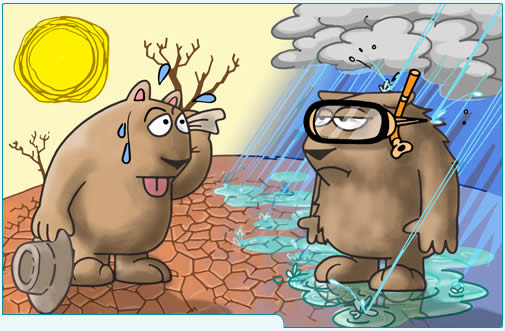
Cartoon from Saida Online.

With U.S. leading the way:
Irreversible climate change looms

By Jack A. Smith | The Rag Blog | November 29, 2011

The Obama Administration has largely remained passive about the critical imperative to reduce greenhouse gases to limit catastrophic global warming.

Washington continues to insist upon exercising world leadership in all key global endeavors, including the environment, but has failed dramatically in terms of climate change.

In fact, the White House is greatly expanding U.S. access to fossil fuel energy sources even as scientific and environmental organizations are intensifying their warnings about the need to immediately reduce greenhouse gas carbon emissions that are warming the planet.

Although the U.S. recently has ranked second to China in fossil fuel burning, it is by far the greatest polluter of the atmosphere in the last century and a half. Given the differences in population, America still uses three times more per capita than China.

White House policy is fixated on reducing dependence upon Middle Eastern oil and gas by greatly increasing the extraction of fossil fuels closer to home — mainly a vast increase in natural gas production from hydraulic fracturing (fracking) throughout the United States, expanded drilling for offshore oil, and importing dirty tar sands oil from Canada.

While increasing the development and use of global warming fuels, President Obama is advancing no significant program to replace high carbon emitting fossil fuels with renewable non-carbon solar and wind power.

The U.S. government is subsidizing some major “green” corporations, providing them with nearly no-risk guarantees for developing solar and wind, but this remains a relatively minor enterprise. Progress made so far is being stalled by the unexpected abundance (and thus cheaper price) of domestic natural gas secreted in shale, more secure oil reserves than anticipated, and the probability of reduced federal and state subsidies.

In a major statement from London November 9, the International Energy Agency (IEA) called for a “bold change of policy direction toward the use of low-carbon fuels within the next five years. If the major industrial states do not do so quickly, the world will lock itself into an insecure, inefficient and high-carbon energy system,” which is precisely what the Obama Administration is doing.

This recommendation seeks to prevent the rise in global temperatures in this century from exceeding 2 degrees Celsius, which is based upon keeping carbon emissions in the atmosphere below 450 parts per million (ppm). Anything above the target standards will cause irreparable damage to life on Earth.

According to many scientists and environmental groups these standards are inadequate, and that 350 ppm is the maximum amount that can be accommodated without causing a disaster. Atmospheric carbon, which occurs naturally, has reached dangerous levels due to industrialization. It has increased from 280 ppm at the beginning of the industrial era to approximately 392 ppm today, which is why it is said warming is well underway and its effects are being felt throughout the world.

Introducing the new report, IEA executive director Maria van der Hoeven declared, “Growth, prosperity and rising population will inevitably push up energy needs over the coming decades… Governments need to introduce stronger measures to drive investment in efficient and low-carbon technologies.”

The Environment News Service reports that the “agency’s warning comes at a critical time in international climate change negotiations, as governments prepare for the annual UN climate summit in Durban, South Africa, November 28-December 9. ‘If we do not have an international agreement whose effect is put in place by 2017, then the door will be closed forever,’ IEA chief economist Fatih Birol warned.'” (The main goal of the 17th climate summit is to agree on a resolution to replace the Kyoto Protocols, which will expire next year.)

The IEA describes itself as “an autonomous organization which works to ensure reliable, affordable and clean energy for its 28 member countries and beyond.” Its members represent the world’s leading capitalist countries. Greenpeace and some other environmental groups are critical of the group’s approval of tar sands oil, lower carbon fuels and nuclear energy. The BRICS countries (Brazil, Russia, India, China, and South Africa) are not IEA members.

Reporting October 26 on America’s hunt for more carbon-emitting fuels, The New York Times quoted Daniel Lashof, director of the climate program at the Natural Resources Defense Council, as declaring:

Giving new life to fossil fuels is a devil’s bargain, probably making solutions to climate change, and the development of renewable energy, even more difficult. Not only are you extending the fossil fuels era, but you are moving into fossil fuels that are dirtier and release more carbon pollution in the process of extracting and using them.

The Obama Administration has been leaning toward approving a $7 billion investment in a pipeline to transport Canadian tar sands oil to Texas but encountered a fusillade of activist opposition from the environmental movement in recent months. Michael Brune, executive director of the Sierra Club, has declared that “Tar sands oil is the dirtiest oil on Earth.” Dr. James Hansen, NASA’s top climate scientist, says that fully developing the tar sands in Canada would mean “essentially game over” for the climate.

Environmental movement criticisms have been compounded by objections from residents of Nebraska with concerns that pipeline spills might pollute the irreplaceable Ogallala aquifer, which occupies 10,000 square miles north to south from South Dakota to Texas and is a major source of water for the High Plains.

In August and September, 1,200 anti-tar sands activists were arrested for offering civil disobedience in front of the White House. On November 6, 12,000 people surrounded the presidential mansion demanding an end to construction of the 1,700-mile Keystone XL pipeline from Canada to Texas.

Four days later, President Obama announced that his final decision would now be postponed until months after next year’s elections, implying that the pipeline route might have to circumnavigate the immense aquifer.

Some environmental groups have interpreted Obama’s delay as a victory, suggesting that the project is being abandoned, but this view is too optimistic. The White House seeks abundant and stable supplies of oil for the next several decades from sources other than (or in addition to) the volatile Middle East, and tar sands oil from nearby friendly Canada is a most attractive alternative. Canadian oil has been entering the U.S. for many years in existing pipelines, and this is continuing. In all probability, some version of Keystone will greatly increase the supply.

Does fracking affect the water supply? Graphic from Desmogblog.

Environmentally-concerned Americans have also launched campaigns against fracking, mainly because of the danger to water supplies inherent in an extraction method that requires the high pressure injection of deadly chemicals deep underground.

The Obama Administration is so intent upon vastly increasing natural gas production that it has been brushing objections aside, as have state governors — such as New York State’s Andrew Cuomo — who argue that what really matters are the additional jobs and tax revenue from massive fracking operations.

Advocates of natural gas argue that burning gas for electricity emits 30% less carbon dioxide than oil, and about 45% less than coal. But recent studies have shown that the process of fracking releases sufficient stores of methane into the atmosphere to compensate for any reduction in carbon from natural gas. Methane creates a greenhouse heat trap about 20 times greater than carbon dioxide. The gas industry maintains that the reduction in emissions from natural gas “outweighs” the detrimental effects of methane.

The New York Times article points out that

“Temporary or permanent fracking bans have been put in place in New York, New Jersey and Maryland. Other states are toughening drilling regulations, and the industry is responding with tighter wastewater management, while the Environmental Protection Agency is expected to complete a study on fracking next year. Nevertheless, gas shale drilling appears likely to continue at a fast pace in the most important gas-producing states.

The rest of the world is watching. Moratoriums have been put in place in parts of France, Germany, South Africa and the Canadian province of Quebec; Britain, Ukraine and other countries are moving cautiously forward. Still, the Energy Department projects that gas from shale could account for 14% of global supplies by 2030, with as many as 32 countries having production potential.

If world countries, led by the U.S., continue to disregard environmental objections to fracking, enhanced natural gas production combined with a major increase in oil production by the U.S. will further subvert incentives toward ending use of fossil fuels. So far, shale gas extraction in the U.S. has increased 500% in the last five years, and that’s just the beginning.

Quoting Ivan Sandrea, president of the Energy Intelligence Group, the Times concluded its article with these words: “The fossil fuel age will be extended for decades. Unconventional oil and gas are at the beginning of a technological cycle that can last 60 years. They are really in their infancy.”

It has been five months since Democratic former Vice President Al Gore stuck his neck out in an article he wrote for Rolling Stone by publicly criticizing Democrat Obama for inaction on reducing America’s addiction to fossil fuels. So far, Obama has done nothing but live up to Gore’s critique:

“President Obama,” he declared,

has thus far failed to use the bully pulpit to make the case for bold action on climate change… The president made concessions to oil and coal companies without asking for anything in return. He has also called for a massive expansion of oil drilling in the United States, apparently in an effort to defuse criticism from those who argue speciously that “drill, baby, drill” [a conservative slogan] is the answer to our growing dependence on foreign oil.

Washington’s refusal to take more than token steps to alleviate global warming would be relatively inconsequential were the U.S. a much smaller player on the world stage. But American governments have insisted for decades — based on economic strength and unparalleled military power — on being recognized as the world’s dominant and irreplaceable hegemonic state.

Uncle Sam’s leadership is enormously influential, especially in the industrialized world, and America’s sluggish response toward global warming is a global disincentive toward taking speedy, responsible and united action.

U.S. financial institutions, corporations, and the wealthiest proportion of its population are “deeply invested in an energy sector dominated by fossil fuels, and actively hostile to alternatives,” economist Paul Krugman noted recently. These powerful elements are not prepared to accept the economic and political rearrangements required to transform America into an environmentally sound society of minimal carbon usage and many other ecological safeguards.

Such a transformation involves greater government investments, potentially smaller profits for many years, strategic alterations in the country’s disproportionate consumption of resources and products, and substantial changes beyond today’s gridlocked and essentially conservative political process.

In effect — given its disinclination to interfere in the workings of America’s neoliberal capitalist economy, even to protect all life on Earth — Washington’s continuing unipolar leadership is guiding the world toward irreversible climate change.

The U.S. may change its ways, but economic and political realities suggest an alteration of this magnitude is hardly on the foreseeable agenda. Climate change, however, is taking place now. At issue are two necessities: (1) strengthening of the environmental and social change movements in the U.S., and (2) a dramatic initiative by other powerful countries and regional blocs to take significant concerted global action to save the Earth regardless of Washington’s dithering.

[Jack A. Smith was editor of the Guardian — for decades the nation’s preeminent leftist newsweekly — that closed shop in 1992. Smith now edits the Hudson Valley Activist Newsletter, where this article also appears. Read more articles by Jack A. Smith on The Rag Blog.

The Rag Blog

Posted in Rag Bloggers | Tagged , , , , , , | 1 Comment

1. IRREVERSIBLE CLIMATE CHANGE LOOMS

By Jack A. Smith / The Rag Blog / November 29, 2011

The Obama Administration has largely remained passive about the critical imperative to reduce greenhouse gases to limit catastrophic global warming.

Washington continues to insist upon exercising world leadership in all key global endeavors, including the environment, but has failed dramatically in terms of climate change.

In fact, the White House is greatly expanding U.S. access to fossil fuel energy sources even as scientific and environmental organizations are intensifying their warnings about the need to immediately reduce greenhouse gas carbon emissions that are warming the planet.

Although the U.S. recently has ranked second to China in fossil fuel burning, it is by far the greatest polluter of the atmosphere in the last century and a half. Given the differences in population, America still uses three times more per capita than China.

White House policy is fixated on reducing dependence upon Middle Eastern oil and gas by greatly increasing the extraction of fossil fuels closer to home — mainly a vast increase in natural gas production from hydraulic fracturing (fracking) throughout the United States, expanded drilling for offshore oil, and importing dirty tar sands oil from Canada.

While increasing the development and use of global warming fuels, President Obama is advancing no significant program to replace high carbon emitting fossil fuels with renewable non-carbon solar and wind power.

The U.S. government is subsidizing some major “green” corporations, providing them with nearly no-risk guarantees for developing solar and wind, but this remains a relatively minor enterprise. Progress made so far is being stalled by the unexpected abundance (and thus cheaper price) of domestic natural gas secreted in shale, more secure oil reserves than anticipated, and the probability of reduced federal and state subsidies.

In a major statement from London November 9, the International Energy Agency (IEA) called for a “bold change of policy direction toward the use of low-carbon fuels within the next five years. If the major industrial states do not do so quickly, the world will lock itself into an insecure, inefficient and high-carbon energy system,” which is precisely what the Obama Administration is doing.

This recommendation seeks to prevent the rise in global temperatures in this century from exceeding 2 degrees Celsius, which is based upon keeping carbon emissions in the atmosphere below 450 parts per million (ppm). Anything above the target standards will cause irreparable damage to life on Earth.

According to many scientists and environmental groups these standards are inadequate, and that 350 ppm is the maximum amount that can be accommodated without causing a disaster. Atmospheric carbon, which occurs naturally, has reached dangerous levels due to industrialization. It has increased from 280 ppm at the beginning of the industrial era to approximately 392 ppm today, which is why it is said warming is well underway and its effects are being felt throughout the world.

Introducing the new report, IEA executive director Maria van der Hoeven declared, “Growth, prosperity and rising population will inevitably push up energy needs over the coming decades… Governments need to introduce stronger measures to drive investment in efficient and low-carbon technologies.”

The Environment News Service reports that the “agency’s warning comes at a critical time in international climate change negotiations, as governments prepare for the annual UN climate summit in Durban, South Africa, November 28-December 9. ‘If we do not have an international agreement whose effect is put in place by 2017, then the door will be closed forever,’ IEA chief economist Fatih Birol warned.'” (The main goal of the 17th climate summit is to agree on a resolution to replace the Kyoto Protocols, which will expire next year.)

The IEA describes itself as “an autonomous organization which works to ensure reliable, affordable and clean energy for its 28 member countries and beyond.” Its members represent the world’s leading capitalist countries. Greenpeace and some other environmental groups are critical of the group’s approval of tar sands oil, lower carbon fuels and nuclear energy. The BRICS countries (Brazil, Russia, India, China, and South Africa) are not IEA members.

Reporting October 26 on America’s hunt for more carbon-emitting fuels, The New York Times quoted Daniel Lashof, director of the climate program at the Natural Resources Defense Council, as declaring: “Giving new life to fossil fuels is a devil’s bargain, probably making solutions to climate change, and the development of renewable energy, even more difficult. Not only are you extending the fossil fuels era, but you are moving into fossil fuels that are dirtier and release more carbon pollution in the process of extracting and using them.”

The Obama Administration has been leaning toward approving a $7 billion investment in a pipeline to transport Canadian tar sands oil to Texas but encountered a fusillade of activist opposition from the environmental movement in recent months. Michael Brune, executive director of the Sierra Club, has declared that “Tar sands oil is the dirtiest oil on Earth.” Dr. James Hansen, NASA’s top climate scientist, says that fully developing the tar sands in Canada would mean “essentially game over” for the climate.

Environmental movement criticisms have been compounded by objections from residents of Nebraska with concerns that pipeline spills might pollute the irreplaceable Ogallala aquifer, which occupies 10,000 square miles north to south from South Dakota to Texas and is a major source of water for the High Plains.

In August and September 1,200 anti-tar sands activists were arrested for offering civil disobedience in front of the White House. On Nov. 6, 12,000 people surrounded the presidential mansion demanding an end to construction of the 1,700-mile Keystone XL pipeline from Canada to Texas.

Four days later, President Obama announced that his final decision would now be postponed until months after next year’s elections, implying that the pipeline route might have to circumnavigate the immense aquifer.

Some environmental groups have interpreted Obama’s delay as a victory, suggesting that the project is being abandoned, but this view is too optimistic. The White House seeks abundant and stable supplies of oil for the next several decades from sources other than (or in addition to) the volatile Middle East, and tar sands oil from nearby friendly Canada is a most attractive alternative. Canadian oil has been entering the U.S. for many years in existing pipelines, and this is continuing. In all probability, some version of Keystone will greatly increase the supply.

Environmentally-concerned Americans have also launched campaigns against fracking, mainly because of the danger to water supplies inherent in an extraction method that requires the high pressure injection of deadly chemicals deep underground.

The Obama Administration is so intent upon vastly increasing natural gas production that it has been brushing objections aside, as have state governors — such as New York State’s Andrew Cuomo — who argue that what really matters are the additional jobs and tax revenue from massive fracking operations.

Advocates of natural gas argue that burning gas for electricity emits 30% less carbon dioxide than oil, and about 45% less than coal. But recent studies have shown that the process of fracking releases sufficient stores of methane into the atmosphere to compensate for any reduction in carbon from natural gas. Methane creates a greenhouse heat trap about 20 times greater than carbon dioxide. The gas industry maintains that the reduction in emissions from natural gas “outweighs” the detrimental effects of methane.

The N.Y. Times article points out that “Temporary or permanent fracking bans have been put in place in New York, New Jersey and Maryland. Other states are toughening drilling regulations, and the industry is responding with tighter wastewater management, while the Environmental Protection Agency is expected to complete a study on fracking next year. Nevertheless, gas shale drilling appears likely to continue at a fast pace in the most important gas-producing states.

“The rest of the world is watching. Moratoriums have been put in place in parts of France, Germany, South Africa and the Canadian province of Quebec; Britain, Ukraine and other countries are moving cautiously forward. Still, the Energy Department projects that gas from shale could account for 14% of global supplies by 2030, with as many as 32 countries having production potential.”

If world countries, led by the U.S., continue to disregard environmental objections to fracking, enhanced natural gas production combined with a major increase in oil production by the U.S., will further subvert incentives toward ending use of fossil fuels. So far, shale gas extraction in the U.S. has increased 500% in the last five years, and that’s just the beginning.

Quoting Ivan Sandrea, president of the Energy Intelligence Group, the Times concluded its article with these words: “The fossil fuel age will be extended for decades. Unconventional oil and gas are at the beginning of a technological cycle that can last 60 years. They are really in their infancy.”

It has been five months since Democratic former Vice President Al Gore stuck his neck out in an article he wrote for Rolling Stone by publicly criticizing Democrat Obama for inaction on reducing America’s addiction to fossil fuels. So far, Obama has done nothing but live up to Gore’s critique:

“President Obama,” he declared, “has thus far failed to use the bully pulpit to make the case for bold action on climate change…. The president made concessions to oil and coal companies without asking for anything in return. He has also called for a massive expansion of oil drilling in the United States, apparently in an effort to defuse criticism from those who argue speciously that ‘drill, baby, drill’ [a conservative slogan] is the answer to our growing dependence on foreign oil.”

Washington’s refusal to take more than token steps to alleviate global warming would be relatively inconsequential were the U.S. a much smaller player on the world stage. But American governments have insisted for decades — based on economic strength and unparalleled military power — on being recognized as the world’s dominant and irreplaceable hegemonic state. Uncle Sam’s leadership is enormously influential, especially in the industrialized world, and America’s sluggish response toward global warming is a global disincentive toward taking speedy, responsible and united action.

U.S. financial institutions, corporations, and the wealthiest proportion of its population are “deeply invested in an energy sector dominated by fossil fuels, and actively hostile to alternatives,” economist Paul Krugman noted recently. These powerful elements are not prepared to accept the economic and political rearrangements required to transform America into an environmentally sound society of minimal carbon usage and many other ecological safeguards.

Such a transformation involves greater government investments, potentially smaller profits for many years, strategic alterations in the country’s disproportionate consumption of resources and products, and substantial changes beyond today’s gridlocked and essentially conservative political process.

In effect — given its disinclination to interfere in the workings of America’s neoliberal capitalist economy, even to protect all life on Earth — Washington’s continuing unipolar leadership is guiding the world toward irreversible climate change.

The U.S. may change its ways, but economic and political realities suggest an alteration of this magnitude is hardly on the foreseeable agenda. Climate change, however, is taking place now. At issue are two necessities: (1) strengthening of the environmental and social change movements in the U.S., and (2) a dramatic initiative by other powerful countries and regional blocs to take significant concerted global action to save the Earth regardless of Washington’s dithering.

[Jack A. Smith was editor of the Guardian — for decades the nation’s preeminent leftist newsweekly — that closed shop in 1992. Smith now edits the Hudson Valley Activist Newsletter, where this series also appears. Read more articles by Jack A. Smith on The Rag Blog

The Rag Blog

Posted in RagBlog | Leave a comment

Lamar W. Hankins : Ayn Rand and the Sophistry of the Libertarians

Art from Salon.

The sophistry of Ayn Rand libertarians

The profiteers, using libertarian justifications, help corporations dominate American life to satisfy their quest for greater profits.

By Lamar W. Hankins | The Rag Blog | November 29, 2011

In 1964, I roomed with Wally. Wally had discovered Ayn Rand and talked frequently about rugged individualism — his desire to be left alone by the state, by institutions, and by others to follow his own path. Wally thought no one should tell him what to do.

That entire semester, Wally probably missed 90% of his college classes. After all, he wanted his liberty. Needless to say, his grades suffered, but we had some fascinating discussions about philosophy and the socioeconomic condition of the U.S., a subject about which Wally took no responsibility. After all, each person is responsible for his or her own condition, created by his or her own choices.

If this sounds vaguely familiar, it is echoed in the callousness of the current Republican presidential campaign, where Herman Cain states that if a person doesn’t have a job, it is that person’s fault; where Ron Paul suggests that if a person needs health care but has chosen not to purchase health insurance, then it is perfectly acceptable to let that person die.

Where all undocumented immigrants should be immediately shipped back to their country of origin, and electrified, military-guarded fences should be erected to assure that they cannot return; where the crowd applauds all of Gov. Perry’s executions, even if some of those executed were innocent; where waterboarding is torture that makes Republicans feel good (they like to call it “enhanced interrogation”); where gay servicemen are booed; and where “no work, no food” is an honored value.

It’s chilling: even George W. Bush claimed to have compassion, but Tea-party-leaning, Ayn Rand-spouting Libertarians have none.

Rooming with Wally was my introduction to libertarianism. If that had been the end of my study of libertarianism, I would have a more jaundiced view than I now have of the philosophical underpinnings of that philosophy.

Now, over 45 years later, libertarianism is widely discussed and mentioned in conversation. We have some politicians who claim to be Libertarians. Many freethinkers call themselves libertarians — comedian Bill Maher, illusionist Penn Jillet, biologist P. Z. Myers, and others. I often agree with some libertarian ideas, but I’ve come to realize that there is a fatal flaw in Ayn Rand libertarian philosophy.

To say that someone is a libertarian is about as useful as saying that a person is religious. There may be as many varieties of libertarianism as there are religions in the U.S. Lately, though, many in the political class identify themselves as Any Rand libertarians, so I will focus on their brand of libertarianism.

After all, it is the kind extolled by Paul Ryan, Rand Paul, Ron Paul, Clarence Thomas, Rush Limbaugh, Glenn Beck, and most of this year’s crop of Republican presidential hopefuls, though I don’t claim that any of them follow Ayn Rand’s philosophy (Objectivism) in any systematic way.

Ayn Rand extolled the virtues of individualism, sometimes called rugged individualism, as a lynchpin of her beliefs. Individualists are glorified as ambitious, fiercely independent people who succeed spectacularly in life solely because of their own actions, resources, intellects, and willpower.

In Ayn Rand’s world, the masses of people don’t fit this description. They are largely miserable souls who occasionally overcome their misery thanks to the exceptional abilities of a few individualists, who do great things because of their creativity and intellectual acumen.

If this is your view, your reality is not the same as mine. When I look at society in the U.S., I see opportunities for many people made possible by the collective actions of us all — a system based on an implicit social contract that has created public education, infrastructure, modern utilities, water resources on which all life depends, organized social and economic systems that, however flawed, make possible success for the great masses of our people.

Rand’s idea that those who succeed do so because of their individualist qualities that make them some sort of supermen is a dishonest analysis of how our society works. One has to have blinders not to see the importance of the cooperative spirit that pervades America.

Most of our politicians don’t believe in the American government because they don’t believe in the basic tenets of our democracy; they don’t believe in the Constitution, and they don’t believe in the Declaration of Independence, both of which are imbued with a collective, cooperative spirit.

Based on their actions in the last 30 years, nearly all Republicans (as well as many, sometimes most, Democrats and some independents) don’t believe that government should have the purposes envisioned by our founders. The Declaration, for instance, provides as follows:

We hold these truths to be self-evident, that all men are created equal, that they are endowed by their Creator with certain unalienable rights, that among these are life, liberty and the pursuit of happiness. That to secure these rights, governments are instituted among men, deriving their just powers from the consent of the governed.

For the most part, libertarians don’t like the fact that governments are created by people to secure for everyone the basic rights of equality and a multitude of other rights — life, liberty, and the pursuit of happiness — which were further explained and expanded in the Bill of Rights.

All of these ideas from the Declaration and Constitution create an implicit bargain — a social contract — among the American people. The essence of that social contract is that we will help one another by joining together to form a government that will serve the interests of us all.

But Ayn Rand and her current libertarian followers nowhere acknowledge the truth written by W. E. B DuBois 55 years ago: “We let men take wealth which is not theirs; if the seizure is ‘legal’ we call it high profits and the profiteers help decide what is legal.” And that has been the failure of our republic for at least the last 30 years. The profiteers have been allowed to write or re-write the rules under which our political and economic system operates.

Governance, as the Occupy movement is arguing, is all about balancing the interests inherent in the social contract and the rights we have so that one group (the “profiteers”) cannot dominate another, a view anathema to the 1% and their defenders, who spend millions to make sure the rules favor them and not the 99%.

The profiteers, using libertarian justifications, help corporations dominate American life to satisfy their quest for greater profits; to enrich the wealthy further, insisting that people pull themselves up by their bootstraps (ignoring the fact that to do so literally means that you land on your backside when you try); to deny the basic need of all people for adequate food, housing, education, and medical care if they are unable to afford those things because they can’t find a job, are unable because of infirmity to hold a job, or are a child in need of nurture and care.

To pass laws like Medicare Part D in a way that enriches the pharmaceutical and insurance industries at the expense of the people and creates greater deficits; to let half the people and many corporations get away with contributing nothing to fund the federal government; to refuse to stabilize Social Security through two simple methods — expand the payroll tax to all earned income, and recover through the tax system most Social Security benefits paid to the wealthy; and to fight wars that do little if anything to protect America, but everything to enrich defense contractors, funding these wars with borrowed money.

The signers of the Declaration believed that laws should be adopted that are “most wholesome and necessary for the public good.” This belief is virtual heresy to most Ayn Rand libertarians, who do not want laws that are for the public good. They want laws that benefit the corporations and the wealthy. They ignore the Constitution, which provides that one of the purposes of our form of government is to “promote the general Welfare.”

One of the most succinct statements in opposition to Ayn Rand’s philosophy came recently from Senatorial candidate Elizabeth Warren at a house party in Massachusetts:

There is nobody in this country who got rich on his own. Nobody. You built a factory out there — good for you! But I want to be clear. You moved your goods to market on the roads the rest of us paid for. You hired workers the rest of us paid to educate. You were safe in your factory because of police forces and fire forces that the rest of us paid for. You didn’t have to worry that marauding bands would come and seize everything at your factory, and hire someone to protect against this, because of the work the rest of us did.

Now look, you built a factory and it turned into something terrific, or a great idea — God bless. Keep a big hunk of it. But part of the underlying social contract is you take a hunk of that and pay forward for the next kid who comes along.

Warren’s message is one well-understood by the Occupy movement, whose members are driven by a profound commitment to democratic principles and to an economic system that will assure a decent life for all, rather than just the 1%.

Ayn Rand viewed the misery of many of the world’s people as a failure of their will. She would not acknowledge that our government, through opportunism, the taking of natural resources, militarism, and exploitation of the labor of third world people, made possible much of our prosperity.

Rand’s philosophy is grounded in selfishness and greed disguised as virtue. The needs of others, including those starving and homeless, are not worth her consideration. As far as Rand was concerned, these weak, defective people could just die.

I value individualism, but within certain boundaries. When I look at the world, I recognize that I have whatever success I have had not as some willful lone ranger operating on my own. I had friends, family, teachers, mentors, opponents, leaders, public servants, and countless others long forgotten who helped me become whatever I have become.

I have never seen anyone else whose life has been otherwise. It takes extreme myopia or mendacity not to see that rugged individualism is a figment of Ayn Rand’s imagination. Not only are her novels fictional, but her entire philosophy is based on a fiction, as well.

[Lamar W. Hankins, a former San Marcos, Texas, city attorney, is also a columnist for the San Marcos Mercury. This article © Freethought San Marcos, Lamar W. Hankins. Read more articles by Lamar W. Hankins on The Rag Blog.]

Also see:

The Rag Blog

Posted in Rag Bloggers | Tagged , , , , | 1 Comment

1. IRREVERSIBLE CLIMATE CHANGE LOOMS

By Jack A. Smith / The Rag Blog / November 29, 2011

The Obama Administration has largely remained passive about the critical imperative to reduce greenhouse gases to limit catastrophic global warming.

Washington continues to insist upon exercising world leadership in all key global endeavors, including the environment, but has failed dramatically in terms of climate change.

In fact, the White House is greatly expanding U.S. access to fossil fuel energy sources even as scientific and environmental organizations are intensifying their warnings about the need to immediately reduce greenhouse gas carbon emissions that are warming the planet.

Although the U.S. recently has ranked second to China in fossil fuel burning, it is by far the greatest polluter of the atmosphere in the last century and a half. Given the differences in population, America still uses three times more per capita than China.

White House policy is fixated on reducing dependence upon Middle Eastern oil and gas by greatly increasing the extraction of fossil fuels closer to home — mainly a vast increase in natural gas production from hydraulic fracturing (fracking) throughout the United States, expanded drilling for offshore oil, and importing dirty tar sands oil from Canada.

While increasing the development and use of global warming fuels, President Obama is advancing no significant program to replace high carbon emitting fossil fuels with renewable non-carbon solar and wind power.

The U.S. government is subsidizing some major “green” corporations, providing them with nearly no-risk guarantees for developing solar and wind, but this remains a relatively minor enterprise. Progress made so far is being stalled by the unexpected abundance (and thus cheaper price) of domestic natural gas secreted in shale, more secure oil reserves than anticipated, and the probability of reduced federal and state subsidies.

In a major statement from London November 9, the International Energy Agency (IEA) called for a “bold change of policy direction toward the use of low-carbon fuels within the next five years. If the major industrial states do not do so quickly, the world will lock itself into an insecure, inefficient and high-carbon energy system,” which is precisely what the Obama Administration is doing.

This recommendation seeks to prevent the rise in global temperatures in this century from exceeding 2 degrees Celsius, which is based upon keeping carbon emissions in the atmosphere below 450 parts per million (ppm). Anything above the target standards will cause irreparable damage to life on Earth.

According to many scientists and environmental groups these standards are inadequate, and that 350 ppm is the maximum amount that can be accommodated without causing a disaster. Atmospheric carbon, which occurs naturally, has reached dangerous levels due to industrialization. It has increased from 280 ppm at the beginning of the industrial era to approximately 392 ppm today, which is why it is said warming is well underway and its effects are being felt throughout the world.

Introducing the new report, IEA executive director Maria van der Hoeven declared, “Growth, prosperity and rising population will inevitably push up energy needs over the coming decades… Governments need to introduce stronger measures to drive investment in efficient and low-carbon technologies.”

The Environment News Service reports that the “agency’s warning comes at a critical time in international climate change negotiations, as governments prepare for the annual UN climate summit in Durban, South Africa, November 28-December 9. ‘If we do not have an international agreement whose effect is put in place by 2017, then the door will be closed forever,’ IEA chief economist Fatih Birol warned.'” (The main goal of the 17th climate summit is to agree on a resolution to replace the Kyoto Protocols, which will expire next year.)

The IEA describes itself as “an autonomous organization which works to ensure reliable, affordable and clean energy for its 28 member countries and beyond.” Its members represent the world’s leading capitalist countries. Greenpeace and some other environmental groups are critical of the group’s approval of tar sands oil, lower carbon fuels and nuclear energy. The BRICS countries (Brazil, Russia, India, China, and South Africa) are not IEA members.

Reporting October 26 on America’s hunt for more carbon-emitting fuels, The New York Times quoted Daniel Lashof, director of the climate program at the Natural Resources Defense Council, as declaring: “Giving new life to fossil fuels is a devil’s bargain, probably making solutions to climate change, and the development of renewable energy, even more difficult. Not only are you extending the fossil fuels era, but you are moving into fossil fuels that are dirtier and release more carbon pollution in the process of extracting and using them.”

The Obama Administration has been leaning toward approving a $7 billion investment in a pipeline to transport Canadian tar sands oil to Texas but encountered a fusillade of activist opposition from the environmental movement in recent months. Michael Brune, executive director of the Sierra Club, has declared that “Tar sands oil is the dirtiest oil on Earth.” Dr. James Hansen, NASA’s top climate scientist, says that fully developing the tar sands in Canada would mean “essentially game over” for the climate.

Environmental movement criticisms have been compounded by objections from residents of Nebraska with concerns that pipeline spills might pollute the irreplaceable Ogallala aquifer, which occupies 10,000 square miles north to south from South Dakota to Texas and is a major source of water for the High Plains.

In August and September 1,200 anti-tar sands activists were arrested for offering civil disobedience in front of the White House. On Nov. 6, 12,000 people surrounded the presidential mansion demanding an end to construction of the 1,700-mile Keystone XL pipeline from Canada to Texas.

Four days later, President Obama announced that his final decision would now be postponed until months after next year’s elections, implying that the pipeline route might have to circumnavigate the immense aquifer.

Some environmental groups have interpreted Obama’s delay as a victory, suggesting that the project is being abandoned, but this view is too optimistic. The White House seeks abundant and stable supplies of oil for the next several decades from sources other than (or in addition to) the volatile Middle East, and tar sands oil from nearby friendly Canada is a most attractive alternative. Canadian oil has been entering the U.S. for many years in existing pipelines, and this is continuing. In all probability, some version of Keystone will greatly increase the supply.

Environmentally-concerned Americans have also launched campaigns against fracking, mainly because of the danger to water supplies inherent in an extraction method that requires the high pressure injection of deadly chemicals deep underground.

The Obama Administration is so intent upon vastly increasing natural gas production that it has been brushing objections aside, as have state governors — such as New York State’s Andrew Cuomo — who argue that what really matters are the additional jobs and tax revenue from massive fracking operations.

Advocates of natural gas argue that burning gas for electricity emits 30% less carbon dioxide than oil, and about 45% less than coal. But recent studies have shown that the process of fracking releases sufficient stores of methane into the atmosphere to compensate for any reduction in carbon from natural gas. Methane creates a greenhouse heat trap about 20 times greater than carbon dioxide. The gas industry maintains that the reduction in emissions from natural gas “outweighs” the detrimental effects of methane.

The N.Y. Times article points out that “Temporary or permanent fracking bans have been put in place in New York, New Jersey and Maryland. Other states are toughening drilling regulations, and the industry is responding with tighter wastewater management, while the Environmental Protection Agency is expected to complete a study on fracking next year. Nevertheless, gas shale drilling appears likely to continue at a fast pace in the most important gas-producing states.

“The rest of the world is watching. Moratoriums have been put in place in parts of France, Germany, South Africa and the Canadian province of Quebec; Britain, Ukraine and other countries are moving cautiously forward. Still, the Energy Department projects that gas from shale could account for 14% of global supplies by 2030, with as many as 32 countries having production potential.”

If world countries, led by the U.S., continue to disregard environmental objections to fracking, enhanced natural gas production combined with a major increase in oil production by the U.S., will further subvert incentives toward ending use of fossil fuels. So far, shale gas extraction in the U.S. has increased 500% in the last five years, and that’s just the beginning.

Quoting Ivan Sandrea, president of the Energy Intelligence Group, the Times concluded its article with these words: “The fossil fuel age will be extended for decades. Unconventional oil and gas are at the beginning of a technological cycle that can last 60 years. They are really in their infancy.”

It has been five months since Democratic former Vice President Al Gore stuck his neck out in an article he wrote for Rolling Stone by publicly criticizing Democrat Obama for inaction on reducing America’s addiction to fossil fuels. So far, Obama has done nothing but live up to Gore’s critique:

“President Obama,” he declared, “has thus far failed to use the bully pulpit to make the case for bold action on climate change…. The president made concessions to oil and coal companies without asking for anything in return. He has also called for a massive expansion of oil drilling in the United States, apparently in an effort to defuse criticism from those who argue speciously that ‘drill, baby, drill’ [a conservative slogan] is the answer to our growing dependence on foreign oil.”

Washington’s refusal to take more than token steps to alleviate global warming would be relatively inconsequential were the U.S. a much smaller player on the world stage. But American governments have insisted for decades — based on economic strength and unparalleled military power — on being recognized as the world’s dominant and irreplaceable hegemonic state. Uncle Sam’s leadership is enormously influential, especially in the industrialized world, and America’s sluggish response toward global warming is a global disincentive toward taking speedy, responsible and united action.

U.S. financial institutions, corporations, and the wealthiest proportion of its population are “deeply invested in an energy sector dominated by fossil fuels, and actively hostile to alternatives,” economist Paul Krugman noted recently. These powerful elements are not prepared to accept the economic and political rearrangements required to transform America into an environmentally sound society of minimal carbon usage and many other ecological safeguards.

Such a transformation involves greater government investments, potentially smaller profits for many years, strategic alterations in the country’s disproportionate consumption of resources and products, and substantial changes beyond today’s gridlocked and essentially conservative political process.

In effect — given its disinclination to interfere in the workings of America’s neoliberal capitalist economy, even to protect all life on Earth — Washington’s continuing unipolar leadership is guiding the world toward irreversible climate change.

The U.S. may change its ways, but economic and political realities suggest an alteration of this magnitude is hardly on the foreseeable agenda. Climate change, however, is taking place now. At issue are two necessities: (1) strengthening of the environmental and social change movements in the U.S., and (2) a dramatic initiative by other powerful countries and regional blocs to take significant concerted global action to save the Earth regardless of Washington’s dithering.

[Jack A. Smith was editor of the Guardian — for decades the nation’s preeminent leftist newsweekly — that closed shop in 1992. Smith now edits the Hudson Valley Activist Newsletter, where this series also appears. Read more articles by Jack A. Smith on The Rag Blog

The Rag Blog

Posted in RagBlog | Leave a comment

Danny Schechter : The Media and Occupy Wall Street

Jon Stewart covers Wall Street coverage.

But for how long?
Occupy Wall Street is all over the media

By Danny Schechter | The Rag Blog | November 28, 2011

One of the oldest patterns of media coverage can be summed up this way:

First they ignore you. Then they ridicule you. Then they realize you are a story and fall in love. So they build you up but then, all at once, tear you down.

You may not have changed, but they have, addicted as they are to keep coming up with shifting story lines, more to fight their own boredom and fear of tune-out than the validity or importance of the topic.

In the same way that political sound-bites went from nearly 30 seconds to five, or that MTV style editing soon invaded the newsrooms with quick cutting and razzle-dazzle effects — “covering” news while making it difficult to concentrate on it, much less to comprehend the fast-paced presentation techniques.

When asked by researchers, audiences could barely tell you what they had just seen, much less what it meant.

We saw this in Iraq when, during the invasion, it was war all the time, literally around the clock — but when you looked closely, it wasn’t about Iraq or Iraqis, it was about a narrative of U.S. slaying the bad guys, cowboys versus Indians, good guys versus bad guys. There was no other news, but what there was AAU — All About US.

Now, with Occupy Wall Street, the pattern is similar. The issues largely don’t exist — if they require any explanation or analysis. Knowledge about Wall Street and the economy is assumed.

Conflict drives the news.

There was little reporting on the occupation when it started. It was only after it became massive — and the cops began pepper-spraying — that the media arrived en masse. They had adversaries. That they could understand.

Soon, they flocked to Zuccotti Park like bluebirds. When one landed, they all landed. The TV trucks were everywhere, especially at 6 and 11 p.m., so that local reporters could do silly live stand-ups and show off colorful characters to reinforce the narrative that the protesters were just having fun, and had no serious ideas.

Many of these frontline reporters couldn’t tell you the difference between a derivative and a donut, but that didn’t matter because what does matter is face time, airtime, visibility.

First the international press recognized that this movement was important. The park became a mini-United Nations with crews from BBC, Al Jazeera, Xinhua News Agency, Russia Today, Press TV.

When they took it seriously, our press began to do the same, and then American TV got into the act once they realized that this was a national, even a global story

Occupy Wall Street soon had a press desk trying to help reporters who often showed up with preconceived story lines demanded by their editors. Soon the stories about sex, drugs, and drumming — no rock and roll yet — were everywhere as reporters turned over rocks and looked for the homeless and the harassers.

When one station did a “The Park is a Walmart for Rats,” story, City Hall saw an opening and began harping on cleanliness (which has always been next to godliness).

Most activists were happy to be interviewed but few ever watched how the stories were edited: what was covered and what was not.

That’s also because many of the occupiers hate television and what it has become. They don’t read ponderous editorials or inflammatory headlines.

They do read and create social media — Twitter, Facebook, and YouTube.

The advantage is that they are then exposed to their truths and the news they believe they need to make a difference.

Its news for the community, not the country. The disadvantage is they often are not reaching out to the millions of Americans who won’t join the movement simply because it’s cool. The 99% need to be educated and inspired — but, alas, they rely on the papers and cable news that is least sympathetic to the movement,

You have to use media if you want to occupy the mainstream — and build a larger movement — as opposed to being depicted as a tribal subculture of misfits and the angry,

I would suspect that members of the movement have not met with or tried to persuade editorial boards or newsroom execs. They tend to react more to what the media is saying than to be proactive — with their own media campaigns to shape a message that gets disseminated widely.

As the movement moves on, messages have to change and target specific communities. That may be coming, but not quickly enough.

Already some big media outlets like The Washington Post, the paper still living off its Watergate reputation even as it finds few wars it won’t support, is saying Occupy Wall Street is “over.”

You can bet they want it to be over because their focus on politics starts with the top — the White House — and specializes in inside-the-beltway stories. For years, black people in Washington — the majority — have complained that they are largely ignored by their own hometown newspaper.

Post editors are proud-and-cloistered 1-percenters who love to cover social movements of the past, not the present.

I once looked at how the Post covered the March on Washington back in 1963. The story line was how violence was averted. MLK’s “I Have A Dream” speech was barely news. The march’s focus on the need for jobs was downplayed then just as Occupy Wall Street’s economic critique is downplayed today.

The movement is being challenged by mayors — armed with the latest “non-lethal” toys — and coordinated by the Feds (a story few media outlets have investigated) who want to shut down the encampments.

Yes, it’s wrong and unconstitutional and unfair, but is this a battle they can win? Yes, many can go to jail but what message does that send?

Occupy Wall Street is not about camping, its about crusading for justice.

Even Murdoch’s Wall Street Journal (not the “Occupied” version) is praising the protests.

This Thanksgiving weekend, Wall Street should say a prayer of gratitude for Occupy Wall Street.

While some bankers and brokers have sympathized with or supported this ragtag protest movement, others grouse that they are being demonized.

But compared with financiers of the past, who faced nasty rhetoric, political hostility and physical danger, today’s bankers and brokers seem like a bunch of babies when they whine about being targeted by these dissidents.The “Occupy” rhetoric might sound overheated, but it is golden praise alongside what bankers used to hear.

At least some of the l% is hearing the message.

It’s the 99% that the movement should aim at with actions and media designed to show that they’re on their side — and find more creative forms of outreach and organizing to turn a community of activists into a mass movement with demands that the people can resonate with and find ways of supporting.

Media hype can help but its no substitute for less glamorous organizing. In the end, that will be the test of whether the movement is “over” or over the top.

[News Dissector Danny Schechter is covering Occupy Wall Street in his Newsdissector.com blog and will soon have a book out collecting his many reports since September. Go here for Schechter’s TV report on Occupy Wall Street Comments to dissector@mediachannel.org. Read more by Danny Schechter on The Rag Blog.]

The Rag Blog

Posted in Rag Bloggers | Tagged , , | Leave a comment

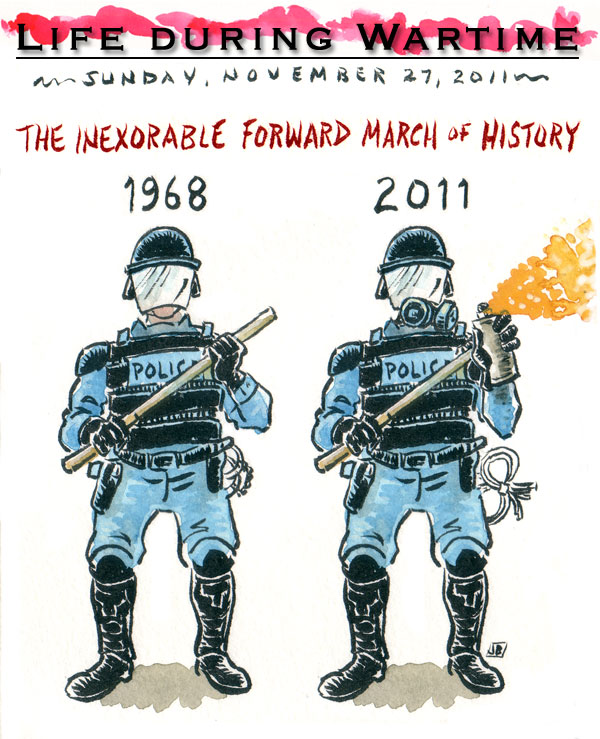
CARTOON / Joshua Brown : Life During Wartime: March of History

Political cartoon by Joshua Brown / The Rag Blog / September 18, 2011.

[Joshua Brown is the executive director of the Center for Media and Learning/American Social History Project, The Graduate Center, The City University of New York and is a professor of history at CUNY. Find more political cartoons by Joshua Brown on
The Rag Blog.]

The Rag Blog

Posted in Rag Bloggers | Tagged , , | 1 Comment

Ted McLaughlin : Congressional Insider Trading is a Crime! Or Should Be…

Image from Dallas News.

There oughta be a law:
Stop Congressional ‘insider trading’

By Ted McLaughlin / The Rag Blog/ November 26, 2001

Last week it was revealed that members of Congress regularly do something that, if done by other Americans, would be considered a criminal act. It is “insider trading.” This is when someone uses information not available to the general public to make trades in the stock market, thereby gaining an unfair advantage in the market.

An example of this would be when a corporate insider knows something will soon happen that will affect the market price of that company’s stock. It would be illegal for him/her to use that knowledge to buy or sell that company’s stock until that information is released publicly.

But the members of Congress and their aides routinely have that kind of information available to them (such as the knowledge that a new law or regulation will soon be imposed that will significantly affect a certain industry, or the knowledge that a lucrative government contract will soon be given to a certain corporation).

While it would be illegal for an American citizen to use this secret information to enrich themselves by buying or selling stock, that illegality does not extend to members of Congress or their aides. And many members of Congress and their employees (of both political parties) have used “insider trading” to fill their own personal bank accounts with cold hard cash (and lots of it).

Of course this isn’t the only example of Congress giving themselves perks that ordinary Americans don’t enjoy. How many ordinary workers do you know that can vote themselves a raise without permission of their bosses, even in the midst of a recession? Congress can, and they don’t seem to care what their bosses (the people of this country) think about it. But in spite of their usual arrogance, this insider trading story seems to have embarrassed at least some members of Congress.

Rep. Tim Walz (D-Minnesota) and Rep. Louise Slaughter (D-New York) have introduced a new bill in the House of Representatives. It is called the “Stop Trading on Congressional Knowledge Act (STOCK Act), and it would ban members of Congress or their aides from buying or selling stocks or commodities if they have “material nonpublic information” that relates to a company or commodity. The bill would eliminate the insider trading advantage that Congress currently enjoys over all other Americans.

But while the bill makes a lot of sense and would be supported by a large majority of Americans, don’t start celebrating its passage yet. For a lot of the members of Congress this is akin to killing the goose that lays the golden eggs, and you can bet that many of them will fight tooth-and-nail to kill this bill. In fact, they are already coming up with reasons why the bill “wouldn’t work,” and might even be a bad idea.

These naysayers tell us that it would be very hard to prove that a member of Congress or their aides had used insider information in making trades. And they say that Congress might just make many more things secret from the public to cover their tracks after making insider trades.

These are actually fairly good arguments. We already know that many Wall Street executives engage in insider trading but are rarely caught, and authorities would be even more reluctant to make an accusation against a member of Congress. And the government already keeps too many things secret that should be public knowledge.

But even if both of those things are true, they are nothing more than excuses for failing to address the problem. Insider trading is wrong and should be outlawed no matter how hard it is to prove. And it is just as wrong for Congress as it is for everyone else.

While not all insider trades are caught, some are and that acts as a deterrent to others who would consider it. As for Congress trying to cover their illegal acts with government secrecy, there are ways to expose that (remember WikiLeaks?).

The truth is that there is an easy way to overcome both of those arguments. Just amend the STOCK Act to outlaw all trading of stocks and commodities by members of Congress and their aides and immediate family members (whether insider trading is used or not).

I know there will be some that will say this would be unfair, and that members of Congress should have the right to make money by honest trading just like other Americans. I disagree.

These men and women were not sent to Congress to make themselves rich. They were sent there because they told the voters they wanted to serve their country, and they are well-paid for that service. A member of Congress is paid nearly $170,000 a year (plus expenses, perks, and benefits). The salary alone is three times the average wage of the bottom 99% of Americans.

If this is not sufficient remuneration for their service to their country, then I question if their running for office was really a desire to serve — and they should resign (and then they could trade to their hearts desire).

Government service should not be the path to riches, and for millions of government workers at all levels it isn’t. They work for salaries lower than they could get in private industry because they have a desire to serve their country and their fellow citizens — and they retire on a modest income after that life of service. Why should it be different for members of Congress (or their aides)?

[Ted McLaughlin also posts at jobsanger. Read more articles by Ted McLaughlin on The Rag Blog.]

The Rag Blog

Posted in Rag Bloggers | Tagged , , , | Leave a comment

Author and noted scholar Mike Davis describes the “rite of passage” when as a young activist, you first “look into a cop’s eyes a few anxious inches from your face and find only robotic murderous hatred staring back at you.” Confessing that he’s not too fond of being clubbed or pummeled, Mike says he prefers to “lock myself safely in my car and drive to protest,” perhaps humming “drove my Chevy to the levee…” He then offers a fascinating history of all-American vehicle-based demonstrations, from truck convoys to labor’s use of massive auto blockades.

Posted in RagBlog | Leave a comment

November 18th marked the 33rd anniversary of the Jonestown massacre. Paul Krassner recounts some of the dark history of Jim Jones and his movement — much of it little-known and some of it involving San Francisco politics — and the horrific story of the killing of Congressman Ryan and the mass suicide that followed, including dialogue from audio recordings of the event.

Posted in RagBlog | Leave a comment

Steve Russell — himself a member of the Cherokee Nation — quotes his “all time favorite Cherokee,” Will Rogers: “When a [political] party can’t think of anything else they always fall back on Lower Taxes. It has a magic sound to a voter, just like Fairyland…” Rogers wrote that in 1924, and that same year he suggested essentially what the Occupy folks are demanding: quit allowing unlimited gambling by Wall Street with other people’s money.

Posted in RagBlog | Leave a comment

Steve Russell : Will Rogers on Occupy Wall Street

Get the point? Image of Will Rogers from the Will Rogers Museum.

Will Rogers on Occupy Wall Street

By Steve Russell | The Rag Blog | November 23, 2011

“It’s all right to let Wall Street bet each other millions of dollars every day but why make these bets affect the fellow who is plowing a field out in Claremore, Oklahoma?”

My all time favorite Cherokee, Will Rogers, wrote that in 1924. Today, most of the fellows plowing fields in Claremore, Oklahoma, are still Cherokee — but a lot fewer of them own the land they are plowing.

Nine years after Will Rogers made that complaint, the New Deal was beginning to roll, and Congress passed the Glass-Steagall Act in response. Glass (D-VA) and Steagall (D-AL) created the Federal Deposit Insurance Corporation. In the Great Depression, when a bank went belly up your money was just gone. Even now, it’s not widely known that the FDIC does not cost the taxpayers a penny. Fees assessed on the commercial banks fund it.

Just as important, the Glass-Steagall Act created a firewall between commercial banks and investment banks. Investment banks were not insured by the FDIC, did not have to pay the assessments, and were free to gamble with the money of anybody dumb enough to entrust it to them for the purpose.

Commercial banks are the places you go to get your crop loan, your car loan, or your mortgage. They had strict capital reserve requirements, which placed a limit on the amount of “leverage” they could bring to bear — that is, the multiple of customer deposits they could invest.

Bankers always thought this limit cramped their style, and I suppose it did. They were free to gamble with their own money, but they were limited in how much they could gamble with the money deposited by that fellow plowing his field in Claremore, OK.

This terrible injustice to the banksters, I mean bankers, was corrected by Gramm (R-TX), Leach (R-IA), and Bliley (R-VA) in 1999. Their bill, tearing down the wall between investment and commercial banking, was signed into law by President Clinton, who should have known better, but the political zeitgeist of the times was still deregulation. “Government,” in the famous words of President Reagan, “is the problem.”

Phil Gramm was John McCain’s principal economic advisor until he got canned for referring to Americans as “a nation of whiners.” The “whiners” did not know it at the time, but the gamblers unleashed by Gramm’s deregulation had leveraged their assets 30:1 and had, by spinning out derivative instruments of mind-bending complexity, become “too big to fail.”

That is, if they went broke they would take down so many businesses and people with them that the farmer in Claremore would get knocked right off his tractor. Of course, some people doubted any investment bank was “too big to fail,” and so the folks in charge let Lehman Brothers go down in 2008, apparently to see how bad it could get.

The Dow Jones average took the greatest one-day dive in history and racked up a trading range of 1,000 points. Lehman’s failure set off a cascade of smaller failures that played out for months. If you once had a retirement account but you don’t anymore, you can thank that experiment.

I remember back when I was young enough to be shocked, an undergraduate at the University of Texas. A law professor who was on President Nixon’s defense team in the Watergate scandal was asked whether some new cover-up revelation was “serious.” “Serious?” the professor asked, “the Dow Jones dropped 50 points on the news!” Fifty points. Serious. How times do change.

So we had to bail out the banksters from the consequences of their own recklessness or kiss our retirement plans goodbye. No problem, right? Wasn’t the major issue of the 2000 elections what to do with the budget surplus?

It was the issue, indeed. Bush said, “it’s your money and you know better than the government how to spend it.” Al Gore said this is our chance to “put Social Security in a lock box” and end the bipartisan accounting tricks with the trust fund.

Oh, now I remember. Bush won, and cut our taxes.

“When a party can’t think of anything else they always fall back on Lower Taxes. It has a magic sound to a voter, just like Fairyland…” Will Rogers wrote that in 1924, not 2000, and in the same year he expressed the only thing that will get us out of this even if we do, as Occupy Wall Street demands, quit allowing unlimited gambling with other people’s money:

“People want JUST taxes, more than they want lower taxes. They want to know that every man is paying his proportionate share according to his wealth.”

Maybe I’m biased by my Cherokee genes, but any man who could write that in 1924 deserves our attention today. There was about to be an event called the Great Depression.

[Steve Russell, Cherokee Nation of Oklahoma, lives in Sun City, Texas, near Austin. He is a Texas trial court judge by assignment and associate professor emeritus of criminal justice at Indiana University-Bloomington. Steve was an activist in Austin in the Sixties and Seventies, and wrote for Austin’s underground paper, The Rag. Steve is also a columnist for Indian Country Today, where a version of this article also appeared. He can be reached at swrussel@indiana.edu. Read more articles by Steve Russell on The Rag Blog.]

The Rag Blog

Posted in Rag Bloggers | Tagged , , , | 2 Comments

Paul Krassner : Sex, Corruption, and the Kool-Aid Massacre

The Rev. Jim Jones.

Sex, Corruption,
and the Kool-Aid Massacre

By Paul Krassner / The Rag Blog / November 23, 2011

November 18th marked the 33rd anniversary of the Jonestown massacre.

Jim Jones, founder of the 8,000-member People’s Temple in San Francisco, once asked Margo St. James, founder of the prostitutes’ rights group, COYOTE (Call Off Your Old Tired Ethics), how he could obtain political power.

She answered, sardonically, “Arrange for some of your women to have sex with the bigwigs.”

Jones in turn offered to supply busloads of his congregation for any protest demonstration that COYOTE organized, but Margo declined his offer.

“I never liked him,” she told me. “I never saw his eyes. Even in the dimmest light, he never removed his shades. He was hiding something. I figured it was his real feelings. I thought he was a slimy creep.”

Margo’s instincts were correct.

Potential recruits for People’s Temple were checked out in advance by Jones’ representatives, who would rummage through their garbage and report to him on their findings -– discarded letters, food preferences and other clues. Temple members would visit their homes, and while one would initiate conversation, the other would use the bathroom, copying names of doctors and types of medicine.

They would also phone relatives of a recruit in the guise of conducting a survey and gather other information that would all be taped to the inside of Jones’ podium, from which he would proceed to demonstrate his magical powers at a lecture by “sensing the presence” of an individual, mentioning specific details.

When People’s Temple moved to Guyana and became Jonestown, Jim Jones would publicly humiliate his followers. For example, he required them to remove their clothing and participate in boxing matches, pitting an elderly person against a young one. He forced one man to participate in a homosexual act in the presence of his girlfriend. There were paddle beatings and compulsory practice-suicide sessions called “White Nights.”

On November 18, 1978, Congressman Leo Ryan, who had been investigating Jonestown, was slain at the Guyana airport, along with three newspeople and several disillusioned members of the cult. Jones then orchestrated the mass suicide-murder of 900 men, women and children, mostly black.

Jones: “What’s going to happen here in a matter of a few minutes is that one of a few on that plane is gonna –- gonna shoot the pilot. I know that. I didn’t plan it, but I know it’s gonna happen. They’re gonna shoot that pilot and down comes the plane into the jungle. And we had better not have any of our children left when it’s over ’cause they’ll parachute in here on us. So my opinion is that we’d be kind to children and be kind to seniors and take over quietly, because we are not committing suicide. It’s a revolutionary act.”

Christine Miller: “I feel like that as long as there’s life, there’s hope. There’s hope. That’s my feeling.”

Jones: “Well, someday everybody dies. Someplace that hope runs out ’cause everybody dies.”

Miller: “But, uh, I look at all the babies and I think they deserve to live…”

Jones: “But also they deserve much more. They deserve peace.”

Unidentified man: “It’s over, sister, it’s over. We’ve made that day. We made a beautiful day. And let’s make it a beautiful day.”

Unidentified woman: [Sobbing] “We’re all ready to go. If you tell us we have to give our lives now, we’re ready…”

Jones: “The congressman has been murdered –- the congressman’s dead. Please get us some medication. It’s simple. It’s simple, there’s no convulsions with it, it’s just simple. Just please get it before it’s too late. The GDF [Guyanese army] will be here. I tell you, get moving, get moving, get moving. How many are dead? Aw, God almighty, God almighty — it’s too late, the congressman’s dead. The congressman’s aide’s dead. Many of our traitors are dead. They’re all layin’ out there dead.”

Nurse: “You have to move, and the people that are standing there in the aisle, go stay in the radio-room yard. So everybody get behind the table and back this way, okay? There’s nothing to worry about. So everybody keep calm, and try to keep your children calm. And the older children are to help lead the little children and reassure them. They aren’t crying from pain. It’s just a little bitter tasting, but that’s — they’re not crying out of any pain.”

Unidentified woman: “I just wanna say something to everyone that I see that is standing around and, uh, crying. This is nothing to cry about. This is something we could all rejoice about. We could be happy about this.”

Jones: “Please, for God’s sake, let’s get on with it. We’ve lived –- let’s just be done with it, let’s be done with the agony of it. [There is noise, confusion and applause.] Let’s get calm, let’s get calm. [There are screams in the background.] I don’t know who fired the shot, I don’t know who killed the congressman, but as far as I’m concerned, I killed him. You understand what I’m saying? I killed him. He had no business coming. I told him not to come. Die with respect. Die with a degree of dignity. Don’t lay down with tears and agony. Stop this hysterics. This is not the way for people who are socialistic communists to die. No way for us to die. We must die with some dignity.

“Children, it’s just something to put you to rest. Oh, God! [Crying in the background] I tell you, I don’t care how many screams you hear, I don’t care how many anguished cries, death is a million times preferable to ten more days of this life. If you’ll quit telling them they’re dying, if you adults will stop this nonsense -– I call on you to quit exciting your children when all they’re doing is going to a quiet rest. All they’re doing is taking a drink they take to go to sleep. That’s what death is, sleep. Take our life from us. We laid it down. We got tired. We didn’t commit suicide. We committed an act of revolutionary suicide, protesting the conditions of an inhuman world…”

Those who refused to drink the grape-flavored punch laced with potassium cyanide were either shot or killed by injections in their armpits. Jim Jones either shot himself or was murdered.

The Black Panther newspaper editorialized: “It is quite possible that the neutron bomb was used at Jonestown.”

Rev. Jim Jones and friends in 1952. Image from Indianapolis Star.

When San Francisco District Attorney Joe Freitas learned of the killings, he was in Washington, D.C., conferring with the State Department about the mass suicide-murder in Jonestown. He immediately assumed that Moscone and Milk had been assassinated by a People’s Temple hit squad. After all, George Moscone was number one on their hit list.

Freitas had been a close friend of Jim Jones. After the massacre in Guyana, he released a previously “confidential” report, which stated that his office had uncovered evidence to support charges of homicide, child abduction, extortion, arson, battery, drug use, diversion of welfare funds, kidnapping, and sexual abuse against members of the sect. The purported investigation had not begun until after Jones left San Francisco. No charges were ever filed, and the People’s Temple case was put on “inactive status.”

Busloads of illegally registered People’s Temple members had voted in the 1975 San Francisco election, as well as in the runoff that put George Moscone in office. Freitas appointed lawyer Tim Stoen to look into possible voter fraud. At the time, Stoen was serving as Jim Jones’ chief legal adviser. Freitas later piously accused him of short-circuiting the investigation, but after Stoen left the case, the D.A.’s office assured the registrar that there was no need to retain the voting rosters, and they were destroyed.

Several former members of People’s Temple had heard about this fraudulent voting, but the eyewitnesses all died at Jonestown. In addition, the San Francisco Examiner reported that Mayor Moscone had called off a police investigation of gun-running by the Temple, which had arranged to ship explosives, weapons, and large amounts of cash to South America via Canada.

George Moscone’s body was buried. Harvey Milk’s body was cremated. His ashes were placed in a box, which was wrapped in Doonesbury comic strips, then scattered at sea. The ashes had been mixed with the contents of two packets of grape Kool-Aid, forming a purple patch on the Pacific. Harvey would’ve liked that touch.

COYOTE’s Margo St. James.

It was well known around City Hall that Moscone had a predilection for black women. Police almost arrested him once with a black prostitute in a car at a supermarket parking lot.

Soon after the Dan White trial, I got a phone call from Lee Cole, an ex-Scientologist I had met in Chicago while researching the Charles Manson case. He wanted to visit me, but I said no.

“Suppose I just come over?” he said.

“You don’t know where I live.”

“I can find out.”

“If you find out, and you tell me how you did it, you can come over.”

I wanted to determine how carefully I had covered my tracks, or see which friend would give out my address. A little while later, Lee Cole called again and told me my address — he said that he had obtained it from the voter registration files — so I told him to come over.

He took me to see Lowell Streiker, author of The Cults Are Coming! and a deprogrammer who had counseled one-third of the Jonestown survivors. In the course of our conversation, I mentioned my theory that Jim Jones had served as a pimp at City Hall and maintained power by implied blackmail.

Dr. Streiker told me of his friend — a member of Jones’ planning commission — who had told him about the technique that People’s Temple had used on Mayor Moscone. They sent a young black female member to service him, as a gift, then called the next week about a serious problem — she had lied, said she was 18, when in fact she was underage, but don’t worry, we have it under control — just the way J. Edgar Hoover used to manipulate top politicians with his juicy FBI files.

So Jim Jones had taken Margo St. James’ sardonic advice after all, on how to achieve political power: “Arrange for some of your women to have sex with the bigwigs.” And he had taken it all the way to a mass suicide-murder — which occurred simultaneously with a mass demonstration by the women’s movement in San Francisco, called “Take Back the Night!”

They completely shut down traffic on Broadway. But there was not a word about that event in any of the media. It was knocked totally out of the news by the massacre in Jonestown.

Jonestown and Kool-Aid continue to serve as occasional joke references for stand-up comedians and metaphors for politicians and pundits alike.

[Paul Krassner edited The Realist, America’s premier satirical rag. He was also a founder of the Yippies. Find Paul’s autobiography, Confessions of a Raving Unconfined Nut: Misadventures in the Counterculture at paulkrassner.com. Paul Krassner’s dialogue with Andrew Breitbart appears in the December issue of Playboy. Read more articles by Paul Krassner on The Rag Blog.]

The Rag Blog

Posted in Rag Bloggers | Tagged , , , , , | 3 Comments