Rabbi Arthur Waskow : Burn Their Books, Mayor Bloomberg

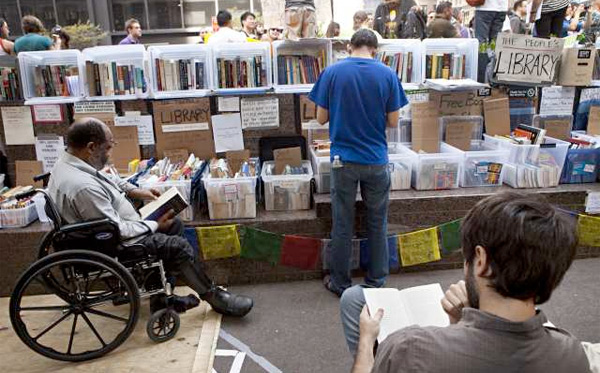
People’s Library at Occupy Wall Street. Photo by David Shankbone / Flickr.

NYPD apparently destroys ‘American cultural history’

More than 5,000 books in the Occupy Wall Street library were reportedly thrown away when police moved in to remove protesters from Zuccotti Park in New York early Tuesday.

During the police raid, Occupy Wall Street librarians tweeted, “NYPD destroying american cultural history, they’re destroying the documents, the books, the artwork of an event in our nation’s history,” Galleycat reports.
[….]
The library, which started out as a box of books and grew to a collection of more than 5,000, was originally out in the open air. Rocker, poet, and National Book Award winner Patti Smith donated a tent to house the library and protect the books from the weather. — Los Angeles Times / November 15, 2011

Burn their books, Mayor Bloomberg!

By Rabbi Arthur Waskow / The Rag Blog / November 16, 2011

Burn Occupy Wall Street’s books? Why would I do that? I had the police dump all 5,000 of their library in a garbage truck. Much less spectacle than burning. The actual stink doesn’t get on TV. Free speech is one thing, but radical sociology, progressive economics, poetry — feh!

That is a made-up quote, but the fact is NOT made up.

Make no mistake, Mayor Bloomberg is a billionaire, high up among the 1%. After serving the two terms allowed by law, he decided he wanted a third. So he used a fraction of his billions — the “philanthropic” fraction — to persuade many New York institutions that had supported the two-term limit, to switch.

That’s what it means to be a billionaire. There’s a limit to how many McMansions, how many bottles of fine wine, you can actually enjoy. But buying power — no limits.

The New York Times called the police action to clear the Occupy Park “almost military.” Here’s one description, vouched for by Rev. John Collins, United Methodist Minister. (After that, some thoughts on what to do.)

The New York Police Department broke up the Occupy Wall Street encampment in Zucotti Park at 1:30 a.m. this morning. Several hours later, on a park bench at the intersection of Sixth Avenue and Canal Street, amid heavy police presence and continuing arrests, I met Jeannie, a woman in her 40’s.

She has been camped in Zucotti Park over a month. She is from California. Her father is a child of the Depression. Her mother and her aunt are out of work, Jeannie has been a financial analyst on Wall Street for 13 years.

I asked why she was part of Occupy. “Because of what I have seen by working on Wall Street.. Goldman Sachs pressured the leaders of Greece and Italy to name bankers to run those countries and bypass the people.”

This is Jeannie’s account of last night.

At about 1:30 I had awakened to get a cup of coffee. Police had surrounded the Park. They put up barricades around the park. I got out of the barricades and tried to get to a nearby mall. The police treated us like the worst kind of terrorists. There were pregnant women in our group.

The police presence was massive, maybe 2,000 police. About 200 people were driven out of the park. Then came the violence. Police started pulling people into the street and then saying, “Now you’re in the street [which is closed]. You’re under arrest.” 10-15 police in full riot gear blocked all the exits. The police then began beating them and using mace and pepper spray right in peoples’ eyes.

It was now 3 a.m. Most of the occupiers had been dispersed. A police helicopter followed our group with searchlights, Police then caught us and arrested many. Those of us who were not arrested walked north to Foley Square near the Federal Court House. Police surrounded us in Foley Square, pushing their billy clubs in front of them and squeezing us into a tight circle.

I learned this morning that they had destroyed our library of several thousand books, many on capitalism, socialism, economics, cooking, children’s stories. They just threw them all into garbage trucks…

Occupy Wall Street library. Photo from LA Times.

What to do? here is a call from MoveOn activists:

This Thursday there will be a national day of action to express our outrage at what the 1% have done to our nation.

To find the action nearest you, click here and then type in your zip code.

Here’s why this action is more important now than even when MoveOn first scheduled it. New York City Mayor Bloomberg and the wealthy and powerful interests behind him are clearly gambling that the Occupy phenomenon is a fad, and that the 99% is not a real movement, but just a small number of people whom they can intimidate.

It’s up to us to prove them wrong. If people take to the streets in massive numbers on Thursday, we will prove that this is a movement, that We are the 99% — and that it is time for major change in the priorities of this country.

MoveOn has a special role to play in all this. With 5 million members across the country, we have the capacity to turn these Thursday rallies into huge events. But we can’t rely upon emails alone. We need to communicate the urgency of the moment.

Here is what the OWS folks wrote last night, in the midst of the assault upon them:

This burgeoning movement is more than a protest, more than an occupation, and more than any tactic. The “us” in the movement is far broader than those who are able to participate in physical occupation. The movement is everyone who sends supplies, everyone who talks to their friends and families about the underlying issues, everyone who takes some form of action to get involved in this civic process.

This moment is nothing short of America rediscovering the strength we hold when we come together as citizens to take action to address crises that impact us all.

Such a movement cannot be evicted. Some politicians may physically remove us from public spaces — our spaces! — and, physically, they may succeed. But we are engaged in a battle over ideas.

Our idea is that our political structures should serve us, the people — all of us, not just those who have amassed great wealth and power. We believe that is a highly popular idea, and that is why so many people have come so quickly to identify with Occupy Wall Street and the 99% movement.

You cannot evict an idea whose time has come.On our shoestring budget, The Shalom Center is vigorously supporting the Occupy movement, MoveOn, and other efforts to combat the pharaohs of our generation — global corporations and the 1%. Please click here to help us do that work. Thanks!

Shalom, salaam, shantih, peace…

[Rabbi Arthur Waskow is director of The Shalom Center. His newest book, co-authored with R. Phyllis Berman, is Freedom Journeys: The Tale of Exodus and Wilderness across Millennia (Jewish Lights), available from Shouk Shalom our on-line bookstore. Read more articles by Rabbi Arthur Waskow on The Rag Blog.]

The Rag Blog

Posted in Rag Bloggers | Tagged , , , , | Leave a comment

Kate Braun : Tie Up Loose Ends During Waning Crescent Moon

Waning crescent moon. Photo by Ed Euthman / Flickr.

Moon Musings:
Waning Crescent Moon
(November 19 – 22, 2011)

By Kate Braun / The Rag Blog / November 16, 2011

The waning crescent moon is a good moon phase to use to tie up loose ends and to consolidate experiences and resources in preparation for the new cycle that begins with the next Full Moon.

It’s all about healing and rest, and is a time to recognize and release old patterns of belief and behavior that are holding us back from easily meeting whatever challenges are now facing us. This is a time of psychic clearing, of sifting out uncertainty and confusion.

When we remember that 2011 is all about change and remember also that the result of the changes won’t be clear until 2012, the need to evaluate where we’ve been and what we’ve tried becomes a more important feature of this moon-phase observance.

Just as this is a good time to physically weed a garden, lop branches that overhang roofs, and trim away dead tree limbs (especially if they are in danger of falling onto houses, cars, or people), it is also a good time for pondering the possibilities and probabilities as we study where we’ve been and what we’ve done and what’s worked and what hasn’t worked. Desires are more likely to be fulfilled if the way is clear.

Lore says that a wish made at this moon phase is more likely to come true because needs are felt more deeply during this moon phase. The more deeply a need is felt, the more invocative energy goes into the moon cycle and the more likely this need will be met.

However, it might be better to phrase your wishes by saying “I desire,” rather than “I wish for,” or “I want.” Frequently the phrase “I wish” or “I want” reinforces a sense of not having; the result can be the opposite of what you intend. The phrase “I desire,” on the other hand, generates a different sort of energy and can draw whatever it is to you rather than emphasize that it is not present. I thank Sara Pencil Blumenthal for this bit of insight.

Lore also says if a young woman dreams of the moon growing dimmer, she should mind her sharp tongue, lest happiness elude her, but to dream of a clear moon indicates success. You may find it helpful to keep a notepad and pen near where you sleep so that you can record your dreams.

Much can be learned from studying dreams: patterns can be recognized, trends can be spotted, sources of negativity can be identified. You, not a purchased dream interpretation book, are the best source for defining the symbolism in your dreams.

Keep in mind that at this moon phase problems are revealed but not solved. Seeing the problem or difficulty is likely to be easy, but give yourself time to consider possible solutions before acting; a too-quick fix will be superficial and is likely to work against a true understanding of all the possibilities.

And there is a Jupiter retrograde (until December 28) to consider as well. Jupiter retrograde makes it very easy to see negatives, to tally up all the reasons that a project won’t work, that it should never have been undertaken in the first place. I recommend taking some extra time to strengthen your connection to Spirit while Jupiter retrogrades. It won’t hurt and it could help a lot. The Big Thing is to lay the groundwork for what you plan to accomplish in the next moon cycle.

If you honor the waning crescent moon on Saturday, November 19, wear black (for lead, the metal associated with Saturn), make sure you are in contact with Mother Earth, and state your desires seven times. Saturn’s energy is useful in rituals that promote self-discipline.

If you choose Sunday, November 20, use the color yellow (for the Sun), make sure to incorporate fire in your ceremonies, and state your desires six times. Use Sun energy for money, health, and friendship-related matters

On Monday, November 21, emphasize Lady Moon with Silver, either as a color or by wearing much silver jewelry. Have containers of water (the moon’s element) indicate the boundaries of your ceremonial area and state your desires nine times. Use moon energy to make rituals for inspiration, change, increased psychic ability

On Tuesday, November 22, Mars’ day, wear red to represent the element Fire and make sure Fire is present. Candles or an oil lamp will do nicely. State your desires five times as you use Mars energy to make rituals for overcoming enmity, developing courage, protecting property.

[Kate Braun‘s website is www.tarotbykatebraun.com. She can be reached at kate_braun2000@yahoo.com. Read more of Kate Braun’s writing on The Rag Blog.]

The Rag Blog

Posted in Rag Bloggers | Tagged , , , , , | Leave a comment

Moon Musings:
Waning Crescent Moon
(November 19 – 22, 2011)

By Kate Braun / The Rag Blog / November 15, 2011

The waning crescent moon is a good moon phase to use to tie up loose ends and to consolidate experiences and resources in preparation for the new cycle that begins with the next Full Moon.

It’s all about healing and rest, and is a time to recognize and release old patterns of belief and behavior that are holding us back from easily meeting whatever challenges are now facing us. This is a time of psychic clearing, of sifting out uncertainty and confusion.

When we remember that 2011 is all about change and remember also that the result of the changes won’t be clear until 2012, the need to evaluate where we’ve been and what we’ve tried becomes a more important feature of this moon-phase observance.

Just as this is a good time to physically weed a garden, lop branches that overhang roofs, and trim away dead tree limbs (especially if they are in danger of falling onto houses, cars, or people), it is also a good time for pondering the possibilities and probabilities as we study where we’ve been and what we’ve done and what’s worked and what hasn’t worked. Desires are more likely to be fulfilled if the way is clear.

Lore says that a wish made at this moon phase is more likely to come true because needs are felt more deeply during this moon phase. The more deeply a need is felt, the more invocative energy goes into the moon cycle and the more likely this need will be met.

However, it might be better to phrase your wishes by saying “I desire,” rather than “I wish for,” or “I want.” Frequently the phrase “I wish” or “I want” reinforces a sense of not having; the result can be the opposite of what you intend. The phrase “I desire,” on the other hand, generates a different sort of energy and can draw whatever it is to you rather than emphasize that it is not present. I thank Sara Pencil Blumenthal for this bit of insight.

Lore also says if a young woman dreams of the moon growing dimmer, she should mind her sharp tongue, lest happiness elude her, but to dream of a clear moon indicates success. You may find it helpful to keep a notepad and pen near where you sleep so that you can record your dreams. Much can be learned from studying dreams: patterns can be recognized, trends can be spotted, sources of negativity can be identified. You, not a purchased dream interpretation book, are the best source for defining the symbolism in your dreams.

Keep in mind that at this moon phase problems are revealed but not solved. Seeing the problem or difficulty is likely to be easy, but give yourself time to consider possible solutions before acting; a too-quick fix will be superficial and is likely to work against a true understanding of all the possibilities.

And there is a Jupiter retrograde (until December 28) to consider as well. Jupiter retrograde makes it very easy to see negatives, to tally up all the reasons that a project won’t work, that it should never have been undertaken in the first place. I recommend taking some extra time to strengthen your connection to Spirit while Jupiter retrogrades. It won’t hurt and it could help a lot. The Big Thing is to lay the groundwork for what you plan to accomplish in the next Moon cycle.

If you honor the Waning Crescent Moon on Saturday, November 19, wear black (for lead, the metal associated with Saturn), make sure you are in contact with Mother Earth, and state your desires seven times. Saturn’s energy is useful in rituals that promote self-discipline.

If you choose Sunday, November 20, use the color Yellow (for the Sun), make sure to incorporate fire in your ceremonies, and state your desires six times. Use Sun energy for money, health, and friendship-related matters

On Monday, November 21, emphasize Lady Moon with Silver, either as a color or by wearing much silver jewelry. Have containers of water (the Moon’s element) indicate the boundaries of your ceremonial area and state your desires nine times. Use Moon energy to make rituals for inspiration, change, increased psychic ability

On Tuesday, November 22, Mars’ day, wear red to represent the element Fire and make sure Fire is present. Candles or an oil lamp will do nicely. State your desires five times as you use Mars energy to make rituals for overcoming enmity, developing courage, protecting property.

[Kate Braun‘s website is www.tarotbykatebraun.com. She can be reached at kate_braun2000@yahoo.com. Read more of Kate Braun’s writing on The Rag Blog.]

The Rag Blog

Posted in RagBlog | Leave a comment

Susan Van Haitsma : Anti-War GI’s March in Killeen Vets Day Parade

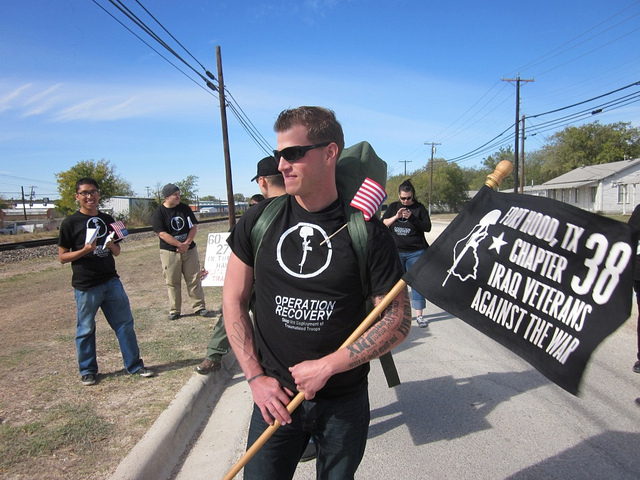
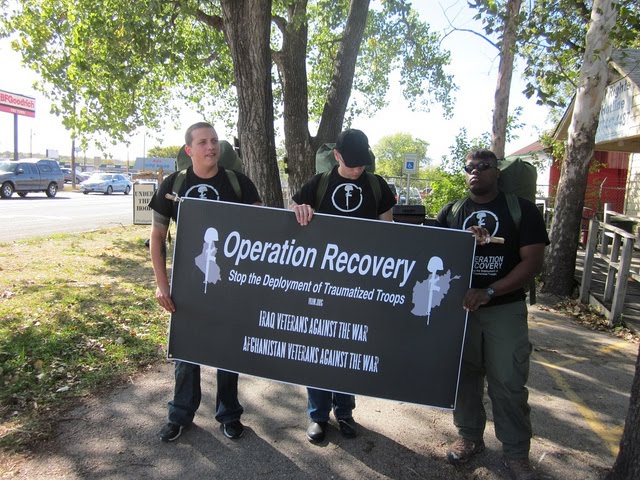
Representatives of IVAW and Under the Hood Cafe marched in the Killeen Veterans Day Parade. Photo by Susan Van Haitsma / The Rag Blog.

The burdens of war:
Anti-war GI’s on Veterans Day

By Susan Van Haitsma / The Rag Blog / November 15, 2011

See more photos by Susan Van Haitsma, Below.

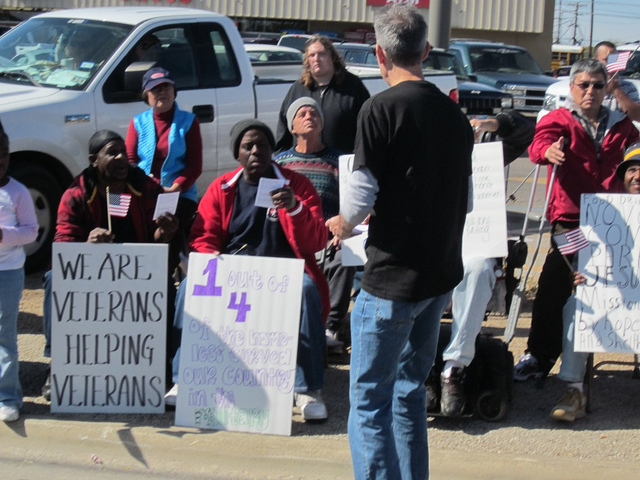
KILLEEN, Texas — Usually Veterans Day bums me out big time. War is the worst human invention I know. Sacrificing the lives of young adults to “protect my way of life” is false and backward. I don’t know how to thank veterans for their sincere motivation to help the world when consequences of their roles as soldiers have been so harmful to the world and to themselves.

This Veterans Day, I had an opportunity to reconcile these sentiments in the heart of Texas, in the small town that contains the largest military base in the world.

Staff and volunteers with Under The Hood, the GI Rights Center and Café in Killeen, Texas, teamed with members of the Ft. Hood chapter of Iraq Veterans Against the War (IVAW) to march in the Killeen Veterans Day Parade, and they invited supporters to join them. Several of us drove up from Austin to take part.

The parade entry was designed to promote IVAW’s Operation Recovery project, a campaign for service members’ right to heal. The campaign is calling for increased health services for traumatized troops instead of continued deployments. Surely this is a reasonable demand.

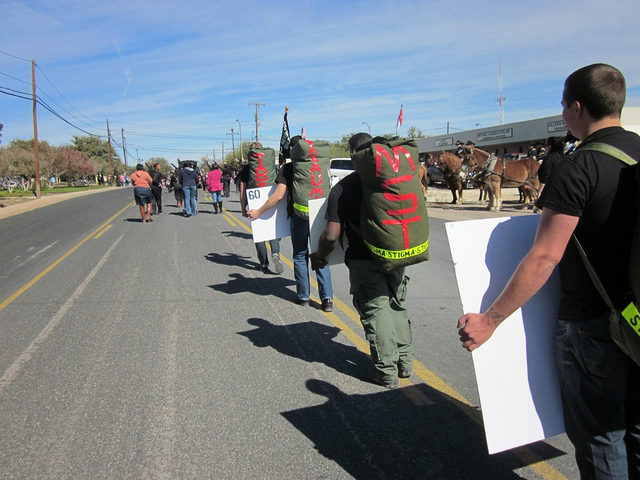
To dramatize the message in the parade, four soldiers marched single file, carrying full army duffel bags on their backs. The bags were labeled “Trauma,” “PTSD,” “MST” (Military Sexual Trauma, and “TBI” (Traumatic Brain Injury). Each bag was also ringed with the word, “Stigma” in bold lettering.

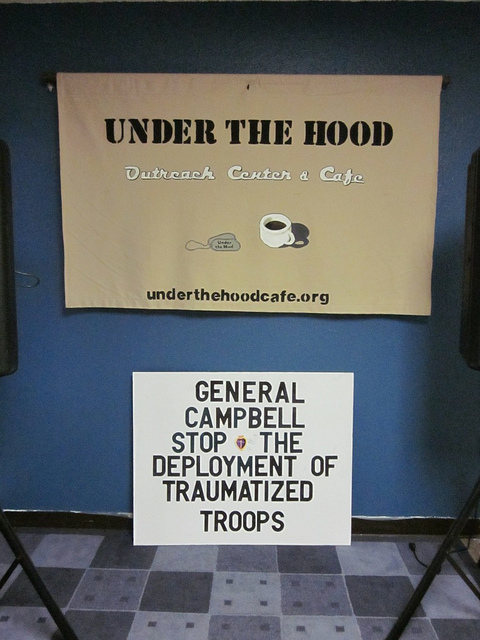
The symbolism of the burdens of war borne by soldiers provided a strong visual message. The soldiers also carried signs calling on Ft. Hood’s base commander, General Donald Campbell, to stop deploying traumatized troops from Ft. Hood.

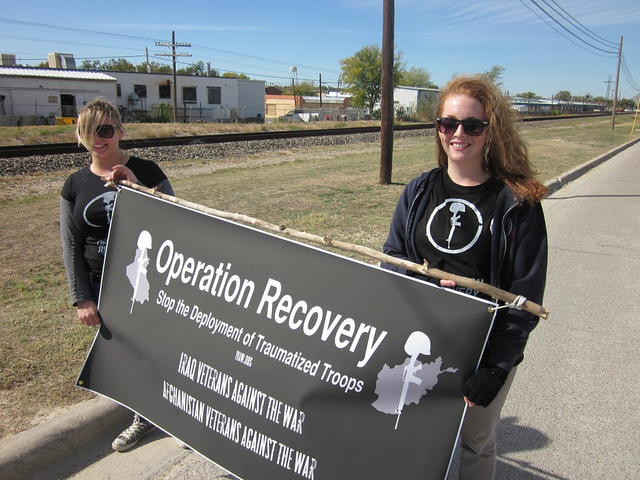
We civilian supporters walked with the soldiers, carrying an Operation Recovery banner and distributing fliers to the parade audience about Operation Recovery and Under The Hood. We weren’t sure how we would be received by the crowd lining the parade route, but even with red, white and blue everywhere, people were overwhelmingly receptive.

As the parade wound its way through Killeen’s modest downtown streets, we passed deserted storefronts and saw many signs of economic struggle. War does not profit the warrior.

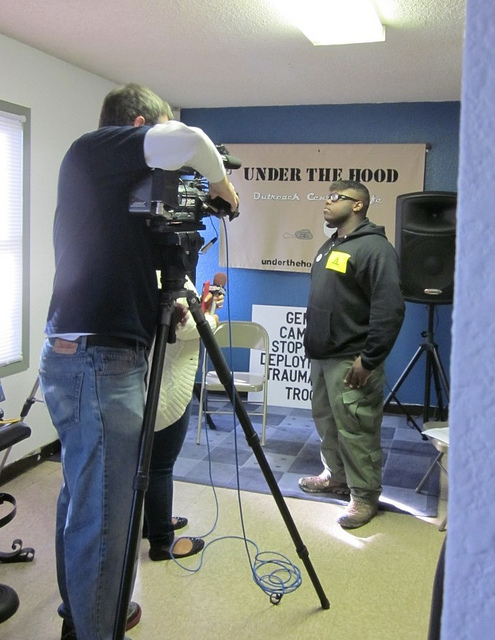
A press release about our parade entry was issued just before we walked the few blocks from Under The Hood, across the railroad tracks to the parade lineup. A local ABC-TV affiliate responded, and a reporter came to the café after the parade. Iraq war vets, Kyle and Curtis, gave excellent interviews for a good report that ran on the evening news and the KXXV-TV home page.

After the interviews, we hung around the café and talked, readying things for the evening’s special Veterans Day poetry event hosted by the phenomenal Killeen poetry slam group. My feelings about the day’s events seemed to find expression in the poems I heard that night. Truths were spoken about military life, death and injury, separation and reconciliation, love and pain. We were drawn together: soldier and civilian, gay and straight, youngadults and older ones.

Under The Hood is a busy place, with lots of good things happening. Current events include weekly “Ribs ‘n Rights” nights, twice monthly poetry slams and an upcoming Warrior Writers workshop. They recently held a community art show and Combat Paper workshop.

Check out www.underthehoodcafe.org to find out more about Under The Hood, and go to www.operationrecoverycampaign.org to register your support for service members’ right to heal.

[Susan Van Haitsma is active in Austin with Sustainable Options for Youth and CodePink. She also blogs at makingpeace. Find more articles by Susan Van Haitsma on The Rag Blog.]

Photos by Susan Van Haitsma / The Rag Blog.

The Rag Blog

Posted in Rag Bloggers | Tagged , , , , , | Leave a comment

Thorne Dreyer’s guests on Rag Radio Friday, Nov. 4, 2011, were Ole Jorgen Hammeken — an indigenous Greenlandic Inuit polar explorer, social worker, and actor — and French filmmaker Marc Buriot, who was executive producer of the award-winning film, Inuk, in which Hammeken stars. The story of Inuk is loosely based on the work Hammeken and his wife, Ann Andreasen, have done at their internationally-acclaimed home for disadvantaged children in Greenland. Hanneken uses dogsledding as therapy in working with troubled Greenlandic youth. We discuss the making of the film and the issues it raises about Greenland and its indigenous people — and the inevitable conflicts between their historic traditions and contemporary culture. Go to this post to listen to the full interview.

Posted in RagBlog | Leave a comment

SPORT / Dave Zirin : The World Joe Paterno Made

Penn State fans. Image from The Big Lead.

Fan culture, rape culture,
and the world Joe Paterno made

The pain might run deeply in Happy Valley but the cancer runs deeper.

By Dave Zirin / The Rag Blog / November 14, 2011

Meet John Matko. John Matko is a 34-year-old Penn State class of 2000 alumnus, distraught by the recent revelations that legendary Coach Joe Paterno and those in charge allegedly shielded a serial child rapist, assistant Jerry Sandusky.

He was livid that students chose to riot on campus this week, more upset about Paterno’s dismissal than anything else. He was disgusted that the Board of Trustees decided to go ahead as planned with Saturday’s Nebraska game just days after the revelations became public. John Matko felt angry and was compelled to act.

He stood outside Saturday’s Penn State-Nebraska game in Happy Valley and held up two signs. One read, “Put abused kids first.” The other said, “Don’t be fooled, they all knew. Tom Bradley, everyone must go.” [Tom Bradley is the interim head coach.]

The response to Matko gives lie to the media portrayal of last Saturday’s game. We were told the atmosphere was “somber,” “sad,” and “heart-rending,” as “the focus returned to the children.” The crowd was swathed in blue, because, we were told, that is the color to awareness of child abuse (also the Penn State colors)

The team linked arms emerging from the tunnel. They dropped to a knee with their Nebraska opponents at midfield before the game. Once again, broadcasters told us, “the players were paying tribute to the victims of child abuse.” We were told all of this, and I wish to God it was true.

I don’t doubt the emotions in Happy Valley are genuine. I don’t doubt the searing shock and pain that must be coursing through campus. But this is the pain of self-pity, not reflection. It’s the pain of the exposed not the penitent.

Let’s go back to John Matko. Matko stood with his signs behind a pair of sunglasses. He wasn’t soapboxing, or preaching: just bearing silent witness. It was an admirable act but no one bought him a beer. Instead, beer was poured on his head. His midsection was slapped with an open hand. Expletives were rained upon him. His signs were also kicked to the ground and stomped.

As The Washington Times wrote, “Abuse flew at Matko from young and old, students and alumni, men and women. No one intervened. No one spoke out against the abuse.”

One disapproving student said, “Not now, man. This is about the football players.”

And with those nine words, we see the truth about Saturday’s enterprise. It was about the football program, not the children. It was morbid theater where people were mourning the death of a jock culture that somewhere along the line mutated into malignancy. It’s a malignancy that deprioritized rape victims in the name of big-time football.

The signs of this malignancy did not emerge overnight. Looking backward, there are moments that speak of the scandals to come. In 2003, less than one year after Paterno was told that Sandusky was raping children, he allowed a player accused of rape to suit up and play in a bowl game. Widespread criticism of this move was ignored.

In 2006, Penn State’s Orange Bowl opponent Florida State sent home linebacker A.J. Nicholson, after accusations of sexual assault. Paterno’s response, in light of recent events, is jaw-dropping. He said,

There’s so many people gravitating to these kids. He may not have even known what he was getting into, Nicholson. They knock on the door; somebody may knock on the door; a cute girl knocks on the door. What do you do? Geez. I hope — thank God they don’t knock on my door because I’d refer them to a couple of other rooms.

Joanne Tosti-Vasey, president of Pennsylvania’s National Organization for Women in Pennsylvania, was not amused. With chilling unintentional prescience, Tosti-Vasey responded, “Allegations of sexual assault should never be taken lightly. Making light of sexual assault sends the message that rape is something to be expected and accepted.”

They called for Paterno’s resignation and short of that, asked to dialogue with Paterno and the team. Neither Paterno nor anyone in the power at Penn State accepted the invitation.

This is the world Joe Pa made. It’s a world where libraries, buildings, and statues bear his name It’s a world where the school endowment now stands at over $1 billion dollars. It’s a company town where moral posturing acted as a substitute for actual morality. In such an atmosphere, seeing the players and fans gather to bow their heads and mourn Saturday wasn’t “touching” or “somber” or anything of the sort. It was just sad. It was sad because they still don’t get it.

One PSU student named Emily wrote the following to si.com’s Peter King,

Truth is, if not for Paterno’s philanthropy and moral code (until his fatal lapse of judgment), I and thousands of others wouldn’t be here right now. If not for Paterno… Pennsylvania State might still be an agriculture school and State College might be lucky if there were a Wal-Mart within a 30-mile radius. Paterno made a huge mistake, but that doesn’t mean he’s not a good man.

Bullshit. Emily’s words ring as false as the apologists for the Vatican, Wall Street, the military command at Abu Ghraib, and any industry deemed “too big to fail.” The same moral code that Emily praises just can’t be the same moral code that covers up child rape. To do so is to make the very notion of morality meaningless.

Emily’s gratitiude that her school isn’t “30 miles from the nearest Wal-Mart” can’t justify defending Paterno. To do so, makes you complicit in the crimes and the cover-up. It also ensures that such a thing could happen again.

On Saturday, while Matko endured the physical and verbal rage of the PSU faithful, hundreds gathered around the Paterno statue outside the stadium, laying down flowers and gifts. To really move forward, the malignancy must be removed. Fire everyone. Shut down Happy Valley football for a year. Do whatever you have to do to make sure that the world Joe Paterno made has seen its last day.

[Dave Zirin is the author of The John Carlos Story (Haymarket) and just made the new documentary Not Just a Game. Receive his column every week by emailing dave@edgeofsports.com. Contact him at edgeofsports@gmail.com. Read more articles by Dave Zirin on The Rag Blog.]

The Rag Blog

Posted in Rag Bloggers | Tagged , , , , , | 1 Comment

Bob Fitrakis and Harvey Wasserman : Post-Buckeye Election Protection?

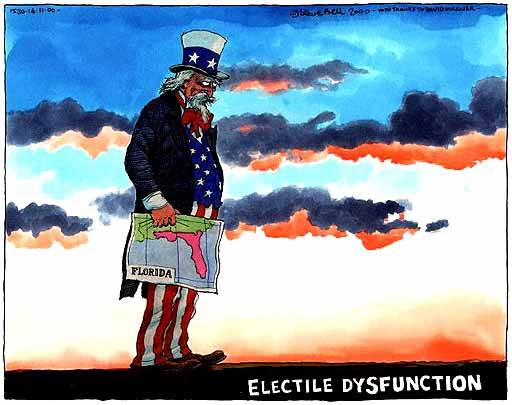
Political cartoon by Steve Bell / About.com.

Can we transform labor’s Buckeye victory
into a new era of election protection?

By Bob Fitrakis and Harvey Wasserman / The Rag Blog / November 14, 2011

The crushing defeat Ohio’s working people dealt 1% politicians last week has critical implications for a whole other issue — election protection.

In a voting process that might otherwise have been stolen, a concerted effort by citizens committed to democracy — NOT the Democratic Party — guaranteed an official Ohio tally that finally squares with reality. The defeat of millionaire Republican Governor John Kasich’s union-busting Issue 2 by more than 20% actually squared with exit polling and other reliable political indicators.

In the 2008 election, Richard Charnin has demonstrated how there was a more than 5% shift towards the Republican presidential candidate John McCain than predicted by the highly accurate exit polls, the gold standard for detecting election fraud. In Ohio’s 2010 election, exit polls revealed a 5.4% unexplained “red shift” towards the Republican Party. The shift led to the defeat of Democratic Governor Ted Strickland as well as Ohio Attorney General Richard Cordray.

But both of those elections were administered under a Democratic governor and secretary of state. This year’s reasonable vote count on Issue 2 came under Republican Secretary of State John Husted and Republican Governor John Kasich who had a strong interest in seeing the opposite outcome. For those of us in Ohio, that was the REAL groundshaker of Issue 2’s defeat.

The most shocking news from Ohio’s 2011 election was the inability of Franklin County Board of Elections officials to post election results at the precinct level due to faulty software programming. In a close election, this could have been pivotal in allowing electronic election fraud. See: “Election night computer software meltdown in Franklin County.”

Can we now build on this to bring reliable vote counts to the entire nation? See the proposal below.

But first, understand: Since 2004, Ohio has been the poster chlld for the art and science of stealing elections. When Karl Rove and then-Secretary of State J. Kenneth Blackwell flipped a 4%-plus victory for John Kerry into a 2%-plus victory for George W. Bush, they forged overnight a new frontier of high-tech election thievery. See “New court filing reveals how the 2004 Ohio presidential election was hacked.”

The fraud was carried out with a stunning array of techniques. More than 300,000 likely Democratic voters were knocked off the registration rolls. Grassroots registration efforts were intimidated and shredded. Voting machines were shorted, manipulated, and flipped. Voters were misled and misguided. Whole bags of ballots disappeared. Electronic screen tallies jumped from Kerry to Bush. Polls closed illegally and often. You name it, the GOP did it… and then some.

In our How the GOP Stole America’s 2004 Election we documented well over a hundred different ways the Republicans robbed the process to give George W. Bush a second term.

Not only did John Kerry and the Democrats say nothing about it. Kerry conceded with nearly a quarter-million votes uncounted, then used a Republican law firm to attack election rights activists’ attempts to reveal what had been done.

Then, in 2005, Blackwell and Rove outdid themselves. A grassroots-based election reform referendum ran right up to voting day with a 25-plus margin of victory. It mandated extended voting access for all Ohio citizens and a range of other reforms. With clear benefit to the vast majority of Ohio voters, all major polls showed that year’s Issue 2 passing with ease. See “Has American Democracy died an electronic death in Ohio 2005’s referenda defeats?

But somehow, on election day, it went down in flames. Ohio’s electoral process remained a thieves’ paradise.

In 2006, amidst massive GOP scandals and Blackwell’s impossible run for the statehouse, the Democrats swept in. They oversaw Obama’s victory in the Buckeye state, a key to all presidential elections.

They did virtually nothing to reform the structure of Ohio’s electoral process. But the grassroots strength of those committed to democracy became established.

This year, democracy advocates were again out in force. Independent monitors showed up at polling stations throughout the state, sponsored by the Free Press’ Election Protection project and Green Party observers were active as well. A careful eye was kept on electronic voting machines. Ballot custody was tracked and potential fraud was challenged. Numerous pollworkers contacted the Free Press when they were unable to post precinct-level results.

And thus this critical election was not stolen, as well it might have been. Labor’s critical victory was preserved, and perhaps a new era has opened in our national politics, aimed at rolling back the reactionary tide of corporate personhood and its minions of mammon.

But it cannot proceed without election protection. Our voting process is non-transparent, inherently corrupt, unfair, and prone to theft by the highest briber.

So we are now in the process of drafting a constitutional amendment. It can go state by state, and nationwide. Language will vary and evolve. We hope you will join the process and use it to define the electoral process in years to come:

A protection amendment for the states and nation:

  1. All citizens shall be automatically registered to vote upon turning 18 years old. Registration is lost only upon revocation of citizenship or death.
  2. A legal signature, accurately provided under penalty of felony law, shall be sufficient to procure a ballot
  3. Voting shall take place by mail, as prescribed by local officials, and at voting stations open on a designated four-day period including Saturday, Sunday, Monday, and Tuesday.
  4. All ballots shall be printed on recycled paper.
  5. All ballots shall be hand-counted, and preserved for at least 10 years after every election.
  6. All polling places shall host exit polls conducted by independent agencies under the supervision of an independent non-partisan agency.

An informed, committed citizenry will still be needed to guarantee fair elections. Reform of the financial aspects of election campaigns also needs to be addressed.

But in terms of guaranteeing an accurate vote count, we believe these six measures are key. We are sure these reforms will come over a long, difficult process.

But paper ballots are used in Germany, where vote counts square to within 0.1% of exit polls, and in Japan, Switzerland, Canada, and elsewhere. Elections on paper can certainly be stolen, but it’s a lot harder to do than with the absurdly corruptible electronic voting machines and non-transparent hardware and software manufactured by partisan corporations.

No system is flawless. But think about where America would be right now if the 1% had stolen Ohio’s labor law and destroyed its public unions.

Our survival as a nation depends on establishing a fair, reliable voting process. We believe this is a start. Won’t you join us?

[Bob Fitrakis and Harvey Wasserman have co-authored four books about election protection. Bob’s Fitrakis Files are at freepress.org, where this article was first published. Harvey Wasserman’s History of the U.S. is at HarveyWasserman.com, along with Solartopia! Our Green-powered Earth. Read more of Harvey Wasserman and Bob Fitrakis’ writing on The Rag Blog.]

The Rag Blog

Posted in Rag Bloggers | Tagged , , , , | 1 Comment

Can we transform labor’s Buckeye victory
into a new era of election protection?

By Bob Fitrakis & Harvey Wasserman / The Rag Blog / November 14, 2011

The crushing defeat Ohio’s working people dealt 1% politicians last week has critical implications for a whole other issue — election protection.

In a voting process that might otherwise have been stolen, a concerted effort by citizens committed to democracy — NOT the Democratic Party — guaranteed an official Ohio tally that finally squares with reality. The defeat of millionaire Republican Governor John Kasich’s union-busting Issue 2 by more than 20% actually squared with exit polling and other reliable political indicators.

In the 2008 election, Richard Charnin has demonstrated how there was a more than 5% shift towards the Republican presidential candidates John McCain than predicted by the highly accurate exit polls, the gold standard for detecting election fraud. In Ohio’s 2010 election, exit polls revealed a 5.4% unexplained “red shift” towards the Republican Party. The shift led to the defeat of Democratic Governor Ted Strickland as well as Ohio Attorney General Richard Cordray.

But both of those elections were administered under a Democratic governor and secretary of state. This year’s reasonable vote count on Issue 2 came under Republican Secretary of State John Husted and Republican Governor John Kasich who had a strong interest in seeing the opposite outcome. For those of us in Ohio, that was the REAL groundshaker of Issue 2’s defeat.

The most shocking news from Ohio’s 2011 election was the inability of Franklin County Board of Elections officials to post election results at the precinct level due to faulty software programming. In a close election, this could have been pivotal in allowing electronic election fraud. See: “Election night computer software meltdown in Franklin County.”

Can we now build on this to bring reliable vote counts to the entire nation? See the proposal below.

But first, understand: Since 2004, Ohio has been the poster chlld for the art and science of stealing elections. When Karl Rove and then-Secretary of State J. Kenneth Blackwell flipped a 4%-plus victory for John Kerry into a 2%-plus victory for George W. Bush, they forged overnight a new frontier of high-tech election thievery. See “New court filing reveals how the 2004 Ohio presidential election was hacked.”

The fraud was carried out with a stunning array of techniques. More than 300,000 likely Democratic voters were knocked off the registration rolls. Grassroots registration efforts were intimidated and shredded. Voting machines were shorted, manipulated, and flipped. Voters were misled and misguided. Whole bags of ballots disappeared. Electronic screen tallies jumped from Kerry to Bush. Polls closed illegally and often. You name it, the GOP did it… and then some.

In our How the GOP Stole America’s 2004 Election we documented well over a hundred different ways the Republicans robbed the process to give George W. Bush a second term.

Not only did John Kerry and the Democrats say nothing about it. Kerry conceded with nearly a quarter-million votes uncounted, then used a Republican law firm to attack election rights activists’ attempts to reveal what had been done.

Then, in 2005, Blackwell and Rove outdid themselves. A grassroots-based election reform referendum ran right up to voting day with a 25-plus margin of victory. It mandated extended voting access for all Ohio citizens and a range of other reforms. With clear benefit to the vast majority of Ohio voters, all major polls showed that year’s Issue 2 passing with ease. See “Has American Democracy died an electronic death in Ohio 2005’s referenda defeats?

But somehow, on election day, it went down in flames. Ohio’s electoral process remained a thieves’ paradise.

In 2006, amidst massive GOP scandals and Blackwell’s impossible run for the statehouse, the Democrats swept in. They oversaw Obama’s victory in the Buckeye state, a key to all presidential elections.

They did virtually nothing to reform the structure of Ohio’s electoral process. But the grassroots strength of those committed to democracy became established.

This year, democracy advocates were again out in force. Independent monitors showed up at polling stations throughout the state, sponsored by the Free Press’ Election Protection project and Green Party observers were active as well. A careful eye was kept on electronic voting machines. Ballot custody was tracked and potential fraud was challenged. Numerous pollworkers contacted the Free Press when they were unable to post precinct-level results.

And thus this critical election was not stolen, as well it might have been. Labor’s critical victory was preserved, and perhaps a new era has opened in our national politics, aimed at rolling back the reactionary tide of corporate personhood and its minions of mammon.

But it cannot proceed without election protection. Our voting process is non-transparent, inherently corrupt, unfair, and prone to theft by the highest briber.

So we are now in the process of drafting a constitutional amendment. It can go state by state, and nationwide. Language will vary and evolve. We hope you will join the process and use it to define the electoral process in years to come:

An protection amendment for the states and nation:

  1. All citizens shall be automatically registered to vote upon turning 18 years old. Registration is lost only upon revocation of citizenship or death.
  2. A legal signature, accurately provided under penalty of felony law, shall be sufficient to procure a ballot
  3. Voting shall take place by mail, as prescribed by local officials, and at voting stations open on a designated four-day period including Saturday, Sunday, Monday, and Tuesday.
  4. All ballots shall be printed on recycled paper.
  5. All ballots shall be hand-counted, and preserved for at least 10 years after every election.
  6. All polling places shall host exit polls conducted by independent agencies under the supervision of an independent non-partisan agency.

An informed, committed citizenry will still be needed to guarantee fair elections. Reform of the financial aspects of election campaigns also needs to be addressed.

But in terms of guaranteeing an accurate vote count, we believe these six measures are key. We are sure these reforms will come over a long, difficult process.

But paper ballots are used in Germany, where vote counts square to within 0.1% of exit polls, and in Japan, Switzerland, Canada, and elsewhere. Elections on paper can certainly be stolen, but it’s a lot harder to do than with the absurdly corruptible electronic voting machines and non-transparent hardware and software manufactured by partisan corporations.

No system is flawless. But think about where America would be right now if the 1% had stolen Ohio’s labor law and destroyed its public unions.

Our survival as a nation depends on establishing a fair, reliable voting process. We believe this is a start. Won’t you join us?

[Bob Fitrakis and Harvey Wasserman have co-authored four books about election protection. Bob’s Fitrakis Files are at freepress.org, where this article was first published. Harvey Wasserman’s History of the U.S. is at HarveyWasserman.com, along with Solartopia! Our Green-powered Earth. Read more of Harvey Wasserman and Bob Fitrakis’ writing on The Rag Blog.]

The Rag Blog

Posted in RagBlog | Leave a comment

Ellen LaConte : When Too Big to Fail is Too Big Not To

“Blick auf den Planeten Erde” by Heikenwaelder Hugo, Austria / Wikimedia Commons.

When too big to fail
is too big not to

Where bailout theory comes a cropper, no matter who’s doing or who’s receiving the bailout, is when it ignores the inevitability of finiteness on a finite planet.

By Ellen LaConte / The Rag Blog / November 10, 2011

Author and sustainability advocate Ellen LaConte will be Thorne Dreyer‘s guest on Rag Radio, Friday, November 11, 2011, 2-3 p.m. (Central) on KOOP 91-7-FM in Austin. Stream it live here.

The Occupy Wall Street (OWS) protesters here and around the world and most of the now iconic 99% of humans have something in common with the forces and powers they’re protesting.

Like the powers that be on Wall Street, in Washington, and in the rest of the nation’s and the world’s capitols and financial centers, they believe in the global economy’s ability to deliver them the goods — the resources, jobs, wages, and services they deserve and depend on — if only the people managing it were more fair.

As I write this the occupy moment in the U.S. is weakening and, its having neither chosen a single demand or coherent cluster of them nor posed any coherent solution to present inequities and trespasses, seems likely not to become a coherent movement. This leaves OWS in much the same position as the political and economic forces against which it is arrayed: incoherent.

Inarguably, the global economy could be managed in a way that would come closer to creating the flat world, level playing field, and economic equity envisioned by analysts like Tom Friedman and Paul Krugman. But even if it were, we would still be dealing with an economy that’s approaching a terminal condition capable of bringing to an end life as we know it. It’s this terminal condition we need to be protesting, or better still, trying mightily to mitigate or avoid.

Global economic theory tends to rely on one particularly counterintuitive notion: that huge transnational corporations, organizations, and economic systems are not vulnerable to the defects inherent in all forms of gigantism and overreach. Rather they are and should be treated as if they were “too big to fail” — or at least too big to be allowed to.

Why?

Letting them go under would, exactly as we’ve seen, put at risk the national and regional economies, investors, stockholders, suppliers, and other businesses and organizations, and even sovereign nations, they would weaken or take down with them. Some other economy, corporation, organization, country, or consortium of them will — even must — as a matter of course, bail out vulnerable mega-companies and institutions and nations. They must not be allowed to fail.

And so stock markets, investors, and even individuals who are not vested in the financial sector or directly in the global economy but who do depend on its ability to keep funding the systems they rely on for their lives and livelihoods keep counting on the powers and the world’s leaders to make sure the system doesn’t fail. And they assume, or at least try very hard to believe, they can actually do that.

Bailout Theory, as it is called, is fatally flawed, however, when it comes to a globalized, fossil-fueled, industrial, and hyper-capitalized economy. The kind of economy we are all now living “under.” The very economy that both fat cats and fist-shakers stake their futures on.

Again, why?

“Because Mother Nature does not do bailouts,” says former Vice President and climate change spokesperson Al Gore. Just as there’s no other Earth to turn to if we live for too long beyond this one’s means, there’s no larger economy to turn to if the global economy operates much longer beyond its means. And there are no unaffected national or regional economies that are sufficiently big, rich, or independent to bail the global economy out.

As we’ve seen in Europe, the global economy’s wealthiest, most powerful and aggressive subsidiary economies are heavily invested and implicated in each other’s bad paper, foreclosures, bankruptcies, and other forms of debt. Witness Germany’s virtual ownership of Greece and Britain, and European banks teetering on the edge of insolvency due to bad loans made to the overdrawn PIIGS (Portugal, Ireland, Italy, Greece and Spain) and in development, infrastructure, energy, military and expansion projects that are so big that no subsidiary economy can afford to undertake them alone.

The global economy’s poorest subsidiary economies already hang on by a thread that the richest, finding themselves ever less rich, may choose or have no choice but to cut. National economies are propping up each other’s credit and financial institutions in such a way that each of them is vulnerable to the failure of any of the others.

In spring 2008, in an earlier draft of my book Life Rules, I predicted that only one opportunistic condition would be required to bring down this jerry-rigged, multinational system of props: protracted widespread drought, cumulative weather-related disasters coupled with bankrupt emergency management systems, failed grain crops, another major resource war, recognition of and panic around peak oil, a rapid or prolonged sequence of serious seismic events, or meltdown of the U.S. or European Union economies, for example. Here we are.

But surely economic collapse isn’t inevitable, is it? After all, we pulled out of the Great Depression of the 1930s. That was a worldwide phenomenon too and the decades following the crash brought the most prosperity to the most people in human history.

The mid-20th century miracles of industrial productivity, the phenomenally productive (not to say completely harmless) agricultural Green Revolution, computer, electronic and digital technologies, and (so-called) free-market economic policies accomplished a number of wildly ambitious goals.

They enriched and added to the list of self-designated First World (or at least prosperous, powerful, developed, industrialized) economies and so-called Second World (developing, industrializing) economies. They hauled many so-called Third World economies — by the First World’s reckoning, the poor, less powerful, undeveloped, not-yet industrialized economies — into the modern era.

In the process they created a conceptual divide that gave putative First World nations a dangerous sense of superiority and entitlement and global aspirations that carried stock markets around the world to such heights that at century’s end one investment analyst predicted the DOW Jones Industrial Average, which had yet to exceed 14,000 points, could hit 36,000.

Couldn’t upgraded versions of the same sorts of activities and policies that bailed us out then (Keynesian policies, for example, that we still like to believe will work now) actually bail us out now too?

No.

Why not? Several once-in-an-Earthtime conditions permitted the boom that followed that early 20th century bust. Among them were:

  • a war-driven, full-employment, manufacturing economy based on the production and deployment of conventional (that is, non-nuclear, non-biological) weaponry;
  • cheap, abundant fossil fuels and natural resources, like minerals, metals, land and water;
  • free, reliable ecosystem services;
  • relatively predictable, mostly good weather;
  • the gold standard limitation on economic and environmental overreach;
  • widespread faith in “endless capital” and effective big government.

None of these can save us now. Perpetual warfare bankrupts and corrupts rather than bankrolling nations and threatens unprecedented death and destruction. Earth’s cornucopia of resources and fossil fuels is approaching empty and will not be refilled. Ecosystem services like carbon sequestration, soil maintenance, flood control, pH balance, and water purification have been seriously taxed by global economic activity over the past half century.

The climate has already become noticeably unstable and increasingly unfriendly and CO2 in the atmosphere (not to mention other greenhouse gases) is almost 50 parts per million higher than life as we’ve known it can tolerate. The removal of any tie between the amount and value of monies in circulation and a finite material like gold has allowed — caused — the increasing funniness and decreasing actual value of money and created a false sense of limitlessness.

And the capacity of governments to manage at the global or even national level the complex symptoms that characterize our present critical mass of environmental, economic, social, and political crises appears to be nil.

“Thus it is that we can say,” writes American sociologist Immanuel Wallerstein in a paper titled “Globalization or the Age of Transition,” “that the capitalist world-economy has now entered its terminal crisis, a crisis that may last up to 50 years. . . As the world-economy enters into a new period of [attempted] expansion it will exacerbate the very conditions which have led it to this terminal crisis.”

“Collapse, if and when it comes again, will this time be global,” wrote anthropologist and historian Joseph Tainter in The Collapse of Complex Societies as long ago as 1988. “No longer can any individual nation collapse. World civilization will disintegrate as a whole.” He no longer includes the hedge “if and when it comes again” in his prediction.

In short, the booming, credit-driven economy that those once-in-an-Earthtime conditions permitted is the biggest economy there is and ever has been. There’s no bigger human economy for it to turn to for help. It’s too big not to fail.

If this is true, then future moment-cum-movements may wish, will likely need, to focus on post-global economics rather than tweaking of the present system which is both moribund and a danger to living things, including most humans.

[A freelance journalist, contemporary issues writer, and memoirist, Ellen LaConte is author most recently of a controversial, widely-endorsed meta-synthesis, Life Rules: Why so much is going wrong everywhere at once and how Life teaches us to fix it. Information about Ellen and her work can be found at www.ellenlaconte.com. Read more articles by Ellen LaConte on The Rag Blog.]

The Rag Blog

Posted in Rag Bloggers | Tagged , , , , | Leave a comment

Paul Beckett : Naked ALEC and the Right Wing Conspiracy

Graphics from the Center for Media and Democracy.

ALEC Naked:
More news from the ‘vast
right wing conspiracy’

By Paul Beckett / The Rag Blog / November 10, 2011

MADISON, Wisconsin — It’s all we needed! Another dimension of the “vast right-wing conspiracy” comes to light, like a horror movie monster emerging from primeval slime.

What’s its name? ALEC. But if you’re thinking of the irritating but ultimately cuddly boss in 30 Rock you’re way off. This ALEC is an acronym standing for American Legislative Exchange Council.

ALEC brings together state legislators (overwhelmingly, conservative Republicans) and corporate leaders in annual meetings to propose, review, and approve the legislation that they would LIKE to see passed at the state level.

Corporations’ business interests (profits, reduction of taxes, regulation, environmental protections, etc.) are melded with the ideological content of the right-wing politicians (guns, privatizing schools, anti-abortion, Voter ID, etc.). Sitting together in task forces, corporate representatives (often very high-level) work together with legislators to produce model legislation that is approved to be taken home and introduced in state legislatures.

ALEC staff assist adaptations in language and strategy to the circumstances of different states. Authorship of introduced legislation (about 1,000 bills a year in the country as a whole) is claimed by the local legislator: ALEC does not sign its work!

Is ALEC new? Not at all. It was created in 1973, and was closely associated with the Heritage Foundation, created at about the same time. Little noticed outside of conservative circles, ALEC grew and grew. Now its influence touches every state, and some of America’s top corporate leaders attend ALEC’s annual meetings.

But we in Wisconsin were largely blindsided, even though an earlier generation of Wisconsin conservative leaders such as former Governor Tommy Thompson and former Senator Robert Kasten were ground-floor ALEC participants.

For most of us, ALEC remained unknown, as obscure for us as, say, a pair of billionaire brothers named Koch.

Then came January 2011 and the inauguration of Governor Scott Walker. Virtually instantly, as snowflakes flew outside the Capitol, a blizzard of legislation was introduced inside touching on almost everything in Wisconsin’s public life and traditions: education (“choice” charter schools, teachers’ rights to organize, education funding, even the organization and governance of state universities), taxes, rights of labor, health care (Wisconsin’s successful “Badger Care” adaptation of Medicaid), funding for Medicare, concealed gun carry, voter ID, the state civil service. There was little that was not in there. And most of it was bundled together in a “Budget Repair Bill,” to be passed as “emergency legislation” by monolithic GOP majorities.

The Budget Repair Bill contained 9,355 sections, mostly packed with dense legalese. How had Walker and his lieutenants, who had never claimed to be intellectual giants, put together such an immense construction by the early part of February?

You guessed it: ALEC. ALEC indeed had not signed its work. But we were beginning to wake up. It emerged that there were few things in Walker’s legislative package that were NOT underlain by legislative “models” developed within ALEC.

Two thirds of a year after the events of February-March, the ALEC legislation is still wreaking havoc to Wisconsin’s proud political traditions. Most recently, we have Voter ID (read, voter suppression), and concealed carry on the books, with lots more to come.

Now, Wisconsin progressives are beginning to push back and make themselves a headache for ALEC.

This dimension of the “vast right-wing conspiracy” (for that is exactly what it is) has flourished in obscurity. But in a stunt reminiscent of a Hollywood spy flick, Mark Pocan, a Wisconsin Assembly Democrat (and one of the Assembly’s most progressive members) infiltrated the 2010 ALEC national conference in New Orleans.

His method was simple. As a state legislator, he simply paid the dues and attended. He attended the assemblies and the cocktail parties (he was excluded from the task force meetings) and obtained the password to the ALEC collection of more than 800 “model” bills ready and waiting for introduction in state legislatures.

Pocan’s experience and the access he gained was an important asset as the Center for Media and Democracy, based in Madison, did a thorough and fascinating research job on ALEC, resulting in “ALEC Exposed.”

Good, muck-raking investigative journalism lives! There is little you will not find in “ALEC Exposed.” Included here are lists of ALEC member corporations, politicians, the ALEC state Chairs, ALEC “scholars,” and ALEC Boards and Task Forces. It would have been unfair to omit the role of the infamous Koch Brothers, and they are given the credit they deserve. Finally, “ALEC Exposed” provides a vast compendium of the more than 800 ALEC “model” bills, organized by subject matter.

“ALEC Exposed” really IS a “model”: a model of hard-hitting, fact-filled reporting on a subject of huge national significance.


But, how does a web-based, The Nation-connected media report like “ALEC Exposed” make its way out through the filters of a tired, timid, and conservative-leaning mainstream media and a hyper-energetic and deliberately slanted right-wing infotainment complex led by Fox News?

Well, that’s the big problem, alright. It is not that we don’t have investigative reporting and writing of Lincoln Steffens quality these days. There is a lot of it: perhaps unprecedented quantities. The problem is that most of this is confined within the left in a politically segregated America, and it effectively reaches only a small proportion of American brains.

A step in doing something about this was taken recently by another Wisconsin group. On October 22 a day-long program entitled “All About ALEC” drew some 300 participants, this on one of the last sunny and warm Saturdays of the year.

Organized by the Oregon (WI) Area Progressives or OAP, the conference included a stellar set of nearly 20 presenters covering ALEC’s history, financing, organization, and its connection to current crises in healthcare, education, tax policy, and state government finance, the Voter ID legislation, labor rights, education, and campaign finance.

State Assembly member Mark Pocan presented an entertaining account of his “undercover” work at the New Orleans ALEC national conference. A significant point was his perception, as he watched the interactions of state legislators with corporate leadership (often very high level), of the dominance of the corporate side.

Joanne Ricca of the Wisconsin AFL-CIO laid out the historical roots of ALEC in the early 1970s, showing its connection to the Heritage Foundation and to Grover Norquist and the other founders of neoconservatism. Almost 40 years later, ALEC literally has a legislative answer prepared on almost every issue. A comparison of this position of strength to that of the American left is frightening. We really need an ALEC of the left she noted, with a wistful tone.

Mike McCabe of the Wisconsin Democracy Campaign put ALEC in the larger context as he laid out a four-part net of political hegemony developed by conservative forces. First is ideological hegemony through media control and “message development.” Second is electioneering (in a competition that is increasingly rigged). Third comes the legislative offensive, using majorities to legislate the conservative goals. Fourth is to ensure judicial confirmation of legislation as high courts are packed with conservative judges.

ALEC’s primary significance is in the third area: using a legislative majority to quickly embed a comprehensive conservative agenda in the legal code, state by state, especially in the 21 states that elected Republican majorities in 2010.

That liveliest of the U.S. House of Representatives progressives, Jan Schakowsky, came up from Illinois to speak. (Fending off references to Wisconsin’s traditional joking antagonism toward its neighbor on the south, she informed us that Illinois, where Wisconsin’s 14 progressive state Senators took refuge in February, should now be called the Sanctuary State.)

Speaking as a political professional, Jan Schakowsky had a simple message: we should not give up. The popular uprising in Wisconsin (for one description go here) demonstrated the power of an aroused public. Wisconsin “lifted a cloud of paralysis and despair,” she said.

The politically fortified positions of the right are formidable (for instance, she said, the National Rifle Association [NRA] simply “owns” the U.S. Congress in its area of interest). But it is extremely important to remember that the left’s positions ARE majority positions on all the crucial issues, as poll after poll confirms.

The right’s money is important; but remember, she said, that it takes less money to convince people of their TRUE interests than it does to convince them of false ones. What we on the left have to do is make legislators fear us more than they fear them.

Wisconsin’s ALEC story is no more important than that of any other state. ALEC is organized and active in every one of the 50 states. (To get started with your state, go here.) Exposure is a powerful weapon. ALEC has flourished in the shadows, never “signing its work.” In each state, we need to pull aside the curtain. In the Wizard of Oz, the little dog Toto pulls aside a curtain and we see that an apparently omnipotent force really consists of a portly little man pulling levers and speaking through loudspeakers.

Shining a strong light, state by state, on ALEC, its legislators (and its connection to their legislation), and to the corporate benefits provided to ALEC’s corporate funders, is a start to taking back our democracy at the state level.

ALEC also makes an important point about us, the progressive left. Suppose we came to power, all over the country. How much of a progressive agenda do we have, one that we all agree on, one that comprehensively moves America toward the progressive society that we could be? As Joanne Ricca said, maybe we need something like an ALEC on our side of the political divide!

[Dr. Paul Beckett lives in Madison, Wisconsin. He can be reached at beckettpa@gmail.com. Read more articles by Paul Beckett on The Rag Blog.]

The Rag Blog

Posted in Rag Bloggers | Tagged , , , | 1 Comment

Josefina Castillo and Judith Rosenberg : Women and Fair Trade

The Women and Fair Trade festival. Image from the group’s website.

Sustaining indigenous traditions:
The Women and Fair Trade Festival

The people want fair markets, not ‘free trade.’

By Josefina Castillo and Judith Rosenberg / The Rag Blog / November 10, 2011

The Women and Fair Trade Festival is an annual Austin marketplace, now in its eighth year, that hosts artisan producers from women’s cooperatives from all over the world. Women and their representatives gather in Austin to meet local consumers for commerce, cultural celebration, and exchange. Austin Tan Cerca de la Frontera sponsors the two-day event, November 12-13, 2011, 10 a.m.-6 p.m., at The Old School, 1604 East 11th Street, Austin, Texas.

Saturday, November 12, from 3-5 p.m., the first John Ross Journalism Award will be presented to Melissa del Bosque of the Texas Observer. On Sunday, November 13, from 3-5 pm, the second annual Trans-lingual Poetry Concert features Liliana Valenzuela and other Austin poets influenced by Latina, Middle Eastern, and African cultures.

AUSTIN — The Women and Fair Trade Festival, established eight years ago by Austin Tan Cerca de la Frontera, is a community gathering where people can buy fair trade products while helping to sustain old indigenous traditions — and have the opportunity to interact with the direct producers of colorful arts and crafts. This community event celebrates the rich cultural diversity of our society, and presents an alternative to corporate globalization.

Participants include eight cooperatives, formed by women adversely affected by globalization, who come from various developing countries to tell their stories and sell beautiful handmade textiles, toys, pottery, jewelry, clothing, and ethnic weavings.

Through cooperatives, women become central participants in the management of their own products, maintain ancestral knowledge, support sustainable agriculture, and provide much needed funds for community development projects. Fair trade allows women to play central roles in the development of local economies.

This year, ATCFE has named Melissa del Bosque recipient of the John Ross Journalism Award 2011 for her reporting on Mexico and the U.S./Mexico Border in the Texas Observer. The award, to be presented Saturday, November 12, from 3 to 5 p.m, is given in recognition of Melissa’s independence, courage, and ability to place events within a deeper context.

Rag Blog editor Thorne Dreyer, Rene Valdez of Red Salmon Arts and Resistencia Bookstore, and noted documentary photographer Alan Pogue will pay tribute to the legacy of the great activist, poet, and author — and regular contributor to The Rag Blog John Ross, who died earlier this year. They will also discuss the importance of independent media and alternate channels for coverage of other countries.

On Sunday, November 13, from 3 to 5 p.m., the second annual Trans-lingual Poetry Concert features Liliana Valenzuela and other Austin poets influenced by Latina, Middle Eastern, and African cultures, who live simultaneously in several cultures and languages. They help us hear and see the world created by trade and colonialism as well as lives and identities that crisscross and re-define borders. Other confirmed poets include Deborah Paredez, Carolina Ebeid, Maganthrie Pillay, Zara Houshmand, Fehintola Mosadomi, and Adesile Okeowo.

The impact of ‘free trade’

In Austin Tan Cerca de la Frontera we have seen face-to-face the impact of free trade policies on workers’ lives while organizing border delegations to visit Mexican workers in the maquiladora industry, with its assembly plants located in developing countries, owned by transnational corporations.

We have learned of exploitation not only in terms of salary and working conditions but also in the places where they live. The “colonias” lack the basic infrastructure to allow workers to live in a decent way: they have no paved roads, no sewage systems, and are marked by widespread environmental damage.

Just a few years ago Austin Tan Cerca made a study of where the money goes when you buy a pair of jeans at a department store. The actual producer, the person whose hands created the product, gets less than 1%. Transnational corporations (and their brand name distributors), retail stores, and manufacturing facilities keep 99% of the value. How can anybody believe this is free trade?

In 1999 — the same year that Austin Tan Cerca de la Frontera took its first steps to establish a relationship of solidarity with Mexican workers — the World Trade Organization, meeting in Seattle, became a stage for activists and ordinary working people on which to protest against corporate greed. The people in the streets of Seattle were able to feel the power of their solidarity against the giant corporations and government — and they managed to stop the WTO’s deliberations. All the ministers went home confused and empty-handed.

Austin Tan Cerca de la Frontera wants not only to protest against the rank injustice of the income inequality between the 1% and the 99%, but also to offer and be part of alternative proposals such as the Fair Trade movement. More and more voices have proposed “fair trade” since the 1994 passage of the North American Free Trade Agreement (NAFTA) and through the years in which workers and environmentalists learned in personal terms the emptiness of NAFTA’s promises.

Though the 99% have not yet declared a formal program, and have wisely refrained from listing demands, their yearnings must surely be in harmony with fair trade. If the 99% are willing to cross borders, they must be in sympathy with the maquiladora worker who 10 years ago had an opportunity to look her U.S. CEO in the eye and say, “We’re the ones that create the wealth. You’re the one that reaps the benefit. My children and I still don’t have running water.”

The communities we serve and their diverse cultures are like pearls of a necklace, beautiful and rich, connected by a common thread of hope in their artistic designs. In these challenging economic times we offer a new path, a new way to link a rich cultural heritage with modern alternative ideas and marketing — which is what a real democracy looks like and which suggests the future that we’d like to see.

[Josefina Castillo is an ex officio member of the board and Dr. Judith Rosenberg is president of Austin Tan Cerca de la Frontera.]

The Rag Blog

Posted in Rag Bloggers | Tagged , , , , , , | Leave a comment

Bruce Goldberg : Carl Oglesby Occupies Heaven

Carl Oglesby. Photo by Jennifer Fels / AP / The Guardian.

Occupy Heaven:
The Memorial for Carl Oglesby

By Bruce Goldberg / The Rag Blog / November 10, 2011

Born of a working class family in Akron, Ohio, Carl Oglesby grew to become an influential radical activist, writer, and thinker from the 1960’s until the time of his death in September of this year. Elected President of Students for a Democratic Society (SDS) in 1965, Oglesby, a gifted orator, gave one of the more memorable speeches against the Vietnam War at a massive March on Washington Rally in November 1965.

He was the author of many books, notably Containment and Change, The New Left Reader, Who Killed JFK?, and his last published work in 2008, his memoir, Ravens in The Storm. An accomplished musician, he composed and sang his own songs on two recorded albums, Carl Oglesby (1969) and Going to Damascus (1971).

Carl died of cancer on September 13, 2011, and a memorial celebration in his honor was held in Cambridge, Massachusetts, on November 4.

Somewhere, call it heaven, the spirit of Carl Oglesby managed to occupy the entire outskirts of paradise on a brilliantly cool and crystal clear night in Cambridge, Massachusetts. Here, in Harvard Square’s Old Cambridge Baptist Church, just a few blocks from where he once lived, some 150 or so old friends, lovers, family, colleagues, and admirers gathered to remember a man.

Befitting Carl, the talks were long, sometimes very long. Some read from Carl’s early plays, some from his speeches and published writing.

Bob Katz, an early collaborator with Carl on the Assassination Information Bureau, recalled a trip with Carl to Boulder in the early 1970s. The two had come for an alternative media conference and during one of the many breaks in the conference they took a long hike with some of us Boulder folks into the mountains. Carl suddenly vanished as the sun disappeared behind the Rockies and just as some began to worry about what had happened to him, the familiar lilting sound of a flute filtered down through the trees. “He could still be there even when he wasn’t,” Bob thought, “much as he is here tonight even when he isn’t.“

Did you know there were over 15,000 pages of Carl’s FBI files compiled? Neither did I, but apparently that’s what Attorney Jim Lesar found in plying free Carl’s files under the Freedom of Information Act. Carl also has appeals pending concerning the JFK assassination, and the case of the World War II Nazi spy, General Reinhard Gehlen, who apparently continued to operate his Nazi spy ring with American complicity after the war. Carl’s partner, Barbara Webster, and his three children will now become plaintiffs in the still-pending suits.

Todd Gitlin remembered how Carl occupied SDS, all of SDS, during the period of its rapid growth from relative obscurity, and Alan Haber recounted how he and Carl had discussed a 50th SDS reunion commemorating the Port Huron statement.

Perhaps most touching and real, however, were the remembrances of Carl’s children — Aron, Caleb, and Shay. Only perhaps in the immediate aftermath of death, at that tipping point before the gossips of history carve their initials on what comes to be regarded as unquestioned fact, does the full measure of a life get a brief chance to be heard — and then, usually, only by those who came to know the whole person including the missing pieces.

Families and loved ones are often the best at this. And this night was no exception. Shay Oglesby-Smith performed a musical tribute to her dad, a rephrasing of “My Favorite Things,” sung a cappella and with hauntingly beautiful lyrics that only one of Carl’s daughters could pen.

Aron shared a hidden side of her dad that maybe, “if only subconsciously,” sought to inhabit the role of the tragic hero, trying “to do impossible things he thought were right.”

Caleb’s family slides showed Carl as a young boy, as an actor portraying the Earl of Kent in Shakespeare’s King Lear, as a gifted musician and songwriter, and simply, as Carl the man — the skinny man in his early 30’s tightly gripping his kids in his arms, the fiery bearded long-haired man giving razor-edged speeches, the dapper tuxedoed man at Caleb and Shay’s wedding, the beaming tender man posing proudly with his new grandchild.

Carl Oglesby the actor, the musician, the playwright, the radical activist, the father, and the man, was 76 years old.

[Bruce Goldberg is a former SDS organizer and friend of Carl Oglesby.]

Also see

The Rag Blog

Posted in Rag Bloggers | Tagged , , , , , , | Leave a comment