Judy Gumbo Albert : Past Seeds the Present at Oakland General Strike

Judy Gumbo Albert: Past seeds the present.

General Strike in Oakland:
The past seeds the present

By Judy Gumbo Albert / The Rag Blog / November 3, 2011

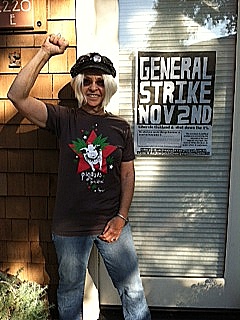
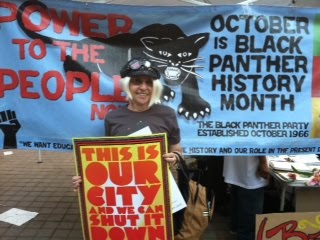
OAKLAND — I felt very much at home at Occupy Oakland’s General Strike yesterday after I heard a young rapper with butt-length dreds and saggy blue jeans remind the crowd that Oakland was the birthplace of the Black Panther Party. He pumped his fist in the air and yelled “Power to the People,” then, just like the Panthers did, admonished the cheering crowd to “watch out for provocateurs.”

I recognized a younger me in a group of women in red t-shirts who taught the crowd to stretch our arms in front of our bodies in a self-defense stance of “No!” Just as Wolfe Lowenthal taught karate in Lincoln Park that summer of 1968. Like Wolfe, the stance these women took was militant and gentle, unlike Wolfe, they complemented “No” with a new stance: “Yes!”

I saw Weathermen in the Black Bloc anarchists who broke away and trashed, and Summer of Love hippies in the beatitude of those who sat on straw mats meditating or practicing yoga. I smelled the ‘60s in the marijuana offered to me by a smiley young African-American teen who sat behind me.

Abbie Hoffman would have been delighted at the General Strike’s free store vibe where food, posters, clothes, and supplies were freely given with the attitude that everyone can share; we’re all in this together. To me, a 1960s radical and original Yippie, the slogan: “Occupy” is brilliant. It prompts you to take direct action, unlike asking those in power to “Stop the War.”

The male-dominated, media-seeking leadership of my day has been replaced by a gender neutral, democratic process of consensus that does not defer to celebrity. I’m delighted. Anyone can choose — or choose not — to speak to the crowd. Or to the media.

When someone speaks for attribution, they open with the caveat: I speak for myself, not for Occupy. Even Jean Quan, Mayor of Oakland, was not accorded the privilege of speaking — she arrived after the speaker’s list was full.

I wrote my Ph.D. thesis in the 1970s and came up with what I thought was a new concept. I got it from the Vietnamese. The best English translation was: “fecundated in a new context.” The verb may sound obscene, but fecundate translates as nourish or fertilize.

It’s been my experience that history is not a straight line. My generation of radicals should not and must not take credit for Occupy. What we did is plant seeds which have been fertilized and nourished by the massive social inequities of today. I felt those seeds flower at Occupy Oakland’s General Strike.

[Judy Gumbo Albert is an original Yippie, along with Abbie and Anita Hoffman, Jerry Rubin and Nancy Kurshan, Paul Krassner, and Judy’s late husband Stew Albert. Judy has remarried, lives in Berkeley, California, and is currently writing her memoir, Yippie Girl. She can be found at www.yippiegirl.com. Read more articles by Judy Gumbo Albert on The Rag Blog.]

The Rag Blog

Posted in Rag Bloggers | Tagged , , , | Leave a comment

Rag Radio : Singer/Songwriter and Community Activist Charlie Faye

Austin singer/songwriter Charlie Faye with Rag Radio host Thorne Dreyer at the KOOP studios in Austin, Texas, Friday, Oct. 28, 2011. Photo by Tracey Schulz / Rag Radio.

Singer/songwriter and community activist Charlie Faye
on Rag Radio with Thorne Dreyer. Listen to it here:

Thorne Dreyer‘s guest on Rag Radio this Friday, November 4, 2011, 2-3 p.m. (Central) on KOOP 91-7-FM in Austin will be Greenlandic Inuit explorer, social worker, and actor Ole Jørgen Hammeken, star of the award-winning film, Inuk, and the film’s executive producer, Marc Buriot. Stream it live here.

Charlie Faye, Austin-based singer/songwriter and community activist, was Thorne Dreyer’s guest on Rag Radio, Friday, October 28.

On January 1, 2010, Charlie Faye, embarked on a modern bohemian adventure. In 10 months, Charlie made her home in 10 different towns: Tucson, Los Angeles, Portland, Boulder, CO, Shreveport, LA, Burlington, VT, Milwaukee, Nashville, Asheville, NC, and New York City. Traveling alone, Charlie put together a new band in each town and wrote and recorded a new song with local musicians each month. Her 10-town-made Travels with Charlie record represents a real cross-section of our national roots-based, Americana music scene.

Charlie Faye also has become one of Austin’s most recognized music community organizers. A front-page story in the Austin American-Statesman outlined her efforts to save Wilson Street, a musicians’ enclave of cottages in South Austin. Charlie discusses with us the sense of community among musicians in Austin (a major factor in her decision to move to Austin in 2007), the importance of affordable housing for the Austin artistic community, and the unique role that the Wilson Street cottages have played.

(After the show was broadcast, Charlie forwarded to us, via Facebook, a 30-day “Notice of Lease Termination and Notice to Vacate” the properties at 2606 and 2610 Wilson Street; the lots are scheduled for redevelopment.)

Charlie’s history also includes touring as a sideman with Dan Zanes and Greg Garing, as well as playing alongside Natalie Merchant, Bettysoo, Will Sexton, and many others. On the show, we discuss her accomplishments and her adventures, and she performs live.

Rag Radio — hosted and produced by Rag Blog editor Thorne Dreyer — is broadcast every Friday from 2-3 p.m. (CDT) on KOOP 91.7-FM in Austin, and streamed live on the web. KOOP is an all-volunteer cooperatively-run community radio station in Austin, Texas.

Rag Radio, which has been aired since September 2009, features hour-long in-depth interviews and discussion about issues of progressive politics, culture, and history. After broadcast, all episodes are posted as podcasts and can be downloaded at the Internet Archive. Tracey Schulz is the show’s engineer and co-producer.

Rag Radio is also rebroadcast on Sundays at 10 a.m. (Eastern) on WFTE, 90.3-FM in Mt. Cobb, PA, and 105.7-FM in Scranton, PA. Rag Radio is produced in the KOOP studios, in association with The Rag Blog, a progressive internet newsmagazine, and the New Journalism Project, a Texas 501(c)(3) nonprofit corporation.

Coming up on Rag Radio:

  • Nov. 4, 2011: Greenlandic Inuit Explorer and Actor Ole Jørgen Hammeken and Inuk Executive Producer Marc Buriot.
  • Nov. 11, 2011: Author and Sustainability Advocate Ellen LaConte.
  • Nov. 18, 2011: Singer/Songwriter, Author, Actor & Artist Bobby Bridger.
  • Nov. 25, 2011: UT-Austin Government Professor David Edwards.

The Rag Blog

Posted in RagBlog | Tagged , , , , , | Leave a comment

Bill Meacham : Simone de Beauvoir: A Philosophy of Liberation

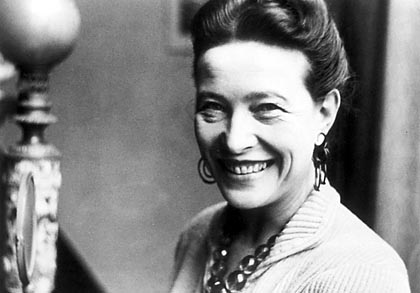
Simone de Beauvoir. Image from Cultural and Critical Theory Library.

Simone de Beauvoir:
A philosophy of liberation

Exercising our own freedom requires that others be free.

By Bill Meacham / The Rag Blog / November 3, 2011

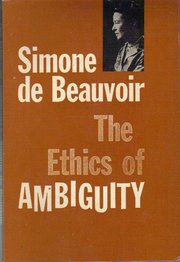
I was pleased recently to find the full text of Simone de Beauvoir’s The Ethics of Ambiguity freely available on line. De Beauvoir was one of a cadre of post-World-War-II French existentialists that also included Jean-Paul Sartre, Albert Camus, Maurice Merleau-Ponty, and others. Her work provides a fascinating window into a unique point of view on what it is to be human and how that pertains to the struggle for political and spiritual liberty.

The starting point to understanding de Beauvoir is human freedom. Philosophers have had quite a debate about whether human beings have free will.[1] The French existentialists not only assume we do but make it the center point of their view of human nature.

They do this because of what is revealed by their methodology. The existentialists describe the human condition from a radically first-person point of view, the point of view of a free agent; and in doing so they try to avoid all preconceptions and presuppositions. De Beauvoir says “… let man put his will ‘in parentheses’ and he will thereby be brought to the consciousness of his true condition.”[2]

By “in parentheses” she means that we set aside all theories from psychology, history, sociology, biology, and similar sciences and we also set aside, as much as we can, all our taken-for-granted assumptions about who we are. Instead we describe our life purely as we experience it. Immersed in the first-person point of view and trying to avoid terminology from other disciplines, the existentialists employ cryptically evocative terms intended to lead us to new realizations about ourselves and our lives.

From this point of view there are three categories of stuff we find in our world.[3] The first is “I myself,” the self or person as each of us experiences himself or herself; the second is the world of non-human things; and the third is other people.

Each of us — each self, each person — has two fundamental characteristics. One is that we can be conscious of ourselves; we have self-awareness and can mentally step back from our engagement in life and examine, not just what we are engaged with but ourselves as engaged beings as well. The human is “… a being who … questions himself in his being, a being who is at a distance from himself ….”

This ability is the root of the famous nothingness that both de Beauvoir and Sartre claim to be foundational: “… the nothingness which is at the heart of man is also the consciousness that he has of himself.” When you are observing yourself, the you that is doing the observing is not the you that is being observed. In all the elements of experience that you are observing, you the observer are not present. That’s the nothingness.

And this nothingness is free to choose, free to act, undetermined by any of what it is conscious of. The existentialists do not engage in the standard arguments about hard determinism, incompatibilism, and so forth that have populated the historical debate about free will. They just recognize that our activity — as observed in this impartial, presuppositionless way — just happens, springing forth from the same nothingness that underlies our experience. Just as you the observer cannot be observed, neither can you the agent be observed.

You could say that human freedom is a premise of her whole argument, not a result of any logical deduction, but certainly not unexamined either. She does not use the term, but she is asserting agent causality; the human being, she says, is “a cause of itself.” She uses the term “existence” for this kind of being, the kind of being that can transcend itself to become more than what it already has been.

The second category is everything that is not human, that does not have self-awareness and freedom. She calls this “facticity” or “brute fact.” This includes all physical objects, such as tables and chairs, rocks and trees, as well as animals and plants that may be conscious of their world but are not conscious of themselves. The factical is just there; it does not act and cannot transcend itself.

But the factical depends on the human for its being. The nothingness that we each fundamentally are “discloses being.” This does not make any sense from an objective, scientific point of view, but from the existential point of view it does, because by “being” she means what is just there as an element in our experience.

Consider a beautiful sunset. Without our experience of the beauty, would there be beauty? Without our experience of the colors would there even be color? From a scientific point of view we can say that there would be light waves of a certain frequency and intensity. But there is only color and beauty if someone is there to experience them.

If we understand this distinction between existence — what we are — and being — what only exists (for us) as disclosed to us in our experience –, then we can begin to make some sense of enigmatic passages such as these:

My freedom must not seek to trap being but to disclose it. The disclosure is the transition from being to existence. The goal which my freedom aims at is conquering existence across the always inadequate density of being.

The trick of tyrants is to enclose a man in the immanence of his facticity and to try to forget that man is always, as Heidegger puts it, ‘infinitely more than what he would be if he were reduced to being what he is’ ….

The third category is other people, disclosed through what Heidegger called Mitsein, or being-with. We recognize that others are like us, that each of them is an existence, a freedom, that can transcend itself just as we can. But they are also objects, factical things, that can get in our way or that can be useful to us. And, as they regard us, we become factical and thing-like for them.

The ambiguity that de Beauvoir refers to in the title of her work is just this: that each of us is both an existence, a freedom, “a pure internality against which no external power can take hold” and simultaneously a facticity, “a thing crushed by the dark weight of other things.” (Existentialists, unlike, say, analytic philosophers, can be quite dramatic.) And the ethical question is how to comport ourselves while being true to both aspects of our existence.

She rejects any notion of an absolute goodness or moral imperative that exists on its own. There are no goals or ends to which we are obliged to devote ourselves outside of what we ourselves choose as our projects. “It is desire which creates the desirable, and the project which sets up the end. It is human existence which makes values spring up in the world on the basis of which it will be able to judge the enterprise in which it will be engaged.”

Once you have a project — to accomplish something at work, or to raise healthy children, or to create a work of art, or to pursue a hobby — then values spring up in relation to it. There are activities that will promote or hinder your accomplishment of it. But what justifies the project itself?

It is a common complaint about existentialism that it provides no basis for ethics. “[I]f man is free to define for himself the conditions of a life which is valid in his own eyes, can he not choose whatever he likes and act however he likes?” But, de Beauvoir responds, there is one goal that comes with being human: the exercise of freedom itself. “[H]uman freedom is the ultimate, the unique end to which man should destine himself,” she says. Freedom is the “universal, absolute end.”

In this she is quite Aristotelian, although she does not acknowledge it. The goal or end of being human, says Aristotle, is to do well what humans uniquely do. When you are exercising your function — which, for de Beauvoir, is to exercise freedom — then you are fulfilled and experience happiness.

Happiness as such is not a goal for the existentialists, but the exercise of the uniquely human function is: “If man wishes to save his existence, as only he himself can do, his original spontaneity must be raised to the height of moral freedom by taking itself as an end through the disclosure of a particular content.” By “disclosure of a particular content” she means the projects that we freely choose. You can’t just choose freedom in the abstract; it is always freedom to pursue a particular goal.

The point is to choose our projects knowingly rather than blindly or habitually, and to choose projects that will enable us to expand our powers and to exercise our creativity in ever more satisfying ways so that we may “feel the joy of existing.”

And in order to do this, we must allow others their freedom as well. And not only allow it, but actively promote it. Exercising our own freedom requires that others be free. The goal is to “become conscious of the real requirements of [our] own freedom, which can will itself only by destining itself to an open future, by seeking to extend itself by means of the freedom of others. … [T]he freedom of other men must be respected and they must be helped to free themselves. Such a law imposes limits upon action and at the same time immediately gives it a content.”

She does not demonstrate that this concern for the freedom of others is required, in the sense of deriving it logically. We could say that she merely asserts it, but that would be missing the point of the existentialist program. She examines her own experience of being in the world and finds it disclosed to her, part of her existence itself: “I concern others and they concern me,” she says. “There we have an irreducible truth. The me-others relationship is as indissoluble as the subject-object relationship.” “[T]he existence of others as a freedom defines my situation and is even the condition of my own freedom.”

Philosophically, we can get at the injunction to have concern for others in many ways. With Kant we could derive it from principles of pure reason. With the Utilitarians we could derive it from the mandate to maximize happiness or pleasure. Perhaps closer to de Beauvoir’s view, we could say that rational self-interest requires it.

But de Beauvoir finds it in an essential part of human existence: the impulse to be generous. “There is vitality only by means of free generosity,” she says. “Contrary to the formal strictness of Kantianism for whom the more abstract the act is the more virtuous it is, generosity seems to us to be better grounded and therefore more valid the less distinction there is between the other and ourself and the more we fulfill ourself in taking the other as an end. That is what happens if I am engaged in relation to others.”

Antonio Núñez Jiménez, Simone de Beauvoir, Jean Paul Sartre, and Che Guevara in Cuba, 1960. Photo from Wikimedia Commons.

So if you are radically free to choose at any moment, how do you figure out what to do? What projects would be suitable for a free existent such as yourself? Art, scientific inquiry, technological innovation and philosophy are all good candidates in so far as they are open-ended, aiming at “an indefinite disclosure of being.”

Science is at its best when it keeps opening the possibilities for new discoveries; technological innovation, when it frees us from drudgery and enables more creativity. And certainly art is high on the list. Not only does the best art flow from the creativity of the artist, but it inspires the audience — the viewer, listener, reader or participant — to find new potentialities, new avenues for self-expression, as well. “Art reveals the transitory as an absolute; and as the transitory existence is perpetuated through the centuries, art too, through the centuries, must perpetuate this never-to-be-finished revelation.”

But the paradigmatic case of an authentic project is the struggle for liberation, politically, socially, and economically, a topic that recurs throughout her work. She published The Ethics of Ambiguity in 1947, and the struggle to liberate France from the Nazis was undoubtedly fresh in her mind. And she was on the editorial board of the left-leaning literary journal Les Temps modernes. A good portion of the third chapter of her book concerns the intricacies and nuances of political action.

The connection between existentialism and politics is obvious. We are all inherently free; hence the slave is always free to rebel against the master. The negro, the woman, the colonized native, the worker in a capitalist enterprise: all are free to rise up against their oppressors.

“[T]he oppressed,” says de Beauvoir, “can fulfill his freedom as a man only in revolt, since the essential characteristic of the situation against which he is rebelling is precisely its prohibiting him from any positive development; it is only in social and political struggle that his transcendence passes beyond to the infinite.” She would, I am confident, quite approve of the Occupy Wall Street movement.

We would be ill advised to swallow the existentialist program whole hog. The radical first-person point of view is, after all, just one person’s opinion. It is up to each of us to examine our own experience of life to see how much of de Beauvoir’s description resonates with us as true. (The ability to do that is another expression of our freedom, she would say.)

If you did so you would notice that you are, in addition to your radical freedom and nothingness, an animal body, an organism. You would find yourself, not floating in empty space, but situated, embedded in the world. You would understand that at the very least you need to choose strategies for being in your world that enhance your ability to survive and stay free.

You would find your world shot through and through with other people, some of whom indeed seem to limit and constrain you, but others of whom thrill to your existence as you thrill to theirs, and with whom you find mutual comfort and joy, or at least pleasant conversation. You would see that, far from being something alien, some heavy density that limits your soaring freedom, your environment in fact supports and sustains you, and it makes sense to support and sustain it in turn.

And you would find, with de Beauvoir, that a strategy of being generous, of being cooperative, of being — she does not use the word, but I will — compassionate, is a strategy that enhances your life.

Right now you are breathing a new breath. Right now is a new moment. What will you do with it?

Notes

[1] My own view is that we certainly do have free will. See my “Do Humans Have Free Will?” at http://www.bmeacham.com/whatswhat/FreeWill.html and “Beyond the Causal Veil” at http://www.bmeacham.com/blog/?p=424 .
[2] De Beauvoir, Simone, The Ethics of Ambiguity. All quotations are from this work, which is on line and has no page numbers, so I won’t footnote each one. By “man” she means human beings generally, male or female. She wrote before the feminist movement – which took inspiration, in part, from her own The Second Sex— brought to our attention the inherent unfairness and bias of such language.
[3] I’m describing an ontology, but I can’t say three categories of “being” or of “existence,” as both these terms have special meanings for de Beauvoir. And I can’t say categories of “things” because some of them are not things.

References

De Beauvoir, Simone. The Ethics of Ambiguity. On-line publication, URL = http://www.marxists.org/reference/subject/ethics/de-beauvoir/ambiguity/index.htm as of 6 October 2011. Another version, not as well proof-read, is here: http://www.webster.edu/~corbetre/philosophy/existentialism/debeauvoir/ambiguity.html as of 6 October 2011.
The Information Philosopher. “Agent-Causality.” On-line publication, URL = http://www.informationphilosopher.com/freedom/agent-causality.html as of 27 October 2011.
Wikipedia. “Free will.” On-line publication, URL = http://en.wikipedia.org/wiki/Free_will as of 27 October 2011.

[Bill Meacham is an independent scholar in philosophy. A former staffer at Austin’s 60s underground paper, The Rag, Bill received his Ph.D. in philosophy from the University of Texas at Austin. Meacham spent many years working as a computer programmer, systems analyst, and project manager. He posts at bmeacham.com, where this article also appears. Read more articles by Bill Meacham on The Rag Blog.]

The Rag Blog

Posted in Rag Bloggers | Tagged , , , , , | 1 Comment

Danny Goldberg : Don’t Diss the Drum Circles

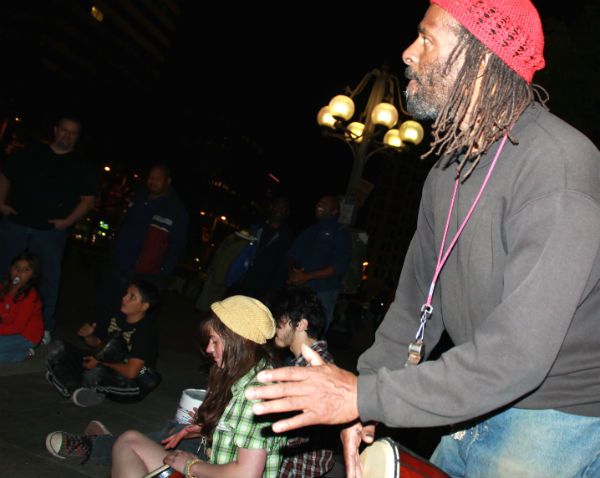
Drummer at Occupy Wall Street in Philadelphia. Image from PhillyNow.

Don’t diss the drum circles:
Why hippie culture is still
important to our protests

By Danny Goldberg / AlterNet / November 2, 2011

Progressives and mainstream Democratic pundits disagree with each other about many issues at the heart of the Occupy Wall Street protests, but with few exceptions they are joined in their contempt for drum circles, free hugs, and other behavior in Zuccotti Park that smacks of hippie culture.

In a post for the Daily Beast Michelle Goldberg lamented, “Drum circles and clusters of earnest incense-burning meditators ensure that stereotypes about the hippie left remain alive.”

At Esquire, Charles Pierce worried that few could “see past all the dreadlocks and hear… over the drum circles.” Michael Smerconish asked on the MSNBC show Hardball if middle Americans “in their Barcalounger” could relate to drum circles. The New Republic’s Alex Klein chimed in, “In the course of my Friday afternoon occupation, I saw two drum circles, four dogs, two saxophones, three babies… Wall Street survived.”

And the host of MSNBC’s Up, Chris Hayes (editor at large of The Nation), recently reassured his guests Naomi Klein and Van Jones that although he supported the political agenda of the protest he wasn’t going to “beat the drum” or “give you a free hug,” to knowing laughter.

Yet it is precisely the mystical utopian energy that most professional progressives so smugly dismiss that has aroused a salient, mass political consciousness on economic issues — something that had eluded even the most lucid progressives in the Obama era.

Since the mythology of the 1960s hangs over so much of the analysis of the Wall Street protests, it’s worth reviewing what actually happened then. Media legend lumps Sixties radicals and hippies together, but from the very beginning most leaders on the left looked at the hippie culture as, at best, a distraction and, at worst, a saboteur of pragmatic progressive politics.

Hippies saw most radicals as delusional and often dangerously angry control freaks. Bad vibes.

Not that there is anything magic about the word “hippie.” Over the years it has been distorted by parody, propaganda, self-hatred, and, from its earliest stirrings, commercialism. In some contemporary contexts it is used merely to refer to people living in the past and/or those who are very stoned.

The hippie idea, as used here, does not refer to colloquialisms like “far out” or products sold by dope dealers. At their core, the counterculture types who briefly called themselves hippies were a spiritual movement. In part they offered an alternative to organized religions that too often seemed preoccupied with rules and conformity, especially on sexual matters. (One reason Eastern religious traditions such as Buddhism and Hinduism resonated with hippies was because they carried no American or family baggage.)

But most powerfully, the hippie idea was an uprising against the secular religion of America in the 1950s, morbid “Mad Men” materialism, and Ayn Rand’s social Darwinism.

The hippies were heirs to a long line of bohemians that includes William Blake, Walt Whitman, Ralph Waldo Emerson, Henry David Thoreau, Herman Hesse, Arthur Rimbaud, Oscar Wilde, Aldous Huxley, utopian movements like the Rosicrucians and the Theosophists, and most directly the Beatniks.

Hippies emerged from a society that had produced birth-control pills, a counterproductive war in Vietnam, the liberation and idealism of the civil rights movement, feminism, gay rights, FM radio, mass-produced LSD, a strong economy, and a huge quantity of baby-boom teenagers. These elements allowed the hippies to have a mainstream impact that dwarfed that of the Beats and earlier avant-garde cultures.

In the mid-Sixties rock and roll’s mass appeal fused with certain elements of hip culture, especially in San Francisco bands like the Jefferson Airplane, the Grateful Dead, and Big Brother and the Holding Company (as well as Seattle’s Jimi Hendrix). That mood was absorbed and expanded by much of the popular music world, including the already popular Bob Dylan, the Rolling Stones, and the Beatles.

John Lennon’s songs “Instant Karma,” “Give Peace A Chance,” “Across The Universe,” “Revolution” (“But when you talk about destruction / Don’t you know that you can count me out”), and “Imagine” are probably as close to a hippie manifesto as existed, and the Woodstock festival as close to a mass manifestation of the idea as would survive the hype.

It is easy to cherry-pick a few idiotic phrases from stoners in the 1970 documentary Woodstock, but what made the event and its legacy meaningful to its fans — aside from the music — was the example of people in the hip community taking care of each other, as shown in the Wavy Gravy documentary Saint Misbehavin’.

No two hippies had the same notion of what the movement was all about, but there were some values they all shared. As Time put it in 1967, “Hippies preach altruism and mysticism, honesty, joy and nonviolence.”

Like any spiritual movement (or religion) hippies attracted pretenders, ranging from undercover cops to predators such as Charles Manson, who used their external trappings for very different agendas.

By October of 1967, following the so-called “Summer of Love” (during which more than a hundred thousand long-haired teenagers overloaded and permanently changed the Haight-Ashbury neighborhood of San Francisco), exploitation of the word “hippie” had become sufficiently prevalent that a group of counterculture pioneers in the Bay Area held a “Death of the Hippie” mock funeral. A flier announcing the ceremony warned young seekers against the existential perils of hype.

Media created the hippie with your hungry consent. Careers are to be had for the enterprising hippie. The media casts nets, create bags for the identity-hungry to climb in. Your face on TV. Your style immortalized without soul in the captions of the [San Francisco] Chronicle. NBC says you exist, ergo I am. Narcissism, plebian vanity.

The pure of heart were exhorted to “Exorcize Haight-Ashbury. Do not be bought by a picture or phrase. Do not be captured in words. You are free, we are free. Believe only in your own incarnate spirit.” Woodstock shows that by 1969 even the long-haired masses had taken to calling themselves “freaks.”

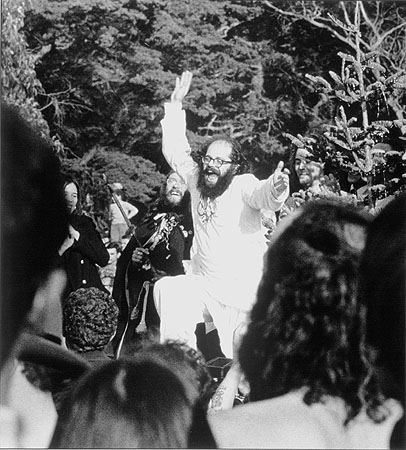
Poet Allen Ginsberg at the Human Be-In, San Francisco, 1967.

A year ago, shortly before the 2010 mid-year election, a left-wing blogger on a conference call with President Obama’s adviser David Axelrod, complained that dismissive comments by the administration about its left-wing base amounted to “hippie punching.”

The phrase was used to emphasize the contempt that the administration had shown for the progressive base, but it was also a reminder of the disdain that most of the Left has for the word “hippie,” as if to complain, “You think that we are as irrelevant as hippies!” Like those who ostentatiously distanced themselves from the Wall Street drum circles, the bloggers wanted to distinguish the modern Left from actual hippies (or who they thought hippies were).

The anti-hippie ethos on the left runs deep. Many 1960s radicals claimed that the hippies had squandered a chance to mainstream left-wing political ideas. In Black Panther leader Bobby Seale’s book Seize the Time he quotes white radical Jerry Rubin as saying that he and others had formed the “Yippies” because hippies had not “necessarily become political yet. They mostly prefer to be stoned.” In the real world, the Yippies never got a mass following, but the Grateful Dead did.

Early in 1967 writers for the Haight-Asbury psychedelic paper the Oracle, along with local poets, musicians, and mystics, organized the first Human Be-In in Golden Gate Park. They were chastised by a group of Berkeley radicals, including Rubin, for rejecting their proposal that the gathering should have “demands,” a suggestion that the amused hippie conveners saw as a contradiction of the whole idea.

(There are echoes of this argument in criticisms of the Occupy Wall Street protesters as insufficiently specific in their demands — as if the interests of 99 percent are not a clear enough litmus test for any proposed laws or regulations.)

Bill Zimmerman, an antiwar activist of the Vietnam era, summarized the radical attitude toward hippies in his excellent memoir Troublemaker:

Not believing they could alter the juggernaut of American capitalism through politics, the hippies tried culture instead — starting with [Timothy] Leary’s slogan, “Turn on, tune in, drop out”… While we [“the political people in the antiwar movement”] all accepted a subsistence lifestyle without expensive clothes, cars or other luxuries, they were about enjoyment, friendship, shared experiences, and whatever transcendence could be achieved through mind-altering drugs, music, and sex.

This both exaggerates the political viability of the non-hippie radicals of the day and underestimates the social conscience and commitment of many of those who chose to develop communes and new age spiritual communities.

One example is the SEVA Foundation, founded by Wavy Gravy and Ram Dass in the early 1970s. Over the course of 30 years, the nonprofit organization has raised enough money from rock benefits to pay for over three million eye operations in Third-World countries to rescue people from blindness. And of course the modern environmental movement owes as much to a mystical belief in the sanctity of the earth as it does to science.

Some on the left maintained that hippies scared off socially conservative liberals who otherwise would have been more sympathetic to the antiwar movement. In There but for Fortune, a wonderful documentary about radical singer-songwriter Phil Ochs, the artist can be heard complaining that freakish looking protesters undermined the credibility of antiwar demonstrations with middle Americans.

In a piece for The Nation in 1967, Ochs’s friend Jack Newfield complained, “Bananas, incense, and pointing love rays to the Pentagon have nothing to do with redeeming America.”

Republican leaders including Richard Nixon, Spiro Agnew, and Ronald Reagan eagerly used cartoon versions of hippies as part of their successful attempt to break up the New Deal coalition. “A hippie is someone who looks like Tarzan, walks like Jane, and smells like Cheetah,” quipped then California Governor Reagan in 1969.

Jefferson R. Cowie’s Stayin’ Alive theorizes that America’s rightward trend began when Nixon lured working-class whites into Republican arms by contrasting the hippie myth of Woodstock with country singer Merle Haggard’s anti-hippie anthem “Okie from Muskogee.”

One was southern, gritty, masculine, working class, white, and soaked in the reality of putting food on the table; the other was northern, eastern, radical, effete, leisurely, affluent, multi-cultural, and full of pipe dreams.

One was real, the other surreal; one worked, the other played; one did the labor, the other did the criticism; one drank whiskey, the other smoked dope; one built, the other destroyed; one was for survival, the other was for revolution; one died in wars, the other protested wars; and one was for Richard Nixon, the other for George McGovern.

Cowie’s book is terrific, but this is nonsense. The lion’s share of the decline in Democratic votes for president occurred between 1964 (61 percent) and 1968 (43 percent), when Hubert Humphrey was the nominee. Most of those formerly Democratic votes went to the racist Alabama Governor George Wallace, who garnered 13 percent of the vote on a third-party ticket — an explicit reaction against civil rights legislation.

The demonstrations outside of the Democratic Convention in 1968 in which many Americans sympathized with cops more than protesters had nothing to do with hippies; they were orchestrated by radical non-hippies like Rubin. (Hippie icon Allen Ginsberg argued in vain against the Chicago protests, because he presciently feared violence).

Four years later, there were no hippies involved with the McGovern campaign’s mistakes, like the ill-advised selection of Thomas Eagleton as the vice-presidential nominee and the breakdown of the relationship between the campaign and organized labor. Those mistakes were made by well-intentioned but inept liberal political consultants, many of whom would self-righteously characterize themselves as “pragmatists” in future years.

It is possible that some non-racist, older, white Democrats switched sides because they were offended by aspects of hippie culture, but it seems likely that more of their children and grandchildren rejected conservative orthodoxy because of their attraction to that very culture. The Allman Brothers and other southern rock bands developed a following that dwarfed that of Haggard, and ended up being a source of funding for Jimmy Carter’s primary campaign in 1976.

Modern heirs to the hippie idea include millions of “New Age” believers, inspired by the likes of Baba Ram Dass, Joseph Campbell, Deepak Chopra, and in some cases Oprah Winfrey, whose non-hierarchal spirituality exists outside the confines of traditional churches and synagogues. Although very few neo-hippie groups have explicit political agendas, many in the progressive public interest world benefit from their largess.

What possible relevance does any of this have to American politics in 2011? For one thing, many of those young people who like to beat on drums and who devised some of the subtle infrastructure of Occupy Wall Street are clearly tuned into an energy that exists outside of the parameters of political science.

Spiritual movements do not adhere to “party lines,” which is one reason why conventional political activists find them so maddening. Martin Scorsese’s recent documentary on the life of George Harrison reminded us not only of the Beatles’ passionate embrace of Hinduism and the funds he raised for Bangladesh but also of his perverse anger at paying his taxes.

Nonetheless, it doesn’t take a poll or a focus group to know that people who identify with the hippie idea are unlikely to vote Republican. (Ron Paul’s people are trying. They give out fliers at Occupy Wall Street while, as of this writing, Democrats still fear to do so.)

Conservatives have effectively peddled the notion that all politics are corrupt. The resulting apathy, and opposition to government, conveniently leaves big business more in charge than ever. The price that Democrats and progressives pay for belittling or ignoring contemporary devotees of the hippie idea, who share the opinion that politics are corrupt, is to reinforce the impulse to “drop out” in a cohort that would otherwise be, for the most part, natural allies.

Spiritual values can expand the reach of political action, especially at a time when progressives struggle to connect to mass consciousness. Their causes have been mired in phrases like “single-payer” and “cap-and-trade.” For all of their virtues, policy wonks didn’t come up with “We are the 99 percent.” People with drum circles did.

The Right understands the subtle connections between ideology and practical politics. Few Republican leaders distance themselves from right-wing Christians or demagogues like Glenn Beck. And Ayn Rand’s doctrine of selfishness, despite elements that conservative politicians would be afraid to avow, is celebrated by right-wing oligarchs and wannabes.

Alan Greenspan, the long-time head of the Federal Reserve, was a personal disciple of Rand, and Congressman Paul Ryan, who drafted the Republican budget that would’ve eliminated Medicare, cites Rand as his intellectual hero.

Any bohemian movement will attract goofballs. Drum circles may inspire and unify a crowd in one situation, but simply drown out conversation in another. It is one thing for a polite protester to offer “free hugs,” and quite another for a sweaty inebriate to impose them. The way to deal with this is to rebuke individual jerks, not to dismiss a vibrant section of mass culture.

As Martin Luther King pursued his strategy of nonviolent protest, the NAACP leader Roy Wilkins, who oversaw most of the legal strategy for the civil rights movement, mocked him by asking, “How many laws have you changed?” King replied, “I don’t know, but we’ve changed a lot of hearts.”

Obviously, the civil rights movement needed both spiritual and legal efforts to achieve its goals. So do modern progressives. As Nick Lowe asked in the song made famous by Elvis Costello, “What’s so funny about peace, love, and understanding?”

[Danny Goldberg is the author of the books How the Left Lost Teen Spirit and Bumping Into Geniuses. This article was first published at Dissent Magazine and was distributed by AlterNet.]

The Rag Blog

Posted in RagBlog | Tagged , , , , , | 11 Comments

Wayne Grytting : Gandhi Meets Monty Python

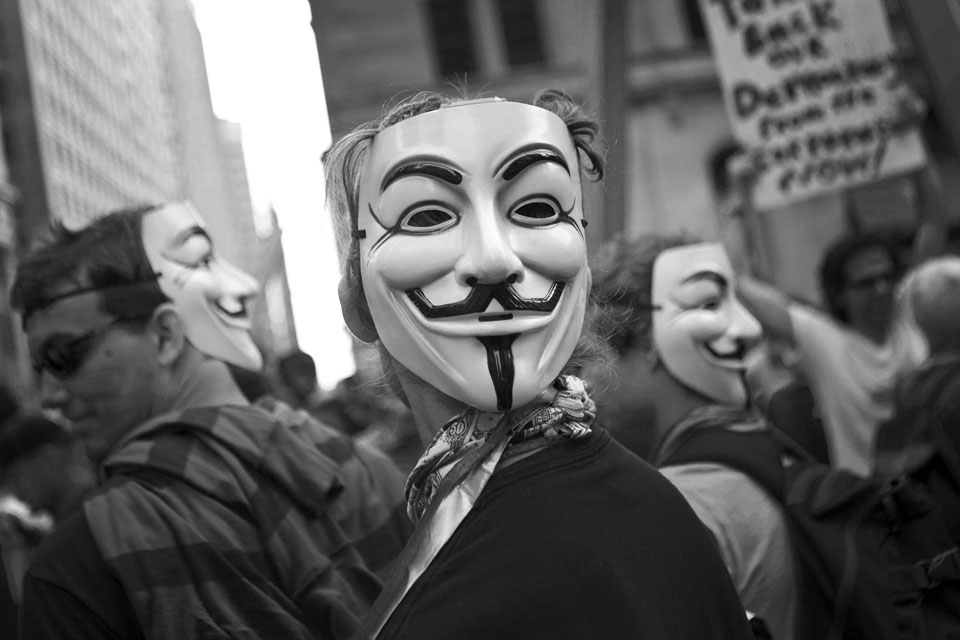
We are all Guy Fawkes. Occupiers in Zuccotti Park in New York turn protest into theater. Photo by Andrew Burton / AP.

Gandhi meets Monty Python:
The comedic turn in nonviolent tactics

By Wayne Grytting / Waging Nonviolence / November 1, 2011

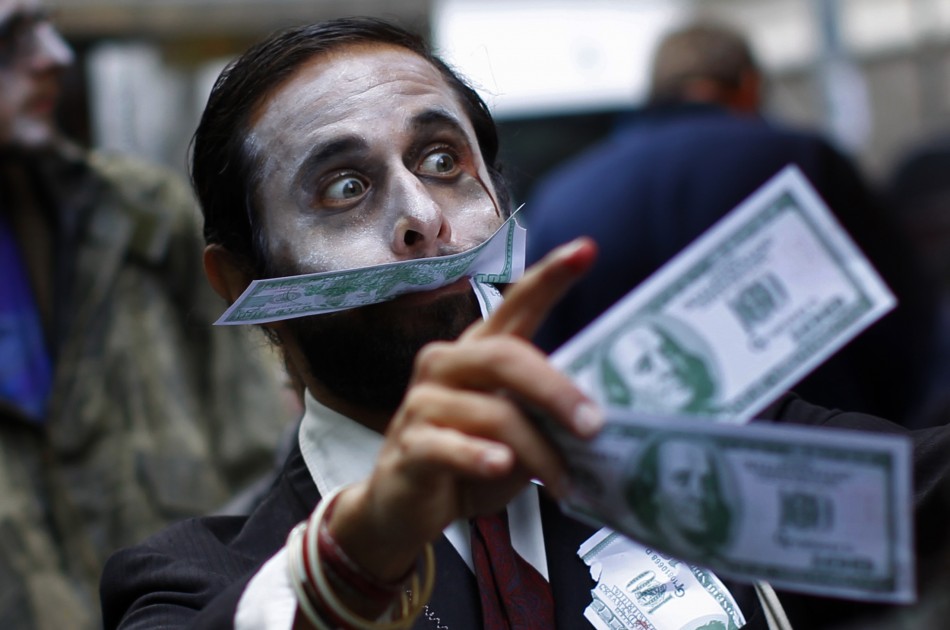
On October 3rd, protesters at Occupy Wall Street failed to march. Instead they clumsily lurched. With white painted faces, glazed looks and dollar bills hanging out of some mouths, protesters chanted “I smell money, I smell money…” It was Corporate Zombie Day.

Scenes like this and the sight of Guy Fawkes masks, clown suits, drumming circles, and surrealistic posters all over the country have left many commentators scratching their heads. Is this protest or carnival? Maybe we should tell them. There’s been a sea change in the protest industry.

“A worldwide shift in revolutionary tactics is underway right now that bodes well for the future,” proclaims Adbusters, the initiators of Occupy Wall Street. A key part of this rechanneling of tactics has been a move away from both angry protests or passive waiting-to-be-clubbed-by-police-batons to age-old carnival-style antics.

A festive atmosphere has reigned supreme in all of the successful pro-democracy uprisings of the past two decades. In Poland, Serbia, Georgia, Ukraine, Tunisia, and Egypt, music and humor were everywhere. Why?

Musically, Eastern European rallies were powered by punk rock bands while in the Arab Spring, “hip-hop has become the rhythm of the resistance,” writes author Robin Wright. Tahrir Square, says journalist Sarah Carr, “was essentially a comedy explosion.”

Tunisia was “a pioneer in revolution and now it’s at the forefront in comic expression,” proclaims the voice of Captain Khuzba, the masked cartoon hero who fought Tunisia’s secret police armed with a loaf of French bread. In Serbia’s pro-democracy movement in 2000, Srdja Popovic, a leader of Otpor (“Resistance”) reports, “Everything we did had a dosage of humor.”

Otpor is the organization credited with forging the nonviolent tactics used in the Arab Spring and earlier pro-democracy movements in Georgia and Ukraine. Founded in 1998 following a period of failed demonstrations by a small ragged group of twenty-somethings, it had within two years built a movement that overthrew Serbia’s dictator Slobodan Milosevic.

Otpor learned early that humor could be a gigantic ice breaker, cutting through citizen’s fear and apathy and “turning oppression upside down.” They fine-tuned the art of comedic resistance, added modern marketing techniques and the strategic framework provided by Gene Sharp.

The starting point for Sharp in From Dictatorship to Democracy is a recognition that “The common error of past improvised political defiance campaigns is the reliance on only one or two methods, such as strikes and mass demonstrations.” His remedy was a heavy dosage of “low-risk, confidence-building actions.” Street theater and under-the-radar comic protests.

Following this path, Mykhailo Svystovych, of Ukraine’s youth movement group Pora (“It’s Time”) recalls: “We didn’t do rallies with speakers, we did theatrical events.” The massive rallies we viewed on TV — this was the final chapter prepared by years of small guerrilla incursions.

Who were Otpor’s heroes? In interviews they list names we might expect: Gandhi, Martin Luther King Jr., and an unexpected source: Monty Python’s Flying Circus.

Stop the presses. What? How did those clowns sneak into the club? What is it about Monty Python-style humor that lends itself to deposing tyrannies? Let’s look closely at the exact laughter creating tactics developed in these movements so you can judge for yourself — and maybe add to your own resume.

Fortunately, excellent stories have been collected by authors Tina Rosenberg (“Revolution U”), Patrick Kearny (A Carnival of Revolution), Matthew Collin (The Time of the Rebels) and video producer Steven York (A Force More Powerful).

Wall Street zombie. Image from IBTimes.

1. Flying under the radar

Dictators typically outlaw protest marches and give their security forces carte blanche to bash heads. In South Africa, blacks “solved” the problem by assembling large gatherings at funerals, the one kind of gathering the Apartheid government was not ready to ban. How could the deceased help it if she or he had tens of thousands of friends who wanted to mourn and follow the hearse through town?

In Serbia, Otpor developed a tactic of “flash” protests, introducing a game called “Arrest the Traffic Lights.” People would mob street intersections and simply jump up and down while the walk lights were green. When the light changed they’d carefully obey the law and disperse only to resume their protest when the light said “go” again.

In Chile in 1983 labor unions made plans for their first test of Pinochet after 10 years of violent repression. Copper miners about to go on strike observed the large number of soldiers assembling by their mines and swiftly changed tactics. Instead of a strike, they called for a national day of slow movement.

All over Chile, people simply drove, walked or worked in slow motion to express their solidarity. Later they banged on pots and pans at exactly 8 p.m. How do you arrest slow walkers or pot bangers? It’s a massive clown routine worthy of a Marcel Marceau. How could you not smile at your fellow slow motion actors? After that the ice was broken and an irresistible wave of protests began.

2. Obedience parody

If protests against a government are being discouraged, and you feel a need to walk with a large group, you can always choose to march in “support” of the government. So Otpor paraded “for” Milosevic’s socialist party, but did so with a small herd of sheep with signs around their necks announcing “We support the Socialist Party.”

In the Ukraine, student members of Pora (“It’s Time”) fought against the usurped election of their local tyrant named Yanukovych. He had a prison record so Pora members dressed up in prison uniforms and campaigned for him in the main streets of Kiev, Ukraine’s capitol.

In Egypt, activists helped government officials by setting up Facebook pages for them and Twitter accounts so they could spread their messages. One official’s favorite activities were listed for him as: “Kicking ass, taking names, and wearing decorations with more colors than you can find in a pack of Skittles.”

In Poland in 1987, a group of “socialist surrealists” called the Orange Alternative (combining Communist red with the Catholic yellow) produced parodies of official events. On one April Fool’s Day they marched to the central square in Wroclaw to express their love of the government through a voluntary work day.

Armed with mops and toothbrushes — which was very inefficient, I might add — they proceeded to clean up the square while singing socialist labor songs and dressing up like ideal workers from old Stalinist movies of the 1930s. Police again confronted the problem — what can you arrest them for? Cleaning up the square is a crime? Acting as fools gained protesters immunity from repression and a strengthened community of smiling co-conspirators.

Members of Otpor stage a silent protest in Belgrade against Serbian regime and Yugoslav President Slobodan Milosevic. Photo by Sasa Stankovic / EPA / The Guardian.

3. Therapeutic pies in the face

If moving slowly together can help create community, imagine what collectively throwing a pie in the face of a dictator can be like. Otpor, in their most famous actions, brought out a barrel with Milosevic’s picture on it and let people hit it with a stick for only one dinar. Those who were unemployed because of Milosevic could hit it twice for free. The police only looked ridiculous when they stepped in to, in the words of Otpor, “arrest” the barrel. Pictures of the “arrest” would soon be posted in the Internet.

In Georgia in 2003, the group Kmara (“Enough”) created large banners where passers-by could take photos of themselves flushing their president, Eduard Shevardnadze, down the toilet. In Ukraine, by 2004 the action had moved to the Internet where citizen’s could throw eggs at their soon to be deposed leader Yankukovych, who had famously overreacted to a real egg throwing incident.

What is hitting a picture of a dictator but a version of the dunk tank? These actions go back to centuries-old carnival traditions of ridiculing the high and mighty. They crop up in movement after movement because they meet very basic needs. Throwing a pie at authority can be a low-risk participatory event with an appreciative community cheering one on. It’s not lazily watching Jon Stewart on TV — it’s physical action against authority, a physical break with patterns of passivity and isolation, a nonviolent rechanneling of simmering anger.

4. Idiocy rising to the top

Much of the humor of movements requires faith, a conviction that if you just set the table, the other side’s idiocy will provide all the humor necessary. For example, Otpor had their offices raided and computers hauled away. Knowing they had an informer “assisting” their activities, they put out the word they would be bringing in a load of new computer equipment. At the “secret” time trucks pulled up with heavy looking boxes. While laboring to lift these loads, the police intervened, only to discover all the boxes were empty. The story, with photos, went viral.

When Serbia’s government leveled charges that Otpor was a foreign-paid terrorist organization, Otpor took flatbed trucks and megaphones to the streets to denounce and expose the “terrorists” in their midst. They brought 17 and 18-year-old “terrorist” students in front of the public and grilled them about their activities.

Similarly, in Egypt, when the government officials denounced the protesters for serving “foreign agendas,” young people showed up at Tahrir Square with plain blank notebooks, complaining they’d left their foreign agendas at home.

Orange Alternative: Photo from the exhibition Pomaranczowa Alternatywa Happeningiem w Komunizm at the Galeria Miedzynarodowego Centrum Kultury. Image from Daily Serving.

5. Absurdity squared

Community organizing guru Saul Alinsky’s famous Rules for Radicals #3 states: “Whenever possible, go outside the experience of the enemy.” Or any forms of rationality they might ever recognize.

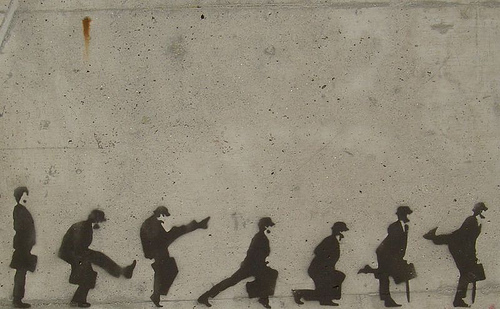
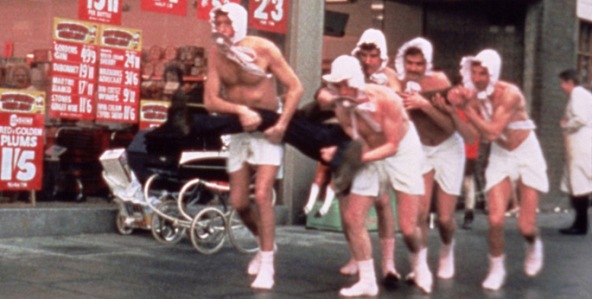
We enter here into pure Monty Python territory. Otpor, for example, would hold fake soccer games in the streets complete with uniformed referees and an imaginary soccer ball. Or they would hold parades in ridiculous fancy dress with no protest slogans, or gaily deliver cookies and flowers to police stations.

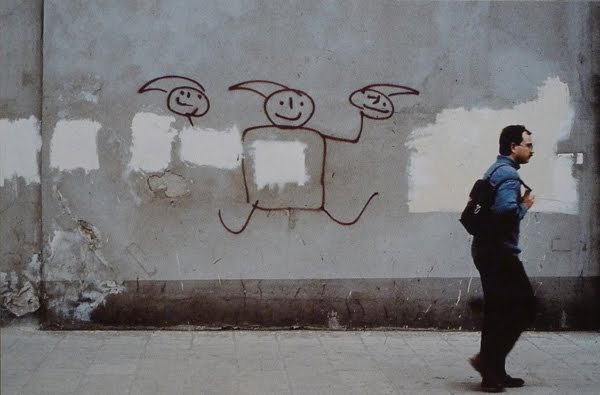
My favorite example is from the Orange Alternative in Poland. After the group carefully spray-painted graffiti around Wroclaw, the police would come by and paint it over with white paint. This would leave unsightly white splotches on building walls. Instead of posting yet more graffiti, the activists took red paint and turned the splotches into elves. (Think of Hegel’s dialectic here — but on LSD). As more and more red elves appeared, this morphed into a demonstration where thousands dressed up in red and marched chanting “Elves are real!”

American activists will recognize most of the elements of the festive model. Certainly the street theater of the AIDS Coalition to Unleash Power (ACT UP) or “Billionaires for Bush” anticipates much of the spirit of the pro-democracy movements. But what stands out in the new movements is the integration of the class clowns with the nerds, of spontaneity with nonviolent discipline.

Traditionally people attracted to festive protests, group hugs, and consensus decision-making have been too laid back to organize effectively. The successful pro-democracy groups have managed to combine these elements with a caffeinated backbone of organizers who make the trains run on time and know when to shift gears.

Otpor leader Srdja Popovic, succinctly makes the point: “You can have 100,000 people in the streets and one single idiot who’s throwing stones, and he’s going to be the star of the day and this is how media operates.” The remarkable level of nonviolence maintained by these movements points to a concerted behind-the-scenes enforcement of a “no-idiocy” policy that leaves Seattle WTO veterans green with envy.

Pro-democracy movements established clear boundaries within which a “diversity of tactics” could flourish. Former Otpor leaders now run the Center for Applied Nonviolent Action and Strategies (CANVAS) in Belgrade, which offers extensive training opportunities for inquiring minds.

Monty Python-style humor is rooted in centuries-old carnival traditions which, as Russian scholar Mikhail Bakhtin has so brilliantly taught us, emphasize that all of us are fools and clowns just waiting to slip on banana peels. It has a humility that cuts through any vestiges of elitism or know-it-all political correctness.

Carnival represents the joyful life that stands as the total opposite of the zombie-like death of corporate rule. It’s what I believe allowed Otpor and other pro-democracy groups of twenty-somethings to bridge age and cultural gaps and build powerful movements.

Occupy Wall Street is a bold “experiment in truth,” which my stock analysts tell me should lead to a bull market in protests. Let’s keep a smile on it.

[Wayne Grytting is the author of American Newspeak: The Mangling of Meaning for Power and Profit and a former teacher in Seattle. He writes a blog — Penetrating the Fog — on the uses of humor to open closed minds. This article was first published at Waging Nonviolence.]

The Rag Blog

Posted in RagBlog | Tagged , , , | Leave a comment


southyrolean / flickr

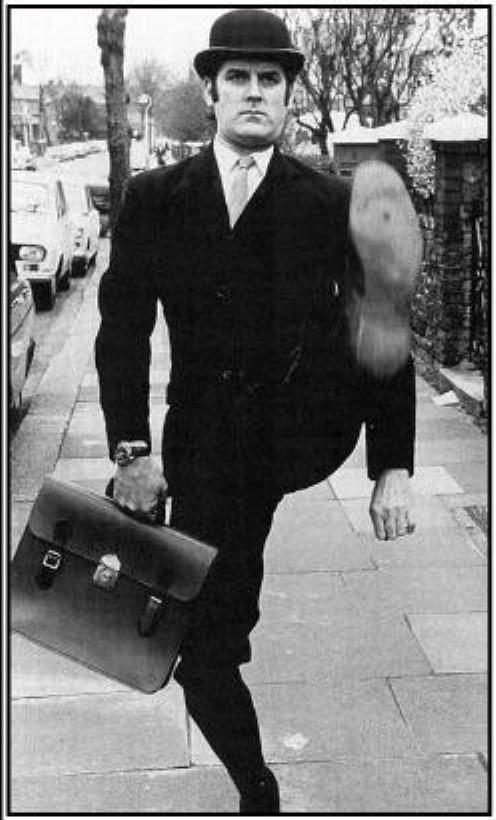
M. Python: And now for something completely different.

Wall Street zombie. Image from IBTimes.

Gandhi meets Monty Python:
The comedic turn in nonviolent tactics

By Wayne Grytting / Waging Nonviolence / November 1, 2011

On October 3rd, protesters at Occupy Wall Street failed to march. Instead they clumsily lurched. With white painted faces, glazed looks and dollar bills hanging out of some mouths, protesters chanted “I smell money, I smell money…” It was Corporate Zombie Day.

Scenes like this and the sight of Guy Fawkes masks, clown suits, drumming circles, and surrealistic posters all over the country have left many commentators scratching their heads. Is this protest or carnival? Maybe we should tell them. There’s been a sea change in the protest industry.

“A worldwide shift in revolutionary tactics is underway right now that bodes well for the future,” proclaims Adbusters, the initiators of Occupy Wall Street. A key part of this rechanneling of tactics has been a move away from both angry protests or passive waiting-to-be-clubbed-by-police-batons to age-old carnival-style antics.

A festive atmosphere has reigned supreme in all of the successful pro-democracy uprisings of the past two decades. In Poland, Serbia, Georgia, Ukraine, Tunisia, and Egypt, music and humor were everywhere. Why?

Musically, Eastern European rallies were powered by punk rock bands while in the Arab Spring, “hip-hop has become the rhythm of the resistance,” writes author Robin Wright. Tahrir Square, says journalist Sarah Carr, “was essentially a comedy explosion.” Tunisia was “a pioneer in revolution and now it’s at the forefront in comic expression,” proclaims the voice of Captain Khuzba, the masked cartoon hero who fought Tunisia’s secret police armed with a loaf of French bread. In Serbia’s pro-democracy movement in 2000, Srdja Popovic, a leader of Otpor (“Resistance”) reports, “Everything we did had a dosage of humor.”

Otpor is the organization credited with forging the nonviolent tactics used in the Arab Spring and earlier pro-democracy movements in Georgia and Ukraine. Founded in 1998 following a period of failed demonstrations by a small ragged group of twenty-somethings, it had within two years built a movement that overthrew Serbia’s dictator Slobodan Milosevic.

Otpor learned early that humor could be a gigantic ice breaker, cutting through citizen’s fear and apathy and “turning oppression upside down.” They fine-tuned the art of comedic resistance, added modern marketing techniques and the strategic framework provided by Gene Sharp.

The starting point for Sharp in From Dictatorship to Democracy is a recognition that “The common error of past improvised political defiance campaigns is the reliance on only one or two methods, such as strikes and mass demonstrations.” His remedy was a heavy dosage of “low-risk, confidence-building actions.” Street theater and under-the-radar comic protests.

Following this path, Mykhailo Svystovych, of Ukraine’s youth movement group Pora (“It’s Time”) recalls: “We didn’t do rallies with speakers, we did theatrical events.” The massive rallies we viewed on TV — this was the final chapter prepared by years of small guerrilla incursions.

Who were Otpor’s heroes? In interviews they list names we might expect: Gandhi, Martin Luther King Jr., and an unexpected source: Monty Python’s Flying Circus.

Stop the presses. What? How did those clowns sneak into the club? What is it about Monty Python-style humor that lends itself to deposing tyrannies? Let’s look closely at the exact laughter creating tactics developed in these movements so you can judge for yourself — and maybe add to your own resume.

Fortunately, excellent stories have been collected by authors Tina Rosenberg (“Revolution U”), Patrick Kearny (A Carnival of Revolution), Matthew Collin (The Time of the Rebels) and video producer Steven York (A Force More Powerful).

1. Flying under the radar

Dictators typically outlaw protest marches and give their security forces carte blanche to bash heads. In South Africa, blacks “solved” the problem by assembling large gatherings at funerals, the one kind of gathering the Apartheid government was not ready to ban. How could the deceased help it if she or he had tens of thousands of friends who wanted to mourn and follow the hearse through town?

In Serbia, Otpor developed a tactic of “flash” protests, introducing a game called “Arrest the Traffic Lights.” People would mob street intersections and simply jump up and down while the walk lights were green. When the light changed they’d carefully obey the law and disperse only to resume their protest when the light said “go” again.

In Chile in 1983 labor unions made plans for their first test of Pinochet after 10 years of violent repression. Copper miners about to go on strike observed the large number of soldiers assembling by their mines and swiftly changed tactics. Instead of a strike, they called for a national day of slow movement.

All over Chile, people simply drove, walked or worked in slow motion to express their solidarity. Later they banged on pots and pans at exactly 8 p.m. How do you arrest slow walkers or pot bangers? It’s a massive clown routine worthy of a Marcel Marceau. How could you not smile at your fellow slow motion actors? After that the ice was broken and an irresistible wave of protests began.

2. Obedience parody

If protests against a government are being discouraged, and you feel a need to walk with a large group, you can always choose to march in “support” of the government. So Otpor paraded “for” Milosevic’s socialist party, but did so with a small herd of sheep with signs around their necks announcing “We support the Socialist Party.”

In the Ukraine, student members of Pora (“It’s Time”) fought against the usurped election of their local tyrant named Yanukovych. He had a prison record so Pora members dressed up in prison uniforms and campaigned for him in the main streets of Kiev, Ukraine’s capitol.

In Egypt, activists helped government officials by setting up Facebook pages for them and Twitter accounts so they could spread their messages. One official’s favorite activities were listed for him as: “Kicking ass, taking names, and wearing decorations with more colors than you can find in a pack of Skittles.”

In Poland in 1987, a group of “socialist surrealists” called the Orange Alternative (combining Communist red with the Catholic yellow) produced parodies of official events. On one April Fool’s Day they marched to the central square in Wroclaw to express their love of the government through a voluntary work day.

Armed with mops and toothbrushes — which was very inefficient, I might add — they proceeded to clean up the square while singing socialist labor songs and dressing up like ideal workers from old Stalinist movies of the 1930s. Police again confronted the problem — what can you arrest them for? Cleaning up the square is a crime? Acting as fools gained protesters immunity from repression and a strengthened community of smiling co-conspirators.

3. Therapeutic pies in the face

If moving slowly together can help create community, imagine what collectively throwing a pie in the face of a dictator can be like. Otpor, in their most famous actions, brought out a barrel with Milosevic’s picture on it and let people hit it with a stick for only one dinar. Those who were unemployed because of Milosevic could hit it twice for free. The police only looked ridiculous when they stepped in to, in the words of Otpor, “arrest” the barrel. Pictures of the “arrest” would soon be posted in the Internet.

In Georgia in 2003, the group Kmara (“Enough”) created large banners where passers-by could take photos of themselves flushing their president, Eduard Shevardnadze, down the toilet. In Ukraine, by 2004 the action had moved to the Internet where citizen’s could throw eggs at their soon to be deposed leader Yankukovych, who had famously overreacted to a real egg throwing incident.

What is hitting a picture of a dictator but a version of the dunk tank? These actions go back to centuries-old carnival traditions of ridiculing the high and mighty. They crop up in movement after movement because they meet very basic needs. Throwing a pie at authority can be a low-risk participatory event with an appreciative community cheering one on. It’s not lazily watching Jon Stewart on TV — it’s physical action against authority, a physical break with patterns of passivity and isolation, a nonviolent rechanneling of simmering anger.

4. Idiocy rising to the top

Much of the humor of movements requires faith, a conviction that if you just set the table, the other side’s idiocy will provide all the humor necessary. For example, Otpor had their offices raided and computers hauled away. Knowing they had an informer “assisting” their activities, they put out the word they would be bringing in a load of new computer equipment. At the “secret” time trucks pulled up with heavy looking boxes. While laboring to lift these loads, the police intervened, only to discover all the boxes were empty. The story, with photos, went viral.

When Serbia’s government leveled charges that Otpor was a foreign-paid terrorist organization, Otpor took flatbed trucks and megaphones to the streets to denounce and expose the “terrorists” in their midst. They brought 17 and 18-year-old “terrorist” students in front of the public and grilled them about their activities.

Similarly, in Egypt, when the government officials denounced the protesters for serving “foreign agendas,” young people showed up at Tahrir Square with plain blank notebooks, complaining they’d left their foreign agendas at home.

5. Absurdity squared

Community organizing guru Saul Alinsky’s famous Rules for Radicals #3 states: “Whenever possible, go outside the experience of the enemy.” Or any forms of rationality they might ever recognize.

We enter here into pure Monty Python territory. Otpor, for example, would hold fake soccer games in the streets complete with uniformed referees and an imaginary soccer ball. Or they would hold parades in ridiculous fancy dress with no protest slogans, or gaily deliver cookies and flowers to police stations.

My favorite example is from the Orange Alternative in Poland. After the group carefully spray-painted graffiti around Wroclaw, the police would come by and paint it over with white paint. This would leave unsightly white splotches on building walls. Instead of posting yet more graffiti, the activists took red paint and turned the splotches into elves. (Think of Hegel’s dialectic here — but on LSD). As more and more red elves appeared, this morphed into a demonstration where thousands dressed up in red and marched chanting “Elves are real!”

American activists will recognize most of the elements of the festive model. Certainly the street theater of the AIDS Coalition to Unleash Power (ACT UP) or “Billionaires for Bush” anticipates much of the spirit of the pro-democracy movements. But what stands out in the new movements is the integration of the class clowns with the nerds, of spontaneity with nonviolent discipline.

Traditionally people attracted to festive protests, group hugs, and consensus decision-making have been too laid back to organize effectively. The successful pro-democracy groups have managed to combine these elements with a caffeinated backbone of organizers who make the trains run on time and know when to shift gears.

Otpor leader Srdja Popovic, succinctly makes the point: “You can have 100,000 people in the streets and one single idiot who’s throwing stones, and he’s going to be the star of the day and this is how media operates.” The remarkable level of nonviolence maintained by these movements points to a concerted behind-the-scenes enforcement of a “no-idiocy” policy that leaves Seattle WTO veterans green with envy.

Pro-democracy movements established clear boundaries within which a “diversity of tactics” could flourish. Former Otpor leaders now run the Center for Applied Nonviolent Action and Strategies (CANVAS) in Belgrade, which offers extensive training opportunities for inquiring minds.

Monty Python-style humor is rooted in centuries-old carnival traditions which, as Russian scholar Mikhail Bakhtin has so brilliantly taught us, emphasize that all of us are fools and clowns just waiting to slip on banana peels. It has a humility that cuts through any vestiges of elitism or know-it-all political correctness.

Carnival represents the joyful life that stands as the total opposite of the zombie-like death of corporate rule. It’s what I believe allowed Otpor and other pro-democracy groups of twenty-somethings to bridge age and cultural gaps and build powerful movements.

Occupy Wall Street is a bold “experiment in truth,” which my stock analysts tell me should lead to a bull market in protests. Let’s keep a smile on it.

[Wayne Grytting is the author of American Newspeak: The Mangling of Meaning for Power and Profit and a former teacher in Seattle. He writes a blog — Penetrating the Fog — on the uses of humor to open closed minds. This article was first published at Waging Nonviolence.]

The Rag Blog

Posted in RagBlog | Leave a comment

Beyond the Causal Veil
by Bill Meacham

Quantum indeterminacy operates inside your brain. What does that say about the nature of human will and decision-making?(1)

We’ve taken a look at the world of quantum physics before, but a little recap is in order in case you missed it. The quantum level is where thing are quite tiny, less than about 100 nanometers long. Here things behave very strangely. We can describe their properties and behavior mathematically by a formula called the “wave function,” and under certain circumstances the wave function divides into two or more pairs or branches, each with its own consequences. Each of these branches represents a potential future or a potential version of reality. When observed, only one of these branches is perceived; that is, only one of the potential futures becomes the actual perceived present.

Double-Slit experiment resultsA famous experiment, widely replicated, called the Double-Slit experiment reveals the strangeness of this level of reality. It consists of sending light through two side-by-side vertical slits to a recording medium, such as film; and it shows, among other things, that light can behave both as a stream of particles and as a wave. When light is sent through one slit at a time, a vertical band appears. In this case light acts like a series of particles that go through the slit, hit the recording medium and make an impression. If you open the slit on the right, the band appears on the right, and if you open the slit on the left, the band appears on the left. You would expect that if both slits were opened, the result would be two side-by-side bands. In fact, however, the result is a strong band in the middle, the expected bands on the left and right, and then dimmer bands extending outward in each direction. Light in this case acts like waves that cause interference patterns. That is, when a crest meets a crest, a more intense crest results; and when a crest meets a trough they cancel out. The bands of light are from the crests reinforcing each other, and the darkness in between is the from crests and troughs canceling each other out.

Even more interesting, when light is emitted one photon at a time and aimed at the two slits, it shows the same interference pattern. You would expect that a photon would go through one slit or the other. In fact it appears to act like a wave that goes through both slits, interferes with itself, and results in an impression in one and only one of the bands.

And you cannot predict in advance where the photon will make an impression.

You can predict that given a great number of photons, they will result in bands. That is, they won’t all end up in the same place, but rather in various places according to their probability distribution. But there is only a probability, not an absolute certainty, that any single photon will end up in one place or another.

We might well ask what causes the wave, which is mathematically described as a collection of probabilities of being detected in various places, to be in fact detected at only one place. I’ll return to this question shortly. For now, note the quantum indeterminacy, our inability to predict the final location of any single photon. The sequence in which the singly-emitted photons will arrive is completely unpredictable. We have a radical discontinuity of causality.

In ordinary life and in classical (non-quantum) physics, we have a clear concept of causality: a cause is something that reliably produces an effect. Given the same or a similar set of circumstances, we expect the same results to appear. Hitting a billiard ball at a certain angle and with a certain force will always cause it to move in a certain direction and at a certain speed. This conception of causality has three parts:

Regularity – A cause always produces its effect according to physical laws that can be discovered by observation and experiment.
Temporal sequence – The cause always precedes its effect in time. The cause never follows the effect.
Spatial contiguity – There is always some physical connection or spatial contact between the cause and its effect, or a chain of such connections.

At the quantum level, the regularity is missing. There is no set of circumstances that causes the photon always to be detected in a specific place. (And, as we have seen, sometimes spatial contiguity is missing as well.)

Once the photon has been detected then the ordinary chain of causality takes over. The beginning of a macroscopic event can certainly be dependent on a microscopic event. In that case, each microscopic possibility at the beginning can lead to a different chain of macroscopic events at the end.

This becomes important when we consider that some events in the brain happen at the quantum level.

The human brain is a mass of electrochemical activity. It contains approximately 100 billion nerve cells, or neurons, and up to five quadrillion connection points between them. Neurons are the fundamental elements of the brain; they transmit electrochemical impulses to and from other neurons, sense organs or muscles. Some impulses are triggered by sense organs, and some by the excitation of neighboring neurons. Some impulses excite or inhibit neighboring neurons and some cause muscle contractions that move the body.

Parts of a neuronA neuron consists of several parts: numerous dendrites, which look vaguely like trees with many branches, a cell body, and a single axon, a tube that divides at the end to many terminals. Dendrites are the incoming channels; they receive electrochemical impulses from other cells, which then pass through the body and out the axon terminals. Between the axon terminals and the dendrites of the neighboring neurons are gaps, called synapses, only twenty nanometers wide. On the other side of the synaptic gap from the axon is a receptor area on a dendrite of a neighboring cell. An axon can have many terminals, and each dendrite can have many receptor areas. Thus each neuron transmits impulses to and receives impulses from a great many neighboring neurons. Some neurons receive impulses from up to 10,000 neighbors. Some in the cerebellum receive up to 100,000. Clearly the brain is an organ of almost unimaginable complexity.

The impulse traveling through the neuron is an electrical charge. A neuron either transmits the impulse (we say it fires) or it does not; it is a binary element, either on (firing) or off (not firing). When the electrical charge reaches the synaptic gap, it triggers the release of chemicals, neurotransmitters, which is why we call brain activity electrochemical. A single release of a neurotransmitter might be too weak to trigger the receiving neuron, but since each neuron forms outgoing synapses with many others and likewise receives synaptic inputs from many others, the combination of several inputs at once can be enough to trigger it. Or the receipt of an inhibitory neurotransmitter can prevent an impulse that otherwise would have fired. The output of a neuron thus depends on the inputs from many others, each of which may have a different degree of influence depending on the strength of its synapse with that neuron.

What is interesting for the present discussion is what happens to cause the neurotransmitters to travel across the synapse. The chemistry is a bit complex, but basically neurotransmitter chemicals sit docked in little pockets, called vesicles, waiting for something to release them. When the electrical impulse arrives at the terminal, it opens up channels that let calcium ions in. The calcium makes the vesicle fuse with the cell wall and open up so the neurotransmitters go out into the synaptic gap and then hit the receiving neuron.

The channels through which calcium ions enter the nerve terminal from outside the neuron are tiny, only about a nanometer at their narrowest, not much bigger than a calcium ion itself. The calcium ions migrate from their entry channels to sites within the nerve terminal where they trigger the release of the contents of a vesicle. At this submicroscopic level of reality, quantum indeterminacy is in play. A given calcium ion might or might not hit a given triggering site; hence, a given neurotransmitter might or might not be released; hence the receiving neuron might or might not get excited (or inhibited).

In other words, at the most fundamental level, brain functioning is not causally determined.

And since the ordinary chain of causality takes over after the quantum event happens, quantum uncertainty at the synaptic level can lead to causal uncertainty at the level of the whole brain. And that means – since the state of the brain at least heavily influences, if not causally determines, our perceptions, thoughts, feelings and actions – that human conduct is not fully causally determined in the physical world.

What causes a quantum event – in this case the impact of a calcium ion on a triggering site – to cease being merely a probability and start being something that happens at a certain place? Not anything in the physical world. There is a causal discontinuity in nature. Events at the quantum level of reality have no physical cause, but are themselves causes of subsequent events. What is on the other side of the causal discontinuity?

At this point we move beyond what physics can tell us, but clearly it leaves open the possibility that human will is free and even that something that transcends our ordinary notion of the physical – a soul, perhaps, or a god or a plethora of deities – intervenes in the physical world.

Some protest that the causal uncertainty at the quantum level of reality is merely statistical. Events happen randomly; hence, we can draw no conclusions about nonphysical causality, free will, the existence of a soul or of God, or any such thing. In particular, they say, a decision that is initiated by a random occurrence is no more free than one initiated by physical causality. But random as they may be individually, quantum events considered as a group certainly do exhibit regularities. Light passed through double slits exhibits distinct patterns, not random noise.

Consider a pointillist painting, which consists of distinct dots of pigment. If you look at it up close, all you see is random dots. When you view it from afar, you see identifiable forms and shapes, recognizable objects, patterns. So what are the patterns that we find in the behavior that issues from the firing of our brain cells? Does what is outside the bounds of physical causality have any regularity or structure of its own that we can use to understand and predict what it will do? Are there any categories of causal explanation that might be applicable?

The answer is, yes, of course there are: the concepts that pertain to agents. We explain the behavior of agents not in terms of physics and chemistry but in terms of their perceptions, beliefs, desires and goals.

By “agent” I mean the usual: something with will and intention, something that initiates movement without an external nudge, something that acts or has the power to act on its own rather than merely reacting to events. Agency is a different category of causation from physical causation. What agents do is not uncaused, but what causes agents to act is their beliefs and desires, not mechanical or chemical forces. And what agents do is not completely predictable. We try to influence people by persuasion, but we can only influence them, we cannot completely control them. Rather like a single photon, we can never be sure what somebody will do until they have done it. Nor can we be sure what we ourselves will do until we have done it. And afterwards we recognize that we could have done differently.

We are agents not automata. In other words, we have free will. Now the question is, what shall we do with it?

———–

Notes

(1) What follows is summarized from my paper “The Quantum Level of Reality,” located here: http://www.bmeacham.com/whatswhat/Quantum.html. That paper contains more detail and all the footnotes and references. See also “Do Humans Have Free Will?” here: http://www.bmeacham.com/whatswhat/FreeWill.html.


Type rest of the post here

Source /

The Rag Blog

Posted in RagBlog | Leave a comment

Gandhi meets Monty Python:
The comedic turn in nonviolent tactics

By Wayne Grytting / Waging Nonviolence / November 1, 2011

On October 3rd, protesters at Occupy Wall Street failed to march. Instead they clumsily lurched. With white painted faces, glazed looks and dollar bills hanging out of some mouths, protesters chanted “I smell money, I smell money…” It was Corporate Zombie Day.

Scenes like this and the sight of Guy Fawkes masks, clown suits, drumming circles, and surrealistic posters all over the country have left many commentators scratching their heads. Is this protest or carnival? Maybe we should tell them. There’s been a sea change in the protest industry.

“A worldwide shift in revolutionary tactics is underway right now that bodes well for the future,” proclaims Adbusters, the initiators of Occupy Wall Street. A key part of this rechanneling of tactics has been a move away from both angry protests or passive waiting-to-be-clubbed-by-police-batons to age-old carnival-style antics.

A festive atmosphere has reigned supreme in all of the successful pro-democracy uprisings of the past two decades. In Poland, Serbia, Georgia, Ukraine, Tunisia, and Egypt, music and humor were everywhere. Why?

Musically, Eastern European rallies were powered by punk rock bands while in the Arab Spring, “hip-hop has become the rhythm of the resistance,” writes author Robin Wright. Tahrir Square, says journalist Sarah Carr, “was essentially a comedy explosion.” Tunisia was “a pioneer in revolution and now it’s at the forefront in comic expression,” proclaims the voice of Captain Khuzba, the masked cartoon hero who fought Tunisia’s secret police armed with a loaf of French bread. In Serbia’s pro-democracy movement in 2000, Srdja Popovic, a leader of Otpor (“Resistance”) reports, “Everything we did had a dosage of humor.”

Otpor is the organization credited with forging the nonviolent tactics used in the Arab Spring and earlier pro-democracy movements in Georgia and Ukraine. Founded in 1998 following a period of failed demonstrations by a small ragged group of twenty-somethings, it had within two years built a movement that overthrew Serbia’s dictator Slobodan Milosevic.

Otpor learned early that humor could be a gigantic ice breaker, cutting through citizen’s fear and apathy and “turning oppression upside down.” They fine-tuned the art of comedic resistance, added modern marketing techniques and the strategic framework provided by Gene Sharp.

The starting point for Sharp in From Dictatorship to Democracy is a recognition that “The common error of past improvised political defiance campaigns is the reliance on only one or two methods, such as strikes and mass demonstrations.” His remedy was a heavy dosage of “low-risk, confidence-building actions.” Street theater and under-the-radar comic protests.

Following this path, Mykhailo Svystovych, of Ukraine’s youth movement group Pora (“It’s Time”) recalls: “We didn’t do rallies with speakers, we did theatrical events.” The massive rallies we viewed on TV — this was the final chapter prepared by years of small guerrilla incursions.

Who were Otpor’s heroes? In interviews they list names we might expect: Gandhi, Martin Luther King Jr., and an unexpected source: Monty Python’s Flying Circus.

Stop the presses. What? How did those clowns sneak into the club? What is it about Monty Python-style humor that lends itself to deposing tyrannies? Let’s look closely at the exact laughter creating tactics developed in these movements so you can judge for yourself — and maybe add to your own resume.

Fortunately, excellent stories have been collected by authors Tina Rosenberg (“Revolution U”), Patrick Kearny (A Carnival of Revolution), Matthew Collin (The Time of the Rebels) and video producer Steven York (A Force More Powerful).

1. Flying under the radar

Dictators typically outlaw protest marches and give their security forces carte blanche to bash heads. In South Africa, blacks “solved” the problem by assembling large gatherings at funerals, the one kind of gathering the Apartheid government was not ready to ban. How could the deceased help it if she or he had tens of thousands of friends who wanted to mourn and follow the hearse through town?

In Serbia, Otpor developed a tactic of “flash” protests, introducing a game called “Arrest the Traffic Lights.” People would mob street intersections and simply jump up and down while the walk lights were green. When the light changed they’d carefully obey the law and disperse only to resume their protest when the light said “go” again.

In Chile in 1983 labor unions made plans for their first test of Pinochet after 10 years of violent repression. Copper miners about to go on strike observed the large number of soldiers assembling by their mines and swiftly changed tactics. Instead of a strike, they called for a national day of slow movement.

All over Chile, people simply drove, walked or worked in slow motion to express their solidarity. Later they banged on pots and pans at exactly 8 p.m. How do you arrest slow walkers or pot bangers? It’s a massive clown routine worthy of a Marcel Marceau. How could you not smile at your fellow slow motion actors? After that the ice was broken and an irresistible wave of protests began.

2. Obedience parody

If protests against a government are being discouraged, and you feel a need to walk with a large group, you can always choose to march in “support” of the government. So Otpor paraded “for” Milosevic’s socialist party, but did so with a small herd of sheep with signs around their necks announcing “We support the Socialist Party.”

In the Ukraine, student members of Pora (“It’s Time”) fought against the usurped election of their local tyrant named Yanukovych. He had a prison record so Pora members dressed up in prison uniforms and campaigned for him in the main streets of Kiev, Ukraine’s capitol.

In Egypt, activists helped government officials by setting up Facebook pages for them and Twitter accounts so they could spread their messages. One official’s favorite activities were listed for him as: “Kicking ass, taking names, and wearing decorations with more colors than you can find in a pack of Skittles.”

In Poland in 1987, a group of “socialist surrealists” called the Orange Alternative (combining Communist red with the Catholic yellow) produced parodies of official events. On one April Fool’s Day they marched to the central square in Wroclaw to express their love of the government through a voluntary work day.

Armed with mops and toothbrushes — which was very inefficient, I might add — they proceeded to clean up the square while singing socialist labor songs and dressing up like ideal workers from old Stalinist movies of the 1930s. Police again confronted the problem — what can you arrest them for? Cleaning up the square is a crime? Acting as fools gained protesters immunity from repression and a strengthened community of smiling co-conspirators.

3. Therapeutic pies in the face

If moving slowly together can help create community, imagine what collectively throwing a pie in the face of a dictator can be like. Otpor, in their most famous actions, brought out a barrel with Milosevic’s picture on it and let people hit it with a stick for only one dinar. Those who were unemployed because of Milosevic could hit it twice for free. The police only looked ridiculous when they stepped in to, in the words of Otpor, “arrest” the barrel. Pictures of the “arrest” would soon be posted in the Internet.

In Georgia in 2003, the group Kmara (“Enough”) created large banners where passers-by could take photos of themselves flushing their president, Eduard Shevardnadze, down the toilet. In Ukraine, by 2004 the action had moved to the Internet where citizen’s could throw eggs at their soon to be deposed leader Yankukovych, who had famously overreacted to a real egg throwing incident.

What is hitting a picture of a dictator but a version of the dunk tank? These actions go back to centuries-old carnival traditions of ridiculing the high and mighty. They crop up in movement after movement because they meet very basic needs. Throwing a pie at authority can be a low-risk participatory event with an appreciative community cheering one on. It’s not lazily watching Jon Stewart on TV — it’s physical action against authority, a physical break with patterns of passivity and isolation, a nonviolent rechanneling of simmering anger.

4. Idiocy rising to the top

Much of the humor of movements requires faith, a conviction that if you just set the table, the other side’s idiocy will provide all the humor necessary. For example, Otpor had their offices raided and computers hauled away. Knowing they had an informer “assisting” their activities, they put out the word they would be bringing in a load of new computer equipment. At the “secret” time trucks pulled up with heavy looking boxes. While laboring to lift these loads, the police intervened, only to discover all the boxes were empty. The story, with photos, went viral.

When Serbia’s government leveled charges that Otpor was a foreign-paid terrorist organization, Otpor took flatbed trucks and megaphones to the streets to denounce and expose the “terrorists” in their midst. They brought 17 and 18-year-old “terrorist” students in front of the public and grilled them about their activities.

Similarly, in Egypt, when the government officials denounced the protesters for serving “foreign agendas,” young people showed up at Tahrir Square with plain blank notebooks, complaining they’d left their foreign agendas at home.

5. Absurdity squared

Community organizing guru Saul Alinsky’s famous Rules for Radicals #3 states: “Whenever possible, go outside the experience of the enemy.” Or any forms of rationality they might ever recognize.

We enter here into pure Monty Python territory. Otpor, for example, would hold fake soccer games in the streets complete with uniformed referees and an imaginary soccer ball. Or they would hold parades in ridiculous fancy dress with no protest slogans, or gaily deliver cookies and flowers to police stations.

My favorite example is from the Orange Alternative in Poland. After the group carefully spray-painted graffiti around Wroclaw, the police would come by and paint it over with white paint. This would leave unsightly white splotches on building walls. Instead of posting yet more graffiti, the activists took red paint and turned the splotches into elves. (Think of Hegel’s dialectic here — but on LSD). As more and more red elves appeared, this morphed into a demonstration where thousands dressed up in red and marched chanting “Elves are real!”

American activists will recognize most of the elements of the festive model. Certainly the street theater of the AIDS Coalition to Unleash Power (ACT UP) or “Billionaires for Bush” anticipates much of the spirit of the pro-democracy movements. But what stands out in the new movements is the integration of the class clowns with the nerds, of spontaneity with nonviolent discipline.

Traditionally people attracted to festive protests, group hugs, and consensus decision-making have been too laid back to organize effectively. The successful pro-democracy groups have managed to combine these elements with a caffeinated backbone of organizers who make the trains run on time and know when to shift gears.

Otpor leader Srdja Popovic, succinctly makes the point: “You can have 100,000 people in the streets and one single idiot who’s throwing stones, and he’s going to be the star of the day and this is how media operates.” The remarkable level of nonviolence maintained by these movements points to a concerted behind-the-scenes enforcement of a “no-idiocy” policy that leaves Seattle WTO veterans green with envy.

Pro-democracy movements established clear boundaries within which a “diversity of tactics” could flourish. Former Otpor leaders now run the Center for Applied Nonviolent Action and Strategies (CANVAS) in Belgrade, which offers extensive training opportunities for inquiring minds.

Monty Python-style humor is rooted in centuries-old carnival traditions which, as Russian scholar Mikhail Bakhtin has so brilliantly taught us, emphasize that all of us are fools and clowns just waiting to slip on banana peels. It has a humility that cuts through any vestiges of elitism or know-it-all political correctness.

Carnival represents the joyful life that stands as the total opposite of the zombie-like death of corporate rule. It’s what I believe allowed Otpor and other pro-democracy groups of twenty-somethings to bridge age and cultural gaps and build powerful movements.

Occupy Wall Street is a bold “experiment in truth,” which my stock analysts tell me should lead to a bull market in protests. Let’s keep a smile on it.

[Wayne Grytting is the author of American Newspeak: The Mangling of Meaning for Power and Profit and a former teacher in Seattle. He writes a blog — Penetrating the Fog — on the uses of humor to open closed minds. This article was first published at Waging Nonviolence.]

The Rag Blog

Posted in RagBlog | Leave a comment

Larry Ray : Cellular Civil Rights in Mississippi?

Graphic by Larry Ray / The Rag Blog.

Civil rights for diploid cells?
Legal ‘personhood’ in Mississippi

The draconian redefinition of abortion and commonly used methods of contraception as murder would do away with a woman’s right to make her own decisions about childbearing.

By Larry Ray / The Rag Blog / November 1, 2011

GULFPORT, Mississippi — On Tuesday, November 8th, Mississippi voters will either support or defeat a proposition that would give a fertilized human egg the same legal rights and protections under the State’s Constitution that apply to living, breathing people.

Few voters in Mississippi would bother to turn out to support particulars of defining the legal status of the fusion of two haploid gametes. Most folks might think that was a pair of some new deer species and the vote would regulate its hunting season.

But clarification of those biological terms quickly spread in evangelical conservative code for anti-abortion, suddenly making zygotes, diploid cells, and gametes candidates for legal “personhood” among the fervent and zealous.

The Mississippi proposition’s draconian redefinition of abortion and commonly used methods of contraception as murder would do away with a woman’s right to make her own decisions about childbearing. The so-called “personhood” measure seeks to do away with those rights guaranteed under the Supreme Court’s 1973 Roe v. Wade decision.

Such a state constitutional change would not only ban all abortion care but could also outlaw many common forms of birth control, limit medical treatment options for pregnant women, and ban reproductive technologies such as in-vitro fertilization.

This was tried in Colorado twice, in 2008 and 2010, and voters overwhelmingly defeated the ballot measures each time.

But that that was Colorado and this is Mississippi, the state that tops the Gallup poll list of America’s most frequent churchgoers with 63% of the population attending church weekly or almost every week. Vermont, incidentally, has the least churchgoers with only 23% attending regularly, but then they are a bunch of Yankees.

Mississippi’s strong religious voice has long determined what folks can and can’t do in the state. Alcohol was made illegal in 1907, and Mississippi was the last state to repeal Prohibition in 1966. When I moved here to the Gulf Coast in 1980, sale of alcohol was from state-controlled “package stores,” whose signs had to be flat against the building and in letters of a specified size. No neon and no hanging signs like other stores.

I stopped in one my first week here for a bottle of sour mash bourbon and after ringing up the purchase, the nice lady leaned over the counter and asked, sweetly and helpfully, if I “wanted a Baptist Bag.” I must have had a totally puzzled look so she pulled a regular large brown grocery bag from under the counter and mentioned that “lots of customers prefer to carry out their bottles in this kind of bag.” At the time, I found this all rather provincially colorful.

Thirty-one years later you still cannot buy hard liquor on a Sunday even in the “wet” counties, and Mississippi’s provincialism has a much darker hue today that is potentially much more dangerous. Many evangelical and fundamentalist believers now want to impose their narrow, extreme beliefs down to the human cellular level upon all who live in the State of Mississippi.

And with 63% of the population being steady church goers — and voters — both the Republican and Democratic candidates for governor are making it clear that legal human rights for a single fertilized human egg is just peachy with them.

Abortion foes piously proclaiming their belief in the sanctity of life seem to look at that sanctity differently regarding Mississippi’s death penalty. Their opposition to family planning, birth control, and contraception is loud and clear, but there seem to be no voices raised against the biblical evils of fornication. The libidinous Viagra and Cialis commercials still dominate the nightly news.

November the 8th will show if Mississippi’s reckless religious fundamentalists would, as The New York Times noted, “protect zygotes at the expense of all women while creating a legal quagmire — at least until the courts rule it unconstitutional, as they should.”

I have to hope that Mississippi will ultimately not vote to support this attempt by a vocal segment of organized religion to limit the personal and civil rights of the women who live here.

But then again, as far as civil rights are concerned, from the cellular level on up, we have to realize that it was just one year ago that a federal judge ordered the Walthall County School District in Mississippi to halt policies that had allowed some of its district’s schools and classes to become segregated… again. Segregation was outlawed in 1970.

[Retired journalist Larry Ray is a Texas native and former Austin television news anchor who now lives in Gulfport, Mississippi. He also posts at The iHandbill. Read more articles by Larry Ray on The Rag Blog.]

The Rag Blog

Posted in Rag Bloggers | Tagged , , , , | 4 Comments

Ted McLaughlin : The Occupy Movement is Changing the Conversation

It’s changing the conversation:
The wealth gap and the Occupy Movement

By Ted McLaughlin / The Rag Blog / October 31, 2011

The image above brings home a very disturbing fact about the United States — the vast inequality of wealth and income in the country. This inequality, which grows worse with each passing week — since Congress has done nothing about it — was the primary cause of this Great Recession (just like a previous and very similar gap caused the Great Depression).

But there is a big difference between the previous gap causing the Great Depression, and the current gap causing the Great Recession. The previous gap was caused by the Republican Party favoring the rich and the corporations. But when the Democrats got into power they changed the economic policies, put people back to work (using WPA and CCC), created the Social Security system, and gave the country new hope.

But things were different this time. After the Republicans went back to their old ways of favoring the rich and the corporations, causing the current economic mess and the loss of millions of jobs, the people again put the Democrats back in power in 2008. But this time nothing happened.

It turns out that the rich and corporations had gotten smarter — instead of just buying the Republican politicians, they also bought a passel of Democratic politicians (the blue dogs). And the Republicans combined with the blue dogs were powerful enough to prevent any economic changes or job creation.

After watching the Congress muddle around for nearly three years without changing the failed “trickle-down” Republican policy or doing anything to create a substantial amount of jobs, it became obvious that too many members of Congress (of both parties) were controlled by the corporations and the rich and nothing was going to be done to help ordinary and hurting Americans.

In fact, the situation was being made worse by cuts to education and social programs while the rich continued to get unnecessary tax cuts and the corporations received unnecessary subsidies.

If any needed change was going to occur, it would have to start with the American people — not the corporate-owned politicians in Congress. When this became obvious, it resulted in the birth of the Occupy Wall Street movement.

It may have started small with only a few hundred protesters in New York City, but it struck a chord with the American people and spread quickly to many other American cities — first the large cities, and then in the smaller cities, and finally to cities around the world. It has now grown so large that it can no longer be ignored.

But can the movement cause real economic change in the United States? Probably not until and unless it grows even larger, but it has caused a couple of minor changes already — and one of those could lead to much bigger changes down the road.

The first change is that it is starting to scare the big banks on Wall Street. At about the same time that the Occupy Wall Street movement started, one of the biggest banks (Bank of America) announced they would start charging their depositors a $5 a month fee for using their debit cards (accessing their own money). Several other of the giant Wall Street banks indicated they would do the same.

But the American public, led by the Occupy Wall Street protesters, gave voice to their anger over this latest insult from the greed-mongers of Wall Street (whose illegal actions triggered the recession).

Many people threatened to pull their money out of the giant banks and put it into local banks and credit unions. There was even a day set aside, November 5, to do this en masse. Now the big banks are backing down. J.P. MorganChase, U.S. Bancorp, Citigroup, PNC Financial, KeyCorp, and other banks are now saying they will NOT follow Bank of America’s lead in charging for use of a debit card. And frankly, it would not surprise me if Bank of America didn’t reverse their decision soon.

But the Occupy Wall Street movement has caused an even more important change — one that could lead to needed economic changes down the road. They have altered the national dialogue, especially on the nation’s news media outlets. Last summer all the media wanted to talk about was the national debt, an issue that is far less important than job creation and income inequality. A review of the 24-hour news sources (MSNBC, CNN, Fox) in the last week of July showed the following mentions:

Debt……………7,583
Unemployment……………427
Unemployed……………75

But after a month of the Occupy Wall Street movement that has changed. A review of the same news sources during the week of October 10-16 showed the most popular word references had changed to:

Jobs……………2,738
Wall Street……………2,387
Occupy……………1,278
Unemployment……………506
Debt……………398
Unemployed……………194

This is good change. A problem cannot be solved until the public is discussing it as an important issue, and that is unlikely to happen until the issue is being covered by the media. The movement still needs to grow to be the catalyst for a real change in economic policy, and that can happen now because the nation is now paying attention and starting to discuss the real issues.

[Ted McLaughlin also posts at jobsanger. Read more articles by Ted McLaughlin on The Rag Blog.]

The Rag Blog

Posted in Rag Bloggers | Tagged , , , , | Leave a comment

Greg Moses : It’s all Trick, no Treat, as Cops Bust Occupy Austin Protesters

Austin police confront demonstrators at City Hall, Oct. 29, 2011. Photo by Ann Harkness /Flickr.

All trick no treat:
Austin police take down
food table in midnight raid

By Greg Moses / The Rag Blog / October 31, 2011

Police in Austin, Texas, made 39 arrests early Sunday as they moved to enforce a new rule banning food tables in the City Hall plaza where protesters have camped out. Some protesters surrounded the tables with arms linked. Most were charged with criminal trespass, Police Chief Art Acevedo said. No injuries were reported.

Protesters had been advised of the food table ban on Friday, Assistant City Manager Michael McDonald told the Austin American-Statesman.“We want to facilitate their activities,” he said, “but we can’t allow this to be a permanent campsite.”

Some protesters found the ban arbitrary. “On a night where there are hundreds of drunks driving around town, they have all these resources here to take down three food tables,” protester Dave Cortez told the newspaper. — Salon / AP

If last Friday you could pull yourself from the temptation of ordering a $17 risotto among jam-packed downtown luncheoneers, then you could walk a little further to the west side of Austin City Hall and catch a free viewing of the noon sun as it stopped to warm a heap of oversized sleeping bags right outside the picture window of city council chambers.

Probably the architect who west-walled the council room in glass was suggesting something about democracy, so you wondered for a minute how that impromptu pile of cozy bedding looked from inside and how long the sight would be tolerated. Out on the west plaza meanwhile a well-bred dog concentrated on the art of warming, stretching its front legs out in such a way as to flatten its tummy across the sun-stained stone, stretching, and coughing just a little bit.

Of course it sounds too perfect that the only other thing you heard was the quiet melody of guitar strings being finger-picked by a youngish man whose presence, style, and musicality seemed to account for the dog’s single-minded attention to relaxation.

Now at what point exactly on this fourth weekend of Occupy Austin did the Austin Police swoop down to scoop up all these sleeping bags and dump them at some pre-authorized location? By Sunday afternoon a shoeless young woman will be trying to explain it all, pointing to her feet and saying yes, that’s why she has no shoes, because they were lost in the sleeping bag raid.

And sure enough on Sunday afternoon when you walk back around to check out the view near “democracy window” there is nothing but bare stone.

Rounding the corner to the south plaza on Friday, you saw a dozen folks sitting in various places upon the amphitheater to your upper left and another dozen people gathered in the plaza before you. Beyond the plaza, and around the sidewalks, perhaps another dozen sat, walked, or stood. Three dozen in all, up, down, and around.

A shirtless man with a bicycle mocked you on Friday for gaping at the scene, then turned his attention to two middle aged men with really cool bikes who were also just looking at things.

Where the east steps of the amphitheater met the plaza was an empty metal bookshelf labeled “Free Library,” not too far from a line-up of books sunning themselves on a warm block of stone. Sitting also on the stone was a young woman deep into the art of making a sign from poster-board and magic marker.

“The police took the bookshelf, too,” explains the barefoot woman on Sunday. “I think they called it a permanent fixture.”

Austin police arrest demonstrator at City Hall, Oct. 29, 2011. Photo by Ann Harkness / Flickr.

On Friday also you recall making notes about the food table that was serving free lunch on the lower deck of the amphitheater. “Mom’s Work” said a sign behind the table as food was being served by a healthy looking blonde.

“They didn’t come for the food table until midnight Saturday,” the barefoot woman explains on Sunday. “There was a new rule about no food from 10 pm to 6 am, so we were kinda giddy about it when they didn’t come for the table at 10. But the rule didn’t go into effect until Sunday, so that’s why they waited.”

Although the food-table arrests were not the first arrests for Occupy Austin, they were the first to be met with a unified and organized response. As the barefoot woman was informing me on Sunday about the overnight arrests, she wondered how she was going to march barefooted from city hall to the county jail.

Thinking back on Friday, you got the impression that the occupation camp was mostly glowing on the question of police relations. The Austin Police Chief had come to Thursday night’s General Assembly with some encouraging words and promises. Folks were chatting Friday about how Austin was an exception to the police attacks that had rocked other occupations.

Not that police had been exactly kindly up to the fourth weekend of Occupy Austin. For example, the “flag man” of the movement who wore a Veteran’s Administration tag around his neck and who camped out near the front sidewalk with an American flag said the cops warned him once that if he put his head down to sleep they would arrest him. After 36 hours of sleepless occupation he walked several miles to the VA facility before he felt safe enough to close his eyes.

After the food-table take-down, the police came back.

“Oh I don’t remember exactly what time it was, maybe between two and four in the morning,” says a trusted witness.

“One group of cops lined up at the top of the amphitheater.”

“No, there were two lines of cops at the top of the amphitheater,” says a friend.

“And they had another line of cops over there,” says the trusted witness, pointing to the sidewalk along the east side of the city hall plaza.

The cops swept southward down the amphitheater and westward across the plaza.

“It was ridiculous, because we have been moving to that side two or three times a week so that they could power-wash the plaza and amphitheater,” chimes in the friend. “Then last night they also changed the order of the power washing. Usually they wash the amphitheater first so that it has a chance to dry first and we can go back to sleep. But last night they washed the amphitheater last and we had the feeling they did it on purpose so that we would have wet spaces to sleep on.”

By the time the police intimidations were over with, nearly 40 people had been arrested. They were being bailed out all day Sunday, and at 4 pm it was time to redouble the support group that was assembled at the door of the county jail.

After a brief double-check via an iPhone map, organizers led 60 marchers north, up Guadalupe, from city hall to the county jail. Our barefooted marcher carried a sign taller than her that read: “Unless someone like you cares a whole awful lot, nothing’s going to get better, it’s not.” Signed by, “The Lorax.” Next time I will see her, she will be educating a television reporter who doesn’t appear shoeless to me.

“Shame on APD, Occupiers must go free!” chant some 60 marchers as they step past prime retailers and polished tour buses. “It’s the War Economy,” declares one protest sign as marchers pass a couple of banks. Small cars honk friendly notes as they pass us going south. Then as the last stragglers of the march finish crossing Fifth Street a big white gas-guzzling combo SUV pickup monstrosity lays on its horn and gas at the same time, nearly threatening to run ‘em down.

After marchers pass the John Henry Faulk city library and take a turn around Wooldridge Park, they are greeted with cheers from the branch occupation at the county jail. The merged rally is easily 150 strong. In this hour of triumph, the arrests themselves have energized the movement to a new plateau of solidarity and determination.

“Free Speech Dies, [The Police Chief] Lies,” chant the occupiers. They recite the First Amendment in unison.

The Bail and Jail Magnet for the occupation announces that $400 has just been posted for two more releases, a third release is pending after that, and a supporter has donated pizza! Boxes of pizza are stacked five high on a bench.

“This is what Democracy looks like,” chants the crowd as a lead organizer points to them. “This is what Hypocrisy looks like,” they chant as he points to the jail house door. All this is going out via live stream on the occupation’s trusty laptop, which has been marched up here, too.

“What happens when people violate your constitutional rights?” asks an organizer. “Do they get arrested?”

“They get elected!” answers a backbencher, cackling.

At that point the door to the county jail opens up and out come three jail trustees in blue scrubs, walking a dog, supervised by a uniformed deputy. The four of them take the dog to a grassy patch where he knows just what to do.

Two television crews break down and return home. A third crew arrives with a satellite truck. The air is swooning with the smell of hand-rolled tobacco.

Arrests accompany police shutdown of food table at Occupy Austin. Photo by Ann Harkness / Flickr.

Then we see our first liberation. Out from the glass doors of the jail strides a young man of stocky build, green t-shirt, desert camo pants, black bandana tied around his neck, and topped with a broad, flat Mohawk. He looks good to us, and you can tell we look good to him. He saunters toward the back benches where the jail veterans are sharing stories. Someone passes him a Coke.

Another stocky young man about this time is talking to the live stream about getting in and out of jail. Inside, they told him there were too many people in jail. He said he told them that’s an easy problem to fix. Just let the folks who didn’t do anything out.

When organizers report three more arrests back at city hall, I walk south to check it out. At Wooldridge Park, three women have set up a table to give food, socks, undershorts, and t-shirts to a line that is already 60 men long. A man is asking for extra socks that he can give to his girlfriend. Down 9th St. near the Hirshfeld-Moore House I catch the back end of a Zombie march. Then it’s past the Texas Observer on 7th, under the porch at Betsy’s Bar, and down a stretch of Lavaca that stinks like puke and grease. At an upscale hotel, valets are lining up a Prius, an Audi, and a BMW.

“Yes, two guys got arrested here about ten minutes ago,” is what I hear from several people back at city hall. “They were fighting. Then while they were being arrested, another guy kept talking to the cops and wouldn’t shut up, so they arrested him too.”

It’s close to 6 pm Sunday and the fourth weekend of Occupy Austin is coming to a close. The last jail release won’t be live streamed until 9:22 pm. Meanwhile Bob Jensen is leading a few folks to the West side of city hall for a teach-in on toxic economics.

Occupiers on the plaza are already debating the meaning of today’s arrests and planning further actions to seek divestment of the city from Bank of America. Everybody is thinking about the next move.

[Greg Moses is editor of the Texas Civil Rights Review and author of Revolution of Conscience: Martin Luther King, Jr. and the Philosophy of Nonviolence. He can be reached at gmosesx@gmail.com. Read more articles by Greg Moses on The Rag Blog.]

The Rag Blog

Posted in Rag Bloggers | Tagged , , , , , | 3 Comments

Susan Van Haitsma : ‘Viva la Vida’ in Austin

CodePink at Viva la Vida. Photo by Susan Van Haitsma / The Rag Blog.

Viva la Vida…
and remember the dead

By Susan Van Haitsma / The Rag Blog / October 28, 2011

See gallery of photos by Susan Van Haitsma, Below.

AUSTIN — One of Austin’s most colorful events of the year is the Dia de los Muertos festival organized by the good folks at Austin’s Mexic-Arte Museum. For 28 years, the museum has hosted events to mark this indigenous occasion.

The Viva la Vida festival was held on Saturday, October 22, and included a beautiful and very lively procession from Saltillo Plaza in East Austin to the downtown museum at 5th and Congress. All ages were invited to paint and costume ourselves in skeleton regalia or in whatever ways we wished to commemorate our departed friends and ancestors while celebrating life in the moment.

Music, dance, art, food — the gifts of life — were shared between the living and the dead, lifting the thin veil, helping us to remember.

For the past few years, several of us CodePink Austin folks have participated in the procession and have created altars for the museum’s community altars exhibit. This year, because October marks the tenth anniversary of the beginning of the U.S. assault and occupation of Afghanistan, we dedicated our altar to the women and children in Afghanistan who have died as a consequence of the war.

For the procession, we also costumed ourselves with a peace/anti-war theme. As the procession made its way down Sixth Street toward the museum, crowds lined the route. Jim and Heidi Turpin, walking together as a dead U.S. soldier and dead Afghan woman, were an especially poignant sight, drawing much applause, a few frowns, and many photographs.

Mexic-Arte’s community altars exhibit, along with a concurrent show about the history of Dia de los Muertos, runs through November 13 at 419 Congress Avenue, Austin, Texas.

[Susan Van Haitsma is active in Austin with Sustainable Options for Youth and CodePink. She also blogs at makingpeace. Find more articles by Susan Van Haitsma on The Rag Blog.]



Viva la vida in Austin, Saturday, Oct. 22, 2011. Photos by Susan Van Haitsma / The Rag Blog.

The Rag Blog

Posted in Rag Bloggers | Tagged , , , , , , , | Leave a comment