VIDEO / Jeff Zavala and Thorne Dreyer : Anarchist Organizer and Author Scott Crow on Rag Radio

Anarchist, community organizer,

and author Scott Crow on Rag Radio

Video by Jeff Zavala / Interview by Thorne Dreyer / The Rag Blog / August 24, 2011

Scott Crow, an Austin-based anarchist, community organizer, political activist, and writer, was Thorne Dreyer’s guest on Rag Radio on August 5, 2011, and Austin documentary videographer Jeff Zavala produced a lively video of the show.

Crow, who has been labeled a “domestic terrorist” by the FBI, was the subject of a May 29 New York Times front page article about FBI surveillance of political activists in this country.


Scott’s organizing projects include the post-Katrina Common Ground Collective in New Orleans, which has been called the largest anarchist-influenced organization in modern U.S. history, and his book about that experience, Black Flags and Windmills: Hope, Anarchy and the Common Ground Collective, will be published by PM Press in September, 2011.

Scott has worked with groups like Greenpeace, ACORN, and the Rainforest Action Network, and currently works at an anarchist recycling center cooperative in Austin

The Rag Blog has posted videos by Jeff Zavala of two earlier Rag Radio interviews — with journalism professor and widely-published author Robert Jensen on July 8, 2011, and with Texas shrimper, environmental activist, and “Eco-Outlaw” Diane Wilson on June 24, 2011. Zavala is the creator of ZGraphix Productions and posts videos at zgraphix.blip.tv and at Austin Indymedia. Zavala is also the founder of the Austin Activist Archive, a virtual collective dedicated to broadcasting citizen journalism.

Rag Radio — hosted and produced by Rag Blog editor Thorne Dreyer — is broadcast every Friday from 2-3 p.m. (CDT) on KOOP 91.7-FM in Austin, and streamed live on the web. The show, which has been aired since September 2009, features hour-long in-depth interviews and discussion about issues of progressive politics, culture, and history. After broadcast, all episodes are posted as podcasts and can be downloaded at the Internet Archive. Rag Radio is also rebroadcast on Sundays at 10 a.m. (Eastern) on WFTE, 90.3-FM in Mt. Cobb, PA, and 105.7-FM in Scranton, PA.

The Rag Blog

Posted in Rag Bloggers | Tagged , , , , , , , , | Leave a comment

Bob Feldman : Hidden History: Slavery in ‘Coahuila y Tejas’

Mexico in 1825, including the state of Coahuila y Tejas. Image from Wikimedia Commons.


The hidden history of Texas

Part 3: The 1827-1836 years under Mexican rule

By Bob Feldman / The Rag Blog / August 24, 2011

[This is the third installment of Bob Feldman’s new Rag Blog series on the hidden history of Texas.]

By 1830 legalized slavery was prohibited in most states of Mexico and in some northern states in the United States. Yet legalized slavery in Texas was not permanently abolished until the middle of the 1860s.

Between 1827 and 1829, both state and federal government authorities in Mexico continued their efforts to end the enslavement of African-Americans in Mexico many years before the enslavement of African-Americans was finally ended in either the United States or Texas, following the U.S. Civil War of the early 1860s.


Article 15 of the Coahuila y Tejas State Constitution of 1827 stated that “No one shall be born a slave, and after six months the introduction of slaves under any pretext” in Texas “shall not be permitted.” And on Sept. 15, 1829, Mexican President Vicente Guerrero issued a decree that emancipated all slaves within the Republic of Mexico.

On Dec. 2, 1829, however, the Anglo settlers who lived in the Mexican state of Coahuila y Tejas and owned more than 1,000 African-American slaves, were then legally allowed to ignore Mexican President Guerrero’s Sept. 15, 1829 emancipation decree and to continue to redefine their imported slaves as “indentured servants,” in order to evade the 1824 Mexican law that prohibited the further importation of slaves into Mexico.

But on April 6, 1830 Mexico’s Congress passed another law which more strictly prohibited importation of more slaves into Texas under any guise by the Anglo settlers.

In 1830 the number of Spanish-speaking Mexicans who lived in Texas (and mostly earned their living as ranchers and small farmers) numbered 4,000, while the number of English-speaking Anglo settlers who lived in Texas (usually as either slave-owning cotton plantation owners or non-slave-owning white farmers) numbered 10,000.

So the Mexican government decided it would no longer allow more Anglo settler-colonists — who were mostly into establishing an economic system in Texas based on slave labor and exporting cotton — to immigrate to Mexico. As a result, the Mexican Congress’s Law of April 6, 1830 also prohibited any further immigration into Mexico’s Coahuila y Tejas state by settlers from U.S. territory. In addition, this law also imposed new customs duties on imports and exports from Mexico that financially hurt the Anglo settlers who were involved in exporting cotton from Texas and importing other goods to Texas.

Since the border between the United States and the Mexican state of Coahuila y Tejas was too long for the Mexican Army to guard completely and secure effectively, Anglo settlers continued to enter Mexico in the early 1830s, as “illegal aliens,” and by 1834, the number of white Anglo settlers in Texas had jumped to 20,700, while the number of Spanish-speaking “Tejano” residents within the Texas region of Coahuila y Tejas was still only 4,000.

After some of the Anglo settlers in Coahuila y Tejas held a convention in 1833 — which asked for both repeal of the Mexican Congress’s Law of April 6, 1830 (that prohibited further immigration of settlers from the United States) and for Texas to become a separate Mexican state and no longer just a region of the predominantly Spanish-speaking state of Coahuila y Tejas — the 1830 law was repealed by the Mexican government in late 1834.

In addition, the Mexican government then “offered considerable self-government at the local level” to the Anglo settlers in Coahuila y Tejas, and “during the early 1830s Anglos in Texas received important concessions such as trial by jury and use of the English language” from the Mexican federal government, according to Randolph Campbell’s Gone To Texas.

Yet when the demand for a separate, predominantly white Anglo state of Texas within the federal republic of Mexico was rejected by the Mexican government after Stephen F. Austin presented it in Mexico City, Austin apparently then wrote an inflammatory letter in which he advised the Anglo settlers in Texas to form a separate state “even though the general government” of Mexico “refuses to consent.” This inflammatory letter, however, was intercepted by Mexican government authorities; and Austin was then imprisoned by the Mexican authorities for a year.

According to Gone To Texas, among the reasons the predominantly white Anglo settlers in Coahuila y Tejas wanted a separate state for themselves within Mexico was that “most Anglos definitely thought themselves inherently superior to Mexicans” and “most Anglos at least accepted slavery, whereas Mexican officials threatened to destroy the institution.” In his 1996 book Black Texans: A History of African Americans in Texas, Texas Tech University Professor of History Alwyn Barr also observed:

Mexicans generally accepted black people, especially mulattos, more readily than did the… Anglo population… Because of the favorable legal and social conditions, Benjamin Lundy, a white abolitionist, and Nicholas Drouett, a mulatto who had retired as an officer in the Mexican army, sought permission to establish a colony of free blacks from the United States during the 1830s. The Mexican government reacted favorably, but most whites in the United States and Texas opposed the project as an impediment to their westward movement…

White Texans, overwhelmingly southern in background, brought with them favorable views of slavery and unfavorable views of black people… Mexican opposition to the importation of slaves did slow Anglo immigration and act as a major source of discontent prior to the Texas Revolution in 1836…

So in 1835 the predominantly white Anglo settlers armed themselves and began organizing for an armed rebellion against Mexican government rule in Texas. A number of Spanish-speaking Mexican settlers in Texas (like a land speculator with the Galveston Bay and Texas Land Company named Lorenzo de Zavala) supported the armed rebel Anglos.

And, according to the Texas State Historical Association’s Texas Almanac website, an East Texas merchant of Jewish background (and a friend of former Tennessee Governor Sam Houston) named Adolphus Sterne “became a principal source of financial backing for the Texas Revolution” of 1835-1836.

[Bob Feldman is an East Coast-based writer-activist and a former member of the Columbia SDS Steering Committee of the late 1960s. Read more articles by Bob Feldman on The Rag Blog.]

The Rag Blog

Posted in Rag Bloggers | Tagged , , , | Leave a comment

Texas’s Hidden History Revisited—Part 3: The 1827-1836 Years Under Mexican Rule (section 1)

The hidden history of Texas

Part 3: The 1827-1836 Years Under Mexican Rule

By Bob Feldman / The Rag Blog / August 16, 2011

[This is the third installment of Bob Feldman’s new Rag Blog series on the hidden history of Texas .]

By 1830 legalized slavery was prohibited in most states of Mexico and in some northern states in the United States. Yet legalized slavery in Texas was not permanently abolished until the middle of the 1860s.

Between 1827 and 1829, for example, both state and federal government authorities in Mexico continued their efforts to end the enslavement of African-Americans in Mexico many years before the enslavement of African-Americans was finally ended in either the United States or Texas, following the U.S. Civil War of the early 1860s.

Article 15 of the Coahuila y Texas State Constitution of 1827 stated that “No one shall be born a slave, and after six months the introduction of slaves under any pretext” in Texas “shall not be permitted.” And on Sept. 15, 1829, Mexican President Vicente Guerrero issued a decree that emancipated all slaves within the Republic of Mexico.

On Dec. 2, 1829, however, the Anglo settlers who lived in the Mexican state of Coahuila y Texas and owned more than 1,000 African-American slaves, were then legally allowed to ignore Mexican President Guerrero’s Sept. 15, 1829 emancipation decree and to continue to redefine their imported slaves as “indentured servants,” in order to evade the 1824 Mexican law that prohibited the further importation of slaves into Mexico.

But on Apr. 6, 1830 Mexico’s Congress passed another law which more strictly prohibited importation of more slaves into Texas under any disguise by the Anglo settlers.

In 1830 the number of Spanish-speaking Mexicans who lived in Texas (and mostly earned their living as ranchers and small farmers) numbered 4,000, while the number of English-speaking Anglo settlers who lived in Texas (usually as either slave-owning cotton plantation owners or non-slave-owning white farmes) numbered 10,000.

So the Mexican government decided it would no longer allow more Anglo settler-colonists — who were mostly into establishing an economic system in Texas based on slave labor and exporting cotton — to immigrate to Mexico. As a result, the Mexican Congress’s Law of April 6, 1830 also prohibited any further immigration into Mexico’s Coahuila y Texas state by settlers from U.S. territory. In addition, this law also imposed new customs duties on imports and exports from Mexico that financially hurt the Anglo settlers who were involved in exporting cotton from Texas and importing other goods to Texas.

Since the border between the United States and the Mexican state of Coahuila y Texas was too long for the Mexican Army to guard completely and secure effectively, Anglo settlers continued to enter Mexico in the early 1830s, as “illegal aliens,” and by 1834, the number of white Anglo settlers in Texas had jumped to 20,700, while the number of Spanish-speaking “Tejano” residents within the Texas region of Coahuila y Texas was still only 4,000.

After some of the Anglo settlers in Coahuila y Texas held a convention in 1833 — which asked for both repeal of the Mexican Congress’s Law of April 6, 1830 (that prohibited further immigration of settlers from the United States) and for Texas to become a separate Mexican state that was no longer just a region of the predominantly Spanish-speaking state of Coahuila y Texas — the 1830 law was repealed by the Mexican government in late 1834.

In addition, the Mexican government then “offered considerable self-government at the local level” to the Anglo settlers in Coahuila y Texas, and “during the early 1830s Anglos in Texas received important concessions such as trial by jury and use of the English language” from the Mexican federal government, according to Randolph Campbell’s Gone To Texas.

Yet when the demand for a separate, predominantly white Anglo state of Texas within the federal republic of Mexico was rejected by the Mexican government after Stephen Austin presented it in Mexico City, Austin apparently then wrote an inflammatory letter in which he advised the Anglo settlers in Texas to form a separate state “even though the general government” of Mexico “refuses to consent.” This inflammatory letter, however, was intercepted by Mexican government authorities; and Austin was then imprisoned by the Mexican authorities for a year.

According to Gone To Texas, among the reasons the predominantly white Anglo settlers in Coahuila y Texas wanted a separate state for themselves within Mexico was that “most Anglos definitely thought themselves inherently superior to Mexicans” and “most Anglos at least accepted slavery, whereas Mexican officials threatened to destroy the institution.” In his 1996 book Black Texans: A History of African Americans in Texas, Texas Tech University Professor of History Alwyn Barr also observed:

Mexicans generally accepted black people, especially mulattos, more readily than did the… Anglo population… Because of the favorable legal and social conditions, Benjamin Lundy, a white abolitionist, and Nicholas Drouett, a mulatto who had retired as an officer in the Mexican army, sought permission to establish a colony of free blacks from the United States during the 1830s. The Mexican government reacted favorably, but most whites in the United States and Texas opposed the project as an impediment to their westward movement…

White Texas, overwhelmingly southern in background, brought with them favorable views of slavery and unfavorable views of black people… Mexican opposition to the importation of slaves did slow Anglo immigration and act as a major source of discontent prior to the Texas Revolution in 1836…

So in 1835 the predominantly white Anglo settlers armed themselves and apparently began organizing for an armed rebellion against Mexican government rule in Texas. A number of Spanish-speaking Mexican settlers in Texas (like a land speculator with the Galveston Bay and Texas Land Company named Lorenzo de Zavala) also apparently supported the armed rebel Anglos.

And, according to the Texas State Historical Association’s Texas Almanac website, an East Texas merchant of Jewish background (and a friend of former Tennessee Governor Sam Houston) named Adolphus Sterne “became a principal source of financial backing for the Texas Revolution” of 1835-1836.

After Mexican President and General Santa Anna ordered his brother-in-law — Mexican General Martin Perfecto de Cos — to move more than 700 government troops into Texas in September 1835, the predominantly Anglo rebels opened fire on some of these Mexican Army troops in October 1835 in Gonzales, Texas. And “by early November 1835, the rebellion had defeated Mexican forces everywhere except in San Antonio,” according to Randolph Campbell’s Gone To Texas. The following month, on Dec. 5, 1835, the armed Texas rebels also defeated Mexican General Cos’s troops in San Antonio and thus also gained control of that city.

Santa Anna, however, then gathered an army of 6,000 Mexican troops in early 1836 and ordered 3,000 of these troops to march toward San Antonio in late February 1836. In response, the Anglo rebel leaders ordered San Antonio evacuated—except for the 150 armed Anglo men under William Travis’s command (later joined by 32 or 33 additional Anglo volunteers) who stayed behind in an abandoned Franciscan mission, the Alamo, that had been converted into a fort.

For 10 days, Santa Anna’s troops besieged the Alamo and demanded that the armed Anglo rebels inside surrender unconditionally. But when Travis and his armed group refused to surrender, Mexican President Santa Anna ordered his troops to attack the Alamo on Mar. 6, 1836. As a result, 600 Mexican troops were killed by the armed Anglo men who were inside the Alamo; and all of the 182 or 183 of the armed Anglo men who were inside the Alamo were killed by the Mexican troops who stormed the Alamo. And elsewhere in Texas—where a convention of predominantly white Anglo rebels at Washington-on-the-Brazos had declared Texas to now be an independent “Republic of Texas” (whose first president was a land speculator with the Galveston Bay & Texas Land Company named David G. Burnet) on Mar. 2, 1836—armed Anglo rebel groups apparently began to utilize the battle cry “Remember the Alamo!” in their subsequent armed clashes with Mexican federal government troops.

Coincidentally, both the commander of the white Anglo rebel troops in the Alamo, William Travis, and one of the most famous defenders of the Alamo, Jim Bowie, were apparently either involved in the slave trade or owned slaves (as did former Tennessee Governor Sam Houston, one of the leaders of the Anglo settler revolt of 1835-1836 that led to the creation of the independent Republic of Texas). As Alwyn Barr wrote in an essay, titled “Black Texans During the Civil War,” that appeared in a 2003 book Invisible Texans: Women and Minorities in Texas which Donald Willett and Stephen Curley edited:

“…Anglo-American immigration from the United States brought with them Black slaves, whose numbers had risen to about 5,000 when Texans revolted against Mexico in 1836…James Bowie and James Fannin had smuggled slaves into Texas, while Sam Houston and William B. Travis both owned bondsmen. Slaves represented at least 15 percent of the population in the new Republic of Texas.”

So, not surprisingly, the March 1836 Constitution of the new independent Republic of Texas was a pro-slavery document which legalized slavery in Texas and reversed the legal ban on the importation of slaves into Texas which the Mexican Congress had enacted in 1830. As Gone To Texas observed:

“Section 9 of the General Provisions…guaranteed that people held as slaves in Texas would remain in servitude and that future emigrants to the republic could bring slaves with them. Furthermore, no free black could live in Texas without the approval of [the Republic of Texas’s] congress, and any slave freed without the approval of congress had to leave the republic. Most of the leaders of the Texas Revolution were southerners and the new republic would protect their `Peculiar Institution’…”

After the fall of the Alamo, the armed conflict between the separatist Texas rebels and the Mexican government’s troops only lasted another six weeks. In late March 1836, a unit of 365 Texas rebels (under James Fannin’s command) was surrounded by a much larger number of Mexican Army cavalry troops (under Mexican General Jose de Urrea’s command) near Goliad, Texas. Then, in accordance with Mexico’s recently-passed “piracy” law, Santa Anna ordered all 365 Texas rebels executed on Mar. 27, 1836, following the surrender of Fannin and his unit to General Urrea’s cavalry.

But on Apr. 21, 1836, 800 armed Texas rebels, under former Tennessee Governor Sam Houston’s command, attacked 1,400 troops of Santa Anna’s Mexican Army near the San Jacinto River, killed 630 of Santa Anna’s troops and captured another 733 of his troops. And the following day–Apr. 22, 1836–Houston’s Texas separatist troops captured Mexican President Santa Anna, himself; and while he was held as a prisoner by Texas rebel troops, Santa Anna was forced to sign the Treaty of Velasco on May 14, 1836, in which he agreed to withdraw all Mexican troops to the other side of the Rio Grande. In addition, the Rio Grande was made the independent Republic of Texas’s new southern boundary—although when it was part of the Mexican state of Coahuila y Texas, the southern boundary of Texas was actually considered further north on the Nueces River.

Not surprisingly, the Treaty of Velasco that Santa Anna was forced to sign while imprisoned was subsequently repudiated by the Mexican government and by Santa Anna (after he was finally released and eventually sent back to Veracruz, Mexico on a U.S. warship, nine months later, by U.S. President Andrew Jackson); and the Mexican government refused to recognize the independence of Texas and the separatist Republic of Texas or agree that Texas’s land was no longer a part of Mexico’s territory until 1848.

Following the signing of the Treaty of Velasco in May 1836 and the withdrawal of Mexican troops, the Anglo settler-colonist leaders of the 1835-36 separatist “Texas Revolution” almost immediately tried to persuade the U.S. government to annex their newly independent “Republic of Texas.” So, not surprisingly, Northern opponents of slavery, like Benjamin Lundy and U.S. Congressional Representative John Quincy Adams, insisted that the Texas “revolution had resulted from a conspiracy to add more slave territory to the Union,” according to Gone To Texas.

[Bob Feldman is an East Coast-based writer-activist and a former member of the Columbia SDS Steering Committee of the late 1960s. Read more articles by Bob Feldman on The Rag Blog.]

Type rest of the post here

Source /

The Rag Blog

Posted in RagBlog | Leave a comment

Carl Davidson : Time to Get Serious About Full Employment

WPA image via Keep on Keepin’ On


Time to get serious about full employment:

We need a jobs program that

doesn’t tinker around the edges

By Carl Davidson / The Rag Blog / August 24, 2011

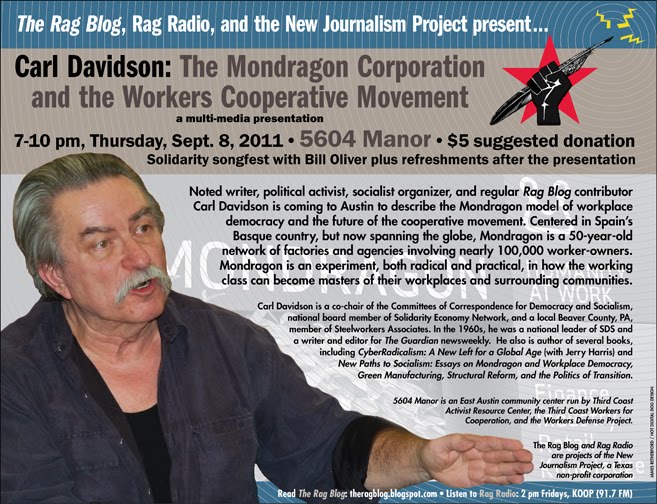
The Rag Blog will present noted writer and political activist Carl Davidson with a multi-media presentation on “The Mondragon Corporation and the Workers Cooperative Movement,” on Thursday, Sept. 8, 2011, 7-10 p.m., at 5604 Manor Community Center, 5604 Manor Road, Austin, Texas. For more information, go here. Carl will also be Thorne Dreyer‘s guest on Rag Radio, Friday, Sept. 9, from 2-3 p.m. (CST), on KOOP 91.7-FM in Austin, and streamed live here.

My regional daily newspaper, the Pittsburgh Post-Gazette, to its credit, came out with an editorial Monday, Aug. 22, 2011, urging President Obama to push for a substantial jobs program over Republican opposition.

Action on jobs: Obama must push hard to get people back to work” is the headline, and a key point stresses “Mr. Obama now needs to offer proposals equal to the size of the problem. That means bold strokes, not half-measures. If his Republican antagonists in Congress are determined to stand in the way of getting Americans back to work, the president must say so publicly — and then go over their heads to enlist the nation in his effort.

Terrific, a good framing of the question. Unfortunately, however, once you get into the substance of the piece, it turns into a muddle. The Post-Gazette offers up a hodgepodge of proposals that tinker around the edges of the problem — more tax cuts and credits for jobs created, more unemployment benefits, and oddly, more trade deals, even though these deals mostly result in net job losses.

Here’s the heart of the matter. In a down economy, jobs are created by increasing demand, by more customers with bigger orders coming to a firm’s doors. The problem is that consumer demand has taken a nose dive since the credit bubble burst.

People don’t have money to spend. They’re cutting back on everything, and trying to unload their debt. This means business-to-business orders shrink as well. Companies may be cash-rich and have high profits, but with no increase in orders or customers at their door, they aren’t likely to hire people to do nothing just to get a tax credit.

This is where government has to become the key customer. It has to make huge productive purchases for local work and local materials to build productive infrastructure — county-owned green energy plants, new and improved schools, modernized locks and dams, Medicare for all, investment in young students and veterans like we did with the GI Bill, investment in research in new industries, and so on.

Most important, to work well, it can’t be nickel-and-dimed to death. It has to be on the scale of the expenditures for World War II. That’s when the “multiplier effect” can kick in, and related growth in manufacturing can take off in turn. And it has to be paid for by going to where the most appropriate money is, imposing a financial transaction tax on unproductive and destabilizing speculation by Wall Street.

The best the Post-Gazette does on this matter is to support Obama’s proposal for an “Infrastructure Bank,” while urging him to find a way to bypass a GOP roadblock in Congress.

But even that is too passive. It says, in effect, here’s a small pot of money. If you want to repair some roads, come and get some.

What we really need is something like the New Deal’s Tennessee Valley Authority and Works Progress Administration, but on steroids, a TVA-WPA-CCC 2.0. We need to pass John Conyers’ HR 870 Full employment Bill. We need the Department of Energy and the Department of Labor to go to every county in the country with a fully-funded proposal to build new green energy wind farms and solar power arrays as public energy utilities, hiring local workers at union scale, with no obstacles to a union election. And that’s just for starters.

Yes, we need a serious jobs program. But it’s time for everyone who utters that phrase to get serious themselves. Why? Because it’s going to take a massive upsurge in class struggle to get it — by removing those standing in the way.

[Carl Davidson is a national co-chair of the Committees of Correspondence for Democracy and Socialism, a national board member of Solidarity Economy Network, and a local Beaver County, PA member of Steelworkers Associates. In the 1960s, he was a national leader of SDS and a writer and editor for the Guardian newsweekly. He is also the co-author, with Jerry Harris, of CyberRadicalism: A New Left for a Global Age. He serves as webmaster for SolidarityEconomy.net and Beaver County Blue. This article was first published on Carl’s blog, Keep On Keepin’ On. Read more articles by Carl Davidson on The Rag Blog.]

The Rag Blog

Posted in Rag Bloggers | Tagged , , , , , | 1 Comment

The Rag Blog Presents : Carl Davidson on Mondragon and Workers’ Cooperatives

CLICK ON IMAGE TO ENLARGE

The Rag Blog, Rag Radio, and the New Journalism Project
Present Noted Writer and Political Activist Carl Davidson:
‘Mondragon and the Workers’ Cooperative Movement’
A Multi-Media Presentation

Thursday, Sept. 8, 2011, 7-10 p.m.
At 5604 Manor Community Center,
5604 Manor Road, Austin, Texas

Austin singer/songwriter Bill Oliver will perform.
Refreshments, including beer and wine, will be available.
$5 Suggested Donation

Go to our Facebook event page.

Carl Davidson in Austin:
‘The Mondragon Corporation and
the Workers’ Cooperative Movement

The Rag Blog, Rag Radio, and the New Journalism Project present noted writer and political activist Carl Davidson with a multi-media presentation on “The Mondragon Corporation and the Workers’ Cooperative Movement,” from 7-10 p.m., Thursday, Sept. 8, 2011, at 5604 Manor Community Center, 5604 Manor Road, Austin, Texas. There is a suggested donation of $5. After the presentation, Austin musician Bill Oliver will perform live. Refreshments, including beer and wine, will be available.

The Mondragon Corporation is a 50-year-old network of factories and agencies, involving close to 100,000 workers — centered in Spain’s Basque country, but now spanning the globe. Mondragon is an experiment, at once radical and practical, in how the working class can become masters of their workplaces and surrounding communities.

Carl Davidson, a regular contributor to The Rag Blog, is a co-chair of the Committees of Correspondence for Democracy and Socialism, a national board member of Solidarity Economy Network, and a local Beaver County, PA member of Steelworkers Associates. In the 1960s, he was a national leader of SDS and a writer and editor for the Guardian newsweekly. He is also author of several books, including, with Jerry Harris, CyberRadicalism: A New Left for a Global Age, and New Paths to Socialism, essays on worker coops, Marxism and the green economy.

Bill Oliver, known as the “Environmental Troubadour,” is an Austin-based singer/songwriter and entertainer.

5604 Manor is a community center run by the Workers Defense Project, Third Coast Activist Resource Center, and the Third Coast Workers for Cooperation.

The Rag Blog is a progressive internet newsmagazine based in Austin, Texas. The Rag Blog is published by the New Journalism Project, a 501(c)(3) Texas nonprofit corporation. Rag Radio is a weekly public affairs program hosted by Rag Blog editor Thorne Dreyer, Fridays, 2-3 p.m., on KOOP 91.7-FM in Austin.

Carl Davidson will also discuss the Mondragon Corporation and workers cooperatives on Rag Radio, Friday, Sept. 9, from 2-3 p.m. on KOOP 91.7-FM, and streamed live on the World Wide Web.

The Rag Blog

Posted in RagBlog | Tagged , , , , , | 1 Comment

Lamar W. Hankins : Tax Cuts and Republican Hypocrisy

At the trough. Image from Florida Pundit.


Republican tax cut hypocrisy

knows no bounds

The average current tax cut on millionaires insisted on by the Republicans and agreed to by President Obama amounts to $200,000 each for 2011 and 2012.

By Lamar W. Hankins / The Rag Blog / August 23, 2011

Finally, there is an Obama policy that I can wholeheartedly endorse. The President wants to extend the payroll tax reduction enacted last year. The payroll tax funds Social Security, half of which is paid by workers and half by employers. This tax reduction proposal would keep in place the 12-month payroll tax reduction from 6.2% of earnings to 4.2% that was enacted last year.


A family with salaried income of $50,000 a year will have nearly $1,000 extra to spend on whatever they need. This is a modest way to give average working Americans a few dollars, almost all of which will be spent on goods and services, thus stimulating the economy and leading to a demand for more workers to provide those goods and services.

Republicans, however, see the benefit in extending tax cuts only for the millionaires and billionaires, who will invest their money wherever it will bring them the greatest yield. They already spend all that they want or need to spend.

Their tax reduction doesn’t create jobs because it isn’t invested in job-producing activity. It goes to buy stocks or bonds in companies all over the globe, or to increasing real estate holdings, not to creating new companies that will hire new employees, or to adding jobs to companies they may already own. But most Republicans oppose Obama’s modest payroll tax cut for average Americans.

The payroll tax that funds Social Security can be reduced for a few years as a stimulus to the economy because there are enough assets in the Social Security Trust Fund to meet Social Security obligations through 2037, according to the United States Social Security Administration’s Office of the Chief Actuary.

I have been critical of President Obama’s economic policies since he took office, beginning with his appointments to key positions related to the economy. Most notable among these was Larry Summers, who served as Treasury Secretary for two years during the Bill Clinton presidency. In that position, he pushed for the Commodity Futures Modernization Act, which allowed many investment vehicles, such as derivatives, to go unregulated. Derivatives include credit default swaps that led in large part to the 2008 economic crisis.

Summers was and is a true believer in a largely unregulated financial market. When we fail to regulate those markets adequately, the financial sector focuses on ways to make money for investment banks through methods that do nothing to create jobs or stimulate the economy.

As a result, we get tens of thousands of mortgages consolidated into investment vehicles. When many of those mortgages are backed by insufficient value they are called subprime mortgages. When there are too many subprime mortgages and there is corruption throughout the industry, the financial collapse of these insufficiently regulated investments is inevitable.

Bloomberg Business Week reported in 2008 that some of these failures were caused by mortgage wholesalers (who worked for the banks that packaged these mortgages into investments) offering sexual favors to independent mortgage brokers (who were independent processors of mortgage applications) to let them purchase mortgage loan applications. The lenders (banks) then packaged these mortgages into investment securities.

Business Week also reported other corruption in this process, including widespread bribery or payoffs to obtain mortgage applications, as well as fabricated loan documents, along with the coaching of mortgage brokers about how to skirt the few regulations that did exist.

In summary, Business Week reported,

In the end, the wholesalers were undone by the same people who allowed for their rise: their Wall Street overlords. During the boom investment banks bought as many loans as they could to pool together and turn into securities. In 2006 the top 10 investment banks, which included Merrill Lynch, … Bear Stearns,… and Lehman Brothers, sold mortgage-backed securities worth $1.5 trillion, up from $245 billion in 2000.

To keep the supply of loans coming, the investment banks increasingly took control of the industry’s frontline players as well. First they started buying small, independent wholesaling firms. Next they extended billions in credit to subprime lenders. Then they took stakes in some, and bought others outright. At the height of the frenzy in 2006, six top investment banks shelled out a total of $2.2 billion to buy subprime shops.

This kind of activity doesn’t create jobs, it destroys jobs, as thousands of jobs were cut when the housing bubble burst in 2008. When the wealthy look for places to invest their money, they don’t typically look for entrepreneurial ventures that will create jobs, but for ways to safely invest their excess money, money they don’t need for what most of us consider the necessities of life.

Of course, the rating agencies, like Standard & Poor’s (who recently downgraded the ratings of U.S. government bonds), gave the best ratings to these mortgage consolidation investments, leading wealthy investors to believe that such investments were a great way to make more money. The investment bankers, you may remember, were bailed out by the taxpayers at the end of the Bush presidency and during the early part of Obama’s presidency.

The Bush tax cuts on millionaires and billionaires caused $2 trillion in deficits during the Bush presidency. The average current tax cut on millionaires insisted on by the Republicans and agreed to by President Obama amounts to $200,000 each for 2011 and 2012. The wars started by Bush and continued by Obama, along with the tax cuts for the wealthy, will account for half the public debt by 2019, according to the nonpartisan, nonprofit Center for Budget and Policy Priorities.

At least the President is trying to make a modest correction in his grievous tax agreement with the Republicans, but there will be few Republicans who will agree to very modest tax relief for working Americans because they have cast their lot with the wealthiest 1% of Americans, who became wealthy because they figured out how to game the political and economic system for their benefit and to the detriment of the other 99%.

Over 200 years ago, Thomas Jefferson wrote:

I hope we shall crush in its birth the aristocracy of our monied corporations, which dare already to challenge our government to a trial by strength, and bid defiance to the laws of our country.

When will the President learn that it is not possible to make deals with hypocrites who are, by their nature, deceivers and charlatans? Thomas Jefferson understood the nature of uncontrolled capitalism, but we did not heed his warning. It becomes more difficult by the day to make a persuasive argument that the oligarchy is not in charge of our government, from top to bottom.

[Lamar W. Hankins, a former San Marcos, Texas, city attorney, is also a columnist for the San Marcos Mercury. This article © Freethought San Marcos, Lamar W. Hankins. Read more articles by Lamar W. Hankins on The Rag Blog.]

The Rag Blog

Posted in Rag Bloggers | Tagged , , , , , | Leave a comment

Ted McLaughlin : The ‘Free Market’ Myth and the Suicide of Capitalism

Political cartoon by Carol Simpson / Cartoon Work.


The ‘free market’ myth and the

suicide of the capitalist system

In a capitalist society such as ours the wealth will be redistributed to the richest people unless there are some regulations to prevent that.

By Ted McLaughlin / The Rag Blog / August 23, 2011

We hear a lot today about free trade and free enterprise. Those are today’s code words for unregulated capitalism — the idea that capitalism can work for the benefit of everyone in a society as long as it is not hindered by government regulations. The proponents of this idea say that the more money the capitalists make, the more jobs they will create and the better off everyone in the society will be.


You may recognize this as the Republican “trickle-down” theory.

These modern Republicans may be surprised to learn that their boogeyman, Karl Marx was in favor of “free trade.” Look at this quote from Marx:

The free trade system is destructive. It breaks up old nationalities and pushes the antagonism of the proletariat and the bourgeoisie to the extreme point. In a word, the free trade system hastens the social revolution. It is in this revolutionary sense alone, gentlemen, that I vote in favor of free trade.

Marx was in favor of free trade, or unregulated capitalism, because he knew that such a system was sowing the seeds of its own destruction. An unregulated capitalism would inevitably result in the death of capitalism (by concentrating too much of the total wealth in the hands of a few people which would kill demand).

The rich and the corporations (today’s capitalists) have let their greed for accumulating ever larger pools of money blind them to reality (if they ever understood it in the first place). And that reality is that capitalists do not create jobs. Demand for products and services is what creates jobs. Capitalists simply exploit that demand to make money (and they have to put people to work in order to exploit that demand). But when the demand disappears, so do the jobs.

Now you may be asking yourself at this point: If an unregulated capitalism is suicidal then how has our system survived this long? The answer is regulation. When our system has started to get too out of whack, we have instituted measures to regulate or control the excesses of capitalism — measures designed to redistribute some of the income and wealth away from the rich and to the others in our society.

I know that the term “redistribution of wealth” has been demonized in this country, but that is ridiculous because wealth is always being redistributed in all societies. In a capitalist society such as ours, the wealth will be redistributed to the richest people unless there are some regulations to prevent that. These regulations will spread the distribution of wealth and income throughout the society. This is healthy, because a more equal distribution of income creates demand as people use that wealth and income to buy goods and services (and this allows capitalists to make money and workers to find jobs).

We have used various means to redistribute the income more fairly in this country. We created a progressive income tax (where the more money a person makes the higher tax rate they pay), we created and protected unions (which provided workers with decent wages and better benefits), we created an array of social service programs (to protect children, the elderly, the poor, and those with disadvantages), and we imposed regulations on the business practices of Wall Street and the corporations. These things helped to keep our capitalist system from getting out of control and choking to death on its own success.

But the Republicans have never accepted that capitalism needs regulating. They still believe that “trickle-down” (or Voodoo) economics will work (in spite of its repeated failures). With the election of Ronald Reagan in 1980, they began to tear down the safeguards that had been installed in our society. They started to eliminate business regulations, strip unions of their power, dismantle social programs, and lower tax rates for the rich. This process was accelerated in the administration of George W. Bush.

The result was predictable. Far too much of the nation’s wealth and income became concentrated in the hands of only a few people (about 1% of the population controls 40% of the wealth and income currently). While the income of the rich grew astronomically, the income of

workers was stagnant (and their buying power dropped substantially). This resulted in a drop in demand, which resulted in lay-offs, which killed demand even further, causing more layoffs — and this spiraled the country down into a serious recession.

And what do the Republicans think the solution to this jobless recession is? They want to cut social programs, cut taxes for the rich, eliminate unions, and eliminate regulations on businesses. In other words they want to do more of the same things that caused this economic mess in the first place. They seem to be incapable of learning from either experience or history.

They claim they are being fiscally responsible. They aren’t. What they are really doing is giving our capitalist system enough rope to hang itself — an economic suicide that could unfortunately also kill our economy (and maybe even our democracy).

[Ted McLaughlin also posts at jobsanger. Read more articles by Ted McLaughlin on The Rag Blog.]

The Rag Blog

Posted in Rag Bloggers | Tagged , , , , , , | 5 Comments

In case you missed them. These pictures of Rick Perry as an Aggie cadet and as a Texas A&M student, decked out in lettered cardigan (with Reveille at his feet), are absolutely priceless.

Posted in RagBlog | Leave a comment

Kate Braun : Problems Are Revealed During Balsamic Moon

Balsamic Moon. Photo by oceandesetoiles / Flickr.


Moon Musings:

Waning Balsamic Moon

(August 23-25, 2011)

By Kate Braun / The Rag Blog / August 22, 2011

The Balsamic Moon phase is when problems are revealed, but not a time when they are solved. To go for a “quick fix” is likely not to be profitable, as it will be a superficial solution that really is no solution, especially with Pluto retrograde until Sept. 16 and Chiron retrograde until November 9.


These retrogrades prompt us to notice what we have been neglecting, with the intention of rectifying the neglect, and recognizing our imperfections so that we can grow in positive ways. I recommend being content for the moment with identifying the matters requiring resolution. The waxing moon phases will be the time to make plans for the future, look ahead, and open yourself to change.

As with any waning moon phase, this is a good time to stir uncertainty and confusion out of the mix because it is a time for psychic clearing. You may find yourself being more aware of disturbing emotional tides at this moon phase, which could be because you are paying more attention to the things you are deciding to change in your life.

Be aware that you may find habits, relationships, and/or jobs that have soured and need to be not just “fixed” but released. As you perform your rituals for banishing negative energy, you should find yourself becoming more relaxed and calm.

It is said that a wish made at the Balsamic Moon is more likely to come true because needs are felt more deeply at this time. The more deeply a need is felt, the more invocative energy goes into the Moon rituals and the more likely the need will be met, especially if that need involves letting go of negativity.

Sea water can be an important element to incorporate into your moon ritualing. Sea salts (not table salt) dissolved in tap water are an acceptable substitute for sea water, and the dissolving should be complete before you charge the water.

There are several methods that can be used to charge water with the energy relevant to your purpose. You may stir the water with a crystal (clockwise if you seek to attract something to you, counterclockwise if you are releasing something), you may hold your hands over the water and visualize energy flowing through you into the water as you contemplate the intent of your actions, you may hold the container of water in your hands and breathe upon in gently as you visualize your intent blending with the water.

These are only a few suggestions and, as with most magickal workings, the ritual you create by and for yourself is likely to be more powerful than a ritual you merely copy. Charging water is rather like using Reiki: the energy flows through you but does not drain you, it enters the water and causes the water to become energized with your intent. Unused charged water may be bottled and saved in the refrigerator for future use, but be sure to label the bottle with the date and the intention of the charging!

Herbs and wood chips may be soaked in the charged water, then allowed to dry before being used as incense in your celebration. Please respect any burn bans in your area and be sure to do any incense-burning in a flame-proof container such as a cast-iron cauldron. Never leave a fire unattended.

In the garden (if your garden has not shriveled in the Texas heat), this is the time to weed out what you don’t want to grow, trim or lop branches that overhang roofs or gardens too much. It is not a time for planting, however!

Given the current daytime high temperatures, I recommend commencing your rituals after the sun has set. Be sure to eat something, but take care to not let yourself become heavy with food. Cheese and bread or crackers, fruits, finger sandwiches, water, herb tea, fruit punch, bite-size quiches, cookies, frozen yogurt: these are all foods that will sustain your energy without compromising your concentration.

I urge you to be sure to drink plenty of water, even after the sun sets. Dehydration happens in dark as well as daylight. I also urge you to wear lightweight loose clothing preferably made of natural fibers such as cotton. A swingy spaghetti-strapped cotton sundress is likely to feel more comfortable than tight shorts and a body-hugging spandex-polyester top.

A Balsamic Moon is said to relate to healing and rest, since it is the last phase before the New Moon. It is also said to relate to one’s commitment to destiny. You might want to consult an astrologer to learn more about how this moon phase relates to your destiny.

[Kate Braun‘s website is www.tarotbykatebraun.com. She can be reached at kate_braun2000@yahoo.com. Read more of Kate Braun’s writing on The Rag Blog.]

The Rag Blog

Posted in Rag Bloggers | Tagged , , , , , | Leave a comment

Sarito Carol Neiman provides some valuable perspective on Rick Perry and his “Texas Miracle.” One gem: a New York Times columnist in 2003 reported that one manufacturer — notorious for its Dickensian record on workers safety — said they’d only do business in “developing countries and Texas.” She follows with a truly scary Texas report card that indeed reads like that of a third world country.

Posted in RagBlog | Leave a comment

Attorney Raznikov, who was involved in the Free Speech Movement at Berkeley in 1964, remembers how the news reporting distorted the events in which he participated. He then looks at the recent London “riots” and, in examining their underlying causes, suggests we be wary of mainstream media interpretations. “Whoever controls the media,” he reminds us, “controls the story the public sees and hears.”

Posted in RagBlog | Leave a comment

Richard Raznikov : From Berkeley to London, a Word From Our Sponsors

The Free Speech Movement at the University of California at Berkeley, 1964. Image from the New SDS Website.


From 60’s Berkeley to the London ‘riots’:

A word from our sponsors

Whoever controls the media controls the story the public sees and hears. Whatever ‘news’ we get is filtered through the propaganda requirements of those who own it.

By Richard Raznikov / The Rag Blog / August 18, 2011

The first time I personally experienced the unreliability — i.e. lies — of the media was as a freshman at U.C. Berkeley in October 1964. Along with about a thousand others, my friend JBD and I found ourselves in the middle of what was to become the Free Speech Movement.


The University had embarked on a mission, spurred by its corporate sponsors, to impede the recruitment of civil rights volunteers on campus. Students were already in the forefront of demonstrations against racial discrimination in San Francisco at the Sheraton Palace, on auto row, and at Zim’s Restaurants, and the targets had grown to include businesses in Oakland’s Jack London Square and the Oakland Tribune newspaper.

Powerful people were pissed off, and they leaned on the University’s administration to put a stop to it.

The Free Speech Movement was the student response to new restrictions on free speech imposed by Chancellor Ed Strong and U.C. President Clark Kerr.

Being in the middle of this historic development was an intoxicating experience, and JBD and I participated in sit-ins and demonstrations, and passed out leaflets. We were among the first batch of students to surround a police car with our bodies, preventing the removal of one Jack Weinberg, who had been arrested for violating university rules when he sat at a recruitment table for either the Student Nonviolent Coordinating Committee (SNCC) or the Congress of Racial Equality (CORE) — I can’t recall which.

The October 1st capture of the police car in a spontaneous circle of students generated nationwide press coverage, and most of America learned of the incipient student revolt on their evening news programs. What they learned was a little bit different from what we were experiencing in Sproul Plaza.

The public heard that we were a bunch of ungrateful brats, outside agitators, and Communist dupes. The quite significant issues of freedom of speech and of constitutional rights in general, although they were the central point of the protests and of the speeches given by Mario Savio and others, standing atop the imprisoned squad car, were completely ignored.

We were too busy to watch ourselves on the news but we soon discovered how we were being portrayed. Personally, I didn’t mind the brat thing, but I resented anyone regarding me as a dupe. Not to mention that one of the friends I’d made in the FSM was a member of the steering committee who was a libertarian — and happened to belong to “Students for Goldwater.”

Whoever controls the media controls the story the public sees and hears. I am reminded of that daily, following events in England, in Israel, in Libya, in Syria, in Egypt, in Haiti, in Greece. Whatever “news” we get is filtered through the propaganda requirements of those who own it, those who sponsor it, and those whose threats can promote or make vanish a given narrative.

In other words, you can’t take at face value anything you see on television or coming from the mouths of politicians. They are lying to you. That’s a part of their job.

I wrote a piece called “London Burning” and got a pretty fast response from people who took issue with my slant on events. One of them was my old friend JBD himself, whose quite reasonable question was, mainly, how sympathetic would I be if the looters were looting and/or burning down my shop.

Answer: I wouldn’t be very sympathetic; I’d be pissed off.

But, here’s the thing: I didn’t write favorably about looters. I don’t even know how much looting has taken place, and neither do you. I know what the Cameron government is saying, but they are notorious liars to begin with. I also know that the media, in collusion with government, can make a snowplow look like a Trailways bus.

My point was this: the England riots are political.

What the media coverage is leaving out, among other things:

Last fall there were demonstrations across England by students angry about prospective cuts in social services. The level of outrage surprised the Cameron regime which, along with other European governments, has been implementing so-called “austerity” measures, the translation being that in order to satisfy the bankers and other corporate thugs the few crumbs formerly doled out to the poor will now be taken away.

Then, on March 26th of this year, half a million demonstrators — many of them trade unionists — converged on London to protest the slashing of government programs and social services. They were joined by huge numbers of the young, especially students.

Traffic cone embedded in the smashed windows at a London shopping center. Photograph by Jim Dyson / Getty Images.


In a prescient article two months ago in the Indypendent, Peter Bratsis wrote:

…the class dimensions of the demonstration are not yet obvious nor are they reducible to the social-economic positions or to the intentions of those of us who were there. The class character of the demonstration will be manifest by its impact and what will follow in the months ahead…

As Bratsis pointed out,

One thing is certain, however: The March 26 protest will have as little impact on policymakers as the antiwar demonstrations did. Within the “democratic” world at least, orderly popular protests have proven to be of little consequence when it comes to influencing policies.

He then observed that while many union participants would abandon the field, having come to London and “done all that they could,” the events would lead to further radicalization of those who were most directly victimized by the government’s actions and targeted by police.

Partly as a response to the heavy-handed actions of the police and partly as a product of principled political reflection and organization, the extra-parliamentary left, especially anarchism, is on the rise. There were hundreds of mask-wearing protesters willing to engage in property destruction and risk arrest.

Their occupation of Fortnum and Mason, one of the most famous stores in London, and their attack on the Ritz Hotel and dozens of stores on Oxford Street, especially those known for not paying any taxes, is a clear sign that the movement is growing. Although there may still be far to go before the streets of London look like those of Seattle in 1999 or Athens in 2008, major progress is being made.

Historically, ideology is always an unsteady partner to rebellion. Indeed, if revolution waited for the development of a broad-based intellectual theory it would wait forever. Most American colonists had not read Tom Paine’s “Common Sense,” and those Russians who stormed the Winter Palace had by and large never heard of Karl Marx.

Bratsis continues:

According to the historian Karl Polanyi, the working class in Britain has been the most repressed and beaten down in all of Europe. Polanyi asserts that this has rendered them nearly incapable of any self-directed, progressive, political action. Nonetheless, we have seen flashes of political possibilities, such as the poll tax riots of 1990 that brought down Margaret Thatcher and the fierce but unsuccessful coal miners’ strike of 1984-85 that broke organized labor in the U.K.

The stakes of the current attack on working people are clear. Orderly demonstrations and petitions are not sufficient for fighting the power of the ruling classes and their… servants within Parliament. A new chapter in disruptive, disciplined and disorderly political action by the dominated is necessary. If marching is as far as the political efforts go, the overcrowded classrooms, shrinking universities, declining life expectancy and decreasing wages and pensions will be all the evidence we need for understanding how the class struggle in Britain is progressing.

More than 16,000 police have been deployed to retake the streets of London. More than 1,700 arrests have been carried out, and magistrates have already tried and sentenced some to prison. A majority of the arrestees are minors. One such was sent to jail for six months for stealing bottled water. Prisons and juvenile detention centers are running out of cells for the inmates.

London police have conducted raids specifically against low-income housing projects, and concerns over civil liberties of the accused have been brushed aside by the Cameron regime in the wild rush to convict and imprison those accused. The prime minister declared that “phony concerns about human rights” wouldn’t be permitted to get in the way.

Despite the cover stories promoted by the British government and the widespread media complicity in reducing the rioters to “mindless” criminals and “anarchists,” the enormity of the rebellion — and its use of social networks and Blackberry messaging services — suggests something with clearer direction and better organization.

The British government is working on policies which will shut down these web sites and services to impede future actions, much the same way the Egyptian government sought to save Mubarak’s miserable skin. It didn’t work in Egypt but maybe the English will have better luck.

The U.S. government has, of course, embarked on the same course, and the mass media in this country are complicit in distorting the news out of London. After all, the same kind of phony “austerity” policies being used in Europe to screw the last dime out of the poor and the seemingly powerless are being tried in America by the Obama regime and its Republican allies. Don’t think for a minute we’re not being set up. In England, the economics editor at

The Guardian (and a part-time magistrate) wrote:

From the bench, what magistrates see is a raging bundle of id impulses, the desire for immediate gratification untempered by a sense of guilt and with only an ill-formed notion of right and wrong. The temptation to bang them up and throw away the key is strong, and magistrates will no doubt be encouraged to do just that over the coming weeks.

Don’t be fooled by the press releases. Crisis is manufactured in order to seize money or to get rid of civil liberties, often both. When people fight back with whatever rudimentary weapons are at their disposal, it is essential that they be divested of reason and marginalized as criminals. That’s what the mass media do these days — create and promote the cover stories of their sponsors.

No, I do not personally think that looting businesses is a good idea, a sound tactic, or a morally-defensible position. But I’m not going to pretend that there isn’t a reason for it.

[Richard Raznikov is an attorney practicing in San Rafael, California. He blogs at News from a Parallel World.]

The Rag Blog

Posted in Rag Bloggers | Tagged , , , , , , , , , , , | 1 Comment