Robert Jensen : The Anguish in the American Dream


The Anguish in the American Dream

By Robert Jensen / The Rag Blog / June 27, 2011

Robert Jensen will discuss the American Dream and more as Thorne Dreyer‘s guest on Rag Radio, Friday, July 8, 2011, 2-3 p.m. (CDT) on Austin’s community radio station, KOOP-91.7 FM, and streamed live on the internet.

As we cope with downturns in American power in the world and the American economy at home, there is much talk about reviving, renewing, rescuing, or redefining the American Dream. We would be better off facing the anguish inherent in the American Dream. Once we recognize that the dream has always been dependent on domination, we can see more clearly our options for a just and sustainable future.

[A version of this essay was delivered at MonkeyWrench Books in Austin, Texas, on February 10, 2011.]

Whether celebrated or condemned, the American Dream endures, though always ambiguously. We are forever describing and defining, analyzing and assessing the concept, and with each attempt to clarify, the idea of an American Dream grows more incoherent yet more entrenched.

The literature of this dream analysis is virtually endless, as writers undertake the task of achieving, saving, chasing, restoring, protecting, confronting, pursuing, reviving, shaping, renewing, and challenging the American Dream.

Other writers are busy devouring, recapturing, fulfilling, chasing, liberating, advertising, redesigning, rescuing, spreading, updating, inventing, reevaluating, financing, redefining, remembering, and expanding the American Dream.

And let’s not forget those who are deepening, building, debating, burying, destroying, ruining, promoting, tracking, betraying, remaking, living, regulating, undermining, marketing, downsizing, and revitalizing the American Dream.

We are exhorted to awaken from, and face up to, the dream, as we explore the myths behind, crisis of, cracks in, decline of, and quest for the American Dream.

My favorite book title on the subject has to be Andy Kaufman: Wrestling with the American Dream, which explores the comedian’s career “within a broader discussion of the ideology of the American Dream.” According to the book’s publisher, the author

brilliantly decodes Kaufman in a way that makes it possible to grasp his radical agenda beyond avant-garde theories of transgression. As an entertainer, Kaufman submerged his identity beneath a multiplicity of personas, enacting the American belief that the self can and should be endlessly remade for the sake of happiness and success. He did this so rigorously and consistently that he exposed the internal contradictions of America’s ideology of self-invention.

As we can see, writers are eager to dive deep into the American Dream to find strikingly original insights, bold new interpretations, previously unexplored nuances. I will take a different approach: I want to skate on the surface and state the obvious. It’s a strategy seldom employed, I believe, because such a reckoning with our past leaves us uneasy about the present and terrified of the future. That strategy leaves us in anguish.

I believe that to be fully alive today is to live with anguish, not for one’s own condition in the world but for the condition of a broken world. My anguish flows not from the realization that it is getting harder for people to live the American Dream, but from the recognition that the American Dream has made it harder to hold together the living world.

So, our task here is to tell the truth about the domination that is at the heart of the American Dream so that we may face the brokenness of our world. Only then can we embrace the anguish of the American Dream and confront honestly our moment in history.

The epic dream

James Truslow Adams appears to have been the first to have used the phrase “the American Dream” in print, in his 1931 book The Epic of America.[1] This stockbroker turned historian defined it as “that dream of a land in which life should be better and richer and fuller for everyone.” But he didn’t reduce the dream to materialism and emphasized U.S. social mobility in contrast with a more rigid European class system:

It is not a dream of motor cars and high wages merely, but a dream of social order in which each man and each woman shall be able to attain to the fullest stature of which they are innately capable, and be recognized by others for what they are, regardless of the fortuitous circumstances of birth or position.

Adams was, in fact, concerned about the growing materialism of U.S. life, and he wondered about “the ugly scars which have also been left on us by our three centuries of exploitation and conquest of the continent.” He was writing at the beginning of the Great Depression, coming off the go-go years of the 1920s. So, not surprisingly, his list of those problems will sound familiar to us:

how it was that we came to insist upon business and money-making and material improvement as good in themselves; how they took on the aspects of moral virtues; how we came to consider an unthinking optimism essential; how we refused to look on the seamy and sordid realities of any situation in which we found ourselves; how we regarded criticism as obstructive and dangerous for our new communities; how we came to think manners undemocratic, and a cultivated mind a hindrance to success, a sign of inefficient effeminacy; how size and statistics of material development came to be more important in our eyes than quality and spiritual values; how in the ever-shifting advance of the frontier we came to lose sight of the past in hopes for the future; how we forgot to live, in the struggle to “make a living”; how our education tended to become utilitarian or aimless; and how other unfortunate traits only too notable today were developed.

Yet for all his concerns, Adams believed that the United States could overcome these problems as long as the dream endured, and that led him into the dead end of clichés: “If we are to make the dream come true we must all work together, no longer to build bigger, but to build better.” For Adams, as the book’s title makes clear, the story of America is an epic, and “The epic loses all its glory without the dream.”

But dreams of glory are bound to betray us, and 80 years later the question is whether the story of the United States is an epic or a tragedy. More on that later.

The dream and domination

Adams’ definition of the dream as the belief that “life should be better and richer and fuller for everyone” is rather abstract. One historian’s “short history” of the concept[2] highlights the dreams of religious freedom, political independence, racial equality, upward mobility, home ownership, and personal fulfillment that run through U.S. history, but a concept used by so many people for so many different purposes can’t be easily defined.

Rather than try to organize the complexity, I want to focus on what has made the American Dream possible. That much is simple: The American Dream is born of, and maintained by, domination.

By this claim, I don’t mean that the American Dream is to dominate (though many who claim to be living the American Dream revel in their ability to dominate), but rather that whatever the specific articulation of the American Dream, it is built on domination. This is the obvious truth on the surface, the reality that most dreamers want to leave out, perhaps because it leads to a painful question: How deeply woven into the fabric of U.S. society is the domination/subordination dynamic on which this country’s wealth and freedom are based?

First, the American part: The United States of America can dream only because of one of the most extensive acts of genocide in recorded human history. When Europeans landed in the region that was eventually to include the United States, there were people here. Population estimates vary, but a conservative estimate is 12 million north of the Rio Grande, perhaps 2 million in what is now Canada and the rest in what is now the continental United States.

By the end of the so-called Indian Wars, the 1900 census recorded 237,000 indigenous people in the United States. That’s an extermination rate of 95 to 99 percent.[3] That is to say, the European colonists and their heirs successfully eliminated almost the entire indigenous population — or the “merciless Indian Savages” as they are labeled in the Declaration of Independence, one of the most famous articulations of the American Dream.

Almost every Indian died in the course of the European invasion to create the United States so that we may dream our dreams. Millions of people died for the crime of being inconveniently located on land desired by Europeans who believed in their right to dominate.

Second, the dream part: Adams pointed out that while this is always about more than money, the idea of getting one’s share of the American bounty is at the core of the American Dream. That bounty did not, of course, drop out of the sky. It was ripped out of the ground and drawn from the water in a fashion that has left the continent ravaged, a dismemberment of nature that is an unavoidable consequence of a worldview that glorifies domination.

“From [Europeans’] first arrival we have behaved as though nature must be either subdued or ignored,” writes the scientist and philosopher Wes Jackson, one of the leading thinkers in the sustainable agriculture movement.[4] As Jackson points out, our economy has always been extractive, even before the industrial revolution dramatically accelerated the assault in the 19th century and the petrochemical revolution began poisoning the world more intensively in the 20th.

From the start, we mined the forests, soil, and aquifers, just as we eventually mined minerals and fossil fuels, leaving ecosystems ragged and in ruin, perhaps beyond recovery in any human timeframe. All that was done by people who believed in their right to dominate.

This analysis helps us critique the naïve notions of opportunity and bounty in the American Dream. The notion of endless opportunity for all in the American Dream is routinely invoked by those who are unconcerned about the inherent inequality in capitalism or ignore the deeply embedded white supremacy that expresses itself in institutional and unconscious racism, which constrains indigenous, black, and Latino people in the United States.

The notion of endless bounty in the American Dream leads people to believe that because such bounty has always been available that it will continue to be available through the alleged magic of technology. In America, the dreamers want to believe that the domination of people to clear the frontier was acceptable, and with the frontier gone, that the evermore intense domination of nature to keep the bounty flowing is acceptable.

Of course the United States is not the only place where greed has combined with fantasies of superiority to produce horrific crimes, nor is it the only place where humans have relentlessly degraded ecosystems. But the United States is the wealthiest and most powerful country in the history of the world, and the country that claims for itself a unique place in history, “the city upon a hill”[5] that serves as “the beacon to the world of the way life should be,” in the words of one of Texas’ U.S. senators.[6]

The American Dream is put forward as a dream for all the world to adopt, but it clearly can’t be so. Some of the people of the world have had to be sacrificed for the dream, as has the living world. Dreams based on domination are, by definition, limited.

Jackson reminds us how these two forms of domination come together in the United States when he asserts, “We are still more the cultural descendants of Columbus and Coronado than we are of the natives we replaced.”[7] Citing the writer Wendell Berry, he points out “that as we came across the continent, cutting the forests and plowing the prairies, we never knew what we were doing because we have never known what we were undoing.”[8]

Dreams based on domination by people over the non-human world are dreams only for the short-term. Dreams based on domination by some people over others are dreams only for the privileged. As Malcolm X put it, “I see America through the eyes of the victim. I don’t see any American dream; I see an American nightmare.”[9]

Justice and sustainability

A world based on domination/subordination is a profoundly unjust world and a fundamentally unsustainable world.

The state of our unjust world: A third of the people on the planet live on less than $2 per day, while half live on less than $2.50 a day.[10] That means at least half the people in this world cannot meet basic expenditures for the food, clothing, shelter, health, and education necessary for a minimally decent life. Concern about this is not confined to radical idealists. Consider the judgment of James Wolfensohn near the end of his term as president of the World Bank:

It is time to take a cold, hard look at the future. Our planet is not balanced. Too few control too much, and many have too little to hope for. Too much turmoil, too many wars, too much suffering. The demographics of the future speak to a growing imbalance of people, resources, and the environment. If we act together now, we can change the world for the better. If we do not, we shall leave greater and more intractable problems for our children.[11]

The state of our unsustainable world: Every measure of the health of the continent — groundwater depletion, topsoil loss, chemical contamination, increased toxicity in our own bodies, the number and size of “dead zones” in the surrounding oceans, accelerating extinction of species and reduction of bio-diversity — suggests we may be past the point of restoration. This warning comes from 1,700 of the world’s leading scientists:

Human beings and the natural world are on a collision course. Human activities inflict harsh and often irreversible damage on the environment and on critical resources. If not checked, many of our current practices put at serious risk the future that we wish for human society and the plant and animal kingdoms, and may so alter the living world that it will be unable to sustain life in the manner that we know. Fundamental changes are urgent if we are to avoid the collision our present course will bring about.[12]

That statement was issued in 1992, and in the past two decades we have yet to change course.

These days when someone seeks my support for an idea, project, or institution, I ask whether it makes some contribution to the struggle for justice and sustainability. No one idea, project, or institution can solve our problems, of course, and perhaps even no combination can save us. But I am convinced we must ask this question in all aspects of our lives.

I have concluded that the American Dream is inconsistent with social justice and ecological sustainability. So, I’m against the American Dream. I don’t want to rescue, redefine, or renew the American Dream. I want us all to recognize the need to transcend the domination/subordination dynamic at the heart of the American Dream. If we could manage that, the dream would fade — as dreams do — when we awake and come into consciousness.

That’s my principled argument. Now let’s consider two questions about political and rhetorical strategy.

Strategic considerations I: A radical core

A few years ago, sometime around the U.S. invasion of Iraq in 2003, I got a call from a New York Times reporter who was writing a piece about the anti-war movement’s attempt to rally folks around the idea that “peace is patriotic.” I told him I never used that phrase and routinely argued against patriotism — instead of trying to redefine patriotism, I wanted to abandon the concept as intellectually, politically, and morally indefensible.[13]

He was intrigued and asked me to explain. Realize, this was the first, and so far the only, time I have been interviewed by a Times reporter, and so even though I know that newspaper to be a tool of the ruling class, I wanted to make a good impression.

First, I pointed out that critiques of patriotism have been made by radicals in the past and that there was nothing all that new in what I had to say. After I explained my argument, he said he couldn’t see a hole in the reasoning but that it didn’t really matter. “No one is ever going to accept that,” he said, and so my position — no matter how compelling — didn’t end up in his story.

Perhaps I can take some solace in knowing that he thought my argument was right. But it’s not enough just to be right, of course — we want to be effective. Is an argument irrelevant if it can’t be communicated widely in the mainstream? Is that the fate of an assault on the idea of an American Dream?

It’s certainly true that the American Dream is a deeply rooted part of the ideology of superiority of the dominant culture, and there is evidence all around us that this ideology is more deeply entrenched than ever, perhaps because the decline of American power and wealth is so obvious, and people are scrambling. But that doesn’t automatically mean that we should avoid radical critiques and play to the mainstream. I believe those critiques are more important than ever.

This conclusion stems from an assessment of the political terrain on which we operate today. This is not a mass-movement moment, not a time in which large numbers of Americans are likely to engage in political activity that challenges basic systems of power and wealth.

I believe we are in a period in which the most important work is creating the organizations and networks that will be important in the future, when the political conditions change, for better or worse. Whatever is coming, we need sharper analysis, stronger vehicles for action, and more resilient connections among people. In short, this is a cadre-building moment.

Although for some people the phrase “cadre-building” may invoke the worst of the left’s revolutionary dogmatism, I have something different in mind. For me, “cadre” doesn’t mean “vanguard” or “self-appointed bearers of truth.” It signals commitment, but with an openness to rethinking theory and practice.

I see this kind of organizing in some groups in Austin, where I live. Not surprisingly, they are groups led by younger people who are drawing on longstanding radical ideas, updating as needed to fit a changing world. These organizers reject the ideology that comforts the culture.

The old folks — which I define as anyone my age, 52, and older — who are useful in these endeavors also are willing to leave behind these chauvinistic stories about national greatness.

To openly challenge the American Dream is to signal that we are not afraid to (1) tell the truth and (2) keep working in the face of significant impediments. This kind of challenge speaks to those who are hungry for honest talk about the depth of our problems and are yearning to be part of a community that perseveres without illusions. That isn’t a majority, maybe not yet a significant minority, but those people have the resolve that we will need.

Back to the patriotism critique: Despite the popularity of the “peace is patriotic” bumper stickers, I have continued to offer my argument against the concept of patriotism, and whenever I speak about it in a lecture, people tell me that it was helpful to hear the position articulated in public.

Over and over, on this and other issues, I hear people saying that they have had such thoughts but felt isolated and that hearing the critique in public shores up their sense that they are not crazy. Perhaps these kinds of more radical analyses don’t change the course of existing movements, but they help bolster those who are at the core of the more radical movements we need, and they help us identify each other.

Strategic considerations II: Engagement

Although a radical critique of the American Dream isn’t likely to land in The New York Times, we shouldn’t ignore the ways we can use such arguments for outreach to liberal, and even conservative, communities.

Once again, an example about patriotism: I have had conversations with conservative Christians, who typically are among the most hyper-patriotic Americans, in which I challenged them to square that patriotism with their Christian faith.[14] Isn’t patriotism a form of idolatry?

I can’t claim to have converted large numbers to an anti-empire/anti-capitalist politics. But as the evangelicals say, we sometimes make progress one by one, from within. Framing questions in a way that forces people to see that conventional politics is at odds with their most deeply held moral principles is a potentially effective strategy.

It doesn’t always work — we humans are known for our ability to hold contradictory ideas — but it is one resource in the organizers’ toolkit.

So, we might consider critiquing the American Dream by contrasting it with another widely embraced idea, the Golden Rule or the ethic of reciprocity, which says we should treat others as we would like to be treated. That principle shows up in virtually all religious teachings and secular philosophy.[15] In Christianity, Jesus phrased it this way in the Sermon on the Mount:

[12] So whatever you wish that someone would do to you, do so to them; for this is the law and the prophets. [Matt. 7:12]

One of the best-known stories about the great Jewish scholar Hillel from the first century BCE concerns a man who challenged him to “teach me the whole Torah while I stand on one foot.” Hillel’s response: “What is hateful to you, do not do to your neighbor. That is the whole Torah, while the rest is the commentary thereof; go and learn it.”[16]

This is echoed in the repeated biblical command, in the Hebrew Bible as well as the New Testament, to “love thy neighbor as thyself.” [Lev. 19:18] In Islam, one of the Prophet Muhammad’s central teachings was, “None of you truly believes until he loves for his brother what he loves for himself.”[17] In secular Western philosophy, Kant’s categorical imperative is a touchstone: “Act only according to that maxim whereby you can at the same time will that it should become a universal law.”[18]

On the surface, the American Dream of success for all appears to be an articulation of the Golden Rule, of equal opportunity for all. When I suggest that the two ideas are, in fact, in opposition, it gives me a chance to make the case that the Dream is based on domination and, therefore, a violation of that core principle.

How can we reconcile our commitment to an ethic of reciprocity while endorsing a vision of society that leads to an unjust and unsustainable world? How can we face the least among us today, and our descendants tomorrow, knowing we turned away from the moral commitments we claim to be most dear to us? A critique of the American Dream can open up that conversation.

Telling the tale: Epic or tragic hero?

The American Dream typically is illustrated with stories of heroes who live the dream. But the larger story of American Dream casts the United States itself as the hero on a global stage. The question we might ask, uncomfortably: Is the United States an epic hero or a tragic one?

Literature scholars argue over the definition of the terms “epic” and “tragedy,” but in common usage an epic celebrates the deeds of a hero who is favored by, and perhaps descended from, the gods. These heroes overcome adversity to do great things in the service of great causes. Epic heroes win.

A tragic hero loses, but typically not because of an external force. The essence of tragedy is what Aristotle called “hamartia,” an error in judgment made because of some character flaw, such as hubris. That excessive pride of the protagonist becomes his downfall.

Although some traditions talk about the sin of pride, most of us understand that taking some pride in ourselves is psychologically healthy. The problem is excessive pride, when we elevate ourselves and lose a sense of the equal value of others.

This distinction is crucial in dealing with the American Dream, which people often understand in the context of their own hard work and sacrifice. People justifiably take pride, for example, in having worked to start a small business, making it possible for their children to get a college education, which is one common articulation of the American Dream.

I can tell you a story about a grandfather who emigrated from Denmark and worked hard his whole life as a blacksmith and metal worker, about parents who came from modest circumstances and worked hard their whole lives, about my own story of working hard. That story is true, but also true is the story of domination that created the landscape on which my grandfather, my parents, and I have worked.

Pride in work turns to hubris when one believes one is special for having worked, as if our work is somehow more ennobling than that of others, as if we worked on a level playing field.

When we fall into hubris individually, the consequences can be disastrous for us and those around us. When we fall into that hubris as a nation — when we ignore the domination on which our dreams are based — the consequences are more dramatic. And when that nation is the wealthiest and most powerful in the world, at a time in history when the high-energy/high-technology society is unraveling the fabric of the living world, the consequences are life-threatening globally.

Not to worry, some say: After all, other empires have come and gone, other species have come and gone, but the world endures. That flippant response glosses over two important considerations. First, empires cause immense suffering as they are built and as they decline. Second, the level of human intervention into the larger world has never been on this scale, so that the collapse of an empire poses new risks.

To toss off these questions is to abandon one’s humanity.

To face this honestly, we need to recognize just how inadequate are our existing ideas, projects, and institutions. Quoting the late geographer Dan Luten, Jackson reminds us:

[Most Europeans] came as a poor people to a seemingly empty land that was rich in resources. We built our institutions with that perception of reality. Our political institutions, our educational institutions, our economic institutions — all built on that perception of reality. In our time we have become rich people in an increasingly poor land that is filling up, and the institutions don’t hold.”[19]

Developing new institutions is never easy. But it will be easier if we can abandon our epic dreams and start dealing the tragic nature of circumstances.

The end of the epic, for us all

To conclude I want to return to the words of our first American Dreamer, James Truslow Adams: “The epic loses all its glory without the dream.”

Glory is about distinction, about claiming a special place. The American Dream asserts such a place in history for the United States, and from that vantage point U.S. domination seems justified. The future — if there is to be a future — depends on us being able to give up the illusion of being special and abandon the epic story of the United States.

It is tempting to end there, with those of us who critique the domination/subordination dynamic lecturing the American Dreamers about how they must change. But I think we critics have dreams to give up as well. We have our epics of resistance, our heroes who persevere against injustice in our counter-narratives.

Our rejection of the idea of the American Dream is absorbed into the Dream itself, no matter how much we object. How do we live in America and not Dream?

In other words, how do we persevere in a nightmare? Can we stay committed to radical politics without much hope for a happy ending? What if we were to succeed in our epic struggle to transcend the American Dream but then find that the American Dream is just one small part of the larger tragedy of the modern human?

What if the task is not simply to give up the dream of the United States as special but the dream of the human species as special? And what if the global forces set in motion during the high-energy/high-technology era are beyond the point of no return?

Surrounded by the big majestic buildings and tiny sophisticated electronic gadgets created through human cleverness, it’s easy for us to believe we are smart enough to run a complex world. But cleverness is not wisdom, and the ability to create does not guarantee we can control the destruction we have unleashed.

It may be that no matter what the fate of the American Dream, there is no way to rewrite this larger epic, that too much of the tragedy has already been played out.

But here’s the good news: While tragic heroes meet an unhappy fate, a community can learn from the protagonist’s fall. Even tragic heroes can, at the end, celebrate the dignity of the human spirit in their failure.

That may be the task of Americans, to recognize that we can’t reverse course in time to prevent our ultimate failure, but that in the time remaining we can recognize our hamartia, name our hubris, and do what we can to undo the damage.

That may be the one chance for the United States to be truly heroic, for us to learn to leave the stage gracefully.

An audio version, on CD or MP3, is available from Alternative Radio. Video of the talk is online here.

[Robert Jensen is a journalism professor at the University of Texas at Austin and board member of the Third Coast Activist Resource Center in Austin. He is the author of All My Bones Shake: Seeking a Progressive Path to the Prophetic Voice, (Soft Skull Press, 2009) and Getting Off: Pornography and the End of Masculinity (South End Press, 2007); Jensen is also co-producer of the documentary film Abe Osheroff: One Foot in the Grave, the Other Still Dancing, which chronicles the life and philosophy of the longtime radical activist. Robert Jensen can be reached at rjensen@uts.cc.utexas.edu. Read more articles by Robert Jensen on The Rag Blog.]

[1] James Truslow Adams, The Epic of America (New York: Triangle Books, 1931).

[2] Jim Cullen, The American Dream: A Short History of an Idea that Shaped a Nation (New York: Oxford University Press, 2003).

[3] See David E. Stannard, American Holocaust: Columbus and the Conquest of the New World (New York: Oxford University Press, 1992); and Ward Churchill, A Little Matter of Genocide (San Francisco: City Lights Books, 1997). Churchill argues persuasively that the fact that a large number of those indigenous people died of disease doesn’t absolve white America. Sometimes those diseases were spread intentionally, and even when that wasn’t the case the white invaders did nothing to curtail contact with Indians to limit the destruction. Whether the Indians died in war or from disease, starvation and exposure, white society remained culpable.

[4] Wes Jackson, Becoming Native to This Place (Lexington: University Press of Kentucky, 1994), p. 19.

[5] This phrase is attributed to Puritan John Winthrop’s 1630 sermon, “A Model of Christian Charity,” which draws on Jesus’ words in the Sermon on the Mount, “You are the light of the world. A city set on a hill cannot be hid.” [Matt. 5:14] The late president Ronald Reagan was fond of describing the United States as a “shining city upon a hill,” as he did in his farewell address on January 11, 1989. http://www.reaganlibrary.com/reagan/speeches/farewell.asp

[6] Kay Bailey Hutchison, Senate debate on “Authorization of the use of United States Armed Forces against Iraq,” (S.J. Res. 45) October 09, 2002. http://thomas.loc.gov/cgi-bin/query/Z?r107:S09OC2-0011

[7] Jackson, Becoming Native to This Place, p. 15.

[8] Wes Jackson, “Becoming Native to This Place,” Thirteenth Annual E. F. Schumacher Lectures,

October 1993, Yale University, New Haven, CT. http://neweconomicsinstitute.org/publications/lectures/Jackson/Wes/becoming-native-to-this-place

[9] Malcolm X, Malcolm X Speaks: Selected Speeches and Statements, George Breitman, ed. (New York: Grove, 1965), Chapter 3, “The Ballot or the Bullet,” p. 26.

[10] World Bank, “World Development Report 2008,” October 2007. www.worldbank.org/wdr2008

[11] James D. Wolfensohn, address to the Board of Governors of the World Bank Group, September 23, 2003. http://siteresources.worldbank.org/NEWS/Resources/jdwsp-092303.pdf

[12] Henry Kendall, a Nobel Prize physicist and former chair of the Union of Concerned Scientists’ board of directors, was the primary author of the “World Scientists’ Warning to Humanity.” http://www.ucsusa.org/ucs/about/1992-world-scientists-warning-to-humanity.html

[13] For this argument, see Chapter 3 of my book Citizens of the Empire: The Struggle to Claim Our Humanity (San Francisco: City Lights Books, 2004). That chapter is also available online at http://uts.cc.utexas.edu/~rjensen/freelance/CoEPatriotism.pdf

[14] For an example of this in the context of the American Dream, see David Platt, Radical: Taking Back Your Faith from the American Dream (Colorado Springs, CO: Multnomah Books, 2010). Unfortunately, his critique of the American Dream appears to be rooted in a conservative theology that asserts Christianity as the one true faith tradition, replacing a reactionary nationalism with a reactionary religion.

[15] For a summary, see “Shared belief in the Golden Rule.” http://www.religioustolerance.org/reciproc.htm

[16] Talmud, tracate Shabbat 31a. http://www.come-and-hear.com/shabbath/shabbath_31.html

[17] Yahya ibn Sharaf al-Nawawi, Al-Nawawi’s Forty Hadith (Cambridge, UK: Islamic Texts Society, 1997), Hadith 13.

[18] Immanuel Kant, Grounding for the Metaphysics of Morals, 3rd ed. (Indianapolis: Hackett, 1993), p. 30.

[19] Wes Jackson, Consulting the Genius of the Place: An Ecological Approach to a New Agriculture (Berkeley, CA: Counterpoint, 2010), p. 117.

The Rag Blog

Posted in Rag Bloggers | Tagged , , | Leave a comment

Jordan Flaherty : Murder Trial Begins for Danziger Bridge Cops

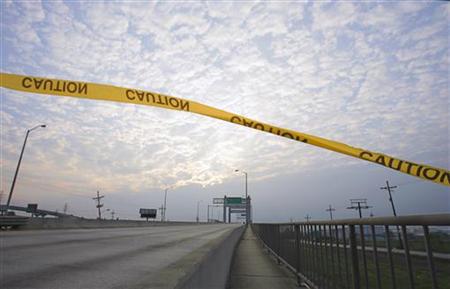
Crime scene: New Orleans’ Danziger Bridge was the site of police shootings. Photo by Lucas Jackson / Reuters.

New Orleans cops go on trial:
Shot unarmed African-Americans in cold blood

Did New Orleans media contribute to police violence after hurricane Katrina?

By Jordan Flaherty / The Rag Blog / June 27, 2011

NEW ORLEANS — Opening arguments begin today in what observers have called the most important trial New Orleans has seen in a generation. It is a shocking case of police brutality that has already redefined this city’s relationship to its police department, and radically rewritten the official narrative of what happened in the chaotic days after Hurricane Katrina.

Five police officers are facing charges of shooting unarmed African-Americans in cold blood, killing two and wounding four, and then conspiring to hide evidence. Five officers who participated in the conspiracy have already pleaded guilty and agreed to testify against their fellow officers.

The shootings occurred on September 4, 2005, as two families were fleeing Katrina’s floodwaters, crossing New Orleans’ Danziger Bridge to get to dry land. Officers, who apparently heard a radio report about shootings in the area, drove up, leapt out of their vehicle, and began firing.

Ronald Madison, a mentally challenged man, was shot in the back at least five times, then reportedly stomped and kicked by an officer until he was dead. His brother Lance Madison was arrested on false charges. James Brissette, a high school student, was shot seven times, and died at the scene. Susan Bartholomew, 38, was wounded so badly her arm was shot off of her body. Jose Holmes Jr. was shot several times, then as he lay bleeding an officer stood over him and fired point blank at his stomach. Two other relatives of Bartholomew were also badly wounded.

Danziger is one of at least nine recent incidents involving the NOPD being investigated by the U.S. Justice Department, several of which happened in the days after the city was flooded. Officers have recently been convicted by federal prosecutors in two other high-profile trials.

In April, two officers were found guilty in the beating death of Raymond Robair, a handyman from the Treme neighborhood. In December, a jury convicted three officers and acquitted two in killing Henry Glover, a 31-year-old from New Orleans’ West Bank neighborhood, and burning his body.

New Orleans police arrest a man after Sept. 4, 2005, police shootings on the Danziger Bridge in New Orleans. Photo by Alex Brandon / The Times Picayune.


From survivors to looters

In the aftermath of Hurricane Katrina, people around the world felt sympathy for New Orleans. They saw images of residents trapped on rooftops by floodwaters, needing rescue by boat and helicopter. But then stories began to come out about looters and gangs among the survivors, and the official response shifted from humanitarian aid to military operation.

Then-Governor Kathleen Blanco sent in National Guard troops, announcing. “They have M-16s and are locked and loaded. These troops know how to shoot and kill and I expect they will.” Warren Riley, at that time the second in charge of the police department, reportedly ordered officers to “take the city back and shoot looters.”

In the following days, several civilians — almost all of them African American — were killed under suspicious circumstances in incidents involving police and white vigilantes. For years, family members and advocates called for official investigations and were rebuffed.

“Right after the hurricane there were individuals and organizations trying to talk about what happened on Danziger,” says Dana Kaplan, executive director of Juvenile Justice Project of Louisiana (JJPL), a legal and advocacy organization based in New Orleans. “But their voices were marginalized.”

There is evidence that local media could have done a better job. Alex Brandon, a photographer for New Orleans’ Times-Picayune newspaper who later went on to work for Associated Press, testified in the Henry Glover trial that he knew details about the police killings that he didn’t reveal. “He saw things and heard things that proved to be useful in a criminal investigation. He didn’t report them as news,” wrote Picayune columnist Jarvis DeBerry after the Glover trial concluded.

Former Orleans Parish District Attorney Eddie Jordan, who led an initial investigation of the Danziger officers, believes an indifferent local media bears partial responsibility for the years of cover-up. “They were looking for heroes,” he says. “They had a cozy relationship with the police. They got tips from the police, they were in bed with the police. It was an atmosphere of tolerance for atrocities from the police. They abdicated their responsibility to be critical in their reporting. If a few people got killed that was a small price to pay.”

Family members and advocates tried to get the stories of police violence out through protests, press conferences, and other means. Peoples Hurricane Relief Fund, an organization dedicated to justice in reconstruction, held a tribunal in 2006 where they presented accusations of police violence — among other charges — to a panel of international judges, including members of parliament from seven countries. Activists even brought charges to the United Nations, filing a shadow report in February 2008 with the UN Committee on the Elimination of Racial Discrimination in Geneva.

But it was not until late 2008 that a journalist named AC Thompson did what the local media failed to do, and investigated these stories in detail. “It’s unfortunate that it took a national publication to really dig to the root,” says Kaplan, referring to Thompson’s work. “In New Orleans the criminal justice system has been so corrupt for so long that things that should be shocking didn’t seem to be raising the kind of broad community outrage that they should have.”

In 2009, after years of pressure from activists and the national attention brought on by AC Thompson’s reporting, the U.S. Justice Department decided to look into the accusations of police violence. This has led to one of the most wide-ranging investigations of a police department in recent U.S. history. Dozens of officers are facing lengthy prison terms, and corruption charges have reached to the very top of the department.

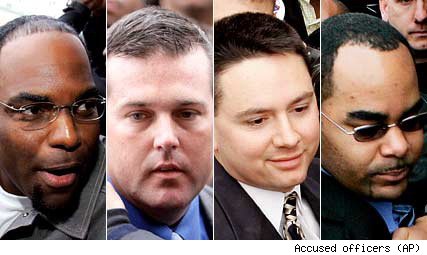
The Danziger trial is expected to last two months. Kenneth Bowen, Robert Gisevius, Anthony Villavaso, and Robert Faulcon, the officers involved in the shooting, could receive life sentences if convicted. Sergeant Arthur Kaufman, who was not on the bridge, is charged only in the conspiracy and could receive a maximum of 120 years. Justice Department investigations of other incidents are continuing, and it is likely that some form of federal oversight of the department will be announced in coming months.

[Jordan Flaherty is a journalist and staffer with the Louisiana Justice Institute. His award-winning reporting from the Gulf Coast has been featured in a range of outlets including
The New York Times, Al Jazeera, and Argentina’s Clarin newspaper. His new book is FLOODLINES: Community and Resistance from Katrina to the Jena Six. He can be reached at neworleans@leftturn.org, and more information about Floodlines can be found at floodlines.org. This article was originally published by Truthout. Find more articles by Jordan Flaherty on The Rag Blog.]

The Rag Blog

Posted in Rag Bloggers | Tagged , , , , , | Leave a comment

Environmental activist Diane Wilson — who will be Thorne Dreyer’s guest on Rag Radio this Friday, June 24 (go to article for details) — has become a champion who “takes risks, gets bloodied and arrested, and endures jail — then turns her adventures into good-hearted, epic tales reminiscent of Mark Twain.” Wilson, a shrimper from Seadrift, Texas — and the author of Diary of an Eco-Outlaw — has become an inspiring leader of the environmental protest movement and a prime nemesis of corporate polluters. Article originall distributed by OpEd News.

Posted in RagBlog | Leave a comment

Roger Baker : Have We Turned the Corner on Peak Driving?

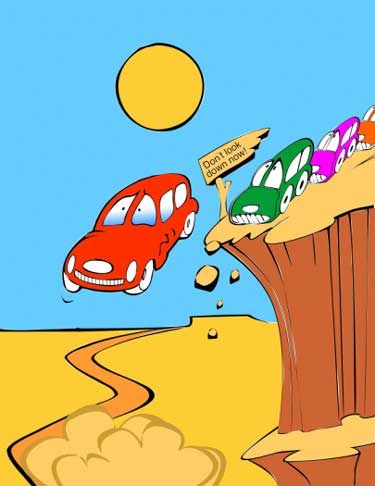
A window on peak driving. Image from The Auto Channel.

Coming soon:
Peak oil, peak driving, peak cars

Part II: Have we turned the corner on peak driving?

By Roger Baker / The Rag Blog / June 23, 2011

[This is the second part of a series by Roger Baker on transportation, centering on the issue of peak oil and its ramifications.]

Tell the average U.S. car owner that total driving in the USA might have already peaked forever, and they are likely to think you’re crazy. That possibility goes against a lifetime of personal experience, living as we do in a country dependent on personal vehicles for work trips and various other vital functions.

It doesn’t seem possible that total driving could peak and decline in our lifetimes, especially given an ever increasing population. Cars and their social and economic implications might be said to be the primary basis for the prevailing U.S. lifestyle and culture.

We see evidence for a shift in driving behavior in many places. Indeed, evidence for a driving slowdown clearly predates the big 2008 run-up in fuel prices. There are a number of factors at work. High unemployment cuts down on work trips. Intractable traffic congestion associated with suburban commuting in most U.S. metropolitan areas plays a role. As the U.S. population ages, it is driving less.

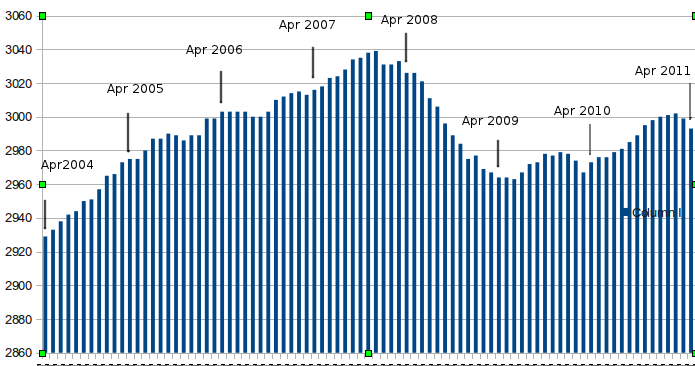
According to the best data, collected by hundreds of stations around the USA by the Federal Highway Administration, the total amount of U.S. driving, called VMT or vehicle miles traveled, hit a peak of about 3.04 trillion miles of travel in 2007. Since 2007, travel volume has been making a sluggish recovery, but U.S. driving is still over 1 percent below the level of four years ago.

The chart below offers my expanded version, including the latest month available, the VMT for April 2011, and extending back for each month since 2004. We can see there were several years of a weaker increase, beginning about mid-2005. As gas prices rose during 2008, total driving took a nosedive and then made a slow bumpy recovery during 2009-2010. In early 2011, driving has dropped again, likely in response to sharply higher fuel prices.

Rag Blog chart by Roger Baker.

CLICK ON IMAGE TO ENLARGE.

The reason for this slow recovery in U.S. driving is not hard to understand. The most recent data show that the cost of transportation (mostly driving) in the U.S. has been rising with increasing fuel prices. It has now recovered and exceeds the previous 2008 peak, even as household income continues to fall behind due to inflation.

If we are optimists, we can look at this chart and argue the VMT numbers might keep rising at the current sluggish rate. Purely by eyeballing the chart, it looks like U.S. travel volume might possibly recover to reach its old 2007 peak in two years or so. But the likelihood of higher oil prices and the slow replacement of the existing vehicle fleet suggest that this is unlikely to happen.

The U.S. vehicle fleet of cars, light trucks, etc may already be past its peak. The total number of private vehicles reached a high of about 250 million in 2008.

An excellent analysis of the changing economics of U.S. transportation has been provided by Worldwatch Institute founder Lester Brown. He points out that In 2009 alone, car ownership declined by about 4 million vehicles, or about 2%.

Future U.S. fleet size will be determined by the relationship between two trends: new car sales and cars scrapped. Cars scrapped exceeded new car sales in 2009 for the first time since World War II, shrinking the U.S. vehicle fleet from the all-time high of 250 million to 246 million. It now appears that this new trend of scrappage exceeding sales could continue through at least 2020.

The basic case for peak driving and peak cars is that driving is becoming increasingly unaffordable for the steadily growing ranks of low income drivers, in a nation where vehicle ownership is highly correlated with income. Annual car ownership cost is now estimated at $9,000.

Meanwhile, many experts now believe that we are very near or past peak global oil production. Given a steadily growing demand for a shrinking global oil supply, the lack of practical alternatives is bound to make driving in the U.S. steadily less affordable. This is doubly the case when rising fuel prices act like a tax that competes with, and depresses, consumer spending in other sectors of the economy.

Until the U.S. economy recovers, it is hard to see how driving and car sales can recover. Assuming the U.S. and global economy do recover, it is just as hard to imagine a scenario in which basic supply and demand will not raise the cost of fuel high enough to kill the economic recovery, much as we saw in 2008 when the price of oil reached $147 a barrel.

If we knew the state of the U.S. economy a year from now, and an average driver’s fuel costs, we would be in a good position to predict the level of driving. Since the economy is unlikely to recover much the next year, in terms of the part of family income that can be devoted to driving, the wild card, the biggest source of economic uncertainty, is the cost of motor fuel next year and beyond.

The Road Lobby:
Why public planners hate the concept of peak driving

The reality of peak driving and peak cars on the road is guaranteed to be seen as unwelcome, and to be unpopular among planners. Planning for peak driving deeply disturbs the basis for business as usual, an unpopularity it shares with measures to limit global warming. Peak driving is subversive of existing interests since so much existing investment and infrastructure is based on the status quo.

There are a constellation of powerful financial interests tied in one way or another to the automobile, all sharing in common an interest in the continuation and expansion of a car-centric and oil-addictive U.S. suburban lifestyle. These interests include the car building industry, the road construction industry, the home products industry, and also include the various suburban sprawl and home-building beneficiaries.

Most transportation planners and their allies — ranging from Exxon, to Walmart, to General Motors — are inclined by the nature of their existing investments to favor roads and driving as the way to serve a profitable continuation of the prevailing pattern of suburban development.

It should come as no surprise that there is an active road lobby with many branches, including here in Austin, dedicated to perpetuating the privately profitable aspects of driving. The road lobby has its own stable of active driving promoters like Wendell Cox and Randal O’Toole, both stridently pro-road and anti-transit. If there is a toll road lobby it is probably centered around Peter Samuel and Toll Roads News.

The Texas Transportation Institute is essentially the academic think tank of the Texas road lobby. It offers an academic fig leaf of respectability to the active promotion of roads and cars and driving as unchallenged core values and infrastructure funding assumptions.

One of their current projects is to study, and prove the necessity for, a new tax on miles driven to replace or supplement the current fuel tax. The fact that the road lobby would be suggesting what is guaranteed to be such a highly unpopular kind of tax only underlines the deteriorating economics of driving.

The road lobby, in its more overtly and stridently political manifestation, often maintains that the ability to drive anywhere is a basic civil right under attack by transit advocates and urban planners inside government. At any rate, this outlook applies when the planners are not primarily trying to build more roads. Especially the roads that subsidize the suburban growth surrounding major U.S. metropolitan areas, where most state and federal planners are still focusing their attention.

The ultimate futility of subsidizing suburban sprawl development with more roads comes as no surprise. The case was already solidly made in 2004 in the classic peak oil documentary, The End of Suburbia.

The degree to which supposedly near-universal car ownership is threatened by a relatively declining U.S. household income is a factor that U.S. transportation planners are especially reluctant to admit. The reality is that rising fuel prices and a stagnant economy are fundamentally changing the economics of transportation and forcing the growing ranks of the poor to give up their cars.

Next time: A deeper look at what is by now an overwhelming body of evidence that U.S. driving behavior is fundamentally changing in response to our changing economy. The closer you look, the more apparent that a basic shift is really taking place. But what will the public transportation alternative look like by the time the public widely appreciates how much they really need it?

[Roger Baker is a long time transportation-oriented environmental activist, an amateur energy-oriented economist, an amateur scientist and science writer, and a founding member of and an advisor to the Association for the Study of Peak Oil-USA. He is active in the Green Party and the ACLU, and is a director of the Save Our Springs Association and the Save Barton Creek Association in Austin. Mostly he enjoys being an irreverent policy wonk and writing irreverent wonkish articles for The Rag Blog. Read more articles by Roger Baker on The Rag Blog.]

The Rag Blog

Posted in Rag Bloggers | Tagged , , , , | 3 Comments

David P. Hamilton : How Social Security Works in the U.S. and France

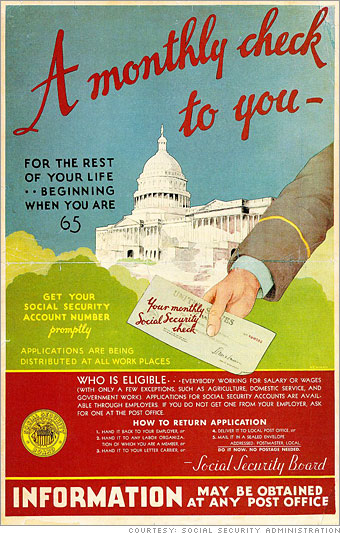
Social Security building at Rennes, France. Image from Wikimedia Commons.

Letters from France IV:
Social Security in the U.S. and France

In France the system is more costly, more complicated, and provides more benefits, but employers and the wealthy pay a higher percentage of the costs.

By David P. Hamilton / The Rag Blog / June 23, 2011

[This is the fourth in a series of dispatches from France by The Rag Blog‘s David P. Hamilton.]

PARIS — Social security in France has a wider definition that includes health care, unemployment compensation, family support, disability, and other benefit programs. But in the U.S. social security is generally understood to refer to the federal old-age pension program that protects workers and covers family members against loss of income from the wage earner’s retirement.

There are basic differences between the retirement programs in France and the U.S. In essence, in France the system is more costly, more complicated, and provides more benefits, but employers and the wealthy pay a higher percentage of the costs.

There are, however, major similarities between the French and American retirement pension systems. Both are pay-as-you-go systems in which current receipts are used to pay current benefits. Also, both are under attack by rightists because of their projected future insolvency caused by changing demographics.

The ratio of active workers paying into the system relative to retirees receiving benefits is falling in both countries and will fall more quickly with the retirement of “baby-boomers.” In France, this “dependency ratio” is already much worse than the in the U.S. Indeed, the U.S. has the best dependency ratio among the G8 nations.

This problem is largely a distraction to focus the debate away from obvious solutions to what Nobel Laureate economist Paul Krugman describes as a “modest” long term shortfall. Krugman notes that “extending the life of the trust fund into the 22nd century, with no change in benefits, would require additional revenues equal to only 0.54 percent of GDP. That’s less than 3 percent of federal spending — less than we’re currently spending in Iraq.”

James Roosevelt, a former commissioner for retirement policy for the Social Security Administration, claims that the “crisis” is more a myth than a fact. Nobel Laureate economist Joseph Stiglitz agrees.

Both France and the U.S. have pay-as-you-go systems. Money taken in from payroll taxes is used to pay current retirees. In the U.S., there have been more receipts than payouts since 1983. Excess receipts go into the Social Security Trust Fund. There they are loaned to the U.S. general revenue fund to be used for other governmental expenses.

The U.S. Treasury general revenue fund currently owes the Social Security Trust Fund over $2.5 trillion. In 2009, FICA taxes and interest on the fund took in $120 billion more than it paid out, despite a serious shortfall in payroll tax receipts caused by the subprime mortgage crisis and high unemployment. By 2019, the general revenue fund will owe the Social Security Trust Fund $3.8 trillion.

Unfortunately, the U.S. government has made no provision to repay these “borrowed” surpluses. They have gone most prominently to finance militarism, such as the recently passed 2012 $690 billion “Defense” Department appropriation.

There are various proposals being floated to repay this debt and rectify the shortfall by raising receipts, reducing benefits, or privatizing the system. But there are several other options that don’t ever get discussed. For example, had the government not spent a trillion on imperialist wars in Iraq and Afghanistan and trillions more to otherwise feed the voracious needs of the military-industrial complex, it would have the money to repay the trust fund.

As Ron Paul has suggested, were we to close down most if not all of the over 800 military bases the U.S. has outside its borders and end the numerous wars (all in Muslim countries) in which we are presently engaged, we would have the money to pay back the Social Security Trust Fund.

In other words, we could cut the largest discretionary element in the federal budget, the military/intelligence/homeland security expenditures that are greater than the similar expenses of the rest of the world combined.

But most military spending functions as a transfer payment from the general population to the rich who own and profit from the military-industrial complex. Hence, social security solvency achieved by reduced militarism is out of the question.

Revoking the Bush/Obama tax cuts for the most wealthy would largely eliminate the federal deficit, allowing general revenues to be used to pay back the debt owed Social Security, money owed to those of more humble means. The Center on Budget and Policy Priorities wrote in 2010:

The 75-year Social Security shortfall is about the same size as the cost, over that period, of extending the… tax cuts for the richest 2 percent of Americans (those with incomes above $250,000 a year). Members of Congress cannot simultaneously claim that the tax cuts for people at the top are affordable while the Social Security shortfall constitutes a dire fiscal threat.

This approach is considered politically unviable despite broad popular support among the general population who don’t own a single member of Congress, a president, or a team of lobbyists.

Another option would be to remove the cap on FICA taxes that is currently $106,800. That solution would raise taxes on the richest 6% of Americans and largely restore perpetual solvency in the social security system, providing 1.3 trillion dollars over the next 10 years according to the libertarian Cato Institute.

Although the Wall Street Journal editors believe that lifting the cap would be “one of the greatest tax increases of all time” and “so crazy it’s beyond belief,” this richest 6% have seen their inflation-adjusted income increase about 90% over the past 30 years while wages of the less wealthy have stagnated.

A 2005 Washington Post poll found that 81% of Americans would favor lifting the cap altogether and it has been endorsed by those”radicals” at the AARP, the largest seniors lobby in the U.S. The precedent for removing the cap is that in 1993 Congress removed the cap on the tax to support Medicare.

The Social Security Administration’s chief actuary stated that removing the cap, even if it included increased benefits for the wealthy paying more, would eliminate 93% of the projected shortfall over the next 75 years.

Unfortunately, elimination of the cap is a non-starter in a Congress owned by the economic elite who might then have to pay the same tax the rest of us pay.

Or the government might tax property income, now exempt from FICA taxes, the same way wages and salaries are taxed. The current rate of taxation on long term capital gains is 15%, while the top marginal tax rate on wages is 35%. Again, such a tax would fall almost exclusively on the very richest Americans, the capitalist class, who derive most of their income from property investments.

Hence, it is politically unrealistic and not considered a viable option.

A much less desirable approach would be to raise FICA taxes on everyone from the current 12.4% (half paid by employees and half by employers) to 14.4%, which would solve the future insolvency problem altogether. This could be done by raising just the employer’s contribution and leaving the employee contribution as it is now. This would still leave the employer contribution in the U.S. below what employers pay in France.

It is argued that such a move would stifle employment, but the latest figures (for April 2011) show the unemployment rate in France only 0.1% higher than the official rate in the U.S. that is widely considered understated.

In addition, we could simply bar the U.S. government from borrowing funds from the Social Security Trust Funds that it has no capacity to repay. But this would mean the deficit problem would become immediate, rather than being delayed by borrowing from the trust fund.

None of these potential solutions are remotely acceptable to the 1% of the U.S. population, the economic elite, who own the U.S. government. Hence, these options are all outside the realm of possibility within the capitalist hegemony in the U.S.

The demographic squeeze used to justify the insolvency argument is based on several factors, primarily greater longevity, declining birth rates, higher unemployment among the youngest and oldest workers, and unemployed older workers taking early retirement.

In 2010, French president Sarkozy’s government, despite massive protests by the Left that brought millions into the streets, raised the early retirement age from 60 to 62 and full retirement from 65 to 67. These changes are not fully applicable until 2018.

The U.S. system is in the process of a similar transition. In 2018, the retirement age necessary for a pension is projected to be the same in both countries.

This change in the French system is supposed to make their system fully solvent into the foreseeable future. Yet in the U.S., rightists continue to argue that the U.S. system, with the same age of retirement and lower benefits, will not be solvent in the future, despite the fact that the demographics show that France has a greater disparity between active workers and retirees. One might reasonably ask why what works for France isn’t working for the U.S., which has less of a problem.

It is also notable that the solution Sarkozy chose to shore up the French system was considered a relatively moderate one. Given very high levels of public opposition, cutting benefits or raising taxes was considered out of the question and he paid a heavy political price for the measures he took. His subsequent approval ratings set record lows for any president in the post-WWII history of France.

Like in the U.S., social security pensions in France have huge constituencies and massive popular support. When recently polled on how to resolve the “debt crisis” in the U.S., respondents rejected changes in Social Security and Medicare by 68% to 28%. In France, the margin of support for the pension system is even greater.

In France, there are five categories of old age pensions, three of them public and universal, two private but strictly regulated.

First, there is a minimum old age pension one may receive even if you have never been employed. It is means tested and to qualify you cannot earn more than roughly $11,000 annually (at an exchange rate of $1.40 equaling one euro). It is also available to those whose qualifying earnings under the state pension system would result in a pension less than this minimum one. It pays about $12,000 annually to an individual or $19,500 to a couple.

The second tier of the French system has 26 compulsory schemes, based on occupational groups largely funded by contributions from both employees and employers. Although schemes are not run or financed directly by the government, they are regarded as public pensions, typically administered by boards composed of representatives of workers and employers, and have to conform to principles determined by the state.

The largest “general” scheme covers all wage-earners in the private sector. This is a mandatory state pension program that aims to provide payments up to a maximum of 50% of the retiree’s highest earning years, with payouts limited to a maximum, of 35,000 euro/$50,000 annually. In contrast, the maximum annual payout under the U.S. Social Security system is only $28,392.

This French retirement program is funded by payroll taxes at a rate of 6.65% paid by employees and 8.3% paid by employers, collectively 1.55% more than is paid by workers and employers in FICA taxes in the U.S.

In comparison, social security taxes in the U.S. are currently 12.4% of wages up to $106,800 per year with employees and employers each paying half. Those making more pay nothing on what they earn above the income cap. Hence, the U.S. system is funded by a regressive tax with those making more than the cap paying at a lower rate than those making less than the cap.

In 2012, the employer contribution is set to be reduced to 4.2%, while the employee contribution stays at 6.2%, a peculiar step given the concerns over the U.S. “debt crisis” and the Social Security system’s long term solvency.

Third, there is a mandatory occupational pension program with separate categories for private sector workers, civil servants and managers/executives. Contributions vary depending on your category, with higher rates for the managers/executive category and lower rates for workers.

Non-managerial workers pay nothing into this fund on their first $50,000 in annual income and 7.7% on earnings above that level. Civil servants pay 1.5% below $50,000 and 4.76% above. Managers and executives pay corresponding rates of 3% and 8%. Their employers pay more: none for workers’ wages below $50,000 and 12.6% above, 3% and 9.26% for civil servants, and 3% and 12% for managers.

The goal of this program is to raise the retirement income to 70-80% of the beneficiary’s highest earning years. These programs are now considered solvent despite France’s higher old age dependency ratio and the fact that French retire roughly four years earlier than Americans and live two years longer.

In addition to these public pension programs, France has optional private pension programs, both collective and individual, much like those in the U.S. These are strictly regulated. It is unthinkable that you could loose such a pension if your former employer went out of business. Nobody in France could believe what happened to employees of Enron or imagine that the stock market could have an impact on the pension system.

Because of the adequacy of the public pensions, most people in France do not have private pensions and those who do are mainly at executive level. The UK based Pensions Policy Institute asserts that French pensioners receive 90% of their pre-retirement income from their various pension resources.

In comparing the old-age pension system with that in the U.S., we see a representative example of results of socialism in France. Employers, the wealthy, and managerial personnel pay higher rates and those rates increase with income. Hence, the French system is funded by a progressive tax with the lowest paid workers paying little or nothing to benefit from some components of the system.

In the U.S., FICA is regressive, the upper income brackets paying less or nothing if they derive their income from property. This reflects France’s recognition of the inherently exploitative nature of capitalism that results inevitably in greater economic inequality that the state must ameliorate in order to maintain the equality component of “liberty, equality, fraternity.”

In contrast, in the U.S., with a government of, by and for the richest 1%, individualism is glorified, the commons is denigrated, and principles of social solidarity ar deemed unworthy of serious consideration.

[David P. Hamilton has been a political activist in Austin since the late 1960s when he worked with SDS and wrote for The Rag, Austin’s underground newspaper. Read more articles by David P. Hamilton on The Rag Blog.]

The Rag Blog

Posted in Rag Bloggers | Tagged , , , , | Leave a comment

Peak Driving, Peak Cars

By Roger Baker / The Rag Blog / June 22, 2011

Tell the average U.S. car owner that total driving in the USA might have already peaked forever, and they are likely to think you’re crazy. That possibility goes against a lifetime of personal experience, living as we do in a country dependent on personal vehicles for work trips and various other vital functions.

It doesn’t seem possible that total driving could peak and decline in our lifetimes, especially given an ever increasing population. Cars and their social and economic implications might be said to be the primary basis for the prevailing U.S. lifestyle and culture.

We see evidence for a shift in driving behavior in many places. Indeed, evidence for a driving slowdown clearly predates the big 2008 run-up in fuel prices. There are a number of factors at work. https://www.theragblog.com/roger-baker-austin-drowning-in-traffic-growth-think-again/ . High unemployment cuts down on work trips. Intractable traffic congestion associated with suburban commuting in most US metropolitan areas plays a role. As the US population ages, it is driving less.

According to the best data, collected by hundreds of stations around the USA by the Federal Highway Administration, the total amount of US driving, called VMT or vehicle miles traveled, hit a peak of about 3.04 trillion miles of travel in 2007. Since 2007, travel volume has been making a sluggish recovery, but US driving is still over one percent below the level of four years ago. http://www.fhwa.dot.gov/ohim/tvtw/11aprtvt/figure1.cfm

Here is my expanded version, including the latest month available, the VMT for April 2011, and extends backward for each month since 2004. We can see there were several years of a weaker increase, beginning about mid-2005. As gas prices rose during 2008, total driving took a nosedive and then made a slow bumpy recovery during 2009-2010. In early 2011, driving has dropped again, likely in response to sharply higher fuel prices.
VMT2004-2011.png

The reason for this slow recovery in US driving recovery is not hard to understand. The most recent data show that the cost of transportation (mostly driving) in the US has been rising with increasing fuel prices. It has now recovered and exceeds the previous 2008 peak http://research.stlouisfed.org/fred2/series/CPITRNSL?cid=32418, even as household income continues to fall behind due to inflation.

If we are optimists, we can look at this chart and argue the VMT numbers might keep rising at the current sluggish rate. Purely by eyeballing the chart, it looks like US travel volume might possibly recover to reach its old 2007 peak in two years or so. The likelihood of higher oil prices and the slow replacement of the existing vehicle fleet suggest that this is unlikely to happen.

The US vehicle fleet of cars, light trucks, etc may already be past its peak http://www.houstontomorrow.org/livability/story/us-car-ownership-rate-may-be-at-its-peak/ . Total private vehicles reached a high of about 250 million in 2008.

An excellent analysis of the changing economics of US transportation has been provided by Worldwatch Institute founder Lester Brown. He points out that In 2009 alone, car ownership declined by about 4 million vehicles, http://www.grist.org/article/u.s.-car-fleet-shrinks-by-four-million-in-2009 or about 2%.

Future U.S. fleet size will be determined by the relationship between two trends: new car sales and cars scrapped. Cars scrapped exceeded new car sales in 2009 for the first time since World War II, shrinking the U.S. vehicle fleet from the all-time high of 250 million to 246 million. http://www.earthpolicy.org/index.php?/plan_b_updates/2010/update87t . It now appears that this new trend of scrappage exceeding sales could continue through at least 2020.

The basic case for peak driving and peak cars is that driving is becoming increasingly unaffordable for the steadily growing ranks of low income drivers, in a nation where vehicle ownership is highly correlated with income. Annual car ownership cost is now estimated at $9000. http://www.boston.com/cars/newsandreviews/overdrive/2011/04/average_car_ownership_nearly_9000_per_year.html

Meanwhile, many experts now believe that since we are very near or past peak global oil production https://www.theragblog.com/roger-baker-playing-peak-a-boo-with-the-earth/. Given a steadily growing demand for a shrinking global oil supply, the lack of practical alternatives is bound to make driving in the US steadily less affordable. This is doubly the case when rising fuel prices act like a tax that competes with, and depresses, consumer spending in other sectors of the economy.

Until the US economy recovers, it is hard to see how driving and car sales can recover. Assuming the US and global economy do recover, it is just as hard to imagine a scenario in which basic supply and demand will not raise the cost of fuel high enough to kill the economic recovery, much as we saw in 2008 when the price of oil reached $147 a barrel.

If we knew the state of the US economy a year from now, and an average driver’s fuel costs, we would be in a good position to predict the level of driving. Since the economy is unlikely to recover much the next year, in terms of the part of family income that can be devoted to driving, the wild card, the biggest source of economic uncertainty, is the cost of motor fuel next year and beyond.

The Road Lobby; why public planners hate the concept of peak driving

The reality of peak driving and peak cars on the road is guaranteed to be seen as unwelcome, and to be unpopular among planners. Planning for peak driving deeply disturbs the basis for the business as usual, an unpopularity it shares with measures to limit global warming. Peak driving is subversive of existing interests since so much existing investment and infrastructure is based on the status quo.

There are a constellation of powerful financial interests tied in one way or another to the automobile, all sharing in common an interest in the continuation and expansion of an car-centric and oil-addictive US suburban lifestyle. These interests include the car building industry, the road construction industry, the home products industry, and include the various suburban sprawl, home-building beneficiaries. Most transportation planners and their allies, ranging from Exxon, to Walmart, to General Motors, are inclined by the nature of their existing investments to favor roads and driving as the way to serve a profitable continuation of the prevailing pattern of suburban development.

It should come as no surprise that is an active road lobby with many branches dedicated to perpetuating the privately profitable aspects of driving. The road lobby has its own stable of activist driving promoters like Wendell Cox http://en.wikipedia.org/wiki/Wendell_Cox and Randal O’Toole, http://en.wikipedia.org/wiki/Randal_O%27Toole , both stridently pro-road and anti-transit. If there is a toll road lobby it is probably centered around Peter Samuel and Toll Roads News http://www.tollroadsnews.com/ .

The Texas Transportation Institution http://tti.tamu.edu/ is essentially the academic think tank of the Texas road lobby. It offers an academic fig leaf of respectability to the active promotion of roads and cars and driving as unchallenged core values and infrastructure funding assumptions. One of their current projects is to study, and prove the necessity for, a new tax on miles driven to replace or supplement the current fuel tax. The fact that the road lobby would be suggesting what is guaranteed to be such a highly unpopular kind of tax only underlines the deteriorating economics of driving.

The road lobby, in its more overtly and stridently political manifestation, often maintains that the ability to drive anywhere is a basic civil right under attack by transit advocates and urban planners inside government http://ti.org/antiplanner/ . At any rate, this outlook applies when the planners are not primarily trying to build more roads. Especially the roads that subsidize the suburban growth surrounding major US metropolitan areas, where most state and federal planners are still focusing their attention. The ultimate futility of subsidizing suburban sprawl development with more roads comes as no surprise. The case was already solidly made in 2004 in the classic peak oil documentary “The End of Suburbia” http://www.youtube.com/watch?v=Q3uvzcY2Xug

The degree to which supposedly near-universal car ownership is threatened by a relatively declining US household income is a factor that US transportation planners are especially reluctant to admit. The reality is that rising fuel prices and a stagnant economy are fundamentally changing the economics of transportation and forcing the growing ranks of the poor to give up their cars.

Next time: A deeper look at what is by now an overwhelming body of evidence that US driving behavior is fundamentally changing in response to our changing economy. The closer you look, the more apparent that a basic shift is really taking place. But what will the public transportation alternative look like by the time the public widely appreciates how much they really need it?

[Roger Baker is a long time transportation-oriented environmental activist, an amateur energy-oriented economist, an amateur scientist and science writer, and a founding member of and an advisor to the Association for the Study of Peak Oil-USA. He is active in the Green Party and the ACLU, and is a director of the Save Our Springs Association and the Save Barton Creek Association. Mostly he enjoys being an irreverent policy wonk and writing irreverent wonkish articles for The Rag Blog. Read more articles by Roger Baker on The Rag Blog.]

Source

The Rag Blog

Posted in RagBlog | Leave a comment

Roger Baker : Have We Turned the Corner on Peak Driving?

A window on peak driving. Image from The Auto Channel.

Coming soon:
Peak oil, peak driving, peak cars

Part II: Have we turned the corner on peak driving?

By Roger Baker / The Rag Blog / June 23, 2011

This is the second part of a series by Roger Baker on transportation, centering on peak oil and its ramifications.

Tell the average U.S. car owner that total driving in the USA might have already peaked forever, and they are likely to think you’re crazy. That possibility goes against a lifetime of their personal experience, living as we do in a country dependent on personal vehicles for work trips and various other vital functions.

It doesn’t seem possible that total driving could peak and decline in our lifetimes, especially given an ever increasing population. Cars and their social and economic implications might be said to be the primary basis for the prevailing U.S. lifestyle and culture.

We see evidence for a shift in driving behavior in many places. Indeed, evidence for a driving slowdown clearly predates the big 2008 run-up in fuel prices. There are a number of factors at work. High unemployment cuts down on work trips. Intractable traffic congestion associated with suburban commuting in most U.S. metropolitan areas plays a role. As the U.S. population ages, it is driving less.

According to the best data, collected by hundreds of stations around the USA by the Federal Highway Administration, the total amount of U.S. driving, called VMT or vehicle miles traveled, hit a peak of about 3.04 trillion miles of travel in 2007. Since 2007, travel volume has been making a sluggish recovery, but U.S. driving is still over 1 percent below the level of four years ago.

Here is my expanded version, including the latest month available, the VMT for April 2011, and extending back for each month since 2004. We can see there were several years of a weaker increase, beginning about mid-2005. As gas prices rose during 2008, total driving took a nosedive and then made a slow bumpy recovery during 2009-2010. In early 2011, driving has dropped again, likely in response to sharply higher fuel prices.

Rag Blog chart by Roger Baker.

CLICK ON IMAGE TO ENLARGE.

The reason for this slow recovery in U.S. driving is not hard to understand. The most recent data show that the cost of transportation (mostly driving) in the U.S. has been rising with increasing fuel prices. It has now recovered and exceeds the previous 2008 peak, even as household income continues to fall behind due to inflation.

If we are optimists, we can look at this chart and argue the VMT numbers might keep rising at the current sluggish rate. Purely by eyeballing the chart, it looks like U.S. travel volume might possibly recover to reach its old 2007 peak in two years or so. The likelihood of higher oil prices and the slow replacement of the existing vehicle fleet suggest that this is unlikely to happen.

The U.S. vehicle fleet of cars, light trucks, etc may already be past its peak. The total number of private vehicles reached a high of about 250 million in 2008.

An excellent analysis of the changing economics of U.S. transportation has been provided by Worldwatch Institute founder Lester Brown. He points out that In 2009 alone, car ownership declined by about 4 million vehicles, or about 2%.

Future U.S. fleet size will be determined by the relationship between two trends: new car sales and cars scrapped. Cars scrapped exceeded new car sales in 2009 for the first time since World War II, shrinking the U.S. vehicle fleet from the all-time high of 250 million to 246 million. It now appears that this new trend of scrappage exceeding sales could continue through at least 2020.

The basic case for peak driving and peak cars is that driving is becoming increasingly unaffordable for the steadily growing ranks of low income drivers, in a nation where vehicle ownership is highly correlated with income. Annual car ownership cost is now estimated at $9000.

Meanwhile, many experts now believe that we are very near or past peak global oil production. Given a steadily growing demand for a shrinking global oil supply, the lack of practical alternatives is bound to make driving in the U.S. steadily less affordable. This is doubly the case when rising fuel prices act like a tax that competes with, and depresses, consumer spending in other sectors of the economy.

Until the U.S. economy recovers, it is hard to see how driving and car sales can recover. Assuming the U.S. and global economy do recover, it is just as hard to imagine a scenario in which basic supply and demand will not raise the cost of fuel high enough to kill the economic recovery, much as we saw in 2008 when the price of oil reached $147 a barrel.

If we knew the state of the U.S. economy a year from now, and an average driver’s fuel costs, we would be in a good position to predict the level of driving. Since the economy is unlikely to recover much the next year, in terms of the part of family income that can be devoted to driving, the wild card, the biggest source of economic uncertainty, is the cost of motor fuel next year and beyond.

The Road Lobby:
Why public planners hate the concept of peak driving

The reality of peak driving and peak cars on the road is guaranteed to be seen as unwelcome, and to be unpopular among planners. Planning for peak driving deeply disturbs the basis for business as usual, an unpopularity it shares with measures to limit global warming. Peak driving is subversive of existing interests since so much existing investment and infrastructure is based on the status quo.

There are a constellation of powerful financial interests tied in one way or another to the automobile, all sharing in common an interest in the continuation and expansion of a car-centric and oil-addictive U.S. suburban lifestyle. These interests include the car building industry, the road construction industry, the home products industry, and also include the various suburban sprawl and home-building beneficiaries.

Most transportation planners and their allies — ranging from Exxon, to Walmart, to General Motors — are inclined by the nature of their existing investments to favor roads and driving as the way to serve a profitable continuation of the prevailing pattern of suburban development.

It should come as no surprise that there is an active road lobby with many branches dedicated to perpetuating the privately profitable aspects of driving. The road lobby has its own stable of activist driving promoters like Wendell Cox and Randal O’Toole, both stridently pro-road and anti-transit. If there is a toll road lobby it is probably centered around Peter Samuel and Toll Roads News.

The Texas Transportation Institute is essentially the academic think tank of the Texas road lobby. It offers an academic fig leaf of respectability to the active promotion of roads and cars and driving as unchallenged core values and infrastructure funding assumptions.

One of their current projects is to study, and prove the necessity for, a new tax on miles driven to replace or supplement the current fuel tax. The fact that the road lobby would be suggesting what is guaranteed to be such a highly unpopular kind of tax only underlines the deteriorating economics of driving.

The road lobby, in its more overtly and stridently political manifestation, often maintains that the ability to drive anywhere is a basic civil right under attack by transit advocates and urban planners inside government. At any rate, this outlook applies when the planners are not primarily trying to build more roads. Especially the roads that subsidize the suburban growth surrounding major U.S. metropolitan areas, where most state and federal planners are still focusing their attention.

The ultimate futility of subsidizing suburban sprawl development with more roads comes as no surprise. The case was already solidly made in 2004 in the classic peak oil documentary, “The End of Suburbia.”

The degree to which supposedly near-universal car ownership is threatened by a relatively declining U.S. household income is a factor that U.S. transportation planners are especially reluctant to admit. The reality is that rising fuel prices and a stagnant economy are fundamentally changing the economics of transportation and forcing the growing ranks of the poor to give up their cars.

Next time: A deeper look at what is by now an overwhelming body of evidence that U.S. driving behavior is fundamentally changing in response to our changing economy. The closer you look, the more apparent that a basic shift is really taking place. But what will the public transportation alternative look like by the time the public widely appreciates how much they really need it?

[Roger Baker is a long time transportation-oriented environmental activist, an amateur energy-oriented economist, an amateur scientist and science writer, and a founding member of and an advisor to the Association for the Study of Peak Oil-USA. He is active in the Green Party and the ACLU, and is a director of the Save Our Springs Association and the Save Barton Creek Association in Austin. Mostly he enjoys being an irreverent policy wonk and writing irreverent wonkish articles for The Rag Blog. Read more articles by Roger Baker on The Rag Blog.]

The Rag Blog

Posted in Rag Bloggers | Tagged , , , , | Leave a comment

David P. Hamilton : Social Security in the U.S. and France

Social Security building at Rennes, France. Image from Wikimedia Commons.

Letters from France IV:
Social Security in the U.S. and France

In France the system is more costly, more complicated, and provides more benefits, but employers and the wealthy pay a higher percentage of the costs.

By David P. Hamilton / The Rag Blog / June 23, 2011

[This is the fourth in a series of dispatches from France by The Rag Blog‘s David P. Hamilton.]

Social security in France has a wider definition that includes health care, unemployment compensation, family support, disability, and other benefit programs. But in the U.S. social security is generally understood to refer to the federal old-age pension program that protects workers and covers family members against loss of income from the wage earner’s retirement.

There are basic differences between the retirement programs in France and the U.S. In essence, in France the system is more costly, more complicated, and provides more benefits, but employers and the wealthy pay a higher percentage of the costs.

There are, however, major similarities between the French and American retirement pension systems. Both are pay-as-you-go systems in which current receipts are used to pay current benefits. Also, both are under attack by rightists because of their projected future insolvency caused by changing demographics.

The ratio of active workers paying into the system relative to retirees receiving benefits is falling in both countries and will fall more quickly with the retirement of “baby-boomers.” In France, this “dependency ratio” is already much worse than the in the U.S. Indeed, the U.S. has the best dependency ratio among the G8 nations.

This problem is largely a distraction to focus the debate away from obvious solutions to what Nobel Laureate economist Paul Krugman describes as a “modest” long term shortfall. Krugman notes that “extending the life of the trust fund into the 22nd century, with no change in benefits, would require additional revenues equal to only 0.54 percent of GDP. That’s less than 3 percent of federal spending — less than we’re currently spending in Iraq.”

James Roosevelt, a former commissioner for retirement policy for the Social Security Administration, claims that the “crisis” is more a myth than a fact. Nobel Laureate economist Joseph Stiglitz agrees.

Both France and the U.S. have a pay-as-you-go system. Money taken in from payroll taxes is used to pay current retirees. In the U.S., there have been more receipts than payouts since 1983. Excess receipts go into the Social Security Trust Fund. There they are loaned to the U.S. general revenue fund to be used for other governmental expenses.

The U.S. Treasury general revenue fund currently owes the Social Security Trust Fund over $2.5 trillion. In 2009, FICA taxes and interest on the fund took in $120 billion more than it paid out, despite a serious shortfall in payroll tax receipts caused by the subprime mortgage crisis and high unemployment. By 2019, the general revenue fund will owe the Social Security Trust Fund $3.8 trillion.

Unfortunately, the U.S. government has made no provision to repay these “borrowed” surpluses. They have gone most prominently to finance militarism, such as the recently passed 2012 $690 billion “Defense” Department appropriation.

There are various proposals being floated to repay this debt and rectify the shortfall by raising receipts, reducing benefits, or privatizing the system. But there are several other options that don’t ever get discussed. For example, had the government not spent a trillion on imperialist wars in Iraq and Afghanistan and trillions more to otherwise feed the voracious needs of the military-industrial complex, it would have the money to repay the trust fund.

As Ron Paul has suggested, were we to close down most if not all of the over 800 military bases the U.S. has outside its borders and end the numerous wars (all in Muslim countries) in which we are presently engaged, we would have the money to pay back the Social Security Trust Fund.

In other words, we could cut the largest discretionary element in the federal budget, the military/intelligence/homeland security expenditures that are greater than the similar expenses of the rest of the world combined.

But most military spending functions as a transfer payment from the general population to the rich who own and profit from the military-industrial complex. Hence, social security solvency achieved by reduced militarism is out of the question.

Revoking the Bush/Obama tax cuts for the most wealthy would largely eliminate the federal deficit, allowing general revenues to be used to pay back the debt owed Social Security, money owed to those of more humble means. The Center on Budget and Policy Priorities wrote in 2010:

The 75-year Social Security shortfall is about the same size as the cost, over that period, of extending the… tax cuts for the richest 2 percent of Americans (those with incomes above $250,000 a year). Members of Congress cannot simultaneously claim that the tax cuts for people at the top are affordable while the Social Security shortfall constitutes a dire fiscal threat.

This approach is considered politically unviable despite broad popular support among the general population who don’t own a single member of Congress, a president, or a team of lobbyists.

Another option would be to remove the cap on FICA taxes that is currently $106,800. That solution would raise taxes on the richest 6% of Americans and largely restore perpetual solvency in the social security system, providing 1.3 trillion dollars over the next 10 years according to the libertarian Cato Institute.

Although the Wall Street Journal editors believe that lifting the cap would be “one of the greatest tax increases of all time” and “so crazy it’s beyond belief,” this richest 6% have seen their inflation-adjusted income increase about 90% over the past 30 years while wages of the less wealthy have stagnated.

A 2005 Washington Post poll found that 81% of Americans would favor lifting the cap altogether and it has been endorsed by those radicals at the AARP, the largest seniors lobby in the U.S. The precedent for removing the cap is that in 1993 Congress removed the cap on the tax to support Medicare.

The Social Security Administration’s chief actuary stated that removing the cap, even if it included increased benefits for the wealthy paying more, would eliminate 93% of the projected shortfall over the next 75 years.

Unfortunately, elimination of the cap is a non-starter in a Congress owned by the economic elite who might then have to pay the same tax the rest of us pay.

Or the government might tax property income, now exempt from FICA taxes, the same way wages and salaries are taxed. The current rate of taxation on long term capital gains is 15%, while the top marginal tax rate on wages is 35%. Again, such a tax would fall almost exclusively on the very richest Americans, the capitalist class, who derive most of their income from property investments.

Hence, it is politically unrealistic and not considered a viable option.

A much less desirable approach would be to raise FICA taxes on everyone from the current 12.4% (half paid by employees and half by employers) to 14.4%, which would solve the future insolvency problem altogether. This could be done by raising just the employer’s contribution and leaving the employee contribution as it is now. This would still leave the employer contribution in the U.S. below what employers pay in France.

It is argued that such a move would stifle employment, but the latest figures (for April 2011) show the unemployment rate in France only 0.1% higher than the official rate in the U.S. that is widely considered understated.

In addition, we could simply bar the U.S. government from borrowing funds from the Social Security Trust Funds that it has no capacity to repay. But this would mean the deficit problem would become immediate, rather than being delayed by borrowing from the trust fund.

None of these potential solutions are remotely acceptable to the 1% of the U.S. population, the economic elite, who own the U.S. government. Hence, these options are all outside the realm of possibility within the capitalist hegemony in the U.S.

The demographic squeeze used to justify the insolvency argument is based on several factors, primarily greater longevity, declining birth rates, higher unemployment among the youngest and oldest workers, and unemployed older workers taking early retirement.

In 2010, French president Sarkozy’s government, despite massive protests by the Left that brought millions into the streets, raised the early retirement age from 60 to 62 and full retirement from 65 to 67. These changes are not fully applicable until 2018.

The U.S. system is in the process of a similar transition. In 2018, the retirement age necessary for a pension is projected to be the same in both countries.

This change in the French system is supposed to make their system fully solvent into the foreseeable future. Yet in the U.S., rightists continue to argue that the U.S. system, with the same age of retirement and lower benefits, will not be solvent in the future, despite the fact that the demographics show the France has a greater disparity between active workers and retirees. One might reasonably ask why what works for France isn’t working for the U.S., which has less of a problem.

It is also notable that the solution Sarkozy chose to shore up the French system was considered a relatively moderate one. Given very high levels of public opposition, cutting benefits or raising taxes were considered out of the question and he paid a heavy political price for the measures he took. His subsequent approval ratings set record lows for any president in the post-WWII history of France.

Like in the U.S., social security pensions in France have huge constituencies and massive popular support. When recently polled on how to resolve the “debt crisis” in the U.S., respondents rejected changes in Social Security and Medicare by 68% to 28%. In France, the margin of support for the pension system is even greater.

In France, there are five categories of old age pensions, three of them public and universal, two private but strictly regulated.

First, there is a minimum old age pension one may receive even if you have never been employed. It is means tested and to qualify you cannot earn more than roughly $11,000 annually (at an exchange rate of $1.40 equaling one euro). It is also available to those whose qualifying earnings under the state pension system would result in a pension less than this minimum one. It pays about $12,000 annually to an individual or $19,500 to a couple.

The second tier of the French system has 26 compulsory schemes, based on occupational groups largely funded by contributions from both employees and employers. Although schemes are not run or financed directly by the government, they are regarded as public pensions, typically administered by boards composed of representatives of workers and employers, and have to conform to principles determined by the state.

The largest “general” scheme covers all wage-earners in the private sector. This is a mandatory state pension program that aims to provide payments up to a maximum of 50% of the retiree’s highest earning years, with payouts limited to a maximum, of 35,000 euro/$50,000 annually. In contrast, the maximum annual payout under the U.S. Social Security system is only $28,392.

This French retirement program is funded by payroll taxes at a rate of 6.65% paid by employees and 8.3% paid by employers, collectively 1.55% more than is paid by workers and employers in FICA taxes in the U.S.

In comparison, social security taxes in the U.S. are currently 12.4% of wages up to $106,800 per year with employees and employers each paying half. Those making more pay nothing on what they earn above the income cap. Hence, the U.S. system is funded by a regressive tax with those making more than the cap paying at a lower rate than those making less than the cap.

In 2012, the employer contribution is set to be reduced to 4.2%, while the employee contribution stays at 6.2%, a peculiar step given the concerns over the U.S. “debt crisis” and the Social Security system’s long term solvency.

Third, there is a mandatory occupational pension program with separate categories for private sector workers, civil servants and managers/executives. Contributions vary depending on your category, with higher rates for the managers/executive category and lower rates for workers.

Non-managerial workers pay nothing into this fund on their first $50,000 in annual income and 7.7% on earnings above that level. Civil servants pay 1.5% below $50,000 and 4.76% above. Managers and executives pay corresponding rates of 3% and 8%. Their employers pay more: none for workers wages below $50,000 and 12.6% above, 3% and 9.26% for civil servants, and 3% and 12% for managers.

The goal of this program is to raise the retirement income to 70-80% of the beneficiary’s highest earning years. These programs are now considered solvent despite France’s higher old age dependency ratio and the fact that French retire roughly four years earlier than Americans and live two years longer.

In addition to these public pension programs, France has optional private pension programs, both collective and individual, much like those in the U.S. These are strictly regulated. It is unthinkable that you could loose such a pension if your former employer went out of business. Nobody in France could believe what happened to employees of Enron or imagine that the stock market could have an impact on the pension system.

Because of the adequacy of the public pensions, most people in France do not have private pensions and those who do are mainly at executive level. The UK based Pensions Policy Institute asserts that French pensioners receive 90% of their pre-retirement income from their various pension resources.

In comparing the old-age pension system with that in the U.S., we see a representative example of results of socialism in France. Employers, the wealthy, and managerial personnel pay higher rates and those rates increase with income. Hence, the French system is funded by a progressive tax with the lowest paid workers paying little or nothing to benefit from some components of the system.

In the U.S., FICA is regressive, the upper income brackets paying less or nothing if they derive their income from property. This reflects France’s recognition of the inherently exploitative nature of capitalism that results inevitably in greater economic inequality that the state must ameliorate in order to maintain the equality component of “liberty, equality, fraternity.”

In contrast, in the U.S., with a government of, by and for the richest 1%, individualism is glorified, the commons is denigrated, and principles of social solidarity ar deemed unworthy of serious consideration.

[David P. Hamilton has been a political activist in Austin since the late 1960s when he worked with SDS and wrote for The Rag, Austin’s underground newspaper. Read more articles by David P. Hamilton on The Rag Blog.]

The Rag Blog

Posted in Rag Bloggers | Tagged , , , , | Leave a comment

Social Security building at Rennes, France Image from Wikimedia Commons.

Letters from France IV:
Social security in France and the US.

By David P. Hamilton / The Rag Blog / June 22,2011

[This is the fourth in a series of dispatches from France by The Rag Blog‘s David P. Hamilton.]

Social security in France has a wider definition that includes health care, unemployment compensation, family support, disability, and other benefit programs. But in the U.S. social security is generally understood to refer to the federal old-age pension program that protects workers and covers family members against loss of income from the wage earner’s retirement.

There are basic differences between the retirement programs in France and the U.S. In essence, in France the system is more costly, more complicated, and provides more benefits, but employers and the wealthy pay a higher percentage of the costs.

There are, however, major similarities between the French and American retirement pension systems. Both are pay-as-you-go systems in which current receipts are used to pay current benefits. Also, both are under attack by rightists because of their projected future insolvency caused by changing demographics.

The ratio of active workers paying into the system relative to retirees receiving benefits is falling in both countries and will fall more quickly with the retirement of “baby-boomers.” In France, this “dependency ratio” is already much worse than the in the U.S. Indeed, the U.S. has the best dependency ratio among the G8 nations.

This problem is largely a distraction to focus the debate away from obvious solutions to what Nobel Laureate economist Paul Krugman describes as a “modest” long term shortfall. Krugman notes that “extending the life of the trust fund into the 22nd century, with no change in benefits, would require additional revenues equal to only 0.54 percent of GDP. That’s less than 3 percent of federal spending — less than we’re currently spending in Iraq.”

James Roosevelt, a former commissioner for retirement policy for the Social Security Administration, claims that the “crisis” is more a myth than a fact. Nobel Laureate economist Joseph Stiglitz agrees.

Both France and the U.S. have a pay-as-you-go system. Money taken in from payroll taxes is used to pay current retirees. In the U.S., there have been more receipts than payouts since 1983. Excess receipts go into the Social Security Trust Fund. There they are loaned to the U.S. general revenue fund to be used for other governmental expenses.

The U.S. Treasury general revenue fund currently owes the Social Security Trust Fund over $2.5 trillion. In 2009, FICA taxes and interest on the fund took in $120 billion more than it paid out, despite a serious shortfall in payroll tax receipts caused by the subprime mortgage crisis and high unemployment. By 2019, the general revenue fund will owe the Social Security Trust Fund $3.8 trillion.

Unfortunately, the U.S. government has made no provision to repay these “borrowed” surpluses. They have gone most prominently to finance militarism, such as the recently passed 2012 $690 billion “Defense” Department appropriation.

There are various proposals being floated to repay this debt and rectify the shortfall by raising receipts, reducing benefits, or privatizing the system. But there are several other options that don’t ever get discussed. For example, had the government not spent a trillion on imperialist wars in Iraq and Afghanistan and trillions more to otherwise feed the voracious needs of the military-industrial complex, it would have the money to repay the trust fund.

As Ron Paul has suggested, were we to close down most if not all of the over 800 military bases the US has outside its borders and end the numerous wars (all in Muslim countries) in which we are presently engaged, we would have the money to pay back the Social Security Trust Fund. In other words, we could cut the largest discretionary element in the federal budget, the military/intelligence/homeland security expenditures that are greater than the similar expenses of the rest of the world combined.

But most military spending functions as a transfer payment from the general population to the rich who own and profit from the military-industrial complex. Hence, social security solvency achieved by reduced militarism is out of the question.

Revoking the Bush/Obama tax cuts for the most wealthy would largely eliminate the federal deficit, allowing general revenues to be used to pay back the debt owed Social Security, money owed to those of more humble means. The Center on Budget and Policy Priorities wrote in 2010:

The 75-year Social Security shortfall is about the same size as the cost, over that period, of extending the… tax cuts for the richest 2 percent of Americans (those with incomes above $250,000 a year). Members of Congress cannot simultaneously claim that the tax cuts for people at the top are affordable while the Social Security shortfall constitutes a dire fiscal threat.

This approach is considered politically unviable despite broad popular support among the general population who don’t own a single member of Congress, a president or a team of lobbyists.

Another option would be to remove the cap on FICA taxes that is currently $106,800. That solution would raise taxes on the richest 6% of Americans and largely restore perpetual solvency in the social security system, providing 1.3 trillion dollars over the next 10 years according to the libertarian Cato Institute.

Although the Wall Street Journal editors believe that lifting the cap would be “one of the greatest tax increases of all time” and “so crazy it’s beyond belief,” this richest 6% have seen their inflation-adjusted income increase about 90% over the past 30 years while wages of the less wealthy have stagnated.

A 2005 Washington Post poll found that 81% of Americans would favor lifting the cap altogether and it has been endorsed by those radicals at the AARP, the largest seniors lobby in the U.S. The precedent for removing the cap is that in 1993 Congress removed the cap on the tax to support Medicare. The Social Security Administrations chief actuary stated that removing the cap, even if it included increased benefits for the wealthy paying more, would eliminate 93% of the projected shortfall over the next 75 years.

Unfortunately, elimination of the cap is a non-starter in a Congress owned by the economic elite who might then have to pay the same tax the rest of us pay.

Or the government might tax property income, now exempt from FICA taxes, the same way wages and salaries are taxed. The current rate of taxation on long term capital gains is 15%, while the top marginal tax rate on wages is 35%. Again, such a tax would fall almost exclusively on the very richest Americans, the capitalist class, who derive most of their income from property investments.

Hence, it is politically unrealistic and not considered a viable option.

A much less desirable approach would be to raise FICA taxes on everyone from the current 12.4% (half paid by employees and half by employers) to 14.4%, which would solve the future insolvency problem altogether. This could be done by raising just the employer’s contribution and leaving the employee contribution as it is now. This would still leave the employer contribution in the U.S.below what employers pay in France.

It is argued that such a move would stifle employment, but the latest figures (for April 2011) show the unemployment rate in France only 0.1% higher than the official rate in the US that is widely considered understated.

In addition, we could simply bar the U.S. government from borrowing funds from the Social Security Trust Funds that it has no capacity to repay. But this would mean the deficit problem would become immediate, rather than being delayed by borrowing from the trust fund.

None of these potential solutions are remotely acceptable to the 1% of the U.S. population, the economic elite, who own the U.S. government. Hence, these options are all outside the realm of possibility within the capitalist hegemony in the U.S.

The demographic squeeze used to justify the insolvency argument is based on several factors, primarily greater longevity, declining birth rates, higher unemployment among the youngest and oldest workers, and unemployed older workers taking early retirement.

In 2010, French president Sarkozy’s government, despite massive protests by the Left that brought millions into the streets, raised the early retirement age from 60 to 62 and full retirement from 65 to 67. These changes are not fully applicable until 2018. The U.S. system is in the process of a similar transition. In 2018, the retirement age necessary for a pension is projected to be the same in both countries.

This change in the French system is supposed to make their system fully solvent into the foreseeable future. Yet in the U.S., rightists continue to argue that the U.S. system, with the same age of retirement and lower benefits, will not be solvent in the future, despite the fact that the demographics show the France has a greater disparity between active workers and retirees. One might reasonably ask why what works for France isn’t working for the U.S., which has less of a problem.

It is also notable that the solution Sarkozy chose to shore up the French system was considered a relatively moderate one. Given very high levels of public opposition, cutting benefits or raising taxes were considered out of the question and he paid a heavy political price for the measures he took. His subsequent approval ratings set record lows for any president in the post-WWII history of France.

Like in the U.S., social security pensions in France have huge constituencies and massive popular support. When recently polled on how to resolve the “debt crisis” in the U.S., respondents rejected changes in Social Security and Medicare by 68% to 28%. In France, the margin of support for the pension system is even greater.

In France, there are five categories of old age pensions, three of them public and universal, two private but strictly regulated.

First, there is a minimum old age pension one may receive even if you have never been employed. It is means tested and to qualify you cannot earn more than roughly $11,000 annually (at an exchange rate of $1.40 equaling one euro). It is also available to those whose qualifying earnings under the state pension system would result in a pension less than this minimum one. It pays about $12,000 annually to an individual or $19,500 to a couple.

The second tier of the French systems has 26 compulsory schemes, based on occupational groups largely funded by contributions from both employees and employers. Although schemes are not run or financed directly by the government, they are regarded as public pensions, typically administered by boards composed of representatives of workers and employers, and have to conform to principles determined by the state.

The largest ‘general’ scheme covers all wage-earners in the private sector. This is a mandatory state pension program that aims to provide payments up to a maximum of 50% of the retiree’s highest earning years, with payouts limited to a maximum, of 35,000 euro/$50,000 annually. In contrast, the maximum annual payout under the U.S. Social Security system is only $28,392.

This French retirement program is funded by payroll taxes at a rate of 6.65% paid by employees and 8.3% paid by employers, collectively 1.55% more than is paid by workers and employers in FICA taxes in the U.S.

In comparison, social security taxes in the U.S. are currently 12.4% of wages up to $106,800 per year with employees and employers each paying half. Those making more pay nothing on what they earn above the income cap. Hence, the U.S. system is funded by a regressive tax with those making more than the cap paying at a lower rate than those making less than the cap.

In 2012, the employee contribution is set to be reduced to 4.2%, while the employee contribution stays at 6.2%, a peculiar step given the concerns over the U.S. “debt crisis” and the Social Security system’s long term solvency.

Third, there is a mandatory occupational pension program with separate categories for private sector workers, civil servants and managers/executives. Contributions vary depending on your category, with higher rates for the managers/executive category and lower rates for workers.

Non-managerial workers pay nothing into this fund on their first $50,000 in annual income and 7.7% on earnings above that level. Civil servants pay 1.5% below $50,000 and 4.76% above. Managers and executives pay corresponding rates of 3% and 8%. Their employers pay more: none for workers wages below $50,000 and 12.6% above, 3% and 9.26% for civil servants, and 3% and 12% for managers.

The goal of this program is to raise the retirement income to 70-80% of the beneficiary’s highest earning years. These programs are now considered solvent despite France’s higher old age dependency ratio and the fact that French retire roughly four years earlier than Americans and live two years longer.

In addition to these public pension programs, France has optional private pension programs, both collective and individual, much like those in the U.S. These are strictly regulated. It is unthinkable that you could loose such a pension if your former employer went out of business. Nobody in France could believe what happened to employees of Enron or imagine that the stock market could have an impact on the pension system.

Because of the adequacy of the public pensions, most people in France do not have private pensions and those who do are mainly at executive level. The UK based Pensions Policy Institute asserts that French pensioners receive 90% of their pre-retirement income from their various pension resources.

In comparing the old-age pension system with that in the U.S., we see a representative example of results of socialism in France. Employers, the wealthy, and managerial personnel pay higher rates and those rates increase with income. Hence, the French system is funded by a progressive tax with the lowest paid workers paying little or nothing to benefit from some components of the system.

In the U.S., FICA is regressive, the upper income brackets paying less or nothing if they derive their income from property. This reflects France’s recognition of the inherently exploitive nature of capitalism that results inevitably in greater economic inequality that the state must ameliorate in order to maintain the equality component of “liberty, equality, fraternity.”

In contrast, in the U.S., with a government of, by and for the richest 1%, individualism is glorified, the commons is denigrated, and principles of social solidarity ar deemed unworthy of serious consideration.

[David P. Hamilton has been a political activist in Austin since the late 1960s when he worked with SDS and wrote for The Rag, Austin’s underground newspaper. Read more articles by David P. Hamilton on The Rag Blog.]

The Rag Blog

Posted in RagBlog | Leave a comment

Social Security building at Rennes, France Image from Wikimedia Commons.

Letters from France IV:
Social security in France and the US.

By David P. Hamilton / The Rag Blog / June 22,2011

[This is the fourth in a series of dispatches from France by The Rag Blog‘s David P. Hamilton.]

Social security in France has a wider definition that includes health care, unemployment compensation, family support, disability, and other benefit programs. But in the U.S. social security is generally understood to refer to the federal old-age pension program that protects workers and covers family members against loss of income from the wage earner’s retirement.

There are basic differences between the retirement programs in France and the U.S. In essence, in France the system is more costly, more complicated, and provides more benefits, but employers and the wealthy pay a higher percentage of the costs.

There are, however, major similarities between the French and American retirement pension systems. Both are pay-as-you-go systems in which current receipts are used to pay current benefits. Also, both are under attack by rightists because of their projected future insolvency caused by changing demographics.

The ratio of active workers paying into the system relative to retirees receiving benefits is falling in both countries and will fall more quickly with the retirement of “baby-boomers.” In France, this “dependency ratio” is already much worse than the in the U.S. Indeed, the U.S. has the best dependency ratio among the G8 nations.

This problem is largely a distraction to focus the debate away from obvious solutions to what Nobel Laureate economist Paul Krugman describes as a “modest” long term shortfall. Krugman notes that “extending the life of the trust fund into the 22nd century, with no change in benefits, would require additional revenues equal to only 0.54 percent of GDP. That’s less than 3 percent of federal spending — less than we’re currently spending in Iraq.”

James Roosevelt, a former commissioner for retirement policy for the Social Security Administration, claims that the “crisis” is more a myth than a fact. Nobel Laureate economist Joseph Stiglitz agrees.

Both France and the U.S. have a pay-as-you-go system. Money taken in from payroll taxes is used to pay current retirees. In the U.S., there have been more receipts than payouts since 1983. Excess receipts go into the Social Security Trust Fund. There they are loaned to the U.S. general revenue fund to be used for other governmental expenses.

The U.S. Treasury general revenue fund currently owes the Social Security Trust Fund over $2.5 trillion. In 2009, FICA taxes and interest on the fund took in $120 billion more than it paid out, despite a serious shortfall in payroll tax receipts caused by the subprime mortgage crisis and high unemployment. By 2019, the general revenue fund will owe the Social Security Trust Fund $3.8 trillion.

Unfortunately, the U.S. government has made no provision to repay these “borrowed” surpluses. They have gone most prominently to finance militarism, such as the recently passed 2012 $690 billion “Defense” Department appropriation.

There are various proposals being floated to repay this debt and rectify the shortfall by raising receipts, reducing benefits, or privatizing the system. But there are several other options that don’t ever get discussed. For example, had the government not spent a trillion on imperialist wars in Iraq and Afghanistan and trillions more to otherwise feed the voracious needs of the military-industrial complex, it would have the money to repay the trust fund.

As Ron Paul has suggested, were we to close down most if not all of the over 800 military bases the US has outside its borders and end the numerous wars (all in Muslim countries) in which we are presently engaged, we would have the money to pay back the Social Security Trust Fund. In other words, we could cut the largest discretionary element in the federal budget, the military/intelligence/homeland security expenditures that are greater than the similar expenses of the rest of the world combined.

But most military spending functions as a transfer payment from the general population to the rich who own and profit from the military-industrial complex. Hence, social security solvency achieved by reduced militarism is out of the question.

Revoking the Bush/Obama tax cuts for the most wealthy would largely eliminate the federal deficit, allowing general revenues to be used to pay back the debt owed Social Security, money owed to those of more humble means. The Center on Budget and Policy Priorities wrote in 2010:

The 75-year Social Security shortfall is about the same size as the cost, over that period, of extending the… tax cuts for the richest 2 percent of Americans (those with incomes above $250,000 a year). Members of Congress cannot simultaneously claim that the tax cuts for people at the top are affordable while the Social Security shortfall constitutes a dire fiscal threat.

This approach is considered politically unviable despite broad popular support among the general population who don’t own a single member of Congress, a president or a team of lobbyists.

Another option would be to remove the cap on FICA taxes that is currently $106,800. That solution would raise taxes on the richest 6% of Americans and largely restore perpetual solvency in the social security system, providing 1.3 trillion dollars over the next 10 years according to the libertarian Cato Institute.

Although the Wall Street Journal editors believe that lifting the cap would be “one of the greatest tax increases of all time” and “so crazy it’s beyond belief,” this richest 6% have seen their inflation-adjusted income increase about 90% over the past 30 years while wages of the less wealthy have stagnated.

A 2005 Washington Post poll found that 81% of Americans would favor lifting the cap altogether and it has been endorsed by those radicals at the AARP, the largest seniors lobby in the U.S. The precedent for removing the cap is that in 1993 Congress removed the cap on the tax to support Medicare. The Social Security Administrations chief actuary stated that removing the cap, even if it included increased benefits for the wealthy paying more, would eliminate 93% of the projected shortfall over the next 75 years.

Unfortunately, elimination of the cap is a non-starter in a Congress owned by the economic elite who might then have to pay the same tax the rest of us pay.

Or the government might tax property income, now exempt from FICA taxes, the same way wages and salaries are taxed. The current rate of taxation on long term capital gains is 15%, while the top marginal tax rate on wages is 35%. Again, such a tax would fall almost exclusively on the very richest Americans, the capitalist class, who derive most of their income from property investments.

Hence, it is politically unrealistic and not considered a viable option.

A much less desirable approach would be to raise FICA taxes on everyone from the current 12.4% (half paid by employees and half by employers) to 14.4%, which would solve the future insolvency problem altogether. This could be done by raising just the employer’s contribution and leaving the employee contribution as it is now. This would still leave the employer contribution in the U.S.below what employers pay in France.

It is argued that such a move would stifle employment, but the latest figures (for April 2011) show the unemployment rate in France only 0.1% higher than the official rate in the US that is widely considered understated.

In addition, we could simply bar the U.S. government from borrowing funds from the Social Security Trust Funds that it has no capacity to repay. But this would mean the deficit problem would become immediate, rather than being delayed by borrowing from the trust fund.

None of these potential solutions are remotely acceptable to the 1% of the U.S. population, the economic elite, who own the U.S. government. Hence, these options are all outside the realm of possibility within the capitalist hegemony in the U.S.

The demographic squeeze used to justify the insolvency argument is based on several factors, primarily greater longevity, declining birth rates, higher unemployment among the youngest and oldest workers, and unemployed older workers taking early retirement.

In 2010, French president Sarkozy’s government, despite massive protests by the Left that brought millions into the streets, raised the early retirement age from 60 to 62 and full retirement from 65 to 67. These changes are not fully applicable until 2018. The U.S. system is in the process of a similar transition. In 2018, the retirement age necessary for a pension is projected to be the same in both countries.

This change in the French system is supposed to make their system fully solvent into the foreseeable future. Yet in the U.S., rightists continue to argue that the U.S. system, with the same age of retirement and lower benefits, will not be solvent in the future, despite the fact that the demographics show the France has a greater disparity between active workers and retirees. One might reasonably ask why what works for France isn’t working for the U.S., which has less of a problem.

It is also notable that the solution Sarkozy chose to shore up the French system was considered a relatively moderate one. Given very high levels of public opposition, cutting benefits or raising taxes were considered out of the question and he paid a heavy political price for the measures he took. His subsequent approval ratings set record lows for any president in the post-WWII history of France.

Like in the U.S., social security pensions in France have huge constituencies and massive popular support. When recently polled on how to resolve the “debt crisis” in the U.S., respondents rejected changes in Social Security and Medicare by 68% to 28%. In France, the margin of support for the pension system is even greater.

In France, there are five categories of old age pensions, three of them public and universal, two private but strictly regulated.

First, there is a minimum old age pension one may receive even if you have never been employed. It is means tested and to qualify you cannot earn more than roughly $11,000 annually (at an exchange rate of $1.40 equaling one euro). It is also available to those whose qualifying earnings under the state pension system would result in a pension less than this minimum one. It pays about $12,000 annually to an individual or $19,500 to a couple.

The second tier of the French systems has 26 compulsory schemes, based on occupational groups largely funded by contributions from both employees and employers. Although schemes are not run or financed directly by the government, they are regarded as public pensions, typically administered by boards composed of representatives of workers and employers, and have to conform to principles determined by the state.

The largest ‘general’ scheme covers all wage-earners in the private sector. This is a mandatory state pension program that aims to provide payments up to a maximum of 50% of the retiree’s highest earning years, with payouts limited to a maximum, of 35,000 euro/$50,000 annually. In contrast, the maximum annual payout under the U.S. Social Security system is only $28,392.

This French retirement program is funded by payroll taxes at a rate of 6.65% paid by employees and 8.3% paid by employers, collectively 1.55% more than is paid by workers and employers in FICA taxes in the U.S.

In comparison, social security taxes in the U.S. are currently 12.4% of wages up to $106,800 per year with employees and employers each paying half. Those making more pay nothing on what they earn above the income cap. Hence, the U.S. system is funded by a regressive tax with those making more than the cap paying at a lower rate than those making less than the cap.

In 2012, the employee contribution is set to be reduced to 4.2%, while the employee contribution stays at 6.2%, a peculiar step given the concerns over the U.S. “debt crisis” and the Social Security system’s long term solvency.

Third, there is a mandatory occupational pension program with separate categories for private sector workers, civil servants and managers/executives. Contributions vary depending on your category, with higher rates for the managers/executive category and lower rates for workers.

Non-managerial workers pay nothing into this fund on their first $50,000 in annual income and 7.7% on earnings above that level. Civil servants pay 1.5% below $50,000 and 4.76% above. Managers and executives pay corresponding rates of 3% and 8%. Their employers pay more: none for workers wages below $50,000 and 12.6% above, 3% and 9.26% for civil servants, and 3% and 12% for managers.

The goal of this program is to raise the retirement income to 70-80% of the beneficiary’s highest earning years. These programs are now considered solvent despite France’s higher old age dependency ratio and the fact that French retire roughly four years earlier than Americans and live two years longer.

In addition to these public pension programs, France has optional private pension programs, both collective and individual, much like those in the U.S. These are strictly regulated. It is unthinkable that you could loose such a pension if your former employer went out of business. Nobody in France could believe what happened to employees of Enron or imagine that the stock market could have an impact on the pension system.

Because of the adequacy of the public pensions, most people in France do not have private pensions and those who do are mainly at executive level. The UK based Pensions Policy Institute asserts that French pensioners receive 90% of their pre-retirement income from their various pension resources.

In comparing the old-age pension system with that in the U.S., we see a representative example of results of socialism in France. Employers, the wealthy, and managerial personnel pay higher rates and those rates increase with income. Hence, the French system is funded by a progressive tax with the lowest paid workers paying little or nothing to benefit from some components of the system.

In the U.S., FICA is regressive, the upper income brackets paying less or nothing if they derive their income from property. This reflects France’s recognition of the inherently exploitive nature of capitalism that results inevitably in greater economic inequality that the state must ameliorate in order to maintain the equality component of “liberty, equality, fraternity.”

In contrast, in the U.S., with a government of, by and for the richest 1%, individualism is glorified, the commons is denigrated, and principles of social solidarity ar deemed unworthy of serious consideration.

[David P. Hamilton has been a political activist in Austin since the late 1960s when he worked with SDS and wrote for The Rag, Austin’s underground newspaper. Read more articles by David P. Hamilton on The Rag Blog.]

The Rag Blog

Posted in RagBlog | Leave a comment

Joshua Holland : Governor ‘Goodhair’ and the ‘Texas Miracle’

Texas Gov. Rick Perry: Praying for a miracle.

Texas is a basket case:
Right-wing governance in action

Conservatives claim the ‘Texas Miracle’ is a model for the nation, but it’s actually a blueprint for winning the race to the bottom.

By Joshua Holland / AlterNet / June 22, 2011

Conservative mythology now holds up Texas as a shining example of right-wing governance in action. Republicans would have us believe that gutting the state’s social safety net, denying workers the right to bargain collectively, and relentlessly cutting taxes unleashed a torrent of “job creation” and, ultimately, prosperity.

Under Governor Rick “Goodhair” Perry’s term in office, Texas has indeed been a model of conservative governance, but the truth is that it has resulted in anything but prosperity for the people of the Lone Star State. In fact, Texas is not only a complete basket-case, it would be faring far worse today without the help of policies enacted by Democrats at the federal level — policies Perry lambasted as “irresponsible spending that threatens our future.”

The kernel of truth on which the tale of the Texas Miracle is built is that the state has in fact added a lot of jobs over the past decade. In a gushing lead editorial, the Wall Street Journal noted that “37% of all net new American jobs since the recovery began were created in Texas.” The Journal then spun that fact like this:

Capital — both human and investment — is highly mobile, and it migrates all the time to the places where the opportunities are larger and the burdens are lower. Texas has no state income tax. Its regulatory conditions are contained and flexible. It is fiscally responsible and government is small. Its right-to-work law doesn’t impose unions on businesses or employees.

In the Journal‘s hyper-partisan view, the lesson to be learned is that “the core impulse of Obamanomics is to make America less like Texas and more like California, with more government, more unions, more central planning, higher taxes.” That spin was echoed during last week’s GOP debate by none other than Newt Gingrich, who asked, “Why [would] you want to be at California’s unemployment level when you can be [at] Texas’s employment level?”

James Galbraith, an economist at the University of Texas, scoffed at the whole narrative, telling AlterNet, “the notion that our state government is a model is almost enough to beckon the spirit of Molly Ivins back from the shades.” Galbraith said “Texas has been a low-tax, low-service state since the time of the Republic,” and noted that it’s “therefore impossible that this fact suddenly accounts for its better job performance over the past few years.”

(Texas’ record of job creation under Perry is the same as it was under former governor Ann Richards, a Democrat.)

“Texas is an energy state benefiting from high oil prices and the incipient boom in natural gas,” explained Galbraith. “That’s an accident of nature.” He added that the state “went through the S&L crisis, had major criminal prosecutions and more restrictive housing finance regulations this time around; hence it was not an epicenter of the subprime housing disaster. That’s called a learning experience.”

Tighter regulation of the lending industry is also anathema to today’s GOP.

Arguably the biggest sleight-of-hand in the Texas Miracle storyline, however, is that many of those jobs were a result of a huge surge in the state’s population, much of it fueled by immigration from Latin America (rather than liberal hell-holes like California).

Texas’ population grew by 20 percent over the past decade, and Hispanics accounted for almost two-thirds of that growth. A surge in people created greater demand for goods and services, which leads to more jobs. But the jobs being created in Texas aren’t keeping up with the state’s expanding workforce — the Wall Street Journal somehow failed to mention that during the exact same period in which it was adding all those new jobs, Texas’ unemployment rate actually increased from 7.7 to 8 percent. (It also failed to note that 23 states — including such deep blue ones as Vermont, New York and Massachusetts — enjoy lower unemployment rates than Texas.)

But perhaps the most laughable claim in this whole narrative is that Texas has been “fiscally responsible.” Perry certainly adhered to the conservative playbook, offering massive tax breaks without the deep cuts in services that might inspire a voter backlash. As a result — an entirely predictable one — the Austin American-Statesman reported that “state lawmakers have spent much of the year grappling with a budget shortfall that left them $27 billion short of the money needed to continue current state services.”

CNN adds that while Perry was railing against the Democratic stimulus package passed over the fierce resistance of conservatives, the state “was facing a $6.6 billion shortfall for its 2010-2011 fiscal years,” and “it plugged nearly all of that deficit with $6.4 billion in Recovery Act money.”

The stimulus package created or saved 205,000 jobs in Texas, second only to California. But as James Galbraith told AlterNet, while “the state budget has not yet been cut drastically” due to the stimulus boost, “the key phrase is ‘not yet.’” Now that the stimulus has run its course, “if projections for the current budget cycle are correct, things will get much worse in the next year.”

Indeed, those cuts are now on their way. The Texas legislature imposed draconian cuts to Medicaid, cut tuition aid to 43,000 low-income students, and is weighing $10 billion in cuts to the state’s education system. According to Texas state senator Rodney Ellis, D-Fort Bend, the 2012-2013 budget will underfund “health and human services in Texas by $23 billion, 29.8 percent below what is needed to maintain current services.”

But Perry’s tax breaks are indeed part of the state’s jobs picture; as Time magazine’s Massimo Calabresi noted, Perry established several massive business tax breaks “designed to lure companies from other states.”

[But] the funds have been controversial. They have channeled millions of dollars to companies whose officers or investors are major Perry campaign donors and Perry has allowed them to keep their subsidies in many cases even when they fail to deliver promised jobs. More important for the purposes of judging Perry’s job-creating record, even those that do produce jobs don’t necessarily create long-lasting ones, or increase the state’s overall prosperity.

In a report written for Perry last spring, Michael Porter of Harvard Business School noted that such tax breaks “ultimately don’t support long-term prosperity,” because companies that can move easily “are looking for the best deal and when the deal runs out they move” again, taking their jobs with them.

He also found that Texas’ per capita income growth was the eighth slowest of any state in the country between 1998 and 2008. That’s because, as the American Independent‘s Patrick Brendel noted, “Texas has by far the largest number of employees working at or below the federal minimum wage,” and the number of crappy jobs has exploded while this supposed Texas Miracle was taking place.

“From 2007 to 2010, the number of minimum wage workers in Texas rose from 221,000 to 550,000, an increase of nearly 150 percent,” wrote Brendel. As a result, Texas is now “tied with Mississippi for the greatest percentage of minimum wage workers, while California had among the fewest (less than 2 percent).” It should be noted that the cost of living is higher in California than in Texas.)

At a fundraiser this week, Rick Perry, who despite toying with the idea of secession in the past may now be eying a White House bid, told a group of Republican fat-cats that in his state, “you don’t have to use your imagination, saying, ‘What’ll happen if we apply this or that conservative principle?’ You just need to look around, because they’ve been in play across our state for years, generating real results.”

In this, Perry is absolutely, 100 percent correct. He slashed taxes to the bone, handing out credits to his political cronies like they were candy. He decried the evils of Big Government while hypocritically using federal stimulus funds to help close Texas’ budget gap in the short term, and now he’s using the state’s longer term fiscal disaster — one of his own creation — as a premise for destroying an already threadbare social safety net serving the neediest Texans.

As a result of these policies, plus immigration and other external factors, his state’s added a lot of low-paying poverty jobs without decent benefits. He’s added very little in the way of “prosperity.”

In the final analysis, Texas is indeed a shining example of conservative governance, as well as an almost perfect model for winning the race to the bottom.

[Joshua Holland is an editor and senior writer at AlterNet. He is the author of The 15 Biggest Lies About the Economy: And Everything else the Right Doesn’t Want You to Know About Taxes, Jobs and Corporate America. This article was published at and distributed by AlterNet.]

The Rag Blog

Posted in RagBlog | Tagged , , | 1 Comment

Social security in France and the US.

By David P. Hamilton / The Rag Blog / June 22,2011

[This is the fourth in a series of dispatches from France by The Rag Blog‘s David P. Hamilton.]

Social security in France has a wider definition that includes health care, unemployment compensation, family support, disability, and other benefit programs. But in the U.S. social security is generally understood to refer to the federal old-age pension program that protects workers and covered family members against loss of income from the wage earner’s retirement.

There are basic differences between the retirement programs in France and the U.S. In essence, in France the system is more costly, more complicated, and provides more benefits, but employers and the wealthy pay a higher percentage of the costs.

There are, however, major similarities between the French and American retirement pension systems. Both are pay-as-you-go systems in which current receipts are used to pay current benefits. Also, both are under attack by rightists because of their projected future insolvency caused by changing demographics.

The ratio of active workers paying into the system relative to retirees receiving benefits is falling in both countries and will fall more quickly with the retirement of “baby-boomers.” In France, this “dependency ratio” is already much worse than the in the U.S. Indeed, the U.S. has the best dependency ratio among the G8 nations.

This problem is largely a distraction to focus the debate away from obvious solutions to what Nobel Laureate economist Paul Krugman describes as a “modest” long term shortfall. Krugman notes that “extending the life of the trust fund into the 22nd century, with no change in benefits, would require additional revenues equal to only 0.54 percent of GDP. That’s less than 3 percent of federal spending — less than we’re currently spending in Iraq.”

James Roosevelt, a former commissioner for retirement policy for the Social Security Administration, claims that the “crisis” is more a myth than a fact. Nobel Laureate economist Joseph Stiglitz agrees.

Both France and the U.S. have a pay-as-you-go system. Money taken in from payroll taxes is used to pay current retirees. In the U.S., there have been more receipts than payouts since 1983. Excess receipts go into the Social Security Trust Fund. There they are loaned to the U.S. general revenue fund to be used for other governmental expenses.

The U.S. Treasury general revenue fund currently owes the Social Security Trust Fund over $2.5 trillion. In 2009, FICA taxes and interest on the fund took in $120 billion more than it paid out, despite a serious shortfall in payroll tax receipts caused by the subprime mortgage crisis and high unemployment. By 2019, the general revenue fund will owe the Social Security Trust Fund $3.8 trillion.

Unfortunately, the U.S. government has made no provision to repay these “borrowed” surpluses. They have gone most prominently to finance militarism, such as the recently passed 2012 $690 billion “Defense” Department appropriation.

There are various proposals being floated to repay this debt and rectify the shortfall by raising receipts, reducing benefits, or privatizing the system. But there are several other options that don’t ever get discussed. For example, had the government not spent a trillion on imperialist wars in Iraq and Afghanistan and trillions more to otherwise feed the voracious needs of the military-industrial complex, it would have the money to repay the trust fund.

As Ron Paul has suggested, were we to close down most if not all of the over 800 military bases the US has outside its borders and end the numerous wars (all in Muslim countries) in which we are presently engaged, we would have the money to pay back the Social Security Trust Fund. In other words, we could cut the largest discretionary element in the federal budget, the military/intelligence/homeland security expenditures that are greater than the similar expenses of the rest of the world combined.

But most military spending functions as a transfer payment from the general population to the rich who own and profit from the military-industrial complex. Hence, social security solvency achieved by reduced militarism is out of the question.

Revoking the Bush/Obama tax cuts for the most wealthy would largely eliminate the federal deficit, allowing general revenues to be used to pay back the debt owed Social Security, money owed to those of more humble means. The Center on Budget and Policy Priorities wrote in 2010:

The 75-year Social Security shortfall is about the same size as the cost, over that period, of extending the… tax cuts for the richest 2 percent of Americans (those with incomes above $250,000 a year). Members of Congress cannot simultaneously claim that the tax cuts for people at the top are affordable while the Social Security shortfall constitutes a dire fiscal threat.

This approach is considered politically unviable despite broad popular support among the general population who don’t own a single member of Congress, a president, or a team of lobbyists.

Another option would be to remove the cap on FICA taxes that is currently $106,800. That solution would raise taxes on the richest 6% of Americans and largely restore perpetual solvency in the social security system, providing $1.3 trillion over the next 10 years according to the libertarian Cato Institute. Although the Wall Street Journal editors believe that lifting the cap would be “one of the greatest tax increases of all time” and “so crazy it’s beyond belief,” this richest 6% have seen their inflation-adjusted income increase about 90% over the past 30 years while wages of the less wealthy have stagnated.

A 2005 Washington Post poll found that 81% of Americans would favor lifting the cap altogether and it has been endorsed by those radicals at the AARP, the largest seniors lobby in the U.S. The precedent for removing the cap is that in 1993 Congress removed the cap on the tax to support Medicare.

The Social Security Administrations chief actuary stated that removing the cap, even if it included increased benefits for the wealthy paying more, would eliminate 93% of the projected shortfall over the next 75 years. Unfortunately, elimination of the cap is a non-starter in a Congress owned by the economic elite who might then have to pay the same tax the rest of us pay.

Or the government might tax property income, now exempt from FICA taxes, the same way wages and salaries are taxed. The current rate of taxation on long term capital gains is 15%, while the top marginal tax rate on wages is 35%. Again, such a tax would fall almost exclusively on the very richest Americans, the capitalist class, who derive most of their income from property investments. Hence, it is politically unrealistic and not considered a viable option.

A much less desirable approach would be to raise FICA taxes on everyone from the current 12.4% (half paid by employees and half by employers) to 14.4%, which would solve the future insolvency problem altogether. This could be done by raising just the employer’s contribution and leaving the employee contribution as it is now. This would still leave the employer contribution in the U.S. below what employers pay in France.

It is argued that such a move would stifle employment, but the latest figures (for April 2011) show the unemployment rate in France only 0.1% higher than the official rate in the U.S. that is widely considered understated.

In addition, we could simply bar the U.S. government from borrowing funds from the Social Security Trust Funds that it has no capacity to repay. But this would mean the deficit problem would become immediate, rather than being delayed by borrowing from the trust fund.

None of these potential solutions are remotely acceptable to the 1% of the U.S. population, the economic elite, who own the U.S .government. Hence, these options are all outside the realm of possibility within the capitalist hegemony in the U.S.

The demographic squeeze used to justify the insolvency argument is based on several factors, primarily greater longevity, declining birth rates, higher unemployment among the youngest and oldest workers, and unemployed older workers taking early retirement. In 2010, French president Sarkozy’s government, despite massive protests by the Left that brought millions into the streets, raised the early retirement age from 60 to 62 and full retirement from 65 to 67. These changes are not fully applicable until 2018.

The US system is in the process of a similar transition. In 2018, the retirement ages necessary for a pension is projected to be the same in both countries.

This change in the French system is supposed to make their system fully solvent into the foreseeable future. Yet in the U.S., rightists continue to argue that the U.S. system, with the same age of retirement and lower benefits, will not be solvent in the future, despite the fact that the demographics show that France has a greater disparity between active workers and retirees. One might reasonably ask why what works for France isn’t working for the U.S., which has less of a problem.

It is also notable that the solution Sarkozy chose to shore up the French system was considered a relatively moderate one. Given very high levels of public opposition, cutting benefits or raising taxes were considered out of the question and he paid a heavy political price for the measures he took. His subsequent approval ratings set record lows for any president in the post-WWII history of France.

Like in the U.S., social security pensions in France have huge constituencies and massive popular support. When recently polled on how to resolve the “debt crisis” in the U.S., respondents rejected changes in Social Security and Medicare by 68% to 28%. In France, the margin of support for the pension system is even greater.

In France, there are five categories of old age pensions, three of them public and universal, two private but strictly regulated. First, there is a minimum old age pension one may receive even if you have never been employed. It is means tested and to qualify you cannot earn more than roughly $11,000 annually (at an exchange rate of $1.40 equaling one euro).

It is also available to those whose qualifying earnings under the state pension system would result in a pension less than this minimum one. It pays about $12,000 annually to an individual or $19,500 to a couple.

The second tier of the French system has 26 compulsory schemes, based on occupational groups largely funded by contributions from both employees and employers. Although schemes are not run or financed directly by the government, they are regarded as public pensions, typically administered by boards composed of representatives of workers and employers, and have to conform to principles determined by the state.

The largest “general” scheme covers all wage earners in the private sector. This is a mandatory state pension program that aims to provide payments up to a maximum of 50% of the retiree’s highest earning years, with payouts limited to a maximum, of 35,000 euro/$50,000 annually.

In contrast, the maximum annual payout under the U.S. Social Security system is only $28,392. This French retirement program is funded by payroll taxes at a rate of 6.65% paid by employees and 8.3% paid by employers, collectively 1.55% more than is paid by workers and employers in FICA taxes in the U.S.

In comparison, social security taxes in the U.S. are currently 12.4% of wages up to $106,800 per year with employees and employers each paying half. Those making more pay nothing on what they earn above the income cap. Hence, the U.S. system is funded by a regressive tax with those making more than the cap paying at a lower rate than those making less than the cap.

In 2012, the employee contribution is set to be reduced to 4.2%, while the employee contribution stays at 6.2%, a peculiar step given the concerns over the U.S. “debt crisis” and the Social Security system’s long term solvency.

Third, there is a mandatory occupational pension program with separate categories for private sector workers, civil servants, and managers/executives. Contributions vary depending on your category, with higher rates for the managers/executive category and lower rates for workers.

Non-managerial workers pay nothing into this fund on their first $50,000 in annual income and 7.7% on earnings above that level. Civil servants pay 1.5% below $50,000 and 4.76% above. Managers and executives pay corresponding rates of 3% and 8%. Their employers pay more: none for workers’ wages below $50,000 and 12.6% above, 3% and 9.26% for civil servants, and 3% and 12% for managers.

The goal of this program is to raise the retirement income to 70-80% of the beneficiary’s highest earning years. These programs are now considered solvent despite France’s higher old age dependency ratio and the fact that French retire roughly four years earlier than Americans and live two years longer.

In addition to these public pension programs, France has optional private pension programs, both collective and individual, much like those in the U.S. These are strictly regulated. It is unthinkable that you could loose such a pension if your former employer went out of business. Nobody in France could believe what happened to employees of Enron or imagine that the stock market could have an impact on the pension system.

Because of the adequacy of the public pensions, most people in France do not have private pensions and those who do are mainly at executive level. The UK based Pensions Policy Institute asserts that French pensioners receive 90% of their pre-retirement income from their various pension resources.

In comparing the old-age pension system with that in the U.S, we see a representative example of results of socialism in France. Employers, the wealthy, and managerial personnel pay higher rates and those rates increase with income. Hence, the French system is funded by a progressive tax with the lowest paid workers paying little or nothing to benefit from some components of the system. In the U.S., FICA is regressive, the upper income brackets paying less or nothing if they derive their income from property.

This reflects France’s recognition of the inherently exploitive nature of capitalism that results inevitably in greater economic inequality that the state must ameliorate in order to maintain the equality component of “liberty, equality, fraternity.” In contrast, in the U.S., with a government of, by and for the richest 1%, individualism is glorified, the commons is denigrated, and principles of social solidarity are deemed unworthy of serious consideration.

[David P. Hamilton has been a political activist in Austin since the late 1960s when he worked with SDS and wrote for The Rag, Austin’s underground newspaper. Read more articles by David P. Hamilton on The Rag Blog.]

The Rag Blog

Posted in RagBlog | Leave a comment