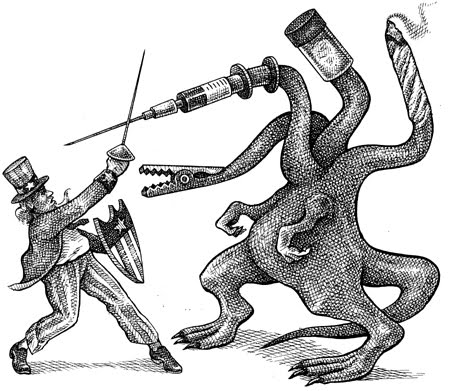
Jonah Raskin : Interviewing Journalist and Gay Activist Allen Young

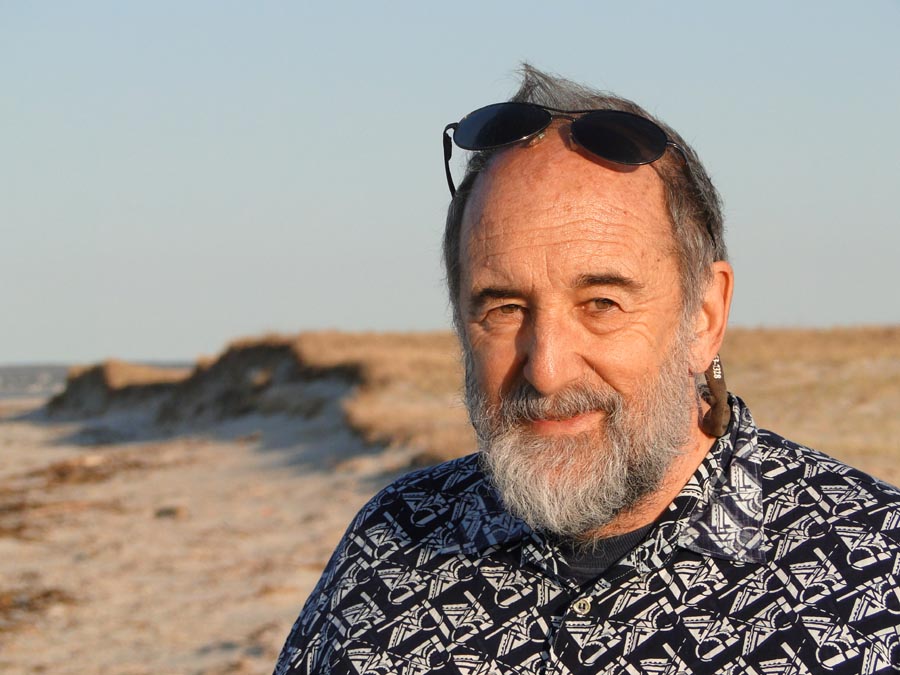
Allen Young, 2009. Photo by Diane Keijzer.

In and out of the closets:
An interview with journalist Allen Young

By Jonah Raskin / The Rag Blog / June 30, 2011

A week before Allen Young celebrated his 70th birthday, New York Governor Andrew Cuomo signed a bill legalizing same sex-marriage. The sexual revolution that had begun in the 1960s reached a crescendo, and there was much to celebrate at Young’s birthday bash.

Born in Liberty, New York six months before the bombing of Pearl Harbor, he’s been a life-long advocate of personal and political liberty, and all his life he’s been opposed to war. Since 1970, Young has been active in gay liberation and has written extensively about the oppression and the liberation of gay men and lesbian women.

In addition to books such as Gays Under the Cuban Revolution and anthologies he has edited with Karla Jay, such as Out of the Closets, he has written about his own region in Make Hay While the Sun Shines.

Once a reporter for The Washington Post, and, at the height of the cultural revolution of the 1960s, a mainstay at Liberation News Service (LNS), where he was a colleague of Rag Blog editor Thorne Dreyer, Young lives now in Massachusetts, writes a regular column for the Athol Daily News, and is an active citizen in his community.

In this interview with long-time Rag Blog contributor Jonah Raskin, he looks back at his life in journalism, the New Left, and Gay Liberation, and offers his reflections on the United States today: the mass media, right-wing politicians, and small towns.

Jonah Raskin: You’ve been a journalist most of your life. What’s the single most important change you’ve seen in your lifetime?

Allen Young: When I was growing up, the word homosexual rarely appeared in print. I never saw anything in print about gay people that was positive. That’s changed. There’s an often-repeated joke now that “the love that dare not speak its name won’t shut up.”

If there’s one story you’re proudest of writing what story is it?

It took courage to write about the persecution of gay men and lesbians in “revolutionary” Cuba. I’m particularly proud because I did not make excuses for this persecution, as others did, by blaming it on machismo and the Roman Catholic heritage in Cuba. Rather, I focused on the fact that this was ideology imported by Cuba from the international communist movement, going back to Stalinism, and enforced by a police state.

There has been a lot of attention recently to the underground press of the 1960s and 1970s. What would you say was your major contribution to the underground papers?

Although leadership was starting to become a dirty word in the late 1960s, often a synonym for elitism, I played a leadership role at Liberation News Service (LNS). I helped to mold the organization in the late 1960s into a well-organized collective with a stipend for its staff and a commitment to sending out news reliably.

Do you feel oppressed as a gay man in American society today?

I have great joy in my life, being partnered for 31 years, and with many supportive friends both gay and straight. But feelings of oppression linger because millions of Americans still regard people like me as inhuman, immoral, disgusting, and even monstrous. What also weighs heavily on me is the oppression experienced by gays and lesbians in nations around the world, especially Africa, Eastern Europe, and the Middle East.

You’ve been active in the gay liberation movement over the past 40 years or so. Was life hell before gay liberation?

Despite many outward signs of personal success, such as winning scholarships, becoming editor-in-chief of my college’s daily newspaper, having articles published in The New York Times, and later becoming respected in the New Left, I lived daily with a powerful feeling that I could never tell anyone who loved me (much less strangers) about my true nature. That kind of self-loathing and hiding is indeed hellish.

What would you say changed for you most of all after the arrival of gay liberation?

I could feel good about myself and I could be honest. That was huge. Leftwing ideology did nothing to liberate me as a gay person and this realization led me first to question dogma and then to reject it and all forms of zealotry.

When you see gay men these days who don’t know their history what might you say to them?

Don’t take for granted the freedoms you have and be aware that many people, even those around you, are living in fear. The lives of gay people were very restricted in the past, and a political movement was needed to bring about change. In more than half the states in the U.S., it’s still legal for employers to fire gay workers just because they are gay, for example. A movement is still needed.

Who would you say are the unsung heroes of gay liberation?

The Stonewall Rebellion took place in 1969. There were no more than 1,000 gay men and lesbians (as well as bisexuals and transgendered people) active nationwide in the post-Stonewall gay movement. In New York, there were only a few dozen people who attended meetings of the Gay Liberation Front and the Gay Activists Alliance and who demonstrated against the police, the media, and psychiatrists. To name a few names of heroes from those days: Ron Auerbacher, Bob Bland, Pat Maxwell, Step May, Roni Schnitzer, Ron Ballard, Jerry Hoose, Dana Gillespie, Marty Steffens, Suzanne Bevier, Mark Silber.

You’ve lived in rural Massachusetts for decades? What do you like about rural life?

The challenge of finding a way to relate to people with different worldviews and experiences. In urban environments, and in college towns, it’s too easy to conform and relate exclusively to people who agree with you. Life here is more “real.”
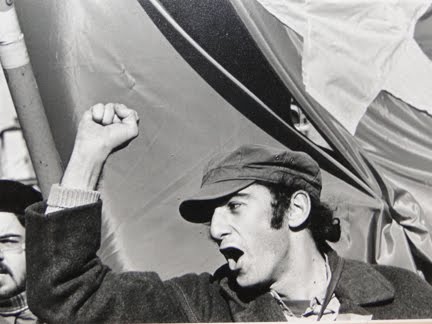
Allen Young, then with LNS, at an anti-war rally in Washington, D.C. in 1969. Photo by David Fenton.

Do you think you’ve been shaped by one decade, say the 1960s or the 1970s, more than any other decade?

Every decade of my life shaped me. I think of myself as an aging hippie and a Sixties person. I feel a special affinity with the many people who drastically altered their lives in the 1960s to combat the Vietnam War and “the establishment,” and who enjoyed marijuana and LSD, but much of this continued into the 1970s.

What do you miss about urban life?

Not a thing.

What were the worst aspects of the New Left?

I have negative feeling, even shame, about the fascination with and glamorizing of armed struggle that was common in the New Left. I feel particularly bad about our insistence on displaying the flag of the National Liberation Front of South Vietnam. While opposing the war, we might have acknowledged that the NLF’s vision for Vietnam did not include civil liberties and democracy. New Leftists did a good job of expanding the ranks, but we did not do a great job of communicating with the rest of America.

And what about the best aspects?

The New Left emerged from the repressive McCarthy era and rejected the rigid and often dishonest dogma of the Old Left. Influenced by the beatniks, New Leftists challenged repressive American culture, including repressive drug laws, while celebrating the joyous and mind-expanding aspects of cannabis and psychedelics. The New Left presented a vision that would end racism, militarism, jingoism, and the exploitation of workers. There were hints of a loving community, though male chauvinism was a barrier.

What has surprised you the most about American life in, say, the last decade or so?

The widespread support for right-wing media, especially Fox News and stars such as Glenn Beck and Rush Limbaugh. I’m also surprised at the extent to which people have embraced political figures I find extremely unattractive and witless such as George W. Bush and Sarah Palin. I’m surprised how few people are outraged about the excesses of the rich and powerful.

What if anything would you do differently if you could go back and redo your own life?

I would have come out as gay in my teenage years so I could have enjoyable sex and romance in my life when I was my most youthful. Fortunately, I did have an important and exciting physical and emotional relationship with a college classmate, but it was characterized by a lot of fear and I could not make it endure despite efforts to do so.

Are you hopeful about the future and if so why?

I have mixed feelings about the future. I’m hopeful because I see many young people acquiring an interest in sustainable agriculture. I’m pessimistic because I see powerful forces throughout the world promoting violent solutions to problems and doing nothing to stop global warning and environmental degradation.

What do you look forward to in your own life?

I look forward to remaining active and healthy and enjoying the companionship of my long-term partner, and facing death with dignity. I hope that I won’t suffer from a debilitating disease and die a slow death. I would like to have physician-assisted suicide available to me if I need it.

You have friends and neighbors in your neck of the woods. What do you like most about them?

They make me laugh and appreciate my sense of humor. They share my appreciation of small-town life, the concept of community and respect and love for the natural world. It’s rare, around here, to find people motivated by greed or hatred, or who use violence to solve problems.

What’s best about small town America?

The small towns in New England, at least the ones I know best, accept nonconformity and have a strong sense of community. I like the quiet of country living and the opportunity to grow my own food.

[Jonah Raskin is the author of For the Hell of It: The Life and Times of Abbie Hoffman, and teaches media at Sonoma State University. Read more articles by Jonah Raskin on The Rag Blog.]


The Rag Blog

Posted in Rag Bloggers | Tagged , , , , , , , | 4 Comments

Glenn W. Smith : Conservative Lies About Human Nature

The “gloomy Hobbesian picture.” Graphic from Apollo.Gold.

A dog-eat-dog world?
Conservative lies about human nature

By Glenn W. Smith / The Rag Blog / June 29, 2011

Since World War II, America’s elite policy makers have arranged and rearranged our political and economic relationships around an empirically false — radically false — understanding of human being and behavior.

Paradoxically, the false portrait of humankind feeds both an unwholesome worship of dog-eat-dog individualism and a sense of powerlessness in the face of godlike market forces that must be obeyed no matter the cost in lives, global environmental catastrophe, or gross economic injustice.

Its roots lie in the gloomy Hobbesian picture of unredeemable, brutish humanity and in the Enlightenment’s faith in universal reason. Twentieth Century conservative thinkers, looking to rationalize authoritarianism and excuse the inevitable social destruction caused by unrestrained greed, simply invented new concepts of human nature that made their policy goals seem essential.

It’s just one of many ironies that this authoritarian view was swallowed whole hog by so-called libertarians. (It should be noted that Robert Nozick, author of the seminal libertarian book, Anarchy, State, and Utopia, later spit out the worm he’d swallowed and repudiated his earlier work.)

The ugly, empirically false portrait is this: a human is a cold and isolated individual who uses unemotional reason to reach predetermined ends. This is the widely discredited but still popular “rational actor” model. And there’s another color in the picture, which some are now calling the “rat choice” model. This tells us those predetermined ends are always selfish or self-interested.

We are, these conservatives say, rats.

As virtually every field within the human sciences has found, we are nothing like that. Because we are hard-wired for empathy, we can and do act altruistically. We seek fairness. Our selves are not isolated, but interconnected in many ways. We are competitive, but we are also cooperative. Reason and emotion are intertwined. There’s no such thing as unemotional reason. We don’t coldly follow the rules of logic in making moral decisions.

In his new book, The Fair Society, biologist Peter Corning writes:

Contrary to the stereotype about our innate selfishness and greed, most of us share a desire to live in a society where fairness is the operative norm, where everybody’s basic needs are met… where there is a robust sense of “reciprocity” — a rough balancing of benefits and obligations.

Cognitive scientists like George Lakoff have been urging us to grasp the new 21st Century understanding of human being and thinking. Dozens of others have made similar points. We can’t advance a progressive social vision using false assumptions disguised as unbiased scholarship, assumptions intended to forever preclude a fair, progressive, democratic society.

In her new book, Cultivating Conscience, UCLA law professor Lynn Stout demolishes the concept of “homo economicus,” the descriptive name for the lonely, selfish, hyper-rational, and exclusively materialist creature invented by conservative propagandists.

That view, Stout says, “implies we are psychopaths.”

It should come as no surprise that corporations and wealthy conservative ideologues funded the multi-decade effort to convince Americans our nature is other than it is. First came the Rand Corporation. It was there that economist Kenneth Arrow articulated the so-called “rational choice” theory. Here’s how historian Alex Abella summed it up in Soldiers of Reason:

Arrow’s rational choice theory would become a mainstay of economics and political science; by the 1960s… it would redefine the foundations of public policy by assuming that self-interest defines all aspects of human activity… When applied to corporations, the theory exempted them from any social responsibility other than that owed to their shareholders…

Next came the so-called “law and economics” movement, centered mostly at the University of Chicago and spearheaded by Richard Posner, Gary Becker, and others. In a nutshell, its propagandists insisted that the “rational actor” model be employed to decide legal disputes.

Such right-wing benefactors as Richard Scaiffe funded the law and economics movement with millions of dollars to the University of Chicago, the Manhattan Institute, and other institutions. The funding was not intended to help a search for truth. It was intended to paint a picture of human nature that justified unbridled greed and the injustice that follows from its institutional legitimacy.

There are echoes here of other authoritarian traditions that condemned the rabble to justify elite power. The religious myth about the Fall of Man, for instance, is accompanied by the assertion that only priests and pastors can save us from ourselves.

Conservative columnist David Brooks is clearly alarmed that the dark vision of humanity that fueled the conservative movement for decades is being unmasked. He is trying to fit the new, more humanistic and hopeful portrait into a scheme for more, not less, authoritarian control.

In his book, The Social Animal, Brooks recommends the new human sciences be employed to shape (read: control) people’s behavior. He leaves untouched all questions about whether such control is moral.

Edwin L. Rubin, who elaborated on the “rat choice theory” mentioned above, summed up the motivations of those who invented the cruel, selfish homo economicus:

…rational choice theory and rat choice theory, when combined, provide a comprehensive argument for an unregulated market, an argument grounded in a theory of human behavior and human choices.

Just last week, philosopher John McCumber took on the rational actor model and homo economicus in The New York Times:

Whatever my preferences are, I have a better chance of realizing them if I possess wealth and power. Rational choice philosophy thus promulgates a clear and compelling moral imperative: increase your wealth and power!

A moral imperative for the pursuit of wealth and power, whatever the consequences for the many and for society at large. That was the goal of the confidence men who sold us a false and destructive view of our own natures. So successful were they that many progressives (and most Democrats) remain content to operate within the frames and narratives generated by the scam.

Our most important task involves replacing the deceitful view of humankind with the new — and true — picture of cooperative, empathic, and complex human being (we can, obviously, be selfish, cruel and violent — but that’s not all we are).

A society organized around the values generated by such a picture will look radically different from political and economic structures forced upon us by the greedy authoritarians who sold us a bill of goods about ourselves.

[Austin’s Glenn W. Smith, according to Daily Kos founder Markos Moulitsas, is a “legendary political consultant and all-around good guy.” His excellent blog on politics and culture is DogCanyon, where this article was also posted. Read more articles by Glenn W. Smith on The Rag Blog.]

The Rag Blog

Posted in Rag Bloggers | Tagged , , | 1 Comment

Mary Tuma : Rick Perry (Selectively) Touts Texas Economy With Glenn Beck

It’s all good. Rick Perry’s broad brush. Image from The Last Refuge.

Schmoozing with Glenn Beck:
Rick Perry paints the Texas
economy with a broad brush

Texas leads the nation in the number and proportion of people making minimum wage or less.

By Mary Tuma / The Texas Independent / June 29, 2011

AUSTIN — On Monday, Texas Gov. Rick Perry appeared via satellite on Fox News’ Glenn Beck Show — this time sticking around longer than his 35-second in-person cameo on the program two weeks ago — to tout the Texas economy and job creation numbers, his prime talking points as of late.

Beck, whose television program is set to end Thursday, prefaced the interview by lauding Texas for generating 37 percent of all new post-recession U.S. jobs since June 2009. Both he and Perry avoided mentioning the state’s structural budget deficit, sweeping cuts to health services and public education, and its surge of low-wage jobs, as noted by the Texas Independent.

From 2007 to 2010, the number of minimum wage workers in Texas rose from 221,000 to 550,000, an increase of nearly 150 percent. Texas leads the nation in the number and proportion of people making minimum wage or less.

Aside from the lack of a state income tax and Perry’s push for tort reform, neither the host nor guest paid much attention to other variables that could have influenced the job creation numbers, such as Texas’ natural resources, energy and high-tech industries, successful Gulf port business, and trade with Mexico and China, all factors pointed to by Pia Orrenius, a senior economist at the Dallas Federal Reserve — the source of the 37 percent figure (via PolitiFact Texas).

Referencing a critical story in TIME Magazine’s Swampland, Beck asked Perry to assess the idea that he is a “master at the theater of job poaching” from other states like California and New York, to which Perry replied, that is what the “Founding Fathers had in mind with the Tenth Amendment.”

(That particular amendment explicitly asserts that powers not granted by the U.S. Constitution to the federal government are reserved to the individual states; unless those powers are prohibited by the U.S. Constitution to the states — then they are reserved to the people.)

The TIME article recounted a trip Perry made to California last November in which he “crowed that he had stolen 153 businesses from the Golden State in 2010; some 92 companies moved the other way, leaving Perry with a net gain of 61 businesses.”

A CNN opinion piece, written by a former Dallas Morning News columnist, calls the “Texas miracle” a mere “mirage.” In it, state Rep. Joaquin Castro (D-San Antonio) says many of those highly touted jobs went to people moving to Texas in order to take those jobs, and therefore, fail to raise the employment rate of native Texans:

“That jobs thing is a sleight of hand,” Castro said. “More than half of those new jobs have been filled by non-Texans. So it’s people moving here to take those jobs. It underscores this bipolar state that we live in. You have a population in Texas that is generally lower educated, poor, isn’t covered by health insurance… all of these things… so you can recruit these companies to come here from out of state but your own people, often times, aren’t qualified to fill these jobs.”

The way that Castro sees it, this is all about long-term investment and conflicting priorities.

“We’re not creating a system that educates them well and prepares them,” he said. “We underinvest in these things, which is what Perry is doing in public education and higher education. We can create the jobs, and that’s great. But our own people who have gone through Texas schools and Texas universities aren’t the ones filling them.”

When Beck brought up the TSA “anti-groping” bill, added to the special session call by Perry, the governor took to the opportunity to voice his disapproval of federal employee-led unions:

Beck: Are you concerned at all about the organizing of the airport workers by the AFL-CIO? The security, homeland security?

Perry: Sure. I think anytime you have federal employees being unionized, I have a real problem with that. You don’t have to look much further than what we have already that those federal agencies, or the federal employees that are unionized at the end of the day, it’s not in the best interest of the citizens, certainly the citizens who aren’t part of the union.

As a “right-to-work” state, employees in Texas cannot be required to join unions upon employment. The classification is seen by opponents as a means to deter from collective bargaining, a way to dilute unionization and prevent employees from securing higher paying jobs.

According to a report by the Economic Policy Institute, the “right-to-work” law — because it decreases wages and benefits, weakens workplace protections, and minimizes the likelihood that employers will be required to negotiate with their employees — “is advanced as a strategy for attracting new businesses to locate in a state.”

The report’s analysis of Oklahoma, the most recent state to enact a “right-to-work” law, also found evidence that the laws could actually hurt the economic prospects of states looking to branch out from traditional or low-wage manufacturing jobs into areas such as high-tech manufacturing or “knowledge” sector jobs.

Referring to reporting by the Associated Press, Media Matters for America also notes:

Although Beck cited Texas’ AA+ rating from S&P, he neglected to mention that Texas is “unlikely to receive the top AAA rating because lawmakers have not addressed a structural deficit created by an underperforming business tax.”

Beck joked that he is considering moving to Texas and toyed with the idea of running for Perry’s spot, if he decides to make a presidential bid, saying,

You know, Rick, I mean this sincerely. And I know that you’re considering possibly running for president of the United States. And I’m considered possibly moving to Texas. I don’t know who your lieutenant governor is, but I am thinking that we’re not going to let you leave Texas. I mean, I could run for governor of Texas, I’m just saying.

Political observers expect current Lt. Gov. David Dewhurst to announce soon that he will campaign for the U.S. Senate seat to be vacated by Sen. Kay Bailey Hutchison.

[Mary Tuma is a reporter for The Texas Independent and will be contributing regularly to The Rag Blog. A graduate of the University of Texas School of Journalism, Tuma has worked for The Houston Chronicle, The Texas Observer, and Community Impact Newspaper. She is in the process of obtaining her master’s degree in media studies from UT-Austin. Born and raised in Houston, she now calls Austin home. This article first appeared at The Texas Independent.]

The Rag Blog

Posted in Rag Bloggers | Tagged , , , , , | 2 Comments

Dr. Stephen R. Keister : Poverty and Public Health in America

The picture of poverty in America. Image from Bay View.

Poverty and public health:
The social causes of death in America

By Dr. Stephen R. Keister / The Rag Blog / June 29, 2011

“[The] incredible absolute size and commanding market positions [of a few immense corporations] make them the most exceptional manmade creatures of the twentieth century… In terms of the size of their constituency, volume of receipts and expenditures, effective power, and prestige, they are more akin to nation-states than business enterprises of the classic variety.” — Richard Barber, from the book Friendly Fascism by Bertrand Gross.

These days we are always on the lookout for a bit of encouraging news. But the final analysis of the Vermont health care plan comes as a bitter disappointment. The online organization Single Payer Action on June 21 provided us with the sad news: the much-touted Vermont plan is not single payer, not even close.

It seems that the phrase “single payer” was stripped out during the final negotiations, and the implementation of the legislation is dependent on federal approval. It also appears that agencies in Washington will not grant needed waivers. The bill permits the private insurers to operate in Vermont indefinitely.

ScienceDaily reports on a study done at the Columbia University School of Public Health that brings home once again the great failings of the healthcare system in the United States. The study “found that poverty, low levels of education, poor social support and other social factors contribute about as many deaths in the U.S. as such familiar causes as heart attacks, strokes, and lung cancer.”

The investigators found that approximately 245,000 deaths in the year 2000 could be attributed to low levels of education, 176,000 to racial segregation, 162,000 to low social support, 133,000 to individual poverty, 119,000 to income inequality, and 39,000 to area-level poverty.

Overall, 4.5% of U.S. deaths were found to be attributable to poverty — midway between previous estimates of 6% and 2.3%. However, the risks associated with both poverty and low education were higher for individuals ages 25-64 than for those of 65 or older. The authors’ findings for a broader public health conceptualization of the causes of mortality and an expansive policy approach that considers how social factors can be addressed to improve the health of populations.

Meanwhile, our elected representatives continue their budget negotiations in Washington with an eye on further cutting an already inadequate Medicaid program and “revising” Medicare benefits, continuing the downward spiral of health care for the poor, the disabled, our returning servicemen/women, and the emotionally ill.

Happily, there is some galvanizing opposition, as witnessed by a massive protest by National Nurses United in Lafayette Square demanding a tax revenue increase from corporations in order to prevent such cuts in Medicaid and Medicare.

I am encouraged by the rare occasions that a group of dedicated Americans will gather in public to speak up against injustice. But I also wonder about the lack of public militancy against injustice here that we see demonstrated by the citizens in our fellow democracies in Europe, especially in Greece, Spain, France, and the United Kingdom.

It would seem that there is an answer, a disturbing answer, contained in an article by Harriet Fraad, published in Tikkun and distributed by AlterNet. The title: “Why Are Americans Passive as Millions Lose Their Homes, Jobs, Families, and the American Dream?” While Dr. Fraad offers some suggestions, one hopes that they do not come too late.

Noam Chomsky peripherally addressed this matter in a 1995 essay when he wrote:

A final point, something I’ve written about elsewhere (e.g., in a discussion in Z papers and in the last chapter of Year 501). There has been a striking change in the behavior of the intellectual class in recent years. The left intellectuals who… years ago would have been teaching in working-class schools, writing books like Mathematics for the Million, participating in and speaking for popular organizations, etc., are now largely disengaged from such activities, and although quick to tell us that they are far more radical than thou, they are not to be found, it seems, when there is an obvious and growing need and even explicit request for the work they could do out there in the world of people with live problems and concerns. That’s not a small problem. This country right now is in a very strange and ominous state.

People are frightened, angry, disillusioned, skeptical, confused. That’s an organizer’s dream… It’s also fertile ground for demagogues and fanatics who can (and, in fact, already do) rally substantial popular support with messages that are not unfamiliar from their predecessors in somewhat similar circumstances. We know where it has led in the past; it could again. There’s a huge gap that once was at least partially filled by left intellectuals willing to engage with the general public and their problems. It has ominous implications, in my opinion.

A few bright lights in the darkness: Senator Bernie Sanders is facing down the pharmaceutical industry. He has introduced a bill in the Senate authorizing government expenditures of some $80 billion per year to buy up the patents that were awarded to the drug companies for “carrying out research.”

These patents, in essence, provide government-granted patent monopolies, thus providing the pharmaceutical companies the right to price drugs at hundreds of dollars per prescription and sometimes several thousand dollars per prescription in the United States.

The money would come from a tax on public and private insurers. The savings from lower-cost drugs would immediately repay more than 100 per cent of the tax.

The country is projected to spend almost $300 billion on prescription drugs this year. Prices would fall to roughly one-tenth the amount in the absence of patent monopolies, leading to a savings of more than $250,000 billion. The savings on lower drug prices should easily exceed the size of the tax, leaving a substantial net reduction in costs to the government and private insurers. For more details about the legislation, see “The Drug Market Scam” by Dean Baker on AlterNet.

The other side of the coin involves a decision by the Supreme Court on June 23, 2011, freeing the generic drug makers from providing consumers with the specific dangers of using a drug. The court, at the same time, gave the pharmaceutical industry access to prescriptions written by physicians for their patients. So much for “patient-physician confidentiality”!

The other bit of good news came in a June 16 New York Times op-ed by President Jimmy Carter, when he joined the chorus of those asking the government to call off the Global War on Drugs. Thus he added his voice to those of Richard Branson, George Shultz, and Paul Volker. President Carter pointed out that this legislation has increased our prison population from 500,000 people in 1980 to 2.3 million in 2009. The increase mostly is for crimes that are non-violent and related to drug possession. There are 743 people in prison for every 100,000 Americans, a higher proportion than in any other country and seven times as great as in Europe. Some 7.2 million people are either in prison, on probation, or on parole — more than 3% of all American adults.

The cost? California in 1980 spent 10% of the state’s budget on higher education and 3% on prisons. In 2010, almost 11% went to prisons and only 7.5% to higher education.

Of course, the fight for enlightened drug policy, as seen in most European nations, will be fought tooth and nail by those who are financially rewarded by the so-called war on drugs — the crime cartels and those receiving baksheesh from the criminal enterprises (corrupt law enforcement officers, politicians, judges, and the operators of our uniquely American private prisons).

One final personal thought: The Republicans keep repeating the mantra that if we increase the taxes on the wealthy, they will not have the funds to create jobs. Of course, this is pure and simple poppycock. Their wealth is not used to produce employment. In the autumn of 2008 at the time of the financial crash, I was talking to a Swiss banker who works for a typical big Swiss bank. In the autumn of 2008, he said, the bank’s below-street-level gold vault, encased in concrete, cracked open under the weight of the gold bullion being shipped in from the U.S.A.

Create jobs!?! Maybe for Swiss concrete workers…

[Dr. Stephen R. Keister lives in Erie, Pennsylvania. He is a retired physician who is active in health care reform and is a regular contributor to The Rag Blog. Read more articles by Dr. Stephen R. Keister on The Rag Blog]

The Rag Blog

Posted in Rag Bloggers | Tagged , , , , , , | Leave a comment

Harvey Wasserman : Countdown to Nuclear Disaster

Political cartoon by Olle Johansson, Sweden / Cagle Cartoons.

Countdown to disaster:
Fukushima spews, Los Alamos burns,
Vermont rages, and we’ve almost lost Nebraska

By Harvey Wasserman / The Rag Blog / June 29, 2011

Humankind is now threatened by the simultaneous implosion, explosion, incineration, courtroom contempt, and drowning of its most lethal industry.

We know only two things for certain: worse is yet to come, and those in charge are lying about it — at least to the extent of what they actually know, which is nowhere near enough.

Indeed, the assurances from the nuke power industry continue to flow like the floodwaters now swamping the Missouri Valley heartland.

But major breakthroughs have come from a Pennsylvania senator and New York’s governor on issues of evacuation and shut-down. And a public campaign for an end to loan guarantees could put an end to the U.S. industry once and for all.

FUKUSHIMA: The bad news continues to bleed from Japan with no end in sight. The “light at the end of the tunnel” is an out-of-control radioactive freight train, headed to the core of an endangered planet.

Widespread internal radioactive contamination among Japanese citizens around Fukushima has now been confirmed. Two whales caught some 650 kilometers from the melting reactors have shown intense radiation.

Plutonium, the deadliest substance known to our species, has been found dangerously far from the site.

Tokyo Electric and the Japanese government have admitted to three 100% meltdowns but can’t confirm with any reliability the current state of those cores. There’s reason to believe one or more have progressed to “melt-throughs” in which they burn through the thick stainless steel pressure vessel and onto the containment floor.

The molten cores may be covered with water. But whether they can melt further through the containments and into the ground remains unclear.

Possibilities may include a “China Syndrome” scenario in which one or more still-molten cores does melt through the containment and hits ground water. That could lead to a steam explosion that could blow still larger clouds of radioactive steam, water and debris into the atmosphere and ocean.

At least three explosions have occurred, one of which may have involved criticality.

There is no doubt at least two containments were breached very early in the disaster. Unit Four is cracked and sinking. The status of its used radioactive fuel pool, which has clearly caught fire, is uncertain. Also unclear is the ability of the owners to sustain the stability of Units Five and Six, which were shut when the quake/tsunami hit.

That stability depends on continued power to run cooling systems, which could disappear amid seismic aftershocks many believe are inevitable. A very substantial quake hit after the tremors that led to Indonesia’s devastating tsunami, and few doubt it could happen again — soon — at Fukushima.

All the above is dependent on reports controlled primarily by Tokyo Electric and the Japanese government. There is every reason to believe the situation is worse than it seems, and that those in charge don’t really know the full extent of the damage or how to cope with it.

Just five years ago a quake shut seven reactors at Kashiwazaki. The entire nation of Japan sits on a wide range of fault lines. Tsunami is a Japanese word.

Radiation from Fukushima has long since been detected throughout the northern hemisphere, with health effects that will be debated forever.

Some 50 reactors still operate in Japan. According to some, the Japanese public has the legal right to shut them all.

Let us pray they do. Yesterday.

LOS ALAMOS: A massive wildfire has swept at least to the outskirts of the national laboratory that was at the core of the program that built the Atomic Bomb.

The first explosion irradiated a nearby valley on July 16, 1945. Then came the two that obliterated Hiroshima and Nagasaki.

There are significant quantities of stored radioactive material in and around Los Alamos. How much there is, where it is, how badly it is threatened, how much (if any) has already been engulfed in flames remains to be seen. Evacuations are underway.

Official reassurances are not reliable.

Nor are estimates of the potential for radioactive fallout to spread throughout North America and beyond.

Political cartoon by R.J. Matson / The St. Louis Post-Dispatch / Roll Call.

VERMONT YANKEE: Entergy, owner of the one reactor in Vermont, has sued to shred a solemn public contract.

The one thing certain here is the company’s contempt for the sanctity of its own word.

Years ago Entergy sought official permits at VY. It promised in return that the state could choose to shut the reactor on March 21, 2012, which it’s now done.

In recent years VY has spewed tritium into groundwater and the Connecticut River, in some cases from underground pipes whose existence the company denied. A cooling tower has collapsed.

But the Nuclear Regulatory Commission has extended the reactor’s license and asked the federal Justice Department to intervene on behalf of the utility.

The request trashes any credibility retained by the NRC. The Commission was established in the mid 1970s to be a disinterested party on which the public could rely. For it to now take a partisan stand on behalf of a reactor owner it’s bound to regulate thoroughly contaminates the core of its existence.

Entergy has sued so it can buy some $65 million in radioactive fuel the people of Vermont do not want burned on their land.

This will go to the U.S. Supreme Court, where the future legal sanctity of any and all public contracts signed by any corporation, nuclear or otherwise, may be determined.

NEBRASKA: The flooding Missouri River continues to threaten at least two heartland reactors.

Late reports indicate Cooper may still be running, with public assurances it could be shut very quickly. What might happen if the operators are a little bit late has not been explained.

Nor is there much to go on about the impacts of flooded cores and fuel cooling ponds on the Missouri and Mississippi Rivers or the eco-systems along the way to a Gulf of Mexico still reeling from BP’s toxic dose.

But an almost surreal set of circumstances surrounds the true nature of design specifications and protections in place (or not) at Ft. Calhoun.

They may be best summarized by what happened to a “flood berm” meant to protect Ft. Calhoun. This huge rubberized water-filled sausage was 16 feet at the base and eight feet high.

But CNN has quoted a company representative as saying that some sort of equipment “came in contact” with the berm and punctured it.

Not to worry: the “same level of protection is in place” as had been prior to the installation of the berm.

In other words, the device was installed to protect the reactor. Then somebody punctured it. But things are as they were before so they must not have needed that berm in the first place. Got it?

It’s as yet unclear whether flood waters will continue to rise at these two reactors, whether the operators can protect them, and what will happen if they can’t.

The corporate media is carrying virtually zero coverage of any of the above stories. All are subject to rapid, dangerous changes about which we may have little reliable information.

But we do know for sure that U.S. Senator Robert Casey, Jr. (D-PA) now wants to see more deeply into one of the key holes in the nuclear façade: evacuation.

After Three Mile Island’s 1979 partial melt-down, new federal legislation allegedly gave states more power over how to get people out of the path of a melting nuke.

But after an as-yet unopened Perry reactor was damaged by a 1986 earthquake, Ohio’s then-Governor Richard Celeste sued to keep Perry shut pending a state evacuation study.

The NRC refused and won in federal court. Perry opened. Ohio’s official study then said evacuation was virtually impossible.

A quarter-century later, Casey wants to see what it might now take to move downwinders out of harm’s way from a TMI, Perry, Chernobyl, Fukushima, Vermont Yankee, Cooper, Ft. Calhoun… you name it.

Casey’s being joined by New York Governor Andrew Cuomo, whose demands for the shut-down of Indian Point, 35 miles north of Manhattan, have left its owners “shaken.”

Cuomo and Casey might do well to join governors of states like Vermont, Massachusetts, California, and others in testing the law on evacuation planning. Populations have vastly increased at virtually all U.S. reactor sites since TMI. And the ugly realities that define the so-called “peaceful atom” are still making themselves all too apparent.

Whether the U.S. will now turn with Germany, Japan, Italy, Switzerland, Israel, and others away from atomic power and toward a green-powered Earth is up to us. The Solartopian technologies of wind, solar, tidal, geothermal, ocean thermal, bio-fuels, increased efficiency, and conservation are now demonstrably cheaper, safer, cleaner, more reliable, more job-producing, and quicker to install than anything atomic energy can promise.

A $36 billion loan guarantee give-away still mars the proposed 2012 federal budget. Constant pressure on Congress and the White House can kill that, and any other proposed funding for still more of these nightmares.

The stream of reactor disasters spewing from this dying industry is certain to escalate. The toll rises with each leak at Fukushima, every flame at Los Alamos, each legal brief at Vermont Yankee, every foot of Nebraska floodwater.

The need to stop the madness grows more desperate every day.

[Harvey Wasserman edits the NukeFree.org website. His most recent book is Solartopia! Our Green-Powered Earth. His “Solartopia! Green-Power Hour” is at www.talktainmentradio.com every Wednesday, 8-9pm. Read more of Harvey Wasserman’s writing on The Rag Blog.]

The Rag Blog

Posted in Rag Bloggers | Tagged , , , , | 1 Comment

By Dr. Stephen R. Keister / The Rag Blog / June 29, 2011

“[The] incredible absolute size and commanding market positions [of a few immense corporations] make them the most exceptional manmade creatures of the twentieth century… In terms of the size of their constituency, volume of receipts and expenditures, effective power, and prestige, they are more akin to nation-states than business enterprises of the classic variety.” — Richard Barber, from the book Friendly Fascism by Bertrand Gross.

These days we are always on the lookout for a bit of encouraging news. But the final analysis of the Vermont health care plan comes as a bitter disappointment. The online organization Single Payer Action on June 21 provided us with the sad news: the much-touted Vermont plan is not single payer, not even close.

It seems that the phrase “single payer” was stripped out during the final negotiations, and the implementation of the legislation is dependent on federal approval. It also appears that agencies in Washington will not grant needed waivers. The bill permits the private insurers to operate in Vermont indefinitely.

ScienceDaily reports on a study done at the Columbia University School of Public Health that brings home once again the great failings of the healthcare system in the United States. The study “found that poverty, low levels of education, poor social support and other social factors contribute about as many deaths in the U.S. as such familiar causes as heart attacks, strokes, and lung cancer.”

The investigators found that approximately 245,000 deaths in the year 2000 could be attributed to low levels of education, 176,000 to racial segregation, 162,000 to low social support, 133,000 to individual poverty, 119,000 to income inequality, and 39,000 to area-level poverty.

Overall, 4.5% of U.S. deaths were found to be attributable to poverty — midway between previous estimates of 6% and 2.3%. However, the risks associated with both poverty and low education were higher for individuals ages 25-64 than for those of 65 or older. The authors’ findings for a broader public health conceptualization of the causes of mortality and an expansive policy approach that considers how social factors can be addressed to improve the health of populations.

Meanwhile, our elected representatives continue their budget negotiations in Washington with an eye on further cutting an already inadequate Medicaid program and “revising” Medicare benefits, continuing the downward spiral of health care for the poor, the disabled, our returning servicemen/women, and the emotionally ill.

Happily, there is some galvanizing opposition, as witnessed by a massive protest by National Nurses United in Lafayette Square demanding a tax revenue increase from corporations in order to prevent such cuts in Medicaid and Medicare.

I am encouraged by the rare occasions that a group of dedicated Americans will gather in public to speak up against injustice. But I also wonder about the lack of public militancy against injustice here that we see demonstrated by the citizens in our fellow democracies in Europe, especially in Greece, Spain, France, and the United Kingdom.

It would seem that there is an answer, a disturbing answer, contained in an article by Harriet Fraad, published in Tikkun and distributed by AlterNet. The title: “Why Are Americans Passive as Millions Lose Their Homes, Jobs, Families, and the American Dream?” While Dr. Fraad offers some suggestions, one hopes that they do not come too late.

Noam Chomsky peripherally addressed this matter in a 1995 essay when he wrote:

A final point, something I’ve written about elsewhere (e.g., in a discussion in Z papers and in the last chapter of Year 501). There has been a striking change in the behavior of the intellectual class in recent years. The left intellectuals who… years ago would have been teaching in working-class schools, writing books like Mathematics for the Million, participating in and speaking for popular organizations, etc., are now largely disengaged from such activities, and although quick to tell us that they are far more radical than thou, they are not to be found, it seems, when there is an obvious and growing need and even explicit request for the work they could do out there in the world of people with live problems and concerns. That’s not a small problem. This country right now is in a very strange and ominous state.

People are frightened, angry, disillusioned, skeptical, confused. That’s an organizer’s dream… It’s also fertile ground for demagogues and fanatics who can (and, in fact, already do) rally substantial popular support with messages that are not unfamiliar from their predecessors in somewhat similar circumstances. We know where it has led in the past; it could again. There’s a huge gap that once was at least partially filled by left intellectuals willing to engage with the general public and their problems. It has ominous implications, in my opinion.

A few bright lights in the darkness: Senator Bernie Sanders is facing down the pharmaceutical industry. He has introduced a bill in the Senate authorizing government expenditures of some $80 billion per year to buy up the patents that were awarded to the drug companies for “carrying out research.”

These patents, in essence, provide government-granted patent monopolies, thus providing the pharmaceutical companies the right to price drugs at hundreds of dollars per prescription and sometimes several thousand dollars per prescription in the United States.

The money would come from a tax on public and private insurers. The savings from lower-cost drugs would immediately repay more than 100 per cent of the tax.

The country is projected to spend almost $300 billion on prescription drugs this year. Prices would fall to roughly one-tenth the amount in the absence of patent monopolies, leading to a savings of more than $250,000 billion. The savings on lower drug prices should easily exceed the size of the tax, leaving a substantial net reduction in costs to the government and private insurers. For more details about the legislation, see “The Drug Market Scam” by Dean Baker on AlterNet.

The other side of the coin involves a decision by the Supreme Court on June 23, 2011, freeing the generic drug makers from providing consumers with the specific dangers of using a drug. The court, at the same time, gave the pharmaceutical industry access to prescriptions written by physicians for their patients. So much for “patient-physician confidentiality”!

The other bit of good news came in a June 16 New York Times op-ed by President Jimmy Carter, when he joined the chorus of those asking the government to call off the Global War on Drugs. Thus he added his voice to those of Richard Branson, George Shultz, Paul Volker, and many others.

President Carter pointed out that this legislation has increased our prison population from 500,000 people in 1980 to 2.3 million in 2009. The increase mostly is for crimes that are nonviolent and related to drug possession. There are 743 people in prison for every 100,000 Americans, a higher proportion than in any other country and seven times as great as in Europe. Some 7.2 million people are either in prison, on probation, or on parole — more than 3% of all American adults.

The cost? California in 1980 spent 10% of the state’s budget on higher education and 3% on prisons. In 2010, almost 11% went to prisons and only 7.5% to higher education.

Of course, the fight for enlightened drug policy, as seen in most European nations, will be fought tooth and nail by those who are financially rewarded by the so-called war on drugs — the crime cartels and those receiving baksheesh from the criminal enterprises (corrupt law enforcement officers, politicians, judges, and the operators of our uniquely American private prisons).

One final personal thought: The Republicans keep repeating the mantra that if we increase the taxes on the wealthy, they will not have the funds to create jobs. Of course, this is pure and simple poppycock. Their wealth is not used to produce employment. In the autumn of 2008 at the time of the financial crash, I was talking to a Swiss banker who works for a typical big Swiss bank. In the autumn of 2008, he said, the bank’s below-street-level gold vault, encased in concrete, cracked open under the weight of the gold bullion being shipped in from the U.S.A.

Create jobs!?! Maybe for Swiss concrete workers…

[Dr. Stephen R. Keister lives in Erie, Pennsylvania. He is a retired physician who is active in health care reform and is a regular contributor to The Rag Blog. Read more articles by Dr. Stephen R. Keister on The Rag Blog]

The Rag Blog

Posted in RagBlog | Leave a comment

Perry, Beck tout selective data on Texas economy
Governor uses broad brush to paint rosy picture of state economy, skips important details

By Mary Tuma / The Texas Independent / June 29, 2011

On Monday, Gov. Rick Perry appeared via satellite on Fox News’ Glenn Beck Show — this time sticking around longer than his 35-second in-person cameo on the program two weeks ago — to tout the Texas economy and job creation numbers, his prime talking points as of late.

Beck, whose television program is set to end Thursday, prefaced the interview by lauding Texas for generating 37 percent of all new post-recession U.S. jobs since June 2009. Both he and Perry avoided mentioning the state’s structural budget deficit, sweeping cuts to health services and public education, and its surge of low-wage jobs, as noted by the Texas Independent.

From 2007 to 2010, the number of minimum wage workers in Texas rose from 221,000 to 550,000, an increase of nearly 150 percent. Texas leads the nation in the number and proportion of people making minimum wage or less.

Aside from the lack of a state income tax and Perry’s push for tort reform, neither the host nor guest paid much attention to other variables that could have influenced the job creation numbers, such as Texas’ natural resources, energy and high-tech industries, successful Gulf port business, and trade with Mexico and China, all factors pointed to by Pia Orrenius, a senior economist at the Dallas Federal Reserve — the source of the 37 percent figure (via PolitiFact Texas).

Referencing a critical story in TIME magazine’s Swampland, Beck asked Perry to assess the idea that he is a “master at the theater of job poaching” from other states like California and New York, to which Perry replied, that is what the “Founding Fathers had in mind with the Tenth Amendment.”

(That particular amendment explicitly asserts that powers not granted by the U.S. Constitution to the federal government are reserved to the individual states; unless those powers are prohibited by the U.S. Constitution to the states — then they are reserved to the people.)

The TIME article recounted a trip Perry made to California last November in which he “crowed that he had stolen 153 businesses from the Golden State in 2010; some 92 companies moved the other way, leaving Perry with a net gain of 61 businesses.”

A CNN opinion piece, written by a former Dallas Morning News columnist, calls the “Texas miracle” a mere “mirage.” In it, state Rep. Joaquin Castro (D-San Antonio) says many of those highly touted jobs went to people moving to Texas in order to take those jobs, and therefore, fail to raise the employment rate of native Texans:

“That jobs thing is a sleight of hand,” Castro said. “More than half of those new jobs have been filed by non-Texans. So it’s people moving here to take those jobs. It underscores this bipolar state that we live in. You have a population in Texas that is generally lower educated, poor, isn’t covered by health insurance… all of these things… so you can recruit these companies to come here from out of state but your own people, often times, aren’t qualified to fill these jobs.”

The way that Castro sees it, this is all about long-term investment and conflicting priorities.

“We’re not creating a system that educates them well and prepares them,” he said. “We underinvest in these things, which is what Perry is doing in public education and higher education. We can create the jobs, and that’s great. But our own people who have gone through Texas schools and Texas universities aren’t the ones filling them.”

When Beck brought up the TSA “anti-groping” bill, added to the special session call by Perry, the governor took to the opportunity to voice his disapproval of federal employee-led unions:

Beck: Are you concerned at all about the organizing of the airport workers by the AFL-CIO? The security, homeland security?

Perry: Sure. I think anytime you have federal employees being unionized, I have a real problem with that. You don’t have to look much further than what we have already that those federal agencies, or the federal employees that are unionized at the end of the day, it’s not in the best interest of the citizens, certainly the citizens who aren’t part of the union.

As a “right-to-work” state, employees in Texas cannot be required to join unions upon employment. The classification is seen by opponents as a means to deter from collective bargaining, a way to dilute unionization and prevent employees from securing higher paying jobs.

According to a report by the Economic Policy Institute, the “right-to-work” law — because it decreases wages and benefits, weakens workplace protections, and minimizes the likelihood that employers will be required to negotiate with their employees — “is advanced as a strategy for attracting new businesses to locate in a state.”

The report’s analysis of Oklahoma, the most recent state to enact a “right-to-work” law, also found evidence that the laws could actually hurt the economic prospects of states looking to branch out from traditional or low-wage manufacturing jobs into areas such as high-tech manufacturing or “knowledge” sector jobs.

Referring to reporting by the Associated Press, Media Matters for America also notes:

Although Beck cited Texas’ AA+ rating from S&P, he neglected to mention that Texas is “unlikely to receive the top AAA rating because lawmakers have not addressed a structural deficit created by an underperforming business tax.”

Beck joked that he is considering moving to Texas and toyed with the idea of running for Perry’s spot, if he decides to make a presidential bid, saying,

You know, Rick, I mean this sincerely. And I know that you’re considering possibly running for president of the United States. And I’m considered possibly moving to Texas. I don’t know who your lieutenant governor is, but I am thinking that we’re not going to let you leave Texas. I mean, I could run for governor of Texas, I’m just saying.

Political observers expect current Lt. Gov. David Dewhurst to announce soon that he will campaign for the U.S. Senate seat to be vacated by Sen. Kay Bailey Hutchison.

[Mary Tuma is a reporter for The Texas Independent and will be contributing regularly to The Rag Blog. A graduate of the University of Texas School of Journalism, Tuma has worked for The Houston Chronicle, The Texas Observer, and Community Impact Newspaper. She is in the process of obtaining her master’s degree in media studies from UT. Born and raised in Houston, she now calls Austin home. This article first appeared at The Texas Independent.]

The Rag Blog

Posted in RagBlog | Leave a comment

Glenn W. Smith : Conservative Lies About Human Nature

The “gloomy Hobbesian picture.” Graphic from Apollo.Gold.

A dog-eat-dog world?
Conservative lies about human nature

By Glenn W. Smith / The Rag Blog / June 29, 2011

Since World War II, America’s elite policy makers have arranged and re-arranged our political and economic relationships around an empirically false — radically false — understanding of human being and behavior.

Paradoxically, the false portrait of humankind feeds both an unwholesome worship of dog-eat-dog individualism and a sense of powerless in the face of godlike market forces that must be obeyed no matter the cost in lives, global environmental catastrophe or gross economic injustice.

Its roots lie in the gloomy Hobbesian picture of unredeemable, brutish humanity and in the Enlightenment’s faith in universal reason. Twentieth Century conservative thinkers, looking to rationalize authoritarianism and excuse the inevitable social destruction caused by unrestrained greed, simply invented new concepts of human nature that made their policy goals seem essential.

It’s just one of many ironies that this authoritarian view was swallowed whole hog by so-called libertarians. It should be noted that Robert Nozick, author of the seminal libertarian book, Anarchy, State, and Utopia, later spit out the worm he’d swallowed and repudiated his earlier work.)

The ugly, empirically false portrait is this: a human is a cold and isolated individual who uses unemotional reason to reach pre-determined ends. This is the widely discredited but still popular “rational actor” model. And there’s another color in the picture, which some are now calling the “rat choice” model. This tells us those pre-determined ends are always selfish or self-interested.

We are, these conservatives say, rats.

As virtually every field within the human sciences has found, we are nothing like that. Because we are hard-wired for empathy, we can and do act altruistically. We seek fairness. Our selves are not isolated, but interconnected in many ways. We are competitive, but we are also cooperative. Reason and emotion are intertwined. There’s no such thing as unemotional reason. We don’t coldly follow the rules of logic in making moral decisions.

In his new book, The Fair Society, biologist Peter Corning writes:

Contrary to the stereotype about our innate selfishness and greed, most of us share a desire to live in a society where fairness is the operative norm, where everybody’s basic needs are met… where there is a robust sense of “reciprocity” — a rough balancing of benefits and obligations.

Cognitive scientists like George Lakoff have been urging us to understand the new 21st Century understanding of human being and thinking. Dozens of others have made similar points. We can’t advance a progressive social vision using false assumptions disguised as unbiased scholarship, assumptions intended to forever preclude a fair, progressive, democratic society.

In her new book, Cultivating Conscience, UCLA law professor Lynn Stout demolishes the concept of “homo economicus,” the descriptive name for the lonely, selfish, hyper-rational, and exclusively materialist creature invented by conservative propagandists.

That view, Stout says, “implies we are psychopaths.”

It should come as no surprise that corporations and wealthy conservative ideologues funded the multi-decade effort to convince Americans our nature is other than it is. First came the Rand Corporation. It was there that economist Kenneth Arrow articulated the so-called “rational choice” theory. Here’s how historian Alex Abella summed it up in Soldiers of Reason :

Arrow’s rational choice theory would become a mainstay of economics and political science; by the 1960s… it would redefine the foundations of public policy by assuming that self-interest defines all aspects of human activity… When applied to corporations, the theory exempted them from any social responsibility other than that owed to their shareholders…

Next came the so-called “law and economics” movement, centered mostly at the University of Chicago and spearheaded by Richard Posner, Gary Becker, and others. In a nutshell, its propagandists insisted that the “rational actor” model be employed to decide legal disputes.

Such right-wing benefactors as Richard Scaiffe funded the law and economics movement with millions of dollars to the University of Chicago, the Manhattan Institute, and other institutions. The funding was not intended to help a search for truth. It was intended to paint a picture of human nature that justified unbridled greed and the injustice that follows from its institutional legitimacy.

There are echoes here of other authoritarian traditions that condemned the rabble to justify elite power. The religious myth about the Fall of Man, for instance, is accompanied by the assertion that only priests and pastors can save us from ourselves.

Conservative columnist David Brooks is clearly alarmed that the dark vision of humanity that fueled the conservative movement for decades is being unmasked. He is trying to fit the new, more humanistic and hopeful portrait into a scheme for more, not less, authoritarian control.

In his book, The Social Animal, Brooks recommends the new human sciences be employed to shape (read: control) people’s behavior. He leaves untouched all questions about whether such control is moral.

Edwin L. Rubin, who elaborated on the “rat choice theory” mentioned above, summed up the motivations of those who invented the cruel, selfish homo economicus:

…rational choice theory and rat choice theory, when combined, provide a comprehensive argument for an unregulated market, an argument grounded in a theory of human behavior and human choices.

Just last week, philosopher John McCumber took on the rational actor model and homo economicus in The New York Times:

Whatever my preferences are, I have a better chance of realizing them if I possess wealth and power. Rational choice philosophy thus promulgates a clear and compelling moral imperative: increase your wealth and power!

A moral imperative for the pursuit of wealth and power, whatever the consequences for the many and for society at large. That was the goal of the confidence men who sold us a false and destructive view of our own natures. So successful were they that many progressives (and most Democrats) remain content to operate within the frames and narratives generated by the scam.

Our most important task involves replacing the deceitful view of humankind with the new — and true — picture of cooperative, empathic, and complex human being (we can, obviously, be selfish, cruel and violent – but that’s not all we are).

A society organized around the values generated by such a picture will look radically different from political and economic structures forced upon us by the greedy authoritarians who sold us a bill of goods about ourselves.

[Austin’s Glenn W. Smith, according to Daily Kos founder Markos Moulitsas, is a “legendary political consultant and all-around good guy.” His excellent blog on politics and culture is DogCanyon, where this article was also posted. Read more articles by Glenn W. Smith on The Rag Blog.]

The Rag Blog

Posted in RagBlog | Leave a comment

FILM / Gregg Barrios : ‘Incendies’ is Scorching Odyssey of Death, Rebirth

Lubna Azabal in Incendies. Courtesy of eOne Films.

Denis Villeneuve’s Incendies:
A scorching odyssey of death and rebirth

By Gregg Barrios / The Rag Blog / June 28, 2011

[Incendies. Written and directed by Denis Villeneuve; Featuring Lubna Azabal, Mélissa Désormeaux-Poulin, Maxim Gaudette, and Rémy Girard.]

The opening sequence in Incendies is a stunning piece of poetic filmmaking: A desert in the Middle East framed in the window of a barracks where a dozen young Muslim conscripts readied for combat are having their heads shaved. Radiohead’s haunting “You and Whose Army?” quietly plays as the camera zooms in on a child soldier who refuses to blink.

Quick cut to modern day Montreal. A lawyer is reading the last will and testament of Nawal Marwan (Azabal) to her adult children twins Jeanne and Simon. They learn that their late mother wants them to deliver a letter to their father and their brother. This surprises both since their father has been long dead and they never knew they had another sibling.

Nawal also states that she wants to be buried “naked, face down, away from the world.” No name or epitaph on a gravestone because she did not keep her promises in life. However, once the letters are delivered, she can rest in peace in the knowledge of what she was never able to tell her children alive.

While this set-up might strike some viewers as shop-worn, it is the stuff that makes Shakespearean drama, grand opera and Greek tragedy lasting forms of storytelling.

Incendies (nominated for a best foreign film Oscar last year) tells a tale of lost children, fathers and sons, and mothers who hold those secrets at a great cost. Director Villeneuve renders his film in an almost epic scale. Its mash-up (section titles, pop anthems, and non-chronological structure) echo Olivier Assayas’ Carlos or Abbas Kiarostami’s Certified Copy. Still Villeneuve weaves his riveting tale alternating past with present to a fever pitch.

Their quest leads them — Jeanne willingly, Simon reluctantly — to a fictional Middle East country (modeled after Lebanon and their long civil war between Muslims and Christians).

The film parallels their search with the mother’s life: as a teen, the Christian-born Nawal has a romance with a young Muslim. Pregnant, she is forced to give up her child as a foundling but not before a midwife tattoos the child’s heel. The child’s mother vows to find him at whatever cost.

Nawal (Azabal’s dramatic portrayal is pitch perfect) is a raging life force whose devastating ordeals and star-crossed fate are constantly shifting as she too learns more about herself. As her story unfolds, I dare you to watch without blinking.

It is said that the cry of the mythical phoenix after having its nest reduced to ashes is that of a beautiful song. Ditto Nawal. When she is incarcerated, the inmates and guards call her “The Woman Who Sings.”

Incendies retells that age-old song of songs with beauty and grace.

[Gregg Barrios is a journalist, playwright, and poet living in San Antonio. Gregg, who wrote for The Rag in Sixties Austin, is on the board of directors of the National Book Critics Circle. This article was also published in the San Antonio Current. Read more articles by Gregg Barrios on The Rag Blog

The Rag Blog

Posted in Rag Bloggers | Tagged , , | 1 Comment

Lamar W. Hankins : Michele Bachmann’s Revelations

Rep. Michele Bachmann, R-Minn., blows a kiss to a supporter after her formal announcement to seek the 2012 Republican presidential nomination, Monday, June 27, 2011, in Waterloo, Iowa. Photo by Charlie Riedel / AP.

(And a few of my own…)
Michele Bachmann’s revelations

By Lamar W. Hankins / The Rag Blog / June 28, 2011

In this revelatory time, it should come as no surprise that there are lots of revelations going around. Michele Bachmann has announced frequently that God has told her to do various things. When she ran for a seat in Congress in 2006, she said this:

God then called me to run for the United States Congress. And I thought, what in the world would that be for? And my husband said “You need to do this.” And I wasn’t so sure. And we took three days, and we fasted and we prayed. And we said “Lord, is this what you want? Is this Your will?” And after — along about the afternoon of day two — He made that calling sure.

And it’s been now 22 months that I’ve been running for United States Congress. Who in their right mind would spend two years to run for a job that lasts for two years? You’d have to be absolutely a fool to do that. You are now looking at a fool for Christ. This is a fool for Christ.

Bachmann has now gone through another period of decision-making that has culminated in another message from God that she should run for President of the United States. She told Iowa Public Television at the end of May that she has “had that calling” to run for President.

Apparently, God also has told her that part of her job as a representative is to oppose the Patient Protection and Affordable Care Act approved in 2010, which she refers to as “Obamacare.” In addition, she has celestial marching orders to oppose the teaching of evolution, to let Glenn Beck solve the debt crisis, to repeal the minimum wage, to reject 99% of climate scientists who have identified the evidence that climate change is at least partly man-made, to oppose gay marriage, and to obey a whole host of other directives from God.

Apparently, if Michele Bachmann is for it or against it, the sole reason is because God has told her what position to take.

Bachmann is not the only politician to receive a revelation from God to run for political office, including the presidency. It happened to Mike Huckabee, Newt Gingrich, and Sarah Palin, among others.

I suppose that some people are comforted by politicians who tell them that what the politicians are doing is directed by God. But I’m skeptical about such claims. First, the claims can’t be verified. We have only the word of the politician that a revelation has come from God.

Even when these politicians appear to have the highest level of sincerity, probity, and righteousness, it is impossible to know that they’ve actually received a revelation from God. After all, the stage, television, and movies aren’t the only places where we find good actors.

I haven’t found the particular brand of religion followed by these revelation-receiving politicians a reliable way to judge their veracity either. Revelations seem to come from evangelicals of all kinds, from Catholics, from Mormons, from Baptists, and maybe even from some Presbyterians, Episcopalians, and Methodists (although Methodists are known mainly for getting warm feelings in their hearts — an experience I had at a younger age).

Character is also an unreliable measure of the truthfulness of reports of revelations from politicians. Newt Gingrich, for instance, delivered divorce papers to a former wife while she was in the hospital recovering from cancer surgery. That doesn’t demonstrate much character.

Michele Bachmann has virtually disowned her half-sister after she made public that she was lesbian. While I can’t judge Bachmann in any religious way for her rejection of her half-sister, such abnegation of another person for her love of a person of the same sex seems, at best, cruel, not in keeping with Jesus’s kindness toward prostitutes and others whose behaviors were disappointing to him.

The positions politicians take on political issues give no clue as to the authenticity of their revelations from God. Some are for capital punishment; others against it. Some are for universal health care; others oppose it. Some are for raising the debt ceiling; others see that as a lack of appropriate stewardship of our God-given resources.

Some support our military ventures in the Middle East; others see them as a great moral failing, condemned by God. Some apparently believe God is OK with extramarital affairs; others view such actions as sinful. On man-made climate change, the revelatory politicians are all over the ballpark. So political positions don’t give me guidance about which politicians have really received revelations from God and which haven’t.

I’ve looked at general credibility as a guide to whether a politician has been called by God to be a political leader. With regard to Bachmann, Matt Taibbi in Rolling Stone provided a litany of falsehoods she has put forward:

She launched a fierce campaign against compact fluorescent lights, claiming that the energy-saving bulbs contain mercury and pose a “very real threat to children, disabled people, pets, senior citizens.” She blasted the 2010 census as a government plot and told people not to comply because the U.S. Constitution doesn’t require citizens to participate, when in fact it does. She told her constituents to be “armed and dangerous” in their resistance to cap-and-trade limits on climate-warming pollution. She insisted that Obama’s trip to India cost taxpayers $200 million a day, and claimed that Nancy Pelosi had spent $100,000 on booze on state-paid flights aboard military jets.

Recently she has denied a report by the Los Angeles Times that she has benefited from government subsidies given to her husband’s counseling clinic and a family farm, though she reports income from both businesses on federal financial disclosures.

Based on her work with the Maple River Education Coalition in Minnesota, Bachmann apparently believes that public school teachers should not encourage children to share because sharing is too socialistic.

She believes that the federal government is moving us toward “one-world government” that will control us by pushing sustainable development, pantheism, evolution, socialized medicine, and other nefarious concepts. As bizarre as some of these ideas sound to many people — Taibbi has called them part of Bachmann’s “lunacy” — they are not useful as a way to judge the authenticity of her revelation that she is called by God to be president.

After considering all these matters, what I’m left with are some revelations of my own. It seems that God — the same God from whom Michele Bachmann receives her revelations — has revealed to me that I should not vote for any politician who claims to be called by God to seek political office.

A further revelation of mine is that God will not take positions on political issues. What I can’t understand is why God would give people such contradictory messages. Could it be that such revelations are merely projections of the individuals who report them? Or maybe such people can’t make a persuasive argument that justifies our support without claiming divine sanction.

I haven’t been able to figure it out. It’s all just a mystery, I guess.

[Lamar W. Hankins, a former San Marcos, Texas, city attorney, is also a columnist for the San Marcos Mercury. This article © Freethought San Marcos, Lamar W. Hankins. Read more articles by Lamar W. Hankins on The Rag Blog.]

The Rag Blog

Posted in Rag Bloggers | Tagged , , , | 5 Comments

Lamar W. Hankins : Michele Bachmann’s Revelations

Rep. Michele Bachmann, R-Minn., blows a kiss to a supporter after her formal announcement that she will seek the 2012 Republican presidential nomination, Monday, June 27, 2011, in Waterloo, Iowa. Photo by Charlie Riedel / AP.

(And a few of my own…)
Michele Bachmann’s revelations

By Lamar W. Hankins / The Rag Blog / June 28, 2011

In this revelatory time, it should come as no surprise that there are lots of revelations going around. Michele Bachmann has announced frequently that God has told her to do various things. When she ran for a seat in Congress in 2006, she said this:

God then called me to run for the United States Congress. And I thought, what in the world would that be for? And my husband said “You need to do this.” And I wasn’t so sure. And we took three days, and we fasted and we prayed. And we said “Lord, is this what you want? Is this Your will?” And after — along about the afternoon of day two — He made that calling sure.

And it’s been now 22 months that I’ve been running for United States Congress. Who in their right mind would spend two years to run for a job that lasts for two years? You’d have to be absolutely a fool to do that. You are now looking at a fool for Christ. This is a fool for Christ.

Bachmann has now gone through another period of decision-making that has culminated in another message from God that she should run for President of the United States. She told Iowa Public Television at the end of May that she has “had that calling” to run for President.

Apparently, God also has told her that part of her job as a representative is to oppose the Patient Protection and Affordable Care Act approved in 2010, which she refers to as “Obamacare.” In addition, she has celestial marching orders to oppose the teaching of evolution, to let Glenn Beck solve the debt crisis, to repeal the minimum wage, to reject 99% of climate scientists who have identified the evidence that climate change is at least partly man-made, to oppose gay marriage, and to obey a whole host of other directives from God.

Apparently, if Michele Bachmann is for it or against it, the sole reason is because God has told her what position to take.

Bachmann is not the only politician to receive a revelation from God to run for political office, including the presidency. It happened to Mike Huckabee, Newt Gingrich, and Sarah Palin, among others.

I suppose that some people are comforted by politicians who tell them that what the politicians are doing is directed by God. But I’m skeptical about such claims. First, the claims can’t be verified. We have only the word of the politician that a revelation has come from God.

Even when these politicians appear to have the highest level of sincerity, probity, and righteousness, it is impossible to know that they’ve actually received a revelation from God. After all, the stage, television, and movies aren’t the only places where we find good actors.

I haven’t found the particular brand of religion followed by these revelation-receiving politicians a reliable way to judge their veracity either. Revelations seem to come from evangelicals of all kinds, from Catholics, from Mormons, from Baptists, and maybe even from some Presbyterians, Episcopalians, and Methodists (although Methodists are known mainly for getting warm feelings in their hearts — an experience I had at a younger age).

Character is also an unreliable measure of the truthfulness of reports of revelations from politicians. Newt Gingrich, for instance, delivered divorce papers to a former wife while she was in the hospital recovering from cancer surgery. That doesn’t demonstrate much character.

Michele Bachmann has virtually disowned her half-sister after she made public that she was lesbian. While I can’t judge Bachmann in any religious way for her rejection of her half-sister, such abnegation of another person for her love of a person of the same sex seems, at best, cruel, not in keeping with Jesus’s kindness toward prostitutes and others whose behaviors were disappointing to him.

The positions politicians take on political issues give no clue as to the authenticity of their revelations from God. Some are for capital punishment; others against it. Some are for universal health care; others oppose it. Some are for raising the debt ceiling; others see that as a lack of appropriate stewardship of our God-given resources.

Some support our military ventures in the Middle East; others see them as a great moral failing, condemned by God. Some apparently believe God is OK with extramarital affairs; others view such actions as sinful. On man-made climate change, the revelatory politicians are all over the ballpark. So political positions don’t give me guidance about which politicians have really received revelations from God and which haven’t.

I’ve looked at general credibility as a guide to whether a politician has been called by God to be a political leader. With regard to Bachmann, Matt Taibbi in Rolling Stone provided a litany of falsehoods she has put forward:

She launched a fierce campaign against compact fluorescent lights, claiming that the energy-saving bulbs contain mercury and pose a “very real threat to children, disabled people, pets, senior citizens.” She blasted the 2010 census as a government plot and told people not to comply because the U.S. Constitution doesn’t require citizens to participate, when in fact it does. She told her constituents to be “armed and dangerous” in their resistance to cap-and-trade limits on climate-warming pollution. She insisted that Obama’s trip to India cost taxpayers $200 million a day, and claimed that Nancy Pelosi had spent $100,000 on booze on state-paid flights aboard military jets.

Recently she has denied a report by the Los Angeles Times that she has benefited from government subsidies given to her husband’s counseling clinic and a family farm, though she reports income from both businesses on federal financial disclosures.

Based on her work with the Maple River Education Coalition in Minnesota, Bachmann apparently believes that public school teachers should not encourage children to share because sharing is too socialistic.

She believes that the federal government is moving us toward “one-world government” that will control us by pushing sustainable development, pantheism, evolution, socialized medicine, and other nefarious concepts. As bizarre as some of these ideas sound to many people — Taibbi has called them part of Bachmann’s “lunacy” — they are not useful as a way to judge the authenticity of her revelation that she is called by God to be president.

After considering all these matters, what I’m left with are some revelations of my own. It seems that God — the same God from whom Michele Bachmann receives her revelations — has revealed to me that I should not vote for any politician who claims to be called by God to seek political office.

A further revelation of mine is that God will not take positions on political issues. What I can’t understand is why God would give people such contradictory messages. Could it be that such revelations are merely projections of the individuals who report them? Or maybe such people can’t make a persuasive argument that justifies our support without claiming divine sanction.

I haven’t been able to figure it out. It’s all just a mystery, I guess.

[Lamar W. Hankins, a former San Marcos, Texas, city attorney, is also a columnist for the San Marcos Mercury. This article © Freethought San Marcos, Lamar W. Hankins. Read more articles by Lamar W. Hankins on The Rag Blog.]

Source /

The Rag Blog

Posted in Rag Bloggers | Tagged , , | Leave a comment

Alice Walker : Why I’m Joining the Freedom Flotilla to Gaza

Poet and Pulitizer Prize-winning novelist Alice Walker in Gaza City in 2009. Photo from AP / The Guardian (U.K.).

Why I’m joining the Freedom Flotilla to Gaza

Pulitzer prize-winning American writer Alice Walker is on board an international flotilla of boats sailing to Gaza to challenge the Israeli blockade. Here she tells why.

By Alice Walker / The Guardian (U.K) / June 27, 2011

See ‘After the excitement of the Arab Spring, has the Palestine issue slipped out of view?’ by Emine Saner, Below.

Why am I going on the Freedom Flotilla II to Gaza? I ask myself this, even though the answer is: what else would I do? I am in my 67th year, having lived already a long and fruitful life, one with which I am content. It seems to me that during this period of eldering it is good to reap the harvest of one’s understanding of what is important, and to share this, especially with the young. How are they to learn, otherwise?

Our boat, The Audacity of Hope, will be carrying letters to the people of Gaza. Letters expressing solidarity and love. That is all its cargo will consist of. If the Israeli military attacks us, it will be as if they attacked the mailman. This should go down hilariously in the annals of history. But if they insist on attacking us, wounding us, even murdering us, as they did some of the activists in the last flotilla, Freedom Flotilla I, what is to be done?

There is a scene in the movie Gandhi that is very moving to me: it is when the unarmed Indian protesters line up to confront the armed forces of the British Empire. The soldiers beat them unmercifully, but the Indians, their broken and dead lifted tenderly out of the fray, keep coming.

Alongside this image of brave followers of Gandhi there is, for me, an awareness of paying off a debt to the Jewish civil rights activists who faced death to come to the side of black people in the American South in our time of need. I am especially indebted to Michael Schwerner and Andrew Goodman who heard our calls for help — our government then as now glacially slow in providing protection to non-violent protesters — and came to stand with us.

They got as far as the truncheons and bullets of a few “good ol’ boys'” of Neshoba County, Mississippi and were beaten and shot to death along with James Chaney, a young black man of formidable courage who died with them. So, even though our boat will be called The Audacity of Hope, it will fly the Goodman, Chaney, Schwerner flag in my own heart.

And what of the children of Palestine, who were ignored in our president’s latest speech on Israel and Palestine, and whose impoverished, terrorized, segregated existence was mocked by the standing ovations recently given in the U.S. Congress to the prime minister of Israel?

I see children, all children, as humanity’s most precious resource, because it will be to them that the care of the planet will always be left. One child must never be set above another, even in casual conversation, not to mention in speeches that circle the globe.

As adults, we must affirm, constantly, that the Arab child, the Muslim child, the Palestinian child, the African child, the Jewish child, the Christian child, the American child, the Chinese child, the Israeli child, the Native American child, etc, is equal to all others on the planet. We must do everything in our power to cease the behavior that makes children everywhere feel afraid.

I once asked my best friend and husband during the era of segregation, who was as staunch a defender of black people’s human rights as anyone I’d ever met: how did you find your way to us, to black people, who so needed you? What force shaped your response to the great injustice facing people of color of that time?

I thought he might say it was the speeches, the marches, the example of Martin Luther King Jr, or of others in the movement who exhibited impactful courage and grace. But no. Thinking back, he recounted an episode from his childhood that had led him, inevitably, to our struggle.

He was a little boy on his way home from yeshiva, the Jewish school he attended after regular school let out. His mother, a bookkeeper, was still at work; he was alone. He was frequently harassed by older boys from regular school, and one day two of these boys snatched his yarmulke (skull cap), and, taunting him, ran off with it, eventually throwing it over a fence.

Two black boys appeared, saw his tears, assessed the situation, and took off after the boys who had taken his yarmulke. Chasing the boys down and catching them, they made them climb the fence, retrieve and dust off the yarmulke, and place it respectfully back on his head.

It is justice and respect that I want the world to dust off and put — without delay, and with tenderness — back on the head of the Palestinian child. It will be imperfect justice and respect because the injustice and disrespect have been so severe. But I believe we are right to try.

That is why I sail.

[Alice Malsenior Walker is a poet, short story writer, novelist, essayist, anthologist, teacher, editor, publisher, womanist, and activist. The Chicken Chronicles: A Memoir by Alice Walker was published by Weidenfeld and Nicolson. Her critically acclaimed novel The Color Purple was awarded the Pulitzer Prize for Fiction. Walker won the 2010 Lennon/Ono Grant for Peace. This article was originally published in the British daily, The Guardian. A longer version appears on Alice Walker’s blog, alicewalkersgarden.com/blog.]

Activists involved of the new Gaza flotilla called “Freedom Flotilla Two” at press conference on Feb. 7, 2011, in Madrid. (At left, Cindy Sheehan.) Photo by Dominique Faget / AFP / Getty Images.

After the excitement of the Arab Spring,
has the Palestine issue slipped out of view?

Just over a year ago, in the middle of the night, Israeli commandos boarded a Turkish ship in international waters just off the coast of Israel, opened fire and killed nine activists. The Mavi Marmara was one of six ships in the Freedom Flotilla, which was attempting to break the Israeli blockade of Gaza, and the actions of Israel’s military brought widespread international condemnation.

This time, as Freedom Flotilla II sets sail over the next week, with 10 ships carrying many of the same activists who traveled last year, including Swedish writer Henning Mankell, American human rights campaigner Hedy Epstein, and writer and academic Alice Walker, the Israeli government’s response will be closely watched.

This week Ron Prosor, Israel’s ambassador to the UN, wrote a letter saying: “Israel calls on the international community to do everything in their ability in order to prevent the flotilla and warn citizens… of the risks of participating in this type of provocation.” The purpose of the flotilla, he said, is “to provoke and aid a radical political agenda.” He later added: “We are very determined to defend ourselves and to assert our right to a naval blockade on Gaza.”

“The threats of violence won’t deter us,” says Huwaida Arraf, one of the flotilla organizers. “Nobody is going in to this lightly, but we feel it has to be done. Israel has to realize its violence against us is not going to stop our growing civilian effort to challenge its illegal policies. The size of this flotilla, the number of people involved in organizing it, even after Israel killed nine of our colleagues last year, is testament to that.”

She says half a million people applied for the few hundred places: depending on how many of the 10 boats are seaworthy in time, there should be around 400 people on the flotilla.

The campaign began in August 2008, when 44 activists on two small fishing boats set off from Cyprus and managed to reach Gaza. Later that year, the Free Gaza Movement, as it became known, organized several other voyages, usually sending single boats containing small but symbolic supplies such as medicine and toys, and volunteers, including doctors, lawyers, and politicians.

Amid allegations of violence and hostility from Israel’s naval forces at sea, the activists decided they would need to send a flotilla, and after months of fundraising and negotiating with NGOs from other countries, particularly Turkey, several ships met in the Mediterranean sea in May last year with the intention of reaching Gaza.

“We didn’t make it to Gaza and we lost a lot of colleagues,” says Arraf, “but one of the things that was achieved was that people realized what Israel’s policies meant, and the violence Israel was using to maintain them. We think our action will put pressure on Israel to end its blockade on Gaza, and we hope the respective governments of all the people participating will take action and do what they should be doing, instead of having their nationals putting their lives at risk like this.”

There is a danger, says Chris Doyle, director of the council for Arab-British understanding, of the Palestinian issue being overlooked — in the west at least — as focus shifts to countries going through the extraordinary changes in the Arab Spring. “There is a danger that people forget how important this issue is, and that it is boiling. It is still an unresolved issue. At a time when international politicians — Obama, Cameron, Sarkozy, and others– are concentrating so much on other areas of the region, the issue of Palestine has not gone away.”

“Everyone has been so amazed and shocked at the beauty of the Arab revolutions, seeing these incredibly brave and wonderful citizens, that it quite naturally seizes the attention, but at the heart of the Arab revolutions is Palestine,” says Karma Nabulsi, an academic and expert on the Middle East. “I would say it hasn’t been properly covered in the west, but Palestine is central to what people — the Arab media, the people who are participating in the Arab revolutions — talk about all the time.”

So where does Palestine fit into the Arab spring? Doyle says: “A Palestinian spring is more than possible. Many senior people within Fatah and the Palestinian authorities have been saying this is the way to go because the negotiations are not seen as credible, and they will have to adopt different tactics. I think that, on the one hand, those tactics could be against the Israeli occupation, but also it represents a threat to the Palestinian authority itself, both to Fatah and Hamas.”

The flotilla “gives people heart and encouragement, that the struggle for freedom has friends and supporters,” says Nabulsi. “What the flotilla did last year, these plucky little boats, was bring the entire world to look at what [the Israeli government] were doing. Not just because of the brutality of the response of the military, but it shows how simple gestures get to the heart of the issue — breaking through the silence and the siege, and all the things that seem so big and impossible to do. They did it and they’re going to do it again, and that’s what is so remarkably brave.”

— Emine Saner / The Guardian (U.K.)

The Rag Blog

Posted in RagBlog | Tagged , , , , , | 1 Comment