Clare Bayard : Veterans and the Healing Process

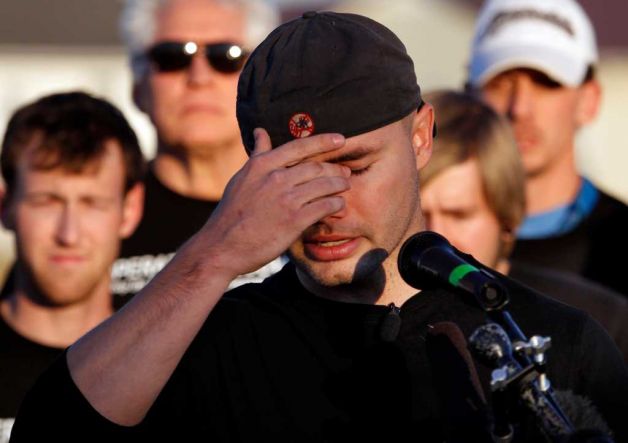
AWOL soldier Jeff Hanks speaks about the effects of PTSD on his family, Nov. 11, near Ft. Campbell in Oak Grove, Ky. Photo by Robert Smith / AP.

Healing from empire:
Anti-war veterans redefine Veterans Day

By Clare Bayard / The Rag Blog / November 22, 2010

“Today we are asking for more than a moment of silence. We are demanding justice.”

This statement, published in a Veterans’ Day open letter from the Central Illinois chapter of Iraq Veterans Against the War (IVAW), reflects the spark lit in cities across the country for Veterans Day this year.

Last Thursday, anti-war veterans and their supporters marked Veterans Day with a range of coordinated events around the country. Until the 1950s, November 11th was known as Armistice Day to commemorate the end of World War I. This year, members of IVAW and their civilian allies evoked the original meaning of this holiday through building up Operation Recovery, a campaign to transition this country out of our declared “endless war” and heal some of its wounds.

Operation Recovery: End the Deployment of Traumatized Troops was launched this past October 7th, on the tenth anniversary of the Afghanistan War. It seeks to end the military’s abusive practices of deploying soldiers suffering from trauma, including Post-Traumatic Stress Disorder (PTSD), Traumatic Brain Injury (TBI), and Military Sexual Trauma (MST).

IVAW’s research estimates that approximately 20% of active duty troops are suffering from untreated trauma; many servicemembers have shared stories of being denied treatment as well as being punished and mocked for seeking it, even as military suicides continue to rise.

This campaign is one step towards IVAW’s broader goals to not only ensure the right of servicemembers to heal, but also to end the wars and occupations, deliver reparations to Iraq, and hold accountable the people who are responsible.

Operation Recovery events included an art opening and Warrior Writers workshop in Chicago; street outreach in New York, Philadelphia, Champaign-Urbana, Illinois, and Manhattan, Kansas; outreach on bases to active duty soldiers at Fort Riley, Kansas, and Fort Lewis, Washington; teach-ins and organizing meetings in Savannah, Georgia and San Francisco; and the public surrender of an injured AWOL soldier at Ft. Campbell, Kentucky.

Picture this when you think of Veterans Day

Among this year’s Veterans Day events for Operation Recovery, Army Specialist Jeff Hanks publicly surrendered during a press conference across from Ft. Campbell, Kentucky. Spc. Hanks went AWOL to resist redeployment to Afghanistan this fall after the military refused to treat him for severe PTSD. Supported by military and civilian allies alike, Hanks and other veterans testified about the military’s negligent and often abusive treatment of even severely traumatized soldiers seeking care.

Spc. Hanks decided he wanted to turn himself in publicly to draw attention to these widespread practices. Hanks, his wife Christina, and their two young daughters are still awaiting the Army’s verdict, trying to keep up hope despite their anxiety. If he is court-martialed, he could face up to two years in prison, and a lifetime felony conviction on his record. At worst, the Army could attempt to forcibly deploy him again.

At the gates of Ft. Campbell, 25 supporters from across the Southeast stood with Jeff Hanks as he told his story to 15 news cameras. Another AWOL soldier from his unit traveled to join the rally, disclosing similar experiences. One supporter explained that her husband, who is currently deployed, was sent against medical advice. Over the last week, a number of other soldiers gone AWOL from the 101st due to mental health struggles have reached out to Operation Recovery for support.

Visibility and support are important factors that can influence the morale of traumatized troops and their families, and can also impact the military’s treatment of people who go public. Aaron Hughes of IVAW shared with supporters the fact that “Jeff’s command was extremely hostile when he turned himself in on Veterans Day, but after [Jeff was interviewed by Katie Couric in a] CBS story aired on Friday, they changed their tune.”

At the same time, Operation Rescue unfolded in other forms around the country. On the University of Illinois campus in Champaign-Urbana, IVAW members and civilian antiwar organizers publicly mounted a large display board that counted Army suicides during the past year, with 334 bold tally marks. The striking art drew veterans, students (including Iraqi-Americans), professors, and workers into conversations with the organizers.

“It felt like an important presence to have because there were so many pro-military groups, including the military themselves, who were there using the day to drum up support for the wars. We effectively inserted a different understanding of what it means to support the troops, which is to bring them home,” said Sarah Lazare from the Civilian-Soldier Alliance that helped organize the event.

In San Francisco, 50 people — from a range of veterans’ and civilian organizations — gathered to launch Operation Recovery on the West Coast. IVAW members traveled from four states across the West. Leaders visited from Coffee Strong, the G.I. Coffeehouse at Ft. Lewis, Washington, that provides critical support and community to questioning soldiers.

IVAW members explained the campaign and discussed local strategy with people from over 15 organizations and at least five cities. Thursday’s event built on the momentum of the previous Sunday’s annual Veterans Day march in San Francisco. This year kicked off a multi-year set of healing ceremonies and events led by veteran and non-veteran members of the Ohlone Nation, working alongside Veterans for Peace.

Veterans breaking the silence

The November elections revealed a striking wall of silence around war as a campaign issue. Politicians across the spectrum seem to be finding it expedient to keep people from thinking about or discussing the wars. At the same time mainstream coverage of PTSD and other health issues for veterans has increased.

The various forms of violence that people experience in the military — and how bringing the war home effects them — have long been taboo subjects in this country. But veterans and their loved ones are refusing to stay quiet about these important issues. And the increasing visibility of this campaign is not only raising public awareness, but it is also helping to break through the isolation that so often effects traumatized servicemembers and their families.

“We’re excited to help Jeff get the help he needs, but this is not over. We intend to hold the people responsible for this accountable,” says Chantelle Bateman, a field organizer with Iraq Veterans Against the War who accompanied Spc. Hanks into Ft. Campbell as he surrendered himself.

Nobody is a bystander

This moment calls for the mass participation of veterans, their families and friends, and everyone who is looking for ways to actively reclaim this country from war. Operation Recovery offers concrete and powerful ways to involve a real grassroots movement in turning the tide. IVAW encourages veterans and their communities to contact them directly. The rest of us have a number of ways to support war resisters who are pushing back from inside the military.

Here are some ways to get involved:

  • Sign the Pledge and learn more about IVAW’s work and the campaign.
  • Support Operation Recovery and Spc. Jeff Hanks financially.
  • Raise funds through raising awareness in your own circles, and bringing your community into the loop: Hold a house party for Operation Recovery (contact IVAW field organizer Joe Callan at zkjcallan@ivaw.org).
  • Write a supportive letter to Spc. Jeff Hanks and his family, as his wife Christina has requested. Even a quick note makes a difference. Email to: CMH1more30@yahoo.com.
  • Help us build networks of skilled people who can provide health services and other basic needs to support veterans transitioning to civilian life. The campaign team is plugging in lawyers, therapists, doctors, acupuncturists, and others who are donating their talents to this cause.

It’s time to turn away from war and towards healing and rebuilding.

[Clare Bayard organizes with the Catalyst Project and War Resisters League, building a G.I. resistance movement that challenges U.S. empire, and connecting domestic racial and economic justice organizing with international movements against militarism.]

  • Those in the Austin area can also support Under the Hood, the GI Coffeehouse at Ft. Hood in Killeen.

The Rag Blog

Posted in Rag Bloggers | Tagged , , , , , | Leave a comment

Bill Fletcher, Jr. : Rediscovering ‘The Souls of White Folk’

Mural in Great Barrington, Mass., honoring African American author W.E.B. Dubois. Image from Progressive America Rising.

90 years later in the era of the Tea Party:
Rediscovering ‘The Souls of White Folk’

By Bill Fletcher, Jr. / November 22, 2010

“But what on earth is whiteness that one should so desire it?” Then always, somehow, some way, silently but clearly, I am given to understand that whiteness is the ownership of the earth forever and ever, Amen!

–W.E.B. Dubois, from “The Souls of White Folk”

I am not sure what led me back to it. I had read W.E.B. Dubois’s “The Souls of White Folk” (originally published in Darkwater: Voices from Within the Veil, 1920) years ago. At the time I was moved by this often ignored essay but simply filed it away in the recesses of my memory.

Yet I returned to it. I had been thinking about right-wing populism and white nationalism in the USA and at some point I found myself Googling this piece. There were three things that immediately struck me: (1) by coincidence, it was published exactly 90 years ago; (2) it read, in many respects, as if it had been written yesterday; and (3) it was both passionate and poetic in its style, but equally biting in its critique of white supremacy and imperialism.

“The Souls of White Folk” was an essay written in the aftermath of World War I and the despicable Versailles Treaty of 1919 which formally ended the war. Mainstream historians often focus on the mean-spirited punishment that the Allied Powers brought upon Germany, thereby laying the foundation for World War II. Little attention is given, however, to the hypocritical attitude of the Allied Powers with respect to the colonial world, the “darker races,” to borrow from the title of Vijay Prashad’s excellent book.

Representatives of the colonial world (including from Black America) gathered in Versailles to ascertain whether the Allied Powers (USA, Britain, France, Italy) would be true to their commitment to support the right of national self-determination. The future leader of the Vietnamese Revolution, Ho Chi Minh, was one such person who made the trek to Versailles, hoping that Vietnam, and the rest of Indochina, would secure self-determination.

Instead of receiving justice, the colored peoples of the world were ignored. The former colonies of Germany were either handed over outright to other colonial powers or they were placed into a League of Nations trusteeship, but in neither case were they able to secure independence.

Dubois observed this first hand, having attended the Versailles conference. He subsequently helped to convene a Pan African Congress in order to address the fact that the African world had been so overlooked.

“The Souls of White Folk” takes as its starting point an analysis of the origins of World War I. Rather than accepting the established notion that it was a war for democracy and self-determination, Dubois embraces the assessment that it was an imperialist war focused on the objective of gaining greater portions of the colonial world for this or that imperialist power. This was an analysis advanced by Russia’s V.I. Lenin at the start of World War I and for much of the Left it has subsequently become a basic truism.

“The Souls of White Folk” would be a powerful document if it simply stopped there, but Dubois goes further and in doing so makes this document one that cannot be read simply as an historical piece, but one that remains critically important today.

Dubois turns to the question of race and, in fact, white privilege, and demonstrates the linkages between race and imperialism. Dubois notes, for example: “Behold little Belgium and her pitiable plight, but has the world forgotten Congo?”

For those not up on their World War I history (and no criticism is implied), much was made of the German subjugation of Belgium. Yet Dubois asks about the Congo, and this is not simply a throw-away line. Belgium, through King Leopold, controlled the Congo during which time it put to death 10 to 12 million people.

Dubois, of course, could not know what was soon to be facing European Jews and the annihilation of 6 million of them at the hands of the Nazis (who in 1920 were just getting organized), but that Holocaust received international attention, whereas the holocaust inflicted on the Congolese people was all but ignored at the time that it happened, in the aftermath of World War I, and, indeed, in the aftermath of World War II. For Dubois, imperialism was not racially blind.

Dubois situates the matter of race directly with modern imperialism. He makes the point that the degrading of this or that part of humanity has been with us for thousands of years, but that it is with the rise of modern Europe that we see the rise of what he terms “the eternal world-wide mark of meanness,–color!”

Race (or racist oppression) becomes a process of dehumanizing the targets of colonial oppression, turning them into something less than men and women and thereby making it easier to overlook their suffering.

This is what was powerful in his example of Belgium. It was not that Dubois was ignoring the suffering of the people of Belgium. Rather he was focusing on the fact that the so-called civilized world could so easily ignore the suffering and murder of so many millions of people in the Congo and elsewhere, people who happened to be black, brown, yellow, and red.

There is another piece to race that Dubois suggests, i.e., that it also dehumanizes so-called whites. Over the years this concept has gained greater scholarly attention, though for the “darker races” of the world it was a piece of common sense. We grew up with our parents suggesting “…in order to keep someone in the sewer you have to stay there with them…” and other such aphorisms.

As part of his critique of imperialism and racism, Dubois holds a mirror to the USA and says, much as Dr. M. L. King would say slightly more than 40 years later: “It is curious to see America, the United States, looking on herself, first, as a sort of natural peacemaker, then as a moral protagonist in this terrible time. No nation is less fitted for this role.”

In reading this I found myself thinking about the role of the USA in the talks between the Israeli government and the Palestine National Authority, claiming to be the honest broker while ignoring Israel’s further aggression, most recently in the form of the expansion of the illegal settlements. But it is more fundamental than that: the actions of the Israelis represent a replication of those taken by U.S. settlers as they expanded West, taking lands from the Native Americans and the Mexicans.

“The Souls of White Folk” riveted me because of its continued relevance. At a moment, in the aftermath of the November 2010 elections and the victories (albeit complicated) by the political Right, I found myself thinking about the “souls” that inhabit so many white folk in the USA, souls that have been shaped by a perception of their own alleged superiority and infallibility as white Americans in comparison to the entirety of humanity.

These souls, however, resemble ghouls rather than angels as they haunt not only the victims of centuries of white supremacist terror, but also haunt the owners themselves, disfiguring them and, as Dubois so poetically puts it, rendering them less than human.

[Bill Fletcher, Jr. is a Senior Scholar with the Institute for Policy Studies, the immediate past president of TransAfrica Forum and the co-author of Solidarity Divided: The Crisis in Organized Labor and A New Path Toward Social Justice. He can be reached at papaq54@hotmail.com. Fletcher is a member of the editorial board of The Black Commentator, and this article appears in the Nov. 18, 2010 issue of that publication. It was also posted to Progressive America Rising.]

Thanks to Carl Davidson / The Rag Blog

Posted in RagBlog | Tagged , , , , , | 2 Comments

Paul Beckett : Reprising Ford’s ‘Radical’ Tune

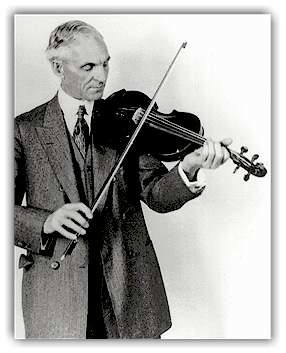
Fiddlin’ Henry Ford doubled workers’ wages. Image from FiddlingAround.

Henry Ford on why there
isn’t going to be a recovery


By Paul Beckett / The Rag Blog / November 22, 2010

Nicholas Kristof is concerned. The United States, he says, “now arguably has a more unequal distribution of wealth than traditional banana republics like Nicaragua, Venezuela and Guyana.” Kristof speaks for many of us. Even Alan Greenspan (who helped so mightily to make it so) is concerned about America’s rampant level of income and wealth inequality.

But Wall Street and most of the Republicans don’t care. No doubt — for them — it’s good the U.S. is still Number One in something! They place no value on equality itself. There seems to be no concern for fairness. And they have convinced themselves that inequality — even extreme, exaggerated inequality — is good for the economy.

Wrong! What they are not seeing is that rampant, out-of-control growth in inequality is bad for the economy. What they have forgotten is something Henry Ford (another unlikely preacher against extreme inequality) told us.

In 1914 Ford astonished most of his American fellow capitalists by abruptly doubling the wage level of his workers. He announced a $5.00 a day wage policy, when going market wages (what he COULD have got workers for) were about half as much. Applying the Consumer Price Index, that $5 would be more than $100 a day now.

In his famous memoir, on the subject of wages, Ford wrote:

No manufacturer in his right mind would contend that buying only the cheapest materials is the way to make certain of manufacturing the best article. Then why do we hear so much talk about the “liquidation of labour” and the benefits that will flow to the country from cutting wages — market? What good is industry if it be so unskillfully managed as to not to return a living to everyone concerned? No question is more important than that of wages — most of the people of the country live on wages. The scale of their living – the rate of their wages — determines the prosperity of the country. [Emphasis added.] — Henry Ford, My Life and Work, Garden City, New York: Doubleday, Page & Company, 1923, p. 116]

This was “Fordism.” Workers should not only be worker-producers, but simultaneously be consumers of the goods produced (very much including Henry Ford’s automobiles).

It was a powerful idea. Marx’s progressive impoverishment of the working classes leading to the end of capitalism didn’t occur. Capitalism got new wind instead.

Aldous Huxley, publishing Brave New World in 1932, jokingly located his vision of the World State in the year 632 A.F.: “After Ford.” (1 A.F. is the year 1908 when the Model T first appeared.) In 632 A.F. people swear oaths “By Ford,” and the Christian cross has been converted to a T.

Good fun. But Ford and Fordism were almost that important. American post-World War II prosperity, and the enormous advances of Western Europe, were based on always-growing consumption by the masses whose incomes and standards of living also grew constantly. The Consumer Economy had been invented, and it flourished.

How amazing that the political-economic managers of our society seem to have completely forgotten this basis of the American prosperity they love to celebrate! First, our industrialists have been permitted — in many ways encouraged — to seek the absolutely lowest market wages elsewhere in the world to build their products.

American workers suffer and, in the longer run, the country suffers; but owners and managers greatly benefit since their profits are easier than ever. They pay labor there; they sell the product here. Good business. (And, let us admit that in the short run, as consumers, we all benefit and are all, in a measure, complicit.)

The real level of wages has been stagnant, not improving, for several decades. Virtually all the income (and wealth) growth since 1965 has been within the top 20%. In fact, per Kristof, “from 1980 to 2005, more than four-fifths of the total increase in American incomes went to the richest 1 percent.”

Timothy Noah has presented a wonderfully comprehensive review of inequality data in Slate. (Don’t miss the excellent set of slides accompanying the first article!)

But wait. This process has been going on since Reagan, yet our consumption has continued to grow in the face of stagnation in income for two-thirds of the population. Was Henry Ford wrong? Is “Fordism” contradicted?

No. There was a huge boost in family income and consumption as more women joined the work force. But that’s a one-time thing. After that, we’ve been living on borrowed time. Literally borrowed: the development of credit cards put deficit finance at the disposal of us all. And easy mortgages and home equity loans fueled a housing price bubble, and gave us more to spend with. It seemed too good to be true. It was.

So these bullets are now fired; the gun is pretty well empty.

Everyone agrees that recovery from the Great Recession depends on returning to (if possible, surpassing) the consumption rates of the 1980s and 1990s. But where is that supposed to come from?

We still find our Captains of Industry crowing (and adding to their personal fortunes) every time they can further “liquidate” their labor forces. (Maybe they should read My Life and Work!)

We keep our minimum wage set to absurdly low rates, far too low to support a family’s consumption.

I spend a lot of time in Denmark where I have close family, and find that our U.S. median wage falls about where their lowest new-worker entry wages are set. Our conservative economists would tell us that such high wages must produce high unemployment and economic stagnation. Sorry: not so. Denmark is weathering the Great Recession better than we are. And their unemployment is put at under 5%!

The U.S., meanwhile, tolerates an unemployment rate of almost 10%. But surveys put under-employment at 20%.

Finally, thanks to decades of hard work by corporate forces and their political allies trade union membership within the private sector labor force is under 8%. We are back to 1901 levels. (We always knew the right is out to abolish the 20th Century!)

America’s economic future clearly is at a tipping point. Our economy is not going to expand again unless we remember Henry Ford’s lesson: the prosperity of the country depends not on the how well the few at the top are doing, but how well most of the people are doing. The “scale of their living… determines the prosperity of the country.”

For those of us on the left, it’s a matter of fairness, of equality, of equal rights, of humanity. The right doesn’t see that. OK. But they had better see that it’s a matter of preserving the economic vitality and shared prosperity that we once were famous for.

Here are three ideas that could get our country moving again. First, a national minimum wage of at least $12 (indexed for inflation!). Second, let’s reverse the tax and other incentives that have encouraged our industrialists to export our productive capacity. Let’s bring good jobs home.

Third, we must push back hard on the levels of inequality that give even conservatives pause. We must restore tax progressivity in general and, in particular, distinguish more intelligently between the large numbers who are wealthy and the small numbers who make super incomes (the ones most of us call “obscene”).

We are fortunate: the U.S., among developed countries, is not at all an over-taxed country. Relatively modest tax increases can rebalance government revenues and expenditures, while beginning a return to a more “American” balance between economic equality and inequality.

If these obvious and common sense ideas sound “radical” — well, it shows how much we have lost as a nation in recent decades, and how successful the extreme right has been.

But — by Ford! — there is time, in this year 102 A.F., time to make the American dream real again!

[Dr. Paul Beckett lives in Madison, Wisconsin. He can be reached at beckettpa@gmail.com.]

The Rag Blog

Posted in Rag Bloggers | Tagged , , , , | 2 Comments

Joshua Brown : Life During Wartime: Dubya’s New Digs

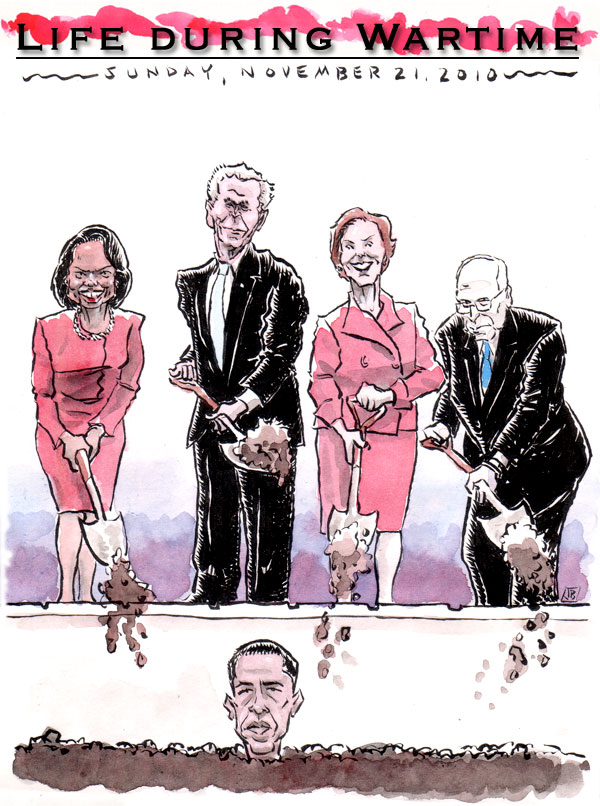
Political cartoon by Joshua Brown / Historians Against the War / The Rag Blog

The Rag Blog

Posted in Rag Bloggers | Tagged , , | 1 Comment

Ansel Herz : Behind the Barricades in Haiti

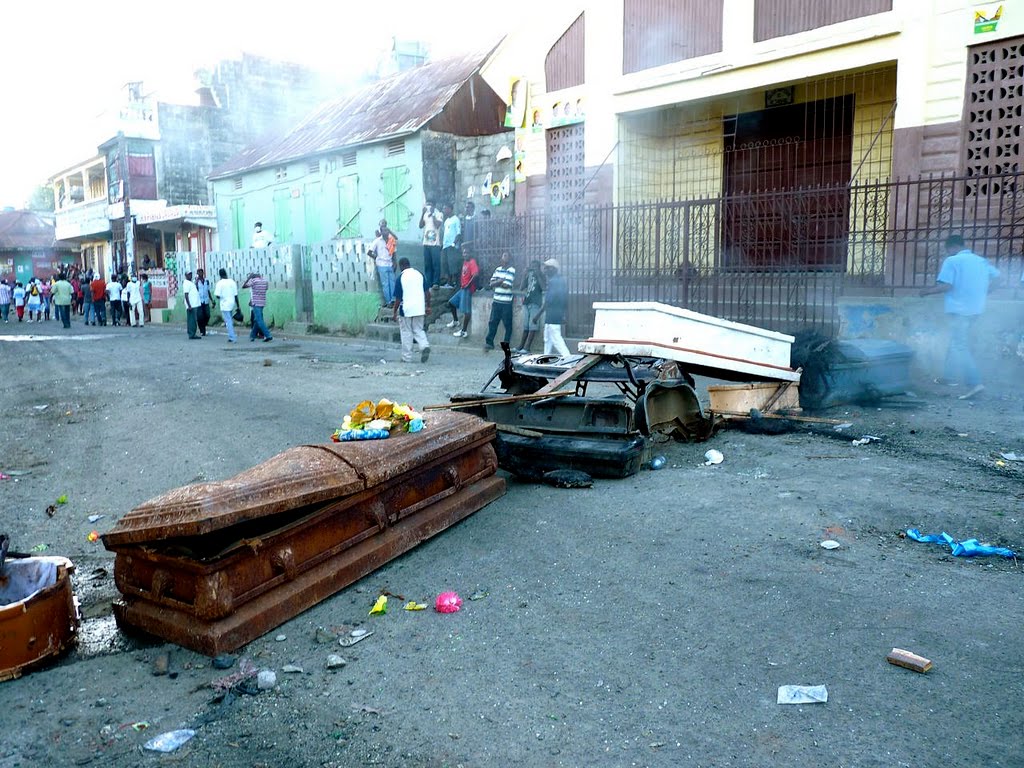
Coffins used as street barricades in Cap-Haiten, Haiti. Photo by Ansel Herz / Mediahacker / The Rag Blog.

Streets barricaded in Cap-Haitien:
Protests in Haiti have popular support

By Ansel Herz / November 19, 2010

CAP-HAITIEN, Haiti — The first barricade looked harmless enough. Foot-long rocks piled next to each other in a line.

But as the bus driver slowed down, flying rocks landed in the street — thrown by youths crouching in the bushes up the hill.

“We don’t really have a country! The police don’t do anything!” a nun sitting across from me complained after the bus driver negotiated, with a little cash, our way past.

The man next to her said the country will always be mired in problems until a leader like Hugo Chavez or Fidel Castro takes power.

We must have passed a dozen more barricades, most unmanned.

After Limbe, where cholera has killed at least 100 people, we came to the biggest “barikad” yet in the highway. Thick trees lay across the road and hundreds of people, a few holding machetes, blocked the way.

The bus driver once again descended to negotiate, but didn’t appear to be making any progress. Most passengers grabbed their belongings and got out.

I decided to go too. As I gathered my things, there was a debate among the remaining passengers:

“He’s a blan (foreigner), he’s going to get hurt.”

“No no no, he speaks Creole, he’ll be fine.”

“They’re going to think he’s MINUSTAH. They’re not logical.”

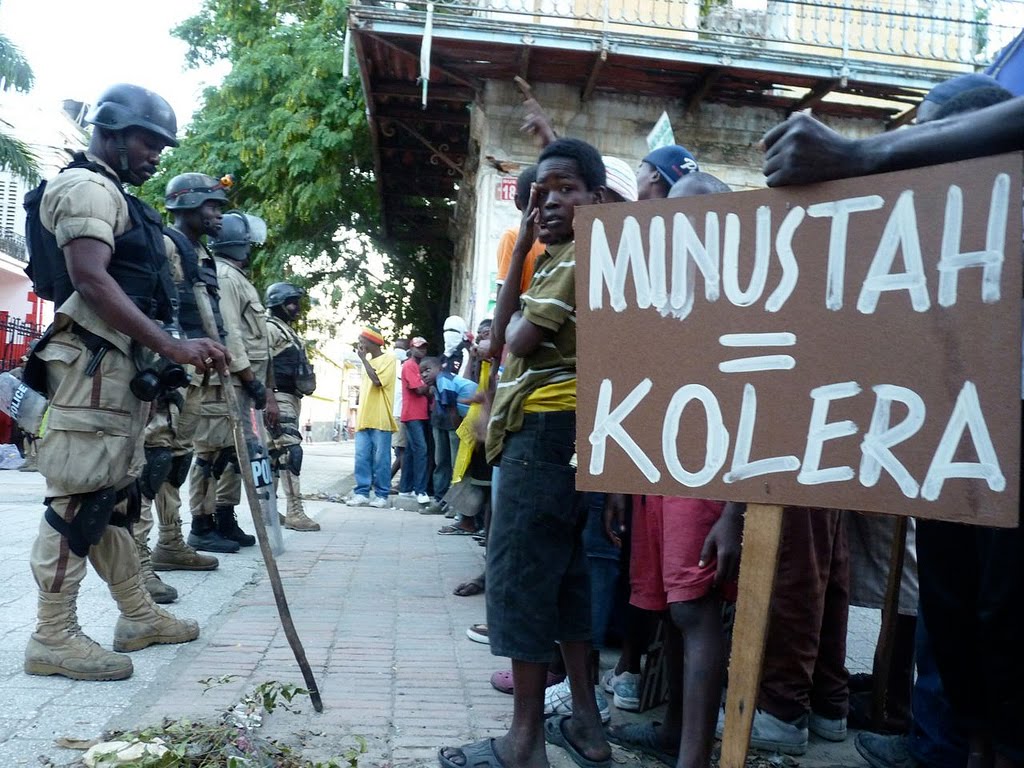
MINUSTAH is the acronym for the UN peacekeeping mission. As I stepped off the bus, people standing at the road called me over and urged me not to go. It was the third day of so-called “cholera riots” against foreign troops blamed for introducing the disease into the country.

Someone said the protesters are violent “chimere,” a word for political gangs. I explained that it’s my job as a journalist to go talk to them.

Then two Haitian journalists who were on the bus pushed their way through the crowd and wrapped their arms around me. Everyone agreed, finally, that together with the two guys I could get through the barricades.

Elizer and Duval were coming back home to Cap-Haitien. They were scared for me, saying under no circumstances should I talk with protesters or take photos. I reluctantly agreed to follow their instructions.

I wondered if perhaps the UN peacekeeping mission was right in saying these protests were organized by a politician or gang. “Enemies of stability and democracy,” MINUSTAH mission head Edmond Mulet called them. So far, I’d only seen young men in the street.

But as we passed through each barricade, everyone — young girls and rotund market women mingling with demonstrators — yelled out, “MINUSTAH ou ye?”

I yelled back, “Non, mwen se yon journalis Amerikan.” The suspicious stares softened into smiles and understanding looks. After passing the third barricade that way, we started laughing.

One teenager who threw a rock at us as we approached on motorcycle said, “pa gen pwoblem” — no problem — after I held out my press badge.

As we arrived on the outskirts of Cap-Haitien proper, the streets were deserted except for people gathered around barricades. One was still flaming. At another, dozens of men milled around a burnt out car.

“Press! Press!” I called out, and they beckoned me through the crowd, many hands pushing me forward until I was through.

I was glad when an elderly man walking in the street stopped me. I finally had a chance to do an interview, against the advice of my companions. I whipped out my audio recorder. He was Amos Ordena, the local section’s elected Kazek — an official dispute mediator.

“The population has information that MINUSTAH introduced cholera,” he told me. “So many people have died. They’re obligated to hold fast, to demonstrate, so that the authorities will take responsibility. They’re asking MINUSTAH to leave the country.”

Haitian street demonstrators want the UN’s MINUSTUH troops to leave. Photo by Ansel Herz / Mediahacker / The Rag Blog.

Asked if the protests are by a single group or the general population, he said all elements of society are participating in “the movement.” He said MINUSTAH are not firing weapons in self-defense, in the air to disperse protesters, but firing at people. He heard that at least one person had died earlier in the day.

We finally turned off the main road and walked into an alleyway. Elizer’s modest home was at the end (he lost his wife, children, and house in the capital in the earthquake). One of his brothers, blind and handicapped, lay on the floor beneath a television showing a soccer match. He smiled and introduced himself when I walked in.

Elizer reminded me to use hand sanitizer. Then his frail mother, beaming at us, served us fresh mais moule (corn) and papaya juice.

A neighbor of Elizer called up TV reporter Johnny Joseph, who came to meet me and help me get to the house where I was planning to stay. Elizer refused to accept any money for all his trouble.

Before leaving with Johnny, I spoke to Aristil Frito, a 24-year-old student standing outside talking with his neighbors. “The objective of the movement is clear: they’re asking for the departure of MINUSTAH.”

He said irresponsibility by the leaders of the country had led to this situation. In a more developed country, without so many young unemployed people in the street, the protests might have been more peaceful, he said.

“But the real solution is for people to live in a climate of peace, in dialogue. Today all Haitians should work together finish with hunger and poverty,” he said. “The best solution is the promotion of social dialogue.”

Johnny and I hopped on a motorcycle taxi, taking backstreets to bypass the barricades. We passed a five-foot deep trench dug in a narrow dirt road. Johnny said a MINUSTAH vehicle fell into the trench Wednesday and people threw bottles at them. The troops opened fire, killing an innocent bystander whose body was taken downtown, he said.

MINUSTAH blamed the death on local gangs.

At one junction, a young man in a purple shirt and black cap blocked our path and stuck out a knife as his friends looked on. I realized my press badge was tucked into my shirt. I pulled it out as Johnny talked the man down.

“You need to have your badge out,” the young man told me, glaring. “It’s a principle.” That’s been the only instance of serious hostility directed at me since I arrived in Cap Haitien.

So it’s bewildering to read the reporting of CNN’s Ivan Watson, who claimed that armed rioters control the city. He told viewers while being filmed on the back of a fast-moving motorcycle that it’s only way to move about the city amidst “violent protests.”

He doesn’t use that adjective to describe the actions of UN troops, accused of killing at least three demonstrators since Monday.

“They shot many people. We took them to the hospital. We’re asking MINUSTAH to leave the country,” a middle-aged man who declined to give his name told me.

He stopped bicycling past an intersection barricaded with coffins to stop and share his anger. “We have bottles, we don’t have guns to shoot them, but they’re shooting us. We have to defend our rights, MINUSTAH is a thing that doesn’t work in this country.”

Another of Watson’s reports claimed that Christian missionaries were forced to speed on a bus away from out-of-control-mobs, like in a Hollywood-style chase scene.

High drama = high ratings.

As I walked towards the downtown’s central public square on Wednesday, finally nearing the house, I saw several dozen people facing Haitian police in full riot gear standing in their way.

They said they had no beef with foreigners generally — only MINUSTAH.

Theodore Joel said they respected the Haitian police, because they’re brothers and family — though two police stations were reportedly set on fire during the first day of protests.

“Those soldiers are tourists! The money that’s invested in MINUSTAH — they could invest that money in education. They could invest in constructing hospitals, in cleaning up the country. but they’re paying those soldiers instead. We don’t have guns like in 1803… but each time we put our heads together, we’re marked in history.”

Thursday marked 203 years since the Battle of Vertières, where Jean-Jacques Dessalines led the final major assault on French armies to drive them off Haitian soil. They renamed the city: from Cap Francois to Cap-Haitien.

While many expected demonstrations to continue in commemoration of Haiti’s independence struggle, the streets were quiet. No further confrontations were reported. I walked around downtown Cap on my own, trying to find an Internet connection to send out a radio story.

I’m asking everyone I meet here — from local journalists, vendors, men at the barricades, to a local magistrate — if these protests were organized by a gang or political group.

The unanimous answer is no — people are fed up with UN peacekeepers and the cholera outbreak is the straw that broke the camel’s back. The magistrate said he understands and respects the people demonstrating, but he wishes the barricades weren’t impeding the transportation of medical supplies to fight cholera in his commune, where people are dying in the street.

As the head of MINUSTAH warned that “every second lost” because of protests means more suffering and death from cholera, the anti-UN demonstrations continued in Port-au-Prince on Thursday.

CNN’s Watson led his report this way: “Like cholera itself, Haiti’s protests against the United Nations spread Thursday to the capital, Port-au-Prince, as angry people took to the streets demanding the global body get out of their country.”

Seems that for Watson, these protests are like a disease. It continues: “a planned protest began peacefully in the center of the city but turned violent as it moved toward the presidential palace, with one woman overcome by tear gas, witnesses said.”

Again, the protesters are the ones implicated in the violence. But a timeline report released by International Action Ties, an independent human rights monitoring group, said the demonstrations were largely peaceful after returning to Champs de Mars plaza.

UN troops and Haitian police fired at least 30 tear gas canisters into the Faculty of Ethnologie and surrounding tent camps, the report said, sending children and old women fleeing into the streets. Police ignored the group’s pleas to stop firing.

Are protests against the UN meant to destabilize the country? Are Haitians who’ve taken to the streets being used, like puppets, by powerful politicians for their own ends? Are the protests violent?

The foreigners I’ve talked to say yes. A few American liberals living in Haiti tell me they fear the protests are violent and meant to cause chaos, echoing the statements of MINUSTAH and reporters like Watson. Some Haitians in the professional middle class don’t want to participate.

But most Haitians I’ve spoken with say no. They say this is the inevitable outcome when troops who operate in Haiti with seeming impunity may have introduced a deadly, misery-multiplying disease into the country. It’s an angry, popular movement — protesting however they can, emotions running high — against a five-year-old foreign occupation.

What do you think? We’ll see how this plays out in the next nine days, ahead of the Nov. 28 election. Stay tuned.

[Ansel Herz, a former Austin activist, is a multimedia journalist and web designer based in Port-Au-Prince, Haiti. This article first appeared on Ansel’s blog, Mediahacker.]

Source / Mediahacker


Video posted by Pierre Durohito De Venchy of the first three days of protests:

The Rag Blog

Posted in Rag Bloggers | Tagged , , , , | 4 Comments

Join us today! Rag Blog Happy Hour, 5-7:30, at Maria’s, 2520 S. Lamar. Informal gathering. All are welcome! Special guests: Sarito Carol Neiman, author and original co-editor of The Rag (1966); Philip Russell, author of the newly released “History of Mexico: From Pre-Conquest to Present.” No charge. Maria’s bar and menu available. Leeann Atherton performs at 7 p.m.

Posted in RagBlog | Leave a comment

Medea Benjamin : Death Marchers Haunt New Bush Library Digs

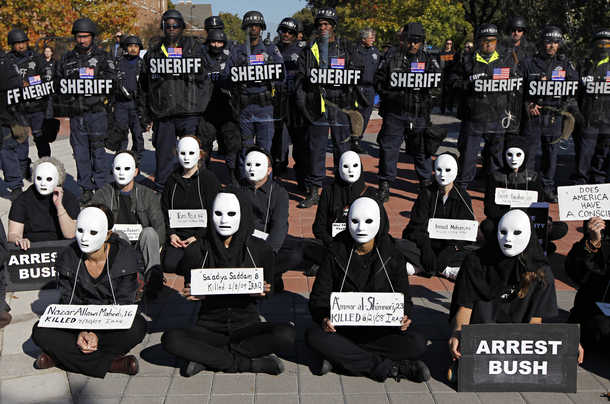
Demonstrators from March of the Dead protest in front of Dallas SWAT officers during groundbreaking at new George W. Bush Presidential Center at SMU, Nov. 16, 2010. Photo by G.J. McCarthy / AP.

Breaking new ground:
Protests at the future site
of the George W. Bush Library

By Medea Benjamin / November 19, 2010

DALLAS — Several thousand people lined up to see George Bush, Dick Cheney, and Condoleezza Rice shovel dirt into a hole at Southern Methodist University in Dallas, the site slated to become the George Bush Presidential Center housing a museum, library, and archives.

Over 100 peace activists showed up to protest, including New York City artist Laurie Arbiter, who helped organize a March of the Dead and carried a sign asking “Does America Have a Conscience?” “Rather than build a library, we should leave the broken ground and just fill it with a big pile of rubble,” said Arbiter. “That would truly represent the catastrophic results of the Bush Administration.”

As part of the March of the Dead, protesters dressed in black, wore white death masks and had signs around their necks representing dead Iraqis, Afghans, and U.S. soldiers. The dramatic march stopped traffic and provoked strong emotions in passers-by, participants and even the police.

Renee Schultz, who drove from Indianapolis to join the protest, wore the death mask and a sign representing a 23-year-old female U.S. soldier killed in Iraq. “When I first put on the mask, I just stood there and cried. I kept thinking, ‘I am 23 years old and had my whole life ahead of me. Why did I die?'” Schultz looked over at the riot police and noticed that one of them also had tears streaming down his eyes.

When the marchers attempted to reach the public viewing area, the police forced them back to the designated “protest pen” far from the ceremony. One of the protesters, a wheelchair-bound veteran of the Korean War and World War II, angrily told the police that he did not fight in two wars to be told that his freedom of speech would be confined to a “protest zone.”

The gathering was part of a three-day People’s Response, filled with rallies, marches, teach-ins, and exhibits of crosses and soldiers’ boots to represent the war dead. Organized by Texans for Peace, The Dallas Peace Center, CODEPINK, and Veterans for Peace, among others, the speakers included former FBI agent Colleen Rowley, former CIA agent Ray McGovern, retired Colonel Ann Wright, professor Robert Jensen, and Texas State Representative Lon Burnam.

Also among the protesters was Cindy Sheehan, the Gold Star mother who led a prolonged protest outside Bush’s ranch in Crawford, Texas in 2005. “Bush should not be allowed to profit from war crimes, crimes that he has even admitted to,” said Sheehan. “It’s not right that he will make millions from his book and speaking engagements, while millions have been killed, displaced, tortured and had their lives ruined because of him.”

The whole dang crew: Digging in at groundbreaking ceremony for George W. Bush Presidential Center in Dallas, Nov. 16, 2010. Photo by L.M. Otero / AP.

The protesters focused on the lies Bush told the American public to justify invading Iraq, his authorization of torture and the need for accountability. “Accountability is the sign of a true democracy,” said former CIA agent Ray McGovern. “No one should be above the law and the truth must not be buried or rewritten.”

Protesters were also concerned about the policies the new Bush Center will promote. President Bush said the Center would include an “action-oriented institute” to advance the principles his administration stood for, including the “benefits of limiting the role of government in people’s lives.”

According to local organizer Leslie Harris of CodePink, “this really means promoting the same kinds of disastrous policies that brought us preemptive war, economic crisis, environmental disaster, unprecedented presidential power, and diminished civil and human rights. We can’t let one of America’s worst presidents shape our future policies.”

The peace activists who came to protest Bush also discussed their disappointment with the Obama administration and the difficulties they anticipate in pushing the new, more conservative Congress to stop funding the wars in Iraq and Afghanistan. Among the actions they encouraged were:

  • supporting the January 15 FBI protest in Washington DC;
  • promoting local campaigns, including citywide resolutions, to bring our war dollars home;
  • reaching out to allies, particularly groups victimized by the economic crisis, but also reaching out to members of the Tea Party who want to see cuts in Pentagon spending;
  • pressuring the State Department to stop using private security contractors;
  • supporting the December 16 veteran-led civilian disobedience in Washington DC;
  • organizing a delegation to Iraq to take testimony from Iraqis about George Bush and the legacy of the US invasion;
  • stopping John Yoo, author of the “torture memos,” from teaching law at the UC Berkeley law school.

For some light entertainment after long days of protest, a group stopped by local Barnes and Noble to reshelve — and photograph — Bush’s Decision Points in a more appropriate place in the store. These included placing the book next to The Murder Business in the True Crimes section, Wing Nuts in the Fantasy Section, When Law Fails: Making Sense of Miscarriages of Justice in the Legal Section, and our favorite in the Children’s Section, Dr. Seuss’ Will You Please Go Now?” With the renewed media attention on George Bush, including his sanctioning of torture, Bush might do well to take Dr. Seuss’ advice.

[Medea Benjamin was a founder of CodePink. Follow her on Twitter: www.twitter.com/medeabenjamin.]

Source / Huffington Post


Where Bush’s book belongs. Images from Waging Nonviolence.

The Rag Blog

Posted in RagBlog | Tagged , , , , , , , , , | 5 Comments

Dr. Stephen R. Keister : Physician, Heal Thyself

Graphic by Daniel Marsula / Pittsburgh Post-Gazette.

Physician, heal thyself:
The sad demise of medical ethics

By Dr. Stephen R. Keister / The Rag Blog / November 17, 2010

Recently I awoke to a front page article in The Erie Times-News headlined “Doctors’ hawking products raises concerns. Critics say plugging goods is unethical.” It was an excellent survey on the local level of the the deteriorating ethics of the medical profession, naming doctors’ names, and quoting the payoffs to physicians by the pharmaceutical companies involved for “providing educational services.”

My hat is off to the Times-News for showing courage to raise this specter locally, as Pro Publica has done recently on a larger scale in its “Dollars for Docs” series, and especially an article entitled, “Payments to Doctors by Most Pharma Companies Still Remain Secret.”

In this series, Pro Publica tells the story of the total deterioration of medical ethics in the United States. How did we get to this point? Where did these practices originate? Let us step back a few years and look at the ethical/historical implications of this aberration, noting the blame that must be borne by the doctors, but also taking into account the larger societal picture.

I graduated from medical school in 1945. At that time we had a peculiar idea that the role of a physician — as a professional instructed in the healing arts and sciences — was to provide care for his/her patients. The Hippocratic Oath was somehow still in vogue, and, oddly enough, most graduates of that time took it seriously. Making a decent but not lavish living was a side issue.

After internship and residency I opened a then unique practice in rheumatology in Erie, Pennsylvania. At that time the hospital I was affiliated with required all physicians — before we were permitted to admit patients — to serve two months, averaging 2-3 hours a day, caring for the hospital’s 20-30 charity inpatients, with the aid of an intern. We were also expected to put in one morning a week working in one of the various charity specialty clinics in the hospital. As time went on, and “hospitalization insurance” evolved, these demands lessened, and by the 1970s were nonexistent.

In our private office practice it was customary to spend a full hour with a new patient, provide 15-20 minutes for follow-up visits, and depend on the good will of the patient to either pay the charges on departure or make arrangements with the receptionist to pay as he/she could at a later date.

If an urgent situation arose while we were off-duty, the telephone answering service would gave the caller our home phone numbers and the problem would be resolved by telephone, a house call, or meeting the individual at the emergency room.

Sometime in the 1970s-1980s changes started happening. I had a dermatologist friend who organized “future physicians” programs at several local high schools. He enjoyed the interest of the students, the give-and-take, the feeling of accomplishment — but around 1970 he became disillusioned and dissolved the program. Why? The students were becoming more interested in making money than in dedicating themselves to the profession. Just a small example of our evolution into a society primarily concerned about accumulating individual wealth and not about the well-being of our fellow man or the broader interest of the community.

Thus we have witnessed the ongoing evolution of social Darwinism in our society, of the current American attitude that wealth is God’s way of rewarding the individual. The coup de grace was the well-calculated takeover of the medical establishment by the health insurance cartel. Since that time the physician has devolved from a professional to a businessman, essentially owned by the insurance industry and assuming the ethics and morality of that industry.

In my final years of practice roving physicians, prostituted to the pharmaceutical companies, began providing dinner/educational programs at the more posh local hotels, to “educate” the local practitioners on the advantages of different medications. At times the invitees were provided a stipend for attending the gathering.

The ultimate illustration of this financial pandering occurred in my last year of practice, 1989, when I received a special delivery letter requesting my presence at a three-day “educational” meeting at a luxury hotel in Phoenix, Arizona, all expenses paid, to be accompanied by a “companion of my choice.”

I had never availed myself of such an opportunity in my years of practice and felt that perhaps I should have some first-hand knowledge of what the world was all about. Thus, in view of the fact that my wife had settled “the companion of choice issue,” I signed on. We were provided a round-trip airplane ticket, three nights in a luxury hotel with meals and entertainment, in return for my attending lectures for three hours each morning.

There were some 200 physicians in attendance, and a repeat performance was scheduled for the next week. I pointed out to my wife that some of the physicians had brought their daughters rather than their spouses, and her response was “do not be naïve.” I was cursed by a sense of shame for being there but, in retrospect it was indeed an “educational” experience — not for what I learned about the pharmaceutical product being touted, but for what it taught me about the drift in our culture and morals.

Our current system of medical care and delivery ranks anywhere from 24th to 36th in the industrialized world, depending on the agency doing the evaluating. Yet, there is no overwhelming public anger about this fact. Instead, the public was taken in by absurd claims about “government death panels” and the advent of “socialized medicine.”

This gullibility on the part of the public, aided and abetted by the corporate-owned mainstream media, does not bode well for the future. The people in their ignorance confuse legitimate, compassionate hospice care, with “death panels” and reasonably priced medical care provided by a nonprofit insurance company and administered by public representatives and medical doctors, with “socialized medicine.”

Most of our citizens haven’t the slightest idea what is happening with our health care system. Costs here are 2-3 times those in other developed countries. Canada and the United Kingdom have what you might call socialist systems, but polling in both countries shows that the public is happy with the care they receive; in Canada, more than 90% respond positively, and the only major complaint in the UK concerns slow service in some areas.

Most European nations, and Japan and Taiwan, have government-subsidized private insurance plans, with funds going to provide patient services, not absurdly high executive salaries and stockholder dividends — at something like $500 per month for a family of four, with insurance co-payments of 10-20% for outpatient services and pharmaceuticals.

This varies a bit from country to country, but they provide all basic health services, often including house calls. Supplemental insurance may be purchased for private rooms and other special care. And those additional services are much less expensive; where one pays $1,500 for a MRI in the USA, it may cost something like $200 in Europe. And we pay 2-3 times more for pharmaceuticals here.

No other country, save New Zealand, has the endless TV commercials for prescription drugs that we must endure in this country. (Is it still necessary to advertise Viagra?) Nowhere else is there such collusion between researchers and pharmaceutical companies, although the latest AARP Bulletin contends that only a very small percentage of physicians allow these ads to color their judgment in writing prescriptions. In no other country do we find ads for physicians in the yellow pages, in newspapers, or on roadside sign boards. Nowhere else do hospitals advertise on TV or in local newspapers.

I can look at the current world as both a physician and a patient, having had some recent reactivation of my prostatic cancer, which was irradiated 10 years ago. And I cannot complain, since — between Medicare and my supplementary insurance — my care has been excellent, allowing me free choice of doctors and hospitals.

Happily I learned early to avoid Medicare Advantage plans which limit choice and in the long run were designed to create income for the insurance company managing the plan. I am happy that the community where I live provides excellent hospice services so, when I face the inevitable end, I can look forward to humane, compassionate care and not prolonged misery in a hospital setting. (Switzerland provides an even better option, but it involves a lot of administrative problems.)

I see no hope for first class medical care for all in the United States in the foreseeable future. The insurance cartel and the pharmaceutical companies dominate our media, while the public accepts or has no understanding of the problem (in France the streets would be filled with demonstrators). The Republicans would do away with Medicare and would privatize Social Security. And the Democrats, starting with the president, seem lacking in idealism and ecourage little community activism.

The health care legislation passed this year is essentially a farce — created in coordination with the insurance cartel and PhARMA — and provides only minimal additional benefits to the consumer while lacking in cost controls. Most of the good work being done in the medical profession comes from Physicians for A National Health Program, the American College of Physicians, and the Academies of Pediatrics and General Practice. One cannot count on significant support for change from the overpaid surgical specialities and those physicians already acting on behalf of the megacorporations.

[Dr. Stephen R. Keister lives in Erie, Pennsylvania. He is a retired physician who is active in health care reform.]

The Rag Blog

Posted in Rag Bloggers | Tagged , , , , | 2 Comments

Lamar W. Hankins : After Veterans Day, Business As Usual

Photo by John Gomez / AP.

Now, back to Fox News…
Veterans’ Day is over

Man is the only animal that deals in that atrocity of atrocities, War. He is the only one that gathers his brethren about him and goes forth in cold blood and calm pulse to exterminate his kind. — Mark Twain

By Lamar W. Hankins / The Rag Blog / November 16, 2010

We Americans remember our history for a few minutes each year, often on days set aside for such matters. There is Presidents’ Day, the MLK holiday, San Jacinto Day (if you are a Texan), Memorial Day (the day set aside to honor those who died in our wars), Independence Day (one of two times a year to sell and buy fireworks in honor of the Chinese, though everything we buy seems to come from them now), Labor Day (one of our shopping and barbecuing holidays mostly), Veterans’ Day (a time to express a few patriotic-sounding thoughts before concentrating on the next holiday), Thanksgiving Day (the day for football and turkey, mostly), Christmas Day (a mixture of the commercial and religious), and New Year’s Day (more football and the honoring of our new calendars).

I admit to being cynical about many of these special days. It seems that their main purpose is to give us an opportunity to believe we are better people than we are by paying lip service to some easily held value that the holiday represents. This has seemed especially true of Veterans’ Day.

While I have not supported the creation of veterans, I have thought it hypocrisy of the highest order to claim with our words to honor our veterans, only to largely ignore them in reality. From discussions with my father, who served over four years in World War II, I understand that he was not pleased to be drafted and have his life interrupted by Hitler’s march across Europe, but he served honorably in an antiaircraft battalion.

He recorded his military journey in a small booklet supplied by the Bell Telephone Company of Pennsylvania: Camp Wallace, Fort Bliss, Philadelphia, Westville (New Jersey), Camp Kilmer, a troop ship from New York to Scotland, Llanover (Wales), Folkestone (England), May 24, 1944 — ”fired at first enemy plane,” July 26-27 — “knocked down 13 robot planes,” Omaha Beach (about 60 days after D-Day), Paris, Borischot (Belgium), Nijlen (Belgium), Lillo (Belgium), Bergen Op Zoom (Holland), Wuustwezel (Belgium), Fort Querqueville (France), Amberg (Germany), Wiesbaden (Germany), Bad Soden (Germany), Camp Herbert Tareyton (near Le Havre, France).

Dad considered himself fortunate that he had not been in the hand-to-hand combat his younger brother had found in the Pacific theater. He had escaped much of the trauma of war. Dad never wanted to visit any of the places he went as a soldier (except maybe Philadelphia, where he got to see a baseball game), but he did so in the service of his country, just as millions of others have done.

America saw fit to thank the men and women (my mother was in the U.S. Army Nursing Corps) who served in World War II by passing the GI Bill, which provided college or vocational education, along with one year of unemployment benefits, and loans to buy homes or start businesses. Over the years, additional provisions were added to assist veterans.

In 2008, educational benefits were greatly expanded thanks to Senator James Webb. Since President Obama has been in office, additional funding and benefits have been approved for veterans: the Department of Veterans Affairs was provided with more than $1.4 billion to improve services to America’s Veterans, and $4.6 billion was added to the Veterans Administration budget to recruit and retain more mental health professionals to help veterans, especially those suffering from PTSD.

But all of these improvements have fallen short of adequately addressing the suffering of more than 200,000 Vietnam veterans exposed to Agent Orange. For decades, the Defense Department refused to acknowledge the connection between that defoliant and the dramatically higher incidence of cancer and neurological, digestive, skin, lung, heart, and reproductive defects experienced by these veterans.

Similarly, as many as one-fourth of the 700,000 Gulf War veterans may suffer from what was called Gulf War Syndrome (now Gulf War illness), the causes of which are now believed to be primarily neurotoxins encountered by our troops in the war. Our government has failed to honor its commitment to these service men and women, as well as those affected by IED blasts, toxic exposure in Iraq, and other results of war.

If we are the nation we claim to be, it is essential that something substantial be done for these veterans (as well as those continuing to serve in the military) suffering from PTSD — Post Traumatic Stress Disorder. The very name explains that war is traumatic and can create stress long after the trauma has ended. This is a condition that our military services prefer be kept under wraps. To most of our leaders, civilian and military, the less said about the trauma of war and the aftermath, the better.

Discussion of the toll war takes on our sons and daughters continues to be taboo, or at least discouraged in polite company. At the end of October, The Public Editor at The New York Times explained in a column how the Times covered the WikiLeaks release of documents from our two Middle East wars. Many of these documents revealed the sickening details of those wars as experienced by our troops on the ground.

There were many complaints that the documents were doing harm to our troops, but so far no one has been able to provide any evidence of this. The statements of former military personnel and authors who support this position are not evidence, merely opinions. The sub rosa implication of many such criticisms, that publication of the documents may be treasonous, is unsupported by any thorough analysis of exactly how the information leaked has harmed anyone, except for the harm to the reputations of military decision-makers and of the United States.

Aside from the specific details of how we have conducted these wars, what this leaked information reminds us is that war is an inhumane activity that morally degrades its participants, and should be undertaken only in self-defense, not out of retribution, hubris, or notions of exceptionalism.

As a country, we have facilitated and instigated torture and murder and rape, and continue to do so. Neither most of the Congress nor our last president apparently worried much about such matters, allowing the wars in Afghanistan and Iraq to proceed with little oversight or control. Now our new president is allowing, if not directing, the Afghan War to spread into Pakistan.

And the war hawks among us are drumming up support for a war against Iran for its internal policies relating to the development of its nuclear capabilities. It seems that we support sovereignty only when it is ours or that of our allies. And without doubt, our leaders don’t worry about the consequences of such wars on the citizens we call upon to carry out the fighting and dying and suffering.

Mark Twain observed over a century ago how this process works in “Chronicle of Young Satan”:

Statesmen will invent cheap lies, putting blame upon the nation that is attacked, and every man will be glad of those conscience-soothing falsities, and will diligently study them, and refuse to examine any refutations of them; and thus he will by and by convince himself that the war is just, and will thank God for the better sleep he enjoys after this process of grotesque self-deception.

When our government uses the services of psychologists and psychiatrists to manipulate the emotions and behaviors of our service men and women so that they will go to war in the mistaken belief that such wars are necessary to protect this country from harm, the government officials responsible degrade the professions they use, and they dishonor the human beings they manipulate to engage in war.

We should do more for our veterans, but whatever we do for them will be too little to make up for the immorality we have pushed, coaxed, bribed, and coerced them into. It is times like these when I hope that there is a God who will exact retribution for the craven disregard of basic decency. Unfortunately, He seems incapable of preventing the immorality that is war. It is up to us to see that this scourge of humankind is ended, along with its inevitable torture, murder, rape, and other suffering.

All of this brings to mind some other words of Mark Twain in “What Is Man?”:

Man is the only animal that deals in that atrocity of atrocities, War. He is the only one that gathers his brethren about him and goes forth in cold blood and calm pulse to exterminate his kind. He is the only animal that for sordid wages will march out… and help to slaughter strangers of his own species who have done him no harm and with whom he has no quarrel… And in the intervals between campaigns he washes the blood off his hands and works for “the universal brotherhood of man” — with his mouth.

Now, it seems, we no longer have even the small benefit of intervals between wars. If we are the apotheosis of creation, whatever caused that creation is a wretched failure.

[Lamar W. Hankins, a former San Marcos city attorney, is also a columnist for the San Marcos Mercury. This article © Freethought San Marcos, Lamar W. Hankins.]

The Rag Blog

Posted in Rag Bloggers | Tagged , , , , , | 3 Comments

Jonah Raskin : Tina Brown is Blushing Bride

Blushing bride. Image from Weddingstar.

READ THIS SKIP THAT:
The Daily Beast weds Newsweek

By Jonah Raskin / The Rag Blog / November 16, 2010

Mergers of media giants usually attract attention in the media, and for the moment the merger of Newsweek and The Daily Beast is big news. Tina Brown is back — perhaps bigger than ever before. The former editor of Vanity Fair and The New Yorker, and the founder and the editor-in-chief of The Daily Beast, Brown described the merger as a “marriage,” and added that some marriages take longer than others to happen.

Brown brings a certain amount of sex appeal with her to her new job at Newsweek, as well as considerable experience in print media. But her sex appeal and her experience hardy seem enough to rescue the 75-year-old news magazine and rival of Time that is owned by Sidney Harman — now 92-years-old; it will take more than Brown to prevent the sinking of that hoary old beast, Newsweek.

It’s estimated that Newsweek will lose $20 million this year; The Daily Beast — that’s owned by Barry Diller’s Inter Active Corp (IAC) — is only expected to lose $10 million this year. IAC also owns Evite and Excite and more. Newsweek thinks that online journalism and information is the shot in the arm that it needs; The Daily Beast thinks that Newsweek will add credibility. If it’s a marriage, as Brown says it is, than It’s more like a shot-gun marriage than a marriage of true love.

In either case, no one under the age of 25 is reading either Newsweek or The Daily Beast, which is a good reason advertisers are not flocking to either of them. The marriage —or merge — between the two of them seems like an act of desperation more than anything else.

The bigger story that the merger hides is the crisis of old-fashioned print media that print media doesn’t want to face, and doesn’t want to write about. It’s one of the biggest news stories of our time, and it’s not going to go away. It’s bigger than TV or the movies or radio, and one of these days we’re going to read a news story that says “Newsweek Closes Shop.”

Jonah Raskin is a professor of communication studies at Sonoma State University.]

The Rag Blog

Posted in Rag Bloggers | Tagged , , , , , , | 1 Comment

Image from Joe Raedle / Getty Images.

The Daily Beast Marries Newsweek

By Jonah Raskin / The Rag Blog / November 16, 2010

Mergers of media giants usually attract attention in the media, and for the moment the merger of Newsweek and The Daily Beast is big news. Tina Brown is back — perhaps bigger than ever before. The former editor of Vanity Fair and The New Yorker, and the founder and the editor-in-chief of The Daily Beast, Brown described the merger as a “marriage,” and added that some marriages take longer than others to happen.

Brown brings a certain amount of sex appeal with her to her new job at Newsweek, as well as considerable experience in print media. But her sex appeal and her experience hardy seem enough to rescue the 75-year-old news magazine and rival of Time that is owned by Sidney Harman — now 92-years-old; it will take more than Brown to prevent the sinking of that hoary old beast, Newsweek.

It’s estimated that Newsweek will lose $20 million this year; The Daily Beast — that’s owned by Barry Diller’s Inter Active Corp (IAC) — is only expected to lose $10 million this year. IAC also owns Evite and Excite and more. Newsweek thinks that online journalism and information is the shot in the arm that it needs; The Daily Beast thinks that Newsweek will add credibility. If it’s a marriage, as Brown says it is, than It’s more like a shot-gun marriage than a marriage of true love.

In either case, no one under the age of 25 is reading either Newsweek or The Daily Beast, which is a good reason advertisers are not flocking to either of them. The marriage —or merge — between the two of them seems like an act of desperation more than anything else.

The bigger story that the merger hides is the crisis of old-fashioned print media that print media doesn’t want to face, and doesn’t want to write about. It’s one of the biggest news stories of our time, and it’s not going to go away. It’s bigger than TV or the movies or radio, and one of these days we’re going to read a news story that says “Newsweek Closes Shop.”

Jonah Raskin is a professor of communication studies at Sonoma State University.]

The Rag Blog

Posted in RagBlog | Leave a comment

Michael Deutsch : Justice Dept. Ups Ante Against Anti-War Activists

Above, Chicago demonstrators protest after September 24, 2010 FBI raids on anti-war activists. Below, supporters in Minneapolis prepare signs for demonstration protesting FBI raids and grand jury subpoenas. Photos from Fight Back! News.

‘Material support’ for terrorism:
FBI actions, grand jury subpoenas
mark ominous expansion of law

By Michael Deutsch / The Rag Blog / November 16, 2010

In late September the FBI carried out a series of raids of homes and anti-war offices of public activists in Minneapolis and Chicago. Following the raids the Obama Justice Department subpoenaed 14 activists to a grand jury in Chicago and also subpoenaed the files of several anti-war and community organizations.

In carrying out these repressive actions, the Justice department was taking its lead from the Supreme Court’s 6-3 opinion last June in Holder v. the Humanitarian Law Project which decided that non-violent First Amendment speech and advocacy “coordinated with” or “under the direction of” a foreign group listed by the Secretary of State as “terrorist” was a crime.

The search warrants and grand jury subpoenas make it quite clear that the federal prosecutors are intent on accusing public nonviolent political organizers, many affiliated with Freedom Road Socialist Organization (FRSO), of providing “material support,” through their public advocacy, for the Popular Front for the Liberation of Palestine (PFLP) and the Revolutionary Armed Forces of Colombia (FARC).

The Secretary of State has determined that both the PLFP and the FARC “threaten U.S. national security, foreign policy or economic interests,” a finding not reviewable by the Courts, and listed both groups as foreign terrorist organizations (FTO).

In 1996, Congress made it a crime then punishable by 10 years, later increased to 15 years, to anyone in the U.S. who provides “material support or resources to a foreign terrorist organization or attempts or conspires to do so.” The present statute defines “material support or resources” as:

any property, tangible or intangible, or service, including currency or monetary instruments or financial services, lodging, training, expert advice or assistance, safe houses, false documentation or identification, communications equipment, facilities, weapons, lethal substances, explosives, personnel and transportation except medicine or religious materials.

In the Humanitarian Law Project case, human rights workers wanted to teach members of the Kurdistan PKK, which seeks an independent Kurdish state, and the Liberation Tigers of Tamil Eelam (LTTE), which sought an independent state in Sri Lanka, how to use humanitarian and international law to peacefully resolve disputes, and to obtain relief from the United Nations and other international bodies for human rights abuses by the governments of Turkey and Sri Lanka. Both organizations were designated as FTOs by the Secretary of State in a closed hearing, in which the evidence is heard secretly.

Despite the non-violent, peacemaking goal of this speech and training, the majority of the Supreme Court nonetheless interpreted the law to make such conduct a crime. Finding a whole new exception to the First Amendment, the Court decided that any support, even if it involves nonviolent efforts towards peace, is illegal under the law since it “frees up other resources within the organization that may be put to violent ends,” and also helps lend “legitimacy” to foreign terrorist groups.

Writing for the majority, Chief Justice Roberts, despite the lack of any evidence, further opined that the FTO could use the human rights law to “intimidate, harass or destruct” its adversaries, and that even peace talks themselves could be used as a cover to re-arm for further attacks. Thus, the Court’s opinion criminalizes efforts by independent groups to work for peace if they in any way cooperate or coordinate with designated FTOs.

The Court distinguishes what it refers to as “independent advocacy” which it finds is not prohibited by the statute, from “advocacy performed in coordination with, or at the direction of, a foreign terrorist organization,” which is for the first time found to be a crime under the statute. The exact line as to where independent advocacy becomes impermissible coordination is left open and vague.

Seizing on this overbroad interpretation of “material support,” the U.S. government is now moving against political groups and activists who are clearly exercising fundamental First Amendment rights in vocally opposing the government’s branding of foreign liberation movements as terrorist and supporting their struggles against U.S. backed repressive regimes and illegal occupations.

Under this new definition of “material support,” the recent efforts of President Jimmy Carter to monitor the elections in Lebanon — which was coordinating with the political parties there including a designated FTO, Hezbollah — could well be prosecuted as a crime. Similarly, the publication of op-ed articles by FTO spokesmen from Hamas or other designated groups by The New York Times or Washington Post, or the filing by human rights attorneys of amicus briefs arguing against a group’s terrorist designation or the statute itself could also now be prosecuted.

Of course, the first targets of this draconian expansion of the material support law will not be a former president or the establishment media, but members of a Marxist organization and vocal opponents of the governments of Israel and Colombia and the U.S. policies supporting those repressive governments.

President Obama in his foreword to the recent autobiography of Nelson Mandela, Conversations with Myself, wrote that “Mandela’s sacrifice was so great that it called upon people everywhere to do what they could on behalf of human progress. [and] . . . [t]he the first time I became politically active was during my college years, when I joined a campaign on behalf of divestment, and the effort to end apartheid in South Africa.”

At the time of Mr. Obama’s First Amendment advocacy, Mr. Mandela and his organization the African National Congress (ANC) were denounced as terrorist by the U.S. government. The “material support” law, if in effect back then, would have opened Mr. Obama up to potential criminal prosecution.

It is ironic, and the height of hypocrisy, that this same man who speaks with such reverence for Mr. Mandela and recalls his own support for the struggle against apartheid, now allows the Justice Department under his command to criminalize similar First Amendment advocacy against Israeli apartheid and other repressive foreign governments.

Anyone wishing to assist with financial support for the legal expenses of those under attack, can send a tax-deductible check to the National Lawyers Guild Foundation. c/o National Lawyers Guild, 132 Nassau St. Room 922, New York, N.Y. 10038.

[Michael Deutsch is a lawyer with the People’s Law Office in Chicago. For the past 40 years he has represented political activists and victims of government repression Among his clients have been the Attica Prisoners in the 1971 uprising, Puerto Rican independence fighters, members of the Black Liberation movement, grand jury resisters, and Palestinians falsely accused of terrorism.]

The Rag Blog

Posted in Rag Bloggers | Tagged , , , , , , , , | Leave a comment