BOOKS / Doug Ireland : Iconic Artist Grant Wood Was Man of Many Closets


A man of many closets:
New biography of Grant Wood
opens all the doors

By Doug Ireland / The Rag Blog / October 27, 2010

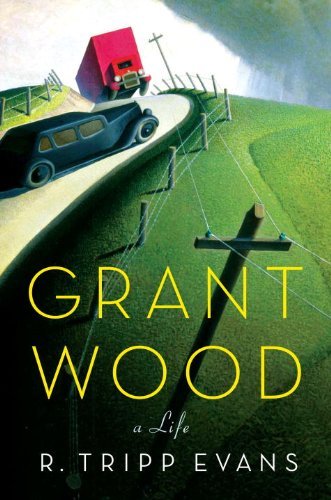
[Grant Wood: A Life by R. Tripp Evans (Knopf, 2010); Hardcover, 401 pp, $37.50.]

Grant Wood’s “American Gothic” is the most recognizable American painting.

Of all the paintings in the world, only the Mona Lisa has been more parodied. As Tripp Evans notes in his groundbreaking new biography of the artist, when it was first exhibited in Chicago in 1930, it made an instant global celebrity out of Wood: “Never in the history of American art had a single work captured such immediate and international recognition; by the end of 1930, the painting had been reproduced in newspapers around the globe… Never before, either, had a painting generated such widespread curiosity about its artist.”

“American Gothic” was considered by most critics of that day as something of a national self-portrait, and it made Wood the icon of a new native American, regionalist art. The New Yorker wrote at the time, “As a symbol Wood stands for the corn-fed Middle West against the anemic East, starving aesthetically upon warmed-over entrees dished up by Spanish chefs in Paris kitchens. He stands for an independent American art against the colonialism and cosmopolitanism of New York.”

Wood, who was born in the small town of Anamosa, Iowa, in 1898 and spent nearly all his life painting in the Hawkeye State, depicting its countryside and inhabitants, was said to stand for the flinty, manly virtues of heartland America. The New York Times proclaimed that Wood, who styled himself a “farmer-painter,” had earned his “toga virilis” for, as Evans summarizes it, “ending Americans’ perilous fascination with impressionism.”

Wood himself encouraged this anti-intellectual, quintessentially American, and rigorously heterosexual version of his persona and the origins of his art. He famously declared in a newspaper interview, “All the really good ideas I’ve ever had came to me while I was milking a cow,” adding, “You don’t get panicky about some ‘-ism’ or other while you have Bossy by the business end. Your thoughts are realistic and direct.”

The public image Wood constructed of himself even extended to the way he dressed. As one prominent critic eulogized him on his death in 1942, “In past years artists adopted smocks for their own… the working attire of French peasants. Grant Wood wore the work clothes of his own country when he painted, overalls such as a farmer or mechanic would choose.”

But all of this was an elaborate charade. As Evans, an openly gay art history professor at Wheaton College in Illinois, reveals in this meticulously researched biography, Wood had made a careful study of impressionism during four extended trips to Europe and had been a student for two years at the prestigious Académie Julian in Paris, where he steeped himself in the impressionist and post-impressionist masters.

Although he spent his earliest years on the family farm, he spent most of his boyhood time hidden away in a dark basement, his refuge where he could draw and paint, sequestered from the disapproval of his distant and authoritarian father, who considered such artistic proclivities “sissified.”

His father died when he was quite young, and he then moved to the bustling metropolis of Cedar Rapids with his mother and sister, with whom he lived there for most of the rest of his life until, as part of his camouflage, he contracted a loveless, unconsummated, unhappy, and brief marriage.

Far from being inspired by milking cows — an activity he only engaged in occasionally in his young boyhood — Wood told his wife that he felt “disgusted and dirty” by the act. She would recount, “He told me how embarrassed he was at the time because he was sure that no matter how much he bathed, he must carry with him the smell of the manure which permeated his clothes from working around livestock.”

And as a young man Wood wouldn’t have been caught dead in overalls — he was, in fact, something of a dandy, as photographs in this copiously illustrated volume from Wood’s “bohemian,” European period clearly show. His earliest vocations activities were not in farming but as a jewelry designer, interior decorator, and in theatrical production. One friend described the shy Wood’s voice as sounding “like the fragrance of violets made audible.”

Grant Wood’s classic “American Gothic” (1930) and his painting of a nude male. Photos courtesy Knopf / Gay City News.

Wood’s previous biographers have turned a blind eye to the demonstrable fact that he was a deeply closeted homosexual. Evans documents the always-chubby Wood’s infatuations (many of them apparently unrequited and sublimated into parental role-playing) with an unending series of slim, dark-haired young men who were his students, protégés, and secretaries. As the bartender in a famous Cedar Rapids watering hole Wood favored put it, “Wood was only gay when he was drunk.”

Evans has even unearthed numerous oblique but unmistakable references to Wood’s sexual orientation in the Iowa newspapers of the 1920s. As he writes, “Given the later insistence upon Wood’s sturdy masculinity and embodiment of Midwestern morality, it is surprising to note the frequency and candor of these early references to his homosexuality.”

To take just one example, Wood’s friend MacKinlay Kantor (who won later fame as a Pulitzer Prize-winning novelist and screenwriter) wrote in his gossip column for the Des Moines Tribune-Capital, emphasizing Wood’s bachelorhood: “Pink of face and plump of figure, he was most nearly in character one night when he appeared at a costume party dressed as an angel — wings, pink flannel nightie, pink toes, and even a halo, supported by a stick thrusting up his back.”

Not only did Kantor link Wood’s costume to common stereotypes of the “fairy,” but after comparing Wood to Snow White, who lay imprisoned in a glass coffin awaiting her prince’s kiss, Kantor wrote: “The front door of his apartment is made of glass, but it’s a coffin lid. OOOOOOoooooh!” Kantor then exhorted the “boys” among his readers to “look [Wood] over.” The meaning of all this is quite evident, unless one doesn’t want to see.

The fact that things like this had appeared in print drove Wood even further into his closet in the late 1920s, leading him to adopt the overalls and “farmer-painter” pose to bolster its locked door. It was also at this time that he turned away from his early painting style, indisputably marked by his study of impressionists, to the gothic realism that, as Evans demonstrates, bore the imprint of the Dutch and German masters he had absorbed while studying in Germany.

Evans is brilliant in documenting how gender assignments were made to various artistic styles, and how impressionism was considered a “feminine” art form. Moreover, the new school of regionalist, “authentic” American art of “U.S. scene” painting, of which Wood became a symbol in the 1930s after the stunning success of “American Gothic” — and which was launched as a media fetish with a 1934 Time magazine cover story written on orders of its conservative nationalist publisher Henry Luce — was impregnated with an explicitly xenophobic, anti-modernist, and extremely homophobic ideology.

Thus, Wood’s famous comrade-in-arms in this movement, the painter Thomas Hart Benton, wrote a 1935 essay entitled “Farewell to New York,” which Evans rightly describes as a “homophobic diatribe.” In it, Benton roared that the city had “lost its masculinity” since the start of the Depression, because it had been polluted by

the concentrated flow of aesthetic-minded homosexuals into the various fields of artistic practice… far be it from me to raise any hands in moral horror over the ways and tastes of individuals. If young gentlemen, or old ones either, wish to wear women’s underwear and cultivate extraordinary manners it is all right with me. But it is not all right with the art which they affect and cultivate. It is not all right when, by ingratiation or subtle connivance, precious fairies get into positions of power and judge, buy, and exhibit American pictures on a base of nervous whim and under the sway of those overdelicate refinements of taste characteristic of their kind.

To cover himself, Wood endorsed Benton’s queer-bashing declaration.

The movement’s most ardent advocate among art critics — one might even call him its ideologue — Thomas Craven, in his 1934 book Modern Art: The Men, the Movement, the Meaning, had earlier blown the same trumpet. “The artist is losing his masculinity,” Craven growled.

The tendency of the Parisian system is to disestablish sexual characteristics, to merge the two sexes in an androgynous third, containing all that is offensive in both. Once [male artists] contract la vérole Montparnasse — the pox of the Quarter — they become jaded and perverse… They found magazines in which their insecurity is attested by the continual insulting of America, hymns to homosexuality and miscegenation… It is this sort of life that captures American youth and emasculates American art.

Not only was homosexuality illegal and known homosexuals jailed or condemned to horrific “treatments” by psychiatric ghouls in mental hospitals, but the very art movement that had made Wood a central figure was unrelenting in its condemnation of same-sex orientation. Wood’s exposure would have threatened not only his reputation but his income as well.

It was in this context that in 1935 he contracted a marriage with a former actress, Sarah Moxon, to the great surprise of his friends and family. But he soon alienated Sara by falling in love with her handsome, 20-something son from a previous marriage, installing this rather louche and exploitative if decorative young chap in their home, and lavishing money and attention on him, even considering adopting him at one point.

At the same time, Wood also kept a secretary, Paul Rinard, another in the series of slightly-built, dark-haired young men with whom the painter surrounded himself, and with whom he was also in love — albeit unrequited. All these boys under one roof eventually were too much for Sara, and the brief marriage ended in acrimony.

There were several points in Wood’s life at which exposure of his homosexuality seemed imminent. In the late 1920s, he was blackmailed by a young man over their relations. And though he piled layers of protective cover on his public image, Wood was stifling in his closet, and from time to time this was reflected in his painting.

In 1937, he produced for sale by mail a lithograph, “Sultry Night,” that showed a handsome, full frontal nude man beside an outdoor bathtub pouring a bucket of water in a slow cascade over his head. Declaring the work to be an example of pornography, the censors at the U.S. Postal Service barred its publisher from distributing it or featuring the image in its catalogues (although not banning the many female nudes the publisher carried).

Wood was forced to publicly defend the “innocence” of the work as a recalled scene from his boyhood, something Evans demonstrates was more than unlikely.

Evans’ book is much more than a biography — it is also a lesson in looking and seeing. Evans is blessed with a felicitous gift of description that makes his dissections and deconstructions of Wood’s art not only enlightening but also enjoyable. And as an openly gay man, Evans is not blind to the multitude of clues in Wood’s paintings that signal the artist’s queer sensibility and even homoerotic sentiments that most previous critics have ignored.

Even those not steeped in the arcana of art criticism will find Evans’ descriptions of what the paintings mean an engrossing read, all the more so because these works are included among the book’s many illustrations. Readers may judge for themselves whether or not his interpretations are on track — as I think they are.

Wood’s reputation fell with the rise of abstract art in the post-World War II period, but a revival of interest in him began in 1983 with an exhibition that, as Evans notes, “coincided nicely with the dawn of the Reagan era. In Wood’s sunny, presumably uncomplicated imagery, conservative art critics could have found no more perfect illustration of President Reagan’s relentless optimism and call to ‘traditional American values.’”

But in Grant Wood: A Life, Evans reveals the dark ironies in Wood’s portrayals of heartland America and its culture that he traces back to Wood’s love of H. L. Mencken, whose contempt for that backwater culture and its “booboisie” he shared. It is evident in Wood’s work for those who wish to see it, and Evans is a reliable guide.

In the book’s epilogue, Evans pays tribute to Paul Rinard, Wood’s last secretary, who entered politics after serving in the navy in World War II. Rinard became a powerful backroom policy broker, first with Iowa’s liberal governor Harold Hughes in the 1960s, then joining the staff of Senator John Culver, who at Rinard’s funeral in 2000 called him “the intellectual godfather of Iowa’s progressive agenda for half a century.”

From the 1970s on, Rinard was “a defender of gay and lesbian civil rights — a courageous stance that struck even Culver’s younger staffers as radical… It would be difficult to explain Rinard’s commitment to this issue,” writes Evans, “especially during a period when its advocates were so scarce, without taking into account his profound loyalty to Wood. The artist might have led a far happier life, Rinard believed, had he been able to live in a more authentic way — safeguarded from the fear of losing his job, his reputation, or both, for being exposed as a homosexual.”

Gay activist friends of mine from Iowa who knew and greatly appreciated Rinard tell me that Evans paean to him is not misplaced.

Tripp Evans’ book is not only sure to change the way the art world looks at Grant Wood and his work, it is also a valuable contribution to this country’s cultural history, and one that shows the insidious homophobia that has often shaped that history. This is a splendid, beautifully written book.

[Doug Ireland is a longtime radical political journalist and media critic and an openly gay man. His work has appeared in many U.S. and French publications, including the New York Post (back in its liberal days), the Village Voice, New York magazine, The Nation, Bakchich, the Parisian daily Liberation, the LA Weekly, and Gay City News, the largest lesbian and gay weekly in New York City, where this article also appears.]

The Rag Blog

Posted in Rag Bloggers | Tagged , , , , | Leave a comment

Jim Turpin : Military Suicides, PTSD at All-Time High

Under the Hood Café near Ft. Hood in Killeen Texas is a place where active duty GIs and veterans of Iraq and Afghanistan can discuss the debilitating effects of war. Photo from Under the Hood / Flickr.

Texas’ Fort Hood sets the pace:
PTSD and suicides in the military
are at an all-time high

By Jim Turpin / The Rag Blog / October 27, 2010

KILLEEN, Texas — Even with the spin from the current administration that the “war is over” in Iraq, it is well known that 50,000 combat-ready troops remain in the country. Add to that a recent deployment of 2,000 troops from the 3rd Armored Cavalry Regiment from Fort Hood in Texas. At present almost 100,000 troops remain in Afghanistan.

With the total number of U.S. military personnel cycling through both Afghanistan and Iraq at almost 1.8 million, and with the RAND corporation estimating that 18% have PTSD (which is deemed low by some experts), this would put the returning numbers with PTSD at 324,000.

A recent article in The New York Times confirms what the organizers of the Killeen-based GI coffeehouse Under the Hood Café have been battling at Fort Hood for the last year and a half: suicides are at the highest point since 2008, with 14 confirmed suicides since the beginning of 2010. In one recent weekend, there were three suicides and one murder-suicide at Fort Hood.

With the population at Fort Hood ranging from 46,000 to 50,000 soldiers at any given time, the rate of suicide is four times the national average, based on Center for Disease Control and Prevention estimates of 11.5 suicides per 100,000 people.

The repeated deployment of military personnel who suffer from both physical and psychological wounds has led to these all-time high suicide rates. A recent article in the American Journal of Public Health studied 2,500 New Jersey National Guardsmen and determined “deployed soldiers were more than three times as likely as soldiers with no previous deployments to screen positive for post traumatic stress disorder.”

Despite these staggering statistics, the Fort Hood command continues to find ways to deny soldiers their right to receive necessary mental health services. Several soldiers have come forward recently with reports of harassment, undue punishment, and interference when seeking these necessary services.

A number of examples include:

  • The imprisonment of SPC. Eric Jasinski in March 2010. Jasinski, who was suffering from PTSD, refused redeployment to Iraq based on this condition. It was feared that Jasinski’s confinement could interfere with his ability to receive his prescribed medications. Eric’s attorney James Branum stated, “He was seeing a psychiatrist for his condition and prescribed Zoloft for depression and Trazadone to get to sleep, and they handed him his gun and told him to go back to Iraq.”
  • The deployment of 50 soldiers from Ft. Hood with physical (knee, back, and shoulder issues due to bomb blasts) and psychological (PTSD/TBI) issues in June 2010 to the National Training Center at Ft. Irwin, California. Combat training for those soldiers with verified PTSD and other anxiety disorders runs counterintuitive to generally accepted psychiatric practices.
  • Recent reports from soldiers at Ft. Hood suffering from PTSD and substance abuse who are being given extra work loads or are being kept from dealing with additional personal crises at home. Issues they are confronted with include being given medication only (instead of counseling) or being ignored by the chain of command when they request assistance.

Veteran deaths also surge after discharge from the military and are often the result of vehicle accidents, motorcycle crashes, drug overdoses, or other causes. An article this month in The New York Times discusses the huge number of veteran deaths attributed to destructive, risky, and lethal behaviors:

“The data show that veterans of Iraq and Afghanistan were two and a half times as likely to commit suicide as Californians of the same age with no military service. They were twice as likely to die in a vehicle accident and five and a half times as likely to die in a motorcycle accident. These numbers are truly alarming and should wake up the whole country,” said United States Representative Bob Filner, Democrat of San Diego, who is the chairman of the House Veterans’ Affairs Committee.

“They show a failure of our policy.”

The Under the Hood Café and Outreach Center, the GI coffeehouse located near Ft. Hood, Texas, the largest military base in the U.S., offers GIs a free speech zone. It provides a non-military environment that allows active duty GIs and veterans of Iraq and Afghanistan to discuss the debilitating effects of war. Under the Hood offers free referrals for medical and psychological services and legal assistance for those soldiers who are resisting redeployment to war zones.

To benefit its ongoing efforts in support of GIs, veterans, and military families, Under the Hood is having a “Hoodstock Flashback” concert (see graphic below) on Sunday, November 14, from 6-11 p.m. at Jovita’s in Austin. Admission is $10 at the door and includes such artists as Barbara K, Karen Abrahams, Will T. Massey, and Richard Bowden.

[Jim Turpin is a native Austinite and member of CodePink Austin. He also volunteers for the GI coffeehouse Under the Hood Café at Ft. Hood in Killeen, Texas.]

CLICK ON IMAGE TO ENLARGE

The Rag Blog

Posted in Rag Bloggers | Tagged , , , , , , , | Leave a comment

BOOKS / Sidney Brammer : Remembering Joe Watson

Shelf at Austin’s 12th Street Books, home to the late Joe Watson’s personal book collection.

‘Not all of me will die’:
Remembering Joe Watson

The survival of small, independent bookshops owes much to the thinking, reading public who buy and cherish books, as well as the peculiar entrepreneurship of some very literary, visionary individuals who collect and sell them.

By Sidney Brammer / The Rag Blog / October 27, 2010

AUSTIN — Sometimes I find myself missing my old hometown even though I still live here.

My jaundiced opinion of Austin is that it used to be better, i.e. smaller, quieter, and with much smarter people walking along its much shadier streets. The weather even seemed cooler and wetter when I was a kid in the ‘50s, because my fondest, frequent recollection is of being taken to bookstores on rainy days.

The particular bookstore that stands out in my memory is The Brick Row Book Shop, a loft on the musty second floor above Faulkner’s Drugs at the corner of Guadalupe and 24th Streets. The Brick Row was an antiquarian bookshop; it traded in used or rare books and prints to the sophisticated intellects who peopled Austin’s pre-“literary outlaw” past.

The Brick Row was immortalized in the novel The Gay Place (second book of the trilogy, if you’re interested in literary sleuthing), and it was the first place I ever heard classical music and Fats Waller (played on an old phonograph in the proprietor’s office). It is also where I learned how to browse — a non-linear, imaginative, instinctive, and highly intelligent human activity that bears no resemblance at all to surfing the Web.

The occasion of this elliptical remembrance of things past was a friend calling to tell me some very sad news: Joe Watson had passed away. In case you missed it, a tiny photo of a strikingly handsome young Navy flyboy in aviator sunglasses appeared on a recent obituary page of our major daily; Joe Watson was one of Gen. Claire Chennault’s Flying Tigers who “flew the Hump” over the China-Rangoon-Burma theater of WWII.

When Joe returned from that war, he landed in San Francisco Bay (where his ashes are now scattered), and he settled there for a time with wife Trudi. Joe and Trudi became serious book collectors, joining that region’s rich underground of collectors, small presses, independent booksellers, literary journal editors and authors.

Joe also taught school for many years, and in the 1980s, the Watsons retired to Austin where they added their sociable, erudite charm to our bookish subculture.

Joe loved to talk books and his impressive personal book collection now resides at Luke Bilberry’s 12th Street Books. Most people are unaware that Joe was, also, a secret business partner in Paul Foreman’s much-missed Brazos Book Shop, one of the finest and dustiest browsing parlors that ever existed (and another great place to take kids on rainy days).

One other fact about Joe Watson that is even less well known (and which I feel compelled to reveal, as my personal memorial to Joe) is that sometime in the early ‘70s, Joe purchased an old footlocker from Franklin Gilliam, the proprietor of The Brick Row Book Shop; the footlocker was full of personal papers that had once belonged to a minor regional novelist by the name of Billy Lee Brammer.

You see, people who love books enough to collect them eventually all come to know each other. In 1971, Franklin Gilliam moved The Brick Row from Austin to the Bay area and he inevitably encountered Joe Watson. Gilliam was a happy-Buddha egghead from Cuero, Texas who wore horn-rimmed glasses and spoke with a wonderfully astute and condescending drawl on just about any subject, author, or book one could find in his crowded floor-to-ceiling stacks.

His Austin customers included university students, earnest young lecturers, elbow-patched classics professors, beatniks, artists, activists, journalists, politicians — even old Harry Ransom depended on Gilliam’s finds. When a down-and-out Bill Brammer was hanging out in Bolinas and hit up his old Austin friend and favorite bookseller for a loan, Gilliam insisted on Brammer collateralizing the loan with his footlocker, knowing full well that Brammer would never pay him back.

Gilliam, in his Buddha-like wisdom, also knew that someday, somehow, the contents of that footlocker would be important to somebody. So he sold it to Joe and Trudi Watson because he knew they were the kind of collectors who would never exploit the contents by separating and selling each piece individually — and what a treasure trove it was!

The footlocker was filled with correspondence between Brammer and other authors (such as Warren Miller, David Halberstam, Larry L. King, Elizabeth Janeway, and Merle Miller), letters between Brammer and his editors and agent during his brief period of notoriety as an acclaimed new author (long before his decline), the original galley proofs of The Gay Place, and manuscript pages for Fustian Days, Brammer’s unfinished sequel to his novel — items that had long been assumed lost.

Brammer had left very few personal papers in his disorderly wake when he died of a drug overdose in 1978. Thus, if not for Joe Watson and his Texana-loving Trudi, there would not be a well-preserved and intact Billy Lee Brammer archive now housed at the Southwestern Writers Collection at Texas State University.

For every Brick Row Book Shop that fades from our memories, other home-grown enterprises step in to carry the torch — shops like Brazos Books, Grok Books (which evolved into BookPeople), Deep Eddy Books, 12th Street Books, and, of course, good old Half Price Books that has managed to weather several economic downturns and location moves.

The survival of small, independent bookshops owes much to the thinking, reading public who buy and cherish books, as well as the peculiar entrepreneurship of some very literary, visionary individuals who collect and sell them. So this is a small tribute to one of those visionaries: Joe A. Watson. It’s also a tribute to those almost forgotten book lovers, booksellers, and book collectors who handed me my first books as a young person, some with inscriptions that I still treasure to this day, because good books are kept and are valuable to us in a way that a Kindle will never be.

They help us remember those “book people” who have made Austin an intellectual oasis within a know-nothing state — an intelligent and humanistic strain that is much more integral to our safe haven for thought than 75,000 ACL-Fest [Austin City Limits music festival] boogiers will ever be.

So if you don’t want to be forgotten, then don’t forget… Franklin Gilliam, Charles Anthony Newnham, Elmo and Jenny Hegman, John Henry Faulk, Mary Sherrill, John Patrick Sullivan, Jean and Russell Lee, Willis W. Pratt, Robert Christian Eckhardt, Cecile Ragland Fischer, Marjorie Hershey, Sam and Virginia Whitten, Helen Handley, Maury Maverick, Jr., Phyllis Cartwright, et ceteraet cetera

Non omnis moriar.” — Horace, The Odes

[Sidney Brammer is an award-winning screenwriter, playwright, director, and film/video and theater artist who teaches screenwriting and playwrighting at Austin Community College. Her father was Texas novelist Billy Lee Brammer, author of The Gay Place. This article was first posted to The Austin Chronicle‘s books blog, Under the Covers.]

Sidney Brammer will be Thorne Dreyer‘s guest on Rag Radio on KOOP 91.7 FM in Austin, Friday, November 12, 2-3 p.m. (CST). To stream Rag Radio live, go here. To listen to this show after the broadcast, or to listen to earlier shows on Rag Radio, go here.

The Rag Blog

Posted in Rag Bloggers | Tagged , , , , | 5 Comments

Bob Fitrakis and Harvey Wasserman : Rove Served for Election Theft

Danse Macabre: MC Karl Rove, choreographer of election theft. Photo from AP.

Facing the nation:
Karl Rove deposed for election fraud

By Bob Fitrakis and Harvey Wasserman / The Rag Blog / October 26, 2010

Election woes got you down?

Imagine the look of contempt on Karl Rove’s face this past Sunday as he swaggered toward his star turn on CBS’s Face the Nation only to be served with our subpoena sanctioned by the Secretary of the State of Ohio.

The federal subpoena orders Rove to testify in deposition. Our attorney, Cliff Arnebeck, intends to ask Mr. Rove about his role in the theft of the 2004 election, and to discuss his orchestration of tens of millions of corporate/billionaire dollars in the one coming up on November 2, 2010.

As co-counsel and plaintiff in the on-going King-Lincoln-Bronzeville federal lawsuit, we have fought for six years to win justice and full disclosure in an election that Rove stole for George W. Bush.

In the course of this civil rights federal suit, we have seen the illegal destruction of hundreds of thousands of paper and electronic ballots that were supposedly protected by federal law.

We have seen 56 of 88 Ohio counties destroy most of their poll records, making a full recount of the 2004 vote an impossibility. Some of this destruction, for which no one has been prosecuted, was done in defiance of federal law and a federal court order.

We have also seen the very mysterious and disturbing death of Michael Connell, Rove’s former chief computer guru. Rove used Connell to establish the electronic tools and architectural framework through which the vote count manipulations that shifted the election from John Kerry to Bush were accomplished.

An experienced professional pilot, Connell died improbably in a fiery crash at his home airport in Canton in December 2008. Connell had been deposed the day before the November 2008 election. Attorney Arnebeck was in the process of preparing for another round of questioning when Connell’s life was ended.

Our subpoena is aimed at letting Rove explain all he did to give himself, Bush, and Dick Cheney another term in the White House.

But there is much more. With the U.S. Supreme Court’s infamous Citizens United decision, the floodgates have opened to an unprecedented wave of cash coming from corporations and billionaire donors such as the Koch Brothers. By many accounts at least $150 million in corporate/billionaire lucre is being laundered through Rove’s American Crossroads.

Under Rove’s orchestration, this money is being used to wipe Democrats out of Congress and to take control of the apportionment process at the state level throughout the country.

“Rove is the de facto head of a coordinated Republican national campaign in which Tom Donahue of the Chamber of Commerce is a senior partner, while the Republican National Committee has been relegated to junior partner status,” says Arnebeck.

“Rove has filled the airwaves with high-priced attack ads funded by the mega-corporations and billionaires that stand to benefit most from another assault on the public trust and treasury.

“He and the Koch Brothers have also funneled large bundles of cash to a Tea Party astroturf organization meant to give the Republican campaign a grassroots veneer.

“From the fiasco of Florida 2000 through the theft of Ohio 2004 to the present, there has been no significant federal reform of the electoral process or curtailment of the use of easily manipulated electronic voting machines,” adds Arnebeck. “With the added tsunami of cash from Citizens United, Rove’s role as the principal perpetrator of a racketeering conspiracy, as defined by the Ohio Corrupt Practices Act, has been vastly enhanced.”

“Our lawsuit stemming from the widespread ‘irregularities’ that defined the 2004 election has never been settled,” concludes Arnebeck. “With the approval of the out-going Secretary of State, Jennifer Brunner, we have served Mr. Rove with a legally binding requirement that he answer a few questions.”

Stay tuned.

[Bob Fitrakis and Harvey Wasserman are co-counsel and plaintiff in the King-Lincoln-Bronzeville federal lawsuit, and have co-authored four books on election protection at www.freepress.org, where donations to this lawsuit can be made via the CICJ election protection at the online store, where the Fitrakis Files also appear. Harvey Wasserman’s History of the United States is at www.harveywasserman.com.]

The Rag Blog

Posted in Rag Bloggers | Tagged , , , , , , , | 3 Comments

David Bacon : California’s Perfect Storm

Students and teachers march in Oakland, California,
to protest the termination of adult education programs. Photo by David Bacon.

Fighting to save public education:
California’s perfect storm

Across California, new alliances of teachers, students, state workers, communities of color, and working-class communities in general took on the challenge.

By David Bacon / The Rag Blog / October 25, 2010

SAN FRANCISCO, California — The United States today faces an economic crisis worse than any since the Great Depression of the 1930s. Nowhere is it sharper than in the nation’s schools. It’s no wonder that last year saw strikes, student walkouts, and uprisings in states across the country, aimed at priorities that put banks and stockbrokers ahead of children.

California was no exception. In fact, other states looked on in horror simply at the size of its budget deficit — at one point more than $34 billion. The quality of the public schools plummeted as class sizes ballooned and resources disappeared in blizzards of pink slips. Fee increases drove tens of thousands from community colleges and university campuses.

But California wasn’t just a victim. Last year it saw a perfect storm of protest in virtually every part of its education system. K-12 teachers built coalitions with parents and students to fight for their jobs and their schools. Students poured out of community colleges and traveled to huge demonstrations at the capitol. Building occupations and strikes rocked the University of California (UC) and the California State University (CSU) campuses.

Together, they challenged the way the cost of the state’s economic crisis is being shifted onto education, with a particularly bitter impact on communities of color. Activists questioned everything from the structural barriers to raising new taxes to the skewed budget priorities favoring prisons over schools.

Rise and fall of the Master Plan

When the current recession hit, California had already fallen from one of the country’s leaders in per-pupil education funding in the 1950’s to 49th among the 50 states in the last decade. That fall was more than just a decline in dollars. It was the end of a commitment to its young people that started in 1960, when a wave of populist enthusiasm put liberals in control of the California Legislature and governor’s mansion.

Together, they issued a Master Plan for Higher Education that promised every student access to some degree of post-secondary schooling. Community colleges were free, omnipresent, and accepted everyone. UCs had no tuition and charged only nominal “fees” for university services. Strikes led by Third World students and civil rights demonstrations opened the doors wider to people of color and youth of working-class families generally. The state’s reputation as an economic and technological powerhouse owed much to the students who passed through the system in the decades that followed.

By last year, that era wasn’t even a memory for students who have grown up in an age of shrinking expectations. Yet on paper, at least, the promise remained. In urging students and teachers on UC campuses to fight instead of giving up, noted radical sociologist Mike Davis called it an epic challenge. “Equity and justice are endangered at every level of the Master Plan for Education,” he argued.

Davis called on his fellow faculty members to look out of their office windows. “Obscene wealth still sprawls across the coastal hills, but flatland inner cities and blue-collar interior valleys face the death of the California dream. Their children — let’s not beat around the bush — are being pushed out of higher education. Their future is being cut off at its knees.”

Strike! he urged them. “A strike,” he said, “by matching actions to words, is the highest form of teach-in. The 24th [the date last September for the first walkout] is the beginning of learning how to shout in unison.”

Strike!

Davis’ letter came just as the perfect storm began to build. Lightning struck first at the universities, scenes of the sharpest confrontations in California last year. California’s university system includes 10 UC and 23 CSU campuses. Organizing started even before students were back in their fall classes.

“I was involved in previous campaigns against budget cuts when they were more modest,” recalls Ricardo Gomez, a UC Berkeley student leader. “We knew the state’s $34 billion budget shortfall would be used to slash money for education, and that the regents would put a big fee increase on the table. This time around we resolved to do something different, to move out of the channels of student government.”

Students and university workers created a joint strike committee that from the beginning sought to build an alliance with faculty on every campus. “The structure on each campus was open to everyone,” Gomez says. “From the first day of classes, people who’d never been involved before were turned on. . . We wanted a mass organization to plan demonstrations. At the same time we formed committees to set up websites, make posters and flyers, and put together the marches.”

In late August, the strike committee set a date for the first demonstrations — the walkout planned for Sept. 24.

One reason for what became an unprecedented level of faculty involvement was the move away from tenured positions to the widespread employment of contingent instructors, with much lower pay and little security. UC has about 19,400 faculty members, but only about 9,000 today have tenure.

Highlighting the impact at UC Santa Cruz was the dismissal of Susanne Jonas and Guillermo Delgado, instructors in Latin American and Latino Studies with more than two decades of seniority each, and the end of the celebrated Community Studies program. Lecturers were the first faculty victims of the cuts on every campus.

Gov. Arnold Schwarzenegger and UC administrators ensured the involvement of another constituency with their war on campus unions. Blue-collar UC members of the American Federation of State, County, and Municipal Employees (AFSCME) had just won a good contract after years of fighting. They saw their gains evaporate in furloughs and layoffs. The University Professional and Technical Employees (UPTE) still didn’t have a contract, and voted to strike Sept. 24.

Stoking the anger further, a series of media exposés documented high salary increases for top UC executives. At the Sept. 15-17 regents meeting, some received increases of up to 30 percent (up to $52,000 per year) on salaries in the $200,000 to $400,000 range.

UC Santa Cruz Feminist Studies professor Bettina Aptheker called the Sept. 24 strike “the largest unified action, perhaps, in the history of the UCs. It is first and foremost in defense of public education, and then in support of shared governance, in which faculty and students, but especially faculty, are allowed to actually influence policy and decisions. Third, it is in support of all union demands for negotiations and contracts.”

Nevertheless, UC President Mark Yudof proposed a 32 percent fee increase spread over the following two years. That proposal virtually guaranteed that the November regents meeting, scheduled to vote on it, would be greeted by further walkouts. As the regents met, students occupied buildings in Los Angeles, Berkeley, Santa Cruz, and Davis. Demonstrations shook the other five campuses.

Yudof dismissed the protests in a snide commentary in The New York Times. Schwarzenegger did too. “They’re all screaming,” he said. “Everyone has to tighten their belts.” But on the campuses, the chancellors were forced to react. First they punished the students who occupied buildings. A second building occupation in Berkeley in December led to the arrests of 65 students. By then, occupations had spread into the state university system as well, over similar tuition increases and budget cuts. In both Berkeley and San Francisco, police stormed the occupied buildings rather than negotiate the exit of students, as they’d done previously.

Yet some cutbacks were reversed. Library hours that had been cut in Berkeley and Santa Cruz, for instance, were restored. In Los Angeles, protests won the chancellor’s support for more aid to undocumented students. And under the pressure of strikes and protests, UPTE finally won a contract.

Crisis hides restructuring plans

Schwarzenegger and the regents were using the state’s budget crisis to move forward a much broader agenda — a shift in the way education in California is funded, what the money is used for, and who can afford higher education.

“The 32 percent fee increase not only undermines the access of students to the system, especially students of color from working families, but it’s also part of the privatization program,” explains Liz Hall, director of the UC Student Association and a UC Berkeley alumna. “Unlike the money from the state, which is restricted in the way the university can use it, the money from fees can be used any way the administration wants.”

She points out that a proposal to build a UC supercomputer by Yudof’s predecessor, Robert Dynes, failed because the Legislature wouldn’t fund it. “With fee money, UC administrators can launch whatever research and pet projects they like, and grant high salaries to their cronies. The growth of those unrestricted funds is one reason we have an executive pay scandal every few years. The regents run UC like a for-profit corporation.”

(In California higher ed, “fees” actually means tuition. The 1960 Master Plan outlawed tuition for higher education. A critical aspect of the disintegration of the plan has been raising “student fees,” originally meant to cover minor expenses, to amounts that can only be seen as billing for tuition.)

Shifting the funding of California’s higher education system from the state, through taxes, onto students themselves, isn’t just a program for the UC system. The state’s community college system is many times larger and the impact even more severe.

For the first time, student fee increases are now used to directly fund community colleges, which are experiencing the same trend toward tuition increases. Cesar Cota, a student at Los Angeles City College, was the first in his family to attend college. “Now it’s hard to achieve my dream,” he says, “because the state put higher fees on us, and cut services and classes.”

Monica Mejia, a single mom, wants to get out of the low-wage trap. “Without community college,” she says, “I’ll end up getting paid minimum wage. I can’t afford the fee hikes. I can barely make ends meet now.”

According to Marty Hittelman, president of the California Federation of Teachers (CFT) and a former community college instructor, the system turned away more than 250,000 students in 2009-10 alone. “Where can they go?” he asks.

UC? CSU? The workforce? California has a 12.6 percent unemployment rate, one of the nation’s highest. The state universities dropped 40,000 students this year. UC fees have gone up 215 percent since 2000, and CSU fees 280 percent. Community college fees, once nonexistent, rose 30 percent just last year.

Hundreds of thousands of students enrolled in California community colleges are unable to get the classes they need and thousands of temporary faculty are without classes to teach. So, as in the universities, the student returns for paying higher fees are increased class size and fewer available classes.

Those cuts have an extra impact on students of color. The Los Angeles Community College District educates almost three times as many Latino students and nearly four times as many African American students as all of the UC campuses combined.

Rallies, protests, and sit-ins

Police confront students during the occupation of Wheeler Hall on the UC Berkeley campus. Photo by David Bacon.

In protest, students, teachers, parents, union members, and community activists staged rallies at the end of November throughout California (as well as in other parts of the United States). There were large rallies in Los Angeles, San Francisco, and Oakland.

At CSU Fullerton, students took control of the humanities building, saying they were “putting ourselves in direct solidarity with the ‘occupations’ that have been occurring the world over from universities to factories to foreclosed homes; from Asia to Europe to Africa to Central and South America and, now, here in the United States.”

The Fullerton students chose the humanities building to protest the corporatization scheme envisioned by the campus strategic planner, Michael Parker, who called humanities “socially irrelevant” and favored courses useful for preparing student for corporate employment. Humanities, the students said, has become “politically dangerous to the established economic order… We are not surprised because we are dangerous.”

“The L.A. rally was spectacular,” enthuses Jim Miller, who teaches at San Diego City College. “The church holds a thousand, and there were hundreds more trying to get in.” He counted 565 people who came from San Diego to the Los Angeles event, including three buses of students from San Diego City College.

The protests continued into the spring. More than 8,000 students from Los Angeles and other community college districts rallied at the state capitol in Sacramento on March 22. State university campuses also sent hundreds of marchers.

‘We can’t fit on the rug anymore’

The most dramatic demonstrations were at the university level, but the crux of California’s education crisis lies in the K-12 public school system, especially in poor urban communities, and neighborhoods of immigrants and people of color. Some 22,000 pink slips were given out to public school teachers across the state in the 2009-10 academic year.

“In Watsonville they’re overcrowding classes,” charges Manny Ballesteros, a youth organizer. “They’re building more prisons in California than schools, and there are more blacks and Mexicans inside those prisons. For young people like me, instead of being able to get a job, and achieving our goals, that tells you, ‘You’re not going to make it.'”

Watsonville now only has seven school nurses for 19,000 students, and has cut school psychologists and counselors, music, and art. “Sports have become pay to play,” says Jenn Laskin, a humanities and English teacher at Watsonville’s Renaissance Continuation High School. “That means students who are talented and don’t have the money lose the opportunity. That cuts off yet another pathway to college.”

The state’s limit of 20 students for K-3 classes was modified in the Legislature’s recent budget deals, so next year K-2 classes will have 28 students. “We’re loading to the max. Kindergarten classes are super crowded, and one student told me, ‘We can’t even fit on the rug anymore.’

“Combined with the emphasis on test scores, it all affects children’s ability to learn,” she laments. “We have 2nd-grade students who don’t even know how to use scissors, because they’ve been taught to the test. They can bubble in letters and numbers, but they can’t cut a circle in a piece of paper.”

In Los Angeles, one of the world’s largest school districts, more than 6,300 teachers were originally set to lose their jobs before the beginning of the fall 2010 term. After unsuccessful attempts to get the Los Angeles Unified School District administration to reduce the number, teachers mounted a wave of successively more militant demonstrations.

Los Angeles Superior Court Judge James Chalfant ruled that a planned one-day strike was illegal because it would “endanger student health and safety,” and threatened educators with $1,000 fines and the loss of their teaching credential if they struck. So hundreds of teachers picketed their own schools before classes started, and parents and students walked with them.

One mother, Maria Gutierrez, said the one-day strike was a good idea. “What does it matter if children lose one day of class? If we lose our teachers, they’re going to lose a lot more.” And while the district claimed poverty was forcing layoffs, it found the money to hire more than 3,000 substitute teachers to take classes in case the teachers stuck.

At the beginning of May, thousands of teachers filled the street in front of the district’s offices, and 40 were arrested for blocking it in an act of civil disobedience.

Like so many other schools districts across the country, Los Angeles has used the crisis to escalate its plans to turn public schools over to charter groups. By the end of May, a total of 20 existing schools and 27 new campuses had been put up for bid. So teachers and communities organized around that, too. After months of planning and packed meetings, many of those bids went to groups led by teachers.

Education or incarceration?

With headlines focused on Los Angeles and the Bay Area, it’s easy to forget that California is an agricultural state. But it may be in poor agricultural communities, especially those in the San Joaquin Valley, where the state’s twisted priorities are the clearest. In the middle of a budget crisis, what will the state fund — schools or prisons?

Unemployment in California’s rural counties is often twice as high as on the coast. The economic crisis in small valley towns like Delano and McFarland was a fact of life long before California’s current budget woes.

In Delano, historic home of Cesar Chavez’s United Farm Workers, 30 percent of the residents live below the poverty line. Desperate for employment, many were sold the idea that prisons would provide a source of jobs beyond low-wage farm labor. As a result, the area has become home to giant institutions whose budgets dwarf those of local school districts. Valley teenagers today see those prisons in their future, whether as guards or inmates, rather than college.

Every day in Delano 3,176 people go to work in the Kern Valley State Prison and North Kern State Prison. Almost as many of the town’s families now depend on prison jobs as those supported by year-round field labor. Thousands of former farmworkers now guard other Latinos and blacks — inmates just as poor, but mostly from the urban centers of Los Angeles or San Jose rather than the rural communities of the Central Valley. The two prisons have a combined annual budget of $294 million. By comparison, the town’s 2010 general fund was a tenth of that, and the budget of its public schools a twentieth.

Following the March 4 Day to Save Education, a group of teachers and home care workers began a march from Bakersfield to Sacramento to mobilize opposition to the cuts. One marcher, retired teacher Gavin Riley, describes the social cost as he saw it walking through the valley:

We’ve seen boarded-up homes everywhere. Coming into Fresno we walked through a skid row area where people were living in cardboard and wood shacks underneath a freeway, sleeping on the sidewalks. We’ve seen farms where the land is fallow and the trees have been allowed to die.

About the only thing we’ve seen great growth in is prisons… I look at that and say, what a waste, not only of land but also of people. I can’t help but think that California, a state that’s now down near the bottom in what it spends on education, is far and away the biggest spender on prisons. It doesn’t take a brain surgeon to connect the dots.

Long-term strategies

K-12 teachers, students, home care workers, and community activists on a 260-mile, 48-day march from Bakersfield to Sacramento to protest cuts to education and social services. Photo by David Bacon.

The Central Valley march arrived in Sacramento on April 21, when more than 7,000 CFT and AFSCME members marched down to the capitol building to confront the Legislature and Schwarzenegger in a huge rally. They focused on one of the main demands that emerged in the sit-ins and demonstrations throughout the school year — a change in the way the state budget is adopted.

The state has a requirement that two-thirds of the Legislature approve any budget. Even more important, any tax increase takes a two-thirds vote as well. So even though Democrats have had a majority for years in both chambers, a solid Republican block can keep the state in a total economic crisis every year until Democrats agree to slash spending.

Teachers’ unions, students, other labor organizations, and community groups got an initiative (Proposition 25) onto the November ballot that would remove the two-thirds requirement, so that budgets and tax increases can be adopted by simple majority.

The state also needs new sources of revenue. Assemblyman Alberto Torrico authored a bill to charge oil companies a royalty for the petroleum they pull from under California’s soil. California is the only oil-producing state that doesn’t charge the oil giants for what they take.

As the school year drew to a close, students and teachers won some partial victories. Assembly Speaker John Perez introduced the California Jobs Budget, an alternative budget proposal that would reinstate much of the education money cut over the last year. He also promised to roll back the UC and CSU student fee increases by 50 percent.

Meanwhile, Gov. Schwarzenegger’s revised budget reinstated Cal Grants program funding, although it cut money for the poorest recipients of state aid at the same time. (By press time in September, the state legislature had still not passed a budget for the current fiscal year.)

“I don’t feel good that we saved Cal Grants at the expense of single mothers and children,” says Claudia Magaña, a student leader at UC Santa Cruz. “It’s great to know that students had some power this year, but not that we won at the expense of the neediest people. We have to look at who has power in this system and how to get it.”

Coming out of the year’s actions, Magaña voices the conclusion of many student leaders and teachers — that education activists need a strategy for the long haul. “We need [a strategy] to win long-term reinvestment in the system,” says Liz Hall.

We need a power analysis that will help us to build our movement. Preserving the public nature of education will take large-scale changes. This was a year of crisis for us, spurred by fee increases and furloughs. Now our bigger problem is how to get mobilization and commitment for much larger goals. To begin with, we have to get our students to turn out in November.

But giving more power to Democrats, and a better system for arriving at a budget deal, won’t automatically reverse the state’s priorities. Democrats vote for prisons, too.

Jim Miller says the demonstrations, and especially the Central Valley march, show that “we can fight for an economy and a government that work for everybody. We’re not saying save education by throwing old people out of their home care, by getting rid of health care for poor kids, by closing down state parks, or privatizing prisons. This is about the future of the state of California.”

Without unity, he says, “we’ll see a scarcity model, where people say take someone else’s piece of the pie, not mine. That’s a race to the bottom.”

Perhaps fighting itself was the year’s biggest achievement. Across California, new alliances of teachers, students, state workers, communities of color, and working-class communities in general took on the challenge. Their strategic ideas ranged from student strikes and walkouts to alliances between communities and unions, a sophisticated agenda of legislative solutions, and mass mobilizations in rallies and marches.

Although there was a broad variety of activity, a common thread highlighted the special impact education cuts have on communities of color and working-class families. A social movement is growing across the country to defend public education. California’s perfect storm was at its leading edge, and contributed a new repertoire of strategy and tactics for building it.

San Diego students protest racist attacks

At UC San Diego, the storm took on a particular character due to a series of racist events on campus. The string of incidents began in February, Black History Month, when white fraternity students organized a “ghetto-themed” party called a “Compton Cookout.” It was followed by a campus television show that mocked Black History Month. A few days later, a student hung a noose in the UCSD school library. Anti-hate rallies were organized at other campuses in response, and students sat in at Yudof’s Sacramento office.

As students geared up for March 4, a KKK-style hood was found with a hand-drawn circle and cross on the statue of Dr. Seuss outside the UCSD library. At a rally organized at UCLA in protest, student Corey Matthews asked: “What kind of campus promotes an environment that allows people to think it’s acceptable to target people for their ethnicity, gender, or sexuality? It’s something about the tone of the environment that allows this.”

A month later, UCSD administrators took action against Ricardo Dominguez, an art professor who developed a project to help migrants crossing the desert between Mexico and the United States use their cell phones to orient themselves, and find help in an emergency. Hundreds of migrants die in the U.S. desert each year because they cannot locate water or find shelter from the heat.

Conservative Republican Congressman Brian Bilbray objected to university administrators, who placed Dominguez’s tenure under review.

According to Graceland West, a San Diego student leader: “We need more resources for immigrants and people of color on this campus. Instead, a professor with a long history of support for us is being punished for taking a pro-immigrant position. When we have cuts to enrollment and student services, and a lack of financial aid, students of color are the hardest hit. Many now see UCSD as a racist campus. At the same time, higher fees hit high school students thinking about coming here. All this basically deters students of color from applying.”

— David Bacon

This article was first published in the Fall, 2010 issue of Rethinking Public Schools.

[David Bacon is a writer and photojournalist based in Oakland and Berkeley, California. He is an associate editor at Pacific News Service, and writes for Truthout, The Nation, The American Prospect, The Progressive, and the San Francisco Chronicle, among other publications. His documentary photography has been exhibited widely. His latest book is Illegal People: How Globalization Creates Migration and Criminalizes Immigrants.]

Listen to Thorne Dreyer‘s September 7 interview with David Bacon on Rag Radio on KOOP 91.7 FM in Austin, here. To listen to other shows on Rag Radio, go here.

Also see:

The Rag Blog

Posted in Rag Bloggers | Tagged , , , , , | 3 Comments

Marc Estrin : Happy Birthday, World


HAPPY BIRTHDAY, WORLD

By Marc Estrin / The Rag Blog / October 25, 2010

“I’m depressed.”

A most common comment. Depressed about what? The answers are various: our dangerous, deaf, moronic leadership, the ongoing wars, religious strife, public and private corruption, joblessness, lack of child care, housing, perverse spending priorities, the entire fate of the earth. So I thought I might bring some cheer this month by calling for a birthday celebration, a BIG birthday celebration — the October 23rd anniversary of the birth of… EXISTENCE.

That’s right. On October 23rd, 4004 BC, at 4 p.m., Eastern Standard Time, or midnight in the Garden of Eden, God created the heavens and the earth. And the earth was without form and void.

Such was the conclusion of James Ussher (1581-1656), Archbishop of Armagh, Primate of All Ireland, and Vice-Chancellor of Trinity College in Dublin, after profound and exhaustive study of scriptural genealogies and Middle Eastern and Mediterranean histories. His conclusion was incorporated into an authorized version of the Bible printed in 1701, and thus came to be regarded with almost as much unquestioning reverence as the Bible itself.

Six thousand and six years old! That’s a lot of years. And after all that time, what have we come to? The Decline of the West.

Way back in 1919, Oswald Spengler saw it all, the grand pattern, the “inward form of History,” repeating through all recorded time, and in every major culture, including ours.

“For everything organic the notions of birth, death, youth, age, lifetime are fundamentals…”

He saw all cultures come into springlike being, youthful and vigorous, flower in their summery, unique ways, and then autumnally decay. Their winters were frozen into rigid, petrified forms, and these forms he called “civilization.”

Our Western culture had been born around the tenth century, flowered in the Gothic and the Renaissance, became “civilized” in the eighteenth century, and in the nineteenth century, with the industrial revolution, had begun the process of spiritual decline.

The upcoming death of Western Culture was as certain as that of any other living organism. History was Destiny, unfolded through the cycle of human cultures, all of which shared a common rhythm and pattern. We cannot choose our destiny, we cannot alter it. We have no choice but to make the best of our historical situation.

Stark. Dramatic. No wonder it attracted so much attention. In this wintertime essay, he drove his metaphor hard. When the freezing point of a culture is reached, like water, it expands and can shatter its container. Though spiritually exhausted, it gathers the technical and material capacity for outward reach, desperately grabbing at life. And so begins what he called an Age of Caesarism.

He predicted the coming of totalitarian states, not by looking at the social movements around him, but by taking the longest possible view. He predicted a coming age of imperialist wars in which nations would complete their spiritual death, and finally fall to pieces, yes, like Rome, but also like every other culture, finally succumbing to the invasion of new forces, alien, hostile to the old, full of springlike, spontaneous creativity and religious devotion.

In the inevitable final battle between civilized engineers and God-inspired barbarians, the engineers would go down clutching pens and pencils. Artists would also succumb: this was not a time for soul. Art would be frustrated by society’s rejection, or corrupted by its licentiousness and power — a spiritual vocation gone astray. The Zeitgeist is inevitable, a time of perverted men in a hopelessly perverted age, liars calling liars liars.

Spengler spoke of the endless repetition of the “already-accepted,” of standardized art, of petrified formulas which would ignore and deny history. “Events,” he said, would become “the private affairs of the oligarchs and their assassins,” and would arise from administration, not society. He foresaw professional armies operating with an entirely different morality than civilian society. In 1917, he noted, “In a few years, we have learned virtually to ignore things which before the war would have petrified the world.”

Oh well, happy 6006, anyway!

[Marc Estrin is a writer and activist, living in Burlington, Vermont. His novels, Insect Dreams, The Half Life of Gregor Samsa, The Education of Arnold Hitler, Golem Song, and The Lamentations of Julius Marantz have won critical acclaim. His memoir, Rehearsing With Gods: Photographs and Essays on the Bread & Puppet Theater (with Ron Simon, photographer) won a 2004 theater book of the year award. He is currently working on a novel about the dead Tchaikovsky.]

The Rag Blog

Posted in Rag Bloggers | Tagged , , , , | Leave a comment

VERSE / Eric Gordon : The One-Leaflet Theory of Revolution

Graphic from Ben Cumming / Flickr.

The One-Leaflet Theory of Revolution

O God, O Muse, O Creative Spirit,
O shades of Revolution from generations gone,
I chasten my heart and bend my knee to implore you,
Send down,
to one so tired of working and waiting,
to one who winces with twinges of guilt
over a sinful night of dinner and music,
Send to this exhausted brain
that text of heavenly perfection,
that unearthly combination of letters and words,
that transcendent, pellucid, sonorous
expression of the people’s will
at this excruciating moment
that sublime manifesto of deliverance,
that noble pronouncement,
in a language all sentient beings may mystically apprehend,
Send down that one resplendent leaflet
leaping with imagination and potent with inventive genius

That will dilate the veins of indignation,
pump the blood faster through the heart,
lift cataracts from eyes,
and restore the halt and lame
to a full sprint toward the sun
to mold our class solidarity
into a fiery arm of victory
as glorious orchestras fill the air
with harmony no soul has ever heard
and the rhythm of masses marching as one.

And Muse or Spirit or God, please
do not forget to forward your flyer
in exactly that font and graphic design
your divine calculation determines
will awe and astound and amaze the population
into utter, confident conviction
that this, this one page of word and image,
be the prophetic answer to all our age-old prayers,
the long-sought comfort for all oppressed people,
the soothing balm to every hurt and wound,
the bugler’s final taps for numberless capital crimes.

And let it usher in a shining epoch of blissful peace
and art to please, delight, inspire,
that grants the joy of giving all we are able,
that blesses us with all we need.

O God or whoever, will this you bestow?

I’m listening.
Ready.
I’m sitting at my monitor prepared to transcribe.

Patient.
Patient!

Actually, I think I’m getting a little restless now.
I’m not hearing you.

‘Scuse me. Gotta get the phone.
Can I go out precinct walking today?!
Well, I was expecting a very important call.
It could come at any time.

But I can’t wait forever.
Yeah, I can go.
When and where do you need me?

Eric Gordon
October 17, 2010

Thanks to Mariann G. Wizard / The Rag Blog / Posted October 25, 2010

Posted in Rag Bloggers | Tagged , , , | 2 Comments

Danny Schechter : The ‘Fraudclosure’ Backstory

Illustration by Matt Mahurin / The Washington Independent.

U.S. workers in need of rescue:
Report from the epicenter of ‘fraudclosures’

It’s dark as a dungeon way down in the mine…

By Danny Schechter / The Rag Blog / October 25, 2010

WEST PALM BEACH, Florida — In all of the economic issues we are dealing with, there is always a “back story, a deeper context” that is usually missing,“disappeared” like those Allende supporters in Chile in the l970’s who wanted to empower workers, not just rescue them, when they get buried in a deep hole.

Most deeper issues go uncovered. Luis Campos, Director of the School of Anthropology at Chile’s Universidad Academia de Humanismo Cristiano, points out, “more buried than the miners themselves, the demands and the rights of the indigenous population continue to be flouted and unrecognized in our country.”

Many unsafe mines worldwide are still at risk from China to Zambia.

Who woulda thunk — certainly not the 1300 “journalists” on the scene — that this mine disaster had its origins in the era when Richard Nixon and Henry Kissinger helped snuff out an emerging popular democracy in the name of protecting what West Palm Beach-based writer and former economic “hit man,” John Perkins, calls the corporatocracy?

Historian Juan Cole poses these questions:

Are copper and gold mine owners stronger in relation to workers and have they escaped government regulation because the U.S. engineered a coup in 1973 to destroy the Chilean Left?

Was the San Estaban mining company’s ability to marginalize the union and to disregard input from the workers rooted in American-imposed corporate privilege? In other words, was the trapping of these workers in the first place Richard Nixon and Henry Kissinger’s fault?

The deep hole in that Chile mine was caused in part by a gold rush there — triggered, in turn by, a global financial crisis MADE IN THE USA. It had its counterparts in the U.S., and not just among those 29 miners who perished in the big main mine in West Virginia, last April, a disaster that was supposed to lead to new safety rules that the Republicans have been insidiously blocking.

There is another hole we need to focus on. Millions of us are trapped in our own mines, “underwater” in homes that have lost value with bills we cannot afford, trapped in unemployment, in jobs that are gone and not coming back. Poverty is up and the noxious Newt Gingrich wants to end the food stamps that so many now depend on.

There is no rescue in sight, and the human plight of most of the millions affected takes part outside of media sight.

The gaggle of reporters that covered the mine rescue as a human-interest story — not a political issue — missed the backstory there, just as they miss our own here.

Far fewer reporters are covering this crisis.

Here in Florida, one epicenter of the housing catastrophe, homeowners were shell-shocked by the latest fraudclosure crime wave. Denise Richardson writes in the Sun Sentinel,

Last I knew, knowingly signing documents fraudulently and using them in a court of law is frowned on, right? It’s criminal, isn’t it? Or is it only criminal if you are a homeowner and not a bank? Seems we’ve gone to great lengths to create and then accept a double standard here.

Perhaps these financial crimes — yes, that’s what they are, crimes — continue to happen because we never addressed the real problems to begin with. You can’t fix a problem you don’t acknowledge. Does anyone believe that was done to help protect the rights of homeowners? Let’s call it what it is: fraud.

An attorney in Deerfield Beach, Florida, representing 3,000 foreclosure victims, has taken hundreds of depositions from bank employees who admit they knew nothing about the details of the evictions they signed off on. Many are now being put down as “Burger King Kids,” yet they know more about real whoppers than this lot knows about real estate. RealtyTrac reports that foreclosure and REO homes accounted for 24 percent of all residential sales during the second quarter? That is huge!

Here in relatively affluent Palm Beach County, homeowners are number one in the state for the average number of loans in foreclosure that are delinquent. It has the fourth highest number of foreclosures, 45,829, with an average delinquency of 623 days. You will recall that Bernie Madoff once turned Palm Beach into a hunting ground for his ponzi scheme.

This situation is worse than we realize, and not just for the people most directly affected. No one knows how much the banks will lose in the class action suits, fines, and legal actions to come. Some think it could be tens of billions, suggesting another bailout may be in the offing, probably by the Federal Reserve Bank.

Paul Krugman questions whether the banks had the right to seize many of these homes, arguing, “The mortgage mess is making nonsense of claims that we have effective contract enforcement — in fact, the question is whether our economy is governed by any kind of rule of law.”

Buried in the Business section, on page B-8 of The New York Times, way down in an article saying the banks may be on the hook for billions, was this very revealing paragraph speaking to a problem that I have been raising for years, making clear the fraud problem is not just with foreclosures.

Inside the investment houses, several traders said nerves were frazzled further by worries that banks could face much bigger mortgage related losses, not from foreclosures, but because of questions about how the money was lent in the first place. If it turns out that mortgages were bundled together and sold improperly, more holders could sue the banks and force them to buy back tens of billions in mortgage-backed securities.

Frazzled nerves so far seem the worst punishment the banksters have tasted. They have just decided to reward themselves with a new round of raises and bonuses worth $144 billion with few criticisms. The Government has meanwhile just “settled” for $73 million with Countrywide, the leading predatory lender. That means that a prosecution of its top executives, the poster boys for mortgage criminality, will be dropped. Notes the website Housing Doom:

Even having to pay $77.5 million, Mozilo still nets $61.5 million, just between November 2006 and October 2007. Maybe “crime doesn’t pay,” but one of the lessons of the housing bust is that fraud does.

What should be done? Webster Tarpley speaks for many in calling for a national moratorium on foreclosures, a course of action rejected by the White House.

The current chaos in home foreclosures is once again the direct responsibility of the zombie bankers themselves, who have neglected all traditional legal and accounting standards concerning the necessary paper trails in their frenzied desire to securitize mortgage loans and make them into toxic derivatives in the form of asset-backed securities and mortgage backed securities. The zombie bankers, already the recipients of $24 trillion of public largess in the form of the various bailouts, have turned out to be incompetent even in the technical aspects of their own thieving racket.

But the chaos in the bankers’ filing systems is nothing compared to the chaos created by the millions of foreclosures they have engineered, based on adjustable-rate mortgages and similar misleading contracts which never should have been legal in the first place. For some time, it has been evident that the defense of the American middle class requires a blanket, orderly, federal freeze (or moratorium) on all foreclosures on primary residences, similar to the New Deal protections offered to family farms by the landmark Frazier-Lemke Act of 1935-1949 during the previous depression.

Ellen Brown, author of Web of Debt, goes further in Yes Magazine, asking if it is “Time to Break Up the Too-Big-to-Fail Banks?”

Popular financial analysts, crippling bank losses from foreclosure flaws appear to be imminent and unavoidable. The defects prompting the “RoboSigning Scandal” are not mere technicalities but are inherent to the securitization process. They cannot be cured. This deep-seated fraud is already explicitly outlined in publicly available lawsuits

There is, however, no need to panic, no need for TARP II, and no need for legislation to further conceal the fraud and push the inevitable failure of the too-big-to-fail banks into the future.

The faux populists of the Tea Party right have been silent on the issue. Glenn Beck dropped all populist pretensions by calling on followers to give money to the Chamber of Commerce so they can better pursue a corporate agenda. One Republican here assured me that Barney Frank caused the whole financial crisis and that he will be tossed out of office in the midterm election. (He didn’t just blame him — he hates him!) At the same time, one right wing website did publish a detailed denunciation of housing fraud.

As depressing as the lack of any real ongoing mass-based populist movement of the left or the right is another reality that The Washington Post finally spills even as millions of Americans buy into the illusion that new politicians can save us while angry voters here in Florida prepare to vote the Tea Party into office.

Let us tell you an Ugly Truth about the economy, a truth that no one in power or who aspires to power wants to share with you, at least until after the midterm elections are over. It’s this: There is nothing that the U.S. government or the Federal Reserve or tax cutters can do to make our economic pain vanish overnight.

So what will it be? More money for the banks to bring them under control, more illegal foreclosures, or some type of justice for homeowners? Will this crisis lead us to demand action to break up these financial behemoths or will we just sit by and watch a new crisis sweep us deeper into our own mines of despair?

[“News Dissector” Danny Schechter is a journalist, author, Emmy award winning television producer, and independent filmmaker who also writes, blogs, and speaks about media issues. Schechter directed Plunder: The Crime of Our Time, and a companion book, The Crime of Our Time: Why Wall Street Is Not Too Big to Jail. Contact him at dissector@mediachannel.org.]

Listen to Thorne Dreyer‘s Sept. 28 interview with journalist and filmmaker Danny Schechter on Rag Radio here. To find all shows on the Rag Radio archives, go here.

The Rag Blog

Posted in Rag Bloggers | Tagged , , , , , | Leave a comment

Ansel Herz : Cholera Spreads in Haiti

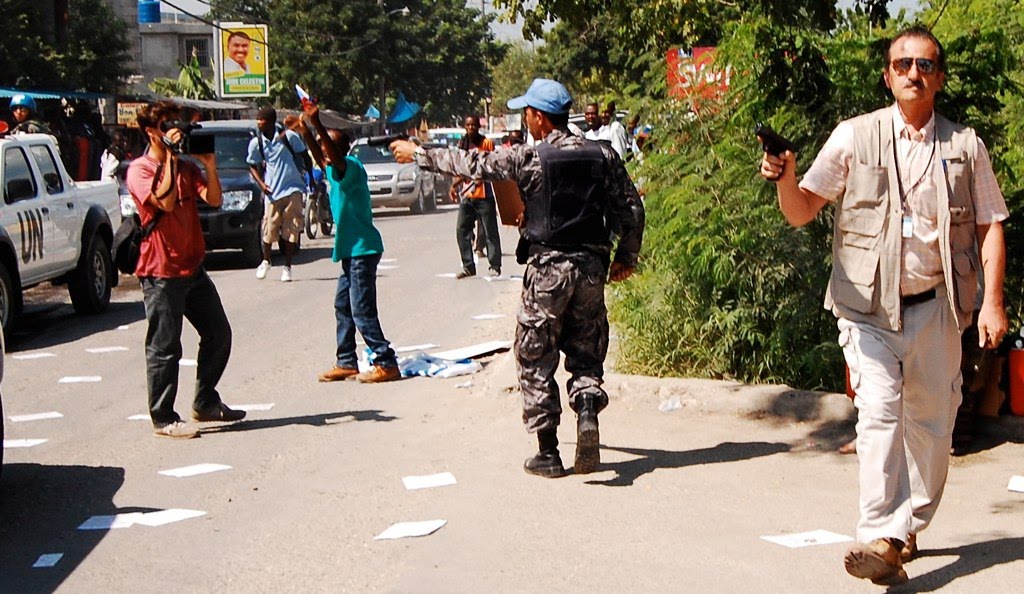
Above, MINUSTAH soldier points his gun at former Austin activist/independent journalist Ansel Herz in Port-au-Prince, Haiti, on October 15, 2010, at a demonstration against the renewal of MINUSTAH, the UN peackeeping mission. Photo from Gaentantguevara / Flickr.

For more about photo see sidebar story below.

Port-au-Prince fears the worst
as cholera spreads in Haiti

By Ansel Herz / The Rag Blog / October 24, 2010

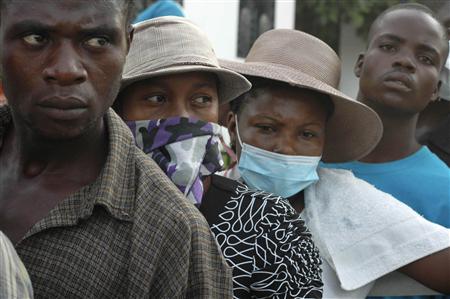
PORT-AU-PRINCE — Days after an outbreak of cholera began in Haiti’s rural Artibonite region [see story below], killing at least 200 people, there are now five confirmed cases of cholera in the busy capital city.

The cases “do not represent spread of the epidemic” because they originated in central Haiti, according to a bulletin circulated by Haiti’s UN peacekeeping mission with the heading “Key Messaging,” obtained by IPS.

“The fact that these cases were picked up and responded to so fast demonstrates that the reporting systems for epidemic management we have put in place are functioning,” it concludes.

Residents of the capital city are not so confident. “It’s killing people — of course, I’m scared. We’re in the mouth of death,” 25-year-old Boudou Lunis, one of 1.3 million made homeless by the quake living in temporary settlements, told the Miami Herald.

Radio Boukman lies at the heart of Cite Soleil, an impoverished slum crisscrossed by foul trash-filled canals where cholera could be devastating. The station has received no public health messages for broadcast from authorities, producer Edwine Adrien told IPS on Saturday, four days after reports of cholera-related deaths first emerged.

At a small, desolate camp of torn tents nearby, a gleaming water tank is propped up on bricks. Camp-dwellers said it was installed by the International Organization for Migration last week, more than nine months after the January earthquake damaged their homes.

But it’s empty because no organization has filled it with water. “We need treated water to drink,” a young man named Charlot told IPS matter-of-factly.

Cholera, transmissible by contaminated water and food, could be reaching far beyond the capital city. There are suspected cases of the disease in Haiti’s North and South departments, according to the Pan-American Health Organization, as well as confirmed cases in Gonaives, the country’s third largest city.

In Lafiteau, a 30-minute drive from Port-au-Prince, Dr. Pierre Duval said he had stabilized two cholera-infected men in the town’s single hospital, but could not handle more than six more patients. One died yesterday. All of them came from St. Marc, near the epicenter of the epidemic.

The main hospital in St. Marc is crowded with the infected. Supplies of oral rehydration salts were spotty when he arrived Friday after rushing from Port-au-Prince, American medic Riaan Roberts told IPS.

“We first talked to some lady from the UN who told us, ‘Oh I have to go to a meeting, I’ll mention your names, but just come back tomorrow,’” he said. “These microcosms of operational logistics are just beyond them.”

Roberts said a Doctors Without Borders team quickly put his skills to use, adding, “[The UN] is so top-heavy with bureaucracy that they can’t effectively react to these small outbreaks which quickly snowball and spread across an area.”

Buses and tap-taps filled with people speed in both directions on the dusty highway connecting the Haiti’s stricken central region to Port-au-Prince. There are no signs of travel restrictions or checkpoints near the city.

At a Friday meeting convened by the Haitian government’s Ministry of Water and Sanitation, “there were conversations around shutting down schools and transportation routes,” said Nick Preneta, Deputy Director of SOIL, a group that installs composting toilets in displacement camps.

“But if that’s the conversation now, however many hours after the first confirmed case, it’s already too late,” he continued. “One of the recommendations was to concentrate public health education at traffic centers… there were a lot of no-brainers at the meeting.”

Cholera bacteria can cause fatal diarrhea and vomiting after incubating for up to five days, allowing people who appear healthy to travel and infect others. The medical organization Partners In Health calls it “a disease of poverty” caused by lack of access to clean water.

The Artibonite river, running through an area of central Haiti known as “the breadbasket” for its rice farmers, is considered the likely source of the epidemic after recent heavy rains and flooding. Analysts say the regional agrarian economy has been devastated by years of cheap American imports of rice to Haiti.

Be sure to check the Haiti Documents Index for the latest internal reports, (mostly) free of spin, from officials.

[Ansel Herz, a former Austin activist, is a multimedia journalist and web designer based in Port-Au-Prince, Haiti. This article also appears on Ansel’s blog, Mediahacker, and was distributed by IPS.]

Relatives of Haitians struck by cholera, outside a local hospital in Saint Marc, Haiti, October 22, 2010. St-Felix Evens / Reuters.

Health workers scramble to keep
cholera out of crowded camps

Some 1.3 million people have lived in makeshift camps throughout Port-au-Prince since the January earthquake devastated the city. Living conditions are “appalling,” according a recent report by Refugees International.

But one bright spot of the multi-billion-dollar relief effort, touted by the United Nations and Haitian President Rene Preval, has been the prevention of the spread of a highly infectious, catastrophic disease.

Until now.

At least 160 people have died this week [the number has now passed 200] from an outbreak of cholera in the central Artibonite region, according to Zanmi Lasante, the Haitian arm of renowned health organization Partners in Health.

The fear now is that the disease will reach Port-au-Prince [see story above] and wreak havoc in the crowded camps by contaminating the water.

There are already six suspected cases of the illness in the capital city, Monica Ferreira, a Portuguese medic, told IPS on Friday. Her team has operated a health clinic for quake victims since January.

“All defensive countermeasures should immediately focus on Cite Soleil and Lafiteau if they want to save Port-au- Prince,” said Dr. James Wilson of the Haiti Epidemic Advisory System (HEAS).

A HEAS partner reported that a market woman and child died from cholera in the small town of Lafiteau, just 25 kilometres from the capital.

Melinda Miles, director of the Haitian organization KONPAY, told IPS she witnessed a man die of cholera Friday afternoon at the Hospital Centre of the Haitian Academy in Lafiteau. Doctors at the hospital could not be reached for comment before publication.

“We went into the room and he died right in front of us,” she said. “He came from St. Marc. The doctor said there are a lot more patients on their way with cholera.”

“If a case from St. Marc has had time to arrive in Lafiteau, then it’s had time to arrive in Port-au-Prince. So I’m really scared,” she added.

The Haitian government says the disease is cholera, a waterborne bacterium that can incubate in bodies for days and suddenly cause death by dehydration. Officials from the Pan American Health Organization, the regional arm of the Geneva-based World Health Organization, said Friday that laboratory tests had confirmed the outbreak.

Authorities have rushed medical resources to St. Marc, about 70 kilometers north of Port-au-Prince, where a single hospital is overcrowded with patients. Villagers who traveled from far away are lying on the floors, hooked up to IV drips, while lines amass outside the gate.

Attempting to cope with the overwhelming patient load, a Doctors Without Borders team has moved from the hospital to construct their own treatment center, spokesperson Petra Becker told IPS.

Other medical teams are gathering information from rural villages to isolate areas where the illness is concentrated and discourage people from moving, she said.

In a blog post on Partners in Health’s website, Chief Medical Officer Joia Mukherjee called cholera “a disease of poverty”. She wrote that loans from the Inter-American Development Bank meant for the development of a public water supply in the Artibonite region were blocked on political grounds during the tenure of President Jean-Bertrand Aristide.

“The international community’s failure to assist the government of Haiti in developing a safe water supply has been violation of this basic right,” Muhkerjee continued.

If the disease reaches Port-au-Prince, the number of victims is likely to skyrocket.

The New York Times reported Friday that cholera cases are surfacing on the island of La Gonave, as well as the areas of Arcahaie and Croix-des Bouquets closer to the capital.

The United Nations and Haitian government are holding emergency meetings in Port-au-Prince to counter the cholera outbreak. Daily truckloads of water delivered by relief group Pure Water for the World to the seaside slum of Cite Soleil have received double the usual chlorination, said Noelle Thabault, the group’s deputy director.

Nesly Louissaint, who lives in Camp Carradeux, an officially recognized camp for thousands of quake victims, received a short text message on his cell phone alerting him to the outbreak of the disease. But no authorities have visited the camp with further information, he said.

It’s not clear what prevention measures have been taken in the capital city. Traffic, schools, businesses and markets were open Friday and the streets appeared to be bustling as usual.

“I have not seen any general information distributed in the streets or camps at this time. I don’t see relief groups out here,” Mark Snyder, a development worker with International Action Ties, told IPS.

“I do see U.N. peacekeeping trucks full of troops, but they are not being utilized to spread information,” he continued. “They’re doing security patrols, which seems like a waste of resources.”

Earlier this week, at least 12 people died when heavy rains flooded some of Port-au-Prince’s displacement camps. Dr. Wilson warns that October is the peak of Haiti’s rainy season, making any further outbreak of the disease more difficult to contain.

Ansel Herz / Oct. 22, 2010

MINUSTAH peacekeeper guards food in Haiti, January 17. Photo by Win McNamee / Getty Images.

UN peacekeeper to photographer:
‘Shoot me and I’ll shoot you’

By Mac McClelland / October 21, 2010

SEE PHOTO AT TOP OF POST

When I showed this amazing picture [at top of post] to my friend, after she registered what she was looking at, her eyes went huge while she exclaimed, “Oh my god!” with her hand over her mouth.

The scene is a protest last week in Port-au-Prince. The guy on the left is a clearly unarmed and videotaping journalist from Texas named Ansel Herz, whom I happened to work with when I was in Haiti last month. The uniformed fellow pointing a gun directly at his face is a United Nations peacekeeper.

I didn’t meet many (okay, any) Haitian fans of MINUSTAH, the UN stabilization force that’s been in the country since 2004. I have, for the record, met some MINUSTAH who are definitely good guys and have, for example, helped a woman in labor get to the hospital, and helped stop a man who was trying to kill his wife for refusing to have sex with him.

But the force has also shot civilians. It’s had to have meetings about how not to sexually abuse the Haitian population. In fact, last week’s protest erupted after the UN officially renewed MINUSTAH’s mandate.

Some of the protesters’ complaints, which echo those I heard while in-country, are that MINUSTAH doesn’t actually do anything to protect civilians living in filthy, violent, rape-infested displacement camps, and that the money could be better spent dealing with those issues.

I asked Ansel how he ended up on the business end of a UN gun, just in case there was any kind of conflict or missing context surrounding this photo. Not so much, he says: “Maybe they felt threatened by my camera.”

–Mac McClelland / Mother Jones

Also see:

The Rag Blog

Posted in Rag Bloggers | Tagged , , , , , , , , | Leave a comment

Lamar W. Hankins : Obama Not Legally Bound to Appeal DADT Ruling

A member of the military who was fired because of Don’t Ask Don’t Tell, at a press conference on Capitol Hill May 3, 2010. Photo from Newscom.

There is no legal reason to appeal
ruling on Don’t Ask Don’t Tell

Clearly, the President and his Justice department have the discretion, both in law and in practice, to refuse to appeal a decision that agrees with his own policy statements and beliefs.

By Lamar W. Hankins / The Rag Blog / October 21, 2010

In case you were wondering whether the President and the Justice Department are legally or constitutionally obligated to appeal the federal district court ruling that the Don’t Ask Don’t Tell (DADT) Act is unconstitutional, the simple answer is that no appeal is legally necessary. Nevertheless, late this past week an appeal was filed.

The ruling

On September 9, 2010, Federal District Judge Virginia A. Phillips issued a Memorandum Opinion holding DADT unconstitutional. The 85-page opinion in Log Cabin Republicans v. United States, explained that DADT “violates the Fifth and First Amendments” to the Constitution.

Judge Phillips wrote that

Plaintiff has proven that the Act captures within its overreaching grasp such activities as private correspondence between servicemembers and their family members and friends, and conversations between servicemembers about their daily off-duty activities. Plaintiff also has proven that the Act prevents servicemembers from reporting violations of military ethical and conduct codes, even in outrageous instances, for fear of retaliatory discharge. All of these examples, as well as others contained in the evidence described below, reveal that Plaintiff has met its burden of showing that the Act does not have a “plainly legitimate sweep.”

The court relied on testimony and the conclusions of three studies that found that having openly homosexual people serving in the military would not have a negative effect on the performance of the military. The opinion cites the testimony of Dr. Lawrence Korb (a former Assistant Secretary of Defense during the Reagan administration, an official with the Council on Foreign Relations, and a fellow at the Brookings Institute) before Congress in 1993:

According to Dr. Korb, there was no empirical research to support the view that homosexual servicemembers would disrupt unit cohesion, and that such evidence could not be obtained without integrating homosexuals into the military…

Dr. Korb testified concerning the experiences of foreign militaries and domestic law enforcement agencies that had integrated homosexual servicemembers, and stated that their integration had not adversely affected unit cohesion or performance in those entities.

Federal District Judge Virginia A. Phillips.

The court found, based on the testimony of witnesses at trial, that the DADT Act itself negatively impacts unit cohesion and military readiness:

The testimony of former servicemembers provides ample evidence of the Act’s effect on the fundamental rights of homosexual members of the United States military. Their testimony also demonstrates that the Act adversely affects the Government’s interests in military readiness and unit cohesion.

Other testimony from witnesses in such specialties as national security policy, military sociology, military history, and social psychology, showed that the DADT Act failed to further the Government’s interests in military readiness or unit cohesion.

The testimony about the financial cost and loss of critical skills in the military caused by the discharge of homosexuals under the DADT Act also contributed to the judge’s conclusions. Critical skills include “Arabic, Chinese, Farsi, or Korean language fluency; military intelligence; counterterrorism; weapons development; and medicine.”

The court wrote, “Far from furthering the military’s readiness, the discharge of these service men and women had a direct and deleterious effect on this governmental interest,” with over 5,000 DADT discharges occurring since 2002.

A Pentagon study suggests “that for every person discharged after 10 years of service, six new servicemembers would need to be recruited to recover the level of experience lost by that discharge.” The cost of new recruitment was estimated to be about $95 million over the first ten years that DADT was in force.

Other adverse consequences of the DADT Act included “increased numbers of convicted felons and misdemeanants” brought into the military services “and increased numbers of recruits lacking the required level of education and physical fitness… allowed to enlist because of troop shortages during the years following 2001.”

After 2001, the armed services were compelled “to lower educational and physical fitness entry standards as well as increase the number of ‘moral waivers’ to such an extent that, in (Dr. Korb’s) opinion, it became difficult for the military to carry out its mission.”

Finally, the court pointed to one other circumstance that negates the importance to the military of DADT. Delaying investigations of violations of DADT until a person returns from a combat assignment, a routine occurrence,

directly undermines any contention that the Act furthers the Government’s purpose of military readiness, as it shows Defendants continue to deploy gay and lesbian members of the military into combat, waiting until they have returned before resolving the charges arising out of the suspected homosexual conduct.

If the warrior’s suspected violation of the Act created a threat to military readiness, to unit cohesion, or to any of the other important Government objectives, it follows that Defendants would not deploy him or her to combat before resolving the investigation. It defies logic that the purposes of the Act could be served by suspending the investigation during overseas deployments, only to discharge a servicemember upon his or her return to a non-combat station.

The court noted that President Obama, the Commander-in-Chief of the Armed Forces, stated on June 29, 2009: “’Don’t Ask, Don’t Tell’ doesn’t contribute to our national security… preventing patriotic Americans from serving their country weakens our national security… [R]eversing this policy [is] the right thing to do [and] is essential for our national security.”

The court noted that the President stated further on October 10, 2009, “We cannot afford to cut from our ranks people with the critical skills we need to fight any more than we can afford — for our military’s integrity — to force those willing to do so into careers encumbered and compromised by having to live a lie.” Also noted is that Admiral Mike Mullen, chairman of the Joint Chiefs of Staff, opposed the DADT policy because it lacks integrity.

The court concluded from the evidence that the DADT policy failed to significantly further the government’s interests and is not necessary to achieve the government’s goals in maintaining a strong military.

Further, the judge found that the policy violates the First Amendment rights of gay and lesbian service members because the restrictions on speech are broader than is justified by the government’s needs, impede military readiness and unit cohesion, prevent gays and lesbians in the military from joining with others to petition their government for a redress of grievances, and punish servicemembers for engaging in private communications about matters related to their sexual orientation if such communications become known, even against the wishes of the writer.

The holding concluded that the DADT Act violates the substantive due process rights identified by a 2003 U.S. Supreme Court decision, as rights associated with the “autonomy of self that includes freedom of thought, belief, expression, and certain intimate conduct.”

Lt. Dan Choi, who was dismissed from the U.S. Army for admitting he was gay, speaks during a rally in Beverly Hills, California May 27, 2009. Photo by Mario Anzuoni / Reuters.

To appeal or not to appeal

After the Justice department reviewed the Log Cabin decision, the President had to decide whether it was necessary to appeal the decision. Diane Mazur, a professor of law at the University of Florida College of Law, has laid out in a legal memorandum the basics about executive discretion to decline to appeal laws held to be unconstitutional.

Mazur’s primary areas of research include civil-military relations and military law generally. In her memorandum, she explains that the usual expectation is that the Justice department “will defend federal laws from constitutional challenge.” However, the usual practice is not mandatory: “There are well-recognized, standard exceptions that give the executive branch discretion in deciding whether or not to defend a law in some circumstances, and they would apply in deciding whether to appeal a court ruling finding that (DADT) is unconstitutional.”

The two most relevant exceptions to the general rule about defending a statute held to be unconstitutional occur

when the president believes the law intrudes upon his express constitutional authority, such as the commander-in-chief authority. In those instances, DOJ may decline to defend a law that reaches too broadly and inappropriately restricts, for example, the president’s ability to direct military forces.

The second exception at play in this case occurs “when that defense would involve asking the Supreme Court to disregard or alter one of its constitutional rulings.” Such a ruling is found in the 2003 case noted in Judge Phillips’s opinion, Lawrence v. Texas, in which “the Supreme Court held that the Constitution protects the liberty of all persons, straight and gay, to enter into private, intimate relationships without interference by the government, unless there is sufficient justification for government regulation.”

From left, Petty Officer Autumn Sandeen, Lt. Dan Choi, Cpl. Evelyn Thomas, Capt. Jim Pietrangelo II, Cadet Mara Boyd and Petty Officer Larry Whitt, who handcuffed themselves to the fence outside the White House April 16, 2010, during a protest for gay rights. Photo by Pablo Martinez Monsivais / AP.

In addition to these two exceptions of the common practice of defending laws against holdings finding them unconstitutional, there are numerous examples of a failure to defend such laws in every administration for the last 60 years. In fact, the Justice department did not appeal a similar decision in 2008 because it did not think its legal position would be sufficiently strong.

If the President believes that DADT harms national security, as he has said, it is within his prerogative to refuse to take an action detrimental to national security. He already has the authority, under the terms of 10 United States Code §12305, to issue an executive order suspending DADT in a national emergency, so the need for this law is already limited, providing further justification for allowing Judge Phillips’s opinion to stand.

In less than six weeks, a report is due from the Department of Defense study group on how best to implement an end to the DADT policy. Any appeal of the Log Cabin case would take much longer and likely be a waste of both government and judicial resources.

The Obama Justice department and the President regularly exercise discretion in deciding what federal laws to enforce or ignore. They have done so with the use of medical marijuana in the 15 jurisdictions where it is allowed. President Obama and all of the last five or six presidents have used signing statements to interpret and dismiss sections of laws with which they disagree, exercising discretion to abrogate a law, or a portion thereof, enacted by Congress.

Last June, President Obama refused to follow a new law that required him to work to get the World Bank and the International Monetary Fund to adopt certain policies favored by Congress. When Congress tried to require by statute that State Department officials not attend United Nations meetings led by nations believed to be sponsors of terrorism, the President exercised his discretion to ignore the law.

Clearly, the President and his Justice department have the discretion, both in law and in practice, to refuse to appeal a decision that agrees with his own policy statements and beliefs.

In the same month that a virulent homophobe is running to become governor of New York, that a gay New Jersey college student is bullied into committing suicide, that the views of a small Kansas congregation consumed by hatred for homosexuals has received national attention, and politicians from the Atlantic to the Pacific think bashing gays is good for their election chances, it is a mystery why the President decided to appeal the Log Cabin case.

[Lamar W. Hankins, a former San Marcos city attorney, is also a columnist for the San Marcos Mercury. This article © Freethought San Marcos, Lamar W. Hankins.]

The Rag Blog

Posted in Rag Bloggers | Tagged , , , , , , , , , | 1 Comment

David Holmes Morris : Violent Repression in the Dominican Republic

Policemen stand guard in Capotillo, the Dominican Republic. Photo from Reuters.

Dominican National Police:
A tradition of violent repression

By David Holmes Morris / The Rag Blog / October 21, 2010

Despite national and international outcry, the Dominican National Police is continuing its tradition of violent repression of dissidents at a time when protests are becoming more common across the country. Some recent incidents in El Cibao, the agricultural and mining region in the north, have resulted in the arrests of many demonstrators, a number of injuries by tear gas and gunshot, and one death.

A delegation from Amnesty International had met with the Distrito Nacional prosecuting attorney as recently as early October seeking information on the large number of deaths of citizens at the hands of the National Police throughout the country and in the capital in particular. At least 226 unlawful killings by the police occurred in the country between January and August of 2009. Thirty percent of the homicides in the Distrito Nacional during the same period were reportedly committed by the police.

In the most dramatic recent incident in El Cibao, a university student taking part in protests on October 12 against government neglect of poor neighborhoods in the area of Santiago de los Caballeros, the country’s second largest city, was shot to death when police fired into the crowd of demonstrators, and at least four others were injured. The demonstrators were demanding that roads be paved and reliable water and electrical power be provided.

Residents of the communities point out that major roads are impassable and that for many years promises of repairs made during election campaigns are quickly forgotten after the elections. Electrical power is available only sporadically in many areas.

A similar incident occurred on July 16 when police shot and killed 13-year-old Miguel Ángel Encarnación during a demonstration by residents of the Capotillo neighborhood of Santo Domingo over the same problems of unpaved roads, intermittent power and water supplies and poor infrastructure in general.

The government has in the meantime promoted the construction of hotels and other businesses catering to tourists and has invested in infrastructure in areas favored by them.

Demonstraters and policeman in Capotillo, Dominican Republic. Image from Panorama Diario.

Barrick Gold

In nearby Cotui, the national police on October 13 used tear gas and birdshot against miners demonstrating for union recognition at the Pueblo Viejo gold mine, of which Barrick Gold of Canada is the majority owner. At least six miners were injured..

Barrick has consistently resisted the miners’ efforts to organize. Labor Minister Max Puig warned the company in August that the government would enforce provisions of the labor code protecting the miners’ rights, although labor federation president Rafael Abreu had presented evidence in June to the International Labor Organization in Geneva documenting Puig’s interference in workers’ rights to form unions at Barrick Gold and other companies.

A renegotiation of the contract between Barrick and the government resulting from rising gold prices had drastically reduced the government’s share of profits from the mine, possibly providing motivation for government support of the workers.

In 2006, Barrick had acquired a 60 percent interest in the mine, one of the oldest European gold mining operation in the Americas, sparking continuing protests by the some 2,000 Dominican and Peruvian miners employed there and by environmentalists and farmers of the area, which is in the heart of the country’s most fertile agricultural region.

Dominican student protesters block streets in Puerto Plata on September 10, 2010. Image from Dominican Central.

Santiago de los Caballeros

The death of the student in Santiago had occurred during demonstrations in a number of communities in the area, all of which, organizers say, were peaceful before the police intervened. “We weren’t even burning tires,” according to Víctor Bretón of the Frente Amplio de Lucha Popular, FALPO, the Broad Front for Popular Struggle, “because the protest was peaceful, when a police contingent arrived and one of them, without saying a word, fired indiscriminately against us, killing our comrade and injuring four others.” The student who was killed, Alfredo Gómez Núñez, was also a member of FALPO.

The National Police were back the next day at the funeral for the slain demonstrator. The mourners reacted angrily to the police presence by blocking roads, burning tires, and shouting slogans against the police and the police responded by again firing into the crowd. Four protesters, including two minors, and one police officer, were injured.

Police authorities claimed the officer was shot by the demonstrators, a claim Bretón denied, saying “unarmed and grieving” people would not open fire on a heavily armed police force.

Police then occupied the streets in communities throughout the area and protests continued, with the burning of tires and the blocking of a major highway, Carretera Duarte. Residents of Los Tejados, who had been without power for a week, blocked another highway then evaded arrest by fleeing before police arrived.

On the same day, high school students in San Francisco de Macorís, another city in El Cibao, protested the killing, with university students following suit with their own vigorous protest, forcing the cancellation of classes at the Centro Universitario Regional del Nordeste in San Francisco for the rest of the day. The campus of the Universidad Nacional Autónoma de Santo Domingo, in the capital, was also closed down for the day because of demonstrations there. University rector Franklin García Fermín attributed the protests to violent, hooded vandals.

Police authorities in Santiago meanwhile announced the formation of a commission to investigate police behavior during the events. “We object to that commission,” said FALPO activist Raúl Monegro, “due to the fact that you cannot be an aggressor and at the same time investigate yourself.”

Amnesty International

Amnesty International has also investigated the case of Juan Almonte Herrera, of the NGO Dominican Committee on Human Rights, who was abducted on his way to work in Santo Domingo on September 28, 2009, by men witnesses have identified as officers of the National Police. One of two charred bodies found in a burned car the next month was identified by his sister as Almonte, although police denied the identification. Family members and lawyers pursuing the case report being under surveillance and receiving death threats.

History

The National Police traces its origins to the Dominican Constabulary Guard, which was created by the U.S. marines during the military occupation of 1916 to 1924. It was renamed the National Police the year the marines left. One of its early members was Rafael Leonidas Trujillo, who joined the force in 1919 as a second lieutenant and rose through the ranks to become commander of the force by 1930. He became president that year and ruled the country, either directly or through puppets like Joaquín Balaguer, until he was assassinated in 1961. He was one of the most brutal dictators in the history of Latin America.

Sources: Amnesty International, El Caribe, Diario Libre, Dominican Today, Hoy Digital, Listin Diario, Nuevo Diario.

[San Antonio native David Holmes Morris is an army veteran, a language major, a retired printer, a sometime journalist, and a gay liberationist. This article was also posted to Upside Down World.]

The Rag Blog

Posted in Rag Bloggers | Tagged , , , , | Leave a comment

Harry Targ : History is Complicated

Arlo Guthrie and Pete Seeger. Image from Last.fm.

What progressives need to know:
History is complicated

Though it’s darkest before the dawn
These thoughts keep us moving on…

By Harry Targ / The Rag Blog / October 20, 2010

I became a radical in the 1960s. I kept putting off being active until the late ’60s but I slowly involved myself in the anti-war movement. When I started teaching around this time I noticed that many students became instant radicals; 19 year-old- kids going from lack of political awareness to militancy in a matter of weeks.

The Southern movement was inspiring; young people and their elders were transforming the system of Jim Crow. College campuses were bursting with energy, demanding “student rights” and “relevant” courses. Then the anti-war mobilizations grew bigger and bigger. Each massive mobilization in D.C., in New York, in Chicago, in San Francisco challenged organizers to produce larger and larger crowds and for a time the crowds did get bigger.

Many of us began to see the achievement of peace and justice as just around the corner. We were on the verge of building a new world, not unlike the world of altruism and love envisioned by Che Guevara.

But then everything seemed to fall apart. The New Left split. African Americans sought to build their own movements. Women and gays began to argue that human liberation should be for them as well.

Nixon was elected. Vietnamization did not end the war but shifted the U.S. role from ground to massive air strikes across all of Vietnam. The Xmas bombing destroyed virtually all of North and South Vietnam. Black Panthers were targeted for assassination by the federal government and local authorities. Students were murdered at Kent State and Jackson State.

The youthful energy, the visions of socialism dissipated. Particularly the young became disillusioned. I remember one student telling me in the early 70s: “I tried the political thing and it didn’t work.”

The seeming victories of the ’60s and ’70s were followed by the brutal Reagan “low intensity” conflicts of the ’80s: leading to death and destruction in Nicaragua, El Salvador, Angola, Ethiopia, Cambodia, and Afghanistan. And Reagan trumpeted the shift from welfare state capitalism to neoliberal globalization: privatization, de-regulation, and shifting all human activities from the public sector to the market. Then the last large-scale check on the globalization of capitalism and imperialism, the Soviet Union, collapsed.

This brief history reflects my own intellectual immaturity. Along with hundreds of thousands of others I was caught up in the emotion of the times. Not informed about the subtleties and complexities of history, I assumed that the path to victory, the path to peace and justice, would be smooth and linear. I did not expect major setbacks. I assumed that once we demonstrated our passion, our ability to mobilize large numbers of people, then the job was done.

But as I read Marx, involved myself in the labor movement and Central American solidarity, I began to realize that history does not work in simple and linear ways. Struggle must continue. Those who oppose us will continue to defend their privileges and their position. Patience is as critical to our work as is passion. And, these lessons of history are more likely to be understood by workers, by marginalized peoples, by most of the citizens of the globe who may not have been the beneficiaries of the short-term victories of social movements.

I also thought more about the lessons embedded in the music of my youth and the deep philosophical meaning of the simple verses of the songs of folk singers such as Woody Guthrie, and Pete Seeger and the Weavers.

I remember Woody’s son Arlo Guthrie describing his own connection to the progressive folk music tradition:

One of the great things that I learned from both my mother and my dad and from some of these folks here is that this kind of wanting to make the world a better place is not something that started with the Weavers….they recognized and continued a tradition that’s probably been going on for as long as people have been around. And that is a wonderful thing for a young person to discover; he or she is not the beginning of a thing but somewhere in the middle of a long line of people who are concerned about making the world a better place to be.

It gives you the ability to not get so anxiety-prone over what’s going on from moment to moment but to take a little longer look and know that you don’t have to finish a job within the span of a lifetime. All you have to do is link up to the future. That’s the job of being a human. It’s to make the connection to the future and hold on to the connection to the past

(Album notes from HARP, Redwood Records.)

In addition, I would often think about Pete Seeger singing in “Quite Early Morning” that it is “darkest before the dawn.”

Some say that humankind won’t long endure
But what makes them so doggone sure?
I know that you who hear my singing
Could make those freedom bells go ringing
I know that you who hear my singing
Could make those freedom bells go ringing

And so keep on while we live
Until we have no, no more to give
And when these fingers can strum no longer
Hand the old banjo to young ones stronger
And when these fingers can strum no longer
Hand the old banjo to young ones stronger

So though it’s darkest before the dawn
These thoughts keep us moving on
Through all this world of joy and sorrow
We still can have singing tomorrows
Through all this world of joy and sorrow
We still can have singing tomorrows

So let’s get back to work.

[Harry Targ is a professor of political science at Purdue University who lives in West Lafayette, Indiana. He blogs at Diary of a Heartland Radical.]

The Rag Blog

Posted in Rag Bloggers | Tagged , , , , , | 1 Comment