Ivan Koop Kuper : KFMK-FM Was Houston’s ‘Mother Radio’

Bumper Sticker design for FM radio station KFMK. Graphic © Joel R. Cheves 1965 – 2008. Image from OmegaGraphix.

Progressive Radio Roots:
KFMK-FM was part of a radio revolution

By Ivan Koop Kuper / The Rag Blog / September 22, 2010

Long before the Internet provided user access to virtually every genre of music ever recorded, before the advent of multi-channel satellite radio, and before corporate mergers and buyouts created today’s mass media monopolies, Houston’s first commercial 24-hour FM rock station provided free-form music with an anything-goes format.

The forerunner of all rock-formatted radio stations to follow in the Texas marketplace, independently owned KFMK-FM promoted itself as “Mother Radio,” and targeted Houston’s burgeoning baby boomer counterculture in the late-1960s.

“We were starving for music and information back then,” said Bill Bentley, director of A & R for Vanguard Records in Los Angeles and former Houstonian. “When the station went on the air, it was a real godsend. I bought an FM radio for that very reason. Houston was no longer a desert wasteland because up until that time we only listened to AM radio on our transistors.”

Broadcasting at 97.8 on the FM dial, Mother Radio was one of many radio stations that sprang up across America during the summer of 1967, just as the colorful new underground papers were popping up all over the country. These stations were all inspired by San Francisco’s underground flagship alternative, KMPX-FM, whose format was the creation of California radio visionary, Tom “Big Daddy” Donahue.

According to Bentley, KFMK was not only a media innovation, it was a lifestyle and cultural phenomenon that influenced a generation of Houston listeners. “The radio station was our beacon,” Bentley said. “It was a soundtrack for the new counterculture, a place we could listen in. Back-to-back, every song was great. It was like we died and went to heaven. The format fit the music, and it was cultural evolution. The DJs had the power to pick the songs, and treated the music with total respect. They believed in the music as much as the audience did.”

Up to this time, mainstream “terrestrial” radio historically broadcast on the AM frequency and only in less-than-glorious monophonic sound. Early FM stations broadcast in stereo but were limited to classical music, easy listening or “elevator music,” and foreign language broadcasts.

Listeners tuned in to Top-40 AM radio to hear contemporary pop music. Then as now, the disc jockeys were loud and chatty, the music was repetitive, and the medium catered to listeners with short attention spans.

Graphic from ad for KFMK-FM in Larry Sepulvado’s underground music publication, Mother Magazine, Issue #3, 1968, Houston, Texas.

Mother Radio changed all the rules, according to former KFMK production director, Stephen Nagel. “We called ourselves ‘free-form radio’ and ‘progressive radio’ because the term ‘album-oriented radio’ hadn’t been invented yet. The whole thing was completely DJ-programmed. I don’t ever remember attending a programming meeting where I was told what I had to play. That was the whole idea; it was ‘free-form’ and there was no format I had to follow,” said Nagel.

KFMK and stations like it created a new kind of relationship between radio and listener. The announcer’s delivery was relaxed, the spinning of album tracks was innovative, and the multi-genre music was programmed in a manner that the songs segued and flowed into each other, attracting listeners who tuned in for hours.

“This is how we approached it,” explained Nagle. “We were going to play the tracks from the albums that AM radio didn’t play that we thought were just as cool as the tracks that AM radio was playing to death. We also weren’t going to yell at our audience but talk to them like they were our friends that knew something about the music we were playing and we weren’t going to play the same songs over and over again or limit ourselves to the ‘hit’ singles.”

A typical KFMK broadcast hour consisted of uninterrupted rock, blues, folk, and jazz music of the era, as well as Indian sitar ragas. At the top of the hour, the station played several commercials, followed by the daily horoscope, and a rip-and-read newscast that always ended with the DJ telling his listeners: “And the war drags on,” a line borrowed from a popular folk song that referred to America’s on-going involvement in Indochina.

All good things must come to an end and Mother Radio was no exception. Handicapped by a failure to attract a substantial market share of the Houston audience, an ineffective low-power transmitter and the bottom-line economics of inadequate advertising revenue, Mother Radio ceased broadcasting by mid-1969 and closed its doors. (According to the historical website, 1960’s Texas Music, pressure from the Houston Police was also a factor in the station’s closing.)

“KFMK was ahead of its time but under-capitalized for the Houston marketplace,” said Nagle who now makes his living practicing law in Austin. “The station owners misjudged what a cultural impact and profit-making potential commercial FM stations like KFMK would have in the future.”

By 1970, a new era of rock radio activity swept over Houston’s media landscape. Privately-held and substantially funded KLOL-FM competed with ABC Radio owned, KAUM-FM, for positioning and a slice of the new demographic pie with their versions of free-form formats. KILT-FM (“Radio Montrose”) as well as KRBE-FM also experimented briefly with progressive rock programming before transitioning into safer and more pop-oriented amalgamations.

(KAUM-FM, unique among the progressive radio stations, also had a large and innovative news department, rivaling even the AM news stations.)

1970 was also the year that Houston’s new listener sponsored, community radio station, KPFT-FM, signed on the air. The Pacifica radio affiliate came the closest to duplicating Mother Radio’s original concept, but only late at night, after prime time when its news and public affairs programming ended.

[Ivan Koop Kuper is a graduate student at the University of St. Thomas, Houston, Texas, and maintains a healthy diet of music, media and popular culture. He can be reached at kuperi@stthom.edu. Find more articles by Ivan Koop Kuper on The Rag Blog]

The Rag Blog

Posted in Rag Bloggers | Tagged , , , , , , , , | 4 Comments

John Ross : The Next Mexican Revolution

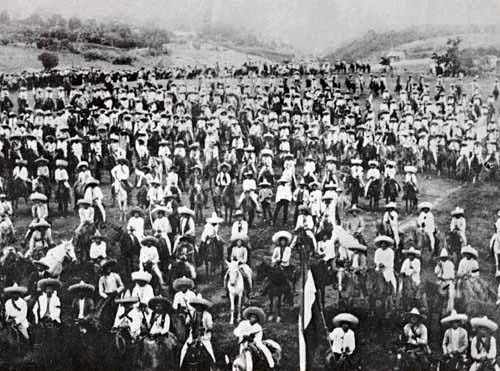
Liberation Army of the South, led by Emiliano Zapata, fought the government forces of Gen. Porfirio Diaz, in the state of Morelos, Mexico. Photo from Wikimedia Commons.

The next Mexican Revolution:

Don’t look now but the long-awaited resurgence of the Mexican Revolution has already begun.

By John Ross / The Rag Blog / September 22, 2010

MEXICO CITY — As the 100th anniversary of the Mexican revolution steams into sight, U.S. and Mexican security agencies are closely monitoring this distant neighbor nation for red lights that could signal renewed rebellion.

The most treacherous stretch for those keeping tabs on subversion south of the border is between September 15th, the recently celebrated bicentennial commemorating the struggle for Mexico’s independence from Spain, and November 20th, the day back in 1910 that the liberal Francisco Madero called upon his compatriots to take the plazas of their cities and towns and rise up against the Diaz government.

At least 10 and as many as 44 armed groups are currently thought to be active in Mexico and the two months between the 200th anniversary of liberation from the colonial yoke and the 100th of the nation’s landmark revolution, the first uprising of landless farmers in the Americas and a precursor of the Russian revolution, is a dramatic platform from which to strike at the right-wing government of President Felipe Calderon.

Among the more prominent armed formations is the Popular Revolutionary Army (EPR) which rose against the government in 1996 and is based in Guerrero and Oaxaca, and three distinct split-offs: the Democratic Revolutionary Tendency (TDR); the Justice Commandos – June 28th, thought to be linear descendents of the followers of guerrilla chieftain Lucio Cabanas who fought the government along the Costa Grande of Guerrero in the 1970s; and the Revolutionary Army of the Insurgent Peoples (ERPI) which also espouses Cabanas’s heritage and is active in the Sierra of Guerrero where Lucio once roamed.

Others on the list released two years ago by the CISEN, Mexico’s lead anti-subversion intelligence-gathering apparatus, include the largely-disarmed Zapatista Army of National Liberation (EZLN), an indigenous formation that rose in Chiapas in 1994; the Jose Maria Morelos National Guerrilla Coordinating Body, thought to be based in Puebla; and the Jaramillista Justice Commandos that takes its name from Ruben Jaramillo, the last general of revolutionary martyr Emiliano Zapata’s Liberating Army of the South gunned down by the government in 1964, which has taken credit for bombings in Zapata’s home state of Morelos.

The TAGIN or National Triple Indigenous and Guerrilla Alliance, thought to be rooted in southeastern Mexico, boasted in a e-mail communiqué at the beginning of the year that a coalition of 70 armed groups have agreed on coordinated action in 2010.

Also in the revolutionary mix are an unknown number of anarchist cells, at least one of which takes the name of Praxides G. Guerrero, the first anarchist to fall 100 years ago in the Mexican revolution.

Primarily operating in urban settings, anarchist cells have firebombed dozens of ATM machines and banks, new car showrooms, bullrings, and slaughterhouses (many anarchists are militant vegans) in Mexico City, Mexico state, Guadalajara, San Luis Potosi, and Tijuana. The U.S. Attorney General Eric Holder has just added Mexican anarchist groups to the Obama government’s terrorist lists.

Thus far, no group in this revolutionary rainbow has struck in 2010, and the window is narrowing if Mexico’s twin centennials are to be a stage upon which to launch new uprisings. If this is to be the year of the next Mexican revolution, the time to move is now.

Objective conditions on the ground are certainly ripe for popular uprising. At least 70% of the Mexican people live in and around the poverty line while a handful of oligarchs continue to dominate the economy — Mexico accounts for half of the 12 million Latin Americans who have fallen into poverty during the on-going economic downturn.

Despite Calderon’s much scoffed-at claims that the recession-wracked economy is in recovery, unemployment continues to run at record levels. Hunger is palpable on the farm and in the big cities. Indeed, the only ray of light is the drug trade that now employs between a half million and a million mostly young and impoverished people.

Labor troubles, always a crucible of revolutionary dynamics, are on the rise. A hundred years ago, conditions were not dissimilar. The fallout from the 1906-7 world depression that saw precious metal prices, the nation’s sustenance, fall off the charts sent waves of unemployment across the land and severely impacted conditions for those still working.

As copper prices bottomed, workers at the great Cananea copper pit scant miles from the Arizona border in Sonora state, went out on strike and owner Colonel William Green called in the Arizona Rangers to take the mine back. Twenty six miners were cut down and the massacre gave birth to the Mexican labor movement.

In March 2010, President Calderon dispatched hundreds of federal police and army troops to Cananea to break a protracted, nearly two-year strike at the behest of the Larrea family, the main stockholders in Grupo Mexicano Industrial which was gifted with the copper pit, the eighth largest in the world, after it was privatized by reviled ex-president Carlos Salinas in 1989. Calderon’s hard-nosed labor secretary Javiar Lozano has threatened arrest of miners’ union boss Napoleon Gomez Urrutia, now in self-exile in Vancouver, Canada.

Lozano is also deeply embroiled in take-no-hostages battles with the Mexican Electricity Workers Union (SME) over privatization of electricity generation here that has cost the union, the second oldest in the country founded during the last Mexican revolution, 44,000 jobs. A near death hunger strike by the displaced workers failed to budge the labor secretary and SME members now threaten to shut down Mexico City’s International Airport.

History is often colored with irony. The first important battles in the Mexican revolution were fought around Ciudad Juarez, Chihuahua, a key railhead on the U.S. border and a commercial lifeline to El Norte for dictator Porfirio Diaz. In skirmish after skirmish, the irregulars of Francisco Villa and Pascual Orozco challenged and defeated the dictator’s Federales and began the long push south to hook up with Emiliano Zapata’s southern army in Morelos state on the doorstep of the capitol.

Ciudad Juarez was devastated by the cruel battles between the revolutionaries and the dictator’s troops. Dead wagons plied the dusty streets hauling off the bodies of those who had fallen to be burnt out in the surrounding desert. Today, once again, Ciudad Juarez is the murder capitol of Mexico.

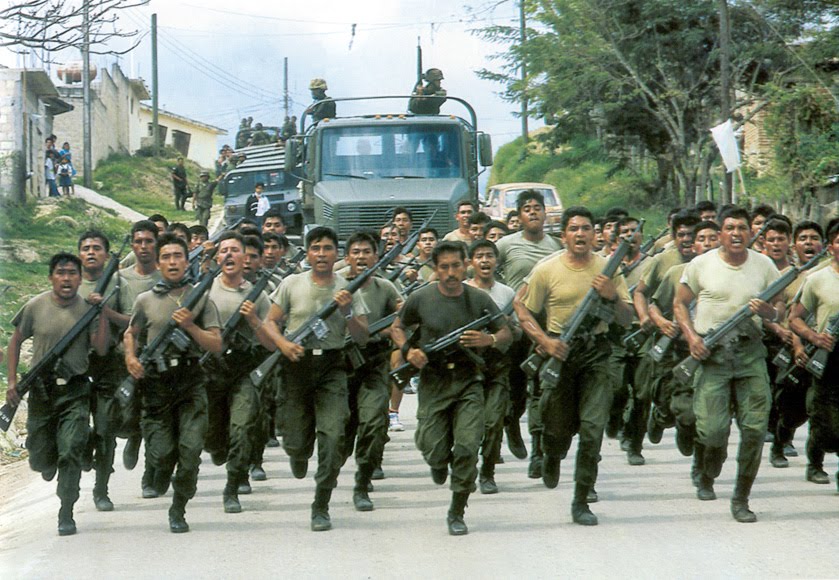
Mexican troops, mobilized to fight the narco-insurrection. Image from. Mcauley’s World’s Webblog.

Over 1,800 have been killed in this border city so far in 2010, a record year for homicides, as the homegrown Juarez drug cartel and its local enforcers, the “La Linea” gang, try to defend the “plaza,” the most pertinent drug crossing point on the 1964 mile border, from the Sinaloa cartel under the management of “El Chapo” Guzman, and his local associates, “Gente Nueva” (“New People”).

Much as today when the narco kings like “El Chapo” or his recently slain associate “Nacho” Coronel are vilified by the Mexican press and President Calderon as “traitors” and “killers” and “cowards,” 100 years back revolutionaries were cast as villains and vandals hell-bent on tearing down the institutions of law and order.

Pancho Villa was universally dissed as a cattle rustler, a “bandido,” “terrorista,” and rapist. When Zapata, “the Attila of the South,” and his peasant army came down to Mexico City in 1914 to meet with Villa, the “gente decente” (decent people) locked up their homes and their daughters to protect them from the barbarian hordes.

Similarly, in 2010, the corporate press lashes out at the cartels and their pistoleros as crazed, drug-addled mercenaries who will shoot their own mothers if enough cash and cocaine are offered. Villa’s troops were no strangers to such accusations. “La Cucaracha,” the Villista marching song, pleads for “marijuana para caminar” (“marijuana to march”).

All this duel centennial year, ideologically driven leftists here have been waiting with baited breath for a resurgence of armed rebellion such as in 1994 when the EZLN rose up against the “mal gobierno” in Chiapas, or in 1996 when the EPR staged a series of murderous raids on military and police installations — but the leftists may be barking up the wrong tree.

If revolution is to be defined as the overthrow of an unpopular government and the taking of state power by armed partisans, then the new Mexican revolution is already underway, at least in the north of the country where Calderon’s ill-advised drug campaign against the cartels (in which according to the latest CISEN data 28,000 citizens have died) has morphed into generalized warfare.

Although the fighting has been largely confined to the north, it should be remembered that Mexico’s 1910 revolution began in that geography under the command of Villa and Orozco, Venustiano Carranza, Alvaro Obregon, and Francisco Madero, and then spread south to the power center of the country.

Given the qualitative leap in violence, Edgardo Buscaglia, a keen analyst of drug policy at the prestigious Autonomous Technological Institute of Mexico now describes Calderon’s war as a “narco-insurgency” — a descripton recently endorsed by U.S. Secretary of State Hillary Clinton. Daily events reported in the nation’s press lend graphic substance to the terminology.

Narco-commandos attack military and police barracks, carrying off arms and freeing prisoners from prisons in classic guerrilla fashion. As if to replay the 1910 uprising in the north, the narco gangs loot and torch the mansions of the rich in Ciudad Juarez. The narcos mount public massacres in northern cities like Juarez and Torreon that leave dozens dead and seem designed to terrorize the local populous caught up in the crossfire and impress upon the citizenry that the government can no longer protect them, a classic guerrilla warfare strategy.

One very 2010 wrinkle to the upsurge in violence: car bombs triggered by cell phones detonate in downtown Juarez, a technology that seems to have been borrowed from the U.S. invasion of Iraq (El Paso just across the river is home to several military bases where returning veterans of that crusade are housed). Plastique-like C-4 explosives used in a July 15th car bombing that killed four in downtown Juarez are readily available at Mexican mining sites.

Further into the interior, commandos thought to be operating under the sponsorship of the Zetas cartel, have repeatedly shut down key intersections in Monterrey, Mexico’s third largest city and the industrial powerhouse of the nation, with stolen construction equipment and stalled buses and trailer trucks purportedly to clear surrounding highways of traffic for the movement of troops and weaponry into this strategic region.

Now the narco-insurrection has invaded the political realm as manifested by the assassination of the one-time ruling PRI party’s front-running candidate for governor of Tamaulipas state in July 4th elections. But party affiliation doesn’t seem to be a determining factor in this ambience of fear and loathing. The kidnapping of right-wing PAN party Padrino Diego Fernandez de Cevallos, one of the most powerful politicos in Mexico and a possible presidential candidate in 2012, must send chills up and down the spines of Calderon and his associates.

Who actually put the snatch on “El Jefe” Diego remains murky. The Attorney General’s office is now pointing fingers at the Popular Revolutionary Army, which is active in the Bajio region where the PANista was taken last May 14th. In 2007, the EPR claimed credit for the bombing of PEMEX pipelines in Guanajuato and Queretero in retaliation for the disappearances of two of its historical leaders.

The Mexican military has long calculated the eventual “symbiosis of criminal cartels with armed groups that are disaffected with the government” (“Combat Against Narco-Traffic 2008″ issued by the Secretary of Defense).

Fifty thousand of the Mexican Army’s 140,000 troops and large detachments of Naval Marines are currently in the field against the narco-insurrectionists. With an eye to the eventual “symbiosis” of the drug gangs with armed guerrilla movements, the U.S. North Command which is responsible for keeping the North American mainland free of terrorists and regards Mexico as its southern security perimeter recently sent counterinsurgency trainers here to assess threats — their visit was confirmed at a Washington D.C. press conference July 21st by Under-secretary of Defense William Wechsler.

Meanwhile, the military is setting up new advance bases in regions where there have been recent guerrilla sightings such as the Sierra Gorda, strategically located at the confluence of Queretero, Guanajuato, and San Luis Potosi states.

Leftists who have been awaiting a more “political” uprising in 2010 are not convinced by Buscaglia’s nomenclature. A real revolution must be waged along ideological and class lines which the narco-insurrection has yet to manifest. Nonetheless, given the neoliberal mindset of a globalized world in which class dynamics are reduced to market domination, the on-going narco-insurrection may well be the best new Mexican revolution this beleaguered nation is going to get.

[An abbreviated version of “The Next Mexican Revolution” appeared in the Guardian (London, U.K.) September 13, 2010. Note: John Ross’s cancer has returned and he is suspending publication of his column while he undergoes chemotherapy in San Francisco. He can be reached at johnross@igc.org. Readers who crave Ross’s words are advised to consult El Monstruo: Dread and Redemption in Mexico City (Nation Books 2010), available at your local independent bookstore.]

The Rag Blog

Posted in Rag Bloggers | Tagged , , , , | Leave a comment

Carl Davidson : Mondragon Diaries I: Bridges to Socialism

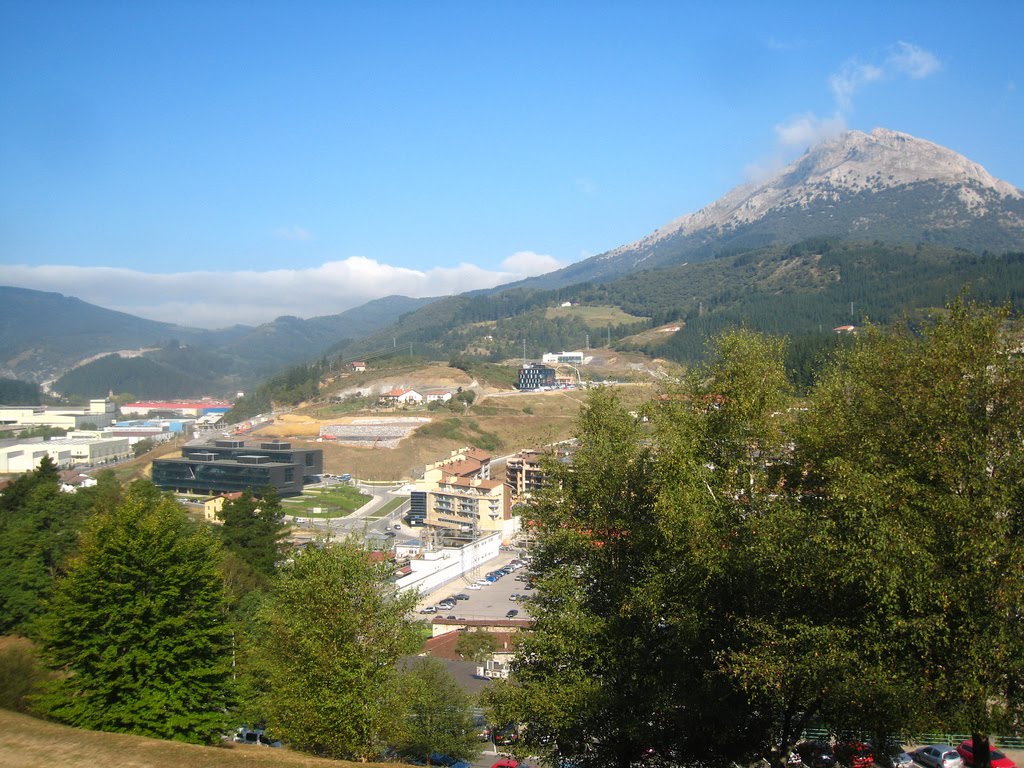
Not paradise, but close: Mondragon Cooperatives in Spain’s Basque Country. Photo from Model-Economy.

Mondragon Diaries, Day One
Bridges to 21st century socialism:
Why humanity comes first at work

By Carl Davidson / The Rag Blog / September 20, 2010

“This is not paradise and we are not angels.” — Mikal Lezamiz, Director of Cooperative Dissemination, MCC

[This is the first of a five-part series by Carl Davidson.]

BASQUE COUNTRY, Spain — After a short bus ride through the stone cobbled streets of Arrasate-Mondragon and up the winding roads of this humanly-scaled industrial town of Spain’s Basque Country in a sunny fall morning, taking in the birch and pine covered mountains, and the higher ones with magnificent stony peaks, I raised an eyebrow at the first part of Mikel’s statement.

The area was breathtakingly beautiful, and if it wasn’t paradise, it came close enough.

I’m with a group of 25 social activists on a study tour organized by the Praxis Peace Project. Our focus is the Mondragon Cooperative Corporation, a 50-year-old network of nearly 120 factories and agencies, involving nearly 100,000 workers in one way or another, and centered in the the Basque Country but now spanning the globe.

We’re here to study the history of these unique worker-owned factories, how they work, why they have been successful, and how they might be expanded in various ways as instruments of social change. Georgia Kelly of the Praxis Peace Project is our cheerful and helpful tour leader, but Mikel is our MCC host in charge of teaching us what he knows.

The MCC reception center is part way up on a slope of a much larger mountain, but it offers a magnificent view of the town and the dozens of industrial and commercial cooperatives in and around it in the valley below. After watching a short film on the current scope of MCC, we move to a lecture room for Mikal’s talk. The signs on the wall say “Mondragon: Humanity at Work: Finance-Industry-Retail-Knowledge,” in Basque, Spanish, and English.

“Humanity at Work,” Mikal starts off, reading the slogan. “This means we are the owners of our enterprises, and we are the participants in their management. Our humanity comes first. We want to have successful and profitable businesses and see them grow, but they are subordinate to us, not the other way around.”

The other part of the slogan — finance, industry, retail, knowledge — refers to the scope of the cooperatives. Of the 120 workplaces, 87 are industrial factories, making everything from kitchen appliances and housewares, to auto parts, computers, and machine tools. One of the coops is a large bank, Caja Laboral. One is a Mondragon University, with some 3,600 students; seven others are research and development centers. One is retail, the huge network of hundreds of Eroski supermarkets and convenience stores, four are agricultural, and six are social service agencies managing health care, pensions, and other insurance matters.

All are worker owned. All have the management selected by the workers and the coop governing boards. All have yearly assemblies where the workers set strategies, make or change policies, and elect their governing boards — one worker, one vote.

Mikal also introduces this by telling us a little about where we are. The Basques are among the oldest people in Europe, with a unique language, unrelated to any others. They have a strong sense of culture and solidarity, and an ongoing quest for autonomy, even independence, from Spain.

The region is made up of four political divisions in Spain and two just across the Pyrenees in France, with 3 million Basque inhabitants there and another 3 million living abroad. They were a center of resistance to Franco’s fascist regime, and have won a good deal of autonomy today in some of the districts.

After World War II, the area was poor and devastated, and the Franco regime was in no mood to give it much help. But one who did rise to the challenge was Father Jose Maria Arizmendiarrieta, a priest who had fought Franco, ended up in prison, but managed to get released instead of executed. Father Arizmendi, as he is popularly called, was assigned by the church to the valley in the Basque containing the small town of Arrasete-Mondragon.

He set to work trying to solve the massive war-created problems at hand. He began building a small technical school, and then a credit union where the region’s peasants and workers pooled meager funds. After a few years, with just five of the best students of the school, he started a small factory making one product: a small paraffin-burning stove so people could cook and heat water. It was a good stove, and sold well.

Most important, he gave the project a set of ten carefully thought-out principles to serve as guidelines for the current and any future endeavors:

  1. Open Admission, meaning no worker is to be discriminated against because of nationality, gender, political party or religion and such
  2. Democratic organization, meaning one worker, one vote
  3. Sovereignty of labor
  4. Instrumental and subordinate nature of capital
  5. Participatory Management
  6. Wage Solidarity
  7. Cooperation between Coops
  8. Social Transformation
  9. Universality
  10. Education

How each of these is implemented, and with what success, will be spelled out in this series of diaries — at least I’ll give it a good shot. But following this introduction and a barrage of questions — Mikal answered a good many — he soon had us all get back on the bus. The best way to learn was to see for ourselves. So he took us off to FAGOR, the relatively large industrial coop that had grown from the first tiny shop that built that first small paraffin stove.

FAGOR today is several connected coops with about 6,000 workers overall, both here in the Assante-Mondragon area and in China. All the employees in the Basque areas are worker-owners; those elsewhere are in varying stages of becoming so.

As we got off the bus, we were at a large modern structure that could easily enclose several football fields. We were given headsets so we could hear our young woman guide over the din of the assembly lines. Once inside, we saw a very modern and computer-assisted assembly line that was putting together household washing machines, from beginning to end. It wasn’t completely automated; workers were required at many points, especially at those checking quality.

This quality was a hallmark of MCC products generally. They compete by selling very high quality goods at reasonable prices and good service. They have very few supervisors. I didn’t see a single one covering the whole process of making the washing machines, and later some convection ovens, from one end of the line to the other. Self-supervision was thus a competitive advantage. Not having a lot of supervisors to pay means lower prices.

Before the crisis hit two years ago, 15 percent of FAGOR’s workers were temporary “trial period” new hires, meaning they couldn’t become worker-owners for six moths to a year. All these were laid off due to the fall in demand, but all the regular worker-owners remained on the job or were shifted to other related coops.

At the moment, the workers were on two shifts. “One group starts at 6 a.m. and ends at 2 p.m.,” our guide explained. “The other goes from 2 p.m. until 10 p.m. There are breaks every two hours, after which each worker can take a different position on their section of the line. The workers decide this rotation among themselves. It helps with safety and spreads skill sets around.”

We noticed that some of the components were in boxes shipped from other countries, and asked Mikal about it. “Our policy for purchasing is set by three things — quality, price and service. If an outside firm does better, we use them.”

He picked up a wiring harness from a box.

Here is a good example. We used to have this made by one of our student-run coops. They had two products, this wiring set and another computer component. The quality and service was good, but the price was poor. This piece, made in Turkey was just as good, the Turkish firm had good service, but at a much lower price.

Our students only worked a four hour day, and paid themselves 550 Euros a month, but the Turkish workers put in 60 hours at 200 Euros. In that situation, we encouraged the students to shift to improving the product where they were better, and to design new products.

Some in our group groaned at the concept, but others felt that, given a market economy, it was the best way to handle the problem — although raising the conditions of the Turkish workers would be a good idea, even if beyond the reach of MCC at the moment.

One thing that stood out of the Fagor line was a concern for both safety and quality. One hundred percent of the machines were tested on the line for safe operation, and another 3 percent were tested again at random just before final packaging. There were numerous station stops where workers kept daily records of any accidents — a green smiley face sticker was a good day, a red frowny face was a problem day. I only saw one red face on a chart on the entire line.

FAGOR is producing 850,000 units a year, shipped mainly throughout Europe. Their pressure cookers are very popular in U.S. department stores.

After a delicious and leisurely lunch, Mikal gave us another talk, stressing two topics — the spread of MCC to other countries, and its ongoing and often difficult efforts to transform its factories in areas outside of the Basque country into full worker-owned cooperatives.

Of the 100,000 people who work for MCC, of the 39,000 in the Basque Country, some 99 percent are worker-owners. Of the 40,000-to-50,000 recently brought into MCC in the rest of Spain, Portugal, and parts of France, many are in various stages of becoming worker-owners, although some are discouraged by the low or negative earnings in the last two crisis years. The remaining 17 percent in countries like China and Brazil still remain wage labor in firms owned by MCC. MCC, however, is still trying to find ways to deal with local laws and customs in these countries to make a full transformation.

This discussion ran into overtime, so the last part of day one, a visit to an Eroski supermarket, was limited to 30 minutes. This one, a full-sized supermarket, was an excellent facility, owned both by all the workers and many consumers as well. Think of it as a high quality worker-owned Walmart combined with a Whole Foods with much lower prices, and you’ll get a reasonably good idea on what it was like. But all I can vouch for at this point is that the fair trade 70 percent chocolate bars come very close to being a small piece of paradise.

[Carl Davidson is a national co-chair of the Committees of Correspondence for Democracy and Socialism, a national board member of Solidarity Economy Network, and a local Beaver County, PA member of Steelworkers Associates. His website is Keep on Keepin’ On, where this article also appears. Davidson is also available to speak on the topic. Contact him at carld717@gmail.com. For more info on these tours, go here.]

The Rag Blog

Posted in Rag Bloggers | Tagged , , , , , , | 1 Comment

FILM / Rick Ayers : An Inconvenient Superman


An Inconvenient Superman:
Davis Guggenheim’s new film
hijacks school reform

By Rick Ayers / The Rag Blog / September 20, 2010

Davis Guggenheim’s 2010 film Waiting for Superman is a slick marketing piece full of half-truths and distortions. The film suggests the problems in education are the fault of teachers and teacher unions alone, and it asserts that the solution to those problems is a greater focus on top-down instruction driven by test scores.

It rejects the inconvenient truth that our schools are being starved of funds and other necessary resources, and instead opts for an era of privatization and market-driven school change.

Its focus effectively suppresses a more complex and nuanced discussion of what it might actually take to leave no child behind, such as a living wage, a full-employment economy, the demilitarization of our schools, and an education based on the democratic ideal that the fullest development of each is the condition for the full development of all. The film is positioned to become a leading voice in framing the debate on school reform, much like Guggenheim’s An Inconvenient Truth did for the discussion of global warming, and that’s heartbreaking.

I’m not categorically opposed to charter schools; they can and often do allow a group of creative and innovative teachers, parents, and communities to build schools that work for their kids and are free of the deadening bureaucracy of most districts. These schools can be catalysts for even larger changes.

But there are really two main opposing positions in the “charter movement” (it’s not really a movement, by the way, but rather a diverse range of different projects). On one side are those who hope to use the charter option to operate effective small schools that are autonomous from districts. On the other side are the corporate powerhouses and the ideological opponents of all things public who see this as a chance to break the teacher’s unions and to privatize education.

Superman is a shill for the latter. Caring, thoughtful teachers are working hard in both types of schools. But their efforts are being framed and defined, even undermined, by powerful forces who have seized the mantle of “reform.”

The film dismisses with a side comment the inconvenient truth that our schools are criminally underfunded. Money’s not the answer, it glibly declares. Nor does it suggest that students would have better outcomes if their communities had jobs, health care, decent housing, and a living wage.

Particularly dishonest is the fact that Guggenheim never mentions the tens of millions of dollars of private money that has poured into the Harlem Children’s Zone, the model and the superman we are relentlessly instructed to aspire to. Those funds create full family services and a state of the art school.

In a sleight of hand, the film magically shifts focus, turning to “bad teaching” as the problem in the poor schools while ignoring these millions of dollars that make people clamor to get into the Promise Academy. As a friend of mine said, “Well, at least now we know what it costs.”

It is so sad to see hundreds of families lined up at these essentially private schools with a public charter cover, praying to get in. Who wouldn’t want to get in? Families are paraded in front of the cameras as they wait for an admission lottery in an auditorium where the winners’ names are pulled from a hat and read aloud, while the losing families trudge out in tears with cameras looming in their faces. Guggenheim gleefully films it all, indulging in what amounts to family and child abuse.

After dismissing funding as a factor, Superman rolls out the drumbeat of attacks on teachers as the first and really the only problem. Except for a few patronizing pats on the head for educators, the film describes school failure as boiling down to bad teachers.

Relying on old clichés that single out the handful of loser teachers anyone could dig up, Waiting for Superman asserts that the unions are the boogeyman. In his perfect world, there would be no unions — we could drive teacher wages even lower, run schools like little corporations, and race to the bottom just as we have in the manufacturing sector.

Imagining that the profit motive works best, the privatizers propose merit pay for teachers whose students test well. Such a scheme would only lead to adult cheating (which has already started), to well-connected teachers packing their classes with privileged kids, and to an undermining of the very essence of effective schools — collaboration between teachers, generous community building with students.

It is interesting to note that Arne Duncan’s kids, as well as the Obama kids, attended the University of Chicago Lab Schools — where teachers had small classes, good pay, and, yes, a union. Students did not concentrate on rote learning and mindless drill and skill or test prep. They were offered in part an exploratory, questioning curriculum. The school for the Obama kids in D.C., Sidwell Friends, also has a unionized faculty. But apparently the masses need to have sweatshop schools.

Waiting for Superman sets up AFT president Randi Weingarten as its Darth Vader — accompanying her appearance on the screen with dire background music. They tell us that the teachers unions have put $50 million into election campaigns over the last 10 years, essentially buying politicians. Actually, this number is a pittance compared to what corporations and the rich throw in. It is less than Meg Whitman spent of her own money in one run for governor of California.

But the film carefully avoids interviewing Diane Ravitch, the lead organizer of the Education Trust and No Child Left Behind efforts who has been lately writing and speaking about her realization that these reforms have had a disastrous effect on schools and teaching and learning.

When African American and Chicano Latino families in the 1960’s were demanding quality education and access to the resources of the best schools, they were also rejecting the myths about blackness meaning culturally deprived. Today that social revolution has been effectively set back. Schools are more segregated today than before Brown v. Board of Education in 1954; nothing is said about that. Black and Brown students are being suspended and expelled, searched and criminalized; not a word.

In place of a movement for transforming power relationships in our society, privatizers and corporate managers step up to define the problem — proposing a revolution that is anything but revolutionary.

A strong project of education transformation would recognize the funds of knowledge urban students come to school with; it would honor the literacy and language practices of the community. It would support a curriculum of questioning, as students examine their world and imagine ways to make it better.

It would put front and center the need to build learning communities, to motivate students to want to learn and believe there is something worth learning. It would create an engaged learning experience for all students, not just the handful who learn to endure boredom and insult in hopes of high income later.

In the hands of these so-called reformers, though, the only goal is to train urban students to be obedient followers; they never propose a project that transforms and empowers communities, only holding out the promise for a few exceptional students to escape the ghetto. Y

ou can see white middle class audience members sighing, comforted to know that everyone really wants to be like us; that everyone who is not like us is tragic. The film bubbles over with terms like escape and rescue, promoting a liberal charity mentality that is never in solidarity with the local community, only regards it as something dysfunctional that needs to be controlled.

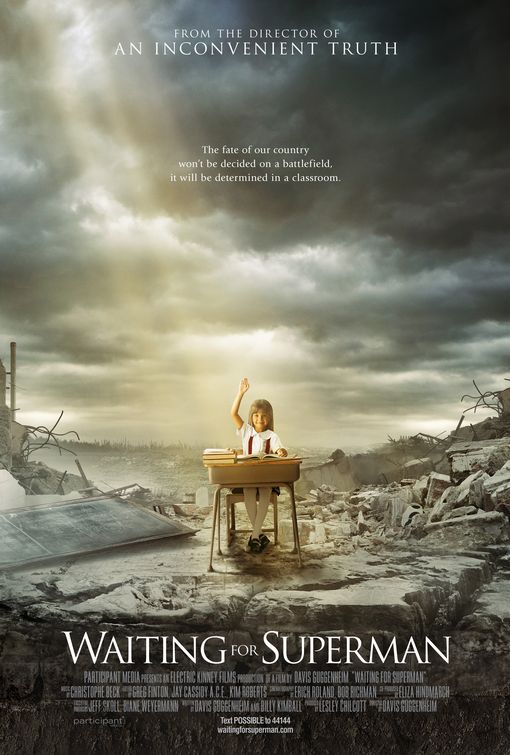
In addition, Waiting for Superman promotes the idea that we are in a dire war for U.S. dominance in the world. The poster advertising the film shows a nightmarish battlefield in stark grey, then a little white girl sitting at a desk is dropped in the midst of it. The text: “The fate of our country won’t be decided on a battlefield. It will be determined in a classroom.”

This is a common theme of the so-called reformers: we are at war with India and China and we have to out-math them and crush them so that we can remain rich and they can stay in the sweatshops. But really, who declared this war? When did I as a teacher sign up as an officer in this war? And when did that fourth grade girl become a soldier in it?

I have nothing against the Chinese, the Indians, or anyone else in the world — I wish them well. Instead of this Global Social Darwinist fantasy, perhaps we should be helping kids imagine a world of global cooperation, sustainable economies, and equity

Waiting for Superman accepts a theory of learning that is embarrassing in its stupidity. In one of its many little cartoon segments, it purports to show how kids learn. The top of a child’s head is cut open and a jumble of factoids is poured in. Ouch! Oh, and then the evil teacher union and regulations stop this productive pouring project.

The filmmakers betray no understanding of how people actually learn, the active and agentive participation of students in the learning process. They ignore the social construction of knowledge, the difference between deep learning and rote memorization. The film unquestioningly bows down to standardized tests as the measure of student knowledge, school success. Such a testing regime bullies aside deeper learning, authentic assessment, portfolio and project based learning.

Yes, deeper learning like this is difficult to measure with simple numbers — but we can’t let the desire for simple numbers simplify the educational project. Extensive research has demonstrated definitively that standardized testing reproduces inequities, marginalizes English Language Learners and those who do not grow up speaking a middle class vernacular, dumbs down the curriculum, and misinforms policy. It is the wisdom of the misinformed, accepted against educational evidence and research. Never mind, they declare: we will define the future of education anyway.

Sadly, the narrow and blinkered reasoning in Waiting for Superman is behind the No Child Left Behind disaster rebranded as Race to the Top. Don’t believe the hype. We can and we must do education, and educational change, much differently. We could develop an economy that supported communities which are well-resourced and democratic. We can right now create pathways in which all kids have a reasonable prospect of an honorable, interesting job in their future. And if democracy and the future society concern us at all, we can and we must create schools which unleash students’ creativity, imagination, and initiative.

[Rick Ayers is a former high school teacher, founder of Communication Arts and Sciences small school at Berkeley High School, and currently Adjunct Professor in Teacher Education at the University of San Francisco. He is author, with his brother William Ayers, of the soon-to-be-released Teaching the Taboo from Teachers College Press. He can be reached at rayers@berkeley.edu .]

The Rag Blog

Posted in Rag Bloggers | Tagged , , , , , | 4 Comments

Sonny Carl Davis is an actor (“I’ve had little roles in big films and big roles in little films, and continue to act when they let me”), a musician, and a screenwriter. He played a red neck entrepreneur in Texas filmmaker Eagle Pennell’s “The Whole Shootin’ Match” (1979) and played memorable roles in Last Night at the Alamo and Fast Times at Ridgemont High. He also had featured parts in Thelma and Louise, Melvin and Howard, , and a supporting role in “Red Headed Stranger with Willie Nelson. He has worked in film both in Austin and Los Angeles,

Sonny was also a founding member in 1968 of Austin’s legendary Uranium Savages, a rock group that incorporated lots of theater into its performances. The Savages played Austin’s venerable 60s-70s rock venues, the Vulcan Gas Co. and Armadillo World Headquarters.

Davis is also a screenwriter. He just finished “Texas Sweet” about love on an onion ranch in South Texas, and is currently writing “Badland Baldy,” a western with Willie Nelson. And he is developing a one man show called “First to be Eaten: Rantings of a Bit Player.”

Posted in RagBlog | Leave a comment

Ted McLaughlin : Fingering Corruption in Afghanistan

President Hamid Karzai votes: Supposedly indelible ink used to mark voters’ fingers in the Afghanistan election to prevent fraud may have been easily washed off. Photo by Reuters.

Ink hardly dry on electoral farce:
American opinion and the Afghan fiasco

By Ted McLaughlin / The Rag Blog / September 19, 2010

The citizens of Afghanistan went to the polls this last weekend to elect 249 new members of their parliament, but initial reports said the voting was much lighter than it was in the presidential election a few months ago. Some will say it’s because the Taliban has tried to discourage people from voting (and they have). But they did the same thing in the presidential election.

It is far more likely that after the corrupt and fraudulent presidential election, few Afghans expect this election to be any different. Why risk your life to vote when the election is probably going to be decided more by fraud than the will of the people? And it looks like the worries about fraud are being borne out.

At the polls they used ink on a finger to keep people from voting more than once. But the ink given out turned out to be easily washed off with just a little water, and household detergent or bleach. There have been reports of people voting repeatedly by washing off the ink. There are also reports of thousands of forged voter cards being used and of bribes being taken by those working at the polls.

The results from the election will probably not be known until near the end of October. Many of the outlying and remote polling places will be transporting the ballot boxes back to more populated areas by donkey to be counted. And all the counting will be done by hand.

But even after the results are announced it is unlikely that most people and/or candidates will trust the results. There is already talk of the results being challenged. And while this fraudulent mess goes on, American soldiers fight and die to continue propping up this corrupt government.

It’s no wonder that many Americans are losing faith in what we’re trying to accomplish in Afghanistan — or don’t think we are capable of accomplishing anything in that country. A new survey done by The New York Times and CBS News shows this clearly.

The poll asked Americans whether we are doing the right thing by fighting in Afghanistan or whether we should not be involved in that war. Here’s what they said:

Doing the right thing……………38%
Shouldn’t be involved……………54%
Don’t know……………9%

Then people were asked whether the war there is going well or going badly. They said:

Going well……………38%
Going badly……………55%
Don’t know……………7%

The American people may have supported this war years ago, but it has gone on for too long and too little has been accomplished with too many lives lost. They no longer believe we are doing the right thing by continuing the war, or even that anything could eventually be accomplished by dragging out the war. It is not likely that the corrupt government and fraudulent elections will change that opinion.

And the opinion is even worse about the Iraq war, where 50,000 American soldiers remain involved regardless of what the government has said. The poll showed that 71% of Americans do not believe the Iraq war was worth the cost in American lives and money.

It is sheer insanity and misguided pride that keeps these wars going (just like the Vietnam war was continued long after it was known that it could not be won). This country is very good at fighting conventional wars (which is what our soldiers were trained for and our military equipment designed for). But the wars in Vietnam, Iraq, and Afghanistan were not and are not conventional wars. They are efforts at nation-building through military power — and that is something we’ve never been very good at doing (and are unlikely to be any better at it in the future).

Americans have always been better at changing the world through providing a shining example of democracy, rule of law, and tolerance. Sadly the current wars and the tactics we have used in them, including torture, have caused us to lose the respect of much of the world. We have muddied the shining example we once provided.

It is time to end these ridiculous wars and bring all our soldiers home. It is also time to try and rebuild a respect for democracy, rule of law, and tolerance once again in this country in the hope that we can once again be respected as a world leader instead of just being seen as an international bully.

[Rag Blog contributor Ted McLaughlin also posts at jobsanger.]

The Rag Blog

Posted in Rag Bloggers | Tagged , , , , , | Leave a comment

Marc Estrin: Don’t Tase Me, Bro…

Killer Klowns. Image from Out of the Grave.

Don’t Tase me, bro…

By Marc Estrin / The Rag Blog / September 18, 2010

Another Taser-related death this past week, this time, not of an ancient great-grandmother in a wheelchair, but of a healthy young man. Those involved with toting up the corpses count more than 500. Google “Taser deaths” for their names and ages.

Tasers don’t kill people. Cops with Tasers kill people. Cops with other weapons kill people too.

In contrast to the United States, British police don’t routinely carry lethal arms. Only a limited number of specialist officers are permitted to use guns in special situations. Britain’s Home Office said being unarmed is part of the “character of the police” in the U.K. The “character of the police” chez nous is something rather different. With our taste for arms sales and permanent war-making throughout the world, could we expect it to be otherwise?

In looking through SKULK last week for its 9/11 resonances, I came across this chapter I had forgotten about. I present it for your bleak amusement:

EIGHTEEN:

Modest Doubt Is Call’d The Beacon Of The Wise

Could they do this? Did they even approve of it being done? Violence? Large-scale, possibly lethal violence?

Teresa had never even hunted or fished with Daddy: the idea of threading a worm on a hook had always seemed too yucky. Richard had the comical habit of crushing plastic milk containers with his hands: stomping on them seemed unseemly. Now they were challenged to embrace something like…the Truth. Teresa heard Thomas Aquinas urging her from potency to act. Richard felt ripeness was all, and things were very close to ripe.

But both were now smitten by a sudden cloud of fear and abdication. And it was in this eddying cloud that they now accompanied WSU’s speaker, Rashid Khalidi, towards Levitt Arena on an otherwise cloudless early evening for his talk on “The New American Empire.”

Why book the Shockers’ home basketball court? Because Khalidi was tall in stature in the academic world? No. Because He was a Shocker (to some) himself? No. Because this was the summer session’s culminating major-speaker event? No. It was because Buildings and Grounds had for some reason denied Richard’s request for Wilner Auditorium, though its schedule seemed open. No matter, Richard thought, Levitt will be fine, if slightly less comfortable in the bleachersswirlin and folding chairs. Desmond Tutu had spoken there last year, and Khalidi would make a nice followup.

But meteorological cloudlessness was a poor predictor of the gathering storm: streaming up Hillside along with Rashid, Teresa and Richard, were tens, then hundreds of sign-carrying students and community folks. Some wore yarmulkas, most wore crosses, and a scant few sported kuffiyehs, the traditional Palestinian headscarf. Uh-oh, T&R thought, looks like a religious war. Khalid was unruffled. “My fans,” he reassured them. Au courant, though. The yarmulkas and crosses seemed to populate the same side of the path, while the kuffiyehs and assorted peaceniks lined up sparsely on the other. Law enforcement was nowhere in sight.

ISRAEL BASHERS NOT WELCOME!; TERRORISTS OFF CAMPUS!; EXTREMISTS OUT OF WICHITA!; STUDENTS WILL NOT BE INTIMIDATED!; A NAZI SPEAKER ON TISHA B’AV — SHAME! SHAME!; NEVER FORGET!; CHRIST SHALL OVERCOME! read signs on one side of the walk.

DIVESTMENT FROM ISRAEL! TROOPS HOME NOW!; WAR IS TERRORISM!; GO SOLAR, NOT BALLISTIC!; ASSES OF EVIL (with pictures of the principals)!; ENFORCE U.N. RESOLUTIONS IN PALESTINE!’ ANYTHING WAR CAN DO, PEACE CAN DO BETTER! read signs on the other.

Both sides seemed to share a strong commitment to the exclamation point. The three of them ran the gauntlet.

The Levitt basketball court had a small stage constructed at one end, as for other large events like rained-out graduations, and Richard and Khalidi took their seats on the well-flowered platform. At 7:40, having allowed ten minutes to accomodate the late-arriving crowd, Richard stood to open the evening.

“Ladies and Gentlemen, Students and Faculty, Members of the Community,” he began, “it gives me great pleasure to introduce the final speaker of our Contemporary Issues series, a man who himself has become a contemporary issue. Rashid Khalidi is Edward Said…

Some cheers and boos from the audience. Richard admonished it gently with his famous Groucho waggling-of-eyebrows.

“…Edward Said Professor of Modern Arab Studies and Literature at Columbia University. Professor Khalidi has written more than seventy-five articles on aspects of Middle East history and politics including pieces in the New York Times [some boos], the Boston Globe [a different set of boos], the Los Angeles Times, the Chicago Tribune, and many journals. He has received fellowships and grants from the John D. and Catherine T. MacArthur Foundation, the Ford Foundation, and the Rockefeller Foundation, and is a recipient of a Fulbright research award. He has been a regular guest on radio and TV shows, including All Things Considered [applause from the liberals], Talk of the Nation, the NewsHour with Jim Lehrer, and Nightline.

“His latest book, Resurrecting Empire: Western Footprints and America’s Perilous Path in the Middle East, examines the record of Western involvement in the region and analyzes the likely outcome of our most recent Middle East incursions.

“Let’s give a warm welcome to our guest, and I’m sure that, in spite of the controversial nature of his topic, we will show him the respect and hospitality for which Kansas is so justly famous. Ladies and Gentlemen, Professor Rashid Khalidi.”

General applause, with a scattering of boos and cheers. Operation Rescue, The Mid-Continent ADL and WSU Hillel stood up in back with their signs.

Khalidi began with many thank yous for the honor of the invitation, invited questions and discussion after his talk, and launched passionately into his topic.

“Since September 11, we’ve heard a lot about the ‘intelligence failures’ that left the United States unprepared for the attacks on the World Trade Center and the Pentagon. But these failures were not simply the result of poor espionage or bureaucratic incompetence. They reflected a deeper failure to understand a region and its historical wounds, a number of which — though not all — were inflicted by the Western powers.”

Serious pre-uproar among the audience. Khalidi remained calm, but did respond:

“I hope you will agree that the future of America’s relations with the Arab and Muslim world depends a great deal on public education. Yet the very people who are in a position to perform this vital task have instead found themselves under siege from the media, from extremist pressure groups and craven politicians. Our crime? Challenging those formidable authorities on the Arab world, George W. Bush and Ariel Sharon.”

Standing and yelling from the audience:

“Anti-semite!”

“If you don’t like it here, go home!”

“Nazi Jew-killer!”

“Terrorists off campus!”

Richard stepped forward, and took the mike from the lectern.

“Ladies and Gentlemen, this kind of behavior will have reverberations country-wide. Internationally. This is an institution committed to academic freedom! Please, please, reserve your comments until after Professor Khalidi’s talk, and then keep them polite. Believe me, the whole world is watching.” He inserted the mike once again in its holder and took his seat. Khalidi, continued, apparently unflustered.

“Back in 1992, a decade before 9/11, a group of right-wing thinkers from the administration of the first George Bush created the Project for a New American Century, PNAC. I strongly suggest you google them, and study their documents closely. Their platform demanded that the United States take advantage of the fall of the Soviet Union to achieve unchallenged, unchallengable domination of the planet, and control of its dwindling resources. They called on America to substantially increase its military budget, to deny other nations the use of outer space, and to adopt a more aggressive and unilateral foreign policy that would allow it to act offensively and preemptively in the world. The elimination of states like Iraq figured prominently in this grand vision.

[Applause and a quickly abating “U-S-A! U-S-A!”]

“In a widely-circulated 1998 letter to President Clinton, the members of PNAC — Donald Rumsfeld, Paul Wolfowitz, Eliot Abrams, Richard Armitage, Richard Pearl, Robert Zoellick, William Kristol and Francis Fukayama among them — challenged the president to move forcefully and militarily to remove Saddam Hussein.
[Again some applause, with annoyed shushing from the liberals.]

“And in their defining document, ‘Rebuilding America’s Defenses,’ written in September 2000 — a full year before 9/11 — they acknowledged that the process of transformation was likely to be a long one, absent — in their own chilling words — ‘some catastrophic and catalyzing event like a new Pearl Harbor.’ One year later that event would arrive.”

It was time for the Blintz Brigade, a group whose motto was “Cream Pies Are For Cream Puffs!” From left and right, two nightmare gaggles of gabardined clowns invaded the platform, firing blintzes at the speaker, splattering his dark suit with crème fraiche (“For The Blessed, Nothing But The Best!”), and greasing the ground with doughish offal.

Now a blintz is no mere crêpe. The baked and semi-hardened dough raised second-degree welts and third-degree contusions on Professor Khalidi’s face — and let loose bedlam in the audience.

Richard sprang from his seat, and Teresa ran up on stage to help battle the clowns. In the arena, folding chairs clattered as the yarmulkas attacked the kuffiyehs, and the crosses attacked them both and one another. Neutrals scattered at first, then tested out testosterone in random directions. Even women have testosterone.
Enter the campus police. Exit the campus police. This was more than they could handle.

The uproar grew from forte to fortissimo as the entropy increased. The clowns had disappeared. Poof! On stage, Richard and Teresa were madly wiping down the distinguished professor with hankie and scarf.

Sirens without, and onto the stage poured the burly Wichita police in an overly-tactical rear-entrance maneuver. With macho seriously compromised from slipping all over the spent blintz shells, they nevertheless succeeded in throwing an orange net over Teresa, Richard and Khalidi before confronting the audience. This latter they did from the edge of the platform, using academy sharpshooters to practice with the new paint-ball and itch-powder 12-gauge shotguns. The chaos on the court was enhanced by scratching and sneezing and wiping of semi-enameled eyes.

Paint transmuted into war-paint, during which the orange-net enforcers, donning ski-masks, resorted to the old-style tactics of punching, kneeing and kicking their capturees. “This is what you get when you fuck with us!” one blue-garbed protector informed Teresa.

Yet more sirens, and more again. The Kansas State Police had not had a chance to try out the $5.3 million worth of advanced tactical weapons they had amassed from the Homeland Security Gift Shop and Cafe. The gym-space echoed anew with concussion grenades; rubber bullets bounced off walls and public; bean-bags (aka FBs, or “flexible batons”) crescendoed the havoc while wooden dowels percussed from skulls to floor.

Was there reaction? You bet!

Anarchists in the crowd organized an ad-hoc protest by stripping naked and arranging themselves non-hierarchically in a peace sign, and were soon trampled by old hippies in tie-dyes and pony-tails shouting ancient slogans, and threatening to call the ACLU.

This was too much for the mid-level officers, who up till now had let the rookies rock and roll. Out came the temporarily-blinding strobe lights, and then the Tasers which, in case you haven’t been following, fire barbed darts which deliver a 50,000 volt jolt. Those hit lose muscle control (including sphincters), and collapse instantly. The gym floor became littered with bodies, clothed and un-.

Still there was resistance from the quickly-erected holding pens. Insufferable: chanting and most provocative of all, videotaping and flashbulbs. It was time for DARPA-level crowd control using weapons that had never been used, not in Wichita, not in Kansas, not in the continental United States, save possibly at the U1a Facility at the DOE’s Nevada Test Site — and maybe not even there. Semi-conductor lasers to create plasma “flash-bangs” stunning and disorienting the target; heat-compliance weapons — directed-energy prototypes that would instantly raise body-temperature to an intolerable level. Taser-type darts variously tipped with four varieties of incapacitating, psycho-active drugs.

But alas, before any of these could be brought into play, the gym lights went out. The clowns had struck again. Several hands copped major feels on Teresa. This was not to her liking. Richard’s hammerlock was tightened through the net, and Khalidi was only just recovering from the baton-twirling routine especially for Ragheads. Then the sprinklers came on strong, dampening the mood and the firepower. And a Jewish clown laugh-track filled the room, with arena loudspeakers cranked up to max — which is pretty loud.

Then silence. Blackness and wetness and silence. The evening seemed over. The police withdrew, fading out under cover of darkness, walkie-talkies crackling obscurely, diminuendo to nothing. The audience walked, limped, staggered, crawled, swam for freedom.

The next day, the Wichita Eagle quoted Mayor Mayans as declaring the police action “a model for homeland defense,” and noted that all officers had demonstrated “a tremendous amount of restraint,” and were thus able “to refrain from arrests.”

Of the three on the platform, one began to entertain modest doubts about remaining in his adopted country, while on a related subject, the other two harbored no more doubts whatsoever.

[Marc Estrin is a writer and activist, living in Burlington, Vermont. His novels, Insect Dreams, The Half Life of Gregor Samsa, The Education of Arnold Hitler, Golem Song, and The Lamentations of Julius Marantz have won critical acclaim. His memoir, Rehearsing With Gods: Photographs and Essays on the Bread & Puppet Theater (with Ron Simon, photographer) won a 2004 theater book of the year award. He is currently working on a novel about the dead Tchaikovsky.]

The Rag Blog

Posted in Rag Bloggers | Tagged , | 1 Comment

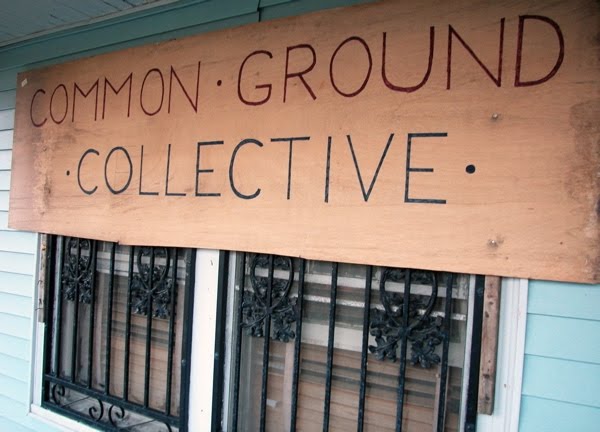
Anarchist organizer scott crow — one of the founders of New Orleans’ Common Ground Collective — tells a remarkable and very personal tale of post-Katrina desperation, racism, and white vigilante violence. Adapted for The Rag Blog from a draft of his upcoming book, it is the story of his experience in the primarily black working class Algiers neighborhood in a stricken and lawless New Orleans, where white supporters join with members of the community in standing up to armed white militias who are driving around in pick up trucks terrorizing the residents.

Posted in RagBlog | Leave a comment

scott crow : White Vigilantes and the Battle of Algiers

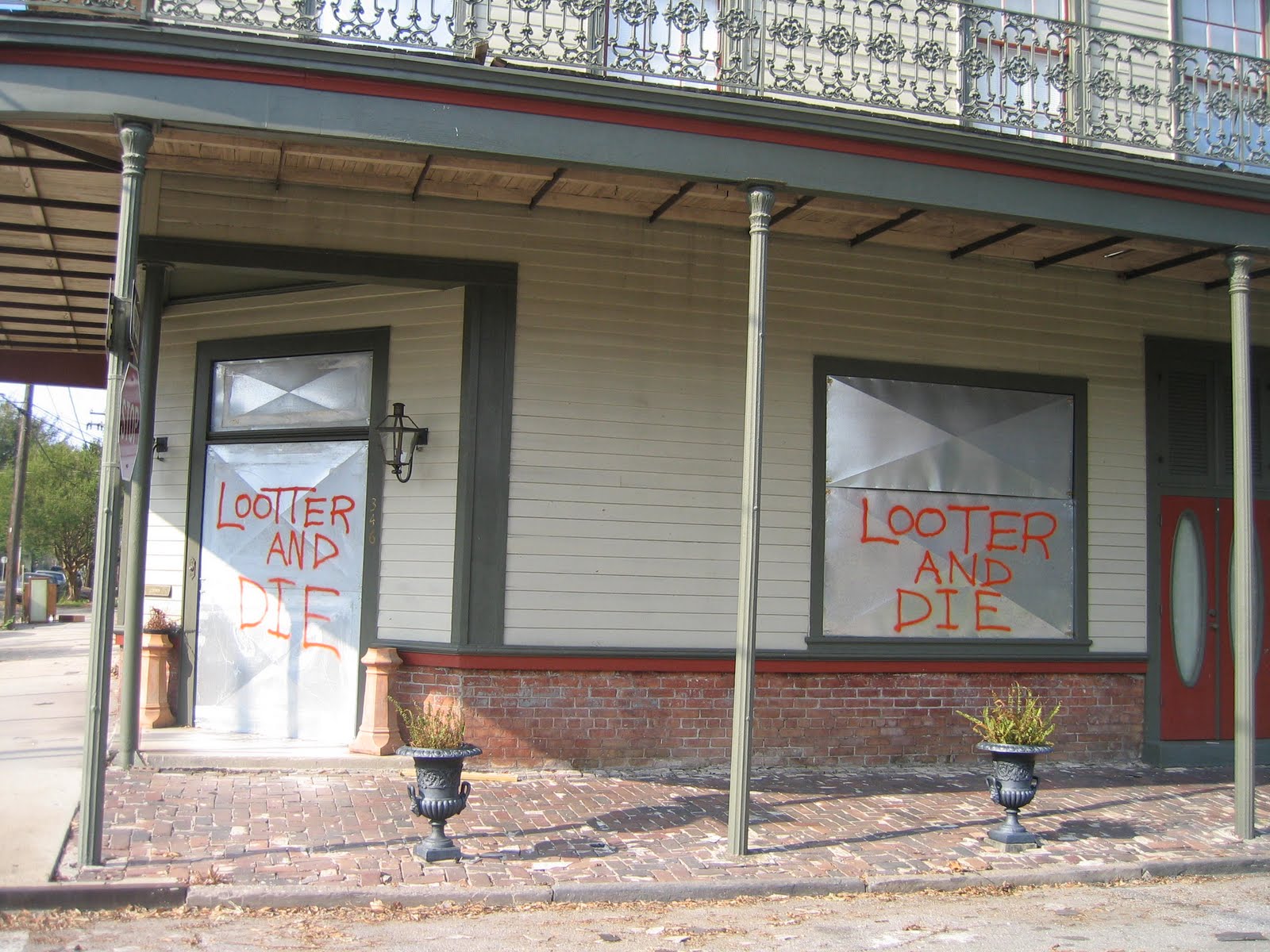
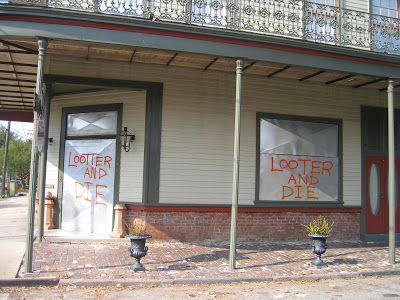
One of numerous looter signs posted by white vigilantes in the small Algiers Point Neighborhood after Hurricane Katrina.

Battle of Algiers:
White vigilantes and the police
in Katrina’s aftermath

By scott crow / The Rag Blog / September 8, 2010

“…within the war we are all waging with the forces of death, subtle and otherwise, conscious or not — I am not only a casualty, I am also a warrior.” — Audre Lorde

As we pass the fifth anniversary of Katrina I want to share this narrative about anarchist organizing in New Orleans after Hurricane Katrina, and about the violence we were confronted with from the white vigilantes and police in Algiers. It takes place upon my return to the area after a failed mission to find my friend Robert King of the Angola 3 right after the levees gave way.

This story, which takes place just before we organized the Common Ground Collective, is adapted from a draft of my forthcoming book: Black Flags and Windmills: Hope, Anarchy and the Common Ground Collective. Five years later we have only scratched the surface in learning about the atrocities of the vigilantes and the police. We are still healing from those encounters. This story is just one of many.

On September 4th I was back home in Austin, resting uneasily from my draining trip, when I received a call from my friend Malik Rahim who, unknown to me, had also remained in New Orleans. He, on the other end of the crackling phone line, was saying, “we got racist white vigilantes driving around in pick up trucks terrorizing black people on the street. It’s very serious. We need some supplies and support…”

He and his neighbors were being harassed and threatened by armed white men, and by the police. He had been interviewed for a piece that appeared in the San Francisco Bay View that explained the grim situation in detail. I had read it upon my return to Austin. Now he was on the phone because he had heard I was just in NOLA looking for [former Black Panther and Angola 3 defendant] Robert King. I knew he was serious. He said he hoped I would come back to New Orleans to give them support and to use it as another opportunity to search again for our friend King who was still missing.

Malik Rahim is a serious man with a broad smile and a big laugh. He was a former Black Panther, the Defense Minister for the New Orleans chapter. His days have been given to making the world a better place since that time. Throughout much of their lives, the histories of the men of the Angola 3 have been intertwined with that of Malik. He and King had not only been Panthers together, they had also been childhood friends in the Algiers neighborhood. King and I had visited him at his mom’s house a few times at the beginning of the century.

After living in Oakland, California, for years, Malik had settled once again in Algiers, where through King he and I had become friends in 2001. Algiers is one of the oldest neighborhoods in New Orleans, situated across the Mississippi from the French Quarter.

Malik, too, had waited out the storm at his home with a woman named Sharon Johnson. While Katrina left massive damage in her wake it hadn’t flooded his neighborhood. Malik had no electricity and no water, but his phone still worked, and when he called I knew it was critical that we move quickly. No electricity, but a live phone. It reminded me of the days just earlier in the leaky vacant warehouse. What an odd coincidence I thought as we spoke.

With determination I decided I was going to go back there to deliver supplies and get to King. This was a chance to try again to find out what had really happened to my friend. The only thing I knew was that he had been trapped in his house, surrounded by dirty water for eight or nine days. I hoped he was still alive. Robert King had been in solitary confinement for 29 years in a 6’ x 9’ cell. I could not let him sit in the floodwaters any longer; I felt a duty to try and get to him.

On the way out of Austin again I stopped at a meeting called by anarchists and activists who were organizing local aid for evacuees. I shared my stories, tears, fears, and the scary realities of what was happening on the ground. I then asked if anyone in the circled crowd of 50-60 people would come to New Orleans knowing what might transpire. Sadly, there weren’t any takers. Was I doing the right thing?

After my first trip to the Gulf I knew better what to bring on this mission: water, food, candles, matches, ammunition and guns; nothing more and nothing less. We were not prepared enough the first time — we were outgunned and under-resourced — but not this time.

Fear of the unknown crawled under the surface of my skin, fear of what was about to happen as I headed back. I knew it was getting more desperate in the Gulf as time passed. Was a race war going to erupt? How many people had died needlessly already?

I had seen from the first trip the disregard and lack of empathy that some white rescuers had shown for desperate people. It had made me deeply angry but I had generally kept my mouth closed. I was torn between doing the work of simply helping people, and espousing my political ideals in the face of oppressive ignorance.

We hurried back to the scene of the floods, our truck speeding alone on the highway headed into an abyss. Few cars moved our way, apart from the occasional military vehicle. In the other direction the roadway was overflowing with evacuees — who began to look like refugees from another place.

People were piled into and on top of vehicles, carrying with them the remnants of their lives; others, stranded without cars, traveled on foot. Families, neighbors, and strangers trying to go somewhere — anywhere — that was away from the flooded areas. All the while the radio reported government sources saying, “Order will be restored” — when all anyone wanted to hear was that the authorities would do whatever it took to get everyone to safety. It was a modern day exodus, caused by corruption and unresponsiveness — and it didn’t have to happen.

I asked myself, “What the hell am I getting into?”

We changed course and went along the lower southwestern coastal route this time, traveling into what looked more and more like occupied war territory with military vehicles and personnel at every turn. I wondered if the doctored passes that we had made would get us past the bureaucracy we knew was already rearing its head.

The military and the state only understood badges and uniforms. They wouldn’t let civilians help even though it was the right thing to do. Many of the young soldiers looked war-stressed and distant as we came up. They grilled us about why and where we were going. Half truths got us through; it was the only way.

After the last checkpoint we drove headlong onto the empty bridgeway; I knew we were “safe.” I let out a sigh of relief and continued to Malik’s. Ours was the only truck on the road, so we ignored the dead useless stop lights.
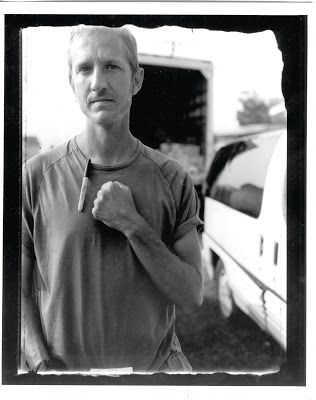
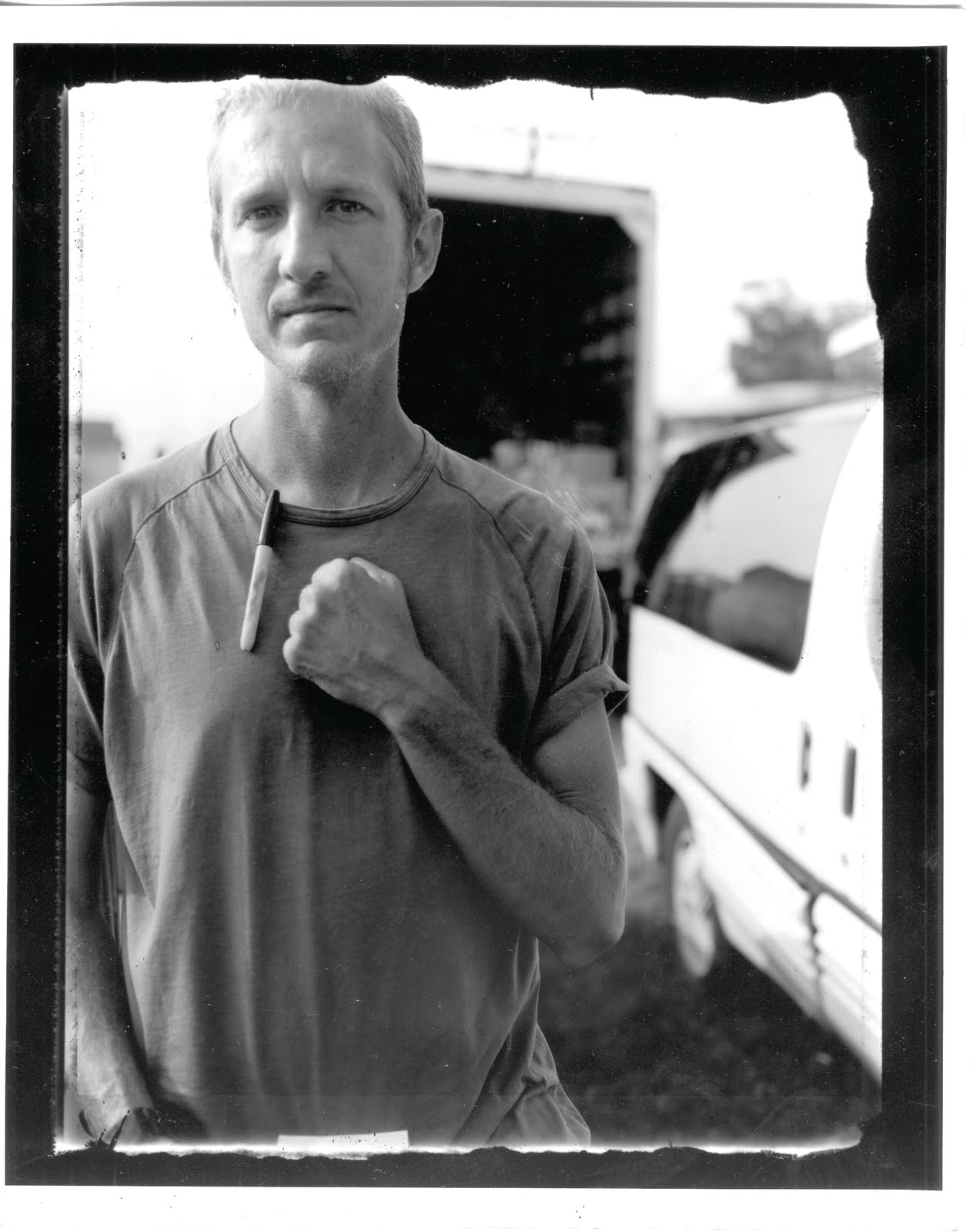
Scott crow on a street in the Algiers area of New Orleans, September 2005. Photo by Todd Sanchioni / The Rag Blog.

So much water so close to home

Algiers is situated in New Orleans, on the south and west sides of the Mississippi river in an area called, ironically enough, the “West Bank.” Like the West Bank halfway around the world in the Middle East, it too had an apartheid system — with two unequal populations. Before the storm, the West Bank was home to 70,000 people. It had a largely poor black population, and a small, wealthy white minority. Governments rendered the larger populace invisible in daily life; why would a storm make it any different?

Huge housing projects and surrounding neighborhoods were burned out or empty, first from neglect, and now from the storm. There had been no social services or safety nets to speak of for decades. When the last clinic closed 10 years earlier it stayed that way, and it was the same with many shuttered schools.

Algiers was surrounded by massive graying concrete levees on the Mississippi sides — almost like prison walls — which didn’t give way, despite nearly being crushed by a huge barge ship that Katrina ran aground within a few feet of the levee walls. This was why it hadn’t flooded, even though the river had swollen to the top of the levees.

After the storm, most residents were gone, with only about 3-4,000 remaining behind. Many were people who couldn’t leave. They had no money, transportation, or family support, or were elderly and in ill health. The storm had made an already terrible situation much worse for them.

The police command structures in the fourth district of Algiers were in shambles. There was scant military help on the ground on this side of the river. The city center — the money-making sector — was the most important to those in power. They had to get NOLA open for business and they neglected everything else.

There were dead bodies on the ground, and buildings smoldered in flames from unknown fires. Algiers, like the rest of New Orleans, was only a remnant of its former self. It was isolated geographically and psychologically from the other side of the river and the outside world.

What was called law enforcement at this stage was erratic, disorganized, and reactionary. It was made up of city, county, state, and some federal officers, but mostly it was Louisiana-based. If they had a plan — besides acting like thugs with badges — it hadn’t been revealed.

As in life before Katrina, laws were subjectively enforced. There were different standards for whites and everyone else, and threats from officers were all over the map in severity. They were accountable to no one but themselves. There were heavily fortified military zones and checkpoints around the area but nothing inside. The residents were left to fend for themselves against the police.

Trapped in this situation, cut off from the rest of New Orleans and the world, Malik Rahim, Sharon Johnson, and a few nearby neighbors struggled to sustain themselves and each other with rudimentary military MRE’s (Meals Ready to Eat) and water obtained from distant military sources.

They had few resources: one busted-ass car with limited gas, supplemented by what they could siphon from abandoned cars. There was no Red Cross, no FEMA — nothing. To get anything you had to have a vehicle and access to gas, and money to buy the gas. Someone had to drive 20-30 miles to a remote military outpost, wait in a long line under armed security — and hope they would be let back into their community before curfew without running out of gas or being shot. The ordeal would take the whole day. That was the only way — there were no other options.

Tapestries of violence

This community had asked for support, so I returned to do what I could. It was what many of us on the outside with conscience would be doing in the weeks to come. But today that was an eternity from where I stood.

I arrived in New Orleans for the second time seven days after the levee failure on September 5th. Everyone pitched in to unload the supplies we had brought. Then the conversation turned to the best way to search for King.

Before we did anything else, Malik took Brandon and me down the street to cover up the dead bullet-riddled body that lay near his house — with a piece of sheet metal tin. The bloated and putrid body had been left there for days. We could smell it as we approached. Malik hoped someone would come and get it soon. But who was looking for this man, his identity unknown to any of us, including the kids who found him?

His image haunts me among the string of deaths I experienced during my time there. He met an ignoble death, likely without a chance. Left to decay on the sun-baked street, where others I had seen had been in the waters. I imagined they all deserved better. His death was a product of his skin color, economics, and chance.

We started setting up security for ourselves and our immediate neighbors. Something else had happened in the short interim since our first arrival in New Orleans. While the state was in crisis, white vigilante militias had formed in Algiers Point and in sthe French Quarter district. These white vigilantes were little more than organized mobs. Signs on the backs of their trucks announced that it was their job to secure law and order in the absence of the police. The militia in Algiers seemed to be made up of drunken racist fools.

Algiers Point is a small, very wealthy, very white neighborhood that is about 10 blocks long in each direction. It is very separated from the Algiers neighborhood. Both sections are part of the broader Westbank, which is predominantly black working class, and poor.

Algiers Point was the only neighborhood on the West Bank where — when traveling down the mostly abandoned and littered streets — we saw hateful signs like “You loot, we’ll shoot,” or “Your life ain’t worth what’s inside.” Signs proudly displayed on the houses that were still occupied, as well as the ones that were vacant and boarded up.

These signs were put up by the vigilante types who stayed. They believed it was their right to protect their private property and secure law and order. It was as if the dam of civil society that kept them from acting out their most racist tendencies had broken, allowing their ugly hatred to emerge. They had another shot at the good old Klan days and they were going to take it.

These armed white militia rode around through largely low-income black communities and meted out their version of justice — intimidation — around Algiers and the West Bank. Their “defense,” as they called it, amounted to harassment of any unarmed black person on the street alone. They acted prideful and talked tough, never offering to help anyone who wasn’t white.

Their incendiary vigilante actions, thinly veiled under the guise of protecting themselves and their private property, added gasoline to the fire of the undeclared war on all who were desperate. I found myself asking what kind of people are more interested in their private property and security than in the well-being of another human?

I could understand the concept, given the right situation, of an armed group of people gathering to defend themselves in the absence of the state, and this disaster could be seen as such a situation. But these people, in their racist actions and words, parading around in their trucks, were no better than Klansmen straight out of the old Deep South. Our conflicting ideas of what community self-defense meant were on a collision course.

In those early days, the Algiers Point Militia openly threatened — and may have killed — desperate unarmed civilians. They foolishly bragged about it to a Danish media crew and to anyone else who would listen. Local representatives of the state, or what little remained of it, with their ingrained racist attitudes towards these marginalized communities they were supposed to protect, stood by and let these vigilantes do their thing.

There were bullet-riddled bodies of black men in the street, including the one that we tried to get picked up for 15 days while it decomposed. Was it the vigilantes or was it the police or both? Those men’s bodies were on different streets — found separately — near nothing of value. Who killed these men? I am now certain — as I believed then — that the vigilantes or the police had killed them and gotten away with it.

In this country, on city streets, they killed people and were accountable to no one.

They regularly both drew their guns on and shot at innocent people — unarmed, poor, black, and on foot — to scare and intimidate them. They threatened Malik — who they mockingly called the “Mayor of Algiers” — from the beginning, pointing guns as they would drive by, threatening to “get ’em.”

The police did nothing but close their eyes and continue their own harassment and shooting campaigns. The lines between law and thugs blurred, leaving people with nowhere to turn.

Undercurrents

From the moment I had set foot in the Algiers neighborhood and spoken with Malik and Sharon Johnson in more detail, I realized that this was going to be bigger, more difficult, and more dangerous than anyone thought. They were both exhausted from having to struggle for survival and remain vigilant about the militia and the police. There had been no help. People were left to their own devices.

Although Algiers had not flooded, it had been ravaged by the storm, and the long-term neglect before that. The water was still high along the levees down the block rising at the edge of the dead-end streets to the north and east sides of the banks; spirits were low in the streets below, but some desperate hope remained among those residents who had stayed. This had always been their home and they didn’t want to leave.

I had been here a few years before with Malik and King, who showed me their old stomping grounds as kids and young hustlers, before they became Black Panthers. Now, like in the rest of the city, trash and abandoned cars littered the empty streets and vacant lots. I asked myself — as I came in and passed the armed, sandbagged turrets at the intersections — what damage was new and what had been that way for a long time?

This place had been occupied by a police force before, but now the outskirts were held by an army that watched from bunkers without helping the people within. Military vehicles patrolled many of the city streets. It looked like low intensity warfare against a civilian population, certainly not aid, eerily reminding me of what I had seen in Belfast and in East Berlin.

After delivering water and food we met and talked with residents from the neighborhood. They were scared — and fed up with the white militia and the police. People, mostly men with little or no resources, both young and old, told us the stories of their lives, and why they had stayed.

Some were forgotten vets from U.S. government wars, others had seen prison time for essentially being Black in Louisiana, while some were quiet and deeply religious men. But they all stayed because they had to. All of them had long family histories within these city blocks; many houses had belonged to the same families for generations.

They worked together to make the most of a bad situation with no resources. They were men and women who had been reduced to statistics by the media, the government, and civil society; they were virtually invisible, characterized only as poor, black, unemployed — branded as hoodlums, drug addicts, or any other number of de-humanizing words — and now they were being called looters for doing what they had to do in order to survive.

In our small group we talked about what we might do to defend ourselves should it become necessary. There were conflicting opinions on how the police might react, but we felt we had no other choice today. We inventoried what weapons we had among us. Who was in, and who among us would have nothing to do with carrying arms.

Eventually — with Brandon Darby (who we would later learn was an FBI informant), Reggie B., and “Clarence” (not his real name) carrying civilian AK-47’s and a .45 caliber pistol, and me with a 9mm carbine rifle — we began our first rudimentary watches, standing or sitting on Malik’s porch and waiting, armed.

I wasn’t a white man taking it on himself to protect helpless locals. There was no act of machismo. I was honored to be amongst these people. To me this was an act of solidarity with people whose lives were being threatened simply because of the color of their skin.

Being there was an expression of my anti-racist principles, my personal commitment, and my revolutionary beliefs — beliefs I had held long before the storm. I had been asked for support and came, not blindly but as a matter of principle. I had come back ready to defend friends and strangers in the neighborhood, because they asked me to. They wouldn’t have asked had it not been necessary. Civil society had given them no choices. It looked as if they simply had been left to die. We had to at least give ourselves a fighting chance for survival.

I was a community organizer from another city who believed that the right to self-determination and self-defense are fundamental if we are going to achieve justice. I accept the fact that dismantling coercive systems that hold people down will require various tools, and sometimes it might involve armed self-defense. Even if what we are working for is a world without violence. It is one of the hard and dirty realities that we must sometimes face while moving towards liberation.

I was terrified but resolved in what I was doing. I had little previous experience in community self-defense. I had been tested on a much smaller scale — resisting neo-nazis and small time fascists, confronting police brutality in the streets, facing threats from private security for my environmental or animal rights work. But this was on a scale unlike anything I knew.

I had had a few years of firearms practice, but now I had to transform a theoretical commitment to armed self-defense into the real thing. It was all to happen so quickly too, without much time for processing or reflection. It was now time for action.
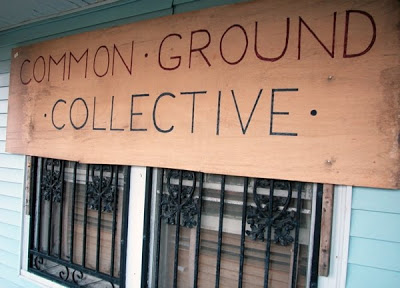
Malik Rahim’s house in Algiers served as Common Ground’s first media and aid distribution center.

Friends of Durruti

The midday humidity hung heavy and the helicopters continued their constant noise in the overhead sky. A few neighbors were gathered at Malik’s long narrow “shotgun” style house, built in the thirties, that sits high off the ground with a tall concrete porch behind a rusting chain link fence.

The white vigilantes came around the corner in their truck — and as before — slowed in front of the house on Atlantic Avenue, talking their racist trash and making threats. But this time it was different: when they came we were there, armed, and nervously holding our ground.

We had more firepower and a better firing position — and we were sober. Finally someone told the vigilantes they should “move on down the road.” That they would no longer be permitted to intimidate or threaten residents around here. Earlier, we had all informally agreed to hold the space no matter what, and I knew that in a flash this could turn bad, could result in a hail of bullets. Time stood still as I kept my finger on the trigger of my rifle.

More words were exchanged and finally the truck drove on — without further incident. My heart pounded with sickness and relief. I was shaking inside from fear and adrenaline. My head swirled with a tidal wave, with more questions than answers. How was the state going to react? How were we going to react? Was this the right thing to do? What if the situation continued to escalate? Would other movement groups support us? What if I had shot someone — or worse killed them? Would it have been worth it?

Some of these men in the truck were known to Malik and his neighbors. Had the veil of society stopped them from this kind of aggression in the past, and now they felt free to act as they pleased? One thing was immediately apparent: even if they were ignorant, they had no real power once they were challenged. As they left, we felt guarded joy, and a sense of relief. But we didn’t know then if they would return.

More volunteers would sit on Malik’s porch over the days to come, and they began rudimentary neighborhood patrols — to keep the militia threat, and to a lesser degree the police, at bay. These acts — and our refusal to leave in the face of repression — made us enemies in the eyes of law enforcement, and race traitors to the racist militias.

But to the people in the neighborhood, the fact that we were ready to die defending their community meant something real and tangible: that white people would come to their aid and put their lives on the line with them and for them. And more would do this as the days progressed.

There was no Red Cross, there was no FEMA, there was no protection for the people except what we were willing to organize for ourselves. Some time later the presence of whites and blacks working together in solidarity to defend these communities against the racist militia would be cited by local residents as one of the things that helped ease the tensions in this racially and economically divided area, devastated long before the levees ever broke.

From self defense we created the Common Ground Collective based on anarchist principles and practice. An organization always at odds with the state, that took direct action to meet the needs of communities otherwise left to die.

[Based in Austin, Texas, scott crow is an anarchist community organizer and writer. He was one of the founders of Common Ground Collective, an organization formed in the aftermath of Hurricane Katrina in 2005 to aid in the rebuilding of New Orleans. He currently works at Ecology Action, a worker-run cooperative recycling center in Austin. His book, Black Flags and Windmills: Anarchy, Hope and the Common Ground Collective, will be released later this year by PM Press.]

The Rag Blog

Posted in Rag Bloggers | Tagged , , , , , , , | 4 Comments

Harry Targ : Time for Progressives to ‘Get on the Bus’

Organize: The handwriting’s on the wall.

Social justice and the fall elections:
Mobilizing the progressive movement

By Harry Targ / The Rag Blog / September 16, 2010

“Get on the Bus.”

That was the conclusion 16 activists from Illinois, Indiana, and Kentucky came to after a day-long meeting assessing the needs of progressive forces between now and the fall elections, and after.

The occasion was the semi-annual meeting of the Midwest Region of the Committees of Correspondence for Democracy and Socialism (CCDS). The small but spirited gathering of activists addressed the significance of the 2010 fall elections, the economic crisis, and how to incorporate Jack O’Dell’s recently proposed Democracy Charter into the project of building a progressive majority.

Elections 2010

Ted Pearson, Chicago peace and justice activist, opened with a discussion of elections 2010 called “Saving the Progressive Majority.” He quoted from a recent article in The Nation by Jean Hardisty and Deepak Bharvava, “Eighteen months into the Obama era, the progressive movement is experiencing malaise, based on disappointment about what has been accomplished so far and confusion about the path forward.”

Pearson noted that while the Obama administration has achieved modest gains in public policy — health care reform, some financial regulation, expansion of poverty programs, student loan reform, and the selection of two moderate Supreme Court justices — people are angered and frustrated by the continuing economic crisis, particularly high unemployment and under employment, two wars, threats to civil liberties, and lack of progress on immigration reform and climate change legislation.

Polling data about where people stand on issues and candidates, Pearson said, suggests much anger and confusion. Progressives must use the next six weeks to reverse the dangerous tilt toward reaction.

Pearson quoted from a recent speech by Van Jones, environmental activist and green jobs advocate, targeted by the right wing for dismissal from the Obama administration, who argued that after eight years of despair activists in 2008 felt a sudden surge of hope. Now there is the danger of returning to despair. Nothing, Jones suggested, can be more destructive to the prospects for a people’s agenda than to withdraw.

It must be made clear that the 2008 election only got progressives “to the starting line”; that the projects initiated have not been completed; and that the struggle in the electoral arena and elsewhere must continue.

Drawing from these comments and history, Pearson concluded that achieving change requires the building of a mass movement. It was the mass movement that led to Obama’s victory and it will take a mass movement to force him and all the institutions of national, state, and local government to move in a progressive direction.

For right now, Pearson argued, progressive forces need to support the massive rally, “One Nation Working Together,” to be held on October 2. This rally will be historic, bringing together the National Association for the Advancement of Colored People (NAACP), the American Federation of Labor and Congress of Industrial Organizations (AFL-CIO), and the National Council of La Raza (NCLR), and hundreds of peace, justice, and environmental groups.

October 2: A massive gathering for economic and social justice.

The October 2 movement will not only bring hundreds of thousands to Washington, D.C. to take back the public image from the right wing, but it will galvanize local progressive groups to speak and work together, whether they are able to go to Washington, D. C. or not. Most important, October 2 promises to bring a broad coalition to “the starting line” so that they can work together in the months and years ahead to achieve economic and social justice and peace.

Most attendees endorsed Pearson’s analysis and Jones’ call to fight despair. They endorsed a campaign to mobilize those who worked so hard to get to the starting line in 2008 to organize at the grassroots for October 2. The campaign for “One Nation Working Together” must build on analyses of the interconnections between class, race, and gender. White privilege, so much a part of the Tea Party agenda, has to be directly challenged.

The jobs crisis

Ira Grupper, labor activist and chair of the CCDS Labor Committee, opened the second panel with a discussion of the crisis of jobs described in the new CCDS booklet, “It’s Time to Fight for Full Employment.”

Rich with data and commentary, the document points to the long term structural character of unemployment in the United States. Recessions, periods of limited or no economic growth, have been followed by longer and longer periods of high unemployment. Over the last decade recoveries from economic stagnation have occurred without reductions in unemployment; so-called “jobless recoveries.”

Grupper pointed out that in recent years corporate announcements of job layoffs have usually been followed by increases in stock market prices. Since the dawn of the new century, profit making by huge corporations and banks has been coupled with declining economic security for American working people.

Grupper referred to the booklet’s description of deindustrialization, financialization, and increasing marginalization of workers by race as well as class. Others added that the particular impact of the recession on women needs to be highlighted.

In addition, participants identified a web of interconnections between cuts in education, lack of training for youth, the rise in marginalization, the shift to the so-called “informal sector,” often criminal activity, and incarceration with no resources for programs of rehabilitation. As Grupper pointed out, the youngest cohort of workers, ages 16 to the mid-20, experience the highest rates of unemployment, some never having experienced a job.

Grupper pointed out that the CCDS booklet summarizes a number of proposals for change, including the United States Steel Workers proposals for a green jobs agenda, support for workers cooperatives, and demands for a new industrial policy that emphasizes public sector employment including infrastructure construction.

The Democracy Charter

The final panel, introduced by Janet Tucker, National Organizer, CCDS, and Mildred Williamson, member of the National Executive Committee, CCDS, described the 2009 Democracy Charter crafted by 87-year-old civil rights activist Jack O’Dell. O’Dell, once an aide to Dr. Martin Luther King and editor of the distinguished journal, Freedomways, has called on 21st century activists to work for a program called the Democracy Charter. The idea of the Democracy Charter was inspired by the Freedom Charter adopted by the African National Congress (ANC) in the 1950s as it organized to defeat racial apartheid in that country.

In addition, O’Dell was inspired by the so-called “Five Principles” of peace and justice embraced by the newly formed Non-Aligned movement of nations in Bandung, Indonesia, also in the 1950s. Both documents proclaimed that freedom and justice both within countries and among them are indivisible. By adopting a Democracy Charter now, O’Dell has argued, progressives in the United States and around the world can articulate a vision for a better world; one that connects class, race and gender, peace, environmental justice, and the uplift of humankind.

Tucker and Williamson pointed out that the Charter, as currently written consists of 13 main points:

  • an end to homelessness
  • full employment
  • a commitment to human rights
  • free education from early childhood through college
  • a non-aggressive foreign policy
  • universal healthcare
  • a secure and solvent social security system
  • a farm economy resting on family and cooperative enterprises
  • a prison system committed to rehabilitation
  • restoration and protection of the environment
  • expanded public management of natural resources
  • the right to have every vote counted
  • airwaves maintained as public property.

During the day, attendees grappled with the difficulty of communicating progressive ideas in a politically charged and hostile environment. Several commentators agreed that the Democracy Charter, like the Freedom Charter of the 1950s, may have the appeal to move beyond premature rejection.

By seriously reflecting on the election just 50 days away and carefully assessing the structural crisis of the U.S. economy, the attendees at this regional meeting recognized the tasks that progressives must complete. And by reflecting on the Democracy Charter they saw a way to clarify the meaning of their work to organize with others to push beyond “the starting line.”

Metaphorically, all agreed to “get on the bus.

[Harry Tarq is a professor in American Studies who lives in West Lafayette, Indiana. He blogs at Diary of a Heartland Radical.]

The Rag Blog

Posted in Rag Bloggers | Tagged , , , , , , | 6 Comments

Marcy Winograd : We Need a Green New Deal

Image from Conservation Value Notes.

It’s time to retool our economy:
The United States needs a Green New Deal

What if our engineers, now building weapons, could build solar cities instead?

By Marcy Winograd / September 15, 2010

My talented young cousin works as a rocket scientist at a local aerospace plant. She considers herself one of the lucky MIT grads who landed a job in the space end of the aerospace industry.

Her friends, however, are designing drones that sometimes miss their terrorist target, accidentally bombing innocent brides and grooms in Afghanistan.

My cousin tells me about a colleague of hers, a drone-builder, who had a nightmare; she accidentally droned her own bedroom.

“She’s still designing these drones, though,” my cousin tells me. “That’s where the money is, the jobs, in military contracts, in building sophisticated weapons systems.”

What if our engineers, now building weapons, could build solar cities instead? Under the Solar America Initiative, Boeing started the ball rolling, contracting with the Department of Energy to make solar energy competitive with conventional electricity by 2015.

Aerospace conversion could happen — and should for the sake of our planet.

Flying 100,000 troops to a far off land to fight an ever-morphing enemy leaves a huge carbon footprint; bombing cities and then rebuilding them emits a carbon monster.

Some might argue the carbon cost is necessary to protect national security, but it doesn’t take a rocket scientist to determine that war and occupation multiply our enemies.

Plus, war is not job smart. In 2007, University of Massachusetts economic researchers found a billion dollars invested in mass transit generates twice as many jobs as the same billion invested in military contracting.

Future economic recovery plans should offer explicit career-path transitions from a permanent war economy to a new green economy. Pay people to retool.

Train laid-off missile defense workers to build wind farms. Offer federal contracts for aerospace firms to fortify the Vincent Thomas Bridge. Invest in health care, education and cleanup at the Superfund sites in Torrance.

President Barack Obama recently signed an $18 billion jobs bill with payroll tax breaks for businesses, as well as tax credits for companies hiring the unemployed and purchasing new equipment. The bill invests billions in federal highway construction and mass transit. Optimists predict the legislation could generate 250,000 jobs.

Not bad, but not great either, given that America has lost 8.4 million jobs since the start of this recession.

Congress would be wise to model a new green-job stimulus package after the Works Progress Administration, the 1935 Roosevelt Depression brainchild that employed an estimated 10 million Americans building 850 airports; 110,000 libraries, schools, and hospitals; 500 water treatment plants; 78,000 bridges and 8,000 parks. The WPA also employed artists to paint murals in post offices, like the San Pedro post office on Beacon Street where a WPA mural depicts the history of the harbor.

Can we afford a super stimulus? Critics lament the growing deficit, estimated to climb to $1.6 trillion this year. But these same critics rarely talk about the elephant in the room: our bloated near-trillion-dollar military budget that siphons much-needed resources from our daily needs.

Take housing, for example. According to the Center for Responsible Lending, our congressional district suffered 7,000 foreclosures in 2009. Over the next four years, the center predicts 25,000 homeowners from West Los Angeles to the harbor will lose their homes to foreclosure.

Freeze the foreclosures. Save our neighborhoods. Instead of funding no-bid contracts in Iraq, Congress could create the Loan Officer Corps to pay mortgage brokers to mediate between banks and homeowners to keep more Americans in their homes, more counties collecting property taxes, more cities solvent.

Prime the jobs pump. Recreate the Civilian Conservation Corps, the New Deal program that employed 250,000 men, ages 18 to 25, at work camps in every state to stop soil erosion and plant trees. Hire more teachers for Head Start, President Lyndon Johnson’s War on Poverty preschool program. Launch a Nurses Now Initiative to pay college grads to train as nurses at Harbor-UCLA Medical Center.

Saving lives, saving minds, saving forests — it’s all green. But how do we pay for this?

Cut the waste in our military budget. Bring our troops home from the trillion-dollar wars in Iraq and Afghanistan. Exact a serious fee on every stock trade on Wall Street. Bust open the bank vaults in the Caribbean where corporate tax dodgers stash their profits. Repeal the Bush tax cuts for the rich. End the war on drugs with its obscene prison costs.

When President Franklin Roosevelt enacted the New Deal, one out of every four Americans was out of work. Today, in California, the real unemployment rate, the one that includes the underemployed and those who have given up looking for a job, is pushing 20 percent.

It doesn’t have to be this way. Together, we can create a better future: new jobs, health care, clean air, land and water. With our wealth of talent, we can champion a new green economy competitive with China and Germany.

It’s time to put America back to work.

It is time for a Green New Deal.

Source / WarIsaCrime.org

The Rag Blog

Posted in RagBlog | Tagged , , , , , | 1 Comment

Kate Braun : Fall Equinox and a ‘Full Wishing Moon’

Fall Equinox: The egg is a symbol of the four elements.

Balancing the egg:
Fall equinox is time of energy and power

Round and around and around and around and around and round we go…

By Kate Braun / The Rag Blog / September 15, 2010

Wednesday. September 22, 2010, is the date of the Fall Equinox, also named Second Harvest, Mabon, and Cornucopia. Lady Moon is in her second quarter in Pisces and there is Full Wishing Moon on Thursday, September 23.

A Full Moon is a time of high energy and much power; its effect can frequently extend to the days immediately before and after the actual Full Moon; therefore, it would be good to include in your activities this night rituals for protection, prosperity, harmony, and balance, keeping your focus on the positive aspects of these qualities.

Decorate with gourds, pine cones, acorns, autumn leaves, apples, pomegranates, and textured fabrics such as velvet, velour, and corduroy. Appropriate colors are red, orange, deep gold, russet, maroon, and violet. Scales or balance rods could be used as a centerpiece. A cauldron filled to overflowing with apples would also serve well as Mabon is sacred to Cerridwen, the Celtic water-oriented Goddess of Autumn. Her symbol is the Cauldron and her fruit is the apple.

In the long ago, the Fall Equinox was the time to start a project which would be completed by Yule (Winter Solstice). One tradition was to make a quilt. If you have friends who enjoy this activity, each of you could begin a quilt square on this night, take it home to finish at your leisure, bring it back at Yule and assemble the quilt. It need not be a full bed size; a lap quilt will generate the same energy associated with finishing what you start.

Equinoxes are the two times each year when a raw egg can be balanced on its larger end. This presents a good reason to contemplate the symbolism of the egg without having to eat any (and given the recent salmonella outbreak we must be more vigilant than usual about knowing the sources of egg production).

The shell represents Earth, the membrane represents Air, the yolk represents Fire, the white represents Water. These are the four elements from which come all things, hence the egg may be considered to represent “All and Everything.” As you and your guests balance your eggs, turn your focus to acknowledging your blessings. Silently give thanks for not only food, clothing, and shelter, but also friends, family, and professional success.

[Kate Braun’s website is www.tarotbykatebraun.com. She can be reached at kate_braun2000@yahoo.com.]

The Rag Blog

Posted in Rag Bloggers | Tagged , , , , , | Leave a comment