Greg Moses : Deporting Texas Student Was Big Mistake

Saad Nabeel. Photo by Shehab Uddin / Der Spiegel.

What the Times forgot to mention:
Story of deported Texas student
Awaits President in Dallas

By Greg Moses / The Rag Blog / August 9, 2010

While the New York Times Monday morning proclaims that the Obama administration is not deporting college students whose parents brought them to America at a young age, the President is headed toward a fundraiser in Dallas Monday night where one such case is well known.

Dallas real estate developer and immigrant rights advocate Ralph Isenberg bought tickets to the fundraiser with President Barack Obama so that he can plead for the speedy return of a young deportee from Texas. Isenberg has been working for several months to secure the return of 19-year-old who was deported to Bangladesh with his parents in early 2010.

If the New York Times is correct about what the Obama administration is trying to do, then the deportation of Saad Nabeel was a big mistake. He had lived in the USA since age three, completing grades six through twelve in Texas. When he was deported at age 18, Nabeel was studying electrical engineering on full scholarship at the University of Texas at Arlington

“I plan to tell the President that if he is looking for a poster child for someone who has been unfairly treated and who we need to do right by, then Saad Nabeel is perfect,” said Isenberg Saturday in a telephone interview with the Texas Civil Rights Review.

“There are multiple legal issues that we can pursue to try to get Saad back in the country,” said Isenberg. “But the quickest solution by far would be to pass a DREAM Act that includes an amendment for young persons who have been recently deported. Other legal issues would require lengthy legal actions — and the wait would do no good to Saad.”

If adopted by Congress and signed by the President, the DREAM Act would offer citizenship options to youth who were brought to the USA by migrant parents. When Isenberg approaches the President in Nabeel’s behalf, he will also be representing the opinions of Saad’s young friends who are this week preparing their returns to college life.

“I feel like everything that has happened in the past year was unnecessary,” explains Chris Anderson, one of Nabeel’s high school friends contacted by the Texas Civil Rights Review.

Saad was brought to America by his family when he was a young child. He lived like every other American by going to school, getting a job, and spending time with his friends and family. Everything that he knew and loved was in the United States, and one day he was just uprooted from college, thrown in jail for over a month, and shipped to a foreign third world country that he has no memory of.

Nabeel’s case has attracted media attention in Dallas and the German magazine Der Spiegel. Other international media have shown interest in the case. Isenberg agrees with Der Spiegel that Nabeel’s campaign to return to the USA has been helped by the young man’s fluency with computer skills.

Keeping tabs on news via computer in Bangladesh, Nabeel saw Monday’s New York Times report as soon as it hit his inbox as the morning’s top story. When asked via email what he would like to say to the President during Monday’s visit to Texas, Nabeel replied within two minutes:

I love America and would die for my country in a heartbeat. It is the only home that I know.

“Saad’s case is really rather compelling,” said Isenberg over the weekend. “Given the discretion that is available to immigration authorities, this thing could have so easily gone the other way. My hope is that the most powerful man in the world will at least take a brief interest.”

[Rag Blog contributor Greg Moses is editor of the Texas Civil Rights Review and author of Revolution of Conscience: Martin Luther King, Jr. and the Philosophy of Nonviolence. He can be reached at gmosesx@gmail.com .]

The Rag Blog

Posted in Rag Bloggers | Tagged , , , , , | 1 Comment

Kate Braun : (Crescent) Moon Musings

Waxing crescent moon over Austin, Feb. 15, 2010. Photo from KXAN.com.

Moon Musings:
Waxing Crescent Moon,
(August 12-August 15, 2010)

By Kate Braun / The Rag Blog / August 8, 2010

This phase of the moon is for promoting things that require growth. Health, money, and relationships fall into this category as does planting above-ground crops in your garden. You may find it helpful to use this moon-phase for clarifying foci and continuing to set goals to accomplish between now and the next new moon.

Sunset is the prime time to begin your celebration; daytime high temperatures begin to drop as sunset drifts into darkness, making the outdoors more comfortable. It is usually better to honor Lady Moon under the open sky.

You have several days in which this moon phase is active. If you choose to activate moon-energy on Thursday, focus your energies on promoting growth where money and legal matters are concerned as Jupiter is the ruling planet. Use the color blue, the number four, and plenty of water in your activities.

Ouspensky considered four the perfect number. It refers to the seasons, the major points on a compass, the suits of Tarot, and the fixed signs of the Zodiac; and adding 1 + 2 + 3 + 4 gives 10, which is composed of the numerals one and zero, which in binary terms are the only numerals needed to create any number. Ergo, four represents “all and everything.” Repeat your invocations four times, turning sunwise and facing each of the cardinal points on the compass in turn (north, east, south, and west).

If you prefer to celebrate on Friday, Venus rules and the focus is more concentrated on promoting love and attraction. Use the color green, go barefoot so that your feet make direct contact with the earth, include water and the number seven in your activities. Seven is a number of Great Magick and may be invoked by drawing a seven-pointed star in the earth. Repeat your invocations seven times, drawing moon energy from above, below, and within yourself as well as the cardinal compass-points.

If Saturday is a better day for you to work with waxing crescent moon energy, the ruling planet is Saturn, it would be good to dress in black, to stay in close contact with the earth and incorporate the number three into your activities. Three is also a number of Great Magick, representing the balance of Mind, Body, and Spirit in the world. Use a triangle to represent this number if celebrating on Saturday and repeat your invocations three times.

There are no hard-and-fast rules as to what you say when you open yourself to moon-energy. You may take some time in advance to write out what you feel to be a good statement or you may speak extemporaneously.

The more important thing is to be centered. One way to do this is to take seven slow and easy yoga-breaths (inhale through the nose, gently and smoothly, feeling the intake of air filling all the empty spaces in your body; exhale gently and smoothly with no huffing and puffing, letting all the empty spaces in your body become completely empty) before you begin, concentrating on making a connection between you and Lady Moon. If you like, visualize this connection as a shining cord of braided silver growing brighter and stronger with each inhalation and exhalation.

Don’t let yourself become too heavy with food before completing your activities. You need energy to focus yourself spiritually, not to run a marathon, but an empty stomach is not good, either. An array of cheeses, crackers, fruits, water, and herb tea, or fruit punch will give you sufficient strength with overloading your digestive system.

Stay focused on laying the foundation for what you choose to accomplish, both short-term and long-term. Remember: you are still at a beginning stage of creating the successful outcome that is your goal. Immediate response to your invocations is possible, but it would be unwise to expect immediate results.

[Kate Braun’s website is www.tarotbykatebraun.com. If you know any Moon Lore that you would like to share with her, send it to kate_braun2000@yahoo.com. Kate will be participating in a Metaphysical Fair on Saturday and Sunday, August 14-15, 2010, at the Holiday Inn (formerly the Radisson) at 6000 Middle Fiskville Rd. in Austin (between Highland Mall and Lincoln Village).]

The Rag Blog

Posted in Rag Bloggers | Tagged , , , , | Leave a comment

John Ross : Epic Hunger Strike in the Land of the Hungry

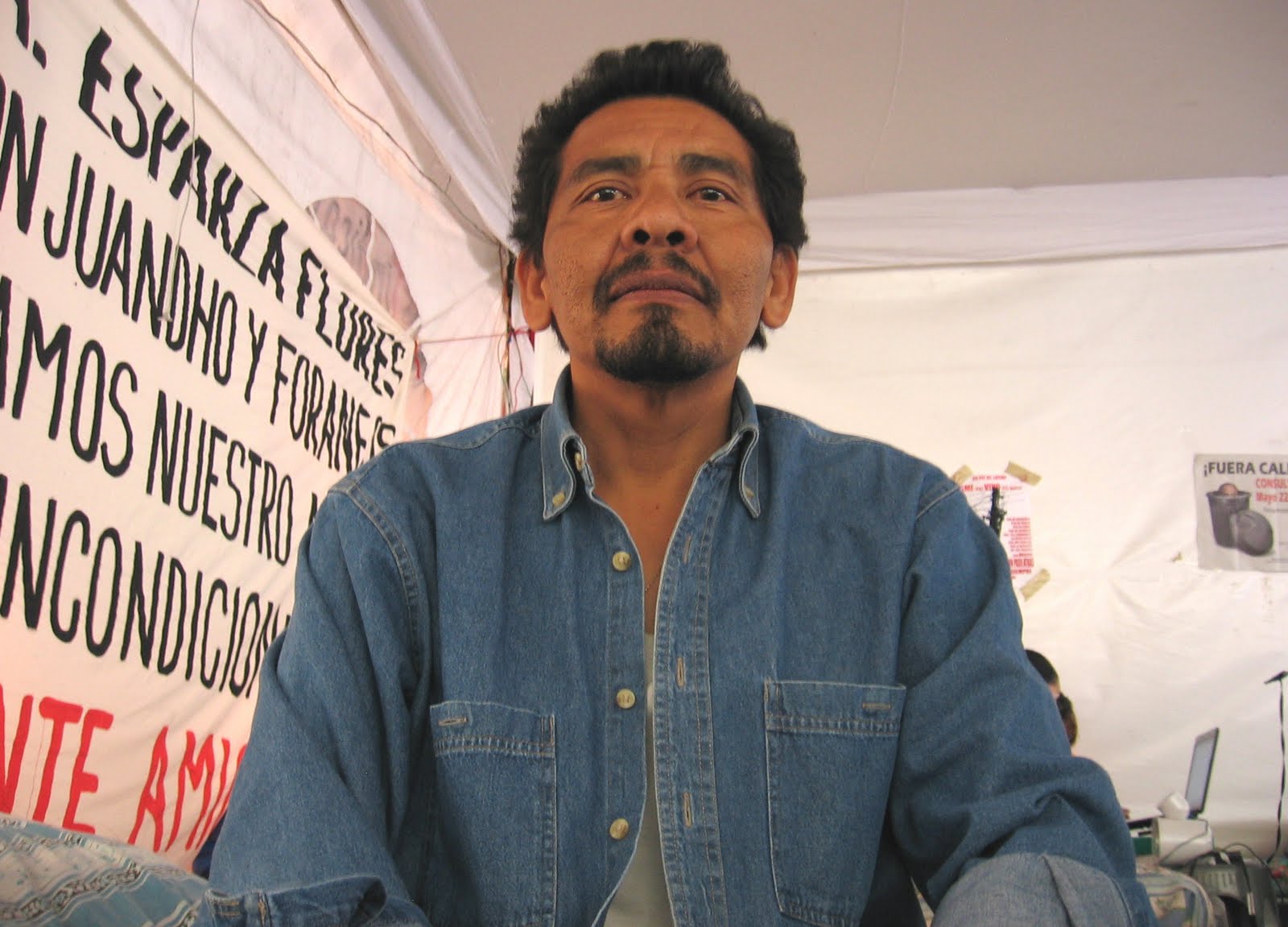
Cayetano Cabrera of the Mexican Electricity Workers’ Union (SME). His hunger strike was the longest in Mexican history — but it ended in futility. Photo from Musicios y Politicos y Locos.

Where Hunger is palpable:
Mexican hunger strike sets record
But electrical workers win nothing

By John Ross / The Rag Blog / August 8, 2010

MEXICO CITY — Hunger is palpable in Mexico. Beggars line the streets of the cities with their bowls and their children, pleading for coins: “Para comer, Senor, para comer?” (“To eat, Mister?”) Whole families rifle through the trash bins in front of the fast food franchises hunting for discarded scraps. At La Merced market, women like Juana Cortez glean the rotting produce thrown out on the patio. “Para comer, Senor…”

According to National Nutrition Institute (INN) studies, 42% of all Mexicans have experienced some degree of malnutrition in their lives. Millions of children living in extreme poverty go to bed hungry every night. Although tortillas are universally utilized to wrap food or scoop up what’s on your plate, for 13 million kids affirms the INN, the tortilla is the whole meal.

With hunger so rooted in Mexican demographics, it seems a jarring anomaly that deliberately starving oneself should be so popular a tactic of achieving redress for social grievances but activists here seem to reflexively go into hunger strike mode when they have exhausted all other remedies to reverse perceived injustices.

Indigenous Zapatista prisoners in Chiapas jails stop eating to protest inequities. So does their emeritus bishop Samuel Ruiz who once hunkered down in a freezing cathedral and refused food for weeks until the government made room for his peace group at the negotiating table. 91 year-old Luis H. Alvarez, once a right-wing PAN party presidential candidate, sat on the steps of the Chihuahua legislature and refused to eat for 41 days to protest electoral flimflam as did his successor as PAN presidential hopeful Manuel Clouthier after the 1988 election was stolen.

Rodolfo Macias, a self-proclaimed president of Mexico, went 50 days in the Zocalo to protest the government’s refusal to recognize his exalted stature.

Rosario Ibarra de Piedra, whose activist son disappeared in police custody and is the force behind the Mothers of the Disappeared, has staged seven hunger strikes demanding the reappearance of those who have been taken. This reporter went 26 days without eating in front of the International Monetary Fund and World Bank to protest a Latin American debt that takes food off the table from those at the very bottom of the food chain.

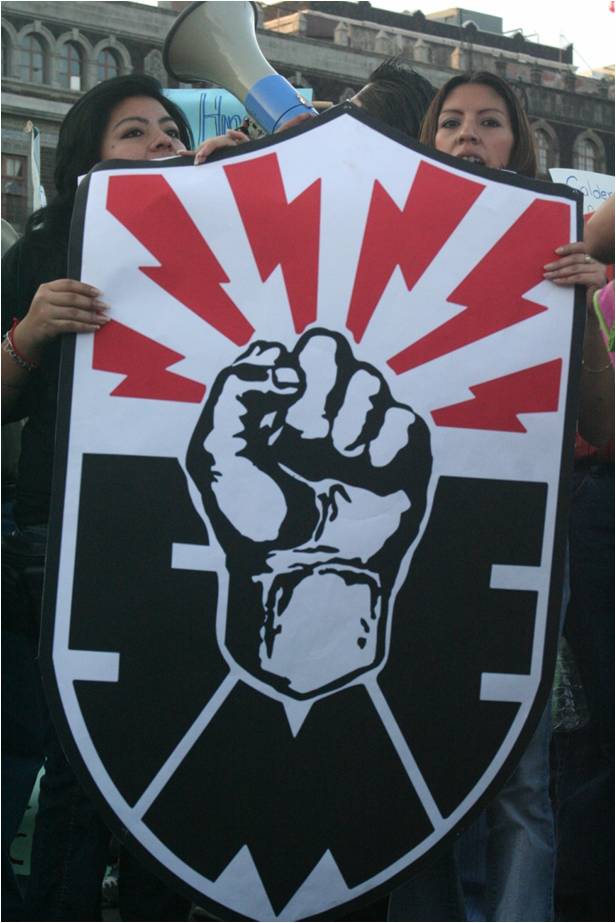
This past April 25th, over 100 members of the Mexican Electricity Workers Union (SME) lay down under a tent pitched in the great Zocalo plaza here, the heart of the Mexican body politic, and declared themselves to be on hunger strike. When medical emergencies forced many of the original strikers to abandon the strike, others stepped up to take their place on the cots under the tent. But after three months, their numbers had been winnowed down to 14. Two of the survivors, Cayatano Cabrera and Miguel Angel Ibarra, vowed to fast to the death to get their jobs back.

Both Miguel Angel and Cayatano had worked for years for “Luz y Fuerza del Centro” (“Light and Power of the Center”), a state-run enterprise that distributed electricity throughout Mexico City and five central states. On October 11, 2009, President Felipe Calderon declared “Luz y Fuerza” to be a debilitating drain on Mexico’s floundering economy and shut down the company. Thousands of federal police and army troops swarmed over 103 generating stations, pushing 44,000 SME members out of their work places at bayonet point.

Shuttering Luz y Fuerza and the subsequent displacement of union workers was one further step in the creeping privatization of the electricity generation sector here that the Constitution mandates to be the domain of the state. Despite constitutional restrictions, over 30% of Mexican electricity generation is now in private — and often transnational — hands.

Calderon’s takeover of Luz y Fuerza appeared to be predicated on his fascination with the company’s 24,000 kilometers of transmission lines upon which he hopes to lay fiber optic cable and sell off the technology to the highest bidder.

From the get-go, it was evident that the Calderon government was equally as dead set on dismembering the Sindicato Mexicano de Electricistas (SME), the second oldest union in Mexico, born 96 years ago at the zenith of the Mexican revolution during a strike against the transnational Canadian Light and Power that then monopolized Mexico City electricity generation.

The SME, which remained largely independent of the long-ruling PRI during that party’s 71 year rule, has a tradition of solidarity with social organizations in struggle — SME volunteers hooked up turbines deep in the Lacandon jungle to bring light to Zapatista villages and, in the aftermath of the horrific 8.1 1985 earthquake here, quickly repaired fallen lines in working class colonias and got Mexico City humming again.

In a not so subtle maneuver to break union solidarity, Calderon and his hard-nosed labor secretary Javier Lozano, who political wags suggest is being groomed to succeed his boss, offered the displaced workers indemnization based on seniority if they would give up their SME affiliation.

Bonuses were promised to those who cashed out quickly and the ex-workers were told they would soon be re-contracted by the Federal Electricity Commission. The CFE is charged with distributing energy outside of Mexico City but has temporarily taken over Luz y Fuerza’s operations here — but only 100 ex-SME members were ever hired.

To sweeten the offer, government financial advisors were made available to counsel the former workers on how best to invest their payouts. Fast food franchises were offered but proved to be prohibitively expensive — former electricity workers were soon selling old clothes in the streets. Under the Calderon-Lozano putsch that involved prime time TV spots and even Twitter messages to prompt cash-outs, 60% of the SME membership was snookered out of fighting for their jobs.

Of 44,000 workers, only 16,400 remained on the SME books and Lozano went after the holdouts with a vengeance, refusing to accept election results that had returned the union’s secretary-general Martin Esparza to office for a second term and freezing 100,000,000 pesos in union funds.

Popular resentment to the Calderon-Lozano assault on the SME flourished briefly. Five days after the takeover, a quarter of a million citizens marched through Mexico City to demand the workers’ reinstatement. Over the next months, according to city transit officials, the SME initiated nearly 900 marches and rallies (nearly three a day), further snarling Mexico City traffic that at best moves at a snail’s pace, to gridlock.

Two attempts at a national strike fizzled. Esparza flew off to Geneva to plead the SME’s case before the OIT or World Labor Organization, a wing of the United Nations. Despite the OIT’s condemnation, Calderon and Lozano would not budge. Finally, on April 25th, Cayatano and Miguel Angel and their comrades lay down in the Zocalo and declared they were not going to eat again until they got their jobs back.

Massive protests occurred after 44,000 members of the Mexican Electricity Workers’ Union were pushed out of their work places at bayonet point. Photo from Think Mexico.

The weeks and months mounted up. By June, Cayatano had clocked 53 days on hunger strike, one more than Provisional Irish Republican Army leader Bobby Sands who expired in the Maze prison in 1981 under British custody — 10 more Provos would starve themselves to death before they won recognition for their struggle. In Ireland, hunger strikers honor the martyrs of the Easter Rebellion who back in 1916 resorted to starvation to win freedom from the British yoke.

By the beginning of July, Cayatano was trespassing into Gandhi’s territory — the Mahatma went on multiple prolonged hunger strikes to win India’s independence. Hunger striking is an Indian tradition in which the aggrieved lay themselves down on the doorstep of those who have wronged them and seek to shame them into just compensation by starving themselves to death.

Now, as he entered his 75th day, Cayatano’s numbers were running neck and neck with Turkish political prisoners, nearly 80 of whom have died in the last decade to protest repression in their country. Turkish activists proudly wear the clothes of those who starved themselves to death in pursuit of justice.

Day after day, Cayatano and Miguel Angel, the others, lay on their cots in the Zocalo. The World Cup, broadcast on giant screens to multitudes in the great plaza, came and went. A tropical music festival followed. Demonstrators for diverse causes tramped into the square. The summer rains inundated the SME camp.

By mid-July, Cayatano Cabrera was fading fast, down to skin and bones, his body eating itself to provide desperately needed nourishment. He had lost 60 pounds, a third of his body weight, suffered two pre-heart attacks, and needed oxygen to breath. The physician who attended the strikers, Alfredo Verdeleguel, pronounced him near death. The government threatened to suspend the doctor’s license if Cayatano died. Verdeleguel began receiving anonymous death threats.

Cayatano and Miguel Angel insisted upon an audience with Felipe Calderon: “…if he fails to give us this right, then he will be responsible for our deaths,” Cabrera gasped, reading a letter to the press that both workers had signed, demanding their jobs back. But Felipe Calderon was preoccupied with praising other hunger strikers, Cuban political prisoners that the Castro government had just released.

When corporate media charged that Cayatano was faking it, that he was sipping atole (corn gruel) and munching on pan dulce in the mornings, his SME comrades ripped off their shirts, plunged syringes into their veins to draw blood, and painted banners with it denouncing the calumnies.

But as Cayatano neared the Guinness Book of Records mark of 94 days set by an IRA prisoner decades ago, the Calderon brain trust was getting jumpy. A government ambulance was stationed in the Zocalo to whisk Cayatano off to hospital if he fell into a coma but the workers drove it off.

Mexico is a mess these days with the economy in free fall and 25,000 citizens sacrificed in Calderon’s foolhardy drug war and the death of a hunger striker or two would only pour gasoline on the blaze. Moreover, many world dignitaries would be showing up in the very plaza where the hunger strikers were starving themselves to death in just six weeks for Mexico’s bicentennial celebrations. Something had to give.

On July 15th, the President fired his Interior Secretary Fernando Gomez Mont, the second most powerful politico in the nation and a staunch proponent of labor secretary Lozano’s hard hand. The new Interior minister was an unknown from Baja California, Francisco Blake Mora, a school chum of Calderon’s that he could control.

Blake’s appointment undercut Lozano who by now was sending out 5,000 Tweets a day threatening to jail Esparza for murder if Cayatano croaked. Blake summoned the SME secretary general to his offices to negotiate an end to Cayatano’s hunger strike.

After months of rejection and frustration, the union had distilled its demands down to three. Sensing that the SME would never get back the Luz y Fuerza jobs, Esparza focused on the figure of a “substitute patron,” i.e. finding a new boss for the workers, a practice embedded in Mexican labor law — indeed, Luz y Fuerza had been founded on the same principle in the 1960s when Canadian Light and Power gave up the ghost.

Esparza and his team urged that the Federal Electricity Commission contract the remaining SME workers but Lozano considered this an impossible solution because the CFE already has contracts with its own compliant company union. The creation of a new corporate entity to oversee Mexico City electricity generation was also nixed by Lozano — the Calderon government has budgeted billions for the bicentennial celebrations and the cupboard was bare.

The second demand was that the labor secretary accept the election results or “toma de nota” (a new vote had been held) ratifying Martin Esparza as the SME’s top official and unfreezing 100,000,000 pesos in union funds. The third demand was amnesty from prosecution for SME strikers — as blackouts spread throughout Mexico City and environs, Lozano and the deposed Gomez Mont accused the electricistas of “sabotage.”

Following a six hour July 22nd negotiating session behind closed doors at the Interior Secretariat, the protagonists emerged from the inner sanctum to announce the end of Cayatano Cabrera’s hunger strike. No jobs or contracts or new companies or even amnesty for the workers were promised although Lozano indicated that union recognition was under renewed consideration. Blake Mora, Javier Lozano, and Martin Esparza shook hands and posed for the official photo. That was it. No agreement had been signed. The details would be worked out later. Trust me.

Past 2 a.m., Martin Esparza sped back to the encampment in the Zocalo in his silver Gran Marquis and disappeared into the tent where the hunger strikers were laid out. For two hours, the SME boss cajoled and browbeat 13 of the starving men into eating again. By acquiescing to the Calderon government’s demands, the men gave up the only power card they still held, the threat of their death.

The one holdout was Cayatano Cabrera. All he wanted was his job back. When his companeros were taken to hospital for treatment, he refused to go along and his family carried him to the car and took the emaciated man home. The longest hunger strike in Mexican history was now history and Cayatano had not gotten his job back.

[John Ross, author of El Monstruo: Dread and Redemption in Mexico City (“gritty and pulsating” — New York Post), is at home in Mexico City. He is available for dinnertime tete-a-tetes at the Café La Blanca in the Centro Historico. Write johnross@igc.org.]

The Rag Blog

Posted in Rag Bloggers | Tagged , , , , , | 2 Comments

Marc Estrin : Awesome Days of Awe


The space between the pillars:
Awesome days of awe

By Marc Estrin / The Rag Blog / August 7, 2010

August 6th: Hiroshima. August 9th: Nagasaki. Three days in between.

The days between close-set giant pillars take on special significance. Whatever the current behavior of the state of Israel, most Jews know such spaces well.

The 10 days between Rosh Hashanah, the beginning of the year, and Yom Kippur, the day of atonement, are not actually holidays, but mark a special period of time — what are called the Days of Awe. They are a kind of spring cleaning in fall, a purification of one’s world and soul so that on Yom Kippur the Jew can faced the Eternal with all worldly issues in place. And what is the main strategy for this cleaning? It may surprise you. Asking and giving forgiveness.

The tradition of the shtetels — those small eastern European Jewish communities depicted in Fiddler on the Roof — was that in the 10 days between Rosh Hashanah and Yom Kippur people would ask forgiveness of everyone they had wronged that year. All the little, and sometimes the big, wrongs that had been done in the community were brought out into the open, confessed, made good if possible, and forgiven. The entire community felt cleansed and pure.

Perhaps not everyone was that honest. Like folks everywhere, not all Jews had the courage to beg someone’s pardon or, when they themselves were asked, to give pardon with a full heart. But they found it a lot easier to do than we would today. While we have much more information now than they did, we don’t know as well how to say “I’m sorry.”

But in those simple villages, to avoid a world full of hate, people often took the 10 days and went knocking on the doors of any estranged friends, and cleared their personal paths, and those of the community. The world was cleansed for Yom Kippur — the “Day of Atonement.”

And on that day the naked human being was scheduled to go mano a mano, godwrestling with the Eternal. Tradition has it that on Rosh Hashanah, God inscribed your name in either the Book of Life or the Book of Death. That’s why the concern for measuring up. But the verdict on Rosh Hashanah was not final. You had the 10 days in between, and especially Yom Kippur, to change the Judgment. But at the end of Yom Kippur, the Books were closed.

And so it is understandable that Yom Kippur be a full day of prayer without food. Five separate services take place during 25 hours — like Muslim practice — but with little or no pause between them. The idea of the fast is this: when the human body has paused from its natural acts of life, and history has suspended its normal ups and downs, the spirit can be utterly reborn. We don’t really do fasts in America. We’re better at pig-outs.

And sin — or evil, for that matter — is not a very popular concept in the contemporary American heartmind. Yet some concept of estrangement from the Truth has been common to most religious world views. The acknowledgment of sin is a crucial part of the Yom Kippur service.

“The Cloud Over The Culture” is the punning title of an extraordinary article by Paul Boyer (1985) which appeared on the fortieth anniversary of dropping the bombs. In it, he asserts, as do I, that although “Hiroshima” and “Nagasaki” are such familiar words — banal even — the United States “has yet to assimilate fully what those words represent in its political, cultural or moral history.”

He quotes the American Catholic Bishops’ 1983 Statement on Nuclear War:

After the passage of nearly four decades and a concomitant growth in our understanding of the ever-growing horror of nuclear war, we must shape the climate of opinion which will make it possible for our country to express profound sorrow over the atomic bombing in 1945. Without that sorrow, there is no possibility of finding a way to repudiate future use of nuclear weapons. [My emphasis.]

Sorrow. Remorse. It sounds Days of Awe-like. How very, very strange it is that we — as a nation — have never done that. Not once, in now 65 years. Not even the teensiest bit. Un-Amerkin.

We have consistently refused — and still, even now, refuse — an absolute and explicit “no first use” nuclear weapons policy. One of the physicists who worked on the Manhattan Project observed that

If the memory of things is to deter, where is that memory? Hiroshima has been taken out of the American conscience, eviscerated, extirpated.

1945 seems so long ago. We were a nation in genuine and legitimate relief from a dreadful war. But what tenacity there is in the myth of American innocence, the belief that we are somehow set apart from the world, our motives higher, our methods purer.

It is this constant myth that prevents us from having any national Days of Awe, that keeps us from expressing sorrow over the event. And, as the Catholic Bishops so insightfully express, without that sorrow, we cannot go on, we cannot build a world safe — from ourselves.

New national holydays

Let me therefore beat the drum for some pre-Labor Day labor. Down with innocence! Up with memory, confession, sorrow, apology, healing!

I hereby propose a new national holiday, modeled on the Days of Awe, but occurring in August, between Hiroshima and Nagasaki. Like the Days of Awe, they would be bounded by two momentous events, would celebrate those events with appropriate ritual, and would feature redemptive tasks to be done in between.

“It could never happen,” you say, “too serious. It runs against the American grain to do that kind of self-criticism.”

Maybe, maybe not. We have our solemn holidays, in places still solemnly kept. And besides, we may be growing up as a nation. Engaged in five current wars, with Iran coming up, the peach fuzz is off our cheeks. Obama’s fairytales notwithstanding, we know we’re not in Kansas anymore.

The vast majority of people realize we can’t go on as we are — exporting jobs, exploiting foreign workers, making wars, eviscerating and polluting the planet. “Change” has become the buzzword to win elections.

The Christians have taught the world to acknowledge a December season of Peace. Is it too much to imagine that churches and synagogues, national organizations and neighborhood groups, schools and universities, could slowly grow a late summer holiday to express the profound sorrow the Catholic Bishops recommend — a mindful holiday to witness and grieve, to assimilate a painful part of the past, to dissipate the cloud over the culture, to ask and give forgiveness, to sing in chorus “Hiroshima, Nakasaki. Never Again,” and to be able to go on, safer from ourselves?

The religious historian Mircea Eliade has made a distinction between sacred and profane time. In sacred time, historical events gradually come to partake of the permanence of myth, while in profane time they gradually lose their grip on people and become merely material for historians and the technicians at Disney World.

I am calling for a holiday that would change Hiroshima and Nagasaki into universal myths, deeply grounded in sacred time, permanent stop signs on the road to destruction. Four new holydays, making things whole, healing.

Here’s how it might go. On August 5th, supper is a Japanese meal, which Americans would learn to make as beautifully as we do a turkey dinner. The event would have a ritual component like a Seder, in which symbolic foods are eaten, and history is thoughtfully reviewed. Each family, each congregation, each school would develop its own texts until some key themes and treatments became solidified.

The morning and afternoon of the 6th — Hiroshima Day — would be a time for fasting, or some special breakfast, with a ritual observance at 8:15 AM. During the 6th, 7th and 8th — our three days of awe and repentance — individuals would consciously perform expiatory tasks, personal and interpersonal, as in the Jewish Days of Awe, but also social, holding teach-ins, attending peace events. If a weekend fell between Hiroshima and Nagasaki, there would be special services at churches, synagogues, mosques. Morning and afternoon of the 9th is again a special time of fasting. 11:02 is observed, and everyone gears up for a big celebration in the evening, at which international foods of all kinds would be prepared — a huge community festival.

What I’m describing is a full-blown, big holiday. Things don’t begin that way, of course. We might just start by thinking about it for a few years, by recognizing that in fact something important did occur on these days. Then, who knows what would grow — in individual hearts, in individual families, in individual congregations and institutions. Were something like this to get underway, in 10 years we’d have Good Housekeeping printing August peace recipes.

We postmoderns like to play with history. Now we can play in its real mudbath, and actually get dirty — a death-defying vital alternative to psychic numbing.

Would the New Days of Awe change anything? I can’t imagine otherwise. The power of confession has been known to the Catholic Church for centuries. If anything has sustained the even older Jewish community, it has been the inspiration of the High Holy Days. The Muslims make pilgrimage to Mecca.

This stuff has both a track record and the power of newness-at-large. Like an exotic virus spreading in a vulnerable population, the power of guilt could quite transform postmodern American culture. Revelation through genuine memory, then Teshuvah, turning and Tikkun, healing.

Or shall we just go on making wars?

[Marc Estrin is a writer and activist, living in Burlington, Vermont. His novels, Insect Dreams, The Half Life of Gregor Samsa, The Education of Arnold Hitler, Golem Song, and The Lamentations of Julius Marantz have won critical acclaim. His memoir, Rehearsing With Gods: Photographs and Essays on the Bread & Puppet Theater (with Ron Simon, photographer) won a 2004 theater book of the year award. He is currently working on a novel about the dead Tchaikovsky.]

The Rag Blog

Posted in Rag Bloggers | Tagged , , , , | 2 Comments

Ted McLaughlin : Access to Water Is a Human Right


Clean water should be a human right,
Not a capitalist commodity

By Ted McLaughlin / The Rag Blog / August 5, 2010

A vote took place in the United Nations a few days ago that could eventually have far-reaching effects on everyone on this planet. The vote was on a resolution, introduced by the Bolivian representative to the U.N., that extended basic human rights. The resolution officially made access to clean water and sanitation a basic fundamental human right.

This just makes sense. After all, water is not a luxury but an absolute necessity for human life. Humans cannot live with water. This puts water in a special category with food and shelter. These items are more important than any other resources because they are a must for sustaining human life. So how could anyone oppose this resolution?

Actually there were no votes against the resolution. It was approved 122 to 0. One might think that was a unanimous victory for human rights, but that would not be completely true. Although no nation voted against the resolution, about 40 nations abstained from voting on the resolution. And, interestingly enough, most of those nations abstaining are the very countries that preach the loudest about human rights.

Among the nations refusing to vote for access to clean water and sanitation as a basic human right were the United States, Canada, Australia, and many European countries — the so-called industrialized and “civilized” first-world nations. Why would they not vote for the right of every human to have access to clean water?

That’s simple. Voting for access to clean water as a fundamental human right would expose their own hypocrisy. You see, these countries don’t see water as something everyone should have a right to. They see water as simply another commodity to be bought and sold, and those who cannot afford to buy it have no right to it. This may sound harsh, but it is true.

The United States has never recognized the right of humans to have access to water. In this country, we give lip service to providing access to clean water for everyone, but the fact is that access is granted only to those who are willing and able to pay for that access. If you don’t think this is true, just try not paying your water bill for a while. You will find your water cut off. Your access to water will be denied by the very government that proudly claims to provide that access.

I have always thought this was wrong. No one should be denied access to clean water just because they cannot afford to buy it. No one should be reduced to having to steal this basic resource just to sustain their lives. Clean water should be provided by the government (as it is in most places in the United States), but it should not be sold — it should be paid for through taxes and provided free of charge to all citizens.

Now I know that some of you are thinking that if water is provided for free then some people will waste this precious resource. That is true — some people will waste the water, and there should be a punishment (probably monetary) for that. Anyone who uses more than a reasonable amount of this precious resource should be fined severely, but no one should be completely denied access to a reasonable amount of water (and that reasonable amount can be determined by the community-at-large).

Frankly, much water is already being wasted. Here in Texas we know that our water resources will not meet our future and growing demand. And yet we continue to waste water. In fact, many communities actually encourage that waste. As example, does it really make sense to keep planting and watering lawns (a requirement in many communities and subdivisions) in a state where water becomes more scarce every year?

And the waste is even more egregious in the richer communities, where one family lives on a large estate and to water many acres of lawns will use more water than that necessary to sustain hundreds of families with clean water. But Americans are in love with their lawns and, even in a state with scarce water resources, are currently unwilling to give them up and stop wasting that valuable resource — and the future be damned.

But such wasteful use of water may not be possible in the future. Especially in light of global climate change (and that change is happening whether you believe it is caused by humans or not), water is becoming scarcer all over the world. There are those who believe (including myself) that future wars will be fought over water rather than oil or other capitalist commodities.

The resolution introduced by Bolivia and passed by 122 nations was nothing less than a gauntlet being thrown down. The developing nations and their allies are telling the industrialized world that water is not a commodity to be sold only to those who can afford it. It is a scarce resource that must be shared by all of humanity.

Like it or not, the industrialized world must reconsider and change it’s wasteful use of this scarce resource, and they must no longer view it as a commodity to make the rich even richer — a commodity that can be denied to the poor. The industrialized world, especially the United States, loves to preach equality and human rights. It is now time for them to start practicing what they preach. The future of humanity demands it.

[Rag Blog contributor Ted McLaughlin also posts at jobsanger.]

The Rag Blog

Posted in Rag Bloggers | Tagged , , , , | 2 Comments

Thomas McKelvey Cleaver : ‘Crossing the Rubicon’ at the Gulf of Tonkin

E. J. Fitzgerald’s painting (1980) illustrates the Gulf of Tonkin Incident. U.S. Navy Historical Center / Wikimedia Commons.

Crossing the Rubicon:
The Tonkin Gulf Incident

It’s an event I can never forget, because I was there, a young sailor working in the operations office of the Admiral in charge of the two destroyers.

By Thomas McKelvey Cleaver / The Rag Blog / August 4, 2010

Today, August 4, is the 46th anniversary of the attacks on four North Vietnamese ports by the U.S. Navy, ordered by President Lyndon Johnson in response to reported attacks during the two days previous by “North Vietnamese torpedo boats” against two American destroyers cruising in “international waters,” the USS Maddox and the USS Turner Joy.

It became the causus belli for direct American military involvement in the Vietnam War, known forever after as the “Tonkin Gulf Incident.”

It’s an event I can never forget, because I was there, a young sailor working in the operations office of the Admiral in charge of the two destroyers. The Seventh Fleet Patrol Force operated extensive reconnaissance networks, from off Vladivostok and the Soviet Far East in the Sea of Japan, down the coast of China to Taiwan and on down to the South China Sea. The initial story, that the two destroyers had been patrolling in the Gulf of Tonkin, in international waters, immediately set off alarm bells to me.

That was because I knew, having worked to set up the briefing for the Admiral the week before, that these two destroyers were operating in support of something known as a “34-Alpha” operation, and that they were very close to Hon Me Island, a piece of real estate in the middle of the Gulf of Tonkin internationally recognized as being part of North Vietnam. My doubts grew more when I got mail from home the following week, with newspaper clippings on the event. Not one of the maps published in the newspapers showed Hon Me Island as even existing.

A month later, we were in Subic Bay, the Philippines, and I was on liberty in Olongapo. I walked into a bar and there sitting at the bar was a sailor I had met a year previously, when he and I went through fire fighting training in San Diego while awaiting transportation to Japan to join our units.

The last time I had seen him, he was a Fire Control Technician 3rd Class, a petty officer. Now he wore Seaman’s stripes on his sleeve. We talked, and things finally got around to how he’d “lost his crow.” He told me he’d been court-martialed. That didn’t surprise me, it happened all the time, if a Captain was upset about some kid coming back off liberty late and wanted to make an example of him. “What for?” I asked. “Disobedience of a direct order,” he replied. That wasn’t some late-liberty offense.

“What was the order?”

“Open fire.”

And then he told me the story.

He was crew aboard the USS Maddox. During the second night, when the two destroyers were reported under attack by several torpedo boats, he was in charge of the fire control tower, responsible for operating the main armament of six five-inch cannons. When ordered to “open fire,” he refused and told his captain that the only target out there was the other destroyer, the Turner Joy. The order was repeated and he refused again. It was repeated a third time and he refused again.

A Chief Petty Officer was sent to arrest him. By the time he was brought to the bridge, the event was over, with the captain of the Turner Joy having established by radio that the torpedo boats had “disappeared.” Still, my friend had refused the order, and was given a general court-martial, where he lost his rank. I’ll never forget the last thing he said: “That whole story is bullshit. Nothing happened out there.”

A year later I was out of the Navy and people would ask me why I was opposed to the war, and I would tell them that story. They’d say “where’s your proof?” and I would have to admit it was somewhere in some sub-basement of the Pentagon, wrapped in a Top Secret clearance. And so not many believed me, it was just too much to take in, that the war was started on such a lie.

Yet, over the years, the story did come out in bits and pieces.

In 1966, an officer I knew who had been part of the Admiral’s staff gave an interview to a newspaper in New York, where he told of how he had interviewed the Chief Sonarman on the Maddox, and that he’d been told there were never any sounds of torpedo boats in the water — a distinctive sound that is unmistakable for anything else.

In 1968, Professor Peter Dale Scott of UC Berkeley interviewed the former Assistant Gunnery Officer of the USS Turner Joy, who related how he had convinced his captain not to open fire that night, because the only target out there was the USS Maddox.

One can only imagine how history would read, had one of those two men been less conscientious in doing his job and had opened fire as ordered. As my friend had told me, “We were so close I’d have blown them out of the water with the first salvo.”

I remember in 1970, when Sixty Minutes ran the first story that told the truth about Tonkin Gulf, revealing that “34-Alpha” operations were code for South Vietnamese commando raids on targets in North Vietnam. The report went on to say that the available evidence looked like the two ships had been where they were to support the raid.

I sat down at my typewriter that night, and wrote the program, telling them what I knew. A week later, Joe Werschba, one of the legendary “Murrow’s Boys” at CBS, called me and told me they had proof my letter was accurate, because he had shown it to a senator in Washington on the Armed Services Committee who confirmed the main points.

And then in 1971 — 39 years ago last month — came the publication of the Pentagon Papers, and the true story of Tonkin Gulf was out there in all its detail. Several people I knew apologized to me for having doubted me over the years. I didn’t have any trouble with their doubt. I had wanted to doubt what I knew myself, because the implications were enormous:

My government lied and millions of people died.

I date my personal political “revolution” to this day, 46 years ago. The day I found that the country I had grown up believing in, that 10 generations of my ancestors had fought and died for at times and in places that made us who we were, that that country didn’t exist.

America has a long history of being lied into wars.

The War of 1812 was far less about “freedom of the seas” and far more about an attempt to grab Canada.

In 1846, Abraham Lincoln stood up in the House of Representatives and demanded that President Polk “point on a map” to the spot where American blood was shed on American soil — Polk couldn’t do it because Taylor’s cavalrymen weren’t in Texas — which wasn’t part of American territory to begin with — they were in territory recognized as part of Mexico, and America was off on its first grand imperial adventure, “liberating” half the territory of Mexico.

In 1876, President Grant decided it was easier to declare war on the Sioux under the pretext they were “killing whites” than to enforce a treaty and expel the thieving miners from the Black Hills of South Dakota.

In 1898, an accidental explosion on a poorly-maintained American ship was taken by William Randolph Hearst and turned into “a splendid little war” that expanded the empire by taking the Philippines and eventually involving us in our first genocidal Asian war, the Philippine Insurrection, which resulted in the deaths of 20 percent of the population of the country over five years, including the near-total annihilation of the population of Panay Island, an event celebrated by the commander of the troops responsible for killing 40,000 Filipinos as “leaving the island a howling wilderness,” which prompted Mark Twain to write the famous “War Prayer” in response to the news.

It took a lot for me to finally understand there is a difference between loving one’s country and supporting the government. It’s not surprising at all that most of my fellow citizens can’t bring themselves to see the lies and do something about them.

[Thomas McKelvey Cleaver is an accidental native Texan, produced screenwriter, and journalist who is frequently accused by his fellow lefties of not being left enough. Being shallow enough to have written successful horror movies and articles about Second World War aviation, he won’t argue the point. But he does take pride that he personally raised $350,000 for Obama in 2008 and has been an activist on anti-war, political reform, and environmental issues for almost 50 years. It should count for something.]

The Rag Blog

Posted in Rag Bloggers | Tagged , , , , | 2 Comments

Jay D. Jurie : The ‘New Zeal’ of Right Wing Propagandist Trevor Loudon

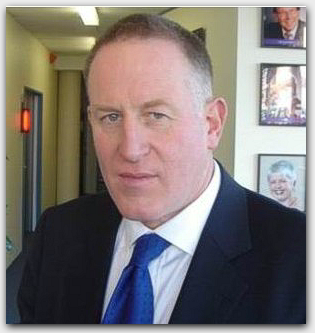
Trevor Loudon. Image from USA Survival News.

New Zealand’s Trevor Loudon and the
Right-wing propaganda machine

By Jay D. Jurie / The Rag Blog / August 4, 2010

Until I came across the KeyWiki site I didn’t know I had my very own “Wiki” page. When I went to “my” page I discovered it focused exclusively on the political side of my life.

KeyWiki describes itself as

…a bipartisan knowledge base focusing primarily on corruption and the covert side of politics in the United States and globally. While particular interest is taken in the left, KeyWiki serves to expose covert politics on both the left and right of the political spectrum.

Accompanying this description was a photo of the Statue of Liberty.

Wondering who might be responsible for all this, the KeyWiki “team” identified only one individual, named Trevor Loudon, while “members of the KeyWiki team will be added below shortly.”

As it turns out, Trevor Loudon is a resident of Christchurch, New Zealand. Since New Zealand has a multiparty parliament it is a little odd that he describes his site as “bipartisan.” His description makes it clear he is focusing on the U.S., so perhaps he means “bipartisan” in the U.S. context. If that’s the case, then his “knowledge base” is virtually nonexistent when it comes to exposing “covert politics” on the right.

For example, a search on his site for David Horowitz — one of the few members of the New Left who became an outspoken conservative — produced information only about his incarnation on the left several decades ago. There were no pages or listings for well-known figures on the right such as Bay Buchanan, Ann Coulter, Nikki Haley, Sean Hannity, Rush Limbaugh, or Bill O’Reilly, though there are links on the companion KeyWiki.org site to blogs operated by Glenn Beck and Michelle Malkin.

Statue of Liberty photo by David Prior / KeyWiki.

Thinking maybe these were insufficiently “covert,” I tried several others, including Bo Gritz, Eric Rudolph, and Randall Terry, turning up nothing. I thought he might have entries for well-known white supremacists David Duke or Tom Metzger, or for well known anti-Semites or Holocaust deniers such as Don Black or Willis Carto, but again, nothing. There wasn’t even a listing for the Ku Klux Klan.

There is no information on right-wing elected officials such as Michelle Bachmann, John Cornyn, Ron Paul, or Joe “You lie!” Wilson. Loudon maintains a separate blog called New Zeal (“promoting liberty in New Zealand and beyond”) on which he re-posted a Washington Times op-ed piece by former Representative and nativist Tom Tancredo (R-CO), in which Tancredo wrote: “Mr. Obama is a more serious threat to America than al-Qaeda,” to which Loudon approvingly appended “well said.”

There are a lot of items about individuals and groups on the left, including denunciatory articles about legislators Neil Abercrombie and Dennis Kucinich, and negatively-framed information about Alan Grayson and Bernie Sanders, among others.

There’s a list of “key organizations” that includes the Apollo Alliance, the Center for American Progress, Committees of Correspondence, Democratic Socialists of America, Institute for Policy Studies, and the New Party. Several other organizations and publications also rate considerable attention, including the Communist Party USA, In These Times, the Movement for a Democratic Society (MDS), the New American Movement (NAM), and The Rag Blog.

A September 2008 blog article (“therealbarackobama”) by Brenda J. Elliott was entitled “Has Trevor Loudon found the Ayers-Dohrn-Obama ‘smoking gun’?” According to Elliott, MDS was behind the creation of Progressives for Obama. Carl Davidson of Progressives for Obama responded that MDS “had nothing to do” with it, “nor did any one of the other alphabet soup of left groups you list.” Elliott further asserted “MDS is the brains behind the SDS brawn.”

America’s Survival Inc. president and Accuracy in Media blogger Cliff Kincaid and Loudon co-authored a 32-page article entitled “From Arms to Education to Political Power: Return of the SDS and the Weather Underground” to further smoke out MDS. Loudon and Kincaid found that under the auspices of MDS, the new SDS, the Center for American Progress and pro-Barack Obama elements were ominously coalescing:

Key to this overall effort is the MDS, which unites Rudd, Ayers, Dohrn and other members of the SDS and Weather Underground from many different socialist and communist organizations.

These assertions are certain to generate some laughter among those actually familiar with the organizations in question.

Former Obama administration “green jobs” director Van Jones was among those singled out by Loudon for special attention. Kincaid has used a Loudon link about Jones on his blog. Glenn Beck has given Loudon a shout-out for “exposing” Jones and Joel Rogers of the New Party. Another shout-out comes from Andrew Breitbart, who conjured up the recent brouhaha over Shirley Sherrod.

Loudon has expended considerable energy making a case that Obama boyhood mentor Frank Marshall Davis was a secret Communist. According to Loudon, U.S. Supreme Court nominee Elena Kagan “doesn’t lean left. She leans socialist-communitistic (sic) first.”

In fact, Loudon’s preoccupation with individuals with links, no matter how obscure, to (real or perceived) socialist or communist organizations puts him at the center of a revival of the redbaiting tactics of former Senator Joseph McCarthy.

Among the reasons I apparently rate my own KeyWiki page is I once signed a petition in support of academic freedom for, in Loudon’s word, “terrorist” Bill Ayers. Loudon’s definition of terrorism seems highly selective, or he must look across the Pacific to find it.

Nowhere does he mention the deadly French intelligence services bombing of the Greenpeace ship Rainbow Warrior in the Auckland harbor, or refer to that as a terrorist act. Nor does Loudon have anything to say about an incident in which New Zealand police pointed automatic weapons at the passengers of a Maori-operated school bus.

The Rag Blog‘s Jay D. Jurie: Sufficiently ‘covert’? Image from Jay’s KeyWiki page, in a photo lifted from Next Left Notes.

My page shows me as a signer of a statement several decades ago that advocated closer working relations between NAM and the Socialist Party USA. I owe Loudon a debt of gratitude for this, as I had forgotten all about it. After being reminded of this, my regret is that those closer working relations never materialized.

Virtually all “Rag Bloggers,” including Marion Delgado, have some listing on KeyWiki. Thorne Dreyer and David Hamilton are among those who have interested Loudon most. In fact, simply writing for The Rag Blog or signing the Progressives for Obama petition appears to be enough to rate your own KeyWiki page. And Loudon seems to consider The Rag Blog a virtual mouthpiece for his theoretical MDS/Progressives for Obama nexus.

[It should be pointed out that The Rag Blog is an independent progressive newsweekly, published by the non-profit New Journalism Project, and has no affiliation with any political group or party.]

Still left unanswered is the question about why Loudon hasn’t exposed covert politics on the right?

Since KeyWiki has only been in existence since April, perhaps he’s just been preoccupied with filling in the left-wing side.

A larger question is why has a New Zealander like Loudon created a Wiki site primarily concerned with the U.S.? Answers to these two questions seem to overlap. In several of his writings Loudon makes it clear he is a committed “Americanphile.” He apparently sees New Zealand as a satellite for what he believes, but the U.S. is the mother ship.

What are those beliefs? Several on-line sources identify Loudon as a member of the “Zenith Applied Philosophy” or ZAP cult, based upon an admixture of Scientology, Eastern mysticism, and John Birch-style laissez-faire capitalism. Loudon’s admiration for the U.S. and its traditions is apparently limited to that which conforms to his laissez-faire outlook. He has taken it upon himself to help chart the rightful course for the U.S.

Whereas its site claims “KeyWiki isn’t a part of any political party and we don’t support candidates,” Loudon is a former vice-president of New Zealand’s ACT (Association of Consumers and Taxpayers) Party. ACT appears to be more or less the equivalent of the U.S. Libertarian Party. According to its website, ACT espouses “free market classical liberalism” and “…seek[s] to rebuild diplomatic and political relationships with Australia and the United States.” ACT also seeks to negotiate a free trade agreement with the United States.

All of the above makes it patently obvious that Loudon is engaged in the “covert politics on the right of the political spectrum.” Rather than engage in honest pursuit of knowledge or debate, his modus operandi is duplicity. While KeyWiki masquerades as objective or balanced its real purpose is to conceal the advancement of a right-wing agenda.

In the deceitful pursuit of this purpose Loudon is not alone, as the shameful Breitbart attack on Shirley Sherrod makes evident. Washington Post columnist Eugene Robinson recently wrote of “a cynical right-wing propaganda machine.”

Trevor Loudon has not only helped fuel this machine with half-truths, distortions, and fabrications, but is one of its drivers.

[Jay D. Jurie is a proud Rag Blogger who teaches public administration and urban planning and lives near Orlando, Florida.]

The Rag Blog

Posted in Rag Bloggers | Tagged , , , , , , , , , , , | 3 Comments

Jim Turpin : Cutting Through the ‘Fog of War’

Fog of war. Image from Thomas Paine’s Corner.

Rules of engagement:
U.S. brutality in the combat zones

The chain of command gave orders to fire indiscriminately at civilians even when soldiers made efforts to refuse such orders.

By Jim Turpin / The Rag Blog / August 4, 2010

The “fog of war” is defined as the ambiguity of situational awareness by participants in military operations. This term is attributed to Prussian military analyst Carl von Clauswitz who stated:

The great uncertainty of all data in war is a peculiar difficulty, because all action must, to a certain extent, be planned in a mere twilight, which in addition not infrequently — like the effect of a fog or moonshine — gives to things exaggerated dimensions and unnatural appearance. (Clauswitz, On War, Book 2, Chapter 2, Paragraph 24)

U.S. combat operations in both Iraq and Afghanistan are approaching the 10-year mark and recent release of classified documents through WikiLeaks has used a floodlight to cut through the “fog of war” and expose the brutality imposed on civilian populations in both of these conflicts.

A recent article in The Nation discusses three soldiers from Bravo Company 2-16 and their deployment in Baghdad in July 2007 and their statements regarding putting up a “wall of steel” or responding to threats with a barrage of fire — even if it put civilians at risk

Three soldiers from this company (McCord, Stieber and Corcoles) report such incidents as:

Corcoles describes the first IED death his unit suffered. “We did a mission that night till like midnight, and we were actually just sitting down… I hadn’t even got three or four drags off my cigarette and an IED went off… We watched the Humvee burn, but we didn’t realize [someone] was still in it.”

The IED attacks left the soldiers angry and scared. McCord recalls one mission to impose curfews. Earlier that day, a popular soldier had died in an IED attack, and the troops took it out on the Iraqis. “There were a lot of people who got beat up that night,” he says bluntly.

This anger was turned into policy by the chain of command. “We had just lost three guys to an IED when the battalion commander came out to the COP (Combat Outpost),” says McCord. He went on to explain that the commander gave orders to shoot indiscriminately after IED attacks. “He said, ‘Fuck it, this is what I want… anytime someone in your line gets hit by an IED.. .you kill every motherfucker in the street,” McCord testifies.

“When one [IED] went off, you were supposed to open fire on anybody,” says Stieber. “At first I would just fire into a field. Then I wouldn’t fire at all.” He describes an IED that went off near a crowd of teenagers. “I said I wouldn’t fire,” even though “other people were firing,” he recalls.

Like Stieber, Corcoles describes incidents in which he purposely aimed his gun away from people. “You don’t even know if somebody’s shooting at you,” he says. “It’s just insanity to just start shooting people.” Stieber pointed out that in incidents like these, it was very rare for U.S. military vehicles to stop to help the wounded or assess how many people had been injured or killed.

Stieber was intimidated and reprimanded by his command for refusing orders to shoot. “One time when I didn’t fire, people in my truck were yelling at me for the rest of the mission. When we got back, one or two leaders got up in my face and kept yelling at me and stuff,” he says. The command eventually stopped sending him on missions as a gunner, and Stieber says he “faced a lot of criticism for it.”

Corcoles saw this too. “One night our truck got hit by an IED and Josh didn’t fire, and another soldier didn’t fire,” he says. “And they were getting yelled at: ‘Why aren’t you firing?’ And they said, ‘There’s nobody to fire at.'”

Clearly, there is no ambiguity in this scenario. The chain of command gave orders to fire indiscriminately at civilians even when soldiers made efforts to refuse such orders. This is most likely a very commonly occurring situation in both theaters of conflict for our soldiers.

Anger and frustration remain for soldiers in the field with June 2010 being the highest casualty rate since the beginning of the Afghanistan conflict for coalition forces with July being on track to possibly exceed this number when count is completed.

This begs the question of why do we continue to put our soldiers in impossible scenarios with large civilian populations that result in deaths and injuries to the very people we are “liberating”?

The “rules of engagement” or basically when to pull the trigger is a delicate balance for any soldier in any combat situation. The present U.S. counterinsurgency (known as “COIN”) presents great difficulties for soldiers in the field. COIN is predicated on “winning hearts and minds” of the civilian population and this is not typically achieved through indiscriminate weapons fire or drone missile strikes on unarmed civilians.

General Petraeus was recently discussed in a Salon article as reviewing the “rules of engagement”:

Petraeus also has to appear to stay the course in terms of counterinsurgency (COIN) fundamentals, such as making extensive efforts not to kill innocent people. The tricky part is that the main argument against McChrystal’s rules of engagement is not that they are too bureaucratic; it’s that they are overreaching and potentially dangerous.

So, the maddening choice by soldiers of firing or not firing on civilian populations always remains. It seems the easy choice is simply not to have combat operations in either Iraq or Afghanistan.

The recent Wikileaks release of over 90,000 classified documents details Afghan corruption, the use of Stinger surface-to-air missiles by the Taliban, U.S. assassination teams, and large numbers of civilian deaths.

But a more chilling Wikileaks release in April 2010 is of an Apache helicopter video clip from July 2007 of 30mm cannon fire cutting down two Reuters reporters and killing 10 civilians. For those that have seen this video, its’ horror and nonchalance are breathtaking. It is impossible to describe and requires that you grit your teeth to watch. It is worth noting that the same company (Bravo 2-16) that was described earlier was also involved in this operation. So death occurred from above and below simultaneously for the civilian populations in this area.

Other than “rules of engagement” and other military protocols, what environmental factors drive this brutal behavior towards civilians in war zones? Which is the “chicken” and which is the “egg”?

Why is indiscriminate fire on civilians so prevalent in Iraq and Afghanistan?

The answer lies in the repeated deployment of U.S. military personnel to both Iraq and Afghanistan.

The continuous exposure to combat trauma has led to dramatic increases in the number of post-traumatic stress disorder (PTSD) cases. Since October 2001, with almost 1.8 million U.S. service personnel serving in Iraq and Afghanistan, the VA has predicted 10-18% have PTSD, or 324,000 individuals.

Even this number may be considered low, with a recent American Journal of Public Health article showing a tripled risk of PTSD for New Jersey based National Guardsmen with repeat deployments.

In past U. S. wars, PTSD was called “soldiers heart” during the Civil War, in WW I it was named “shell shock” and by WW II, “combat fatigue” or “exhaustion.” It is only on recent years that PTSD in combat zones has been fully understood and recognized by both the military and psychiatric experts.

Diagnostic symptoms of PTSD include the following: re-experiencing the original trauma(s) through flashbacks or nightmares, avoidance of stimuli associated with the trauma (certain thoughts or feelings associated with an event), and increased arousal such as difficulty falling or staying asleep, or problems with anger, concentration, or hypervigilance. (American Psychiatric Association’s Diagnostic & Statistical Manual of Mental Disorders IV [DSM- IV] 1994).

The symptoms of avoidance, anger, and hypervigilance are all a psychological witches’ brew in combat situations and ensure brutality towards civilian populations.

Another outcome has been suicides which are tracking at the highest point in the U.S. Army since the 1970’s. Thirty-two soldiers took their own lives In June 2010, the most Army suicides in a single month since the Vietnam era. Eleven of the soldiers were not on active duty. Of the 21 who were, seven were serving in Iraq or Afghanistan.

In my recent volunteer work at Under the Hood Café and Outreach Center at Ft. Hood in Killeen, Texas, I have had the opportunity to speak to many active duty soldiers and veterans of both the Iraq and Afghanistan conflicts. Under the Hood is a non-military environment for active duty and veterans to speak out on the effects of war and offers referral to legal and psychological services for all who come through the door, including those active duty soldiers who are war resisters and have refused to re-deploy to Afghanistan.

Their stories are similar to the ones above and detail heart rending experiences of personal trauma, loss, and pain in their own way much like the testimonies at Winter Soldier.

The original Winter Soldier was testimony organized in 1971 by Vietnam Veterans Against the War (VVAW) as a challenge to the morality and conduct of the Vietnam War, with the goal of publicly exposing war crimes and atrocities by the United States Armed Forces.

On the fifth anniversary of the Iraq invasion in March 2008, the Iraq Vets Against the War resurrected Winter Soldier as a forum where more than 200 U.S. military veterans and active duty soldiers as well as Iraqi and Afghani citizens gave testimony on the conflicts in both countries.

“I remember one woman walking by,” said Jason Washburn, a corporal in the U.S. Marines who served three tours in Iraq. “She was carrying a huge bag, and she looked like she was heading toward us, so we lit her up with the Mark 19, which is an automatic grenade launcher, and when the dust settled, we realized that the bag was full of groceries. She had been trying to bring us food and we blew her to pieces.”

Washburn testified on a panel that discussed the rules of engagement in Iraq, and how lax they were, even to the point of being virtually non-existent.

“During the course of my three tours, the rules of engagement changed a lot,” Washburn’s testimony continues. “The higher the threat the more viciously we were permitted and expected to respond.” (9/20/2008 — Asian Times, Book Review (Dahr Jamail): Winter Soldier: Iraq and Afghanistan by Aaron Glantz)

Whether U.S. brutality against civilians in war zones occurred in Vietnam, Iraq, or Afghanistan, the common themes remain the same: soldiers repeatedly deployed to war zones with heavy civilian populations with no enforced “rules of engagement” resulting in war crimes.

A quote attributed to Joan Baez seems most appropriate:

If it’s natural to kill, why do men have to go into training to learn to do it?

[Jim Turpin is a native Austinite and member of CodePink Austin. He also volunteers for the GI coffeehouse Under the Hood Cafe at Ft. Hood in Killeen, Texas.]

The Rag Blog

Posted in Rag Bloggers | Tagged , , , , , , | 1 Comment

U.S. Brutality in War Zones: Protocol, Environment or Both?

The “fog of war” is defined as the ambiguity of situational awareness by participants in military operations. This term is attributed to Prussian military analyst Carl von Clauswitz who stated:

”The great uncertainty of all data in war is a peculiar difficulty, because all action must, to a certain extent, be planned in a mere twilight, which in addition not infrequently—like the effect of a fog or moonshine—gives to things exaggerated dimensions and unnatural appearance.” (Clauswitz, On War, Book 2, Chapter 2, Paragraph 24)

U.S. combat operations in both Iraq and Afghanistan are approaching the ten year mark and recent release of classified documents through Wikileaks has used a floodlight to cut through the “fog of war” and expose the brutality imposed on civilian populations in both of these conflicts.

A recent article in The Nation (“Wikileaks in Bagdad” August 16/23 edition: http://www.thenation.com/article/38034/wikileaks-baghdad ) discuss three soldiers from Bravo Company 2-16 and their deployment in Bagdad in July 2007 and their statements regarding putting up a “wall of steel” or responding to threats with a barrage of fire – even if it put civilians at risk.
Three soldiers from this company (McCord, Stieber and Corcoles) report such incidents as:
“Corcoles describes the first IED death his unit suffered. ‘We did a mission that night till like midnight, and we were actually just sitting down…. I hadn’t even got three or four drags off my cigarette and an IED went off…. We watched the Humvee burn, but we didn’t realize [someone] was still in it.’
The IED attacks left the soldiers angry and scared. McCord recalls one mission to impose curfews. Earlier that day, a popular soldier had died in an IED attack, and the troops took it out on the Iraqis. ‘There were a lot of people who got beat up that night,’ he says bluntly. This anger was turned into policy by the chain of command. ‘We had just lost three guys to an IED when the battalion commander came out to the COP (Combat Outpost),’ says McCord. He went on to explain that the commander gave orders to shoot indiscriminately after IED attacks. ‘He said, ‘Fuck it, this is what I want…anytime someone in your line gets hit by an IED…you kill every motherfucker in the street,’ McCord testifies.
‘When one [IED] went off, you were supposed to open fire on anybody’, says Stieber. ‘At first I would just fire into a field. Then I wouldn’t fire at all.’ He describes an IED that went off near a crowd of teenagers. ‘I said I wouldn’t fire,’ even though ‘other people were firing,’ he recalls. Like Stieber, Corcoles describes incidents in which he purposely aimed his gun away from people. ‘You don’t even know if somebody’s shooting at you,’ he says. ‘It’s just insanity to just start shooting people.’ Stieber pointed out that in incidents like these, it was very rare for US military vehicles to stop to help the wounded or assess how many people had been injured or killed.
Stieber was intimidated and reprimanded by his command for refusing orders to shoot. ‘One time when I didn’t fire, people in my truck were yelling at me for the rest of the mission. When we got back, one or two leaders got up in my face and kept yelling at me and stuff,’ he says. The command eventually stopped sending him on missions as a gunner, and Stieber says he “faced a lot of criticism for it.” Corcoles saw this too. ‘One night our truck got hit by an IED and Josh didn’t fire, and another soldier didn’t fire,’ he says. ‘And they were getting yelled at: ‘Why aren’t you firing?’ And they said, ‘There’s nobody to fire at.’ “
Clearly, there is no ambiguity in this scenario. The chain of command gave orders to fire indiscriminately at civilians even when soldiers made efforts to refuse such orders. This is most likely a very commonly occurring situation in both theaters of conflict for our soldiers.
Anger and frustration remain for soldiers in the field with June 2010 being the highest casualty rate since the beginning of the Afghanistan conflict for coalition forces with July being on track to possibly exceed this number when count is completed (http://www.icasualties.org/oef/).
This begs the question of why do we continue to put our soldiers in impossible scenarios with large civilian populations that result in deaths and injuries to the very people we are “liberating”?
The “rules of engagement” or basically when to pull the trigger is a delicate balance for any soldier in any combat situation. The present U.S. counterinsurgency (known as “COIN”) presents great difficulties for soldiers in the field. COIN is predicated on “winning hearts and minds” of the civilian population and this is not typically achieved through indiscriminate weapons fire or drone missile strikes on unarmed civilians.
General Petraeus was recently discussed in a Salon article (7/1/10 “War Room”) as reviewing the “rules of engagement”:
“… Petraeus also has to appear to stay the course in terms of counterinsurgency (COIN) fundamentals, such as making extensive efforts not to kill innocent people. The tricky part is that the main argument against McChrystal’s rules of engagement is not that they are too bureaucratic; it’s that they are overreaching and potentially dangerous.”
So, the maddening choice by soldiers of firing or not firing on civilian populations always remains. It seems the easy choice is simply not to have combat operations in either Iraq or Afghanistan.
The recent Wikileaks release of over 90,000 classified documents detail Afghan corruption, the use of Stinger surface-to-air missiles by the Taliban, US assassination teams and large numbers of civilian deaths are part of the detailed information.
But a more chilling Wikileaks release in April 2010 is of an Apache helicopter video clip (http://www.youtube.com/watch?v=is9sxRfU-ik) from July 2007 of 30mm cannon fire cutting down two Reuters reporters and killing 10 civilians. For those that have seen this video, its’ horror and nonchalance are breathtaking. It is impossible to describe and requires that you grit your teeth to watch. It is worth noting that the same company (Bravo 2-16) that was described earlier was also involved in this operation. So death occurred from above and below simultaneously for the civilian populations in this area.
Other than “rules of engagement” and other military protocols, what environmental factors drive this brutal behavior towards civilians in war zones? Which is the “chicken” and which is the “egg”?
Why is indiscriminate fire on civilians so prevalent in Iraq and Afghanistan?
The answer lies in the repeated deployment of US military personnel to both Iraq and Afghanistan.
The continuous exposure to combat trauma have led to dramatic increases in the number of post-traumatic stress disorder (PTSD) cases. Since October 2001, with almost 1.8 million U.S. service personnel serving in Iraq and Afghanistan, the VA has predicted 10 – 18% have PTSD or 324,000 individuals. (http://www.ptsd.va.gov/professional/newsletters/research-quarterly/V20N1.pdf)
Even this number may be considered low, with a recent American Journal of Public Health article showing a tripled risk of PTSD for New Jersey based National Guardsmen with repeat deployments. (http://ajph.aphapublications.org/cgi/content/abstract/100/2/276)
In past U. S. wars, PTSD was called “soldiers heart” during the Civil War, in WW I it was named “shell shock” and by WW II, “combat fatigue” or “exhaustion”. It is only on recent years that PTSD in combat zones has been fully understood and recognized by both the military and psychiatric experts.
Diagnostic symptoms of PTSD include: re-experiencing the original trauma(s) through flashbacks or nightmares, avoidance of stimuli associated with the trauma (certain thoughts or feelings associated with an event), and increased arousal such as difficulty falling or staying asleep, or problems with anger, concentration, or hypervigilance. (American Psychiatric Association’s Diagnostic & Statistical Manual of Mental Disorders IV (DSM- IV) 1994).
The symptoms of avoidance, anger and hypervigilance are all a psychological witches’ brew in combat situations and ensure brutality towards civilian populations.
Another outcome has been suicides which are tracking at the highest point in the U.S. Army since the 1970’s. Thirty-two soldiers took their own lives In June 2010, the most Army suicides in a single month since the Vietnam era. Eleven of the soldiers were not on active duty. Of the 21 who were, seven were serving in Iraq or Afghanistan (http://www.defense.gov/releases/release.aspx?releaseid=13715).
In my recent volunteer work at “Under the Hood” Café & Outreach Center at Ft. Hood in Killeen, Texas (www.underthehoodcafe.org), I have had the opportunity to speak to many active duty and veterans of both the Iraq and Afghanistan conflicts. “Under the Hood” is a non-military environment for active duty and veterans to speak out on the effects of war and offers referral to legal and psychological services for all who come through the door, including those active duty soldiers who are “war resisters” and have refused to re-deploy to Afghanistan.
Their stories are similar to the ones above and detail heart rending stories of personal trauma, loss and pain in their own way much like the testimonies at “Winter Soldier”.
“Winter Soldier” which was originally held as testimony in 1971 by Vietnam Veterans Against the War (www.vvaw.org) as a challenge to the morality and conduct of the Vietnam War by publically exposing war crimes and atrocities by the United States Armed Forces.

On the fifth anniversary of the Iraq invasion in March 2008, the Iraq Vets Against the War (www.ivaw.org), resurrected “Winter Soldier” at which more than 200 U.S. military veterans and active duty soldiers as well as Iraqi and Afghani citizens gave testimony on the conflicts in both countries.
“I remember one woman walking by,” said Jason Washburn, a corporal in the US Marines who served three tours in Iraq. “She was carrying a huge bag, and she looked like she was heading toward us, so we lit her up with the Mark 19, which is an automatic grenade launcher, and when the dust settled, we realized that the bag was full of groceries. She had been trying to bring us food and we blew her to pieces.”

Washburn testified on a panel that discussed the rules of engagement in Iraq, and how lax they were, even to the point of being virtually non-existent.

“During the course of my three tours, the rules of engagement changed a lot,” Washburn’s testimony continues. “The higher the threat the more viciously we were permitted and expected to respond.” (9/20/2008 – Asian Times, Book Review (Dahr Jamal): Winter Soldier: Iraq and Afghanistan by Aaron Glantz)
Whether U.S. brutality against civilians in war zones occurred in Vietnam, Iraq or Afghanistan, the common themes remain the same: soldiers repeatedly deployed to war zones with heavy civilian populations with no enforced “rules of engagement” resulting in war crimes.
A quote attributed to Joan Baez seems most appropriate:
“If it’s natural to kill, why do men have to go into training to learn to do it?”


Type rest of the post here

Source /

The Rag Blog

Posted in RagBlog | Leave a comment

Harvey Wasserman : Pete Seeger Sings for Solartopia!

Pete Seeger sings for Solartopia!

By Harvey Wasserman / The Rag Blog / August 3, 2010

See Video and Lyrics to ‘God’s Counting on Me,’ Pete Seeger’s song about the BP oil spill, Below.

“We’ve got a country full of ambitious people,” Pete Seeger tells us. Solar energy is “something direct,” a way to “pay our bills, not tomorrow, but today.”

By “bills” Pete doesn’t just mean the ones from the electric company. He’s talking about the Big Bill, the one from Mother Nature.

At age 91, Pete is American folk activism’s truest bard. It’s no accident that Pete’s new CD is Tomorrow’s Children and that his new music video is for Solartopia!, a holistic, socially just, post-corporate vision of a green-powered Earth.

Solartopia, he says, “is the wonderful, positive way of approaching the problem” of a polluted planet. “Don’t just say ‘don’t, don’t, don’t.’ Say ‘DO! DO! DO!'”

This spring, while finishing up Tomorrow’s Children, he joined singer-songwriters Dar Williams and David Bernz in a Beacon studio filled with singing schoolkids, organized by local music educator Dan Einbender, who co-produced the album.

Pete’s hometown, up the Hudson from Manhattan, is home to the Clearwater, the legendary sloop Pete has helped keep afloat to fight the pollution that’s killing the great river — and our planet. That includes fierce opposition to the Indian Point nuclear plant, a few miles down the river, now in a life-or-death legal battle over the hot water outtakes that kill millions of aquatic organisms every year.

Along with Solartopia!, Pete, David and the kids put some finishing touches on Turn! Turn! Turn!, one of Pete’s great anthems. With its Biblical overtones, it still resonates with the aura of a generational hymn. The Byrds took it electric in the 1960s, but it lives on as a clarion call for a species on the brink.

Pete wrote Solartopia! in his solarized hand-built home, surrounded by woods, overlooking the river. Below the house, his battery-powered pickup quietly recharged from the panels on the rooftop.

With great optimism, I asked if he could possibly put this vision of a green-powered Earth to music. Without so much as a blink, he whipped out that magnificent banjo. In a matter of minutes — forever golden in my soul — he had the song.

Then singer-songwriter David Bernz, who co-produced Pete’s previous Grammy-winning CD, wrote the verses. With award-winning filmmaker Dan Keller shooting in High-Def, and a dozen of Einbender’s kids in joyous chorus, the video was born.

Pete’s presence in the movement for a green-powered Earth has been as essential as it was in the days of Civil Rights (when he wrote We Shall Overcome ) and Vietnam.

In June, 1978, Pete came to Seabrook with Arlo Guthrie and Jackson Browne. To avoid potential mayhem involving thousands of peaceful marchers versus a wacky out-of-control New Hampshire governor named Meldrim Thomson, a deal was cut. Attorney-General Tom Rath agreed to stand by quietly while the Clamshell Alliance would enjoy a peaceful weekend on the construction site — as long as we left on Sunday afternoon.

But who would show up? When Pete said he’d come with Arlo and Jackson, we had an event for the ages. It was America’s biggest anti-nuclear gathering until the melt-down at Three Mile Island nine months later.

That was 30 years ago — already a good four decades into Pete’s career of activism and social change. Since then he’s sung at countless concerts, benefits, marches, and gatherings aimed at shutting the nuclear industry and other polluters while bringing on a green-powered Earth.

For his 90th birthday party, last year, he packed Madison Square Garden with activists and fans, including Bruce Springsteen and a stage full of luminaries. The proceeds, of course, would go to support the Clearwater.

To have Pete now singing for a green-powered Earth, putting our movement once again to music, is enough to give us all hope in yet another “hopeless” movement against yet another “unbeatable” problem… until we dance again in Solartopia.

“Wind power, solar power,” Pete says. “this is the most exciting time in the world to be living….There has never been such an exciting time.”

[Harvey Wasserman’s SOLARTOPIA! Our Green-Powered Earth is at solartopia.org as is Pete’s new video. The song is on Pete’s new CD, Tomorrow’s Children.]

‘God’s Counting on Me’:
Pete Seeger sings about the BP oil spill

On July 23th 2010 Pete Seeger performed live at a Gulf Coast Oil Spill fundraiser at The City Winery in New York City. There he unveiled to the public his new protest song about the BP oil spill entitled “God’s Counting on Me, God’s Counting on You.” Backing up Pete’s singing and banjo picking is the singer/songwriter James Maddock on acoustic guitar. All proceeds of this concert went to the Gulf Restoration Project. The show was produced and hosted by Richard Barone. The video was edited and mixed by Matthew Billy

(Pete Seeger on banjo; James Maddock on guitar.)

Lyrics:

When we look and we can see things are not what they should be
God’s counting on me, God’s counting on you
When we look and see things that should not be
God’s counting on me, God’s counting on you
Hopin’ we’ll all pull through, Hoping we’ll all pull through,
Hopin’ we’ll all pull through
Me and you.

It’s time to turn things around, trickle up not trickle down
God’s counting on me, God’s counting on you
It’s time to turn things around, trickle up not trickle down
God’s counting on me, God’s counting on you
Hopin’ we’ll all pull through, Hoping we’ll all pull through,
Hopin’ we’ll all pull through
Me and you.

And when drill, baby, drill turns to spill, baby, spill
God’s counting on me, God’s counting on you
Yes when drill, baby, drill turns to spill, baby, spill
God’s counting on me, God’s counting on you
Hopin’ we’ll all pull through, Hoping we’ll all pull through,
Hopin’ we’ll all pull through
Me and you.

Don’t give up don’t give in, workin’ together we all can win
God’s counting on me, God’s counting on you
Don’t give up don’t give in, workin’ together we all can win
God’s counting on me, God’s counting on you
Hopin’ we’ll all pull through, Hoping we’ll all pull through,
Hopin’ we’ll all pull through
Me and you.

There’s big problems to be solved, let’s get everyone involved
God’s counting on me, God’s counting on you
There’s big problems to be solved, let’s get everyone involved
God’s counting on me, God’s counting on you
Hopin’ we’ll all pull through, Hoping we’ll all pull through,
Hopin’ we’ll all pull through
Me and you.

When we sing with younger folks, we can never give up hope
God’s counting on me, God’s counting on you
When we sing with younger folks, we can never give up hope
God’s counting on me, God’s counting on you
Hopin’ we’ll all pull through, Hoping we’ll all pull through,
Hopin’ we’ll all pull through
Me and you.

Source / CommonDreams

The Rag Blog

Posted in Rag Bloggers | Tagged , , , | Leave a comment

Will Governor Don Siegelman Get Justice?

The fall-out from the Supreme Court’s recent action in the case of Enron CEO Jeff Skilling has brought a famous political prosecution back into the headlines.

The conviction of former Alabama Governor Donald E. Siegelman for bribery in 2006 had become a cause célèbre in the United States and internationally, with 104 current and past states attorneys general going on record that Siegelman should have a new trial. One of these former AGs was Grant Woods, national co-chairman of the McCain presidential campaign.

Siegelman’s case was the most famous of the Bush Justice Department’s political prosecutions, but the unsuccessful effort to jail Cyril Wecht was probably the most malignant of them. It illustrates the kind of political prosecution that has become common in the Republican South. These prosecutions hinge on a very vague and short piece of legislation — the “honest services” and mail fraud statute — that imposes stiff penalties upon officials and others accused of not providing citizens with “honest services” due to corruption.

The Siegelman case in brief

Siegelman wanted a state lottery to fund education and accepted two bundled donations of $250,000 each to the Alabama Educational Foundation, a non-profit entity, from Richard M. Scrushy, CEO of Health South. The foundation sought voter approval of a lottery. Siegelman then appointed Scrushy to a state hospital board. Three former governors had appointed this CEO to state boards. The prosecutors were unable to prove corrupt intent when they attempted to prove bribery.

There was no paper trail or direct evidence to prove there was quid pro quo, and Scrushy also had been appointed by two former governors. Federal bribery law permits jurors to infer that a deal was made, even in the absence of evidence. The judge instructed the jurors to convict on “the mere conviction that Governor Siegelman ‘intended ‘ to ‘act as a result of the campaign contributions.’”

The case hinged upon testimony of former chief aide, Nick Bailey, who said he negotiated bribes on behalf of the governor in other matters. Bailey admitted he was not present when Siegelman appointed Scrushy. The prosecutors had Bailey rehearse his testimony in 70 practice sessions and did not give the defense their interview notes. Bailey received a light sentence in return for his testimony. His employer, Luther “Stan” Pate said the federal officials got him to testify by threatening to use information he used drugs and by referring to damaging rumors about Bailey’s sex life.

Siegelman was sentenced to seven years in prison. One of the charges against him was depriving the citizens of Alabama of honest services through fraud, and that was linked to mail fraud. The honest services fraud doctrine is used when kickbacks and outright bribery cannot be proven. In this case, it is claimed that Siegelman asked Scrushy to contribute to the Alabama Educational foundation, thus constituting a conspiracy to deprive Alabama citizens of honest services.

Judge Mark E. Fuller, a former political opponent, must have considered Siegelman a flight risk because he deprived the former governor of the customary 45 days to put his affairs in order and sent him off to prison in chains. Fuller had been a district attorney, and his successor, appointed by Governor Siegelman, claimed there had been accounting irregularities under Fuller.

The federal marshal only permitted Siegelman to read the King James version of the Bible while he was being shunted around from prison to prison before settling in Oakdale, Louisiana. When prisoner Siegelman took his case to the press, the prosecutors threatened to charge him with obstruction and conspiring to bring the court into public contempt. Fuller threatened to add five to years years to the sentence.

The former governor served nine months before being released on bond pending his appeals and efforts to get a new trial. These efforts to get the case set aside by the conservative Eleventh Circuit court failed. However, it dropped two counts and sent the case back to Fuller. The Supreme Court refused to take an appeal. However, on June 29, 2010, the high court in the case of Jeff Skilling narrowed the definition of failure to provide honest services.

The problem is that “honest services” are intangible, hard to define, and seem to be described differently in each case where this cover-all charge is deployed. Then the court vacated the convictions of Scrushy and Siegelman and instructed the Eleventh Circuit in Atlanta to take another look at the cases in the light of “Skilling v. the United States.” However, this does not open the door was opened to revisiting the many irregularities in the case. To date Siegelman has spent two and a half million dollars on legal fees.

The Drive to Convict Siegelman: A Story of Selective Prosecution

Siegelman was the most popular Democrat in a very Republican state, and as early as 1999 he became the target of Republican efforts to put him behind bars. He had been Secretary of State, Attorney General, and Lieutenant Governor, and was elected governor in 1998 and served 4 years.

His legal problems began in 1999 when state Attorney General William Prior went after a Siegelman backer, Tuscaloosa physician Philip Bobo, who was charged with Medicaid fraud in 2001. Matthew Hart, the Alabama Assistant Attorney General who handled the case, told a U.S. attorney that he hoped the prosecution would lead to Siegelman. The case against Bobo fell apart, but Hart continued investigating Siegelman and he soon became an assistant U.S.Attorney.

Hart was to have the help of Leura G. Canary, whom President George W. Bush made US. Attorney for the Middle District of Alabama. She made Hart her assistant. Her husband Bill had been a Republican operative and had worked with Karl Rove. Bush appointed Alice Martin U.S. Attorney for the Northern District, and she would assist in the effort to jail Siegelman.

In 2002, Bill Canary ran Representative Bob Riley’s gubernatorial campaign against Governor Siegelman. Canary was president of the Business Council of Alabama and a close friend of Karl Rove. On election night, the Democratic governor appeared to be ahead, but the victory was reversed in a midnight retabulation in Baldwin County that resulted in shifting 6,000 votes to Riley. No Democrat was present when the votes were recounted. Attorney General Prior ruled that there could be no recount and sealed the returns. Siegelman unsuccessfully litigated for two years to unseal the ballots and get a recount. Prior was subsequently appointed to the Eleventh Circuit Court.

Dog tracks and casinos have long played a major role in Alabama politics. Siegelman had angered Republicans by his efforts to fight casinos and to unsuccessfully get the voters to approve a state lottery that would fund public education. Bob Riley said he opposed all gambling but received millions from Jack Abramoff. That matter and corruption at the Dothan casino are currently questions of contention in intra-Republican politics in the state. Using Ralph Reed as a front man, Abramoff inserted himself in the election to protect a casino in Mississippi, which did not need the competition of a lottery. Most of the documents about this were sealed in an investigation conducted by Senator John McCain.

When Siegelman challenged the election results, efforts to convict him were renewed in earnest. In 2004, Hart indicted Bobo, Siegelman, and Paul Hamrick for rigging Medicare bills, but the judge cited Hart for contempt for filing materials that would inflame the jury, and much of his evidence was thrown out. That prosecution fell apart. But Siegelman was indicted again in October, 2005, and his opponents would succeed in jailing him Siegelman in 2006.

Judge Fuller
President Judge Mark Everett Fuller is a very wealthy man and had been a Republican political operative. He controlling 43.7% of Doss Aviation, which did $300 million worth of business with the Defense Department in the George W. Bush years. That fact alone gave the appearance of bias and should have resulted in Fuller removing himself from the case. There is some evidence that he would “hang Don Siegelman.” In one business arrangement, he listed his chambers as his address. When his court reporter died, he used the death to long delay issuing a transcript of the trial, thus delaying an appeal.

Fuller had campaigned against Siegelman and was an election strategist for the Republicans. He could have recused himself by using the well accepted justification that to remain in the trial raised questions about conflict of interest and impartiality.

Two jurors worked together to find evidence on the internet that they could use to persuade other jurors to vote against Siegelman. Some of the arguments they gave their colleagues came from a TV station blog that was critical of Siegelman. In effect, they were introducing information that had not been used in court. When their e-mails were discovered, the judge did nothing about the situation.

Retired Federal District Judge U.C. Clemon complained that the prosecutors poisoned the jury pool, engaged in judge shopping, and were guilty of other forms of misconduct. Seventy –five former Attorneys General from forty states denounced the handling of the Siegelman Case and demanded a retrial. They wrote, in part:

At best, the facts outlined by the Government show that: (1) Governor Siegelman felt that Mr. Scrushy ought to donate more to his favored issue campaign [the state lottery] than Mr. Scrushy donated to the campaign of his competitor; (2) Mr. Scrushy was aware that Governor Siegelman expected at least a $500,000 contribution to the lottery fund; (3) Governor Siegelman was aware that Mr. Scrushy wanted to be reappointed to the CON Board: (4) Governor Siegelman did not think that such an appointment would cause any problems; and (5) Governor Siegelman did, in fact, reappoint Mr. Scrushy to the CON Board. Completely absent from the Trial Record is any evidence that Governor Siegelman and Mr. Scrushy entered into an explicit agreement whereby Mr. Scrushy’s appointment to the CON Board was conditioned upon Mr. Scrushy’s making the political contributions in question. Two previous Governors had appointed Scrushy to the same position without incident. [Emphasis added.]
Siegelman and Scrushy filed papers asking Judge Fuller to remove himself from the case due to his conflicts of interest. Fuller has not ruled on the motion. In May, 2010, Fuller asked the Eleventh Circuit if he should recuse himself because he met federal marshals about the case without defense attorneys present.

Signs of a Political Prosecution
After Siegelman was sentenced, mounting evidence appeared that this was indeed a political prosecution. However, there seemed to be no way to use any of it.
Attorney Dana Jill Simpson, a former Republican operative, came forward with information. Miss Simpson had known Governor Riley since law school. She became disenchanted with politics when she was asked to do research that would essentially frame several Democrats. Since coming forward, she has had some troubling experiences. Her house was accidentally burned to the ground, and she was forced off the road by an Alabama state law enforcement official . Her car was totaled.
She said that she heard William Canary, Riley’s chief advisor, say that he would get “his girls”—meaning Mrs. Canary and Alice Martin- – to work on nailing Shegelman, and he would enlist the help of his friend Karl Rove. The “girls” soon got busy and when their efforts seemed to flag, the Public Responsibilities Division of the DOJ prodded them on to greater exertions. The Justice Department rejected a FOIA request for documents relevant to whether she had a conflict of interest in the case. In a filing against recusal, she questioned the intentions of the opposing attorneys and the Professional Integrity Section of the DOJ took the extraordinary step of signing on to her statement.

When “the girls’” efforts seemed to flag, the DOJ prodded them on to greater exertions. The Justice Department rejected a FOIA request for documents relevant to whether Canary had a conflict of interest in the case. Eventually, Mrs. Canary had to recuse herself, but only after having shaped the case.

Mr. Canary later said under oath that he played a role in getting the federal attorneys to go after Siegelman Canary later testified that he had talked about getting the girls to work against Siegelman. The most recent DOJ filing says he swore under oath that he had not contacted Karl Rove, but none of this appears in his Congressional testimony. After the successful prosecution, Rove threw a party for Steve Feaga, one of the prosecutors, at his Rosemary Beach, Florida home. Feaga is a Reserve Colonel, who served in the legal office at Langley AFB. Perhaps he could have had a role in reviewing the fueling contract held by Judge Fuller’s firm. When the House Judiciary Committee looked into Rove’s possible involvement, it found that his e-mails about the dinner party were among the millions that had been lost.

Acting U.S. Attorney Louis V. Franklin who became the lead prosecutor and sought a 30 year sentence, claimed that he alone made the decision to indict Siegelman and that the Justice Department did not supervise what he was doing He repeatedly insisted that Karl Rove had nothing to do with the case. G. Douglas Jones, a defense attorney and former federal prosecutor, learned that the Professional Integrity Section of the Justice Department carefully supervised the case and insisted that the local prosecutors press on and take another look when the case seemed to be running out of steam. There is evidence that Noel Hillman, chief of the Professional Integrity Section of the Criminal Division, kept a close eye on the case and saw that it moved forward. He is now a federal judge.

Jill Simpson also said that she heard in early 2005 that a federal judge was about to be appointed who “hated” Siegelman and was determined to “hang him.” There was a danger then that Siegelman might try to run again for governor. The new federal judge turned out to be Mark Fuller, a former Republican official and believed Siegelman was responsible for having him audited. Fuller had been very active in the 2002 campaign.

Before she testified before Congress, a helpful Democrat recommended she hire a lawyer who had worked for the GOP for decades. She declined. Her testimony led Representative Randy Forbes ( R., VA.) to demand a Congressional investigation of her.

In 2007 Time magazine came into possession of a transcript of prosecution interview with landfill operator, developer, and lobbyist Clayton Lamar (Lanny) Young who said he passed bribe money to Siegelman and to a number of Alabama Republicans. CNN also covered the story. He explained how money went through people who served as conduits, and he named several Republicans as recipients of bribes. The interview took place in the office of Mrs. Canary and present were representatives of the Alabama Attorney General and the Professional Integrity Section in Washington. Siegelman’s attorneys found some of this evidence in thousands of pages of discovery documents, but Judge Fuller forbade them to use it.

A paralegal named Tamarah Grimes was fired for writing to the Attorney General in 2007 about the continued involvement in the case of a Mrs. Canary, who earlier recused herself. Grimes produced e-mails to prove her point. Ms. Grimes also had evidence that a witness was coached and showed that prosecutors were communicating with jurors during the trial. Some of here evidence was on audiotape, and the DOJ wanted to prosecute her for making the recordings.

The case became intertwined with the politically-motivated firings of federal prosecutors because it was claimed that Karl Rove was involves in these ugly incidents. Rove’s attorneys and Justice Department officials tried to separate the firings from the Siegelman case so as to intimidate witnesses who had testified about both matters. That tactic would have produced sensitive information that Rove could have used.

Recently, Nora Dannehy, a Bush hold-over, has reported that there was nothing wrong with the nine firings. She had prosecuted Republican Governor John Rowland of Connecticut for mail and tax fraud. He faced one count and he served ten months. That governor had nominated her brother for a judicial position. Four days after President Bush appointed her special prosecutor to look into the firings, it was found in Connecticut that her team of attorneys had unlawfully suppressed evidence in another corruption case.

Nick Bailey, Siegelman’s former aide, has now complained that he felt intimidated because so many of his interrogations were conducted at an Air Force Base where prosecutor Stephen Feaga was a JAG. On March 4,2009, he told Investigative Group International that he did not believe Siegelman thought he was being bribed, and he added that, during questioning, he “felt unsafe for his physical person.” Bailey said he was threatened with ten years in prison and legal actions against his brother, Shane.

Legal scholar Bruce Fine, a conservative, complained during the G.W. Bush years, “We have a Justice Department that has substantially been turned into a political arm of the White House.”

Questions About the Holder Justice Department

It is a matter of public record that President Barack Obama inherited a Justice Department in which many civil service attorneys were hired for political reasons. There was also the unresolved matter of whether nine U.S. Attorneys had been removed for political reasons. The House Judiciary Committee had already looked into the some political prosecutions, including the Siegelman Case.

Scott Horton, a law professor who has written about the case in Harpers said he found someone within the prosecution’s ranks who was afraid to provide information about the effort to jail Siegelman. The source said, “ you don’t understand, these people would kill me if they have to to keep the lid on this.” With respect to the DOJ in Washington, , “They’d be happy to learn that I was dead.” Horton thinks that David Margolas, Holter’s Deputy Attorney General is the problem.

There were so many questions about the Siegelman Case that one would expect Eric Holder to take a second look at the Siegelman Case. Instead, he ordered Elana Kegan, the new Solicitor General, to oppose Siegelman effort to obtain a new trial. She did so, claiming on November 13, 2009, that Siegelman’s “corrupt intent” had been proven. There had been no proof unless one takes the assumption of the judge and jury that it existed as proof. Perhaps Kegan cannot be blamed for taking this position. She was following orders and are still many Bush hires in the department, some of whom could have helped write her brief. Maybe she and her aides were thinking about a position they later took in Pottawattamie County v. McGhee and Harrington that people do not have a constitutional protection against being framed.

Holder was appointed D.C. Superior Court Judge by President Ronald Reagan and was an active member of the conservative Federalist Society. He has continued the policies of the Bush Justice Department with respect to the state secret privilege, enforcement of the Patriot Act, military commissions, and the rights of detainees.

The Obama administration and Holder have kept the 93 Bush U.S. Attorneys in their jobs until successors have been confirmed. That has been a very diccicult process because Republicans have worked hard to delay the confirmations. To date, only 57 replacements have been confirmed, and Obama has had to drop a nominee in Utah and replace him with a Republican. Senators Jeff Sessions and Richard Shelby have blocked the the candidate nominated to replace Mrs. Canary. Matthew Hard remains an assistant U.S. Attorney in Birmingham.

It is very possible that the Eleventh Circuit Court will find a way to support the remaining counts of denial of honest services against Siegelman. A count of bribery remains and is not subject to review. Progressives should be demanding that the Obama Justice Department reexamine its position on this case and not vigorously press charges against the wronged governor. Siegelman still could ask certiorari from the Supreme Court on the next Eleventh Circuit decision.

Biographical Line: Donald C. Swift is Professor Emeritus of History at Edinboro University of Pennsylvania

Type rest of the post here

Source /

The Rag Blog

Posted in RagBlog | Leave a comment

Ed Felien : The Holy War that We Can’t Win


The Afghan jihad:
A war that we can’t win

By Ed Felien / The Rag Blog / August 3, 2010

How can war be holy?

What righteous god would welcome the massacre of innocents?

And, yet, the origins and history of Judaism, Christianity, and Islam have their roots in war. The Old Testament and Talmud are catalogs of epic battles. Jesus, who brought the new commandment, Love thy neighbor, also told his followers, “Let him who has no sword sell his mantle and buy one. For I tell you that this scripture must be fulfilled in me, ‘And he was reckoned with transgressors.'” (Luke: 22, 36-37)

Muhammad, not just a prophet and the founder of Islam, was a remarkable general. His continued battles with rival tribes eventually led to a consolidation of most of the Arabian Peninsula into an Islamic confederation during his lifetime. Much of the fire and intensity of the Qur’an is because Muhammad is encouraging his early Muslim supporters to fight to defend the faith.

Combining religious zeal with a sword is a lethal mixture, and, although there are many progressive developments that flow from early Islam: a more enlightened view of women; a rejection of feudal autocracy and privilege; and the development of a uniform code of justice; still, one of the dominant themes of the Qur’an is its effectiveness as a manual of war: “Fight and kill the disbelievers wherever you find them. Take them captive, harass them, lie in wait and ambush them using every stratagem of war.” (Qur’an: 9, 5)

The community of the faithful in Islam is called the ummah. The community spread from the Arabian Peninsula in the Seventh Century to as far east as China and Indonesia and as far west as North and South America. There are now between one and two billion Muslims worldwide, 21% of the world’s people. But, just as Italians feel a sense of ownership of the Roman Catholic Church, Arabs have a similar proprietary reaction to Islam. The major shrines are in Arabia or the Middle East. Devout Muslims are supposed to visit Mecca once in their lifetime. The Qur’an is written in Arabic, the language of Saudi Arabia.

The particular brand of Islam practiced in Saudi Arabia is Wahabbi. This ultra-conservative variant was developed at the end of the eighteenth century as a reaction against the dominance of the Turkish Empire and its more liberal brand of Sufi Islam. Local tribesmen were more likely to fight against Turkish occupation if they felt it was blasphemous, thus skirting the prohibition in the Qur’an of Muslims fighting Muslims.

When the British joined the local rebels (most notably with Lawrence of Arabia), that sealed the fate of the Turkish Ottoman Empire. When oil was found in Arabia, Western countries found a good reason to continue support for the Saud family and all the other petty warlords they had made heads of state in the countries they had drawn on the map of the Middle East.

All this seemed like it would continue forever. The oil companies allowed the Arab countries to become rich, as long as the oil companies became richer. The conservative orthodoxy of Wahabbi Islam allowed the Saud family to rule with autocratic simplicity. They controlled their people and that allowed the British (and soon American interests) to get the oil and make everybody happy.

These fairy tale kingdoms continued in the Middle East until the Iranians threw America’s Shah off the Peacock Throne in February of 1979. Unhappy at losing our perch in the Middle East, President Carter grew jealous of Soviet influence in Afghanistan. He reportedly gave over a billion dollars to the Pakistan ISI (a CIA equivalent) to support a religious group that was fighting to throw out the Soviets. So, the truth of the matter is that the U. S. was the original funder for al Qaeda and Osama bin Laden and the holy war or jihad against Western influences in the ummah.

When Osama bin Laden declared a fatwah against the U. S. and Western influences in the Middle East in 1998, he listed three examples of how the U. S. has attempted to destroy Muslim interests:

First, for over seven years the United States has been occupying the lands of Islam in the holiest of places, the Arabian Peninsula, plundering its riches, dictating to its rulers, humiliating its people, terrorizing its neighbors, and turning its bases in the Peninsula into a spearhead through which to fight the neighboring Muslim peoples.

Second, bin Laden opposed the sanctions and then the war against the people of Iraq, and, third, he opposed the state of Israel and supported a Palestinian state.

But the principal focus of jihad today is the war in Afghanistan. This holy war to throw out the infidel has strong support among Afghan locals. They’ve been doing it for at least a thousand years. And it can draw on the support of millions of Muslims worldwide who see an attack on the ummah as an attack on Islam.

The most explosive ingredient in this already deadly Afghan stew is the influence of Pakistan. The ISI has supported the Taliban and al Qaeda with war materiel for decades. The Taliban are happy to please their benefactors with attempts to blow up the Indian Embassy in Kabul.

The only thing about Pakistan that you can count on is that they hate India and they want Kashmir. All alliances, agreements, treaties, etc. are just temporary steps to facilitate those two objectives. The recent release of military documents by WikiLeaks shows the duplicitous game ISI has been playing with the U. S. and the Taliban. They have no hesitation to sell out one side or the other in the pursuit of their own objectives.

A further complication in the Afghan jihad is the Pashtun influence. The Pashtun are an ethnic group that date back at least to the 8th Century and the introduction of Islam in the area. Currently, they make up about 40% of the population of Afghanistan and 15% of the population of Pakistan. For many years it was the goal of tribal leaders to secede and form their own Pashtunistan. There is no question that tribal and Pashtun loyalties are stronger than national loyalties, and they have no respect for the Afghan/Pakistan international border.

So, what do we have?

We have a holy war waged against the U. S. by millions of Muslims that has as its principal focus a narco-terrorist state that produces 92% of the world’s opium made up mainly of a population that has no interest in being Westernized and resents our invasion. It’s a war that can’t be won, and it is bleeding us dry in terms of the lives of our best soldiers and our national treasury. And, it’s a holy war that we began 30 years ago.

Isn’t it time to declare our prayers have been answered and get out?

[Ed Felien is publisher and editor of Southside Pride, a South Minneapolis monthly.]

The Rag Blog

Posted in Rag Bloggers | Tagged , , , | 2 Comments