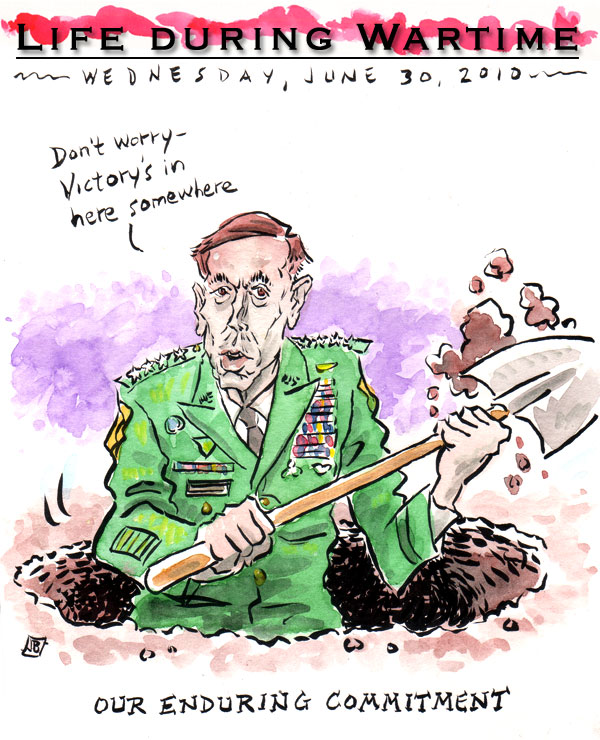
Life During Wartime : Our Enduring Commitment

Political cartoon by Joshua Brown / Historians Against the War / The Rag Blog

The Rag Blog

Posted in Rag Bloggers | Tagged , , , , | Leave a comment

Buck Benefit a Big Success!

By Mariann G. Wizard / The Rag Blog / June 30, 2010

AUSTIN — A community-wide benefit for former Austinite and long-time political prisoner Marilyn Buck, on Friday, June 25, was a success on all levels, according to organizers. The event was co-hosted by The Rag Blog/New Journalism Project and NOKOA/The Observer, along with six other community groups and businesses, and supported by a lengthy roster of contributors.

A spokesperson for Youth Emergency Service, Inc. (YES, Inc.)/The Phogg Phoundation for the Pursuit of Happiness, the tax-exempt fiscal sponsor for the event, expressed confidence Monday that, when all receipts are counted, the event will meet or exceed its fundraising goal.

The evening was also a great chance for people who might not ordinarily see each other often, or even meet, to interact in a relaxed, easy-going atmosphere. Building community is a common goal for all eight hosting groups.

Host committee member Tania Rivera of Ex-Pinta Support Alliance (ESA) agreed. “It was a beautiful sight to see both the younger and older generation of our community join in solidarity to support Marilyn Buck’s release from prison. As an ex-pinta [“pinta” is Spanish for “female prisoner”], I was reminded of the importance of my commitment to struggle against the oppression of those left inside the cages, and for those coming home in exile.”

Marilyn Buck, imprisoned for 25 years for politically-motivated crimes committed in the 1970s and 1980s, is the daughter of the late former Episcopal priest Louis Buck, prominent in civil rights activity here in the early 1960s. Some attending the benefit were influenced by the elder Buck while they were students at UT Austin; some had participated with him in the struggle to end “Jim Crow” discrimination.

Other attendees had never met either Buck, but know of Marilyn through her acclaimed poetry, her contributions to political journals, or the sometimes exaggerated story of her days as an urban guerrilla that has grown up while she’s been behind bars.

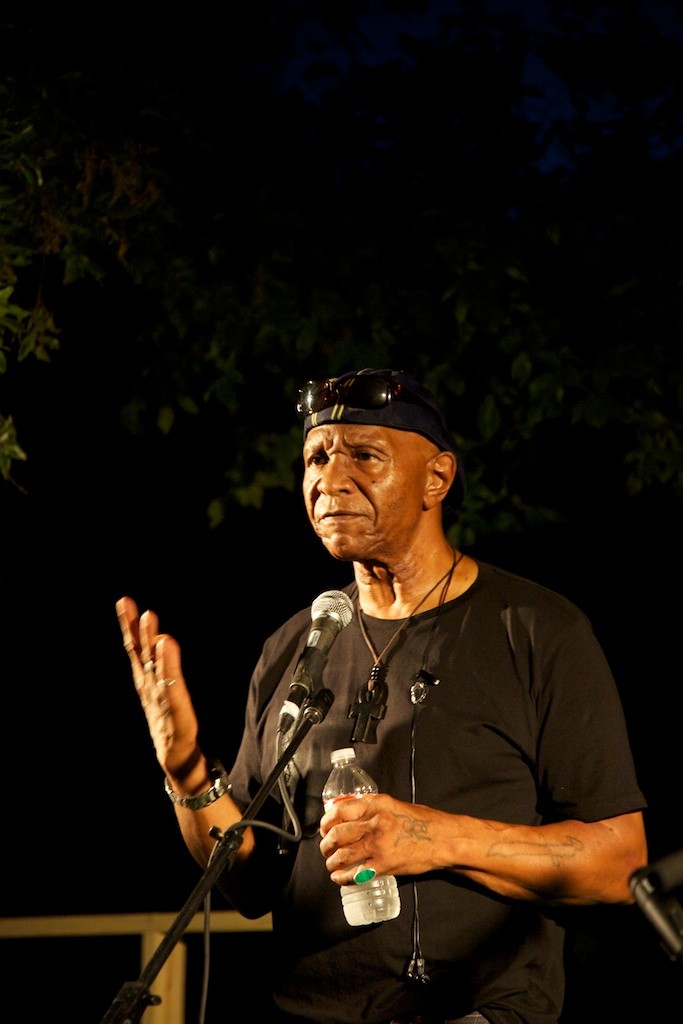
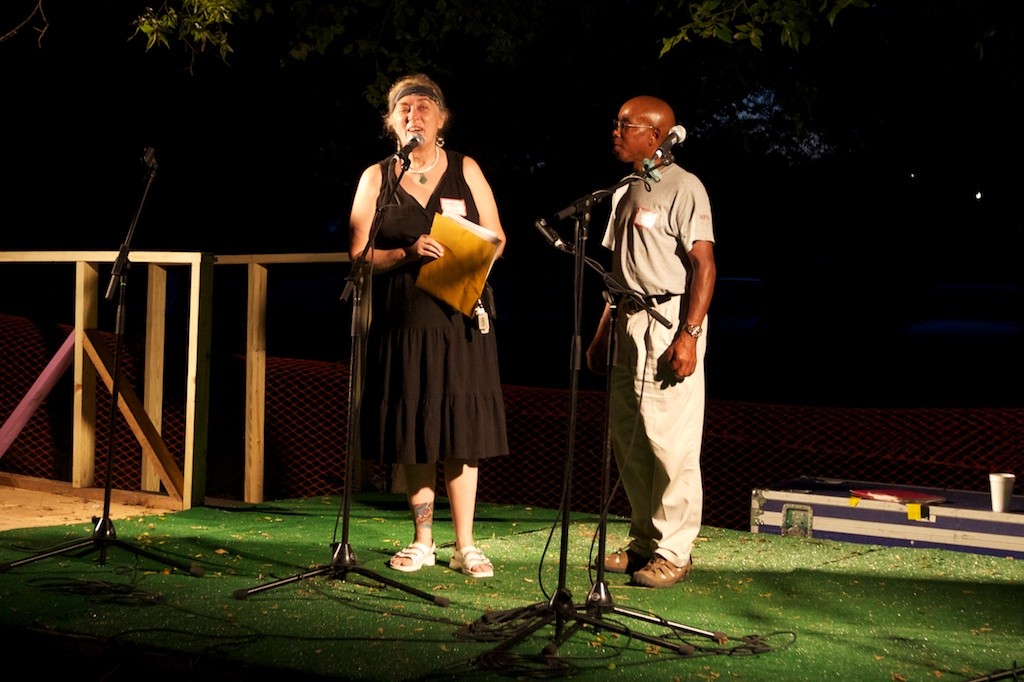
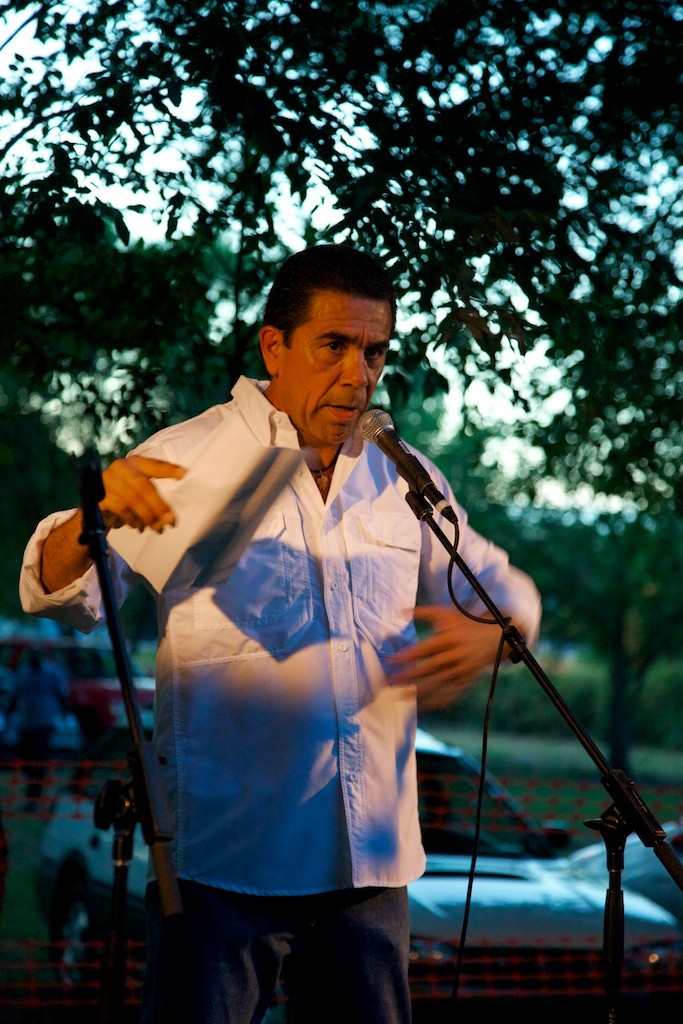
Friday’s benefit, at a private East Austin riverfront estate, featured music by country/folk singer/songwriter Karen Abrahams and friends, activist songwriter Joe P. Carr, and the conscious hip-hop stylings of Riders Against the Storm. Poets Jorge Antonio Renaud and Henry Gonzalez each read from their work, and some of Marilyn’s poems were read to the receptive crowd.

Maria Elena Martinez, a shaman, medicine woman, and leader in Austin’s La Alma Mujer Council, led a healing ceremony for Marilyn, who now has a serious cancer. Under a brilliant full moon, participants held hands in a great circle, connecting to the four directions, the sky, the earth, and their own hearts as they sent positive energy to Buck, being treated in a prison hospital in Ft. Worth.

An art auction featuring works from several artists and collectors, including award winning documentary photographer Alan Pogue, noted painter Madelon Umlauf, co-host South Austin Popular Culture Center, and Houston “working class artist” Robert Al-Walee, drew many bids during the evening..

In addition to raising funds to help Marilyn when she is released on parole in August, and hopefully aid her recovery, organizers also honored her commitment to her ideals even while imprisoned. Without revisiting all of her decisions in an era of heavy government repression against radical groups, they cited factors that made her actions something other than criminal. The slogan for the event, “Free Marilyn Now,” urges speedy consideration of a request by Buck’s attorney for accelerated compassionate release, in light of her life-threatening illness.

Al-Walee, a former member of the Black Panther Party, likens Marilyn’s actions to those of pre-U.S. Civil War firebrand John Brown in her opposition to racial oppression, except that in Buck’s case, she was not in the forefront of an imminent outbreak of hostilities. “When a revolutionary succeeds, he or she is revered as a hero, but success depends on many factors. Marilyn’s actions took place when repression was in the ascendancy, so she is treated as a common criminal.”

Two policemen and a Brinks security guard died in attempted robberies in which Buck and other members of what became known as the “Resistance Conspiracy Case” took part, and public property was damaged in bombings protesting U.S. foreign interventions.

Fugitive members of the radical underground, Marilyn and her co-defendants in this complicated, lengthy, multi-layered case were essentially the last remnants, in 1985, of what had, 15 years earlier, been a broad-based cultural and political “revolution.” While some goals of that movement were then and still are being realized, its suggestions for fundamental, systemic changes in economic relations remain out of bounds.

The benefit also launched discussions in some quarters about the existence of political prisoners in the U.S. today, and what that means or should mean to non-criminal citizens. Robert King, a local author and former political prisoner as one of the “Angola 3,” featured speaker at the benefit, tackled the issue in programs on KOOP Radio earlier in the week and in his remarks Friday.

Born poor and black in Louisiana in the 1940s, his eventual intersection with the criminal injustice system was almost inevitable. Convicted of a crime he didn’t commit, his increasing political awareness and membership in the Black Panther Party helped him see that he had “been in a minimum security prison” all along.

King was held on false charges for 29 years in solitary confinement in Angola State Penitentiary. “We are all political prisoners,” he says, “only some are held in harsher conditions than others. Marilyn Buck’s confinement has been extremely harsh, and she deserves to come home.” A BBC documentary about the Angola 3, In the Land of the Free, narrated by Samuel L. Jackson, has recently been released to critical acclaim.

Some benefit guests traveled from San Antonio, San Marcos, and the Dallas-Ft. Worth area to attend. Other hosts were Ecology Action, One Love Kitchen, and Resistencia Bookstore/Red Salmon Arts.

To make a contribution to Marilyn Buck’s support, please send your check or money order to YES, Inc; PO Box 13549, Austin, TX 78711, with a note that it is for this purpose. Contributions are tax-deductible to the extent allowed by applicable tax law.

[The following update on Marilyn Buck’s condition comes to us from Friends of Marilyn Buck.]

Marilyn has received her last chemo treatment at the hospital and is now back at the prison, receiving palliative care. She has undergone as much chemo as her body can tolerate. She feels that her medical care has been similar to what she would be getting in the free world, and that her doctors have been both competent and respectful of her. She is also receiving support from her sister-prisoners who are able to visit with her.

She’s been having very good visits with her family, and continues to feel the love and support of so many people who are meditating with her, sending her cards and generally keeping her in their thoughts.

Every effort is being made by her attorney to secure an early release. Marilyn asks that people not initiate their own letter-writing or phone campaigns for her release, as these are likely to be counterproductive. Should the situation change and such a campaign be deemed helpful, we’ll let everyone know right away.

In spite of the serious situation she faces, Marilyn’s spirits remain incredibly strong and her energy is focused on coming home to be with the people who love her.


Type rest of the post here

https://www.theragblog.com/warrior-poet-marilyn-buck-no-wall-too-tall/
Warrior-Poet Marilyn Buck : No Wall Too Tall by Mariann G. Wizard / The Rag Blog / May 19, 2010

http://www.archive.org/details/RagRadio-2010-06-22-RobertKingMarilynBuckMariannG.Wizard
Thorne Dreyer interviews Robert King and Mariann Wizard on Rag Radio / June 22, 2010

Source /

The Rag Blog

Posted in RagBlog | Leave a comment

Formula None

By Stefan Wray / The Rag Blog / June 30, 2010

AUSTIN — If I told you I hated fast cars, I’d be making a liar out of myself. Powerful engines and high speeds give nearly everyone an adrenalin rush. I’m no exception. And yet while I’m not much of a car racing fan, I can see how the sport can grab people’s attention.

But this business of bringing Formula One racing to Austin has left me and an increasing number of Austinites questioning whether this is the right thing for our city. More and more of us are deciding that it is not.

For those with no clue as to what I’m talking about, Formula One is the crème de la crème of automobile racing. Today’s F1 cars race at speeds topping 220 miles per hour. With a 60-year history, the first Formula One World Championship was held in Europe in 1950.

Starting in the 1970s, Formula One’s iconic and controversial president and CEO, Bernie Ecclestone, has turned it in a multi-billion dollar business and now an elite sport for the rich and famous.

For several years, Ecclestone had been looking for a U.S. location for Formula One for the 2012 through 2021 race seasons. After first being rebuked by New Jersey, it was announced on May 25, 2010, that a deal had been struck for Austin to be this site.

The story received front page news coverage when it broke and the decision has been heralded by F1 racing aficionados on blogs and racing fan web sites all over the Internet. Local and state politicians have given this much fanfare and are enthusiastic about a perceived economic benefit for the city.

I had an immediate, visceral, reaction to the announcement and quickly shot off a letter to the Mayor and City Council that was also published in the Austin Chronicle. In the letter, I argued that the City should conduct a carbon footprint and environmental impact study before situating Formula One here.

To me, it seemed incongruous that a “green” city such as Austin, with such an emphasis on pursuing renewable energy and efforts aimed at energy conservation, would be a location for Formula One. I wrote: “Future generations will laughingly look back at us and ponder why we moved forward with the construction of a car racetrack near the end of the era of the gasoline-powered combustion engine.”

Not long after that, David Kobierowski wrote a piece about Formula One that was published in the Austin Post. David’s line of thinking focused not on anything wrong, per se, with Formula One but that it is a sport better suited for perhaps Dallas or Las Vegas. He wrote: “There are some good reasons for F1 in TX like it’ll bring some jobs and international flavor/tourism. But overall, this is not a wise fit for Austin.”

I just came home from the Texas Democratic Party State Convention in Corpus Christi and when I asked a few in the Austin delegation what they thought about Formula One coming to their city, there were similar reactions to David’s sentiment. People say that it just doesn’t feel like Austin.

In mid June, David and I started a Facebook group — Concerned About Formula One (F1) Racing Coming to Austin — where we’ve started to post information about Formula One and where we’re starting to gather other people.

At the same time, the Austin American Statesman began to dig into some of the secrecy that surrounds the deal to bring Formula One to Austin.

It turns out that this plan has been in the works for several years. It’s been largely driven by the Republican-led State Comptroller’s office. But legislation introduced by Democratic State Senator Kirk Watson in March 2009 laid the groundwork for using state money for initial funding.

It is the use of $25 million in public monies to help underwrite some of the start up costs, and the slowly revealed information about how this deal has been constructed, that has other constituencies questioning the entire affair.

Interestingly, some of what David and I have easily been able to find by simple Google searches has yet to make it into the Austin American Statesman’s reporting.

One example is the readily available reports regarding Bernie Ecclestone’s praise for Hitler and Saddam Hussein. Amazingly, in a 2009 interview, Ecclestone said that Hitler “could command a lot of people” and was “able to get things done.”

We’ve not seen anything in Austin media about the character and mindset of Ecclestone.

Just this weekend there were a couple more Austin American Statesman articles on Formula One. One dealt with how a sizeable amount of generated revenue will actually leave the state and go to a California retirement fund. The Statesman writer concludes: “Time will tell whether Formula One is worth the price to Texas.”

Missing in Austin media, though, was an announcement that came out in an AP story on June 24, that the United States Formula One team had been banned from competition in Formula One. The AP story said: “The USF1 Formula One team has been fined and barred from ever competing in F1 for not taking part in the 2010 world championship.”

Why on earth would Austin want to construct a Formula One racetrack if the U.S. team is not involved?

It appears that the more we know about the effort to bring Formula One racing to Austin, the worse the idea becomes.

But, just because there is nascent public criticism and the daily paper is raising doubts, this doesn’t automatically translate into the plan being tossed out.

If you’re a Rag Blog reader and for whatever reason don’t like the idea of Formula One racing coming to Austin, then join us on our Facebook group — and add a comment at the end of this article. We may out of necessity move beyond Facebook, but that’s where our effort is at the moment.

[Stefan Wray is a writer, environmental activist, Drupal web project manager, documentary maker, and resident of Austin’s Montopolis neighborhood.]

The Rag Blog

Posted in RagBlog | Leave a comment

Marc Estrin : The Genius of Jean Baudrillard


THE GENIUS OF JEAN BAUDRILLARD

By Marc Estrin / The Rag Blog / June 29, 2010

[This is the first of three parts.]

My last week’s posting on The Rag Blog, Tea for Two, led to several inquiries concerning the philosopher and social critic Jean Baudrillard, who died three years ago at the age of 77.

I was a latecomer to Baudrillard. Years after academic critics had been industriously putting him down, I discovered him by accident in a catalogue called AMOK, Fourth Dispatch: A Sourcebook of the Extremes of Information in Print. Exotica, Mayhem, Neuropolitics, Scratch ‘n Sniff, Sensory Deprivation, Sleaze, Tactics — and, under “Control,” Baudrillard.

In a page of Baudrillard listings, they printed a selection from Simulations about Disneyland being “presented as imaginary in order to make us believe that the rest is real.” The proverbial light bulb snapped on over my head: Reality! This contemporary craziness is not basically about Democrats and Republicans, hawks and doves, rich and poor, blacks and whites, women and men — it’s about different understandings of Reality! And about the various strategies of manipulating Reality.

This was a new thought for me, one that seemed hugely pregnant. I ran out and bought a copy of Simulations, figuring that Baudrillard might have the missing key to my key questions. He would explain things that seemed so weirdly inexplicable — like how and why we’ve fallen into our postmodern insanity, and what we need to do about it.

I’m a good reader. Six hundred page book? No problem. Simulations is 4×6 — large print, big margins, 150 pages. Almost a pamphlet. I’ll read it in an evening. It’s now 13 years later, and I’m still nibbling away at it. Not that it’s so difficult. But the thinking of this “intellectual terrorist,” “the Darth Vader of postmodernism,” is so audacious that I can’t read any more than a page at a time — if that.

The last movement of Schoenberg’s Second Quartet sets a poem by Stefan George which begins with the line, “Ich fühle Luft von anderen Planeten” — I feel the air of other planets. That’s how I feel when reading Baudrillard. Adding Baudrillard to any academic debate on postmodernism is like a scene from a Marx Brothers movie where two people are arguing, and Harpo comes in with a scissors and snips off their ties.

Although he himself denies being “serious,” I think it pays to try to think with him, and to take his unseriousness seriously for where it may lead.

I’m going to quote him a lot. There’s no sense paraphrasing a writer who, in a section on the energy of postmodern collapse, can write

We …dream of harnessing this energy, but this is sheer madness. We might as well harness the energy of automobile accidents, or of dogs that have been run over…


Late, early, and middle Baudrillard

You may know that there is “early,” “middle,” and “late” Beethoven — Beethoven the enthusiastic, energetic young kid ready to kick the pants off any other classical composer; Beethoven the walking tragedy, Europe’s greatest composer going DEAF! — inventing romantic music to express the deepest passions of his mighty heart; and finally, “late” Beethoven — the stone deaf old man, a decade out of touch with any worldly sound, inventing music that had never been heard before, and would never be heard again. Well, Baudrillard underwent a similar conversion to the weird.


Late

For our purposes here, I am going to concentrate almost entirely on the language and concepts of middle Baudrillard. Late Baudrillard flies so high and crazy that it’s difficult to connect with without a thorough grounding in what preceded it, and even then makes for a major challenge. His thought revolves around the notions of “seduction” and “fatal theory” in which objects take control of the universe, surpassing all attempts to conceptualize or control them.

This “obscene” (out of the scene, nothing hidden) “ecstasy of objects” creates a catastrophe for us, the exhausted subjects, and we arrive at apathy and stupefaction. Our only hope is to imitate the strategies and ruses of objects.

Baudrillard sees other social critics as proceeding by “banal strategies,” thinking themselves more clever than objects, and heading for inevitable defeat from objects’ greater cynicism and shrewdness.

That much said about late Baudrillard, I leave you to try to read his mysterious words, and to study the insidious plotting of your refrigerators and vases.


Early

Early Baudrillard is more understandable, and extremely interesting. Although he was never fully accepted into the starry, hierarchical skies of European academia, Baudrillard began his intellectual career with some extremely significant extensions of Marxism to contemporary reality, taking into account the emergence of mass culture and the technologies of mass reproduction.

Early on, Baudrillard was still a classical, highly imaginary, Marxist, assuming, with Marx, that economics was the major determining factor of human life and civilization. His insight, however, was that production was no longer as important a force as consumption, and that consumerism — “a collective hysteria that takes the form of manic appropriation of an endless series of objects” — made the behavior of consumers more important than the behavior of producers, the major actors on Marx’s stage. The desire for objects had easily evolved into the desire for desire itself, and a positive feedback loop was well into driving a situation unimagined by the Marxian theory of mutually antagonistic forces.

But this extension of Marxism evolved into a devastating critique of Marx, and an attack on classical Marxism as a mirror of bourgeois society, a perpetuation of the idea of humanity as homo economicus, an excusing, legitimizing understanding of the current state of affairs.

In typical, flamboyant form, Baudrillard parodied the famous opening of the Communist Manifesto:

A spectre haunts the revolutionary imagination: the phantom of production. Everywhere it sustains an unbridled romanticism of productivity. The critical theory of the mode of production does not touch the principle of production.

Baudrillard accuses Marx of being in collusion with capitalism (!) in the Marxian analysis of the insidious power of its forms. He was looking for a more radical position, one which looks at the world through another lens — the optic of “symbolic exchange.” In symbolic exchange, Baudrillard posits an alternative organizing principle of modern society, harkening back to the practices of more “primitive” ones.

In escaping the logic of production and adopting the pervasive ambiance of advertising, this new condition creates a state of affairs in which the product is no longer as important as the set of meanings arbitrarily grafted on to it. The pervasive power of advanced capitalism has created an entirely new structure of meaning. The free play of signs and codes gives consumers an illusory sense of freedom and self-determination which entirely escapes their eyes and understanding.

In his books, For a Critique of the Political Economy of the Sign (1972/1981), The Mirror of Production (1975), and Symbolic Exchange and Death (1976), Baudrillard attempts to work out all the contradictions between commodity exchange and symbolic exchange, and their implications for the future.

But his final break with Marxism came with his new understanding of the evolution of Reality in Western culture. Here we come to a main feeding station for digesting postmodernity — the one I find most interesting, stimulating, and profitable: middle Baudrillard, and his notions of hyperreality and simulation.


Middle

In Symbolic Exchange and Death, Baudrillard posits a definitive rupture between modern societies oriented around production and consumption, and postmodern ones “in which codes, models, and signs are the organizing principles of a new social order where simulation rules.” In Simulations, he develops these ideas.

I don’t think Baudrillard would like my seizing and concentrating on this stage of his work: he has gone beyond it.

“I so wish I could cast off this yoke of simulacras and simulations which, incidentally, I have never treated as the last word of history, and with which I am truly fed up. I’ve heard these tunes too many times.” “I stopped working on simulation. I felt I was going totally nuts.”

And even his readers go totally nuts. Middle Baudrillard is not logical. He rarely defines his key terms, and when he does, he will offer widely ranging anecdotal descriptions rather than definitions. So you never really know what he’s talking about. The good side of this is that he stimulates the creative imagination like no other writer — you have to fill in your own blanks.
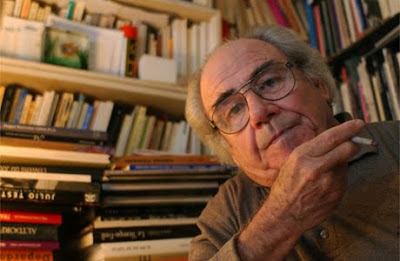
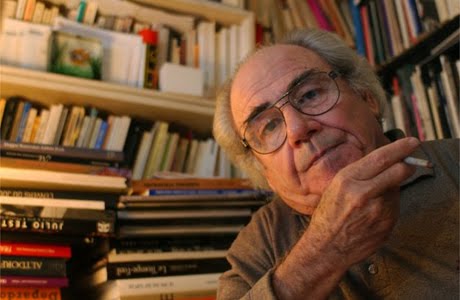
Jean Baudrillard at his home in Paris. Photo by Eric Feferberg / Guardian, U.K.

Simulations

Let me review from last week a key section in Simulations which give a reader something to hang on to. Baudrillard, you may remember, characterizes four stages in the changing function of signs. It is worth repeating.

  1. The sign is “a reflection of a basic reality” — as is common in scientific or referential language.
  2. The sign “masks and perverts a basic reality” — as when ideology stems from false consciousness which prevents people from seeing their true alienation or exploitation. The Frankfurt School writers have plenty to say about this.
  3. The sign “masks the absence of a basic reality” — as when iconoclasts fear of images of deity because they may lead people to suspect the absence of deity.
  4. The sign “bears no relation to any reality whatsoever”: it is its own pure simulacrum.

Here Baudrillard is thinking of the incessant contemporary production of images with no attempt to ground them in reality. Do you drive a Lexus, an Acura, an Elanta, an XL300? What does that mean??? (p11)

The transition from signs which dissimulate something to signs which dissimulate that there is nothing, marks a decisive turning point. The era of simulation begins. (12)

We look around us today. How can we account for “the interchangeability of previously contradictory or dialectically opposed terms,” the interchangeability

of the beautiful and the ugly in fashion; of the right and the left in politics; of the true and false in every media message; of the useful and the useless at the level of objects; and of nature and culture at every level of meaning?

It’s easy — because

all the great humanist criteria of value, all the values of a civilization of moral, aesthetic, and practical judgment, vanish in our system of images and signs. Everything becomes undecidable.

The age of simulation …begins with a liquidation of all referentials — worse: by their artificial resurrection in systems of signs, a more ductile material than meaning, in that it lends itself to all systems of equivalence,… substituting signs of the real for the real itself….(4)

On the first page of Simulations, Baudrillard cites a tale by Borges in which “the cartographers of the Empire draw up a map so detailed that it ends up exactly covering the territory.” (1) But these days, it is no longer a question of maps and territories. Something has disappeared: the sovereign difference between them. If there is any distinction at all, it is that it is the territory whose shards are slowly rotting across the map, and not vice versa.

So all we have now is the map, the sign, a most “ductile” environment. This is the age of simulation — the generation by models of a “real” without origin or reality. Hyperreality. “The territory no longer precedes the map, nor survives it. Henceforth it is the map that precedes the territory.” (2)

If you think it’s easy to tell real from fake, Baudrillard challenges you to try staging a fake holdup.

Be sure to check that your weapons are harmless, and take the most trustworthy hostage, so that no life is in danger….Demand ransom, and arrange it so that the operation creates the greatest commotion possible — in brief, stay close to the “truth,” so as to test the reaction of the apparatus to a perfect simulation. But you won’t succeed: the web of artificial signs will be inextricably mixed up with real elements (a police officer will really shoot on sight; a bank customer will faint and die of a heart attack; they will really turn the phony ransom over to you)…(39)

And here, Baudrillard elucidates the dynamic nature of the interaction of reality and simulation:

— In brief, you will unwittingly find yourself immediately in the real, one of whose functions is precisely to devour every attempt at simulation, to reduce everything to some reality — that’s exactly how the established order is… (39)

If reality is to seek in simulation the same order of reality, then the destiny of reality is inevitably to become simulation. This dynamic would explain the “collective hysteria” of production and overproduction, consumption and overconsumption in Western culture.

What society seeks through production, and overproduction, is the restoration of the real which escapes it. That is why contemporary “material” production is itself hyperreal. (44)

It also explains the itch for fascism that we see demonstrated in the public desire for a president to “act presidential.” It doesn’t matter what he does: the mere assertion of power satisfies “a collective demand for signs of power — a holy union which forms around the disappearance of power.” (45)

It further explains the movement to “end welfare as we know it,” and get single mothers working, even if they cannot afford to take care of their children, and even if government solutions (short of abandonment) are bound to cost more than welfare. “There is a demand for work exactly proportional to the loss of stake in the work process.” (47)

How to cope with this unholy coupling of reality and sign? The answer seems to be to assume nothing about the reality of any reality. Everything is true. All realities are exchangeable and equivalent. Baudrillard gives the example of a hot topic at the time he was writing: urban bombings (presented as leftist) terrorizing Germany and Italy, but equally applicable to many “terrorist” and false-flag attacks today.

Is any given bombing in Italy the work of leftist extremists, or of extreme right-wing provocation, or staged by centrists to bring every terrorist extreme into disrepute and to shore up its own failing power, or again, is it a police-inspired scenario in order to appeal to public security? All this is equally true, and the search for proof, indeed the objectivity of the fact does not check this vertigo of interpretation. We are in a logic of simulation which has nothing to do with the logic of facts… (31)

Baudrillard next treats us to some extended examples of living “in a logic of simulation.”


Disneyland

I have already referred to the much-quoted section on Disneyland, (23-26), the “perfect model of all the entangled orders of simulation.” (23)

Disneyland is there to conceal the fact that it is the “real” country, all of “real” America, which is Disneyland (just as prisons are there to conceal the fact that it is the social in its entirety, in its banal omnipresence, which is carceral). Disneyland is presented as imaginary in order to make us believe that the rest is real, when in fact all of Los Angeles and the America surrounding it are no longer real, but of the order of the hyperreal and of simulation. It is not a question of a false representation of reality, but of concealing the fact that the real is no longer real, and thus of saving the reality principle. (25)

Baudrillard identifies Disneyland in this regard as a third-order simulation — the kind which “masks the absence of a basic reality.” He also opines that “the Disneyland imaginary is neither true nor false; it is a deterrence machine set up in order to rejuvenate in reverse the fiction of the real.” (25)

By denying the truth or falsity of Disneyland, he is underlining that it is not that Disneyland is a fake representation of America, but that there no longer is any real America. His prison reference would suffer the same logic: it is not that America is “really” a total prison from which we are distracted by literal prisons. In terms of meaning, there is no is here — any more than there is one particular terrorist bomber — no matter who actually did the bombing.

Can you grasp the radical, all-embracing nature of these assertions?

Baudrillard is often accused of being decadent and apolitical — of being neutral and non-judgmental concerning these phenomena. But his section on Watergate shows that it is possible to combine these counter-intuitive views with a hard-headed understanding of power and a passionate denunciation of predatory capitalism.


Watergate is not a scandal

It is not important who did what. “Watergate above all succeeded in imposing the idea that Watergate was a scandal — in this sense it was an extraordinary operation of intoxication.” (27)

Before, the task was to dissimulate scandal; today, the task is to conceal the fact that there is none. Watergate is not a scandal: this is what must be said at all cost, for this is what everyone is concerned to conceal, this dissimulation masking a…moral panic as we approach the primal…scene of capital: its instantaneous cruelty, its incomprehensible ferocity, its fundamental immorality — this is what is scandalous, unaccountable for in that system of moral and economic equivalence which remains the axiom of leftist thought, from Enlightenment theory to communism. Capital doesn’t give a damn about the idea of the contract which is imputed to it — it is a monstrous unprincipled undertaking, nothing more. Rather it is “enlightened” thought which seeks to control capital by imposing rules on it. And all that recrimination which replaced revolutionary thought today comes down to reproaching capital for not following the rules of the game. “Power is unjust, its justice is a class justice, capital exploits us, etc.” — as if capital were linked by a contract to the society it rules. (28-29)

Hence Watergate was only a trap set by the system to catch its adversaries, a simulation of scandal to regenerative ends. (30)

It was not a trap designed or set by anyone, but an inevitable consequence of unanchored reality desperately clinging to its unanchored self. Just as with the terrorist bombing, anyone can do the actual work. If the Left wants to expose Watergate as a scandal of the Right, all well and good.

The work of the Right is done very well, and spontaneously, by the Left on its own. Besides, it would be naive to see an embittered good conscience at work here [Deep Throat]. For the Right itself also spontaneously does the work of the Left…..Such collusions admirably knit together…The conjunction of the system and its extreme alternative like two ends of a curved mirror, the ‘vicious’ curvature of a political space henceforth magnetized, circularized, reversibilised from right to left, a torsion that is like the evil demon of commutation, the whole system, the infinity of capital folded back over its own surface…. (30, 34-5)


The Gulf War will not take place

Baudrillard became more infamous than ever when — before the ’91 war — he made the above statement. After the war, when taunted with the incorrectness of his position, he simply commented, “The Gulf War did not take place.” Rather than try to understand this paradoxical statement, most critics simply threw up their hands and cried, “He’s a bigger asshole than I thought.”

But isn’t it clear that just as Disneyland is not fake, just as Watergate was not a scandal, the Gulf War was not a war, but a misdirecting sleight-of-hand to make us think that all isn’t war? If this was an ideological war to oust Saddam, why was Saddam left still in power, though the west “won”? If this was a fierce contest against a hugely threatening army, why were there so few American casualties? Some on the left have refused to call it a war, but rather, “a massacre.” Some have analyzed it as a taxpayer-supported demo — PR for the benefit of U.S. arms merchants. In any case, there is a lot of truth in Baudrillard’s seemingly outrageous statements. His analysis of simulated war, however, goes deeper:

Behind the armed violence, the murderous antagonism between adversaries — which seems a matter of life and death, and which is played as such (otherwise you could never send out people to get smashed up in this kind of trouble), behind this simulacrum of a struggle to death and of ruthless global stakes, the two adversaries are fundamentally as one against that other, unnamed, never mentioned thing, whose objective outcome in war, with equal complicity between the two adversaries, is total liquidation. It is tribal, communal, pre-capitalist structures, every form of exchange, language and symbolic organization which must be abolished. Their murder is the object of war — and in its immense spectacular contrivance of death, war is only the medium of this process of terrorist rationalization by the social — the murder through which sociality can be founded, no matter what allegiance, communist or capitalist. The total complicity or division of labor between two adversaries…for the very purpose of remolding and domesticating social relations. (68-69)

No wonder there are no “victories” in war, at least not those of stated objectives. If the actual objective is to repress any other emerging reality, then it’s good — and understandable — that Saddam was left in power, that the drug war is “unsuccessful,” that Russia was (and is) being destroyed and humiliated in its recycled role as ally.

What no longer exists is the adversity of adversaries, the reality of antagonistic causes, the ideological seriousness of war. (70)

Instead, there is a secret alliance of all the components of the what-is. All is simulated, necessary and equal in the Political Economy of Signs. Such thinking explains a lot.

To be continued next week.

[Marc Estrin is a writer and activist, living in Burlington, Vermont. His novels, Insect Dreams, The Half Life of Gregor Samsa, The Education of Arnold Hitler, Golem Song, and The Lamentations of Julius Marantz have won critical acclaim. His memoir, Rehearsing With Gods: Photographs and Essays on the Bread & Puppet Theater (with Ron Simon, photographer) won a 2004 theater book of the year award. He is currently working on a novel about the dead Tchaikovsky.]

The Rag Blog

Posted in Rag Bloggers | Tagged , , , , | Leave a comment

Dave Zirin : Why I Root for Argentina

No one can predict his devilish tricks: Argentina coach Diego Maradona. Photo by Ammar / AP.

The beautiful game:
Why I root for Argentina

By Dave Zirin / June 28, 2010

Before the start of the World Cup, I broadcast my rooting interest with the obnoxious insistence of a nuclear-powered vuvuzela: Argentina all the way.

I wanted Argentina to win because their style of soccer speaks to the full potential of the beautiful game. I wanted Argentina to win because few people in the U.S. could pick Lionel Messi out of a lineup, and he might be the most electrifying athlete on earth. I wanted Argentina to win because their coach, the walking, talking telenovela, Diego Maradona, is just too entertaining to see pushed off the stage

As Dan Wetzel of Yahoo Sports described Coach Maradona,

He screams and cheers. He complains and cajoles. He smiles. He prays. He blesses himself. He hugs. Actually, he hugs a lot. He even kisses his players. Pushing 50 yet wearing earrings and a salt-and-pepper goatee, he remains the biggest presence in the building — and that includes his megastar players such as Lionel Messi and Tevez.

In his playing days, Maradona made people reconsider the sacred idea that Pele was surely the greatest player to ever patrol the pitch. He went from soccer superstar to Argentine folk hero during the 1986 World Cup, when he “avenged” the 1982 British defeat of Argentina in the Falklands War by defeating England in the quarterfinals, with a little help from the “Hand of God.”

Maradona’s brilliance inspired Eduardo Galeano to write

No one can predict the devilish tricks this inventor of surprises will dream up for the simple joy of throwing the computers off track, tricks he never repeats. He’s not quick, more like a short-legged bull, but he carries the ball sewn to his foot and he’s got eyes all over his body. His acrobatics light up the field… In the frigid soccer of the end of the century, which detests defeat and forbids all fun, that man was one of the few who proved that fantasy can be efficient.

Efficient fantasy is the best way to describe Argentina’s current run to the quarterfinals. In a modern world of robotic soccer strategems, they play with the wicked grace of decades past. Given that success breeds imitators, I would argue that it is in the best interests of international soccer to see Argentina take it all the way.

For those experiencing this World Cup in the throes of neutrality, there are political reasons to support Argentina as well. This has received next to no media coverage either in their native Argentina or around the world, but the team has fully embraced the courageous group of grandmothers known as Abuelas de Plaza de Mayo. This organization is devoted to finding out the truth about the fate of Argentina’s desaparecidos — the people forever imprisoned or disappeared by the military dictarorship of Jorge Rafael Videla — during Argentina’s Dirty War of 1976-1983.

Diego Maradona hugs Abuelas president Estela de Carlotto.Photo from as.com.

At a training session in South Africa, the entire Argentine team unfurled a banner that read, “We Support the Grandmothers of the Plaza de Mayo for the Nobel Peace Prize.” The group has in fact been officially nominated for the prize and Abuelas president Estela de Carlotto, is in South Africa, meeting with Nelson Mandela and other world leaders. She has also been publicly — and literally — embraced by Maradona.

The critical work that Abuelas has done will only receive a greater spotlight if Argentina continues to advance. This makes all those connected with Argentina’s dirty war, who still hold tremendous power in the country, increasingly, and deliciously, apprehensive.

I can certainly understand, and have heard from numerous people, that these kinds of political concerns shouldn’t play into our rooting interests when it comes to the World Cup. It should just be about the game.

But this is like wishing a double cheeseburger didn’t have cholesterol. There is simply no sporting event on earth more entangled in politics than this brilliantly bombastic tournament. Anytime you have half the earth tuned in — as colonies play their former colonizers and dictatorships challenge democracies — politics follows like rainbows after rain. As long as politics is part of the mix, we might as well support a team that in addition to epitomizing “the beautiful game” stands with a beautiful cause.

Viva Argentina!

[Dave Zirin is the author of the forthcoming Bad Sports: How Owners are Ruining the Games we Love (Scribner). Receive his column every week by emailing dave@edgeofsports.com. Contact him at edgeofsports@gmail.com. This article also appears in The Nation.]

The Rag Blog

Posted in RagBlog | Tagged , , , , , | Leave a comment

Vision of a Better World : Let the Poets Speak

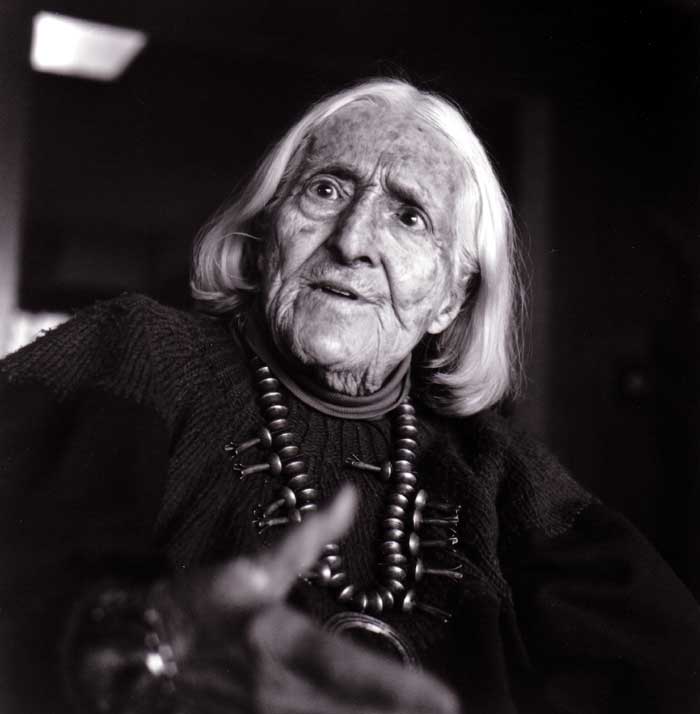
Meridel Le Sueur. Photo from Working Women.

Class, race, empire, and resistance:
The vision of the poet


By Harry Targ / The Rag Blog / June 28, 2010

  • Oil Spills as the Gulf of Mexico is Destroyed
  • Judge with BP Stock Rules Against Government Regulation
  • Several States Contemplate Arizona-Like Laws to Install Police Repression Against People of Color
  • Millionaire Politicians Vote to Cut Off Benefits to the Jobless
  • Media Ignores Massive Detroit Mobilization Against Poverty and War
  • Media Continues to Advertise “Tea-Party” and Sarah Palin Without Ever Addressing Capitalism(fantasy headlines by the author, morning June 26)

Some of our finest poets described so well the nature of the empire in which we live and the need for resistance against it. Meridel Le Sueur, the socialist/feminist poet, novelist, and chronicler of the Great Depression and beyond wrote with power about twentieth century America in a way that could have been written this week.

None of my sons or grandsons took up guns against you.

And all the time the predators were poisoning the humus, polluting
the water, the hooves of empire passing over us all. White
hunters were aiming down the gunsights; villages wrecked,
mine and yours. Defoliated trees, gnawed earth, blasted embryos.

We also live in a captive country, in the belly of the shark.
The horrible faces of our predators, gloating, leering,
the bloody Ford and Rockefeller and Kissinger presiding over
the violation of Asia

Meridel Le Sueur

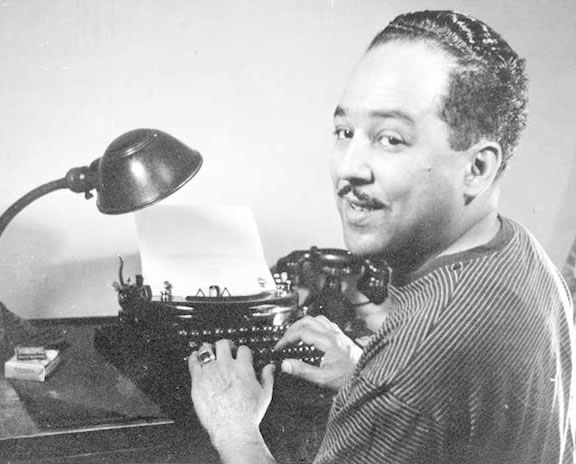
Langston Hughes. Photo from Arts Edge / Kennedy Center.

Langston Hughes, African American poet, captured United States history powerfully in the words of class and race

I am the poor white, fooled and pushed apart,
I am the Negro bearing slavery’s scars.
I am the red man driven from the land,
I am the immigrant clutching the hope I seek —
And finding only the same old stupid plan
Of dog eat dog, of mighty crush the weak.

I am the young man, full of strength and hope,
Tangled in that ancient endless chain
Of profit, power, gain, of grab the land!
Of grab the gold! Of grab the ways of satisfying need!
Of work the men! Of take the pay!
Of owning everything for one’s own greed!

I am the farmer, bondsman to the soil.
I am the worker sold to the machine.
I am the Negro, servant to you all.
I am the people, humble, hungry, mean —
Hungry yet today despite the dream.
Beaten yet today — O, Pioneers!
I am the man who never got ahead,
The poorest worker bartered through the years.

— Langston Hughes

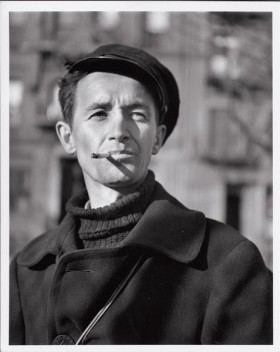
Woody Guthrie, 1943. Photo from Rounder Records / Bluegrass Journal.

And balladeer Woody Guthrie wrote verses, often unsung, for the unofficial American anthem, “This Land is Your Land?”

As I went walking I saw a sign there
And on the sign it said “No Trespassing.”
But on the other side it didn’t say nothing,
That side was made for you and me.

In the shadow of the steeple I saw my people,
By the relief office I seen my people;
As they stood there hungry, I stood there asking
Is this land made for you and me?

— Woody Guthrie

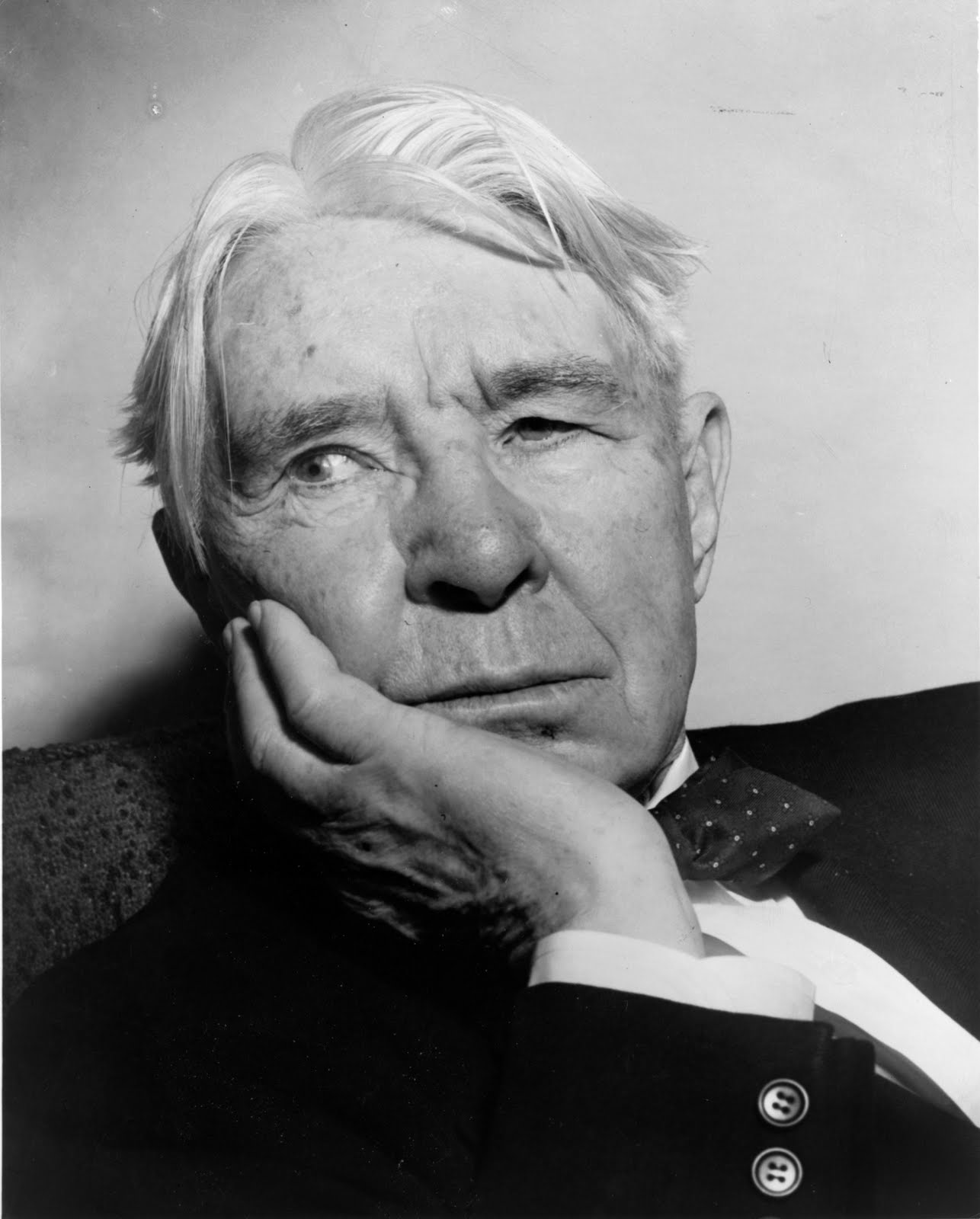
Carl Sandburg. Photo by Al Ravenna, 1955 / World Telegram / Library of Congress / Wikimedia Commons.

Carl Sandburg, poet, biographer of Abraham Lincoln, and children’s author, reminded us of who has made history and ironically created the exploitation of the producing class.

I am the people — the mob — the crowd — the mass.
Do you know that all the great work of the world is done through me?
I am the workingman, the inventor, the maker of the world’s food and
clothes.
I am the audience that witnesses history. The Napoleons come from me
and the Lincolns. They die. And then I send forth more Napoleons
and Lincolns.
I am the seed ground. I am a prairie that will stand for much plowing.
Terrible storms pass over me. I forget. The best of me is sucked out
and wasted. I forget. Everything but Death comes to me and makes
me work and give up what I have. And I forget.

— Carl Sandburg

Poets usually are driven by a vision of a better world. For Langston Hughes:

O, let America be America again —
The land that never has been yet —
And yet must be — the land where every man is free.
The land that’s mine–the poor man’s, Indian’s, Negro’s, ME —
Who made America,
Whose sweat and blood, whose faith and pain,
Whose hand at the foundry, whose plow in the rain,
Must bring back our mighty dream again.

— Langston Hughes

And for Woody Guthrie:

When the sun came shining, and I was strolling,
And the wheat fields waving and the dust clouds rolling,
As the fog was lifting a voice was chanting:
This land was made for you and me.

— Woody Guthrie

And finally poets offer the hope of resistance and change:

How can we touch each other, my sisters?
How can we hear each other over the criminal space?
How can we touch each other over the agony of bloody roses?
I always feel you near, your sorrow like a wind in the
great legend of your resistance, your strong and delicate strength.

It was the bumble bee and the butterfly who survived, not the dinosaur.

— Meridel Le Sueur

Nobody living can ever stop me,
As I go walking that freedom highway;
Nobody living can ever make me turn back
This land was made for you and me.

— Woody Guthrie

Sometimes I growl, shake myself and spatter a few red drops for history to
remember. Then — I forget.

When I, the People, learn to remember, when I, the People, use the
lessons of yesterday and no longer forget who robbed me last year,
who played me for a fool — then there will be no speaker in all the
world say the name: “The People,” with any fleck of a sneer in his
voice or any far-off smile of derision.

The mob — the crowd — the mass — will arrive then.

— Carl Sandburg

O, yes,
I say it plain,
America never was America to me,
And yet I swear this oath —
America will be!

Out of the rack and ruin of our gangster death,
The rape and rot of graft, and stealth, and lies,
We, the people, must redeem
The land, the mines, the plants, the rivers.
The mountains and the endless plain —
All, all the stretch of these great green states —
And make America again!

— Langston Hughes

Selections from the following poems:
Meridel Le Sueur, “Doan Ket
Langston Hughes, “Let America Be America Again
Woody Guthrie, “This Land is Your Land?
Carl Sandburg, “I Am the People, the Mob

[Harry Tarq is a professor in American Studies who lives in West Lafayette, Indiana. His blog is Diary of a Heartland Radical.]

The Rag Blog

Posted in Rag Bloggers | Tagged , , , , , , , | 1 Comment

The Republicans had a party in Dallas — kicked off with a keynote speech by leading thinker Rep. Michele Bachmann — and produced a document for the (middle) ages. Political correspondent Ted McLaughlin details lowlights of the Texas GOP’s amazingly reactionary platform, adds his comments, and wonders if this scary document describes a world we’d like to live in and leave to our children.

Posted in RagBlog | Leave a comment

Roger Baker : Bad News and The Wall of Denial

Breaking down the wall. Photo from Andrew Alexander / Flickr.

Shock therapy:
Breaking down the wall of denial

By Roger Baker / The Rag Blog / June 27, 2010

I think that dramatic experiences like the oil spill, or some other bad news equivalent, are absolutely inevitable under a corporat-ocracy. But they are also necessary for progress.

Why? To break down the wall of denial that prevents us from seeing that our global survival depends on abandoning the maximizing of global profit, with weak regulation, as our primary global motivator.

The maximum-expansionist policy inherent to capitalism, unregulated, and blind to the future, ultimately reinforces population overshoot, famine, and maximum disruption and destruction of nature. But the current exploitation is like slowly boiling a frog, the entrenched status quo really needs some trigger event to alert the system to danger.

This is because political consciousness is not a linear process; it is raised in stages through psychological breakthroughs, through responding to specific crises like the oil spill. I think Naomi Klein has written about how the U.S. political system practically requires shock therapy to initiate change, which is often used to advantage by the bad guys, as with 9/11. On a personal level this could be a job loss, sufficient to cause a traumatic revaluation of one’s political fundamentals and outlook.

It took the hyper-inflation of the Weimar republic in Germany in the 1920s to more or less permanently make the Germans fear inflation, much more to this day than the USA. I imagine the great earthquake caused San Francisco to build stronger buildings — more effectively than could any possible warnings by multitudes of seismologists and scientists.

On many issues — like energy, water, global warming, food, and population increase — we ultimately need to run into various barriers for progress to occur. We don’t need band-aids to treat symptoms; we need situations that seriously interfere with our comfort, sufficient to shake up our cultural assumptions, and that cause us accept unpleasant solutions. Better a little pain today than a lot more pain later through lack of intelligent early action on predictable threats.

The public is currently fearful and angry about government due to personal pain, but this anger is not well-focused, except now almost universally against BP in the case of the oil spill. This crisis involving natural limits tends to raise both oil addiction awareness, and corporate domination awareness.

It is unpopular to say, but we do need more of certain kinds of problems that disturb our comfort enough to make it possible to take the actions that prepare us for the future. Problems that are serious enough to disturb us into appropriate action, but yet not so serious that they cause us to do crazy hysterical things, like electing hate candidates offering simple cultural and ethnic solutions.

Meanwhile, so long as the economic pain persists, but is treated symptom by symptom by an already overstressed system, I think the public will broadly demand some new political outlets in response, and the Tea Party supporters, however they might evolve, are still in the running. Whether the political result is based on a sensible long term vision, or a toxic brew of self-reinforcing political hostility similar to the current bipartisan gridlock in Congress is the real choice.

[Roger Baker is a long time transportation-oriented environmental activist, an amateur energy-oriented economist, an amateur scientist and science writer, and a founding member of and an advisor to the Association for the Study of Peak Oil-USA. He is active in the Green Party and the ACLU, and is a director of the Save Our Springs Association and the Save Barton Creek Association. Mostly he enjoys being an irreverent policy wonk and writing irreverent wonkish articles for The Rag Blog.]

The Rag Blog

Posted in Rag Bloggers | Tagged , | 10 Comments

Bob Feldman : A People’s History of Afghanistan /12

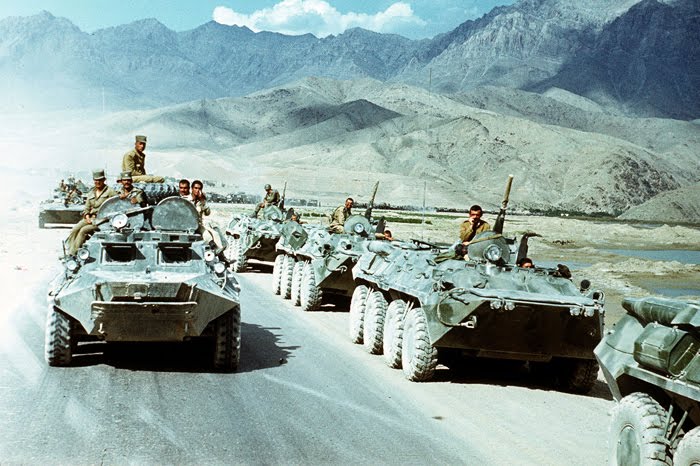
Soviet troops leaving Afghanistan, 1988. Photo by Mikhail Evstafiev / Wikimedia Commons.

Part 12: 1987-1992
A People’s History of Afghanistan

By Bob Feldman / The Rag Blog / June 21, 2010

[If you’re a Rag Blog reader who wonders how the Pentagon ended up getting stuck “waist deep in the Big Muddy” in Afghanistan (to paraphrase a 1960s Pete Seeger song) — and still can’t understand, “what are we fighting for?” (to paraphrase a 1960s Country Joe McDonald song) — this 15-part “People’s History of Afghanistan” might help you debate more effectively those folks who still don’t oppose the planned June 2010 U.S. military escalation in Afghanistan? The series so far can be found here.]

In 2010 more than 600 individuals were still imprisoned by the Democratic Obama Administration at its Bagram detention facility in Afghanistan, and many of these Bagram prisoners have apparently been held without access to lawyers or an opportunity to legally challenge the basis of their imprisonment for as long as six years.

Yet none of the U.S. government officials responsible for escalating the covert and overt U.S. military intervention in Afghanistan since the 1970s have ever been held legally accountable for the morally disastrous humanitarian effects their policies have had on the history of people in Afghanistan.

Yet in April 1986, the People’s Democratic Party of Afghanistan (PDPA)-Parcham faction leader who had been installed in late December 1979 by Soviet troops as the head of the PDPA regime in Afghanistan — Babrak Karmal — was replaced by the former head of the PDPA regime’s secret police, Dr. Mohammad Najibullah, after Najibullah was elected by the PDPA’s Central Committee to be its new general secretary.

Subsequently, on January 1, 1987, the new PDPA regime head of state attempted to bring peace to the people of Afghanistan and negotiate an end to the 1980s Afghan war by announcing a “program of `national reconciliation’ comprising three key elements: a six-month unilateral cease-fire, the formation of a government of `national unity’ and the return of over 5 million refugees from Pakistan and Iran,” according to Angelo Rasanayagam’s Afghanistan: A Modern History. The same book also recalled:

An “Extraordinary Supreme Commission for National Reconciliation” was set up and branches were opened all over the country. Their job was to make contact with refugees… in exile or fighting with resistance groups, pass on the message of peace, and distribute essential relief items for the use of returning refugees. Other inducements offered were tax concessions, the return of confiscated property and the deferment of military service.

Radio Kabul started calling the Mujahideen fighters “angry brothers” rather than “bandits.” Some 4000… prisoners were released. Six months later, just before the expiring of the 6-month ceasefire, Najibullah was able to claim that 59,000 refugees had returned; tens of thousands of men were negotiating with the government; 4,000 representatives of the opposition had been included in the reconciliation committees; and coalition governments had already been formed in several villages, sub-districts, districts and provinces.”

But the alliance of seven U.S., Pakistan, and Saudi government-sponsored anti-feminist Afghan political parties apparently “turned down with disbelief and contempt” the January 1987 peace proposals of the PDPA regime in Afghanistan. As the same book explained:

The Islamic parties… claiming to represent the Mujahideen resistance had developed into vested interests that were not receptive to power-sharing arrangements. They and their Pakistani sponsors, replete with funds and weapons generously contributed by “the international community,” developed their own agendas for a post-Soviet Afghanistan…The parties owed their “influence” to the fact that they served as somewhat porous conduits for the U.S. and Saudi funds and weapons channeled to the resistance fighters inside Afghanistan by Pakistan’s ISI [Inter-Service Intelligence]…

Ironically, “a survey among Afghan refugees conducted in 1987 by one of Afghanistan’s outstanding academics and intellectuals, Professor S.B. Majrooh, found that less than half a percent of those polled would choose one of the seven” Afghan Islamic political party “leaders to rule a free Afghanistan,” according to Afghanistan: A Modern History. Coincidentally, the Union of Mujahideen (a coalition of these seven unpopular Islamic parties) apparently then arranged for Professor Majrooh to be assassinated in his office in Peshawar on February 11, 1988, shortly after his survey results were made public.

Yet despite the rejection of its January 1987 peace proposals by the U.S., Pakistani and Saudi government-sponsored Islamic parties, the PDPA regime extended its unilateral January 1987 ceasefire in Afghanistan for another six months in June 1987, and it invited its right-wing Afghan political opponents to suggest changes in the draft of a proposed new Afghan constitution which it published in July 1987.

The proposed new Afghan constitution — that set up a democratic, multiparty parliamentary political system in Afghanistan in which Islam was the state religion — was then formally approved by the PDPA regime’s parliament (jirga) in November 1987.

On February 8, 1988, the Gorbachev regime in the Soviet Union next announced that on May 15, 1988, it would start to withdraw the 85,000 Soviet troops still in Afghanistan, and that it would have all Soviet troops pulled out of Afghanistan by March 15, 1989.

Parliamentary elections were then held in Afghanistan in April 1988 in which the National Fatherland Front [NFF] and other newly formed Afghan parties won more seats in the new, democratically-elected Afghan parliament than did the PDPA — which just won 22 percent of the parliamentary seats. In addition, 25 percent of the seats in the lower house of the new Afghan parliament were left vacant for representatives of the Islamic opposition parties in Afghanistan- — that were still unwilling to negotiate an agreement in 1988 that would finally bring peace to Afghanistan.

A peace agreement between the Pakistani government and the Afghan government — guaranteed by both the Reagan Administration and the Gorbachev regime in the Soviet Union — was, however, signed on April 14, 1988. But after the withdrawal of all Soviet troops from Afghanistan was completed in February 1989, Pakistan’s “ISI drew up the battle plans and arranged the logistics, the intelligence and the communications,” for a March 7, 1989, attack from Pakistan by its Afghan Mujahideen units, according to Afghanistan: A Modern History.

Although the Mujahideen quickly “captured the government base of Samarkhel, 12 miles south-east of Jalalabad,” their march to the local airport “ran into heavy resistance.” As Afghanistan: A Modern History observed, “despite human wave assaults and a heavy bombardment of the city that cost over 2,000 mostly civilian lives, the Muhajideen could not advance any further. And in July 1989 the Afghan government military forces were able to easily retake its Samarkhel base, where they found that 70 captured Afghan army officers had been murdered by the ISI-organized Mujahideen.”

Without the support of any Soviet troops, the army of the Najibullah regime’s Afghan government in 1989 was also able to defend Jalalabad “against the most massive attack ever undertaken by the Mujahideen during the whole war,” according to Afghanistan: A Modern History.

And, despite a failed coup attempt by the Minister of Defense of the Afghan government regime in March 1990, Najibullah’s regime did not collapse until there was a successful 1992 Afghan military coup which, according to Dator Zayar’s October 2001 “Afghanistan: An Historical View” article, was “planned by the CIA and ISI” and “prepared the way for the capture of Kabul by the Islamic fundamentalists.”

Afghan President Najibullah then announced in early April 1992 that he would resign as part of a UN-brokered transition of power and “Kabul now became the scene for a power struggle between four main armed” Mujahadeen “groups,” according to Afghanistan: The Mirage of Peace by Chris Johnson and Jolyon Leslie.

By April 1992, the commanders of the various Mujahideen guerrilla groups were also deriving a major source of their personal income from Afghanistan’s lucrative drug trade. As Trinity College Professor and International Studies Program Director Vijay Prashad wrote in his “War Against The Planet” article that was posted on the CounterPunch website:

The opium harvest at the Pakistan-Afghan border doubled between 1982 and 1983 (575 tons), but by the end of the decade it would grow to 800 tons. On June 18, 1986, the New York Times reported that the Mujahideen “have been involved in narcotics activities as a matter of policy to finance their operations.”

In his Killing Hope book, William Blum also wrote:

…Mujahideen commanders inside Afghanistan personally controlled huge fields of opium poppies, the raw material from which heroin is refined. CIA-supplied trucks and mules, which had carried arms into Afghanistan, were used to transport some of the opium to the numerous laboratories along the Afghan-Pakistan border, whence many tons of heroin were processed with the cooperation of the Pakistani military. The output provided an estimated one-third to one-half of the heroin used annually in the United States and three-quarters of that used in Western Europe…”

Next: “A People’s History of Afghanistan—13: 1992-1998″

[Bob Feldman is an East Coast-based writer-activist and a former member of the Columbia SDS Steering Committee of the late 1960s.]

  • Previous installments of “A People’s History of Afghanistan” by Bob Feldman on The Rag Blog can be found here.

The Rag Blog

Posted in Rag Bloggers | Tagged , , , , , , | Leave a comment

John Ross : An Uprising of Bones in Mexico

Tlatecuhtli, Aztec goddess of the earth, a fierce frog-like creature. The monumental 12-ton slab was discovered during an excavation beneath a popular Mexico City cantina. Photo from Noticias Azatlan Virtual.

An uprising of bones:
Macabre marks past and present in Mexico

By John Ross / The Rag Blog / June 27, 2010

MEXICO CITY — Under the martial cadence of muffled drums, the bones rolled solemnly up the elegant Paseo de Reforma atop a dozen military vehicles. Four skulls could be spotted in one large glass urn. “Look Papi, there goes Hidalgo!” a small boy pointed excitedly — one of the skulls is purported to be that of Miguel Hidalgo, the country priest who rose in rebellion in 1810 to initiate Mexico’s struggle for independence from Spain, an event whose bicentennial is being celebrated this year.

For his efforts, Hidalgo was fusilladed by a Royal firing squad then decapitated and his head hung from a public building to impress upon would-be disciples the folly of rebellion.

Other urns were full of arm bones and femurs, said to be the remains of Jose Maria Morelos, Vicente Guerrero, Guadalupe Victoria, Leona Vicaria and her lover Andres Quintana Roo, and other heroes of the struggle for independence.

The macabre military parade was captained by President Felipe Calderon this May 30th to usher in Bicentennial festivities that will climax in September. The bones of the heroes are being shifted from their crypts in the slender column that supports the gilded Angel of Independence installed by dictator Porfirio Diaz (1876-1910) just weeks before the Mexican revolution exploded a hundred years ago.

Under Calderon’s direction, they were being transported up to Chapultepec Castle, the colonial palace that overlooks the city, where experts will sort out whose bones are whose, and polish them up in anticipation of the big fiesta.

2010, of course, also marks the 100th anniversary of the Mexican revolution but the bones of the heroes of that landmark uprising of the poor are buried in their own monument, currently undergoing renovation. Of the duel centennials, the marking of the Mexican revolution has been downgraded by the right-wing president Calderon who reportedly is uncomfortable with the images of such revolutionaries as Emiliano Zapata, Francisco Villa, and others who once overthrew a conservative government.

But the bones of the heroes are not the only bones stirring in Mexico these days. In Taxco, the historic Guerrero state silver mining town, now a tourist Mecca, at least 77 cadavers were removed this June from the shuttered San Francisco Cuadra mineshaft, all of them casualties of Calderon’s never-ending drug war. Although most had been reduced to piles of bones, more recent victims were identified by striking tattoos of Santa Muerte, the death goddess of the narcos.

The bones retrieved from the Taxco mine are thought to have been deposited there by pistoleros in the employ of La Familia, a drug gang based in next-door Michoacan state, notorious for beheading its rivals. Some drug war observers link the death cult to the Evangelical prosperity gospel.

On June 16th, La Familia gunmen and federal police troops mixed it up outside Taxco. According to Mexican drug war officials, a total of 15 dead pistoleros were added to the mounting bone pile. Taxco’s stock as a tourist destination has declined precipitously since the killing spree began.

All over Mexico, the narco bones are piling up. 23,000 citizens have perished since Calderon declared war on the drug cartels 43 months ago to curry favor with Washington and garb himself in the mantle of military authority after a fraud-marred presidential election that left him with little credibility. To underscore the campaign, Calderon donned a military field jacket two sizes too big for his small, pudgy stature to the delight of the nation’s acid-penned political cartoonists.

In addition to the 23,000 dead, hundreds are missing in action, many buried in clandestine common graves like the Taxco silver mine. Families set out on federal and state highways and never arrive home. Some vanish at impromptu checkpoints set up by the military and police and the drug gangs.

A record number of bones were collected this May when 1060 died in the drug war, a 43% increase over May 2009. June has been even more horrific. This June 11th while Mexico’s national team inaugurated the World Cup football championship in South Africa, 85 new candidates for the bone pile were counted, a new one-day record.

Two 70-plus days followed. Ninteen addicts were slain in a Chihuahua City drug clinic, the fourth mass killing at such facilities in the state in the past year. In Ciudad Madero where 20 were slain, a clique known as “The Artists of Assassination” took credit for distributing the dead in a score of colonies in this Tamaulipas oil town.

A skull — perhaps that of revolutionary legend Miguel Hidalgo — seen in a glass crypt containing the bones of a dozen national heroes in Mexico , Sunday, May 30, 2010. The remains were carried through the city in a solemn Bicentennial procession. Photo by Marco Ugarte / AP.

On June 15th, 29 members of the Zeta Cartel were massacred inside a Mazatlan Sinaloa state penitentiary by rivals from El Chapo Guzman’s Pacific Cartel armed with automatic weapons. El Chapo (“Shorty”) is reputed by U.S. National Public Radio to be Calderon’s favorite narco lord. Thirty-five prisoners had previously been slaughtered in the prison since the first of the year.

On the same day as the massacre in Mazatlan, a dozen federal troops were ambushed by La Familia near Zitacuaro Michoacan in the heart of the Monarch butterfly sanctuary zone. The ambush occurred almost a year to the date of a La Familia attack that cost 10 federal police officers their lives.

With the daily body count zooming, President Calderon has been obligated to launch a media campaign in an effort to convince a dubious public that he is winning his drug war. In mid-June, the President’s public relations team bought up double truck space in every daily newspaper and weekly magazine in the country for the publication of Calderon’s 5,000-word defense of his failing policies, shifting blame for the violence to the insatiable demand for drugs of his nearest neighbor to the north which he also lamented is arming the drug cartels via thousands of gun shops strung along the 1964 mile border.

The president also put the onus on the purportedly increasing affluence of Mexicans (presumably due to his administration’s economic initiatives) that has provided them with enough disposable income to buy drugs.

Sic.

Felipe Calderon’s mobilization of the armed forces to take on the cartels has been, at best, a big bust. Sending in the troops has predictably led to massive corruption. The Mexican Army, which took over the drug war from very corruptible state and federal police, is now so untrustworthy that the Navy is being deployed in high profile operations.

Civilian security agencies are riddled with cartel infiltrators. Officials on drug gang payrolls have been uncovered in the Special Prosecutor for Organized Crime office, the Federal Police command, and even Interpol and the U.S. Homeland Security Customs & Border Enforcement. Human rights abuses have climbed to over a thousand incidents a month reported to the National Commission on Human Rights (CNDH.)

The border around Reynosa, Tamaulipas and McAllen, Texas is particularly treacherous. On June 3rd, three boys — the youngest was 13 — were gunned down by Mexican Army troops near Reynosa. The military claims they were Gulf cartel gunmen (“sicarios“). Their parents testify they were wearing their middle school uniforms when the soldiers opened fire.

Calderon’s preference for marketing the Bicentennial of Independence reflects the skittishness of his rightist PAN party to deal with class-based social upheaval. On the other side of the political ledger, the Left is focused on the possibility of renewed uprising as the nation approaches the centennial of the 1910 revolution.

Tattoo depicting Santa Muerte, the death goddess of the narcos. Image from Marzia Tattoo / Flickr.

Class tensions, exacerbated by the spiraling economic downturn; the increasing concentration of wealth in the coffers of the oligarchy; and rampant injustice are seen as signposts towards a new Mexican revolution. But the Left may have missed the boat. Indeed, if revolution can be defined as the violent overthrow of a sitting government, the new Mexican revolution has already begun:

  • Item — Narco commandos are in the field inflicting double-digit casualties on federal security forces such as in the June 15th ambush in the Monarch butterfly sanctuary. Police and military outposts and prisons have been repeatedly overrun by such commandos.
  • Item — Revolutionaries seek to demonstrate to the masses that the government can no longer protect them. The recent spate of bloody massacres seems to be directed to this end.
  • Item — On June 9th, Monterrey youth gangs affiliated with the Zetas shut down that northern industrial city, blocking central thoroughfares and freeways with stolen trailer trucks, tourist buses, and earth-moving equipment at rush hour, a stunt that would make many left revolutionaries salivate. A similar shutdown in April was rumored to have provided the Zetas with free access to move troops and weapons through this strategically located metropolis.
  • Item — “Plata o plomo” (“silver or lead”), the slogan of the drug gangs when dealing with the political parties and elected officials, is operative. Candidates for all three major parties have been threatened, bribed, and sometimes assassinated in the run-up to state elections this July. The kidnapping of a powerful politico and possible PAN presidential candidate is another indicator that an armed struggle for state power is in process.

Amidst dibilitating narco wars and bicentennial ballyhoo, older bones are rising to the surface these days.

Deep beneath the Templo Mayor or Great Temple in Mexico City’s old quarter where the Aztec emperors butchered tens of thousands of warriors to win the blessings of Tlaloc, the god of the rain, and Huitzilopochtli, the sun at mid-day, the bones of the ancients are rattling around as never before.

In 2006, at the foot of the altar to Tlaloc on the corner of Guatemala and Argentina Streets, the National Institute of History and Anthropology (INAH) began to excavate a site beneath a popular cantina, El Seminario. Ten meters down, the diggers hit pay dirt: a monumental 12-ton slab depicting the Tlatecuhtli, the Aztec goddess of the earth, a fierce frog-like creature that had been buried for five centuries following the fall of the Mexica empire to the European invaders.

Archeologist Eduardo Matos Mocuhtezuma, on whose watch the earth goddess was uncovered, speculates that the Tlatecuhtli was installed by the Emperor Mocuhtezuma II (no relation) to cover the tomb of Ahuizotl, one of the most powerful of Mexica rulers.
Although the bones of Ahuizotl have not yet been located, the discovery of many offerings (“ofrendas“) — textiles, gold jewelry, tiny figures of Aztec deities — indicate a new find is imminent.

This May 17th, the Tlatecuhtli, which has broken into four large sections and is missing a four foot section where its viscera should be, was painstakingly carried into the Templo Mayor museum to be the centerpiece of an exhibition documenting the “Time and Destiny” of Mocuhtezuma’s governance — his fall in 1521 amidst multiple signs of doom and gloom marked the end of the Aztec empire.

As they were 500 years ago, these are apocalyptical times. The deluge of bones here is accompanied by premonitions of cataclysm: global warming, a deadly Gulf of Mexico oil spill, terrifying acts of violence and vengeance.

Laid out on an immense bier, the Tlatecuhtli is visible from three stories above the museum floor. Viewed from on high, she seems immersed in beatific repose, her heavy lids turned demurely downwards and her serrated tongue dangling comically from her open mouth. Capped by a crown of caracoles (snails) she is perched on thick claws that communicate maximum animal power.

Jesus, a breakfast companion at the Café La Blanca, studies the photo in the morning daily, La Jornada. “Wow! What do you think will happen to us if she ever wakes up?” he wonders.

[John Ross lives in Mexico City a few blocks from the Tlatecuhtli and the subject of his latest cult classic El Monstruo: Dread & Redemption In Mexico City (“gritty & pulsating” — New York Post.) He is can be fingered at johnross@igc.org.]

The Rag Blog

Posted in Rag Bloggers | Tagged , , , , , | 1 Comment

Payoff Time in the Gulf : Hitting the Petro Jackpot


Everyone loses:
Hitting the Petro-Jackpot

The gulf is carpeted with long wide dark and slimy rainbow slivers and miles of weathered henna colored crude oil mousse…

By Larry Ray / The Rag Blog / June 26, 2010

GULFPORT, Mississippi — Winds, tides and ocean currents, changing like spinning wheels on a slot machine, have finally lined up to announce a Petro-Jackpot! Floating and submerged oily, syrupy petroleum filth is the unwelcome payoff as it finally glides into the Mississippi Sound.

BP’s uncontrolled gusher of oil has assaulted our protective pristine offshore barrier islands and now is flowing into the shallow marine nursery grounds off the Mississippi coastal shoreline. The gulf is carpeted with long wide dark and slimy rainbow slivers and miles of weathered henna colored crude oil mousse that bob and drift toward the horizon. This menace is now within sight of our miles of white beachfront along coastal Highway 90.

The futility of pleading “Somebody do something!” becomes evident. Trying to skim and contain the millions of gallons of floating oil before it comes ashore is like trying to scoop up and dispose of billions of flu germs from ten thousand sneezes. Oil, assisted by a rolling sea, splashes over and eases under so-called oil containment booms. Also consider that we have had a daily heat index here averaging 100º to 108º for the past month. Suffocating heat adds to the futility of trying to sop up oil and tar before it arrives to coat the blazing beach sand.

All the political rhetoric, naive denial, and assurances that “our beaches” are pristine and somehow exempt from the nautical nuance of Ma Nature, has stopped. The hastily produced TV commercials showing happy kids splashing along our water’s edge, and couples strolling on the beach with a setting sun turning the water golden have been pulled off the air.

Now multi-faceted environmental damage begins right here on the beaches and in the seafood-rich waters fronting Gulfport and Biloxi. Recovering from this long term damage will not be like recovering from Hurricanes Camille and Katrina. The area around Valdez, Alaska has yet to truly recover from a much smaller amount of oil carelessly loosed on its shores 21 years ago when a fully loaded Exxon oil tanker ran aground splitting open its tanks just offshore.

Looking at today’s NOAA oil trajectory map, above, one can visualize a double lobed, fat tube of 30-weight toothpaste being squeezed, with the cap having been unscrewed right at the flat line just off Gulfport. Governor Haley Barbour has urged churches to have special prayer services. I wonder if entreaties to a higher power to cause the deluge to somehow miss “our area” suggest that the glop would be prayed away to “some other area?” This has puzzled me since I was a little kid.

During an active hurricane season here a few years ago a large evangelical church’s sign on a main Gulfport street proclaimed, “Glory… God turned the storm!”

A category three hurricane, indeed, veered away from our coast right into Florida causing several deaths and terrible destruction in the tens of millions of dollars.

How about we call off the location-specific prayer tug-of-war and instead all go take a nice walk down the beach in a couple of weeks?

There’s lots of power in reality checks too.

[Retired journalist Larry Ray is a Texas native and former Austin television news anchor. He also posts at The iHandbill.]

The Rag Blog

Posted in RagBlog | Tagged , , , , , , | 1 Comment

Robert Jensen : Emotional Reactions to Collapse

Anguish. Image from Fixing My Life.

The anguish of the age:
Emotional reactions to collapse

By Robert Jensen / The Rag Blog / June 26, 2010

We live amidst multiple crises — economic and political, cultural and ecological — that pose a significant threat to human life as we understand it.

There is no way to be awake to the depth of these crises without an emotional reaction. There is no way to be aware of the pain caused by these systemic failures without some experience of dread, depression, distress.

To be fully alive today is to live with anguish, not for one’s own condition in the world but for the condition of the world, for a world that is in collapse.

Though I have felt this for some time I hesitated to talk about it in public, out of fear of being accused of being too negative or dismissed as apocalyptic. But more of us are breaking through that fear, and more than ever it’s essential that we face this aspect of our political lives. To talk openly about this anguish should strengthen, not undermine, our commitment to political engagement — any sensible political program to which we can commit for the long haul has to start with an honest assessment of reality.

Here is how I would summarize our reality: Because of the destructive consequences of human intervention, it is not clear how much longer the planetary ecosystem can sustain human life on this scale. There is no way to make specific predictions, but it’s clear that our current path leads to disaster.

Examine the data on any crucial issue — energy, water, soil erosion, climate disruption, chemical contamination, biodiversity — and the news is bad. Platitudes about “necessity is the mother of invention” express a hollow technological fundamentalism; simply asserting that we want to solve the problems that we have created does not guarantee we can.

The fact that we have not taken the first and most obvious step — moving to a collective life that requires far less energy — doesn’t bode well for the future.

Though anguish over this reality is not limited to the affluence of the industrial world — where many of us have the time to ponder all this because our material needs are met — it may be true that those of us living in relative comfort today speak more of this emotional struggle. That doesn’t mean that our emotions are illegitimate or that the struggle is self-indulgent; this discussion is not the abandonment of politics but an essential part of fashioning a political project.

I would like help in this process. I’ve started talking to people close to me about how this feels, but I want to expand my understanding. By using the internet and email, I am limiting the scope of the inquiry to those online, but it’s a place to start.

My request is simple: If you think it would help you clarify your understanding of your struggle, send me an account of your reaction to these crises and collapse, in whatever level of detail you like. I am most interested in our emotional states, but any exercise of this type includes an intellectual component; there is no clear line between the analytical and the emotional, between thinking and feeling. An understanding of our emotions is connected to our analysis of the health of the ecosystem, the systems responsible for that condition, and the openings for change.

Because I may draw on this material in public discussions and for writing projects, please let me know how you are willing to have your words used. Your writing could be: (1) “on background,” not to be quoted in any forum; (2) “not for attribution,” permission to be quoted but not identified; or (3) “on the record,” permission to be quoted and identified. If you don’t specify, I will assume (2).

My plan is to report back to anyone interested. If you would like to be included on that distribution list, let me know. Please send responses in the body of an email message, not as an attachment, to robertwilliamjensen@gmail.com.

Whether or not you write to me, I hope everyone will begin speaking more openly about this aspect of our struggle. If there is to be a decent future, we have to retain our capacity for empathy. Most of us can empathize with those closest to us, and we try to empathize with all people. The next step is to open up to the living world, which requires an ability to feel both the joy and the grief that surrounds us.

Editor’s note: For those of you who wish to share your responses with other readers of The Rag Blog, please also post your thoughts as comments to this article. (Use the “comments” function at the end of this post.)

[Robert Jensen is a journalism professor at the University of Texas at Austin and board member of the Third Coast Activist Resource Center in Austin. He is the author of All My Bones Shake: Seeking a Progressive Path to the Prophetic Voice, (Soft Skull Press, 2009); Getting Off: Pornography and the End of Masculinity (South End Press, 2007); The Heart of Whiteness: Confronting Race, Racism and White Privilege (City Lights, 2005); Citizens of the Empire: The Struggle to Claim Our Humanity (City Lights, 2004); and Writing Dissent: Taking Radical Ideas from the Margins to the Mainstream (Peter Lang, 2002). Jensen is also co-producer of the documentary film Abe Osheroff: One Foot in the Grave, the Other Still Dancing, which chronicles the life and philosophy of the longtime radical activist.]

The Rag Blog

Posted in Rag Bloggers | Tagged , , , , | 5 Comments