Sorcerer’s Apprentice : Tipping Points and Paradigm Shifts


Conducting the planets:
Tipping points and paradigm shifts

By Marc Estrin / The Rag Blog / May 16, 2010

We’ve all become tutored in the past years about “tipping points”:

  • the warming of the ocean releasing more CO2 into the atmosphere, which warms the ocean, which releases more CO2 into the atmosphere…
  • the melting of the permafrost discharging floods of methane into the atmosphere, which warms the air which melts more permafrost…

I don’t have to go on. Yeats nailed it right after the First World War:

“Things fall apart,” he wrote. “The center cannot hold;
Mere anarchy is loosed upon the world…”

With the industrial/scientific revolutions came “The Sorcerer’s Apprentice” — surely the myth of an era just passed. Most of you are old enough, or young enough to remember that marvelous sequence in (early!) Disney’s Fantasia, where Mickey Mouse — to the accompaniment of Paul Dukas’ symphonic scherzo, The Sorcerer’s Apprentice — tries to get the multiplication of uncontrollable brooms to stop “fetching water” after his magic command.

A detail I particularly love is Mickey awash in a whirlpool, hanging onto, and frantically searching, a book of magic for the missing words, trying to find the formula to make the water stop — and licking his finger to turn the page. I find this both hilarious and profound.

Goethe, 143 years before Disney, noted this significant tale in a poem once memorized by all German schoolchildren:

Stehe! Stehe!
Denn wir haben
Deiner Gaben
Vollgemessen! —
Ach, ich merk es! Wehe! Wehe!
Hab ich doch das Wort vergessen!

[Stop! Enough!
For we’ve had
Our fill of your gifts.
Oh, I see it now, oi, oi, oi!
I’ve forgotten the magic word!]

Fortunately for the apprentice, the master finally returns to make all things well.

The theme of losing control of our tools is caught most beautifully for me in a little passage from Lewis Mumford (1952):

It is as if we had invented an automobile that had neither a brake nor a steering wheel, but only an accelerator, so that our sole form of control consisted in making the machine go faster. For a little while, on a straight road, we might feel safe, and even, as we increased our speed, gloriously free; but as soon as we wanted to reduce our speed or to change our direction or to back up, we should find that no provision had been made for this degree of human control — the only open possibility was Faster, faster!

(The same might be said of capitalism.)

Think of Mickey’s dream in which he stands on a rock conducting the planets and the comets and the sea, the surprisingly benign aspiration of a little mouse-man given complete control of the earth and its elements, a naive, diminutive Everyman sharing Tom and Huck’s dream of “having a spectacular lot of fun without being malicious.”

But now with us, the dream has turned malicious, the master does not return, the magic word seems lost. And with the recent, uncontrolled, seemingly uncontrollable Gulf oil “spill” (like knocking over a wineglass?) we — as a culture — may have actually tipped. Tipped into a paradigm shift.

The old paradigm: Go for it! If it breaks, we can fix it. Isn’t science wonderful?

And behold — the new paradigm: WE CAN’T FIX IT. There is no magician, even with three PhDs or 90 billion bucks.

This — for some — is startling. For others — many others — it means death. If “The Sorcerer’s Apprentice” was the myth of the time just passed, the myth for now is Endgame.

Our Faustian civilization has reached its allotted time, and the end is Marlowe’s, not Goethe’s.

[Marc Estrin is a writer and activist, living in Burlington, Vermont. His novels, Insect Dreams, The Half Life of Gregor Samsa, The Education of Arnold Hitler, Golem Song, and The Lamentations of Julius Marantz have won critical acclaim. His memoir, Rehearsing With Gods: Photographs and Essays on the Bread & Puppet Theater (with Ron Simon, photographer) won a 2004 theater book of the year award. He is currently working on a novel about the dead Tchaikovsky.]

The Rag Blog

Posted in Rag Bloggers | Tagged , , , | Leave a comment

Creative Engagement : How About a Public Option for Jobs?

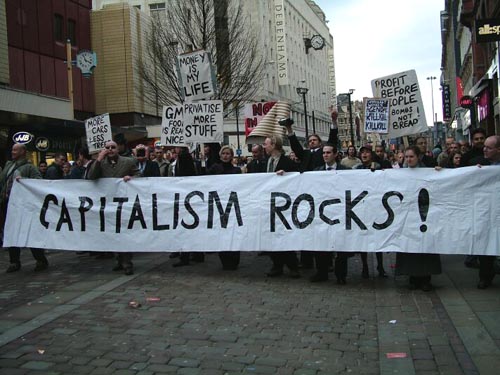
Capitalism knows best? How about creating some jobs. Image from Beyond TV.

Answering economic atrophy:
A public option for jobs

By Greg Moses / The Rag Blog / May 16, 2010

Creative destruction is one way to say it. In order for capitalism to create a job, it must first promise to destroy it. In years when this gruesome formula works out, capitalism creates more jobs than it destroys. Then there are years like these.

Thursday night on the Capitalism Knows Best Channel (CNBC) Larry Kudlow said one thing that made sense. What if we stop wasting time on the blame game and start getting busy with solutions. Not that I’m taking my bets off the short table, mind you, but I’d feel a whole lot less hysterical these days if I thought someone actually knew how to get “the system” to create more jobs than it destroys.

The catastrophe of our economic atrophy since the market top of 2007 was too easily sketched in Thursday’s New York Times by a life-long worker whose skills had finally been displaced by the revolution in desktop computing.

Today’s economy, said the worker, only favors special-needs groups like minorities and veterans and the disabled. I don’t think the worker said a thing about how capitalism really works, except that someone had sold her some worthless training recently, along with one more goddam loan that she can’t pay back.

So where do jobs really come from and where should we really be looking — if not at minorities, veterans, and the disabled?

The worser the world gets the fewer words will be acceptable to boil down the process of job creation, and the less time we’ll have to block the hip shots aimed toward the usual suspects that fascism loves to detain. Imagine blaming the hardest working immigrants on the planet earth for the fact that we have no jobs! Yet, look who the police are coming for in Arizona. I guess if you’re caught standing at the curb looking for a job, it must be your fault you didn’t find one quicker.

“Too complicated for television” is what my news director used to tell me when I’d turn in a tape that played for three minutes and fifty-four seconds. If we don’t get the real jobs story down to 15 seconds or less a lot of innocent people are going to tear each other apart.

Under these emergency circumstances we have two quick choices. There is supply and demand. Or there is labor and need. These are not the same things by a long shot.

The longer that “free market capitalism” — recently valued at $49 trillion dollars globally by the World Federation of Exchanges- — fails to solve the problem of supply and demand the sooner we’re going to have to get serious about a public option where labor meets needs.

In either case it’s a national disaster to have one million people willing to work while the private and public sectors are both paralyzed before them. The wise labor economist Ray Marshall said somewhere recently that a day of unspent labor is a day you never get back. And if you are working all day only looking for work, soon enough you are scarred for life.

An economy of needs can be organized if unmet needs are matched with unused labor. There may be no profit in the deal — no supply or demand — but useless lives can be made useful and the swift transformation can get us all focused on solving some real problems rather than playing blame.

Now here’s what can be done. The world’s most wealthy holders of sovereign debt (yes, the White House knows who they are) can accept a restructured payment plan. The present-day savings of the sovereign debt service can be funneled into emergency public service programs. Did you know there are children on the playgrounds of public schools who have no one to watch them? Out of a million unemployed people, how many could be quickly certified for that?

What? Are there not a million playgrounds? What? Are some workers not suitable for children? How about reshelving books at the city library? How about scooping buckets of oil from the Gulf of Mexico? One million workers paid $30,000 per year each would cost $30 billion, a fraction of the financial bailout called TARP.

Now I want you to stop me when you see “free-market capitalism” hiring away these “public option” workers onto paths of so-called prosperity, but until then, as I say, there is so little time. Soon enough the fascists will be cramming new detention centers full of immigrants and calling it sovereignty or somesuch nonsense as that.

Instead of passively undergoing creative destruction we can demand creative engagement and we can demand it quickly from the people who have the power to deliver it. Meanwhile, decency demands that we stop the nonsense of blaming minorities, veterans, and disabled people for suddenly becoming folks the rest of us have the time to think about, again.

[Greg Moses is editor of the Texas Civil Rights Review and author of Revolution of Conscience: Martin Luther King, Jr. and the Philosophy of Nonviolence. He can be reached at gmosesx@gmail.com.]

The Rag Blog

Posted in Rag Bloggers | Tagged , , , | 3 Comments

Budd Saunders : Barack Obama and the Hog:Corn Ratio

Hog:corn ratio. These handsome creatures were headed to market due to high corn prices. Photo by Mark Steil / Minnesota Public Radio.

No jake brakes:
The Palin shriek, and the hog:corn ratio

By Budd Saunders / The Rag Blog / May 16, 2010

DURHAM, Arkansas — There’s a sign at the Elkins city limits, “NO JAKE BRAKES.” I don’t know how many have heard a semi jake-brake down, but you never forget it. It reminds me of that bubble-headed joke Sarah Palin. She shrieks! If she’s making a point she emphasizes it by shrieking louder. The “Moose Killer” has become The Shriek.

Why the Republican Party, which used to be a well-tended political party, chose this character to carry the banner of conservative ideology is beyond me. She is surely a curse to torture us. And after she used the term “reload,” she tried to explain it away, but it means one thing to anyone familiar with guns.

Having now vented this fine morning which once again finds me alive, I must move on.

President Obama is a bitter disappointment for many of us who are Democrats and probably a few Republicans. Very few. I’ve written before that no one can compromise with Republicans. They believe that bipartisan means to do it their way. And our President Obama is marching resolutely on doing what the Republicans want done. For starters he introduced a comprehensive reform healthcare package. When the Republicans wanted public option taken out, he took it out. They wanted parts about immigrants changed, so he took those out. And so on.

I didn’t know who Geithner was, however I had heard of Bernanke. When Obama appointed Geithner my wife exclaimed loudly “not him!” She was right. Those two characters come straight from Wall Street. When I was an undergraduate in the College of Agriculture I took a course in Economics. I don’t remember much more than what Debits and Credits are. Debits is money I don’t have and credit is something I have too much of. And for whatever reason I remember the Hog:Corn Ratio.

I suppose the Hog:Corn Ratio has changed a lot but surely some family farm operations still manage hogs and raise corn. The theory is based on live hog price per 100 pounds divided by the price of corn per bushel. If corn is selling for a low price, feed the corn to the hogs. If the corn has a high price, sell the corn and the livestock. If it’s above 20 the profit would lead to raising more hogs. If below 20 it works in a reverse ratio. If you believe that is complicated, try the other economic theory I remember, that of John Maynard Keynes or How To Really Screw Things Up. Mr. Keynes had a theory about how to get out of a recession. It’s a beaut.

Keynesian Theory puts the idea forward that the private sector cannot keep our economy stable. According to The Concise Encyclopedia of Economics, “full employment could be maintained only with the help of government spending.” As I understand it, this theory was used to pull us out of what is called The Great Depression and during WW2. That made ours a War Economy, and it has stayed that way until the present. Accordingly the private sector wasn’t investing enough money in the economy during that time so the government — i.e., us taxpayers — had to invest more.

Meanwhile the private sector figured that if government would take over paying for everything, why should they bother to spend their own money. Thus St. Ronald the Reagan and his buddies came up with the idea of “trickle down economics,” in which the government let private industry keep its money, theoretically so that it could afford to hire more people. Didn’t work. Corporate executives would rather give themselves bigger bonuses for getting bigger tax breaks from the government. Daddy Bush rightly called this “Voodoo economics.”

Guided by Geithner and Bernanke, Obama used Keynes as a guide to stimulate the economy by giving stimulus money. AIG, Fannie Mae, and her significant other Freddie Mac, got billions. Keynes would have loved these guys. As I recall my wife and I got a total of $200. It didn’t go very far, but it went into the economy nonetheless. The Cash for Clunkers Program also invested in the economy, bailing out banks and the automobile industry.

Keeping the Keynes Theory leads to another of my disappointments in Obama. He promised peace and received the Nobel Peace Prize. He sent troops to Afghanistan. Did I miss something here? He says he has a plan for leaving Iraq but with casualties mounting, we will probably have to send in more troopies. The governments of Iraq and Afghanistan are waiting with a handful of gimme and a mouthful of much obliged. Republicans are standing by to dictate which part of bipartisan they don’t like. Based on past performances Obama will back off again. My buddy Troll is leaving America to settle in a foreign country. It’s times like this when I wish I could just gather my gear and join him.

Then there’s the oil catastrophe in the Gulf of Mexico. It is so terrible that there are no words to describe it. We are destroying our planet. My wife suggested that the human race are parasites and the Earth is fighting back. Each time I start my car I think about that.

Question authority. It’s the American way.

[Budd Saunders is a Vietnam veteran who lives in Arkansas and writes a regular column for the Durham Dispatch.]

The Rag Blog

Posted in Rag Bloggers | Tagged , , , | 1 Comment

WAR AGAINST THE ENVIRONMENTAL MOVEMENT:

The Bombing of Judi Bari

On the 24 of May, twenty years ago sensationalist headlines across the country announced the arrest of two leading environmentalists, Judi Bari and Darryl Cherney. Their car had been bombed—but it was they who were arrested, charged with their own bombing! The environmental activist movement and Earth First! in particular were branded as terrorist organizations, this incident fell just after the very successful EF! campaign to save the old growth Redwoods, labeled “Redwood Summer” that brought in young people from all over the country—- they sang, they sat down in the roads, and they filled the jails like the old time Wobbly organizers, like Civil Rights activists, like the Peace Movement. It looked like the Timber industry was in for big trouble. But then the car bombing. What followed was an interesting and frightening revelation of political intrigue, collusion between the police, the FBI and the timber companies. In an important interview that appeared on TV (Live from the Heartland) Dennis Cunningham was interviewed by Michael James, at Heartland Cafe, June 6, 2004.

Michael James asks Cunningham about the outcome of the Judi Bari case, and for “background on who she was and what the case was about?”

Dennis Cunningham replies, “Judi Bari was an environmentalist organizer with Earth First!. She and Darryl Cherney, another EF! Organizer, were bombed in their car in Oakland. A pipe bomb was put under the driver’s seat and rigged with a motion device that would ignite on the motion of the car. When the bomb went off the cops came—the FBI came right away—and they told the cops “we know these people, they are terrorist suspects, we’ve been investigating them, and we believe this was their own bomb and they were on their way to plant it someplace—you should bust them.” Oakland cops say “okay boss” and did. They arrested them and charged them with possession and transportation of an illegal explosive device—it made headlines all over the country—-the front page of the New York Times, and everywhere else—it was the top of the news around the country. They were vilified as terrorists by virtue of those headlines and by connecting them to the bomb, which in fact had been used to try to kill them or kill her. Judi Bari was a leading voice and an amazingly skilled, experienced, and persuasive organizer and public speaker—those who planted the bomb were out to shut her up.

Michael James asked Cunningham why he thought Earth First! was the main environmental organization getting headlines at that time, and added he heard that he heard they “had been chaining themselves to trees to trying to stop the cutting of the redwoods.”

Dennis Cunningham replied, “Judi Bari was an environmentalist organizer with Earth First!. She and Darryl Cherney, another EF! Organizer, were bombed in their car in Oakland. A pipe bomb was put under the driver’s seat and rigged with a motion device that would ignite on the motion of the car. When the bomb went off the cops came—the FBI came right away—and they told the cops ‘we know these people, they are terrorist suspects, we’ve been investigating them, and we believe this was their own bomb and they were on their way to plant it someplace—you should bust them.’ Oakland cops say ‘okay boss’ and did. They arrested them and charged them with possession and transportation of an illegal explosive device—it made headlines all over the country—-the front page of the New York Times, and everywhere else—it was the top of the news around the country. They were vilified as terrorists by virtue of those headlines and by connecting them to the bomb, which in fact had been used to try to kill them or kill her. Judi Bari was a leading voice and an amazingly skilled, experienced, and persuasive organizer and public speaker—those who planted the bomb were out to shut her up.”

Michael James asked Cunningham if he thought Earth First! was the main environmental organization getting headlines at that time, and added he heard that he heard they “had been chaining themselves to trees to trying to stop the cutting of the redwoods.”

Cunningham replied, “True, true. They were organizing for a summer project. They called it Redwood Summer. They modeled it after the 1960s Civil Rights Project Mississippi Summer—-they were trying to bring people, students, and activists from all over the country to the redwood region to do direct action in the summer of 1990. They wanted to try to slow down the timber harvest and protect the old-growth redwoods. A big local timber company in Humboldt County had been bought up by corporate raiders with junk bonds; to pay off the junk bonds, they tripled the timber harvest. There was an initiative put on the ballot for November that would have limited the clear cutting and the kind of destructive logging that they do now, which fills up the streams with silt and kills the fish, and kills the fishing industry, and leaves the hillsides unstable and prone to mud slides—disaster. After the bombing, the timber companies hired a Washington public relations firm, Hill and Knowlton to fight the ballot initiative.”

Cunningham replied, True, true. They were organizing for a summer project. They called it Redwood Summer. They modeled it after the 1960s Civil Rights Project Mississippi Summer—-they were trying to bring people, students, and activists from all over the country to the redwood region to do direct action in the summer of 1990. They wanted to try to slow down the timber harvest and protect the old-growth redwoods. A big local timber company in Humboldt County had been bought up by corporate raiders with junk bonds, to pay off the junk bonds, they tripled the timber harvest. There was an initiative put on the ballot for November that would have limited the clear cutting and the kind of destructive logging that they do now, which fills up the streams with silt and kills the fish, and kills the fishing industry, and leaves the hillsides unstable and prone to mud slides—a disaster. After the bombing, the timber companies hired a Washington public relations firm, Hill and Knowlton to fight the ballot initiative.

And then as soon as the bombing had taken place Timber Companies labeled the bill “the bomber initiative”—-terrorists want to pass this thing, it’s too radical. Earth First! shouldn’t be allowed to dictate public policy.” The Initiative ultimately lost by a point and a half. A researcher concluded that there was more than three billion dollars in timber revenues that the companies had been able to realize in the twelve years since the bombing, that they wouldn’t have got if the initiative had passed. So there was a big motivation to shut Judi up, besides that she and EF! were reaching out to the timber workers.

They were trying to make common cause between the environmentalists and the workers, saying, “where you gonna work when the trees are gone?” Timber industry is are clear cutting as fast as they can. In Mendocino County at that time 95% of big trees were already gone, and they closed mills. Judi led an Earth First! contingent and with a group of workers went to a county board meeting right after the big timber company in Mendocino announced it was closing the mills. They got up at the county board meeting and said that the board should take over the mill, preserve the jobs, keep the economy stable. For the timber companies that was pretty much the last straw. But they didn’t want to make a martyr out of her. They hoped to shut her up for good. They thought they did, but she didn’t die in the bombing. It was a miracle she didn’t die. But then they had her accused of the bombing. Within three hours and five minutes of the explosion, they were under arrest.

James asked when Cunningham when he got involved with the case, he replied that “Bill Simpich, a lawyer in San Francisco and Oakland had started a suit against the FBI and the Oakland Police for false arrest, but that after he joined the group of defense attorneys they were able to reverse the charges so, in fact, they were able to accuse the Oakland police and the FBI of arresting Bari and Cherney on purpose in order to discredit them in a COINTELPRO type operation. According to Cunningham COINTELPRO stands for Counter Intelligence Program—a J. Edgar Hoover undercover dirty operation that the cops use and that the FBI used “against the Black Panthers, against the Anti-war movement, against the Communist Party, against who knows…..”

James commented that it was often used against anyone who challenged them. And

Cunningham added, “Yes, everyone who seemed to present a popular threat against the status quo, they did what they could to mess up their work; and they didn’t have any boundaries of legality on what they allowed themselves to do. So there were frame-ups….the murder of Fred Hampton arose out of COINTELPRO operations…

We had a lawsuit that lasted ten years and went to trial in 2002, in trial for about six weeks, and we were waiting for the jury for another three weeks. The jury came back with a 4.4 million total award for the two of them. It was half punitive damages and half what they call compensatory damages. About 80% of the total of the money was assigned to the First Amendment cause—meaning that the claim that it had been done on purpose to mess up their political work was the thing that most appealed to that jury, and they gave the most damages for that. It was going to be appealed, and then we started talking about settling and getting it over with since by then it was twelve years of litigation.

James mentions that Judi never got to see this victory because she had died.

Cunningham added that she had endured incredible suffering, “Judi died in 1997 from breast cancer. She had been horribly injured in the bombing. She was crippled, and she had a lot of pain. She kept right on doing her political work and got deeply involved in the case because she felt it was really important to fight back against the FBI attack on the environmental movement. The FBI were so intent on creating the effect they wanted—-headlines of the arrest of the victims as the perpetrators—that they really didn’t bother to cover their tracks very well….”

The previous interview is and excerpt from a book that is being planned by Charles H. Kerr Publishing Company.

Today it seems everybody is an “environmentalist”—but it doesn’t mean anything except that they want a car with better milage and may have a recycle bin. That’s it, they fill up the world with more and more junk and the oceans with plastic bottles. Even capitalism has adopted “Green” as the new thing since the Financial and Real Estate crash, trying to exploit the minimal interest people have in preserving the planet.

The great tragedy of the Gulf Oil Spill has not yet been felt. The spill is still going on! Why aren’t BP officials being arrested and charged with reckless homicide (people died), why isn’t the company being taken over by the U.S. government (like they would a failed bank), the ocean is being killed, why isn’t the army, the navy, young unemployed kids, too, being mobilized to do some good for a change and stop this thing. Oil, like water and air should belong to the people, it should be used wisely, not wasted.

It is very important for those who can to attend the events in the Bay Area:

On Sunday, May 23, an event dubbed “Revolutionary Ecology” (the title of one of Judi’s best essay collections) will take place at La Pena Cultural Center in Berkeley, with a panel of speakers, music, film and an exciting historical exhibit.

On Monday, May 24, the actual anniversary, people from near and far will gather at the site where a motion-triggered bomb exploded under Judi’s car seat, nearly killing her and forever changing the Earth First! movement. The location is on Park Blvd. in Oakland just south of the MacArthur Freeway.

For Details see www.judibari.org or Earth First!

Penelope Rosemont

Type rest of the post here

Source /

The Rag Blog

Posted in RagBlog | Leave a comment

Jim Rigby : Towards a Radical Christianity

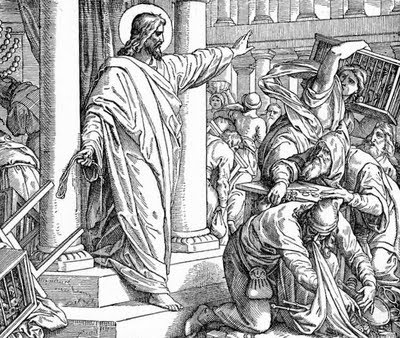
Jesus drives the money changers from the Temple. Image from ETC / University of South Florida.

A Radical Christianity?

I would say any Christian who leaves the fate of the poor to market forces has renounced Christ in every meaningful sense.

By Jim Rigby / The Rag Blog / May 15, 2010

Dr. Jim Rigby, an activist for peace and justice and for gay rights and women’s reproductive rights, is pastor of St. Andrew’s Presbyterian Church in Austin, Texas. He was interviewed by Alex Doherty of the New Left Project about a radical interpretation of Christianity.

Your journey seems to have been one of increasing politicization but without moving away from religion — can you describe that journey for us?

To me, religion is a fancy word for how we build our frame of meaning, and politics is just a fancy word for how we treat each other. As a child I learned an apolitical version of Christianity and was duly offended if a preacher ever brought up social issues in a sermon. Religion, I was taught, was a personal relationship with Jesus. So I could sing “Jesus loves the little children,” but did not feel any need to confront the possibility that my nation might be dropping napalm on them.

Nor did I consider myself political in college or seminary. Of course, I was political, I just didn’t know it because the religious worldview I had been taught was so in line with the dominant culture that my own politics were invisible to me. In my mind, I was just a white Christian male who happened to worship a white male version of Christ.

I wasn’t selling out consciously, but it was in my interest not to notice the power systems that left me in a place of privilege. By viewing religion as politically neutral, I could disguise the unfair advantages that came from being a white Christian heterosexual male, My complicity with various oppressions was unconscious, but I knew enough not to explore other ways of thinking, so, on some level, I knew what I was doing.

When I began to work with survivors of rape I could feel the role my male privilege played in their trauma. Later, that insight grew to include what my heterosexual privilege meant to gay and lesbian persons. Finally, I came to understand that justice has to include the whole human family. I realize that most leftists have a well deserved contempt for religion, but I personally came to hear the gospel as a call to justice for all people, which is how many oppressed people have heard it from the beginning.

In your sermons, you take biblical stories to have metaphorical but not literal truth. What is a metaphorical approach to reading the bible?

If the Bible were literally true we would not need it. We do not need symbols for things on the surface of our experience, but the more deeply we wish to speak of life, the more we need poetry and ritual. Reason does very well at apprehending special affairs like matter, it is not so good at apprehending time. Symbols describe aspects of life that are invisible at any one moment but play out over time.

As I studied the stories of the Bible I realized that they were often Jewish versions of much older stories. They weren’t about actual people. They were poems about life as a human experiences it. The figures in the stories weren’t historical but allegorical representations of experiential lessons.

Science and history are attempts to describe our experiences from the outside in. Art is the attempt to express those same experiences from the inside out. Religion is that intuitive act that balances those two vital concerns. As the word implies, religion is reconnecting the pieces of our experience into a meaningful whole. We never have enough information, so that effort requires faith. We never can get complete control of events, so it requires hope. We are never completely what we strive to be, so it requires forgiveness and love.

You view the gospels as having a radical message — how is it then that the Church has so often sided with forces of oppression?

The church was radical for several centuries but was co-opted by the Roman Empire about the time of Constantine. The reason for this hostile takeover is pretty obvious. It is the same reason corporations buy protest songs and turn them into commercials.

Religion deserves much of the blame it receives for historical monstrosities such as the crusades and inquisitions, but more often, religion falls captive to political bullies who use it for very secular purposes. The war in the Middle East isn’t really about religion at all. It is a fight over land hiding behind the cloak of religion. I doubt very seriously that the primary motive for the Crusades was rescuing the holy lands from Islam. I suspect the booty captured by “pious” European kings was much more to the point.

The role of religion in violence may be closer to the role alcohol plays in domestic abuse as a “dis-inhibitor.” If you blame abuse on the alcohol, you may be missing the real dynamics of bullying. I think Voltaire was right to say those who believe absurdities are much more likely to commit atrocities, but the real question for me, is can there be a religion that honors reason, science, and universal human rights? If we use “religion” as a synonym for supernaturalism, the answer, obviously, is no. But I think it is a conversation worth having.

What does the word “God” mean to you?

There are many religious forms that do not personify experience using a concept of God at all. Non-theist religion has a rich heritage when it isn’t being burned by theists. So a personal God is not necessary, but it can be a helpful symbol for doing elementary metaphysics — which is addressing questions like “what’s it all about?” We cannot really answer the question, but our minds will construct some such frame.

Einstein would often use the word “God” as a shorthand metaphysical device, probably to save time and give a charm to his imagery. He did not believe in a personal God, but he found the symbol useful for talking about everything at once. Our minds need a frame to begin the task of understanding our experience. The universe is a boundless verb, but our minds need the closure of nouns. Hegel said religion is putting philosophy in pictures. That’s an over simplification, of course, but it states a truth I think.

“God” is a human symbol that allows us to speak of everything that is too big, too deep, and too strange for our ordinary understanding. In Hebrew, the divine name of God is YHWH which is a verb form of the word “being.” The other names for God are like facets on that one diamond. The point is not to believe in a being, but to illumine various aspects of being itself.

Your Church took the unusual step of accepting a confirmed atheist — the writer and activist Robert Jensen — as a member of your congregation. Why did you accept him as a part of your Church? How was his acceptance viewed within and outside St. Andrews?

Robert Jensen was an example of someone who had rejected religion for all the right reasons. When I heard his speeches I felt prophetic principles beneath his disdain for religion. He hated religion for the same reason that the prophets hated the religion of their day.

When Dr. Jensen joined our church, people inside our church were delighted, but many outside the church were quite upset. It was a bit strange. I received hate mail from theists and he received hate mail from atheists. We were ordered to take him off the roles by the next higher level of the church but we refused. Bob has been a tremendous addition to our church and has allowed people to feel much freer in rejecting supernaturalism and challenging the dominant religion of our nation which is, of course, capitalism.

What is your opinion of the so-called “New Atheists” — in particular Christopher Hitchens, Sam Harris, and Richard Dawkins?

I have great affinity for atheists like Robert Ingersoll, but some of the people writing bestselling books are like the televangelists of atheism. They completely misunderstand what intelligent religious people are saying. If you assume that the worst of religion represents the rest, then laughing at us is easy. It is easy to refute Pat Robertson, but I’ve yet to hear a convincing argument that the world was poorer because Martin Luther King and Gandhi were religious. Who can’t refute flat earth religion? I’m sure they are good people, but reading their books feels like getting lynched by people who don’t know how to tie a knot.

When I read an atheist like Bertrand Russell I get a very different feeling. His indignation against religion came straight out of his concern for humankind so he knew where to put the scalpel. I also love Monty Python’s attacks on bad religion. The New Atheists feel more like high school bullies making fun of the slow and weak. I agree with most of what they say, but their cruelty toward their frightened and superstitious brothers and sisters is counterproductive. When confronted with ignorance a fool ridicules and a sage teaches.

What is wrong with capitalism from a Christian standpoint?

Theoretically, a Christian could support many types of government, but the core insights of the religion are basically socialist and even, I think, anarchist. Jesus began his ministry by saying “I’ve come to preach good news to the poor, and to announce the acceptable year of God.”

That statement would have been understood as announcing the year of Jubilee, which meant a release of prisoners and a redistribution of the wealth. To pretend Jesus wasn’t political doesn’t make any sense. The Romans wouldn’t have killed him for being a religious leader. Crucifixion was primarily reserved for insurrectionists. The fact that the Romans put “King of the Jews” on his cross was not a religious taunt. It was a threat to any movement of liberation among the people.

Of course, the ancient world didn’t have the word “capitalism” in the modern sense, but they had a word for making money off of interest owed you by your neighbor. It was called “usury” and it was considered a sin. It is a mistake to reduce any religion down to a political position. And it is also wrong to force any religious sectarian viewpoint into the public sphere. But, I would say any Christian who leaves the fate of the poor to market forces has renounced Christ in every meaningful sense.

Much of the religious life consists of ritual. What is the point of religious rituals? What is meant to be achieved by them?

I used to hate rituals. I felt manipulated by them. What I have come to realize is, when they are done voluntarily, rituals can be a way our body comes to understand the symbols in our heads. When birds want to mate they don’t say it with words, they dance. It is written in their bodies. When bees want to tell of far away honey they, too, dance. Our bodies respond to certain movements in a powerful way that rational language cannot touch.

People often think of religious rituals as acts of socialization, but their more important function is to integrate individuals and communities to the circle of life and to help us move through life passages like puberty, marriage, and death. One of the things that makes Americans so easy to frighten is that we do not have rituals that help our bodies understand that death is a part of life and is not to be avoided. Instead of asking people to live without rituals, I believe we should teach the kind of rituals that would help people to recognize the earth as our home, and every human as a part of our family.

Can you recommend some writers on Christianity and religion in general whom you particularly admire.

I was a musician for a while and discovered that those who can talk about music usually can’t make it. Sadly, the same is true for religion. Most theology induces my gagging reflex because religion isn’t supposed to be a special topic of its own. To hear someone talk about religion is like watching someone chew with their mouth open. I would much rather see them absorb the teachings and then demonstrate them in acts of courage and compassion.

Adult religion shouldn’t in the foreground of our lives. It is more the wonder behind our science, the passion behind our art, and the compassion behind our ethics. I love the writings of MLK, Gandhi, and Tolstoy. But I also love an atheist like Carl Sagan who turns science into a hymn. Richard Dawkins has some nice celebrations of nature. Anyone who tunes their instrument to the chord of nature, and becomes a friend of humankind is singing the one hymn written in every human heart.

[This interview was first published May 10, 2010, by the New Left Project.]

Thanks to Robert Jensen / The Rag Blog

Posted in Rag Bloggers | Tagged , , , , , | 2 Comments

Mississippi Politics : Nasal Denial and Oily Delusion

Graphic by Larry Ray / The Rag Blog.

Mississippi Politics:
Getting stinkier by the minute

By Larry Ray / The Rag Blog / May 15, 2010

GULFPORT, Mississippi — Growing up in Texas I was sure politics couldn’t get any stinkier, any dumber, or any more corrupt than ours. Then later in life I moved to Mississippi and soon saw that Texas politics pales in all categories of underachievement and good-old-boy domination when compared to the Magnolia State.

But Mississippi politics is generally endured much like mosquitoes, stifling summer heat, and down here on the Gulf Coast, hurricanes. Katrina wiped most of the edge of the state off the map in 2005. We had just gotten the place more or less back in shape and looking very good again, then April 20th, 2010, 25 days ago, a British Petroleum offshore oil well in 5,000 feet of water suffered a “worst case scenario.” And by now it looks like it is even worse than that.

After a lethal fire, explosion, and sinking of a leased drilling rig that killed 11 workers, oil began gushing into the Gulf of Mexico uncontrollably from a mile below. For almost a month now, millions of gallons of crude oil continue to escape, out of control. The entire world has been following news reports on British Petroleum’s failed attempts to stop the flow and to deal with a catastrophe that worsens daily.

Winds and currents have kept the spill off Mississippi shores so far, but the petroleum odor from hundreds of square miles of floating oil some 40 miles offshore has been noticeable here in communities all along the coast.

About a week and a half ago the moment I stepped outside with the dogs to take a morning walk a heavy, oily, almost diesel-like smell filled the air. A steady south wind was blowing. As we got to the park, folks were stopping to ask one another if they “could smell that.” We all could.

And the vagaries of wind and air currents have brought the petroleum smell back several more times. Folks have been calling city officials and health departments. There have been several mentions of the oily smell up and down the coast by local news media. Folks with severe asthma were told to check with the doctor if it really got bad. But it was not a really big deal.

Then day before yesterday one of our esteemed politicos, Lt. Governor Phil Bryant, had his photo on the front page of the morning paper with the headline, “Bryant Doesn’t Smell The Oil.” The Sun Herald’s article reported that, “Lt. Gov. Phil Bryant’s response to people in South Mississippi who’ve said they can smell oil from the Deepwater Horizon spill in the Gulf is, ‘No, you can’t.’

“Speaking at Wednesday’s Coastal Development Strategies Conference, Bryant said the smell may be coming from their lawn mowers. ‘That is not gasoline coming out of the Gulf,’ he said.”

Bryant, who back slapped his way to hosting the National Association of Lieutenant Governors in July in Biloxi went on about the BP disaster noting it is “not the Exxon Valdez.” Phil was as oily and about as crude as his odorless oil out there declaring there is nothing to worry about, “Y’all come on down here, you hear!”

Bryant’s imperial pronouncement that no one was smelling anything except lawnmower fumes followed the blithe May 1 pronouncement from Mississippi U.S. Rep. Gene Taylor, after a quick fly-over of the gathering spill that, “It’s not as bad as I thought. It’s breaking up naturally; that’s a good thing. The fact that it’s a long way from the Mississippi Gulf Coast, that’s a great thing, because it gives it time to break up naturally.”

Taylor, a supposed Democrat, whose voting record would make Senator Mitch McConnell proud, was already fast becoming very unpopular for his dullness and increasingly regular trips to the all you can eat lobbyist campaign contribution buffet. His remarks exhibiting no real concern for the potential offshore threat elicited an outraged reaction from folks up and down the coast. Taylor’s political future seems to breaking up naturally as well.

It is completely understandable that area chambers of commerce, businesses, and our tourism and seafood industries want to get out the word that our beaches are still clean, seafood is fresh, and that we are open for business. We might well dodge the worst of the damage along with Alabama and Florida. But selling that idea as the oil spill grows, heaves and moves at the whim of sea currents and surface winds is tough to pull off.

Having political buffoons telling the world that folks here aren’t smelling anything but lawnmower fumes, and that the oil is “breaking up naturally” only serves to rob any planned promotional campaign of any credibility it may have.

And I haven’t even mentioned our Governor, Haley Barbour, who made the national news recently after he declared, dewlaps swinging, “When you’re a fat redneck like me and got an accent like mine you can say, ‘well they’re gonna hold me to a higher standard.'”

Higher than what, Governor? The next high tide?

[Retired journalist Larry Ray is a Texas native and former Austin television news anchor. He also posts at The iHandbill.]

The Rag Blog

Posted in Rag Bloggers | Tagged , , , , | Leave a comment

Prohibition II : A Trillion Dollars Down the Drain

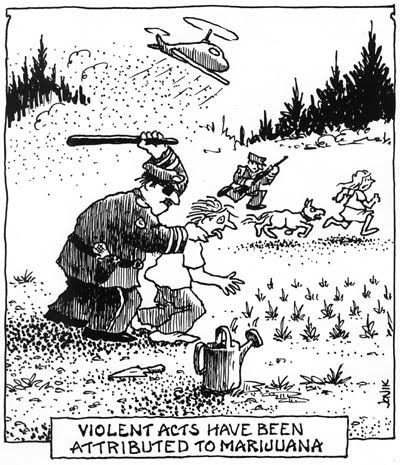
Cartoon from WeedPolitik.

40 Years of War on Drugs:
A trillion bucks and things are worse

By Ted McLaughlin / The Rag Blog / May 14, 2010

Back in 1970, President Richard Nixon was having a lot of trouble trying to get something (anything!) accomplished in Vietnam. So he decided to wage a war that he thought he could win, and most of the American populace would support — a war on drugs. He signed the Comprehensive Drug Abuse Prevention and Control Act. He said, “Public enemy no. 1 in the United States is drug abuse. In order to fight and defeat this enemy, it is necessary to wage a new, all-out offensive.”

Nixon budgeted $100 million, and the “war on drugs” was off and running. Unfortunately, this new “war on drugs” was as flawed and ill-conceived as his plan to burglarize the Watergate Building. President after president took up the same war, and each one upped the amount of money sunk into the program. Now it is 40 years later, and the only thing that has been accomplished is the spending of over a trillion dollars on this exercise in futility. That money has not slowed down the import of drugs into this country or the use of the illegal drugs.

The current United States Drug Czar, Gil Kerlikowske, admits as much. He says, “In the grand scheme, it has not been successful. Forty years later, the concern about drugs and drug problems is, if anything, magnified, intensified.”

His predecessor, John P. Walters, is more hard-headed. He claims, “To say that all the things that have been done in the war on drugs haven’t made any difference is ridiculous. It destroys everything we’ve done. It’s saying all the people involved in law enforcement, treatment and prevention have been wasting their time. It’s saying all these people’s work is misguided.”

Well, yes. That’s exactly what the last 40 years of the “war on drugs” has shown. Much of the work is misguided — especially the money spent on interdiction, arrest, incarceration, and forced drug programs. This approach simply does not work. How many more years and how much more money must we waste before we realize that?

It is said that those who do not learn from history are doomed to repeat that history, and that is obviously true with prohibition. We should have learned from the first time it was tried in this country in the 1920s, when alcohol was outlawed. That did not prevent the use of alcohol. Anyone who really wanted it could still get it. All it did was create a huge black market that made underworld gangs rich and much more powerful. It also increased the violence of these underworld gangs as they struggled to control that black market, and many times that violence spilled over to affect innocent people.

Our second attempt at prohibition, the “war on drugs,” has done exactly the same thing. It has not stopped or decreased drug use. Anyone who really wants to use drugs can easily get them. It has also enriched underworld gangs (we now call them “drug cartels”) and made them very powerful. And it has increased the violence connected with those gangs, with much of that violence spilling over to affect innocent people. And it is all caused by the “war on drugs.”

We had the chance to learn the horrors of prohibition the first time we tried it, but we didn’t. And our failure to learn from past mistakes has been devastating both financially and socially. It does not matter whether the prohibited drug is alcohol, marijuana, or some other drug, the effect of the prohibition is the same.

There were those opposed to legalizing alcohol again. They said it would be terrible for the country, because alcohol use would rise sharply. They were wrong. Education programs alerted people to the effects of alcohol overuse and abuse, and treatment programs did wonders for those who wanted treatment for that abuse. Meanwhile, millions continued to use alcohol recreationally, just as they had under prohibition, without ill effects.

It is just a regrettable fact of life that some will abuse any recreational substance. However, that can be controlled by education and treatment programs. In a free country, we should not punish the millions who use the substances in a controlled and recreational way. And we certainly shouldn’t criminalize those hard-working and decent people (especially those who use harmless substances like marijuana). Legalizing drugs will not destroy our society any more than legalizing alcohol did. Those who want them will get them (just as they do now) and those who don’t won’t.

Instead of spending another trillion dollars trying to stop drug use and failing (while the drug cartels get richer and more violent), wouldn’t it make more sense to legalize drugs and then tax the hell out of them? Let those drugs pay not only for treatment programs and education, but also for many other government functions. It would not only mean less taxes of other kinds, but it would also create many legal jobs and income opportunities. Doesn’t that make sense for a country in the middle of a recession?

Sadly, President Obama is following in the failed footsteps of his predecessors. He has budgeted $15.5 billion just for this year’s “war on drugs” — with $10 billion going to the futile interdiction and law enforcement efforts (and that doesn’t count the billions that will be spent for the incarceration of nonviolent drug users in state facilities). This is just throwing good money after bad into a bottomless pit, and it will accomplish nothing — just like the last 40 years. Frankly, that money could be better spent on food, housing, and health care for needy Americans.

It is time for America to admit that the “war on drugs” has failed. Continuing this program will only result in more failure. The only thing that makes sense is to change our policy and recognize that drug abuse is a medical problem — not a criminal problem. Any money spent on drugs should go into education and treatment programs. And our law enforcement agencies should turn their attention to controlling real crimes — like those committed by violent criminals who attack innocent persons and their property. Meanwhile, recreational substance use should be legalized and taxed. A sensible policy like this will not harm our nation — it will save it.

By using the Freedom of Information laws, the Associated Press has learned how some of our first trillion dollars in the failed “war on drugs” was spent. Here are the figures:

  • $20 billion to fight the drug gangs in their home countries. In Colombia, for example, the United States spent more than $6 billion, while coca cultivation increased and trafficking moved to Mexico — and the violence along with it.
  • $33 billion in marketing “Just Say No”-style messages to America’s youth and other prevention programs. High school students report the same rates of illegal drug use as they did in 1970, and the Centers for Disease Control and Prevention says drug overdoses have “risen steadily” since the early 1970s to more than 20,000 last year.
  • $49 billion for law enforcement along America’s borders to cut off the flow of illegal drugs. This year, 25 million Americans will snort, swallow, inject and smoke illicit drugs, about 10 million more than in 1970, with the bulk of those drugs imported from Mexico.
  • $121 billion to arrest more than 37 million nonviolent drug offenders, about 10 million of them for possession of marijuana. Studies show that jail time tends to increase drug abuse.
  • $450 billion to lock those people up in federal prisons alone. Last year, half of all federal prisoners in the U.S. were serving sentences for drug offenses.
  • At the same time, drug abuse is costing the nation in other ways. The Justice Department estimates the consequences of drug abuse — “an overburdened justice system, a strained health care system, lost productivity, and environmental destruction” — cost the United States $215 billion a year.

[Rag Blog contributor Ted McLaughlin also posts at jobsanger.]

The Rag Blog

Posted in RagBlog | Tagged , , , , , | 2 Comments

Tom Miller : On Reading Cervantes Aloud in Madrid

Cartoon by Juan Carlos Pedreira Fernández / Galería Cubarte.

‘En un lugar de la Mancha…’
On reading Cervantes aloud in Madrid

By Tom Miller / The Rag Blog / May 14, 2010

All together now: “En un lugar de la Mancha, de cuyo nombre no quiero acordarme, no ha mucho tiempo que vivía un hidalgo de los de lanza en astillero, adarga antigua, rocín flaco y galgo corredor.”

If you don’t recognize those 33 words, go to the back of the class. The rest of you can identify the opening line from Don Quixote de la Mancha, the world’s best-loved and most translated novel. Since its initial publication in the early 17th century (in two parts; 1605 and 1615) the Quixote has been considered the first modern novel and its author Miguel de Cervantes has come to symbolize the Spanish language. If you grew up in a Spanish-speaking country you likely can recite those words in your sleep.

Ground zero for Cervantes, of course, is Madrid, where he lived off and on, and died April 23, 1616. William Shakespeare, who symbolized another language, died April 23, 1616 as well. In those days Spain followed one calendar while England used another, so although Miguel de Cervantes’ and William Shakespeare died the same date, they did not die the same day. (Or, as I explain to friends in Tucson, one followed the calendar from El Charro, and the other, from Mi Nidito.)

April 23 has evolved into El Día del Libro in Spain, a very literary day on which the King awards the annual Cervantes Prize for outstanding work in the Spanish language, and kiosks and big displays of books line the streets of Madrid, Barcelona, and elsewhere. (In Barcelona, it’s also Sant Jordi day, which, in addition to celebrating books, includes giving a rose to a lover or someone you’d like to be a lover. Books and lovers; I ask you, could there be a more fertile combination?)

Madrid’s main activity takes place in the Circulo be Bellas Artes (CBA), a huge building on a broad mid-town boulevard with galleries, rooms for workshops, theater, meetings, and exhibits, as well as a nicely stocked bookstore named for the poet Antonio Machado. And it’s here every year that the Lectura Continuada, the marathon reading, of the thousand-page Don Quixote takes place.

The first reader, always, is the winner of the Cervantes Prize, in this case, the Mexican poet José Emilio Pacheco. He’s followed by politicos, actors, high-ranking cultural bureaucrats, and the like. Each reader gets a paragraph or two at most. The CBA has a high-tech approach to the Quixote, and arranged for teleconferencing from readers in cities throughout Africa, the Americas, and Asia. And, it was web-streamed, so from whatever distance, if you cranked up your computer during the marathon, you could have heard more than a thousand readers, including… me.

A month earlier I made an international call to the phone number listed on the CBA web site, but the nine-hour time difference made that window of opportunity difficult to jump through. So shortly after I arrived in Spain I went to the CBA building and found the registration table. “When would like to read?” a woman asked ingenuously. “We have a lot of openings at this point.” I chose 6 p.m. the first day simply out of convenience. Because of the ebb and flow, you never knew your precise passage until 30 seconds before you read. For those of us for whom os and vuestra are not part of our normal Spanish, this could be a bit intimidating.

Except for the stage, the main room was always dark so the whole process could be video’d. A big screen showed clips from the many film versions of Don Quixote. Great stuff! And you deaf readers, imagine Don Quixote in sign language! These signers were as much actors as translators, taking on the roles of el Quixote and Sancho Panza and the whole cast of characters. To add to the literary carnival a few excerpts were acted out by local theater groups.

The process ran smoothly. Like every other reader, I checked in at a table outside the main room at my appointed time and got a ticket. I was then directed to a line on the side of the auditorium, where, when I reached the front, someone verified my name with a list. While the person three ahead of me was reading out loud from the podium, the fellow two ahead of me was sitting with the ringmistress, as I called her, following the passage on stage so he’d know where his own segment began, while the chica directly in front of me was at the front table on stage signing paperwork.

At one point I got the nod and proceeded to the front table where I signed my name and gave my employment (“¿A que te dedicas?” the fellow whispered.) A minute later I moved up to the second-to-top rung, sitting next to the ringmistress following along with the reader before me.

The previous weekend I spent in Argamasilla de Alba, a small village in La Mancha that Cervantes was known to have visited and said to have been imprisoned in for a spell. Unbeknownst to me A de A was having its own Lectura Continuada, and the cervantistas invited me to take part. The town was so small they only had enough people to read the novel’s first part, and for that students from local public schools took turns. Unlike in Madrid, these people could show me my section ahead of time. I found it in the English translation always by my side, and eventually was called to the stage which really wasn’t a stage, more like a table covered by a big cloth in the front of a big room.

I said, “Para mostrar el alcance internacional de Cervantes y el Quixote, voy a leer mi fragmento en otro idioma.” (One should never be too far from one’s own copy of el Quixote.) And with that, I read the occasionally testy conversation in Part One, chapter twelve, between Don Quixote the shepherd Pedro about the late student — shepherd Grisótomo.

The ringmistress in Madrid nodded me over to the chair next to hers as the previous participant stood at the lectern. We followed the passage being read on a large-type edition — the exact same edition on the lectern. After just a few sentences from the reader right before me, the ringmistress said “Gracias,” and motioned me up. Her “Gracias” was sort of like the hook of an exceptionally bad performance, except in this case it was simply used to hurry the reading along. Move along little dogies.

I was temporarily disoriented and the ringmistress had to walk over to point out where I should start. The sign language translator, with whom I’d been chatting in the lobby, gave me a supportive smile. We were in Part One, chapter 21, when the good don and Sancho are having one of their near-quarrels. In all I read 77 words. As I left the stage there was the obligatory smattering of applause that followed every reader.

Afterward I stood by myself in the back listening to the readers who followed me. One of them, a South American, came up, and in a low voice, said: “Your accent. Are you from Germany?”

[Tom Miller’s most recent book is Revenge of the Saguaro: Offbeat Travels Through America’s Southwest. He is working on Don Quixote’s Trail — Through the Wilds and Windmills of the World’s Best Loved Novel. His web site is www.tommillerbooks.com.]

Also see:

The Rag Blog

Posted in Rag Bloggers | Tagged , , , , , , , | Leave a comment

Dick J. Reavis : The Genealogy of Bill White

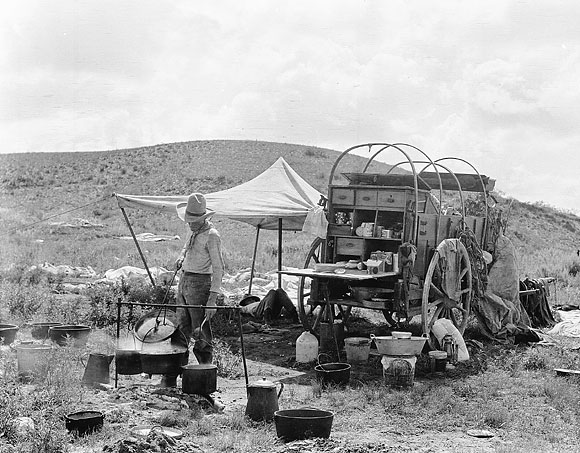
A Bill White ancestor making his way to Texas? Photo by Texas cowboy photographer Erwin E. Smith.

¿Quién es más Texan?
Genealogy, politics, and Bill White

By Dick J. Reavis / The Rag Blog / May 14, 2010

Democratic candidate Bill White’s great, great, great, great grandparents came to Texas in 1850. That’s the upshot of the headline — or propaganda — in a four-page, slick advertising insert that fell out of my copy of the Amarillo News-Globe on Thursday.

I’m no genealogist, and it took me awhile to deconstruct all of that.

White’s advertising supplement is probably an attempt to persuade voters that he’s at least as Texan as Ricky Perry, the descendant of at least one Texan who served in the Confederate Army.

But White’s claim, or attempt, is risible on at least one level. If my calculations are correct, White’s family tree includes 32 great, great, great, great grandparents. If two of them came to Texas in 1850, what about the other 30? His roots circular may be an appeal from genealogy, but it presents a very edited genealogy. Maybe the rest of his ancestors were Red Russians?

The insert will in any case be viewed in some quarters as an oddity. We’ve seen nothing like it in national politics: did John Kerry advertise that he’s the many, many great grandson of Mayflower passengers? Does Barack Obama claim descent from Kenyan royalty? White, in authorizing the insert, is, if nothing else, guilty of what the “cosmopolitans” call “provincialism.”

If genealogists dig into the facts that underlie the White bulletin, they may be able to determine whether he — or Perry’s — ancestors owned slaves, because that might be of interest to African-American voters. But I doubt that it will become an issue, because not many people in Texas believe that the regional, national, or class origins of anyone’s great, great, great, great, great grandparents are important today.

The real point of the roots circular is revealed by the text and sepia-toned photos of its interior pages. White may be a Houston urbanite — everybody knows that — but his ancestry, according to the insert’s interior photos and captions, includes Texans who lived in Corsicana, Jones, and Caldwell counties, Corpus Christi, Sinton, and San Antonio. Counting back the generations lets him establish a statewide, even rural and small-town identity.

Rick Perry does something like that by proclaiming that he was born in the hamlet of Paint Creek, which according to the Handbook of Texas, “In the late 1980s … had [a] school, two churches, several houses, a football field, and a covered barn in which the school buses were parked.”

Winning the support of rural voters is still helpful, it seems, in gubernatorial races and maybe in other Texas political contest. But it is not necessarily important to the journalists who cover those races, or at least that’s what owners and editors of Texas newspapers and magazines, most of which are headed by non-Texans, seem to believe.

No gubernatorial candidate has presented himself as qualified for office because he is a native of New York and a graduate of Ivy League writing programs or political science academies, apparently because such standards are only relevant to politics. Journalism, on the other hand, is a technical or scientific skill in which the successful practitioner may hail from any regional or national background, and needs no rapport with voters.

Perhaps I am alone, but I see a problem in the lack of an analogy there. Those people whom we refer to as “the voters” are in the journalistic world known as “the readers,” the people who, at least in theory, ultimately determine whether a publication lives or dies.

And if politicians have a less respectable job, spouting words, oozing empathy, winning hearts and minds, and assailing local corruption — well, of course, journalists have nothing to do with an undertaking like that!

[A native Texan, Dick J. Reavis is an award-winning journalist, educator, and author who teaches journalism at North Carolina State University. He is a former staffer at the Moore County News, The Texas Observer, Texas Monthly, the San Antonio Light, the Dallas Observer, Texas Parks & Wildlife Magazine, the Fort Worth Star-Telegram and the San Antonio Express-News. He also wrote for The Rag in Austin in the Sixties. His latest book is Catching Out: The Secret World of Day Laborers.]

The Rag Blog

Posted in Rag Bloggers | Tagged , , , , , | Leave a comment

Jena, Louisiana : Drug Bust or Racist Revenge?

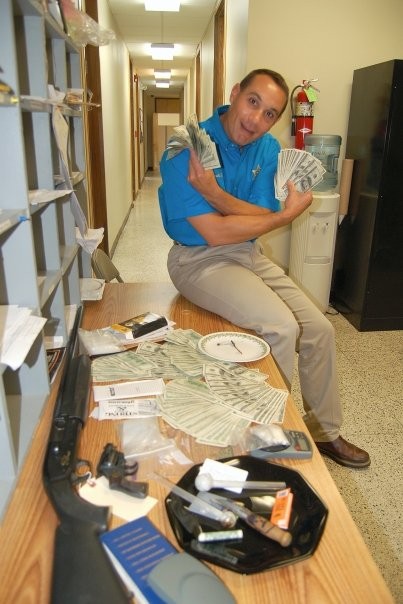
Sheriff Scott Franklin, shown reveling in loot obtained during a controversial drug raid last summer in Jena, Louisiana. Photo special to The Rag Blog.

Revenge for civil rights protests?
‘Operation Third Option’ in Jena

By Jordan Flaherty / The Rag Blog / May 14, 2010

Award-winning journalist and author Jordan Flaherty will be Thorne Dreyer’s guest on Rag Radio, Tuesday, May 18, 2-3 p.m. (CST) on KOOP 91.7 FM in Austin. For those outside the listening area, go here to stream the show.

They will discuss Flaherty’s post-Katrina writings, his reporting about the Jena Six incidents and their aftermath, and about harassment of minorities, transgenders, sex workers, and others in New Orleans and in Louisiana — and about the positive community organizing that has occurred in response to this harassment.

At 4 a.m. on July 9 of last year, more than 150 officers from 10 different agencies gathered in a large barn just outside Jena, Louisiana. The day was the culmination of an investigation that Sheriff Scott Franklin said had been going on for nearly two years. Local media was invited, and a video of the Sheriff speaking to the rowdy gathering would later appear online.

The Sheriff called the mobilization “Operation Third Option,” and he said it was about fighting drugs. However, community members say that Sheriff Franklin’s actions are part of an orchestrated revenge for the local civil rights protests that won freedom for six Black high school students — known internationally as the Jena Six — who had been charged with attempted murder for a school fight.

One thing is clear: the Sheriff spent massive resources; yet officers seized no contraband. Together with District Attorney Reed Walters, Sheriff Franklin has said he is seeking maximum penalties for people charged with small-time offenses. Further, in a parish that is 85 percent white, his actions have almost exclusively targeted African Americans.

Sheriff Scott Franklin of Jena says he is trying to rid his community of drugs. Critics say he is pursuing revenge against the town’s Black community.

Downtown Baghdad

According to a report from Alexandria’s Town Talk newspaper, LaSalle Parish Sheriff Scott Franklin prepared the assembled crowd for a violent day. “This is serious business what we’re fixing to do,” said Sheriff Franklin. “If you think this is a training exercise or if you think these are good old boys from redneck country and we’re just going to good-old-boy them into handcuffs, you’re wrong. These people have nothing to lose. And they know the stakes are high.”

“It’s going to be like Baghdad out in this community at 5 a.m.,” he continued dramatically, explaining that their target was 37-year-old Darren DeWayne Brown, who owns a barbershop — one of the only Black-owned businesses in town — and his “lieutenants,” who Franklin said supplied 80 percent of the narcotics for three parishes. “Let me put it to you this way,” declared the Sheriff, “When the man says, ‘We don’t sell dope today,’ dope won’t get sold.”

Sheriff Franklin said that option one is for drug dealers and users to quit, option two is to move, and option three is to spend the rest of their lives in prison. And this day was all about option three. “They will get put in handcuffs, put behind bars today and never see the light of day again unless they are going out on the playground in prison,” he boasted.

At the end of the day, a dozen people were arrested on charges that ranged from contempt of court to distribution of marijuana, hydrocodone, or cocaine. Despite catching the accused residents by surprise with early morning raids, in which doors were battered down by SWAT teams while a helicopter hovered overhead and then search teams were brought in to take houses and businesses apart, no drugs or other physical evidence was retrieved.

All evidence in the cases comes from the testimony of 23-year-old Evan Brown of Jena, who also wore a hidden camera during the investigation that parish officials have said provides powerful visual evidence. “We’re completely satisfied with the results,” said LaSalle Sheriff’s Department Narcotic Chief Robert Terral, who refused further comment on the operation.

Lasalle Parish is a politically conservative enclave located in northwest Louisiana. Former Klansman David Duke received a solid majority of local votes when he ran for governor in 1991 — in fact, he received a higher percentage of votes in LaSalle Parish than in any other part of the state.

The Parish became famous in 2007 for the case of the Jena Six. In demonstrations that were called the birth of a 21st Century civil rights movement, an estimated 50,000 people marched in Jena. They were protesting a pattern of systemic racism and discriminatory prosecutions. All six youths, who once faced life in prison, are now either enrolled in college or are on their way.

The Sheriff told the Jena Times that he began preparing for Operation Third Option in November of 2007, less than two months after the historic protests.

Caseptla Bailey (left) and Catrina Wallace were active in the campaign to support the Jena 6. Their door was broken down by police while they slept. Photo by Jordan Flaherty / The Rag Blog.

A terrifying morning

Catrina Wallace, 29, was sleeping in her bed with her youngest child when her door was broken down and she awoke to the feeling of a gun to her head. When she opened her eyes, her small home was filled with police. “I never seen that many police at one time,” she recalled. “Everywhere I looked all I saw was police. There were six or seven just in my bedroom.” She says police pointed guns at her small children and wouldn’t let her comfort them.

Catrina Wallace is the sister of Robert Bailey, one of the Jena Six. Along with her mother, Caseptla Bailey, she was one of the leaders of the campaign to free the accused youths, and she organized meetings and protests for months. Wallace says her political activism made her a target. “I’m a freedom fighter,” she says. “I fight for peoples’ rights. I’ve never been in trouble.”

As with every other house raided that day, the police found no drugs in Wallace’s home. According to Wallace, police initially claimed they found marijuana on her kitchen table, but later discovered that they had collected broccoli stems, left over from dinner the previous night.

Despite the lack of evidence, and the fact that she has lived her whole life in Jena and is raising three small children, she was held for a $150,000 cash-only bond. Her car, a 1999 Mitsubishi Gallant, was also seized by police, who continue to hold it in an impound lot. If she wants it back, Catrina will have to pay $12 a day to the lot for every day since it was seized, in July of last year — an amount already larger than the value of the car.

Tasered and traumatized

Samuel Howard was sleeping in his bed, naked, when police broke down his door at 5 a.m. Howard says police tasered him three times, twice in the back and once in his arm, and pointed guns at his three kids. They took him out of his house still naked, and brought him to a baseball field, along with the other arrestees from that day. There he says he spent another hour without any clothes, standing with the other arrestees, until police brought him an orange jailhouse jumper.

“They treated us like we was hard core killers,” says Howard, who says that in a small town like Jena where everyone knows each other, such violent tactics are uncalled for. “The sheriff knows me,” he says. “We went to school together. He knows I’m not a violent person.”

Howard is being charged with three counts of distribution of cocaine. His trial is scheduled for May 24 (Catrina Wallace’s is scheduled for the same week). As with the other defendants, the only evidence against him is the testimony and video from the police informant. Howard, who has seen the evidence, says he is not implicated in the video.

His home was badly burned up that day, apparently from flares that police fired inside, and his windows were all destroyed. Howard, who does some auto repair work, says his four vehicles — including two older cars that don’t run — were also seized by police.

Racially motivated

Many of Jena’s Black residents say that the town’s white power structure — including the DA, Sheriff, and the editor of the local paper — wants revenge against Black people in town who stood up and fought against unjust charges. They complain that in a town that is mostly white, all but two of the people arrested were Black, and the only arrestees pictured in the town’s paper were Black. The sheriff “Just wants to humiliate people,” says Caseptla Bailey, Wallace’s mother, “Especially the African Americans.” The editor and publisher of the Jena Times, the town’s only paper, is Sammy Franklin, who has owned the paper since 1968. His son is Sheriff Scott Franklin.

A white-owned store around the corner from the courthouse in downtown Jena sells t-shirts commemorating Operation Third Option, with a design of a person behind bars. Black residents of Jena say that an earlier version of the shirt featured a monkey behind bars. They say that white residents of Jena have gloated about the arrests.

Four of those arrested on that day have pled guilty. Chelsea Brown, who was arrested for contempt of court, received a sentence of 25 days. Devin Lofton, who pled guilty to conspiracy to distribute, received 10 years. Adrian Richardson, 34, who pled guilty on April 23 to two counts of distribution, received 25 years. Termaine Lee, a 22-year-old who had no previous record but faced six counts of distribution, received 20 years.

Some of the accused have hired attorneys, while others have had public defenders appointed. However, all involved say they doubt they can receive a fair trial in LaSalle. They say that white defendants with similar or worse charges received lower bonds, and face lesser sentences. “It’s crooked,” says Howard. “They ain’t playing fair down here, that’s all.”

Marcus Jones, father of Mychal Bell, one of the Jena Six youths, doesn’t mince words. “This is racially motivated,” he says. “It’s revenge.” He says that the problem is that while the Jena Six youths were freed, there were no consequences for the Sheriff or DA. “Wouldn’t none of this be going on if justice had been done the way it was supposed to have been,” he says.

Jones was not among those arrested, but in a small town like Jena, he knows everyone involved. He says he was shocked at the resources the police brought in. “Why did you need helicopters and military weapons?” he asks. “I could see it if you were going to arrest Noriega or the Mafia, but these are people with kids in their homes. The Sheriff’s department never had any violent run-ins with any of these people.”

Jones believes the entire campaign by Sheriff Franklin has been a gesture of asserting control over the Black community, and he calls for a federal investigation of the Sheriff’s department and DA.

Samuel Howard says that now he mostly stays home with his three kids, ages 12, 14, and 15. He’s afraid of the Sheriff’s office arresting him if he leaves the house, and he wants to stay close to his kids, who were traumatized by his arrest. “It scared them to death,” he says. “They still talk about it to this day.”

“They know they’re wrong,” said Howard, referring to the Sheriff and DA, “You can’t tell me they don’t know.”

[Jordan Flaherty is a journalist, an editor of Left Turn Magazine, and a staffer with the Louisiana Justice Institute. He was the first writer to bring the story of the Jena Six to a national audience and audiences around the world have seen the television reports he’s produced for Al-Jazeera, TeleSur, GritTV, and Democracy Now. Haymarket Press will release his new book, FLOODLINES: Stories of Community and Resistance from Katrina to the Jena Six, this summer. He can be reached at neworleans@leftturn.org.]

Marcus Jones, Catrina Wallace, and others in Jena are available for interviews.
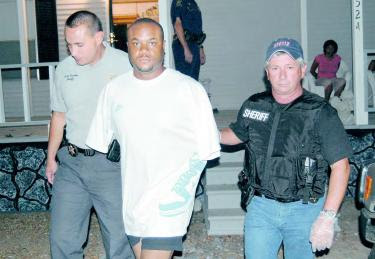

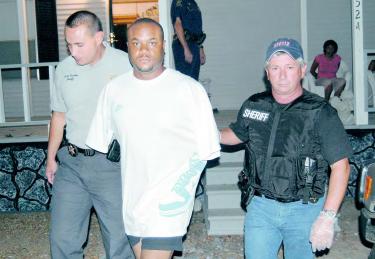
Representatives of the Jena, Louisiana, Sheriff’s Department arrest an unidentified suspect during drug raids July 9, 2009. Photo from the Jena Times.

A member of a white supremacist group marches in Jena, Louisiana, January 22, 2008. Photo by Jessica Rinaldi /Reuters.
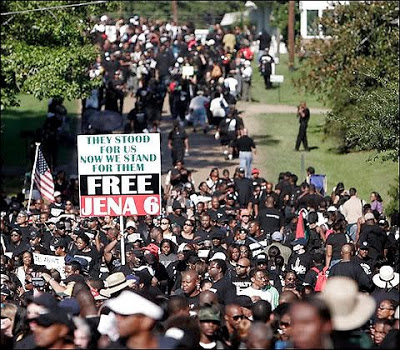
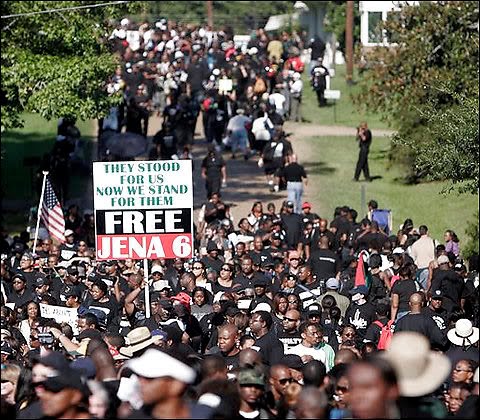
Demonstrators march in support of the Jena Six, September 20, 2007. Photo from The Cheddar Box.

The Rag Blog

Posted in Rag Bloggers | Tagged , , , , , , , , , , , | 8 Comments

Austin writer and activist Hamilton discusses the intrigues and idiosyncrasies of getting around in France. And he sees much to like in the French way of handling travel and transportation, though some of it is sure to confound the tourist. As a self-proclaimed Francophile, he likes the road system and approach to driving, as well as the creative use of alternatives to the automobile — like fast trains, public bicycle installations, and, hey, just plain walking.

Posted in RagBlog | Leave a comment

Amy Goodman : In Praise of Lena Horne

Singer, actress, and civil rights activist Lena Horne died this week at 92. Photo by Cinetext / Sportsphoto Ltd / Allstar.

She fought segregation, McCarthyism:
Singing Lena Horne’s praises

By Amy Goodman / May 13, 2010

‘Mississippi wanted its movies without me. It was an accepted fact that any scene I did was going to be cut when the movie played the South.’ — Lena Horne

Lena Horne died this week at the age of 92. More than just a brilliant singer and actress, she was a pioneering civil rights activist, breaking racial barriers for generations of African-Americans who have followed her. She fought segregation and McCarthyism, was blacklisted, yet persisted to gain worldwide fame and success. Her grandmother signed her up as the youngest member of the NAACP as a 14-month-old.

Hers is the story of the 20th century, of the slow march to racial equality, and of remarkable perseverance.

Horne’s career began in Harlem’s renowned Cotton Club, where African-Americans performed for an exclusively white audience. She joined several orchestras, including one of the first integrated bands, and then landed the first meaningful, long-term contract for an African-American actor with a major Hollywood film studio, MGM. Her contract included provisions that she would not be cast in the stereotypical role of a maid. She was never given full acting roles, though, only stand-alone singing scenes.

“I looked good and I stood up against a wall and sang and sang. But I had no relationship with anybody else,” she told The New York Times in 1957. “Mississippi wanted its movies without me. It was an accepted fact that any scene I did was going to be cut when the movie played the South.”

During the World War II years, she toured with the USO, entertaining troops. At Camp Joseph T. Robinson in Arkansas, she learned she would be performing for a segregated whites-only audience. Afterward, she gave an impromptu performance for the African-American troops and was again angered when German POWs imprisoned at the base were allowed to crowd into the mess hall. She insisted they be thrown out.

Horne, in a 1966 Pacifica Radio interview, recalled a watershed moment in Cincinnati. She was touring with a band, and on the night of the boxing match between Joe Louis and Max Schmeling of Nazi Germany, Horne, who didn’t care for boxing, found herself backstage with the band members, around the radio, rooting for Louis:

I said, ‘He’s mine.’ And I didn’t want him to be beaten. ‘He’s ours.’ I think that’s the first I remember ever identifying with another Negro in that way before. I was identifying with the symbol that we had, of a powerful man, an impregnable fortress. And I didn’t realize that we drew strength from these symbols.

Paul Robeson, the great African-American singer and activist, had a profound influence on Lena Horne. In the Pacifica interview, she recalled,

Paul taught me about being proud because I was Negro… he sat down for hours, and he told me about Negro people… And he didn’t talk to me as a symbol of a pretty Negro chick singing in a club. He talked to me about my heritage. And that’s why I always loved him.

The association with Robeson, a proud, outspoken activist, contributed to Horne’s blacklisting during the McCarthy era.

James Gavin, who wrote the definitive biography of Lena Horne, Stormy Weather, told me:

Lena Horne was a very brave woman and is not given credit for the activism that she did in the 1940s, at a time when a lot of the black performers that she knew were simply accepting the conditions of the day as the way things were and were afraid of rocking the boat and losing their jobs. And Lena never hesitated to speak her mind.

Gavin described Horne’s appearance at the 1963 March on Washington, where she took the microphone and unleashed one word, “Freedom!” She appeared with the great civil rights leader Medgar Evers at an NAACP rally, just days before he was assassinated. She worked with Eleanor Roosevelt on anti-lynching legislation, and supported SNCC, the Student Nonviolent Coordinating Committee, and the National Council of Negro Women (led by Dorothy Height, another civil rights leader, who died last month at the age of 98).

Horne’s biographer Gavin says she was filled with anguish for not doing enough. But Halle Berry thinks otherwise. When Berry became the first African-American woman to win the Academy Award for best actress in 2001, she sobbed as she held up her Oscar in her acceptance speech:

This moment is so much bigger than me. This moment is for Dorothy Dandridge, Lena Horne, Diahann Carroll. … And it’s for every nameless, faceless woman of color that now has a chance because this door tonight has been opened.”

Denis Moynihan contributed research to this column.

© 2010 Amy Goodman

[Amy Goodman is the host of Democracy Now!, a daily international TV/radio news hour airing on 800 stations in North America. She was awarded the 2008 Right Livelihood Award, dubbed the “Alternative Nobel” prize, and received the award in the Swedish Parliament in December.]

Source / TruthDig.com / CommonDreams.

The Rag Blog

Posted in RagBlog | Tagged , , , , , , , , | 2 Comments