BOOKS / The Secret Fundamentalism of ‘The Family’


The Family:
A little-known Christian ‘Mafia’

By Sherman DeBrosse / The Rag Blog / October 18, 2009

[This is the first of a two-part series.]

The Family: The Secret Fundamentalism at the Heart of American Power by Jeff Sharlet. 464 pp. Hardback, Harper (May 20, 2008); trade paperback, Harper Perennial (June 2, 2009).

Jeff Sharlet has written a very provocative book entitled The Family: The Secret Fundamentalism at the Heart of American Power. It is about the powerful “Family” or “Fellowship” of politicians, corporate types, and other “big men” who pray together and consider themselves brothers.

Members define themselves as a “Christian Mafia,” but they do not pack heat or break the law. These people are not ignorant wingnuts. Rather, they are intelligent, resourceful, accomplished, and often very charismatic. They operate secretly, are hierarchically organized, and place great stock in obedience, which they constantly describe as “love.” They claim to be non-partisan, but they are on the way to becoming the officer corps for the Right.

Sometimes they seem to say one thing and do another, and Charles Colson, who is tied to them, might be shedding light on this practice when he frequently discusses the value of the “noble lie.”

Brothers are organized into prayer cells, and this method of organizing has been widely adapted in conservative Christian circles. They have a network of houses and campgrounds, and there is a famous house in Washington, DC where some members of Congress live. Recently, we learned that three members of Congress living in the Fellowship’s house on C Street were involved in sexual scandals. An estate on the Potomac named “The Cedars” is their headquarters.

After 9/11, Sharlet spent some time in “Ivanwald” a training house in Arlington, Virginia, where the brothers trained young men thought to have leadership potential. This movement attracts people who want black and white clarity rather than subtle thinking; they are either Alpha males or want to become them.

From the beginning, the Family has claimed that it was taking Christianity back to what it was in the first century. They never explain what that is, and this claim can best be taken as an indirect way of saying other Christians simply have it wrong. Early Christianity was the religion of the poor and marginalized. These Christians did not seek power and wanted to live apart, thinking that the Second Coming was imminent. They often held goods in common and sometimes bought the freedom of slaves. That kind of Christianity is light years away from what the Family represents!

The Fellowship has existed for seventy years, going back to a group in Seattle who came together to fight unionized longshoremen. They saw strikes as sinful and acts of disobedience against God. It claims to be non-partisan and has some Democratic members, who are usually conservatives. There have been a few liberal members. These people rarely come to the surface, except at the annual National Prayer Breakfast, which they have sponsored since 1953.

Doug Coe took over leadership of The Family in the 1960s, and has only gone into semiretirement recently. Dick Foth, an advisor of John Ashcroft, now leads the Family. Coe is clearly one of the most powerful men in America. He is not into having people attend churches or subscribing to creeds. For him, it is all about submitting to Christ. Another reason to stay away from the Protestant churches was that the brothers thought women ran them.

Vereide and Coe both thought they were conducting spiritual warfare, but their approaches were different. Vereide would openly fight against unions and strikers. Coe is much more subtle, with his followers quietly working in cloakrooms, over dinner, through marriages, and even in bedrooms.

Coe would not change our institutions, but he thinks they should be run by men who submit to Christ. It is a sort of mild dominionism, the idea that the United States must be ruled by followers of Christ. One of their successes was obtaining federal funding of religious outreach programs and charities, and they aim to privatize welfare.

Reverend Vereide was strongly anti-union, pro-laissez faire capitalism, and fiercely anti-Communist. Coe has less to say against unions and cultivates conservative union leaders. He identifies empire and free enterprise with America’s core role in the world. Hence, they are somehow Christ’s program.

Sometimes members talk about helping the poor, but they make it clear that poverty is God’s disobedience. Some members, like Ed Meese, say it is hard to believe there are any starving children in the United States. They seem far more concerned about the welfare of big oil.

President George H.W. Bush, left, with the The Family’s Douglas Coe, center. Photo from the George Bush Presidential Library.

They are about power

The brothers of The Family are about wielding power and influencing people who have it, the “big men.” They patiently spend years cultivating these big men. They see Christ as the ultimate strong, forceful male and frequently quote his words about bringing the sword and division.

These people are what some would call “social dominance oriented.” Studies suggest that such people view equality negatively and would strongly agree that some people are more worthy than others.

Theirs is not the gentle Christ of the beatitudes and Sermon on the Mount. Sharlet does not explain why the cult of the personality is so important to them, but he quotes Theodore Adorno: “The more impersonal our order becomes, the more important personality becomes as an ideology.”

Maybe that explains the Sarah Palin phenomenon. Doug Coe emphasizes the person of Jesus rather than his teachings and sees The Master as a powerful Alpha male. Coe repeatedly talked about “Jesus + nothing,” and it seems to be a completely malleable formula. Any policy can be plugged in and be made a policy Christ demands the United States follow.

These people have an unhealthy interest in Hitler, Stalin, Mao Tsedung, and Ghengis Khan. They are particularly interested in Hitler, whom they admit was an evil man. But they admire his organizational skill, his understanding of human nature, his genius, and particularly his ability to sway others. Some of the brothers study and practice Hitler’s oratorical techniques. The Family of Coe’s generation are not fascists, but they have no warm feelings about democracy. They are authoritarians by any measure.

The Brothers are mainly cultivating potential leaders and “big men” so that they can use them. But they also want to save the souls of ordinary people so that those folks can be controlled and social order will be preserved. Their bottom line is that salvation comes to nations and not to persons on an individual by individual process — a very unfundamentalist bit of theology.

These people take very seriously the medieval idea that God anoints rulers. That explains, in part, the support they have given a number of bloody dictators, including some non-Christians like General Shuarto. There is a long list of similar monsters that they befriended, in return for their help in extending American economic and political power. Among these foreign friends are Papa Doc Duvalier, Emperor Heili Selassie, Korea’s General Park, and Brazil’s General Medici.

By all accounts, they have great power. It is difficult to measure their power because they keep a low profile. This book provides many examples of ways in which they have influenced other governments and their ability to access anyone in government. Their power rests upon their personalities, their connections, the importance of the people within the Fellowship, and their influence over conservative Christianity.

Sharlet demonstrates that the Family has strong ties to leaders of the Religious Right, which includes fundamentalists, evangelicals, Pentecostals, and others. Bill Bright of the Campus Crusade for Christ is tied to the brothers. Though claiming his movement is non-political, he occasionally has revealed an intense partisanship and strong opposition to the doctrine of the separation of church and state.

Chuck Colson, another close ally, writes about a “veritable underground of Christ’s men all through government.” Billy Graham had early ties with the movement and learned lessons he applied to his overseas operations. Family members also extended various services to the young Pat Robertson. The Fellowship has extensive overseas networks.

Some have written that Secretary of State Hillary Clinton is a member and that Coe is her spiritual mentor. It appears that she has prayed with Senator Sam Brownback’s group, has met Coe, and was grateful for Fellowship people’s prayers during the Lewinsky affair. However, she is a female so she cannot be a member. There is no evidence Coe is her spiritual mentor.

Religious fundamentalism

So much is secret about the Family that Sharlet thought it necessary to do extensive research on the thought of various Christian fundamentalists and evangelicals. What was striking to this writer was that so many of the fundamentalists and evangelicals he discussed felt left out and powerless, and that they sought to reverse these feelings by finding absolute TRUTH in scripture and doctrine. This kind of belief seemed to greatly empower them.

On the other hand, the people in the Fellowship are powerful and know it. Indeed, their sense of being empowered makes it possible to override and reinterpret many of Christ’s clear teachings.

Sharlet calls Family members “fundamentalists.” That term, when defined strictly in religious terms, probably fit their founder, Abram Vereide, in some ways and in his early years. Fundamentalists are biblical literalists, and “fundamentalism” has a very precise religious meaning, and does not really fit today’s Family.

Religious fundamentalists have very clearly defined beliefs, and the Family is not in favor of creedalism. The Family speaks the language of religious fundamentalists and aspires to speak for the religious Right, which includes the more numerous evangelicals and Pentecostals.
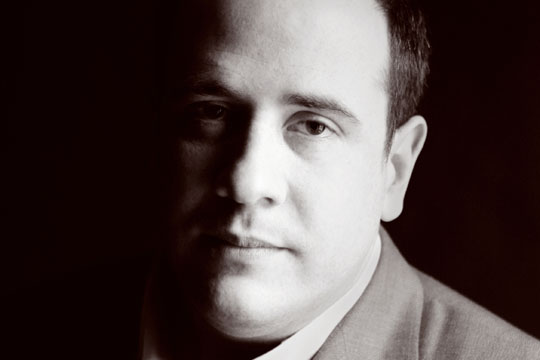
Author Jeff Sharlet. Photo by Greg Martin.

Social fundamentalism

If the term “fundamentalism” is applied to the Family to measure a fundamentalism in economic, cultural, and social matters, it is apt. Some, like Jimmy Carter, have used the word “fundamentalism” in the broader sociological context suggested here, and Martin Marty has sometimes done the same He believes that Adorno’s study of the roots of authoritarianism is really an examination of societal fundamentalism.

Luigi Tomasi of the University of Trento, who works in sociological theory, development, and religion, speaks of a “social fundamentalism” that best describes the kind of fundamentalism Jeff Sharlet is discussing.

Like the religious fundamentalists, the social fundamentalists think that their principles must be practiced in full, and without compromises. Social fundamentalists, like religious fundamentalists, adhere to what they think are some simple but noble principles that they think are overlooked.

Both sorts of Fundamentalists are absolutists in the sense that they can explain all relevant phenomenons in terms of their basic ideas. Alternative interpretations must be demonized. Whatever they believe is sanctioned by a higher authority. In the case of the Fellowship, it is God the processes of history.

Literalism is another characteristic, but it only seems to apply some of the time in the case of the Family.

They are also exclusivist in that they believe there is only one way to interpret their basic ideas. Fundamentalists or both the religious and social sorts are inclined to be true believers. They boost their self esteem by seeing themselves as an “in” group that opposes an “out” group that, for the moment, dominates society.

The desire to be part of an important “in” group seems to be related to creating for themselves a collective identity as religious fundamentalists or as members of the Fellowship.

Religious and social fundamentalists want to reconstruct the world by applying principles drawn from the past. They can be viewed as radical traditionalists. As traditionalists, they think time honored social distinctions are just part of the nature of how things are and should be.

They are atavistic in that they want to return to elements of a mythic past, especially one in which women were kept in their place. Atavistic movements find salvation in elements of the past and create myths about them. Frequently, they target neighbors as the dreaded “Other.” Feminism is the scapegoat for many problems, partly because it is totally secular.

This anti-feminism is rooted in the fact that males are losing power, and, in a larger sense, fundamentalisms represent efforts of individuals and groups to regain power and control over their situations. In the case of the Family, social fundamentalists, we have an extreme effort of males to acquire great power as a group and individually, as Alpha males.

In some ways they are anti-modern, although religious fundamentalists have pioneered in exploiting new developments in communications technology. Fundamentalists generally are troubled by diversity and pluralism, and some resent the modern tendency toward economic globalization.

However, the Family has a record of working to promote economic globalism, and here it differs sharply from many of the religious fundamentalists they would lead and speak for. In other cultures, religious fundamentalists have often taken positions in defense of the poor, but in the United States they often resent money spent alleviating poverty, and they embrace economic doctrines that serve the rich and corporate power.

There was a time when religious fundamentalists refused to engage the culture and broader society. Now many of them seek to use their votes to take over the political polity. The Family, religious conservatives and social fundamentalists, work day and night to accomplish this and are experts at engaging the culture and mixing with people who do not agree with them.

The Fellowship consistently champions bare-knuckled, unfettered capitalism as Christ’s doctrine. They are what the British call “market radicals” or what Americans call “market fundamentalists.” High on their agenda is extending U.S. influence in the world, and they subscribe to what scholars have called “foreign policy fundamentalism,” the outlook that more force is always appropriate.

They subscribe to the notion that the United States is God’s favored nation and they back interventionism and U.S. imperialism. Vereide had a fetish about conforming to traditional social norms. The Family, as social fundamentalists, join religious fundamentalists, are upset or worse by the onset of modernization and the ascendancy of secular values. Both are at odds with what they think is a depraved culture.

Political wolves in sheep’s clothing

There are many serious and able Protestant theologians. As a volunteer for an historical agency, I read and analyzed their works for many years. On the other hand, there is much that passes as theology that is little more than political commentary or weak social science.

Some years ago, I acquired a multi-volume set by an eminent conservative Protestant theologian. As I studied the volumes, I kept wondering if I was reading a mix of politics and sociology rather than theology. Most of it was like what we often find on Sunday morning TV, mostly politics and maybe a little religion. What I knew as theology was largely absent. The religious comments that were there were thin gruel, and not the careful argumentation of a theologian.

The same is true of The Family. They have all the cultural concerns of the old evangelical America that has been slowly fading since the 1920s. But their real passion is for market capitalism and the American empire. There are some positive accomplishments to attribute to them. Coe worked with Bono in his humanitarian work, and some members have helped build hospitals.

When I set aside the last volume, I was unable to identify where the theology was. Sharlet tried to trace The Family back through the Second Great Awakening and all the way back to Jonathan Edwards. Those links are not that solid.

The Family members pray, but it is hard to find any serious religious thought or theological literacy here. What we have is social and political movement taking on religious clothing. That, of course is natural. Even medieval weavers did a better job presenting their discontent over wages as a religious movement.

Post-Civil War southern frustrations presented themselves as the religion of the lost cause, and had a certain degree of theological substance. Too many on the Religious Right have taken the road of Doug Coe — perhaps beginning with some genuine religious concerns but soon practicing politics falsely presented as religious work.

Next: Part II: Right Wing Populism.

[Sherman DeBrosse is a retired history teacher. Sherm spent seven years writing an analytical chronicle of what the Republicans have been up to since the 1970s. The New Republican Coalition : Its Rise and Impact, The Seventies to Present (Publish America) can be acquired by calling 301-695-1707. On line, go here.]

Find The Family: The Secret Fundamentalism at the Heart of American Power by Jeff Sharlet on Amazon.com.

The Rag Blog

Posted in Rag Bloggers | Tagged , , , , | 1 Comment

Biodiversity and Global Change : Carbon in the Soil


Insights from soil carbon research:

Scientists analyze interactions with climate change and land management to address food, fuel, water and fiber needs.

By Alison Grantham / October 18, 2009

Nearly 300 soil scientists from 33 countries gathered last week in Colorado Springs, Colorado, for the second International Symposium on Soil Organic Dynamics under the theme “Land Use, Management and Global Change.”

I presented a poster on the Rodale Institute’s research on soil carbon and nitrogen mineralization potential in our Farming Systems Trial (FST) and soaked up all the knowledge I could.

The universe of the conference focus increased even as we met. Conference host Keith Paustian of Colorado State University opened the conference emphasizing that global soil organic matter (SOM) stocks are now estimated to contain 3 trillion tons of soil organic carbon.

This estimate just increased significantly in a recent publication in Global Biogeochemical Cycles where the authors reported that carbon stocks in peat soils are much larger than previously understood. That makes soil the largest actively cycling pool of carbon — more than quadruple the amount of carbon in vegetation and more than triple that in the atmosphere.

In an era where rising concentrations of atmospheric carbon are threatening global climate function, ecosystem stability and agricultural productivity, the sheer size of the soil carbon pool makes it imperative that we learn more about the pool’s dynamics.

Highlights from the remarks of the event’s leading presenters illustrate the profound ways that soil dynamics and the variations in soil capacities impact individuals, communities and nations.

Abad Chabbi, host of the first symposium on these topics in France two years ago, protested that the clear challenges addressed in 2007 persist today, including:

  • The extent and role anthropogenic forcing.
  • The feedbacks between vegetation and SOM.
  • Interactions between climate change, SOM and biodiversity.
  • SOM generated greenhouse gases.
  • Soil quality and SOM.

Gary “Pete” Peterson emphasized that organic matter is the essence of soil health and quality, railing against the destructive wheat-fallow system that brought SOM levels in eastern Colorado from 2.5 percent to less than 1 percent. To Peterson, 14 month fallows make no sense, while alternative systems that increase biomass inputs through improved rotation intensity and complexity generate multi-faceted improvements in soil.

Testifying to water scarcity in Colorado and the value of improving soil water retention, this reservoir was created by piping water hundreds of miles through the Rocky Mountains.

He pointed out that increasing biomass:

  • Improves aggregate yields for the farmer
  • Increases the food supply and soil carbon levels
  • Decreases soil bulk density (degree of compaction), which, in turn, increases both soil porosity and water infiltration rates, thereby decreasing water stress in this highly water constrained region.

Finally, Eldor Paul, the grandfather of soil science himself, rose to deliver the keynote. A highly esteemed scientist who has published thousands of articles and books over the last century, Paul is a man who scorns retirement and still fells his own lumber on his Colorado ranch.

Brusquely addressing the international audience of soil science leaders, he reviewed the last 200 years of soil organic matter research and turned quickly to outlining the community’s objectives for 2030. Actually, the way Eldor laid it out, they were less objectives and more assignments; tasks that must be completed by 2030, no excuses.

Figuring out sequestration

First and foremost, he charged his peers with figuring out “this soil carbon sequestration thing.” He admitted that he had thought the issue had already been figured out, although now his confidence has been eroded by poor consistency within the field in the way data were collected and reported.

Future monitoring and reporting must be much more precise with the terms of estimates like soil carbon pool’s mean residence time reported relative to the experiment’s length, or the necessity that the uncertainty of any and all estimates of soil carbon change (measured or modeled) be clearly stated.

After paying due respect to carbon, which Paul acknowledged as, “What’s paying all our salaries,” he concluded that “nitrogen is what actually deserves more attention in the long run.”

Over the next four days through some 120 presentations, eight poster sessions, coffee breaks, tea times and social dinners, the leaders in this field set about offering their answers and posing new questions relative to these challenges.

To me, the most exciting talks came at the “land use, management and global change” workshop where we dealt with consideration of principles of ecosystem function, such as biodiversity, as well as needs for nutritious food and renewable energy.

To that end I’ll stick to a couple inspirational and exciting talks that covered those issues. Finally, I will offer a brief overview of the advances in soil carbon measurement and change detection that several research groups have worked to develop.

Coming from Rodale, where researchers and farmers have toiled for more than 60 years to demonstrate the potential for organic systems to achieve improvements in soil health and quality, it was heartening to see long-term organic research from around the world that chronicled similar achievements in soil through organic methods.

Biodiversity builds carbon

Compost in Korea: From Korea, Dr. Chang Hoon Lee, reported on 40 years of rice research where mineral fertilizer and compost approaches to soil fertility were compared. Although compost alone had a 12-year lag time to catch build up to conventionally fertilized yields, the compost alone and compost plus reduced NPK treatments both supported significant improvements in soil microbial health, soil organic matter and rice productivity in the long term.

Czech pasture biodiversity: Perhaps most inspiring was Dr. Borivoj Sarapatka’s report on the carbon sequestration and biodiversity of organic pastures in the Czech Republic.

In that nation there has been huge growth in organic farming since 1991, when there was essentially none. Today, more than 10 percent of the total agricultural area is organically managed, according to the latest census. A large part of that growth has happened in pastures.

Sarapatka characterized those pastures by the level of plant biodiversity along a spectrum from “newly established pastures” with 16 plant species on average to “semi-natural grasslands” with 33 or more plant species. He studied 44 characteristics of those communities, and discovered some astounding differences.

Amazingly, the more biodiversity in a pasture, the more carbon Sarapatka found in the soil. The most species-rich grasslands had roughly double the carbon of their species-poor counterparts. How fabulous! He identified yet another co-solution inherent to maturing, biologically managed agricultural systems: improving biodiversity while producing organic food also sequesters carbon.

Polycultures in Michigan: Finally, Dr. G. Phil Robertson of the W.K. Kellogg Biological Station in Michigan reported on the potential of biodiverse perennial polycultures to meet the United State’s mandated biofuel needs of the future. Thanks to the U.S. Energy and Policy Act of 2007, the United States must develop the capacity to generate 21 billion gallons of cellulosic ethanol (or “advanced biofuels”).

Robertson posited, “…we know there are right and wrong ways to deploy and manage the systems that will provide this biomass. Wrong approaches amplify the current shortcomings of intensive grain-based agriculture.”

He presented results quantitatively depicting the biodiverse alternative of minimally managed, early successional native prairie biofuel production systems. This data comes from the Kellogg Center’s two-decade comparison of several annual and perennial agroecosystems and three successional ecosystems. These systems range from conventionally managed corn-soy-wheat, to organically-managed legume-based corn-soy-wheat, to perennial alfalfa and poplar, to three ecosystems representing the range from an early successional native prairie to mature forest.

Researchers found the greatest biomass production, the greatest biodiversity, the greatest carbon sequestration, and the best lifecycle greenhouse gas balance in these early successional prairie systems. These findings indicate we can find co-solutions that simultaneously address the most daunting biodiversity, fuel, and climate challenges.

Lastly, numerous researchers reported on optical soil-carbon sampling techniques from mid-infrared to near-infrared that allow 10-fold increases in soil carbon sampling intensity. These advances allow quantification of soil-carbon levels with much greater confidence that will, in turn, allow us to determine soil carbon change much sooner than we can now.

Based on what we’ve learned in 60 years of looking at how farmed soils respond to biologically based farming techniques, we hope that these technical advances in C measurement will allow carbon-offset payments based on measured sequestration rather than estimates from practices alone. After my week in Colorado with the world’s soil inquisitors, I have great confidence in this possibility.

[Alison Grantham is research director at the Rodale Institute.]

Source / Rodale Institute

Thanks to Richard D. Jehn / The Rag Blog

Posted in RagBlog | Tagged , , , , | 2 Comments

AfPak War : Not a Pretty Picture

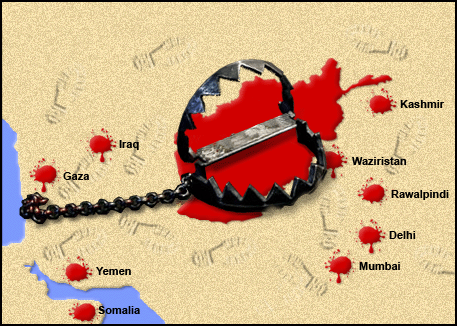
Here there be monsters. Graphic from Asia Times.

War destabilizing Pakistan;
Veteran officer urges Afghan drawdown

By Roger Baker / The Rag Blog / October 16, 2009

The news regarding the war in Afghanistan just keeps getting worse. The NATO alliance war in Afghanistan is increasingly morphing into “AfPak” war that is also destabilizing Pakistan. Meanwhile the Taliban is steadily increasing in strength whereas the US/NATO forces are regarded by the population as corrupt and ineffective.

In one recent case, the Italian NATO troops bribed the Taliban to maintain the peace. When the French troops who were sent in to replace them were not in on the deal, they were attacked and mutilated.

Here is an exclusive report by a journalist who interviewed a top Taliban commander who outlines their strategy; an interview rather unlikely to be granted if the Taliban were not confident of victory.

Most observers, including even top generals like McChrystal, who are actively trying to promote an escalation of the war, agree that we are currently losing strength to the Taliban guerrillas.

Independent military observers think that any US escalation will strengthen the insurgents, and that we are unlikely to be able to prop up the unpopular Afghan army. And that if we could do so, it would take a long time.

Veteran Army Officer Urges Afghan Troop Drawdown

A veteran Army officer who has served in both the Afghanistan and Iraq wars warns in an analysis now circulating in Washington that the counterinsurgency strategy urged by Gen. Stanley A. McChrystal is likely to strengthen the Afghan insurgency, and calls for withdrawal of the bulk of U.S. combat forces from the country over 18 months.

In a 63-page paper representing his personal views, but reflecting conversations with other officers who have served in Afghanistan, Lt. Col. Daniel L. Davis argues that it is already too late for U.S. forces to defeat the insurgency…

In the paper, Davis argues that the counterinsurgency strategy recommended by McChrystal would actually require a far larger U.S. force than is now being proposed. Citing figures given by Marine Corps Col. Julian Dale Alford at a conference last month, Davis writes that training 400,000 Afghan army and police alone would take 18 brigades of U.S. troops – as many as 100,000 U.S. troops when the necessary support troops are added.

The objective of expanding the Afghan security forces to 400,000, as declared in McChrystal’s “initial assessment”, poses other major problems as well, according to Davis.

He observes that the costs of such an expansion have been estimated at three to four times more than Afghanistan’s entire Gross Domestic Product. Davis asks what would happen if the economies of the states which have pledged to support those Afghan personnel come under severe pressures and do not continue the support indefinitely.

“It would be irresponsible to increase the size of the military to that level,” he writes, “convincing hundreds of thousands of additional Afghan men to join, giving them field training and weapons, and then at some point suddenly cease funding, throwing tens of thousands out of work.” — Gareth Porter / IPS

Not only is the war in Afghanistan costly and nearly certain to be protracted into a war lasting years, but it is a logistical nightmare, with no clear goals. The few operable roads leading into the capital of Kabul are now frequently mined with IEDs. The Pentagon is reporting to Congress that the fuel to fight the war is costing the US $400 per gallon to deliver. Given the logistics, often the only way to supply US/NATO troops is by helicopter.

The Pentagon pays an average of $400 to put a gallon of fuel into a
combat vehicle or aircraft in Afghanistan….

The Pentagon comptroller’s office provided the fuel statistic to the committee staff when it was asked for a breakdown of why every 1,000 troops deployed to Afghanistan costs $1 billion….

According to a Government Accountability Office report published earlier this year, 44 trucks and 220,000 gallons of fuel were lost due to attacks or other events while delivering fuel to Bagram Air Field in Afghanistan in June 2008 alone….

The Marines in Afghanistan, for example, reportedly run through some 800,000 gallons of fuel a day.

Thanks to S. M. Wilhelm / The Rag Blog

Posted in Rag Bloggers | Tagged , , , | 1 Comment

Health Care Reform and the ‘Independent Voter’


In the health care debate:
‘Independent’ usually means ‘misinformed’

By Dr. Stephen R. Keister / The Rag Blog / October 16, 2009

As witness not of our intentions but of our conduct, we can be true or false, and the hypocrite’s crime is that he bears false witness against himself. What makes it so plausible to assume that hypocrisy is the vice of vices is that integrity can indeed exist under the cover of all other vices except this one. Only crime and the criminal, it is true, confront us with the perplexity of radical evil; however only the hypocrite is really rotten to the core. — Hannah Arendt, 1963

Last evening on MSNBC’s the Ed Show it was suggested that most “independent voters” do not appear to understand the essence of the health care debate. This statement gave me pause, for it suddenly occurred to me that I really have a very hazy perception of who those “independent voters” really are.

My first inclination is to think of a large group of citizens who are not party-affiliated but are independent thinkers. I believe that many in the educated, progressive community would have the same immediate response. Well, stop! It was largely the “independent voters” who voted against their own self interests and twice elected Ronald Reagan president. Time to slow down and reflect…

No doubt there are those who do not belong to a specific political party, or consider themselves Socialists or Greens; however, this is not the mass of the electorate. Who are we discussing?

The Democrat or Republican is moved by tradition or conviction to register as he or she does. In the health care debate most registered Democrats favor including a non-profit entity — whether it be a true non-profit company, overseen by physicians and members of the community at large (universal single payer care as described by Physicians For A National Health Program), or a government agency like Medicare or the Veterans Administration.

Most Republican champion a “free market” neo-liberal economic theory, social Darwinism, in fact dominated by the insurance cartel and pharmaceutical giants Yet this does not account for the masses of the “independent voters” alluded to on the Ed Show.

We return to the so-called independent voters, the ones who voted for Ronald Reagan. These people were not well informed, as we might delude ourselves into thinking. These were the folks who were moved to vote for an actor, an actor they had seen on the screen as a soldier, as a cowboy, or a he-man. Many, as with Reagan himself, did not divorce his roll playing from reality. They did not consider that here was a puppet managed by a number of ambitious puppet masters from the world of the corporations and the military-industrial complex, who were the powers behind the throne.

These were the folks who were unaware that their trade unions were being undermined, their financial and social safety nets were being destroyed, and their jobs were beginning to be shipped overseas to increase the profits of the large corporate interests behind the Reagan presidency.

Certainly, a few “independent” voters are at home studying political trends, reading economic theory, trying to comprehend the geo-politics of the Middle East; however, most are watching Fox News, attending Ron Paul discussion groups, seriously considering the overtly absurd, corporate sponsored, anti-health care propaganda on television.

These are the people who chose their health care companies and part D Medicare insurance carriers from ads on TV; they are totally oblivious to the fact that the cost of TV advertising is tremendous and in the long run will be passed on to the consumer who has been suckered into purchasing the product. Lost with them is the old adage that you don’t get “something for nothing.”

Unfortunately most of the “information” available to the average person is not information at all, but is misinformation provided by the corporations who control much of the print media, the preponderance of the TV stations, and nearly all radio. Yet there is a glimmering of hope. The October 12th Modern Physician reported that the American physician is much more satisfied in dealing with a government program such as Medicare than with private insurance companies. On a 1-5 scale, the 1700 physicians participating in the survey gave Medicare part B a score of 3.59, Aetna was second with a rating of 3.15, followed by Cigna 3.11, Coventry Health Care 2.99, Humana 2.92, Anthem 2.84, and United Health Care 2.45. Please note that Humana is probably the most widely advertised health insurance/hospital company on telebision!


Consumers Union, publisher of Consumers Reports, for decades, rarely makes a political statement.; however, in a Consumer Reports survey, republished by McClatchy Newspapers on October 9, showed that 51 % of Americans have “faced difficult health care choices in the past year.” The survey showed that because of costs 28% put off doctors visits; 25% have been unable to afford medical bills or medication; 22% put off medical procedures; 20% declined medical tests; 20% skipped filling prescriptions; 15% tool expired medication; 15% skipped scheduled dosages of medication. Jim Guest, Consumers Union president and CEO said, “Today health care costs too much. Many Americans are one slip or major illness away from losing their coverage.”

During the past week the insurance cartel has exposed its true face with its threat to Congress and the President that if proposed health care legislation (read “insurance reform”) is not passed to their liking that they will raise rates throughout the insurance industry. And they are demanding that congress include a mandate requiring Americans to own health insurance, with a penalty as high as $3,800 a family to enforce it. Further, the insurance industry would be delighted if Congress includes tax-payer funding of private insurance company premiums, for those who cannot afford to buy the mandated private insurance.

In other words the health insurance industry is trying to blackmail our elected representatives, at least those that who are not already bribed, to provide more income to the insurance industry on the backs of the poor and the taxpayer. Thus, higher salaries for the executives – making possible larger mansions and more elegant yachts — as well as increased income to the stockholders and the entire Wall Street establishment.

Of course this is merely the tip of the iceberg; the power structure in the United States is determined to create a two class society. This is well illustrated in an article by Mark Ames, distributed by AlterNet, entitled “8 Shocking Ways the Billionaires Have Schemed to Rob Us of Every Last $.” It is time that the “independent voters” awaken and face reality, since most of this approach is based on lack of medical care to the average citizen. Note, for example, that there is now a policy among the private insurance companies to deny health care coverage to women who have had a Caesarian section, unless she is voluntarily sterilized thereafter.

I have had Medicare coverage for the past 18 years, and have experienced no denials or other problems in spite of treatment for cancer of the prostate and and (hold your hats) an idiopathic demyelinating periperal motor neuropathy that is gradually interfering with my walking. At no time has my physicians’ treatment, testing, or prescribing been challenged. At no time has there been evidence of a government bureaucrat interjecting himself into the process, and my final death-bed wishes have been purely private between my family and myself, and those I have informed, my physician and attorney. My main concern, and this MUST be addressed by Congress, is the fact that Medicare funding will become a real problem by 2017 unless the gross waste of billions of dollars poured into the Medicare Advantage Programs or The Medicare Part D prescription programs in not halted by Congress.

We have reached the crucial stage of health care reform.

I have faith in the House of Representatives; however, I am much concerned about the Senate, with its jellyfish-like majority leader, and its antiquated parliamentary rules — with 100% of the Republican Senators, including those from Maine, as well as “independent” Sen, Lieberman, being totally beholden to the insurance industry. We also have the pre-paid group of 6-7 Democratic Senators, most a part of the Senate Finance Committee.

Unfortunately, in the face of the widely disseminated information regarding their acceptance of baksheesh, they show no shame. Only superhuman pressure from the public, including the “independents,” can alter this nearly untenable situation. It blows my mind that the United States, among all industrialized nations, citizens do not have decent, universal health care — or even the prospect of having it — as a moral imperative. Only in the USA do we see boxes in check-out lines asking donations to pay for a certain child’s brain tumor surgery. Shame, shame, shame.

I have a bit of remaining hope that the President will rise to the task of demanding a TRUE public option, Medicare-for-all. A plan parallel to the current Medicare for the elderly, paid for by premiums collected from the insured, or with government subsidy for the poor. This would not be related to the current Medicare programs which have been paid for in advance by a 3 3/4% tax deduction from participants’ paycheck throughout their working years.

The Medicare-for-all would not subject to the rationing of care as is rampant among the private insurers, there would be no denial of insurance du to pre-existing illness, and no insurance company employees would be searching through your claims to find a reason to deny payment.

To date President Obama has not shown himself to be a person of strong conviction, when we consider the failure to establish regulations subsequent to the financial crises; his deference to the military, rather than the Middle East experts, concening Afghanistan; and his blathering homage to a Republican senator from Maine, rather than taking an unequivocal position of leadership in support of a public option as the keystone of universal health care.

Once again, we as a people, must make our voices heard at the White House. Time grows very short.

[Dr. Stephen R. Keister lives in Erie, Pennsylvania. He is a retired physician whose articles on health care reform appear regularly in The Rag Blog.]

The Rag Blog

Posted in Rag Bloggers | Tagged , , , , | 13 Comments

Nobel Laureate Elinor Ostrom : Economics and the Environment

Elinor Ostrom celebrates winning the Nobel prize in economics. Photo by John Sommers II / Reuters.

Elinor Ostrom breaks the Nobel mold:
A new look at economics, the environment and the commons

The economics profession needs to be shaken up. Ostrom’s Nobel prize should encourage us to take a fresh approach

By Kevin Gallagher / October 15, 2009

The economics profession is in such disarray that one of the Nobel prizes in economics this year went to political scientist Elinor Ostrom — the first woman to be awarded the economics prize. This is an excellent choice (in any year) not only because of what Ostrom has contributed to social theory but also because of how she goes about her work.

In a nutshell, Ostrom won the Nobel prize for showing that
privatising natural resources is not the route to halting environmental degradation.

In most economics classes the environment is usually taught as being the victim of the “tragedy of the commons”. If one assumes, like many economists do, that individuals are ruthlessly selfish individuals, and you put those individuals onto a commonly owned resource, the resource will eventually be destroyed. The solution: privatise the commons. Everyone will have ownership of small parcels and treat that parcel better than when they shared it.

Many environmental experts also reject the tragedy of the commons argument and say the government should step in.

Ostrom says the government may not be the best allocator of public resources either. Often governments are seen as illegitimate, or their rules cannot be enforced. Indeed, Olstrom’s life work looking at forests, lakes, groundwater basins and fisheries shows that the commons can be an opportunity for communities themselves to manage a resource.

In her classic work Governing the Commons: The Evolution of Institutions for Collective Action, Ostrom shows that under certain conditions, when communities are given the right to self-organise they can democratically govern themselves to preserve the environment.

At the policy level, Ostrom’s findings give credence to the many indigenous and peasant movements across the developing world where people are trying to govern the land they have managed for centuries but run into conflict with governments and global corporations.

Some economists on the frontier of their discipline have started to use Ostrom’s insights in their work. In their recent book Reclaiming Nature: Environmental Justice and Ecological Restoration, James Boyce, Liz Stanton and Sunita Narain, show how communities in Brazil, India, West Africa and even in the United States have managed their resources in a sustainable manner when given their rightful access to their assets.

Indeed, Boyce and his collaborators find that communities should be paid for their services, since they can sometimes do a far better job than government or corporations at managing resources. Indeed, “payment for environmental services” has become a buzzword in development circles. Now even the World Bank has a fund for PES schemes across the world.

In terms of methodology, Ostrom proves her findings three times over. As opposed to many economists who never leave the blackboard, Ostrom often conducts satellite analyses of resource depletion to measure amounts of degradation. Second, she actually goes out into the field and performs case studies of human and ecological behaviour all across the world. However, she doesn’t stop there. When she gets back from her fieldwork she conducts behavioural experiments to see if random subjects replicate her findings in the field.

The Nobel committee should be applauded for recognising such rigorous theoretical and empirical work. Shining light on Ostrom is a call to economists to spend a lot more time analysing human behaviour, rather than assuming that we are all rational selfish individuals. It is also a call on economists to become more empirical and to find ways to validate their theories.

Adopting Ostrom’s approach will not only help us forge a better relationship with the natural environment, but will help us become more realistic about the economy in general. It’s time for a fresh approach to both.

Source / Guardian, U.K.

The Rag Blog

Posted in RagBlog | Tagged , , , | 1 Comment

Climate Bill : Morphing into a Monster?

“Acid Tar.” Image ©2009 ~Monster-Man-08.

A John Kerry/Lindsay Graham production:
Pro-nuke, pro-drilling, pro-coal ‘climate bill’

By Harvey Wasserman / The Rag Blog / October 15, 2009

Is the climate bill morphing into an excuse to promote fossil fuels and new nuclear power plants?

Sen. John Kerry’s (D-MA) recent promotion of a pro-nuke/pro-drilling/pro-coal agenda in the name of “climate protection” has been highlighted in a New York Times op ed co-authored with Sen. Lindsay Graham (R-SC). The piece brands nuke power “our single largest contributor of emissions-free power.” It advocates abolishing “cumbersome regulations” so utilities can “secure financing for more plants.” And it wants “serious investment” to “find solutions to our nuclear waste problem.”

The Senate bill as now drafted also includes a “Clean Energy Development Administration” that could deliver virtually unlimited federal cash to build new reactors and fund other mega-polluters.

Also on the table are vastly expanded permits for off-shore drilling. And Kerry/Graham have talked of making the U.S. “the Saudi Arabia of clean coal” while bringing “new financial incentives for companies that develop carbon capture and sequestration technology.”

If you think pushing nukes, oil wells and coal mines to “prevent global warming” is counter-intuitive, you ain’t seen nothin’ yet.

The give-aways are allegedly meant to attract GOP votes. The joint Kerry/Graham op ed is being billed as a “game changer.”

But even with provisions pushing a hundred new reactors in the U.S. alone, some GOP stalwarts hint they would NEVER vote for a bill that includes cap-and-trade clauses. So is the GOP set to play the same game with climate legislation as it has with health care: prolong negotiations, gut the substance of reform, demand — and GET — untold corporate giveaways, and then oppose the bill anyway?

What thin green substance survives could be limited to a few showpiece handouts for renewables and efficiency, with cap-and-trade as the centerpiece. But many environmentalists argue that cap-and-trade could create yet another costly bureaucracy with little real impact on the climate crisis.

To get real about solving this crisis, Congress should demand — and fund — a definitive national transition to energy efficiency and modernized mass transit. We still waste half the energy we consume. There’s no source of usable juice cheaper and quicker to install than increased efficiency.

Taxes on carbon and other forms of “ancillary” pollution would help if they assess radioactive emissions (from coal as well as nukes), destruction of our oceans,lakes and rivers, removal of mountain tops, creation of nuclear waste, and so on.

Merely axing the subsidies to King CONG (Coal, Oil, Nukes & Gas) and rendering a level playing field for true green energy sources to fairly compete with the old fossil/nukes would take us a long way up the road to Solartopia. A feed-in tariff that rewards renewables for the pollution they avoid would also help.

Without all that, the climate bill’s outright negatives could be huge. Atomic reactors can do little or nothing to bring down carbon emissions. Projected construction costs for new nukes have jumped from $2 billion to $13 billion and counting. Body-blows to the all-but-dead Yucca Mountain nuke waste dump have left the industry, after 50 years, with nothing tangible to do with some 50,000 tons of spent lethal radioactive fuel rods.

And after a half-century, the industry cannot command private construction financing or private liability insurance to cover a catastrophic melt-down or terror attack. Even if reactors could help with greenhouse gas emissions, it would take a trillion dollars or more to make a noticeable dent, and a decade or more for such reactors to begin to come on line.

But the reactor lifeline does not flow through licensing or waste. Because it has failed as a commercial technology, the industry must have massive infusions of cash and loan guarantees. The climate bill’s real damage will be measured by the size and scope of reactor subsidies, if any.

Kerry’s willingness to entertain “clean coal” and new offshore oil drilling as “solutions” for climate chaos staggers the imagination. It seems to signal that King CONG still owns Washington, and that any meaningful Congressional push for green power will demand serious redirection from the grassroots.

DC insiders generally doubt that any climate bill can pass this year. Afghanistan and health care still dominate the national agenda.

But Democrats are desperate for SOMETHING to show at December’s Copenhagen Climate Conference. The question is: how much will they give fossil/nuke Republicans to get a bill — ANY bill — with the world “climate” attached?

The anti-nuclear movement has three times defeated proposed $50 billion loan guarantees for new nuclear plants. The environmental community still understands that solving the climate crisis requires the ultimate phaseout of fossil fuels.

“A carbon-free, nuclear-free energy future is within the Senate’s reach,” says Michael Mariotte of the Nuclear Information and Resource Service. “The approach laid out by Kerry and Graham would lead to a climate bill in name only.” NIRS is organizing a national call-in this week. A nationwide series of demonstrations for the environment will take place October 24.

Preserving our ability to survive on this planet demands we phase out fossil fuels and nuclear power, and win a green-powered Earth based solely on renewables and efficiency. Ultimately, we cannot live with less.

[Harvey Wasserman’s Solartopia! Our Green-Powered Earth is at www.solartopia.org. He is senior advisor to the Nuclear Information and Resource Service, and senior editor of www.freepress.org, where this article also appears.]

The Rag Blog

Posted in Rag Bloggers | Tagged , , , , | 9 Comments

Steve Russell : Let Us Now Praise (Not) Famous Women

There’s a little “Wonder Woman” in all women. Image from the Wonder Woman Museum.

Let us now praise women
And the roles they play in our lives

By Steve Russell / The Rag Blog / October 14, 2009

I just came from a reunion of the civil rights law firm in Austin, where I used to work. Most of our work involved the anti-war movement and the mainstream discrimination cases, although we did send two lawyers to help defend the avalanche of criminal cases that fell on the American Indian Movement after Wounded Knee II. One of my detractors once said, “the biggest risk you took at the Knee would be a paper cut.”

It’s true that I took no risks at the Knee and I would go farther and say I would not have. Demonstration is easy; organizing is hard, and waving guns at the guys who have all the guns is just plain dumb. That said, once the government dropped the proverbial load of bricks on AIM, AIM had to be defended because their complaints were just even if their tactics were wrong. But I digress.

The people I knew in the civil rights movement were the finest people I’ve known in my life, and at my age I’ve watched plenty of friends and family make the journey, so I know that I should not waste an opportunity to tell somebody how much they have meant to me.

As far as I knew, the firm reunion was put together by a couple of the name partners. At the reunion, I discovered something that should not have been a surprise. Much of the heavy lifting was done by one of several women who had been legal workers.

I got to thinking about her when the truth came out, and I’ve decided that it’s fitting to say some things about her without speaking her name. Here’s a woman who has all the skills to run a law office, with or without computers. She sings and plays piano and accordion. She has a working knowledge of constitutional law, and has forgotten more about medicine than I ever knew. That may be why her daughter has become a medical doctor.

Maybe she is Superwoman, but she represents nicely the women who were behind every campaign I had to run when I was an elected official. I am reminded of the time I didn’t have the money to pay for preparing a mailer and the day before it had to be done my home was suddenly full of women I had no recollection of meeting. It turned out I had met some of them. They appeared because somebody posted a notice on the bulletin board at the battered women’s shelter saying I had an opponent and needed help.

I suppose I got that outpouring from the shelter for two reasons. I had created domestic violence dockets on two different courts, and my opponent had obstructed my efforts on one of those courts. The judge running against me was later arrested for threatening his wife with a gun, but I have no way of knowing if anybody knew about his personal life.

Women were behind everything I’ve ever accomplished in my life. I was married to some of them, some worked for me, and some just helped me for their own reasons, but without them my legal career would not have happened the way it did. It appears to me that we men can’t beat women in academia, in the professions, or in making families the places where our children can feel safe and excel. Seems some men think the only way they can beat women is to beat them.

Men are, indeed, bigger and stronger than women in most cases. There is social science research that tells us women are as likely as men to resort to what is technically domestic violence. That is, they will throw a slap or a dish because they are just as likely as we are to be unskilled at conflict resolution. Violent women notwithstanding, it is the women who arrive in the emergency rooms and the morgues. This is true in the dominant culture and unfortunately it’s also true in our [Indian] cultures.

Domestic violence is not a sex-neutral problem. While some men bite dogs, dog bite is not a species-neutral problem. Domestic violence is our problem, we men, the ones with the size and often the military training.

While it is necessary to put wife beaters in jail, sometimes to keep the peace in the community, jail is not going to stop wife beating. What will stop it is when beating your wife means your fishing buddy doesn’t want to fish with you anymore. When beating your wife is an unadulterated mark of disgrace. When hurting the mother of your children brings you the shame you deserve.

If a judge expresses outrage toward a wife beater, the judge has to be expressing the values of the community, and the community has to be a place where no man, woman, or child will listen to excuses.

She started it. She didn’t have dinner ready on time. She called me a bad name. I’m not here to tell you your wife is perfect, but if you made a bad pick when you got married we have divorce courts for that. I guess you should be proud that everybody would say you are a perfect husband except when you beat her, right?

I can accept that the fact that I have been gifted with a great professional career by a bunch of anonymous women will not apply to everybody. I suppose I can even understand the people who, when I was pushing a female candidate in my tribal election, railed against “petticoat government.”

Habits die hard, although my understanding of Cherokee history matches Wilma Mankiller’s, as expressed in her autobiography: we used to have women leaders before the missionaries taught us that men are meant to run things.

If none of the things I’ve said match your life experience, let me try one more thing. Let me point out that for most of us, the first human touch we experience is by a woman, a midwife or a grandmother in that role. The last human touch we experience will be a woman, a hospice nurse or a sister in that role. In between, if we are lucky, we experience other loving touches from women that ought to give us pause before laying violent hands on them, or offering friendship to a man who does.

If you can come that far with me, let me offer one more suggestion as a privilege of my age: do not waste an opportunity to tell the women who have made your life better how much they mean to you.

[Steve Russell, Cherokee Nation of Oklahoma, is a Texas trial court judge by assignment and an associate professor of criminal justice at Indiana University. He is a contributor to The Rag Blog and is a columnist for Indian Country Today, where this article also appears. He lives in Bloomington and can be reached at swrussel@indiana.edu.]

The Rag Blog

Posted in Rag Bloggers | Tagged , , , , | 1 Comment

Preventing Abortion : Contraception More Successful than Laws

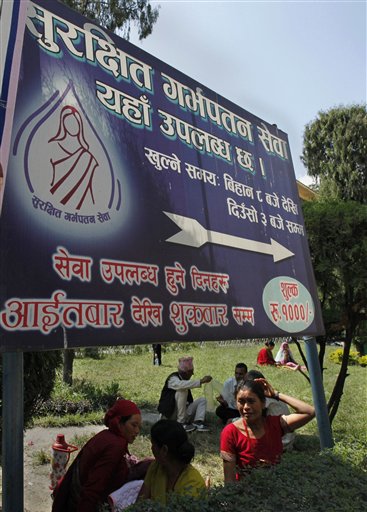
Sign in Katmandu, Nepal: “Safe Abortion Service avbailable. From 8 a.m. to 3 p.m. Sunday to Friday. Charge 1,000 rupees.” The hospital is run by the government. Photo by Binod Joshi / AP.

Guttmacher survey of 197 countries:
Making abortion illegal doesn’t mean fewer abortions

The way to lower (and someday hopefully eliminate) abortion is to teach real sex education and encourage the use of contraceptives.

By Ted McLaughlin / The Rag Blog / October 14, 2009

Fundamentalists live in a very simple world. They believe they can prevent teens from having sex by refusing to provide them with real sex education. They also believe they can prevent abortions by simply banning legal abortions.

It has recently been shown that teaching “abstinence only” does not prevent teen sex, but it does increase the number of teen pregnancies by preventing the use of contraceptive methods. Now there is a new study that shows banning abortions does not decrease the number of abortions.

The Guttmacher Institute did a survey of 197 countries regarding abortion. They found “roughly equal rates” of women seeking abortions in both countries with legal abortion and countries that had banned abortions. In other words, banning abortion not only didn’t eliminate abortions, it didn’t even lower the number of abortions.

In countries without legal abortion, women just go to a country where it is legal (as Irish women go to Europe) or they seek illegal (and dangerous) abortions (as women in Africa and South America do). In fact, illegal abortions kill at least 70,000 women each year — leaving nearly a quarter of a million children without mothers. Another 5 million women develop serious complications.

Oddly enough, there is a proven way to lower the rate of abortions — contraception. The Guttmacher Institute found that there were 45.5 million abortions in 1995. By 2003, that number had dropped to 41.6 million in spite of an increase in population. The change is due to a wider use of contraceptive methods.

Just look at what contraception has done in the Netherlands — where abortion is legal and contraceptive use is encouraged and taught. Worldwide, the abortion rate is about 29 per 1000 people, but in the Netherlands it is only 10 per 1000 people. Young people there commonly use two forms of contraception, and that has radically lowered the abortion rate.

The facts are clear. If you hate abortion and want to eliminate it, banning abortion will not do it. That will only kill and seriously injure many women. The way to lower (and someday hopefully eliminate) abortion is to teach real sex education and encourage the use of contraceptives.

No one likes abortion. It just can’t be eliminated by simplistic thinking or laws.

[Rag Blog contributor Ted McLaughlin also posts at jobsanger.]

The Rag Blog

Posted in Rag Bloggers | Tagged , , , | 9 Comments

Death Penalty Probe : Perry Pressured Panel Chair


Fired commission chief Sam Bassett:
Pressure from Perry on Willingham probe

By Zachary Roth / October 13, 2009

It’s starting to look more and more like Texas governor Rick Perry orchestrated an effort to thwart a state probe into an arson investigation that may have led to the execution of an innocent man.

Sam Bassett — the former chair of the Texas Forensic Science Commission, who Perry declined to reappoint last month — is now saying that Perry’s aides tried to pressure him over the direction of the inquiry his panel was conducting into the steps that led to the 2004 execution of Cameron Todd Willingham for arson. Perry, as governor, signed off on the execution, despite clear evidence that the investigation was flawed.

Bassett told the Chicago Tribune over the weekend that he twice was summoned to meetings with Perry’s top attorneys, who said explicitly that they were unhappy with the how the panel’s probe was being conducted. At one meeting, Perry’s lawyers questioned how much it was costing, and asked why the panel had hired a nationally known arson expert — rather than a Texas fire scientist — to look into the case. Bassett added that after that meeting, a staffer from the Texas general counsel’s office started attending commission meetings.

Said Bassett to the Tribune:

I was surprised that they were involving themselves in the commission’s decision-making. I did feel some pressure from them, yes. There’s no question about that.

Nor is Perry’s office being transparent about the issue. Over the weekend, it refused a request from The Houston Chronicle to release documents that would shed light on how — or whether – it reviewed a report from Willigham’s lawyer, sent hours before Willingham alerting the governor to serious flaws in the arson investigation. Perry’s office argued to the paper that staff comments and analyses of the report aren’t public records.

Since the controversy over Bassett’s ouster erupted last month, Perry has pointed out that Bassett’s tenure was expired, and that the governor merely declined to reappoint him. But an advisory lawyers group, as well as several members of the panel itself, had urged Perry to keep Bassett on. And the decision not to reappoint Bassett came just days before the panel was to hear testimony from Craig Beyler, a nationally known arson expert who argued in a report that methods used in the investigation could not support the finding of arson.

The new chair appointed by Perry to replace Bassett, conservative prosecutor John Bradley, called off Beyler’s testimony, saying he and other new panel members needed more time to get up to speed on the case. Bradley has not said whether Beyler’s appearance will be rescheduled.

Source / TPMMuckraker

Thanks to Harry Edwards / The Rag Blog

Posted in RagBlog | Tagged , , , , | 2 Comments

Refuseniks : Israel’s Shministim say ‘No’ to Occupation of Palestine

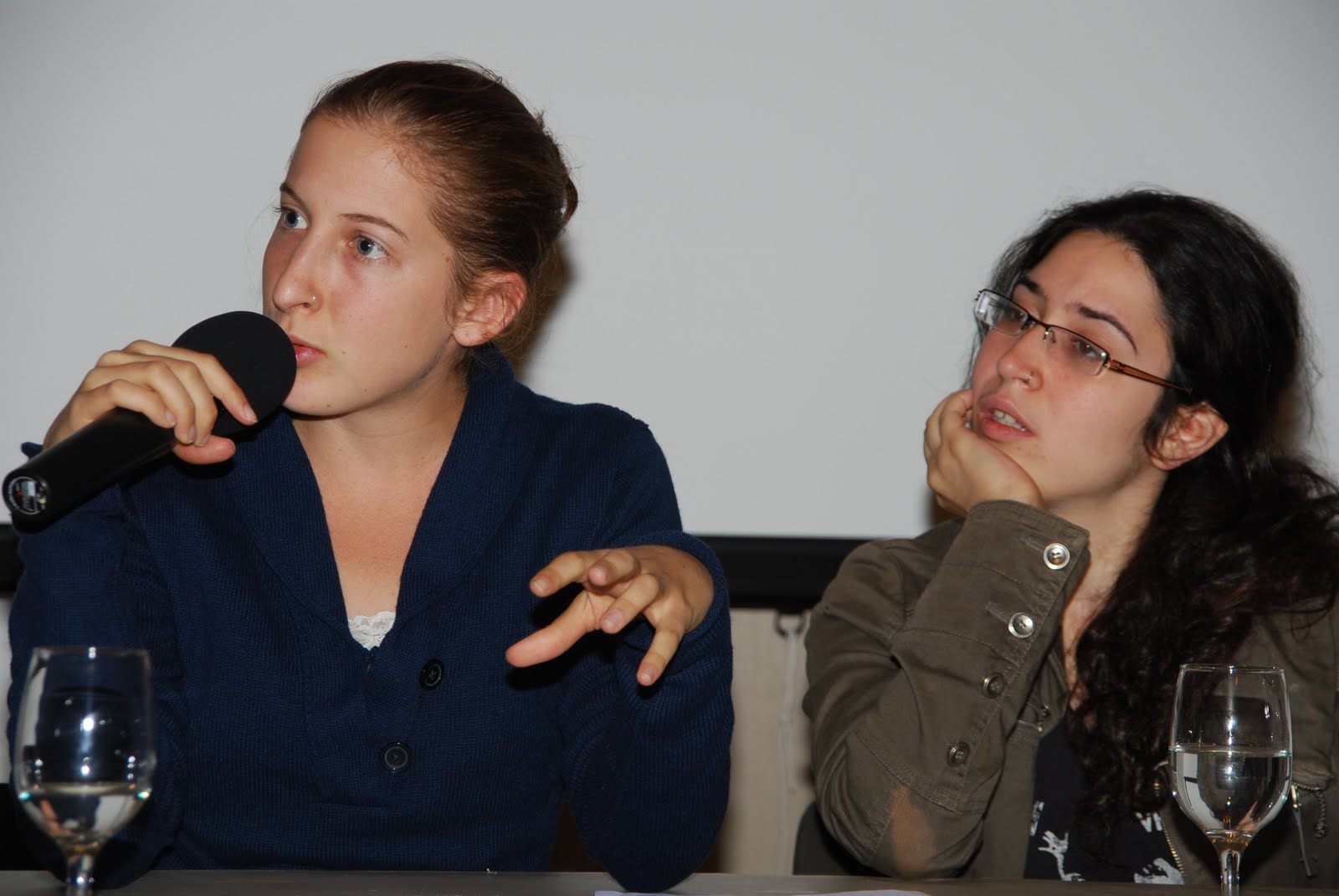
Refuseniks: Maya Wind, left, and Netta Mishly. Photo by Thomas Good / NLN / The Rag Blog.

Israelis who just say ‘No’:
Students refusing to serve the occupation

By Thomas Good / The Rag Blog / October 13, 2009

NEW YORK — Shministim is a Hebrew word meaning twelfth graders — but it means much more than that in the context of Israeli society and the occupation of Palestine.

Shministim was the name adopted by a group of high school seniors who, in 1970, sent a letter to then Prime Minister Golda Meir, explaining that they declined to serve in the Israeli Defense Force due to the IDF’s role in policing the occupation of the West Bank and Gaza. In 1987, a second Shministim group was formed, again composed of high school students who refused to serve in occupied Palestine.

In 2001, a third instance of the sarvanim — or refusenik — movement arose. Members of this third incarnation of the student group are currently touring the U.S. The tour was organized by Jewish Voice for Peace and is being aided by CodePINK.

On September 30, two Shministim refusers, Maya Wind and Netta Mishly, spoke at the Unitarian Church of Staten Island. The event was co-sponsored by the UCSI and Peace Action Staten Island.

The two young women began their presentation with a description of how conscription works in Israel. It is mandatory for all Jews and some non-Jews as well. Women serve two years, men, three. Draft dodging is very common.

According to Wind, 40 percent of those required to serve elude the draft as a variety of loopholes exist. Orthodox Jews are exempted on religious grounds and married women are also not required to serve. Physical ailments are a third way out of military service and mental illness — real or invented — is “another popular one,” Wind said.

Israel also grants conscientious objector status to some conscriptees, although potential COs must convince a panel that they are “universal pacifists” who will not fight under any circumstances. The last officially accepted category is “misfitting” which, according to Ms. Wind, includes “everything from smoking pot in high school to a rough socioeconomic background.”

But the Shministim do not fit into any of these categories. They are refuseniks with a political cause — “selective refusers” who reject Israeli policy towards Palestine and its peoples. Because they are not pacifists and cite a political reason for their refusal, they often become political prisoners of the Israeli military.

Maya Wind read a portion of a Shministim letter that was sent to the Israeli political leaders. The section mentioned several “defense methods” the Shministim find objectionable: “checkpoints, targeted killing (of Palestinians), roads for Jews only, sieges and war.” The conclusion of the statement summarized the Shministim position saying it was “impossible to be moral and serve the occupation.”

Becoming a political prisoner

Netta Mishly described the process of becoming a refusenik. Draftees receive orders to report to base. On arrival each conscript receives an order, in effect the order states you are now a soldier of the IDF. It is at this point the Shministim refuse.

Having refused a direct order, the refuseniks are sent to military prison. When they are released, the Shministim return to base where they are again ordered to become soldiers. Additional refusals provoke additional jail time. This sequence can loop any number of times.

It can be broken by the refusenik asking to see a psychiatrist — or being ordered to see one. If found mentally unfit, the refusenik is exempted from military service. In theory a conscript can be held in prison for ten years but according to Mishly no one has been held beyond two years.

The reason behind the refusal

Maya Wind and Netta Mishly discussed the rationale for the Shministim refusal to serve the occupation in detail. The discussion began with a slideshow depicting the Israeli appropriation of Palestinian land, starting in 1947 and intensifying after the 1948 war. The war resulted in a large land grab that Israelis call independence and Palestinians call the Nakba (catastrophe).

The 1947 partition scheme gave 30 percent of the population (Israelis) 55 percent of the land, Wind said. Since then the Israelis have made encroachment on the remaining lands a centerpiece of domestic and foreign policy. And integral to the encroachment and appropriation is the occupation.

Ms. Mishly described the “three elements of the occupation” in some detail: settlements, check points and “separation barriers” (the Wall).

“The settlements are in very strategic points.” she said.

The settlements are used to justify the army’s presence in Palestine. The settlers, the checkpoints that protect them, and the army personnel that garrison the checkpoints have been deployed for “purely economic reasons,” Mishly said.

The system of checkpoints — and the time involved in negotiating them — keeps the cost of Palestinian produced goods high with the end result being that it is often cheaper for Palestinians to buy Israeli products than to purchase items produced by their own people. The Palestinians who pass through the checkpoints are used as a cheap labor pool by Israelis — and the checkpoints are used effectively to prevent organized resistance to economic exploitation.

The 260 checkpoints make it very difficult for Palestinians to move freely and this is by design, according to Wind and Mishly. Travel permits are required and membership in an organization the Israelis oppose can result in a permit being revoked. This can be devastating as Palestinians must funnel through checkpoints to go to school and hospital — as well as to work.

The official rationale argues that checkpoints are for security and protect Israelis. Ms. Wind disagrees.

“The vast majority of checkpoints separate Palestinians from Palestinians more than they separate Palestinians from Israelis,” Wind said.

The checkpoint system is an aspect of military service the Shministim find particularly objectionable. Wind pointed out that having to wear 80 pounds of equipment, “in all weather,” while strip searching Palestinians who stand on line for hours makes for surly soldiers who are also scared for their own safety. This often results in IDF soldiers abusing Palestinians, Wind said. None of this furthers the peace process.

Up against the wall

Ms. Mishly discussed The Wall, the so-called separation barrier, which is located inside the West Bank — as opposed to encircling the territory. The fact that the Wall winds through Palestinian territory, rather than containing it — erected in areas where settlements are planned but not yet built — would seem to indicate that its purpose is not security but continued encroachment into Palestinian lands, in the form of settlements.

Expanding settlements

The settlements allow Jews seeking affordable housing — underwritten by government sponsored tax incentives — to acquire nicer homes with “better views” than they could find in Israel. But the settlements are not the only form of encroachment. Maya Wind has researched what she calls “the economy of occupation” and she has concluded that there are four core elements:

  1. Economic exploitation of Palestinian natural resources and a cheap labor pool are hallmarks of the economy of the occupation, according to Wind. Palestinian laborers are underpaid (often less than the Israeli minimum wage), uninsured and compelled to work overtime without overtime compensation. Many natural resources are removed from Palestine, for example mud used in facial masks, and packaged and sold as Israeli products.

    “Israel goes into the West Bank and extracts natural resources as if it owned them,” Ms. Wind said. The Israelis also dump toxic and other waste in the West Bank, she said.

  2. Control of the indigenous population via military means has produced a security industry in Israel. Ms. Wind said that the economic importance of Israeli arms trafficking is a problem but the exportation of security methods and technology using “the occupation as a logo” is particularly offensive
  3. The corporations profiting from the Israeli economic exploitation of Palestinian workers and natural resources are not exclusively Israeli. Multinational corporations profiting at the expense of the Palestinians, encouraged by Israeli tax incentives, is well documented at whoprofits.org, Ms. Wind said.
  4. Water. Water is a key natural resource in the Middle East and 80 percent of the water extracted from Palestine is redirected to Israeli settlements, producing serious shortages in the Occupied Territories.

Ideology and ordinary Israelis

To make the occupation palatable to ordinary Israelis and the rest of the world an ideological war is also underway, Wind said. She told the audience that the “victim mentality,” in part a result of the Holocaust and other examples of anti-semitism, is used to create a distrust of the world — a distrust that is “very harmful to the peace movement” in Israel.

The absence of a “Palestinian narrative” in Israeli discourse and textbooks is used to perpetuate the “empty land” myth, Wind said, alluding to the notion that Palestine was a vast empty expanse, a “land without people for a people without land” before the Israelis arrived. Wind compared the lack of a Palestinian narrative in Israel to the lack of a Native American narrative in U.S. society.

Additional ideological underpinnings of the occupation and exploitation include the notion that the IDF is “the most moral army in the world,” Wind said. She said that this romantic representation of the IDF is accompanied by the myth that the Israeli government wants peace but “there is no partner.” Wind rejects this idea, noting that wherever there are people, there is a partner for the peace process.

The formal presentation was followed by a question and answer session.

An audience member asked about Americans who serve in the IDF. Netta Mishly responded, saying that Americans generally serve only a year as they are “not that useful” due to the language barrier — most Americans who join the IDF do not speak Hebrew.

Commenting on a significant fact, often overlooked in discussions about the occupation, Mishly said that more and more settlers are army careerists, attaining higher and higher ranks and being in a position to influence IDF policy and perhaps Israeli politics. This also hinders the peace process.

Sons and daughters

The most poignant moment in the evening arrived when the two young women discussed the cost of being a Shministim.

Noting that the refuseniks are the smallest segment — approximately 200 people — of the peace movement in Israel, Mishly pointed out that they support each other because they are ostracized. Responding to a question about whether their families support them, Mishly said no.

“It hurts,” she said.

The lack of support for the political position taken by the Shministim does not, however, stop family members from supporting their children when their sons and daughters enter the prison system.

“They are still your parents,” Mishly said.

[Thomas Good is editor of Next Left Notes, where this article also appears.]

The Rag Blog

Posted in Rag Bloggers | Tagged , , | 6 Comments

Mexico : Church and Macho Politicos Wage War on Women

Photo of graffiti from Mejilla Hyde.

Catholic Church and macho politicos
Wage war on Mexico’s women

‘Get your rosaries out of our ovaries!’

By John Ross / The Rag Blog / October 13, 2009

MEXICO CITY — “Sacan Sus Rosarios De Nuestras Ovarios!” The women, some of them bare-breasted, linked arms and chanted at the men in suits who were dashing towards the barricaded doors of the colonial edifice that houses the local congress in the central Mexican city of Queretero.

“Get Your Rosaries Out Of Our Ovaries!”

Indeed, some of the men were so eager to get to their desks on the floor of the state legislature that they squeezed through basement windows, risking wrinkles to duds that had been freshly pressed for the occasion.

By 9 a.m. September 1st, in a classic “madruguete” (early morning vote behind locked doors to exclude dissenters), all 21 members of the all-male Queretero congress had unanimously passed a bill criminalizing abortions for all women with the exception of rape victims (but not victims of incest) and those whose lives would be put at risk for carrying to full term. Any other woman who so much as inquired about the availability of abortion at a hospital or clinic could now be imprisoned for up to a year.

According to news reports, a week after the law was passed and signed off on by the rightist Queretero governor, one unfortunate and unidentified woman was in fact arrested for soliciting an abortion, held in jail overnight, and forced to pay a 4000 peso fine.

Queretero was the 15th Mexican state to criminalize abortion. Days later, the conflictive southern state of Oaxaca became the 16th entity in the Mexican union to ratify what pro-choice organizations label “La Ley Machista” that defines life as beginning at fertilization and imposes prison sentences on women seeking to terminate unwanted pregnancies. As in Queretero, the measure was vociferously dissed by pro-choice advocates and the legislature was forced to relocate to a secure alternative site to vote the Oaxaca version of “The Macho Law” up.

Criminalization of abortion bills are also pending in Michoacan, Sinaloa, Veracruz, and Mexico state. With half of Mexico’s 31 states plus one now on record, the machos are assured that a constitutional amendment criminalizing abortion can be passed and such legislation is expected to be introduced in a coming session of the new Mexican congress.

Criminalization of abortion is turning Mexico into “a totalitarian state,” opines Diego Valades, a former attorney general and dean of the National Autonomous University (UNAM) law faculty — such legislation “cedes control of a woman’s body to the state and is itself unconstitutional.” Valades proposes instead a constitutional amendment that would guarantee a woman’s reproductive rights.

The anti-abortion putsch is being orchestrated by the ruling right-wing PAN party in connivance with the Princes of the Catholic hierarchy. One goal is to force repeal of Mexico City’s free abortion-on-demand law. Since the pro-choice legislation was deemed constitutional by a ten to one vote of the nation’s Supreme Court two Septembers ago after the law had been challenged by then-attorney general Eduardo Medina Mora, a proxy for President Felipe Calderon, and the National Human Rights Commission ombudsman Jose Luis Soberanes, an Opus Dei intimate, the city has provided free interruptions of unwanted pregnancies during the first 12 weeks of gestation to more than 30,000 women, an average of 41 a day, according to the Mexico City Womens’ Institute.

Abortion on demand has incurred the fierce wrath of Mexico City Cardinal Norberto Rivera, the most powerful Churchman (there are no Churchwomen) in the land, who ordered all church bells in the capital rung in mourning to mark the court’s decision. The Mexico City archdiocese has since bought a plot in the Dolores Cemetery where it stages funerals for aborted fetuses.

The 102-member Mexican Bishops’ Conference (CEM) is equally as obstreperous in its condemnation of Mexico City’s free abortion services, even those few liberationist bishops who have a voice and vote oppose the leftist capital government’s pro-choice initiative — San Cristobal de las Casas bishop emeritus, an apostle of liberation theology, once exhibited gory blow-ups of aborted fetuses on the esplanade outside the “Cathedral of Peace” in that Chiapas city.

“I am appalled by the CEM’s position. The separation of Church and State is the foundation of the Mexican constitution,” an indignant Diego Valades reminded attendees at a recent National University academic conference.

Mexican Attorney General Arturo Chavez Chavez.

The campaign to criminalize abortion is only one front in the war on women being waged by the PAN, the Roman Catholic Church, and their political allies. Last month (September), the Mexican Senate confirmed Arturo Chavez Chavez, Calderon’s handpicked designee, as the country’s new attorney general over the intense objections of feminists and human rights activists.

As chief prosecutor in the northern state of Chihuahua during the mid to late 1990s, Chavez Chavez was charged with investigating the murders and disappearances of 192 women in the gritty border city of Ciudad Juarez. Mothers of the dead women — “Las Muertas” — accuse Chavez Chavez of gross negligence.

In testimony at his confirmation hearing, the future attorney general insisted that he had cleared 60 murders during his years as Chihuahua’s chief prosecutor but the truth is more diffuse — Chavez Chavez prosecuted one suspect, an Egyptian chemist Omar Latif Sharif, for 60 killings. Sharif, however, was convicted of only one murder, that of a sometimes girlfriend, and is currently serving a 30 year sentence in a Chihuahua penitentiary.

Paula Flores, whose murdered 17 year-old daughter Maria Sagrario has become an icon for the mothers of Las Muertas, recalls a less than empathetic Chavez. When 11 years ago she went down on her knees before him to plead for justice for Sagrario, the aspiring attorney general just walked around her as if she didn’t exist. Later, Chavez Chavez’s investigators mistook Sagrario’s tomb and opened up an adjoining gravesite, carrying off the remains of another Muerta for an autopsy.

Such confusion tainted the Calderon nominee’s years at the helm of the investigation. In 1999, United Nations rapateur for extra-judicial killings Asma Jahangir denounced Chavez Chavez’s “arrogance” when she sought to question him about the investigations. A second UN rapateur on judges and judicial processes, Dato Parran, who visited Juarez in 2002, doubted that any of the more than 100 remaining cases had even been investigated.

In 2003, Amnesty International found “intolerable negligence” in the investigations of the dead women’s murders carried out by Chavez Chavez and his successors — autopsies did not meet international legal standards and inquiries were only initiated after pressure from grieving families. Many of the disappeared women were dismissed as runaways.

Jurist Eduardo Buscalgia, who headed a UN commission that reviewed the violent deaths of 258 women in Juarez between 1993 and 2003, uncovered what he recently described as “procedural horrors” in the investigations of the deaths of Las Muertas. Many of the victims had apparently been tortured and some of their bodies burnt. Eight women had one breast cut off and were brutally bitten by their attacker(s) and their remains thrown out on the same desert lot, evidence that suggested a serial killer was at large yet no serious investigation was ever launched by Mexican authorities.

Instead, Chavez Chavez blamed the women for their own grisly murders, intimating that they had provoked their killers by wearing mini-skirts. “Only bad women go out at night,” he concluded — many of the victims like Maria Sagrario Flores had been working late night shifts at Juarez maquiladoras and were still wearing their “batas” (work smocks) when their bodies were discovered.

Despite overwhelming evidence of Arturo Chavez Chavez’s inept, misogynist investigation into the deaths of Las Muertas, he was confirmed September 24th by the Mexican Senate as the nation’s top law enforcement officer. When, in protest, the mothers of the dead women painted 106 pink crosses (the number of unsolved cases) on the walls of the prosecutor’s offices in Juarez, they were investigated for the destruction of federal property.

Posters at entrance to a government building in Juárez in 1998 protesting disappearances of women and lack of police investigation. Photo© Susan Meiselas.

In another notorious case of violence against women, 11 victims of sexual abuse during police raids in the farming village of San Salvador Atenco May 3rd-4th 2006 have once again been denied justice. This September, the Special Prosecutor for Violence Against Women (FEMIMTRA), which operates under Chavez Chavez’s jurisdiction, rejected their claims that they had been sexually manhandled and penetrated during their arrests and turned the cases back to Mexico state authorities that had already vindicated the police.

Charges against 22 state cops were dropped, five are pending while the accused are out on bail (if previous accusations of sexual battery against the police are any precedent, they will never be prosecuted), and one police agent who was sentenced to three years imprisonment paid a $400 USD fine and is now reportedly back on the Mexico state police payroll.

Violence against women is spiraling in Mexico. On the day Arturo Chavez Chavez was confirmed (September 24th), five women were shot and killed in the Sierra of Petatlan in Guerrero state where army troops have been pursuing purported guerrillas for months. One week later, four women — one a police domestic violence investigator — and a little girl who was playing nearby were gunned down in Ciudad Juarez. According to a grim roster held by the group “Justice For Our Daughters,” 67 women have been murdered or disappeared in Juarez in the first nine months of 2009 — 28 bodies remain unclaimed in the city morgue.

From July 2007 thru June 2008, 227 “feminicides” were recorded in 13 northern Mexican states by the private Citizens Observatory on Feminicides and 1014 counted nationally. 60% of the killings occurred in and around the womens’ homes.

Despite the on-going slaughter, the central Mexican state of Guanajuato, which has long been under the thumb of the Catholic Church and the PAN, is the only one of Mexico’s 31 states that has not enacted a law to protect women from domestic violence. Guanajuato is home to the extreme right-wing “El Yunque” (The Anvil), a secret organization with roots in the 1926-29 Cristero uprising against the anti-clerical president Plutarco Elias Calles, founder of the modern PRI party that ruled Mexico for 71 years until displaced by the PAN’s Vicente Fox, a Guanajuato native, in 2000 — three members of Fox’s cabinet were reportedly affiliated with El Yunque.

When the school term began this fall in Guanajuato, first year high school students found themselves without biology text books because books published by the federal Secretary of Public Education (SEP) had been withdrawn under orders from PANista governor Juan Manuel Oliva who adjudged that they contained “perversions” — the biology books included anatomically-correct reproductions of human genitalia and addressed birth control, even daring to use the two dread words “condom” and “abortion.”

Instead, the Guanajuato Education Secretariat (SEG) distributed 114,000 of their own biology textbooks that demonized masturbation and homosexuality, skipped any mention of AIDS prevention, and advocated abstinence as the only method of avoiding unwanted pregnancies.

When the federal SEP (ironically controlled by the PAN) insisted on teaching the original biology texts, a group of women in Leon, the state capital, headed by a local rightist councilwomen burnt hundreds of the SEP books in the central plaza of the city. “They want to make my son wear a condom,” explained the councilwoman Hortencia Orozco.

The PAN is hardly alone in its pogram against women. The Chavez Chavez nomination was voted up by the PRI and the Mexican Green Environmental Party (sic) that together hold an absolute majority in the Mexican congress. Eight of the 16 states that have criminalized abortion are governed by the PRI whose party president is a woman.

600,000 abortions are performed in Mexico each year according to the Secretary of Public Health, 100,000 of them under dangerous, clandestine circumstances. The prohibition of legal abortion stirs the specter of the dark ages of back alley butchers scraping women with clothes hangers. In six of the 16 states that have criminalized the interruption of unwanted pregnancies, maternal mortality is five times the national average.

Both local and national legislatures in Mexico are male dominated. The number of women holding congressional office (27%) is well below Cuba (43%), Argentina (40%), Costa Rica (39%), and African nations such as Mozambique, Tanzania, and Rwanda (49%). Only 15% of high echelon executives in the Calderon government are women in a country where women (52%) are the majority — in Ecuador 35% of all executive positions are held by women and Argentina and Chile have women presidents.

Two years ago, Mexico revised its electoral code to insure that women would comprise 40% of the federal congress but this September 2nd, when the recently elected Chamber of Deputies met for the first time, eight recently elected women rose from their desks one by one and asked for permanent leaves of absence. Their seats were then delegated to their all-male substitutes (“suplentes“), at least one of whom was the husband of an electee. Denouncing violation of the so-called “Equanimity of Gender” clause of the reformed code, feminist Gabriela Rodriguez, writing in the left daily La Jornada, blasted the flimflam as “nothing less than electoral fraud against women.”

[John Ross’ monstrous El Monstruo — Dread & Redemption in Mexico City, a “love letter” to the most contaminated, corrupt, and conflictive city in the Americas (Kirkus Reviews), will be published next month by Nation Books. His Iraqigirl (Haymarket), the diary of a teenager growing up under U.S. occupation, is now in the stores. The author is scouting venues for a 2009-2010 book tour. Any ideas? Contact johnross@igc.org.]

The Rag Blog

Posted in Rag Bloggers | Tagged , , , , , | 13 Comments

Rag Radio! : Healthcare NOT Warfare


TUESDAY ON KOOP RADIO IN AUSTIN:

RAG RADIO

HOSTED BY THORNE DREYER

KOOP, 91.7 FM — Every Tuesday afternoon — 2-3 PM

The latest addition to the Rag media family, Rag Radio presents issue-oriented discussion and cutting edge cultural programming in the tradition of the underground press. With a heavy dose of our countercultural history. [The Rag was Austin’s legendary 60’s underground newspaper; The Rag Blog and Rag Radio represent its spiritual rebirth.]

VOLUME I, NUMBER 3:
Tuesday, October 13, 2-3 PM

Healthcare NOT Warfare
Rev. Jim Rigby
St. Andrews Presbyterian Church
Austin, Texas
and
Jesse Romero
Texas State Director
Health Care for America Now

NEXT WEEK:
Tuesday, October 20, 2-3 PM

Criminal Justice and Texas Politics

Glenn W. Smith
Texas blogger and political consultant
and
Steve Hall
Director, StandDown Texas Project


The online stream of RAG RADIO can be found here:


The Rag Blog

Posted in RagBlog | Tagged , , , , | 1 Comment