Who Owns Congress? (Hint : Wall Street)

And where’s the outrage?
Wall Street owns Congress

By Sid Eschenbach / The Rag Blog / October 11, 2009

See ‘On the government’s owners’ by Glenn Greenwald, Below.

A few years ago, Bill Bennett wrote a book entitled The Death of Outrage based loosely, between self-serving rants, on the assertion that the nation should be outraged by Bill Clinton’s character flaws…

The issue covered in Glenn Greenwald’s article below is so far more important, far more lethal and far more pressing than any part of Bennett’s book that it beggars the mind… but still no outrage. The inchoate sentiments displayed by the Tea-Baggers are as close as any group has come, albeit in their case from a particularly strange and disjointed line of reasoning, to grasping and acting on the fact that there has in fact been a financial coup d’etat in the U.S.

The political party that is able to articulate and frame this debate will own it… although for the very reason that there has been a coup, no major national leaders are making it.

No time like the present.

On the government’s owners

By Glenn Greenwald / October 10, 2009

The most revealing political quote of the last year came, in my view, from the second-highest ranking Democratic Senator, Dick Durbin, who told a local radio station in April: “And the banks — hard to believe in a time when we’re facing a banking crisis that many of the banks created — are still the most powerful lobby on Capitol Hill. And they frankly own the place.”

The best Congressional floor speech of the last year on the financial crisis was this extraordinarily piercing five-minute revelation from Rep. Marcy Kaptur of Ohio on the Wall Street bailout and how the Congress is subservient to their dictates.

And the single most insightful article on the financial crisis was written by former IMF Chief Economist and current MIT Professor Simon Johnson in the May 2009 issue of The Atlantic, when he argued that “the finance industry has effectively captured our government” and detailed how the U.S. has become very similar to failed emerging-market nations in both its political and economic culture.

All of that came together last night on Bill Moyers’ Journal program, as Johnson and Kaptur together discussed the stranglehold which the financial industry exerts over the federal government and how that has produced a jobless recovery in which the only apparent beneficiaries are the bankers and other financial elites who caused the financial crisis in the first place.

The discussion began with reference to this Associated Press article from last week, which examined Timothy Geithner’s calenders, obtained through a FOIA request. Those documents show that Geithner spends an amazing amount of time on the telephone with the CEOs of Goldman Sachs, Citibank and JP Morgan: “Goldman, Citi and JPMorgan can get Geithner on the phone several times a day if necessary, giving them an unmatched opportunity to influence policy.”

Other than the President, virtually everyone else — including leading members of Congress — are forced to leave messages. Kaptur and Johnson begin by discussing what that signifies in terms of the ongoing financial crisis and how government works.

I’ll excerpt a few representative passages, but the entire segment is very worth watching:

[Moyers plays an excerpt from Capitalism: A Love Story:

MICHAEL MOORE: Do you think it’s too harsh to call what has happened here a coup d’état? A financial coup d’état?

REP. MARCY KAPTUR: That’s, no. Because I think that’s what’s happened. Um, a financial coup d’état?

MICHAEL MOORE: Yeah.

MARCY KAPTUR: I could agree with that. I could agree with that. Because the people here (pointing to the Capitol) really aren’t in charge. Wall Street is in charge”…]

SIMON JOHNSON: Well, I think it really tells you how the system works. The system is based on access and is based on what on Wall Street shaping Washington’s view of what’s important.

It’s the people who are very close to Mr. Geithner before when he was the head of the New York Fed. Before he became Treasury Secretary. These people have unparalleled access. And in a crisis, when everything is up for grabs, you don’t know what’s going on, the people who will take your phone calls, right, in government and people who are going to be standing in the oval office, making the key decisions. That’s the heart of the system. That’s the heart of how you get your agenda through, by changing their worldview. . . .

And Rahm Emanuel, the President’s Chief of Staff has a saying. He’s widely known for saying, ‘Never let a good crisis go to waste’. Well, the crisis is over, Bill. The crisis in the financial sector, not for people who own homes, but the crisis for the big banks is substantially over. And it was completely wasted. The Administration refused to break the power of the big banks, when they had the opportunity, earlier this year. And the regulatory reforms they are now pursuing will turn out to be, in my opinion, and I do follow this day to day, you know. These reforms will turn out to be essentially meaningless. . . .

BILL MOYERS: Let me show you an excerpt from the speech President Obama made on Wall Street last month, September. Here is the challenge he laid down to the bankers.

PRESIDENT OBAMA: We will not go back to the days of reckless behavior and unchecked excess at the heart of this crisis, where too many were motivated only by the appetite for quick kills and bloated bonuses. Those on Wall Street cannot resume taking risks without regard for consequences, and expect that next time, American taxpayers will be there to break their fall.

BILL MOYERS: A reality check. Not one CEO of a Wall Street bank was there to hear the President. What do you make of that?

SIMON JOHNSON: Arrogance. Because they have no fear for the government anymore. They have no respect for the President, which I find absolutely extraordinary and shocking. All right? And I think they have no not an ounce of gratitude to the American people, who saved them, their jobs, and the way they run the world.

BILL MOYERS: In the scheme of things, it is the Congress, and the government that’s supposed to stand up to the powerful, organized interests, for the people in Toledo, who can’t come to Washington. Who are working or trying to keep their homes or trying to pay their health bills. What’s happened to our government?

MARCY KAPTUR: Congress has really shut down. I’m disappointed in both chambers, because wouldn’t you think, with the largest financial crisis in American history, in the largest transfer of wealth from the American people to the biggest banks in this country, that every committee of Congress would be involved in hearings, that this would be on the news, that people would be engaged in this. . . .

I’ve been one of the Members of Congress trying to increase by ten times the agents to get at the justice issues for the American people. For companies that have been hurt. For shareholders that have been hurt. Our government isn’t doing it. That it’s very easy to look at the budget of the F.B.I. in mortgage fraud and securities fraud and say, ‘How serious is the government?’ And until those numbers increase, we will not begin to get justice. . . .

BILL MOYERS: Well, and this is what we were talking about earlier, the system. I mean, President Clinton’s Secretary of Treasury, Robert Rubin helps eliminate Glass-Steagall. And then leaves the government and goes to work for? Citicorp?

SIMON JOHNSON: Well Rubin’s a fascinating character. He ran Goldman Sachs, he went into the Clinton White House, then he became Secretary of the Treasury, and it was on his watch that, first of all, Glass-Steagall began to really seriously crumble, and then it was completely swept away- replaced, abolished, really. And then, of course, Rubin goes on after he leaves Treasury, to be the senior guru type figure at Citigroup. And Citigroup is absolutely epicenter of everything that’s gone wrong with our financial system.

BILL MOYERS: And wasn’t it Robert Rubin the mentor, the guru to both Tim Geithner and Larry Summers?

SIMON JOHNSON: Absolutely. Both Geithner and Summers advanced to senior positions in the Treasury under Rubin was instrumental in bringing Larry Summers to be President of Harvard, after the Clinton Administration. And according to published new report, he was absolutely key person in making sure that Tim Geithner first went to a senior job at the IMF, and then became President of the New York Fed. And there are unconfirmed reports that Robert Rubin was an essential adviser to then candidate Obama in fall of last year, with regard to who he should bring on board as the leadership team on the economic side.

MARCY KAPTUR: And you know, looking at it from the heartland, when I look at Wall Street and all their connections into Washington, and I’ve been at it a while now, it’s very disheartening to me, because I know they don’t care about us out there. We’re flyover country for them. And they’re just out to make money. . . .

BILL MOYERS: So, Simon, what happens now? If we’re going to avert a depression and the next calamity, what needs to be done?

SIMON JOHNSON: Well, I think you have to keep at it, Bill. I mean, that’s the lesson from previous generations of Americans, who have really confronted entrenched power like this. You have to keep at it. And you mustn’t be satisfied. When the Administration says, ‘Okay, we fixed it. Don’t worry. We did some technical tweaking on capital requirements, for example, in the banks.’ You have to say, ‘No, that’s not true. Let’s look at what’s happening, let’s follow it through.’ . . . .

BILL MOYERS: Does President Obama get it?

MARCY KAPTUR: I don’t think President Obama has the right people around him. The poor man inherited a total mess, globally and domestically. I think some of the people that he trusted haven’t delivered. I urge him to get new generals. It’s time.

SIMON JOHNSON: Louis the Fourteenth of France, a very powerful monarch, was famous for having many bad things, you know, happen under his rule. And people would always say, ‘If only Louis the Fourteenth knew. I’m sure he doesn’t know. If we could just tell him, he’d sort it out.’ You know. I’m skeptical.

Neil Barofsky, the independent watchdog of the TARP program, recently said that while the Wall Street bailout did avert full-scale financial collapse, it plainly failed in its principal stated goal of increasing lending (because banks used the money to buy other institutions, create capital cushions, pay out bonsues, etc.). He detailed how the Treasury Department actually tried (mostly unsuccessfully) to coach the banks into refusing to provide Barofsky with information about how they used the TARP money they received. Worse, he said that the U.S. economy is more dependent than ever on these same “too-big-to-fail” financial institutions, which have grown in size, and the U.S. economy is thus more vulnerable than it was even a year ago to an actual collapse. Meanwhile, even the extremely modest Wall Street reforms Obama is advocating are meeting heavy resistance from those who Dick Durbin called the Owners of Congress.

As Kaptur said, given the size and scope of “the largest transfer of wealth from the American people to the biggest banks in this country,” one would expect there to be massive public interest in what happened and why, and, more so, whether any of this is being fixed (it plainly isn’t). One would particularly expect the Democratic Party — which has long branded itself as being the populist party against Wall Street — would be leading that charge, for political benefit if not for substantive reasons. But that’s clearly not happening, and the primary reason why is because both political parties, as institutions, are dependent on and thus controlled by the very industry that is at the heart of it.

Among the two parties, there’s no outlet for the populist anger that Kaptur understands and is voicing because each party is eager to serve the interests of those who fund them. And that’s why Democrats have largely ceded the populist anger over Wall Street to GOP operatives who are exploiting the “tea party” movement as the only real organized citizen activism over these issues. See this article from last week: “Wall Street money rains on Chuck Schumer”:

While the industry has scaled back its political spending in the wake of last year’s economic collapse, data from the Center for Responsive Politics show that it’s still investing heavily in the Senate, where it’s likely to have its best shot at stopping — or at least shaping — the crackdown on Wall Street that President Barack Obama has proposed.

And it’s clearly looking to Democrats to do it.

Of the $10.6 million the industry has given to sitting senators this year, more than $7.7 million has gone to Democrats.

This is hardly unique to the banking industry. This is how the political system works generally. Earnest, substantive debates over this or that policy are so often purely illusory, as the only factor that really drives that outcomes is the question of who owns and thus controls the political system. That central fact subsumes just about everything else.

Source / salon.com

The Rag Blog

Posted in Rag Bloggers | Tagged , , , , , | 7 Comments

Tipping Point : New Research on Climate Change Says We’re Getting Close

Illustration by Guy Billout / Mother Jones.

New methods of scientific research show
CO2 levels way beyond ‘natural fluctuation’

It is undeniable that CO2 levels have risen and fallen in the past. It is also undeniable that there is a point beyond which serious damage to the world’s environment will occur.

By Ted McLaughlin / The Rag Blog / October 11, 2009

For years now, we have been arguing about global climate change (commonly called “global warming”) and whether it is caused by increasing levels of CO2 in the atmosphere.

Most of the world’s scientists believe we are nearing the tipping point, beyond which will cause global catastrophe. Conservatives disagree, saying it is natural for CO2 levels to rise and fall and we shouldn’t burden our corporations over something that is natural.

Both sides have a point. It is undeniable that CO2 levels have risen and fallen in the past. It is also undeniable that there is a point beyond which serious damage to the world’s environment will occur. But what is the tipping point, and how much have the levels of CO2 varied in the past (without causing damage to the environment)?

It has been hard to answer these questions in the past, because all we had to go on were ice core samples. The ice core samples will only take us back about 800,000 years. Fortunately, scientists have now developed a method for seeing CO2 levels much farther back in time — about 20 million years. And what they’ve found is kind of scary.

This new method involves taking sediment cores from the bottom of the Pacific Ocean. That gives them the ratios of boron and calcium in the shells of tiny marine organisms called foraminifera. This gives them the ph of the water as far back as twenty million years ago, and from that ph they can figure the level of CO2 in the air at any particular time.

Our current level of CO2 in the air is slightly less than 400ppm, and scientists expect we will reach the 400ppm level in about a decade (or less). The International Energy Agency, in it’s prescription for controlling CO2 levels, sees them topping out at 510ppm before stabilizing at 450ppm. The energy bill recently introduced in the U.S. Senate also uses the 450ppm figure as a target.

The new research takes us back to the Miocene period, which started a little over twenty million years ago. At that time, the CO2 levels were at 400ppm (about what they are now). This was probably caused by prolonged volcanic activity in the Columbia River Basin in North America.

But the scary part is that at that time, there were no ice caps at the north and south poles. And the sea level was 80-130 feet higher than today. The CO2 level began to decline about 14 million years ago, causing the gradual growth of the ice caps and the gradual lowering of ocean levels. Since that time, the CO2 level has fluctuated naturally between 180ppm and 280ppm.

While the pro-corporate conservatives are correct that there have been natural fluctuations, we have surpassed the high end of that fluctuation for many years now. At 400ppm and beyond we are approaching the tipping point, beyond which we will no longer be able to avoid catastrophe.

We have been debating whether 450ppm of CO2 in the air is doable. That may well be the wrong question. Considering the new research, we should be asking if 450ppm is too high a level to avert disaster. After all, the ice caps are already melting and we are not quite up to the 400ppm level of CO2.

Even if we are able to stabilize the level of CO2 at 450ppm (and that looks doubtful at present), we may just be slowing the coming disaster instead of preventing it. And that’s just not good enough.

While some of our lawmakers (and those in other countries) are talking about stabilizing CO2 levels, there doesn’t seem to be any urgency in their actions. Sadly, there doesn’t seem to be much urgency among the general population either. It’s almost as if everyone believes this is a problem, but we have a lot of time to deal with it. All we have to do is pass a law or two, but not ones that would alter our lives, and everything will be all right.

It would be nice if that were true, but this new research shows us it’s not. We may already be at or closely approaching the tipping point. Immediate and radical action is necessary. We cannot continue to build coal plants and placate ourselves with myths of “clean coal.”

We must stop polluting our air with more and more CO2. If we cannot immediately develop and transfer to really clean forms of energy, then we need to cut our energy use and change our lifestyle.

The alternative is unthinkable for our children and grandchildren.

[Rag Blog contributor Ted McLaughlin also posts at jobsanger.]

The Rag Blog

Posted in Rag Bloggers | Tagged , , , | 8 Comments

Honduras : Talks Ramp Up as Repression Gets Bloody

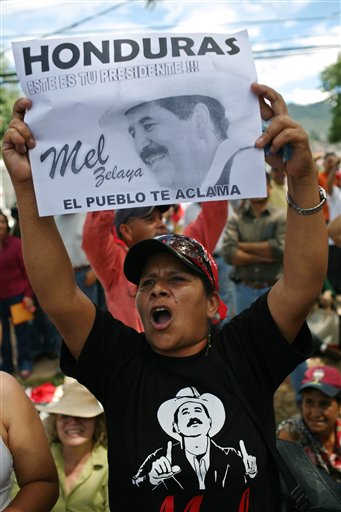
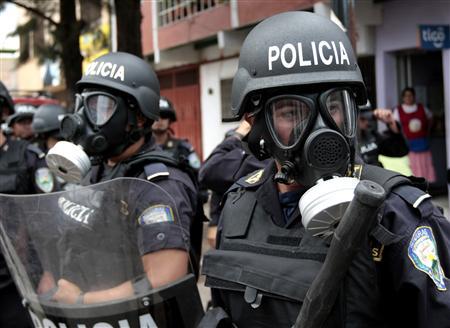
Top, Zelaya supporter with sign saying “Honduras, this is your president,” outside the U.S. embassy in Tegucigalpa, Oct. 7, 2009. Photo by Rodrigo Abd / AP. Below, riot policemen stand guard as Zelaya supporters protest in Hato De En Medio neighborhood in Tegucigalpa, Oct. 10. Photo by Henry Romero / Reuters.

More bloody repression in Honduras
As negotiations enter new stage

By David Holmes Morris / The Rag Blog / October 10, 2009

See ‘Zelaya stakes out his position’ by Arturo Cano, and late-breaking story on new media crackdown, Below.

As determined protests and bloody repression continue in the streets outside, representatives of deposed Honduran President Manuel Zelaya and the de facto government led by Roberto Micheletti have been meeting with Latin American diplomats in a hotel in Tegucigalpa since October 7 in an effort to resolve the crisis the country has been living through since June 28.

Optimists say the talks, sponsored by the Organization of American States, are already producing results, but skeptics counter that the coup government will never budge from its hidden agenda of stalling until the November elections which, the golpistas hope, will restore legitimacy to the Honduran government and will spell defeat for those struggling for change.

Journalist Arturo Cano wrote the following from Tegucigalpa where he is covering the crisis for the Mexican daily newspaper La Jornada.

Zelaya stakes out his position:
A return to power before the 15th or no elections

Micheletti warns that nothing short of an invasion will prevent November 29 vote while Insulza says the basis of dialogue must include all provisions of San José Accord.

By Arturo Cano / October 8, 2009

TEGUCIGALPA, Honduras — Luz Ernestina Mejía, Miss Honduras of 1980, former Partido Liberal congresswoman and an organizer of the “white marches” against the reinstatement of Manuel Zelaya to the presidency, is furious with the foreign ministers.

“Why should we approve of Zelaya’s capricious return to power through legal means? No restitution, no tercería (a third person in the presidency), nothing. I am a radical,” she says.

“So what is this dialogue for?” she asks. “They (the zelayistas) are lucky I’m not one of the negotiators.”

But they are not that lucky: hours later, when presented with arguments by diplomatic representatives of several countries, the de facto president becomes exasperated and says he’s been tricked.

“We thought you had come in good faith to tell us you accept a Honduran solution, but the speeches you have made are totally different. They say we have to return Mr. Zelaya to power,” Micheletti thunders, although, in truth, he is not as radical as Miss Honduras.

He does accept a third person in the presidency. “I will step aside but this gentleman who has done so much harm to the economy and to Honduras must also step aside.”

Micheletti gives a report on his government, chastizes the ministers for their deafness and waxes apocalyptic. “The elections will be held on November 29! Only if we are attacked and invaded will they not be held!”

’Not a single death,’ he presumes to claim

He takes pleasure in his verbal retaliation: “You neither know the whole truth nor at times do you want to hear the whole truth.” And Micheletti’s truth is that “there has not been a single death at the hands of the army or the police,” there has not been a state of siege, but merely the suspension of “some” rights and the closing down of two media, thanks to which acts “the population has experienced the most peaceful of days.”

And in passing, Micheletti informs José Miguel Insulza, secretary general of the Organization of American States, the foreign ministers of six countries and several other diplomatic representatives, of the cost of feeding Manuel Zelaya’s horse and of his groom’s salary.

In the morning, Insulza had stated the OAS position: the Honduran dialogue should have as a basis “all the points” of the San José Accord, proposed more than two months ago by Óscar Arias. One of those points is Zelaya’s restitution to office. Insulza adds to that the formation of a “national unity” government and Zelaya’s renouncing any act leading to the rewriting of the constitution.

A couple of days ago, Micheletti let slip a mention of the possibility of reinstating the president. Now, with the ministers as a captive audience, he returns to the position he had held since the coup d’état.

“To continue in a situation like this one, in which President Zelaya is not reinstated, poses a considerable risk that the results of the election will not be recognized,” says Rodolfo Gil, Argentine representative to the OAS.

Along the same line, Brazilian representative Ruy Casaes cites the example of President Fernando Collor de Mello, “deposed by absolutely legal means.”

The remaining representatives are less direct, so the Brazilian is the only one Micheletti interrupts. He greets the Mexican foreign minister, Patricia Espinosa, with a kiss.

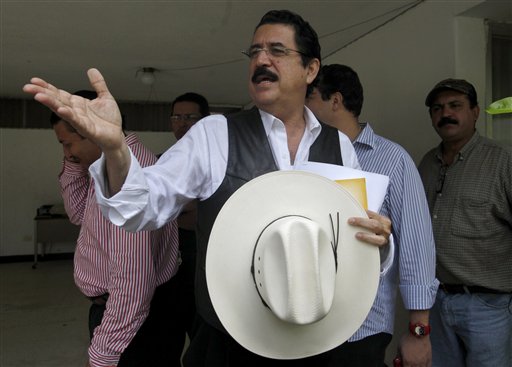
Honduras’ ousted President Manuel Zelaya gestures after a meeting with negotiators at the Brazilian embassy in Tegucigalpa, Wednesday, Oct. 7, 2009. Photo by Esteban Felix / AP.

One day in office and ‘he’ll twist it all around’

“Treat me right because I’m going to be interior minister again,” Víctor Meza would say in the first days of August, when he was predicting “good news soon.” Two months later, Meza heads a group of three who represent Zelaya in the talks with the de facto government. So the “good news” never came.

Only Zelaya’s secret return to his country on Monday, September 21, turned the situation around and made the international community tighten some screws, particularly one manufactured in Brazil, and brought about this day: the first day that union leader Juan Barahona is not in a march but in a great hall with carpets and chandeliers, a proletarian in a sea of suits, in blue jeans and his baseball cap. And to be sure, Barahona and Zelaya’s Labor Minister Mayra Mejía are left alone on the left of the first row; none of the businessmen or politicians, unanimous in their support of the coup, wants to sit next to them.

First to speak at the opening ceremony of the dialogue is José Miguel Insulza, who brings to the table the San José Accord and asks the participants to negotiate “their hidden intentions.” When he finishes, the businessmen, the hard-line of the coup, respond with a timid boo.

“Once again they’ve come to impose their agenda, their formula,” says businessman Santiago Ruiz, one of those who booed and one of those convinced that Zelaya should never be reinstated. “One day in office and he’ll twist it all around.”

Zelaya began the day with a statement on the radio: “We warn you that if the president is not returned to office before October 15, then automatically, for lack of validity, credibility and the confidence of the national and international communities, the electoral calendar will be null and void until the San José Accord is signed and the president is reinstated.”

The elections are the battle horse of the de facto government, the political parties, the businessmen, the “civil society” marching in their white t-shirts, and the churches.

They don’t want a dialogue, they want to stall until the elections which, to their way of thinking, will magically make the world’s governments recognize that there was a “presidential succession” and not a coup d’état.

’Hypocritical maneuvering’ will be exposed

“President Zelaya will be back in the capitol this month, the president will return to the office to which he was elected,” says Víctor Meza shortly after his presentation to the international delegation and before his closed meeting with the de facto government’s negotiators.

In his speech Meza apologizes for being late, which resulted from Zelaya’s representatives not being allowed to see the president in the Brazilian embassy until eight o’clock this morning.

Shortly before the assembly was convened, perhaps in order to present the OAS mission with a luxurious reception, the police broke up a zelayista demonstration at the United States Embassy. They then also attacked groups of students demonstrating at the National University.

Meza denounces these actions and forsees a scenario that the zelayistas consider likely:

“This dialogue has virtues and possibilities and when we understand it as a medium for calculated retreats and tactical delays, the dialogue has the advantage of exposing that hypocritical maneuvering.”

Leaving stridency aside, Meza calls for a speedy exit from the “dark tunnel” Honduras has entered after “allowing the barbaric to overcome the civilized.”

Interestingly, some of the public, including some among the press, applaud him.

Source / La Jornada

Breaking story:
Honduras imposes media restrictions

October 11, 2009

Honduras’s government has imposed a new law limiting media freedoms in the country, amid a political standoff between Roberto Micheletti, the de facto leader, and Manuel Zelaya, the deposed president.

Talks between the rival factions entered a three-day pause on Saturday, prolonging uncertainty over a possible resolution to the almost four-month old crisis.

The new legislation gives Micheletti’s government the power to close down radio and television stations that incite “social anarchy” or “national hatred”.

Oscar Matute, the interior minister, denied the measures amounted to controlling the media, saying the government was was applying rules allowed under international law.

“It doesn’t represent any kind of control of the media,” he was quoted by the Reuters news agency as saying.

“No journalist, no media outlet, can act as an apologist for hatred and violence in society.”

Media crackdown

The government has not fulfilled an earlier promise to lift emergency measures that closed Radio Globo and Canal 36 last month, which had supported Zelaya.

The two stations were among the only media in Honduras that reported on the protests in favour of restoring Zelaya to power.

Michelletti’s government accused the stations of encouraging vandalism and insurrection for announcing demonstrations.

Honduras has experienced near daily protests since the military-backed coup in June, which came after Zelaya pressed ahead with plans for a referendum on changing the constitution despite a Supreme Court order ruling the vote illegal.

The interim government accuses Zelaya of trying to amend the constitution to annul one-term presidential limit.

Zelaya denies the allegation.

Negotiations suspended

Since sneaking back into Honduras late last month, Zelaya has been taking refuge, with dozens of supporters, in the Brazilian Embassy in Tegucigalpa, the Honduran capital.

The international community has been pressuring the interim government to allow Zelaya’s return to power ahead of the November 29 presidential election, which was scheduled before the coup.

Representatives from the rival factions said that recent face-to-face talks have yielded agreement on 60 per cent of the issues under an international plan to resolve the crisis.

But Juan Barahona, Zelaya’s negotiator, said no agreement had been reached on the fundamental issue of whether the ousted leader could return to serve out the remaining months of his term.

They planned to discuss the issues within their own factions over the three-day pause and resume negotiations on Tuesday, two days before the October 15 deadline given by the Zelaya camp for his unconditional restitution.

Source / Al Jazeera

The Rag Blog

Posted in Rag Bloggers | Tagged , , , , | Leave a comment

BOOKS / Speak English! by Mike Palecek


Sci-fi, conspiracy theories and politics merge:
Speak English! is a wild journey

By Joan Wile / The Rag Blog / October 10, 2009

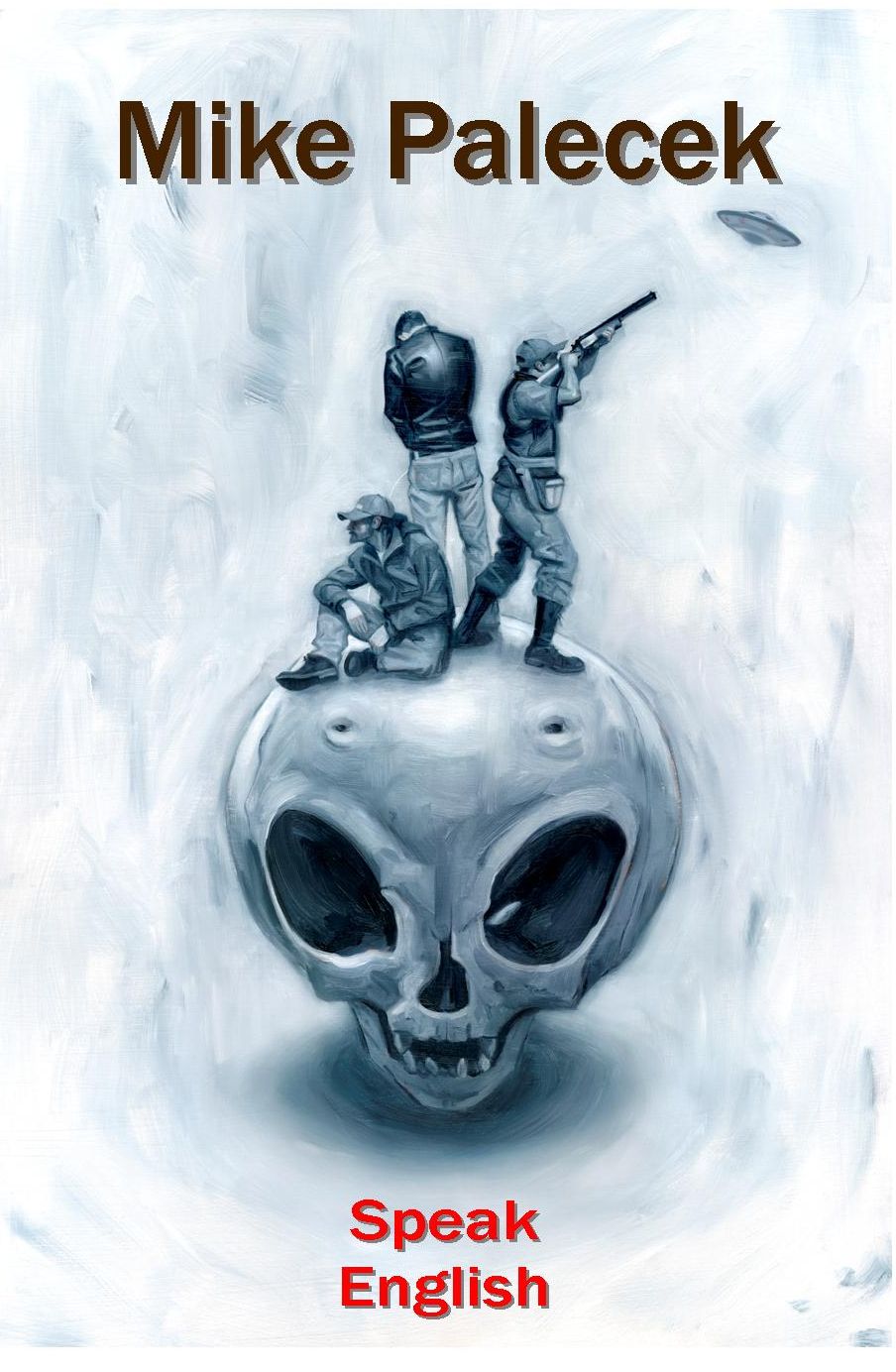
[Speak English! by Mike Palecek. Trade paperback, 322 pp. Published by CWG Press; to be released November, 2009.]

Speak English, by Michael Palecek, speaks the truth, and in English.

Combination road story, sci-fi mystery, philosophical consideration, and political castigation of just about everything, Mr. Palecek’s book is a must-read for all who seek justice, peace, accountability of elected officials, and penetration of the myths that cloud our political vista.

With unique and dazzling style, Mr. Palecek takes us with him on a cross-country book tour during which we encounter many of the gutsy anti-establishment heroes and heroines of our times.

This account is book-ended by an intriguing tale of country boys engaging with aliens and flying saucers.

The seeming disparity between the extra-terrestrial yarn and the contemplative trek across the United States is resolved, finally, in a surprising twist which leaves the reader awestruck yet satisfied.

The author is obsessed with his beliefs that the 9-11 tragedy was caused by George Bush and his cronies, and that President Kennedy’s assassination did not occur as the official investigation findings claim.

He is also heartbroken about Paul Wellstone’s death in an airplane crash and suspicious that it, too, was a politically-motivated killing.

One comes to believe, while reading the book, that these are not necessarily crackpot conspiracy theories but rather enigmas deserving of much deeper probing.

Speak English contains many varied elements — poetry combined with funny yokel dialogue, for instance; inspiring quotes from eminent writers and statespeople; questions upon questions with startling answers.

Just as the book’s protagonist encounters many adventures on his book tour, we, the readers, encounter twists and turns from paragraph to paragraph and page to page that make our perusal of his book one big adventure. It is difficult to adequately describe its immense sweep and broad diversity of style and subject.

This is a page-turner. Curl up in a comfortable chair with a healthy dose of cynicism and open-mindedness for an enlightening and entertaining trip through America’s (no-)heartland and the author’s unique, inquiring sensibility.

[Joan Wile is the author of Grandmothers Against the War; Getting off Our Fannies and Standing up for Peace (Citadel Press, ’08).]

Go here to find Speak English! by Mike Palecek.

The Rag Blog

Posted in Rag Bloggers | Tagged , , | Leave a comment

Carl R. Hultberg :
How They Busted Hippie Hill

They found dope in Dick’s Store and then they took down Hippie Hill.

hippie hill - dick's store

Dick’s Store in Danbury, NH — near Hippie Hill — shown after Dick got busted Sunday, Oct. 4. Photo by Ken Williams / Concord Monitor.

As far as I know Hippie Hill had never really bothered many of the local townspeople. All that changed last year…

By Carl R. Hultberg | The Rag Blog | October 10, 2009

HIPPIE HILL, NH — The town of Danbury, New Hampshire, where I live, is also home to a local landmark known as Hippie Hill. Of course, this being New Hampshire, we have to remember that here the term “hippie” does not connote any particular point of view regarding war, peace, ecology, racial equality or women’s liberation. What hippie means in NH is long hair and a predilection for the consumption of large quantities of marijuana (and beer).

In many ways hippie is the same as biker (motorcyclist) in New Hampshire. So it is at Hippie Hill where local bikers and others who like to ride their motorcycles (without noise restricting mufflers) on Rte 4 congregate in downtown Danbury to throw horseshoes, drink beer and defiantly smoke (mostly homegrown) pot on a little knoll (railroad embankment) across the road from Dick’s Store.
Continue reading

Posted in Rag Bloggers | Tagged , , , , | 15 Comments

Nobel Screams : ‘Out of Afghanistan’

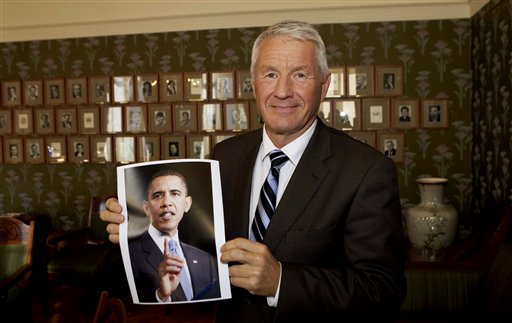
Nobel Chairman Thorbjoern Jagland. Obama has a lot to live up to.

Nobel Prize is mandate to exit Afghanistan,
Build a green-powered, nuke-free earth

By Harvey Wasserman / The Rag Blog / October 10, 2009

Above the din, the Nobel message screams: “U.S. OUT OF AFGHANISTAN, GO FOR SOLARTOPIA!”

It’s now up to US to use that Nobel to win that dual prize.

This award never went to two of the most critical peacemakers of the 20th Century: Mahatma Gandhi, who pioneered the successful use of mass non-violence; and Eleanor Roosevelt, feminist godmother of the New Deal’s social programs and the Universal Declaration of Human Rights.

It has not gone to Cesar Chavez, Ken Saro-Wiwa, Thich Nhat Hanh, Paul XIII and so many more.

But yes it did to Barack Obama. Why?

Right now we have no choice but to defer to the committee that took the plunge. Chairman Thorbjoern Jagland explained that “It could be too late to respond three years from now. It is now we have an opportunity to respond — all of us.”

Respond to what?

“We couldn’t get around these deep changes that are taking place” under Obama.

ARE taking place? Or WILL take place? Or MIGHT take place if somebody plays this card right.

Say you’re a committee member desperate for peace and a solution to climate chaos.

Maybe you’re a gambler. You remember giving the Prize to Desmond Tutu for fighting apartheid before it was abolished.

You say: “This new kid talks a great game. He’s made a green and peaceful feint or two. But the generals and fossil/nukers are at his throat.

“Let’s box him in. Let’s hang this Nobel around his neck… and over his head. Let’s DARE him to do right.”

Or, as Jagland has actually put it, the award will give Obama “encouragement” and “support in producing concrete results” for the “vision of a nuclear-free world” among other things.

Now let’s say you’re an American activist. You’re desperate to stop the worst mistake America could make since Lyndon Johnson’s 1965 escalation of the Vietnam War — that is, a murderous, suicidal escalation of the war in Afghanistan.

We all know this would shred the last fiber of a failing society, utterly decimating any chance for an American moral, ecological or economic recovery.

But the long knives of Pentagon junta are out in force.

We also know without a massive Solartopian push for renewables and efficiency, the global climate is doomed. Nuclear power must be excluded and fossil fuels phased out.

Now this glib young prez, who must stand up to the generals and King CONG (Coal, Oil, Nukes, Gas) is given — or shall we say, stuck with — the Nobel Prize.

Pasted to his back now are the words of Alfred Nobel lauding “the person who shall have done the most or the best work for fraternity between the nations and the abolition or reduction of standing armies and the formation and spreading of peace congresses.”

Obama rightly says he does not deserve “to be in the company of so many of the transformative figures who’ve been honored by this prize.”

But the Committee, which cited Afghanistan, climate change and nuclear disarmament in its decision, is clearly betting this marker might help him — FORCE him — to get there.

Obama could, of course, use it as cover — Henry Kissinger style — to do the wrong things.

But this gift is not to Obama. It’s to US, as a tool to MAKE him go where we must.

The spotlight has now been amped. The focus is on Aghanistan and a green-powered, nuke-free Earth.

The Nobel is a mandate — a sacred trust — to push this president into the pantheon with Martin Luther King and Nelson Mandela, not to mention Eleanor Roosevelt and Mahatma Gandhi.

Ready or not, we have our opening to make Barack Obama rise to their standard.

[Harvey Wasserman’s Solartopia! Our Green-Powered Earth is at www.solartopia.org.]

The Rag Blog

Posted in Rag Bloggers | Tagged , , , | 6 Comments

Rabbi Arthur Waskow : Let’s Help Obama EARN that Nobel


The Nobel Prize, Obama, and Afghanistan
(And especially its women)

By Rabbi Arthur Waskow / The Rag Blog / October 9, 2009

The first person I told this morning that Obama had won the Nobel Prize for Peace said, “For what?”

So — if I may give a new spin to a saying of the last remarkable presidential candidate before him, Bobby Kennedy:

Some people, shown a piece of work not yet completed, say, ‘How come?’

But I, facing that same piece of work not yet completed, say, ‘The time is now!’

And that is what I would urge us all to say to the President today, and next week:

”Congratulations! And the time is NOW to fulfill this honor — end the Afghan War!”

To help stop the war, we invite you to act now by clicking here to send a letter to your Senator (or Vice-President Biden if as a DC resident you have none)

The war could and should have begun by tackling Al Qaeda as criminals, not as if they were a country that was at war with the U.S. The minimum amount of force necessary to apprehend them, including deadly force if necessary. That’s it. Capturing cop-killers without burning down the neighborhood.

Yes, the Taliban are disgusting. Oppressive. But there are a myriad ways of encouraging reform in other countries. The one that does NOT work is trying to install democracy at the point of a bayonet. Or, even worse, Predator Drones which massacre wedding parties from the sky and turn the survivors into furious enemies.

In a minute I will suggest a couple of ways of thinking outside the Afghan box. Maybe those or other ideas they stimulate should be the way to go. Continuing this war is not. We can already see that we have walked into another quagmire — an endless war in a country that for centuries has hated all occupations with a burning fury.

And that war would undermine all plans for social reform at home — exactly what happened to Lyndon Johnson when Vietnam swept away the Great Society.

The moment has come to correct the mistake. President Obama has been told that the warpath “forward” means 500,000 US troops for five years. Many dead, maimed of body, mind, and soul. Forget about health care. Forget education. Forget healing our wounded, choking planet. And he is — it seems — thinking twice.

But the mindless pressures of military habit are still pressing. The American people — surveys show a majority oppose this war — must act to end it. The other path — friendship with Islam; economic aid at the grass-roots, micro-loan level; empowering women; drawing on the healing of wind and solar energy instead of addiction to oil — will do far more to protect America.

As Code Pink, the U.S. women’s peace organization, has reported after recent meetings with Afghan women, and as my dear friend Barbara Bick, whose memory is a blessing, and who spent years in Afghanistan working with Afghan women, also reported before her death this year, Afghan women want to be empowered — but they do not believe American bombs will do it.

Two ideas way outside the box:

  1. Send five women U.S. Senators to negotiate with Afghan women and all male Afghan factional leaders (including the varied Taliban factions) with two promises: that any governance agreement unanimously agreed to will be backed up by billions in U.S. economic aid, delivered in suitcases, if necessary. All U.S.military presence and aid ends at once. If no such agreement is reached, all U.S. involvement in Afghanistan ends.
  2. Call a conference of the independent women’s organizations in Afghanistan. Offer micro-loans for grass-roots economic development to any group of ten women who apply as a group (loans ranging from $1,000 to $5,000), plus offer ten revolvers and 100 bullets to each group of women: one gun and 50 bullets for each woman for target practice, 50 for defense against anyone who comes to assail them for being uppity. Then — the U.S. leaves, except for continuing contact with the micro-loan organizations.

Whether you like these ideas or not, the US war in Afghanistan should end — for their sake and for ours.

Again — we invite you to act now by clicking here to send a letter to your Senator (or Vice-President Biden).

Thanks and blessings that the effort you bring for peace and healing flows back into peace and healing in your own life.

Shalom, salaam, shantih, peace —

Arthur

[Rabbi Arthur Waskow is director of The Shalom Center. He can be reached at awaskow@shalomctr.org.]

The Rag Blog

Posted in Rag Bloggers | Tagged , , , | 22 Comments

Stephanie Smith : E. Coli and the Killer Burger

Escherichia coli (known as “E. Coli” to its friends).

E. coli nearly killed Stephanie Smith:
All-beef patty can be big-time trouble

By Carl R. Hultberg / The Rag Blog / October 9, 2009

Stephanie Smith was pretty much committed to vegetarianism. But after her mother insisted she get a little protein from a traditional meal, she broke down and let her mother (Sharon) cook her a burger. Sharon slapped a Sam’s Club beef patty in the frying pan and they had their American style meal.

When Stephanie got sick, her mother was sure she knew what had caused it. It had to be the spinach. What neither of them knew was that the meat industry poisons people all the time. That’s why it rarely makes the news. Stephanie went into seizures and had to be put into a coma to save her life. Today she is recovering, but she will probably never walk again.

The story of the burger that poisoned her is a complex one. No, as you probably have already guessed, the cows (as opposed to steers) who supplied the meat for that burger were not raised on a family farm. If the cows had been raised in this traditional manner, they would have been grass fed, allowed to exercise and slaughtered in a clean environment.

As it was the killer burger came from multiple sources. To maximize profits, Cargill purchased cow meat from here and there, high intensity feedlots where cattle are penned in and pumped full of the high protein food (soy) that makes their meat attractive on the plate. After feeding out in these filthy crowded lots, the animals are brought in to be slaughtered in an assembly line process. Although there are safety rules, greed and the sheer impossibility of keeping feces off the future meat products make food safety in this environment extremely difficult to achieve.

No one knows exactly where the E. coli tainted meat came from. Could be Omaha. Could be Uruguay. All the different sources make it easy for the companies to blame each other, while they speed up production and hire illegal immigrants at lower wages. The American Meat Institute says it is doing what it can to slow down the rate of E. coli poisoning.

Cook your burger all the way through and you will kill the pathogens, diseased tissue and possibly some of the hormones and antibiotics. Then you will have a wholesome American style meal. Medium rare could quite possibly kill you. Meat promoters point to the need for total irradiation of meat products. Just another part of a mouth watering American food experience, I guess, but obviously another workplace hazard for the largely immigrant workforce.

Are there other options? Aside from the obvious vegetarian diet that feeds the world 15X over compared to meat eating? The vegetable diet that is better for your health? The diet that does more to stop global warming than driving an electric car, riding a bicycle and recycling 100% of your trash? The diet that allows humanity to live at peace with animals and each other? Not that diet?

Okay, the other alternative is to go to your butcher and have him (or her) cut and grind up a piece of animal flesh for you to eat. It won’t cost $1 a pound and come in a pre formed patty, but it will put you in a safer and more morally honest position as a meat eater.

Bon appetit!

The Rag Blog

Posted in Rag Bloggers | Tagged , , , | 6 Comments

McChrystal Clear : More Boots on the Ground

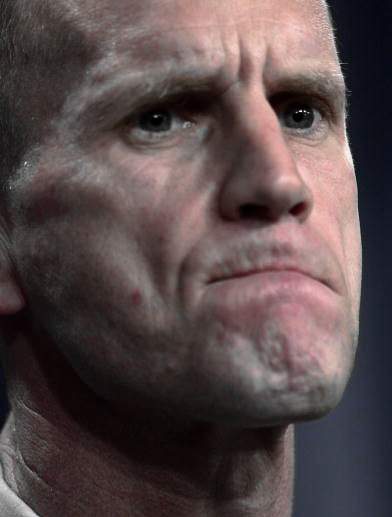
Gen. Stanley McChrystal: Repeating the cliches.

Do the numbers:
500,000 troops for Pashtunistan?

McChrystal repeats the clichés of classic counterinsurgency… American generals used the same vintage phrases in Vietnam, where efforts to ‘protect the population’ led to forcing rural peasants into fortified ‘strategic hamlets.’

By Steve Weissman / October 8, 2009

Gen. Stanley McChrystal, the U.S. commander in Afghanistan, talks of winning the hearts and minds of the Afghan people. He sees the need to get beyond standard military thinking and understand the political, religious, social and economic context. He also knows that kicking down doors, destroying homes and killing civilians turns the Afghans against us and creates more insurgents than we could ever kill.

“If the people are against us, we cannot be successful,” McChrystal told CBS’s “60 Minutes.” “If the people view us as occupiers and the enemy, we can’t be successful and our casualties will go up dramatically.”

In his report to President Obama and in endless interviews, the four-star general talks about persuading the Afghans, protecting them and making them secure from the Taliban. “Our every action must help secure, mobilize and support the Afghan people and their government to defeat the insurgency and establish effective governance.”

How to “establish effective government” in a country that has never known one, McChrystal does not say. Nor does he tell us how he would do it with an Afghan leadership made up of war lords, drug barons and a president — Hamid Karzai — who won re-election by creating hundreds of phony polling stations and stuffing ballot boxes in wholesale fashion.

Undaunted, McChrystal repeats the clichés of classic counterinsurgency, or COIN, as refurbished by his boss, Gen. David Petraeus, head of Central Command. American generals used the same vintage phrases in Vietnam, where efforts to “protect the population” led to forcing rural peasants into fortified “strategic hamlets.”

With only slight variations of emphasis, French generals spoke the same lingo earlier in Vietnam and Algeria, while British generals became the gurus of counterinsurgency from Malaya to Kenya to Cypress. In these conflicts, one problem stands out: The counterinsurgents most often lost, as did earlier invaders in Afghanistan, from Alexander the Great to the British Raj to the former Soviet Union.

But why let all this history get in the way? “Each historical moment is different,” the learned Obama warned us with a flourish from the Greek philosopher Heraclitus. “You never step into the same river twice.”

Forget history, then, and stick with military thinking. The new counterinsurgency manual that General Petraeus produced calls for “a range of 20 to 25 counterinsurgents for every 1000 residents” in the area of operations. Afghanistan has a population of some 30 million, which would require 600,000 to 750,000 counterinsurgents, including American, allied and Afghan troops.

Frederick Kagan, the neo-conservative military strategist who advises both Petraeus and McChrystal, talks of limiting our counterinsurgency to the Pashtun areas of Afghanistan, leaving the Tajiks, Hazaras, Uzbeks, and other of the country’s ethnic minorities to fend for themselves. Kagan estimates a Pashtun population of some 16 million, which would bring the counterinsurgent troops needed down to somewhere between 320,000 and 400,000.

Either way, having enough troops in no way guarantees victory. But, according to Pentagon doctrine, having too few would make it almost impossible to subdue a determined insurgency, especially in Afghanistan’s mountainous terrain.

America now has some 68,000 troops in Afghanistan. Obama has already authorized another 21,000, and General McChrystal is asking for 40,000 more. This would bring the American commitment to 129,000. Allied troops number 35,000, and the Afghans currently have 88,000 soldiers and 82,000 police. This would bring the total to 334,000, if McChrystal counts on the Afghan forces, which most experts do not. Washington is asking for more troops from our reluctant allies, while McChrystal plans to increase the Afghan total to 400,000 by 2014.

Would this be enough to win? Secretary of Defense Robert Gates is reportedly having second thoughts. “Even 40,000 more [American] troops don’t give you enough boots on the ground to protect the Afghans if the north and west continue to deteriorate,” one official told The Wall Street Journal. “That may argue for a different approach.”

Gates has previous voiced the fear that too many foreign boots on the ground will only encourage more Afghans to join the insurgents, as the Soviet learned.

Others, like Sen. Russell Feingold, fear that foreign boots in the Pashtun area of Afghanistan will force more of the insurgents into the tribal areas of Pakistan, where they would meld into a population of over 25 million Pashtuns. How many more troops would General McChrystal need then?

[A veteran of the Berkeley Free Speech Movement and the New Left monthly Ramparts,Steve Weissman lived for many years in London, working as a magazine writer and television producer. A former senior editor at Truthout, he now lives and works in France. For previous articles by Steve Weissman on The Rag Blog, go here.]

Source / truthout

The Rag Blog

Posted in RagBlog | Tagged , , | 1 Comment

Supremes Hear Challenge to Mojave Cross

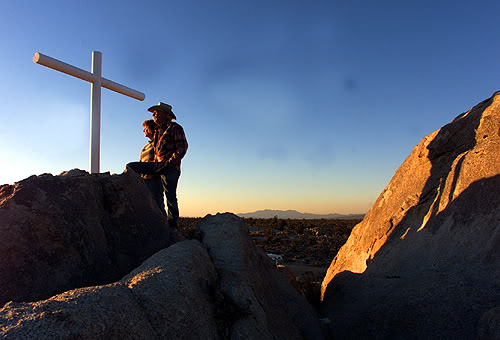
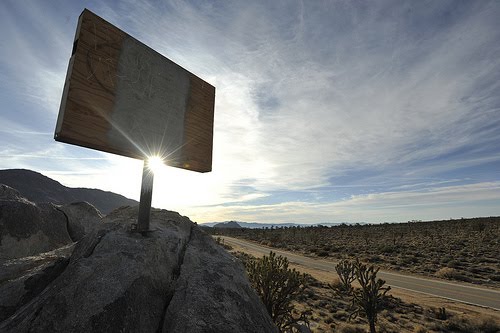
Eight foot high cross on Sunrise Mountain in the Mojave National Preserve. Below, cross is covered during court fight. Lower photo by Eric Reed.

Veterans’ memorial at Mojave National Preserve:
Supreme Court hears challenge to eight-foot cross

The ACLU argued that the cross is the predominant symbol of Christianity and should not be treated as a single, favored religious symbol.

By Ted McLaughlin / The Rag Blog / October 8, 2009

An 8 foot cross has stood atop Sunrise Rock in the Mojave National Preserve since 1934. It was supposedly erected to honor America’s soldiers in World War I. But is it really proper to erect a religious symbol in a National Preserve or Park, especially since the Park Service turned down a request to erect a Buddhist monument nearby?

That is the question that was being discussed by the United States Supreme Court yesterday. A former National Park Service employee felt it was inappropriate for the National Preserve to favor one religion over others, and took the matter to court. A federal judge and the 9th Circuit Court of Appeals ruled that the display was unconstitutional, and the government appealed to the Supreme Court.

The Obama administration supports leaving the cross in the park. As much as I respect President Obama, I have to disagree with him on this one. I have no problem with a memorial honoring World War I soldiers being in the preserve, but why does it have to be a christian symbol (and the cross is recognized worldwide as a christian symbol).

Christians would be opposed to the memorial being a religious symbol from any other religion, so I really don’t understand why they think it’s OK to force their own symbol on Americans who believe in other religions. Personally, as an atheist, I don’t believe symbols of any religion should be placed on government land.

In an attempt to do an end run around the Constitution, the National Preserve has transferred ownership of the cross and the bit of land underneath it to the Veterans of Foreign Wars (VFW). This is not real ownership, because the VFW can’t sell the land and if they remove or fail to provide upkeep on the cross, the land will revert back to the National Preserve.

The ACLU argued that the cross is the predominant symbol of Christianity and should not be treated as a single, favored religious symbol. Judge Scalia tried to argue that the cross didn’t just represent christian soldiers, but was a “common symbol” to honor war dead.

That’s a ridiculous argument. One look at national cemeteries for war dead shows that crosses are used for Christian dead, while other symbols are used for those of a different faith. There is even a designated symbol for atheists.

No matter how long the cross has stood in the Mojave National Preserve, it should be removed. Allowing only a Christian symbol amounts to government designating a favorite or “official” religion, and that is unconstitutional.

Americans practice many faiths, and many practice no religion at all. Their tax money helps support the National Park System, and they should not be forced to support someone else’s religion.

[Rag Blog contributor Ted McLaughlin also posts at jobsanger.]

The Rag Blog

Posted in Rag Bloggers | Tagged , , | 9 Comments

Freeland: Banking Goes Broadway


Pay Pals: Getting Big Bucks from Banks
By Bill Freeland / The Rag Blog / October 7, 2009

As MegaBank’s CFO, I’ve prepared the following guidelines for the upcoming meeting of the executive compensation committee.

(I say “upcoming” but, of course, I mean “long past.” It seems notice of this year’s meeting was once again sent late and as a result none of you were here. Don’t be concerned. It went off without a hitch. Simply sign below to confirm receipt of this back-dated mandatory communication.)

Item 1: Hello and Goodbye

First, let me welcome all of the newcomers — which is to say, all of you. As you are aware, committee members are replaced annually to promote the bank’s goal of presenting policies that are always fresh — at least to each of you.

The benefit in all of this is that there is little need for you to be concerned about details you’re likely to forget by the end of the meeting anyway. We apologize in advance if the new amenity we’ve added to the gathering creates a distraction. As I’m sure you know, access to an open bar during all the deliberations has recently become a widely accepted practice in our industry. What’s more, should you have any other needs that require attention (either here or in an adjoining room), feel free to consult the friendly companion who has been assigned to you for that purpose.

Item 2. Newly Strengthened Standards

In light of the recent financial crisis (or as we prefer to call it, “opportunity”), the time of business as usual is long past. Time was when hard work and political connections were all you needed to succeed in this business. Not anymore. Today we have a new partner: the federal government. As a result we are now free to move beyond merely rewarding success. In this new age we can concentrate exclusively on the rewards themselves.

Which means that the work of this committee can assume a sharply different focus. Having become really too big to fail also means we are now big enough to accept the rewards of this new status. Which is why this year’s bonus package, while it may appear exorbitant to others who have not achieved our level of systemic threat, we believe is simply too big to forego.

Item 3: Short-Term vs. Long Term Goals

If there is one thing this new realty has taught us it is that we need to focus more on long-term stability rather than short-term gain. This will require raising our sights above today’s quick profit and becoming more concerned with projecting earnings much further out. Say, a month or two — at least. In this context, we hereby dedicate ourselves to the long-term goal of a minimum of two booms before every bust.

But this kind if discipline comes at a price. Which, of course, brings us again to the compensation committee. Long-term perspective merits long-term pay. Therefore, we will be proposing the industry’s first “better than life” lifetime pay. The checks keep coming as long as we (or our beneficiaries) keep cashing them.

Item 4. New Levels of Accountability

We have all grown up to respect the importance of the work ethic. In recent years that has meant the grinding demands of working from ten to four for a solid three days a week with only a two-hour break for lunch. But in this new age of bailouts and corporate consolidations, we call for a new definition of the term “work” itself. Who anymore really believes that this requires time actually spent at a desk. Or for that matter, even at the office.

No, work can now assume a new existential dimension. Now the new definition of “executive performance” can be inextricably joined to “executive existence” itself. We no longer merely do our jobs. We are our jobs. Recognizing this new reality, however, presents a unique challenge to the compensation committee.

Existence obviously requires a 24-hour commitment. And as a “24-hour executive,” our compensation must be similarly comprehensive. We exist around the clock. We should be paid around the clock. Seen from this perspective, executive pay that was once considered outrageous is now merely au currant.

And given what we’ve been through over these last months, that seems the least we can do for ourselves.

The Rag Blog

Posted in Rag Bloggers | Tagged , , , | Leave a comment

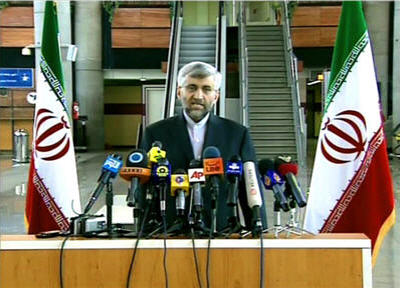
Iran and the Geneva Talks

Secretary of Iran’s Supreme National Security Council, Saeed Jalili expressed Tehran’s readiness to cooperate with the international community in all areas, saying he entered the talks with six powers in Geneva with “good will.” Photo: Al Alam.

Real Progress With Iran
By Gary Sick / October 4, 2009

The Geneva nuclear talks were just baby steps along a long and perilous path. Still, this was a historic moment after 30 years of mutual recriminations and hyperbole.

If you have any doubt that the Geneva meetings with Iran were surprisingly productive, just go back and look at the commentary the day before they began. Even allowing for the fact that the United States and its negotiating partners (the five permanent members of the United Nations Security Council plus Germany–the P5+1–plus European Union negotiator Javier Solana) were trying to lower expectations to the political equivalent of absolute zero, it was still difficult to find anyone who anticipated anything like real progress. Yet that is what happened.

Iran had issued a bland five-page document that scarcely mentioned the nuclear issue. They insisted that the newly discovered Qom enrichment site was not only perfectly legal but utterly routine. They let it be known that they had no intention of discussing their own nuclear program in these talks. Yet, from the accounts we have so far, it appears that Iran came prepared to make concessions about Qom, permitting IAEA inspections to begin within the next two weeks or so. As for their nuclear program, almost nothing else seems to have been discussed.

The United States blustered that it was preparing “crippling sanctions” to be imposed on Iran if they did not “come clean” about their nuclear activities. In the end, it appears that sanctions were not a significant topic, and the Western side was prepared to make some significant concessions of its own.

By all accounts, instead of being a food fight leading to a total breakdown, the Geneva talks were serious, businesslike, and even cordial. The top U.S. negotiator, Undersecretary of State William Burns, had a one-on-one meeting with Iranian top negotiator Saeed Jalili, in which they reportedly talked substantive issues. That is something that had not happened in thirty years. During the latter years of the Clinton presidency, Iranian officials conducted desperate evasive maneuvers to avoid any direct contact with American officials, and during the first six years of the George W. Bush administration, American officials did the same with their Iranian diplomatic counterparts. The orders on both sides to avoid official contact at risk of one’s professional career seem to have been relaxed, at least for this occasion.

What did this meeting actually produce? Iran agreed to permit inspections of its new site. The Western negotiators came up with a clever ploy to permit Iranian low-enriched uranium (LEU) to be sent to Russia for further enrichment, probably from about 5 percent to about 20 percent, and then transported to France to be fabricated into fuel rods to feed the Iranian research reactor (ironically given to Iran by the United States in an earlier day), which is used to produce isotopes used for medical purposes. This had many dimensions. First, it reduced the Iranian LEU stock below the level required to produce a nuclear device. Second, it established the principle that Iranian enrichment could be conducted outside the country. But third, it promised to provide Iran with uranium enriched well above the level required for nuclear power reactors (but not yet at the level required for bomb-building). And lastly, it tacitly acknowledged Iran’s right to produce enriched uranium. Nothing in the reports we have seen to date indicate that the Western interlocutors insisted on the previous red line that Iran should abandon its enrichment program.

Finally, the two sides agreed to meet again later this month. At a minimum, that suggests that they believed there was more to be discussed.

Both sides evidently came prepared to behave civilly, to make some small but important concessions, and to initiate a process of negotiation that has been on ice almost since the moment that George W. Bush decided, for arcane reasons of his own, to declare Iran (which had just finished working closely with the United States to establish a new civil government in Afghanistan) a charter member of the Axis of Evil.

One swallow does not a summer make, and it would be a mistake to think that the results of the Geneva meetings were anything more than the first baby steps along a perilous and unpredictable path. Those perils were unmistakable in the words of President Obama in his brief remarks immediately following the talks. In carefully chosen words, he remarked that “today’s meeting was a constructive beginning, but it must be followed by constructive action by the Iranian government.” His emphasis was almost exclusively on our demands on Iran and what remained to be done, rather than on what had been accomplished.

Obama’s speech was clearly directed to his domestic constituency, and particularly the right wings of both the Democratic and the Republican parties who had openly hoped or expected that the meetings would lead to early, severe sanctions against Iran. It was also no doubt intended to maintain the pressure on the Iranian side and to demonstrate that we would not settle for a few welcome, even unexpected, gestures of cooperation. That skeptical tone may have been dictated by negotiating strategy and political necessity, but I wonder if we will be as understanding when the Iranian leadership makes similarly dismissive remarks.

Still, this was a historic moment after 30 years of mutual recriminations and hyperbole. Under the circumstances, even simple civility was remarkable. Both sides behaved themselves almost as grownups, when it would have been easier to descend into a school yard rumpus.

We can hope that the Western negotiators keep their eye on the fundamental objectives of these talks. Instead of drawing new red lines, which are typically ignored by the Iranians and which have proved both futile and counterproductive, we need to pursue two clear goals. First, we need to insist on maximum inspection and monitoring of all aspects of Iran’s nuclear activities. Secondly, we should attempt to minimize Iran’s development of the precursors of a nuclear weapon. In other words, we should install an early warning system that will tell us with some confidence if Iran decides to depart from its obligations under the Non-Proliferation Treaty and build a bomb; and we should seek to maximize the time between such a decision and the moment when Iran could actually produce a deliverable weapon.

Those are realistic goals and they are consistent with Iran’s own statements and past practice. But they will not easily be achieved in a negotiating climate of hostility and mistrust. This meeting offered the prospect that the “wall of mistrust,” as former Secretary of State Madeleine Albright and former Iranian President Mohammed Khatami described it, is not necessarily impermeable.

The process that has been started is going to be neither short nor serene. It is, however, the only game in town. And it is off to a better start than any of us had a right to expect.

Source / Axis of Logic

Thanks to Deva Wood / The Rag Blog

Posted in RagBlog | Tagged , , | 1 Comment