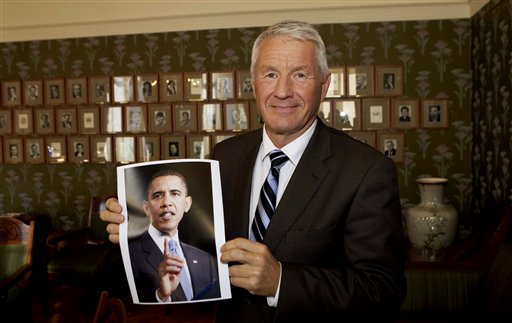
Rabbi Arthur Waskow : Let’s Help Obama EARN that Nobel


The Nobel Prize, Obama, and Afghanistan
(And especially its women)

By Rabbi Arthur Waskow / The Rag Blog / October 9, 2009

The first person I told this morning that Obama had won the Nobel Prize for Peace said, “For what?”

So — if I may give a new spin to a saying of the last remarkable presidential candidate before him, Bobby Kennedy:

Some people, shown a piece of work not yet completed, say, ‘How come?’

But I, facing that same piece of work not yet completed, say, ‘The time is now!’

And that is what I would urge us all to say to the President today, and next week:

”Congratulations! And the time is NOW to fulfill this honor — end the Afghan War!”

To help stop the war, we invite you to act now by clicking here to send a letter to your Senator (or Vice-President Biden if as a DC resident you have none)

The war could and should have begun by tackling Al Qaeda as criminals, not as if they were a country that was at war with the U.S. The minimum amount of force necessary to apprehend them, including deadly force if necessary. That’s it. Capturing cop-killers without burning down the neighborhood.

Yes, the Taliban are disgusting. Oppressive. But there are a myriad ways of encouraging reform in other countries. The one that does NOT work is trying to install democracy at the point of a bayonet. Or, even worse, Predator Drones which massacre wedding parties from the sky and turn the survivors into furious enemies.

In a minute I will suggest a couple of ways of thinking outside the Afghan box. Maybe those or other ideas they stimulate should be the way to go. Continuing this war is not. We can already see that we have walked into another quagmire — an endless war in a country that for centuries has hated all occupations with a burning fury.

And that war would undermine all plans for social reform at home — exactly what happened to Lyndon Johnson when Vietnam swept away the Great Society.

The moment has come to correct the mistake. President Obama has been told that the warpath “forward” means 500,000 US troops for five years. Many dead, maimed of body, mind, and soul. Forget about health care. Forget education. Forget healing our wounded, choking planet. And he is — it seems — thinking twice.

But the mindless pressures of military habit are still pressing. The American people — surveys show a majority oppose this war — must act to end it. The other path — friendship with Islam; economic aid at the grass-roots, micro-loan level; empowering women; drawing on the healing of wind and solar energy instead of addiction to oil — will do far more to protect America.

As Code Pink, the U.S. women’s peace organization, has reported after recent meetings with Afghan women, and as my dear friend Barbara Bick, whose memory is a blessing, and who spent years in Afghanistan working with Afghan women, also reported before her death this year, Afghan women want to be empowered — but they do not believe American bombs will do it.

Two ideas way outside the box:

  1. Send five women U.S. Senators to negotiate with Afghan women and all male Afghan factional leaders (including the varied Taliban factions) with two promises: that any governance agreement unanimously agreed to will be backed up by billions in U.S. economic aid, delivered in suitcases, if necessary. All U.S.military presence and aid ends at once. If no such agreement is reached, all U.S. involvement in Afghanistan ends.
  2. Call a conference of the independent women’s organizations in Afghanistan. Offer micro-loans for grass-roots economic development to any group of ten women who apply as a group (loans ranging from $1,000 to $5,000), plus offer ten revolvers and 100 bullets to each group of women: one gun and 50 bullets for each woman for target practice, 50 for defense against anyone who comes to assail them for being uppity. Then — the U.S. leaves, except for continuing contact with the micro-loan organizations.

Whether you like these ideas or not, the US war in Afghanistan should end — for their sake and for ours.

Again — we invite you to act now by clicking here to send a letter to your Senator (or Vice-President Biden).

Thanks and blessings that the effort you bring for peace and healing flows back into peace and healing in your own life.

Shalom, salaam, shantih, peace —

Arthur

[Rabbi Arthur Waskow is director of The Shalom Center. He can be reached at awaskow@shalomctr.org.]

The Rag Blog

Posted in Rag Bloggers | Tagged , , , | 22 Comments

Stephanie Smith : E. Coli and the Killer Burger

Escherichia coli (known as “E. Coli” to its friends).

E. coli nearly killed Stephanie Smith:
All-beef patty can be big-time trouble

By Carl R. Hultberg / The Rag Blog / October 9, 2009

Stephanie Smith was pretty much committed to vegetarianism. But after her mother insisted she get a little protein from a traditional meal, she broke down and let her mother (Sharon) cook her a burger. Sharon slapped a Sam’s Club beef patty in the frying pan and they had their American style meal.

When Stephanie got sick, her mother was sure she knew what had caused it. It had to be the spinach. What neither of them knew was that the meat industry poisons people all the time. That’s why it rarely makes the news. Stephanie went into seizures and had to be put into a coma to save her life. Today she is recovering, but she will probably never walk again.

The story of the burger that poisoned her is a complex one. No, as you probably have already guessed, the cows (as opposed to steers) who supplied the meat for that burger were not raised on a family farm. If the cows had been raised in this traditional manner, they would have been grass fed, allowed to exercise and slaughtered in a clean environment.

As it was the killer burger came from multiple sources. To maximize profits, Cargill purchased cow meat from here and there, high intensity feedlots where cattle are penned in and pumped full of the high protein food (soy) that makes their meat attractive on the plate. After feeding out in these filthy crowded lots, the animals are brought in to be slaughtered in an assembly line process. Although there are safety rules, greed and the sheer impossibility of keeping feces off the future meat products make food safety in this environment extremely difficult to achieve.

No one knows exactly where the E. coli tainted meat came from. Could be Omaha. Could be Uruguay. All the different sources make it easy for the companies to blame each other, while they speed up production and hire illegal immigrants at lower wages. The American Meat Institute says it is doing what it can to slow down the rate of E. coli poisoning.

Cook your burger all the way through and you will kill the pathogens, diseased tissue and possibly some of the hormones and antibiotics. Then you will have a wholesome American style meal. Medium rare could quite possibly kill you. Meat promoters point to the need for total irradiation of meat products. Just another part of a mouth watering American food experience, I guess, but obviously another workplace hazard for the largely immigrant workforce.

Are there other options? Aside from the obvious vegetarian diet that feeds the world 15X over compared to meat eating? The vegetable diet that is better for your health? The diet that does more to stop global warming than driving an electric car, riding a bicycle and recycling 100% of your trash? The diet that allows humanity to live at peace with animals and each other? Not that diet?

Okay, the other alternative is to go to your butcher and have him (or her) cut and grind up a piece of animal flesh for you to eat. It won’t cost $1 a pound and come in a pre formed patty, but it will put you in a safer and more morally honest position as a meat eater.

Bon appetit!

The Rag Blog

Posted in Rag Bloggers | Tagged , , , | 6 Comments

McChrystal Clear : More Boots on the Ground

Gen. Stanley McChrystal: Repeating the cliches.

Do the numbers:
500,000 troops for Pashtunistan?

McChrystal repeats the clichés of classic counterinsurgency… American generals used the same vintage phrases in Vietnam, where efforts to ‘protect the population’ led to forcing rural peasants into fortified ‘strategic hamlets.’

By Steve Weissman / October 8, 2009

Gen. Stanley McChrystal, the U.S. commander in Afghanistan, talks of winning the hearts and minds of the Afghan people. He sees the need to get beyond standard military thinking and understand the political, religious, social and economic context. He also knows that kicking down doors, destroying homes and killing civilians turns the Afghans against us and creates more insurgents than we could ever kill.

“If the people are against us, we cannot be successful,” McChrystal told CBS’s “60 Minutes.” “If the people view us as occupiers and the enemy, we can’t be successful and our casualties will go up dramatically.”

In his report to President Obama and in endless interviews, the four-star general talks about persuading the Afghans, protecting them and making them secure from the Taliban. “Our every action must help secure, mobilize and support the Afghan people and their government to defeat the insurgency and establish effective governance.”

How to “establish effective government” in a country that has never known one, McChrystal does not say. Nor does he tell us how he would do it with an Afghan leadership made up of war lords, drug barons and a president — Hamid Karzai — who won re-election by creating hundreds of phony polling stations and stuffing ballot boxes in wholesale fashion.

Undaunted, McChrystal repeats the clichés of classic counterinsurgency, or COIN, as refurbished by his boss, Gen. David Petraeus, head of Central Command. American generals used the same vintage phrases in Vietnam, where efforts to “protect the population” led to forcing rural peasants into fortified “strategic hamlets.”

With only slight variations of emphasis, French generals spoke the same lingo earlier in Vietnam and Algeria, while British generals became the gurus of counterinsurgency from Malaya to Kenya to Cypress. In these conflicts, one problem stands out: The counterinsurgents most often lost, as did earlier invaders in Afghanistan, from Alexander the Great to the British Raj to the former Soviet Union.

But why let all this history get in the way? “Each historical moment is different,” the learned Obama warned us with a flourish from the Greek philosopher Heraclitus. “You never step into the same river twice.”

Forget history, then, and stick with military thinking. The new counterinsurgency manual that General Petraeus produced calls for “a range of 20 to 25 counterinsurgents for every 1000 residents” in the area of operations. Afghanistan has a population of some 30 million, which would require 600,000 to 750,000 counterinsurgents, including American, allied and Afghan troops.

Frederick Kagan, the neo-conservative military strategist who advises both Petraeus and McChrystal, talks of limiting our counterinsurgency to the Pashtun areas of Afghanistan, leaving the Tajiks, Hazaras, Uzbeks, and other of the country’s ethnic minorities to fend for themselves. Kagan estimates a Pashtun population of some 16 million, which would bring the counterinsurgent troops needed down to somewhere between 320,000 and 400,000.

Either way, having enough troops in no way guarantees victory. But, according to Pentagon doctrine, having too few would make it almost impossible to subdue a determined insurgency, especially in Afghanistan’s mountainous terrain.

America now has some 68,000 troops in Afghanistan. Obama has already authorized another 21,000, and General McChrystal is asking for 40,000 more. This would bring the American commitment to 129,000. Allied troops number 35,000, and the Afghans currently have 88,000 soldiers and 82,000 police. This would bring the total to 334,000, if McChrystal counts on the Afghan forces, which most experts do not. Washington is asking for more troops from our reluctant allies, while McChrystal plans to increase the Afghan total to 400,000 by 2014.

Would this be enough to win? Secretary of Defense Robert Gates is reportedly having second thoughts. “Even 40,000 more [American] troops don’t give you enough boots on the ground to protect the Afghans if the north and west continue to deteriorate,” one official told The Wall Street Journal. “That may argue for a different approach.”

Gates has previous voiced the fear that too many foreign boots on the ground will only encourage more Afghans to join the insurgents, as the Soviet learned.

Others, like Sen. Russell Feingold, fear that foreign boots in the Pashtun area of Afghanistan will force more of the insurgents into the tribal areas of Pakistan, where they would meld into a population of over 25 million Pashtuns. How many more troops would General McChrystal need then?

[A veteran of the Berkeley Free Speech Movement and the New Left monthly Ramparts,Steve Weissman lived for many years in London, working as a magazine writer and television producer. A former senior editor at Truthout, he now lives and works in France. For previous articles by Steve Weissman on The Rag Blog, go here.]

Source / truthout

The Rag Blog

Posted in RagBlog | Tagged , , | 1 Comment

Supremes Hear Challenge to Mojave Cross

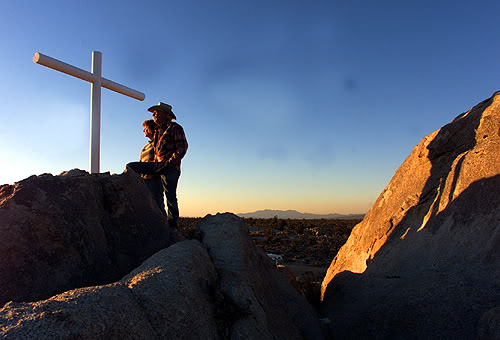
Eight foot high cross on Sunrise Mountain in the Mojave National Preserve. Below, cross is covered during court fight. Lower photo by Eric Reed.

Veterans’ memorial at Mojave National Preserve:
Supreme Court hears challenge to eight-foot cross

The ACLU argued that the cross is the predominant symbol of Christianity and should not be treated as a single, favored religious symbol.

By Ted McLaughlin / The Rag Blog / October 8, 2009

An 8 foot cross has stood atop Sunrise Rock in the Mojave National Preserve since 1934. It was supposedly erected to honor America’s soldiers in World War I. But is it really proper to erect a religious symbol in a National Preserve or Park, especially since the Park Service turned down a request to erect a Buddhist monument nearby?

That is the question that was being discussed by the United States Supreme Court yesterday. A former National Park Service employee felt it was inappropriate for the National Preserve to favor one religion over others, and took the matter to court. A federal judge and the 9th Circuit Court of Appeals ruled that the display was unconstitutional, and the government appealed to the Supreme Court.

The Obama administration supports leaving the cross in the park. As much as I respect President Obama, I have to disagree with him on this one. I have no problem with a memorial honoring World War I soldiers being in the preserve, but why does it have to be a christian symbol (and the cross is recognized worldwide as a christian symbol).

Christians would be opposed to the memorial being a religious symbol from any other religion, so I really don’t understand why they think it’s OK to force their own symbol on Americans who believe in other religions. Personally, as an atheist, I don’t believe symbols of any religion should be placed on government land.

In an attempt to do an end run around the Constitution, the National Preserve has transferred ownership of the cross and the bit of land underneath it to the Veterans of Foreign Wars (VFW). This is not real ownership, because the VFW can’t sell the land and if they remove or fail to provide upkeep on the cross, the land will revert back to the National Preserve.

The ACLU argued that the cross is the predominant symbol of Christianity and should not be treated as a single, favored religious symbol. Judge Scalia tried to argue that the cross didn’t just represent christian soldiers, but was a “common symbol” to honor war dead.

That’s a ridiculous argument. One look at national cemeteries for war dead shows that crosses are used for Christian dead, while other symbols are used for those of a different faith. There is even a designated symbol for atheists.

No matter how long the cross has stood in the Mojave National Preserve, it should be removed. Allowing only a Christian symbol amounts to government designating a favorite or “official” religion, and that is unconstitutional.

Americans practice many faiths, and many practice no religion at all. Their tax money helps support the National Park System, and they should not be forced to support someone else’s religion.

[Rag Blog contributor Ted McLaughlin also posts at jobsanger.]

The Rag Blog

Posted in Rag Bloggers | Tagged , , | 9 Comments

Freeland: Banking Goes Broadway


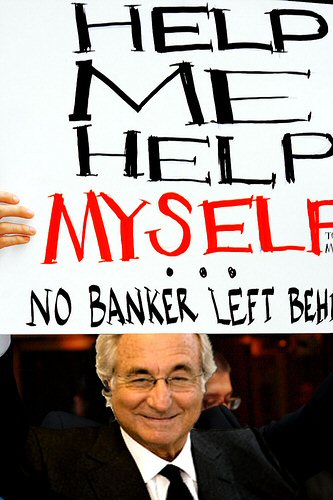
Pay Pals: Getting Big Bucks from Banks
By Bill Freeland / The Rag Blog / October 7, 2009

As MegaBank’s CFO, I’ve prepared the following guidelines for the upcoming meeting of the executive compensation committee.

(I say “upcoming” but, of course, I mean “long past.” It seems notice of this year’s meeting was once again sent late and as a result none of you were here. Don’t be concerned. It went off without a hitch. Simply sign below to confirm receipt of this back-dated mandatory communication.)

Item 1: Hello and Goodbye

First, let me welcome all of the newcomers — which is to say, all of you. As you are aware, committee members are replaced annually to promote the bank’s goal of presenting policies that are always fresh — at least to each of you.

The benefit in all of this is that there is little need for you to be concerned about details you’re likely to forget by the end of the meeting anyway. We apologize in advance if the new amenity we’ve added to the gathering creates a distraction. As I’m sure you know, access to an open bar during all the deliberations has recently become a widely accepted practice in our industry. What’s more, should you have any other needs that require attention (either here or in an adjoining room), feel free to consult the friendly companion who has been assigned to you for that purpose.

Item 2. Newly Strengthened Standards

In light of the recent financial crisis (or as we prefer to call it, “opportunity”), the time of business as usual is long past. Time was when hard work and political connections were all you needed to succeed in this business. Not anymore. Today we have a new partner: the federal government. As a result we are now free to move beyond merely rewarding success. In this new age we can concentrate exclusively on the rewards themselves.

Which means that the work of this committee can assume a sharply different focus. Having become really too big to fail also means we are now big enough to accept the rewards of this new status. Which is why this year’s bonus package, while it may appear exorbitant to others who have not achieved our level of systemic threat, we believe is simply too big to forego.

Item 3: Short-Term vs. Long Term Goals

If there is one thing this new realty has taught us it is that we need to focus more on long-term stability rather than short-term gain. This will require raising our sights above today’s quick profit and becoming more concerned with projecting earnings much further out. Say, a month or two — at least. In this context, we hereby dedicate ourselves to the long-term goal of a minimum of two booms before every bust.

But this kind if discipline comes at a price. Which, of course, brings us again to the compensation committee. Long-term perspective merits long-term pay. Therefore, we will be proposing the industry’s first “better than life” lifetime pay. The checks keep coming as long as we (or our beneficiaries) keep cashing them.

Item 4. New Levels of Accountability

We have all grown up to respect the importance of the work ethic. In recent years that has meant the grinding demands of working from ten to four for a solid three days a week with only a two-hour break for lunch. But in this new age of bailouts and corporate consolidations, we call for a new definition of the term “work” itself. Who anymore really believes that this requires time actually spent at a desk. Or for that matter, even at the office.

No, work can now assume a new existential dimension. Now the new definition of “executive performance” can be inextricably joined to “executive existence” itself. We no longer merely do our jobs. We are our jobs. Recognizing this new reality, however, presents a unique challenge to the compensation committee.

Existence obviously requires a 24-hour commitment. And as a “24-hour executive,” our compensation must be similarly comprehensive. We exist around the clock. We should be paid around the clock. Seen from this perspective, executive pay that was once considered outrageous is now merely au currant.

And given what we’ve been through over these last months, that seems the least we can do for ourselves.

The Rag Blog

Posted in Rag Bloggers | Tagged , , , | Leave a comment

Iran and the Geneva Talks

Secretary of Iran’s Supreme National Security Council, Saeed Jalili expressed Tehran’s readiness to cooperate with the international community in all areas, saying he entered the talks with six powers in Geneva with “good will.” Photo: Al Alam.

Real Progress With Iran
By Gary Sick / October 4, 2009

The Geneva nuclear talks were just baby steps along a long and perilous path. Still, this was a historic moment after 30 years of mutual recriminations and hyperbole.

If you have any doubt that the Geneva meetings with Iran were surprisingly productive, just go back and look at the commentary the day before they began. Even allowing for the fact that the United States and its negotiating partners (the five permanent members of the United Nations Security Council plus Germany–the P5+1–plus European Union negotiator Javier Solana) were trying to lower expectations to the political equivalent of absolute zero, it was still difficult to find anyone who anticipated anything like real progress. Yet that is what happened.

Iran had issued a bland five-page document that scarcely mentioned the nuclear issue. They insisted that the newly discovered Qom enrichment site was not only perfectly legal but utterly routine. They let it be known that they had no intention of discussing their own nuclear program in these talks. Yet, from the accounts we have so far, it appears that Iran came prepared to make concessions about Qom, permitting IAEA inspections to begin within the next two weeks or so. As for their nuclear program, almost nothing else seems to have been discussed.

The United States blustered that it was preparing “crippling sanctions” to be imposed on Iran if they did not “come clean” about their nuclear activities. In the end, it appears that sanctions were not a significant topic, and the Western side was prepared to make some significant concessions of its own.

By all accounts, instead of being a food fight leading to a total breakdown, the Geneva talks were serious, businesslike, and even cordial. The top U.S. negotiator, Undersecretary of State William Burns, had a one-on-one meeting with Iranian top negotiator Saeed Jalili, in which they reportedly talked substantive issues. That is something that had not happened in thirty years. During the latter years of the Clinton presidency, Iranian officials conducted desperate evasive maneuvers to avoid any direct contact with American officials, and during the first six years of the George W. Bush administration, American officials did the same with their Iranian diplomatic counterparts. The orders on both sides to avoid official contact at risk of one’s professional career seem to have been relaxed, at least for this occasion.

What did this meeting actually produce? Iran agreed to permit inspections of its new site. The Western negotiators came up with a clever ploy to permit Iranian low-enriched uranium (LEU) to be sent to Russia for further enrichment, probably from about 5 percent to about 20 percent, and then transported to France to be fabricated into fuel rods to feed the Iranian research reactor (ironically given to Iran by the United States in an earlier day), which is used to produce isotopes used for medical purposes. This had many dimensions. First, it reduced the Iranian LEU stock below the level required to produce a nuclear device. Second, it established the principle that Iranian enrichment could be conducted outside the country. But third, it promised to provide Iran with uranium enriched well above the level required for nuclear power reactors (but not yet at the level required for bomb-building). And lastly, it tacitly acknowledged Iran’s right to produce enriched uranium. Nothing in the reports we have seen to date indicate that the Western interlocutors insisted on the previous red line that Iran should abandon its enrichment program.

Finally, the two sides agreed to meet again later this month. At a minimum, that suggests that they believed there was more to be discussed.

Both sides evidently came prepared to behave civilly, to make some small but important concessions, and to initiate a process of negotiation that has been on ice almost since the moment that George W. Bush decided, for arcane reasons of his own, to declare Iran (which had just finished working closely with the United States to establish a new civil government in Afghanistan) a charter member of the Axis of Evil.

One swallow does not a summer make, and it would be a mistake to think that the results of the Geneva meetings were anything more than the first baby steps along a perilous and unpredictable path. Those perils were unmistakable in the words of President Obama in his brief remarks immediately following the talks. In carefully chosen words, he remarked that “today’s meeting was a constructive beginning, but it must be followed by constructive action by the Iranian government.” His emphasis was almost exclusively on our demands on Iran and what remained to be done, rather than on what had been accomplished.

Obama’s speech was clearly directed to his domestic constituency, and particularly the right wings of both the Democratic and the Republican parties who had openly hoped or expected that the meetings would lead to early, severe sanctions against Iran. It was also no doubt intended to maintain the pressure on the Iranian side and to demonstrate that we would not settle for a few welcome, even unexpected, gestures of cooperation. That skeptical tone may have been dictated by negotiating strategy and political necessity, but I wonder if we will be as understanding when the Iranian leadership makes similarly dismissive remarks.

Still, this was a historic moment after 30 years of mutual recriminations and hyperbole. Under the circumstances, even simple civility was remarkable. Both sides behaved themselves almost as grownups, when it would have been easier to descend into a school yard rumpus.

We can hope that the Western negotiators keep their eye on the fundamental objectives of these talks. Instead of drawing new red lines, which are typically ignored by the Iranians and which have proved both futile and counterproductive, we need to pursue two clear goals. First, we need to insist on maximum inspection and monitoring of all aspects of Iran’s nuclear activities. Secondly, we should attempt to minimize Iran’s development of the precursors of a nuclear weapon. In other words, we should install an early warning system that will tell us with some confidence if Iran decides to depart from its obligations under the Non-Proliferation Treaty and build a bomb; and we should seek to maximize the time between such a decision and the moment when Iran could actually produce a deliverable weapon.

Those are realistic goals and they are consistent with Iran’s own statements and past practice. But they will not easily be achieved in a negotiating climate of hostility and mistrust. This meeting offered the prospect that the “wall of mistrust,” as former Secretary of State Madeleine Albright and former Iranian President Mohammed Khatami described it, is not necessarily impermeable.

The process that has been started is going to be neither short nor serene. It is, however, the only game in town. And it is off to a better start than any of us had a right to expect.

Source / Axis of Logic

Thanks to Deva Wood / The Rag Blog

Posted in RagBlog | Tagged , , | 1 Comment

Losing Our Humor Over Guantanamo


On Guantánamo, Lawmakers Reveal They Are Still Dick Cheney’s Pawns
By Andy Worthington / October 6, 2009

I like to believe that, despite studying Guantánamo for four years, I still have a sense of humor, but last Thursday I lost it, after 258 members of the House of Representatives (including 88 members of President Obama’s own party) voted for an idiotic, paranoid and unjust motion proposed by Rep. Hal Rogers (R-Ken.), which was designed to “Prohibit the transfer of GITMO prisoners, period” (those were his exact words). Just 163 Representatives voted against the motion, which, as JURIST described it, also supports “adding Guantánamo detainees to the federal ‘no fly’ list, and adopting Senate language forbidding the release of photos showing detainee abuse.”

Just in case there was any doubt about the motion, Rep. Rogers, in his inimitable style, explained that he was concerned with “protecting the American people from all threats … including the warped intentions of terrorists and radical extremists,” and proceeded to explain that “This motion strengthens the House bill’s current restrictions on Guantánamo Bay detainees by ensuring their names have been put on the No Fly list and by clearly prohibiting their transfer to the United States — for whatever reason.”

After lambasting the Obama administration for having “No plan” for how to close Guantánamo, Rep. Rogers explained that “this motion prohibits the granting of any immigration benefit for any reason. Without such a benefit, there is no legal way to bring these terrorists to American soil and in our constituents’ backyards. And, that means these terrorists cannot be granted the same constitutional rights as American citizens.”

He added, “After all, these detainees are enemy combatants, caught on the battlefield. They are NOT common criminals and they should not be granted legal standing in our criminal courts by bringing them onto US soil. From my point of view, we cannot waver on this issue, nor can we be weak. There is no reason these terrorists, who pose a serious and documented threat to our nation, cannot be brought to justice right where they are in Cuba. And, I certainly think that is where the American people stand on this issue — they don’t want these terrorists in their hometowns, inciting fellow prisoners, abusing our legal system, and terrorizing their communities.”

This, then, is the reason that I have lost my sense of humor. In May, members of the US Senate voted by 90-6 to approve an amendment to the Supplemental Appropriations Act of 2009, eliminating $80 million from planned legislation intended to fund the closure of Guantánamo, and specifically prohibiting the use of any funding to “transfer, relocate, or incarcerate Guantánamo Bay detainees to or within the United States.” Defending the amendment, Senate Majority Leader Harry Reid (D-NV), speaking for himself and his spineless colleagues who had bowed to a Republican fearmongering campaign, said, “This is neither the time nor the bill to deal with this. Democrats under no circumstances will move forward without a comprehensive, responsible plan from the president. We will never allow terrorists to be released into the United States.”

In June, the House of Representatives followed up by passing a spending bill turning down the administration’s request for $60 million to close Guantánamo, which, as JURIST described it, “placed limits on the government’s ability to transfer detainees to the US and release detainees to foreign countries.” Approved by a vote of 259-157, the bill also prohibited funds from being used to release detainees from Guantánamo into the United States. In JURIST’s words, “The legislation [requires] the president to submit to Congress a detailed plan documenting the costs and risks of transferring a detainee to the US for trial or detention at least two months before the detainee is to be transferred. Additionally, the president [has] to notify the governor and legislature of the state to which the detainee is to be transferred at least 30 days before the transfer and must show that the detainee does not pose a security risk. The bill also requires that the president submit a report to Congress before releasing a detainee into his country of origin or last habitual residence unless that country is the US.

Last Thursday’s vote was for a non-binding motion to instruct conferees to follow Rep. Rogers’ motion (see an explanation here) rather than binding legislation, but, at the very least, it signals that lawmakers on both sides of the aisle are determined to scupper Barack Obama’s pledge to close Guantánamo by January 22, 2010, for two indefensible reasons.

The first is the NIMBY card (Not In My Back Yard), in which lawmakers wail, as Rep. Rogers put it, that “the American people … don’t want these terrorists in their hometowns, inciting fellow prisoners, abusing our legal system, and terrorizing their communities.” This requires everyone involved to conveniently forget that America’s Supermax prisons are the envy of prison-lovers the world over, that convicted mass-murdering criminals — including some convicted of terrorism — are safely locked away in these prisons, and that the rest of the world is looking on and laughing at the lawmakers’ feeble paranoia.

However, the second reason for my despair is rather more fundamental. To hear Harry Reid, the Senate Majority Leader, use the word “terrorists” when referring to the Guantánamo prisoners, and to hear this same word repeated ad infinitum by Rep. Rogers, and by those many members of the Senate and the House who have persistently voted to prevent the closure of Guantánamo, is to step back into those dark months after the 9/11 attacks, when former Vice President Dick Cheney and his closest advisors were hatching their plans to hold anyone who ended up in US custody as an “enemy combatant” — in other words, neither as a criminal nor as a prisoner of war, but as a whole new category of non-being without rights.

It involves stepping back to a time when Cheney and his associates were hatching their plans to hand out bounty payments, averaging $5,000 a head, to the US military’s Afghan and Pakistani allies, who seized at least 86 percent of the men who ended up in Guantánamo, the majority of whom were not “caught on the battlefield,” as Rep. Rogers cla.

It also involves stepping back to when these same men — and defense secretary Donald Rumsfeld — were hatching their plans to prevent the military from conducting competent tribunals under Article 5 of the Geneva Conventions.

Pioneered by the US, and conducted during every war from Vietnam onwards, competent tribunals were designed to separate soldiers from civilians, in situations in which enemy soldiers did not wear uniforms, by holding tribunals close to the time and place of capture, in which these men could call witnesses to establish their credentials. In the first Gulf War, these tribunals led to nearly three-quarters of 1,200 men being released, but in Afghanistan the administration’s decision not to proceed with the tribunals (which was dictated from the highest levels of government) not only contributed to the filling of Guantánamo with people who were neither soldiers nor terrorists, but also led the administration to conclude that the humane standards of treatment required by the Geneva Conventions for all prisoners (whether uniformed personnel or not) did not apply to “enemy combatants.”

This was just the beginning. Voting to prevent the Obama administration from bringing Guantánamo prisoners to the US for any reason — even for federal court trials — endorses the notion that, having randomly rounded up hundreds of prisoners, and having refused to screen them, it was then justifiable to deprive them of the protections of the Geneva Conventions and to transport them to Guantánamo, where they continued to be held without rights, and where, if the lawmakers had their way, they would remain in that perpetual limbo.

What the nation’s lawmakers seem to be forgetting is that the legal black hole of Guantánamo’s early years was only maintained until June 2004, when no less a body than the US Supreme Court was required to intervene. The Supreme Court took the unprecedented step of granting the prisoners habeas corpus rights because, although some of them may well have been soldiers, who should have been held as prisoners of war, or terrorists, who should have been prosecuted as criminals, the Bush administration’s decision to hold them as “enemy combatants” without rights meant that those who claimed that they were innocent men seized by mistake — perhaps in connection with those bounty payments mentioned above — had no way whatsoever of challenging the basis of their detention. Without the intervention of the Supreme Court, they could have been held for the rest of their lives without ever having been screened adequately to determine whether they were, in fact, terrorists, soldiers or innocent men seized by mistake or sold for money.

Even then, this miserable story was far from over, as lawmakers should recall. In an attempt to ignore the impact of the Supreme Court’s ruling, the Bush administration introduced one-sided military tribunals to evaluate the prisoners’ cases, relying on supposed evidence that in fact consisted largely of “confessions” extracted from other prisoners, either through torture or coercion, or through bribery (the promise of better living conditions, or the false promise of freedom), and persuaded Congress (including many of the same cowardly propagandists responsible for the votes in May, June and last Thursday) to pass two hideously flawed pieces of legislation — the Detainee Treatment Act of 2005 and the Military Commissions Act of 2006 — which purported to strip the prisoners of the habeas rights granted by the Supreme Court.

Last June, the Supreme Court rose up again, this time granting the prisoners constitutionally guaranteed habeas corpus rights, and setting in motion a process of reviews that, to date, has led to District Court judges examining the government’s supposed evidence in 38 cases, and ruling that, in 30 of these cases (in other words, in 79 percent of the cases), the government failed to establish that the men in question were members of, or supported al-Qaeda and/or the Taliban. If the lawmakers cared to read the rulings, they would discover that this was largely because the judges concluded that the government was relying on supposed evidence that in fact consisted largely of “confessions” extracted from other prisoners, either through torture or coercion, or through bribery (the promise of better living conditions, or the false promise of freedom).

Fortunately, the lawmakers are no longer able to prevent these cases from taking place — as no doubt, if they were able, they would yet again cast the remaining prisoners into a lawless abyss — but by making such sweeping generalizations about the “terrorists” in Guantánamo, and about preventing the government from transferring any of these “terrorists” to the US mainland to be imprisoned and to face trials, they are committing a number of grievous errors.

They are preventing justice from being delivered in the cases of the small number of prisoners actually accused of involvement in the 9/11 attacks and other acts of international terrorism, and they are shamelessly, ridiculously, and unforgivably tarring everyone held at Guantánamo as a “terrorist,” even though the majority of the men have never been charged with any crime, even though the lack of screening and the bounty payments that I mentioned above have been assiduously chronicled by lawyers and writers — myself included — who have not succumbed to a witless parroting of Dick Cheney’s hollow propaganda, and even though judges in US courts continue to demonstrate that, behind the hype and hyperbole, the majority of these men are not “terrorists” at all.

My sense of humor will return (you don’t deal with Guantánamo day in and day out without having a sense of humor, however dark), but my despair at the spinelessness and stupidity of the majority of the nation’s lawmakers will only dissipate when these men and women can be bothered to examine the facts, rather than letting themselves remain infected by the lies and paranoia of the most disgraceful Vice President in American history.

[Andy Worthington is the author of The Guantánamo Files: The Stories of the 774 Detainees in America’s Illegal Prison (published by Pluto Press, distributed by Macmillan in the US, and available from Amazon — click on the following for the US and the UK).]

Source / Andy Worthington

The Rag Blog

Posted in RagBlog | Tagged , , , | Leave a comment

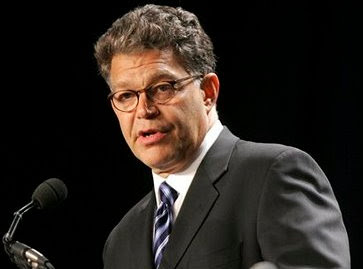
Sen. Al Franken : The Internet is the Town Square

This may be the clearest, most useful exposition on Net Neutrality that I have yet seen.

Thorne Dreyer / The Rag Blog

The Internet:
It’s not a truck, It’s a town square

The Internet is a platform for speech, debate, creativity. And it is neutral. And government has a role to play in making sure it stays that way.

By Senator Al Franken / October 7, 2009

As you know, I got to the Senate a bit late.

But I didn’t get here too late. Because we’re debating issues of major consequence right now — health care, the economy, the course of the war in Afghanistan. And one of the issues you don’t hear about as much — but one that will impact our lives, our economy and, yes, the future of music — is Net Neutrality.

Several years ago, in the middle-to-late 90s, I went and gave a speech to the folks at DARPA, the Defense Advanced Research Projects Agency. I remember asking what cool things they were working on.

One guy took me aside and told me he was working on an unmanned aerial vehicle the size of an insect. I was really excited about that, though I’m pretty sure it didn’t happen. But they did succeed in creating the ARPA-net forty years ago. And the ARPA-net grew into the Internet… which is almost as cool.

And today, the Internet is the town square. Thomas Jefferson famously said that given a choice between government without newspapers and newspapers without government, he “would not hesitate to prefer the latter.” If he were here today, I think he’d see the Internet in much the same light.

Now, fortunately, we don’t have to make that choice because the Internet is a platform for speech, debate, creativity. And it is neutral.

And government has a role to play in making sure it stays that way. Let me add that this is the fundamental political philosophy that I bring as a senator to so many of our national challenges. It’s not government’s job to make sure that everyone gets to the finish line, but government does have a role to play in making sure everyone can at least get to the starting line.

That’s how the Internet developed. The FCC treated the Web as a common carrier similar to the phone – meaning that anyone had the right to access it however they wanted so long as they weren’t breaking the law.

But as high-speed Internet became available, the cable and telecom industries convinced the FCC to change the rules — to give corporate Internet service providers the power to use “network management” as code for “finding ways to squeeze more cash out of their networks.” As a result, the freedom and openness that are the Internet’s hallmarks are being seriously challenged.

Moving at the same speed

Right now, a blog loads just as quickly as a corporate Web page. An e-mail from your mother comes through just as smoothly as a bill notification from your bank. An independent bookstore can process your order as quickly as Barnes & Noble. A garage band can stream its songs just as easily as a multi-platinum superband like REM can.

But recently, business executives from top ISPs have declared their interest in offering “prioritized” Internet service to companies that can pay for it. In other words, a company like Microsoft or Amazon could pay for its content to be delivered over a high-speed network — relegating a blogger or a mom-and-pop business to the slow lane.

That would transform the Internet from a free, open and competitive playing field into a “pay-for-play” arena in which citizen bloggers, nonprofits and small businesses are simply muscled out by major media conglomerates. That would transform the World Wide Web into a system of separate and unequal networks.

Censoring the Net

And it raises two major issues, as I see it.

First, it raises the issue of censorship. Once service providers are in the business of deciding what kind of content moves at what speed, they come very close to deciding what kind of content moves at all.

Second, this is about entrepreneurship and innovation. Great innovations only take place on an even playing field, where the little guys can go head-to-head with the big guys. If we change the rules of the game to benefit the big guys, innovation will suffer.

So the issue here isn’t only what might be blocked, but what might never be developed in the first place. Let me talk for a minute about each.

First, censorship. Take a look at Iran. In Iran, every Internet provider uses filters to control the Web sites and e-mails that users can access. They use a technology called “Deep Packet Inspection” to filter every e-mail, Facebook post and Tweet that anyone sends, and –- in real time – block content that’s deemed objectionable.

You might say, “Well, that’s a terrible situation, but it’s happening in Iran, and we are not Iran.” No, we’re not Iran, but that isn’t stopping several companies from taking the same or similar technology for a test drive.

First, you may remember that in 2007, Verizon refused to allow the pro-choice group NARAL to send text messages to its supporters – even though they had signed up to receive them. Verizon’s explanation was that it had the right to block “controversial or unsavory” messages. Like, for example, that a woman should have control of her reproductive system.

A second example: Comcast has used Deep Packet Inspection to block lawful peer-to-peer applications.

And you may remember that during a live Webcast of a 2007 Pearl Jam concert, AT&T killed the audio for a few beats. Turns out the missing lyrics were critical of President Bush.

ISPs want to profit from a closed Net

Stifling openness on the Internet isn’t always about censorship. In the future, it could simply be a product of business at work – of ISPs turning a profit. The chief technology officer for BellSouth recently said, “I can buy a coach standby ticket or a first class ticket… I can get two-day air or six-day ground.” He asserted that the Internet should be the same way.

The CEO of Verizon made the same point when he said, “We need to make sure there is the right economic model… we need to pay for the pipe.” And one provider proposed a system where consumers could pay a cheap monthly rate for light Internet use, a higher fee for heavier use… but with an exception for people who accessed only the content created by that network provider.

That’s a business motive, but it has the effect of limiting speech, and as far as I’m concerned, free speech limited — or free speech delayed — is the same as free speech denied. Because the truth is that the Internet is the town hall of the 21st century.

In the 1997 decision Reno v. ACLU, Justice Stevens wrote:

“Through the use of chat rooms, any person with a phone line can become a town crier with a voice that resonates farther than it could from any soapbox. Through the use of Web pages, mail exploders, and newsgroups, the same individual can become a pamphleteer.”

I serve on the Judiciary Committee, and on my fourth day in the Senate — my first hearing on that committee — we were dealing with the nomination of Judge (now Justice) Sonia Sotomayor.

I asked her specifically about whether she thought the American public has a compelling First Amendment interest in ensuring the Internet stays open and accessible. And if I could paraphrase her answer, it was “yes.” As noisy and messy as it may be, the Internet is a democracy. And because of that, it is a critical part of our democracy. But without strong legislation prohibiting ISPs from regulating content, that may not always be the case.

Let me add that among the people who would be hurt the most are rural users, who, like many in my home state of Minnesota, often only have access to a single ISP. If that rural ISP decides to favor or cut special deals with big companies — or with the companies that ISP also owns –- then rural users would only receive the viewpoints that the ISP favors. ISP profit margins should never come at the cost of a free and open Internet.

The economic future of our country

While ISPs may benefit from a closed Internet, we all lose. And it’s not just the material that could be slowed or censored. It’s innovation itself.

In America, we think that an individual with a big idea is just as worthy of competing as a company with a big market share. But the loss of a neutral Internet means that the market is no longer competitive. It’s no longer a meritocracy.

Consider the case of YouTube. YouTube was founded in 2005 above a pizzeria in San Mateo, California. At the time, the most popular video application was something called Google Video — an app that most people came to realize was slow and clunky.

Because it was so well designed, YouTube quickly gained a user base, and gradually overcame Google Video. As we know, Google actually bought YouTube and retired Google Video.

This all happened because YouTube and Google Video competed on the same playing field, accessed the same Internet, and, in a meritocratic system, consumers saw that YouTube was better. But in a world where Google could pay an ISP for “premium” access, Google Video could have secured priority status, leaving YouTube on a second-tier track. YouTube would have loaded too slowly to win viewers. We’d be stuck with Google Video.

Again, what’s at stake here isn’t just what could be taken away. It’s what could never be created in the first place.

The Internet has been a tremendous platform for innovation and entrepreneurship. Guaranteeing its continued success isn’t just about giving consumers better apps; it’s about the economic future of our country.

The FCC takes on Net Neutrality

Now, I know many of you in the music and entertainment industry are concerned about where Net Neutrality fits in with your efforts against piracy. Having spent much of my life as a writer and entertainer, I own copyrights, too, and I share your concerns.

But Net Neutrality is and must be explicitly a matter of protecting lawful content, applications and usage. Whether we do it through statute or regulation, ISPs must and will retain the right to combat unlawful usage of the Internet.

Now, how we do that technologically is an enormous question. You may remember when Sen. Ted Stevens insightfully pointed out that the Internet “is not something you just dump something on. It’s not a truck. It’s a series of tubes.”

In making that statement, I think Sen. Stevens illustrated why some members of Congress might not be the right people to answer this technological question. That’s why it is good news that the FCC is now taking the lead on this battle.

Recently, Chairman Julius Genachowski announced that the commission would be issuing pro-Net Neutrality regulations. The commission rules will emphasize nondiscrimination –- barring ISPs from favoring or disfavoring particular Internet content or applications –- and transparency, requiring ISPs to be open about their network management practices. And Genachowski’s right.

An ISP should not be able to prioritize certain traffic over other traffic. A company cannot pay to have a “fast track” over the Internet.

And we need to be serious about transparency. ISPs should have to disclose to consumers any practices that may affect communications between a user and an application, content or service provider. This ensures that when ISPs do take actions that slow down one content provider and speed up another, users will find out.

We also need to acknowledge that sometimes, it is citizens, and not the government, that are in the best position to protect the Internet. We need to empower Internet users to file complaints directly with the FCC, and to allow them to recover damages in certain cases.

Finally, and I think the FCC will agree with me on this one, we need to give the experts at the FCC the flexibility they need to solve this complicated problem.

So rest assured, even though Sen. Stevens is no longer here to lend us his “tube” expertise, I will be standing ready to work with knowledgeable leaders in Congress — Sen. Dorgan, Sen. Snowe, Congressman Markey, and Congresswoman Eshoo — to make sure we get it right.

For the first time, it looks like we might actually do this. The FCC is on board, and so are critical leaders in Congress.

Obama on Net Neutrality

In addition, President Obama has consistently voiced support for Net Neutrality. Recently, he put Net Neutrality at the top of his national innovation agenda. So although previous efforts to pass Net Neutrality have failed, we now have both a president and an FCC chairman who strongly support the cause.

This is not to say that this debate is over and won. Some of my colleagues have already introduced legislation to block Net Neutrality efforts. And just last week, a Washington Post editorial declared that “federal regulators should not be telling Internet service providers how to run their businesses,” and that Net Neutrality will “micromanage what has been a vibrant and well-functioning marketplace.”

Ignore for a moment the irony that a leading newspaper would come out against a bill whose purpose includes protection of free speech, and let me say that Net Neutrality is not a matter of needless government intervention. It is a necessary response to verifiable instances of ISPs discriminating against users based on the applications they use or the content they access, and of ISPs voicing their support for a separate and unequal Internet.

It is a 21st-century reiteration of one of our most important constitutional rights –- the right to free speech. And it doesn’t interfere with the free market. It protects the free market.

A century ago, President Teddy Roosevelt wrote, “Above all else, we must strive to keep the highways of commerce open to all on equal terms.”

He may have been writing in a different time, and addressing different technology, but his purpose is just as relevant today.

[From a speech delivered by Sen. Franken at the Future of Music Coalition Policy Summit at Georgetown University in Washington, D.C.]

Sen. Al Franken on keeping a neutral net

Source / Save The Internet / freepress

The Rag Blog

Posted in RagBlog | Tagged , , , , , , | 1 Comment

Rag Radio! A Conversation with Larry Ray


TUESDAY ON KOOP RADIO IN AUSTIN:

RAG RADIO

HOSTED BY THORNE DREYER

KOOP, 91.7 FM — Every Tuesday afternoon — 2-3 PM

The latest addition to the Rag media family, Rag Radio presents issue-oriented discussion and cutting edge cultural programming in the tradition of the underground press. With a heavy dose of our countercultural history. [The Rag was Austin’s legendary 60’s underground newspaper; The Rag Blog and Rag Radio represent its spiritual rebirth.]

VOLUME I, NUMBER 2:
Tuesday, October 6, 2-3 PM

A conversation with
Larry Ray
Retired journalist and television anchorman
and Rag Blog contributor

Tuesday, October 13, 2-3 PM

Healthcare NOT Warfare
Rev. Jim Rigby
St. Andrews Presbyterian Church
Austin, Texas
and
Jesse Romero
Texas State Director
Health Care for America Now


The online stream of RAG RADIO can be found here:


The Rag Blog

Posted in Rag Bloggers | Tagged , | 1 Comment

The Afghan Quagmire : Considering the Options

“Smiling on Quicksand.” © Gary Winters

A no-win situation?
An Afghan quagmire in the making

By Sherman DeBrosse / The Rag Blog / October 5, 2009

We are mourning the loss of eight American soldiers who died in a day-long battle near the Pakistan border. They were killed by a well armed force that dwarfed them in size. Their mission was to try to stem the flow of Pakistani Taliban fighters over the border to join their allies in the Afghan Taliban. Indeed, a number of the fighters were Pakistani Taliban expelled from the Swat Valley by Pakistan’s army.

The guerilla force that confronted the Americans numbered about 300. In Iraq, the guerilla forces seldom exceeded 30, with the possible exception of the fighting in Falluhah.

Now we are facing the decision of whether to send in many more troops to continue a policy of nation-building and providing population security. The situation in Afghanistan is enormously complex, and there clearly is no easy resolution or way out.

Lieutenant General Stanley McCrystal has warned Washington that we are losing in our battle against the Taliban and other insurgents in Afghanistan. He has called for an additional 10,000 to 40,000 troops, and he has the backing of his very popular boss, General David Petraeus. There is a parallel to the “clear and hold” strategy employed in Vietnam, but McCrystal would be more careful with firepower and more interested in economic development.

During the campaign, Barack Obama sought to show that he was strong on national security by saying that Afghanistan was the necessary war. Now those remarks are haunting him as he ponders the sad history of foreign involvement in Afghanistan and our unpromising situation there now. Much of latter was due to the policies of the Bush Administration, but voters have short memories, and Obama will pay for lack of success in Afghanistan.

For the moment, Obama is taking time to reconsider our objectives in Afghanistan. Afghanistan has become a NATO mission, and our president would be well advised to invite NATO to join in these deliberations. Otherwise, it will appear that we are continuing the Bush policy of dictating to others.

France, Germany, and Great Britain have asked for an international conference to discuss how NATO forces can be phased out in Afghanistan. In view of the growing sentiment in Europe against the Afghanistan operation, it would be wise to learn how much support we could count on if we ramp up the effort to provide population security.

Already some writers fear that extended involvement in Afghanistan could be the rock on which the NATO vessel breaks. NATO Secretary General Anders Fogh Rasmussen has endorsed Obama’s decision to review the policy and has said that it is more important to get the right strategy than to rely on putting in more troops.

Biden‘s approach

Vice President Joseph Biden, after much study and two unpleasant meetings with Hamid Karzai, has concluded that the current regime in Afghanistan will not be a reliable partner for an effort to establish security for the population in Afghanistan. Until recently, National Security Advisor James L. Jones appeared to agree. Biden’s view is that the U.S. needs to focus less on Afghanistan and more on Pakistan, where Al Qaeda is and where instability makes that nation’s nuclear weapons a potential problem.

Biden suggests ramping down the counter-insurgency effort and focusing on damaging Al Qaeda, partly through Predators and air power. Spies and Special Forces and other black ops would also be involved. The US will be able to continue its drone air strikes in the Federally Administered Tribal Areas, but it is doubtful that Pakistan can permit the U.S. to bomb Taliban sites in Quetta, capital of Baluchistan province. We can be of greater help to the Pakistanis as they are finally going against their own Taliban. At the moment, they are preparing an offensive in Waziristan.

Of course, the U.S. will need enough stability in some parts of Afghanistan so they can be used as bases to launch all manner of assaults against Al Qaeda. In the long run, it is doubtful that we can put Al Qaeda out of business, but we should make it our top priority to inflict as much damage as possible. There are signs that some of the insurgents are amenable to negotiations, and it is possible that money and diplomacy could accomplish with them what more troops may not.

Of course, the Biden plan would not stop the training and recruitment of Afghan soldiers and police. It should include giving the army better equipment.

Greater reliance on air power clearly suggests a willingness to repeat the carpet bombing of 2001. Should the Al Qaeda reenter Afghanistan, we would have no choice but to resume round-the-clock carpet bombing. Taliban leaders remember the bombing and realize that it would be repeated should they assist Al Qaeda establish camps and bases in their country.

Republicans demand escalation

With the remarkable exception of George Will, Republicans back the former Special Forces commander. They stand to gain no matter what Obama does in Afghanistan. If more troops are sent, and there is still failure or stalemate, they still win big time. Few will remember that John McCain and others beat the drums for more troops and a long war.

A common argument is that any backing away from an all-out effort will give Al Qaeda new energy and attract more recruits to their standard. In truth, American policy in Iraq and our tactics in Afghanistan, which harmed many civilians, were responsible for recruiting people for the Taliban and Al Qaeda. Sami Yousafzai’s interviews of Taliban people in the current Newsweek demonstrates how Bush Administration tactics alienated many and strengthened the Taliban. It is unlikely that the salutary change in course under General McCrystal can reverse the damage. Moreover, his turn toward the exercise of soft power — economic and social development — is all to the good, but this policy will require more time than we have. It can be recalled that it took John Paul Vann many years to work economic and social miracles in the Mekong Delta.

We frequently hear that anything less than a ramped up war in Afghanistan will damage U.S. credibility abroad. There may be some truth to this. Certainly other nations will not doubt that we have the ability to go anywhere and bring about massive destruction when we do not get our way. The real question should be “Does our national interest require expenditure of a great deal of blood and treasure in Afghanistan?

A similarly weak argument is that we must prevent Afghanistan from becoming a failed state so that Al Qaeda will not use it as a base of operations. This wrongly assumes that there are no other failed states Al Qaeda can use as a base. Moreover, the terrorist organization appears to be unhampered in its operations in Pakistan. As General Jones has admitted, there is no reason why the Taliban would want to leave. He claims there are less than 100 Al Qaeda in Afghanistan.

Republican columnist Michael Gerson eschews the most simplistic arguments and admits the complexity of the situation in Afghanistan. Still, he senses that Obama is in a no-win situation. Gerson redefines the civilian-military relationship a bit by insisting that suggesting that tradition demands that Obama select his best general and get out of the way.

He even mentions Harry S. Truman in this respect, though the use of that precedent can be debated. In the end, Abraham Lincoln accepted U.S. Grant’s meatgrinder approach, but he had been involved in many military decisions throughout the war. Another way to look at this is to recall that Lincoln bucked the popular George McClellan and that Truman sacked the very popular Douglas MacArthur.

One can only wonder if any of the critics are concerned that the US be in a position to construct the long-desired twin pipelines down through Afghanistan to carry Caspian gas and oil to Pakistan and, by ship, to India. This was the object of a great deal of diplomacy before 9/11, and the Bush administration even resorted to the threat of bombings. The pipelines are in our national interest but it is doubtful if soldiers should lose their lives to get them.

Another surge?

Those who insist that Obama bow to Petraeus and McCrystal think that copying the surge strategy in Afghanistan will work. The surge worked best in the urban areas of Iraq, and there are few urban areas in Afghanistan. The surge also worked in Iraq because the United States literally bought off its enemies, paying large amounts to tribal leaders and monthly stipends to their armed retainers. Only Bob Woodward has openly discussed another reason why the surge worked. Special Forces in Iraq, under McCrystal, carried out something like the Vietnam War’s Operation Phoenix and eliminated thousands of the insurgent cadre.

Repeating some version of Phoenix in Afghanistan does not require a huge increase in American forces there. Over seven years, we have spent $38 billion in Afghanistan, with few discernable positive results. Perhaps more of the money sent there should be used to buy off warlords and put their troops on retainer. It’s worth a try.

Should we bet on Karzai?

It still comes down to whether a large new commitment in human lives, money, and American prestige should be made in Afghanistan. Many Afghans believe that the present regime is hopelessly corrupt. The recent rigged election of August 20 is one indication of how weak the Karzai regime is. The UN found that one third of the votes cast for Karzai were fraudulent.

The resultant acrimony has been so great that it is unrealistic to believe that Afghans can be unified around Karzai — no matter how many troops we send there. Karzai has not bothered to denounce those who rigged the election on his behalf. His reliance upon war lords and human rights abusers is not likely to win new grassroots supporters. Of course, policy makers recall that in Vietnam the elimination of the corrupt Ngo Dinh Diem resulted in even worse leaders.

The idea that we can, using soft power, somehow win over large numbers of Karzai opponents to support him is fanciful. The counter-insurgency strategy has been based upon the idea that we could eventually build a large and effective Afghan army and matching police force. The Afghan army stands at 94,000 and has had a little success in the north. It will take two years to increase it to 134,000. That is still far short of the 300 or 400 thousand that are needed.

Who can remember that there were 91,000 when George W. Bush began to rebuild the army. A rational person would look at these figures and conclude that either the Republican administration had done poorly or it was unrealistic to expect rapid growth of that force. Our problems began when the Bushies somehow bungled the effort to nab Osama and then pulled out our most effective people so they could begin their adventure in Iraq. Any way you look at U.S. policy there under Bush, it is impossible to conclude that anything was accomplished. Obama inherited a ticking time bomb but don’t look to any Republican politician or publicist to mention this. The truth is that it could be too late to do much there.

There is also the lesson of Vietnam, where we did build a large, well-equipped ARVIN force that was ineffective and heavily infiltrated by the enemy. There were also many “potted plants,” units that existed on paper but not in reality.

Unless Karzai abandons brutality and corrupt practices overnight and becomes a Boy Scout, the prospects of bringing much stability to Afghanistan are slim. The man is a Pashtun and that should have helped him with the nation’s largest ethnic group. Instead, the Taliban, also largely Pashtun, have been able to play on Pashtun nationalism to enlist support.

Effectively ending Taliban jihadism may be beyond our ability. The Afghan Taliban practices jihad but only locally. They would only be a threat to the United States if they could again provide Al Qaeda with a base of operations. However, there is no reason for Al Qaeda to leave the Waziristan area of Pakistan, where they have the run of things and even have located families there.

Though the Taliban previously sheltered Al Qaeda, many Taliban are not warm friends of the Arab-led terrorists, and it is possible that clever intelligence people could drive a wedge between them. It should also be remembered that many who call themselves Taliban in Afghanistan are simply insurgents capitalizing on that name. Many of them can be bought off.

The Pakis will play a double game

Pakistan will continue playing a double game — doing enough to get aid while keeping the Afghan Taliban alive. The best we can do is to induce them to do more for us. Our primary goal there is to foster enough stability in Pakistan to keep the jihadists from getting their hands on the nation’s nuclear assets. That is no small job.

The Pakistani Army, though secular, long ago resorted to sponsoring Islamic jihadism as a means of countering Indian power. They built jihadist movements to threaten India in destabilizing Kashmir. In time, a jihadist opposition emerged in Pakistan itself, and the army officer corps now must deal with the fact that religious fanaticism has infected more than a few junior officers.

Because Pakistan needs to have a strong influence in Afghanistan, Pakistani intelligence, the ISI — with the help of the United States in the late 1970s and eighties — nurtured jihadism in Afghanistan. Many in Pakistan’s ISI — once closely tied to the CIA — are not inclined to do anything to injure the Afghanistan Taliban, and they believe that the United States will not be in Afghanistan indefinitely

Unless Pakistan can be induced to stop helping the Afghan Taliban, a U.S counter-insurgency program will require far more troops that McCrystal is now requesting. Afghans in the south and east already see the U.S. as an occupying power, and the presence of more troops is certain to deepen that impression in those places and possibly spread it to the rest of the country. The McCrystal strategy would be an occupation, and foreign occupations of that country since the time of Alexander the Great have been failures.

In retrospect, it appears that most of the billions poured into Afghanistan were a poor investment. One leading member of Karzai’s coalition said he will withdraw if more American troops are committed. This man is an American ally but thinks that more troops would mobilize more people against the government.

Too much was filtered through foreign contractors. The money would have been better spent buying off the Pakistan generals and ISI and bringing greater political stability to Pakistan. Fortunately, Congress has just tripled its appropriation for Pakistan; but the amount is still relatively small.

The farmers and the poppies

The Obama Administration wisely ended its war against the farmers growing poppies. It might be worthwhile to buy and destroy the Afghan opium crop. Using last year’s data, that might cost as much as $3.4 billion. This would not stop the Taliban from collecting taxes on it, but destruction of the whole crop would prevent the Taliban from moving large quantities of opium to the international market. That would cut their income by a third.

The situation in Afghanistan is very complex and unpromising. There are variables that the American public does not perceive. Do they know that many Afghans speak Persian and that they are strongly influenced by Iran. The latter could make things even worse for us but Iran has no reason now to want an unstable Afghanistan.

Our dealings with Iran can impact what goes on in Afghanistan. By appearing to be more reasonable than Bush, President Obama has obtained some important concessions from Iran and may be able to do more. If Israel were to move against Iran, we could expect Iran to use its influence against us among its Afghan clients.

Richard Holbrooke has given us an idea of how bad the situation in Afghanistan is: “Its worse than the Nam!” It is very important that the American people understand what is involved here because a decision to make a long term commitment to pacification and nation-building will require years of commitment, massive amounts of money, and far more troops than we are now contemplating.

Even with all that, there will be no guarantee that we can succeed in building a stable nation there. That is why House Minority Leader John Boehner is so angry that President Obama wants to take time making this decision. If thoughtful independents come to understand much of what is involved, they might support Obama in redefining the mission there. Information is, as usual, the enemy of Republican policy here. The more people understand, the less damage Afghanistan will inflict on Obama’s political future.

[Sherman DeBrosse is the pseudonym for a retired history teacher. Sherm spent seven years writing an analytical chronicle of what the Republicans have been up to since the 1970s. The New Republican Coalition : Its Rise and Impact, The Seventies to Present(Publish America) can be acquired by calling 301-695-1707. On line, go here.]

The Rag Blog

Posted in Rag Bloggers | Tagged , , | 10 Comments

Mexico : Wave of Anarchist Bombings Has Rich Historical Context


‘The breath of the revolution’:

Wave of anarchist bombings hits Mexico;
Security forces on red alert

By John Ross / The Rag Blog / October 5, 2009

MEXICO CITY — An unprecedented wave of anarchist bombings here and in provincial capitals has Mexican security forces on red alert.

Beginning September 1st, bombs have gone off once or twice a week regularly as clockwork, taking out windows and ATMs at five banks, torching two auto showrooms and several U.S. fast-food franchises plus an upscale boutique in the chic Polanco district of this conflictive capital. In each case, the Anarchist “A” has been spray-painted on nearby walls along with slogans supporting animal liberation, demands to stop prison construction, and calls for the demise of capitalism.

The serial bombings are the first to strike Mexico City since November 2006 when radicals took out a chunk of the nation’s highest electoral tribunal, blew a foreign-owned bank, and scorched an auditorium in the scrupulously-guarded compound of the once and future ruling PRI party.

The 2006 attacks came in the wake of a fraud-marred presidential election and federal police suppression of a popular uprising in the southern state of Oaxaca and were claimed by five armed groups, most prominently the Democratic Revolutionary Tendency, a split-off from the Marxist-Leninist Popular Revolutionary Army (EPR) which itself bombed a Sears outlet in Oaxaca City in 2006 and PEMEX pipelines in central Mexico in 2007.

Anarchist cells that claim to have perpetrated the recent explosions take pains to distance themselves from the Marxist bombers.

In vindicating a September 25th blast at a Banamex branch in the rural Milpa Alta delegation (borough) of Mexico City during which the rebels claim a half million pesos were immolated, “The Subversive Alliance For The Liberation Of The Earth, The Animals, & The Humans” (in that order) charged that the U.S.-owned bank promoted “torture, destruction, and slavery. “Our motives are to stop these bastards and let them know that we are not playing games.”

Bank video cameras captured the images of three hooded and black-clad young bombers. On October 1st, 22 year-old Ramsis Villareal, a student activist, was arrested by federal police and charged with “terrorism” in connection with bombings at several of the banks. He was released the next day after violent protests by young anarchists in Mexico City.

The September 25th Banamex blast was not the first time the bank has been targeted by “terrorist” bombs. In August 2001, heavy duty fireworks broke out windows in a “cristalazo” at three southern Mexico City branches to protest the sale of Banamex, Mexico’s oldest bank, to Citigroup, the New York-based banking group that has been so devastated by the financial melt-down that it recently put Banamex back up for sale.

The 2001 bombing was attributed to the little-known Armed Revolutionary Front of the People (FARP). Three brothers, students at the UNAM, and the sons of EPR founder Francisco Cerezo (not his real name), were subsequently imprisoned on “terrorism” charges — the attacks took place just days before the terrorist assaults on New York and Washington purportedly carried out by Osama Bin Laden’s Al-Qaeda group. The Cerezo brothers were imprisoned for eight years and have only recently been released from federal lockup.

The September bombings and associated property damage also singled out Mexico City and Guadalajara offices of the European bio-tech titan Novartis that, along with Monsanto, bears responsibility for spreading genetically modified seed throughout Mexico’s corn-growing belt and contaminating native species of maiz. Auto showrooms in the two cities were also on the business end of Molotov cocktails September 18th and 26th — seven luxury automobiles including a Hummer were torched at Auto Nova in Guadalajara.

An Internet page documenting the Guadalajara bombing included communiqués from Jeffrey Luers AKA “Free,” who is serving ten years in Oregon for burning up 21 SUVs on a Portland lot. “Free” is accused by the FBI of being an associate of the Earth Liberation Front, eco-“terrorists” that the U.S. Justice Department has elevated to the top of the Terrorist Hit Parade, alongside Bin Laden. The initials “ELF” were reportedly spray-painted on the burnt-out showroom walls.

Messages justifying the bombings were posted to the Total Liberation website that is dedicated to “the dissolution of civilization” and serves as an international bulletin board for notices of similar sabotage by anarchist cells around the world such as the U.S. “Burn Down The Jails!,” Latin American autonomous cells of the Animal Liberation Front — an ELF offshoot, and the Greek anarchist movement that ravaged Athens this summer.

“Our fire illuminates the night!” waxed poetic one anonymous Mexican anarchist interviewed on the Total Liberation site. “We have lost all fear of spending the rest of our days in prison,” perhaps a reference to the Cerezo brothers and Ramsis Villareal. Groups claiming bombings, and other successful acts of sabotage take fanciful names infused with poetry, bravado, and black humor: “Luddites Against the Domestication of Wildlife,” “Espana Signus Francescos” (thought to be a reference to San Francisco of Assisi, the patron saint of animals), and “Autonomous Cells of the Immediate Revolution — Praxedis G. Guerrero.”

Bust of revolutionary leader Praxedis G. Guerrero in the central plaza of the town named after him in the Mexican state of Chihuahua.


The historically obscure Guerrero
was the first anarchist to fall in the landmark 1910-1919 Mexican revolution whose centennial will be marked in 2010. Praxides G. Guerrero was felled by a “bala ciega” (literally “blind bullet”) during a guerrilla raid on Janus Chihuahua in May 1910, six months before Francisco Madero officially called for the overthrow of dictator Porfirio Diaz in November of that year to launch the Mexican revolution.

Only 28 years old on the day of his death, Guerrero was a young partisan of anarchist superstars Ricardo and Enrique Flores Magon. “Praxedis translated the theory of anarchism into practical action,” writes anarchist historian Dave Poole. In a recent e-mail, John Mason Hart, author of the definitive study “Anarchism & The Mexican Working Class,” concluded that if Guerrero had survived, the Mexican revolution would have looked more like the contemporary neo-Zapatista rebellion in Chiapas than the fratricidal bucket of blood it became.

As a writer, Praxedis G. Guerrero’s prose has all the impact of an anarchist bomb. In “Blow!” the revolutionary imagines himself as the wind: “I steal into palaces and factories, I blow through prisons and caress the infancy prostituted by Justice, I force my way into army barracks and see in them an academy of assassination, I am the breath of the revolution…”

It hardly seems a coincidence that modern-day anarchists struck in September, “the patriotic month” when Mexicans celebrate the declaration of their independence from Spain in 1810, the bicentennial of which, along with the centennial of the Mexican Revolution, is on deck in 2010.

President Felipe Calderon has budgeted billions of pesos to mark the twin centennials even as Mexico is mired in a bottomless recession that has driven millions of workers into the streets. Ironically, the Calderon government has reportedly contracted a Hollywood production outfit with the very anarchist brand-name “Autonomy” for $60,000,000 USD to mount centennial “spectaculars” — in 2008, “Autonomy” staged the spectacular pageant that opened the Beijing Olympics.

In invoking Praxedis G. Guerrero’s hallowed name, anarchist bombers appear to be celebrating the vital role their ideological forbearers played in the Mexican revolution, the first great uprising of the landless in the Americas and an immediate precursor of the Russian revolution.

Anarchism in Mexico dates back to the first days of the republic when in 1824, North American followers of the Welsh utopian socialist Robert Owen unsuccessfully sought to establish colonies along the border in Chihuahua. In the 1860s, anarchism doing business as “mutualism” (i.e. working class solidarity) took root in the burgeoning Mexican labor movement — mutualism’s most significant representation was the House of The World Worker (“Casa de Obrero Mundial“) that flourished during the early days of the revolution.

As the Mexican revolution crested at the turn into the 20th century, anarchism gained an early foothold. Ricardo and Enrique Flores Magon’s newspaper Regeneracion (“Regeneration”) was passed from hand to hand and widely read by those who sought the dictator’s overthrow. Repeatedly imprisoned by Porfirio Diaz, Ricardo and Enrique fled to the U.S. where they clandestinely continued to publish Regeneracion.

The first issue of Ricardo and Enrique Flores Magon’s newspaper Regeneracion, published on August 7, 1900.

The anarchist duo was pursued by both Diaz’s agents and U.S. immigration authorities and forced to flee from city to city (San Antonio, Los Angeles, St. Louis.) Imprisoned for violating the 1917 version of the Patriot Act, Ricardo Flores Magon died in Leavenworth Federal Penitentiary in 1922 under mysterious circumstances that suggest he was strangled by prison guards for flying a Mexican flag in his cell. A century after the Mexican revolution, a handful of campesino organizations in the Flores Magones’ native state of Oaxaca continue to incorporate the brothers’ names in their struggles.

During their ill-fated sojourn north of the border, the Magones forged links to U.S. anarchists. The IWW — the Industrial Workers of the World or Wobblies — which preached anarchism on the street corners of the American west, is said to have been the organizing force behind the miners’ strike in the great Cananea copper pit in Sonora during which a score of workers were massacred by the Arizona Rangers — Cananea is considered the seedbed of the Mexican labor movement. The celebrated Chicago anarchist Voltairine de Cleyre contributed to Regeneracion and raised bail money for the Flores Magones. In 1911, Joe Hill, the renowned Wobbly organizer and bard, rode with the Magonistas in a failed expedition to liberate Baja California.

Despite their margination from the revolutionary mainstream, Magonistas fought in the armies of Emiliano Zapata, Francisco Villa, and Venustiano Carranza although they were often singled out as troublemakers and executed by revolutionary firing squads.

The anarchist flame in Mexico would never have survived without the solidarity of Spanish exiles. Spanish anarchists played a critical role in the formation of the House of the World Worker and after the Spanish Civil War (1936-9) anarchist fighters and thinkers were offered sanctuary from Franco’s fascist hordes in Mexico. Spanish anarchists founded the Social Reconstruction Library in downtown Mexico City, an invaluable repository of anarchist archives.

The Zapatista rebellion in Chiapas in 1994 signaled the second coming of Mexican anarchism. The EZLN’s rejection of dependence on the “mal gobierno” (bad government) and its insistence on collective action and the creation of autonomous zones in the southeast of that highly-indigenous state inspired collectives of young anarchists, often clustered around the National Autonomous University or UNAM. Anarchist activists spurred the 1999-2000 strike against a tuition hike at the National University. Ski-masked, so-called “ultras” with tags like “El Mosh,” “El Gato,” and “The Devil” drove the student struggle to sectarian excess and a clampdown by the federal police that resulted in 700 arrests.

The uproar at the 1999 Seattle conclave of the World Trade Organization was the first explosion of the anti-globalization movement in which anarchists would play a pivotal role. Black clad youth basked in the media spotlight in Seattle but property damage against franchise chains like Niketown by the self-named “Black Bloc” purportedly animated by the writings of U.S. anarchist guru John Zerzan, offended mainstream anti-globalization groups like Global Exchange whose founder Medea Benjamin called for their arrest. The Seattle uprising was first plotted at a 1996 anti-globalization forum staged by the Zapatistas on the fringes of the Lacandon jungle.

The death of Black Blocker Carlo Giuliani under the guns of the police at the 2001 Genoa Italy G-8 summit had deep scratch in the Zapatista zone where a clinic has been named for the anarchist martyr at Oventic, the rebels’ most public outpost — the Giuliani family has contributed an ambulance.

Mexican black blockers went into action at the 2003 WTO fiasco in the luxury port of Cancun. Armed with Molotov cocktails, shopping carts filled with rocks, and home-made battering rams, the anarchos threatened to storm police barricades but spontaneous peace-making by indigenous women protestors helped avoid bloodshed and the black-clad militants decided to burn down a local pizza parlor instead.

Bloodshed was on the agenda at a 2004 Ibero-American summit in Guadalajara when then Governor Francisco Ramirez Acuna (now president of the lower house of the Mexican congress) unleashed his robocops on an anti-globalization rally. Young anarchists were beaten into the sidewalk like so many baby harp seals and dragged off to gaol where police torture continued for weeks. Several block blockers were held for nearly a year despite the outcry from the international human rights community.

Anarchist collectives in Mexico City are not universally unruly. La Karakola, a collective that swears allegiance to Zapatismo and non-violence, would just as soon dance as toss rocks at the cops. Anarcho “squats” take over abandoned buildings — the “okupas” modeled on those run by Barcelona activists pop up in unlikely neighborhoods such as the squat house under the towering Torre Mayor, an 88-story skyscraper on swanky Reforma boulevard.

Punky anarchist fashion — black clothes, studded leather jackets, piercings, exotic hairstyles, and a written language in which “k’s” replace “c’s”, is popular with dissident big city youth and on display Saturday mornings at the Chopo Bazaar and evenings at the Alicia Forum where punk meets anarchism. But most anarchofashionistas” are not bombers — it’s a struggle to slip a ski mask over a Mohawk.

2006 seems to be the year that anarcho fury at the destruction of the planet took wings — the earliest postings on the Total Liberation page date from then. The first actions were little publicized and dismissed by police and the media as vandalism — destruction of pay phones installed by Telmex, owned by tycoon Carlos Slim, the richest man in Latin America, is a popular sport. Sabotage peaked in 2008 when 129 actions were recorded, most of them non-violent such as the liberation of slaughter house-bound chickens and the reconfiguration of bull ring signage transforming the Toluca Plaza de Torros into a “Plaza of Torturers.”

One exception was the torching of a leather expo in Leon Guanajuato, the shoe and boot capital of Mexico. On October 2nd, the 40th anniversary of the 1968 student massacre, fast food franchises were Molotov-ed in the capital’s old quarter and 13 anarchists arrested. Fake bombs were subsequently planted at MacDonald’s, KTC, and Burger King in ten provincial cities.

The September wave of bombings was a defiant step upwards but not by much — the “bombs” were primitively fashioned from butane tanks used by plumbers to solder pipes and detonated by bottle rockets. All bombings occurred during early morning hours to avoid human casualties although some stray dogs and cats may have been singed.

Despite the lack of lethal intent, the bombings have riveted the attention of numerous security forces, particularly the CISEN, Mexico’s lead intelligence agency which is reportedly spread thin trying to keep tabs on plans by clandestine guerrilla bands ranging from the Zapatistas to the EPR to foment armed uprising during the 100th birthday party of the Mexican revolution to which all Mexicans, regardless of ideological persuasion, have been invited.

[John Ross’s monstrous El Monstruo — Dread & Redemption In Mexico City will be published this November by Nation Books. Iraqigirl, the diary of a teenager growing up under U.S. occupation, is already in the stores. The author will be touring with both volumes in 2009-2010 and invites suggestions of venues at johnross@igc.org.]

The Rag Blog

Posted in Rag Bloggers | Tagged , , , , | 8 Comments

Understanding the Politics of the Vocal Discontents

Remember Scout and Jem Finch?

They who burn books …. will also, in the end, burn people.” — Heinrich Heine

Fear, Ignorance and the Summer of Our Discontent
By John Atcheson / October 4, 2009

Fear

To those of us in the reality based community, watching the tea-baggers, death panelist propagators, birthers and assorted other whackjobs conjure up government fascism out of whole cloth, even as they unwittingly defend the unbridled fascistic behavior of corporations, defies logic.

Seeing them this past Summer act out their delusions at town hall meetings and on the Nation’s Mall — waving Don’t Tread on Me signs; invoking the Founders as they engaged in the most undemocratic behavior; vilifying the President– perplexes those of us who inhabit the real world. Where, we ask ourselves, does such a deadly brew of willful ignorance and passionate intensity come from?

Good question.

There are cultural, sociological and psychological explanations for their political pornography, and it is useful to examine them.

The most important fact to understand, is that these are the people who were left behind by change. In fact, one of their more popular signs is “Keep the Change“. Although they don’t realize it, the change they rail against is not the one Obama talks about – rather it is the one that has occurred in the last two generations.

Less than fifty years ago, these largely white and religious cohorts inhabited a world in which they were the majority. A world in which everyone knew why we were placed on this Earth, Who put us here, and what we ought to believe – a world in which everything was mapped out, a world in which they were the cartographers and the keepers of the sacred knowledge.

In those halcyon days of yesteryear, when people defined who it was that constituted “us” and who it was that made up “them,” they found themselves in the majority. And it was good.

But society has moved on.

We now live in a multi-ethnic world dominated by rapid change, chaotic cultural shifts, materialism, uncertainty, and perhaps most of all, loss of control. Our children hop into cars and out of our lives. They log onto the web and get exposed to a universe of things that range from the divine to the heinous. Our families disintegrate as they chase jobs, and so too, do our communities and our mores. Transience replaces permanence in people, places and things. We get Relativity, but it comes with relativism.

The certainties that formed their shared reality two generations ago have been swept away. Most people moved forward in lockstep with reality. But those left behind are threatened, scared, and angry at forces they only dimly understand, and their response is to see the world, not as it is, but as they wish it were – as it used to be in a more certain time.

Ignorance

Education played a large part in whether people could adapt to the new world, or whether they couldn’t. A Washington Post ABC poll taken in late 2008, found that white people without a college degree favored John McCain by 17 percentage points, while those with a college degree preferred Barack Obama by 9 percentage points.

The dispossessed need narratives and scapegoats to make their plight comprehensible and they need easy targets to blame. The Republicans and their corporate overlords have given them one: Government is the last stereotype – the new nigger, spick, wop, or mick.

The election of a black President to head the all-purpose bogeyman — evil big gubmint – has allowed fear mongers to literally put a face on this scapegoat, and unleashed an irrational frenzy among the dispossessed. Thus, this past summer thousands on the national Mall and at town hall meetings were joined by only one real common issue -they’ve accepted an all-purpose scapegoat for their fall from grace: Government is the protector of the source of all their fears and problems: the “others,” the “not us,” and now it’s run by one of “them.”

That’s why immigration pops up in any issue including health care. That’s why the vague fear of Muslims taking over the country. That’s why a single group can stand in unison as they protest the strangest of bedfellows: fascists, socialists, and “libruls,” that are in some dim way supposed to be connected to health care. That’s why they are suddenly concerned about deficits and fiscal responsibility after silently watching as their idols – Reagan and Bush – literally blew up the federal budget. That’s why they resent taxes, so much of which they fear is destined for “the others,” even though most of the crowd appeared to be at or near the medicare/social security age.

The Roots of Discontent

But here is the ultimate irony – the changes that have left the tea-baggers and other assorted tin foil hat types feeling rootless, disenfranchised, and fearful were unleashed in large measure by the doctrine they defend: Reaganism.

Or more precisely, Corporatism.

The answer to Tomas Frank’s iconic question: What’s the Matter with Kansas is that Corporations have skillfully and systematically exploited the sense of fear and disenfranchisement that a “market uber-alles” creates to effectively neuter the only power capable of challenging them and containing their excesses: government.

And it isn’t just the whackjobs who have been complicit.

While the roots of corporate oligarchy go back to our very founding, and their power derives from some post-Civil War era Supreme Court Decisions which essentially gave corporations rights of personhood, it saw two great incarnations – first, beginning in the Gilded Age and extending right up to 1929; and again, since the 1980’s when it became a doctrine on steroids under Regan.

Corporate power reached its zenith during the laissez-faire 1920’s, and led to an unprecedented concentration of wealth in the upper 1% of the population and an unconstrained private sector and – inevitably – to the Great Depression. Roosevelt put in place programs which created a level playing field and a constrained private sector that operated in a manner consistent with the public good, and those programs contributed to four decades of sustained growth and a burgeoning middle class.

But for the last three decades, this nation has retreated from those New Deal programs. Progressives watched mutely as wages flatlined, as jobs disappeared overseas, as wealth was once again ripped from the hands of the poor and handed to the richest 1%; as the financial world was de-regulated; as government was vilified; and as the political process got hi-jacked.

The real tragedy is that while progressives hunkered down, afraid to confront the popular and appealing message of Reagan and his ideological descendants, corporations funded a coordinated takeover of the Republican Party, the popular press, and the machinery of government.

The corporate fleecing of America remains the greatest story never told.

Indeed, Bush slipped two ardent corporatists into the Supreme Court while progressives and the news media focused on wedge issues like abortion. As a result, we now have the most corporate-friendly Supreme Court in a century. Last week the Court took the unusual step of rushing a case to judgment that could substantially expand corporate political influence.

It’s a War, Stupid

What progressives have failed to comprehend, and what Obama’s compromise-driven approach to governance fails to appreciate is that there is a war on for the hearts, minds, and soul of America. In this war, Republicans are bit-players – minions of corporate power. Democratic Blue Dogs are their brethren – sniffing eagerly at the nether regions of the corporate body for tasty crumbs. The real war is one between government and Corporations. And Corporations, having bought off the upper class and both parties, and skillfully manipulated the fearful to encourage divisiveness, are winning.

The shape of the Wall Street bailout; the corporate-friendly nature of the health care debate; the weakness of the climate bills, the obscene size of our defense budget have all been dominated by our complete failure to address the one big issue – to engage in the war of ideologies that must be waged. If people have been fooled, progressives have no one but themselves to blame. They’ve only heard one side of the debate.

Progressives have simply lacked the courage to take this war on. Even though it is obvious that the laissez-faire dogma of Hoover/Reagan/Bush brought on the Great Depression and the Greatest Recession respectively, Democrats cower when confronted with complaints about big Gubmint’ or “socialism,” or “fascism”; and they nod placidly when people say that the magic markets will bring about all good things by pure serendipity if we just leave them alone.

As for raising taxes to provide services demanded by voters? Fugeddaboutit. Ditto on regulating the excesses of the financial sector.

Reagan advocated an essentially amoral framework for society – not amoral as it is often used to mean immoral but amoral in its literal sense — operating outside of a moral context. This essentially undid much of what Roosevelt had achieved: tethering the unbridled power of corporations to the government so that it might be forced to meet basic ethical and pragmatic limitations that served the common good.

With the popularity of Reaganism, we spent three decades shrinking government and glorifying and unleashing the private sector.

The reality of the new world order is that tyranny is, in fact afoot. But it is the handmaiden of corporations not government. And it is about to become much worse, as the Bush Supreme Court Appointees rush to expand corporate control over the political process.

Ironically, government is the only entity capable of protecting people from the new fascists – unconstrained corporations.

The Founders were fond of checks and balances. Thus, the three branches of government were set up to operate as counterweights, preventing any one branch from getting too much power. One must believe that they would have built in checks against corporate power if it had existed then in anything like the form it does now.

Yes, there is a war for the mind, heart, and soul of this country. We must decide, once and for all, whether we wish to be a nation of and for the people, or one of the corporation, by the corporation and for the corporation.

The Progressive and Democratic response to this war has been a three decade swoon that makes them the modern-day equivalent of Neville Chamberlain, appeasing the Reaganistas at every turn. It has not worked; it will not work.

The Health Care Debacle – Poster Child for Progressive Cowardice

Watching the tea-baggers, one is tempted to dismiss them as little more than slack-jawed yokels at a three-card-monty festival – another case of dumb asses getting the wool pulled over their eyes.

But watching the health care bill turn from populist reform to industry pork aided and abetted by the Democrats we elected, we have to wonder whether we’re really any smarter.

At its root, the health care debate is simple. Right now, we have a middle man – the health insurance industry – that imposes a 30% surcharge (nearly $400 billion each year) on health care, while adding no value whatsoever to health. In fact, they restrict care. Operating beside it are government run programs which have a transaction cost of only 3.5%, with better outcomes and higher customer satisfaction. The same is true for pharmaceuticals – Bush’s program prohibits the government from negotiating lower prices and prohibits customers from buying imports, which gives big PhRMA some $700 billion in excess profits.

So the question is, do we want to pay a 30%, $350 billion surcharge for poorer and more uncertain care, or do we want to pay a 3.5% transaction cost for better care and better service? It’s that simple.

But we’ve watched mutely as 3,300 health care lobbyists (more than six lobbyists for each member of Congress) storm the Hill, spending more than $4 million a day solely to obfuscate the issue and preserve their amoral profits.

This summer we yielded control of the Bill to six Senators – who represent only 2.6 % of Americans and who have received more than $8.5 million in campaign contributions from the health care industry – and allowed them to strip out consumer protections in the Bill even as they load it with industry party favors.

We watched in silence as Obama and the Dems unilaterally jettisoned the single payer plan, and we watched as the gang of six stripped out the anemic alternative — a public option — even though the majority of Americans initially favored both. How is it that our elected representatives do not – will not – represent us?

We accept at face value the idea that the Bills all preserve choice, when in fact industry gets first choice of whether you get to keep your insurance, or whether you get to opt for the public option (if their even is one). Obama has stood idly by while this corporate takeover of the debate proceeded – in fact, he cut his own backroom deals with big PhaRMA – privately agreeing, as Bush did, not to use government’s bargaining authority to reduce drug costs in exchange for their support.

This is a war; but health care is only a battle. On its face, it appears that on one side are lunatic tea-baggers full of equal parts passionate intensity and ignorant delusion; on the other are those lacking all conviction. But the reality is, that above it all, conning the yokels with distractions, and buying off the last pockets of government power are the corporate forces of tyranny – neither evil nor good, just doing whatever we allow them to do.

We will lose this war, until and unless we constrain corporate power – until we name the beast and demand that our representatives represent us.

This is our last chance. Obama’s address to Congress was a start. But it will take a great leader – not simply a great rhetorician – to win this war and he can’t do it alone.

Obama has suffered comparisons with Franklin Roosevelt since he crossed the threshold of the White House, but as many have pointed out, when Roosevelt was confronted with demands from the activists in his party, he said, “I agree with you. I want to do it. Now make me do it.”

If we expect Obama to do his part, we must do ours. If 70% of us want serious health care reform, we can’t simply talk to pollsters about it. If we are upset that Wall Street is being made whole with our taxes and disbursing mega-bonuses to fat cat CEOs, while the rest of the economy – the real economy – languishes, we can’t passively wait for justice to arrive by Limo or Lear Jet.

We must demand that we get our government back; we must confront and drive a stake into the thoroughly discredited theology of Hoover/Reagan/Bush; we must be sure our voices are heard. We must turn the money changers from the sacred halls of governance. We must insist that media become something more than stenographers turning tricks for their corporate Johns. At the end of the day, corporations only have money – we have the vote.

Tea baggers have been manipulated by corporate interests precisely because they are the most aggrieved and disenfranchised members of society.

Corporations have bet that the slightly more affluent progressives have enough skin in the game that we’ll stay on our couches and mumble epithets. We can make fun of the tea baggers, but at least they are out there.

As Labor Day drifts into hazily recalled burgers, beer, and bogus sales from retailers, we should remember what it stands for. It is time to organize. If our representatives are on the take, we must get rid of them. If our leaders won’t lead, we must lead them.

We can stop the corporate K-Street takeover of America. But we must first believe that it exists. We do not face evil, we face something far more dangerous – an entity that is devoid of all values and ethics save one: the relentless drive to accumulate wealth and power for its own sake. Adam Smith was wrong – without the government to set boundary conditions and establish an even playing field, there is no common good in capitalism. Only tyranny and subjugation.

We must work to check the unbridled power of money in our political system or see it destroyed. Our voices and our votes can triumph – but only if we get off the couches and, to borrow a phrase from the tea-baggers, Take Back Our Country.

Of course, we do have an alternative.

Care to pick a card, yokel? Any card?

[John Atcheson’s writing has appeared in the Washington Post, the Baltimore Sun, the San Jose Mercury News, the Memphis Commercial Appeal, as well as in several wonk journals. Email to: atchman@comcast.net.]

Source / Common Dreams

The Rag Blog

Posted in RagBlog | Tagged , , , | 11 Comments