Drought : Mexico Goes Down the Drain

A tractor ploughs a hectare of land in the northern Mexican state of Chihuahua. Photo by Tomas Bravo / Reuters.

Mexico goes down the drain:
Water and power south of the border

By John Ross / The Rag Blog / August 31, 2009

MEXICO CITY — Mexico has been swamped by a wave of serial plagues of biblical proportions in recent months. First, it was the blood-curdling violence of President Felipe Calderon’s ill-conceived and macabre war on the drug cartels that has taken the lives of 12,000 citizens in the past three years. Then the economy collapsed in a calamitous whoosh plunging the country into the deepest slide since the Great Depression. Last spring’s swine flu panic garnished the fear and loathing.

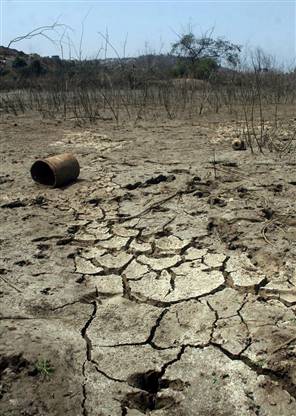
Now add drought and famine to the list of catastrophes.

One day last week (Aug. 16th-23rd), housewives from Iztapalapa, Mexico City’s poorest and most populous delegation or borough, lined up dozens of empty plastic pails in front of the National Palace, the seat of the Calderon government, to underscore their demand for water. On any given day this summer, 1.5 million “chilangos” (Mexico City residents) have been denied the precious liquid due to the National Water Commission (CONAGUA)’s shut down of the Cutzamala river system that supplies about a third of the capital’s water.

The water crisis has been exacerbated by near-zero rainfall in the Valley of Mexico that surrounds the city due, meteorologists avow, to the nefarious, every-nine-year weather phenomenon known as El Nino. Whoever’s to blame, Mexico City is in the claws of the worst drought here in 60 years. Day after day this summer, chilangos have risen to cloudless skies — the July-August-September rainy season cycle accounts for 70% of the megalopolis’s rainfall totals in an average year.

The absence of precipitation that is drying up all of Mexico has the National Weather Service praying for Atlantic hurricanes that are worrisomely late in coming — the delay is the longest in 18 years. By the third week of August, the storms were only at “B” for “Bill” level. “Bill” disappeared into the North Atlantic without spilling a drop on Mexico.

The weathermen and women are not the only Mexicans praying for rain. In Jalisco where cornfields are blasted by the “Sequia” (drought), true believers parade the Virgin of Zapopan from one country town to the next in the unrequited hopes She will bring on the rains, and in Mexico City’s great Zocalo plaza, concheros — Aztec dancers — pound drums and blow copal incense to the four cardinal corners of the universe in choreographed appeals to Tlaloc, the Mexica rain deity to whom Aztec priests once sacrificed young babies in order to insure his watery largesse and a bumper corn crop.

Tlaloc’s unresponsiveness to the chilangos‘ entreaties is already triggering tensions. Out in Iztapalapa in the east of the city, colonos from parched neighborhoods are blocking avenues and have broken into locked water deposits. In August, they hijacked several “pipas” or cistern trucks used to deliver water to bone-dry colonies.

The pipa business has boomed all summer, enraging the Iztapalapan. Private contractors charge the neighbors a fee for services the government should be providing and the dubious quality of the water the pipa deliver is a flashpoint for outrage. Neighbors display bottles of viscid, smelly liquid that they jocularly refer to as “Aguas de Tamarindo” — Tamarind-flavored drinks.

The scarcity of potable water in marginated zones like Iztapalapa has converted Mexicans into the Numero Uno per capita consumers of Coca Cola in the known universe. The Coca Cola Corporation is also Mexico’s top purveyor of purportedly purified bottled water.

Iztapalapa is a barometer of social conflict. If and when trouble boils over in this megalopolis, it will most likely happen there first.


Out in the countryside, the drought is raking the land. Dams are at perilously low levels in a season when they are usually filled to the brim — this time last year, dam capacity was at 95%. But in 2009, 57 of the 177 dams in the federal system are below 50% due to the lack of sufficient rainfall. Half of Mexico’s 21 million corn farmers depend on rainfall to irrigate their fields and all across the fertile breadbasket of central Mexico — the “Bajio” — crops are shriveling up.

This July was the driest July in 68 years in 11 states that account for 84% of Mexican corn production. Farmers in Jalisco, the leading white corn producer, Zacatecas, Guanajuato, Queretero, and Aguascalientes have already lost up to 75% of their harvests. At opposite ends of the republic, Yucatan and Sonora have been devastated by the Sequia.

Cattle ranchers report catastrophic losses — 50,000 head have already died and the price of milk has soared by 20%. Cruz Lopez, director of the National Farmers Confederation (CNC), the nation’s largest campesino federation, estimates that 20,000,000 tons of basic grains have been wiped out and fears an “historic food crisis” that will stir up conflicts between farming communities over increasingly shrinking resources.

To fend off famine, the Calderon government will be forced to up NAFTA corn imports from the U.S., already at $25,000,000,000 USD annually — about 60% of the imported corn is thought to be genetically modified. Sitting in boxcars in northern Mexican rail yards, the NAFTA corn is an inviting target for nearby colonies of unemployed workers who force doors and cart off the grain.

Newspaper photographs of housewives gleaning loose corn along the tracks are reminiscent of Mexico’s 1910 revolution, the first great uprising of the landless in Latin America, whose 100th anniversary will be marked next year. Some observers are already predicting that social upheaval will accompany the centennial.

Drought is relentlessly cyclical in central Mexico. Rainfall diminishes, underground springs dry up, and the sequias collapse whole civilizations. Teotihuacan, the first city in the Americas to be founded on a corn economy, disappeared into dust in the Second Century AD. Today, its’ justly celebrated pyramids on the sun-scorched plains 45 kilometers north of Mexico City are all that remain. Half a millennium later, the same fate befell the Toltec civilization at the north end of the valley.

The Aztec-Mexicas inherited a flourishing lake system. Tenochtitlan, the seat of their empire founded in 1325 (now Mexico City’s old quarter), was a prosperous island when the Spanish invaded in 1521. But a century after the Conquest, the lakes had dried up, the bitter fruit of massive deforestation on surrounding hillsides.

In the four centuries since, Mexico City’s water quandary has perplexed presidents and generals and even emperors. Overpopulation has exhausted aquifers and the inadequate solution has been to suck water from river systems a hundred miles away like the Cutzamala whose bounty has to be pumped a mile uphill to satisfy the thirst of the chilangos.

“FEBRUARY 2010 — A CITY WITHOUT WATER!” read the doomsday ads leftist mayor Marcelo Ebrard is running every day in the capital’s dozen newspapers. Jose Ibarreche, an independent engineer who contracts with the Mexico state water commission, thinks the situation is much worse. “If the people really knew what’s going on, it would cause a panic,” he calmly posited over café con leche at the downtown Café La Blanca one rainless night last week.

Reflecting this dire prognosis, Mayor Marcelo has installed a color-coded warning system that replicates U.S. terrorist alerts — red, orange, yellow, and green. Last week, the neon warning strung between the two City Hall buildings in the Zocalo was at red.

With the city suffering a daily 71 million cubic meter shortfall, the in-flow has been reduced to just 4.4 meters a second, cutting water pressure in half. Water tanks on the roofs of luxury skyscrapers along the city’s most exclusive boulevard, the Paseo de Reforma, are compromised.

The flow from the Cutzamala, which accounts for 30% of the city’s water, has itself been cut by 30% — the seven dams that fill the system have recorded zero rainfall thus far in 2009 and levels are shrinking below 32%. Water accumulated in the dam system during the once-upon-a-time rainy season is earmarked for delivery to the capital in February, March, and April 2010, the hottest, driest months of the year in a city already anticipated to be boiling over with swine flu panic and insurrectionary fever.

Some of the customers clustered around the counter at La Blanca are convinced that politics have trumped nature in the water war. Cutzamala water is the domain of CONAGUA under the direction of Calderon’s water czar Luis Luege Tamargo, the ex-chieftain of the president’s right-wing PAN party in the capital and a likely candidate for mayor in the next election.

Berta Robledo, a retired nurse and fierce partisan of the formerly wildly popular ex-mayor of Mexico City Andres Manuel Lopez Obrador (AMLO), suspects that the PANista is denying needed water to this left-run city to exploit an issue that could propel the rightists into City Hall in 2012. Others speculate that Marcelo Ebrard has exaggerated the city’s water problems to pressure the Calderon government into forking over fresh moneys to revitalize the capital’s decrepit water system. Ebrard himself is a likely presidential candidate in 2012.

Ibarreche explains that contrary to popular mythology most of the Capital’s water — 71% — comes from the city itself via a network of deep and diminishing wells that are putting out twice as much water as the aquifers can take in. According to CONAGUA, Mexico City is extracting 1.2 billion cubic meters a year from its well system and incorporating less than half that, 512 million cubic meters, in the aquifers.

This summer, El Nino, the acute lack of rainfall, and climate change (the Mexican capital has warmed one degree in the past 10 years), have brought the wells to the brink of apocalypse.

But the big problem is not the missing rain so much as what happens when it does. In an average year, Jose Ibarreche insists, enough rain falls (600 to a 1000 millimeters) to provide the city with five years of water — if the run-off can be captured, a feat the city is not now equipped to handle. Currently, rainwater is swallowed up by Mexico City’s vaunted Deep Drainage System (“Drenaje Profundo“), a miracle of engineering malfeasance that mixes clean water with the megalopolis’s sewage (“aguas negras“) and sweeps them both through mountains into Hidalgo state where they eventually find a path to the Gulf of Mexico.

To trap the run-off, Ibarreche has been working on a series of collectors and artificial lakes in the forested highlands of the Valley of Mexico and rural areas of the capital such as the Ajusco and Cuajimalpa to capture the vital fluid when it drills down from the heavens. The rainwater will then be treated and injected into aquifers to recharge them, a process that can take a year. But this year there has been no rain and no run-off.

Water distribution in Mexico City reflects the class divide. According to city water commission stats, 1,000 liters a day are delivered to every man, woman, and child in upscale neighborhoods like Bosques de Lomas and Lomas de Chapultepec in the west of the city to water their lawns and fill their swimming pools and wash their classic cars. Working class citizens in the east and north of the city such as out in Iztapalapa are ascribed 200.

To ameliorate the inequity, Mexico City’s left government threatens to raise rates substantially for each 100 liters delivered above the city average of 300 per capita — Ebrard’s Water Secretary Ruben Aguirre wants to knock the average down to 150 liters a day. The howls of PANistas concerned for their Jacuzzis echo in the Mexico City Legislative Assembly where Ebrard’s Party of the Democratic Revolution (PRD) owns the majority.

To tamp down the ire of working class chilangos (80% of the capital’s population), water is super subsidized, selling for 15 to 35 cents USD per cubic meter (1000 liters) when the actual cost is 20 pesos ($1.80 USD.) The PAN’s plan is to eliminate subsidies and privatize services, arguing that raising rates will conserve water by punishing the wasters. Such a platform could also incite riot in poorer neighborhoods.

So ominous is the situation that Mexico City’s 12 year-old leftist government is resorting to neo-liberal anathema by privatizing services. About 16% of the water distribution system has been contracted out to four national and transnational corporations that now determine and measure usage and rates, bill customers, and are responsible for treatment and maintenance.

Maintenance is a big money item. About a quarter to a third of the city’s water is being lost to leaks in ancient pipelines, about 12,000 liters a minute Aguirre calculates, and city workers have never been quick to staunch them.

Ebrard’s efforts to privatize water services in the largest city in the Americas follows the takeover of systems in Mexican cities like Cancun, Saltillo, and Aguascalientes where water rates have risen alarmingly commensurate with the projections of the privatizers. In the mix are such transnationals as Suez-Lyonnaise (French), Aguas de Barcelona, Vivendi Water, and Azturix (formerly Enron, now Suez.)

One alternative to leaping on the neo-liberal bandwagon: la Brigada de Las Mujeres Plomeras or the Women Plumbers’ Brigade which trains housewives in the city’s housing projects in plumbing and water conservation arts. Promoted by Clara Brugada, an Iztapalapa-based organizer and Lopez Obrador’s candidate to head that downtrodden delegation, the Women Plumbers Brigade is modeled on the brigades of “Adelitas” or women soldiers assembled by AMLO to stop the privatization of the Mexican state petroleum corporation PEMEX under the slogan “El Petroleo Es Nuestro” (“The oil is ours.”)

“Well, so is the water” Brugada urges.

[John Ross’s monstrous El Monstruo — Dread & Redemption in Mexico City (Nation Books, 500 pages) will be published this November — he is looking for local venues to introduce the Monstruo to the North American public. His Iraqigirl, the tale of a teenager coming of age under U.S. occupation (Haymarket) is already in the stores. If you have further info write johnross@igc.org.]

The Rag Blog

Posted in Rag Bloggers | Tagged , , , | Leave a comment

Bank Struggles and the ‘Science’ of Economics

As bank struggles worsen:
The ‘science’ of economics

By Roger Baker / The Rag Blog / August 31, 2009

See ‘Meltdown 101: Why banks’ struggles have worsened,’ by Marcy Gordon, Below.

A viewpoint inspired by some bad banking news is cited in an article posted below.

But first, here are some likely economic dynamics that I see in play.

Under FDR when the banks went bust, the feds would step in and secure your savings. But now the feds are broke too, so they are selling T-notes to the federal reserve run by the biggest banks to provide the liquidity to prevent a panic of lenders among an aging, credit card-plagued U.S. population addicted to foreign oil and cheap Chinese imports. You hardly need a weatherman to know some kind of a storm is blowing up.

Foreigners increasingly shun T-notes, and the treasury has its hands full just borrowing enough to prop up the banks, to say nothing of the looming Fannie and Freddie deficits, etc. Given various deflationary headwinds, there is no way to get the economy back on track enough to restore bank profitability, mentioned as a lagging factor below.

Where are the stimulus funds going to come from on top of the next bailouts without generating impossible deficits? The stimulus funds are like a sugar high calculated to loosen up spending psychology, but there needs to be a stable track to climb onto.

Our current approach seems likely to lead to entitlements for certain special interests like investment banks and favored corporations, but also stagflation. Likely a continuation of our current situation where everyone is trying to downsize and shift their spending to basics. Basic needs which are likely to go up in price. A commodities bull market for oil and food, etc., but stagnation for non-essential needs. Maybe hyperinflation without making certain painful reforms.

Money tends to flock toward the most profitable sectors, previously high tech and housing. But now more likely industrial commodities, which are often bubble-prone due to an inelastic global supply. No more than a few years until another price spike for oil. China is said to be speculating in certain commodities like copper. But in the context of peak oil, stockpiling basic strategic commodities seems like a smart long term investment more than a risky gamble. The U.S. stockpiled strategic commodities after WWII and nobody raised an eyebrow. We still stockpile oil.

Economics is a branch of politics that aspires to be regarded as a science. It is actually based on nothing more predictable than mass psychology. The velocity of circulation of money is a function of mass spending psychology. This velocity tends to increase due to inflationary expectations, perhaps led by dollar devaluation.

If the public shifts from saving to spending freely, the system reacts exactly as if a lot more dollars were put into the economy, even if the government does nothing. If there is enough inactive money attracted from the sidelines, it can lead to uncontrolled inflation, which ultimately ends up as a bust.

A strong grassroots shift in widespread economic behavior is beyond the ability of a government, especially one plagued by deficits, to control very well. Interest rates are a weak way to steer an economy except during fairly stable and predictable times conducive to rational long range investments.

The problem of insufficient revenues to meet governmental commitments historically tends to be resolved through inflation. Savings are paid off in shrunken dollars. Inflation is in essence a concealed form of taxation resulting in a transfer of wealth to those who cannot be easily identified.

The US political system cannot even muster the political discipline to broaden and reform its health care system to match accepted world standards. Given this political paralysis, it is not hard to see that the most likely political outcome of the economic pain from a slack economy, short of an emergency, is to take the easy way out by injecting money and extending credit. Until that in in itself leads to a crisis, which might be abrupt in the case of devaluation.

Meltdown 101: Why banks’ struggles have worsened
By Marcy Gordon / August 29, 2009

WASHINGTON — Despite signs of an improving economy, the nation’s banks are still struggling — in fact, the pace of bank failures has accelerated.

What would it take to turn the banking sector around? And what can people do to protect their savings in the meantime?

Here are some questions and answers about the wave of U.S. bank failures, as the latest quarterly snapshot of the industry painted a grim picture.

Q: How bad is this wave of failures?

A: A cascade of collapses began last year as the financial crisis struck.

Eighty-one banks have fallen so far this year as tumbling home prices and spiking unemployment pushed loan defaults upward. That’s the largest number in a year since the early 1990s, at the apex of the savings and loan crisis. It compares with 25 bank failures last year and three in 2007.

The failures have sapped billions from the federal deposit insurance fund, which guarantees account holders’ money when banks go under. The fund stood at $10.4 billion in the second quarter, its lowest point since 1992.

The biggest failure this year: Colonial Bank, a heavy regional lender in real estate development based in Montgomery, Ala., which became the sixth-largest bank failure in U.S. history on Aug. 14. The Federal Deposit Insurance Corp. seized Colonial and sold its $20 billion in deposits, 346 branches in five states and about $22 billion of its assets to BB&T Corp.

Some analysts believe another 100 to 300 banks could fail before the crisis runs its course, largely because of souring loans for commercial real estate. The number of institutions on the FDIC’s internal “problem list” — those rated by examiners as having very low capital cushions against risk and other deficiencies — jumped to 416 at the end of June from 305 in the first quarter, the agency reported Thursday.

Q: What’s behind this?

A: Banks around the country have run into trouble on their loans for construction and development, the fastest-growing category of troubled loans for U.S. banks, especially in overbuilt areas. Many companies have shut down in the recession, vacating shopping malls and office buildings financed by the loans.

Lots of banks have heavy concentrations of these loans in their lending portfolios, and some small banks are considered by regulators to be particularly vulnerable. Delinquent loan payments and defaults by commercial and residential developers have surged to the highest levels since the early 1990s, during the S&L crisis.

At the same time, some recent failures have been smaller banks brought down by garden-variety loans that have soured during the recession. Regulators say they’re concerned about growing delinquencies on prime, conventional home loans.

Q: So even though the economy is starting to recover, banks are still struggling?

A: The condition of the banking industry is what economists call a lagging indicator: It falls behind the state of the economy because the problems take longer to percolate through banks, as opposed to other signposts such as consumer spending, gross domestic product or permits for building construction.

That means the pain will continue to weigh on the banking sector while the economy rebounds.

FDIC Chairman Sheila Bair offered a reminder on Thursday: “Banking industry performance is, as always, a lagging indicator.”

Q: What will it take to turn the banking industry around?

A: Not much other than time, experts say.

“The only thing you could do is … to ignore the losses that are already there,” said Karen Shaw Petrou, managing partner of Federal Financial Analytics in Washington. That would be a terrible mistake, she said, noting that regulators’ blind eye in the 1980s prolonged the S&L crisis.

“The best thing for the banking industry is just to take it on the chin and move on,” she said.

Q: What about me? What can I do to protect my money in the bank?

A: Accounts are insured by the FDIC up to $250,000 per depositor per bank. Joint accounts are insured up to that amount for each co-owner of the account; individual retirement accounts, or IRAs, held in banks are also insured.

If you have multiple individual accounts at one bank, it’s important to structure them carefully so they don’t exceed the limits. The FDIC has a calculator on its Web site called the electronic deposit insurance estimator, or EDIE, that can help determine how much money in deposit accounts, if any, exceeds the insurance limits. You can find it here: http://tinyurl.com/lt3aok.

For any money in a failed bank’s deposit accounts that exceeds the insured limits, you become essentially a creditor of the bank. You would eventually recover some of your money, but the amount can range from 40 cents on the dollar up to the full amount. Recovery of the money could take months.

Copyright © 2009 The Associated Press. All rights reserved.

Source / AP / Google News

The Rag Blog

Posted in Rag Bloggers | Tagged , , | 2 Comments

Victor Agosto Released from Bell County Jail

Holly Baker of Georgetown and Col. Ann Wright of Honolulu, Hawaii, look at the arm band of Victor Agosto, who was sentenced to a month in jail and stripped of his Army rank for refusing orders to deploy, during a celebration of his release Saturday at Under the Hood in Killeen. Agosto was assigned to the 57th Expeditionary Signal Battalion at Fort Hood. Photo: Herald/Catrina Rawson.

War objector gets out of jail
By Rebecca LaFlure / August 30, 2009

A Fort Hood soldier who was arrested for refusing orders to deploy to Afghanistan was released from jail Saturday.

Victor Agosto, 24, who believes the wars in the Middle East violate international law, pleaded guilty to disobeying a lawful order during a summary court martial at Fort Hood earlier this month.

The Iraq veteran, assigned to the 57th Expeditionary Signal Battalion, was sentenced to 30 days in Bell County Jail and demoted to private, the lowest Army rank. Agosto ripped the specialist rank off his uniform after the sentence was read.

Now, after a 24-day stint behind bars, Agosto said his only regret is that he didn’t refuse orders sooner.

“People always say, ‘I can’t imagine what you’ve gone through,'” Agosto, said Saturday, wearing a T-shirt that read, “The people united will never be defeated.”

“I don’t feel like I’ve had to endure a lot of difficulties. … You’ll never regret following your conscience.”

Agosto said he expects to receive an other-than-honorable discharge from the Army. He’ll likely be chaptered out by his unit in the coming weeks, and his unit commanders will decide the appropriate discharge.

Agosto said his stint in jail was “relaxing.” He received daily letters from around the world, including Ecuador and Germany.

“Everyone was very supportive,” Agosto said. “I received many post cards from people thanking me for what I did.”

During the Aug. 5 trial, Agosto said he did not oppose the wars in the Middle East when he enlisted in 2005.

It was not until he deployed to Iraq that he began to have doubts, he said. When Agosto returned from Iraq in November, he thought his Army contract would end this summer. Instead, Agosto was ordered to Afghanistan under the stop-loss program, which extends the tours of military service members beyond their contracts.

At the end of April, Agosto went public about his intent to resist the war, and in May, he refused an order from his company commander to prepare to deploy. Agosto said he did not apply for conscientious objector status because he does not oppose all wars.

Col. Ben Danner, III Corps public affairs officer, said on Aug. 5 that Agosto’s court-martial was not about a soldier who refused to deploy for combat, but rather, one who refused a lawful order from a noncommissioned officer to report to the Soldier Readiness Check site.

“The Army is a values-based organization that embraces the values of loyalty, duty, respect, selfless service, honor, integrity and personal courage,” he said. “For a soldier to violate military law by refusing to obey orders is a serious matter.”

Celebrating his release

Peace activists flooded the Under the Hood Café in Killeen Saturday evening to celebrate Agosto’s release.

Bryan Hannah, an Iraq War veteran, attended Saturday’s event. Hannah refused to deploy to Iraq in November after he was stop-lossed. The former Fort Hood soldier never faced a court-martial, but instead received an Article 15. He was demoted from specialist to private and given an honorable discharge from the military.

“There’s nothing in Iraq I would have died for,” Hannah said, who’s now a student at Austin Community College.

Ann Wright, a retired Army colonel and U.S. State Department official, addressed the crowd of Agosto supporters Saturday. Wright was one of three State Department officials who publicly resigned in direct protest of the March 2003 invasion of Iraq.

“It takes great principle and courage to say, ‘I love my country, but I’m not loving what my country’s doing,'” she said.

Agosto is not the only Fort Hood soldier who has resisted the war in Afghanistan because of his beliefs. Sgt. Travis Bishop, also with the 57th Expeditionary Signal Battalion, was sentenced to a year in jail, stripped of his Army rank and given a bad conduct discharge during a special court martial at Fort Hood Aug. 14.

Unlike Agosto, Bishop went absent without leave (AWOL) the day he was supposed to deploy to Afghanistan. He turned himself into his unit a week later.

An eight-member jury found him guilty of two counts of missing movement, disobeying a lawful order and going AWOL.

Bishop, who said fighting in a war violates his Christian ethics, filed for CO status. His original application was denied, but James Branum, his attorney, said he is currently writing a rebuttal on the grounds that the Army chaplain evaluation did not meet legal requirements.

Working for peace

Agosto said he plans to remain an active member of the peace movement. He’s considered a possible speaking tour, and wants to eventually go to college for sociology.

“Some kind of major where I don’t make any money,” he said.

He hopes to influence other soldiers against the wars in the Middle East to follow their conscience, he said.

“That was part of the idea of doing what I did,” he said.

Source / Killeen Daily Herald

Thanks to Alice Embree / The Rag Blog

Posted in RagBlog | Tagged , | 2 Comments

Freakence : Decimus Iunius Iuvenalis


Decimus Iunius Iuvenalis

De Didier Mainguy / The Rag Blog / August 30, 2009

Plus connu sous le nom de Juvenal. (Ier siècle et du début du IIe siècle) Etait-il beat, hippie, autonome ultra-gauchiste, anarchiste ? L’histoire ne le dit pas. En tout cas, Decimus n’aime pas l’Empire et ses bouffons, la farce du jeu politique, l’hypocrisie bourgeoise Juvenal était peut-être, après tout, l’un des tous premiers Digger.

De mes études littéraires rapidement bâclées au début des années 70 (Il y avait tellement à faire, alors….) je regrette que ma trop sérieuse prof de latin ne nous ait pas enseigné Les Satires, (et les merveilleux écrits sur les orgies romaines)

Decimus mérite une place sur Freakences. D’abord parce qu’il me permet d’étaler ma fausse érudition. Ensuite parce qu’il s’est posé une question toujours d’actualité (bien que comme chacun sait, l’Empire et ses bouffons, la farce politique et l’hypocrisie n’existent plus dans nos sociétés démocratiques modernes)

“sed quis custodiat ipsos custodes?”: “mais qui garde ces gardiens?”

La question fait peur. La réponse encore plus.

Un élément de réponse est donné par James Retherford dans Who Watches the Watchman?, version américaine des années soixante de la question de Juvenal. . L’histoire personnelle d’un journaliste de la presse underground englué dans les filets de COINTELPRO. (C’est sur la liste des travaux d’Hercule de Freakence Sixties)

Exercice : Courrez acheter Les Satires. Allumez votre TV ou radio (programme d’infos continues) Lisez. Bon Week-end.

Source / Freakence / August 29, 2009


The Rag

Le Torchon est apparu dans les rues d’Austin en octobre 1966.

Plus de 40 ans après, les participant(e)s de l’aventure sont toujours là. D’abord à travers un travail d’archives et de mémoires.

Ensuite, les deux pieds dans le présent avec la nouvelle formule électronique de The Rag qui au fil des années est devenu une des toute première source d’information alternative des Etats-Unis. Une renaissance pleinement réussie, entre passé et présent.


Un clin d’oeil à Woodstock avec la photo culte et sa version 2009 de Nick and Bobbi Ercoline, 60 ans maintenant.

Et hier, Tom Hayden, sous un jour peu connu d’auteur de B.D dans The Long War. Dessins de

Sam Marlow et Ellis Rosen. Edité par Paul Buhle.

Freakence Sixties a l’honneur de figurer dans la rubrique Nos racines. Nos amis

Amical salut à Alice Embree, Thorne Dreyer et aux autres

Source / Freakence / July 16, 2009


Le projet Freakence Sixties

La Presse underground

The Rag – Austin, Texas

Le Mouvement et les nouveaux médias — Thorne Dreyer et Victoria Smith

Go here for Google Translate.

The Rag Blog

Posted in Rag Bloggers | Tagged , , , , | Leave a comment

Cindy Sheehan: Alone at Martha’s Vineyard


The Silence of the Antiwar Movement is Deafening
Cindy Sheehan’s Lonely Vigil in Obamaland

By John V. Walsh / August 26, 2009

Cindy Sheehan will be at Martha’s Vineyard beginning August 25 a short way from Obama’s vacation paradise of the celebrity elite but very far from the Afghanistan and Pakistan and Iraq where the body bags and cemeteries fill up each day as Obama’s wars rage on. She will remain there from August 25 through August 29 and has issued a call for all peace activists to join her there. For those of us close by in the New England states and in New York City, there would seem to be a special obligation to get to Martha’s Vineyard as soon as we can.

A funny thing has happened on Cindy Sheehan’s long road from Crawford, Texas, to Martha’s Vineyard. Many of those who claim to lead the peace movement and who so volubly praised her actions in Crawford, TX, are not to be seen. Nor heard. The silence in fact is deafening, or as Cindy put it in an email to this writer, “crashingly deafening.” Where are the email appeals to join Cindy from The Nation or from AFSC or Peace Action or “Progressive” Democrats of America (PDA) or even Code Pink? Or United for Peace and Justice. (No wonder UFPJ is essentially closing shop, bereft of most of their contributions and shriveling up following the thinly veiled protest behind the “retirement” of Leslie Cagan.) And what about MoveOn although it was long ago thoroughly discredited as principled opponents of war or principled in any way shape or form except slavish loyalty to the “other” War Party. And of course sundry “socialist” organizations are also missing in action since their particular dogma will not be front and center. These worthies and many others have vanished into the fog of Obama’s wars.

Just to be sure, this writer contacted several of the “leaders” of the “official” peace movement in the Boston area – AFSC, Peace Action, Green Party of MA (aka Green Rainbow Party) and some others. Not so much as the courtesy of a reply resulted from this effort – although the GRP at least posted a notice of the action. (It is entirely possible that some of these organizations might mention Cindy’s action late enough and quickly enough so as to cover their derrieres while ensuring that Obama will not be embarrassed by protesting crowds.) We here in the vicinity of Beantown are but a hop, skip and cheap ferry ride from Martha’s Vineyard. Same for NYC. So we have a special obligation to respond to Cindy’s call.

However, not everyone has failed to publicize the event. The Libertarians at Antiwar.com are on the job, and its editor in chief Justin Raimondo wrote a superb column Monday on the hypocritical treatment of Sheehan by the “liberal” establishment. (1) As Raimondo pointed out, Rush Limbaugh captured the hypocrisy of the liberal left in his commentary, thus:

“Now that she’s headed to Martha’s Vineyard, the State-Controlled Media, Charlie Gibson, State-Controlled Anchor, ABC: ‘Enough already.’ Cindy, leave it alone, get out, we’re not interested, we’re not going to cover you going to Martha’s Vineyard because our guy is president now and you’re just a hassle. You’re just a problem. To these people, they never had any true, genuine emotional interest in her. She was just a pawn. She was just a woman to be used and then thrown overboard once they’re through with her and they’re through with her. They don’t want any part of Cindy Sheehan protesting against any war when Obama happens to be president.”

Limbaugh has their number, just as they have his. Sometimes it is quite amazing how well each of the war parties can spot the other’s hypocrisy. But Cindy Sheehan is no one’s dupe; she is a very smart and very determined woman who no doubt is giving a lot of White House operatives some very sleepless nights out there on the Vineyard. Good for her.

Obama is an enormous gift to the Empire. Just as he has silenced most of the single-payer movement, an effort characterized by its superb scholarship exceeded only by its timidity, Obama has shut down the antiwar movement, completely in thrall as it is to the Democrat Party and Identity Politics. Why exactly the peace movement has caved to Obama is not entirely clear. Like the single-payer movement, it is wracked by spinelessness, brimming with reverence for authority and a near insatiable appetite to be “part of the crowd.” Those taken in by Obama’s arguments that the increasingly bloody and brutal AfPak war is actually a “war of necessity,” should read Steven Walt’s easy demolition of that “argument.” (2) Basically Obama’s logic is the same as Bush’s moronic rationale that “We are fighting them over there so we do not have to fight them over here.” There is a potential for “safe havens for terrorists,” as the Obamalogues and neocons like to call them, all over the world; and no one can possibly believe the US can invade them all. However, the ones which Israel detests or which allow control of oil pipelines or permit encirclement of China and Russia will see US troops sooner or later.

The bottom line is that everyone in New England and NYC who is a genuine antiwarrior should join the imaginative effort of Cindy Sheehan in Obamaland this week and weekend. We owe it to the many who will otherwise perish at the hands of the war parties of Bush and Obama.

1.See: original.antiwar.com/justin/2009/08/23/war-coverage-and-the-obama-cult/

Or go to Antiwar.com and make a contribution while you are there. It’s almost as good as CounterPunch.com.

2.See: walt.foreignpolicy.com/posts/2009/08/18/the_safe_haven_myth

[John V. Walsh can be reached at John.Endwar@gmail.com. He welcomes comments, and he looks forward to seeing crowds of CounterPunchers at Martha’s Vineyard this week and weekend.]

Source / CounterPunch

The Rag Blog

Posted in RagBlog | Tagged , , , | 17 Comments

Money Alone Is Not Wealth


America, smitten with financial sector, must build true wealth
By Anna Manzo / Thursday, August 27, 2009

The unemployment rate at the end of July was 9.4 percent and is expected to reach 10 percent by year’s end. If part-time workers who want full-time jobs and those who have given up hope for a new job are included, the current jobless rate jumps to 16 percent.

Could it be that jobs are disappearing because society values money and profits over wealth created by production of goods and services? Companies routinely cut labor costs — namely, individuals’ compensation for producing — to maximize profit. How sustainable is that?

Since the global economy is requiring massive government bailouts, it’s time to rethink “wealth” and how valuing money and profit over people affects a society.

Dean Baker, macroeconomist with the Center for Economic and Policy Research, points out that the U.S. financial sector does not directly provide a good or a service. Its primary activity is mediating buying and selling. In the 1940s, the sector created less than 6 percent of corporate profits. It was still under 10 percent in the 1960s, but it was 30 percent in 2004.

Critics of government bailouts say Wall Street now focuses on “making money off money,” which enriches the wealthy but creates fake wealth: wealth created by accounting entries, commissions, fees, debt pyramids, predatory lending or the inflation of asset bubbles unrelated to creation of goods and services.

John C. Edmunds, a finance professor at Babson College known as an advocate of financial expansion, had been advising governments for at least a decade that “an economic policy that aims to achieve growth by wealth creation does not need to increase the production of goods and services, except as a secondary objective.”

In 1996, he declared that financial securities were the leading components of wealth; their fast growth would soon be more than two years’ worldwide output of goods and services.

Critics say the Federal Reserve allied with the U.S. Treasury and Wall Street banks to give higher priority to creating this “fake” wealth rather than producing actual wealth.

The Fed pursued cheap money policies to encourage borrowing by speculators to support inflation. Meanwhile, publicly traded corporations sought to increase share prices by outsourcing production to low-wage countries without labor unions, undermining the industrial sector once responsible for America’s largest economic growth.

Such priorities also led to massive deregulation of the financial sector, allowing exploiters such as Bernard Madoff and Allen Stanford to bilk their investors of billions. Academics, business interests and their lobbyists, media such as CNBC and policymakers dependent on campaign contributions had complicity in the deregulation.

In 1999, banking, insurance and real estate lobbying successfully got repeal of the Glass-Steagall Act, enacted in 1933 to protect depositors by mandating separation between speculative investment firms and commercial banks, backed by deposits.

With fewer protections, exotic “financial instruments” proliferated, including an estimated $56 trillion in unregulated “credit default swaps.” That is equal to the world’s gross domestic product. The exotic “instruments” collapsed as subprime mortgages defaulted.

CEOs from America’s largest financial corporations involved in the collapse collected vast sums of money by questionable means, while driving their companies and unsuspecting investors into bankruptcy.

Hardworking people who invested in 401(k)s, stocks, bonds and mortgages are facing loss of jobs, homes and pensions. They entrusted the fruit of their labor to a financial sector they didn’t know resembled a casino.

In 2005, Forbes magazine reported 691 billionaires worldwide. In 2008, there were 1,250 billionaires with an estimated combined wealth of $4.4 trillion. According to a United Nations study, the richest 2 percent of the world’s people now own 51 percent of the world’s assets. The poorest 50 percent own 1 percent.

Baker notes that maintaining the rate of productivity growth of goods and services enjoyed between 1943 and 1975 would enable reducing the average workweek to 21 hours or adding 24 weeks of vacation while still having the same real income in 2030 as we have today.

A return to sustainable local economies is sorely needed. Wall Street’s critics have noted that money is not wealth; it is useless until exchanged for something of value. For example, $1 billion spent to safeguard Middle East fossil fuel supplies takes a toll in military combat deaths and injuries, expensive consequences not incurred with $1 billion invested in renewable energy jobs.

True wealth is priceless: healthy, self-sustaining families and communities; a world free of homelessness, crime, war and terrorism; and retirements spent in dignity, not destitution. It’s time to get priorities straight. Money alone is not wealth.

[Anna Manzo is a New Haven Register copy editor and Web editor/producer for “Between The Lines,” a radio news magazine heard on 45 radio stations in the United States, Canada and Australia.]

Source / New Haven Register

The Rag Blog

Posted in RagBlog | Tagged , , , | 3 Comments

Washington in the Time of Cholera : A Pandemic of Ignorance

Graphic by Larry Ray / The Rag Blog.

Health Care Reform:
A Pandemic of Ignorance and Fear

By Larry Ray / The Rag Blog / August 29, 2009

I have just finishing reading Naples in the Time of Cholera 1884-1911. It is a masterful historical look at the spread of cholera in Naples, Italy, during the late cholera pandemics that swept large parts of the world in the 19th and 20th centuries. The parallels between today’s vocal citizen opposition to change in our problem-plagued American health care system and the frightened ignorance of fist-shaking citizens in Naples 125 years ago are worth a few words.

In Naples, filth and squalid living conditions as well as medical ignorance of just what caused cholera made for a deadly combination. This was worsened by politics, class distinctions and a long standing public distrust of authority in 1884. Italy had just been unified in 1871, with Rome as its capital, into a single republic. Naples had been under the domination of so many other countries and powers since its founding by the Greeks in about 430BC that its citizens didn’t trust politicians for a moment. And with good reason, with the hapless poor and elderly always the first to get the short end of any political stick.

The USA, just an upstart of a country compared to the ancient grand old former empires of Europe, nonetheless shares the commonality of basic human nature with Italy and certainly Naples when it comes to anger generated from ignorance and fear of change. And we also share with Naples the existence of conniving politicians, greedy business interests, a medical elite fighting amongst itself, and organized religion attempting to influence legislation.

Putting things into this kind of a time comparison, the 70 years we have been trying to get affordable access to health care for all Americans doesn’t seem very long compared to how long old world countries have had to wait for things to happen.

As cholera spread throughout the slums and packed tenement houses of Naples, widespread anger fed by wild rumors and misinformation resulted from the heavy-handed treatment and cavalier approach by government to dealing with massive death and spread of the disease.

Rumor became fact in the minds of the non-elite sufferers that the rich were poisoning them “by spreading arsenic on their buildings at night” as a way to get rid of them. In both France and Italy the clerical right fanned the flames of the Vatican’s prejudice to further stir up trouble for regimes they deeply disliked. The Jesuits called cholera “the chastisement of heaven’ for those who strayed from toeing a strict Catholic line.

Involvement of religion here in the USA is most loudly heard through faith-based interpretation of when life begins and how that belief impacts health care for believers as well as non-believers. This line in the religious sand focuses most fiercely upon abortion rights. Obliquely, recent misinformation from conservatives includes nonsense and twisted interpretations warning of President Obama’s “death panels” that would decide who lives and dies… sort of a modern day rumor akin to government poisoning the poor in Naples to get rid of them.

The human nature parallels between health care based fear and public demonstrations here in the USA and those in bella Napoli more than a century ago are not hard to see. Lines can be drawn between the socio economic and educational levels of the loudest and angriest of those in Naples in the 1800’s and the many frightened and ignorant fist shakers at the hot summer ‘Town Hall’ meetings across America in recent weeks.

The misinformation and rumors could have been a lot worse in Naples had there been access to email and TV.

In Naples there was no fact-checking to counter misinformation, so the wildest and most improbable fear-mongering flashed like a wildfire through the disease ridden quarters of the old city.

Today we do have impartial fact checking and the Annenberg Public Policy Center’s Factcheck.org just posted results of their non-partisan research into recent falsehoods and manipulation by those with lots to lose from a more level health care insurance playing field:

Twenty-six Lies About H.R. 3200
“A notorious analysis of the House health care bill
contains 48 claims.
Twenty-six of them are false and the rest mostly misleading.
Only four are true.”

It is worth a quick CLICK ON THE LINK to see this dispassionate debunking of chain e-mail and blathering talking head nonsense.

The irony of my Naples comparison is that Italy ranks near the top of the list of countries with the most equitable and highest level of quality health care today, while the USA is pitifully way down the list… and it is America’s world-recognized low standing that current health care reform seeks to finally remedy.

[Retired journalist Larry Ray is a Texas native and former Austin television news anchor. He also posts at The iHandbill.]

Find Naples in the Time of Cholera 1884-1911 by Frank M. Snowden on Amazon.com.

The Rag Blog

Posted in Rag Bloggers | Tagged , , , , , | 2 Comments

Gay Scientists Isolate Christian Gene

Thanks to Janet Gilles / The Rag Blog

Posted in RagBlog | Tagged , , | 2 Comments

Military Reports on Reporters: ‘Like Perusing the Diary of Your Stalker’

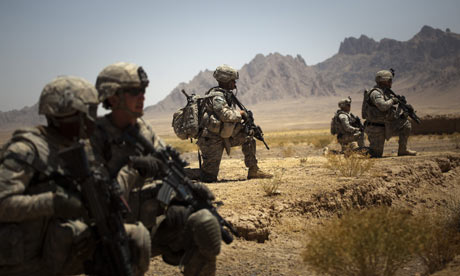
A photograph of US soldiers near Kandahar, Afghanistan, taken by the embedded AP photographer Emilio Morenatti the day before he lost a foot in a roadside bombing. Photo: Emilio Morenatti/AP.

US Military Investigates Afghan Desk
By P.J. Tobia / August 28, 2009

This article from Stars and Stripes has a lot of journalists talking. It is about The Rendon Group, a company that puts together background briefs on reporters who apply for embeds with the US military in Afghanistan.

Most reporters in Afghanistan know about these reports. I obtained a copy of my Rendon report about three months ago from a friend in the military and I’ve posted excerpts below. I don’t really think the reports are some kind of violation, in fact, I think the military is smart to look into the background’s of people who will be writing about them. Rating the coverage that reporters give the military – ”positive,” “neutral,” “negative” – seems a bit silly and slightly Orwellian, but if thousands of reporters were covering my organization, I would want a simple shorthand to indentify them as well.

I do think the reports are creepy though. These guys have read almost everything I’ve written in the last few years, even interviews I’ve given to local news blogs. Reading this report is like perusing the diary of your stalker. Rendon also classifies certain publication as “left leaning” which I find odd.

Most troubling by far is that when S&S asked the military about Rendon, they denied the existence of these reports. I’m holding one of these reports in my hand right now, trust me, it exists. I’ve also met people who work for The Rendon Group in Kabul. In conversations, they deny that there is any nefarious objective to what they do. “We just help the military figure out what embed is right for a particular reporter,” one Rendon employee told me over drinks. “If a reporter is classified as “negative” they are less likely to go where the action is and more likely to be covering a platoon that guards sandbags in Herat.”

I’ve quoted the best parts of my Rendon report below for your reading pleasure. This was my second report, generated after my second embed (in Wardak) and before my third (in Kandahar.) I bolded some of the good parts and put links to the stories they reference.

Memorandum

FROM: The Rendon Group
Date: 5 May 2009

RE: UPDATE P.J. Tobia Journalist Profile

The purpose of this memo is to provide an updated assessment of P.J. Tobia, and give a profile of his work, both through a summary of content and analysis of style, in order to gauge the expected sentiment of his work while on an embed mission in Afghanistan…

UPDATE to analysis below:

Tobia’s work resulting from his most recent embed was an in-depth article for The Philadelphia Inquirer on joint US, French and ANA operations in Wardak. The article followed Lt Eric Schwirian and his efforts to train ANA soldiers who, if properly strengthened, are the coalition’s ticket out of Afghanistan. His article for Philadelphia Inquirer was more straightforward than his previous work.

Tobia was more sympathetic and less critical of the US Military in his most recent report as evidenced by his quote selection: “We’re here to keep the Afghan people safe.”

Tobia continues to humanize US soldiers by quoting mainly US Military personnel and detailing the soldiers’ backgrounds, homes and reaction to fighting in Afghanistan.

His most recent article is neutral-to-positive while his previous work has been neutral or neutral-to-negative.

In an interview, he decried the acid attacks and human rights violations toward Afghan women in particular…

Background

[Tobia’s] articles on Afghanistan focused on multiple topics that included, narcotics use, detainee abuse, the ‘hearts and minds’ mission, the development of the ANSF as well as the overall cost of the US mission in Afghanistan. He produced two articles that were originally published in The Washington Post and Nashville Scene but were later picked up by New York’s left leaning Village Voice and Florida’s New Times.

…It should be noted that his [Village Voice] article was titled “Afghaniscrewed: How I Spent My Fall Vacation.”

Perspective, Style and Tone

Tobia tends to write lengthy feature articles that are highly narrative. His articles are often written in first person and may be considered commentaries rather than hard news pieces. His articles are thought provoking as he often asks questions rather than making conclusions.

He writes with an outside observer’s perspective, but his articles show he can identify and empathize with US troops.

Expectations for Embed

Based on his previous embed and past reporting, it is unlikely that he will miss an opportunity to report on US military missteps. However, if following previous trends, he will remain sympathetic to US troops and may acknowledge a learning curve in Afghanistan.

Considering his previous embed, it is likely that he will produce articles that may be picked up by a number of publications.

In light of his previous style and previous coverage, it is likely that he will write long feature articles that address several current Afghan issues in relation to troops he has contact with.

Source / True Slant

The Rag Blog

Posted in RagBlog | Tagged , , | 1 Comment

Military Outsourcing: Of Exceptionally Dubious Value

A firearms and tactics instructor at Blackwater demonstrates a weapon in Moyock, N.C. Photo: Gerry Broome/AP.

Flushing Blackwater
By Jeremy Scahill / August 26, 2009

Blackwater, the private mercenary company owned by Erik Prince, has been thrust back into the spotlight by a series of stunning revelations about its role in covert US programs. Since at least 2002, Blackwater has worked for the CIA in Afghanistan and Pakistan on “black” contracts. On August 19, the New York Times revealed that the company was, in fact, a central part of a secret CIA assassination program that Dick Cheney allegedly ordered concealed from Congress. The paper then reported that Blackwater remains a key player in the widening air war in Pakistan and Afghanistan, where it arms drone aircraft. These disclosures follow allegations–made under oath by former Blackwater employees–that Prince murdered or facilitated the murder of potential government informants and that he “views himself as a Christian crusader tasked with eliminating Muslims and the Islamic faith from the globe.”

In addition, Blackwater is being investigated by the Justice Department for possible crimes ranging from weapons smuggling to manslaughter and by the IRS for possible tax evasion. It is being sued in federal courts by scores of Iraqi civilians for alleged war crimes and extrajudicial killings. Two of its men have pleaded guilty to weapons-smuggling charges; another pleaded guilty to the unprovoked manslaughter of an Iraqi civilian, and five others have been indicted on similar counts. The US military is investigating Blackwater’s killing of civilians in Afghanistan in May, and reports are emerging that the company may be implicated in the CIA’s extraordinary rendition program.

And yet, despite these black marks, the Obama administration continues to keep Blackwater on the government’s payroll. In Afghanistan and Pakistan, Blackwater still works for the CIA, the State Department and the Defense Department to the tune of hundreds of millions of dollars, and its continuing presence is an indicator of just how entrenched private corporations are in the US war machinery. The United States now deploys more private forces (74,000) than uniformed soldiers (57,000) in Afghanistan. While the majority of these contractors are not armed, a sizable number carry weapons, and their ranks are swelling. A recent Defense Department census reports that as of June 30, armed DoD contractors in Afghanistan had increased by 20 percent from the first quarter of 2009.

With the exception of a few legislators, notably Representatives Henry Waxman and Jan Schakowsky, Congress has left the use of private military contractors largely unmonitored. But the recent disclosures of Blackwater’s covert activities may finally force Congress to take action. At the very least, the Obama administration should be required to disclose current and past federal contracts with all of Prince’s companies and affiliates, including those registered offshore.

Congress can take Schakowsky’s lead and ask the Obama administration why it is continuing to work with Blackwater. Schakowsky has called on Secretary of State Hillary Clinton and Defense Secretary Robert Gates to review all of the company’s existing contracts and not to award any new ones to its many affiliates. Congressional intelligence committees should also conduct a wide-ranging investigation into Blackwater’s involvement in the CIA assassination program. Were Blackwater operatives involved in actual killings? Who approved the company’s involvement? Was Congress notified? How high up the chain of command did the covert relationship with the company go? Was Blackwater active on US soil? What role, if any, did/does Blackwater play in secretly transporting prisoners?

This investigation must include the sworn testimony of former top CIA officials who were later hired or paid by Blackwater. Among these are Alvin “Buzzy” Krongard, the former number-three man at the agency, who gave Blackwater its first CIA contract and then served on the company’s board, and J. Cofer Black, the former head of the CIA’s counterterrorism unit, which ran the assassination program. Black later became the vice chair of Blackwater and ran Total Intelligence Solutions, Prince’s private CIA. Total Intelligence has been simultaneously employed by the US government, foreign governments and private companies, an arrangement that may have created conflicts of interest that the House and Senate intelligence committees are obliged to investigate. Congress should also ask if national security is compromised when the knowledge, contacts and access possessed by former high-ranking CIA officials like Black and Krongard are placed on the open market.

John Kerry, chair of the Senate Foreign Relations Committee, has questioned whether Blackwater used its State Department clearance as cover to gather information for targeted killings. Kerry should hold hearings in which Hillary Clinton and Condoleezza Rice would be compelled to testify on the matter. The oversight committees should probe allegations that Blackwater was involved in arms smuggling and extrajudicial killings in Iraq, while committees dealing with military affairs should investigate what impact Blackwater’s actions in Iraq have had on the safety of US troops. An invaluable asset for these investigations could be the Commission on Wartime Contracting, established by Senators Jim Webb and Claire McCaskill. Finally, the Justice Department should probe the murder, smuggling and other allegations against Prince and his executives.

In all of this, Blackwater has proved itself to be a whack-a-mole: it keeps popping up. Despite the Iraqi government’s ban on the company, its operatives remain in Iraq a full two years after the September 2007 Nisour Square massacre, in which seventeen Iraqi civilians were gunned down in Baghdad. This resilience means that the investigations into the company must be comprehensive and coordinated.

Lastly, it is a mistake to think that Blackwater is the only problem. In Iraq, for example, the Obama administration is replacing Blackwater with the private contractor Triple Canopy, which, in addition to hiring some of Blackwater’s men, has its own questionable history, including allegations of shooting civilians and hiring forces from countries with a history of human rights abuses. Blackwater is but one fruit on the poisonous tree of military outsourcing. It is imperative that Congress confront the intimate linking of corporate profits to US wars and lethal, covert operations.

[Jeremy Scahill, a Puffin Foundation Writing Fellow at The Nation Institute, is the author of the bestselling Blackwater: The Rise of the World’s Most Powerful Mercenary Army, published by Nation Books. He is an award-winning investigative journalist and correspondent for the national radio and TV program Democracy Now!.]

Source / The Nation

The Rag Blog

Posted in RagBlog | Tagged , , , | Leave a comment

The Forgotten War: Bringing Only More Despair

A huge explosion in Kandahar, Afghanistan, on Tuesday left mounds of rubble. At least 41 people were known dead. Photo: Allauddin Khan/Associated Press.

Bombing Deepens Despair in a Stricken Afghan City
By Taimoor Shah / August 26, 2009

KANDAHAR, Afghanistan — This city is no stranger to bombings. There have been many here over the years of war. But the one on Tuesday night — the deadliest — may have done more than any other to deepen Kandahar’s sense of isolation and tip its people into despair that someone, anyone, has the power to halt the mayhem that surrounds them.

Source / New York Times

The Rag Blog

Posted in RagBlog | Tagged , , , | 8 Comments

Water Or Coke? A Few Revealing Facts

According to Snopes, most of the information about Coke below is quite untrue. The source of this piece is unknown – I tend to call it Internet detritus. Janet says: “I think the part about water is true, but the Coke part may contain exaggerations. Kind of a humor piece, urban myth really.

The truth about salt is also interesting. Humans fought over salt for millennia, and it is essential to health. Today’s salt is industrial waste, not mined which came originally from the sea, or harvested directly from the sea. The evidence that salt is bad for you is really evidence that industrial waste is bad for you.”

WATER

#1. 75% of Americans are chronically dehydrated. (Likely applies to half the world population.)

#2. In 37% of Americans, the thirst mechanism is so weak that it is mistaken for hunger.

#3. Even MILD dehydration will slow down one’s metabolism as 3%.

#4. One glass of water will shut down midnight hunger pangs for almost 100% of the dieters studied in a University of Washington study.

#5. Lack of water, the #1 trigger of daytime fatigue.

#6. Preliminary research indicates that 8-10 glasses of water a day could significantly ease back and joint pain for up to 80% of sufferers.

#7. A mere 2% drop in body water can trigger fuzzy short-term memory, trouble with basic math, and difficulty focusing on the computer screen or on a printed page.

#8. Drinking 5 glasses of water daily decreases the risk of colon cancer by 45%, plus it can slash the risk of breast cancer by 79%, and one is 50% less likely to develop bladder cancer. Are you drinking the amount of water you should drink every day?

COKE

#1. In many states the highway patrol carries two gallons of Coke in the trunk to remove blood from the highway after a car accident.

#2. You can put a T-bone steak in a bowl of Coke and it will be gone in two days.

#3. To clean a toilet: Pour a can of Coca-Cola into the toilet bowl and let the ‘real thing’ sit for one hour, then flush clean. The citric acid in Coke removes stains from vitreous china.

#4. To remove rust spots from chrome car bumpers: rub the bumper with a rumpled-up piece of Reynolds Wrap aluminum foil dipped in Coca-Cola.

#5. To clean corrosion from car battery terminals: pour a can of Coca-Cola over the terminals to bubble away the corrosion.

#6. To loosen a rusted bolt: apply a cloth soaked in Coca-Cola to the rusted bolt for several minutes.

#7. To bake a moist ham: Empty a can of Coca-Cola into the baking pan, wrap the ham in aluminum foil, and bake. Thirty minutes before ham is finished, remove the foil, allowing the drippings to mix with the Coke for a sumptuous brown gravy.

#8. To remove grease from clothes: Empty a can of Coke into the load of greasy clothes, add detergent, and run through a regular cycle. The Coca-Cola will help loosen grease stains. It will also clean road haze from your windshield.

FOR YOUR INFORMATION:

#1. The active ingredient in Coke is phosphoric acid. It will dissolve a nail in about four days. Phosphoric acid also leaches calcium from bones and is a major contributor to the rising increase of osteoporosis.

#2. To carry Coca-Cola syrup! (the concentrate) the commercial trucks must use hazardous material place cards reserved for highly corrosive materials.

#3. The distributors of Coke have been using it to clean engines of the trucks for about 20 years!

Now the question is, would you like a glass of water? Or Coke?

Thanks to Janet Gilles / The Rag Blog

Posted in RagBlog | Tagged , | 2 Comments