Fighting Back in Hard Times: The Power of Organized Labor Action

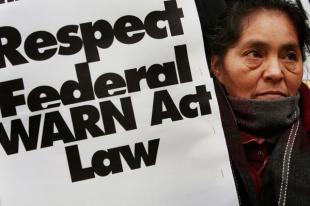
Laid-off Republic Windows and Doors factory worker Maria Gonzalez holds a picket sign outside the factory in December 2008 in Chicago, Ill. About 250 workers demanded severance and vacation pay owed to them.

The Legacy Lives On
By Kari Lydersen / June 28, 2009

Just months after laid-off workers occupied the Republic Windows and Doors factory in Chicago, their action inspired a similar revolt halfway across the country.

On December 5, 2008, 250 laid-off workers occupied Chicago’s Republic Windows and Doors factory, refusing to leave until paid for accrued vacation time and two months of federally-mandated severance. These demands, which might have been ignored by media in more stable economic times, thrust the unionized workers onto the national stage as the country’s financial system and economy unraveled.

Five days later, bailed-out JPMorgan Chase and Bank of America—the latter of which had cut off a line of credit to the company—reached a settlement with the workers, and the occupation ended. But beyond their monetary demands, the predominately Latino workers were delivering a clear message to Washington: protect workers’ rights.

Workers in Rhode Island were listening, as In These Times Contributing Editor Kari Lydersen makes clear in the following excerpt from her new book, Revolt on Goose Island: The Chicago Factory Takeover, and What it Says About the Economic Crisis. After the Colibri Group—which manufactures high-end lighters, pens and cigar-cutters—unexpectedly shuttered a factory outside of Providence in mid-January, some of the 250 workers laid-off there decided to fight for exactly what Republic workers had fought for.

* * * * *

The Colibri Group was formed in 1928 to make mechanical cigarette lighters—a novel invention at the time. The company became a leading manufacturer of high-end lighters, pens, cigar-cutters, cuff links, and other accessories engraved and encrusted with gems. Until recently, its headquarters and two factories in Rhode Island employed a diverse, largely immigrant workforce who spoke at least six languages: English, Spanish, Portuguese, Hmong, Chinese, and Haitian Creole.

But gem-encrusted pens and $100 lighters are the kinds of luxuries most people cut down on during rough times, so it is no surprise that the economic crisis hit Colibri hard. The company suffered several waves of layoffs over the past year. On December 22, 2008, 52-year-old Alda Bonin and a number of other workers were laid off. “Merry Christmas,” she told her manager. She didn’t mean it sarcastically, but the ill-timed move couldn’t be ignored.

Bonin is a skilled jewelry mold-maker and kept her own tools at the factory, so she told the manager she needed to collect them. “Don’t worry about it,” she was told. “The layoff is only temporary, you’ll get your job back in early February.” Just two years earlier, Bonin had been laid off from another flailing jewelry company, so she was skeptical. She lives about a mile from the factory, and on January 15, when she happened to see her former co-workers walking by in tears, she feared the worst.

She quickly got on the phone and learned that her former colleagues had arrived at work to see a sign saying the plant was permanently closed. CEO Jim Fleet had sent an e-mail the previous night, but since many workers didn’t have internet connections at home, they had showed up in the morning none the wiser. About 280 workers had lost their jobs, in addition to the previous layoffs.

State of decline

As at Republic, it seemed Colibri officials had known the company was likely to close. They had desperately sought new investments or a merger over the past year, to no avail. The company had lost $10 million in both 2007 and 2008. But Bonin is furious that they still waited to tell workers until the last minute.

“They started laying off people a little bit at a time,” she remembers. “There was hardly anybody in the place. I just wish I was told the truth from the beginning. When they laid off my group, they already knew. So to be told that I was coming back to work, I was deceived.”

The Manhattan-based finance company Founders Equity was the majority owner of Colibri. Colibri declared bankruptcy, being $28 million in debt and owing $6 million to vendors. The workers’ healthcare was terminated immediately, and their chances of getting new jobs looked very grim.

Even before the economic crisis, the state’s historic jewelry industry had lost many jobs because of cheaper foreign labor. The crisis meant a severe downturn in demand for jewelry. And other local industries weren’t faring much better. The state’s unemployment rate for January 2009 was 10.3 percent, higher than the national rate of 7.6 percent that month.

The afternoon of the closing, employee Emilio Blanco, a Dominican immigrant, was at home feeling lost and dejected. He had worked at the company for 22 years, since he was 24 years old. He had done “everything” there, from welding to stone-setting, and he was raising two kids on his income. “I gave them so much, my whole life, and then they just closed the doors on us like we were animals,” he said. “I felt like my heart was on the floor.”

‘An amazing moment of solidarity’

The workers had no union to turn to, so Blanco called an advice program on a Spanish-language radio station. The DJ gave him the number for Fuerza Laboral (Workers’ Power), a grassroots advocacy organization with just two staff members. Director Greg Pearson asked if Blanco could get 10 workers together for a meeting. Twenty-one people showed up, and the Colibri Workers for Rights and Justice was born.

On February 3, they drew 250 people to a protest outside the factory, in a snowstorm. On February 6, the Republic workers came through Providence on their Resistance tour, with an event at the Open Table of Christ United Methodist Church. About 50 Colibri workers attended and then met with Robles and Meinster for three hours. The Colibri workers were game for a sit-in or similar direct-action tactic of their own.

“It was an amazing moment of solidarity and awareness,” said Pearson. “They took the workers through what the process is. Republic had a union, Colibri didn’t have any union. Republic got three days’ notice, these workers didn’t get any notice.”

Bonin was highly impressed with Robles and the Republic action. “I thought these people had a lot of strength and confidence in themselves, they were brave and powerful to do this,” she said. “When you stick together as a group, you do have more power, you do have more hope.”

While many of the Republic workers had experience and training in organizing and direct action thanks to the union and other Chicago campaigns, almost all the Colibri workers were new to the realm. But they dove right in.

A campaign is born

Since the Colibri factories were already vacated and shuttered, it was too late for an occupation. Instead, they decided to fight through public pressure for their WARN Act pay and accrued vacation time, plus severance pay based on seniority: one extra week for each year of service, a benefit that had been given to workers laid off earlier.

Since Colibri was in bankruptcy, as at Republic targeting the company itself would likely not be fruitful. So in a page taken from the Republic playbook, they designed a campaign to pressure Founders Equity and the two banks that were secured creditors: Sovereign Bank and HSBC, a bailout recipient.

During a court hearing, former Colibri toolmaker and Vietnam veteran Mike Masi told bank officials, “Banks have insurance. We don’t. Banks can wait to be repaid. We can’t. For some of us, both wage-earners in the household were working at Colibri and now we are left with zero income. Others of us struggle with health issues and greatly depended on our health insurance, which was cut off as well.”

Fuerza Laboral launched a national campaign. Seventy workers rallied at Founders’ Manhattan headquarters. They marched on the state capitol. They spearheaded a national letter-writing drive. On March 12, the Rhode Island House of Representatives unanimously passed a resolution supporting the workers and calling for legislation to create a stronger version of the WARN Act on a state level.

The city council also passed a resolution of support; the workers brought flowers in thanks. And an attorney working pro bono filed lawsuits regarding WARN Act violations.

On March 19, an auction of Colibri’s assets was scheduled. A crowd of about 150 potential buyers was expected, and the auction would be held at Colibri’s former headquarters in Providence. The workers figured this was their moment.

They gathered at 9:30 a.m., and police were already lining the street. The workers marched and chanted, waving signs reading RISE TOGETHER, STAY TOGETHER. Teenagers came with musical instruments, and someone said they should dance. Bonin alone started dancing, but felt foolish that no one was joining her, so she grabbed another Colibri worker known as a comedian and the two twirled and dipped as the crowd cheered.

Police forced the workers to clear the way when cars drove in for the auction. The first few times the workers complied. Then a group of them sat down in the road and refused to budge. They were quickly arrested.

“Seeing the police pulling my friends off the ground, handcuffing them, making them lay down, it was upsetting and emotional at the same time,” said Bonin. “But I felt we needed to keep on going for them.” Groups of workers sat in the road and got arrested two or three more times over the next few hours.

In all, 14 people were brought to the station and charged with disorderly conduct, including Pearson and about 10 workers. The auction did go on but turnout was low. After the protest, Bonin headed to the station to check on her co-workers. She was relieved to see them coming out three hours later with smiles on their faces.

As Emilio Blanco left the station, his voice was hoarse from all the chanting and cheering, but he was in good spirits. “We’re fighting for our rights, we won’t stop until we get paid,” he said. “This is very important to set an example for other compañeros.”

His friend Yannary Sarit, 32, had worked at the company for almost five years and was ready to take their story to Washington, D.C., on the coming weekend for the National People’s Action (NPA) conference, an annual convergence of community and activist organizations. This was her first time taking part in activism, but her appetite was whetted.

“I thought this was the land of opportunity, but they closed the doors on us,” Sarit said. “The American Dream is a myth. We worked so hard for them, and then this. But if we keep fighting, things are going to change.”

Workers’ payback

Bonin was balancing between hope and cynicism about the likelihood of getting their jobs back, but she saw larger meaning in the struggle, regardless of the outcome. By the evening after the protest, she was exhausted and stretched out on the couch watching TV, but her adrenaline was still running. She was looking forward to the next day’s strategy meeting and an ongoing fight for justice.

Since the layoff she had sent out résumés, but she hadn’t heard a word back, not even a note to say her résumé had been received. The jewelry industry will not recover for a long time, she figures. After being laid off twice within a few years, she is ready for a career change. She wants to go back to school to become a medical assistant. The money Colibri owes her would be a big help in launching this dream.

“Even if we don’t get the money, I feel like I’ve accomplished something with that group of people,” she says. “What we’ve accomplished already is that another employer won’t end up doing what they did to us.”

This article is excerpted from Revolt on Goose Island: The Chicago Factory Takeover, and What it Says About the Economic Crisis, published by Melville House Publishing, June 2009. For more information about the book, click here.

[Kari Lydersen, an In These Times contributing editor, is a Chicago-based journalist writing for publications including The Washington Post, the Chicago Reader and The Progressive. Her most recent book is Revolt on Goose Island.]

Source / In These Times

Thanks to Diane Stirling-Stevens / The Rag Blog

Posted in RagBlog | Tagged , , | 1 Comment

Congress : Return Health Care to the People


Health care should be a profession, not a business.

By Dr. Stephen R. Keister / The Rag Blog / June 29, 2009

The American, if he has a spark of national feeling, will be humiliated by the very prospect of a foreigner’s visit to Congress — these, for the most part, illiterate hacks whose fancy vests are spotted with gravy, and whose speeches, hypocritical, unctuous, and slovenly are spotted with the gravy of political patronage, these persons are a reflection on the democratic process rather than of it; they expose it in its underwear.

Mary McCarthy

The “health care debate” has become more and more peripheral to the basic meaning of health care, i.e. caring for the ill and those suffering from chronic disease. The politicians confabulate, confuse, and deceive in their personal interests or in the interests of their financial patrons.

The entire matter is quite simple and would health care costs could be reduced by 30-40% if our elected representatives would adhere to a plan 30 years in developing, a plan not of “socialized medicine,” but a plan developed to be administered by physicians to their patient base. This is a plan far different from the frantic attempts to improvise while paying homage to the insurance and pharmaceutical industries currently being considered in the Congress.

The plan proposed by Physicians for a National Health Program is all inclusive, provides care without the dictates and maneuvers of the health insurance industry, and returns health care to the people and their physicians, as is common in the vast majority of nations of the civilized world. Here is a plan for universal care without government interference, and without rationing care for the profits of the large corporations as currently occurs in the United States.

In the July 2009 issue of Vanity Fair there is an excellent article by Dr. Joseph Stiglitz entitled “Wall Street’s Toxic Message” in which the author points out that when the current crises is over, the reputation of American style capitalism will have taken a beating — not least because of the gap between what Washington practices and what it preaches. The article is illustrated with a cartoon, pertaining to Wall Street, but also indicative of the current health insurance cartel. The cartoon updates the four horsemen of The Apocalypse: Mendacity, Greed, Arrogance, Stupidity.

Dean Baker, in a Truthout Perspective article titled “Spreading the Wealth Around to the Insurance Industry and Friends,” starts with a telling statement: “This is the time when the excrement starts hitting the fan. The lobbyists are in overdrive, rounding up members of Congress just like the cowboys of the Old West would bring in the herd.”

Not only are the insurance companies morally corrupt in their dealings with our “representatives” but they are equally duplicitous in their dealings with their clients, the sick, and the dying. David S. Hilzenrath writes in the Washington Post that “Health insurers have forced consumers to pay billions of dollars in medical bills that the insurers themselves should have paid, according to a report released yesterday by the staff of the Senate Commerce Committee.” Yet the public hears little or nothing of this in the mainstream media.

One major problem of the current debate is the fact that the American public does not understand the issues involved. There is dismay about the lack of health care; however, the public at-large somehow does not get it. There was a demonstration this past week in Washington promoting health care for all which, as I understand, brought out 20,000 protesters. Considering the enormity of the problem one would have wished for at least 200,000.

Sara Robinson of Campaign for America’s Future, in an article entitled “We’ve Been Trapped inside a Bad Health Care System So Long, We Don’t Even Know How Much Were Missing” points out that “sometimes, when you’re up to your chin in alligators, it’s hard to focus on the fact that there’s a big broad, alligator-free world waiting somewhere out there, beyond the edge of the swamp.”

Perhaps I am overly obsessed with the corruption attendant to the present debate; however, nearly 88 years ago I was born into a household involved in local politics. My father was a totally honest man who attempted to face down the system, and ended up broken by the inherent evil of the political patronage game. He learned that, even on a local level, one either pays homage to those interests where money is power, or one best not play at all. Finally, my father bent and chose not to participate at all. Also see Amy Goodman’s “Congre$$, Heal Thyself.”

We tend to dwell on the profits made by the insurance, pharmaceutical, and health appliance industries; however, there is another facet to the overall high health costs in the United States and this is well illustrated in an article titled “Life is Expensive” in the May 30 Economist, in which the author cites the telling case of a middle-aged man. The man, who had good insurance, developed chest pains and went straight to a cardiologist who put him though a bunch of tests including a CT Scan amd an angiogram which caused serious complications and landed him in the hospital for a while.

He ran up a bill of $150,000, the studies were negative and the chest pains vanished. Some months later the pain reappeared and he talked to a physician trained in preventative medicine who asked about lifestyle changes. The patient mentioned that he had taken up gardening and had been weeding. The physician, on examination, established that the patient had strained a chest muscle while weed whacking and that was the cause of the pain.

Unfortunately episodes akin to this are much too common in the United States today. We over-utilize medical procedures rather than obtaining a careful history and examining a patient. Many doctors are overburdened with too many patients, while other physicians, unfortunately, do not take time with the patient, because, sadly, time is money. This is a culture developed in the past 30 years with the change, due to the influence of the insurance industry, that has turned a profession into a business.

There are other factors too, such as fear of medico-legal law suits, largely an unfounded fear, but used as a rationalization by physicians for doing any and all tests and X-rays, needed or not, for self protection. I practiced rheumatology for 40 years and spent time talking and communicating with my patients — a largely foreign practice today — and with rapport, honesty, and understanding I avoided all the legal complications I was warned about. When I started my practice an old wise physician pointed out to me that the way to avoid medico-legal problems is to establish an honest personal relationship with your patient. Personal communication, even by telephone, beats the patient being brushed aside only to talk to a nurse or PA, and might allay some fears for both patient and physician.

Another problem is the indoctrination of the public into believing that the utilization of “procedures” has something to do with “good medicine.” The culture demands that every cough deserves an immediate chest X-ray. Every bump on a child’s head requires a MRI or CT Scan ($2500). Every twisted knee needs a MRI and surgical intervention. (Try hard enough and there is always a willing orthopedist.) We in this country have twice as many births by caesarian section as in any other Western nation. Why? As a matter of convenience for the mother, or indeed, a greater fee for the obstetrician?

There is a great need for many more primary care physicians in the United States: internists, pediatricians, family physicians. These are in short supply because of the relatively low income and long hours involved, on top of the horrid expense of a medical education. On thhe other side of the coin are the “specialists” in cardiovascular surgery, ophthamology, orthopedics and urology, who make 10-20 times the income of the primary care doctors. I recently read a commentary by a cardiovascular surgeon who justified the income because “we save lives.” Perhaps this should be displayed on a flashing neon sign! “WE SAVE LIVES.” As I recall ALL physicians are trained to treat disease, alleviate suffering, give comfort, and in doing so save lives.

One would hope that Congress, while developing a health care plan, might spend some time talking to primary care physicians, largely represented by Physicians for a National Health Program, rather than talking to the CEOs and lobbyists of the insurance and pharmaceutical industries and their hangers on such as the AMA and AARP.

Unfortunately, when I look at Congress I am reminded of Will Rogers comment: “The country has come to feel the same when Congress is in session as when the baby gets hold of a hammer.”

[Dr. Stephen R. Keister, a retired physician who is active in health care reform, lives in Erie, PA. His previous articles on The Rag Blog can be found here.]

Source

The Rag Blog

Posted in Rag Bloggers | Tagged , | 3 Comments

Greg Moses : Chinese Dragon in Aftershock?

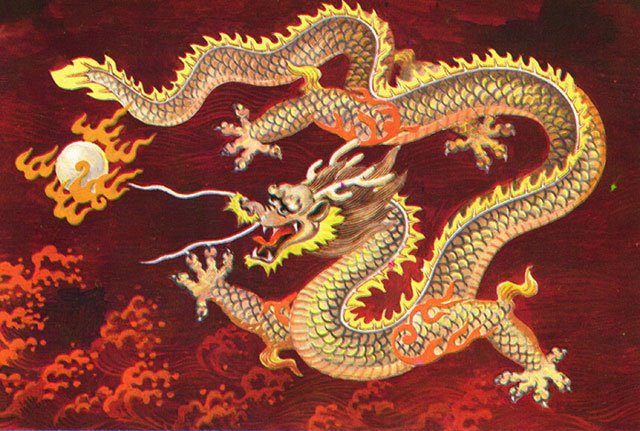
Chinese dragon: still snorting through the global depression? Image from Scrape TV.

Still time to put jobs first?

In the chatter of Chinese ministers sounds a worry that the ‘socialist market economy’ could come out of the economic crisis fatter than it needs to be and therefore vulnerable to all the lean dogs that global capital is breeding as we speak.

By Greg Moses / The Rag Blog / June 29, 2009

From a distance the Chinese mainland appears to be snorting through the global depression like a fire-breathing dragon. But a closer look at internet discourse reveals a giant in the throes of aftershock. When we hear tones of irritation from Chinese officials regarding “dollar problems” we could on the one hand consider their pain.

On the other hand, whether you are listening to pro-dollar or anti-dollar partisans today, there is an eerie agreement between Marxist and Friedmanite alike that return on capital is the main thing. What we need to hear more often from both sides of the global mouth is how capital will only grow through labor.

With the help of Google translate, the average monolingual Yankee can cross the ocean and listen to the official pronouncements of ministers for the Communist Party of China (CPC) who have a thousand throats exhorting the masses to keep on the scientific path.

What the scientific path sounds like in China today is a lot like what you hear weekdays over the chatterbox at the Capitalism-Knows-Best Channel (CNBC). For instance, the Chinese “socialist market economy” is being redefined scientifically into a “modern market economy under rule of law,” which is exactly the way they like it at CNBC.

From both sides of the Pacific you get pretty much the same news: double-digit downturns in profits across the board, dozens of gigantic projects suddenly scrapped and unplugged, trade routes collapsing, pages snatched from memories of capitalism past, the better to remind us how to survive.

Even on the question of climate change there is a convergence of policy conviction that “the construction of ecological civilization” will help our damaged economies to “cope with the international financial crisis” through the material re-production of green technologies.

Tuning into the thoroughly capitalized culture at CNBC — coming at you “live from the financial capital of the world” — bust is generally accepted as the price of boom. Mad Money man Jim Cramer said recently that if the stock market were to take another 150 point dive on the S&P 500 Index, investors from the boo-yah land of Cramerica could consider it a gift — “A GIFT!!”

But over on the Chinese mainland, ministers seem to be talking to masses who haven’t quite learned how to appreciate the opportunities of economic collapse. This is the time, say the ministers, to vigorously seek innovations in technology, reconfigure business models, bury dead capacities, and evolve the community through decisive calculations of “M&A.”

In the chatter of Chinese ministers sounds a worry that the “socialist market economy” could come out of the economic crisis fatter than it needs to be and therefore vulnerable to all the lean dogs that global capital is breeding as we speak.

Of course every Wal-Mart shopper knows how much is owed to the enormous Chinese factories that punched out a dozen or so shopping seasons. But Chinese ministers know better how the tiny “Made in China” labels were not attached to Chinese-branded logos. And whereas the great logos of the global economy will likely recover on top of factories somewhere or anywhere (thank you Naomi Klein) there is no guarantee that the factories of China will be serving the logo powers next year.

There is enough worry to go around. In the USA we don’t know if the unemployment numbers will stop in time to provide the baby boom a respectful retirement. In China, the ministers don’t know if plants and projects will stop shutting down in time to prevent a more colossal sacrifice in capital spending.

Matching the positive image of the Chinese minister atop his nearly $2 trillion mountain of dollar reserves is the precise negative image of the average American consumer down in his valley of debt. And where the images should be joined at the middle term is across the rubbed glass surface of the Wal-Mart check-out counter, courtesy of MasterCard and Visa.

Of course, there was a time not too many months ago when the era of dollar-fed arrogance seemed to be stalking the world with unchecked power as “dollar hegemony” rolled around the globe with tsunami force. These days however the dollar gets pulled up off its knees by other currencies at the most curious times, exactly in moments when the whole flow of things seems to shudder with collapsing pipes.

What the dollar needs most right now is a national emergency declared in behalf of jobs. Enough diddling with yield curves and balance sheets already. Whatever it takes, we need folks back at work. Until we are busy creating value through labor, every dollar will stay busy shrinking.

Which brings us to the final correspondence between CNBC and the ministers of China. By and large all these voices fail to inflect the urgency of the single outcome that will count most toward economic health — getting everybody back to work. If you are holding a pile of dollars the immediate question should be how to transform that cash into tools of productivity for workers of the world. Wealth today is paralyzed from not knowing how to become productive. This is the real problem.

So whether you grew up on one side of the Pacific listening to warnings about the Midas touch or you grew up on another side of the Pacific sneaking lessons from Mencius you should know. When you mistake the real value of human economy for dollars, gold, or profit, you shall kill the order of things.

Something about the discourse of crisis is chilling to the ear. Neither side of the ocean is talking early or often enough about how to forge wealth into tools that can be put to work. There is still time perhaps to put jobs first.

[Greg Moses is editor of the Texas Worker and a regular contributor to The Rag Blog. He can be reached at gmosesx@gmail.com .]

The Rag Blog

Posted in Rag Bloggers | Tagged , , , | 2 Comments

Honduran Coup Leaders Reportedly Trained at U.S. Army School in Georgia

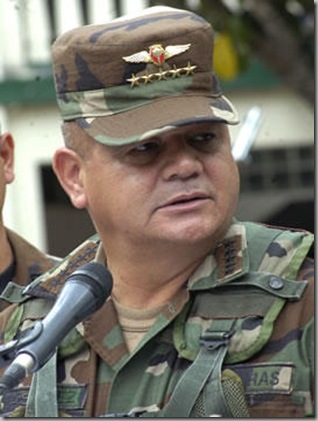
Reported Honduras coup leader General Romeo Vasquez trained at the Western Hemisphere Institute for Security Cooperation at Fort Benning, Georgia.

Key leaders of Honduras military coup trained in U.S.

The Georgia-based U.S. military school is infamous for training over 60,000 Latin American soldiers, including infamous dictators, “death squad” leaders and others charged with torture and other human rights abuses.

By Chris Kromm / June 29, 2009

At least two leaders of the coup launched in Honduras on June 28 were apparently trained at a controversial Department of Defense school based at Fort Benning, Georgia infamous for producing graduates linked to torture, death squads and other human rights abuses.

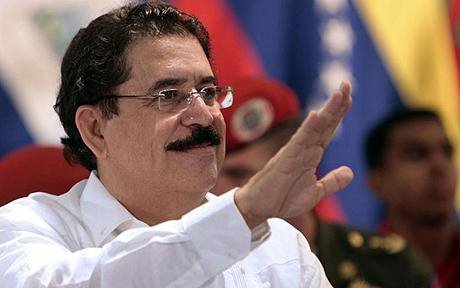
Leftist President Manuel Zelaya was kidnapped and transported to Costa Rica on Sunday morning after a growing controversy over a vote concerning term limits. Over the last week, Zelaya clashed with and eventually dismissed General Romeo Vasquez — who is now reportedly in charge of the armed forces that abducted the Honduran president.

According to the watchdog group School of Americas Watch, Gen. Vasquez trained at the Western Hemisphere Institute for Security Cooperation at least twice — in 1976 and 1984 — when it was still called School of Americas.

The Georgia-based U.S. military school is infamous for training over 60,000 Latin American soldiers, including infamous dictators, “death squad” leaders and others charged with torture and other human rights abuses. SOA Watch’s annual protest to shut down the Fort Benning training site draws thousands.

According to SOA Watch, the U.S. Army school has a particularly checkered record in Honduras, with over 50 graduates who have been intimately involved in human rights abuses. In 1975, SOA Graduate General Juan Melgar Castro became the military dictator of Honduras. From 1980-1982 the dictatorial Honduran regime was headed by yet another SOA graduate, Policarpo Paz Garcia, who intensified repression and murder by Battalion 3-16, one of the most feared death squads in all of Latin America (founded by Honduran SOA graduates with the help of Argentine SOA graduates).

General Vasquez isn’t the only leader in the Honduras coup linked to the U.S. training facility. As Source Kristin Bricker points out:

The head of the Air Force, Gen. Luis Javier Prince Suazo, studied in the School of the Americas in 1996. The Air Force has been a central protagonist in the Honduran crisis. When the military refused to distribute the ballot boxes for the opinion poll, the ballot boxes were stored on an Air Force base until citizens accompanied by Zelaya rescued them. Zelaya reports that after soldiers kidnapped him, they took him to an Air Force base, where he was put on a plane and sent to Costa Rica.

For previous Facing South coverage of controversy surrounding the School of Americas/Western Hemisphere Center, see here.

Source / Facing South

Also see Military Coup : Resistance and Repression in Honduras by Kristin Bricker / The Rag Blog / June 29, 2009

Thanks to Victor Agosto / The Rag Blog

Posted in RagBlog | Tagged , , , , | 4 Comments

Military Coup : Resistance and Repression in Honduras

Demonstrator outside the Presidential Palace following the kidnapping of President Zelaya of Honduras. (Top) Photo from Orlando Sierra / AFP / Getty. (Below) Photo from Reuters.

Resistance and Repression in Honduras

People are taking the streets in Honduras despite incredibly hostile conditions created by the military.

By Kristin Bricker / June 29, 2009

An unknown number of Hondurans have taken to the streets today (Sunday) in an effort to stop the coup that the military, in league with Congress and the Supreme Court, has carried out against democratically elected President Manuel “Mel” Zelaya.

Due to intermitant power outages and heavy rain, independent media within Honduras has had extreme difficulty transmitting news. This means that while there’s been plenty of news in the mainstream media about the actions people with a lot of political power have been taking — from Chavez and the ALBA nations to the Organization of American States to the United States — there’s been very little reported about what rank-and-file Hondurans have been doing to reverse the coup.

However, it is clear that Hondurans are resisting. People are taking to the streets in Honduras despite incredibly hostile conditions created by the military. Radio Es Lo De Menos reports that their colleagues on the ground have been fired at by snipers who are positioned in rooftops around the city. They stress that the gunfire at this point has only been in the form of “warning shots” and no one has been reported injured from gunfire.

The Civic Council of Popular and Indigenous Organizations of Honduras (COPINH) wrote in a communique,”We tell everyone that the Honduran people are carrying out large demonstrations, actions in their communities, in the municipalities; there are occupations of bridges, and a protest in front of the presidential residence, among others. From the lands of Lempira, Morazán and Visitación Padilla, we call on the Honduran people in general to demonstrate in defense of their rights and of real and direct democracy for the people, to the fascists we say that they will NOT silence us, that this cowardly act will turn back on them, with great force.”

Radio Es Lo De Menos reported that the military has set up roadblocks all over the country in an attempt to prevent Zelaya supporters from reaching the capital. The soldiers are also reportedly attempting to shut down public transportation.

Zelaya supporters took to the streets in an attempt to prevent military reinforcements from arriving at the Presidential Palace. There are protests all over Tegucigalpa, trying to impede military movements.

People cast symbolic votes in today’s controversial public opinion polls. While soldiers seized ballot boxes in many locales, in some towns people managed to rescue the seized ballot boxes from the soldiers and cast their votes:

Photo by Oswaldo Rivas / Reuters.

The Washington Post reports:

“Soldiers try to prevent journalists from filming as they patrol the area around the presidential palace in Tegucigalpa, Sunday June 28, 2009. Soldiers arrested Honduras’ President Manuel Zelaya and disarmed his security guards after surrounding his residence before dawn Sunday, his private secretary said. Protesters called it a coup and flocked to the presidential palace as local news media reported that Zelaya was sent into exile.”

Photo by Esteban Felix / AP.

Union Leader Calls for National Strike in Honduras

Honduran labor leader Ángel Alvarado told TeleSUR that he has called a national strike for Monday in Honduras to protest the coup that has ousted President Manuel Zelaya.

Cell phone service seems to have intermittently returned to Honduras, allowing Alvarado to communicate with TeleSUR via phone from outside the Presidential Palace. Alvarado told TeleSUR that there’s about 15,000 protesters gathered outside the Presidential Palace demanding Zelaya’s return.

Meanwhile, Radio Es Lo De Menos is repeatedly pleading with the international community that protests be organized outside Honduran embassies around the world.

Kristin Bricker

Source / The Narcosphere

Also see Honduran Coup Leaders Reportedly Trained at U.S. Army School in Georgia by Chris Kromm / The Rag Blog / June 29, 2009

Thanks to Col. Jeffrey Segal / The Rag Blog

Posted in RagBlog | Tagged , , | Leave a comment

Health Care in Venezuela

New Venezuelan clinic built by community with funds given from municipality. When communities build projects such as this, they provide some labor and serve as the contractor — thus allowing a lot to be done at lower costs than usual.

Health Care and Democracy: A Look at the Venezuelan Healthcare System
By Caitlin McNulty / June 25, 2009

The right to health care is guaranteed in the Venezuelan Constitution, which was written and ratified by the people in 1999. Through implementing a state-funded social program called Barrio Adentro, or inside the barrio, free comprehensive health care is available to all Venezuelans. Beginning in June 2003 through a trade pact with Cuba, Venezuela began to bring Cuban doctors, medical technology, and medications into rural and urban communities free of charge in exchange for low-cost oil.

The 1.5 million dollar per year program expanded to provide a broad network of small neighborhood clinics, larger regional clinics, and hospitals which aim to serve the entire Venezuelan population. (1) Chavez has referred to this new health care system as the “democratization of health care” stating that “health care has become a fundamental social right and the state will assume the principal role in the construction of a participatory system for national public health.” (2) In Venezuela, not only is health care a right; it is recognized as an essential for true participatory democracy.

Some of what characterizes this movement towards health care for all includes popular participation, preventative medicine, and evaluation of community health issues. Western medicine typically operates in a top-down fashion. Doctors treat symptoms, and often fail to evaluate the larger picture of community health issues or teach prevention. (3) In a private for-profit system, there is little incentive to prevent costly illnesses. In Venezuela, however, Barrio Adentro began constructing clinics within neighborhoods where many had never been to a doctor. Through this program, a community can organize to receive funding to build a clinic and bring in doctors. The community is responsible for creating health committees, the members of which go door to door to assess the specific health issues of their community. Doctors who live in the communities also make house calls. (4) People participate in the process of serving the health needs of the entire population.

The extensive health program is also being used to train a new generation of Venezuelan doctors. The training program takes place within the clinic system itself and relies heavily on experiential learning. The program seeks to build a new relationship between doctor and patient based on the values of service, solidarity and compassion. Doctors participating in the training program are coming from the communities they are learning in and serving, building on their intimate knowledge of the communities to provide truly compassionate and personalized care. Using popular forums, medical professionals are able to respond to the needs of the community and offer education, treatment and consultation addressing unique public health issues.(6)

Although the system began by focusing exclusively on preventative health, it has expanded to include emergency health services, mental health services, surgeries, cancer treatment, dental care, access to optometrists as well as free glasses and contact lenses, support systems for those with disabilities and their families, as well as access to a large variety of medical specialists. They have succeeded in taking an under funded, corrupt public health care system and changing not only the quality and accessibility but also the mentality of those working there. Instead of a for-profit industry systematically denying access to large sectors of the population, health care in Venezuela is seen as a basic human right. No one is turned away, and no one is denied care. In Venezuela, they treat whole person, not simply their illness, and money stays where it belongs- outside of the health care system.(7)

During my time in Venezuela, I developed a cough that went on for three weeks and progressively worsened. Finally, after I had become incredibly congested and developed a fever, I decided to attend a Barrio Adentro clinic. The closest one available was a Barrio Adentro II Centro de Diagonostico Integral (CDI) and I headed in without my medical records or calling to make an appointment. Immediately, I was ushered into a small room where Carmen, a friendly Cuban doctor, began questioning me about my symptoms. She listened to my lungs and walked me over to another examination room where, again without waiting, I had x-rays taken. Afterwards, the technician walked me to a chair and apologized profusely that I had to wait for the x-rays to be developed, promising that it would take no more than five minutes. Sure enough, five minutes later he returned with both x-rays developed. Carmen studied the x-rays and informed me that I had pneumonia, showing me the telltale shadows. She sent me away with my x-rays, three medications to treat my pneumonia, congestion, and fever, and made me promise to come back if my conditioned failed to improve or worsened within three days.

I walked out of the clinic with a diagnosis and treatment within twenty-five minutes of entering, without paying a dime. There was no wait, no paperwork, and no questions about my ability to pay, my nationality, or whether, as a foreigner, I was entitled to free comprehensive health care. There was no monetary value connected with my physical well-being; the care I received was not contingent upon my ability to pay. I was treated with dignity, respect, and compassion, my illness was cured and I was able to continue with my journey in Venezuela.

This past year, a family friend was not so lucky. At the age of 56, she was going back to school and was uninsured. She came down with what she thought was a severe case of the flu, and as her condition worsened she decided not to see a doctor because of the cost. She died at home in bed, losing her life to a system that did not respect her basic human right to survive. Her death is not an isolated incident. Over 18,000 United States residents die every year because of their lack of prohibitively expensive health insurance. The United States has the distinct honor of being the “only wealthy industrialized nation that does not ensure that all citizens have coverage”.(8) Instead, we have commodified the public health and well being of those live in the US, leaving them on their own to obtain insurance. Those whose jobs do not provide insurance, can’t get enough hours to qualify for health care coverage through their workplace, are unemployed, or have “previously existing conditions” that exclude them from coverage are forced to choose between the potentially fatal decision of refusing medical care and accumulating medical bills that trap them in an inescapable cycle of debt. And sometimes, that decision is made for them. Doctors often ask that dreaded question; “do you have insurance?” before scheduling critical tests, procedures, or treatments. When the answer is no, treatments that were deemed necessary before are suddenly canceled as the ability to pay becomes more important than the patient’s health.(9)

It is estimated that there are over fifty million United States residents currently living without health insurance, a number that will skyrocket as unemployment rates increase and people lose their work-based health care coverage in this time of international financial crisis.(10) Already this year, 7.5 million people have lost work-related coverage. Budget cuts for the state of Washington this year will remove over forty thousand people from Washington Basic Health, a subsidized program which already has a waiting list of seventeen thousand people.(11) As I returned to the US from Venezuela, I was faced with the realization that as a society, the United States places a monetary value on life. That we make life and death judgments based on an individual’s ability to pay. And that someone with the same condition I had recently recovered from had died because, according to our system, her life wasn’t insured.

Many in the United States fear that people would abuse a free health care system, causing overcrowding and a compromised level of care. Others claim that a single payer system would limit the freedoms of both doctor and patient. These claims, propagated by the corporate media in the United States, are a hollow attempt to keep those in the US from organizing to demand single payer health care. Primary care and preventative medicine are seen as the first steps towards sustainable universal health care, keeping people out of costly hospital stays, tests, and treatments down the road. Socializing the costs of medicine keeps costs low by preventing expensive treatments and health problems. It is difficult to understand how much quality, free health care means until you find yourself in a position of vulnerability and need. I felt a sense of security traveling in Venezuela that I do not feel in the United States; in Venezuela, there is a safety net ready to catch you when you fall. People in the US must ask themselves, as a country, where our values lie and how we have not only let people slip through the cracks but worked to systematically exclude them. Do we believe that insurance corporations and the medical industrial complex should be profiting from denying care and keeping sick people from receiving treatment? Or do we believe that care should be separate from an individual’s ability to pay? As a nation, we must embrace our humanity and value life over profits.

Notes:

1 Wilpert, Gregory. Changing Venezuela The History and Policies of the Chavez Government. New York: Verso, 2006.

2 “Mision Barrio Adentro.” Mision Barrio Adentro. 02 June 2009 .

3 Wilpert, Gregory. Changing Venezuela The History and Policies of the Chavez Government. New York: Verso, 2006.

4 “Mision Barrio Adentro.” Mision Barrio Adentro. 02 June 2009 .

6 “Mision Barrio Adentro.” Mision Barrio Adentro. 02 June 2009 .

7 ibid

8 “Insuring America’s Health: Principles and Recommendations -.” Institute of Medicine. 02 June 2009 .

9 “PR-2000-43/ WORLD HEALTH ORGANIZATION : ASSESSES THE WORLD’S HEALTH SYSTEMS.” 02 June 2009 .

10 “Census Revises Estimates of the Number of Uninsured People — Center on Budget and Policy Priorities.” Center on Budget and Policy Priorities. 02 June 2009 www.cbpp.org/cms/?fa=view&id=245.

11 “PR-2000-43/ WORLD HEALTH ORGANIZATION : ASSESSES THE WORLD’S HEALTH SYSTEMS.” 02 June 2009 www.who.int/inf-pr-2000/en/pr2000-44.html.

Source / Upside Down World

Thanks to Jeffrey Segal / The Rag Blog

Posted in RagBlog | Tagged , , | Leave a comment

Short Attention-Span News : Tweet-ening the Pot


A little birdie told me…
Short Attention-Span News

By Mariann G. Wizard / The Rag Blog / June 29, 2009

Help Army Nat.Guard Lt. Dan Choi, fighting discharge 4 being gay, NOW: http://www.couragecampaign.org/page/ic/rl0ze9ehwuz8th/SjZDRRMLFEAhUl4

* * *
92 city cops n Hidalgo busted by Mexican federales, charged w/providing info, security 2 Zetas cartel, @$230-380/2 wks. Muy barata, ¿sí?
* * *
Luis Posada Carriles, who bombed Cuban airliner in 1976, killing 73, has escaped Venezuelan prison, lives freely n Miami. See: www.nlg.org.
* * *
Republicans didn’t have cojones 2 nominate Colin Powell when he could have been 1st Black Pres.; now say he’s left party – as n disinvited?
* * *
GM 2 reinvent self? Rebuild Jeep Cherokee (unGrand), “the SUV that wdn’t die”, w/better mileage, cupholder; don’t mess w/size, reliability!
* * *
Chicago Cubs Mgr Lou Piniella defended Geovany Soto (C), who tested positive 4 pot during World Baseball Classic; said he’d once tried weed.
* * *
Dandelion (Taraxacum officinale), best known “weed” n world, was human food, medicine b4 use of writing. Bitter digestive, diuretic, detox.
* * *
Man n Iran said young women w/out headscarves danced n streets 4 Mousavi. “I’ll vote 4 Ahmadinejad; if Mousavi wins, they’ll dance naked.”
* * *
Weirdest group-dancing-2-Michael-Jackson-music video-on-You-Tube: smiling, bearded Saudi men n full desert garb, moonwalking & getting down.
* * *
Last word: MJ, dancing, & Iran, you-must-see: http://mikeely.wordpress.com/2009/06/26/video-irans-streets-mjs-they-dont-really-care-about-us
* * *
From Liz, Jeff, CNN.com, Mike E & Kasama, @WEEDMASTER & WeedPlay Marijuana News, The Week, HerbClip, American-Statesman, & The Daily Show.

Mariann Wizard, @Pollyanna46

[Note: Follow The Rag Blog on Twitter: twitter.com/TheRagBlog.]

The Rag Blog

Posted in Rag Bloggers | Tagged | 3 Comments

Austin’s Lloyd Doggett and the Sorta Clean Energy Act

After working hard to reform it, U.S. Rep. Lloyd Doggett (D,TX) finally voted for the energy bill. Here he speaks at the Austin Global Warming Press conference in June, 2008.

The special interests’ ‘Clean Energy’ bill passes the House

Austin’s own Lloyd Doggett led the fight to strengthen the bill… No one except Doggett can say what pressure he was subjected to on Thursday and Friday as the votes were being tallied in back rooms…

By Alyssa Burgin / The Rag Blog / June 28, 2009

It’s over in the House.

The dog-pile of special interests, climbing all over each other to see whose cause benefited most, ended Friday, June 26, with a vote in the U.S. House on the American Clean Energy and Security Act (ACESA), which started life as the principled Waxman-Markey bill. What came out of the process is a veritable “Christmas tree” of giveaways, exemptions, federally-funded studies that lead to dead-ends, and lowered expectations. Gucci-gulch regulars connected to fossil fuels and big agriculture can rejoice, and afford a few more pairs of alligator shoes.

The American people on the other hand, should be wary. Yes, it’s possible, in the abstract, that the bill will be strengthened in the Senate — the house leadership’s promise to representatives who were reluctant to sign on because they feared the bill was too weak. It’s also possible the sun will rise in the West, in the abstract, and that clean coal, a concept not only pushed but well-funded in ACESA, will make the air around coal plants refreshingly minty. Truth is, the bill faces an uphill struggle in the Senate, and the opposition has declared that the percentage of carbon emissions cuts, already well below the minimum scientists say is needed to stand a chance of banishing climate change, must go lower still.

Austin’s own Lloyd Doggett led the fight to strengthen the bill in the House. His strategy, made known to a group of environmentalists who met with him three weeks ago in Schulenburg, was to hold out for a full debate — to delay the vote as long as possible, hoping that if the advocates of the present bill didn’t have the votes, they would be forced to include safeguards which he thought were necessary.

Doggett had written his own bill — the Safe Markets Act of 2009. In it, he made sure to address the blossoming derivatives market that he thought would emerge from the ACES bill — unregulated and on a clear-cut path to disaster. He also found fault with renewable energy standards, which he saw as too open to substitution with less-costly, less-effective means, at the whim of American governors. But primarily, he found the bill too weak to fulfill the minimum requirements that have been telegraphed to the United States as being necessary to hammer out an agreement in the U.N. Climate Change Conference to take place in Copenhagen later this year.

It wasn’t unreasonable for Doggett to assume that his opposition could make a crucial difference. After all — it was the holding-out of petroleum industry patron Gene Green of Baytown that resulted in so many provisions being inserted that would favor oil-and-gas, so why couldn’t one courageous environmentalist have the same effect?

But it was not to be. No one except Lloyd Doggett can say what pressure he was subjected to on Thursday and Friday as the votes were being tallied in back rooms, but everyone has seen the outcome. After giving an inspiring speech earlier about his “no” vote on the bill, he later changed his vote and weighed in with the Democratic majority, as a critical part of the 219-to-212 victory. It is known that his office was bombarded with phone calls, some of which apparently placed him in the same category as the climate deniers who made such fools of themselves before the camera on Friday.

A last-minute “manager’s mark-up” of the bill inserted a few, a very few, of the provisions that Doggett and others were pushing, but that would not have been enough to convince him to change his mind. It’s hard to imagine what kind of arm-twisting went on, but judging from the tired visage he presented on CSPAN late in the afternoon, it must have been substantial.

Perhaps this bill is a critical first step in the campaign to regulate greenhouse gases in the United States, and put this nation back in the global fight for a solution to climate change, but much more will have to be done to make certain that special interests do not eviscerate the provisions any further. And even then, the people of this nation will have to stand strong for real change, real efforts to rein in corporate interests, and real teeth in enforcement of the rules laid down.

Otherwise…

It’s over.

The Rag Blog

Posted in Rag Bloggers | Tagged , , , | 1 Comment

Singin’ on Sunday: Austin’s Cold Sun

Cold Sun live in the Palmer Auditorium, circa 1971.

Cold Sun: Austin’s Lost Psychedelic Visionaries
By Patrick Lundborg

[To hear Cold Sun, click here.]

The story of how Austin, Texas was transformed from a sleepy little college town into a world- renowned mecca for rock and country music has been told many times. It’s a neat hippie saga with heroes and martyrs, a few emblematic anecdotes and no loose ends… or so it seems.

But what if there were some loose ends, what if there is a whole tapestry hidden under the Vulcan Gas-into-Armadillo HQ saga as usually told? Maybe the psychedelic era didn’t end with the 13th Floor Elevators, and maybe it didn’t begin with them either?

One of the earliest recognitions of Austin’s new and elevated standing in the music business came with a Chet Flippo article in a 1974 Phonograph Record Magazine. The piece, which is written from an insider perspective, presents an already finalized view of how the preceding 10-year period had played out in Austin and Texas as a whole. By and large, this is the story which has been propagated through subsequent retrospectives. Too large murals of the International Artists label, Vulcan Gas Co, and the few hit or hit-bound artists are painted, while many of the key elements of what constituted a scene – the KAZZ-FM station and the related Sonobeat label, the teen clubs, the legendary Baby Cakes group, the Elevators’ rapid fall from grace in the late 1960s – are missing.

Of course, this is just another case of how the victors, in this case the cosmic cowboys, are allowed to remember what they feel like remembering, and then pass it on for the history book writers. But as we’re beginning to learn, the victory hymns aren’t necessarily the most accurate chronicles, nor the most interesting.

Reaching down into the tapestry of vintage Austin music I found a mysterious strand that seemed to run through a lot of these areas. The thread comes in psychedelic colors, spun into a lizard skin pattern, and forms the previously untold story of COLD SUN.

I

“There was a mythical Austin that is the root of all subsequent myths about it being such a ‘cool place’. That time was so magical and wondrous that the memory of it still fuels the fake scenes there, today.”

Thirty-five years later Cold Sun founder Bill Miller has few fond memories of the era that brought Austin music to national recognition. According to him and others who were there at the beginning, or 2 seconds after the beginning, it was already going downhill in late 1967 when the Vulcan Gas Co opened. Just like its west coast big brother city of San Francisco, the preceding years of 1965 and 1966 were the true golden age of Austin. This assessment can also be found in Stephanie Chernikowski’s charming 13th Floor Elevators reminiscence, first published in Not Fade Away #1 magazine in 1975. According to Chernikowski, the storm clouds were gathering over the Austin freak scene in mid-1966, a full year before the so-called Summer Of Love.

In 1966 Bill Miller and his friends were too young to be part of the UT-based Elevators circle, yet followed what was going on around the band, and other hot local acts such as the Baby Cakes and the Wig, with great interest. Miller was an unusual teenager with unusual interests that included pet lizards – big ones – and the more esoteric sides of American pop culture, interests that live on to this day. Many thought him to be older than he was, and his active networking in what was then just a small town with a tangible music scene, gave him a good grasp of the goings-on. There were the two local radio stations, KNOW and KAZZ-FM, the latter being the hipper as they did not ban “You’re Gonna Miss Me” but in fact made it a hit. The father-son team of Bill Josey Sr & Jr that ran KAZZ-FM also operated Sonobeat, Austin’s only record label at the time. Over at the Austin Statesman paper there was Jim Langdon, a local Ralph Gleason who wrote excitedly about the new “psychedelic rock” of the Elevators. The huge UT campus and related Ghetto scene supplied a bohemian undercurrent to the city, as it had for several years. But Austin was still just a local scene and noone thought of comparing it to the rich, legend-filled musical heritages of Houston and San Antonio.

Too young to have been part of the mid-1960s teen music explosion Bill Miller and his guitarist friend Tom Mcgarrigle formed their first band in 1968. The band was called Cauldron, and apart from Miller and Mcgarrigle featured John Kearney, who had played drums with Roky Erickson in his pre-Elevators band, the Spades. Cauldron soon changed their name to AMETHYST, and played at the local “I.L Club”, which was the first psychedelic underground club in Austin. The small club, named after and run by Ira Littlefield, was located in a rough East Austin (the black part of town) neighborhood and had a sign upfront that read “Famous Beatnik Bands, Nightly”. Conqueroo played there several times. Some Amethyst recordings exist from the I L Club; these remain unheard but it appears that even at this early stage the band relied solely on original material such as “See What You Cause”. During this period there was some member shuffling including a succession of lead vocalists who failed to work out right. Drummer John Kearney has commented that Miller’s long, complex songs required plenty of rehearsal, one reason for him to later leave the band.

Already at this stage Bill Miller had found the instrument that he would continue to favor throughout his career, the autoharp. Autoharps were unusual but not unique within rock music at the time; some folk-inspired bands like the Lovin’ Spoonful and the Charlatans used them, or at least posed with them for pictures. But in a development similar to how Tommy Hall had turned the concept of “jug”sounds upside down with the Elevators, Miller decided to take the autoharp into places it had not been before. The instrument was adapted and rebuilt into a fully electrified unit, and Amethyst’s music was arranged to accommodate and make full use of the unearthly sounds of the electric autoharp. Most people have heard Miller’s instrument as used on the famous Roky Erickson & the Aliens recordings from the late 1970s, but 10 years earlier it resounded around local clubs in Texas.

While Amethyst was building up a repertoire and re-shuffling its members, the Austin music scene was changing rapidly around them. Despite releasing their masterpiece “Easter Everywhere” album in November 1967 and playing Vulcan Gas the same month, local heroes the 13th Floor Elevators had been going downhill ever since returning from California in late ‘66. The later line-ups of the band were arguably the best in terms of musicianship, but a lot of people were lamenting the loss of energy and excitement from early 1966. Many other teen club bands from the pre-hippie era that had spawned the Elevators were also gone or disappearing, and almost none managed the transition into the “progressive” times of the post-Sgt Pepper late 1960s. Golden Dawn, who partook in the local LSD revolution as “Elevators protegés”, fell apart shortly after their brilliant I A album had been released. Bill Miller recalls that Dawn key figure George Kinney stopped by at a few Amethyst rehearsals. The Baby Cakes merged with the Wig into the heavier Lavender Hill Express and their former bands were soon forgotten. As everywhere else harder drugs entered the picture and rock music itself was splintering off into various directions. From the very beginning Vulcan Gas Co booked new local bands that represented these changing directions, such as the Conqueroo (S F Bay Area acidrock) and Shiva’s Headband (embryonic country-rock). There was also a constant back-n-forth between Texas and San Francisco, as many bands tried their luck in the Bay Area only to discover it jam-packed with starving rock bands.

Bill Miller’s Amethyst weren’t terribly impressed with this new direction and scene, which would ultimately lead to the grand 1970s days of the Armadillo World Headquarters. Amethyst was a young band, but the members had been around in the days of genuine excitement. Rather than picking up steel guitar, or get a speedfreak guitarist that could imitate Johnny Winter, the band continued along their specific vision as represented by its two constant members, Miller and lead guitarist Mcgarrigle. The two had plenty of ideas and ambition, and for a while ran their own rock club at Jubilee Hall down in Houston (maintained by notorious preacher Freddie Gage). After giving up trying to find a lead singer they settled on sharing the vocals between them, and soon Miller handled the majority of them. Apart from the Elevators heritage, which is obvious in the band’s subsequent recordings, Miller kept abreast of developments in other parts of America and added the Doors and Velvet Underground to his list of influences. Velvet Underground would play Austin in 1969 after Vulcan Gas had somewhat reluctanctly booked them; the shows were a success and another indication of something else cooking locally, apart from the country and blues mutations. Miller was there, naturally, and had a conversation with Lou Reed backstage regarding the 13th Floor Elevators.

Houston, 1969

II

“If it ain’t peyote, it ain’t from Texas”

Beyond the college student and redneck clusters there were strange developments in and around Austin at the time, and Amethyst/Cold Sun were connected to many of them. Unusual characters crowd their history, such as the band’s friend and future Roky Erickson exorcist/bodyguard Winston “Wink” Taylor, member of an esoteric Christian splinter church led by Father Robert Williams ­– this congregation later counted Roky’s mom Evelyn among their members and assembled in a church that once served as a rehearsal space for the Elevators. Taylor and his friends used to live in the Serpentarium, an abandoned snake farm outside town. This circle included soon-to-be Cold Sun bass player Mike Waugh, and the enigmatic Johnny Love, a Hollywood-style singer and dope dealer who many locals thought was a government agent. For a while the Snake Farm residents had a band going called Alpha Centauri. On the enemy side there was the notorious Captain Harvey Gann, chief narc officer in Austin, known to always wear a bright red suit when conducting a raid. Gann and his team watched the Elevators and other local rock bands very closely.

The Church of the Elevators

Bill Miller himself still had plenty of space to allow his special interests to grow, and in fact made the local papers when his huge tegu lizard ran away and was put into a dog pound, from which it promptly escaped. Other Miller projects included building a complete Dr Doom (the Marvel comic book villain serenaded by the Elevators) costume, although it did not progress beyond a completed metal glove. One interest that would have direct impact on Cold Sun’s music was ancient Egyptian mythology, as heard on the “RA-MA” track from their Sonobeat tapes, an 11-minute epic that also invoked Lemurian elements. And psychedelic drugs were of course everywhere, as they had been in Austin long before the Elevators started handing out free LSD at local gigs. Miller recalls that “a wider cross section than one would imagine did peyote. The 60s beatnik-peyote scene seemed to know no beginning – it had been among the hip as long as the hip had existed since way before acid was invented. It was legal and could be purchased in cactus shops and plant stores. Things were actually more cool before acid appeared.”

Proof of Dr Hermon’s hip lifestyle – Art Kleps gives thumbs up!

An official secret of the town was Dr Hermon, a Viennese immigrant who the straight Austin medical establishment referred to as “Crazy Harry”. Hermon had a Federal licence to prescribe and administer LSD, marijuana and mescaline/peyote. The Austrian psychiatrist carried a jet set air about him and was into concepts like hypnotism, nude therapy and psychedelic evolutionary therapy. His eccentric image and non-conformist behavior put him in contact with the Austin music underground, which he supplied with psychedelic drugs for several years. Captain Gann and the narcotics squad were aware of this, but Dr Hermon’s medical licence made him difficult to bust. Hermone’s rapport with the rock musicians was such that he was appointed doctor for Roky Erickson when Roky was staying at Holy Cross Hospital in 1968, recovering from a nervous breakdown. Unsurprisingly, in this case Hermon made sure not to involve the patient with drugs. Gann and his narcs later managed to crack down on Hermon, who was forced to leave Austin in a haste.

John David Bartlett, a local musician who worked with the latter-day Elevators and was signed to International Artists recalls hanging out with the Amethyst members: “We had many late fuzzy evenings at Bill’s tiny apartment at the base of Castle Hill. There was an old white wood frame building that rambled up the hill. It had been divided into tiny efficiency apartments for the more adventurous of Austin’s scene in those daze and had stairs that went up the outside along the hill. It was like an extention of the old Texas Ghetto, with a younger crowd. My house up on Blanco at the top of Castle Hill tended to attract a lot of jam monkeys. That’s where we first met Bill and Tom. Tom was such an intense and great guitarist. Bill’s first band didn’t attract as much attention among my crowd as Cold Sun. I think I heard them only once. But in 69′ we all were cut loose from the mooring and on a fairly consistant high. I remember one night best. Sitting at Billy’s apartment and he played a new song. Hard dischordant autoharp as Bill screamed ‘we live beneath Spider City’ [from “South Texas”]… I’ve got to underline the way Tom looked in those daze. Dark and beautiful. And Billy all in black.”

Fred Mitchim, member of the same young Austin scene, recalls his first encounter with Miller and McGarrigle at the Castle Hill freak complex: “I was listening to my friends talk about how Bill was so relieved to have his own place so he wouldn’t have to keep his stash in a jar in the back yard any more. This story was my first impression of Bill moments before I met him for the first time. As we headed up the pathway I heard Cold Sun for the first (and most memorable) time. I was struck by the originality of these psychedelic yet also dark songs. And of course Bill’s electric auto harp against Tom’s searing single note double picking fuzz box echoplex leads. Really nice. When they finished my friends introduced me and I remember noticing Bill to be the first “dressed all in black” person I had met. Back then 6 foot tall Tom would wear no shirt with a orange tuxedo tails coat, red bell bottoms, blue rubber health food sandals, with 3 feet of black hair.”

III

Around the time of the Velvet Underground shows at Vulcan, Bill Miller hooked up with another of his sources of inspiration, former Elevators drummer John Ike Walton, who had returned to Texas after a spell as a session musician in California. The newly recruited Amethyst bass player Mike Waugh introduced John Ike to Miller and the band. It seems Walton was on the verge of becoming a member of Amethyst, replacing Roky Erickson’s old Spades drummer John Kearney in an ironic twist, and while he soon bowed out he would play an important part in the band’s evolvement.

From his Elevators days Walton was familiar with Bill Josey Sr who ran the local Sonobeat label, and he suggested that Josey would check Miller and Amethyst out. After having sold the KAZZ-FM radio station in the Fall 1967 to focus on their record label, Josey Sr and Jr had released a string of interesting 45s with local artists, including the only record that the legendary Conqueroo ever would release, as well as excellent singles by the Sweetarts and non-Austin band the Thingies. The label’s story has been chronicled in some detail in Not Fade Away #2, which oddly contains no mention of Cold Sun. Beyond a fairly impressive release catalog, Sonobeat took special interest in the technical aspects of record production, and in fact claimed to be the first label anywhere to feature a mono compatible “solid state stereo” sound on their early 45s. Around this time – 1969 – Josey was working with local band Mariani, named after and lead by their drummer but noted mainly for teenage wiz kid lead guitarist Eric Johnson, as well as with Johnny Winter whose reputation was already growing beyond Austin’s borders in the wake of a Texas music feature in Rolling Stone magazine.

First, excellent Sonobeat rock 45

Bill Miller remembers the first demo session, as almost everything else connected with the band, very clearly: “John Ike told Josey about me and he asked Mike Waugh to set up a meeting. I think the first time Josey heard me was in the studio. Mike and John Ike had only heard me play solo, through an amp at my house. Josey had me record a long demo – about 15 or 20 songs with me singing into a mic in the drum room and with the harp pickup plugged directly into the board. That first demo was supposedly a song demo. I recorded it in one night. That was when Josey`s studio was still in the basement of his house. During the recording of that first demo, he phoned Vince Mariani and had him come over. I saw him from the booth, staring at me and smirking. I emerged from the booth right after recording ‘Here In The Year’ followed by ‘God Is A Girl’ and met Vince, who said to me first off, ‘Man, you`re really a freak’”.

Bill Josey Sr was sufficiently impressed with Miller’s demo recordings to offer the band a development deal, where they would work on their music in order to produce recordings that could be pitched to major labels. Sonobeat made demo LPs of Mariani and Johnny Winter following the same principle, as well as a little known folk-oriented artist named Bill Wilson. When John Ike Walton did not join the band they brought in drummer Hugh Patton instead, and with a complete line-up in place they were ready for the recording studio. One final question that needed to be solved was the band’s name, however – they weren’t really Amethyst anymore, and in lack of a name Josey would refer to them as “The Bill Miller Project” for the time. About halfway into the sessions the band came up with COLD SUN, which would stick for the rest of their career. The band still used the Amethyst moniker for a few live gigs around this time.

As with many things in their history, the name “Cold Sun” is enigmatic. The 1989 retrospective album on the Rockadelic label that first brought the Sonobeat recordings to light didn’t even appear under that name, but as “Dark Shadows” which is the title of a popular 1960s mystery TV series. In the liner notes Miller denied ever having been in a band called Cold Sun, and suggested that they had always been called Dark Shadows. However he had referred to the band’s real name in a 1976 interview, where he mentioned that before playing with Roky Erickson in the Aliens he “spent seven years developing the electric auto-harp with a band called Cold Sun”. The name itself is derived from the legends of MU, made famous by the writings of Col James Churchward and more recently by the great 1970s rock band of the same name, led by Merrel Fankhauser. MU and the Lemurian mythology was popular in Cold Sun circles, although Miller says that he tried to come up with an even better band name later on.

Lemuriana – Ancient knowledge rising to consciousness.

IV

After using a local club for recording, the Sonobeat label had set up their own recording studio in the basement of the Joseys’ house. The early stages of the Cold Sun project were located to this basement studio, but the material actually preserved on tape was made at yet another Sonobeat studio in a building on North Lamar that also housed the KOKE radio station, owned by Austin’s then-mayor Roy Butler (ironically, KOKE was Josey’s old KAZZ-FM restructured and renamed). This is where all known Cold Sun recordings were made. Miller estimates the total time for the project to roughly 6 months, including work tapes, demos and actual recording sessions. All of the material had been written prior to the Sonobeat deal, but went through various changes and upgrades as the sessions progressed. There were also a few songs from the first demo tape that were discarded along the way, among them “God Is A Girl”, “Graduation Day” and “Do The Ray” which were all written by Miller – the latter being the band’s “dance tune”, inspired by Roger Corman’s “The Man With The X-Ray Eyes” – and “Mind Aura” and “Shifters” by lead guitarist Tom Mcgarrigle. Vince Mariani and Bill Josey both suggested that Miller do all the lead vocals, which may have been the reason that Mcgarrigle’s tunes weren’t used. Incidentally, Cold Sun bass player Mike Waugh was well familiar with Josey, having been used as an in-house session bassist on many Sonobeat recordings before joining the band.

Despite the creative and seemingly unproblematic nature of the sessions, Miller recalls that “Bill Josey did not understand where we were coming from musically. We couldn`t explain to him what`s happening, so I explained to him that Tom and I are simply, ‘Lou Reed fans’. He didn`t understand that, either.” Josey may have had a greater input on the technical aspects of recording Cold Sun than the actual music, and as Miller remembers him “Josey was indeed a wizard – maybe the closest thing that Texas had to a Joe Meek. Josey invented the Sonotone Black Box – a mysterious device, some sort of compressor. I do remember Eric Johnson recording with the Black Box , but he only used it to a minor degree. Johnson did not understand it. Neither did I. I played through it, too, to try it out, but never recorded with it.” The highly unusual autoharp likely ticked Josey’s interest, as there were no precedents for how to record it. As it turned out the autoharp was fed directly into the board on most songs, as was the bass. The Cold Sun recordings were originally intended to be in quadraphonic sound, one of Josey’s pet interests at the time.

In addition to musical arrangements, a lot of work was put into the lyrics. Miller isn’t very proud of them today, but they still stand head and shoulders above the usual hippie fantasy nonsense from the era. Every song has several lines that stick in memory the way well-written rock lyrics do. The vast majority of them were written by Miller, but input and inspiration also came from Mcgarrigle and band friend Winston Taylor. Another lyric collaborator of Cold Sun was Sonobeat associate Herman Nelson, a square-looking middle-aged man who behind his façade was known as a local mystic and white magician. Miller recalls the source for the tracks like this:
“Whatever ideas other than Colonel Jim/Mu stuff came from me, Tom and Winston. ‘Ra-Ma’, ‘Fall’ and ‘Twisted Flower’ were very much Churchward influenced. ‘South Texas’ and ‘See What You Cause’ were not, really, and ‘South Texas’ was mostly a 100% psychedelic anthem drenched in peyote. ‘For Ever’ and ‘Here In The Year’ were 100% me . Only ‘Fall’ and ‘Ra-Ma’ contained lyrics by the other 3 people.“

A numerological infatuation shared by Josey and the band members influenced the Cold Sun lyric writing and recording, according to Miller:

“Josey was superstitious. He believed that the Johnny Winter album’s exact track length was a lucky number. It was 43 or 45 minutes and – oh, I forget how many seconds. You can check the Johnny Winter length – you will find that it is exactly the same length as the Cold Sun album – exactly, to the second. ‘Ra-Ma’, and ‘Fall’ had to be made longer to fit that time frame and a song that Tom wrote was dropped at Tom`s insistance; he was as superstitious as Josey and prone to suggestion in those areas – fearful of certain numbers. So was I. I was desperate for more lyrics and am afraid those weak lines were not very real, just whatever would rhyme. I wrote the weak lines, myself. It was still a bit short in length, so Josey got the idea to add the wind chimes thing at the end of ‘Ra-Ma’.”

The running order presented on the 1989 Rockadelic issue of the Sonobeat tapes differs markedly from how Miller and Josey had envisioned the album back in 1970. This is their original, intended track order:

1.- “South Texas” (Miller)
2.- “Twisted Flower” (Miller)
3.- “Here In The Year’ (Miller)
4.- “For Ever” (Miller)
5.- “See What You Cause” (Miller)
6.- “Fall” (Miller, Taylor)
7.- “Ra Ma” (Miller, Mcgarrigle, Nelson)

While there are pros and cons of both structures, one could opine that “South Texas” would have made for an extremely strong opening, and that the album as a whole would build to an appropriate climax with “Ra-Ma”, as originally planned.

Regarding the musical re-arrangements during the sessions, Miller recalls that:

“Only ‘See What You Cause’ remained the same, even the technique of having Tom play bass and the bass player play lead guitar. Tom had no intention of playing bass, but it worked well on that song to do it that way. He and Mike both were cool about that. ‘Fall’ was the same musical passages as before, but, with new words added and the old lyrics 100% discarded – except the part about Dodge – that lyric was the same as the older version. The harmonica was also new in the ‘Josey’ era. In that photo of Cold Sun, you can see a harmonica holder attached to the top of the autoharp if you look closely. It was a harmonica holder with the neck piece removed, which I`d slide into place through brackets on the side of the harp – I would swivel the harp to ‘center’ and use the harp itself as a holder – while playing it – playing both instruments simultaneously.”

The vocals on the Cold Sun album have confused people as there seem to be two different lead vocalists, sometimes switching parts from one line to the next. The truth is that both vocalists are Miller, who in spite of not being a natural vocalist shows a remarkable versatility on the tracks – he will move from a dark, Jim Morrison-influenced vocal style into a piercing, Roky Erickson-like acid-punk voice seemingly without effort, and without ever revealing what is his “true” style. The vocal harmonies were handled by Mcgarrigle and Waugh, with Waugh given two lines of lead vocals on “Twisted Flower”; a source of amusement during the sessions, according to Miller:

”I really wanted Mike Waugh to sing the whole song and he wanted to, very much. However, he was not as good as me on that song as lead vocalist , except for those 2 lines. Bill Josey said, ‘He sounds like Jerry Lewis, and I don’t mean Jerry LEE Lewis!’. Josey later named the middle section (‘Yes, I receive the calls …’) the Jerry Lewis bit. In vocal sessions, Josey would say, ‘OK, lets try to improve on the third line of the Jerry Lewis bit.”

The eyes of the Gecko.

V

Here are some other Miller comments on the Cold Sun tracks:

Here In The Year — “Regarding the end section Josey said: ‘That is so beautiful. Surely you aren`t really going to let Tom put NOISE over that?’. Later, I laughingly told Tom. His reply was, ‘Well, cry me a river’. That song was not a Peyote song, though. It was a prediction of the Internet – but with links to the Ethernet. The original verse was ‘Here in the year 1969’. Lame, huh? Well, it was 1970, finally, and counting – and doubts increased about Josey cutting the ‘Columbia’ deal – I was motivated to alter the lyric a bit.”

Ra-Ma — ”All bass you hear in the beginning ‘dreamy’ segment is my thumb doing bass lines on the autoharp as I play the other strings with my fingers… Does the harmonica RUIN it? Does it help? I think it`s good on Ra-Ma. Josey liked it on that song. He smiled. I got it on the first take. I play lead guitar on the first part with vocals, ‘Crocodiles line the banks …’ etc. I wrote that guitar part and did not want Tom to waste time on it – he was too busy with other parts. Later, of course, he learned it for the live performances. Does ‘Ra-Ma’ sound better or worse, now that you know it was about Mu ?”

Fall — ”Herman Nelson wrote far more for Josey than I realized. I had forgotten that he wrote the melody and lyrics to Mariani`s ‘Re-Birthday’. I remembered a couple of lines he wrote for Cold Sun – ‘Fall’. ‘Willow binds like steel/from your lotus wheel’ Actually that was written for a different song – If I had used his words in the song he wrote it for, you would hear, ‘You may never see what you cause/You may never see what you cause/Willow binds like steel/from YOUR lotus wheel/from YOUR lotus wheel’. Funny, huh?”

See What You Cause — ”It was an obvious tribute to Roky, whom I had never met at that time. I was good at ghost writing for Rok even back then. That came in handy as I arranged ‘Bloody Hammer’, ‘Night Of The Vampire’, ‘Two Headed Dog’, and others.”

South Texas — “Inspired by a weekend in South Texas with 2 girls from Corpus Christi and a big bowl of peyote salsa and a drive-in Mexican restaurant with these great big fried tortillas. There was a motel crawling with these tiny geckos. Geckos have voices. Peyote is more AUDIO oriented than any other drug, as far as I know. Tom Mcgarrigle sounded like a Gecko with his guitar, at times.”

Twisted Flower — “The ‘Bass’ solo at the beginning is actually the autoharp. The drum clicks start it off and then the autoharp comes in with the heavy booming autoharp bass strings playing the bass solo, then Mike Waugh decends into what is a brief ‘Bass duet’ before the guitar and harp come in with the higher stuff.”

VI

The basic idea for the Cold Sun studio project was that Josey would pitch the finished recordings to a major label, Columbia being the one most frequently mentioned. The method of pressing vinyl demo discs in a limited run was going out of fashion, as modern tape techniques simplified the demoing process. The Mariani LP from 1969 was the last of the Sonobeat vinyl demos, and as the Cold Sun sessions were wrapped up in the Spring 1970, stereo cassette and quarter track dubs of studio tapes were used for presenting the material. This is the reason no demo LP or acetate exists from the original sessions (note: the infamous Cold Sun acetate dates from a later stage, detailed below). Unfortunately, Sonobeat’s financials were under pressure at this point and Josey may not have been able to put enough weight behind his Cold Sun pitch. The label had scored a substantial PR hit with Johnny Winter, whose “Winter” LP from early 1969 (later re-released as “Progressive Blues Experiment” on UA) was recorded with Sonobeat before Winter signed his huge deal with Columbia, but it appears that little or no profit from it ended up with Josey. In the case of Cold Sun it’s possible that the band’s unique brand of psychedelia did not match what record labels expected from an Austin band at the time. In short, no contract was signed, and Sonobeat itself went into low-profile.

Bill Josey Sr kept working with recordings of various local artists in a new studio outside Austin before becoming ill in 1976 and passing away shortly after. His son Bill Josey Jr who had been involved with the label and the KAZZ-FM station, using the on-air DJ alias of “Rim Kelly”, showed some interest in reviving the label in the 1990s, but nothing has yet come of these activities. Bill Miller remembers Josey Sr fondly. “I lost track of Josey news around the time I began to help Roky develop his songs, a few months before BliebAlien did local shows – must have been circa late 1974. I don`t think Bill Josey did much more before his fatal illness, but have wondered what he did in that period. Things were moving so fast. I regret not visiting Bill Josey again. He was a great man, gave a lot to the Texas scene.” Bill Josey’s and the Sonobeat label’s full story still remains to be told.

The Cold Sun saga was far from over, however. The band kept working on their material and gigging locally now and then. Bill Miller recalls several new tunes from the post-Sonobeat era, such as “D.J.`s Locker”, “The Worldwide Voice Of James” and “PayOla”. A live recording from the time includes “Out Of Phase”, “Where The Shadows Lie”, and “Live Again”. Most of these were written by Miller, who was the band’s driving force at this stage. Tom Mcgarrigle actually left the band for a period, but came back shortly after. Bass player Mike Waugh, whose musicianship is still held in high regard by Miller, unfortunately left the band and had to be replaced – a very daunting task according to Miller. After another bass player didn’t work out Waugh was replaced with a Mike Ritchey, and with Mcgarrigle back this was the Cold Sun line-up for the rest of the band’s career. The on-stage photo of the band from the Palmer Auditorium (where Bob Dylan had played a legendary show back in 1965) shows this last line-up.

Fred Mitchim recalls the live Cold Sun like this: “On stage Bill would be slumped over his harp and Tom would be standing real straight like Cipollina. My memory of how they were perceived by the locals is from the 2 or 3 times I saw them play. In the clubs it went right over most people’s heads. At this time I’m positive no one had ever been exposed to anything like Bill’s wide eyed scary psychedelia. At the high point of each set Bill would turn a fuzz box on his harp and play it with a kitchen knife. As I was saying… Zoom… right over their heads. I don’t remember them playing out that much but it seems like they we’re always slaving over the album they were recording so if you were not a local musician you might not know much about them and back then almost no one was allowed to hear the recordings.”

JohnDavid Bartlett has similar memories: “The ‘over the head’ reference is true. There weren’t that many live Cold Sun shows as I remember. But at the ones I saw, when a song would end the musicians in the audience would howl, while the rest looked like the audience in “The Producers” at the end of “Springtime for Hitler”.

Bill Miller considers the prospect of going west.

The band was never a success locally. It appears that their music simply was too far removed from what was happening around Austin, the parallel infatuation with country and blues “roots” music being all the rage, and the city’s growing national exposure giving increased credence to that orientation. Cold Sun built partly upon the 13th Floor Elevators, but the Elevators were dead and buried in 1971 and people wouldn’t even admit having once liked them. Their other musical influences were urban and intellectual, and wholly alien to what was going on. As Miller recalls, “We played shows that were a faithfully reproduced live version of the album – but better. We were not that serious about playing in Texas, but would have played more. When you hear that album, whatever it is that makes you like it, you should understand that the same thing that makes you like it served to make clubs and brats in Austin NOT like it”. They weren’t without supporters, though: “Vince [Mariani] never missed any show we did. We reminded him of some lost element from childhood – carnivals. After one show he said, ‘You guys sound like you just walked out of a space ship’”.

VII

The band soldiered on into 1973 with Miller busy learning the ropes of the music industry. Tom Mcgarrigle left the band permanently, and Miller relocated briefly to Memphis and worked on his business network. Cold Sun was on the back burner, but another and equally interesting phase was just around the corner. Some time earlier mutual friend Winston Taylor had introduced Miller to Roky Erickson, who had been released after 3 years in Rusk State Hospital and was back in Austin. Miller recalls an early encounter with Roky: “One day, I entered Roky`s house and he had allowed a pile of wax candles to melt into the center of the shag carpet until the carpet became the wick of the giant candle, burning brightly. Roky was sitting on a large chair smoking a J. A man with long hair, glasses, and white robes was at his feet. Roky was barefoot and the man was washing his feet in some special ceremonial golden platen – presumably filled with Holy Water? The man used a special cloth and every motion seemed like some specialized routine, some ritual.”

Patrick Mcgarrigle – you owe him thanks.

Roky Erickson’s career was essentially back to zero at this point. There were some one-off Elevators reunions, but not much else. Roky had a network of friends who helped him through his Rusk period and after, among them Patrick Mcgarrigle, younger brother of Cold Sun’s lead guitarist. In an effort to revitalize Roky’s rock’n’roll career Patrick Mcgarrigle wanted to put a band together, and as part of this Bill Miller was contacted. Bringing in “the only two musicians in Texas I could trust”, Mike Ritchey and Hugh Patton were selected for the rhythm section, and so BLIEBALIEN was born. As Miller points out, this band was essentially Cold Sun under a new name, with Roky on guitar instead of Tom Mcgarrigle. Roky had written a massive number of songs – perhaps as many as 200 – while in Rusk, and the BliebAlien project aimed mainly at arranging these for a rock setting. Live gigs weren’t a priority, but as a local show at the Ritz unexpectedly was booked, Miller was called in to join the band. This marked the beginning of a phase that later would lead to Roky Erickson & the Aliens being formed, an outfit who should need no introduction. The BliebAlien and Aliens years lie outside the scope of this article, but will hopefully be covered elsewhere. According to Miller, it is “even stranger” than the Cold Sun saga.

This isn’t quite the end, however. Sometime around 1973 Cold Sun bass player Mike Ritchey had taken the Sonobeat master tapes and had an acetate made from them. The main reason was that he wanted to be able to replay the recordings – on which he doesn’t actually play – on regular hifi equipment. As far as can be determined, only 1 single acetate was made, and remained in Ritchey’s possession. At one point he played it for Roky Erickson, who was surprised as he hadn’t heard of neither Cold Sun nor Bill Miller’s songwriting capabilities. As Miller tells it, Roky confronted him after hearing the acetate:

ROKY : “Now, Bill, who is the writer in this band?”
BILL : “You are, Roky. Why would I want Bill Miller for a writer when I could have Roky Erickson? Do you think I`m stupid?”

Soon after this incident the Cold Sun acetate and the band itself disappeared off the face of the earth; the only trace of them anywhere was a brief 1976 interview reference by Miller. As it turned out, it would be 15 years before anyone heard of Cold Sun again.

VIII

“At one time my greatest fear would have been the thought of anyone hearing the old Cold Sun recordings.”

In 1989, Rich Haupt and his partner Mark Migliore of the Dallas-based Rockadelic record label were approached by Michael Ritchey, who knew Migliore since before. Ritchey wanted them to hear something with his “old band”. As Haupt recalls it,

”It was a 3 or 4 song acetate labeled Cold Sun…..needless to say when we listened to it we were blown away. Michael got Mark in touch with Bill Miller and he tried to work out a deal to release the material. After many conversations, Mark gave up and concluded that these songs would never be released as Bill was pretty adamant about NOT releasing them. I asked Mark if I could give it a try and after many hours on the phone I think I convinced Bill that his material was GREAT and that it would be a shame if no one got to hear the LP. Bill finally agreed but there were some details that were difficult to work out. The biggest obstacle was the name of the band. Michael Ritchey, who was responsible for getting the ball rolling (although he was in the band AFTER the recordings) insisted the name of the band was/should be Cold Sun. Bill on the other hand insisted on Dark Shadows, which was something he made up years after the band was defunct. I did my best to compromise and printed both “names” on the cover. The second big issue was the inserts that went in the LP. Bill wanted his extensive notes while Michael wanted a more simplistic, coherent insert. Again I tried my best to compromise and put Bill’s notes in 1/2 the LP’s and Michael’s in the other half. There is no question that this is the best LP we have had the privilege of releasing, and hopefully Bill is glad that it ultimately has worked out the way it has. I could have pressed MANY copies of this both on vinyl and CD over the years but have stuck to my word of only releasing 300 copies.”

It should be pointed out that the acetate was not the source for the Rockadelic reissue, but rather dubs from the original Sonobeat master tapes, which were still in Miller’s possession. The acetate only features about 2/3rds of the material on the Rockadelic record, and is in pretty worn shape — a fact that didn’t keep it from selling for a whopping $10.000 on the record collector market recently. The actual deal reached between Rockadelic Records and Miller was unusual:

“All Rich Haupt paid me for the album was: A giant billboard sized picture of Simone Simon. He said – “If you let me release this, I will pay you. How much money do you require ?” I said, “I would require a giant billboard sized picture of Simone Simon, so I can erect a proper shrine for worship.” Rich said , “Who is Simone Simon ?”. I told him: Star of “Cat People”, the icon star of Jacques Tourneur, who was the David Lynch of the 1940`s. Jacques Tourneur directed “I Walked With A Zombie”. So, Rich got me a giant picture of Simone Simon. And I sent him the Josey reel dub from the Josey master.”

The album front cover was designed by Rockadelic, while Miller suggested putting the tegu lizard on the back. Apart from the liner note insert, the package included a color on-stage photograph of the band. The release was an instant success among fans of underground psychedelia, and the 300 numbered copies sold out very quickly. Despite having been bootlegged (in inferior sound and without inserts), it now changes hands for over $100. Even after the album was released Miller was unimpressed with his old recordings, and would not discuss the Cold Sun era. It would be several years and much prodding from fans across the world before he recognized that they may have great value, even if they failed to wow the world back in 1970. As of this writing plans for a CD release of the Sonobeat masters, and hopefully some bonus live material, are in progress. Meanwhile, Miller – who today is known as Billy Angel – has entered a third, or fourth, phase in his career, now as autoharpist with the Blood Drained Cows, a Southwestern rock band that also features members from 1980s legends the Angry Samoans. The Blood Drained Cows are gigging frequently around USA and have a new CD out, titled “13”. On stage the band plays a 13th Floor Elevators cover, thus closing a circle that began in Austin 1966.

© Patrick Lundborg and Lysergia.com, 2003-2008

This article has also appeared in print in MISTY LANE magazine #18, 2003.

REFERENCES

1. “Texas Rock & Roll Spectacular” by Chet Flippo, in Phonograph Record Magazine, March-1974

2. 13th Floor Elevators article by Stephanie Chernikowski, in Not Fade Away magazine #1, 1975.

3. Sonobeat article by Doug Hanners in Not Fade Away magazine #2, 1977. (Online with Bill Josey photo at www.scarletdukes.com/st/tm_aussonobeat.html)

4. Texas rock article by Larry Sepulvado and John Burks in Rolling Stone, issue #23.

5. Brown Paper Sack magazine #1, edited by Andrew Brown, 1997.

6. “13th Floor Elevators – the Complete Reference File”, book by Patrick Lundborg, 2002. lysergia_2.tripod.com/elevRefFileMain.htm

7. “Journey To Tyme”, discography of Texas music by David Shutt, 2nd edition 1981.

8. The Ghetto website, with Austin 1965-69 article by Gerry Storm.

9. Rockadelic Records website, with Cold Sun audio clip

10. Blood Drained Cows site with links to Billy Angel’s site.

To discuss and learn more about Texas music from the 1960s and early 1970s, visit the Texas 60s Refuge.

Source / Lysergia

Many thanks to Patrick Lundborg and Thomas McGarrigle / The Rag Blog

Posted in RagBlog | Tagged , , | 2 Comments

The Mexican Dilemma: Biofuel or Food?

Street vendor in Mexico City. Critics of biofuels say they push up the cost of food.

Mexico’s gamble on biofuels
By Alberto Najar / June 26, 2009

Mexican authorities intent on tackling the issues surrounding the production of biofuels are faced with one fundamental question. Should they have clean air, or cheap food to feed the country’s poor?

In a country where, according to official estimates, 40 million people live in poverty and 30% of the maize consumed is imported, the answer not straightforward.

On the one hand there is the international commitment the government has made to promote the use of renewable fuels and to fight climate change.

On the other, environmentalists warn that producing raw materials for ethanol and biodiesel displace production of basic grains, especially maize, the staple of the Mexican diet.

“We could lose the ability to produce our own food,” says Raul Benet, a spokesman for the activist group Rostros sin Voces, or Faceless Voices.

But the undersecretary of agriculture, Francisco Lopez Tostado, flatly rejects that there is any kind of conflict.

And if there was, he tells BBC Mundo, “food would definitely prevail”.

Second generation

Mexico has produced legislation to restrict the use of maize in the production of biofuels.

The grain can only be used if there is a national surplus and domestic demand has been met.

But those are conditions that have yet to be satisfied, acknowledges Mr Tostado.

So, faced with a collapse in its green energy strategy, the government has made changes that they hope will make it possible to both comply with its international commitments regarding biofuels and feed its poor.

One of those commitments is that by 2011 it will replace 2% of hydrocarbons used in three of the country’s main cities – Guadalajara, Monterrey and Mexico City – with green alternatives.

Instead of maize, officials are looking to produce ethanol from sugar cane or sea weed, for example, and biodiesel from palm trees or castor oil plants.

Experiments have been made with sweet sorghum, cassava and jatropha (or physic nut), that could be applied in the production of so-called second generation biofuels.

This is when vegetable waste is recycled to make the biomass used in the first stages of production.

There is a total of 145 projects being carried out to find the optimum raw material for the production of biofuels, according to Mr Tostado.

But environmentalists fear that a new Biofuels Bill, which is yet to become law, could risk opening the door to the inclusion of maize in the production of biofuels.

The undersecretary of energy, Jordi Herrera, dismisses that possibility, as the use of maize as raw material for biofuels is banned in Mexico.

“Nothing and nobody can be above the law”, he tells the BBC.

Since last year, the government has stopped financial support to projects that would be using maize in biofuel production.

In the north-eastern town of Sinaloa, two plants had already been built for that purpose. Now they will have to adapt so they can use different raw materials such as sugar cane.

So alternatives to maize are the key.

If Mexico succeeds in making fuel from these alternatives it may well manage to have it all: green energy and food for its poor.

Source / BBC News

Thanks to Deva Wood / The Rag Blog

Posted in RagBlog | Tagged , , , | 1 Comment

Still Not Much Concrete Evidence of Iranian Election Fraud

Tehran, August 19, 1953.

Tehran, June 13, 2009.

See also, In a micro-blogging world, caution needed on macro of #iranelection by Maha Zimmo, below.

AJAX REDUX: US Heavy Meddle in Iran
By Nima Shirazi / The Rag Blog / June 26, 2009

The Western press has clearly taken a side and has successfully managed to drag its uninformed audience along with it. News reports all refer to the continuing groundswell of protest to the election results as an “unprecedented” show of courage, resistance, and people power against the government not seen in Iran since the 1979 revolution.

But what we have seen this past week seems to have far more in common with the events of fifty-six years ago, rather than just thirty.

In 1953, the United States government, at the behest of Britain, tasked CIA operatives Kermit Roosevelt, Jr. and Donald Wilber to overthrow the democratically-elected government of Iran, in order to put an end to the process of oil nationalization by Prime Minister Mohammed Mossadegh. This nationalism “outraged the British, who had ‘bought’ the exclusive right to exploit Iranian oil from a corrupt Shah, and the Americans, who feared that allowing nationalization in Iran would encourage leftists around the world.” The coup d’etat, which took a mere three weeks to execute, was accomplished in a number of stages. First, members of the Iranian Parliament and leaders of political parties were bribed to oppose Mossadegh publicly, thereby making the government appear fragmented and not unified. Newspaper owners, editors, columnists and reporters were then paid off in order to spread lies and propaganda against the Prime Minister.

Furthermore, high-ranking clerics, influential businessmen, members of the police, security forces, and military were bribed, as well. Roosevelt hired the leaders of street gangs in Tehran, using them to help create the impression that the rule of law had totally disintegrated in Iran and that the government had no control over its population. Stephen Kinzer, journalist and author of All the Shah’s Men, tells us that “at one point, [Roosevelt] hired a gang to run through the streets of Tehran, beating up any pedestrian they found, breaking shop windows, firing their guns into mosques, and yelling, ‘We love Mossadegh and communism.’ This would naturally turn any decent citizen against him.” In a stroke of manipulative genius, Roosevelt then hired a second mob to attack the first mob, thereby giving the Iranian people the impression that there was no police presence and that civil society had devolved into complete chaos, with the government totally incapable of restoring order. Kinzer elaborates,

They rampaged through the streets by the tens of thousands. Many of them, I think, never even really understood they were being paid by the C.I.A. They just knew they had been given a good day’s wage to go out in the street and chant something. Many politicians whipped up the crowds during those days…They started storming government buildings. There were gunfights in front of important buildings.

After all was said and done, Prime Minister Mossadegh had been deposed and a military coup returned the monarchy to Iran by installing the pro-western Mohammed Reza Pahlevi on the Peacock throne. The Shah’s brutal, tyrannical dictatorship – established, supported, and funded by the United States – lasted 26 years. In 1979, the Iranian people returned the favor.

So what have we been seeing in Iran this past week?

Whereas there is scant evidence of any actual voter fraud or ballot rigging in the recent reelection of President Mahmoud Ahmadinejad, the popular movement we’ve been seeing on the streets of Tehran and elsewhere is being treated by the American media as some sort of new revolution; an energized, grassroots, and spontaneous effort to overthrow the leaders of the Islamic Republic in favor of a secular, pro-Western “democracy.”

Yet, there is plenty of evidence to suggest that, whereas there are surely thousands of sincere and committed activists and participants in the recent protests, what we are witnessing may very well be the culmination of years of American infiltration and manipulation of both the Iranian establishment and public.

Back in 2005, the United States government was already funding groups it designated as terrorist organizations to carry out violent attacks within Iran in order to destabilize the Iranian government. In 2007, ABC News reported that George W. Bush has signed a secret “Presidential finding” which authorized the CIA to “mount a covert “black” operation to destabilize the Iranian government.” These operations, according to current and former intelligence officials, included “a coordinated campaign of propaganda broadcasts, placement of negative newspaper articles, and the manipulation of Iran’s currency and international banking transactions.”

In May of that same year, the London Telegraph reported that Bush administration zealot John Bolton revealed that an American military attack on Iran would “be a ‘last option’ after economic sanctions and attempts to foment a popular revolution had failed.” Two weeks later, the Telegraph independently verified the ABC report, saying that, “Mr. Bush has signed an official document endorsing CIA plans for a propaganda and disinformation campaign intended to destabilize, and eventually topple, the theocratic rule of the mullahs.”

Daniel McAdams tells us that, at the time, “the president met with the Congressional Star Chamber, the “gang of 8″ House and Senate leaders, and was granted the authorization to use some $400 million for among other things, as the Washington Post reported, “activities ranging from spying on Iran’s nuclear program to supporting rebel groups opposed to the country’s ruling clerics…”

Then, in early May 2008, Counterpunch‘s Andrew Cockburn revealed that “Six weeks ago, President Bush signed a secret finding authorizing a covert offensive against the Iranian regime that, according to those familiar with its contents was ‘unprecedented in its scope.’

“Bush’s secret directive covers actions across a huge geographic area – from Lebanon to Afghanistan – but is also far more sweeping in the type of actions permitted under its guidelines – up to and including the assassination of targeted officials. This widened scope clears the way, for example, for full support for the military arm of Mujahedin-e Khalq, the cultish Iranian opposition group, despite its enduring position on the State Department’s list of terrorist groups.

Similarly, covert funds can now flow without restriction to Jundullah, or “army of god,” the militant Sunni group in Iranian Baluchistan – just across the Afghan border – whose leader was featured not long ago on Dan Rather Reports cutting his brother-in-law’s throat.

Other elements that will benefit from U.S. largesse and advice include Iranian Kurdish nationalists, as well the Ahwazi Arabs of southwest Iran.

Of course, US officials denied any “direct funding” of Jundallah, but admitted regular contact since 2005 with its leader Abd el Malik Regi, who was widely reputed to be involved in heroin trafficking from Afghanistan. Funding has reportedly been funneled through Iranian exiles with connections in Europe and the Gulf States.

Furthermore, on June 29, 2008, Seymour Hersh of the New Yorker confirmed all of these reports, writing, “Late last year, Congress agreed to a request from President Bush to fund a major escalation of covert operations against Iran, according to current and former military, intelligence, and Congressional sources. These operations, for which the President sought up to four hundred million dollars, were described in a Presidential Finding signed by Bush, and are designed to destabilize the country’s religious leadership.” Among the activities Hersh cited were “gathering intelligence about Iran’s suspected nuclear-weapons program”, “undermining Iran’s nuclear ambitions” and “trying to undermine the government through regime change [by] working with opposition groups and passing money.”

But the US campaign against Iran didn’t come to a halt with the ascension of President Obama. There is no evidence to conclude that the $400 million dollars Bush signed off on has been put to different use (like, say, funding public schools or healthcare.) In early June 2008, Justin Raimondo of Antiwar wrote, “Obama, with his peace overtures [to Iran], serves as the smiley-face mask for some pretty loathsome activities. The U.S. government claims to be fighting terrorism, yet is sponsoring groups that plant bombs in mosques, kidnap tourists as well as Iranian policemen, and fund their activities with drug-running in addition to covert subsidies courtesy of the U.S. taxpayers.” He continues,

“What’s going on in Iran today – a sustained campaign of terrorism directed against civilians and government installations alike – is proof positive that nothing has really changed much in Washington, as far as U.S. policy toward Iran is concerned. We are on a collision course with Tehran, and both sides know it. Obama’s public “reaching out” to the Iranians is a fraud of epic proportions. While it’s true that our covert terrorist attacks on Iran were initiated under the Bush regime, under Obama we’re seeing no letup in these sorts of incidents; if anything, they’ve increased in frequency and severity.”

Days before the Iranian election, a suicide-bomber killed at least 25 people, and wounded over 125 others, inside a prominent Shi’a mosque in the city of Zahedan, in the southeast province of Sistan-Baluchistan. The rebel Sunni group, Jundallah, which is linked to the US, claimed responsibility for the blast, which was immediately followed up by attacks on banks, water-treatment facilities, and other key installations in and around Zahedan, including a strike against the local campaign headquarters of Iranian President Mahmoud Ahmadinejad. Last year, Jundallah ( which is committed to establishing a Baluchi Islamic state in southeastern Iran and parts of Pakistan and one of whose founding members is allegedly the infamously waterboarded al Qaeda operative Khalid Sheikh Mohammed) kidnapped 16 Iranian policemen and videotaped their execution. There was also recently an attempted bombing of an Iranian airplane, which took off from the southwestern city of Ahvaz on the Iraqi border, which has a heavily Arab population. These recent events add up to what Raimondo refers to as “a small-scale insurgency” arising in Iran’s southern provinces.

Both the White House and State Department immediately denounced these attacks and denied any involvement in what they called “recent terrorist attacks inside Iran.” Furthermore, there were reports that the Obama administration was considering adding Jundallah to the State’s Department’s list of terrorist organizations. However, analyst Steve Weissman notes, “the administration suddenly backed away from making the terrorist designation or from otherwise indicating that it would stop the destabilization campaign.”

(Incidentally, one of the only two provinces in Iran that went for Mousavi last Friday was Sistan-Baluchistan and crowds of about 2,000 people have taken to the streets in Ahvaz since the election.)

Support for Jundallah – which in what could be the result of a savvy public relations suggestion by the Pentagon, recently changed its name to the Iranian People’s Resistance Movement – is just one way the United States has worked to foment an anti-Iranian united front within the country on the verge of the Presidential elections. As such, we are told, “the U.S. is, in effect, conducting a secret war against Tehran, a covert campaign aimed at recruiting Iran’s ethnic and religious minorities – who make up the majority of the population in certain regions, such as in the southeast borderlands near Pakistan – into a movement to topple the government in Tehran, or, at least, to create so much instability that U.S. intervention to ‘keep order’ in the region is justified.”

Ken Timmerman, the executive director of the right-wing Foundation for Democracy in Iran, which is the Persian Service of Voice of America (VOA), “spilled the beans on activities of the other arm of US meddling overseas, the obscenely mis-named National Endowment for Democracy, in a piece written one day before the election,” McAdams tells us. Timmerman apparently stated that “there’s the talk of a ‘green revolution’ in Tehran,” prompting McAdams to “wonder where that ‘talk’ was coming from. Timmerman did not appear to be writing from Iran.” McAdams continues,

Timmerman went on to write, with admirable candor and honesty, that:

“The National Endowment for Democracy has spent millions of dollars during the past decade promoting ‘color’ revolutions in places such as Ukraine and Serbia, training political workers in modern communications and organizational techniques.

“Some of that money appears to have made it into the hands of pro-Mousavi groups, who have ties to non-governmental organizations outside Iran that the National Endowment for Democracy funds.”

Yes, you say, but what does a blow-hard propagandist like Timmerman know about such things? Well, he should know! His very spooky Foundation for Democracy in Iran has its own snout deep in the trough of NED’s “open covert actions” against the Iranian government.

How does the “Foundation for Democracy in Iran” seek to “promote democracy” in Iran with our tax dollars? Foundation co-founder Joshua Muravchik gives us a hint in his subtly-titled LA Times piece, “Bomb Iran.”

Additionally, Weissman warns of Timmerman’s devious sincerity: “Please note that this comes from a very involved right-wing critic who personally knows the expatriate Iranian community,” he writes. “It is impossible to know how much government money went to these groups, since Congress has purposely exempted the National Endowment for Democracy from having to make public how it spends taxpayer money.”

Even more recently, commentator Stephen Lendman reports that former Pakistani Army General Mirza Aslam Beig told Pasto Radio on June 15 that “undisputed” intelligence proves CIA interference in the internal affairs of Iran. “The documents prove that the CIA spend $400 million inside Iran to prop up a colorful-hollow revolution following the election” and to incite regime change for a pro-Western government.

So, are we finally seeing that $400 million pay off in Iran this past week?

There are plenty of clues that reveal the Iranian street protests we’re seeing daily in the news may not be all we’re told they are. Indeed, the sheer numbers of protesters are impressive and anyone who feels that an injustice has occurred should certainly take to the streets – and not be subject to any sort of police brutality – but much of what we’ve seen and heard in the past two weeks shows signs of orchestration and bears fingerprints of foreign manipulation.

Many of the protesters we have seen are well-dressed westernized young people in Tehran who are carrying signs written in English, reading, “Where is My Vote?” and other such slogans in English. If the young voters of Iran were addressing their frustrations to their own government, why weren’t they speaking the same language? Protesters seen in many YouTube videos and interviewed on American television also speak perfect English. An early message received through a social networking site after the election, sent to the National Iranian American Council and subsequently reported by the American media, came from (allegedly) an Iranian in Tehran. It read:

“I am in Tehran. Its 3:40 in the morning. I’ve connected with you [by hacking past the government filter]. It’s a big mess here. People are yelling from their houses – ‘death to the dictator.’ They are setting up a military government. No one dares to go out. No one has seen Mousavi today. Rumor has it that they have arrested him. I don’t have an email but I will contact you again.

Help us.”

The idea of an Iranian, aware of the long history of US interference in Iranian affairs, beseeching an audience in America for “help” is, to put it lightly, dubious.

(The same should definitely be said about a recent OpEd featured in the New York Times last Sunday which was supposedly written by “a student in Iran.” The article, clearly hoping to galvanize the American readership into strongly supporting pro-Mousavi protesters against the Iranian government, was almost surreal. In it, the author – curiously named “Shane M.” which is perhaps the least Iranian name ever – denies the accuracy of pre-election polling by writing, “let’s not cloud the results with numbers that were, like bagels, stale a week later.” Later, he describes a scene from the widespread pre-election pro-Mousavi street parties in Tehran, including this observation: “A girl hung off the edge of a car window “Dukes of Hazzard” style.” What possible young “Iranian student” would casually reference bagels and Dukes of Hazzard is beyond me, but I can probably think of a few CIA agents that may enjoy both.)

As for the widespread claim, published in nearly every major newspaper, that Mousavi had been disappeared, imprisoned, or put under house arrest, it obviously wasn’t true considering that the very next day Mousavi was addressing a crowd of tens of thousands in the middle of Tehran from the roof of his car.

Furthermore, the chants we hear of “death to the dictator, death to Ahmadinejad” don’t make much sense coming from Iranian citizens. As Paul Craig Roberts points out, “Every Iranian knows that the President of Iran is a public figure with limited powers. His main role is to take the heat from the governing grand Ayatollah. No Iranian, and no informed westerner, could possibly believe that Ahmadinejad is a dictator. Even Ahmadinejad’s superior, Khamenei, is not a dictator as he is appointed by a government body that can remove him.” Roberts goes on to say,

The demonstrations, like those in 1953, are intended to discredit the Iranian government and to establish for Western opinion that the government is a repressive regime that does not have the support of the Iranian people. This manipulation of opinion sets up Iran as another Iraq ruled by a dictator who must be overthrown by sanctions or an invasion.

Early reports of the Tehran rallies revealed that pro-Mousavi protesters were throwing rocks at Iranian police and security forces, as well as burning police motorcycles, city buses, and even private and government buildings. In contrast, we also heard of riot police beating protesters, gas and water cannons being used on crowds, and Basiji paramilitary groups opening fire on peaceful demonstrators. Even though Iranian officials have blamed recent street violence on Mousavi supporters and marchers point to pro-government gangs, accusing them of staging incidents in order to justify further “crackdown” of dissent, the truth may be even more sinister. As one pro-Mousavi protester, who has taken part in every single march so far this week, told Newsweek, “I think some small terrorist groups and criminal gangs are taking advantage of the situation.” American money well-spent, perhaps.

According to the national intelligence services, a group of US-linked terrorists who had planned to set off twenty explosions in Tehran were discovered. Nevertheless a bomb still went off near the shrine of Iran’s revolutionary founder, Ayatollah Ruhollah Khomeini, killing one and injuring two.

Despite the rise in violence in the past week, Khamenei has consistently differentiated between what he believes are rebel groups and non-political protesters and “the electoral fans and supporters” of Mousavi. He is quoted as saying that “those who devastate the public assets and private belongings of the people are carrying out the aggressive actions without any political purposes” and urged the defeated presidential candidates to utilize “legal venues” to voice their complaints. Khamenei stated, “the destiny of elections would be determined on the ballots, not on the palm of the streets.”

Officials in the Iranian government are well-aware, and appropriately suspicious, of foreign meddling in their domestic affairs. Ali Larijani, the pragmatic, moderate conservative Speaker of Parliament and frequent Ahmadinejad opponent, said recently in a live televised speech, “those who under the mask of political fans of a certain movement or candidate impose damages to the public properties or paralyze the daily life of ordinary people are not among the protestors who want their votes to be virtuously preserved,” adding that “the liberty of demonstrations should be respected, and those who are in charge of issuing certifications to legitimize the protesting rallies should cooperate and issue them constructively.”

The Western media is certainly not helping matters. It should be remembered, first off, that both the BBC and New York Times played important roles in the 1953 overthrow. Bill Van Auken’s The New York Times and Iran: Journalism as State Provocation tells us of the documentation of journalism as the media arm of the imperial state, including the direct military participation of one of its CIA-connected reporters in the coup against Mossadegh:

In 1953, [the New York Times] correspondent in Tehran, Kennett Love, was not only a willing conduit for CIA disinformation, but also acknowledged participating directly in the coup. He subsequently wrote of giving an Iranian Army tank column instructions to attack Mossadegh’s house. Afterwards, the Times celebrated the coup and demanded unconditional support for the Shah’s regime.

The BBC is known to have spearheaded Britain’s own propaganda campaign, broadcasting the code word (“exactly”) that launched the coup d’état itself. Even the rise and importance of new media has to be viewed critically – something Western journalists aren’t very good at. CNN recently created a new disclaimer icon to account for all the “unverified” material they’ve been broadcasting ’round the clock in their effort to stand with protesters and against the Iranian government.

The Iranian “twitter boom” has, to a certain extent, been engineered by a small group of anti-Ahmadinejad advocates in the United States and Israel. Whereas media organizations excitedly report about young Iranians twittering away on the streets of Tehran, it’s clear that most of the activity is simply Americans “tweeting” amongst themselves. Nevertheless, the US government requested that Twitter postpone a scheduled downtime for maintenance so that tweeting from Iran could go uninterrupted. But, of course, this isn’t meddling. Additionally, Caroline McCarthy of CNET News reports that “Users from around the world are resetting the location data in their profiles to Tehran, the capital of Iran, in order to confuse Iranian authorities who may be attempting to use the microblogging tool to track down opposition activity.” While I’m not sure about “confusing” Iranian authorities, I am sure that actions like this serve to overhype the scope, reach, and importance of social networking and alternative media in Iranian politics and activism. The voices of the Iranian people should, of course, be heard and listened to – but the twittering mass of American, European, and Israeli support can hardly be said to speak on behalf of the Iranian public.

This disingenuous statement of President Obama may offer us some insight. In the early days of the post-election protests, he said, “It is not productive, given the history of US and Iranian relations to be seen as meddling in Iranian elections.”

American meddling, Mr. Obama? Never! Especially not when our government is responsible for thirty years of sanctions, overt and covert operations designed to weaken one of the only countries that has ever successfully stood up to American imperialism in the face of aggressive efforts to foment dissent and promote regime change.

* * * * *

Please also read Jeremy R. Hammond’s exceptional piece on Foreign Policy Journal, entitled “Has the U.S. Played a Role in Fomenting Unrest During Iran’s Election?

This article also appeared at Nima Shirazi’s blog, Wide Asleep in America.
more like a civil rights movement than a pre-revolutionary situation.

What is not up for discussion here is whether Iran needs a revolution, as this is a call not to be made by you or I, but rather only by the citizenry of the country itself. Also not up for discussion is that we must always stand in solidarity with brutalized demonstrators of any country (regardless if they are representative of the minority or majority).

The nuances

Slowly surfacing is that there are many other groups participating in these opposition rallies (both inside and outside of Iran), who do not share the same objectives as the dominant forces in the opposition. In many instances, the variances are quite large and range from a complete reformation yet protection of the existing political system, to the fantastical demand of the return of the Shah, to the hope of overthrowing the entire regime, to the simple demand of replacing one leader by another, to completely shedding the veil of a theocracy etc., ad infinitum.

Should the current political situation become the foundation of an actual revolution, then the possible absence of cohesion among the reformists may cause chaos, instability and great civil unrest within Iran for years to come. Chaos, instability and great civil unrest are not the intent of the reformist movement; anyone who would argue that does indeed require a snooze.

For the love of conspiracy

Some might consider it a conspiracy theory the claim that many of the alleged Twitter feeds from Iran were in fact all opened on the same day and from inside of the State of Israel, the argument being that the Mossad has been partly responsible for fanning the flames that may lead to the instability of Iran. If this is in fact true, then there are two main possible explanations for this interference: (1) this is being done in order to divert attention away from Israel’s criminal actions and oppression of the Palestinian people, of which we saw even more horrible images than what we are currently witnessing in Iran; and/or (2) The destabilization of Iran, and the subsequent possibly immediate affects on Syria and Lebanon.

Some might consider it a conspiracy theory the claim that the misrepresentation of that which is being hailed as a ‘revolution,’ does in fact serve, to the greatest interest, the political machinations of the American neo-conservative movement. But before calling it a conspiracy theory, consider the reality that as I type, the pressure on Obama — from the conservative right — to render null his campaign promise to engage in a dialogue with Iran persists, increases and may soon become the rallying call of well-meaning everyday folk. Our cries for ‘democracy’ and ‘freedom’ in Iran are the same rhetoric utilized by the American right power elite when they demand that Obama “stand for democracy” and “be on the right side of history” taking a stronger stand against Iran.

Stronger stand, how? Tossing a missile or two at ‘targeted’ regime-only locations (no civilians will die, we promise) within Iran, free Iran? (we heart Google Earth); advancing the cause of freedom and democracy in the Middle East begins with ensuring the success of a free Iran?

My apologies, there. Forgive that minor lapse of memory and the fact that I have just misquoted; it appears I am in fact brunette and therefore require a nap. Because actually, the transcript of the speech reads “advancing the cause of freedom and democracy in the Middle East begins with ensuring the success of a free Iraq.”

Conspiracy theory indeed. As conspiratorial as the idea of war-for-profit; as conspiratorial as the idea that torture is institutionalized behavior within the US military; and as conspiratorial as the notion that America’s is a rogue state.

The Empire always conspires, and no less so when people are taking to the streets with great courage to express legitimate grievances. But this doesn’t mean those of us opposed to the machinations of the U.S and Israeli right should be silent.

We can support the call for civil liberties and civil rights in Iran: the right to organize, to assemble, dissent, and to vote for whomever they choose. And, yes, even the right to tweet, so long as we remain vigilant about the macro geo politics as well.

[Maha Zimmo is a political analyst whose areas of concentration are the Middle East, Islam and the international legal system. She received her Master of Arts from the Department of Law at Carleton University.]

Source / Rabble

The Rag Blog

Posted in RagBlog | Tagged , , , , | 5 Comments

Stonewall Was a Riot : Gay Liberation and the Struggle for Social Change

The Stonewall Rebellion, June 28, 1969. Top photo © Fred McDarrah.

The Stonewall Rebellion, the fight for gay liberation and the Sixties movement for social change

By Michael Bronski / The Rag Blog / June 27, 2009
[With a response by Allen Young]

[The launching of the modern gay movement is usually associated with the Stonewall Rebellion (sometimes called the Stonewall Riots), which was sparked on a hot June night in 1969 by a police raid on the Stonewall Inn, a mafia-run bar in New York City’s Greenwich Village. That event was 40 years ago, and to mark the anniversary, many gay writers have recently been busy trying to assess the historic importance of Stonewall and the evolution of the gay movement over four decades.

As with any movement for social change, the gay movement ranges across the political spectrum. Some writers with a more radical vision of social change look back at the politics of the first post-Stonewall organization — the New York Gay Liberation Front (GLF) — and feel that GLF’s revolutionary impetus has been lost as the contemporary movement focuses on such issues as same-sex marriage and the expulsion of openly gay and lesbian people from the military.

One such writer, a veteran gay commentator on culture and politics, is Michael Bronski of Cambridge Mass., author of Culture Clash: The Making of Gay Sensibility and The Pleasure Principle: Sex, Backlash, and the Struggle for Gay Freedom and a part-time teacher at Dartmouth College in New Hampshire. The Rag Blog offers Bronski’s recent piece, originally published in The Guide, one of the few gay periodicals that has welcomed a more radical perspective.

A response to Bronski’s comment, written especially for The Rag Blog, is offered by Allen Young, who worked for three years at Liberation News Service (LNS) before becoming involved in 1970 with GLF in New York City. Young collaborated in the 1970s with lesbian GLFer Karla Jay on three anthologies, including the ground-breaking Out of the Closets: Voices of Gay Libeartion (still in print) as well as on the comprehensive survey entited The Gay Report. Bronski’s Culture Clash, noted in the previous paragraph, was in some ways an expansion of an article he wrote that was published in another of the Young-Jay anthologies, entitled Lavender Culture (also still in print). Young is also the author of Gay Sunshine Interview with Allen Ginsberg and Gays Under the Cuban Revolution. He has lived in a gay-centered community in north central Massachusetts since 1973, where he continues to be a writer and activist focusing on gay and environmental issues.]

Stonewall was a riot
By Michael Bronski
/ The Rag Blog / June 29, 2009

It was a just another hot, sticky night toward the end of June.

The streets of Greenwich Village were filled with cruising men, displaced street youth, drug dealers and random musicians trying to make a few bucks from small audiences. But when New York City’s Finest raided the Stonewall Inn in the early hours of June 28, 1969, something extraordinary happened.

Police raids on the city’s gay bars took place all the time, but that night was different. That night people fought back. They were angry. Maybe it was because gay icon Judy Garland died two days earlier, or because the heat got to everyone. Or it just might have been that gays couldn’t take it any longer. But that evening, and for the next two evenings, Christopher Street was filled with gays, as well as the neighborhood’s more motley denizens, heckling, taunting, and at times engaging in physical exchanges with the police. It was the birth of a new era of queer life. But exactly what that new era was is up for debate.

Stonewall, or rather the myth of Stonewall, has become an intrinsic part of our history. It is a milestone and touchstone of gay freedom and revolution, but it has also become a millstone weighing us down with its historical burden. Have we, as a community, given such incredible weight to Stonewall, and turned it into a sentimental story of singular self-assertion, that we have actually distorted what it actually means, or might mean? Maybe if we really understood the complexity of Stonewall — rethink it in the tangled web of late-1960s history from which it has too often been removed — we could see it for exactly what it was and better understand our relationship to it.

My own connection to Stonewall is complicated. At the time I was a 20-year-old college student across the river in Newark, New Jersey. On the big night I was probably in New York for a hamburger and a double feature of art films. The following day I heard about the first riot, but figured that it was a one-shot deal and never thought that the energy would be sustained — albeit greatly abated — over two more nights. But even then the event didn’t seem like front-page news, and nobody called it a riot; it was slightly more than a minor skirmish with the police, the sort of thing that happened all the time on the hot city streets.

Although within weeks of the event I would become very involved in the new gay liberation movement, Stonewall did not mean much to me at the time. Nor, I must say, does it mean a whole lot to me now. At Dartmouth College in this past March — where I teach courses including “Introduction to Gay, Lesbian, Bisexual, and Transgender Studies” — I found myself spending an entire class trying to get students to attach less importance to the Stonewall riots and to see them in perspective.

It’s not so easy. Some students think Stonewall was simply the first gay pride parade with floats and an after-party. (I’m not sure why they think the word “riot” is included.) Others imagine full-scale street fighting, and once a student asked me how many gay people died at the Stonewall Inn. Their more informed classmates understand the relatively small scale of the event but presume that its reverberations were felt immediately — the high-pitched scream heard Ôround the world.

To understand Stonewall we need to place those valiant acts of street power and street theater into a larger historical perspective. The first fact I impress upon my students is that for almost 20 years before Stonewall the country saw the growth of a vibrant homophile movement. The Mattachine Society, founded by Harry Hay in 1950, was the first gay rights organization in the U.S., followed five years later by the lesbian Daughters of Bilitis, founded by Del Martin and Phyllis Lyon. The Society of Individual Rights was founded in San Francisco in 1964, and the North American Conference of Homophile Organizations came into being in 1966.

Photo from 70s Gay Liberation Front poster. Used on the jacket cover of: Martin Duberman’s, ‘Stonewall,’ 1993.

These groups completely changed the public discourse about homosexuality in the entire country. Without these homophile groups nothing that happened in 1969 and the years afterward would have been possible. In praising Stonewall, as we do now, we all too often completely erase the profoundly important work that these groups did for nearly two decades. Stonewall was, in a very real sense, both a continuation of this work as well as a radical break from it, as it brought the very idea of homosexuality from the realm of the private into the public world of the street and used anger, not reason, as its impetus.

The second thing I try to impress on my students is that without the prevalence of the Vietnam War protests, without the women’s liberation movement, without the example of the Black Panthers, the Young Lords, and the counterculture’s mantra of “sex, drugs and rock and roll,” there would have been no Stonewall riots. There would have been no gay liberation movement (at least not as it happened in 1969.) The queens — and let’s remember that they were aided by the street people in the Village, men and women we would now call homeless — rioted at Stonewall because everybody was rioting; they protested because everyone was protesting. The Stonewall riots were completely in sync with the crazy, frantic, angry, and yes, sometimes heedless political activities — including the bombings by anti-war groups like the Weather Underground, as we were reminded of so frequently during this past election — of the late 1960s.

The gay liberation movement was not made up of non-profit groups raising funds and lobbying to enact laws. It was a grassroots movement, a groundswell of women and men who had reached the breaking point. The first major gay activist group to form after Stonewall was the Gay Liberation Front — a name borrowed from the Woman’s Liberation Front, which in turn borrowed it from the Vietnamese National Liberation Front, which claimed the spirit and moniker of the Algerian National Liberation Front, which fought French domination in Northern Africa. The phrase “gay is good” was derived from “black is beautiful.” Gay power emerged naturally from black power.

It wasn’t that we were copying other movements, but that we saw ourselves as part of a broader struggle. Gay liberation was possible because the whole culture was being transformed and transfigured. Considering the enormous changes that took place as a result of these movements, it truly was the second American Revolution. There was a decisive break, and afterward things were different for gays, women, people of color, and young people. It may not look like that now — or at least not all the time — but America changed in those years, and all for the better.

But even as I write this I feel that there are details missing. While all of these connections are true — even as they are forgotten in most remembrances of Stonewall — they lack concrete details and feel like radical rhetoric. So let’s look at exactly what was going on during the five years before Stonewall that, along with the important work the homophile movement had done, set the stage for this remarkable event. As Bob Dylan sang in 1964, “The Times they are a-Changin,” and when we look back at the massive cultural and political changes that were occurring, it is impossible to imagine that Stonewall wasn’t inevitable.

In March of 1964, Cesar Chavez and the grape pickers union called for the first nationwide boycott of California grapes, while at the same time the University of California Berkeley closed its campus in response to students demanding their right to speak out against the war in Vietnam. Later that month, the Supreme Court granted married couples right to birth control. In response to an increasingly angry civil rights movement, Congress passed the Civil Rights Act in June. Even with this minor commitment to justice the next year ushered in a wave of violence.

In February of 1965, Malcolm X was assassinated, and while Congress passed the Voting Rights Act guaranteeing federal protection for voter registration, August saw the first truly serious race riots in Los Angeles in which almost 1,000 buildings in the Watts neighborhood were looted, burned or destroyed. As if the world wasn’t mad enough, Harvard professor Timothy Leary urged Americans to “turn on, tune in, drop out” — the drug revolution hit the streets.

In 1966, race riots destroyed large sections of Chicago and three African-American teenagers were killed by National Guard troops. Things only got worse in 1967 as full-scale riots in Detroit and Newark, as well as serious conflicts in 33 other cities, left 66 people dead and 10,000 more homeless. Antiwar protests escalated as the U.S. sent nearly half a million soldiers to Vietnam, many of them African-American men from the inner cities. On the domestic front, CBS ran a groundbreaking news show called “The Homosexuals,” which was the first time self-identified gays talked about their lives on television. In November, the Oscar Wilde Bookshop opened on Mercer Street in Greenwich Village — the first gay bookstore in the world.

In April of 1968, the assassination of Martin Luther King led to riots across the country that left 39 people dead and thousands of others hurt. Robert Kennedy was assassinated two months later. In the midst of this gays become more visible when Mart Crowley’s groundbreaking play The Boys in the Band opened on Broadway. Women’s liberation became increasingly visible when feminists staged a mass demonstration at the Miss America pageant in September. In the midst of this upheaval it made perfect sense that a frightened America would elect Republican Richard Nixon to the presidency that November.

It was really only a matter of time before gays got angry enough to start fighting back. Beginning in March of 1969, the New York Police Department stepped up its periodic raids on gay bars; the June 28 raid on the Stonewall Inn was simply business as usual. After three nights of unrest women and men began to organize and weeks later the formation of the Gay Liberation Front was announced. The group was a direct, and important, result of the Stonewall riots.

But Stonewall was not the end of this national narrative, just a small moment in time. Two months after the birth of the Gay Liberation Front, Students for a Democratic Society staged its largest national demonstrations. National protests against the war in Vietnam increased and in November an unprecedented quarter million people marched on the Pentagon. Although inconceivable a decade earlier, American society was in full-throttle revolt against racism, oppression of women, sexual repression and the deadly foreign policies that were destroying lives in the U.S. and abroad. Is it any surprise that by the middle of 1970 there were already more than 300 independent chapters of the Gay Liberation Front across the country? It wasn’t just that gay liberation was an idea whose time was ripe, but rather that in this context of multiple fights for massive social change it was an idea that was inevitable.

What was incredible about the Gay Liberation Front, and what is so sorely missing from our gay rights movements now, is that it saw itself as a multi-issue radical movement.

It was as concerned with ending wars abroad, fighting racism and securing reproductive freedom for women as it was with fighting homophobia. Members of the Gay Liberation Front also understood that they needed, pragmatically and philosophically, to work in coalition with other movements.

For me, as a young queer who had already been working with Students for a Democratic Society and had been involved in civil rights and women’s rights issues, gay liberation was a revelation that brought together all my political and emotional concerns.

The vision of the Gay Liberation Front linked freedom for gays to the freedom of all other oppressed groups. It is a vision that neither the homophile groups that preceded it nor the gay rights groups that followed understood or embraced. It is a lesson the gay rights movement just might be learning now.

The importance of Stonewall resides not in a sentimental vision of it as a sort of community coming-out story but in its unique place in the panoply of movements, events, riots, demonstrations, political actions, social revolts, bad behaviors, and bursts of anger that defined the second half of the 1960s. By all means, let’s celebrate the 40th anniversary of Stonewall this month but let’s also remember that it is not just about gay equality; it is about the broadest vision of social change and social justice the U.S. has experienced in our lifetimes.

[Michael Bronski is the author of “Culture Clash: The Making of Gay Sensibility” and T”he Pleasure Principle: Sex, Backlash, and the Struggle for Gay Freedom.” He writes frequently on sex, books, movies, and culture. His ” A Lesbian, Gay, Bisexual, and Transgender History of the United States” is being published by Beacon Press next Fall. He lives in Cambridge, Massachusetts.and is a Senior Lecturer at Dartmouth College.]

The Stonewall Inn. Photo by Larry Morris / NYT.

A Response to Michael Bronski
By Allen Young
/ The Rag Blog / June 27, 2009

Michael Bronski’s article, in part a tribute to the early post-Stonewall movement, in particular the Gay Liberation Front (GLF), is greatly appreciated by those of us who were involved as activists during those amazing times — generally viewed as 1969-71.

The article is correct in describing the GLF politics as radical, and as linked to other social justice movements of the times, but I believe Bronski is incorrect in suggesting that gay liberation has disappeared and been replaced by something excessively mainstream.

One longtime gay activist, agreeing with the thrust of the Bronski article, sent out this email to friends and acquaintances: “The demand, the agenda, has shriveled from real change — whether you call it revolution, liberation, freedom — to nothing much more than the status quo wreathed in lavender. Now everything is besotted with ‘equality’ and there’s a downside: Equality won’t get single payer health care, for one. It only brings more of the same and it limits the vision. The dreams are smaller now, way smaller… How did the gay movement morph into the Rotary Club in a few decades?”

A lesbian who has been active since those days wrote: “The article [by Bronski] was worth reading. But the question is, short of a revolution supported by the majority of Americans, how could the various groups have realized their vision? We devolved into a scattering of non-profit groups precisely because there was no revolution.”

My position is that I do not share the very negative and pessimistic evaluation of the changes in gay politics that have taken place in the 40 years since the founding of GLF. The current movement is much more than the black-tie parties of the Human Rights Campaign (HRC) — which I have never attended and have no desire to attend — and does not resemble the Rotary Club. (The Rotary Club in my small-town community, by the way, does a lot of very good work and I have some friends who are in it.)

I feel there’s a lot of progress involving GLBT individuals and organizations going on, throughout the nation and the world, and we can be proud of our original efforts that have merely evolved into something different. I am much more inclined to celebrate, not piss and moan about how gay liberation is dead. It is, in my view, very much alive and well, thankfully without the wrong-headed and ultimately futile “radical” voice that Michael Bronski misses so much. I remember chanting in 1970, “Go left, go gay, go pick up the gun,” imitating a Black Panther chant of that time. How ridiculous, even shameful! The gay movement today makes progress without the language or the political analysis of the 1960s, and I am glad about that.

Sure, some important and wonderful aspects of early gay liberation have been lost or diminished in importance, but they’re still floating around and I am confident that the best and most important of these will have their day.

There are a few factual mistakes in Bronski’s article, but I don’t see any point in nit-picking. However, on the pre-Stonewall gay or homophile movement, I feel Bronski makes a major error. Now, I totally respect these earlier pioneers. They were brave and they brought a positive message about homosexuals to the world as best they could at the time. We GLFers were, back in the day, not sufficiently aware of their accomplishments, and sometimes were disrespectful, and I have apologized about that personally to Jim Kepner, Billy Glover, Frank Kameny, Barbara Gittings and others whom I have met. However, the suggestion made by Bronski that “these groups completely changed the public discourse about homosexuality in the entire country” is patently absurd, an exaggeration that cannot be sustained by facts. The truth is that these groups had minimal impact in a few big cities, and almost no impact elsewhere.

GLF introduced something of much more psychological and political importance than the “anger” that Bronski focuses on. For us, the key was “coming out of the closet.” We were relentless in that message. Our memorable positive chant, “Out of the closets and into the streets!” is one that we used a lot. Marching in the streets while provocatively chanting was something that the old homophile movement did not do and wasn’t particularly comfortable with. In the 40 years since Stonewall, the end of fear and secrecy for millions of GLBT individuals is our biggest victory. Several gay liberationists have helped me better define what we did and what we should be remembered for most. A Minnesota activist wrote: “One of the distinguishing characteristics of the early gay liberation movement is that we were made up of a group of people who had managed to escape the fetters of the societally imposed regime of fear.” Another added that we successfully defied “that regime of fear and — together in an outspoken mass –were able to name it for its injustice, violence and false defamation of our lives.”

Stonewall and GLF changed the impact of gay activism from minimal to substantial. That was done initially with the help of the new gay periodicals such as Come Out! in New York and Gay Sunshine in San Francisco and the newly out yet experienced staffers of the counterculture “underground press” linked to the anti-war and anti-racist movements of the Sixties.

Our impact grew to something beyond substantial to monumental with the emergence of professional organizations like Human Rights Campaign (HRC) and the National Gay and Lesbian Task Force (NGLTF), Gay and Lesbian Advocates and Defenders (GLAD) and Lambda Legal, Gay and Lesbian Alliance Against Defamation (GLAAD), Gay, Lesbian and Straight Education Network (GLSEN), with the advent of modern gay literature, gay and straight Americans’ response to the tragedies of AIDS and Matthew Shepard, the coming out of Ellen DeGeneres and other mass media advances, the partially successful campaign for gay marriage, and on and on.

Gay liberation is not dead. Many millions of Americans, gay and straight, have dreams that are not at all “small.” Many gay people — people touched by the message of early gay liberation — are helping to create and promote those larger dreams — in government jobs , the nonprofit world including schools and colleges, international NGOs, and in political organizations working on health care, workers rights, environmental issues, animal welfare, immigration issues, and much more.

The Rag Blog

Posted in Rag Bloggers | Tagged , , , , , , , , | 5 Comments