Robert Jensen : Lingering White Supremacy in South Africa Feels Like Home

Sign in South Africa from the days of apartheid — the practice of racial “seperateness” that was dissolved in 1994. White supremacy, however, is not so easily dispatched by changes in laws. Photo from SouthAfrica.TO.

Lingering white supremacy in South Africa sounds much like United States

…it is clear that we white people can’t hide behind the litany of excuses we use to justify our failure to confront white supremacy.

By Robert Jensen / The Rag Blog / June 9, 2009

Apartheid is dead in South Africa, but a new version of white supremacy lives on.

“During apartheid the racism of white people was up front, and we knew what we were dealing with. Now white people smile at us, but for most black people the unemployment and grinding poverty and dehumanizing conditions of everyday life haven’t changed,” a black South African told me. “So, what kind of commitment to justice is under that smile?”

This community activist in Cape Town said that, ironically, the end of South’s Africa’s apartheid system of harsh racist segregation and exploitation has in some ways made it more difficult to agitate for social justice today. As he offered me his views on the complex politics of his country, Nkwame Cedile, a field worker for People’s Health Movement, expressed a frustration that I heard often in my two weeks in the country: Yes, the brutality of apartheid ended in 1994 with free elections, but the white-supremacist ideas that had animated apartheid and the racialized distribution of wealth it was designed to justify didn’t magically evaporate.

That shouldn’t be surprising — how could centuries of white supremacy simply disappear in 15 years? What did surprise me during my lecture tour was not the racial tension but how much discussions about race in South Africa sounded just like conversations in the United States. There was something eerily familiar to me, a lifelong white U.S. citizen, about those discussions. I have heard comments from black people in the United States like Cedile’s, but I’ve also heard white Americans articulate views on race that were sometimes exactly like white South Africans’. I learned that even with all the differences in the two countries there are equally important similarities, and as a result the sense of entitlement that so many white people hold onto produces similar dodges and denials.

Those similarities: South Africa and the United States were the two longstanding settler states that maintained legal apartheid long after the post-World War II decolonization process. The crucial term is “settler state,” marking a process by which an invading population exterminates or displaces and exploits the indigenous population to acquire its land and resources, with formal slavery playing a key role at some point in the country’s history. Both strategies were justified with overtly racist doctrines about white supremacy, and both required the white population to discard basic moral and religious principles, leading to a pathological psychology of superiority. Both of those settler strategies have left us with racialized disparities in wealth and well-being long after the formal apartheid is over.

The main difference: The United States struggles with its problem with a white majority, while South Africa has a black majority. But what I found fascinating is how little difference that made in terms of the psychological pathology of so many white people. So, as is typically the case, my trip to South Africa taught me not only about racism in South Africa but also in the United States, which reminded me that perhaps we travel to observe others so that we can learn about ourselves.

From a two-week trip I wouldn’t claim deep insights or knowledge about South Africa. My contact in the country, outside of informal chats with people on the street, was limited primarily to university professors and students, or left/progressive activists in Cape Town, Johannesburg, and Durban. I didn’t have a chance to get behind the gates in the wealthy neighborhoods or talk to elite business people, and my travels in the black townships were limited in time and scope. But with those limits, some clear patterns emerged about the moderate/liberal/left white people I engaged with.

[A footnote on racial terms: In South Africa people sometimes talk about race in terms of white and black, with “black” in that context meaning all people who aren’t of European descent. More specifically, the black population is made up of black Africans (such as the Zulu and Xhosa), Indians (descended from various waves of immigration from India), and coloured (mixed-race). Most whites tend to identify as of primarily English or Dutch/Afrikaner background. Many people in South Africa try to avoid apartheid-era terminology but still sometimes use these four traditional racial categories, in part because they are the basis for measuring economic progress in relation to various forms of affirmative action.]

The first trend was the belief that whatever racism remained in South Africa, things will get better naturally, as long as South Africans respect all cultures. The argument seems to go something like this: Apartheid is over, we have a black government, and now it’s time to move ahead by understanding that the problem of race in no longer political but one of inadequate cultural understanding and engagement. This celebration of diversity is familiar to us in the United States, where institutions (especially corporations and schools) tend to address difficult questions about disparities in political power and the distribution of wealth through multiculturalism. While there’s nothing wrong, of course, with acknowledging cultural diversity and helping people learn more about other cultures, multiculturalism does not take the place of real politics, no matter how much many white people wish it could. Understanding others doesn’t automatically mean that those with unearned privileged will work to undermine the system that gives them that privilege.

During my first days in the country, my host for the trip, Junaid Ahmad, reported an incident that drove home how superficial such commitment to multiculturalism can be. Ahmad, a Ph.D. student and activist at the University of Cape Town, had been asked to appear on the campus radio station opposite the student government president to discuss race issues. When the other student (a white man) pointed to a recent musical performance in which black African and coloured choirs sang together, Ahmad (a Pakistani-American) challenged the assumptions of multiculturalism-as-a-solution behind the comment. The student body president got more and more agitated with Ahmad’s critique until finally, as the interview was ending, the student president turned to him and said, “You should be careful.”

Ahmad said the man didn’t appear to be reminding him to look both ways while crossing the street or to be careful driving in heavy traffic. The vague warning wasn’t a direct threat, but Ahmad said that given the context of a white man angered by a challenge from an Indian (the category into which Ahmad would likely fit in South Africa), it was hard not to interpret the comment as white-supremacist. The white man had acknowledged that racial issues still haunt South Africa but wasn’t eager to engage in a debate about his assessment of what was needed for real progress, especially not when the critique came from …

Though his expression of his emotional reaction was crude, the young man was not idiosyncratic. In my experience, many whites — in South Africa and the United States — expect their endorsement of multiculturalism to be accepted as evidence of a serious commitment to ending racism.

After a talk at the University of Johannesburg in which I argued for always keeping discussions of race grounded in the white-supremacy of the culture, a faculty member there took issue with the tone of my remarks. If we want to be a “post-racial” society, she suggested that dialogue without all the political baggage was necessary. The only path to racial harmony was to put aside the bitterness and find a common humanity, and part of the success of the interracial dialogues she was part of was the ability of the group to put race aside, she said.

I told her I had no problem with people pursuing such discussions so long as we didn’t pretend we could erase the effects of race with the snap of our fingers. Racial distinctions and racialized disparities in wealth endure, even without the legal enshrinement of them, and that reality has to be acknowledged. She pressed the claim that such a focus on race undermines commonality, noting that as a person of German and Jewish heritage, she knew this first hand. The comments from blacks in the room who disputed her call for color blindness didn’t dissuade her; she was adamant about the proper path. As she pressed on, I noticed a row of black students behind her rolling their eyes, suggesting they had heard this before and were tired of it. The price of admission to these race dialogues was to leave behind what people of color know about race, and one thing they know is that we whites typically are too quick to believe we have transcended race.

There’s nothing new about either of these examples, of course. The student leader’s sense of supremacy that lingered just below his multicultural commitment is a painfully obvious sign of self-deception, but so are the feel-good claims of the fans of race dialogues. In 1970 one of South Africa’s most eloquent voices for justice, Steve Biko, referred to these black-white circles as “tea parties” that turn out to be “a soporific on the blacks and provide a vague satisfaction for the guilty-stricken whites.” Biko can’t be written off as a black separatist from a bygone era who is no longer relevant; he maintained personal and political relationships with principled white allies while he was alive, and today even with a black-run government South Africa’s economy is dominated by whites with privilege. Biko’s analysis rings as true today as it was in the years before he was murdered while in police custody in 1977. Quoting more extensively from that same essay, “Black Souls in White Skins?”:

“Instead of involving themselves in an all-out attempt to stamp out racism from their white society, liberals waste lots of time trying to prove to as many blacks as they can find that they are liberal. This arises out of the false belief that we are faced with a black problem. There is nothing the matter with blacks. The problem is WHITE RACISM and it rests squarely on the laps of the white society.”

In rejecting what he saw as a false integration, Biko made it clear he believed in real integration premised on a struggle for justice:

“If by integration you understand a breakthrough into white society by blacks, an assimilation and acceptance of blacks into an already established set of norms and code of behaviour set up by and maintained by whites, then YES I am against it. … If on the other hand by integration you mean there shall be free participation by all members of a society, catering for the full expression of the self in a freely changing society as determined by the will of the people, then I am with you.”

Those principles were central to the black consciousness movement that Biko helped lead in South Africa, and they apply just as clearly to the United States, then and now. As I read Biko’s words while in South Africa, I was reminded of my own attempts in the past to prove my anti-racist bona fides by creating the appearance of solidarity when I had yet to demonstrate real solidarity. I cringed at how much I still struggle to avoid this.

My point is not that all problems in South Africa or the United States are the result of racist actions of whites. In South Africa I heard a steady stream of criticism of the ruling African National Congress (ANC) for its failure to live up to the promises in its Freedom Charter that had helped define the struggle against apartheid, for what some see as its willingness to sell out the interests of ordinary people to the white elites who were allowed to retain much of the wealth acquired under apartheid. Leaders such as Biko don’t blame everything on whites but instead analyze the effects of white supremacy and ask for accountability on the part of everyone. For people with unearned privilege, that accountability is too easily avoided.

I finished reading “I Write What I Like,” the book of Biko’s writings quoted from above, while sitting in the Cape Town airport waiting for my flight home. The book stuck out of my over-stuffed shoulder bag as a white South African sat down next to me and said hello. Tired of reading, I put down my newspaper and responded to his friendly conversation starter. As we chatted about our personal lives and I reported on my experiences in the country, I could see his eyes glance several times over at the Biko book. After a few more minutes he felt comfortable enough to ask me what I knew about Biko. I mentioned I had taken a South African history course around 1980 and had read about Biko right after his murder. But this was the first time I had read his own writing, I said, and I was sorry I had waited so long.

After acknowledging Biko’s political skills and courage, my conversation partner warned me not to be too taken in by the “cult” around Biko. “Remember, he died before he had a chance to get corrupt,” he said. Playing a bit dumb, I asked what he meant, and then the floodgates opened. “Just look,” he said, at the litany of incompetent and corrupt ANC politicians. They’ve gotten rich but are slowly turning the country into “one more basket case in Africa.”

Were there no honest black leaders? Was corruption more common in a black government than a white one?

He conceded that there were honest ANC leaders, and perhaps the ANC was no more corrupt than a white party. But it’s not just about honesty, he said, his sentence trailing off. I asked what he meant.

“South Africa is a modern society. We have advanced technology,” he said. “We’re more like a European country than an African one.”

That is the other face of white liberalism. A “hard-headed realism” that understands you can’t really expect the blacks to run the complex society that whites built. After our initial amiable chatting, I was taken aback by the overt racism, though I knew enough to know lots of pleasant people are racist. I awkwardly excused myself to go to the bathroom, though it was as clear to him as to me why I was leaving. As I walked away I immediately felt ashamed for not confronting him. I told myself that this wasn’t my country and it wasn’t my job, that I was legitimately tired, that the man likely would have dismissed me as a naïve American. I told myself that it was okay to walk away, and maybe it was in that particular situation. I reminded myself that I was emotionally and physically exhausted from the trip, but the more I reminded myself, the less compelling my excuses sounded to me. I couldn’t avoid the fact that I, like other white people, always have the choice to walk away.

Whatever my obligation was that day in South Africa, it is clear that we white people can’t hide behind the litany of excuses we use to justify our failure to confront white supremacy: “you have to pick your battles,” or “you can’t change every person.” Maybe that’s all true, but as I got in line to board the plane and looked up to see the man smirk at me, I realized my failure and recognized my moral laziness. The question for me, and for all whites, is whether we learn from those failures or remain stuck in the laziness.

[Robert Jensen is a journalism professor at the University of Texas at Austin and board member of the Third Coast Activist Resource Center. His latest book is All My Bones Shake: Seeking a Progressive Path to the Prophetic Voice (Soft Skull Press, 2009). Jensen can be reached at rjensen@uts.cc.utexas.edu and his articles can be found Source.]

The Rag Blog

Posted in Rag Bloggers | Tagged , , | 1 Comment

Health Care Reform and the Senate : Do as the Romans Did

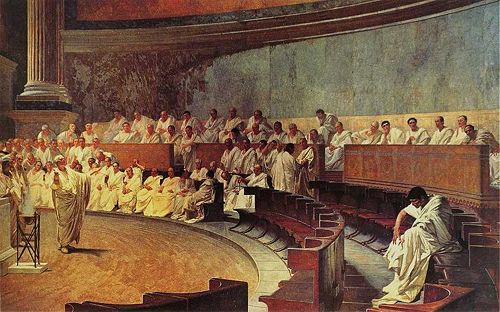
Cicero addresses the Roman Senate in a 19th century fresco. Image from Wikipedia Commons.

Cicero put the Senate itself on trial

‘…if [Gaius Verrus’] immense wealth is sufficient to shatter your honesty — well then… they will certainly know all they need to know about a jury of Roman senators!’

By Dr. Stephen R. Keister / The Rag Blog / June 8, 2009

The Roman criminal court, in the days of The Republic, convened in the Forum before the Temple of Castor and Pollux. In the year 70 BC, Verres, governor of Sicily,was on trial for corruption, theft, and embezzlement, before the praetor Aclius Glabrio and a jury of 23 of The Senators. The prosecutor was Marcus Cicero who was well aware that Verres was a friend and benefactor of many members of The Senate.

Cicero began his prosecution with the following words to the Senators: “But the character of the man I am prosecuting is such that you may use him to restore your own good name. Gaius Verrus has robbed the Treasury and behaved like a pirate and destroying pestilence in his provence of Sicily. You have only to find this man guilty, and respect in you will be rightly restored. But if you do not — if his immense wealth is sufficient to shatter your honesty — well then, I shall achieve one thing at least. The nation will certainly not believe Verres to be right and me wrong — but they will certainly know all they need to know about a jury of Roman senators!” Great crowds of common folks had gathered in respect to Cicero — as the trial progressed the weight of the evidence and the mood of the multitude did indeed lead to the conviction.

How does this relate to the health care hearings in the U.S. Senate? Quoting from the June 22, 2009, Nation: “Writing on The Atlantic’s website, Scott Bland and Donald Brownstein identify of what they dub ‘The Democratic Industrial Complex.’ Energy and health care companies, automakers and banks all understand that the Democrats control much of their fate, so they’ve cast their lot with the majority party in a big way: John Kerry got less than 20% of the donations from electric utilities; Barack Obama got almost 60%. So far in this cycle, Democrats have captured two-thirds of the donations from the health care industry.”

Tom Hinton, president and CEO of The American Consumer Council, elaborates on the baksheesh that Sen. Max Baucus has received from the insurance companies, pharmaceutical companies, and others to whom universal health care is anathema. The Washington establishment is awash in corruption and graft. Thus, little concern for the needs of the American people.

According to Jane Stillwater, writing in the Baltimore Chronicle, Sen. Max Baucus of Montana has received almost $2 million dollars from health care lobbyists alone –$1,826,652 to be exact. Corporate health profiteers who invest in Baucus will now benefit from his stewardship over health care reform. His 2008 donations from health care profiteers included: insurance, $592.185; health professionals. $537,141; pharmaceuticals/health products, $524,813; health service/HMOs, $364,500; hospitals/nursing homes $332,826.

The Republicans continue to collect their dues; for instance Sen. Charles Grassley has collected $1.3 million in donations from industries related to the health care debate. Obviously 65% of American citizens and 63% of American physicians are to be ignored by our elected representatives.

The AP reports that Sen. Edward Kennedy has offered a plan requiring employers to offer health care to employees or pay a penalty. In addition the bill would provide subsidies to poor people to pay for care, and require everyone to purchase health insurance, with exceptions for those who cannot afford it.

Once again we are faced with the little discussed problem of requiring everyone to purchase insurance from a private insurance company. Is this constitutional? Karl Manheim and James Court of the Loyola Law School are quoted in the Christian Science Monitor discussing this question in detail as does Robert Greenslade, a writer on issues involving the Federal Constitution, on the Web Site The Price of Liberty. One would think that some of our constitutional scholars would look into this further and inform the public of their opinions.

Finally, President Obama released a letter on June 2, 2009, addressed to Chairman Baucus and Chairman Kennedy. His concluding paragraph: “I strongly believe that Americans should have the choice of a public health insurance option along side private plans. This will give them a better range of choices, make the health care market more competitive, and keep insurance companies honest.” This was released by Health Care for America Now, among others.

Dr. Paul Krugman congratulated the President in his column in the June 5 New York Times. Krugman gave two worthy bits of advice: 1. Don’t trust the insurance industry; 2. Don’t trust the insurance industry. One might add to Dr. Krugman’s advice; beware of the falsifications on TV relative to health care in Canada or Europe. Overall health care in France per any objective reporting ranks first while the United States is 26th. The June 8 issue of Time Magazine provides a brief overview of health care in certain countries abroad. The Joseph Goebbels and the Leni Riefenstahls of the insurance/pharmaceutical companies’ TV programing will convince the uninformed and the naive otherwise.

President Obama has equivocated on many issues but we hope that he remains steadfast on this one, just as we hope that he remains true to his foreign policy goals as enunciated in Cairo where he was somewhat reminiscent of Prince Metternich after the Congress of Vienna. It seemed a true effort to achieve peace in the world and at the same time retrieve the character of the United States as envisioned by its founders. Yet the president is loath to truly revise the Bush/Cheney horrors of Guatanamo, undue the policy of rendition, abrogate the illegal wiretapping, remove the mercenaries from Iraq and Afghanistan, and release the torture photographs. One must hope that he does not give way to corporate interests in the area of universal, affordable health care, not dictated by big business, but granting to our citizens what is a right and in the end what is in the best interests of the nation at large. I personally still favor single payer, universal care, as the most inclusive, least expensive option, as recommended in the 25 year study by Physicians For A National Health Care Policy.

In my last submission I suggested that marijuana be decriminalized, its sale be licensed, and that a tax be levied as a way of paying in part for universal health care. Since then I saw this in an article by Alfredo Corahado, a Nieman Fellow at Harvard University writing in The Wilson: “The story of drug violence and cartels overwhelming vulnerable democracies is one of the oldest tales in Latin America. Indeed, Mexico is proving — as have Columbia, Peru and Bolivia — that the war on drugs is unwinnable as long as Americans fail to curb their insatiable appetite for illicit drugs”.

The author continues: “After nearly 40 years, U.S. drug policy, at a cost of $40 billion a year, is generally viewed as a failure. In a recent report by the Latin American Commission on Drugs and Democracy, three former heads of state, of Mexico, Columbia, and Brazil, called for a new approach, namely, decriminalizing marijuana. Yet any proposal that smacks of decriminalization is political suicide in the United States.”

Where did the seemingly unassailable prejudice against the use of marijuana originate in the united States. We once had a similar unfounded prejudice regarding absinthe which has now been found to be essentially fictitious and it is now available in most liquor stores. But where did the mythology regarding pot originate? According to the Austin Peace and Justice Coalition Newsletter of November 1993, marijuana (hemp) prohibition was driven by specific commercial interests. William Randolph Hearst started the whole racist “reefer madness” scare. He owned timberlands as well as newspapers. Hemp paper competed with timber, and, with hemp-harvesting equipment patented in 1937, would have cut costs for Hearst’s news competitors. The DuPont chemical and Lilly pharmaceutical firms — increasingly reliant on petroleum — also pushed cannabis prohibition. Cannabis sativa was used in dozens of cheap, safe, effective medicines that Lilly et al could not patent or control. At the time tobacco interests, beer, wine, and other alcohol interests worried that cannabis legalization would cut into their profits, and on and on.

The moral guardians joined the fray in spite of the fact that alcohol and certain prescription medications kill, and cigarettes cause lung cancer. Hearst’s anti-hempster Harry Anslinger, convinced of the debilitating effects of killer weed, testified that its use would make pacifists of military age men! Today, hemp activists take the moral initiative, pointing out that truth in drug education is better than lies; that marijuana-only “offenses” are nonviolent victimless crimes. Once I thought about the prohibition of cannabis, which was not one of my priority interests, I suspected that there must be a financial motive somewhere, as there is in most sereptitious maneuvers in the USA. So there was, and so there is. So often the big corporations flim-flam the “moralists” and use them to their own advantage.

I am not asking that an immediate revision in drug laws be made re: cannabis, and I am not suggesting that cocaine, the opium derivatives, LSD, “angle-dust,” and the amphetamines be decriminalized. I am suggesting that the FDA, and our public health agencies seriously, scientifically, study the effects of certain types of cannabis, and then consider legalization and distribution with federal taxation as is done with alcohol and tobacco.

I do believe that, with the Bush departure, our federal agencies that have to do with health care are once again managed by scientists rather than by political hacks. At the same time I would request that the Justice Department take a hard look at the sentencing laws for the possession of pot. Most other Western nations consider possession or use to be concerns for rehabilitation, if addiction does exist, rather than incarceration. Our prisons are overcrowded with nonviolent offenders at the costs of billions of dollars to the taxpayers which would be much better spent on universal health care among other things. Further, the government will save millions of dollars on futile and sometimes ludicrous enforcement. I recently heard of a woman serving three years in a local prison for growing several cannabis plants in her yard, yet the folks on Wall Street who brought down the nation’s economy go free.

The Rag Blog

Posted in Rag Bloggers | Tagged , , , | Leave a comment

Before it’s Too Late : Save the World’s Fish

Bluefin tuna is being over-fished and its numbers can’t be sustained, scientists say. Photo from Getty Images / The Independent, U.K.

Public supports creation of marine nature reserve

The poll came ahead of the launch of a film, The End Of The Line, which reveals the impacts of overfishing on the world’s oceans.

By Emily Beament / June 8, 2009

More than four fifths of people support the introduction of a nature reserve in our seas to protect stocks of fish, according to a survey published today on World Oceans Day.

The poll came ahead of the launch of a film, The End Of The Line, which reveals the impacts of overfishing on the world’s oceans.

The documentary, by journalist Charles Clover, claims that industrial fishing is emptying the seas of fish, destroying the livelihoods of poor fishermen in places such as Africa and killing wildlife accidentally caught in the process.

And as fisheries ministers are accused of failing to tackle the problems, demand for species such as blue fin tuna, including from top restaurant Nobu, is driving the species closer to the brink of extinction than the white rhino, say campaigners.

The film has been described as the equivalent of Al Gore’s An Inconvenient Truth for fishing, and is being backed by a wide range of green groups including Greenpeace, WWF and the Wildlife Trusts, and retailers such as Waitrose.

Meanwhile, actress Greta Scacchi is launching her own initiative to help save the world’s fish stocks.

She is working with London-based Japanese restaurant Soseki and photographer Rankin to take images of celebrities holding fish for a poster campaign.

Richard E. Grant, Emilia Fox, Terry Gilliam, Lenny Henry and O.T. Fagbenle have already participated.

Scacchi, who starred in White Mischief in 1988, said: “The first round of images are very striking – weird, witty, very saucy and some sensual.

“I have always made environmental issues a priority but recently I have been alerted to the urgency and importance of the effect of over-fishing.

“Nothing prepared me for the impact of Charles Clover’s documentary. I came out of the screening shaken by the gravity of the situation.”

The campaign will be launched at a celebrity party tonight at Soseki, opposite the Gherkin in the City of London.

A survey by the Co-operative, asking customers to vote at the tills on the chip and pin consuls, found that 83 per cent of the 360,000 people polled were in favour of highly protected marine reserves.

According to the retailer, evidence shows an increase of some 446 per cent in the amount of sealife found in reserves where fishing is banned compared to unprotected areas, while the benefits spill over into nearby waters – boosting productivity for fishermen.

Some scientists have warned that globally, without action to bring in marine reserves and stop the most destructive forms of fishing, the world’s fisheries could all collapse by 2048.

As The End Of The Line was released, Mr Clover warned overfishing of the world’s oceans ranked beside climate change as one of the biggest problems facing humans this century.

Mr Clover said: “The issue of overfishing isn’t just something for the most junior minister in the cabinet and EU – it’s one of the world’s most important problems and it’s the big problem on 70% of the Earth’s surface.”

“The world needs to understand over-fishing ranks up there beside climate change, human overpopulation and food security as one of the four big problems facing the present century.

“We’re going to have to start managing large abundant fish populations for healthy oceans, rather than hunting down the last fish and then moving onto the next species.”

The RSPB said that in addition to damaging fish stocks, industrial fishing was killing at least 300,000 birds a year, and threatening 18 out of 22 species of albatross with extinction.

The Co-op and Marine Conservation Society are backing calls for some 30% of the UK’s seas to be included in a network of highly protected marine reserves under the Marine Bill which comes before the Commons this week.

MCS director Dr Simon Brockington said: “Our seas have taken a battering over the last century, but they may be amazingly forgiving.

“By offering much needed protection to important areas of our seas now, we could still ensure a diverse and productive future”.

Dr Helen Phillips, chief executive of the Government’s conservation agency Natural England, said the Marine Bill would “provide a once in a lifetime opportunity to rescue this incredibly precious resource from additional harm, to recover its fish stocks and to help the fishing industry move towards a more sustainable footing for the future”.

She added: “As the End of the Line shows, this level of protection cannot come quickly enough if we are to avert an environmental disaster on an unprecedented scale.”

But industry body Seafish urged the Government to acknowledge the role of British fishermen in the Marine Bill for their contribution to the economy, leading the way globally on sustainability and ensuring food supplies in a world of growing food insecurity.

Source / Press Association / The Independent, U.K.

The Rag Blog

Posted in RagBlog | Tagged , , , | Leave a comment

David P. Hamilton : Antigua Morning

“Morning Street, Antigua Guatemala.” Photo by dawilson / imagekind.

Antigua Morning

By David P. Hamilton / The Rag Blog / June 8, 2009

ANTIGUA, Guatemala — Day breaks noisily with exuberant bird songs, fire crackers announcing birthdays, competing church bells and an errant car alarm, its owner oblivious in slumber.

To the west, Fuego puffs against a clear morning sky, telling us the wind is gentle from the north.

Ancient steeples, domes and cupolas rise above red tile roofs.

Poor Maya boys bike over cobblestone streets for the privilege of mixing concrete at a nearby construction site while local rulers leave for their offices in helicopters.

Smoke waifs from the roasting shed of a neighboring finca.

The rising sun bathes the face of Agua to the south.

A single overripe orange clings to the top branch of an untended tree.

Doves cooing remind us of home and provide bass to the avian chorus.

A dense expanse of forests and fields stretches from volcano to volcano.

The air defines mild.

The coffee is rich and so are we.

The Rag Blog

Posted in Rag Bloggers | Tagged , | Leave a comment

On Cumming and Going : RIP, Grasshopper

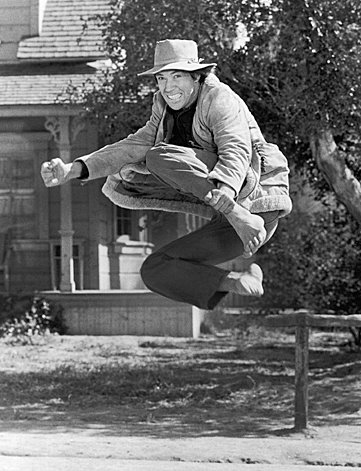
David Carradine as Shaolin monk Caine from 1970’s tv series “Kung Fu.” Apparantly there was one habit he didn’t kick. Photo from Hulton Archive / Getty Images.

Auto-erotic asphyxiation is quite common, but is usually kept quiet when the deceased is not famous… there are a number of guys in the Academy of Criminal Justice Sciences… who make their livings as auto-erotic asphyxiation experts.

By Steve Russell / The Rag Blog / June 8, 2009

Auto-erotic asphyxiation is quite common, but is usually kept quiet when the deceased is not famous. Just like the birth of babies of difficult to discern sex is usually “fixed” and covered up.

How do I know?

Well, there are a number of guys in the Academy of Criminal Justice Sciences (I’ve been a member since 1990 or so) who make their livings as auto-erotic asphyxiation experts.

Who pays them?

Well, if it’s auto-erotic asphyxiation, the insurance has to pay, since that is death by accident. If it’s suicide, the insurance does not have to pay. There’s normally at least one expert on each side.

I have seen their photo collections. All the victims are nude except the ones that are cross-dressed. Men outnumber women 7 or 8 to one.

Some of the cases are really hard.

One fighter ace from the Vietnam War did it in a really simple way, hanging over the edge of the bed. If he had not been cross-dressed, I think the insurance company would have won that one.

Then there was a college girl found hanging, nude, in a dorm closet with all the doors and windows locked, just before she was to both graduate and get married. It was treated first as a very clever homicide, principally because nobody could figure out how her hands got strapped behind her back.

The case was solved by the expert’s wife, based on something she noticed in the picture of the way the body was found. I must confess I saw the picture and it went right past me.

She noticed a brand name of belt had secured the wrists and she knew that it was woven in a manner so it would bend like a regular belt would not. She was able to show her husband how she could step in and out of having the belt in the very position in which it was found.

Then there was a guy who liked to chain his genitals to his VW and drive it around a parking lot, ghost riding. His sex play went wrong when the chain wrapped around the axle and he could no longer reach the controls. He was found twisted up into the wheel well. Boy, that had to hurt….

Personally, I find this drive to “other” other people in terms of their sex practices much more disturbing than the practices.

And, of course, if you take up for somebody who has a stuffed animal fetish or whatever, the uglies immediately assume that you must have the same fetish.

I am skeptical that there is anybody who has no fetish at all. That is, an object or part of the body or song or place or whatever that begins the process of sexual arousal without regard to the rest of the context.

It is not strange to me that more men are “into” fetishes deeply than women. It is one of the adaptive traits that sets men apart from women that we can be sexually aroused “out of context,” the most obvious being response to another woman when in the presence of our mate–which does us no good in the political bedroom but has its advantages for the species generally.

I can tell you exactly how AEA got started.

Hangings used to be public. It was hard not to notice that felons typically died with a roaring erection. There was some colloquialism for a post-mortem erection that escapes my aged brain right now, and good literature is rife with references to it–e.g., Billy Budd. Melville is no pornographer and neither were most of the other writers who referenced it. It was common and everybody knew it. If you did not, you had never seen a hanging and in the days of the death penalty for any felony, that meant you didn’t get out much.

Of course, those among us medically trained will know the counter-intuitive fact that an erection results not from tense muscles but from relaxed ones, and this explains why the erections did not disappear when the hangmen moved from “turning off” to the drop.

Yes, the drop, done correctly, broke the neck and killed virtually instantly. But there was the erection anyway. What happened to the major erogenous zone being the brain? How can a person get turned on with a broken neck?

While I have no first hand experience, I doubt that you can get turned on while being executed unless you have a death fetish.

There’s nothing erotic about the erection at a hanging. It’s mechanical. The muscles of the pelvis go limp and the blood rushes in.

Non-medical types now don’t know that; even medical types then did not know it. I guess they thought his Invisible Friend was giving him a delightful send off.

Anyway, a little light strangulation during sex, people found out, can give you quite an intense jolt. Either sex. Some people want to dial up their orgasms and they get in the habit.

That’s how AEA becomes a sub-specialty in my academic field. There’s a lot of it and people often get killed in mishaps. If you do erotic asphyxiation with a partner, not only is there no problem stopping (normally), you also have somebody who cares about you right there to revive you in case of error…or not.

All of this seems perfectly understandable to me and no occasion to belittle the dead.

[Steve Russell, Cherokee Nation of Oklahoma, is a Texas trial court judge by assignment and an associate professor of criminal justice at Indiana University. Steve, who lives in Bloomington, wrote for Austin’s The Rag in the Sixties and seventies and is a regular contributor to The Rag Blog.]

The Rag Blog

Posted in Rag Bloggers | Tagged , , | 1 Comment

Remembering Activist and AIDS Hero Dr. Alan Berkman

It was to gain Dr. Alan Berkman’s release from prison, so he could receive treatment for his cancer, that Marilyn Buck, Susan Rosenberg, and Laura Whitethorn finally pled guilty to the “conspiracy” charge that netted former Ragstaffer Buck her 80-year sentence, in an agreement with federal prosecutors. Both Susan and Laura have since been freed. Buck could be released in 2010.

Mariann Wizard / The Rag Blog / June 8, 2009

Dr. Alan Berkman in 2006 with AIDS activists from Rwanda.

‘When Health GAP was formed… the anti-viral aids medicine ‘cocktail’ cost ten to fifteen thousand dollars a year… Now the drugs cost about eighty-seven dollars a year and some four million people are taking the medicine, prolonging their lives.’

By Michael Steven Smith / The Rag Blog / June 8, 2009

After battling recurrent cancers for half his life, Alan Berkman died in Memorial Sloan Kettering Hospital in New York City around seven o’clock in the evening of June 5, 2009.

He was under a death sentence with a cancer that was going to kill him. He chose to try a risky stem cell transplant procedure where he first had to have chemo-therapy to knock out his own stem cells and then replace them with the stem cells of a donor. Even finding the donor was difficult, the holocaust having significantly narrowed the gene pool of persons who might have a match. One was found.

Alan entered the hospital knowing he might not get out. He understood what his doctors were telling him. He himself was a doctor, a Sixties graduate of Columbia’s school for physicians and surgeons and now a professor there in the school of public health.

Alan first was struck by cancer when he was in prison. He did eight years, four of them in solitary. He diagnosed himself. But to no avail. The authorities would do nothing, as if they wanted him to die. They must have hated Alan. A communist. A Jew. A doctor. A supporter of blacks and Latinos and Native Americans at the second battle of Wounded Knee.

They knew his history. It was quite a dossier. A Sixties radical. SDS. Active in the anti-war movement. A practicing doctor in New York’s poor neighborhoods. Forced underground for years because he wouldn’t give up the name of a woman he treated for a gunshot wound she got in a failed Brinks truck robbery that killed two cops and a security guard in Rockland County. Then arrested and convicted and doing hard time in a maximum security prison. He helped a cop killer. And now he is in our hands. But Alan was unbent and unbowed. He was tough.

Finally his family and attorneys got him medical attention. He told me they operated on him while handcuffed to a gurney. Deep stomach surgery where the muscles need to be cut. When he awoke from anesthesia they took the handcuffs off and made him get up off the gurney and walk. He got cancer again before getting out on parole. Amazingly [attorneys] Bill Kunstler and Ron Kuby prevented the State from taking away his medical license. He started working as an AIDS doctor in the South Bronx.

That’s when I met him. About twenty years ago. He helped me on a [legal] case. We drove out to Brooklyn to see the client and then had dinner, the first of many. A steak and a martini. Alan and Barbara, Debby and me. We four. Good friends and comrades.

We went back to that restaurant a couple of weeks ago, just before Alan checked into Memorial. We thought we would see him the next week at the event honoring him and Dr. David Hoos for co-founding Health Gap. But that was not to be. His doctors couldn’t give him the time and he was whisked into the hospital for first the chemo and then the transplant. Alan got the new cells but died before they could take root.

When Health GAP was formed with the help of Act Up and Housing Works, the anti-viral aids medicine “cocktail” cost ten to fifteen thousand dollars a year. Big Pharma controlled manufacturing and distribution with their intellectual property rights. Alan helped change that, not having the requisite respect for private property. Now the drugs cost about eighty-seven dollars a year and some four million people are taking the medicine, prolonging their lives.

Alan wasn’t religious. Religion to him was superstition. Being part of a sect was too narrow and confining for Alan. The Jewish heretic who transcends Jewry belongs to a Jewish tradition. The historian Isaac Deutscher had a phrase for it, “the non-Jewish Jew.” Alan was in line with the great Jewish heretics, rebels, and revolutionaries of modern thought; Spinoza, Heine, Marx, Luxemburg, Trotsky, Freud, and Einstein. They too went beyond the boundaries of Judaism, finding it too narrow, archaic, constricting.

I don’t wish to stretch the comparison. Alan was not so much a radical thinker as a man of action. But his intellectual understanding — and he was well educated and widely read — powered his activity. He had in common with these great thinkers the idea that for knowledge to be real it must be acted upon. As Marx observed: “Hitherto philosophers have only interpreted the world, the point however is to change it.”

Like his intellectual predecessors Alan saw reality in a state of flux, as dynamic not static, and he was aware of the constantly changing and contradictory nature of society. Alan was essentially an optimist and shared with the great Jewish revolutionaries an optimistic belief in humanity and a belief in the solidarity of humankind.

The stem cell procedure failed to save him. Alan Berkman has passed, but his work and his example have taken root. Good bye dear friend. We all remember you with the two best words in our language: Love and Solidarity.

Dr. Allan Berkman speaks at March 27, 1998 march and rally demanding freedom for all U.S. held political prisoners and prisoners of war:

Also see Health Gap Founder, Dr. Alan Berkman, Dies / Health GAP / June 5, 2009

Thanks to Jeffrey Segal and Mariann Wizard / The Rag Blog

Posted in Rag Bloggers | Tagged , , , , , | 5 Comments

Roger Baker :
Is Austin drowning in traffic growth?

Part 1: Is Austin drowning in ever-increasing traffic? Think again; top road lobby myth debunked!

austin drowning traffic

Is Austin drowning in traffic?

By Roger Baker | The Rag Blog | June 8, 2009

[This is the first of a two-part series by the Rag Blog’s Roger Baker in which he will debunk the myth of growth in Austin traffic congestion, and will examine the politics of those whose mantra always is to “build more roads.”]

There is no more cherished image promoted by the Texas road lobby than the picture of Austin as a city gridlocked with terrible traffic congestion that keeps getting worse. Accordingly, Austin is said to be in desperate need of new roads to relieve this perpetually increasing congestion. Road building is said to be the best congestion cure, even though the money has now run so short that the roads now have to be built on credit as toll roads.

As I’ll document in the first part of this series, the image of increasing traffic congestion is a myth. Austin’s VMT or total vehicles miles traveled on Austin’s roads has been flat for most of this decade. Austin driver behavior has shifted markedly towards a contraction of trips per person during the same period. Part 2, The Austin Road Lobby, will explore some of the politics behind the projections of high growth and the road lobby’s emphasis on building build roads to solve congestion problems.
Continue reading

Posted in Rag Bloggers | Tagged , , , , , | 10 Comments

Steve Russell : Ranting on Obama and Ike

Put on the spot by Obama: Israeli Prime Benjamin Netanyahu, at weekly cabinet meeting in Jerusalem Sunday, June 7, 2009. Photo by Jim Hollander / AP.

A rant in recognition of June 6

Yes, it will be difficult. No, he may not pull it off. But I’ve never felt so hopeful or so proud of my government.

By Steve Russell / The Rag Blog / June 7, 2009

Obama’s Cairo speech took my breath away in both form and substance.

It’s a measure of his having struck the right chords that he is being pounded now by the Israeli right and the Arab “left,” if you can call most of that stuff left. I personally hesitate to define “left” by tolerance for non-combatant body count.

On the home front, the crazed right is going even crazier at the words “Holy Qur’an,” let alone quoting from it.

That speech basically took away the platform on which Benjamin Netanyahu ran. Bibi must betray his followers, or rebuild his coalition, or get in a public pissing match with the U.S. The Israel lobby is tuning up to defend the ramparts once again, but they have not managed the full cry they would like to see because American Jews are slow to turn against Hillary Clinton and Rahm Emmanuel.

And he then sent George Mitchell, the guy who negotiated the last impossible peace deal, to kick start Netanyahu’s grundy ass.

And it’s no accident that Obama’s next public appearance was at Buchenwald. Or that he made sure it was Rahm photographed riding the camel and not him.

Goddam, I never thought I would live to see the day when an American President would tell the Arabs flat out that the Holocaust deniers and 9-11 deniers among them are idiots and the Israelis have a right to their own state… and then turn right around and essentially commit to regime change in Israel if necessary to support “Palestine,” a word never before uttered by an American President!

Yes, it will be difficult. No, he may not pull it off. But I’ve never felt so hopeful or so proud of my government. Carter came close, but not this close.

I sent the above rant to a friend of mine, also a boomer, and she replied “I’m not in love with Obama. He’s just the best president of my lifetime.”

After I picked myself up off the floor and my gut quit hurting, it dawned on me that Obama’s good notices by most of my generation are aided by the fact that he follows Bush II — the president who makes Richard Nixon look like fucking FDR!

Anyway, this June 6 message is only secondarily about Obama, although without Obama there would be more nostalgia and less current events. The larger context is whether the U.S. ever does anything right, whether the left is capable of relating to American citizenship in any manner but shame.

So it seems to me appropriate to append the June 6 message below, conveying the shameless message that this country may be slow, but we get it right more often than any other country that has faced similar challenges. How hard could it be to govern Sweden?

Next time I use my passport, I can do so without slinking around in the shame brought upon us by the last President. Obama has in so many words disclaimed any interest in permanent military bases in Iraq. Yes, I’m aware that the neocons have published an intent to keep our boots on the ground as long as the oil lasts, but notice has been served that they are not making policy any more.

One more story if I may.

A Canadian Indian told me that his dad enlisted just in time to get caught up in the Normandy hairball, and right after he married my friend’s mom. He barely had time to get her pregnant when he explained that he had been drafted and had to go fight Hitler.

She did not learn until after WWII that Canada did not practice conscription at that time.

My friend’s dad had enough ass in his britches to go fight Hitler because Hitler needed fighting, but not enough to tell his new bride.

If you know any of the oldsters who did that, today would be a good day to thank them.

Sent Just Prior to the Invasion:

Soldiers, Sailors and Airmen of the Allied Expeditionary Force! You are about to embark upon a great crusade, toward which we have striven these many months. The eyes of the world are upon you. The hopes and prayers of liberty loving people everywhere march with you. In company with our brave Allies and brothers in arms on other fronts, you will bring about the destruction of the German war machine, the elimination of Nazi tyranny over the oppressed peoples of Europe, and security for ourselves in a free world.

Your task will not be an easy one. Your enemy is well trained, well equipped and battle hardened. He will fight savagely.

But this is the year 1944! Much has happened since the Nazi triumphs of 1940-41. The United Nations have inflicted upon the Germans great defeats, in open battle, man to man. Our air offensive has seriously reduced their strength in the air and their capacity to wage war on the ground. Our home fronts have given us an overwhelming superiority in weapons and munitions of war, and placed at our disposal great reserves of trained fighting men. The tide has turned! The free men of the world are marching together to victory!

I have full confidence in your courage, devotion to duty and skill in battle. We will accept nothing less than full victory!

Good Luck! And let us all beseech the blessings of Almighty God upon this great and noble undertaking.

— Gen. Dwight D. Eisenhower

The Rag Blog

Posted in Rag Bloggers | Tagged , , , | 9 Comments

Singin’ on Sunday – David Rovics


Another doctor who provided abortions has been murdered in the US, this time in Kansas. He had already been shot back in 1993. Google Dr. George Tiller and you’ll find out lots more.

In the Name of God

I woke up this morning
And I turned on the news
It was a Sunday morning
They were sitting in the pews
The doctor’s wife was in the choir
She was about to sing
She saw it all in front of her
And she heard that awful ring

In the name of God he held his pistol
Pointed at the doctor’s head
In the name of God he pulled the trigger
Now the doctor’s lying dead

Dr. Tiller had a family
Three daughters and a son
Two girls were both doctors
Who were proud of what he’d done
They knew someone had to do something
Before they left this world behind
If it wasn’t them then who would serve
The cause of womankind

In the name of God…

This is not Afghanistan
It’s the Heartland USA
Where a girl has to wonder
If she’ll get acid in her face
Where they bomb the women’s clinics
Because the preacher told them to
Where the man there on the TV
Tells them that’s what they should do

In the name of God…

David Rovics

Source / The HORN

Thanks to Diane Stirling-Stevens / The Rag Blog

Posted in RagBlog | Tagged , , , | 1 Comment

Prison Reform : We Must Stop Locking Up our Problems

Prisons are a necessary part of a civilized country, but they should be reserved for violent criminals and career criminals — people who have proven they cannot be trusted with the safety or property of others.

By Ted McLaughlin / The Rag Blog / June 7, 2009

Here in America, according to Senator James Webb (D-Virginia), “Either we’re the most evil people on earth or we’re doing something wrong.” He’s talking about our prison system. The United States doesn’t just lock up its dangerous criminals, but also its societal problems like the mentally ill and those addicted to drugs. Consider the following facts:

  • We have only 5% of the world’s population, but house 25% of the world’s prisoners
  • We incarcerate 756 out of every 100,000 people — five times the world average.
  • One in every 31 adults in the United States is in prison, in jail or on supervised release.
  • We spend $70 billion per year on corrections — a rise of 40% in the last twenty years.
  • About 16% of adult inmates are mentally ill (and the rate is higher in juvenile institutions).
  • About 60% of those serving a drug sentence have no history of violence.
  • About 80% of drug arrests are for possession — not sales.
  • African-Americans make up 14% of drug-users, but 56% of drug inmates.

Any one of the above statistics would show our system has a problem, but taken together they show a system in crises. Dahlia Lithwick of Newsweek puts it well, when she says, “If Americans actually have the conversation about our disastrous prison policies, we’ll understand the trends all move in very dangerous directions: we lock up more people, for less violent crime, at ever greater expense, breeding more dangerous criminals who often come out unemployable, violent and isolated.”

Fortunately Senator Webb sees the truth. He is proposing an 18 month review of our prison system with an eye toward finding solutions to the problems above. He wants to improve treatment for the mentally ill, reform our drug laws, improve and establish reentry programs for ex-offenders, decrease prison violence, reduce overall incarceration rates and save our prison beds for truly dangerous criminals and gang leaders.

Now all the senator has to do is convince the other members of Congress to go along with his 18 month review. That is the first step to any reform. Once this is done, it should be obvious to anyone with half a brain that reforms are necessary.

The embarrassing fact is that while we claim to be a free nation, we lock up more of our citizens than any of the world’s dictators. Are Americans more prone to breaking the law than the citizens of other countries? Are we truly evil? Nonsense! Americans are neither better nor worse than the people of any other country.

We have more prisoners locked up than anyone else, because our leaders have chosen to use criminal law to deal with our societal problems. Most other civilized nations treat their mentally ill persons rather than dumping them on the criminal justice system. If they must be locked up, for their own safety or the safety of others, it is in a psychiatric institution where they can still receive treatment.

The simple use or possession of drugs should also not be dealt with as a crime. It is a medical problem and treatment is the only real solution. The user is only hurting himself — not others, and in a free country that should not be a crime. If the user does go on to commit a crime (such as theft or burglary) then there are already laws on the books to deal with that. There is no compelling societal need to turn recreational drug users into criminals.

Most recreational drug users, especially of marijuana, hold down full-time jobs, pay taxes and support families. Is it really better to have other taxpayers pay for their incarceration, and their family’s loss of a breadwinner? Prohibition failed the first time we tried it, and this modern prohibition of drugs has been an even more miserable failure.

Prisons are a necessary part of a civilized country, but they should be reserved for violent criminals and career criminals — people who have proven they cannot be trusted with the safety or property of others. Locking up drug users, the mentally ill, and first-time nonviolent offenders is antithetical to the ideals of a free country.

[Rag Blog contributor Ted McLaughlin also posts at jobsanger, an excellent Texas political blog.]

The Rag Blog

Posted in Rag Bloggers | Tagged , , , | 4 Comments

Canadian Mayors: Don’t Get Mad, Get Even


Canadian mayors pass anti-‘Buy American’ resolution
June 6, 2009

In response to the ‘Buy American’ provisions of the U.S. stimulus package, Canada’s mayors narrowly passed a resolution Saturday that could potentially block U.S. companies from bidding on city contracts.

The resolution was passed at the Federation of Canadian Municipalities conference in Whistler, B.C., by a vote of 189-175.

The resolution says the federation should support cities that adopt policies that allow them to buy only from companies whose home countries do not impose trade restrictions against Canadian goods.

“Today, Canada’s cities and communities joined the federal and provincial governments in a common front to try and stop American protectionism,” Jean Perrault, FCM president and mayor of Sherbrooke, Que., said in a statement.

“We stand united in the belief that fair trade and an even playing field are in the best interest of our country, our communities and our citizens.”

The resolution wouldn’t take effect for four months, giving the Canadian government time to lobby the Obama administration.

“This U.S. protectionist policy is hurting Canadian firms, costing Canadian jobs and damaging Canadian efforts to grow our economy in the midst of a worldwide recession,” Perrault said.

Some mayors argued the resolution could make it hard for cities to get the best deal on contracts.

But Susan Fennell, the mayor of Brampton, Ont., stressed the resolution is not protectionism, but a message that Canadian municipalities are concerned across the country.

“It’s Canadians saying on behalf of Canadians that the fair and free trade that’s been in existence for so many years is the way to remain,” she said.

Some Canadian companies have complained they are already being affected by the “Buy American” provision, which gives priority to U.S. iron, steel and other manufactured goods for use in public works and building projects funded with recovery money.

The resolution was initiated by the Ontario community of Halton Hills, where two local companies have lost contracts they previously had in the U.S.

Source / CBC News

Thanks to Deva Wood / The Rag Blog

Posted in RagBlog | Tagged , , | 1 Comment

David Carradine’s Death, and Bizarre Memories from a Reporter’s Early Years

Graphic by Larry Ray / The Rag Blog.

I had never seen anything as ghastly. His upper body was pasty white. From about his pelvis down, the flesh was a dark port color.

By Larry Ray / The Rag Blog / June 6, 2009

Shocking details in news reports today about motion picture actor David Carradine’s death in a Bangkok hotel room literally jolted my memory back to my days as a rookie police beat reporter in South Texas almost 45 years ago.

The police radio in the radio station’s rattletrap old news wagon broadcast one brief call, “All cars bay front area, possible suicide, Shoreside Motel.” I was just a couple of blocks away, and headed over to the motel. No sophisticated news crews and fancy live broadcasts in the mid 1960’s. And you had to be on a beat for a while and make good contacts or the cops wouldn’t even let you near a crime scene. But there were ways.

About the time I pulled into a side parking space, two sheriff’s cars and a city patrol car rolled into the back parking lot. They made a beeline toward an open first floor hallway end door. I just walked in with them. All focus was on a hysterical, weeping housekeeper, pushing the door open into a room.

We started to enter the room, then those in front halted abruptly. Magazines and trash were scattered around the small single room. A bottle of cheap Bourbon was on a table. The ones at the front could see the closet to the left of the door. “Damn, look at that, ” an old deputy grunted. The rest of us worked our way inside and then I saw the closet.

Its cloth curtain had been pulled to one side. A paunchy completely naked man, with a pillowcase pulled over his head, was leaning forward, hanging motionless from a rope tied to a closet clothes rod and then around the pillowcase and his neck. A vanity stool from the room was toppled over in front of his folded knees. “He’s been there quite a while,” one of the city cops observed, “All the blood’s drained down into his lower torso and legs.”

I had never seen anything as ghastly. His upper body was pasty white. From about his pelvis down, the flesh was a dark port color. The maid had found him and was in a state of shock mumbling that the victim was a merchant seaman. I was working hard to be professional, casual, but one of the deputies finally turned and spotted me. “What are you doing in here!” I told him I was with KEYS Radio and was there on the suicide call. “Well you back your butt out of here,” he ordered. I persisted, asking him if he had ever seen a strange suicide like this before. “This ain’t no suicide, and this ain’t no story. Now beat it. I ain’t telling you again.”

I had not been on the police beat very long, and with no more to go on than what I had seen, and having been stiffed by the deputy, I backed out of the parking lot feeling I didn’t have enough for a story. But I wondered that if what I saw wasn’t a suicide, then what kind of murder could it have been? A couple of months later, I learned it was neither.

The Carradine death is initially puzzling to everyone. He reportedly was shooting a new film, “Stretch” in Bangkok, and friends said the 72 year old actor was, “Working hard on the set, and we were liking what we were seeing.” News reports say Carradine hung around the hotel lobby Wednesday night, even playing the grand piano to the delight of those at the lobby bar. He reportedly had a shot of vodka, a cola, then told those at the bar he was going up to his room and have a “special whiskey.”

Police say he entered his room Wednesday night and was discovered around 11 A.M. the next morning by the maid who had come to clean the room. He was reportedly found nude in a closet of his hotel suite with a yellow nylon rope tied around his neck and a black rope around his genitals. The two ropes, according to the Associated Press, were tied together, and he died of asphyxiation. Suggestions that it was a suicide were strongly denied by his wife and his manager. The bartender told reporters that Carradine had made a reservation for a table for a party with friends for Thursday, the day he was found dead. Bizarre, puzzling. Police said there were no signs of forced entry into his room, which was neat and undisturbed. No immediate evidence of foul play.

The details David Carradine’s death jarred loose all the forgotten details of my once seeing a nude hooded dead man hanging from a rope in a motel closet. A man discovered by the maid who came to clean his room. Then other memories came racing back. I remembered being on the scene of a murder one evening months after the mystery motel hanging. The deputy who had run me off from the crime scene in the motel was there, and had warmed up to me after hearing my newscasts saying I, “just might be a fair to middling decent reporter.” It was a misty evening and after he gave me what information he had on the murder, I decided to ask him about the strange hanging in the motel, and if they ever solved that murder. As if he were talking to a police academy class he dispassionately explained what had happened to the man in the motel.

“Look, we see this regularly enough year after year. There are just some people who get sexually excited by letting themselves down slowly on a rope around their neck and as they are almost about to pass out they have an orgasm. Then they ease themselves back up and release the pressure on the neck.” He screwed his mouth to one side, then took a deep breath and continued as if he were teaching me his trade.

“The first thing we do is to check the underwear or hands to see if there is evidence of an ejaculation. The old guy in the motel had used the vanity stool to kneel on as he lowered himself down on the rope. Who knows why he had the pillowcase over his head, but what happened is that the stool fell forward and he was unable to get the pressure off the rope in time. Probably had been hitting the bottle pretty heavy.”

I asked if he knew why people do this and he shrugged, “These people aren’t trying to commit suicide, they sometimes just don’t release the pressure on their neck in time and die. No one would ever know about what they do otherwise. They accidentally strangle and then leave everyone all confused because nobody dreamed that their husband or son or father would be into anything like that. They want to insist it was murder or something, anything, else. We see all kinds of weird sex stuff out there.”

I was astounded, and felt unsteady on my feet. I really didn’t want to hear any more at that point. I now remember those thoughts racing and crisscrossing as I imagined the world this police officer lived in. The things he had seen, the sorry and secret underbelly of people that had become his world. I couldn’t even imagine what the longshoreman’s life had been like, and why his scary, strange sexual need led him to his eventual death. Several months later I got an offer from a local ABC TV affiliate and chasing ambulances and police calls was less intense.

Now comes today’s instant reporting on the Internet about David Carradine’s death with shocking details of his nude body, color of the ropes, where they were tied, and that he asphyxiated, all things that would not have been reported 45 years ago in South Texas. Details similar to the grisly ones I had long ago buried and forgotten.

The Associated Press is already reporting that Thailand’s Central Institute of Forensic Science, said the circumstances under which Carradine died suggest the 72-year-old actor may have been performing auto-erotic asphyxiation.

Carradine’s family wants to fight a finding of suicide as the cause of death and has asked the FBI to assist in the investigation. Gossip columnists are even suggesting Carradine’s connections to Scientology, though he was not a member, could be connected with his death.

Who knows for certain how or why David Carradine died? I certainly do not. Only being able to know and understand his deepest, darkest secrets could one perhaps know the hows and whys of his death.

The awakening of that memory from so long ago did make this old reporter finally do a little research on what the detective deputy told me all those years ago about the reason the longshoreman died.

It took a little time on Google to narrow the detective’s explanation down to a clinical term, asphyxiophilia. The research even notes that auto-erotic asphyxiation has been known since the 1600’s.

Once again, more information there than I ever wanted to know. Now I can only hope that the awakened grisly memories from all those years ago will again fade away deep back into my old gray cells.

[Retired journalist Larry Ray is a Texas native and former Austin television news anchor. He also posts at The iHandbill.]

The Rag Blog

Posted in Rag Bloggers | Tagged , | 4 Comments