BOOKS / Bob Zellner’s ‘The Wrong Side of Murder Creek’

If you want a taste of what life on the front lines was like in the Southern civil rights movement, you have to read this book.

By Jo Freeman

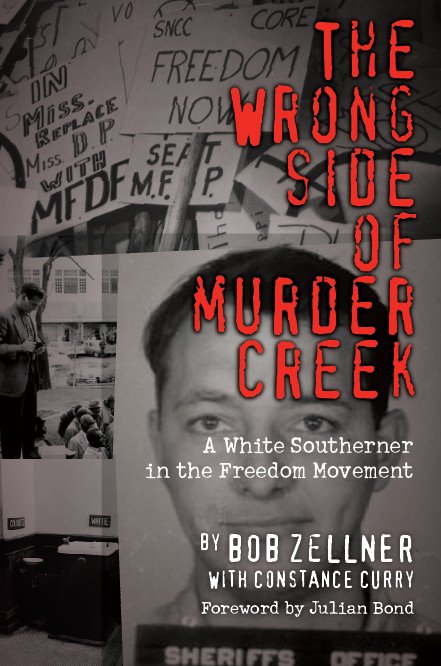
[The Wrong Side of Murder Creek: A White Southerner in the Freedom Movement by Bob Zellner with Constance Curry; Forward by Julian Bond. Published by New South Books, Montgomery AL/Louisville MO; ©2008, 352 pp. $27.95 cloth.]

To those of us who were civil rights activists in the 1960s, Bob Zellner and Constance Curry were legends in their own time. Not big legends like Stokely Carmichael and Julian Bond, but people you knew about even though you never met them, saw them or heard them speak.

They made their reputation working for SNCC, as white civil rights workers trying to liberate the South from American apartheid. Now Connie has helped Bob write his memoir of those perilous times. It’s quite a read.

Murder Creek is really two books in one, and the title itself is a double entendre. The first half is about growing up “progressive” in Alabama. The second half is about SNCC (the Student Nonviolent Coordinating Committee). Zellner joined the SNCC staff in 1961 and stayed with it until almost the end, watching it sputter out of existence a couple of years after it decided to become an all black organization in 1967.

Murder Creek is an actual body of water, dividing Brewton from East Brewton, in the south Alabama county where Bob did most of his growing up. Bob’s father was a Methodist minister, whose congregations were poor and dispossessed whites — the kind who lived on the wrong side of the tracks in East Brewton. Bob’s mother was a school teacher; both parents were educated and for their time and place, liberal on race as well as economic issues.

They raised five sons who were open to changing the way things were done in the South. Bob made his first stand for civil rights as a student at a Methodist college in Montgomery. In 1960 he met Dr. Martin Luther King and Rev. Ralph Abernathy in the local courthouse while they were on trial and attended a couple mass meetings in Abernathy’s church.

As a result he was summoned to appear before the Alabama state Attorney General, who, among other things, told him to report any contact with “Communists.” Some of the “Communists” on the A.G.’s list — Anne Braden, Virginia Durr — did reach out to Bob after reading about him in the newspapers and became his mentors in the civil rights movement.

For just trying to learn about the Montgomery movement Bob and four other students were almost arrested and were asked to leave the college. Bob was the only one of the four with parental support and the only one who did not leave. He stayed until he graduated, then went off to Atlanta to join SNCC.

Supported by a grant from the Southern Conference Education Fund, arranged by Anne Braden, Bob’s job was traveling to college campuses to talk to white students about the movement. But in SNCC style he went wherever he was needed — mostly where Jim Forman (SNCC’s chief administrator) wanted him to go.

Thus we don’t learn much about his experiences trying to break through the wall of white prejudice among young Southerners but we certainly learn a lot about demonstrations and jail. Bob was in plenty of those. In 1968, when he tried to ask a question of George Wallace at a Harvard convocation, Little George cut him off by telling the audience that “this man has been in practically every jail in Alabama” (plus a few in Georgia, Mississippi, Louisiana and Virginia).

That’s the other meaning of Murder Creek. Civil rights workers were fair game for whites wanting to defend the Southern way of life. Beating them was sport; killing wasn’t a crime. After reading detailed descriptions about all the times Bob was jailed and beaten one is amazed that he lived to write this memoir, that his is not the 41st name among the martyrs listed on the Civil Rights Memorial in Montgomery.

Bob was under constant surveillance, but neither the FBI nor the state police protected him or any other civil rights worker. The FBI took notes as they observed the Klan trying to beat him to death, and the police. . . well, they helped beat him up.

Reporters with notebooks and cameras offered the only protection to peaceful demonstrators, and they were also threatened. In a 1963 confrontation in Danville, Va. police broke the cameras of any reporter who used them. There’s a lot of civil rights history that wasn’t written in the “first draft” of newspaper stories because of police intimidation.

Although SNCC was the core of Bob’s life, it wasn’t all of it. Zellner went to grad school and worked at a variety of jobs. His post-SNCC movement job was with GROW, which meant both Grass Roots Organizing Work and Get Rid of Wallace. It helped black and white workers unite against bosses and owners. If you want a taste of what life on the front lines was like in the Southern civil rights movement, you have to read this book.

©2009 Jo Freeman for SeniorWomen.com

Source / SeniorWomen.com

Find The Wrong Side of Murder Creek at NewSouth Books.

Thanks to Jay D. Jurie /The Rag Blog

Posted in RagBlog | Tagged , , , , | Leave a comment

Sherman DeBrosse : God, Guns, Gays and… Gitmo

Photo from WHDH.com.

Adding the Fourth ‘G’

The idea is to make Democrats appear soft on terrorism and legitimize torture and abuses of civil liberties.

By Sherman DeBrosse / The Rag Blog / June 2, 2009

Aside from reproductive issues, the Republican hot button issues begin with the letter “G”– God, guns, and gays. Now we are seeing a carefully orchestrated campaign –complete with expensive television advertisements — to add Gitmo as the fourth “G.” The idea is to make Democrats appear soft on terrorism and legitimize torture and abuses of civil liberties.

The drive is being spearheaded by former Vice President Dick Cheney, a truly odious man. He has the full throated support of Karl Rove and former Speaker Newt Gingrich –both masters of demagoguery and political tactics — and the whole stable of political shock jocks. Most recently, the radio propagandists savaged one of their own when a Chicago radio personality experimented with waterboarding and concluded that it was indeed torture!

These people know that a substantial majority of Americans support torture, keeping the Guantanamo detention facility open, domestic spying, and curtailments of civil liberties. These policies are overwhelmingly backed by Republicans and also have the support of independents. The Democrats know this too. That is why they went along with so much Bush legislation in these areas and are now refusing to support President Barack Obama in closing Gitmo. Only six Democratic Senators stood with the president. It is now hard to remember that George W. Bush and John McCain wanted to close Gitmo.

Cheney and the Republicans are seeking to rewrite the history of torture, claiming it produced solid results that permitted them to avert massive attacks on the homeland. The fact is that most torture was used to obtain information to hype the false case that Iraq had weapons of mass destruction and must be invaded. This is to say, torture produced false confessions and bad information used to support the invasion.

The politics of fear worked in 2002-2003, and they are beginning to make it work again. Cheney and his Republican friends warn that closing Gitmo and tightening the rules of evidence in detainee proceedings will result in terrorists walking the streets. The Not in My BackYard strategy lends legitimacy to a pack of thoroughly dishonest arguments. A basic assumption is that everyone now held there is guilty of terrorism. We are also asked to believe that these people would easily escape super-max federal prisons. Though they would be kept away from the general prison population, we are told they would quickly convert minority prisoners into terrorists.

There seem to be few willing to answer the prophets of fear and doom. To do so could result in one being called a friend of terrorists. Given the dominant “he said-she said” approach to journalism, no one with a pen or microphone would dare presenting information to puncture these fables. Republicans have learned to expertly play on the inability of the mainstream media to deal fairly with issues that touch on security matters.

Republicans have seized upon Speaker Nancy Nelosi’s failure to deal well with the matter of the September 4, 2002, CIA briefing on “enhanced interrogation techniques.” She and former Senator Bob Graham said they did not recall waterboarding being mentioned. We now know that one Abu Zubaydah had been waterboarded 83 times before that briefing. Later, in February 2003, a staffer told the Speaker that waterboarding had long been going on. At that point her only choice was to admit that she had been conned by the CIA and that it was not too late to do much other than work to elect a Democratic president. This made it possible for critics to say she 1) should have been able to see through the CIA’s opaque language and 2) insist that she was soft on terrorism while 3) tacitly approving of torture while 4) also besmirching the CIA. These four Republican positions are inherently inconsistent, but almost no one in the mainstream media has pointed to this obvious fact.

Few in the MSM asked her Republican critics if the CIA did not, in the opinion of many, have a record of bending the truth when talking to Congress. These critics should also have been frequently reminded that Rep. Peter Hoekstra, the House Republican expert on intelligence, had also complained that the agency has lied to Congress.

At base, the issue is massive expansion of executive power. The Republican Party had a long and honorable history of opposing expansions of presidential power. This record was badly tarnished by the abuses of executive power under Richard Nixon and Ronald Reagan, and George W. Bush took the abuses of power and big government to new extremes. In 2005 and 2006, moderates within the Bush administration were able to dial back some of the torture.

Now Cheney is leading a successful effort to eradicate this part of the Republican heritage — opposition to executive supremacy and big government. With these elements removed from the Republican credo, it is very hard to understand how that party can continue to call itself conservative. The word will only apply if we reach back to the times when conservative meant backing executive supremacy, the Court of Star Chamber, bowing to ecclesiastical authority, and depriving people of fundamental rights.

The mind boggles a bit at trying to imagine 21st Century people wanting to become known as the party of torture. But this is precisely what is going on, and the GOP could benefit by retaining existing supporters and attracting independents. But maybe the mind should not boggle at this.

The Republicans are not living in this century. They are a party bent on becoming more of a “whites only” men’s club that is overly dedicated to an extreme version of American Exceptionalism, that was popular long ago. It holds that Americans, especially provincials and right-wing Christians, have been gifted by God with the ability to decide which human beings should be treated with dignity and respect. At base they yearn for the days of the House Un-American Activities Committee and Joseph McCarthy, and they are certain they are endowed with the ability to spot un-American attitudes and “reverse racism” at a thousand paces.

[Sherman DeBrosse, the pseudonym for a retired history professor, is a regular contributor to The Rag Blog and also blogs at Sherm Says and on DailyKos.]

The Rag Blog

Posted in Rag Bloggers | Tagged , , | 3 Comments

Rabbi Arthur Waskow : Murder is Murder and Abortion is Not

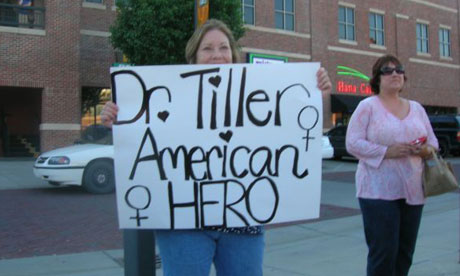
A sign commemorating George Tiller at a candlelight vigil in Wichita, Kansas, where Dr Tiller was murdered on Sunday. Photo by Joe Stumpe / AFP/Getty.

I recognize that some other religious traditions do claim it is murder, but I both disagree with their theology and think they have no right to impose it on mine, by state power or by murder.

By Rabbi Arthur Waskow / The Rag Blog / June 1, 2009

So another physician has been murdered for making it possible for women to actually use their constitutional right to choose an abortion.

All honor to Dr. Tiller, who joins the list of martyrs for ethical decency and human rights, killed for healing with compassion. In his case, a religious martyr in the fullest classical sense, killed in his own church as he arrived to worship, killed for acting in accord with his religious commitments and his moral and ethical choices.

And all dishonor to those vicious attackers like Bill O’Reilly who have egged on the kind of violence that finally murdered Dr. Tiller. And who have blasphemously invoked the name of God to justify these incitements to murder.

There are two real-life cases of abortion that have shaped my own judgment on the practice, in addition to the Torah’s only comment on abortion –- which makes utterly clear that it it is not murder. (The Torah says that if someone causes an abortion but does no other harm to the mother, the agent owes a money recompense to the father for the loss of his potential offspring. And that’s all.)

I recognize that some other religious traditions do claim it is murder, but I both disagree with their theology and think they have no right to impose it on mine, by state power or by murder.

One of these real-life cases of abortion that have shaped my views is that my father’s mother had already birthed five young boys when she became pregnant again in 1914. She hoped to be able to concentrate her energy on raising those five instead of birthing more. Because abortions were illegal, she had a “back-alley” abortion –- and it killed her. So she was unable to raise any of them. Her early death cast a shadow over my father’s life till his own dying day.

The second is that one of my friends and teachers, a great and eminent rabbi, was the child of a mother who fled Vienna after Hitler annexed Austria. His mother was pregnant again when the family needed to leave, and they knew that the underground “railroad” to freedom was bound to be too arduous for a pregnant woman. The choices were: staying in Austria, to die together; leaving her behind, to die alone; or aborting the fetus, so that all of the family had a chance to live. She had an abortion. Today my rabbi friend says they thought then and ever since that she had given birth to the whole family.

I wish the President, when he spoke at Notre Dame, had said explicitly what these stories teach me: that women are moral beings, possessed of moral agency and responsibility in this unique situation where their own bodies are intertwined with another’s; and that the lives of women would be endangered once again if abortion were criminalized again.

He chose instead to say only that the choices are difficult and that unwanted pregnancies should be minimized.

On this point, I wish he had been specific — that the US government should subsidize comprehensive sex education and the provision of free condoms, The Pill, and other contraceptives in all American high schools, and should require health insurance companies to cover the cost of birth control and abortion.

And I wish that religious communities would begin providing comprehensive sex education as their children reach adolescence (and probably for adults as well). In the Jewish community, for example, this should be part of the preparation for bar/bat mitzvah.

This would in fact be rooted in the ancient rabbinic tradition which defined the moment when a boy became an adult bound by the sacred commitments of mitzvot as the day when he had two pubic hairs. Then the rabbis said that instead of checking individuals, they would settle on 13 years and one day. But the point about puberty and sexual maturity was made. (Indeed, it is probably precisely because of the imperative need for ethical sexual behavior beginning with the onset of sexual maturity that the rabbis thought Jews should at that point be bound by the mitzvot.)

Unfortunately, in modern Jewish life this teaching is prudishly ignored. What rabbi have you heard ever address the new Jewish adult and the adult community about sexual ethics, as part of the public ceremony of welcoming him/ her as a bar/bat mitzvah? Time to renew this ancient teaching!

Shalom, Arthur

The Rag Blog

Posted in Rag Bloggers | Tagged , , | Leave a comment

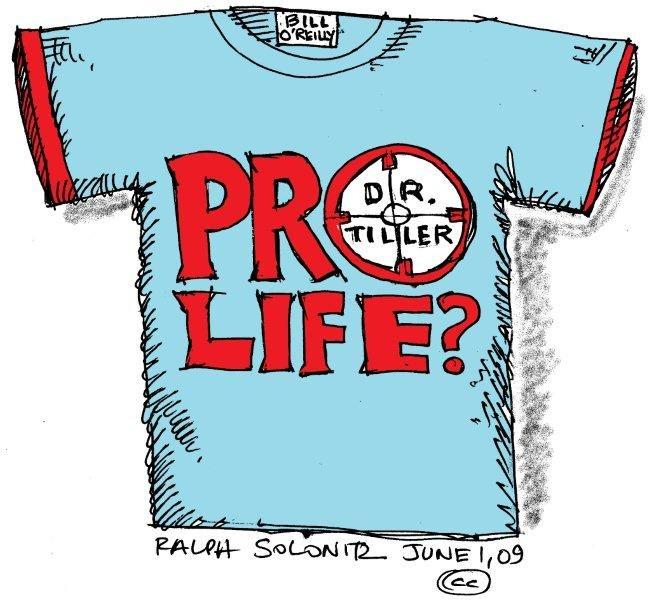
Ralph Solonitz : Pro Life?

Political cartoon by Ralph Solonitz / The Rag Blog / May 23, 2009.
[Ralph Solonitz’ cartoons also appear at
MadasHellClub.net.]

The Rag Blog

Posted in Rag Bloggers | Tagged , , , | Leave a comment

Bill O’Reilly and ‘Tiller the Baby Killer’

Excerpts from Bill O’Reilly’s attacks on murdered physician George Tiller.

O’Reilly’s campaign against murdered doctor

The Fox News star had compared Tiller to a Nazi, called him a ‘baby killer,’ and warned of ‘Judgment Day’

By Gabriel Winant / May 31, 2009

When his show airs tomorrow [June 1], Bill O’Reilly will most certainly decry the death of Kansas doctor George Tiller, who was killed Sunday while attending church services with his wife. Tiller, O’Reilly will say, was a man who was guilty of barbaric acts, but a civilized society does not resort to lawless murder, even against its worst members. And O’Reilly, we can assume, will genuinely mean this.

But there’s no other person who bears as much responsibility for the characterization of Tiller as a savage on the loose, killing babies willy-nilly thanks to the collusion of would-be sophisticated cultural elites, a bought-and-paid-for governor and scofflaw secular journalists. Tiller’s name first appeared on “The Factor” on Feb. 25, 2005. Since then, O’Reilly and his guest hosts have brought up the doctor on 28 more episodes, including as recently as April 27 of this year. Almost invariably, Tiller is described as “Tiller the Baby Killer.”

Tiller, O’Reilly likes to say, “destroys fetuses for just about any reason right up until the birth date for $5,000.” He’s guilty of “Nazi stuff,” said O’Reilly on June 8, 2005; a moral equivalent to NAMBLA and al-Qaida, he suggested on March 15, 2006. “This is the kind of stuff happened in Mao’s China, Hitler’s Germany, Stalin’s Soviet Union,” said O’Reilly on Nov. 9, 2006.

O’Reilly has also frequently linked Tiller to his longtime obsession, child molestation and rape. Because a young teenager who received an abortion from Tiller could, by definition, have been a victim of statutory rape, O’Reilly frequently suggested that the clinic was covering up for child rapists (rather than teenage boyfriends) by refusing to release records on the abortions performed.

When Kansas Attorney General Phill Kline, an O’Reilly favorite who faced harsh criticism for seeking Tiller’s records, was facing electoral defeat by challenger Paul Morrison, O’Reilly said, “Now we don’t endorse candidates here, but obviously, that would be a colossal mistake. Society must afford some protection for viable babies and children who are raped.” (Morrison ultimately unseated Kline.)

This is where O’Reilly’s campaign against George Tiller becomes dangerous. While he never advocated anything violent or illegal, the Fox bully repeatedly portrayed the doctor as a murderer on the loose, allowed to do whatever he wanted by corrupt and decadent authorities. “Also, it looks like Dr. Tiller, who some call Tiller the Baby Killer, is spending a large amount of money in order to get Mr. Morrison elected. That opens up all kinds of questions,” said O’Reilly on Nov. 6, 2006, in one of many suggestions that Tiller was improperly influencing the election.

Tiller’s excuses for performing late-term abortions, O’Reilly suggested, were frou-frou, New Age, false ailments: The woman might have a headache or anxiety, or have been dumped by her boyfriend. She might be “depressed,” scoffed O’Reilly, which he dismissed as “feeling a bit blue and carr[ying] a certified check.” There was, he proposed on Jan. 5, 2007, a kind of elite conspiracy of silence on Tiller. “Yes, OK, but we know about the press. But it becomes a much more intense problem when you have a judge, confronted with evidence of criminal wrongdoing, who throws it out on some technicality because he wants to be liked at the country club. Then it’s intense.”

Tiller, said O’Reilly on Jan. 6 of this year, was a major supporter of then-Gov. Kathleen Sebelius. “I think it’s unfairly characterized as just a grip and grin relationship. He was a pretty big supporter of hers.” She had cashed her campaign check from Tiller, “doesn’t seem to be real upset about this guy operating a death mill, which is exactly what it is in her state, does she?” he asked on July 14 of last year. “Maybe she’ll — maybe she’ll pardon him,” he scoffed two months ago.

This is where it gets most troubling. O’Reilly’s language describing Tiller, and accusing the state and its elites of complicity in his actions, could become extremely vivid. On June 12, 2007, he said, “Yes, I think we all know what this is. And if the state of Kansas doesn’t stop this man, then anybody who prevents that from happening has blood on their hands as the governor does right now, Governor Sebelius.”

Three days later, he added, “No question Dr. Tiller has blood on his hands. But now so does Governor Sebelius. She is not fit to serve. Nor is any Kansas politician who supports Tiller’s business of destruction. I wouldn’t want to be these people if there is a Judgment Day. I just — you know… Kansas is a great state, but this is a disgrace upon everyone who lives in Kansas. Is it not?”

This characterization of Tiller fits exactly into ancient conservative, paranoid stories: a decadent, permissive and callous elite tolerates moral monstrosities that every common-sense citizen just knows to be awful. Conspiring against our folk wisdom, O’Reilly says, the sophisticates have shielded Tiller from the appropriate, legal consequences for his deeds. It’s left to “judgment day” to give him what’s coming.

O’Reilly didn’t tell anyone to do anything violent, but he did put Tiller in the public eye, and help make him the focus of a movement with a history of violence against exactly these kinds of targets (including Tiller himself, who had already been shot). In those circumstances, flinging around words like “blood on their hands,” “pardon,” “country club” and “judgment day” was sensationally irresponsible.

Source / salon.com

The Rag Blog

Posted in RagBlog | Tagged , , , | 5 Comments

Michael Moore : Goodbye, GM

General Motors’ Bob Lutz (“Global Warming is a crock of shit”) and Gary Cowger with obsolete product.

Goodbye, GM

It is with sad irony that the company which invented ‘planned obsolescence’ — the decision to build cars that would fall apart after a few years so that the customer would then have to buy a new one — has now made itself obsolete.

By Michael Moore / The Rag Blog / June 1, 2009

I write this on the morning of the end of the once-mighty General Motors. By high noon, the President of the United States will have made it official: General Motors, as we know it, has been totaled.

As I sit here in GM’s birthplace, Flint, Michigan, I am surrounded by friends and family who are filled with anxiety about what will happen to them and to the town. Forty percent of the homes and businesses in the city have been abandoned. Imagine what it would be like if you lived in a city where almost every other house is empty. What would be your state of mind?

It is with sad irony that the company which invented “planned obsolescence” — the decision to build cars that would fall apart after a few years so that the customer would then have to buy a new one — has now made itself obsolete. It refused to build automobiles that the public wanted, cars that got great gas mileage, were as safe as they could be, and were exceedingly comfortable to drive. Oh — and that wouldn’t start falling apart after two years.

GM stubbornly fought environmental and safety regulations. Its executives arrogantly ignored the “inferior” Japanese and German cars, cars which would become the gold standard for automobile buyers. And it was hell-bent on punishing its unionized workforce, lopping off thousands of workers for no good reason other than to “improve” the short-term bottom line of the corporation.

Beginning in the 1980s, when GM was posting record profits, it moved countless jobs to Mexico and elsewhere, thus destroying the lives of tens of thousands of hard-working Americans. The glaring stupidity of this policy was that, when they eliminated the income of so many middle class families, who did they think was going to be able to afford to buy their cars? History will record this blunder in the same way it now writes about the French building the Maginot Line or how the Romans cluelessly poisoned their own water system with lethal lead in its pipes.

So here we are at the deathbed of General Motors. The company’s body not yet cold, and I find myself filled with — dare I say it — joy. It is not the joy of revenge against a corporation that ruined my hometown and brought misery, divorce, alcoholism, homelessness, physical and mental debilitation, and drug addiction to the people I grew up with. Nor do I, obviously, claim any joy in knowing that 21,000 more GM workers will be told that they, too, are without a job.

But you and I and the rest of America now own a car company! I know, I know — who on earth wants to run a car company? Who among us wants $50 billion of our tax dollars thrown down the rat hole of still trying to save GM? Let’s be clear about this: The only way to save GM is to kill GM. Saving our precious industrial infrastructure, though, is another matter and must be a top priority.

If we allow the shutting down and tearing down of our auto plants, we will sorely wish we still had them when we realize that those factories could have built the alternative energy systems we now desperately need. And when we realize that the best way to transport ourselves is on light rail and bullet trains and cleaner buses, how will we do this if we’ve allowed our industrial capacity and its skilled workforce to disappear?

Thus, as GM is “reorganized” by the federal government and the bankruptcy court, here is the plan I am asking President Obama to implement for the good of the workers, the GM communities, and the nation as a whole. Twenty years ago when I made “Roger & Me,” I tried to warn people about what was ahead for General Motors. Had the power structure and the punditocracy listened, maybe much of this could have been avoided. Based on my track record, I request an honest and sincere consideration of the following suggestions:

1. Just as President Roosevelt did after the attack on Pearl Harbor, the President must tell the nation that we are at war and we must immediately convert our auto factories to factories that build mass transit vehicles and alternative energy devices. Within months in Flint in 1942, GM halted all car production and immediately used the assembly lines to build planes, tanks and machine guns. The conversion took no time at all. Everyone pitched in. The fascists were defeated.

We are now in a different kind of war — a war that we have conducted against the ecosystem and has been conducted by our very own corporate leaders. This current war has two fronts. One is headquartered in Detroit. The products built in the factories of GM, Ford and Chrysler are some of the greatest weapons of mass destruction responsible for global warming and the melting of our polar icecaps. The things we call “cars” may have been fun to drive, but they are like a million daggers into the heart of Mother Nature. To continue to build them would only lead to the ruin of our species and much of the planet.

The other front in this war is being waged by the oil companies against you and me. They are committed to fleecing us whenever they can, and they have been reckless stewards of the finite amount of oil that is located under the surface of the earth. They know they are sucking it bone dry. And like the lumber tycoons of the early 20th century who didn’t give a damn about future generations as they tore down every forest they could get their hands on, these oil barons are not telling the public what they know to be true — that there are only a few more decades of useable oil on this planet. And as the end days of oil approach us, get ready for some very desperate people willing to kill and be killed just to get their hands on a gallon can of gasoline.

President Obama, now that he has taken control of GM, needs to convert the factories to new and needed uses immediately.

2. Don’t put another $30 billion into the coffers of GM to build cars. Instead, use that money to keep the current workforce — and most of those who have been laid off — employed so that they can build the new modes of 21st century transportation. Let them start the conversion work now.

3. Announce that we will have bullet trains criss-crossing this country in the next five years. Japan is celebrating the 45th anniversary of its first bullet train this year. Now they have dozens of them. Average speed: 165 mph. Average time a train is late: under 30 seconds. They have had these high speed trains for nearly five decades — and we don’t even have one! The fact that the technology already exists for us to go from New York to L.A. in 17 hours by train, and that we haven’t used it, is criminal. Let’s hire the unemployed to build the new high speed lines all over the country. Chicago to Detroit in less than two hours. Miami to DC in under 7 hours. Denver to Dallas in five and a half. This can be done and done now.

4. Initiate a program to put light rail mass transit lines in all our large and medium-sized cities. Build those trains in the GM factories. And hire local people everywhere to install and run this system.

5. For people in rural areas not served by the train lines, have the GM plants produce energy efficient clean buses.

6. For the time being, have some factories build hybrid or all-electric cars (and batteries). It will take a few years for people to get used to the new ways to transport ourselves, so if we’re going to have automobiles, let’s have kinder, gentler ones. We can be building these next month (do not believe anyone who tells you it will take years to retool the factories — that simply isn’t true).

7. Transform some of the empty GM factories to facilities that build windmills, solar panels and other means of alternate forms of energy. We need tens of millions of solar panels right now. And there is an eager and skilled workforce who can build them.

8. Provide tax incentives for those who travel by hybrid car or bus or train. Also, credits for those who convert their home to alternative energy.

9. To help pay for this, impose a two-dollar tax on every gallon of gasoline. This will get people to switch to more energy saving cars or to use the new rail lines and rail cars the former autoworkers have built for them.

Well, that’s a start. Please, please, please don’t save GM so that a smaller version of it will simply do nothing more than build Chevys or Cadillacs. This is not a long-term solution. Don’t throw bad money into a company whose tailpipe is malfunctioning, causing a strange odor to fill the car.

100 years ago this year, the founders of General Motors convinced the world to give up their horses and saddles and buggy whips to try a new form of transportation. Now it is time for us to say goodbye to the internal combustion engine. It seemed to serve us well for so long. We enjoyed the car hops at the A&W. We made out in the front — and the back — seat. We watched movies on large outdoor screens, went to the races at NASCAR tracks across the country, and saw the Pacific Ocean for the first time through the window down Hwy. 1. And now it’s over. It’s a new day and a new century. The President — and the UAW — must seize this moment and create a big batch of lemonade from this very sour and sad lemon.

Yesterday, the last surviving person from the Titanic disaster passed away. She escaped certain death that night and went on to live another 97 years.

So can we survive our own Titanic in all the Flint Michigans of this country. 60% of GM is ours. I think we can do a better job.

Yours,

Michael Moore

The Rag Blog

Posted in Rag Bloggers | Tagged , , , , | 6 Comments

Cuba-U.S. Talks : No Preconditions Required

Graphic circa 1902.

U.S. and Cuba to restart negotiations without preconditions.

The fact is that Cuba does not pose any danger to the United States. A continuation of the embargo and failure to normalize relations, does nothing to protect the United States. All it does is hurt both countries economically, and make the U.S. look foolish…

By Ted McLaughlin / The Rag Blog / June 1, 2009

It looks like the United States and Cuba are about to take the first small feeble steps toward normalizing the relationship between the two countries. This is a good thing, and should have happened years ago.

Recently, the United States had asked Cuba to resume negotiations regarding the immigration of Cubans to the United States. Last weekend, Cuba sent a diplomatic note to the U.S. government accepting the invitation to restart the talks. I hope these talks are successful, so other negotiations can be conducted and relations finally normalized.

One reason these talks are going to happen, is that neither country put any preconditions on holding the talks. This should be a lesson to both countries, especially the United States. The U.S. is still requiring preconditions before having more substantial talks and before re-admitting Cuba to the Organization of American States.

The whole idea of preconditions for talks is ridiculous. First, no country has the right to demand another country alter their government. We would be aghast if Cuba demanded we alter our way of governing ourselves before they would talk to us, and yet we seem to think it’s fine for us to do the same thing to them. How can we possibly believe we have the right to do something we would not allow Cuba to do to us?

Also, having pre-conditions before negotiating is like demanding the other country give up before negotiations have even begun. We would not give in before negotiations have begun, so how can we demand it of others?

But not only are the preconditions wrong, they will probably soon put the U.S. in an unsustainable and untenable position. The Organization of American States is scheduled to meet very soon, and the feeling is that the huge majority of the members are in favor of re-admitting Cuba. They may well do so in spite of what the United States wants, or whatever preconditions the United States has imposed.

True diplomacy requires both countries to negotiate in good faith. The differences between the two countries are the matters to be negotiated. To demand for one country to submit to the wishes of another before negotiating is not diplomacy — it is hubris, or worse.

The fact is that Cuba does not pose any danger to the United States. A continuation of the embargo and failure to normalize relations, does nothing to protect the United States. All it does is hurt both countries economically, and make the U.S. look foolish — especially since most other countries, including our allies, have resumed normal relations with Cuba.

It is time for President Obama to drop all preconditions to negotiating the normalizing of relations with Cuba. There is no reason the United States and Cuba cannot be friends, who work together for the common good of both countries.

[Rag Blog contributor Ted McLaughlin also posts at jobsanger, an excellent Texas political blog.]

The Rag Blog

Posted in Rag Bloggers | Tagged , , , | 1 Comment

Chavez: ‘When the Working Class Roars, the Capitalists Tremble’

Photo: AFP/Getty Images.

Venezuela: ‘When the working class roars, capitalists tremble’
By Federico Fuentes / May 30, 2009

Addressing the 400-strong May 21 workshop with workers from the industrial heartland of Guayana, dedicated to the “socialist transformation of basic industry”, Venezuelan President Hugo Chavez noted with satisfaction the outcomes of discussions: “I can see, sense and feel the roar of the working class.”

“When the working class roars, the capitalists tremble”, he said.

Chavez announced plans to implement a series of radical measures, largely drawn from proposals coming from the workers’ discussion that day.

The workers greeted each of Chavez’s announcements with roars of approval, chanting “This is how you govern!”

Chavez said: “The proposals made have emerged from the depths of the working class. I did not come here to tell you what to do! It is you who are proposing this.”

Nationalisation and workers’ control

To the cheers of the workers, Chavez announced the nationalisation of six iron briquette, ceramics and steel companies, one after the other.

He said this started “a process of nationalisations” aimed at creating an integrated basic industry complex as part of building socialism.

Chavez also said it was necessary for there to be workers’ control along “the entire productive chain”. Plans for the industrial complex had to be “nourished with the ideas of the working class”.

Throughout the day, workers from local steel, aluminum and iron companies raised demands for greater worker participation in managing production, more nationalisations, and the need to sack corrupt and counterrevolutionary managers.

The workers were affiliated to the Socialist Workers’ Force (FST), which organises unionists in the United Socialist Party of Venezuela (PSUV — the mass revolutionary party led by Chavez).

Saying this new phase would have to be “assumed with responsibility”, Chavez called on the workers to wage an all-out struggle against the “mafias” rife in the management of state companies.

Chavez said he would approve a new law to allow workers to elect state company managers.

“Every factory should be a school, in order, as Che said, to create not only briquettes and sheets and steel and aluminium, but also, above all, new men and women, a new society, a socialist society”, he said.

Chavez also called for workers to organise an armed militia. Worker battalions in each factory should be equipped with weapons “in case anyone makes the mistake of messing with us”.

Post-referendum offensive

These moves are part of a push to deepen the Venezuelan revolution after the February 15 referendum that voted to remove restrictions on the number of terms public officials could stand for election.

At stake was the future of the revolution. Its central leader, Chavez, was unable to stand for re-election in 2012 under pre-existing regulation limiting a president to two terms.

The referendum initiative followed the November regional elections, in which the PSUV won a majority of governorships and mayoralties, yet lost some key states to the right-wing opposition.

The opposition used newly won offices to launch an assault on grassroots organisations and the government’s pro-poor social programs.

The referendum was part of a counter-offensive to strengthen the organisation of the revolutionary forces and win another mandate for the revolution’s radical program.

As part of the campaign, around 100,000 “Yes committees” were organised in factories and communities across the country. The “Yes” campaign, which won nearly 55% or 6.3 million votes, was a decisive mandate to deepen the revolution.

The campaign raised the level of organisation among the revolution’s base — workers, students, peasants, the urban poor and other sectors.

After the referendum, Chavez called for the restructuring of the PSUV. The Yes committees were to be converted into “socialist committees” as grassroots units of the party.

Special emphasis was put on strengthening the social fronts.

In early May, Chavez reshuffled the PSUV regional vice-presidents, appointing those seen as his closest collaborators.

Attacks on capital

With this momentum, the government gave clear signals of how it intended to fight the global economic crisis and falling oil prices.

Rather than a pact with the capitalist class, as some within the revolutionary movement had called for, Chavez launched an offensive — with state intervention into, and in some cases expropriation of, capitalist firms.

This followed previous nationalisations in oil, steel, telecommunications, electricity, and other industries. This is part of ensuring state ownership over strategic sectors of the economy, to direct such sectors towards social needs.

Rice-producing factories owned by Polar, Venezuela’s largest company, were temporarily taken over by the military in February after it was found the company was deliberately evading government-imposed price controls.

Under Venezuelan law, food companies are obliged to direct 70% of production towards selected products at a set price. This is to ensure enough affordable food is available to the poor.

Venezuelanalysis.com said on March 11: “During a recent surge in land reform measures, Venezuela’s National Institute of Lands (INTI) [took] public ownership of more than 5000 hectares of land claimed by wealthy families and multi-national corporations.”

INTI said it would review tens of thousands more hectares as part of its drive to ensure fertile land is directed towards food production for social needs, rather than corporate profits.

On May 7, the National Assembly passed a law ensuring state control over a range of activities connected to the oil industry, previously run by multinationals.

The next day, “the government expropriated 300 boats, 30 barges, 39 terminals and docks, 5 dams and 13 workshops on Lake Maracaibo, where there are large crude oil reserves”, a May 9 Venezuelanalysis.com article said.

On May 20, it nationalised a gas compression plant in the eastern state of Monagas under the same law.

Five days before, the government took over a pasta processing plant owned by US multinational Cargill after government inspectors found it was not producing price-regulated pasta as required.

Food vice minister Rafael Coronado said that after the 90-day intervention period, inspectors “together with the workers, the communal councils” would decide what to do with the company.

Revitalised working class

On April 30, announcing plans to expropriate the La Gaviota sardine processing plant, Chavez told a gathering of workers that “wherever you see a private company, a capitalist company that is exploiting the workers and is not complying with the laws, that is hoarding, denounce it, because the government is willing to intervene”.

La Gaviota had been shut for two and a half months by workers’ protests demanding the boss comply with the collective contract.

The same day, the government and workers took over the Cariaco sugar processing plant, the scene of similar protests.

Some of the companies Chavez said would be nationalised on May 21 have also faced industrial disputes.

Chavez had previously threatened to nationalise Ceramicas Carabobo if the bosses refused to come to an agreement with the workforce. Workers at Matesi had called for the company be nationalised due to the unwillingness of management to sign a fair collective contract.

Matesi and Tavsa were part of the previously state-owned steel production complex, Sidor, before being sold off separately in the 1990s to Techint, an Argentine company.

After a 15-month dispute over the signing of a collective contract, the government nationalised Sidor, which was majority owned by Techint, decrying the “colonialist mentality” of the bosses overseeing super-exploitative conditions.

However, in Matesi and Tavsa, negotiations over collective contracts continued. Inspired by the Sidor example, where a collective contract was signed after nationalisation, Matesi workers demanded their factory also be nationalised.

This increase in industrial militancy has resulted in a number of factory occupations. This includes the Tachira-based coffee processing plant Cafea, which was closed by its bosses.

Its workforce, together with unions and the local community, have occupied the plant and are demanding it be nationalised.

Source / Green Left Online

The Rag Blog

Posted in RagBlog | Tagged , , , | 2 Comments

Obama, the Anti-War Movement and the Neo-Cons: Turning the Ship Around

“Warship 53.” Photo from sailsarana.com

Obama’s agenda of ‘turning the battleship’ is not our agenda of disarming it altogether: ending U.S. interventionism and bullying of all sorts, initiating an era of peaceful global cooperation to tackle poverty, disease, global warming and other threats to all humanity.

By Max Elbaum / May 29, 2009

Turning the ship — toward what?

Responding to a questioner saying that there seemed to be little change in Washington policies, President Obama replied: “The ship of state is an ocean liner, it’s not a speedboat… if we can move this big battleship a few degrees in a different direction, we may not see all the consequences a week from now or three months from now, but 10 years from now, or 20 years from now.”

Obama is right that the “big battleship” of U.S. imperial militarism can’t be easily turned, much less quickly stopped altogether. But Obama’s remark also impels us to examine the nature of the turn he is trying to make, and to analyze where it does and doesn’t overlap with, or open doors for, an antiwar agenda.

Bush’s unilateralism and total reliance on military force over-stretched the empire and ended up undermining U.S. global power. Obama’s team, representing the now-dominant anti-Neo-Con wing of the U.S. elite, aims to change that. Like their predecessors, Obama’s team wants to maximize U.S. clout in the world. But unlike Bush and the Neo-Cons, Obama’s team believes that doing so requires adapting skillfully to, rather than trying to bludgeon away, new realities of global power.

This means a different mix of diplomacy and military force, and includes willingness to the degree they are pressed to make concessions to other countries and movements. Every such accommodation is fiercely resisted by powerful forces within the national security state and the racist right-wing populists now leading the Republican opposition. Sharp fights over whether or not a particular concession is necessary are ongoing within the administration itself.

The significance of Obama’s shift has been noted by popular movements worldwide. They know that this readjustment was forced on Washington through hard struggle and many sacrifices. They believe it offers better terrain on which to struggle further. Simultaneously, antiwar and progressive movements are clear (or should be) that Obama’s agenda of “turning the battleship” is not our agenda of disarming it altogether: ending U.S. interventionism and bullying of all sorts, initiating an era of peaceful global cooperation to tackle poverty, disease, global warming and other threats to all humanity.

The inter-play of these contending strategies unfolds differently on different battlefronts, with dynamics determined mainly by the real-world balance of forces. It is that balance that a clear-eyed, long-haul peace movement must fight to change.

‘Responsible’ withdrawal from Iraq

Start with Iraq, central site of the Middle East defeat which has driven Washington’s foreign policy retrenchment. (Antiwar activism and the economic crisis have been contributing factors, but U.S. failure to subdue the Iraqi people is the main reason unilateral militarism is no longer in vogue.) The Obama team, reality-based, believes that extricating the U.S. from this Bush-created “quagmire” offers better prospects for preserving U.S. regional influence than staying a lost course. But they also think a “responsible” (that is, drawn-out) process gives Washington the most leverage.

Even this is not enough for most U.S. generals, including Iraq Commander Ray Odierno. They still fantasize about snatching victory from the jaws of defeat if only they can stay McCain’s 100 years. Hence the running battle – visible in media leaks from infighting behind closed doors – about whether “conditions will allow the U.S. to get out” by the 2011 target date.

It’s instructive to see how Obama is working that one. As is his pattern, he relies on rhetorical skills and capacity to “change the discourse” in key constituencies. So he made a surprise visit to Iraq and gave a speech to U.S. troops praising them and promising they would be coming home. The response was wild applause. This limited Odierno’s maneuvering room, squeezing him between let’s-go-home sentiment among the soldiers below him and pronouncements about withdrawal from his Commander-in-Chief above. So when asked after Obama’s visit what the chances were that U.S. withdrawal would actually occur on December 31, 2011, this hard-line opponent of getting out gritted his teeth and replied: “On a scale of one to ten, ten.”

Good as far as it goes. Compared to the Neo-Con stay-forever agenda, that’s far indeed. But compared to the antiwar agenda? Not so much. Every day the U.S. occupies Iraq means more death, destruction and violation of Iraqi sovereignty. Every day leaves the door open for a Neo-Con/Odierno comeback, and for the kind of blackmail that drove Obama’s torture photo flip-flop, “Well, Mr. President, if you release those photos we probably won’t be able to leave Iraq on your timetable, so…”

What’s especially sobering is that Iraq is the battlefront most favorable for the antiwar side. It is here that U.S. defeat has been clearest and where U.S. public opinion has shifted most strongly to the “gotta get out” position.

Bigger danger in Afghanistan

That’s why, though similar dynamics are at work, we face even greater dangers and difficulties regarding Afghanistan. U.S. defeat there is not yet as thorough, and U.S. public opinion is not yet as antiwar. So the administration’s actions are worse, and the logic of escalation means they threaten to get even more so.

Obama’s “adapt to reality” approach here has so far yielded only a few glimmers of change. The goals of intervention have been defined down to defeating Al-Qaeda rather than building a stable U.S. client state. There is the beginning of a serious diplomatic effort to involve all countries in the region – crucially, Iran is included – in seeking some kind of negotiated settlement. Negotiations of a sort are underway with leaders of the Taliban, and it at least gets reported in the U.S. press that “the enemy” has put forward a peace plan of its own (hinging on U.S. commitment to get out).

But the administration has not yet been forced to accept the basic point that the U.S. military presence is part of the problem in ending the war (and isolating Al-Qaeda), not part of the solution. So instead of any kind of timetable or even vague promise of withdrawal, Washington is sending more troops, expanding the use of drone bombings, and putting a hawk with a record of war crimes and cover-ups, Gen. Stanley McChrystal, in charge of the theater.

This is a “big muddy” path, as former CIA Station Chief in Kabul Graham Fuller stresses: “Military force will not win the day in either Afghanistan or Pakistan; crises have only grown worse under the U.S. military footprint.” Not only does escalation, with its day-in, day-out killing of Afghan civilians, block reconciliation between different sectors of the Afghan population. It inflames tensions in nuclear-armed Pakistan, where the population – in its vast majority opposed to theocratic reactionaries like the Taliban – is simultaneously opposed to doing the bidding of a foreign power which for decades has supported corrupt military dictators against Pakistani democratic aspirations.

The challenges are formidable in reversing this disastrous course. Every regional actor (except the Pakistani secret service) and the majority of Afghans are opposed to a return to Taliban rule. This leads to vacillation in opposing the U.S. military presence. Matters are especially tough in terms of U.S. public opinion, which has been fed decades of demonization of all (non-Israeli) peoples in the region and is only beginning to hear any kind of non-hate-filled rhetoric coming from a President’s bully pulpit.

The strongest factor in the antiwar movement’s favor here is growing public recognition that military action in the Middle East/West Asia produces no good results while bleeding precious lives and scarce resources. Turning that sentiment into a loud, active, won’t-take-no-for-an-answer antiwar surge will be no easy task. There are no shortcuts, and multi-leveled tactics, including cooperation with forces who oppose escalation but are not yet for total withdrawal, will have to be part of the mix.

Israeli settlements; ‘Halting Iran’

We face a similarly difficult challenge when it comes to the new administration’s stance toward the Israel/Palestine conflict. Observers across the spectrum parsed every word uttered by Obama and Israeli Prime Minister Binyamin Netanyahu following their meeting May 19. The analysts who focused mainly on words and language mostly shared Middle East expert Juan Cole’s view that “the talks were pretty clearly a train wreck for Israel’s far rightwing Likud Party… [Obama and Netanyahu] clearly did not agree on virtually anything important. Both finessed the disagreement by appealing to vague generalities and invoking the long term.”

That assessment is based on a number of Obama statements that contrast with the kind of fawning rhetoric that characterized George Bush’s comments during or after meeting with Israeli leaders. Talking about the “peace process” Obama said that “[Israeli] Settlements have to be stopped in order for us to move forward.” Directly challenging Netanyahu’s insistence that Iran’s alleged nuclear weapons program had to be ended before Israel could address Palestinian demands, Obama bluntly said that any linkage between Iran and Israel-Palestine “actually runs the other way.”

Netanyahu kept insisting that he and Obama “saw eye-to-eye” on “halting Iran” but Obama conspicuously refused to agree and, pointedly, did not repeat the “all options are on the table” phrase that is U.S. code for the threat of an attack on Iran that Israeli leaders so desperately desire. Obama’s comments on Israeli settlements were underscored a few days later by Secretary of State Hillary Clinton: “He wants to see a stop to settlements — not some settlements, not outposts, not ‘natural growth’ exceptions. That is our position. That is what we have communicated very clearly.”

Those are the kinds of signals that have set off big alarm bells in the Israel Lobby and within the Israeli right. Keith Weissman, Iran expert formerly at AIPAC (espionage charges against him were dropped earlier this month) now tells the Jerusalem Post that “there is no viable military option for dealing with the Iranian nuclear threat.” The Post accompanied its report with an analytic article under the headline “Has Obama given up on halting Iran?” Israeli peace activist Uri Avnery reports that Obama “has warned the Israeli government unequivocally [against launching such an attack}. Just to make sure, he sent the CIA chief to Israel to deliver the message personally to every Israeli leader.”

Bottom line: Obama believes a deal with Iran is necessary if Washington is going to manage its Iraq and Afghanistan crises in ways the minimize the damage Bush has done to U.S. regional influence; and he is not going to let Israeli bombast set the agenda on what he deems a matter vital to U.S. interests.

Again, good as far as it goes, and in terms of reducing the danger of a military attack on Iran, that’s pretty far. But for winning Palestinian freedom and even a minimally just settlement of the Israel-Palestine conflict, this is not yet far at all. Presidential words on that one have to be matched by some deeds if Israeli policies of grinding colonization are going to be halted or reversed. Phyllis Bennis of IPS makes the key point here:

“This first Obama-Netanyahu meeting included no public acknowledgement of any U.S. pressure brought to bear to insure real implementation of Israel’s existing treaties or other international (or U.S.) law obligations…. What happens next, privately and publicly, will be determined largely by the level of pressure that is brought to bear on Obama. We know the capacity of Israel’s U.S. supporters to raise that pressure. The question for us is how to challenge it, for diplomacy instead of threats towards Iran, and an end to U.S. support for Israeli occupation and apartheid… There’s a lot of work ahead.” Full text here.

Torture and civil liberties

We face a similarly complicated landscape on the torture/civil liberties front. Dick Cheney’s “we tortured and we’re proud of it” speech May 21 was a wake-up-call for those who have gotten complacent about the far right. There’s a permanent war/executive-power-uber-alles crowd that still has an audience of millions and is banking on fear-mongering to make a comeback. But Obama’s speech the same day was hardly a total repudiation of Cheney-like policies. Constitutional law expert Glenn Greenwald points out:

“The speech was fairly representative of what Obama typically does: effectively defend some important ideals in a uniquely persuasive way and advocating some policies that promote those ideals (closing Guantanamo, banning torture tactics, limiting the state secrets privilege) while committing to many which plainly violate them (indefinite preventive detention schemes, military commissions, denial of habeas rights to Bagram abductees, concealing torture evidence, blocking judicial review on secrecy grounds).”

Here again the public has not yet been won to the kind of outrage about torture and human rights violations that would force Obama to match his phrases with deeds.

While critiquing Obama’s backward actions, Greenwald also wrote: “his well-crafted speech can have a positive impact on our debate and contained some welcome and rare arguments from a high-level political leader – changes in the terms of the debate are prerequisites to changes in policy and the value of rhetoric shouldn’t be understated.”

So Obama’s words open a door. But in action his administration both conciliates and contains forces who want to keep that opening as narrow as possible. Only a movement that fights — and fights smart — while digging in for a long haul, can catalyze the power required to push it wide open. That means finding the mix of patient, respectful persuasion and make-trouble urgent action that it takes to win the support of millions without compromising away the principle that “power concedes nothing without a demand, it never did and it never will.”

Source / War Times/Tiempo de Guerras / Progressives for Obama

Thanks to Carl Davidson / The Rag Blog

Posted in RagBlog | Tagged , , , | Leave a comment

Singin’ on Sunday – Tony Joe White

Tony Joe White – Rainy Night In Georgia

Source / De Laaste Show TV1

Thanks to Deva Wood / The Rag Blog

Posted in RagBlog | Tagged , , | 1 Comment

Medea Benjamin Calls on Obama to Visit Gaza

Smoke billowed from Israeli artillery shells exploding over northern Gaza in December 2008. Photo: Menahem Kahana/Agence France-Presse Getty Images.

During His Trip to Egypt, Obama Should Visit Gaza
By Medea Benjamin / May 29, 2009

Obama will give a major policy talk at Cairo University on June 4, intended to start mending the rift between the United States and the Arab world. During the Bush years, many Arabs turned against the United States because of the invasions of Afghanistan and Iraq, as well as the abuses at Guantanamo and Abu Graib. But the issue that is really at the crux of the tensions with the United States is the intractable conflict between Israel and Palestine, and what many perceive as a one-sided U.S. policy in support of Israel.

The Obama administration has taken a positive stand on the Israeli settlements, calling for a complete freeze. “[Obama] wants to see a stop to settlements — not some settlements, not outposts, not ‘natural growth’ exceptions,” Secretary of State Hillary Clinton recently told reporters.

But the administration has said almost nothing about the devastating Israeli invasion of Gaza that left over 1,300 dead, including some 400 children. To many in the Middle East, this is an unfortunate continuation of past policies that condemn the loss of innocent Israeli lives, but refuse to speak out against the disproportionately greater loss of Palestinian lives at the hands of the Israeli military.

The Israeli invasion of Gaza began on December 27, 2008, when Obama had just won the election but had not yet taken office. While he spoke out against the November 26 Mumbai terrorism attack, he refused to even call for a ceasefire in Gaza, saying coldly, “When it comes to foreign affairs it is particularly important to adhere to the principle of one president at a time.”

Once inaugurated, Obama appointed George Mitchell as a special peace envoy and immediately sent him on a “listening tour” to key places in the Middle East—except Gaza. Mitchell returned for a second trip to the region in late February, visiting Turkey, the United Arab Emirates, Egypt, Israel and the West Bank but once again bypassing Gaza. The same thing happened on his third trip in April.

Hillary Clinton has never visited war-torn Gaza. She promised $300 million for rebuilding, but the aid won’t get to Gaza as long as the administration insists on dealing only with Mahmoud Abbas and his Palestinian Authority in the West Bank while shunning Hamas, which controls Gaza and was democratically elected.

Obama won great support from the American people during the presidential campaign when he said that America must talk to its adversaries, without preconditions. But his administration now puts ridiculous conditions on talking to Hamas: It must recognize Israel, renounce violence and accept previous international agreements. Israel, on the other hand, does not have to recognize Palestine, renounce violence or abide by past agreements. Putting preconditions on just one side of the conflict makes it impossible to move a peace process forward.

While Obama prepares for his trip to the Middle East, more than 150 people—mostly Americans—are trying to enter war-torn Gaza through both the Egyptian and Israeli borders. Organized under the umbrella of the peace group CODEPINK, this is the largest group of Americans to travel to Gaza since the siege began.

The delegations, invited by the United Nations Relief and Works Agency (UNRWA), are bringing medicines, toys, school supplies and playground building materials. An estimated 1,346 Gazan children were left without one or more of their parents as a result of the Israeli assault and the majority were left traumatized and depressed.

That’s why the peace group CODEPINK has launched an international petition (see www.codepinkalert.org) calling on Obama to visit Gaza and see for himself the devastation and deprivation that continues to plague the region’s 1.5 million people almost 6 months after the invasion. Just this week, Obama just tacked a new stop to his upcoming Middle Eastern visit: Saudi Arabia. If he can make room for a private dinner with the King, then surely he can find the time to go to Gaza. Isn’t it more important for Obama to visit a region where 1,300 people have recently been killed and thousands of homes, schools and mosques destroyed? Isn’t it more important for him to see how the Israelis are using the yearly $3 billion in military aid from U.S taxpayers?

Obama should take the opportunity, during this visit to Egypt next week, to visit Gaza. He should express his condolences for the loss of so many innocent lives, call for a lifting of the inhumane siege that continues to imprison an entire population, and support an investigation of how U.S. military funds to Israel are being spent.

Those actions, more than any fine words he may speak during his talk at Cairo University, will do wonders to repairs our relations with the Arab world that were so tattered during the Bush years.

[Medea Benjamin (medea@globalexchange.org) is cofounder of Global Exchange (www.globalexchange.org) and CODEPINK: Women for Peace (www.codepinkalert.org).]

Source / Common Dreams

The Rag Blog

Posted in RagBlog | Tagged , , , , | Leave a comment

Rabbi Arthur Waskow : ‘The Mormons are Coming, the Jews are Coming’

“The Mormons are Coming” / Californians Against Hate.

As Martin Buber said, ‘I do not even know what it means to say that “The ends justify the means,” but I can tell you this: The means that you actually use will become the ends that you actually achieve.’

By Rabbi Arthur Waskow / The Rag Blog / May 31, 2009

“The Mormons are Coming, the Jews are coming!”

Suppose you read that opponents of same-sex marriage had taken ads in newspapers shouting, “The Jews are Coming, the Jews are Coming!” to warn people against the nefarious influence of Jewish organizers who were (disproportionately to their numbers) involved in supporting same-sex marriage?

I would think it was disgusting bigotry.

Now imagine that supporters of same-sex marriage take ads in newspapers shouting, “The Mormons are Coming, the Mormons are coming!” to warn people against the nefarious influence of Mormon organizers who were (disproportionately to their numbers) involved in opposing same-sex marriage?

I would think it was disgusting bigotry.

The former has not happened; the latter has.

The Shalom Center and I strongly support the legalization of same-sex marriage by society as a whole and the practice of it by Jewish communities (and have done so since long before it was a salient public issue). AND — that does not prevent us from thinking this way of winning support for it is disgusting.

Mormonism — like Roman Catholicism, Orthodox Judaism, evangelical Protestantism — is a mixed bag. (I’m sure there are many people, including me, who think “renewal Judaism,” let alone Judaism in general, is a mixed bag.) And therefore, “the Mormons” must not be condemned any more than “the Jews.”

We support same-sex marriage for the sake of love and justice. For the same reasons, we oppose such unjust and hateful means of supporting it.

The ironies are astounding. The bigoted ads were placed on newspaper Web sites in three Eastern states last month — by “Californians Against Hate”!!

The ad was rejected by the Kennebec Journal in Maine, which said that the copy “borders on insulting and denigrating a whole set of people based on their religion.” Right on, Kennebec Journal!

This incident reminds us of the wisdom of the biblical teaching, “Justice, justice, shall you pursue!” Why is “justice” mentioned twice? To remind us that just ends must be pursued by just means. People who claim to be “against hate” should not mobilize hatred in support of their goals.

This teaching was ignored or subverted this past week by the FBI itself – an institution presumably committed to pursue justice.

In Riverdale, New York, four Muslim men were accused by the police of plotting to blow up two synagogues and actually buying what they thought were bombs to do it. On the surface of most of the news stories, this seemed like a simple abomination. Hatred of Jews, sparked by fury at various behaviors of some Jewish institutions, had turned into terrorism. Period. Scared me. Could have been my synagogue.

But when I read past the first four paragraphs of the New York Times story, the story became much more complex. Turns out the four alleged miscreants had been recruited by an FBI agent who came to their mosque, talked big about blowing up enemies, had money to spend on supporting these attacks and paying those who would join up. He found and organized the group of four. He arranged for them to buy fake bombs. All this with the knowledge and cooperation of the FBI.

It seems likely that if it had not been for this FBI agent., the four would never have lifted a finger against the synagogues. The news stories portray them as incoherent, small-time criminals who had served small-time prison terms. It seems likely that if no one had organized and paid them, the synagogues never would have been in danger at all.

Was justice served and were people protected by their arrest? Sort of. They had – assuming always that the news reports were accurate – actually taken what they thought were steps to blow up the synagogues.

But was the goal of justice served by just means?

What is to be done? Assuming the truth of the allegations, the four men did violate the law and endanger lives. They violated the standards of personal ethical responsibility.

But what about the standards of social ethical responsibility – society embodied in the FBI? If the FBI invented the crime, what to do?

The conventional answer is that if the four men were “entrapped,” they are entitled to be acquitted — just as a confession beaten out of a suspect, even if it turns out to be true, is nullified. (The courts have concluded that is the best way of deterring the police from beating suspects.)

But this means releasing men who, when the opportunity to commit mass murder was laid before them, went for it instead of going to the police and scotching the plot.

The analogy that occurs to me is what ought to happen when high officials plan torture and lowly grunts carry it out. “Obeying orders” is no defense. Neither is “high office.” Both the planners and the perpetrators ought to be punished.

(That is precisely why I think the Obama Doctrine of “Even if they tell, don’t ask!” and “Don’t look back” is a bad mistake.)

So in the Riverdale case, maybe the FBI agent ought to be charged as a co-conspirator, and if he is proved to have invented the crime and organized the criminals, he too should be punished — along with them.

Progressives and conservatives, the government and its critics, all need to affirm and act on the teaching — “Justice, justice shall you pursue.”

As Martin Buber said, “I do not even know what it means to say that ‘The ends justify the means,’ but I can tell you this: The means that you actually use will become the ends that you actually achieve.”

He was talking to early Bolsheviks who were trying to protect the Russian Revolution by using the “Red Terror” against its opponents. The result, as decade by decade the “means” became the “ends,” was Stalinism and the gulag.

Buber was right. Remember. Do not forget.

With blessings of shalom, salaam, peace,

Arthur

[Rabbi Arthur Waskow, a regular contributor to The Rag Blog, is director of The Shalom Center. Rabbi Waskow is co-author of The Tent of Abraham, author of Godwrestling — Round 2, Down-to-Earth Judaism, and a dozen other books on Jewish thought and practice, as well as books on U.S. public policy.]

The Rag Blog

Posted in Rag Bloggers | Tagged , , , , , | Leave a comment