BOOKS / ‘Cruel and Unusual: The Culture of Punishment in America’

What I found striking in this volume is the extent to which advances in behavioral science and pedagogical experience have played almost no role in the evolution of corrections: Sentencing policies and prison conditions stem from basic, often religious and primitive, attitudes and beliefs.

By Eve Pell / April 24, 2009

[Cruel and Unusual: The Culture of Punishment in America, Dr. Anne-Marie Cusac; Yale University Press, 336 pp; $27.50]

When I was involved in prison reform in the early 1970s, my colleagues and I were shocked that our state, California, held so many prisoners, 22,000. Now, 35 years later, California’s prison population has ballooned to 165,000. Since 1973, the U.S. imprisonment rate has multiplied more than five times; we hold the dubious distinction of being the most imprisoning nation in the world.

Why does our nation, with 5 percent of the world’s people, have 25 percent of its prisoners, about 2 million? Why do we keep at least 25,000, maybe double that, in long-term isolation, a situation known to cause insanity, when other nations have more effective and humane methods of managing violence? Why do we inflict intense physical pain, sometimes to the point of death, with tasers, stun belts and restraint chairs at a time when violent crime is not on the increase?

Anne-Marie Cusac, an award-winning reporter (and published poet) with years of covering criminal justice issues, tackles these questions in her book, Cruel and Unusual: The Culture of Punishment in America. In just-the-facts, dispassionate style, she traces the methods our society has used to discipline offenders and nonconformists, from 17th century floggings and stocks in the public square to 21st century super-maxes designed to deprive inmates of human contact. She chronicles the motivations driving such vengeful practices, from Protestant Christian beliefs in the devil and the sinful nature of man to public fear of crime whipped up by television cop shows and exploited by politicians.

Cusac, who teaches communications at Roosevelt University in Chicago, also traces the history of American attitudes toward punishment from colonial days and the Rev. Jonathan Edwards in 1740 to modern-day Christian conservatives and the tortures at Abu Ghraib. (“All are by nature the children of wrath and heirs of hell…” preached Edwards, insisting that the wills of young “vipers” must be beaten down and broken.) Using a wide lens, she examines the intentional infliction of pain as a means to discipline and reform those who are deemed in need of chastisement, from lashings with cat-o’-nine-tails and boring holes in tongues with a hot iron, as was done in the Massachusetts colony, to hooding and beating inmates, or shackling them to restraint poles in freezing cold or searing heat, as happened recently in some U. S. prisons. The same philosophy extends to families: I was astonished to find that one can order spanking rods—a Speak Softly Spanking Stick, for instance—on the Internet, for administering biblically sanctioned punishment to one’s child.

Cusac links changes in attitudes toward punishment to changes in American culture. After the American Revolution, for example, the former colonists mitigated the harsh penalties imposed under monarchical rule, finding lesser punishments more in line with their new democracy. She describes the evolution of reformist and anti-reformist movements as they swept across the nation and conflicted with one another.

What I found striking in this volume is the extent to which advances in behavioral science and pedagogical experience have played almost no role in the evolution of corrections: Sentencing policies and prison conditions stem from basic, often religious and primitive, attitudes and beliefs. The role prisons should play in our society is answered, most often, by the response to this question: Should offenders have their wills broken by pain and suffering, or do they retain some capacity for rehabilitation? As Cusac shows, we lean far more toward the former.

In some schools of thought over the years, human beings were considered capable of redemption; in others, human nature was considered sinful and meriting only punishment. There were brief periods when, under the sway of Enlightenment principles, reformers like Benjamin Rush opposed physical punishment and the death penalty in favor of hard labor and solitary confinement—then viewed as a less punitive means of helping criminals to reform. But over time, as punishment migrated from the public square to walled-off prison cells, these “reforms” morphed into abuses—what Cusac calls “punishment creep,” perhaps because prisons were hidden from public view.

In the 19th century, liberationist movements evoked conflicting ideas: Abolitionists organized to stop the whipping and bondage of slavery, while pro-slavers favored the use of pain to maintain domination. In the Navy before 1850, officers used flogging to maintain discipline; later on, reformers organized to make flogging aboard ships unlawful.

Throughout the book, prevailing philosophies of punishment seesaw back and forth as intellectual, political and religious tides wax and wane. Emerging science sometimes plays a role in the debates; backlashes to prevailing philosophies result in hardening or softening of attitudes. (Though attitudes seem to harden much more easily than they soften.) Cusac summarizes the work of scholars, commentators and law enforcement officials in order to arrive at generalizations describing different eras.

But, perhaps because the ebb and flow of ideas is itself untidy and irregular, in some chapters the book skips and hops unevenly from one thing to another. Cusac quotes Source 1 saying A, Source 2 saying B, Source 3 saying something else. I wanted a firmer hand on the tiller in such places. A chapter that aims to show how the urge to punish surged in the 1970s cites Time and Newsweek on the wickedness of Generation Xers; gives blow-by-blow accounts of the plots of “Rosemary’s Baby, “The Exorcist” and “Carrie,” movies that portray a powerful devil; and describes the conservative backlash against the liberal movements of the ’60s like feminism and gay liberation. With “evil” alive and abroad in the land, societal problems are blamed not on racism or poverty, but rather on bad individuals and drug “fiends,” an underclass whose personal vices lead to crime. This climate of opinion provides fodder for neoconservatives to justify longer sentences, harsher prison conditions and larger expenditures for new prisons. It may be that Cusac’s pop history is on the money, but it seemed a little glib and I wasn’t quite convinced.

But there is no discounting the lasting influence of the vengeful Protestant ethos. This attitude lives on, epitomized by the little-known Christian Reconstructionist movement, which advocates a theocracy in which sins like blasphemy merit death by stoning or burning alive. Cusac links this movement to Oklahoma Sen. Tom Coburn, who has said that he favors the death penalty for doctors who perform abortions.

My criticisms of her work are relatively minor: In writing about the short-lived movement for prison reform of the early 1970s, Cusac misstates the title of Jessica Mitford’s exposé of prisons, calling it “Kind and Unusual Punishment.” The correct title is “Kind and Usual Punishment,” Mitford’s ironic take on the corrections industry and its failings. More generally, when Cusac relies on selections from many diverse sources, the resulting argument feels a bit mushy. By contrast, where she relies on her own years of reporting, the book takes on real power. Her linkage of the abuses of Abu Ghraib to American correctional practices is a case in point—the atrocities at Abu Ghraib, even threatening inmates with dogs, had happened in American prisons. “George Bush said he was exporting democracy to Iraq,” she writes, “but he seems to have exported a much uglier aspect of American public policy—some of the most sadistic practices employed in the U.S. prison system.”

Her chronicling of severe injury and death to inmates from new technology shocks the conscience—stun belts, tasers, restraint chairs, supermax isolation … she cites names and circumstances of outrage after outrage. Back in the 1970s, when I was a newbie reporter writing about brutality behind bars, I thought that if the public only knew that terrible cruelty was taking place, there would be an outcry and corrections officials would have to change their ways. I don’t think that anymore. There is no powerful constituency, no high-paid K Street lobby, no fat source of campaign funding from those who want to reform our prisons. And though Cusac says her book demonstrates the hazards of ignoring the current situation, it is difficult for me to see how it will help to bring about much-needed change. People don’t care enough about the thousands of inmates in solitary slowly going insane, week in and week out. In fact, a politician who is seen as being soft on criminals stands to lose big—remember Michael Dukakis and Willie Horton?

But I am encouraged by Sen. Jim Webb, D-Va., who recently spoke out against our useless, expensive and counterproductive incarceration establishment. As he says, it is a system of “chaos and mismanagement” that wastes billions of dollars as it creates “violence, physical abuse and hate.” Anne-Marie Cusac’s book helps to explain how we got to this awful pass.

Source / truthdig

Find Cruel and Unusual: The Culture of Punishment in America at Amazon.com.

Thanks to Jeffrey Segal / The Rag Blog
Posted in RagBlog | Tagged , , , , , | Leave a comment

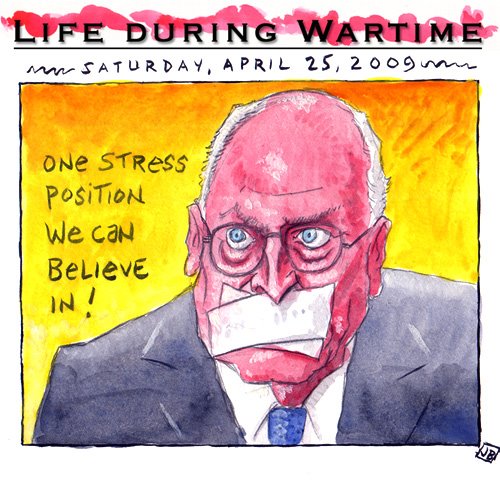
Life During Wartime : Stress We Can Believe In

Political cartoon by Joshua Brown / Historians Against the War / The Rag Blog

The Rag Blog

Posted in Rag Bloggers | Tagged , , | 1 Comment

Foodie Friday: Michael Pollan’s Food Revolution in the Making


A food revolution in the making from Victory Gardens to White House Lawn
By Michael Pollan / April 20, 2009

Last month, First Lady Michelle Obama broke ground for a new vegetable garden on the South lawn of the White House. It’s the first time food will be grown at the President’s residence since Eleanor Roosevelt planted her Victory Garden during World War II. Back then, as part of the war effort, the government rationed many foods and the shortage of labor and transportation fuel made it difficult for farmers to harvest and deliver fruits and vegetables to market. The First Lady’s Victory Garden set an example for the entire nation: they too could produce their own fruits and vegetables. Nearly 20 million Americans answered the call. They planted gardens in backyards, empty lots, and even on city rooftops. Neighbors pooled their resources, planted different types of produce, and formed cooperatives–all in the name of patriotism.

By the time the war ended, home gardeners were producing 40 percent of the United States’ produce. They aided the war effort by creating local food networks that provided much needed produce in their own communities, but their effect on the social fabric of the nation was greater still. Urban and suburban farmers were considered morale boosters who had found a great sense of empowerment through their own dedication to a common cause.

Today, home gardening is on the rise, but most Americans still know very little about where their food comes from, and even less about how the changes in temperature and precipitation associated with global warming may alter national food production. If you break down the fossil fuel consumption of the American economy by sector, agriculture consumes 19 percent of the total, second only to transportation. Unfortunately, there hasn’t been a concentrated effort to mitigate its impact on the climate. If we want to make significant progress in reducing global warming we will need to wean the American food system off its heavy 20th-century diet of fossil fuel and put it back on a diet of contemporary solar energy.

Resolarizing the food economy can support diversified farming and shorten the distance from farm to fork, shrinking the amount of fossil fuel in the American diet. A decentralized food system offers many other significant benefits: Food eaten closer to where it is grown is fresher and requires less processing, making it more nutritious, and whatever may be lost in efficiency by localizing food production is gained in resilience; regional food systems can better withstand all kinds of shocks.

Here are few examples of how we could start:

· Provide grants to towns and cities to build year-round indoor farmers’ markets.

· Make food-safety regulations sensitive to scale and marketplace, so that small producers selling direct off the farm or at a farmers’ market are not regulated as onerously as a multinational food manufacturer.

· Urge The U.S.D.A. to establish a Local Meat-Inspectors Corps to serve and support the local food processors that remain.

· Establish a Strategic Grain Reserve to prevent huge swings in commodity prices.

· Create incentives for hospitals and universities receiving federal funds to buy fresh local produce which would vastly expand regional agriculture and improve the diet of the millions of people these institutions feed.

This isn’t just about government reform. Organizations, businesses, and even individuals like you can help advance these key initiatives and support both the revival of food local food economies and the health of our nation.

Next month the Natural Resources Defense Council will honor individuals who have demonstrated leadership and innovation in the field of sustainable food in its first annual Growing Green Awards. As the Chair of the selection committee, I’m excited to be part of this initiative and join NRDC in recognizing the extraordinary contributions this years honorees have made in the areas of ecologically-integrated farming, climate and water stewardship, farmland preservation, and social responsibility. The Growing Green Awards is an opportunity to highlight the contribution individuals can make in creating a more sustainable future through better food production practices that improve the health of people and the planet.

Read the rest at the Source / OnEarth

Many thanks to Janet Gilles / The Rag Blog

Posted in RagBlog | Tagged , , , | 1 Comment

If the World Stopped Burning Coal, This Would Be 80% of the Solution to Climate Change

Paul Nolley, sophomore English and political psychology major, admires Beehive Designs artwork. Media Credit: Martha Warfel / Daily Vidette Photographer.

Beehive Design Collective share stories of activists
By Sam Schild / April 24, 2009

“Clean Coal Dirty Lie” is a sign held by a depiction of a bee, meant to represent an Appalachian person, in the Beehive Design Collective’s newest collage drawing project: “The True Cost of Coal: Mountaintop Removal and the Fight For Our Future.”

There was much happening on the quad in celebration of Earth day on Wednesday. But somewhere off the quad, the distant sound of bees could be heard. A buzzing could be heard all over campus coming from the activity room of the Bowling and Billiards Center.

While there were not actually any bees in the Bowling and Billiards center, the Beehive Design Collective were creating quite the buzz. With original activist artwork and a presentation related to their newest project, the Bees brought social and environmental activism in the form of giant mural collages.

The Beehive Collective is a group of traveling artists and activists. They go from location to location spreading the messages behind their “anti-copyright” images. This group of 16 Bees work collectively, “as horizontal and non hierarchically as possible,” Tyler Bee said while giving a brief introduction about the Beehive Collective organization.

The Beehive Collective is a not for profit organization. Their collages tell stories that can serve as “an activist’s cheat sheet,” Tyler Bee said.

They take their artwork all over to tell their stories. They take the collages to organic fairs, protests, schools and many other locations, spreading the messages behind each meticulously created collage. Normally, there would be a whole swarm of “bees” with Tyler at an event like the one in the BBC, but for this particular presentation he was alone.

Based out of Machias, Maine, The Beehive Collective spends months, or more often years, creating gigantic murals of our smaller drawings.

“[We] collage and quilt smaller drawings together,” Tyler Bee said. “All the little stories, little projects, little communities all do their parts to create this bigger picture,” Tyler Bee continued, “[We try to] make sense of smaller stories to make a larger narrative.” This is how the Bees’ artwork relates to the world, on a theoretical level.

But, the Bees’ artwork relates to the world on a literal level as well. Past Beehive Collective collages deal with important topics such as globalization, corporate colonization and human rights, to name a few. And with their latest piece, environmental justice can be added to the list of important issues the Beehive collective’s artwork deals with.

In the collages there are no humans depicted, the only living beings in the Bees’ artwork are plants and animals. The Bees use different animals to represent people. They ask groups of people which animal they identify most with, and then use that animal in their drawings to stand in for those people.

“[This way we] avoid really stupid stereotypes of people,” Tyler Bee said, and also this is to serve as a reminder that humans are animals as well.

“The True Cost of Coal” is still unfinished, but even in its work-in-progress form it still struck awe into audience members.

“[The piece is] Really, really cool” Kyle Riley, a freshman history major, said.

The Bees’ latest project and the object of Wednesday’s presentation contained an extraordinary amount of detail. The approximately 5 foot by 12 foot canvas the piece was printed on contained countless individual scenes which each had its own little story.

Each of these scenes was interwoven and flowed seamlessly into the next scene. This makes it so one could find themselves looking at the other end of the collage just after starting to look at the fir end.

“It’s refreshing to get some insight on this issue,” Paul Nolley, a sophomore political science major, said.

Tyler Bee demonstrated how a piece of Beehive Collective artwork can serve as an “activist’s cheat sheet” with the presentation he gave. He told the story of America and its relation to coal.

The collage is separated into five sections, and when it is folded so that only the outside two sections are showing, there is a pleasant picture of the world before coal burning began. Then, the picture “opens up to show how mountain top removal mining rips the environment apart.”

Mountain top removal mining is the modern “mechanized” method of mining coal.

“If the mountain is a layer cake, the coal is the frosting in between layers,” Tyler said.

The mountain is blown up and the coal is scooped out by a machine called a dragline. After each layer of coal is removed, the next layer of rock is blown up and dumped into the valleys in between the mountains.

“There are [at least] 500 mountains no longer in existence [in Appalachia because of mountain top removal mining]” Tyler Bee said.

Mountain top removal mining reduces the amount of manpower needed. Approximately 200 miners are needed using traditional, less environmentally damaging deep mining techniques. But with mountain top removal mining, only 12 people are needed to do the work that previously would have taken 200. Therefore, Tyler Bee said, when coal companies say “coal means jobs for America,” it is a lie.

Mountain top removal is only the tip of the iceberg when it comes to discussing the true cost of coal. Burning coal is just as environmentally degrading, if not more.

“If the world stopped burning coal, this would be 80 percent of the solution to climate change,” Tyler Bee said.

Source / Daily Vidette at Illinois State University

The Rag Blog

Posted in RagBlog | Tagged , , , | 1 Comment

The Radical Right: Alive, Well, and Wanting to March on Washington in Protest … of Something

Ohio Militia Calls for Armed March on Washington
By David Holthouse / April 24, 2009

The self-identified leader of the Ohio Militia, a conspiracy-minded “Patriot” group, released a video [above] earlier this week calling for 1 million heavily armed antigovernment demonstrators to march on Washington, D.C., this coming July 4.

“We need to do something,” he said. “We need to make a dent.”

Identifying himself as “Pale Horse,” apparently a reference to the Four Horsemen of the Apocalypse, and speaking through a creepy voice distorter, the Ohio militiaman detailed his brazen vision: “A peaceful demonstration of at least a million — hey, if we can get 10 million, even better — but at least one million armed militia men marching on Washington. A peaceful demonstration. No shooting, no one gets hurt. Just a demonstration. The only difference from any typical demonstration is we will all be armed.”

The Ohio Militia website contains apocalyptic language and imagery, along with references to various 9/11 and “North American Union” conspiracy theories. Videos show men said to be Ohio Militia members engaged in small-unit, live-fire combat training. One video is titled “America’s Wake Up Call: Buy Guns.” A different video slideshow depicts assault weapons, mushroom clouds, George Bush, Satan, Osama bin Laden and lots of men in camouflage on maneuvers. It’s set to “Goofy’s Concern,” a song by Butthole Surfers, a psychedelic rock band from Austin, Texas, that includes these lyrics: “I don’t give a fuck about the FBI! I don’t give a fuck about the CIA! I don’t give a fuck about LSD! I don’t give a fuck about anything!”

That video concludes with a message to the Michigan Militia, one of the largest and oldest militia groups in the country: “Thanks for letting us train at Camp Stasa with you guys.”

It isn’t clear that the Ohio Militia is capable of bringing a busload of protesters to Washington, let alone a million or more. But Pale Horse’s call for a gathering of gun-toting militia forces in the nation’s capital brings to mind a similar infamous call to arms issued in 1994 by Patriot movement attorney, filmmaker and conspiracy theorist Linda Thompson. Thompson — who once told the editor of this blog about being personally and repeatedly followed by black helicopters, shot at by mysterious attackers, and having a beloved dog zapped by a secret government ray gun — was probably best known for producing the pseudo-documentary “Waco: The Big Lie,” which alleged a government mass murder in the 1993 standoff in Texas. Although the video was widely circulated, its claims were soon debunked.

Proclaiming herself “Acting Adjutant General” of the “Unorganized Militia of the United States,” Thompson announced that her armed march would take place on Sept. 19, 1994. She said her unorganized army would demand the repeal of the North American Free Trade Agreement and the Brady Bill, a gun control measure. U.S. senators and congressmen who refused to accede would be arrested, tried for treason and, if necessary, executed by firing squad or hanging, she said.

Thompson’s plan was almost universally denounced by right-wing groups, including most of the militias that were then appearing all over the country, who accused her of attempting to lead them on a suicide mission. Many in the movement suspected that Thompson was an agent provocateur working for the government.

Response to Pale Horse’s suggestion for a more “peaceful” display of force remains to be seen.

Source / Southern Poverty Law Center

Thanks to Diane Stirling-Stevens / The Rag Blog

Posted in RagBlog | Tagged , , | Leave a comment

Hey Naomi Klein : You and What Movement?

Barack Obama, community organizer.

You and What Movement?
A Response to Naomi Klein

Revealing a bizarre contempt and college-educated condescension toward a vast multi-racial swathe of progressive supporters and sympathizers of Obama and his movement, Klein seeks to explain us away as dupes.

By Al Giordano

[The following opinion piece by Al Giordano, who is a community organizer now living in Mexico, was written in response to an article by Naomi Klein, originally published in The Nation and posted on April 17, 2009, by The Rag Blog under the title of “Naomi Klein : Hopebroken and Hopesick.” Giordano published his response on April 18 in the Narco News Bulletin. We think he makes some very good points and suggest that progressives disillusioned with Barack Obama’s presidency so far might benefit from Giordano’s perspective.]

Naomi Klein is suffering, along with some other sectors of the academic North American left, an existential crisis.

In a recent column she published in The Nation and in The Huffington Post [and also posted on The Rag Blog], she complained about “the awkward in-between space in which many US progressive movements find themselves” now that Barack Obama is president of the United States.

Revealing a bizarre contempt and college-educated condescension toward a vast multi-racial swathe of progressive supporters and sympathizers of Obama and his movement, Klein seeks to explain us away as dupes. We (I use the first person plural proudly and without hesitation) are, according to Klein, part of a “superfan culture,” that, she says, believes we can “save the world if we all just hope really hard,” and that suffers from the following psychological ailments: “Hopeover… hoper coaster… hope fiend… hopebreak… and hopelash.”

Her theory, that progressive Obama supporters are now inflicted by buyer’s remorse, flies contrary to all objective measurement. The pollster.com aggregate of all recent public opinion surveys finds that 61.8 percent of Americans view Obama (less than 100 days into his presidency) favorably, compared to 32.9 percent that view him unfavorably. As Gallup notes, President Obama’s first-quarter average favorability of 63 percent exceeds that of the first three months of his eight immediate predecessors: Presidents Bush II, Clinton, Bush 1, Reagan, Carter, Ford, Nixon or Johnson.

Ah, but Klein is talking about “progressives,” so let’s take a look at the hard data that is available. Separate out the crosstabs, and those numbers are even sky higher among progressive demographic groups. Among Democrats, according to an early April Pew survey, 88 percent view the young president favorably, so it’s not really clear who Klein is talking about, imagining or inventing out of thin air when she devotes an entire column to claim a non-existent demographic trend.

Among African-Americans (without which there can be no successful “progressive movement” in the United States), a towering 94 percent approve of how the president is doing his job, according to the Quinnipiac survey. Among Hispanic Americans (just as important to any progressive future in the US), 73 percent feel the same way. Among Americans that earn less than $50,000 a year (the working class and the poor), a solid 60 percent approve. The question must be asked: What “movement” does Klein thus imagine? An exclusively white and college educated one? I fear that the truth may not be far from it if she is so quick to insult and dismiss such a large bloc of people who skew non-white, poor and working class.

There is currently no quicker way for white progressives to further divide themselves from African-American, Hispanic-American, working class and poor Americans – all sectors without which serious and successful progressive movements in the US would be impossible – than to invent derogatory psychobabble terms for us because we do not share Klein’s tendencies to feel somehow demoralized by the country’s first African-American head of state, and demonstrably its most progressive since Franklin Delano Roosevelt.

That such complaint comes after less than 100 days, when the President has just eased the Cuba embargo that was foolishly embraced by Kennedy, Johnson, Nixon, Ford, Carter, Reagan, Bush I, Clinton and Bush II, is nothing less than pathetic. In the same week, Obama made the classified torture memos public (and as any working journalist or investigator knows, every department of his administration now responds quickly – usually overnight – to our Freedom of Information Act requests for information; a sea change from all previous administrations). The passage of Obama’s economic Stimulus bill marked the single largest expenditure ever on jobs and social programs like unemployment insurance, Medicaid and public education in the history of any country. He has already made the orderly withdrawal of US combat troops from Iraq official policy with a timeline that has most of it done before the 2010 midterm elections. And in three short months, Obama has restored the principle of progressive taxation to the United States.

Yesterday, at the Summit of the Americas in Trinidad, the US president extended a long overdue hand of friendship to his Venezuelan counterpart, a democratically elected leader that suffered an attempted military coup d’etat that was cheered, if not planned, by Washington. The President, in short time, has already defused an entire string of similar policy time bombs left by previous administrations (Republican and Democratic alike). Will there be more tensions between Chávez and the US? Very likely the answer is yes, but the gravity and context of them has shifted positively. This hemisphere is already a safer place for dissident journalists, community organizers, governments of the left and other grassroots change agents. That, alone, makes it more possible for us to organize and make bigger and better changes – of the kind for which we do not need any government’s permission – in the days and years ahead.

I quite agree with Klein’s belief that “demanding” is better than “hoping” when it comes to changing public policy. But where I get off her bus is upon her inference that we who are supportive of – and more happy than not about – Obama’s presidency somehow believe differently. Her claim only demonstrates her gross ignorance toward the important sector of the left (including parts of the Obama movement) that are community organizers. “Demanding” is necessary but without “organizing” to back it up it is merely an act of intellectual masturbation. It accomplishes nothing. It never has won a single battle. And that’s why, until 2008, the US left in particular – so busy demanding without doing the hard work of organizing – went through at least three “lost decades.”

The problem with too much of the “activist left” in North America is that so many of its adherents don’t really want to do the hard work of community organizing. I wonder: when was the last time that Klein went door-to-door, or staffed a phone bank, or otherwise reached out directly to real people demographically different from her? Any journalist or writer that hasn’t, at minimum, accompanied organizers doing that real work of change should shut the fuck up when it comes to opining about “the people.” They don’t have a clue as to who “the people” are. Activism that doesn’t involve one or more of those tasks does not rise to the level or effectiveness of organizing. And those that don’t do it really have no idea where the public is at: the masses (or “the multitude” in current jargon) are imaginary cartoon characters to these people. Their view of us is as elitist as it is condescending.

They can complain about, for example, US policy toward Israel and Palestine, seemingly oblivious to how US public opinion on the matter keeps those very bad policies in place. If they got off their duffs and knocked on doors to ask real people about it, they’d get a lesson in civics, and perhaps learn better ways to move public opinion in a better direction. They can bemoan the “bailouts” (essentially government loans to financial services industries) ignorant of the fact that when big corporations fall they land hardest on the workers and the poor, as would a 1929-level crash of the kind that nearly occurred last October. They can demand “nationalization” of the banks, without offering any detail as to what that would look like. I live in Mexico where the 1982 bank nationalization proved disastrous for the country’s workers, and helped destroy its middle class. The devil is always in the details.

I am not a member of the Democratic Party, and I did not vote for twelve years prior to 2008 until Obama’s candidacy gave me a reason to do so. While the academic North American left went jet-hopping from summit protest to social forum across the globe, I went to Latin America, lived, worked and reported alongside the authentic social movements that many of them came to visit for a weekend or maybe a month. I’m more comfortable with an anarcho-syndicalist view of the kind of society that I daily work toward than I am with electoral politics. Socialist, although it’s a moniker that seems a bit statist and conservative for me, is still a term that I’m more comfortable with than “Democrat.” And yet every day I see the President moving the United States closer to my own version of utopia, after a lifetime of watching each of his predecessors pull it farther away. More importantly, for me, as a journalist and an organizer, the Obama presidency has created much more space for people like us to get out there and do this hard work without the repression and marginalization that we have struggled under for decades.

Here’s what the academic left – hopping mad, frustrated and now, like Klein, lashing out at those of us in the working left – doesn’t get: It was Obama – not Klein’s post-Seattle ’99 milieu of “anti-globalization activists” – who opened the doors of the American left for the first time since the Civil Rights movement of the ‘50s and ‘60s to the building of an authentically multi-racial movement. It was Obama – not Klein and her colleagues – that got working class whites struggling alongside working class blacks and Hispanics in the United States, and who turned a new generation onto the art of community organizing that the activist left had abandoned.

When colleagues like Klein so summarily insult Obama supporters and sympathizers, they are driving yet another stake between their white college-educated ghetto and the 94 percent of African-Americans, and the 73 percent of Hispanic Americans, and the 60 percent of the entire American working class, that is pleased, as I am, that this unique historic figure is, for the next four years at least, the President of the United States.

I’m reminded of the scene from the Martin Scorcese motion picture, The Aviator, in which Kathryn Hepburn (Cate Blanchette) brings Howard Hughes (Leonardo DiCaprio) home to meet her family. “We’re socialists,” the mother tells Hughes. And then, when she thinks Hughes is speaking ill of President Franklin Roosevelt, she nearly runs him out of the house. FDR, like Obama, wasn’t a socialist (and unlike Obama, he was born into privilege). But a great many socialists, communists and even anarchists of the era understood that their work was made so much more possible by his presidency. And that cultivated an intense synergy, not to mention a renaissance of labor and community organizing during that epoch. In retrospect, that synergy between the working left and the FDR presidency brought with it many of the 20th century’s most progressive advances.

The same is happening now – although Klein and others haven’t done the investigative or organizing spadework to recognize it – and that (even without the many progressive policies enacted by the Obama administration already, and those important ones like immigration reform yet to come) makes me an unabashed, eyes wide open, Obama sympathizer, guilt-free, without any of the feelings of remorse Klein seeks to assign to me and millions like me. That enthusiasm hasn’t turned us into blind followers: these pages are already filled with hard-hitting critiques when the Obama administration has been wrong; on Plan Mexico, on the drug war, and other deadly serious matters. And yet even on those fronts, our ability to push back and serve as a check and a break on the extremities of those bad policies vastly outweighs what we were able to do for many previous decades.

But I’m not going to sit back silently while some white progressives – dripping with the nastiest forms of envy because, truth be told, the Obama movement succeeded at resurrecting community organizing and multi-racial struggle whereas their tired tactics and strategies had failed again and again to do so – try to claim to me or anyone else that they’re the ones doing the demanding while we’re somehow sitting back and thinking we can “save the world if we just hope really hard.”

Memo to Ms. Klein: Go back to the only school that ever got the left – in which I take no back seat to you in either mileage or scar tissue – anywhere: that of community organizing. We’re doing it. You’re not. And when you go to give your next speech at some university or activist hall, look around at the white, privileged faces that occupy more than half those seats. Study how many of them choose to self-marginalize from workers or racial minorities with their freak-show narcissistic – and yet humorless! – antics. You know what I’m talkin’ about. And you probably wince regularly as they ask you to sign your book for them.

Ask yourself, “are these the so-called masses that are going to make a progressive movement succeed?” You know damn well, in your heart, that they’re not. They do buy hardcover books though, a lot more than the workers and the poor ever will. With all due respect I must ask: Have you become an intellectual prisoner of what you think it takes to pander to your own college-educated consumers?

No thank you, Ms. Klein: When it comes to the United States, I’ll take my chances with the multi-racial community organizers of the Obama movement, and the tens of thousands of young organizers they’ve inspired and trained, at least until the non-electoral North American left gets its shit together, which, after reading a column like yours, seems still a long and far away struggle.

Source / The Narco News Bulletin

Thanks to Larry Piltz / The Rag Blog

Posted in RagBlog | Tagged , , , | 11 Comments

Steve Weissman : How Should We Respond to Ahmadinejad

Ultra-conservative Rabbi Moishe Arye Friedman, left, shakes hands with Iranian President Mahmoud Ahmadinejad, during international conference questioning the existence of the holocaust in Tehran, Dec. 12, 2006. Photo by AP.

Using the word ‘pretext’ to describe Jewish suffering during World War II recalled the views of Holocaust deniers like Robert Faurison, Ahmed Rami, and Frederick Töben who went to Tehran in Decemeber 2006 for Ahmadinejad’s ‘International Conference to Review the Global Vision of the Holocaust.’

By Steve Weissman / The Rag Blog / April 24, 2009

In his April 20th speech to the conference on racism sponsored by the U.N. High Commission on Human Rights, Iranian President Mahmoud Ahmadinejad raised many valid criticisms of Western imperialism and the war in Iraq. But what he said about the founding of Israel compacted history in some very strange ways, echoing his earlier flirtation with those who deny the Nazi holocaust. As a secular Jew who rejected Zionism over 40 years ago, I found his remarks silly, misleading, and offensive. As an activist who has consistently struggled against both racism and imperialism, I found it self-defeating for anyone to take Ahmadinejad as our spokesman.

His strangely compacted history boiled down to this: that “a number of powerful countries … resorted to military aggression” to make the Palestinian people homeless. And that they did it “on the pretext of Jewish sufferings and in misusing the Holocaust.”

Using the word “pretext” to describe Jewish suffering during World War II recalled the views of Holocaust deniers like Robert Faurison, Ahmed Rami, and Frederick Töben who went to Tehran in Decemeber 2006 for Ahmadinejad’s “International Conference to Review the Global Vision of the Holocaust.” Iranian officials insisted that the conference sought “neither to deny nor prove the Holocaust … [but] to provide an appropriate scientific atmosphere for scholars to offer their opinions in freedom about a historical issue.” But that’s the same disingenuous dodge that Holocaust deniers have used ever since they started their rehabilitation of the Third Reich.

Simply stated, there is absolutely no doubt that the Nazis tried their hardest to systematically exterminate Jews — as well as gays and Gypsies. To deny this is nothing short of immoral and idiotic. It also undercuts our ability to fight against racism and for a Palestinian state. Get “pretext” and Holocaust denial out of the way and there’s no question that Zionists used the reality of Jewish suffering to win support for the State of Israel, just as we now use the reality of Palestinian suffering to build support for a Palestinian state.

Ahmadinejad’s compacted history similarly denies the historic reality of political Zionism. The powerful countries on the U.N. Security Council did not create the Zionist movement. European Jews, mostly non-religious, did, and they had to fight the Great Powers to do it. Where in Ahmadinejad’s simplistic anti-imperialist narrative is the very real nationalist movement that had to smuggle weapons and Jewish refugees into Palestine against the best efforts of the British Navy? Where are the attacks by Jewish “terrorists” against British troops? And where are all those Jewish communities that have lived continuously in Palestine for over 2500 years?

None of this, in my view, ever justified dispossessing the Palestinians, a large number of whom were themselves undoubtedly descendants of the ancient Israelites. But to deny the Jewish story in Palestine, as Ahmadinejad does, is silly. Worse, it lays the groundwork to deny the humanity of the Israelis for whom all this history remains very real.

Where Ahmadenijad is undoubtedly right is his contention that the unfairly constituted U.N. Security Council confirmed the creation of the Jewish state. But where does that leave those of us who are anti-imperialist? If we follow Ahmadinejad’s logic, as many in Hamas now do, we must fight to undo over 60 years of history, and that will be a fight to the death. The call to eliminate the State of Israel, while not explicitly a call to kill Israelis or other Jews, will sound to them as an incitement to genocide, and they will fight it without mercy. Tens of thousands of people, both Israeli and Palestinian, will die. And, in the end, who will win? I would not bet on the Palestinians. It’s certainly not fair, but the best I would hope for is a two-state solution, and that will be a difficult enough.

One final question: Should we join Ahmadinejad in calling the Israelis “racist perpetrators of genocide?” I would not. The long-standing Israeli policy of seeking “more land and fewer Arabs” is horrendous. But it is not genocide, at least not until Avigdor Lieberman has his way. And it is not essentially racial, but increasingly religious, denying people first-class citizenship because they do not share the dominant faith or identity. To me, that is every bit as pernicious as racism, whether in Israel or any number of Islamic countries.

[A veteran of the Berkeley Free Speech Movement and the New Left monthly Ramparts, Steve Weissman lived for many years in London, working as a magazine writer and television producer. He now lives and works in France, where he writes regularly for The Rag Blog.]

Please see:

Also see:

The Rag Blog

Posted in RagBlog | Tagged , , , , , , | 1 Comment

Bob Simmons on Austin’s Jack Jackson : History’s Cartoonist

Jack Jackson. Painting by Scout Stormcloud / The Rag Blog.

Jackson left a large body of work behind that will assure that people will be reading and looking at his handiwork for as long as we have a world that cares about history, Native Americans, Texas, Mexico, or flights of graphic fantasy.

By Bob Simmons / The Rag Blog / April 24, 2009

See ‘Jaxon, Drawn to the Task,’ Video by Bob Simmons, Below.

Jack Jackson, aka “Jaxon,” the famous Austin underground cartoonist and historian died back in August of 2006 by his own hand. He had been diagnosed some months earlier with cancer and some other nasty conditions to go with it. As for taking his own life, he might have decided that going through a prolonged battle to preserve what would be a tedious, at best, old age wasn’t worth the trouble or expense. I would not presume to second-guess Jack on this issue. It is something each of us may have to deal with in our own good time.

The obituaries rolled in. Much tribute was paid, and more importantly, many true tears were shed. Jack had made a lot of friends over the years. If we lived in a fair and just world, then Jack should have left a valuable estate behind, for he was an enormously talented and hard-working artist, but he was never paid anything close to what he was worth. Call it the luck of the draw, combined with the fact that Jack was not one to compromise. He had a vision, and he was true to it. He worked alone in rooms, late at night, guided only by a sense of trying to honor some of history’s semi-forgotten underdogs like Juan Seguin, Quanah Parker, and the countless nameless native Americans who died in the North American holocaust, our own ethnic cleansing of the West.

One can go to many sites, starting with Wikipedia for the full bibliography of his works. [Also see Jack Jackson on the Rag Author’s Page.] Suffice to say, he left a large body of work behind that will assure that people will be reading and looking at his handiwork for as long as we have a world that cares about history, Native Americans, Texas, Mexico, or flights of graphic fantasy.

In 2008, the Texas State Historical Association held its annual meeting in Corpus Christi, TX, and I had the opportunity to speak about Jack, since we had been housemates and had both worked with Chet Helms and the Avalon Ballroom in San Francisco during the hippie heyday of the 1960’s. We had also both worked together on the Texas Ranger humor magazine in the early 60’s and had walked other similar paths. I prepared a little video presentation for the gathered historians, so that they would know him better.

The room was full of academics and historians. Their interest in Jack was that he had come from such an unusual background, and was a classic autodidact or self-taught historian. My job was to show something of the ‘other’ world from which he had sprung.

Of course I couldn’t get the video projector to work, so I got to talk about Jack for the assembled group. I managed to get through the event without notes, but who knows what I said, or if it was worth anyone’s time. So, now, after a lot of messing with various YouTube and Vimeo nonsense, I have managed to get the short video I prepared up on the Net.

I want to share it with you, because everyone should know more about Jaxon, a real artist and hero of his time.

The interview footage comes from Scott Conn’s “A Dirt Road to Psychedelia” and from an interview I did with Jack shortly before he died. Most of the artwork can be found in the Jaxon Collection at the Barker Texas History Museum at The University of Texas’ Center for American History under the care of our friend John Wheat. I’ll take credit for most of the still photos, along with Bill Helmer, Burton Wilson, and a couple stills stolen off the web…call it ‘fair use’.

Jaxon – drawn to the task from Telebob on Vimeo.

The Rag Blog

Posted in Rag Bloggers | Tagged , , , , , , , | Leave a comment

Afghanistan’s Bagram Prison : ‘Worse than Gitmo’

Detainees being held at Bagram Air Base in Afghanistan cannot use US courts to challenge their detention, the US says. Photo by Musadeq Sadeq / AP.

‘Worse than Gitmo’:
ACLU Asks for Documents on Bagram Prison, Where the US Still Holds 600 Prisoners

The Obama administration argues that the prisoners at Bagram—some who have been there 6 years—do not have habeas corpus rights. That’s not looking backwards. It is current policy.

By Jeremy Scahill / April 23, 2009

As the Obama administration faces mounting pressure to appoint an independent special prosecutor to investigate torture and other crimes ordered by senior Bush administration officials and implemented by CIA operatives and contractors, the ACLU is opening up another front in the battle for transparency. But this one is not exclusively aimed at the Bush era. Today, the ACLU filed a Freedom of Information Act request seeking to make public records on the US-run prison at Bagram Airfield in Afghanistan. The group is seeking documents from the Departments of Defense, Justice and State and the CIA.

As the ACLU states, “the U.S. government is detaining more than 600 individuals at Bagram, including not only Afghan citizens captured in Afghanistan but also an unknown number of foreign nationals captured thousands of miles from Afghanistan and brought to Bagram. Some of these prisoners have been detained for as long as six years without access to counsel, and only recently have been permitted any contact with their families. At least two Bagram prisoners have died while in U.S. custody, and Army investigators concluded that the deaths were homicides.”

The Obama administration has refused to grant habeas corpus rights to prisoners at Bagram, but a federal judge recently ruled that three prisoners can challenge their detention in U.S. courts. The Obama administration, in continuing a Bush-era policy, is appealing the ruling. According to the ACLU, “The prisoners, who were captured outside of Afghanistan and are not Afghan citizens, have been held there for more than six years without charge or access to counsel:”

“The U.S. government’s detention of hundreds of prisoners at Bagram has been shrouded in complete secrecy. Bagram houses far more prisoners than Guantánamo, in reportedly worse conditions and with an even less meaningful process for challenging their detention, yet very little information about the Bagram facility or the prisoners held there has been made public,” said Melissa Goodman, staff attorney with the ACLU National Security Project. “Without transparency, we can’t be sure that we’re doing the right thing – or even holding the right people – at Bagram.”

This is a very important case to monitor, particularly because it is an area where Obama’s administration has allied itself squarely with that of the Bush administration. This is not “looking backwards” at all, it is looking at the present and it aint Dick Cheney and Donald Rumsfeld running this sick, unconstitutional show.

Source / RebelReports

Thanks to S.M. Wilhelm / The Rag Blog

Posted in RagBlog | Tagged , , , , | 1 Comment

Democracy’s Turn : Bankers of the World, Untie!

“Can’t Anyone Untie Us?” by Francisco de Goya.

When we voted for change last November we weren’t talking about pennies on the dollar. Bankers of the world, untie!

By Greg Moses / The Rag Blog / April 24, 2009

It wasn’t the housing bubble exactly. It was more the way the bubble was blown.

In the official language of the International Monetary Fund report for April 2009, “the crisis was largely caused by weak risk management in large institutions at the core of the global financial system combined with failures in financial regulation and supervision.”

After “the crisis” was caused, the weak risk managers along with their failed regulators and supervisors came back to loot the national debt.

In essence, the mortgage of the American Worker has been preyed upon to inflate the wealth and power of financiers. Twice.

From the IMF point of view, more debt looting or “fiscal adjustment” will be necessary to keep the world economy from worse channels of trouble. And so long as the money makes genuine entry into the credit system at lenient rates (if not terms), then it seems like sensible advice. I believe the IMF when it claims that worse trouble is possible.

Says the IMF: “Key transmission routes [of worse trouble] include deep corrections in national housing markets, especially but not exclusively in advanced economies; corporate stress, especially but not exclusively in emerging economies; deflation risks, mainly in advanced economies; and increasing vulnerabilities in public sector balance sheets, especially but not only in emerging economies.”

Sure as sewage runs downhill, downside risks remain.

And yet, behaving like crash victims who climb from wrecks and run around for awhile, whole classes of boosters may be seen doing double flips of joy because they think they feel the world bouncing off its bottom.

There are many gloomy charts in the IMF report on the global economy, but the one that chills me most shows how each economic region of the globe is expected to contribute to the world recovery that (we hope) will begin later this year.

When it comes to the crucial turning point for that recovery, the US is the only portion of the global economy that completely disappears from the bar graph. The US will make zero contribution to global growth in the 4th quarter of 2009, then a bit of a negative contribution in the 1st quarter of 2010, before slacking to zero again in the 2nd quarter of 2010.

As for “other advanced countries,” you will find them colored in dark blue below the line of recovery, indicating that they will be worse than no help. Above the line of positive Purchasing Power Parity, all the heaving lifting at the beginning of the second decade of the 21st Century will be upon the shoulders of China and the “rest of the world.”

This, my friends, is how you win a cold war without knowing the least reason why.

Along with my favorite storm watcher these days, Larry Kudlow, I also have faith that democracy and capital will figure out how to keep each other alive through this deluge, but I disagree with his forecast model.

For the past several decades capital has taken advantage of weakened democracy in the US. It is now time for democracy to return the favor. As US capital returns from subzero on the IMF recovery scale, democracy has to insist on new parameters.

If the Chinese can lead global growth in 2010, what happens to the claim that big governments must be incapable?

Therefore, health care coverage for all people, cap and trade for all creatures, a path to citizenship for every neighbor in the neighborhood, and a genuine national youth program, all of these things will elevate the US to a place we should have been 30 years ago.

When we voted for change last November we weren’t talking about pennies on the dollar. Bankers of the world, untie!

[Greg Moses is editor of TexasWorker.Org. He can be reached at gmosesx@gmail.com.]

The Rag Blog

Posted in Rag Bloggers | Tagged , , , | Leave a comment

Medical Professionals ‘Led the Way’ : The Psychologists of Torture

Licensed psychologist and Army Col. Larry James was the director of Guantanamo’s “Behavioral Science Consultation Team,” which oversaw the use of harsh interrogation techniques widely condemned as torture. Photo by Army Spc. Shanita Simmons / from In These Times.

Medical professionals designed and helped to implement Bush administration interrogation practices.

‘The conclusion that these interrogation techniques cause no lasting harm is the equivalent of psychological malpractice,’ says Physicians for Human Rights’ Steven Reisner.

By Frederick Clarkson / April 23, 2009

One of the key, if underreported, findings in Tuesday’s bombshell Senate report on the Bush-era treatment of U.S. military detainees was the role of civilian and military psychologists in devising, directing and overseeing the torture of prisoners.

While the report highlights the role of senior Bush administration officials in approving “aggressive” interrogation techniques, it also exposes how medical professionals helped to transform the Pentagon’s torture resistance program into tactics used against prisoners at Guantanamo Bay, Abu Ghraib and CIA “black” sites.

Understanding the role of these professionals should be a “specific focus” of an investigation into the use of these tactics, according to Physicians for Human Rights (PHR), which has condemned the tactics as illegal and medically unethical.

In a series of reports available on its Web site, PHR details the tactics, which it says include beating, sexual and cultural humiliation, forced nakedness, exposure to extreme temperatures, exploitation of phobias, sleep deprivation and sensory deprivation.

The Cambridge, Mass.-based organization, which won a Nobel Peace Prize in 1997, says psychologists “led the way” in legitimizing the Pentagon’s approval and use of the tactics. It has joined the Senate committee in calling on U.S. Attorney General Eric Holder to investigate who should be held accountable.
From Korea to Gitmo

The carefully worded U.S. Senate Armed Services Committee report reveals how the torture tactics developed directly from the military’s Survival, Evasion, Resistance and Escape (SERE) training program, which was designed to help downed American pilots resist torture.

The SERE program was based on interrogation methods used by the Chinese during the Korean War that aimed to elicit false confessions from American prisoners for propaganda purposes. Designed to enhance resistance to torture, the SERE program was reverse-engineered by psychologists working within a joint Army and CIA command to become the Bush administration’s “enhanced interrogation methods.”

Early in the Senate report, we learn that the SERE program’s adaptation began with two senior military psychologists. In December 2001, Dr. James Mitchell, the senior SERE psychologist at the Pentagon’s Joint Personnel Recovery Agency, asked his former colleague Dr. John “Bruce” Jessen to review a recently obtained al Qaeda interrogation resistance training manual.

“The two psychologists reviewed the materials and generated a paper on al Qaeda resistance capabilities and countermeasures to defeat that resistance,” according to this heavily redacted section of the Senate report. Mitchell and Jessen became CIA interrogation consultants the next year.

In April of 2002, Jessen created an “exploitation draft plan” for Guantanamo detainees. According to this plan, Jessen would direct SERE training of interrogators at the “exploitation facility,” which would be “off limits to non-essential personnel.” The Senate report makes several references to changing conditions at GTMO whenever the International Committee of the Red Cross came to visit.

Eventually, Guantanamo became known as a “Battle Lab for new interrogation techniques,” which were then applied at military prisons in Iraq and Afghanistan and at CIA detention centers.

Military and law enforcement professionals repeatedly warned against the application of SERE tactics, but the Senate report shows that their use was urged by top Bush administration figures eager to find information linking Al Qaeda and Iraq. (And it concludes that their use at Guantanamo Bay, authorized by Secretary of Defense Donald Rumsfeld, led to the abuse of detainees there – as well as in Afghanistan and Iraq.)

The Senate report notes that SERE-based interrogation techniques were presented to Guantanamo personnel in September of 2002, despite the objections of instructors from Fort Bragg. In an interview with the Army’s Inspector General, Army psychiatrist Major Charles Burney said “interrogation tactics that rely on physical pressures or torture…do not tend to get you accurate information or reliable information.” According to Burney, instructors repeatedly stressed that harsh interrogations don’t work and that the information gleaned “is strongly likely to be false.”

Nonetheless, the SERE techniques came to be used by members of the newly created “Behavioral Science Consultation Teams” (BSCT), a joint operation of the Army and CIA. The first of those teams worked at Guantanamo.
The role of ‘safety officers’

The Senate report confirms the intimate involvement of health professionals in designing, supervising and implementing the Army and the CIA’s “enhanced” interrogation program. (The Justice Department’s Office of Legal Counsel memos, released April 16, revealed that medical professionals had served as “safety officers” during waterboarding and other interrogation sessions.)

“The monitoring of vital signs and giving instructions to interrogators to start and stop are some of the most severe abuses of the Hippocratic Oath and medical ethics imaginable,” said Nathanial Raymond of PHR. “Strangely, the memos and the statements of former senior Bush Administration officials use the presence of medical professionals in contravention of their professional ethics as a defense, when it is in fact, itself, a crime.”

Tactics used by psychologists and supervised by medical personnel clearly constituted torture and a grave breach of medical and professional ethics, according to both PHR and the International Committee of the Red Cross (ICRC).

In a February 2007 report made public earlier this year, the ICRC states that health professionals who participated in the interrogation process “constituted a gross breach of medical ethics” at times amounting to “participation in torture.”

Steven Reisner, PHR’s advisor on psychological ethics, believes that U.S. psychologists were busy perpetrating torture even before Justice Department lawyers wrote their opinions justifying the interrogation practices.

“These individuals must not only face prosecution for breaking the law,” Reisner says, “they must lose their licenses for shaming their profession’s ethics.”
Debate among psychologists

The role of psychologists in torture became a hot issue within the American Psychological Association in 2005, when the board of the organization of mental health professionals endorsed psychologists’ role in interrogations as consistent with APA ethics, for the purpose of making it safe, legal and effective. But a 2007 resolution of the APA membership proscribed member involvement in a number of interrogation tactics. Then, in 2008, the organization passed a further resolution against members’ presence at any facility where U.S. and international law was being violated, unless they were working for the benefit of the people held.

Prior to the 2008 APA resolution, Guantanamo’s public affairs office published an article in January 2008 describing the Behavioral Science Consultation Team as “integral” to the success of Guantanamo.

In that article, Army Colonel Larry James–a licensed psychologist and the director of Guantanamo’s Behavioral Science Consultation Team–says he feels validated by the APA’s approval (at an August 2007 convention) of psychologists working in military detention facilities.

“It’s clear given the vote at the APA convention that there is overwhelming support for psychologists who wear the uniform all around the world in defense of this nation,” James says.

“During my time here, I am proud to say that I have not seen a guard or interrogator abuse anyone in any shape or form,” he continues. The article reports that James worked with another licensed psychologist, a behavioral science specialist and leaders within the Joint Detention Group and the Joint Intelligence Group.
Push for accountability

Since 2005, however, PHR has been working to hold accountable health professionals it believes were complicit in torture. The APA “has never comprehensively addressed the troubling ethical entanglement of some members of its leadership in the intelligence apparatus,” PHR’s Sara Greenberg wrote Wednesday.

“In January 2005,” Greenberg writes,

the American Psychological Association issued its Report of the Presidential Task Force on Psychological Ethics and National Security, which seeks to legitimize the involvement of psychologists in interrogation; a role that is fundamentally inconsistent with ethical principles and both US and international law. In concluding that psychologists have a central role in interrogations, the Task Force gave short shrift to the ethical and human rights implications of coercive interrogation practices used by U.S. forces that relied on psychological expertise. Nor has the APA sanctioned its members responsible for designing and implementing torture.

PHR contrasts the APA’s flip-flopping with the unequivocal opposition to torture expressed by other leading organizations of health professionals, including the American Medical Association and the American Psychiatric Association.

With the debate over how to hold Bush administration-era officials accountable for alleged torture now at a fever pitch, PHR spokespeople have fanned out in the media, calling for the psychologists who justified, designed and implemented the interrogation programs to lose their professional licenses and face criminal prosecution.

“The conclusion that these interrogation techniques cause no lasting harm is the equivalent of psychological malpractice,” Reisner recently told the Inter Press Service. “How can you compare U.S. soldiers who volunteered for SERE training, and could have stopped their interrogations at any time, with the effects on a prisoner who has been ‘disappeared,’ is in fear for his life, and believes he will never see his family again?”

[Frederick Clarkson is a Massachusetts-based independent journalist. He is the editor, most recently, of Dispatches from the Religious Left: The Future of Faith and Politics in America (Ig Publishing, 2008).]

Source / In These Times

The Rag Blog

Posted in RagBlog | Tagged , , , , | Leave a comment

Newsroom Layoffs : Black Journalists Take Hardest Hits

Controversial sports analyst Stephen A. Smith — once a rising star at ESPN radio and television — is leaving the air because he refused a pay cut.

With all the hair-pulling about the demise of the print media, and especially the reports on the massive city room layoffs, here’s a little factoid that may just be slipping through the cracks. It’s black journalists who are taking the hardest hits, by far. As if the miniscule minority presence on news staffs wasn’t already scandalous enough — now they’re the ones being laid off first.

Thorne Dreyer / The Rag Blog / April 23, 2009

Black journalists are being slashed from newsrooms at alarming and disproportionate rate

April 23, 2009

Newsroom jobs held by Black journalists were cut by an alarming 13.5 percent in 2008, making African-Americans the single most targeted group for job losses in newsrooms across the country according to a study released by ASNE, the American Society of News Editors.

“While NABJ [National Association of Black Journalists] recognizes the current economic downturn, newspapers must stop the bloodletting of Black journalists now,” said NABJ President Barbara Ciara. “It is unconscionable that this industry is willing to jeopardize the accuracy, integrity and bottom line of its publications.”

In all, nearly 400 Black journalists lost their jobs in 2008, representing the largest drop in all minority employment and scaling back progress toward diversity in newsrooms to 1998 census levels.

Furthermore, 458 newspapers still have no minorities in their newsrooms and only 111 out of 633 newspapers surveyed have achieved parity with the minority population in their communities.

“Newsrooms without Black journalists are unacceptable,” Ciara said. “NABJ calls on industry leaders to re-commit to making diversity a priority – even in this difficult climate.”

The decrease in minority representation in newsrooms runs counter to general population trends, which project the United States will become a “majority minority” country by mid-century.

In 1999, ASNE defined as its goal to deliver parity in newsroom representation by 2025. NABJ stands ready to work with ASNE and media companies to reach this goal and promote diversity in the nation’s newsrooms.

“As minority communities grow in number and influence, newspapers must prepare for the future by preserving the jobs of Black journalists and grooming them for the leadership positions of tomorrow,” Ciara said.

“The most innovative and profitable newspapers are those with diverse perspectives and minorities in their upper ranks.”

An advocacy group established in 1975 in Washington, D.C., NABJ is the largest organization of journalists of color in the nation, with more than 4,100 members, and provides educational, career development and support to black journalists worldwide.

Source / Washington Informer

The Rag Blog

Posted in RagBlog | Tagged , , , | Leave a comment