Religious Right Concedes Defeat!

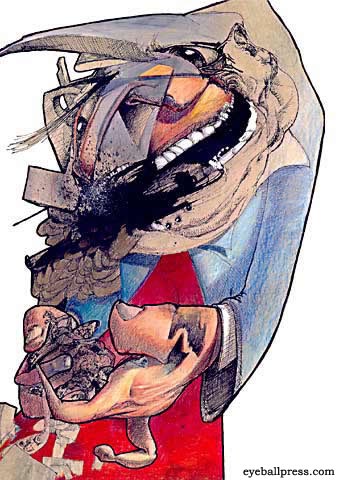
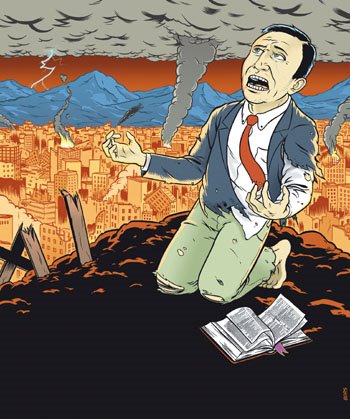
‘Armageddon for the Religious Right.’ Art by Matthew Bors / Orlando Weekly.

America’s religious Right has conceded that the election of US President Barack Obama has sealed its defeat in the cultural war with permissiveness and secularism.

By Alex Spillius / April 10, 2009

WASHINGTON — Leading evangelicals have admitted that their association with George W. Bush has not only hurt the cause of social conservatives but contributed to the failure of the key objectives of their 30-year struggle.

James Dobson, 72, who resigned recently as head of Focus on the Family — one of the largest Christian groups in the country — and once denounced the Harry Potter books as witchcraft, acknowledged the dramatic reverse for the religious Right in a farewell speech to staff.

“We tried to defend the unborn child, the dignity of the family, but it was a holding action,” he said.

“We are awash in evil and the battle is still to be waged. We are right now in the most discouraging period of that long conflict. Humanly speaking, we can say we have lost all those battles.”

Despite changing the political agenda for a generation, and helping push the Republicans to the Right, evangelicals have won only minor victories in limiting the availability of abortion. Meanwhile the number of states permitting civil partnerships between homosexuals is rising, and the campaign to restore prayer to schools after 40 years — a decision that helped create the Moral Majority — has got nowhere.

Though the struggle will go on, the confession of Mr Dobson, who started his ministry from scratch in 1977, came amid growing concern that church attendance in the United States is heading the way of Britain, where no more than ten per cent worship every week.

Unease is rising that a nation founded — in the view of evangelicals — purely as a Christian country will soon, like northern Europe, become “post-Christian”.

Recent surveys have suggested that the American religious landscape has shifted significantly. A study by Trinity College in Connecticut found that 11 per cent fewer Americans identify themselves as Christian than 20 years ago. Those stating no religious affiliation or declaring themselves agnostic has risen from 8.2 per cent in 1990 to 15 per cent in 2008.

Despite a common distaste among evangelicals for the new Democratic president, who is regarded as at best a die-hard, pro-abortion liberal and at worst a Marxist, a serious rift is emerging among social conservatives in the wake of his election victory.

A growing legion of disenchanted grassroots believers does not blame liberal opponents for the decline in faith or the failures of the religious Right. Rather, they hold responsible Republicans — particularly Mr Bush — and groups like Focus on the Family that have worked with the party, for courting Christian voters only to betray promises of pursuing the conservative agenda once in office.

“Conservatives became so obsessed with the political process we have forgotten the gospel,” said Steve Deace, an evangelical radio talk show host in Iowa who broadcast a recording of Mr Dobson’s address, which he said had appeared on Focus on the Family’s website before disappearing.

Mr Deace added: “All that time spent trying to sit at the top table is not time well spent. Republicans say one thing and do another.”

In the southern Bible belt, many like the Rev Joe Morecraft, head of a small Presbyterian church near Atlanta, judge that the Christian movement failed not because its views were unpalatable for moderates and liberals, but because “it was not Christian enough”.

A deserter from the Republican Party, he said Christians had been corrupted by politics and needed to return to the basics of local social work and preaching the gospel, rather than devoting their “energies to getting a few people elected”.

He is not alone in questioning how evangelical leaders such as Mr Dobson could spend a career campaigning against abortion and then eventually support a candidate like Senator John McCain, who has dubious “pro-life” credentials.

Ray Moore, president of Exodus Mandate, a South Carolina-based group which organises home-schooling for Christian children, said: “Political involvement by Christians is not wrong, but that’s all the big groups did for 25 years. They were more concerned with fund-raising and political power than they were with our children’s welfare.”

“It’s a failed movement,” he said. “We will end up like England, where the church has utterly lost its way.”

Michael Spencer, a writer who lives in a Christian community in Kentucky, said the religious Right had suffered from its identification with Mr Bush, the most unpopular president in living memory, and the extremist rhetoric of some on the religious Right.

One of the more notorious outbursts was the Rev John Hagee’s assertion that the deadly Hurricane Katrina in 2005 was God’s judgment on New Orleans for hosting a gay parade.

In an online article in the Christian Science Monitor that has became a touchstone for disaffected conservatives, Mr Spencer forecast a major collapse in evangelical Christianity within ten years.

“Evangelicals have identified their movement with the culture war and political conservatism. This will prove to be a very costly mistake,” he wrote.

Source / Telegraph, U.K.

Thanks to S.M. Wilhelm / The Rag Blog

Posted in RagBlog | Tagged , , , | 1 Comment

Republicans’ New Line : Obama a Dangerous Polarizer

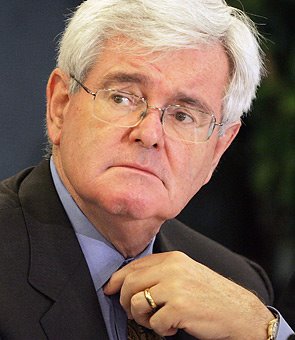
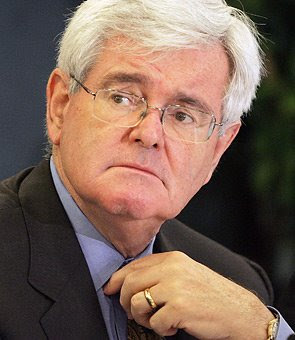
Republicans dig up Newt Gingrich playbook: Turning back the clock.

Now that Obama has been in office over seventy days, the second phase of the strategy has been unveiled as Republicans across the board suggest that he is a divider and polarizer.

By Sherman DeBrosse / The Rag Blog / April 12, 2009

Gingrich tactics now deployed against Obama

Shocked by the results of the 2008 election, Republicans went back to the Newt Gingrich playbook for tactics to put them back in power. Newt again became a major Republican guru, as the party recommitted itself to obstructionism. Despite the crises the nation faced, it dedicated itself to trying to block Obama’s recovery efforts. Rush Limbaugh offended some GOP friends by giving away the central GOP game when he frankly said he hoped the new president failed. The tactic was to work to prevent success while briefly saying nice things about President Barack Obama.

Now that Obama has been in office over seventy days, the second phase of the strategy has been unveiled as Republicans across the board suggest that he is a divider and polarizer. Paint him as a dangerous radical. There is no need to offer details.

This is very similar to the treatment Bill Clinton received. Though he was a thorough-going centrist, Republicans launched a concerted efforts to delegitimize him. Both Clinton and Obama were denied honeymoons because their views were radical.

In Clinton’s case, Republicans spawned the “Arkansas Project “to dig up dirt on Whitewater, which led to a new investigation. A sickly partisan judicial panel removing a fair investigator in order to facilitate a fiercely partisan probe. We might also recall that early in the Clinton years, it was revealed that many Republican columnists actually coordinate their columns and talking points. Today, it is obvious that this remains their modus opperendi.

This time Glenn Beck, Sean Hannity and Rush Limbaugh rant on about socialism, communism and nationalization. Rep. Michele Bachmann of Minnesota laments that there may be no rich people in America as a result of Obama’s policies. Glenn Beck is even frothing about goose-stepping Nazis, black helicopters, and detention centers, forgetting that potentially dangerous FEMA policies and the alleged detention centers were results of the policies of Ollie North, Ronald Reagan, Dick Cheney and George W. Bush.

At the other end of the GOP information spectrum so-called moderates make the same case without all the wild language. Republican columnist Michael Gerson writes that Barack Obama is the “most polarizing new president.” David Brooks, another writer who has credentials as a reasonable Republican, seems close to this position. Neither, has been able to make a case for such a claim, but Gerson performs some rather astonishing mental gymnastics to support his contention. Ever so briefly, Gerson, Brooks and Katherine Parker seemed a bit off the Republican reservation as they suggested that Sarah Palin might not be the best candidate in 2012 and argued that the party should be something other than the Party of No and Obstructionism. Now they are safely back on the reservation and reading off of the official script.

The vagueness of the GOP charges examined

Several weeks ago, E.J. Dionne questioned these vague charges against Obama and the claim that he was a radical. My guess is that what bothered the GOP most was that the stimulus plan contained many provisions to strengthen the safety net for the poor. As recently as three months ago, there were fewer people on welfare than a quarter of a century ago. That is a measure of how much damage the welfare reform of 1996 had done to the poor, marginalized and helpless. Obama was temporarily reversing this supreme Republican accomplishment, and they were infuriated.

It is also likely that they are bothered that there is a danger of enacting a universal health care plan that would take care of all Americans. Bill and Hillary Clinton ran into a buzz saw of criticism when they attempted to enact a plan that threatened the interests of the insurance companies.

Most Republicans, other than a handful of governors in very red states who have turned back money for the poor and unemployed, cannot come out and say they are against helping the poor lest some undeserving folks benefit. Now days, they even have to mask their opposition to a health plan that might not sufficiently enrich the insurance companies. Vagueness explained!

Gerson’s case

David Gerson was vague about what made Obama so radical, but he said Obama was divisive because the President was not getting Republican support in Congress. As evidence, Gerson notes that not one Republican voted for the Obama budget. Well, not one Republican voted for Clinton’s first budget. Does this mean that Republicans are hyper-partisan or that both Obama and Clinton are wild radicals. Does Gerson remember Clinton’s success in battling deficits?

There was briefly an effort on the part of conservative Democrats to add to the budget a Republican plan to strip the government of $93 billion in revenue over a decade by raising the limit for inheritance tax. Now that concession stands as a separate proposal and is supported by ten conservative Democratic Senators. This is probably the sort of thing Gerson would see as evidence of moderation and bipartisanship.

Then Gerson serves up the claim that Obama’s budgets would greatly increase debt over a decade, without noting that most of the debt in the five out years was a result of entitlements in place long before Obama took office. He cuts Obama no slack on interest payment incurred before he took office or as part of a stimulus package.

Gerson sketches a strange picture of our recent past. The fact is that Democrats provided Nixon and Reagan with votes to pass some of their initiatives in part because they had been elected to the White House and should have been given some co-operation. Democrats also helped the Bushes pass legislation. True, they rejected some extremist nominees to the courts. Democrats have a history of functioning as a party of government. By contrast, Republicans have been delaying the confirmation of executive branch nominees and have already listed endless conditions for the approval of judicial nominees.

We heard that there were no Republican ideas incorporated in the stimulus package at the same time that Senator Kit Bond ran around Missouri bragging about how he rolled the Democrats by adding all sorts of local goodies and then refusing to vote for the package. It is a simple fact that Obama, up front, included too much in tax relief in a failed effort to attract Republican votes for the stimulus. He obviously misread their motives and mindset.

Gerson does not comment on the stimulus, but he laments that Republicans were “flattened, not consulted” in the budget process. He offers no proof of this sweeping generalization. Does he remember the multiple times when Democratic committee members were actually locked out of committee meetings when Republicans ran the House? Sometimes Republican chairmen refused to let Democrats attend, instead permitting lobbyists to join in the marking up process. Sometimes Democrats were kept off conference committees. Gerson has also forgotten that Obama’s proposed down payment for health care was stripped out of the budget, as was the reserve for another TARP.

Republicans blame Obama for letting Congress write both the stimulus and the budget. This argument, fleshed out by other Republican propagandists, is that the President should have written both to see that Republican thought was reflected in them. We had the examples of Carter and Clinton who had serious problems with their own party in Congress because they overlooked the prerogatives of Democrats on the hill. Gerson would place Obama in this no win situation, without explaining it to his readers.

Gerson implies that Republicans would have been more generous with their votes had he made even more concessions. The fact is that Republicans have come to march in lock-step, as though they belonged to a European style parliamentary party rather than to an American political party. In Clinton’s case, they only provided votes when they got exactly what they wanted, a massive assault on the welfare system, telecommunications “reform” that turned over the airwaves to giant corporate interests and opening the door to endless cable rate hikes, and, of course, the deregulatory reforms that have now wiped out most of our retirement savings and some pension plans.

Now we read that Eric Cantor, number two Republican leader in the House and a self-proclaimed expert in Gingrich tactics, sent out a memo to all Republicans instructing them to harass freshmen Democrats whenever they try to speak. In the first instance this tactic was deployed, a new Democrat trying to talk about health care reform was badgered about alleged Democratic responsibility for AIG bonuses.

Health Care

Another sign of radicalism is that Congressional Democrats is talking about the possibility of enacting “controversial elements of the budget” using the budget reconciliation rule. This would mean 51 votes in the Senate rather than the “normal 60.” More bad history! Bob Dole began the process of threatening a filibuster against any piece of legislation the GOP disliked. No rule would be violated if the budget reconciliation process were used. Gerson forgets that the Republicans frequently used this process to lower taxes for the rich and for other partisan purposes.

This leads us to what must be bothering Gerson — health care. The Democrats cannot pass universal health care without invoking the budget reconciliation rule. Even with the rule, they will have to have some sweeteners for the Democrats who are owned by the health insurance industry. He may say that the cap and trade energy program will come under the rule as well, but it is unlikely that Democrats from troubled industrial states will stand still for this.

Gerson ignores Obama’s many concessions to the Right

While accusing Obama of being a “source of division,” Gerson overlooks all the positions Obama has taken to appease the Right. The fact is that Obama is a uniter, and most Americans perceive this. What Gerson and other Republican propagandists are doing is attempting to transform one of Obama’s greatest strength into a weakness.

President Obama’s health care program concedes too much to the insurance companies, even though these concessions add unnecessary cost. In Iraq, he lengthened the timetable for withdrawal. He has continued renditions, stood behind Bush’s uses of the state secret privilege, not asked for a rewrite of the Patriot Act, and appears to have continued the sweeping and questionable wiretapping program begun by a rightist regime. Despite loud Republican laments about socialism and nationalizing banks, Obama has not nationalized the banks and has adopted a bail-out plan that looks too much like the Paulson Plan. Even though the UAW supported Obama in the campaign, Obama has been tougher on Detroit than Bush was. There are even indications that Obama will not go nearly as far as the Europeans and many progressives ask in regulating financial markets. Obama has done nothing to encourage or help Congressional probes of abuses of power under Bush. Yet, we hear that he is an extremist and a very polarizing figure???

This effort to delegitimize is about a young black man in the White House

One reason Republicans are so vague in their charges is that they need to suggest that this young, African American president is a radical — an angry black man — with some sort of dangerous, unspecified agenda. Hence, a substitute for right-wing broadcaster Laura Ingram said that Michelle Obama was a “tramp.” Senator Richard Shelby tells Alabama constituents that Obama probably was not born in the United States. Taking a page from Joe McCarthy’s playbook, Spencer Bachus of Alabama tells voters that he has the names of 17 Congressmen who were socialists. He seemed to be answering Michele Bachmann’s demand for an investigation of anti-Americanism among Congressmen. They did not mention Obama, but there is no mystery about what their findings would be. Rush Limbaugh, who does what passes for thinking on behalf of over 20,000,000 voters, blended Obama’s name with that of a ruthless African dictator, in the most recent of his many racist comments.

It all plays to racial animosities. At this writing, Obama’s approval rating in the South stands at 41%. Last Sunday, CNN reporter John King interviewed three whites in Tennessee about Obama’s foreign trip. These good folks were relieved that he did not embarrass himself or his country.

Obama has said nothing about further gun control, but ammo and gun sales started going up the day after he was elected. Even after the terrible killings in Binghamton and Pittsburgh, Obama is not talking about what the Second Amendment might mean. The crazed shooter of three policemen in Pittsburgh was certain Obama would take his guns and was also convinced that Jews run the world. Vague, unspecific charges inflame people like this and many others who are not demented but are prisoners of what we hope will be a bygone culture.

At the far right of the Republican spectrum, Obama is not viewed as a legitimate leader due to his race and also because his policies are considered “liberal.” For more than two decades, movement Republicans have bathed in a sea of ugly, toxic propaganda to which they have slowly become prisoners. For more than two decades, Republicans have been in battle mode, overdosing on rhetoric that feeds rage and irrational fears.

This is not to suggest that all Republicans, or their more moderate pundits, share any racism with some southern folks or the NRA survivalists. But at some level their thought processes have been disrupted and steered into the conviction that progressive Democrats could not be good Americans or be really entitled to govern this great land. The war on terror rhetoric deepened these views and persuaded most Americans that they had to acquiesce in the surrender of basic rights in exchange for physical safety.

It’s not surprising that the governor of Nevada, Jim Gibbons, recently insulted the President of the United States and his office. Noting that the president would visit Nevada in May, Gibbons sent a proper note inviting Obama to visit him. But the invitation was released with a ridiculing and complaining press release that could only have been intended as an insult and un-invitation, this strange thought Obama did not merit the respect due other occupants of the Oval Office. Gibbons went off party script when he complained that the stimulus plan sent too little to Nevada. Cut him a break, he was busy sending hundreds of text messages to a female friend not his wife.

In Arizona, one of the reddest of states, a large university invited Obama to speak at commencement, but refused to grant him an honorary doctorate because he lacked sufficient experience and accomplishments. We certainly hope that none of the esteemed administrators at Arizona State University harbored racist thoughts. More than likely they saw Obama as somehow an illegitimate occupant of the White House.

The University of Notre Dame has invited Barack Obama to address its graduates and will award him an honorary degree. A vocal minority, supported by the local bishop and Cardinal George of Chicago, are critical of the university because Obama’s position on abortion and some related issues is not that of the Catholic Church. The people who raise these objections have something in common with the rural, red state folks who cannot accept Obama as a legitimate president. They believe that America will never again be dominated by rural, evangelical whites, and they are very angry about it. By the same token, a vocal but perhaps majority element in the Catholic hierarchy realizes the church will never have the power and influence it once had. It cannot recruit enough priests and people are leaving it in droves. Those who remain are furious about the clergy sex scandal, and most are disinclined to listen to the bishops. In both these instances, Republicans have figured out how to harness for political purposes deep frustrations and resentments.

Talking down the recovery

The Republicans have refused to give the new president a honeymoon and have adopted tactics that even threaten the recovery. They have repeatedly insisted that the stimulus will not work, and a PNC Corp. study shows that 47 % of businessmen buy this argument. How many of that 47% will go out and invest in new jobs if they believe that? The Ipsos/McClatchy tracking poll found that about 47% of the general population did not give Obama good marks on the economy. Helped by dishonest Republican charges, many even blame Obama for the AIG bonuses. They forget that it was the Republicans who first objected to restraints on executive compensation.

Now there have been some very small “glimmers of hope” that suggest there could be some improvement by late September. Without skipping a beat, Eric Cantor switched from blaming Democrats for the recession to saying there was not much of a recession in the first place. The new line is that the Democrats overreacted. RNC national chairman Michael Steele chimed in his agreement, adding that all the people in the shopping malls proves there is not much of a problem.

Mastery of the message

One would think that voters would see some duplicity in the works of Eric Cantor, the acknowledged party ideologue in the House. However, over time, people have been conditioned to simply accept such inconsistencies from rightists who claim to be more American and patriotic than the rest of us. In the last two decades, the Republicans have
learned how to apply the findings of modern cognitive science, while Democrats often seem inept in even common sense techniques to self-defense.

This calls to mind a successful tactic used by the Republican who recently ran for Congress in the 20th district of New York. The results were so close that no one has been declared a winner. He repeatedly said his opponent voted to give the AIG executives big bonuses, and this tactic clearly did not injure the Republican. The fact was that his opponent was not an incumbent and had never served in any office. The tactic worked because the press will not call Republicans on any of their shameful tactics. It also worked because Republican consultants have mastered communications theory and have repeatedly proven that it is not difficult to rewire the memory of the electorate. Irresponsible charges on the stump, along with the refusal of the mainstream media to point out the worst offenses, have transformed the public square, into a place where fear, hate, and bald lies trump reason.

The Rag Blog

Posted in Rag Bloggers | Tagged , , , | Leave a comment

Mad at Michele : Pesticide Companies Miffed at White House For Organic Garden

After President Obama was elected, and even before the magnitude of the recession became apparent, there was a push from community food activists to plant a “Victory Garden” on the South Lawn of the White House. Led by Roger Doiron, founder of the Kitchen Gardeners International, a Maine non-profit to encourage home gardening, a petition drive was started through the “Eat the View” campaign that gathered over 100,000 signatures using Facebook and other social networks to encourage the Obama’s to plant a garden. [On March 20, 2009,] Michele Obama, along with 23 fifth graders from the Bancroft Elementary School in Washington, DC, broke ground on an 1100 square foot plot. This will be the first garden on the lawn since Eleanor Roosevelt had a garden at the White House during the second world war. — Sustainable Agriculture. Photo from USA Today.

Chemical Companies Want Obama to Use Pesticides
By Alan Locklear / The Rag Blog / April 11, 2009

The Mid America CropLife Association (MACA) has a bone to pick with Michelle Obama. MACA represents chemical companies that produce pesticides, and they are angry that — wait for it — Michelle Obama isn’t using chemicals in her organic garden at the White House.

I am not making this up.

In an email they forwarded to their supporters, a MACA spokesman wrote, “While a garden is a great idea, the thought of it being organic made [us] shudder.” MACA went on to publish a letter it had sent to the First Lady asking her to consider using chemicals — or what they call “crop protection products” — in her garden.

Michelle Obama has done America a great service by publicizing the importance of nutritious food for kids (she’s growing the garden in partnership with a local elementary school class) as well as locally grown produce as an important, environmentally sustainable food source.

I just signed a petition telling MACA’s board members to stop using Michelle Obama’s garden to spread propaganda about produce needing to be sprayed with chemicals. I hope you will, too.

Please have a look and take action.

The Rag Blog

Posted in Rag Bloggers | Tagged , , , | 2 Comments

Leon Panetta’s CIA : Getting Away With Torture

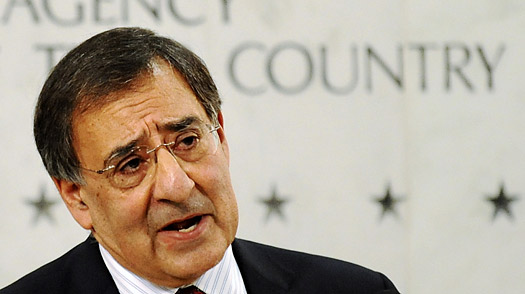
CIA Director Leon Panetta at his ceremonial swearing-in on Feb. 19, 2009. Photo by Jonathan Ernst / Reuters.

Hope Abandoned:
Obama Protects CIA Torture Memos

By Chris Floyd / April 11, 2009

It was obvious from the moment that Barack Obama appointed Leon Panetta to head the CIA that there was going to be no serious investigation — much less prosecution — of the high crimes of torture committed by the agency at the order of the Bush White House. Panetta, a Clinton retread (who actually began his career in the Nixon administration), has always been a bland, feckless, obedient servant of the Establishment; he has no outside power base, no pull, no heft, no popularity — nothing that would enable him to grab hold of the CIA with both hands and clean that fetid, blood-encrusted house. And of course, it was precisely this kind of powerless figure that Barack Obama wanted in the post.

The appointment was very typical of the Obama operation. Panetta had made a few very mild statements over the years that would allow him to be passed off as some kind of “progressive” in the witless, substanceless “process stories” that the corporate media do for new government appointees. This would be enough to keep the progressive “base” — which was overwhelmingly inclined to give Obama every benefit of every doubt — lulled long enough to get the patsy into the job.

Of course, to actually get the job, Panetta had to make it clear to Congress that he wasn’t going to stir up any trouble on the torture front, and was willing to play along with anything the Unitary Executive might order him to do. But the corp-media made little of this, concentrating instead on Panetta’s rote assertions that “America doesn’t torture,” and his embrace of the Army Field Manual as the standard for CIA interrogation. (Of course, the vaunted manual also allows practices that any rational human being would consider torture, but that’s another story.)

Once Panetta was confirmed in his figurehead director’s role, the Obama White House then confirmed its true intentions regarding the rogue agency. It has put the actual running of the CIA into the hands of one of the top figures involved in the Bush torture program. Scott Horton at Harper’s points us to the remarkable story by investigator John Sifton, detailing Obama’s retention — and promotion — of Bush’s willing torturers. From Sifton, at The Daily Beast:

“On Monday night the confidential report of the International Committee of the Red Cross on the CIA’s secret detention and interrogation program was published on the website of the New York Review of Books. The report confirms previous allegations about CIA abuses against detainees. Unlike earlier reporting, however, the document is based on irrefutable first hand information: interviews with detainees and U.S. officials. The document describes in stark detail the CIA’s use of forced standing, sleep deprivation, prolonged isolation, assaults, and waterboarding. It also discloses the participation of CIA medical personnel in torture….

“The New York Times reported that Leon Panetta, the current CIA director, has taken the position that “no one who took actions based on legal guidance from the Department of Justice at the time should be investigated, let alone punished.” Yet a number of CIA officials implicated in the torture program not only remain at the highest levels of the agency, but are also advising Panetta. Panetta’s attempt to suppress the issue is making Bush’s policy into the Obama administration’s dirty laundry.

“Take Stephen Kappes. At the time of the worst torture sessions outlined in the ICRC report, Kappes served as a senior official in the Directorate of Operations—the operational part of the CIA that oversees paramilitary operations as well as the high-value detention program. (The directorate of operations is now known as the National Clandestine Service.) Panetta has kept Kappes as deputy director of the CIA—the number two official in the agency. One of Kappes’ deputies from 2002-2004, Michael Sulick, is now director of the National Clandestine Service—the de facto number three in the agency. Panetta’s refusal to investigate may be intended to protect his deputies. Since the basic facts about their involvement in the CIA interrogation program are now known, Panetta’s actions are increasingly looking like a cover-up.”

Sifton also makes a very important point about the Red Cross report on torture that has been almost entirely ignored (which is not surprising, given that the Red Cross report itself has been almost entirely ignored by the corporate media that gives us the “news” of the day):

“Another overlooked fact is this: the ICRC report is an important legal document that contains well-sustained allegations of criminal conduct with legal significance. Unlike earlier claims in books, magazines, and newspapers, the ICRC’s allegations are official notices from a legally recognized entity. The ICRC, after all, is not Human Rights Watch, the Washington Post, or The New Yorker, all of which have reported on the CIA’s secret prison program. The ICRC is an official entity recognized under the Geneva Conventions and various other earlier international treaties relating to armed conflict and prisoners of war. The ICRC is specifically tasked under the Geneva Conventions to visit prisoners and communicate with detaining powers to uphold the conventions’ spirit and purpose. Its interpretations and statements on matters of international law are held as legally authoritative. As such, the ICRC’s allegations have legal significance beyond previous disclosures. In effect, the document itself is evidence in a criminal case.

“Note in particular the report’s date, February 14, 2007—Valentine’s Day. On that date, the U.S. government was put on notice about the allegations of CIA torture. (The ICRC also wrote to the U.S. governments about the issue of disappearances at several points in 2003-2006.)

“Under international law—the Geneva Conventions, the Convention against Torture, and basic precepts of customary international law—the United States has a positive obligation to investigate and prosecute persons alleged to have committed torture and other violations of the laws of war. As of Valentine’s Day 2007, and possibly earlier, the U.S. government was obligated to investigate and prosecute the abuses detailed in the report. The United States’ failure to do so is a recurring breach of international law.”

The United States has formally adopted the Geneva Conventions and the Convention Against Torture; they are not some kind of “foreign devilment” messing with our sacred sovereignty: they are the law of the land. But it is clear that the Obama Administration does not have and never had the slightest intention of obeying the law and instigating the required investigations and prosecutions of the high crime — the capital crime — of ordering and committing torture. And the reason for this refusal is also clear: the Obama Administration wants to retain the power to torture, to conduct “paramilitary operations” with secret armies and single assassins, to carry out mass, illegal surveillance of the population with no legal accountability, to do “whatever it takes” to keep the machine of war and domination churning at full strength. That is why they have retained apparatchiks like Kappes and Sulick; that is why they are not only defending the Bush gang’s egregious assertions of authoritarian power, but are actually seeking to expand them, as Glenn Greenwald and others have detailed.

It is understandable that people hunger desperately for change after the open, scalding evils of the Bush years. It is understandable that they would seize on an attractively packaged figure who made a few progressive noises, carried a great deal of genuinely symbolic weight due to his race, and was more personable, cool and articulate than his god-awful predecessor. It is understandable that many people would want to give this figure the benefit of the doubt, to turn a blind eye to the many warning signs that emerged during the campaign, and hope for the best. After all, who would not rather live in hope?

But hope must be grounded in reality; and it must be invested in the right place. When reality gives it the lie, then it must be abandoned. There is no hope to be found in the Obama Administration: no hope for genuine change, no hope for a clean break (or any kind of break) from the relentless and ruthless promotion of empire, oligarchy and militarism. By his own choices — his appointments, his policies, his court actions, his rhetoric — Barack Obama has demonstrated beyond all doubt his sincere and abiding commitment to “continuity” in the most pernicious and corrosive elements of America’s lawless hyper-state. To place one’s hope in such a figure is a crippling, disastrous folly.

The only hope that can be associated with the Obama Administration is the long-shot, rapidly fading, outside chance that they could be forced — very much against their will — into at least slowing the militarist-oligarchic juggernaut by strong, sustained, massive, informed political opposition from the public. (And no, not the “tea-bag” fantasies of the fascistic Right, whose only real complaint about Obama — aside from the unspoken one about his skin color — is that he is not militarist and oligarchic enough.)

I don’t believe this will happen, that this kind of genuine and fruitful dissent will arise on a scale large enough to pressure the administration into making changes in order to save its own political skin. Nor do I, as some do, place any “hopes” — if that’s the word — that some outside power (or combination of powers) or calamitous event (or combination of calamitous events) will force the juggernaut onto another course. As in the case of the present global financial collapse, the reaction of the elite to such circumstances will be to do more of the same, to try more and more desperately to return to the status quo — or, as today, to exploit the panic and chaos of disaster to extend their own power and privilege even further. And with a militarist elite that possesses an arsenal capable of bringing the world down with them if they can’t hold on to power, I can’t contemplate such a Götterdämmerung of suffering and death with anything like “hope.”

But I also know that I don’t know what the future might bring. So whatever small hope I still have resides in the flickering possibility of engendering the kind of large-scale, genuine, fruitful dissent described above. I realize that this is a rather slim reed to hang on to; yet it is a mighty oak when compared to a hope invested in leaders who protect and promote torturers, who perpetuate — and laud — mass war crimes, who expand tyrannical powers, and who sell their children’s birthrights to a keep a tiny, rapacious elite in ascendancy. I will take my slim reed over such brutal delusions any day.

[Chris Floyd is an American writer and frequent contributor to Counterpunch where this article also appears. His blog, Empire Burlesque, can be found at chris-floyd.com.]

Source / counterpunch

Thanks to David Hamilton / The Rag Blog

Posted in RagBlog | Tagged , , , , , | 1 Comment

BOOKS / Jonah Raskin on The Peep Diaries


To Peep or Not to Peep? That is the Question

By Jonah Raskin / The Rag Blog / April 11, 2009

[The Peep Diaries: How We’re Learning to Love Watching Ourselves and Our Neighbors, by Hal Niedzviecki, City Lights.]

In 1953, the British historian, Isaiah Berlin wrote an essay entitled “The Hedgehog and the Fox” that made him famous the world over. Berlin argued that there were two fundamentally different kinds of thinkers. There were the hedgehogs of the world, and there were the foxes. The hedgehogs had, he explained, one dominant idea that informed everything they wrote about. The foxes knew a great many things, and were not satisfied to be identified with a single all-embracing idea.

Berlin didn’t originate the hedgehog and the fox concept. The ancient Greek poet Archilochus did thousands of years ago, but Berlin gave it currency in the 20th-century, and it caught on. So, Dante and Hegel are often grouped with the hedgehogs; Shakespeare and James Joyce with the foxes. If nothing else the hedgehog and the fox categories provide fodder for cocktail parties. An entrepreneurial fellow might create a Hedgehog and Fox Blog; everyone with email could join one group or another, or put their friends in a category.

Hal Niedzviecki would probably be found among the hedgehogs. In true hedgehog fashion, he finds a single idea and holds on to it tenaciously. He sees everything and everyone through the lens of that one idea. In his new book, The Peep Diaries the hedgehog idea is right there in the subtitle: “How We’re Learning to Love Watching Ourselves and Our Neighbors.” Niedzviecki hammers away at his idea for more than two hundred pages, and if somehow you’ve missed it in the subtitle he repeats it in the book itself. “We’re all learning to love watching ourselves and our neighbors,” he says in chapter one.

Much of what Niedzviecki says is obvious. Everyone reading this online, as you’re doing now, already knows most if not all of what he has to say. “More than ever we’re putting everything on line,” Niedzviecki writes. Gee! He adds, “it’s getting harder and harder to keep a secret.” Wow! A bit further on he writes, “In the age of Peep, everyone wants to know everything (and everyone wants everyone else to know everything) about who they are, why they are, and how they are.” What will he think of next? Still further on he observes, “Peep culture is our (admittedly twisted) answer to the problem of the dehumanizing of humanity.”

Aha! “The dehumanizing of humanity.” Now, there’s a big theme that nearly every college sophomore has written about in a term paper for the last 50 years. I know I did, and so did many of my classmates. Sophomores are still writing essays on that subject. Much of what Niedzviecki says is trite, clichéd, and dare I say it, muddleheaded.

Perhaps the main problem I have is with the word “Love” in the subtitle – as in “how we’re learning to love watching ourselves and our neighbors.” Now, I know that advertising and public relations persuade masses of people to love things – like Wendy’s hamburgers – and people – like Brad Pitt – so that we consume them in one way or another. But as a teacher at a public university in California I also know that my students do not love the loss of their privacy. Yes, they email and Blog and take photos of themselves and their friends and post them. That is true. But they also dislike invasions of their privacy, and indeed feel that they have a right to it. They don’t want anyone to follow them in the bathroom and watch them poop or pee.

Some of them are willing to fight to preserve their privacy. I know. I teach a class that focuses on privacy issues. In a recent moot court we held in class the students were all on the side of the citizens whose privacy was violated, and against the media that invaded it. When I told them that our college president had surgery to shrink the size of his stomach, and that he had lost 100 pounds they insisted that wasn’t news, and that they’d never print it in the campus newspaper.

I disagreed. If Derek Jeter’s hands and Alex Rodriguez’s knees are news, the college president’s stomach is news, too. He’s getting paid $150,000 a year, and I want to know if he’s healthy or not and able to do his job.

I have always liked gossip, and I like to gossip. I have gossiped about Tom Hayden, Jane Fonda, Jessica Mitford, Jake and Maggie Gyllenhaal, the son and daughter of my friends, Naomi and Stephen Gyllenhaal, who produced Homegrown, the marijuana movie I wrote, and who made everyone who worked on the movie sign a contract saying that they would not do drugs during production. Sometimes there is more news in so-called gossip then in hard news stories. Whenever I hear juicy gossip I email friends. I tell the world. I have largely lived a transparent life ever since I wrote my autobiography Out of the Whale in 1974. I recommend transparency – though Niedzviecki mostly doesn’t. Come out and play, I say.

Privacy is also a very strange thing. In many ways it’s hard to lose it, no matter how hard you try because the context is all-important. When I tell students in a crowded lecture hall that I dropped acid and rioted in the streets in the 1970s it doesn’t mean much if anything to them, and I don’t feel that I have lost my privacy, whatever that is. The students weren’t there, then. They don’t know that historical moment and what it meant. They don’t get it. So, I’m as private as I ever was.

Near the end of The Peep Diaries, Niedzviecki writes that when he began his book he wasn’t sure if he’d end it on a note of “pro or anti-Peep.” When he did reach the end, he says, he was “as undecided as ever” and that he still didn’t know where he stands. “Do I install every possible privacy protection on my computer? Do I track my friends and let them track me?” He does say that he has come to one strong, definite conclusion: he won’t put a picture of his daughter on his blog. And he won’t mention her name online, either.

“That’s about the only thing I’m absolutely sure about when it comes to Peep,” he writes. On his website he writes, “Hey, I’m Hal Niedzviecki. I’m a 37 year-old writer/thinker. I live in Toronto, Ontario, Canada with my wife and two-and-a-half year-old.” In a way he has already exposed his daughter. We know she exists; we know her age, we know who her father is. Writing about oneself, one automatically and inevitably writes about others. It is impossible, or nearly so, not to out friends and family if we are writers. It comes with the territory.

Niedzviecki’s book begins to become interesting at the very end when he gets beyond glib phrases like the “dehumanizing of humanity,” and writes about himself, his wife and his daughter. This book could use more candor and more disclosure; make it more like a diary, Hal, and less like a dissertation. The book could also benefit from an insightful comment made by F. Scott Fitzgerald, the author of The Great Gatsby. Fitzgerald had a better idea, I think, than Isaiah Berlin’s hedgehogs and foxes. “The test of a first-rate intelligence,” Fitzgerald wrote, “is the ability to hold two opposed ideas at the same time, and still retain the ability to function.” Perhaps if Niedzviecki had started The Peep Diaries by disclosing his duality about “the culture of peep” it would have made for more compelling reading. It would certainly have made the book far more of a human document. After all, the essential humanity of the author is what matters most of all.

[Find Hal Niedzviecki’s The Peep Diaries: How We’re Learning to Love Watching Ourselves and Our Neighbors at City Lights.]

The Rag Blog

Posted in Rag Bloggers | Tagged , , , | 2 Comments

Interview with Tim DeChristopher, Utah Oil Lease Spoiler

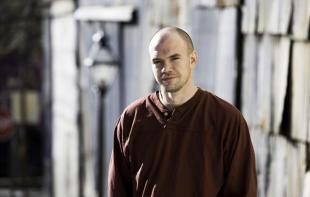
In its final days, the Bush administration tried to sell drilling rights to Utah’s Red Rock Country. Student Tim DeChristopher purchased a chunk of that land in an act of civil disobedience.

Modern-Day Monkeywrencher
By Martin Stainthorp / April 10, 2009

During the final days of the Bush administration, Tim DeChristopher’s civil disobedience drew attention to a rushed federal auction for Utah drilling rights.

On Dec. 19, Tim DeChristopher, 27, walked into a Bureau of Land Management building in Salt Lake City where an auction was being held. The federal government was selling drilling rights on 164,000 acres of land in Utah’s Red Rock Country. Earlier that month, several environmental groups—including the National Resources Defense Council (NRDC), the Southern Utah Wilderness Alliance (SUWA), the Wilderness Society and Earth Justice—had filed a lawsuit challenging the auction. They objected to the leasing of 110,000 acres of public lands, most of which are adjacent to Arches and Canyonlands National Parks, and argued that drilling would damage views and increase pollution.

When DeChristopher entered the building, officials mistook him for a bidder and allowed him to enter the auction, where he was given a bidding paddle—number 70. The University of Utah economics student says he stood out in a room filled mostly with veteran oil and gas men, but he started holding up his paddle to bid. By the time officials caught on and stopped the auction, DeChristopher had acquired the rights to 12 parcels of land, totaling 22,000 acres—for $1.79 million that he didn’t have.

He later told authorities he had engaged in civil disobedience to protect the land and was willing to go to prison for his actions. Attracting media attention and support from around the world, DeChristopher raised enough money to offer an initial $45,000 payment for the lands he had acquired, but the Bureau of Land Management refused it.

On Jan. 17, the environmental groups won their lawsuit, and Interior Secretary Ken Salazar later invalidated 77 controversial leases from the auction, including all of DeChristopher’s. Despite the victory, he still faces federal criminal charges.

‘I see this as the way the environmental movement should be working: with some big groups on the inside… And then people like me, on the outside, pushing the boundaries’

In These Times called DeChristopher in Salt Lake City, where he lives.

Why did you intervene in the auction?

It was a rushed attempt to sell off some of the most precious lands in southern and eastern Utah right before Bush left office. And there were a lot of examples of how rushed it was. One of the most entertaining is that when they first announced what parcels were up for auction, they included land in the city of Moab that had houses on it. They included the land underneath the Moab golf course, which they tried to auction off to drill.

There was a lot of opposition to it, and the environmental impact statement wasn’t adequately done and didn’t factor in a lot of the costs associated with drilling. And the public comment period was rushed and people were obstructed from getting accurate information.

Who were some of the other bidders?

A lot of them were small energy producers who were intending to later flip the parcels, to sell them to the bigger companies. There were a few bigger companies there, like Bill Barrett Corporation. And I was told that one of the companies I was bidding against was Halliburton.

What is your reaction to Secretary Salazar’s decision to invalidate 77 of the leases, including all of yours?

I was encouraged by Salazar’s decision. I saw it as a strong stand by our new administration to protect the land and to protect the climate. The administration not only reinforced the lawsuit, but it also went well beyond the grounds of the lawsuit to challenge those underlying resource management plans.

I see this as the way the environmental movement should be working: with some of the big groups on the inside, like SUWA and NRDC, that are working through their means—whether through lawsuits or whatever is available to them. And then people like me, on the outside, pushing the boundaries and doing the controversial stuff that the big groups can’t do.

Could the lawsuit alone have produced this outcome or was your action necessary?

My action was certainly needed and that’s the feedback I’ve gotten from a lot of people involved in this issue. It brought to light the injustice behind this auction. And it kept it in the media and the public eye for that month or so after the auction before Salazar made his decision.

What’s going to happen to the 77 parcels now?

Now the government goes back and considers whether it’s really a good idea to be auctioning off this land for oil and gas development. It’ll look at the land’s real value and hopefully do an accurate environmental impact statement that weighs the costs of air pollution, the cost of road building, the loss of recreation—all those things it hadn’t considered before.

Do you still expect to be criminally charged?

I would expect that it would still happen. The Salazar decision didn’t erase the case against me even though it did protect the land for now. The one thing that it did is take away the damages from my case, which I think puts me in a better legal position because there’s no way that they can show $1.7 million of damages to anyone. And because the decision is an official ruling stating that this auction was inappropriate and illegal, it strongly supports the idea that what I was standing up against was something unjust.

Have you been surprised by all the support you’ve received?

I’ve been very surprised by that and surprised by how broad that support is. It’s been coming from all over the country and from across the political spectrum. A lot of mainstream folks are supporting this not-so-mainstream action.

From my lawyer, Patrick Shea—the former director of the Bureau of Land Management [under Clinton], who’s now joining my side and supporting what I did—to a lot of professors and folks at the university who are supporting what I did. Last week I went to Utah Valley University, to Orem and Provo, and had two speaking engagements down there. And that’s really the most conservative part of Utah, which is one of the most conservative states in the country. I received a huge amount of support there.

How do you feel about people equating your action with that of Edward Abbey and The Monkey Wrench Gang?

I was a big fan of Edward Abbey, especially when I was younger. And in the last couple months, I’ve met a lot of Edward Abbey’s close friends and some of the people who inspired the characters in The Monkey Wrench Gang. What they told me is that my actions are categorically different than monkeywrenching. The monkeywrenching of Abbey’s style was something solitary that one did at night and then snuck away and never talked about again. Whereas what I did was more in line with civil disobedience, of people openly standing in the way of an unjust law or an unjust system and accepting the consequences for it.

In the weeks following the auction, you raised about $100,000, much of which was intended to pay for the lands. Since that option is now off the table, what do you plan to do with the money?

About $40,000 of that money is in the legal fund that we’ll hang on to because it looks like there’s a good chance that this case will go to trial. And we’ll probably need quite a bit more than that.

The rest of the money is in the lease purchase fund. I’m drafting a letter right now that I’m going to send out in the next few days to all the donors, informing them of what the situation is and asking them whether they want the money returned, put toward my legal fund or put toward another similar cause, namely the nonprofit group that I’ve helped launch in the last two months called Peaceful Uprising—a group that seeks to be the direct action side of the environmental movement that has been lacking in recent years.

Our mission is to train and support and defend those who take nonviolent direct action to protect our future from climate change.

In promoting more aggressive, grassroots tactics within the environmental movement, you’ve expressed criticism of some of the mainstream environmental groups for not pushing people to act outside of traditional methods, such as donating money, writing letters and signing petitions.

All of that stuff is necessary and it needs to continue to be an important part of the movement, but it can’t constitute the whole movement, especially an environmental movement where there are entrenched interests on the other side.

The fossil fuels industry, for example, is profiting off the destruction of our future. We’re battling against this huge force that has far more political power than the movement does. That industry gets to write the rules.

If the environmental movement always plays by the rules, there’s no way we can win. There’s no way we can defend our future. And we’re always going to be backpedaling, which is what we’ve seen in the movement for the last 20 years. We’ve basically tried to just put out fires and gone from one fire to another and we’re always losing ground.

So, if the environmental movement is going to make progress, it must shift the center and shift what’s considered reasonable. There needs to be that direct action side of it.

[Martin Stainthorp is an editorial intern at In These Times. A native of Chicago, he graduated from the University of Richmond in 2007.]

Source / In These Times

Thanks to Diane Stirling-Stevens / The Rag Blog

Posted in RagBlog | Tagged , , | 2 Comments

Medicine and Torture: Bad Bedfellows

Handcuffs sit at the foot of a chair used for interrogation inside a cell in the maximum security Camp 5 at Camp Delta on May 9, 2006 in Guantanamo Bay, Cuba. Photo: Mark Wilson/Getty Images.

U.S. Medical Personnel and Interrogations: What Do We Know? What Don’t We Know?
By Sheri Fink / April 9, 2009

This week’s posting of a confidential International Committee of the Red Cross report (PDF) about the treatment of 14 “high value detainees” held in secret CIA prisons has again raised a nettlesome question: In exactly what ways were medical personnel involved in abusive detainee interrogations?

The report, put online by The New York Review of Books in connection with articles written by Mark Danner, was based on interviews with the detainees who had been kept isolated from each other. ICRC media delegate Bernard Barrett confirmed in an e-mail that the report was authentic. “We have publicly deplored that this confidential material was made public as that was never our intent.” (The ICRC provides this explanation of its role.)

The detainees reported that health personnel generally provided them with high-quality medical care, but also said that some health workers oversaw or participated in “ill-treatment” such as beatings and waterboarding.

One detainee alleged that a health worker told him, “I look after your body only because we need you for information.”

Responding to questions from the New York Times, CIA spokesman Mark Mansfield said his agency had long ago ended the interrogation program and the agency, as directed by the Obama administration, will only use techniques that fall within the Army Field Manual (PDF).

To put the new information into perspective, ProPublica offers these answers to key questions about the roles of American medical personnel in detainee treatment in recent years.

What is known about the involvement of health professionals in the interrogations?

For years, reporters have been detailing the roles of psychologists and psychiatrists in the now-abandoned interrogation practices.

“Psychologists, working in secrecy…actually designed the tactics and trained interrogators in them while on contract to the C.I.A.,” Katherine Eban wrote for Vanity Fair in 2007.

Psychologists James Mitchell and Bruce Jessen reportedly “reverse-engineered” tactics from a military training program known as SERE (Survival, Evasion, Resistance, Escape), originally designed to help captured U.S. soldiers withstand abusive treatment. They then showed military and CIA interrogators how to apply the tactics to detainees in an effort to break them down, according to articles and Jane Mayer’s book “The Dark Side.”

The two have not discussed their role with journalists, but they did release a statement in response to the Vanity Fair article stressing their opposition to torture. They said they were proud of their work for the country and that their actions and advice were legal and ethical. “Under no circumstances have we ever endorsed, nor would we endorse, the use of interrogation methods designed to do physical or psychological harm.” We also called Mitchell Jessen and Associates consulting firm for comment and were told, “It is their policy not to give interviews.”

Psychologists and psychiatrists, sometimes working as Behavioral Science Consultation Teams (known as “BSCTs”), reportedly helped craft interrogation plans for specific detainees, a role they may still be playing in spite of opposition from professional medical associations, according to an Army medical policy document issued in 2006 and recently made public by the New England Journal of Medicine. The Army stressed that BSCT medical personnel were applying their knowledge to information-gathering and were not involved in providing medical care to the detainees, helping avoid a conflict in loyalties.

Criticisms have also been leveled at the access military and CIA interrogators had to detainees’ medical records and their ability to direct health personnel to provide them with information (PDF). After reviewing Defense Department interrogation operations in 2004, the military acknowledged (PDF) that in Iraq and Afghanistan, “interrogators sometimes had easy access to such information” but found that they did not use it inappropriately.

What other issues have been raised?

Early reports focused on abusive treatment of prisoners at Abu Ghraib in Iraq. Col. Thomas M. Pappas, chief of military intelligence at Abu Ghraib, who was interviewed as part of the Taguba investigation, testified that a psychiatrist and another doctor monitored interrogations (PDF) at the prison and had the final say in what aspects of the interrogation plan were implemented.

Military doctors and nurses were criticized for failing to report evidence of abuse. In a few instances, detainees who were initially certified by physicians as having died of natural causes were later acknowledged by the Pentagon to have died of homicides due to asphyxia or blunt force injuries.

The health system for detainees at Abu Ghraib was found to be poorly equipped and understaffed. Geneva Conventions requirements to provide monthly health inspections and allow prisoners to request proper medical care were not fulfilled there and in Afghanistan, according to internal military investigations described in the Lancet in 2004 and in the book “Oath Betrayed” by ethicist Steven Miles.

After the scandal broke, the Department of Defense reviewed its procedures for medical personnel dealing with detainees and, in 2005, issued more specific guidelines that called for personnel to be guided by medical ethics and report inhumane treatment.

The Office of the Army Surgeon General also conducted an extensive assessment of detainee medical operations in Iraq, Afghanistan and Guantanamo beginning in late 2004. While it concluded that medical personnel had made extraordinary efforts to provide “compassionate and dedicated care” to prisoners and detainees, it also found problems with the security of medical records and the extent to which medical personnel were trained about the need to report suspected detainee abuse.

The report recommended that all medical personnel be prohibited “from active participation in interrogations” and that psychiatrists and other physicians no longer be part of BSCTs. Former Army Surgeon General Kevin Kiley did not approve the latter recommendation.

What do standards of medical ethics have to say about health professionals participating in detainee questioning?

When it comes to torture and other mistreatment (as opposed to lawful interrogations), widely accepted standards of medical ethics are clear: Physicians and other health personnel cannot participate, facilitate or be present. Physicians and other health professionals are also forbidden from using their specialized knowledge and skills to facilitate ill treatment.

When captives are brought to detention sites, they must be given medical checks and ongoing care, and doctors must report any suspected abuses up the chain of command. The role of health professionals “is explicitly to protect [detainees] from … ill-treatment,” according to the ICRC report. If a detainee has a medical emergency during questioning, a physician can be called in to provide treatment.

Recently, medical societies have laid out strict policies that restrict their members’ participation in even lawful interrogations. The American Medical Association’s Code of Ethics was updated in 2006 to ban physicians from conducting interrogations or monitoring them “with the intention of intervening in the process.” The reason for this is described in the ICRC report: “Any interrogation process that…requires a health professional to monitor the actual procedure, must have inherent health risks” and is thus “contrary to international law.”

The American Psychiatric Association issued an even broader ban on involvement in interrogations, forbidding psychiatrists from being in a room where an interrogation is ongoing.

The American Psychological Association took a different stance in 2005, opposing torture but expressly acknowledging a role for its psychologist members in gathering information that “can be used in our nation’s and other nations’ defense,” including serving as interrogation consultants. The task force that made that recommendation was later criticized as being biased. Last year, the association approved new guidelines that would restrict psychologists from participating in interrogations at sites that violate international law or the U.S. Constitution.

What questions remain?

The list of unknowns is long. How, why and when the CIA brought SERE-affiliated psychologists and psychiatrists into the interrogation strategy of detainees remains a mystery.

The question of how effective the practices they allegedly developed were at eliciting useful intelligence also remains a matter of debate, with recent media reports casting doubt on the usefulness of intelligence obtained from one of the captives, Abu Zubaida. Last month on CNN former Vice President Dick Cheney defended his administration’s programs dealing with suspected terrorists as “essential to the success” in preventing attacks on U.S. soil after 9/11.

The exact roles medical personnel are playing in presumably lawful interrogations being conducted today are also unclear.

Also unknown are the identities of most of the medical personnel involved in abusive interrogations. Their numbers may be small. The Office of the Army Surgeon General queried more than 1000 medical personnel from more than 180 military units (nearly 900 had served or were serving in Iraq, Afghanistan or Guantanamo) and found only five instances of medical personnel participating in interrogations.

Are there any investigations coming?

Sen. Patrick Leahy recently proposed a nonpartisan commission of inquiry to “get to the truth of what went on during the last several years.” In a statement last week, Leahy said that the ICRC report and other recent revelations demonstrate “why we cannot just turn the page without reading it.”

The advocacy organization Physicians for Human Rights is calling for the proposed commission to “document the use of the healing professions to design, supervise, and implement a regime of abuse.” The group wants health professionals who participated to be referred to state licensing boards, which could consider stripping them of the right to practice.

An aide to Leahy told ProPublica that an exploration of medical professionals’ roles “remains to be determined…There’s no bill or detailed proposal.” The senator’s statement expressed his concern not to “scapegoat or punish those of lesser rank.”

Source / Pro Publica

The Rag Blog

Posted in RagBlog | Tagged , , , | Leave a comment

Alice Embree : Easter Weekend at the Ranch

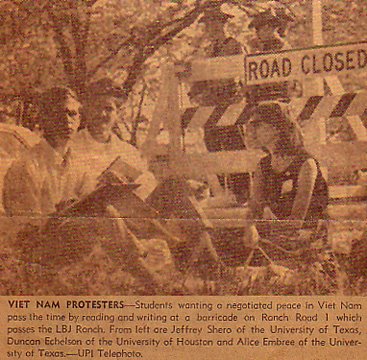
Alice Embree, with Jeff Shero (left) and Duncan Echelson, shown at LBJ Ranch during a peace vigil on Easter in 1965. This UPI telephoto was reproduced in Prairie Radical, a memoir by former Austin activist Robert Pardun.

An Activist History of Easter in Texas:
Camp Casey and the LBJ Ranch

By Alice Embree / The Rag Blog

[Three years ago, Austin activist and Rag Blog contributor Alice Embree spent Easter weekend at Camp Casey near George Bush’s ranch in Crawford, Texas. She describes this experience and reflects on an earlier Easter vigil at another presidential ranch in 1965. The Rag Blog is publishing her remembrance this Easter weekend.

Embree, who was a founder of The Rag — Austin’s legendary underground newspaper from the 60s and 70s that served as inspiration for The Rag Blog — originally posted this article on April 24, 2006 to The Rag’s website.]

President Bush’s ranch in Crawford, Texas, was a retreat until last August when Cindy Sheehan brought the war protest there. The President stayed away this Easter weekend as peace activists converged from around the country.

On Good Friday morning, we gather on the small triangle of dirt where Cindy Sheehan asked the world why her son Casey died – “For What Noble Cause?” We then march single file past the point where the Secret Service usually blocks the road, past the entrance to Bush’s ranch with its ironic “Dead End” sign, past the Secret Service enclave, the peaceful pastures, the wildflowers, the calves and spirited horses, arriving finally at our destination, Camp Casey Two.

Fourteen people lead the march with large wooden crosses. Sheehan carries one of them. We stop 14 times. Each time a station of the cross is observed: Jesus falls, Jesus speaks to his mother, Jesus dies. The deaths in Iraq seem as close as the spring breeze.

Camp Casey Two is on a small patch of land, leased from a cousin of the disgruntled Crawford neighbor who shot his gun off last August. A field of white crosses is there, some with boots beside them, some with names on them. In a large tent, we are greeted as family and directed to a long table of food.

The faces of soldiers are on the walls, pictures of those who have died in this mistaken war. Photos of flag draped coffins are there – the ones the U.S. media doesn’t show. A large banner has a color picture of Sheehan’s son and the words, “In Loving Memory of Army Specialist Casey A. Sheehan.”

At Camp Casey, the war is personal.

Forty-one years ago, on another Easter weekend, in front of another Texas president’s ranch, I was part of a vigil to end another horrific war. It was April 17, 1965. Students for a Democratic Society had organized an antiwar march in Washington, D.C. Those of us in SDS at the University of Texas didn’t go to Washington. We went instead to Ranch Road 1 outside Johnson City, Texas, where President Lyndon Johnson had come for the Easter weekend. I was nineteen. For my generation, the Vietnam War was personal. The draft made it so.

My friends made life decisions about whether to serve or to avoid service by conscientious objection, marrying or going to Canada. The war escalated with its terrible toll of casualties. We watched with tears in our eyes as the body counts were reported on the nightly news, as Buddhist monks set themselves on fire in protest, as the defoliants fell over Vietnam’s tree canopy, as the napalm stuck to the skin of civilians, as the cluster bombs exploded in the villages. We saw in the faces of many vets what would later be called Post Traumatic Stress Disorder (PTSD). We saw the flag draped coffins return.

Better minds than mine have surely thought about how this war in Iraq is different, have wondered why the opposition in the opinion polls isn’t also in the streets. The antiwar movement I was part of in the sixties was fueled by youth. At that vigil in 1965, we were all young. Our parent’s generation told us, “You don’t understand. You haven’t lived through a war.” But the draft made the war inescapable for my generation.

My peers were awakened and emboldened by the civil rights movement. We learned direct action from the lunch counter sit-ins that brought down segregation. We learned moral courage from the people who braved water cannons to claim the right to vote. The country’s soul was stirred, roused from its post-WWII doze by the civil rights struggle.

Perhaps as a nation we weren’t as afflicted with attention deficit disorder then. There were only three major TV networks. We didn’t surf endless channels. We didn’t watch sound-bite news on 24-hour channels, while competing news scrolled across the bottom of the screen. We gathered in the student union to watch the nightly news. Together, we heard the body counts and saw the flag draped coffins return. We were together. We didn’t search for Internet news in isolation.

Now, I see that same sense of community in the Camp Casey tent. The Iraq vets describe it as finally coming home. Here they find each other and share their pain and anger. It is a place dominated by those most affected by the war. It is led by Gold Star Families for Peace, the families of Iraq military who have died. Other groups – Military Families Speak Out, Iraq Vets Against the War, Vietnam Veterans Against the War, and Veterans for Peace – are also represented.

In the car on the way to Camp Casey One, Tina tells her story. Her son was a first gunner at Fallujah. He was ordered to fire at a group of insurgents and then to recover weapons from the dead. She says that as he turned the bodies over, he found women and children. There was just one weapon among them all. He came back unable to look at his mother and sister. He would call Tina with a gun in his mouth to say he didn’t deserve to live. She brought him with her to an antiwar march from Mobile to New Orleans. He found other veterans like himself. Tina says it was healing for their entire family. Later, she tells her story from the stage for the first time.

At Camp Casey, the pain is palpable. Voices break. Tears fall. Families embrace each other. An Argentine man who came to this country escaping a right wing dictatorship talks about his son who died in service to his adopted country. One of the Gold Star mothers says, “It’s personal for us. But it isn’t personal for anyone else.”

That is the truth I brought home from Camp Casey.

Rev. Dr. Joseph E. Lowery arrives at Camp Casey as part of a March to Redeem the Soul of America. Rev. Lowery spoke at Coretta Scott King’s funeral and was a founder of the Southern Christian Leadership Conference with Rev. Martin Luther King, Jr. He is 84. Rev. Lowery reminds us that Martin Luther King, Jr. spoke out against the war in Vietnam on April 4, 1967, that he was shot to death on a Memphis balcony on April 4, 1968, and that Casey Sheehan died in Iraq on April 4, 2004. He draws the parallel of simple acts of courage – of Rosa Parks sitting down on a Montgomery bus, of Cindy Sheehan sitting down on a Texas ranch road. His message is the Easter message of resurrection and hope. He tells us that we are in a sacred place, a place where the soul of America can be healed.

I show Sheehan pictures of the 1965 vigil at LBJ’s ranch from Robert Pardun’s book, Prairie Radical. I tell Daniel Ellsberg about the vigil as well. On Good Friday, he got arrested for sitting in the ditch. He remembers that Paul Potter spoke to 50,000 people at that first major mobilization against the war on April 17, 1965. Ellsberg’s strongest memory, recounted in his memoir, Secrets, is that he asked his wife on their first date that weekend, 41 years ago.

At Camp Casey, we get a piece of tape with the number of dead to put on our shirt. Everyone wears 2,360 on the first day. The six is marked out on the second day. Ten more U.S. soldiers are dead. By Monday, at the University of Texas rally, the number is 2,376.

Beatriz, a member of the Gold Star Families for Peace, has come from Dallas to speak at the UT forum. Her nephew died in Iraq before his infant daughter was born. Beatriz is angry and eloquent. She says she wants Bush to have three terms – the third term in prison. She tells me that she was a Republican and a supporter of Bush until the war came home to her in a body bag.

The movement to prevent the war in Iraq was large and spirited before March of 2003. Now, it seems gut punched as the war grinds on, demoralized by Bush’s “victory” in the 2004 election. I remember in 1965, only a handful of students demonstrated on Ranch Road 1. It took years of organizing and linking struggles. It was too many years before the war’s end in 1975. Too many more names on the Vietnam Memorial. Too much more devastation and death for a small country to bear.

The UT crowd marches to the nearby military recruitment center. We chant: “Recruiters Lie; Soldiers Die.” CodePink’s Pink Police put yellow crime scene tape across the door. An angry gray-haired woman marches up.

“You can’t do that,” she says.

“It’s a crime scene,” I answer.

“I lived through Vietnam,” she says, expecting that response to dismiss me.

“So did I,” I tell her.

The Rag Blog

Posted in Rag Bloggers | Tagged , , , , , , , , | 1 Comment

Kos : The Newspaper Execs’ Hissy Fit

Newspaper, aka the “Dinosaur Blog.” Graphic from Exhibit 5a.

The industry’s woes are self-inflicted, and its continued arrogance and superiority complex continue to blind its executives from potential solutions in a world where quite frankly, they are no longer quite relevant.

By kos / April 9, 2009

Newspaper executives are suddenly strutting around making demands of all sorts of people:

In addition to discussing whether and how to charge for the expensively produced content that today is available for free at most newspaper websites, publishers familiar with the agenda for the private session said other topics were:

  • How to recover some of the classified advertising business that has been usurped by Craig’s List and others.
  • Whether to demand payment from aggregators who now freely link to content from their sites.
  • How newspapers might get a greater share of the $10.8 billion in search revenues that represented 46% of all U.S. online advertising revenues in 2008.

Yeah, good luck with that. The response around the web has been fierce.

First off is the most righteous rant I’ve ever seen leveled against the dinosaur newspaper industry now lashing out because of its inability to adapt and survive. A definite must-read:

Let’s go on up to Rupert Murdoch, who says Google’s stealing his copyright in a recent Forbes article:

“Should we be allowing Google to steal all our copyrights?” asked the News Corp. chief at a cable industry confab in Washington, D.C., Thursday. The answer, said Murdoch, should be, ” ‘Thanks, but no thanks.’ “

Let me help you with that, Rupert. I’m going to save you all those potential legal fees plus needing to even speak further about the evil of the Big G with two simple lines. Get your tech person to change your robots.txt file to say this:

User-agent: *
Disallow: /

Done. Do that, you’re outta Google. All your pages will be removed, and you needn’t worry about Google listing the Wall St. Journal at all.

Oh, but you won’t do that. You want the traffic, but you also want to be like the AP and hope you can scare Google into paying you. Maybe that will work. Or maybe you’ll be like all those Belgian papers that tried the same thing and watched their traffic sadly dry up.

Perhaps all the papers should get together like Anthony Moor of the Dallas Morning News suggests in the same article:

“I wish newspapers could act together to negotiate better terms with companies like Google. Better yet, what would happen if we all turned our sites off to search engines for a week? By creating scarcity, we might finally get fair value for the work we do.”

Please do this, Anthony. Please get all your newspaper colleagues to agree to a national “Just say no to Google” week. I beg you, please do it. Then I can see if these things I think will happen do happen:

  • Papers go “oh shit,” we really get a lot of traffic from Google for free, and we actually do earn something off those page views
  • Papers go “oh shit,” turns out people can find news from other sources
  • Papers go “oh shit,” being out of Google didn’t magically solve all our other problems overnight, but now we have no one else to blame.

Jeff Jarvis:

Yesterday, you delivered a foot-stomping little hissy fit over Google and aggregators. How dare they link to you and not pay you? Oh, I so want Eric Schmidt to tell you today that you’re getting your wish and that Google will no longer link to you. Beware what you wish for. You’d lose a third of your traffic overnight. If other aggregators (I work with one) and bloggers (I am one) and Facebook all decided to follow suit, you’d lose half your traffic. On most of your sites, only 20 percent of the audience in a day ever sees your homepage and its careful packaging; 4 of 5 readers instead come in through search and links. In the link economy – instead of the outmoded content economy in which you operate – Google and aggregators and bloggers are bringing value to you; they should be charging you for the value they bring. You should rise up today and give Mr. Schmidt a big thank you for not charging you. But you won’t, because you’ve refused to understand this new business reality.

I’d love to know what percentage of a newspaper’s readership actually would even notice if the main news section disappeared. How many pick up newspapers just for the sports? For the style section? For the horoscopes? For the crossword puzzle or sudoku? Heck, I remember when newspapers were useful to check on the weather, look up TV listings, and box scores. All of this is easily replaceable or is already history. Sports? I may be biased given the other company I founded, but I think sports bloggers are doing a superior job of covering their teams and sports than the newspapers they’re quickly replacing, not to mention the proliferation of sports media on TV, from ESPN, to networks that focus specifically on single sports (NFL, MLB, NHL networks) and less popular ones (Versus).

What about news from DC? Who needs the newspapers when we’ve got adequate to great coverage from CQ, Politico, TPM, Washington Independent, HuffPo, and the Hill?

Local news? Newsroom cuts in search of ever-higher profit margins have decimated local coverage in the age of corporate ownership. Local TV is filling many of those gaps, as are citizen bloggers. Don’t laugh at the notion of citizen journalists — the best Oakland coverage anywhere, bar none, comes from the muckrakers at A Better Oakland. It truly beats the shit out of anything the Oakland Tribune or local TV stations are doing. It’s a model I fully expect to organically emerge in cities and towns all over the country.

Business news? What’s left of the newspaper business sections are a joke, supplanted by cable business networks and online business publications (like Motley Fool and The Street). Remember when newspapers ran stock tables? In fact, some are still stupid enough to be running them despite the proliferation of real-time stock tickers for the masses.

Opinion? Ha ha ha ha ha! This site exists precisely because of the drivel they’ve force fed us the last few decades. When David Broder is the pinnacle of the newspaper world’s editorial pages, you’ve given up that ghost a long time ago.

Newspapers like to see themselves as “essential to democracy” or some other such bullshit, but they’ve long been part of a much broader media landscape, in which broadcast and the internet have become the most efficient delivery mechanisms. And pretty soon, with convergence, they’ll be one and the same. Newspapers have refused to adapt, or they’ve pissed away money buying baseball teams, or they’ve squeezed the value out of their product by demanding 30 percent profit margins, or they’ve expanded at unsustainable rates, or all of the above.

But they aren’t the only player in town, and there are plenty of other media operations that are already mimicking the content they product, or can quickly rush in to fill the void if a true market need exists. And while we may miss having all that disparate information packaged into one convenient portable (and disposable) product, fact is that we can get just about everything newspapers provided elsewhere, and no trees have to die in the process.

Will it be sad to see venerable operations like the Chicago Tribune, San Francisco Chronicle, and Boston Globe bite the dust? Of course. It won’t be an occasion to gloat or celebrate. But the industry’s woes are self-inflicted, and its continued arrogance and superiority complex continue to blind its executives from potential solutions in a world where quite frankly, they are no longer quite relevant. As Jarvis reminded the execs:

Your Google snits don’t even address your far more profound problem: the vast majority of your potential audience who never come to your sites, the young people who will never read your newspapers. You all remember the quote from a college student in The New York Times a year ago, the one that has kept you up at night. Let’s say it together: “If the news is that important, it will find me.” What are you doing to take your news to her? You still expect her to come to you – to your website or to the newsstand – just because of the magnetic pull of your old brand. But she won’t, and you know it. You lost an entire generation. You lost the future of news.

More from newspaper exec Steve Buttry, and also Jeremy Littau, at the Missouri School of Journalism. Meanwhile, Steve Yelvington looks at some of the barriers to enacting a pay wall, while Martin Langeveld at Harvard’s Nieman Journalism Lab, ran the numbers and found that erecting a paywall doesn’t make financial sense.

Update: Someone sent over a link to Voice of San Diego, which is doing a fantastic job covering the city. Goes to show that newspapers don’t have a monopoly on great coverage of their towns.

Update II: Anthony Moor of the Dallas News, quoted above as wanting newspapers to block Google en masse, emails me to say that his quote was mischaracterized by the reporter writing that piece:

My conversation with him was much more nuanced and I was being a bit tongue-in-cheek about “turning off” to Google. We don’t matter much to Google. rather, I was musing about what might happen if all news sites went dark for a week. What would people think? Would we matter? It’s hard to know how relevant news and information sites are unless they’re not there, and that kind of experiment would help us find out.

Source / Daily Kos

The Rag Blog

Posted in RagBlog | Tagged , , , , , , , | 1 Comment

Danny Glover : Barack Obama Must Support the Global Struggle Against Racism

Danny Glover.

This should be a moment for the United States to rejoin the global struggle against racism, the struggle that the Bush administration so arrogantly abandoned. I hope President Obama will agree that the United States must participate with other nations in figuring out the tough issues of how to overcome racism and other forms of discrimination and intolerance…

By Danny Glover / April 8, 2009

In 2001 I traveled to Durban, South Africa, to join the tens of thousands of people who came to participate in the United Nations-sponsored World Conference Against Racism, Racial Discrimination, Xenophobia and Related Intolerance. More than 2,000 came from the United States, a rainbow of people crossing all lines–racial, ethnic, national, language, immigration status, religious and much more–joining an equally diverse crowd from across the globe. It was an extraordinary opportunity to meet, discuss, argue and strategize over how to rid the world of these longstanding evils.

Our participation paralleled that of the official US delegation. And that’s where we faced a huge challenge. The Bush administration team, having only grudgingly agreed to participate at all, made clear they had no real commitment to fighting racism or offering leadership on other challenging issues of discrimination. When they didn’t like a few small parts of the sixty-one-page text, they packed up and walked out of the conference. It was a sad but hardly surprising moment, exposing once again the history of US failures to take seriously the consequences of its own legacy of racism, a point most recently made by Attorney General Eric Holder.

The 2001 Declaration expressed powerful truths. It stated: “We acknowledge and profoundly regret the massive human suffering and the tragic plight of millions of men, women and children caused by slavery, the slave trade, the transatlantic slave trade, apartheid, colonialism and genocide, and call upon States concerned to honour the memory of the victims of past tragedies and affirm that, wherever and whenever these occurred, they must be condemned and their recurrence prevented.” Another part declared, “We recognize the inalienable right of the Palestinian people to self-determination and to the establishment of an independent State and we recognize the right to security for all States in the region, including Israel, and call upon all States to support the peace process and bring it to an early conclusion.”

Now, eight years later, the United Nations is convening the Durban Review Conference in Geneva April 20 to 24 to review and assess the progress since 2001. Member nations have toiled for two years to craft an outcome document that assesses the current analysis and challenges. This document–which called for particular measures to provide support and reparations to all the victims both of long-ago histories, like the descendants of the European-Atlantic slave trade, and those facing contemporary forms of discrimination and apartheid policies, such as the Roma, the Dalits (India’s “untouchables”) and the Palestinians–was rejected by the Obama administration.

This year we thought things would be different. Our country has taken a huge step in our long struggle against racism: we have elected our first African-American president. And perhaps more important, the mobilization of people who made Barack Obama’s election possible brought more young people of color into political action, with others of various ethnic and political backgrounds, than perhaps any campaign before. It is a moment not to sit on our laurels; certainly, we have much farther to go. But it is certainly a moment for our nation’s political leadership to acknowledge a new marker in the long and painful struggle for justice, and a time to offer global leadership in the United Nations forum organized to combat bigotry and injustice.

In an effort to address the administration’s concerns, the United Nations has released a new “outcome document,” stripped of all language deemed offensive or controversial. Yet we face the sad reality that our president, the first African-American to lead this country, who has galvanized hope among victims of injustice around the world and encouraged them to stand up with dignity for their rights, has yet to indicate if he will send an official delegation or continue to abstain from the entire process.

Our historical struggle against racism can claim great progress as a legacy of the civil rights movement led by the likes of Fanny Lou Hamer and Dr. Martin Luther King Jr., but this 2009 review of the 2001 Durban conference against racism should still be a moment in which the administration of President Obama returns to the world stage to join deliberations aimed at making even further progress against injustice.

For twenty years, Congressman John Conyers, dean of the Congressional Black Caucus, has annually introduced a bill urging the United States to form a commission to study whether reparations are an appropriate response to the continuing legacy of slavery in our country. Would not the Durban Review Conference be a perfect venue to the administration to support the remedies recommended by the global community of nations to overcome the impacts of racism, slavery, anti-Semitism, apartheid and other forms of discrimination?

Would this United Nations conference not be exactly the right place for our new president to show the world that his administration’s commitment to “change we can believe in” means rejecting our country’s tarnished legacy of violating international law, undermining the United Nations and using American exceptionalism to justify walking away from the leadership responsibility many in the world expect of the United States? To make that change clear, wouldn’t this be a great opportunity to remind the world that even if the final document does not call out the name of every perpetrator government, the United States at least believes that every group of victims facing discrimination or worse based on their identity, especially the most vulnerable, and those who are stateless and thus in need of special attention by the international community, should be named and promised assistance?

This should be a moment for the United States to rejoin the global struggle against racism, the struggle that the Bush administration so arrogantly abandoned. I hope President Obama will agree that the United States must participate with other nations in figuring out the tough issues of how to overcome racism and other forms of discrimination and intolerance, and how to provide repair to victims. Our country certainly has much to learn; and maybe, for the first time in a long time, we have something by way of leadership to share with the rest of the world in continuing our long struggle to overcome.

[Danny Glover is an actor/activist and chair of the TransAfrica Forum Board of Directors, and a founder of ‘Progressives for Obama.’]

Source / The Nation

Thanks to Carl Davidson / The Rag Blog

Posted in RagBlog | Tagged , , , | 1 Comment

Texas Republican to Asian-Americans : Please Simplify Your Names

Texas Rep. Betty Brown, R-Terrell, made the remark during House testimony on Tuesday. Photo from the Houston Chronicle.

Here’s a classic Texas story! It was published by the Houston Chronicle and is being circulated by the Huffington Post. — Jeff Jones / The Rag Blog

Lawmaker defends comment on Asians
Call for voters to simplify their names not racially motivated

By R.G. Ratcliffe / April 9, 2009

AUSTIN — A North Texas legislator during House testimony on voter identification legislation said Asian-descent voters should adopt names that are “easier for Americans to deal with.”

The comments caused the Texas Democratic Party on Wednesday to demand an apology from state Rep. Betty Brown, R-Terrell. But a spokesman for Brown said her comments were only an attempt to overcome problems with identifying Asian names for voting purposes.

The exchange occurred late Tuesday as the House Elections Committee heard testimony from Ramey Ko, a representative of the Organization of Chinese Americans.

Ko told the committee that people of Chinese, Japanese and Korean descent often have problems voting and other forms of identification because they may have a legal transliterated name and then a common English name that is used on their driver’s license on school registrations.

Easier for voting?

Brown suggested that Asian-Americans should find a way to make their names more accessible.

“Rather than everyone here having to learn Chinese — I understand it’s a rather difficult language — do you think that it would behoove you and your citizens to adopt a name that we could deal with more readily here?” Brown said.

Brown later told Ko: “Can’t you see that this is something that would make it a lot easier for you and the people who are poll workers if you could adopt a name just for identification purposes that’s easier for Americans to deal with?”

Democratic Chairman Boyd Richie said Republicans are trying to suppress votes with a partisan identification bill and said Brown “is adding insult to injury with her disrespectful comments.”

Brown spokesman Jordan Berry said Brown was not making a racially motivated comment but was trying to resolve an identification problem.

Berry said Democrats are trying to blow Brown’s comments out of proportion because polls show most voters support requiring identification for voting. Berry said the Democrats are using racial rhetoric to inflame partisan feelings against the bill.

“They want this to just be about race,” Berry said.

Copyright 2009 Houston Chronicle

Source / Houston Chronicle

The Rag Blog

Posted in RagBlog | Tagged , , , , | 1 Comment

Pittsburgh Cop Killer Egged on by Alex Jones, Right Wing Conspiracy Media

Alex Jones broadcasting from Austin’s KLBJ.

Richard Poplawski’s photo from MySpace.

Poplawski was a neo-Nazi wannabe who railed against blacks, Jews, ‘Zionists,’ and gun control. And like many members of the far-right fringe, he allegedly visited Jones’ Web sites and posted alarming reports by Jones’ writers on the white supremacist message board, Stormfront.

By Max Blumenthal / April 8, 2009

Richard Poplawski, the man who allegedly murdered three Pittsburgh cops, was clearly influenced by Fox News’s Glenn Beck and right-wing radio.

On April 6, two days after the 22-year-old Richard Poplawski allegedly murdered three police officers in Pittsburgh, Pennsylvania, a radio host named Alex Jones settled in before a microphone in his studio in Austin, Texas to do some damage control. “The mainstream media has certainly enjoyed tying me into this story,” Jones complained. “They’re attacking me and saying I’m delusional and there’s no New World Order The Second Amendment, what the country’s founded on–it’s all my fault!”

Poplawski was a neo-Nazi wannabe who railed against blacks, Jews, “Zionists,” and gun control. And like many members of the far-right fringe, he allegedly visited Jones’ Web sites and posted alarming reports by Jones’ writers on the white supremacist message board, Stormfront. (Poplawski’s posts are here, authored under the handle, “Braced For Fate.”) While Alex Jones generally avoids overt racism, he has found an eager audience on Stormfront by conjuring dark visions of an impending New World Order, claiming FEMA is secretly building a national concentration camp network, and announcing that President Barack Obama has planned mass gun seizures on his way to establishing a leftist dictatorship. “Remember, the first step in establishing a dictatorship is to disarm the citizens,” warned a March 13 commentary on Jones’ website, Prison Planet.

In the wake of Poplawski’s alleged murder spree, the killer’s friends and family members painted a portrait of a paranoid young man whose worldview was informed almost totally by the kind of conspiratorial themes entertained by Jones. Poplawski’s best friend, Edward Perkovic, who also spouted white supremacist rhetoric, Source” target=_blank>told the Pittsburgh Tribune-Review that his friend “grew angry recently over fears Obama would outlaw guns.” Poplawski’s mother remarked to police investigators that her son targeted cops “because he believed that as a result of economic collapse, the police were no longer able to protect society.”

But hysterical warnings of government gun grabs and a socialist takeover of the U.S. are no longer the sole proprietary interest of fringe players like Jones. In the Obama era, Jones’ conspiracy theories have graduated to primetime on Fox News. And radicals like Poplawski are tuning in. Indeed, according to the Anti-Defamation League, the alleged killer posted a YouTube clip to Stormfront of top-rated Fox News host Glenn Beck contemplating the existence of FEMA-managed concentration camps. (“He backed out,” Poplawski wrote cryptically beside the video.) Three weeks later, Poplawski posted another Youtube clip to Stormfront, this time of a video blogger advocating “Tea Parties,” or grassroots conservative protests organized by Beck and Fox News contributor Newt Gingrich (see here and here) against President Barack Obama’s bailout plan.

Jones has gradually come to be accepted by the right-wing media. In September 2007, Jones interrupted a live broadcast by Fox News host Geraldo Rivera (Rivera was reporting at the time on “the secret world of restroom gay sex”) by shouting into a megaphone, “9-11 was an inside job!” He was hauled away by NYPD officers soon after. On March 18, however, Jones became a guest of honor inside Fox studios, introduced as “the great Alex Jones” by Fox News contributor Judge Andrew Napolitano during a lengthy segment on the online show, The Strategy Room. Towards the end of his spot, Jones celebrated his sudden and dramatic influence on the conservative movement’s biggest media personalities.

“I’ve never seen an awakening this big. I’m seeing Glenn Beck talk about the New World Order on Fox, I’m seeing you talk about it,” Jones told Napolitano. “We’re seeing Lou Dobbs talk about it, we’re seeing mainline hosts–Limbaugh’s even talking about global government. Michael Savage is talking about how Obama may stage crises to bring in martial law. So all the things that I was talking about in the wilderness ten plus years ago are now hitting mainstream, and it is great!”

David Neiwert, a veteran reporter on right-wing militia movements and author of the forthcoming book, The Eliminationists: How Hate Talk Radicalized the American Right, explained that by co-opting conspiratorial rhetoric from the farthest shores of the right, mainstream conservative talkers can inflame the passions of paranoiacs like Poplawski to a dangerous degree. “It’s always been a problem when major league demagogues start promulgating false information for political gain,” Neiwert told me. “What it does is unhinge fringe players from reality and dislodges them even further. When someone like Poplawski hears Glenn Beck touting One World Government and they’re gonna take your gun theories, they believe then that it must be true. And that’s when they really become crazy.”

For Jones, whatever bad publicity he incurred from a fan’s alleged killing spree paled in significance to the sudden cachet he has gained among conservative media bigwigs. During his April 6 broadcast, two days after the murders, he boasted, “Now, if you listen to [Sean] Hannity’s show, if you listen to Savage; you listen to Limbaugh, it’s almost like Alex Jones is hosting the show.”

[Max Blumenthal is a senior writer for The Daily Beast and writing fellow at The Nation Institute, whose book, Republican Gomorrah (Basic/Nation Books), is forthcoming in Spring 2009. Contact him at maxblumenthal3000@yahoo.com.]

Source / Daily Beast / AlterNet

Thanks to David Hamilton / The Rag Blog

Posted in RagBlog | Tagged , , , | 8 Comments