They’re Not Sticking !!!

Cartoon by Charlie Loving / The Rag Blog

Posted in Rag Bloggers | Tagged , | 3 Comments

Texas Prisons : Forced Labor Creates Unfair Competition

Lufkin rig: forced out by forced labor.

Prison labor contract forces Lufkin Trailers out of business; Another manufacturer fights back.

By William Michael Hanks / The Rag Blog / April 3, 2009

All those big rigs pulling trailers with “Lufkin” branded on the rear will be disappearing from the highways because the company cannot compete with forced prison labor. In a turn of events reminiscent of the Nazi slave labor camps Lufkin Industries, founded in 1902, announced the closing of one of it’s major product lines – Lufkin Trailers.

A Nacogdoches businessman, Charles Bright, is fighting back to save his Viking Trailer business before it too succumbs to $1.00 a year facilities rental and .80 cent an hour labor. Please file under Prison Reform.

Nacogdoches manufacturer instrumental in saving Texas jobs
By Donna McCollum / April 1, 2009

NACOGDOCHES, TX — Bright Coop owner Charles Bright began making wooden chicken coops over 60 years ago. Today the company manufactures metal coops, forklifts and trailers. What’s consistent is he knows every step taken. “This is a low boy trailer and will probably end up in oil field,” said Bright during a tour of the plant. He also knows each employee, over 100 during peak production. “Hi Paul,” said Bright to a welder. “Some of my employees have worked for me for 30, 40 years. I know most of them by their first name,” Bright said.

The legacy nearly cratered. Less than 90 miles away at the Michael Unit at Tennessee Colony imported pre finished trailers were assembled by state prison labor. “It’s stiff competition,” notes Bright. Specifically, a $2,000 undercut in price. Enough to put trailer manufacturer, Lufkin Industries out of business. “Lufkin, you might say, just bit the dust,” said Bright. Bright didn’t want that to happen to his newly established Viking Trailers.

Bright and Lufkin industries got the support of Senator Robert Nichols. The Jacksonville Republican requested Texas Attorney General Greg Abbott to review the Texas Department of Criminal Justice Prison Industry Enhancement Certification Program (PIE program). An official Attorney General informal opinion found that PIE is not operating within federal and state law. Nichols went to work. He asked Bright to testify, something he did as many as five times before legislative committees.

Bright noted his multi million dollar investments, while the state rented to facilities to an out of state company for, “One dollar. I said one dollar,” stated the employer. The pay scale is significantly different too. Bright’s employees make competitive wages. Prisoners are paid less than 80 cents an hour. “I’m for the program if it will help train the prisoners, give them something to do when they get out, but let’s all get on the same playing ground,” said Bright.

The man who shuns at the idea of retiring, probably wouldn’t have pursued his trailer division had he known of the prison industry contracts. He’s no longer ignorant of the state competition. Now he’s wanting to save other Texas manufacturers.

Legislation under development includes safeguards for existing Texas industries and more transparency in prison labor contracts. The bill could be kicked out of committee as early as this week.

Source / KTRE.com

The Rag Blog

Posted in Rag Bloggers | Tagged , | 3 Comments


Type rest of the post here

Source /

The Rag Blog

Posted in RagBlog | Leave a comment

I Only Read the First 140 Characters. I’m Posting This on My Facebook Wall. Snob.


Nit-twits!! If You Twitter, You May Be a Twit
By Dorian Snow / April 1, 2009

I have an aversion to blogging about my personal life on public websites. I just don’t think I’m that interesting. And it gives me the willies to think someone I don’t like, or wouldn’t like, can spy on me. It also makes me shudder to think I may type something I’ll regret, and I won’t be able to delete it. I prefer to blog anonymously. I don’t need credit for my posts. If I were an entertainer, a performer, a celebrity, a politician, or a creator of absolutely anything that should be in the public forum, I could see the interest in having a MySpace, Facebook, or Twitter account. However, as best as I can tell, there are more “regular” people with these free blog pages than public figures, and it amazes me how many of these people appear unaware of the fact that the entire world can watch them in this fishbowl technology. I had to wonder: How many people who post using their real names wonder if anyone is spying on them? Do they wonder if they may be sounding unprofessional? Do they wonder if judgments are forming about them—and I don’t mean the good ones?

So as not to be judgmental, I researched the pros and cons of these sites. There are advantages and disadvantages, and if you have a fan club (even if it consists of a nephew and a niece, or one friend) Facebook and MySpace are a convenient and free way to keep them up-to-date on your thoughts and whereabouts. But be mindful: e-mail is much more private. On Facebook, you can allow or block readers. But on Twitter, the whole world can “follow” you. If you are a voyeur, that is the best feature of Twitter. (More on that later.)

I had never had an interest in posting to any of these public sites. This past October, I was invited to join Facebook. It was against my sensibilities, but in order to see photos from a thirtieth high school reunion I had attended, I had to open a Facebook account. It took thirty seconds to do. This was the forum used by the former classmates so they could stay in touch with each other. Facebook has a tool to create alumni groups, social groups and activist groups. It’s wonderful for networking. But mostly, it’s used by friends and families to post in-the-moment thoughts and photos. Facebook also encourages its users to play gimmicky social games that are, for me, sophomoric.

When I joined, I had no idea how popular this site was. I had heard about FB for the first time a couple of years ago. A high-school student mentioned it to me as a way she was staying in contact with her friends and acquaintances. It seemed like a fun thing for kids, and she seemed to think that high school and college kids were using it as an alternative to MySpace. Now, a couple of years later, it seems people of every age group are using it.

Within a day of joining, people from recessive corners of my life began to find me, inviting me to be their FB “friends.” Oh no! I wondered, do I have time for this? When you have a FB, MySpace, or Twitter account, if anyone googles you, they will find you quickly. If people were looking for a way to contact you, consider yourself found. Since you have to apply by using an e-mail account, all your email contacts who are also using these other blog platforms will quickly find out you too are using the same platforms. And voila—if you are popular, or if former friends had been looking for you, your e-mail inbox will be filled to the gills with messages from people from your past. If you are looking to expand your social or professional network, this can we a wonderful tool.

However, if you are trying to hide from the world, do not open a Facebook account!

There are many uses for these sites. But be forewarned: Many of the people with Twitter and Facebook accounts think that the minutia of their lives is interesting. They are basically tone-deaf to their own vapidity.

With Facebook, www.facebook.com, you have to be invited to be a “friend” in order to enter someone’s blog page and read all the posts on their page. I have accepted the invitations of everyone who has asked me to link to them, and so far, only people I know have requested this. Suddenly, with access to their homepages, I was now peering into their cyber worlds, reading their posts, and viewing their photos. I thought this could be a lot of fun. Dorian the Spy.

So I began to read posts. What surprised me the most was that for the most part, their personal comments painted a picture of rather mundane worlds, although I doubt these individuals think of their lives as mundane. I also don’t think that in reality, their lives are as mundane as they sound. Otherwise, they wouldn’t be making them public…one would think. What I learned is that when given a public forum, most people aren’t very creative. What caused me to form this opinion was that I observed that those who religiously post on Facebook answer truthfully the ever-present Facebook question: What are you doing right now?

The answer to that question is what is known as your “status” update. As an example, I noticed that my acquaintance “friends” were regularly answering that question with brutally truthful answers that seemed to me so dull, perhaps only one or two people on the planet might care, and that’s being generous:

“Dreading having to go food-shopping in the freezing cold.”
“Sitting on the sofa with my feet up, watching TV, but nothing good is on.”
“Bored silly on a Saturday night.”

Coming up with an answer more scintillating than that probably requires more thought than most people are willing to entertain.

The schticks and gimmicks attached to FB are endless: delivering cyber glasses of wine to your online “friends,” throwing “snowballs,” and “poking” them. Please don’t ask me to explain this. It’s not worth your time. But the one gimmick that gave me pause was the request to post “25 Random Thoughts About Myself.” A “friend” invited me to participate. It’s a way for them to get to know you better. I declined. I can’t even think of one person who would be interested in reading 25 thoughts about myself, or 25 people who would want to read even one random thought about myself! I decided I could not bear to inflict my personal and random thoughts on cyberspace.

To be clear, I think these sites are great. Merging freedom of speech with interesting communication technology gives everyone an interesting product. However, by posting the question “What are you doing now?” these popular sites are enticing people to write the first thing that comes to mind. And from what I can tell, these knee-jerk, thoughtless comments are creating an inordinate amount of mindless cyber-clutter.

This led me to my next observation: If you are trying to impress someone—for instance, if you are looking for love, or looking for a job—if the most interesting answers to the question “what are you doing right now” are more often than not in the realm of the tedious, work-a-day drivel that clutters your mind—and you are at the same time hoping to convince someone out there in the real world that you are the best thing since sliced bread—you might want to put a bit more thought into your posts.

Additionally, it is wise to keep in mind that all of your “friends” and fans can post to your page. And if they are FB or Twitter addicts, they may post some inane things from time to time. If they sound like ninnies, don’t blame the rest of the world if they judge you by the cyber-company you keep. Trust me: There are people out there who are not willing to ignore the portrait your blog pages are painting you to be.

If I were looking for love, you can be sure I’d refrain from telling the truth about my boring Saturday night. Your other bored friends might enjoy your misery-loves-company attitude. But remember that the world is watching you in that cyber fishbowl. My status update would surely be something much more enticing to the reader I was hoping to attract: “Cooking yummy gourmet meal. Listening to Beethoven’s Waldstein. Taking dog for walk on beach. Wish I had special guy 2 share it with.”

That post was 131 characters long. Why mention it? This is important to know if you want to use Twitter. www.twitter.com. Each post on Twitter has to be no more than 140 characters in length. Can you sound interesting in fewer than 140 characters? From my observations, most people can’t. But the point of Twitter is not to sound fascinating. The point is to communicate is short sentences.

I recently read that six million people are using Twitter, which grew by 900 percent last year. The average age of a Twitterer is 31. A few news anchors I watch have been mentioning their Twitter blogs, such as Rachel Maddow and Anderson Cooper. I’ve chosen to ignore that until now. Most of the time, a TV anchor might ask the viewer to “go on Twitter and tell us what you think.” By the sound of it, it seemed to be something I needed to “ignore.” There is way too much stuff I don’t have time to read which I wish I did have time to read, and I decided I definitely do not have enough time to wade through Twitter babble.

However, after my recent foray into Facebook, and my refusal to participate with others very often, I decided I should take a look at Twitter to see what all the hoopla is about. As I mentioned, if you are a voyeur, it can provide hours and hours of fun. While you can find links to topics of interest, and short, personal updates written by people you may find interesting, it is also a site where you may find you are spending hours and hours poring through mini-thoughts—most of which are no more interesting than an observation of the weather at the corner of Sixth and Nowhere. For many, it is a useful tool. I certainly do not begrudge anyone a useful tool. However, one needs to be aware that if you are reading someone’s Twitter page, you might wonder why a public figure might have just posted they are stuck in rush-hour traffic. My first reaction to this was: BORING!! WHO CARES!!! Turns out, because Twitter links to Blackberry and I-Phone applications, it keeps friends, family, and colleagues up-to-date on your whereabouts. Famous people and others with important, relevant issues to discuss use their Twitter blogs for advertising, PR, sales, and comments. Yet, periodically, they post they are just getting on the red-eye, or they are stuck in traffic. Someone out there actually cares. I’m guessing the significant other cares…the rest of us are just innocent bystanders, or witless voyeurs into their fishbowl.

twitter1.jpgSome people report that Twitter is faster than email and doesn’t require an Internet connection. Therefore, millions are using it so their inner circle and network are updated when necessary. From what I can ascertain, the most beneficial use of “tweeting” is to communicate short ideas, directions, or bulletins to inform your circle what you are doing in that moment, what information they need to know, or where they need to be. Many Twitterers post a link to an article, a website, or a video that they think the reader will find interesting. A Twitter page is a running log of comments, and tweets are often non-linear conversations. Posts intended for fans or colleagues are interspersed with posts responding to specific people’s comments to you, or personal updates to family members and friends. If you are reading their page, you’ll find you may want to “ignore” a lot of it. Expect that you’ll have to wade through a lot of posts that sound so meaningless and banal, you might wonder why the Twitterer took the time to type them. If this gets too tedious, you may find you don’t enjoy Twitter. If you don’t, you are not alone. Many people hate it.

Getting onto Twitter takes a few seconds. I had no goals. I quickly set up an account and started looking around. The setup lets you know which of your e-mail contacts have Twitter accounts. These are people you can instantly put in your Twitter network, if you choose. You can also delete their names in an instant. Anyone you find on Twitter is someone you can “follow.” You don’t need permission from them. Through my small instant network of friends who were immediately linked through my e-mail contacts, I clicked on one of their names, and looked at the people they were following on Twitter. You can literally follow thousands, if not millions, of people on Twitter. Within a minute, I was reading David Gregory’s, Rachel Maddow’s, and Chris Hayes’s Twitter pages. A blog entry is called a “tweet.” (That term is a bit saccharine for my taste, but it follows the birdbrain, micro-attention-span format of the site.) Chris Hayes writes for “The Nation.” He appears on MSNBC frequently as an astute political commentator. And yet, Chris’ tweets can be rather banal blurbs about D.C. rush hour traffic on a Friday afternoon. When he’s not following the ins and outs of the political scene, he’s blogging about stuff that definitely needs to be ignored. I learned quickly that Chris must have people who care about his traffic woes. I was disappointed. Chris’ Twitter page wasn’t giving me anything worth reading. David Gregory was posting the names of upcoming guests on “Meet the Press,” using his page as an advertising vehicle. Rachel Maddow was posting the names of her upcoming guests that evening, listing stories she was working on, and making some snarky comments, too.

tweeter4bird.jpgNot surprising, for many people, these sites are a place for the egocentric who wish they were famous. Some people have in fact successfully become “famous for being famous” by using these sites. All of these sites are getting more and more popular. But they have one thing in common: they allow everyone in their network to know how interesting, or ordinary, their life is.

Supporters say, “Just ignore the things you aren’t interested in.” However, you can’t know you want to ignore something until you have read it for content. In the search for interesting posts, ignoring can be very time-consuming. There is a lot of drivel out there. On Twitter, you might find yourself wading through an endless list of 140-character posts of nonsense.

On Day One of my entrée onto the Twitter site, I got a cute little pop-up message with a picture of their cute bird icon: The message read: “Twitter is over capacity. Too many tweets! Please wait a moment and try again.”

Their site went down. Too popular. And clearly their servers are beyond capacity.

The following was a comment on a blog responding to an article about Twittering. This supporter of Twitter wrote this:

“Sure, there are people whose ego overrides their good sense…Like any tool, Twitter has good uses, and LOTS of worthless ones. I follow about a hundred accounts…most of them automated news feeds. Much quicker to read through a few pages of headlines and links than to scan a hundred or so RSS feeds or hit a hundred bookmarks. I do fieldwork with a group of colleagues, and we’re all set to phone-follow each other. One twitter can broadcast a quick update to several people at once, and it’s much easier than conference calls or mass emails…and can be done from places where we don’t have any Net connection. ‘15 mins – NW corner Smith & Jones’ and we all know where and when to join up…And then there was this recent weather emergency when phone lines (and cell freqs) were overloaded…one quick tweet every hour or so, taking almost negligible bandwidth, could let a couple of dozen friends, family, and editors know that I wasn’t dead. Oddly enough, they seemed to care about that. Twitter’s just another way to keep in touch.”

Another downside to all of these sites is that like Instant Messaging, both Facebook and Twitter can be addictive, if you are prone to that. For some people, they can be so consuming, their relationships and jobs can suffer.

On the same blog on Alternet was this comment, which summed up my concerns perfectly:

twitter3.jpg“Does anybody enjoy being alone in their own space anymore? Seriously: a quiet walk in the park, a quiet book with some soft music, a dinner made for a loved one, a morning doing art, canoeing or gardening…anything that doesn’t have a constant e-portage of the minutia of other people’s moment-to-moment commentaries?

“…When is the last time people just spent time alone and enjoyed it? If you’re not enjoying being alone in your headspace for any significant period of time…are you ever doing your own thinking & personal development? Are you ever in the moment?

“Who are you if you can’t spend any time without a constant chatter from talk radio?…tv?…Twitter?…Facebook?…TXTMSG? Hell, some people can’t even walk down a hallway without jabbering on a cell phone…don’t even get me started about ‘quality time’ with a BlackBerry or iPhone junkie…

“Is our technology stealing our opportunities for experiencing the goal of Zen practitioners: being in the moments of our existence?”

Very good questions, if you ask me.

Not only is there a social issue, but there is a safety issue. Did you hear that New York City may make it illegal to type text messages and cross a street at the same time? At least one casualty per day shows up in the emergency room because someone fell off a curb or hit a lamp post while using their Blackberry because they were not watching where they were walking.

Would you read a magazine while walking through a crowded city street?

Would you read a magazine in front of your companions at a fancy dinner party?

Would you read a magazine while driving a car?

These are all activities where texting simultaneously is not obviously rude, or worse, dangerous, to a lot of folks.

Jerry Seinfeld recently did a bit on Blackberries. He won’t use one. He rightly observed that people have become exceptionally rude while using them during social gatherings. He explained that there were perhaps more interesting buttons on the Blackberry than there were on the face of the person sitting next to them. From my own experience, I have noticed some of my in-laws playing video games on their iPhones during dinner parties. How has this become socially acceptable?

For years, I have suggested that adolescent addictions to instant-messaging and texting has turned young people into people with fewer interpersonal skills. And yet supporters of these technologies insist these technologies will never replace the need for face-to-face communication. That may be true, but I have my doubts. I have observed that social groups, while face-to-face with friends and family, find whatever is happening on their Blackberries and I-Phones exceedingly more interesting than what is being said by the person in the chair next to them. How many of us have been out to dinner with someone who has constantly answered their cell phone and has spent more time on the phone than in conversation with us? Have you been with people whose gaze is constantly drifting down to their idle cell phone to see who may have sent them a text or e-mail? I surmise they fear that they are missing out on something if they aren’t checking their cell phones constantly.

With the increase in cyber networks and platforms, the number of digital communications has become so tremendous that it can be a full-time job reading them, let alone responding to them. It has become very easy to tune out from real life in favor of tuning into the world of digital communication.

If they are not waiting for an emergency call, should we not inform our friends that this behavior is rude? Or should we just “ignore” them and move on? If a dinner companion who is jilted in favor of their friend’s tweet and texts on a cell phone doesn’t find this insulting, they should. It worries me that so many are turning into Pavlov’s dogs, jumping at every ringtone, every vibrating alert, every text message.

On The Daily Show, Feb. 26, Brian Williams responded to Jon Stewart’s question on this topic. Jon asked Brian what he thought of Twitter, observing that many correspondents now use it.

Jon: “Have the news organizations now become so enamored of the technology that they really are not using it for its proper things? Congressmen are Twittering. Newscasters are Twittering. Is this a distraction? Is it worthwhile? What’s your opinion?”

Brian: “You know what? I don’t Twitter. When you Twitter, the subject line is automatically, “”What are you doing right now?”” And the answer I have to that question at any moment of the day isn’t interesting enough. It’s not interesting enough to my family and friends…my dog doesn’t wake up when I come home. So until I can answer that with a more compelling thing…it just isn’t my game.”

Jon expressed consternation that members of Congress were Twittering during Obama’s address to Congress on the evening of February 24. Brian replied, “A 200-pound chimp in an inappropriate relationship has caused them to jump on monkey legislation, and you’re expressing surprise??”


And so, if you Twitter, you may be a twit. Not necessarily…but you get my drift.

As my parents used to say, “There is a time and a place for everything.” Unfortunately, I believe our society may have lost its sights on the appropriate time and place for respectful behavior.

When I have more time to waste, or an addiction to take up, I will surf through Twitter to look for the hidden gems…the blogs of artists, musicians, scientists, writers, thinkers…the people who are compelled to share more interesting thoughts than wishing they didn’t have to go out in the cold for a quart of milk, or wishing they could find something good to watch on TV.

In case you are interested in organizing your cyber platforms, there is software that allows your various blogs to link to each other, so one status update will update all the other platforms. It’s an organization tool that can be a valuable time-saver. A friend linked me to this page, in case you need to link your blogs. mashable.com/2007/07/17/social-network-aggregators/

Source / CommonSense2

The Rag Blog

Posted in RagBlog | Tagged , , , | 8 Comments

Death at Three Mile Island : The Corporate Media’s Iron Curtain

Three Mile Island Nuclear Generating Station, 1979.

Thirty years after the Pennsylvania melt-down, a Soviet-style Iron Curtain has formed between the corporate media and the alternatives, with nuclear power at its center.

By Harvey Wasserman / April 1, 2009

Chernobyl exploded and Three Mile Island missed by a whisker. They both killed people.

But thirty years after the Pennsylvania melt-down, a Soviet-style Iron Curtain has formed between the corporate media and the alternatives, with nuclear power at its center.

The Soviets denied for days that the Chernobyl accident had happened at all. America’s parallel corporate media says “no one died at TMI.”

Take National Public Radio’s Scott Simon. On March 28, Simon smirked on air that “no one was killed or injured” at Three Mile Island, “not so much as a sprained ankle.”

Except when people are fleeing them, as they did 30 years ago, radiation releases have never been linked directly to joint sprains.

But cancer, leukemia, birth defects, stillbirths, malformations, spontaneous abortions, skin lesions, hair loss, respiratory problems, sterility, nausea, cataracts, a metallic taste, premature aging, general loss of bodily function and more can be caused by radioactive emissions of the type that poured out of TMI. And all such ailments have been documented there OUTside the corporate media.

Simon and everyone else INside the corporate media missed the well-organized, well-executed press event in the statehouse at Harrisburg on March 26. Despite solid publicity from Eric Epstein and the long-standing Three Mile Island Alert, not a single corporate reporter covered presentations by nuclear engineer Arnie Gundersen and University of North Carolina epidemiologist Dr. Stephen Wing.

Once a top industry executive, Gundersen has shown that the containment at Three Mile Island Unit 2 did not completely hold, and that far more radiation was released than previously believed.

Dr. Wing reports that levels of radiation-related disease significantly rose in the downwind area. Wing and three co-authors looked at statistics used in a major study by Columbia University and other sources. They concluded that—despite official denials—the numbers clearly indicate serious potential health effects.

Gundersen and Wing were neither hiding nor alone. University of Pittsburgh radiology Professor Emeritus Dr. Ernest Sternglass and health researchers Joe Mangano and Jay Gould have long since documented that public health catastrophe. House-to-house surveys from local residents Jane Lee and Mary Osborne confirm the damage. Massive anecdotal evidence collected in a book and radio show by Robbie Leppzer appears at turningtide.com. Published in 1982 by DellDelta, KILLING OUR OWN correlated the death toll at TMI with that from other mis-uses of radiation. Other books have followed with similar conclusions.

This tidal wave of proof about the TMI death toll spread through the “alternative” media prior to the accident’s anniversary. Democracy Now!’s Amy Goodman and Juan Gonzales talked with me about it on March 27. Announced by the Institute for Public Accuracy, the story appeared on the Pacifica and Counterspin/Fair radio networks , and with Peter B. Collins on the Thomm Hartmann Show. It was also heard on stations such as WORT (Madison), KBOO (Oregon), KDKA (Pittsburgh), radioornot.com, and more. Websites like Huffington Post, CommonDreams, Alternet, FreePress.org, NukeFree, CounterPunch, BuzzFlash, Smirking Chimp, Daily Kos, and dozens more got the story out, as did environmental groups like Greenpeace, NIRS and Beyond Nuclear. (If your website, radio show or organization also carried it, please contact me).

But the word never crossed the conceptual chasm between the “mainstream” media and the “alternative.” Despite a federal class action lawsuit filed by 2400 Pennsylvania families claiming damages from the accident, despite at least $15 million quietly paid to parents of birth-defected children, despite three decades of official admissions that nobody knows how much radiation escaped from TMI, where it went or who it affected, not a mention of the fact that people might have been killed there made its way into a corporate report.

Nuclear opponents commemorated the day throughout the United States—most visibly at the gates of the plant itself—while Simon and others piously intoned that the opposition was dead and gone.

Simon concluded his 11-minute smarm by interviewing Dan Reicher from Google, whose “green” vision somehow includes new reactors. Not a peep was allowed from an epic grassroots No Nukes movement that has sustained itself nonstop (and nonviolently) since long before TMI melted, and is as strong as ever.

From the Associated Press and other corporate outlets, the parroted mantra that “nobody was killed” rang out as if a melt-down was no big deal, and turning a $900 million asset into a multi-billion-dollar liability was a “success story.”

Few assertions more clearly divide our parallel media universes than this one. Stolen elections and WMDs, corporate thievery and hemp/marijuana prohibition are all part of the Great Divide. But people (and animals) dying unreported in our most infamous industrial accident cut to the heart of our dis-informational dilemma.

Newspapers and TV networks are dying because they cannot attract advertisers because they are losing audience.

In some ways, we will miss them. But their self-interested omissions and deceptions have disemboweled their usefulness. Even the legendary CBS News anchor Walter Cronkite bought into the line that there was no danger of an explosion at TMI that week.

But in fact there was. Was the omission due to haste in a murky nightmare? A fear of causing panic? A fear of retribution from major sponsors? Or merely an unhealthy willingness to take the authorities at their word?

Whatever the case, the bad news is that the dominant media cannot handle this story and too many others like it. Millions of Americans are thus dangerously misinformed.

The good news is, there is new media—including wherever you’re now reading this—that WILL report it. And that’s growing stronger because it reports the truth to power.

Izvestia and Pravda are still being televised. But people did die at Three Mile Island. And it’s the “alternative” media that now brings reality to the mainstream.

[Harvey Wasserman edits NukeFree.org and is senior editor of FreePress.org, where this article originally appeared. His books, including SOLARTOPIA! OUR GREEN-POWERED EARTH, are available at harveywasserman.com.]

Source / The Free Press

Thanks to Jeff Jones / The Rag Blog

Posted in RagBlog | Tagged , , | 1 Comment

Lest We Forget That There Is Unfinished Business with a Few Stray War Criminals


Fake Faith and Epic Crimes
By John Pilger / April 2, 2009

These are extraordinary times. With the United States and Britain on the verge of bankruptcy and committing to an endless colonial war, pressure is building for their crimes to be prosecuted at a tribunal similar to that which tried the Nazis at Nuremberg. This defined rapacious invasion as “the supreme international crime differing only from other war crimes in that it contains within itself the accumulated evil of the whole.” International law would be mere farce, said the chief US chief prosecutor at Nuremberg, Supreme Court justice Robert Jackson, “if, in future, we do not apply its principles to ourselves.”

That is now happening. Spain, Germany, Belgium, France and Britain have long had “universal jurisdiction” statutes, which allow their national courts to pursue and prosecute prima facie war criminals. What has changed is an unspoken rule never to use international law against “ourselves,” or “our” allies or clients. In 1998, Spain, supported by France, Switzerland and Belgium, indicted the Chilean dictator Augusto Pinochet, client and executioner of the West, and sought his extradition from Britain, where he happened to be at the time. Had he been sent for trial he almost certainly would have implicated at least one British prime minister and two US presidents in crimes against humanity. Home Secretary Jack Straw let him escape back to Chile.

The Pinochet case was the ignition. On 19 January last, the George Washington University law professor Jonathan Turley compared the status of George W. Bush with that of Pinochet. “Outside [the United States] there is not the ambiguity about what to do about a war crime,” he said. “So if you try to travel, most people abroad are going to view you not as ‘former President George Bush’ [but] as a current war criminal.” For this reason, Bush’s former defence secretary Donald Rumsfeld, who demanded an invasion of Iraq in 2001 and personally approved torture techniques in Iraq and at Guantanamo Bay, no longer travels. Rumsfeld has twice been indicted for war crimes in Germany. On 26 January, the UN Special Rapporteur on Torture, Manfred Nowak, said, “We have clear evidence that Mr. Rumsfeld knew what he was doing but nevertheless he ordered torture.”

The Spanish high court is currently investigating a former Israeli defence minister and six other top Israeli officials for their role in the killing of civilians, mostly children, in Gaza. Henry Kissinger, who was largely responsible for bombing to death 600,000 peasants in Cambodia in 1969-73, is wanted for questioning in France, Chile and Argentina. Yet, on 8 February, as if demonstrating the continuity of American power, President Barack Obama’s national security adviser, James Jones, said, “I take my daily orders from Dr. Kissinger.”

Like them, Tony Blair may soon be a fugitive. The International Criminal Court, to which Britain is a signatory, has received a record number of petitions related to Blair’s wars. Spain’s celebrated Judge Baltasar Garzon, who indicted Pinochet and the leaders of the Argentinian military junta, has called for George W. Bush, Blair and former Spanish prime minister Jose Maria Aznar to be prosecuted for the invasion of Iraq — “one of the most sordid and unjustifiable episodes in recent human history: a devastating attack on the rule of law” that had left the UN “in tatters.” He said, “There is enough of an argument in 650,000 deaths for this investigation to start without delay.”

This is not to say Blair is about to be collared and marched to The Hague, where Serbs and Sudanese dictators are far more likely to face a political court set up by the West. However, an international agenda is forming and a process has begun which is as much about legitimacy as the letter of the law, and a reminder from history that the powerful lose wars and empires when legitimacy evaporates. This can happen quickly, as in the fall of the Berlin Wall and the collapse of apartheid South Africa — the latter a spectre for apartheid Israel.

Today, the unreported “good news” is that a worldwide movement is challenging the once sacrosanct notion that imperial politicians can destroy countless lives in the cause of an ancient piracy, often at remove in distance and culture, and retain their respectability and immunity from justice. In his masterly Dr. Jekyll and Mr. Hyde R.L. Stevenson writes in the character of Jekyll: “Men have before hired bravos to transact their crimes, while their own person and reputation sat under shelter … I could thus plod in the public eye with a load of genial respectability, and, in a moment, like a schoolboy, strip off these lendings and spring headlong into the sea of liberty. But for me, in my impenetrable mantle, the safety was complete.”

Blair, too, is safe — but for how long? He and his collaborators face a new determination on the part of tenacious non-government bodies that are amassing “an impressive documentary record as to criminal charges,” according to international law authority Richard Falk, who cites the World Tribunal on Iraq, held in Istanbul in 2005, which heard evidence from 54 witnesses and published rigorous indictments against Blair, Bush and others. Currently, the Brussels War Crimes Tribunal and the newly established Blair War Crimes Foundation are building a case for Blair’s prosecution under the Nuremberg Principle and the 1949 Geneva Convention. In a separate indictment, former Judge of the New Zealand Supreme Court E.W. Thomas wrote: “My pre-disposition was to believe that Mr. Blair was deluded, but sincere in his belief. After considerable reading and much reflection, however, my final conclusion is that Mr. Blair deliberately and repeatedly misled Cabinet, the British Labour Party and the people in a number of respects. It is not possible to hold that he was simply deluded but sincere: a victim of his own self-deception. His deception was deliberate.”

Protected by the fake sinecure of Middle East Envoy for the Quartet (the US, EU, UN and Russia), Blair operates largely from a small fortress in the American Colony Hotel in Jerusalem, where he is an apologist for the US in the Middle East and Israel, a difficult task following the bloodbath in Gaza. To assist his mortgages, he recently received an Israeli “peace prize” worth a million dollars. He, too, is careful where he travels; and it is instructive to watch how he now uses the media. Having concentrated his post-Downing Street apologetics on a BBC series of obsequious interviews with David Aaronovitch, Blair has all but slipped from view in Britain, where polls have long revealed a remarkable loathing for a former prime minister — a sentiment now shared by those in the liberal media elite whose previous promotion of his “project” and crimes is an embarrassment and preferably forgotten.

On 8 February, Andrew Rawnsley, the Observer’s former leading Blair fan, declared that “this shameful period will not be so smoothly and simply buried.” He demanded, “Did Blair never ask what was going on?” This is an excellent question made relevant with a slight word change: “Did the Andrew Rawnsleys never ask what was going on?” In 2001, Rawnsley alerted his readers to Iraq’s “contribution to international terrorism” and Saddam Hussein’s “frightening appetite to possess weapons of mass destruction.” Both assertions were false and echoed official Anglo-American propaganda. In 2003, when the destruction of Iraq was launched, Rawnsley described it as a “point of principle” for Blair who, he later wrote, was “fated to be right.” He lamented, “Yes, too many people died in the war. Too many people always die in war. War is nasty and brutish, but at least this conflict was mercifully short.” In the subsequent six years at least a million people have been killed. According to the Red Cross, Iraq is now a country of widows and orphans. Yes, war is nasty and brutish, but never for the Blairs and the Rawnsleys.

Far from the carping turncoats at home, Blair has lately found a safe media harbour — in Australia, the original murdochracy. His interviewers exude an unction reminiscent of the promoters of the “mystical” Blair in the Guardian of than a decade ago, though they also bring to mind Geoffrey Dawson, editor of The Times during the 1930s, who wrote of his infamous groveling to the Nazis: “I spend my nights taking out anything which will hurt their susceptibilities and dropping in little things which are intended to sooth them.”

With his words as a citation, the finalists for the Geoffrey Dawson Prize for Journalism (Antipodes) are announced. On 8 February, in an interview on the Australian Broadcasting Corporation, Geraldine Doogue described Blair as “a man who brought religion into power and is now bringing power to religion.” She asked him: “What would the perception be that faith would bring towards a greater stability …[sic]?” A bemused and clearly delighted Blair was allowed to waffle about “values.” Doogue said to him that “it was the bifurcation about right and wrong that what I thought the British found really hard” [sic], to which Blair replied that “in relation to Iraq I tried every other option [to invasion] there was.” It was his classic lie, which passed unchallenged.

However, the clear winner of the Geoffrey Dawson Prize is Ginny Dougary of the Sydney Morning Herald and the Times. Dougary recently accompanied Blair on what she described as his “James Bondish-ish Gulfstream” where she was privy to his “bionic energy levels.” She wrote, “I ask him the childlike question: does he want to save the world?” Blair replied, well, more or less, aw shucks, yes. The murderous assault on Gaza, which was under way during the interview, was mentioned in passing. “That is war, I’m afraid,” said Blair, “and war is horrible.” No counter came that Gaza was not a war but a massacre by any measure. As for the Palestinians, noted Dougary, it was Blair’s task to “prepare them for statehood.” The Palestinians will be surprised to hear that. But enough gravitas; her man “has the glow of the newly-in-love: in love with the world and, for the most part, the feeling is reciprocated.” The evidence she offered for this absurdity was that “women from both sides of politics have confessed to me to having the hots for him.”

These are extraordinary times. Blair, a perpetrator of the epic crime of the 21st century, shares a “prayer breakfast” with President Obama, the yes-we-can-man now launching more war. “We pray,” said Blair, “that in acting we do God’s work and follow God’s will.” To decent people, such pronouncements about Blair’s “faith” represent a contortion of morality and intellect that is a profananation on the basic teachings of Christianity. Those who aided and abetted his great crime and now wish the rest of us to forget their part — or, like Alistair Campbell, his “communications director,” offer their bloody notoriety for the vicarious pleasure of some — might read the first indictment proposed by the Blair War Crimes Foundation: “Deceit and conspiracy for war, and providing false news to incite passions for war, causing in the order of one million deaths, 4 million refugees, countless maiming and traumas.”

These are indeed extraordinary times.

Source / Information Clearing House

The Rag Blog

Posted in RagBlog | Tagged , , | 2 Comments

FDR-Bashing and Right Wing Economics

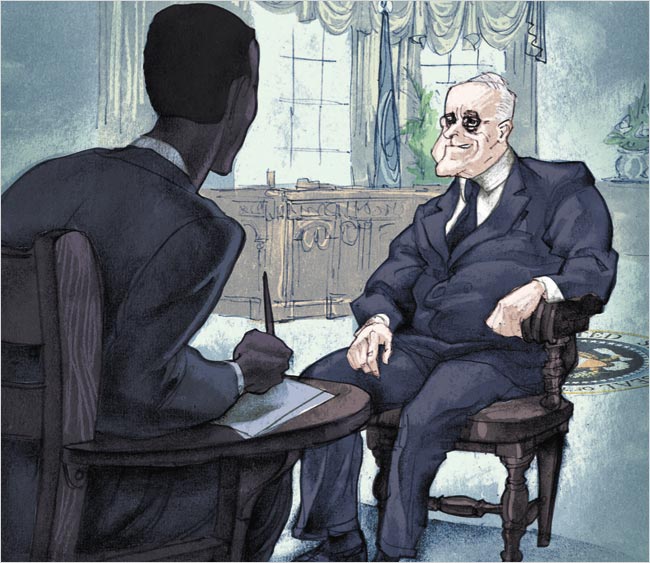
How much can Obama learn from FDR? Graphic from Economic Policy Journal.

The right wing economic ideologues had their chance and got what they wanted in terms of deregulation, union busting, deficit spending and war. And the results are now pretty clear. It is time for them to just shut up.

By Chuck Spinney / The Rag Blog / April 2, 2009

See ‘Was the New Deal a Bust?’ by Jeff Madrick, Below.

The right wing in America has been bashing FDR for my entire life. Since 1981, the anti-Roosevelts have been in power for all but eight years, and that exception, the presidency of Bill Clinton, was more “conservative” than “liberal.” The centerpiece of Roosevelt’s legacy, Social Security, has been a particular target of the radical right, which harps on its long term problems. Their solution has been to “securitize” Social Security in the form of private 401K-type accounts.

Social Security has long term problems, to be sure. But in the short term, it has been a cash cow since the increases in social-security taxation were put into place during the 1980s, ironically while Reagan was preaching the virtues of privatization and running huge deficits. Since then, Social Security has been taking in much more money than it spends. The Social Security cash flow has been squandered through predilection for deficit spending by Democratic as well Republican administrations since LBJ unified the the budget in an effort to hide the cost of the Vietnam War, with much, if not most, of that diversion being directed toward the Pentagon, particularly during the Reagan and Bush II administrations.

One thing is now clear: Had the Republicans succeeded in securitizing Social Security, part or all of this cash surplus would have been pumped into Wall Street and inflated the financial bubble even further. It is also clear that the influx of money would have increased bankers’ bonuses and shifted even more money to the super rich. Perhaps, the huge influx of money would have delayed timing of the bubble’s bursting (into a democratic administration?), but it is now clear that the inevitable bursting would have been even more destructive to the welfare of average citizens than the current meltdown.

Nevertheless, even today, amid the carnage wrought by the supercapitalism of the radical right, we still hear them trashing Social Security as well as the social programs that are Roosevelt’s legacy. My friend Jeff Madrick, an old time liberal, is rightly offended by this attack and has written the attached defense of the New Deal, which I think is largely on the mark.

But while I think Jeff is dead on, I am still nervous over the question of whether or not a Keynesian approach will work well in today’s crisis. I think the total debt situation in our country (public and private) is very different than the 1930s and that it is being worsened by Obama’s giveaway to the big banks, which should be allowed to fail, be broken up, and re-regulated. Also, the U.S. was an industrial economy in the 1930s, with a very small military sector, and although production collapsed in the Great Depression, it remained an industrial economy, albeit one with horrendous excess capacity. So, there was a big pump that was ready to be primed.

Today, after years of deindustrialization, what remains of our industrial sector is much smaller and feebler relative to the size of our economy and its global competitors. Moreover, today’s industrial sector is infected by a proportionally much bigger permanent military sector made up of highly politicized inefficient mega-corporations that can not compete in free markets. Those who think increasing the defense budget today will stimulate the economy like it did in WWII are dead wrong, because a comparison of the stimulative effects of defense spending in WWII to today’s situation is completely bogus for at least two reasons:

(1) Rationing increased saving after we entered WWII, which built up pent up demand that was released after the war. On the other hand, our country has been over-consuming, dissaving, and deindustrializing since at least 1980.

(2) Most of the companies making defense products in WWII were commercial companies, like Ford, which returned to producing commercial products after WWII. Today, defense is a highly specialized sector with very little spin off to the civilian economy and no civilian market expertise. (Aircraft manufacturers were an exception, but the cold war and government subsidies bailed them out.)

So, my skepticism centers on the following question: Do the higher debt burden and the effects of deindustrialization and increased militarization in the industrial sector create a situation different enough from the 1930s and early 1940 to undermine the salutary effects on Keynesianism that Madrick discusses? I don’t think anyone knows the answers to this question.

On the other hand, some things are clear, at least to me:

(1) Squandering political capital to bail out a corrupt bloated financial sector that is so clearly obsessed with promoting its own welfare at the expense of the general welfare will only increase the power of the financial oligarchy that wreaked so much devastation.

(2) Propping up the defense industry by keeping cold war turkeys like the F-22 and missile defense systems alive in the name of protecting jobs also puts the interest of a faction before the general interest and retards the re-industrialization of the American economy.

(3) Our country definitely needs to devote more resources to repairing crumbling infrastructure, be it bridges, sewers, and roads, or education systems, or the medical system, in order to refurbish the base for economic growth.

So, with these caveats in mind, I think Jeff’s analysis is dead on and I urge you to read it. The right wing economic ideologues had their chance and got what they wanted in terms of deregulation, union busting, deficit spending and war. And the results are now pretty clear. It is time for them to just shut up.

Was the New Deal a Bust?
by Jeff Madrick / March 30, 2009

Today’s all-day conference taking a “second look” shows the power of the right in even getting such a question on the table. But claims that the New Deal failed are dead wrong.

Nothing better illustrates the tenacity of the political right in America than the attention it has won for its claims that Franklin D. Roosevelt’s New Deal made the Great Depression of the 1930s worse. Despite heavy political losses, the right soldiers on, maintaining if not building support for bigger battles it expects to come.

The Wall Street Journal editorial page has provided the principal venue for the claims FDR’s programs failed. But today, the Council on Foreign Relations has put together an all-day conference in New York asking its audience to take a “second look” at the New Deal. It is another sign of the right’s influence that it is able to get the prestigious CFR to sponsor the occasion. I am participating and am very glad for the opportunity because claims that the New Deal failed are dead wrong.

What prompts the rightist outcry today, of course, is the government deficit spending proposed by President Obama.

What prompts the rightist outcry today of course is the government deficit spending proposed by President Obama. It is classic Keynesianism designed, along with the financial rescue and housing subsidies, to halt the current severe recession and ignite economic recovery. (The British economist John Maynard Keynes argued in his 1936 classic, The General Theory of Employment, Interest, and Money, that the government can stimulate the economy by spending more than it taxes, thus adding buying power and promoting business investment.)

The conservative critics of the New Deal today want nothing of Obama’s plan. Such Keynesian spending will do no good, make government still bigger, and encumber the U.S. with far more debt than it can manage for many years, they argue. But does a clear look at the 1930s Depression offer any serious evidence to support the contention that Keynesianism failed—and always will?

The claim is misleading from the very start. In fact, Keynesianism was not seriously applied in the 1930s. Economists and others in the 1930s supported government programs to increase consumption; an active right wing then opposed it. But no Keynesian or other serious economist for the last half-century has argued that the deficit spending applied by FDR had a chance to end the Depression. A paper by E. Cary Brown dismissed the notion as far back as 1955

As Price Fishback, a centrist mainstream economic historian from the University of Arizona, points out, budget deficits never rose to the level of Keynesian prescriptions because they were far too small compared to the sharp drop in the nation’s income and industrial production on the order of 30 percent or more. The budget deficits came to roughly 5 percent at their height. While federal spending to pay for relief, work projects, public works, and other matters was increased to as much as 8 percent of a much-shrunken gross domestic product, taxes were also repeatedly raised. Keynesianism is not about public spending per se, but the degree to which outlays exceed tax revenue—the size of the deficit. Compared to the sharp drop in demand, the deficits were just too small.

But even those deficits, coupled with less-stringent monetary policy, had a substantial impact. From 1933, when Roosevelt took office, to the end of his first term in early 1937, the nation’s GDP rose by 9 percent a year. In fact, as Alex Field, an economist at Santa Clara University, points out, when properly calculated on a “chain-weighted” basis, GDP exceeded its 1929 high by the end of Roosevelt’s first term. So did capital investment, rising from some $11 billion in 1933 (in 2000 dollars) to $91 billion in 1937.

This doesn’t stop some economists from claiming investment was poor in these years, evidence to the contrary. They blame the purported weakness on uncertainty over Roosevelt programs and on unions, which, with newfound organizing power due to Roosevelt legislation, artificially pushed up wages and reduced profitability. If anything, it was persistent excess capacity, not somewhat higher wages, that deterred investment. Industrial production remained below 1929 levels until roughly 1937.

For four years, then, the economy was improving robustly. Moreover, the rate of unemployment fell rapidly from roughly 25 percent at its worst level in 1933 to 14.3 percent in 1937. Good progress, but still much too high. No doubt, unemployment would have fallen significantly more, however, except that, under pressure from the predecessors to today’s anti-New Dealers, FDR stepped on the brakes. Taxes were increased, government spending cut back (federal salaries were reduced, for example), and the Federal Reserve tightened monetary policy. The economy plunged into a new recession and the unemployment rate shot up four percentage points to about 19 percent. But the cause was not Keynesian stimulus, but its very opposite.

The anti-New Dealers apparently love to tell us that Keynesianism did not end the Great Depression, the war did. Exactly. Huge amounts of military spending provide the example that solidifies the Keynesian claim. Military spending is also government spending.

Christina Romer, the current head of Obama’s Council of Economic Advisers, has done academic research suggesting looser monetary policy in the late 1930s resulted in more rapid gains in the economy in 1938 and 1939. This is hardly inconsistent with Keynesianism. But it was the rapid rise in government spending in 1941, leaping from roughly $200 billion to $355 billion, that makes the Keynesian case. The economy took off at this point, and unemployment (before large-scale military conscription) fell by four percentage points. It is more than a little interesting that Romer also now supports deficit spending as a stimulus to the economy. So does Ben Bernanke, long a subscriber to the monetarist explanation of the Great Depression until his own place in history has been put on the line as Federal Reserve chairman.

If the New Deal was not about Keynesianism, then what good did it do? A great deal, and that’s understating it. It provided regulation for a modern financial economy, establishing the Securities and Exchange Commission, passing the Glass-Steagall restrictions on banks, and creating deposit insurance. It established federal unemployment insurance, a minimum wage, and of course Social Security. It enabled unions to organize. And I leave much out on the regulatory front. Eventually, it created the Bretton Woods framework for international trade and investment.

The New Deal also aggressively built the nation’s roads and bridges, again a fact often neglected. In the 1920s, the nation’s surface infrastructure did not keep up with the increase in auto ownership. But the capital stock of the nation’s roads, bridges, and new highways rose by a remarkable 70 percent between 1929 and 1941. The development of sewers and water systems was almost as robust. This enormous investment laid the groundwork for the suburban development and growing commercial economy after World War II.

The current right wing complains about all of these government programs, not least Social Security. They were supposedly dangerous interventions that reduced economic efficiency. Yet in the post-World War II era, the economy grew with remarkable speed despite its relative maturity after having become the world’s largest by the late 1800s, and wages doubled for all income groups. All the while, Social Security reduced elderly poverty rates from more than 30 percent to less than 10 percent. Those who complain about unions and their undermining of investment have a hard time explaining the economy’s success in the 1950s and 1960s, a time in which union power was at its height and capital investment was nevertheless robust. By contrast, after Ronald Reagan helped lead to declining unionization, capital investment was disappointing in the 1980s. In the 2000s, when unions seem almost nonexistent, median wages have fallen, and capital investment has been persistently weak.

Some on the right even deny the value of the new transportation infrastructure of the 1930s, claiming that public works spending did not produce an economic miracle. Of course it did not. It was never enough spending in the short run. Its benefits were longer term and critical to future prosperity, as public infrastructure has been since the beginning of the Republic.

One other neglected but remarkable fact should be mentioned, emphasized in particular in fine work by the economist Alex Field. Productivity rose rapidly in the 1930s. I don’t mean simple labor productivity—the output per hour of work. But total factor productivity, or TFP, rose at rates that exceeded growth in most other decades, including the 1920s. TFP is the true source of economic growth. It is, to simplify, the sum of new technologies, managerial innovations, learning on the job, scale economies due to growing demand, and other factors that cannot be attributed merely to increases in labor supply or capital investment. One reason, as Field persuasively computes, was the growth of surface transportation built by the government that made the productivity of private industry greater.

The New Deal, of course, was a hodgepodge of programs and as such, some of them failed and were damaging to the economy. Even Keynes decried provisions in the FDR’s National Industrial Recovery Act of 1933 that resulted in allowing businesses to raise prices. No doubt, some public works programs were more worthwhile than others. But on balance, the New Deal left a stunning legacy that changed America incomparably for the better, made the growth of a true middle class possible, and reaffirmed faith in American democracy when it was perhaps most challenged under the dark cloud of the Depression. This is what many of us long believed, and despite efforts to revise this history, we still should.

The failure to adopt a powerful Keynesian stimulus delayed recovery far longer than necessary. The key lesson of the 1930s is that we cannot afford timidity.

[Jeff Madrick is a contributor to the New York Review of Books and a former economics columnist for the New York Times. He is editor of Challenge magazine, visiting professor of humanities at Cooper Union, and senior fellow at the New School’s Schwartz Center for Economic Policy Analysis. He is the author of Taking America, The End of Affluence and The Case for Big Government.]

Source / The Daily Beast

Thanks to Tom Cleaver / The Rag Blog

Posted in RagBlog | Tagged , , , | 1 Comment

Intrepid Berlin Correspondent MacBryde Reports on the Berlin Dialogue on the Financial Crisis

Heidemarie Wieczorek-Zeul, German Minister for International Economic Cooperation and Development. Photo: © Simone D. McCourtie / World Bank.

Changing the System(s) (Part 1)
By David MacBryde / The Rag Blog / April 1, 2009

Some quick steps in February and March working towards the April 2nd Summit on the International Finance System. And some long-term, medium-term, and immediate work to achieve more democracy with social fairness and ecological viability.

BERLIN — Economist Joseph Stiglitz, author of Capitalist Fools, visited Berlin in March for a gathering called by Heidemarie Wieczorek-Zeul, the German Minister of International Economic Cooperation and Development.

Stiglitz attended as Chair of the new United Nations Commission of Experts on Reforms of the International Monetary and Financial System. Heidemarie is also a member of that commission which was established by the President of the UN General Assembly with the mandate to reflect on the causes of the crisis, assess impacts on all countries and suggest adequate responses as to avoid its recurrence and restore global economic stability.

The workshop in Berlin served two purposes: It was called to include other experts on the finance crisis also from non-governmental think-tanks and citizens’ groups, and was an occasion for Commission members to meet and work on their recommendations that were then published on March 20th . The Stiglitz Commission Recommendations (18 pages) are available online.

Hasty snapshot of Joseph Stiglitz looking up at Heidemarie Wieczorek-Zeul during the Berlin Dialogue on the Financial Crisis and Changing the International Finance System.

Some background: In February Wieczorek-Zeul had, as earlier mentioned in The Rag Blog, convened an international working group on the international impacts of the breakdown of the financial system. That served to develop the current German position on the issues. Politically active since the mid-1960’s, she has been a Member of the European Parliament, is a Member of the German Parliament (Bundestag) and heads (like a cabinet position) the Federal German Ministry for International Cooperation and Development.

All the above has, as one immediate focus, the April Financial Crisis Summit in London.

Some (A) long-term, (B) medium-term, and (C) immediate work:

(A) Long-term: More democracy: Getting from 0 to 1 to 8 to 20 to 185

Don’t fix it unless it is broken. It is broken.

The March meeting was opened by Heidemarie pointing out the window to where The Berlin Wall had been, and was taken down (by curious East Germans, not by Gorbatchov or Reagan), and noting that current changes are larger.

Background:

(0) An international conference about the international financial system was called, and failed, in the 1930s.

(1) In 1944 at Breton Woods, New Hampshire, a conference did create an international financial system. That was based on a single nation’s currency, the US dollar, pegged to a physical commodity, gold. (An alternative, proposed by Keynes and others, would have been to create an actually international reserve currency.) Also several international institutions were created (“World Bank”, “International Monetary Fund”) with participation and decision-making based on the amount of money put in. The USA was by far the richest country at the end of WW2.

(8) In 1970, at a time of international financial turbulence, US President Nixon called a meeting of the richest countries. (That eventually became the “G8” meetings of heads of governments of the richest 8 countries.) Nixon took the dollar off the gold standard, but the dollar remained the international “reserve currency”.
In the Spring 2007, with growing international financial stresses, the “G8” met in Germany, at Heiligendamm. There were large theatrical blockades outside and a real blockade inside that meeting. The German position, as host and also as chair of the European Union, included putting the financial system on the agenda.
Bush blocked that.

(20) Following Paulson’s panicky punt in September 2008 with a three page bank bailout plan (without any congressional oversight or judicial review) there were numerous crises meetings. The European Union “asked” (some said “insisted”) on an emergency financial summit meeting with Bush in November, with the G20 so as to include countries from all continents. At that meeting Bush agreed to stop his blockade and put the international finance system on the agenda with a meeting of the G20 scheduled for this April, 2009.

(185) The G20 includes Brazil, South Africa, China and others. The recommendation by Stiglitz, Heidemarie and others in the UN Commission on the financial system is to create an architecture that includes all 185 countries.

But as a participant at the March workshop in Berlin put it: the Titanic has hit the iceberg. It is not a matter of rearranging the deck chairs. Some immediate and near-term actions are needed. It is the case that, as the ship is sinking, actions are needed and can not be postponed while building a whole new liner – that is a longer term job. But unlike what actually happened as the Titanic sunk, with few life boats and many people locked below decks, now immediate and near-term actions must include all involved.

One long-term recommendation, also urged by the current German chancellor, is to create an Economic Council at the United Nations parallel to the (old) Security Council. While a global town meeting using the internet and consensus decision making might be imaginable, that is not immediately, if ever, practicable. And the (old) UN Security Council is also no longer a model. The recommendations do include some steps towards reform of the United Nations, in the long-term, as an international forum to handle international economic issues.

(B) medium-term: a philosophical and hard economic question: what is “money”, and what is a “reserve currency”? What is “the financial system”, and what are “banks” and “financial institutions” in that system?

The value and role of the “dollar” is already an issue. One medium-term consideration is NOT to replace all dollars, or replace the dollar as a currency, but maybe to use an already existing economic tool called “special drawing rights” (SDRs) already available among central banks through the International Monetary Fund (IMF):

“The SDR is an international reserve asset, created by the IMF in 1969 to supplement the existing official reserves of member countries. SDRs are allocated to member countries in proportion to their IMF quotas. The SDR also serves as the unit of account of the IMF and some other international organizations. Its value is based on a basket of key international currencies.”

“The International Monetary Fund (IMF) is an organization of 185 countries, working to foster global monetary cooperation, secure financial stability, facilitate international trade, promote high employment and sustainable economic growth, and reduce poverty around the world.” (official site)

Facing the disaster of past policies, there have already been some policy changes by staff at the IMF. There will be more changes in the near and medium term.

(C) immediate work: oversight, “regulation”, tax havens and emergency financial actions

Oversight: A core issue that was blocked by Bush at the Spring 2007 G8 summit was the lack of insight and oversight about international financial activities. What is happening? What is “in” the “investment products” in banks and other entities engaging in international economic activities? What are “systemic” dangers? It sure would have helped to have had all of that out on the table in the spring of 2007, before the crisis hit hard in the fall of 2008. But Bush blocked that.

The German position (also widely held by conservatives here) is that while “markets” are a vast improvement over feudal or other forms of tyranny, they are not, by themselves, self-regulating or stable. The standard sports analogy is that to play soccer, or whatever, one needs accepted, legitimate, rules and referees and a fair playing field. One alternative is to have a dog-eat-dog, survival of the nastiest, society. That is certainly possible, but not broadly desirable. Even most dogs do not do that.

One linguistic problem in discussions between Germans and Anglo-Saxons is the term “regulation”. In English that can sound negative, stuffy and authoritarian, a limitation on liberty. And can be. But the word can have a different meaning: “legitimate standard”. The usual analogy here involves vehicles used on public roads. Consider someone driving on public roads at night at high speed without breaks or lights, and causing damage. Not a good idea. In Germany, vehicles to be used on public roads need to be registered and inspected to meet safety standards. That is not a tyrannical dictation of where or when one drives the vehicle. It is a precondition for having usable public roads that the vehicles meet legitimate standards when used on public roads.

The Germans and others at the G20 summit will be insisting on improvements in oversight and regulations/standards for international financial activities.

That is the core issue for Germans at the summit. That issue is basically also one of democracy and the ability to have legitimate oversight and standards of international economic activity in the (global) economy. The “markets” are no longer only within nations, and there is now significant economic activity beyond the ability of any individual nation alone to exercise oversight and legitimate regulation.

That requires international agreements. Decisions about vehicle standards can be made for specific geographic areas. Democratic decisions are for the most part made within nation-states. But there is now significant international economic activity across boarders of any one nation, activity that can, and now has, caused vast damage. Recently, with much work, there had been a decline in infant mortality rates. Now they are climbing.

We will see what agreements will be reached at the G20. In any case international oversight and standards are on the agenda. The German position is that there be no geographical exception, and that all internationally active institutions and financial products be included.

An additional immediate agenda point regards international tax evasion problems. Most all governments are, or had better quickly be, concerned with that issue. The Swiss (after some recent legal pressure from the US Securities and Exchange Commission and from Germany) and following them a number of countries with “bank secrecy laws” have already agreed to accept international standards on cross-boarder tax issues.

The German position on emergency financial actions is now also fairly clear. They are taking a number of steps domestically, including with a view to dangers of hyperinflation/deflation. The Germans have a large stimulus package already and have the “automatic” anti-depression features in the social system. They are now watching to see the effects before doing more. There is a strong distinction made here between anti-depression “stimulus” efforts and dealing with the international financial system, including effects on small countries that are innocent by-standers and do not have large currency reserves. The Germans are, and are urging others, to increase the emergency facilities available to innocent countries with small reserves.

Locally in Germany immediate steps also involve changing the banking laws to enable emergency expropriation if necessary, as well as legal steps regarding international tax evasion issues.

Current issues here about getting beyond the financial crisis involve “investment”, the business models of “banks” and “public investment”. What kind of economy can be gotten to “beyond” the crisis? Emergency “stimulus” packages are one thing, but just expanding the money supply another. When is a “stimulus” really an investment that helps create value, and when is it only a transfer of funds from one pocket to another? A financial “system” is one thing, the institutions in a system another.

While some Germans enjoy pointing the finger at the “monstrosity” of Anglo-Saxon fundamentalist market capitalism (to quote the conservative German President Mr. Koehler) there is also a German saying that if you point a finger at someone else several fingers are pointed back at yourself. Along with being very mad at some financial institutions and systems in the USA and Britain (and, formerly, Island), the Germany are intense about “investment processes” here.

Changing the system(s) also involves changing the decision-making processes of the institutions in the system, including processes of investment decisions. Germany already has some public banks. The labor unions have some rights, and have been flexing their muscles and their political planning. There is broad cultural agreement that “investment decisions” can also involve ethical, social and ecological dimensions that need to be “taken into account”, but are not usually “taken into account” as a market price factor. That is, not only is there an internal failure of the capital market, but there is also much more reality beyond the market, beyond the price and cost numbers normally “taken into account” as a market cost.

So the crisis of the capital market is not only a crisis within the market but also crises about realities “external” to the market such as ethics, social fairness and ecological viability. This week in Germany there is both a large conference on education for “sustainable development” that is socially fair and ecologically viable, and an international working meeting preparing for the Copenhagen Climate Summit in the autumn. In both there will be some focus on best practices on the local, regional and international levels that can be scaled up. A lot is on the plate.

The Rag Blog

Posted in Rag Bloggers | Tagged , , | 1 Comment

Reasons

Cartoon by Charlie Loving / The Rag Blog

Posted in Rag Bloggers | Tagged , | Leave a comment

Keith Joseph : Why Socialism? Because of Wednesday!

Watching the clock under capitalism: Dali-inspired melting clock / e-potpourri.

Once you get through Wednesday, only two more days to go until the weekend… The weekend is real life — the work-week is its interruption. Work is what we do when we are not alive, when we stick our necks into the machine and the vampires suck our life for profit.

By Keith Joseph / The Rag Blog / April 1, 2009

Socialism is once again up for discussion, so I thought it was time to propose an answer to the question: why socialism? And my answer is: Wednesday. What is Wednesday? Wednesday — or as my old man used to call it: hump-day — is the third day in the work-week. Once you get through Wednesday, only two more days to go until the weekend. What is the weekend? The weekend is real life — the work-week is its interruption. Work is what we do when we are not alive, when we stick our necks into the machine and the vampires suck our life for profit.

On Wednesday mornings I wake up and think: “What day is it? It’s Wednesday. Oh, I’m halfway there.” Halfway to where? To the weekend, yes, but also more importantly, even if less obviously, halfway to celebrating the waste of my life, the waste of five beautiful days that cannot be gotten back so I can say on Friday with a foolish grin “TGIF.”

I first noticed the horror of work under capitalism when I finished celebrating the end of high school. On the last day of high school I thought like some kind of an idiot, “I will never have to get up this early again.” The memory of the alarm clock, my mother screeching my name as I ignored the alarm clock — it still makes me shudder — weighed on me, and I thought it was really over. Little did I know it had only just begun.

I painted houses after high school and worked my way through college and kept painting houses for a few years after I graduated college. I remember the feeling of sacrilege, of wasting something beautiful, holy, and irreplaceable as I sweated outside on ladders of various heights to earn a day’s pay ($60 a day at the beginning, when I finally quit painting I was making $140): I am trading a perfect day, in the perfectly healthy body of a twenty year old for $60. I will never have this day again and I certainly will never be able to buy it for $60. It is priceless and I sell it for $60. What kind of fool am I?

I still sell my days. The horror of it isn’t so biting. That is really how we are desensitized. Not through violence on TV but by our willingness to sell our days, our weeks, our months and our years — our lives for a mess of porridge and a plasma TV. Individual resistance is futile, revolution is necessary — the slow long process of dismantling capitalist social relationships and the horror of wasting lives for the profit of a few.

My daughter is only six years old — already she is in training. Every weekday morning she wakes up and gets ready for school and my wife or I drop her off on our way to work. She asked me the other day, “How long do I have to do this for?” (get up every morning and go to school). I answered her, “Honestly, it never ends. After school you have to go to work. They let you retire just after your body starts falling apart, just before you are about to die.” I tell her the truth so she will understand why socialism is necessary.

Socialism is necessary because work under capitalism is a life-sapping process that also infiltrates our lives outside of work. The most basic level of experience — our relationships to ourselves and others — is corrupted by capitalist social relationships. Marx covered some of this ground in his rightly celebrated 1844 Manuscripts (also known as the Paris Manuscripts). He explains that human beings are alienated in four main ways: from each other; from their own possibilities; from their activity at work, and from the result or product of their labor. Marx’s text is full of rich insights and each form of alienation has the possibility of sustained discussion. Indeed, plenty of ink has been spilt analyzing these texts.

I only want to add that work is drudgery because it is organized under capitalistic social relations. Our jobs are not to make, produce, or create anything; our job is to produce surplus value (surplus value is the source of all forms of capitalists’ income: profit; rent; and interest). As a head of U.S. Steel once boasted, “The job of US Steel is not making steel, it is making money.” And our job is to make money for one capitalist enterprise or another. But this is not the only way to organize work. The hatred that most of us feel for work under capitalism is not a hatred for work in general. Indeed, work under different conditions can be challenging, interesting, fun, creative and self-fulfilling.

One of the things that makes Marx’s 1844 manuscripts so fascinating is his discussion of work as the vehicle for self-realization. Work can actually become the opportunity to not only discover your self but to create your self and develop humanity as a whole at the same time.

One example used by Marx is the development of human senses through work. Musicians, for instance, not only create music but develop the human ability to hear –work holds the possibility to create not only objects outside of ourselves but the creation of ourselves. Many of us have had this sort of experience outside of capitalist work relations. For instance, I enjoy writing. It is not only an opportunity to put ideas on paper, but it also allows for the creation of the ideas. The work develops the self and its capacities and the finished product is then a way to understand ourselves and the world more deeply. But writing as a job would be quite different in most cases. I wouldn’t choose my topics, I would have to write in a style that conforms to someone else’s expectations, and I would have an artificial deadline — when, what, and how I write, under capitalism, would be dictated by another.

This is one reason many people don’t enjoy writing, because the process is learned in school settings that are very much intended to mimic, as training, the conditions faced by workers (the whole point of education under capitalism is to produce willing and able workers, i.e., people with skills capital needs and people who are willing to work under exploitative conditions enforced by illegitimate authority. You learn to accept authority and hierarchy as the norm — “Go to the principal’s office” — and you learn to have your most intimate activities dictated by outside forces, i.e., when to wake up, when to eat, when to use the bathroom, and when to go home).

When I tell someone I worked as a house painter they often will respond: “I like painting.” I answer, “That’s because you never did it for a living.” When you paint a room in your apartment or house, it is your own freely chosen activity. You determine when, how, and why the work will be done and you keep the product (the painted room) of your labor. This is non-alienated work. One way to know the difference between alienated and non-alienated work is through your experience of time. Alienated work is when you watch the clock with unimaginable longing: “Is it lunch time yet?” “Is it time to go home yet?” You don’t watch the clock when you are performing non-alienated labor, and time seems to pass quicker than usual. The surprising thing is that not only is non-alienated work far more enjoyable and fulfilling, it is ultimately “more productive.” You can get far more work done in non-alienated settings.

Under capitalism non-alienated labor, whether playing music, programming, painting, writing, or laying brick happens in between “work,” on the weekends (if we are lucky enough to have weekends off) or in the evenings (if we are working the first shift), but one of the main objectives of socialism is to transform work so that it is no longer the interruption of life but instead the activity that makes life most interesting and fulfilling.

The Rag Blog

Posted in RagBlog | Tagged , , , | 2 Comments

Justifying Afghanistan: Obama’s Got It Wrong

President Obama announces a new comprehensive strategy for Afghanistan and Pakistan Friday. Behind him, from left, are policy advisor Bruce Riedel, Joint Chiefs Chairman Adm. Michael Mullen, National Security Advisor James Jones, and Secretary of State Hillary Rodham Clinton. AP Photo/Ron Edmonds.

Obama’s domino theory
By Juan Cole / March 30, 2009

The president sounds like he’s channeling Cheney or McCain — or a Cold War hawk afraid of international communism — when he talks about the war in Afghanistan.

President Barack Obama may or may not be doing the right thing in Afghanistan, but the rationale he gave for it on Friday is almost certainly wrong. Obama has presented us with a 21st century version of the domino theory. The U.S. is not, contrary to what the president said, mainly fighting “al-Qaida” in Afghanistan. In blaming everything on al-Qaida, Obama broke with his pledge of straight talk to the public and fell back on Bush-style boogeymen and implausible conspiracy theories.

Obama realizes that after seven years, Afghanistan war fatigue has begun to set in with the American people. Some 51 percent of Americans now oppose the Afghanistan war, and 64 percent of Democrats do. The president is therefore escalating in the teeth of substantial domestic opposition, especially from his own party, as voters worry about spending billions more dollars abroad while the U.S. economy is in serious trouble.

He acknowledged that we deserve a “straightforward answer” as to why the U.S. and NATO are still fighting there. “So let me be clear,” he said, “Al-Qaida and its allies — the terrorists who planned and supported the 9/11 attacks — are in Pakistan and Afghanistan.” But his characterization of what is going on now in Afghanistan, almost eight years after 9/11, was simply not true, and was, indeed, positively misleading. “And if the Afghan government falls to the Taliban,” he said, “or allows al-Qaida to go unchallenged — that country will again be a base for terrorists who want to kill as many of our people as they possibly can.”

Obama described the same sort of domino effect that Washington elites used to ascribe to international communism. In the updated, al-Qaida version, the Taliban might take Kunar Province, and then all of Afghanistan, and might again host al-Qaida, and might then threaten the shores of the United States. He even managed to add an analog to Cambodia to the scenario, saying, “The future of Afghanistan is inextricably linked to the future of its neighbor, Pakistan,” and warned, “Make no mistake: Al-Qaida and its extremist allies are a cancer that risks killing Pakistan from within.”

This latter-day domino theory of al-Qaida takeovers in South Asia is just as implausible as its earlier iteration in Southeast Asia (ask Thailand or the Philippines). Most of the allegations are not true or are vastly exaggerated. There are very few al-Qaida fighters based in Afghanistan proper. What is being called the “Taliban” is mostly not Taliban at all (in the sense of seminary graduates loyal to Mullah Omar). The groups being branded “Taliban” only have substantial influence in 8 to 10 percent of Afghanistan, and only 4 percent of Afghans say they support them. Some 58 percent of Afghans say that a return of the Taliban is the biggest threat to their country, but almost no one expects it to happen. Moreover, with regard to Pakistan, there is no danger of militants based in the remote Federally Administered Tribal Areas (FATA) taking over that country or “killing” it.

The Kabul government is not on the verge of falling to the Taliban. The Afghan government has 80,000 troops, who benefit from close U.S. air support, and the total number of Taliban fighters in the Pashtun provinces is estimated at 10,000 to 15,000. Kabul is in danger of losing control of some villages in the provinces to dissident Pashtun warlords styled “Taliban,” though it is not clear why the new Afghan army could not expel them if they did so. A smaller, poorly equipped Northern Alliance army defeated 60,000 Taliban with U.S. air support in 2001. And there is no prospect of “al-Qaida” reestablishing bases in Afghanistan from which it could attack the United States. If al-Qaida did come back to Afghanistan, it could simply be bombed and would be attacked by the new Afghan army.

While the emergence of “Pakistani Taliban” in the Federally Administered Tribal Areas is a blow to Pakistan’s security, they have just been defeated in one of the seven major tribal agencies, Bajaur, by a concerted and months-long campaign of the highly professional and well-equipped Pakistani army. United States Secretary of Defense Robert Gates replied last summer to the idea that al-Qaida is regrouping in Pakistan and forms a new and vital threat to the West: “Actually, I don’t agree with that assessment, because when al-Qaida was in Afghanistan, they had the partnership of a government. They had ready access to international communications, ready access to travel, and so on. Their circumstances in the FATA (Federally Administered Tribal Areas) and on the Pakistani side of the border are much more primitive. And it’s much more difficult for them to move around, much more difficult for them to communicate.”

As for a threat to Pakistan, the FATA areas are smaller than Connecticut, with a total population of a little over 3 million, while Pakistan itself is bigger than Texas, with a population more than half that of the entire United States. A few thousand Pashtun tribesmen cannot take over Pakistan, nor can they “kill” it. The Pakistani public just forced a military dictator out of office and forced the reinstatement of the Supreme Court, which oversees secular law. Over three-quarters of Pakistanis said in a poll last summer that they had an unfavorable view of the Taliban, and a recent poll found that 90 percent of them worried about terrorism. To be sure, Pakistanis are on the whole highly opposed to the U.S. military presence in the region, and most outside the tribal areas object to U.S. Predator drone strikes on Pakistani territory. The danger is that the U.S. strikes may make the radicals seem victims of Western imperialism and so sympathetic to the Pakistani public.

Obama’s dark vision of the overthrow of the Afghanistan government by al-Qaida-linked Taliban or the “killing” of Pakistan by small tribal groups differs little from the equally apocalyptic and implausible warnings issued by John McCain and Dick Cheney about an “al-Qaida” victory in Iraq. Ominously, the president’s views are contradicted by those of his own secretary of defense. Pashtun tribes in northwestern Pakistan and southern Afghanistan have a long history of dissidence, feuding and rebellion, which is now being branded Talibanism and configured as a dire menace to the Western way of life. Obama has added yet another domino theory to the history of Washington’s justifications for massive military interventions in Asia. When a policymaker gets the rationale for action wrong, he is at particular risk of falling into mission creep and stubborn commitment to a doomed and unnecessary enterprise.

Source / Salon

The Rag Blog

Posted in RagBlog | Tagged , , , | 4 Comments

Ric Sternberg Video : Million Musician March for Peace

“Bionic Ric” Sternberg played in the band and also filmed the Million Musicians March — led by Grand Marshal Wavy Gravy — on March 21, 2009, in Austin, Texas. Photo by Alan Pogue / The Rag Blog.

The Million Musician March:
Just Keepin’ Austin Weird

By Ric Sternberg / The Rag Blog / March 31, 2009

On March 21, 2009, Instruments for Peace staged its annual Million Musician March for Peace. OK, so maybe there weren’t a million, but hundreds of Austin’s musicians and supporters marched from the Texas Capital building down to the City Hall. The parade snaked through Austin’s live music district and many participants and attendees of the South by Southwest Music Festival hit the streets to cheer the marchers on. This is Part 1 of my coverage of the event: excerpts from the pre-march rally and concert on the Capital steps.

Next is Part 2 of my coverage of the event: excerpts from the march and an exciting melding as the parade reaches City Hall and Carolyn Wonderland, Guy Forsythe and Shelley King join that marching band in a jumping version of “Down by the Riverside.” (Part 3 is still to come.)

See related coverage on The Rag Blog:

The Rag Blog

Posted in Rag Bloggers | Tagged , , , , , | 1 Comment