Eliminating the Taliban Threat: Not Achievable


How to Leave Afghanistan
By Leslie H. Gelb / March 12, 2009

ONLY if our troop levels hit 100,000 and fighting floods over into Taliban havens in Pakistan will Washington be likely to look hard at the alternative policy for Afghanistan — withdrawing most American forces and refocusing our power on containing, deterring and diplomatically encircling the terrorist threat. But by then it will be too late.

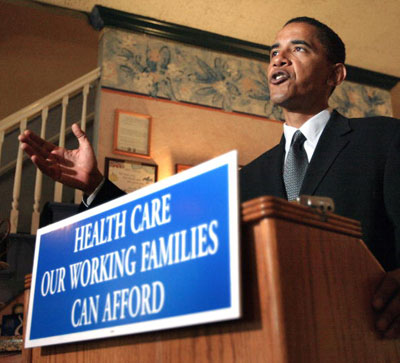
President Obama is now confronting the classic problem from hell: either do more to stave off defeat and hope to get lucky, or withdraw and face charges of defeatism and perhaps new terrorist attacks. Mr. Obama’s goal is to “ensure” that Afghanistan is not a sanctuary for terrorists, which effectively restates his campaign call for victory there. Thus, he recently decided to add 17,000 American troops to the more than 35,000 already in Afghanistan. But his goal of eliminating the Taliban threat is not achievable.

Mr. Obama needs to consider another path. Our strategy in Afghanistan should emphasize what we do best (containing and deterring, and forging coalitions) and downgrade what we do worst (nation-building in open-ended wars). It should cut our growing costs and secure our interests by employing our power more creatively and practically. It must also permit us — and this is critical — to focus more American resources and influence on the far more dire situation in Pakistan.

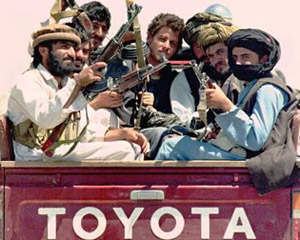
We can’t defeat the Taliban in Afghanistan, as the last seven years have shown. Numbers are part of the problem: most Taliban are members of Afghanistan’s majority tribe, the Pashtuns. More confounding, the Taliban and their Qaeda allies have found in northwestern Pakistan a refuge that has proved almost impregnable. These factors make overcoming the enemy in Afghanistan infinitely harder than it was in Iraq.

What we can do is effectively reduce the risk of terrorist attacks from Afghanistan against its neighbors, the United States and its allies. We can do this in a way that would allow for the withdrawal of American forces, though economic and military aid would continue.

Graphic by Fogelson-Lubliner.

The first step is to provide significantly increased economic support, arms and training to friendly Afghans as United States combat forces gradually depart over, say, three years. We could use the intervening time to increase present counterinsurgency operations to better protect Afghans and give them a boost to fight on their own, if they have the will.

The second step is to try to separate less extremist elements of the Taliban from their leadership and from Al Qaeda. Mr. Obama is already considering reaching out to Taliban moderates, and he could do this through the Afghan government and covert contacts. No group is monolithic once tested with carrots and sticks, as we saw in Northern Ireland and Iraq.

The Taliban are no exception. While most of them want to drive America out, they have no inherent interest in exporting terrorism. As nasty as the Taliban are, America’s vital interests do not require their exclusion from power in Afghanistan, so long as they don’t support international terrorists.

Third, while we should talk to the Taliban, Washington can’t rely on their word and so must fashion a credible deterrent. The more the Taliban set up shop inside Afghanistan, the more vulnerable they will be to American punishment. Taliban leaders must have good reason to fear America’s military reach. Their leaders could be hit by drones or air strikes. The same goes for their poppy fields, from which they derive considerable income. Most important, Mr. Obama must do what the Bush team inexplicably never seemed to succeed in doing — stop the flow of funds to the Taliban that comes mainly through the Arab Gulf states. At the same time, he could let some money trickle in to reward good behavior.

Fourth, President Obama has to ring Afghanistan with a coalition of neighbors to show the Taliban they have no place to seek succor, even after an American departure. The group would include China, India, Russia, NATO allies, and yes, Iran. They all share a considerable interest in stemming the spread of Afghan drugs and Islamic extremism. China and Russia should be more willing to help in this anti-Taliban effort as the American military presence recedes from their sensitive borders.

Then there’s Pakistan, both the heart of the problem and the key to its solution. The peaceful future of the region depends on the resolve and ability of Pakistan’s secular and moderate religious leaders to provide decent government to their people. China, India, Iran and Russia might cooperate with Washington simply because there’s no motivation greater than the nightmare of extremists controlling Pakistan’s nuclear weapons.

India in particular wants to combat extremism in Pakistan. It could do that by reducing its forces on the border with Pakistan, for example, thereby allowing Pakistani moderates to focus their attention more on the growing and already formidable extremist threat within.

Withdrawal need not mean defeat for America and victory for terrorists, if the full range of American power is used effectively. Richard Nixon and Henry Kissinger proved that by countering the nasty aftereffects of Vietnam’s fall to communism in a virtuoso display of American power. They did this by engaging in triangular diplomacy with China and the Soviet Union; brokering a de facto peace between Israel and Egypt; and re-establishing American prowess in Asia as a counterweight to emerging Chinese power. By 1978, three years after Saigon’s fall, America’s position in the area was stronger than at any time since the end of World War II.

I don’t know whether the power extrication strategy sketched out here would be less or more risky than our present course. But trying to eliminate the Taliban and Qaeda threat in Afghanistan is unattainable, while finding a way to live with, contain and deter the Taliban is an achievable goal. After all, we don’t insist on eliminating terrorist threats from Somalia, Yemen and Pakistan. Furthermore, this strategy of containing and deterring is far better suited to American power than the current approach of counterinsurgency and nation-building.

President Obama and Congress owe it to both Afghans and Americans to explore a strategy of power extrication before they make another major decision to expand the war.

[Leslie H. Gelb, a former editor and columnist for The Times, is the president emeritus of the Council on Foreign Relations and the author of the forthcoming “Power Rules: How Common Sense Can Rescue American Foreign Policy.”]

Source / New York Times

The Rag Blog

Posted in RagBlog | Tagged , , , | Leave a comment

The Explosion at the Shrine of Rahman Baba

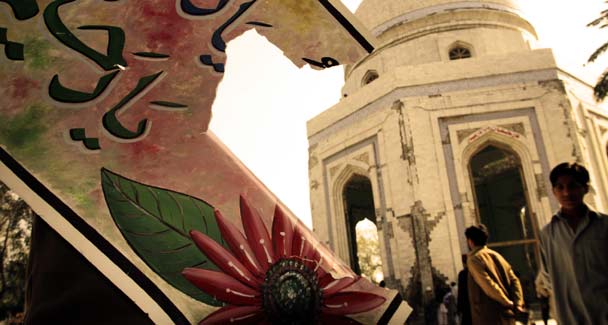
The explosion badly damaged Rahman Baba’s Shrine. AP Photo/Muhammad Sajjad.

Uprooting Flowers on Pakistan’s Frontier
By James Caron / March 14, 2009

Some time before dawn on the 5th of this month, there was an explosion in the main building at the ziyarat, or shrine, of ‘Abd-ur-Rahman in Hazar Khwani village, North-west Frontier Province, Pakistan. While explosions have become despairingly common in this general region, with Taliban-inspired networks proliferating among the majority Pashtun ethnic group, this particular explosion shocked many commentators. It did so not only because the village was located in a fairly secure area, but also because Rahman Baba, as the saint was better known, was something of a symbol of peace in the Pashtun regions of Pakistan and Afghanistan, and his poetry continues to be one of the sturdiest foundations of Pashtun cultural heritage.

Since the bombing a variety of commentators – some in Pakistan and especially western observers – have read this event as a war between two cosmically separate factions of Islam. In a piece in The Observer on March 8th, William Dalrymple’s headline claimed that “Wahhabi radicals are determined to destroy a gentler, kinder Islam.” The article argued that a wholesale Saudi-funded importation of “madrasa student” ideology threatens a somehow more authentic Pakistani Islam based on a tolerant Sufism.

I disagree with both the reifications of pundits such as Dalrymple and those of certain sections of the critical Pakistani intelligentsia, at least in part. In my recent experience living in and around Peshawar and the NWFP, I sensed that one major social fault line in Frontier Islam is something more basic. In many cases, working-class and service-industry people belonging to the Deobandi school of thought, which casual commentators often conflate with “radical Wahhabism,” proved to be among the gentlest and most generous people I met in Pakistan. In my extended interactions with certain such people, even though they belonged to proselytizing groups such as the Tablighi Jama‘at this membership did not color their interactions with me as a person.

I noticed, instead, a split between those who focused on the social role of their Islam as an analytical and activist tool to create social movements; and those for whom Islam was a humanist experience. Simply put, it was abstracted social-centric Islam versus concrete people-centric Islam. Social-centric Islams of all stripes, moderate or radical; their largely middle-class propagandists, and their populist adherents tend to say a similar thing. That is, they hold that reform of superstitious customs – including shrine pilgrimage – will help poor people better their material lives and create a more just social order. In seeking to forcibly enable an abstract vision of purist religious and social reform for people in a highly unjust political and economic environment, paradoxically the radical faction responsible for this blast probably never stopped to think about actual people.

This for me is the real tragedy of the symbolic attack – for there was little real damage – on Rahman Baba’s ziyarat. For me, an American Muslim academic who has studied the Pashto language, it was my favorite place in Pakistan exactly because of its people-centrism.

One of the Masters students in the Pakistan Studies program at Peshawar University lives in Hazar Khwani village where the tomb is, and in 2005 he invited me to visit his family there. I’d prefer not to mention his name, since association with Americans is no longer something that people would wish others to know about. After several languorous hours of the legendary Pashtun hospitality, a sizable group of us went to the shrine to say a fatiha prayer for Rahman Baba.

One reason I love the shrine is the personality of Rahman Baba himself, as reflected in his poetic work. A couple of lines that illustrate well a social religion grounded on a genuine love for individuals and personalized devotion are the following. The version sung by Qamar Gula, an Afghan woman singer in the 1970s, is my favorite:

Dwa yaran da ranga cha na de lidali / Che yaw da bal khkandzal kral; bal du’a kra

Che me mina Khdae pa ta bande payda kra / Tarka ma pa hagha wradz khpala riza kra

Who ever heard of two lovers like this / Where one cursed the other; while the other prayed for the first

When God created love for you in me / On that day I gave up my free will

The following lines may be among the most widely known bits of Pashto poetry anywhere. A fair number of Pashtuns I have met know this passage by heart:

Kar da gulo ka che sima de gulzar shi / Aghze ma kara; pa pkho ke ba de khar shi

Kuhi ma kina da bal sari pa lar ke / Chere sta ba da kuhi pa ghara lar shi

Plant flowers where you live, so that your region is a flower garden / Don’t plant thorns or they will stick in your feet

Don’t dig a pit in someone else’s path / Your path might sooner or later end up leading into that pit

The shrine is located where Rahman Baba and his disciples used to meet. And whether or not he planted the garden himself, Rahman Baba’s shrine complex sits in a grove of deciduous trees – sycamore, poplar, and eucalyptus – interspersed throughout an ancient graveyard. Rahman Baba purportedly had the ability to communicate with animals due to his gentleness, and even now, when people have birds that are suffering from any form of ailment, they bring them to Rahman Baba’s forest to recuperate. There is a special very large aviary constructed in and among the trees for this purpose. I imagine these innocent creatures were spared on the dawn of the 5th. There were a few buildings in between the aviary and the main mausoleum which might have sheltered them from the blast.

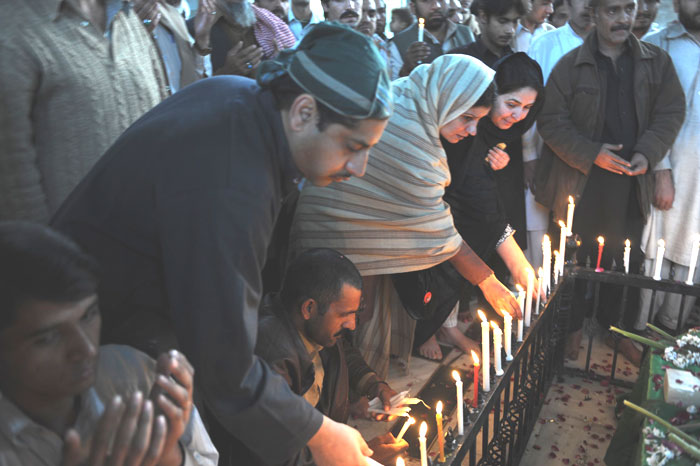
Writers, civili society workers and lovers of Rahman Baba observed vigil on the Shrine of Rahman Baba.

Rahman Baba’s shrine complex had none of the ostentation of most South Asian shrines. The sober austerity struck me as very “Pashtun” – not at all like the stereotype of a sensuous, mystical “Sufi Islam” as opposed to some other essentialized “strict Islam”. The shrine complex consists of a number of small cube-shaped whitewashed buildings, and a large marble mausoleum structure sponsored by the Saudi government in 2001 or 2002. If there was much beauty, it was mainly located in the trees and the sunlight filtering through, and in non-visual adornments granted not by wealthy donors but by the participation of everyday visitors.

Instead of visual ostentation, the main decoration was verbal. Much like the Persian poet Hafiz of Shiraz, Rahman Baba of Hazar Khwani wrote poetry that is still used daily by people today for inspiration in coping with their problems. People do a niyat – meditate on their problem – and then open Rahman Baba’s diwan, or poetry collection, to find a couplet at random. Almost invariably it helps (and the couplets above give only the most rudimentary sense of the gentle sorts of “advice from beyond” that the diwan contains). I myself have kept a copy in my office. It got me through a difficult year of teaching full time and advising students for the first time. In any case, after this exercise, if the couplet has been helpful, supplicants often visit the shrine complex and commission that couplet to be painted in green lettering on the whitewashed walls of the small boxlike buildings there.

My inlaws from the lowlands of the (ethnically very different) Punjab province sometimes gently poked fun at me, a historian, visiting the NWFP for research. I remember one asking incredulously, “What are you going to see there? There’s nothing but Pashtuns!” His point was that unlike the Punjabi city of Lahore, for example, Peshawar and the surroundings offer little in the way of glorious monuments or iconic cityscapes (with a few notable exceptions). For him, and for too many others, those things are what history is all about. Ergo, in this view, Pashtuns have no history. But personally, I draw the most inspiration in my work from reflecting on various modalities of verbal culture. And there are few societies on earth that have produced the sort of oral-historical, poetic patrimony that Pashtun society has – language-based monuments so socially intimate that most outsiders will never appreciate them, or even see them. “Wildflowers blooming, ignored, in the wasteland” is the analogy used in the title of a mid 1980s poetic anthology, as well as a paraphrase of words that the legendary peace activist Khan ‘Abd-ul-Ghaffar Khan once used to describe his people. For this other reason the shrine struck me as a very “Pashtun” monument, stripped of everything but those beautiful green words on white, words which meant the world to someone in an hour of need. It is this people-centric Islam that was under attack, an Islam that cuts across sectarian divides and invites Wahhabis and all other Muslims alike to imagine each other as fellow humans above all else, complex and unique. Though this was not true of everyone, many so-called ‘Wahhabis’ I knew answered that invitation with a soft and understated “yes”, and coexisted with the more socially marginal figures who managed this space full-time.

After our group paid our respects in the mausoleum, we met a large group of malangs, or ascetics/hermits. They were chopping wood at the time, in preparation to cook lentil soup for the evening charity kitchen. There was already a fire going, and I detected hashish fumes mixing with the mesquite smoke. The malangs put down what they were doing and made us some milky tea, without any request on our part. It was the first time I’d ever had a substantive discussion with malangs. It mainly pivoted on my telling one of the malangs that even in the US, some of us study the poetry of Rahman Baba. The malang I was speaking to – in true ego-denying form, he never offered his name – was not surprised. He said, “Of course, he is a great friend of God. Even in America he must be famous.”

One photo I took of the main mausoleum is my favorite among all those I took in my entire time in Pakistan. Quite by chance, I hit the camera button at the exact moment when two friends were greeting each other in an embrace, which is exactly the feeling I get when I open Rahman Baba’s diwan. Looking even more closely one notices two women in brown burqas, mostly obscured by shadows, between two flags off to the left. This almost unnoticeable presence is part of what so outraged the new crop of ‘religious students’, the literal meaning of the word ‘taliban’. Superstition and saint veneration was objectionable enough; but according to what I’ve read of the event, the thought of women engaging in these activities, in public, appears to have been the trigger for this bombing. The act, therefore, consisted of two parts. The perpetrators viewed women as a social category to be reformed, not as individual people with individualized spiritual needs; and they viewed individualized Islam, grounded in actually-existing people, to be beside the point. In attempting to destroy this shrine, or to discourage attendance at it, they saw no value in the relationships expressed here.

For me at least, Rahman Baba the man is not the object of veneration; Rahman Baba the tradition is. To me Rahman Baba was a geographic focal point which communicated all the individual desires and hopes that passed through society. The saint is immortal because of his words; and his words are immortal partly because their presence in that concrete physical space engenders a personal connection to other individuals regardless of sectarian or socioeconomic or even temporal boundaries. For this reason, an attack on Rahman Baba’s ziyarat hit me especially hard. Despite all the distance between my life and that of Hazar Khwani village, I felt that I had added my own presence to that of countless other specific individuals. When I saw the news of this bombing, I felt as if I was seeing the participatory history of unique people, with individual pains and individual dreams, being replaced by dogmatic abstraction. For this reason, it would be a true shame in my eyes if popular and critical analyses of this, and other such, events also replicated a typology-based worldview, with ideological labels like “Deobandi” or “Barelvi” or “Wahhabi – not actual people – at their core.

[James Caron is in the Ph.D. Program of S. Asia Studies at the Univ. of Pennsylvania.]

Source / Informed Comment

The Rag Blog

Posted in RagBlog | Tagged , , , , | Leave a comment

Misplaced Anger : Coming to Terms with the Obama Health Care Plan

Perhaps too many liberals are exhausted by watching the Kabuki Theatre of the Republican congressional leadership and their total disregard for the welfare of the nation in this time of deep crisis.

By Dr. Stephen R. Keister / The Rag Blog / March 14, 2009

On Tuesday March 3, the attendee list for the Health Care Summit at The White House was announced and I, like many, many other advocates of universal, single payer health care felt that President Obama had entered a Faustian agreement with AHIP. I, again, like many others spent hours on the internet attempting to rally support for our cause. Seemingly the effort bore results as Rep. Conyers and Dr. Fein, President of Physicians for a National Health Policy (PNHP) were included in the gathering. Dr. Fein’s speech is reproduced in my last Rag Blog submission.

It was the next morning that I found the extensive pamphlet issued during the Obama campaign wherein he described his plan for universal health care on page 34. Indeed, he did not include HR 676 in his thinking but a viable, and possibly enactable plan was described which we will touch on in more detail later.

Perhaps too many liberals are exhausted by watching the Kabuki Theatre of the Republican congressional leadership and their total disregard for the welfare of the nation in this time of deep crisis. Perhaps we are becoming a bit touchy as a result of their nay saying, and their opposition to increasing taxes for the wealthy, their placing blame for our economic woes on the working man, and their absurd argument that if the super-wealthy have to pay more taxes it will reduce their giving to charity, as if tax-deductions were the sole reason for charitable giving. However, back to the subject of health care in the after glow of the White House conference . . .

In our discussion of health care let us apply the dictum of Ockham’s razor to the discussion. First, the cost of universal health care has been bandied about with little thought to realities. If one goes to the PNHP website one can click on “Single Payer National Health Insurance” for a well presented summary. For extensive details go to the left column and click on “Frequently Asked Questions.” Second, the need for national health care becomes apparent when one reviews the “Human Development Index.” This was a totally new concept to me but one that is explained in Wikipedia. The Human Development Index (HDI) is a comparative measure of life expectancy, literacy, education and standards of living in countries worldwide. It is a standard means of measuring well-being, especially child welfare. The standing of the United States? Look it up!

Subsequent to the White House Conference Rep. John Conyers, speaking at Thomas Jefferson University, said that President Obama would not support single-payer universal health insurance now because he had too much on his plate — two wars and an economic crises — and would have to settle for the health reform he could get. The Michigan Democrat said the President would push through a public-private system of health reform, keeping private insurance through employers, and expanding a Medicare-like system for the uninsured, “if he is lucky.” This, of course, is compatible with the Obama campaign promise.

Even this concession has caused the AHIP (America’s Health Insurance Plans) to launch a vitriolic campaign, well detailed in an article in Campaign for America’s Future, by Monica Sanchez. These are the folks who feigned support for and then helped torpedo health care reform in the early 90s with the now infamous “Harry and Louise” ads. They have good reason to mount an opposition since the top seven “for profit” health insurers made a combined $12.6 billion in 2007 — an increase of 170.2% from 2003. Further, the CEO compensation packages for the top seven for profit health insurance companies ranged from $3.7 million to $25.8 million.

Business Week in the March 5, 2009, issue has a lengthy article entitled “A Backlash against Obama’s Budget.” It is noted that lobbyists are already planning public protests, ad campaigns and more targeted appeals to key members of Congress. On March 3, former Columbia/Hospital Corporation of America CEO Richard L. Scott, contributed $5 million from his own pocket, launched a $20 million advertising and public relations effort emphasizing free market alternatives to Obama’s health-care plans. Scott plans three weeks of ads on CNN and NBC, then video documentaries hosted by former CNN anchor Gene Randall in which doctors and patients in Britain and Canada bemoan their health systems.

If I were Mr. Scott I would go at this in two ways: (1) In every community, in every social group, there are, as we all know, folks who are chronically complaining, the tiring bitchers, that we all encounter. Surely, with the added incentive of several thousand dollars, they would be only too eager to vent their hostility in public; (2) And then there are unemployed professional actors, looking for work, who will be glad to oblige. One thing that I cannot comprehend is why Mr. Scott omitted Fox News from his selections. I vaguely remember legal fraud representations against Columbia Hospital Corporation some years ago.

More from the excellent Business Week article:

Obama and his team will also be hearing from health insurers like United Health Group, Humana, Well-point and Kaiser. They are balking at the plan to cut $176 billion in costs out of Medicare Advantage which combines private insurance with Medicare coverage. The lobbyists aim to send a message to Max Baucus of Montana, the Democratic chairman of the Senate Finance Committee, and Charles Grassley of Iowa, the committee’s top Republican. The plan is to show how much rural areas would suffer under the proposal. “By rural areas,” we basically mean Iowa and Montana”, says one industry lobbyist. “Baucus and Grassley will understand that.”

Again, in our last Rag Blog article we dealt with the United Health Care Group, and have addressed Humana on repeated occasions. We also reported on Sen. Baucus’ repeated receipt of donations from the health insurance and pharmaceutical industries in prior presentations. Remember that President Bush established Medicare Advantage with several thoughts in mind: (1) to enrich the insurance industry; (2) to privatize Medicare as he failed to privatize Social Security and thus deplete the Medicare reserve funds per neoliberal economic theory; (3) and to reward his contributors in the insurance industry.

In The Guardian of March 7, 2009, there is a telling quotation from Senator Grassley; “Should the reform plan include a public-sector insurance programme (some call it ‘Medicare for All’) as an alternative to private insurance?” A lot of us feel that the public-sector option would create unfair competition “for the private insurers.”

David Sirota on March 6, in “Blog For Our Future” asks the question, “If government is so awful, so inefficient and so supposedly hated by the country as the Right so often insists, how are those same Republicans insisting that Americans would overwhelmingly opt to be covered by a government-run health plan, if given the choice.” Further, “Mitch McConnell suggested that there were areas in which Republicans won’t compromise, particularly the creation of a new public insurance program to compete with private insurers. ‘Forcing free market plans to compete with those government-run programs would create an unleveled playing field and inevitably doom the competition.’

Of course the playing field would not be level. At the present time the administrative cost consumes approximately 6% of the budget, while over 30% of the private plans go into administrative costs, which include CEO salaries, stock holder dividends and advertising. And remember as well, the private companies have a big expense in paying lobbyists and bribing our elected representatives.

The Republican thinking is well represented in The Raw Story on March 5, 2009. Republican Representative Zach Wamp of Tennessee told MSNBC that Obama’s proposed healthcare plans would be a “fast march to socialism” and that he believes that healthcare is not a right because many choose not to have insurance. Listen, healthcare is a privilege.” (Does he not know that a decent private plan for a family of four can cost $12,000?)

Obviously Rep. Wamp has not the vaguest ideas of what is inherent in “socialism” and is totally unfamiliar with the excellent privileged health care in the vast majority of Western European nations. One wonders if, as a child, the “gentleman” enjoyed teasing animals!

The March 16 issue of Time Magazine, hardly a liberal publication, presents, on page 26, an excellent article entitled “The Health Care Crisis Hits Home.” Near the end of the article the author points out that 25 million are UNDERINSURED. They pay for health care coverage but have inadequate coverage. There is no magic formula for figuring out how much coverage is enough, but here are a few pitfalls to avoid: (1) High Deductibles Commonwealth Fund found that 25% pay annual deductibles of $1,000 or more, a red flag for scant coverage. (2) Caps or omission of services. Read your plan to check on drug coverage or per day hospital fees, which may leave you with bulging health care bills. (3) Temporary or short-term policies. Buying into these plans may disqualify you from comprehensive, long term coverage later, especially if you have a pre-existing condition.

At the near age of 88, I would love to see single payer, universal health care enacted, and have worked for it as a member of PNHP; however, I am a realist and for the present will support the Obama plan, knowing that it is not perfect but feeling that it is a step in the right direction with better things to come. I must admit hesitancy in accepting the Obama Treasury team, and his apparent lack of historical perspective re: Afghanistan; however, he is taking many steps that rile the far right establishment and which I in turn find comforting. I remember quite well when President Kennedy was advocating withdrawal of troops from Viet Nam, a more tolerant attitude toward Cuba and an accelerated civil rights policy. Perhaps President Obama should stay within his armored limousine! One assumes that in our nation there are greater, and more malicious, forces than the Presidency.

The Rag Blog

Posted in Rag Bloggers | Tagged , , , | 2 Comments

Republican Buffoon Bunning : Another Shameful Show

Graphic by Larry Ray / The Rag Blog (with apologies to the horse).

Sen. Jim Bunning: A Shameful Show

While many senators were terse and faulted Geithner for not having a detailed bailout plan in hand, Senator Bunning was coarse, mean spirited and imperious.

By Larry Ray / The Rag Blog / March 13, 2009

New Treasury Secretary Tim Geithner was subjected to an unconscionably mean, sarcastic and possibly pathological verbal lashing by Kentucky Republican Senator Jim Bunning in a televised senate hearing today.

Secretary Geithner was questioned by members of the Senate Budget Committee with Republican Senators particularly putting on quite a show, peppering Geithner with rhetorical verbal lashings that served not so much to educe useful answers as to vent frustrations and to grandstand for the voters back home.

Televised hearings, instead of being orderly proceedings seeking to find solid solutions, are unfortunately being used as free political advertising by disorderly and disgraceful public officials like Senator Jim Bunning.

Secretary Geithner has barely had time to move into his office. Yet he has spent more time appearing before hearings than he has using his expertise and experience to craft details of his bailout budget plan. Today’s petty viciousness did not serve America in any way. Instead of budget committee members asking rational questions and attempting to help craft a plan with positive ideas and input, the hearing was more like something from the Spanish Inquisition.

Secretary Geithner showed his mettle and maturity as he weathered the rude rantings and abrupt cavalier treatment, the worst of which came from aging Republican Senator Jim Bunning. In case the name doesn’t roll off your tongue immediately, Bunning is the snappish buffoon who has a history of ugly, mindless and mean spirited comments for which he has repeatedly been forced to apologize. He made Time magazine’s list of the worst senators, and refused to return to Kentucky to debate his opponent, instead doing it from Washington, where it was later learned he had used a teleprompter for the debate.

His most recent gaffe was made at a Hardin County (Ky.) Republican Party’s Lincoln Day Dinner. In a headline grabbing comment about approaching vacancies on the Supreme Court he predicted that U.S. Supreme Court Justice Ruth Bader Ginsburg would be dead by year’s end.

Justice Ginsburg returned to work just two weeks after her surgery for pancreatic cancer. Bunning issued an apology, but his press release reportedly misspelled Justice Ginsburg’s name.

While many senators were terse and faulted Geithner for not having a detailed bailout plan in hand, Senator Bunning was coarse, mean spirited and imperious. After asking Geithner, “Where is your plan to rescue the United States system? We’ve been waiting for that.” he would not allow Geithner to even respond, shouting over him with more ranting questions.

Bunning’s tirade was what one might expect to see from an an enraged worker who has lost his job, all his savings and his home having a rude rant at George Bush. Yet here is a disgraced Republican Senator whipping up on a member of President Obama’s cabinet.

Fearful of losing his seat as junior senator from Kentucky, Bunning just a few weeks ago threatened to sue the National Republican Senatorial Committee if it tries to recruit a GOP candidate to challenge him. He went on wildly, claiming Kentucky Senate President David Williams “owes him $30,000” and questioned the honesty of NRSC Chairman John Cornyn of Texas.

To his credit, Secty. Geithner kept his cool, and strongly defended his budget plan and even after being rudely interrupted by Bunning who waived a memo and hissed, “Where is the bottom line to the taxpayer dollar-wise?” Geithner defended the $160 billion AIG bailout, offering measured, rational reasoning.

Sadly, his fellow senators allowed Bunning to berate and verbally lash the Treasury Secretary like he was an unprepared schoolboy. Finally, following the firestorm, Senator Lindsey Graham, R-S.C. attempted a half-hearted try at extending an olive branch, saying to Geithner, “Thank you for taking the job, I know it is tough.” It was too little too late. But Geithner remained poised, restrained and certainly much more professional than the gathered Senators.

Bunning is clearly old, cranky and may be exhibiting early senile dementia. He also may still be living in some reverie from his days as a major league baseball pitcher dating back to the 1950’s. But even back then the only good thing many baseball fans remember Jim Bunning ever did was blowing the 1964 pennant for the Phillies, so the Cardinals could come from 6 games back and win. But finding a way to halt America’s worsening economy is no game, and Senator Bunning’s time at bat today showed him swinging wildly and striking out.

Like the old horses from his state of Kentucky, he needs to be put out to pasture. It is no secret that many of his colleagues would like that.

[Retired journalist Larry Ray is a Texas native and former Austin television news anchor. He also posts at The iHandbill.]

The Rag Blog

Posted in Rag Bloggers | Tagged , , , | Leave a comment

El Salvador : U.S. Republicans Meddling in Historic Election

Mauricio Funes, a former television reporter, is the FMLN candidate for president of El Salvador.

It is outrageous to see how a small contingent from the Party of No can contribute to a climate of electoral fear.

By Al / The Rag Blog / March 13, 2009

[The following is a dispatch from a regular Rag Blog contributor who is writing under a pseudonym due to the sensitivity of the situation in El Salvador.]

Live from San Salvador.

I am here as an international observer to an historic election in El Salvador. Before I came here, Rep. Raul Grivalva from Arizona, Senator Bernie Sanders and 31 others signed a letter to the Obama administration requesting that the U.S. remain neutral and support the outcome of the presidential election this Sunday, March 15, 2009. What I have seen here is the way that a few Republicans testifying on the floor of Congress can intervene in that sovereignty.

The front pages of the paper here trumpeted the news that the United States would cut off aid and stop Salvadoran immigrants from submitting remittances to their country. It is outrageous to see how that small contingent from the Party of No can contribute to a climate of electoral fear. The other claim is that the journalist Mauricio Funes from the FMLN party is a terrorist. I was walking in the neighborhood near our hotel two days ago when an airplane dropped flyers over several blocks advertising a documentary. The ad featured Hugo Chavez stabbing his finger at his audience. The ruling ARENA party here is trying to demonize Funes and the FMLN, paving the way for potential violence. Two FMLN activists were murdered last night after they were followed and cornered by a truck full of men.

This is the old El Salvador of death squads and assassinations which our tax dollars supported for so many years. Please pay attention to what is happening here. Call your Congressional representatives and demand that the U.S. remain neutral and support the democratic choice that is made on Sunday. Pressure today has resulted in a statement of neutrality from the State Department, but it is hard to publicize this statement. Read the Huffington Post for more action items

Mil gracias,

Al

The Rag Blog

Posted in Rag Bloggers | Tagged , , , | Leave a comment

MRSA: A Potential Cost of Industrial Agriculture

One of the many industrial hog farms outside Camden, Ind. Photo: Nicholas D. Kristof/The New York Times.

Our Pigs, Our Food, Our Health
By Nicholas D. Kristof / March 11, 2009

The late Tom Anderson, the family doctor in this little farm town in northwestern Indiana, at first was puzzled, then frightened.

He began seeing strange rashes on his patients, starting more than a year ago. They began as innocuous bumps — “pimples from hell,” he called them — and quickly became lesions as big as saucers, fiery red and agonizing to touch.

They could be anywhere, but were most common on the face, armpits, knees and buttocks. Dr. Anderson took cultures and sent them off to a lab, which reported that they were MRSA, or staph infections that are resistant to antibiotics.

MRSA (methicillin-resistant Staphylococcus aureus) sometimes arouses terrifying headlines as a “superbug” or “flesh-eating bacteria.” The best-known strain is found in hospitals, where it has been seen regularly since the 1990s, but more recently different strains also have been passed among high school and college athletes. The federal Centers for Disease Control and Prevention reported that by 2005, MRSA was killing more than 18,000 Americans a year, more than AIDS.

Dr. Anderson at first couldn’t figure out why he was seeing patient after patient with MRSA in a small Indiana town. And then he began to wonder about all the hog farms outside of town. Could the pigs be incubating and spreading the disease?

“Tom was very concerned with what he was seeing,” recalls his widow, Cindi Anderson. “Tom said he felt the MRSA was at phenomenal levels.”

By last fall, Dr. Anderson was ready to be a whistle-blower, and he agreed to welcome me on a reporting visit and go on the record with his suspicions. That was a bold move, for any insinuation that the hog industry harms public health was sure to outrage many neighbors.

So I made plans to come here and visit Dr. Anderson in his practice. And then, very abruptly, Dr. Anderson died at the age of 54.

There was no autopsy, but a blood test suggested a heart attack or aneurysm. Dr. Anderson had himself suffered at least three bouts of MRSA, and a Dutch journal has linked swine-carried MRSA to dangerous human heart inflammation.

The larger question is whether we as a nation have moved to a model of agriculture that produces cheap bacon but risks the health of all of us. And the evidence, while far from conclusive, is growing that the answer is yes.

A few caveats: The uncertainties are huge, partly because our surveillance system is wretched (the cases here in Camden were never reported to the health authorities). The vast majority of pork is safe, and there is no proven case of transmission of MRSA from eating pork. I’ll still offer my kids B.L.T.’s — but I’ll scrub my hands carefully after handling raw pork.

Let me also be very clear that I’m not against hog farmers. I grew up on a farm outside Yamhill, Ore., and was a state officer of the Future Farmers of America; we raised pigs for a time, including a sow named Brunhilda with such a strong personality that I remember her better than some of my high school dates.

One of the first clues that pigs could infect people with MRSA came in the Netherlands in 2004, when a young woman tested positive for a new strain of MRSA, called ST398. The family lived on a farm, so public health authorities swept in — and found that three family members, three co-workers and 8 of 10 pigs tested all carried MRSA.

Since then, that strain of MRSA has spread rapidly through the Netherlands — especially in swine-producing areas. A small Dutch study found pig farmers there were 760 times more likely than the general population to carry MRSA (without necessarily showing symptoms), and Scientific American reports that this strain of MRSA has turned up in 12 percent of Dutch retail pork samples.

Now this same strain of MRSA has also been found in the United States. A new study by Tara Smith, a University of Iowa epidemiologist, found that 45 percent of pig farmers she sampled carried MRSA, as did 49 percent of the hogs tested.

The study was small, and much more investigation is necessary. Yet it might shed light on the surge in rashes in the now vacant doctor’s office here in Camden. Linda Barnard, who was Dr. Anderson’s assistant, thinks that perhaps 50 people came in to be treated for MRSA, in a town with a population of a bit more than 500. Indeed, during my visit, Dr. Anderson’s 13-year-old daughter, Lily, showed me a MRSA rash inflaming her knee.

Dr. Tom Anderson’s daughter, Lily, and, wife, Cindi, in Camden, Indiana. Dr. Anderson treated an epidemic of MRSA infections before he died. Photo: Nicholas D. Kristof/The New York Times.

“I’ve had it many times,” she said.

So what’s going on here, and where do these antibiotic-resistant infections come from? Probably from the routine use — make that the insane overuse — of antibiotics in livestock feed. This is a system that may help breed virulent “superbugs” that pose a public health threat to us all. That’ll be the focus of my next column, on Sunday.

Source / New York Times

The Rag Blog

Posted in RagBlog | Tagged , , | 2 Comments

Eschenbach: The Root Cause of the Economic Crisis: Selfishness Was In, Selflessness Was Out


The Death of Voodoo Economics
By Sid Eschenbach / The Rag Blog / March 12, 2009

While it’s interesting, almost unavoidable and improbably instructive to play a ‘blame game’ regarding who is responsible for our collective demise, my own view is that finding answers to more fundamental cultural questions regarding the WHAT and the WHY of how we got here is far more important to understand than the WHO.

In other words, what belief or ideology made so many people do the things that they did that led inexorably to our present situation? While in a parlor game we might ask who was the worst dictator; Mao, Hitler, Lenin, Stalin, or Pol Pot, the more interesting and by far the more illustrative question is why did they do what they did? What was the ideology that drove them and all those around them to commit the acts they committed? What was the culture they lived within that fostered their creation and facilitated their acts.

Beyond that, beyond the questions of what and why, there is a second component to our disaster, the HOW, and that too demands examination. What were the actual economic mechanisms of our downfall? How are they related to the ‘what’ and ‘why’, and are they also culpable or are they simply innocent tools that were misused by ideologically misguided people?

What and Why

When the mavens of conventional wisdom say things like; “There’s plenty of blame to go around”, what they are really saying is that the culture itself has failed in some fundamental way. They mean that there has been not an individual but rather an ideological failure within the culture, a collective mistake in the value system used to regulate society. Strangely, one of the leaders of the very ideology that lead so many to err was himself the first to clearly and publicly identify the problem: Alan Greenspan, in response to a question from Rep. Henry Waxman during his Congressional Testimony in October of 2008, said the following:

Well, remember that what an ideology is. It is a conceptual framework [that determines] the way people deal with reality. Everyone has one. You have to — to exist, you need an ideology. The question is whether it is accurate or not. And what I’m saying to you is, yes, I found a flaw. I don’t know how significant or permanent it is, but I’ve been very distressed by that fact.

Greenspan, more a sociologist than economist in that statement, speaks a fundamental truth; that he (and by logical extension all of the then current ruling political and economic class) shared an ideology that ‘had a flaw’. In that light, they are blameless as individuals but indictable as an ideological group… and how each contributed in greater or lesser part to the events that followed is of far lesser importance than our understanding the ‘flaws’ in the ideology that led them to their acts.

So what were the values of that flawed ideology? What were the beliefs shared by these many perfectly rational and responsible individuals that collectively led their society into economic chaos? Again, Greenspan, as arguably its foremost practitioner, identifies the ideological cornerstone, the belief that the free market system is the best way to allocate capital and risk in an economic system. This is the economic ideology popularized by the writings of Ayn Rand, given intellectual and academic substance by Milton Freidman, and delivered to the western mainstream of economics by Ronald Reagan. It is known by many monikers; supply-side economics, Chicago School economics, neoliberal economics, trickle-down economics, and free-market economics… but by whatever name, it is the same ideology identified by different parts of its message.

Beyond the general argument of its proponents that it is the best economic system because of it’s supposed superiority (over the state) in the allocation of capital and evaluation and distribution of risk, it is also based upon two other fundamental ideas; first, the idea that greed and self-interest are the most significant motivators in human behavior, and second, it advances the idea that ‘market efficiencies’ (such as production costs or sales prices) are the most important elements of market capitalism, and considers anything that inhibits market efficiency or self-interest as a hindrance to general prosperity and detrimental to the society as a whole.

In brief, it is an ideology born in reaction to the state controlled societies of the mid-20th century and shaped as a rejection of the socialist and communist propositions regarding the management of society. Like all grand ideologies, there is more than a kernel of truth at its core. However, and again like all other ideologies, it is ultimately less a replicable and universal system that will produce the same results in different countries and cultures than it is a reflection of the values of the individuals that practice it.

In order to demonstrate what I mean by that, an example: imagine a half-dozen different countries all have exactly the same vehicular transit policies. Identical laws, penalties, procedures and processes governing how automotive traffic is managed. Now imagine that those countries are Nigeria, Italy, Norway, Japan, Argentina and Canada, and ask yourself if you think that if one visited those countries with identical traffic laws, would you expect all the drivers of these countries to drive in the same way? If you’ve ever been to any of these countries, your answer would of course be ‘no’… and therein lies the ‘flaw’ found by the leader of the free-market ideology; the different way individual members of every culture respond to identical rules. The ‘flaw’ that Mr. Greenspan found within his ideology, the lack of individual responsibility, was in fact the result of the change in cultural values caused by the very free-market philosophy he believed in.

Mr. Greenspan was born and raised in the even then vanishing cultural values that were described by Max Weber in his classic work “The Protestant Ethic and the Spirit of Capitalism”, a culture where an individuals righteous and proper behavior, moderated and guaranteed by his church, served as the cornerstone of individual responsibility found at the heart of early American capitalism. Weber’s book describes in detail the particularly American expression of one of the key and indispensible ingredients of all successful societies; the individual responsibility of the citizen that is also understood to include a collective responsibility… the willingness to sacrifice oneself for the greater good. Indeed, if there is a single quality that predicated American greatness on the world stage in the 19th and 20th centuries, it was that combination of individual strength and collective responsibility… the ideology that ‘I must be a strong and good individual’ combined with ‘I am my brothers keeper’. From the pre-Christian Romans to the 21st century Chinese, the requirement that individual members of society subordinate their needs to the greater good while simultaneously leading honorable lives as individuals has been the narrative of all successful human civilizations… and the American is no exception.

What shocked Mr. Greenspan, then, was his discovery that this was essentially no longer true; that individuals across the social spectrum… from the financial and political leaders of the modern American society to the individual citizen consumers and workers… that they all placed their own needs above the common need, their own benefit above the common benefit. While this is certainly nothing new in human history, it was new indeed to the American popular culture. While greed and self-aggrandizement are never far below the surface of inherent and biologic human behavior, when those qualities are celebrated and emphasized, as they are in the Ayn Rand neoliberal socio-economic model, there could be no other outcome. Just as in her novel “Atlas Shrugged” when the ‘productive and creative’ people went on strike, abandoning the needs of the larger society to pursue their own personal benefit, in the real life of our own historical novel we reached a condition wherein all things selfish were deemed virtuous… and here we have finally identified the ‘flaw’ discovered by Greenspan.

Bankers, he was shocked to discover, had put their own well-being above their company’s welfare… but worse… we had all become, each in our individual parts, like the bankers. We bought what we could not afford… thinking only of ourselves, we borrowed what we couldn’t repay, never thinking of the consequences… and at the fall, we all pointed fingers at one another, never considering our responsibilities to the society as a whole… but why should we? Hadn’t our political class been preaching the virtues of selfishness and greed for nearly three decades, for over a full generation? Hadn’t anyone who tried to design and build systems that worked for the collective well-being, from community organizers to union leaders, been attacked and discredited as liberal dreamers? That kind of ‘socialist’ thinking had become, in the modern vernacular, foolish and dated. Selfishness was in, selflessness was out.

However, one can only look to other successful societies to compare behaviors and see the values of Reaganism reflected in something very different: in Japan, heads of failed companies took personal responsibility and resigned in public disgrace; in America, heads of failed companies gave themselves golden parachutes and lashed out at all around them as the cause of their company’s demise. In Europe, employment, public health and financial equality held center stage, while in America all three were held up as ‘yesterdays’ thinking, and instead efficiency, free choice and the right to riches were celebrated as both the goals of policy, and became policy itself. In retrospect, what is shocking about Alan Greenspan’s comments is that after 30 years of worshiping the masters of the universe, he is shocked at their and our collectively selfish behavior… but in his defense, his own culture is another than the one being lived around him. Simply put, his mistake was to assume that his own personal values were the values of the present, and not recognizing that they were those of the past.

Under this ideologic regime, and particularly in the United States, we have seen national tax, trade and labor policies manipulated by the rich to make themselves richer at the expense of the rest of society. Since 1980 and the formal entry of neoliberal economics onto the American scene under Ronald Reagan, the top 1% of Americans today earn nearly 4 times the amount they earned in 1980, while the incomes of all others have remained essentially flat. In contrast, during the period from 1940 -1970, all incomes of all sectors of American societies doubled. While particularly true for the U.S., it is also true for the world has a whole. A recent (Oct 2008) OECD study shows that the United States is higher than only two countries out of thirty member states (Turkey and Mexico) in measurements of poverty and inequality. The same report states that the top 10% of Americans control 71% of the national wealth. In short, under the neoliberal free-trade banner, inequality has increased within nearly all countries and also between all countries… and this is not a trend that can continue with creating major intra and international problems, and can only be considered a gross failure of the policies designed by an ideology based upon greed.

How

This recent ideologically founded catastrophic failure of the entire economic framework… from manufacturing to consuming to financing… is in many ways testimony to the ‘success’ of the same… or as Bob Dylan said many years ago, ‘she knows there’s no success like failure, and that failure’s no success at all.’ The ability to produce more goods more cheaply and distribute them more broadly should be a good thing, and the past 30 years represent the first time in history that man could actually, through a combination of high tech, mass transport, low wages and high debt, satisfy virtually every need of every person to and beyond the limits of their economic abilities to consume. In order to do that, massive manufacturing, consumer and financial businesses were created that followed the same laissez faire ideological principals, principal among them being that size matters due to the following fundamental narrative; better is more efficient, bigger creates greater efficiencies, therefore bigger is better. While there is always risk in business to uncontrolled growth, the countless mergers and acquisitions in automotive, high tech, finance, biotech, agribusiness, construction and energy companies for the last part of the previous century was the rule, not the exception.

The idea that there could be existential disadvantages or threats to great size was never seriously considered in this paradigm, and any concept that a manufacturing, services, consumer or financial company could be too big simply didn’t enter into the ideological model. On the contrary, continued consolidation of all industries was looked upon as the essence of the march to efficiencies under the laissez faire flag. As a result, when the black swan entered, the event that had never happened before but, because the future has never happened before, did, the exploding of a ten-year housing bubble exploding, the results were equally as all encompassing and destructive in the same way that the successes of the earlier years had been all-encompassing… on a global scale and with massive companies… and again all due to the same reason, that being following blindly the commonly accepted dogmas of the reigning ideology.

Over a period of 30 years, a massive global manufacturing capacity was built upon one simple mantra at the heart of ‘free trade’: manufacture in the poor countries and sell in the rich countries. This, of course, requires an ideological component that will solve the political problems that have historically arisen… a way to convince the people in the rich countries not to place tariffs upon the importation of goods manufactured in the poor countries back into the rich countries. This was also achieved through liberal applications of the free-trade ideology, as selfish consumers were essentially ‘bought off’ by the cheap goods and easy credit provided by the market leaders. They bought the ultimately destructive argument that the availability of cheap goods was a legitimate and valid long term policy goal, instead of the creation and maintenance of industrial jobs and the maintenance of a diversified economic culture. Occasionally, politicians would try to challenge the mantra, most notably Ross Perot in the 1992 American presidential race… but none was able to puncture the bubble of consumer and voter credibility.

With that socio-political problem solved, internet based computer technologies solved the communication and management problems that had previously constrained growth, and there were suddenly no practical limits to the size nor the locations of the multinationals. They could manufacture virtually anywhere, ship virtually anywhere, and sell virtually anywhere, and be headquartered virtually anywhere… all managed by computers that organized, rationalized and made possible the most theoretically ‘efficient’ allocation of capital and the assessment of risk possible ever seen.

However, the laws of the business cycle cannot be repealed through ideology, and something had to give. As stated above, the modern free market trade and development paradigm requires two components; poor manufacturing countries and rich market countries. As poverty is far more abundant than capital, it is the latter which gave way first. The bursting of the real estate bubble in the United States marked the outer limits to what had been for two decades an apparently endless supply of consumer capital, the fuel that powered the machine. To make matters far worse, this end of consumer credit combined itself with a product glut (caused by the achievement of primary market saturation of nearly all goods), and a crash could not be stayed. Not only did consumers no longer have money… they really didn’t need to consume anything new because they had at least one of everything. Therefore, when the limit of no more ability to create money through debt coincided with fully penetrated markets for nearly all consumer goods, the edge of the cliff was defined.

This nearly instantaneous stop to spending in the principal market country resulted in massive manufacturing overcapacity in everything from cars to refrigerators to stereos to computers around the globe… leading to severe contractions in those economies too. It is, however, the financial sectors of the rich countries that have turned out to be the biggest casualties of the meltdown, and the reason for that has less to do with what could be described as the relatively normal contraction at the end of a business cycle than with the size and importance of the companies affected creating an actual existential threat to the countries involved. This too is the product of the ideology of free-market capitalism, because instead of regulating, overseeing and managing the ‘masters of the universe’, the countries whose leadership drank too much of the ‘bigger is better’ ‘no regulations are better than regulations’ ‘let the free market allocate capital and measure risk’ Kool-Aid are the countries that have been hit the hardest, a phenomena clearly demonstrated by comparing the relative health of the financial sectors of Canada to the United States.

Canada, long the butt of jokes for its ‘provincial conservatism’ and ‘stodgy capitalism’, now stands as virtually the only truly healthy financial system in the west. Because neither the national government regulators nor the executives of the financial institutions ever drank the ideological Kool Aid that has destroyed the rest of the financial universe… because they required borrowers to show how they could pay back the loans… because they never lost sight of either individual nor corporate responsibility… in short, because they behaved the way Alan Greenspan mistakenly assumed their brethren to the south would behave, their financial system is today the soundest in the western world… and there is no greater evidence of the culpability and the failure of the free trade, laissez faire, trickle down, Chicago School, neo-liberal, supply-side, Ayn Rand school of economics. They simply didn’t permit their banking and financial entities to participate in the orgy of irresponsible creation of money and ‘growth’ that other countries did… and those countries, from the United States to Iceland, Latvia to Ireland, are now paying the price for their intoxication with existential hang-overs.

How Now

What is the solution? What new belief system will replace the old; what ideology new or old will, as Greenspan said, be more ‘accurate’? Beyond that, how will this new cultural narrative steer the collective actions of a culture to success and stability, just as the Reaganite meme steered us to failure?

My views are that the fundamental mistake of the ‘laissez faire‘ brand of capitalism was, to return to Dylan… its very ‘success’… if indeed in the face of such widespread devastation the meaning of the term in a limited sense can be understood. The neoliberal ideology is a system that neither accepted limits to its power nor recognized other virtues than those (supposedly) valued by the market; low production costs and high market prices, low taxes, no tariffs, the nationalization of loss and the privatization of gain, no limits on growth, the destruction of organized labor, etc.

However, as we have all discovered, the following problems are part and parcel of that paradigm: low manufacturing costs lead, in their ultimate expressions, to child labor, sweat shops and a race to the bottom through union busting, country shopping and low environmental regulations; low taxes facilitate as their principal effect a marked and rapid increase in inequality, not the creation of new wealth as the Ayn Rand school advertises; high market prices demand a large wealthy middle class able to pay them… but there is no provision within the paradigm to protect these very markets; the ‘efficiencies’ of scale created by huge corporate monoliths moves us into the ‘too big to fail’ category, guaranteeing the nationalization of failure while preserving the privatization of gain. In short, we adopted an ideology that subordinates nearly all ‘human’ or ‘liberal’ values to a ruthless ‘efficiency of the market’ model… and are now harvesting the inevitable results of the mature expression of that belief.

With that in mind, the tenets of a new socio-political economic meme should be clear:

  • That no private entity be allowed to become too big to fail, whatever that means within the context of the industry and region.
  • That providers of essential public services once more return to public management as public utilities, as monopoly powers over essential services is something that is too dangerous to be left in private hands.
  • That the neoliberal god of ‘efficiency’ must be replaced by the god of ‘wellbeing’, and that society should not assume that the latter is a product of the former.
  • That the fundamental difference between the concepts of an ‘individuals responsibility for their own life’ and crass selfishness be clear, and the latter be understood to be the anti-social and destructive behavior that it is.
  • That nations reclaim their rightful control over their national economies and act in the long-term interests of their citizens wellbeing. That would include the right to protect their national markets and their national industries, among other things.
  • That while understanding that all men are not created equal and that the natural processes of any system will always be to generate both winners and losers, the goal of every nation should be to promote tax policies that trend towards equality of opportunity, equality in growth, and shared obligations to the nation… not towards greater inequality, the creation of fixed economic classes and unequal individual opportunity.

We are now paying the price for having worshiped at the feet of false gods, as the efficient market theories of neoliberalism have led us to ruin through the hubris of its practitioners. What was surprising to Alan Greenspan, that humans, especially when encouraged by the reigning ideological narrative, could be senseless, selfish and heartless, should surprise no one. Hopefully, however, out of the ruins of this disaster will arise a new ideology that encompasses some of the above social, political and economic values, and economic Randism, Friedmanism and Reaganism and will take it’s just place alongside the other ideological failures … in that place that Reagan himself called the “dustbin of history”.

The Rag Blog

Posted in Rag Bloggers | Tagged , | Leave a comment

Kate Braun: Vernal Equinox Seasonal Message


Vernal Equinox Seasonal Message
By Kate Braun / The Rag Blog / March 12, 2009

Wise Mother whose love surrounds me all you make is sacred…”

Friday, March 20, 2009 is the Spring/Vernal Equinox. Lady Moon is in her 4th quarter, gently retreating as Lord Sun continues his advance. This festival is also called Ostara, for the Anglo-Saxon goddess of the spring, Eoster. Eoster is very like Freya in her attributes. Friday is Freya’s day, making this year’s celebration even more of a “special event”.

Pink, yellow, green and all pastels are appropriate colors to wear and to use in your altar and table decorations. Use living plants for a centerpiece, not artificial ones. Living plants represent Mother Earth‘s reassurance that life continues its cycle and all is well on the planet. You may incorporate artificial rabbits, animals sacred to Diana, and/or eggs into your centerpiece. A solar cross, one with 4 equal arms, is also appropriate; it represents the totality of the Zodiac as well as the solstices and equinoxes and the balance of all things.

Eggs, whether real or artificial, are an important part of the celebration. They represent the beginning of life. Serve your guests eggs and foods such as custard and quiche that use eggs as the main ingredient. Leafy green vegetables, cheeses, ham, sprouts, and a variety of nuts will also be appropriate. Hard-boiled eggs, whether dyed or not, can be given to each of your guests and the following ritual may be observed: As you crack the shell, say aloud: “Now is winter’s ice cracking”; as you peel the white away, say aloud: “Now is the snow melting”; as the golden yolk of the egg is freed, say aloud: “The Sun is free to grow in strength”. Then each guest gives a bit of the yolk and a bit of the white to the persons sitting on either side and all guests toast each other saying “Welcome Spring” or “Goodbye Winter” or some similar phrase. Eostra was fond of sweets, so ending your meal with a dessert is encouraged. Chocolate is not at all out of place.

Other rituals that can be observed to honor Eoster include: planting a real egg, cooked or raw, in the east corner of your garden (this brings fertility to the garden); making a “God’s Eye” (a solar cross with ribbons or yarn in colors appropriate to this season twined around the cross-arms), which may then be placed on your altar or hung outside; decorating hard-boiled or artificial eggs using stickers, paints, colored pens, dye, paper, cloth, ribbons, whatever you have on hand or strikes your fancy. The decorated eggs may be kept as party favors, or exchanged among your guests. Artificial eggs may be kept and used in next year’s decorations.

Reminders: April 4 & 5, 2009, is the next Metaphysical Fair at the Radisson Hotel, 6000 Middle Fiskville Rd. between Highland Mall and Lincoln Village in Austin. Saturday, April 4, hours are: 10 AM – 6 PM; Sunday, April 5, hours are: 11 AM – 6 PM. There is a $7 entry fee, good for both days If you come to the fair because you read about it here, please stop by the Tarot by Kate table and say “Hi”. If you choose to get a Tarot reading from me at this fair, mention this Seasonal Message and get 5 additional minutes free.

Wednesdays April 8, 15, & 22, 2009, I will be teaching a Beginning Tarot class at UT Austin as part of the Informal Classes program. If you are interested in taking this class you may get more information and enroll online by going to www.informalclasses.org. The course number is 9338.601; the course title is Beginning Tarot.

Saturday and Sunday, April 11 & 12, 2009. I plan to participate in a Spirit Fair in Oklahoma City, OK. For more information about this event, go to www.spiritfair.com.

Tarot by Kate 512-454-2293
www.tarotbykatebraun.com
kate_braun2000@yahoo.com

The Rag Blog

Posted in Rag Bloggers | Tagged , | 2 Comments

Kisseloff: A Review of Warren Beatty’s ‘Reds’

Illustration by Hugo Gellert. Source: Wikipedia.

Remembering a Red From Reds
By Jeff Kisseloff / March 5, 2009

The other day I sat in front of my TV watching Warren Beatty’s Reds with tears in my eyes–not because I was so moved by the story of John Reed (although I was), but because I got to see my friend Hugo Gellert for the first time since the day before his death in 1985.

Hugo is pretty much forgotten now, but from 1917 through the 1950s, his illustrations appeared in nearly every progressive and radical magazine in the country, including The Nation. When I got to know him toward the end of his life, he was living in a small house in Freehold, New Jersey, with his wife Livia, who, sadly was as senile as she was bright-eyed. Still, he was always gracious and fun, except when the conversation rolled around to Max Eastman or Whittaker Chambers, two turncoats an unrepentant old leftist couldn’t abide.

I met Hugo in connection with a book I was writing, but long after the interviewing process was over, I’d drive down to Freehold once a month or so to shovel the walk or pick up groceries or do the dishes that were always piled up in the sink. It was a small to price to pay for the privilege of hearing stories from someone who was the living embodiment of the twentieth-century American left. We generally sat by a fire in the living room, which was lined with bookshelves. Livia had arranged the books by size so that they made mesmerizing waves up and down the walls. His studio was upstairs, but whenever I asked for a tour, he always gently demurred.

Hugo didn’t have a lot of heroes, but one of the few was John Reed, whom he knew well as a fellow Greenwich Village bohemian in the years around World War I. Beatty captures that brief epoch of artistic and political rebellion beautifully in Reds, in large part because of his use of “witnesses,” actual acquaintances of Reed and Louise Bryant who pop up as a kind of Greek chorus throughout the film. Hugo was one of them, along with Will Durant, Henry Miller, George Seldes, among others, all of whom are now gone. The film relives the exciting heyday of great foreign correspondents, and Reed may have been the greatest of all with his reporting on Pancho Villa, World War I, and, of course, the Russian revolution, the source of his great masterpiece, Ten Days That Shook the World. He was also an unabashed leftist who played a central role in the formation of the American Communist Party soon after some 16 million people had died for “profits,” as Reed says in the movie. Think what you want about journalistic objectivity, but Reed and others knew the system wasn’t working, and he never thought that being a reporter disqualified him from doing something about it.

Hugo had a brother who was a conscientious objector during the war. He was sent to military prison where he died of a gunshot wound. The Army said it was suicide, but they couldn’t explain how a person could kill himself with a rifle. What Hugo remembered was that soon after his brother’s death Reed returned home from Russia. They bumped into each other on the street. Hugo asked him about the revolution, but Reed only wanted to talk about Hugo’s brother. There’s a scene in Reds where Beatty berates a member of the Socialist Party who missed a meeting because his wife had taken sick. Hugo liked Beatty, but in that scene anyway, that wasn’t the John Reed he remembered.

When I knew Hugo, I think he just wanted to live long enough to take care of Livia until her death. It didn’t work out that way. I saw him one day in December 1985, and toward the end of the afternoon I found him sitting in the kitchen with his head in his hands. I asked him if he wanted to go to the doctor, but he said no. The next day I called the house to see how he was feeling. Surprisingly, Livia answered the phone. She was hysterical. She said Hugo was taken to the hospital and they had refused to tell her whether he was okay. I calmed her down and told her I would call. I did, and a nurse told me that they had spoken to Livia about a dozen times. She said they explained to her as gently as they could each time that he had died. I hung up the phone and cried like a baby.

A couple of days later I drove down to Freehold to find the house crawling with people, most of whom were strangers to Livia. Several of them were helping themselves to Hugo’s work. I managed to shoo them out of the house and then, crossing over the bloodstained carpet where Hugo had fallen and died, I climbed the stairs to see his studio for the first time. One look around, and I realized why he never let me up there. It was an utter mess. Hugo was such a dignified presence, but at 92 years old, he had lost control of the space. Socks and underwear littered the floor alongside drawings–beautiful drawings–that must have been fifty or sixty years old.

Hugo had told me a great story of his contribution to the opening show of the Museum of Modern Art in 1932. He had read an article about a journalist named Vanderbilt who had gotten a jailhouse interview with Al Capone. The Chicago gangster took note of his visitor’s last name, and with his outsized ego, decided he and the robber barons shared a common criminal bond. “Us fellas gotta stick together,” he suggested.

Hugo ran with it, painting a large canvas, depicting Capone manning a machine gun with J. D. Rockefeller, J. P. Morgan, Henry Ford and Herbert Hoover, standing by his shoulder. A young Nelson Rockefeller, who was then in charge of the new museum, took one look and ordered it moved upstairs by the bathroom.

It had never occurred to me that it would be up there in Hugo’s studio, but there the painting was, facing backward leaning against the wall. A few days later Hugo’s brother and I carried it out to the backyard to photograph it. A gust of wind promptly blew the painting against the arm of a lawn chair and punched a huge hole in it. Fortunately, a talented restorer repaired the damage, and the painting in all its restored glory can be seen at the Wolfsonian Museum in Miami Beach. The sale of the painting and the rest of Hugo’s work allowed Livia to live out the rest of her life in comfort.

Now, thanks to the glory of Blu-Ray, there Hugo was again, looking just as I remember him, telling stories in his living room. I can’t recommend the film enough, if not for seeing Beatty and Diane Keaton, but for the privilege of seeing the last remnants of the early twentieth-century left (and a few from the right), still full of piss and vinegar.

One more quick story. Those who were a bit chagrined at the way Beatty intercut some of the most moving scenes of the film–the storming of the Winter Palace to a Russian chorus singing “The Internationale”–with shots of himself and Diane Keaton making love in their flat, might appreciate this. Around the time Reds was released, I was working for Alger Hiss as his legal researcher. One day Alger went down to Soho for lunch with a friend who was a prominent entertainment lawyer. A couple of hours later, Alger returned, laughing. It seems as they were eating, Beatty entered the restaurant. Alger’s buddy waved him over and introduced them, telling Beatty, “You just made Reds, how about a movie on the Hiss-Chambers case?”

“The Hiss-Chambers case?” Beatty answered. “Where’s the love story in that?”

Despite that, I highly recommend the twenty-fifth anniversary DVD. Its terrific cinematography is a great excuse to buy a Blu-Ray player if you haven’t already, and this new version comes with a terrific documentary on the making of the film. Beatty’s comments are marvelous.

Now, here’s The Nation‘s review of Reds, and I thought you’d also enjoy a few of Hugo’s illustrations as they appeared in the magazine in June, July and August, 1936.

Source / The Nation

Thanks to Jeffrey Segal and Mariann Wizard / The Rag Blog

Posted in RagBlog | Tagged , , , , | 1 Comment

Some Fundamental Changes in Decision-Making in Germany and the USA

THIS IS SATIRE on the front page of “Frankfurter Allgemeine Zeitung.” Photo by David MacBryde.

Some fundamental changes in decision-making in Germany and the USA — pointed at by the Rag Blog Berlin correspondent
By David MacBryde / The Rag Blog / March 11, 2009

News in Berlin: Germans debate and draft legislation to enable bank expropriation if necessary for the public good.

(A) Acting now in the capital market crisis, the decision about this specific legislation marks a seismic change in Germany about economic decision-making. For a comparison to the USA, Joseph Stiglitz’s article “Capitalist Fools” is helpful.

(B) Forecasting the crises, and what is “beyond” the crises: Will we get a U, I, L or E ?

BERLIN – Something new and something old: The conservative “Frankfurter Allgemeine Zeitung” (FAZ) on 19 February 2009 headlines the cabinet decision on legislation that would enable bank expropriation if that becomes necessary for the common good. The editorial expresses concern, but acknowledges the decision.

The front page picture by Helga Lade, in an attempt at humor in these times, is titled “In Times Like These” and shows a 1987 photo of the communist East German flag flying at the “Peoples’ Own Enterprise” ( “Volkseigenebetrieb”, VEB) PERFEKT – a factory, rather dilapidated, making crash helmets. THIS IS SATIRE.

What is at stake here? Who is being satirized? What changes are happening?

First, something old, and what is NOT happening: While the FAZ jokes with a flash-back to monopoly state socialism, that is not what is happening and is not the issue. Indeed the conservative FAZ satires and explicitly chastises the few residual neo-liberal extreme market fundamentalists who try to attack the current democratic government decision about expropriation by trying to paint it as some kind of a march back to monopoly socialism. The conservative FAZ editors, and most people in Germany, view such attacks by residual market fundamentalists as untenable and not helpful in the current work for solutions.

What is now happening is a lot: — A nation-wide warning strike by 700,000 public employees. Brief, Successful. — The passage of a second anti-depression stimulus package, after extensive and intense debates. – Local school districts deciding about their stimulus efforts. — The decision to change motor vehicle tax to include exhaust emissions. — Emergency European meetings acting on the capital market crisis, and working towards the international economic summit decisions scheduled for April. — Considerable anger at General Motors management, with concern about what to do with the GM subsidiary in Germany , Opel. — And more, such as the exciting Berlin Film Festival. The specially featured opening film, out of competition, was appropriately “The International”, a finance system crime thriller. The Golden Bear best film prize (the Berlin mascot is a bear) was awarded to a film from Peru — about a mother’s trauma — raped by paramilitary mercenaries — affecting her daughter.

What I want to focus on is one particular change in decision-making processes here. The decision was made to draft legislation specifying and enabling the decision-making process involved in bank expropriation. The particular acute problem now only involves one bank, the Hypo Real Estate Bank. Germany already has publicly owned banks in the “mixed” economy here. The issue is not having publicly owned banks. (And it should be noted that there have been some cases of disastrous mismanagement in “publicly owned” banks here, and convictions.) The issue now at hand is what happens when there is a conflict between a privately owned bank, private capital, and the public interest as represented by an elected government. Can, and with what due processes under law, a government force a takeover, expropriate, a private bank? (WARNING: it may be a disastrous mistake to actually proceed and take over a “bad bank”, depending on what is in the bank.) The issue here now is not whether to actually take over this one bank, or others, without knowing what possible disasters might be hidden in the bank. The issue is about having a legitimate process for forced expropriation, if and when that needed in the public interest. Significantly, now even the conservatives use the “e” word – expropriation. The current government here is a coalition of the two largest political parties. The news is that the conservative party, CDU, did not block, as in the past, but finally agreed with the progressive party (SPD) on creating this new decision-making process.

That is a huge, seismic, shift here going back to the refounding of Germany after WW2. Even the main conservative paper, the FAZ, acknowledges the decision and that it marks a major change from the “mixed economy” as designed at the refounding of Germany after WW2.

It marks a recognition and acceptance, even by conservatives here, that the capital market crisis is indeed a crisis of market failure, investment decision failure, and that democratically legitimate action on and intervention in “the market” including expropriation of private capital, can be needed and justified in the public interest.

For comparison to the USA, Joseph Stiglitz’s article “Capitalist Fools” is helpful:

A Dangerous Moment ahead of us”:

Behind the debate over remaking US financial policy will be a debate over who’s to blame. It’s crucial to get the history right, writes a Nobel-laureate economist, identifying … key mistakes … and one national delusion.

There will come a moment when the most urgent threats posed by the credit crisis have eased and the larger task before us will be to chart a direction for the economic steps ahead. This will be a dangerous moment. Behind the debates over future policy is a debate over history – a debate over the causes of our current situation. The battle for the past will determine the battle for the present. So it’s crucial to get the history straight.” As Stiglitz concludes about the causes of the crisis we are now in: “The truth is most of the individual mistakes boil down to just one: a belief that markets are self-adjusting and that the role of government should be minimal.” (ob cit. “Capitalist Fools”)

So let us briefly review some of the history we have just been living through:

Within the economy: The capital market and investment decision processes broke down. (As one measure: the Asian Development Bank estimates as of 9 March 2009 that some 50 Trillion US$ have been destroyed so far in the crisis, the equivalent of one year of total global gross domestic product.)

Within the US government: some sudden massive seismic shifts occurred, with three events in mid-September 2008 that I wish to remind us of:

1 – The Republican administration presented the Paulson 3 page plan. That 3 page plan aimed to transfer massive public money to “bailout” private banks AND the plan’s decision-making processes explicitly excluded legislative oversight and judicial review.

That would have established what can accurately be called executive branch economic tyranny, adding to the other extensive (and sometimes secret) executive branch powers claimed by the Bush-Cheney administration. Let us call it “Paulson´s Panicky Punt”, or the “Paulsonite Republican Bailout”.

2 – That was defeated.

3 – But the crises in the economy was continuing, and there was a basic choice:

3A – Do nothing. Many of the Republicans in Congress, in contrast to the Paulsonites in the administration, adopted the opposite position, call it the “Hooverite Ploy”, to let the crisis happen basically without government action and relying on their extreme market fundamentalism.

3B – Act by trying, although the Bush-Cheney administration still held executive power, to change away from a “bailout for the banks” towards an “investment by and for the people” — to move in the direction of developing oversight and accountability and ways to enable democratic government activity. As one first step, the Congressional Oversight Committee was created, with Elizabeth Warren as chair, to start public hearings.

The basic point is that the breakdown of the capital market and of investment decision-making, and the September 2008 events, certainly raised issues about decision-making.

But the changes in decision-making in the USA have only started — and, as Stiglitz warns, the outcomes are not clear.

There is a possible bright spot in the crises for those interested in decision-making and in self-determining people living in freedom with governance of, by and for the people, with liberty and justice for all. These “interesting times” may open potentials for better decision-making, for more democracy that includes better decision-making about and within the economy.

At least there was one bright day in Germany recently as some decisions were made. But what is the forecast — the weather forecast and the economic forecast?

On one bright day some substantial decisions have been made in Berlin. Will there be more bright days? Weather forecasts are difficult. Photo: David MacBryde.

And a forecast of what will happen in the economy is even more difficult. Indeed it is in principal not possible to make a precise forecast of what will be happening – because what happens in the future depends also on decisions that have not yet been made.

One issue is what “economic growth” will get us out of the crises, what kinds of “growth” can we have “beyond” the crises? What kinds of “growth” are damaging, and need to be reduced or stopped? What kinds of “growth” are helpful and can be worked on for a better life and future opportunities?

I am trying to grow my understanding of what is happening, and will try to write more also in this blog on some philosophical and economic questions.
Here I will formulate one question. (Remember you first saw the question formulated this way here.)

Will we experience a U, I, L or an E ?

U – an historically traditional “cyclic” downturn followed by an upturn – one question being how long the bottom of the U is. (One thing is clear: the kind of “growth” on into the future will not be the kind of growth that aims at getting four cars in every garage on the planet.)

I – a rapid decline to social disintegration, and irreversible.

L – a drop to a very low subsistence level, for many below subsistence, for a long time.

Or can we get to an E with different kinds of economic activities and growth.

– To drop down, minimizing to as near zero as possible, those kinds of “growth” that reduce or destroy opportunities in the future. (For instance, and especially, those kinds of “growth” that depend on the destruction of physical resources and thereby destroy rather than enhance the opportunities of future generations.)

– To achieve sustainable energy and physical resources use.
(For instance not depleting but sustaining and improving soil, “permaculture”, and maximizing full cycle recycling of various minerals.)

– To develop positive growth, possibly rapid, and unlimited over time.
(For instance how much music, how many songs, can there be? What other activities, over time, have no limits?)

So to get “beyond” the crises, what kinds of activities need to be reduced, what kinds need good stewardship to be sustainable, what kinds can be grown?

Doing that will involve lots and lots of decisions. So one bright spot while we get, pun intended, a crash course in the economy is the opportunity to open up, enrich, decision-making about and within the economy.

A few changes in decision-making processes are already happening.

The Rag Blog

Posted in RagBlog | Tagged , , , , | 1 Comment

Music Video by Ric Sternberg : That Big Hot Texas Sun

Music video by Ric Sternberg / The Rag Blog.

Red hot music video promotes solar energy with red hot Austin musicians.

By Ric Sternberg / The Rag Blog / March 11, 2009

Why do we keep fiddling while Texas burns? We are burning our environment, burning fossil fuels. But the solution is right over our heads. This hot, Texas/New Orleans style music video makes the case for solar energy in Texas.

It was produced in response to a call from Environment Texas to submit videos on the subject. The piece centers on a song by singer-songwriter Frank Meyer, and features great Austin musicians including Phoebe Hunt on fiddle, Marvin Dykhuis on guitar, Oliver Steck on trumpet, Joe England on flute and Geno Gottschall on the big honking Sousaphone.

As a renewable energy advocate for many years, I was thrilled to answer Environment Texas’ call.

This was a labor of love, not only for me but for many of the talented folks who helped. Frank Meyer often writes songs that relate to his passions for peace and alternatives and is a brilliant green builder as well as singer-songwriter. (In fact, Frank helped tremendously and led the wall raising at our straw bale home.) So he was the logical choice to write and perform the song when I came up with the idea.

Phoebe Hunt is an Austin phenomenon — a genius fiddler (at only 24) who is also very committed to saving the planet. Oliver Steck (another genius, IMO) and his trumpet, baritone horn, accordion, etc., can be found, along with Frank and Bill Oliver and Richard Bowden, making music at just about every peace demonstration. Marvin Dykhuis is yet another brilliant musician who donated his considerable talents to this project. Marvin also generously donated his studio to record his tracks along with Frank’s vocal and Phoebe’s fiddle part. Marvin, BTW, is also a straw bale house dweller.

Geno Gottschall provided the funky bottom on his hot tuba (he marched with the Sousaphone but played the part on tuba in the studio). My fellow Minor Mishap Marching Band member Joe English provided the top with his tasty flute playing. And I filled in the rhythm, playing both the bass and snare drum parts (though I credited two other Minor Mishap members — monster bass player Rob Jewett and my old buddy Skip Gerson, who carried the instruments and faked it for the video shot). Rounding out the parade was another old friend – Mike “Sully” Sullivan, who mimed playing the baritone horn beautifully.

My friend (dating back to the early 70s in Vermont) East Side Flash did the recording of the instruments that we did not do at Marvin’s at his great facility – Flashpoint Recording Studio. Flash also did the mix and audio sweetening.

The Austin area is probably the best place in the world to do a project like this, not just because of the abundance of talented, committed musicians and facilities, but because everyone seems to be into these ideas.

Now, as my dear departed friend Susan Lee Solar sloganed when she ran against George Bush as the Green Party candidate for Governor, let’s GO SOLAR!

[Ric Sternberg is an Austin writer and filmmaker. Vist his AIM Productions website.]

The Rag Blog

Posted in Rag Bloggers | Tagged , , , , , , | 2 Comments

Barbara Ehrenreich & Bill Fletcher Jr. : Reimagining Socialism

Graphic from The Yellow Brick Road.

Rising to the Occasion: Reimagining Socialism

We see a tremendous opportunity in the bleak fact that millions of Americans have been rendered redundant by the capitalist economy and are free to dedicate their considerable talents to creating a more just and sustainable alternative.

By Barbara Ehrenreich and Bill Fletcher Jr.

[This article appears in the March 13, 2009, edition of The Nation. The editors of The Nation preface it as follows: “Socialism’s all the rage. ‘We Are All Socialists Now,’ Newsweek declares. As the right wing tells it, we’re already living in the U.S.S.A. But what do self-identified socialists… have to say about the global economic crisis?]

If you haven’t heard socialists doing much crowing over the fall of capitalism, it isn’t just because there aren’t enough of us to make an audible crowing sound. We, as much as anyone on Wall Street in, say, 2006, appreciate the resilience of American capitalism–its ability to regroup and find fresh avenues for growth, as it did after the depressions of 1877, 1893 and the 1930s. In fact, The Communist Manifesto can be read not only as an indictment of capitalism but as a breathless paean to its dynamism. And we all know the joke about the Marxist economist who successfully predicted eleven out of the last three recessions.

But this time the patient may not get up from the table, no matter how many times the electroshock paddles of “stimulus” are applied. We seem to have entered the death spiral where rising unemployment leads to reduced consumption and hence to greater unemployment. Any schadenfreude we might be tempted to feel as executives lose their corporate jets and the erstwhile Masters of the Universe wipe egg from their faces is quickly dashed by the ever more vivid suffering around us. Food pantries and shelters can no longer keep up with the demand; millions face old age without pensions and with their savings gutted; we personally are consumed with anxiety about the future that awaits our children and grandchildren.

Besides, it wasn’t supposed to happen this way. There was supposed to be a revolution, remember? The socialist idea, prediction, faith or whatever was that capitalism would fall when people got tired of trying to live on the crumbs that fall from the chins of the rich and rose up in some fashion–preferably inclusively, democratically and nonviolently–and seized the wealth for themselves. Such a seizure would have looked nothing like “nationalization” as currently discussed, in which public wealth flows into the private sector with little or no change in the elites that control it or in the way the control is exercised. Our expectation as socialists was that the huge amount of organizing required for revolutionary change would create an infrastructure for governance, built out of–among other puzzle pieces–unions, community organizations, advocacy groups and new organizations of the unemployed and nouveau poor.

It was also supposed to be a simple matter for the masses to take over or “seize” the physical infrastructure of industrial capitalism–the “means of production”–and start putting it to work for the common good. But much of the means of production has fled overseas–to China, for example, that bastion of authoritarian capitalism. When we look around our increasingly shuttered landscape and survey the ruins of finance capitalism, we see bank upon bank, realty and mortgage companies, title companies, insurance companies, credit-rating agencies and call centers, but not enough enterprises making anything we could actually use, like food or pharmaceuticals. In recent years, capitalism has become increasingly and almost mystically abstract. Outside manufacturing and the service sector, fewer and fewer people could explain to their children what they did for a living. The brightest students went into finance, not physics. The biggest urban buildings housed cubicles and computer screens, not assembly lines, laboratories, studios or classrooms. Even our flagship industry, manufacturing autos, would require major retooling to make something we could use–not more cars, let alone more SUVs, but more windmills, buses and trains.

What is most galling, from a socialist perspective, is the dawning notion that capitalism may be leaving us with less than it found on this planet, about 400 years ago, when the capitalist mode of production began to take off. Marx imagined that industrial capitalism had potentially solved the age-old problem of scarcity and that there was plenty to go around if only it was equitably distributed. But industrial capitalism–with some help from industrial communism–has brought about a level of environmental destruction that threatens our species along with countless others. The climate is warming, the oil supply is peaking, the deserts are advancing and the seas are rising and contain fewer and fewer fish for us to eat. You don’t have to be a freaky doomster to see that extinction may be what’s next on the agenda.

In this situation, with both long-term biological and day-to-day economic survival in doubt, the only relevant question is: do we have a plan, people? Can we see our way out of this and into a just, democratic, sustainable (add your own favorite adjectives) future?

Let’s just put it right out on the table: we don’t. At least we don’t have some blueprint on how to organize society ready to whip out of our pockets. Lest this sound negligent on our part, we should explain that socialism was an idea about how to rearrange ownership and distribution and, to an extent, governance. It assumed that there was a lot worth owning and distributing; it did not imagine having to come up with an entirely new and environmentally sustainable way of life. Furthermore, the history of socialism has been disfigured by too many cadres who had a perfect plan, if only they could win the next debate, carry out a coup or get enough people to fall into line behind them.

But we do understand–and this is one of the things that make us “socialists”–that the absence of a plan, or at least some sort of deliberative process for figuring out what to do, is no longer an option. The great promise of capitalism, as first suggested by Adam Smith and recently enshrined in “market fundamentalism,” was that we didn’t have to figure anything out, because the market would take care of everything for us. Instead of promoting self-reliance, this version of free enterprise fostered passivity in the face of that inscrutable deity, the Market. Deregulate, let wages fall to their “natural” level, turn what remains of government into an endless source of bounty for contractors–whee! Well, that hasn’t worked, and the core idea of socialism still stands: that people can get together and figure out how to solve their problems, or at least a lot of their problems, collectively. That we–not the market or the capitalists or some elite group of über-planners–have to control our own destiny.

We admit: we don’t even have a plan for the deliberative process that we know has to replace the anarchic madness of capitalism. Yes, we have some notion of how it should work, based on our experiences with the civil rights movement, the women’s movement and the labor movement, as well as with countless cooperative enterprises. This notion centers on what we still call “participatory democracy,” in which all voices are heard and all people equally respected. But we have no precise models of participatory democracy on the scale that is currently called for, involving hundreds of millions, and potentially billions, of participants at a time.

What might this look like? There are some intriguing models to study, like the Brazilian Workers Party’s famous experiments in developing a participatory budget in Porto Alegre. Z Magazine founder Michael Albert developed a detailed approach to mass-based planning that he calls participatory economics, or “parecon,” and one of us (Fletcher, in his book Solidarity Divided, written with Fernando Gapasin) has proposed a locally based network of people’s assemblies. But all this is experimental, and we realize that any system for mass democratic planning will be messy. It will stumble; it will be wrong sometimes; and there will be a lot of running back to the drawing board.

But as socialists we know the spirit in which this great project of collective salvation must be undertaken, and that spirit is solidarity. An antique notion until very recently, it flickered into life again in the symbolism and energy of the Obama campaign. The Yes We Can! chant was the slogan of the United Farm Workers movement and went on to be adopted by various unions and community-based organizations to emphasize what large numbers of people can accomplish through collective action. Even Obama’s relatively anodyne calls for a new commitment to volunteerism and community service seem to have inspired a spirit of “giving back.” If the idea of democratic planning, of controlling our destiny, is the intellectual content of socialism, then solidarity is its emotional energy source–the moral understanding and the searing conviction that, however overwhelming the challenges, we are in this together.

Solidarity, though, is an empty sentiment without organization–ways of thinking and working together, and of connecting the social movements that are battling injustice every day. We see a tremendous opportunity in the bleak fact that millions of Americans have been rendered redundant by the capitalist economy and are free to dedicate their considerable talents to creating a more just and sustainable alternative. But if we are serious about collective survival in the face of our multiple crises, we have to build organizations, including explicitly socialist ones, that can mobilize this talent, develop leadership and advance local struggles. And we have to be serious, because the capitalist elites who have run things so far have forfeited all trust or even respect, and we–progressives of all stripes–are now the only grown-ups around.

[Barbara Ehrenreich is the author, most recently, of This Land Is Their Land: Reports From a Divided Nation. Bill Fletcher Jr. originated the call for founding “Progressives for Obama.” He is the executive editor of Black Commentator, and founder of the Center for Labor Renewal.]

Source / The Nation

Thanks to Dorinda Moreno / The Rag Blog

Posted in RagBlog | Tagged , , , , , | 4 Comments