Lincoln: ‘If Slavery Is Not Wrong, Nothing Is Wrong’


RIGHTS: Human Slavery Thriving in the Shadows
By Mirela Xanthaki / February 13, 2009

“Dora”, a young Mexican woman, was helped by another Mexican woman to cross the U.S. border in the promise of a good job there. She ended up in Texas, working in a sweatshop and not allowed to go out or even take a shower.

“Sandra” was sold as a child for 400 dollars to a pedophile, who repeatedly raped her for four years.

Both were victims of a global trafficking network that has ensnared an estimated 10 million people, although hard data about the underworld of human slavery remains elusive – partly because of the reluctance of some countries to cooperate with investigations.

“We have a big picture, but it is impressionistic and lacks depth,” admitted Antonio Maria Costa, executive director of the U.N. Office on Drugs and Crime (UNODC), which just released its annual Global Report on Trafficking in Persons on Thursday.

“Although we can talk with specific numbers about drug trafficking, for example, we do not have an estimate for this area of crime [human trafficking],” Costa said.

The International Labour Organisation (ILO) estimates 2 million as the yearly net addition to the total number of slaves worldwide. Subtracting the number of people rescued or who die annually, the total number is thought to be over 10 million.

However, the actual number of known trafficking victims is only 22,500.

“We are not able to segment today’s slave markets into their components. We must – but cannot – catalogue different types of slavery. Exploitation through child-begging in Europe is different from what goes on in a brothel, or in a street corner in Australia,” Costa noted.

“Preventive measures must also be adapted to take into account that an Asian father sells his underage daughter under circumstances different than what pushes an illegal immigrant at a sweatshop in the Americas,” he explained. “If we do not overcome this knowledge crisis, we will be fighting the problem blindfolded.”

The report is based on data gathered from 155 countries. Of these, 125 have signed the U.N. Protocol against Trafficking in Persons. However, not all of those who ratified it are enforcing the provisions of the treaty – 40 percent of the countries in the sample did not convict anyone for trafficking in the past year.

Overall, the number of convictions for human trafficking is growing, says the report, notably in a handful of countries, but it is still much lower than the estimated number of victims.

Many large countries like China, Saudi Arabia, Libya and Iran remain uncooperative and provided no data.

The most common form of human trafficking is sexual exploitation (79 percent) followed by forced labour (18 percent). Forced labour is detected and reported less because it is frequently goes unnoticed, especially in big cities.

Nearly four in five victims are women and girls. Including boys, 20 percent of all trafficking victims in the world are children, but in some parts of Africa and Asia’s Mekong region, children are the majority.

The report also reveals that intra-regional and domestic trafficking are the major forms of trafficking in persons. “Criminals prey on their own kin, something even animals don’t do,” Costa said.

The report shatters some illusions about victims and victimisers. Although generally speaking, most crimes are committed by young men, when it comes to trafficking, women perpetrators play an important role. In 30 percent of the countries that provided evidence on the gender of traffickers, women make up the largest proportion.

In regions like Eastern Europe and Central Asia, women trafficking women is the norm, according to Costa. Psychological, financial and coercive reasons often induce former victims to become traffickers.

Mira Sorvino, an actress and UNODC Goodwill Ambassador, shared stories of trafficking victims that she had met.

Dora’s trafficker threatened that if she ran away, her family would be killed. “Here in Texas you are lower than a dog,” she would tell Dora. “People here actually care if a dog is abused. No one cares about you.”

Dora managed to escape, but even years later, she is plagued by nightmares and afraid for herself and her family. The woman who enslaved her was punished with one year of house arrest.

Sandra, sold as a child, was forced to sleep on a black magic “altar” that her “owner” had in his house. He claimed to be a sorcerer and would tell her that he could read all her thoughts. Eventually, he decided to exploit her economically as well, sending her to work at a factory and keeping her earnings.

Sorvino described Sandra today as “a burned out soul”. “So much suffering in a person could only be encountered maybe in a Holocaust survivor,” she said.

The report was unable to confirm that the number of victims is rising. However, based on intuition and experience, Costa said that the global economic crisis is likely affecting demand and supply, and making a greater number of people more vulnerable to predators.

Kevin Bales, president of the abolitionist group Free the Slaves, struck a more optimistic note. “Slavery as an institution is pushed to the end of its extinction,” he said.

Never before has slavery represented such a small fraction of the global economy, he said. Bales believes that with sufficient commitment and resources, slavery is a phenomenon that can be eradicated.

To liberate and rehabilitate a slave in a poor country, the cost is around 400 to 600 dollars. Multiplied by the estimated number of slaves, the total needed would amount to 10.5 billion dollars.

“That is small change compared to the money spent on the bank bailout,” he said.

Sorvino added that the term “trafficking” is really a euphemism. “It still should be called slavery so that people can’t tune out the suffering that goes along with it,” she said.

Two hundred years ago, a group of abolitionists in Britain sat down together and took action to end slavery. Twenty years later, slavery was abolished in Britain, he said.

“If 12 people can take it on and beat something perfectly legal at the time, are we so timid that we can’t put an end to this crime?” Bales asked.

Commemorating the 200th anniversary of Abraham Lincoln’s birthday, the U.S. president who outlawed slavery in that country, a quote from him was echoed at the U.N. conference: “If slavery is not wrong, nothing is wrong.”

Source / IPS News

The Rag Blog

Posted in RagBlog | Tagged , , | 1 Comment

Off and Running : Recovery Bill Big on Transit, Green Energy, Science

Obama Recovery program provides $8 billion for high-speed rail. Pictured is a high speed rail project that Californians voted for in 2008.

Progressives, Obama keep promise to jumpstart clean energy, economy.

By Joseph Romm / February 14, 2009

Years from now, long after the economy has recovered, this moment may well be remembered as the time that progressives, led by Obama, began the transition to a sustainable economy built around green jobs. If, on the other hand, we don’t stop catastrophic warming, that will almost certainly be because the conservative movement threw their entire weight behind humanity’s self-destruction (see “Anti-science conservatives must be stopped“) — and the lopsided vote on the stimulus bill will be the first time in the Obama adminstration that conservatives in both chambers signaled their willingness to sacrifice the future for their ideology.

This post detailing the green elements of the stimulus bill, including an excel spreadsheet, by the Center for American Progress’s Daniel J. Weiss and Alexandra Kougentakis, was first published here.

The House-Senate conference recovery bill supplies $8.4 billion for transit projects, and an additional $8 billion for high-speed rail. These would put Americans back to work to the tune of nearly 20,000 jobs for every $1 billion invested in mass transit.

More than a year after the recession began and after 3.6 million Americans lost their jobs, Congress has passed the American Recovery and Reinvestment Act, H.R. 1. The act will inject $789 billion into new programs and tax incentives to stimulate the economy.

Unprecedented investments in clean energy are a central element of the recovery plan. The bill includes $71 billion for clean energy programs–more than three times the current spending for these same programs (download the breakdown here (.xls)). H.R. 1 also adds $20 billion in clean energy tax incentives. The bill would “spark the creation of a clean-energy economy” that President Barack Obama promised during his inaugural address.

The Recovery Act intends to quickly put Americans to work undertaking the essential task of reducing our use of energy and oil, which would strengthen our economy and security. It would also boost investments in clean renewable energy generation from the wind, sun, and other clean sources. The World Resources Institute determined that there is a significant job creation differential between traditional infrastructure investments and those focusing on clean energy initiatives. Every investment of $1 billion in clean energy programs creates nearly 5,000 more jobs than traditional infrastructure spending. These are some of the most important initiatives in the recovery package.

Under the recovery plan, the Weatherization Assistance Program would receive an additional $5 billion to install efficiency measures in low-income households. This amount could weatherize 1 million homes, and, directly and indirectly, create 375,000 jobs. Low-income families will save an average of $350 annually in reduced energy costs. .

Another clean energy program, the federal green buildings program, would receive $4.5 billion in funding from the plan. Modernization and energy efficiency upgrades of federal buildings would put people to work and save taxpayers millions of dollars a year in federal energy bills. President Obama recently noted that efficiency for federal buildings could save taxpayers “$2 billion,” asking, “Why wouldn’t we want to make that kind of investment?”

Energy efficiency and conservation grants for energy efficiency in residential and commercial buildings would gain $6.3 billion. This is in addition to a new program with the Department of Housing and Urban Development for energy efficiency retrofits of low-income housing that would receive $250 million. This funding would directly and indirectly generate over 1 million jobs, and many would be construction jobs–a sector hard hit by the recession.

The bill supplies $8.4 billion for transit projects, and an additional $8 billion for high-speed rail. There are an estimated 787 ready-to-go transit projects eligible for funds from the programs to purchase buses and equipment needed to increase public transportation and improve intermodal and transit facilities. These would also put Americans back to work to the tune of nearly 20,000 jobs for every $1 billion invested in mass transit.

There is also $20 billion in clean energy tax incentives, including a three-year extension of the Production Tax Credit for wind and other renewable energy projects. Due to the credit crunch and recession, many wind projects have had difficulty attracting investors. To address this problem, the bill “provides grants of up to 30 percent of the cost of building a new renewable energy facility to address current renewable energy credit market concerns.”

In 2008, Senate Majority Leader Harry Reid (D-NV), the Center for American Progress Action Fund, and the University of Nevada Las Vegas hosted a National Clean Energy Summit. The many energy experts at the summit agreed that lack of efficient, reliable transmission capacity was a major barrier to a vast expansion of renewable electricity generation. The recovery package tackles this problem with its $17 billion in spending and loan guarantees for “smart grid” technology and 3,000 miles of new transmission lines.

Thankfully, the final bill excludes the Senate’s $500 million allocation that would have provided up to $50 billion in loan guarantees for “low emission” electricity, predominately aimed at nuclear power. With a 50-percent default rate, these nuclear loans could have made taxpayers responsible for at least $25 billion in risky loans. This program would have created very few jobs because it takes a long time to finance and build a nuclear power plant.

The Congressional Budget Office forecasts that without a strong recovery package, real gross domestic product would shrink by 2.2 percent in 2009. In contrast, implementation of the plan would yield as many as 3.6 million new jobs from all spending in less than two years. The American Recovery and Reinvestment Act includes energy investments that would set the foundation for an economy that uses efficient, low-carbon energy sources and highly efficient advanced technology. It is 21st-century energy policy that follows eight years of inertia and reaction, and it is a remarkable achievement for an administration that isn’t yet a month old.

For a complete breakdown of the House, Senate, continuing resolution, and conference recovery bill clean energy provisions, download this table (.xls).

Source / Climate Progress

Unprecedented investments in clean energy are a central element of the recovery plan.

What’s Green About the New Stimulus Deal?
By Joseph Romm / February 13, 2009.

There’s lots of good news — from a tax credit for renewables to the $50 billion nuclear industry giveaway being axed. Here’s the highlights.

A final deal was reached on a $789 billion stimulus plan (see NYT a href=”http://www.nytimes.com/2009/02/12/us/politics/12stimulus.html?_r=2&hp” target=”_blank”>here). One of the best pieces of news is that the $50 billion in fraudulent budget gimmickry on behalf of the nuclear industry was axed, as I posted last night.

There’s also a 3-year extension of the production tax credit for wind and other renewables, which will be crucial to Obama meeting his goal to “double the production of alternative energy in the next three years.” And there’s an expanded tax credit for plug in hybrids, which will be critical for Obama to meet his goal of one million plug-ins by 2015.

The conferees did put back $400 million for DOE’s ARPA-E program, which in normal circumstances would be mostly duplicative of existing DOE R&D programs (see here “Note to media on ARPA-E”). But it is new money, and will give Stephen Chu something to chew on quickly.

Speaker Nancy Pelosi (D-CA) has distributed a fact sheet on the conference report on the American Recovery and Reinvestment Act. Here are the details on what’s green in ARRA (and I’ll also post the science and tech stuff):

Clean, Efficient, American Energy: To put people back to work today and reduce our dependence on foreign oil tomorrow, we will increase renewable energy production and renovate public buildings to make them more energy efficient.

Smart Grid/Advanced Battery Technology/Energy Efficiency

  • Provides a total of $30 billion for such initiatives as a new, smart power grid, advanced battery technology, and energy efficiency measures, which will create nearly 500,000 jobs.
  • Transforms the nation’s electricity systems through the Smart Grid Investment Program to modernize the electricity grid to make it more efficient and reliable.
  • Supports U.S. development of advanced vehicle batteries and battery systems through loans and grants so that America can lead the world in transforming the way automobiles are powered.
  • Helps state and local governments make investments in innovative best practices to achieve greater energy efficiency and reduce energy usage.
  • Spurs energy efficiency and renewable energy R&D.

Tax Incentives to Spur Energy Savings and Green Jobs

  • Provides $20 billion in tax incentives for renewable energy and energy efficiency over the next 10 years.
  • Includes a three-year extension of the production tax credit (PTC) for electricity derived from wind (through 2012) and for electricity derived from biomass, geothermal, hydropower, landfill gas, waste-to-energy, and marine facilities (through 2013).
  • Provides grants of up to 30 percent of the cost of building a new renewable energy facility to address current renewable energy credit market concerns.
  • Promotes energy-efficient investments in homes by extending and expanding tax credits through 2010 for purchases such as new furnaces, energy-efficient windows and doors, or insulation.
  • Provides a tax credit for families that purchase plug-in hybrid vehicles of up to $7,500 to spur the next generation of American cars.
  • Includes clean renewable energy bonds for State and local governments.
  • Establishes a new manufacturing investment tax credit for investment in advanced energy facilities, such as facilities that manufacture components for the production of renewable energy, advanced battery technology, and other innovative next-generation green technologies.

Landmark Energy Savings at Home

  • Provides $5 billion for landmark provisions to improve the energy efficiency of more than 1 million modest-income homes through weatherization.
  • This will save modest-income families on average $350 per year on their heating and air conditioning bills.

Repairing Public Housing and Making Key Energy Efficiency Retrofits to HUD-Assisted Housing

  • Provides a total of $6.3 billion for increasing energy efficiency in federally-supported housing programs.
  • Specifically, establishes a new program to upgrade HUD-sponsored low-income housing (elderly, disabled, and Section to increase energy efficiency, including new insulation, windows, and frames.
  • Also invests in energy efficiency upgrades in public housing, including new windows, furnaces, and insulation to improve living conditions for residents and lower the cost of operating these facilities.

All in all, an impressive down payment on the transition to a clean energy economy.
Here’s the science and tech stuff (which includes ARPA-E):

Transform our Economy with Science and Technology: To secure America’s role as a world leader in a competitive global economy, we are renewing America’s investments in basic research and development, in training students for an innovation economy, and in deploying new technologies into the marketplace. This will help businesses in every community succeed in a global economy.

Investing in Scientific Research (More than $15 Billion

  • Provides $3 billion for the National Science Foundation, for basic research in fundamental science and engineering — which spurs discovery and innovation.
  • Provides $1.6 billion for the Department of Energy’s Office of Science, which funds research in such areas as climate science, biofuels, high-energy physics, nuclear physics and fusion energy sciences — areas crucial to our energy future.
  • Provides $400 million for the Advanced Research Project Agency-Energy (ARPA-E) to support high-risk, high-payoff research into energy sources and energy efficiency in collaboration with industry.
  • Provides $580 million for the National Institute of Standards and Technology, including the Technology Innovation Program and the Manufacturing Extension Partnership.
  • Provides $8.5 billion for NIH, including expanding good jobs in biomedical research to study diseases such as Alzheimer’s, Parkinson’s, cancer, and heart disease.
  • Provides $1 billion for NASA, including $400 million to put more scientists to work doing climate change research.
  • Provides $1.5 billion for NIH to renovate university research facilities and help them compete for biomedical research grants.

Source / Climate Progress / AlterNet

Thanks to Carl Davidson / The Rag Blog

Posted in RagBlog | Tagged , , , , | 1 Comment

The Stimulus Fix and the Global Ponzi Scheme

In terms of our current economic condition, we resemble a junkie going through withdrawal; “jonesing,” desperate for a money fix. Stimulus packages are thus globally popular to alleviate the symptoms of our addiction to easy money resulting from the recent unregulated issuing of debt.

By Roger Baker / The Rag Blog / February 14, 2009

See ‘IMF Says Advanced Economies Already in Depression‘ by Angus Whitley and Shamim Adam, Below.

What would a financial collapse look like?

For one, there would be a downward spiral of job losses feeding on other job losses.

For another thing, the banks would stop lending.

And for another thing, the IMF might start saying we’re in a world depression, and saying we have to restructure the broken world banking system to get out of the fix we’re in. Just like they are saying now, (see bottom of this post).

[The banking sector is the sector of society that risks or invests a society’s wealth in market goods, infrastructure or production, with the aim of protecting or expanding it. Even under socialism there needs to be some kind of a state bureaucracy to do the same things. Historically, you didn’t used to have to have banks at all because you had priests and potentates with kingly powers. In common doing what they thought was necessary to run the money affairs of the kingdom in such a way as to make it prosper over the lifetime of a king and his agents. A kingly system by its nature tends to encourage a fairly
long-range management perspective.]

Now we have a different perspective rooted in our political system and in the international needs of finance capital. Capital has assumed and demanded a system that assumes stable growth forever. This set the stage for a permanent bubble economy in which the US government has turned into a sort of publicly supported incubator to guarantee the success of deregulated banking and investment interests. Now globally expanding on the same bad habits that led to the great depression.

In effect the managers of US capitalism have forced the government to guarantee the unregulated issuing of bad paper like credit default swaps, based on infinite growth. To back up this bad paper, the future earnings of US taxpayers have been pledged as collateral for bank bailout debt. But about the only way for the taxpayers and economy to thrive is for the US to become competitive in world trade by producing goods that make sense when restructuring toward an energy limited economy.

We have investment banks trying to influence politics and reduce regulation alongside Fannie Mae and Freddie Mac. Washington is swarming with special interest lobbyists aiming to restrict, and sweeten for themselves, the political outcomes. On the whole, this is a system acting to impede reform and change.

The Federal Reserve, the ones who try to regulate our economy by setting the prime interest rate, are really a private outfit sponsored by the largest dozen or so banks. Alongside that kind of political clout, the US Treasury Dept., that prints up our money and sells US bonds, usually goes along with the Fed.

The chances for turning around what looks like a world depression seems to boil down to whether the current dysfunctional system, now hobbled by entrenched special interests, can actually be reformed and restructured into a sound global banking system. One that will take up the slack and stand on its own after the immediate effect of the stimulus funds wear off.

In terms of our current economic condition, we resemble a junkie going through withdrawal; “jonesing,” desperate for a money fix. Stimulus packages are thus globally popular to alleviate the symptoms of our addiction to easy money resulting from the recent unregulated issuing of debt. A fix of stimulus cash can help over the short run to get us back into a functioning state, but its not going to help very much and for very long — unless we deal with the underlying problem, which is the unregulated, dysfunctional banking system in search of rational managemnt on a global scale.

An unregulated global banking system really amounts to a giant global Ponzi scheme, one that bets on the infinite growth of future global market demand, even for discretionary spending on status items. The more risk, the higher the interest rates tend to be, and the more profitable for those involved in setting up and insuring the deals.

Obviously, the USA would have to be a key player in reforming the global banking system, but also China, Britain, Japan, Germany, etc. If one regional banking system looks sounder than the the others, the money will head there.

The odds for international cooperation are not so good for a global banking system used to calling the shots.

A new system with a matching political regulation system is needed to set up wise banking and investment rules, rules based on cooperation and long term thinking. A new regulated global system is needed, one that potential investors have confidence will really offer hope for long range growth and stability of their invested wealth.

It is a tall order given our current situation, but that is what the IMF seems to be saying we need as a basis to keep the banking problems from getting worse, and to serve as a necessary basis to turn around a world depression.

IMF Says Advanced Economies Already in Depression

By Angus Whitley and Shamim Adam / February 7, 2009

Advanced economies are already in a “depression” and the financial crisis may deepen unless the banking system is fixed, International Monetary Fund Managing Director Dominique Strauss-Kahn said.

“The worst cannot be ruled out,” Strauss-Kahn said in Kuala Lumpur, where he was attending a gathering of central bankers from Southeast Asia. “There’s a lot of downside risk.”

Ten days ago, the IMF cut its world-growth estimate for this year to 0.5 percent, the weakest pace since World War II. Stimulus packages alone won’t succeed in dragging the global economy out of recession unless confidence is restored in the banking system, Strauss-Kahn said today.

“All this will work if, and only if, the different countries are likely to do what they have to do in terms of restructuring the banking sector,” he said. “And today it’s not done.”

The U.S. economy has lost 3.57 million jobs since a recession started in December 2007, its biggest employment slump of any economic contraction in the postwar period as companies from Macy’s Inc. to Caterpillar Inc. cut costs. The U.K. economy will shrink this year by the most since 1946, the IMF forecasts.

“There is hope that the fiscal and monetary stimulus measures being implemented around the world can help turn things around,” said David Cohen, Singapore-based director of Asian economic forecasting at Action Economics. “But there is still the risk it can be short-circuited by further financial turmoil.”

$780 Billion Package

The U.S. Senate is due to vote early next week on an economic stimulus package totaling at least $780 billion that President Barack Obama said is needed to prevent the economy from sinking into a deeper recession. Asian nations from China to Singapore and India have pledged more than $685 billion on their own spending programs.

The Obama administration is considering subjecting banks to a new test to determine whether they require fresh capital injections as part of a rescue plan to be unveiled by Treasury Secretary Timothy Geithner next week, people familiar with the matter said.

Governments should be ready for “full-fledged” intervention, acting quickly to sell or wind-up insolvent lenders, Strauss-Kahn said. While the European Central Bank, which left interest rates unchanged this week, may have more room to cut borrowing costs, such a policy may not be as important as restructuring the region’s banks, he said.

Borrowing Costs

“We’re probably not very far from the point where the question of interest rates is not the most important question,” Strauss-Kahn said. “Providing direct liquidity to the market, restructuring the banking sector, may have more influence on demand than interest rates.”

In Asia, “there’s still room for bigger stimulus packages,” the IMF official said. Malaysia, for example, may introduce a second stimulus package larger than November’s 7 billion-ringgit ($1.9 billion) plan, he said.

Developing Asia will probably expand 5.5 percent this year, the slowest pace since 1998, the IMF said in last month’s update of its World Economic Outlook report. The region may expand 6.9 percent next year, the fund forecasts.

Asian nations will need a recovery in the global economy before the region can exit a slowdown, the IMF said this month. Strauss-Kahn said today the fund’s forecast for a recovery to start in 2010 is “very uncertain.”

Demand for Loans

Demand for IMF loans is rising in nations suffering from weaker export sales, banking industry turmoil and deteriorating investor confidence. The organization has so far agreed to lend $47.9 billion to countries affected by the crisis, including Belarus, Hungary, Iceland, Latvia, Pakistan, Ukraine and Serbia.

Strauss-Kahn said he agreed with Poland that the eastern European nation isn’t in need of assistance from the fund now, but may require financial aid in the future.

The fund may collaborate with some countries to restore confidence, without necessarily providing immediate loans, the official said.

“Some need for precautionary arrangements may appear,” he said, without naming specific countries.

Critics of the fund say it’s failed to keep up with the pace of change as the worldwide recession deepens.

The IMF and similar institutions are “incapable” of coping with the global financial crisis, because their resources can’t keep up with demand, former World Bank President Paul Wolfowitz said on Feb. 4.

Russian Prime Minister Vladimir Putin has criticized the World Bank, IMF and World Trade Organization as anachronistic organizations that give no voice to emerging economies.

The IMF and the World Bank were set up at the 1944 Bretton Woods conference. The IMF was designed to prevent crises in the international monetary system and to provide financing to distressed countries.

Source / Bloomberg

The Rag Blog

Posted in Rag Bloggers | Tagged , , , | 2 Comments

Lest We Forget the Beauty of the Actions We Take

Embedded video from CNN Video
Sarah Palin Raises Over $1 Million for Planned Parenthood
By David Knowles / February 13, 2009

Via today’s Miami Herald comes a story that might be filed under “the law of unintended political consequences.” Way back in September, when Sarah Palin was campaigning alongside John McCain a curious anonymous e-mail started making the rounds. It urged women to donate to Planned Parenthood in Palin’s name. Here’s some video of Palin answering a reporter’s question yesterday on the windfall of donations she has unwittingly helped bring to Planned Parenthood.

And here’s the full text of the original e-mail:

Dear Friends:

We may have thought we wanted a woman on a national political ticket, but the joke has really been on us, hasn’t it? Are you as sick in your stomach as I am at the thought of Sarah Palin as Vice President of the United States?

Since Palin gave her speech accepting the Republican nomination for the Vice Presidency, Barack Obama’s campaign has raised over $10 million dollars. Some of you may already be supporting the Obama campaign financially; others of you may still be a little honked off over the primaries.

None of you, however, can be happy with Palin’s selection, especially on her positions on women’s issues. So, if you feel you can’t support the Obama campaign financially, may I suggest the following fiendishly brilliant alternative?

Make a donation to Planned Parenthood. In Sarah Palin’s name. And here’s the good part: when you make a donation to PP in her name, they’ll send her a card telling her that the donation has been made in her honor. Here’s the link to the Planned Parenthood website:

www.plannedparenthood.org

You’ll need to fill in the address to let PP know where to send the “in Sarah Palin’s honor” card. I suggest you use the address for the McCain campaign headquarters, which is:

McCain for President
1235 S. Clark Street
1st Floor
Arlington, VA. 22202

Feel free to send this along to all of your women friends and urge them to do the same.

Planned Parenthood has now raised over $1 million on a campaign they had no part in orchestrating. A true fund-raising windfall, I doubt the organization is complaining much about all those thank you cards it has had to send out to the Alaska Governor.

Source / America On Line

The Rag Blog

Posted in RagBlog | Tagged , , , | Leave a comment

Universal Health Care : Fighting Off the Republicans and the Ghost of Milton Friedman

The Republics show an almost religious devotion to the doctrine of economist Milton Friedman.

The fight for universal single-payer health care: where we stand

Obviously the Republican ideologues in the Senate are going to be an ongoing problem. Sen. Mitch McConnell gives off an aura of Tomas de Torquemada with a near religious dedication to the doctrine of Milton Friedman.

By Dr. Stephen R. Keister / The Rag Blog / February 13, 2009

For those readers who question from whence I come; I am an 87 year old retired physician who for the past 18 years, since my retirement, has been working for single payer/universal health care. My previous articles on this subject appear in earlier issues of The RagBlog. In view of recent circumstances I may be assuming the roll of a Cassandria; however, so be it.

Much of the attention regarding single payer/universal health care in recent months, by numerous dedicated organizations, has been focused on the House of Representatives and the recently reintroduced HR 676. I would urge all those dedicated to this important cause to contact your representative; however, before calling, writing or e-mailing, check opensecrets.org and ascertain the amount he/she has taken from the insurance, pharmaceutical, and related industries and make your Representative aware that these facts are known to you.

As I see the situation developing, the United States Senate is becoming the outstanding obstacle to achieving any single payer/universal health care legislation should it ever pass the House. Sen.Max Baucus (D) is the point man for any “health care” legislation in the Senate and he has made it abundantly clear that universal/single payer is not on the table. In reviewing Sen. Baucus’ contributors 2003-2008, he has received $591,235 from the insurance industry, $516,813 from the pharmaceutical industry, and $535,891 from “health professionals.” And this is just the beginning!

Obviously the Republican ideologues in the Senate are going to be an ongoing problem. Sen. Mitch McConnell gives off an aura of Tomas de Torquemada with a near religious dedication to the doctrine of Milton Friedman. To better understand this, let me review Friedman’s teachings in brief, with thanks to Naomi Klein in the “Shock Doctrine.”

“Friedman had plenty of specifics. Taxes. when they exist, should be low, and rich and poor should pay the same flat rate. Corporations should be free to sell their products anywhere in the world, and governments should make no effort to protect local industries or local ownership. All prices, including the price of labor, should be determined by the market. There should be no minimum wage. For privatization Friedman offered up health care, the post-office, retirement pensions, even national parks. In short, and quite unabashedly, he was calling for the breaking of the New Deal–that uneasy truce between the state, corporations, and labor that had prevented popular revolt after the Great Depression. What ever protections workers had managed to win, what ever services the state now provided to soften the edges of the market {Social Security and Medicare}, the Friedmanites counterrevolution wanted them back.

And it wanted more than that — it wanted to expropriate what workers and governments had built during those decades of public works. All this shared wealth should be transferred to private hands, on principle.”

Ronald Reagan subscribed totally to the Friedman doctrine; hence, the beginning of the slide into the Great Depression of 2008. One can understand then why, with “negotiations” in the Senate regarding The Stimulus Bill that many items were stripped away, or greatly diminished ,from the House Bill, i.e. health care aid, Medicaid for the
unemployed, aid to elderly or disabled or elderly programs, funding for The National Institutes of Health, funding for Centers For Disease Control, as well as University Research Facilities, and Water Resources.

Have no doubts about it, the well disciplined, jackbooted Republicans of the Senate are going to stand firm in support of the Teachings of Milton Friedman! They will oppose government sponsored health care without any reservations. The fact that the United States ranks #26 in health care worldwide will not shake their resolve.

What can we who want single payer universal health care, as a human right, do about it:

  • 1) We can get to work with our Senators asking for a change in the filibuster rule. THIS MAY BE CHANGED BY A SIMPLE MAJORITY VOTE, according to The Nation Magazine. There seems to be apprehension among the Democratic leadership to do so. This is a timid bunch and will require intense citizen pressure to make such a move.
  • 2) Perhaps we should look at the French model, as of several weeks ago, when over one million French Citizens took to the streets, throughout the cities of France, in PEACEFUL marches against the government inequities. This brought together unions, professionals, clerks, academics and students and, without violenc, got the president’s attention.
  • 3) WE must push both the House and Senate to do away with “Medicare Advantage Plans” and the absurd Medicare Prescription drug plans which the Bush administration put in place to reward the insurance industries and Pharma, and which are subtly depleting the Medicare Fund. Congress Must redo these laws.
  • 4) One should check the report of The Institute for America’s Future on Feb. 12, 2009, and become familiar with the current efforts of The Peterson Foundation to undermine the retirement and health security of millions of Americans. (The cover story in the current Nation Magazine alludes to this.)
  • 5) Contribute to Physicians For A National Health Program, California Nurses, or Public Citizen. I ask a lot in view of depleted IRAs or 401Ks!
  • 6) Beware of politicians who say “I support universal health care” or “health care for all.” This is code language for “I will back insurance company health care.” The correct answer is “I support single payer/universal health care” or I support HR 676. Do not feel sad about Sen. Daschle’s departure—he had close ties to the health insurance industry. And remember that Families USA, AARP, and the AMA are opposed to single payer care. The poorly written Massachusetts health care program is already beginning to demonstrate its inherent problems in using private insurance for a government program.
  • 7) Visit the website of Physicians For A national Health Program and inform your friends and family about this site.

Finally, those of you who live in Pennsylvania should contact your local legislator and urge support for House Bill HB 1660 and Senate Bill 300, and with public pressure the Commonwealth of Pennsylvania may be the first state to provide universal/single payer health care for all. The act is entitled The Family and Business Healthcare Security Act and Governor Rendell repeatedly said he will sign. According to a Quinnipac survey on May 1, 2008, 68% of Pennsylvanians support the movement.

I have perhaps a silly concern, but in view of the powerful financial interests behind the Friedman Doctrine and all it represents, when I hear President Obama speaking up for care for the poor, adequate health care, public works, the right to unionize, the name of Salvador Allende comes to mind. We already hear the right wing media calling him a “socialist” or, even worse, “a communist.” We must keep our reason and not be led astray by false prophets or fear mongers. Fascism, where it has developed, has always come in the guise of preventing socialism.

The Rag Blog

Posted in Rag Bloggers | Tagged , , , | 1 Comment

Larry Ray : Rebublican Obstructionists Still Don’t Get It

Graphic by Larry Ray / The Rag Blog.

Instead of thinking about America first and a looming, worsening recession, these Righteous Right-wingers are thinking mostly of themselves and their political futures.

By Larry Ray / The Rag Blog / February 12, 2009

On November 4th, 2008 Americans overwhelmingly said ENOUGH! Voters said they had had enough of penny-pinching, closed-minded conservatives trashing our economy and our worldwide reputation. Yet those very conservative paragons of parsimony still haven’t gotten the message: “No one wants to hear from you any more.”

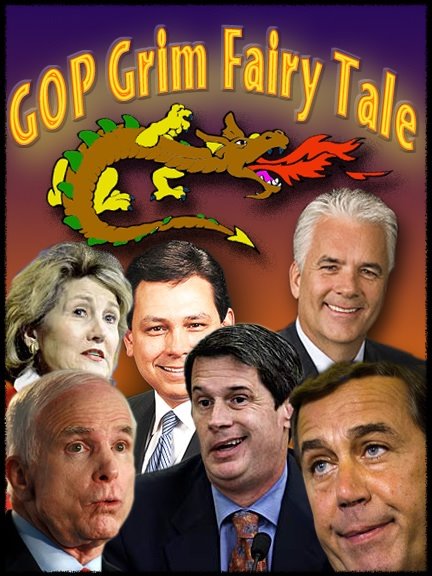
The Republicans have been working overtime telling GOP Grim Fairy Tales about “their plan” to fix America’s problems. Problems their leadership actually caused. The “liberal media” they have loudly denounced for decades has opened the airwaves to feature the worst and loudest of the nay-saying tale tellers, day after day. Boehner’s braying, Vitter’s vitriol, Hutchinson’s hollering, Ensign’s exaggerations, and McCain’s moaning has created a dismal daily din.

The three Republican Senators who did vote to approve a desperately needed stimulus bill have been hailed as heroes for joining the Democrats and low-life kamikaze rejects by their GOP chamber-mates.

Instead of thinking about America first and a looming, worsening recession, these Righteous Right-wingers are thinking mostly of themselves and their political futures. They know that their “base” back home, as ultraconservative and ultra-narrow as they are, will not hesitate to poison the next primary when they come up for reelection. The rabid folks back home will pick a new, even more strident wing-nut candidate to run against them if they don’t toe the line and oppose anything that doesn’t start with the words tax-cut, tax-credit or tax-rebate.

“The House Republican Economic Recovery Plan,” posted on the web by the GOP, lists five steps they claim will actually move us up out of their mess without spending any money at all. It seems clear why serious recovery plan economic experts didn’t show any interest in hearing all this again:

  • “Immediate Tax Relief for Working Families.” “House Republicans propose reducing the lowest individual tax rates from 15% to 10% and from 10% to 5%.” No stimulus here. No plan for badly needed infusion of cash money. Instead a promised annual benefit of $500 in tax relief on the low end all the way to an astounding $1,200 under the 10% bracket. Non-working families are not mentioned. Maybe they will get a coupon for some boot-straps by which to pull themselves up.
  • “No Tax Increases to Pay For Spending.” “House Republicans believe that any stimulus spending should be paid for by reducing other government spending, not raising taxes.” The trillion dollar tooth fairy will visit America’s pillows, perhaps?
  • “Assistance for the Unemployed.” Here, they make a little bit sound like a lot, proposing “to make unemployment benefits tax free so that those individuals between jobs can focus on providing for their families.” And they will allow that largess for nine whole months, March to December 2009! What the hell else would we be focusing on while unemployed? Imagine the joy a year from now at tax time when you are still jobless but don’t have to pay taxes on jobless benefits for nine months of last year!
  • “Stabilizing Home Values.” “House Republicans propose a home-buyers credit of $7,500 for those buyers who can make a minimum down-payment of 5%.” That breathtaking plan would only be for “responsible buyers,” by the way. They say nothing about “responsible lenders.” Nothing about buying up all their buddies’ toxic sub-prime mortgages. That would involve spending taxpayer moolah.
  • “Help for America’s Small Businesses.” “House Republicans propose to allow small business to take a tax deduction equal to 20% of their income.” You bet . . . 20% of no income will yank shuttered small businesses right up out of this mess.

Nobel laureates, respected economists and lions of the financial world have characterized the present economic crisis as potentially as bad as the crash of 1929. All are clear that only massive quick infusions of cash from the U.S. Government can initiate a turn-around in the dangerous cycle of joblessness, tight credit, business failures and increasing human suffering across America. The private sector alone cannot pull it off without help, and repeating past mistakes like those made in Japan in the 1990’s clearly will not work either.

Republicans will continue shouting loudly that the experts are wrong, and that repeating Bush’s failed triple try at tax cuts will still, somehow, do the trick. They have to keep up the noise for the base back home. Pitifully, the rest of the Americans outside their home districts are of little concern to them because they will not be voting in their forthcoming primaries. And these bozos wear American flag pins in their lapels.

[Retired journalist Larry Ray is a Texas native and former Austin television news anchor. He also posts at The iHandbill.]

The Rag Blog

Posted in Rag Bloggers | Tagged , , | 3 Comments

Redeveloping the Brackenridge Tract in Austin: Maybe Not Such a Good Idea

Austin Lion’s Municipal Golf Course on the Brackenridge Tract. Photos: Jana Birchum.

Hey, University of Texas Regents! You pinheads are making us mad!
By Mariann G. Wizard / The Rag Blog / February 12, 2009

Austin American-Statesman Outdoor columnist Mike Leggett writes about big mouth bass and white tail deer much of the time; about introducing youngsters to hunting and fishing; and sometimes just about the Texas outdoors in all its glory. I read his week-end column, and often clip it for my brother and nephew, avid fishermen who live near Lake Belton. A few months ago, Leggett was instrumental in exposing a $100,000 pseudo-scientific “study”, funded by the Texas Department of Parks and Wildlife, on whether steel shot kills doves as well as lead shot; carried out by the novel method of having a big old no-limit dove hunt for TDPW employees the day before the season opened for regular folks.

Last Sunday, Leggett took on an even bigger foe, and an even bigger potential boondoggle: the University of Texas Board of Regent’s move to “redevelop” the Brackenridge Tract, 500 acres donated to UT in 1910 by Colonel George W. Brackenridge, a 25-year-plus Regent and philanthropist who, among other things, also donated the land for San Antonio’s enormous Brackenridge Park, all for “purposes of education and research”. Through the years, UT has established graduate student housing on the Tract and leased parts of it, while parts have become de facto City-owned public streets, a low water bridge, public boat dock, and so forth. Spring-fed Deep Eddy pool is part of the Tract.

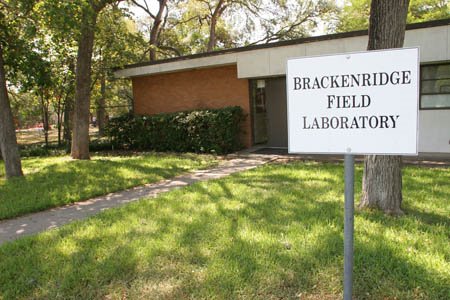
Total acreage of the Tract has thus been reduced to 345 acres. At its heart lies the 88 acre Brackenridge Field Lab (BFL), on what is now prime West Austin riverfront (see map). BFL, established in 1962 at the request of UT’s Botany and Biology departments, is one of the few field research facilities in the nation located in an urban area but within easy reach of a university campus. Its important ongoing projects include fire ant research and the University’s vast entomology (bug) collection. It would not be feasible to relocate the wildlife and plant species living within its borders, and its destruction would be a senseless set-back to basic research in botany and biology.

Frank C. Erwin, Jr., arguably the most ambitious and far-seeing of modern Regents, emphasized Col. Brackenridge’s bottom line in a history of the Tract he presented to the Board in 1973. The Colonel’s bequest had been made “with the request only on [Brackenridge’s] part that [the land] never be disposed of but held permanently for… educational purpose.” In 1921, after Brackenridge’s pipedream of eventually moving UT’s main campus to the Tract was effectively squashed by the Legislature, the Texas Attorney General warned that Regents “should not sell nor attempt to sell any part of the Tract without seeking his prior opinion”. Shortly afterwards, part of the property was leased to the Austin Lions Club for creation of a golf course, a popular use for which it is still employed, although under City of Austin auspices, and the issue lay more-or-less fallow for 40 years — until Erwin’s day.


Repeatedly during the mid-1960s, Regents sought to get more out of the Tract, either in terms of student housing or in terms of income, and in 1967 the Texas Legislature obliged their good friend, Regents Chairman Erwin, by passing Senate Bill 211, authorizing the lease or sale of any portion of the Tract, apparently for any use whatsoever, with funds from such sale (or lease) to go towards land acquisition for expansion of the main “40 acres” campus.

But this didn’t prove immediately necessary, “thanks to the invaluable assistance of President Lyndon B. Johnson”. The University’s “involvement” in the University East and Brackenridge Urban Development Programs, more commonly known as “urban removal”, gutted several lovely, student-affordable, family-friendly, integrated and/or primarily minority neighborhoods east of UT from Speedway to IH 35 and beyond, and south between 21st and 15th Streets (towards Brackenridge Hospital, also donated by the Col.) to make room for Erwin & Co’s megalomaniacal vision of accommodating, on one giga-campus, every high school graduate who could pay the rising tuition costs. Veteran Rag aficionados will recall that Erwin personally led bulldozers to destroy the lovely old oaks along Waller Creek in 1969, in pursuit of his expansionist agenda, calling students who climbed the trees to try to save them “a bunch of dirty nothin’s”. His was not the voice of reason that kept students from being bulldozed, along with the ancient trees, that sad day. Now, where public schools, parks, and neat frame houses with pretty yards once thrived, an endless expanse of University athletic “facilities” and parking lots blends seamlessly with the soulless Capitol-state office complex and still nibbles away at beleaguered East Austin.

In December, 2007, UT Regents approved a motion to retain a master planner to conceptualize redevelopment plans for the west Austin Brackenridge Tract. Their decision has generated considerable heat from various interest groups and constituencies, and even a public hearing or two hosted by impotent City officials, but nothing, so far, that seems likely to slow the development train, unless it might be general economic ruin.

Among all of the many already-valuable, well-utilized, highly-prized resources that have grown up within and around Col. Brackenridge’s gift, Mike Leggett is particularly steamed about the potential loss of BFL, calling it, in language infrequently seen in Austin’s daily paper, “unbridled pinheadism”. In response to an encouraging e-mail from Your Humble Correspondent, he said he’s had a lot of positive responses to the article, and that “we’ll see” if it has any effect.

If the long-lost trees of Waller Creek are any indication, those who value BFL need to speak up now, speak up loud, speak up not just to say “Right on!” to Mike but “Stop the plunder!” to UT’s rulers — and maybe shine up their tree-climbin’ spikes. Otherwise, West Austinites will soon get a taste of the “gentrification” that has already blighted everything within reach of UT’s high-rollers — and everyone in town, including future generations of UT and other students, will be the poorer for it.

(By the way, Leggett’s story mentions that friends have told him he’s been “writing angry” lately, and he’s trying to tone it down. Au contraire, brother, keep it coming!)

The Rag Blog

Posted in Rag Bloggers | Tagged , | 2 Comments

The Media in the Recent War on Gaza

Paul Beckett is the newest addition to the growing family of Rag Bloggers. We are grateful he found us and wants to participate in the effort we have undertaken.

Richard Jehn / The Rag Blog

Journalists protesting against censorship outside the UN office in Gaza in September 2008. Photo: Mohammed Omer.

Creating Eyelessness in Gaza: Israel Controls the Old Media – But What About the New?
By Paul Beckett / The Rag Blog / February 12, 2009

Israel’s attack on Gaza was meticulously planned, over a six-months period. (Ilan Pappe and others have reported that a mock-up Gaza target city was constructed at a cost of millions in the Negev, and IDF soldiers practiced urban destruction for months before December 2008.)

Just as meticulous – and lasting just as long – was the planning for the media-control operation to accompany the military one.

When Israel invaded Lebanon in 2006 the spin had spun totally out of control as free-range journalists on the ground documented the killing, displacement and destruction (and the prolific use of weapons such as cluster bombs and bunker buster bombs against civilian targets). Very embarrassing for Israel (not to mention Condoleezza Rice!).

There must be a better way to suppress journalistic truth. Imbedding complaisant journalists with the IDF troops? Stricter filtering of applications for press passes (only the extremely safe need apply)? More effective censorship?

Ah! Then the wonderful idea came: how about no first-hand journalistic coverage at all! Genius!

Jon Snow’s U.K. Channel 4 show called “Unseen Gaza” (January 22, 2009) reports on his experience with the Israeli operation, first hand. With Israel’s attack (timed to begin in the American Christmas holiday week when nobody would be watching anyway), all the international media sent reporters. They were welcomed at the Press Accreditation Centre with a display of Hamas rocket debris. (That set the tone.) They were issued briefcase-loads of slick-paper reports and booklets laying out the “background story” for the journalists. Then, they were installed on a hill in southern Israel with a distant – really distant! – view of the edge of the Gaza Strip.

Visits to Sderot and the other Jewish towns that had taken Palestinian rocket fire (usually, but not always ineffectual) were furnished lavishly.

But not one journalist was permitted into the Gaza Strip.

Reporters or photographers who tried to jump the reservation were detained and sometimes had their discs erased.

The reporters watched and filmed white smoke and grey smoke and black smoke as, sporadically, it appeared over what they were told was Gaza City. They heard the dull thump of heavy bombs from time to time.

Sitting and standing there ineffectually, aware they were being used by Israel, reporters called it with sour humor, the “Hill of Shame.” Then “Hill of Same” because every day they wrote, called in, and photographed the same.

“Shame” is indeed appropriate. The reporters groused among themselves, but to my knowledge not one major Western news organization protested vigorously and left.

The media control operation was effective. On their hill, the reporters saw nothing they were not supposed to see. (Jon Snow remarks that often, as they called in their stories to London, the home office knew more than they.)

Now an interesting fact is that many of these organizations were in touch with Palestinian stringers in the Gaza Strip. They had access to the horrific reality of children blown apart, of white phosphorous wounds that burn and burn and burn in the flesh until they have burnt to the bone. They had access to shots of the hospitals where Palestinian doctors worked double and triple shifts trying to save some while others died at their feet. They had access to shots of the U.N. schools where hundreds of the homeless were pressed together to sleep on floors without water or electricity – and then (in several cases) were bombed and shelled by the Israeli forces (who had the precise coordinates of every rock and brick in Gaza, let alone the schools).

But of course, for the most part, the Western journalists on the Hill of Shame couldn’t use these, could they? After all, they had not seen these things “first-hand” with their own, highly-paid and officially-accredited, professional-journalist eyes.

Further, the gruesome pictures were much too strong (in their judgment) for their Western audiences, accustomed to infotainment. Snow permits us to listen to the self-justifications of several UK journalists or media managers (and these were not even the Americans!).

Was it a triumph for the Israeli Press Office? Well, certainly the media operation had gone exactly as planned.

Almost. What went wrong? Al Jazeera. Al Jazeera was there, and they stayed, and they were able to broadcast out. This best of the international news media ate the lunch of the Western big-name media organizations (as they’ve been doing now for years). They just told what they saw. And showed it. As much as would be humanly possible given the brutality of the attack, they even dutifully parroted Israeli official statements for balance. It was just good old-fashioned journalism in the midst of falling bombs, tank shells, and white phosphorous.

So half the world was seeing exactly what was going on. For Israel, it was not the important half. The all-important (for Israel) U.S. TV audience saw and heard only what they were supposed to.

But arguably the audience for Al Jazeera’s work was the most important part of the world. It included the entire Arab and Muslim world. And it included the younger generations everywhere, more internet-savvy, watching Al Jazeera live via Livestation, or trading clips via YouTube.

Israeli media-control failed to control the plain, good, fair, honest and old-fashioned television journalism of Al Jazeera. Meanwhile they firmly put themselves in the category (a Hall of Shame?) of regimes such as Burma or North Korea. Alas, this is not anything very new for contemporary Israel (and that’s a shame).

But there is still something else to this story, something unexpectedly heartening. There was another kind of media-control failure. This comes from the people themselves, and it is something (relatively) new in the world. This is ordinary Gazans filming blasts, wounds and killings with their cell-phones and sending out their stories. This is youthful Facebookers and bloggers who are telling the incredulous world what they’ve just been through.

This is what a new kind of media looks like, and what a new kind of democracy looks like. It’s difficult for authorities like the Israeli ones to control. Its devastating power is that people are just telling the truth, one to another. In this increasingly saddening world of ours, this is something to be excited about!

[Paul Beckett lives near a small lake in the university town of Madison, Wisconsin. In the past he lived in Nigeria and he co-authored books and wrote articles on Nigerian and African politics. Now he is active in a number of progressive causes and organizations including The Madison Institute, the Progressive Roundtable, and the Madison-Rafah Sister City Project. He is films librarian for the latter. Much of his reading and writing now focuses on the Israel-Palestine situation. He is on the lazy side with all too many recreational interests but might manage to do a book on Israel-Palestine next year. He can be reached at snkbeckett@yahoo.com.]

The Rag Blog

Posted in Rag Bloggers | Tagged , , , , , | 1 Comment

Wall Street Journal : Librarian Laments Research Shutdown

The following would just be a sad but passing story except for one thing. It is emblematic of what’s happening all over the country. Reporters are being “let go,” bureaus are being closed, broadcast news departments are suffering daily funding cutbacks and quality is suffering. And all that may just to be a stopgap measure to stave off what many consider the inevitable.

The news business is in big trouble and many a venerable journalistic institution is facing serious financial crisis and the very real possibility of going out of business.

— Thorne Dreyer / The Rag Blog / February 12, 2009

Librarian Leslie A. Norman says that the search softwear that reporters must now rely on cannot replace the ‘knowledge about how to research using all the tricks we’ve learned over the years.’

By Joe Strupp /February 11, 2009

NEW YORK — The librarian who operates The Wall Street Journal’s news research library — which is set to close with the elimination of her job and another staffer’s — said in a memo to other librarians that the shutdown is both a personal difficulty and a hit to news coverage.

“When I asked who will do research for the reporters, I was told, ‘No one,'” the memo from Leslie A. Norman, posted on a librarian list serve last week, stated. “The reporters will probably be using a Lexis product called Due Diligence Dashboard (you know how your moms told you ‘if you can’t say something nice…’)”

She later adds that it cannot replace the “knowledge about how to research using all the tricks we’ve learned over the years. We figure that the reporters will probably spend 10 times our compensation trying to do their own research.”

The library cutback is part of a 14-person newsroom job reduction announced last week by the Journal, which also includes news assistant Ed Ramos in the library. Norman and Ramos plan to remain on the job until at least March 23, the memo stated.

Asked to comment on the library closing and Norman’s memo, Journal Spokesman Robert Christie stated in an e-mail to E&P: “Yes, we are closing the library. It is regrettable. Our reporters do have access to multiple databases including Factiva and this migration to digital databases as you has been happening for many years.”

Officially an assistant librarian, Norman has been running the library since 2007 when the previous librarian left. She has been at the Journal since 2005, with four years’ prior experience at Bloomberg’s library. She declined comment, but confirmed the memo had been posted.

“I also love my job very much and I don’t see myself finding a news librarian job in the near future. Every day is different and a challenge. No offense but being a public librarian would drive me crazy,” she adds in the memo, which noted she may be able to remain in her post under a contract status without benefits, but has no confirmation yet. “I’m even worried about the microfilm. Between where the Proquest historical database leaves off and our PDF archives begins, there is about 10 years where the only physical form of the paper exists on microfilm.”

After that memo was posted on Feb. 5 at the NewsLib list serve, Norman received numerous notes and e-mails expressing sympathy through the list serve.

That prompted another memo on Tuesday that said, in part, “Your messages have been supportive and loving at a hard time. I got through half of them on Friday and I had to walk away from the computer because I was crying so much. I’ve printed them out so I can look at them when I feel bad.”

Both memos are posted below:

The announcement to her colleagues

Hi:

I regret to report that the WSJ Library will cease to exist on March 23, 2009.

Ed Ramos, the news assistant, and I were given our termination notices today. I have asked to continue on as a consultant with just pay, and not benefits. It’s in management’s hands now.

We will be put on a re-hire list and if the jobs open up in six months, we may be rehired.

When I asked who will do research for the reporters, I was told , “No one.” The reporters will probably be using a Lexis product called Due Diligence Dashboard (you know how your moms told you “if you can’t say something
nice…”)

But it cannot replace Ed’s and my knowledge about how to research using all the tricks we’ve learned over the years. We figure that the reporters will probably spend 10 times our compensation trying to do their own research.

I have many emotions, mostly fear. My husband was laid off by Dow Jones last fall. I also need medication for a chronic medical condition.

I also love my job very much and I don’t see myself finding a news librarian job in the near future. Every day is different and a challenge. No offense but being a public librarian would drive me crazy.

I’m even worried about the microfilm. Between where the Proquest historical database leaves off and our PDF archives begins, there is about 10 years where the only physical form of the paper exists on microfilm.

There are so many little things about what we do…how do I possibly explain them or even write them down?

We’ll be here in some form until March 23. Thanks.

Her gratitude for their support

Hi:

I can’t individually answer all the messages I’ve received in the past few days. So I’ll thank everyone with one big note.

Your messages have been supportive and loving at a hard time. I got through half of them on Friday and I had to walk away from the computer because I was crying so much. I’ve printed them out so I can look at them when I feel bad.

The reporters here have been supportive and compassionate also. Many have called wondering what they are supposed to do after the library closes. They told me how important my research was to their stories. I didn’t know I meant so much to them.

From the bottom of my heart, I thank you for your magnitude of caring and support.

Leslie A. Norman
Assistant Librarian
The Wall Street Journal

Source / Editor & Publisher

The Rag Blog

Posted in RagBlog | Tagged , , , | Leave a comment

Rabbi Arthur Waskow : Rebirthing the Freedom Seder

Freedom Seder graphic by Avi Katz.

Since the most profound issue facing the world today is the danger of climate catastrophe — ‘global scorching’ — and other forms of earth-wide environmental disaster, the Fortieth Anniversary Freedom Seders will especially address that challenge through the presence in the Passover story of the Ten Plagues.

By Rabbi Arthur Waskow / The Rag Blog / February 12, 2009

Forty years ago, the 2000-year-old form of the Passover Seder and Haggadah were turned into a seed for change, liberating new vision and creativity. The original Freedom Seder was held in Washington DC in 1969 on the first anniversary of the death of Dr. Martin Luther King. Every Haggadah before it had told the story of the liberation of the ancient Israelites from slavery under Pharaoh; the Freedom Seder intertwined that Jewish story with the struggles for freedom of Black America and other cultures, races, and religions. It won national attention and emulation, and in the decades since has sparked for many people the creation of many Seders and Haggadot devoted to various aspects of liberation.

Forty years – like the forty days of rain before the Flood, the forty days and nights that Moses and then Jesus fasted before their revelations, the forty years of travail in the wilderness, the forty weeks of human pregnancy — are the time for a pregnant pause toward a new birthing. What now most needs a birthing?

Since the most profound issue facing the world today is the danger of climate catastrophe — “global scorching” — and other forms of earth-wide environmental disaster, the Fortieth Anniversary Freedom Seders will especially address that challenge through the presence in the Passover story of the Ten Plagues.

Each of the plagues is an ecological disaster brought on by Pharaoh’s hard-heartedness, stubbornness, and addiction to his own power. Swarms of frogs and locusts, unprecedented hailstorms, rivers become undrinkable, three days of sandstorm darkness so thick it could be touched — these disasters for the earth were intertwined with economic disasters for the people: workers impoverished into slaves, foreigners turned into pariahs. What are the Ten Plagues being brought upon us by the institutional “pharaohs” of today? Who and what are thoee pharaohs?

The New Freedom Seder for the Earth will also address Ten Healings for the earth and human justice that we must bring about through our own action.

I wrote the original Freedom Seder, which was published by Ramparts magazine. The actual Seder was broadcast live on WBAI radio, and the Canadian Broadcasting Corporation carried an hour-long reprise on national television. Since I am now director of The Shalom Center, The Shalom Center has taken responsibility for creating the New Freedom Seder for the Earth.

A flagship 40th Anniversary Seder will be held in Washington, DC, at 5 pm on March 29, 2009, at Shiloh Baptist Church in Washington, D.C. Hundreds of participants representing many faiths and races are expected to attend the event, which will draw attention to global threats to the environment. The Seder will also focus on the central Passover themes of freedom and the ten Biblical plagues, most of which were ecological calamities.

Shiloh Baptist Church is one of the earliest and sturdiest of African-American churches in the nation’s capital. It was founded by slaves in 1852, in Fredericksburg, Virginia. When the Union Army offered safe passage to all blacks from Fredericksburg, north to Washington, many Shiloh members, now freed slaves, came meeting in a small shanty where they learned to read and write. They continued to worship together, growing to 750 members by 1861. In 1863, Shiloh was recognized as a true church and ordained its first pastor. In the 145 years since then, there have been only five other pastors. Sr. Pastor Dr. Wallace Charles Smith now leads the congregation.

March 29 is ten days before Passover, two weeks before Easter, and less than a week before the anniversary of Dr. Martin Luther King’s death. The Freedom Seder in Washington will infuse each of these events with new energy and depth. It will draw national attention to the many local Fortieth Anniversary Interfaith Freedom Seders that will be held simultaneously in communities around the U.S., uniting people of all faiths, cultures, and races in a common dedication to social and economic justice, peace, and the healing of our wounded earth.

The Fortieth Anniversary Freedom Seders will focus on how to move past the top-down pharaonic powers that today are blocking the path toward a promised land of justice and sustainable community, nourished by sustainable sources of energy. We intend for the Seders to be not a one-time-only event but part of a process of ongoing organizing to prevent climate disaster and work for a just and sustainable economy.

To attend the Seder in Washington, please register here.

To sponsor or take part in your Freedom Seder for the Earth in your own community, please write Awaskow@shalomctr.org and register your Seder here.

The Rag Blog

Posted in Rag Bloggers | Tagged , , , , | 1 Comment

David MacBryde in Berlin : A Look at the Ecomonic Sea Change

Allgemeine Zeitung: ‘The World Hanging in the Air.’ Photo by David MacBryde / The Rag Blog.

Seeing the Sea-Change in Germany and in the USA

What kind of “growth” is possible and desirable, what is impossible or dangerous on the thin surface of this planet? What do we want to “stimulate”, or “invest in” — and who makes, and in whose interest, “investment” decisions?

By David MacBryde / The Rag Blog / February 12, 2009

Beforehand:

BERLIN — In Germany on Friday, the sixth of November, 2009, the major conservative newspaper here, the Frankfurter Allgemeine Zeitung, ran a front page picture captioned “The World Hanging in the Air” just prior to, and while waiting for, the US response to the financial crisis and the economic stimulus package.

The paper reported, as a taste of what might come, that the US administration just extended public health coverage for children (SCHIP) “as a down payment on comprehensive reform.”

In the German news, local TV showed school districts in Berlin and around the country where people were working overtime gearing up to implement school building renovations as part of the German economic stimulus plans that had already been agreed upon.

One definite if relatively minor controversy was about accountability. Substantial public funds, borrowed in effect from the future, were being rapidly distributed to local school districts. How would the public school administrations handle the funds in an accountable way? That involves accounting in the bookkeeping sense (where German bookkeeping can be “stuffy” and rigid, not flexible and as fast as needed in the emergency.) The issue is also accountability in terms of appropriate use of public funds borrowed from the future. That sense of accountability, given the flood of funds, is getting lots of attention, including that of the school kids.

The main controversy in the German news came in debates about the crisis in the financial system. There are still many unknowns about conditions in some banks. There are still questions about possible huge hidden obligations, “innovative finance packages,” in the financial sector. And worse (since only relatively few banks here held many “innovative finance packages” bought from the USA — and there was no housing bubble or sub-prime mortgage problem here), the rapidly deepening recession meant that even “normal” bank assets were of unclear value, or were losing monetary value.

The German government is preparing legislation should it become necessary in the public interest to nationalize, expropriate, banks on a large scale. The government, the taxpayers, already de facto own a few banks on a case by case emergency basis. (And simply “nationalizing” the banks is not in itself here seen as adequate. One of the first banks to face failure here was the Bavarian State Bank, owned by the very conservative state of Bavaria and run by the local equivalent of very conservative Republicans. That is a topic for another blog.)

During:

On Tuesday the 10th of February there was news from the USA about the stimulus package being passed by the Senate. That process is being closely watched and generally greeted with some relief here.

Then the US administration presented the revised action plan about the financial crisis.

Lead by a hefty 10.2% decline in financial stocks, the stock market dropped 4.6%.

One thing is obvious: the announced action plan was NOT seen as making US banks wealthy.

To the contrary, bank stocks dropped.

Historians will have many details to look into. And more decisions will have to be made in order to get beyond the crisis in the financial system. But it is obvious that the plan as announced will NOT hand the banks a blank check from taxpayers as the original three page Bush-Paulson Republican bailout plan tried to do.

Into the future. Working towards April:

In Germany there has been much work on the crisis in the capital market system.

There was a meeting in Berlin about the financial crisis that was initiated by the German Ministry of International Economic Cooperation and that included non-governmental organizations and think tanks. The issue was the impact of the crisis in the financial system on weak states. The bottom line: the crisis, created in the richer countries, appears to be causing the unemployment of an additional 20 million people in poorer countries, with an increase in infant mortality. While over the years there had been some improvement in overcoming poverty and malnutrition, now that progress is being threatened and more kids are starving to death, all because of decisions that were made in banks. The German foreign policy position now includes (a) increasing direct foreign aid and (b) cutting those European and US agricultural subsidies that harm indigenous farming development in poorer countries. It was noted that Obama has explicitly urged the cut of those farm subsidies in the US, but that farm legislation in the US is also a domestic issue and depends on legislative work at the state level.

The German and European Union negotiating position on the financial crisis is being worked out with a view to the next international finance crisis meeting in April. That meeting will now include Brazil and China, and there is intense non-governmental work happening that concerns the inclusion of the interests of weaker states. This process will be one thing to watch.

For one aspect of the sea change that is happening, see the accompanying chart of current bank rankings as of Feb. 6, 2009 (Frankfurter Allgemeine Zeitun).

Chart of rankings of the largest banks as of Feb. 6, 2009. From Allgemeine Zeitung.

What will be happening in the USA regarding the financial system crisis?

There were congressional hearings with bankers on Wednesday, Feb. 11, 2009.

After the panicky punt by Paulson with his three page plan being defeated in Congress, Congress did pass a financial system plan that was supposed to be different — not a bailout but an investment — with oversight and accountability for us tax payers.

What has been happening to that? And what will happen next?

Personally, I have long appreciated the work of Elizabeth Warren. She wrote “the Coming Collapse of the Middle Class” and “The Two Income trap” concerning what has been happening economically to middle income families since the early 1970s, in “the mainstream.” She shows the sociological changes in the last 30 years and where we are “now” — BEFORE the current crisis — and how mainstream families ware but one accident away from bankruptcy BEFORE the current crisis started. Warren was previously at the University of Texas and now is at Harvard Law where she specializes in bankruptcy law.

If you have time, and cheep broadband access, she has a fine lecture on YouTube.

Warren was appointed chair of the Congressional Oversight Committee on the financial crisis. She is an expert in personal bankruptcy. She is certainly no fan of bankrupting average Americans in the interest of pumping money to bankers. She has heavily criticized both the Bush-Paulson plan and its implementation.

As the capital market crisis continues, she is one person to watch. There will be much controversy and more hearings in Congress.

On the stimulus package, Obama went on the road and encouraged local home meetings about the economy. And supposedly a government website is being set up for accountability, to follow implementation and to keep tabs on who does what with tax payer money for the stimulus.

There will be hearings in Washington on the financial system crisis. How will the controversies and decisions about the finance system crisis proceed?

Looking forward. From afar, one question:

Is there interest outside of Washington, D.C., in holding hearings on the financial crisis, on what happened and what is in the public interest? Might it be of interest, say in Austin, Texas, to encourage, say Congressman Lloyd Doggett with his staff, to set up a local hearing?

Maybe calling on Jim Hightower and perhaps faculty from Austin Community College, maybe Richard Croxdale, and UT journalism professor Robert Jensen, and James Galbraith of the UT Inequality Project, and others?

A start-up working paper to raise questions could be the Dec. 10, 2008, report from the Congressional Oversight Committee.

The focus for a hearing could be the Preamble to the Constitution, specifically one core purpose for the founding the United States, namely for “promoting the general welfare”. How do the efforts to solve the crisis in the financial system measure up to the purpose of “promoting the general welfare?”

That is a short term question. The longer term issue is what is meant by getting “beyond” the crises? Four cars in every garage is not the answer. I will write on that in a future blog. What kind of “growth” is possible and desirable, what is impossible or dangerous on the thin surface of this planet? What do we want to “stimulate”, or “invest in” — and who makes, and in whose interest, “investment” decisions?

The Rag Blog

Posted in Rag Bloggers | Tagged , , , | 2 Comments

Is Armageddon Closer Than Most Americans Think?

Frankly, I am not so concerned about doomsday and don’t believe it will come to that. But the thoughts that Hirschhorn expresses here are worthy of consideration, and the steep increase in firearms sales is rather disturbing.

Richard Jehn / The Rag Blog


Mesmerized by Melodic Rhetoric
By Joel S. Hirschhorn / February 11, 2009

Compared to rioting Europeans, Americans seem like docile, drugged out sheep herded towards the economic cliff, mesmerized by melodic rhetoric of political messiah Barack Obama. Too much hope can precipitate violence.

“I’ve been through Y2K and I’ve been through 9/11. I have never seen people so afraid as what we are seeing right now,” said gun shop owner Scott Moss recently. With more guns per capita easily 250 million privately owned ones and certainly more people in prisons than any other democracy, the intriguing question in this still worsening economic calamity is: If Americans found the courage for political rebellion now, would it preempt massive criminal violence, social havoc and armed rebellion later?

What we see President Obama and Congress doing and debating seem inadequate to restore financial health and security to the vast majority of Americans before millions more lives are devastated. Billions of tax dollars have gone to banks, corporations and others but have not stopped the hemorrhage of our financial lifeblood. More than half a million jobs continue to be lost a month; 3.5 million in the past year. Millions are losing their homes, health insurance and ability to buy food. Those with jobs are afraid to spend money.

As Nobel Prize winning and gloomy economist Paul Krugman said the other day after condemning what is going on in Washington, DC: “the economy is still in free fall” and we may be “falling into an economic abyss.” Harsh words for a harsh reality.

Recently, President Obama said: “A failure to act, and act now, will turn crisis into a catastrophe.” But what really matters is exactly what actions the government takes and whether they are what is needed. Besides, about the same time, his senior advisor David Axelrod said on television that “we have an economic catastrophe.” For most Americans, catastrophe seems more accurate.

Meanwhile, the elite Upper Class that stole the nation’s wealth in recent years with their greed and political clout, and destroyed the global economic system, are still sitting pretty in their McMansions, penthouses, private jets and yachts. They still enjoy their $50,000+ cars, still wine and dine in incredibly expensive restaurants, and still retain more wealth than ordinary people can imagine. Brioni men’s suits for $40,000+ are selling fast.

So what are ordinary Americans doing? Are there massive crowds of screaming, sign-carrying Americans in city streets from coast to coast? No. Or outside congressional buildings and the White House? No. Are there riots and looting by hoards of hungry and angry people who have lost a decent lifestyle? No. Do we see anything like the anti-Vietnam War protests? No. Do we see anything like the urban riots after the assassination of Martin Luther King, Jr.? No. Do we see anything like the rebellion against the British that created our nation? No

What do we see? Millions of people getting notices that they have lots their jobs, getting eviction notices, applying for bankruptcy, trying to get unemployment benefits, standing on long lines to get a shot at few jobs, filling crowded hospital emergency rooms to get medical help, taking their children out of child care they no longer can afford, and buying fewer and cheaper foods or seeking free food.

Compared to rioting Europeans, Americans seem like docile, drugged out sheep herded towards the economic cliff, mesmerized by melodic rhetoric of political messiah Barack Obama.

No wonder our politicians look like dithering, confused idiots arguing among themselves as we continue falling into economic hell. We simply are not demanding enough of those we elected.

It’s as if most Americans are patiently waiting to be rescued by winning the lottery. Is it hope or stupidity?

Meantime, President Obama has successfully stimulated one business sector. Since November, gun and ammunition sales have soared, as have requests for concealed carry permits. “Our sales are up 15 to 20 percent since October,” says the owner of Shooter’s Service in Livonia, Michigan. “It’s not the 40 percent other stores are reporting, but it’s good business.” Oakland County in Michigan issued 130 percent more concealed carry weapon permits in January than a year earlier. Such permits are up as much as 90 percent in some Western North Carolina counties. According to the FBI, background checks for gun sales in January jumped 29 percent over January 2008; this followed a 24 percent rise in December and a 42 percent increase in November. In many places gun sales have dropped because of shortages.

What awaits us when hope becomes futile and all confidence in the government is lost? Gun owner Chad Roberts in Tennessee said this recently: “With the economy like it is more people are going to be desperate wanting to steal from you.” So, perhaps we will see a contagious, rapid descent into mass criminal violence. As suffering, gun-toting Americans resort to looting, theft, robbery, burglary, assaults and other economically driven violent acts to get what is needed to survive, and other gun owners shoot to defend what they have. The fabric of civilized society ripped apart. Brutal police and military actions result, and for many no police protection. Constitutional freedoms suspended in a national emergency. Government threatened by armed rebellion as gun-toting citizens put their Second Amendment rights to the ultimate use.

This nightmare scenario may happen because free people waited too long, remained too hopeful, put too much faith in elections. Armageddon is closer than most Americans realize. Beyond catastrophe lies mob rule, a doomsday post-democracy, disintegration, collapse, chaos. Americans sucked into the economic abyss where violence replaces politics.

Hope will be a distant memory. One way to avoid the abyss is to give Americans what they have a constitutional right to have, something the Founders in their wisdom knew we would need. They provided an option in Article V of the Constitution that Congress has refused to honor, even though the one and only requirement has long been met. It is a convention of state delegates to consider proposals for constitutional amendments. This would provide a national forum for the public to seriously become involved with possible ways to reform and improve our government structure. Over 700 applications from state legislatures for an Article V convention have been submitted from all 50 states; they are being made available for the first time at foavc.org. Because the convention can only propose amendments that still must be ratified by three-quarters of the states there really is nothing to fear about harming our Constitution. There is now considerable interest in many states to push for a convention.

In these dismal times using what the Founders gave us makes more sense than ever before. Americans need more than two-party politics. They need a serious debate about structural reforms through constitutional amendments that can attack the deep rooted corruption and incompetence that plague the federal government and contributed to creating our current economic meltdown.

Rather than fear a convention, embrace it. It is far more rational to fear sticking with our status quo dysfunctional government or, worse, the degeneration into violent upheaval. Following the Constitution’s path to get reforms should be preferred.

[Joel S. Hirschhorn is a co-founder of Friends of the Article V Convention; contact him through delusionaldemocracy.com.]

Source / Nolan Chart

The Rag Blog

Posted in RagBlog | Tagged , , | Leave a comment