Ron Ridenour : Half-Century of Cuban Revolution: ‘Challenges’

Some Cuban youth have turned to western styles. Here, a young Cuban with a punk hair style watches a tattoo artist apply a tattoo at the Metal City Festival in Santa Clara, Cuba, Oct. 27, 2007. Photo by by Javier Galeano / AP.

A successful revolution must be one in permanent development, one that can solve the basic needs of adequate housing, food and clothing; otherwise people will seek solutions elsewhere.

By Ron Ridenour / The Rag Blog / December 27, 2008

[This is the second in a two-part series on the 50th anniversary of the Cuban Revolution by Rag Blog contributor Ron Ridenour. For Part I of this series, go here.]

Seventy days after the Cuban revolutionary victory, the National Security Council under the Eisenhower-Nixon regime issued a directive, March 10, 1959, to bring “another government to power in Cuba.” This decision was made precisely because Cuba’s young leadership initiated politics of solidarity among human beings. A week later, President Eisenhower ordered the CIA to train Cuban exiles for an invasion of their country, according to Eisenhower’s “The White House Years: Waging Peace [sic] 1956-1961”.

The Cuban revolution was declared to be socialist by Fidel Castro speaking before an approving crowd as US planes flew over Havana dropping bombs. The April 1961 Bay of Pigs invasion had begun. Following its rapid failure, President JF Kennedy instituted a blockade of Cuba, which remains today.

In 1967, President LB Johnson, then bogged down in war against the Indo-Chinese peoples, expressed to a reporter: “We were running a goddamn Murder Incorporated in the Caribbean.” He said so after learning the CIA had used the Mafia to try to assassinate Fidel Castro. The CIA was also infecting humans, animals and crops with poisons, terrorizing its people from the air and on the ground. (See my book, “Backfire: The CIA’s Biggest Burn”, Editorial Jose Marti, Havana, 1991.)

Readers here are familiar enough with the history of US subversion against the Cuban revolution that I merely touch on it, in order to set the background for why the original Marxist ideas of political democracy and workers control, of equality in economy without privileges to any sector or leaders were not thoroughly forthcoming, especially after the fall of the Soviet Union and Cuba’s other trading partners in Comecon. In addition to external attacks, which have twisted development, are adverse decisions taken by the national government as well as realities of underdevelopment.

Now, however, nearly two decades after the fall of Comecon and as Cuba begins to celebrate its 50th anniversary, it is the only remaining socialist country, at least in the western hemisphere (perhaps in the entire world given that China and the Indo-Chinese countries have converted nearly totally into capitalist economies). Cuba maintains its socialist roots and Marxist socialist ideology although the “Special Period” concessions to capitalist measures installed for shear survival have created inequality: a growing gap between a new poor and a new rich.

“This country can self-destruct; this Revolution can destroy itself, but they [the US] can never destroy us; we can destroy ourselves, and it would be our fault,” so spoke Fidel Castro, November 17, 2005, about the consequences of a double economy and decay in morality and consciousness.

Four areas of greatest popular discontent are: a) the double economy, two currencies; b) too much reliance on imports and not enough national production; c) perpetual lack of sufficient housing made worse by this year’s hurricane destructions; d) insignificant improvement in worker empowerment, with few exceptions.

A large part of the population has become disillusioned. It steals and hustles simply to meet basic needs, and many fall into the pit of consumerism, pursuing individual greed. These growing sectors have rejected the motto set by the revolution — in the words of Che — “The ultimate and most important revolutionary aspiration: to see man liberated from alienation.”

The “new class”, of which Fidel also spoke three years ago, includes private farmers, self-employed artisans and handymen, a large number who legally earn convertible currency at their jobs, some who receive large sums of remittances from family members living abroad, and a growing sub class of thieves.

Those who must live exclusively on national pesos can not afford to buy basic items, such as shampoo and soaps, clothes, hardware, household appliances or even sufficient food stuff—not to mention repair materials for their residences, which can not be found in pesos. The amount of items remaining on subsidized rations is insufficient for survival. People, especially in the large cities, must find ways of supplementing their meager earnings.

A renowned economist, Dr. Omar Everleny, told me: “You can’t stimulate people with morality, with revolutionary propaganda, with anti-imperialism for a lifetime. People get tired of this and they must eat. Sure, everybody goes to the plaza for the marches, but when they return home they demand that the state provides them with their needs.”

Almost all the department stores in Havana, for instance, now only sell goods in convertible currency (cucs). The cheapest radio, for example, costs 13 cucs and is driven, foolishly enough, only on batteries. The store did not have batteries when I bought mine. I finally found batteries (6 cucs) after searching in 15 stores. The total price (24 pesos per cuc) came to 456 pesos, which is over twice the minimum monthly wage.

One sees youths, who have never worked, spending more money drinking beer in one session than a pensioner must live on for an entire month. These same teenagers often adorn themselves in gaudy t-shirts advertizing US capitalism and imperialism, promoting the FBI or the US military—whose illegal base on occupied Cuban territory is a torture chamber. Some of these youths grease their hair, wear their pants midway down their asses, and jabber on mobile telephones, which costs more to buy and speak on than in the rich capitalist west. When I asked some why they behaved thusly, they replied that “it is the fashion.” Maybe so in the decadent west but very few people in Cuba have the money to adopt such a life style even if they wished to, and why should they.

And there are far more cars and motorcycles in the streets than ever before, and fewer bicycles. Most cars are privately owned and all parts and the gasoline must be bought in cucs. The price of gasoline is as high as European prices and is double or more the cost in the US. And the state sells bicycles from China only in cucs.

The brain drain to the capitalist world, which the government speaks of lamentably, is a growing phenomenon, but it is also internal. More and more car owners are using their vehicles, especially the old US cars, as taxis. Some do so legally by buying a license, paying taxes and insurance; many do not. Taxi drivers earn more money in one day than my friend, a former captain of Cuban ships, who risked his life as an infiltrator inside enemy lines (the CIA), in an entire month. Acquaintances who have doctorate degrees, who were heads of media outlets, officers and other professionals have left their positions to find ways of earning convertible currency, such as taxi chauffeurs.

The double economy and its negative consequences are so rampant that the government has allowed the film industry to make films with this theme. The most recent one, “Horn of Plenty” (“Cuerno de la abundancia”), revolves around the greed and envy connected with this inequality. Rather than concluding, as one would expect by a propaganda-oriented state-run medium, the people involved did not learn their lesson.

Yet most media do not address this problem, or at least do not come up with analyses or solutions. The youth daily, Juventud Rebelde, does have a column of complaints from readers concerning specific failures of agencies and institutions, usually having to do with the lack of promised services and reparations. There are also a few magazines with limited press runs and audiences that do go a bit deeper sometimes: La Geceta, Cajman Barbuda, Caminos.

Caminos is published by the Martin Luther King Memorial Center and is distributed somewhat widely in pesos. It can do so because of donations from solidarity people such as Pastors for Peace.

While no coges lucha (don’t fight city hall) is still a common motto, some Cubans are acting to overcome that anti-revolutionary attitude—which is generated from a deaf bureaucratic institutionalized structure. The MLK center is a protagonist of fighting that attitude. Its director, Rev. Raul Suarez, is so respected that he is an elected delegate to the National Assembly. His center is also a casa comunitaria (community house) run on Paulo Freire participatory sociology principles, seeking to stimulate people to involve themselves in projects to improve the community. While this is progress there are only eight such centers in the entire of Havana.

The next half-century

Once Fidel became ill and stepped down from government, his brother Raul won the next elections. Many see him as an innovator. He has broadened some rights, such as that anyone with hard currency can buy imported mobile telephones, computers, cars, etc. and rent luxurious hotel rooms. But that does not affect the vast majority of Cubans. During his term thus far, and also due to the most damaging hurricanes in modern history, the gap between the new rich and a relative poor sector is increasing. Some think Raul will take the country more in the direction of China. Signs include: granting more land to private farmers; greater monetary incentives for farm production teams; the raising of retirement age by five years (women from 55 to 60; men from 60 to 65); increased credits and trade with China, buying everything from cheap items made by over-exploited workers to modern buses, trains and all sorts of manufactured items for energy and infrastructure.

The fact that Cuba has survived the wrath of US imperialism, whereas no other country attempting socialism has (we must wait more for Venezuela’s development to make a judgment here), is a miracle in itself and enough reason for solidarity people abroad not to be disillusioned. Nevertheless, 70% of the population was born after 1959 and much of it demands greater results than has been forthcoming. One cannot placate these demands by harping on the gains of, for example, free and full medical care, especially when service is less today than for ten years ago, because so many medical workers are abroad on missions.

A successful revolution must be one in permanent development, one that can solve the basic needs of adequate housing, food and clothing; otherwise people will seek solutions elsewhere as is evidenced by so many people leaving Cuba for economic gain. And for those who remain, they are glad if they have family members working abroad, including the land of the enemy, who send them benefits from capitalism’s exploitative economy. That is not the way to teach one’s people that socialism has greater virtues than capitalism.

People ask: why is the best service, the best production made by those earning lots of money in convertible currency? Is that not evidence that privatization (capitalism) is more effective?

The answer must lay in having confidence in the workers to run the farms and factories, to eliminate the hated and incompetent bureaucracy, to instill true debate and democratic decision-making. We must note that no working class has had the real power or exercised it, in order to build real socialism, or any system for that matter. And true democracy is impossible without the mass of people holding the cards. Perhaps, as some interpret the ideas of Marx, this cannot happen until world capitalism is defeated and swept aside so that the construction of socialism by the working class itself can begin. The progressive regional alliances taking root in Latin America is a good sign for the future of survival and for socialism to grow IF capitalism is rejected.

The globalized economic crisis upon us could be an excellent opportunity for working classes the world over to shed capitalist solutions and begin the process of socialist transformations. But that requires sacrifice and struggle at the risk of jail and death at the hands of the owners’ police and soldier traitors. That also requires prepared revolutionary forces. My reading of the times, unfortunately, is that most of the workings classes are not ready, which means that to solve their immediate needs they could go to the right, even towards fascism. The culture of fear with its terrorist wars and rampant racism throughout the institutions and governments in Europe, the US and elsewhere, could very well lead the world into a new fascist era.

The progressive regional alliances taking root in Latin America is a good sign for the future of survival of an independent continent, one in which socialism sows roots, and for the rebirth of a better socialism in Cuba.

[Ron Ridenour, a regular contributor to The Rag Blog, is an award-winning writer and author whose special interest is Latin America. Ridenour was a sixties activist who wrote and edited for that decade’s underground press. He now lives in Denmark and also posts at http://www.ronridenour.com/.]

Also see Ron Ridenour: Half-Century of Cuba’s Revolution: ‘Solidarity’ by Ron Ridenour / The Rag Blog / Dec. 23, 2008

The Rag Blog

Posted in Rag Bloggers | Tagged , , , , , , | 11 Comments

Henry Kissinger: Criminal Extraordinaire

Well, here’s a story, in his own words, of a criminal who walked away from his crimes scot free. That makes a fairly strong case that all the criminals currently in the White House and other parts of the federal administration will also walk away scot free. Once again, shame for my heritage.

This archive is remarkable, and contains all the transcripts of Kissinger’s secret tapes.

Richard Jehn / The Rag Blog


“We can bomb the bejesus out of them all over North Vietnam.” Archive Publishes Treasure Trove of Kissinger Telephone Conversations
Edited by William Burr / December 23, 2008

Comprehensive Collection of Kissinger “Telcons” Provides Inside View of Government Decision-Making; Reveals Candid talks with Presidents, Foreign Leaders, Journalists, and Power-brokers during Nixon-Ford Years
National Security Archive Electronic Briefing Book No. 263 – Part 1

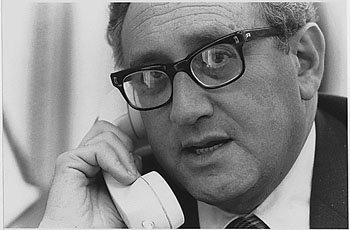
Washington, D.C. – Amidst a massive bombing campaign over North Vietnam, Henry Kissinger and Richard Nixon candidly shared their evident satisfaction at the “shock treatment” of American B 52s, according to a declassified transcript of their telephone conversation published for the first time today by the National Security Archive. “They dropped a million pounds of bombs,” Kissinger briefed Nixon. “A million pounds of bombs,” Nixon exclaimed. “Goddamn, that must have been a good strike.” The conversation, secretly recorded by both Kissinger and Nixon without the other’s knowledge, reveals that the President and his national security advisor shared a belief in 1972 that the war could still be won. “That shock treatment [is] cracking them,” Nixon declared. “I tell you the thing to do is pour it in there every place we can…just bomb the hell out of them.” Kissinger optimistically predicted that, if the South Vietnamese government didn’t collapse, the U.S. would eventually prevail: “I mean if as a country we keep our nerves, we are going to make it.”

The transcript of the April 15, 1972, phone conversation is one of over 15,500 documents in a unique, comprehensively-indexed set of the telephone conversations (telcons) of Henry A. Kissinger—perhaps the most famous and controversial U.S. official of the second half of the 20th century. Unbeknownst to the rest of the U.S. government, Kissinger secretly taped his incoming and outgoing phone conversations and had his secretary transcribe them. After destroying the tapes, Kissinger took the transcripts with him when he left office in January 1977, claiming they were “private papers.” In 2001, the National Security Archive initiated legal proceedings to force the government to recover the telcons, and used the freedom of information act to obtain the declassification of most of them. After a three year project to catalogue and index the transcripts, which total over 30,000 pages, this on-line collection was published by the Digital National Security Archive (ProQuest) this week.

Kissinger never intended these papers to be made public, according to William Burr, senior analyst at the National Security Archive, who edited the collection, Kissinger Telephone Conversations: A Verbatim Record of U.S. Diplomacy, 1969-1977. “Kissinger’s conversations with the most influential personalities of the world rank right up there with the Nixon tapes as the most candid, revealing and valuable trove of records on the exercise of executive power in Washington,” Burr stated. For reporters, scholars, and students, Burr noted, “Kissinger created a gift to history that will be a tremendous primary source for generations to come.” He called on the State Department to declassify over 800 additional telcons that it continues to withhold on the grounds of executive privilege.

The documents shed light on every aspect of Nixon-Ford diplomacy, including U.S.-Soviet détente, the wars in Southeast Asia, the 1969 Biafra crisis, the 1971 South Asian crisis, the October 1973 Middle East War, and the 1974 Cyprus Crisis, among many other developments. Kissinger’s dozens of interlocutors include political and policy figures, such as Presidents Nixon and Ford, Secretary of State William Rogers, Governor Nelson Rockefeller, Robert S. McNamara, and Soviet Ambassador Anatoli Dobrynin; journalists and publishers, such as Ted Koppel, James Reston, and Katherine Graham; and such show business friends as Frank Sinatra. Besides the telcons, the Kissinger Telephone Conversations: A Verbatim Record of U.S. Diplomacy, 1969-1977 includes audio tape of Kissinger’s telephone conversations with Richard Nixon that were recorded automatically by the secret White House taping system, some of which Kissinger’s aides were unable to transcribe.

A series of unforgettable moments are captured in the transcripts, not least involving Kissinger’s complex and difficult relationship with Richard Nixon. Repeatedly, the national security adviser used his skills in flattery and connivance to help build up the president’s image and stay in his good graces. During the Jordan crisis in September 1970, Kissinger told the media that he had awakened the President to brief him on King Hussein’s military actions against Palestinian guerillas. But a transcript of his call to the President the next day recorded him as informing Nixon: “in light of the fact that there was nothing you could do, we thought it best not to waken you.”

The telcons also illustrate other Kissinger’s efforts to spin the media, monitor and control the process of decision-making, disparage rivals, keep important associates, such as his patron Nelson Rockefeller, in the loop, and win over critics:

  • After Gerald Ford shuffled his cabinet in November 1975, removing Kissinger as national security adviser and shifting Donald Rumsfeld from his chief-of-staff position to be Secretary of Defense, Kissinger spoke to Secretary of the Treasury William Simon. “The guy who cut me up inside this building isn’t going to cut me up any less in Defense,” he noted.
  • In an August 13, 1974, conversation with Elliott Richardson after Nixon resigned, Kissinger disparaged George H.W. Bush as a candidate to replace Gerald Ford as Vice President. “I am not as high on George Bush, as some others are, partly because of his lack of experience.”
  • In a conversation with President Nixon on the illegal wiretap scandal in June 1973, Nixon threatened to go to political war with Democrats if they pressed the issue. “Lets get away from the bullshit,” Nixon stated angrily. “Bobby Kennedy was the greatest tapper.” The President even suspected his own phone had been wiretapped in the early 1960s. “[J.Edgar Hoover] said Bobby Kennedy had [the FBI] tapping everybody. I think that even I’m on that list,” President Nixon told Kissinger. When Nixon noted that the wiretap scandal would “catch some of your friends,” Kissinger responded: “Well, I wouldn’t be a bit unhappy.”
  • In a bizarre conversation with anti-war activist/poet Alan Ginsburg on April 23, 1971, Kissinger discussed meeting with ardent opponents of the Nixon administration. Ginsburg suggested the meeting, joking that “It would be even more useful if we could do it naked on television. “I gather you don’t know how to get out of the war,” Ginsburg is recorded as stating. “I thought we did,” Kissinger responded, “but we are always interested in hearing other views.”

In the April 15, 1972, conversation about bombing North Vietnam, Nixon recalled that bombing had failed to defeat Ho Chi Mhin’s forces in the past.

Nixon: “Of course, you want to remember that Johnson bombed them for years and it didn’t do any good.”

Kissinger: But Mr. President, Johnson never had a strategy; he was sort of picking away at them. He would go in with 50 planes; 20 planes; I bet you we will have had more planes over there in one day than Johnson had in a month.

Nixon: Really?

Kissinger: Yeah.

Source / The National Security Archive

Thanks to Mariann Wizard and Jeff Segal / The Rag Blog

Posted in RagBlog | Tagged , , , | Leave a comment

Passive Solar: Living Without Furnaces in the Cold

This is the kind of innovation that will be required around the world in short order. We love reading our Friends at Earth Family Alpha: they always have a positive outlook and make incredibly imaginative suggestions about how we can go forward, just as does this article.

Richard Jehn / The Rag Blog

Berthold Kaufmann and his wife, Dorte Feierabend, with their daughters in their “passive house” in Darmstadt, Germany. Photo: Rolf Oeser for The New York Times.

No Furnaces but Heat Aplenty in ‘Passive Houses’
By Elisabeth Rosenthal / December 26, 2008

DARMSTADT, Germany — From the outside, there is nothing unusual about the stylish new gray and orange row houses in the Kranichstein District, with wreaths on the doors and Christmas lights twinkling through a freezing drizzle. But these houses are part of a revolution in building design: There are no drafts, no cold tile floors, no snuggling under blankets until the furnace kicks in. There is, in fact, no furnace.

In Berthold Kaufmann’s home, there is, to be fair, one radiator for emergency backup in the living room — but it is not in use. Even on the coldest nights in central Germany, Mr. Kaufmann’s new “passive house” and others of this design get all the heat and hot water they need from the amount of energy that would be needed to run a hair dryer.

“You don’t think about temperature — the house just adjusts,” said Mr. Kaufmann, watching his 2-year-old daughter, dressed in a T-shirt, tuck into her sausage in the spacious living room, whose glass doors open to a patio. His new home uses about one-twentieth the heating energy of his parents’ home of roughly the same size, he said.

Architects in many countries, in attempts to meet new energy efficiency standards like the Leadership in Environmental and Energy Design standard in the United States, are designing homes with better insulation and high-efficiency appliances, as well as tapping into alternative sources of power, like solar panels and wind turbines.

The concept of the passive house, pioneered in this city of 140,000 outside Frankfurt, approaches the challenge from a different angle. Using ultrathick insulation and complex doors and windows, the architect engineers a home encased in an airtight shell, so that barely any heat escapes and barely any cold seeps in. That means a passive house can be warmed not only by the sun, but also by the heat from appliances and even from occupants’ bodies.

And in Germany, passive houses cost only about 5 to 7 percent more to build than conventional houses.

Decades ago, attempts at creating sealed solar-heated homes failed, because of stagnant air and mold. But new passive houses use an ingenious central ventilation system. The warm air going out passes side by side with clean, cold air coming in, exchanging heat with 90 percent efficiency.

“The myth before was that to be warm you had to have heating. Our goal is to create a warm house without energy demand,” said Wolfgang Hasper, an engineer at the Passivhaus Institut in Darmstadt. “This is not about wearing thick pullovers, turning the thermostat down and putting up with drafts. It’s about being comfortable with less energy input, and we do this by recycling heating.”

There are now an estimated 15,000 passive houses around the world, the vast majority built in the past few years in German-speaking countries or Scandinavia.

The first passive home was built here in 1991 by Wolfgang Feist, a local physicist, but diffusion of the idea was slowed by language. The courses and literature were mostly in German, and even now the components are mass-produced only in this part of the world.

The industry is thriving in Germany, however — for example, schools in Frankfurt are built with the technique.

Moreover, its popularity is spreading. The European Commission is promoting passive-house building, and the European Parliament has proposed that new buildings meet passive-house standards by 2011.

The United States Army, long a presence in this part of Germany, is considering passive-house barracks.

“Awareness is skyrocketing; it’s hard for us to keep up with requests,” Mr. Hasper said.

Nabih Tahan, a California architect who worked in Austria for 11 years, is completing one of the first passive houses in the United States for his family in Berkeley. He heads a group of 70 Bay Area architects and engineers working to encourage wider acceptance of the standards. “This is a recipe for energy that makes sense to people,” Mr. Tahan said. “Why not reuse this heat you get for free?”

Ironically, however, when California inspectors were examining the Berkeley home to determine whether it met “green” building codes (it did), he could not get credit for the heat exchanger, a device that is still uncommon in the United States. “When you think about passive-house standards, you start looking at buildings in a different way,” he said.

Buildings that are certified hermetically sealed may sound suffocating. (To meet the standard, a building must pass a “blow test” showing that it loses minimal air under pressure.) In fact, passive houses have plenty of windows — though far more face south than north — and all can be opened.

Inside, a passive home does have a slightly different gestalt from conventional houses, just as an electric car drives differently from its gas-using cousin. There is a kind of spaceship-like uniformity of air and temperature. The air from outside all goes through HEPA filters before entering the rooms. The cement floor of the basement isn’t cold. The walls and the air are basically the same temperature.

Look closer and there are technical differences: When the windows are swung open, you see their layers of glass and gas, as well as the elaborate seals around the edges. A small, grated duct near the ceiling in the living room brings in clean air. In the basement there is no furnace, but instead what looks like a giant Styrofoam cooler, containing the heat exchanger.

Passive houses need no human tinkering, but most architects put in a switch with three settings, which can be turned down for vacations, or up to circulate air for a party (though you can also just open the windows). “We’ve found it’s very important to people that they feel they can influence the system,” Mr. Hasper said.

The houses may be too radical for those who treasure an experience like drinking hot chocolate in a cold kitchen. But not for others. “I grew up in a great old house that was always 10 degrees too cold, so I knew I wanted to make something different,” said Georg W. Zielke, who built his first passive house here, for his family, in 2003 and now designs no other kinds of buildings.

In Germany the added construction costs of passive houses are modest and, because of their growing popularity and an ever larger array of attractive off-the-shelf components, are shrinking.

But the sophisticated windows and heat-exchange ventilation systems needed to make passive houses work properly are not readily available in the United States. So the construction of passive houses in the United States, at least initially, is likely to entail a higher price differential.

Moreover, the kinds of home construction popular in the United States are more difficult to adapt to the standard: residential buildings tend not to have built-in ventilation systems of any kind, and sliding windows are hard to seal.

Dr. Feist’s original passive house — a boxy white building with four apartments — looks like the science project that it was intended to be. But new passive houses come in many shapes and styles. The Passivhaus Institut, which he founded a decade ago, continues to conduct research, teaches architects, and tests homes to make sure they meet standards. It now has affiliates in Britain and the United States.

Still, there are challenges to broader adoption even in Europe.

Because a successful passive house requires the interplay of the building, the sun and the climate, architects need to be careful about site selection. Passive-house heating might not work in a shady valley in Switzerland, or on an urban street with no south-facing wall. Researchers are looking into whether the concept will work in warmer climates — where a heat exchanger could be used in reverse, to keep cool air in and warm air out.

And those who want passive-house mansions may be disappointed. Compact shapes are simpler to seal, while sprawling homes are difficult to insulate and heat.

Most passive houses allow about 500 square feet per person, a comfortable though not expansive living space. Mr. Hasper said people who wanted thousands of square feet per person should look for another design.

“Anyone who feels they need that much space to live,” he said, “well, that’s a different discussion.”

Source / The New York Times

Thanks to Betsy Gaines / The Rag Blog

Posted in RagBlog | Tagged , , , | 1 Comment

Gaza : The Pictures Tell the Story

An explosion from an Israeli missile strike in the northern Gaza Strip.

A Palestinian man cries over the body of his son following an Israeli air strike in Gaza December 27, 2008.

In pictures: Massacre in Gaza
December 27, 2008

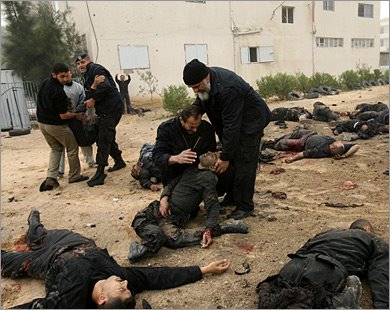
After announcements that a decision whether to increase the military attack on the Gaza Strip would be made tomorrow, Sunday, Israeli forces instead launched a major operation today.

The Israelis killed 150 Palestinians with more expected to die. The Israeli government says it is just the beginning.

Bodies of Palestinian Policemen killed in the Israeli airstrike.

For more pictures from the Israeli assault on Gaza, go to Uruknet.

Also see Two waves of Israeli airstrikes kill 205 Palestinians / Ma’an News Agency.

And Massive demonstrations in Jordan against Israel’s Gaza attack / M&C / Middle East

Thanks to S. M. Wilhelm / The Rag Blog

Posted in RagBlog | Tagged , , , | 9 Comments

Leaving Las Vegas : Can We Say Goodbye to Catalysmic Consumption and Hedonism?

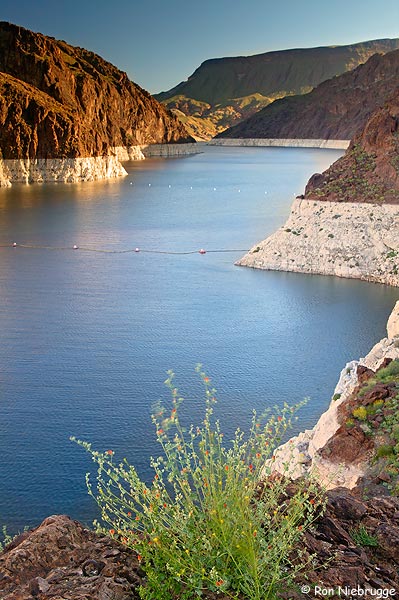
Lake Mead: Beautiful but shrinking. Photo by Ron Niebrugge / Niebrugge Images.

‘Will we finally accept the public policy and lifestyle changes that the real world now requires? Or will “Viva Las Vegas” always be America’s motto?’
By David Sirota / December 27, 2008.

There is something especially unsettling about visiting Las Vegas these days — and it is not the town’s lascivious culture. A voyage to Sin City in this moment of ecological and economic crisis is a journey to a giant concave mirror reflecting back the magnified — and ugly — truths about this epoch of cataclysmic consumption and hubristic hedonism.

Like most flights into Vegas, mine last week soared over a shrinking Lake Mead. Visually, the white strip around the manmade reservoir is beautiful — the bright chalk line separating the blue water from the red-brown desert evokes memories of a Bob Ross pastel painting minus “happy trees.” But it is a menacing harbinger of depletion. This water source for 22 million people is at its lowest level since the 1960s. Strained by the Southwest’s population explosion and by drought-accelerating climate change, the lake now stands a 50 percent chance of running dry by 2021, according to scientists.

As the plane descends, Vegas comes up on the horizon faster than ever. As one of the country’s quickest growing locales, it has become a massive blob suffocating a fragile ecosystem. Sans urban planning in the libertarian West, that unbridled growth encourages more roads, cars and smog.

At least McCarran Airport is only a short ride to the city’s core, but that is the most troubling area of all. Recently recast as a family-friendly Disneyland, downtown Vegas nonetheless retains its identity as the place where a recession-plagued country gambles away its dwindling paycheck.

Vegas’s colorful lights are supposed to be the “enjoyment” for those who inevitably lose at the slot machines. But with each twinkle the atmosphere warms. Despite advances in clean energy, electricity is still primarily produced with carbon-emitting sources that drive global warming. Indeed, the blinding Strip that prompts tourists’ drunken cheers is a monument to the same gluttony that helped make Nevada the fastest-growing emitter of carbon dioxide in the country.

Sure, Vegas boasts of renewable power investments and energy-saving light bulbs. But bragging about such efforts rather than simply shutting stuff off is as silly as Arnold Schwarzenegger trumpeting his supposed commitment to environmentalism by pledging to make one of his Hummers more fuel efficient.

But that’s always been the American way, hasn’t it? We don’t stop driving Hummers around a warming planet just like we don’t stop building population centers in deserts, just like we don’t stop gambling when wages drop just like we don’t stop wasting energy on casino signs. Why? Because it’s fun to drive tanks, live in desert climates, double-down on 11 and gape at bright lights in the big city. And during the years of cheap energy, income growth and seemingly endless water supplies, fun always trumped pragmatism.

That period, of course, has been supplanted by the Age of the Finite. And to its (few) sober visitors, Vegas implicitly asks whether our whole society is genuinely ready for that new reality.

Whether hanging Christmas lights in Toledo, buying SUVs in Boulder, taking long showers in Atlanta, residing in sprawly suburbs near Chicago, or overspending anywhere, we are all Las Vegans now. And because we have become so environmentally and economically interconnected, what happens in our own Vegas no longer stays in our own Vegas — it affects everyone.

Knowing that, are we ready to turn off some lights in our homes? Is it possible for Americans to forfeit McMansion dreams, drive smaller cars, take public transit, embrace water restrictions, or live in more sustainable geographies? Can we resist materialism, halt the bone-crushing stampedes to Wal-Mart, and stop needlessly spending beyond our means?

In other words, will we finally accept the public policy and lifestyle changes that the real world now requires? Or will “Viva Las Vegas” always be America’s motto?

COPYRIGHT 2008 CREATORS SYNDICATE, INC.

[David Sirota is a best-selling author whose newest book, “The Uprising,” was just released this month. He is a fellow at the Campaign for America’s Future and a board member of the Progressive States Network — both nonpartisan organizations. His blog is here.]

Source / AlterNet

Thanks to David Hamilton / The Rag Blog

Posted in RagBlog | Tagged , , , , , | 1 Comment

American Health Care : A Sucker Born Every Minute

Grand huckster P. T. Barnum: “A sucker born every minute.”

‘The insurance industry and PhARMA are well aware of the TV watcher’s predilection to accept, without question, their lies, distortions, and innuendoes about the nature of and need for single payer, universal health care.’

By Dr. Stephen R. Keister / The Rag Blog / December 27, 2008

P.T. Barnum’s famous statement plays well today, “There is a sucker born every minute.” In some yet undetermined way Barnum must have anticipated the age of television and the fact that for some obscure reason the average American feels that what he sees on television must be true. Therein we who favor single payer, universal health care face one of our two greatest problems. The insurance industry and PhARMA are well aware of the TV watcher’s predilection to accept, without question, their lies, distortions, and innuendoes about the nature of and need for single payer, universal health care and by deceit invade the psyche of the boob glued to the tube and convince him that his best interest is served only by a greedy, capitalistic group of corporations, thus, depriving him of his right to health care for him and his family.

The United States is one of two industrialized nations that permit advertising of prescription medication on TV. I recently noted that the various drug companies, in one year, spent half a billion dollars on sleep problems, and the medicines to correct them. Watching TV for an evening one can only imagine the cost to the pharmaceutical industry, as every other ad seems to espouse a different prescription nostrum for ailments real or imagined. One can only surmise the overall cost that, in the long run, will be passed on to the patient at the drug store. What is the purpose? One assumes that the pharmaceutical companies anticipate that the TV watchers will harass their family doctors into giving them “what I saw advertised on TV.” Of course any thoughtful physician will discuss the pros and cons of the request, and then make it very clear that he determines from scientific knowledge what medications he will prescribe, and not be guided by rank commercialism. If he does not do so it is time to suggest a change in physicians.

Excessive pharmaceutical prices are largely indigenous to the United States. On Nov. 21, 2008, in an article posted on TruthOut, an American expatriate in Paris, Steve Weissman, notes his initial experience with the French medical system. He writes.

The system here is surprisingly nonbureaucratic, at least for the patient.. My wife Anna and I picked our own general practitioners, specialists, and hospital care, with no insurance company restricting us to their list of doctors or hospitals. In fact, we found only two restrictions. The GPs could turn us down if they already had too many patients and they had to be within our geographical area so they would not have to travel too far when making a house call. Thus, under socialized medicine here in France, doctors still make house calls, even here in the boondocks where we live.

For each visit to the GP, we write a check for 22 euros. The system then reimburses us for 70% with a direct deposit to our bank account. For some particularly debilitating conditions the government pays the full 100%. To pay whatever the government doesn’t many people have private top-up insurance, which is very reasonably priced. At the pharmacy, we don’t pay at all. We simply present our health care cards; the government and top-up insurance then pay the pharmacist directly.

How good is the French medical care? Surveys by the W.H.O. rate the French system the best in the world, and far better than average health care in the United States.”

Again, please note that French TV does not carry pharmaceutical ads. But then the French physician seemingly does not need to be directed by corporate advertising and appears to be much better off for the lack of it. But our TV watchers should be cautioned that the profit making, politician-prostituting drug companies are not serving the viewers’ best interest but, amazingly will be believed by most Americans.

I practiced internal medicine and rheumatology for 40 years, retiring in 1990. Rousseau noted in his writings that we should each experience every situation presented to us as a life experience. In 1989 I received an invitation from a pharmaceutical company to attend a three day seminar at a luxury hotel in Phoenix, air-fare paid, with a “companion of my choice.” For 39 years I had never replied to such an invitation, but decided that it was my last chance for such an experience. Hence, I showed the invitation to my wife, and the “companion issue” was quickly answered. We flew from Erie, Pa. to Phoenix, were provided with a $500 a day room, meals, picnics, entertainment, and were required for three days to attend a three hour morning seminar. There were 200 physicians and “companions” in attendance, all with expenses paid. (At the first dinner I noted to my wife that a great number of physicians had brought their daughters, and she noted that I was extremely naïve.) In any event, after 24 hours I was educated about and ashamed by what was being done by the pharmaceutical companies in offering baksheesh to the medical profession. I gained an insight into the high price of drugs to the consumer.

There are many reasons for the high price of prescriptions in this country. Do not blame the pharmacist. There has been collusion between the Bush administration and big PhARMA, as well as the insurance industry. The Medicare Part D “prescription plan” is the outstanding example. This insult to the intelligence of the American public was passed by a whip-sawed congress in the middle of the night by 2-3 votes. The congressional sponsors, by and large, have been employed by the pharmaceutical industry since the bill’s passage. In return a grossly imperfect “prescription plan” with payments in the billions out of the Medicare Fund being made to the pharmaceutical and insurance industries for “administering” the plan, and with minimal control of the payment schemes presented to the subscribers. The bill specified prohibiting prescriptions from abroad, deemed price control on drugs as with the VA system out of bounds, and specified that there be no negotiations by Medicare on drug prices with the carriers. One prominent insurance company, which is also in the hospital business, has surreptitiously used the prescription drug plan as a vehicle for pedaling its HMO

We who are rational, discerning human beings must try our utmost to influence the Obama administration to (1) revise the Medicare part D prescription bill in the interest of the consumer rather than the corporations; (2) legislate against advertising of prescription drugs; and (3) establish hard and fast restrictions on the financial interaction between the pharmaceutical industry and the medical professions, including the ghost writing of professional papers for academic researchers by the pharmaceutical industry.

I have addressed one part of the problem regarding health care for all, but there is another chapter dealing with the distortions by the insurance companies and HMO’s which we will address at a later time. It is only the citizens of this nation, acting collectively, who can bring about change. We must make our voices heard by our elected representatives. And we should check out the contributions those representatives have received from the drug and insurance industries on any of several available web sites like OpenSecrets.org.

The Rag Blog

Posted in Rag Bloggers | Tagged , , , , | 4 Comments

Afghanistan Warlords, the CIA and the Little Blue Pill

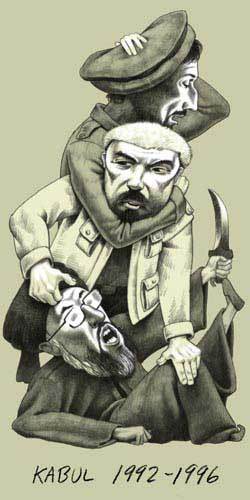
Illustration by Matt Weems / Afghanistan Watch.

‘The grinning chief offered up a bonanza of information about Taliban movements and supply routes — followed by a request for more pills.’
By Joby Warrick / December 26, 2008

The Afghan chieftain looked older than his 60-odd years, and his bearded face bore the creases of a man burdened with duties as tribal patriarch and husband to four younger women. His visitor, a CIA officer, saw an opportunity, and reached into his bag for a small gift.

Four blue pills. Viagra.

“Take one of these. You’ll love it,” the officer said. Compliments of Uncle Sam.

The enticement worked. The officer, who described the encounter, returned four days later to an enthusiastic reception. The grinning chief offered up a bonanza of information about Taliban movements and supply routes — followed by a request for more pills.

For U.S. intelligence officials, this is how some crucial battles in Afghanistan are fought and won. While the CIA has a long history of buying information with cash, the growing Taliban insurgency has prompted the use of novel incentives and creative bargaining to gain support in some of the country’s roughest neighborhoods, according to officials directly involved in such operations.

In their efforts to win over notoriously fickle warlords and chieftains, the officials say, the agency’s operatives have used a variety of personal services. These include pocketknives and tools, medicine or surgeries for ailing family members, toys and school equipment, tooth extractions, travel visas, and, occasionally, pharmaceutical enhancements for aging patriarchs with slumping libidos, the officials said.

“Whatever it takes to make friends and influence people — whether it’s building a school or handing out Viagra,” said one longtime agency operative and veteran of several Afghanistan tours. Like other field officers interviewed for this article, he spoke on the condition of anonymity when describing tactics and operations that are largely classified.

Officials say these inducements are necessary in Afghanistan, a country where warlords and tribal leaders expect to be paid for their cooperation, and where, for some, switching sides can be as easy as changing tunics. If the Americans don’t offer incentives, there are others who will, including Taliban commanders, drug dealers and even Iranian agents in the region.

The usual bribes of choice — cash and weapons — aren’t always the best options, Afghanistan veterans say. Guns too often fall into the wrong hands, they say, and showy gifts such as money, jewelry and cars tend to draw unwanted attention.

“If you give an asset $1,000, he’ll go out and buy the shiniest junk he can find, and it will be apparent that he has suddenly come into a lot of money from someone,” said Jamie Smith, a veteran of CIA covert operations in Afghanistan and now chief executive of SCG International, a private security and intelligence company. “Even if he doesn’t get killed, he becomes ineffective as an informant because everyone knows where he got it.”

The key, Smith said, is to find a way to meet the informant’s personal needs in a way that keeps him firmly on your side but leaves little or no visible trace.

“You’re trying to bridge a gap between people living in the 18th century and people coming in from the 21st century,” Smith said, “so you look for those common things in the form of material aid that motivate people everywhere.”

Among the world’s intelligence agencies, there’s a long tradition of using sex as a motivator. Robert Baer, a retired CIA officer and author of several books on intelligence, noted that the Soviet spy service was notorious for using attractive women as bait when seeking to turn foreign diplomats into informants.

“The KGB has always used ‘honey traps,’ and it works,” Baer said. For American officers, a more common practice was to offer medical care for potential informants and their loved ones, he said. “I remember one guy we offered an option on a heart bypass,” Baer said.

For some U.S. operatives in Afghanistan, Western drugs such as Viagra were just part of a long list of enticements available for use in special cases. Two veteran officers familiar with such practices said Viagra was offered rarely, and only to older tribal officials for whom the drug would hold special appeal. While such sexual performance drugs are generally unavailable in the remote areas where the agency’s teams operated, they have been sold in some Kabul street markets since at least 2003 and were known by reputation elsewhere.

“You didn’t hand it out to younger guys, but it could be a silver bullet to make connections to the older ones,” said one retired operative familiar with the drug’s use in Afghanistan. Afghan tribal leaders often had four wives — the maximum number allowed by the Koran — and aging village patriarchs were easily sold on the utility of a pill that could “put them back in an authoritative position,” the official said.

Both officials who described the use of Viagra declined to discuss details such as dates and locations, citing both safety and classification concerns.

The CIA declined to comment on methods used in clandestine operations. One senior U.S. intelligence official familiar with the agency’s work in Afghanistan said the clandestine teams were trained to be “resourceful and agile” and to use tactics “consistent with the laws of our country.”

“They learn the landscape, get to know the players, and adjust to the operating environment, no matter where it is,” the official said. “They think out of the box, take risks, and do what’s necessary to get the job done.”

Not everyone in Afghanistan’s hinterlands had heard of the drug, leading to some awkward encounters when Americans delicately attempted to explain its effects, taking care not to offend their hosts’ religious sensitivities.

Such was the case with the 60-year-old chieftain who received the four pills from a U.S. operative. According to the retired operative who was there, the man was a clan leader in southern Afghanistan who had been wary of Americans — neither supportive nor actively opposed. The man had extensive knowledge of the region and his village controlled key passages through the area. U.S. forces needed his cooperation and worked hard to win it, the retired operative said.

After a long conversation through an interpreter, the retired operator began to probe for ways to win the man’s loyalty. A discussion of the man’s family and many wives provided inspiration. Once it was established that the man was in good health, the pills were offered and accepted.

Four days later, when the Americans returned, the gift had worked its magic, the operative recalled.

“He came up to us beaming,” the official said. “He said, ‘You are a great man.'”

“And after that we could do whatever we wanted in his area.”

Source / Washington Post

The Rag Blog

Posted in RagBlog | Tagged , , , | 1 Comment

Granny D : Fear is a Humbug

‘This society has run its course. We the people have long been ready for fresh growth, greener growth, scaled more to the needs of human beings and their communities.’
By Doris “Granny D” Haddock

[These remarks are excerpted from a speech given by Doris “Granny D” Haddock on October 12, 2008, in Philadelphia, as it appears in the December issue of New Hampshire Magazine. Granny D, 97, gained fame by walking across the continental United States in 1999 to advocate campaign finance reform and in 2004 ran unsuccessfully as a Democrat for the US Senate from New Hampshire. The entire speech can be found at NH Mag’s website.]

It seems that the world is changing around us this autumn. I know that some of my feistier friends have been hoping for big social and political changes — for a revolution of some sort — to get us on a new path to a better future on a healthier Earth. I do not think they imagined that the revolution might take the form of strange torpedoes called credit default swap derivatives, exploding our banks and bankrupting our governments, but revolutions rarely arrive or turn out the way you expect. This society has run its course. We the people have long been ready for fresh growth, greener growth, scaled more to the needs of human beings and their communities.

I have been thinking lately of my old Texas writer friend Molly Ivins, who passed away not long ago and left us with an insufficient store of good humor to see all the amusing and satisfying turns of justice in the present economic collapse. She would remind us that Freedom’s just another word for no retirement money left to lose. Yes, the walls have crumbled, but now we are free from all that anxiety about losing all our money. There’s not much left to worry about.

Sticking together, none of us will starve. Besides, we can always grow enough zucchini for everyone, can’t we?

We need not fear Fear Itself this time around, for fear is a humbug. If we have learned anything in all the Aquarian splendor of the last few generations, it is that fear for the loss of material things is but the jitters of an addict, and the jitters go away once we relax into whatever new world we find ourselves come into.

You will hear people on television worrying about the return of the Great Depression. I have heard that several times during the last week or so.

I am old enough to have memories of that time, are any of you? Maybe we were hungry sometimes, but did we starve? No, because we had our friends and family and the earth to sustain us. The earth may have been reluctant to feed us in some of those years, but never our friends nor our families.

If you lived through that time, and if now you hear some young expert on television saying the term “Great Depression” as if it were a great monster who might return, let me ask you — you who remember the last time — there are a few of us left — let me ask you if your memories of that time are not more round and golden than sharp-edged?

My husband, Jim, made an ice rink from a little meadow, and he made a few dollars extra those winters of the Depression. I learned to put on one-woman plays, and performed in women’s clubs here and there, making the rest of what we needed. We were fountains of creativity. We were fountains of friendship to our neighbors. As a nation, we were a mighty river of mutual support.

That same Great Depression made some people in other countries ready for violence, genocide and war. But, somehow, through the exceptional miracle that is America itself, the hard times only made us more willing to help the world when our help was needed.

I am not advocating hardship, and I am not cheerleading for poverty. Indeed, prosperity is the green wreath we cherish most, though it means little without the times between.

Source / NH Magazine

Thanks to Doug Zabel / The Rag Blog

Posted in RagBlog | Tagged , , | 1 Comment

Wanted : Dialogue on the Great Depression of 2009

How prepared are Americans today to cope, adjust, improvise, and to help one another as things really get tough in the coming year or two? Could really bad times that go on and on bring about a forced reset of the American psyche?

By Larry Ray / The Rag Blog / December 25, 2008

What happens after the last strains of Auld Lang Syne fade away on New Year’s Eve, and the glow of the historic inauguration of Barack Obama on January 20th quickly dims? By then, the deep economic mess we face should really start to sink in across America.

Those of us in our Golden Years may see things coming that those of more recent generations can’t even imagine. Its really a matter of what our parents knew about the great depression in the 1930’s and what they taught us when we were young. But if you were born in 1970, by the time you were old enough to remember daily life, things would have probably seemed fine. Your parents grew up when America was taking deep swigs of the new good life and opportunity after WWII. My folks were little kids when the 1929 crash happened. They grew up in the depth of the depression and did without. So, I got stern warnings about spending and saving money. Warnings that 40-somethings today probably didn’t get. And 40-somethings certainly didn’t see thrift and restraint reflected in the America of their youth.

How prepared are Americans today to cope, adjust, improvise, and to help one another as things really get tough in the coming year or two? Could really bad times that go on and on bring about a forced reset of the American psyche? A sea-change in leadership is coming, but a new Obama administration will begin work in the midst of global recession. Our new leaders will inherit record-setting national debt, and the diplomatic debris and great political uncertainty left by Bush and company. Massive government stimulus and work programs will be part of the long term solution but individual responsibility for daily survival will be key on the community level.

Compared to the more than ten years of misery, loss, unemployment, hunger and grinding uncertainty following the crash of 1929, we are a much stronger nation today. But the ability of average Americans to make do and to do without will be an unfolding saga. Will the new jobless again be forced to depend upon soup-kitchens and handouts to survive? Can we even imagine that? Millions, who for decades have been spending money they do not have, using a wallet full of credit cards to get whatever they want, will be forced to take a hard look at themselves. A pay-as-you-go world is a great social leveling force.

I would like to see an exchange of ideas about what you see coming on the basic person to person level. Post a comment and let’s hear your thoughts and observations. Hardship can also create positive changes. Will humbling loss and poverty merely increase crimes like shoplifting and burglaries or will it bring out a renewed American strength and pride? What role will the internet and wireless communication make as times get really tough?

Let’s start by exchanging ideas and talking to one another early on.

[Retired journalist Larry Ray is a Texas native and former Austin television news anchor. He also posts at The iHandbill.]

The Rag Blog

Posted in Rag Bloggers | Tagged , , | 3 Comments

Chris Cook: Changing the Food Policy for America

Graphic source.

A food agenda for Obama
By Christopher D. Cook / December 26, 2008

Now’s the time to reinvent America’s farm and food policies.

San Francisco – Within hours of former Iowa Gov. Tom Vilsack’s nomination last week as Agriculture secretary, websites were humming with well-documented critiques of his affinity for genetically engineered crops, agribusiness giant Monsanto, heavily polluting factory farms, and other Big Farm interests.

Some critics expressed outrage, others surprise, especially since they had mounted a vigorous, 55,000-plus strong online petition to persuade President-elect Barack Obama to nominate someone more progressive who would promote sustainable food and farming.

The need for sweeping change could not be clearer when it comes to our food: At taxpayer expense, current policy subsidizes large corporate farms and destructive industrial agriculture, which rob the countryside of economic diversity and precious environmental resources, such as water and topsoil.

These same subsidies, and anemic regulatory enforcement, encourage an increasingly monopolized food system, and a “cheap food” policy that lards us with fatty, processed foods – the cost of which is ultimately dear, more than $100 billion annually for obesity and diet-related diseases. Today’s food system also generates a sizable portion of America’s greenhouse gases, and rests on fast-dwindling and volatile oil supplies.

Now is the time for something different – change we can eat.

As Mr. Obama weighs a massive stimulus package, he should include new funding streams that promote sustainable food – to build up alternatives such as farmer’s markets, local “foodshed” programs that promote consumption of local produce, and farm-to-institution projects that encourage schools, hospitals, and other large buyers to purchase local organic foods when possible.

The change we need in food is as urgent as any we face – changes that affect national health, energy security, global warming, and more. Here, then, is a not-so-modest nine-point platform for food reform, some of which could be included in Obama’s stimulus package. Other elements may require a lengthier policy push:

  1. New public investments targeting sustainable agriculture, defined as organic, small- to mid-sized, diversified farming.
  2. New investments in local/regional food networks and foodsheds – to help build up the connections between farmers and consumers, to open up and expand new markets for organic farmers and those considering the transition; for more farmer’s markets and food stores that feature local produce.
  3. A moratorium on agribusiness mergers, and strenuous antitrust provisions and enforcement to protect what little is left of diversity in the food economy.
  4. A moratorium on all new genetically modified (GMO) products, and an expansion of existing ones, and appointment of a blue-ribbon panel/commission to assess the impact of GMO foods on our environment and our health.
  5. A moratorium on – and gradual phasing out of – concentrated animal feeding operations, aka factory farms, which are among the nation’s top polluters of water and air, and breeders of widespread and virulent bacterial strains.
  6. Dramatically expanded regulatory enforcement and staffing in the US Department of Agriculture and the Food and Drug Administration to protect food safety and meat industry labor and environmental practices.
  7. Slowing the hazardously fast meatpacking (and poultry) assembly line, to protect workers and consumers.
  8. Incentives for small-scale urban, suburban, and rural farming ventures oriented toward diversified local food systems.
  9. Bold public investment in a raft of public awareness campaigns that build support, and expand markets and demand, for sustainable alternatives such as urban agriculture and gardening, and reducing fast-food consumption.
  10. Fill in the blank, and send me your thoughts at www.christopherdcook.com.

Food is a vital cornerstone of both individual life and civil society, and our current system is making us fatter, churning out greenhouse gases, and abusing workers and animals.

With a new administration elected on a “change” agenda, it’s a timely moment to press for the most basic change of all: change in the food that ends up on our plates and in our bodies.

[Christopher D. Cook is a journalist and the author of “Diet for a Dead Planet: Big Business and the Coming Food Crisis.”]

Source / Christian Science Monitor

The Rag Blog

Posted in RagBlog | Tagged , , | Leave a comment

A Practical Guide to Stopping the BushCo Oil and Gas Public Lands Selloff

A view of Dinosaur National Monument. Photo source.

‘Direct action gets the goods’
By Amy Goodman / December 24, 2008

Tim DeChristopher is an economics student at the University of Utah in Salt Lake City. He had just finished his last final exam before winter break. One of the exam questions was: If the oil and gas companies are the only ones that bid on public lands, are the true costs of oil and gas exploitation reflected in the prices paid?

DeChristopher was inspired. He finished the exam, threw on his red parka and went off to the Bureau of Land Management land auction that the Southern Utah Wilderness Alliance called “the Bush administration’s last great gift to the oil and gas industry.” Instead of joining the protest outside, he registered as a bidder, then bought 22,000 acres of public land. That is, he successfully bid on the public properties, located near the Arches and Canyonlands National Parks and Dinosaur National Monument, and other pristine areas. The price tag: more than $1.7 million.

He told me: “Once I started buying up every parcel, they understood pretty clearly what was going on … they stopped the auction, and some federal agents came in and took me out. I guess there was a lot of chaos, and they didn’t really know how to proceed at that point.”

Patrick Shea, a former BLM director, is representing DeChristopher. Shea told the Deseret News: “What Tim did was in the best tradition of civil disobedience, he did this without causing any physical or material harm. His purpose was to draw attention to the illegitimacy and immorality of the process.”

There is a long tradition of disrupting land development in Utah. In his memoir, “Desert Solitaire,” Edward Abbey, the writer and activist, wrote: “Wilderness. The word itself is music. … We scarcely know what we mean by the term, though the sound of it draws all whose nerves and emotions have not yet been irreparably stunned, deadened, numbed by the caterwauling of commerce, the sweating scramble for profit and domination.”

Abbey’s novel “The Monkey Wrench Gang” inspired a generation of environmental activists to take “direct action,” disrupting “development.” As The Salt Lake Tribune reported on DeChristopher: “He didn’t pour sugar into a bulldozer’s gas tank. He didn’t spike a tree or set a billboard on fire. But wielding only a bidder’s paddle, a University of Utah student just as surely monkey-wrenched a federal oil- and gas-lease sale Friday, ensuring that thousands of acres near two southern Utah national parks won’t be opened to drilling anytime soon.”

Likewise, the late Utah Phillips, folk musician, activist and longtime Utah resident, often invoked the Industrial Workers of the World adage: “Direct action gets the goods.”

More than just scenic beauty will be harmed by these BLM sales. Drilling impacts air and water quality. According to High Country News, “The BLM had not analyzed impacts on ozone levels from some 2,300 wells drilled in the area since 2004 … nor had it predicted air impacts from the estimated 6,300 new wells approved in the plan.” ProPublica reports that the Colorado River “powers homes for 3 million people, nourishes 15 percent of the nation’s crops and provides drinking water to one in 12 Americans. Now a rush to develop domestic oil, gas and uranium deposits along the river and its tributaries threatens its future.”

After questioning by federal authorities, DeChristopher was released.

The U.S. attorney is currently weighing charges. DeChristopher reflects: “This has really been emotional and hopeful for me to see the kind of support over the last couple of days … for all the problems that people can talk about in this country and for all the apathy and the eight years of oppression and the decades of eroding civil liberties, America is still very much the kind of place that when you stand up for what is right, you never stand alone.”

His disruption of the auction has temporarily blocked the Bush-enabled land grab by the oil and gas industries. If DeChristopher can come up with $45,000 by Dec. 29, he can make the first payment on the land, possibly avoiding any claim of fraud. If the BLM opts to re-auction the land, it can’t happen until after the Obama administration takes over.

The sales, if they happen, will likely be different, thanks to the direct action of an activist, raising his voice, and his bidding paddle, in opposition.

[Amy Goodman is the host of “Democracy Now!,” a daily international TV/radio news hour. Denis Moynihan contributed research to this column.]

Source / Seattle Post-Intelligencer

The Rag Blog

Posted in RagBlog | Tagged , , | Leave a comment

We Are Citizens of Earth, Not Just Consumers: Fixing the Broken Economy Means Changing It

Although this article explicitly addresses the Canadian economy, the points these authors make apply everywhere.

Richard Jehn / The Rag Blog

Paul Lachine/NewsArt

Don’t fix the economy – change it
By Peter G. Brown and Geoffrey Garver / December 26, 2008

Sticking with the model that is driving us toward ecological catastrophe will eventually kill us

Amid the discordant clash of solutions being served up to address the global financial crisis, a common refrain can be heard: Most global leaders and their economic advisers key their policy prescriptions to “sustained economic growth.” The prevailing debate is how to get there most quickly. In Canada, how this debate plays out could bring down the government in a matter of weeks.

Unfortunately, it is the wrong debate. Neither the Conservative minority nor the opposition has proposed anything that will set Canada on a long-term path toward the kind of economy that will both provide for the well-being of Canadians and enhance and preserve the ecological community of which people are but one dependent part.

All eyes may now be on the kind of fiscal budget the Conservatives might produce next year, but a more essential budget also demands urgent attention: the global ecological budget. The financial crisis has brought into sharp focus the need to fundamentally change, not merely repair or rebuild, our economy. Because, quite simply, sticking with an economic model that is driving toward ecological catastrophe will kill us. So, it is essential to address the financial and ecological crises together.

The ecological budget, on which all life and, consequently, the human economy depends, is already in dramatic deficit. Why is this budget ultimately more important than the fiscal budget? Sept. 23, 2008, was Earth Overshoot Day. The period after Sept. 23 represents the time the human population causes an ecological deficit, using up the Earth faster than it can regenerate.

Every year, Earth Overshoot Day comes earlier. This moving date tells the story of a global environment rapidly losing its ability to support life: accelerating climate change; the loss of species and habitats; declining fisheries; the proliferation of ocean dead zones; diminishing freshwater resources; and more. Ecological overshoot is climate change on steroids.

Here are six steps we can take toward a truly balanced budget that will allow Canadians, and all people on Earth, to live fulfilling, healthy, yet more ecologically compatible, lives.

  • Recognize that the economy is part of the biosphere. A comprehensive economic plan must be based on the scientific fact that the global economy is a subsidiary of the natural order. Economic policies should be attuned to the limited capacity of Earth’s biosphere to provide for humans and other life and to assimilate their waste. Photosynthesis and sunlight are as essential to the framework for economic budgets and expenditures as the laws of supply and demand.
  • Acknowledge that we need new institutions. An economic renewal tailored to the 21st century would establish institutions committed to fitting the human economy to Earth’s limited life-support capacity. Canada, with its token efforts to address climate change, is far off the track. We need something like the central reserve banks, but which look after shares of the Earth’s ecological capacity, not just interest rates and the money supply. Money should be recognized as a social licence to use part of Earth’s life-support capacity. Some functions of governance would have to operate at a global level, through a federation modelled perhaps on the European Union, with enforceable laws designed to assure that individual nations don’t overrun Earth’s limits. The rules for the developed countries that are responsible for the current ecological crisis should be different from those for developing ones.
  • Acknowledge that unlimited growth on a finite planet makes no sense. Most people wrongly believe that unlimited growth and wealth accumulation are the “natural laws” of the economy – inviolable, even though together they undermine the Earth’s ecological and social systems. We face a moral challenge: bring the global economy into a right relationship with the planet and its human and non-human inhabitants or suffer the increasing destruction of Earth’s finite life-support systems and social structures. Growth in consumption is a nonsensical response to the sharp decline in Earth’s biophysical systems that is caused by overconsumption. Our new ecological and climate reality demands new ways to live within the means of the Earth.
  • Fairness matters. A “right” human-Earth relationship would recognize humans as part of an interdependent web of life on a finite planet. The economy must recognize the rights of the human poor and of millions of other species to their place in the sun. In a world awash in money, addressing poverty only with growth reflects a tragic lack of moral imagination. Indeed, in pushing for more “free” trade as it is currently understood, Canada would entrench an ongoing addiction to consumption, pursued in a manner that often ravages the bio-productivity of developing countries.
  • Expand the discussion. The new knowledge that will forever mark this period in human history is the overwhelming scientific evidence that we are overconsuming the planet and accelerating toward ecological catastrophe. The short-term approaches of most ministers of finance and professional economists don’t account for how the planet works, or even that the economy exists on a finite planet. Scientists morally committed to protecting the global commons and researching ecological limits to the global economy need much more funding and influence in policy-making.
  • Look beyond technological fixes. Bold new leadership is needed that will focus on all four policy “theatres” relevant to human ecological impact and provide the moral footing that will lead people, individually and collectively, to choose lifestyles with radically lower impact. The four policy variables are: technology; population; wealth and consumption; and morals and customs. These factors should together shape Parliament’s rethinking of the current economic system. Technology can increase efficiency of energy and resources use, yet it is overemphasized as a solution. Pushing technological solutions like hydrogen cars and genetically modified agriculture is much easier politically than asking people to consume less or have fewer children. Unfortunately, technology alone cannot solve the ecological crisis. For one thing, efficiency gains often lead to greater, not lower, consumption. An example is the squandering of Quebec’s underpriced hydroelectric power.

Investments in new “green” technology need to be coupled to a regulatory structure that ensures that efficiency does not result in more impact, along with massive investment in creating or restoring natural systems that build bioproductivity. Economic policy must promote not more affluence as currently defined, but more sufficiency for all Canadians – so that all may live with self-respect, without overconsumption.

Perhaps most difficult to come to grips with is that Canada is an overpopulated country – if you compare the individual impact of each Canadian with what the Earth can withstand. We should escape from the current treadmill that considers more people necessary for more growth.

Lastly, we must greatly increase investment in educational and civic institutions that teach that we are not “consumers,” but citizens of the Earth, and guardians of life’s prospect on a small, beautiful and finite planet.

[Peter G. Brown is a professor at McGill University. Geoffrey Garver is an environmental consultant and lectures in law at Université de Montréal and Université Laval. They are co-authors of Right Relationship: Building a Whole Earth Economy.]

Source / Toronto Star

The Rag Blog

Posted in RagBlog | Tagged , , | Leave a comment