Richard Rodriquez : Why Churches Fear Gay Marriage

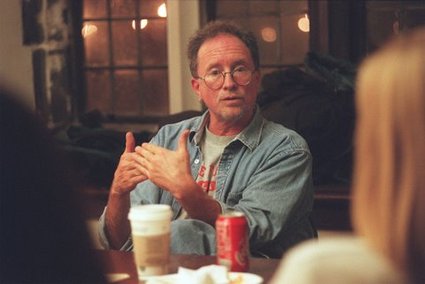
Author Richard Rodriguez is Mexican-American, gay and a practicing Catholic. Photo by Christine Alicino / salon.com.

As the American family fractures and the majority of women choose to live without men, churches are losing their grip on power and scapegoating gays and lesbians for their failures.

By Jeanne Carstensen

For author Richard Rodriguez, no one is talking about the real issues behind Proposition 8.

While conservative churches are busy trying to whip up another round of culture wars over same-sex marriage, Rodriguez says the real reason for their panic lies elsewhere: the breakdown of the traditional heterosexual family and the shifting role of women in society and the church itself. As the American family fractures and the majority of women choose to live without men, churches are losing their grip on power and scapegoating gays and lesbians for their failures.

Rodriguez, who is Mexican-American, gay and a practicing Catholic, refuses to let any single part of himself define the whole. Born in San Francisco in 1944 and raised by his Spanish-speaking Mexican immigrant parents to embrace mainstream American culture and the English language, he went on to study literature and religion at Stanford and Columbia. His first book, “The Hunger of Memory: The Education of Richard Rodriguez,” explores his journey from working-class immigrant to a fully assimilated intellectual — angering many Latinos with his view that English fluency is essential. “Days of Obligation: An Argument With My Mexican Father,” which was a Pulitzer Prize finalist in 1993, continued his investigation into how family, culture, religion, race, sexuality and other strands of his life all contribute to the whole, a complex “brownness” of contradictions and ironies. “Brown: The Last Discovery of America” completes the trilogy — but not his insatiable intellectual curiosity, which he is now shining on monotheism.

Rodriguez’ stinging critiques of religious hypocrisy are all the richer for his passionate love of Catholicism and the Most Holy Redeemer parish in San Francisco, where he and his partner of 28 years are devoted members. Today, Rodriguez is at work on a new book about the monotheistic “desert religions” — Christianity, Judaism and Islam. Ever since Sept. 11, “when havoc descended in the name of the desert God,” Rodriguez said in one of his Peabody Award-winning radio commentaries for PBS’s News Hour, he has been trying to understand the strands of darkness that run through these religions.

Salon spoke to Richard Rodriguez by phone at his home in San Francisco.

What was your reaction to California voters’ going heavily for Obama and also passing Proposition 8, banning gay marriage?

I was like a lot of other Americans at the moment when the West Coast tipped the balance in favor of Obama. I didn’t so much think it represented the end of racism but the possibility of change. At the same time, I also knew that large numbers of Californians in religious communities were voting against gay marriage and that Latinos and blacks were continuing to take part in this terribly tragedy. We persecute each other. The very communities that get discriminated against discriminate against other Americans.

The Spanish language newspaper La Opinión called the results an “embarrassment,” saying “California still has two faces.” Do you agree?

La Opinión represents the opinion of a lot of Latinos who are more educated and — what should I say? — more cosmopolitan. But Latinos in both my family and the Catholic Church belong to a more traditional America. This is a troubling aspect of the way our country is formed right now. It is a time of great change but also a time when people are afraid of change.

You said recently the real issue behind the anti-gay marriage movement is the crisis in the family. What do you mean?

American families are under a great deal of stress. The divorce rate isn’t declining, it’s increasing. And the majority of American women are now living alone. We are raising children in America without fathers. I think of Michael Phelps at the Olympics with his mother in the stands. His father was completely absent. He was negligible; no one refers to him, no one noticed his absence.

The possibility that a whole new generation of American males is being raised by women without men is very challenging for the churches. I think they want to reassert some sort of male authority over the order of things. I think the pro-Proposition 8 movement was really galvanized by an insecurity that churches are feeling now with the rise of women.

Monotheistic religions feel threatened by the rise of feminism and the insistence, in many communities, that women take a bigger role in the church. At the same time that women are claiming more responsibility for their religious life, they are also moving out of traditional roles as wife and mother. This is why abortion is so threatening to many religious people — it represents some rejection of the traditional role of mother.

In such a world, we need to identify the relationship between feminism and homosexuality. These movements began, in some sense, to achieve visibility alongside one another. I know a lot of black churches take offense when gay activists say that the gay movement is somehow analogous to the black civil rights movement. And while there is some relationship between the persecution of gays and the anti-miscegenation laws in the United States, I think the true analogy is to the women’s movement. What we represent as gays in America is an alternative to the traditional male-structured society. The possibility that we can form ourselves sexually — even form our sense of what a sex is — sets us apart from the traditional roles we were given by our fathers.

I think Proposition 8 was also galvanized by insecurity around gay families.

I agree. But the real challenge to the family right now is male irresponsibility and misbehavior toward women. If the Hispanic Catholic and evangelical churches really wanted to protect the family, they should address the issue of wife beating in Hispanic families and the misbehaviors of the father against the mother. But no, they go after gay marriage. It doesn’t take any brilliance to notice that this is hypocrisy of such magnitude that you blame the gay couple living next door for the fact that you’ve just beaten your wife.

The pro-8 campaign calls itself the Protect Family Movement, even though the issue of family was the very reason gays needed to have marriage. There are partners in gay unions now who have children, and those children need to be protected. If my partner and I had children, either through a previous marriage or because we adopted them, I would need to be able to take them to the emergency room. I would need to be able to protect them with the parental rights that marriage would give me. It was for the benefit of the family that marriage was extended to homosexuals.

Religions have the capacity for being noble and ennobling but they are also the expression of some of the darkest impulses in us — to go after the “other.” For Christians, if the other isn’t the Muslim, it’s the homosexual. That is the most discouraging part.

Speaking of hypocrisy, churches have plenty of sexual skeletons in their closet.

Right. The Mormon Church has this incredible notoriety in America for polygamy and has been persecuted because of it. The very church that became notorious because of polygamy is now insisting that marriage is one man and one woman. That is, at least, an irony of history. But as a number of Mormon women friends of mine say, the same church that espouses the centrality of family in their lives is also the church that urges them to reject their gay children.

Then there is the Roman Catholic Church, my own church, which has just come off this extraordinary season of sexual scandal and misbehavior in the rectory against children. The church is barely out of the court and it’s trying to assume the role of governor of sexual behavior, having just proved to America its inability to govern its own sexual behavior.

Look at the evangelicals. In their insistence that people be born again, they know Americans are broken. In their circus-tent suburban churches, you find 10,000 people on a Sunday morning. You find people who have been divorced, people who have had drug experiences, people who have been in jail. These churches touch upon a dream that people can put our lives back together again.

Now these churches are going after homosexuals as a way of insisting on their own propriety. They are insisting that they have a role to play in the general society as moral guardians, when what we have seen in the recent past is just the opposite. I mean, it’s one thing for the churches to insist on their right to define the sacrament of marriage for their own members. But it’s quite another for them to insist that they have a right to define the relationships of people outside their communities. That’s really what’s most troubling about Proposition 8. It was a deliberate civic intrusion by the churches.

I wonder if these churches sense they’re losing some of the influence they’ve had for the past eight years.

To my knowledge, the churches have not accepted responsibility for the Bush catastrophe. Having claimed, in some cases, that Bush was divinely inspired and his election was the will of God, they have failed to explain why the last eight years have been so catastrophic for America.

Now I think evangelicals are falling back on issues that have been reliable for them in the past. Mike Huckabee, a Baptist minister, who said that children of immigrants should be educated, was essentially frightened away from that position by Mitt Romney. The tentativeness of the evangelicals on immigration only allowed them to be more vociferous on the gay issue. That’s traditionally easy for them — to go after the sinner. But it doesn’t convince me of their ascendancy; it merely convinces me that they are retreating. They don’t know how to extend their agenda beyond gay marriage and abortion.

There’s going to be an ongoing legal battle over Proposition 8. How do you think gay activists should proceed?

I think gay activists should be very careful with this issue. We should not present ourselves as enemies of religion. I am not prepared to leave the Roman Catholic Church over this issue. The Catholic Church is my church. I was a little concerned about the recent protests outside the Los Angeles Mormon temple. I’ve seen this sort of demonstration escalate into a sort of deliberate exercise of blasphemy.

For example, in the most severe years of the AIDS epidemic, activists from ACT UP went into St. Patrick’s Cathedral, took the communion wafer and threw it on the ground. That is exactly the wrong thing to do. One should be respectful of the religious impulse in the world. If we decide to make ourselves anti-religious, we will only lose.

But religious communities must be challenged too. I was in Jerusalem a couple of years ago for Gay Pride. All the leaders of religious communities — Muslim, Jew and Christian — were brought together by their mutual animosity toward gay activism to protest the parade. There was the grand patriarch of the Eastern churches, the high rabbi of Jerusalem, the Roman Catholic archbishop, the mullahs, and they were all united in one cause. The police outnumbered the parade participants. One marcher was attacked and stabbed by an Orthodox Jew.

We have to be very clear about male violence within the monotheistic religions. This is a failure within churches and we can’t be casual about it. But we can’t be casual about the importance of religion either. We need to be both respectful of religion and critical of religion. Otherwise I suspect we won’t get very far at all.

What do you think about gay rights as universal rights? Many argue that it’s a cultural issue and that specific communities, such as Latinos and blacks, have their own understanding of homosexuality and shouldn’t be messed with.

In my own my family, and my parents were not well educated, it would have been impossible for them to have dealt with the words “gay” or “homosexual” in my relationship with them. But there was no way for them to reject me either. I was a member of the family and I couldn’t sin my way out of it.

Once my partner became part of my life, he became part of their life too. They didn’t want it said, they didn’t want it named or defined, but they assumed it and accepted it. At family events, when my partner wasn’t there, my mother would get on the phone and call him and insist he come over.

These communities have very intricate ways of dealing with these things and they are not necessarily the highly politicized tactics that you see in traditional middle-class society in America.

I have not been to a Mexican family without some suspicion of homosexuality in children or grandchildren. But people deal with it within the larger context of family. That’s why I suspect the revolution will come not from the male church but from how women treat their children, and whether or not women are willing to reject their children. I don’t think they are. I saw too many times during the AIDS epidemic that when death came and the disease took its toll, if one parent was there, it was almost always the mother and not the father. That bond is so powerful.

I also think about the role of gays as caregivers to the elderly parent while siblings are too busy with their children. At the Most Holy Redeemer Church in San Francisco, which is the gay Roman Catholic parish, a number of old Irish women essentially adopted the gay parishioners, and were adopted by them, because their children had moved to the suburbs, or Pennsylvania, or Orlando, and were no longer in a position to care for them. That’s a bond that no one really talks about.

My partner has taken care of many elderly people over the years. They know who he is and they know who I am. But it’s unspoken. I don’t know how they voted on Tuesday, but I do think that it is their responsibility now to speak out.

Are you saying individual relationships will ultimately be more powerful than organized religion?

Well, I’m working right now in the Middle East on monotheistic religions because I’m very worried about the direction of religion. Ever since Sept. 11, when I heard that prayer being spoken at the moment the planes hit the World Trade Centers, I realized how much darkness there is in religion compared to how much light there is. I am very much concerned with whether or not these religions can be feminized.

The desert religions — Judaism, Christianity and Islam — are male religions. Their perception is that God is a male god and Allah is a male god. If the male is allowed to hold onto the power of God, then I think we are in terrible shape. I think what’s coming out of Colorado Springs right now, with people like Tony Perkins of the Family Research Council, is either the last or continuing gasp of a male hierarchy in religion. That’s what’s at stake. And women have a determining role to play. Are they going to go along with this, or are they going to challenge the order?

Well, yes, but then we have the rise of someone like Sarah Palin, who is just one example of how complicated things get in this issue.

Yes, you have Sarah Palin. But you also have women deciding to leave marriages. When a woman decides to leave the kitchen and seek a career outside the family, when a woman decides not to take on the name of her husband, when a woman wants to be more than simply the mother of children, when she wants to have some place in the world that is not defined by her family or her husband, that seems to suggest something comparable to what gays experience when they come out of the closet. Notice that both those metaphors of getting out of the kitchen and getting out of the closet are domestic images.

But are you saying Palin represents this?

I’m not that kind of optimist!

It does seem she wants to have a career separate from the family, but in many ways she embodies the old conservative order.

Clearly, what you say is true. I don’t see women challenging the male order of things in every case. Wives tolerate all kinds of behavior of fathers toward their children. But I do think it’s important that some woman are starting to challenge that. The divorce rate suggests that women are not happy with the relationship they have with men. And whatever that unhappiness is, I would like people to know that, as a gay man, I’m not responsible for what’s wrong with heterosexual marriage. On the other hand, whatever is wrong with the heterosexual marriage does have some implication for the world I live in. Women are redefining sexuality in a way that’s going to make it easier for me to be a gay man.

The formal role of women is also undergoing change in some churches, right?

That’s right. The Episcopal Church in America is now under the leadership of a woman. Feminism is going to change a great deal. The most radical people in the Roman Catholic Church are women. They’re challenging everything from the priesthood to the male God to what it means to be married. I don’t expect to see gay marriage enter these conservative institutions in my lifetime. But I do see change.

I belong to a Catholic parish in San Francisco, where my partner and I are acknowledged by the other people in the parish as a couple. We take communion together, the priests know who we are, they’re supportive of who we are, and what we are, and they see us in various roles — giving eulogies to dead friends but also helping to baptize little babies. We’re very much a part of that community. That’s why I’m not prepared to lose it because some archbishop in Colorado or cardinal in Los Angeles is behind Proposition 8. It is not my church that they’re talking about, it’s not even my experience of love.

Source / salon.com / Nov. 25, 2008

Thanks to Jeff Jones / The Rag Blog

Posted in RagBlog | Tagged , , , , , , , , | 1 Comment

The Real Bill Ayers Stands Up

I was cast in the ‘unrepentant terrorist’ role; I felt at times like the enemy projected onto a large screen in the ‘Two Minutes Hate’ scene from George Orwell’s ‘1984,’ when the faithful gathered in a frenzy of fear and loathing.

By William Ayers / December 5, 2008

IN the recently concluded presidential race, I was unwillingly thrust upon the stage and asked to play a role in a profoundly dishonest drama. I refused, and here’s why.

Unable to challenge the content of Barack Obama’s campaign, his opponents invented a narrative about a young politician who emerged from nowhere, a man of charm, intelligence and skill, but with an exotic background and a strange name. The refrain was a question: “What do we really know about this man?”

Secondary characters in the narrative included an African-American preacher with a fiery style, a Palestinian scholar and an “unrepentant domestic terrorist.” Linking the candidate with these supposedly shadowy characters, and ferreting out every imagined secret tie and dark affiliation, became big news.

I was cast in the “unrepentant terrorist” role; I felt at times like the enemy projected onto a large screen in the “Two Minutes Hate” scene from George Orwell’s “1984,” when the faithful gathered in a frenzy of fear and loathing.

With the mainstream news media and the blogosphere caught in the pre-election excitement, I saw no viable path to a rational discussion. Rather than step clumsily into the sound-bite culture, I turned away whenever the microphones were thrust into my face. I sat it out.

Now that the election is over, I want to say as plainly as I can that the character invented to serve this drama wasn’t me, not even close. Here are the facts:

I never killed or injured anyone. I did join the civil rights movement in the mid-1960s, and later resisted the draft and was arrested in nonviolent demonstrations. I became a full-time antiwar organizer for Students for a Democratic Society. In 1970, I co-founded the Weather Underground, an organization that was created after an accidental explosion that claimed the lives of three of our comrades in Greenwich Village. The Weather Underground went on to take responsibility for placing several small bombs in empty offices — the ones at the Pentagon and the United States Capitol were the most notorious — as an illegal and unpopular war consumed the nation.

The Weather Underground crossed lines of legality, of propriety and perhaps even of common sense. Our effectiveness can be — and still is being — debated. We did carry out symbolic acts of extreme vandalism directed at monuments to war and racism, and the attacks on property, never on people, were meant to respect human life and convey outrage and determination to end the Vietnam war.

Peaceful protests had failed to stop the war. So we issued a screaming response. But it was not terrorism; we were not engaged in a campaign to kill and injure people indiscriminately, spreading fear and suffering for political ends.

I cannot imagine engaging in actions of that kind today. And for the past 40 years, I’ve been teaching and writing about the unique value and potential of every human life, and the need to realize that potential through education.

I have regrets, of course — including mistakes of excess and failures of imagination, posturing and posing, inflated and heated rhetoric, blind sectarianism and a lot else. No one can reach my age with their eyes even partly open and not have hundreds of regrets. The responsibility for the risks we posed to others in some of our most extreme actions in those underground years never leaves my thoughts for long.

The antiwar movement in all its commitment, all its sacrifice and determination, could not stop the violence unleashed against Vietnam. And therein lies cause for real regret.

We — the broad “we” — wrote letters, marched, talked to young men at induction centers, surrounded the Pentagon and lay down in front of troop trains. Yet we were inadequate to end the killing of three million Vietnamese and almost 60,000 Americans during a 10-year war.

The dishonesty of the narrative about Mr. Obama during the campaign went a step further with its assumption that if you can place two people in the same room at the same time, or if you can show that they held a conversation, shared a cup of coffee, took the bus downtown together or had any of a thousand other associations, then you have demonstrated that they share ideas, policies, outlook, influences and, especially, responsibility for each other’s behavior. There is a long and sad history of guilt by association in our political culture, and at crucial times we’ve been unable to rise above it.

President-elect Obama and I sat on a board together; we lived in the same diverse and yet close-knit community; we sometimes passed in the bookstore. We didn’t pal around, and I had nothing to do with his positions. I knew him as well as thousands of others did, and like millions of others, I wish I knew him better.

Demonization, guilt by association, and the politics of fear did not triumph, not this time. Let’s hope they never will again. And let’s hope we might now assert that in our wildly diverse society, talking and listening to the widest range of people is not a sin, but a virtue.

[William Ayers, a professor of education at the University of Illinois at Chicago, is the author of “Fugitive Days” and a co-author of the forthcoming “Race Course.”]

Source / The New York Times

Thanks to Jim Retherford / The Rag Blog

Posted in RagBlog | Tagged , , , , , , , , | 1 Comment

If We Do Not Change the Way We Produce Food, There Will Be Crisis Within Ten Years


‘Yes We Can’ Create a Sane Food Policy in the US
By Bruce Friedrich / December 6, 2008

Two extensive reports released in April indicate that our current method of devising food policy is broken and that the current system is doing tremendous harm in many areas, including those that are of particular interest to President-elect Obama: human health, the environment, and global poverty.

The first of these reports, “Putting Meat on the Table: Industrial Farm Animal Production in America,” was produced by the Pew Commission on Industrial Farm Animal Production, a major project of the Pew Foundation and the Johns Hopkins Bloomberg School of Public Health. The Commission comprised 15 members, including ranchers and health-focused professors (e.g., Marion Nestle) as well as a former governor of Kansas (John Carlin), a former secretary of agriculture (Dan Glickman), a former assistant surgeon general/chief of staff to the surgeon general, and the president of the Western Montana Stockgrowers Association. After more than two years of research, which included heavy lobbying by the meat industries, the Commission released its report explicitly comparing the state of agriculture today to the “military industrial complex” feared by Dwight Eisenhower. Upon investigation, the Commission found what it calls an “agro-industrial complex—an alliance of agricultural commodity groups, scientists at academic institutions who are paid by the industry, and their friends on Capitol Hill.”

One of the truisms of Washington politics is that agribusiness won’t allow a sane food policy in the U.S. This sad fact is just as true of Democratic as of Republican administrations, as detailed by investigative journalist Eric Schlosser and the Center for Public Integrity (CPI). Both wrote their strongest exposés about the issue during the Clinton administration. And although I’m currently discussing the executive branch, the problem infects Congress as well-whether under Democratic or Republican control (as documented by the Pew Commission, Schlosser, and the CPI).

The results of the farmed-animal industry’s self-governance have been disastrous. As the Commission explains, “Our diminishing land capacity for producing food animals, combined with dwindling freshwater supplies, escalating energy costs, nutrient overloading of soil, and increased antibiotic resistance, will result in a crisis unless new laws and regulations go into effect in a timely fashion. … This process must begin immediately and be fully implemented within 10 years” [emphasis added]. In its executive summary, the Commission writes, “Commissioners have determined that the negative effects of the [factory animal farming] system are too great and the scientific evidence is too strong to ignore. Significant changes must be implemented and must start now.”

A similar report (“CAFOs Uncovered: The Untold Costs of Confined Animal Feeding Operations“) by the Union of Concerned Scientists (UCS) was also released in April, reaching similar conclusions and making similar recommendations.

In addition to the other issues, the UCS report details the tens of billions of dollars the meat industry receives in taxpayer subsidies every year. Remarkably, factory farms are so economically inefficient that factory farm representatives claim the entire meat industry would cease to exist if forced to pay even a tiny fraction back in the form of meaningful clean-air legislation.

Sadly, but not surprisingly, not one of either reports’ recommendations was included in either the House or Senate versions of the Farm Bill—or even meaningfully discussed.

In January—another Obama first—we will have a president who has shown a keen interest in the problem: The Obamas famously shop at Whole Foods and eat organic vegetables—so the president-elect has his personal house in order. Impressively, he also understands and cares about the broader implications of our food policy.

On August 1, at a forum in St. Petersburg, Florida, Obama discussed (watch video) the fact that funneling grains through animals is inefficient, which is contributing to food shortages and even food riots in the developing world. At home, he pointed out that agribusiness subsidies are vastly inefficient, that they neglect the healthiest foods, and that American health would benefit from a change in diet. He declared that we need “to reexamine our overall food policy ….”

The issue was still on his mind when he spoke with Joe Klein from Time magazine in October, when he brought up Michael Pollan’s recent New York Times Magazine letter to the “farmer in chief.” Obama discussed food policy like a pro, arguing that the U.S. needs—but doesn’t have—a comprehensive policy approach. Obama explained that our lack of a sane and coherent food policy poses significant environmental, health, and national security problems.

Of course, understanding the problem and fixing it are two very different things.

First, Obama must pick a secretary of agriculture who does not have ties to agribusiness and who has not spent her or his career defending the status quo. Three names that are being discussed in the media—Charlie Stenholm, Colin Peterson, and John Salazar—would be horrible choices, as these men have supported the status quo consistently and would be very unlikely to support even the most modest of reforms. Even on noncontroversial animal welfare measures, they have gone against the will of the American people to support the worst policies imaginable—including horse slaughter and the sport-hunting of polar bears—even when the vast majority of Congress, including Sen. Obama, were going the other way.

Second, PETA is recommending the creation of a National Food Policy Council (NFPC) to coordinate food policy, which is currently far too disparate to be efficient or wise. We have the National Economic Council, now run by Larry Summers, that looks at interagency economic policy, with a focus on efficiency and sound policy. And we expect that Obama will follow the advice of John Podesta, who recommends a cabinet-level “Department of International Development” in his superb book, The Power of Progress. Similarly, we desperately need a food-policy council, which could include Rep. Rosa DeLauro’s proposal for a food-safety agency but with a broader mission.

One specific policy initiative that the new NFPC should address is the placement of the National School Lunch Program (NSLP) in the USDA. The current situation represents a conflict of interest that is harming the health of our nation’s young people. Because the USDA exists to promote U.S. agriculture—not to improve human health—the NSLP has become a dumping ground for the meat and dairy industries at the expense of children’s health.

A similar issue exists regarding poverty alleviation. Currently, the Women, Infants, and Children (WIC) program provides women with up to 28 quarts of milk or 4 pounds of cheese per month, both of which are high in saturated fat and cholesterol. However, the program skimps on vegetables, allowing a monthly total of only 2 pounds of carrots (for breast-feeding women only) and 1 pound of beans—no other whole vegetables or fruits are allowed. The WIC program should be administered by the Department of Health and Human Services, not the USDA, for the same reasons that there should be a shift for the NSLP.

The president-elect has committed to implementing sweeping changes that will improve the nation’s health, protect the global environment, and address the problems of domestic and global poverty. He should start by appointing an independent-minded secretary of agriculture who shares his concern for our nation’s youth, our national health, global development, the environment, and animals, and he should create a National Food Policy Council and appoint a food-policy “czar” to oversee and coordinate a comprehensive and forward-thinking policy.

[Bruce Friedrich is vice president of policy and government affairs for People for the Ethical Treatment of Animals. He has been a progressive activist for more than 20 years.]

Source / Common Dreams

The Rag Blog

Posted in RagBlog | Tagged , , | 1 Comment

Indictments Expected in 2007 Blackwater Shooting

This actually comes as quite a surprise, since we’re dealing with the Bush administration and the myriad declarations of immunity that Jerry Bremer left behind in Baghdad. I won’t be holding my breath expecting these men to serve any prison time, that’s for sure.

Richard Jehn / The Rag Blog

Click on graphic to enlarge it. Graphic courtesy Washington Post. SOURCES: Staff reports, satellite image by DigitalGlobe via GoogleEarth | Photos By Sudarsan Raghavan, The Washington Post – October 04, 2007.

Blackwater Guards Indicted in Iraq Deaths
By Matt Apuzzo and Lara Jakes Jordan / December 5, 2008

WASHINGTON — Five Blackwater Worldwide security guards have been indicted and a sixth was negotiating a plea with prosecutors for a 2007 shooting that left 17 Iraqis dead and became an anti-American rallying cry for insurgents, people close to the case said Friday.

Prosecutors obtained the indictment late Thursday and had it put under seal until it is made public, perhaps as early as Monday. All who discussed the case did so on condition of anonymity because the matters remain sealed.

Six guards have been under investigation since a convoy of heavily armed Blackwater contractors opened fire in a crowded Baghdad intersection on Sept. 16, 2007. Witnesses say the shooting was unprovoked but Blackwater, hired by the State Department to guard U.S. diplomats, says its guards were ambushed by insurgents while responding to a car bombing.

Young children were among the victims and the shooting strained relations between the U.S. and Iraq. Following the shooting, Blackwater became the subject of congressional hearings in Washington and insurgent propaganda videos in Iraq.

The exact charges in the indictment were unclear, but the Justice Department has been considering manslaughter and assault charges against the guards for weeks. Prosecutors have also been considering bringing charges under a law, passed as part of a 1988 drug bill, that carries a mandatory 30-year prison sentence for using a machine gun in a crime of violence.

The Justice Department has ordered five of the six guards to surrender Monday to the FBI, but details of where and precisely what time were still being worked out Friday, according to those people close to the case.

The remaining guard has been negotiating to reduce the charges against him in return for cooperation. If completed, such a deal could provide prosecutors with a key witness against the other five. Others in the convoy have already testified before a federal grand jury about the shooting.

Justice Department spokesman Dean Boyd declined comment.

Blackwater spokeswoman Anne Tyrrell said, “We’ve consistently said that we do not believe the guards acted unlawfully. If it is determined they did, we would support holding them accountable.”

Regardless of the charges they bring, prosecutors will have a tough fight. The law is unclear on whether contractors can be charged in the U.S., or anywhere, for crimes committed overseas. The indictment sends the message that the Justice Department believes contractors do not operate with legal impunity in war zones.

Based at a sprawling compound in Moyock, N.C., Blackwater itself is not a target of the FBI investigation. Company officials have cooperated with the investigation.

To prosecute, authorities must argue that the guards can be charged under a law meant to cover soldiers and military contractors. Since Blackwater works for the State Department, not the military, it’s unclear whether that law applies to its guards.

Further complicating the case, the State Department granted all the Blackwater guards limited immunity in exchange for their sworn statements shortly after the shooting. Prosecutors will need to show that they did not rely on those statements in building their case.

The State Department declined to comment and referred questions to the Justice Department.

Copyright 2008 The Associated Press.

Source / America On Line

The Rag Blog

Posted in RagBlog | Tagged , , , , | Leave a comment

Sorry Hillary : Obama Boys Behaving Badly

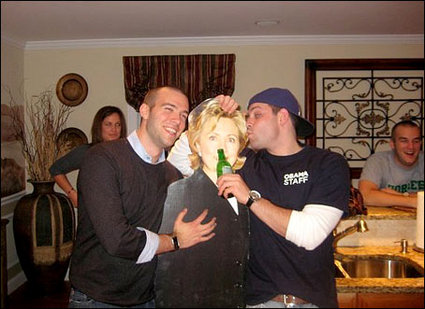
Jon Favreau, left, and unidentified friend with Sen. Hillary Clinton cutout. From the “44” Blog / Washington Post.

‘Asked about the photos, Favreau, who was recently appointed director of speechwriting for the White House, declined comment. A transition official said that Favreau had “reached out to Senator Clinton to offer an apology.”‘ (What woe…)

By Frank James / December 5, 2008

A colleague tipped me to a Washington Post posting from the “44” blog which reports on an incident which is like something from a “West Wing” episode.

As the WaPo’s Al Kamen writes, Jon Favreau, 27, who President-elect Obama has named his speechwriting chief, did something really dumb at a party:

… Some interesting photos of a recent party he attended — including one where he’s dancing with a life-sized cardboard cut-out of secretary of state-designate Sen. Hillary Rodham Clinton, and another where he’s placed his hand on the cardboard former first lady’s chest while a friend is offering her lips a beer — popped up on Facebook for about two hours. The photos were quickly taken down — along with every other photo Favreau had of himself on the popular social networking site, save for one profile headshot.

Asked about the photos, Favreau, who was recently appointed director of speechwriting for the White House, declined comment. A transition official said that Favreau had “reached out to Senator Clinton to offer an apology.”

Considering the photo, I don’t think I would have used the phrase “reached out to Sen. Clinton” in that statement.

Could you imagine being Favreau and having to apologize to the president-elect or Sen. Hillary Clinton for this? And you thought you were having a bad day.

Reminds me of that line President Bush used when he was running for the White House in 2000: “When I was young and foolish, I was young and foolish.”

Source / The Swamp / Chicago Tribune

Thanks to Harry Edwards / The Rag Blog

Posted in RagBlog | Tagged , , | 1 Comment

Academic Study : Hot Sounds, Cool Stock Market

Dan Burrows: ‘Sir Mix-a-Lot’s “Baby Got Back” beat variance is as smooth as, well, a baby’s bottom. Maybe that’s why there was mad volatility on the market’s dance floor.’

‘When the stock market endures periods of high volatility — such as the one we’re in right now — chart-topping songs tend to have low “beat variance,”’ according to research by New York Poly’s Phil Maymin.

By Dan Burrows / December 5, 2008

Investors have sought portents of the market’s future in everything from the length of ladies’ hemlines to which NFL conference wins the Super Bowl. Now — in the midst of the financial crisis — here’s a new theory on where to find omens: the Billboard music charts.

Phil Maymin, an assistant professor of finance and risk engineering at the Polytechnic Institute of New York University, has crunched 50 years worth of stock-market data — along with more than 5,000 hit songs. And he says he’s found an inverse correlation between stock-market volatility and whether the hot music of the moment is frenetic or steady.

What that means: When the stock market endures periods of high volatility — such as the one we’re in right now — chart-topping songs tend to have low “beat variance,” according to Maymin’s research. The opposite is also true, he says. Low-volatility markets correlate with music showing high beat variance. (Read the abstract of Maymin’s paper.)

It isn’t a question of whether the music is fast or slow, but instead how much the pace varies within a song. Some of the highest beat-variance marks in Maymin’s work came from crooners like Bobby Vinton and Barbra Streisand (think of how “The Way We Were” starts off slow and then speeds up). And while Billy Idol may have rocked the “Cradle of Love,” the beat he pounded out was steady — giving his hits a low beat-variance score.

Maymin says he doesn’t know whether the music is the chicken or the egg when it come to market volatility, only that a relationship exists. Maybe it’s just that people need to chill out when the market’s behaving like Spinal Tap on tour.

“What music do you listen to when you freak out?” Maymin asks. “Do you listen to crazy, volatile music? Or do you listen to Rick Astley’s ‘Never Gonna Give You Up’ to kind of calm yourself down?” (Memo to Ben Bernanke: Maybe you should try rickrolling the economy.)

It’s a bit counterintuitive at first. During periods when market volatility is relatively benign — such as in the early ’80s, ’90s and 2000s – music with higher average beat variance has been more popular. “That’s when people have more of an appetite for something like Alice Cooper,” Maymin says.

What’s more, Maymin says that it appears as if musical tastes can predict future market volatility. A strategy based on predicting market volatility from past beat variance appears profitable, on average. “The model predicts that realized volatility next year will be lower than it was this year,” he says. “So if I could sell implied volatility for one year in the high 40s, I would.”

So will reading Billboard magazine help you make a killing on the VIX, betting on market volatility through contracts on the Chicago Board Options Exchange? Finance blogger Paul Kedrosky called Maymin’s work “one of the stranger financial research papers I’ve seen in a long time.”

Maymin, whose resume includes advanced degrees from the University of Chicago and Harvard (along with a three-year stint with Long-Term Capital Management), says his trading model based on year-end Billboard charts and year-end average stock volatility has been very profitable. And — guess what? — its best year was 1987, our last great market crash.

Most investors, of course, shouldn’t play around with super-sophisticated trading strategies based on volatility implicit in the prices of near-term S&P 500 options and exhaustive regression analyses of beat variances of songs in the Billboard Top 100 since 1958 vs. the standard deviation of the stocks in the S&P over the same time frame. Still, it has given us an idea for Wall Street’s next hit band. Vixie Chicks, anyone?

Source / SmartMoney

See slideshow of Money to Buy, Sell or Hold By.

Thanks to Steve Russell / The Rag Blog

Posted in RagBlog | Tagged , , , | Leave a comment

Foodie Friday: Champandongo and Black-Eyed ‘Peans’

High time we resurrected the “Foodie Friday” tradition with the Rag Blog. I was doing this in the early days of the blog, but let it slip as political events overtook us. Now we bring it back in all its earlier glory and more (pictures!). If you have a recipe you would like to appear here, please use the e-mail link in the sidebar to submit it to us for consideration.

Richard Jehn / The Rag Blog

Champandongo. Photo: Madeleine Cocina.

Champandongo
By Richard Jehn / The Rag Blog / December 5, 2008

1 medium yellow onion, diced
2 teaspoons olive oil
1/2 pound ground pork
1/2 pound ground beef
3 tablespoons cumin
1 tablespoon sugar
1 large ripe tomato, finely chopped
3 tablespoons diced candied citron
3 tablespoons chopped almonds
3 tablespoons chopped walnuts

Sauté the onion in olive oil until just turning transparent, then add the meats, the cumin, sugar, and salt and pepper to taste. Brown meat until only one or two tablespoons of liquid remain in the pan, then add the chopped tomato, citron, and chopped nuts. Simmer slowly for about 10 minutes, then set aside to cool.

1/4 cup heavy cream
1/2 cup dark, earthy mole *
1/4 pound cotija cheese, crumbled (or use queso manchega for a very different flavour)
4 tortillas
Duck or chicken stock (only if required)

Preheat oven to 350° F. Pour the cream into a ceramic baking dish, then layer first 2 tortillas, then half the meat mixture, then half the mole and last half the cheese, repeating one more time in the same order until everything has been used. Finally, pour chicken stock into the dish to moisten everything well, but only if you need more liquid. Bake, covered, for about 30 minutes, then remove cover and bake for another 10 or 15 minutes until cheese is golden brown and dish is bubbling vigorously.

Serve with Black-Eyed Peans (see below).

* Note: my recipe for a dark, earthy mole:

2 dried ancho chiles, stemmed, seeded, and sliced in half
1 clove elephant garlic (or equivalent), finely diced
3 or 4 shallots, diced
3 Roma tomatoes
1/2 teaspoon oregano
1/4 teaspoon thyme
1/4 teaspoon marjoram
1/4 teaspoon cinnamon
1/4 teaspoon coriander
3/4 teaspoon cumin
1/4 teaspoon fresh ground pepper
3/4 to 1 cup of chicken or duck stock
1/3 cup of toasted and salted pumpkin seeds (pepita’s)
1 (1 ounce) block of semi-sweet chocolate, chopped
A dash or two of salt
Juice of 1 lime

In a small pot, sauté the finely diced shallots and garlic in a tablespoon of olive oil, while you are rehydrating the chiles in hot water and roasting the tomatoes in a very hot oven. Add all the spices to the frying shallots, then immediately add the now much softened and roasted tomatoes. Smash the tomatoes a bit with your wooden spoon to get some liquid in the pot. Add the duck (or chicken) stock to the stuff in the pot, then add the pumpkin seeds.

By now, the anchos are nicely rehydrated and should be chopped into small bits and added to the mixture, along with the soaking water. Simmer for 40 to 45 minutes, then stir in the chopped chocolate and keep stirring until it melts. [A word about the two recommended chocolates – Baker’s is truly semi-sweet and I prefer it for this recipe, while Ibarra is a Mexican sweet, sugary chocolate, and will still give a result, but too sweet and rather undesirably different, in my opinion.]

This should be a wonderful smelling, earthy, rich, deep reddish-brown sauce. Pour it into a blender, perhaps after it has cooled for a few minutes, adding the salt and lime juice, then pulse until it turns into a pasty liquid. Strain if desired.

Laura Esquivel’s Recipe for a Dark Mole

This recipe requires a glass of lime water with sage to cool the passions. Squeeze the juice of half a lime into a tall glass of (icy) cold spring water and stir in 1/4 teaspoon of minced fresh sage leaves.

Regarding the turkey stock, Tita fed the turkeys only corn and water, until 15 days before slaughter, when she added 1 walnut on T-minus 15 only for the “target” turkey, 2 walnuts on T-minus 14, 3 walnuts on T-minus 13, and so on. It is important that the targeted turkey continue eating corn and drinking plenty of water, also.

1/4 mulato chile
3 ancho chiles, seeds and stems removed, and lightly toasted in lard
3 pasilla chiles
A handful of almonds, lightly toasted
A handful of sesame seeds, lightly toasted
Turkey stock
A hard roll
Peanuts
1/2 onion, chopped
Wine
2 squares of chocolate
Anise
Cloves
Cinnamon
Pepper
Sugar
Seeds from the chiles
5 cloves garlic

Grind the toasted sesame seeds and almonds together, then add to the turkey stock, adding salt to taste. Grind the cloves, cinnamon, anise and pepper in a mortar, adding the roll last, which has been fried in lard with the onion and garlic. Combine the spices and hard roll with the wine, mixing thoroughly. The final step is adding the chocolate and a little sugar to taste, and baking in an earthenware dish until the mixture thickens.

So there, and this was a very difficult tiny project to write up, Tita’s Turkey Mole. Tita says, “the secret is to prepare the mole with a lot of love.” You figure out what to do with the listed ingredients that are not in the instructions…

If you don’t believe me, then read the book: Like Water for Chocolate, written by Laura Esquivel, copyright 1989 (and watch the movie, as well, to see if you can find any hints). “To the table or bed, you must come when you are bid.” The recipe for Tita’s turkey mole is in Chapter 4 – April.

Black-Eyed “Peans”

It’s a little difficult to decide whether these things are beans or peas, so I compromised. I suppose you could also call them “beas,” but it might create confusion.

1/2 cup dried black-eyed peas
Fresh-ground pepper to taste

Place peas and pepper in a small pot and cover with water plus one inch. Bring to a boil, then simmer for about 1-1/4 to 1-1/2 hours, until tender. Drain and place into a bowl, reserving cooking water.

1 to 2 tablespoons grapeseed oil
3 or 4 shallots, cleaned and minced
2/3 cup minced green bell pepper
1/3 cup minced red bell pepper
3 cloves garlic, minced
5 large button mushrooms, cleaned and diced
2 medium tomatoes, chopped
1 to 2 teaspoons crushed fresh-dried thyme
1/2 teaspoon fresh-ground pepper
1/2 teaspoon hot pepper sauce

In a large sauté pan, heat the oil on medium heat. Toss in the shallots, peppers and garlic and stir well. When things are going swimmingly, add the mushrooms, tomatoes and spicing. Stir again, to incorporate. Keep simmering and stirring for 20 minutes, then add cooked peas plus a little of the cooking water, mixing it all up and cooking for 5 more minutes to heat peans thoroughly.

The Rag Blog

Posted in RagBlog | Tagged | 4 Comments

Supremes Take Case Challenging President’s Right to Indefinite Detention of Suspects


Supreme Court to decide if the president can order the indefinite military detention of people living in the United States?
By Adam Liptak / December 5, 2008

WASHINGTON — The Supreme Court on Friday agreed to decide the most fundamental question yet concerning executive power in the age of terror: Can the president order the indefinite military detention of people living in the United States?

The case concerns Ali al-Marri, the only person on the American mainland being held as an enemy combatant, at the Navy brig in Charleston, S.C. Mr. Marri, a citizen of Qatar, was legally in the United States when he was arrested in December 2001 in Peoria, Ill., where he was living with his family and studying computer science at Bradley University.

Eighteen months later, when Mr. Marri was on the verge of a trial on credit card fraud and other charges, President Bush declared him an enemy combatant, moving him from the custody of the Justice Department to military detention. The government says Mr. Marri is a Qaeda sleeper agent sent to the United States to commit mass murder and disrupt the banking system.

The case, which will probably be argued in the spring, will present the Obama administration with several difficult strategic choices. It can continue to defend the Bush administration’s expansive interpretation of executive power, advance a more modest one or short-circuit the case by moving it to the criminal justice system.

In July, the United States Court of Appeals for the Fourth Circuit, in Richmond, Va., issued a fractured decision in the case. In one 5-to-4 ruling, the court ruled that the president has the legal authority to detain Mr. Marri.

But a second, overlapping 5-to-4 majority of the court ruled that he must be given an additional opportunity to challenge his detention in federal court. An earlier court proceeding, in which the government had presented only a sworn statement from a defense intelligence official, was inadequate, the second majority ruled.

The government had urged the Supreme Court to put off consideration of the case, al Marri v. Pucciarelli, until the trial-court do-over was completed.

Two other men have been held as enemy combatants on the American mainland since the Sept. 11 attacks. Rulings in their cases will inform the Supreme Court’s treatment of Mr. Marri.

In 2004, in Hamdi v. Rumsfeld, five Supreme Court justices said Congress had granted the president power to detain at least those enemy combatants captured on the battlefield in Afghanistan, even if they are American citizens, for the duration of hostilities there. But the detainee in that case, Yaser Hamdi, was freed and sent to Saudi Arabia not long after the court’s decision, which also allowed him to challenge his detention.

Based on the Hamdi decision, the Fourth Circuit in 2005 upheld the detention of Jose Padilla, an American arrested at a Chicago airport. Although Mr. Padilla was said to have ties to Al Qaeda, the Fourth Circuit decision largely turned on his own activities on the battlefield in Afghanistan. Just before the Supreme Court was to decide whether to hear his case for a second time, Mr. Padilla was transferred to the criminal justice system and convicted on charges related to terrorism last year.

In a recent brief, the government provided the justices with a sworn 2004 statement from Jeffrey N. Rapp, the defense intelligence official. The statement, declassified in 2006, said that Mr. Marri had met with Osama bin Laden and Khalid Shaykh Muhammed in the summer of 2001.

“Al-Marri offered to be an al Qaeda martyr or to do anything else that al Qaeda requested,” Mr. Rapp said. The Qaeda officials told Mr. Marri, the statement said, to leave for the United States and to make sure he got there before Sept. 11.

The government’s brief said the Congressional authorization must have intended to allow the detention of people like Mr. Marri and called a contrary interpretation absurd. Such a reading, the brief said, “relies on the assumption that when Congress authorized the use of military force to respond to the Sept. 11 attacks, it did not intend to reach individuals virtually identically situated to the September 11 hijackers.”

In a brief filed three weeks ago, lawyers for Mr. Marri, who has been held without charge in isolation for more than five years, said the court should not delay consideration of the case.

“Since the nation’s founding,” the brief said, “persons lawfully residing in this country have correctly understood that they can be imprisoned for suspected wrongdoing only if the government charges them with a crime and tries them before a jury.”

Source / The New York Times

The Rag Blog

Posted in RagBlog | Tagged , , | Leave a comment

Eschenbach: On Letting Go of Religion, Part II


The Case for Intolerance of Religion, Part II
By Sid Eschenbach / The Rag Blog / December 5, 2008

The Ecumenical Experiment

Our tolerance of religion simply prolongs the agony of an ethical system in crisis and conflict. “Ecumenicalism”, the noted Catholic theologian Dr. Hans Kung states, “is based in a critical attitude about one’s own religious tradition, but also a steadfastness of belief that one’s own religion is the true religion”. This concept is to theocratic survival what Mutually Assured Destruction was to national survival. Instead of attempting to resolve our differences and move forward together, it postulates the formalization of a permanent state of conflict, distrust and enmity which must be tolerated…. because open warfare is worse. Of course it is no surprise that religion doesn’t suggest or act on the obvious solution… redefine ethics in non-theocratic terms. This crisis of ethics, which grows ultimately out of the failure of religious intolerance and now the failure of religious tolerance, gives rise to conflicts like the situation in the Middle East. It is no coincidence that the Jewish Palestinian conflict is now seen in terms of the conflict without a solution… because, like ecumenicalism, it postulates the formalization of contradictory and mutually incompatible realities.

While quantum physics postulates much the same type of simultaneously occurring contradiction, in human affairs it doesn’t work so well, and any good 9th to 18th century leader knew this all too well. But in 1776 there was lots of free space in this new place called America, and coming from centuries of intolerant religious madness in Europe,… tolerance seemed like the only way to a create a peaceful society. From then to now, the world has shrunk, and the temporary convenience of condoning mutually unacceptable and contradictory dogma, even with the introduction of modern ecumenicalism, stretches tolerance and reason past the breaking point.

In their hearts, the Baptist /Moslem /Jew /Catholic/ Mormon /Hindi really believes the others are all pagans and that they alone are right. Period. Religious leaders of the 18th century turned to religious tolerance not because they wanted to… but as usual, because they had to. It is nothing less than what they clearly saw it as… a dilution of their power, and it was not given up easily. And if they in their hearts don’t accept nor tolerate others, why should they be tolerated? This reality is seen in world and national events daily.

By definition, no resolution to the conflict between the competing religions is intended to ever come from the practice of ecumenism. It attempts to treat the symptom of strife, not the disease of inherent contradiction…. and no amount of wax on the hood has ever made a motor run better. Not only is it a defeatist theory that religions had to accept in order to survive, in its earliest incarnation, before “modern” inter-faith ecumenism gained “politically correct” status, it was just the opposite! It was an effort to consolidate power between like groups and gain market share… not an effort to foster understanding and respect among conflictive, contradictory religious faiths. It was an effort by the Christian churches to overlook their small differences and join in a common front the better to face the religious competition.

Because the roots of ecumenicalism are planted in deeply cynical soil, the tree and the fruits of ecumenism are tainted… and it is for these reasons that we can no longer tolerate tolerance of religious belief. It is an attempt to construct a peace where embedded conflict remains, a guardian of the status quo until one side or another gains the upper hand and declares victory. While we espouse “tolerance” of one another’s beliefs, we continue to preach, teach and spread the divisive poison of us versus them… the Middle East being just the most topical example.

What’s New?

So now, today in 2008…what has changed? Why would I argue the seemingly preposterous… that we can no longer tolerate tolerance of religion? How can this possibly be a step forward? Why was tolerance a very good idea in 1776, but a very bad one today? What has changed now is quite simply…. everything. Everything we now understand that we didn’t understand before. Everything we know now that we didn’t know before. Everything we can do now that we couldn’t do before. Every answer we have now that we didn’t have before. Every question we can ask now that we couldn’t have asked before.

What has changed is simply this: for the first time in our 500,000 year human history, we no longer have to be believe…. for we now can either a) know, or b) know what we don’t know. To paraphrase Hawking: “We’re working on it”. If in fact the reason for the creation of the major religions was to provide answers and control for growing and unmanageable populations of newly agrarian societies, we can now state (and what the Vatican readily admits) that the first raison d’être is no longer viable. While we clearly don’t understand (and certainly will never understand) everything, we do understand enough about everything not have to believe religious creation cosmologies any longer, and this is undeniable.

Unfortunately, the reality of this fact has yet to be integrated into our ethical thinking. The second part of the religious imperative, the need to create ethical frameworks for large societies… takes us back to the splitting of the atom. And clones. And stem cell research. And euthanasia. Social and political leaders still make ethical decisions based upon antiquated religious belief systems. While they and their societies struggle to manage the options provided by the sciences which defeated them, they find, not surprisingly, that their belief systems are not up to the task… and that is simply because they were never designed to do so. The questions which face us today are as new as the knowledge which produced them, and therefore it makes as much sense to base the ethics of modern societies on 2,000 year old religious models as it would to ask David with his slingshot to throw his rock to the moon… and bring it back.

The question then becomes more straightforward: what takes religion’s place in the cosmologic and ethical realms? If one can argue that science has displaced the need for religious cosmologies, where is the replacement for the overarching ethical guidance which all societies need… a role historically provided by religions?

It’s a Relative World

From Aristotle to Newton, the concept of “science” was not unlike the concept of the Gods with whom they shared their time. Definitive, omnipresent and immutable powers, absolute and perfect. Albert Einstein turned Newtonian science on its head when he discovered that science, that definitive model, was relative. And then to really make it relative, along came newer theories. Quantum theory, and string theory, theories of small and large force theories… all of them are relative, and all of them are redefining our understanding of the universe and our place in it.

These scientific discoveries, while rocking again and again the boat of science to its gunnels, simply reflected what many social thinkers had intuitively understood for some time: nothing is truly independent, and that all things are defined not by themselves but by their relationships to one another. Music is not a series of notes, but the relationship between the notes. Politics is not the policies, but the relationships created between the peoples. Poetry is not the individual words, but the relationship between them. Love is not the feeling but the relationship between the lovers. Theft is not the movement of the object, but the relationship between the owners when the object is moved. Murder is not the death, but the reasons for it. All of life is context, and therefore any system of ethics cannot be defined as immobile and inflexible, but rather entirely dependent upon the context of the events and the relationships between the actors.

It is for this reason that any religions version of the Ten Commandments can no longer be used as a foundation for any ethical system. “Thou shalt not kill” sounds great… until one is confronted by a psychopath threatening one’s family. What to do? Is the war veteran a vile murderer or a hero? It’s not a question that religiously based ethics can define, because they come from a simpler age…an age before humanity was educationally prepared to deal with the more intellectually mature questions of ethical relativity. In order to successfully build and execute a system of ethical relativity, the levels of both general and specific knowledge within a society must be fairly high… levels not attained within any society on the planet until the 20th century.

Common Answers

While this fact of relativity is at once simple and profound, with one notable exception the various efforts to formulate a system of relative ethics have floundered… and that notable exception is the bulk of Western common law. Something so omnipresent that we take it completely for granted… yet it has only been around for some 400 of the 500,000 years we’ve been on the planet. We don’t recognize the inherent contradictions between our new “relative” ethics system and the old “dogmatic” ethics system until a case like stem cell research comes along. And then it’s all too painfully obvious. It’s the equivalent of calling Newton out of the past to adjudicate an argument among sub-atomic particle physicists. It simply can’t work, as Newton’s version of science makes no account of the relationships between the actors… but because we haven’t yet moved beyond religiously derived ethics, we have no other tools to bring to bear. (But not to be too hard on Newton. As perhaps the greatest mind of the millennia, were such a time travel event to happen, it wouldn’t take him long to get up to 21st century speed!)

The Founding Fathers of the American experiment are often cited for their wisdom, and indeed they were wise. However, from an 18th century pragmatists point of view, if you wanted to design a system of governance that would have even a remote chance of success, there were in fact very few options, and as is often the case, one fundamental decision dictates all those that follow. As I stated above, the warfare generated by centuries of religious intolerance lead to the experiment with religious tolerance, which demanded and then stipulated freedom of religion. Freedom of religion demands, in government, only one possible relationship between church and state… their formal separation (clearly one cannot codify an individuals right to freedom of religion if there is an official state religion). And that separation of the state from an underlying religiously defined code of ethics… which now seems so obvious, but had never in the history of mankind happened before… demanded the creation and the formalization of a secular system of ethics…. otherwise known as common law. The founding fathers fear of religious strife lead inexorably to the creation of the western worlds first codified, highly evolved, and widely accepted system of secular ethics.

Interestingly, not only does this new ethical system examine action, but more importantly it examines in great detail the context in which the action took place… and this is a huge step forwards from religiously based ethical systems. Questions not just of action, but of intent and context are commonly and dealt with… attempting through legal ethics to find answers to questions such as those posed by Dostoyevsky and others. For example, if I am brilliant and starving… and you are rich, fat and stupid, is it still theft if I steal the bread you don’t need anyway? The problem, of course, was that we didn’t have the knowledge necessary to design and build a flexible system of ethics… and we had to rely on simple dogmatic answers to what are often not simple ethical questions, answers which try and take into account all aspects of the relationships involved in the situation.

And so Today…

We find ourselves for the first time in all of human history able to solve through secular means the two problems which men invented the gods to solve… first, the problem of providing general cosmologic answers, and second, the problem of designing satisfactory social controls. Science and law have become our sources for the solutions to these two problems. While they are obviously incomplete models, perfect solutions cannot be made the enemy of partial but workable answers. While we continue to struggle with them as they and we evolve, they are clearly at a far higher level and are systems of knowledge far more satisfactory than the two thousand year old systems that they must replace.

In the final analysis, the following is clear: as the original reasons for the creation of religious dogma no longer exist, and as it is also clear that the ongoing practice of all of the various and highly competitive religious systems in a highly populated world is clearly causing more friction than peace… we have arrived at the point in human history that we must abandon the dogma of the past and embrace the systems which today provide us with answers that work.

There has never been a single war waged over whether two and two is four, or whether two atoms of hydrogen plus one of oxygen make water. These are trans-nation, trans-tribal and trans-cultural realities which join the human race rather than divide it. In fact, during the most recent and, due to the level of the weaponry involved, the most dangerous confrontation ever between human groups, scientists and jurists on both sides of the cold war continually found common ground, and without the presence of a religious conflict, actual warfare was finally and successfully avoided. To the degree that we tolerate divisive religious practices and let them take precedence over our newfound unifying social and empirical structures, we continue to use systems which are not only broken but actually dangerous to use.

And as I said at the beginning, this in not just an irrelevant or irreverent poke at the religious powers that be, for we continue to suffer at the hands of ignorance in very real ways, and it happens each and every day. In the U.S., attitudes towards AIDS, reproductive rights and birth control, fundamental medical research, taxation, sexual preferences and their associated legal rights, life and death themselves are just some of the areas where religiously guided ethics intervene and try to control. Internationally, the age old abuses and exploitation of the ignorant by religious groups and the rise of militant fundamentalism are by far the most important factors in this unending cycle of warfare we find ourselves stuck in.

We are consciously and unconsciously bound to ancient religious archetypes, and suffer directly from their use. Why else would many turn to a (probably) gay male who has never personally experienced any long-term intimate human bond in order to receive marriage counseling? Why else would we listen respectfully to a Billy Graham, and treat him with a deference wholly unearned as he mouths irrelevant platitudes? Why else would we accept the ethical legitimacy of a system of institutionalized slavery such as the caste system? How else can we continue to tolerate, in the name of religious tolerance, a religion which practices physical disfigurement of females as one of its fundamental practices? How else can we continue to express man’s dominion over nature as “god given”, and sacrifice all other forms of life before the needs of humankind? As a society we continue to express respect for and subservience to systems of social and ethical controls which in fact have absolutely no relevance to the huge body of our recently earned knowledge, and enjoy no standing in our courts. To continue to pretend that they do and respect them for it is to accept bigotry, to accept ignorance, to foster warfare, and to halt progress.

The case for intolerance of religion is clear, and to the degree we continue to equate tolerance of religion with maturity and religion with virtue, we hobble our newfound abilities to find real virtue where it may lay, and make real progress in real ways to generate real wellbeing for real people. At this dawn of the 21st century, we can simply no longer tolerate the tolerance of religion.

The Rag Blog

Posted in RagBlog | Tagged , , | Leave a comment

Gov’t. Outsourcing Has Been Nothing But Trouble

Here is another legacy of the Bush administration: a government gutted by corporate crony outsourcing. The two articles here tell the story of that legacy: corruption, lies, inefficiencies, and incessant problems, whether health, compensation, or otherwise. It will take decades to repair the damage this corrupt administration has caused.

Richard Jehn / The Rag Blog


Warehoused Asian workers in Iraq will be sent home
By Adam Ashton / December 4, 2008

BAGHDAD — Asian men who’ve been living in warehouses near the Baghdad airport while awaiting promised jobs with a military subcontractor now are in line to be sent home, and they’re still not sure how they’ll be paid for their time in Iraq.

Tensions simmered throughout the week at a compound where about 1,000 men from Bangladesh, India, Nepal and Sri Lanka spoke out against their treatment by Najlaa International Catering Services, the Kuwaiti company that hired them for work in Iraq.

Jobs didn’t materialize for the men, who’ve spent one to three months living in three pale blue warehouses packed with bunk beds along an airport side road.

Najlaa officials broke up a protest outside the warehouses Tuesday by pledging to pay the men. Marwan Rizk, the company’s chief executive, told McClatchy that it would repatriate the workers and give them salaries for their time in the country.

Manoj Kodithuwakku, 28, a Sri Lankan living in one of the warehouses, said he and others were still waiting to be paid.

“It’s very difficult for us to believe them after everything,” he said.

Most of the men don’t want to return to their countries yet. Most of them paid middlemen about $2,000 to link them up with work and get them to Iraq. Many, including Kodithuwakku, will owe on loans they took out to pay those fees.

Kodithuwakku said that the wages he’d earn at a Sri Lankan hotel, his job before he came to Iraq, wouldn’t help him pay down that debt.

“It will be only sufficient for survival,” he said.

Those fears contributed to a hectic scene Wednesday, when the men in the warehouses reportedly staged another raucous protest. At one point, Iraqi police fired over their heads to end the revolt, Kodithuwakku said.

About 400 were taken on buses to the airport Wednesday to board planes for Dubai, a hub for flights in and out of Iraq. Flights weren’t available, however, and the men were returned to the warehouses.

Kodithuwakku said that about 160 were asked to get on buses again Thursday night, but they were holding out for stronger guarantees that Najlaa would pay them.

Najlaa is a subcontractor to KBR, a former Halliburton subsidiary that provides a range of services for the U.S. military in Iraq.

Rizk told McClatchy this week that the company had encountered unspecified obstacles to its contracts in Iraq that delayed the jobs it anticipated giving the men. He said Najlaa took care of the men’s basic health and safety needs, though the workers have complained about poor food and inadequate restrooms.

Spokesmen for the Multi-National Forces-Iraq have declined several requests for comment about the warehouses this week.

Source / McClatchy

Also see Iraq : KBR Subsidiary Confines Asian Workers in Warehouse by Adam Ashton / The Rag Blog / Dec. 2, 2008

Then there’s this fiasco:

US troops launch Iraq toxins case
By Rajini Vaidyanathan / December 4, 2008

Sixteen American soldiers who served in Iraq are suing the defence contractor KBR, accusing it of knowingly exposing them to a cancer-causing chemical.

The soldiers say they were exposed to the chemical while working at a water pumping plant in southern Iraq.

Their lawsuit, filed in a US District Court, claims that KBR managers knew the site was contaminated but “downplayed and disregarded” the risk.

KBR denies the accusation and has vowed to fight the lawsuit.

‘Nasal tumours’

The claims go back to 2003, when the soldiers, from the Indiana National Guard, were protecting the Qarmat Ali water pumping plant in Southern Iraq.

Map of Iraq showing Qarmat Ali. Source: BBC news.

The 23-page lawsuit argues that KBR managers knew as early as May of that year that the site was contaminated with sodium dichromate, which contains the highly dangerous chemical hexavalent chromium, said to cause cancer.

The soldiers say that they and other civilian contractors there were repeatedly told there was no danger, and that when they reported health problems such as nose-bleeds to their bosses, they were told they were simply “allergic to the sand”.

The court papers claim that these symptoms were the early side-effects of the chemical, and that some who served on the site went on to suffer severe breathing problems and nasal tumours.

In a statement issued to the BBC, KBR said it intended to vigorously defend itself.

It denied it harmed troops, saying that managers notified army engineers about the substance on site, and were told that their efforts to remedy the situation were effective.

Source / BBC News

The Rag Blog

Posted in RagBlog | Tagged , , | 1 Comment

Texas : Mental Health Care a Disgrace

Farhat Chishty, right, spends time with her mentally retarded son Haseeb Chishty at Denton State School in Denton, Texas, Jan. 16, 2008. In 2002 Haseeb nearly died after a beating by a care worker and is now confined to a wheelchair and unable to feed himself or use the bathroom. Photo by Donna McWilliam / AP.

Texas has more mentally disabled patients in institutions than any other state, and the federal government has concluded that the state’s care system is stubbornly out of step with modern mental health practices.

December 3, 2008

DENTON, Texas – For more than a century, thousands of mentally disabled Americans were isolated from society, sometimes for life, by being confined to huge public hospitals.

In at least one place, they still are.

Texas has more mentally disabled patients in institutions than any other state, and the federal government has concluded that the state’s care system is stubbornly out of step with modern mental health practices.

Critics allege that Texas remains stuck in an era when the mentally disabled were hidden away in large, impersonal facilities far from relatives and communities.

“In Texas, it’s like a time warp,” said Jeff Garrison-Tate, an advocate who wants to close the 13 hospitals called “state schools” and move patients into group homes.

For the third time in three years, the criticism has attracted the attention of the Justice Department, which on Tuesday accused Texas of violating residents’ constitutional rights to proper care.

Investigators found that dozens of patients died in the last year from preventable conditions, and officials declared that the number of injuries was “disturbingly high.”

In addition, hundreds of documents reviewed by The Associated Press show that some patients have been neglected, beaten, sexually abused or even killed by caretakers. Inspection reports also describe filthy rooms and unsanitary kitchens.


‘Institution capital of America’

Many of the nation’s mental hospitals were first built in the 1800s, when they were often called insane asylums. But by the 1960s, most experts concluded that patients fared better in smaller, community-based settings.

The American Association on Intellectual and Developmental Disabilities says large care facilities — usually those with at least 16 residents — “enforce an unnatural, isolated, and regimented lifestyle that is not appropriate or necessary.”

Because of those concerns, eight states have abolished large institutions for the mentally disabled. Another 13 states closed most of their largest facilities, leaving just one open in each state.

But Texas has remained “the institution capital of America,” said Charlie Lakin, director of the Research and Training Center on Community Living at the University of Minnesota.

The 13 facilities in Texas house nearly 5,000 residents — more than six times the national average.

On a per-capita basis, Texas has 20.4 people per 100,000 in large institutions, Lakin said. The national average is 12.2 people.

Other states with large populations such as New York and California — which have rates of 11.2 and 7.5 people, respectively — rely far less on large institutions.

‘Warehousing’ patients

Federal law requires the mentally disabled to be treated in “the most integrated setting” possible — a factor that led to the Justice Department rebuke of Texas.

Laura Albrecht, a spokeswoman for the Texas Department of Aging and Disability Services, said the agency is expanding community-based services. Texas officials say keeping the facilities open is a matter of preserving as many treatment options as possible.

But critics allege that “warehousing” patients in large institutions invites abuse. Patients are isolated from their families and communities, making regular contact with loved ones more difficult. And caretakers often get overwhelmed by the large numbers of patients, Garrison-Tate said.

In Texas, officials verified 465 incidents of abuse or neglect against mentally disabled people in state care in fiscal year 2007. Over a three-month period this summer, the state opened at least 500 new cases with similar allegations, according to federal investigators.

An AP investigation earlier this year revealed that more than 800 state employees have been fired or suspended since the summer of 2003 because they abused, neglected or exploited mentally disabled residents.

And in the one-year period ending in September, as many as 53 deaths in the facilities were due to potentially avoidable conditions such as pneumonia, bowel obstructions or sepsis, the Justice Department said. Some families tell horror stories of their loved ones in the state facilities. For instance, Michelle Dooley said her son spent three months in the Austin State School, which she described as a place of “dingy yellow floors and patients running around without any clothes on.”

During his time there, he refused to leave his bed and often languished in his own excrement, she said.

Dooley eventually moved her son into a group home in Denton where treatment costs average about $50,000 per year — roughly half as much as the costs at state schools, Garrison-Tate said. Medicaid often picks up most of those costs.

“It was just horrible,” Dooley said. “If he goes back to a state facility, he will shut down and die.”

At the San Angelo State School, inspection reports from 2007 took note of scuffed walls pocked with holes, rotting food, dirty kitchens, broken furniture and missing shower curtains.

More seriously, two employees were fired after throwing a resident into a pool while he was wearing a restraint jacket. The employees had made a bet with the resident that he would be unable to dunk another resident under water. When he lost the bet, the employees restrained him and threw him in the water, according to the reports.

Other families say they are happy with the state care.

Neil Davidson said his daughter Susan, who has cerebral palsy and is mentally retarded, has flourished during her 10 years at the Lubbock State School.

“I’m very impressed with the level of care she has received,” Davidson said. “As far as I am concerned, it’s Mr. Rogers’ neighborhood. Everybody is looking out for everybody else.”

‘Happy, homelike atmosphere’

A visit to the Denton State School, the largest in Texas, reveals a sprawling campus spread across well-kept lawns. Superintendent Randy Spence described the place as a “happy, homelike atmosphere.”

“The vast majority of our employees love the people they work with,” said Cecilia Fedorov, another spokeswoman for the Department of Aging and Disability Services. “They think of them as extended family.”

But Denton is also the site of Texas’ most notorious case of state school abuse.

In 2002, a care worker repeatedly kicked and punched a resident in the stomach and groin. Haseeb Chishty nearly died after that beating. He is now confined to a wheelchair and unable to feed himself or use the bathroom.

“It got to the point where it was fun beating him, torturing him,” said former care worker Kevin Miller, who is now serving 15 years for aggravated assault.

In a statement videotaped by Chishty’s lawyer, Miller said he and many of his fellow care workers used methamphetamines, cocaine and Oxycontin on the job.

Chishty’s mother filed a lawsuit against the facility, but it went nowhere. In Texas, government entities are all but immune from lawsuits.

Trouble in closing schools

Some critics want to close the state schools. But because the Texas Legislature created each one, only lawmakers can close them.

Many of the institutions are large employers in small towns, and they often pay more than other jobs in rural areas. Lawmakers fear taking action that would lead to layoffs, Garrison-Tate said.

“Even if we said we wanted to close all state schools, the community resources aren’t there at this time,” said state Rep. Larry Phillips, chairman of a legislative committee studying the facilities.

Kelly Reddell, the lawyer whose client’s son was beaten nearly to death, said the state is not doing right by its mentally disabled.

“The very nature of the institutional setting, I think, creates the environment for the abuse to take place,” she said. “How in the world can you think this system is the best and it makes sense?”

© 2008 The Associated Press.

Source / AP / MSNBC

Thanks to Wayne Johnson / The Rag Blog

Posted in RagBlog | Tagged , , , | 3 Comments

Producer Marc Shaiman on Prop 8 – the Musical (With Video!)

The musical itself is the brainchild of Marc Shaiman, the composer of the film and stage musical “Hairspray,” as well as some of the filthier songs in “South Park: Bigger, Longer & Uncut.”

By Dave Itzkoff / December 4, 2008

In just one day of online existence, the Funny Or Die video “Prop 8­ — The Musical” has received more than 1.2 million hits. The comedic song-and-dance diatribe about the California ballot initiative to define marriage as existing only between a man and a woman stars a cast of dozens, including John C. Reilly, Neil Patrick Harris, Maya Rudolph, and Jack Black as Jesus Christ.

Assembled in a week, it’s also the result of a process that began when Mr. Shaiman, who splits his time between New York and Los Angeles, alerted his friends and colleagues that Scott Eckern, the musical director of Sacramento’s California Musical Theater, had donated money to a Yes-on-Prop 8 campaign. The proposition has already passed, and Mr. Eckern has since resigned, so what has Mr. Shaiman gained from this video? He discusses the creation of “Prop 8­–The Musical” in a Q&A below.

How did your mass e-mail message about Scott Eckern and the California Musical Theater end up spawning this video?

I sent an e-mail to a lot of people, anyone who’s in my phone book, and said, “Can you believe this guy?” I’d rather almost not talk about him and that situation anymore, because he’s certainly gone through enough. But that e-mail, one of the people it went to was Adam McKay [a co-founder of FunnyOrDie.com]. He wrote me back, basically, just saying, “Why don’t you write a song about it for Funny Or Die?” Which was like, the slapping-my-head moment. Oh yeah, why didn’t I think of that? Or why didn’t I do that in the first place?

It took a few weeks to calm down enough to be able to find the humor in it all. So once he planted that seed in my head, I basically went the next day to the piano and started to write – a week later we were filming it.

Is this the first time you’ve created a viral video for the Internet?

I’m so old, I can’t remember. To this extent, certainly. I have done things that have ended up on the Internet. Luckily, nothing sexual. Yet. But the night is still young.

How do you feel, given that it took the passage of Proposition 8 to motivate you to create a video opposing it?

In my credit, it says, “Written (six weeks too late) by Marc Shaiman.” I mean, yeah, it’s totally bittersweet. Barack Obama’s ascension just had us all so giddy. We were thinking of how to film it, and I said, “Well, maybe that first section should be all of us on a hill, with poppies, and it snows and we’re put to sleep, and then the Proposition 8 people are looking through the crystal ball, like the Wicked Witch of the West in ‘The Wizard of Oz.’” Because that’s what happened. We stupidly allowed ourselves to be lulled into a sense of, everything’s fantastic now, look – everything’s changing. And this couldn’t possibly be voted into law. This is just like some little pesky thing that we’re swatting at, and it will go away immediately.

How did you react to the news that Mr. Eckern had resigned from the theater?

There’s certainly nothing joyous about being partially responsible for a man resigning from his job. I mean, I did not ask for his resignation, nor would it be my place to ask for someone’s resignation. He resigned, though, and I was part of that, and that is a very heavy weight, and I don’t take it lightly. But it has certainly opened up our eyes, and made me get off the couch and out on the street with a picket sign, for the first time in my life. And it felt fantastic.

So this experience has made you more of an activist?

Yeah, I was marching in New York, and that was just the greatest experience. And of course this video is just a viral picket sign. And hopefully funny. I hope that doesn’t get lost. I hope that’s what most people get out of it.

Source / Arts Beat / The New York Times

The Rag Blog

Posted in RagBlog | Tagged , , , , , , , | Leave a comment