One Reason John McCain Will Win in November

This is James Carabelli if you feel like
having a chat with him about this issue.

Project Vote Denounces GOP Plans to Foreclose on the Voting Rights of Low-Income Michigan Residents
September 11, 2008

WASHINGTON — The Michigan GOP has announced plans to use a list of housing foreclosures as the basis for a broad voter-caging operation, as reported yesterday by Eartha Jane Melzer in The Michigan Messenger. James Carabelli, chairman of the Republican Party in Macomb County, Michigan, has announced plans to assign “election challengers” to polling places to question the eligibility of home foreclosure victims based on residency. “We will have a list of foreclosed homes and will make sure people aren’t voting from those addresses,” Carabelli told the Messenger.

Today Teresa James, attorney for the voting rights organization Project Vote, and author of the 2007 report Caging Democracy: A 50-Year History of Partisan Challenges to Minority Voters, issued the following statement in response: The Macomb County GOP’s plan is a cynical partisan attempt to suppress the vote of thousands of low-income and African-American voters, a replay of the 2004 threats of mass challenges. Just because you’re behind on your mortgage doesn’t mean you lose the right to vote. All a foreclosure filing tells anyone is that the owners are behind on their mortgage; it does not mean a voter has necessarily moved. Foreclosures take time. And even if the plan is to only challenge voters whose homes have actually been sold at auction, the challengers will still achieve nothing but to slow-down voting and create an intimidating atmosphere at strategically chosen polls.

Michigan law says that challenges may be made at the polls if the challenger “knows or has good reason to suspect” a voter is ineligible. The Michigan Secretary of State has clarified this to require that challenges should be based on “reliable sources or means.” Republican challengers with only a list of foreclosure notices will have NO evidence or reliable source to suggest that eligible voters have moved and are no longer eligible to vote.

This is just the latest — and most transparent — in a long history of racially and politically motivated GOP attacks against Michigan voters, designed to suppress votes by disenfranchising individual voters and creating confusion and delays at the polls. In 1999, right-wing volunteers in Hamtramck, Michigan systematically challenged the citizenship of voters with dark skin and Arabic-sounding names. In 2004 and 2006, Republicans reportedly recruited thousands of paid challengers to disrupt predominantly African-American precincts. “If we do not suppress the Detroit vote,” a GOP state representative was quoted as saying in 2004, “we’re going to have a tough time in this election cycle.” As the Messenger reports, Macomb County is in the top three-percent of counties in the U.S. hit hardest by the foreclosure crisis — and African-Americans, as the primary victims of sub-prime lending practices, make up the majority of these cases. African-Americans also tend to vote democratic, which is why it’s not surprising that the GOP would target these voters for suppression.

Regardless of politics, no one faced with the possibility of losing their home should also have to lose their vote. Project Vote is writing to ask Michigan Secretary of State, Republican Terri Lynn Land, to instruct election officials that someone’s presence on a list of foreclosure notices is not a legitimate basis for challenging that individual’s right to vote. Project Vote will also send letters to both major parties, reviewing the acceptable criteria for voter challenges under Michigan law, and if necessary will file lawsuits on behalf of disenfranchised voters.

In America you get to vote even if you’re behind on your bills. All Americans — particularly those members of the community hit hardest by the economic crisis — deserve a voice and a vote on Election Day.

Source / CNBC

Thanks to Diane Stirling-Stevens / The Rag Blog

Posted in RagBlog | Tagged , | 2 Comments

BushCo and Sarah Palin : Polar Bears, Schmolar Bears….


‘The Bush Administration had not wanted to designate the polar bear as threatened in the first place; now Palin’s lawsuit provided cover to backtrack on the decision’
By Mark Hertsgaard / September 10, 2008

It wasn’t much noticed at the time, but three weeks before she was chosen as John McCain’s vice presidential running mate, Alaska Governor Sarah Palin played a key supporting role in the latest episode of the Bush Administration’s eight-year war on the Endangered Species Act, one of the cornerstones of American environmental law. On August 4 Alaska sued the government for listing the polar bear as a “threatened” species, an action, the lawsuit asserted, that would harm “oil and gas…development” in the state. In an accompanying statement, Palin complained that the listing “was not based on the best scientific and commercial data available” and should be rescinded.

The Interior Department had issued the listing only after environmental groups filed two lawsuits, and the courts ordered compliance. While the polar bear population was currently stable, the plaintiffs argued, greenhouse gas emissions were melting the Arctic ice that polar bears rely on to hunt seals, their main food source. A study by the US Geological Survey supported this argument, concluding that two-thirds of all polar bears could be gone by 2050 if Arctic ice continues to melt as scientists project. The listing was the first time global warming had been cited as the sole premise in an Endangered Species Act case, and Interior Secretary Dirk Kempthorne clearly wanted it to be the last. When Kempthorne announced the polar bear listing on May 14, he emphasized that it would not affect federal policy on global warming or block development of “our natural resources in the Arctic.”

A week after Palin’s lawsuit, Kempthorne delivered on that pledge. On August 11 he proposed new rules that could allow federal agencies to decide for themselves whether their actions will imperil a threatened or endangered species. The rule reverses precedent: since passage of the Endangered Species Act in 1973, scientists from the Fish and Wildlife Service have made such determinations independent of the agency involved. Under the new rule, if the Army Corps of Engineers is building a dam, the corps can decide whether it is putting species at risk. To make sure no one missed the point, Kempthorne told reporters that the new rule, which he termed “a narrow regulatory change,” would keep the Endangered Species Act from becoming “a back door” to making climate change policy.

Hated by the right wing as an infringement on property rights, the Endangered Species Act has been on Bush’s hit list since the beginning of his presidency, when he chose Gale Norton as his first Interior Secretary. A Republican woman of the West like Palin, Norton assailed the act and did all she could to undermine it. “The Bush Administration has listed only sixty species as threatened or endangered, compared with 522 under Clinton and 231 under the first President Bush,” says Noah Greenwald, science director of the Center for Biological Diversity, the lead plaintiff in the polar bear case. “And it took a court order to make each of those sixty listings happen.”

Kempthorne’s proposal nevertheless seems likely to go forward. An obligatory thirty-day period for public comment expires September 15, after which Interior can begin to implement the rule. Congress could block funding, but few expect that to happen. Lawsuits are certain to follow, but critics say the quickest solution would be for the next administration to withdraw the rule. Barack Obama seems likely to do that; he immediately condemned Kempthorne’s proposal. John McCain was silent. But his choice of Palin–who does not believe global warming is caused by humans but does think it’s acceptable for humans to gun down wolves from airplanes–suggests that Arctic creatures have much to fear from a McCain administration.

And not just Arctic creatures. What’s missing from most discussions about endangered species is that preserving other species is not an act of charity; it is essential to our own survival. “Endangered species issues are usually seen as humans versus nature–we act in favor of one or the other–and that’s just not the case,” says Aaron Bernstein, a fellow at the Center for Health and the Global Environment at Harvard and an editor (with Eric Chivian) of Sustaining Life: How Human Health Depends on Biodiversity. “Polar bears hold tremendous value to medicine, for example,” explains Bernstein. “There is something about the metabolism of female polar bears that allows them to put on tremendous amounts of fat before winter but not become Type 2 diabetic. We don’t understand how they do it yet, but this research is hugely important for the tens of millions of people who suffer from Type 2 diabetes.”

But human dependence on other species is even broader. “We need [ants] to survive, but they don’t need us at all,” notes naturalist E.O. Wilson in a quote Bernstein and Chivian include in Sustaining Life. Without ants (and countless other underground species that will never be the subject of impassioned environmental appeals) to ventilate the soil, the earth would rot, halting food production. Without trees and other elements of a healthy forest, water supplies would shrink. Take away coral reefs and you destroy the bottom of the marine food chain. Global warming is on track to make as much as one-quarter of all plant and animal species on earth extinct by 2040, threatening general ecosystem collapse. To study the natural world is to realize, in the words of the environmental axiom, that everything is connected. What we do to the polar bears, we do to ourselves.

[Mark Hertsgaard is The Nation’s environment correspondent. He is a fellow of The Nation Institute and the author of five books that have been translated into sixteen languages, including Earth Odyssey: Around the World in Search of Our Environmental Future. His next book is Living Through the Storm: Our Future Under Global Warming. more…]

Source / The Nation

Thanks to Carl Davidson / The Rag Blog

Posted in RagBlog | Tagged , , , , , , , , | 1 Comment

Noam Chomsky : Even the Cynical Shake Their Heads in Disbelief


Ossetia-Russia-Georgia
By Noam Chomsky / September 11, 2008

Aghast at the atrocities committed by US forces invading the Philippines, and the rhetorical flights about liberation and noble intent that routinely accompany crimes of state, Mark Twain threw up his hands at his inability to wield his formidable weapon of satire. The immediate object of his frustration was the renowned General Funston. “No satire of Funston could reach perfection,” Twain lamented, “because Funston occupies that summit himself… [he is] satire incarnated.”

It is a thought that often comes to mind, again in August 2008 during the Russia-Georgia-Ossetia war. George Bush, Condoleezza Rica and other dignitaries solemnly invoked the sanctity of the United Nations, warning that Russia could be excluded from international institutions “by taking actions in Georgia that are inconsistent with” their principles. The sovereignty and territorial integrity of all nations must be rigorously honored, they intoned – “all nations,” that is, apart from those that the US chooses to attack: Iraq, Serbia, perhaps Iran, and a list of others too long and familiar to mention.

The junior partner joined in as well. British foreign secretary David Miliband accused Russia of engaging in “19th century forms of diplomacy” by invading a sovereign state, something Britain would never contemplate today. That “is simply not the way that international relations can be run in the 21st century,” he added, echoing the decider-in-chief, who said that invasion of “a sovereign neighboring state…is unacceptable in the 21st century.” Mexico and Canada therefore need not fear further invasions and annexation of much of their territory, because the US now only invades states that are not on its borders, though no such constraint holds for its clients, as Lebanon learned once again in 2006.

“The moral of this story is even more enlightening,” Serge Halimi wrote in Le Monde diplomatique, “ when, to defend his country’s borders, the charming pro-American Saakashvili repatriates some of the 2,000 soldiers he had sent to invade Iraq,” one of the largest contingents apart from the two warrior states.

Prominent analysts joined the chorus. Fareed Zakaria applauded Bush’s observation that Russia’s behavior is unacceptable today, unlike the 19th century, “when the Russian intervention would have been standard operating procedure for a great power.” We therefore must devise a strategy for bringing Russia “in line with the civilized world,” where intervention is unthinkable.

There were, to be sure, some who shared Mark Twain’s despair. One distinguished example is Chris Patten, former EU commissioner for external relations, chairman of the British Conservative Party, chancellor of Oxford University and a member of the House of Lords. He wrote that the Western reaction “is enough to make even the cynical shake their heads in disbelief” – referring to Europe’s failure to respond vigorously to the effrontery of Russian leaders, who, “like 19th-century tsars, want a sphere of influence around their borders.”

Patten rightly distinguishes Russia from the global superpower, which long ago passed the point where it demanded a sphere of influence around its borders, and demands a sphere of influence over the entire world. It also acts vigorously to enforce that demand, in accord with the Clinton doctrine that Washington has the right to use military force to defend vital interests such as “ensuring uninhibited access to key markets, energy supplies and strategic resources” – and in the real world, far more.

Clinton was breaking no new ground, of course. His doctrine derives from standard principles formulated by high-level planners during World War II, which offered the prospect of global dominance. In the postwar world, they determined, the US should aim “to hold unquestioned power” while ensuring the “limitation of any exercise of sovereignty” by states that might interfere with its global designs. To secure these ends, “the foremost requirement [is] the rapid fulfillment of a program of complete rearmament,” a core element of “an integrated policy to achieve military and economic supremacy for the United States.” The plans laid during the war were implemented in various ways in the years that followed.

The goals are deeply rooted in stable institutional structures. Hence they persist through changes in occupancy of the White House, and are untroubled by the opportunity for “peace dividends,” the disappearance of the major rival from the world scene, or other marginal irrelevancies. Devising new challenges is never beyond the reach of doctrinal managers, as when Ronald Reagan strapped on his cowboy boots and declared a national emergency because the Nicaraguan army was only two days from Harlingen Texas, and might lead the hordes who are about to “sweep over the United States and take what we have,” as Lyndon Johnson lamented when he called for holding the line in Vietnam. Most ominously, those holding the reins may actually believe their own words.

Returning to the efforts to elevate Russia to the civilized world, the seven charter members of the Group of Eight industrialized countries issued a statement “condemning the action of our fellow G8 member,” Russia, which has yet to comprehend the Anglo-American commitment to non-intervention. The European Union held a rare emergency meeting to condemn Russia’s crime, its first meeting since the invasion of Iraq, which elicited no condemnation.

Russia called for an emergency session of the Security Council, but no consensus was reached because, according to Council diplomats, the US, Britain, and some others rejected a phrase that called on both sides “to renounce the use of force.”

The typical reactions recall Orwell’s observations on the “indifference to reality” of the “nationalist,” who “not only does not disapprove of atrocities committed by his own side, but … has a remarkable capacity for not even hearing about them.”

The basic facts are not seriously in dispute. South Ossetia, along with the much more significant region of Abkhazia, were assigned by Stalin to his native Georgia. Western leaders sternly admonish that Stalin’s directives must be respected, despite the strong opposition of Ossetians and Abkhazians. The provinces enjoyed relative autonomy until the collapse of the USSR. In 1990, Georgia’s ultranationalist president Zviad Gamsakhurdia abolished autonomous regions and invaded South Ossetia. The bitter war that followed left 1000 dead and tens of thousands of refugees, with the capital city of Tskhinvali “battered and depopulated” (New York Times).

A small Russian force then supervised an uneasy truce, broken decisively on 7 August 2008 when Georgian president Saakashvili’s ordered his forces to invade. According to “an extensive set of witnesses,” the Times reports, Georgia’s military at once “began pounding civilian sections of the city of Tskhinvali, as well as a Russian peacekeeping base there, with heavy barrages of rocket and artillery fire.” The predictable Russian response drove Georgian forces out of South Ossetia, and Russia went on to conquer parts of Georgia, then partially withdrawing to the vicinity of South Ossetia. There were many casualties and atrocities. As is normal, the innocent suffered severely.

Russia reported at first that ten Russian peacekeepers were killed by Georgian shelling. The West took little notice. That too is normal. There was, for example, no reaction when Aviation Week reported that 200 Russians were killed in an Israeli air raid in Lebanon in 1982 during a US-backed invasion that left some 15-20,000 dead, with no credible pretext beyond strengthening Israeli control over the occupied West Bank.

Among Ossetians who fled north, the “prevailing view,” according to the London Financial Times, “is that Georgia’s pro-western leader, Mikheil Saakashvili, tried to wipe out their breakaway enclave.” Ossetian militias, under Russian eyes, then brutally drove out Georgians, in areas beyond Ossetia as well. “Georgia said its attack had been necessary to stop a Russian attack that already had been under way,” the New York Times reports, but weeks later “there has been no independent evidence, beyond Georgia’s insistence that its version is true, that Russian forces were attacking before the Georgian barrages.”

In Russia, the Wall Street Journal reports, “legislators, officials and local analysts have embraced the theory that the Bush administration encouraged Georgia, its ally, to start the war in order to precipitate an international crisis that would play up the national-security experience of Sen. John McCain, the Republican presidential candidate.” In contrast, French author Bernard-Henri Levy, writing in the New Republic, proclaims that “no one can ignore the fact that President Saakashvili only decided to act when he no longer had a choice, and war had already come. In spite of this accumulation of facts that should have been blindingly obvious to all scrupulous, good-faith observers, many in the media rushed as one man toward the thesis of the Georgians as instigators, as irresponsible provocateurs of the war.”

The Russian propaganda system made the mistake of presenting evidence, which was easily refuted. Its Western counterparts, more wisely, keep to authoritative pronouncements, like Levy’s denunciation of the major Western media for ignoring what is “blindingly obvious to all scrupulous, good-faith observers” for whom loyalty to the state suffices to establish The Truth – which, perhaps, is even true, serious analysts might conclude.

The Russians are losing the “propaganda war,” BBC reported, as Washington and its allies have succeeded in “presenting the Russian actions as aggression and playing down the Georgian attack into South Ossetia on 7 August, which triggered the Russian operation,” though “the evidence from South Ossetia about that attack indicates that it was extensive and damaging.” Russia has “not yet learned how to play the media game,” the BBC observes. That is natural. Propaganda has typically become more sophisticated as countries become more free and the state loses the ability to control the population by force.

The Russian failure to provide credible evidence was partially overcome by the Financial Times, which discovered that the Pentagon had provided combat training to Georgian special forces commandos shortly before the Georgian attack on August 7, revelations that “could add fuel to accusations by Vladimir Putin, Russian prime minister, last month that the US had `orchestrated’ the war in the Georgian enclave.” The training was in part carried out by former US special forces recruited by private military contractors, including MPRI, which, as the journal notes, “was hired by the Pentagon in 1995 to train the Croatian military prior to their invasion of the ethnically-Serbian Krajina region, which led to the displacement of 200,000 refugees and was one of the worst incidents of ethnic cleansing in the Balkan wars.” The US-backed Krajina expulsion (generally estimated at 250,000, with many killed) was possibly the worst case of ethnic cleansing in Europe since World War II. Its fate in approved history is rather like that of photographs of Trotsky in Stalinist Russia, for simple and sufficient reasons: it does not accord with the required image of US nobility confronting Serbian evil.

The toll of the August 2008 Caucasus war is subject to varying estimates. A month afterwards, the Financial Times cited Russian reports that “at least 133 civilians died in the attack, as well as 59 of its own peacekeepers,” while in the ensuing Russian mass invasion and aerial bombardment of Georgia, according to the FT, 215 Georgians died, including 146 soldiers and 69 civilians. Further revelations are likely to follow.

In the background lie two crucial issues. One is control over pipelines to Azerbaijan and Central Asia. Georgia was chosen as a corridor by Clinton to bypass Russia and Iran, and was also heavily militarized for the purpose. Hence Georgia is “a very major and strategic asset to us,” Zbigniew Brzezinski observes.

It is noteworthy that analysts are becoming less reticent in explaining real US motives in the region as pretexts of dire threats and liberation fade and it becomes more difficult to deflect Iraqi demands for withdrawal of the occupying army. Thus the editors of the Washington Post admonished Barack Obama for regarding Afghanistan as “the central front” for the United States, reminding him that Iraq “lies at the geopolitical center of the Middle East and contains some of the world’s largest oil reserves,” and Afghanistan’s “strategic importance pales beside that of Iraq.” A welcome, if belated, recognition of reality about the US invasion.

The second issue is expansion of NATO to the East, described by George Kennan in 1997 as “the most fateful error of American policy in the entire post-cold-war era, [which] may be expected to inflame the nationalistic, anti-Western and militaristic tendencies in Russian opinion; to have an adverse effect on the development of Russian democracy; to restore the atmosphere of the cold war to East-West relations.”

As the USSR collapsed, Mikhail Gorbachev made a concession that was astonishing in the light of recent history and strategic realities: he agreed to allow a united Germany to join a hostile military alliance. This “stunning concession” was hailed by Western media, NATO, and President Bush I, who called it a demonstration of “statesmanship … in the best interests of all countries of Europe, including the Soviet Union.”

Gorbachev agreed to the stunning concession on the basis of “assurances that NATO would not extend its jurisdiction to the east, `not one inch’ in [Secretary of State] Jim Baker’s exact words.” This reminder by Jack Matlock, the leading Soviet expert of the Foreign Service and US ambassador to Russia in the crucial years 1987 to 1991, is confirmed by Strobe Talbott, the highest official in charge of Eastern Europe in the Clinton administration. On the basis of a full review of the diplomatic record, Talbott reports that “Secretary of State Baker did say to then Soviet foreign minister Eduard Shevardnadze, in the context of the Soviet Union’s reluctant willingness to let a unified Germany remain part of NATO, that NATO would not move to the east.”

Clinton quickly reneged on that commitment, also dismissing Gorbachev’s effort to end the Cold War with cooperation among partners. NATO also rejected a Russian proposal for a nuclear-weapons-free-zone from the Arctic to the Black Sea, which would have “interfered with plans to extend NATO,” strategic analyst and former NATO planner Michael MccGwire observes.

Rejecting these possibilities, the US took a triumphalist stand that threatened Russian security and also played a major role in driving Russia to severe economic and social collapse, with millions of deaths. The process was sharply escalated by Bush’s further expansion of NATO, dismantling of crucial disarmament agreements, and aggressive militarism. Matlock writes that Russia might have tolerated incorporation of former Russian satellites into NATO if it “had not bombed Serbia and continued expanding. But, in the final analysis, ABM missiles in Poland, and the drive for Georgia and Ukraine in NATO crossed absolute red lines. The insistence on recognizing Kosovo independence was sort of the very last straw. Putin had learned that concessions to the U.S. were not reciprocated, but used to promote U.S. dominance in the world. Once he had the strength to resist, he did so,” in Georgia.

Clinton officials argue that expansion of NATO posed no military threat, and was no more than a benign move to allow former Russian satellites to join the EU (Talbott). That is hardly persuasive. Austria, Sweden and Finland are in the EU but not NATO. If the Warsaw Pact had survived and was incorporating Latin American countries – let alone Canada and Mexico – the US would not easily be persuaded that the Pact is just a Quaker meeting. There should be no need to review the record of US violence to block mostly fanciful ties to Moscow in “our little region over here,” the Western hemisphere, to quote Secretary of War Henry Stimson when he explained that all regional systems must be dismantled after World II, apart from our own, which are to be extended.

To underscore the conclusion, in the midst of the current crisis in the Caucasus, Washington professes concern that Russia might resume military and intelligence cooperation with Cuba at a level not remotely approaching US-Georgia relations, and not a further step towards a significant security threat.

Missile defense too is presented here as benign, though leading US strategic analysts have explained why Russian planners must regard the systems and their chosen location as the basis for a potential threat to the Russian deterrent, hence in effect a first-strike weapon. The Russian invasion of Georgia was used as a pretext to conclude the agreement to place these systems in Poland, thus “bolstering an argument made repeatedly by Moscow and rejected by Washington: that the true target of the system is Russia,” AP commentator Desmond Butler observed.

Matlock is not alone in regarding Kosovo as an important factor. “Recognition of South Ossetia’s and Abkhazia’s independence was justified on the principle of a mistreated minority’s right to secession – the principle Bush had established for Kosovo,” the Boston Globe editors comment.

But there are crucial differences. Strobe Talbott recognizes that “there’s a degree of payback for what the U.S. and NATO did in Kosovo nine years ago,” but insists that the “analogy is utterly and profoundly false.” No one is a better position to know why it is profoundly false, and he has lucidly explained the reasons, in his preface to a book on NATO’s bombing of Serbia by his associate John Norris. Talbott writes that those who want to know “how events looked and felt at the time to those of us who were involved” in the war should turn to Norris’s well-informed account. Norris concludes that “it was Yugoslavia’s resistance to the broader trends of political and economic reform – not the plight of Kosovar Albanians – that best explains NATO’s war.”

That the motive for the NATO bombing could not have been “the plight of Kosovar Albanians” was already clear from the rich Western documentary record revealing that the atrocities were, overwhelmingly, the anticipated consequence of the bombing, not its cause. But even before the record was released, it should have been evident to all but the most fervent loyalists that humanitarian concern could hardly have motivated the US and Britain, which at the same time were lending decisive support to atrocities well beyond what was reported from Kosovo, with a background far more horrendous than anything that had happened in the Balkans. But these are mere facts, hence of no moment to Orwell’s “nationalists” – in this case, most of the Western intellectual community, who had made an enormous investment in self-aggrandizement and prevarication about the “noble phase” of US foreign policy and its “saintly glow” as the millennium approached its end, with the bombing of Serbia as the jewel in the crown.

Nevertheless, it is interesting to hear from the highest level that the real reason for the bombing was that Serbia was a lone holdout in Europe to the political and economic programs of the Clinton administration and its allies, though it will be a long time before such annoyances are allowed to enter the canon.

There are of course other differences between Kosovo and the regions of Georgia that call for independence or union with Russia. Thus Russia is not known to have a huge military base there named after a hero of the invasion of Afghanistan, comparable to Camp Bondsteel in Kosovo, named after a Vietnam war hero and presumably part of the vast US basing system aimed at the Middle East energy-producing regions. And there are many other differences.

There is much talk about a “new cold war” instigated by brutal Russian behavior in Georgia. One cannot fail to be alarmed by signs of confrontation, among them new US naval contingents in the Black Sea – the counterpart would hardly be tolerated in the Caribbean. Efforts to expand NATO to Ukraine, now contemplated, could become extremely hazardous.

Nonetheless, a new cold war seems unlikely. To evaluate the prospect, we should begin with clarity about the old cold war. Fevered rhetoric aside, in practice the cold war was a tacit compact in which each of the contestants was largely free to resort to violence and subversion to control its own domains: for Russia, its Eastern neighbors; for the global superpower, most of the world. Human society need not endure – and might not survive – a resurrection of anything like that.

A sensible alternative is the Gorbachev vision rejected by Clinton and undermined by Bush. Sane advice along these lines has recently been given by former Israeli Foreign Minister and historian Shlomo ben-Ami, writing in the Beirut Daily Star: “Russia must seek genuine strategic partnership with the US, and the latter must understand that, when excluded and despised, Russia can be a major global spoiler. Ignored and humiliated by the US since the Cold War ended, Russia needs integration into a new global order that respects its interests as a resurgent power, not an anti-Western strategy of confrontation.”

Noam Chomsky is professor at the Massachusetts Institute of Technology.

Source / Information Clearing House

The Rag Blog

Posted in RagBlog | Tagged , , , | Leave a comment

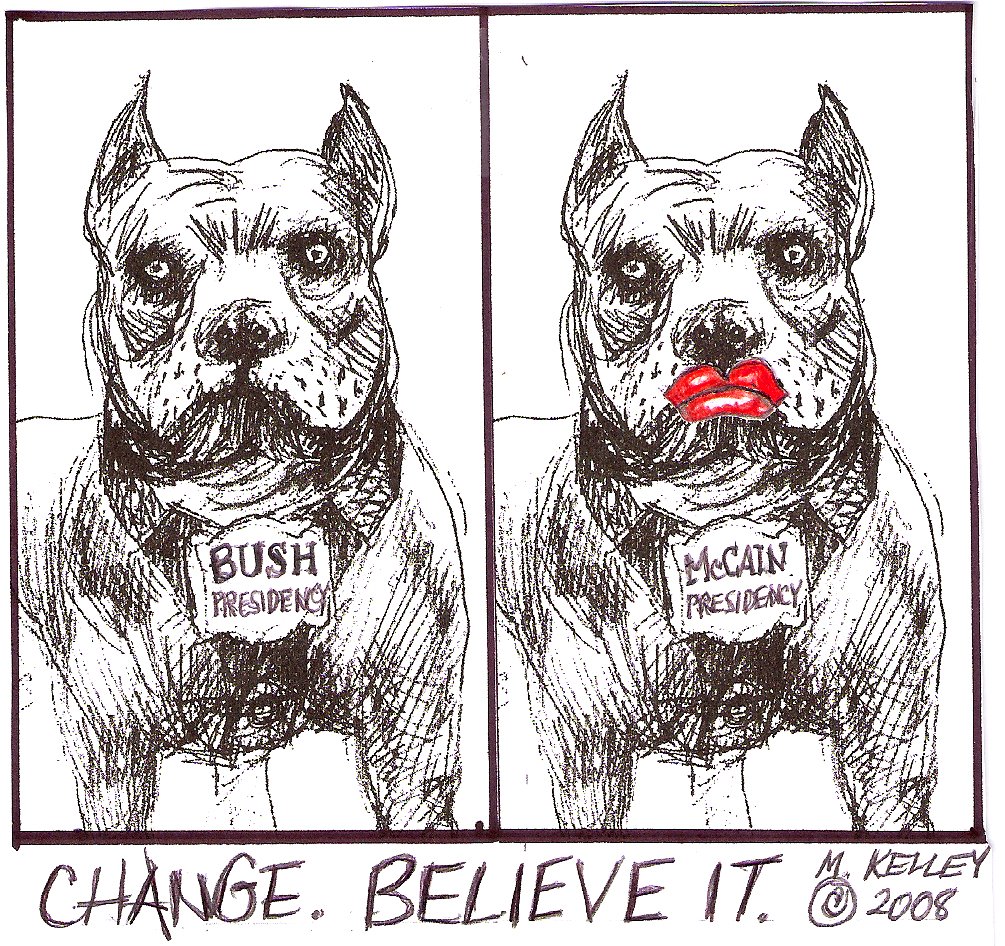
Oh, No … Not More Lipstick Politics !!

Thanks to Diane Stirling-Stevens / The Rag Blog

Posted in RagBlog | Tagged , | 2 Comments

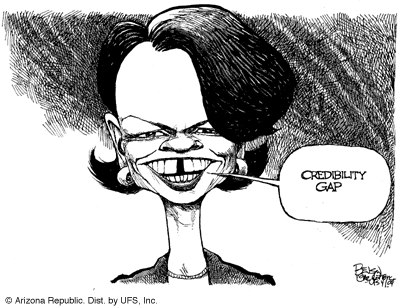
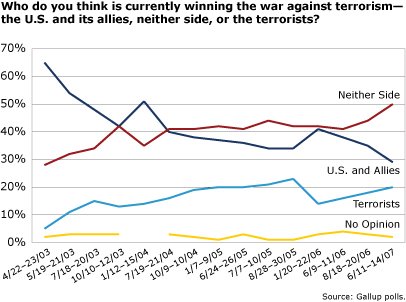
The US Credibility Gap – Who Did 9/11?


Less Than Half the World Believes Al Qaeda Was Behind 9/11 Attacks
By Joshua Holland / September 11, 2008.

A poll of 16,000 people in 17 countries reveals the damage done to the credibility of the United States by the Bush admin.

A new international poll released this week by the Project on International Policy Attitudes (PIPA) found that outside the U.S., many are skeptical that Al Qaeda was really responsible for the September 11th attacks.

16,000 people in 17 countries — allies and adversaries; in Asia, Europe, Africa, Latin America and the Middle East — were asked the open ended question: “who do you think was behind the 9/11 attacks?”

On average, fewer than half of all respondents said Al Qaeda (although there was significant variation between countries and regions). 15 percent said the United States government itself was responsible for the attacks, 7 percent cited Israel and fully one in four said they just didn’t know.

Among our closest allies, very slim majorities believe Al Qaeda was the culprit. According to the study, “Fifty-six percent of Britons and Italians, 63 percent of French and 64 percent of Germans cite al Qaeda. However, significant portions of Britons (26%), French (23%), and Italians (21%) say they do not know who was behind 9/11. Remarkably, 23 percent of Germans cite the US government, as do 15 percent of Italians.”

Whatever one thinks of “alternative” theories of who the perpetrators were that day, the results are an eye-opening indication of how profoundly the world’s confidence in the United States government has eroded during the Bush era. The researchers found little difference among respondents according to levels of education, or to the amount of exposure to the news media they had. Rather, they found a clear correlation with people’s attitudes towards the United States in general. “Those with a positive view of America’s influence in the world are more likely to cite al Qaeda (on average 59%) than those with a negative view (40%),” wrote the authors. “Those with a positive view of the United States are also less likely to blame the US government (7%) than those with a negative view (22%).”

Interestingly, Americans are also dubious, with more than a third of those polled by Scripps News Service in 2006 saying it was “very likely” or “somewhat likely” that “federal officials either participated in the attacks on the World Trade Center and the Pentagon or took no action to stop them” because they “wanted the United States to go to war in the Middle East.” The poll didn’t, however, distinguish between those who believed the government actively participated in the events of that day or merely had foreknowledge that the attacks were imminent. (Another poll that year, by CBS News and the New York Times found that fewer than one in five Americans believed the government was being fully forthcoming about the attacks.)

In one sense, these findings should come as no surprise. America, like other countries, has been known to conduct “false-flag” operations before. And it’s used falsehoods to justify going to war. In the now-infamous “Gulf of Tonkin Incident” — the incident that would be used to justify America’s involvement in that conflict — a minor skirmish occurred between U.S. naval ships and two North Vietnamese coastal vessels. Two days later, the Johnson administration reported that there had been a second attack, which it claimed was evidence of “communist aggression” on the part of the North Vietnamese. But, as a National Security Agency report revealed in 2005 (PDF), the second incident — the one that created a ‘pattern’ of aggression — was invented out of whole cloth. “It is not simply that there is a different story as to what happened; it is that no attack happened that night,” reads the report.

In 1990, on the eve of the first Gulf War, Pentagon officials cited top-secret satellite images and said definitively that Saddam Hussein had amassed a huge army — with 250,000 men and 1,500 tanks — along the Saudi border in preparation for an invasion of that country. Jean Heller, a reporter with the St. Petersburg Times, purchased some Russian satellite images of the same piece of desert and found that in fact there was nothing there but sand. After the U.S.-led attack, a “senior [U.S. military] commander” told New York Newsday, “There was a great disinformation campaign surrounding this war.”

Those incidents are in no way analogous to the attacks of 9/11. But in 1962, the Joint Chiefs of Staff proposed to defense secretary Robert McNamara that the CIA might launch a series of terror attacks within the United States, blame Cuba, and use the ensuing panic to justify military action against the defiant island-nation. (The plan, called “Operation Northwoods,” which became public in 1997, was reportedly killed off by John F. Kennedy himself – it got that far up the food chain.)

Yet, whatever the historical context, there can be little doubt that the Bush administration’s penchant for secrecy and well-documented dishonesty fuels the debate over who perpetrated the attacks of 9/11. Earlier this year, an independent study conducted by the Center for Public Integrity documented 935 lies mouthed by senior administration officials to gin up support for the invasion of Iraq (one of which was Donald Rumsfeld repeating the long-disproved claim that Saddam had amassed a huge army on the Saudi border in 1990).

Just the fact that the administration blamed a group in Afghanistan for the attacks and then invaded a different country — with some of the world’s richest oil reserves — would have been enough to create suspicion around the world. And no satisfactory explanation has ever been given for why the Bush administration didn’t step up airline security in the face of repeated warnings — some quite specific in terms of time and place — from foreign governments and their intelligence agencies, warnings from allies like Israel’s Mossad to “enemies” like the Taliban in Afghanistan.

The credibility gap that’s developed around the world’s preeminent power is more than a matter of academic interest. Around the world, many of those who embraced us immediately after 9/11 and offered almost unconditional support for our policies now don’t believe a word coming out of our officials’ mouths, and that impacts U.S. foreign policy, and the stability of the whole international system, in ways both obvious and subtle.

A good, obvious example is in Pakistan, where most Americans believe we’re allied with the government and a majority of the Pakistani people against a small group of Al Qaeda extremists, who are undermining the U.S.-led battle against their terrorist brethren in Afghanistan (where we are allied with that government and most of that country’s people). American politicians expend much hot air accusing the Pakistani government of ‘not doing enough to rein in extremists’ in the tribal areas bordering Afghanistan.

But as Princeton scholar Zia Mian wrote in July, “most damaging of all for the United States is that people in Pakistan overwhelming see the United States as the problem.” Mian cited a poll (PDF), conducted in May by the Pakistan Institute for Public Opinion, which found that “60% of Pakistanis believe the U.S. ‘war on terror’ seeks to weaken the Muslim world, and 15% think its goal is to ‘ensure US domination over Pakistan.'” About a third had a positive view of al-Qaeda, twice as many as the number that viewed the U.S. in a positive light. Mian touched on what is probably the key finding in the study — and one that speaks to our officials’ utter lack of credibility when they say that they’re fighting “extremism” or “terrorists.” The poll found that “44% of Pakistanis believe the United States is the greatest threat to their personal safety … [while] the Pakistani Taliban, who … by some estimates have up to 40,000 fighters, are seen as a threat by less than 10%. Al-Qaeda barely registers as a threat, slightly surpassing Pakistan’s own military and Inter-Services Intelligence agency (ISI).”

With almost half of the population saying the U.S. is the greatest threat to their own personal safety, any Pakistani government will be left between a rock and a hard place. In that part of the planet, the real-world consequence of our government’s credibility gap is that the cooperation Washington seeks from Islamabad — both internally and with neighboring Afghanistan — can only result in destabilizing an already unstable political scene.

Around the world, the United States is at the nadir of its post-World War II influence. Among foreign governments and publics, in international institutions and commercial markets, our brand — our ideologies — haven’t had less power to sway people than they do today. We’ve never had less “soft power,” hard power doesn’t come cheaply or without unintended consequences and there’s no guarantee that the Iron Fist can ever be put back into the Velvet Glove now that it’s been exposed.

The fact that fewer than half of the world’s citizens believe we were really attacked by Al Qaeda seven years ago is merely a reflection of far deeper problems that our foreign policy-makers are going to have to try to face in the coming years. That’s Bush’s foreign policy legacy.

All of which brings us to what historians will probably consider the great irony of the decline of the brief U.S.-led mono-polar order that existed between the end of the Cold War and the beginning of the second Gulf War: the neoconservative movement, which was so obsessed with the preservation of American power and the suppression of its rivals — from its birth in the Nixon Administration, through Reagan’s “Dirty Wars” in Latin America and culminating in the 2003 invasion of Iraq — ultimately oversaw the crash and burn of the World’s Only Superpower’s ability to influence world events.

Source / AlterNet

Thanks to Diane Stirling-Stevens / The Rag Blog

Posted in RagBlog | Tagged , , | 2 Comments

Arianna Huffington on Obama : Time For Some Righteous Rage

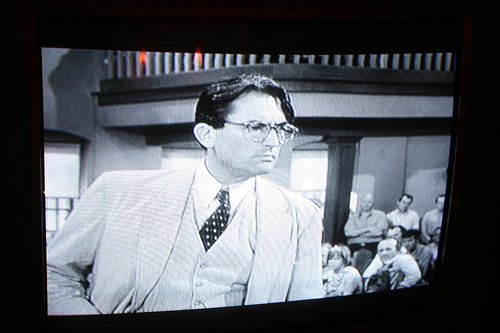
Gregory Peck as Atticus Finch in ‘To Kill a Mockingbird’ : Righteous rage.

‘It’s time for Obama to unleash his inner Atticus’
By Arianna Huffington / September 10, 2008

Back in February 2007, I wrote about the role casting would play in the presidential race, and the American public’s readiness to replace the John Wayne take-no-crap-cowboy model of leadership with a Gregory Peck-does-Atticus Finch archetype.

Given Obama’s sense of moral obligation and social responsibility, and his “audacity of hope,” I felt “the man and the moment may be made for each other.”

Now, as the crises facing our country intensify, and the campaign McCain is running becomes sleazier and more trivial, it’s time for Obama to unleash his inner Atticus — or at least the key element of Finch that Obama seems reluctant to embrace: righteous rage.

“Finch had the riotous fire of all the great prophets in the Judeo-Christian tradition,” John Cusack told me during our back-and-forth email conversation of the last few days. “He unleashes that fire in his final, great courtroom speech. If he didn’t, if he refused to unleash his anger and contempt at the horror and immorality of racism, he would prove himself to be an unemotional man unworthy of our love and respect. Obama has waited long enough to show us this side of himself. Besides, we need to know that he can be a mean motherfucker if he wants this job.”

Obama has demonstrated a laudatory levelheadedness — the ability to keep his head while those around him were losing theirs — over the long haul of the ’08 campaign, always presenting a cool and unruffled image. And it has served him well.

This is clearly part of Obama’s lifelong attempt to present a nonthreatening persona, what Shelby Steele has dubbed the “iconic Negro.” Think Oprah, Michael Jordan, and Tiger Woods. Now picture them in your mind… they’re smiling aren’t they?

Being likeable is obviously a good thing in politics. So is being analytical and thoughtful and composed. But the last seven-plus years demand more than a detached analysis — and certainly more than a beaming smile.

They demand indignation. Outrage. Fury.

Obama has often said that he is running because of what Dr. King called “the fierce urgency of now.” He needs to show that fierceness and that urgency.

When we think of King, we usually think of him as resolute and dignified. But, as Michael Eric Dyson points out, King was also filled with a prophetic anger, especially in the later years of his life, when he turned his attention to fighting poverty, entrenched racism, and the Vietnam War.

As a leader fighting for fundamental change in this country, Obama has to be willing to show us that kind of righteous anger. I don’t know about you, but when I think about what George Bush has done to this country — and what John McCain wants to keep doing — I consider outrage the only rational and legitimate response. So why don’t we see this outrage from Obama?

And now, to all that the Republicans have done to America, we have to add the gutter campaign they are running in a desperate effort to win the White House. You know the McCain campaign has sunk into the cesspool when seen-it-all Beltway denizens like Joe Klein and Mark Halperin start looking for the barf bag.

HuffPoster John Neffinger has dubbed McCain’s sleazy sex ed attack ad Obama’s “Dukakis Moment” — the time for him to avoid looking emotionally detached and “show America how he behaves when something despicable is done to him, so we can all see how he would behave as our leader if something despicable were done to us — as it was on 9/11.”

The fear of activating the residual racism provoked by the caricature of the “angry black man” should no longer hold sway. As John Cusack points out, over the last 40 years, popular culture has been “filled with images of strong, powerful black actors who have been able to express righteous rage and still capture our affection and respect. From Sidney Poitier to Denzel Washington, Will Smith, and Morgan Freeman — these are men who have the inherent dignity to express the kind of cosmic rage that comes from being human and responding to injustice. They are perceived as authentic and powerful precisely because they show us their anger as they fight for what is right and true and good. If they didn’t, we wouldn’t respect them.”

Picture Poitier as Virgil Tibbs in In the Heat of the Night when Rod Steiger’s southern sheriff mocks his “funny name for a nigger boy from Philadelphia” and asks, “What do they call you up there?”

Righteous rage drips from every syllable of his five-word answer: “They call me Mister Tibbs!” See below for the Poitier clip and others with Washington, Freeman, Smith, and Don Cheadle.

Obama clearly has it in him. We saw a flash of it in Denver when he announced: “Enough!”

Paul Slansky writes that this single word — filled as it is with outrage and the echoes of the outrages perpetrated by Bush and McCain — should become the theme of the campaign: “‘Enough!’ is a rallying cry, a direct descendant of Network’s ‘I’m mad as hell and I’m not going to take it anymore.’ It invites audience participation at every campaign stop. There is something cathartic about screaming in unison: ‘Enough!!'”

To fully become the transformational leader we need, Obama must demonstrate to the American people his capacity for indignation — for the kind of ferocious passion that fueled King and Nelson Mandela. He has to fight fire with fire, and wield anger in the service of what right, true, and good. The fierce urgency of now demands nothing less.

Source / The Huffington Post

The Rag Blog

Posted in RagBlog | Tagged , , , | Leave a comment

Remembering This Day Only with a Smile for Bella


On a day when most people will be watching heart-wrenching MEMORIALS, I chose this……..
By Diane Stirling-Stevens / The Rag Blog / September 11, 2008

Today my great grand-daughter turns 1; that is the ‘good memory’ Bella has brought to this date marked on my calendar – September 11.

I was in the hospital on 9.11.01, and the nurses wouldn’t let anyone in our room turn on the television that day because they said they were having reception problems. It was a good thing I’m certain, to have ‘censored’ the tragedy from those of us who were dealing with our own injuries and illness. None of my family told me about what had happened – again, I guess they wanted to be sure I was ‘home and recovered’ before I learned about it.

Because the coverage of that terrible day went on and on each day in the news, ultimately I saw reruns, but never the entire moment-to-moment coverage that millions saw as it unfolded.

My brother-in-law was driving into New York city when it happened; his wife and mother-in-law were coming from Logan because his mother-in-law lived in Boston at the time, and was making a visit to their home in New Jersey. David saw it from the highway; he called my husband who was in the hospital lounge where I was a patient. I later learned how David had nearly veered off the road when he had the radio on and learned the plane that was suspect, had left Logan at the very time his wife and her mother were scheduled to depart.

Because the phone lines were jammed, David couldn’t get information about his wife. It was several hours before he finally got through, and learned the good news – his mother-in-law had forgotten her ticket, so they’d driven back to her home to get it. Because of her forgetfulness (she has Alzheimer’s disease), they were NOT on that plane that day. David ended up driving to Boston to pick up the two, and they rested a few days as they watched this horror and ever so glad to be spared.

A friend of mine (Norma Allende) lived not too far from the Twin Towers, so I called as soon as I was aware of the incident, and kept in touch with her throughout the months to come. Her story via e-mail was certainly book material, and I cherish the words and details she gave me that give a face to the story like no national news-cast could.

Of course the capitalistic country known as ‘America’, wasted no time in making millions and millions of dollars on not only the daily viewing via television, but in movies and documentaries that followed to the point of excess (in my opinion).

Since September 11, 2001, I’ve looked at a lot of videos; read a lot of web-sites (with a great deal of source material sent to me by my friend, Lynn), and what I see and feel is a ‘terrorist attack on our country by GWB & Company’, makes me remember this day only with a smile for Bella; a glance at her beautiful smile, and a sincere wish she’ll not face a life in this country of strife and tyranny as I am so concerned might be her future. For me, I have to remember this incident of 9.11.01 with this well-written article.

9/11 Plus Seven
By Andrew J. Bacevich / September 9, 2008

The events of the past seven years have yielded a definitive judgment on the strategy that the Bush administration conceived in the wake of 9/11 to wage its so-called Global War on Terror. That strategy has failed, massively and irrevocably. To acknowledge that failure is to confront an urgent national priority: to scrap the Bush approach in favor of a new national security strategy that is realistic and sustainable — a task that, alas, neither of the presidential candidates seems able to recognize or willing to take up.

On September 30, 2001, President Bush received from Secretary of Defense Donald Rumsfeld a memorandum outlining U.S. objectives in the War on Terror. Drafted by Rumsfeld’s chief strategist Douglas Feith, the memo declared expansively: “If the war does not significantly change the world’s political map, the U.S. will not achieve its aim.” That aim, as Feith explained in a subsequent missive to his boss, was to “transform the Middle East and the broader world of Islam generally.”

Rumsfeld and Feith were co-religionists: Along with other senior Bush administration officials, they worshipped in the Church of the Indispensable Nation, a small but intensely devout Washington-based sect formed in the immediate wake of the Cold War. Members of this church shared an exalted appreciation for the efficacy of American power, especially hard power. The strategy of transformation emerged as a direct expression of their faith.

The members of this church were also united by an equally exalted estimation of their own abilities. Lucky the nation to be blessed with such savvy and sophisticated public servants in its hour of need!

The goal of transforming the Islamic world was nothing if not bold. It implied far-reaching political, economic, social, and even cultural adjustments. At a press conference on September 18, 2001, Rumsfeld spoke bluntly of the need to “change the way that they live.” Rumsfeld didn’t specify who “they” were. He didn’t have to. His listeners understood without being told: “They” were Muslims inhabiting a vast arc of territory that stretched from Morocco in the west all the way to the Moro territories of the Southern Philippines in the east.

Yet boldly conceived action, if successfully executed, offered the prospect of solving a host of problems. Once pacified (or “liberated”), the Middle East would cease to breed or harbor anti-American terrorists. Post-9/11 fears about weapons of mass destruction falling into the hands of evil-doers could abate. Local regimes, notorious for being venal, oppressive, and inept, might finally get serious about cleaning up their acts. Liberal values, including rights for women, would flourish. A part of the world perpetually dogged by violence would enjoy a measure of stability, with stability promising not so incidentally to facilitate exploitation of the region’s oil reserves. There was even the possibility of enhancing the security of Israel. Like a powerful antibiotic, the Bush administration’s strategy of transformation promised to clean out not simply a single infection but several; or to switch metaphors, a strategy of transformation meant running the table.

When it came to implementation, the imperative of the moment was to think big. Just days after 9/11, Rumsfeld was charging his subordinates to devise a plan of action that had “three, four, five moves behind it.” By December 2001, the Pentagon had persuaded itself that the first move — into Afghanistan — had met success. The Bush administration wasted little time in pocketing its ostensible victory. Attention quickly shifted to the second move, seen by insiders as holding the key to ultimate success: Iraq.

Fix Iraq and moves three, four, and five promised to come easily. Writing in the Weekly Standard, William Kristol and Robert Kagan got it exactly right: “The president’s vision will, in the coming months, either be launched successfully in Iraq, or it will die in Iraq.”

The point cannot be emphasized too strongly: Saddam Hussein’s (nonexistent) weapons of mass destruction and his (imaginary) ties to Al Qaeda never constituted the real reason for invading Iraq — any more than the imperative of defending Russian “peacekeepers” in South Ossetia explains the Kremlin’s decision to invade Georgia.

Iraq merely offered a convenient place from which to launch a much larger and infinitely more ambitious project. “After Hussein is removed,” enthused Hudson Institute analyst Max Singer, “there will be an earthquake through the region.” Success in Iraq promised to endow the United States with hitherto unprecedented leverage. Once the United States had made an example of Saddam Hussein, as the influential neoconservative Richard Perle put it, dealing with other ne’er-do-wells would become simple: “We could deliver a short message, a two-word message: ‘You’re next.'” Faced with the prospect of sharing Saddam’s fate, Syrians, Iranians, Sudanese, and other recalcitrant regimes would see submission as the wiser course — so Perle and others believed.

Members of the administration tried to imbue this strategic vision with a softer ideological gloss. “For 60 years,” Condoleezza Rice explained to a group of students in Cairo, “my country, the United States, pursued stability at the expense of democracy in this region here in the Middle East — and we achieved neither.” No more. “Now, we are taking a different course. We are supporting the democratic aspirations of all people.” The world’s Muslims needed to know that the motives behind the U.S. incursion into Iraq and its actions elsewhere in the region were (or had, at least, suddenly become) entirely benign. Who knows? Rice may even have believed the words she spoke.

In either case — whether the strategy of transformation aimed at dominion or democratization — today, seven years after it was conceived, we can assess exactly what it has produced. The answer is clear: next to nothing, apart from squandering vast resources and exacerbating the slide toward debt and dependency that poses a greater strategic threat to the United States than Osama bin Laden ever did.

In point of fact, hardly had the Pentagon commenced its second move, its invasion of Iraq, when the entire strategy began to unravel. In Iraq, President Bush’s vision of regional transformation did die, much as Kagan and Kristol had feared. No amount of CPR credited to the so-called surge will revive it. Even if tomorrow Iraq were to achieve stability and become a responsible member of the international community, no sensible person could suggest that Operation Iraqi Freedom provides a model to apply elsewhere. Senator John McCain says that he’ll keep U.S. combat troops in Iraq for as long as it takes. Yet even he does not propose “solving” any problems posed by Syria or Iran (much less Pakistan) by employing the methods that the Bush administration used to “solve” the problem posed by Iraq. The Bush Doctrine of preventive war may remain nominally on the books. But, as a practical matter, it is defunct.

The United States will not change the world’s political map in the ways top administration officials once dreamed of. There will be no earthquake that shakes up the Middle East — unless the growing clout of Iran, Hezbollah, and Hamas in recent years qualifies as that earthquake. Given the Pentagon’s existing commitments, there will be no threats of “you’re next” either — at least none that will worry our adversaries, as the Russians have neatly demonstrated. Nor will there be a wave of democratic reform — even Rice has ceased her prattling on that score. Islam will remain stubbornly resistant to change, except on terms of its own choosing. We will not change the way “they” live.

In a book that he co-authored during the run-up to the invasion, Kristol confidently declared, “The mission begins in Baghdad, but it does not end there.” In fact, the Bush administration’s strategy of transformation has ended. It has failed miserably. The sooner we face up to that failure, the sooner we can get about repairing the damage.

Andrew J. Bacevich is professor of history and international relations at Boston University. His bestselling new book is The Limits of Power: The End of American Exceptionalism.

Source / TomDispatch

The Rag Blog

Posted in Rag Bloggers | Tagged , | Leave a comment

Wal-Mart and the Loss of U.S. Jobs


‘Report shows Wal-Mart has played a major role in creating a record trade deficit with China’
By S.M. Willhelm / The Rag Blog / September 11, 2008

Wal-Mart claims it creates jobs across America, but a new report shows a much different reality.

The giant retailer’s reliance on cheap goods made in China has cost this country nearly 200,000 jobs since 2001, says the report, The Wal-Mart Effect, by the nonprofit Economic Policy Institute (EPI).

The report shows Wal-Mart has played a major role in creating a record trade deficit with China that has eliminated some 1.8 million jobs, mainly in manufacturing.

Wal-Mart’s China Imports Cost Nearly 200,000 U.S. Jobs

Wal-Mart claims it creates jobs across America, but a new report shows a much different reality.

The giant retailer’s reliance on cheap goods made in China has cost this country nearly 200,000 jobs since 2001, says the report, The Wal-Mart Effect, by the nonprofit Economic Policy Institute (EPI).

The report shows Wal-Mart has played a major role in creating a record trade deficit with China that has eliminated some 1.8 million jobs, mainly in manufacturing.

The U.S. trade deficit with China reached a whopping $233 billion last year, and imports for Wal-Mart alone accounted for $27 billion—11 percent of that total. This year’s first-quarter $46.4 billion total deficit is twice as large as in the same period last year.

The U.S. trade deficit with China between 1997 and 2006 has displaced production that could have supported about 2.2 million U.S. jobs, according to EPI. Most of these jobs (1.8 million) have been lost since China entered the World Trade Organization (WTO) in 2001.

Contrary to the predictions of its supporters, China’s entry into the WTO has failed to reduce its trade surplus with the United States or increase overall U.S. employment.

Says economist Robert Scott, author of the EPI report:

Now we know the impact that imports from China to the world’s largest retailer has on our nation’s jobs. What’s good for Wal-Mart is not always good for U.S. workers.

The AFL-CIO, domestic manufacturers and many economic experts maintain that one key reason the U.S. trade deficit with China is so high is because China deliberately undervalues its currency, the yuan, to keep the value artificially low so it can boost exports and discourage imports—running up the U.S. trade deficit and costing good American jobs.

An AFL-CIO report shows China’s fixed currency rate artificially lowers the price of its goods by 40 percent, effectively subsidizing China’s exports and putting U.S. companies at a competitive disadvantage.

The bipartisan Fair Currency Act, introduced by Reps. Tim Ryan (D-Ohio) and Duncan Hunter (R-Calif.), would clarify that currency manipulation is an illegal subsidy under WTO rules. A similar bill was introduced in the Senate by Sens. Jim Bunning (R-Ky.), Evan Bayh (D-Ind.) and Debbie Stabenow (D-Mich.).

In 2004 and 2005, the Bush administration rejected petitions from the AFL-CIO and business and farm leaders that asked Bush to take action against China’s currency manipulation.

James Parks / Jun 27, 2007

Source / AFL/CIO NOW

The Rag Blog

Posted in Rag Bloggers | Tagged , , , , , , | 1 Comment

BushCo and Fox : Colluding in Blatant Lies About Murder in Afghanistan


The government, the media and Afghanistan
By Glenn Greenwald / September 11, 2008

On the night of August 22, the U.S. committed what Chris Floyd, in a richly detailed and amply documented piece, calls an “atrocity” in the Afghan village of Azizabad, near the western city of Herat. The U.S. conducted a massive midnight airstrike on the village, killing scores of unarmed civilians, including large numbers of women and children. That was preceded just weeks earlier by another U.S. airstrike in Eastern Afghanistan which “killed 27 people in a wedding party — most of them women and children, including the bride.”

What makes the Azizabad attack particularly notable is the blatant and now clearly demonstrated lying engaged in by the U.S. Government regarding this incident, with the eager propagandistic assistance of what we are constantly told is the “legitimate news arm” of Fox News — namely, Brit Hume’s show and his stable of “legitimate news reporters.” Working in unison, Fox and the Pentagon continuously denied claims that large numbers of civilians had been killed in the airstrike, accusing the villagers of lying and U.N. investigators of having been “duped.” But a mountain of documentary evidence and independent investigations have now conclusively confirmed that it was the U.S. Government that was lying and the villagers’ claims which were true all along, forcing the military to “reinvestigate” its own conclusions.

While local villagers, the Afghan government, U.N. investigators, and independent journalists all insisted that the U.S. air attack resulted in the slaughter of 95 civilians, including 50 children, and killed no Taliban fighters, the U.S. military repeatedly issued vehement denials of those claims, insisting for weeks “that only 5 to 7 civilians, and 30 to 35 militants, were killed in what it [said] was a successful operation against the Taliban.” The Bush administration even “accused the villagers of spreading Taliban propaganda” and claimed “that the villagers fabricated such evidence as grave sites,” even though those “villagers have connections to the Afghan police, NATO or the Americans through reconstruction projects, and they say they oppose the Taliban.”

But a gruesome video has now surfaced clearly documenting the huge number of civilians that were killed. A very thorough, independent, on-the-scene investigation by the New York Times’ Carlotta Gall — who Floyd, a former colleague of Gall at The Moscow Times, rightly hailed as a truly intrepid war reporter — resulted in the discovery of mountains of new documentary evidence and highly credible and pro-U.S. witnesses confirming not only that at least 90 civilians were killed, but also casting serious doubt on the U.S.’s claim that there were even any Taliban in the village at all.

There are numerous vital issues raised by this episode relating both to the bombing and particularly how the U.S. Government so frequently issues false claims, but in light of all the recent uproar over what is and is not “appropriate journalism,” I want to focus for the moment on Fox News’ role in this. When the U.S. military originally was denying the villagers’ claim, the Pentagon claimed it had had conducted an investigation and that an unnamed “independent journalist” who happened to be with them confirmed their account that large numbers of Taliban were among the dead and only very few unarmed civilians were. But then this was revealed:

The US military said that its findings were corroborated by an independent journalist embedded with the US force. He was named as the Fox News correspondent Oliver North, who came to prominence in the 1980s Iran-Contra affair, when he was a[ Marine] colonel.

That “independent journalist” is the same person who, in 1986, proudly went before Congress and boasted: “I will tell you right now, counsel, and to all the members here gathered, that I misled the Congress,” and then justified that lying — and to this day still justifies it — on the ground that it was for a greater good. That behavior — which led to multiple felony convictions that were ultimately overturned because he had received immunity in connection with his testimony — hasn’t prevented North from being employed as a “reporter” by the serious, legitimate news arm of Fox News, nor from appearing regularly on Brit Hume’s Serious News Show as a journalist, nor being cited as an “independent journalist” by the U.S. military to confirm its claims and accuse Afghan villagers of lying about the number of their dead.

That it was Oliver North who turned out to be the U.S. military’s vaunted “independent journalist” verifying its claims about the Azizabad raids was revealed by Fox on the September 8 edition of “Special Report with Brit Hume,” which was guest-anchored by “journalist” Jim Angle. At the top of the show, this is what Angle “reported”:

In Afghanistan, FOX has exclusive pictures of what happened in a U.S. raid which some locals claim killed civilians. A FOX crew tells a different story.

Nobody — other than Brit Hume’s news show — ever denied that civilians were killed in this airstrike. The only “debate” — prior to the emergence of documentary evidence — was over how many were killed. Yet Fox began by telling its pitifully misled viewers that while “some locals claim [the airstrike] killed civilians,” “a Fox crew” had a “different story.”

Later in the show, Angle introduced the segment this way:

The U.S. military is reopening an investigation into an operation led by American forces that some now say resulted in the deaths of dozens of Afghan civilians. Video allegedly taken at the scene appears to show images of dead children, but a FOX crew went along on that mission and has exclusive pictures that tell a different story.

Angle then introduced Fox News “national security correspondent” Jennifer Griffin, and this is what Fox viewers heard:

GRIFFIN: So what did happen during the 2:00 a.m. raid into Azizabad? The Special Forces teams involved have been muzzled pending the new investigation, but FOX News cameramen Chris Jackson and Lieutenant Colonel Oliver North happened to be embedded with the Marine Special Forces Unit involved in the raid. This is their video exclusive to FOX News. They witnessed the entire operation firsthand.

CHRIS JACKSON, FOX NEWS CAMERAMAN: I had the freedom to rein all over the objective, go to anywhere I wanted to go, and I saw the dead combatants. And they were wearing bandoleers and holding AK-47s.

GRIFFIN: Special military investigators showed the FOX team satellite photos of the graveyards near Azizabad taken before and after the raid. Quote, “Though only about 15 new graves were evident in nearby cemeteries and no local civilians had sought medical treatment for wounds,” North wrote in his blog on August 29th, “the number of noncombatant casualties allegedly inflicted in the raid continued to rise.”

JACKSON: I’ve worked in war zones and disaster areas for a long time, so I’m used to seeing large numbers of dead people. I did not see this in Azizabad. I went through the rubble, I went through the buildings, the main objectives. And what I saw was primarily enemy combatants. What I saw matched is the number of the U.S. Army figure of how many people were killed.

GRIFFIN: A press release from the original military investigation concluded, “Investigators discovered firm evidence that the militants planned to attack a nearby coalition forces base. Other evidence collected included weapons, explosives, intelligence materials, and an access badge to a nearby base as well as photographs from inside and outside of the base.

(END VIDEOTAPE)

Fox’s news show — not Bill O’Reilly, but Brit Hume’s “legitimate news program” — continued to insist, based upon the “reporting” of “journalist” Oliver North and his cameraman, that the U.S. military’s original claims were true, and the villagers and the U.N. were lying, even as the U.S. military itself was, in light of the ample evidence, severely backtracking on its story:

The U.S. decision to again probe the Aug. 21 attack in Azizabad, near the western city of Herat, came at the urging of Gen. David D. McKiernan, the top NATO commander in Afghanistan. McKiernan said he was prompted by “emerging evidence” that threw into question the finding of a U.S. investigation that five to seven civilians died. McKiernan had earlier said he concurred with that finding. . . .

“The footage that is there on this shows horrendous pictures of these bodies and clearly identifies women and children. In some cases, the bodies are not in one piece,” a U.N. official said, speaking on the condition of anonymity. “Whether you say it was 76 or 82 or even 92 — it was clearly not seven who were killed there.

Said a senior U.S. military official: “Whatever information McKiernan got that was shared by Afghan and U.N. representatives led him to believe there was good cause to want to look at all of this more deeply.

It is hardly uncommon for claims by the U.S. Government regarding the multiple countries in which our “War on Terror” is being waged to be vehemently disputed by a whole array of people. The only difference here is that video, other documentary evidence, and independent investigations have all emerged confirming the falsity of the U.S. Government’s claims.

This is what I found so deeply bothersome and inane about this week’s hand-wringing over the oh-so-“undignified” spats between various MSNBC personalities during the Convention and the Threat to the Integrity of American Journalism posed by such squabbling, or by the oh-so-inappropriate placement of “blatant liberals” in the sacred anchor chair. There is an entire cable “news” outlet, the highest-rated one in the country, which exists for little reason other than to amplify and certify false government claims — it’s literally nothing more than an outlet for state-issued propaganda — and our leading news critics and even other “journalists” praise and treat its “news” anchors as legitimate and credible sources of news (and for those who want to claim that Brit Hume is something other than a nakedly partisan right-wing propagandist, see here, here, and here, just for starters).

Way beyond Fox, this is the same thing that our media generally (and with some important exceptions) has been doing for years, at least — mindlessly repeating and confirming false Government claims. That’s what makes Carlotta Gall’s on-scene actual investigation of the Pentagon’s Afghanistan claims so notable — it’s so unusual. From Jessica Lynch’s heroic Rambo-like firefight to Pat Tillman’s murder by Al Qaeda monsters to pre-war claims of the Iraqi menace to post-war claims of Glorious Progress to current claims of the Grave Russian and Iranian Threats to the concealment and then justification of virtually every act of government radicalism over the last eight years, our media has, by and large, done what Fox News did in the Azizabad case — offer itself up as an uncritical conduit for state propaganda.

And that’s to say nothing of their more overt propagandistic activities — the still-extraordinary fact that for the last seven years, virtually every American news program has employed as “independent analysts” people who were part of a formal, coordinated and likely illegal U.S. Government propaganda program run out of the Pentagon, a program which resulted in countless false stories broadcast by these networks to boost Government lies. And even after all of that was revealed and documented on the front page of the NYT, these media outlets — all 3 networks, plus CNN and others — continue to employ the propagandists, and worse, refuse even to tell their viewers about what happened, or even to disclose to their viewers the existence of the story, and then — at best — actually defend it all when forced on their obscure blogs to mention it.

Keith Olbermann may be more overtly opinionated and devoted to a particular presidential candidate than a classical Brokawian “anchor” should be, and it’s certainly reasonable to say that he, Chris Matthews, Joe Scarborough and David Schuster have acted like adolescent clowns on television, but spending time focusing on that as some sort of grave threat to American journalism is like taking a patient whose vital organs are drowning in Stage 4 cancer and obsessing about his hangnail.

* * * * *

Independent of the Government lying and Fox News propaganda, the massacre of Azizabad civilians highlights the massive yet largely ignored questions about what we are doing in Afghanistan and whether — regardless of one’s views of the original invasion — we are achieving any good at all. As Floyd wrote yesterday:

The mass death visited upon the sleeping, defenseless citizens of Azizabad encapsulates many of the essential elements of this global campaign of “unipolar domination” and war profiteering: the callous application of high-tech weaponry against unarmed civilians; the witless attack that alienates local supporters and empowers an ever-more violent and radical insurgency; and perhaps the most quintessential element of all — the knowing lies and deliberate deceits that Washington employs to hide the obscene reality of its Terror War.

Over at Nieman Watchdog, The Washington Post‘s Dan Froomkin interviewed experts in the region who cite numerous questions that ought to be asked about the wisdom of our continuing occupation of Afghanistan, including “Are we bombing our way to disaster in Afghanistan?” And as Froomkin himself put it yesterday in his Post chat:

Civilian deaths — which the civilians may well consider murder — tend to turn people against us.

I was kind of amazed that Bush raised the issue at all in yesterday’s speech, but he did. I was really amazed, however, at how cavalier he sounded: “Regrettably, there will be times when our pursuit of the enemy will result in accidental civilian deaths. This has been the case throughout the history of warfare. Our nation mourns the loss of every innocent life. Every grieving family has the sympathy of the American people.”

I mean, c’mon. It’s a bit hard to convince people that our nation mourns the loss of every innocent life when we don’t even acknowledge them.

Most striking of all is that the “issues” of least significance, of zero import, are the ones which receive the most attention in the “political debates” conducted by our media — pigs and lipstick and bowling scores and lapel pins and windsurfing tights — while the ones of greatest significance are virtually ignored. And that is highly unlikely to change between now and November. To know why, just compare these two statements — first, from McCain campaign manager Rick Davis (“This election is not about issues. This election is about a composite view of what people take away from these candidates”) and this one from MSNBC’s Joe Scarborough (media will talk about “[w]hatever the McCain campaign wants us to talk about”). When Tom Brokaw expresses concern about any of that, then his profound concerns over undignified journalism can be taken seriously.

Source / Salon

The Rag Blog

Posted in RagBlog | Tagged , , , | Leave a comment

How Will We Stop These Illegal US Incursions?

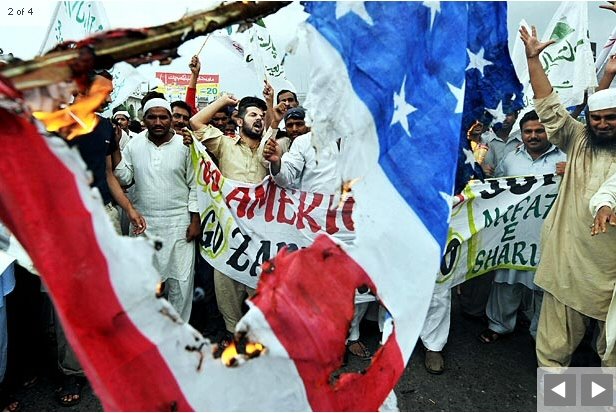
U.S. forces conducted one such raid in South Waziristan, a tribal area, on Sept. 3. Here, Pakistanis protest that action two days later in Lahore. On Wednesday, Pakistan’s army chief said he wouldn’t allow foreign troops to fight on his country’s soil. Photo: Arif Ali, AFP / Getty.

Bush secretly approved raids in Pakistan
September 11, 2008

WASHINGTON — President Bush secretly approved orders in July allowing U.S. special forces to carry out ground assaults inside Pakistan without approval from the Pakistani government, the New York Times reported on Thursday.

The disclosure is certain to further anger Pakistan’s military, whose Army chief said on Wednesday that Pakistan would not allow foreign troops to conduct operations on its soil, after a cross-border incursion last week by U.S. commandos.

The new orders reflect concern about safe havens for al-Qaida and the Taliban inside Pakistan and an American view that Pakistan lacks the will and ability to combat militants, the Times said.

“The situation in the tribal areas is not tolerable,” said a senior U.S. official who spoke to the newspaper on condition of anonymity. “We have to be more assertive. Orders have been issued.”

The newspaper said the orders also reflected a belief some U.S. operations had been compromised once Pakistanis were advised of the details.

Helicopter-borne U.S. commandos carried out a ground assault in Pakistan’s South Waziristan, a sanctuary for al-Qaida operatives, last week, the first known incursion into Pakistan by U.S. troops since the 2001 invasion of Afghanistan. The raid killed 20 people, including women and children.

Army chief General Ashfaq Kayani Kayani said in a statement on Wednesday: “The sovereignty and territorial integrity of the country will be defended at all cost and no external force is allowed to conduct operations … inside Pakistan.”

“There is no question of any agreement or understanding with the coalition forces whereby they are allowed to conduct operations on our side of the border,” he said.

The U.S. action complicated the situation for Pakistan’s new civilian president, Asif Ali Zardari, who was sworn in on Tuesday, having forced former army chief Pervez Musharraf to stand down last month after nearly nine years in power.

Zardari, like Musharraf, has vowed to defeat the Taliban and support the West’s mission in Afghanistan, but the civilian government has to pay more heed to public opinion than Musharraf had done in a country rife with anti-American sentiment.

At the same time, Pakistan is highly vulnerable to any reduction in U.S. financial support, given the rapid depletion of Pakistan’s foreign currency reserves, which has sparked talk the country could default on a sovereign bond early next year unless it gets billions of dollars of foreign financing.

Afghanistan Troop Surge

Bush, days before his final 9/11 anniversary in office, said this week he will send more troops to Afghanistan as his top military officials told Congress America was not winning a fight against the nearly seven-year insurgency.

Defense Secretary Robert Gates and Adm. Mike Mullen, chairman of the Joint Chiefs of Staff, told the House of Representatives Armed Services Committee success in Afghanistan would require more civilian effort beyond the military fight.

“Frankly, we’re running out of time,” Mullen said.

“I’m not convinced we are winning it in Afghanistan. I am convinced we can,” he said, offering a sober assessment nearly seven years since U.S.-led forces toppled the Taliban after the September 11, 2001, attacks.

Violence in Afghanistan has soared during the past two years as al-Qaida and Taliban fighters have regrouped in the remote region between Afghanistan and Pakistan.

“These two nations are inextricably linked in a common insurgency that crosses the border between them,” Mullen said.

“We can hunt down and kill extremists as they cross over the border from Pakistan … but until we work more closely with the Pakistani government to eliminate the safe havens from which they operate, the enemy will only keep coming.”

U.S. commanders in Afghanistan have requested three more combat brigades, about 10,000 soldiers. About 33,000 U.S. troops are already there, including 14,000 who are part of a 53,000-strong NATO military command.

The officials said the West should do more to help Afghans with new investments in roads and other infrastructure, education and crop assistance.

“These are the keys to success in Afghanistan,” said Mullen. “We cannot kill our way to victory.”

He said Afghanistan badly needed a national security force supported by local leaders. Gates supports an Afghan government proposal to double the size of the country’s army by creating an active-duty force of 122,000 troops by 2014.

However, U.S. reinforcements depend on Washington’s ability to reduce forces now deployed in Iraq, where the Bush administration has waged an unpopular war that critics say distracted attention from Afghanistan and al-Qaida.

Copyright 2008, Reuters

Source / America On Line

The Rag Blog

Posted in RagBlog | Tagged , , | Leave a comment

Attention Sarah Palin!


Thanks to Nick Hopkins / The Rag Blog

Posted in RagBlog | Tagged , , | 1 Comment

For Now, Our War on al Qaeda Is Over


On the Seventh Anniversary of September 11: Time to Declare the original al-Qaeda Defeated
By Juan Cole / September 11, 2008

The original al-Qaeda is defeated.

It is a dangerous thing for an analyst to say, because obviously radical Muslim extremists may at some point set off some more bombs and then everyone will point fingers and say how wrong I was.

So let me be very clear that I do not mean that radical Muslim extremism has ceased to exist or that there will never be another bombing at their hands.

I mean the original al-Qaeda. Al-Qaeda as a historical, concrete movement centered on Usama Bin Laden and Ayman al-Zawahiri, with the mujahideen who fought in Afghanistan in the 1980s at their core. Al-Qaeda, the 55th Brigade of the Army of the Islamic Emirate of Afghanistan under the Taliban. That al-Qaeda. The 5,000 fighters and operatives or whatever number they amounted to.

That original al-Qaeda has been defeated.

Usamah Bin Laden has not released an original videotape since about four years ago. There was that disaster with the cgi black beard. There was the old footage spliced in by al-Sahab. But nothing new on videotape. I conclude that Bin Laden, if he is alive, is so injured or disfigured that his appearance on videotape would only discourage any followers he has left.

Ayman al-Zawahiri, Bin Laden’s number two man, is alive and vigorous and oppressively talkative. But he has played wolf so many times with no follow-through that he cannot even get airtime on cable news anymore, except at Aljazeera, and even there they excerpt a few minutes from a long tape.

Marc Sageman in his ‘Understanding Terror Networks’ estimates that there are less than a thousand Muslim terrorists who could and would do harm to the United States. That is, the original al-Qaeda was dangerous because it was an international terror organization dedicated to stalking the US and pulling the plug on its economy. It had one big success in that regard, by exploiting a small set of vulnerabilities in airline safety procedures. But after that, getting up a really significant operation has been beyond them so far.

In the region, Usamah Bin Laden wanted to overthrow the royal family of Saudi Arabia, and install an al-Qaeda-led, Taliban-like ’emirate’ in that country. He wanted to expel US troops from Prince Sultan Air Base, which he considered a form of American military occupation of Saudi Arabia and thus of two of the holiest cities in Islam, Mecca and Medina.

Ayman al-Zawahiri wanted to overthrow the Egyptian government. His Egyptian Islamic Jihad was building cells and capacity for a violent attack on the Egyptian president, just as constituent elements of al-Qaeda had assassinated Anwar El Sadat in 1981.

But the Saudi government has not been overthrown. The US troops are out of Saudi Arabia, so talk has died down about the occupation of the two holy cities, which never made much ssnse to begin with (there were few or no foreign troops in Hijaz, the west coast along the Red Sea, where Mecca and Medina are located). The Saudi royal family is flush with tens of billions of dollars in oil revenues. It may fall to a popular revolution as with Iran, in the future, but any such instability is unlikely to be led by al-Qaeda. Only 10% of Saudis now say they think well of that organization, and they are the ones who do not think it carried out September 11.

Ayman al-Zawahiri’s organization, the Egyptian Islamic Jihad, has been devastated inside Egypt. Most of its cadres were killed or imprisoned. It had had an alliance,since 1980 or so, with the Gama’a al-Islamiyyah of the blind sheikh, Omar Abdel Rahman. The leadership of the Gama’a has broken with the sheikh, and many of the leaders have renounced violence as a political path. They have written and published 20 or so ‘recantations’ that interpret the Qur’an as commanding peaceful activitsm and denouncing violence.

That is, one of the major unexpected outcomes of Sept. 11 has been to turn one of the major Egyptian fundamentalist organizations into a peace movement.

Everywhere you look, the Egyptian Islamic Jihad is weaker or has dwindled into insignificance.

So if the original al-Qaeda has been defeated, what are the prospects of violent Muslim radicalism?

Terrorist groups are active in four major contexts among Muslims:

1) There are tiny one-off cells (a group of seven acquaintances, e.g., unconnected to any larger organization) among some Muslim communities of Western Europe. They have no real political prospects or import, although they can be briefly disruptive. They are expressions of discontent by a handful of obsessive personalities with Western foreign policy toward the Muslim world. There are also small one-off cells in some Muslim countries, such as Morocco, but so far they are not politically important. These cells are nurtured by the internet and might have dissipated in its absence.

2) There are larger organizations or networks in some Middle Eastern countries that deploy terrorist tactics for political purposes. The radical Muslim movement of Algeria is an example. Al-Qaeda in Saudi Arabia made a push 2003-2006 but was largely repressed.

3) In small territories under what is locally perceived as direct foreign military occupation, organized national liberation movements have sometimes deployed Muslim radicalism as an ideology of resistance and resorted to terrorist tactics, as with Hamas in Gaza, and the Kashmiri and Chechen jihadi groups. They are leant greater significance and popular support by the national liberation project, but they are operating among relatively small populations (Gaza is 1.5 million) and are taking much larger occupiers, so that they can be crushed or marginalized over time.

One implication of Sageman’s work is that these groups centered on national liberation seldom pose a terrorist threat to the United States. Hamas, for instance, pledged no attack on the US. Sageman found no Kashmiris among the international terrorist groups– they are focused on their domestic project of liberation.

4) Virtually in a class by themselves are the Islamic State of Iraq in the Sunni Arab areas of Iraq, and the Taliban, whether the Tehrik-i Taliban in the Federally Administered Tribal Areas of Pakistan or the neo-Taliban of southern Afghanistan. The Islamic State of Iraq and similar organizations are called by Washington ‘al-Qaeda in Iraq or AQI– but the groups themselves generally do not call themselves this since the killing of Abu Musab Zarqawi. They have been attrited in Iraq by Shiite death squads, by American military operations and special death squads, and by the opposition of tribal and other local political forces, such as the 1920 Revolution Brigades, which allied from summer 2006 with the US. They operated on a much bigger scale than the groups in 3) and had the potential to control big swathes of territory before their defeat. The radical Sunnis’ strategy in Iraq, of targetting Shiites and provoking an ethnic civil war, doomed them, since it left them a small minority toward which the majority was deeply hostile. They were forestalled by their own tactics from taking up the mantle of Iraqi nationalism, and so remained terrorist groups without larger political import.

While the Taliban are broadly unpopular in both Pakistan and Afghanistan, they do have some claim on sentiments of sub-nationalism among the Pushtun ethnic group and so have managed to become political movements and not just terrorist groups (though they continue to deploy terrorism as one tool for accomplishing their political goals). The neo-Taliban in Afghanistan seem to be near to taking Ghazni, which is not so far from the capital, Kabul.

Although the US is worried about the Arab volunteers who take refuge among the resurgent Taliban, they are a tiny element and cannot easily launch international terrorist operations from FATA. NATO is making a significant error if it does not recognize that the neo-Taliban is more than just a small international terrorist organization. Rather, it has elements of a national liberation organization (in northwest Pakistan it is the lentil-eating Punjabis who are coded as the ‘foreign’ occupiers).

While counter-terrorism activities can be usefully pursued in these three areas, it is clear that the local perception of foreign occupation is part of the problem, and a long-term occupation is likely to exacerbate the violence rather than reduce it.

Here is some support for that thesis. Aljazeera English reports on the Afghan reaction to Bush’s announcement that he will send more US troops to Afghanistan. Those interviewed are convinced it won’t matter or that it will make the security situation worse, and insist that more Afghan troops are the answer.

It seems clear to me that a combination of sticks and carrots in dealing with the tribes plus strengthening the capacity and efficiency of the local military forces is the only path likely to succeed in the long run here. In any case the Taliban themselves do not pose the threat of international terrorism, though they may give safe harbor to individuals from abroad that do. The focus should be on tracking down and circumscribing the activities of those individuals. Convincing the Pushtun population generally to put up with 70,000 US and NATO troops and with air strikes that kill civilian villagers is a fool’s errand.

As for the relative decline of Sunni radicalism in Iraq, it comes in part from a political failure. That al-Qaeda’s inability to develop a pan-Islamic discourse and strategy helped doom it is clear from the remarks by Ayman al-Zawahiri released earlier this week regarding Iran.

“Do you have any advice or any words to refute the argument of the theoreticians who claim that 9/11 was an internal action carried out by the Israeli Government?

Al-Zawahiri: My answer: It is enough to reply to this suspicion by saying that it is not based on any evidence. The first side that released this suspicion was Al-Manar Television, which is affiliated with the Lebanese Hizballah. It claimed that it cited a certain website. The objective behind this lie is clear. The objective is to deny that the Sunnis have heroes who harm America as no one has harmed it throughout its history. This lie was then circulated by the Iranian news media and they continued to repeat it until today for the same objective. Perhaps, they guided Al-Manar Television to begin these lies. Iran’s objective is clear. It is to cover its collusion with America in invading the homelands of Muslims in Afghanistan and Iraq.

I gave examples of this collusion in my recent interview with Al-Sahab under the title “reading in the events.” This lie was then repeated by some of the psychologically defeated ones in our Islamic world, whose minds, which were distorted by Western exaggeration, refuse to believe that some Muslims can cause this harm to America. These poor minds have thus far not been able to understand why America is defeated in Afghanistan and Iraq in front of the simple mujahidin, and, in fact, why America has failed to arrest Mulla Mohammad Omar and Shaykh Usama Bin Ladin, may God watch over them, after more than six years of fierce war, during which it used all means of technology, which caused us a headache about its legendary capabilities. Furthermore, why the power of the mujahidin is growing against it day by day despite this world war that is being launched against them?”

No more eloquent testament to the defeat of the original al-Qaeda could be found than the pitiful inability of Zawahiri to name any genuine accomplishments in recent times save the ability of the top leadership to elude capture!

The Bush administration over-reacted to September 11, misunderstanding it as the action of a traditional state rather than of a small asymmetrical terrorist group. Its occupation of Iraq lengthened al-Qaeda’s shelf life. But poor strategy by the Sunni radicals themselvesf brought the full wrath of Iran, the Iraqi Shiites, Jordanian intelligence, and the United States military down on their heads.

“Al-Qaeda in Iraq” is not a reason for the US to extend its occupation of that country, but is rather an epiphenomenon created by the occupation and the political mistakes it made.

My hypothesis is that the relatively high incidence of terrorism in the Muslim world in recent times is associated with two major factors. One is the final tying up of the loose ends of the 19th and early 20th century legacy of Western colonialism in the region (Algeria, Palestine, Ksahmir and Chechnya all have that context). The other is the large scale movement from rural, peasant life to an alienating urban environment. The transition from agrarian to urban society has been attended with great violence and disruptions in other culture regions as well– consider Germany in the first halfof the twentieth century, or Russia, or China. When the contradictions of the colonial legacy are resolved, and when the urban and demographic transitions are sufficiently advanced, the incidence of terrorism in the region will likely decline. There may be further violence, but it will be rooted in future crises such as the impending water shortage and very high fuel and food prices.

For now, our war is over. Time to come home, and train and fund locals to do the clean-up work.

Source / Informed Comment

The Rag Blog

Posted in RagBlog | Tagged , , | Leave a comment