Eric Clapton & Babyface – Change the World
Thanks to Diane Stirling-Stevens / The Rag Blog
Eric Clapton & Babyface – Change the World
Thanks to Diane Stirling-Stevens / The Rag Blog
CNN Breaking News, 6:09 PM PDT, 30 August 2008: “Mayor Ray Nagin orders New Orleans evacuated, calling Hurricane Gustav ‘the mother of all storms.'”
And more CNN Breaking News, 8:14 AM PDT, 31 August 2008: “President Bush, Vice President Cheney to skip Republican convention because of Hurricane Gustav, White House says.”

Blackwater Gearing Up for Hurricane Gustav
By R.J. Hillhouse / August 29, 2008
Gustav Blackwater Worldwide is currently seeking qualified law enforcement officers and security personnel to potentially deploy to provide security in the possible aftermath of Hurricane Gustav. This is the first time Blackwater has mobilized under its controversial Homeland Security contracts. Blackwater did deploy security personnel to assist New Orleans in wake of Hurricane Katrina and this resulted in great controversy since it was the first time a private military corporation had deployed on US soil.
Blackwater issued the following call for personnel late Friday afternoon:
Blackwater is compiling a list of qualified security personnel for possible deployment into areas affected by Hurricane Gustav. Applicants must meet all items listed under the respective Officer posting and be US citizens. Contract length is TBD.
Law Enforcement Officers (all criteria must apply)
1. Current sworn [may be full time, part time or reserve]
2. With arrest powers
3. Armed status (must indicate Armed and/or Semi Auto. Revolver only not accepted) expiration must be greater than 60 days out
4. Departmental credentials (not just a badge)
Armed Security Officers (all criteria must apply)
Only from the following states: OR, WA, CA, NV, NM, AZ, TX, FL, GA, SC, NC, VA, MD, IL, OK
1. Current/active/licensed/registered armed security officer
2. All training verification [unarmed and armed certificates of completion]
3. Current state issued face card indicting armed status [expiration must be greater than 60 days out]
Applicants will be required to provide an electronic copy of the above required credentials/documents, recent photo within the last six months with response to this AD prior to consideration for deployment.
Personnel who meet the above qualifications and are interested, please send resumes and files to: 25505@blackwaterusa2.hrmdirect.com
Source / The Spy Who Billed Me
And there’s this:
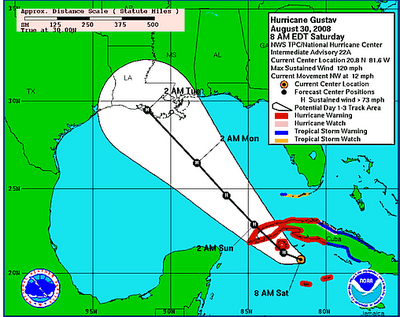
Gustav is gathering strength, heading towards Gulf Coast states
By Joe Sudbay (DC) August 30, 2008From the National Hurricane Center:
DATA FROM AN AIR FORCE RECONNAISSANCE AIRCRAFT INDICATE THAT MAXIMUM SUSTAINED WINDS HAVE CONTINUED TO INCREASE AND ARE NOW NEAR 120 MPH…195 KM/HR…WITH HIGHER GUSTS. GUSTAV IS A DANGEROUS CATEGORY THREE HURRICANE ON THE SAFFIR-SIMPSON HURRICANE SCALE. GUSTAV IS EXPECTED TO PASS OVER WESTERN CUBA AS A MAJOR HURRICANE…AND COULD REACH CATEGORY FOUR STATUS BEFORE MAKING LANDFALL THERE. ADDITIONAL STRENGTHENING IS POSSIBLE OVER THE SOUTHERN GULF OF MEXICO
And, the latest projected track has it hitting the coast of Louisiana in the very early hours of Tuesday:
Scott McClellan thinks this good be good for the Republican Party. Seriously:
“If it’s a major hurricane, I think that they certainly need to show they learned lessons from three years ago, both from a policy and perception standpoint,” McClellan said.
He also suggested that McCain could benefit politically from such a scenario: It would allow Bush to mount an effective GOP response to a disaster while removing the unpopular president from the convention roster.
“It could be a two-fer,” McClellan said.
Source / America Blog
Thanks to Diane Stirling-Stevens / The Rag Blog

Integrity Bank of Alpharetta, Georgia, was closed by U.S. regulators today, the 10th bank to collapse this year amid a surge in soured real-estate loans stemming from the worst housing slump since the Great Depression.
Integrity Bank, with $1.1 billion in assets and $974 million in deposits, was shuttered by the Georgia Department of Banking and Finance and the Federal Deposit Insurance Corp. Regions Financial Corp., Alabama’s biggest bank, will assume all deposits from Integrity, which was run by Integrity Bancshares Inc. The failed bank’s five offices will open on Sept. 2 as branches of Regions, the FDIC said.
“Depositors will continue to be insured with Regions Bank so there is no need for customers to change their banking relationship to retain their deposit insurance,” the FDIC said.
Banks are being closed at the fastest pace in 14 years as financial companies report more than $505 billion in writedowns and credit losses since 2007. California lender IndyMac Bancorp Inc., which had $32 billion in assets, was closed July 11 in the third-largest bank seizure, contributing to a 14 percent drop in the U.S. deposit insurance fund that had $45.2 billion at the end of the in the second quarter.
Regions will buy about $34.4 million in assets and will pay the FDIC a premium of 1.01 percent to assume the failed bank’s deposits, the FDIC said. The FDIC estimates the cost of the Integrity failure to its deposit-insurance fund will be $250 million to $300 million.
Read all of the gory details here. / Bloomberg
Thanks to Diane Stirling-Stevens / The Rag Blog

Secret Spying Court Stays Secret, Rejects ACLU Plea Again
By Ryan Singel / August 29, 2008
For the the third time in a year, a secret spying court rejected an ACLU request to let some sunshine pierce its dark curtains of secrecy, ruling late Thursday that national security prohibits publishing even unclassified versions of court documents or allowing non-government lawyers to argue in the court.
The Foreign Intelligence Surveillance Court was reacting to an ACLU petition in July to be part of the court’s review of new wiretapping powers handed to the Administration by Congress in July. Under the new law —known as the FISC Amendments Act — the nation’s spies can order companies like AT&T and Google to help the government drop dragnets into domestic internet and phone facilities to capture all communications suspected to involve at least one foreigner.
Previously, the law said that such wiretaps had to be approved on an individual basis if done inside the U.S., while more lax rules held sway if the govenrment wiretapped such communications outside the U.S. That legality did not stop the Bush Administration, which began a secret spying program after 9/11 that included targeting these kinds of communications.
The ACLU argued that the new law expanded the government’s powers so broadly that the court needed to make exceptions to its ultra-secret hearings that never allow any opposition.
Foreign Intelligence Surveillance Court judge Marya McLaughin dismissed those pleas, saying (.pdf) that there was no right for the public to know about the workings of the court.
The FISC has no tradition of openness, either with respect to its proceedings, its orders or to Government briefings filed with the FISC. […]
Although it is possible to identify some benefits which might flow from public access to Government briefs and FISC orders … any such benefits would be outweighed by the risks to national security created by the potential exposure of the Government’s targeting and minimization procedures.
ACLU attorney Jameel Jaffer expressed frustration, yet again — saying that secrecy should not be wrapped around a new law that affects every American’s privacy.
“The Bush administration says that the new law is necessary to protect the country against terrorism, but there’s nothing in the law that prevents the government from monitoring the communications of innocent Americans,” Jaffer said in a written statement. “The intelligence court should not be deciding important constitutional issues in secret judicial opinions issued after secret hearings at which only the government is permitted to appear.”
The ACLU also wanted to file a brief contesting the constitutionality of the targeting procedures and the law, but McLaughin declined, saying that the group’s analysis would not be helpful since only the government and the court know how the spying works.
The FISC was given a little authority in the new law to oversee the procedures the National Security Agency will use to make sure it does not intentionally target Americans or snag purely domestic communications with its new dragnets. Under the rules, the NSA can’t point the microphone at a particular American to monitor their overseas communications without a court order naming the target, but can monitor all Americans by targeting anyone outside the country using a new blanket order.
The ACLU also asked the court to make the government file unclassified versions of the documents it has to file with the court that describe the dragnets. Other than a yearly accounting of how many surveillance court orders it has granted or denied, little is known of the court and it has only released a handful of decisions in its 30-year history — including three in the last 12 months denying the ACLU’s petitions to open itself up.
The ACLU also filed suit in federal district court to contest the law, which also provides retroactive amnesty for telecoms that helped the government warrantlessly spy on Americans.
Source / Wired
Thanks to Diane Stirling-Stevens / The Rag Blog

Dumbest salvo yet in the war on terror, courtesy of the London police
By Cory Doctorow / August 30, 2008
Today I spotted this sign at a Tesco’s grocery store in Islington, London — it might just be the single stupidest salvo in the war on terror to date, courtesy of the London Metropolitan Police:
Terrorism: If you suspect it, report it
TERRORISTS NEED INFORMATION
Observation and surveillance help terrorists plan attacks. Have you seen anyone taking pictures of security arrangements?
TERRORISTS NEED TRANSPORTATION
If you work in vehicle hire or sales, has a sale or rental made you suspicious?
TERRORISTS NEED TO TRAVEL
Meetings, training and planning can take place anywhere. Do you know someone who travels but is vague about where they are going?
TERRORISTS USE COMPUTERS
Do you know someone who visits terrorism-related websites?
TERRORISTS NEED COMMUNICATION
Anonymous, pay-as-you-go and stolen mobiles are typical. Have you seen someone with large quantities of mobiles? Has it made you suspicious?
Translation: god help you if you worry about CCTVs in your neighbourhood, get into an argument at the car-rental agency, don’t feel like telling your co-workers that you go off to have regular dialysis treatments, look at websites that the guy next to you in the Internet cafe isn’t familiar with, or can’t get credit and use pay-as-you-go phones instead. After all, the police here don’t even need to charge you with a crime in order to lock you up for 42 days. Absolutely the stupidest salvo in the war on terror to date, Tesco’s, Islington, London, UK.
Source / Boing-Boing
Thanks to Diane Stirling-Stevens / The Rag Blog
This story yields speculation of another relatively predictable outcome: the acquital of KBR of any wrongdoing (see our post, Because the Empire is never, Ever Wrong – this is really all the same story, differing details). As Juan Cole points out, the circumstances that brought these Nepalese men to Iraq in the first place should be termed slavery (“human trafficking”) by any reasonable definition. How is it that this continues to occur in modern times?
Richard Jehn / The Rag Blog
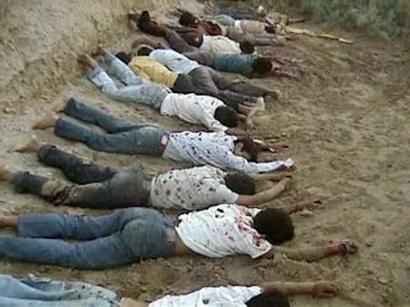
A Nepalese man and relatives of 12 others who were killed in Iraq four years ago are suing American firm KBR on charges of human trafficking.
The men were recruited in Nepal to work in a hotel in Jordan, but were later told they would have to work at a US air base in Iraq, their lawyers said.
Twelve of the men were kidnapped and killed by Islamic militants while being transported inside Iraq.
The 13th man was made to work against his will at the air base, lawyers said.
The execution-style killing of the hostages was recorded by the extremists and posted on a website.
The incident sparked riots in Nepal with angry demonstrators targeting a mosque, some government buildings and offices of employment agencies.
At least two people were killed in the protests.
‘Passports seized’
The lawsuit filed in the US District Court in Los Angeles on Wednesday alleged “that the illicit trafficking scheme… was engineering by KBR and its subcontractor”, identified as Daoud & Partners.
The men, between the ages of 18 and 27, were recruited “to work as kitchen staff in hotels and restaurants in Amman, Jordan”, said a statement from Cohen, Milstein, Hausfeld & Toll, one of the law firms handling the case.
Relatives of kidnapped worker in Iraq
Some recruitment agencies are blamed for sending workers to Iraq
But once they arrived in Jordan “they were not provided the expected employment,” the statement said.
Their passports were seized, and they were told they were being sent to Iraq “to provide menial labour” at the Al-Asad air base, it added.
“For 15 months, the 13th man Buddi Prasad Gurung, was held in Iraq against his will, before KBR and Daoud allowed him to return home to Nepal,” the statement said.
“It doesn’t appear that any of them knew they were going to Iraq,” news agency Reuters quoted attorney Matthew Handley as saying.
KBR would not comment on the lawsuit, but in a statement, the company said it “in no way condones or tolerates unethical or illegal behaviour”.
Nepal banned its citizens from going to Iraq to work there in 2003 because of safety concerns.
But a lack of employment opportunities back home meant that private recruitment agencies continued to send Nepalese workers to Iraq through countries like Jordan and Kuwait.
Source / BBC News
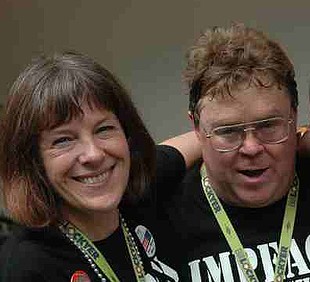
DENVER — This is my last day in town, and all the talk around the breakfast table is how and where everyone will watch or listen to ‘The Speech’, Obama’s premier performance at Invesco Field. I decide not to waste time hassling long lines or working connections for tickets, since I can watch it on TV in nearby Boulder, where my partner is staying with family.
So I head for the church hosting ‘The Nation’ and Progressive Democrats of America (PDA). On arrival, I’ve just missed Rev. Jesse Jackson, but Ron Kovic of ‘Born on the Fourth of July’ fame and early member of Vietnam Vets Against the War is holding forth on his mistreatment at a past GOP convention. He then reports on yesterday’s powerful five-mile IVAW and youth march. He did the entire length in his wheelchair. He can’t praise the organizers highly enough, acknowledges that Obama did the right thing, but says to keep pushing on. He ends by asserting that we can’t let the right have a monopoly on patriotism, so long as we remember we’re also ‘citizens of the world.’ He gets a standing ovation.
I decide to walk the streets again. I want to take it all in, and reflect at little on what major party conventions are all about.
First stop is the lobby at the Sheraton. For a veteran organizer like me, working away 0n a variety on fronts for 45 years, all I have to do is stand there for 15 minutes and someone I know will show up. Sure enough, someone calls my name, and it’s Brian Kettenring from ACORN, now one of their top organizers. I first met him when he was a young student ACORN worker in Chicago. He’s been on the West Coast for years, but introduces me to ACORN activists from Pennsylvania, now my base area.
Brian tells me he’s headed for ACORN headquarters in DC, where, half-joking, half serious, he tells me he wants them to let him set up a ‘Department of Socialism’ to discuss ‘bigger picture things’. I tell him I’ve working on just the thing for him, the newly formed ‘U.S. Solidarity Economy Network,’ with an upcoming conference early in 2009. My trend in SEN is based on David Schweickart’s ‘After Capitalism’ with ‘Economic Democracy’ as a ‘successor system’ enroute to a fuller blown socialism. It’ll challenge ACORN, but it starts on the ground, where they are. He’s very interested, and we decide to stay in touch on it. Plus I now have a new contact in Philly.
So there’s lesson number one. Conventions are about horizontal networking. Completely apart from the official goings-on, this stuff happens everywhere. Multiply my short example with Brian by 100, and you get the idea.
From the Sheraton, I take an elevated walkway and run into a building with an inviting, postmodernist display on ecology, energy and related topics. It’s aimed at DNC delegates and put up by a high-tech design outfit called ‘Partly Sunny: Designs to Change the Forecast. Inside are dozens of displays of green and solar construction materials and firms to build the homes and offices of the future. When a young guide offers to help, I ask ‘are any these outfits worker or community coops?’ Some are, she answers, and shows me how I can find out more. This gets me thinking that almost all of these firms are what we call ‘high road capitalists’ and thus some of them possible candidates to pull into our solidarity economy networking.
Now ‘Partly Sunny’ is just one of thousands of corporate displays, presentations and parties going on all week. While this one is a small, relatively progressive example, all of them, bad guys and good guys, are going all out in the DNC events to draw the country’s political class upward and into its orbit of influence.
Thus we have lesson number two. Conventions are about vertical networking and its more aggressive cousin, cooptation. There’s a constant influx of newer and younger delegates, candidates, elected officials and party workers to be recruited. If you’ve been to college, think fraternity and sorority ‘Rush Week’, and you’ll have the right idea.
I head back to the church because I want to catch PDA’s summary sessions. Along the way, I run into a dozen people I know wanting to know if I know where they can get tickets (I don’t) or telling me about the hoops they went through to get them.
This is lesson three. Conventions are about discovering the pecking orders in the various cliques, and how to turn them to your advantage, for good reasons or otherwise.
So I what do I conclude? Major party conventions are really a lot like high school and the socialization process we all experience in and through them. Learning all the cliques, all the pecking orders, where you can best fit in and suffer least, having a good time in the coolest clubs and extracurricular activities. You know, all the important stuff that goes on everywhere except the classroom. At the DNC, all the important stuff these days goes on everywhere EXCEPT on the convention floor and the ‘big night’ speeches. These latter events are actually, for better or worse, carefully scripted infomercials mostly far beyond our reach.
A corollary lesson: You can accomplish a lot here, but you better come in with a very clear idea of your core values, your own platform and your strategic orientation. If you don’t, you’ll wind up being part of someone else’s platform and strategy. But if you do, you can make major gains.
PDA is a case in point. As I arrive for the final sessions, Dennis Kucinich is pressing impeachment, whipping out his pocket copy of the Constitution. Next, Steve Cobble, Leslie Cagan, Jaime Raskin (State Senator, Maryland) and Rep Keith Ellison, the Congressman from Minnesota who is also a practicing Muslim, and caused a flurry in the press when he was sworn in using Thomas Jefferson’s personal copy of the Koran–all of them are on the platform, ready to follow up and discuss what it means to defend the Constitution and democracy in even broader terms.
Tim Carpenter, PDA’s tireless chief organizer and John Nichols of the Nation are setting up the crowd. Tim is explaining how PDA has grown, in just four years, from a few dozen in 2004 to now over 140,000 members all across the country. Mimi Kennedy and Jodie Evans are also there, and add in on how the persistent and audacious pursuit of their ‘inside-outside’ strategy has succeeded and the turnouts to all the sessions this week shows they’ve made even greater gains.
PDA, of course, is hardly the only player in the progressive movement. I like much of what they do, and work closely with them back in Beaver County, Pa. But there’s also room for improvement and other approaches and organizations, too. My point here is that groups ignoring and avoiding the political events and activities surrounding elections–and you don’t have to support any candidate or platform to be engaged in them–are only shooting themselves in the foot.
I’m hardly a believer that basic social change is achieved by elections. But I’m a firm believer that change on this order must proceed THROUGH them, in the long march through all the institutions of our society, building the strongholds we need for the popular power and economic democracy that can take us even farther down the road. With that thought in mind, I’m headed back to Beaver County, Western PA, where I hear Obama and Biden are making a bus tour around the state. It’s a very tight race there, and we’ll soon see if this helps.
Source / Progressives for Obama
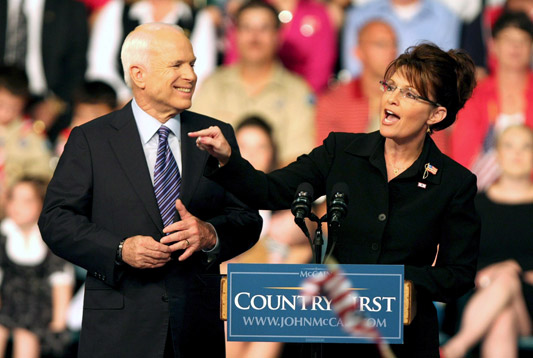
Presumably, John McCain would only select a candidate for vice president who shared his supposedly clear-eyed vision about Iraq, who had also called for — or at least thought it was a good idea — to push more troops into Iraq in 2007.
Well, maybe Sarah Palin thought the surge was great, or maybe she didn’t. It’s hard to tell what, if anything, Palin thinks or thought about the surge of troops in Iraq, or the decision to invade Iraq in the first place, for that matter. A clip search doesn’t show any substantive comments from Palin about Iraq during her short term as governor of Alaska, in 2007 or 2008, or at any point prior to that. That includes instances when she was specifically asked about the war.
In an interview with Alaska Business Monthly shortly after she took office in 2007, Palin was asked about the upcoming surge. She said she hadn’t thought about it. “I’ve been so focused on state government, I haven’t really focused much on the war in Iraq,” she said. “I heard on the news about the new deployments, and while I support our president, Condoleezza Rice and the administration, I want to know that we have an exit plan in place; I want assurances that we are doing all we can to keep our troops safe.”
Seven months into the surge, she still either had not formed any opinion on the surge or the war or just wasn’t sharing. “I’m not here to judge the idea of withdrawing, or the timeline,” she said in a teleconference interview with reporters during a July 2007 visit with Alaska National Guard troops stationed in Kuwait. “I’m not going to judge even the surge. I’m here to find out what Alaskans need of me as their governor.”
That’s a little weird, since Fort Richardson, near Anchorage, has dispatched countless soldiers to Iraq, including many who did not make it back. And Palin’s own son, Track, is an infantry soldier who could go there any time.
Source / salon.com

ANCHORAGE, Alaska — “Is this a joke?” That seemed to be the question du jour when my phone started ringing off the hook at 6:45am here in Alaska. I mean, we’re sort of excited that our humble state has gotten some kind of national ‘nod’….but seriously? Sarah Palin for Vice President? Yes, she’s a popular governor. Her all time high approval rating hovered around 90% at one point. But bear in mind that the 90% approval rating came from one of the most conservative, and reddest-of-the-red states out there. And that approval rating came before a series of events that have lead many Alaskans to question the governor’s once pristine image.
There is no doubt in my mind that many Alaskans are feeling pretty excited about this. But we live in our own little bubble up here, and most of the attention we get is because of The Bridge to Nowhere, polar bears, the indictment of Ted Stevens, and the ongoing investigation and conviction of the string of legislators and oil executives who literally called themselves “The Corrupt Bastards Club”.
So seeing our governor out there in the national spotlight accepting the nomination for Vice Presidential candidate is just downright surreal. Just months ago, when rumors surfaced that she was on the long version of the short list, she was questioned if she’d be interested in the position. She said she couldn’t answer “until somebody answers for me what is it exactly that the VP does every day. I’m used to being very productive and working real hard in an administration. We want to make sure that that VP slot would be a fruitful type of position, especially for Alaskans and for the things that we’re trying to accomplish up here….”
There is no doubt that Palin has fierce territorial loyalties. When elected governor there was much concern because she came right out and said she would favor her own home town of Wasilla (where she was mayor) and its surrounding environs collectively known as “the Valley” while leading the state. And it’s obvious from her statement that Alaska was on her mind when accepting the VP nod (see my emphasis above).
So what is it that we’re “trying to accomplish up here”?
* Palin is currently in the middle of a controversial gas pipeline project in Alaska. She’s favored the ‘Trans Canada’ proposal that will run the pipeline through Canada, in effect shipping US jobs over the border. Many Alaskans, including former governors, have favored the “All Alaska Route”.
* She is also sueing the federal government over listing the polar bears as a threatened species. The science was even compelling enough to convince the Secretery of the Interior that the bears needed to be listed. But acknowlegement of this issue, and the potential disruption to development on Alaska’s oil-rich north slope spurred Palin to attempt to stop the listing.
* Does she want to open ANWR? Yes. Every politician in Alaska wants to open ANWR. It’s basically a requirement if you ever hope to get elected for anything. Even Mark Begich, the progressive Democrat running against the indicted Senator and Alaskan institution Ted Stevens, is pro-drilling. That’s the sea we swim in up here. There are a few anti-drilling folks, but you have to look hard to find them, and work hard to have them admit it.
Will all this wash with voters in the ‘Lower 48′? Time will tell.
18 Million Cracks in the Glass Ceiling
It was obvious anyway, but became beat-you-over-the-head-with-a-two-by-four obvious when Palin referenced the ‘glass ceiling’ line, that this choice is a blatant pander to women. I would like to believe that women will actually feel insulted by this. Yes, it would have been historic if Hillary had gotten the nomination. It was historic that she made it as far as she did. Yes, it would be great to have a woman in the oval office, or in the VP slot if they are the right woman…a woman who got there with her own drive, grit, determination, intelligence, skill and merits. When you’re hand-picked by a man to win votes simply because you are a woman, that doesn’t count, and it doesn’t break any kind of ceiling. Would we have had a Stan Palin as our VP pick? No. So choosing a woman because you think her gender will get votes is insulting.
Governor “Squeakyclean”… or not
Another focus of Palin’s introduction today was her reform image. Listen to John McCain and you’ll hear about a maverick reformer who took on big oil, took on corrupt Alaska politicians, and whose ethics are unquestioned.
Alaskans really want to like Sarah Palin. In a state where corruption is the rule, and the same faces keep recycling over and over and over again like a bad dream, a new face, with a promise of reform seemed like a breath of fresh air. Palin defeated incumbent governor Frank Murkowski (father of Alaska Senator Lisa Murkowski who he appointed to his own Senate seat when he was elected governor) because he was such an obnoxious, bloviating, downright BAD politician. This staunchly republican state voted with relief, not having to cross over and vote Democratic, but still able to get Murkowski the hell out of office. In the general election Palin swept into office running against a former Democratic governor, Tony Knowles, who was capable but came with baggage. And he represented to Alaskans more of the same, tired old-style politics, and special interests that we have come to loathe.
So, if McCain had made his selection six months ago, the squeaky-clean governor meme would have made a little more sense. But, Sarah Palin is currently under an ethics investigation by the Alaska state legislature. The details of this investigation read like a trashy novel, and I suspect that the players will soon have newfound celebrity on the national stage. I’ll try to explain for all you non-Alaskans who suddenly have good reason to want to know more about Sarah Palin. For those of you not interested in trashy novels, feel free to skip ahead. Here it is…what we in Alaska call “TrooperGate”.
Sarah Palin’s sister Molly married a guy named Mike Wooten who is an Alaska State Trooper. Mike and Molly had a rocky marriage. When the marriage broke up, there was a bitter custody fight that is still ongoing. During the custody investigation, all sorts of things were brought up about Wooten including the fact that he had illegally shot a moose (yes folks this is Alaska), driven drunk, and used a taser (on the test setting, he reminds us) on his 11-year old stepson, who supposedly had asked to see what it felt like. While Wooten has turned out to be a less than stellar figure, the fact that Palin’s father accompanied him on the infamous moose hunt, and that many of the dozens of charges brought up by the Palin family happened long before they were ever reported smacked of desperate custody fight. Wooten’s story is that he was basically stalked by the family.
After all this, Wooten was investigated and disciplined on two counts and allowed to kept his position with the troopers. Enter Walt Monegan, Palin’s appointed new chief of the Department of Public Safety and head of the troopers. Monegan was beloved by the troopers, did a bang-up job with minimal funding and suddenly got axed. Palin was out of town and Monegan got “offered another job” (aka fired) with no explanation to Alaskans. Pressure was put on the governor to give details, because rumors started to swirl around the fact that the highly respected Monegan was fired because he refused to fire the aforementioned Mike Wooten. Palin vehemently denied ever talking to Monegan or pressuring Monegan in any way to fire Wooten, or that anyone on her staff did. Over the weeks it has come out that not only was pressure applied, there were literally dozens of conversations in which pressure was applied to fire him. Monegan has testified to this fact, spurring an ongoing investigation by the Alaska state legislature. But, before this investigation got underway, Palin sent the Alaska State Attorney General out to do some investigative work of his own so she could find out in advance what the real investigation was going to find. (No, I’m not making this up). The AG interviewed several people, unbeknownst to the actual appointed investigator or the Legislature! Palin’s investigation of herself uncovered a recorded phone call retained by the Alaska State Troopers from Frank Bailey, a Palin underling, putting pressure on a trooper about the Wooten non-firing. Todd Palin (governor’s husband) even talked to Monegan himself in Palin’s office while she was away. Bailey is now on paid administrative leave.
As if this weren’t enough, Monegan’s appointed replacement Chuck Kopp, turns out to have been the center of his own little scandal. He received a letter of reprimand and was reassigned after sexual harrassment allegations by a former coworker who didn’t like all the unwanted kissing and hugging in the office. Was he vetted? Obviously not. When he was questioned about all this, his comment was that no one had asked him and he thought they all knew. Kopp, defiant, still claimed to have done nothing wrong and said to the press that there was no way he was stepping down from his new position. Twenty four hours later, he stepped down. Later it was uncovered that he received a $10,000 severance package for his two weeks on the job from Palin. Monegan got nothing.
After extensive news coverage about all this nasty behind-the-scenes scandal, which is definitely NOT squeaky clean, Palin’s approval ratings fell to 67%, still high, but a far cry from the 90% number that’s being thrown around so glibly by the Republicans today. Alaskans are quickly becoming disillusioned once again.
“Executive Experience”
Before her meteoric rise to political success as governor, just two short years ago Sarah Palin was the mayor of Wasilla. I had a good chuckle at MSN.com’s claim that she had been the mayor of “Wasilla City”. It is not a city. Just Wasilla. Wasilla is the heart of the Alaska “Bible belt” and Sarah was raised amongst the tribe that believes creationism should be taught in our public schools, homosexuality is a sin, and life begins at conception. She’s a gun-toting, hang ‘em high conservative. Remember…this is where her approval ratings come from. There is no doubt that McCain again is making a strategic choice to appeal to a particular demographic – fundamentalist right-wing gun-owning Christians. And Republican bloggers are already gushing about how she has ‘more executive experience’ than Obama does! Above is a picture of lovely downtown Wasilla, for those of you unfamiliar with the area. Behind the Mug-Shot Saloon (the first bar I visited when I moved to Alaska long ago) is a little strip mall. There are street signs in Wasilla with bullet holes in them. Wasilla has a population of about 5500 people, and 1979 occupied housing units. This is where your potential Vice President was two short years ago. Can you imagine her negotiating a nuclear non-proliferation treaty? Discussing foreign policy? Understanding non-Alaskan issues? Frankly, I don’t even know if she’s ever been out of the country. She may ‘get’ Alaska, but there are only a half a million people here. Don’t get me wrong….I love Alaska with all my heart. I’m just saying.
I, and all Alaskans will be interested to see how this whole process unfolds. This is definitely a gamble for McCain, and in my humble opinion, a gift to Obama and to Joe Biden who just got thrown a big hunk of red meat for the vice presidential debate.
This is the wedge-issue, desperate ’Hail Sarah’ pass of the McCain campaign.
Now I’m off to get some Jiffy Pop.

Local Reaction to the Palin Bombshell
I, like all Alaskans, have been glued to the news media today, watching with amazement as Sarah Palin was tagged as McCain’s vice presidential running mate. Local radio talk shows are all a-buzz. The progressive station has a mixture of callers who are amused, horrified, and bewildered. The conservative station has a mixture of callers who are amused, enthusiastic, horrified and bewildered. No one is really sure how this happened, or what to make of it. Citing the fact that she was the mayor of Wasilla 2 years ago in her list of “executive experience” doesn’t even pass the giggle test in Alaska. Palin does have many supporters here in the state, but even many of them are doubting whether she can cut it in the Veep slot. A few callers have said they feel sorry for her, because they like her but she’s obviously being “used” and is way over her head. Local politicians are fiercely divided. Those who like her are generally appointees who are locally referred to as “Palin-bots” and have drawn comparisons to George Bush’s idealogical croneys. Many, Democrats and Republicans, are fierce opponents.
Here’s a smattering of reactions:
Alaska State Senate President Lyda Green (R): “She’s not prepared to be governor. How can she be prepared to be vice president or president? Look at what she’s done to this state. What would she do to the nation?” (Green is from Palin’s home town of Wasilla.)
Alaska House Speaker John Harris (R): “She’s old enough. She’s a U.S. citizen.”
Alaska Democratic Party Chair Patti Higgins: “In this very competitive election for them to go pick somebody who is … under a cloud of suspicion, who is under investigation for abuse of power. It just sounds like a pretty slow start to me. We need a vice president who can step in if, God forbid, something happened to John McCain. I don’t think she’s someone who is ready for that 3 a.m. phone call.”
Randy Ruedrich, Alaska Republican Party Chair: Not giving interviews.
Alaska Attorney General Talis Colberg: “a mixed set of emotions, kind of an odd sense of Alaska nationalism or pride. This is like watching a moon landing or something. It’s just something you don’t expect to see very often. It’s wonderful. It was an emotional thing to see the governor walk out with her family and I say, wow, I work for her.”
McHugh Pierre, Alaska Republican Party Spokesman: “She brings her voice of new energy and change. And she knows Alaska.”
Indicted Alaska Sr. Senator Ted Stevens (R): “it’s a great day for the nation and Alaskans.”
Andrew Halcro, local blogger who ran against Palin for governor: “This shocking choice says more about McCain’s desperation than it does about Palin’s qualifications”.
and my favorite…
Alaska State Representative Mike Doogan (D): “Either Sarah Palin has talents and skills we were not aware of”, or “John McCain fell down and hit his head”. He also called the prospect of Palin potentially needing to take over as President”pretty scary.”
Source / Mudflats
Thanks to Harry Edwards / The Rag Blog

OAKLAND, California — In a project that would make Franz Kafka grin, a 30-year-old bug has metamorphosed into a snail. The resulting creation, an art car called The Golden Mean, is a golden gastropod that glows in the dark and shoots rings of fire from its feelers. It also seats six comfortably.
Blacksmith John Sarriugarte, who fabricates custom home furnishings, worked with his wife, Kyrsten Mate, to transform a 1966 VW Bug into the rolling piece of art. The Golden Mean is making its debut at the Burning Man art festival this year.
Mate says she literally dreamed up the concept.
“I woke up and said, ‘We have to build this giant snail,'” she said. “It totally wasn’t planned. This whole project has been weird coincidences and math.”
The visually stunning vehicle takes its name from the golden ratio, a mathematical proportion that’s said to produce aesthetically pleasing art and architecture. The spiral in the snail’s shell is shockingly close to the ratio. Other inspirations for the project include the giant pink snail from Doctor Dolittle, giant mechanical elephant puppets by Royal de Luxe and Jules Verne’s imaginative creations.
For a peek at last-minute preparations that took place in Sarriugarte’s Form & Reform shop before Golden Mean headed off for its date with the playa, go here.
Source / Wired
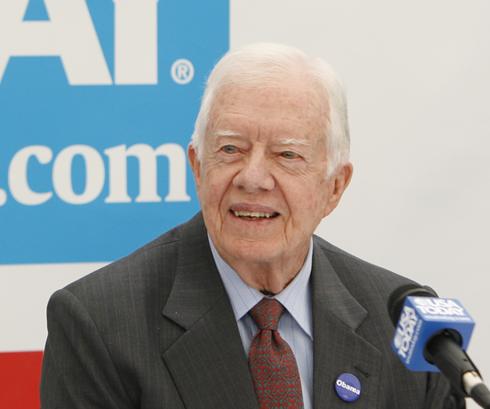
DENVER — Former president Jimmy Carter called Republican presidential candidate John McCain a “distinguished naval officer,” but he said the Arizona senator has been “milking every possible drop of advantage” from his time served as a prisoner of war in Vietnam.
Carter spoke Thursday with USA TODAY and Gannett News Service reporters before Barack Obama’s acceptance speech to cap off the Democratic National Convention. Carter spoke of Obama’s challenges facing the lingering effects of racism in the United States and the ability of the Clintons to bring their supporters over to Obama. He decried Connecticut Sen. Joe Lieberman’s decision to “abandon” the Democrats by speaking at the Republican convention next week.
Carter, however, focused heavily on McCain. He said he was bewildered by McCain’s performance at the Saddleback Presidential Forum hosted by pastor and author Rick Warren in Lake Forest, Calif., earlier this month.
Carter said that whether he was asked about religion, domestic or foreign affairs, every answer came back to McCain’s 5½ years as a POW.
“John McCain was able to weave in his experience in a Vietnam prison camp, no matter what the question was,” Carter said. “It’s much better than talking about how he’s changed his total character between being a senator, a kind of a maverick … and his acquiescence in the last few months with every kind of lobbyist pressure that the right-wing Republicans have presented.”
Carter said Lieberman, Al Gore’s running mate in 2000 and now an independent, had cast his lot with the GOP by deciding to speak at the party’s convention.
Lieberman switched his party registration after losing the 2006 Democratic senatorial primary to Ned Lamont, who made opposition to the Iraq war central to his campaign. Lieberman kept his seat and has helped Democrats maintain a 51-49 voting edge.
“I would hope that the Democrats could have enough senators elected in November so that we would not any longer need to include Joe Lieberman among the senators,” Carter said.
Carter called Hillary Rodham Clinton’s speech at the convention Tuesday “superb” but questioned her for pointing out her accomplishments in some areas and merely saying that Obama shared those concerns.
Carter said former president Bill Clinton’s speech Wednesday was “perfect.” Carter said the two speeches took pressure off Obama by uniting the party and ensuring that Clinton supporters would support Obama.
Carter cited a USA TODAY/Gallup Poll last week that found 47% of Clinton supporters said they were solidly behind Obama and 30% said they would vote for McCain, someone else or no one at all. “I think that this week has eliminated that disparity,” he said.
Carter also spoke of the segregation he saw growing up and said racism is “always a subtle factor” in American politics. He called this November’s election possibly the most “momentous, important” U.S. election in the past 100 years, and he was confident that Obama could overcome the racial divide.
But he said race could ultimately be the deciding factor.
Source / USA Today

The credit crunch is morphing from an American-centred financial crisis into a global economic crisis,” says David Bowers of Absolute Strategy Research…
‘Borrowing our way to prosperity’
By Roger Baker / The Rag Blog / August 29, 2008
Damnation! The problems we create when our bankers gamble on maintaining exponential growth on a finite planet. Borrowing our way to prosperity using Chinese loans by pledging our houses as collateral does not seem to be working so well lately. Who would have thought somebody would expect to be paid back before they would lend us some more?
Fortunately all we have to do is print up a ton of money and we can make the problem go away. And with bank bailouts we don’t even need to mess around with all those messy printing presses, do we?
And aren’t you glad this will all have a happy ending with a man like Obama as president?
A Nightmare on Wall Street
Aug 28th 2008Why the credit crunch has lasted so long
LIKE a Hollywood monster that is impervious to bullets, the credit crisis refuses to lie down and die. The authorities have bombarded it with interest-rate reductions, tax cuts, special liquidity schemes and bank bail-outs, but still the creature lumbers forward, threatening new victims with every step. Global stockmarkets are suffering double-digit losses this year, and credit markets are once again gummed up.For investors who cut their teeth in the 1980s and 1990s, the persistence of the crisis must be a surprise. Prompt action by central banks, after Black Monday in 1987 (when America’s stockmarket fell by almost 23%), or following the collapse of Long-Term Capital Management, a hedge fund, in 1998, suggested it was always worthwhile to “buy on the dips”.
One reason why things are different this time is that there has been a double shock. On top of the decline in house prices and the associated drop in the prices of asset-backed securities, the markets have also had to face a surge in commodity prices. That has constrained central banks from easing monetary policy as much as they might have done, particularly in Britain and the euro zone. Even in America, rates might now perhaps be 1% (as they were in 2003) without the commodity boom.
In addition, the combination of the two shocks has created uncertainty about the direction of monetary and regulatory policy. Will the central banks be forced to “do a Turkey” and adjust their inflation targets upward (implicitly or explicitly) to reflect reality? Alternatively, will they crack down so hard on inflation that they force their economies into recession? And will the price of investment-bank rescues be a harsh new regulatory regime that restricts the scope for future credit (and economic) growth? In the face of all this uncertainty, investors can hardly be blamed for being cautious.
The way that the crisis has centred on the banking industry also explains its duration. Stephen King, an economist at HSBC, points out that the financial crises of the 1990s were also prolonged, from the savings and loan collapses in America through the Swedish banking rescues to the extremes of Japan’s debt deflation. As Mr King says, “if banks are unable or unwilling to lend, monetary policy doesn’t work so well.”
Worse still, bank problems create a feedback loop with the rest of the economy. When banks get into difficulty, they restrict their lending. That in turn makes life more difficult for companies and consumers, causing them to cut their spending and making it harder for them to repay their debts. That forces further caution on the banks.
Recent economic data have highlighted how the gloom is spreading. Neither Germany nor Japan enjoyed a credit boom earlier this decade but both economies are suffering. Business confidence in Germany fell to its lowest level in three years, according to the latest Ifo survey, released on August 26th. “The credit crunch is morphing from an American-centred financial crisis into a global economic crisis,” says David Bowers of Absolute Strategy Research, a consultancy.
Another reason why the crisis is lasting so long stems from the nature of the previous boom. Everyone was borrowing money, from homeowners buying houses they could not afford in the hope of capital gains, to investors buying complex debt products with high yields because of the extra “carry”.
These investors were, directly or indirectly, beholden to the banks. Even when money was borrowed from “the market”, the lenders may well have been hedge funds, conduits or structured-investment vehicles, all of which had themselves borrowed money from banks in the first place. That former wellhead of finance has now run fairly dry.
In turn, that explains the absence of bargain hunters, particularly in the debt markets. Investment-grade debt might look attractive on a five-year view, if all you have to worry about is the risk of default. But most investors in that market have a three- or six-month view; they cannot afford for things to get worse before they get better, in case they are forced into a fire-sale of their assets.
So the markets (and the developed economies) are waiting for a catalyst for recovery. Lower commodity prices helped for a while, and may help further if they encourage central banks to cut rates. Evidence of a bottom in the American housing market may also do the trick. But the crisis seems certain to linger into 2009, and could even make it into the following year. Successful horror movies tend, after all, to have several sequels.
Source / The Economist
Thorne Webb Dreyer, Editor