What Are We So Afraid Of?


Canadian border no longer invisible in Vermont
Keith B. Richburg / August 24, 2008

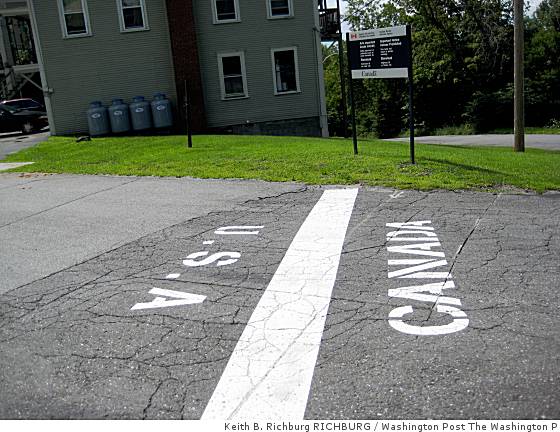
DERBY LINIE, Vt. — The changes started coming slowly to this small town where the U.S. border with Canada runs across sleepy streets, through houses and families, and smack down the middle of the shared local library.

First was the white, painted lettering on the pavement on three little side streets – “Canada” on one side, “U.S.A.” on the other. Then came the white pylons denoting which side of the border was which. After that, signboards were erected on some streets, ordering drivers to turn back and use an officially designated entry point.

And along with the signposts came an influx of American Border Patrol agents, cruising through the town in their sport-utility vehicles with sirens, chasing down cars and mopeds that ignored the posted warnings.

For longtime residents accustomed to a simpler life that flowed freely across a largely invisible border, the final shock – and what made most people really take notice – was a proposal by the border agents last year to erect fences on the small streets to officially barricade Derby Line from Stanstead, Quebec, and neighbor from neighbor.

“They’re stirring up a little hate and discontent with that deal,” said Claire Currier, who grew up in this border area and works at Brown’s Drug Store, which has operated on the same spot since 1884. “We’ve all intermingled for years.”

For the Department of Homeland Security, the changes are part of a gradual fortification of America’s northern border that began shortly after the Sept. 11, 2001, terrorist attacks and has accelerated in recent years.

The hardening of the northern frontier is unsettling to many in the small towns along the border. For as long as most of these people can remember, the line between the United States and Canada has been little more than a historic curiosity, rather than the hard and fast demarcation that is America’s southern border.

Named the Secure Border Initiative, the project calls for more than tripling the number of agents along the northern border, adding boats and helicopters, and deploying sophisticated new technology including hundreds of millions of dollars in new communications equipment, radiation detectors and three different types of camera-mounted sensors in the uninhabited wooded areas.

“It was freer before, but we live in a different world now,” said agent Mark Henry, the operations officer at the Border Patrol’s Swanton Sector, headquartered in Swanton, Vt. The sector encompasses about 24,000 square miles, extending from the town of Champlain, in upstate New York, on the east all the way across to the border with Maine. The sector now has 250 agents, up from 180 three years ago, and the number is scheduled to reach 300 next year. In 2001, there were 340 agents along the entire border with Canada.

“9/11 changed everything,” said Border Patrol agent Fernando Beltran, the operations chief for Swanton Sector’s Newport station, which includes Derby Line. “This may have been Mayberry before, but it’s not anymore.”

Residents of this town of 776 understand the need for enhanced security. They also wistfully remember a time when neighbors easily crossed into another country to visit neighbors. People went to church and to school on either side of the line. Members of the same family lived on either side. Some streets, an old factory, the local library and opera house, and a few houses straddle the line.

“I have one brother – he’s American. He was born on the U.S. side. I was born on the Canadian side,” said Arthur Brewer, who is 76. “It was like there was no border.”

Townsfolk are concerned about practical issues with fences. The two sides share a water system, a sewer system and snow-removal services. For years, the fire departments of both sides have helped each other without regard to a border, and fences, they fear, might disrupt travel routes for emergency vehicles.

“It hasn’t been an easy issue for either side to digest,” said lifelong resident Karen Jenne, the Derby Line town clerk and treasurer. “But we understand that Border Patrol and Homeland Security have a job to do.”

The new vigilance has led to more arrests of people crossing illegally and interdiction of contraband, mostly drugs. Border agents in this sector said that last year they arrested people from 117 different countries trying to enter the United States illegally.

The resources here are still a small fraction of what is deployed on the southern border with Mexico. But with the increased Border Patrol presence, the North is starting to look more like what border residents of Texas, California and Arizona have been seeing for years.

Source / San Francisco Chronicle

The Rag Blog

Posted in RagBlog | Tagged , , | 1 Comment

Slow Food Nation : You Are What You Eat


The Slow Food Nation gathering promises to be a Woodstock for food lovers and enviros concerned with our food system.
By Kerry Trueman / August 25

SAN FRANCISCO — A swarm of 40,000 to 50,000 locavores will descend on San Francisco this Labor Day weekend to attend Slow Food Nation, a four-day extravaganza of teach-ins and tastings that’s being billed as a kind of “Woodstock for gastronomes.”

I’d rather go to a Woodstock for garden gnomes, myself — at least those Lilliputian lawn ornaments share my fondness for front yard farming. Gastro gnomes, on the other hand, sound like elitist elves who are overly fond of artisanal cheeses and grass-fed beef. Do we really need a celebration of such highfalutin culinary novelties at a time when high fuel and food costs are making it harder for people to keep their pantries stocked with even the most basic staples?

Well, yes, we do, because we need to remember that the fresh, unadulterated, minimally processed, locally produced foods that Slow Food Nation is showcasing were our pantry staples, before the military-industrial complex annexed our food chain a half a century or so ago in the name of progress.

Our great-grandparents would be flabbergasted to learn that grass-fed milk in glass bottles bearing the local dairy farm’s logo is now a rare luxury item available to only the affluent few who are willing to pay $4 for a half-gallon of milk.

Back in the day, our breads were fresh-baked and free of high fructose corn syrup, and our eggs and bacon came from chickens and hogs that rolled around in the dirt and saw the light of day. The word “farm” still evokes nostalgic pastoral images for most Americans, but there’s nothing even remotely benign or bucolic about the fetid, brutal factory farms that supply us with most of our meat, poultry, eggs and dairy products today. And unmasking this unsavory reality is as much a part of Slow Food Nation’s agrarian agenda as dishing out local delicacies.

So don’t be distracted by the aroma of wood-fired focaccia wafting from the Fort Mason Center “Taste Pavilions”; Slow Food Nation has the potential to spark a crucial dialogue about where our food comes from, how it’s grown, and why all that matters. With forums featuring the good food movement’s marquee names, including Wendell Berry, Vandana Shiva, Michael Pollan, Marion Nestle and Eric Schlosser, this Alice Waters-sponsored shindig could be the watershed event that puts America’s foodsheds on the map.

Don’t know what a “foodshed” is? Don’t worry, nobody else does, either — the word is still so obscure it hasn’t earned an entry on Wikipedia. It means, essentially, the area through which food travels to get from the farm to your plate. That would have been a pretty short trip a few generations ago, but in this era of globalization, our foodshed now encompasses the whole world, more or less.

This far-flung food chain has enslaved us with a false sense of abundance, turning the produce aisles of our supermarkets into a seasonless place where you can find berries and bell peppers all year round. But this apparent bounty diverts us from the fact that industrial agriculture has actually drastically reduced the diversity of the foods that our farmers grow.

As small and mid-size farms got swallowed up by the massive monoculture operations we now call “conventional,” the varieties of fruits and vegetables grown on those farms got whittled down to just those few that shipped the best and had the longest shelf life. Breeders chose to focus on species of livestock and poultry that fatten up the fastest, such as big-breasted but bland Butterball turkeys so top-heavy they can’t reproduce naturally and have to be artificially inseminated. For this we give thanks each November?

This focus on economies of scale, and the illusory “efficiency” of a food system dependent on cheap fossil fuels and perpetual subsidies, gave us, the richest nation in the world, the cheapest food. And we are all the poorer for it.

Along the way, we lost hundreds of different kinds of plants and animals; currently, “at least 1,060 food varieties unique to North America are threatened, endangered or functionally extinct in the marketplaces of the United States, Canada, and northern Mexico,” Gary Paul Nabhan writes in Renewing America’s Food Traditions, a new book that celebrates the distinctive culinary regions of our country that Agribiz almost obliterated in recent decades.

But Renewing America’s Food Traditions is not just a book; it’s an alliance: Called RAFT for short, it’s a collaborative effort from Slow Food USA and six other sustainably minded organizations. RAFT’s mission is to inspire what the folks at Slow Foods USA call “eater-based conservation” by preserving and promoting the culinary heritage and extraordinary biodiversity that blessed this country for centuries before we shifted gears and became a fast food nation.

Nabhan is participating in a Slow Food Nation forum, “Re-Localizing Food,” along with Pollan, Dan Barber and Winona LaDuke, but this powerhouse panel is, alas, already sold out, along with most of the other forums featuring the rock stars of the real food movement.

Thankfully, the Slow Food Nation folks are offering some free events and exhibits, too, including the Marketplace, which promises “to transform San Francisco’s Civic Center Plaza into an urban garden, farmers market, outdoor food bazaar and soapbox,” and the Slow Food Nation Victory Garden in front of City Hall, whose impressive array of organic heirloom vegetables is being donated to local food banks.

In keeping with its goal to promote all things sustainable, Slow Food Nation aspires to be a “zero waste event:” In addition to recycling and composting food waste, plates, flatware and packaging, Slow Food Nation is joining forces with Food and Water Watch to banish bottled water from the four-day festival. Echoing Food and Water Watch’s Take Back the Tap campaign, the event will instead offer five tap water stations where folks can refill their water bottles — or, if you didn’t bring your own, you can buy a reusable, eco-friendly stainless steel canteen.

Not content to just spare us the spectacle of 50,000 good food fanatics washing down all those sustainable snacks with bottled water, Food and Water Watch has posted a much-needed guide on its Web site for the rest of us on how to “Free Your Event From Bottled Water.” Pair this with Slow Food Nation’s Declaration for Healthy Food and Agriculture, to be unveiled on Aug. 28 at San Francisco’s City Hall, and you’ve got a virtual road map to a real revolution, even if you’re not going to San Francisco.

Source / AlterNet

Thanks to David Hamilton / The Rag Blog

Posted in RagBlog | Tagged , , , , , | 1 Comment

Cyndi Lauper on Obama’s Brand of Hope : One Size Fits All


‘We as a society, LGBT or straight, can show that civil rights are important and discrimination is wrong across the board through our vote.’
By Cyndi Lauper / August 24, 2008

As I toured all over the country this summer with True Colors, I saw something in the eyes of the audience I have not seen in a very long time, it was hope. Each night as I talked about the power of voting, it was evident through their reactions that the crowd wanted to change how this country is run. That is the one good thing that President Bush has done in the past seven years, he has created a movement within the country to change how things are done in Washington DC. But, what mattered to me the most is that everyone cared enough about their own lives and the future to register and vote.

I believe we are at a crossroads and the next ten years will determine the future of this country. Like I said from the stage, this is not voting for the American Idol, it is much more important, this is voting for the American President. And now that I’m home again, and off stage, I wonder, will we become the country that respects the diversity that is our backbone or will we continue down this path of the few ruling the many? I wonder to myself are we gonna make that change in a big way and when I think about it I believe that the change can happen in the form of Senator Barack Obama.

Because, America is a quilt of many fabulous fabrics and we have a sorted history that has not always respected that. And because, for far too long groups of people have been singled out and discriminated against simply because of such things as the color of their skin, their religious beliefs or whom they love. And, that these very acts undermine the basic principles this country was founded on, the time has come to finally break down the barriers that keep America from fulfilling its destiny.

In particular, the lesbian, gay, bisexual and transgender community is closer than ever to gaining full equality. We are teetering back and forth right now, and we need to act together to push us in the right direction. What we are asking for is only fair and right. We as a society, LGBT or straight, can show that civil rights are important and discrimination is wrong across the board through our vote. I believe by voting for Barack Obama we will do just that.

Like Obama, I grew up with a loving, hard-working single mom, in a neighborhood mixed with all races and different backgrounds. And like Obama, I knew that was our strength and not our weakness.

I see in Barack Obama a real fighter for fairness and inclusion, a person who overcame every obstacle growing up to achieve an education and to become the leader he is today. He battles against discrimination of all kinds, from race and gender to sexual orientation and gender identity. He is the most inclusive candidate who has a real chance at the White House that we ever have had. He is a true American who commands respect and more importantly respects Americans – all of us.

I believe that a President Obama would deliver on the promises that have been made to the LGBT community for so long, like inclusive workplace non-discrimination legislation, the end of “Don’t Ask, Don’t Tell”, and finally the passage of hate crimes legislation that includes everyone, not just some. It saddens me in ways I cannot begin to describe just to know that hate crimes still occur in our society. Under President Obama, the Matthew Shepard Hate Crimes Act will finally become law.

When I talk to young people I believe the time has come. It reminds me of my generation in the 1960’s who made a promise to make the world better. The young people today have dedicated themselves as well to this goal and have truly embraced change. They are working harder than ever to elect Barack Obama President because he is a voice of a new and more imaginative generation. They are hungry for new ways of thinking, and to put away old labels, fears, prejudices and bigotries. They believe you can change the world one person at a time. And so do I.

Simply look around, and talk to every young voter you meet, and then vote because you care what happens to them and you care what happens to the world and this country. We all deserve better.

Lastly, I implore you to share your lives with the people you love and care about. Your vote is powerful, but the work cannot end there. Americans are mostly fair-minded people, but are disconnected from the everyday struggles of your life. We are one society and if we are disconnected we fall, but connected we stand tall. If you want people to understand the reality of being LGBT in society today, you need to share your story.

If you are LGBT, share with them the discrimination you still face in America, and if you are a straight ally, share with them the discrimination you have seen inflicted upon your friends and family. Explain that discrimination not only affects the one it is directed towards, but it affects us all. Show through your example what LGBT people truly are like and break down the misconceptions and stereotypes that fuel the prejudices that have plagued our community and society for far too long.

I am an example of what can happen when you share your story. When my sister Elen came out to me and told me about her life, my eyes were opened to the fact that I needed to be a part of changing this country for the LGBT community and have taken that responsibility very seriously.

So, the time has come to stand up and use your voice. It is time that we push ourselves over the edge towards full equality. It is time that we have a President who will work for us and not against us.

All my best,
Cyndi Lauper

Source / The Huffington Post

The Rag Blog

Posted in RagBlog | Tagged , , , , , , | Leave a comment

We Are Propelled Forward By Fear

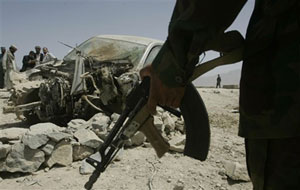
An Afghan soldier stands near a destroyed vehicle after an explosion on the outskirts of Kabul. Photo: AP photo / Rafiq Maqbool

Pouring Gas on the Afghanistan Bonfire
By Chris Hedges / August 25, 2008

The wars in Iraq and Afghanistan grind forward with their terrible human toll, even as the press and many Americans play who gets thrown off the island with Barack Obama. Coalition forces carried out an airstrike that killed up to 95 Afghan civilians in western Afghanistan on Friday, 50 of them children, President Hamid Karzai said. And the mounting bombing raids and widespread detentions of Afghans are rapidly turning Afghanistan into the mirror image of Iraq. But these very real events, which will have devastating consequences over the next few months and years, are largely ignored by us. We prefer to waste our time on the trivia and gossip that swallow up air time and do nothing to advance our understanding of either the campaign or the wars fought in our name.

As the conflict in Afghanistan has intensified, so has the indiscriminate use of airstrikes, including Friday’s, which took place in the Azizabad area of Shindand district in Herat province. The airstrike was carried out after Afghan and coalition soldiers were ambushed by insurgents while on a patrol targeting a known Taliban commander in Herat, the U.S. military said. Hundreds of Afghans, shouting anti-U.S. slogans, staged angry street protests on Saturday in Azizabad to protest the killings, and Karzai condemned the airstrike.

The United Nations estimates that 255 of the almost 700 civilian deaths in fighting in Afghanistan this year have been caused by Afghan and international troops. The number of civilians killed in fighting between insurgents and security forces in Afghanistan has soared by two-thirds in the first half of this year.

Ghulam Azrat, the director of the middle school in Azizabad, said he collected 60 bodies after the bombing.

“We put the bodies in the main mosque,’’ he told the Associated Press by phone, sometimes pausing to collect himself as he wept. “Most of these dead bodies were children and women. It took all morning to collect them.”

Azrat said villagers on Saturday threw stones at Afghan soldiers who arrived and tried to give out food and clothes. He said the soldiers fired into the crowd and wounded eight people, including one child.

“The people were very angry,” he said. “They told the soldiers, ‘We don’t need your food, we don’t need your clothes. We want our children. We want our relatives. Can you give [them] to us? You cannot, so go away.’ ”

We are in trouble in Afghanistan. Sending more soldiers and Marines to fight the Taliban is only dumping gasoline on the bonfire. The Taliban assaults, funded largely by the expanded opium trade, are increasingly sophisticated and well coordinated. And the Taliban is exacting a rising toll on coalition troops. Soldiers and Marines are now dying at a faster rate in Afghanistan than Iraq. In an Aug. 18 attack, only 30 miles from the capital, Kabul, the French army lost 10 and had 21 wounded. The next day, hundreds of militants, aided by six suicide bombers, attacked one of the largest U.S. bases in the country. A week before that, insurgents killed three foreign aid workers and their Afghan driver, prompting international aid missions to talk about withdrawing from a country where they already have very limited access.

Barack Obama, like John McCain, speaks about Afghanistan in words that look as if they were penned by the Bush White House. Obama may call for withdrawing some U.S. troops from Iraq, but he does not want to send them all home. He wants to send them to Afghanistan, or to what he obliquely terms “the right battlefield.” Obama said he would deploy an additional 10,000 troops to Afghanistan once he took office.

The seven-year war in Afghanistan has not gone well. An additional 3,200 Marines were deployed there in January. Karzai’s puppet government in Kabul controls little territory outside the capital. And our attempt to buy off tribes with money and even weapons has collapsed, with most tribal groups slipping back into the arms of the Taliban insurgents.

Do the cheerleaders for an expanded war in Afghanistan know any history? Have they studied what happened to the Soviets, who lost 15,000 Red Army soldiers between 1979 and 1988, or even the British in the 19th century? Do they remember why we went into Afghanistan? It was, we were told, to hunt down Osama bin Laden, who is now apparently in Pakistan. Has anyone asked what our end goal is in Afghanistan? Is it nation-building? Or is this simply the forever war on terror?

Al-Qaida, which we have also inadvertently resurrected, is alive and well. It still finds plenty of recruits. It still runs training facilities. It still caries out attacks in London, Madrid, Iraq and now Afghanistan, which did not experience suicide bombings until December 2005. Al-Qaida has moved on. But we remain stuck, confused and lashing about wildly like a wounded and lumbering beast.

We do not have the power or the knowledge, nor do we have the right under international law, to occupy Iraq and Afghanistan. We are vainly trying to transplant to these countries a modern system of politics invented in Europe. This system is characterized by, among other things, the division of the Earth into independent secular states based on national citizenship. The belief in a secular civil government is to most Afghans and Iraqis an alien creed. It will never work.

We have blundered into nations we know little about. We are caught between bitter rivalries among competing ethnic and religious groups. We have embarked on an occupation in Iraq and Afghanistan that is as damaging to our souls as it is to our prestige and power and security. And we believe, falsely, that because we have the capacity to wage war we have the right to wage war.

We divert ourselves in our dotage and decline with images and slogans that perpetuate fantasies about our own invulnerability, our own might, our own goodness. We are preoccupied by national trivia games that pass for news, even as the wolf pants at our door. These illusions blind us. We cannot see ourselves as others see us. We do not know who we are.

“We had fed the heart on fantasies,” William Butler Yeats wrote, “the heart’s grown brutal from the fare.”

We are propelled forward not by logic or compassion or understanding but by fear. We have created and live in a world where violence is the primary form of communication. We have become the company we keep. Much of the world—certainly the Muslim world, one-fifth of the world’s population, most of whom are not Arab—sees us through the prism of Iraq, Afghanistan and Palestine. We are igniting the dispossessed, the majority of humanity who live on less than two dollars a day. And whoever takes the White House next January seems hellbent on fueling our self-immolation.

Chris Hedges’ column, now weekly, appears Mondays on Truthdig.

Source / TruthDig

The Rag Blog

Posted in RagBlog | Tagged , | Leave a comment

Junior’s Endless Litany of Broken Promises

Iraqi child runs for water when the truck appears

After 5 years of war, Iraqis desperate for water
By Missy Ryan and Sattar Rahim / August 24, 2008

BAGHDAD, Aug 24 (Reuters) – At a communal water station in a Baghdad slum, a young boy’s skinny arms fly up and down as he uses a bicycle pump to coax water from the dry ground.

His efforts produce a languid stream that will tide over his family — and the families of the children waiting near him to fill their cooking pots — until the next day.

This is a daily ritual for millions of Iraqis who lack access to sufficient clean water and proper sewage five years after the U.S.-led invasion to topple Saddam Hussein.

Water and sewage are perennial challenges in this arid country, where the overhaul of decrepit public works has been hindered by years of war and neglect.

Nearly a billion litres of raw sewage is dumped into Baghdad waterways each day — enough to fill 370 Olympic-sized pools.

The United Nations estimates that less than half of Iraqis get drinking water piped into their homes in rural areas. In the capital, people set their alarm clocks to wake them in the middle of the night so they can fill storage tanks when water pressure is under less strain.

New investments in water and sanitation are only slowly bearing fruit even as Iraq seeks to capitalise on a dramatic drop in violence over the past year.

Iraqi and U.S. officials have been working to refurbish existing water plants, distribution lines and sewage works, but they say major infrastructure improvements will take years.

Since 2003, the United States has spent about $2.4 billion on Iraq’s water and sanitation sector, and the Iraqi government has now taken over funding major construction. But the World Bank estimates that at least $14 billion is needed.

In the apartment bloc where Suhad Mohammed lives in eastern Baghdad, water pressure is so weak that water doesn’t reach the top floors. Each morning, her husband and son help her fill plastic jugs from a communal tap downstairs and lug them up several flights of stairs.

“It gets even more complicated in the summer,” she said.

The shortages are also causing health problems.

Acute cases of diarrhoea are three times more common in eastern Baghdad, where water service is most problematic, than in the rest of the city, the United Nations says. That side of the city has also seen a higher incidence of cholera.

OUT OF SIGHT, OUT OF MIND

Officials say the water system was neglected for decades under Saddam Hussein and was ill-equipped to keep pace with a rapidly growing population in the Iraqi capital.

Electricity, which flickers on in Baghdad for just a few hours a day, is another major problem. Back-up power systems at water plants are not designed to operate as often as they do.

“Every power cut, even if it lasts for just a few minutes, delays water production by three hours,” said Sadiq al-Shimari, director general of water facilities for Baghdad.

He said water production now amounts to about 2.8 million cubic metres a day in Baghdad, still far below daily demand of 4 million cubic metres.

The state of Baghdad’s sewage system may be even more bleak.

“Out of sight and out of mind,” an official at the U.S. embassy said on condition of anonymity. “There wasn’t a lot of focus from the (former) regime on the long-term consequences of dumping raw sewage onto river banks,” he said.

The United Nations says that sewage seeping and being dumped into water supplies has “grave implications” for Iraqis’ health and the environment.

Waste and illicit use of water supplies abound, too, as they do in electricity distribution and other basic services.

“We have people illegally siphoning water from the pipelines, using potable water to irrigate their gardens and fill their fish pools,” complained one Baghdad official.

“Even water used by car washes — this wasted water could be used in areas already suffering from shortages.”

NO OTHER CHOICE

At the northern edge of Sadr City, a poor, largely Shi’ite area, a man named Ali points across a dusty, trash-strewn yard to the murky canal where he and his children bathe.

“The water is dirty, but what can we do? We don’t have any other choice,” he says, laughing bitterly.

“People like us, who earn three or four dollars a day, we spend it all on generators,” he said, referring to the informal network of neighbourhood diesel generator operators who supply Baghdad’s electricity when the power goes out.

The recently opened Sadr City water treatment plant, still in its pilot phase, is expected to provide a major boost to the city’s water supply once it is operating fully.

Other government renovation and construction projects are underway, and city officials say the volume of water moving through the system has already increased substantially.

“As soon as you build new plants, and you lay down new networks, you will be able to service more people,” another U.S. official said. “It’s as simple as that, but it takes time.”

In the meantime, the government, the United Nations, and some aid groups dispense water from trucks in some of the neediest areas of Baghdad, said Vinod Alkari, a water and sanitation expert with the United Nations Children’s Fund.

The Iraqi government has been criticised for dragging its feet in spending money budgeted for vital reconstruction.

“Now they apparently have enough resources, and they’re slowly moving toward using those resources,” Alkari said.

“But the task is immense. Even with all the money in the world, it would still take time.”

(Additional reporting by Wisam Mohammed, Aws Qusay, Aseel Kami and Khalid-al Ansary; writing by Missy Ryan; editing by Clar Ni Chonghaile)

Source / Reuters

The Rag Blog

Posted in RagBlog | Tagged , | 3 Comments

Iraq Lies: Will Anyone Ever Be Held to Account?


White Paper Justifying Iraq War Written Three Months before Intel Report Arrived
by Michael Collins / August 25, 2008

The National Security Archive released a report Friday Aug. 22, 2008 that sheds even more light on the premeditated lying and deception that took the United States to war in Iraq. The findings are based on new evidence compiled by Dr. John Prados and published by the National Security Archive. See “White Paper” Drafted before NIE even Requested, “Scoop” Independent News, Aug. 24, 2008.

Most notably, Prados shows the depth of the deception perpetrated against citizens and Congress regarding the alleged threat to U.S. security posed by Iraq. It had appeared that the White House rewrote the Oct. 1, 2002 National Intelligence Estimate and then issued that doctored report to Congress on Oct. 4, 2002. Prados reveals convincing evidence that the Oct. 4 White Paper had already been written by July 2002. He shows that it was only slightly altered after the final NIE arrived. This White Paper served as the basis for the war.

The unavoidable conclusion is that the Bush-Cheney White paper “justifying” the invasion was developed a full three months in advance of the intelligence data and analysis that should have served as the basis for that justification. The National Security Archive summed it up succinctly:

“The U.S. intelligence community buckled sooner in 2002 than previously reported to Bush administration pressure for data justifying an invasion of Iraq,

“The documents suggest that the public relations push for war came before the intelligence analysis, which then conformed to public positions taken by Pentagon and White House officials. For example, a July 2002 draft of the “White Paper” ultimately issued by the CIA in October 2002 actually pre-dated the National Intelligence Estimate that the paper purportedly summarized, but which Congress did not insist on until September 2002.” National Security Archive in “Scoop’ Independent News, August 24, 2008.

The seemingly endless war in Iraq has become a total disaster on multiple levels for all involved. The awful toll in human deaths and casualties is largely ignored but real nevertheless. Over 4,000 U.S. soldiers have been lost in battle and tens of thousands injured. In excess of one million Iraqi civilians are dead due to civil strife unleashed by the invasion. The U.S. Treasury is drained and the steep decline in respect for the United States around the world is just beginning to manifest.

The United States political establishment responds with collective denial on a scale that’s incomprehensible. In the presidential campaign, the only sustained public commentary on the war comes from the Republican presidential candidate John McCain who makes the bizarre claim that U.S. is “surrendering” with victory in clear sight. McCain touts the surge without noting that 4.0 million Iraqis are “displaced from their homes.” Nearly ten percent of Iraq’s population is either dead or injured and there are 5.0 million Iraqi orphans.

This pathological view of victory claims the “surge’ is a success in the context of a devastated population in an obliterated nation lacking in the most essential supplies and services; a nation where death continues on a shopping spree

The report by Dr. Prados makes it clear that the executive branch was responsible for creating whatever information they found necessary to justify war and they did it by posing security threats from Iraq and demanding that intelligence briefers fill in the details

Summary of Findings by Prados, National Security Archive

“A recently declassified draft of the CIA’s October 2002 white paper on Iraqi WMD programs demonstrates that that (the White) paper long pre-dated the compilation of the National Intelligence Estimate on Iraqi capabilities.

“Bush administration and the Tony Blair government began acting in concert to build support for an invasion of Iraq two to three months earlier than previously understood.

“A comparison of the CIA draft white paper with its publicly released edition shows that all the changes made were in the nature of strengthening its charges against Iraq by inserting additional alarming claims, in the manner of an advocacy, or public relations document.

“The draft and final papers show no evidence of intelligence analysis applied to the information contained.” August 22, 2004

One Final Hope to Avoid a Tragic War

Ultimately, the White House had what it wanted by July 2002. When the National Intelligence Estimate arrived from an intimidated intelligence community, there was still one hope of a rational outcome on the rush to war. The NIE delivered to the White House on Oct. 1, 2002 noted that the one scenario in which Iraq would attack the United States involved a U.S. attack on Iraq that threatened Saddam Hussein’s survival.

The following is brutally simple. The one way to cause the hypothesized (and erroneous) claims of Hussein’s intent to attack the United States is to go to war and threaten his regime. Therefore, refraining from war was the best way to protect the United States.

“Baghdad for now appears to be drawing a line short of conducting terrorist attacks with conventional or CBW against the United States, fearing that exposure of Iraqi involvement would provide Washington a stronger cause for making war.

“Iraq probably would attempt clandestine attacks against the U.S. Homeland if Baghdad feared an attack that threatened the survival of the regime were imminent or unavoidable, or possibly for revenge.” Key Judgments, National Intelligence Estimate, Oct. 2002

That was deleted entirely. The July White Paper was “complete” and sent to Congress as the evidence justifying the invasion of Iraq.

In the most supreme of ironies, many members of Congress failed to even review the distorted White Paper before voting overwhelmingly to approve the invasion.

Is there any hope that this same legislative body can remedy the great wrong they helped create? Is there anyone who believes that this or any future White House will move with the urgency necessary to end this war? Will anyone ever be held to account for this series of premeditated deceptions?

See full report with links to primary evidence at Scoop Independent News

Source / OpEdNews.com

The Rag Blog

Posted in RagBlog | Tagged , , | Leave a comment

Texas : Raiding Pension Funds to Build Toll Roads

Northbound Texas Toll 130 at the Exit 426 off-ramp. This toll road northeast of Austin opened for traffic in 2006.

‘An irresponsible and immoral idea”
By Paul Burka / August 23, 2008

I doubt whether Rick Perry, David Dewhurst, or Tom Craddick has ever heard of the Lane Cove Tunnel in Sidney, Australia. If they had, they might not be so eager to raid the teacher and state employee retirement funds to build toll roads.

On the day the Olympics opened (08/08/08), the Sidney Morning Herald carried the news that the tunnel “is rapidly turning into a bottomless pit for its financial backers….” Two credit rating agencies, Standard & Poor’s and Moody’s, have warned that the toll road could default on its $1.1 billion debt with a year. The tunnel has suffered three consecutive monthly dropoffs in traffic usage. The estimated usage before the road was built was 100,000 vehicles per day; actual numbers in June and July barely exceeded 50,000. A Standard & Poor’s analyst predicted that unless the project gets fresh capital (at least half a billion dollars), it will default within 10 to 16 months. Perhaps TxDOT, since it is such a believer in such projects, would like to invest.

The problem with the financial wheeling and dealing with retirees’ funds that Perry, Dewhurst, and Craddick have proposed is that toll road projects are risky investments. They are risky for two reasons. One is that they are subject to economic fluctuations that affect people’s driving habits, such as the price of gasoline or the pace of development. The second reason is that, when government is involved, they are vulnerable to political pressure and favoritism. Google “toll road defaults” and you will find a trove of stories with unhappy endings. The Camino Columbia toll road in Laredo, which was rife with political intrigue over which landowners would benefit from having a road go through their property, opened in 2000 and defaulted in 2004. Cost: $90 million. Auctioned off for: $12 million. Tx-DOT bail out acquisition payment: $20 million. The Dulles Greenway toll road to Washington’s Dulles Airport defaulted on its bonds within a year of its opening in 1995. The private owner, Toll Road Investors Partnership II, have lost money every year since the road opened. When toll roads lose money, tolls go up–in this case, to $4.80 by 2012. That works out to an astronomical 35 cents per mile. There are similar stories in Orange County, California (where the state had to buy failing toll lanes), and along Florida’s west coast, and near Richmond, Virginia, where the 8.8-mile Pocohantas Parkway, financed with tax-free bonds, has suffered around a 50% shortfall in projected toll receipts; the state has had to maintain the road because the private owners don’t have the money. Bond ratings have been lowered to below investment grade. To pay off the bonds, the toll was increased by 50%.

It is true that many toll roads have been success stories. In Texas these include the Dallas-Fort Worth Turnpike, which paid off bondholderes with toll revenues after thirty years and became free Interstate 30; the Dallas North Tollway and its northern extension; and the Sam Houston Tollway on the west side of Houston. The issue here is not toll roads per se. It is toll roads built with pension funds (and probably other investment funds as well, such as the Permanent School Fund and the Permanent University Fund). These are trust funds. They belong to the members. It is morally wrong to require fund managers to invest them in risky ventures like toll roads. Does anybody doubt that there will be pressure on the pension funds to invest in certain projects that favor certain people and certain contractors and certain areas? We all know what kind of people we are dealing with here. Rick Perry can’t resist it. He appointed the members of the boards that oversee the pension funds. These deals will be neck-deep in politics.

The Statesman’s story on the leadership’s plan quotes Britt Harris, the chief investment officer of the Teacher Retirement System, as saying that investments in infrastructure made sense if the proposal was “equal or better than something we can get [in another project].” Harris then pointed out that the fund’s “ultimate loyalty is to the members,” not to target investments based on geography or politics. The last clause does not appear in quotation marks in the article. Bravo for Britt Harris, but I think he should keep his resume updated.

The biggest risk in toll roads as investments is political pressure. The pressure comes in two forms. The first is pressure on the consultants to provide favorable projections for use of proposed toll roads. Does anybody trust TxDOT–or the consultants they hire, or the private entities they seek to contract with–to do hardnosed, accurate projections? If you do, then consider these comments from an article in Business Week several years ago, at about the time Rick Perry was unveiling his proposal for the Trans-Texas Corridor:

* “There is a history of feasibility studies for toll roads being overly optimistic,” says John J. Hallacy III, director of municipal bond research for Merrill Lynch and Co.

* “Of the 10 major private toll roads constructed since the mid-1990s, nearly half carry far less traffic than projected. Some $4 billion in toll road bonds risk default over the next five years unless they’re refinanced,” estimates Robert H. Mueller, a municipal bond analyst at the J.P. Morgan securities Inc.

What about financing toll roads with bonds? Well, don’t expect bond raters to give the bonds a good rating. I’m quoting here from an article that appeared eight years ago in a tollroad industry publication, so it is possible that things may have changed, though I doubt it. Credit is much harder to get today than it was in 2000.

Fitch-ICBA, the New York bond rating agency says that there is a permanent bifurcation of the toll road bond market. Established systems of toll facilities can expect to be rated in the range A to AA, whereas most standalone and startup toll facilities will be rated BB- to BBB. They see a continuing demand for new toll road financings because of what they call a “seemingly unbridgeable gap” between highway needs and the ability to finance them with tax monies that toll projects can often help to fill.

According to BondsOnline, bonds rated BBB are “lower medium grade” and bonds rated BB- are “speculative.” The lower the bond rating, of course, the higher the interest rate that bond buyers demand. No one is going to be getting any bargains on toll road bonds. And AAA ratings are just a dream: “Fitch says that the ever present possibility of state governments siphoning off surplus toll revenues or leveraging them for other borrowings prevents state owned turnpikes from achieving the AAA rating.” So how can asking pension funds to invest in these bonds ever be a prudent investment? It can’t.

The article continues: Another problem with bonds for highways is that bond rating houses distrust state governments. It is unlikely that any state owned turnpikes will ever reach AAA: The key reason is susceptibility to political interventions.

I have said this before, and I will say it again. There is a sensible way to finance roads. It is to increase the gasoline tax and index it to inflation in the highway construction index. The gasoline tax has some weaknesses. Part of it is diverted to public education. People drive less when gasoline prices go through the roof. Cars are more fuel-efficient. All of this cuts into the revenue potential of the tax. Nevertheless, Texans still love their cars. The suburban lifestyle here is designed around the automobile. Even if the revenue per mile driven is declining, there is a lot of life left in the tax. A portion of the revenue could be dedicated to paying off the bonds for toll roads. This should be capped to ensure that money will still be available for free roads. While the resistance to tax increases is formidable, so is the resistance to toll roads. If you can persuade the public that a gasoline tax increase will reduce the need for toll roads, I think that proposition could be sold. Anything is better than insisting that the savings of retired teachers and state employees be invested in risky ventures like toll roads.

Source / Burkablog / Texas Monthly

See Austin and US 290 E: You Can’t Get There From Here by Roger Baker / The Rag Blog / August 13, 2008

Thanks to Roger Baker / The Rag Blog

Posted in RagBlog | Tagged , , , , , | Leave a comment

What George Orwell Wrote, 70 Years Later to the Day

George Orwell, author of 1984 and Animal Farm.

‘”I think he would have been a blogger,” said Jean Seaton, a professor at the University of Westminster in London’
By Noam Cohen / August 24, 2008

See George Orwell’s “post” for August 25, 1938, below.

Aug. 12 began as a hot morning in Aylesford, Kent, England, only to be followed by a powerful thunderstorm in the afternoon. Meanwhile, the blackberries were beginning to redden.

Aug. 12, 1938, that is.

The observations were made by George Orwell, whose copious diaries are now being published every day in blog form, exactly 70 years after they were made. The scholars behind the project say they are trying to get more attention for Orwell online and to make him more relevant to a younger generation he would have wanted to speak to.

“I think he would have been a blogger,” said Jean Seaton, a professor at the University of Westminster in London who administers the Orwell writing prize and thought up the idea of the blog.

Though as prolific as any blogger (his collected writings occupy some 20 volumes), Orwell, who died in 1950, never had the chance to spontaneously publish his thoughts to a waiting public. Now — with some lag time — they are being made available that way at Orwell Diaries.

The Webmaster has included hyperlinks, including a definition of blackberries (no, not the kind you operate with your thumbs) and a Google map of the sanitarium in Kent in southeast England where Orwell was recuperating from tuberculosis and observing the weather so closely.

The entry from Aug. 10, for instance, is offers this report: “Drizzly. Dense mist in evening. Yellow moon.”

Rest assured, he will soon become consumed by the clouds gathering over Europe. Next month the blog will reprint the entries from the political diary he started Sept. 7, 1938.

“The diary isn’t Orwell at his most polemic; it is Orwell at his most steady, most observant,” Professor Seaton said.

Like any good political blogger, Orwell devoured the news, making clippings and looking for shifts in public and government opinion, Professor Seaton said. “He’s partly obsessed by the newspapers because of the start of the world war,” she said. “The diary is written against this almost traumatized understanding that there is going to have to be a second world war.”

The material being reprinted (with the permission of the Orwell estate) can be found in the Orwell archive at University College in London and in the author’s collected works, but “ordinary people won’t go to it,” she said. “I thought, if you publish what he wrote as he wrote it in real time, people would find that rather engaging.”

Professor Seaton said the site would publish at least until 2010, and had more than 50,000 page views since it started on Aug. 9.

The Orwell blog is not the only effort to inject spontaneity into material written generations ago.

For more than a year, Bill Lamin, 60, a retired mathematics teacher in England, has been publishing the letters of his grandfather, who fought in World War I — 90 years to the day.

Part of the attraction for readers, Mr. Lamin said in an e-mail message, was that “no one knows the outcome, whether he lives or dies from letter to letter.”

While the Orwell blog will not have that level of suspense, Professor Seaton said the material was full of tension.

“You do know how this story is going to end,” she said, “but one of the brilliant things is that Orwell doesn’t know how it is going to end.”

Source / New York Times

August 25, 1938, Preston Hall

Everything in Suffolk is much more dried-up than in Kent. Until the day we arrived there had been no rain for many weeks & various crops had failed. Near S’wold saw several fields of oats & barley being harvested which had grown only 1’ or 18” high. Ears nevertheless seemed normal. Wheat crop all over the world said to be heavy.
A bedstraw hawk-moth found in our back garden & mounted by Dr Collings¹. Evidently a straggler from the continent. Said to be the first seen in that locality for 50 years.
Little owl very common round here. Brown owl does not seem to exist.
Dr C. says the snake I caught was the “smooth snake”, non-poisonous & not very common.
Today hot again.
Gipsies beginning to arrive for the hop-picking. As soon as they have pitched their caravans the chickens are let loose & apparently can be depended on not to stray. The strips of tin for cloth-pegs are cut of biscuit boxes. Three people were on the job, one shaping the sticks, one cutting out the tin & another nailing it on. I should say one person doing all these jobs (also splitting the pegs after nailing) could make 10-15 pegs an hour.
Another white owl this evening.

¹The Blairs’ family doctor at Southwold from 1921. His son, Dennis, was a friend of Orwell’s; see 109, n. 1. Peter Davison

Orwell Diaries / August 25, 2008

Thanks to Harry Edwards / The Rag Blog

Posted in RagBlog | Tagged , , , , , | 1 Comment

Type your summary here


Type rest of the post here

Source

The Rag Blog

Posted in RagBlog | Leave a comment

What We Don’t Read About Abkhazia’s Fight for Independence

The sun also shines (and hides): ‘It was only a partial eclipse in Tbilisi–but it was total in western Georgia, and supposedly perfect in separatist Abkhazia, Georgia’s westernmost province,’ according to Ben Wheeler, posted on March 29, 2006. Photo by John “Pachydon” Mackedon.

‘All this trumpeting of Georgian sovereignty is quite exaggerated’
By Gerry Storm / The Rag Blog / August 25, 2008

What we aren’t getting in the way of news is that Abkhazia fought a brutal war to resist becoming part of Georgia, hates the Georgians, wants to be an independent state, and an ally of Russia. They use rubles for currency, welcome Russian aid, and much of their population is Russian.

The country is still an unreconstructed mess after the Georgians virtually destroyed it after the Abkhazians refused to be good Georgians.

I would presume that something similar is going on in South Ossetia.

All this trumpeting of Georgian sovereignty is quite exaggerated and promoted by the Bushies who made lots of promises to Georgia without checking the history of the place. The Russian position of backing both provinces as independent states is quite popular in the region.

See the following: Russia Votes to Recognize Independence of Breakaway Regions / The Huffington Post / August 25, 2008

The Rag Blog

Posted in Rag Bloggers | Tagged , , , , | Leave a comment

Dem Convention Protesters: "Fuck Fox News"

Boy, how right did the protesting youth get this? Fox News, “fair and balanced,” deserves every bit of abuse that anyone cares to dish them. “Fair” refers to their disdain for the facts, while “balanced” reflects their racism and hatred of other, particularly black, Muslim, or Latino.

Richard Jehn / The Rag Blog

Denver Democratic Convention Protesters

Thanks to Diane Stirling-Stevens / The Rag Blog

Posted in RagBlog | Tagged , , | Leave a comment

The Answer Is Not Another Pill : The Answer Is Spinach

Bill Maher – Anti-Pharma Rant

Bill Maher ends this episode, which aired on the 28th of September 2007, with a rant about big pharma.

Thanks to Janet Gilles | The Rag Blog | Posted August 24, 2008

Posted in RagBlog | Tagged , , | Leave a comment