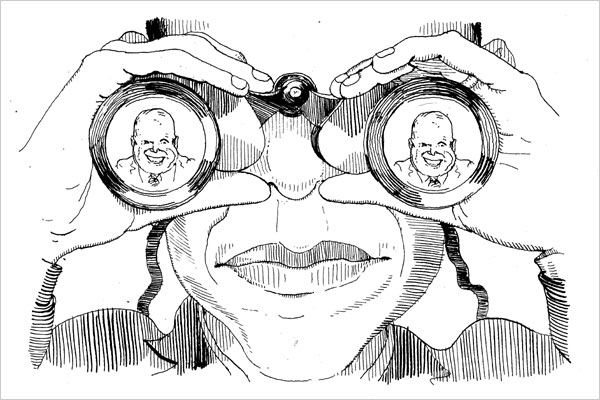
What Precisely Are YOU Afraid Of?


Gay marriage foes mobilize for ban in Calif.
By Tracie Cone And Lisa Leff / August 24, 2008

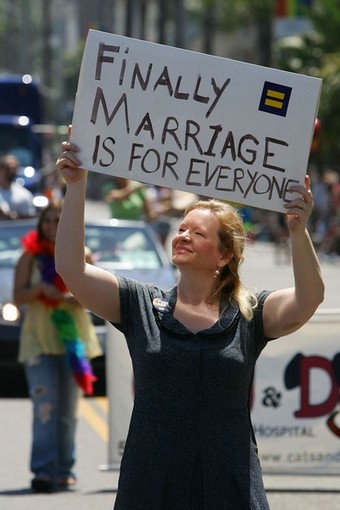
FRESNO, Calif. — Michael Bumgarner says he’s never campaigned for a political cause before, but his strong opposition to same-sex marriage has prompted him to join thousands of volunteers going door-to-door in support of a ballot initiative that would ban gay nuptials here.

“I’ve never stumped before, but I want to be a part of this,” Bumgarner said. The retired insurance executive and devout Mormon said his late mother would “turn over in her grave” if she knew that gays and lesbians could marry.

With less than 11 weeks until Election Day, supporters of Proposition 8 are ramping up their field organization and refining their message as they seek to persuade California voters to shut the door on same-sex marriage. It’s the first time voters will be asked to weigh in on the issue in either California or Massachusetts — the states where gays have won the right to wed.

An estimated 15,000 backers of the measure, most of them members of Mormon, Catholic and evangelical Christian churches, knocked on doors and distributed campaign literature to registered voters throughout the state this weekend and last, according to Jennifer Kerns, spokeswoman for the Yes on 8 campaign.

The initiative is a constitutional amendment, similar to ones already enacted in 26 other states, that would overturn the California Supreme Court decision that legalized same-sex marriage. It needs a simple majority of votes to pass.

Ron Prentice, director of the coalition of religious and social conservative groups that qualified the amendment for the November ballot, said the group has ordered 1 million yard signs and 1 million bumper stickers.

“Unless the people are angry, nothing will happen,” Prentice said. “We are going to change the Constitution and say on Nov. 4, ‘Judges, you can’t touch this.'”

For now, the campaign’s goal is to identify supporters and voters who are unaware or haven’t made up their minds about the measure, said Al Almendariz, a retired air traffic controller and a Mormon.

Almendariz led a team of five people canvassing a suburban neighborhood southeast of Sacramento on Saturday, and their script was concise. The volunteers told people who answered their doors they were with the Proposition 8 campaign, an effort that would define marriage as being between a man and a woman. They didn’t mention same-sex marriage unless a resident brought it up.

“We’re just polling — yes or no, not trying to find converts or change people’s minds,” said Christina Hirst, 28, a photographer with three young children. Hirst and her husband, Justin, 33, a high-school Spanish teacher, said they joined the door-knocking Saturday because they don’t want their children hearing about gay relationships at school.

The literature that volunteers distributed was intended to reinforce the campaign’s message that the amendment is “pro-marriage and children” instead of anti-gay.

“California should do more to encourage families to stay together,” reads the pamphlets illustrated with close-ups of heterosexual couples posed cheek-to-cheek.

Frank Schubert, who is co-managing the Yes on 8 campaign, said the outreach effort is designed to counter the principle message of gay rights advocates, who are portraying the upcoming vote as a matter of fairness and equality.

“They want people to feel like you are a bad person if you support what has been the definition of marriage since the dawn of time,” Schubert said. By having face-to-face conversations about why the amendment is necessary, organizers hope to reach potential supporters who may worry that voting for the measure would get them labeled as “bigots or homophobes,” he said.

Bumgarner distributed handouts listing “Six Consequences if Proposition 8 Fails” that volunteers were encouraged to use as talking points. They included warnings that ministers who preach against same-sex marriage could be sued for hate speech, churches would be sued for refusing to host wedding ceremonies for gays, and that “children in schools will be taught that same-sex marriage is OK.”

The amendment’s opponents dispute those claims, saying that the Supreme Court specifically exempted churches from having to participate in same-sex weddings and that nothing in state law requires teachers to discuss marriage — straight or gay — with students.

Recent polls suggest the election could be close. A Field Poll taken last month found that 51% of likely voters said they would vote against Proposition 8, while 42% said they would vote for it.

Source / USA Today

Thanks to Diane Stirling-Stevens / The Rag Blog

Posted in RagBlog | Tagged , , | Leave a comment

Frank Rich : Last Call for Change We Can Believe In

Drawing by Barry Blitt / NYT.

‘It’s time for Barack Obama to dispatch Change We Can Believe In to a dignified death’
By Frank Rich / August 24, 2008

AS the real campaign at last begins in Denver this week, this much is certain: It’s time for Barack Obama to dispatch “Change We Can Believe In” to a dignified death.

This isn’t because — OMG! — Obama’s narrow three- to four-percentage-point lead of recent weeks dropped to a statistically indistinguishable one- to three-point margin during his week of vacation. It’s because zero hour is here. As the presidential race finally gains the country’s full attention, the strategy that vanquished Hillary Clinton must be rebooted to take out John McCain.

“Change We Can Believe In” was brilliantly calculated for a Democratic familial brawl where every candidate was promising nearly identical change from George Bush. It branded Obama as the sole contender with the un-Beltway biography, credibility and political talent to link the promise of change to the nation’s onrushing generational turnover in all its cultural (and, yes, racial) manifestations. McCain should be a far easier mark than Clinton if Obama retools his act.

What we have learned this summer is this: McCain’s trigger-happy temperament and reactionary policies offer worse than no change. He is an unstable bridge back not just to Bush policies but to an increasingly distant 20th-century America that is still fighting Red China in Vietnam and the Soviet Union in the cold war. As the country tries to navigate the fast-moving changes of the 21st century, McCain would put America on hold.

What Obama also should have learned by now is that the press is not his friend. Of course, he gets more ink and airtime than McCain; he’s sexier news. But as George Mason University’s Center for Media and Public Affairs documented in its study of six weeks of TV news reports this summer, Obama’s coverage was 28 percent positive, 72 percent negative. (For McCain, the split was 43/57.) Even McCain’s most blatant confusions, memory lapses and outright lies still barely cause a ripple, whether he’s railing against a piece of pork he in fact voted for, as he did at the Saddleback Church pseudodebate last weekend, or falsifying crucial details of his marital history in his memoirs, as The Los Angeles Times uncovered in court records last month.

What should Obama do now? As premature panic floods through certain liberal precincts, there’s no shortage of advice: more meat to his economic plan, more passion in his stump delivery, less defensiveness in response to attacks and, as is now happening, sharper darts at a McCain lifestyle so extravagant that we are only beginning to learn where all the beer bullion is buried.

But Obama is never going to be a John Edwards-style populist barnburner. (Edwards wasn’t persuasive either, by the way.) Nor will wonkish laundry lists of policy details work any better for him than they did for Al Gore or Hillary Clinton. Obama has those details to spare, in any case, while McCain, who didn’t even include an education policy on his Web site during primary season, is still winging it. As David Leonhardt observes in his New York Times Magazine cover article on “Obamanomics” today, Obama’s real problem is not a lack of detail but his inability to sell policy with “an effective story.”

That story is there to be told, but it has to be a story that is more about America and the future and less about Obama and his past. After all these months, most Americans, for better or worse, know who Obama is. So much so that he seems to have fought off the relentless right-wing onslaught to demonize him as an elitist alien. Asked in last week’s New York Times/CBS News poll if each candidate shares their values, registered voters gave Obama and McCain an identical 63 percent. Asked if each candidate “cares about the needs and problems of people like yourself,” Obama beat McCain by 37 to 23 percent. Is the candidate “someone you can relate to”? Obama: 55 percent, McCain: 41. Even before McCain told Politico that he relies on the help to count up the houses he owns, he was the candidate seen as the out-of-step elitist.

So while Obama can continue to try to reassure resistant Clinton loyalists in Appalachia that he’s not a bogeyman from Madrassaland, he must also move on to the bigger picture for everyone else. He must rekindle the “fierce urgency of now” — but not, as he did in the primaries, merely to evoke uplifting echoes of the civil-rights struggle or the need for withdrawal from Iraq.

Most Americans, unlike the press, are not obsessed by race. (Those whites who are obsessed by race will not vote for Obama no matter what he or anyone else has to say about it.) And most Americans have turned their backs on the Iraq war, no matter how much McCain keeps bellowing about “victory.” The Bush White House is now poised to alight with the Iraqi government on a withdrawal timetable far closer to Obama’s 16 months than McCain’s vague promise of a 2013 endgame. As Gen. David Petraeus returns home, McCain increasingly resembles those mad Japanese soldiers who remained at war on remote Pacific islands years after Hiroshima.

Economic anxiety is the new terrorism. This is why the most relevant snapshot of voters’ concerns was not to be found at Saddleback Church but at the Olympics last Saturday. For all the political press’s hype, only some 5.5 million viewers tuned in to the Rev. Rick Warren’s show in Orange County, Calif. Roughly three-quarters of them were over 50 — in other words, the McCain base. By contrast, a diverse audience of 32 million Americans tuned in to Beijing that night to watch Michael Phelps win his eighth gold medal.

This was a rare feel-good moment for a depressed country. But the unsettling subtext of the Olympics has been as resonant for Americans as the Phelps triumph. You couldn’t watch NBC’s weeks of coverage without feeling bombarded by an ascendant China whose superior cache of gold medals and dazzling management of the Games became a proxy for its spectacular commercial and cultural prowess in the new century. Even before the Olympics began, a July CNN poll found that 70 percent of Americans fear China’s economic might — about as many as find America on the wrong track. Americans watching the Olympics could not escape the reality that China in particular and Asia in general will continue to outpace our country in growth while we remain mired in stagnancy and debt (much of it held by China).

How we dig out of this quagmire is the American story that Obama must tell. It is not a story of endless conflicts abroad but a potentially inspiring tale of serious economic, educational, energy and health-care mobilization at home. We don’t have the time or resources to go off on more quixotic military missions or to indulge in culture wars. (In China, they’re too busy exploiting scientific advances for competitive advantage to reopen settled debates about Darwin.) Americans must band together for change before the new century leaves us completely behind. The Obama campaign actually has plans, however imperfect or provisional, to set us on that path; the McCain campaign offers only disposable Band-Aids typified by the “drill now” mantra that even McCain says will only have a “psychological” effect on gas prices.

Even as it points to America’s future, the Obama campaign also has the duty to fill in its opponent’s past. McCain’s attacks on Obama have worked: in last week’s Los Angeles Times-Bloomberg poll, Obama’s favorable rating declined from 59 to 48 percent and his negative rating rose from 27 to 35. Yet McCain still has a lower positive rating (46 percent) and higher negative rating (38) than Obama. McCain is not nearly as popular among Americans, it turns out, as he is among his journalistic camp followers. Should voters actually get to know him, he has nowhere to go but down.

The argument against Obama’s “going negative” is that it undermines his message of “transcendent politics” and will make him look like an “angry black man.” But pacifistic politics is an oxymoron, and Obama is constitutionally incapable of coming off angrier than McCain. A few more fisticuffs from the former law professor (and many more from his running mate and other surrogates) can only help make him look less skinny (metaphorically if not literally). Obama should go after McCain’s supposedly biggest asset — experience — much as McCain went after Obama’s crowd-drawing celebrity.

It is, after all, not mere happenstance that so many conservative pundits — Rich Lowry, Peggy Noonan, Ramesh Ponnuru — have, to McCain’s irritation, proposed that he “patriotically” declare in advance that he will selflessly serve only a single term. Whatever their lofty stated reasons for promoting this stunt, their underlying message is clear: They recognize in their heart of hearts that the shelf life of McCain’s experience has already reached its expiration date.

Is a man who is just discovering the Internet qualified to lead a restoration of America’s economic and educational infrastructures? Is the leader of a virtually all-white political party America’s best salesman and moral avatar in the age of globalization? Does a bellicose Vietnam veteran who rushed to hitch his star to the self-immolating overreaches of Ahmad Chalabi, Pervez Musharraf and Mikheil Saakashvili have the judgment to keep America safe?

R.I.P., “Change We Can Believe In.” The fierce urgency of the 21st century demands Change Before It’s Too Late.

Source / New York Times

Thanks to Shelia Cheaney / The Rag Blog

Posted in RagBlog | Tagged , , , , , , | Leave a comment

Sunday’s Laugh


A cannibal was walking through the jungle and came upon a restaurant operated by a fellow cannibal. Feeling somewhat hungry, he sat down and looked over the menu…

* Tourist: $5
* Broiled Missionary: $10
* Fried Explorer: $15
* Baked Democrat or Grilled Republican: $100

The cannibal called the waiter over and asked, ‘Why such a price difference for the Politician?’

The cook replied, “Have you ever tried to clean one? They’re so full of shit, it takes all morning.”

Thanks to Diane Stirling-Stevens / The Rag Blog

Posted in RagBlog | Tagged , | 1 Comment

Elections: This Is the Only World We’ve Got, Folks


We Have a Chance to Choose a Better Road
By Caroline Arnold / August 24, 2008

Hope has two beautiful daughters. Their names are Anger and Courage; anger at the way things are, and courage to see that they do not remain the way they are. – Augustine of Hippo (354-430 AD)

Annie Glenn liked to tell the (probably apocryphal) story about a hand-lettered sign posted on a muddy, rutted road in rural Muskingum County, Ohio: “Choose your rut carefully – you’ll be in it for the next ten miles.”

With the conventions now upon us, we must hope that delegates and voters alike heed that homespun Ohio advice: Choose a rut carefully. We will all be in it for at least the next four years.

Despite the efforts of the neocons and much of the media over the last quarter-century to make fear the organizing principle of our society, most Americans today are more angry than fearful at the way things are, deeply dissatisfied with the rut we’ve been in for the last seven years and hoping, yearning for a road leading to a better world.

The 2006 election showed that we were angry about the rut our country was in. It also revealed that our courage – or the courage of our Congress – was not equal to the task of pulling out of the rut we were in and getting on firmer ground.

We’re angry again this year. What about? Gas prices? Cost of living? Gay marriage? Cost of war? Job losses? Unfair taxes? Mortgage foreclosures? Corporate welfare? Torture? Health Care? Surveillance of Internet and phones? Global warming? Peak oil? Abortion? “Illegal”aliens?

This week Speaker Pelosi said that in light of public anger over gasoline prices and public opinion that offshore drilling will bring those prices down, she will put the issue back on the table. As she should: this is a democracy, and if people are angry about something, elected officials should address it.

But by the same reasoning, Pelosi was dead wrong to keep impeachment off the table for two years. People were and are angry over the lying, cheating and criminal actions of the President and Vice President and have been clamoring for impeachment. How many people (in both cases) may be open to question, but the best way to find out is to put the issue on the table and see how many people pick up their forks.

Democracy is supposed to be a road on which people make the public decisions, policies and laws that affect their lives and communities and pave the way for a better future. It doesn’t guarantee scientifically-sound policies, logical, rational or moral decisions, fair or equitable laws, or even “liberty and justice for all.” It can only offer the people who travel the road and take the consequences of public decisions and policies the means to keep maintaining the infrastructure and improving the road as needed.

But what happens when elections are corrupted by money, when wealth can fund political campaigns and buy not just advertising but whole media empires, when voting machines can be corrupted, and voters intimidated or falsely disqualified, and when a questionably elected President can put the whole nation in a rut of secrecy, torture and perpetual war?

We have plenty to be angry about, but do we have the courage to change things? Do we even have the courage to set priorities among the things we will invest in or take risks for? What comes first, our own children, parents, siblings, friends? Our own homes, cars, private property, pets? Our personal education and health care? Education and health care for all? Gas for $3/gallon? Hungry, homeless people in our communities? Hungry, homeless people in Palestine or Afghanistan? Undocumented immigrants here? Refugees from genocide in Africa? Endangered species planet-wide?

The ethanol in the our cars’ gas tanks takes food from poor children; the exhaust from our lawn-mowers strands polar bears in the Arctic; our tax dollars pay for the cluster bombs that maim Lebanese children and the bulldozers that raze the houses of Palestinians. Our racism sends one in 20 black men to prison, serving longer terms than whites or Hispanics for the same crimes. Our hatred of “illegal immigrants” has stranded 43 women and 150 children in Postville, Iowa, destitute and under virtual house-arrest, and our fear of illegal drugs killed the dogs of a small town mayor when a local SWAT team without a proper warrant burst into his house on the mistaken assumption that his wife was dealing marijuana.

This is the only world we’ve got, folks. What we Americans do, how we spend our time, our money and the world’s natural resources, how we use our technical prowess, our human creativity and our human capacity for fairness, compassion and helping one another, and most of all, who we elect and what ruts in the road we choose in this election will affect, for better or worse, every living creature and living system on earth, down to the last generation to the end of time.

Though the mud-machines are already operating and it’s going to be very hard even to see where the ruts are, we have the chance to choose a better road. Barring new ways to tamper with votes or voters, some event that can be billed as a terrorist attack, or a few election-day power outages on the East or West Coasts, this election will tell us which ruts we are angry about and which ruts we have the courage to change or get out of.

[Before joining Senator John Glenn’s Washington staff in 1985, Caroline Arnold (csarnold@neo.rr.com) founded a successful small business and served three terms on the Kent (OH) Board of Education. In retirement she is active with civic and environmental organizations in Kent.]

Source / Common Dreams

The Rag Blog

Posted in RagBlog | Tagged , , | Leave a comment

Police State Amerikkka, Right in My Own Backyard

I was astounded to read that a Border Patrol roadblock was erected for several hours last week on SR 104 near the Hood Canal Bridge. Welcome to police state Amerikkka, I thought. And I tend to agree with the Port Townsend couple identified below who suggest this is “racial profiling.” In typical Olympic Peninsula fashion, arresting one white person mitigates such a charge. “Simplistic” is the best description of the reasoning that goes on out here.

I need to leave it, because I sure as hell don’t love it anymore.

Richard Jehn / The Rag Blog

Hood Canal Bridge, view to the east

Border Patrol immigration checkpoints like one approaching Hood Canal Bridge to be more common on Peninsula, agency says
By Erik Hidle and Tom Callis / August 24, 2008

U.S. Border Patrol checkpoints, such as one near the Hood Canal Bridge on Friday and another about six months ago near Forks, are about to become more common on the North Olympic Peninsula, said an agent.

A checkpoint was set up Friday morning on state Highway 104 one mile west of the Hood Canal Bridge.

“Today we implemented a checkpoint there between approximately 9 a.m. and 2 p.m.,” Supervisory Border Patrol Agent Michael Bermudez Bermudez said on Friday.

“These types of check points have proven to be successful in the past, and we are starting to utilize more checkpoints.

“We are expecting to begin using them frequently in and around that area, and in places in Jefferson and Clallam counties.”

He declined to say where or when the checkpoints would be.

Border Patrol Deputy Chief Patrol Agent Joseph Guiliano said checkpoints on U.S. Highway 101 are planned north of Forks and south of Discovery Bay between now and mid-September.

Guiliano said agents detained six illegal immigrants at a checkpoint eight miles north of Forks about six months ago eight miles north of Forks.

In March 2007, agents detained seven people at a checkpoint near Forks.

Bermudez said the temporary checkpoints’ primary objectives are to apprehend terrorists and illegal immigrants.

They also are used in conjunction with local law enforcement to arrest felons, seize drugs and weapons and to deter illegal activity, he added.

At Friday’s checkpoint near the bridge, seven illegal immigrants and one person with a felony warrant were taken into custody, and $2,500 worth of illegally harvested salal was confiscated, Bermudez said.

“Border Patrol checkpoints are a critical tool to protect against illegal activity,” he said.

“We are going to continue to put them in areas where people have to pass through from point A to point B.”

Eastbound traffic

The checkpoint required vehicles heading eastbound on state Highway 104 to stop briefly while agents performed visual inspections of vehicles and asked drivers questions.

If agents believed more investigation was required, they sent the vehicle to a secondary lane.

Otherwise, drivers were permitted to travel on.

“The supervisor today said traffic was flowing along pretty good through the checkpoint,” Bermudez said on Friday.

“I don’t believe that at any time did traffic come to standstill.”

Waited in line

Jewel and Harry Atwell of Port Townsend said they did have to wait in a line while they passed through the checkpoint on Friday morning.

“We were approaching the bridge when we had to stop in a line,” Jewel Atwell said.

“We assumed the bridge was open, but then we saw a big sign that said there were U.S. officers ahead.”

Atwell said the agents made them stop and asked them questions, while men on each side of their car looked in at their belongings.

Atwell said she felt the Border Patrol agents had violated their civil liberties and were racially profiling people.

“We asked them what they were doing, and the man said they were looking for someone,” she said.

“I told them that they were racially profiling us.”

Both the Atwells are Caucasian. Jewel Atwell said that by letting them go through so easily, the agents were practicing racial profiling.

Bermudez said he disagreed with Atwell’s view.

“We arrested numerous people today, and one of the people was white,” he said.

“We have the authority to do these checkpoints in numerous places and we will.”

Bermudez said he understands the frustration of waiting in line, but that the job the Border Patrol is doing is important.

“It’s not just illegal immigration we are focusing on because we are reducing crime when we take a felon off the street,” Bermudez said.

“Our agents are highly skilled and highly trained.”

Bermudez also said he wasn’t surprised to hear some complaints.

“You won’t see a Border Patrol agent telling doctors or lawyers how to do their jobs,” he said.

“But you will see people trying to tell us how to do our job, even though we’re trained to do it.”

Source / Peninsula Daily News

The Rag Blog

Posted in RagBlog | Tagged , , | 6 Comments

FILM: Katrina’s Children : ‘If You’re Quiet Enough… You Hear Things’


Children of Katrina Still Bear the Scars
by Leonard Pitts, Jr. / August 24, 2008

You cannot watch Laura Belsey’s movie without ruminating upon the myriad ways we fail our young.

There are many wrenching scenes in Katrina’s Children but arguably the most wrenching is not the girl crying because the hurricane left her so fearful of water she can no longer swim, or the boys touring the wreckage that once was home, or the children recalling how corpses floated by, writhing with maggots, bursting open. No, the most wrenching scene comes when Tyronieshia tries to read.

She pauses before the sign warning of penalties for bringing firearms onto the elementary school campus — yes, they need a ”no guns” sign at an elementary school — but she can’t read it. She struggles to do so, but it’s no use. She can’t decipher ”carrying,” can’t figure out “firearms.”

Everyone failed her.

TYRONIESHA, 10, grew up in the St Bernard Projects and now lives in FEMA’s largest trailer park, Renaissance Village, near Baton Rouge. She believes that Katrina hit New Orleans “because the Devil told her to do it”.

Ten years old and she was already well on the way to illiteracy and the life of don’t have and can’t get that usually comes with it. And you realize, here is a child who was failed by her school, failed by her community, failed by her family. Then, three years ago this week, the storm came and she was failed by everything else.

Katrina’s Children is not coming soon to a theater near you. It can, however, be purchased online (http://www.katrinaschildren.com/). A portion of the proceeds go to help children’s programs in New Orleans.

See it if you can. It will claw at your heart.

There is no footage of the hurricane in it, no shots of rooftop rescues or chaos at the Superdome. There is no narration, no talking heads, virtually no adults whatsoever. Instead, there are the children, drawing pictures of the day their city drowned, telling how it feels to leave or lose everything you’ve ever known, walking you through the debris and the detritus, weeping, and wondering why it happened. They are white and black and one Vietnamese girl, children of various economic strata, some precocious and verbal, some so ill-spoken, so isolated from the mainstream, that their English requires subtitles.

All of them indelibly scarred.

”It was interesting when we screened the film for some of the parents and the kids,” says Belsey, the 42-year-old New York filmmaker who directed Katrina’s Children. “The parents were really moved. They had no idea the kids were thinking those thoughts. It just goes to show that if you take the time and pay attention and if you’re quiet enough . . . you hear things.”

But when are we that quiet?

We cry out at as the famous for nothing live their train wreck lives or the ballplayer runs for daylight or the TV news tells us about this week’s missing coed, but we fail to hear the quiet, painful sound of Tyronieshia trying to read.

Then a mammoth storm swallows an American city whole. And some of us cry out that liberals should not send help to a red state, or that God allowed the storm because New Orleans is too tolerant of homosexuals, or that this tragedy proves certain people are lazy and welfare-dependent. But we fail to hear Erica, who is 10, weeping because she saw babies die in the convention center’s heat and stench.

We forget that children are in the room sometimes. We push our agendas and assign our blame and impose our narratives and forget that they are right there, taking it in. Yet, if some of them were failed by schools, community and family, all were failed by the Army Corps of Engineers, the mayor, the governor, the emergency management director and the president. And don’t think they don’t know.

Maybe you take that as the cue to circle your wagons of race or politics. Well, Erica, who saw babies die, sees an imperative beyond that. She drew a picture, a mosaic of faces in rainbow colors, combining into a single image. A single destiny. With a little one’s gift for clarifying and purifying that which stymies and stupefies adults, she calls her drawing All In One.

And the prophet was right. A little child shall lead them.

© 2008 Miami Herald Media Company.

Source / Miami Herald

The Rag Blog

Posted in RagBlog | Tagged , | Leave a comment

The Sunday Snapshot : The Signpost for Change


Source / MoveOn.org

Thanks to Betsy Gaines / The Rag Blog / Posted August 24, 2008

Posted in RagBlog | Tagged , , | Leave a comment

Denver : Police and Protesters Make Preparations

Two days before the start of the Democratic convention, police patrol Cuernavaca Park in Denver. The city has spent a year gearing up. Photo by Joshua Duplechian / Rocky Mountain News / AP.

Looks like they’re preparing for martial law
By Eli Saslow / August 24, 2008

DENVER — To the uninformed visitor, it has become difficult to tell whether Denver is preparing for a Democratic National Convention or the institution of martial law. Helicopters filled with armed commandos swooped over downtown in a training exercise earlier this summer. A warehouse was converted into a temporary jail with chain-link fences and signs threatening the use of electric stun devices. Travel agents sold getaway packages to locals, with one company imploring residents to “escape town while you still can.”

Hosting a convention necessitates preparing for the worst, Denver Mayor John Hickenlooper said, and his city has accomplished that with gusto. The possibility of protesters hurling buckets of feces? Denver proposed an ordinance to prevent it. The threat of crowd violence? The city spent $2.1 million on “personal protection equipment” for police.

More than 50,000 visitors will descend on the Mile High City this week, and Denver has spent the past year plotting ways to avoid public embarrassment. The city studied previous convention disturbances and negotiated with several groups that are planning to protest. With an international audience of media members, delegates and the Democratic Party elite expected to arrive this weekend, Denver hopes to capitalize on a chance to re-image itself as “more than a second-tier town,” Hickenlooper said.

“The nice thing about hosting one of these conventions is that you can show off,” said Hickenlooper, a Democrat who will speak on the opening night of the convention. “We don’t want some traffic jam, protest or unfortunate incident to become the big story, because there’s too much good stuff going on here. We have the infrastructure to be prepared to handle anything.”

Denver worked hard to procure such a visible moment. The city submitted convention bids in 2000 and 2004 but didn’t advance deep into the selection process, in part because it lacked enough hotel rooms. After another four years of growth — Colorado is one of the 10 fastest-growing states in the nation — Denver submitted a bid for the 2008 convention.

In its pitch, Denver highlighted the Rocky Mountain region’s potential to include several swing states. Once solidly Republican, Colorado has a Democratic governor and a Democratic majority in the legislature for the first time in half a century. Nevada and New Mexico also could flip from red to blue in the coming election.

The Democratic National Committee announced that Denver defeated New York City to win the bid in January 2007. DNC Chairman Howard Dean cited “recent Democratic gains in the West” as the primary motive for his decision. By coming to Denver, Dean said, Democrats hoped to signal their intent to compete for votes in the Mountain West.

It was a significant victory for the Mile High City, which has always suffered from something of an inferiority complex. Even though it ranks as one of the country’s top 20 metropolitan areas, with a thriving tourism industry and four major professional sports teams playing downtown, Denver residents say their city is often misrepresented as a cow town stuck in the middle of flyover country.

“We’ve always had to overcome this idea that we’re not big enough or important enough to even be part of the national political landscape,” said Elbra Wedgeworth, president of the convention’s host committee. “That was part of the idea behind wanting to get the convention in the first place. If people see Colorado and the Western spirit, they’ll get past all of that.”

But the past year also has provided a long and painful lesson in the downsides of hosting a convention, Denver officials said. The city struggled to raise the $50 million it promised to convention organizers. It received a $50 million federal grant for security, but that money has disappeared quickly, officials said.

Downtown office buildings have hired extra security and rehearsed evacuation plans. The Secret Service established 18 working groups in Denver, with assignments to coordinate air security, crisis management and more. The local host committee recruited, trained and organized 20,000 volunteers. Highway officials restructured traffic patterns to accommodate major road closures.

“There are some security measures in place that will be seen, and some that will be unseen,” said Malcolm Wiley, spokesman for the Secret Service. “We have a subcommittee to address any possible thing that can happen.”

What, exactly, can Denver expect this week? That’s difficult to predict, experts said. Conventions have transpired without major unrest since riots broke out at the 1968 Democratic convention in Chicago. Four major protest groups — one called Recreate ’68 — plan to demonstrate in Denver, mostly to demand more rights for immigrants and an end to the Iraq war. Organizers said they expect more than 25,000 protesters to participate, with the stated goal of derailing convention proceedings.

Denver already has experienced a few security scares. Sen. John McCain’s area headquarters here received an envelope containing white powder last week, and four employees went to the hospital for examination before officials determined the powder was not lethal. Earlier in the summer, a marijuana advocacy group gathered downtown and started beating people with bats. Police rushed to the scene — only to realize the protest was staged and the bats were inflatables.

In the local newspapers, Denver officials have outlined several worst-case scenarios: Protesters might chain themselves together with chicken wire, use quick-setting cement to block streets or threaten delegates with violence. One city councilman said anarchists had rented a house in Denver and stocked it with urine, which would be sprayed on crowds as they entered the Pepsi Center.

Protesters denied all of the above.

The protest groups responded by outlining a worst-case scenario of their own. Law enforcement officials might arrest nonviolent demonstrators and use aggressive force whenever necessary, protesters said. The groups described an arsenal of high-tech weaponry they expect to encounter: guns that shoot sticky film and rubber bullets; machines that emanate ear-piercing sound waves; microwave devices that create a burning sensation on the skin.

Denver said it will not use any of the above.

“Basically, what’s happening is a cat-and-mouse game,” said Adam Jung, organizer of a protest group called Tent State University, which plans to demonstrate in a 50,000-foot “freedom cage” outside the Pepsi Center. “The city keeps coming up with new restrictions on us, and we figure out ways to get around them. That’s how it’s going to go, until one of us gets the last word.”

Source / Washington Post

Thanks to Carl Davidson / The Rag Blog

Posted in RagBlog | Tagged , , , , , , | Leave a comment

‘We Filled a Lot of Space Together’ – G.W. Bush

When I decided to post this, I thought I would label it with the term ‘humor,’ but realised I just couldn’t bring myself to do it. There’s nothing even remotely humourous about these quotations from President Junior. They’re absolutely disheartening. Or, as E.L. Doctorow has said,

“He is the subject of jokes and he jokes himself about his clumsiness with words, but his mispronunciations and malapropisms suggest a mind of half-learned language that is eerily compatible with his indifference to truth, his disdain for knowledge as a foundation of a democratic society.” (from the Nation)

Richard Jehn / The Rag Blog

Bushisms: Adventures in George W. Bushspeak

“First of all, I don’t see America having problems.” –George W. Bush, interview with Bob Costas at the 2008 Olympics, Beijing, China, Aug. 10, 2008

“I’m coming as the president of a friend, and I’m coming as a sportsman.” –George W. Bush, on his trip to the Olympics in China, Washington, D.C., July 30, 2008

“There’s no question about it. Wall Street got drunk — that’s one of the reasons I asked you to turn off the TV cameras — it got drunk and now it’s got a hangover. The question is how long will it sober up and not try to do all these fancy financial instruments.” –George W. Bush, speaking at a private fundraiser, Houston, Texas, July 18, 2008

“I think it was in the Rose Garden where I issued this brilliant statement: If I had a magic wand — but the president doesn’t have a magic wand. You just can’t say, ‘low gas.'” –George W. Bush, Washington D.C., July 15, 2008

“And they have no disregard for human life.” –George W. Bush, on the brutality of Afghan fighters, Washington, D.C., July 15, 2008


“The economy is growing, productivity is high, trade is up, people are working. It’s not as good as we’d like, but — and to the extent that we find weakness, we’ll move.” –George W. Bush, Washington, D.C., July 15, 2008

“Goodbye from the world’s biggest polluter.” –George W. Bush, in parting words to British Prime Minister Gordon Brown and French President Nicolas Sarkozy at his final G-8 Summit, punching the air and grinning widely as the two leaders looked on in shock, Rusutsu, Japan, July 10, 2008

“Amigo! Amigo!” –George W. Bush, calling out to Italian Prime Minister Silvio Berlusconi in Spanish at the G-8 Summit, Rusutsu, Japan, July 10, 2008

“Throughout our history, the words of the Declaration have inspired immigrants from around the world to set sail to our shores. These immigrants have helped transform 13 small colonies into a great and growing nation of more than 300 people.” –George W. Bush, Charlottesville, Va., July 4, 2008

“Should the Iranian regime-do they have the sovereign right to have civilian nuclear power? So, like, if I were you, that’s what I’d ask me. And the answer is, yes, they do.” –George W. Bush, talking to reporters in Washington, D.C., July 2, 2008

“But oftentimes I’m asked: Why? Why do you care what happens outside of America?” –George W. Bush, Washington, D.C., June 26,2008

“I remember meeting a mother of a child who was abducted by the North Koreans right here in the Oval Office.” –George W. Bush, Washington, D.C., June 26, 2008

“I want to tell you how proud I am to be the President of a nation that — in which there’s a lot of Philippine-Americans. They love America and they love their heritage. And I reminded the President that I am reminded of the great talent of the — of our Philippine-Americans when I eat dinner at the White House.” –George W. Bush, referring to White House chef Cristeta Comerford while meeting with Filipino President Gloria Macapagal Arroyo, Washington, D.C., June 24, 2008

“And I, unfortunately, have been to too many disasters as president.” –George W. Bush, discussing flooding in the Midwest, Washington, D.C., June 17, 2008

“There is some who say that perhaps freedom is not universal. Maybe it’s only Western people that can self-govern. Maybe it’s only, you know, white-guy Methodists who are capable of self-government. I reject that notion.” –George W. Bush, London, June 16, 2008

“Your eminence, you’re looking good.” –George W. Bush to Pope Benedict XVI, using the title for Catholic cardinals, rather than addressing him as “your holiness,” Rome, June 13, 2008

“The German asparagus are fabulous.” –George W. Bush, Meseberg, Germany, June 11, 2008

“We’ve got a lot of relations with countries in our neighborhood.” –George W. Bush, Kranj, Slovenia, June 10, 2008

“One of the things important about history is to remember the true history.” –George W. Bush, Washington, D.C., June 6, 2008

“There’s no question this is a major human disaster that requires a strong response from the Chinese government, which is what they’re providing, but it also responds a compassionate response from nations to whom — that have got the blessings, good blessings of life, and that’s us.” –George W. Bush, on relief efforts after a Chinese earthquake, Washington, D.C., June 6, 2008

“Let’s make sure that there is certainty during uncertain times in our economy.” — George W. Bush, Washington, D.C., June 2, 2008

“We got plenty of money in Washington. What we need is more priority.” –George W. Bush, Washington, D.C., June 2, 2008

Read the rest of them here, if you can stand it. / About.com

Thanks to Diane Stirling-Stevens / The Rag Blog

Posted in RagBlog | Tagged , , , | Leave a comment

Drawn and Quartered


The Rag Blog / Posted August 24, 2008

Posted in RagBlog | Tagged , , , , , | Leave a comment

ECONOMY : The Cascading Effect of Peak Oil

Photo by Mannie Garcia / Bloomberg News.

‘Don’t take a weatherman’: Credit Default Swaps
By Roger Baker / The Rag Blog / August 24, 2008

I’m no expert on these financial instruments, but as we used to say, it don’t take a weatherman to know which way the wind blows. I think peak oil has a whole lot to do with the credit worthiness of the institutions that these CDS underwrite. My main topic is Credit Default Swaps, but meanwhile, here are three key links having to do with the steady financially corrosive effect of peak oil on the overall world economy and corporate profitability. It takes a real optimist these days to think that world oil production has not already peaked, given the fact that production hasn’t increased significantly in two years despite soaring oil prices:

Crude Oil Price Retreat: Sunrise or a Lull Before the Storm? / Energy Bulletin / August 12, 2008

PEAKING OF WORLD OIL PRODUCTION:
IMPACTS, MITIGATION, & RISK MANAGEMENT
/ .pdf

Peak oil primer and links / Energy Bulletin

Credit default swaps are basically paper guarantees traded among financial institutions that the corporations and financial institutions that underlie the US and world economy, and which guarantee that these institutions will operate soundly in the future and be able to repay their debts. What is alarming is their magnitude, proliferation, and non-transparency. The fact is that these debt repayment insurance policies are key elements in assuring the financial health of the US economy, and a major reason that the Federal Reserve had to bail out investment bank Bear Stearns on an emergency basis.

How many of them are scattered throughout the financial institutions of Wall Street? The total CDS value is now about $62 trillion, up from just $4 trillion in the last five years! This current total is now about equal to the entire annual world economy, calculated to be about $65 trillion by the CIA. Total external world debt of all types is calculated to be nearly as great, at $54 trillion.

The main tool to prevent a cascading chain reaction of CDS insolvency seems to be more Federal Reserve bailouts of the Bear Stearns type. Here are key links and documentation of the risk of a financial meltdown that they pose. A Federal Bailout basically means that US taxpayers rather than private investment banks are assuming the burden of debt, but this debt just inflates the current debt bubble further at public expense.

Meanwhile, commodity price increases due to peak oil and cost-push inflation have recently been on an accelerating upward trend (this factor has diminished at least temporarily; good discussion in the current Economist) that undermines the profitability of the global market economy. Since all manufacture relies on commodities, this factor decreases profits and increases the risk of corporate loan defaults.

Federal Reserve chair Bernanke at Woods Hole does not seem to be very cheerful these days, partly because stagflation (strongly linked to cost-push inflation due to energy price increases) appears to be becoming international in character; “View of economy somber from Fed mountain retreat.”

Last year the problem was CDOs. Now the Bear Stearns bailout shows that the financial consequences of preventing bank runs due to CDS on the part of the fed is thought to be necessary on an emergency basis, even over the weekend. At some point such emergency measures may not work to damp down a panic wherein everyone runs to their investment bank and tries to cash in their share of the towering mountain of speculative CDS diffused throughout financial institutions. Also see the book “The Trillion Dollar Meltdown” by Charles Morris.

“A credit default swap (CDS) is a credit derivative contract between two counterparties, whereby one makes periodic payments to the other and receives the promise of a payoff if a third party defaults[1]…

…because there is no requirement to actually hold any asset or suffer a loss, credit default swaps can also be used for speculative purposes…

Warren Buffett famously described derivatives bought speculatively as “financial weapons of mass destruction.” In Berkshire Hathaway’s annual report to shareholders in 2002, he said, “Unless derivatives contracts are collateralized or guaranteed, their ultimate value also depends on the creditworthiness of the counterparties to them…

Credit default swap / Wikipedia

IN THE weeks before Bear Stearns, a Wall Street bank, collapsed in March, nervous investors scanned not just its share price for a measure of its health, but the price of its credit-default swaps (CDSs), too. These once-obscure instruments, now widely enough followed that they have even earned a mention on an American TV crime series, clearly indicated that the firm’s days were numbered. The five-year CDS spread had more than doubled to 740 basis points (bps), meaning it cost $740,000 to insure $10m of its debt. The higher the spread, the greater the expectation of default.

Once again, CDS spreads on Wall Street banks are pushing higher, having fallen in March after the Federal Reserve extended emergency lending facilities to them…

There are some who doubt whether the CDS market is a reliable barometer of financial health. Though its gross value has ballooned in size from $4 trillion in 2003 to over $62 trillion, many of the transparency, and are prone to wild swings…

Pressure Guage: Are credit-default swaps living up to the hype? / Economist.com / August 21, 2008

The world gross domestic product according to the CIA yearbook is now about $65 trillion:GDP (purchasing power parity): GWP (gross world product): $65.61 trillion (2007 est.)…

…Debt – external: $53.97 trillion; note: this figure is the sum total of all countries’ external debt, both public and private (2004 est.)

Source / The World Fact Book / CIA

The Rag Blog

Posted in Rag Bloggers | Tagged , , , , , , | 1 Comment

You Might Want to Sandbag the Beach Cottage

A massive crack in Petermann Glacier in Northern Greenland has at least one scientist predicting that a big part of the Northern Hemisphere’s largest floating glacier will be gone within a year. Photo: Byrd Polar Research Center / AP

Greenland Glacier Shows Giant New Crack
By Seth Borenstein / August 23, 2008

WASHINGTON — In northern Greenland, a part of the Arctic that had seemed immune from global warming, new satellite images show a growing giant crack and an 11-square-mile chunk of ice hemorrhaging off a major glacier, scientists said Thursday.

And that’s led the university professor who spotted the wounds in the massive Petermann glacier to predict disintegration of a major portion of the Northern Hemisphere’s largest floating glacier within the year.

If it does worsen and other northern Greenland glaciers melt faster, then it could speed up sea level rise, already increasing because of melt in sourthern Greenland.
The crack is 7 miles long and about half a mile wide. It is about half the width of the 500 square mile floating part of the glacier. Other smaller fractures can be seen in images of the ice tongue, a long narrow sliver of the glacier.

“The pictures speak for themselves,” said Jason Box, a glacier expert at the Byrd Polar Research Center at Ohio State University who spotted the changes while studying new satellite images. “This crack is moving, and moving closer and closer to the front. It’s just a matter of time till a much larger piece is going to break off…. It is imminent.”

The chunk that came off the glacier between July 10 and July 24 is about half the size of Manhattan and doesn’t worry Box as much as the cracks. The Petermann glacier had a larger breakaway ice chunk in 2000. But the overall picture worries some scientists.

“As we see this phenomenon occurring further and further north — and Petermann is as far north as you can get — it certainly adds to the concern,” said Waleed Abdalati, director of the Center for the Study of Earth from Space at the University of Colorado.

The question that now faces scientists is: Are the fractures part of normal glacier stress or are they the beginning of the effects of global warming?

“It certainly is a major event,” said NASA ice scientist Jay Zwally in a telephone interview from a conference on glaciers in Ireland. “It’s a signal but we don’t know what it means.”

It is too early to say it is clearly global warming, Zwally said. Scientists don’t like to attribute single events to global warming, but often say such events fit a pattern.

University of Colorado professor Konrad Steffen, who returned from Greenland Wednesday and has studied the Petermann glacier in the past, said that what Box saw is not too different from what he saw in the 1990s: “The crack is not alarming… I would say it is normal.”

However, scientists note that it fits with the trend of melting glacial ice they first saw in the southern part of the massive island and seems to be marching north with time. Big cracks and breakaway pieces are foreboding signs of what’s ahead.

Further south in Greenland, Box’s satellite images show that the Jakobshavn glacier, the fastest retreating glacier in the world, set new records for how far it has moved inland.

That concerns Colorado’s Abdalati: “It could go back for miles and miles and there’s no real mechanism to stop it.”

Source / AP / America On Line

The Rag Blog

Posted in RagBlog | Tagged , | Leave a comment