Anyone Who Feels Disappointed Will Go Back

UNDER PRESSURE: Two Sunni Arab fighters in the Sons of Iraq look on this year during a military operation involving American and Iraqi forces south of Baghdad. The U.S. plans for the group to be “out of business” by June. Photo: Petros Giannakouris / Associated Press

Iraq seeks breakup of U.S.-funded Sunni fighters
By Ned Parker / August 23, 2008

Distrusted by the Shiite-led government, the Sons of Iraq face arrests and could return to insurgency. They have been key in helping calm the violence.

BAGHDAD — An emboldened Iraqi government has launched an aggressive campaign to disband a U.S.-funded force of Sunni Arab fighters that has been key to Iraq’s fragile peace, arresting prominent members and sending others into hiding or exile as their former patrons in the American military reluctantly stand by.

The Shiite Muslim-led government has long distrusted the fighters, many of whom are former insurgents. Senior Shiite politicians label some of the members murderers, and warn that there is no long-term obligation to employ them after their units are disbanded.

“The ones in Baghdad and Diyala province just changed their T-shirts. There are large numbers who were really Al Qaeda. We have to really look hard for those elements without blood on their hands,” said Haidar Abadi, a lawmaker from Prime Minister Nouri Maliki’s Islamic Dawa Party.

Amid fears that the Sunnis’ treatment could rekindle Iraq’s insurgency, the Americans are caught between their wish to support the fighters and their stronger ties to Maliki’s government, which has challenged the Sunni paramilitaries in recent months as it grows increasingly confident about its fledgling army.

“We want to have our cake and eat it too, support Maliki and the Sons of Iraq. . . . Maliki wants to make that as hard for us as possible. He wants us to choose him,” said Stephen Biddle, a Council on Foreign Relations defense expert who has served as an advisor on strategy to Army Gen. David H. Petraeus, the U.S. commander in Iraq. “What it looks like we are getting is a Maliki government that won’t behave itself and wants to crush the Sons of Iraq.”

The chief U.S. military spokesman here denied Maliki was targeting the Sons of Iraq, or that the Americans were tilting toward the government at the expense of the Sunni fighters.

“Just last week, the prime minister gave his personal commitment to the program,” Brig. Gen. David Perkins said. “They are well aware of the sacrifices the Sons of Iraq have made, that they were a critical element in bringing the security situation under control and that it is in their strategic advantage to assimilate them peacefully and orderly into Iraqi society.”

Maliki has grown powerful after successful military operations in spring against Shiite cleric Muqtada Sadr’s militia in southern Iraq and Baghdad. His transformation has provided the Americans a partner they can work with as they look for a way to hand over the reins in Iraq, the long-term U.S. goal here.

A Western advisor to the Iraqi government said the U.S. military couldn’t stop the Iraqi security forces now even if it wanted to — they are larger in size and have their own chain of command.

The Iraqi government first challenged the U.S. military over the Sons of Iraq program in the spring — basically freezing the activities of the Iraqi reconciliation committee charged with integrating the 99,000 fighters into the security forces and civilian jobs, according to a Shiite advisor to the government.

In July, Maliki informed the Americans that he wanted the entire program handed over to him as soon as possible, said Mohammed Salman, the head of the committee. In response, the U.S. military has drafted plans to dissolve the group by next summer, integrating 20% of its members into the police and finding the rest such jobs as mechanics, electricians and carpenters. The Americans want to slash the Sons of Iraq to 60,000 by the end of the year.

“Our goal is that by June 2009, the Sons of Iraq are out of business,” said Lt. Col. Jeffrey Kulmayer, who is charged with the Sunni paramilitary file.

Just over 9,000 of the Sunni fighters have been hired into the security forces so far. And the government has warned that any program to provide the majority of the fighters job training once their paramilitary units are disbanded will be temporary.

“We have the same problems around the country. We can’t just create a program to pay some people and not others,” said Abadi, the lawmaker.

Such comments raise concerns in U.S. military circles that the men will be pushed back to joining dwindling militant groups such as Al Qaeda in Iraq.

“If the government of Iraq doesn’t decide to employ all of them, you have jobless rates that skyrocket,” said a U.S. intelligence analyst who, like some others who spoke for this report, did so on condition of anonymity. “I don’t know what will happen.”

Many of the fighters are now on the run. The Iraqi military has mostly dismantled the group in the Baghdad suburb of Abu Ghraib, once a hub for militant attacks, and it has arrested Sunni fighters in Baqubah, 35 miles northeast of the capital. Influential Sunni paramilitary leaders, from the Baghdad and Baqubah areas, have gone into hiding or are in exile.

In the past, U.S. commanders had deflected arrest warrants for key fighters, but there has been an apparent shift. “We don’t have a ‘get out of jail free’ card for the Sons of Iraq. There is law and order in this country, and we respect the Iraqi government,” Kulmayer said.

The men feel increasingly vulnerable — they have been attacked by Al Qaeda and Shiite militias and subjected to Iraqi army raids. Since January, 462 of them have been killed in attacks by militants. If disbanded, their leaders warn, the men could revolt, but the Sons of Iraq are holding out hope that local elections, still without a date, will improve their lot.

“In the event that the U.S. military and government don’t live up to their promises, it could turn back to a violent form of resistance,” said a leader, Abu Abed, from the north Baghdad neighborhood of Adhamiya. “Every action breeds a reaction.”

Read the rest of it here. / Los Angeles Times

The Rag Blog

Posted in RagBlog | Tagged , | Leave a comment

Joe Biden : Senator MasterCard

Faux Photomontage.

Biden’s bankrupt policy causing people to lose their homes
By Tom Cleaver / The Rag Blog / August 23, 2008

Has anyone else noted the irony that Joe Biden is the Senator who led the “bi-partisan” charge for “banktruptcy reform”? You know, the law that’s now wiping out the people losing their homes, who Obama has been claiming all week he’s in favor of helping?

There’s a reason why every Hollywood contract I ever signed says that the site for legal remedies if I want to go after the bastards for their thieving is the State of Delaware and that the applicable law will be the Corporation Laws of the State of Delaware. Trust me, that reason is not because of the fact that Delaware believes in helping the little guy in a fight over corporate injustice.

This decision is actually a bit harder to swallow than the FISA business, since this is (theoretically) a “pro-people” campaign, as opposed to John McCain’s “pro-corporation” campaign.

“Chicago politics” indeed.

The Rag Blog

Posted in Rag Bloggers | Tagged , , , , , | Leave a comment

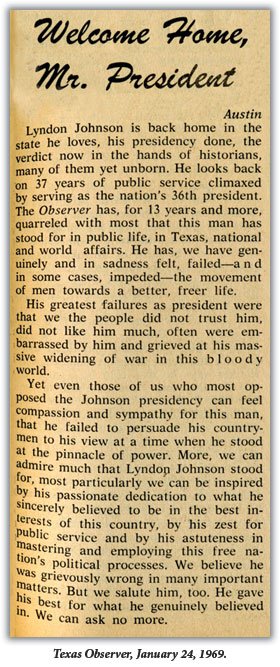
Ronnie Dugger : LBJ, The Texas Observer and Me

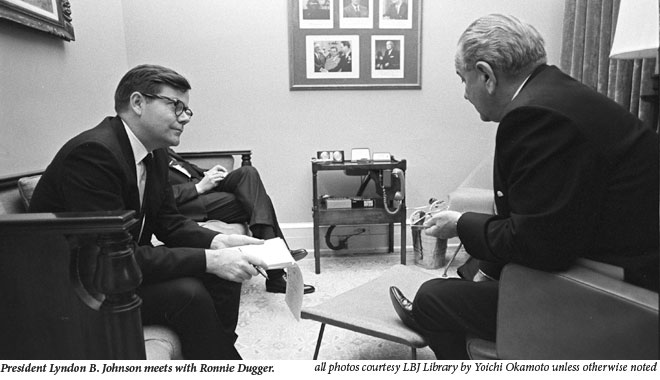
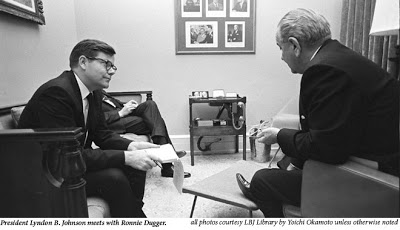
Former Texas Observer editor Ronnie Dugger with President Lyndon Johnson. Photo by Yoichi Yokamoto / Courtesty LBJ Library / Texas Observer.

‘None of us knew it yet, but we Americans were about to be trapped in the history that Lyndon Johnson would make’
By Ronnie Dugger / August 22, 2008

The confrontation between Lyndon Johnson on one side and The Texas Observer and me on the other arrived on its own terms at his ranch in the Hill Country in 1955.

He was the senior United States senator from Texas and the new majority leader of the Democrats in the Senate. He had developed his concept of journalism as the editor of his college paper sucking up to the college president, and by 1955 he was hell-bent on the presidency. A group of national liberal Democrats and I, chosen as editor, had launched the Observer the preceding December. I had been editor of my high school and college newspapers, a sportswriter, columnist, an occasional correspondent for the San Antonio Express-News, and a hanger-out with Edward R. Murrow’s boys at CBS News in London when I was studying in England. Johnson was 47; I was 25.

None of us knew it yet, but we Americans were about to be trapped in the history that Lyndon Johnson would make, and I was about to be trapped in his persona and career. He was not an idealist, but he served ideals when it suited and expressed him. He was not a reactionary, but he fanned reaction when it helped him advance himself. As I wrote in my 1982 book about him, “Lyndon Johnson was rude, intelligent, shrewd, charming, compassionate, vindictive, maudlin, selfish, passionate, volcanic and cold, vicious and generous. He played every part, he left out no emotion; in him one saw one’s self and all the others. I think he was everything that is human. The pulsing within him, his energy, will, daring, guile, and greed for power and money, were altogether phenomenal, a continuous astonishment.” Ahead of us lay his ascension to the presidency after the assassination of John Kennedy and his calamitous Vietnam presidency, but also his presidency of Medicare, Medicaid, the Voting Rights Act, the Fair Housing Act, Head Start, federal aid for the education of the poor, bilingual education, affirmative action, and the establishment of public radio and television.

Lyndon was the driven son of an ambitious, all-empowering mother and a failed liberal politician who made it no higher than elected membership in the Texas House of Representatives. After a lot of hell-raising, Lyndon, following his mother’s lead, took $100 from his folks and enrolled at Southwest Texas State Teachers’ College in San Marcos. The 700 students there came from the farms and towns in the area. They were almost all white, only a few Mexican-American. Already aiming to be president, Lyndon was set on getting power even in school, and having watched his father, he knew how to try and how not to try for it. Since he got not another nickel from his parents, he had to work his way through Southwest Texas, but after a stint janitoring around the campus, he simply strode into the office of Cecil Evans, the president of the school, and talked his way into a slightly better job.

Walking on campus with his cousin Ava, Lyndon divulged to her his theory of how to get ahead. “The first thing you want to do,” he told her, “is to know people—and don’t play sandlot ball; play in the big leagues … get to know the first team.”

“Why, Lyndon,” she exclaimed, “I wouldn’t dare to go up to President Evans’ office.”

“That’s where you want to start,” he told her.

“I knew there was only one way to get to know him, and that was to work for him directly,” Johnson told me later in the White House. For most of his time at Southwest Texas, he was special assistant to the president’s secretary, with his desk next to the secretary’s. This paid him $37.50 a month, but he wanted to be editor of the student paper because that would pay him another $30.

In his first signed editorial in the student paper, the College Star, Lyndon rebuked fellow students—“celebrities,” he called them—who were using the college bulletin board for personal messages. The board “must be kept free for school matters,” he wrote, of course thereby pleasing Cecil Evans. Lyndon “knew how to ingratiate himself,” as one of the English teachers there said, and when the student council made him editor of the Star, he demonstrated further that he would use the paper as a tool for personal advancement. Profiling his own boss, Lyndon wrote: “Dr. Evans is greatest as a man,” what with “his depth of human sympathy . . . unfailing cheerfulness, geniality, kind firmness,” and so on.

Throughout his career on the make, Johnson cottoned up to selected powerful political leaders, both accommodating and abetting them, and thus predictably becoming a favored protégé. He did this, for example, with House Speaker Sam Rayburn, President Roosevelt, and Sen. Richard Russell, as well as with business leaders such as contractors George and Herman Brown. In flattering Dr. Evans in the college paper that he edited, he was just warming up his game of protegeship through the opportunities provided him by his temporary status as a journalist.

In 1955, Rayburn and Johnson, the Democratic Party’s bosses over the two branches of the distant Congress, were gigantic figures in one-party Texas politics. The Democrats in Texas were venomously divided between the “loyal Democrats”—also called national Democrats, who generally favored the policies advanced by Roosevelt and Truman—and the reactionary governor, Allan Shivers, and his fellow segregationists and conservatives, who had total control of the state Democratic Party. The previous October, a group of about 100 “loyal,” that is, national, Democrats in Texas, sensing that Shivers and his followers would go for Eisenhower for president in 1956 (as they did), gathered in Austin to found a liberal journal and asked me to edit it.

They knew, of course, that my views were liberal. They had some knowledge of my years of reporting on the thoroughly corrupt Texas Legislature in The Daily Texan, the student paper at the University of Texas in Austin, and my year as editor there championing racial integration, repeal of the oil depletion allowance, and other liberal causes. For a year my columns from abroad, laced with some of my policy opinions, had run in the San Antonio daily. A speech I had given to the Houston Rotary Club advocating, among other things, national health insurance, had provoked the physicians in the club to issue an outraged written objection.

Most of the liberals who had assembled in the hotel downtown, however, appeared to want a party organ, its editorial voice subordinated to the calculations of the national Democrats in Texas. My models for reporting were: the great muckrakers; Ed Murrow; James Reston. My idea of journalism included standing enough apart from government and political parties to report independently of them and to criticize any institution when that was called for. Although party organs have their place, I did not want to work on one.

Acting through Jack Strong, a lawyer in East Texas, the liberals offered me the editorship on the Friday before the Monday when I was leaving for Corpus Christi to work on a shrimp boat and jump ship in Mexico, eventually to write a novel about the Mexicans who (then as now) were wading, swimming, and drowning in the Rio Grande in search of work. That night I batted out a long letter to the group addressed to Mrs. R.D. Randolph, one of the group’s leaders who was an heiress to the Kirby lumber fortune in East Texas, outlining what sorts of stories I would want the Observer to investigate and what sorts of editorial crusades we likely would launch, but also my position on a party organ. Addressing the group in the hotel downtown, I told them I was not interested in editing a party organ, but I would stay and edit the new journal, provided I had exclusive control of all the editorial content. The paper’s publisher could fire me at any time for any reason, but as long as I was the editor, I would determine the editorial content. This arrangement, which protects the journalists and the journalism from politics or the business of publishing, I later, as Observer publisher until 1994, explicitly ceded to every editor who succeeded me.

Bob Eckhardt, the great legislator of my generation in Texas and soon to become one of my closest friends, told me later that a fierce debate occurred after I left the hotel. He said that Mark Adams, a New Dealer and a yeoman printer, said that “if ever a rattlesnake rattled before he struck, Dugger has.” Mark, who became my first printer at the Observer, denied saying it.

But they accepted my terms, and as we prepared to begin, I settled on a motto for the front-page masthead, Thoreau’s “The one great rule of composition is to speak the truth,” and wrote a policy credo that contained the sentence, “We will serve no group or party but will hew hard to the truth as we find it and the right as we see it.”

I had no sting out for Johnson, far from it. While a student at UT, I had worked downtown in Austin as a reporter and news announcer for his and Lady Bird’s radio station, KTBC. His senatorial office, that is, he, had helped me get a job in Washington one summer in the division of international organizations at the Department of State. Returning from abroad, I had applied unsuccessfully for a job on his Senate staff. I learned that Horace Busby, one of his top advisers, had said to him something like, “Ronnie’s not our kind of guy,” but I didn’t know that for many years.

The first year or so at the Observer, I was the only reporter and editor, and we had one subscription person. The founding group watched quietly as I did my best to begin to wreak havoc on racism, corruption, poverty, discrimination, and the rancidness of the plutocratic ideals blatted forth by the allegedly Democratic Gov. Allan Shivers. When I reported the racial murders of two black children in Mayflower, Texas, near Tyler, I was told that one of the Observer founders, Franklin Jones Sr., a very successful plaintiff’s lawyer in Marshall, exploded profanely on seeing my photograph of the body of one of the dead children on the front page: “Here I am working my ass off getting subscriptions for the Observer, and Dugger sends us pictures of dead Negroes all over the front page.” But if Franklin did say that, or something like it, he said nothing to me.

A new Democratic National Committee member from Texas had to be chosen, and it became known that Sen. Johnson had exerted his power to achieve the selection for that honor of the reactionary and racist Lt. Gov. Ben Ramsey, who presided as the dictator over the Texas Senate to the purring pleasure, protection, and profit of every corporate fat cat in the state, the oilmen most of all. In editorials, I damned Johnson to hell and back for it.

Johnson had been opposing the Texas liberals—on Ben Ramsey, by effectively favoring conservative Price Daniel over the liberal Ralph Yarborough for governor, and in other ways—to get Texas reactionaries behind him, or at least to quiet them down, for his candidacy for president, which Rayburn and he would soon make public. Nearly all of us at the Observer and all our readers were in agreement on a new drive to build a grassroots uprising of the liberal and populist Democrats to throw Ramsey and his ilk—Shivers, Sen. Daniel, the lot of them—into the Republican Party where they belonged. Obviously a Democratic Party answering to well-organized Democrats in the cities directly challenged and would at least diminish the boss-rule powers that Rayburn and Johnson exercised and enjoyed, and Johnson went to calling all of us involved in this organizing effort “the redhots.”

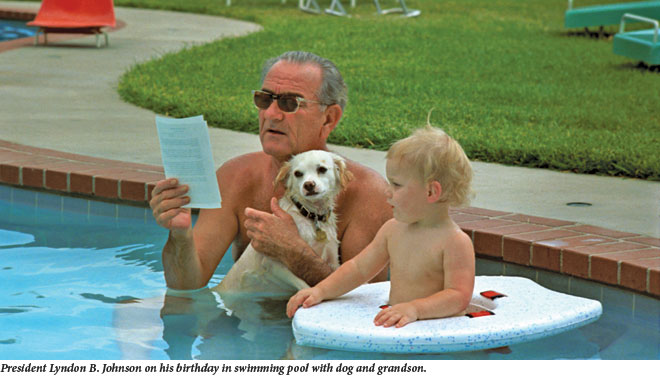
At some point that fall, with the Ramsey controversy smoking, I received a phone call that Sen. Johnson would like to see me, and would I call on him at the ranch at a certain hour on a certain afternoon. I had never been out there. After wheeling my family’s 1948 Chevrolet, which we called the Green Hornet, through the Pedernales River muscling itself shallowly over Johnson’s low-water bridge, I pulled up in front of his grand spread and saw that he was swimming in the pool, off to the right there. We greeted, nodding, and for some time I shifted from one foot to the other by the pool, feeling rather high in the air, as he continued his swim and, desultorily, we talked.
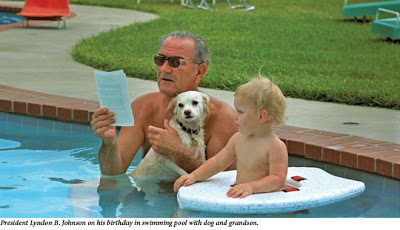

Toweling off and sitting us down on the pool furniture, cocking his long face toward me, Sen. Johnson asked me:

“Ronnie, what’s the circulation of your paper?”

“Oh, about 6,000.”

“Stick with me and we’ll make it 60,000,” Johnson said.

I knew at once what he meant. “Stick with me” meant support his policies and decisions, about Ben Ramsey and anything else, celebrate his sagacity and wisdom in all that I wrote about him, and support his presidential ambitions; “and we’ll make it 60,000” meant that in return, he would employ his standing, power, and connections to build up the Observer. The one great rule of composition would be to promote Lyndon Johnson. The Observer would be not a party organ, but a Johnson pipe organ that his nod could cause to bellow forth with Wagnerian splendor. The senior senator from Texas and the Democratic majority leader of the U.S. Senate had called me out here to propose straightforwardly that the Observer and I replace journalistic integrity with loyalty to him. He was trying to bribe me and The Texas Observer, or, if this was not to be a bribe, the deal—the secret understanding—the quid pro quo, obedient loyalty and feigned adulation in return for the other’s use of his power on your behalf, would have been not different from a bribe by a dime.

Johnson’s problem was, he would soon make public his campaign for the presidency. He knew the Observer was a novelty, conspicuous in reactionary Texas, reporting long-covered-up events and expressing unpredictable opinions; he knew that national newspeople, traipsing to and from his ranch from Austin, would often drop by the Observer offices for inside dope or just for the devilment of it, as in fact they were to do for the rest of the decade; and he knew that if his sellouts to the Texas yahoos and rednecks on the way to the White House became clear to the national Democrats, they might not nominate him for president.

My problem was how to get out of there. I could have just said, “I’m sorry, senator, no deal,” but this was not my style while practicing rebellious journalism in Texas. I extended myself and taxed my fellow Observer reporters to be fair and accurate, both in order to be fair and accurate and in self-defense, although, that done, in editorials I let miscreants and villains have it straight on. In person, in my life day after day, I was carefully polite and civil with all parties. If I was formally polite to a fault, well, it was a kind of protective coloration. On this afternoon with Johnson, I realized that the Observer and I had been misgauged and underestimated, but that for the rest of the occasion my part was to avoid any accusative remarks or implications, any incautious, offensive, or popinjay responses, and to graciously take my leave as soon as that might appear mannerly.

Sitting there side by side on plastic chaise lounges—someone brought us cold drinks, I believe lemonades—we talked along gingerly for maybe an hour. Well, senator, it’s an honor to have met you, and I appreciate your having me out—don’t want to overstay, I’d better be getting back to town—I said something like this, starting to rise to head back to my Green Hornet.

No, he said, why don’t you stay to dinner. No trouble, Bird’ll have plenty.

Although I had nothing more to say to him, I had not said no, and he had something more to say to me.

After an interim during which nothing happened, I sat down to dinner in a half-dark chamber at the center of the Johnsons’ well-staged home with Lady Bird Johnson and Johnson’s personal secretary, Mary Margaret Wiley, who had been my managing editor in high school in San Antonio when I had edited the Brackenridge Times. Mary Margaret is a beautiful person. While I had perceived no romantic flash in our friendship and work together in high school, we admired and respected each other; I was glad she was there.

As Johnson sat down at my left at the head of his table, though, I realized, silently appalled, “My God, the subject is at hand, all I can do is explain journalism to him as if he actually doesn’t know what it is.” If the situation had not been unbelievable, it would have been incredible.

I struck forth uncertainly, as if we were dining on a pitching log, addressing only Johnson to describe, as best I could, the role of journalism, the Fourth Estate, separation from government, providing facts and explanations, democracy’s inexpendable need for an independently informed electorate. I may even have quoted Jefferson. I might as well have been talking to the log I was riding. Johnson said to me, No, the thing a smart young reporter does, and should do, is survey the field of candidates, pick the best one, and enter into a deal to help that one win whatever office and prevail in whatever controversy, subordinating his reporting and comment to the interests of the candidate.

Johnson was far too smart to really think that is what journalism is or should be. He was feigning adherence to a theory of journalism, a blend of his own practice on his college paper and his political strategy of protegeship upended for the advance of his juniors, that might work somewhat, with me and others, as a disguise for his use of journalists to serve his will to power. Later it became embarrassingly clear that he had induced some of the leading reporters and columnists in Texas and the nation to make some such a deal with him or assent to some such understanding: Leslie Carpenter, William S. White, Joseph Alsop, some of the authors of those surprising articles in the big magazines in the late 1950s promoting the lanky Lyndon Johnson of Texas for president of the United States.

I remember (I am not referring, for this essay, to my notes on all of this) that neither Lady Bird nor Mary Margaret said one word all evening. Oh, perhaps one or two, but I don’t remember even one. They sat silent and still as good women of old were supposed to during an argument among the men. Yet both Bird and Mary Margaret were highly intelligent. How strange the evening must have seemed to them, their guy trying to turn a journalist into his secretly bought public promoter, their senator and this younger guy battling over irreconcilable opinions, completely missing each other, reaching no agreement.

Many’s the time since that evening there has replayed on the stage in my mind a vivid re-seeing of what happened upon my departure that evening. I am five or six feet away from Lyndon and me, watching the two of us illuminated by the ranch-house lighting locked in animated argument in front of his house at his low wire fence, he inside the fence, I outside, our knees braced against it and each other, intensely disputing directly into each other’s faces a few inches apart, he leaning first a little into my face, and then a little more, and then so much my head is bent back, and I shift my heels backward to be able to stand up straight to him again.

My first associate editor at the Observer, Billy Lee Brammer, a reporter on the Austin daily (and later the author of the classic Texas novel The Gay Place), started showing up unbidden evenings and helping me clip the 3-foot-high mounds of the rotgut Texas daily newspapers of that era, then quit downtown and came on staff. He flourished in reporting Texas politics for us, most memorably “the Port Arthur story” and the Austin lobby’s junket for Texas legislators to the Kentucky Derby, until Johnson hired him onto his Washington staff.

The liberal Democratic organizing of the ’50s caught hold in the cities, especially in Houston and San Antonio. In the 1956 Democratic state convention, over the furious objections of Johnson and his operatives there, the delegates elected Mrs. Randolph, who had become the de facto publisher of the Observer, to the Democratic National Committee. Four years later, favorite son Johnson trounced his opponents in Texas and swept into that year’s state convention, where he had Mrs. Randolph replaced. In one of these conventions, Mrs. Randolph told me, Johnson sent her word asking her to call on him, and when she did he asked expansively, “Well, Mrs. Randolph, what can I do for you?” She replied: “Nothing.”

Texas labor leaders Fred Schmidt and Hank Brown told me that, when they lobbied the Democrats’ Senate leader in Washington, he railed against the Observer and me, on some specified occasion with a copy of the journal on his desk. Mrs. Randolph said that when he asked her to get me to do something or other she replied, “Talk to him.” At least I could think, when for example I wrote a series of columns on the horrors of nuclear weapons, or during the Vietnam war when I ran a headline across the front page, “Will Johnson Bomb China?” that the man himself might be reading it.

During one state Democratic convention, I was running tandem some with Mark Sullivan, the Southwest bureau chief for Time-Life, for which I was a stringer. Mark and I approached Johnson on the convention floor for an interview. Johnson barked out that he wouldn’t talk to us with me there because “that boy prints lies about me.” We left him—or at least I did; I am not sure what Mark did.

That was the first and has been the only time in my life when I have directly experienced from another person the will to ruin me. The Time-Life connection was enabling me to hold up my financial end with my wife and children despite my annual Observer salary of $6,500. With this one ferocious remark to my boss at Time-Life, Johnson surely meant to kill me professionally. Deep in my convention story in the Observer, I reported the scene and what Johnson had said about me. I was deeply offended, and a year or two had to pass before my anger about it subsided. But Time-Life stood by me (in fact in 1961, after a lunch with Henry Luce, I was invited to join the staff of Time, which I did not).

In 1959, preparing a special focus for the Observer on Johnson’s candidacy for president, I asked him for an interview in Washington, and he granted it. I remember that on my way into his regal office as majority leader, I saw Mary Margaret at her desk, and we exchanged cautious smiles and slight nods when my eyes briefly met hers as I passed. The interview went well enough. This time I got the full Johnson treatment of persuasion, charm, raillery, and menace—stories, brags, ridicules of his colleagues, jokes, hands on my knees—again and again the leaning into my face.

Perhaps I should also record that, in the early 1960s when Johnson was vice president, I became a correspondent in Texas for the then-liberal Washington Post, and I intuitively suspect on the basis of the facts and context of what happened, but I have no evidence, that Johnson used his extremely close ties to that newspaper’s executives to have them eventually drop me.

The Observer never endorsed Johnson for president except in his contest with Barry Goldwater in 1964. In columns, I was for Estes Kefauver in 1956, Averell Harriman in 1960.

Except for an oblique column in the Observer full of obscurities after the confrontation at the ranch, this is the first report I have written about these events since they occurred half a century ago. Initially there was the off-the-record problem, but that’s gone now. I have not wanted to write about it, too, because how could I without being perceived as possibly self-serving? I relate them here now because the Observer editor asked me to.

In November 1965, I was one of the eight speakers who addressed the first massive demonstration against Johnson’s escalation of the Vietnam war, and afterward I typed out a copy of my speech and sent it to President Johnson (the Observer ran the text of it). Johnson had George Reedy, then his press secretary, send me a note that “the President asked me to tell you he seeks no wider war,” the first time I saw or heard him hide behind that lying bromide.

In 1967, having signed a contract with W.W. Norton for a book on Johnson, I wrote him asking him for biographical interviews and telling him that I intended a fair and accurate book worthy of the attention of serious people, and he gave me extensive interviews in the White House in late 1967 and 1968. He introduced me around the White House as “the leading liberal in the Southwest.” Discounting that as the Texas blarney it was, he had given off accusing me, or the Observer, of printing lies about him.

He tried to bring you into his field of overmastering personal power; that failing, he tried to ruin you; that failing, well, OK, he would deal with you again. In my last interview with him in the White House, on March 23, 1968, we were carrying along merrily. He was telling me a story when he suddenly interrupted himself and said, “Now, Ronnie, I’m giving you all these great stories, I want a friendly book!” I leaned forward and began, “Well, now, Mr. President—” but he shut me off and continued with the story. He was so charming, engaging, such an engrossing person, funny, fun to be with, such a good raconteur, I did not remember that he had said that until I was outside the White House that night. I went on back in and spoke with his press secretary then, my old friend George Christian, whom I had reported alongside years earlier in the offices of the International News Service in the Texas Capitol. I reminded George I had told Johnson I intended to write a fair and accurate book worthy of the interest of serious people, but that during our interview that evening he had said he wanted “a friendly book.” Oh, hell, George said, you know Lyndon, he didn’t mean anything by it. Maybe George was right, but “Yes, he did,” I said, “and please tell him from me, on that point, no deal.”

The next day, I suspected pro forma in light of what had occurred, I asked that my next interview with the president be scheduled, and then I waited some days in the Hay-Adams Hotel across Lafayette Park from the White House, where I was staying. No call came. A week later Johnson quit the presidency. Another week later, he began his interviews with Doris Kearns.

The Observer maintained its integrity and its independence of Lyndon Johnson before and during his presidency. He was who and what he was, the Observer and I were what and who we were and are, and this is the story of Lyndon Johnson, The Texas Observer, and me.
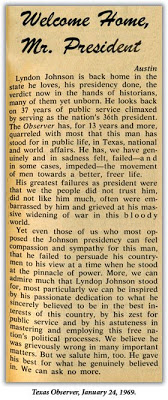
Click for larger image.

Ronnie Dugger, founding editor of the Observer and, later, its publisher until 1994, is the author of Dark Star, Hiroshima Reconsidered (World, 1967), Our Invaded Universities (W.W. Norton, 1973), The Politician: The Life and Times of Lyndon Johnson (W.W. Norton, 1982), and On Reagan (McGraw Hill, 1983). His work on stealing elections by manipulating computer-counted votes, beginning in The New Yorker and the Observer in 1988 and continuing since in other periodicals, initiated the reporting that predicted the potential for the current scandals and laid the foundation for needed reforms on that subject. He now works in Cambridge, Massachusetts, on books and his poetry; his e-mail is rdugger123@aol.com.

Source / Texas Observer

The Rag Blog

Posted in RagBlog | Tagged , , , , , , , , , | 1 Comment

Endangered Species : Angered Scientists, Green Groups Confront Administration

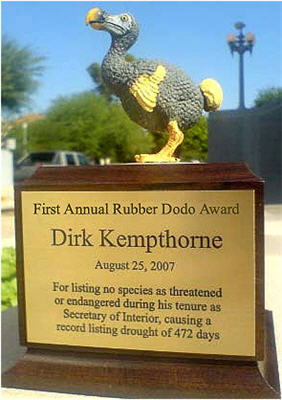
Interior secretary Dirk Kempthorne, winner of the 2007 Rubber Dodo Award, is drawing the wrath of scientists and green groups.

Environmental groups plea for public comment on endangered species law changes
By Elana Schor / August 22, 2008

A coalition of scientists and advocates from 105 environmental groups across the US is pressing the Bush administration to allow more public input before it restructures the country’s endangered species law.

Environmentalists got a shock to the system 10 days ago when the Bush administration revealed it would end the 35-year-old requirement that government agencies consult with independent scientists before building roads, dams or mines that could harm threatened species.

The interior secretary who proposed the rule, Dirk Kempthorne, defended the move as necessary to make sure climate change is not used to justify more endangered species protections. Activists cried foul, accusing the Bush administration of launching a “sneak attack” on wildlife during its last days in office.

But what made the Bush administration’s plans even more alarming to environmentalists was the limited outreach that Kempthorne’s department plans to do before changing the endangered species law.

Every US government agency must seek public comment on a rules change before making it. Comments are generally accepted for several months — but the species protections are scheduled to pass after only 30 days of discussion.

“It appears as if the [Bush] administration is doing whatever it can to discourage participation in the democratic process,” National Wildlife Federation executive director John Kostyack said.

“I think we can expect more sneaky assaults like this on our public land and wildlife laws as this administration heads for the exits.”

In addition, public comments will only be accepted by mail or through a government website that automatically shares one’s personal information. The limited comments could prevent green groups from generating mass opposition to the new rule via fax and email.

While they battle to prevent the species law from being changed, environmental groups are also pushing for Kempthorne to open up the process and allow the public greater say over wildlife protections.

“The abbreviated timeline and restrictive commenting options raise serious concerns that the department of the interior is attempting to rewrite a bedrock environmental statute without allowing for adequate public involvement,” 105 environmental groups wrote in a letter to Kempthorne yesterday.

The groups also urged Kempthorne to hold public hearings on the new rule where advocates from both sides of the endangered species debate could exchange views.

Signers of the letter hail from nearly every state in America and a cornucopia of scientific institutions, from the Gulf Restoration Network to the Missouri Botanical Garden to California Trout Incorporated.

Source / Guardian, U.K.

Also see Bush officials sneak-attack nation’s wildlife / salon.com

The Rag Blog

Posted in RagBlog | Tagged , , , , , , | 2 Comments

And We Aren’t Gonna Take It Anymore!!

Room 641A is an alleged intercept facility operated by AT&T for the U.S. National Security Agency, beginning in 2003. Room 641A is located in the SBC Communications building at 611 Folsom Street, San Francisco, three floors of which were occupied by AT&T before SBC purchased AT&T and changed its name to AT&T. The room was referred to in internal AT&T documents as the SG3 [Study Group 3] Secure Room. It is fed by fiber optic lines from beam splitters installed in fiber optic trunks carrying Internet backbone traffic and, therefore, presumably has access to all Internet traffic that passes through the building. Source.

Rights Group Suing AT&T for Spying Will Sue Government Too
By Ryan Singel / August 22, 2008

A civil liberties group suing AT&T for helping the government warrantlessly spy on Americans isn’t abandoning its lawsuit after Congress voted to give retroactive immunity to the nation’s telcoms.

Instead, the scrappy San Francisco-based Electronic Frontier Foundation now says that it will expand its efforts and sue the government over the spy program that operated outside of the court system for more than six years.

“If Congress wants to shut down one avenue, we will go down another,” EFF legal director Cindy Cohn said, noting that the amnesty provisions in the FISA Amendments Act of 2008 do not apply the government itself as the Administration had first wanted.

The full extent of the government’s warrantless spying has yet to be revealed, but it is reported to involve massive data-mining of Americans’ phone records, and broad wiretapping of communications that enter or leave the U.S. border .

After the portion that targeted Americans’ international communications was submitted to the nation’s acquiescent secret spying court for blanket approval in January 2007, the program was quickly found to be illegal.

That prompted the Bush Administration to scare Congress into giving it wide, but temporary powers to turn American internet and phone companies into de facto extensions of the nation’s spooks.

After a few months of standing up to the Administration’s typical terrorism rhetoric, a Democratic-controlled Congress caved to political pressure in July and handed a significant victory to President Bush by approving retroactive amnesty to telecoms that spied on Americans without following the st helping the government warrantlessly and secretly spy on Americans.

Other groups have attempted to sue the government over the warrantless spying, but even the most successful of them have eventually failed since the plaintiffs can’t convince a court that they were spied on.

The EFF will rely on the same evidence its civil suit does — wiring documents and a signed declaration from former AT&T engineer Mark Klein. Klein alleges that AT&T siphoned off internet traffic into a secret room in San Francisco controlled by the NSA. (See Wired.com’s publication of the Klein documents that remain under partial seal in federal court.)

Though the EFF didn’t want to sue the government originally, the amnesty issue forced their hand, according to Cohn.

“If it was illegal for AT&T to turn over the data, then it was illegal for government to receive it,” Cohn said.

Cohn admits the government has many sovereign immunity defenses that can protect it from lawsuits, but says they aren’t insurmountable and that the program clearly violates the Fourth Amendment.

As for the unexpectedly long-lived suit against AT&T, the government and the EFF are discussing when and how the government will attempt to have the case dismissed using the amnesty provision. The EFF wants to challenge the legality of the amnesty before it is actually applied, while the government prefers to have the case dismissed first — then have the EFF fight the dismissal.

Lawyers for both sides will meet with the judge in the case in early September, setting a likely date for the next court appearance in December.

The case is known as Hepting vs. AT&T.

Source / Wired

Thanks to Diane Stirling-Stevens / The Rag Blog

Posted in RagBlog | Tagged , , , | 2 Comments

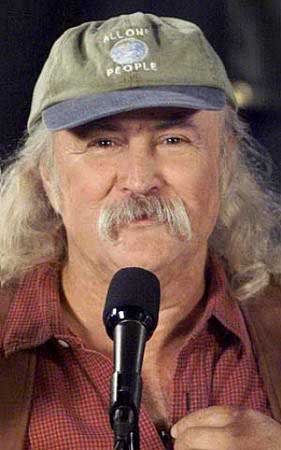
MUSIC : David Crosby Not Shy About Which Side He’s On


‘Barack has dignity and moral values, and I believe he loves his country.’
By Ricardo Baca / August 22, 2008

It’s hard to believe, but David Crosby, an artist celebrated for his liberal activism as much as for inspired songwriting, will attend his first-ever Democratic National Convention, in Denver next week.

“Usually the people who try to get celebrities to come around to conventions and stuff want bigger ones than me,” Crosby said via telephone from his Santa Barbara, Calif., home earlier this week. “They want Jennifer Lopez or something.”

And mind you, Crosby won’t attend the convention itself. He’s going to the Buell Theatre to play an etown show Tuesday with buddies Graham Nash, James Taylor and Ani DiFranco.

“I don’t like most politicians, so I don’t see what the attraction is to go and be in the middle of a bunch of them,” Crosby said. “I’m definitely not going to the convention. I’m going to etown. I have a very high opinion of etown. They’re good people, and they do really good work. And I don’t think you can say that about most politicians.”

What about the dude getting ready to accept the Democratic nomination?

“I think he’s a very encouraging guy, a very intelligent man — which is, of course, a complete 180 degree shift from where we’ve been the last eight years,” Crosby said. “The idea of having a guy who can speak in complete sentences is extremely attractive. Barack has dignity and moral values, and I believe he loves his country.”

Crosby is just one of many musicians making their way to the Mile High City in the next 10 days. Conventions have grown into media circuses where entertainers and politicos share the same ground for a few days. It’s going to be an incredibly busy music week in Denver with performers as varied as Willie Nelson and the Black Eyed Peas, Fall Out Boy and Rage Against the Machine, Daughtry and Melissa Etheridge, the Blue Scholars and Silversun Pickups, Moby and Ted Leo and the Pharmacists — and maybe Dave Matthews, Kanye West and Bruce Springsteen.

While some bold names will be in Denver all week — playing this party, getting spotted at that party, hobnobbing at another party — Crosby is fine with getting in and out.

“I have a friend who does a show on Air America, David Bender, and I’ll probably do his show while I’m there,” said Crosby. “If we get roped into something else, we get roped into something else.”

Crosby understands the weight of the current presidential race, not to mention the great divide in America today. There’s a scene in the recent Crosby, Stills, Nash & Young documentary, “Déj… Vu,” that films angry fans leaving in the middle of a CSNY concert in Atlanta as the group spoke against President Bush and sang songs such as “Let’s Impeach the President.” The group knew their political views would make an impact in the South, and that’s why they were filming it for the documentary, but they didn’t know the reaction would be so severe.

“When you look at the people, the ones who were disgruntled, they’re not the people who I really give a (expletive) about,” Crosby said. “Truth is, it’s good to stir things up. It’s good to make people have a dialogue with each other, even if it starts out with people yelling and pointing fingers.”

When asked about the dichotomy of an artist-fan relationship — they love your music but not your personality or politics — Crosby changed his tune a bit.

“I do give a (expletive) about them, but I think they’re kind of funny when they come to a CSNY concert and get mad about there being politics,” he said. “I don’t have a lot of sympathy for them. We’ve been probably the most political band in the world — or at least one of them. Anybody who comes to a concert of ours and expects us to not be anti-war and pro-human and anti-George Bush is crazy. They should have gone to a different concert.”

Source / Denver Post

The Rag Blog

Posted in RagBlog | Tagged , , , , , , , | 1 Comment

BOOKS : But Is That All He Should Be Charged With?

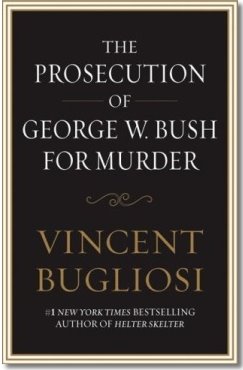
The Prosecution of George W. Bush for Murder is currently number 10 on the New York Times bestseller list. Thanks to Susie Madrak at Suburban Guerilla for pointing that out.

Richard Jehn / The Rag Blog


A review of Bugliosi’s The Prosecution of George W. Bush for Murder: The Prosecutor and the President
By Michael Collins / August 21, 2008

Vincent Bugliosi wants George W. Bush prosecuted for murder. There are others who are complicit in the crime, namely the Vice President and Condoleezza Rice, but Bush is the target of this famed former Los Angeles prosecutor (the Charles Manson case) and best selling author (Helter Skelter and The Betrayal of America as two examples). He is undeterred by the virtual major media blackout on interviews and advertising. He’s taking his case directly to the people through alternate media and the internet.

Bugliosi constructs a devastating case in The Prosecution of George W. Bush for Murder. As I write this review, it is still difficult to grasp my sense of shock at this title with this author’s name below it. A legendary prosecutor with a near perfect record in big cases, Bugliosi articulates one of the most revolutionary ideas imaginable in a mix of today’s otherwise vapid and obtuse political thinking. But first, the book and how the prosecutor makes his case.

He wastes no time in following up on the shock generated by the title. In the first sentence, we’re told:

The book you are about to read deals with what I believe to be the most serious crime ever committed in American history – – the president of the nation, George W. Bush, knowingly and deliberately taking this country to war in Iraq under false presences, a war that condemned over 100,000 human beings, including 4,000 American soldiers, to horrific, violent deaths.” (V. Bugliosi, p. 3)

The president “knowingly and deliberately” caused the deaths of U.S. soldiers and Iraqi civilians and that’s called murder, plain and simple. This is not a hypothetical case that could happen under special legal interpretations. When the president leaves office, he is subject to the same law as the rest of us. Bugliosi explains the ability to prosecute the case against George W. Bush by a district attorney or states attorney in any local jurisdiction where a life was lost in the Iraq war. Federal prosecutors also have that option. Bugliosi’s detailed analysis of this phenomenon offers some of the best analysis in the book and the detailed end notes.

Read all of it here. / ePluribus Media

The Rag Blog

Posted in RagBlog | Tagged , , , , , | Leave a comment

When I Covered My First Democratic Convention: Chicago 1968

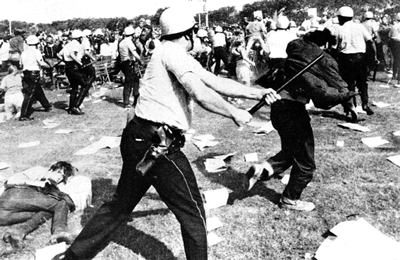
Chicago cops brutally attack demonstrators (and journalists, and bystanders) outside Democratic Convention, 1968.

‘It culminated in the crushing of Sen. Eugene McCarthy’s anti-Vietnam crusade inside the convention hall and the cracking of peacenik skulls by Mayor Richard Daley’s police in the streets’
By Greg Mitchell / August 21, 2008

NEW YORK — With the 2008 Democratic national convention about to begin in Denver, I can’t help recalling the first DNC that I covered in 1968, exactly 40 years ago next week. Yes, it was the infamous gathering in Chicago, when the conflict turned bloody. I never made it inside the convention hall — but I did grab a front row seat for what “went down,” as we used to say.

It culminated in the crushing of Sen. Eugene McCarthy’s anti-Vietnam crusade inside the convention hall and the cracking of peacenik skulls by Mayor Richard Daley’s police in the streets. Together, this doomed Hubert Humphrey to defeat in November at the hands of my old hero, Richard Nixon.

I’ve been a political-campaign junkie all my life. At the age of 8, I paraded in front of my boyhood home in Niagara Falls, N.Y., waving an “I Like Ike” sign. Four years later, in 1960, I represented Nixon in a 7th grade debate, and when the votes were counted, Kennedy had carried the class by about 20-2. Traumatized, I’ve never publicly endorsed a candidate since. But in 1968 I got to cover my first presidential campaign when one of Sen. McCarthy’s nephews came to town, before the state primary, and I interviewed him for the Niagara Falls Gazette, where I worked as a summer reporter during college.

My mentor at the Gazette was a young, irreverent City Hall reporter named John Hanchette. He went on to an illustrious career at other papers, and as a Pulitzer Prize-winning national correspondent for Gannett News Service, but back then he was best known for his weekly column. It featured a comic creation known as “Falls Street Louie,” who had all the inside dirt on the local politicos.

Hanchette was in Chicago that week to cover party politics as a Gazette reporter and contributor to the Gannett News Service (GNS). I was to hang out with the young McCarthyites and the anti-war protestors. To get to Chicago I took my first ride on a jetliner.

To make a long story short: On the climactic night of Aug. 28, 1968, Hanchette and I ended up just floors apart in the same building: the Conrad Hilton Hotel in downtown Chicago. I was in McCarthy headquarters and Hanchette was in one of Gannett’s makeshift newsrooms. Probably at about the same time, we pulled back the curtains and looked out our separate windows to see police savagely attacking protestors with nightsticks at the intersection directly below.

Besides writing his own stories, Hanchette was expected to “run” copy from columnist Dave Beetle to GNS at the convention hall. Also on hand in that room was the GNS fashion writer, who was composing a piece on Muriel Humphrey’s wardrobe. After spotting the carnage in the streets, Hanchette recalls asking Beetle to come to the window for a look. The older reporter didn’t seem that impressed until tear gas started seeping into the room through the vents. Then Beetle said, “Hmm, this may be serious.”

Like me, Hanchette headed for the streets. By that time, the peak violence had passed, but cops were still pushing reporters and other innocent bystanders through plate glass windows at the front of the hotel.

While I screwed up my courage and crossed to Grant Park where the angry protest crowd gathered, Hanchette hailed a gypsy cab and headed for the convention hall out by the stockyards. When he got to the Gannett tent he told GNS honcho John C. Quinn what he had seen and suggested that the bad-cop angle should lead the wire report. Quinn was not always confident about the young Hanchette’s news judgment, based on his earlier suggestion that an interview with Allen Ginsberg (or the Yippies nominating Pigasus the Pig for president) should play prominently on the GNS wire.

But dramatic film footage of what would later be labeled a “police riot” had just hit network TV, so Quinn went with it.

When we returned to Niagara Falls that Friday, we each wrote columns for that Sunday’s paper. I described the eerie feeling of sitting in Grant Park, with machine guns on Army Jeeps pointed at the crowd, and thousands around me yelling at the soldiers and the media, “The whole world is watching!” — and knowing that, for once, it was true.

Regretfully, Hanchette told his readers that Falls Street Louie would not be filing a report. Hanchette had sent him home early. Mayor Daley’s Chicago was just a little too dangerous for Louie.

More than 35 years later, after I had written two books on other infamous political campaigns, I returned to Chicago for a staged performance of a musical based on one of them. As I got out of a cab to make my way to the theater, I had an eerie feeling and, sure enough, looking up the street I noticed Grant Park a block away– and the very intersection in front of the Hilton where skulls were cracked that night in 1968.

Greg Mitchell is editor of Editor and Publisher. Among his nine books are: “The Campaign of the Century” (about Upton Sinclair’s race for governor of California in 1934) and “Tricky Dick and the Pink Lady” (the Nixon-Douglas contest in 1950). His latest book on Iraq and the media is “So Wrong for So Long.”

Source / Editor and Publisher

The Rag Blog

Posted in RagBlog | Tagged , , , , , | Leave a comment

Now, We Seem to Have Lost the Dots


Flaws Found In Watch List For Terrorists
By Siobhan Gorman / August 22, 2008

The government’s main terrorist-watch-list system is hobbled by technology challenges, and the $500 million program designed to upgrade it is on the verge of collapse, according to a preliminary congressional investigation.

The database, which includes an estimated 400,000 people and as many as 1 million names, has been criticized for flagging ordinary Americans. Now, the congressional report finds that the system has problems identifying true potential terrorists, as well.

Additional Resources
• Read highly technical internal documents identifying problems with the watch list systems. Document 1 Document 2
Read a government fact sheet of the current TIDE database.
Read the letter from Rep. Brad Miller to Director of National Intelligence Inspector General Edward Maguire.
Read the Subcommittee staff memo explaining the findings of their review of the watch list programs.

Among the flaws in the database, which was quickly built by Lockheed Martin Corp. in the wake of the Sept. 11, 2001, terrorist attacks, is its inability to do key-word searches. Instead, an analyst needs to rely on an indexing system to query the database, according to congressional investigators who learned of the issues from a whistleblower. Lockheed spokesman Tom Jurkowsky said he could not comment on a report he had not read.

Meanwhile, tens of thousands of “potentially vital” messages from the Central Intelligence Agency have not been included in the database, known as the Terrorist Identities Datamart Environment, or TIDE, congressional investigators found.

The system provides data to all federal-government terrorist watch lists, including the “no-fly” list maintained by the Transportation Security Administration and the Terrorist Screening Center, a clearinghouse for federal, state and local officials.

Thursday, lawmakers called on the inspector general who oversees the office of Director of National Intelligence Mike McConnell to investigate the problems. The database “may have left us less able to connect the dots than we were before,” Rep. Brad Miller (D., N.C.) said in an interview. “Now, we seem to have lost the dots.” The database’s search engine, he added, “is blindfolded.”

Rep. Miller, chairman of the House Science and Technology subcommittee that conducted the investigation, wrote to Inspector General Edward Maguire on Wednesday to ask him to look into the programs. The current system “has been crippled by technical flaws” and the system designed to replace it, dubbed Railhead, “if actually deployed, will leave our country more vulnerable than the existing yet flawed system today,” Rep. Miller wrote.

Mr. McConnell’s spokesman, Ross Feinstein, said his office has not seen the letter and would not comment. Lawmakers did not discuss their findings with Mr. McConnell or his staff prior to requesting the inspector-general investigation.

When tested, the new system failed to find matches for terrorist-suspect names that were spelled slightly different from the name entered into the system, a common challenge when translating names from Arabic to English. It also could not perform basic searches of multiple words connected with terms such as “and” and “or.”

Because the format of the data in the current database is “complex, undocumented, and brittle,” some significant data will be lost when the system is replaced by Railhead, according to the congressional report. For example, scraps of information such as phone and credit-card numbers found when law-enforcement and intelligence officials empty a suspect’s pocket, often called “pocket litter,” will not be moved to the new system.

Railhead was supposed to be completed by year’s end but has been delayed. Nearly half of the 72 so-called “action items” for the program were delayed as of June, congressional investigators found.

In recent weeks, the government has fired most of the 862 private contractors from dozens of companies working on the Railhead project, and only a skeleton crew remains, one congressional aide said. The two leading contractors on the program are Boeing Co. and SRI International. Calls to officials of Boeing and SRI were not immediately returned.

The congressional aide said the subcommittee found evidence of warring between the two contractors, which significantly hampered progress.

August Cole contributed to this article. Write to Siobhan Gorman at siobhan.gorman@wsj.com.

Source / The Wall Street Journal

The Rag Blog

Posted in RagBlog | Tagged , , | 1 Comment

Jonathan Franzen : ‘I Just Called to Say I Love You’

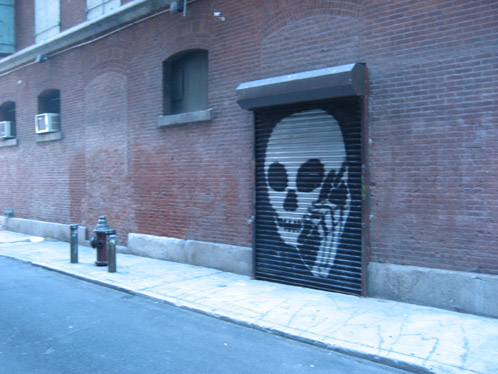
Skull-with-cell-phone by Spazmat in downtown New York City. Photo by Ivan Corsa. /Global Graphica

Cell phones, sentimentality, and the decline of public space.
By Jonathan Franzen

This article appears in full in the September/October 2008 issue of Technology Review.

One of the great irritations of modern technology is that when some new development has made my life palpably worse and is continuing to find new and different ways to bedevil it, I’m still allowed to complain for only a year or two before the peddlers of coolness start telling me to get over it already Grampaw–this is just the way life is now.

I’m not opposed to technological developments. Digital voice mail and caller ID, which together destroyed the tyranny of the ringing telephone, seem to me two of the truly great inventions of the late 20th century. And how I love my BlackBerry, which lets me deal with lengthy, unwelcome e-mails in a few breathless telegraphic lines for which the recipient is nevertheless obliged to feel grateful, because I did it with my thumbs. And my noise-canceling headphones, on which I can blast frequency-shifted white noise (“pink noise”) that drowns out even the most determined woofing of a neighbor’s television set: I love them. And the whole wonderful world of DVD technology and high-definition screens, which have already spared me from so many sticky theater floors, so many rudely whispering cinema-goers, so many open-mouthed crunchers of popcorn: yes.

Privacy, to me, is not about keeping my personal life hidden from other people. It’s about sparing me from the intrusion of other people’s personal lives. And so, although my very favorite gadgets are actively privacy enhancing, I look kindly on pretty much any development that doesn’t force me to interact with it. If you choose to spend an hour every day tinkering with your Facebook profile, or if you don’t see any difference between reading Jane Austen on a Kindle and reading her on a printed page, or if you think Grand Theft Auto IV is the greatest Gesamtkunstwerk since Wagner, I’m very happy for you, as long as you keep it to yourself.

The developments I have a problem with are the insults that keep on insulting, the injuries of yesteryear that keep on giving pain. Airport TV, for example: it seems to be actively watched by about one traveler in ten (unless there’s football on) while creating an active nuisance for the other nine. Year after year; in airport after airport; a small but apparently permanent diminution in the quality of the average traveler’s life. Or, another example, the planned obsolescence of great software and its replacement by bad software. I’m still unable to accept that the best word-processing program ever written, WordPerfect 5.0 for DOS, won’t even run on any computer I can buy now. Oh, sure, in theory you can still run it in Windows’ little DOS-emulating window, but the tininess and graphical crudeness of that emulator are like a deliberate insult on Microsoft’s part to those of us who would prefer not to use a feature-heavy behemoth. WordPerfect 5.0 was hopelessly primitive for desktop publishing but unsurpassable for writers who wanted only to write. Elegant, bug-free, negligible in size, it was bludgeoned out of existence by the obese, intrusive, monopolistic, crash-prone Word. If I hadn’t been collecting old 386s and 486s in my office closet, I wouldn’t be able to use WordPerfect at all by now. And already I’m down to my last old 486. And yet people have the nerve to be annoyed with me if I won’t send them texts in a format intelligible to all-powerful Word. We live in a Word world now, Grampaw. Time to take your GOI pill.

But these are mere annoyances. The technological development that has done lasting harm of real social significance–the development that, despite the continuing harm it does, you risk ridicule if you publicly complain about today–is the cell phone.

Just 10 years ago, New York City (where I live) still abounded with collectively maintained public spaces in which citizens demonstrated respect for their community by not inflicting their banal bedroom lives on it. The world 10 years ago was not yet fully conquered by yak. It was still possible to see the use of Nokias as an ostentation or an affectation of the affluent. Or, more generously, as an affliction or a disability or a crutch. There was unfolding, after all, in New York in the late 1990s, a seamless citywide transition from nicotine culture to cellular culture. One day the lump in the shirt pocket was Marlboros, the next day it was Motorola. One day the vulnerably unaccompanied pretty girl was occupying her hands and mouth and attention with a cigarette, the next day she was occupying them with a very important conversation with a person who wasn’t you. One day a crowd gathered around the first kid on the playground with a pack of Kools, the next day around the first kid with a color screen. One day travelers were clicking lighters the second they were off an airplane, the next day they were speed-dialing. Pack-a-day habits became hundred-dollar monthly Verizon bills. Smoke pollution became sonic pollution. Although the irritant changed overnight, the suffering of a self-restrained majority at the hands of a compulsive minority, in restaurants and airports and other public spaces, remained eerily constant. Back in 1998, not long after I’d quit cigarettes, I would sit on the subway and watch other riders nervously folding and unfolding phones, or nibbling on the teatlike antennae that all the phones then had, or just quietly clutching their devices like a mother’s hand, and I would feel something close to sorry for them. It still seemed to me an open question how far the trend would go: whether New York truly wanted to become a city of phone addicts sleepwalking down the sidewalks in icky little clouds of private life, or whether the notion of a more restrained public self might somehow prevail.

Read all of this article here. / Technology Review

Thanks to Carlos Lowry / The Rag Blog

Posted in RagBlog | Tagged , , , | 1 Comment

Free Gaza: Making a World We Want to Live In


Gaza mission set to leave today
By Stefanos Evripidou / August 22, 2008

THE TWO boats set to challenge Israel’s tight control over the Gaza Strip are finally due to leave Cyprus this morning.

After days of waiting, the 40-plus international peace activists gathered their things and loaded the 21-metre SS Free Gaza and 18-metre SS Liberty docked at Larnaca port in preparation for today’s voyage.

Their hope is to reach Gaza’s shore uninterrupted by tomorrow and open a channel of communication for the 1.4 million Palestinians living there. Movement of goods and people has been strictly restricted by the Israeli authorities since Hamas took over government last year.

Human rights organisations say the situation is close to a “humanitarian catastrophe” with access to medical supplies limited, while day to day trade and aid remains bottlenecked at Gaza borders. The all-round restrictions leave even Fulbright scholars stranded in Gaza, unable to get back to their studies in the US.

Members of the Free Gaza Movement, including Palestinians and Israelis, are well aware that the chances of reaching Gaza are slim. Israel has insisted on its right to control everything that comes in and out of Gaza, including two boats carrying hearing aids for children affected by the sonic boom of Israeli planes and 5,000 balloons.

According to a Greek member of the group, Israel is claiming control over 36 nautical miles of water from Gaza’s shore, as opposed to the international standards of six or 12, because of military manoeuvres underway.

“Greek boats have been sailing these Mediterranean waters for three to four thousand years. How is it possible for Israel to act like the police and say who can enter the sea and who can’t… and then say it wants peaceful co-existence with the Mediterranean people,” said Vangelis Pisias.

Another Greek national, Petros Yiotis, said the mission was to reach Gaza and tell the world that “the Palestinians who are imprisoned in this huge open prison have the same human rights as people the world over. They have the right to use their sea freely, like the rest of the Mediterranean people”.

One of the main organisers, Paul Larudee, said the trip was not about humanitarian aid, but “about the right of Palestinians to live freely, as freely as Israelis, Cypriots, Greeks and Americans”.

“We can all use a little freedom but no one more than the Palestinians,” he added.

The mission’s medical officer, Dr Bill Dienst, said he was preparing for the worst and hoping for the best.

“I’m an emergency room physician from a small town, so I’m pretty good at what you call ‘wilderness medicine’,” said Dienst.

The doctor first went to Gaza in 1983. “There were no walls back then, it was easy to go back and forth. Palestinians were used as cheap labour back then. There was oppression but it wasn’t a lockdown like today.”

He last went two years ago. “Every time I go back I say, ‘this is horrible, things couldn’t get worse than this’ but they do.”

The captain of the SS Free Gaza, John Klusmire from California, only arrived on the island five days ago, just weeks after having surgery on a broken foot. Limping with his foot in a cast, the captain said there were many important reasons for getting to Gaza, even though he didn’t originally intend on going himself.

“They needed a captain, so I came. I only checked out the boat today, she’s a beauty,” he said.

THOMAS Nelson, a 64-year-old attorney from Oregon, says there are international and US lawyers ready to respond if the Israelis take the boats while in Gazan waters and arrest those on board.

“If they pull us in, there’s an argument for kidnapping. We’ve got both US and international lawyers, academics, theoreticians ready to get involved.

“When you are not violating international law and someone drags you against your will somewhere else, that’s kidnapping,” he said.

Nelson said there were two routes to take: one, against Israel itself in the International Court of Justice, or two, by looking at the personal liability of the Israeli navy commanders through a growing area of law called “universal jurisdiction”.

“The Israelis claim they have rights over Gazan territorial waters from the Oslo Accords, but they don’t. They only have the right to patrol the waters for security reasons, and it’s already been acknowledged we are not a security threat. That’s very clear,” said Nelson, one of the many retired or ready for retirement members of the group.

The Israeli Foreign Ministry has written to the organisers saying that if they insist on sailing to Gaza they will be seen as supporting a terrorist organisation.

“We have nothing to do with Hamas. We are going to a population that’s imprisoned. This is what states do, they try to scare people by telling them they’re helping terrorism. Like in the 1950s when everyone was seen as a communist threat,” said Nelson.

FOR HUWAIDA Arraf, a Palestinian with Israeli citizenship, the reasons for making the symbolic voyage to Gaza are much closer to home.

“As an Israeli citizen, I can’t go to Gaza to see friends, and they can’t come to see us,” she said.

“As a Palestinian, for too long Israel has tried to make us feel powerless. I’m part of a new generation of Palestinians who refuses to accept our predicament. We are trying to organise ourselves, to connect with each other despite the difficulties of being scattered all over the world with various travel restrictions.

“And as a human being, I’m appalled by what’s happening and horrified that governments, world leaders and institutions established to uphold people’s dignity and human rights are not doing anything about what Israel is doing to Palestine.”

Arraf said when governments and institutions fail to act, it’s up to the people to do so.

“We Palestinians have the power to mobilise, to make change. We deserve the freedom to live with dignity, and won’t rest until that happens.

“People of the world are not powerless to make a world they want to live in. Not one where people are punished, starved and humiliated because they are of a certain race, religion or ethnicity,” said Arraf.

Copyright © Cyprus Mail 2008

Source / Cyprus Mail

Thanks to Alan Pogue / The Rag Blog

Posted in RagBlog | Tagged , , | Leave a comment

All These Methods Were First Tested in Laos

A view of Long Chen. The most secret location in ‘the secret war’ against Laos was the former CIA air base of Long Chen, a place that remains off limits even today.

LAOS: Film Reveals CIA’s ‘Most Secret Place on Earth’
By Andrew Nette / August 22, 2008

PHNOM PENH – – It was known as the ‘secret war’, a covert operation waged by the U.S. Central Intelligence Agency (CIA) throughout the sixties and early seventies against communist guerrillas in Laos.

And the most secret location in this clandestine war was the former CIA air base of Long Chen, in central Laos, a place that remains off limits even today.

A new film, ‘The Most Secret Place on Earth’, to be released in cinemas across Europe later this year, explores this little known conflict.

The film, which previewed for the first time in Phnom Penh in mid-August, includes images of Long Chen shot by the first Western camera crew to enter the base since the communists took control of the country in 1975.

“I first got the idea to do the film when I visited the Plain of Jars in Laos in 2002,” recalled Marc Eberle,36, the German director in an interview with IPS.

“You could still see the craters from the air bombing and unexploded ordnance was everywhere.”

“Then I heard about Long Chen and the fact that no one had got there since the war and I thought, how do I visit and how do I make a film about it?”

Little is known about the Lao conflict despite the fact that it remains the largest and most expensive paramilitary operation ever run by the U.S.

It was completely run by the CIA using largely civilian pilots from the agency’s own airline, Air America, and mercenaries recruited from the Hmong, an ethnic tribe living in mountainous areas in central and northern Laos.

Despite being the centre of the covert operation and, at its peak, one of the world’s busiest airports with a population of 50,000 people, Long Chen’s location was never marked on any map.

“I found it bizarre that at one time this was the second biggest city in Laos and it was completely secret,” Eberle says.

Long Chen remains off limits to foreigners and most Lao due to clashes with remnants of the CIA’s Hmong army. Until recently it formed part of a special administrative zone under the direct control of the Lao army.

Renewed interest in the Laos’ secret war was briefly rekindled in 2003 when two Western journalists made contact with members of the Hmong resistance, the first white people they had seen since the CIA abandoned them 27 years ago.

Although pictures from the encounter were printed in Time Asia and won a world press award, U.S. media failed to pick up the story and it died.

The decades-old conflict again made headlines last year when U.S. authorities arrested 78 year-old Vang Pao, the head of the CIA’s Hmong forces in the sixties, and indicted him on terrorism charges relating to his alleged involvement in a plot to over throw the Lao government.

Eberle also believes what happened in Laos in the sixties is relevant in that it shares strong parallels with the conflict in Iraq.

“Laos was the progenitor of the way America fights wars in the 21st century,” he says.

“Outsourcing the war to private companies, gathering public support by falsifying intelligence and documents, embedded journalism and automated warfare including the use of so-called ‘smart weapons’, all these methods were first tested in Laos.”

The conflict began in the late fifties, as Washington sought to counter communist Pathet Lao forces and their North Vietnamese allies who had began building the Ho Chi Minh trail through the jungles running down the eastern border of Laos.

The operation was placed under CIA control to get around Laos’ supposed political neutrality and the conditions set by the Geneva Accords.

Vang Pao, then an officer in the Royal Lao Army, was recruited in 1960 to lead the Hmong troops drafted to fight the communists, which at the peak of the fighting numbered up to 30,000.

The largest of hundreds of airstrips built by the CIA throughout Laos, Long Chen was established soon after.

The Most Secret Place examines the conflict through the stories of players involved in the covert, diplomatic and military aspects of the conflict, including former diplomats, CIA officers and Air America pilots.

It also draws on critics such as Alfred McCoy, author of The Politics of Heroin: CIA Complicity in the Global Drug Trade and a reporter in Laos at the time, and Fred Branfman, an aid worker turned anti-war activist who worked to expose the conflict.

Ordinary Lao people at the receiving end of the world’s most technologically sophisticated military machine get a chance to tell their story.

Although there is a short interview with Vang Pao, the one aspect of the story not adequately dealt with is the plight of the Hmong, who bore the brunt of some of the most savage fighting. With the exception of senior officers like Vang Pao and their families, the Hmong fighters were abandoned when the U.S. pulled out.

One of the most interesting aspects of ‘The Most Secret Place’ is that it incorporates previously unused footage Eberle managed to collect, including film of actual combat missions and day-to-day life at Long Chen.

This was gathered from myriad sources, including the U.S. National Film Archive and footage held by television stations from across Europe.

“The CIA had just declassified a whole lot of material so that helped as well,” he says. “The most important source was the guys who were over there filming with their little Super 8 cameras, often illegally.”

This film’s analysis sets it apart from other books and documentaries on the subject, most of which justify the conflict, lauding the CIA operatives and their Air America pilots as heroes.

The reality, as Alfred McCoy says towards the end of the film, was very different. “We destroyed a whole civilisation, we wiped it off the map. We incinerated, atomised human remains in this air war and what happened in the end? We lost.”

The covert nature of the conflict meant that U.S. forces were able to ignore virtually all the rules of engagement operating in Vietnam. Every building was a potential target and the civilian toll was huge.

The situation grew worse in 1970 when U.S. President Nixon authorised massive B-52 bombing strikes on Laos, which remained classified information until many years later.

American planes dropped an average of one planeload of bombs on targets in Laos every eight minutes, 24 hours a day for nine years, making it the most heavily bombed country on earth per capita in the history of warfare.

Eberle remains cagey about exactly how he managed to gain access to film at Long Chen. “It was a matter of having the right contacts,” he says.

The last film crew to try and get there were caught and convicted to 15 years prison, although they were eventually freed after four weeks due to international pressure.

“After we went another UK crew tried to get there but they were caught and deported,” he adds.

“There are some places in the world that have a different energy and Long Chen is one of these. You look down the runway and think this is the place were it all happened. The planes took off from here and bombed all those people.”

The film, which contains aerial footage of the base as well as shots from the ground, shows Long Chen today as an overgrown airstrip surrounded by heavily forested mountains.

“It’s just an army outpost now. A small village, a couple of hundred people, soldiers and their families.”

The buildings, including Californian bungalows and a number of other structures designed in sixties style, largely lie vacant and derelict.

“The golden age of Long Chen is over. It used to be the high-tech oasis for spooks in Laos. There were allegedly more antennas there than trees. Now they do not even have power.”

The 2007 arrest of Vang Pao in California, along with eight other Hmong and a former U.S. army ranger who served in Vietnam, on charges of allegedly plotting to topple the Lao government, has highlighted the current state of Hmong resistance inside Laos.

Eberle believes, as do many other observers in Laos, that the resistance is on its last legs.

“There are still some groups but they are not organised. They are certainly not politically or militarily organised. They are remnants, the children and grandchildren of those involved in the war who are scared to come out of the jungle because they have never known anything else.”

“Whether Vang Pao is guilty or not of the charges he is facing, one thing that is true is that he and other expatriate Hmong have used these people as pawns,” maintains Eberle.

“Vang Pao has also got millions [of dollars] out of the Hmong community in the U.S. under the guise of liberating their homeland.”

The decline in the resistance has been accompanied by talk of opening up Long Chen and the area around it to tourism.

“I do not see that happening in the next few years. It is still far too sensitive on the part of the Lao government,” says Eberle. “They are also keen not to risk unsettling relations with the Americans by opening it up.”

“It is the last chapter of the Vietnam War and both governments have an interest in making sure it is forgotten.”

Source / IPS News

The Rag Blog

Posted in RagBlog | Tagged , , | Leave a comment