My Generation Didn’t Exactly Live Up to Expectations


Goodbye and Get Lost! The Devolution of the Baby Boom Generation
By John F. Miglio / August 22, 2008

Some people say that I’m a dreamer, but I’m not the only one. — John Lennon

Although Albert Camus died before baby boomers took charge of the world and placed their redoubtable imprimatur on the political scene, he foreshadowed their eventual devolution in this prescient statement: “Conformity is one of the nihilistic temptations of rebellion which dominate a large part of our intellectual history. It demonstrates how the rebel who takes to action is tempted to succumb, if he forgets his origins, to the most absolute conformity. And so explains the twentieth century.

Camus was right, of course. As a baby boomer, it doesn’t make me happy to say this; however, how else does one explain the “absolute conformity” (not to mention hypocrisy) of my once-rebellious generation? How else does one explain the disgraceful situation in which our country now finds itself?

We can’t blame Nixon any more, although it would be fun to still kick him around. No, we have to look inward. We’re the ones who created this mess. We’re the ones who abrogated our political idealism and slowly but surely conformed to establishment power and corporate materialism. And we’re the ones who allowed George W. Bush, a baby boomer of the worst sort, to slime his way into the presidency and bankrupt the country both economically and morally.

No wonder young people and Europeans hate our guts. The sad truth is, if you had told me in 1968 (40 years ago) that in 2008 the United States would be bogged down in another unnecessary war of choice that would kill thousands of American soldiers and hundreds of thousands of innocent civilians, I wouldn’t have believed you. In fact, I would have said, “No, I think Americans have learned their lesson with Vietnam and won’t make that mistake again.”

If you had told me 40 years ago that proportionate to inflation, average Americans would be worse off economically than they were in the late 1960s, I would have said, “Impossible! Every generation since World War II is destined to do better than their parents.”

If you had told me 40 years ago that Americans would eventually embrace free market economics, become slaves to multinational corporations, and allow the upper one per cent of the population to own 40% of its wealth, I would have laughed and said, “I agree with Mencken that Americans are not the brightest inhabitants on the planet, but they’re at least smart enough to know when they’re being played for saps!”

If you had told me 40 years ago that the stock market would crash in the late 1990s, that hundreds of thousands of citizens would lose their homes to foreclosures and that major banks would fail in 2008, I would have said, “Not possible! We learned our lesson from the Great Depression regarding the importance of strong government regulations and oversight of the real estate and financial markets!”

If you had told me 40 years ago that in 2008, the price of gas would be over $4 a gallon and that the country still wouldn’t have an energy policy based on renewable energy rather than fossil fuels, I would have said, “Are you kidding? I just read the latest issue of Popular Science, and by the turn of the century Americans will all be riding in electric cars.”

If you had told me 40 years ago that marijuana would still be illegal in 2008 and that over a third of our prison population would be in jail not because they hurt anyone but merely because they possessed drugs, I would have said, “Nah, by the turn of the century, even the most conservative stiffs will wake up and realize that making drugs illegal is a huge mistake.”

If you had told me 40 years ago that 47 million Americans would not have health insurance in 2008 and that the accumulated debt on their medical bills would be the leading cause of bankruptcy, I would have said, “Americans are compassionate people. That could never happen.”

If you had told me 40 years ago that there would be a television show in 2008 called Jackass and that one of its “stars” would literally jump into a cesspool at a waste treatment plant on an episode called “pooh diving,” I would have said, “That’s ridiculous! No one would do that on TV– even for a lot of money.”

If you had told me 40 years ago that the presidential elections of 2000 and 2004 would be stolen by the Republicans courtesy of the Supreme Court and Diebold, I would have said, “Nonsense! The Democratic Party would never stand for that!”

If you had told me 40 years ago that the 43rd President of the United States would be this spoiled, dumb-ass, rich kid who would make Lyndon Johnson look like a compassionate genius, a noble King Arthur, I would have said, “No, Americans are becoming more sophisticated after being deceived about Vietnam and will demand much more truth and authenticity from future presidents.”

I could go on, of course, but you get the idea. So maybe I was a dreamer 40 years ago. Then again, my generation didn’t exactly live up to expectations. So what’s next for baby boomers? What’s next for America? If Camus thought the 20th Century was an age of conformity, imagine what he would say about the 21st Century!

Lucky for us, no one reads Camus anymore. After all, he was French… and an intellectual… and a left-wing radical; everything Americans despise and distrust. They would never have a beer (much less a glass of wine) with someone like Camus. Americans like regular guys, like George W. Bush and John McCain.

Perhaps Barack Obama can change this paradigm. The young seem to like him, and so do the Europeans. And at least he’s not a baby boomer. But will he be any better?

Source / CounterPunch

The Rag Blog

Posted in RagBlog | Tagged , | 1 Comment

More Perspective on the Conflict in South Ossetia


Under Moscow’s wing
By James Denselow / August 22, 2008

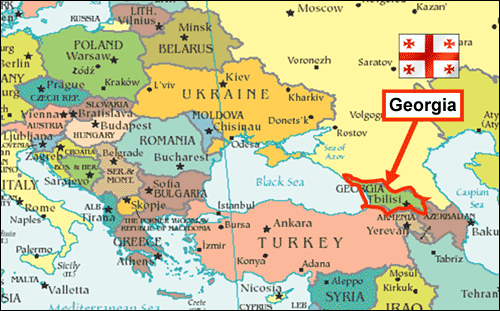
Events in Georgia have had some surprising repercussions in the Middle East, leaving Syria looking perkier than usual

Israel’s involvement with the Georgian military has been somewhat overlooked in light of more blatant US support, such as the airlift of some 2,000 Georgian troops from Iraq at the start of the conflict. However Misha Glenny spotted it, writing in the New Statesman that Prime Minister Putin warned President Shimon Peres to “pull out your trainers and weapons or we will escalate our co-operation with Syria and Iran” – after which Israel dutifully complied.

Hizbullah’s leader, Hassan Nasrallah also spotted it and subsequently mocked Israel’s withdrawal, claiming that “the entire front line of the [Israeli] army’s brass stepped down because of the [Lebanon] war. Gal Hirsch, who was defeated in Lebanon, went to Georgia and they too lost because of him.”

The Russians are indeed emboldened by their sweeping victory which has highlighted the impotence of both the US and Nato. Jonathan Spyer, in the Jerusalem Post, described Russian action as throwing down “a direct challenge to the US-dominated post Cold-war international order” and expressed concern over Moscow’s willingness to supply Syria with the S-300 long-range anti-aircraft missile system, a defensive measure that has the potential to impede Israeli airstrikes such as the one that targeted a suspected Syrian nuclear site last September.

Then the BBC reported yesterday that Syria’s President Assad met with President Medvedev at the Black Sea resort of Sochi to discuss “deals on anti-aircraft and anti-tank missile systems”.

Like any customer visiting his main arms dealer, Assad praised Russian actions in Georgia, explaining that “we understand the Russian stance and the Russian military response as a result of the provocations which took place. We appreciate the courageous decision taken by the Russian leadership in responding to the international initiatives and the start of withdrawing its forces”.

Assad also signalled his willingness to have Russian Iskander missiles (which according to GlobalSecurity.org are capable of overcoming the enemy’s anti-missile defences and hitting targets at a distance of 280 kilometers) situated on Syrian territory, although he refused to commit to any timeline for such a deployment.

The Syrians have survived six years of Isolation led by Washington and Tel Aviv following 9/11, an isolation that has only shown recent signs of ending. If a small country like Syria can survive years of western isolation then the Russian bear empowered with petrodollars and a stable, if undemocratic, leadership, will surely feel more confident in throwing its foreign policy weight around.

The Times reported that Russia’s activism, particularly in arms dealing, was sparking fears of a Middle East “Cold War”. In previous years Russia has respected US/Israeli “red lines” on supplying equipment to Syria; however with the potential red lines crossed by the other side in terms of support for Georgia and signing Poland up to the anti-ballistic missile treaty, all bets may be off. Indeed, the BBC reported the Russian reaction as an ominous foreign ministry statement saying that Moscow “will be forced to react, and not only through diplomatic demarches”.

Syria has a number of offensive and defensive weapon orders pending, however what could radically alter the balance of power is a more overt Russian presence in the country itself. Over the past few years defence analysts have kept a close eye on the Russian navy’s activity at the Syrian port of Tartus. There are real fears that the Russians are keen to transform what was little more than a refuelling station into a fully-fledged Russian Mediterranean fleet naval base where they can relocate much of the Black Sea fleet currently held up in Sevastopol.

Satellite shots of Russian involvement in dredging the port to allow access to larger vessels provide more evidence to support this theory which would place an aggressive Russia right on the doorstep of Israel and in close proximity to the strategic Turkish port of Ceyhan, the terminus of a major new oil pipeline linked to the Azerbaijani port city of Baku – an incendiary combination with huge tactical ramifications.

This makes grim reading for the lame duck leaders, Bush and Olmert, neither of whom have the political capital of the Russian Putin-Medvedev alliance. Perhaps the only manoeuvre that can undermine an aggressive Syrian-Iranian-Russian alliance is the Israeli-Syrian peace talks, which are still ongoing. If they result in an unlikely peace treaty there is hope yet that this new and dangerous cold war will not emerge.

Source / Information Clearing House

Then there’s this background:

War in Georgia: The Israeli connection
By Arie Egozi / August 10, 2008

For past seven years, Israeli companies have been helping Georgian army to prepare for war against Russia through arms deals, training of infantry units and security advice

The fighting which broke out over the weekend between Russia and Georgia has brought Israel’s intensive involvement in the region into the limelight. This involvement includes the sale of advanced weapons to Georgia and the training of the Georgian army’s infantry forces.

The Defense Ministry held a special meeting Sunday to discuss the various arms deals held by Israelis in Georgia, but no change in policy has been announced as of yet.

“The subject is closely monitored,” said sources in the Defense Ministry. “We are not operating in any way which may counter Israeli interests. We have turned down many requests involving arms sales to Georgia; and the ones which have been approves have been duly scrutinized. So far, we have placed no limitations on the sale of protective measures.”

Israel began selling arms to Georgia about seven years ago following an initiative by Georgian citizens who immigrated to Israel and became businesspeople.

“They contacted defense industry officials and arms dealers and told them that Georgia had relatively large budgets and could be interested in purchasing Israeli weapons,” says a source involved in arms exports.

The military cooperation between the countries developed swiftly. The fact that Georgia’s defense minister, Davit Kezerashvili, is a former Israeli who is fluent in Hebrew contributed to this cooperation.

“His door was always open to the Israelis who came and offered his country arms systems made in Israel,” the source said. “Compared to countries in Eastern Europe, the deals in this country were conducted fast, mainly due to the defense minister’s personal involvement.”

Among the Israelis who took advantage of the opportunity and began doing business in Georgia were former Minister Roni Milo and his brother Shlomo, former director-general of the Military Industries, Brigadier-General (Res.) Gal Hirsch and Major-General (Res.) Yisrael Ziv.

Roni Milo conducted business in Georgia for Elbit Systems and the Military Industries, and with his help Israel’s defense industries managed to sell to Georgia remote-piloted vehicles (RPVs), automatic turrets for armored vehicles, antiaircraft systems, communication systems, shells and rockets.

According to Israeli sources, Gal Hirsch gave the Georgian army advice on the establishment of elite units such as Sayeret Matkal and on rearmament, and gave various courses in the fields of combat intelligence and fighting in built-up areas.

‘Don’t anger the Russians’

The Israelis operating in Georgia attempted to convince the Israeli Aerospace Industries to sell various systems to the Georgian air force, but were turned down. The reason for the refusal was “special” relations created between the Aerospace Industries and Russia in terms of improving fighter jets produced in the former USSR and the fear that selling weapons to Georgia would anger the Russians and prompt them to cancel the deals.

Israelis’ activity in Georgia and the deals they struck there were all authorized by the Defense Ministry. Israel viewed Georgia as a friendly state to which there is no reason not to sell arms systems similar to those Israel exports to other countries in the world.

As the tension between Russia and Georgia grew, however, increasing voices were heard in Israel – particularly in the Foreign Ministry – calling on the Defense Ministry to be more selective in the approval of the deals with Georgia for fear that they would anger Russia.

“It was clear that too many unmistakable Israeli systems in the possesion of the Georgian army would be like a red cloth in the face of a raging bull as far as Russia is concerned,” explained a source in the defense establishment.

For instance, the Russians viewed the operation of the Elbit System’s RPVs as a real provocation.

“It was clear that the Russians were angry,” says a defense establishment source, “and that the interception of three of these RPVs in the past three months was an expression of this anger. Not everyone in Israel understood the sensitive nerve Israel touched when it supplied such an advanced arms system to a country whose relations with Russia are highly tense.”

In May it was eventually decide to approve future deals with Georgia only for the sale of non-offensive weapon systems, such as intelligence, communications and computer systems, and not to approve deals for the sale of rifles, aircraft, sells, etc.

A senior source in the Military Industry said Saturday that despite some reporters, the activity of Georgia’s military industry was extremely limited.

“We conducted a small job for them several years ago,” he said. “The rest of the deals remained on paper.”

Dov Pikulin, one of the owners of the Authentico company specializing in trips and journeys to the area, says however that “the Israeli is the main investor in the Georgian economy. Everyone is there, directly or indirectly.”

Georgian minister: Israel should be proud

“The Israelis should be proud of themselves for the Israeli training and education received by the Georgian soldiers,” Georgian Minister Temur Yakobashvili said Saturday.

Yakobashvili is a Jew and is fluent in Hebrew. “We are now in a fight against the great Russia,” he said, “and our hope is to receive assistance from the White House, because Georgia cannot survive on its own.

“It’s important that the entire world understands that what is happening in Georgia now will affect the entire world order. It’s not just Georgia’s business, but the entire world’s business.”

One of the Georgian parliament members did not settle Saturday for the call for American aid, urging Israel to help stop the Russian offensive as well: “We need help from the UN and from our friends, headed by the United States and Israel. Today Georgia is in danger – tomorrow all the democratic countries in the region and in the entire world will be in danger too.”

Zvi Zinger and Hanan Greenberg contributed to this report

Source / YNet News

The Rag Blog

Posted in RagBlog | Tagged , , , | Leave a comment

Burning Man: Puts Other Festivals in the Shade

Each year is based around a different theme, last year was The Green Man. Photo by Piers Moore Ede.

America’s premier counter-culture event is far more than just a naked camping fest
By Piers Moore Ede / August 20, 2008

In late 1986, a beach party celebrating the summer solstice marked the first official Burning Man. Within a few years, its participants had become so many, and its activities so outlandish, that founder Larry Harvey and his friends decided to move the festival to somewhere more appropriate. They chose the Black Rock desert, a 100-mile prehistoric lakebed in north-western Nevada, where temperatures regularly reach 110°F.

By 1997, Burning Man was already well on the way to becoming a cultural phenomenon. That year 10,000 people turned up to experience a week of desert living, far outside the mainstream culture of the United States. Within “Black Rock City”, participants abide by a gift economy, in which commerce of any type is expressly forbidden. “Burners” must bring all their own food, camping equipment and water; and are expected to “participate” in one form or another. Many choose to construct extraordinary temporal pieces of art: full size buildings made of driftwood and junk, flashing sculptures belching flames into the night. Walking around the desert after dark, this formerly empty expanse shimmers with a thousand projections and creations, impromptu performances, DJ booths, fantastical art cars resembling pirate ships and dragonflies. “It’s like stepping through the looking glass,” one Burner told me. “The default world – which is what we call the world outside – just can’t compare with this.”

In 2007, numbers at Burning Man reached 35,000. There were people of every age group, from every stratum of society. I was among them, knowing no one, expecting little more than a fun week in a somewhat surreal environment. And yet, like thousands before me, the week was transformative, life changing, instantly addictive. This third largest city in Nevada (vanishing “without a trace” after the festival’) was spotlessly clean, full of highly creative and considerate individuals. People travelled everywhere by bicycle, some of them naked. Everywhere I went, people offered me food, free rides on their “mutant vehicles”, invitations to all-night parties, yoga lessons, fire juggling demonstrations. Dressed in bizarre costumes, wearing sand goggles and dust masks, it seemed easy to take people at face value, little caring what they did outside Black Rock. The annual theme, which last year was entitled Green Man, seemed to perfectly mesh with the zeitgeist. Invention and great creativity was needed to rethink the carbon-based structure of our world. At Burning Man that world seemed to rise up in the present moment, ecologically sound and full of laughter.

It would be all to easy to write off Burning Man as a desert rave, an escape valve for overstressed executives, a 21st-century update on Woodstock. But more than any of those things, Burning Man is a philosophy, an attempt to reinvent the parameters and constraints of society. Within the most advanced capitalist economy in the world, participants choose to free themselves from commerce. Art works are anonymous, often destroyed at the end of the week, even in the case of colossal structures taking months to build. People make an effort to help each other – a necessary step, actually, given the potentially hostile natural environment. Unlike any other festival I’ve visited, it’s one without celebrity, corporate logos, or personal egos of any kind.

“Given the current cultural and political climate in the United States,” Geoffrey told me, a veteran Burner of seven years, “this is really the only sane place left. I’ve been incredibly broke this year and wasn’t sure I was going to make it, but then I realised that I had to be here, it’s the only truly sacred experience open to me right now.”

Perhaps more even than the enlightening effects of doing without money, running water or cell phone connection, Burning Man seems to effect a spiritual magnetism on those who attend. From above, the circular design of the city, carefully zoned each year, seems akin to some ancient pagan site. With its fire worship, close connection to nature, and emphasis on participation, Burning Man offers a transcendent experience to all comers. Each year, a Temple of Forgiveness invites people to inscribe the names of loved ones who have passed away on its walls and ceilings, before the whole structure goes up in flames, in a grand gesture of emancipation. A central tent hosts Wiccan dances, group zazen, chanting and tribal drum circles, invoking a spiritual dimension without dogma or belief.

For myself, as I rode my bicycle far out on to the prehistoric lakebed at midnight, looking backwards on the glittering utopia that is Black Rock City, Burning Man seemed like the freest place on earth. Behind me, people from all over the world were gathered in what felt like some kind of non denominational worship. I wasn’t exactly sure what we were worshipping, but it felt significant. Significant enough that back in the ‘default’ world, my first act was to book my ticket for 2008.

* The Burning Man Project: August 25-September 1 2008-08 (tickets must be bought beforehand, they’re not sold on the gate), burningman.com

* Getting there: British Airways flies to Reno via Dallas or Chicago (with onward flights on American Airlines) from £549.20. Black Rock is more than 100 miles north of Reno, and gives a new meaning to the term “middle of nowhere”. It takes roughly three hours by car, and you should be prepared to share the road with livestock and wildlife.

Source / Guardian, U.K.

Thanks to Roger Baker / The Rag Blog

Posted in RagBlog | Tagged , , , , | Leave a comment

FCC Decision : Milestone in the Fight for Internet Rights

Kevin Martin says Comcast’s actions are like a post office blocking mail. Photo by AP.

‘It’s the first time the FCC has gone to such lengths to assert users’ right to an open Internet’
By tkarr / August 20, 2008

It’s official. The Federal Communications Commission published its order today lowering the hammer on Comcast for derailing Internet users’ Web access and then pretending that the cable giant was doing nothing wrong.

The order, approved by a bipartisan FCC majority at the beginning of the month, demands that Comcast “must stop” its ongoing practice of blocking Internet content by year’s end.

As we have written before, this action carries considerable weight.

It’s the first time the FCC has gone to such lengths to assert users’ right to an open Internet. And it sends a warning shot across the bow of other major ISPs that are flirting with the idea of blocking, filtering or degrading content, or favoring certain Web sites and services over others.

The FCC Delivers

“This order marks a major milestone in Internet policy,” says Ben Scott, Free Press policy director. “For years, the FCC declared that it would take action against any Internet service provider caught violating the online rights guaranteed by the agency. Today, the commission has delivered on that promise.”

The order concludes the FCC’s months-long investigation, which included two public hearings at Harvard and Stanford universities — and more than 25,000 public comments.

“This clear legal precedent signals that the future of the Net Neutrality debate will be over how, not whether, to protect users’ right to an open Internet,” Scott says.

Comcast’s Smokescreen

Comcast and its Astroturf allies swamped the FCC with filings that challenged the agency’s authority and outright denied any wrongdoing. But the smackdown of Comcast’s claims issued today makes clear that the agency is on solid legal footing, and Comcast clearly in the wrong.

“The Communications Act has long established the federal agency’s authority to promote the competition, consumer choice, and diverse information across all communications platforms,” explains Marvin Ammori, Free Press’ legal counsel, who authored the 2007 complaint against the cable giant.

In 2005, the agency unanimously adopted an Internet policy statement that “extended these rights to Internet users – including the right to access the lawful content, applications and services of their choice.”

That statement served the basis for the Free Press complaint, which set the wheels of the FCC churning towards today’s welcome result.

A Scathing Rebuke

The FCC was unconvinced by Comcast’s attempts to evade accountability. The order finds that Comcast’s repeated “verbal gymnastics” and attempts to muddy the issue of blocking were “unpersuasive and beside the point.”

The commissioners were especially outraged by Comcast’s lies and deception. When it first got caught blocking the Internet, the cable giant “misleadingly disclaimed any responsibility for its customers’ problems,” according to the FCC order, followed by “at best misdirection and obfuscation.”

Contrary to the spin of Comcast’s lawyers, the FCC can protect the rights of Internet users, and promote openness, free speech and competition on the Web.

ISPs Don’t Own the Internet

“The Internet is a world-wide system that does not belong to any one operator,” wrote David Reed, a pioneer in the design of the Internet’s fundamental architecture. “The design of the Internet Protocols specifies clear limits on what operators can and cannot do… Happily, the FCC recognized and exposed Comcast’s transgressions of those limits.”

Still, the FCC cannot act without first receiving complaints from users. Cable and phone companies would now be wise to obey the order and resist their gatekeeper tendencies.

But the public also needs to continue to keep watch over the Internet, and to call for FCC action against abuses of our Internet rights.

Source / Save the Internet

In all of my experience reviewing government decisions affecting the Internet, I have read none that are more subtle and sophisticated in their understanding of the Internet, and few that are as important for setting the conditions under which innovation and competition on the Internet will flourish.

As the Order makes clear, the Commission has clearly recognized the importance of the Internet as a platform for technological growth and innovation. It is also an extraordinarily important platform for free speech. Innovation and technological growth are essential components to economic prosperity. Free speech is the single most important element in a democracy.

…By secretly adding a layer of secret sauce into the Internet that interferes with legitimate applications and network services, Comcast has injured the value of the Internet to other innovators. By denying that it has done this, it has added insult to that injury. The Commission has done us all a great service by stating clearly that it will assure that the platform for innovation that the Internet is will not be compromised by such behavior.

Professor Lawrence Lessig / Stanford Law

Also see FCC Orders Comcast to Stop Blocking Some Large Files / Washington Post / August 21, 2008

The Rag Blog

Posted in RagBlog | Tagged , , , , | 1 Comment

San Marcos : Officer Receives Threats After Allowing Dog to Die

Missy died en route to a veterinary clinic while San Marcos cop wrote a ticket. Family photo.

Texas cop who wrote a ticket while dog choked to death, received oral reprimand.
August 21, 2008

SAN MARCOS, Texas — A police officer who delayed a couple racing their dying dog to an emergency vet clinic while he wrote them a ticket has received death threats, the mayor said Thursday.

A statement issued by San Marcos Mayor Susan Narvaiz said Officer Paul Stephens was inappropriate and insensitive and that he has been disciplined, but the threats against the officer are “extremely unfortunate.”

Narvaiz’ statement did not elaborate on the threats. She did release some new details of the incident, including that a second officer had tried to help the choking dog, a teacup poodle named Missy.

“Without question, the situation was not handled very well by Officer Stephens. But the characterization of the story has led to death threats against the officer and his family,” Narvaiz said.

Michael Gonzalez and Krystal Hernandez were allegedly driving 95 mph when Stephens pulled them over after midnight Aug. 5 on Interstate 35.

According to Narvaiz, Gonzalez first pulled over on an overpass. Using his patrol car public address system, Stephens asked him to go somewhere safer and Gonzalez drove another two miles at a “high rate of speed,” despite the officer’s lights and siren.

When he finally pulled over, Gonzalez pleaded with Stephens to let them get to the clinic.

The patrol car’s dashboard camera showed Stephens telling Gonzalez: “It’s just a dog. You can buy another one. Relax.”

Officer Joyce Bender arrived and approached Hernandez on the passenger side of the car. When told Missy was choking, she took the dog and tried to clear its airway to allow it to breath, but failed, Narvaiz said.

At that point, the officers believed the dog was already dead and Stephens issued the ticket. The incident lasted 17 minutes, Narvaiz said.

Gonzalez and Hernandez filed a complaint the next day and San Marcos Police Chief Howard Williams issued Stephens a reprimand. Williams also wrote a letter of apology to Gonzalez.

Narvaiz said Stephens is an Iraq war vet who joined the department in March 2007 and has no history of previous complaints. She said the discipline for Stephens was appropriate.

Gonzalez said Tuesday he thought an oral reprimand was not sufficient.

“That’s not really a punishment at all,” he said. “I don’t feel a person like that should be working in law enforcement.”

Source / AP / Houston Chronicle

Please see our original story: San Marcos : Dog Dies After Traffic Cop Ignores Owners’ Pleas / The Rag Blog / August 19, 2008.

The Rag Blog

Posted in RagBlog | Tagged , , , , , | Leave a comment

Sen. John Cornyn, R-Texas : Big Bad Dawg (Video)

Sen. Corndog : All Hat and no Cattle

Thanks to Telebob / The Rag Blog / Posted August 21, 2008

Posted in RagBlog | Tagged , , , , | Leave a comment

Junior’s Legacy : As Little As Possible


White House May Have Lost 7 Months of E-mail Since 2003
by Pete Yost / August 21, 2008

WASHINGTON – The White House is missing as many as 225 days of e-mail dating back to 2003, and there is little likelihood that a recovery effort will be completed by the time President Bush leaves office, according to an internal White House draft document obtained by the Associated Press.

The nine-page outline of the White House’s e-mail problems invites companies to bid on a project to recover the missing electronic messages.

The work would be carried out through April 19, 2009, according to the Office of Administration request for contractors’ proposals dated June 20. The new president will be inaugurated three months before that completion date.

Last week, the White House declined to comment on the document. On Wednesday, the White House refused to discuss internal contracting procedures but said the information was “outdated and seriously inaccurate.” It would not elaborate. Nor would it say whether anyone had been hired.

“With an eye on the clock, the White House continues to drag its feet and do everything possible to postpone public access to the records of this presidency,” said Anne L. Weismann, chief counsel of Citizens for Responsibility and Ethics in Washington, a private watchdog group.

The draft document outlines a process in which private contractors would attempt to retrieve lost e-mail from 35,000 disaster recovery backup tapes dating to October 2003, a period covering such events as growing violence in Iraq, the Abu Ghraib prison scandal and the criminal inquiry into the disclosure that Valerie Plame, wife of an administration critic, worked for the CIA.

The recovery project would not use backup tapes going back to March 2003, according to the draft document, even though an earlier White House assessment suggested that e-mail was missing from that period as well.

Industry experts point out that relying on the backup system to ensure accurate retention, preservation and retrieval of all e-mail is problematic because it does not take into account deleted e-mail.

“A backup system isn’t designed to be a 100% complete inventory of all e-mails,” said William P. Lyons, chairman and chief executive of AXS-One, a provider of records compliance management solutions. “It’s designed to make a copy of data at a specific point in time.”

The White House draft document says the number of days of missing e-mail ranges from 25 to 225, a range that industry experts say would make it difficult to bid on a recovery project.

“Generally, when the scope of the work is expected to fluctuate by a factor of nearly 10, I can only take you so seriously,” said Steven L. Schooner, co-director of the government procurement law program at George Washington University.

At a hearing on Capitol Hill in February, the White House told Congress it was trying to determine how many e-mail messages were missing.

© 2008 Associated Press

Source / Common Dreams

The Rag Blog

Posted in RagBlog | Tagged , , | Leave a comment

India/US Nuclear Deal Bad for the NPT


U.S.-India nuclear deal a non-proliferation disaster
By Anthony Salloum / August 21, 2008

Countries like Canada must stand up to Bush and say this is a bad deal with dire consequences

This week a select group of countries, Canada among them, will vote on a proposed nuclear deal between the U.S. and India that could lead to the further spread of nuclear weapons. With limited attention paid to this issue at home, indications are that Canada may be on the verge of making a grave mistake by supporting this deal. But this doesn’t have to be the case.

If Canada were to courageously stand against this deal, it wouldn’t be alone. Austria, Ireland, Japan, Netherlands, New Zealand, Norway and Switzerland all expressed concern last month.

Today and tomorrow, the 45 members of the Nuclear Suppliers Group – the alliance of countries that seeks to control trade in “dual-use” nuclear fuel, materials and technology – will be asked to consider the Bush administration’s proposal to exempt India from having to join the Non-Proliferation Treaty (NPT) as a condition of receiving nuclear technology and fuel.

The NPT is signed by 189 countries and has three key pillars: non-proliferation, disarmament and peaceful uses of nuclear energy. To be implemented, the U.S.-India nuclear deal requires approval by the Indian parliament, the International Atomic Energy Agency (IAEA), the Nuclear Suppliers Group and the U.S. Congress.

So far, India and the IAEA have approved it.

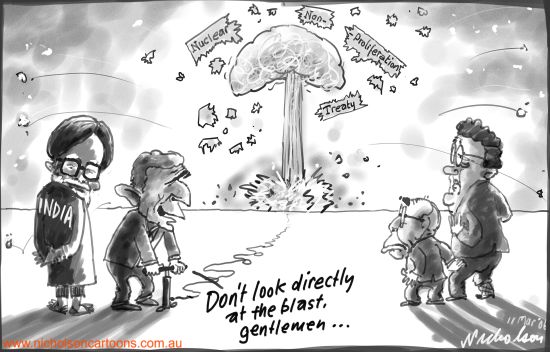
If the U.S. wins exemption for India, the deal would be a non-proliferation disaster. It would be a Bush legacy the world could do without. The deal will lead to greater nuclear proliferation.

Treaties like the NPT, meant to prevent the spread of nuclear weapons, have been unravelling. There are four nuclear weapons states that do not belong to the NPT: India, Pakistan, Israel and North Korea – the first state to actually quit the NPT while announcing its intention to develop nuclear weapons. Negotiations are still ongoing on compensating North Korea for agreeing to relinquish its nuclear weapons program.

Supporters of the U.S.-India nuclear deal argue that this bilateral agreement will help thwart the spread of nuclear weapons because it places 14 of India’s 22 reactors under IAEA monitoring. However, this deal allows India to continue thumbing its nose at the only legal, multilateral non-proliferation treaty the globe has, since it will not require India to join the NPT.

Additionally, unlike 178 other countries, India has not signed the Comprehensive Test Ban Treaty prohibiting the testing of nuclear weapons, and continues to produce reactor grade material and expand its nuclear arsenal via the remaining reactors not available to the IAEA for inspection. In fact, the deal guarantees India an uninterrupted supply of fuel without obligating it to sign the test ban treaty.

Organizations and experts, including the Rideau Institute, are raising the alarm. An Aug. 15 letter sent to all 45 foreign ministers of the Nuclear Suppliers Group, including David Emerson, by more than 150 NGOs and experts from 24 countries, noted that, “this deal, if approved, would give India rights and privileges of civil nuclear trade that have been reserved only for members in good standing under the NPT. It creates a dangerous distinction between `good’ proliferators and `bad’ proliferators and sends out misleading signals to the international community with regard to NPT norms.”

This special deal for India has not gone unnoticed by its rivals, Pakistan and China.

Adding fuel to the fire, Iran, which is a member of the NPT – unlike India – points to the deal as an example of the dangerous “good-bad” double standard. It is livid at the hypocrisy, pointing out that Israel is probably quietly lobbying for its own special deal. Iran has a right to have a civil nuclear program, but there are ample reasons to distrust its intentions. The U.S.-India nuclear deal does make a diplomatic solution even more difficult to achieve.

Iran’s ambassador to the United Nations in Vienna, Ali Asghar Soltanieh, cautioned that, “There is serious concern that the United States has taken this step with the intention to create a precedent and pave the way for Israel to continue its clandestine [nuclear] weapons activities.” In other words, the U.S.-India deal will embolden other countries to undermine the NPT as well. And with the 2010 review conference of the NPT looming, there is much at skate.

Canada has options. This week at the Nuclear Suppliers Group meeting, Canada could coalesce with Austria, Ireland, Japan, Netherlands, New Zealand, Norway and Switzerland, and demand that India signs two treaties – the Fissile Materials Cut-off Treaty, which stipulates that India halt production of reactor grade material, and the Comprehensive Test Ban Treaty – as a precondition for their support of the U.S.-India deal. Who knows, other countries may also be emboldened to stand up and say this is a bad deal with awful consequences. No one country has to be alone in standing up to George Bush.

Alternatively, these countries could ask for more time to study the proposed exemption. Such a delay would spell the end of the deal because the U.S. Congress cannot consider and vote on the deal until the Nuclear Suppliers Group approves it. If this agreement doesn’t land back in Washington by late September, it could not be approved during the remaining lifespan of Bush’s administration, effectively killing the deal.

However, if Canada were to support the U.S. on this deal, it would be abandoning its long-standing position as a strong supporter of nuclear non-proliferation, and instead, be supporting Bush’s legacy of undermining the most effective mechanism we have to avoid the spread of nuclear weapons in the world.

Here’s hoping this Bush legacy doesn’t come to fruition.

Anthony Salloum is the program director of the Rideau Institute, which serves as the global secretariat to Abolition 2000, a network of more than 2,000 organizations working for a global treaty to eliminate nuclear weapons.

Source / The Toronto Star

The Rag Blog

Posted in RagBlog | Tagged , , | Leave a comment

The Iraq War Will End on the Day We Stop Paying for It


San Francisco to Vote on Iraq War Funding
by Tom Gallagher / August 21, 2008

On November 4, San Franciscans will vote on the strongest anti-Iraq War measure yet to appear before the voters of a major American city. Proposition U, placed on the ballot by five of the city’s Board of Supervisors, declares it city policy that “its elected representatives in the United States Senate and House of Representatives should vote against any further funding for the deployment of United States Armed Forces in Iraq, with the exception of funds specifically earmarked to provide for their safe and orderly withdrawal.”

San Francisco was the site of some of the nation’s largest protests leading up to the war, culminating in over 1,000 arrests for blocking the streets on the day of the invasion. And in 2004, 63 percent of its voters backed a policy statement urging the federal government “to withdraw all troops from Iraq and bring all military personnel in Iraq back to the United States.” But with more American troops there today than on the day when San Francisco’s voters last spoke on the issue, it seemed time to go to the polls again, particularly since, in the words of the Supervisors’ ballot argument, “San Francisco has struggled to fund its schools, meet the health care needs of its citizens, and provide safety on its streets,” while the Iraq War has cost “the city of San Francisco alone $1.8 billion.”

As a local advisory measure (voters cannot compel their congressional representatives to vote as directed) on a national issue, Proposition U was conceived with one eye on San Francisco and the other on Washington, D.C. The city’s congressional delegation has never adequately reflected the depth of local antiwar feeling. The late Tom Lantos, who represented the city’s west side, was a flat-out war supporter. (Jackie Speier, his successor of only four months will not likely continue his hawkish stance.) The city’s more prominent Representative, House Speaker Nancy Pelosi, has been a more complicated case. Along with the majority of House Democrats, she voted against the war at the outset, then voted to fund it, proclaiming that “Democrats will never cut off funding for our troops when they are in harm’s way.”

Although Pelosi has since cast votes against war funding and was even recently joined by the generally hawkish California Senator Diane Feinstein (Senate colleague Barbara Boxer has been considerably better on the war), the scenario most favorable to antiwar forces portends votes on war funding that all of the city’s representatives in Washington may find significantly harder to resist. Since Barack Obama has never prattled on about envisioning American troops in Iraq for the next hundred years like John McCain, his election at least offers the hope of ending the occupation within the twenty-first century. The fact, however, is that Obama’s plan calls for “combat troops” remaining there sixteen months into his administration, with perhaps tens of thousands of so-called “non-combat troops” staying on indefinitely. Most congressional Democrats will need a lot of antiwar wind at their backs to resist requests for military appropriations in Iraq emanating from an Obama White House.

While aspiring to provide at least a gust to buoy the antiwar spirit of the local congressional delegation, Proposition U is also designed as a bit of an antidote to a type of magical thinking that seems to have come over some of the nation’s war opponents ever since their massive protests failed to stop the war. In 2004, this thinking took the form of believing that all that was necessary to end the war was to elect John Kerry, largely ignoring his have-it-both-ways stance of condemning Bush both for starting the war and for not sending enough troops. (The Administration’s “surge” has belatedly addressed the latter concern.)

In 2006, it was the drive to vote a Democratic majority into Congress that seemed to supplant the need for direct antiwar activity in the minds of many. This, although there was no genuine prospect of a simple Democratic majority providing the votes needed to end the war, given that a third of House Democrats have supported it. And, in 2008, the wish-the-war-away strategy appears to amount to electing Obama and hoping that he’ll do what his antiwar constituency wants him to do, even if he’s never said he would.

There is one way that the starry-eyed Obama fans have it right, though. What Obama’s supporters believe does matter. It matters a lot, but only insofar as they make him know they expect him to act on their beliefs, and do so loudly, publicly, and defiantly, if need be. For the fact is that even if Obama’s Iraq plan were far better than it is and his foreign policy team were not full of status quo types, these factors would not diminish the intense pro-war pressure he will feel if he is elected. Any Democrat in the White House can assume both a Republican drumbeat of accusations about undercutting our armed forces and selling out an ally as well as a steady stream of “stay the course” pronouncements — like the recent New York Times opinion piece, “Not Quite Ready to Go Home” — from supposedly neutral foreign policy establishment types.

Getting the Republicans out of the White House may be a necessary condition for ending this war, but it is far from a sufficient one. Hopefully, on election day, by voting in Proposition U, the voters of San Francisco will present the newly elected President with a real peace plan and remind both their representatives and the nation of the simple fact that the Iraq War will end on the day we stop paying for it.

Tom Gallagher is an antiwar activist living in San Francisco. Reach him at TGTGTGTGTG@aol.com.

Source / Common Dreams

The Rag Blog

Posted in RagBlog | Tagged , | Leave a comment

Fidel’s Is Still Bigger Than Bush’s !!

Fidel completes 82 years: Santería priests and priestesses in Cuba carried out yesterday, Wesnesday, a ritual in which they prayed again for the health of the veteran leader, for whom they wished “long life”. The ceremony included calling upon the African deities and Fidel’s guardian angel amid a strong touch of drumming, sacrifices of animals, and the planting of a ceiba tree. – Por Estó de Quintana Roo, Chetuaml, Q. Roo, Mex., 12 August 2008.

And as the photo clearly shows, his is still bigger than Bush’s!

Thanks to Mariann Wizard / The Rag Blog

Posted in Rag Bloggers | Tagged | 3 Comments

Nader: Asking the FDIC to Be Realistic

Federal Deposit Insurance corporation Chairman Sheila Bair addresses the Intstitute of International Bankers annual conference at the Four Seasons Hotel March 3, 2008 in Washington, DC. Photo: Chip Somodevilla/Getty Images North America

Where Is Congress? The Problem with Problem Banks
By Ralph Nader / August 21, 2008

This week, the Wall Street Journal reported that Federal Deposit Insurance Corporation (FDIC) officials are pushing various agencies charged with regulating banks, such as the Treasury’s Office of Thrift Supervision to more aggressively give problem banks lower ratings than they may now be receiving from regulators. Regulators give banks a rank between 1 and 5. Well-managed banks get a 1, problem banks receive a 4 or 5. The FDIC wants to see more banks getting 4s or 5s.

In late July, I wrote to U.S. Senate Committee on Banking, Housing and Urban Affairs Chairman Christopher Dodd (D-Conn.) and House Financial Services Committee Chairman Barney Frank, D-Mass. to suggest that they jointly hold hearings on the FDIC’s ability to deal with potential bank failures in the next several years. In the letter, I noted that in a March 10, 2008 memorandum on insurance assessment rates, Arthur J. Murton, Director of the Division of Insurance and Research for the FDIC stated:

While 99 percent of insured institutions meet the “well capitalized” criteria, the possibility remains that the fund could suffer insurance losses that are significantly higher than anticipated. The U.S. economy and the banking sector currently face a significant amount of uncertainty from ongoing housing sector problems, financial market turbulence and potentially weak prospects for consumer spending. These problems could lead to significantly higher loan losses and weaker earnings for insured institutions.

FDIC Chairman Sheila C. Bair, however, has been singing a more upbeat tune. She recently said, “The banking system in this country remains on a solid footing through the guarantees provided by FDIC insurance. The overwhelming majority of banks in this country are safe and sound and the chances that your own bank could fail are remote. However, if that does happen, the FDIC will be there – as always – to protect your insured deposits.”

Despite these reassuring words, the recent failure of IndyMac highlights the need for tough Congressional oversight. Banking experts have indicated that the cost of the collapse of IndyMac alone will be between $4 billion and $8 billion. The FDIC has approximately $53 billion on hand to deal with bank failures. This amount may not be adequate, given the cost of IndyMac and given the approximately $4 trillion in deposits the FDIC insures.

Congressional oversight of the financial services industry and its regulators should be a topic priority for Congress. I even suggested several questions that should be put to FDIC officials such as:

1. Was IndyMac on the list of “Problem Institutions” before it failed?

2. Were the other banks that failed this year on the FDIC list of “Problem Institutions”?

3. What is the anticipated cost of dealing with the failures of the other four banks that failed this year?

4. As of March 31, 2008 the FDIC reported 90 “Problem Institutions” with assets of $26 billion. What is the current number of “Problem Institutions” and what are the assets of these “Problem Institutions”?

5. How many banks are likely to fail in 2008 and 2009 respectively?

6. What is the estimated range of costs of dealing with the projected failures?

7. What will the effect of higher losses than those projected be on the FDIC’s estimate of the proper reserve ratio?

8. What are the FDIC’s projections for reserves needed and potential bank failures beyond 2009?

9. Is the FDIC resisting raising the current rates of assessments on FDIC insured banks so that the cost of any significant bailouts will have to be shifted to the taxpayers?

10. Does the Government Accountability Office (GAO) believe that the existing rate schedule for banks to pay into the Deposit Insurance Fund (DIF) is set at the proper level?

It would also make sense for Congress to revisit the FDIC’s current approach to setting reserve ratios for banks.

The FDIC is not likely to address its own inability to clearly assess the current risks posed to depositors and taxpayers by the high-rolling, bailout-prone banking industry.

When Congress reconvenes after Labor Day it would be prudent for Senator Dodd and Congressman Frank to focus on the FDIC and our nation’s troubled banks through some tough no-holds-barred hearings. These two lawmakers are going to have to hear from the people back home soon.

Neither Senator Dodd nor Congressman Frank have responded to my letter of July 23, 2008.

Ralph Nader is running for president as an independent.

Source / CounterPunch

The Rag Blog

Posted in RagBlog | Tagged , , | Leave a comment

Perspectives on the Iraqi Oil Industry


Political rifts slow recovery of Iraqi oil
By Carola Hoyos, Roula Khalaf and Ed Crooks (in London) / August 21, 2008

Political gridlock has overtaken security risk as the primary hurdle facing the rehabilitation of Iraq’s oil industry, according to oil executives and analysts.

Cabinet disagreements and unrealistic expectations from Baghdad are already threatening to scupper the oil ministry’s plans to sign short-term technical support agreements with international oil companies.

This could also complicate the more ambitious plans to agree longer-term development contracts that would involve big investments by oil majors. Iraq’s oil ministry last month invited foreign companies to bid for contracts to develop eight oil and gas fields for the first time in three decades.

Charles Ries, US co-ordinator for Iraq’s economic transition, recently told reporters that the short-term contracts, which would train and assist Iraqi engineers to raise oil output, now at 2.4m barrels a day, by an extra 500,000 b/d, were not likely to go through.

Anadarko, the US independent, has walked away from the short-term deals on offer, citing unfavourable terms. Others, including BP and Royal Dutch Shell, say talks are continuing. However, analysts have suggested no agreement is likely before the end of Ramadan, putting any deals off until at least October.

In its most recent report, the International Energy Agency, the oil consuming countries’ watchdog, said it might have to revise down its forecasts of Iraqi capacity expansions because of doubts over the technical support contracts.

Oil executives said the deals had been mired in confusion. Some said the agreements on offer had lost much of their appeal when Iraq reduced the contracts’ lengths from two years to one, and when it became clear Iraq would not give companies that signed short-term contracts preferential treatment for the more sought-after long-term deals.

International oil companies are far from shrugging off their security concerns over sending large numbers of employees to Iraq. Shell, for example, conducts all its work on Iraq outside the country, advising and training Iraqi staff working on the Kirkuk and Missan oilfields, and working on plans to use the gas produced as a byproduct of oil extraction and burned off in flares.

But at least one western energy group is becoming bolder. Eni, the Italian oil company, recently sent its head of exploration and production and its head of oil and gas for a visit.

For Eni and other big companies, the ultimate prize would be longer-term deals that allowed them to produce oil from Iraq’s huge fields, and seek more fields in the unexplored areas.

The country’s oil ministry wants to sign field development deals as early as next year, and has said it will reveal terms next month.

But companies are still concerned at the lack of new legislation governing the industry. Moves to agree on a new law have been derailed amid disagreements between the Kurdish minority and the Arab majority.

Meanwhile, China National Petroleum Corporation, the state-owned oil company that is the parent of the listed Petrochina group, may be the first foreign company to sign an oil deal with Baghdad since the fall of Saddam Hussein: a service contract to develop the Ahdab field.

Hussein Shahristani, Iraq’s oil minister, was quoted in an Iraqi newspaper on Tuesday as saying that a $1.2bn (€817m, £644m) deal with China had been under discussion for a year.

CNPC refused to comment, but an industry official in Beijing confirmed the talks were taking place with the Iraqi authorities, and that an Iraqi minister was expected to visit Beijing next week.

Additional reporting by Geoff Dyer in Beijing

Source / Financial Times

Iraq condemns oil majors’ “humanitarian” failure
By Simon Shuster, August 20, 2008

MOSCOW, Aug 20 (Reuters) – A top Iraqi official on Wednesday attacked oil majors for trying to overcharge the war-torn nation and ignoring their “humanitarian” duty to help develop Iraq’s battered oil industry.

“Foreign companies, including Russian companies, have not taken up the call to develop these projects. As a result of them not wanting to work in these conditions, the Iraqi people have suffered greatly,” Karim Waheed, Iraq’s electricity minister, said at a news conference in Moscow.

The attack came after Iraq delayed the signing of short-term oil service contracts with oil majors due to disagreements over payment terms and their duration.

Iraq and major international oil companies have been negotiating six short-term technical service contracts, each worth about $500 million and targeting a 100,000 barrels per day increase in output from six of Iraq’s biggest oilfields.

The companies involved in negotiations included Royal Dutch Shell (RDSa.L: Quote, Profile, Research, Stock Buzz) and Exxon Mobil (XOM.N: Quote, Profile, Research, Stock Buzz). The firms, jostling for years to position themselves for access to the world’s third-largest oil reserves, had hoped that the contracts would give them a headstart in negotiations for future deals.

“The invitations to take part in these projects have not only an economic but a humanitarian character,” Waheed said after meetings with Russian energy minister Sergei Shmatko and the heads of Russian energy service firms.

In negotiating deals, foreign majors had counted on Iraq’s ignorance of the markets in trying to overcharge the country in a time of need, the Iraqi minister said.

“Some companies in those cases demanded sky-high prices for their services, thinking Iraq does not have a grasp of international financial markets. They were unpleasantly surprised when they found out we fully understand global commodity markets and global stock markets,” he said.

Waheed also reiterated Iraq’s traditional stance that Russian oil major LUKOIL (LKOH.MM: Quote, Profile, Research, Stock Buzz) would have to compete on equal terms with other contenders to develop the giant West Qurna deposit at next year’s tenders.

LUKOIL signed the $4 billion West Qurna deal with the government of Iraq’s former dictator, Saddam Hussein, over a decade ago but Baghdad scrapped the deal shortly before Hussein was deposed by a U.S. invasion in 2003.

“These contracts are old in many ways. Firstly the price of metals and other building materials has increased dramatically, not to mention the price of oil…” Waheed said.

© Thomson Reuters 2008

Source / Reuters

The Rag Blog

Posted in RagBlog | Tagged , | Leave a comment