ECONOMY : Trickle Down from the Bailouts


‘The federal government is drowning in a sea of red ink’
By Roger Baker / The Rag Blog / August 19, 2008

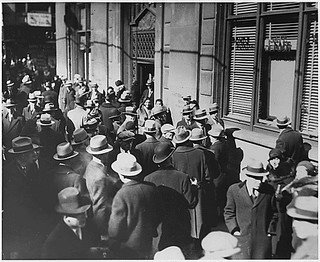
Bernanke and his crew at the fed bailed out Bear Stearns at taxpayer expense because they feared not doing so would have caused a financial meltdown. There are many tens of trillions in financial derivatives that could quickly cause a panic and domino effect if they don’t keep throwing money at the banks to back up these tangles of derivatives which guarantee bonds and that the US financial system is sound.

The banks they need to bail out to prevent a spreading panic keep getting smaller and smaller. Bailing out Fannie and Freddie is only a matter of time now. The federal government is drowning in a sea of red ink.

But meanwhile all that bailout money is leaking into the broader economy and driving up “core inflation”, which in turn underestimates true inflation. When that happens, you lose money by holding bank deposits and treasury bonds and you have to raise interest rates, which then makes the derivative credibility problem worse. Things are unstable and could deteriorate pretty fast if the Chinese and Arabs and everyone start cashing in and dumping their dollars internationally. Get ready for more inflation, as Fisher of the fed is warning of now:

Fed’s Fisher Says U.S. May Face `Lingering Inflationary Fever’ / Bloomberg / August 19, 2008

Note from this last link that everything hinges on energy prices driving cost-push inflation moderating. If peak oil is real (which it is) then there is no way out; no amount of bailouts can paper over the reality all the trillions in derivatives that guarantee that the big corporations can repay their debts are as worthless as all the subprime loans that were involved in the first stage of the widening crisis.

See the following stories:

Bernanke Tries to Define What Institutions Fed Could Let Fail / Bloomberg / August 18, 2008

Large U.S. Banks May Fail Amid Recession, Rogoff Says / Bloomberg / August 19, 2008

The Rag Blog

Posted in Rag Bloggers | Tagged , , , , | 1 Comment

A Video Series on World Agriculture: Monsanto, Part 8

The World According to Monsanto (Part 8 of 8)

Right now, there is probably no other company that is doing more to endanger the health of this planet, and it’s inhabitants, than Monsanto. With Nazi-like attitude, they are leading the world in shear destructive evil greed. First they were a drug company, and then they expanded to become a drugs and genetic engineering company, and now Monsanto is attempting to acquire water rights in countries with water shortages in a move to control the people’s basic means of survival, and production of the global food supply. Giant transnational corporations like Monsanto, in collusion with the World Bank and the World Trade Organization, seek to commodify and privatize the world’s water and put it on the open market for sale to the highest bidder. Millions of the world’s citizens are being deprived of this fundamental human right, and vast ecological damage is being wrought as massive industry claims water once used to sustain communities and replenish nature.

Click here for more information.

Thanks to Diane Stirling-Stevens / The Rag Blog

Posted in RagBlog | Tagged , | 2 Comments

Iraq Report: Still Very Tense in Kirkuk

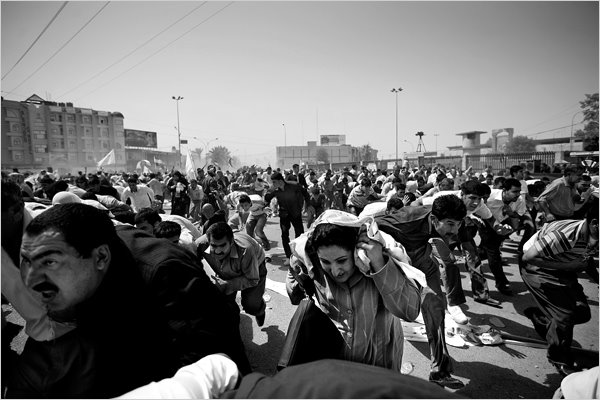
The aftermath of a suicide attack on Kurdish demonstrators three weeks ago.
Photo: Benjamin Lowy/VII Network

Kurdish Control of Kirkuk Creates a Powder Keg
By Richard A. Oppel Jr. / August 18, 2008

KIRKUK, Iraq — The phone rang, and it was answered by a Kurdish security commander, Hallo Najat, sitting in his office in this deeply divided city. On the line, he said, was a United Nations official wanting to know whether it was true that the Kurdish militia, the pesh merga, had left its bases in northern Iraq and was occupying Kirkuk.

No, Mr. Najat told the caller. But after hanging up, he wryly revealed the deeper truth about Kirkuk, combustible for its mix of ethnicities floating together on a sea of oil: the Kurds already control it.

“It’s true,” Mr. Najat said. “What is the need for the troops?”

Of all the political problems facing Iraq today, perhaps none is so intractable as the fate of Kirkuk, a city of 900,000 that Kurds, Arabs and Turkmens all claim as their own. The explosive quarrel over the city is one major barrier to creating stable political structures in the rest of Iraq.

Beyond that, it demonstrates that despite a recent decline in violence, Iraq’s unsettled ethnic and regional discord could still upend directives emanating from Baghdad and destabilize large swaths of the country — or even set off a civil war.

This month, legislation in the national Parliament to set the groundwork for crucial provincial elections collapsed in a bitter dispute over Kirkuk, as Arabs and Turkmens demanded that the Kurds be forced to cede some of their power here. But with the Kurds having already consolidated their authority in Kirkuk, there seemed little chance — short of a military intervention — of that happening.

Kurdish authority is visible everywhere in the city. In addition to the provincial government and command of the police, the Kurds control the Asaish, the feared undercover security service that works with the American military and, according to Asaish commanders, United States intelligence agencies.

Asaish officers are often the first to the scene of an attack and, other Kurdish officials concede, seem always to have the best intelligence. The leaders of the Asaish report only to the dominant Kurdish political parties, the Kurdistan Democratic Party and the Patriotic Union of Kurdistan.

“He’s my boss,” said Mr. Najat, the commander of the K.D.P. Asaish force in Kirkuk, glancing at a picture of Masrur Barzani, the head of intelligence for the K.D.P. and the son of the party’s leader, Massoud Barzani.

The Kurds’ control over the security forces — and their ability to use it for political purposes — was evident three weeks ago, rival groups say, after a suicide bomber attacked Kurdish demonstrators, igniting a riot that left dozens dead and hundreds wounded.

After the attack, a mob of Kurds set upon a Turkmen political headquarters, eventually firebombing the building. At some point, the Turkmen guards inside fired at the crowd. All in all, American officials say they believe, far more people were killed and wounded in the riot than in the bombing that touched it off.

Yet, while the police quickly arrested 13 Turkmens at the headquarters, charging them with firing on the crowd, they did not apprehend any of the Kurds who burned the building. One of the Turkmen guards wounded in the fighting was quickly interrogated at the hospital by the Asaish and the police. A video, in which the guard says he was ordered to fire on the crowd, soon appeared on Kurdish television.

Kurdish police commanders promise an impartial investigation of the bombing and its aftermath, overseen by officers from all of the city’s ethnic groups. But the senior Turkmen on the force, Maj. Gen. Turhan Abdul-Rahman Youssef, fears a whitewash.

“I don’t think we will have a result,” he said, describing the broadcast showing the wounded Turkmen guard as “illegal.”

The Kurds’ accumulation of power has stoked tensions with Arabs and Turkmens. “There is much fear,” said Mohammed Khalil, the leader of the Arab bloc on the provincial council. “The Asaish are saying they will annex Kirkuk by force, and that is terrifying people.” Arabs also say the Asaish carry out kidnappings, a charge Asaish officers deny.

But rival ethnic leaders also warn that the Kurds’ control of the security forces will not prevent chaos in the event of an outbreak of ethnic fighting. The city’s Arabs, Mr. Khalil said, “will not stay handcuffed by Kurdish actions.”

Under Saddam Hussein, tens of thousands of Kurdish families were ousted from Kirkuk, replaced by Arabs as part of his drive to obtain a firmer political grip on the enormous oil reserves here. But after the American-led invasion of Iraq in 2003, Kurdish militiamen reversed the process, driving out Arabs and bringing in Kurds. Arabs and Turkmens now make up about 40 percent of Kirkuk’s population, according to American military estimates.

The Kurds want to fold Kirkuk into the neighboring Kurdistan region. They also warn that any plan stripping them of power will be harshly contested.

“Its fate will be failure,” said Nejad Hassan, the senior Kurdistan Democratic Party official in Kirkuk.

After the suicide bombing, that conflict was evident in a dispute about whether to bring a substantial number of Iraqi troops into the city, in a direct challenge to Kurdish supremacy.

In a series of sweeps conducted with the Americans, the Iraqi Army has helped establish stability this year in other volatile parts of Iraq. But Iraqi troops have largely stayed out of Kirkuk.

After the July 28 attacks, however, Prime Minister Nuri Kamal al-Maliki ordered in a battalion from a nearby base. The troops took up positions in the city.

Aware that part of the proposal being debated in Baghdad was to send a far larger force from central and southern Iraq to administer security — which would mean a mostly Arab force, loyal to the Baghdad government, set against Kurdish-controlled forces — the Kurds objected strenuously.

Kurds were not the only ones opposing the deployment of a major Arab security force after the violence. The American military commander here, Col. David Paschal, said he feared that if Baghdad sent in additional troops, Kurdish leaders would retaliate by sending in their own militia from northern Iraq, creating a potentially disastrous confrontation.

“I just saw this continued escalation of force happening,” he said. Baghdad is expected to withdraw the troops, according to American commanders.

Colonel Paschal blames all the political parties for inflaming tensions to serve their interests. But he said it was difficult to comprehend the level of mistrust.

“Negotiations here are, ‘You give me everything I want, and I will walk away happy,’ ” he said. “It is hard for us to appreciate the level of ethnic hatred.”

The severity of those tensions became indisputably clear three weeks ago when thousands of Kurds poured into central Kirkuk to protest the power-sharing proposal in Baghdad.

In a video that American commanders say they believe to be authentic, a young man who the Americans say appears to be the bomber, not a woman as Kurdish officials initially said, can be seen standing in a sea of demonstrators. He ritualistically raises his hands, palms up, toward his face, then lowers them to his side. An instant later the explosion engulfs him and everyone around him.

It took only a few moments for the demonstrators to turn their fury on the Turkmens, whom they instantly blamed. One mistook a well-known Kurdish journalist, Yahya Barzanji, for a Turkmen correspondent, shouting, “He’s working for the Turkmens,” Mr. Barzanji recalled. A video captured the crowd furiously beating Mr. Barzanji, chanting: “Kill him! Kill him!”

Within minutes the mob was in front of the Turkmen party headquarters. While American and Kurdish officials agree that the Turkmen guards fired into the crowd, Colonel Paschal — who watched the skirmish unfold in a video feed from a remotely piloted aerial drone — said that the Turkmens did not appear to fire wantonly, and that they instead gradually escalated until they were firing directly into a large and growing mob that posed a threat.

All told, at least 28 people died and 213 were wounded in the suicide attack and the ensuing riot, according to the Asaish commander at the main hospital. Kurdish authorities have sought to play down the intensity of the fight between the Kurds and the Turkmens, but Colonel Paschal said most of the casualties were sustained during the riot.

Despite this outbreak, Colonel Paschal said attacks in Kirkuk had dropped by two-thirds since last summer. Kurds attribute some of that improvement to the Asaish.

“They are in direct contact with the people,” said Hemin Shafiq, a 24-year-old policeman. “They are more rapid. That is why they are much more active than the police.”

Rifat Abdullah, the leader of the Patriotic Union of Kurdistan here, said: “The Asaish have lots of sources, and that’s why the Americans depend on them and the police depend on them. That might explain why they have more power.”

General Turhan admitted that the Asaish officers were, at times, more powerful than the police, and he said there were thousands of Asaish in the city, though Kurdish officials say there are no more than 1,000. “They have a major role combating terrorism, but the problem is they are loyal to the political parties,” he said.

In an interview, the provincial police chief, Maj. Gen. Jamal Taher, a Kurd, did not answer a question about whether he had the power to control the activities of the Asaish. But he praised their ability to ferret out information.

“Maybe they have better sources than me,” he said.

Riyadh Muhammed contributed reporting.

Source / New York Times

The Rag Blog

Posted in RagBlog | Tagged , | Leave a comment

Democracy in Pakistan Still Has a Fighting Chance

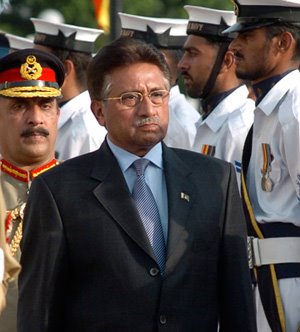
Pakistani President Pervez Musharraf inspects guard of honor before leaving the presidential house after his resignation in Islamabad Aug. 18, 2008.
Photo: Reuters/Mian Khursheed

The fall of Bush’s man in Pakistan
By Juan Cole / August 19, 2008

Despite Pervez Musharraf’s despotism and double-dealing with U.S. enemies, George W. Bush, John McCain and the GOP embraced him to the bitter end.

It is a measure of the Bush administration’s broken foreign policy that the departure of Pervez Musharraf, the corrupt, longtime military dictator of Pakistan, is provoking fears in Washington of “instability.” Despite Bush’s warm embrace, Musharraf gutted the rule of law in Pakistan over the previous year and a half, including sacking its Supreme Court. He attempted to do away with press freedom, failed to provide security for campaigning politicians and strove to postpone elections indefinitely.

The Bush administration has made a regular practice of undermining democracy in places where local politics don’t play out to its liking, and in that, at least, Musharraf was a true partner. But stability derives not from a tyrannical brake on popular aspirations; it derives from the free play of the political process. Musharraf’s resignation from office, in fact, marks Pakistan’s first chance for a decent political future since 1977.

Musharraf as a general had been known in the 1990s as a hawk, foolhardy in his provocation of India and deeply wedded to supporting the Taliban (and implicitly al-Qaida) in Afghanistan. Unlike some of his colleagues, there was nothing ideological about his belligerence. Brought up in part in secular Turkey as the son of a diplomat, he displayed no interest in fundamentalist Islam. His was the belligerence of opportunism and ambition.

Musharraf deposed then Prime Minister Nawaz Sharif in October of 1999. As army chief of staff, he had earlier that year launched the disastrous Kargil War against India in the Himalayan area of Kashmir, and been forced to withdraw. The encroachment on Indian-held territory had not been cleared with the prime minister, who was all too happy to yield to American entreaties to withdraw. Musharraf might well have been brought up on charges over the catastrophe, but he decided to overthrow the civilian government instead.

George W. Bush has been a staunch supporter of Musharraf. When campaigning for president in the fall of 1999, Bush praised Musharraf’s coup as promising stability for Pakistan. Sen. John McCain also supported the coup, and has recently dismissed the civilian government of the 1990s as a “failed state.” It is true that Sharif had begun exhibiting dictatorial tendencies before his ouster, but that is not a failed state, it is tyranny. How civilian authoritarianism could have been cured by military dictatorship remains unclear.

Pakistan was founded in 1947 by Muhammad Ali Jinnah and other leaders of the Muslim League as a refuge for the Muslims of British India. Jinnah fulminated against theocracy and fully expected Hindus and Sikhs to constitute a plurality of the new state’s population. He thought of it as a state for Muslims, not as an Islamic state, and simply wanted to save South Asian Muslims from laboring under a Hindu majority in India.

But Pakistan did not become the enlightened, parliamentary democracy with guaranteed constitutional rights that its founder, a Shiite trained in British law in London, had envisaged. It constituted the most rural and least industrialized parts of British India. It never implemented proper land reform, ensuring the survival of a corrupt and imperious class of large landlords who are not exactly clamoring for their peasants to become literate and politically aware. Its social indicators, whether literacy, health or urbanization, remained disappointing. A small fundamentalist movement, the Jama’at-i Islami, came to have influence all out of proportion to its membership, despite its general inability to garner more than 3 percent of the vote in most elections.

The military was the most ambitious bureaucracy inherited from British India, and it made its first coup in 1958. After a return to civilian rule in 1971, the military under Gen. Zia ul-Haq struck again in 1977, hanging Prime Minister Zulfikar Ali Bhutto in 1979. Gen. Zia was viewed by the Reagan administration as indispensable to its covert war against the Soviet occupation of Afghanistan. Zia, isolated and without popular support inside Pakistan, made an alliance with the fundamentalist Jama’at-i Islami and began the “Islamization” of Pakistani law, which had earlier been a mixture of British legal principles with precedents derived from Muslim customary practice.

Zia’s Inter-Services Intelligence, the feared military intelligence branch, received some $5 billion from Reagan and a matching sum from King Fahd in Saudi Arabia to fight the Soviets, and the ISI funneled much of that money to the most hard-line fundamentalist guerrillas among the Afghans. The Reagan-backed jihad against Moscow attracted the enthusiasms of Osama bin Laden, Ayman al-Zawahiri and thousands of other Arab volunteers, leading to the creation of al-Qaida.

Zia died in a mysterious plane crash in 1988, allowing a partial return to civilian rule. Bhutto’s daughter, Benazir, won the elections to become the country’s first female prime minister. But the military only let her take office after she pledged to cede Afghanistan policy to them, so that entire policy sectors remained under military control.

Gen. Zia had extensively and arbitrarily amended the constitution, giving the president enormous powers, including the authority to dismiss the prime minister. His successor dismissed Bhutto in 1990, allowing her rival, Nawaz Sharif, to come to power. In 1993, she swept back to power in that year’s parliamentary elections, but she was dismissed once more in 1996, again succeeded by Sharif, who was overthrown by the military in 1999. The military’s continued control of much of government policy during that decade and the repeated intervention of the president or the chief of staff to overturn the results of popular elections stunted the growth of political parties and institutions such as the courts. Contrary to McCain’s assertion, it was not the civilian parties that created a failed state but the generals who did it.

Musharraf ostensibly turned his back on his allies, the Taliban and their al-Qaida colleagues, after 9/11, acquiescing in Bush’s demand that he join Washington in a global war on terror. Musharraf, who had long backed not only the Taliban but also jihadi groups inside Pakistan that the Pakistani military sent to hit Indian Kashmir, was the least likely poster child for counterterrorism imaginable. But Bush’s propaganda machine painted him and the Pakistani military as anchors of stability — after they had spent decades destabilizing Pakistan and Afghanistan and cynically deploying the most virulent forms of Muslim fundamentalism to fight India and Indian influence.

Musharraf was an embarrassment to the Bush administration once Bush began using a rhetoric of democratization. So Musharraf conveniently turned himself from mere military dictator into a “president” by the expediency of a referendum on April 30, 2002.

For a dictator, a referendum has the advantages that it does not require one to run against a rival candidate, and virtually any vote tally can be declared a victory. Musharraf held crooked parliamentary elections in fall 2002, interfering in the free campaigning of the left-of-center, secular-leaning Pakistan People’s Party and the right-of-center, big landlord-dominated Muslim League (N), which had been led by Nawaz Sharif (hence the “N”). The party that did best was a pro-Musharraf, breakaway faction of the Muslim League, called “Q” for the “Great Leader,” Qa’id-i A’zam, the honorific of Muhammad Ali Jinnah, the country’s founder. It was essentially what it would be like if an American general led a coup, suppressing the Democrats and Republicans, and ruling through something he called the “George Washington Party.”

After Musharraf rigged the elections against the popular parties, a coalition of fundamentalist parties saw unprecedented success, getting 17 percent of seats in the federal parliament and taking over two major provinces, the North-West Frontier Province and Baluchistan. Those provinces were preciscely where the remnants of the Taliban and al-Qaida who fled to Pakistan were hiding out. The Jama’at-i Islami and its partners in the Islamic Action Council (MMA) promptly denied that there was any such thing as al-Qaida. But some of the MMA leaders had trained, or even been Taliban.

So the man Bush had so eagerly enlisted for the war on terror, by his dictatorial tinkering with the electoral process, helped put pro-bin Laden Muslim fundamentalists in control of the very provinces where the fight against militancy and terrorism was most important. And in reality, Musharraf needed the jihadi militants too much for his struggle with India over Kashmir to thoroughly root them out.

Although the Pakistani security forces did capture more than 600 Arab al-Qaida fugitives in Pakistan, and did engage in sometimes hard fighting against tribal forces in the northwest allied to the Taliban or neo-Taliban groups, Washington’s depiction of Musharraf as a critical ally in the war on terror was blatant propaganda. Elements of the ISI even went on cultivating and using Taliban elements based in Pakistan to assert control of southern Pakistan, a policy that had, in part, led to 9/11 in the first place. Musharraf either was unable to purge ISI of fundamentalist elements, or cynically continued to use them in his rivalry with Afghanistan President Hamid Karzai, who deeply dislikes and distrusts the general.

Musharraf’s unwillingness or inability to root out fundamentalist extremism brought him into disrepute with middle-class Pakistanis, especially educated women, who feared the Talibanization of their own society. Musharraf’s economic policies helped grow a large, literate, urban middle class that grew attached to free access to independent and foreign media, and depended for business and professional purposes on a rule of law.

When Musharraf came into conflict with Supreme Court Chief Justice Iftikhar Muhammad Chaudhry in spring of 2007, he highhandedly dismissed him. Pakistan’s middle classes, attorneys and other legal professionals staged continual protests and rallies. Musharraf was forced to reinstate Chaudhry in summer of 2007. But when he attempted to become an elected president that fall without resigning first as military chief of staff, the Supreme Court was set to rule against him. He therefore sacked the whole Supreme Court and packed it with yes men who allowed him to call himself president. He also imposed strict press censorship and excluded some independent channels from broadcasting over cable in Pakistan. This series of dictatorial actions, including interfering with free access to the media, caused Musharraf’s popularity to plummet.

Musharraf’s grip on power had clearly become too feeble for his main external backers, the Bush administration and the Saudi royal family, to trust him to continue to ride the tiger of popular discontent. He had to resign his military commission to remain believable as a civilian president. After Benazir Bhutto was assassinated on Dec. 27, 2007, while campaigning for prime minister, he was forced to hold credible parliamentary elections. The Pakistani public dealt a crushing rebuff to Musharraf last February, turning the country over to Benazir’s PPP and to Sharif’s Muslim League. The two major, long-standing parties made a political alliance and began planning for Musharraf’s impeachment, spurred on by the lawyers and popular activists. It was over for Musharraf by last February.

Pakistan’s middle classes have spoken. They want a return to civilian rule and a reestablishment of the rule of law. They are skeptical that the corrupt and imperious establishment political parties can deliver to them the better life to which they aspire for themselves and their children. Given the chance, they gave the biggest number of seats in parliament to a left of center, secular-tinged party, the PPP. The Pakistani people have given the lie to the stereotype often visited upon them, that a majority are religious fanatics and are incapable of participating in an open democracy.

The Pakistani military and its tacit alliance with militant fundamentalists has in fact caused most of the country’s problems. If the U.S. and Europe are wise, they will give the elected prime minister their full support and pump in aid to help ensure that democracy in Pakistan, still an embryo, actually has a fighting chance.

Source / Salon

The Rag Blog

Posted in RagBlog | Tagged , , | Leave a comment

Texas Horror Movies : The Top Five


A Handful of Non-Chainsaw Horrors
By Hair Balls / August 18, 2008

We Texans live with our share of horrors: fire ants, Rick Perry, residents of Plano, but this entry was still something of a challenge. After all, coming up with Texas horror movies without invoking the one that actually has the name of our state in the title is harder than successfully suing local religious figures. Still, a few intrepid filmmakers have found some scares of the non-chainsaw variety in the Lone Star State.

5. Manos: The Hands of Fate (1966)

Torgo and company were rightly consigned to the chemical toilet of Hollywood history until MST3K resurrected them. Repeat viewings of Harold P. Warren’s sole foray into cinema don’t convey any greater insight (believe me, I’ve tried), just heightened annoyance. Set in Warren’s hometown of El Paso, it’s allegedly Quentin Tarantino’s favorite comedy, which isn’t exactly a ringing endorsement.

4. Future-Kill (1985)

This is a bit of a cheat, seeing as it stars Chain Saw Massacre alumni Edwin Neal and Marilyn Burns. Then again, my friends and I were among the few people who were actually suckered in by H.R. Giger artwork’s (which director Ronald W. Moore tearfully begged the artist to supply for the poster) enough to see the movie in theatrical release. There’s very little “future” in this Austin-filmed horror flick about frat boys tasked with abducting a “Mutant” (a nuclear protester with a penchant for lipstick and mascara) and running afoul of “Splatter” (Neal), an actual mutant with a mean streak.

I’m genuinely heartbroken I couldn’t find the scene where a dude kills a stray cat with an Uzi. You’ll have to make do with this dubbed clip:

3. Silent Rage (1982)

How do you stop a killer who can’t die? Ordinarily I’d recommend you track down some member of the Van Helsing clan, but the only hope for the residents of this small Texas town is Sheriff Chuck Norris, who engages in an increasingly futile series of hand-to-hand battles with a resurrected maniac before doing the sensible thing and dropping the guy down a well.

Fine, I just wanted to talk about Chuck some more. But what about that ending? It leaves things open for a sequel!

2. Bubba Ho-Tep (2002)

Perhaps only the great Joe R. Lansdale could come up with a story in which a long-forgotten Elvis and a surgically altered JFK (darkened, Tropic Thunder style, to throw his enemies off track) do battle with an ancient mummy. Set in an East Texas rest home, the film was hampered from the start by Campbell’s insistence on referring to the flick as a B-movie, to director Don Phantasm Coscarelli’s chagrin.

My friend and I saw the River Oaks premiere of this, with Campbell and Coscarelli in attendance, sneaking into the theater while a German romantic comedy (they exist) was screening. We ended up sitting next to the entire Lansdale clan, who’d trekked down from Nacogdoches for the trip. Good people. And they didn’t rat us out

1. Man of the House (2005)

Oh, boo yourself. Did any of you actually watch this? Academy Award winner Tommy Lee Jones and Academy Award watcher Cedric the Entertainer join forces to make the University of Texas a laughing stock to everyone in the country who didn’t attend A&M. I understand it’s not
technically horror, but you try sitting through it without getting the shakes. Fear or nausea…makes no difference.

To give you an idea how bowel-clenchingly awful it is, the Offspring song accompanying this clip is actually better than the actual dialogue.

Go here for more video clips: Source / Houston Press

The Rag Blog

Posted in RagBlog | Tagged , , , , | 1 Comment

Riding the New Media : How Obama Really Did It

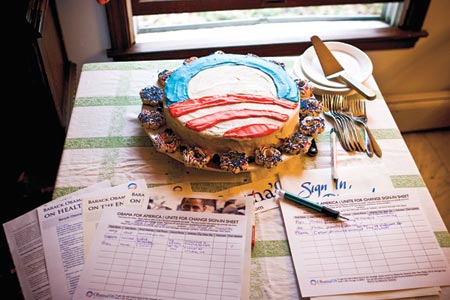
Cake and eat it too. From a party organized through Obama social-networking site. Photo by Porter Gifford / Technology Review.

The social-networking strategy that took an obscure senator to the doors of the White House.
By David Talbot

This article appears in full in the September/October 2008 issue of Technology Review.

Joe Trippi, Howard Dean’s 2004 presidential campaign manager and Internet impresario, describes Super Tuesday II–the March 4 primaries in Texas, Ohio, Vermont, and Rhode Island–as the moment Barack Obama used social tech­nology to decisive effect. The day’s largest hoard of dele­gates would be contested in Texas, where a strong showing would require exceptional discipline and voter-education efforts. In Texas, Democrats vote first at the polls and then, if they choose, again at caucuses after the polls close. The caucuses award one-third of the Democratic delegates.

Hillary Clinton’s camp had about 20,000 volunteers at work in Texas. But in an e-mail, Trippi learned that 104,000 Texans had joined Obama’s social-­networking site, www.my.barackobama.com, known as MyBO. MyBO and the main Obama site had already logged their share of achievements, particularly in helping rake in cash. The month before, the freshman senator from Illinois had set a record in American politics by garnering $55 million in donations in a single month. In Texas, MyBO also gave the Obama team the instant capacity to wage fully networked campaign warfare. After seeing the volunteer numbers, Trippi says, “I remember saying, ‘Game, match–it’s over.'”

The Obama campaign could get marching orders to the Texans registered with MyBO with minimal effort. The MyBO databases could slice and dice lists of volunteers by geographic micro­region and pair people with appropriate tasks, including prepping nearby voters on caucus procedure. “You could go online and download the names, addresses, and phone numbers of 100 people in your neighborhood to get out and vote–or the 40 people on your block who were undecided,” Trippi says. “‘Here is the leaflet: print it out and get it to them.’ It was you, at your computer, in your house, printing and downloading. They did it all very well.” Clinton won the Texas primary vote 51 to 47 percent. But Obama’s ­people, following their MyBO playbook, so overwhelmed the chaotic, crowded caucuses that he scored an overall victory in the Texas delegate count, 99 to 94. His showing nearly canceled out ­Clinton’s win that day in Ohio. Clinton lost her last major opportunity to stop the Obama juggernaut. “In 1992, Carville said, ‘It’s the economy, stupid,'” Trippi says, recalling the exhortation of Bill Clinton’s campaign manager, James Carville. “This year, it was the network, stupid!”

Throughout the political season, the Obama campaign has domi­nated new media, capitalizing on a confluence of trends. Americans are more able to access media-rich content online; 55 percent have broadband Internet connections at home, double the figure for spring 2004. Social-networking technologies have matured, and more Americans are comfortable with them. Although the 2004 Dean campaign broke ground with its online meeting technologies and blogging, “people didn’t quite have the facility,” says ­Lawrence Lessig, a Stanford law professor who has given the Obama campaign Internet policy advice (Lessig wrote The People Own Ideas! in our May/June 2005 issue). “The world has now caught up with the technology.” The Obama campaign, he adds, recognized this early: “The key networking advance in the Obama field operation was really deploying community­-building tools in a smart way from the very beginning.”

Of course, many of the 2008 candidates had websites, click-to-donate tools, and social-networking features–even John McCain, who does not personally use e-mail. But the Obama team put such technologies at the center of its campaign–among other things, recruiting 24-year-old Chris Hughes, cofounder of Facebook, to help develop them. And it managed those tools well. Supporters had considerable discretion to use MyBO to organize on their own; the campaign did not micromanage but struck a balance between top-down control and anarchy. In short, Obama, the former Chicago community organizer, created the ultimate online political machine.

The Obama campaign did not provide access or interviews for this story; it only confirmed some details of our reporting and offered written comments. This story is based on interviews with third parties involved in developing Obama’s social-networking strategy or who were familiar with it, and on public records.

An Online Nervous System

A row of elegant, renovated 19th-century industrial buildings lines Boston’s Congress Street east of Fort Point Channel. On any given day, behind a plain wooden door on the third floor of 374 Congress, 15 to 20 casually clad programmers tap away at computers. On the day I visited, the strains of Creedence Clearwater Revival filled the room; a Ping-Pong table dominated the small kitchen. This is the technology center for Blue State Digital, which means that it is also the nervous system for its two largest clients, the Barack Obama campaign and the Democratic National Committee. Founded by alumni of the Dean campaign, Blue State Digital added interactive elements to Obama’s website–including MyBO–and now tends to its daily care and feeding. The site’s servers hum away in a Boston suburb and are backed up in the Chicago area.

Jascha Franklin-Hodge, 29, greeted me with a friendly handshake and a gap-toothed grin. He has a deep voice and a hearty laugh; his face is ringed by a narrow beard. Franklin-Hodge dropped out of MIT after his freshman year and spent a few years in online music startups before running the Internet infrastructure for the Dean campaign, which received a then-­unprecedented $27 million in online donations. “When the campaign ended, we thought, ‘Howard Dean was not destined to be president, but what we are doing online–this is too big to let go away,'” he says. He and three others cofounded Blue State Digital, where he is chief technology officer. (Another cofounder, Joe Rospars, is now on leave with the Obama campaign as its new-media director.)

The MyBO tools are, in essence, rebuilt and consolidated versions of those created for the Dean campaign. Dean’s website allowed supporters to donate money, organize meetings, and distribute media, says Zephyr Teachout, who was Dean’s Internet director and is now a visiting law professor at Duke University. “We developed all the tools the Obama campaign is using: SMS [text messaging], phone tools, Web capacity,” Teachout recalls. “They [Blue State Digital] did a lot of nice work in taking this crude set of unrelated applications and making a complete suite.”

Blue State Digital had nine days to add its tools to Obama’s site before the senator announced his candidacy on February 10, 2007, in Springfield, IL. Among other preparations, the team braced for heavy traffic. “We made some projections of traffic levels, contribution amounts, and e-mail levels based on estimates from folks who worked with [John] Kerry and Dean in 2004,” recalls Franklin­-Hodge. As Obama’s Springfield speech progressed, “we were watching the traffic go up and up, surpassing all our previous records.” (He would not provide specific numbers.) It was clear that early assumptions were low. “We blew through all of those [estimates] in February,” he says. “So we had to do a lot of work to make sure we kept up with the demand his online success had placed on the system.” By July 2008, the campaign had raised more than $200 million from more than a million online donors (Obama had raised $340 million from all sources by the end of June), and MyBO had logged more than a million user accounts and facilitated 75,000 local events, according to Blue State Digital.

MyBO and the main campaign site made it easy to give money–the fuel for any campaign, because it pays for advertising and staff. Visitors could use credit cards to make one-time donations or to sign up for recurring monthly contributions. MyBO also made giving money a social event: supporters could set personal targets, run their own fund-raising efforts, and watch personal fund-­raising thermometers rise. To bring people to the site in the first place, the campaign sought to make Obama a ubiquitous presence on as many new-media platforms as possible.

The viral Internet offered myriad ways to propagate unfiltered Obama messages. The campaign posted the candidate’s speeches and linked to multimedia material generated by supporters. A music video set to an Obama speech–“Yes We Can,” by the hip-hop artist Will.i.am–has been posted repeatedly on YouTube, but the top two postings alone have been viewed 10 million times. A single YouTube posting of Obama’s March 18 speech on race has been viewed more than four million times. Similarly, the campaign regularly sent out text messages (at Obama rallies, speakers frequently asked attendees to text their contact information to his campaign) and made sure that Obama was prominent on other social-networking sites, such as Facebook and MySpace (see “New-Media King” chart above). The campaign even used the micro­blogging service Twitter, garnering about 50,000 Obama “followers” who track his short posts. “The campaign, consciously or unconsciously, became much more of a media operation than simply a presidential campaign, because they recognized that by putting their message out onto these various platforms, their supporters would spread it for them,” says Andrew Rasiej, founder of the Personal Democracy Forum, a website covering the intersection of politics and technology (and another Dean alumnus). “We are going from the era of the sound bite to the sound blast.”

Money flowed in, augmenting the haul from big-ticket fund-raisers. By the time of the Iowa caucuses on January 3, 2008, the Obama campaign had more than $35 million on hand and was able to use MyBO to organize and instruct caucus-goers. “They have done a great job in being precise in the use of the tools,” Teachout says. “In Iowa it was house parties, looking for a highly committed local network. In South Carolina, it was a massive get-out-the-vote effort.” MyBO was critical both in the early caucus states, where campaign staff was in place, and in later-­voting states like Texas, Colorado, and Wisconsin, where “we provided the tools, remote training, and opportunity for supporters to build the campaign on their own,” the Obama campaign told Technology Review in a written statement. “When the campaign eventually did deploy staff to these states, they supplemented an already-built infrastructure and volunteer network.”

Using the Web, the Obama camp turbocharged age-old campaign tools. Take phone banks: through MyBO, the campaign chopped up the task of making calls into thousands of chunks small enough for a supporter to handle in an hour or two. “Millions of phone calls were made to early primary states by people who used the website to reach out and connect with them,” Franklin-Hodge says. “On every metric, this campaign has operated on a scale that has exceeded what has been done before. We facilitate actions of every sort: sending e-mails out to millions and millions of people, organizing tens of thousands of events.” The key, he says, is tightly integrating online activity with tasks people can perform in the real world. “Yes, there are blogs and Listservs,” Franklin-Hodge says. “But the point of the campaign is to get someone to donate money, make calls, write letters, organize a house party. The core of the software is having those links to taking action–to doing something.”

Read all of this article here / Technology Review

Thanks to Carlos Lowry / The Rag Blog

Posted in RagBlog | Tagged , , , , , | Leave a comment

Six Questions about the Anthrax Case

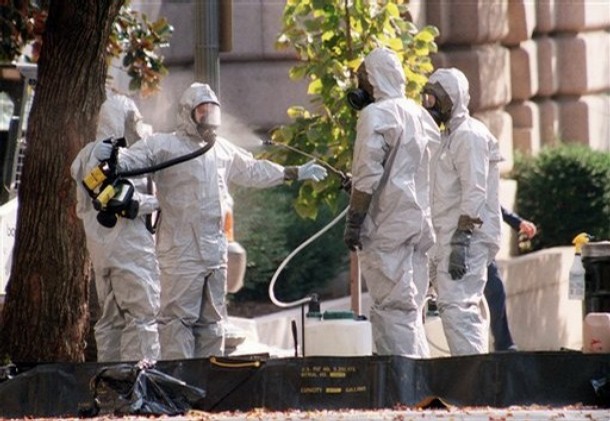
A hazardous materials unit worker is hosed down on Capitol Hill on Tuesday, where worked continued inspecting buildings and offices for anthrax contamination. Photo by Ron Thomas / AP.

Double Standards in the Global War on Terror, Anthrax Department
By Tom Engelhardt / August 18, 2008

Oh, the spectacle of it all — and don’t think I’m referring to those opening ceremonies in Beijing, where North Korean-style synchronization seemed to fuse with smiley-faced Walt Disney, or Michael Phelp’s thrilling hunt for eight gold medals and Speedo’s one million dollar “bonus,” a modernized tribute to the ancient Greek tradition of amateurism in action. No, I’m thinking of the blitz of media coverage after Dr. Bruce Ivins, who worked at the U.S. Army Medical Research Institute of Infectious Diseases at Fort Detrick, Maryland, committed suicide by Tylenol on July 29th and the FBI promptly accused him of the anthrax attacks of September and October 2001.

You remember them: the powder that, innocuously enough, arrived by envelope — giving going postal a new meaning — accompanied by hair-raising letters ominously dated “09-11-01” that said, “Death to America. Death to Israel. Allah is great.” Five Americans would die from anthrax inhalation and 17 would be injured. The Hart Senate Office Building, along with various postal facilities, would be shut down for months of clean-up, while media companies that received the envelopes were thrown into chaos.

For a nation already terrified by the attacks of September 11, 2001, the thought that a brutal dictator with weapons of mass destruction (who might even have turned the anthrax over to the terrorists) was ready to do us greater harm undoubtedly helped pave the way for an invasion of Iraq. The President would even claim that Saddam Hussein had the ability to send unmanned aerial vehicles to spray biological or chemical weapons over the east coast of the United States (drones that, like Saddam’s nuclear program, would turn out not to exist).

Today, it’s hard even to recall just how terrifying those anthrax attacks were. According to a LexisNexis search, between Oct. 4 and Dec. 4, 2001, 389 stories appeared in the New York Times with “anthrax” in the headline. In that same period, 238 such stories appeared in the Washington Post. That’s the news equivalent of an unending, high-pitched scream of horror — and from those attacks would emerge an American world of hysteria involving orange alerts and duct tape, smallpox vaccinations, and finally a war, lest any of this stuff, or anything faintly like it, fall into the hands of terrorists.

And yet, by the end of 2001, it had become clear that, despite the accompanying letters, the anthrax in those envelopes was from a domestically produced strain. It was neither from the backlands of Afghanistan nor from Baghdad, but — almost certainly — from our own military bio-weapons labs. At that point, the anthrax killings essentially vanished… Poof!… while 9/11 only gained traction as the singular event of our times.

Those deaths-by-anthrax ceased to be part of the administration’s developing Global War on Terror narrative, which was, of course, aimed at Islamist fanatics (and scads of countries that were said to provide them with “safe haven”), but certainly not military scientists here at home. No less quickly did those attacks drop from the front pages — in fact, simply from the pages — of the nation’s newspapers and off TV screens.

Unlike with 9/11, there would be no ritualistic reminders of the anniversaries of those attacks in years to come. No victims, or survivors, or relatives of victims would step to podiums and ring bells, or read names, or offer encomiums. There would be no billion-dollar (or even million-dollar) memorial to the anthrax dead for the survivors to argue over. There would be little but silence, while the FBI fumbled its misbegotten way through an investigative process largely focused on one U.S. bio-weapons scientist, Steven J. Hatfill, who also worked at Fort Detrick and just happened to be the wrong man. (Bruce Ivins, eerily enough, would work closely with, and aid, the FBI’s investigation for years until the spotlight of suspicion came to be directed at him.)

This essentially remained the state of the case until, as July ended, Ivins committed suicide. Then, what a field day! The details, the questions, the doubts, the disputed scientific evidence, the lists of kinds of drugs he was prescribed, the lurid quotes, the “rat’s nest” of an anthrax-contaminated lab he worked in, the strange emails and letters! (“I wish I could control the thoughts in my mind… I get incredible paranoid, delusional thoughts at times, and there’s nothing I can do until they go away, either by themselves or with drugs.”) Case solved! Or not… The “mad scientist” from the Army’s Fort Detrick bio-wars labs finally nabbed! Or not…

It was a dream of a story. And the mainstream media ran with it, knowledgeably, authoritatively, as if they had never let it go. Now, as the coverage fades and the story once again threatens to head for obscurity (despite doubts about Ivins’s role in the attacks), I thought it might be worth mentioning a few questions that came to my mind as I read through recent coverage — not on Ivins’s guilt or innocence, but on matters that are so much a part of our American landscape that normally no one even thinks to ask about them.

Here are my top six questions about the case:

1. Why wasn’t the Bush administration’s War on Terror modus operandi applied to the anthrax case?

On August 10th, William J. Broad and Scott Shane reported on some of the human costs of the FBI anthrax investigation in a front-page New York Times piece headlined, “For Suspects, Anthrax Case Had Big Costs, Scores of the Innocent in a Wide F.B.I. Net.” They did a fine job of establishing that those who serially came under suspicion had a tough time of it: “lost jobs, canceled visas, broken marriages, frayed friendships.” According to the Times (and others), under the pressure of FBI surveillance, several had their careers wrecked; most were interviewed and re-interviewed numerous times in a “heavy-handed” manner, as well as polygraphed; some were tailed and trailed, their homes searched, and their workplaces ransacked.

Under the pressure of FBI “interest,” anthrax specialist and “biodefense insider” Perry Mikesell evidently turned into an alcoholic and drank himself to death. Steven Hatfill, while his life was being turned inside out, had an agent trailing him in a car run over his foot, for which, Broad and Shane add, he, not the agent, was issued a ticket. And finally, of course, Dr. Ivins, growing ever more distressed and evidently ever less balanced, committed suicide on the day his lawyer was meeting with the FBI about a possible plea bargain that could have left him in jail for life, but would have taken the death penalty off the table.

Still, tough as life was for Mikesell, Hatfill, Ivins, and scores of others, here’s an observation that you’ll see nowhere else in a media that’s had a two-week romp through the case: In search of a confession, none of the suspects of these last years, including Ivins, ever had a lighted cigarette inserted in his ear; none of them were hit, spit on, kicked, and paraded naked; none were beaten to death while imprisoned but uncharged with a crime; none were doused with cold water and left naked in a cell on a freezing night; none were given electric shocks, hooded, shackled in painful “stress positions,” or sodomized; none were subjected to loud music, flashing lights, and denied sleep for days on end; none were smothered to death, or made to crawl naked across a jail floor in a dog collar, or menaced by guard dogs. None were ever waterboarded.

Whatever the pressure on Ivins or Hatfill, neither was kidnapped off a street near his house, stripped of his clothes, diapered, blindfolded, shackled, drugged, and “rendered” to the prisons of another country, possibly to be subjected to electric shocks or cut by scalpel by the torturers of a foreign regime. Even though each of the suspects in the anthrax murders was, at some point, believed to have been a terrorist who had committed a heinous crime with a weapon of mass destruction, none were ever declared “enemy combatants.” None were ever imprisoned without charges, or much hope of trial or release, in off-shore, secret, CIA-run “black sites.”

Why not?

2. Why wasn’t the U.S. military sent in?

Part of the reigning paradigm of the Bush years was this: police work was not enough when the homeland was threatened. The tracking down of terrorists who had killed or might someday kill Americans was a matter of “war.” Those who had attacked the American homeland and murdered U.S. citizens would, as our President put it, be “hunted down” by special ops forces and CIA agents who had been granted the right to assassinate and brought in “dead or alive.”

Why then, when acts of murderous bio-terror had been committed on American soil, was the military not called in? Why were no CIA “death squads” — the tellingly descriptive phrase used by Jane Mayer in her remarkable new book, The Dark Side — dispatched to assassinate likely suspects? Why were no Predator unmanned drones, armed with Hellfire missiles, launched to cruise the skies of Maryland and take out Ivins or other suspects “precisely” and “surgically” in their homes (whatever the “collateral damage”)? Why, in fact, weren’t their homes simply obliterated in the manner regularly employed in Afghanistan, Pakistan, Somalia, and elsewhere? (In fact, it seems to have taken the FBI two years after their first suspicions of Ivins simply to search his house and even longer finally to take away his high-level security clearance.)

Once U.S. weapons labs were identified as the sources of the anthrax, why were no special ops teams sent in to occupy the facilities, shut them down, and fly those found there, shackled and blindfolded, to Guantanamo or other more secret sites?

Why, when the administration went to great lengths to squeeze off funding for terrorists elsewhere, was funding for those labs significantly increased?

Why, when those swept up or simply kidnapped by the Bush administration and then discovered to be innocent, were — after secret imprisonment, abuse, and torture — regularly released without apology or reimbursement (if released at all), did the U.S. government pay Hatfill $4.6 million to settle a lawsuit he filed in response to his ordeal?

Why when, according to the Vice President’s “one percent doctrine,” no response was too extreme if even a minuscule chance of a catastrophic attack against the U.S. “homeland” existed, were no extreme acts taken with a WMD killer (or killers) on the loose, possibly in Maryland’s suburbs?

3. Once the anthrax threat was identified as coming from U.S. military labs, why did the administration, the FBI, and the media assume that only a single individual was responsible?

Read as much of the coverage of the anthrax killings as you want and you’ll discover that the FBI has long taken for blanket fact that a single “mad scientist” was the culprit — and, no less important, that that theory has been accepted as bedrock fact by the media as well. No alternative possibilities have been seriously considered for years.

For instance, it is known that a set of the anthrax letters was sent from a mailbox in Princeton, New Jersey, some hours from Ivins’s home and the Fort Detrick lab in Frederick, Maryland. The question the FBI puzzled over — and the media took up vigorously — was whether, on the day in question, Ivins had time to make it to Princeton and back, given what’s known of his schedule. The FBI suggests that he did; critics suggest otherwise. No one, however, seems to consider the possibility that the lone terrorist of the anthrax killings might have had one or more accomplices, which would have made the “problem” of mailing those letters into a piece of cake.

Is it that Americans, as opposed to foreigners bent on terrorism, are assumed to be unstoppable individualists, loners canny enough to carry out plots by themselves? Does no one recall that the last great act of American terrorism in the United States, the bombing of the Alfred P. Murrah Federal Building in Oklahoma City in 1995, was a crime committed by at least two American “loners”? (The earliest reports in that case, too, blamed Arab terrorists — plural.)

There seem to have been no serious al-Qaeda “sleeper cells” in this country, but how do we know that there isn’t a “sleeper cell” of American bio-killers lurking somewhere in the U.S. military lab community?

4. What of those military labs? Why does their history continue to play little or no part in the story of the anthrax attacks?

In reading through reams of coverage of Ivins’s suicide and the FBI case against him, I found only a single reference to the work his lab at Fort Detrick had been dedicated to throughout most of the Cold War era. Here is that sentence from the Washington Post: “As home to the Army Biological Warfare Laboratories, the facility ran a top-secret program producing offensive biological weapons from 1943 until 1969.” And yet, if you don’t grasp this fact, the real significance of the anthrax case remains in the shadows.

As with the continuing story of nuclear dangers on our planet, the terrors of our age are almost invariably portrayed as emerging from bands of fanatics, or lands like Iran said to be ruled by the same, in the backlands of our planet (some of which also just happen to be in the energy heartlands of the same planet). And yet, if we are terrified enough of loose or proliferating weapons of mass destruction to threaten or start wars over them, it’s important to understand that, from 1945 on, these dangers — and they are grim dangers — emerged from the heartland of the military-industrial machines of the two Cold War superpowers, the U.S. and the USSR.

Put another way, the most conceptually frightening attacks of 2001 came directly from the Cold War urge to develop offensive biological weapons. Until 1969, the Army’s biological-warfare laboratories at Fort Detrick were focused, in part, on that task. Plain and simple. After President Richard Nixon shut down the offensive bio-war program in 1969, the Army’s scientists switched to work on “defenses” against the same. As with defenses against nuclear attack, however, such work, by its nature, is often hard to separate from offensive work on such weaponry. In other words, looked at a certain way, one focus of the Fort Detrick lab, which fell under suspicion in the anthrax attacks by the winter of 2001, has long been putting bio-war on the global menu. In that, it was evidently successful in the end.

There is irony here, of course. In the post-Cold War era, our worries focused almost solely on the deteriorating, sometimes ill-guarded Russian Cold War labs and storehouses for biological, chemical, and nuclear war. It was long feared that, from them, such nightmares would drop into our world. But in this we were, it seems, wrong. The labs with the holes were ours and — what’s more terrifying — the possibilities for leakage and misuse are still expanding exponentially.

5. Were the anthrax attacks the less important ones of 2001?

If you compare the two sets of 2001 attacks in terms of death and destruction, 9/11 obviously leaves the anthrax attacks in the dust. Thought about a certain way, however, the attacks of 9/11, while bold, murderous, televisually spectacular, and apocalyptic looking, were conceptually old hat. It was the anthrax attacks that pointed the way to a new and frightening future.

After all, the World Trade Center had already been attacked, and one of its towers nearly toppled, by a rental-van bomb driven into an underground garage by Islamists back in 1993. The planes in the 2001 assaults were, as Mike Davis has written, simply car bombs with wings, and car bombs have a painfully long history. Even though in their targeting — the symbolic mega-buildings of an imperial power whose citizens previously preferred to believe themselves invulnerable — the 9/11 hijackers offered a new psychological reality to Americans, their most striking and unsettling feature was perhaps themselves. Those 19 men had pledged to commit suicide not for their country, as had thousands of Japanese kamikaze pilots at the end of World War II, or even for a potential country like hundreds of Tamil suicide bombers in Sri Lanka, but for a religious fantasy (behind which lay non-religious grievances). On the other hand, the 9/11 attacks were but a larger, more ambitious version of, for instance, the suicide-by-boat attack on the U.S.S. Cole in a Yemeni port in 2000.

On the other hand, the anthrax mailings represented something new. (The Japanese Aum Shinrikyo cult had attempted to make and use bio-weapons, including anthrax, back in 1990s, but failed.) If the al-Qaeda strike on 9/11 had only simulated a weapon-of-mass-destruction attack, with the anthrax killer, no imagination was necessary. An actual weapon of mass destruction — highly refined anthrax — had been used successfully, then used again, and the killer(s) remained at large, not in the Afghan backlands but somewhere in our midst, with no evidence that the supply of anthrax had been used up.

And yet, even as the Bush administration, the two presidential candidates, all of Washington, and the media remain focused on terrorism in the Afghan-Pakistani border regions, few give serious thought — except when it comes to individual culpability — to the terror that emerged from the depths of the military-industrial complex, from our own Cold War weapons labs. To that, no aspect of the Global War on Terror seems to apply.

6. Who is winning the Global War on Terror?

The answer, obviously, is the terrorists. Just last week, Mike McConnell, the director of national intelligence, made this crystal clear when it came to al-Qaeda. He testified before Congress that the organization “is gaining in strength from its refuge in Pakistan and is steadily improving its ability to recruit, train and position operatives capable of carrying out attacks inside the United States.” In fact, it’s been clear enough for quite a while that the Bush administration’s Global War on Terror has mainly succeeded in creating ever more terrorists in ever more places. And yet, arguably, the anthrax killer or killers have, to date, gained far more than al-Qaeda. Looked at a certain way, whatever the role of Bruce Ivins, the anthrax killings proved to be a full-scale triumph of terrorism.

One theory has long been that whoever committed the anthrax outrages was intent on drawing attention (and probably funding) to further research and development of U.S. bio-war “defenses.” If so, then, what a remarkable success! In the years since the attacks occurred, funding has flooded into such labs, whose numbers have grown strikingly. On September 11, 2001, reports the Washington Post, “there were only five ‘biosafety level 4′ labs — places equipped to study highly lethal agents such as Ebola that have no human vaccine or treatment — a Government Accountability Office report stated last fall. Fifteen are in operation or under construction now, according to the report. There are hundreds more biosafety level 3 labs, which handle agents such as Bacillus anthracis, which does have a human vaccine.”

The few hundred people at work in the U.S. bio-defense program before 9/11 have swelled to perhaps 14,000 scientists who have “clearances to work with ‘select biological agents’ such as Bacillus anthracis — many of them civilians working at private universities” where, according to experts, “security regulations are remarkably lax.” And don’t forget the Army’s own billion-dollar plan to “build a larger laboratory complex as part of a proposed interagency biodefense campus at Fort Detrick.” We’re talking about the place where, as Ivins’s crew was evidently nicknamed, “Team Anthrax” worked and whose labs are reputedly “renowned for losing anthrax.” In these same years, according to the New York Times, “almost $50 billion in federal money has been spent to build new laboratories, develop vaccines and stockpile drugs.” Some of this money was pulled out of basic public health funds which once ensured that large numbers of people wouldn’t die of treatable diseases like tuberculosis and redirected into work on the Ebola virus, anthrax, and other exotic pathogens.

In these years, not to put too fine a point on it, the Bush administration has exponentially expanded our bio-war labs, increasing significantly the likelihood that a new “mad scientist” will have far more opportunity and far more deadly material available to work with. It has, in other words, increased the likelihood not just that terror will come to “the homeland,” but that it will come from the homeland. Thanks to this administration, the terrorists won this round and future terrorists can reap the fruits of that victory.

Bruce Ivins, whatever you did, or whatever was done to you, R.I.P. Your lab is in good hands. And the likelihood is that, almost seven years after the first anthrax envelope arrived, the world is more of a terror machine than ever.

[Tom Engelhardt, co-founder of the American Empire Project, runs the Nation Institute’s TomDispatch.com. He is the author of The End of Victory Culture, a history of the American Age of Denial. The World According to TomDispatch: America in the New Age of Empire (Verso, 2008), a collection of some of the best pieces from his site, has just been published. Focusing on what the mainstream media hasn’t covered, it is an alternative history of the mad Bush years.]

Note on readings: Oddly enough, back in December 2002, as this site was going public, the very first TomDispatch guest writer, public health expert David Rosner, took up the issue of smallpox hysteria, pointing out that the disease was saved from total eradication on the planet by a U.S./USSR agreement “to make sure that the virus that causes smallpox would remain in storage awaiting a new opportunity to terrorize the world. For decades, both countries stored it, distributed it to various research labs and otherwise ensured that this public health victory would be turned into a potential human tragedy.” He added: “Fear of smallpox has played nicely into the overall strategy of the Bush administration to militarize public health.” It’s a piece worth revisiting, as perhaps is “It Should Have Been Unforgettable,” a post I wrote back in 2005 when the anthrax case had long fallen off the American radar screen.

More recently, Glenn Greenwald of Salon.com has done superb work on the anthrax story. In 2007, he wrote a striking column, “The unresolved story of ABC News’ false Saddam-anthrax reports,” on some crucially bad reporting by Brian Ross and ABC, and he followed up after Ivins’s suicide with a piece, (“Journalists, their lying sources, and the anthrax investigation,”) that has more unsettling questions about the anthrax case than any other 16 pieces I’ve seen. It’s a must read. Jay Rosen, at his always interesting PressThink blog, took up Greenwald’s challenge to Brian Ross and ABC on its reporting and pressed the point home in two recent posts, here and here.

Finally, Elisa D. Harris, a senior research scholar at the Center for International and Security Studies at the University of Maryland, had a fine, thoughtful op-ed last week in the New York Times, “The Killers in the Lab” (“Our efforts to fight biological weapons are making us less safe”), which laid out in an impressive way the expansion of U.S. bio-weapons research since 2001.

Copyright 2008 Tom Engelhardt

Source / TomDispatch

The Rag Blog

Posted in RagBlog | Tagged , , , , | Leave a comment

Obama and The Onion : Reflections on the Uses of Satire

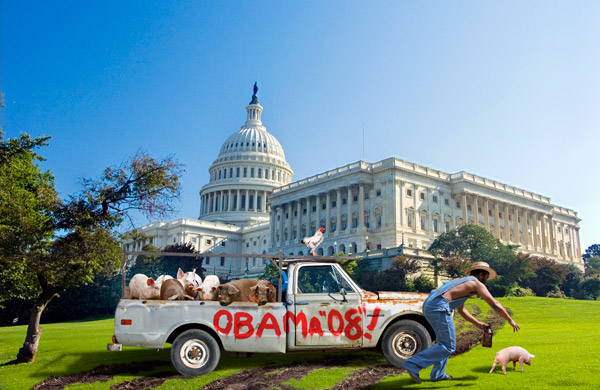
‘Cooter Obama’ chases pig on Capitol lawn. Photo from controversial satirical article in The Onion. Photo © Copyright 2008, Onion, Inc.

I recently chuckled at a satirical piece I found at The Onion’s website and reposted it here on The Rag Blog with barely a second thought. The story, “Obama’s Hillbilly Half-Brother Threatening To Derail Campaign,” stirred up a tempest. My co-editor Richard Jehn found it especially tasteless and pulled the story until we could discuss it. Though I’m a great fan of hard-hitting satire and consider no one above a bit of good-natured fun, I tended on reflection to agree with Richard and we left The Onion’s article off the blog. But I did pass it around for reaction.

Well, as often happens in our little corner of the internet, the whole affair inspired a discussion that has been fun and insightful. And best of all, Jim Retherford wrote the following rather eloquent reflection that is well worth a read!

Below Jim’s thoughtful take, I’ve included a bunch of posts from Rag Blog readers and friends – and I definitely urge you to read them. And by the way, here’s a link to The Onion’s satirical piece – which I just noticed is still number one on their “hit” list.

Thorne Dreyer / The Rag Blog / August 19, 2008

THE LIONS OF COMEDY
By James Retherford [convicted pie thrower] / The Rag Blog / August 19, 2008

Comedian Rich Scheidner used to perform frequently at Austin’s Comedy Workshop, and my spouse Cindy and I developed a warm friendship with him and his Austin-born wife. Early on I noticed that Rich’s comic schtick was unique; he did not make jokes about individuals or classes of people, except himself and the class he represented — i.e., clueless white guys. Yeah, he told wife and mother-in-law jokes, but he himself was the punchline of these routines. No off-color sexual jokes. No potty-mouth humor. No ethnic jokes. No vulgar class jokes. In short, none of the stuff I had grown accustomed to seeing on the Comedy Workshop stage. One night backstage as we tossed down a couple tequila shots after his show, I asked Rich about it. His reply was something like this:

“It doesn’t take talent to exploit other people in order to get a cheap laugh. I think it is lazy, and I also think it is wrong.”

Unlike Mike Klonsky’s and Carl Davidson’s thoughtful remarks, I simply dismissed the Onion piece as lazy and “not funny” and did not parse it further. As far as I’m concerned, “not funny” itself is the rimshot-punctuated death knell of satirical writing. It means whatever humor was intended, it missed the mark.

Badda-bing!

Why does the Onion piece miss the mark? As one with working-class redneck/hillbilly ancestral roots spread from Texas through the Smoky Mountains into rural Indiana, I find Appalachian culture and people a force to be celebrated, not mocked — especially not to be mocked by opportunistically “using” another historically marginalized and oppressed racial/cultural group such as African-Americans. Not funny. I have never watched a single episode of Beverly Hillbillies; it ain’t funny. There’s nothing funny about the brave men and women who stood up to the capitalists at Paint Creek, Cabin Creek, Matewan, Blair Mountain, “Bloody” Harlan and Bell County, Ludlow. They are heroes in my book. Nothing funny about what Peter Rowan calls that “high lonesome sound” of Jean Ritchey, the Stanley Brothers, the Monroe Brothers, Hazel Dickens, Jim Garland, Sarah Gunning, and Aunt Molly Jackson, the Carter Family, Flatt and Scruggs, Jim and Jesse, Charlie Poole, Doc Watson, Merle Travis, and many many many more. Nothing funny about the art of Grandma Moses either … or the near-anonymous master whittlers and quilters of the southland’s hills and hollers. There was plenty of funny about Minnie Pearl.

Cousin Minnie’s hillbilly humor brings us to a very important observation, to wit: Hillbillies — and African-Americans and Mexicans and Poles and Irish and women and men and gays and very tall people and very short people — have unlimited license to laugh at themselves. Black comics tell nigger jokes, gay comics tell faggot jokes, Rich Scheidner told “clueless white guy” jokes, and the members of their constituent groups ROTFL. Long-oppressed groups have risen up to reclaim the words that once were used to inflict pain and self-loathing, to turn the language of their oppressors upside down and inside out.

But in a world where oppression is a systemic disease, the language license is not transferable to any other class or group. Why not? Within these groups, rap, banter, trash talk, and humor is egalitarian. No one is “better” than anyone else. To riff on your friend’s po’ mamma is to riff on your own po’ mamma. But when humor is directed from one class at another, it is no longer egalitarian. It becomes hierarchical — and oppressive — as a performer representing the attitudes of a particular group or class invites the audience to join in the act of making fun of a “lesser” group or class. Moral, cultural, sexual, intellectual, racial, and/or class superiority emerges as the fundament of the routine, and targets of moral, cultural, sexual, intellectual, racial, and/or class inferiority are lined up by the enterprising jokester for the comic “kill.” Those words (like the n-word) reassume their denigrating meanings. I would further argue that derisive and demeaning “humor” directed at any marginalized or oppressed individual, group, or class can be — and is often — construed as a subtle form of violence, an attack on the very soul of culture, on the right of the individual, group, or class to be. As progressives, we should understand this by now.

Some may argue that “not funny” does not necessarily translate into “offensive,” but this is a false dichotomy and begs the basic question of class and power. I didn’t find characterizations of Jimmy Carter’s and Bill Clinton’s kinfolk funny either; I thought the revelations about Billy and Roger made the candidates more real. Rather I am reminded of the infamous recent New Yorker cover and of the white middle-class liberal intellectuals who, officiously incredulous by the uproar, declared, “If you don’t find this funny, something is wrong with you.”

So what IS wrong with me?

• First of all, I was born into poor white farming family and didn’t have running water (except the creek that ran through the woods behind the back pasture) or indoor “facilities” until I was in the eighth grade. My father was a tenant farmer who would disappear for days at a time on drinking and womanizing sprees and was abusive when he was at home. My father’s family — with a few exceptions — boasted of their lineage to ex-Confederates and horse thieves, and my father proved worthy of his bloodlines when one drunken night he came home with a loaded shotgun intent on killing my mom, my younger brother, and myself. He ended up in jail and then in a mental institution where he was given shock treatments.

My mother was an orphan who worked her way to a teaching degree at Indiana University. She taught in a small country school during the winter months and kept chickens, tended a very big garden, and worked in an aluminum factory in the summer to keep food on the table and clothes on our backs. As an orphan, however, she was not aware until late in her lifetime that her great-grandfather and great-great-grandfather were two of America’s finest abolitionist and women’s rights statesmen of the first half of the 19th century — one was a two-time vice-presidential candidate. (My grandson bears their names, Julian Giddings Retherford.)

• Second, for several months in 1974 I lived “underground” in the back of a holler in Calhoun County, WV, with my infant son Jesse James. While there I spent a lot of time down the crick visiting a retired coal miner and listening to hair-raising stories about the WV coal wars and the rise of the UMW. Every weekend a nearby community hosted a “sing,” a potluck-and-music event at which family musical groups from all over the nearby counties fiddled and sang from a makeshift stage. The spirit of communal sharing among the hill folk and the transplanted hippies was contagious and memorable, and I still get misty-eyed as I recall one lovely young local lass (aged 14 or 15) singing lilting tear-stained a cappella ballads plucked straight from the 15th-16th century Scottish highlands. Ah, that high lonesome sound.

• So what else is wrong with me? In August 1967 I had the remarkable opportunity to hear SNCC spokesperson James Forman tell a room full of white middle-class liberal intellectuals sporting “I Am Not Racist” buttons just how racist they (we) really were. The place was Chicago’s Palmer House ballroom at the infamous Conference on New Politics at a juncture when the emerging Black Power movement increasingly was at loggerheads with white paternalism in the civil rights struggle (and, I also should add, COINTELPRO was in full swing). Forman told the smug and testy white members of the audience [my paraphrase follows]:

“You say you aren’t racists. You say you have overcome your racism.

“You’re wrong. You ALL are racists! Each and every one of you is racist to the bone. …

“I’m not saying this to you in anger. I’m just stating fact. And the fact is that white people in America are racists. I also recognize that white people can’t help it. Your parents and your grandparents were born and raised in a racist society. You were born and raised in a racist society. You are schooled in racist schools. You get all of your news and information from racist media. You are bombarded by racist advertising images. So the question isn’t whether or not you are racist. The question is: When are you going to acknowledge your own racism? And then what are you going to do in order to understand and eliminate it?”

Forman further noted how white liberals, having declared themselves “beyond racism,” always seem to reserve for themselves the moral authority to arbitrate matters of racial acceptability. (To me, the Geraldine Ferraro flap was a classic example of what Forman was talking about). Challenging white liberals to cease such paternalistic practices, Forman asserted that only victims of race [or class or gender] oppression are qualified to judge whether an image or action directed against them is offensive and/or oppressive. His parting words challenged white middle-class liberal intellectuals to learn how to accept leadership from the victims of race and class oppression, the very people on whose behalf white liberals joined the movement, the very people suffering under the yoke of bigotry and intolerance.

(Forty-one years later, Forman’s admonishment continues to strike me as extraordinarily measured and reasonable. And forty-one years later, white middle-class liberals continue to claim the moral authority to stand in judgment over matters of race and class, to arbitrate over what is funny and what is not.)

So what IS wrong with me? My own life and work certainly has not been without yucks. How many people show up to testify at a federal grand jury probe of the Capitol bombing dressed like King Kong (hey, I heard they were looking for urban gorillas)? Or silence a world-class right-wing windbag who was trying to filibuster an SDS meeting by wrapping him up in an American flag and hauling him off the stage? Or get busted for pie-throwing?

Like Rich Scheidner, I too eschew the “easy” laugh, the lampoon of the socially marginalized and oppressed individual or class. On the other hand, I do NOT subscribe to the idea that humor cannot set its sights on any group or class. Instead I align with the free-for-all tradition of dada, the surrealists, the Keystone Kops (“pie-throwing as a fine, wish-fulfilling, universal idea,” Mack Sennett once said, “especially in the face of authority”), the Situationists, the Provos, the Motherfuckers, the Yippies, and the Daily Show. I see humor as a weapon to be wielded as scalpel or bludgeon — or lemon meringue pie — against oppressors, i.e., the ruling class and its oiligarchy. As Jay Jurie suggests, “Let’s lampoon the hell out of the rich and powerful.”

Meanwhile this discussion provides an excellent opportunity for each of us to take account of where we stand in regard to our lifelong struggles to understand and eliminate the vestiges of our own racism and classism (and, among us of the male gender, our sexism). Any open-minded, non-defensive survey of the U.S. cultural map in the first decade on the 21st century will, I think, show us that we still have a long long long way to go to meet Forman’s call of four decades ago and the many subsequent challenges that have followed.

The following are comments from other readers and friends of The Rag Blog.

I for one, am a big Onion fan, run their stuff on my blog all the time, and I love political satire aimed right or left (even at Obama). I also don’t flinch from comics like Chris Rock, who do race jokes. But this racist parody aimed at Obama and family, is too close to the racist norm, that is, to what’s appearing daily in the mainstream columns and media to be considered funny or good satire. The degradation of hillbillies only compounds the fracture. Every racist joke or cliche is not satire. The Rag can (should) do better.

Mike Klonsky

Really is in poor taste. Like some of the very worst of Mad magazine, but it really doesn’t belong on TRB. It is racist.

Richard Jehn

I thought is was awful – deleted it right away

. I just had a sick feeling when I saw it…

well, you didn’t put it on the front of the new yorker!!!! the rag folks are not shy about speaking up and it is the onion that should feel bad

Shelia CheaneyThorne. It seems every politician has a skeleton or brother in a closet somewhere. LBJ had his and Carter his. The news in Arkansas is that there is a clan of Obama relatives in the Ozarks of Arkansas. The Arkansans that I associate with were rather proud of that fact.

Terry DuBose

I thought it was very funny–and I’m a hillbilly of sorts.

But you notice that I didn’t repost it to P40 [Progressives for Obama].

My daughter Amy is a senior editor at the New Yorker, and visited here with my grandson last week–‘Dad, it was a horrible week, they actually PICKETED us! And I told them before it went into print that I didn’t think it was that funny, but I never expected this!’

Anyway, I’m with MikeK on this one. I think a good rule of thumb is not what we might think of it, but how it might go over among those who put the ‘N’ word in front of Obama’s name.

You have to be very careful with humor. Back at Penn State, in the early 1960s, I asked my Hegel-Marx professor once what he was working on. ‘A paper on how all humor has a touch of evil and violence,’ was the answer. I thought it bizarre at the time, but watch a few Roadrunner cartoons, and notice when you laugh!

Carl DavidsonI think your interpretation is probably correct, but unfortunately, racism is in the eyes of the beholder/perception is reality, so with such a figure and at such a particularly sensitive (politically/future-of-the-nation-wise) time, it was not wrong to pull it.

Earnest T. Bass

I thought it was funny,

and didn’t even have time to think about the implications. My mind went straight to Billy Carter and Roger Clinton. I mean, it was about a HILLBILLY fer cryin’ out loud-we all know there ain’t no such a thang as a black hillbilly.

Fontaine Maverick…I believe we would be the poorer without humor and jokes such as Cooter brings as comic relief. I will not even address the propriety or lack thereof of the stereotypes upon which the humor is based. The yardstick I would use to measure that is whether it is actually hurtful or merely crude. I hope we have all progressed beyond the point where Aggie and Polish jokes actually reflect any heartfelt prejudice against these oft abused communities.

Mike Hanks

…I tend to agree that the hillbilly thing was a stretch

because it didn’t have much of any basis in reality — few thought- provoking lessons to teach unlike Tom Tomorrow. Racial humor is like the third rail of politics.

Somebody probably told you to lighten up a bit so it doesn’t come across like Next Left Notes which is pretty heavy and probably takes itself too seriously and so isn’t very fun to read unless you think like Lenin. I think you want to make your blog a bit like the New Yorker.

But you are a hell of a good editor in general and its fine to focus on the lighter side of what a mess humans are making of trying to run the world.

As you notice I do a lot of that myself. You have to either laugh or cry about what happens when a bunch of tribal apes whose controlling instincts were honed by a million years of evolution living in small bands try to run vast civilizations. That mass society can ever function successfully at all is a miracle which takes the crutches of bullshit religions and legal bureaucracies to keep it functioning and from degenerating into constant war as the rule.

I hope this makes some sense.

Roger Baker…with all due respect to ya’lls sensitivity in general and Mr. Davidson’s sensitivity in particular, let me disagree with the idea that this story is racist or dangerous or anything else that might be offensive (with the possible exception of being mishillbillyistic:)

Some thoughts:

The story does not portray Obama and Michele as terrorists … or even the wet dreams of Sean Hannity’s misconstruction of Obamas as terrorists.

The story does not denigrate black people.

The story is not dependent on ‘elitist’ appreciation of irony or satire or cartoon parody

The story is like Billy Carter or Roger Clinton … but even more benign since it does not aim at an actual person

As my black wife said, “of course it isn’t racist … they couldn’t very well portray Obama’s fictitious brother as a white man.” Although one could, actually, and then have a whole set of additional concerns. (Now, that’s when some white people would sure enough scream, “Racist!”

My wife is not only black, but a hillbilly/hillsally (swampsally?) from the swamplands and sugar cane fields of southern Loosiana. She and her co-workers of color were hooting and laughing at the story.

The Rag is not the New Yorker.

Having said and so forth, it is hard to overemphasize the need for sensitivity and conversations on these matters, but we should remember that when no actual race or individual is meanly denigrated, and when something is funny, we should enjoy a hearty laugh whenever we can.

(When I asked my wife to read the story again in light of our concerns, she replied with simple dignity, “Shheeeeet, Cooter be funny!)

Jim Baldauf

I’ll just note I was about to the second paragraph

, thinking of Billy and Roger, and thinking that this was true (I mean I just got through being subjected to John Edwards stupidity and, then the announcement that Hillary was planning a little grandstanding at the convention to assuage her indignant supporters) in the world of ever-increasing weird politics, and how maybe it would undercut some of the harassment Obama’s getting when I noted the increasing classism and was then wondering what it was doing in the Rag. It is Onion stuff, but I don’t take them seriously enough to think much of their work, and this would be a prime example, not worth repeating. Furry Freak Brothers had their time, but we didn’t pay a lot of attention to them either, beyond a quick snort. I think you shouldn’t have bothered, mainly because it really has nothing to do with Obama or anything else for that matter.

In any case, satire is a hard row to hoe, so contemplate the medium, and take the risk again — it’s how we learn, and thank the goddess, it’s never too late. Meanwhile I hear there’s a new Jig/Jag on the candidates and i hope I can now hear it when it plays.

Pat CuneyThorne, Not only are you not “taking a beating on this,” it seems like most respondents disagreed with me and several liked or loved the Obama’s Hillbilly Half-brother Post and found it amusing to hilarious. I certainly wasn’t calling on you to take it down. I was just expressing my own distaste for it and my amazement that you published it in the first place. Once up, it sparked some good debate and discussion. I appreciate you considering readers opinions.

Mike Klonsky

I suppose it is debatable as to whether or not the article is funny

(I thought it was), but I certainly don’t see it as racist or as an attack on Obama. I think it’s important to take to heart what Molly [Ivins] repeatedly said, that if we can’t have fun doing what we think is important, we’re doing it wrong. Cheers!

David N. Smith This can’t be for real. Is this stuff really happening? If it is then it is choreographed by some one who is familiar with the “hillbilly” stereotype from “The Beverly Hillbillies”, “Dog Patch” and “Deliverence”. The concept of being a hillbilly is a stereotype about white, Southern hill people and never includes black people to my knowledge. I’d look to see who is laughing in the Republican National Committee.

Robert Pardun

…this one is way too open for misinterpretation,

and also to be taken and used by the people we wouldn’t want using it. For the next 80 days, I would recommend erring on the side of caution, just because “we ain’t seen nuthin’ yet, folks!” is about to hit the fan in 14 days.

Thomas CleaverI’d say leave it off. It’s not quite funny enough to overcome its negative aspects. If it made particularly relevant points, it would be OK, but it just plays on stereotypes for cheap laughs.

Nick Hopkins

Hi, I want to “weigh in” on this.

I love satire. I resent humorlessness (so prevalent in many “political” circles) and I crave any opportunity to laugh. I think when it comes to certain things, including race, we have to be very careful. I simply don’t like ethnic jokes. Chris Rock’s humor on racism (mentioned below) is coming from a black man, and that makes a big difference in how it is seen by blacks and whites. What the Rag/Onion did with the “hillbilly” thing is similar to the New Yorker cartoon cover depicting Obama as a Muslin and Michele Obama as a Pantheresque radical — clearly satirical stuff done by white people. Great satire for sure, but things are just too sensitive now and I think a good question to ask is, “Would black people have possibly created this particular satirical view?” And if the answer is no, then it’s not appropriate. Too much danger of misinterpretation, hurt feelings, perpetuating stereotypes, etc.

Analogy to consider — which influences my thinking, personally: Have you ever seen those “roasts” by comedians who frequently make reference to these straight male comedians having affairs with one another, including lots of ass-fucking jokes. So, men-loving-men and especially anal sex are big fucking jokes. No, not in my book, not when it is done in that way by straight (usually white) guys — guys who are probably so uptight they wouldn’t let a woman’s hand go near their behind.. Not when our culture is so burdened by homophobia (much of it sex-based).

Allen YoungI found the Onion’s satire on Obama humorless and boring. When I read it, I pictured a red neck type hillbilly, and imagined the half brother to look something like Bill Clinton’s problematic brother….then I saw the picture, and thought that was especially in bad taste. I wouldn’t waste the space on your blog with this one.

Kay Gaul

Right wing attacks on “political correctness”

are a not-so-subtle attack on the left as authoritarian and devoid of any sense of humor. They have the added value of legitimizing race hatred, gay-bashing, and other aspects of the right wing agenda, all under the guise of “free speech.” Like the classic “have you stopped beating your wife yet?” question, this is an excellent trap into which various liberals have fallen.

Those of us further to the left not only ought to be able to use humor as a weapon, or as a way to keep ourselves from going insane in the face of all the horror we encounter on a daily basis, but to laugh at the existential absurdity of the world and ourselves.

There are often fine lines between incisive humor and stereotypes intended to keep certain groups in their place.

Though I’m no fan of postmodernism, the idea of “deconstruction” does have some merit when applied to the social significance of current events.

In the instance of the Obama hillbilly cartoon, I’d say as a politician, and one who if elected would do his duty to represent the dominant corporate system, Obama is a legitimate target of humor. On the other hand, to link Obama to hillybilly stereotypes is not only a throwback to right wing smears against Jimmy Carter, it plays into fears exploited since the days of the “founding fathers,” of unpredictable “mob rule.” It was against this same sort of “mob” that Progressive Era “reformers” and nativists like Theodore Roosevelt responded, to suppress the urban machines and their immigrant and working class support base. It’s an old joke on fundamental social change, very time-worn.

As a rule of thumb, I’d say we should steer clear of humor based on race, ethnicity, age, gender, or sexual orientation.

When warranted we should point out the cruelty inherent in humor targeting the weak, powerless, infirm, disadvantaged, etc. For example, what I’ve read (I haven’t seen it) about the movie “Tropic Thunder” is that it disparages “retards.” I’m sure none of us wants to make fun at the expense of persons born with incapacitating conditions. It’s just not what the left is about.

Again, we should not take ourselves too seriously in so doing. There are plenty of other good targets for humor, let’s lampoon the hell out of the rich and powerful. When the right attacks affirmative action as political correctness, we should reply with how and why racism is wrong, and the best responses might involve skewering the right with humor.

J. JurieThe Rag Blog

Posted in Rag Bloggers | Tagged , , , , , , , , | 5 Comments

Predicting and Preparing for Economic Collapse


Closing the ‘Collapse Gap’: the USSR was better prepared for collapse than the US
by Dmitry Orlov

This article was originally published December 4, 2006.

Good evening, ladies and gentlemen. I am not an expert or a scholar or an activist. I am more of an eye-witness. I watched the Soviet Union collapse, and I have tried to put my observations into a concise message. I will leave it up to you to decide just how urgent a message it is.

My talk tonight is about the lack of collapse-preparedness here in the United States. I will compare it with the situation in the Soviet Union, prior to its collapse. The rhetorical device I am going to use is the “Collapse Gap” – to go along with the Nuclear Gap, and the Space Gap, and various other superpower gaps that were fashionable during the Cold War.

Slide [2] The subject of economic collapse is generally a sad one. But I am an optimistic, cheerful sort of person, and I believe that, with a bit of preparation, such events can be taken in stride. As you can probably surmise, I am actually rather keen on observing economic collapses. Perhaps when I am really old, all collapses will start looking the same to me, but I am not at that point yet.

And this next one certainly has me intrigued. From what I’ve seen and read, it seems that there is a fair chance that the U.S. economy will collapse sometime within the foreseeable future. It also would seem that we won’t be particularly well-prepared for it. As things stand, the U.S. economy is poised to perform something like a disappearing act. And so I am eager to put my observations of the Soviet collapse to good use.

Slide [3] I anticipate that some people will react rather badly to having their country compared to the USSR. I would like to assure you that the Soviet people would have reacted similarly, had the United States collapsed first. Feelings aside, here are two 20th century superpowers, who wanted more or less the same things – things like technological progress, economic growth, full employment, and world domination – but they disagreed about the methods. And they obtained similar results – each had a good run, intimidated the whole planet, and kept the other scared. Each eventually went bankrupt.

Slide [4] The USA and the USSR were evenly matched in many categories, but let me just mention four.

The Soviet manned space program is alive and well under Russian management, and now offers first-ever space charters. The Americans have been hitching rides on the Soyuz while their remaining spaceships sit in the shop.

The arms race has not produced a clear winner, and that is excellent news, because Mutual Assured Destruction remains in effect. Russia still has more nuclear warheads than the US, and has supersonic cruise missile technology that can penetrate any missile shield, especially a nonexistent one.

The Jails Race once showed the Soviets with a decisive lead, thanks to their innovative GULAG program. But they gradually fell behind, and in the end the Jails Race has been won by the Americans, with the highest percentage of people in jail ever.

The Hated Evil Empire Race is also finally being won by the Americans. It’s easy now that they don’t have anyone to compete against.

Slide [5] Continuing with our list of superpower similarities, many of the problems that sunk the Soviet Union are now endangering the United States as well. Such as a huge, well-equipped, very expensive military, with no clear mission, bogged down in fighting Muslim insurgents. Such as energy shortfalls linked to peaking oil production. Such as a persistently unfavorable trade balance, resulting in runaway foreign debt. Add to that a delusional self-image, an inflexible ideology, and an unresponsive political system.

Slide [6] An economic collapse is amazing to observe, and very interesting if described accurately and in detail. A general description tends to fall short of the mark, but let me try. An economic arrangement can continue for quite some time after it becomes untenable, through sheer inertia. But at some point a tide of broken promises and invalidated assumptions sweeps it all out to sea. One such untenable arrangement rests on the notion that it is possible to perpetually borrow more and more money from abroad, to pay for more and more energy imports, while the price of these imports continues to double every few years. Free money with which to buy energy equals free energy, and free energy does not occur in nature. This must therefore be a transient condition. When the flow of energy snaps back toward equilibrium, much of the US economy will be forced to shut down.

Slide [7] I’ve described what happened to Russia in some detail in one of my articles, which is available on SurvivingPeakOil.com. I don’t see why what happens to the United States should be entirely dissimilar, at least in general terms. The specifics will be different, and we will get to them in a moment. We should certainly expect shortages of fuel, food, medicine, and countless consumer items, outages of electricity, gas, and water, breakdowns in transportation systems and other infrastructure, hyperinflation, widespread shutdowns and mass layoffs, along with a lot of despair, confusion, violence, and lawlessness. We definitely should not expect any grand rescue plans, innovative technology programs, or miracles of social cohesion.

Slide [8] When faced with such developments, some people are quick to realize what it is they have to do to survive, and start doing these things, generally without anyone’s permission. A sort of economy emerges, completely informal, and often semi-criminal. It revolves around liquidating, and recycling, the remains of the old economy. It is based on direct access to resources, and the threat of force, rather than ownership or legal authority. People who have a problem with this way of doing things, quickly find themselves out of the game.

These are the generalities. Now let’s look at some specifics.

Slide [9] One important element of collapse-preparedness is making sure that you don’t need a functioning economy to keep a roof over your head. In the Soviet Union, all housing belonged to the government, which made it available directly to the people. Since all housing was also built by the government, it was only built in places that the government could service using public transportation. After the collapse, almost everyone managed to keep their place.

In the United States, very few people own their place of residence free and clear, and even they need an income to pay real estate taxes. People without an income face homelessness. When the economy collapses, very few people will continue to have an income, so homelessness will become rampant. Add to that the car-dependent nature of most suburbs, and what you will get is mass migrations of homeless people toward city centers.

Slide [10] Soviet public transportation was more or less all there was, but there was plenty of it. There were also a few private cars, but so few that gasoline rationing and shortages were mostly inconsequential. All of this public infrastructure was designed to be almost infinitely maintainable, and continued to run even as the rest of the economy collapsed.

The population of the United States is almost entirely car-dependent, and relies on markets that control oil import, refining, and distribution. They also rely on continuous public investment in road construction and repair. The cars themselves require a steady stream of imported parts, and are not designed to last very long. When these intricately interconnected systems stop functioning, much of the population will find itself stranded.

Slide [11] Economic collapse affects public sector employment almost as much as private sector employment, eventually. Because government bureaucracies tend to be slow to act, they collapse more slowly. Also, because state-owned enterprises tend to be inefficient, and stockpile inventory, there is plenty of it left over, for the employees to take home, and use in barter. Most Soviet employment was in the public sector, and this gave people some time to think of what to do next.

Private enterprises tend to be much more efficient at many things. Such laying off their people, shutting their doors, and liquidating their assets. Since most employment in the United States is in the private sector, we should expect the transition to permanent unemployment to be quite abrupt for most people.

Slide [12] When confronting hardship, people usually fall back on their families for support. The Soviet Union experienced chronic housing shortages, which often resulted in three generations living together under one roof. This didn’t make them happy, but at least they were used to each other. The usual expectation was that they would stick it out together, come what may.

In the United States, families tend to be atomized, spread out over several states. They sometimes have trouble tolerating each other when they come together for Thanksgiving, or Christmas, even during the best of times. They might find it difficult to get along, in bad times. There is already too much loneliness in this country, and I doubt that economic collapse will cure it.

Slide [13] To keep evil at bay, Americans require money. In an economic collapse, there is usually hyperinflation, which wipes out savings. There is also rampant unemployment, which wipes out incomes. The result is a population that is largely penniless.

In the Soviet Union, very little could be obtained for money. It was treated as tokens rather than as wealth, and was shared among friends. Many things – housing and transportation among them – were either free or almost free.

Slide [14] Soviet consumer products were always an object of derision – refrigerators that kept the house warm – and the food, and so on. You’d be lucky if you got one at all, and it would be up to you to make it work once you got it home. But once you got it to work, it would become a priceless family heirloom, handed down from generation to generation, sturdy, and almost infinitely maintainable.

In the United States, you often hear that something “is not worth fixing.” This is enough to make a Russian see red. I once heard of an elderly Russian who became irate when a hardware store in Boston wouldn’t sell him replacement bedsprings: “People are throwing away perfectly good mattresses, how am I supposed to fix them?”

Economic collapse tends to shut down both local production and imports, and so it is vitally important that anything you own wears out slowly, and that you can fix it yourself if it breaks. Soviet-made stuff generally wore incredibly hard. The Chinese-made stuff you can get around here – much less so.

Slide [15] The Soviet agricultural sector was notoriously inefficient. Many people grew and gathered their own food even in relatively prosperous times. There were food warehouses in every city, stocked according to a government allocation scheme. There were very few restaurants, and most families cooked and ate at home. Shopping was rather labor-intensive, and involved carrying heavy loads. Sometimes it resembled hunting – stalking that elusive piece of meat lurking behind some store counter. So the people were well-prepared for what came next.

In the United States, most people get their food from a supermarket, which is supplied from far away using refrigerated diesel trucks. Many people don’t even bother to shop and just eat fast food. When people do cook, they rarely cook from scratch. This is all very unhealthy, and the effect on the nation’s girth, is visible, clear across the parking lot. A lot of the people, who just waddle to and from their cars, seem unprepared for what comes next. If they suddenly had to start living like the Russians, they would blow out their knees.

Slide [16] The Soviet government threw resources at immunization programs, infectious disease control, and basic care. It directly operated a system of state-owned clinics, hospitals, and sanatoriums. People with fatal ailments or chronic conditions often had reason to complain, and had to pay for private care – if they had the money.

In the United States, medicine is for profit. People seems to think nothing of this fact. There are really very few fields of endeavor to which Americans would deny the profit motive. The problem is, once the economy is removed, so is the profit, along with the services it once helped to motivate.

Slide [17] The Soviet education system was generally quite excellent. It produced an overwhelmingly literate population and many great specialists. The education was free at all levels, but higher education sometimes paid a stipend, and often provided room and board. The educational system held together quite well after the economy collapsed. The problem was that the graduates had no jobs to look forward to upon graduation. Many of them lost their way.

The higher education system in the United States is good at many things – government and industrial research, team sports, vocational training… Primary and secondary education fails to achieve in 12 years what Soviet schools generally achieved in 8. The massive scale and expense of maintaining these institutions is likely to prove too much for the post-collapse environment. Illiteracy is already a problem in the United States, and we should expect it to get a lot worse.

Slide [18] The Soviet Union did not need to import energy. The production and distribution system faltered, but never collapsed. Price controls kept the lights on even as hyperinflation raged.

The term “market failure” seems to fit the energy situation in the United States. Free markets develop some pernicious characteristics when there are shortages of key commodities. During World War II, the United States government understood this, and successfully rationed many things, from gasoline to bicycle parts. But that was a long time ago. Since then, the inviolability of free markets has become an article of faith.

Slide [19] My conclusion is that the Soviet Union was much better-prepared for economic collapse than the United States is.
I have left out two important superpower asymmetries, because they don’t have anything to do with collapse-preparedness. Some countries are simply luckier than others. But I will mention them, for the sake of completeness.

In terms of racial and ethnic composition, the United States resembles Yugoslavia more than it resembles Russia, so we shouldn’t expect it to be as peaceful as Russia was, following the collapse. Ethnically mixed societies are fragile and have a tendency to explode.

In terms of religion, the Soviet Union was relatively free of apocalyptic doomsday cults. Very few people there wished for a planet-sized atomic fireball to herald the second coming of their savior. This was indeed a blessing.

Slide [20] One area in which I cannot discern any Collapse Gap is national politics. The ideologies may be different, but the blind adherence to them couldn’t be more similar.

It is certainly more fun to watch two Capitalist parties go at each other than just having the one Communist party to vote for. The things they fight over in public are generally symbolic little tokens of social policy, chosen for ease of public posturing. The Communist party offered just one bitter pill. The two Capitalist parties offer a choice of two placebos. The latest innovation is the photo finish election, where each party buys 50% of the vote, and the result is pulled out of statistical noise, like a rabbit out of a hat.

The American way of dealing with dissent and with protest is certainly more advanced: why imprison dissidents when you can just let them shout into the wind to their heart’s content?

The American approach to bookkeeping is more subtle and nuanced than the Soviet. Why make a state secret of some statistic, when you can just distort it, in obscure ways? Here’s a simple example: inflation is “controlled” by substituting hamburger for steak, in order to minimize increases to Social Security payments.

Slide [21] Many people expend a lot of energy protesting against their irresponsible, unresponsive government. It seems like a terrible waste of time, considering how ineffectual their protests are. Is it enough of a consolation for them to be able to read about their efforts in the foreign press? I think that they would feel better if they tuned out the politicians, the way the politicians tune them out. It’s as easy as turning off the television set. If they try it, they will probably observe that nothing about their lives has changed, nothing at all, except maybe their mood has improved. They might also find that they have more time and energy to devote to more important things.

Slide [22] I will now sketch out some approaches, realistic and otherwise, to closing the Collapse Gap. My little list of approaches might seem a bit glib, but keep in mind that this is a very difficult problem. In fact, it’s important to keep in mind that not all problems have solutions. I can promise you that we will not solve this problem tonight. What I will try to do is to shed some light on it from several angles.

Slide [23] Many people rail against the unresponsiveness and irresponsibility of the government. They often say things like “What is needed is…” plus the name of some big, successful government project from the glorious past – the Marshall Plan, the Manhattan Project, the Apollo program. But there is nothing in the history books about a government preparing for collapse. Gorbachev’s “Perestroika” is an example of a government trying to avert or delay collapse. It probably helped speed it along.

Slide [24] There are some things that I would like the government to take care of in preparation for collapse. I am particularly concerned about all the radioactive and toxic installations, stockpiles, and dumps. Future generations are unlikely to able to control them, especially if global warming puts them underwater. There is enough of this muck sitting around to kill off most of us. I am also worried about soldiers getting stranded overseas – abandoning one’s soldiers is among the most shameful things a country can do. Overseas military bases should be dismantled, and the troops repatriated. I’d like to see the huge prison population whittled away in a controlled manner, ahead of time, instead of in a chaotic general amnesty. Lastly, I think that this farce with debts that will never be repaid, has gone on long enough. Wiping the slate clean will give society time to readjust. So, you see, I am not asking for any miracles. Although, if any of these things do get done, I would consider it a miracle.

Slide [25] A private sector solution is not impossible; just very, very unlikely. Certain Soviet state enterprises were basically states within states. They controlled what amounted to an entire economic system, and could go on even without the larger economy. They kept to this arrangement even after they were privatized. They drove Western management consultants mad, with their endless kindergartens, retirement homes, laundries, and free clinics. These weren’t part of their core competency, you see. They needed to divest and to streamline their operations. The Western management gurus overlooked the most important thing: the core competency of these enterprises lay in their ability to survive economic collapse. Maybe the young geniuses at Google can wrap their heads around this one, but I doubt that their stockholders will.

Slide [26] It’s important to understand that the Soviet Union achieved collapse-preparedness inadvertently, and not because of the success of some crash program. Economic collapse has a way of turning economic negatives into positives. The last thing we want is a perfectly functioning, growing, prosperous economy that suddenly collapses one day, and leaves everybody in the lurch. It is not necessary for us to embrace the tenets of command economy and central planning to match the Soviet lackluster performance in this area. We have our own methods, that are working almost as well. I call them “boondoggles.” They are solutions to problems that cause more problems than they solve.

Just look around you, and you will see boondoggles sprouting up everywhere, in every field of endeavor: we have military boondoggles like Iraq, financial boondoggles like the doomed retirement system, medical boondoggles like private health insurance, legal boondoggles like the intellectual property system. The combined weight of all these boondoggles is slowly but surely pushing us all down. If it pushes us down far enough, then economic collapse, when it arrives, will be like falling out of a ground floor window. We just have to help this process along, or at least not interfere with it. So if somebody comes to you and says “I want to make a boondoggle that runs on hydrogen” – by all means encourage him! It’s not as good as a boondoggle that burns money directly, but it’s a step in the right direction.

Slide [27] Certain types of mainstream economic behavior are not prudent on a personal level, and are also counterproductive to bridging the Collapse Gap. Any behavior that might result in continued economic growth and prosperity is counterproductive: the higher you jump, the harder you land. It is traumatic to go from having a big retirement fund to having no retirement fund because of a market crash. It is also traumatic to go from a high income to little or no income. If, on top of that, you have kept yourself incredibly busy, and suddenly have nothing to do, then you will really be in rough shape.

Economic collapse is about the worst possible time for someone to suffer a nervous breakdown, yet this is what often happens. The people who are most at risk psychologically are successful middle-aged men. When their career is suddenly over, their savings are gone, and their property worthless, much of their sense of self-worth is gone as well. They tend to drink themselves to death and commit suicide in disproportionate numbers. Since they tend to be the most experienced and capable people, this is a staggering loss to society.

If the economy, and your place within it, is really important to you, you will be really hurt when it goes away. You can cultivate an attitude of studied indifference, but it has to be more than just a conceit. You have to develop the lifestyle and the habits and the physical stamina to back it up. It takes a lot of creativity and effort to put together a fulfilling existence on the margins of society. After the collapse, these margins may turn out to be some of the best places to live.

Slide [28] I hope that I didn’t make it sound as if the Soviet collapse was a walk in the park, because it was really quite awful in many ways. The point that I do want to stress is that when this economy collapses, it is bound to be much worse. Another point I would like to stress is that collapse here is likely to be permanent. The factors that allowed Russia and the other former Soviet republics to recover are not present here.

In spite of all this, I believe that in every age and circumstance, people can sometimes find not just a means and a reason to survive, but enlightenment, fulfillment, and freedom. If we can find them even after the economy collapses, then why not start looking for them now?

Thank you.

~~~~~~ Editorial Notes ~~~~~~

Energy Bulletin published an excerpt from this talk yesterday (Dec 3), and Dmitry reported that his small webserver was overwhelmed with requests. Although it’s good news that his writing has such a following, PLEASE don’t access the document on his web server (Club Orlov). The same content is here, on Energy Bulletin’s heavier duty webserver.

—————

Orlov has many penetrating insights, couched in his dark humor. Particularly striking is the strong case he makes that the peoples of the USSR were actually better prepared for a collapse because

* they had learned to be more self-reliant
* many crucial functions (like housing and transportation) were taken care of by the state sector which was more stable than a private sector would have been.

Orlov’s cynicism about the possibility of intelligent government action was probably justified in the case of the Soviet Union, but I think it would be a tragic mistake to abandon efforts to change the direction of the U.S. The Soviets had little chance to make democratic institutions work. We do have that chance.
-BA

UPDATE: Dmitri Orlov writes on March 4, 2007:
You wrote that “The Soviets had little chance to make democratic institutions work.” That’s not entirely true. Perestroika and Glasnost were all about democracy, and in my opinion it had the same chance of success as the hopelessly gerrymandered system that passes for democracy in the US, (although much less than any proper, modern democracy, in which the Bush regime would have been put out of power quite a while ago, after a simple parliamentary vote of no confidence and early elections). The problem is that, in a collapse scenario, democracy is the least effective system of government one can possibly think of (think Weimar, or the Russian Interim Government) – a topic I cover in Post-Soviet Lessons.

Lastly, I don’t think calling me a cynic is exactly accurate: I’ve been in the US a long time, watching the system become progressively more dysfunctional with each passing political season. It seems to me that it is not necessarily cynical to be able to spot a solid trend, but that it could be simply observant.

UPDATE (October 30, 2007):
We’ve noticed an influx of visitors to Dmitry Orlov’s article, since its mention on several websites. Dmitry writes that his new book, “Reinventing Collapse,” is due from New Society Publishers in the springtime.

Source, including all of the slides / Energy Bulletin

The Rag Blog

Posted in RagBlog | Tagged , , | Leave a comment

Afghanistan: So Long As It’s "Our Taliban"

Malalai Joya

Is Malalai Joya the Bravest Woman in Afghanistan? An Afghan Woman Who Stands Up to the Warlords
By Farooq Sulehria / August 18, 2008

Afghanistan lives in the fear of the US-sponsored war lords. These hated warlords are not scared by the Taliban-monster raising its head in the south. Ironically, they live in the fear of an unarmed girl in her late twenties: Malalai Joya. To silence Joya’s defiant voice, war lords dominating national parliament, suspended Joy’s membership for three years in 2007. Earlier, at almost every parliamentary session she attended, she had her hair pulled or physically attacked and called names (‘whore’). ‘They even threatened me in the parliament with rape’, she says. But she neither toned down her criticism of war lords (‘they must be tried’) nor US occupation (‘war on terror’ is a mockery). Understandably, she’s been declared the ‘bravest woman in Afghanistan’ and even compared with Aung Sun Suu Kyi.

A household name in Afghanistan (‘Most famous woman in Afghanistan’, according to BBC), Joya shot to fame back in 2003 at the Loya Jirga convened to ratify Afghanistan’s new constitution. Unlike US-sponsored clean-shaven fundamentalists, Joya was not nominated but elected by the people of Farah province to represent them. She stunned the Loya Jirga and journalists present on the occasion, when she unleashed a three-minute vitriolic speech exposing the crimes of warlords dominating that Loya Jirga. Grey-bearded Sibghatullah Mojadadi, chairing the Loya Jirga, called her an ‘infidel’ and a ‘communist’. Other beards present on the occasion also shouted at her. But before she was silenced by an angry mob of war lords around, she had electrified Afghanistan with her courageous speech.

During the course of these three fateful minutes, the course of Joya’s life was also changed. In her native province of Farah, locals wanted her to represent them in elections. It takes guns and dollars to contest an election in Afghan electoral-battlefields. Joya had none. But she could not turn down hundreds of supporters daily paying her visits, urging her to stand. She decided to run for Wolesi Jirga (lower house of national parliament). Danish film maker Eva Mulvad, immortalised Joya’s courageous election campaign and subsequent victory, in her ‘Enemies of Happiness’ .

I happened to meet Joya in January unexpectedly at a dinner when she reached Peshawar (Pakistan) on her way to Canada. Since her passport has been confiscated and she is on Exit Control List, she had travelled to Pakistan in disguise. Politely refusing my request for an interview on the plea that she got to catch a flight early next morning, she promised to catch up with me in Kabul later in March.

Three months later, we met again in Kabul. As an MP, Joya was entitled to rent a villa in a posh neighbourhood designated to MPs. However, plagued with life threats, Joya hardly visits it. Her comrades discreetly pointed to the villa when we were driving past this neighborhood on our way to an underground home Joya sometimes uses to meet visitors. In an interview, interspersed by a delicious Afghan dinner, and post-dinner chat, this brave woman shared her hopes and fears with Arbetaren. Here are the excerpts.

Have you gone to court against your suspension. Did you contact Karzai against your suspension?

Joya: Here in Afghanistan, we have a mafia running the system. It is the same war lords in the parliament who head the courts. These Northern Alliance warlords dispense justice. I was suspended because I termed Afghan parliament as a stable full of animals. Though I think animals are useful. The warlords want me to apologize for this comment. I refuse to apologize for telling the truth aloud. I don’t see a chance in a court dominated by warlords to do me justice. However, another reason was, for the fear of personal security, no advocate was ready to plead my case. Now a lawyer has agreed to plead my case and I would move the court. (She went to court in April). However, I would tell the court that not me but war lords be brought in the dock.

As far as Hamid Karzai is concerned, he has been shamelessly silent on my suspension by an undemocratic parliament. I never contacted him. He should have contacted me. On the other hand, there were demonstrations across Afghanistan against my suspension. Karzai’s police proved good only at breaking up these demonstrations. But also what Karzai could have done? He is ridiculed by the people of Afghanistan as mayor of Kabul since his control does not extend beyond Kabul.

How come than Karzai is in power and how come you keep declaring Afghan parliament as undemocratic when it has been elected in general elections?

Joya: Well, this is a parliament in which 80 per cent of the members are warlords or drug lords. They either snatched their places in parliament at gun point or bought these seats off with US dollars. In some cases, both guns and dollars played a role. Even Human Rights Watch has accused some leading members of this parliament of war crimes. But this parliament, in a unique move, granted warlords an amnesty against crimes committed during the war. Even Mulla Umar can benefit after this amnesty.

Karzai, who was voted in as a lesser evil, has been co-operating with these criminals all the time. Hence, no wonder if he is unpopular today. But he is sustained in the presidential palace by USA and all the warlords co-operate with the USA:

By the way, one hears more about Karzai’s brother in Kabul than Karzai himself. Every other posh real estate project or every second case of corruption is attributed to the younger Karzai. He is also named when it comes to drug peddling?

Joya: Corruption and drug trafficking have become a big issues. In my view, security is the biggest issue. After that it is corruption. The so-called international community which in fact is US government and its allies, has sent a lot of money. This amount was enough to build two instead of one Afghanistan. But even Karzai himself confesses that the money has ended up in the pockets of ministers, bureaucrats and member parliaments. On the other hand, one hears about a mother in Heart selling her daughter for ten dollars. And not merely the brother of Karzai is a drug lord, foreign troops have been allegedly involved.

Really? Any proof? Press reports?

Joya: Yes some press reports have pointed that out. For instance, Russian state TV has hinted at US troops involvement in drug trafficking. That was reported in the press here. But this is like an open secret. Karzai in one of his speeches last year said that it was not only Afghans who are involved in drug trafficking. He hinted at foreign connections. Though he did not name any country or troops but people in Afghanistan understood what he meant. Now Afghan drugs are finding their way to New York and European capitals. Hence, no wonder today Afghanistan is producing 90 per cent of world opium. This is taking its toll on women. Now we hear about ‘opium brides’. When harvests fail, peasants are not able to pay back loans to drug lords; they ‘marry’ their daughters off to warlords instead.

Why is the USA letting all this happen?

Joya: The USA wants the things as they are. The status quo. A bleeding, suffering Afghanistan is a good excuse to prolong its stay. Now they are even embracing the Taliban. Recently, in Musa Qila, a Taliban commander Mulla Salam was appointed as governor by Karzai. The USA has no problem with the Taliban so long as it’s ‘our Taliban’.

Not merely Karzai, but also all these war lords have been sustained in power by the USA. That is why, when there are demonstrations against war lords, there are also demonstrations against foreign troops. People here believe that the warlords are cushioned by the US troops. If the USA leaves, the warlords will loose power because they have no base among our people. The people of Afghanistan will deal with these warlords once US troops leave Afghanistan.

Don’t you think security situation will get even worse once troops pack off?

Joya: Maybe. But tell the people in Sweden that Swedish troops are helping implement US agenda in Afghanistan. The democracy-loving people of Sweden should rather support democratic forces in Afghanistan and instead of sending soldiers; Sweden should send doctors, nurses, teachers and build schools and hospitals.

Farooq Sulehria lives in Sweden and can be reached at mfsulehria@hotmail.com.

Source / CounterPunch

The Rag Blog

Posted in RagBlog | Tagged , , , | 1 Comment

Net Neutrality: Why You Should Give a Damn

Photo by Sean Nel.

‘Too much creative control is in the hands of too few people who aren’t creative’
By Michael Janover / August 16, 2008

OK, I’m old. I was around when Channel 2 went on the air in Denver in the early 50’s and brought us Blinky the Clown. It was exciting. Television. In Colorado!

In the mid-60s, cable TV and the dish staked their claims, and folks in the mountains could finally see Star Trek and Mary Tyler Moore. A whole new world was opening, no longer limited by four or five basic channels. Cable and satellite promised real choice. Hundreds of channels! Wow! You could see anything!

So what happened to all the choices?

Why is it that TV and the movies are always the same old, same old?

For one thing, the Federal Communications Commission (FCC) made it possible to merge control of the television and film industries into fewer and fewer networks. What started out as infinite possibilities gradually became three super networks. These entities gobbled up the studio system and the cable channels. Creative decisions were gradually assumed by corporate boards that prefer safe, tested and bland to innovative, daring and dramatic. It’s one of the reasons hard news became infotainment, and rich, life-changing drama is now “reality” programming.

Too much creative control is in the hands of too few people who aren’t creative.

The beginning of the 80s was the start of the Computer Age. I went out and bought a Kaypro, a clunky box, with black screen and glowing green text. It was great. Totally cutting edge.

Computers became more wonderful with color graphics and the mouse thingy, but the most amazing and subversive change was INTERNET. In a few short years, it turned the planet into one big neighborhood; and with broadband access, it also offered interactivity.

We are no longer simple couch potatoes in front of the living room TV. Today, we’re interactive potatoes and use computers to communicate, shop, or read and comment about everything from elections to Dancing With the Stars. We converse with people around the country and world as if they lived across the street. How quaint and microscopic those “hundreds of channels” seem now.

Blogs and YouTube are the new political language. They were vital in the Writer’s Guild’s recent successful struggle with management – the very people who own the mainstream media. Truth is, the Internet does more to democratize the world than any of the wars currently being waged. It truly offers an infinity of choices that TV can’t deliver, and freedom of interactivity that telephones only dream of.

Something this massive and good just begs for someone to control it, don’t you think?

Well, that group has surfaced. It’s not the Chinese government, not even your government. No, it’s the telecommunications companies. The same folks who offer you three-tiered packages of programming instead of just charging you for the shows you want to see; the same people who offer expensive long distance packages when you can do better for next to nothing over the Internet; and the same people who want immunity from prosecution for accidentally illegally wiretapping millions of our phone conversations.

Since the telecoms deliver the Internet to you, they think the government should grant them the power to control how you use it. They want to make more money and put limits on what you see and how you see it. In their world, websites should be charged for the privilege of being seen by their customers. And sites should pay extra for making it possible for consumers to download their material faster (– by removing the telecom’s artificial restraints). Failure to pay these tolls results in your site not being seen, or in ultra-lengthy download times that drive impatient users elsewhere.

Imagine going online to CNN or to download music or watch an old TV show, but the feed is so slow that it no longer works properly. The grass on your lawn is growing faster. Why? Because someone didn’t pay tacked-on fees to the local cable or phone company, and the feed was restricted.

The Telecoms are spending millions to convince Congressional candidates that giving them control makes for a less expensive, better Internet. As you read this, they’re donating money like there’s no tomorrow, because after this election, the new Congress will be forced to decide if Telecoms should be given this power.

“Net Neutrality” basically means “Leave the Internet alone,” and it’s the battle cry for those who think handing over management and control of information to a few mega-corporations is the worst possible idea.

Net Neutrality isn’t another “nutty left wing crusade.” Internet giants like Google and Microsoft, consumer advocates such as Consumer Reports, small businesses who might be relegated to the slow lane, and iPod users who might find it harder to download tunes — all want to maintain Net Neutrality.

“Maintain” is the magic word. Net Neutrality doesn’t ask for new regulations; it only wants to be sure that the freedom we already have is preserved. If you believe in a true open market and don’t want to give your freedom of choice to some corporate Big Brother, if you don’t want your Internet experience censored or restricted, if you enjoy watching YouTube or visiting Facebook without limitations – you probably support Net Neutrality without even realizing it.

It’s time for you to speak up and ask a few questions. Now is when you have the clout. Does your Senate candidate support maintaining freedom of the Internet – or increasing profits for the Telecoms? If you don’t know, find out.

For more detailed information on the fight to save the Internet, please check out www.freepress.net/files/nn_fact_v_fiction_final.pdf, a fact sheet put together by Free Press, the Consumers Union, and Consumer Federation of America.

[Michael Janover grew up in Denver and went to school and graduated from CU in Boulder in 1967. He’s been a WGA writer since 1978, worked for HAWAII 5-O, Wide World of Disney and wrote THE PHILADELPHIA EXPERIMENT while in Hollywood. He also helped start the Colorado Film School in Aurora.]

© Rocky Mountain News

Source / Rocky Mountain News

The Rag Blog

Posted in RagBlog | Tagged , , , , , | 1 Comment

Tom Hayden on Obama : Transformational President or Another Disappointment?

Screen print from Ray Noland’s (CRO) traveling Obama art show entitled Go Tell Mama!.

‘Whether he wins or loses, the vast movement inspired by Obama will become the next generation of American social activists’
By Tom Hayden

Barack Obama, it is true, is a transformational leader. But he needs a transformational movement to become a transformational president.

He is transformational not only by his charisma and brilliance, but by embodying the possibility of an African-American being chosen president in the generation following the civil-rights movement. Whether he wins or loses, the vast movement inspired by Obama will become the next generation of American social activists.

For many Americans, the possibility of Obama is a deeply personal one. I mean here the mythic Obama who exists in our imaginations, not the literal Obama whose centrist positions will disappoint many progressives.

My wife and I have an adopted eight-year old “biracial” boy whose roots are African-American. My adult son is married to an African-American woman with roots in Jamaica and Costa Rica. Our family is part of the globalized generation Obama represents. What is at stake for our kids’ future is real, palpable, not only political. Their future will very much be shaped by the outcome of this election. Millions of people in this country—and around the world—feel similarly affected.

Myths are all-important, as Obama writes in his Dreams from My Father. Fifty years ago, the mythic Obama existed only as an aspiration, an ideal, in a country where interracial love was taboo and interracial marriage was largely banned. In 1960, in my liberal community of Ann Arbor, Michigan, our student newspaper exposed the University of Michigan’s dean of women for secretly spying on white coeds seen having coffee with black men in the campus Union and notifying their parents. In those days, too, the vision of an African-American as president was preserved only in a dream state. As Obama himself declared on the night of the Iowa primary, “Some said this night would never come.”

The early civil-rights movement, the jazz musicians, and the Beat poets dreamed up this mythic Obama before the literal Obama could materialize. His African father and white countercultural mother dared to dream and love him into existence, incarnate him, at the creative moment of the historic march on Washington. Only the overthrow of Jim Crow segregation then opened space for the dream to rise politically.

This collapse was not an engineering feat, like a bridge falling, but the consequence of suffering and martyrdom along with countless invisible feats of organization in the American South.

If this sounds unscientific or, as some would say, cultish, think about it. None of the supposedly expert people in the political, media or intellectual establishments saw this day coming. I didn’t expect it myself, the news was carried to me by a new generation, including my own grown-up children. It was dreamed up and built “beyond the radar” or “outside the box” by experienced dreamers with long histories in community organizing, social movements, and not a few lost causes. They were sustained by the stones the builders left out, the movement, “calloused hand by calloused hand,” that Obama refers to.

In one of his best oratorical moments, Obama summons the spirit of social movements that were built from the bottom up, from the Revolutionary War to the abolitionist crusade to the women’s suffrage cause to the eight-hour day and the rights of labour, ending with the time of his birth when the walls came down in Selma and Montgomery, Alabama, and Delano, California.

As he repeats this mantra of movements thousands of times to millions of Americans, a new cultural understanding becomes possible. This is the foundation of a new American story that is badly needed, one that attributes whatever is great about this country to the ghosts of those who came before, in social movements from the margins.

Although Howard Zinn may not agree, Obama to a large degree has appropriated Zinn’s “people’s history” model of America as against the conservative narrative that glorifies wars against alien savages as necessary to forge a new democracy in the wilderness, the unbroken story of American exceptionalism, from the colonial forests to the Iraqi deserts, from Custer to McCain. Obama’s emerging narrative also includes but supercedes the other major explanation of American specialness, the narrative of the “melting pot,” by noting that whatever “melting” did occur was always in the face of massive and entrenched opposition from the privileged.

I have met John McCain, and I happen to like him as an earthy sort of guy. But I am constantly aware that he bombed Vietnam at least 25 times before being shot down in a war that never should have been fought, in a defeat that still cannot say its name. He wants to continue the unwinnable Iraq war, costing 10 billion dollars per month, until every suspect Iraqi is dead, wounded or detained, even though our military tactics keep causing more young Iraqis to hate us than ever before.

As if fighting the war on terrorism until the end of terrorism isn’t enough for him, McCain wants to reignite the Cold War until the Russians are forever broken and humiliated. The vanguard for the anti-Russian offensive has been Georgia, a stronghold of the neoconservative lobby and, incidentally, a cash cow for McCain’s own foreign-policy adviser Randy Scheunemann, who made hundreds of thousands of dollars working as a lobbyist for the country before joining McCain’s campaign team. By supporting Georgia’s impractical attempts to seize the breakaway areas of South Ossetia and Abkhazia, McCain has abetted another unnecessary war he cannot win.

This inability to limit the adventurist appetite for war is the most dangerous element of the McCain and Republican world view. It is paralleled, of course, by their inability to limit the corporate appetite for an unregulated market economy. In combination, the brew is an economy directed to the needs of the country-club rich, the oil companies, and military contractors.

A form of crony capitalism slouches forward in place of either competitive markets or state regulation. The McCain future will be one of circling the wagons around the five percent who own 40 percent of the planet’s resources against the 95 percent who live vulnerable lives under our web of empire. To nail down this future, McCain has pledged to nominate Supreme Court candidates approved by the far right.

And yet McCain has a good chance, the best chance among Republicans, of winning in November. He has Gen. Eisenhower’s war-hero persona. It is a dangerous world out there. He appeals to those whose idea of the future is more of the past, buying time against the inevitable. And McCain is running against Barack Obama, who threatens our institutions and culture simply by representing the unexpected and unauthorized future.

My prediction: If he continues on course, Obama will win the popular vote by a few percentage points in November, but is at serious risk in the Electoral College. The institution rooted in the original slavery compromise may be a barrier too great to overcome.

The priority for Obama supporters has to be mobilization of new, undecided, and independent voters in up-for-grabs states like Pennsylvania, Ohio, Michigan, while expanding the Electoral College delegates in places like New Mexico, Colorado, Nevada and possibly Virginia. Unlike the nadir of 2000, when Al Gore and the institutional Democrats seemed unable to mount a resistance, another Electoral College loss should trigger an unrelenting and forceful democracy movement against the Electoral College and other institutional chains on the right to know, vote, and participate.

There are many outside the Obama movement who assert that the candidate is “not progressive enough”, that Obama will be co-opted as a new face for American interventionism, that in any event real change cannot be achieved from the top down.

These criticisms are correct. But in the end, they miss the larger point.

The network www.progressivesforobama.blogspot.com/ is the site to visit for those who want to share and explore these concerns in depth, while still wanting to help the Obama movement win. Most of us want President Obama to withdraw troops from Iraq more rapidly than in 16 months. But it is important that Obama’s position is shared by Iraq’s prime minister and the vast majority of both our people. The Iraqi regime, pressured by its own people, has rejected the White House and McCain’s refusal to adopt a timetable.

The real problem with Obama’s position on Iraq is his adherence to the outmoded Baker-Hamilton proposal to leave thousands of American troops behind for training, advising and ill-defined “counterterrorism” operations. Obama should be pressured to reconsider this recipe for a low-visibility counterinsurgency quagmire.

On Iran, Obama has usefully emphasized diplomacy as the only path to manage the bilateral crisis and assure the possibility of orderly withdrawal from Iraq. He should be pressed to resist any escalation. On Afghanistan, Obama has proposed transferring 10,000 American combat troops from Iraq, which means out of the frying pan, into the fire. A July 28 Time magazine cover story by Rory Stewart rejects such thinking: “A troop increase is likely to inflame Afghan nationalism because Afghans are more anti-foreign than we acknowledge and the support for our presence in the insurgency areas is declining.” Obama should accept this advice.

Pakistan, and the possibility of a ground invasion by Afghan and U.S. troops, could be Obama’s Bay of Pigs, a debacle. On Israel-Palestine, he will pursue diplomacy more aggressively, but little more. Altogether, the counterinsurgencies in Iraq, Afghanistan, and Pakistan are likely to become a spreading global quagmire and a human-rights nightmare, nullifying the funding prospects for health-care reform or other domestic initiatives.

In Latin America, Obama supports the Colombian military, riddled with drug lords, against the Columbia guerrillas, with ties of their own to narco trafficking. Beyond that, he has been out of step and out of touch with the winds of democratic change sweeping Latin America. His commitment to fulfilling the United Nations anti-poverty goals, or to eradicating sweatshops through a global living wage, is underwhelming and—given his anti-terrorism wars—will be underfinanced.

And so on. The man will disappoint as well as inspire.

Once again, then, why support him by knocking on doors, sending money, monitoring polling places, getting our hopes up? There are three reasons that stand out in my mind. First, American progressives, radicals, and populists need to be part of the vast Obama coalition, not perceived as negative do-nothings in the minds of the young people and African-Americans at the center of the organized campaign. It is not a “lesser evil” for anyone of my generation’s background to send an African-American Democrat to the White House. Pressure from supporters of Obama is more effective than pressure from critics who don’t care much if he wins and won’t lift a finger to help him.

Second, his court appointments will keep us from a right-wing lock on social, economic and civil-liberties issues during our lifetime. Third, we all can chew gum and walk at the same time; that is, it should be no problem to vote for Obama and picket his White House when justified.

Obama himself says he has solid progressive roots but that he intends to campaign and govern from the centre. (He has said he is neither a “Scoop” Jackson Democrat nor a Tom Hayden Democrat.) That is a challenge to rise up, organize, and reshape the centre, and build a climate of public opinion so intense that it becomes necessary to redeploy from military quagmires, take on the unregulated corporations and uncontrolled global warming, and devote resources to domestic priorities like health care, the green economy, and inner-city jobs for youth.

What is missing in the current equation is not a capable and enlightened centrist but a progressive social movement on a scale like those of the past.

The refrain is familiar. Without the militant abolitionists, including the Underground Railroad and John Brown, there would have been no pressure on President Lincoln and no black troops for the South. Without the radicals of the 1930s, there would have been no pressure on President Franklin Roosevelt, no New Deal, no Wagner Act, no Social Security. Without the civil-rights and peace movements pressuring President John Kennedy, there would have been no march on Washington and no proposal to reverse the nuclear-arms race.

It is true that these radical reforms were limited and gradually weakened, but there is no evidence to suggest that if radicals had abstained from mainstream electoral politics that deeper reforms or revolution would have resulted.

The creative tension between large social movements and enlightened Machiavellian leaders is the historical model that has produced the most important reforms in the course of American history.

Mainstream political leaders will not move to the left of their own base. There are no shortcuts to radical change without a powerful and effective constituency organized from the bottom up. The next chapter in Obama’s new American story remains to be written, perhaps by the most visionary of his own supporters.

His own movement will have to pull him towards full withdrawal from Iraq, or the regulation of the great financial power centres, instead of waiting for him to lead. Already among his elite caste of fund-raisers, there is more interest in his position on the capital-gains tax than holding Halliburton accountable. And his “cast of 300” national security advisers, according to The New York Times, “fall well within centrist Democratic foreign policy thinking”.

Progressives need to unite for Barack Obama but also unite—organically at least, not in a top-down way—on issues like peace, the environment, the economy, media reform, campaign finance and equality like never before. The growing conflict today is between democracy and empire, and the battlefronts are many and often confusing. Even the Bush years have failed to unite American progressives as effectively as occurred during Vietnam. There is no reason to expect a President McCain to unify anything more than our manic depression.

But there is the improbable hope that the movement set ablaze by the Obama campaign will be enough to elect Obama and a more progressive Congress in November, creating an explosion of rising expectations for social movements—here and around the world—that President Obama will be compelled to meet in 2009.

That is a moment to live and fight for.

Tom Hayden is a lifelong peace and human-rights activist, former California legislator, professor, and author of more than 15 books. His latest are Voices of the Chicago Eight (City Lights), Writings for a Democratic Society: the Tom Hayden Reader (City Lights), and Ending the War in Iraq (Akashic).

Source / Straight.com.

The Rag Blog

Posted in RagBlog | Tagged , , , , | 1 Comment