Blame Is an Ugly Word – Let’s Stop Doing It

If we have and respect political freedom, then we have a responsibility to only vote for those whose policy positions, values, etc., are what we truly admire and think are what is needed for the country.

Misplaced Blame Undermines Democracy
by Joel S. Hirschhorn / August 11, 2008

A lot of people that I describe as neo-progressives have already started, nervously, to blame those of us who totally reject lesser-evil voting and the two-party system (duopoly) and plutocracy that Barack Obama supporters seem more than willing to sustain.

Neo-progressives are really nothing more than Democrats feeling too ashamed to call themselves Democrats but, instead, rejoice in calling themselves progressives, as if they buck the status quo political system. They do not. They are not genuine political dissidents. They always find a rationale to keep voting for Democrats and for not voting for any third-party or independent candidate, especially in presidential elections.

How do we best serve democracy? That is a central question for me. I reject lesser-evil voting that allows people with an easy conscience to vote for candidates that they know have very serious deficiencies, and not vote for others that do not have much of a chance of winning, even though they represent a more preferred set of policy positions and ideals.

Here is the central lesson I have come to: If democracy is to have real meaning and if people recognize the critical importance of fostering political competition, then clearly we must stop blaming some people for who wins an election, even though they did not vote for that winner.

In other words, it is very damaging to democracy if the concept of a spoiler is applied to some candidates (for taking votes away from some preferred candidate) and if blame is also placed on those who follow their conscience and do not vote for the candidate favored by the left (neo-progressives, liberals, and Democrats).

This year, lesser-evil voters in the millions will vote for Obama. They really do not agree with many of Obama’s positions and views, nor do they necessarily have much confidence that he will deliver true political reforms. That they want change does not make their choice right, certainly not in the long run if one agrees that we must put an end to the two-party plutocracy run mostly to serve the corporate state and the wealthy. Lesser-evil voting got us to where we are today and will not restore American democracy.

I hope there are millions of astute Americans that conclude that neither Obama nor McCain deserve their vote. If they decide not to vote at all or if they vote for some third-party candidate, then they are not to be blamed. They are to be respected as taking democracy seriously and making freedom more than an empty symbolic concept.

If we have and respect political freedom, then we have a responsibility to only vote for those whose policy positions, values, etc., are what we truly admire and think are what is needed for the country.

The lesser-evil voters are the ones making a mockery of democracy. And the people who blame all those not voting for Obama for electing McCain, should that happen, are the ones defiling democracy.

True proponents for change will vote for Ralph Nader or one of the other third-party candidates, if they find that candidate to really be what the country needs. Winning is not the highest priority or the greatest need. Getting votes counted for candidates outside the corrupt two-party system is what is needed for the longer term and keeping hope alive for an eventual political revolution — something that Obama shows no signs of delivering. People who label themselves as independents should not succumb to pressure to vote for Obama mainly because they fear McCain.

If McCain wins, then the only people deserving blame for what results are those that voted for him. And make no mistake; I predict there would be much to blame him and them for. Still, I would feel much joy in seeing Obama with his audacity of arrogance lose. And if he wins, there will be, eventually, much to blame him and his voters for. It is less important to get the first black president than it is to strike a blow against the two-party plutocracy. Anyway, if Obama was a true political messiah he would have, from the very start, proclaimed he wanted to be considered an American, not an African-American.

American democracy has become fake and delusional and our Constitution shredded. And the only people to blame for both are all those who voted for Democrats and Republicans. When will people learn?

Despite revolting conditions, most Americans remain unready to revolt, even the working poor. And the longer that ugly truth remains, the more we need what Thomas Jefferson knew was periodically required, a real political revolution.

Millions of Obamatons would probably welcome putting this on all our currency: “In God and Barack Obama We Trust.” That’s how insane things seem these days, at least to those of us who have not succumbed to all his smiles and empty rhetoric. As to those genuinely believing that McCain would make a great president, being dumb is no better than being delusional.

Source / Swans Commentary

The Rag Blog

Posted in RagBlog | Tagged , | 1 Comment

John Edwards? Paging Henry Cisneros

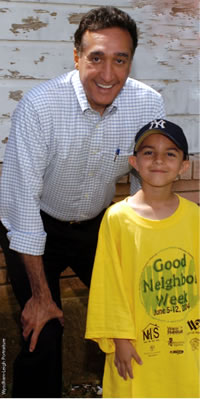
Henry Cisneros and friend: In the day.

San Antonio’s Cisneros ‘was on his way to becoming the Latino Obama before he cheated on his saintly wife’
By Melinda Henneberger / August 10, 2008

John Edwards is reminding me more and more of poor Henry Cisneros, who was on his way to becoming the Latino Obama before he cheated on his saintly wife, Mary Alice, while she was pregnant with their third child, a son born with no spleen and a malformed heart and stomach. Bill Clinton asked Cisneros to serve as his housing secretary anyway, a few years later, and by then, the affair was such old news that it never even came up during his confirmation hearings. Yet in the course of his background check for the cabinet post, Cisneros lied to the FBI – not about whether he was supporting his former mistress, but about the amount he paid her — and as a result, was subjected to a four-year investigation by a special prosecutor, a probe that cost taxpayers $9 million.

Heck of a public servant, Henry, so big-hearted and capable; watching him work a crowd in San Antonio back in the day, you’d have sworn you were looking at the future. But at some point after he stopped paying Linda Medlar, she started taping their phone calls, and triggered the investigation. When the judge who presided over his trial finally asked Cisneros why he’d lied in the first place, he explained that while he wasn’t positive himself about the amount he’d paid Medlar, he was positive he didn’t want his wife to know how high that figure was. He pled guilty to a misdemeanor, and when he left public life, we all lost out. So, what’s the relevance?

First, it’s that scary as we wives can be, federal investigators are scarier, and if any of the $15,000 a month that’s being paid to Edwards’ ex-girlfriend came from campaign funds, I cannot overemphasize how seldom fudging the facts with the Feds works out. Second, what do Monica Lewinsky, Linda Medlar and Rielle Hunter have in common? All were employees, and world-class blabbermouths. (You never really hear about the guys who get involved with the quiet types, do you?) It’s silly to say we don’t care if politicians fool around as long as they don’t lie about it; how is that supposed to work? And until we figure it out, we’re stuck pretending these people are perfect and then, we when find out otherwise, pretending we’re surprised.

As it is, we’re so perplexed about how to treat this stuff I can’t even tell what this first-person Newsweek piece is trying to say. In it, reporter Jonathan Darman tells about his own adventures with Rielle Hunter, a woman so fascinating that after meeting her on a trip to Iowa with Edwards in 2006, Darman spends weeks trying to track her down and months getting to know her. After concluding she’s an unreliable source, he keeps in touch anyway: “I continued to see her…I liked Rielle” and “let her do my astrological chart.” From the way he describes their first, boozy lunch, I can’t tell if he suspected she and Edwards were carrying on or not: Is the tone confessional because he missed the story, because he had the story and sat on it, or because he fell for the “I can tell you’re an old soul” hoodoo himself? (The last guy I knew who talked like that wound up blowing town with the life savings of several women who each thought they were going to marry him and start an ashram.) Hunter told Darman that in this incarnation, she wanted to help Edwards become a transformational figure on a par with Gandhi or MLK; better luck next time?

Source / Slate

The Rag Blog

Posted in RagBlog | Tagged , , , , | 2 Comments

Hipster: The Dead End of Western Civilization

‘Lovers of apathy and irony, hipsters are connected through a global network of blogs and shops’
By Douglas Haddow

We’ve reached a point in our civilization where counterculture has mutated into a self-obsessed aesthetic vacuum. So while hipsterdom is the end product of all prior countercultures, it’s been stripped of its subversion and originality.

I‘m sipping a scummy pint of cloudy beer in the back of a trendy dive bar turned nightclub in the heart of the city’s heroin district. In front of me stand a gang of hippiesh grunge-punk types, who crowd around each other and collectively scoff at the smoking laws by sneaking puffs of “fuck-you,” reveling in their perceived rebellion as the haggard, staggering staff look on without the slightest concern.

The “DJ” is keystroking a selection of MP3s off his MacBook, making a mix that sounds like he took a hatchet to a collection of yesteryear billboard hits, from DMX to Dolly Parton, but mashed up with a jittery techno backbeat.

“So… this is a hipster party?” I ask the girl sitting next to me. She’s wearing big dangling earrings, an American Apparel V-neck tee, non-prescription eyeglasses and an inappropriately warm wool coat.

“Yeah, just look around you, 99 percent of the people here are total hipsters!”

“Are you a hipster?”

“Fuck no,” she says, laughing back the last of her glass before she hops off to the dance floor.

Ever since the Allies bombed the Axis into submission, Western civilization has had a succession of counter-culture movements that have energetically challenged the status quo. Each successive decade of the post-war era has seen it smash social standards, riot and fight to revolutionize every aspect of music, art, government and civil society.

But after punk was plasticized and hip hop lost its impetus for social change, all of the formerly dominant streams of “counter-culture” have merged together. Now, one mutating, trans-Atlantic melting pot of styles, tastes and behavior has come to define the generally indefinable idea of the “Hipster.”

An artificial appropriation of different styles from different eras, the hipster represents the end of Western civilization – a culture lost in the superficiality of its past and unable to create any new meaning. Not only is it unsustainable, it is suicidal. While previous youth movements have challenged the dysfunction and decadence of their elders, today we have the “hipster” – a youth subculture that mirrors the doomed shallowness of mainstream society.

Take a stroll down the street in any major North American or European city and you’ll be sure to see a speckle of fashion-conscious twentysomethings hanging about and sporting a number of predictable stylistic trademarks: skinny jeans, cotton spandex leggings, fixed-gear bikes, vintage flannel, fake eyeglasses and a keffiyeh – initially sported by Jewish students and Western protesters to express solidarity with Palestinians, the keffiyeh has become a completely meaningless hipster cliché fashion accessory.

The American Apparel V-neck shirt, Pabst Blue Ribbon beer and Parliament cigarettes are symbols and icons of working or revolutionary classes that have been appropriated by hipsterdom and drained of meaning. Ten years ago, a man wearing a plain V-neck tee and drinking a Pabst would never be accused of being a trend-follower. But in 2008, such things have become shameless clichés of a class of individuals that seek to escape their own wealth and privilege by immersing themselves in the aesthetic of the working class.

This obsession with “street-cred” reaches its apex of absurdity as hipsters have recently and wholeheartedly adopted the fixed-gear bike as the only acceptable form of transportation – only to have brakes installed on a piece of machinery that is defined by its lack thereof.

Lovers of apathy and irony, hipsters are connected through a global network of blogs and shops that push forth a global vision of fashion-informed aesthetics. Loosely associated with some form of creative output, they attend art parties, take lo-fi pictures with analog cameras, ride their bikes to night clubs and sweat it up at nouveau disco-coke parties. The hipster tends to religiously blog about their daily exploits, usually while leafing through generation-defining magazines like Vice, Another Magazine and Wallpaper. This cursory and stylized lifestyle has made the hipster almost universally loathed.

“These hipster zombies… are the idols of the style pages, the darlings of viral marketers and the marks of predatory real-estate agents,” wrote Christian Lorentzen in a Time Out New York article entitled ‘Why the Hipster Must Die.’ “And they must be buried for cool to be reborn.”
With nothing to defend, uphold or even embrace, the idea of “hipsterdom” is left wide open for attack. And yet, it is this ironic lack of authenticity that has allowed hipsterdom to grow into a global phenomenon that is set to consume the very core of Western counterculture. Most critics make a point of attacking the hipster’s lack of individuality, but it is this stubborn obfuscation that distinguishes them from their predecessors, while allowing hipsterdom to easily blend in and mutate other social movements, sub-cultures and lifestyles.

***

Standing outside an art-party next to a neat row of locked-up fixed-gear bikes, I come across a couple girls who exemplify hipster homogeneity. I ask one of the girls if her being at an art party and wearing fake eyeglasses, leggings and a flannel shirt makes her a hipster.

“I’m not comfortable with that term,” she replies.

Her friend adds, with just a flicker of menace in her eyes, “Yeah, I don’t know, you shouldn’t use that word, it’s just…”

“Offensive?”

“No… it’s just, well… if you don’t know why then you just shouldn’t even use it.”

“Ok, so what are you girls doing tonight after this party?”

“Ummm… We’re going to the after-party.”

***

Gavin McInnes, one of the founders of Vice, who recently left the magazine, is considered to be one of hipsterdom’s primary architects. But, in contrast to the majority of concerned media-types, McInnes, whose “Dos and Don’ts” commentary defined the rules of hipster fashion for over a decade, is more critical of those doing the criticizing.

“I’ve always found that word [“hipster”] is used with such disdain, like it’s always used by chubby bloggers who aren’t getting laid anymore and are bored, and they’re just so mad at these young kids for going out and getting wasted and having fun and being fashionable,” he says. “I’m dubious of these hypotheses because they always smell of an agenda.”

Punks wear their tattered threads and studded leather jackets with honor, priding themselves on their innovative and cheap methods of self-expression and rebellion. B-boys and b-girls announce themselves to anyone within earshot with baggy gear and boomboxes. But it is rare, if not impossible, to find an individual who will proclaim themself a proud hipster. It’s an odd dance of self-identity – adamantly denying your existence while wearing clearly defined symbols that proclaims it.

***

“He’s 17 and he lives for the scene!” a girl whispers in my ear as I sneak a photo of a young kid dancing up against a wall in a dimly lit corner of the after-party. He’s got a flipped-out, do-it-yourself haircut, skin-tight jeans, leather jacket, a vintage punk tee and some popping high tops.

“Shoot me,” he demands, walking up, cigarette in mouth, striking a pose and exhaling. He hits a few different angles with a firmly unimpressed expression and then gets a bit giddy when I show him the results.

“Rad, thanks,” he says, re-focusing on the music and submerging himself back into the sweaty funk of the crowd where he resumes a jittery head bobble with a little bit of a twitch.

The dance floor at a hipster party looks like it should be surrounded by quotation marks. While punk, disco and hip hop all had immersive, intimate and energetic dance styles that liberated the dancer from his/her mental states – be it the head-spinning b-boy or violent thrashings of a live punk show – the hipster has more of a joke dance. A faux shrug shuffle that mocks the very idea of dancing or, at its best, illustrates a non-committal fear of expression typified in a weird twitch/ironic twist. The dancers are too self-aware to let themselves feel any form of liberation; they shuffle along, shrugging themselves into oblivion.

***

Perhaps the true motivation behind this deliberate nonchalance is an attempt to attract the attention of the ever-present party photographers, who swim through the crowd like neon sharks, flashing little blasts of phosphorescent ecstasy whenever they spot someone worth momentarily immortalizing.

Noticing a few flickers of light splash out from the club bathroom, I peep in only to find one such photographer taking part in an impromptu soft-core porno shoot. Two girls and a guy are taking off their clothes and striking poses for a set of grimy glamour shots. It’s all grins and smirks until another girl pokes her head inside and screeches, “You’re not some club kid in New York in the nineties. This shit is so hipster!” – which sparks a bit of a catfight, causing me to beat a hasty retreat.

In many ways, the lifestyle promoted by hipsterdom is highly ritualized. Many of the party-goers who are subject to the photoblogger’s snapshots no doubt crawl out of bed the next afternoon and immediately re-experience the previous night’s debauchery. Red-eyed and bleary, they sit hunched over their laptops, wading through a sea of similarity to find their own (momentarily) thrilling instant of perfected hipster-ness.

What they may or may not know is that “cool-hunters” will also be skulking the same sites, taking note of how they dress and what they consume. These marketers and party-promoters get paid to co-opt youth culture and then re-sell it back at a profit. In the end, hipsters are sold what they think they invent and are spoon-fed their pre-packaged cultural livelihood.

Hipsterdom is the first “counterculture” to be born under the advertising industry’s microscope, leaving it open to constant manipulation but also forcing its participants to continually shift their interests and affiliations. Less a subculture, the hipster is a consumer group – using their capital to purchase empty authenticity and rebellion. But the moment a trend, band, sound, style or feeling gains too much exposure, it is suddenly looked upon with disdain. Hipsters cannot afford to maintain any cultural loyalties or affiliations for fear they will lose relevance.

An amalgamation of its own history, the youth of the West are left with consuming cool rather that creating it. The cultural zeitgeists of the past have always been sparked by furious indignation and are reactionary movements. But the hipster’s self-involved and isolated maintenance does nothing to feed cultural evolution. Western civilization’s well has run dry. The only way to avoid hitting the colossus of societal failure that looms over the horizon is for the kids to abandon this vain existence and start over.
***

“If you don’t give a damn, we don’t give a fuck!” chants an emcee before his incitements are abruptly cut short when the power plug is pulled and the lights snapped on.

Dawn breaks and the last of the after-after-parties begin to spill into the streets. The hipsters are falling out, rubbing their eyes and scanning the surrounding landscape for the way back from which they came. Some hop on their fixed-gear bikes, some call for cabs, while a few of us hop a fence and cut through the industrial wasteland of a nearby condo development.

The half-built condos tower above us like foreboding monoliths of our yuppie futures. I take a look at one of the girls wearing a bright pink keffiyah and carrying a Polaroid camera and think, “If only we carried rocks instead of cameras, we’d look like revolutionaries.” But instead we ignore the weapons that lie at our feet – oblivious to our own impending demise.

We are a lost generation, desperately clinging to anything that feels real, but too afraid to become it ourselves. We are a defeated generation, resigned to the hypocrisy of those before us, who once sang songs of rebellion and now sell them back to us. We are the last generation, a culmination of all previous things, destroyed by the vapidity that surrounds us. The hipster represents the end of Western civilization – a culture so detached and disconnected that it has stopped giving birth to anything new.

Source / Adbusters / Posted July 29, 2008

The Rag Blog

Posted in RagBlog | Tagged , , , | 3 Comments

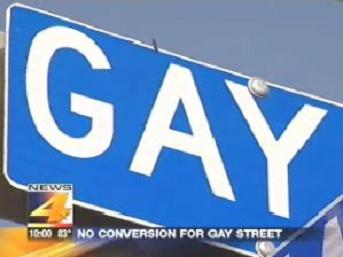
San Antonio Baptist Church Says ‘Gay Street’ Not ‘Baptist Way’


City Council won’t change street name
By Kate X Messer / August 9, 2008

According to WOAI, the NBC affiliate in the Alamo City, San Antonio City Council has denied Second Baptist Church’s request to change the name of the street on which their church resides.

As the report points out, “Gay” is the name of a community activist of significance to the surrounding community, which wants the name of the street to remain Gay Street.

We think instead that the church should move a few blocks south to the corner of Gay/Hub.

Source / Austin Chronicle

A street on the East Side is in the spotlight because a church wants to change its name. But now it looks like that won’t be happening anytime soon.

News 4 looked into why this one request is getting so much attention.

It seems like a simple process. Second Baptist Church wants to change the name of the street that runs next to it, to Second Baptist Way. But it’s the name they’re trying to change it from that’s raising some eyebrows.

If Second Baptist wanted to change Edna Street or Bob Street, most involved in the debate wouldn’t bat an eye.

But the street they are trying to convert isn’t just any street, it’s Gay Street. Many people questioned why they wanted to change that street’s name.

Second Baptist said they simply wanted to reach out to the community more by changing the street to the church name.

But Attorney Rosie Gonzales didn’t buy that reasoning.

“They could reach out into the community just leaving it the way it is,” said Gonzales. “I don’t see how changing the name of a street is going to help their community outreach efforts whatsoever.”

Those outreach efforts by the church ended right where they began on Thursday, at City Hall.

City Councilwoman Sheila McNeil requested that the name change be denied and the council agreed. By almost an unanimous vote, the name Gay Street was left as is.

McNeil said the neighbors who live around Gay Street want the name to stay.

According to neighbors, the street was actually named after a community activist. They say that’s part of the reason the name has stayed and why the want it to continue.

Kim Fischer / WOAI.com / August 8, 2008

The Rag Blog

Posted in RagBlog | Tagged , , , , | Leave a comment

Critiquing the Human Family

See “EdgeLeft: Taking China’s Side” by David McReynolds below

It Was a Good Reminder for Me
By Diane Stirling-Stevens / The Rag Blog / August 10, 2008

Since my family came from Germany (my mom’s side in 1631; my dad’s in 1710), and I clearly remember being told how the Germans and Chinese worked side-by-side building the railroads, this article struck ‘home’ with me. Maybe having the funny name of Rambow; being extremely poor growing up, and living in a town that was 90% German where they felt ‘safe’ (pretty clannish actually), there were lots of ‘tales’ about ‘other folk’ that were either of different religion; color, or origin. It took moving away from that small town – living in large cities and in different parts of the United States, for me to fully understand the necessity of eliminating prejudice; bigotry, and setting arbitrary standards that often (I think) are based on family folk lore, hear-say, and tradition.

I got my first real chance to learn more about the Negro when I moved to Cincinnati in 1974. Nearly all of the friends I’ve kept in touch with (and visit there), after 34 years, are my black friends (and I have 3 that live near me now, that I’m very close to). I’ve been taught so much by them; their history – enjoyed their traditional foods, and heard their viewpoints about the slave situation; how they felt when they could finally vote, and of course their reaction to the improvement in the way our country is now incorporating the black American into business/entertainment/politics/society, as it should have done.

When I lived in California for almost 20 years, I had a chance to visit China town; various parts of both Southern, and Northern California where the Vietnamese create their little ‘territories’ – again, they not only offer excellent food, but their neighborhoods are clean – they are diligent shop-owners, and very conscious of the work they perform. I learned more about the Mexican way of life; my youngest son married a beautiful Mexican lady in 2002 – another son married a beautiful Cuban woman back in 1990, so I know all of my children benefited from learning to appreciate the ways and customs of not just we ‘white German immigrants’ aka Americans.

Getting into the electronics industry in 1980 (Seattle, Washington), I again got a chance to see the exceptional workmanship of the Asian – learned more about our Indian nations; the Eskimo nation, and I think by that time I was truly beginning to ‘balance’ my reaction and be much less willing to accept the historical ‘slander’ done to some races of people, by other races of people. In fact, I’ve come to love the ‘mix’ of we Americans; the colors of our America, and chose to move next to the Mohave Indian reservation back in 2000 because I knew they’d never build up the land the way many of the white ‘developers’ choose to plunder the land. I have to say ‘white’ builders, because I’ve never met any other kind (imagine there are some of course). It’s sad to think how all the ‘colors of the rainbow’ have built up this country, and I’m sure you’ve noticed it’s only been pretty much the leadership of the ‘white good old boys’, that have put us in this condition we’re in today.

The world is big now; communications are faster than they’ve ever been, and I’m hoping all of this will help us learn to understand each other better, not start conflicts and fight wars more efficiently. What I’m guessing is we have to get a few other ‘colors’ of people into our leadership/administration, and not allow our media (who also is predominately white guys and gals) feed us propaganda. In fact, I bet the Rag Blog and its many writers, could easily create a powerful piece on how the media does (and does not) deliver the news that we REALLY need. If you look at the ‘faces’ of those who are spewing the daily headlines and ‘breaking news’, more often than not it’s a white person – very well made up; a suit or lovely dress with jewelry, and all are photogenic! In fact as I type this, it strikes me many of the comedy shows have over-weight and not-so-good-looking stars and cast. Even if some are handsome or pretty to look at, they’ve usually got a ‘fall guy or gal’, who isn’t nearly as attractive.

Hey, if I don’t stop right now and let you read the great article Alan sent, this will turn into a book. My mind is traveling to a place that says: “Hey, Diane, since you rarely watch television why don’t you make it a project, and see just how many shows have minorities, and what parts do they play….” I guess I’ll do that this coming week …

EdgeLeft: Taking China’s Side
by David McReynolds

There has been an enormous amount of China-bashing in recent months, leading up to the Olympics. I’d like to put in a good word for China, something not that politically correct these days.

Sure, I wish the Chinese did not eat dogs, but we have pigs on our menu, and they are just as smart as dogs. Yes, I wish the Dalai Lama could return to Tibet, though the issue of Tibet is more complex than either the Chinese or the Dalai Lama make it out to be. And the history of Tibet under the Buddhists not as ideal as some in the West believe.

Perhaps most of all I wish the Chinese would use strong pressure on Sudan regarding Darfur. And, of course, as a member of the American Civil Liberties Union, and a lifelong American dissident, I support the full and complete extension of human rights to every human being on this planet.

However, much of the coverage I’ve seen overlooks some painful Western history. I fell in love with China as a kid in Los Angeles, before ever tasting Chinese food. Why, I’m not sure. Perhaps it was reading Pearl Buck’s Good Earth. Perhaps it was because I loved fireworks and firecrackers, and the ones we bought for July 4th were made in China. Whatever the reason, it certainly wasn’t the culture of California, riddled with anti-Chinese and anti-Asian attitudes.

Let’s remember, as Americans, the Chinese Exclusion Act of 1882, which was “progressive racism”. At the time of our Gold Rush there was a flood of poor Chinese who came here, provided low wage labor, built our railways, did our laundry, but also became a scapegoat for low income workers who saw Chinese labor as competition. Some of the slogans of the time are chilling to remember:

“We want no slaves or artistocrats
The Coolie Labor System Leaves us No Alternative
Starvation or Disgrace Mark the Man who Would Crush Us To the Level of the Mongolian Slave
We All Vote
Women’s Rights and No More Chinese Chambermaids”

These were slogans carried by anti-Chinese demonstrators. In 1882, after decades of such agitation, and with the support of the progressives of the day, the Chinese Exclusion Act was passed, making it all but impossible for Chinese to come to this country.

But this was small change compared to what the rest of the world was doing to China. The Opium Wars of 1839 and 1856 resulted from a struggle between the Qing Dynasty of China, which sought to suppress the use of opium, and the British who had a monopoly on the opium trade and were determined to push that addiction on the Chinese.

China lost both wars, and had to grant the British “extraterritorial rights” (similar to the rights the Americans in Iraq enjoy today). So the civilized British who, like our own half-civilized President, today lectures the Chinese on human rights, have forgotten that, for a profit, they were delighted to deal in opium.

The Boxer Rebellion at the turn of the last century saw an uprising by members of the “Chinese Society of Right and Harmonious Fists” against foreign influence. (They took the name “boxer” from the martial arts they used). The rebellion against foreign influence was serious enough. According to Wikipedia “In June 1900, the Boxers invaded Beijing and killed 230 foreign diplomats and foreigners.”

Chinese Christians – who had also been targeted – and Westerners retreated to the legation quarter, putting up a two month struggle until a “multinational coalition rushed 20,000 troops to the rescue”. The Boxer Rebellion was a serious challenge to outside influence and those outsiders (including Japan) were enthusiastic in sharing the burden of crushing the Chinese. There were 51 warships sent in (18 of them being Japanese, 10 being Russian). At least 55,000 troops were sent (Japan, with 20,300, sent the most, the Russians with 12,400 were second, and the British with 10,000 came in third. The Americans, not yet a world power, sent only 2 warships and fewer than 3500 troops.

China was crushed, humiliated, the last Chinese dynasty ended. Let me quote Kaiser Wilhelm II’s July 27th order to his troops: “Make the name German remembered in China for a thousand years so that no Chinaman will ever again dare to even squint at a German.”

Western intervention paved the way for the rise of Sun Yat-sen, who overthrew the Mancu (Qing) dynasty and established the Chinese Republic. But the Chinese Republic had a short and turbulent life. World War II did not begin in Europe – it began on July 7th, 1937, when the Empire of Japan launched a full scale invasion of China. It was this which I remember as a child, when our bubble gum came wrapped in horrific (and pro-Chinese) illustrations of Japanese atrocities. (Perhaps the chewing gum was made in China?). The infamous Rape of Nanking, in which thousands of Chinese civilians were raped and murdered by the Japanese military forces, still rankles in Chinese minds.

For a time Chiang Kai-Shek, who had succeeded Sun Yat-sen, cooperated with Mao and the Communists in fighting the Japanese. But at a crucial point Chiang turned on the Chinese, massacred thousands in a surprise attack, and the Chinese Civil War began in earnest, continuing until 1949, when Chiang retreated to Taiwan and the Chinese Revolution was complete. (Throughout that war, the US sided with Chiang Kai-Shek, supplying him with weapons and using US air power to move Nationalist troops into position against the Communists).

My sense is that there is a general agreement by military historians that Mao and his forces did a better job of fighting the Japanese than Chiang’s Nationalists.

But the West was hardly ready to deal ith China, a nation far more civilized than our own, or any nation in Western Europe. We denied China its seat in the Security Council. The US refused to “recognize” China. It was not until the famous visit to China by Richard Nixon that relations were finally normalized.

My view of China is not shaped by an enthusiasm for Maoism. (I do recommend Edgar Snow’s Red Star Over China for a sympathetic view of the Chinese Communists, and I know my father, who served with Army Air Force Intelligence during the war, and was in China more than once, was deeply impressed by the Chinese. More than that, my father, a devout Christian and political conservative, was baffled that the Chinese, in all their poverty and hunger, had a dignity and “sense of worth” that impressed him).

It is not the current Chinese State I endorse, but the long history of China, its remarkable accomplishments over thousands of years. I am embarrassed when the West chides China today, at a time when NATO is killing civilians in Afghanistan, and the US and Great Britain have, between them, laid waste to Iraq, one of the cradles of civilization in the Middle East.

It had long been my hope to visit China. I know, as the years pass, that goal won’t be achieved. But from afar, and long before the Chinese Revolution, I was on the side of China. I don’t even like sports, but I am glad the Olympics is a success. I compare the speed with which China dealt with the horrible disaster of its great earthquake this year with the total failure of George Bush to cope with Katrina.

I believe in human rights – but one of the most basic of human rights is the right to eat. China has paid a high price for its swift industrialization but it has given many of the people of China a chance at what we would call “the good life”. I live in a country with the highest number of men and women behind bars of any nation in the world – I hesitate to make human rights in China my first priority. China is now one of the emerging great powers. It would be to our advantage to treat it with a sense of respect to which its several thousand years of civilization entitles it.

[David McReynolds worked for many years for War Resisters League, was at one time Chair of War Resisters International, and was the Socialist Party’s Presidential candidate in 1980 and 2000. He retired in 1999 and lives on the Lower East side with his cats. He can be reached by email at: dmcreynolds@nyc.rr.com].

Source / EdgeLeft

The Rag Blog

Posted in Rag Bloggers | Tagged , , | 1 Comment

A Video Series on World Agriculture: Monsanto

We will run the remaining videos in the series daily for the next week. The Rag

The World According to Monsanto (Part 1 of 8)

Right now, there is probably no other company that is doing more to endanger the health of this planet, and it’s inhabitants, than Monsanto. With Nazi-like attitude, they are leading the world in shear destructive evil greed. First they were a drug company, and then they expanded to become a drugs and genetic engineering company, and now Monsanto is attempting to acquire water rights in countries with water shortages in a move to control the people’s basic means of survival, and production of the global food supply. Giant transnational corporations like Monsanto, in collusion with the World Bank and the World Trade Organization, seek to commodify and privatize the world’s water and put it on the open market for sale to the highest bidder. Millions of the world’s citizens are being deprived of this fundamental human right, and vast ecological damage is being wrought as massive industry claims water once used to sustain communities and replenish nature.

Click here for more information.

Thanks to Diane Stirling-Stevens / The Rag Blog

Posted in RagBlog | Tagged , | 2 Comments

The Wife John McCain Callously Left Behind

Forgotten woman: Carol McCain.

‘There is another Mrs McCain who casts a ghostly shadow over the Senator’s presidential campaign’
By Sharon Churcher / August 8, 2008

Now that Hillary Clinton has at last formally withdrawn from the race for the White House, the eyes of America and the world will focus on Barack Obama and his Republican rival Senator John McCain.

While Obama will surely press his credentials as the embodiment of the American dream – a handsome, charismatic young black man who was raised on food stamps by a single mother and who represents his country’s future – McCain will present himself as a selfless, principled war hero whose campaign represents not so much a battle for the presidency of the United States, but a crusade to rescue the nation’s tarnished reputation.

McCain likes to illustrate his moral fibre by referring to his five years as a prisoner-of-war in Vietnam. And to demonstrate his commitment to family values, the 71-year-old former US Navy pilot pays warm tribute to his beautiful blonde wife, Cindy, with whom he has four children.

But there is another Mrs McCain who casts a ghostly shadow over the Senator’s presidential campaign. She is seldom seen and rarely written about, despite being mother to McCain’s three eldest children.

And yet, had events turned out differently, it would be she, rather than Cindy, who would be vying to be First Lady. She is McCain’s first wife, Carol, who was a famous beauty and a successful swimwear model when they married in 1965.

She was the woman McCain dreamed of during his long incarceration and torture in Vietnam’s infamous ‘Hanoi Hilton’ prison and the woman who faithfully stayed at home looking after the children and waiting anxiously for news.

War hero: McCain with Carol as he arrives back in the US in 1973 after his five years as a PoW in North Vietnam.

But when McCain returned to America in 1973 to a fanfare of publicity and a handshake from Richard Nixon, he discovered his wife had been disfigured in a terrible car crash three years earlier. Her car had skidded on icy roads into a telegraph pole on Christmas Eve, 1969. Her pelvis and one arm were shattered by the impact and she suffered massive internal injuries.

When Carol was discharged from hospital after six months of life-saving surgery, the prognosis was bleak. In order to save her legs, surgeons had been forced to cut away huge sections of shattered bone, taking with it her tall, willowy figure. She was confined to a wheelchair and was forced to use a catheter.

Through sheer hard work, Carol learned to walk again. But when John McCain came home from Vietnam, she had gained a lot of weight and bore little resemblance to her old self.

Today, she stands at just 5ft 4in and still walks awkwardly, with a pronounced limp. Her body is held together by screws and metal plates and, at 70, her face is worn by wrinkles that speak of decades of silent suffering.

For nearly 30 years, Carol has maintained a dignified silence about the accident, McCain and their divorce. But last week at the bungalow where she now lives at Virginia Beach, a faded seaside resort 200 miles south of Washington, she told The Mail on Sunday how McCain divorced her in 1980 and married Cindy, 18 years his junior and the heir to an Arizona brewing fortune, just one month later.

Carol insists she remains on good terms with her ex-husband, who agreed as part of their divorce settlement to pay her medical costs for life. ‘I have no bitterness,’ she says. ‘My accident is well recorded. I had 23 operations, I am five inches shorter than I used to be and I was in hospital for six months. It was just awful, but it wasn’t the reason for my divorce.

‘My marriage ended because John McCain didn’t want to be 40, he wanted to be 25. You know that happens…it just does.’

Some of McCain’s acquaintances are less forgiving, however. They portray the politician as a self-centred womaniser who effectively abandoned his crippled wife to ‘play the field’. They accuse him of finally settling on Cindy, a former rodeo beauty queen, for financial reasons.

McCain was then earning little more than £25,000 a year as a naval officer, while his new father-in-law, Jim Hensley, was a multi-millionaire who had impeccable political connections.

He first met Carol in the Fifties while he was at the US Naval Academy in Annapolis. He was a privileged, but rebellious scion of one of America’s most distinguished military dynasties – his father and grandfather were both admirals.

But setting out to have a good time, the young McCain hung out with a group of young officers who called themselves the ‘Bad Bunch’.

His primary interest was women and his conquests ranged from a knife-wielding floozy nicknamed ‘Marie, the Flame of Florida’ to a tobacco heiress.

Carol fell into his fast-living world by accident. She escaped a poor upbringing in Philadelphia to become a successful model, married an Annapolis classmate of McCain’s and had two children – Douglas and Andrew – before renewing what one acquaintance calls ‘an old flirtation’ with McCain.

It seems clear she was bowled over by McCain’s attention at a time when he was becoming bored with his playboy lifestyle.

‘He was 28 and ready to settle down and he loved Carol’s children,’ recalled another Annapolis graduate, Robert Timberg, who wrote The Nightingale’s Song, a bestselling biography of McCain and four other graduates of the academy.

The couple married and McCain adopted Carol’s sons. Their daughter, Sidney, was born a year later, but domesticity was clearly beginning to bore McCain – the couple were regarded as ‘fixtures on the party circuit’ before McCain requested combat duty in Vietnam at the end of 1966.

He was assigned as a bomber pilot on an aircraft carrier in the Gulf of Tonkin.

What follows is the stuff of the McCain legend. He was shot down over Hanoi in October 1967 on his 23rd mission over North Vietnam and was badly beaten by an angry mob when he was pulled, half-drowned from a lake.

Over the next five-and-a-half years in the notorious Hoa Loa Prison he was regularly tortured and mistreated.

It was in 1969 that Carol went to spend the Christmas holiday – her third without McCain – at her parents’ home. After dinner, she left to drop off some presents at a friend’s house.

It wasn’t until some hours later that she was discovered, alone and in terrible pain, next to the wreckage of her car. She had been hurled through the windscreen.

After her first series of life-saving operations, Carol was told she may never walk again, but when doctors said they would try to get word to McCain about her injuries, she refused, insisting: ‘He’s got enough problems, I don’t want to tell him.’

H. Ross Perot, a billionaire Texas businessman, future presidential candidate and advocate of prisoners of war, paid for her medical care.

When McCain – his hair turned prematurely white and his body reduced to little more than a skeleton – was released in March 1973, he told reporters he was overjoyed to see Carol again.

But friends say privately he was ‘appalled’ by the change in her appearance. At first, though, he was kind, assuring her: ‘I don’t look so good myself. It’s fine.’

He bought her a bungalow near the sea in Florida and another former PoW helped him to build a railing so she could pull herself over the dunes to the water.

‘I thought, of course, we would live happily ever after,’ says Carol. But as a war hero, McCain was moving in ever-more elevated circles.

Through Ross Perot, he met Ronald Reagan, then Governor of California. A sympathetic Nancy Reagan took Carol under her wing.

But already the McCains’ marriage had begun to fray. ‘John started carousing and running around with women,’ said Robert Timberg.

McCain has acknowledged that he had girlfriends during this time, without going into details. Some friends blame his dissatisfaction with Carol, but others give some credence to her theory of a mid-life crisis.

He was also fiercely ambitious, but it was clear he would never become an admiral like his illustrious father and grandfather and his thoughts were turning to politics.

In 1979 – while still married to Carol – he met Cindy at a cocktail party in Hawaii. Over the next six months he pursued her, flying around the country to see her. Then he began to push to end his marriage.

Carol and her children were devastated. ‘It was a complete surprise,’ says Nancy Reynolds, a former Reagan aide.

‘They never displayed any difficulties between themselves. I know the Reagans were quite shocked because they loved and respected both Carol and John.’

Another friend added: ‘Carol didn’t fight him. She felt her infirmity made her an impediment to him. She justified his actions because of all he had gone through. She used to say, “He just wants to make up for lost time.”’

Indeed, to many in their circle the saddest part of the break-up was Carol’s decision to resign herself to losing a man she says she still adores.

Friends confirm she has remained friends with McCain and backed him in all his campaigns. ‘He was very generous to her in the divorce but of course he could afford to be, since he was marrying Cindy,’ one observed.

McCain transferred the Florida beach house to Carol and gave her the right to live in their jointly-owned townhouse in the Washington suburb of Alexandria. He also agreed to pay her alimony and child support.

A former neighbour says she subsequently sold up in Florida and Washington and moved in 2003 to Virginia Beach. He said: ‘My impression was that she found the new place easier to manage as she still has some difficulties walking.’

Meanwhile McCain moved to Arizona with his new bride immediately after their 1980 marriage. There, his new father-in-law gave him a job and introduced him to local businessmen and political powerbrokers who would smooth his passage to Washington via the House of Representatives and Senate.

And yet despite his popularity as a politician, there are those who won’t forget his treatment of his first wife.

Ted Sampley, who fought with US Special Forces in Vietnam and is now a leading campaigner for veterans’ rights, said: ‘I have been following John McCain’s career for nearly 20 years. I know him personally. There is something wrong with this guy and let me tell you what it is – deceit.

‘When he came home and saw that Carol was not the beauty he left behind, he started running around on her almost right away. Everybody around him knew it.

‘Eventually he met Cindy and she was young and beautiful and very wealthy. At that point McCain just dumped Carol for something he thought was better.

‘This is a guy who makes such a big deal about his character. He has no character. He is a fake. If there was any character in that first marriage, it all belonged to Carol.’

One old friend of the McCains said: ‘Carol always insists she is not bitter, but I think that’s a defence mechanism. She also feels deeply in his debt because in return for her agreement to a divorce, he promised to pay for her medical care for the rest of her life.’

Carol remained resolutely loyal as McCain’s political star rose. She says she agreed to talk to The Mail on Sunday only because she wanted to publicise her support for the man who abandoned her.

Indeed, the old Mercedes that she uses to run errands displays both a disabled badge and a sticker encouraging people to vote for her ex-husband. ‘He’s a good guy,’ she assured us. ‘We are still good friends. He is the best man for president.’

But Ross Perot, who paid her medical bills all those years ago, now believes that both Carol McCain and the American people have been taken in by a man who is unusually slick and cruel – even by the standards of modern politics.

‘McCain is the classic opportunist. He’s always reaching for attention and glory,’ he said.

‘After he came home, Carol walked with a limp. So he threw her over for a poster girl with big money from Arizona. And the rest is history.’

Additional reporting by Paul Henderson in Virginia Beach and William Lowther in Washington

Source / Daily Mail, U.K.

Thanks to Mercedes Lynn de Uriarte / The Rag Blog

Posted in RagBlog | Tagged , | 2 Comments

What Will the Candidates Do to End the Unwinnable War on Drugs?


‘The prohibition of drugs is perhaps the most disastrous policy currently pursued by the US government’
By Johann Hari / August 10, 2008

On January 20th 2009, either the president of the United States will be a man who used to smoke crack, or the First Lady will be a former drug addict who stole from charity to get her next fix. In this presidential campaign, there are dozens of issues that have failed to flicker into the debate, but the most striking is the failing, flailing ‘War on Drugs.’ Isn’t it a sign of how unwinnable this ‘war’ is that, if it was actually enforced evenly, either Barack Obama or Cindy McCain would have to skip the inauguration — because they’d be in jail?

At least their time in the slammer would feature some familiar faces: they could share a cell with Bill Clinton, George W. Bush, and some 46 percent of the US population.

The prohibition of drugs is perhaps the most disastrous policy currently pursued by the US government. It hands a vast industry to armed criminal gangs, who proceed to kill at least excess 10,000 citizens a year to protect their patches. It exports this programme of mass slaughter to Mexico, Colombia and beyond. It has been a key factor in reviving the Taliban in Afghanistan. It squanders tens of billions of dollars on prisons at home, ensuring that one in 31 adults in the US now in prison or on supervised release at any one time. And it has destroyed an entire generation of black men, who are now more likely to go to prison for drug offences than to go to university.

And for what? Prohibition doesn’t stop people using drugs. Between 1972 and 1978, eleven US states decriminalized marijuana possession. So did hundreds of thousands of people rush out to smoke the now-legal weed? The National Research Council found that it had no effect on the number of dope-smokers. None. The people who had always liked it carried on; the people who didn’t felt no sudden urge to start.

So where’s the debate? The candidates have spent more time discussing froth and fancies — how much air is in your tyres? — than this $40bn-a-year ‘war.”

They should be forced to listen to Michael Levine, who had a thirty year career as one of America’s most distinguished federal narcotics agents. In his time, he infiltrated some of the biggest drugs cartels in the world — and he now explains, in sad tones, that he wasted his time. In the early 1990s, he was assigned to eradicate drug-dealing from one New York street corner — an easy enough task, surely? But he quickly learned that even this was physically impossible, given the huge demand for drugs. He calculated that he would need one thousand officers to be working on that corner for six months to make an impact — and there were only 250 drugs agents in the whole city. One of the residents asked him, “If all these cops and agents couldn’t get this one corner clean, what’s the point of this whole damned drug war?”

When Levine penetrated to the very top of la Mafia Cruenza, one of the biggest drug-dealing gangs in the world, he learned, as he puts it, “that not only did they not fear our war on drugs, they actually counted on it… On one undercover tape-recorded conversation, a top cartel chief, Jorge Roman, expressed his gratitude for the drug war, calling it ‘a sham put on the American tax-payer’ that was ‘actually good for business’.” He was right — prohibition is the dealer’s friend. They depend on it. They thrive on it, just as Al Capone thrived on alcohol prohibition. When Levine recounted these comments to his boss — the officer in command of the paramilitary operation attacking South America — he replied, “Yeah, we know [the police and military battles against drug gangs] don’t work, but we sold the plan up and down the Potomac.”

Yet virtually no politicians are exposing this scandal. A rare and heroic exception is Jim Webb, Senator for Virginia. In his brilliant new book Born Fighting, he says “the hugely expensive antidrug campaigns we are waging around the world are basically futile.” He even goes further, and exposes how this intersects with racism to create a monstrous injustice. The ACLU found in 2006 that although the races use drugs at the same rate, black Americans — who comprise 12 percent of the population — make up 74 percent of all drug offenders sentenced to prison.

Webb shows the human cost: “Even as I write these words, it is virtually certain that somewhere on the streets of Washington D.C. an eighteen year-old white kid from the Maryland or North Virginia suburbs is buying a stash of drugs from an eighteen year-old black kid. The white kid is going to take that stash back to the suburbs and make some quick money by selling it to other kids.” He will grow up and grow out of it, and one day — as a wealthy professional — he will “look back on his drug use just as recreational and joke about it… just one more little rebellion on the way to adulthood.”

But the black kid “will enter a hell from which he may never recover.” He is likely to be arrested, and to go to prison. “Prison life will change the black kid, harden him, mess up his mind, and redefine his self-image. And after he is released from prison, the black kid will be dragging an invisible ball and chain behind him for the rest of his life… By the time the white kid reaches fifty years of age, he may well be a judge. By the time the black kid reaches fifty, he will likely be permanently unemployable, will be ineligible for many government assistance programmes, and will not even be able to vote.” Barack Obama only narrowly missed this fate. He would not be the Great Black Hope he deserves to be; he wouldn’t even be allowed to cast a ballot in 2008.

Of course, ending drug prohibition may seem impossible now. But in 1924, even as vociferous a wet as Clarence Darrow was in despair, writing that it would require “a political revolution” to legalise alcohol in the US. Within a decade, it was done.

Before this campaign is out, Obama needs to be asked: do you really think you should be in jail? McCain needs to be asked: do you really think your wife should be in jail? Both need to be asked: do you really think 46 percent of Americans should be criminalized? And if not, what are you going to do to begin ending this mad, unwinnable ‘war on drugs’?

Johann Hari has reported from Iraq, Israel/Palestine, the Congo, the Central African Republic, Venezuela, Peru and the US, and his journalism has appeared in publications all over the world. The youngest person to be nominated for the Orwell Prize for political writing, in 2003 he won the Press Gazette Young Journalist of the Year Award and in 2007 Amnesty International named him Newspaper Journalist of the Year. He is a contributing editor of Attitude magazine and published his first book, God Save the Queen?, in 2003.

Source / The Huffington Post

The Rag Blog

Posted in RagBlog | Tagged , , , , , , | 2 Comments

William Greider : Economic Free Fall

Avenging Angels. Illustration courtesy of The Nation.

‘In their haste to do anything the financial guys seem to want, Congress and the lame-duck President are, I fear, sowing far more profound troubles for the country’
By William Grieder

This article appears in the August 18, 2008 edition of The Nation.

Washington can act with breathtaking urgency when the right people want something done. In this case, the people are Wall Street’s titans, who are scared witless at the prospect of their historic implosion. Congress quickly agreed to enact a gargantuan bailout, with more to come, to calm the anxieties and halt the deflation of Wall Street giants. Put aside partisan bickering, no time for hearings, no need to think through the deeper implications. We haven’t seen “bipartisan cooperation” like this since Washington decided to invade Iraq.

In their haste to do anything the financial guys seem to want, Congress and the lame-duck President are, I fear, sowing far more profound troubles for the country. First, while throwing our money at Wall Street, government is neglecting the grave risk of a deeper catastrophe for the real economy of producers and consumers. Second, Washington’s selective generosity for influential financial losers is deforming democracy and opening the path to an awesomely powerful corporate state. Third, the rescue has not succeeded, not yet. Banking faces huge losses ahead, and informed insiders assume a far larger federal bailout will be needed–after the election. No one wants to upset voters by talking about it now. The next President, once in office, can break the bad news. It’s not only about the money–with debate silenced, a dangerous line has been crossed. Hundreds of billions in open-ended relief has been delivered to the largest and most powerful mega-banks and investment firms, while government offers only weak gestures of sympathy for struggling producers, workers and consumers.

The bailouts are rewarding the very people and institutions whose reckless behavior caused this financial mess. Yet government demands nothing from them in return–like new rules for prudent behavior and explicit obligations to serve the national interest. Washington ought to compel the financial players to rein in their appetite for profit in order to help save the country from a far worse fate: a depressed economy that cannot regain its normal energies. Instead, the Federal Reserve, the Treasury, the Democratic Congress and of course the Republicans meekly defer to the wise men of high finance, who no longer seem so all-knowing.

Let’s review the bidding to date. After panic swept through the global financial community this spring, the Federal Reserve and Treasury rushed in to arrange a sweetheart rescue for Bear Stearns, expending $29 billion to take over the brokerage’s ruined assets so JPMorgan Chase, the prestigious banking conglomerate, would agree to buy what was left. At the same time, the Fed and Treasury provided a series of emergency loans and liquidity for endangered investment firms and major banks. Investors were not persuaded. Their panic was not “mental,” as former McCain adviser Phil Gramm recently complained. The collapse of the housing bubble had revealed the deep rot and duplicity within the financial system. When investors tried to sell off huge portfolios of spoiled financial assets like mortgage bonds, nobody would buy them. In fact, no one can yet say how much these once esteemed “safe” investments are really worth.

The big banks and investment houses are also stuck with lots of bad paper, and some have dumped it on their unwitting customers. The largest banks and brokerages have already lost enormously, but lending portfolios must shrink a lot more–at least $1 trillion, some estimate. So wary shareholders are naturally dumping financial-sector stocks.

Most recently, the investors’ fears were turned on Fannie Mae and Freddie Mac, the huge quasi-private corporations that package and circulate trillions in debt securities with implicit federal backing. Treasury Secretary Henry Paulson (formerly of Goldman Sachs) boldly proposed a $300 billion commitment to buy up Fannie Mae stock and save the plunging share price–that is, save the shareholders from their mistakes. So much for market discipline. For everyone else, Washington recommends a cold shower.

Talk about warped priorities! The government puts up $29 billion as a “sweetener” for JP Morgan but can only come up with $4 billion for Cleveland, Detroit and other urban ruins. Even the mortgage-relief bill is a tepid gesture. It basically asks, but does not compel, the bankers to act kindlier toward millions of defaulting families.

A generation of conservative propaganda, arguing that markets make wiser decisions than government, has been destroyed by these events. The interventions amount to socialism, American style, in which the government decides which private enterprises are “too big to fail.” Trouble is, it was the government itself that created most of these mastodons–including the all-purpose banking conglomerates. The mega-banks arose in the 1990s, when a Democratic President and Republican Congress repealed the New Deal-era Glass-Steagall Act, which prevented commercial banks from blending their business with investment banking. That combination was the source of incestuous self-dealing and fraudulent stock valuations that led directly to the Crash of 1929 and the Great Depression that followed.

Even before Congress and Bill Clinton repealed the law, the Federal Reserve had aggressively cleared the way by unilaterally authorizing Citigroup to cross the line. Wall Street proceeded, with accounting tricks described as “modernization,” to re-create the same scandals from the 1920s in more sophisticated fashion. The financial crisis began when these gimmicky innovations blew up.

Democrats who imagine they can reap partisan advantage from this crisis don’t know the history. The blame is bipartisan; so also is the disgrace. In 1980, before Ronald Reagan even came to town, Democrats deregulated the financial system by repealing federal interest-rate ceilings and other regulatory restraints–a step that doomed the savings and loan industry and eliminated a major competitor for the bankers. Democrats have collaborated with Republicans on behalf of their financial patrons every step of the way.

The same legislation also repealed the federal law prohibiting usury–the predatory practices that ruin debtors of modest means by lending on terms that ensure borrowers will fail. Usurious lending is now commonplace in America, from credit cards and “payday loans” to the notorious subprime mortgages. The prohibition on usury really involves an ancient moral principle, one common to Judaism, Christianity and Islam: people of great wealth must not be allowed to use it to ruin others who lack the same advantages. A decent society cannot endure it.

The fast-acting politicians may hope to cover over their past mistakes before the public figures out what’s happening (that is, who is screwing whom). But the Federal Reserve has a similar reason to move aggressively: the Fed was a central architect and agitator in creating the circumstances that led to the collapse in Wall Street’s financial worth. The central bank tipped its monetary policy hard in one direction–favoring capital over labor, creditors over debtors, finance over the real economy–and held it there for roughly twenty-five years. On one side, it targeted wages and restrained economic growth to make sure workers could not bargain for higher compensation in slack labor markets. On the other side, it stripped away or refused to enforce prudential regulations that restrained the excesses of banking and finance. In The Nation a few years back, I referred to Alan Greenspan as the “one-eyed chairman” [September 19, 2005] who could see inflation in the real economy–even when it didn’t exist–but was blind to the roaring inflation in the financial system.

The Fed’s lopsided focus on behalf of the monied interests, combined with its refusal to apply regulatory laws with due diligence, eventually destabilized the overall economy. Trying to correct for previous errors, the Fed, with its overzealous free-market ideology, swung monetary policy back and forth to extremes, first tightening credit without good reason, then rapidly cutting interest rates to nearly zero. This erratic behavior encouraged a series of financial bubbles in interest-sensitive assets–first the stock market, during the late 1990s tech-stock boom, then housing–but the Fed declined to do anything or even admit the bubbles existed. The nation is now stuck with the consequences of its blindness.

The Federal Reserve’s dereliction of duty is central to the financial failures. It betrayed the purpose for which the central bank was first created, in 1913, abandoning the sense of balance the Fed had long pursued and that Congress requires. Most politicians, not to mention the press, are too intimidated to question the Fed’s daunting power, but their ignorance is about to compound the problem. Instead of demanding answers, the political system is about to expand the Fed’s governing powers–despite its failure to protect us. Treasury Secretary Paulson proposed and Democratic leaders have agreed to make the insulated Fed the “supercop” that oversees not only commercial banks and banking conglomerates but also the largest investment houses or anyone else big enough to destabilize the system. This “reform” would definitely reassure club members who are already too cozy with the central bankers. Everyone else would be left deeper in the dark.

The political system, once again, is rewarding failure. The Fed is an unreliable watchdog, ideologically biased and compromised by its conflicting obligations. Is it supposed to discipline the big money players or keep them afloat? Putting the secretive central bank in charge, with its unlimited powers to prop up troubled firms, would further eviscerate democracy, not to mention economic justice.

If Congress enacts this concept early next year, the privileged group of protected financial interests is sure to grow larger, because other nonfinancial firms could devise ways to reconfigure themselves so they too would qualify for club membership. A very large manufacturing conglomerate–General Electric, for instance–might absorb elements of banking in order to be covered by the Fed’s umbrella (GE Capital is already among the largest pools of investment capital). Private-equity firms, with their buccaneer style of corporate management, are already trying to buy into banking, with encouragement from the Fed (the Service Employees International Union has mounted a campaign to stop them). A new President could stop the whole deal, of course, but John McCain has surrounded himself with influential advisers who were co-architects of this financial disaster. For that matter, so has Barack Obama.

The nation, meanwhile, is flirting with historic catastrophe. Nobody yet knows how bad it is, but the peril is vastly larger than previous episodes, like the savings and loan bailout of the late 1980s. The dangers are compounded by the fact that the United States is now utterly dependent on foreign creditors–Japan and China lead the list–who have been propping us up with their lending. Thanks to growing trade deficits and debt, foreign portfolio holdings of US long-term debt securities have more than doubled since 1994, from 7.9 percent to 18.8 percent as of June 2007. If these countries get fed up with their losses and pull the plug, the US economy will be a long, long time coming back.

The gravest danger is that the national economy will weaken further and spiral downward into a negative cycle that feeds on itself: as conditions darken, people hunker down and wait for the storm to pass–consumers stop buying, banks stop lending, producing companies cut their workforces. That feeds more defaulted loan losses back into the banking system’s balance sheets. This vicious cycle is essentially what led to the Great Depression after the stock market crash of 1929. I offer not a prediction but a warning. The comparison may sound farfetched now, but US policy-makers and politicians are putting us at risk of historic deflationary forces that, once they take hold, are very difficult to reverse.

A more aggressive response from Washington would address the real economy’s troubles as seriously as it does Wall Street’s. Financial firms have lost capital on a huge scale–more of them will fail or be bought by foreign investors. But Wall Street cannot get well this time if the economy remains stuck in the ditch. Washington needs to revive the “animal spirits” of the nation at large. The $152 billion stimulus package enacted so far is piddling and ought to be three or four times larger. Instead of sending the money to Iraq, we should be spending it here on getting people back to work, building and repairing our tattered infrastructure, investing in worthwhile projects that can help stimulate the economy in rough weather.

An agenda of deeper reforms can boost public confidence even as it undoes a lot of the damage caused by the financiers and bankers. Some suggestions:

§ Nationalize Fannie Mae and other government-supported enterprises instead of coddling them. Restore them to their original status as nonprofit federal agencies that provide a valuable service to housing and other markets. Make the investors eat their losses. Buy the shares at 2 cents on the dollar. Without a federal guarantee, these firms are doomed anyway.

§ Resolve the democratic contradiction of “too big to fail” bailouts by dismantling the firms that are too big to fail–especially the newly created banking conglomerates that have done so much harm. Restore the boundaries between commercial banking and investment banking. In any case, market pressures are likely to shrink those behemoths as banks sell off their parts to survive. For the remaining big boys, revive antitrust enforcement. Set stern new conditions for emergency lending from government–supervised receivership, stricter lending rules to prevent recidivism and severe penalties for greed-crazed shareholders and executives.

§ Assign the Federal Reserve’s regulatory role to a new public agency that is visible and politically accountable. Make the Fed a subsidiary agency of the Treasury Department and reform its decision-making on money and credit to restore an equitable balance between competing goals and interests–seeking full employment but also stable money and moderate inflation.

§ Begin the hard task of re-creating a regulated financial system Americans can trust, one that recognizes its obligations to the broad national interest. This requires regulatory reforms to cover moneypots like private-equity funds and to clear away the blatant conflicts of interest and double-dealing on Wall Street, and also to give responsible shareholders, workers and other interests a greater voice in corporate management and greater protection against rip-offs of personal savings.

§ Re-enact the federal law against usury. The details are difficult and can follow later, but this would be a meaningful first step toward restoring moral obligations in the financial sector. People would understand it, and so would a lot of the money guys. Maybe in the deepening crisis, Washington will begin to grasp that money is also a moral issue.

[The Nation’s national affairs correspondent William Greider has been a political journalist for more than thirty-five years. A former Rolling Stone and Washington Post editor, he is the author of the national bestsellers One World, Ready or Not, Secrets of the Temple, Who Will Tell The People, The Soul of Capitalism (Simon & Schuster) and–due out in February from Rodale–Come Home, America.]

Source / The Nation

Thanks to Diane Pontius / The Rag Blog

Posted in RagBlog | Tagged , , , , , , | 1 Comment

San Francisco Peaks : Court Allows Further Development on Sacred Native American Land

Native American dancers in Arizona.

‘Ruling in the case to protect the environmental and cultural integrity of Arizona’s San Francisco Peaks’
By Brenda Norrell / August 9, 2008

FLAGSTAFF, Ariz. — Bending under pressure from the Bush Administration, the Ninth Circuit Court of Appeals reversed an earlier decision which halted plans to make sewer water into snow for San Francisco Peaks, sacred to 13 Native American Nations.

On San Francisco Peaks, medicine men hold ceremonies and gather medicine plants for healing.

The federal court’s decision to reverse the earlier ruling magnifies the reality of the collapse of both U.S. democracy and the separation of powers in the United States three branch government. The separation of powers was designed to prevent the executive branch from interfering in the decisions of the high court.

Further, the federal court’s decision violates U.S. federal laws and the recently adopted U.N. Declaration on the Rights of Indigenous Peoples, pointedly Article 12 which states Indigenous Peoples have the right to carry out their ceremonies and culture.

In Flagstaff, the Save the Peaks Coalition released a statement after the Ninth Circuit Court of Appeals issued the long awaited ruling Friday in the case to protect the environmental and cultural integrity of Arizona’s San Francisco Peaks. “The split decision overturned a previous court ruling and has temporarily denied attempts by tribes and environmental groups to stop Arizona Snowbowl Ski Resort from expanding development and making fake snow from treated sewage effluent on the holy mountain.”

“The cultural survival of more than 13 Indigenous Nations is directly intertwined with the environmental integrity of the holy San Francisco Peaks,” said Jeneda Benally, a volunteer with the Save the Peaks Coalition. “Today’s decision not only places these ways of life in peril but sets the stage for an ecological and public health catastrophe. We have no choice but to uphold our commitment to protect the holy San Francisco Peaks,” continued Benally.

The United States Forest Service manages the San Francisco Peaks as public land and has faced multiple lawsuits by the Navajo Nation, Hopi, White Mountain Apache, Yavapai Apache, Hualapai, and Havasupai tribes, as well as the Sierra Club, Flagstaff Activist Network, Center of Biological Diversity, and others after it initially approved the proposed ski area development in 2005.

The Coalition pointed out that in the most recent ruling, the Court found that using reclaimed sewer water to make snow for skiing on an admittedly sacred site posed no ‘substantial burden’ on the Plaintiffs’ exercise of religion in this case.

According to the Court, the “only effect of the proposed upgrades is on the Plaintiffs’ subjective, emotional religious experience. That is, the presence of recycled wastewater on the Peaks is offensive to the Plaintiffs’ religious sensibilities…the diminishment of spiritual fulfillment – serious though it may be – is not a ‘substantial burden’ on the free exercise of religion.” The Court dismissed Plaintiffs’ religious beliefs as calling them mere “damaged spiritual feelings.”

American Indian Nations primary arguments focused on religious issues by utilizing the Religious Freedom Restoration Act (RFRA), which they had hoped would provide the necessary legal protection where other laws such as the American Religious Freedom Act have failed.

“The opinion is unfortunate and, in my opinion wrong,” stated Howard Shanker, who represents Navajo Nation, Havasupai Tribe, White Mountain Apache Nation, Yavapai-Apache Nation, Sierra Club, Center for Biological Diversity, and the Flagstaff Activist Network. “The Court places itself in the position of judging the legitimacy of Native American beliefs and practices. It becomes the arbiter of religion which is not the proper role for the courts. The evidence clearly shows that the Peaks are important to 13 of the Tribes in the southwestern United States and that using sewer water to make snow on them constitutes a significant burden on the Tribe’s ability to practice their religion.”

“In this country Native Americans have no First Amendment rights when it comes to government land use decisions,” stated Howard Shanker, who is also running for Congress in Arizona’s Congressional District 1. “The federal government likely holds thousands of acres of land that Tribes hold sacred. This case was the last, best chance for the Tribes to be able to provide some legal protection to those lands. In a nation that prides itself on religious liberty, it is unconscionable that Native American beliefs are not respected under the law or the Constitution. We anticipate petitioning the U.S. Supreme Court for review of this matter,” said Shanker.

“This ruling sets a negative precedent that impacts the future of Native American religious practice,” said Francis Tso of the Save the Peaks Coalition. “We will seek to reverse this appalling decision.”

The three dissenting Judges from the en banc Court argued that, “Religious exercise, invariably, and centrally, involves a ‘subjective’ spiritual experience.” The dissenting judges further provided that, “The majority’s misunderstanding of the nature of religious beliefs and exercise as merely “subjective” is an excuse for refusing to accept the Indians’ religion as worthy of protection under RFRA.” As noted by the dissent, “RFRA was passed to protect the exercise of all religions, including the religions of American Indians. If Indians’ land-based exercise of religion is not protected by RFRA in this case, I cannot imagine a case in which it will be. I am truly sorry that the majority has effectively read American Indians out of RFRA.”

“This decision is a painful affirmation of the lack of protection for our religious freedom,” said Alberta Nells with the Youth of the Peaks. Nells continued, “It is a bitter reminder that not all citizens are equal in this country, but just as the civil rights movement did not give up when courts delivered blow after blow, we will not give up until our rights are fully upheld. We, the youth, will continue to stand up for our cultural survival.”

“Federal land management policies are inconsistent when addressing Native American religious practice relating to sacred places. This case underscores the fact that we need legislative action to guarantee protection for places held holy by Native American tribes”, stated Klee Benally of the Save the Peaks Coalition. “The deeply held religious beliefs of hundreds of thousands of citizens of this country have been trumped by a single for profit private business operating on public lands. What I keep wondering is ‘How is that considered justice?'” continued Benally.

Environmental groups argued that the Forest Service violated the National Environmental Policy Act. “Eight of eleven judges decided to completely ignore the issue of ‘What happens if a child were to eat this snow?'” said Rudy Preston of the Flagstaff Activist Network and a plaintiff in the case. Preston continued saying that, “The court dismissed the whole health issue on a procedural error thereby refusing to comment on the true health impacts of this fake snow, which has been proven to contain harmful pharmaceuticals and personal care productions, on our children. The court has obviously cast off this responsibility, and we will continue to demand accountability for our children and the land.”

Environmental groups are concerned with the health hazards of using treated sewage effluent to make this snow, and are committed to continuing to challenge this ruling. “We obviously disagree with ruling-snowmaking with sewage is still plainly a bad idea,” said Taylor McKinnon, Public Lands Director with the Center for Biological Diversity, “We’ll keep fighting along side our partners. This ruling only emboldens our resolve.”

The U.N. Declaration on the Rights of Indigenous Peoples states in Article 12: “Indigenous peoples have the right to manifest, practice, develop, and teach their spiritual and religious traditions, customs and ceremonies; the right to maintain, protect, and have access in privacy to their religious and cultural sites; the right to the use and control of their ceremonial objects; and the right to the repatriation of their human remains.”

Source / Censored News

Thanks to Jeff Jones / The Rag Blog

Posted in RagBlog | Tagged , , , , , , | 1 Comment

Iraq Report: Tense in the North

An Iraqi soldier inspects weapons which were found during military search operations in different parts of Diyala province.

Outbreak of armed conflict in tense Kirkuk feared
By Basil Adas / August 10, 2008

BAGHDAD — Prime Minister Nouri Al Maliki has commissioned a special committee of the Council of Ministers to urgently prepare a report on the potential outbreak of armed conflict in Kirkuk.

“Prime Minister Al Maliki is extremely concerned by the evolution of differences between Kurds and the Arab and Turkmen,” sources in Al Maliki’s Da’awa Party told Gulf News.

These sources added that Prime Minister Al Maliki is worried about two dangerous scenarios in Kirkuk. Firstly, Al Maliki fears that any limited or comprehensive eruption of violence could pave the way for ethnic cleansing.

Also, he fears the disintegration of the Iraqi Army if the Kurdish-majority Iraqi forces in Kirkuk support the annexation of the city.

Iraqi forces stationed in the Sunni Arab provinces of Nineveh, Salahuddin and Diyala would then have to step in to protect the Arabs and Turkmen in Kirkuk.

Regional considerations

There are two brigades of the Iraqi army and 9,000 policemen in Kirkuk. The Kurds constitute more than 90 per cent of the leadership and more than 70 per cent of soldiers in the lower grades.

“There is no equal in military power. Kurdish forces are too large. They would be able to impose total control over Kirkuk in hours,” Tourhan Al Mufti, a member of the Turkmen block in the governorate of Kirkuk told Gulf News.

He added, however, the likelihood of such a takeover is small because of regional and international considerations.

“Barzani [Iraqi Kurdish leader] cannot annex Kirkuk without the greenlight from Washington, and I think if the US does this they will lose the support and cooperation of the Sunni Arab forces in the governorates of Al Anbar, Baghdad, Salahuddin, Diyala and Ninevah which will undermine any security improvements achieved by the US in Iraq,” Abdul Karim Al Dulaimi, a senior official of the Iraqi Interior Ministry told Gulf News.

Mohammad Al Jouburi, a member of the Arab bloc in the governorate of Kirkuk confirmed to Gulf News that two brigades of the Peshmergas forces who are responsible for the protection of Kurds have moved from Sulaimaniyah and Arbil to the towns of Qerager and Shawan about 20 kilometres outside of Kirkuk.

Also in Kirkuk are about 4,000 US troops at the Al Hurria air base who still maintain control over security in the city.

Source / Gulf News

The Rag Blog

Posted in RagBlog | Tagged , | 1 Comment

Housing Crisis: "My Son Was Not So Lucky"

The Morgan-Stanley Building

Morgan-Stanley freezing the home-equity credit lines on mortgage holders
By Diane Stirling-Stevens / The Rag Blog / August 9, 2008

I’m certain other institutions will follow their lead; this article probably doesn’t surprise most of us.

For me, I was glad/am glad I’ve seemed to have a ‘nose’ for these potential down-turns, and after having our property appraise 4X more than what we paid for it; keeping a very low mortgage balance, in August of 2007 we asked for a one-time equity loan to pay off our existing credit cards. What was funny was the loan officer who approved this loan said, “You’re asking way too little when you consider the finance charges on this loan; why don’t you triple your request.” Aha, that was a clue to ‘just say no’!!!!

At the time, I thought possibly those officers might be getting a commission based on the SIZE of the equity-loan, and have no idea if there were those kinds of incentives as it seemed loans were being written at such a fast and furious pace.

Now, based on the down-turn, our property has been reduced by 18% in just ONE YEAR. The only good thing for us, was we had a sizeable ‘cushion’ based on the original purchase price, and after adding the equity loan, we can still take a substantial ‘hit’/reduction, and still not owe MORE than the appraised value. Since this is our retirement home, we won’t be putting it on the market, so that gives us a certain comfort because when we die whatever the value is then, should be more than any remaining mortgage on the home (at least our kids should get a few dollars from the inheritance).

My son was not so lucky; he bought his home February 2008 – it’s dropped so sharply, that he’s lost $180,000 these past 6 months in the ‘appraised value’. There’s no way he can afford to sell the place; he can’t afford to pay off what would be a mortgage (plus closing costs and fees) of $200,000 in one LUMP SUM payment. So, he’s stuck – and for how many years???? The sad thing was I suggested they hold off a bit; that I didn’t think the housing market was going to do anything but collapse because of the many loans being written – the adjustable rates scared me, and I knew they wanted to potentially relocate in 2009 after his wife finished getting her doctorate degree. It bothers me because my son felt I was being too cautious; he claims I’m so conservative when it comes to money, and now he’s so sorry he didn’t listen.

Possibly if you’ve got any children or young people who are not aware that they might not be able to draw against any equity line of credit they might have received from their bank, this article should be read and shared.

This whole mortgage issue has certainly saddened me, because all my life it was considered a safe thing to invest in – your home. Real estate usually increased in value over time; it was something a person could rely on, and the equity loans or home-improvement loans used to be viable. Now it seems our children and our grand-kids are going to end up paying RENT; cramming themselves into shared housing, and it makes me sick to think about it.

Morgan Stanley Said to Freeze Home-Equity Credit Withdrawals
By Christine Harper / August 7, 2008

Morgan Stanley, the second-biggest U.S. securities firm, told thousands of clients this week that they won’t be allowed to withdraw money on their home-equity credit lines, said a person familiar with the situation.

Most of the clients had properties that have lost value, according to the person, who declined to be identified because the information isn’t public. The New York-based investment bank will review home-equity lines of credit, or HELOCs, monthly from now on, the person said yesterday.

Wall Street firms including Morgan Stanley are ratcheting back on risks after the collapse of the subprime mortgage market and ensuing credit contraction saddled banks and brokerages with almost $500 billion of writedowns and losses. Consumers fell behind on home-equity credit lines at the fastest pace in two decades in the first quarter, the American Bankers Association reported last month.

Source / InfoWars

And then there’s this:

Carolyn Patmon met with Florida Governor Charlie Crist

Joining The Corporate Bail-Out Receiving Line
By Carolyn Patmon / August 9, 2008

I’m changing my name to Fannie Mack.

I figure when the federal government is handing out all those billions to Freddie Mac and Fannie Mae to solve the mortgage crisis, I’ll just slide in line and get a few dollars for my own mortgage crisis. Luckily for me, my maiden name is Mack, and my grandmother’s name was Fannie, so the paperwork should be easy.

That’s about the only way that I — or any other victim of predatory lenders — can expect to get much public aid. Since my home went into foreclosure, I’ve been helped by ACORN, I’ve been helped by my family and friends, but I haven’t been helped by the government yet.

I appreciate the president for signing the “American Housing Rescue and Foreclosure Prevention Act” into law last week. It’s better than nothing.

But I learned from my experience with a deceptive lender to always read the fine print. And the fine print of this bill sounds more like an “American Corporate Rescue Act” for Freddie Mac and Fannie Mae than much help for an ordinary homeowner like me. You can bet Congress didn’t make the CEO of Freddie Mac give up any of his almost $20 million in pay as part of this $300 billion sweet deal.

For us, of course, there are strings attached. If you’ve already gotten a 60-day notice, tough luck for you, because the refinancing program doesn’t start until Oct. 1. You’ll have to pay a fee to refinance. Lenders don’t have to agree to easier terms. Many won’t qualify because their incomes are too low or their debt is too high.

Of the million homeowners foreclosed on last year, or the 2 million expected to face foreclosure by the end of the year, this program will only help 400,000 at best. And I bet a lot of those 400,000 still won’t be able to afford their so-called re-financed loans.

Sometimes I blame myself and think I should have been smart enough to avoid IndyMac’s slick marketing. But state and federal regulators should have been smart enough to see the subprime crash coming and smart enough to put regulations in place to stop it. Like how about a rule that bank robbers and embezzlers can’t be mortgage brokers? ACORN and other community groups saw the crisis coming as early as 2002.

We didn’t make those banks and mortgage companies cook their books, or hire felons, or hand out mortgages like church bulletins to everyone who walked through the door. In fact, for years ACORN has been doing everything in its power to stop predatory lending. Last week hundreds of us rallied at National City Bank offices in 30 cities and persuaded the company to negotiate their loan practices- good news for future borrowers, but little help for those who have already lost their homes.

The federal government continues to bail out industry after industry, but the buck always stops with the taxpayer who ends up footing the bill for every corporate crash. Our country is like a dysfunctional family with one spoiled kid rescued every time he messes up and the other given tough love even without doing anything wrong.

So I’m changing my name to Mrs. Fannie Mack.

As Tom Paxton said in his 1980 song about the infamous Chrysler bailout: “I’m changing my name to Chrysler. When they hand a million grand out; I’ll be standing with my hand out; Yes sir, I’ll get mine.”

[Carolyn Patmon is the head of Anti-Foreclosure Committee for Orlando ACORN and a family delegate for the Equal Voice for America’s Families Campaign of the Marguerite Casey Foundation.]

Source / Z-Net

The Rag Blog

Posted in Rag Bloggers | Tagged , , | 4 Comments