The War on Drugs: Manufacturing Its Own Enemies


In plain English: Why the drug war is a crime against humanity explained
By Carmen Yarrusso / August 9, 2008

Like the Iraq war and the “war on terror”, the so-called “drug war” is a government contrived “war” based on lies that generates massive profits for a few while causing massive suffering for many.

The drug war is futile by design (and thus never-ending) because it doesn’t “fight” drugs—quite the contrary—it strongly encourages production and distribution of prohibited drugs by guaranteeing extremely high profits.

But the most insidious and evil aspect of the drug war is it manufactures its own enemies by criminalizing the most basic of human rights—the right of sovereignty over your own body. The drug war could not exist without first inventing a bogus crime.

Our government wastes billions of tax dollars each year harassing and jailing millions of decent, productive Americans for a government-invented “crime”. The use of drugs (even dangerous drugs like alcohol and nicotine) simply doesn’t meet any reasonable definition of “crime”.

Real crime requires action that harms another. Real crime requires both a victim and a perpetrator. For example, robbery harms another and has both a victim and a perpetrator. Only a corrupt, depraved government could invent a crime you commit against yourself.

If you use certain drugs, our government claims you’re both a criminal and a victim at the same time. Since the perpetrator can’t be separated from the victim, the victim is further punished for the “crime”. This pathetic perversion of justice is vigorously championed by our government for selfish political reasons.

More than 50 government agencies share billions of your tax dollars each year “fighting” a government-created crime. Of the millions of illegal drug users, the vast majority use marijuana. If marijuana were legal like alcohol, these government agencies would suddenly lose billions of dollars because millions of former “criminals” would suddenly be granted sovereignty over their own bodies. The vast army amassed to fight the drug war would need to be dissolved at great cost.

That’s why our government strongly opposes even honest debate about marijuana legalization because this massive money-making scam would soon end.

Ingesting nicotine, alcohol, fatty foods, or certain drugs may be unwise. But why is it a crime? If a drug user or a non-drug user harms another they should be treated equally. But the bogus “crime” of drug use doesn’t require harming anyone. Nor does it require a victim and a perpetrator. It only requires a government-invented, bogus criminal/victim, a drug user.

By using lies and deception our government convinces gullible Americans that simply putting something into your own body is a serious crime. But evidence clearly shows that nearly all the harm associated with drug use is caused by creating the bogus crime, not from the actual drug use. There are millions of drug users, but relatively few are harmed by their drug use. These few should be patients, not criminals.

But it’s not just the millions arrested for drug use who suffer from this gross injustice. We gullible Americans have allowed our government to invent a bogus crime that causes massive misery worldwide while costing the taxpayers billions.

Consider the following list of easily avoidable human tragedies that are the direct result of a government-invented, bogus crime: A tax-free, unregulated, multi-billion-dollar drug industry necessarily run by violent criminals; a giant law enforcement bureaucracy wasting billions in a futile attempt to curtail this drug industry, which, in fact, guarantees its extreme profitability; a deteriorating public education system robbed of billions to support this law enforcement bureaucracy; courts and prisons overflowing with non-violent “criminals” while murderers, rapists and real criminals go free; tens of thousands of children enduring the suffering and stigma of having one or both parents in jail for a bogus “crime”; the gradual erosion of our Constitution as more and more civil liberties are sacrificed to fight a crime “made in USA.”; rampant corruption of foreign governments (like Mexico and Columbia), so driven by US drug profits that life and human rights are secondary; thousands of adults and children infected and dying from HIV because distributing clean needles is a “crime”; violent street gangs with little incentive for education or legitimate jobs reaping huge drug profits made possible by a bogus crime; a growing death toll from police breaking down doors to catch people using substances less dangerous than tobacco, alcohol or fatty foods; a growing cynicism and disrespect for all laws and authority fueled by the knowledge our government can arbitrarily invent a bogus crime…

This sordid list goes on and on.

We’re appalled when Islamic regimes invent bogus crimes against reading certain books, or listening to certain music. Using certain drugs is our government’s version of the same thing. But the worldwide consequences of US drug prohibition are far more serious and severe. All of these “crimes” lack the moral basis of real crime. All are clear cases of a repressive government dictating the private personal behavior of its citizens.

If real crime is knowingly causing harm to others, then the real crime here is not drug use, but making drug use a “crime”. And the real criminals are not drug users, but ordinary people like us, who sit back and condone a ruthless scam that has been exported and exploited around the world leaving massive human suffering in its wake.

Source / Information Clearing House

The Rag Blog

Posted in RagBlog | Tagged , | 2 Comments

You Will See It in a Child’s Dream

A Message of Peace

Source / Where Date Palms Grow

The Rag Blog / Posted August 9, 2008

Posted in RagBlog | Tagged , | 1 Comment

Independence in South Ossetia or World War III?


‘We the people have maybe 24 hours to make up our own minds.’
By Greg Moses / August 9, 2008

Considering the grave implications of the battle that has broken out over South Ossetia, it was puzzling to see the sparse coverage on Friday’s cable news and financial networks. On the other hand, maybe this is good news. The imperial position has not been prepped. Before waiting on next week’s lineup of Pentagon consultants dragged back from vacation, we the people have maybe 24 hours to make up our own minds.

My contribution toward a people-centered solution: concede independence to the breakaway republic of Tskhinval. Here’s why.

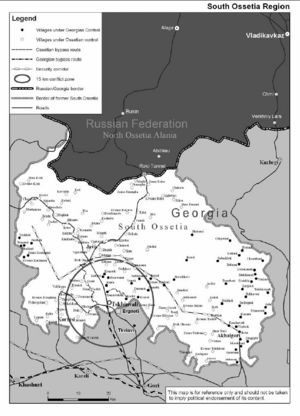
According to background materials available on the internet, some of which have already been broadcast as news, it appears that South Ossetia has long enjoyed a relatively autonomous position, even under Soviet rule. North Ossetia is part of the Russian Federation, so South Ossetians are kin to Russians. Reports claim that most South Ossetians hold citizenship in the Russian Federation, and that 99 percent of South Ossetians favored independence from Georgia in a 2006 referendum.

On Nov. 12, 2006, South Ossetians aligned with the breakaway republic of Tskhinval, re-elected their independent president, Eduard Kokoity. But this is only half the story.

As Irina Kelekhsayeva reports for the Institute for War and Peace Reporting (IWPR), on the same day that Kokoity was re-elected in Tskhinval, there was a parallel election among a cluster of ethnic Georgian villages in the region, resulting in the confirmation of Dmitry Sanakoyev as the “alternative president” of an “alternative administrative unit” created by Georgia’s central government. South Ossetia has two Presidents, but Kokoity usually gets called the “de facto” one (CRS No. 392 17-May-07).

Although Russia had agreed to withdraw its military bases from Georgia, reports continued to hint that weapons from Russia were continuing to flow into Tskhinval. Meanwhile, from the other side, Georgia got lots of help from the USA and achieved the highest growth rate of military spending in the world. Says the 2008 yearbook from the Stockholm International Peace Research Institute (SIPRI): “Georgia in particular had a very high level of military spending in comparison to the size of its economy.”

On both sides, the arms built up and up. On the ground, people of the region did their best to live under the tensions of dual Russian-Georgian peacekeeping forces, who periodically blocked and unblocked travel along key roads. Last week, in an effort to unfreeze the frozen conflict, the Georgian Army rolled into the region from the South. The Russian Federation countered with a swift and surprising attack from the North.

Already, voices in the USA, echoing the policy posted at the State Department web site, talk about a need to maintain the “integrity” of the border that keeps South Ossetia clearly within the domain of Georgia. This is the position to rethink.

Most ominous for peace lovers is the presence of the Caspian pipeline that runs near the Georgia capital of Tbilisi, just south of South Ossetia. This is the same pipeline that is now in flames in Turkey from a reported attack by the Kurdistan Workers’ Party (PKK), another “separatist” group that analysts will no doubt consider when evaluating any concession to the South Ossetia “separatists.”

On the Russian side, there are similar considerations of geopolitical posturing. Some analysts say an objective of the Russian incursion this week will be to strengthen the Russian influence over terms of conflict resolution. The Russian gambit may also work to keep Georgia out of NATO forever.

Which brings me to the tentative, people-centered solution: In consideration of the longstanding “de facto” independence of Tskhinval, the boundary of Georgia’s “integrity” should be rethought to exclude that portion of South Ossetia known as the breakaway republic. The “Georgian villages”, on the other hand, should be allowed to reunite.

No doubt, a certain kind of geopolitical logic will not shirk the prospect of drawing Russia into a protracted war with Georgia. As the Georgian arms buildup comes from USA aid and manufacturers, geopolitical ambitions will still be whetted by profit. But if we think about geopolitical peace that respects traditions of autonomy and self-definition, then the people of South Ossetia deserve a defensive retreat of the Georgian Army to concede the independence of the breakaway republic of Tskhinvali.

Peace for South Ossetia means relinquishing hardline claims that it falls within the “sovereign” borders of Georgia. If Georgia concedes quickly, then world opinion can next focus on the immediate withdrawal of Russian troops, whose stated purpose for invading Tskhinval will have vanished.

In the above, tentative suggestion, I have tried to apply a people-centered, rather than a bloc- or state-centered strategy of peace. This is a deliberate attempt to think outside of the Cold War box. In the event that people of the world are prepared to think and act with independence, we may find something in our future besides World War III.

Further Reading:

• An Associated Press report attributes US interests in Georgia to the Caspian pipeline. However a quick check of a map seems to indicate that the pipeline runs well south of South Ossetia, a fact strangely missing from the AP report. “Georgia as a whole means quite a lot,” says a strategist to the AP. No doubt. But if the pipeline is going to draw our thoughts to the region, then what would be the point of prolonging the conflict over a small northern province of Georgia, when US oil interests lie further south?

• Michel Chossudovsky explored the impact of the Caspian pipeline during the bombing of Lebanon in 2006:

The Ceyhan-Tblisi-Baku (BTC) pipeline totally bypasses the territory of the Russian Federation. It transits through the former Soviet republics of Azerbaijan and Georgia, both of which have become US “protectorates”, firmly integrated into a military alliance with the US and NATO. Moreover, both Azerbaijan and Georgia have longstanding military cooperation agreements with Israel.

The US State Department position: The United States supports the territorial integrity of Georgia and a peaceful resolution of the separatist conflict in South Ossetia. Note how the State Department’s own account of the conflict points to provocations against the Ossetians by the Georgia authorities:

The cessation of hostilities brought on by the Sochi Agreement held fast into 2004. At that point, Georgian President Eduard Shevardnadze had been replaced by Mikheil Saakashvili, who expressed a renewed interest in reintegrating Georgia’s separatist regions. In keeping with this policy, the Georgian Government placed a special emphasis on the regulation and monitoring of trade within and through South Ossetia, closing down a particularly large South Ossetian market which had been used for unregulated trade. South Ossetian forces retaliated by closing highways and detaining Georgian troops within South Ossetian borders. Tensions between the sides escalated, and exchanges of mortar fire in late July and August 2004 killed dozens.

• Recent trends in military expenditure (SIPRI): Military spending is rising rapidly in the South Caucasus — Armenia, Azerbaijan and Georgia — largely due to the region’s three ‘frozen’ conflicts and the involvement of external actors. The rises have been made possible by economic upswings largely based on oil and gas revenues.

• Ossetians.Com: In this labor of love by an Ossetian expatriate living in Canada, we can see how the local experience of Ossetians appears to be more aggravated by Georgian than Russian dominion.

• In any event, there is always a question of minority populations, whose rights should be respected. Here is a 2005 report:

Residents of villages in the Didi and Patara Liakhvi districts, point to continuing instances of suspected kidnapping and torture of Georgians, as well as an increasing number of complaints about discrimination, as indicators of what life under an autonomous South Ossetia would be like.

• Notable Ossetians: Akhmet Tsalikov (Tsalykkaty) (1882-1928) Founder of the theory of Islamic socialism. A book by Tsalikov, published in Prague in 1926, appears to be available in Serbian: Brat na brata : roman iz revoliutsionnoi’ zhizni Kavkaza

[Greg Moses is editor of the Texas Civil Rights Review and author of Revolution of Conscience: Martin Luther King, Jr. and the Philosophy of Nonviolence.]

Source / Dissident Voice

Thanks to Fran Hanlon / The Rag Blog

Posted in RagBlog | Tagged , , , , , | 5 Comments

MEDIA : The Press and the Atomic Bomb

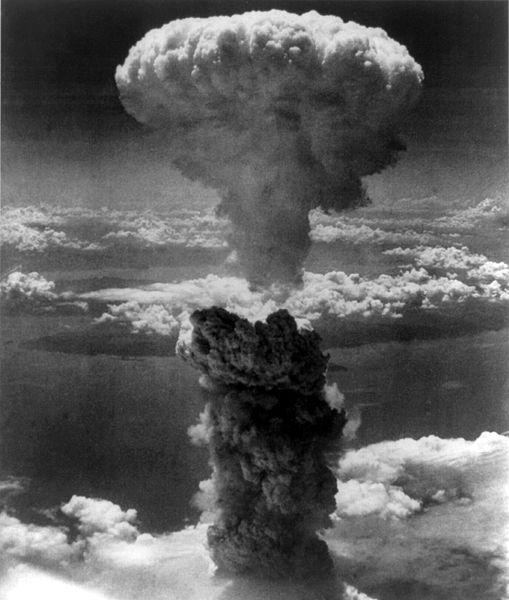
Mushroom cloud from the nuclear explosion over Nagasaki rising 60,000 feet into the air on the morning of Aug. 9, 2008.

63 Years Ago: Media Distortions Set Tone for Nuclear Age
By Greg Mitchell / August 6, 2008

At this time of year it is always important to look back at how the original “first-strike” was explained to the press, distorted, and then became part of the decades-long narrative of how, in this view, nuclear weapons can be used — and used again.

Sixty-three years after the atomic attacks on Hiroshima and Nagasaki, The Bomb is still very much with us. The U.S. retains over 5000 nuclear weapons — does this surprise you? — with better than 4000 said to be “operational.” There are plans to reduce this number, but only by 15%. The Russians still have many of their nukes but these remnants of the “superpower” era — and the lack of airtight security surrounding them — get little play today. All we seem to hear about are alleged or possible Iranian or North Korean or freelance terrorist nuclear devices.

The fact is, our “first use” policy — dating back to 1945 — remains in effect and past Gallup polls have shown that large numbers of Americans would endorse using The Bomb against our enemies if need be. So at this time of year it is always important to look back at how the original “first-strike” was explained to the press, distorted, and then became part of the decades-long narrative of how, in this view, nuclear weapons can be used — and used again.

The Truman announcement of the atomic bombing on Aug. 6, 1945, and the flood of material from the War Department, written by The New York Times’ William L. Laurence the following day, firmly established the nuclear narrative. It would not take long, however, for breaks in the official story to appear.

At first, journalists had to follow where the Pentagon led. Wartime censorship remained in effect, and there was no way any reporter could reach Hiroshima for a look around. One of the few early stories that did not come directly from the military was a wire service report filed by a journalist traveling with the president on the Atlantic, returning from Europe. Approved by military censors, it went beyond, but not far beyond, the measured tone of the president’s official statement. It depicted Truman, his voice “tense with excitement,” personally informing his shipmates about the atomic attack. “The experiment,” he announced, “has been an overwhelming success.”

The sailors were said to be “uproarious” over the news. “I guess I’ll get home sooner now,” was a typical response. Nowhere in the story, however, was there a strong sense of Truman’s reaction. Missing from this account was his exultant remark when the news of the bombing first reached the ship: “This is the greatest thing in history!”

On Aug. 7, military officials confirmed that Hiroshima had been devastated: at least 60% of the city wiped off the map. They offered no casualty estimates, emphasizing instead that the obliterated area housed major industrial targets. The Air Force provided the newspapers with an aerial photograph of Hiroshima. Significant targets were identified by name. For anyone paying close attention there was something troubling about this picture. Of the thirty targets, only four were specifically military in nature. “Industrial” sites consisted of three textile mills. (Indeed, a U.S. survey of the damage, not released to the press, found that residential areas bore the brunt of the bomb, with less than 10% of the city’s manufacturing, transportation, and storage facilities damaged.)

On Guam, weaponeer William S. Parsons and Enola Gay pilot Paul Tibbets calmly answered reporters’ questions, limiting their remarks to what they had observed after the bomb exploded. Asked how he felt about the people down below at the time of detonation, Parsons said that he experienced only relief that the bomb had worked and might be “worth so much in terms of shortening the war.”

Almost without exception newspaper editorials endorsed the use of the bomb against Japan. Many of them sounded the theme of revenge first raised in the Truman announcement. Most of them emphasized that using the bomb was merely the logical culmination of war. “However much we deplore the necessity,” The Washington Post observed, “a struggle to the death commits all combatants to inflicting a maximum amount of destruction on the enemy within the shortest span of time.” The Post added that it was “unreservedly glad that science put this new weapon at our disposal before the end of the war.”

Referring to American leaders, the Chicago Tribune commented: “Being merciless, they were merciful.” A drawing in the same newspaper pictured a dove of peace flying over Japan, an atomic bomb in its beak.

At the same time, however, the first non-official news reports began to break into print, including graphic accounts of casualties, a subject ignored in the War Department’s briefings.

Tokyo radio, according to a United Press report, called Hiroshima a city of the dead with corpses “too numerous to be counted … literally seared to death.” It was impossible to “distinguish between men and women.” Medical aid was hampered by the fact that all the hospitals in the city were in ashes. The Associated Press carried the first eyewitness account, attributed to a Japanese soldier who had crudely described the victims (over Tokyo radio) as “bloated and scorched — such an awesome sight — their legs and bodies stripped of clothes and burned with a huge blister. …”

Americans who came across these reports were thrust briefly into the reality of atomic warfare — if this information could be believed; The New York Times observed that the Japanese were “trying to establish a propaganda point that the bombings should be stopped.” The Hearst newspapers published a cartoon showing a hideous, apelike “Jap” rising out of the ruins of Hiroshima screaming at Americans, “They’re Not Human!”, with the caption, “Look who’s talking.”

But in quoting from Tokyo radio, newspapers did introduce their readers to a disturbing point of view: that the atomic bombing might not be an act of deliverance blessed by the Almighty but a “crime against God and man”; not a legitimate part of war but something “inhuman,” a cruel “atrocity,” and a violation of international law, specifically Article 22 of the Hague Convention which outlawed attacks on defenseless civilians. The Japanese also compared the bomb to the use of poison gas, a weapon generally considered taboo. It was this very analogy many American policy makers and scientists had feared as they contemplated using the bomb, which they knew would spread radiation.

Other condemnations appeared as the War Department’s grip on the story weakened slightly. The New York Herald-Tribune found “no satisfaction in the thought that an American air crew had produced what must without doubt be the greatest simultaneous slaughter in the whole history of mankind,” likening it to the “mass butcheries of the Nazis or of the ancients.”

A leading religious body in America, the Federal Council of Churches, urged that the U.S. drop no more atomic bombs on Japan, in a statement issued by two of its leaders, G. Bromley Oxnam and John Foster Dulles, later President Eisenhower’s chief adviser. America had won the race for the bomb but it “may yet reap the whirlwind,” Hanson Baldwin, military analyst for the New York Times, declared.

Interest in Hiroshima, however, receded as other events in the Pacific war, as well as speculation about a Japanese surrender, took center stage. On Aug. 9, the top two headlines on the front page of The New York Times announced the Soviets’ declaration of war against Japan (indeed, some historians would later write that it was this, not the atomic bombs, that primarily forced the Japanese surrender). Not until line three did this message appear: “ATOM BOMB LOOSED ON NAGASAKI.” The target of the second attack, a city of 270,000 people, was described, variously, as a naval base, an industrial center, or a vital port for military shipments and troop embarkation, anything but a largely residential city. The bomb, in fact, exploded over the largest Catholic community in the Far East.

That night, President Truman told a national radio audience that the Hiroshima bomb had been dropped on a “military base,”not a large city, although he knew this was not true. “That was because we wished in the first attack to avoid, in so far as possible, the killing of civilians,” he said. Yet 150,000 civilians had died or would soon perish from radiation disease.

[Greg Mitchell is co-author, with Robert Jay Lifton, of the book, “Hiroshima in America.”]

Source / Editor and Publisher

The Rag Blog

Posted in RagBlog | Tagged , , , , , , , , , | 1 Comment

The Saturday Snapshot

You would do well to trace the link to read Imad Khadduri’s article:

Source / Free Iraq

The Rag Blog

Posted in RagBlog | Tagged , | 1 Comment

Elizabeth Edwards : Today

Elizabeth Edwards. Photo by Gerry Broome / AP.

‘We have stood with one another through (it) all…’
By Elizabeth Edwards / August 8, 2008

Our family has been through a lot. Some caused by nature, some caused by human weakness, and some – most recently – caused by the desire for sensationalism and profit without any regard for the human consequences. None of these has been easy. But we have stood with one another through them all. Although John believes he should stand alone and take the consequences of his action now, when the door closes behind him, he has his family waiting for him.

John made a terrible mistake in 2006. The fact that it is a mistake that many others have made before him did not make it any easier for me to hear when he told me what he had done. But he did tell me. And we began a long and painful process in 2006, a process oddly made somewhat easier with my diagnosis in March of 2007. This was our private matter, and I frankly wanted it to be private because as painful as it was I did not want to have to play it out on a public stage as well. Because of a recent string of hurtful and absurd lies in a tabloid publication, because of a picture falsely suggesting that John was spending time with a child it wrongly alleged he had fathered outside our marriage, our private matter could no longer be wholly private.

The pain of the long journey since 2006 was about to be renewed.

John has spoken in a long on-camera interview I hope you watch. Admitting one’s mistakes is a hard thing for anyone to do, and I am proud of the courage John showed by his honesty in the face of shame. The toll on our family of news helicopters over our house and reporters in our driveway is yet unknown. But now the truth is out, and the repair work that began in 2006 will continue. I ask that the public, who expressed concern about the harm John’s conduct has done to us, think also about the real harm that the present voyeurism does and give me and my family the privacy we need at this time.

Source / Daily Kos

Thanks to Harry Edwards / The Rag Blog

Posted in RagBlog | Tagged , , | 2 Comments

Seeking Moral Parity in the Community of Nations


It’s the Torture, Stupid: Restoring Human Rights Must Be Next Prez’s Top Priority
by Ted Rall / August 9, 2008

Both major presidential candidates have promised to roll back the Bush Administration’s torture archipelago. Both say they’ll close Guantánamo, abolish legalized torture, and respect the Geneva Conventions on the treatment of prisoners of war. Obama also pledges to eliminate “extraordinary rendition,” in which the CIA kidnaps people and flies them to other countries to be tortured, and says he will investigate Bush Administration officials for possible prosecution for war crimes.

If followed by other meaningful changes in behavior–withdrawing from Afghanistan and Iraq and foreswearing preemptive warfare–restoring the rule of law and respecting the rights of “enemy combatants” can start America’s long, slow climb back to moral parity in the community of nations. But there are worrisome signs that Barack Obama and John McCain’s commitment to moral renewal is less than rock-solid.

McCain, who claimed to have been tortured as a POW in North Vietnam, says a lot of the right things. “We do not torture people,” he said in a 2007 Republican debate. “It’s not about the terrorists; it’s about us. It’s about what kind of country we are.” He used his Vietnam experience against fellow Republicans, bullying Congress into passing a law banning torture against detainees held by the military.

Bush signed McCain’s bill in late 2005, saying it “is to make it clear to the world that this government does not torture and that we adhere to the international convention of torture, whether it be here at home or abroad.”

Days later, however, Bush issued a secret “signing statement” declaring that he would ignore the Detainee Treatment Act. NYU law professor David Golove, an expert on executive power, said: “The signing statement is saying ‘I will only comply with this law when I want to, and if something arises in the war on terrorism where I think it’s important to torture or engage in cruel, inhuman, and degrading conduct, I have the authority to do so and nothing in this law is going to stop me.”

McCain, who says as president he would veto a bill rather than issue a signing statement negating its contents, was no doubt angry about Bush’s perfidy. But, fearful of alienating Bush and the GOP leadership as he geared up for his ‘08 presidential campaign, he remained silent.

In February of this year, McCain backtracked still further from his anti-torture position, voting against legislation that would have blocked the CIA from subjecting inmates in its secret prisons to waterboarding, hooding, putting duct tape across their eyes, stripping them naked, rape, beatings, burning, subjecting them to hypothermia, mock executions, and other “harsh interrogation techniques.”

“The CIA should have the ability to use additional techniques,” he argued. He refused to explain why the CIA ought to be allowed to torture while the DOD should adhere to international standards of civilized behavior.

The U.S. continues to torture.

Unlike McCain, Obama remains a critic of officially sanctioned torture. “We’ll reject torture–without exception or equivocation,” Obama says. He would also end “the practice of shipping away prisoners in the dead of night to be tortured in far-off countries, of detaining thousands without charge or trial, of maintaining a network of secret prisons to jail people beyond the reach of the law.”

The trouble is, Obama isn’t laying the groundwork for stopping torture or closing Guantánamo or other U.S. gulags in his stump speeches. He talks a lot about energy policy, healthcare, jobs and the economy–and withdrawing troops from Iraq so they join the war against Afghanistan instead. If he becomes president, people will expect him to do those things. Without a sustained focus on human rights issues, however, any moves he makes will seem to come out of the blue–and face stronger pushback from Republicans anxious to bash him as weak on national security.

Why doesn’t Obama emphasize Bush’s war crimes? Maybe he’s trying to play the Great Uniter, or maybe he knows that many Americans don’t give a rat’s ass about the pain inflicted against people they’ll never meet in places they’ve never heard of. Who knows? All we know for sure is that, day after day, Obama fails to talk about what is arguably the worst crime of the corrupt Bush Administration.

Of course, renouncing torture isn’t enough. Those who authorized it must be held to account. However, it doesn’t seem likely that they will.

Asked in April whether he would prosecute Bush Administration officials for authorizing torture, Obama delivered his now-familiar duck-and-cover: say the right thing, then weasel out of it. “If crimes have been committed, they should be investigated,” he said.

But not for at least four years: “I would not want my first term consumed by what was perceived on the part of the Republicans as a partisan witch hunt, because I think we’ve got too many problems to solve.”

Memo to Barack: This isn’t about prosecuting Republicans. It’s about prosecuting torturers.

“Prosecution of any officials, if it were to occur, would probably not occur during Obama’s first term,” Slate reports, citing Obama campaign insiders. “Instead, we may well see a Congressionally empowered commission that would seek testimony from witnesses in search of the truth about what occurred. Though some witnesses might be offered immunity in exchange for testimony, the question of whether anybody would be prosecuted would be deferred to a later date–meaning Obama’s second term, if such is forthcoming.”

First would come a South African-style “Truth and Reconciliation Commission,” where the truth would come out. But the torturers would get off scot-free.

“The commission would focus strictly on detention, torture and extraordinary rendition, or the practice of spiriting detainees to a third country for abusive interrogations. The panel would focus strictly on these abuses, leaving out any other allegedly illegal activities during the Bush Administration, such as domestic spying,” says Slate. Second–well, there might not be a second. Even if there is, shortsighted Americans’ appetite for justice and accountability will probably have been diluted by the time 2013 rolls around.

Mainline media liberals, in conjunction with Obama supporters, are even going so far as to suggest that Bush issue his torturers with a blanket pardon in exchange for their testimony at Obama’s toothless commission.

Regardless of who wins in November, we will get a president who’s better on torture and other human rights issues than George W. Bush. At least their words sound nice. But real change and moral redemption will only begin if we–Democrats, Republicans and everyone else–demand the next president stands by his pretty promises.

Until they start taking taking torture, Gitmo and human rights seriously, neither Obama nor McCain should be able to appear in public without facing questions and heckling about these issues.

Ted Rall is the author of the new book “Silk Road to Ruin: Is Central Asia the New Middle East?,” an in-depth prose and graphic novel analysis of America’s next big foreign policy challenge.

© 2008 Ted Rall

Source / Common Dreams

Lest we forget the horror that we are talking about, here is a story related by Layla Anwar of Arab Woman Blues:

Crucified by “Freedom”
By Layla Anwar / July 30, 2008

Painting : Iraqi artist, Haidar Al-Karagholi, 2007.

The story am about to tell you is a true one. I have kept the details unchanged, but I did change the names, location and dates to protect the anonymity of the victims.

Ahmad lives in an insalubrious, run down apartment in Syria with his wife and 5 kids. Prior to his forced exile, he lived in a decent neighborhood and in a large home, large enough for his family and his parents.

After the occupation and during the usual nightly American raids, that all Iraqis have experienced, Ahmad’s life took a definite turn from which he will never recover.

His house was besieged by a horde of American barbarians, tanks and weapons…They stormed in the middle of the night, made everyone lie on the floor, face down, including his elderly parents, kicked and beat the whole family with their boots, resting them on their heads and necks…

Then they proceeded to storm each room using axes to break down the doors when the doors were not locked to start with. Then they opened the wardrobes, and said they were looking for weapons of mass destruction. They set all the wardrobes on fire.

They moved Ahmad’s family to the vicinity of his home and made Ahmad and his family watch as your brave boys blew the house up.

They arrested Ahmad and a few others, blindfolded them and took them to an American camp in Baghdad. During the ride to the detention camp, around 20 soldiers were kicking and butting with their rifles edges, Ahmad and the other detainees.

Once arrived, they placed them in a corner of a dirty cell and started pissing on their wounded bodies while hysterically laughing. Not contenting themselves with that alone, they (the Americans) brought in a basin used to collect shit from their mobile toilets and emptied it on Ahmad and the other detainees heads.

Ahmad and his mates spent several months at this American detention camp. The first few days their interrogation consisted of identifying posters on a wall. The picture was that of Saddam Hussein. Of course Ahmad was able to identify Saddam Hussein’s picture. When he and the others answered affirmatively, they were violently beaten up by the Americans because for these Americans luminaries, that was proof that they (the detainees) knew Saddam personally.

After several days the interrogation took another turn. Ahmad believes it was not even a process of getting any information which he did not have. But, according to him, the interrogations were just a form of humiliation to the prisoners and a way for the soldiers to “HAVE FUN.” – American fun.

Ahmad recalls that one of the American officers used to sit on his chair with a bottle of whisky next to him and start questions like: ” Where do you buy your vegetables from ?” ” What is the name of your barber?” Other humiliating questions were – “How many times do you have intercourse with your wife ?” “What positions do you take ?… At times, a male and female soldier would undress and mimic such acts in front of the other soldiers all the while “teasing” the detainees…

Ahmad and other prisoners were then transferred to another camp in the South. Which meant that officially there were under British custody. But the personnel inside the camp included US, Australian as well as British soldiers.

When they arrived at this other camp, the British received Ahmad and the others with the same sort of treatment — kicking and striking with their riffles butts, just like their fellow Americans did before. Ahmad’s head was injured during his first arrest and the wound in his head reopened and started bleeding.

The soldiers tried to stitch it in the prison cell but failed, since they are not trained to do so. So they were forced to transfer him to a military hospital. X rays showed that his skull was fractured and had been fractured for several days by now, from the physical blows. They had to operate on him and he was moved back to the prison camp.

Ahmad recalls that all sorts of humiliation and torture were still being inflicted on the prisoners of this camp. He said that when they wanted to take any one to the interrogation session, they’d strip him from all his clothes and put a hood on his head and make him walk naked the whole distance, around 3 km, in front of the other prisoners while the accompanying soldiers would be using their vehicles.

The interrogation still consisted of questions like – “where do you buy your vegetables from and where do you get a haircut?” All the while, with insults and all kinds of beatings being showered on the detainee.

These interrogation sessions were done in the presence of the highest ranking prison officers. Ahmad is completely convinced that these interrogations and torture sessions were done for the sake of “FUN FOR THE SOLDIERS” and not for extracting and gathering security information as the Americans like to pretend.

A whole year elapsed and Ahmad was allowed to receive one visit from some members of his family. His family had spent days and weeks in front of the prisons, begging to see him…

Food in the prison was in itself an insult and a form of torture.

The soldiers would collect the prisoners in one large open space at 8 am for “breakfast”. They would make them sit in the heat of the sun till 11 am.
They were forced to take on a “stress position”, i.e to sit in a position straining their joints with their hands crossed over their heads so they can have their “breakfast”!

In case any prisoner moved his hand to rest his body a little, the guards would directly shoot him with a rubber bullet right on the face. Some prisoners lost one of their eyes in such incidents. Other developed severe pain and blue faces for months. Those who were unable to stay in the stress position were the elderly, some older than 70 years of age.

That same procedure was repeated between 1 pm and 5 pm – during the “lunch” period The food consisted of a bag of beans with sugar for “breakfast” and a very hot peppered rice for “lunch.”

After a year or so, Ahmad and others were transferred to Abu Ghraib prison.

Ahmad recalls that what was unique to this prison were not the notorious sexual insults and torture – something he was quite familiar with and used to by now, but the presence of woman prisoners among them (the men) and the torture these brave women were subjected to in front of them.

One such technique was to tie the woman’s legs with two different ropes and pull the naked body in opposite directions. Some died from the pain of this method and others were either split in half or had their hips totally disconnected from their joints.

Another “sport” for the American brave boys, so they can have fun, was to tie
a male prisoner with the noose of a rope to his neck and the other end of the rope was tied to the waist of one soldier. The soldier would run from one end of the cell to the other dragging the suffocating prisoner on the ground and other soldiers — spectators would time the race.
Then, other soldiers were to do the same thing but in a shorter period. In other words, a race competition/a contest. The prisoner would usually end up with a dark blue face from strangulation and his whole body bruised from being dragged in a “fun” race.

Ahmad was finally released with no charges. He moved to Syria, having lost his home in Baghdad and nowhere to go. About a year after his arrival here, Ahmad started feeling numbness and weakness in one side of his body, something which made speech and swallowing excessively difficult. At first he thought he had a stroke, but when he consulted a specialist, he was told that he had some dead brain cells due to some traumatic accident.

Today, Ahmad drags his legs and is unable to use his arm and hand. Ahmad does not only carry the physical trauma which is there for all to see but the psychological trauma from which he will never heal.

While in Syria, Ahmad met another friend who was an inmate in some Basra camp. This other friend told him that the Americans used to drop hot pepper liquid in the eyes of the prisoners as a form of torture. His friend added that the brave boys did that to him more often than not and today Ahmad’s friend is totally BLIND.

Ahmad also met the daughter of a judge, she can’t walk anymore, her hips “went loose” after being tortured in Abu Ghraib.

There are more stories, real stories to tell…Stories of “Liberation.” Stories weaved by a “civilized” West, the West of ” Human Rights and Democracy.”

Some bad faithed, dirty, corrupt, hypocrites will argue that this is the work of “a few bad apples.”

American and British “ideals” – Yes more like it.

The Western ideals of “Freedom.”

P.S: A special thank you to A. for sharing it with me.

Source / Arab Woman Blues

The Rag Blog

Posted in RagBlog | Tagged , | 1 Comment

The Best Century in America Will Be the Last


U.S. Headed Toward Bankruptcy, Says Top Budget Committee Republican
By Terence P. Jeffrey / August 8, 2008

The ranking Republican on the House Budget Committee said the U.S. government is headed toward bankruptcy if it stays on its current fiscal course.

“We know that for a fact,” Rep. Paul Ryan (R-Wis.) told CNSNews.com in a video interview. “All the actuaries, all the objective scorekeepers of the federal government, are predicting this.”

To back up this claim, Ryan cited an estimate by the non-partisan Government Accountability Office that says the government faces a $53-trillion shortfall to cover the costs of promised benefits in its entitlement programs.

“They say we are $53 trillion short of fulfilling the promises the government is making to the American people, in today’s dollars,” said Ryan.

“Meaning that if we want to keep the promises of Medicare, Medicaid and Social Security, which are basically the three major entitlement programs, today we would have to set aside $53 trillion dollars and invest them at Treasury rates in order to do it,” he said.

Ryan said that to deal with this situation the government must either reform the entitlement programs or eventually impose massive tax increases on American workers.

“For the last 40 years, the federal government has had to tax every dollar made in America at 18.3 cents on that dollar to pay the bills of the federal government,” said Ryan.

“By the time my three children – who are three, five and six years old—are my age, the federal government will have to tax 40 cents out of every dollar made in America just to pay the bills for the federal government at that time,” he said.

Ryan asked the Congressional Budget Office to determine what the tax rates would need to be to cover federal spending at that level.

“What they told me was really startling,” said Ryan. “They said that the current low rate, the 10-percent bracket for low-income Americans, would have to go up to 25 percent. The middle-income tax rate for middle-income Americans would have to go up to 66 percent, and the top rate, which is what small businesses pay, would have to go to 88 percent.

“Those would be the tax rates you would have to have if you wanted to tax your way out of this problem,” he said. “And if you did that, all experts conclude, you would literally crash the American economy.”

Ryan portrayed the long-term budget crisis he believes the country is now facing as a generational challenge.

“The legacy of this country has always been that each generation confronts the challenges before it so that the next generation is better off,” said Ryan. “In the past, we brought down the Iron Curtain and won the Cold War. We got through World War I. We got through World War II. We won the war on the Great Depression.

“The problem that we have right now—putting foreign policy aside and our fight with Islamic radicalism—is that we have an economic crisis, we have a fiscal crisis, and, that is, we will bankrupt this country, and the best century in America will be the last century,” he added.

“Unless we turn our fiscal situation around and pay off this debt, and change the way these programs work to a more sustainable path, the next generation will have inferior living standards,” said Ryan.

Ryan and his Budget Committee staff have developed a comprehensive plan for reforming federal taxing-and-spending policies that they believe will restore long-term solvency to the federal government.

Entitled “A Roadmap for America’s Future: A Plan to Solve America’s Long-Term Fiscal and Economic Crisis,” the plan has been introduced as legislation (H.R. 6110) in the current Congress.

Source, with video / Information Clearing House

And then there’s this:

Our $100 Trillion National Debt
by Bill Walker / August 7, 2008

The “official” debt of the United States is only around $10 trillion dollars as of August 6, 2008. This is a manageable number; we could pay it off in a few decades if we quit buying luxuries like food and clothing, and take a few other minor economy measures. Unfortunately, the “$10 trillion” number was produced by government accounting, which among other things allows one to ignore Social Security, Medicare, and the new prescription drug benefit. This is like ignoring rent, food, and utilities in your household budget… it will lead to a few bounced checks. Our real debt is about ten times higher.

Who says so? The President of the Dallas Federal Reserve, Richard W. Fisher. In a May speech at the Commonwealth Club of California, he states that the US national debt is close to $100 trillion. You can read his whole speech at the Federal Reserve web site.

The Real Debt

Here is what he said regarding the actual US debt:

“Add together the unfunded liabilities from Medicare and Social Security, and it comes to $99.2 trillion over the infinite horizon. Traditional Medicare composes about 69 percent, the new drug benefit roughly 17 percent and Social Security the remaining 14 percent.”

Interested readers will notice that the new prescription drug benefit is projected to be more fiscally crushing than all of Social Security.

Mr. Fisher points out that this $99.2 trillion will be a bit of a burden to pay off:

“Let’s say you and I and Bruce Ericson and every U.S. citizen who is alive today decided to fully address this unfunded liability through lump-sum payments from our own pocketbooks, so that all of us and all future generations could be secure in the knowledge that we and they would receive promised benefits in perpetuity. How much would we have to pay if we split the tab? Again, the math is painful. With a total population of 304 million, from infants to the elderly, the per-person payment to the federal treasury would come to $330,000. This comes to $1.3 million per family of four—over 25 times the average household’s income.”

You do have $1.3 million in your pocket, right? What, are you some kind of deadbeat?

Speaking of deadbeats, the “$99.2 trillion” estimate does not include the subprime bailout. So for those who like large round numbers, by the end of 2008 the real National Debt should be large, round, and about $100 trillion.

Other Unfunded Liabilities

The Fed’s numbers do not include some other liabilities the US has acquired over the years. One massive but unquantifiable liability is the probability of future wars. If it cost the US hundreds of billions of dollars to invade the fifth-rate kleptocracy of Iraq and the foreign-aid regime of Afghanistan, how many trillions would wars against real powers cost? Perhaps I should ask “how many US cities” such wars would cost.

Some nations could legitimately plan for peace. Sweden has not fought a foreign war since 1814 (as many Swedes have pointed out in emails regarding my Swiss article). Switzerland, not since 1815. The US record is less hopeful.

The US is rarely not in foreign wars, and the current Administration has openly announced that the “Global War On Terror” will never end. Yet our government accounting is predicated on perpetual peace, on an ever-increasing flow of money into the official pyramid schemes.

In any case, whether you are pro- or anti- Empire, real accounting demands some reserves for future war contingencies. When even a few US cities are burning radioactive pyres, the flow of funds to Social Security and Medicare will suffer some interruption.

Any fiscal plan demands amortization of the accumulated hatred our foreign adventures have accumulated. The US taxpayer has aided every evil dictator since 1945. Stalin, Castro, Pol Pot, Nyerere, Idi Amin, go right down the roster and US money helped pay for the barbed wire and bullets (and the nuclear reactors, in the case of the Kim Dynasty rulers of Korea).

So far blowback has been quite mild. But in a world full of easy do-it-yourself WMD technologies, our luck can’t hold forever. If the US were a private company, the “badwill” on our books would reach into the tens of trillions.

Tearing Up The Credit Cards

Most likely, the US will simply continue into bankruptcy. This is the most common pathway for nations with fiat currencies and unchecked ruling classes. But let’s assume that somehow a Clone Army of 435 Ron Pauls gets into Congress, while genetic technology brings back Jefferson and Gallatin to their old offices. Can the US be made solvent again?

I think so. Most of the unfunded liability is medical. We know why the medical system does not work. So if we eliminate the FDA, guild restrictions on medical professions, and the ridiculous tax laws that force us into medical-insurance serfdom to employers, we could cut medical costs enough to phase out Medicare and the new “drug benefit.” In this way more than half the shadow debt can be wiped out.

The answer for the Social-Security pyramid scheme is well known. Chile fixed its Social Security disaster decades ago, by giving large IRA-style allowances and phasing out the government payments to younger recipients. The sooner we do this the easier it will be… the Boomers start retiring soon.

Most important, we have to listen to the Founder’s calls for free trade with all nations but entangling alliances with none. The US cannot stop every quarrel in the world even if we wished… and the actual record of our foreign-policy geniuses has been to send a couple of trillion dollars out to the very worst criminals in human history. Aid To Dependent Dictators must stop.

None of this will happen while Mordor-On-The-Potomac still possesses its plutonium credit card, the Fed. Just as we would for any other bankrupt relative, we must help Uncle Sam cut up his credit cards.

Bill Walker [send him mail] is a research technologist. He lives with his wife and four dogs in Grafton NH, where they are active in the Free State Project.

Copyright © 2008 LewRockwell.com

Source / Lew Rockwell

The Rag Blog

Posted in RagBlog | Tagged , , | 1 Comment

This Is Coming to the Truth in Your Home Towns

Tom Feeley, owner and editor of InformationClearingHouse.info, has endured public harassment, home invasions, death threats and threats to his family simply for running a website.

Anti-war website operator threatened by armed thugs
By Paul Joseph Watson, Prison Planet / August 7, 2008

The operator of a leading alternative news and strongly anti-war website has become the target of nefarious thugs apparently in the employ of the U.S. government who have continually harassed him and ordered him to shut down his website.

Tom Feeley, owner and editor of InformationClearingHouse.info, has endured public harassment, home invasions, death threats and threats to his family simply for running a website.

Counterpunch writer Mike Whitney has circulated an e mail describing what happened to Feeley in an attempt to draw attention to the matter.

Whitney writes that earlier this week Feeley’s wife was startled to suddenly discover three well dressed men standing in her kitchen who told her that Tom must “Stop what he is doing on the Internet, NOW!”

To emphasize the point, the thug pulled back his jacket to reveal a gun while barking out the warning.

Tom’s wife was hysterical and refuses to go back to the house. She contacted the FBI but was told there was nothing they could do.

According to Whitney, “The well-dressed man told Tom’s wife that he knew where her son lived, what line of work he was in, and how many children he had.”

Subsequently, two men in a parked car a block from Tom’s mother’s house were spotted using laptops and sped off when they were approached by Tom’s son.

A similar incident had happened four years previously, when Feeley was approached by a stranger in the parking lot of Long’s Drug store in Southern California, after being forced to remain in his car by an accomplice who blocked him from opening the car door. The man told him, “You need to stop what you are doing on the web”.

Tom said the man was overweight and had his shirt untucked. Tom was taken aback, but (after collecting himself said) “What the fuck? Who do you think you are telling me what I can do?”

The man answered, “Tom, I’m just giving you some good advice. You should take my advice, Tom.”

I’ll tell you this about Tom Feeley; he is no bullshitter,” writes Whitney, “He is the “real deal” and completely committed to exposing the mob that is presently running our country. He does not understand why, (as he says) “They are reaching down SO far to get someone who just runs web site”. But, the truth is, they are. Someone wants him to “shut up” and they apparently have the muscle to do it. He knows he is in danger.”

Feeley is ditching his cellphone and maintaining a low profile but to his credit, refuses to cave in to the threats and will continue to publish his website.

Drawing attention to Feeley’s situation is of paramount importance to ensure his protection and also to combat head on attempts to create a chilling atmosphere and intimidate journalists and website publishers.

Source / InfoWars

And here is additional historical information.

The Rag Blog

Posted in RagBlog | Tagged , , | 2 Comments

Needed : Peace Movement Strategy on Afghanistan

Barack Obama with Afghan President Hamid Karzai, center foreground, and other officials at the Presidential Palace in Kabul, Sunday, July 20, 2008. Photo by AP.

‘Obama’s proposal is so ill advised that one might expect it to die on its own but for the fact that it fits neatly into current U.S. strategic doctrine’
By Morton H. Frank / August 9, 2008

Medea Benjamin of Code Pink (Portside, July 26) has called for a peace movement strategy on Afghanistan. While long overdue, this has become urgent after Barack Obama’s call for an additional 10,000 U.S. troops to be deployed there against the insurgency.

Obama’s proposal is so ill advised that one might expect it to die on its own but for the fact that it fits neatly into current U.S. strategic doctrine. The flaws are overwhelming and it goes without saying that the more quickly the peace movement brings them to public attention the less will be the damage to the people of that country. But if all we do is address the specific flaws that apply to Iraq, or Afghanistan, etc., U.S. intervention into third world countries will continue with no end in sight.

Widely understood as a recipe for failure, Obama’s support for deeper U.S. military engagement in Afghanistan has unleashed a torrent of criticism, including many who are far removed from the peace movement. Among the critics is Zbigniew Brzezinski, who, as President Carter’s advisor, had orchestrated the provocation that trapped the Soviet Union into its failed intervention in Afghanistan during the 1970s, and who now warns against the U.S. letting itself get trapped in an unwinnable war.

Additional critics are analysts William Lind and Chuck Spinney, associated with “Defense and the National Interest,” an internet site that features daily expert critiques of ongoing U.S. military policy. Spinney writes that Obama’s deployments to Afghanistan would have to come out of a military that is already overburdened and hollowed out by the Iraq war “to what is perhaps the roughest inhabited terrain in the world, and in a war zone that embodies what is surely one of the most ethnically complex, tribally-organized vendetta cultures of the world.” The tribal groups of Afghanistan have been steeled by years of intermittent warfare against Great Britain until the end of the first world war. Lind says that “The Afghan war is going the way Afghan wars do, as the Pashtun [tribal groups] slowly get their act together to push the occupier out. Spillover from the war in Afghanistan is destabilizing Pakistan, with Washington accelerating the process by putting impossible demands on the country’s leaders.” “Defense and the National Interest” can be accessed at .

Gèrard Chaliand, a French specialist on irregular wars, especially Afghanistan, states flatly that “Victory is impossible in Afghanistan” (Le Monde interview cited by Immanuel Wallerstein). Juan Cole in Salon.com also faults Obama’s ideas about Afghanistan.

A full scale U.S. involvement there would be far more challenging than the invasion of Iraq. U.S. forces have access to Iraq by sea; but Afghanistan is landlocked. Iraq is close to sea level, with most of the fighting in cities, while the Afghanistan fighting is largely in mountainous areas and countryside, posing serious logistical problems for a modern army.. Both Iraq and Afghanistan border on Iran, which supports anti-American fighters. But the Afghanistan resistance in addition has entrée to major additional support in Pakistan. The border line between the two (drawn by the British in 1893) is not recognized by the people who live there, the Pashtun ethnic group, which bears the brunt of the armed struggle. Given millions of Pashtuns on each side of the line, that makes for a very porous border.

An ominous difference between the wars in Iraq and Afghanistan is the generous resources that are available to the Taliban insurgency. The detail here comes mainly from a stunning article in the New York Times Magazine for July 27th by Thomas Schweich, formerly a high counternarcotics official in the Bush administration. The anarchy and high profits associated with heroin have caused production in Afghanistan to increase rapidly. In 2007, nearly 750 square miles of Afghanistan were devoted to cultivation of poppies, chiefly in industrial sized farms, said to provide over 90 percent of the illegal heroin in the world.

The drug traffic supports not only the insurgency, but also corruption in Hamid Karzai’s government, sapping its effectiveness in combating the insurgency. According to Schweich, a U.S. Counternarcotics Strategy was already in being by 2007, and only awaits approval within the Bush administration. Surely this issue deserves attention from the peace movement. If the U.S. can’t attend to it, a demand from the peace movement that the United Nations Office on Drugs and Crime take on the job would certainly be appropriate.

If Obama’s proposal is a disaster in the making, why does he persist with it? That question can be turned around to “Why do the experts tutoring Obama on military affairs continue to advocate policies that only make things worse, as occurred in Vietnam and Iraq?” The answer is a powerful military orthodoxy fueled ultimately by the profits in military industry that puts force ahead of negotiation. Beyond protesting intervention in Afghanistan, we in the peace movement must also challenge the ideology behind it and the military projects that make victory in Afghanistan appear plausible to some.

And behind it all, of course, are the vested interests in the unholy coalition of military contractors, Pentagon executives and members of Congress. Supporting this coalition are masses of people who depend on it for a living.

In the July/Aug. 2007 issue of Foreign Affairs Obama claims that “To renew American leadership in the world, we must immediately begin working to revitalize our military.” “We must use this moment to rebuild our military and to prepare it for the missions of the future.” We must “become better prepared to put boots on the ground in order to take on foes that fight asymmetrical and highly adaptive campaigns on a global scale.”

Clearly, Obama has assimilated the conventional orthodoxy of the U.S. military establishment. His language refers to two specific projects whose costs are sufficient to imperil the goal of civic reconstruction to which he has committed himself.

The projects he cites (details below) are united by a common strategic concept called Transformation, first enunciated in 1997 by the National Defense Panel, a study group. The idea of Transformation was an alleged imperative to reorient the country’s military for wars already under way and to discard weapons which had been appropriate only for the Cold War. According to its advocates, Transformation mandates that the United States prepare for wars against countries that are poorer than we and whose armed forces are weaker than ours.

Conventional doctrine holds that preparing U.S. forces for the new world situation requires one project about soldiers and another about their equipment. On January 11, 2007, Secretary of Defense Robert Gates proposed a permanent addition of 92,000 troops to the Army and Marine Corps, to be carried out over five years. He estimated that it would cost about $1.5 billion annually for each 10,000 added, not counting start-up costs and advanced equipment. The response he got was enthusiastic and fully bipartisan.

The case for the equipment needed for Transformation was best explained in an op ed piece by strategist Kori Schake in The New York Times of February 2, 2006: The military budget is huge, she wrote, but money is being spent on the wrong things. The nation needs an agile force that can quickly defend us against terrorists. Not enough is being allocated for new programs such as unmanned aerial vehicles, high speed sealift and Future Combat Systems, the latter being a package of 18 different weapons and vehicles. Instead, funds are going for unneeded weapons systems designed to combat threats that no longer exist. Schake’s experience at the National Security Council, West Point and the Hoover Institution lent weight to her article.

An editorial dated February 6, 2007 in The New York Times would seem to foretell the difficult choices that a future President Obama will face upon entering office. In that editorial the Times welcomed Bush’s huge new budget of $622 billion for the military, but recommended that “Congress should direct particular attention to the roughly $140 billion … for costs that are not part of the Iraq and Afghanistan section of the budget.” “If the new Democratic-controlled Congress is serious” said the Times “about finding the money to pay for acute domestic needs, it will have to pare back the most extravagant elements of this fantasy wish list” of weapons that were products of Cold War strategic thinking.

To roll back the Afghanistan intervention would not only be a good in itself, but would make significant money available to an Obama presidency for the “acute domestic needs,” that the Times writes about. Even achieving part of that goal would launch the U.S. on a path toward conciliation with the countries of the third world.

The $140 billion mentioned by the Times is a large part of the annual expense of producing and maintaining the military relics of the Cold War. And that is a different matter. To cut into that is far more difficult than the Times would have us think. George Bush senior tried it in 1990 at the end of the Cold War and didn’t get anywhere. The peace movement, which attempted to do it many times after World War II, never made a dent. The military-industrial complex, with its allies in Congress, is simply too powerful, not only economically, but as a political reservoir for the Right.

If the movement to put Obama in the White House is successful and continues to gain momentum, and enough progressive Democrats are elected to Congress, the momentum could go beyond getting us out of Afghanistan and defeat the project for military Transformation.

The most visionary among us might then begin to ponder how to defeat the military-industrial complex as a whole.

Widely understood as a recipe for failure, Obama’s support for deeper U.S. military engagement in Afghanistan has unleashed a torrent of criticism, including many who are far removed from the peace movement. Among the critics is Zbigniew Brzezinski, who, as President Carter’s advisor, had orchestrated the provocation that trapped the Soviet Union into its failed intervention in Afghanistan during the 1970s, and who now warns against the U.S. letting itself get trapped in an unwinnable war.

Additional critics are analysts William Lind and Chuck Spinney, associated with “Defense and the National Interest,” an internet site that features daily expert critiques of ongoing U.S. military policy. Spinney writes that Obama’s deployments to Afghanistan would have to come out of a military that is already overburdened and hollowed out by the Iraq war “to what is perhaps the roughest inhabited terrain in the world, and in a war zone that embodies what is surely one of the most ethnically complex, tribally-organized vendetta cultures of the world.” The tribal groups of Afghanistan have been steeled by years of intermittent warfare against Great Britain until the end of the first world war. Lind says that “The Afghan war is going the way Afghan wars do, as the Pashtun [tribal groups] slowly get their act together to push the occupier out. Spillover from the war in Afghanistan is destabilizing Pakistan, with Washington accelerating the process by putting impossible demands on the country’s leaders.” “Defense and the National Interest” can be accessed at .

Gèrard Chaliand, a French specialist on irregular wars, especially Afghanistan, states flatly that “Victory is impossible in Afghanistan” (Le Monde interview cited by Immanuel Wallerstein). Juan Cole in Salon.com also faults Obama’s ideas about Afghanistan.

A full scale U.S. involvement there would be far more challenging than the invasion of Iraq. U.S. forces have access to Iraq by sea; but Afghanistan is landlocked. Iraq is close to sea level, with most of the fighting in cities, while the Afghanistan fighting is largely in mountainous areas and countryside, posing serious logistical problems for a modern army.. Both Iraq and Afghanistan border on Iran, which supports anti-American fighters. But the Afghanistan resistance in addition has entrée to major additional support in Pakistan. The border line between the two (drawn by the British in 1893) is not recognized by the people who live there, the Pashtun ethnic group, which bears the brunt of the armed struggle. Given millions of Pashtuns on each side of the line, that makes for a very porous border.

An ominous difference between the wars in Iraq and Afghanistan is the generous resources that are available to the Taliban insurgency. The detail here comes mainly from a stunning article in the New York Times Magazine for July 27th by Thomas Schweich, formerly a high counternarcotics official in the Bush administration. The anarchy and high profits associated with heroin have caused production in Afghanistan to increase rapidly. In 2007, nearly 750 square miles of Afghanistan were devoted to cultivation of poppies, chiefly in industrial sized farms, said to provide over 90 percent of the illegal heroin in the world.

The drug traffic supports not only the insurgency, but also corruption in Hamid Karzai’s government, sapping its effectiveness in combating the insurgency. According to Schweich, a U.S. Counternarcotics Strategy was already in being by 2007, and only awaits approval within the Bush administration. Surely this issue deserves attention from the peace movement. If the U.S. can’t attend to it, a demand from the peace movement that the United Nations Office on Drugs and Crime take on the job would certainly be appropriate.

If Obama’s proposal is a disaster in the making, why does he persist with it? That question can be turned around to “Why do the experts tutoring Obama on military affairs continue to advocate policies that only make things worse, as occurred in Vietnam and Iraq?” The answer is a powerful military orthodoxy fueled ultimately by the profits in military industry that puts force ahead of negotiation. Beyond protesting intervention in Afghanistan, we in the peace movement must also challenge the ideology behind it and the military projects that make victory in Afghanistan appear plausible to some.

And behind it all, of course, are the vested interests in the unholy coalition of military contractors, Pentagon executives and members of Congress. Supporting this coalition are masses of people who depend on it for a living.

In the July/Aug. 2007 issue of Foreign Affairs Obama claims that “To renew American leadership in the world, we must immediately begin working to revitalize our military.” “We must use this moment to rebuild our military and to prepare it for the missions of the future.” We must “become better prepared to put boots on the ground in order to take on foes that fight asymmetrical and highly adaptive campaigns on a global scale.”

Clearly, Obama has assimilated the conventional orthodoxy of the U.S. military establishment. His language refers to two specific projects whose costs are sufficient to imperil the goal of civic reconstruction to which he has committed himself.

The projects he cites (details below) are united by a common strategic concept called Transformation, first enunciated in 1997 by the National Defense Panel, a study group. The idea of Transformation was an alleged imperative to reorient the country’s military for wars already under way and to discard weapons which had been appropriate only for the Cold War. According to its advocates, Transformation mandates that the United States prepare for wars against countries that are poorer than we and whose armed forces are weaker than ours.

Conventional doctrine holds that preparing U.S. forces for the new world situation requires one project about soldiers and another about their equipment. On January 11, 2007, Secretary of Defense Robert Gates proposed a permanent addition of 92,000 troops to the Army and Marine Corps, to be carried out over five years. He estimated that it would cost about $1.5 billion annually for each 10,000 added, not counting start-up costs and advanced equipment. The response he got was enthusiastic and fully bipartisan.

The case for the equipment needed for Transformation was best explained in an op ed piece by strategist Kori Schake in The New York Times of February 2, 2006: The military budget is huge, she wrote, but money is being spent on the wrong things. The nation needs an agile force that can quickly defend us against terrorists. Not enough is being allocated for new programs such as unmanned aerial vehicles, high speed sealift and Future Combat Systems, the latter being a package of 18 different weapons and vehicles. Instead, funds are going for unneeded weapons systems designed to combat threats that no longer exist. Schake’s experience at the National Security Council, West Point and the Hoover Institution lent weight to her article.

An editorial dated February 6, 2007 in The New York Times would seem to foretell the difficult choices that a future President Obama will face upon entering office. In that editorial the Times welcomed Bush’s huge new budget of $622 billion for the military, but recommended that “Congress should direct particular attention to the roughly $140 billion … for costs that are not part of the Iraq and Afghanistan section of the budget.” “If the new Democratic-controlled Congress is serious” said the Times “about finding the money to pay for acute domestic needs, it will have to pare back the most extravagant elements of this fantasy wish list” of weapons that were products of Cold War strategic thinking.

To roll back the Afghanistan intervention would not only be a good in itself, but would make significant money available to an Obama presidency for the “acute domestic needs,” that the Times writes about. Even achieving part of that goal would launch the U.S. on a path toward conciliation with the countries of the third world.

The $140 billion mentioned by the Times is a large part of the annual expense of producing and maintaining the military relics of the Cold War. And that is a different matter. To cut into that is far more difficult than the Times would have us think. George Bush senior tried it in 1990 at the end of the Cold War and didn’t get anywhere. The peace movement, which attempted to do it many times after World War II, never made a dent. The military-industrial complex, with its allies in Congress, is simply too powerful, not only economically, but as a political reservoir for the Right.

If the movement to put Obama in the White House is successful and continues to gain momentum, and enough progressive Democrats are elected to Congress, the momentum could go beyond getting us out of Afghanistan and defeat the project for military Transformation.

The most visionary among us might then begin to ponder how to defeat the military-industrial complex as a whole.

[Morton H. Frank is affiliated with Progressives for Obama.]

The Rag Blog

Posted in Rag Bloggers | Tagged , , , , , | Leave a comment

Tape : Order to Forge Iraq-9/11 Letter on White House Stationery

In damning transcript, ex-CIA official says Cheney likely ordered letter linking Hussein to 9/11 attacks
By John Byrne / August 8, 2008

A forged letter linking Saddam Hussein to the Sept. 11, 2001 attacks was ordered on White House stationery and probably came from the office of Vice President Dick Cheney, according to a new transcript of a conversation with the Central Intelligence Agency’s former Deputy Chief of Clandestine Operations Robert Richer.

The transcript was posted Friday by author Ron Suskind of an interview conducted in June. It comes on the heels of denials by both the White House and Richer of a claim Suskind made in his new book, The Way of The World. The book was leaked to Politico’s Mike Allen on Monday, and released Tuesday.

On Tuesday, the White House released a statement on Richer’s behalf. In it, Richer declared, “I never received direction from George Tenet or anyone else in my chain of command to fabricate a document … as outlined in Mr. Suskind’s book.”

The denial, however, directly contradicts Richer’s own remarks in the transcript.

“Now this is from the Vice President’s Office is how you remembered it–not from the president?” Suskind asked.

“No, no, no,” Richer replied, according to the transcript. “What I remember is George [Tenet] saying, ‘we got this from’–basically, from what George said was ‘downtown.'”

“Which is the White House?” Suskind asked.

“Yes,” Richer said. “But he did not–in my memory–never said president, vice president, or NSC. Okay? But now–he may have hinted–just by the way he said it, it would have–cause almost all that stuff came from one place only: Scooter Libby and the shop around the vice president.”

“But he didn’t say that specifically,” Richer added. “I would naturally–I would probably stand on my, basically, my reputation and say it came from the vice president.”

“But there wasn’t anything in the writing that you remember saying the vice president,” Suskind continued.

“Nope,” Richer said.

“It just had the White House stationery.”

“Exactly right.”

Later, Richer added, “You know, if you’ve ever seen the vice president’s stationery, it’s on the White House letterhead. It may have said OVP (Office of the Vice President). I don’t remember that, so I don’t want to mislead you.”

Suskind says decision to post transcript unusual

Suskind posted the transcript at his blog, saying, “This posting is contrary to my practice across 25 years as a journalist. But the issues, in this matter, are simply too important to stand as discredited in any way.” It was first picked up by ThinkProgress and Congressional Quarterly’s Jeff Stein.

Suskind’s new book asserts that senior Bush officials ordered the CIA to forge a document “proving” that Saddam Hussein had been trying to manufacture nuclear weapons and was collaborating with al Qaeda. The alleged result was a faked memorandum from then chief of Saddam’s intelligence service Tahir Jalil Habbush dated July 1, 2001, and written to Hussein.

The bogus memo claimed that 9/11 hijacker Mohammed Atta had received training in Baghdad but also discussed the arrival of a “shipment” from Niger, which the Administration claimed had supplied Iraq with yellowcake uranium — based on yet another forged document whose source remains uncertain.

The memo subsequently was treated as fact by the British Sunday Telegraph, and cited by William Safire in his New York Times column, providing fodder for Bush’s efforts to take the US to war.

The Sunday Telegraph cited the main source for its story on Iraq’s 9/11 involvement as Ayad Allawi, a former Baathist who rebelled against Saddam and was appointed a government position after the US occupation.

Nothing in the story explains how an Iraqi politician was privy to the fake memo, but the New York Times column alluded to Allawi and described him as “an Iraqi leader long considered reliable by intelligence agencies.”

“To characterize it right,” Richer also declares in the transcript, “I would say, right: it came to us, George had a raised eyebrow, and basically we passed it on–it was to–and passed this on into the organization. You know, it was: ‘Okay, we gotta do this, but make it go away.’ To be honest with you, I don’t want to make it sound–I for sure don’t want to portray this as George jumping: ‘Okay, this has gotta happen.’ As I remember it–and, again, it’s still vague, so I’ll be very straight with you on this–is it wasn’t that important. It was: ‘This is unbelievable. This is just like all the other garbage we get about . . . I mean Mohammad Atta and links to al Qaeda. ‘Rob,’ you know, ‘do something with this.’ I think it was more like that than: ‘Get this done.'”

Magazine asserts Feith created bogus document

Today, The American Conservative also published a report saying that the forgery was actually produced by then-Defense Undersecretary Douglas Feith’s Office of Special Plans, citing an unnamed intelligence source. The source reportedly added that Suskind’s overall claim “is correct.”

“My source also notes that Dick Cheney, who was behind the forgery, hated and mistrusted the Agency and would not have used it for such a sensitive assignment,” the magazine wrote. “Instead, he went to Doug Feith’s Office of Special Plans and asked them to do the job. … It was Feith’s office that produced the letter and then surfaced it to the media in Iraq. Unlike the [Central Intelligence] Agency, the Pentagon had no restrictions on it regarding the production of false information to mislead the public. Indeed, one might argue that Doug Feith’s office specialized in such activity.”

More of Suskind’s transcripts are available here.

Source / The Raw Story

Thanks to Roger Baker / The Rag Blog

Posted in RagBlog | Tagged , , , , , , , , | 2 Comments

John McCain Rhymes With Pain

(Copy this, make your own video, make your own mix, circulate widely, the Creative Commons applies; L. A. Piltz, originator, 08/09/08.)

John McCain rhymes with pain
4 more years of Bush Republican reign
McCain rhymes with pain
4 more years of Bush-Cheney disdain
McCain rhymes with pain
4 more years to drive our soldiers insane
McCain rhymes with pain
this time use your brain
cause John McCain rhymes with pain

John McCain rhymes with blood
4 more years another war hawk dud
McCain rhymes with blood
forever linked with the Great American Flood
McCain rhymes with blood
years more of Karl Rove’s un-American mud
and McCain rhymes with thud
yes he profits from the foreign takeover of Bud
and McCain rhymes with dud
and John McCain rhymes with blood

John McCain rhymes with taps
4 more years of Bush intelligence gaps
McCain rhymes with taps
how many more wars to send troops into traps
and McCain rhymes with craps
don’t gamble on decades of financial collapse
yes McCain rhymes with collapse
quit being played for saps
too much time has elapsed
and John McCain rhymes with taps

John McCain rhymes with rage
waiting to explode on a worldwide stage
John McCain rhymes with rage
bottled up inside stab you with a tire gauge
yes McCain rhymes with rage
too set in his ways to turn any page
and please don’t rattle his cage
he has the mind of a man from another age
we’re not dealing with a sage
cause John McCain rhymes with rage

John McCain rhymes with pain
you’d get more years of Bush-Cheney hard reign
McCain rhymes with pain
how many more years of Bush-Cheney remain
and McCain rhymes with slain
how many more troops die how many go insane
how about the ill-gotten gain
while the cronies profit and people die in vain
John McCain rhymes with pain
it couldn’t be more plain
yes McCain rhymes with pain
John McCain rhymes with pain

John McCain’s time has past
he was a good G.I.
and his honor will last
no need to ask why
but now life comes at you fast
and it’s passed him by
so we thank you John
now make room for the other guy
cause John McCain stands for pain

L. A. Piltz, 8/9/08 (Creative Commons applies)

Larry Piltz
Indian Cove / Austin, Texas


The Rag Blog / Posted July 9, 2008

Posted in Rag Bloggers | Tagged , , , | 1 Comment