Frank Rich : Scaring Up the Vote

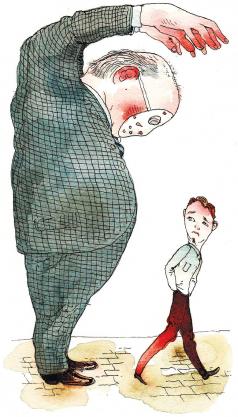
Illustration by Barry Blitt / The New York Times.

If Terrorists Rock the Vote in 2008
By Frank Rich / June 29, 2008

Don’t fault Charles Black, the John McCain adviser, for publicly stating his honest belief that a domestic terrorist attack would be ‘a big advantage’ for their campaign and that Benazir Bhutto’s assassination had ‘helped’ Mr. McCain win the New Hampshire primary. His real sin is that he didn’t come completely clean on his strategic thinking.

In private, he is surely gaming this out further, George Carlin-style. What would be the optimum timing, from the campaign’s perspective, for this terrorist attack – before or after the convention? Would the attack be most useful if it took place in a red state, blue state or swing state? How much would it ‘help’ if the next assassinated foreign leader had a higher name recognition in American households than Benazir Bhutto?

Unlike Hillary Clinton’s rumination about the Bobby Kennedy assassination or Barack Obama’s soliloquy about voters clinging to guns and faith, Mr. Black’s remarks were not an improvisational mishap. He gave his quotes on the record to Fortune magazine. He did so without thinking twice because he was merely saying what much of Washington believes. Terrorism is the one major issue where Mr. McCain soundly vanquishes his Democratic opponent in the polls. Since 2002, it’s been a Beltway axiom akin to E=mc2 that Bomb in American City=G.O.P. Landslide.

That equation was the creation of Karl Rove. Among the only durable legacies of the Bush presidency are the twin fears that Mr. Rove relentlessly pushed on his client’s behalf: fear of terrorism and fear of gays. But these pillars are disintegrating too. They’re propped up mainly by political operatives like Mr. Black and their journalistic camp followers – the last Washington insiders who are still in Mr. Rove’s sway and are still refighting the last political war.

That the old Rove mojo still commands any respect is rather amazing given how blindsided he was by 2006. Two weeks before that year’s midterms, he condescendingly lectured an NPR interviewer about how he devoured ’68 polls a week’ – not a mere 67, mind you – and predicted unequivocally that Election Day would yield ‘a Republican Senate and a Republican House.’ These nights you can still find Mr. Rove hawking his numbers as he peddles similar G.O.P. happy talk to credulous bloviators at Fox News.

But let’s put ourselves in Mr. Black’s shoes and try out the Rove playbook at home – though not in front of the children – by thinking the unthinkable. If a terrorist bomb did detonate in an American city before Election Day, would that automatically be to the Republican ticket’s benefit?

Not necessarily. Some might instead ask why the Bush White House didn’t replace Michael Chertoff as secretary of homeland security after a House report condemned his bungling of Katrina. The man didn’t know what was happening in the New Orleans Convention Center even when it was broadcast on national television.

Next, voters might take a hard look at the antiterrorism warriors of the McCain campaign (and of a potential McCain administration). This is the band of advisers and surrogates that surfaced to attack Mr. Obama two weeks ago for being ‘naïve’ and ‘delusional’ and guilty of a ‘Sept. 10th mind-set’ after he had the gall to agree with the Supreme Court decision on Gitmo detainees. The McCain team’s track record is hardly sterling. It might make America more vulnerable to terrorist attack, not less, were it in power.

Take – please! – the McCain foreign policy adviser, Randy Scheunemann. He was the executive director of the so-called Committee for the Liberation of Iraq, formed in 2002 (with Mr. McCain on board) to gin up the war that diverted American resources from fighting those who attacked us on 9/11 to invading a nation that did not. Thanks to that strategic blunder, a 2008 Qaeda attack could well originate from Pakistan or Afghanistan, where Osama bin Laden’s progeny, liberated by our liberation of Iraq, have been regrouping ever since. On Friday the Pentagon declared that the Taliban has once more ‘coalesced into a resilient insurgency.’ Attacks in eastern Afghanistan are up 40 percent from this time last year, according to the American commander of NATO forces in the region.

Another dubious McCain terror expert is the former C.I.A. director James Woolsey. He (like Charles Black) was a cheerleader for Ahmad Chalabi, the exiled Iraqi leader who helped promote phony Iraqi W.M.D. intelligence in 2002 and who is persona non grata to American officials in Iraq today because of his ties to Iran. Mr. Woolsey, who accuses Mr. Obama of harboring ‘extremely dangerous’ views on terrorism, has demonstrated his own expertise by supporting crackpot theories linking Iraq to the 1995 Oklahoma City bombing and 1993 World Trade Center bombing. On 9/11 and 9/12 he circulated on the three major networks to float the idea that Saddam rather than bin Laden might have ordered the attacks.

Then there is the McCain camp’s star fearmonger, Rudy Giuliani, who has lately taken to railing about Mr. Obama’s supposed failure to learn the lessons of the first twin towers bombing. The lesson America’s Mayor took away from that 1993 attack was to insist that New York City’s emergency command center be located in the World Trade Center. No less an authority than John Lehman, a 9/11 commission member who also serves on the McCain team, has mocked New York’s pre-9/11 emergency plans as ‘not worthy of the Boy Scouts.’

If there’s another 9/11, it’s hard to argue that this gang could have prevented it. At least Mr. Obama, however limited his experience, has called for America to act on actionable terrorist intelligence in Pakistan if Pervez Musharraf won’t. Mr. McCain angrily disagreed with that idea. The relatively passive Pakistan policy he offers instead could well come back to haunt him if a new 9/11 is launched from the Pakistan-Afghanistan border.

Should there be no new terrorist attack, the McCain camp’s efforts to play the old Rove 9/11 fear card may quickly become as laughable as the Giuliani presidential campaign. These days Americans are more frightened of losing their jobs, homes and savings.

But you can’t blame the McCain campaign for clinging to terrorism as a political crutch. The other Rove fear card is even more tattered. In the wake of Larry Craig and Mark Foley, it’s a double-edged sword for the G.O.P. to trot out gay blades cavorting in pride parades in homosexual-panic ads.

Some on the right still hold out hope otherwise. After the California Supreme Court’s decision on same-sex marriage, The Weekly Standard suggested that a brewing backlash could put that state’s ‘electoral votes in play.’ But few others believe so, including the state’s Republican governor, Arnold Schwarzenegger, who has vowed to enforce the law and opposes a ballot initiative to overturn it. Even Bill O’Reilly recently chastised a family-values advocate for mounting politically ineffectual arguments against same-sex marriage.

Mr. McCain is trying to swing both ways. While he no longer refers to the aging old-guard cranks of the religious right as ‘agents of intolerance,’ his actions, starting with his tardy disowning of the endorsement he sought from the intolerant Rev. John Hagee, sometimes speak as loudly as his past words.

The Ohio operative behind that state’s 2004 anti-same-sex marriage campaign was so alienated by Mr. McCain’s emissaries this year that he told The Los Angeles Times, ‘He doesn’t want to associate with us, and we don’t want to associate with him.’ Mr. McCain instead associated himself with Ellen DeGeneres. He visited her talk show to extend his good wishes for her forthcoming California nuptials while seeming almost chagrined to admit his opposition to same-sex marriage, a stand he shares with Mr. Obama. Since then, Mr. McCain has met with the gay Log Cabin Republicans.

He and Mr. Obama also share the antipathy of James Dobson, the Focus on the Family fulminator so avidly courted by the Bush White House. Perhaps best remembered for linking the cartoon character SquareBob SpongePants to a ‘pro-homosexual video,’ Mr. Dobson last week used the word ‘fruitcake’ in a rant against Mr. Obama. He has been nearly as dyspeptic, if not quite as ‘fruit’-fixated, about Mr. McCain.

Mr. Dobson’s embarrassing lashing out is the last gasp of an era. His dying breed of family-values scold is giving way to a new and independent generation of evangelical leaders (and voters) who don’t march to the partisan beat of Mr. Rove or his one-time ally, the disgraced Ralph Reed. Perhaps in belated recognition of this reality, Mr. Rove has been busy lately developing a new fear card for 2008 – fear of the Obamas.

Its racial undertones are naked enough. Earlier this year, Mr. Rove wrote that Mr. Obama was ‘often lazy,’ and that his ‘trash talking’ during a debate was ‘an unattractive carry-over from his days playing pickup basketball at Harvard.’ Last week Mr. Rove caricatured him as the elitist ‘guy at the country club with the beautiful date.’ Provocative as it is to inject Mr. Obama into a setting historically associated with white Republicans, the invocation of that ‘beautiful date’ is even more so. Where’s his beautiful wife? Mr. Rove’s suggestion that Mr. Obama might be a sexual freelancer, as an astute post at the Web site Talking Points Memo noted, could conjure up for a certain audience the image of ‘a white woman on his arm.’

But here, too, Mr. Rove reeks of the past. Should Mr. Black and Mr. McCain follow this ugly lead, I bet it will help them even less than the assassination of Benazir Bhutto.

Source. / New York Times / truthout

The Rag Blog

Posted in RagBlog | Tagged , , , , , , , , , | Leave a comment

For Your Information


Open Records and the Texas Public Information Act.
By nhudson35 / June 28, 2008

The following post on public information in Texas — what it is and how to get it — was published in the Burnt Orange Report. It is chock-full of useful stuff.

I got to sit in on a great meeting several months ago with Attorney Joe Larsen, a Freedom of Information Act of Texas Board Member who has worked on open records cases. Mr. Larsen gave us some and useful information on the Texas Public Information Act. For more information on Open Records Requests, I recommend going to the Freedom of Information Foundation of Texas website here.

Here are some rough notes from the meeting. I am not a lawyer, and this is not legal advice.

What is public information?

Public information is information created, assembled, or maintained by or on behalf of a governmental body, or in transaction of governmental business. Public information may be kept on behalf of a governmental body, and it may extend to the hand of a vendor who maintains a governmental body’s records. A governmental body may delegate responsibility of recordkeeping to an outside body.

You can request public information in any format, but a governmental body does not have to create new information for you.
In a previous age, notes were not public information. Today, most notes created, assembled, or maintained by or on behalf of a governmental body, or in transaction of governmental business, are considered public information.

Emails from a governmental body are generally considered public information, but the Texas Attorney General’s opinions have not kept up with technology. The Attorney General has ruled that emails dealing with personal activities are not public information.

Governor Perry’s office has taken advantage of the Attorney General’s ruling, and open government advocates are upset about it. Perry’s office has a procedure where his and his staffer’s emails are destroyed after seven days. The seven-day period is arbitrary, and it is much shorter than the one to three year period required by law for paper correspondence. Dallas Morning News reported earlier this month:

Since this issue arose last year, the governor’s office has maintained that staffers may delete e-mail from in boxes, but messages dealing with government business is printed and filed.

But government transparency advocates worry that some information may slip through the cracks.

“There’s simply no way that all the e-mails are being printed and filed,” Mr. Larsen said. “In addition to your daily work activity, you have to make sure you’re printing out your emails so that it doesn’t get deleted.”

Rick Perry’s contention that he is printing emails to conform to FOIA requirements seems to be a crock of you-know-what. Public information retention requirements shouldn’t change because the information is kept in different mediums. A policy of deleting emails every seven days will inevitably destroy public information.

Retention requirements depend, instead, upon subject matter. State Libraries, which are charged with retention, have different retention policies for different subject matters. State Libraries have never had a policy that requires them to purge their shelves or electronic files after seven days.

What is a governmental body?

Governmental bodies are specifically defined in theTexas Public Information Act.

Some important notes:

Governmental bodies include DAs, school districts, and any entity supported all or in part by public funds.

The Judiciary is not included.

Case files are subject to common law access and first amendment right access, and you can access case files using Rule 12 of the Texas Rules of Judicial Administration’s

The fact that you receive public funds does not necessarily mean you are subject to public information act. If, however, the Austin Chamber of Commerce gets a grant for their operations, that’s not a quid pro quo. It’s a general grant, and because many chambers of commerce take such grants, they have been found to be governmental bodies.

As a general rule, if a group has a contract with a governmental body, you should assess the relationship and argue that the information the body has should be made public.

Once a governmental body always a governmental body?
No. A group or organization with multiple divisions may have some aspects of their operations subject to FOIA requests, while other operations are not.

Who can request information?

Anyone. And the governmental body may not ask what it is for. You have a right to access the information, and you can be an agent of undisclosed principle.

How do you make a request?

You must put it in writing. Above and beyond that, not much is necessary. Generally, all you must do is mail it to the governmental body. If, however, you make it via email or fax, you should make that request directly to the public information officer. Most entities have a designated public information officer, and you can usually find his or her contact information at the governmental body’s website. It is a good idea to call the public information officer of the governmental body to make sure you’re communicating with the right person.

How do you write it?

Ask specifically for what you’re looking for. Make requests as narrow as you can, consistent with what you’re looking for. This costs less, and is easier to brief for the Attorney General. Be as eloquent and polite as possible. Sidebar snooty comments are not appropriate. Deal professionally with governmental bodies even if they don’t deal professionally with you.

The process

Once a governmental body receives a public information act request, it has ten days to request an Attorney General ruling. In order to withhold the information from the requesting body, the governmental body must show that the requested information falls within an area exception.

A governmental body does not have ten days to turn over the information you’ve requested. The governmental body is required by law to get the information to you promptly. Promptly means as quickly as reasonably possible, and in many cases it may be on the very same day.

If the Governmental Body Claims the requested information falls within a FOIA area of exception

If the governmental body requests a ruling from the Attorney General, they write him a letter. The governmental body must copy the requester when requesting and Attorney General ruling. As soon as possible, submit comments to the Attorney General’s office rebutting the governmental body’s claim that the information falls within an area of exception.

Ask for a copy of a 15 day brief from the Attorney General’s office, and submit comments rebutting the governmental body’s argument for excepting the information you’ve requested.

The Attorney General has 45 working days to issue his ruling, and his office rarely issues a ruling before 45 days. The earlier you get your comments to the Attorney General’s office, the better.

The Attorney General can rule in two ways. He can rule that the information falls within the area of exception, or that it does not. If the Attorney General’s office rules in the requester’s favor, the governmental body has two choices. It can turn over the information, or if the governmental body disagrees with the decision, it can sue the Attorney General.

More on the process

Take the high road. Don’t try anything sneaky.

Put everything in writing.

Develop a relationship with the public information officer you are dealing with.
If you don’t get a response from the Governmental Body, after reasonable attempts to contact them, get in touch with the Attorney General’s office. Style a letter formally as a complaint to the Attorney General, and carbon copy or send a copy of the letter to the governmental body.

There is not a deadline for the cost estimate. If they send you the documents, you don’t owe them a penny.

If they do not request and AG opinion within 10 days, the information is considered public.

A city will sometimes ask for an Attorney General ruling for a discreet part of a request. In instances like that, it may be easier to break down a request into separate requests.

Cost issues
If you have a dispute about the cost estimate, get in touch with the cost administrator at the Attorney General’s office.

Exceptions

Superpublic information
We can’t talk about exceptions without talking about “superpublic” information, which can be found in Chapter 552.022 of government code. Superpublic information is information that must be released, unless confidential by other law: Superpublic information includes budget information, information on vouchers, agency rules, and final reports (with the exception of law enforcement addressed below).

If the governmental body makes a third party settlement, confidentially, the amount of money in the settlement is superpublic information. Items on the list are superpublic, unless confidential by law. The difference between “confidential by law” and the other forms or confidentiality is that confidentiality by law is legally and mandatorily confidential. “Confidential by law” encompasses all confidential laws in Vernon’s Texas Civil Statutes. Examples of information that is confidential by law arein medical records and information a judge rules should be confidential. Information that is confidential by law can never be superpublic. Information submitted in open court cannot be considered confidential under the open records act, and confidentiality statutes must be interpreted narrowly.

Autopsy reports
Autopsy reports were, forever, expressly public. The Attorney General issued a ruling that Autopsy reports included Autopsy photographs. Some schmucks posted the photographs on the web, and an amendment was made to the criminal code of procedure intended to prohibit release of autopsy report photographs unless the individual was in police custody.

The Attorney General issued a ruling that effectively changed the law. Now, in almost all homicides, you cannot get autopsies. You can get the autopsy photographs for individuals in custody, but not the reports.

Law enforcement
You are entitled to basic information about law enforcement. This right has its origins in caselaw. In a Houston chronicle case in the 1970s, the law was revised to says basic information about an arrested person, a crime, and an officer must be released upon request

If you request and incident report from a law enforcement agency, you may be given a synopsis of an incident report. You are entitled to detailed information even if it isn’t on the front page of the incident report.

Personnel records exception. The Public information act does not reach anything that isn’t already covered by common law and constitutional privacy. Will get 95% of personnel files. You can get evaluations and an officer’s salary history.

If you wish to find out about an officer’s case, it must result in deferred adjudication or a conviction before it is public information. Investigations can go on ad infinitum.

The Attorney General is subject to the act. To the extent the Attorney General rules against law enforcement, he rules against himself.

Court Records
Not subject to public information. You need significant cause to seal or close off court records.

Source. / Burnt Orange Report

The Rag Blog

Posted in RagBlog | Tagged , , , , | Leave a comment

If you want to watch today’s vintage video, then just…

…Raise Your Hand

Janis Joplin and Tom Jones 1970

Somehow Tom Jones and Joplin together just gives me the willies but the backup dancers are worth the video. Besides, I think Tom is going to break a hip trying to keep up with her…

sgraham / Hippie Sounds.com.

The Rag Blog

Posted in RagBlog | Tagged , , , , , | Leave a comment

Alternative Media : Reporting From The Ground Up

INSP member paper Hecho en Buenos Aires, Argentina.

Grassroots journalism worldwide:
The power of the street paper

By Silja J.A. Talvi / June 28, 2008

This is how international grassroots journalism, by and for the people, can really look and feel. As for what it can accomplish? The proof is in the pudding, something I got a good taste of last week in Glasgow, Scotland, participating in the 13th annual conference of the International Network of Street Papers (INSP).

In our corporate-dominated media marketplace, an upstart, not-for-profit journalistic enterprise like the INSP is a rare breed indeed. The organization has been around since 1994, initially as the result of a collaborative effort on the part of five, Western European homeless (or “street”) papers. A fiery, opinionated bloke named John Bird founded one of those street papers, The Big Issue, in London. Many of Bird’s life experiences were marked by extreme poverty, as well as horrific experiences of abuse in orphanages, jails and prisons. Now a 62-year-old, Bird still serves as editor-in-chief, having lost neither his survivor’s edge nor his sense of outrage at the ease what he considers disempowering “handouts” to the poor.

The Big Issue has since gone on to become a household name in the United Kingdom—in fact, the paper’s incarnation in Scotland is now that nation’s best-selling weekly news and entertainment magazine. But the INSP hasn’t changed its tune where their central passion is concerned: constant dedication to self-sustaining, skill-building, advocacy journalism for the poor, disenfranchised, and homeless.
Although the INSP’s affiliate publications reach an estimated 32 million readers every year, the organization certainly can’t pretend to have the clout or circulation of, say, AOL-Time Warner or Rupert Murdoch’s fittingly named News Corporation. But those aren’t the arenas in which the INSP is trying to compete. Through their diverse network of more than 90 “street papers” (ranging from down-to-the-basics, black-and-white newspapers to photograph-chocked, full-color magazines), INSP’s member affiliates (with assistance from the integral Street News Service) are busy covering news, cultural and political terrain in 38 countries.

Class structure, poverty, housing, homelessness, the drug war, incarceration, infectious diseases, gang life, racial/ethnic/religious discrimination, police brutality, sex trafficking and prostitution are among frequently covered subjects. With all that in mind, the INSP has to know quite a bit about staying flexible, open-minded, and what it means to be mindful of cultural differences in reporting/reading styles. Yet, there’s no compromise to be made when it comes to the INSP’s mission to inform, enlighten, sustain, and uplift the very people who write for, sell and read their publications.

I went to Glasgow as a volunteer instructor on investigative journalism techniques (especially the more delicate or “controversial” approaches involved in gaining trust with highly marginalized populations), in addition to serving in the capacity as a judge for the INSP’s first-ever journalism awards’ ceremony. (Other editors came from the top rungs of Reuters, Inter Press Service, and Al Jazeera English.) Out of more than 125 entries, a handful of INSP winners were chosen in six categories, ranging from best investigative feature to best cover design.

The location chosen for ceremony, the grand halls of the Kelvingrove Art Gallery, could have easily formed the backdrop for a high-profile film festival. Some of those media-friendly trappings were there already: glasses of bubbly, elegant attire, tearful acceptance speeches, even the blare of musical interludes between awards. The attire, however, was as much traditional Scottish kilt as Ethiopian ceremonial tunic (and everything in between), while those tearful acceptance speeches weren’t about thanking God and the caterer for “making it happen.” Instead, they took the form of painful accounts relating to the imminent or early demise of beloved street paper vendors, whether due to infectious disease, mental illness, late-stage cancer or police murder. These awards were about celebrating success, yes, but they were just as much about addressing the everyday lives of the people writing stories and selling papers from Argentina to Zambia.

“Many of our delegates, partners and guests told me that the 13th Annual Conference of the INSP in Glasgow was the ‘best yet,’ as INSP Executive Director Lisa Maclean enthused after the gala. “There could be many reasons for this: the growing number of delegates (this was the largest INSP conference to date, with 96 delegates from 32 countries); the increased diversity of participants; or the growing representation from the Global South. But I also think that it was clear that the INSP team had listened to our members, providing particularly thoughtful forums for lively and interactive debate, with experts drawn from both the internal membership and external bodies. People really had the opportunity to exchange ideas and gain new ideas and inspiration to improve their local street paper projects.”

I came in to this year’s conference as an eager participant, with no previous experience with the INSP, and left an inspired reader and witness to what I consider to be one of the most moving developments in journalism in the last century. Having gained insight into what’s already been accomplished in the last 15 years, with nowhere near enough fanfare, I can only look forward to spreading the good word about the work ahead.

This is what independent, international grassroots journalism looks like. It isn’t just possible—it’s already happening, and it’s exciting, enduring and, dare I say, revolutionary for all parties concerned.

[Silja J.A. Talvi is an Advisory Board member of Seattle’s twice-monthly investigative street newspaper, Real Change, established in 1994. Real Change is a member of the INSP, and a core content provider for the Street News Service. She is a senior editor at In These Times, an investigative journalist and essayist with credits in dozens of newspapers and magazines nationwide.]

Source. / In These Times

The Austin Advocate is a member of the International Network of Street Papers (INSP).

The Rag Blog

Posted in RagBlog | Tagged , , , | Leave a comment

Draw!

Dario Castillejos / Imparcial de Oaxaca, Oaxaca, Mexico.

The Rag Blog / posted June 28, 2008

Posted in RagBlog | Tagged , , , , , | Leave a comment

Dems Just Love That "Big Bad John"

Ride ’em Corn Dog : Already a Classic

Cornyn video is campaign gold mine;
Race in virtual dead heat

By John Moritz / June 27, 2008

AUSTIN — The sight of U.S. Sen. John Cornyn wearing cowboy threads while an ol’ boy with a Lone Star twang sings his praise was designed to fire up his party’s base.

There was only one hitch in Cornyn’s get-along: The wrong party got fired up.

Turns out the video bio of Cornyn shown at the state GOP convention this month was panned as corn pone by more pundits, bloggers and other smart-mouthed know-it-alls than could fit in the Fort Worth Stockyards.

And it’s the Democrats who are making sure that anyone with a laptop has a chance to see and hear the campaign clip they call “Big Bad John,” complete with a takeoff on Jimmy Dean’s classic song with the same name.

The Democratic Senatorial Campaign Committee posted the video on its Web site and suggested it shows that the urbane and courtly Cornyn is, well, all hat and no cattle.

Here’s a sample of the lyrics: “He rose to the top, in just one term. Kept Texas in power, made lesser states squirm. Big John.”

“We figure it helps our cause more than his,” the Democrats say on their Web site.

The posting came on the heels of Comedy Central’s The Daily Show spoofing the spot, with host Jon Stewart suggesting that Cornyn’s outfit might have come from a store for oversize kids.

Some left-leaning Web sites have called the video Cornyn’s “Michael Dukakis in the tank” moment, recalling the blistering reviews drawn by the 1988 Democratic presidential nominee when he wore a helmet and stood up while riding in a military armored vehicle.

The then-Massachusetts governor ended up looking more silly than soldierly.

Cornyn, a former Texas Supreme Court justice and state attorney general, is in what one poll shows to be a tight race with Democratic state Rep. Rick Noriega of Houston.

A poll of 1,000 likely voters by the nonpartisan Texas Lyceum, a statewide leadership group and think tank, showed Cornyn leading Noriega 38 percent to 36 percent.

The remaining 26 percent of respondents were undecided.

The margin of error was plus or minus 3.1 percentage points.

Daron Shaw, a pollster at the University of Texas at Austin, said he made an extra effort to ensure that the random sample was reflective of the state’s demographics.

Other polls have shown Cornyn with wider leads.

The same poll showed Republican presidential hopeful John McCain to be running ahead of Democrat Barack Obama in Texas by 43 percent to 38 percent.

If the senator was worried that the video’s reviews would make his campaign more difficult, he wasn’t letting on.

“I think it’s hilarious,” he said with a laugh during a conference call with reporters Thursday.

“This was a good-natured introduction we did at the Houston convention a couple of weeks ago.”

When the video was shown at the convention, Cornyn told delegates: “My staff convinced me that it would be a good idea. Maybe I need a new staff.”

Source. / Star-Telegram

Also see Ride ’em, Corn Dog! / The Rag Blog / June 17, 2008

Thanks to Harry Edwards / The Rag Blog

Posted in RagBlog | Tagged , , , , , , , | 2 Comments

I Ran

“Drachen 6” / Irena Vezin.

I Ran

I was so scared, and there was no one to stand up beside me –
I was so weak, and I searched, but there was no place to hide me –
I was so lost, and I knew that I’d made the wrong turning –
Was I less than a man?
I didn’t know, so I Ran.

I Ran – through the darkness, and I never saw you –
I Ran – through the bombs, without hearing your song –
I Ran – through the smoke of my own soul burning –
I Ran straight through to Hell –
When I got there, I fell.

I was so cold, and there was no one to say I still mattered –
I was so sad, and all my bright colors were tattered –
I was so broke, and there was no job where I could be earning –
Was I less than a man?
I didn’t know, so I Ran.

I Ran – though all my friends tried to restrain me –
I Ran – there were funds set aside to retrain me –
I Ran – but I was way too upset to be learning –
I Ran flat out of time –
Can you spare me a dime?

Now it’s so late, and I don’t see I’ve got many choices –
And it’s so hard, to make sense of all of the voices –
If you love me, you’ll know what this song is concerning –
Am I less than a man?
I don’t know, so I Ran!

© 6/28/08 mgwizard

Mariann Wizard
June 28, 2008

The Rag Blog

Posted in Rag Bloggers | Tagged , , , | 6 Comments

Mexico’s Response : A Green Wall

A US Border Patrol vehicle stands guard along the border fence dividing Mexico and the U.S. overlooking Tijuana, Mexico, Friday, June 27, 2008. Photo by Guillermo Arias / AP.

Mexicans protest border fence with (400,000) trees
June 28, 2008

PIEDRAS NEGRAS, Mexico — The first of 400,000 trees are being planted to form a “green wall” in protest of the fence the U.S. is building along the border with Mexico.

The treeline eventually will stretch for 318 miles along the border between the Mexican state of Coahuila and Texas.

Coahuila Gov. Humberto Moreira Valdes says “our wall is of life, and it competes with shame and hate.”

The U.S. government says the fence is critical to security. Critics say it fuels animosity between the two countries and raises environmental and private property concerns.

The mayor of a Texas border town attended the tree planting in Piedras Negras. Eagle Pass Mayor Chad Foster opposes the ongoing construction of 670 miles of border fence.

Source. / AP / Houston Chronicle

Thanks to Harry Edwards / The Rag Blog

Posted in RagBlog | Tagged , , , , | 2 Comments

A Progressive Obama? It Takes a Movement.

FDR, our most progressive president, had the support of a massive labor movement. Photo courtesy of Franklin D. Roosevelt Library and Museum.

Barack Obama: deeply flawed,
and it’s our job to make him better

By Kathy G.

Kathy G. is a shrill feminist, bleeding heart liberal, hardcore policy wonk, political junkie, ardent cinephile, and lover of 19th century novels. She lives in Chicago with her husband and two loveable mutts, where she is attempting, amidst numerous diverting distractions, to complete a Ph.D. in the social sciences.

Steve Russell / The Rag Blog / June 28, 2008

If you’re a liberal Obama supporter, this past week or so has sucked pretty hard. We’ve seen Obama move sharply to the right on a number of fronts, including:

* hiring the centrist, pro-Walmart economist Jason Furman as his economic policy director (and yes, I know that Furman’s done good work on issues like Social Security privatization, but if you’re truly committed to a progressive economic vision, he’s not the guy you’d be hiring);

* naming, as his campaign chief of staff, Jim Messina, who served as chief of staff to Max Baucus, and who appears to strongly support Baucus’s pro-corporate agenda;

* forming a Working Group on National Security that consists mainly of reanimated corpses from the 80s and 90s (Warren Christopher, Sam Nunn, David Boren, Madeleine Albright) rather than fresh, bold new thinkers like Samantha Power;

* making statements that are strongly supportive of NAFTA and that conflict with his position during the primaries (Obama is now saying he won’t unilaterally re-open NAFTA);

* releasing a campaign ad, his first of the general election, which hits on right-wing rather than progressive themes (it emphasizes “cutting taxes” and “moving people from welfare to work” — why not “universal health care” and “getting the hell out of Iraq”?);

* and, finally, throwing his weight behind the FISA “compromise,” which deservedly earned him Atrios’s dreaded “wanker of the day” award.

I’ve gotta say, though — all this was utterly predictable. It’s not only that, once the general election campaign starts, presidential candidates tend to move to the center. It’s that, as I’ve been telling anyone who would listen, Barack Obama is, in substance if not in style, an extremely cautious, utterly conventional, center-left politician. If you want to see real, transformative change in this country, he is not your guy.

The second coming of FDR he is not. As president, I think he’s far more likely to resemble Bill Clinton — except he’ll be a Bill Clinton who can keep it in his pants and will likely be governing with large majorities in both houses of Congress. Which does not thrill me — I never liked Clinton much and held my nose while voting for him.

This is not say Obama is a bad guy at all. He’s whip-smart, he’s a compelling speaker, he’s honest (by “honest” I mean not corrupt, and not — insofar as politicians go, anyway — particularly prone to false or misleading statements, and he has a pretty decent voting record overall. His campaign so far has been most impressive, particularly in the managerial and grassroots organizing departments. I will always give him enormous credit for speaking out against the Iraq War at a time when almost everyone else in public life was running scared. Indeed, after my first choice candidate, John Edwards, dropped out, I chose him over Hillary largely because I think he’s less likely to get us involved in stupid wars than Hillary is (my other reasons were that he’s less tainted by corporate sleaze than she is, and that I thought there was more of a chance he’d be slightly more liberal overall).

And also, it must be said — in case you haven’t noticed, in this country, we do not elect liberal presidents. FDR was a fluke — he was elected when the country was suffering an economic crisis of epic proportions, and even then few believed he’d end up governing as far to the left as he did. LBJ was the other great liberal domestic policy president, but that, too, was a fluke. In the (admittedly totally tasteless) formulation of a friend of mine, the best thing that ever happened to civil rights in this country was the bullet through JFK’s head. It was only in the aftermath of the martyrdom of JFK that the Civil Rights Act, Voting Rights Act, Medicare, Medicaid, etc. could have been passed. And even then, it still required every last ounce of LBJ’s political genius to get them through.

So, in all honesty, I think Obama is about the best we can do. Yes, he opposed the war from the start. But he’s been vague about when he’d start withdrawing troops, and unlike candidates like Bill Richardson, he supports letting residual troops remain. His voting record is decent overall, but it contains some serious disappointments, such as his support of the FISA compromise. Like 95 per cent of the other Democrats in Congress, he’s not exactly a profile in courage.

I’ve been familiar with Barack Obama for a while now. First as my state senator and now as my U.S. senator, he has sometimes greatly impressed me, but often frustrated and disappointed me as well.

He’s an illustrative story: a few years ago, an activist friend of mine was working to pass a bill in the Illinois legislature regulating payday loans. His group met with a number of members of the legislature, including Barack. Many of the elected officials they spoke with told them exactly what they would and would not be able to do. Barack listened sympathetically, but didn’t make any promises or in fact tip his hand in any way (didn’t even say what he wouldn’t be able to do, and that kind of info was useful to my friend’s group). And when push came to shove, Barack didn’t do a damn thing.

My friend (who, by the way, has given money to Obama and voted for him in the primary) said ruefully that he wasn’t particularly surprised: “That’s the Barack Obama I know.” He pointed out that a good chunk of Barack’s campaign donations come from the banking and financial services industry in Illinois and he thinks that was probably the main reason Barack didn’t want to take action on the payday loan issue.

The fact is, in his entire public career Barack Obama has never stuck his neck out for anyone or anything. He’s never once taken on a big, high-profile cause or project that was highly controversial or risked failure. Yes, there’s his early opposition to the war on the one hand; but on the other hand, once he got to the U.S. Senate he did little to, you know, try to stop the war, and his votes on the war have been utterly conventional Democratic votes.

Yet Hillary Clinton, when she was about the age Barack is now, took on the daunting task of developing a health care plan. And even though that ended up being a huge failure, at least she took the risk. If she became president, I truly believe that she’d do her damndest to make universal health care a reality in this country. If John Edwards became president, he’d work like hell to enact his populist economic agenda of universal health care, making it easier to join a union, expanding the EITC, etc.

But Barack Obama? Honestly, I don’t have a freaking clue. I think he’ll govern like the utterly conventional Democrat that he is, but I have no idea what his policy priorities are, or what burning issue drives him.

Over this past election season, on websites and listservs and in conversations, I’ve seen an awful lot of cheap, hacktacular electioneering in favor of one candidate or another. But at the end of the day, I don’t think there was ever all that much of a difference between Hillary and Barack. Or between those two and Edwards, for that matter. Hillary and Barack had voting records and positions on the issues that were close to identical. They’ve both taken shitloads of money from Wall Street, and it’s pretty clear to me that each of them is captive to corporate special interests. Indeed, I interpret Obama’s recent rightward shift — Furman, Messina, the remarks about NAFTA, the FISA compromise — as saying to the corporate interests, “Never fear — we’ll be playing ball as usual with you folks.”

As president, either Barack or Hillary, or Edwards, would be infinitely better than any Republican, but from a progressive point of view, each of them would also far short in some pretty profound and powerful ways.

But you know what? Ultimately, I don’t think that they as individuals are to blame for that. I don’t think Barack, or Hillary, or Edwards, are bad people. I don’t think that Barack Obama, for example, went into politics so he could sell civil liberties down the river in favor of giveaways for the telecom industry. But the incentive structure in politics these days is such that he decided he had more to gain by supporting the FISA “compromise” than by opposing it.

This is where we, as liberals, progressives, lefties, activists, whatever-you-want-to-call-us, come in. I do not believe that our interests are best served by the kind of cheap electioneering we saw over the primary campaign. What would be far more effective would be an independent movement that makes strategic alliances with various political candidates but is also distinctly separate from them.

Instead of shilling for Barack, or Hillary, or whomever, we should have been pressuring the candidates to work for our votes. We should have been pressing them to take firm, non-negotiable positions in favor of things like no immunity for the telecoms, or immediate withdrawal from Iraq with no residual troops. Instead, we were really cheap dates. And when you act like suckers, don’t be surprised when something like Obama’s support for the FISA compromise comes back and bites you in the ass.

If we want real change in this country, the place to look for it is not in our so-called leaders, but in ourselves. What we need, in short, is a movement. Without such a movement, President Obama is not going to be able to achieve a whole lot more than President Clinton or President Carter did. But with such a movement, we may actually get somewhere. FDR was able to achieve great things because he had the strong support of a powerful labor movement. Similarly, the civil rights movement was the wind at LBJ’s back. But I ask you, what will President Obama have?

Obama, like just about every other politician out there, is cautious, but also highly pragmatic. Like everyone else, he responds to incentives. As activists, what we need to do is to move the political center of gravity in this country to the left. To change the incentive structure so that it will be easier for him to do the right thing. This is a far sounder strategy, over both the short and the long term, than waiting for saints or messiahs to come along.

I’ll close with one of my favorite political stories. It concerns my all-time favorite president, FDR. He was meeting with a group of reformers trying to persuade him to support one of their goals. After they finished speaking, FDR said to them, “You’ve convinced me. I want to do it. Now make me do it.”

And that, my friend, is the task at hand.

Do something positive: Support Regina Thomas.

If you’re as disgusted as I am by the way Barack Obama and the rest of the Dems folded like a cheap camera on the FISA issue, do something positive about it — donate money to Georgia state senator Regina Thomas. Thomas is an African-American who is running in the July 15th Democratic primary for Congress in Georgia’s 12th district against the reactionary, pro-war, anti-inheritance tax, anti-immigrant, pro-telecom immunity incumbent, John Barrow. Thomas has sterling progressive credentials and given the fact that she’s running against a conservative white man in a Democratic primary where 70% of voters are African-American, a lot of people think she has an excellent shot at winning.

Bloggers such as Digby, Matt Stoller, and the crew at Firedoglake have already come out in support of Thomas.

To donate money to Regina Thomas via ActBlue, click here.

Kathy G.

Source. / The G Spot / June 21, 2008

Response from Carl Davidson:

I think the conclusion of this is right–we get what we want, some of it anyway, the hard old-fashioned way, organizing our own clout at the base and building upward. The FDR story is a case in point.

But I wouldn’t say he’s ‘deeply flawed.’ Obama is what he is. Obama is a ‘high road’ industrial policy capitalist and multipolar globalist–just read his Cooper Union speech a while back. Clinton is a garden-variety corporate liberal capitalist, which got her on the board of Walmart for years. And McCain is a US hegemonist and an unreconstructed neoliberal capitalist–‘state all evil, market all good’–that kind that says ‘We’re in business to make money, not steel, so we’ll gut these plants and speculate in oil futures, and the workers and towns be damned.’ In other words, the ones who ‘cut taxes’ by putting everything on the China Visa card and got us into this mess.

Actually, truth be told, Obama’s brand of capitalism is best for productive businesses, as opposed to speculators, and does least harm to the working class. He’s never been a socialist, anti-imperialist, or even a consistent progressive or social democrat. That doesn’t mean we can’t press him to be better at what he is or asserts, as in ending the war in 2009, and in promoting and building infrastructure for new green businesses and green jobs for youth. All those solar panels and wave and wind turbines have to be built somewhere by someone. And he has started doing more of this recently, along with his other tacts to the center-right.

We need not be surprised, and in fact it’s one of the reasons we set up ‘Progressives for Obama’ in the first place, knowing this would happen. When your task is to win a majority of Democratic votes and defeat other Democrats in a primary, you put your policy package together in one way. When your task is to win a solid majority of all voters–progressive and center–to isolate and defeat the right, you put it together another way. It’s called politics. What we want to urge, I think, are value-centered politics, where you have a core that keeps you anchored, and avoid any 180 degree turns from one audience to another.

So far, Obama’s been fairly true to his own core values. But we need to understand that while our values overlap with his, they are not entirely the same. As I said earlier, he is what he is, and it will still be the greatest popular electoral victory in my lifetime if we can help put him in the White House. A far more interesting struggle opens up, front and center, the next day. But that’s a problem I’ve also been looking forward to having all my life.

Carl Davidson / The Rag Blog / June 28, 2008

Progressives for Obama.

The Rag Blog

Posted in RagBlog | Tagged , , , , , , , , , , , | Leave a comment

As Long As We Keep Takin’ It, They’ll Keep Giving

You can just hear this asshole saying, “Baby, I didn’t do it …”

Addington: They’ll be Watching Me
By Juan Cole / June 28, 2008

David Addington, Cheney’s legal capo, can’t say whether he authorized waterboarding because he is afraid that al-Qaeda might be watching C-Span.

Al-Qaeda is this crew’s excuse for everything that they always wanted to do before there was any al-Qaeda.

David Addington: ‘al Qaeda May Watch C-SPAN’

Source / Informed Comment

The Rag Blog

Posted in RagBlog | Tagged , | Leave a comment

Drifting Toward Poverty and Serfdom


Reverse Henry-Fordism
By Ernest Partridge / June 17, 2008

There are no sellers without buyers.

That’s the first law of practical economics. Everyone knows this to be true, whether or not one has ever taken a course in Economics. Everyone except, apparently, a few Ph.D economists who seem to forget this rule when they are hired by the Heritage Foundation, the American Enterprise Institute, etc., from which they migrate, back and forth, between offices in Republican administrations and these right-wing think tanks.

For these worthies, the “first law” is replaced by the dogmas of deregulation, “trickle-down” and market fundamentalism: impoverish the masses, throw money at the rich who will then invest it, and then “the invisible hand” of the unregulated free market will bring forth a cornucopia of goods and services.

Never mind that there will be few if any buyers for these consumer goodies.

Henry Ford saw the fallacy of such a policy when he raised the wages of his workers. His competitors in the auto industry were aghast. “Why did you do that?,” they asked. Ford is said to have replied, “If I don’t pay them more, who will buy my cars?”

It took awhile, but Henry Ford was eventually proved to be right. In 1935, in the depths of the great depression, Congress passed the Wagner Act which greatly enhanced the power of labor unions to bargain collectively on behalf of their members. And after World War II, the G.I. Bill allowed millions of returning war veterans to go to college and then to enter the work force as trained professionals. The ranks of the middle class swelled, and as a result of this gain in disposable income, so did the nation’s economy. In an ongoing and sustainable economic symbiosis, the investments of the capitalists “trickled down” to increase the worker’s productivity, income and purchasing power, which in turn “percolated up” to provide generous returns on these investments. Like the fabled golden goose, this economic arrangement promised a perpetual production of “golden eggs” of shared prosperity.

Then came Reaganomics, which allowed the ruling oligarchs with their insatiable appetites for “more, still more,” to dismantle the unions, to cut back workers’ salaries and benefits, to ship manufacturing and management jobs overseas, to starve the tax base through loopholes, regressive tax rates, and off-shore incorporations, and to strip the government of its Constitutionally stipulated function of regulating commerce. (Article One, Section Eight). As most citizens have consequently drifted toward poverty and serfdom, and the government has been taken “to the bathtub” to be drowned, the upward “percolation” has been drying up. Rather than protect and perpetuate the economic system that produced their wealth, the privileged class is cooking and devouring the golden goose.

Senator Bernie Sanders reports the resulting plight of the American middle class:

The economy is doing great, except for 90% of the people in the economy. The reality is that we have the hollowing out of the American economy. Median family income declined by $2500 in the last seven years. 8 million people lost their health insurance. 3 million people lost their pensions. This is a strong economy? You’ve gotta be insane to believe that.

Meanwhile, the richest one percent of the population possesses more wealth than the bottom ninety percent. (See also G. William Domhoff: “Wealth, Income and Power“).
This is how a once-flourishing economy shrivels up and dies: the few who own and control the nation’s wealth refuse to share that wealth with the many who produce that wealth.

Ahead lies ruin for rich and poor alike.

For those with eyes to see, and a willingness to see, the consequences of this unconstrained and unregulated greed are apparent and irrefutable: a constriction of the economy which, unless met immediately with decisive and painful countermeasures, must lead to economic collapse. We can expect no such countermeasures from the Bush (“the fundamentals are sound”) administration. With the bursting of “the housing bubble,” consumer debt has reached its limit: the national credit card is maxed out. Under Bush, the cost of food has doubled, and of gas has tripled. (Neither food nor fuel are counted in Bush’s phony Consumer Price Index, which consequently understates the gravity of current inflation). As the average family spends more on necessities such as food, medical care, home heating and transportation to and from work, “luxuries” simply must drop out. No more vacations. Fewer trips to the movies and to restaurants. Fewer purchases of new cars (the old one will have to do for a few more years). Businesses fail, workers are fired, stocks plunge, unemployment rises, the dollar falls, the cost of imported goods (which means, due to outsourcing, most consumer goods) rise. Still less disposable income to pay for higher priced goods and services. More businesses fail, more workers are fired, etc. Down, down, down, goes the spiral.

“No sellers without buyers.” It’s so obvious, so indisputable, even tautological. How can anyone doubt this fundamental rule of practical economics, much less promote policies that defy it? Answer: because just as history is written by the victors, political/economic dogma is written and taught by those with great wealth and power. And anti-government, trickle-down, market absolutism are the dogmas of those who own and control the nation’s wealth: dogmas that Friedrich Nietzsche called “a master morality,” and that John Kenneth Galbraith characterized as a “moral justification for selfishness.”

History provides numerous examples of such “justifications” by those privileged with wealth and power. Out of the middle ages came the doctrine of “the Divine right” of royalty to rule in luxury. This was supplanted by the Protestant claim that personal wealth was the sign of Divine grace. In the gilded age of the late nineteenth century, the Robber Barons embraced the theory of “social Darwinism;” their wealth proved their superior “fitness” to survive. And now we have the regressive dogmas of Reaganism, of Bushism, and, let’s admit it, to some degree at least, of Clintonism: “trickle down,” unconstrained capitalism, the wealth of the few as the key to the wealth of all others. “The rising tide” that lifts all yachts, the regressives assure us, lifts the dingys as well.

The fundamental error of “trickle down” economics is not that it is false, but that it is a pernicious half-truth. As noted above, in a healthy economy, investments do in fact yield results that “trickle down” to the benefit of the workers and the public at large. But as Abraham Lincoln correctly noted in his first inaugural address, “Labor is prior to, and independent of, capital. Capital is only the fruit of labor, and could never have existed if Labor had not first existed.” Thus “trickled-down” benefits of investment presuppose the “percolated-up” wealth that is produced by labor. An economic theory that touts “trickle-down” benefits of investment to the neglect of the production of labor and the well-being of the workers, is a theory that must fail in its application.

The doctrines of regressive economics – “trickle down,” market absolutism, minimalist government – are dogmas in the literal sense of that word: like creationism and dialectical materialism (Marxism-Leninism), they are believed and promulgated independently of evidence and practical experience. If they are applied and fail, there is always an excuse at hand that does not allow a suspicion that the dogma itself may be flawed. In contrast, progressive economics is empirical, experimental and pragmatic: constant in ends, and adaptable in means. As with numerous schemes in FDR’s New Deal, the progressive policy is tried and, if it fails, it is discarded and a new approach is attempted, and so on until policy is found that “works.” (For an expansion of this point, see my “Beautiful Theory vs. Baffling Reality.”).

The public must reject these false dogmas of regressive economics, and the sooner the better; better for both the public in general and for the oligarchs. The longer that these dogmas dictate public economic policy, the greater will be the fall and the greater will be the retaliation of the people against their oppressors.

No untried utopian schemes need to be invented to replace the current kleptocracy. Only a restoration of a system that has proven itself in the past: a regulated capitalism combined with a social democracy dedicated to the welfare of all citizens and founded on the consent of an informed public as manifested in honest, accurate and verifiable elections. And that latter condition presupposes the existence of a free, independent and diverse media, along with a public education system staffed with well-paid, competent and dedicated teachers.

In short, what is required is a return to the liberalism – “the New Deal,” “The Fair Deal,” “The New Frontier,” “The Great Society” – that Ronald Reagan and the regressives have abolished in the past twenty-seven years. The programs and policies of Reagan’s liberal predecessors were all imperfect, as are all human endeavors, but unlike the regressive politics of today, these earlier administrations had within themselves the means of adaptation, correction and improvement.

We the people know the way out of the political and economic morass in which we find ourselves. But if we are to escape, we must do so ourselves. We can expect no help from the corporate media or from the politicians of both political parties that have led us into the present crisis.

(Note: These ideas are presented and defended at greater length in “Remedial Economics for Regressives,” Chapter 9 of my book in progress, Conscience of a Progressive).

Copyright 2008 by Ernest Partridge

Source / Crisis Papers

The Rag Blog

Posted in RagBlog | Tagged , , | Leave a comment

Hugo Chavez: A Commitment to Democracy, Egalitarianism and Civil Liberties


Chavez, not Bush, upholds U.S. ideals
By Jesús Rivas/ June 27, 2008

Venezuelan President Hugo Chavez often uses very harsh language when referring to President Bush. And the mainstream media in the United States always rushes to describe Chavez as ”anti-American.“

They neglect to report that Chavez always goes out of his way to show support for America’s poor, who suffer from an oppressive ruling elite. He has gone far past the rhetoric, putting his checkbook where his mouth is.

Venezuela-owned Citgo has donated millions of gallons of heating oil to more than 200 indigenous communities, 250 homeless shelters and an estimated 2 million low-income Americans in 23 states — a $100 million-plus contribution.

This is not only solid support for America but also much better than U.S. oil companies, which have refused to engage in similar efforts despite repeated requests from various state representatives.

So, although Chavez’s position is strongly anti-Bush, it is clear that it is not anti-American. I would like to think that the United States is more than just one person.

So, what is America? A superficial answer would say that it is a piece of land, and Americans are the people born on it. But some Americans blow off the tops of mountains to extract carbon for profit. They pour massive amounts of toxic sludge into open pits that ends up polluting and poisoning every thing that lives on the land.

America cannot be just a piece of land because these people exert unspeakable violence against the land, and no one calls them anti-American.

Furthermore, there was a time in which people born on this land where not American citizens; they were representatives of the many indigenous nations that once populated the continent. There was a later time when people born in this land were British subjects. What happened between then and now is what makes this America: the Declaration of Independence and the U.S. Constitution.

That is what America really is: an egalitarian nation of principles, laws and liberties.

So, is Chavez really anti-American? He has honored tremendously egalitarian principles in Venezuela, giving all the people the same rights regardless of their economic status, ethnicity, gender, sexual orientation or origin. He has shown unprecedented respect for every conceivable civil liberty and human right, including every right we have in the United States and others that are not regarded as such in the this country: the right to have three meals a day, to have decent housing, to earn decent wages while working humane hours, to have health care and an education.

Chavez has promoted the creation of 266 community radio and TV stations, giving real muscle to the principle of free speech. This gives people not only the right to speak their minds but also a voice with which they may be heard.

During his nine years in office, there have been more than 11 electoral processes monitored and certified by hundreds of international observers — a lot more than can be said about the U.S. elections.

Chavez’s commitment to democracy, egalitarianism and civil liberties complies completely with the mandates of the U.S. Constitution, making him an exemplary American.

His only fault is that he extends those principles and rights to everybody, even those born outside Venezuelan and U.S. borders.

But that is not at odds with the idea that ”all men are created equal,“ which is the cornerstone of this country’s foundation.

If we want to find someone who is truly anti-American, we should look for someone who claims the right to torture prisoners and creates overseas torture camps.

Someone who uses our military might to loot other countries in violation of basic principles and international laws.

Someone who violates the separation of powers by ignoring the U.S. Supreme Court rulings and adding signing statements to bills passed by Congress.

Someone who takes health coverage away from poor children and families, who spied on U.S. citizens, who rigged elections, who eliminated due process, who imprisons journalists.

If we found someone whose crimes against the Constitution were too many to list, we would have found a true anti-American.

[Jess A. Rivas of Somerset is an assistant Somerset Community College. E-mail him at jesus.rivas@kctcs.edu.]

Source / Axis of Logic

The Rag Blog

Posted in RagBlog | Tagged , , | Leave a comment