
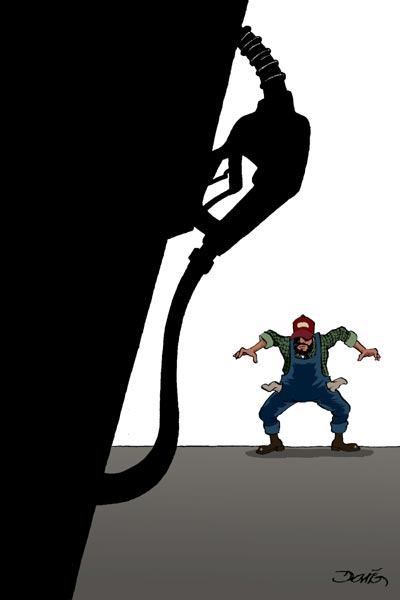
The Rag Blog / posted June 28, 2008
Cornyn video is campaign gold mine;
Race in virtual dead heat
By John Moritz / June 27, 2008
AUSTIN — The sight of U.S. Sen. John Cornyn wearing cowboy threads while an ol’ boy with a Lone Star twang sings his praise was designed to fire up his party’s base.
There was only one hitch in Cornyn’s get-along: The wrong party got fired up.
Turns out the video bio of Cornyn shown at the state GOP convention this month was panned as corn pone by more pundits, bloggers and other smart-mouthed know-it-alls than could fit in the Fort Worth Stockyards.
And it’s the Democrats who are making sure that anyone with a laptop has a chance to see and hear the campaign clip they call “Big Bad John,” complete with a takeoff on Jimmy Dean’s classic song with the same name.
The Democratic Senatorial Campaign Committee posted the video on its Web site and suggested it shows that the urbane and courtly Cornyn is, well, all hat and no cattle.
Here’s a sample of the lyrics: “He rose to the top, in just one term. Kept Texas in power, made lesser states squirm. Big John.”
“We figure it helps our cause more than his,” the Democrats say on their Web site.
The posting came on the heels of Comedy Central’s The Daily Show spoofing the spot, with host Jon Stewart suggesting that Cornyn’s outfit might have come from a store for oversize kids.
Some left-leaning Web sites have called the video Cornyn’s “Michael Dukakis in the tank” moment, recalling the blistering reviews drawn by the 1988 Democratic presidential nominee when he wore a helmet and stood up while riding in a military armored vehicle.
The then-Massachusetts governor ended up looking more silly than soldierly.
Cornyn, a former Texas Supreme Court justice and state attorney general, is in what one poll shows to be a tight race with Democratic state Rep. Rick Noriega of Houston.
A poll of 1,000 likely voters by the nonpartisan Texas Lyceum, a statewide leadership group and think tank, showed Cornyn leading Noriega 38 percent to 36 percent.
The remaining 26 percent of respondents were undecided.
The margin of error was plus or minus 3.1 percentage points.
Daron Shaw, a pollster at the University of Texas at Austin, said he made an extra effort to ensure that the random sample was reflective of the state’s demographics.
Other polls have shown Cornyn with wider leads.
The same poll showed Republican presidential hopeful John McCain to be running ahead of Democrat Barack Obama in Texas by 43 percent to 38 percent.
If the senator was worried that the video’s reviews would make his campaign more difficult, he wasn’t letting on.
“I think it’s hilarious,” he said with a laugh during a conference call with reporters Thursday.
“This was a good-natured introduction we did at the Houston convention a couple of weeks ago.”
When the video was shown at the convention, Cornyn told delegates: “My staff convinced me that it would be a good idea. Maybe I need a new staff.”
Source. / Star-Telegram
Also see Ride ’em, Corn Dog! / The Rag Blog / June 17, 2008
Thanks to Harry Edwards / The Rag Blog
I was so scared, and there was no one to stand up beside me –
I was so weak, and I searched, but there was no place to hide me –
I was so lost, and I knew that I’d made the wrong turning –
Was I less than a man?
I didn’t know, so I Ran.
I Ran – through the darkness, and I never saw you –
I Ran – through the bombs, without hearing your song –
I Ran – through the smoke of my own soul burning –
I Ran straight through to Hell –
When I got there, I fell.
I was so cold, and there was no one to say I still mattered –
I was so sad, and all my bright colors were tattered –
I was so broke, and there was no job where I could be earning –
Was I less than a man?
I didn’t know, so I Ran.
I Ran – though all my friends tried to restrain me –
I Ran – there were funds set aside to retrain me –
I Ran – but I was way too upset to be learning –
I Ran flat out of time –
Can you spare me a dime?
Now it’s so late, and I don’t see I’ve got many choices –
And it’s so hard, to make sense of all of the voices –
If you love me, you’ll know what this song is concerning –
Am I less than a man?
I don’t know, so I Ran!
© 6/28/08 mgwizard
Mariann Wizard
June 28, 2008
The Rag Blog

PIEDRAS NEGRAS, Mexico — The first of 400,000 trees are being planted to form a “green wall” in protest of the fence the U.S. is building along the border with Mexico.
The treeline eventually will stretch for 318 miles along the border between the Mexican state of Coahuila and Texas.
Coahuila Gov. Humberto Moreira Valdes says “our wall is of life, and it competes with shame and hate.”
The U.S. government says the fence is critical to security. Critics say it fuels animosity between the two countries and raises environmental and private property concerns.
The mayor of a Texas border town attended the tree planting in Piedras Negras. Eagle Pass Mayor Chad Foster opposes the ongoing construction of 670 miles of border fence.
Source. / AP / Houston Chronicle
Thanks to Harry Edwards / The Rag Blog
Kathy G. is a shrill feminist, bleeding heart liberal, hardcore policy wonk, political junkie, ardent cinephile, and lover of 19th century novels. She lives in Chicago with her husband and two loveable mutts, where she is attempting, amidst numerous diverting distractions, to complete a Ph.D. in the social sciences.
Steve Russell / The Rag Blog / June 28, 2008
If you’re a liberal Obama supporter, this past week or so has sucked pretty hard. We’ve seen Obama move sharply to the right on a number of fronts, including:
* hiring the centrist, pro-Walmart economist Jason Furman as his economic policy director (and yes, I know that Furman’s done good work on issues like Social Security privatization, but if you’re truly committed to a progressive economic vision, he’s not the guy you’d be hiring);
* naming, as his campaign chief of staff, Jim Messina, who served as chief of staff to Max Baucus, and who appears to strongly support Baucus’s pro-corporate agenda;
* forming a Working Group on National Security that consists mainly of reanimated corpses from the 80s and 90s (Warren Christopher, Sam Nunn, David Boren, Madeleine Albright) rather than fresh, bold new thinkers like Samantha Power;
* making statements that are strongly supportive of NAFTA and that conflict with his position during the primaries (Obama is now saying he won’t unilaterally re-open NAFTA);
* releasing a campaign ad, his first of the general election, which hits on right-wing rather than progressive themes (it emphasizes “cutting taxes” and “moving people from welfare to work” — why not “universal health care” and “getting the hell out of Iraq”?);
* and, finally, throwing his weight behind the FISA “compromise,” which deservedly earned him Atrios’s dreaded “wanker of the day” award.
I’ve gotta say, though — all this was utterly predictable. It’s not only that, once the general election campaign starts, presidential candidates tend to move to the center. It’s that, as I’ve been telling anyone who would listen, Barack Obama is, in substance if not in style, an extremely cautious, utterly conventional, center-left politician. If you want to see real, transformative change in this country, he is not your guy.
The second coming of FDR he is not. As president, I think he’s far more likely to resemble Bill Clinton — except he’ll be a Bill Clinton who can keep it in his pants and will likely be governing with large majorities in both houses of Congress. Which does not thrill me — I never liked Clinton much and held my nose while voting for him.
This is not say Obama is a bad guy at all. He’s whip-smart, he’s a compelling speaker, he’s honest (by “honest” I mean not corrupt, and not — insofar as politicians go, anyway — particularly prone to false or misleading statements, and he has a pretty decent voting record overall. His campaign so far has been most impressive, particularly in the managerial and grassroots organizing departments. I will always give him enormous credit for speaking out against the Iraq War at a time when almost everyone else in public life was running scared. Indeed, after my first choice candidate, John Edwards, dropped out, I chose him over Hillary largely because I think he’s less likely to get us involved in stupid wars than Hillary is (my other reasons were that he’s less tainted by corporate sleaze than she is, and that I thought there was more of a chance he’d be slightly more liberal overall).
And also, it must be said — in case you haven’t noticed, in this country, we do not elect liberal presidents. FDR was a fluke — he was elected when the country was suffering an economic crisis of epic proportions, and even then few believed he’d end up governing as far to the left as he did. LBJ was the other great liberal domestic policy president, but that, too, was a fluke. In the (admittedly totally tasteless) formulation of a friend of mine, the best thing that ever happened to civil rights in this country was the bullet through JFK’s head. It was only in the aftermath of the martyrdom of JFK that the Civil Rights Act, Voting Rights Act, Medicare, Medicaid, etc. could have been passed. And even then, it still required every last ounce of LBJ’s political genius to get them through.
So, in all honesty, I think Obama is about the best we can do. Yes, he opposed the war from the start. But he’s been vague about when he’d start withdrawing troops, and unlike candidates like Bill Richardson, he supports letting residual troops remain. His voting record is decent overall, but it contains some serious disappointments, such as his support of the FISA compromise. Like 95 per cent of the other Democrats in Congress, he’s not exactly a profile in courage.
I’ve been familiar with Barack Obama for a while now. First as my state senator and now as my U.S. senator, he has sometimes greatly impressed me, but often frustrated and disappointed me as well.
He’s an illustrative story: a few years ago, an activist friend of mine was working to pass a bill in the Illinois legislature regulating payday loans. His group met with a number of members of the legislature, including Barack. Many of the elected officials they spoke with told them exactly what they would and would not be able to do. Barack listened sympathetically, but didn’t make any promises or in fact tip his hand in any way (didn’t even say what he wouldn’t be able to do, and that kind of info was useful to my friend’s group). And when push came to shove, Barack didn’t do a damn thing.
My friend (who, by the way, has given money to Obama and voted for him in the primary) said ruefully that he wasn’t particularly surprised: “That’s the Barack Obama I know.” He pointed out that a good chunk of Barack’s campaign donations come from the banking and financial services industry in Illinois and he thinks that was probably the main reason Barack didn’t want to take action on the payday loan issue.
The fact is, in his entire public career Barack Obama has never stuck his neck out for anyone or anything. He’s never once taken on a big, high-profile cause or project that was highly controversial or risked failure. Yes, there’s his early opposition to the war on the one hand; but on the other hand, once he got to the U.S. Senate he did little to, you know, try to stop the war, and his votes on the war have been utterly conventional Democratic votes.
Yet Hillary Clinton, when she was about the age Barack is now, took on the daunting task of developing a health care plan. And even though that ended up being a huge failure, at least she took the risk. If she became president, I truly believe that she’d do her damndest to make universal health care a reality in this country. If John Edwards became president, he’d work like hell to enact his populist economic agenda of universal health care, making it easier to join a union, expanding the EITC, etc.
But Barack Obama? Honestly, I don’t have a freaking clue. I think he’ll govern like the utterly conventional Democrat that he is, but I have no idea what his policy priorities are, or what burning issue drives him.
Over this past election season, on websites and listservs and in conversations, I’ve seen an awful lot of cheap, hacktacular electioneering in favor of one candidate or another. But at the end of the day, I don’t think there was ever all that much of a difference between Hillary and Barack. Or between those two and Edwards, for that matter. Hillary and Barack had voting records and positions on the issues that were close to identical. They’ve both taken shitloads of money from Wall Street, and it’s pretty clear to me that each of them is captive to corporate special interests. Indeed, I interpret Obama’s recent rightward shift — Furman, Messina, the remarks about NAFTA, the FISA compromise — as saying to the corporate interests, “Never fear — we’ll be playing ball as usual with you folks.”
As president, either Barack or Hillary, or Edwards, would be infinitely better than any Republican, but from a progressive point of view, each of them would also far short in some pretty profound and powerful ways.
But you know what? Ultimately, I don’t think that they as individuals are to blame for that. I don’t think Barack, or Hillary, or Edwards, are bad people. I don’t think that Barack Obama, for example, went into politics so he could sell civil liberties down the river in favor of giveaways for the telecom industry. But the incentive structure in politics these days is such that he decided he had more to gain by supporting the FISA “compromise” than by opposing it.
This is where we, as liberals, progressives, lefties, activists, whatever-you-want-to-call-us, come in. I do not believe that our interests are best served by the kind of cheap electioneering we saw over the primary campaign. What would be far more effective would be an independent movement that makes strategic alliances with various political candidates but is also distinctly separate from them.
Instead of shilling for Barack, or Hillary, or whomever, we should have been pressuring the candidates to work for our votes. We should have been pressing them to take firm, non-negotiable positions in favor of things like no immunity for the telecoms, or immediate withdrawal from Iraq with no residual troops. Instead, we were really cheap dates. And when you act like suckers, don’t be surprised when something like Obama’s support for the FISA compromise comes back and bites you in the ass.
If we want real change in this country, the place to look for it is not in our so-called leaders, but in ourselves. What we need, in short, is a movement. Without such a movement, President Obama is not going to be able to achieve a whole lot more than President Clinton or President Carter did. But with such a movement, we may actually get somewhere. FDR was able to achieve great things because he had the strong support of a powerful labor movement. Similarly, the civil rights movement was the wind at LBJ’s back. But I ask you, what will President Obama have?
Obama, like just about every other politician out there, is cautious, but also highly pragmatic. Like everyone else, he responds to incentives. As activists, what we need to do is to move the political center of gravity in this country to the left. To change the incentive structure so that it will be easier for him to do the right thing. This is a far sounder strategy, over both the short and the long term, than waiting for saints or messiahs to come along.
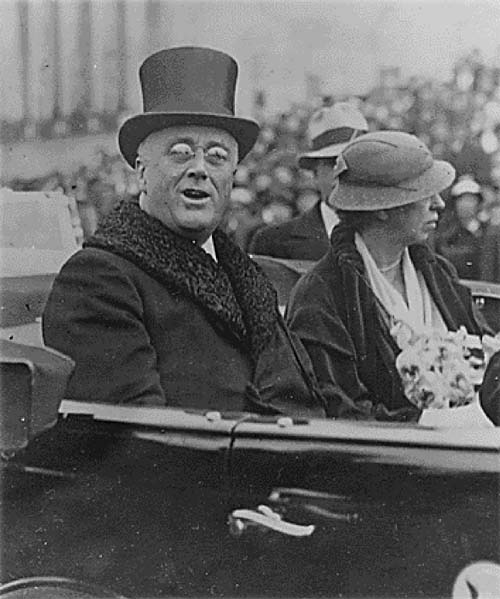
I’ll close with one of my favorite political stories. It concerns my all-time favorite president, FDR. He was meeting with a group of reformers trying to persuade him to support one of their goals. After they finished speaking, FDR said to them, “You’ve convinced me. I want to do it. Now make me do it.”
And that, my friend, is the task at hand.
Do something positive: Support Regina Thomas.
If you’re as disgusted as I am by the way Barack Obama and the rest of the Dems folded like a cheap camera on the FISA issue, do something positive about it — donate money to Georgia state senator Regina Thomas. Thomas is an African-American who is running in the July 15th Democratic primary for Congress in Georgia’s 12th district against the reactionary, pro-war, anti-inheritance tax, anti-immigrant, pro-telecom immunity incumbent, John Barrow. Thomas has sterling progressive credentials and given the fact that she’s running against a conservative white man in a Democratic primary where 70% of voters are African-American, a lot of people think she has an excellent shot at winning.
Bloggers such as Digby, Matt Stoller, and the crew at Firedoglake have already come out in support of Thomas.
To donate money to Regina Thomas via ActBlue, click here.
Kathy G.
Source. / The G Spot / June 21, 2008
Response from Carl Davidson:
I think the conclusion of this is right–we get what we want, some of it anyway, the hard old-fashioned way, organizing our own clout at the base and building upward. The FDR story is a case in point.
But I wouldn’t say he’s ‘deeply flawed.’ Obama is what he is. Obama is a ‘high road’ industrial policy capitalist and multipolar globalist–just read his Cooper Union speech a while back. Clinton is a garden-variety corporate liberal capitalist, which got her on the board of Walmart for years. And McCain is a US hegemonist and an unreconstructed neoliberal capitalist–‘state all evil, market all good’–that kind that says ‘We’re in business to make money, not steel, so we’ll gut these plants and speculate in oil futures, and the workers and towns be damned.’ In other words, the ones who ‘cut taxes’ by putting everything on the China Visa card and got us into this mess.
Actually, truth be told, Obama’s brand of capitalism is best for productive businesses, as opposed to speculators, and does least harm to the working class. He’s never been a socialist, anti-imperialist, or even a consistent progressive or social democrat. That doesn’t mean we can’t press him to be better at what he is or asserts, as in ending the war in 2009, and in promoting and building infrastructure for new green businesses and green jobs for youth. All those solar panels and wave and wind turbines have to be built somewhere by someone. And he has started doing more of this recently, along with his other tacts to the center-right.
We need not be surprised, and in fact it’s one of the reasons we set up ‘Progressives for Obama’ in the first place, knowing this would happen. When your task is to win a majority of Democratic votes and defeat other Democrats in a primary, you put your policy package together in one way. When your task is to win a solid majority of all voters–progressive and center–to isolate and defeat the right, you put it together another way. It’s called politics. What we want to urge, I think, are value-centered politics, where you have a core that keeps you anchored, and avoid any 180 degree turns from one audience to another.
So far, Obama’s been fairly true to his own core values. But we need to understand that while our values overlap with his, they are not entirely the same. As I said earlier, he is what he is, and it will still be the greatest popular electoral victory in my lifetime if we can help put him in the White House. A far more interesting struggle opens up, front and center, the next day. But that’s a problem I’ve also been looking forward to having all my life.
Carl Davidson / The Rag Blog / June 28, 2008
The Rag Blog
David Addington, Cheney’s legal capo, can’t say whether he authorized waterboarding because he is afraid that al-Qaeda might be watching C-Span.
Al-Qaeda is this crew’s excuse for everything that they always wanted to do before there was any al-Qaeda.
David Addington: ‘al Qaeda May Watch C-SPAN’
Source / Informed Comment
The Rag Blog

Reverse Henry-Fordism
By Ernest Partridge / June 17, 2008
There are no sellers without buyers.
That’s the first law of practical economics. Everyone knows this to be true, whether or not one has ever taken a course in Economics. Everyone except, apparently, a few Ph.D economists who seem to forget this rule when they are hired by the Heritage Foundation, the American Enterprise Institute, etc., from which they migrate, back and forth, between offices in Republican administrations and these right-wing think tanks.
For these worthies, the “first law” is replaced by the dogmas of deregulation, “trickle-down” and market fundamentalism: impoverish the masses, throw money at the rich who will then invest it, and then “the invisible hand” of the unregulated free market will bring forth a cornucopia of goods and services.
Never mind that there will be few if any buyers for these consumer goodies.
Henry Ford saw the fallacy of such a policy when he raised the wages of his workers. His competitors in the auto industry were aghast. “Why did you do that?,” they asked. Ford is said to have replied, “If I don’t pay them more, who will buy my cars?”
It took awhile, but Henry Ford was eventually proved to be right. In 1935, in the depths of the great depression, Congress passed the Wagner Act which greatly enhanced the power of labor unions to bargain collectively on behalf of their members. And after World War II, the G.I. Bill allowed millions of returning war veterans to go to college and then to enter the work force as trained professionals. The ranks of the middle class swelled, and as a result of this gain in disposable income, so did the nation’s economy. In an ongoing and sustainable economic symbiosis, the investments of the capitalists “trickled down” to increase the worker’s productivity, income and purchasing power, which in turn “percolated up” to provide generous returns on these investments. Like the fabled golden goose, this economic arrangement promised a perpetual production of “golden eggs” of shared prosperity.
Then came Reaganomics, which allowed the ruling oligarchs with their insatiable appetites for “more, still more,” to dismantle the unions, to cut back workers’ salaries and benefits, to ship manufacturing and management jobs overseas, to starve the tax base through loopholes, regressive tax rates, and off-shore incorporations, and to strip the government of its Constitutionally stipulated function of regulating commerce. (Article One, Section Eight). As most citizens have consequently drifted toward poverty and serfdom, and the government has been taken “to the bathtub” to be drowned, the upward “percolation” has been drying up. Rather than protect and perpetuate the economic system that produced their wealth, the privileged class is cooking and devouring the golden goose.
Senator Bernie Sanders reports the resulting plight of the American middle class:
The economy is doing great, except for 90% of the people in the economy. The reality is that we have the hollowing out of the American economy. Median family income declined by $2500 in the last seven years. 8 million people lost their health insurance. 3 million people lost their pensions. This is a strong economy? You’ve gotta be insane to believe that.
Meanwhile, the richest one percent of the population possesses more wealth than the bottom ninety percent. (See also G. William Domhoff: “Wealth, Income and Power“).
This is how a once-flourishing economy shrivels up and dies: the few who own and control the nation’s wealth refuse to share that wealth with the many who produce that wealth.
Ahead lies ruin for rich and poor alike.
For those with eyes to see, and a willingness to see, the consequences of this unconstrained and unregulated greed are apparent and irrefutable: a constriction of the economy which, unless met immediately with decisive and painful countermeasures, must lead to economic collapse. We can expect no such countermeasures from the Bush (“the fundamentals are sound”) administration. With the bursting of “the housing bubble,” consumer debt has reached its limit: the national credit card is maxed out. Under Bush, the cost of food has doubled, and of gas has tripled. (Neither food nor fuel are counted in Bush’s phony Consumer Price Index, which consequently understates the gravity of current inflation). As the average family spends more on necessities such as food, medical care, home heating and transportation to and from work, “luxuries” simply must drop out. No more vacations. Fewer trips to the movies and to restaurants. Fewer purchases of new cars (the old one will have to do for a few more years). Businesses fail, workers are fired, stocks plunge, unemployment rises, the dollar falls, the cost of imported goods (which means, due to outsourcing, most consumer goods) rise. Still less disposable income to pay for higher priced goods and services. More businesses fail, more workers are fired, etc. Down, down, down, goes the spiral.
“No sellers without buyers.” It’s so obvious, so indisputable, even tautological. How can anyone doubt this fundamental rule of practical economics, much less promote policies that defy it? Answer: because just as history is written by the victors, political/economic dogma is written and taught by those with great wealth and power. And anti-government, trickle-down, market absolutism are the dogmas of those who own and control the nation’s wealth: dogmas that Friedrich Nietzsche called “a master morality,” and that John Kenneth Galbraith characterized as a “moral justification for selfishness.”
History provides numerous examples of such “justifications” by those privileged with wealth and power. Out of the middle ages came the doctrine of “the Divine right” of royalty to rule in luxury. This was supplanted by the Protestant claim that personal wealth was the sign of Divine grace. In the gilded age of the late nineteenth century, the Robber Barons embraced the theory of “social Darwinism;” their wealth proved their superior “fitness” to survive. And now we have the regressive dogmas of Reaganism, of Bushism, and, let’s admit it, to some degree at least, of Clintonism: “trickle down,” unconstrained capitalism, the wealth of the few as the key to the wealth of all others. “The rising tide” that lifts all yachts, the regressives assure us, lifts the dingys as well.
The fundamental error of “trickle down” economics is not that it is false, but that it is a pernicious half-truth. As noted above, in a healthy economy, investments do in fact yield results that “trickle down” to the benefit of the workers and the public at large. But as Abraham Lincoln correctly noted in his first inaugural address, “Labor is prior to, and independent of, capital. Capital is only the fruit of labor, and could never have existed if Labor had not first existed.” Thus “trickled-down” benefits of investment presuppose the “percolated-up” wealth that is produced by labor. An economic theory that touts “trickle-down” benefits of investment to the neglect of the production of labor and the well-being of the workers, is a theory that must fail in its application.
The doctrines of regressive economics – “trickle down,” market absolutism, minimalist government – are dogmas in the literal sense of that word: like creationism and dialectical materialism (Marxism-Leninism), they are believed and promulgated independently of evidence and practical experience. If they are applied and fail, there is always an excuse at hand that does not allow a suspicion that the dogma itself may be flawed. In contrast, progressive economics is empirical, experimental and pragmatic: constant in ends, and adaptable in means. As with numerous schemes in FDR’s New Deal, the progressive policy is tried and, if it fails, it is discarded and a new approach is attempted, and so on until policy is found that “works.” (For an expansion of this point, see my “Beautiful Theory vs. Baffling Reality.”).
The public must reject these false dogmas of regressive economics, and the sooner the better; better for both the public in general and for the oligarchs. The longer that these dogmas dictate public economic policy, the greater will be the fall and the greater will be the retaliation of the people against their oppressors.
No untried utopian schemes need to be invented to replace the current kleptocracy. Only a restoration of a system that has proven itself in the past: a regulated capitalism combined with a social democracy dedicated to the welfare of all citizens and founded on the consent of an informed public as manifested in honest, accurate and verifiable elections. And that latter condition presupposes the existence of a free, independent and diverse media, along with a public education system staffed with well-paid, competent and dedicated teachers.
In short, what is required is a return to the liberalism – “the New Deal,” “The Fair Deal,” “The New Frontier,” “The Great Society” – that Ronald Reagan and the regressives have abolished in the past twenty-seven years. The programs and policies of Reagan’s liberal predecessors were all imperfect, as are all human endeavors, but unlike the regressive politics of today, these earlier administrations had within themselves the means of adaptation, correction and improvement.
We the people know the way out of the political and economic morass in which we find ourselves. But if we are to escape, we must do so ourselves. We can expect no help from the corporate media or from the politicians of both political parties that have led us into the present crisis.
(Note: These ideas are presented and defended at greater length in “Remedial Economics for Regressives,” Chapter 9 of my book in progress, Conscience of a Progressive).
Copyright 2008 by Ernest Partridge
Source / Crisis Papers
The Rag Blog
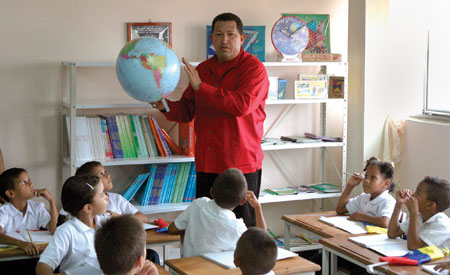
Chavez, not Bush, upholds U.S. ideals
By Jesús Rivas/ June 27, 2008
Venezuelan President Hugo Chavez often uses very harsh language when referring to President Bush. And the mainstream media in the United States always rushes to describe Chavez as ”anti-American.“
They neglect to report that Chavez always goes out of his way to show support for America’s poor, who suffer from an oppressive ruling elite. He has gone far past the rhetoric, putting his checkbook where his mouth is.
Venezuela-owned Citgo has donated millions of gallons of heating oil to more than 200 indigenous communities, 250 homeless shelters and an estimated 2 million low-income Americans in 23 states — a $100 million-plus contribution.
This is not only solid support for America but also much better than U.S. oil companies, which have refused to engage in similar efforts despite repeated requests from various state representatives.
So, although Chavez’s position is strongly anti-Bush, it is clear that it is not anti-American. I would like to think that the United States is more than just one person.
So, what is America? A superficial answer would say that it is a piece of land, and Americans are the people born on it. But some Americans blow off the tops of mountains to extract carbon for profit. They pour massive amounts of toxic sludge into open pits that ends up polluting and poisoning every thing that lives on the land.
America cannot be just a piece of land because these people exert unspeakable violence against the land, and no one calls them anti-American.
Furthermore, there was a time in which people born on this land where not American citizens; they were representatives of the many indigenous nations that once populated the continent. There was a later time when people born in this land were British subjects. What happened between then and now is what makes this America: the Declaration of Independence and the U.S. Constitution.
That is what America really is: an egalitarian nation of principles, laws and liberties.
So, is Chavez really anti-American? He has honored tremendously egalitarian principles in Venezuela, giving all the people the same rights regardless of their economic status, ethnicity, gender, sexual orientation or origin. He has shown unprecedented respect for every conceivable civil liberty and human right, including every right we have in the United States and others that are not regarded as such in the this country: the right to have three meals a day, to have decent housing, to earn decent wages while working humane hours, to have health care and an education.
Chavez has promoted the creation of 266 community radio and TV stations, giving real muscle to the principle of free speech. This gives people not only the right to speak their minds but also a voice with which they may be heard.
During his nine years in office, there have been more than 11 electoral processes monitored and certified by hundreds of international observers — a lot more than can be said about the U.S. elections.
Chavez’s commitment to democracy, egalitarianism and civil liberties complies completely with the mandates of the U.S. Constitution, making him an exemplary American.
His only fault is that he extends those principles and rights to everybody, even those born outside Venezuelan and U.S. borders.
But that is not at odds with the idea that ”all men are created equal,“ which is the cornerstone of this country’s foundation.
If we want to find someone who is truly anti-American, we should look for someone who claims the right to torture prisoners and creates overseas torture camps.
Someone who uses our military might to loot other countries in violation of basic principles and international laws.
Someone who violates the separation of powers by ignoring the U.S. Supreme Court rulings and adding signing statements to bills passed by Congress.
Someone who takes health coverage away from poor children and families, who spied on U.S. citizens, who rigged elections, who eliminated due process, who imprisons journalists.
If we found someone whose crimes against the Constitution were too many to list, we would have found a true anti-American.
[Jess A. Rivas of Somerset is an assistant Somerset Community College. E-mail him at jesus.rivas@kctcs.edu.]
Source / Axis of Logic
The Rag Blog
Thanks to Mariann Wizard / The Rag Blog
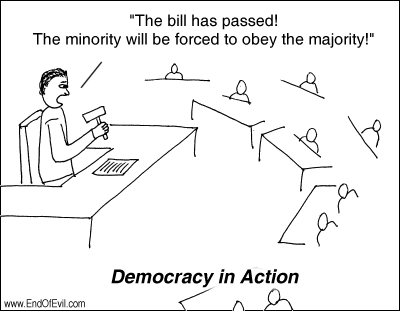
Elections, Capitalism, And Democracy
By Charles Sullivan / June 26, 2008
Because so many of the people on the political left fear that John McCain will become the next president, they have allowed themselves to see the very moderate democratic candidate, Barack Obama, as a desirable alternative to the decidedly ghoulish McCain, rather than supporting a genuine progressive like Dennis Kucinich, Cynthia McKinney, or Ralph Nader. They thus perceive Obama to be far more progressive than he really is. Such comparisons lead us down a dichotomous pathway that assures a continuous drift to the right.
Each election cycle the people on the left find themselves out-flanked by those on the right by allowing them to frame the debate and to define who we are. So each election we end up supporting a very moderate candidate rather than a truly progressive one. Because all of the mainstream candidates are intensively influenced by corporate lobbyists and the electoral system is owned by capital, democracy has remained as elusive as capturing the ghost of a saint with a piece of duct tape.
According to Ambrose I. Lane Sr., host of Pacifica radio’s “We Ourselves,” John McCain has the third most conservative voting record of anyone in the senate. Running an extremist from the opposite end of the political spectrum forces the democratic candidate further to the right than he or she already is. So when progressives fall into this trap, as they so often do, it is a win-win for the corporate lobbyists pulling the strings behind the curtain. They end up supporting a candidate they think can compete against extremists rather than one who actually represents their values. If you have to become like your opponent in order to defeat them, what can you honesty say has been won?
Progressives cannot gain ground by ceding their ideology to their conservative opponents in order to gain office. Without having a viable candidate coming from the far left of the Democratic Party, progressives cannot reasonably expect to push the debate back toward the political center, much less to the left of center. You can make a good case, however, that the democratic leadership under Howard Dean has no real desire to move to the left or to represent traditional progressive values. It likes the status quo just fine; a position that has served its corporate funders well.
Because it has been co-opted by corporate lobbyists—who always hedge their bets—the Democratic Party no longer houses a genuine left-wing faction that can effectively compete for votes in a way that emulates the success of the far right. Because right-wing extremism and corporate fascism are portrayed in the corporate media as reasonable centrist positions beneficial to the people—that is how they are perceived by those who receive their political education from those sources. Thus extremism packaged as democracy is widely considered to be the norm when, in fact, it is not; it is fanaticism couched as something much more benign or beneficial, even if it is a poison pill. Yet it is this extremism that undermines the interests of the nation’s working class people and keeps them subservient to corporate fascism. Voting for meaningful change is like running on a treadmill and expecting to actually go somewhere.
The problem is that capital, rather than informed citizens interested in democracy, is in control of the electoral process. Capital furthers the interest of capital, rather than the interest of the people, and this creates an irreconcilable conflict with genuine human interests. So we end up with a sociopolitical system that is not only fundamentally unjust; it is also predatory and cannibalistic. It consumes the very people who feed it and give it the appearance of legitimacy: the great unwashed working class.
Capitalism flourishes, for a short time, at least, by socializing costs and by privatizing profits and this concentrates and centralizes power into the hands of a select few. Its real purpose is not to serve people; it is to exploit them. Capitalism isn’t even a natural system; it is a purely human construct that has no basis in nature. It is a synthetic system and, as we have seen through chemistry, synthetic systems tend to become mutagens, and thus promote cancer.
Due in part to their extreme political naiveté and to delusional thinking, too many people have accepted corporate fascism as a centrist or “normal” position. Thus they have unwittingly allowed predatory and cannibalistic forces—unregulated markets—to determine the fate of the nation and its people. Neoconservatives and neoliberals, alike, have defined the free market as an unregulated market, which has become their concept of democracy. The so called free market is not under the control of human beings in any meaningful sense, and it does not respond to human needs. Like a creation of Frankenstein, it is a man-made monster that has escaped from the laboratory and is wreaking havoc across the countryside, menacing everyone and everything in its gargantuan steel-booted path.
By themselves, markets are not necessarily a bad thing. Certainly people need commerce and trade. However, it is when markets are deregulated—as required by the adherents of Milton Friedman and the Chicago School of Economics—that they turn upon people and become predatory, undemocratic, and cannibalistic. When markets are given more power and more rights than people, people will cede not only their power to them, but also their humanity. This is how markets have become all-powerful entities that have no soul or conscience and are answerable to no one: monstrosities in every sense of the word.
I would argue, however, that the object of commerce and trade should be to serve people and to benefit the whole of society, rather than to generate enormous profits for the benefit of a select few. Commerce without democracy cannot help us toward a free and democratic society; it can only undermine our every effort at genuine democratization.
Either you work for the public interest or you work for self-interest. It is this assertion that finally brings us back to our starting point—the electoral process. Because the process is under the control of capital rather than working class people, it undermines the democratic process and substitutes something else in its place. That process has led us to where we are and it can never take us back to where we started from. Nor can it ever lead us to genuine democracy or to justice. It can only bear the fruit of its own seeds; it can only provide us with more of what it has already produced.
If we the people are serious about real democratic government, we must work for it outside of the electoral process, as well as from within. We must organize a revolutionary force so powerful that it cannot be ignored or denied. We must institute effective and prolonged economic boycotts. We must organize work slow-downs, work stoppages, and general strikes in order to make corrupt government feel our pain. We must create labor unions that genuinely fight for worker’s rights while simultaneously transitioning the country away from an exploitive and self-destructive capital economy toward a people-oriented economy based upon need, rather than privatized profit subsidized by public funds. These are the means to creating a democratic workplace and bringing malignant capitalism to a grinding halt. The electoral process does not provide the tools for revolution; it subverts the process and only delays the inevitable.
While Barack Obama has run for the presidency on the premise of change, his ideology is fundamentally the same as the presidents who came before him: the economic theories of Milton Friedman and the belief in corporate deregulation; profits before people. Obama’s economic advisers subscribe to the same economic theorem that brought us the trickle down economics of Ronald Reagan and his disastrous foreign policy. Obama’s foreign policy advisers subscribe to the same philosophy that brought us the invasion of Iraq and the Israeli occupation of Palestine; every one of them a war-mongering imperialist with close ties to the military industrial complex with its nexus of profiteering. His energy policy team has great faith in clean coal and safe nuclear energy, neither of which exists.
Because the Obama team is anything but revolutionary, it is unreasonable to expect them to produce polices significantly different than the ones that are already in play. We saw this with Bill Clinton who campaigned on promises to do one thing but, once elected, did another. Clinton won office by being more right-wing than his republican opponent. That was no victory for progressives. How could it be?
This is not to say that Barack Obama is a bad person in any way. Certainly, he is an intelligent man of reasonably good character and a fine orator, but that does not qualify him as representative of the people or the democracy they so desperately need. Is he a better choice than John McCain? Without doubt he is. But then, so is almost anyone else. A toadstool would be a better choice than McCain. We must remember that Obama has been groomed to become president some day and that grooming was provided by special interests whose unstated purpose is to undermine genuine democracy by substituting an imposter in its place. They are convinced that the American people won’t know the difference. So don’t expect any significant changes under Obama, despite all of the campaign rhetoric to the contrary.
The presence of McCain makes the very moderate Obama an appealing alternative and that assures victory for the status quo. It frightens progressive voters away from supporting real progressives like Dennis Kucinich or Cynthia McKinney. Barack Obama was the real choice of the established orthodoxy all along. The marketing strategists have used John McCain to funnel the votes toward Obama and away from genuine progressives. That is where the real fight was. You can call it voting in the absence of real choice because that is precisely what it is. The same policies that have been in play for decades will continue on and we will keep getting a similar result.
Obama’s recent endorsement of warrantless wire-tapping is not only evidence of his belonging to the established orthodoxy; it directly connects him to the draconian policies of the Bush regime and to those of Senator McCain. No true progressive would want to be associated with the unlawful and unjustified surveillance of law-abiding citizens. This is a red flag that must not be ignored.
This is why the country continues to quietly drift further to the right: there is no real choice in elections and we continue to behave as if there are. It is the capitalist system that is at fault, not the candidates themselves who play the game according to the dictum of its inventors. They, too, as despicable as some of them are, are its unwitting victims.
What hope is there for genuine progressives in a game that is rigged? If we are ever to become responsible citizens, we must learn how to separate the contents of the box from the fancy packaging. The same old ideology, regardless of who espouses it, will not lead to meaningful change; nor will pursing the same old methods. If we are going to be satisfied with that, then we can continue to be pawns in a rich man’s game and accept the results of the game without complaint. If we expect better, then we must begin by demanding better of ourselves by recognizing what is being done in our name and doing something about it. But first we must awaken from our stupor and come to the realization that democracy means direct citizen action.
Charles Sullivan welcomes your comments at csullivan@copper.net.
Source / Information Clearing House
The Rag Blog
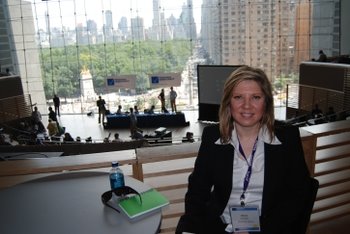
Gina Cooper is the director of an annual phenomenon now known as Netroots Nation.
The four-year-old annual gathering, formerly known as the YearlyKos convention, takes place this year in Austin, Texas, between July 17th and 20th.
Last year, it brought together more than 2,000 people who participate in progressive politics, and who are part of the liberal DailyKos group blogging community.
Cooper expects the same level of turnout as last year’s meeting.
Last summer, the convention also commanded the attendance of all of the Democratic presidential candidates, and it received the bizarre attention of Fox News’ political show host Bill O’Reilly, who blasted Sen. Chris Dodd of Connecticut for attending a conference put on by the “far-left.”
Cooper got involved in progressive politics through her participation in the DailyKos as a blogger, as The New York Times magazine’s politics writer Matt Bai has documented. Prior to being executive director of Netroots Nation, Cooper taught high school math and science.
As Morley Winograd and Michael Hais have shown in their book Millennial Makeover, the blogging community has come to be a force to be reckoned with when it comes to political campaigns, but especially in congressional races. Political bloggers shape media coverage, influence public opinion and break news.
So, it’s no surprise that Cooper expects politicians of all stripes to show up again at this year’s convention.
Barack Obama has been invited, and Nancy Pelosi will be there. (Republican candidates for Congress can also show up, if they want to, and they’ll be feted along with their Democratic counterparts, Cooper says.)
Cooper characterizes the convention as a place where the progressive electorate comes to set its own agenda, and to consummate a “love affair” started off on the web.
This year’s agenda is wide-ranging. It includes subjects that would definitely interest Wired.com’s geeky readership, such as space policy.
Threat Level asked Cooper a few basic questions about the convention at the Personal Democracy Forum in New York on Tuesday. One of them was whether John McCain would be welcome in Austin, since he does have a link to the DailyKos on his campaign website, and since he’s been courting progressive bloggers.
Read on to find out more.
Tell our readers a bit about what Netroots Nation is.
Netroots Nation is formerly known as the YearlyKos convention, and some people call it the bloggers’ convention. But it’s really more than that. It’s the intersection of politics, technology and media on a grassroots level.
But it also includes the upper echelon of people involved in netroots politics as well, the deep thinkers, the big thinkers. It includes regular people who are also big thinkers and deep thinkers, but politics is not something they do for a living — it’s something they do out of passion.
How do you think all these bloggers getting together helps the progressive community?
I think in many ways it, you could have a love affair over e-mail, but it’s not really anything until you get together and consummate it.
So if we want to use that sort of analogy, I think it’s the sort of thing that when people come together, then they are tied together more tightly. They feel that they have more of a community. So it seals that community, which has been built online, with personal interaction.
How many people were there last year, and how many people were there the first year?
The first year, we had around a thousand. Last year, I don’t know. We’re a really small organization doing big things. We were only one-and-a-half people [who were getting paid last year] so we never really got a final count.
But when we had the presidential debate among all the Democratic primary candidates, the room was set for 2,100, and it was standing room only.
And we expect about the same size this year.
Why did you choose Austin?
There really are a lot of reasons. One of the reasons: I think Austin has a chance of swinging blue.
So even looking back last year, we saw that there was going to be an opportunity.
But what drew us there even more was the community. They sought us. They have an amazing grassroots, netroots community. They have an amazing progressive bloggers’ alliance there. It’s very tight. They were recruiting us through the blogs. They were sending us e-mails. Just progressive bloggers in Texas randomly sending us stuff.
I guess some people might have thought of this as harassment, but I thought it was lovely. I thought it was wonderful.
It was regular people who see that when you bring people together in a community, the energy electrifies them, and as a result it expands, and it grows.
So they chose us as much as we chose them.
Who are all these people who come?
Political professionals, but also more wonkish types who think about policy on a regular basis very deeply, as opposed to the rest of us in terms of our own lives.
But you bring those people together with regular people. You bring together politicians and candidates. You bring together progressive organizations.
The speakers often absorb their own expenses. We’re very co-operative. Sometimes they are the sponsors. They want to reach this audience, they’re believers in the people who are there. They’re fans of the political process. They believe the political process offers them a meaningful way to be a part of how we direct our country.
Is this a mini Democratic convention for activists, where the party people can come and plan things to motivate people all around the country?
In some ways, I would think so in terms of it being a gathering of people of like mind. But not everybody agrees at all.
And that really actually is the difference. People are able to come in with their own ideas. So for example, this year, we’re going to have self-organizing sessions. People will be able to come in with their own ideas.
There’s a lot of activity, and people are unplugged, and I love seeing that.
One of the most amazing things that you find there are that the political professionals become inspired by the audience because there’s such sincerity.
You said that Pelosi is coming, and you’ve invited Barack Obama.
Yes, and yes. Everybody’s invited really. To be honest, it’s not like we’ve recruited people. Because the politicians want to meet this audience, so it’s not like we go out and invite somebody, it’s more that it’s kind of out there and people come.
One thing that’s really special about our convention is that it’s not based around a specific constituency.
The politicians aren’t coming to pay their respects, or kiss the ring, or anything like that. They’re coming here to engage these people. The politicians want to be there but there’s no hard sell.
What about John McCain? Has he been invited? He’s got a DailyKos button on his website.
You know, we would love to see him there, but I don’t know if he knows that we exist because we’re mostly on the internet. His wife is the one who helps him with his e-mail. So if she’s a fan — obviously somebody had to be a fan — because somebody had to put that DailyKos button on there.
Of course, we’re love to see them there.
What about Congress? Will any members of Congress be there? Obviously Congress is a big battleground this year.
Yes, there will definitely be Congressional candidates there.
Again, I don’t necessarily track that. If they want to come, they go on the website, and register. They show up, they do their thing.
There is going to be a party, because we definitely appreciate them coming out and reaching out to us.
We’re going to have an event that will feature whatever candidate, Democrat or Republican, that would like to show up, and celebrate them for reaching out to us.
I’m not one of these people who hate Washington, D.C. In fact, one of the most-surprising things that I’ve learned in this process of putting together this convention is that there are real champions for regular people there that have made their way to the inside to influence things for the better.
Darcy Burner, (a Democratic candidate running for office in the 8th District of Washington) for example, submitted a panel. And it was a good one, so we accepted it.
But this is mostly just about getting to examine the agenda of the regular folks.
Source. / Wired
The Rag Blog
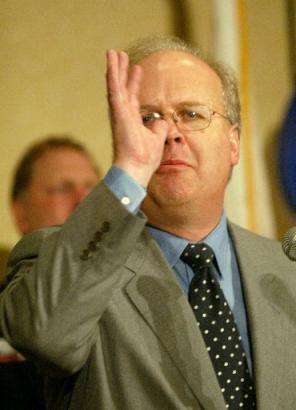
What He Really Means is “Uppity”
By John Ridley / June 27, 2008
Karl Rove says Barack Obama is arrogant.
We’ve heard that; we’ve heard the pejorative “arrogant” before. When I say “we” I mean those of us who are “others” in America; people of color. Minorities. Women. We hear the word all the time from a select section of privileged white guys; the codifying they use when they fear the silver spoons are about to be snatched from their lily palaces: “Those people… How dare they think they can work jobs like ours or live in neighborhoods like ours or send their children to school with ours? Those people are just so damn arrogant.”
Arrogant, of course, is a euphemism. In the monochromatic bunkers from which old-schoolers cling to power the true word they use is “uppity” when hurled at blacks. It’s the “B-word” for women. I’m not sure what the Rovian ilk use for the Latinos and Asian-Americans who dare claim their due, but I’m sure it’s equally as derisive and wielded with sick pleasure.
Arrogant?
The only arrogance Obama is guilty of is the same “Unforgivable Blackness” so many exceptional people of color have demonstrated throughout the history of this country: a refusal to bend to the will of the Retro Guard. To Rove, to the neocons such attitude is wholly unacceptable. Back in the day such “arrogance” was met with a strong rope and tall branch, and anyone who believes that analogy to be too harsh, read here how Roy Bryant and J.W.Milam dealt with the arrogance of 13 year old Emmett Till.
But in this day and age Karl Rove is reduced to making statements which he does not even have the meat to own up to.
Nevertheless, speaking of Obama’s “arrogance” Rove is quoted as saying: “Even if you never met (Obama), you know this guy. He’s the guy at the country club with the beautiful date, holding a martini and a cigarette that stands against the wall and makes snide comments about everyone.”
Really, Mr. Rove? Do you really wish to go there? I will give you the cigarette. Obama did smoke. I will give you the beautiful date. Beyond being a Harvard-educated lawyer, Michelle Obama is a beautiful woman. But I would bet the farm — and I have a farm to bet — that George Bush has been in more country clubs than Barack Obama. I would easily take the line on who’s had more cocktails in their day. And isn’t it the current president who loves to slap a condescending nickname on everyone?
And is there anything more arrogant, Mr. Rove, than ignoring the international community, the United Nations, weapons inspectors on the ground, very facts themselves, to invade a nation because you and a small cadre believe it’s the right thing to do? Is there anything more arrogant than the belief that after such an invasion we as the occupying nation will be welcomed as liberators? Is there anything more arrogant than slapping on a flight suit, playing like you’re the one landing on a carrier deck, making nice for the cameras before that infamous banner while tens of thousands of troops are left behind to fight, and four thousand (and counting) are left to die?
Arrogant?
It’s nothing but hubris for the neocons to believe they can win the election on that one.
Source. / The Huffington Post
The Rag Blog
Thorne Webb Dreyer, Editor






