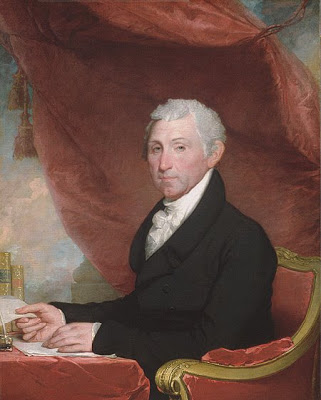
Grandin and Engelhardt on Obama, Latin America and the Monroe Doctrine

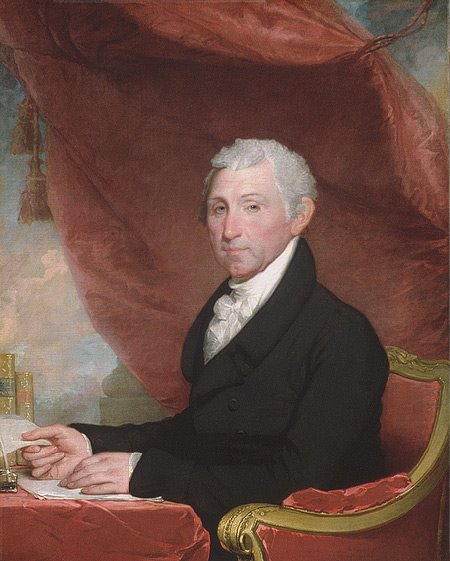
James Monroe, president of the United States, 1817-1825.

Greg Grandin, Is the Monroe Doctrine Really Dead?
By Tom Engelhardt / June 8, 2008

At least once a week — I’ve long suspected — the Chinese leadership must file into the streets of Beijing’s Forbidden City to sing, dance, and pray to the (geo)political gods who drew the Bush administration into the black (gold) hole of Iraq. Without Iraq, we would undoubtedly have heard a great deal more these last years about the “China threat” from the neocons. Without Iraq, Latin America, too, would undoubtedly be a very different place.

Some years ago, it was evident that both former Cold War superpowers were losing control over what the Russians liked to term their “near abroad” (the Baltic states, Eastern Europe, and Central Asia) and Americans preferred to call their “backyard” (Latin America). Despite mutterings about, and a coup attempt against, Hugo Chávez (and another against Haiti’s Jean-Bernard Aristide), Latin America has, since 2001, experienced as close to benign neglect from Washington as might be imaginable. In those years, new regional blocs have begun to form, the most surprising of which may be a growing set of left-leaning democracies in Latin America determined to pursue their own collective interests whatever the Bush administration has in mind.

As Russia rose from the ashes as an energy superpower and began to use its control over natural gas to put renewed pressure on parts of its former “near abroad,” a distracted U.S. has remained somewhat laggard about the state of its backyard. It’s worth noting, however, that the Pentagon has just officially reconstituted the “U.S. Fourth Fleet” — for the Caribbean and the coasts of Central and South America — “after nearly a 60-year slumber.” As of now, it remains a symbolic gesture meant, as Rear Admiral James Stevenson has said, to send “the right signal, even to the people that you know aren’t necessarily our greatest supporters.”

As for just whose backyard, if anyone’s, Latin America will prove to be in the years to come, let Greg Grandin, author of that indispensable book on the American imperial role in Latin America, Empire’s Workshop, take up the topic with his usual intelligence.


Losing Latin America
What Will the Obama Doctrine Be Like?

By Greg Grandin

Google “neglect,” “Washington,” and “Latin America,” and you will be led to thousands of hand-wringing calls from politicians and pundits for Washington to “pay more attention” to the region. True, Richard Nixon once said that “people don’t give one shit” about the place. And his National Security Advisor Henry Kissinger quipped that Latin America is a “dagger pointed at the heart of Antarctica.” But Kissinger also made that same joke about Chile, Argentina, and New Zealand — and, of the three countries, only the latter didn’t suffer widespread political murder as a result of his policies, a high price to pay for such a reportedly inconsequential place.

Latin America, in fact, has been indispensable in the evolution of U.S. diplomacy. The region is often referred to as America’s “backyard,” but a better metaphor might be Washington’s “strategic reserve,” the place where ascendant foreign-policy coalitions regroup and redraw the outlines of U.S. power, following moments of global crisis.

When the Great Depression had the U.S. on the ropes, for example, it was in Latin America that New Deal diplomats worked out the foundations of liberal multilateralism, a diplomatic framework that Washington would put into place with much success elsewhere after World War II.

In the 1980s, the first generation of neocons turned to Latin America to play out their “rollback” fantasies — not just against Communism, but against a tottering multilateralist foreign-policy. It was largely in a Central America roiled by left-wing insurgencies that the New Right first worked out the foundational principles of what, after 9/11, came to be known as the Bush Doctrine: the right to wage war unilaterally in highly moralistic terms.

We are once again at a historic crossroads. An ebbing of U.S. power — this time caused, in part, by military overreach — faces a mobilized Latin America; and, on the eve of regime change at home, with George W. Bush’s neoconservative coalition in ruins after eight years of disastrous rule, would-be foreign policy makers are once again looking south.

Goodbye to All That

“The era of the United States as the dominant influence in Latin America is over,” says the Council on Foreign Relations, in a new report filled with sober policy suggestions for ways the U.S. can recoup its waning influence in a region it has long claimed as its own.

Latin America is now mostly governed by left or center-left governments that differ in policy and style — from the populism of Hugo Chávez in Venezuela to the reformism of Luiz Inácio Lula da Silva in Brazil and Michelle Bachelet in Chile. Yet all share a common goal: asserting greater autonomy from the United States.

Latin Americans are now courting investment from China, opening markets in Europe, dissenting from Bush’s War on Terror, stalling the Free Trade Agreement of the Americas, and sidelining the International Monetary Fund which, over the last couple of decades, has served as a stalking horse for Wall Street and the Treasury Department.

And they are electing presidents like Ecuador’s Rafael Correa, who recently announced that his government would not renew the soon-to-expire lease on Manta Air Field, the most prominent U.S. military base in South America. Correa had previously suggested that, if Ecuador could set up its own base in Florida, he would consider extending the lease. When Washington balked, he offered Manta to a Chinese concession, suggesting that the airfield be turned into “China’s gateway to Latin America.”

In the past, such cheek would have been taken as a clear violation of the Monroe Doctrine, proclaimed in 1823 by President James Monroe, who declared that Washington would not permit Europe to recolonize any part of the Americas. In 1904, Theodore Roosevelt updated the doctrine to justify a series of Caribbean invasions and occupations. And Presidents Dwight Eisenhower and Ronald Reagan invoked it to validate Cold War CIA-orchestrated coups and other covert operations.

But things have changed. “Latin America is not Washington’s to lose,” the Council on Foreign Relations report says, “nor is it Washington’s to save.” The Monroe Doctrine, it declares, is “obsolete.”

Good news for Latin America, one would think. But the last time someone from the Council on Foreign Relations, which since its founding in 1921 has represented mainstream foreign-policy opinion, declared the Monroe Doctrine defunct, the result was genocide.
Enter the Liberal Establishment

That would be Sol Linowitz who, in 1975, as chair of the Commission on United States-Latin American Relations, said that the Monroe Doctrine was “inappropriate and irrelevant to the changed realities and trends of the future.”

The little-remembered Linowitz Commission was made up of respected scholars and businessmen from what was then called the “liberal establishment.” It was but one part of a broader attempt by America’s foreign-policy elite to respond to the cascading crises of the 1970s — defeat in Vietnam, rising third-world nationalism, Asian and European competition, skyrocketing energy prices, a falling dollar, the Watergate scandal, and domestic dissent. Confronted with a precipitous collapse of America’s global legitimacy, the Council on Foreign Relations, along with other mainline think tanks like the Brookings Institute and the newly formed Trilateral Commission, offered a series of proposals that might help the U.S. stabilize its authority, while allowing for “a smooth and peaceful evolution of the global system.”

There was widespread consensus among the intellectuals and corporate leaders affiliated with these institutions that the kind of anticommunist zeal that had marched the U.S. into the disaster in Vietnam needed to be tamped down, and that “new forms of common management” between Washington, Europe, and Japan had to be worked out. Advocates for a calmer world order came from the same corporate bloc that underwrote the Democratic Party and the Rockefeller-wing of the Republican Party.

They hoped that a normalization of global politics would halt, if not reverse, the erosion of the U.S. economic position. Military de-escalation would free up public revenue for productive investment, while containing inflationary pressures (which scared the bond managers of multinational banks). Improved relations with the Communist bloc would open the USSR, Eastern Europe, and China to trade and investment. There was also general agreement that Washington should stop viewing Third World socialism through the prism of the Cold War conflict with the Soviet Union.

At that moment throughout Latin America, leftists and nationalists were — as they are now — demanding a more equitable distribution of global wealth. Lest radicalization spread, the Trilateral Commission’s executive director Zbignew Brzezinski, soon to be President Jimmy Carter’s national security advisor, argued that it would be “wise for the United States to make an explicit move to abandon the Monroe Doctrine.” The Linowitz Commission agreed and offered a series of recommendations to that effect — including the return of the Panama Canal to Panama and a decrease in U.S. military aid to the region — that would largely define Carter’s Latin American policy.

Exit the Liberal Establishment

Of course, it was not corporate liberalism but rather a resurgent and revanchist militarism from the Right that turned out to offer the most cohesive and, for a time, successful solution to the crises of the 1970s.

Uniting a gathering coalition of old-school law-and-order anticommunists, first generation neoconservatives, and newly empowered evangelicals, the New Right organized an ever metastasizing set of committees, foundations, institutes, and magazines that focused on specific issues — the SALT II nuclear disarmament negotiations, the Panama Canal Treaty, and the proposed MX missile system, as well as U.S. policy in Cuba, South Africa, Rhodesia, Israel, Taiwan, Afghanistan, and Central America. All of them were broadly committed to avenging defeat in Vietnam (and the “stab in the back” by the liberal media and the public at home). They were also intent on restoring righteous purpose to American diplomacy.

As had corporate liberals, so, now, neoconservative intellectuals looked to Latin America to hone their ideas. President Ronald Reagan’s ambassador to the UN, Jeane Kirkpatrick, for instance, focused mainly on Latin America in laying out the foundational principles of modern neoconservative thought. She was particularly hard on Linowitz, who, she said, represented the “disinterested internationalist spirit” of “appeasement” — a word back with us again. His report, she insisted, meant “abandoning the strategic perspective which has shaped U.S. policy from the Monroe Doctrine down to the eve of the Carter administration, at the center of which was a conception of the national interest and a belief in the moral legitimacy of its defense.”

At first, Brookings, the Council on Foreign Affairs, and the Trilateral Commission, as well as the Business Roundtable, founded in 1972 by the crème de la CEO crème, opposed the push to remilitarize American society; but, by the late 1970s, it was clear that “normalization” had failed to solve the global economic crisis. Europe and Japan were not cooperating in stabilizing the dollar, and the economies of Eastern Europe, the USSR, and China were too anemic to absorb sufficient amounts of U.S. capital or serve as profitable trading partners. Throughout the 1970s, financial houses like the Rockefellers’ Chase Manhattan Bank had become engorged with petrodollars deposited by Saudi Arabia, Iran, Venezuela, and other oil-exporting nations. They needed to do something with all that money, yet the U.S. economy remained sluggish, and much of the Third World off limits.

So, after Ronald Reagan’s 1980 presidential victory, mainstream policymakers and intellectuals, many of them self-described liberals, increasingly came to back the Reagan Revolution’s domestic and foreign agenda: gutting the welfare state, ramping up defense spending, opening up the Third World to U.S. capital, and jumpstarting the Cold War.

A decade after the Linowitz Commission proclaimed the Monroe Doctrine no longer viable, Ronald Reagan invoked it to justify his administration’s patronage of murderous anti-communists in Nicaragua, Guatemala, and El Salvador. A few years after Jimmy Carter announced that the U.S. had broken “free of that inordinate fear of communism,” Reagan quoted John F. Kennedy saying, “Communist domination in this hemisphere can never be negotiated.”

Reagan’s illegal patronage of the Contras — those murderers he hailed as the “moral equivalent of America’s founding fathers” and deployed to destabilize Nicaragua’s Sandinista government — and his administration’s funding of death squads in El Salvador and Guatemala brought together, for the first time, the New Right’s two main constituencies. Neoconservatives provided Reagan’s revival of the imperial presidency with legal and intellectual justification, while the religious Right backed up the new militarism with grassroots energy.

This partnership was first built — just as it has more recently been continued in Iraq — on a mountain of mutilated corpses: 40,000 Nicaraguans and 70,000 El Salvadorans killed by U.S. allies; 200,000 Guatemalans, many of them Mayan peasants, victimized in a scorched-earth campaign the UN would rule to be genocidal.

The End of the Neocon Holiday from History

The recent Council on Foreign Relations report on Latin America, arriving as it does in another moment of imperial decline, seems once again to signal a new emerging consensus, one similar in tone to that of the post-Vietnam 1970s. In every dimension other than military, Newsweek editor Fareed Zacharia argues in his new book, The Post-American World, “the distribution of power is shifting, moving away from American dominance.” (Never mind that, just five years ago, on the eve of the invasion of Iraq, he was insisting on the exact opposite — that we now lived in a “unipolar world” where America’s position was, and would be, “unprecedented.”)

To borrow a phrase from their own lexicon, the neocons’ “holiday from history” is over. The fiasco in Iraq, the fall in the value of the dollar, the rise of India and China as new industrial and commercial powerhouses, and of Russia as an energy superpower, the failure to secure the Middle East, soaring oil and gas prices (as well as skyrocketing prices for other key raw materials and basic foodstuffs), and the consolidation of a prosperous Europe have all brought their dreams of global supremacy crashing down.

Barack Obama is obviously the candidate best positioned to walk the U.S. back from the edge of irrelevance. Though no one hoping for a job in his White House would put it in such defeatist terms, the historic task of the next president will not be to win this president’s Global War on Terror, but to negotiate America’s reentry into a community of nations.

Parag Khanna, an Obama advisor, recently argued that, by maximizing its cultural and technological advantage, the U.S. can, with a little luck, perhaps secure a position as third partner in a new tripartite global order in which Europe and Asia would have equal shares, a distinct echo of the trilateralist position of the 1970s. (Forget those Munich analogies, if the U.S. electorate were more historically literate, Republicans would get better mileage out of branding Obama not Neville Chamberlain, but Spain’s Fernando VII or Britain’s Clement Richard Attlee, each of whom presided over his country’s imperial decline.)

So it has to be asked: If Obama wins in November and tries to implement a more rational, less ideologically incandescent deployment of American power — perhaps using Latin America as a staging ground for a new policy — would it once again provoke the kind of nationalist backlash that purged Rockefellerism from the Republican Party, swept Jimmy Carter out of the White House, and armed the death squads in Central America?

Certainly, there are already plenty of feverish conservative think tanks, from the Hudson Institute to the Heritage Foundation, that would double down on Bush’s crusades as a way out of the current mess. But in the 1970s, the New Right was in ascendance; today, it is visibly decomposing. Then, it could lay responsibility for the deep and prolonged crisis that gripped the United States at the feet of the “establishment,” while offering solutions — an arms build-up, a renewed push into the Third World, and free-market fundamentalism — that drew much of that establishment into its orbit.

Today, the Right wholly owns the current crisis, along with its most immediate cause, the Iraq War. Even if John McCain were able to squeak out a win in November, he would be the functional equivalent not of Reagan, who embodied a movement on the march, but of Jimmy Carter, trying desperately to hold a fraying coalition together.

The Right’s decay as an intellectual force is nowhere more evident than in the fits it throws in the face of the Left’s — or China’s — advances in Latin America. The self-confidant vitality with which Jeane Kirkpatrick used Latin America to skewer the Carter administration has been replaced with the tinny, desperate shrill of despair. “Who lost Latin America?” asks the Center for Security Policy’s Frank Gaffney — of pretty much everyone he meets. The region, he says, is now a “magnet for Islamist terrorists and a breeding ground for hostile political movements… The key leader is Chávez, the billionaire dictator of Venezuela who has declared a Latino jihad against the United States.”

Scare-Quote Diplomacy

But just because the Right is unlikely to unfurl its banner over Latin America again soon doesn’t mean that U.S. hemispheric diplomacy will be demilitarized. After all, it was Bill Clinton, not George W. Bush, who, at the behest of Lockheed Martin in 1997, reversed a Carter administration ban (based on Linowitz report recommendations) on the sale of high-tech weaponry to Latin America. That, in turn, kicked off a reckless and wasteful Southern Cone arms race. And it was Clinton, not Bush, who dramatically increased military aid to the murderous Colombian government and to corporate mercenaries like Blackwater and Dyncorp, further escalating the misguided U.S. “war on drugs” in Latin America.

In fact, a quick comparison between the Linowitz report and the new Council on Foreign Relations study on Latin America provides a sobering way of measuring just how far right the “liberal establishment” has shifted over the last three decades. The Council does admirably advise Washington to normalize relations with Cuba and engage with Venezuela, while downplaying the possibility of “Islamic terrorists” using the area as a staging ground — a longstanding fantasy of the neocons. (Douglas Feith, former Pentagon undersecretary, suggested that, after 9/11, the U.S. hold off invading Afghanistan and instead bomb Paraguay, which has a large Shi’ite community, just to “surprise” the Sunni al-Qaeda.)

Yet, where the Linowitz report provoked the ire of the likes of Jeane Kirkpatrick by writing that the U.S. should not try to “define the limits of ideological diversity for other nations” and that Latin Americans “can and will assess for themselves the merits and disadvantages of the Cuban approach,” the Council is much less open-minded. It insists on presenting Venezuela as a problem the U.S. needs to address — even though the government in Caracas is recognized as legitimate by all and is considered an ally, even a close one, by most Latin American countries. Latin Americans may “know what is best for themselves,” as the new report concedes, yet Washington still knows better, and so should back “social justice” issues as a means to win Venezuelans and other Latin Americans away from Chávez.

That the Council report regularly places “social justice” between scare quotes suggests that the phrase is used more as a marketing ploy — kind of like “New Coke” — than to signal that U.S. banks and corporations are willing to make substantive concessions to Latin American nationalists. Seven decades ago, Franklin Roosevelt supported the right of Latin American countries to nationalize U.S. interests, including Standard Oil holdings in Bolivia and Mexico, saying it was time for others in the hemisphere to get their “fair share.” Three decades ago, the Linowitz Commission recommended the establishment of a “code of conduct” defining the responsibilities of foreign corporations in the region and recognizing the right of governments to nationalize industries and resources.

The Council, in contrast, sneers at Chávez’s far milder efforts to create joint ventures with oil multinationals, while offering nothing but pablum in its place. Its centerpiece recommendation — aimed at cultivating Brazil as a potential anchor of a post-Bush, post-Chávez hemispheric order — urges the abolition of subsidies and tariffs protecting U.S. agro-industry in order to advance a “Biofuel Partnership” with Brazil’s own behemoth agricultural sector. This would be an environmental disaster, pushing large, mechanized plantations ever deeper into the Amazon basin, while doing nothing to generate decent jobs or distribute wealth more fairly.

Dominated by representatives from the finance sector of the U.S. economy, the Council recommends little beyond continuing the failed corporate “free trade” policies of the last twenty years — and, in this case, those scare quotes are justified because what they’re advocating is about as free as corporate “social justice” is just.

Will Obama be any better?

An Obama Doctrine?

So far, Barack Obama promises little better. A few weeks ago, he traveled to Miami and gave a major address on Latin America to the Cuban American National Foundation. It was hardly an auspicious venue for a speech that promised to “engage the people of the region with the respect owed to a partner.”

Surely, the priorities for humane engagement would have been different had he been addressing not wealthy right-wing Cuban exiles but an audience, say, of the kinds of Latino migrants in Los Angeles who have revitalized the U.S. labor movement, or of Central American families in Postville, Iowa, where immigration and Justice Department authorities recently staged a massive raid on a meatpacking plant, arresting as many as 700 undocumented workers. Obama did call for comprehensive immigration reform and promised to fulfill Franklin Roosevelt’s 68 year-old Four Freedoms agenda, including the social-democratic “freedom from want.” Yet he spent much of his speech throwing red meat to his Cuban audience.

Ignoring the not-exactly-radical advice of the Council on Foreign Relations, the candidate pledged to maintain the embargo on Cuba. And then he went further. Sounding a bit like Frank Gaffney, he all but accused the Bush administration of “losing Latin America” and allowing China, Europe, and “demagogues like Hugo Chávez” to step “into the vacuum.” He even raised the specter of Iranian influence in the region, pointing out that “just the other day Tehran and Caracas launched a joint bank with their windfall oil profits.”

Whatever one’s opinion on Hugo Chávez, any diplomacy that claims to take Latin American opinion seriously has to acknowledge one thing: Most of the region’s leaders not only don’t see him as a “problem,” but have joined him on major economic and political initiatives like the Bank of the South, an alternative to the International Monetary Fund and the Union of South American Nations, modeled on the European Union, established just two weeks ago. And any U.S. president who is sincere in wanting to help Latin Americans liberate themselves from “want” will have to work with the Latin American left — in all its varieties.

But more ominous than Obama’s posturing on Venezuela is his position on Colombia. Critics have long pointed out that the billions of dollars in military aid provided to the Colombian security forces to defeat the FARC insurgency and curtail cocaine production would discourage a negotiated end to the civil war in that country and potentially provoke its escalation into neighboring Andean lands. That’s exactly what happened last March, when Colombia’s president Alvaro Uribe ordered the bombing of a rebel camp located in Ecuador (possibly with U.S. logistical support supplied from Manta Air Force Base, which gives you an idea of why Correa wants to give it to China). To justify the raid, Uribe explicitly invoked the Bush Doctrine’s right of preemptive, unilateral action. In response, Ecuador and Venezuela began to mobilize troops along their border with Colombia, bringing the region to the precipice of war.

Most interestingly, in that conflict, an overwhelming majority of Latin American and Caribbean countries sided with Venezuela and Ecuador, categorically condemning the Colombian raid and reaffirming the sovereignty of individual nations recognized by Franklin Roosevelt long ago. Not Obama, however. He essentially endorsed the Bush administration’s drive to transform Colombia’s relations with its Andean neighbors into the one Israel has with most of the Middle East. In his Miami speech, he swore that he would “support Colombia’s right to strike terrorists who seek safe-havens across its borders.”

Equally troublesome has been Obama’s endorsement of the controversial Merida Initiative, which human rights groups like Amnesty International have condemned as an application of the “Colombian solution” to Mexico and Central America, providing their militaries and police with a massive infusion of money to combat drugs and gangs. Crime is indeed a serious problem in these countries, and deserves considered attention. It’s chilling, however, to have Colombia — where death-squads now have infiltrated every level of government, and where union and other political activists are executed on a regular basis — held up as a model for other parts of Latin America.

Obama, however, not only supports the initiative, but wants to expand it beyond Mexico and Central America. “We must press further south as well,” he said in Miami.

It seems that once again that, as in the 1970s, reports of the death of the Monroe Doctrine are greatly exaggerated.

[Greg Grandin teaches history at New York University. He is the author of Empire’s Workshop: Latin America, the United States, and the Rise of the New Imperialism and The Last Colonial Massacre: Latin America in the Cold War.]

Copyright 2008 Greg Grandin

Source. / Tom Dispatch

For more perspective on Barack Obama, go to Progressives for Obama.

Thanks to Tom Hayden / The Rag Blog

Posted in RagBlog | Tagged , , , , , , | Leave a comment

Junior’s Coterie of Criminals Keeps Running

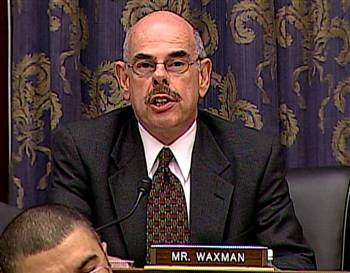
Waxman: “It may well turn out to be the largest war profiteering in history.”

BBC uncovers lost Iraq billions
By Jane Corbin / June 10, 2008

A BBC investigation estimates that around $23bn (£11.75bn) may have been lost, stolen or just not properly accounted for in Iraq.

For the first time, the extent to which some private contractors have profited from the conflict and rebuilding has been researched by the BBC’s Panorama using US and Iraqi government sources.

A US gagging order is preventing discussion of the allegations.

The order applies to 70 court cases against some of the top US companies.

War profiteering

While George Bush remains in the White House, it is unlikely the gagging orders will be lifted.

To date, no major US contractor faces trial for fraud or mismanagement in Iraq.

The president’s Democratic opponents are keeping up the pressure over war profiteering in Iraq.

Henry Waxman who chairs the House Committee on Oversight and Government Reform said: “The money that’s gone into waste, fraud and abuse under these contracts is just so outrageous, its egregious.

“It may well turn out to be the largest war profiteering in history.”

In the run-up to the invasion one of the most senior officials in charge of procurement in the Pentagon objected to a contract potentially worth seven billion that was given to Halliburton, a Texan company, which used to be run by Dick Cheney before he became vice-president.

Unusually only Halliburton got to bid – and won.

Missing billions

The search for the missing billions also led the programme to a house in Acton in West London where Hazem Shalaan lived until he was appointed to the new Iraqi government as minister of defence in 2004.

Judge Radhi al Radhi: “I believe these people are criminals.”

He and his associates siphoned an estimated $1.2 billion out of the ministry.

They bought old military equipment from Poland but claimed for top class weapons.

Meanwhile they diverted money into their own accounts.

Judge Radhi al-Radhi of Iraq’s Commission for Public Integrity investigated.

He said: “I believe these people are criminals.

“They failed to rebuild the Ministry of Defence , and as a result the violence and the bloodshed went on and on – the murder of Iraqis and foreigners continues and they bear responsibility.”

Mr Shalaan was sentenced to two jail terms but he fled the country.

He said he was innocent and that it was all a plot against him by pro-Iranian MPs in the government.

There is an Interpol arrest out for him but he is on the run – using a private jet to move around the globe.

He stills owns commercial properties in the Marble Arch area of London.

Source / BBC

The Rag Blog

Posted in RagBlog | Tagged , | Leave a comment

Gary Chason on His Life in Independent Film

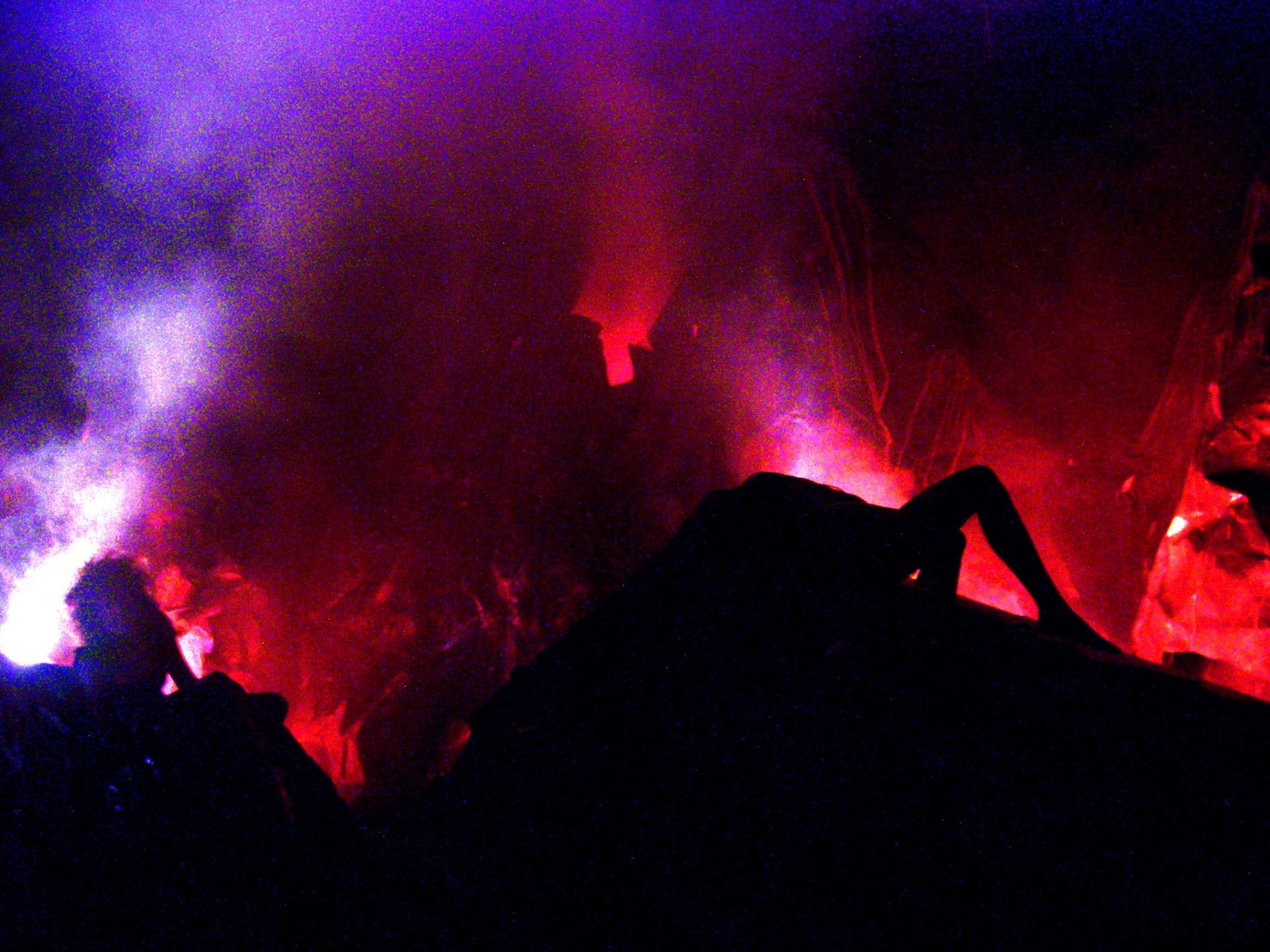
Still from Gary Chason’s God Thinks You’re a Loser.

The Independent Film Movement:
Letter From the Front Lines

By Gary Chason / The Rag Blog / June 11, 2008

[Gary Chason is an Austin-based filmmaker, screenwriter, actor, casting director, playwright, stage director and acting teacher. He also is a contributor to The Rag Blog.]

The Movement

Rejection letters from film festivals always tell you about the thousands of entries they received. And I’m not talking about short subjects either. Feature-length narrative motion pictures are being produced at an unprecedented rate all over the globe. The days when aspiring storytellers wanted to write the great American novel are long gone; now they want to make a hit movie.

Independent filmmaking has been around for as long as the medium has existed. The early independents were experimentalists, searching for the possibilities the medium contained. The fundamental principles of narrative film structure – which we now take for granted – were developed through such experiments. Dali and Bunuel were early pioneers, as was Andy Warhol’s group at the Factory. Independents often made horror genre films because they had the best chance of returning the capital investment. A few, like John Waters, explored highly controversial story lines and themes. Regional legend Eagle Pennell made idiosyncratic films that reeked with authenticity, concentrating on deluded losers and alcoholics and making us care about them as people. And, tortured artist that he was, no doubt used his work to grapple with his own demons.

In recent times, the Hollywood studio system has capitalized on the interest generated by independents, churning out their own “independent” features. Numerous subsidiaries, with studio backing, have taken on the mantel, and subsequent cachet, of independence. Their product, however, lacks the necessary spirit to be included in the movement. The authentically independent filmmaker works outside of the establishment, uses mostly unknown actors, avoids the standard formulas of genre films, and pursues themes, story lines, and subject matter that are clearly outside the mainstream. They make films that Hollywood wouldn’t – or couldn’t – make. And they do it because they are driven by their passion for the work, which makes them a part of the ancient tradition of the artist.

The Digital Revolution

But why are so many features being created now? The digital revolution is the empowering phenomenon here. You can buy or rent an excellent camera very cheaply, or, if you’re clever enough, you can borrow one. Write a script, get some actors together, pick up some tape, and away you go. And you can edit it on your laptop while sipping latte at a coffee house. So the “Suits” no longer hold the keys to the toybox.

The bad news is that a whole lot of dreadful movies are getting made. The good news is that amidst all the crap there are some real gems, films that would never have been made a few years ago because the costs were prohibitive. This has spawned a new generation of filmmaker with a fresh set of priorities, and an aesthetic that often departs radically from Hollywood dogma. (BTW: it is acceptable to use the term “film” even if no actual film was ever involved. “Digital filmmaking” and “digital cinematography” are standard terms.)

Film – especially its main format, 35 millimeter – is still the gold standard. But that won’t last long. In only the second or third generation of high definition, digital cameras have already achieved resolution equal to 35 mm (The Red One Camera), and there’s no end in sight. They are smaller and lighter than film cameras, and they can also record audio, which is automatically synchronized with picture. With film, you have to use two separate machines and then sync audio to picture at the lab.

And that’s another thing: no lab costs. The price of film is high enough – approximately fifty dollars a minute for raw stock – but by the time you get it processed at the lab, printed, and synchronized with the sound, it’s double that amount. And you haven’t done any editing yet. Since it’s fairly normal to shoot ten times as much as you will ultimately need, you reach six figures just on stock and processing. And that’s not counting props, wardrobe, lunches, talent fees, etc.

Low (and No) Budget Wonders

I acted in a lead role in a digital feature, Dear Pillow (Bryan Poyser – Writer/Director), which was produced on a modest grant. It played at festivals all over the world and is currently for rent or sale through the standard outlets. Another, The Puffy Chair (DuPlass Brothers), was made for about the same amount and it got a theatrical release, launching the filmmakers, who now live in L.A. and who are rumored to be lining up five more features. Similar projects are in the works all over the world. None of this would have happened prior to the digital revolution.

Gary Chason in scene from movie Dear Pillow.

Personal Experiences

I made my first feature as a Writer/Director, Charlie’s Ear, in the early nineties when film was the only viable option. It required three years of full-time work to cobble together the unwieldly sum it took to make the picture. Just succeeding at that was a miracle in itself, but it was the only way and I was absolutely determined to get it done no matter what. That, and I was lucky to have excellent partners and associates.

In the end, it was beneficial to learn all aspects of the process, from the legalities of equity capital to the delivery schedule required by distributors, and everything in between. I was already skilled at production from my days in the theater and as a Casting Director (The Last Picture Show, Paper Moon, Pretty Baby, Paris, Texas, etc.), so I had to learn about labs, sound design and mix, timing (now color correction), and much more.

I was at the cusp of the digital age. I used the earliest “non-linear” (a term now passé) editing system in a hybrid with the old-fashioned method of literally cutting and taping together strands of workprint film. It screened for the first time at the Independent Film Market in New York, barely dry from the lab, and snagged a deal. Sadly, the distribution company went belly up before they could release the picture. I got it back, along with some greatly appreciated cash. It played at SXSW in ’94 and so impressed the management at the Dobie Theater in Austin that it got booked there for a short run. It also won all the top awards at the Madrid Festival and the Critics’ Prize at Mannheim. But that was the end of the road. It is not available for rent yet. I expect that it will be at some point in the future.

It’s a dark comedy about a middle-aged schlub (Austin Pendleton) who comes home from work one day to find two guys in his apartment who claim to be working for him. To do what? They say that he hired them to kill his wife. From there, we’re off and running through a story that is full of surprises, turning on itself repeatedly, before ending much the way it began, with the main character’s anger and self-loathing.

Eventually I wound up in Austin, Texas, a veritable hotbed of digital filmmaking and the ideal place for doing my thing. Shortly after arriving in town, I produced and directed another feature, Everything or Nothing, making full use of the latest HD technology. I was able to use the money that otherwise would be spent on film to enhance production values in hundreds of ways – including casting a Los Angeles semi-name actress, Natasha Melnick, in the lead role. Natasha was in Freaks and Geeks, Boston Public, and other TV shows.

It’s about a young girl, orphaned by murder-suicide, who grows up to be a prostitute and heroin addict, and her struggles to get her life straightened out. The film is still finding its way through the festival circuit, and has a distribution offer on the table which hasn’t been, as yet, executed. It should be available for rent in a year or so.

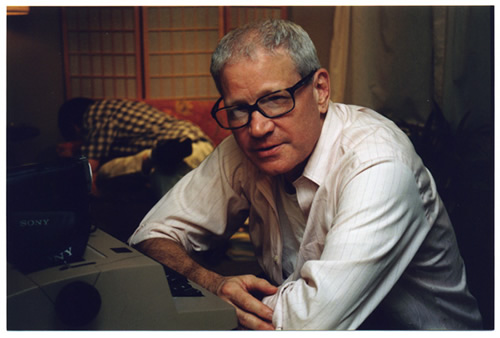
Gary Chason, far left, talks with cast and crew during making of God Thinks You’re a Loser.

Lunatics Running the Asylum

My latest opus as Writer/Director, God Thinks You’re a Loser, just had a cast and crew screening and is being entered into festivals now. It is about three losers on the elevator to Hell, flashing back to reveal why they are condemned and then following them to their destiny. It is way out of the mainstream, definitely a picture that the studios would not make. It is, like Charlie’s Ear, a very dark comedy. Actually, it has been more accurately described as a perverse comedy. And it is experimental in its approach, a deadly sin in the minds of the Suits, but definitely in keeping with the experimental, avant garde theater I cut my directing teeth on.

Since I didn’t have to answer to studio committees – the lunatics were running the asylum – I was able to create a unique visual style, in the manner of comic books. Rather than imitate the look and feel of film, which is usually the case with movies that originate on videotape, I embraced digital technology to create vivid imagery that would be difficult, if not impossible, to duplicate with emulsion. Low budget indies are usually naturalistic in style. I chose to be expressionistic.

The picture doesn’t shy away from being blatently polemical either. It is, in fact, a moral fable, taking the stand that morality has to do with how we treat others. Drug use or sexual activity with a consenting adult, no matter how perverse, won’t get you in trouble. No. A “sin” is to bring harm upon another person. In the Hell of my imagination, the harmful things you have done to others are done to you, over and over, in a kind of karmic reprogramming. Sick and disturbing to be sure, but nevertheless very funny.

The rationale for such radical choices on my part? The glut of product in the marketplace, as so eloquently expressed in those rejection letters from festivals. With so many films vying for attention, to be different – unusual, weird, wacky, zany, schizo – should prove to be a big asset. And besides, I wouldn’t have it any other way because I’m fiercely independent!

Go to God Thinks You’re a Loser for preview, clips and stills.

Dear Pillow on Amazon.com.

Gary’s homesite: Gary Chason Studio.

Gary Chason was a contributor to The Rag, Austin’s sixties underground newspaper and forerunner to The Rag Blog. Here is his listing on the Rag Author’s Page.

The Rag Blog

Posted in Rag Bloggers | Tagged , , , , , , , | Leave a comment

A Fish Stinks From Its Head

The three chief architects and salesmen of the war

Investigate This
by Scott Ritter / June 9, 2008

“I think the questions were asked. I think we pushed. I think we prodded. I think we challenged the president. I think not only those of us in the White House press corps did that, but others in the rest of the landscape of the media did that. … The right questions were asked. I think there’s a lot of critics-and I guess we can count Scott McClellan as one-who think that, if we did not debate the president, debate the policy in our role as journalists, if we did not stand up and say, ‘This is bogus,’ and ‘You’re a liar,’ and ‘Why are you doing this?’ that we didn’t do our job. And I respectfully disagree. It’s not our role.”

That was NBC correspondent David Gregory, appearing on MSNBC’s “Hardball With Chris Matthews.” He was responding to former White House press secretary Scott McClellan’s new book, “What Happened: Inside the Bush White House and Washington’s Culture of Deception.” McClellan has challenged the role of the U.S. media in investigating and reporting U.S. policy in times of conflict, especially when it comes to covering the government itself.

As a critic of U.S. foreign policy in the Middle East, especially when unsubstantiated allegations of weapons of mass destruction are used to sell a war, I am no stranger to the concept of questioning authority, especially in times of war. I am from the Teddy Roosevelt school of American citizenship, adhering to the principle that “to announce that there must be no criticism of the president, or that we are to stand by the president right or wrong, is not only unpatriotic and servile, but it is morally treasonable to the American public.”

Some may point out that Roosevelt made that statement in criticism of Woodrow Wilson’s foot dragging when it came to getting America into World War I, and that it is odd for one opposed to American involvement in Iraq to quote a former president who so enthusiastically embraced military intervention. But principle can cut both ways on any given issue. The principle inherent in the concept of the moral responsibility of the American people to question their leadership at all times, but especially when matters of war are at stake, is as valid for the pro as it is the con.

The validity of this principle is not judged on the level of militancy of the presidential action in question, but rather its viability as judged by the values and ideals of the American people. While the diversity of the United States dictates that there will be a divergence of consensus when it comes to individual values and ideals, the collective ought to agree that the foundation upon which all American values and ideals should be judged is the U.S. Constitution, setting forth as it does a framework of law which unites us all. To hold the Constitution up as a basis upon which to criticize the actions of any given president is perhaps the most patriotic act an American can engage in. As Theodore Roosevelt himself noted, “No man is above the law and no man is below it; nor do we ask any man’s permission when we ask him to obey it.”

Now David Gregory, and others who populate that curious slice of Americana known as “the media,” may hold that they, as journalists, operate on a different level than the average American citizen. As Mr. Gregory notes, it is not their “role” to question or debate policy set forth by the president. This is curious, coming from a leading member of a news team that prides itself on the “investigative” quality of its reporting. If we take Gregory at face value, it seems his only job (or “role”) is to simply parrot the policy formulations put forward by administration officials, that the integrity of journalism precludes the reporter from taking sides, and that any aggressive questioning concerning the veracity, or morality, or legality of any given policy would, in its own right, constitute opposition to said policy, and as such would be “taking sides.”

This, of course, is journalism in its most puritanical form, the ideal that the reporter simply reports, and keeps his or her personal opinion segregated from the “facts” as they are being presented. While it would be a farcical stretch for David Gregory, or any other mainstream reporter or correspondent, to realistically claim ownership of such a noble mantle, it appears that is exactly what Gregory did when he set forth the parameters of what his “role” was, and is, in reporting on stories such as the issue of Iraqi weapons of mass destruction and the Bush administration’s case for war. For this to be valid, however, the issue of journalistic integrity would need to apply not only to the individual reporter or correspondent, but also to the entire system to which the given reporter or correspondent belonged. In the case of Gregory, therefore, we must not only bring into the mix his own individual performance, but also that of NBC News and its parent organization, General Electric.

As a weapons inspector, I was very much driven by what the facts said, not what the rhetoric implied. I maintain this standard to this day in assessing and evaluating American policy in the Middle East. It was the core approach which governed my own personal questioning of the Bush administration’s case for confronting Iraq in the lead-up to the war in 2002 and 2003. I am saddened at the vindication of my position in the aftermath of the invasion and occupation of Iraq, not because of what I did, but rather what the transcripts of every media interview I conducted at the time demonstrates: The media were not interested in reporting the facts, but rather furthering a fiction. Time after time, I backed my opposition to the Bush administration’s “case” for war on Iraq with hard facts, citing evidence that could be readily checked by these erstwhile journalists had they been so inclined. Instead, my integrity and character were impugned by these simple recorders of “fact”, further enabling the fiction pushed by the administration into the mainstream, unchallenged and unquestioned, to be digested by the American public as truth.

Scott McClellan is correct to point out the complicity of the media in facilitating the rush to war. David Gregory is disingenuous in his denial that this was indeed the case. Jeff Cohen, a former producer at MSNBC, has written about the pressures placed on him and Phil Donahue leading to the cancellation of the latter’s top-rated television show just before the invasion of Iraq in March 2003. Katie Couric, the former co-host of NBC’s “Today Show” (and current news anchor for CBS News), has tacitly acknowledged “pressure” from above when it came to framing interviews in a manner that was detrimental to the Bush administration’s case for war. Jessica Yellin, who before the war in Iraq worked for MSNBC, put it best: “I think the press corps dropped the ball at the beginning,” she told CNN’s Anderson Cooper. “When the lead-up to the war began, the press corps was under enormous pressure from corporate executives, frankly, to make sure that this was a war that was presented in a way that was consistent with the patriotic fever in the nation and the president’s high approval ratings.”

Now, one would think that a journalist with the self-proclaimed integrity of Gregory would jump at the opportunity to take the bull by the horns, so to speak, and focus on this story line, if for no other reason than to prove it wrong and thereby clear his name (guilty by association, at the very least) and the name of the organization he represents. The matter is simple, on the surface: NBC network executives either did, or didn’t, pressure their producers and reporters when it came to covering and framing stories. Surely an investigative reporter of Gregory’s talent can get to the bottom of this one?

While Gregory certainly does not need help from someone of such humble journalistic credentials as myself, perhaps my experience as a former weapons inspector in tracking down the lies and inconsistencies of the Iraqi government could be of some assistance. The first thing I would do is to frame the scope of the problem. The issue of Iraq as a target worthy of war really didn’t hit the mainstream until the summer of 2002, so I would start there. I would be interested in defining the potential sources of “pressure” that could be placed on NBC as an organization when it came to reporting on Iraq.

Read all of it here. / TruthDig

The Rag Blog

Posted in RagBlog | Tagged , , | Leave a comment

Peace Vigil in Bellingham, WA Every Friday

Bellingham residents protest Iraq war

Bellingham, Washington: Whatcom Peace Vigil

4:00 – 5:30 PM

Weekly vigil in front of the Federal Building
(Cornwall and Magnolia).

A Bellingham tradition for over 30 years.

Posted in RagBlog | Tagged | Leave a comment

Someone Call Al Gore…

Kelly / The Onion.
The Rag Blog / June ll, 2008

Posted in RagBlog | Tagged , , , | Leave a comment

Quote of the Day : A Patriot

A patriot must always be ready to defend his country against his government.

Edward Abbey

Thanks to Harry Edwards / The Rag Blog / June 11, 2008

Posted in RagBlog | Tagged , , | Leave a comment

Truckers Blockade Traffic in Europe

Truck drivers parked on a highway leading out of Madrid yesterday, one of a number of roads they blocked. Other roads included some leading into the center of Barcelona and the border with France. Photo by Denis Doyle/Getty Images.

Two truck drivers die as fuel protests spread across Europe
June 10, 2008

MADRID — Two lorry drivers were killed on picket lines in Spain and Portugal on Tuesday as strikes by thousands of truckers over soaring fuel prices turned deadly.

Spanish police escorted petrol supply tankers into Barcelona on the second day of the stoppage that has caused food and fuel shortages and huge tailbacks on the Spanish-French border.

French railway workers began their own walkout, increasing the transport chaos.

A Portuguese driver was killed after he was hit by a truck as he manned a barricade filtering traffic near Alcanena, north of Lisbon.

A police spokesman quoted witnesses as saying the 52-year-old man climbed onto the side of a truck in a bid to stop it and fell off under the wheels, Lusa news agency reported.

Later Tuesday, a truck driver in Spain was run over and killed by a van as he manned a picket line outside a wholesale market in the southern city of Granada, police said.

Road haulage representatives suspended strike negotiations with the Spanish government following the incident.

Other trucks in Portugal and Spain have been stoned or had their windows smashed and tyres punctured for working during the national strikes.

A total of 15 people, most of them manning picket lines, were arrested in Spain Tuesday for disturbing public order, assault or threats, Spanish media said.

Tens of thousands of truckers are on strike or joining the protests to demand government help to offset the higher fuel costs.

Authorities in northern Spain ordered emergency measures after many petrol stations in the Catalonia region ran out of fuel.

“Twenty tanker trucks escorted by the regional police left an industrial zone this morning for Barcelona port to help supply and distribute to petrol stations in the region,” a regional police spokesman told AFP.

Forty percent of petrol stations in Catalonia have run out of fuel, according to Manuel Amado, president of the Catalonia Federation of Service Stations.

Arrivals of fresh meat, fish and fruit in Madrid have come to a near halt, according to officials at the Mercamadrid market, Spain’s biggest wholesale market. They said that fish would be in short supply from Thursday but stocks of other foods should last until the end of the week.

Automakers in Spain said most of the country’s automobile plants, including those of Nissan, Mercedes Benz, Seat and Renault, have had to cut or halt production.

Auto plants are particularly vulnerable to a strike by hauliers, which provide them with spare parts.

Truckers stopped lorries from crossing the French-Spanish border and caused major tailbacks around major Spanish cities, including Madrid, Barcelona and Valencia.

Spanish and French truckers staged pickets on either side of the frontier between the two countries. They blocked a bridge on the border at Bidassoa in the western Basque region and other main crossing points.

On the French side, service areas on motorways were packed with trucks from the border right back to Bordeaux, about 200 kilometres (125 miles) away.

Spain’s second largest hauliers’ union Fenadismer, which claims to represent 70,000 out of Spain’s 380,000 truck drivers, launched an open-ended strike on Monday.

Talks Monday between the hauliers and the government ended in failure, Fenadismer said.

The Portuguese government said it hoped to have an agreement with its truckers by the end of the week.

A separate strike by workers at the French rail company, SNCF, severely hit rail traffic.

About half of intercity and local commuter trains were running along with about three quarters of TGV high speed trains from Paris to southwest France. Some express commuter lines into Paris were badly affected by the strike.

Spanish fisherman were keeping up their strike against fuel prices but most French trawlers have decided to go back to work after several weeks of blocking ports and access to oil refineries.

Source. / AFP

Anger: Transport workers block the toll gate of the A7 Highway in La Roca del Valles, near Barcelona.

Also see 90,000 truckers bring Spain to a standstill. / Daily Mail

Thanks to Jesse James Retherford / The Rag Blog

Posted in RagBlog | Tagged , , , , , | Leave a comment

Senate Report : No Saddam, al-Qaida Link

The Senate Intelligence Committee, which released the Iraq report, is chaired by Sen. Pat Roberts, R-Kan., left. The ranking minority member is Sen. Jay Rockefeller, right. Photo by Alex Wong / Getty Images.

The Big Story You May Have Missed During the Obama v. Clinton Finale
By Arianna Huffington / June 9, 2008

For those of you who were understandably busy following the last round of the Democratic Nomination Ultimate Fighting Championship this past week (I won’t give away the ending for those who have it TiVo’d), I’d like to call your attention to a major story you may have missed: the Senate Intelligence Committee’s 200-page “Phase II” report on how the Bush administration used — and abused — pre-war intelligence in the run-up to the war in Iraq.

The Committee’s conclusion: the president and his top officials deliberately misrepresented secret intelligence to make the case to invade Iraq. No surprise there.

But it’s vitally important that we continue to reiterate and document the truth of what happened and who was responsible for perpetrating this fraud on the American public. And here’s why: the war is still going on (and American soldiers continue to die as a result of the deception); the same people responsible for this debacle still have their hands on the wheel; desperate to cover their tracks, they continue to lie about how we got into this mess; and they are currently hitting all the same notes in agitating for war in Iran.

The report is a direct rebuke to the administration’s continued claims that it was the intelligence that was faulty, and that Bush and co. were simply presenting what the C.I.A. had given them.

A statement released by committee chairman Jay Rockefeller makes it clear that the administration “on numerous occasions, misrepresented the intelligence and the threat from Iraq…in making the case for war, the administration repeatedly presented intelligence as fact when in reality it was unsubstantiated, contradicted, or even non-existent.”

The report doesn’t use the word, but we all know what it’s called when someone presents something as fact that’s directly contradicted by the evidence. A lie. Not a mistake. A lie.

Some specifics from Rockefeller’s statement (emphasis mine):

Statements and implications by the President and Secretary of State suggesting that Iraq and al-Qa’ida had a partnership, or that Iraq had provided al-Qa’ida with weapons training, were not substantiated by the intelligence.

*Statements by the President and the Vice President indicating that Saddam Hussein was prepared to give weapons of mass destruction to terrorist groups for attacks against the United States were contradicted by available intelligence information.

*Statements by President Bush and Vice President Cheney regarding the postwar situation in Iraq, in terms of the political, security, and economic, did not reflect the concerns and uncertainties expressed in the intelligence products.

*Statements by the President and Vice President prior to the October 2002 National Intelligence Estimate regarding Iraq’s chemical weapons production capability and activities did not reflect the intelligence community’s uncertainties as to whether such production was ongoing.

*The Secretary of Defense’s statement that the Iraqi government operated underground WMD facilities that were not vulnerable to conventional airstrikes because they were underground and deeply buried was not substantiated by available intelligence information.

*The Intelligence Community did not confirm that Muhammad Atta met an Iraqi intelligence officer in Prague in 2001 as the Vice President repeatedly claimed.
So much for the tired claim that “everybody in the world” agreed that Iraq had WMD, was a “grave and gathering threat,” was in league with Al Qaeda, etc., etc., etc.

The report also details how a cabal very high up in the Pentagon and the Vice President’s office got played by a group of shady Iranian exiles in order, as McCaltchy’s John Walcott puts it, to “feed bogus intelligence on Iraq and Iran to senior policymakers in the Bush administration who were eager to oust the Iraqi dictator.”

This meeting was brokered by neo-con All-Star Michael Ledeen, who is now one of those desperately agitating for war with Iran. The story reads like a bad spy novel.

In December of 2001, Ledeen and two Pentagon Iran experts met an Iranian named Manucher Ghorbanifar in Rome. Ghorbanifar sketched out his plan to overthrow the Iranian regime on a cocktail napkin. The plan involved, as the Senate report puts it, “simultaneous disruption of traffic at key intersections leading to Tehran,” which would “create anxiety, work stoppages and other disruptive measures.” Ghorbanifar asked for $5 million in seed money to get started.

This was not the first time Leeden and Ghorbanifar had met. Both are alumni of the Iran-Contra arms scandal. In fact, in 1984, the CIA had said that Ghorbanifar “should be regarded as an intelligence fabricator and a nuisance.”

Operation Desert Gridlock never happened, but Ledeen continued to feed his dubious intelligence to an eager Pentagon, including giving Undersecretary of Defense Douglas Feith a 100-day plan which would provide evidence that Iraqi WMD had been secretly moved to Iran. On this, he was backed up by three Republican senators: Rick Santorum, Jon Kyl and Sam Brownback.

Eventually alarm bells went off in the CIA and State Department and an investigation of the Pentagon’s contacts with Ghorbanifar was started. It was shut down after only one month, however, by Stephen Cambone, then Undersecretary of Defense for Intelligence.

The reaction of Republicans to the Phase II report has been predictable. They’re desperate for the public not to dwell on the truth about this war. And if they can’t present contrary evidence to refute the report (and they can’t, because it doesn’t exist), they can at least sow doubt — acting as if the report is the result of partisan bickering as opposed to the smoking gun of the Bush administration’s tragic acts.

In fact, the committee vote on the report was 10-5, with Republicans Chuck Hagel and Olympia Snow voting with the Democrats.

“It rots the very fiber of democracy when our government is put to these uses,” said Sen. Sheldon Whitehouse in response to the report.

It’s no coincidence that a war built on lies continues to be conducted using lies (“the surge is working”). Mark Green proposes a way to end the cycle of deception: create a Truth and Reconciliation Commission. “This worked in a very different historical situation of South Africa and can work here as well,” wrote Green on HuffPost. “South Africans who engaged in murder and violence were given amnesty if they confessed under oath to their crimes and knowledge — but would be prosecuted if they didn’t…. The largely successful effort led to both truth and reconciliation.”

Richard Clarke echoed Green’s proposal last week, and also suggested something each of us can do: “I just don’t think we can let these people back into polite society and give them jobs on university boards and corporate boards and just let them pretend that nothing ever happened when there are 4,000 Americans dead and 25,000 Americans grievously wounded, and they’ll carry those wounds and suffer all the rest of their lives.”

If the leaders responsible for that suffering are not held accountable — both at the ballot box and by being shamed and shunned as Clarke suggests — we dishonor the sacrifices of the fallen, and make it likely that many more will endure a similar fate.

Source. / The Huffington Post

The Rag Blog

Posted in RagBlog | Tagged , , , , | Leave a comment

A Flashback with a Moral and Mental Midget

A few choice words from Rupert Murdoch that appeared in the Guardian on 11 February 2003. Just shows how arrogant and ignorant Amerikkkan power can be.

Richard Jehn / The Rag Blog / June 10, 2008

On the war Mr Murdoch was equally unequivocal.”We can’t back down now. I think Bush is acting very morally, very correctly, and I think he is going to go on with it,” he said.

“The fact is, a lot of the world can’t accept the idea that America is the one superpower in the world,” he added.

Mr Murdoch said the price of oil would be the war’s main benefit on the world economy.

“The greatest thing to come out of this for the world economy, if you could put it that way, would be $20 a barrel for oil. That’s bigger than any tax cut in the any country.”

Read all of it here. / The Guardian

The Rag Blog

Posted in RagBlog | Tagged , , | Leave a comment

Like a Forced Marriage, It Probably Won’t Work


U.S. seeking 58 bases in Iraq, Shiite lawmakers say
By Leila Fadel / June 9, 2008

BAGHDAD -Iraqi lawmakers say the United States is demanding 58 bases as part of a proposed “status of forces” agreement that will allow U.S. troops to remain in the country indefinitely.

Leading members of the two ruling Shiite parties said in a series of interviews the Iraqi government rejected this proposal along with another U.S. demand that would have effectively handed over to the United States the power to determine if a hostile act from another country is aggression against Iraq. Lawmakers said they fear this power would drag Iraq into a war between the United States and Iran.

“The points that were put forth by the Americans were more abominable than the occupation,” said Jalal al Din al Saghir, a leading lawmaker from the Islamic Supreme Council of Iraq. “We were occupied by order of the Security Council,” he said, referring to the 2004 Resolution mandating a U.S. military occupation in Iraq at the head of an international coalition. “But now we are being asked to sign for our own occupation. That is why we have absolutely refused all that we have seen so far.”

Other conditions sought by the United States include control over Iraqi air space up to 30,000 feet and immunity from prosecution for U.S. troops and private military contractors. The agreement would run indefinitely but be subject to cancellation with two years notice from either side, lawmakers said.

“It would impair Iraqi sovereignty,” said Ali al Adeeb a leading member of Prime Minister Nouri al Maliki’s Dawa party of the proposed accord. “The Americans insist so far that is they who define what is an aggression on Iraq and what is democracy inside Iraq… if we come under aggression we should define it and ask for help.”

Both Saghir and Adeeb said that the Iraqi government rejected the terms as unacceptable. They said the government wants a U.S. presence and a U.S. security guarantee but also wants to control security within the country, stop indefinite detentions of Iraqis by U.S. forces and have a say in U.S. forces’ conduct in Iraq.

The 58 bases would represent an expansion of the U.S. presence here. Currently, the United States operates out of about 30 major bases, not including smaller facilities such as combat outposts, according to a U.S. military map.

” Is there sovereignty for Iraq – or isn’t there? If it is left to them, they would ask for immunity even for the American dogs,” Saghir said. “We have given Bush our views – some new ideas and I find that there is a certain harmony between his thoughts and ours. And he promised to tell the negotiators to change their methods.”

Maliki returned Monday from his second visit to Iran, whose Islamic rulers are adamantly opposed to the accord. Iran’s Supreme leader Ayatollah Ali Khamanei said following meetings with Maliki that we have “no doubt that the Americans’ dreams will not come true.”

Hoshyar Zebari, the Iraqi foreign minister, criticized the lawmakers for poisoning the public discussion before an agreement is concluded. He said U.S. officials had been flexible in the talks, as well as “frank and honest since the beginning.”

“This is an ongoing process,” Zebari said. “There is no agreement yet. Proposals have been modified, they have been changed and altered. We don’t have a final text yet for them to be judgmental.”

Zebari, who said a negotiating session was held with U.S. officials on the new accord Monday, said any agreement will be submitted to the Iraqi parliament for approval. Leaders in the U.S. Congress have also demanded a say in the agreement, but the Bush administration says it is planning to make this an executive accord not subject to Senate ratification.

Republican presidential candidate John McCain didn’t respond for requests for comment, but the presumptive Democratic nominee, Barack Obama, said through a spokesman that he believes the Bush administration must submit the agreement to Congress and that it should make “absolutely clear” that the United States will not maintain permanent bases in Iraq.

Lee Hamilton, a former Democratic congressman from Indiana, said he had not heard of a plan to seek 50 or more bases in Iraq, and that if it is the case, Congress is likely to challenge the idea. “Congress would have a lot of questions, and the president should be very careful in negotiating,” Hamilton, who now directs the Woodrow Wilson Center for Scholars, told McClatchy.

The top U.S. Embassy spokesman in Iraq rejected the latest Iraqi criticism.

“Look, there is going to be no occupation,” said U.S. spokesman Adam Ereli. “Now it’s perfectly understandable that there are those that are following this closely in Iraq who have concerns about what this means for Iraqi sovereignty and independence. We understand that and we appreciate that and that’s why nothing is going to be rammed down anybody’s throat.

“It’s kind of like a forced marriage. It just doesn’t work. They either want you or they don’t want you. You can’t use coercion to get them to like you,” he added.

U.S. officials in Baghdad say they are determined to complete the accord by July 31 so that parliamentary deliberations can be completed before the Dec. 31 expiration of the UN mandate.

The agreement will not specify how many troops or where they will be deployed, said a U.S. official who asked not to be named due to the sensitivity of the subject, but the agreement will detail the legal framework under which U.S. troops will operate. The U.S. official said that in the absence of a UN resolution authorizing the use of force, “there have to be terms that are in place. That’s the reality that we’re trying to accommodate.”

Iraqis are determined to get their nation removed from the purview of the U.N. Security Council under Chapter 7 of the U.N. Charter, which allows the international body to declare a country a threat to international peace, a step the U.N. took after Saddam Hussein invaded Kuwait. Iraqi officials say that designation clearly is no longer appropriate.

But even on that basic request, the U.S. has not promised to support Iraq, Saghir said, and is insteadn withholding that support as a pressure point in negotiations.

U.S. demands “conflict with our sovereignty and we refuse them,” said Hassan Sneid, a member of the Dawa party and a lawmaker on the security committee in the parliament. “I don’t expect these negotiations will be done by the exact date. The Americans want so many things and the fact is we want different things.”

“If we had to choose one or the other, an extension of the mandate or this agreement, we would probably choose the extension,” Saghir said. “It is possible that in December we will send a letter the UN informing them that Iraq no longer needs foreign forces to control its internal security. As for external defense, we are still not ready.”

Margaret Talev in Washington contributed.

Source / McClatchy

The Rag Blog

Posted in RagBlog | Tagged , , , | Leave a comment

Reasons to Redefine the Word "Murder"


Burma, Food Crisis, Wall Street and the World Economy: Drawing Your Last Breath Hungry
By Allan Nairn / June 9, 2008

In parts of Burma before the cyclone hit the heat was so severe that you could walk around on a hazy day and run the risk of sunstroke.

On Thingyan the Buddhist holiday in which people dunk each other with water you could get a full-face full-pail drenching and be crisply sundried in minutes.

But when the storm water rose on the Irrawaddy Delta drying out became secondary because the sun’s rays were largely gone and so was much of the land, housing, and plantings.

No one really knows how many people died but the world press has made the point that it would have been far fewer if Burma had a better government.

The point could also be made, though, that far fewer still would have died if the world had a better system of producing and allocating its wealth.

It’s hard to come up with solid figures but it seems safe to estimate that the entire disposable wealth of the Irrawaddy Delta before the storm, that of its’ 3.5 million residents, could have been less than that of one table-full of diners at New York’s Four Seasons Grill Room.

Actually, it’s more dramatic than that.

Working with figures from Forbes magazine, the IMF, and the UNDP, it’s possible to estimate that there are between three hundred and a thousand individuals whose accumulated wealth is so vast that any one of them alone could pay each person in the Irrawaddy Delta for a year, and in the case of the richest, like Warren Buffett, could do it for six decades running and still have billions left.

One could get a visualization of this notion and its implications when flying over the Netherlands. Looking down from the Royal Dutch Airline a few weeks after Irrawaddy sank, you could see another delta, a country with much land below sea level, but where long infusions of wealth — much of it extracted from Southeast Asia by whip (see the histories of the Dutch East and West Indies Companies) — have made possible the building, behind strong dikes, by the sea, of nice, glassy homes and offices.

A cyclone Nargis would have killed anywhere — viz. the recent storms in the US midwest — but whether you survive a storm depends in important part on whether you and your ancestors were rich or poor and were able to build good infrastructure (even in the US, see New Orleans).

So the rich world is right to flagellate the Burmese generals for holding back resources as people die (a BBC World TV interviewer yesterday called it “criminal neglect”) but wrong to fail to note that they do the same thing daily, on a global, far more deadly, scale.

The rich do pass out some of their spare wealth during a cyclone or other covered crisis, but on a daily basis withhold enough of it such that 850 million people routinely go hungry.

The recent food price hike has upped that statistic by perhaps a hundred million, and so it is said that we are in a “food crisis” and that “the era of cheap food is over.”

The world would indeed be in a food crisis if there were not enough food to feed the people. But that is not the case.

The problem is that many millions of people can’t afford food. That, clearly, is not a food crisis, but rather a wealth crisis, more precisely a wealth distribution crisis that can be solved by shifts from rich to poor, and a crisis that can be kept from recurring if laws and economies are then modified to institutionalize a new, more realistic, system that doesn’t happen to starve people — an objective which, one would think, is a fairly modest, and perhaps popular, goal.

Today in Rome there is a world summit on food and there has been a political stir over an attempt to exclude Robert Mugabe, Zimbabwe’s liberator and despot.

The point is made correctly that Mugabe runs a failed economic system that kills many people who could have been saved if he had made different choices.

But the same could also be said of a number of others at the summit — those who run the world economy –, which is certainly failed from the point of view of those who draw their last breath hungry.

UN people from FAO (Food and Agriculture Organization) and other agencies have also caused a flutter by talking about $50 billion, over many years, for various food projects, which is a tenfold increase but still less than the personal holdings of Buffett, Bill Gates, and Carlos Slim, who got quite rich essentially overnight when Mexico gave him its cell phone system. It’s also what the US goes though in about five months of occupying Iraq, where child malnutrition has risen in rough correlation with precision bomb drops and Iraqui democracy.

If someone’s dying and you have a dollar that could save them and you withhold it, you have killed them. It’s so extreme it sounds ridiculous, but it happens to be true, and will continue to be true so long as surplus coexists with bodies living on the cliff of death, or, for the luckier young ones, the cliff of mere body stunting and underdevelopment of their brains.

The big story before the food crisis was the US Wall Street financial crisis. For some weeks sober economists were fearing 1929-style panic. But Ben Bernanke, the US Federal Reserve chairman, stepped in to save the day by essentially imagining into existence several hundreds of billions of dollars worth of money that was effectively made available to some of the world’s richest institutions and people.

The coverage focused on the fact that Bernanke did this cleverly, and succeeded, but it could also have noted that this is a remarkable aspect of today´s economy: while most people have to work for their money incrementally, bending in mud to plant their rice, a few can imagine it into existence in large blocks, and give it to their friends and colleagues.

By printing money, issuing bonds, making loans, creating new financial instruments, and by other means, these few create notions that have the power to buy goats, or anything else one wants, and can continue doing so indefinitely so long as rich society buys the pretense.

Which is to say that though, say, getting food to people, requires rearranging some physical things, most of the task involves rearranging the notions that govern actions from people’s heads.

It´s simply a choice as to whether the power to conjure funds will be used for hungry people, and not just the juridical, imaginary persons that are investment corporations (US judicial precedent gives corporations the legal rights of persons, but like persons become ghosts it´s impossible to jail them if they transgress).

And it is likewise simply a choice whether or not to save expiring people by allowing resources to be shifted from an aid ship off Burma´s shore, or from the guys having drinks and lunch at the Four Seasons, table four.

Allan Nairn writes the blog News and Comment at http://www.newsc.blogspot.com/.

Source / CounterPunch

The Rag Blog

Posted in RagBlog | Tagged , | Leave a comment