We Will Reap What We Have Sown


Justice?
By Monica Benderman / June 2, 2008

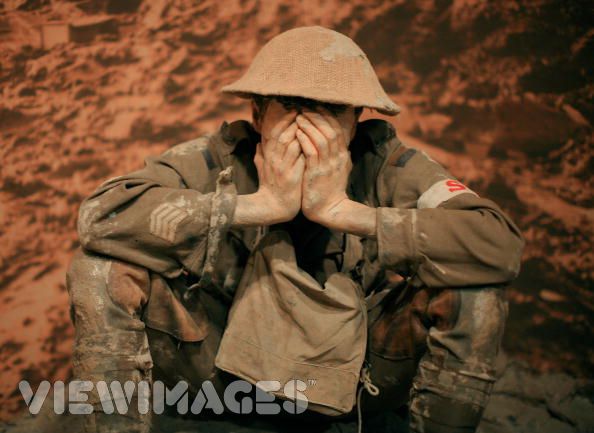
Earlier this week I was put in contact with the mother of a young Iraq veteran. Michael is twenty years old, with experiences no young person should have to face.

Michael chose to serve in the National Guard. Michael returned from Iraq with more than one medal for his service. But after a year long tour at Abu Ghraib, Michael returned with more than just medals – he brought a storehouse of experiences no person of good conscience could ever erase and this young man was not equipped with the tools he needed to quiet his mind and forget the reality of those memories.

Michael was not lost in the system. He received, and continues to receive counseling from the VA for his combat stress. He has the support of his command who has acknowledged the intense conditions under which Michael served. His family has watched over him, supported him and many in his community have embraced him. In the end, war has taken its toll. Michael faces a trial this week and this decorated young veteran, after choosing to serve his country at war, now stands to add years in prison to the list of obstacles his choices have given him.

Michael could not erase the horrors of what he saw in Iraq. Michael is proud of his service – a soldier committed to supporting the soldiers he has served with because he knows firsthand just how much each has given. Even more, Michael knows just how much understanding they now need. The medications couldn’t hide the memories, and the intoxicating effects of the 70 proof contents of a simple glass bottle couldn’t hide them either, bringing instead even greater heartache and the endless nightmare of a lifetime of regrets.

Michael lost his childhood in Iraq and returned to lose one remaining connection to better times when his attempt at self-medicating failed and his best friend lost his life in an accident Michael’s intoxication caused.

Politicians stand at podiums and talk about the cost of war.

Anti-war advocates preach from microphones and bullhorns on the steps of our nation’s capitol, outside city halls across the country and in parades down main streets in every middle-American community that they can reach.

Ignorant commentators issue harsh criticism of those who have volunteered, lashing out at the naiveté of the men and women who stood for what they believed, who acted in good faith and with trust for the words of commanders who had sworn not to abuse the lives entrusted to their leadership, as if those commentating had some higher enlightenment of right and wrong when more often than not they have never stood for anything more than photo opportunities.

Documentaries have been made showing bullet holes piercing the bodies of children no more than one year old; lives lost before they even knew to be afraid.

Many veterans have returned to offer public witness to their horrors while others have simply walked away in painful silence.

Americans shake their heads at the terrible effects of a natural rage – tornadoes, hurricanes, tsunamis, fires and floods destroying lives across the world – pity for the masses of people left homeless, sending care packages as a way to alleviate their guilt for not knowing the reality of what so many others have had to face. How many Americans turn a blind eye to the horrible effects of their own insatiable greed and ignorance for the truth of being human?

We blame our faults on the evil in the world – the evil side of a creator who gave us peace hoping we would know what to do with it; now standing watch as we pretend to have no control over the destruction we alone have caused.

Intellectuals congregate and discuss the psychological reasons for our lack of humanity.

Evangelicals shout from the mountaintops – “We MUST be afraid!”

A soldier stands alone as the chaos swirls around him – wondering “what have I done, where have I gone and how will I ever get back home?”

Wars come and go. Men and women die. Children are born. Economies falter, homes are lost, families are destroyed and futures questioned. The world circles and the cycles repeat themselves as a veteran generation remembers, issuing warnings of caution to a generation coming; a multitude believing themselves to be stronger against the tide than those who came before. As another generation grows old learning that life happens in spite of the effort to control it, the repeated cycles of chaos and division are nothing more than giant spinning wheels churning the mud in a mad attempt to veil the simplicity of the answers to questions most don’t even realize they are asking.

We know the prize; we talk about the dream, the vision, the goal. We paint it with psychedelic colors, glorify it in song, with poetic phrases; holding hands and lighting candles in the hope we can call it to the center of our circle, enjoined arms wrapping tightly to keep it from escaping our grasp. But it is not meant to be held, it is meant to be given with no obligation and no expectations. How long before we finally understand?

The war is coming home and still Americans don’t fully comprehend what we are about to receive.

We will reap what we have sown.

Michael gave what he believed was needed as he stood in response to what he felt called to do. Michael has paid a heavy price; more than any young man should have to pay. It is only the beginning, and a long jail sentence will not bring justice for an accident caused by something far more deadly than driving while intoxicated, with a responsibility shared by thousands who will never realize the cost of their complacency.

Michael, and thousands of others who will return from war to face their own storehouse of demons, deserve people to stand boldly in defense of what is right and just. They deserve people to work together to bring the changes we all need to help our world move a little closer to the goal of peace.

Michael stands to go to trial this week, but Michael should not be standing alone. Every citizen who has not yet stood to see that justice is served in the name of peace shall bear responsibility for what we all are about to receive.

Aren’t we all responsible when a veteran returns from a war we allowed to happen, with a storehouse of experiences whose demons he is powerless to silence?

Aren’t we all responsible for ensuring that true justice is served?

Monica is a senior care advocate. Her husband, Sgt. Kevin Benderman, a ten-year Army veteran served a combat tour in Iraq and a year in prison for his public protest of war. She continues to work within their community to promote resources for veterans and the elderly.

They may be reached at mdawnb@coastalnow.net. Please visit their website, http://www.bendermandefense.org/ to learn more.

Source / Information Clearing House

The Rag Blog

Posted in RagBlog | Tagged , | Leave a comment

Meditations in a Time of Delusions and Lies

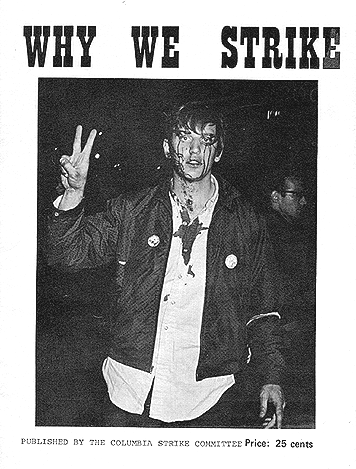
SDS pamphlet, April 1968. NYU Archives Collection.

I picked up a copy of the Columbia Alumni bulletin off the floor of my education classroom at San Francisco State in the spring of 1868, and I could tell the University was putting up a snow job for the grads to diminish the significance of the strike.

I’m glad to see they cared enough about it to have a 40 year reunion! [April 24-27, 2008] It really was a different sort of student strike than most we had seen at this time, because it focused on the University and its encroachment on the surrounding community, in this case, a predominantly black community. The Berkeley commotion over People’s Park being built on by the university, displacing the local hippies and street people, pales in comparison (pun intended).

The following article is by Hilton Obenzinger, a friend of mine, a Stanford professor and long time peace activist who participated in the strike and occupation. The article raises a lot of parallel issues for our current political period. It says a great deal about the lack of understanding and agreement between black protesters and white student protesters in the strike.

Alice Embree’s piece [A. Embree : 1968 Columbia Student Revolt Remembered in New York, The Rag Blog, May 3, 2008] did a good job of looking at the conference itself, and its interaction with current community issues. I can imagine that it was a very lopsided affair in terms of gender participation, as was the original protest. Hilton discusses this in his article, pointing out the fact that Columbia itself was an all male college in those days. Barnard was much smaller and didn’t get quite so involved in the strike, although in terms of leading the charge, two Barnard women, including one whom Hilton and Alice both mention in their articles, hurled a battle cry that brought the argumentative males to their feet and out the door!

Jon Ford / The Rag Blog / June 2, 2008

Columbia Student Rebellion 1968 – 40 Years Later
by Hilton Obenzinger

Paul Spike was going to participate in “Voices of 1968,” a reading featuring poets, novelists and other writers as part of a conference commemorating the 1968 student occupation and strike at Columbia, and he wanted me to take a look at the piece he had just written. I sat with Paul just before the reading on the ledge in front of Columbia University’s famous Alma Mater statue on the steps of Low Library, our backs against the pedestal.

Alma Mater sits with a book on her lap and her arms outstretched to both sides, the mother of wisdom offering herself to all of her children. Anti-war students had pulled a black hood over her head and connected mock electrodes to her hands a couple of days before. The iconic statue had turned into yet another icon, the hooded crucifixion image of Abu Ghraib.

Paul writes novels and non-fiction – he’s also a journalist, the first Yank to edit Punch. For this event, he wrote of the murder in 1967 of his father, the Protestant minister who led the civil rights work of the National Council of Churches, marching with Martin Luther King in Selma and elsewhere. The murder remains unsolved. Paul has long suspected that the murder was a political assassination – but his grief was only an entry point to his main purpose: to offer an apology to Columbia’s black students of 1968.

Why an apology?

Forty years before, Columbia had wanted to build a gym in Morningside Park, and the community and students (and the parks commissioner and the mayor) objected to the landgrab by a private entity of a public park. And to make it even uglier, the magnanimous university allowed for the Harlem community to use a small part of the gym, except that the students (almost all white) would enter from the front door and, as the park sloped down hill toward Harlem, the black community would enter the facilities from the back door. This smacked of Jim Crow – in fact, we called it Gym Crow – and it was emblematic of the way the university lorded over Harlem. At the same time, the university persisted in conducting counter-insurgency research to support the Vietnam war, despite avowals by President Grayson Kirk and others that Columbia had cut all ties to the Institute for Defense Analyses (IDA), the consortium of universities conducting the research.

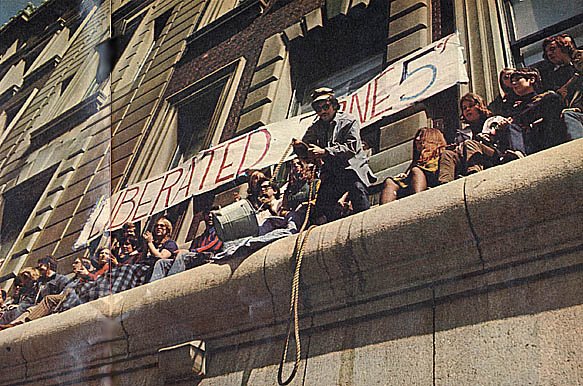
Tensions had been building for a long time. But in a swirl of events, starting with a rally at noon, April 23, 1968, students spontaneously rushed to Morningside Park to tear down the fence around the construction site, and then ended up occupying Hamilton Hall, the main undergraduate classroom building, with Dean Henry Coleman in his office. (A day or so later, the black students asked the dean if he was hungry, and suggested that he go get lunch across the campus, never saying he was released, so as to avoid any impression that he had been held hostage in the first place.) In the middle of that first night the black students in the Students Afro-American Society asked the white students, led by Students for a Democratic Society, to leave: the black students would hold Hamilton Hall on their own, and they invited the white students to take over their own building. And they did, with great enthusiasm. In the end, four more buildings were occupied, including the president’s office in Low Library – which is where I spent that week.

Once we were ensconced in Low, we tried to keep the office suite as clean as possible, considering that it held about 125 people, and we set up cramped living quarters. We also dug out the files on the IDA that proved the university’s complicity and spirited away copies to expose the truth in the underground press.

The faculty tried to intervene and negotiate, and it soon became obvious, no matter what kind of maneuvers by President Grayson Kirk, that the gym and the defense contracts would be dead. In the end, one demand remained the thorniest: amnesty. We felt that we would not accept punishment for doing the right thing, and that if the university wanted to punish us that they should just go ahead and do it, but that we didn’t have to agree to accept it in exchange for . . . being right.

According to former Deputy Mayor Sid Davidoff, the city urged the university to grant amnesty. That would isolate Mark Rudd and his band of radicals, Davidoff had explained his strategy, and he warned that the police were frustrated and itching for blood, “chewing on their nightsticks” in buses for days. Once they were unleashed, he had explained to the university administration, they could not be controlled. Meanwhile, Yale President Kingman Brewster and others called Kirk, telling him to stand firm, that if Columbia gave in to amnesty, other universities would collapse in the face of student rage – another version of the domino theory.

Kirk finally did send in the cops. The black students, advised by lawyers, told the police that they would not resist but that they would not leave Hamilton Hall without being arrested, and they allowed themselves to be cuffed and taken away with no violence. Their approach prevented black students from being brutalized, a spectacle that could have ignited Harlem, and their charges were limited to criminal trespass and no more.

The white students in the other buildings offered passive non-violent resistance of various forms – and as a consequence they were severely beaten. Over 700 were arrested that night, and over a hundred injured, as the cops charged through faculty and students outside the buildings and bloodied many of those inside.

Striking students at Mathematics Hall, Columbia University, 1968.

Events spiraled after the bust into a strike involving the entire university, including faculty, and to other occupations, demonstrations, police riots, and negotiations, going on through the next academic year and beyond. The gym was history, the war research was canceled, and Columbia went through a process of rebuilding itself and, with other universities, reforming higher education to include more democratic governance involving students and faculty, innovations such as black and ethnic studies and women’s studies, and a deeper sense of accountability. The discourse of “diversity” and “multiculturalism” arose from the revolts of Columbia, as well as other schools, to the dismay of the right-wing to this day.

So, forty years later, we came together on the campus from April 24th to 27th with current students, faculty and community members to commemorate the revolt. The “wrinkled radicals,” as the student newspaper called us, reconnected and exulted, sensed our mortality and mourned, perhaps all to be expected at any kind of reunion. We wanted, as Gus Reichbach, now a judge in New York, underscored, to show today’s students that it’s possible to live lives committed to social justice – and still have fun. But we also wanted to discover the deeper significance of the strike and its legacy. With the country embroiled again in yet another immoral war and Columbia once again expanding into Harlem, the similarities and differences were crying out to be explored.

The day before the conference, the New York Times published a personal reflection on the strike by critically acclaimed novelist Paul Auster, “The Accidental Rebel.” He had been part of the occupation of the Math building, and he too would read at “Voices of 1968.” Auster constructed the little essay around the idea that 1968 was “the year of craziness, the year of fire, blood and death . . . and I was as crazy as everyone else.” He went on to observe that “Being crazy struck me as a perfectly sane response to the hand I had been dealt,” which was the threat of being drafted into a war that “I despised to the depths of my being.” He reflected on the gym, the landgrab, the backdoor apartheid quality, but for him the war was at the center of his own revolt. He didn’t recant, had no regrets, and “was proud to have done my bit for the cause,” even though he felt that not much had been accomplished, considering that the war continued to drag on for too many more years. And then, noting that he would not say “the word ‘Iraq’” (and by not saying it, did just that, in great Jonathan Swift tradition), he ended his piece with humorous defiance that “I am still crazy, perhaps crazier than ever.”

Auster’s “craziness” managed to surface periodically through the conference panels on Vietnam and Iraq, on the ethics of protest, race, the legacy of the student movement, the emergence of the women’s movement, and more. Longtime activist Tom Hayden, also a veteran of Math, objected to the essay, regarding Auster as trivializing the protest as insane, an aberration, and not a political eruption. The next day, philosopher Akeel Bilgrami regarded Auster’s craziness differently, describing it as part of Erich Fromm’s observation that, in an insane society, one must become “crazy” to become sane, one must disrupt the bland, grim normality of the lunatics in charge. In fact, Erich Fromm spoke at the counter-commencement held by protesting students in 1968, so Bilgrami may have certainly captured one aspect of the spirit of the age. At the same time, Ray Brown, one of the leaders of the black students in Hamilton Hall, also objected to considering what the African American students had done as “crazy.” As the conference would reveal, the black students felt they had to act with utmost sanity to undermine racist expectations. All of this was quite a bit of play for a little personal reflection – but it was, after all, the only voice in the New York Times for what we had done, so a lot more hung on a short essay than anyone might otherwise note, and the controversy was intense.

Indeed, we met with almost the same intensity as we did 40 years ago – minus the cops. But much of what took place was unusual, and a bit surprising. In our self-reflection, “crazy” was able to take on all sorts of meanings.

Most electrifying was a multimedia re-creation or tableau called “What Happened” that presented a narrative of events, starting on April 23, 1968, with participants describing their experiences at each juncture. Eventually, this narrative-testimony will be brought together as an audio and textual document, hopefully with additional accounts by those students who supported the university administration, and others, such as the police and surviving professors. But even with the dozens of those who took part in the strike testifying at this event, we learned much of what really took place.

For example, the women’s movement was just beginning, and Columbia would be one of the last major protests where male monopoly of leadership and traditional gender roles went unchallenged. It was impossible to revise those dynamics entirely today – Columbia was all-male then, and we could not change that fact – but we were able to highlight the role women played and the rumblings of imminent eruption. For instance, a key juncture in the rebellion was when the demonstrators on April 23rd found themselves locked out of Low Library, the main administration building, and were frustrated in their attempts to confront the university administration. At that point, accounts note that anonymous cries went out, “To the gym! To the gym!” whereby the crowd headed to Morningside Park to tear down the cyclone fence at the construction site. At “What Happened,” we learned that those shouts were not anonymous: Bonnie Offner Willdorf and Ellen Goldberg announced that they had been the ones to re-direct the demonstration: “It was two women who called out ‘To the gym! To the gym!’” Two women acting “crazy,” violating the decorum expected of Barnard students, and they led the auditorium once again in cries of “To the gym! To they gym!”

But it was race relations that was the most volatile, then and now, and the revelations were the most startling – which is what drove Paul Spike to write his essay in response. In 1968, as I outlined earlier, there were two main groups of students driving the protest, black students led by the Students Afro-American Society, and the rest of the students, overwhelmingly white, led by Students for a Democratic Society. During the upheaval, there were two distinct perceptions of strategy and tactics; and afterward, there were two different streams of experience and memory. After the bust, we went our separate ways, politically and socially; and now the conference finally allowed these two streams to converge: black and white came together, and we came to understand each other far better than ever before.

Read the rest of this article here. / Op Ed News / May 27, 2008

Also see [A. Embree : 1968 Columbia Student Revolt Remembered in New York, / The Rag Blog / May 3, 2008

The Rag Blog

Posted in RagBlog | Leave a comment

Dear Screaming Woman…

This is an excellent post about the lunacy into which much of the Obama-Clinton maelstrom has devolved and the need to gain a bit of perspective about who the real mysognists are in this picture.

Thorne Dreyer

I have to vent, Clinton supporters
By altruista / June 1, 2008

I’m a 55-year-old white woman. Our greatest matter of urgency in America is to be sure a Democrat becomes President in November, and to get as many Democrats as possible elected to both houses of Congress. We need to do the same thing at state and local levels.

I’ve never supported any political candidate enough to campaign or canvass for them. I’ve never felt that any candidate would be able to keep their campaign promises once they got into power and went up against the machinery that’s occupying this country today. I’ve never felt strongly enough about a candidate to feel moved to be an activist for them. No candidate can ever be all things to everyone. And until now I’ve been able to keep a respectful silence while others with very strong feelings for either of the Democratic candidates for President have public melt-downs when their candidate has a political setback.

I can’t keep quiet now. I’ve just been watching a white woman in my age group on CNN going radioactive to the cameras about how she’s going to vote for McCain if Hillary Rodham Clinton doesn’t get the Democratic nomination. She gave as her rationale for this chop-off-your-nose-to-spite-your-face tactic that the Democratic party has turned on its women supporters.

To this woman, if you and others like you are reading this: and you’d like the proven record of Republican conservatives for their all-out war on women’s rights? We’re now paying the price for three decades of conservative domination in America –what it’s done to the American character; the fact of American commerce now as morally bankrupt as it is; the abuses of Wall Street; the abuse of the environment; the poisonous cynicism and corruption of this administration — I could go on for pages.

Back to the issue of women’s rights. You, woman screaming into the cameras: you are old enough to remember the pre-Roe v. Wade days in America. Remeber coat hangers, Drano, women hurling themselves down steps, women dying and left unable to bear children from illegal botched abortions? Remember birth control outlawed? Remember the early 1970s, when a woman could not get a credit card or bank loan in her own name—when a woman needed an adult male co-signer’s permission for them because we were deemed incompetent to manage our own financial affairs? Remember when sexual harassment and open sex discrimination were legal? Remember when we didn’t have rape shield laws, when marital rape wasn’t illegal? Remember when a woman being used as a punching bag by her husband had no recourse — had no earning power, no options, when the police she turned to often were abusers themselves and sympathized with the husband, when domestic violence shelters weren’t even a twinkle in anyone’s eye?

If I remember all of that — and I do — then you do, too, Screaming Woman. Republicans fought the changes that spare today’s women those infringements of basic human rights. Give the Republican Party platform a close reading. They want to return us to those days. And because the Democratic Party enacts a decision you (and maybe I) don’t agree with, you’re really going to show them, and vote for McCain? The same McCain who, in front of a group of people and in a mouth-frothing rage, called his wife a cunt? The same McCain who mocked Chelsea Clinton, a child at the time, as ugly? The same McCain who vows to appoint Supreme Court justices who will vote to overturn Roe v. Wade? The same McCain who simply laughed when a Republican woman asked him, on camera, “How do we beat the bitch?” — referring to Clinton, your candidate of choice? The Democratic Party’s decision was worse than this?

Please. Get things in perspective. I do not consent to watching Republicans — the American Taliban — imposing their misogynistic policies on my nieces. Grow up. I seldom use language this strong, and I understand your anger. But remember who our adversaries are. Rememeber what they’re made of, remember the damage they’ve done already and the worse damage they surely will do if we vote them back into power. Truly, Screaming Woman, I cannot wrap my brain around any woman willing to hand all America’s women over to these American Taliban if Clinton doesn’t get the nomination.

You implied in your meltdown that the Democratic Party is making a calculated effort to prevent a woman from winning the nomination because she’s a woman. News flash: it’s possible to support Obama and not be a misogynistic goon.

I had to get that out of my system. Now please, calm down, get your emotions in check, and do this. Think critically, interpret what the candidates say and do, reach informed decisions based on their judgment, character, track record, and positions on the issues, and don’t abuse the vote that women fought so courageously for so long to win.

Source. / Daily Kos

Thanks to Carl Davidson / The Rag Blog

Posted in RagBlog | Tagged , , , | Leave a comment

Monsanto’s Harvest of Fear

No thanks: An anti-Monsanto crop circle made by farmers and volunteers in the Philippines. Photo byy Melvyn Calderon/Greenpeace HO/A.P. Images.

Monsanto’s Harvest of Fear By Donald L. Barlett and James B. Steele, which follows, first appeared in the May issue of Vanity Fair.

First, some comments from Scott Trimble.

I don’t know if Monsanto is the sole title-holder to “America’s Worst Corporation,” but it is certainly one of those in a dead heat (Exxon-Mobil, Winston-Salem, R.J. Reynolds, McDonald’s, Walmart, Chase, Citi, General Electic, and Pfizer are among those that come to mind). However, this does raise an issue that I think is very important. There is a case to be made for not allowing corporations to hold patents or copyrights. Furthermore, to prevent corporate executives from obtaining the patents for work done by others, there should be abundant evidence of the involvement in the development of the product or idea for each person named in a patent application.

While corporations may pay the salaries of researchers or otherwise fund the research that leads to new patents, it is the inspiration, genius and/or work of individuals that results in new discoveries. I’m not sure that changing patent laws in this way would thwart the efforts of companies like Monsanto, but it is an important step in that direction.

Actually, I believe there is an argument to be made for repealing all patent and copyright law, but I know those who believe that capitalism is valid will disagree.

But to get back to Monsanto, we (the people) ought to be writing laws to break the stranglehold of entities like Monsanto over the essential elements of our lives. Unfortunately, to do that, we are going to have to tear down our entire political system and build something that will truly serve the people’s interest, rather than merely make mention of it.

Scott Trimble / The Rag Blog / June 2, 2008

Monsanto already dominates America’s food chain with its genetically modified seeds.

Now it has targeted milk production. Just as frightening as the corporation’s tactics–ruthless legal battles against small farmers–is its decades-long history of toxic contamination.
By Donald L. Barlett and James B. Steele

Gary Rinehart clearly remembers the summer day in 2002 when the stranger walked in and issued his threat. Rinehart was behind the counter of the Square Deal, his “old-time country store,” as he calls it, on the fading town square of Eagleville, Missouri, a tiny farm community 100 miles north of Kansas City.

The Square Deal is a fixture in Eagleville, a place where farmers and townspeople can go for lightbulbs, greeting cards, hunting gear, ice cream, aspirin, and dozens of other small items without having to drive to a big-box store in Bethany, the county seat, 15 miles down Interstate 35.

Everyone knows Rinehart, who was born and raised in the area and runs one of Eagleville’s few surviving businesses. The stranger came up to the counter and asked for him by name.

“Well, that’s me,” said Rinehart.

As Rinehart would recall, the man began verbally attacking him, saying he had proof that Rinehart had planted Monsanto’s genetically modified (G.M.) soybeans in violation of the company’s patent. Better come clean and settle with Monsanto, Rinehart says the man told him—or face the consequences.

Rinehart was incredulous, listening to the words as puzzled customers and employees looked on. Like many others in rural America, Rinehart knew of Monsanto’s fierce reputation for enforcing its patents and suing anyone who allegedly violated them. But Rinehart wasn’t a farmer. He wasn’t a seed dealer. He hadn’t planted any seeds or sold any seeds. He owned a small—a really small—country store in a town of 350 people. He was angry that somebody could just barge into the store and embarrass him in front of everyone. “It made me and my business look bad,” he says. Rinehart says he told the intruder, “You got the wrong guy.”

When the stranger persisted, Rinehart showed him the door. On the way out the man kept making threats. Rinehart says he can’t remember the exact words, but they were to the effect of: “Monsanto is big. You can’t win. We will get you. You will pay.”

Scenes like this are playing out in many parts of rural America these days as Monsanto goes after farmers, farmers’ co-ops, seed dealers—anyone it suspects may have infringed its patents of genetically modified seeds. As interviews and reams of court documents reveal, Monsanto relies on a shadowy army of private investigators and agents in the American heartland to strike fear into farm country. They fan out into fields and farm towns, where they secretly videotape and photograph farmers, store owners, and co-ops; infiltrate community meetings; and gather information from informants about farming activities. Farmers say that some Monsanto agents pretend to be surveyors. Others confront farmers on their land and try to pressure them to sign papers giving Monsanto access to their private records. Farmers call them the “seed police” and use words such as “Gestapo” and “Mafia” to describe their tactics.

When asked about these practices, Monsanto declined to comment specifically, other than to say that the company is simply protecting its patents. “Monsanto spends more than $2 million a day in research to identify, test, develop and bring to market innovative new seeds and technologies that benefit farmers,” Monsanto spokesman Darren Wallis wrote in an e-mailed letter to Vanity Fair. “One tool in protecting this investment is patenting our discoveries and, if necessary, legally defending those patents against those who might choose to infringe upon them.” Wallis said that, while the vast majority of farmers and seed dealers follow the licensing agreements, “a tiny fraction” do not, and that Monsanto is obligated to those who do abide by its rules to enforce its patent rights on those who “reap the benefits of the technology without paying for its use.” He said only a small number of cases ever go to trial.

Some compare Monsanto’s hard-line approach to Microsoft’s zealous efforts to protect its software from pirates. At least with Microsoft the buyer of a program can use it over and over again. But farmers who buy Monsanto’s seeds can’t even do that.

The Control of Nature

For centuries—millennia—farmers have saved seeds from season to season: they planted in the spring, harvested in the fall, then reclaimed and cleaned the seeds over the winter for re-planting the next spring. Monsanto has turned this ancient practice on its head.

Monsanto developed G.M. seeds that would resist its own herbicide, Roundup, offering farmers a convenient way to spray fields with weed killer without affecting crops. Monsanto then patented the seeds. For nearly all of its history the United States Patent and Trademark Office had refused to grant patents on seeds, viewing them as life-forms with too many variables to be patented. “It’s not like describing a widget,” says Joseph Mendelson III, the legal director of the Center for Food Safety, which has tracked Monsanto’s activities in rural America for years.

Indeed not. But in 1980 the U.S. Supreme Court, in a five-to-four decision, turned seeds into widgets, laying the groundwork for a handful of corporations to begin taking control of the world’s food supply. In its decision, the court extended patent law to cover “a live human-made microorganism.” In this case, the organism wasn’t even a seed. Rather, it was a Pseudomonas bacterium developed by a General Electric scientist to clean up oil spills. But the precedent was set, and Monsanto took advantage of it. Since the 1980s, Monsanto has become the world leader in genetic modification of seeds and has won 674 biotechnology patents, more than any other company, according to U.S. Department of Agriculture data.

Farmers who buy Monsanto’s patented Roundup Ready seeds are required to sign an agreement promising not to save

Read the entire article here. / Vanity Fair / May, 2008

Thanks to Richard Kendrick / The Rag Blog

Posted in RagBlog | Tagged , , , , | Leave a comment

Trained in the Use of Cameras by Al Jazeera


Our nation’s self-respect demands impeachment
By Linda Boyd / May 31, 2998

I wept to see Sami al Haj embrace his young son for the first time after six years in Guantanamo prison. Sami al Haj, a Sudanese news cameraman, was seized in Pakistan while working for al Jazeera News. He was imprisoned, tortured and brutalized by Americans while there. Like most prisoners held at Guantanamo, al Haj was never tried or charged.

After his release, Sami al Haj arrived in Sudan and was immediately rushed to a hospital by ambulance, weakened by his 438-day hunger strike in Guantanamo. His message to our government: “Torture does not stop terrorism, torture is terrorism.”

The U.S. government evidence against him says, “He was trained in the use of cameras by al Jazeera News.”

The American people have a choice ahead of them. They can continue to be shamed as a nation of torturers, or they can put a stop to this administration’s ongoing crimes against humanity.

Sami’s Son

Abusing and terrorizing innocent people doesn’t make us safer. Imprisoning people without due process doesn’t make us safer. Violating our laws, treaties and values doesn’t make us safer.

U.S. military and FBI interrogation experts affirm that testimony obtained under torture is inaccurate and unreliable. In May, the FBI issued a scathing 371-page report on torture and war crimes compiled from observations at Guantanamo. Even the CIA concluded in a 1963 study that coercion is “not very helpful outside the context of producing false propaganda.”

George W. Bush said, “We do not condone torture. I have never ordered torture. I will never order torture.”

Recently, Bush admitted that he knew top administration officials met repeatedly in the White House to discuss coercive interrogation techniques, including torture, and that he “approved them.”

President Bush, Vice President Dick Cheney and top administration officials have in fact condoned torture, and violated domestic and international laws that ban cruel, inhuman and degrading treatment of human beings.

These laws include the Geneva Conventions, the 1984 U.N. Convention Against Torture and the U.S. Constitution. These laws are not invalidated, as the Bush team alleges, if prisoners are not on U.S. soil.

Torture laws are jus cogens, meaning “compelling law,” said constitutional law Professor Marjorie Cohn, in testimony before the House Judiciary Committee. “There can be no immunity from criminal liability for violation of a jus cogens prohibition.”

Being a rogue nation is not in our best interest and exposes our soldiers and citizens to grave danger. Why hasn’t Congress stopped torture?

It is unconscionable to simply wait for the torture team to leave office while hapless individuals are imprisoned without due process and tortured. Sami al Haj spoke of the many prisoners languishing in Guantanamo. In despair, many have tried to commit suicide.

Taking impeachment off the table means there is no limit to the Bush team’s depravity, and that torture will continue in our name.

The administration is already expanding prisons around the world, where the abuse of human rights will continue. A new 40-acre prison is under construction in Afghanistan.

While Guantanamo’s prison population is shrinking, prisoners from around the world are being redirected to U.S. prisons in Iraq, where they’ll be more hidden from the public eye. Particularly disturbing are reports of children imprisoned by the U.S. in the Middle East and Guantanamo.

Eventually, some of our highest officials will be tried for war crimes in a court of international law.

Already, charges of condoning torture are advancing against former Defense Secretary Donald Rumsfeld in France. Author Philippe Sands quotes a judge with experience in international criminal cases who says “It’s a matter of time” before members of the Bush administration are arrested for war crimes while traveling abroad.

Why bother with impeachment if charges for war crimes will eventually catch up with the torture team?

Criminal charges can punish individuals for their crimes, but impeachment has the power to restore the rule of law, and redeem the office of the executive. Impeachment hearings will put the truth on the congressional record. Unlike other subpoenas, impeachment subpoenas cannot be denied.

Impeachment establishes legal precedent, so that future public officials will not be able to abuse power in the same way. The American people can signal to the world that they have taken responsibility for their own government, and ensure that torture will never again be this nation’s policy.

We must demand that Congress make ending torture the top priority. They know about torture, and their silence makes them complicit.

The eyes of the world are upon us. There’s plenty of time to impeach. Our self-respect as a nation demands it.

Linda Boyd is director of Washington for Impeachment.

Source / Seattle Post-Intelligencer

The Rag Blog

Posted in RagBlog | Tagged , | Leave a comment

Junior’s Delusions Persist : Rewarmed WWII


Bush Compares War in Iraq, Afghanistan with WW II
By Diane Smith / May 29, 2008

During a speech held at the graduating ceremony of the Air Force Academy cadets, U.S. President George W. Bush said the war waged by America in Iraq and Afghanistan is a “great struggle” and compared it with World War II, The New York Times reported.

Considering the fact that the WW II was regarded by many world leaders, military chiefs and historians as “the war of all wars” or “the war to end all wars” – let’s hope they were right at least on the first one – Bush’s assertion is in a very strong contrast with another one in which he said the U.S. military wasn’t exactly prepared for the aftermath of the first stages of the war.

In his speech, Bush warned that the only way the United States could lose the war is if it defeats itself. He warned the nearly 1,000 graduates against those who would waver in the war struggle.

The President said a 21st century war is won not only through arms but more important, through the power of will.

“And we need to recognize that the only way America can lose the war on terror is if we defeat ourselves,” said Mr. Bush, who described the current situation of the war as a “battle of wills.”

The strategy of United States’ current enemies is to cause it to lose nerve and “retreat before the job is done”, said the President. He exemplified the situation using the experiences of Germany and Japan, which were defeated by the U.S. in WW II only to later become democratic states and allies.

“Today, we must do the same in Afghanistan and Iraq,” Mr. Bush said.

© 2007 – 2008 – eFluxMedia

Source / eFluxMedia

The Rag Blog

Posted in RagBlog | Tagged , | Leave a comment

Steven Harper Joins Junior’s Repression Club


Antiwar Group Fears Speakers will be Blocked at Border
by Doug Ward / May 31, 2008

VANCOUVER – Organizers of an antiwar conference in Vancouver this weekend fear that Canada Border Services may prohibit their keynote speaker, retired U.S. Army Colonel Ann Wright, from entering the country.

Wright was denied entry into Canada twice last year because her name is on a FBI watch list due to misdemeanor convictions stemming from her participation in antiwar demonstrations.

“The Canadian government should not be using this FBI list as a basis for denying entry into Canada,” said Issac Romano, organizer of the Our Way Home conference, which is honouring American women who came to Canada during the ’60s and ’70s due to their opposition to the Vietnam War.

Romano said it is “ironic” that Canada would bar Wright considering that Canada decided not to join the U.S.-led invasion of Iraq and welcomed American draft dodgers and deserters during the Vietnam War.

After a long career in the army, Wright joined the U.S. State Department in 1987, serving as a diplomat in various countries.

She resigned from the State Department over the U.S. invasion of Iraq. Since then Wright has emerged as a leading American antiwar activist.

She has been arrested at protests many times, including when she disrupted a Senate committee hearing at which the top American military official in Iraq, Gen. David Petraeus, was testifying.

Wright, in an interview from California, said the FBI watch list was set up to keep track of “hardened criminals.” But the Bush administration has put the names of arrested peace activists on to the list in order to suppress dissent against the Iraq war, she added. “It’s pure political intimidation.”

Medea Benjamin, another leading U.S. antiwar activist, is also scheduled to speak at the Vancouver conference. But Benjamin was similarly turned back last year by Canadian border guards because her name is on the FBI list.

Wright said that Canada showed independence by not fighting in Iraq, “so it baffles me why the Canadian government trusts a politically-tainted list that the Bush administration is putting out.”

Wright said she hoped to use her Vancouver speech to urge Canadian politicians to provide sanctuary to American soldiers who desert over their opposition to the Iraq conflict.

Parliament is expected to vote Tuesday on a motion, calling upon the Canadian government to allow U.S. war resisters to stay in Canada.

Libby Davies, the NDP MP from Vancouver East, intends to accompany Wright and Benjamin in their attempt to cross the border Sunday morning at the Peace Arch border crossing.

“These two women are not criminals. They are peace activists,” Davies said.

Chris Williams, an Ottawa-based spokesman for the CBS, declined to comment on why the two activists had been barred previously, citing federal privacy rules.

Williams also refused to say whether Wright and Benjamin would be denied entry again on Sunday because their names are on a FBI list.

The CBS official said that every visitor is assessed on a “case-by-case” basis and that a criminal record is one factor border guards use in assessing admissibility into Canada.

© The Vancouver Sun 2008

Source / Vancouver Sun

The Rag Blog

Posted in RagBlog | Tagged , , | 1 Comment

America, Incorporated, L.L.C.


we built this business up from scratch
with all the real estate we snatched
we used resources down the hatch
with all the labor we could catch
mythologized confabulated
self-congratulated
America, Incorporated

for a new place did real well
lots of smokes and folks to sell
way far from god but what the hell
surprise there’s a crack in the Liberty Bell
mammon worshipped freedom jaded
America, Incorporated

needed more land
so to expand
all we could stand
oh ain’t it grand
to be armed well-situated
with native people nearly exterminated
I guess genocide was predestinated for
America, Incorporated

took our place astride the earth
took the place for all it’s worth
impoverishing the world free traded
cause feudalism was underrated
and not nearly as well-remunerated
as guzzling belching satiated
America, Incorporated

we started fresh a new creation
left behind our aggravation
tried to be enlightened nation
with political salvation
ended up fast food plantation
pornographic war sensation
and thought by most an indignation

America, the Corporation
with corporate donors laws donated
never treaty obligated
always right exonerated
never wrong simply fixated
a glowing example irradiated
America, Incorporated

evil’s real, inaugurated
jingoists intoxicated
war high priests how loud they’ve prayed
for an armageddon how long they’ve waited
craving to be expiated
America, Incorporated

truth was switched and freedom baited
people die while targets are graded
whose jugular is the next to be slated
what poor little nation to be devastated
while democracy watches infatuated
and who’s not to say way too elated
then sleeps it off somnambulated
America, Incorporated

is real liberty just imitated
with freedom vaunted yet freedom crated
and protest cautious and sedated
despite the plans to be cremated
the 21st century for this we waited
dithering blithering and bloviated
America, Incorporated
slithering withering misappropriated
America, Incorporated
America, In Corpus Delicti We Trust

America, Incorporated, L.L.C.

Larry Piltz 2006-08
Indian Cove, Austin, Texas

Posted June 1, 2008 / The Rag Blog

Posted in Rag Bloggers | Tagged , , | 3 Comments

Fewer Flights : Costs Economy, Aids Environment

American Airlines and Northwest Airlines have raised their fuel surcharges for flights to Europe by an additional $20 per round trip, an air fare expert says. / Travel-Blog.

US economy begins collapse into a state of greater efficiency. And greater environmental sustainability too. A cutback in unneeded air travel due to soaring fuel costs has eliminated huge amounts of greenhouse gas emissions and thus reduced global warming.

You would think the world would be a better place with fewer insurance salesmen eating unhealthy overpriced food and schmoozing in Las Vegas, etc. But no, the special interests representing the hotels, restaurants and airlines seem to be quite unhappy about the environmental progress being made. This just shows you can’t please everybody.

Roger Baker / The Rag Blog

Less flying costs American economy $26 billion, survey says

Air travelers, tired of inefficient security screening, flight cancellations and delays, avoided some 41 million trips over the past year and that has cost the national economy $26 billion, a survey from the Travel Industry Association reveals.

The survey, conducted by polling firms Peter D. Hart Research Associates and The Winston Group, says the lack of air travel cost airlines more than $9 billion in revenue, hotels nearly $6 billion and restaurants more than $3 billion. Federal, state and local governments also lost more than $4 billion in tax revenue because of reduced spending by travelers.

“Many travelers believe their time is not respected and it is leading them to avoid a significant number of trips,” says Allan Rivlin, a partner at Peter D. Hart Research Associates. “Inefficient security screening and flight cancellations and delays are air travelers’ top frustrations.”

Air travelers apparently have little hope for positive change, with nearly 50 percent saying the air travel system is not likely to improve in the near future. More than 60 percent believe the air travel system is deteriorating. And travelers are most irritated about the air travel process, not the airlines, according to the survey.

The survey of 1,003 air travelers–adults who had taken at least one roundtrip by air in the last 12 months–was conducted between May 6 and May 13 and has a margin of error of 3.2 percentage points.

TIA is a Washington D.C-based nonprofit that represents the travel industry and promotes increased travel to and within the United States.

See research at The Power of Travel.

Source. / Austin Business Journal / May 30, 2008

The Rag Blog

Posted in RagBlog | Tagged , , , | Leave a comment

The Waste, the Fraud, and the Abuse : Staggering


Byron Dorgan’s Contracting Fraud Crusade
By Brian Beutler, The Media Consortium / May 31, 2008

The North Dakota senator has made investigating contractor corruption his mission, but will he succeed in creating a congressional committee devoted to it?

In the wake of a recent Defense Department report from the Office of Inspector General that documents (PDF file) the improper accounting of billions of dollars in war contracting funds, the issue of waste, fraud, and abuse in Iraq is once again in the spotlight on Capitol Hill.

Those findings were amplified on Tuesday when the Project on Government Oversight, a Washington-based watchdog group, obtained a separate inspector general report that found that the number of Pentagon auditors overseeing military contracts has not kept pace with defense spending, which has doubled under the Bush administration — creating conditions that are ripe for corruption and abuse.

While Congress has launched sporadic inquiries into contracting fraud, one legislator, Sen. Byron Dorgan, D-N.D., has made it his mission to investigate contractor corruption.

Dorgan chairs the Democratic Policy Committee, a Senate entity tasked with gathering and distributing policy, strategy, and oversight information to congressional staff and other Democratic officials. (There is also a Republican Policy Committee.) Since 2003, the DPC has held 14 hearings dedicated to exposing the corruption of the Iraq reconstruction effort, and last month the committee released an encyclopedic report detailing major examples of fraud.

When the war in Iraq began, says Dorgan, “no one really [decided] to say, ‘All right, now we’re going to be an investigative committee so there’s accountability.’” In order to fill the void, Dorgan decided to use his committee for that purpose — though its oversight authority is somewhat diminished by the fact that the panel, as a partisan committee, lacks subpoena power. In light of this, since 2005 Dorgan has attempted to establish a congressional committee with full oversight clout to oversee military contracting. Dubbed the Special Committee on War and Reconstruction Contracting, the proposed panel is modeled on the Senate Special Committee to Investigate the National Defense Program (commonly known as the Truman committee), which was charged with investigating the waste and corruption of billions of dollars of World War II-era defense contracts.

So far legislation to create a committee to oversee contracting for the wars in Afghanistan and Iraq hasn’t gained traction. During the previous Congress, which ended in December 2006, Dorgan’s resolution was swatted down three separate times along partisan lines. (In each case, presumptive GOP presidential nominee John McCain voted with the Republican majority to nix the committee.)

A Dorgan aide says that the third-term senator plans to introduce his proposal again within the year, and is currently looking for Republican co-sponsors, which he believes will improve his chances of passing the bill. In the past, the only Republican to vote in favor of the commission was Lincoln Chaffee of Rhode Island, who lost his seat during the Democratic landslide in November of 2006. So Dorgan’s contracting committee is still a long shot.

Other senators have taken a milder approach to the idea of a modern-day Truman committee. Last year, Sen. Jim Webb, D-Va. — along with all of his fellow freshman Democrats in the Senate — sponsored a measure mandating the creation of an independent bipartisan commission (distinct from a congressional committee, which has subpoena power) to “investigate U.S. wartime contracting in Iraq and Afghanistan.” The measure passed unanimously last September as an amendment to the Defense Authorization Act, only to be written out of existence by a presidential signing statement when the bill hit President Bush’s desk in January.

If Dorgan gets his way, it could substantially bolster the Democrats’ efforts to uncover and deter acts of fraud and corruption in war contracting. Currently those efforts have been driven almost exclusively by House Oversight Committee Chairman Rep. Henry Waxman, D-Calif., and Senate Armed Services Committee Chairman Carl Levin, D-Mich. Since taking the House oversight gavel in January 2007, Waxman has held a host of hearings on defense contracting fraud, with a particular emphasis on the companies, like Blackwater and KBR, that have been some of the biggest beneficiaries of the war in Iraq.

Levin has spotlighted the issue of contractor fraud on a number of occasions, but, like Waxman, the focus of his committee extends well beyond contracting oversight. The existing congressional committees, Dorgan says, “have not had the investigators and the time,” to give this issue the focus it deserves. “So, we have held these hearings, and the waste, the fraud, and the abuse is staggering.”

Source / In These Times

The Rag Blog

Posted in RagBlog | Tagged , , , | Leave a comment

Giddyup!

Thanks to Harry Edwards / The Rag Blog

Posted in RagBlog | Tagged , , | Leave a comment

More Wrongful Convictions : The Justice Project

New DNA tests “do not support the current conviction” of Texas Death Row inmate Michael Blair (pictured), who was condemned in the 1993 slaying of 7-year-old Ashley Estell, a high-profile case that led to the creation of tough sex-offender laws, Collin County District Attorney John Roach said recently, as quoted in an AP story.

The Top Stories This Week in Criminal Justice Reform
By Jeff Miller / May 30, 2008

Here are the top stories in criminal justice reform, taken from the Justice Newsladder.

Tennessee will retry death row inmate Paul House but will not seek the death penalty. The decision meets a deadline set by the U.S. Supreme Court to retry or free House by June 17. In June 2006, the Court concluded that reasonable jurors would not have convicted House if they had seen the results of DNA tests from the 1990s. House has been in prison since 1986. (www.tennessean.com)

Michael Blair will most likely become the 9th Texas death row inmate to be exonerated. DNA evidence cleared Blair, already a convicted sex offender, of connection to the murder of seven year-old Ashley Estell; the case led to tougher sex offender laws called “Ashley’s Laws”. (standdown.typepad.com

The district attorney’s office in Dallas County, America’s leading county in exonerations, approved of DNA tests for three more inmates that were denied testing by a previous DA. (dallasnews.com)

Authorities in Illinois are preparing to free Dean Cage, who has served 14 years of a 40 year sentence for aggravated sexual assault after being cleared by DNA tests. Cage was linked to the crime because of his resemblance to a police sketch that appeared in the newspaper. Police then brought the 15 year-old victim to the store where Cage worked and she identified him as the offender. (suntimes.com)

As part of their editorial series They Didn’t Do It: Convicting the Innocent, The Buffalo News argues for videotaping police interrogations. 10 of New York’s 23 wrongful convictions have sprung from false confessions. The entire Buffalo News series can be read on the Justice Newsladder. (buffalonews.com)

The Justice Project, an organization which works to increase fairness and accuracy in the American criminal justice system, is proud to sponsor the Justice Newsladder, a new tool to find the top news and articles about criminal justice reform.

Source. Burnt Orange Report / The Justice Project

Our Agenda for Reform

The Justice Projects works to increase the fairness and accuracy of the American criminal justice system. We develop, coordinate, and implement integrated national and state-based campaigns involving public education, litigation and legislation to reform the criminal justice system, with particular focus on capital punishment.

The Problem: A Broken System

The American criminal justice system is broken. Since the reinstatement of the death penalty in the 1970s, 130 people have been exonerated from death row in 26 states – roughly one for every nine executed. The most comprehensive study of capital trials ever conducted found that nearly seven of every 10 death sentences handed down by state courts from 1973 to 1995 were overturned due to “serious, reversible error,” including egregiously incompetent defense counsel, suppression of exculpatory evidence, eyewitness misidentification, false confessions, snitch and accomplice testimony, and unreliable forensic science. Read more

The Solution: National Agenda for Reform

To promote solutions to the problem of wrongful convictions and enhance protections for innocent people accused of crimes, The Justice Project has constructed a national program of eight specific reform initiatives designed to increase the fairness and accuracy of the criminal justice system.
Read more

From prosecutors to victims’ rights groups, from defense lawyers to judges to law enforcement, reasonable people agree that our system of justice must protect the innocent and punish the guilty – not the other way around.

The Justice Project

Also see Campaign to End the Death Penalty and Free Rodney Reed.

The Rag Blog

Posted in RagBlog | Tagged , , | Leave a comment