H. Rosen : Hillary Missed Her Chance


I Am Not a Bargaining Chip, I Am a Democrat
By Hilary Rosen / June 4, 2008

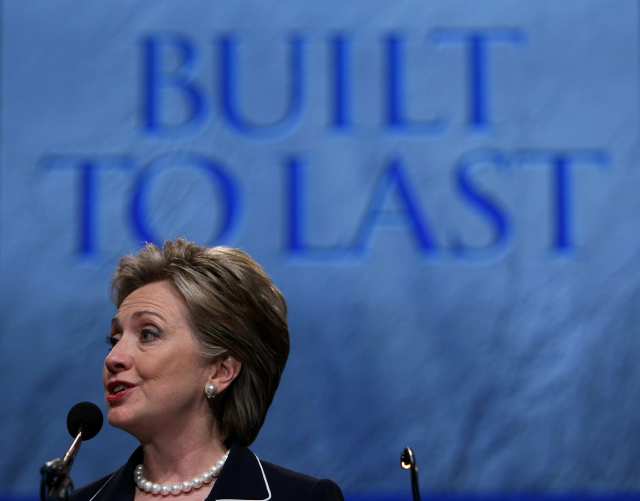
Senator Clinton’s speech last night was a justifiably proud recitation of her accomplishments over the course of this campaign, but it did not end right. She didn’t do what she should have done. As hard and as painful as it might have been, she should have conceded, congratulated, endorsed and committed to Barack Obama. Therefore the next 48 hours are now as important to the future reputation of Hillary Clinton as the last year and a half have been.

I am disappointed. As a long time Hillary Clinton supporter and more importantly, an admirer, I am sad that this historic effort has ended with such a narrow loss for her. There will be the appropriate “if onlys” for a long time to come. If only the staff shakeup happened earlier; if only the planning in caucus states had more focus; if only Hillary had let loose with the authentic human and connecting voice she found in the last three months of the campaign. If only. If only. I have written many times on this site about the talents of Hillary Clinton and why I thought she’d make a great President

After last night’s final primary, she was only about pledged 100 delegates behind him. Ironic that after not wanting to make the decision for so long, it was in fact, the superdelegates who made the decision. But I guess they did so for another reason. It just isn’t her time. It is his time. It’s a new day that offers a freshness to our party that many have longed for. We felt the rush of new voices and a new energy in the Congressional sweep of 2006 and the sweep continues. It has been an organic shift. And a healthy one.

The life’s work of Bill and Hillary Clinton in partnering with so many African Americans uniting our purpose and promoting our mutual issues is as responsible for Barack Obama’s success as our first African American nominee as anyone. And yet, that joy is being denied for them by themselves. It is so sad.

So, I am also so very disappointed at how she has handled this last week. I know she is exhausted and she had pledged to finish the primaries and let every state vote before any final action. But by the time she got on that podium last night, she knew it was over and that she had lost. I am sure I was not alone in privately urging the campaign over the last two weeks to use the moment to take her due, pass the torch and cement her grace. She had an opportunity to soar and unite. She had a chance to surprise her party and the nation after the day-long denials about expecting any concession and send Obama off on the campaign trail of the general election with the best possible platform. I wrote before how she had a chance for her “Al Gore moment.” And if she had done so, the whole country ALL would be talking today about how great she is and give her her due.

Instead she left her supporters empty, Obama’s angry, and party leaders trashing her. She said she was stepping back to think about her options. She is waiting to figure out how she would “use” her 18 million voters.

But not my vote. I will enthusiastically support Barack Obama’s campaign. Because I am not a bargaining chip. I am a Democrat.

Source. / The Huffington Post

The Rag Blog

Posted in RagBlog | Tagged , , , , , | Leave a comment

Who Do You Love?

Who Do You Love?

I wish I could understand
why I know that Bo Diddley
had a one-eyed white bull dog
named Lola,
yet I can’t remember
what year my favorite
grandfather died

Or his age, for that matter

I know that Gram Parsons
was first Ingram Connors
that Elvis had a twin named Jesse
and what the Killer said
when he played piano
right before Little Richard

Yet, I can’t remember
where I put my birth certificate,
when to change the air conditioner filter
or my first husband’s mother’s name

I know that Bo said “Don’t trust
no one but your mama, and look real
hard at her”, but I can’t recall
Christmas when I was six years old

Same for seven, eight, nine and ten

Who do you love?

© Alyce Guynn
June 2, 2008

The Rag Blog

Posted in Rag Bloggers | Tagged , , | 2 Comments

Michael Goldfarb : Scary New McCain Staffer…

Newest McCain official: President has “near dictatorial powers”
By Glenn Greenwald / June 4, 2008

Bill Kristol today proudly announces that one of his Weekly Standard staff members, Michael Goldfarb, was just named the Deputy Communications Director of the McCain campaign. Last April, this newest McCain official participated in a conference call with former Senator George Mitchell, during which Mitchell advocated a timetable for withdrawal from Iraq. Afterwards, this is what Goldfarb wrote about what he thinks are the powers the President possesses in our country:

Mitchell’s less than persuasive answer [to whether withdrawal timetables “somehow infringe on the president’s powers as commander in chief?”]: “Congress is a coequal branch of government…the framers did not want to have one branch in charge of the government.”

True enough, but they sought an energetic executive with near dictatorial power in pursuing foreign policy and war. So no, the Constitution does not put Congress on an equal footing with the executive in matters of national security.

As I noted at the time:

Until the Bill Kristols and John Yoos and other authoritarians of that strain entered the political mainstream, I never heard of prominent Americans who describe the power that they want to vest in our political leaders as “near dictatorial.” Anyone with an even passing belief in American political values would consider the word “dictatorial” — at least rhetorically, if not substantively — to define that which we avoid at all costs, not something which we seek, embrace and celebrate.

And the very idea that the Founders — whose principal concern was how to avoid consolidated power in any one person — sought to vest “near dictatorial power” in the President is too perverse for words. But that’s been the core “principle” driving the destructive radicalism of the last seven years, and it’s an extremist view that is obviously welcomed at the highest levels of the McCain campaign.

Kristol closes his boastful announcement by noting that the pro-dictatorial Goldfarb will return to the Weekly Standard after the campaign ends — “unless he’s appointed national security adviser in the McCain White House.” Somehow, McCain continues to be depicted in the media as a “moderate” and the like despite the enthusiastic support of our nation’s most crazed and unprincipled warmongers. But even more revealing is that McCain is now staffing his communications apparatus at the highest levels by reaching into Bill Kristol’s The Weekly Standard — one of the most deceptive propaganda organs of the Bush years. Does one even need to point out that there are few things more incompatible with one another than “straight talk” and The Weekly Standard?

UPDATE: Michael Goldfarb on waterboarding and other illegal interrogation practices internationally considered to be “torture” (h/t A.L.):

The Times indicts the Bush administration for exposing terrorists captured abroad to “head-slapping, simulated drowning and frigid temperatures.” Boo hoo.

McCain is a deeply principled opponent of torture and waterboarding which is why his new communications official’s view of objections to those techniques is “Boo hoo.”

UPDATE II: Last October, this is what Goldfarb wrote in arguing that telecoms deserve amnesty even if they broke the law in enabling warrantless spying on Americans:

[I]f federal agents show up at a corporate headquarters for a major American company and urgently seek that company’s officers for assistance in the war on terror, the companies damn well ought to give it as a matter of simple patriotism, whether the CIA wants a plane for some extraordinary rendition or help in tracking terrorists via email. . . . [T]o expect a company to resist a plea from the government for help in a time of war is ridiculous.

So, consistent with his President-as-Dictator vision, McCain’s new communications official believes that — as I wrote at the time — when “federal agents” come knocking at your door and issue orders, you better “damn well” obey — you had better not “resist” — even if the orders you’re being given are illegal, even if they’re designed to spy on Americans in violation of the law, and even if they’re intended to facilitate the torture of detainees. That’s what patriotic Americans do — they obey the orders of their near-dictatorial Leader, so sayeth the heel-clicking Michael Goldfarb. That’s a superb, and very mainstream, new addition to the maverick McCain team.

Source. / Salon.com

Thanks to Carl Davidson / The Rag Blog

Posted in RagBlog | Tagged , , | 1 Comment

Medical Marijuana : Things Looking Up

Medical marijuana user.

All Indicators Point to a Softening of America’s Harsh Marijuana Laws
By Alexander Zaitchik / June 3, 2008.

With key medical marijuana ballot initiatives likely to pass, and a more pot-friendly majority in Congress, there is room for optimism.

You have to hand it to the Republican National Committee: Those guys really know how to pick the wrong fight.

John McCain, already running against the public opinion grain in support of the Iraq War and Bush tax cuts, received no help from headquarters last month when the RNC made medical marijuana a campaign issue. After Barack Obama told an Oregon weekly that he would end federal raids on medical marijuana users and providers in states with compassionate use laws, the RNC pounced. Obama’s position, said an RNC statement, “reveals that (he) doesn’t have the experience necessary to do the job of President (and) lacks the judgment to carry out the most basic functions of the Executive Branch.” Because the Supreme Court has ruled that federal drug laws trump state drug laws, the RNC reasons that halting federal raids would be tantamount to ignoring the law.

They’re right. But the RNC might want to get some new pollsters. What they and their candidates don’t seem to realize is that a steadily shrinking minority of Americans oppose the controlled medicinal use of cannabis — around 20 percent, according to the last Gallup poll. It’s a safe bet that an even smaller number considers paramilitary raids on the homes of peaceful cancer patients to be a “basic function of the Executive Branch.” During the New Hampshire primary, every Democratic candidate recognized this political reality by promising to end federal harassment of state-approved medical marijuana facilities and users. Republican candidates Tom Tancredo and Ron Paul pledged the same.

And John McCain? When pressed by activists from the group Granite Staters for Medical Marijuana, the Arizona senator responded in lockstep with most of his GOP peers, sounding less like a maverick than a Reagan-era after-school special. “I do not support the use of marijuana for medical purposes,” McCain said. “I believe that marijuana is a gateway drug. That is my view, and that’s the view of the federal drug czar and other experts.”

Given current trend lines, it may not be long before it’s possible to count McCain’s “other experts” on two hands. In February, the 125,000-member American College of Physicians, the second-largest physicians group in the country, published a position paper endorsing the merits of medical marijuana and recommending the end of marijuana’s classification as a Schedule 1 drug. “The ACP endorsement is massive,” says Bruce Mirken of the Marijuana Policy Project, a Washington, D.C.-based lobbying group. “It blows to splinters the assertion that the medical community doesn’t support medicinal cannabis.”

As goes the ACP, so may go the American Medical Association, an endorsement from which would leave the anti-medical marijuana position of the Food and Drug Administration very lonely indeed.

To its credit, the country has not waited for the medical establishment before moving forward on marijuana policy reform. Over the last decade, support for compassionate use laws and broader decriminalization efforts has been growing, if not at weed’s pace, then fast enough for one veteran marijuana reform lobbyist to now speak of being “within striking distance of a national tipping point.”

Since California passed Proposition 215 legalizing medical marijuana in 1996, an average of one state per year has followed suit, some through ballot initiatives, others through legislation. Even in states that have yet to enact reform, a flurry of bills has been introduced. This activity hasn’t been limited to usual-suspect states like Oregon and Vermont. Recent years have seen medical marijuana laws introduced in Ohio, Alabama, Missouri and Tennessee. In staunchly conservative South Carolina, it was a Republican state senator, whose wife lost a battle with brain cancer, who introduced his state’s medical marijuana bill. In Texas, the state government last year passed a bill that is a halfway house for decriminalization, allowing police to issue citations instead of arresting adults who possess less than 4 ounces of marijuana.

The next big test on the horizon is the Midwestern swing state of Michigan, where voters in November will decide on a medical marijuana law, the first such statewide ballot initiative since South Dakotans narrowly rejected theirs in 2006. If passed, Michigan will be the only state with its geographical and electoral profile to pass a medical marijuana law. According to the Inside Michigan Politics newsletter, polls show two-thirds voter support. “Michigan looks set to become the 13th medical marijuana state this November,” says Rob Kampia, executive director of the Marijuana Policy Project.

The other big initiative in November will appear on ballots in Massachusetts. If passed, the maximum penalty for possession of up to an ounce of marijuana in the Bay State would drop from up to six months in jail and a $500 fine to a $100 civil fine.

There is also still a chance that the New York state legislature will take up medical marijuana this session, a move that would enjoy overwhelming in-state support. Post-Giuliani New York City is the marijuana arrest capital of the world, with nearly 40,000 arrests in 2007 alone. The situation has gotten so out of hand that the New York Times recently urged Gov. David Paterson to take the lead in drug policy reform. Few governors are better positioned to do this than Paterson, who is not only on good terms with state Republican leaders, but has the moral authority that comes from suffering from glaucoma, a painful condition known to be alleviated by marijuana. Before becoming governor, Paterson was a leading activist for drug policy reform and was once arrested protesting the draconian and racially biased Rockefeller Drug Laws, which turn a brittle 35 this year. (Incidentally, the Drug Enforcement Agency is celebrating the same birthday in 2008, its website proudly declaring “35 Years of Excellence.”)

But whatever happens inside Michigan, Massachusetts and New York, the 2005 Supreme Court decision in Gonzales v. Raich still leaves marijuana users open to federal prosecution under the Controlled Substances Act. As highlighted by the RNC statement critical of Obama’s pledge, this decision will continue to undermine state- and local-level reforms until Congress changes federal law. Although only 1 percent of marijuana cases are prosecuted at the federal level, DEA raids on patients, caregivers and providers have been on the rise in states that have passed medical marijuana laws. This is especially true of California and Oregon, where in many cases individual patients have been detained and terrorized. In Los Angeles, the DEA has begun threatening the owners of buildings used for medical marijuana activities with seizure of their property, a development the Los Angeles Times has called “a deplorable new bullying tactic.” According to Mirken, “The DEA has become the single largest obstacle to effective regulation of (medical marijuana) establishments.”

At the moment there are three bills in Congress that seek to put a stop to these raids and set a precedent for federal-level reform.

The young granddaddy of this legislation is the bipartisan Hinchey-Rohrabacher Amendment, which has been introduced every year since 2003. Essentially, the amendment would strip the Department of Justice of funds to prosecute medical marijuana cases in states that have medical marijuana laws on the books. Named after Rep. Maurice Hinchey, D-N.Y., and Rep. Dana Rohrabacher, R-Calif., the legislation wouldn’t legalize marijuana at the federal level or prevent the feds from prosecuting medical marijuana use in states without medical marijuana laws. It would simply enforce respect for state marijuana laws. When first introduced in 2003, Hinchey-Rohrabacher received 152 votes. Last year, that number had risen to 165. Later this summer, Congress will tackle the amendment again when it votes on the Department of Justice Appropriations bill. Reform advocates hope the amendment will benefit from racking up endorsements from groups like the right-leaning Citizens Against Government Waste, which came out in favor of Hinchey-Rohrabacher as a way for Congress to “start sending a signal that its priorities are in order.”

But every year so far has been a 10-yard fight, and its sponsors don’t expect that to change this year. “This will continue to be a tough battle,” says Jeff Lieberson, Hinchey’s spokesperson. “Many politicians are still behind the voters on this issue.” Other analysts also warn against high expectations, pointing out that the timing is especially unfavorable for drug policy reform at the federal level.

“The movement on this issue in 2008 is going to be almost nonexistent because politicians are focused on the election,” says Alex Coolman, a former attorney with the Drug Policy Alliance and author of the Drug Law Blog. “Nobody in Washington wants to do anything that could be perceived as controversial.”

In April, Hinchey-Rohrabacher was joined by two other marijuana policy reform bills, both co-sponsored by Barney Frank, D-Mass., and Ron Paul, R-Texas. HR5842, the Medical Marijuana Patient Protection Act, would deny the federal government the right to employ the Controlled Substances Act to intervene in states that have legalized medical marijuana; it would also remove marijuana from the list of Schedule 1 drugs. HR5843, meanwhile, known as the Personal Use of Marijuana by Responsible Adults Act, would effectively decriminalize possession of up to 1 ounce. “We’re in the early stages here,” says Frank spokesperson Peter Kovar. “Nothing like this ever comes quick.”

But it may be coming more quickly than some people expect. “All the indicators are prompting in the right direction,” says Kampia. “Every major new ballot initiative looks set to pass. Infrastructure is growing: email lists, organizations, allies — it’s across the board. Public opinion is moving steadily in favor of decriminalization. State laws are moving forward, and none are going backward. We’re constantly picking up votes in the House. The 110th is the most supportive Congress we’ve ever had.”

If the RNC keeps attacking Democrats on medical marijuana, the 111th will be that much better.

Source. / AlterNet

Thanks to Steve Russell / The Rag Blog

Posted in RagBlog | Tagged , , , , | Leave a comment

Elvira Arellano on Truth and Hope

Elvira Arellano. Photo by Steve Liss/ Medill.

Elvira Arellano is the immigrant who took sanctuary at the church of Rev. Walter ‘Slim’ Coleman in Chicago, before she was arrested and returned to Mexico. She remains active and a spokesperson for the immigrant rights and social justice movements.

Carl Davidson / The Rag Blog

A Movement of Truth inside a Movement of Hope
By Elvira Arellano

My son Saulito often times tells me he wants to be a great wrestler, a star on luche libre, when he grows up. That is his hope. I don’t want to discourage his hopes, but I try to make him see the truth about Wrestling. O’K Saulito – but you know that that is just a show don’t you? O.K. Saulito, but only a very few Mexican children will get the chance to be stars and make a lot of money, the rest will have to struggle hard all their lives.

All over Mexico – all over Latin America and all over the world – we are watching now as the first African American seems to have a real chance to be President of the United States. We are hopeful and indeed he has sinspired a movement of hope amongst many young people in the United States.

We don’t want to discourage that hope, but we must let people know the truth and build a movement of truth inside the movement of hope. If we don’t we will find that hope, without truth, will turn into despair.

The truth is that Barack Obama must appeal to the majority of voters in the U.S. to be elected President – and we are not yet the majority. That is why he has taken the side of the Israelis against the Palestinians to get the Jewish votes. That is why he has taken the position to keep on with the ridiculous and inhuman blockade against the families and children of the Cuban people. That is why he has had to denounce his own pastor, who only spoke the truth about racism in the United States, and even resign from his own faithful church. And that is why he has been less strong than he should have been on the issue of legalization for the 12 million and a renegotiation of NAFTA which is destroying our communities in Mexico.

We must support Barack Obama and the movement of hope because the alternative is the Movement of Hate which John McCain has embraced. That movement of hate means death through war and free trade and the continued persecution of the 12 million undocumented.

So we choose hope, but not blindly. We must keep the campaign for legalization alive and in the face of the democratic party and the Presidential campaign in the next six months. We must organize with energy and prepare for the first 90 days of a new administration to demand a change in the broken law.

We must Make America see that they must stop the exploitation of Latin America and the Caribbean and support development so we can feed out hungry children and will not have to leave our families and go without papers to works in the north to be exploited and treated like criminals.

We must build a strong movement of truth within the campaign of hope. Organize for hope! Organize for Truth !

Un Movimiento de Verdad Dentro de un Movimiento de Esperanza
Por Elvira Aellano

Mi hijo Saulito me dice muchas veces que cuando sea grande quiere ser campeón de lucha libre. Tal es su gran anhelo, que no quiero desanimarlo pero intento hacerle ver la verdad sobre la lucha libre. “Bien, Saulito, ¿Pero si sabes que eso es puro ‘show’, verdad?” “Muy bien, Saulito, pero son muy pocos los muchachos mexicanos que alcanzan la fama y la fortuna en la lucha libre, los demás tendrán que aceptar una lucha muy dura para toda la vida, como nuestros migrantes que arriesgan su vida para llegar al Norte y trabajar para dar una vida mejor a sus familias y su pago es llamarlo criminal”.

En todo México, América Latina y el mundo entero vemos como el primer Afro Norteamericano parece tener una verdadera oportunidad de ser Presidente de los Estados Unidos. Nosotros somos optimistas y de hecho ha inspirado un movimiento de esperanza entre la juventud en los Estados Unidos.

No queremos desanimar a ese movimiento de esperanza pero tenemos que informar a la gente de la verdad y construir un movimiento de verdad dentro del movimiento de esperanza. Al no lograr eso, es posible que aquella esperanza se convierta, a lo largo, en desesperación.

La verdad es que para salir electo como Presidente, Barack Obama tiene que apelar a la mayoría de los votantes en los Estados Unidos, y los latinos no son la mayoría. Por eso es que Obama se encuentra obligado a tomar la parte de los israelitas en su contienda con los palestinos, porque necesita el voto de la comunidad judía. Por eso es que ha tomado una posición publica a favor de seguir con la estupidez y la inhumanidad del bloqueo en contra de las familias, los niños y el pueblo de Cuba. Por eso es que se vio obligado a denunciar a su propio pastor, cuyo único delito era decir la verdad acerca del racismo en los Estados Unidos, y hasta renunciar a su iglesia. También ha sido muy débil en el asunto de legalizar a 12 millones de indocumentados y la renegociación del TLCAN que está destrozando a nuestras comunidades en México.

Pero en este momento solo hay la opción por Barack Obama y su movimiento de esperanza porque la alternativa es el movimiento de odio abrazado por John McCain. Aquel movimiento significa muerte por medio de las guerras, “libre comercio”, la persecución y terrorismo en contra de 12 millones de indocumentados.

Por lo tanto optamos por la esperanza, pero no con ojos cerrados. Tenemos que mantener viva la campaña a favor de la legalización, retando al partido demócrata y la campaña presidencial en los próximos 6 meses. Tenemos que organizarnos con mucha energía y prepararnos para exigir que en los primeros 90 días de una nueva administración se cambien las leyes injustas de migracion que aterrorizan y separan a nuestras familias.

Tenemos que obligar a los Norteamericanos a ver la necesidad de poner fin a la explotación de América Latina y las Antillas y en lugar de eso, respaldar al desarrollo para que podamos darles de comer a nuestros hijos sin abandonar a nuestras familias para ir a trabajar sin papeles al norte donde nos explotan y nos tratan como criminales.

Tenemos que fomentar un movimiento fuerte a favor de la verdad dentro de la campaña de esperanza. ¡A organizar para la esperanza! ¡A organizar para la verdad!

For information about Elvira Arellano / Wikipedia

Also see Who Would Jesus Deport? by Kimberly Trefilek / Chicago Talks / May 1, 2007

Boston students to ICE: ‘We want our teacher back!’
/ Workers World / May 28, 2008

The Rag Blog

Posted in RagBlog | Tagged , , , , | 1 Comment

Acting Against the Agents of War Crimes


War Criminals Must Fear Punishment: That’s why I went for John Bolton
By George Monbiot / June 3, 2008

As long as the greatest crime of the 21st century remains unprosecuted, we all have a duty to keep the truth alive

I realise now that I didn’t have a hope. I had almost reached the stage when two of the biggest gorillas I have ever seen swept me up and carried me out of the tent. It was humiliating, but it could have been worse. The guard on the other side of the stage, half hidden in the curtains, had spent the lecture touching something under his left armpit. Perhaps he had bubos.

I had no intention of arresting John Bolton, the former under-secretary of state at the US state department, when I arrived at the Hay festival. But during a panel discussion about the Iraq war, I remarked that the greatest crime of the 21st century had become so normalised that one of its authors was due to visit the festival to promote his book. I proposed that someone should attempt a citizens’ arrest, in the hope of instilling a fear of punishment among those who plan illegal wars. After the session I realised that I couldn’t call on other people to do something I wasn’t prepared to do myself.

I knew that I was more likely to be arrested and charged than Mr Bolton. I had no intention of harming him, or of acting in any way that could be interpreted as aggressive, but had I sought only to steer him gently towards the police I might have faced a range of exotic charges, from false imprisonment to aggravated assault. I was prepared to take this risk. It is not enough to demand that other people act, knowing that they will not. If the police, the courts and the state fail to prosecute what the Nuremberg tribunal described as “the supreme international crime”, I believe we have a duty to seek to advance the process.

The Nuremberg principles, which arose from the prosecution of Nazi war criminals, define as an international crime the “planning, preparation, initiation or waging of a war of aggression or a war in violation of international treaties, agreements or assurances”. Bolton appears to have “participated in a common plan” to prepare for the war (also defined by the principles as a crime) by inserting the false claim that Iraq was seeking to procure uranium from Niger into a state department factsheet. He also organised the sacking of José Bustani, the head of the Organisation for the Prohibition of Chemical Weapons, accusing him of bad management. Bustani had tried to broker a peaceful resolution of the dispute over Iraq’s alleged weapons of mass destruction.

Some of the most pungent criticisms of my feeble attempt to bring this man to justice have come from other writers for the Guardian. Michael White took a position of extraordinary generosity towards the instigators of the war. There are “arguments on both sides”, he contended on the Guardian politics blog. Bustani might have received compensation after his sacking by Bolton, “but Bolton says that does not mean much”. In fact, Bustani was not only compensated at his tribunal, he was completely exonerated of Bolton’s accusations and his employers were obliged to pay special damages.

White suggested that Iraq might indeed have been seeking uranium from Niger, on the grounds of a conversation he once had with an MI6 officer. Alongside the British government’s 45-minute claim, this must be the best-documented of all the false justifications for the war with Iraq. In 2002, the United States government sent three senior officials to Niger to investigate the claim. All reported that it was without foundation. The International Atomic Energy Agency discovered that it was based on crude forgeries. This assessment was confirmed by the state department’s official Greg Thielmann, who reported directly to John Bolton. No evidence beyond the forged documents has been provided by either the US or the UK governments to support their allegation.

White also gives credence to Bolton’s claims that the war in 2003 was justified by two UN resolutions – 678 and 687 – which were approved in 1990 and 1991, and that it was permitted by article 51 of the UN charter. The attempt to revive resolutions 678 and 687 was the last, desperate throw of the dice by the Blair government when all else had failed. When it became clear that it could not obtain a new UN resolution authorising force against Iraq, the government dusted down the old ones, which had been drafted in response to Saddam Hussein’s invasion of Kuwait.

This revival formed the basis of Lord Goldsmith’s published advice on March 17 2003. It was described as “risible” and “scrap[ing] the bottom of the legal barrel” by Lord Alexander, a senior law lord. After the first Gulf war, Colin Powell, General Sir Peter de la Billiere and John Major all stated that the UN’s resolutions permitted them only to expel the Iraqi army from Kuwait, and not to overthrow the Iraqi government. Lord Goldsmith himself, in the summer of 2002, advised Tony Blair that resolutions 678 and 687 could not be used to justify a new war with Iraq.

Article 51 of the UN charter is comprehensible to anyone but the lawyers employed by the Bush administration. States have a right to self-defence “if an armed attack occurs against” them, and then only until the UN security council can intervene. On what occasion did Iraq attack the United States? Is there any claim made by the Blair and Bush governments that Michael White is not prepared to believe?

Conor Foley, writing on Comment is free, suggested that my action “completely trivialises the serious case” against the Iraq war and claimed that I was seeking to “imprison … people because of their political opinions”, as if Bolton were simply a commentator on the war, and not an agent. Does he really believe that the former under-secretary did not “participate in a common plan” to initiate the war with Iraq? What other conceivable purpose might the state department’s misleading factsheet have served? And what more serious action can someone who is neither a law lord nor a legislator take? Bolton himself maintains that my attempt to bring him to justice reflects a “move towards lawlessness and fascism”. This is an interesting commentary on an attempt to uphold a law which arose from the prosecution of fascists.

But there is one charge I do accept: that my chances of success were very slight. Apart from the 300-pound gorillas, the main obstacle I faced was that although the crime of aggression, as defined by the Nuremberg principles, has been incorporated into the legislation of many countries, it has not been assimilated into the laws of England and Wales. This does not lessen the crime but it means that it cannot yet be tried here. This merely highlights another injustice: while the British state is prepared to punish petty misdemeanours with vindictive ferocity, it will not legislate against the greatest crime of all, lest it expose itself to prosecution.

But demonstration has two meanings. Non-violent direct action is both a protest and an exposition. It seeks to demonstrate truths which have been overlooked or forgotten. I sought to remind people that the greatest crime of the 21st century remains unprosecuted, and remains a great crime. If you have read this far, I have succeeded.

monbiot.com

Source / Information Clearing House / Guardian

The Rag Blog

Posted in RagBlog | Tagged , | Leave a comment

Books : David Sirota Dissects the New Populism


David Sirota’s The Uprising
By Alex Thurston / June 2, 2008

David Sirota’s new book The Uprising offers an intriguing map of today’s populist movements, leaders, and parties. Sirota profiles movements like the Minutemen, the antiwar “Protest Industry” and the progressive blogosphere; uprising politicians like Brian Schweitzer, Bernie Sanders, John Tester, and Sherrod Brown; new political vehicles like New York state’s Working Families Party, Seattle’s Washtech union, and groups of shareholder activists within companies like ExxonMobil; and complicated insider/outsider personalities like Lou Dobbs and the operatives who make up antiwar strategy groups like Americans Against Escalation in Iraq.

Sirota argues convincingly that the present moment, with its record-high levels of disenchantment with government, globalization, and politics-as-usual, is producing remarkable shifts in identity and activism across the country. The question he and his readers are left asking at the book’s end is whether these uprisings will coalesce into a movement for meaningful political change, or devolve into vicious paroxysms of xenophobia and anti-government backlash.

Many will be unhappy with Sirota’s book, and not just the CEO of ExxonMobil, Rex Tillerson, whom Sirota humiliated by uploading YouTube clips of him making “an evasive, Rumsfeldian ass out of himself on the subject of global warming.” (320) And not just Lou Dobbs, whose transformation into populist crusader, Sirota suggests, was “a mix of both principle and opportunism.” (193) Even mainstays of the progressive movement such as MoveOn feel the heat in The Uprising.

Sirota criticizes them both for having a relatively undemocratic internal structure and, more damningly, for pulling their punches against bad Democrats while trying to stop the war. Even more severe is Sirota’s criticism of AAEI, whom he blasts as partisan hacks more interested in ending Republicans’ careers than in ending the war in Iraq. AAEI, he says, “is fairly open about its desire to put on a smoke-and-mirrors show – and nothing more,” (61) using their substantial advertising budget to create the illusion of a coordinated grassroots antiwar effort, and then manipulating this image to attack Republicans. So while the group might promise to go for the throats of those responsible for starting and prolonging the war, Sirota says, “you can’t ‘go right at them’ if your uprising is led by a tightly knit consulting class that has dual loyalties and has been part of the problem from the outset.” (69)

What Sirota highlights throughout the book is the tension, and frequent contradiction, between playing the game of politics and actually solving problems. That tension haunts the Working Families Party in New York, whose use of laws allowing “fusion” voting (where a party can cross-endorse another party’s candidate, allowing voters to choose, say, Eliot Spitzer as governor using the WFP line) has enabled them to build an effective third party brand and organizational apparatus without running spoiler candidates that tip elections to Republicans. The WFP’s successes, however, brought dilemmas as leaders had to walk a fine line between sacrificing their ideals and building strong partnerships with Democrats like Spitzer. A similar dilemma confronted Jon Tester and other progressive Senators on the issue of whether to support a meaningless nonbinding Senate resolution condemning the war in Iraq.

These discussions touch on a deeply sensitive issue in American and progressive politics right now, which is that Democrats winning elections, particularly the presidential, will not on its own be enough to bring about meaningful change.

As Sirota argued on Colbert the other night, at best a politician might be a vehicle for the uprising, but never its culmination. And as Sirota and Naomi Klein argued on a panel at the Take Back America Conference this year, it is difficult to imagine real progressive change happening under an Obama administration if Obama marks the edge of acceptable left-leaning discourse in American politics; in other words, Obama may need to be challenged by a real leftist – a modern-day Huey Long, if you will – before he could become a modern-day FDR. Obama’s election, then, won’t defuse the uprising; in fact, it may put new wind in its sails. The disenchantment many Americans feel with Democrats after the disappointments of the current Congress should send a warning message to Obama and other Democratic leaders. Many voters have been willing to wait for Democrats to win the White House, but patience is not inexhaustible. If both parties continue to let Americans down, more and more may choose to join the uprising movements Sirota has brought to our attention.
One disappointing aspect of progressive politics that Sirota draws out, moreover, is that progressives have not achieved the level of coordination between our moderate and more radical wings in the ways that conservatives have. While Democrats, especially in the post-Vietnam era, have feared the influence of uprising politics over the party, Republicans have embraced it. Sirota notes that the GOP encourages primary challenges against moderate incumbents by movement conservatives in order to push incumbents rightward and maintain party unity, all while DLC-style Democrats have frantically attempted to cut down “uprising-minded candidates like Howard Dean and leaders like [Sherrod] Brown.” (138-9) The major challenge facing the progressive side of the uprising, then, will be how to engage with the “liberal Establishment” without being killed off or co-opted by it.

All this, I think, means that Sirota’s book leaves us with more questions than answers – a good thing, in my view, because those questions are the central ones of our current political moment. How long, and to what point, can progressives tolerate the shortcomings of the Democratic Party before they branch out to other alternatives? And, though Sirota leaves this question unspoken and merely implied, what good is electoral politics anyway? Perhaps the shareholder activists confronting Exxon on its own turf are the ones facing down the true powers that be, and perhaps the Minutemen who feel they “just need to DO something” are simply the first to tap into a feeling that awaits many more of us.

As Sirota says, it remains to be seen what the outcome of the uprising will be. Will we see new organizations, such as “an organization with the vast membership and internet savvy of a MoveOn that uses fusion voting to develop its own independent political machine like the Working Families Party, rather than playing Washington games in the media”? (337) I would probably rather vote for Barack Obama on that party’s ticket rather than as a mere Democrat. The possibilities offered by technology and plain old human creativity are breathtaking, but the lessons of history are daunting. The uprising activists of a hundred years ago and more gave us eight-hour work days, weekends, and protections over the food we eat – but at times it still feels like we’re stuck in the late nineteenth century, with big business pulling the strings to make our government dance. Sirota’s confidence in the ability of people, if given the chance, to make good decisions is one I share. The question is whether we will find a way to get there – to make our society, our movements, and our government more democratic, more responsive. The uprising has its work cut out for it.

It should be clear to Seminal readers that Sirota’s views closely parallel my own. For example, Sirota lays into the “walking stereotypes” at antiwar protests, and notes that antiwar protesters’

stunts are more likely to get television coverage, they are also more likely to get precisely the kind of circus-freak-show treatment that defeats the underlying purpose of event. If the goal is getting as many Americans as possible to join the uprising to end the war, then achieving that objective is not helped by garnering television coverage that depicts marchers, and thus the cause, as totally fringe and therefore culturally repellent to Middle America.

This kind of sentiment was the impetus for our experimentation with wearing suits to antiwar protests last fall, an initiative we dubbed Serious Change.

And like Sirota, I can sympathize with the efforts of third parties like the WFP, territory that would make many progressives uncomfortable. And hell, I can sympathize with all the manifestations of the uprising that he profiles. Some more than others, of course. But the disenchantment and frustration that runs through all of them has infected me too. I’m angry and I want problems solved.
To close, I’ll say that there are just a few areas where I would have liked to see Sirota go further. Perhaps most importantly, I would have liked to see more discussion of race. Issues of race and racism figure throughout the book, from Lou Dobbs to the Minutemen to the WFP, but as happens so often in American politics race is constantly slipping in and out of view, and rarely are we called to examine the phenomenon directly. The more I learn about American history, the more I feel that it is a history first and foremost of race relations, class relations reflected through prisms of race, and the exploitation of racism by politicians from the southern Democrats of old to Ronald Reagan and his Cadillac-driving welfare queen. I would have liked to see Sirota go further in discussing the ways in which discussions about race intersect with – or impede – discussions about social class.

And as a corollary, I would have liked him to include more nonwhite uprising movements in the book (aside from the WFP and perhaps the antiwar protesters, most of the groups he profiles are predominately white). Having been on a Dead Prez listening kick immediately prior to picking up Sirota’s book, I can say that white America isn’t the only place where an uprising is going on in our country.

These critiques aside, though, I strongly recommend The Uprising. This election cycle has produced a number of important books, but Sirota’s was the one I was most looking forward to reading. And I think that’s because while many others take up the important theme of how Democrats can win elections by being more courageous and better Democrats, Sirota moves to a deeper and more intriguing stratum of political life, showing that elections are just one aspect of a more profound struggle. In the whirlwind of politics, parts of the book have already become history: Spitzer is gone, and new uprisings (such as Ron Paul) have already arisen, and perhaps fallen, in the time since Sirota’s research was coming to a close. But the deeper sociological observations Sirota makes will be with us for some time, I suspect.

At a time when more and more uprisings will appear, thrive, and force change, this book will be a vital tool for anyone interested in American politics outside the narrow corridors of DC.

Source. / The Seminal

Find The Uprising on Amazon.com.

For all things Sirota.

Thanks to William Michael Hanks / The Rag Blog

Posted in RagBlog | Tagged , , , , , , | Leave a comment

Great Liberal Hope? Pilger and Hamilton on Obama

Any of you Obama supporters care to deconstruct Pilger’s argument on the matter of Senator Obama? I remain open-minded, and ever-eager to be “born again.”

Doug Zachary / The Rag Blog / June 3, 2008

[David Hamilton and Scott Trimble of The Rag Blog respond at the end of the following article]

From Kennedy To Obama: Liberalism’s Last Fling
By John Pilger

In this season of 1968 nostalgia, one anniversary illuminates today. It is the rise and fall of Robert Kennedy, who would have been elected president of the United States had he not been assassinated in June 1968. Having travelled with Kennedy up to the moment of his shooting at the Ambassador Hotel in Los Angeles on 5 June, I heard The Speech many times. He would “return government to the people” and bestow “dignity and justice” on the oppressed. “As Bernard Shaw once said,” he would say, “‘Most men look at things as they are and wonder why. I dream of things that never were and ask: Why not?'” That was the signal to run back to the bus. It was fun until a hail of bullets passed over our shoulders.

Kennedy’s campaign is a model for Barack Obama. Like Obama, he was a senator with no achievements to his name. Like Obama, he raised the expectations of young people and minorities. Like Obama, he promised to end an unpopular war, not because he opposed the war’s conquest of other people’s land and resources, but because it was “unwinnable”.

Should Obama beat John McCain to the White House in November, it will be liberalism’s last fling. In the United States and Britain, liberalism as a war-making, divisive ideology is once again being used to destroy liberalism as a reality. A great many people understand this, as the hatred of Blair and new Labour attest, but many are disoriented and eager for “leadership” and basic social democracy. In the US, where unrelenting propaganda about American democratic uniqueness disguises a corporate system based on extremes of wealth and privilege, liberalism as expressed through the Democratic Party has played a crucial, compliant role.

In 1968, Robert Kennedy sought to rescue the party and his own ambitions from the threat of real change that came from an alliance of the civil rights campaign and the anti-war movement then commanding the streets of the main cities, and which Martin Luther King had drawn together until he was assassinated in April that year. Kennedy had supported the war in Vietnam and continued to support it in private, but this was skillfully suppressed as he competed against the maverick Eugene McCarthy, whose surprise win in the New Hampshire primary on an anti-war ticket had forced President Lyndon Johnson to abandon the idea of another term. Using the memory of his martyred brother, Kennedy assiduously exploited the electoral power of delusion among people hungry for politics that represented them, not the rich.

“These people love you,” I said to him as we left Calexico, California, where the immigrant population lived in abject poverty and people came like a great wave and swept him out of his car, his hands fastened to their lips.

“Yes, yes, sure they love me,” he replied. “I love them!” I asked him how exactly he would lift them out of poverty: just what was his political philosophy?

“Philosophy? Well, it’s based on a faith in this country and I believe that many Americans have lost this faith and I want to give it back to them, because we are the last and the best hope of the world, as Thomas Jefferson said.”

“That’s what you say in your speech. Surely the question is: How?”

“How? . . . by charting a new direction for America.”

The vacuities are familiar. Obama is his echo. Like Kennedy, Obama may well “chart a new direction for America” in specious, media-honed language, but in reality he will secure, like every president, the best damned democracy money can buy.

As their contest for the White House draws closer, watch how, regardless of the inevitable personal smears, Obama and McCain draw nearer to each other. They already concur on America’s divine right to control all before it. “We lead the world in battling immediate evils and promoting the ultimate good,” said Obama. “We must lead by building a 21st-century military . . . to advance the security of all people [emphasis added].” McCain agrees. Obama says in pursuing “terrorists” he would attack Pakistan. McCain wouldn’t quarrel. Both candidates have paid ritual obeisance to the regime in Tel Aviv, unquestioning support for which defines all presidential ambition. In opposing a UN Security Council resolution implying criticism of Israel’s starvation of the people of Gaza, Obama was ahead of both McCain and Hillary Clinton. In January, pressured by the Israel lobby, he massaged a statement that “nobody has suffered more than the Palestinian people” to now read: “Nobody has suffered more than the Palestinian people from the failure of the Palestinian leadership to recognise Israel [emphasis added].” Such is his concern for the victims of the longest, illegal military occupation of modern times. Like all the candidates, Obama has furthered Israeli/Bush fictions about Iran, whose regime, he says absurdly, “is a threat to all of us”.

On the war in Iraq, Obama the dove and McCain the hawk are almost united. McCain now says he wants US troops to leave in five years (instead of “100 years”, his earlier option). Obama has now “reserved the right” to change his pledge to get troops out next year. “I will listen to our commanders on the ground,” he now says, echoing Bush. His adviser on Iraq, Colin Kahl, says the US should maintain up to 80,000 troops in Iraq until 2010. Like McCain, Obama has voted repeatedly in the Senate to support Bush’s demands for funding of the occupation of Iraq; and he has called for more troops to be sent to Afghanistan. His senior advisers embrace McCain’s proposal for an aggressive “league of democracies”, led by the United States, to circumvent the United Nations.

Like McCain, he would extend the crippling embargo on Cuba.

Amusingly, both have denounced their “preachers” for speaking out. Whereas McCain’s man of God praised Hitler, in the fashion of lunatic white holy-rollers, Obama’s man, Jeremiah Wright, spoke an embarrassing truth. He said that the attacks of 11 September 2001 had taken place as a consequence of the violence of US power across the world. The media demanded that Obama disown Wright and swear an oath of loyalty to the Bush lie that “terrorists attacked America because they hate our freedoms”. So he did. The conflict in the Middle East, said Obama, was rooted not “primarily in the actions of stalwart allies like Israel”, but in “the perverse and hateful ideologies of radical Islam”. Journalists applauded. Islamophobia is a liberal speciality.

The American media love both Obama and McCain. Reminiscent of mating calls by Guardian writers to Blair more than a decade ago, Jann Wenner, founder of the liberal Rolling Stone, wrote: “There is a sense of dignity, even majesty, about him, and underneath that ease lies a resolute discipline . . . Like Abraham Lincoln, Barack Obama challenges America to rise up, to do what so many of us long to do: to summon ‘the better angels of our nature’.” At the liberal New Republic, Charles Lane confessed: “I know it shouldn’t be happening, but it is. I’m falling for John McCain.” His colleague Michael Lewis had gone further. His feelings for McCain, he wrote, were like “the war that must occur inside a 14-year-old boy who discovers he is more sexually attracted to boys than to girls”.

The objects of these uncontrollable passions are as one in their support for America’s true deity, its corporate oligarchs. Despite claiming that his campaign wealth comes from small individual donors, Obama is backed by the biggest Wall Street firms: Goldman Sachs, UBS AG, Lehman Brothers, J P Morgan Chase, Citigroup, Morgan Stanley and Credit Suisse, as well as the huge hedge fund Citadel Investment Group. “Seven of the Obama campaign’s top 14 donors,” wrote the investigator Pam Martens, “consisted of officers and employees of the same Wall Street firms charged time and again with looting the public and newly implicated in originating and/or bundling fraudulently made mortgages.” A report by United for a Fair Economy, a non-profit group, estimates the total loss to poor Americans of colour who took out sub-prime loans as being between $164bn and $213bn: the greatest loss of wealth ever recorded for people of colour in the United States. “Washington lobbyists haven’t funded my campaign,” said Obama in January, “they won’t run my White House and they will not drown out the voices of working Americans when I am president.” According to files held by the Centre for Responsive Politics, the top five contributors to the Obama campaign are registered corporate lobbyists.

What is Obama’s attraction to big business? Precisely the same as Robert Kennedy’s. By offering a “new”, young and apparently progressive face of the Democratic Party – with the bonus of being a member of the black elite – he can blunt and divert real opposition. That was Colin Powell’s role as Bush’s secretary of state. An Obama victory will bring intense pressure on the US anti-war and social justice movements to accept a Democratic administration for all its faults. If that happens, domestic resistance to rapacious America will fall silent.

America’s war on Iran has already begun. In December, Bush secretly authorised support for two guerrilla armies inside Iran, one of which, the military arm of Mujahedin-e Khalq, is described by the state department as terrorist. The US is also engaged in attacks or subversion against Somalia, Lebanon, Syria, Afghanistan, India, Pakistan, Bolivia and Venezuela. A new military command, Africom, is being set up to fight proxy wars for control of Africa’s oil and other riches. With US missiles soon to be stationed provocatively on Russia’s borders, the Cold War is back. None of these piracies and dangers has raised a whisper in the presidential campaign, not least from its great liberal hope.

Moreover, none of the candidates represents so-called mainstream America. In poll after poll, voters make clear that they want the normal decencies of jobs, proper housing and health care. They want their troops out of Iraq and the Israelis to live in peace with their Palestinian neighbours. This is a remarkable testimony, given the daily brainwashing of ordinary Americans in almost everything they watch and read.

On this side of the Atlantic, a deeply cynical electorate watches British liberalism’s equivalent last fling. Most of the “philosophy” of new Labour was borrowed wholesale from the US. Bill Clinton and Tony Blair were interchangeable. Both were hostile to traditionalists in their parties who might question the corporate-speak of their class-based economic policies and their relish for colonial conquests. Now the British find themselves spectators to the rise of new Tory, distinguishable from Blair’s new Labour only in the personality of its leader, a former corporate public relations man who presents himself as Tonier than thou. We all deserve better.

Source. / ZNet / Tribe / May 31, 2008

“An Obama victory will bring intense pressure on the US anti-war and social justice movements to accept a Democratic administration for all its faults. If that happens, domestic resistance to rapacious America will fall silent.” — John Pilger

Why? I see no reason why supporting Obama for president will translate into lock-step support for his every move. If he doesn’t pull the troops out of Iraq in 2009, I’ll certainly be in the streets again. However, we will very likely be in the position of supporting some of his policies and criticizing others. That would be a truly new situation for us, but we are quite able to discriminate and be opposed to him when appropriate.

The analogy between Obama and Bobby Kennedy is very weak. Obama did not oppose the Iraq War several years after it started because it was “unwinnable” as did Bobby Kennedy relative to Vietnam. Obama also does not enter the race with a history of supporting American aggression (Cuba, Vietnam) as did Kennedy.

Tim Weiner writes in “Lagacy of Ashes” (p.180), “Robert F. Kennedy, 35 years old, famously ruthless, fascinated with secrecy, took command of the most sensitive covert (CIA operations. . . The (Kennedy brothers) unleashed covert action with an unprecedented intensity. Ike had undertaken 170 major CIA covert operations in eight years. The Kennedys launched 163 major covert operations in less than three.” That doesn’t sound much like Obama. Obama is also not from a ruling class family, nor did he have an older brother who was president. He also didn’t beat a candidate clearly to his left to secure the nomination.

Of course, Obama will move to the center in the general election contest. That this will happen is like a law of physics in our two party system. Would Pilger have Obama win the White House by denouncing American crimes at every campaign appearance? He could adopt the slogan, “Purity or Bust!”

Pilger’s logic leads to the conclusion that the Left is better off with a Bush — or a McCain. I argued in October 2004 that Bush would be the candidate who would do the most damage to American imperialism and that was correct. But factors in that equation were the political cowardliness, corporate ties and ruling class background of John Kerry. As for Obama, I remain infected with the hope that he is more one of us than he is able to reveal. I have it on excellent authority that he really does know Bill Ayers and did listen to black liberation theology for 20 years.

A “rapacious America” might be conducive to the growth of the domestic antiwar and social justice movements, but not much good for anyone else in the world outside of corporate CEO’s. I would also point out that the historical high points of the American Left were during the 1930’s and 1960’s when we had relatively reformist presidents.

As of today, we are down to two choices – Obama and McCain. Nader, McKinney, and Barr are possibilities, but only given the demonstrable inadequacy and duplicity of Obama. Those who oppose him must make the argument that the US is incapable of any substantial reform. But his just being the nominee, a non-white man with a Muslim name from a middle class background, is a very most powerful argument against that position.

This is the best chance I’ve ever seen to elect a progressive as the US president. I never thought I’d live to see it. It wouldn’t be happening except for the reaction against George Bush. We can demand political perfection, lose and embrace self-righteousness or we can seize upon the best opportunity we’ll likely ever see to achieve meaningful change at the presidential level.

David Hamilton / The Rag Blog And another view:

While I have no intention of arguing with every detail of your reply, I must refute the claim that “He also didn’t beat a candidate clearly to his left to secure the nomination.” While Hillary Clinton is certainly not clearly to his left, this was not always a two-horse race, and at least four of the candidates who were mainstream enough to get into the early nomination debates were clearly to the left of Obama, one of whom (Edwards) was considered a viable contender during the early part of the race.

Having said that, you are certainly correct that to some degree, however miniscule, Obama does seem better than Clinton or McCain, and as a relative unknown, does allow us some room to hope that he is a true progressive cloaking himself in neoliberalism to prevent the pro-corporate elite from removing him from the race prematurely. Yet, we must also wonder if he is such, how will he uncloak himself without suffering the fate of JFK, RFK, MLK, Malcolm X, Paul Wellstone, JFK, Jr., Mel Carnahan, etc.?

And if he is indeed the neoliberal militarist he presently purports himself to be, do you really think that Americans in significant numbers will publicly and vehemently oppose him? Realize that he is likely to be a Democratic president with a Democratic majority in both houses of Congress. In 93-94, that scenario brought us NAFTA. In 77-80, it brought us no progressive gains domestically (although Carter did broker a peace deal between Israel and Egypt), and led to a conservative backlash that gave us 12 years of Republicans in the White House. In 61-68, we almost started WW3 over Cuba, then got ourselves tangled up in Viet Nam.

Certainly, escaping the Orwellian Bush administration is important, but it will take a lot more than hope to make real progress.

Scott Trimble / The Rag Blog

David responds:

Grasp the historical moment. Tonight [May 3] is big. A major party in a predominantly white nation has just nominated a man of half African descent for the presidency. This in the nation that has the worst history of oppression of African Americans. Furthermore, this African American man is favored to win. And he will probably run with a woman as his VP, another historic first. This eloquent man will deliver his acceptance speech in Denver on the 45th anniversary of Martin Luther King’s “I Have a Dream” speech. This is historically huge and it will be the principal venue of action at least until November for most activists, like it or not.

That this historic event is taking place with a candidate with all the positive qualities of Barack Obama is more than we should have ever expected given the system’s past performances. And that he arrives on the scene when the Republicans are at their weakest, with a weak candidate already named, is a perfect storm.

Regardless of the issues listed as the big ones in the general election campaign – the economy, the war, health care – the central issue of this campaign will be race. Is American racism so enfeebled in its old age that it can be defeated? Can Americans learn to vote their self-interests instead of their prejudices and fears?

Hopefully, even Texas will be in play in this election. Frank Rich in last Sunday’s NY Times referred to a poll that showed Noriega only 4% behind Cornyn for the US Senate seat from Texas. Obama and Noriega campaigning together across Texas could be a powerful impetus for both of them. If our luck holds, we’ll be able to stay home and be part of the action, even if Texas being in play would indicate a Democratic landslide.

Pilger is right in that we are already experiencing a paradigm change. Very likely, the next president will be the first in our lifetimes against whom our opposition is not an almost automatic reflex.

David Hamilton / The Rag Blog

The Rag Blog

Posted in Rag Bloggers | Tagged , , , , , | 4 Comments

Mesmo’s Desert Digest : Seed and Ceremony

Petroglyphs from Willow Springs in northern Arizona. These engravings, made by Hopi Indians during ritual pilgrimages, depict the individual clan symbols of the pilgrims. Not all North American rock art is shamanistic in origin. This is especially true of rock art made by farming tribes like the Hopi. Photo by David S. Whitley.

Mesmo’s Desert Digest will continue to appear in The Rag Blog whenever Mesmo feels like sending it in. Gerry aka Mesmo is “a septuagenarian desert rat” who lives in Southwest New Mexico, “in the floodplain of the Gila River, near where it flows out of the Mogollon Mountains.” A former student at the University of Texas in Austin, a peace activist in the Vietnam era and a noted rock musician during the psychedelic days of the sixties and seventies, Mesmo — as did many of his peers — eventually made the transition to simpler ways. Now he abides in the desert where his farming is traditional but his technology sophisticated.

Mesmo’s introductory post on The Rag Blog was From Austin to Crazy Horse.

The Book Of Hopi includes the tribal history and general philosophies of this ancient people.

They still live up near the New Mexico-Arizona line. I was up there a few years ago with my friend and neighbor, Andrew, who once lived with the Hopi. They don’t let Anglos attend their ceremonies anymore but are otherwise hospitable enough. They live in concrete block houses now and drive pickups and have jobs. The old pueblos are in bad shape. But they still farm in the ancient manner, on the same lands. And they still perform the ancient ceremonies. However many faults their methods may have in the eyes of scientists, they continue to produce. Some of their gardens are spring fed and have been producing for hundreds of years. They must have read E.F. Schumacher, all the fields and plots are small.

Desert farming is a race to get crops through their cycle between frosts, the cycle shortens as you go north. There are many ways to “cheat nature” and increase the length of the growing season. They usually work. The scientists build greenhouses, the Hopis do ceremonies. Most farmers of organic bent follow the Moon cycles as do the Hopis. Some of the organic farmers do ceremonies too, but not many.

The Hopis say that their ancestors chose to live in the present location after searching two continents for a permanent home. The final decision was based not upon maximum productivity nor ease of life but upon balance. Their survival depends upon a good deal of work, good timing, and successful ceremonies. Everyone in the tribe has a role to play. If they do it just right, they believe, they will have a good harvest and peace amongst themselves.

I had known for a long time that I would one day settle in New Mexico. In the late ‘60’s through the mid ‘70’s I drove the Austin to San Francisco and back route countless times, each trip passing through NM twice. I started looking forward to the crossings and taking different paths. One of the items of interest on my long list was to test the Hopi logic of living in the desert and growing food. So when I finally arrived in NM primed to stay, I was looking for that special place where I could grow food and achieve balance. I asked for guidance from my spirits, they placed me here, Gila, NM. There is a clean little river and the growing season is fairly long (May to October). Much to my delight I discovered freaks living here too, a colony of sorts. Many of them had asked the same questions I was asking and were here looking for answers.

This year will be my 15th year of gardening. The first spring I put in a little garden. The next three springs I worked on farms. Since then I have been developing ways to garden in the desert, gardens of rather large size for a single person and with increasingly protective infra-structure for the plants. But I still plant my Chihuahuan corn the way the Hopis do it, and always follow the Moon cycles. They never fail–well, hardly ever.

The Indians who once occupied this valley and left us their magnificent pottery, the Mimbres tribe, had no trucks to deliver their food. They lived off the natural resources for 350 years. I set about to learn as much about how they did this as I could find out. Also looked carefully at what was growing around me and how much of it was edible. If they could do it, why not I?

Well, for starters they were tiny people, hardly taller than a mule deer, didn’t take much food to fill one up. For another thing, the cattle brought in here in the late 19th century grazed the whole county and nearby forest to dust, more than once. Disaster for the Southwest occurred after the end of WWI. Cattle had been selling for enormous prices and the ranges were swelled to overflowing. When the war ended the price dropped by two thirds or so. Cattle were abandoned, left to fend for themselves. This was back before fences.

It’s a wonder that anything still grows around here and much of the original landscape is long gone. The current plant life is laden with invaders who in many cases have taken over. Invaders like juniper (close relative of mesquite), Siberian elm, a tall, fragile tree that sucks up water like a sponge, all kinds of weeds from faraway sources, some of which are useful. That greenery on the hillsides is not native grass, that’s been gone for a long time. More likely weeds of various kinds such as star thistle whose seeds blow in the wind and seek out depleted land.

In the time of the Mimbres people the river was more of a swamp. Beaver dams kept the water impounded, floods were rare. The Mimbrenos raised fish along with their crops. They raised corn, tiny little ears that we found in their ruins, maybe one fourth the size of our typical ear and beans, some have been sprouted in spite of their incredible age. They came out looking a lot like what we call Aztec beans. I have some. Not my favorite.

After awhile it became obvious that using the Mimbreno model was a farce. Today’s Gila valley bore little resemblance to theirs. A better model would be the Mexican cultures that have been more recent occupants. Slowly but surely the logic and beauty of the desert Mexican diet has penetrated my thick skull. The basics, with a variety of spices, is the rule. And all the ingredients can grow in the desert with just a little help.

When I pick up this thread again I will continue the adventures of a townie adjusting to the desert environment and trying to get off the tit of modern commerce, trying to find the balance the Hopis are talking about.

As ever,

Mesmo

Mesmo / The Rag Blog
Greater Chihuahuan Desert / June 3, 2008

Posted in Rag Bloggers | Tagged , , , , , , , | 3 Comments

Eat Your Bugs, Dear

Buffet offering in Thailand of stir-fried grubs with chilis.

Pass the Land Shrimp
By William Saletan / June 3, 2008

Here’s something good you can do for your body and your planet: Eat more bugs.

Janet Raloff has the goods in this week’s Science News. We’re facing worldwide environmental, obesity, and food crises. Bugs are the answer.

Consider the nutritional value of the humble cricket: Each 100 grams of dehydrated tissue has 1,550 milligrams of iron, 340 milligrams of calcium, and 25 milligrams of zinc — three minerals often lacking in the diets of third-world countries. If you’re ever lost in the woods, three crickets a day will meet your iron needs. Compared to beef or pork, bugs deliver more minerals and healthier fats.

Bugs are also more energy-efficient. Crickets deliver twice as much edible tissue as pigs and almost six times as much as steers based on the same food input. And that’s not counting their superior rate of reproduction. One scholar calculates that overall, they’re 20 times more efficient than steers.

That global food crisis you’ve been reading about? No problem. An Asian expert reports that in Thailand, each family can raise crickets independently on a tiny parcel of land. In a pair of villages, 400 families are cranking out 10 metric tons of crickets during the peak season.

Bug-eating also reduces the need for pesticides. The more bugs you eat, the less you have to spray. That’s what happened in Thailand, where locusts have been brought under control through culinary culling.

You’ve never eaten bugs? You’re missing out. People in most countries eat insects. Central Americans eat butterfly larvae. South Americans eat beetles. Africans eat ants, caterpillars, and grubs. Asians eat fried crickets. Aborigines eat honey ants.

You say bugs are gross? Why? Is it the exoskeleton? The appendages? The weird eyes? Guess what: You already eat animals with these characteristics. They’re called crustaceans. Shrimp, crabs, lobsters — they’re arthropods, just like crickets. They’re also scavengers, which means their diets are as filthy as any bug’s.

Many of these arguments have been around for more than a century. Vincent Holt made the original case in his 1885 manifesto, Why Not Eat Insects? Lately, a Web site called food-insects.com has taken up the cause. Three years ago, an Italian professor published Ecological Implications of Minilivestock: Potential Of Insects, Rodents, Frogs And Snails. A company called Sunrise Land Shrimp is bringing the movement to the United States. “Mmm,” says the company’s cricket logo. “That’s good Land Shrimp!”

See what a few good euphemisms can accomplish? “Minilivestock” and “land shrimp” can do for bugs what “mountain oysters” have done for bull testicles. And for those of you who still can’t stand the idea of beetle-munching, there’s even better news. Remember that project I’ve been touting to grow meat without growing animals? Dutch researchers are extending it to insects. Raloff reports:

They’re using biotechnology to produce vats of insect cells — just isolated cells. The researchers described their efforts last year in Biotechnology Advances. The goal, explains Marjoleine C. Verkerk of Wageningen University, is to produce a sanitized source of bug proteins that can be dried and added to breads or perhaps molded into pseudo-burgers. Her team is mass producing isolated ovary cells of silkworms, fall armyworms, cabbage loopers and gypsy moths.

All that good insect protein, without the eyes and legs. What could be better?

Mmm. That’s good land shrimp.

Source. / Slate

The Rag Blog

Posted in RagBlog | Tagged , , | 2 Comments

Kelly / The Onion.

The Rag Blog

Posted in RagBlog | Tagged , , | Leave a comment

Go Bo Diddley

Bo Diddley, pictured in New York City in the late 1950s. Photo from Michael Ochs Archives/Getty Images.

Rock Pioneer Bo Diddley Dies at 79
By Neda Ulaby / June 2, 2008

One of the fathers of rock ‘n’ roll died Monday at the age of 79. Bo Diddley was born Ellas Bates in Mississippi and grew up in Chicago, where he played guitar on street corners before being discovered by Chess Records. He leaves behind a sound that helped build a musical movement.

Diddley’s signature rhythm, among the most distinctive beats in rock ‘n’ roll, can be heard on songs like “Who Do You Love?” and “Bo Diddley.” Scholars trace the pattern to church tambourines, West African drumming, and a hand-patting rhythm called Hambone that goes back to slavery. But Diddley told the public radio show American Routes that he found it someplace else.

“I was trying to play ‘I Got Spurs That Jingle Jangle Jingle’ by Gene Autrey, and stumbled upon that beat,” Diddley said.

The beat may have come from a television cowboy, but later, Diddley described it as “basically an Indian chant.”

“Just picture dancing around a daggone big fire, dancing around with their spears,” he told Morning Edition in an interview.

Regardless of the beat’s source, music historian Peter Guralnick says that Diddley made it big enough for everyone.

“That was just an invitation for people to step into,” Guralnick says. “Lots of people imitated it; lots of people carried it on.”

These people included Eric Clapton, The Rolling Stones, Jimi Hendrix, and Bruce Springsteen.

“It’s almost as if he foreshadowed James Brown in the sense in which rhythm predominated over melody and the usual conventions of pop songwriting,” Guralnick says. “I think it’s a tribute to Bo Diddley that it has lasted as long as it has.”

But Diddley said that while rhythm was important, the secret to good songwriting lay in something else.

“A story with some funny lyrics, or some serious lyrics, or some love-type lyrics,” Diddley said. “But you gotta think in terms of what people’s lives is based on.”

He took his own advice: Many of Bo Diddley’s most famous songs were about Bo Diddley. Diddley was sent to Chicago as a child and adopted by his mother’s sister. Deeply religious, she tried to steer the young man from the devil’s music with violin lessons. He built violins and guitars at a vocational high school.

Diddley later met Gene Barge, a staffer at Chess Records.

“He was gifted with his hands,” Barge says. “He loved to work on things: cars, record players, amplifiers. And he made his guitars. He crafted his whole sound.”

Some of Diddley’s guitars were custom-built to his specifications by the Gretsch company: shaped like stars or covered in fur. Barge says that long before Diddley worked audiences, he worked odd jobs and construction.

“He told me he was working one of the air hammers in the middle of the street that makes all this terrible noise,” Barge says.

Diddley’s music drew from the sounds of the Chicago streets where he first performed, and his name came from street-corner slang.

“Bo Diddley means that a guy was something extra-special or a real pistol,” Barge says.

Barge says that in addition to playing rock, blues inspired by John Lee Hooker, calypso, and Latin-tinged blues, Bo Diddley was something of a comedian. He joined up with a female sideman –- the Duchess -– and Jerone Greene on maracas for songs like the 1958 hit “Say Man,” which featured Greene and Diddley trading playful insults.

“Say Man” was Diddley’s only Top 40 pop hit. His other classic tunes never crossed over from the R&B charts, and his style of rock eventually fell out of fashion. Diddley became bitter over how others had profited from his sound. He sold the rights to his songs to pay his bills, and his living came from constant touring. Toward the end of his career, Diddley toyed with rap and even returned — more or less — to his early classical training.

“I wrote a concerto that I wrote on the guitar,” Diddley said. “It’s called ‘Bo’s Concerto.'”

Source. / All Things Considered / NPR

Also see Bo Diddley, a Rock ’n’ Roll Pioneer, Dies at 79 / New York Times.

The Rag Blog

Posted in RagBlog | Tagged , , , | Leave a comment