Alan Waldman : Leonard Rossiter is Incandescent in Hilarious Britcom ‘Rising Damp’

Waldman’s film and TV
treasures you may have missed:

Strong cast and remarkable writing mark this outstanding 1974-1978 British TV comedy series.

By Alan Waldman | The Rag Blog | March 17, 2013

[In his weekly column, Alan Waldman reviews some of his favorite films and TV series that readers may have missed, including TV dramas, mysteries, and comedies from Canada, England, Ireland, and Scotland. Most are available on DVD and/or Netflix, and some episodes are on YouTube.]

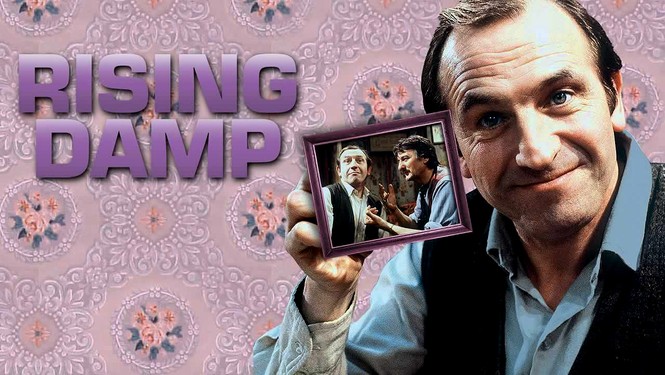
One of the most talented quartets of comic actors of all time ran wonderfully amok in the superb 1974-1978 British TV series Rising Damp. In it, fabulous funnyman Leonard Rossiter starred as frenetic, cranky, cheap, boastful Rupert Rigsby, the landlord of a seedy Yorkshire boarding house. Frances de la Tour, Don Warrington, and Richard Beckinsale were comically adept as his regular tenants.

The critically acclaimed and very popular show ran for 28 episodes during four seasons (all available on Netflix, with many episodes on YouTube). Rising Damp won the Best Situation Comedy BAFTA award, and Rossiter was nominated for two more BAFTAs. More than 93.9% of viewers rating it at imdb.com gave it thumbs-up, and 34% consider it a perfect 10. In a 2004 poll, Rising Damp was voted the best sitcom ever to air on the 15-network Independent Television (ITV) group of British channels. Here is a sample episode.

In Rising Damp, landlord Rigsby is interfering, dour, cowardly, and insulting, and he ignorantly expresses bigoted, right-wing views. A character with so many negative qualities should be very unpleasant, but Rossiter is such a dazzling comic actor, with astonishing manic energy and perfect timing, that we are totally captivated by his over-the-top ridiculousness.

Rigsby has the ill-disguised hots for single tenant Miss Jones (Frances de la Tour — perfect as a lonely, romantic spinster). She vainly fancies upstairs neighbor Philip Smith (Don Warrington), a college student from Croydon (South of London) who convinces the gullible Rigsby that he has 10 wives and is the son of an African chief. This is the inspiration for many droll wisecracks from Rigsby. Actually, Phillip is intelligent and sophisticated, making him the ideal foil for the grubby, unsophisticated Rigsby.

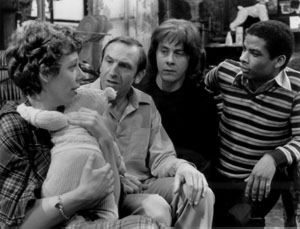
From left: de la Tour, Rossiter, Beckinsale,
and Warrington.

For the first three seasons, Phillip’s roommate was Alan, an impecunious, long-haired medical student who had poor luck with girls. Richard Beckinsale was charming in the role, but tragically he died of a heart attack at age 31. Rossiter also died too young, at 58. So far, Warrington and de la Tour are healthy and continue to do good work — he in Manchild and New Street Law and she in Hugo, The History Boys and two of the Harry Potter films.

I just watched six episodes of Rising Damp again this week and howled once more at Rigsby’s antics, while marveling at Eric Chappel’s magnificent writing.

I have often said and written that one of many reasons that the best Britcoms are far superior to their American counterparts is that they have only six to eight episodes per season, and all are written by the original genius. Whereas it seems as though four of the 22 annual U.S. sitcom episodes are written by the series creator while another three are penned by the producer’s mistress and five more are scribbled by the network executive’s idiot nephew. A 1980 movie version of Rising Damp won the Evening Standard British Film Awards for de la Tour, guest actor Denholm Elliott, and Best Comedy.

During breaks in the filming of Rising Damp, Rossiter starred in the screamingly funny 21-episode/three season (1976-1979) sitcom The Fall and Rise of Reginald Perrin — based on some dark, risqué, satiric novels by David Nobbs, who also scripted the series. In 2009-2010 it was remade in two seasons and 12 episodes as Reggie Perrin, starring the equally brilliant but much taller Martin Clunes. Both series are on Netflix, and the latter can also be streamed on Netflix Instant.

My favorite comic interchange (of many!) in Reggie Perrin is the dippy young psychiatrist telling Perrin: “Today we are going to try something new, called Sobbing Therapy. I found it in a new book, listed between Shopping Therapy and Sperm Therapy.” Perrin asks: “Who does the sobbing, you or me?” She replies: “You. I just hand you tissues — which is actually the same thing I do in “Sperm Therapy.”

[Oregon writer and Houston native Alan Waldman holds a B.A. in theater arts from Brandeis University and has worked as an editor at The Hollywood Reporter and Honolulu magazine. Read more of Alan Waldman’s articles on The Rag Blog.]

The Rag Blog

Posted in Rag Bloggers | Tagged , , , , , | Leave a comment

INTERVIEW / Jonah Raskin : American Jewish Poet Hilton Obenzinger on Israel, Zionism, and the Radical Sixties

Hilton Obenzinger with family photo. Photo courtesy of Stanford University.

Interview with Hilton Obenzinger:
Stanford professor, Sixties radical,  
and anti-Zionist American Jewish poet

“American Jews have been suckered into supporting Israel in unthinking ways. This has been changing, but not enough American Jews are yelling and screaming to stop Israel’s colonial expansion.” — Hilton Obenzinger

By Jonah Raskin | The Rag Blog | March 7, 2013

Born in Brooklyn, New York, the borough that served as the homeland for millions of Jews for decades, Hilton Obenzinger carries Jewish history and lore around with him both mournfully and gleefully.

His many books draw attention to his own Jewish roots, including an oral history he conducted with his Aunt Zosia Goldberg entitled Running Through Fire: How I Survived the Holocaust. There’s also a collection of his poetry entitled This Passover Or The Next I Will Never Be in Jerusalem, which received the American Book Award of the Before Columbus Foundation.

More than 60 years after he celebrated his first Passover with his own family of origin, he’s getting ready to celebrate Passover again with the family he’s created with Estella Habal, an Associate Professor of Asian American Studies at San Jose State University.

With Passover 2013 on the horizon — it starts March 25 — I sent Obenzinger an email and took up a long-standing conversation that we’ve kept going through wars, occupations, Seders, and reunions of Sixties radicals.

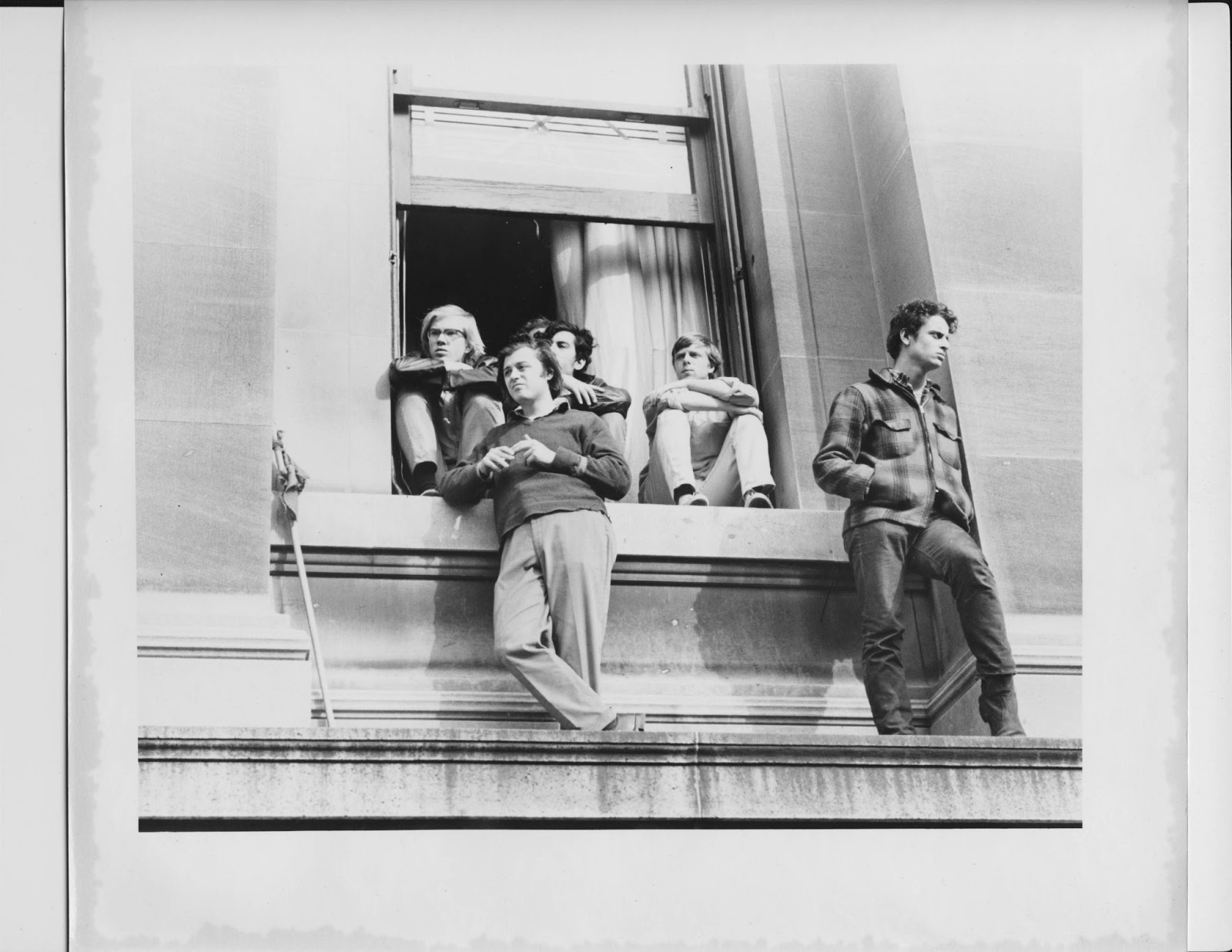
Hilton Obenzinger, left on ledge, at Columbia University strike in 1968.  Photo by Tom Hurwitz.

Jonah Raskin: How will you celebrate Passover this year?

Hilton Obenzinger: We’ll have an extended family feast: my wife and I, our kids and grandkids. As usual, we’ll combine Passover, Easter, and the arrival of spring. It’s a raucous crowd: Jews, Filipinos, Chinese, and more. We use an illustrated Children’s Bible to tell the story of slavery and the escape of the Jews from Egypt, then move on to Jesus and the last Seder, and finish the Biblical story with the crucifixion and the resurrection. Eventually, we reach the Warsaw Ghetto uprising and sing “Let My People Go.”

We pour plenty of wine, shout good wishes for the Palestinians, Native Americans, and everyone else running for freedom. We end the evening with lines from a version of the Haggadah I wrote: “Next year in Jerusalem delivered from bondage.”

What makes you proud to be a Jew?

Jewish culture is rich and varied with a transnational sense of peoplehood. In Europe, my ancestors were everything from ultra-orthodox to Polish nationalists, to escape-to-America émigrés, to Zionist and Communist. The Nazis murdered almost all of them. In the face of that horror and other horrors of history, Jewish survival is astonishing.

I’m especially proud of the American Jewish experience that pushed me, and others, to join the civil rights and social justice movements. I’ve heard it said that support for equality and justice flows from Jewish ethics and from the history of Jewish persecution. I’d like to believe it.

What are you most ashamed about Jews as an ethnic group?

From my point of view, Zionism turned out to be a moral disaster for the Jews. American Jews have been suckered into supporting Israel in unthinking ways. This has been changing, but not enough American Jews are yelling and screaming to stop Israel’s expansion.

Have you been attacked at Stanford because of your beliefs?

After I began to teach at Stanford in the 1990s, a professor wrote a letter denouncing me as a “terrorist.” He was a very nice guy, very progressive — except when it came to Israel. A switch would go off and he’d go bananas.

You have used the expression “Zionist crackpot.” What does it mean to you?

I don’t mean the typical supporter of Israel. I mean those people who fall into the extremist syndrome and who are motivated by a deep-rooted sense that Jews are always the victims and that Israel is always under attack even when it’s the aggressor.

Forty years ago, did you believe there would be a resolution to the conflict between Israel and the Palestinians?

Yes. And I still do.

Do you see a resolution to the conflict in your own lifetime?

Assuming I live another decade or two, probably not. But you never know. Who would have thought the Soviet Union would collapse? Or a black man would be president? I may not live to see it but it’s likely to happen.

Do you think that there can be a one-state solution to the conflicts between Palestinians and Israelis?

Of course, there can be — which doesn’t mean it will happen, at least in the near future. The conflict is not at root religious and it hasn’t been going on for thousands of years, as many claim. It started about 130 years ago when Zionism, a Western political movement, called for the settlement of Palestine and the exclusion of the native people. It’s a conflict started by people, not by God; humans created it; humans can fix it.

What do you see happening now?

Israeli Jews are a nationality with their own language and culture, as are the Palestinians, so it would take a lot of good faith to fit all of them together, including the refugees. Good faith is not an abundant commodity nowadays. Meanwhile, the Israeli government has been doing all it can to prevent a two-state solution by expanding settlements and uprooting Palestinian communities.

One state may be inevitable, since the foundations for a viable Palestinian state have been greatly undermined. Israel might move further in its current colonialist direction, creating reservations for the natives and a large open-air prison in Gaza. I don’t care if there are one or four states, actually, just so long as equality and democratic rights are at the core of all of them.

What have you learned from studying the Holocaust?

When we protested the war in Vietnam many of us didn’t want to be “good Germans” — people passively accepting evil and genocide. My family’s murder always weighs on my mind, so for me it’s imperative to speak out about injustice.

I produced my aunt’s oral testimony called Running through Fire about her escape from the Warsaw Ghetto. I learned from her that everything is muddy — with some Germans acting morally and courageously and some Jews acting in a craven fashion. I also leaned that in a situation of utter horror, no matter how smart and skilled and, in her case, how beautiful you were, pure luck is a determining factor. I’ve also learned to keep my passport up-to-date.

What does it mean to you to be a Jew?

After my son’s birth I felt compelled to pass on to him a positive Jewish experience without the corruptions of anti-Arab racism, and the “Jewish Disneyland” kitsch that American Jews love. I wanted my son to laugh, to enjoy the bar mitzvah experience, to feel comfortable being Jewish and Filipino — which is his mother’s ethnic identity.

What do you think Jews and Arabs have in common?

I told my aunt who survived the Nazis that if she could meet Palestinians in refugee camps she would like them, and that they were a lot like her. Palestinians, like Jews, value education and culture, and they insist on persisting. They, too, have historical memories that they won’t allow to be erased and that they act upon. Both Israeli Jews and Palestinians have also managed to drive each other insane. It’s painful watching two peoples destroy each other.

You’ve written about “the Holy Land.” Is it holy to you?

There’s so much blood and hatred there, that it’s hard to conceive of the place as holy.

At Stanford, where you teach, is there a visible Jewish population and a visible Arab population? What observations have you made about them?

Stanford gentility is strong and has its virtues. A lot of the Jewish students sympathize with the Palestinian cause nowadays and a Jewish critic of Israel is hardly an oddity.

You’re involved with Chinese Railroad Workers in North America Project? What is it?

2015 will be the 150th anniversary of the introduction of thousands of Chinese workers to build the first transcontinental railway across North America. The work culminated with Leland Stanford driving the famous “golden spike” to complete the line that connected East and West. Despite the photographs, drawings, and observers’ testimonies about the Chinese workers who labored from sunrise to sunset, not a single primary document — not a letter or a notebook — has been identified.

So there’s a real Stanford connection, isn’t there?

Construction of the railroad was central to creating the wealth that Leland Stanford used to found the university. Eventually, we’d like to build a monument to the Chinese railroad workers on campus.

What is it about your own experience as a Jew that might help you understand the experience of the Chinese railroad workers?

I remember my father’s experience as an immigrant having to work in dangerous factories. The Chinese in America suffered a lot of abuse — racial violence, mass deportations, expulsions, and discrimination. Early Chinese immigrants were tenacious and ingenuous and determined to possess the country and be possessed by it — just like anyone else.

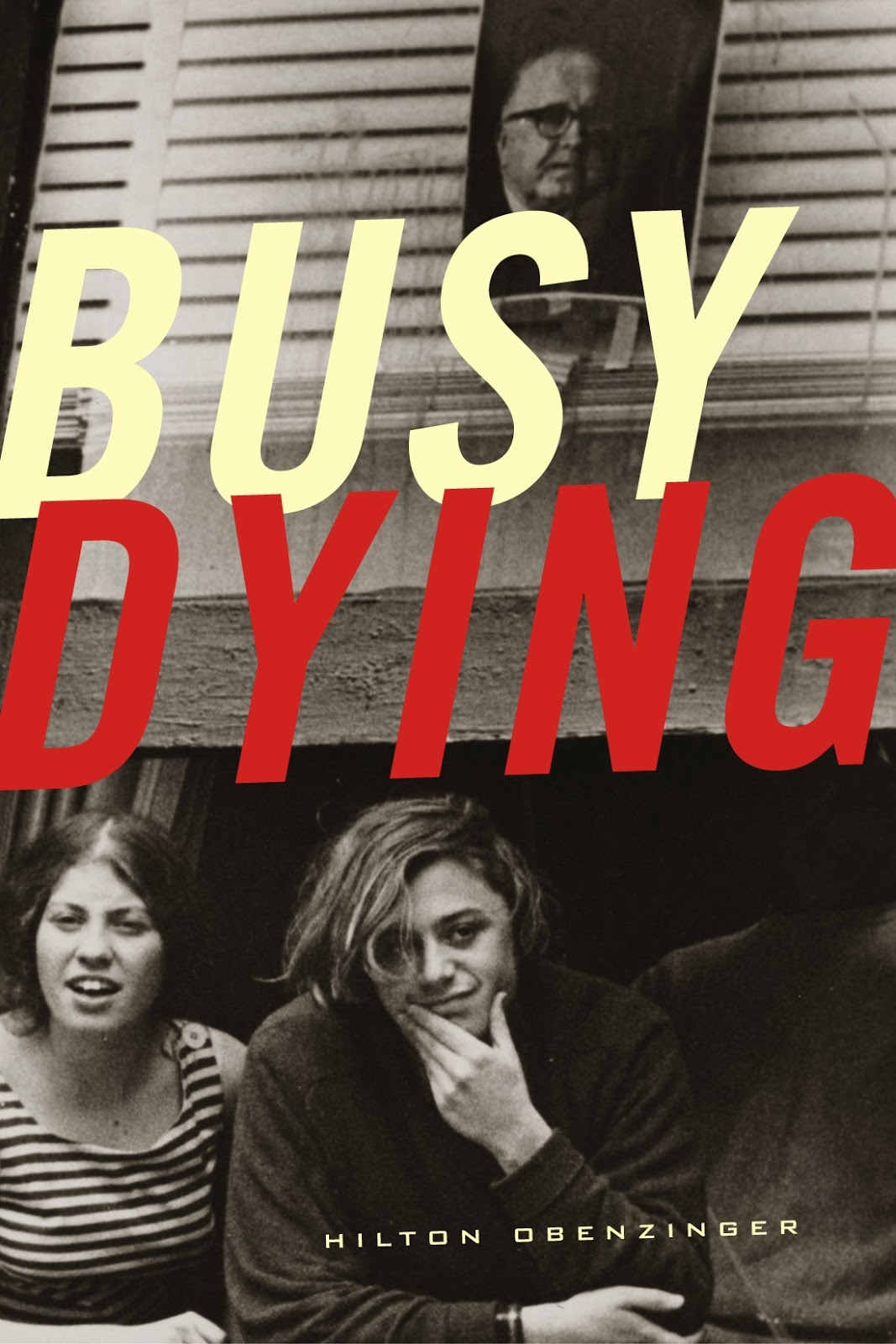
The Columbia protest of 1968 took place 45 years ago. How do you remember it now? In fact, you wrote a book, Busy Dying, that’s in part about that experience. How did writing the book alter your sense of the past?

I have totally blanked out my graduation, but I remember sitting in Low Library in the president’s office in around-the-clock meetings to talk about negotiations and how to nonviolently defend ourselves.

Why did you write your book?

I read accounts of the Sixties and was disturbed by the distortions, stereotypes, and outright lies.

The title Busy Dying borrows from Dylan’s “Busy Being Born.” Did Dylan help shape your Sixties experience?

The line is from “It’s Alright, Ma (I’m Only Bleeding).” It goes, “he not busy being born is busy dying.” Dylan’s music provides much of the soundtrack of my memories. The lines “busy being born” and “busy dying” express the sense of urgency we faced in the Sixties.

When you look back at the Sixties does it seem like an era mostly of sex, drugs, and rock ‘n’ roll, or would you propose another trinity?

I got plenty of drugs but not enough of sex. I loved a lot of the rock ‘n’ roll, but I was also into country music, bluegrass, and Vivaldi. In 1968 we were “freaks” because we rebelled. The hippie part of the Sixties is too narrowly focused on middle class white kids, not the GIs fragging their officers, Freedom Riders, or Black Panthers.

At Stanford are you among the sons and daughters of the elite, who will go on to rule the Empire?

Half the undergraduates aren’t white and most aren’t rich. Of course, when Chelsea Clinton attended Stanford that pretty much defined the school’s reality. But I’ve also known students who joined the Zapatistas, organized unions, helped manage their pueblo’s casino to invest tribal funds wisely, restored native farming to the Big Island in Hawaii, develop educational programs in poor communities.

What about recent protest on campus?

In the fall of 2011, the Big Game between Berkeley and Stanford took place at Stanford right after the police attacks on Berkeley students occupying tents on campus. There was a joint rally of students from both schools — something that I think has never happened before in their fierce rivalry — to show solidarity against police brutality. It was one of the most astonishing moments in Stanford history. I don’t think I’ll ever forget it.

[Jonah Raskin, a regular contributor to The Rag Blog, is a professor Emeritus at Sonoma State University and the author of two books about American Jews, For the Hell of It: The Life and Times of Abbie Hoffman, and American Scream: Allen Ginsberg’s Howl and the making of the Beat Generation. Read more articles by Jonah Raskin on The Rag Blog.]

The Rag Blog

Posted in Rag Bloggers | Tagged , , , , , , , , , | 2 Comments

RAG RADIO / Thorne Dreyer : A Conversation With Austin Chronicle Editor and SXSW Co-Founder Louis Black

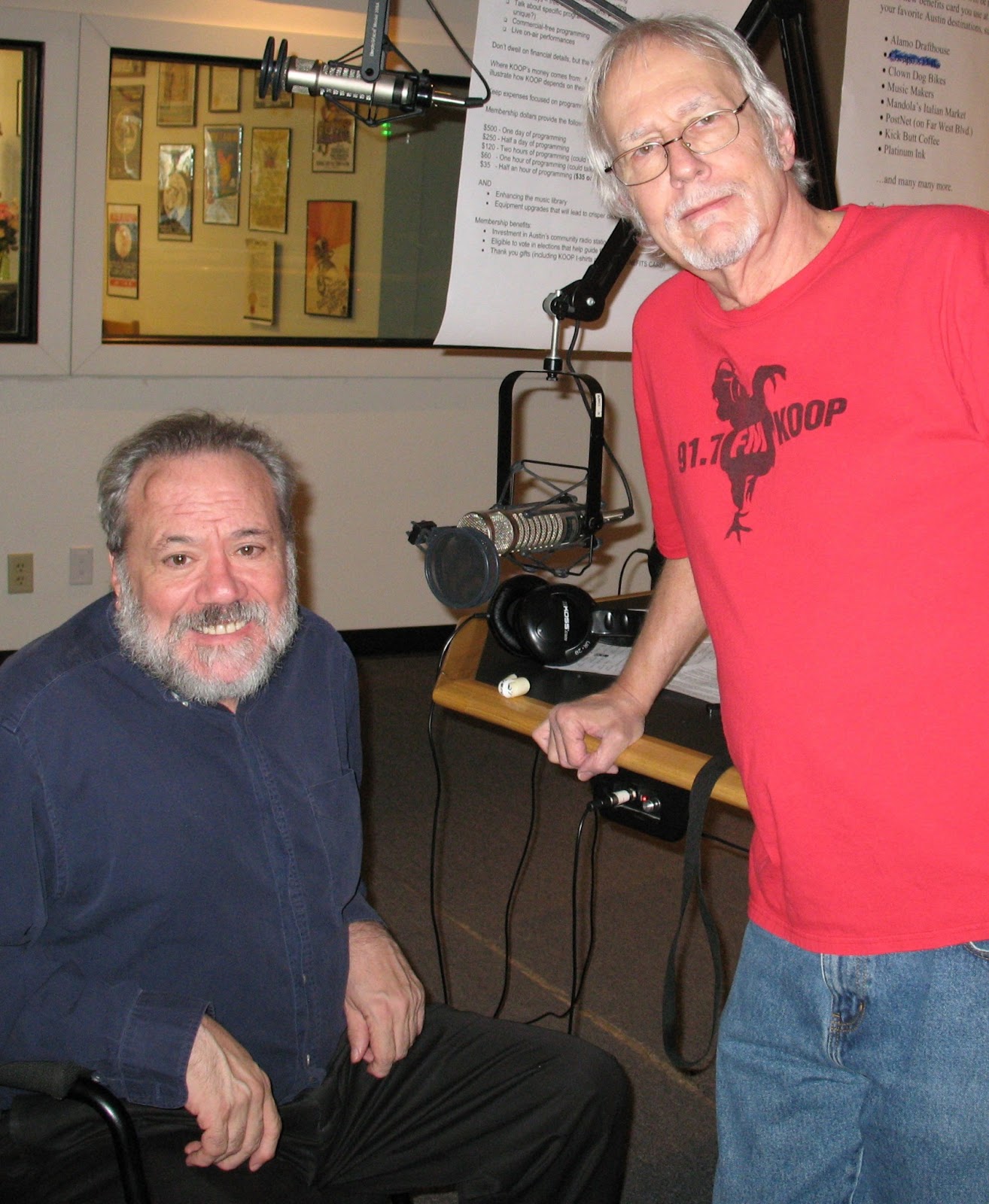
Austin Chronicle editor and South by Southwest co-founder Louis Black in the studios of KOOP-FM in Austin, Texas, Friday, March 1, 2013. Photo by Thorne Dreyer / The Rag Blog.

Rag Radio Podcast:
Austin Chronicle editor Louis Black,
co-founder of South by Southwest

“It used to be that you had to leave Austin to establish yourself politically, as a writer, as a filmmaker, as a musician. And now the world comes to Austin.” — Louis Black

By Rag Radio | The Rag Blog | March 7, 2013

Austin Chronicle editor Louis Black — co-founder of the massive South by Southwest Music, Interactive and Film Festivals and Conferences — was Thorne Dreyer’s guest on Rag Radio, Friday, March 1, 2013.

Rag Radio is a syndicated radio program produced at the studios of KOOP 91.7-FM in Austin, Texas.

Listen to or download our interview with Louis Black here:


Louis Black is the editor of The Austin Chronicle, Austin’s major weekly newspaper, which he co-founded with Nick Barbaro in 1981. In 1987 Black co-founded South by Southwest Music, Interactive and Film Festivals and Conferences, along with Barbaro and Roland Swenson.

SXSW Music is the largest music festival and music industry event in the world; SXSW Interactive is arguably the largest event of its kind in the world; and SXSW Film has become one of the preeminent film festivals in the country. And there’s a new educational component (SXSWedu) that “supports innovations in learning for education practitioners, industry leaders and policy maker.”

(This year’s SXSW takes place between March 8 and March 17, 2013, at the Austin Convention Center and all over Austin, Texas.)

On Rag Radio, Louis Black talked about his personal history growing up in Teaneck, New Jersey. (“I had dyslexia, I had attention issues, all kinds of authority issues. I was a disaster as a student.”) So he became a film geek. At about 12 he became best friends with Leonard Maltin — who would grow up to be one of the nation’s most honored film critics — “and we began to go into New York City after school and all-day Saturdays to watch films — to museum screenings, we’d go to the film societies… We saw tons of movies.”

“We weren’t really auteur freaks or international film fans,” he said. “We would see lots of B movies, lots of cartoons… When we were 15, Len and I met Buster Keaton under the Brooklyn Bridge where he was filming the film, Film.” Film was written by the legendary Irish playwright and novelist Samuel Beckett, who was standing nearby at the time. Black and Maltin were thrilled to meet Keaton but had no idea who Beckett was.

Thanks to Maltin’s connections, Black ended up studying film in graduate school at the University of Texas. “I had been watching movies all my live, I had an enormous amount of knowledge,” and suddenly he was not only a star student, but he had found his calling. Black received an MFA from UT-Austin, with a concentration in film studies, in 1980. And he would soon find himself at the epicenter of Austin’s big-time cultural explosion.

Louis Black was a founding board member of the Austin Film Society, and the board’s first president, and, along with then Texas Monthly Editor Evan Smith, co-founded the Texas Film Hall of Fame in 2001. He executive produced the documentary Be Here to Love Me: A Film About Townes Van Zandt, by Margaret Brown, and was an associate producer on Brown’s documentary, The Order of Myths, which won a Peabody Award in 2009.

Black executive produced the DVD release of the late Eagle Pennell’s The Whole Shootin’ Match, a 1968 film which had long been thought lost and that Robert Redford cites as inspiration for starting the Sundance Institute.

Louis Black and Thorne Dreyer.
Photo by Tracey Schulz.

Black says that the Austin Chronicle, with a circulation close to 450,000, can no longer legitimately be called an “alternative” publication (“KOOP radio is ‘alternative,'” he said), but is a weekly newspaper featuring local news reporting and extensive cultural coverage — and with a “definite point of view.” The Chronicle has played a big role in Austin’s evolution as a cultural hub. “Austin’s a unique place and a very special place,” Black told the Rag Radio audience, “and certainly we’ve contributed to that, and we’ve benefited enormously from that.”

When they started South by Southwest, Black said, they thought they’d have a “nice regional event, a little gathering in Austin for a couple of days, with workshops and panels and hearing some music… and we’d end it with a softball game and a barbeque.” Well, “it was regional for the first year or two,” he added, “but then it became national and then international. And then, under Roland Swenson’s leadership, we added film, we added interactive, and now we’ve added an education component. And it mirrors Austin. The event is just a multiplier for what goes on in Austin all year round. It’s really succeeded.”

And has it succeeded! As the UT alumni mag Alcalde put it in its March/April 2011 issue:

From its modest beginnings as a regional music conference in 1987, South by Southwest has ballooned into a multimedia powerhouse. Its music, film, and interactive-media conferences attract tens of thousands, turning Austin into the center of the cultural universe for one week every March.

Whatever you’re doing, South by Southwest is the place to show it off. Johnny Cash launched his big comeback at South by Southwest in 1994. More recently, Norah Jones started building buzz there before she won all her Grammy Awards. Newly launched Twitter saw tweets per day more than triple at the 2007 interactive conference. And Kathryn Bigelow’s The Hurt Locker, which won [the 2010] best-picture Oscar, was the talk of the 2009 film festival.

At last year’s music festival, Bruce Springsteen provided a memorable keynote address and electrifying showcase performances, heading a stellar cast of artists, from world-renowned to (as yet) little-known, and this year’s bill includes Dave Grohl, Stevie Nicks, and Green Day. There will be more than 20,000 registered participants and many thousands more will come into Austin for the related musical events involving more than 2,000 bands performing at easily a hundred venues. The film festival will offer screenings of more than 150 films.

SXSW Interactive is “probably the biggest event of its kind in the world, and now has hundreds of speakers,” Black says. More than 25,000 attended last year’s Interactive gathering and a substantial increase is expected this year. “With Interactive you can just feel the energy sizzling,” Black says. As The Wall Street Journal wrote, “The brainpower that assembles in Austin is overwhelming. Everywhere you look there are smart people discussing smart ideas.”

And the film festival is now “one of the most highly-regarded film festivals in the world.” Austin is widely-known as the “live music capital of the world,” with thousands of active musicians. But it has also become a major independent film center, home to filmmakers like Richard Linklater, Robert Rodriguez, and Mike Judge.

According to Black, “There’s more creative people in Austin now. More artists and musicians and filmmakers making a living in Austin or living in Austin and having their work seen around the world. It used to be that you had to leave Austin to establish yourself politically, as a writer, as a filmmaker, as a musician. And now the world comes to Austin.”

“And the special thing about the creative scene in Austin,” he said, is that it’s “a completely culturally-integrated community. When you go to New York, the documentary filmmakers don’t hang out with the theatrical filmmakers who don’t hang out with the animators. In Austin all those filmmakers do, and people with a lot of different political stripes do: poets hang out with filmmakers who hang out with novelists who hang out with artists.”

And, host Dreyer added, “everybody hangs out with the musicians.”

Rag Radio has aired since September 2009 on KOOP 91.7-FM, an all-volunteer cooperatively-run community radio station in Austin, Texas. Hosted and produced by Rag Blog editor and long-time alternative journalist Thorne Dreyer, a pioneer of the Sixties underground press movement, Rag Radio is broadcast every Friday from 2-3 p.m. (CST) on KOOP, and is rebroadcast on Sundays at 10 a.m. (EST) on WFTE, 90.3-FM in Mt. Cobb, PA, and 105.7-FM in Scranton, PA.

The show is streamed live on the web by both stations and, after broadcast, all Rag Radio shows are posted as podcasts at the Internet Archive.

Rag Radio is produced in association with The Rag Blog, a progressive internet newsmagazine, and the New Journalism Project, a Texas 501(c)(3) nonprofit corporation. Tracey Schulz is the show’s engineer and co-producer.

Rag Radio can be contacted at ragradio@koop.org.

Coming up on Rag Radio:
THIS FRIDAY,
Friday, March 8: Novelist David McCabe, author of Without Sin, based on a true story of a sex trafficking ring exploiting young, undocumented women.
Friday, March 15: Legendary producer Chris Strachwitz of Arhoolie Records, and filmmakers Maureen Gosling and Chris Simon, This Ain’t No Mouse Music!
Friday, March 22: Progressive sportswriter Dave Zirin, Sports Editor at The Nation.

The Rag Blog

Posted in Rag Bloggers | Tagged , , , , , , , , , , | Leave a comment

Jim Turpin : Is the Imperial Presidency the ‘New Normal’? / 2

Photo by Jim Watson / AFP / Getty Images./ Foreign Policy.

The ‘new normal’?
The Imperial Presidency / 2

“You may ask yourself, well, how did I get here?”
Talking Heads (“Once in a Lifetime”)

By Jim Turpin | The Rag Blog | March 7, 2013

Second in a two-part series.

In my previous installment of this article, I discussed how the codification of the Executive’s imperial power and America’s one party political system have contributed to a deeply emboldened presidential authority.

But recent executive branch overreach is also propped up with a troubling combination of additional factors including:

  • Assassination by star chamber
  • Subjugated and ‘craven’ media

Assassination by star chamber

Star Chamber (n):

  1. A 15th-century to 17th-century English court consisting of judges who were appointed by the Crown and sat in closed session on cases involving state security.
  2. star chamber: A court or group that engages in secret, harsh, or arbitrary procedures.

The Department of Justice (DOJ), in an effort to codify extrajudicial killings in the “War on Terror” by the Executive branch had a “white paper” leaked earlier this week.

The contents and justification for killing U.S. citizens or foreign nationals are chilling and this was laid out by Glenn Greenwald in The Guardian:

The most extremist power any political leader can assert is the power to target his own citizens for execution without any charges or due process, far from any battlefield. The Obama administration has not only asserted exactly that power in theory, but has exercised it in practice. In September 2011, it killed U.S. citizen Anwar Awlaki in a drone strike in Yemen, along with U.S. citizen Samir Khan, and then, in circumstances that are still unexplained, two weeks later killed Awlaki’s 16-year-old American son Abdulrahman with a separate drone strike in Yemen.

Since then, senior Obama officials including Attorney General Eric Holder and John Brennan, Obama’s top terrorism adviser and his current nominee to lead the CIA, have explicitly argued that the president is and should be vested with this power. Meanwhile, a Washington Post article from October reported that the administration is formally institutionalizing this president’s power to decide who dies under the Orwellian title “disposition matrix.”

This “disposition matrix” — more commonly referred to as a “kill list” — is done in complete secrecy by this administration with the aid of the CIA, the National Counterterrorism Center (NTC), and others in a “star chamber.” This unaccountable and unmonitored group metes out justice that is death from above, without a shred of “due process” which has been the center of western legal principles and law since the Magna Carta.

More from Greenwald in The Guardian:

The president’s underlings compile their proposed lists of who should be executed, and the President — at a charming weekly event dubbed by White House aides as “Terror Tuesday” — then chooses from “baseball cards” and decrees in total secrecy who should die. The power of accuser, prosecutor, judge, jury, and executioner are all consolidated in this one man, and those powers are exercised in the dark. In fact, The Most Transparent Administration Ever™ has been so fixated on secrecy that they have refused even to disclose the legal memoranda prepared by Obama lawyers setting forth their legal rationale for why the president has this power.

With unmanned aerial vehicles (UAV), also known as “drones” and having names like “Predator” and “Reaper,” the destruction for those on the ground is both horrific and widespread.

Code Pink, a women-initiated grassroots peace and social justice movement working to end U.S.-funded wars and occupations and to challenge militarism globally, recently traveled to the tribal area in Pakistan to both discuss the impact with civilians and protest the use of drones.

Medea Benjamin, one of the founders of Code Pink, recently released her book Drone Warfare: Killing by Remote Control, an “extensive analysis of who is producing the drones, where they are being used, who are ‘piloting’ these unmanned planes, who are the victims and what are the legal and moral implications.”

Code Pink also, as one of the few activist groups still holding the Obama administration accountable for the use of drones, disrupted the confirmation hearing of new CIA director James Brennan. Professed liberal Democratic Senator Dianne Feinstein quickly removed Code Pink at the beginning of the proceedings.

Just as important, Stanford and NYU released a report last year, titled “Living Under Drones: Death, Injury and Trauma to Civilians from U.S. Drone Practices in Pakistan.” This report lays out evidence of terrorized populations living in fear 24 hours a day:

  • “Drones hover twenty-four hours a day over communities in northwest Pakistan, striking homes, vehicles, and public spaces without warning. Their presence terrorizes men, women, and children, giving rise to anxiety and psychological trauma among civilian communities.
  • “The U.S. practice of striking one area multiple times, and evidence that it has killed rescuers, makes both community members and humanitarian workers afraid or unwilling to assist injured victims.”
  • “Some community members shy away from gathering in groups, including important tribal dispute-resolution bodies, out of fear that they may attract the attention of drone operators. Some parents choose to keep their children home, and children injured or traumatized by strikes have dropped out of school.”

The efficacy of the entire drone program is highly suspect. The following is from the same report:

The number of “high-level” targets killed as a percentage of total casualties is extremely low — estimated at just 2%.Furthermore, evidence suggests that U.S. strikes have facilitated recruitment to violent non-state armed groups, and motivated further violent attacks.

Subjugated and ‘craven’ media

The subject of waterboarding, remarkably, has been a topic in U.S. newspapers since the Phillipine Insurrection at the beginning of the 20th century, when U.S. soldiers were accused of torturing Filipino prisoners with the “water cure”:

A letter by A. F. Miller, of the 32nd Volunteer Infantry Regiment, published in the Omaha World-Herald in May, 1900, told of how Miller’s unit uncovered hidden weapons by subjecting a prisoner to what he and others called the “water cure.” “Now, this is the way we give them the water cure,” he explained. “Lay them on their backs, a man standing on each hand and each foot, then put a round stick in the mouth and pour a pail of water in the mouth and nose, and if they don’t give up pour in another pail. They swell up like toads. I’ll tell you it is a terrible torture.

The Kennedy School of Government published a study by a group of Harvard students in 2010, titled, “Torture at the Times: Waterboarding in the Media.” The remarkable results of this study show evidence of no longer using the term “torture” in U.S. newspapers post 9/11, when these horrific acts are committed by U.S. armed forces.

Ironically, when these acts are committed by other countries, the term “torture” is used much more frequently.

One of the worst offenders was The New York Times:

The New York Times called waterboarding torture or implied it was torture in just 2 of 143 articles (1.4%). The Los Angeles Times did so in 4.8% of articles (3 of 63). The Wall Street Journal characterized the practice as torture in 1 of 63 articles (1.6%). USA Today never called waterboarding torture or implied it was torture.

In addition, the newspapers are much more likely to call waterboarding torture if a country other than the United States is the perpetrator. In The New York Times, 85.8% of articles (28 of 33) that dealt with a country other than the United States using waterboarding called it torture or implied it was torture, while only 7.69% (16 of 208) did so when the United States was responsible. The Los Angeles Times characterized the practice as torture in 91.3% of articles (21 of 23) when another country was the violator, but in only 11.4% of articles (9 of 79) when the United States was the perpetrator.”

Furthermore, it was revealed this week that The New York Times and other newspapers bowed to this administration’s request to keep drone bases in Saudia Arabia secret and then later decided to publish the story on the eve of the Brennan-CIA confirmation hearings:

According to a reporter on the national security beat, The New York Times participated in an “informal arrangement” to keep secret a Saudi Arabian base for U.S. interests — and then suddenly withdrew from that arrangement. A story posted on the paper’s Web site last night — titled “Drone Strikes’ Dangers to Get Rare Moment in Public Eye“ — summarizes the leak of a white paper on the Obama administration’s targeted killing program and tees up the Senate confirmation hearing of White House counterterrorism adviser John O. Brennan to be the director of the Central Intelligence Agency.

Maybe The New York Times‘ slogan, “All the News That’s Fit to Print,” should now be “All the News That’s Fit to Print…When It Makes Us More Money”

The nexus of all these contributing factors to empowering the executive branch is deeply troubling and seems insurmountable. It is rare that when power is given to those in authority, that it is later put aside.

“You may say to yourself, my God, what have I done?” Talking Heads (“Once in a Lifetime”)

[Rag Blog contributor Jim Turpin is an Austin activist and writer who works with CodePink Austin. He also volunteers for the GI coffeehouse Under the Hood Café at Ft. Hood in Killeen, Texas. Read more articles by Tim Turpin on The Rag Blog.]

The Rag Blog

Posted in Rag Bloggers | Tagged , , , , , , , | 1 Comment

Type your summary here

Type rest of the post here

Source /

The Rag Blog

Posted in RagBlog | Leave a comment

Type your summary here

Type rest of the post here

Source /

The Rag Blog

Posted in RagBlog | Leave a comment

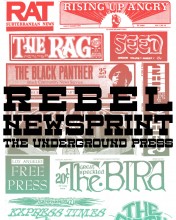
Allison Meier : Radical Archive Exhibits ‘Rebel Newsprint’ from the Sixties

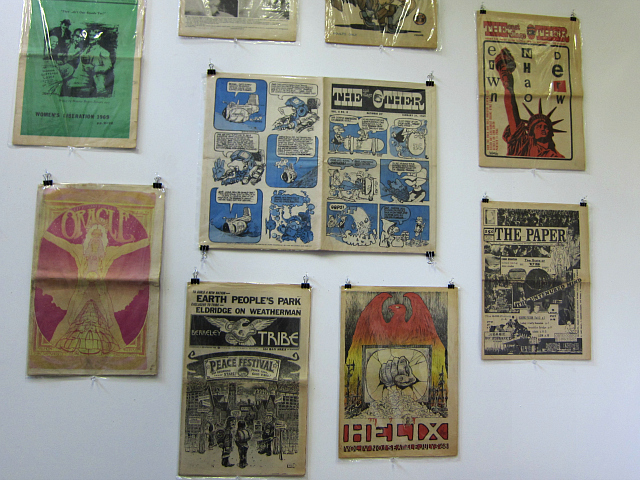
Image from “Rebel Newsprint: The Underground Press” at Interference Archive. Photo by Allison Meier / Hyperallergic.

One radical archive offers a
hands-on approach to activist art

The indie counterculture newspapers of the 1960s multiplied to over 500 around the country, with their art and design as radical as their messages.

By Allison Meier / Hyperallergic / March 6, 2013

The intensified activism of the 1960s fueled by the Vietnam War and struggles over class inequality, women’s rights, and black liberation drove the rapid growth of the underground press. Between 1965 and 1969, the five indie counterculture newspapers scattered across the United States multiplied to over 500 around the country, representing and communicating the voices of feminists, the Black Panther Party, gay activists, psychedelic aficionados, and other social movement groups with their art and design as radical as their messages.

Rebel Newsprint: The Underground Press” at Interference Archive in Gowanus [a neighborhood in Brooklyn, New York] is digging into this historic period with over 100 newspapers from across the sixties underground.

The exhibition of ephemera is curated by Sean Stewart, the editor of On the Ground: An Illustrated Anecdotal History of the Sixties Underground Press in the U.S. (2011), and was drawn from his own collection, with yellowed and folded issues of newspapers like the bilingual community publication Basta Ya started in San Francisco in 1969, the experimental San Francisco Oracle published from 1966 to 1968 out of Haight-Ashbury that reflected the area’s psychedelic scene in trippy rainbow ink and spiritual poetry, and the sexual revolution sourced Screw: The Sex Review co-founded by pornographer Al Goldstein.

Most of the newspapers are held in plastic and suspended from the walls of the Interference Archive’s small space, a cascade of counterculture messages like “End the War Now,” “Don’t Mourn, Organize,” and “All Power to the People” blaring out from vibrantly hued cover art and rapid fire text.

One issue of the East Village Other, responding to the 1967 storming of hippies convening in Tompkins Square by police, has an image of a man with a bloodied face, his hands handcuffed and stretching down while text frames him on two sides: ”My God! My God! Where is this happening? This is America!” (You can see this and some other covers in detail on the Interference Archive blog.)

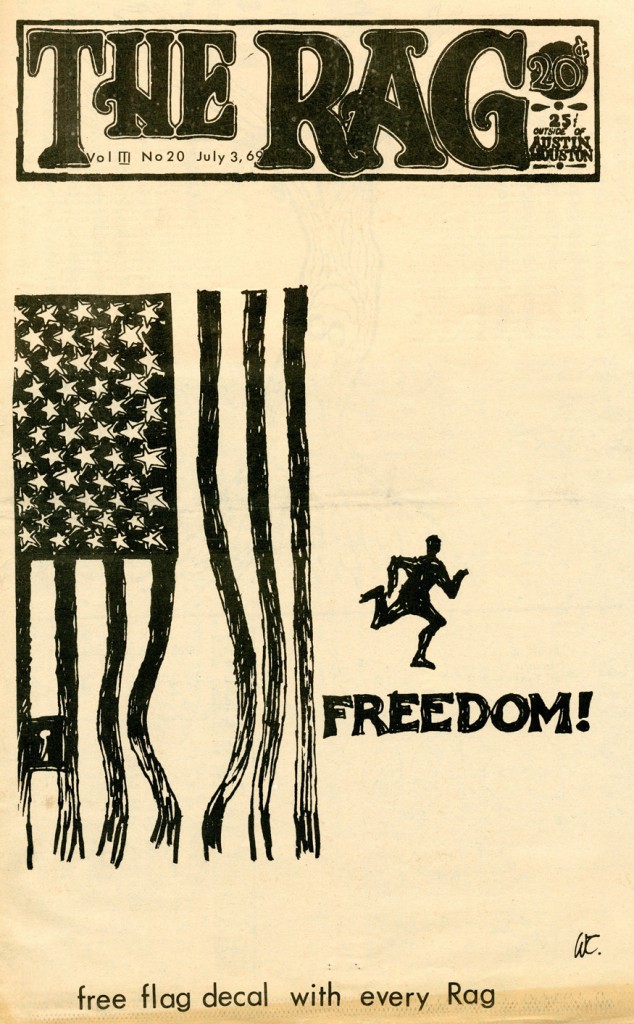
The Rag. Image from
Interference
Archive.

The importance of a visually engaging communication device was especially essential for movements that were located outside of the radical coastal centers, like Space City! in Houston. Thorne Dreyer, part of its editorial collective, is quoted in the exhibition text: “Houston was all spread out, you know, there were antiwar people and there were rock ‘n’ rollers but there wasn’t anything to pull them together. Space City! created a place where all these people could come together.”

There was also the relaying of information between distant parts of the world where activism was broiling. Alice Embree, a staff member at Austin’s Rag, is quoted: “The importance of Rag and the underground press movement was that it was the connective tissue; it spread the news of what was happening from here to other places. It brought the news of, say, People’s Park or whatever was going on in Berkeley or New York, back.” This extended to movements in Mexico and even across the ocean in Japan and France.

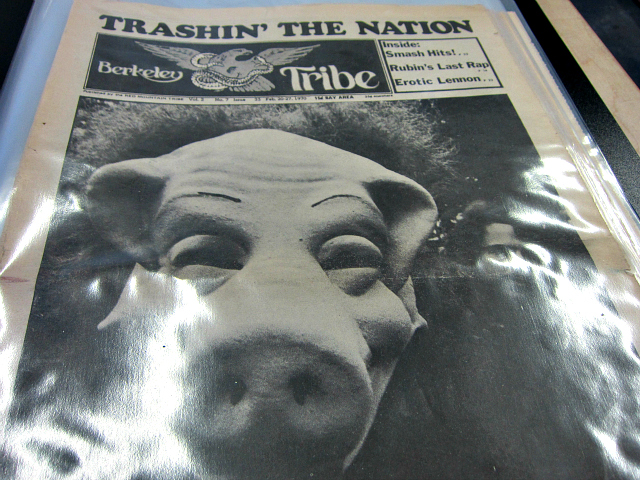
True to the Interference Archive’s mission of providing hands-on access to their materials, there are a few copies of underground newspapers to flip through, such as an issue of the radical California-based Berkeley Barb that includes an article on activist Jerry Rubin and a tantalizing story on “Erotic Lennon.” ”We prioritize use, not preservation,” said Cindy Milstein, one of the members of the Interference Archive collective of volunteers. She also emphasized the archive’s focus on the history of aesthetics and art in activism.

Opened in December of 2011, the Interference Archive is run by a volunteer collective with Kevin Caplicki, Molly Fair, Josh MacPhee, Cindy Milstein, and Blithe Riley at its core. Their small library in Gowanus is packed with materials from around five decades of social movements, with a significant portion of the archives related to activism outside the United States. As a public resource, anyone can stop by during their open hours and dig through boxes of zines, comics, protest banners, books, and some audio and video material.

There are also buttons and t-shirts and flat files of prints from Just Seeds, an art cooperative for graphic designers started by Interference Archive founder MacPhee. Much of the Archive is sourced from the personal collections of MacPhee and fellow founder the late Dara Greenwald, which was amassed from their own participation in social movements and the punk rock culture of the 1980s and 90s.

The Berkeley Tribe. Photo by Allison
Meier /
Hyperallergic.

Every drawer and box and shelf of the Interference Archive is overflowing with valuable research on social movements, from the Paris Rebellion of 1968 to the Latin American solidarity organizations to materials on apartheid, with the importance of art as an avenue for a message’s resonance appearing throughout the decades and the physical connection with the relics of movements really bringing them to life.

While access to all of this is their main goal, their regular exhibitions are a way to examine the role of visual messages in these materials. Looking at the walls covered in the underground newspapers can be a bit overwhelming, but is worth spending time with for the innovative takes on design and use of visuals to convey their fervent messages that were unrepresented in the mainstream press.

Rebel Newsprint: The Underground Press” is at Interference Archive (131 8th Street, Unit 4, Gowanus, Brooklyn) through March 24. Hours are Tuesdays, Wednesdays, and Sundays 12 – 5 pm.

[Allison C. Meier is a freelance and fiction writer based in Brooklyn. Originally from Oklahoma, she has been covering contemporary visual art for print and online media since 2006. You can read about her New York and world travel adventures on her website.  Meier wrote this article for Hyperallergic, “a forum for serious, playful and radical thinking about art in the world today.”]

The Rag Blog

Posted in RagBlog | Tagged , , , , , , , , , | Leave a comment

Danny Schechter : Malls Are Temples of Debt for the ‘Sheeple’

Durban, South Africa’s giant Gateway Mall is a “theater of shopping.” Image from JoeTourist.

For the ‘sheeple’:
Malls are temples of consumer debt

The mall is for the modern economy what the factory was for the old one, until consumption trumped production as the engine of economic activity.

By Danny Schechter | The Rag Blog | March 5, 2013

DURBAN, South Africa — Back in 2002, South Africa hosted a UN environmental Summit on sustainability. It drew a ragtag army of green activists from all over the world, many excited to visit the now free South Africa that they fought for through the apartheid years, and hoping to meet members of the liberation movement led by Nelson Mandela

The closest to Nelson Mandela they got was to gather in front of a giant statue, created by a Swedish artist, in a commercial Square named after the South African icon. When they pictured the new South Africa, they probably saw the townships where tens of thousands of people marched for justice.

Instead, they found themselves in Sandton, a “township” that only capitalists could imagine, an upscale enclave within the city of Johannesburg devoted to corporations, banks and giant malls even more opulent than similar temples of consumption in other countries. Many wandered around in front of the luxury shops, safeguarded by a security army, wondering what that had to do with saving the planet.

South Africa has become a Mall country. There’s even one now in Soweto.

In the old days, empires colonized countries; now their economic combines colonize consumers into market segments that depend on modern malls to organize the shopping that drives economic life.

The mall is for the modern economy what the factory was for the old one, until consumption trumped production as the engine of economic activity. We no longer make many goods; we just generate demand and sell goods others produce in a transaction-based culture where whole societies are organized around venues for routinized and regimented shopping that is masqueraded through advertising as “fun.”

Durban’s giant Gateway Mall, with its food stores, restaurants, game parlors, and movie theaters, calls itself a “theater of shopping.” It claims to be the largest in the Southern Hemisphere.

The academic, Christopher McElligot sees the mall as a “consumer dreamworld for the constantly moving ‘happiness machine.'” Another professor, Dr Arzu Seri, goes further and locates malls in the structure of how our modern economies operate, noting, “In shopping malls, the material culture of capitalism creates an appearance of variety, a colorful surface, which hides the uniformity of capitalist relations and the resulting inequality and poverty.”

These institutions are now referred to as pillars of a “consumer democracy” by analysts writing in The Globalist who say there is a showdown coming between China’s economy and our own.

Write Nicolas Berggruen and Nathan Gardels:

The United States has turned into a borrower and consumer-driven economy dominated by the financial sector and services industry and a country where inequality has grown dramatically. In contrast, China is an investor and export-driven economy that is still industrializing, still largely impoverished and sharply unequal.

This contrasting dynamic between two clashing systems has generated an imbalance in the global economy that, if not corrected, threatens the peace and prosperity that has so far been achieved through globalization.

Julian Delasantellis speaks in Asia Times about malls as key to American survival but they are now also a global phenomenon as you can experience every day in South Africa:

In what is, according to some media reports, the bleakest time in finance history since the moneychangers were driven from the Temple, Americans keep spending. How can they not?…  No matter what the politicians bleat on in the Iowa cornfields about the centrality of Jesus in American life, the country’s real unifying faith, affirmed no matter what race, color, creed, gender, or sexual orientation, is mindless consumerism. In this, the nation’s 1,100 enclosed shopping malls are temples to this national faith, with the 500-store Mall of America, in Bloomington, Minnesota, the faith’s new Vatican, its shining food court on a hill.

My friend, the late Alexander Cockburn. saw the Mall as a mirror of an economic culture in crisis, writing,

The left, by and large, never much cared for malls. They represented privatized space, the collapse of the public realm, and the freedoms — of association and public protest — protected in public space. Malls, whether in strip or covered form, symbolized a conversion of people from citizens to consumers, the death of Main Street, architecture reduced to utter banality Today, mirroring the distress in the mother ship of capitalism, its colonies and settlements are in decay.

In short, as we shop until we drop, it is our society that is dropping too under the weight of the debts we have been encouraged to accumulate. What many don’t see is that even as the cash registers churn, so do the credit card machines. Our acquisition habit is being funded by lenders who tack on interest while taking their cut when shoppers inevitably fall behind in paying their bills, as they know they will.

In this age of the Sequester, government debts are on the agenda. in part because many of the debts to be repaid are owed to foreign governments and big banks that have the clout to lobby the political system to get their money with interest!

But the enormous debt load strangling families as consumers who have no choice but to continue running it up if they want to feed and cloth themselves is much less visible.

That debt is rising. MarketWatch reports: “American consumers increased their debt in the final three months of 2012 for the first time since the fourth quarter of 2008,,, Consumer credit rose $31 billion to break a four-year downtrend.”

The ultra-modern Malls, with their vast parking lots, are, like casinos, magnets for “the sheeple” looking for bargains but ultimately seduced into spending more than they have. The high real estate expense adds to sales costs for upscale retailers insuring that only chain stores can afford to sell there. Overall, prices are unaffordable for South Africa’s poor black majority that trades in an informal economy of unhealthier food and cheaper goods.

Meanwhile, as Patrick Chalmers, a former Reuters journalist turned critic of financial reporting and the creator of Fraudcast News, notes, the financial solutions being proposed in no way respond to the real economy problems squeezing the public.

“Our leaders’ feeble attempts at regulating banks, international finance and global markets have totally failed, leading to ongoing financial crises since the global meltdown of 2007-2008, “ he writes.

“The false debates created with regard to conventional economics, and our policymakers’ fixation with a sterile definition of prosperity as determined by economic growth, are major barriers to change.”

And so, once again, as governments look out for themselves, allegedly to deal with debts and deficit and pay off vast military expenditures, often fueled by corruption, their austerity-driven massive layoffs will force the newly unemployed to go on to unemployment doles, and into deeper personal debt.

Around and around we go; where we stop, nobody knows.

[News Dissector Danny Schechter made the film In Debt We Trust in 2006 that warned of the financial crisis. He edits mediachannel.org. Comments to dissector@mediachannel.org. Read more articles by Danny Schechter on The Rag Blog.]

The Rag Blog

Posted in Rag Bloggers | Tagged , , , , | 1 Comment

Alan Waldman : ‘Gregory’s Girl’ Is a Simply Wonderful 1981 Scottish Film

 
Waldman’s film and TV
treasures you may have missed:

Bill Forsyth’s look at teenage awkwardness and high school romance is original, moving, surprising, and hilarious.

By Alan Waldman | The Rag Blog | March 5, 2013

[In his weekly column, Alan Waldman reviews some of his favorite films and TV series that readers may have missed, including TV dramas, mysteries, and comedies from Canada, England, Ireland, and Scotland. Most are available on DVD and/or Netflix, and some episodes are on YouTube.]

Bill Forsyth’s 1981 Scottish masterpiece, the coming-of-age comedy-romance Gregory’s Girl, is one of my very, very favorite movies ever, and if you can find 91 free minutes you should watch it, either on DVD, Netflix or here on Netflix Instant.

It won the 1982 Best Screenplay BAFTA for Forsyth and nominations for him as Best Director, Best Film, and Most Outstanding Newcomer for star John Gordon Sinclair. It also won the London Critics Circle Special Achievement Award for Forsyth, as well as the Variety Club’s Actress of the Year honor for female lead Dee Hepburn. Fully 92% of the critics polled at rottentomatoes.com liked it, as did more than 87.7% of viewers rating it at imdb.com. A clip from the film was featured in the opening ceremonies of the 2012 London Summer Olympics.

Critic Roger Ebert wrote, “Gregory’s Girl, a charming, innocent, very funny little movie about a weird kid… contains much wisdom about being alive and teenage and vulnerable.”

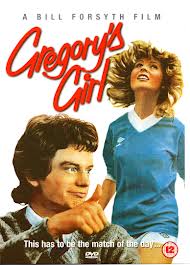
The film has a marvelously goofy tone which is also found in Forsyth’s films That Sinking Feeling, Comfort and Joy, and the widely beloved Local Hero. Set in a small Scottish town’s secondary school, it features Sinclair as Gregory, a lanky, awkward student who is replaced on the school’s soccer team by beautiful Dorothy (Hepburn), on whom he immediately develops a mad crush. She agrees to go out with him and that launches one of the most delightful sequences I have ever seen on the big screen. (I will not give it away.)

Gregory seeks the dating advice of his two clueless male pals (very funny!) and is eventually counseled by his 10-year-old sister. The dialogue is highly amusing, and there are many surprising elements, such as a child in a penguin suit who wanders through scenes for no apparent reason. Sinclair is terrific in the lead role, and several other performers are excellent too.

[Oregon writer and Houston native Alan Waldman holds a B.A. in theater arts from Brandeis University and has worked as an editor at The Hollywood Reporter and Honolulu magazine. Read more of Alan Waldman’s articles on The Rag Blog.]

The Rag Blog

Posted in Rag Bloggers | Tagged , , , , | Leave a comment

Harry Targ : Human Sustainability and the Living Wage

Image from This Magazine

The jobs/income problem:
How do we sustain human life?

Given the vision that animates the progressive majority and the need to build broad coalitions, rebuilding living wage campaigns could be an important part of its organizing future.

By Harry Targ | The Rag Blog | March 5, 2013

In one way or another progressives are addressing fundamental questions basic to human sustainability. And, as Pete Seeger has said: “Participation: that’s what’s going to save the human race.”

First, more and more activists are raising concerns about the survivability of the natural environment in which we live: the land mass, the water systems, the productivity of the land, and the capacity of humans to continue to live on the land. Most visible to the naked eye are consequences of global climate change, including hurricanes, tsunamis, floods, storms, and blistering heat.

Second, there is a growing discussion of problems of access to the rudimentary resources for the maintenance of human life: food, water, and air. Because of the devastations of the environment to distorted and inadequate systems of production and distribution, people are living in poverty, are malnourished, and remain exposed to toxic air and water.

Third, Samir Amin estimates that one-half to two-thirds of the global population lives in conditions of “precariousness.” That is, people lack access to secure jobs and income in global and national economies that systematically are able to produce more goods and services with fewer and fewer workers. However, global capitalism is based on a system of remuneration linking income to jobs. The need for fewer workers leads to fewer jobs and a downward spiral of wages and income.

Fourth, because of environmental devastation; declining access to food and clean air and water; and lack of the capacity to acquire monetary resources to sustain life, little time is left for discussions of what a better life and a better society might look like.

In this blog I will address the access to remuneration, reducing “precariousness,” and having the resources in a money economy to sustain life. Recently, discussion of that dimension of human sustainability has been stimulated by President Obama’s call for raising the minimum wage and the jobs/income crisis faced by workers as a result of the sequester crisis. The data is familiar to most people.

Wages and income

  • Economic Policy Institute analyses show clearly that worker productivity has increased over the last 40 years and wages have stagnated or declined with the exception of a bump in real wages during the late 1990s. For economist Lawrence Mishel, in terms of wages, the last decade has been “the lost decade.”
  • Wage stagnation has affected all sectors of the working population, including those with college degrees.
  • Wage and income inequality has increased dramatically over the last 40 years. As Mishel wrote: “This divergence has been demonstrated anew in the current recovery over 2009-2011 as real wages fell for the bottom 90 percent of the wage distribution but rose for the top five percent.”
  • African Americans and Latinos have experienced wage and job stagnation at rates at least a third higher than whites.
  • “The declining value of the minimum wage has played a key role in these trends…” (Mishel, February 21, 2013, Economic Policy Institute.)

Using the Indiana story to relate wages, jobs, and poverty:

  • Indiana’s job loss between 2008 and 2012 was 231,500.
  • Indiana is among 17 states that have continued to experience absolute declines in their labor force since the recession began.
  • Median family income fell by 29.6 percent in the past decade from $78,599 to $55,368. Only Michigan, among all states, has experienced a larger percentage decrease.
  • Since 2000, Indiana has seen a 52 percent increase in poverty. In 2010, 15.3 percent of Hoosiers were living in poverty, nearly 1 million people. Childhood poverty rates have increased by the same amount. (“Status of Working Families in Indiana, 2011,” Indiana Institute for Working Families, April, 2012).

One response: Living wage campaigns

From the 1990s to 2004 living wage campaigns all across the United States grew, drawing together coalitions of community activists, led by labor, faith communities, and grassroots organizations such as ACORN. Ralph Nader in a recent essay (Common Dreams, February 16, 2013) referred to an apt definition of a living wage proposed by Theodore Roosevelt at the 1912 Progressive Party convention:

We stand for a living wage… enough to secure the elements of a normal standard of living — a standard high enough to make morality possible, to provide for education and recreation, to care for immature members of the family, to maintain the family during periods of sickness, and to permit a reasonable saving for our old age.

The first major living wage victory occurred in the Baltimore campaign of 1994. A local coalition consisting of AFSCME and a group of 50 churches called BUILD, Baltimorean’s United in Leadership Development won a very modest ordinance requiring that companies with city service contracts pay workers a base wage of $6.10 increasing to $7.70 over five years.

While modest, the Baltimore campaign inspired coalitions and demands all across the country. Between 1995 and 1999, 37 additional ordinances passed, sometimes including benefits with wage increases. In 2000-2001 mobilizations led to an additional 57 ordinances. By 2002, three-quarters of these ordinances required health care benefits and wage rates from $9.77 to $11.10 without health care.

An additional 70 campaigns were launched in small towns and big cities around the country, including New Orleans, Santa Monica, and San Francisco (S. Laurel Weldon and Harry Targ, “From Living Wages to Family Wages?New Political Science, March 2004).

Stephanie Luce, Professor of Labor Studies, Murphy Institute, CUNY, updated the living wage story in 2012. She said that since Baltimore much has been accomplished “…winning more than 125 living wage ordinances in cities and counties, three city minimum wages, and state and federal minimum wage increases. Eight states have indexed their minimum wage to inflation because of activist pressure, and campaigns to raise and index state minimums are underway in 10 more states.”

Luce also described problems with living wage campaigns. They tended to target small sectors of the working class (usually public employees). They often did not include part-time workers. Restrictive provisions were included in ordinances which excluded certain corporate investors from the wage and benefit requirements. Also campaigns have been long and difficult, with growing opposition from “big box” and other huge corporations.

On the other hand, she suggested that the value of such campaigns included the impetus living wage coalitions provided for building community coalitions. Often these coalitions supported union organizing drives. They brought together African-American, faith, and labor communities. They generated pressure for other campaigns such as for a minimum wage, prevailing wage, and worker rights.

For example, Luce reported:

After activists won a living wage in Tucson, Arizona, city workers contacted the Communications Workers and organized their own union….The San Francisco living wage coalition helped win card check from the airport commission, resulting in several thousand workers joining a handful of unions….The NEA has launched a national effort to use living wage campaigns as contract campaigns, to raise wages for school support staff.” (Labor Notes, February 27, 2012).

Luce concluded that: “Many living wage campaigns were launched not because they were the best policy available but because they could use leverage where activists were most likely to have it: at the local level.”

Are living wage campaigns still relevant today?

Although some living wage campaigns continue, often expanding their projects to include support for minimum wages, union organizing, and other local campaigns, 9/11, two wars, and the 2008-2012 recession reshaped the agenda of progressive groups. Assaults on worker rights throughout the heartland required mobilizing to save jobs, oppose Right-to-Work laws, protect the right of public employees to form unions, and resist the privatization of every conceivable public institution.

However, given the vision that animates the progressive majority and the need to build broad coalitions, rebuilding living wage campaigns could be an important part of its organizing future.

Living wage campaigns address one of the issues of sustaining humankind mentioned above: jobs, income, and remuneration.

They would resonate with workers who survive on wages just above existing minimum wage laws.

They could work in conjunction with and parallel to mobilizations around minimum wage and jobs campaigns.

And, if the history of such campaigns is a good predictor, living wage campaigns would bring together broad coalitions of workers, faith-based activists, activists from African American and Latino communities, and activists for reproductive health.

Finally, living wage campaigns, whether committed to federal or local legislation in the past, have been grassroots movements shaped by local conditions and the particularities of organizing possibilities at the local level. Building a progressive majority requires parallel and interconnected organizing at the grassroots level and the national level. Each is informed by the other. And ultimately sustaining human life is both a global and a local project.

[Harry Targ is a professor of political science at Purdue University and is a member of the National Executive Committee of the Committees of Correspondence for Democracy and Socialism. He lives in West Lafayette, Indiana, and blogs at Diary of a Heartland Radical. Read more of Harry Targ’s articles on The Rag Blog.]

The Rag Blog

Posted in Rag Bloggers | Tagged , , , , , | 3 Comments

Lamar W. Hankins : Pipeline Debate is Mired in Disinformation

Coming your way? Pieces of the pipeline. Image from National Radio Canada.

Keystone XL Pipeline debate
is mired in disinformation

The Keystone XL Pipeline project has virtually nothing to do with American energy independence, but everything to do with enriching Canadian tar sands oil interests and the interests of refineries that are in the oil products exporting business.

By Lamar W. Hankins | The Rag Blog | March 5, 2013

One of the attributes of our current politics is the repetition of false information, even after it has been proven false. Such repetition is the use of propaganda based on deceit — not to persuade, but to manipulate.

A year ago, when I wrote about the Keystone XL pipeline, I assumed that the debate would be over by now, but the pipeline project has been delayed by protests in Texas and Oklahoma — the Tar Sands Blockade — which have kept the debate alive for a while longer. (To read more about the Tar Sands Blockade, go here and here.)

These delays have given the proponents of the pipeline an opportunity to push their disinformation campaign into high gear, although virtually all they have to say amounts to outright lies or distortions of the truth, to make a few petrochemical companies and investors richer at the expense of the environment — which means to the detriment of the people.

I’m in favor of advocacy, but when advocates are caught in lies, they have to change their message or expose themselves as untrustworthy or worse. Apparently this exposure does not bother the proponents of the Keystone XL Pipeline, which is intended to carry tar sands oil — perhaps the most environmentally destructive oil found on the planet — from Canada to refineries on the Texas Gulf Coast.

  • Deceit 1: Tar sands oil will move the U.S. toward energy independence

The most egregious lie told repeatedly by pipeline proponents is that the tar sands oil will move us toward energy independence. However, most of the petroleum products made from the tar sands oil will be sold overseas at prices even higher than we pay in the U.S. Nothing about the tar sands oil makes the U.S. energy independent, but it does increase the profits of the oil companies that are regularly gouging Americans by manipulating the availability of gasoline.

Sen. John Cornyn, Texas’ senior Republican senator, along with others, stated in a January 2013 letter, “The pipeline is also a major step toward American energy security.” How can a source of oil that will be used primarily to make diesel fuel to be sold overseas help domestic energy security? Canada is seeking a way to have its tar sands oil processed for the international market, not the American market. Refineries in Texas, primarily the Valero refinery in Port Arthur, have been retrofitted to process tar sands oil, rather than to process the kind of oil that comes from domestic production and from OPEC, Venezuela, and Mexico.

The Valero refinery operates in a Foreign Trade Zone so that tar sands oil products will not be taxed when they are sold overseas. At conferences with investors since 2008, Valero has touted its ability to make and export diesel from its Port Arthur facility — the primary purpose of the tar sands oil. But it should come as no surprise that Sen. Cornyn is willing to deceive the public about an issue that involves the profits of oil companies. Since 1999, Sen. Cornyn has taken more than $2.1 million in oil company political contributions, including over $42,000 from Valero alone.

An honest look at the Keystone XL Pipeline project shows clearly that it has virtually nothing to do with American energy independence, but everything to do with enriching Canadian tar sands oil interests and the interests of refineries that are in the oil products exporting business.

  • Deceit 2: If the U.S. doesn’t get the tar sands oil, China will get it

Another unsupported proposition is that if we don’t allow Canada to send the tar sands oil to Gulf Coast refineries, they will just send it to Canada’s West Coast to be sold to China. This proposition is doubtful at best. China is trying to rid itself of massive pollution caused by its own industrialization. Tar sands oil is dirtier than other oil and will just make China’s environment worse, so it is unlikely to want the extra pollution problems it will cause.

Canada also has another problem with pipelining the tar sands oil to its west coast, through British Columbia: More than 100 indigenous groups along the Canadian pipeline route, organized in a coalition called First Nations, oppose the pipeline through British Columbia.

First Nations opposition is largely environmental and cultural. Over the past two years, First Nations tribes have signed an agreement to oppose all pipelines that cross through indigenous territory largely because of environmental concerns that focus on bird habitat, endangered boreal woodland caribou, and the Great Bear Rainforest. They fear also that oil spills from giant tankers will harm Fraser River salmon.

  • Deceit 3: The tar sands pipeline will result in many U.S. jobs

Proponents of the tar sands pipeline have claimed from 20,000 to half a million new jobs related to construction of the pipeline. But the original application for the pipeline made to the State Department claimed at most 4,200 temporary pipeline construction jobs. Every independent assessment of job claims has concluded that the projections of pipeline proponents are wildly inflated. The Cornell University Global Labor Institute, for example, reported last year the number of permanent pipeline jobs (inspection, maintenance, etc.) at about 50.

The Cornell Global Labor Institute published the only jobs study that was not funded by TransCanada, the developer of the XL Pipeline project. That study found that the pipeline project could destroy more jobs than it creates by causing long-term increases in domestic gasoline prices in the Midwest (where Canadian oil is processed in refineries that make gasoline for domestic use) and because of the cost of environmental impacts.

 The Institute reports that

TransCanada has already purchased most of the steel it intends to use for the pipeline from India; that most of the work will be conducted by people already employed by TransCanada; and that the Perryman Group (which did a study paid for by TransCanada) included already-completed pipeline projects in its job-creation estimates.

Something that has delayed the Texas portion of the pipeline project has been the unwillingness of a few Texans to be bullied by a foreign company that has manipulated Texas eminent domain law to its advantage until now. TransCanada claims that it is a “common carrier” in Texas, a status that would allow it to condemn property to use for its pipeline project.

But its status as a common carrier is not settled. Until we get an opinion from the appeals court in Texarkana (for information on the eminent domain suit, go here), we may not know if TransCanada is operating legally with regard to eminent domain. But if eminent domain can be used by a foreign company to take private land against the will of its owner, we are a lot less free than many of our politicians claim we are.

Even if you aren’t concerned about the environmental effects of the pipeline, the risk of leaks polluting surface water and aquifers, and the extra pollution caused by refining and transporting tar sands oil, it is hard to ignore the basic fact that the project has little, if any, benefit for the American public. We won’t get any closer to energy independence and we will get few, if any, permanent jobs out of the project. The pipeline project is not a public works project for which eminent domain should be used. There is no public benefit.

Let TransCanada make its money without burdening Texans by taking their land for the benefit of TransCanada’s owners.

[Lamar W. Hankins, a former San Marcos, Texas, city attorney, is also a columnist for the San Marcos Mercury. This article © Freethought San Marcos, Lamar W. Hankins. Read more articles by Lamar W. Hankins on The Rag Blog.]
The Rag Blog

Posted in Rag Bloggers | Tagged , , , , , , , , | 5 Comments

Ron Jacobs : Bob Dylan’s Biography of American Racism

Bob Dylan visits Rubin “Hurricane” Carter in prison, 1975. Image from Tumblr.

Bob Dylan’s biography of American racism

“Sometimes I think this whole world / is one big prison yard / Some of us are prisoners / and some of us are guards.” — Bob Dylan, “George Jackson”

By Ron Jacobs | The Rag Blog | March 4, 2013

When people think of Bob Dylan, it’s unlikely very many consider him a biographer. Yet, he does write songs about people. I don’t mean that in a general sense, either. I mean he literally writes songs about people. Some of those songs are about people that only Dylan knows or at least only Dylan knows who they are about. Others are about people most of us have heard of or heard of because of a song Dylan wrote.

Recently, I was choosing some images from the web for a display concerning the Emancipation Proclamation and the 1963 March on Washington for Jobs and Justice. As I clicked my way in and out of websites I came across a grainy photo of Bob Dylan, Joan Baez, Harry Belafonte, and other musicians on the stage at the aforementioned march.

This got me to thinking about Bob Dylan and his songs concerning the racism that is part of the definition of these United States. Then I got to thinking about those Dylan songs that name people; even more specifically, the songs that named people that were famous in their own right. “Joey” came to mind. Upon examination, though, this song stands out as an anomaly in the Dylan catalog. Not only is Joey Gallo an ambiguous hero at best, Dylan’s lyrics do not really attempt to make a point, unlike the other songs in this rather loose set.

Then I narrowed the whole process down to songs that are tributes to individuals as opposed to songs which portray an incident featuring an individual who is either acting or being “acted upon.” A song in the former category would be the dark tale Dylan tells in “The Ballad of Hollis Brown.” This song is a tale of a farmer driven to the simultaneously horrendous and protective act of murdering his family because of economic ruin.

Songs that fall in the latter category include “The Death of Emmett Till” and “The Lonesome Death of Hattie Carroll.” Both tunes describe an incident of racist injustice that not only goes virtually unpunished but, in Dylan’s telling, is symptomatic of an evil at home in these United States. Indeed, it is not just at home, but is one of the darkest elements in the myths that describe the nation.

Emmett Till was more than just a boy who looked the “wrong” way at a white woman down South. He was a threat to white supremacy and its falsehood. Millions of men and women paid a price quite similar to Till’s in slavery, lynchings, and prisons. Hattie Carroll lost her life when a rich white man carelessly and callously killed her with his cane. Her killer’s punishment was inconsequential: six months for murder.

Recorded 1983 for Infidels; Released
1991 in
Bootleg Series.

Blind Willie McTell is perhaps most famous nowadays for his song “Statesboro Blues,” most likely titled after the city he grew up in. Although McTell was somewhat well-known on the blues circuit during the 1920s and 1930s, most folks who know this song today know it because of the Allman Brothers. Their version is electric and extended. McTell played a fluid twelve-string and the occasional slide. He lived for 60 years and played throughout the southern United States in a style of picking known as Piedmont — named after the region of the Carolinas it originated in.

While Bob Dylan was recording songs for the album eventually known as Infidels, he recorded his song “Blind Willie McTell.” A masterpiece of a song from a man who has many such songs to his name, Dylan’s work is about much more than the blues singer Willie McTell. It is an angry message transmitted through Dylan from an angry god. Even more, it is about a people and a nation that continue to suffer what Abraham Lincoln correctly identified as “the woe due to those by whom the offense came.”

Just as Mr. Lincoln told the nation in his Second Inaugural Address that perhaps “every drop of blood drawn with the lash shall be paid by another drawn with the sword,” so does Dylan close his song with a parallel observation and warning: “Well, God is in His heaven/And we all want what’s His/But power and greed and corruptible seed/Seem to be all that there is.”

The entire song is written in the minor with the piano the dominant instrument. One sees images of slave auctions, tenant shacks, Ishmael Reed’s Arthur Swille and Raven Quickskill, and Neil Young’s southern man; Christopher Dorner and Barney Fife; Richard Wright’s Bigger Thomas and the past and future Imperial Wizards of the Ku Klux Klan; Huey Newton, Oscar Grant, and Nina Simone. The cries of the whipped and the sound of the lashes become as real as the silence of solitary in today’s supermax prisons.

I remember hearing George Jackson had been killed a few hours after it occurred. The news reports coming in from the AP over Armed Forces Radio were sketchy and most notable for the information they did not provide. European broadcasts were somewhat more complete but all of the reports echoed the official line that Jackson had been trying to escape prior to his murder.

We still don’t know exactly what happened. The theory that makes the most sense to me is that he was planning to escape and had been working out the details with a section of the Bay Area Black Panthers, their mutual allies, and a probable police agent who tipped off the authorities and thereby ensured Jackson’s murder.

Two-sided single, 1971.

It’s difficult to explain the power George Jackson’s words and life story had when his first book Soledad Brother was published. In a world hungry for men and women who had lived a life of wretchedness and risen from those roots, Jackson’s was a life that indicted the evils rooted in slavery and U.S. capitalism while providing hope that this world could be changed. His brother’s heroically futile attempt to free him from the prison George had been exiled to only enhanced his revolutionary and ultimately tragic mystique. So, too, did the arrest and imprisonment of Jackson’s lover and comrade, Angela Davis.

My thoughts upon hearing Bob Dylan’s tribute to Jackson, simply titled “George Jackson,” were that even Bob Dylan, the rock superstar and (by then) recluse was not immune to the meaning of Jackson’s life and death. A poet, after all, lives to discover a meaning in the world that he exists in. For a poet like Dylan, the story of George Jackson confirmed his growing understanding that the scourge of racism was the defining condition of the country he lived in. Indeed, as he explained in a 2012 Rolling Stone interview:

This country is just too fucked up about color. It’s a distraction. People at each other’s throats just because they are of a different color. It’s the height of insanity, and it will hold any nation back — or any neighborhood back. Or any anything back. Blacks know that some whites didn’t want to give up slavery — that if they had their way, they would still be under the yoke, and they can’t pretend they don’t know that. If you got a slave master or Klan in your blood, blacks can sense that.

In other words, as far as Dylan is concerned, there is very little hope. Perhaps the most memorable lines in “George Jackson” are contained in this quatrain, “Sometimes I think this whole world/is one big prison yard/Some of us are prisoners /and some of us are guards.” These lines describe the nation’s dilemma better than any treatise might. Until the guards are willing to accept the fact they are as imprisoned by the legacy of racism as the prisoners they guard, beat, and kill, none of us will be free to leave the prison that is these United States.

Those that try, especially African-Americans, all too often find themselves put away behind bars even more real than the figurative ones that we know as racism. That is the story of Rubin “Hurricane” Carter, a black man who fought his way out of the prison of poverty and the urban ghetto only to be charged with a crime “that he never done.”

Rolling Thunder Revue, 1976.

Like Jackson, Hurricane Carter spent a good portion of his life in prison. Also, like Jackson (and millions of others), Carter’s fate was determined by men and a system that cared little for the truth. Dylan’s lyrics tell the story of dirty cops, lying witnesses, and a prosecution determined to put Carter in prison, if not for the crime he was charged with, then because he had too much pride in his person and his race; traits not just hated by the white power structure, but seen as serious threats. Carter, like Jackson, came to understand his position, a fact which led to his undoing almost as much as the perversions of justice existent in the cases of both men.

When Bob Dylan released his song “Hurricane,” most people had not heard of Carter or his case. As I recall, the demand for a new trial was primarily popular among left organizations like the Revolutionary Union, its student group the Attica Brigades/Revolutionary Student Brigades and various radical anti-racist organizations on the East Coast of the United States.

When Dylan recorded his song and released it as a two-sided single (because of its length), many radio stations did not know what to do with it. The more cutting-edge stations that played non-formula album cuts and regional artists (WHFS-FM in Maryland, WNEW-FM in New York, for example) played the song in its entirety, flipping the single mid-song or having it cued on two turntables. Other, more commercial stations didn’t play it much at all until it reached the Top 40. Stations that traditionally catered to Black audiences were also slow to play the song at first, with the exception of a few college and community-owned stations.

Meanwhile, Dylan and his cohorts were organizing what would be known as the Rolling Thunder Tour. This tour would champion Hurricane’s case and was perhaps one of the last great “Sixties” tours (with the possible exception of the continuing road trip of the Grateful Dead.) Hurricane did get a new trial. He was convicted again, thanks to continued prosecutorial misconduct. He was finally freed in 1985 after a federal judge determined that Carter’s arrest and prosecution was “predicated upon an appeal to racism rather than reason…”

To put it simply, the song itself rocks. There is no other word that describes its appeal. There is probably no other rock song that features a gypsy violin as lead instrument where that can be said. Sharing imagery with the New Jersey street songs of Bruce Springsteen and borrowing rhythms and melody from Ashkenazi and Romano folk songs, “Hurricane” maintains a level of emotion appropriate to its subject matter.

After all, we were trying to save a man’s life. It was already too late for Blind Willie McTell and George Jackson.

This article was first published in Red Wedge Magazine.

[Rag Blog contributor Ron Jacobs is the author of The Way The Wind Blew: A History of the Weather Underground. He recently released a collection of essays and musings titled Tripping Through the American Night. His novels, The Co-Conspirator’s Tale, and Short Order Frame Up will be republished by Fomite in April 2013 along with the third novel in the series All the Sinners Saints. Ron Jacobs can be reached at ronj1955@gmail.com. Find more articles by Ron Jacobs on The Rag Blog.]

The Rag Blog

Posted in Rag Bloggers | Tagged , , , , , , , , , , | Leave a comment