INTERVIEW / Jonah Raskin : Superstar Cinematographer Tom Hurwitz

Cinematographer Tom Hurwitz embedded with troops in Afghanistan during filming for the movie Kansas to Kandahar. Photo courtesy Tom Hurwitz.

An interview with Tom Hurwitz:
Superstar of contemporary 
American cinematography

By Jonah Raskin | The Rag Blog | January 23, 2013

“I love going to the movies. Movies are one of the great anachronisms, where collective craft, design, and technology merge with individual talent, as in the building of a medieval cathedral.” — Tom Hurwitz

I love talking shop, especially with those who work in shops, whether they’re real old-fashioned and gritty or the most up-to-date and sophisticated. Tom Hurwitz, whom I first met in 1968 on the rough-and-tumble campus of Columbia University, is my idea of the ideal filmmaker to talk with about the big glittering shop that makes images and that we all call Hollywood.

Hurwitz is a straight shooter in more ways than one, and a real craftsman — a versatile cinematographer — who knows the film industry from the inside out. What other living moviemaker can you name who talks about capitalism and about art in the same breath and who can practically recite all the scenes in Orson Welles’s Citizen Kane?

Hell, he’s also the son of the legendary documentary filmmaker, Leo Hurwitz (1909-1991), who was, for a time, blacklisted, and who continued to make films, despite it. His stepmother, Peggy Lawson, was a filmmaker and film editor and stars in Dialogue with a Woman Departed (1981) that Leo Hurwitz wrote and directed and that’s a tribute to her and her work.

Tom Hurwitz made his first picture — Last Summer Won’t Happen (1968) — with Peter Gessner when he was 20, and, while he’s taken a few detours in life, he’s followed the script that seems to have been written for him by the gods of cinema. He’s worked on — to name just a few pictures – Creep Show 2 (1987), Wild Man Blues (1997), Ghosts of Abu Ghraib (2007), and Queen of Versailles (2012) that wasn’t nominated for an Oscar — damn it! — but that did win awards at Sundance and from the Directors Guild of America.

Born in 1947 and reared in New York, he’s filmed TV programs such as Down and Out in America (1986), and Faith and Doubt at Ground Zero (2002) both for PBS, as well as movies for the big screen, and has won dozens of awards including two Emmys, along with Sundance and Jerusalem Film Festival awards for best cinematography. Then, too, he’s on the faculty of New York’s School of Visual Arts and a founding member of its MFA program in the social documentary.

For years, I had close friends in Hollywood: Mark Rosenberg at Warner Brothers who produced, with his wife Paul Weinstein, The Fabulous Baker Boys (1989) and Flesh and Bone (1993); and Bert Schneider who produced Easy Rider (1969) and Five Easy Pieces (1970), as well as the award-winning documentary about Vietnam, Winning Hearts and Minds (1974). Rosenberg died in 1992 at the age of 44; Schneider died in 2012 at the age of 78.

Tom Hurwitz is one of the few individuals I know who’s still working in film, still very much alive, and still kicking up a storm of ideas and images for the screen. With the 2012 Academy Awards on the horizon, I fired off a round of questions about movies and moviemakers. Hurwitz was about to leave for India to make yet another movies, but he fired back his answers.

Tom Hurwitz, center in shades, during demonstration at Columbia University, 1968. At front right is Stew Albert, one of the founders of Yippie! Photo courtesy Tom Hurwitz.

Jonah Raskin: Too bad your film Queen of Versailles wasn’t nominated for an Oscar.

Tom Hurwitz: I shot the film and I’m very proud to have been part of it. As I see it, Queen tells a Shakespearian story about the decline of values, the dispersion of families, and the bursting of bubbles in this wretched stage of capitalism we inhabit. It tells the story by following the lives of a household that begins in unimaginable wealth.

Was it a fairly straightforward picture to make?

Making it was difficult. You wouldn’t think that filming the family of a failing billionaire would be taxing. But when you see the movie, you can appreciate that maintaining the proper documentary relationship over a long time was hard. What was wonderful about shooting Queen was working with the director, Lauren Greenfield. She’s a great still photographer who also has a great sense of story. We speak the same language, and I loved the challenge of working up to her standards, making my motion pictures work with the style of her stills.

What are, from your perspective, the best five feature films of 2012?

Anna Karenina uses the device of the theatrical stage to turn a book into a movie — always a challenge — and to surmount the limitations of budget. It takes on a dream-like character with a miraculous effect.

Then there’s Zero Dark Thirty, a film that asks big questions. It felt more real and immediate than any other film this year, with acting, design, direction, photography, and sound all serving a unified end. When the first explosion happened in the film, I was on the floor before I knew it — and I was in Afghanistan. It says something that the filmmaker, Kathryn Bigelow, cares enough about reality to make the explosions sound more real than in any other film that I’ve seen.

Moonrise Kingdom is an almost perfect product of Wes Anderson’s imagination. It’s a fantasy that resides in the twilight land of childhood, in the lives of its marvelously understated characters, in their island world, and in the brilliant design and execution of the film. I kept thinking about it, savoring it like a wonderful meal, or perhaps like a dream.

What about documentaries?

Five Broken Cameras, made by a Palestinian Arab and an Israeli Jew, is seen through the eyes of a villager inside the occupied territories of the West Bank. The film is shot with camera after camera over a 10-year period beginning with the birth of a boy, and as the State of Israel tries to cut off the village off from its fields, and as settlers try to take the land itself.

The residents fight back nonviolently. The toll of the occupation on the lives of the Arabs and on the souls of the Israelis is made painfully clear. The film is told like an historical novel with character development, revelation, and tragedy. It’s the best combination of micro and macro documentary that I’ve ever seen.

Do you watch the Academy Awards?

I only watch them all the way through when a film I’ve photographed is up for an award. I went a couple of times and then I had to sit through them. I usually watch the beginning, get bored, and check the results in the paper or on line.

Are the Oscars mostly a publicity event for the movie industry?

I don’t take the awards themselves lightly. For members of the Academy, November and December are crazy because we try to watch all the films in contention, nominate, and vote. I don’t agree with many of the choices, but I care that the industry goes through the ritual of holding up its best, as cheesy as the event often is.

The chance to walk down the red carpet — even though folks like me are shunted down the non-celebrity lane — is worth the ticket, the limo, and the suit. For five minutes, you walk slowly through a world where shadows are banished, wrinkles and imperfections don’t show, and every watching face holds a camera.

Do you actually go to a movie theater and watch a new film?

I love going to the movies. Movies are one of the great anachronisms, where collective craft, design, and technology merge with individual talent, as in the building of a medieval cathedral. Films ought to be appreciated in a social context. Watching a film alone on the screen in my living room, as I often do, isn’t the same thing.

You were part of the anti-war movement and a protester at Columbia in the 1960’s. Are there others with similar political backgrounds in the movie industry today?

I think any sensible person in the industry who is old enough to have been in the 1960’s political movements is retired. I usually work with people from 10 years younger to less than half my age. Haskell Wexler, a mentor, was an activist in the 1960’s. He’s more of a die-hard than I am and 20 years older. In my age group — Connie Field, Barbara Kopple, Deborah Schaeffer, Mark Weiss, and Deborah Dickson — all spent time in the movement.

Does anyone in Hollywood make what might be called a “radical movie,” and if so how does that happen?

Most of what’s produced in Hollywood now is television. The movie industry, even though some great films were produced this year, is in a huge fog about where it’s going. I don’t think narrative film knows how to be radical. It’s not alone. Neither does television — as good as some of it may be, or the theater.

It’s not only that radical art doesn’t get distributed, it’s that the radical voice is often confused and muted. That may be one of the reasons for the present flowering of documentary films. We may be in a time where reality speaks clearest of all.

What impact does Sundance have on moviemaking today?

Sundance Festival is a great place to see people I know who I would never otherwise get to spend time with. Also, I get to view tons of good, near-good, and occasional great films– so many that my brain becomes mush. Filmmakers who go there leave inspired by the attention, companionship, and good work. Producers sell their films to distributors there, though I’d hate to have to be part of that sales race.

I have friends who say the last really good Hollywood movies were made in the 1930s. Is that perversity or blindness?

There were great films made in Hollywood in the 1930’s, but to say that they were the last great films is obtuse. Thirties films are mannered, even the best of them, with a set of conventions: visual, directorial, and acting. That the best of them succeed in spite of their rarefied air is a particular kind of grandeur. One might note that the social documentary film was invented in the 1930’s in New York, as a way to blow open the closed world of 1930’s Hollywood.

Tom Hurwitz shooting in India for Paul Taylor: Dancemaker. Photo courtesy Tom Hurwitz.

What films do you turn to again and again?

I watch a lot of films over and over because I teach graduate students every year and analyze the images. It’s another way of appreciating films other than just being inspired by them. I have a list of what I consider perfectly photographed films.

If a director and I haven’t already worked together I always try to screen The Conformist (1970), which Vittorio Storaro shot for Bernardo Bertolucci. I talk about the way the image is at once hugely expressive, yet always works at the service of the story and never just calls attention to itself arbitrarily. That is the highest calling of cinematography in narrative and in documentary. I call it the articulate image. Even if we don’t want the film to look anything like The Conformist, watching it together starts the best of conversations. Sometimes I see it to make myself feel good about the possibilities of the image.

What movie made in the last, say, 10 years would you like to be able to say, “That’s my movie.”

I’d pick a documentary called War/Dance (2007) made by Sean and Andrea Fine. It’s about children in a refugee camp in Uganda and their struggle to mount a successful team for a national dance competition. The children become characters in their own amazing drama. The cinematography lifts the heart with its beauty and perfectly compliments the story and the subject.

What filmmakers have you learned from?

First and most important my father, Leo Hurwitz, who directed some of the first American political documentaries in the 1930’s and one of the greatest ever made, Native Land. It was photographed by Paul Strand, the great American photographer, and narrated by Paul Robeson. I love Native Land because it’s brilliantly shot and structured. It influenced me, of course, and a generation of American documentarians here in New York who moved into television in the 1950’s.

Next, there are a group of influential filmmakers who I call my “aunts and uncles”: Sydney Meyers, Manny Kirchheimer, Peggy Lawson, Bill Jersey, Al and David Maysles, Ricky Leacock, Haskell Wexler, Owen Roisman, Charlotte Zwerin, Dede Allen, and Bob Young.

And then, more at a distance: Orson Welles, Nicholas Roeg, James Wong Howe, Gordy Willis, Phillip Roussalot, Peter Suschitzky, Peter Biziou, Nestor Almendros, Sven Nyquist, Terrence Malik, Bernardo Bertolucci, Chris Marker, Jean Rouche, Alain Resnais, Wong Kar Wai, Akiro Kurasawa, and I’m leaving out dozens.

You made movies as a 20-year-old. At 20 and 21 did you look into the future and see a career in the movies?

In 1968, when I looked into the future, I was scared shitless, though I had a film, Last Summer Won’t Happen, in the New York Film Festival. I had no more idea of how to make the next film than I did how to write a novel. I hadn’t lived, let alone learned my craft.

I went off and organized marines, and then a union local, and then took part in the successful defense of a political prisoner for five years. I took stills, sold some, and began to feel like I could go back and begin a career, which I did at 26, with a full apprenticeship behind me. I moved on from there to become a journeyman.

If you had unlimited funds is there a movie you’d love to make now?

I’d love to make a film about the last free tigers on earth that live in a giant mangrove swamp in South Asia that’s the size of Rhode Island. I want to make it through the eyes of Alan Rabinowitz, a Jewish kid from Brooklyn, who grew up to be one of the great protectors of wildlife in the world, and a master of the martial arts. The film about the tigers needs another million dollars in addition to what the producers have already raised, but shooting starts soon in India and Bangladesh.

When someone hands you a script and wants you to read it, what do you look for?

For 15 years I received dozens of scripts to read. They would be disappointing nine-tenths of the time. Sometimes I would have to take one because I really needed the work, and so Creep Show 2 was born. Now, luckily, directors call or email and ask, “Do you want to shoot a documentary about a company of reservists who fly helicopters and are deployed to Afghanistan for a year?” That became Kansas to Kandahar (2006). Or “What about filming a crazy, fascinating, rich family in Orlando, Florida?” That turned into Queen of Versailles. Or, “Would you consider work on the first avowedly gay bishop in Christendom?” That evolved into Love Free or Die (2012). Now, I get to say, which I didn’t at the beginning, “When do we start?”

[Jonah Raskin, a frequent contributor to The Rag Blog, is the author of Field Days: A Year of Farming, Eating, and Drinking Wine in California, and Marijuanaland: Dispatches from an American War. He is a professor emeritus at Sonoma State University. Read more articles by Jonah Raskin on The Rag Blog.]

The Rag Blog

Posted in Rag Bloggers | Tagged , , , , , , , | 1 Comment

RAG RADIO / Thorne Dreyer : Mike McGuire and Lisa Fithian on Occupy Movement and ‘We Are Many’

Mike McGuire, left, co-editor of We Are Many, and activist/writer Lisa Fithian.

Rag Radio podcast:
Mike McGuire and Lisa Fithian
reflect on the Occupy Movement

and the book, We Are Many

By Rag Radio | The Rag Blog | January 23, 2013

Writer/activists Mike McGuire and Lisa Fithian were Thorne Dreyer’s guests Friday, January 18, 2013, on Rag Radio, a syndicated radio show produced at the studios of KOOP-FM in Austin, Texas.

On the show, McGuire and Fithian discuss the legacy and future of the Occupy Wall Street movement, and, more specifically, the 2012 AK Press anthology, We Are Many: Reflections on Movement Strategy from Occupation to Liberation. Mike McGuire was co-editor of the book, and Lisa Fithian contributed the essay, “Strategic Directions for the Occupy Movement.”

Listen to the interview, here:


According to The Rag Blog‘s Ron Jacobs, the book — which compiles the work of more than 50 writers, artists, and photographers — has the “best overall take to date on the meaning of Occupy, its shortcomings and strengths, and its potential future.”

Baltimore native Mike McGuire is a builder and organizer with a background in labor, Latin America, global justice, direct action, and creative protest. He has been working within the Occupy movement since its birth on September 17, 2011.

Lisa Fithian, an Austin-based social justice activist, community organizer, and nonviolence trainer, has for the last 35 years worked with peace, labor, youth, immigrant, environmental, and racial justice groups, and has taught creative nonviolent direct action and civil disobedience tactics. Lisa organized relief efforts with the Common Ground Collective in New Orleans and has served on the National Steering Committee of United for Peace and Justice.

The Rag Blog‘s Jacobs wrote about We Are Many :

Away from the intensity of battles with police and the day-to-day reality… These writers take a hard look at manifestations of racism and sexism in the movement; they discuss the nature of violence and its role in popular movements; and they discuss these and other questions from a perspective that represents the grassroots democratic and anti-capitalist philosophy that motivated the movement.

Rag Radio has aired since September 2009 on KOOP 91.7-FM in Austin. Hosted and produced by Rag Blog editor and long-time alternative journalist Thorne Dreyer, a pioneer of the Sixties underground press movement, Rag Radio is broadcast every Friday from 2-3 p.m. (CST) on KOOP, and is rebroadcast on Sundays at 10 a.m. (EST) on WFTE, 90.3-FM in Mt. Cobb, PA, and 105.7-FM in Scranton, PA.

The show is streamed live on the web by both stations and, after broadcast, all Rag Radio shows are posted as podcasts at the Internet Archive.

Rag Radio is produced in association with The Rag Blog, a progressive internet newsmagazine, and the New Journalism Project, a Texas 501(c)(3) nonprofit corporation. Tracey Schulz is the show’s engineer and co-producer.

Rag Radio can be contacted at ragradio@koop.org.

Coming up on Rag Radio:
THIS FRIDAY, January 25, 2013:
Robert Pollin, author of Back to Full Employment.

The Rag Blog

Posted in Rag Bloggers | Tagged , , , , , , | Leave a comment

Thom Hartmann : The Second Amendment Was Ratified to Preserve Slavery

Slave patrols, under the direction of commissioned militia officers, enforced discipline on slaves in the antebellum South. Image from America’s Black Holocaust Museum.

The Second Amendment was
ratified to preserve slavery

Every Southerner of the era knew the simple answer: Well-regulated militias kept the slaves in chains.

By Thom Hartmann / Truthout / January 23, 2013

The real reason the Second Amendment was ratified, and why it says “State” instead of “Country” (the Framers knew the difference — see the 10th Amendment), was to preserve the slave patrol militias in the Southern states, which was necessary to get Virginia’s vote. Founders Patrick Henry, George Mason, and James Madison were totally clear on that… and we all should be too.

In the beginning, there were the militias. In the South, they were also called the “slave patrols,” and they were regulated by the states.

In Georgia, for example, a generation before the American Revolution, laws were passed in 1755 and 1757 that required all plantation owners or their male white employees to be members of the Georgia Militia, and for those armed militia members to make monthly inspections of the quarters of all slaves in the state. The law defined which counties had which armed militias and even required armed militia members to keep a keen eye out for slaves who might be planning uprisings.

As Dr. Carl T. Bogus wrote for the University of California Law Review in 1998,

The Georgia statutes required patrols, under the direction of commissioned militia officers, to examine every plantation each month and authorized them to search “all Negro Houses for offensive Weapons and Ammunition” and to apprehend and give twenty lashes to any slave found outside plantation grounds.

It’s the answer to the question raised by the character played by Leonardo DiCaprio in Django Unchained when he asks, “Why don’t they just rise up and kill the whites?” If the movie were real, it would have been a purely rhetorical question, because every Southerner of the era knew the simple answer: Well-regulated militias kept the slaves in chains.

Sally E. Haden, in her book Slave Patrols: Law and Violence in Virginia and the Carolinas, notes that, “Although eligibility for the Militia seemed all-encompassing, not every middle-aged white male Virginian or Carolinian became a slave patroller.” There were exemptions so “men in critical professions” like judges, legislators, and students could stay at their work. Generally, though, she documents how most Southern men between ages 18 and 45 — including physicians and ministers — had to serve on slave patrol in the militia at one time or another in their lives.

And slave rebellions were keeping the slave patrols busy. By the time the Constitution was ratified, hundreds of substantial slave uprisings had occurred across the South. Blacks outnumbered whites in large areas, and the state militias were used to both prevent and to put down slave uprisings. As Dr. Bogus points out, slavery can only exist in the context of a police state, and the enforcement of that police state was the explicit job of the militias.

If the anti-slavery folks in the North had figured out a way to disband — or even move out of the state — those Southern militias, the police state of the South would collapse. And, similarly, if the North were to invite into military service the slaves of the South, then they could be emancipated, which would collapse the institution of slavery, and the Southern economic and social systems, altogether.

These two possibilities worried Southerners like James Monroe, George Mason (who owned over 300 slaves), and the southern Christian evangelical, Patrick Henry (who opposed slavery on principle, but also opposed freeing slaves).

Their main concern was that Article 1, Section 8 of the newly-proposed Constitution, which gave the federal government the power to raise and supervise a militia, could also allow that federal militia to subsume their state militias and change them from slavery-enforcing institutions into something that could even, one day, free the slaves.

This was not an imagined threat. Famously, 12 years earlier, during the lead-up to the Revolutionary War, Lord Dunsmore offered freedom to slaves who could escape and join his forces. “Liberty to Slaves” was stitched onto their jacket pocket flaps. During the War, British General Henry Clinton extended the practice in 1779. And numerous freed slaves served in General Washington’s army.

Thus, Southern legislators and plantation owners lived not just in fear of their own slaves rebelling, but also in fear that their slaves could be emancipated through military service.

At the ratifying convention in Virginia in 1788, Henry laid it out:

Let me here call your attention to that part [Article 1, Section 8 of the proposed Constitution] which gives the Congress power to provide for organizing, arming, and disciplining the militia, and for governing such part of them as may be employed in the service of the United States…

By this, sir, you see that their control over our last and best defence is unlimited. If they neglect or refuse to discipline or arm our militia, they will be useless: the states can do neither… this power being exclusively given to Congress. The power of appointing officers over men not disciplined or armed is ridiculous; so that this pretended little remains of power left to the states may, at the pleasure of Congress, be rendered nugatory.

George Mason expressed a similar fear:

The militia may be here destroyed by that method which has been practised in other parts of the world before; that is, by rendering them useless, by disarming them. Under various pretences, Congress may neglect to provide for arming and disciplining the militia; and the state governments cannot do it, for Congress has an exclusive right to arm them [under this proposed Constitution]…

Henry then bluntly laid it out:

If the country be invaded, a state may go to war, but cannot suppress [slave] insurrections [under this new Constitution]. If there should happen an insurrection of slaves, the country cannot be said to be invaded. They cannot, therefore, suppress it without the interposition of Congress… Congress, and Congress only [under this new Constitution], can call forth the militia.”

And why was that such a concern for Patrick Henry?

“In this state,” he said,

there are two hundred and thirty-six thousand blacks, and there are many in several other states. But there are few or none in the Northern States… May Congress not say, that every black man must fight? Did we not see a little of this last war? We were not so hard pushed as to make emancipation general; but acts of Assembly passed that every slave who would go to the army should be free.

Patrick Henry was also convinced that the power over the various state militias given the federal government in the new Constitution could be used to strip the slave states of their slave-patrol militias. He knew the majority attitude in the North opposed slavery, and he worried they’d use the Constitution to free the South’s slaves (a process then called “Manumission”).

The abolitionists would, he was certain, use that power (and, ironically, this is pretty much what Abraham Lincoln ended up doing):

“[T]hey will search that paper [the Constitution], and see if they have power of manumission,” said Henry.

And have they not, sir? Have they not power to provide for the general defence and welfare? May they not think that these call for the abolition of slavery? May they not pronounce all slaves free, and will they not be warranted by that power?

This is no ambiguous implication or logical deduction. The paper speaks to the point: they have the power in clear, unequivocal terms, and will clearly and certainly exercise it.

He added: “This is a local matter, and I can see no propriety in subjecting it to Congress.”

James Madison, the “Father of the Constitution” and a slaveholder himself, basically called Patrick Henry paranoid.

I was struck with surprise,” Madison said, “when I heard him express himself alarmed with respect to the emancipation of slaves… There is no power to warrant it, in that paper [the Constitution]. If there be, I know it not.”

But the Southern fears wouldn’t go away.

Patrick Henry even argued that Southerner’s “property” (slaves) would be lost under the new Constitution, and the resulting slave uprising would be less than peaceful or tranquil:

“In this situation,” Henry said to Madison, “I see a great deal of the property of the people of Virginia in jeopardy, and their peace and tranquility gone.”

So Madison, who had (at Jefferson’s insistence) already begun to prepare proposed amendments to the Constitution, changed his first draft of one that addressed the militia issue to make sure it was unambiguous that the Southern states could maintain their slave patrol militias.

His first draft for what became the Second Amendment had said:

The right of the people to keep and bear arms shall not be infringed; a well armed, and well regulated militia being the best security of a free country [emphasis mine]: but no person religiously scrupulous of bearing arms, shall be compelled to render military service in person.

But Henry, Mason, and others wanted Southern states to preserve their slave-patrol militias independent of the federal government. So Madison changed the word “country” to the word “state,” and redrafted the Second Amendment into today’s form:

A well regulated Militia, being necessary to the security of a free State [emphasis mine], the right of the people to keep and bear Arms, shall not be infringed.

Little did Madison realize that one day in the future weapons-manufacturing corporations, newly defined as “persons” by a Supreme Court some have called dysfunctional, would use his slave patrol militia amendment to protect their “right” to manufacture and sell assault weapons used to murder schoolchildren.

Copyright, Truthout. Reprinted with permission of the author.

[Thom Hartmann is a New York Times bestselling Project Censored Award-winning author and host of a nationally syndicated progressive radio talk show. You can learn more about Thom Hartmann at his website and find out what stations broadcast his radio program. He also now has a daily independent television program, The Big Picture, syndicated by FreeSpeech TV, RT TV, and 200 community TV stations. You can also listen or watch Thom over the Internet.]

Editor’s note: This article has stirred up something of a storm since it was originally posted at Truthout on January 15. Actor Danny Glover drew the ire of conservative student groups at Texas A&M after he referred to Hartmann’s premise during an event honoring Martin Luther King, and film critic Roger Ebert upset some folks when he tweeted that “The Second Amendment was ratified to preserve slavery.” Legal scholar Paul Finkelman rebutted Hartmann’s argument in an article published at The Root on January 21. But the scholarship of Dr. Carl T. Bogus, writing in the UC Davis Law Review and reported on by Mother Jones, and of author Sally E. Haden, would appear to back up Hartmann’s contention.

The Rag Blog

Posted in RagBlog | Tagged , , , , , | 2 Comments

Alan Waldman : ‘Croupier’ is an Excellent, Moody English Thriller

Waldman’s film and TV
treasures you may have missed:

The best film of 2000 introduced super-talented Clive Owen to America.

By Alan Waldman | The Rag Blog | January 22, 2013

[In his weekly column, Alan Waldman reviews some of his favorite films and TV series that readers may have missed, including TV dramas, mysteries, and comedies from Canada, England, Ireland, and Scotland. Most are available on DVD and/or Netflix, and some episodes are on YouTube.]

Croupier, starring Clive Owen, was a 2000 neo-noir art film that had an excellent run and many critical kudos. In some art houses it lasted six months. Fully 98% of the critics evaluating it at rottentomatoes.com praised it, and recently more than 91.3% of the 11,306 viewers rating it at imdb.com gave it thumbs up.

Peter Travers of Rolling Stone declared, “Croupier is taut, tense and enthralling, as smart and surprising as its protagonist.”

Owen plays a novelist and reformed gambler who gets a job as a blackjack dealer and roulette croupier in a London casino. A sensual, mysterious South African woman (Alex Kingston) persuades him to be the “inside man” in a late-night casino robbery. The film is full of fascinating, somewhat off-beat characters, and the rich, detailed casino atmosphere is very involving.

Screenwriter Paul Mayersberg was nominated for the “Best Motion Picture” Edgar award, and the National Board of Review selected it one of the top 10 films of 2000. One of the many reasons I like it so much — I just watched it again on Netflix Instant streaming — is that Mayersberg intentionally and successfully broke the five major rules of screenwriting dogma.

I have interviewed hundreds of screenwriters and TV writers for publications of The Writers’ Guild, and my talk with Mayersberg is my favorite. After you see the film — but not before, as it contains too many spoilers — you may well enjoy that insightful interview explaining how he wrote it “upside down.”

The film is well directed by Mike Hodges, who helmed the 1971 Michael Caine classic Get Carter and the not-so-classic Morons From Outer Space.

[Oregon writer and Houston native Alan Waldman holds a B.A. in theater arts from Brandeis University and has worked as an editor at The Hollywood Reporter and Honolulu magazine. Read more of Alan Waldman’s articles on The Rag Blog.]

The Rag Blog

Posted in Rag Bloggers | Tagged , , , , | Leave a comment

Ron Jacobs : Vietnam Was Not a ‘Mistake’

John Kerry, who parted ways with the VVAW, has served well in the halls of empire. Here he salutes the delegates at the Democratic Convention in Boston, 2004. Photo by Stephen Savoia / AP.

It was not a mistake:
Vietnam and U.S. policy

Kerry considered the U.S. policy in Vietnam a mistake. Much of the antiwar movement saw it as standard operating procedure. Obviously, each understanding depended on one’s interpretation of history.

By Ron Jacobs | The Rag Blog | January 22, 2013

On January 15, 1973, Richard Nixon announced a halt to offensive operations by U.S. forces in Vietnam. Twelve days later a peace agreement was signed in Paris between the United States, North Vietnam, the U.S. client regime in Saigon, and the Provisional Revolutionary Government of South Vietnam. This agreement called for an immediate ceasefire and called for the Vietnamese to negotiate a political settlement regarding the fate of southern Vietnam.

The January 27th agreement was the same as one that Saigon had refused to sign three months earlier. The interlude between the two dates saw some of the heaviest bombing of the entire conflict by the United States Air Force (USAF). I vividly recall listening to the news broadcasts on Armed Forces Radio and watching the German telecasts reporting the bombing.

In typical fashion, Nixon named the operation after a position in U.S. football: Operation Linebacker II. It is estimated that this particular round of carpet bombing killed more than 1,600 northern Vietnamese civilians, including over 200 at Hanoi’s Bach Mai hospital alone. I personally attended two protests in Frankfurt am Main against the so-called Christmas bombings. Similar protests occurred around the world.

The peace agreement did not stop the war. It did provide Nixon and Kissinger with a way to complete their policy of Vietnamization. U.S. troops began to be withdrawn at a greater pace and South Vietnamese troops (ARVN) began to replace the withdrawing forces. U.S. forces on the ground were officially only serving as advisors. Anecdotal evidence suggests that USAF planes continued to bomb, although the missions were now officially led by South Vietnamese flyers.

As many a GI, sailor, or Marine who was stationed in (or off the coast of) Vietnam after the peace agreement was signed can tell you, the war did not end. However, the will to fight among South Vietnamese forces was rapidly fading. Since 1971, friends of mine returning from battle had been telling stories of outright refusal of orders by entire units of ARVN and U.S. forces. Others told me that their bosses told them to “just stay out of sight and stay alive.”

The official word was that no U.S. combat soldiers remained in Vietnam after March 1973. Reflecting the mood among U.S. voters, Congress cut off all official military aid to the Saigon government in 1974.

I returned to the United States in August 1973 and began college in the Bronx. Although there were some meetings and even a small protest or two regarding the continued funding of the war against the Vietnamese (and the unofficial presence of thousands of troops), most of the political activity was focused on the CIA/ITT assisted coup in Chile and the growing calls for Nixon’s impeachment.

One memorable protest against the U.S. funding of the failing Saigon endeavor to survive the will of the Vietnamese people was a takeover of the Statue of Liberty by a small band of Vietnam Veterans Against the War (VVAW) and members of the Attica Brigades. Both of these groups were left anti-imperialist in nature and allies of the post-SDS formation known as the Revolutionary Unions.

John Kerry and the VVAW had parted ways many months before; Kerry had always represented the less-radical (some would say right-wing) elements of the VVAW and the antiwar movement in general. His departure from the VVAW was not a surprise, especially considering the growing radicalization of the organization’s membership.

Kerry considered the U.S. policy in Vietnam a mistake. Much of the antiwar movement saw it as standard operating procedure. Obviously, each understanding depended on one’s interpretation of history.

True to form, John Kerry’s understanding of history has served him well in the halls of empire. Indeed, he may very well become the next Secretary of State; successor to another of the anti-Vietnam war movement’s imperial apologists, Hilary Clinton.

Neither Kerry nor Clinton ever considered the argument that the U.S. war in Vietnam was part and parcel of a policy with economic and political domination of the world as its goal. Instead, they preferred to believe that the slaughter of millions of Vietnamese, the creation of hundreds of thousands of refugees, and the destruction of a land, was just a mistake. The overall policy was a good one, merely desiring to bring democracy and freedom to those same people being murdered and maimed.

Since that day in 1973, the United States has been involved in some kind of military conflict almost without a let up. Democrat and Republican, right wing and liberal, the battle for world hegemony continues unabated.

Low-intensity conflicts that included the massacre of Salvadoran farmers by U.S.-funded death squads and militaries; the murderous subversion of a popular government by CIA-contra forces in Nicaragua; the arming of religious extremists in Afghanistan to fight a secular and progressive government in Kabul; the imposition of sanctions against the Iraqi people causing the deaths of over a half-million people (leading Democratic Secretary of State Albright to state the deaths were “worth the price”); and the never-ending support for Israel’s brutal and Orwellian occupation of Palestine.

All of these elements and hundreds more are what describe US.. foreign policy. They are not mistakes any more than the U.S. war on the Vietnamese people was a mistake. Indeed, they are the price the world must pay.

In the weeks to come, there will be a parade of powerful men and women from the nation’s elites appearing before committees of the Senate. These individuals will be auditioning for their roles in the new White House administration. Some, like John Kerry, will face some loud opposition from the ultra-right members of that legislative body.

Don’t be fooled by the bombast. The proof that the individual being questioned and the individuals doing the questioning agree is in the history briefly noted above. As long as those in both seats believe in the ideology of empire, Washington’s march will never fall and only rarely stumble.

[Rag Blog contributor Ron Jacobs is the author of The Way The Wind Blew: A History of the Weather Underground. He recently released a collection of essays and musings titled Tripping Through the American Night. His latest novel, The Co-Conspirator’s Tale, is published by Fomite. His first novel, Short Order Frame Up, is published by Mainstay Press. Ron Jacobs can be reached at ronj1955@gmail.com. Find more articles by Ron Jacobs on The Rag Blog.]

The Rag Blog

Posted in Rag Bloggers | Tagged , , , , , | 1 Comment

Thomas McKelvey Cleaver : We Are Made for this Moment

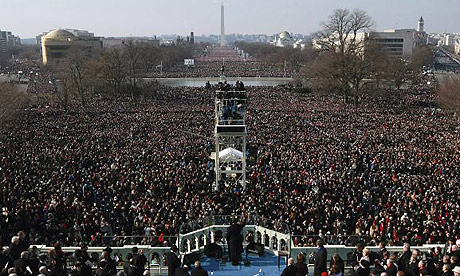
President Obama delivers second Inaugural address at the West Front of the Capitol, January 21, 2013. Photo by J. Scott Applewhite / AP.

Self-evident truths:
We are made for this moment

By Thomas McKelvey Cleaver | The Rag Blog | January 22, 2013

“For history tells us that while these truths may be self-evident, they have never been self-executing; that while freedom is a gift from God, it must be secured by His people here on Earth.” — President Barack Obama, January 21, 2013

See full text of President Obama’s Second Inaugural Address, Below.

As several commentators noted during the Inauguration, President Obama is himself the living embodiment of this truth. Progressives may have been disappointed with various events and policies of the past four years, but the very fact of President Obama’s existence as president is itself a revolutionary affirmation that America can change and grow.

Political geek that I am, I have long paid attention to presidential inaugural speeches. I will never in my life forget the electricity that ran down my spine when I heard President Kennedy say, “ask not what your country can do for you, rather ask what you can do for your country.”

I think that has been my personal lodestone in all the years since; it certainly informed most of the most important decisions I made about my life. I do suspect, however, that my use of those words were not exactly as President Kennedy intended at the time.

Looking back four years, did any of us think we would hear these words from a president? “Our journey is not complete until our gay brothers and sisters are treated like anyone else under the law — for if we are truly created equal, then surely the love we commit to one another must be equal as well.”

Given what we were told of Obama’s views on this topic during the 2008 campaign, that he made this bold statement as boldly as he did in 2013 is proof that he grows and changes, too.

For me, the words that electrified me — as had the words of President Kennedy — were these:

We, the people, declare today that the most evident of truths — that all of us are created equal — is the star that guides us still; just as it guided our forebears through Seneca Falls, and Selma, and Stonewall; just as it guided all those men and women, sung and unsung, who left footprints along this great Mall, to hear a preacher say that we cannot walk alone; to hear a King proclaim that our individual freedom is inextricably bound to the freedom of every soul on Earth.

As a participant in those movements for change over the past 50 years, the recognition of the importance of these three movements was clear evidence that, despite my differences with Obama over his imperial wars, he is still the most important progressive politician of the past 50 years, perhaps since FDR. Below is his speech, I have emphasized those sections that I thought were important when I heard them.

The text of President Barack Obama’s second Inaugural Address, delivered Monday, January 21, 2013, from the West Front of the Capitol, follows below. All emphasis is added.

President Barack Obama’s Second Inaugural Address

Vice President Biden, Mr. Chief Justice, Members of the United States Congress, distinguished guests, and fellow citizens:

Each time we gather to inaugurate a president, we bear witness to the enduring strength of our Constitution. We affirm the promise of our democracy. We recall that what binds this nation together is not the colors of our skin or the tenets of our faith or the origins of our names. What makes us exceptional – what makes us American – is our allegiance to an idea, articulated in a declaration made more than two centuries ago:

“We hold these truths to be self-evident, that all men are created equal, that they are endowed by their Creator with certain unalienable rights, that among these are Life, Liberty, and the pursuit of Happiness.”

Today we continue a never-ending journey, to bridge the meaning of those words with the realities of our time. For history tells us that while these truths may be self-evident, they have never been self-executing; that while freedom is a gift from God, it must be secured by His people here on Earth. The patriots of 1776 did not fight to replace the tyranny of a king with the privileges of a few or the rule of a mob. They gave to us a Republic, a government of, and by, and for the people, entrusting each generation to keep safe our founding creed.

For more than two hundred years, we have.

Through blood drawn by lash and blood drawn by sword, we learned that no union founded on the principles of liberty and equality could survive half-slave and half-free. We made ourselves anew, and vowed to move forward together.

Together, we determined that a modern economy requires railroads and highways to speed travel and commerce; schools and colleges to train our workers.

Together, we discovered that a free market only thrives when there are rules to ensure competition and fair play.

Together, we resolved that a great nation must care for the vulnerable, and protect its people from life’s worst hazards and misfortune.

Through it all, we have never relinquished our skepticism of central authority, nor have we succumbed to the fiction that all society’s ills can be cured through government alone.
Our celebration of initiative and enterprise; our insistence on hard work and personal responsibility, are constants in our character.

But we have always understood that when times change, so must we; that fidelity to our founding principles requires new responses to new challenges; that preserving our individual freedoms ultimately requires collective action. For the American people can no more meet the demands of today’s world by acting alone than American soldiers could have met the forces of fascism or communism with muskets and militias. No single person can train all the math and science teachers we’ll need to equip our children for the future, or build the roads and networks and research labs that will bring new jobs and businesses to our shores. Now, more than ever, we must do these things together, as one nation, and one people.

This generation of Americans has been tested by crises that steeled our resolve and proved our resilience. A decade of war is now ending. An economic recovery has begun. America’s possibilities are limitless, for we possess all the qualities that this world without boundaries demands: youth and drive; diversity and openness; an endless capacity for risk and a gift for reinvention. My fellow Americans, we are made for this moment, and we will seize it – so long as we seize it together.

For we, the people, understand that our country cannot succeed when a shrinking few do very well and a growing many barely make it. We believe that America’s prosperity must rest upon the broad shoulders of a rising middle class. We know that America thrives when every person can find independence and pride in their work; when the wages of honest labor liberate families from the brink of hardship. We are true to our creed when a little girl born into the bleakest poverty knows that she has the same chance to succeed as anybody else, because she is an American, she is free, and she is equal, not just in the eyes of God but also in our own.

We understand that outworn programs are inadequate to the needs of our time. We must harness new ideas and technology to remake our government, revamp our tax code, reform our schools, and empower our citizens with the skills they need to work harder, learn more, and reach higher. But while the means will change, our purpose endures: a nation that rewards the effort and determination of every single American. That is what this moment requires. That is what will give real meaning to our creed.

We, the people, still believe that every citizen deserves a basic measure of security and dignity. We must make the hard choices to reduce the cost of health care and the size of our deficit. But we reject the belief that America must choose between caring for the generation that built this country and investing in the generation that will build its future. For we remember the lessons of our past, when twilight years were spent in poverty, and parents of a child with a disability had nowhere to turn. We do not believe that in this country, freedom is reserved for the lucky, or happiness for the few. We recognize that no matter how responsibly we live our lives, any one of us, at any time, may face a job loss, or a sudden illness, or a home swept away in a terrible storm. The commitments we make to each other – through Medicare, and Medicaid, and Social Security – these things do not sap our initiative; they strengthen us. They do not make us a nation of takers; they free us to take the risks that make this country great.

We, the people, still believe that our obligations as Americans are not just to ourselves, but to all posterity. We will respond to the threat of climate change, knowing that the failure to do so would betray our children and future generations. Some may still deny the overwhelming judgment of science, but none can avoid the devastating impact of raging fires, and crippling drought, and more powerful storms. The path towards sustainable energy sources will be long and sometimes difficult. But America cannot resist this transition; we must lead it. We cannot cede to other nations the technology that will power new jobs and new industries – we must claim its promise. That is how we will maintain our economic vitality and our national treasure – our forests and waterways; our croplands and snowcapped peaks. That is how we will preserve our planet, commanded to our care by God. That’s what will lend meaning to the creed our fathers once declared.

We, the people, still believe that enduring security and lasting peace do not require perpetual war. Our brave men and women in uniform, tempered by the flames of battle, are unmatched in skill and courage. Our citizens, seared by the memory of those we have lost, know too well the price that is paid for liberty. The knowledge of their sacrifice will keep us forever vigilant against those who would do us harm. But we are also heirs to those who won the peace and not just the war, who turned sworn enemies into the surest of friends, and we must carry those lessons into this time as well.

We will defend our people and uphold our values through strength of arms and rule of law. We will show the courage to try and resolve our differences with other nations peacefully – not because we are naïve about the dangers we face, but because engagement can more durably lift suspicion and fear. America will remain the anchor of strong alliances in every corner of the globe; and we will renew those institutions that extend our capacity to manage crisis abroad, for no one has a greater stake in a peaceful world than its most powerful nation. We will support democracy from Asia to Africa; from the Americas to the Middle East, because our interests and our conscience compel us to act on behalf of those who long for freedom. And we must be a source of hope to the poor, the sick, the marginalized, the victims of prejudice – not out of mere charity, but because peace in our time requires the constant advance of those principles that our common creed describes: tolerance and opportunity; human dignity and justice.

We, the people, declare today that the most evident of truths – that all of us are created equal – is the star that guides us still; just as it guided our forebears through Seneca Falls, and Selma, and Stonewall; just as it guided all those men and women, sung and unsung, who left footprints along this great Mall, to hear a preacher say that we cannot walk alone; to hear a King proclaim that our individual freedom is inextricably bound to the freedom of every soul on Earth.

It is now our generation’s task to carry on what those pioneers began. For our journey is not complete until our wives, our mothers, and daughters can earn a living equal to their efforts. Our journey is not complete until our gay brothers and sisters are treated like anyone else under the law – for if we are truly created equal, then surely the love we commit to one another must be equal as well. Our journey is not complete until no citizen is forced to wait for hours to exercise the right to vote. Our journey is not complete until we find a better way to welcome the striving, hopeful immigrants who still see America as a land of opportunity; until bright young students and engineers are enlisted in our workforce rather than expelled from our country. Our journey is not complete until all our children, from the streets of Detroit to the hills of Appalachia to the quiet lanes of Newtown, know that they are cared for, and cherished, and always safe from harm.

That is our generation’s task – to make these words, these rights, these values – of Life, and Liberty, and the Pursuit of Happiness – real for every American. Being true to our founding documents does not require us to agree on every contour of life; it does not mean we will all define liberty in exactly the same way, or follow the same precise path to happiness. Progress does not compel us to settle centuries-long debates about the role of government for all time – but it does require us to act in our time.

For now decisions are upon us, and we cannot afford delay. We cannot mistake absolutism for principle, or substitute spectacle for politics, or treat name-calling as reasoned debate. We must act, knowing that our work will be imperfect. We must act, knowing that today’s victories will be only partial, and that it will be up to those who stand here in four years, and forty years, and four hundred years hence to advance the timeless spirit once conferred to us in a spare Philadelphia hall.

My fellow Americans, the oath I have sworn before you today, like the one recited by others who serve in this Capitol, was an oath to God and country, not party or faction – and we must faithfully execute that pledge during the duration of our service. But the words I spoke today are not so different from the oath that is taken each time a soldier signs up for duty, or an immigrant realizes her dream. My oath is not so different from the pledge we all make to the flag that waves above and that fills our hearts with pride.

They are the words of citizens, and they represent our greatest hope.

You and I, as citizens, have the power to set this country’s course.

You and I, as citizens, have the obligation to shape the debates of our time – not only with the votes we cast, but with the voices we lift in defense of our most ancient values and enduring ideals.

Let each of us now embrace, with solemn duty and awesome joy, what is our lasting birthright. With common effort and common purpose, with passion and dedication, let us answer the call of history, and carry into an uncertain future that precious light of freedom.

Thank you, God Bless you, and may He forever bless these United States of America.

[Vietnam veteran Thomas McKelvey Cleaver is an accidental native Texan, a journalist, and a produced screenwriter. He has written successful horror movies and articles about Second World War aviation, was a major fundraiser for Obama in 2008, and has been an activist on anti-war,  political reform, and environmental issues for almost 50 years. Read more articles by Thomas Cleaver on The Rag Blog.]

The Rag Blog
Posted in Rag Bloggers | Tagged , , , | Leave a comment

Marilyn Katz : Guns? Don’t Wait for Congress

Image from WorldMeets.US.

Or Godot:
Guns? Don’t wait for Congress

With gun enthusiasts stockpiling weapons in light of impending federal regulations, what is a concerned citizen to do?

By Marilyn Katz | The Rag Blog | January 21, 2013

With 300 million guns out there, the reality is that neither the laws passed by governments nor the most elaborate fantasies of the survivalists — with police knocking down every door to unearth hidden arms stashes — will eliminate guns or gun violence.

Three hundred million. That’s the number of guns, from assault rifles to pistols, in the United States today, with the numbers rising each day as gun enthusiasts arm themselves against the local, state, or federal actions being pushed for by gun control advocates. That’s one gun for practically each and every American alive today — even though only a third of us own them.

President Obama has put forward a series of proposals aimed at curbing gun violence in the U.S., and urged Congress to reinstitute a ban on military-style assault weapons and to require universal background checks for gun purchasers. But with 300 million guns out there, the reality is that neither the laws passed by governments nor the most elaborate fantasies of the survivalists — with police knocking down every door to unearth hidden arms stashes — will eliminate guns or gun violence.

So, what to do, besides hope or despair? Despite the odds, quite a bit — with or without congressional or state action:

  • Face the facts. While 9,000 people were killed in gun-related homicides in 2011, another 19,000 used a gun to take their own lives — in many cases the spouse, parent, or child of a gun owner. Men in homes with guns are twice as likely to be killed in a homicide, women three times more likely. Get rid of your guns — you’re more likely to be a victim if you don’t.
  • Address the reality on the streets. Inner-city violence, especially among youth, is undeniable and tragic. Guns are the leading cause of death for black men under 25, and “leadership decapitation,” or police targeting gang leaders, may have unintentionally escalated rather than decreased violence. Pastors, parents, and police might instead resurrect the old strategy of forging a no-gun policy accord among gangs. The gangs might not go away, but the up-close and personal knife fights of West Side Story are preferable to the drive-by shootings of today.
  • Make it personal. In irresistible films and shows from Batman to Reservoir Dogs, Dexter, and The Sopranos, in the computer games we play where an enemy’s death improves one’s score, and even in the nightly news, the message that violence can solve problems permeates our culture and is far more pervasive and consistent than our chosen intentional moral teachings. Whether or not you are raising children, you might consider banishing these “entertainments” from your home and your life. Organize a sports league, take up dancing, read a book — you’ll be more literate and fit.
  • Reexamine what society considers “normal.” Those turning 12 this year have grown up with constant war, exposed to daily death counts from faraway places and casual discussions comparing drone killings to assassinations to outright hand-to-hand combat. Anyone under the age of 80 has experienced only one decade in which our nation was not at war. And our country’s military budget is not only the biggest in the world — it’s greater than the sum of the next 13 biggest military budgets combined. If we want to phase out homicide as a means of resolving conflict, we might insist our nation lead by example.
  • Reconsider the “other.” Ironically, even as our nation becomes more diverse, we are ever more economically segregated, with our images of the “other” too often drawn from films, TV and the news rather than from life. Our image of cities and the lives of their residents are informed by The Wire or Treme, our images of Muslims by Homeland or Glenn Beck. This is not without effect. From the slaughter of churchgoers in Wisconsin to the New York subway platform deaths of innocent citizens, to the “arming of America” in light of the Obama election and reelection, demonization of the “other” has a real cost. While we may not be in favor of censoring media, other measures such as restoring civility to political debate and seeking out more diverse life experiences would seem useful correctives.
  • Follow the money. Guns are not simply lethal; they’re lucrative. According to The Wall Street Journal, manufacturers like Freedom Group, which makes the Bushmaster and Remington, saw their profits soar last year, with Freedom Group earning $237.9 million in the third quarter alone. Another big winner was Wal-Mart, which in 2011 began selling guns at more locations, as part of its attempt to recover from a severe slump. Now, with guns available in 1,800 of its 3,800 stores, Wal-Mart is the nation’s leading seller of firearms and ammunition, and gun sales were up 76 percent last year. With 90 percent of Americans living within 15 miles of a Wal-Mart, I’d make a suggestion: Consider doing your grocery shopping at a retailer where you can’t pick up semi-automatic weapons along with your cereal.

History is pretty clear: If we want change, we have to make it. From women’s suffrage to civil rights, from the establishment of the eight-hour day to pesticide control, our legislators have always responded to citizen action. As always, the future is in our hands.

This article was cross-posted to In These Times.

 [An anti-war and civil rights organizer during the Vietnam War, Marilyn Katz helped organize security during the August 1968 protests at the Democratic National Convention. Katz has founded and led groups like the Chicago Women’s Union, Reproductive Rights National Network, and Chicago Women Organized for Reproductive Choice in the 1960s and 1970s, and Chicagoans Against War in Iraq in 2002. The founder and president of Chicago-based MK Communications, Katz can be contacted at mkatz@mkcpr.com. Read more articles by Marilyn Katz on The Rag Blog.

The Rag Blog

Posted in Rag Bloggers | Tagged , , , , , | 2 Comments

Harry Targ : Dr. King and the Civil Rights-Labor Alliance

Dr. Martin Luther King, Jr., and the Rev. Ralph Abernathy lead a march by sanitation workers in Memphis, March 28, 1968. Photo by Sam Melhorn / AP.


Martin Luther King and the
civil rights and labor alliance

King knew that black and white workers’ struggles for economic justice were indivisible; that civil rights could not be realized in a society where great differences in wealth and income existed…

By Harry R Targ | The Rag Blog | January 21, 2013

Dr. Martin Luther King arrived in Memphis on March 18, 1968 to support the sanitation workers of that city who had been on strike for five weeks. These workers had many grievances that forced them to protest.

Garbage workers had no access to bathroom or shower facilities. They were not issued any protective clothing for their job. There were no eating areas separate from garbage. Also sanitation workers had no pension or retirement program and no entitlement to workers compensation. Their wages were very low.

Shortly before the strike began two workers died on the job and the families of the deceased received only $500 in compensation from the city. Finally, after Black workers were sent home for the day because of bad weather and received only two hours pay they walked off the job.

On March 28, 10 days after King arrived, violence disrupted a march led by him. He left the city but returned on April 4 to lead a second march. On that fateful April day, King told Jerry Wurf, president of the American Federation of State, County, and Municipal Employees or AFSCME: “What is going on here in Memphis is important to every poor working man, black or white, in the South.” That evening Martin Luther King was killed by a sniper’s bullet.

It was logical for King to be in Memphis to support garbage workers. Despite a sometimes rocky relationship between the civil rights and labor movements, King knew that black and white workers’ struggles for economic justice were indivisible; that civil rights could not be realized in a society where great differences in wealth and income existed, and where life expectancies, educational opportunities, and the quality of jobs varied by class, by race, and by gender.

The more progressive and far-sighted leaders and rank-and-file union members in the AFL-CIO knew it too. At the time of King’s death working people were coming together to struggle for positive social change around the banner of the Poor People’s Campaign.

Dr. King’s thinking on the need for an alliance between the civil rights and labor movements was expressed many times. As far back as 1957 at a convention of the United Packinghouse Workers of America (UPWA) he asserted that “organized labor can be one of the most powerful instruments in putting an end to discrimination and segregation.”

During an organizing effort of the Hospital Workers Local 1199 in the fall of 1964, King was a featured speaker at a fundraising rally. He said of the 1199 struggle,

Your great organizing crusade to win union and human rights for New Jersey hospital workers is part and parcel of the struggle we are conducting in the Deep South. I want to congratulate your union for charting a road for all labor to follow-dedication to the cause of the underpaid and exploited workers in our nation.

Shortly after, Dr. King left a picket line of Newark hospital workers on strike to fly to Oslo, Norway, to receive the Nobel Prize.

Upon his return from Norway, King returned to the picket line; this time in support of Black women workers of the Chemical Workers union at the Scripto Pen Plant in Atlanta. He said there: “Along with the struggle to desegregate, we must engage in the struggle for better jobs. The same system that exploits the Negro exploits the poor white…”

At the Negro American Labor Council convention of June, 1965, King called for a new movement to achieve “a better distribution of wealth within this country for all of God’s children.” In February, 1966, King spoke to Chicago labor leaders during his crusade for the end to racism and poverty in that city. He called on the labor movement which had provided techniques and methods, and financial support crucial to civil rights victories to join in the war on poverty and slums in Chicago.

Such an effort in Chicago, he said, would show that a Black and labor alliance could be of relevance to solving nationwide problems of unemployment, poverty, and automation.

One year before his death, King spoke at another meeting of Hospital Workers 1199. He said a closer alliance was needed between labor and civil rights activists to achieve the “more difficult” task of economic equality. The civil rights movement and its allies were moving into a new phase to achieve economic justice, he announced. This would be a more formidable struggle since it was in his words “much more difficult to eradicate a slum than it is to integrate a bus.”

In early 1968, Dr. King incorporated his opposition to the Vietnam War with his commitment to economic justice. He called for an end to the War and the utilization of societal resources to eliminate poverty. To those ends the Poor People’s Campaign was launched. It demanded jobs, a guaranteed annual income for those who could not find work, the construction of 6 million new homes, support for employment in rural areas, new schools to train jobless youth for skilled work, and other measures to end poverty.

While preparing the Poor People’s Campaign, King got a call to go to Memphis. Before leaving he sent a message to be read at the seventh annual convention of the Negro American Labor Council. He wrote that the Council represented “the embodiment of two great traditions in our nation’s history: the best tradition of the organized labor movement and the finest tradition of the Negro Freedom Movement.” He urged a black-labor alliance to unite the Black masses and organized labor in a campaign to help solve the “deteriorating economic and social conditions of the Negro community… heavily burdened with both unemployment and underemployment, flagrant job discrimination, and the injustice of unequal education opportunity.”

Forty years later the social and economic injustices of which Dr. King spoke continue. But so does his vision of a working class movement united in struggle to survive, a movement of Blacks, whites, and Latinos, men and women, young and old, and organized and unorganized workers.

The times have changed but the importance of Dr King’s political vision remains.

A version of this article was first published on January 13, 2009, at Diary of a Heartland Radical.

 [Harry Targ is a professor of political science at Purdue University and is a member of the National Executive Committee of the Committees of Correspondence for Democracy and Socialism. He lives in West Lafayette, Indiana, and blogs at Diary of a Heartland Radical. Read more of Harry Targ’s articles on The Rag Blog.]

The Rag Blog
Posted in Rag Bloggers | Tagged , , , , , , | Leave a comment

Jean Trounstine : Behind Bars and Blogging for Human Rights

Texas born, Johnny E. Mahaffey’s profile page at betweenthebars.org. Image from Between the Bars.

Behind bars and 
blogging for human rights

Martin Luther King Day reminds us about fighting for human rights. It might seem like an oxymoron, convicted criminals blogging for dignity, equality, and inalienable rights, but here’s why it’s not.

By Jean Trounstine | The Rag Blog | January 21, 2013

For some prisoners, blogging is a lifeline to the world. It is the chance to weigh in on the issues of the day and on the particular concerns of those locked up — often unseen and unheard. It also allows them to learn about social media for the eventuality when 95% will return to their communities.

Prisoners send letters with prose, poetry, and art to blogs; those on the outside comment; replies are then mailed to the prisoners who have the opportunity to respond with new posts. Thus, they see that their ideas matter.

Between the Bars.org (BTB), managed by MIT co-creator and Phd candidate Charlie DeTar, has allowed more than 5,000 prisoners to find voice online. This is a significant number, but DeTar reminds us on BTB that it’s still only 1% of the 2.2 million housed in U.S. prisons and jails.

Joining the Ella Baker Center in Oakland, California, this past December 10, BTB honored the anniversary of the worldwide adoption of the Universal Declaration of Human Rights. They aimed to give prisoners the chance to bring attention to human rights abuses within the walls of the world’s largest incarceration system. The Ella Baker Center, named after Civil Rights heroine, Ella Baker, is dedicated to reducing the U.S. incarceration rate by 50% over the next 10 years.

More than 300 BTB authors and artists participated along with other individuals and groups from across the country. Some of the topics that prisoners blogged about for Human Rights Day included: business and job security; human rights violations behind bars; the inhumanity of solitary confinement; the travesty of juveniles in adult prisons; suppression of dissent from prisoners; electronic intrusions at all hours; the high suicide rate in U.S. prison, and the idea that “there can never be justice on stolen land.”

Johnny E. Mahaffey, born in Texas and currently incarcerated in South Carolina, answered the call to discuss human rights in a piece he titles his “Essayistic Ponderings

There are those who believe that prisoners should be removed not only from society, but life itself — all death-penalty arguments aside — into a state of out-of- sight and out-of-mind… and it is this non-existence they seek to impose upon inmates dwelling within the walls of confinement, already removed from their family, and life that they once had — and it is this state of non-existence that contradicts the very thought of “human rights…” Throwing away the key is not an answer to crime, it’s just a lazy way to deal with it…

Mahaffey also says in the same piece that blogging for him is a way to connect with his five children:

Though this blog, they will know always that they were loved, thought of constantly, and that they themselves are in no way to blame for their father’s situation. I may not live long enough to ever see them — prison is dangerous — and these words I type on my typewriter to be mailed out for my blog, could be all that’s left of me.”

Tim Muise, incarcerated at MCI Shirley in Massachusetts, takes on treatment of those behind bars who are gravely ill and near death in a devastating critique, “The Death Chamber — ‘Shirley Style’.” He writes, “Here at the Hospital Unit (HSU), you will see examples of a ‘slow death penalty… feces left in an adult diaper for over 36 hours… Ants were found… maggots…”

A man Muise calls “WB,” was beaten at age 72, thrown into HSU, and Muise maintains, was denied his life-saving medication. “This brought on six separate major heart episodes which required outside hospital attention and major surgeries.”

Maisha Mahalia Durham was one of the few women who responded to the call-out for human rights. Of the nearly 1.5 million housed in state prisons, only 200,000 are women, but there is a considerable body of literature on the particular issues for women behind bars.

Durham, incarcerated in Georgia, is president of a writing group at Pulaski State Prison called “Inkspills” for others like herself, yearning to write. Her blog post for human rights is about the devastating parole system which she has seen keep many prisoners from returning to their communities — in spite of transformation of attitudes and behavior.

She wrote that “When the Judicial System stops looking at the nature of the crime and starts evaluating the nature of the person, justice can be served.”

While Durham joins a notable group of men and women who seek to publish their words in articles and books, blogging gives her immediacy. Prison bloggers can also earn respect for their ideas and position themselves as knowledgeable, as well as reconnect with a community that has, by and large, abandoned them. One blogger poignantly makes this point on BTB by opening up his post with the words, “Hello World.”

[Jean Trounstine is an author/editor of five published books and many articles, professor at Middlesex Community College, and a prison activist. For 10 years, she worked at Framingham Women’s Prison and directed eight plays, publishing Shakespeare Behind Bars: The Power of Drama in a Women’s Prison about that work. She blogs for Boston Magazine and takes apart the criminal justice system brick by brick at jeantrounstine.com where she blogs weekly at “Justice with Jean.” ]

The Rag Blog

Posted in RagBlog | Tagged , , , , , , | Leave a comment

Splat from Tripod.
Type your summary here

Type rest of the post here

Source /

The Rag Blog

Posted in RagBlog | Leave a comment

Tom Hayden : Pentagon Calls Civilian Drone Casualties ‘Bug Splat’

Splat from NuUniform.

Drone policy attacked in top think tank report

Bug splat!That’s what the Pentagon calls civilian casualties in drone attacks.

By Tom Hayden | The Rag Blog | January 17, 2013

The Council on Foreign Relations issued a report last week calling for fundamental reforms in U.S. drone policies, surfacing sharp differences in official circles in response to widespread questioning and protest.

Micah Zenko writes in the Council Special Report that the Pentagon and CIA use the term “bug splat” in referring to their civilian collateral damage methodology. The acronym MALE is employed to describe “medium altitude long-endurance” drone technologies of the future.

More substantively, the CFR report recommends:

  • That the Obama administration’s targeted-killings policy be limited to individuals with a “direct operational” role in terrorist plots against the U.S.;
  • Ending the so-called “signature strikes” against individuals or groups who the White House says, “bear the characteristics of Qaeda or Taliban leaders on the run,” and which define all military-age males in a strike zone as “combatants;”
  • Far greater transparency and accountability in the definitions of civilian casualties, including aggressive congressional oversight.

The report concludes that of 3,000 killed in drone attacks so far, “the vast majority were neither al Qaeda nor Taliban leaders,” a major difference from the low-to-zero civilian casualty estimates by the Obama administration, including newly-recommended CIA chief John Brennan.

Congress comes in for sharp criticism for its failure over the past 10 years to hold a single public hearing on any aspect of the so-called non-battlefield targeted killings. Staffs of the foreign affairs committees “have little understanding of how drone strikes are conducted within the countries for which they are responsible for exercising oversight.”

Judiciary committees are “repeatedly denied access to the June 2010 Office of Legal Counsel memorandum that presented the analysis of the legal basis” for the drone killing of U.S. citizen Anwar al-Awlaki in Yemen in September 2011.

A citizen call for congressional hearings could trigger a response as the new legislative session gets underway in Washington next month. President Obama himself, in an October interview with Jon Stewart, called on Congress to offer “new legal architecture” in order to “rein in” the growing powers of the executive branch in the drone age. The CFR report is likely to shape the terms of the debate ahead.

The report credits protests by human rights and peace advocates and journalists for causing a “major risk” of operational restrictions on drones, and draws parallels with the widespread questioning that undermined the Bush-era torture policies and warrantless wiretapping.

“The current trajectory of U.S. drone strike policies is unsustainable,” the report flatly concludes. Public pressure combined with international condemnation will cause the decline of the program unless there are both reform and confidence-building measures.

The report warns that U.S. policies are setting off a dangerous drone arms race. “Without reform from within, drones risk becoming an unregulated, unaccountable vehicle for states to deploy lethal force with impunity.”

Public opinion surveys show a declining support for the drone policy from 83 percent to 62 percent just between February and June 2012, the period when President Obama initiated his “conversation” about the policy. Local protests have risen against drones as the Afghanistan war has been “winding down.” A colorful, large-scale protest against drones is expected to occur during the Obama inauguration.

The peace protesters have an institutional ally in the absence of support from Congress — the powerful lobby for counterinsurgency, which opposes drone strikes as counterproductive without advisers and troops on the ground to win over “hearts and mind.” One member of the advisory committee on the CFR report was Gen. Stanley McChrystal, who embodied the counterinsurgency program in Afghanistan until forced into retirement.

In an interview last week, McChrystal cautioned that drones create widespread hatred on “a visceral level.” The Long War Journal representing the counter-insurgency advocates, and the New American Foundation, representing national security “centrists,” have been in the forefront of questioning the efficacy of the administration’s policies for this reason.

As 2013 begins, the return of an Imperial Presidency is a definite specter over the Obama administration. Not only is the drones policy under challenge, but the rules of Special-Ops killings and detention, the launching of cyber-war, and the return of the CIA to the business of running cover armies are examples of militarism without checks and balances.

The CFR report says, but cannot confirm, for example, that the CIA directs a paramilitary force of 3,000 Pashtun mercenaries on the Pakistan-Afghanistan border. Congressional oversight is failing, according to the report, and the War Powers Act of 1973 is simply obsolete for the era of modern warfare with its waning emphasis on ground troops.

As even the president has acknowledged, “I think creating a legal structure, processes, with oversight checks on how we use unmanned weapons is going to be a challenge for me and for my successors for some time to come.” (Bowden, Mark. The Finish) Coupled with his comment to Stewart, that is as close as possible to an admission by a president that his government is operating outside the constitutional structure.

It is hard to expect serious reform from the same administrative elites who have depended on the War on Terror’s enabling framework for a decade. Obama may lead us towards a “conversation” but solutions will have to come from Congress at the insistence of the public and media. That is how the War Powers Act became law in 1973, at the insistence of Congress, the media and the peace movement.

No president, from Nixon to Obama, has ever accepted its constitutionality, though sometimes abiding by its requirements — because they believe the law infringes on the power of the presidential office to make war. That is why the public and Congress will be required to reform the current policies, or the future will become far more secret than the past.

[Tom Hayden is a former California state senator and leader of Sixties peace, justice, and environmental movements. He currently teaches at Pitzer College in Los Angeles. His latest book is The Long Sixties. Hayden is director of the Peace and Justice Resource center and editor of The Peace Exchange Bulletin. Read more of Tom Hayden’s writing on The Rag Blog.]

The Rag Blog

Posted in Rag Bloggers | Tagged , , , , , , , | 3 Comments

Bruce Melton : World Bank on Climate: ‘Turn Down the Heat’

Glacier melt. Photo by Dave Appleby / Flickr / Truthout.

Is it really this bad?
World Bank on climate:
‘Turn down the heat’

Instead of working on climate pollution emissions reductions, we are now emitting more than was imagined in the 1998 worst-case scenario.

By Bruce Melton / Truthout / January 17, 2013

See Bruce Melton’s writing about climate change on The Rag Blog.

Mega reports on climate change are piling up almost as fast as the extreme unprecedented weather events. The latest by the World Bank is just another summary of conservative consensus climate science. Impacts are already worse than stated, but fortunately, solutions could be easier than are commonly understood.

As incredible as it sounds, the effects of climate change are even worse than the World Bank says in its latest report, “Turn Down the Heat: Why a 4°C World Must be Avoided,” a summary of the latest findings in climate science.

Much of this work is based on 1998 climate change scenarios and the Intergovernmental Panel on Climate Change consensus position from 2007. Because science takes years and years to happen, a lot of this research is based on a world where Kyoto was still a part of the deal.

But in our world today, instead of working on climate pollution emissions reductions, we are now emitting more than was imagined in the 1998 worst-case scenario. Even though much of the work in the World Bank Report is the latest and greatest, it is still largely based in research on one of the “middle-of-the-road” climate change scenarios.

This is why these consensus reports are so dangerous. It’s not that they project global catastrophe, it is that those projections are based on a consensus opinion. Whenever you get more than one specialist of any kind agreeing on a position that satisfies more than that one specialist, the result is almost always a group opinion that is watered down.

So alone, the scientific consensus on climate change is not as extreme as any of its given parts. It’s easy to agree on the middle-of-the road scenario now that the “best-case” scenario is so obviously a pipe dream.

The consensus opinion includes the solutions as well as the impacts. What the latest forward-leaning findings are now reporting is that treating climate pollution using existing technologies will be no more difficult than supplying Earth with clean drinking water every day. This is hardly a path that destroys our economies.

These existing technologies are things like efficiency improvements, electric and hybrid vehicles, fluorescent light bulbs, wind, solar, wave, tidal, carbon capture and storage (CSS), carbon sequestration and integrated gasification combined cycle (IGCC), natural gas combined cycle (NGCC), saline aquifer sequestration, mineral sequestration, oil field disposal — the list is a mile long.

New technologies now in the field-proving stages are in addition to the economic evaluations that show the cost of treating climate pollution being no different than that for supplying our society with clean drinking water. These “new” technologies have the promise of being far less expensive than existing technologies. Photo copyright Bruce Melton 2012.

More interesting and likely far more valuable is the up and coming technology of air capture. Traditionally, air capture has been seen as infeasible because of the low concentration of CO2 compared to smokestack concentrations from energy generation or industrial processes.

But this is changing. Billionaires across the globe are investing in carbon capture and sequestration technologies to meet the climate change challenge. Outfits like SRI in California are looking to capitalize on the vast amount of money soon to be spent on cleaning up climate pollution by sucking CO2 straight out of the air. The future could be brighter than we think.

While “Heat” is a vast scientific summary of all the major research, it focuses on global average temperature change and largely leaves out what is likely the most important thing about climate change impacts. It is a little thing involving the calculation of averages, but it means a lot to us humans who live on land.

Earth’s oceans cool our climate considerably. This is why the report’s projection of seven degrees Fahrenheit of warming will be so catastrophic. Seven degrees is a lot to ecosystems but not to air-conditioned humans. Warming over land, however, is much greater than over oceans, and this skews the average considerably. What we will actually experience is a lot more warming than the average global warming projections reported by “Heat” suggest.

More evidence of the conservative (small “c”) consensus can be found in “Heat.” It tells us the Amazon will be devastated by global warming in the future.

But a report in April 2011, by a team from the University of Boston, NASA’s Ames Research Center and the University of Viçosa, Brazil, tells us that the Amazon has already changed from a carbon sink to a carbon source, emitting greenhouse gases at a rate that is 75 percent as large as that of the entire United States. The cause is the death of over two billion trees, say the paper’s authors. They were killed by two massive droughts: a 100-year drought in 2005 and one four times as extreme, in 2010.

The Amazon has unexpectedly flipped from a carbon sink to a carbon source nearly as big as all emissions from the United States. The reason is drought: a 100-year drought in 2005 and one four times more extreme, in 2010, that killed more than 2 billion trees. Copyright Bruce Melton 2012.

Billions more have been killed across North America. Over 64 million acres have been impacted in the Rockies in the United States and Canada, where a devastating pine beetle outbreak remains uncontrolled. Extreme cold is the beetle’s only enemy, and extreme cold has gone away.

Warming is twice as much or more than the global average in the Rockies and high latitudes because of the snow and ice feedback. This is caused by warming that melts snow a little earlier, allowing for a longer hot season. Because snow reflects nine times more energy harmlessly back into space than does earth, rock, water, or vegetation, more warming is created. This feeds back into more snowmelt even earlier, and the cycle continues in a rapid warming spiral.

The Texas Forest Service tells us that the drought in the South Central United States in 2011 killed 301 million trees. Findings in Nature Geoscience, by a team from the University of Guelph in Ontario, Canada, together with scientists from the U.S. Geological Survey and the U.S. Forest Service, tells us that the black spruce forest of Alaska (much of the forested area in Alaska) also has now changed from a carbon sink to a carbon source. The team tells us that Alaska’s CO2 emissions from increased forest fires due to climate warming is about equal to all of the emissions from all of Canada’s forest fires during the period 1959-1999.

Research published in Nature Climate Change tells us that forests in the Canadian Rockies are dying 10 times faster than they did 50 years ago, and another piece of research by the U.S. Geological Survey in 2009 reveals that in about the same time frame, forest mortality across the western United States increased five times.

Both studies are careful to mention that the big pine beetle outbreak and increased forest fires are not included in their work. Both studies in the Rockies look at long-term evaluation (100 years plus) of old growth forests not impacted by logging.

What this means is that tree death has increased from roughly 0.5 percent per year to 5 percent per year. In 20 years, the average tree age and its associated carbon sequestration (capture and storage) capacity will be one-quarter what it is today — in just 20 years — not only across high altitudes and high latitudes in North America, but across the world.

“Heat” tells us the average global temperature will rise by seven degrees across the planet by the end of the century. This is not really a whole lot of warming to you and me. But the crazy part is not about how much damage seven degrees of warming will do to many global ecosystems. Seven degrees is the average across the planet. It will warm much more over land areas.

Our oceans are the reason why our climate has not caught up to our greenhouse gas emissions. We all hear that there is a lot more warming “in the pipeline.” In other words, greenhouse gases already emitted will cause additional warming even if we stopped all emissions tomorrow morning. Cool ocean water and cooling from polar ice are both responsible. The refrigerator door has been left open, and it will take decades to generations for the oceans to warm up. So they cool our climate in the meantime.

Different studies from NASA, Columbia and the University of California, Santa Barbara tell us the additional warming will be between 2.5 and 8 degrees Fahrenheit. Then again, these evaluations are based on the middle-of-the-road scenario, so the actual warming in the pipeline is probably a lot more.

So all this cool ocean water cools that air over the oceans. Globally, because oceans cover more than two-thirds of earth, this means that the temperature over land will warm more than twice the global average. Wow!

In September 2009, research workers at the Oak Ridge National Laboratory, Notre Dame, and the National Center for Atmospheric Research told us that because emissions are now along the path of the worst-case scenario, we should be focusing our understanding of future (and current) changes based on this scenario, not the middle-of-the road (A1B) scenario.

What the first few sentences of the report states is telling: “Recent observations of global-average emissions show higher trajectories than the worst-case (A1FI) scenario reported in IPCC AR4 (Intergovernmental Panel on Climate Change 2007 Report). Average A1FI temperatures trend higher than the best-case B1 as well as the relatively worse-case A2 scenario.” (The IPCC scenarios include 40 different futures.)

This team went on to model the 1998 worst-case climate scenario from the 2007 IPCC report instead of the middle-of-the-road scenario used in so many of the research works evaluated in “Heat.” The latest generation models also use a high-resolution framework that can show much greater detail than before.

What these models are now telling us backs up the “averaging effect” that the oceans have on the global temperature average. Their overall findings for the global average temperature increase under the worst-case scenario are little different from the IPCC consensus position that “Heat” discusses, it’s the difference between warming over land and warming over the oceans that will cause all the chaos.

Auroop R. Ganguly and colleagues tell us that across the vast majority of the North American continent and most land masses on Earth, by just 2050, we can expect 14.4 degrees Fahrenheit of warming. By 2100, it’s an unthinkable 22 degrees.

Research from Oak Ridge National Laboratory, Notre Dame, and the National Center for Atmospheric Research shows warming over land that is far in excess of what is commonly understood. Much of this is because of the averaging effect of global temperature differences between those over land and over water.

So now we can begin to see why this World Bank Report is so strident in its findings. Only, what will happen in reality is likely much worse than what the World Bank Report recites.

But all is not lost. I already mentioned that the solutions will be no more difficult than supplying humanity with clean drinking water, and I will get back to that, but first I need to add a little bit of non-consensus knowledge to an assertion that “Heat” makes. Even before that let me clarify a little about the research findings I am reporting.

These individual findings are on the leading edge of science. As is often the case with leading-edge science, there is dissention in the scientific community about validity. What we have been seeing in climate change literature is what climate scientists have been warning us would happen for a couple of decades now: that if we did not reduce emissions, impacts would be more extreme and happen faster.

Much of the consensus knowledge about climate change today is relatively old. It takes a half decade or more for enough knowledge to be gained so that the consensus can begin to acknowledge the changes. This is what is happening across climate science these days. The latest reports are validating the warnings. Yet, the body of science is still young; the conservative consensus is reticent to change.

So “Heat” tells us that large portions of Earth will become uninhabitable because of desertification caused by warming. The desertification that we will actually endure is a lot more than anticipated in “Heat” because our emissions are so much greater. They are  50 percent greater than in 1988, and since 1988, we have emitted 87 percent of the total amount of greenhouse gases mankind has emitted since we started emitting.

Even so, vast desertification — even coming much sooner than the consensus tells us — will not render large tracts of developed nations uninhabitable. There is, you see, this little thing called air conditioning. While non-desert ecosystems will collapse, they will be replaced by desert ecosystems that can handle the heat and dryness. Extinctions will come and go, environmental chaos will reign, blah, blah, blah. All the while we will sit comfortably in our air-conditioned homes and offices.

Food-growing regions will diminish or disappear when groundwater runs out, but agriculture areas will arise. The Amazon for instance, will likely not become a desert overnight. Those Brazilians will continue with their agricultural development, and output will in all likelihood increase greatly, at least for the next couple of decades or generations.

In developed nations everything will become more expensive, but we have the cash to pay for it. The world however is not made up of only “developed nations.” It’s hard to imagine that our society could let things go this far, but if it does, the warming does not stop — it gets worse even faster.

Now let me finish on a high note, also not reported with gusto in “Heat.” “Authoritative” voices tell us climate change is not real, that it is a scientific conspiracy, that it is a natural cycle soon to end, and that it will be good for society. These same confused voices that are telling us all of these things at the same time are the voices that tell us that the solutions to climate change will ruin our economies.

The vast majority of credentialed climate specialists say nothing of the sort. Richard Alley, Evan Pugh Professor of Geosciences at Penn State University, one of the lead authors of the 2001 and 2007 IPCC Reports, member of the United States National Academy of Sciences and one of the pivotal international researchers in climate science, tells us in his book Earth: the Operators’ Manual, that about 100 reports have been published concerning the economic impacts of the solutions to climate change, and they are focusing in on one thing.

The solutions to cleaning up climate pollution, using existing technologies, will cost about one percent of global gross domestic product (GDP) per year for 100 years. The astonishing thing to understand about this one percent of global GDP — this $540 billion a year — is that it is little different from what we have spent on our efforts to provide safe drinking water across the planet every year for the last 100 years.

It is little different from what we spend on the U.S. military every year not counting wars, or what we spend on advertising every year across the planet. It is little different than the normal economic costs to our nation every year because of normal inclement weather — rain, snow, heat, cold, wind, flooding and drought.

It is four times less than what we spend on health care every year in the United States alone, based on the annual 2000 to 2009 average that does not include Obamacare. And remember, this is using existing technologies. New technologies will significantly reduce or even convert these costs into profits.

Cleaning up climate pollution across the planet, in ways that we are already doing today, will cost far less than what we spend on health care every year — just in the U.S. alone.

The “voices” of vested interests are very powerful. Their money has created doubt that threatens the existence of life on this planet. They did not do this purposefully; they did it because of greed, ignorance, innocence, and the pressures of their respective industries’ economics. Their billions, and their quest for billions more, has allowed them to ignore, for whatever reasons, the dire warnings.

There are always a few scientists that disagree. In 2010, 97 to 98 percent of actively publishing climate scientists supported the consensus position. Should we trust the few or the many?

Copyright, Truthout.org. Reprinted with permission.

[Bruce Melton, a regular contributor to The Rag Blog, is a professional engineer, environmental researcher, filmmaker, and author in Austin, Texas. Information on Melton’s new book, Climate Discovery Chronicles, as well as more climate change writing, climate science outreach, and critical environmental issue documentary films can be found on his website and at climatediscovery.com. Read more articles by Bruce Melton on The Rag Blog.]

The Rag Blog

Posted in RagBlog | Tagged , , , , , | 1 Comment