BOOKS / Mariann G. Wizard : Steve Russell’s ‘Wicked Dew’

A chapbook review:
Steve Russell’s ‘Wicked Dew’

By Mariann G. Wizard | The Rag Blog | January 9, 2013

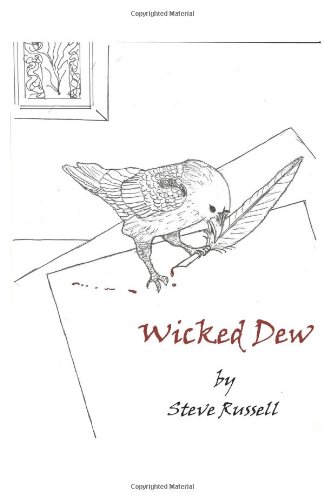
[Wicked Dew, by Steve Russell. (2012: Dog Iron Press, Georgetown, TX.); Paperback; 88 pp; $7.75.]

I’ve known Steve Russell since sometime in 1968 when he started showing up at The Rag office, a tall, gangly, very young Vietnam-era vet going to UT Austin on the GI Bill. Although Steve is incredibly bright and witty, and I’ve always enjoyed his prose contributions to The Rag and now The Rag Blog, I was nervous about reviewing his first book of poetry, Wicked Dew.

Steve is a Native American writer, and all of the previously published works in this collection have appeared in the Native press, where he is a regular contributor of weighty essays as well as occasional poetry. The book in fact won the 2008 Poetry First Book Award of the Native Writers Circle of the Americas (NWCA), and would have been published as part of the award; unfortunately, NWCA lost publication funding and the book is only now seeing the light of day.

I worried I might not be the right person to review poems that would obviously, just from these facts, be deeply rooted in Steve’s experience as a Native American. My mostly Scotch-Irish parentage undeniably has Native ancestors as well, but in my generation, and even in my folks’, as Russell writes in “Blood Quantum,” the “thin red line” of Native genes became gray oblivion.

My unfamiliarity with contemporary Native American literature (these days, honestly, with literature in general!) added to my concern. Would this blue-eyed daughter of “the flood of European blood” really get it?

I needn’t have worried, and neither should other poetry lovers. While a deeper knowledge of Native American literature would no doubt add to the grasp and enjoyment of these 37 poems, most transcend ethnic or tribal viewpoints, offering windows into the transformation of a poor “halfbreed” Oklahoma dropout into a multifaceted human rights activist and whole human being, rooted in and proud of his heritage.

“Heritage” for Steve is, I think, not just who someone’s ancestors were or what they did, but what a person makes of it. He writes his own history, and defines his own family, too.

Here are no paeans to Native purity or essential nobility. Only the lovely “Haiku for Walela” hearkens back before the European flood hit the Western hemisphere. One rather cynical poem, “Teach Me,” begins, “Teach me, White Father, so I may understand. I understand slavery…” Slavery — although not of the lifelong variety — was commonly practiced among Native tribes long before there was any European contact. Of these critical looks at Native political correctness, the most powerful is “How to Succeed as an Indian Poet”:


Don’t say ‘hunger.’
Write of the plump red strawberries
grown by Cherokees
in the Cookson Hills,
rather than rodents fried in lard,
garnished with herbs from the bar ditch,
government commodities on the side…

In “Probably Wolf Clan,” “Indistinguishable Color,” “Blood Quantum,” and other poems, Russell mourns the ongoing loss of Native identity and weighs his own. The question of who is “red” enough to be a “real Indian” has parallels in other discussions: is Barack Obama a “real black man?” What does it mean to be “Hispanic” or “Latino?” And for goodness sake, what in the world is “white?” “When I’m Old” begins:

And when I am very old
will the drums outrun my feet?
Will the sweetgrass be just another smoke, and the sage a burning weed?
Does White Buffalo Calf Woman return for the civilized Indians?

A few selections distill the “wicked dew” of the title and cover illustration, inking the perfidy of European America in its true colors of bitterness and gall. “Bison Bones” excoriates oblivious conquerors who do not even know what they desecrate:

Were Dallas Texans born with neckties on
to be served in deep carpet
by smiling brown faces
where dishes disappear silently
and condiments come in tiny sealed jars
to dine on bison bones?

In other poems, Russell celebrates Native cultural values. “Disruption, Spring 1997,” based on news accounts of an Albuquerque school girl not allowed to graduate wearing a traditional shawl by her grandmother, tells of family pride in the girl’s achievement. Poems for two of Steve’s (non-simultaneous) wives and one titled “Lust” are lit from within by wise acceptance of what-it-is. Another, “Cherokee Love,” begins:

There is no love in Cherokee.
No falling in or falling out,
no marry now or live in doubt,
no changing weather love in Cherokee…

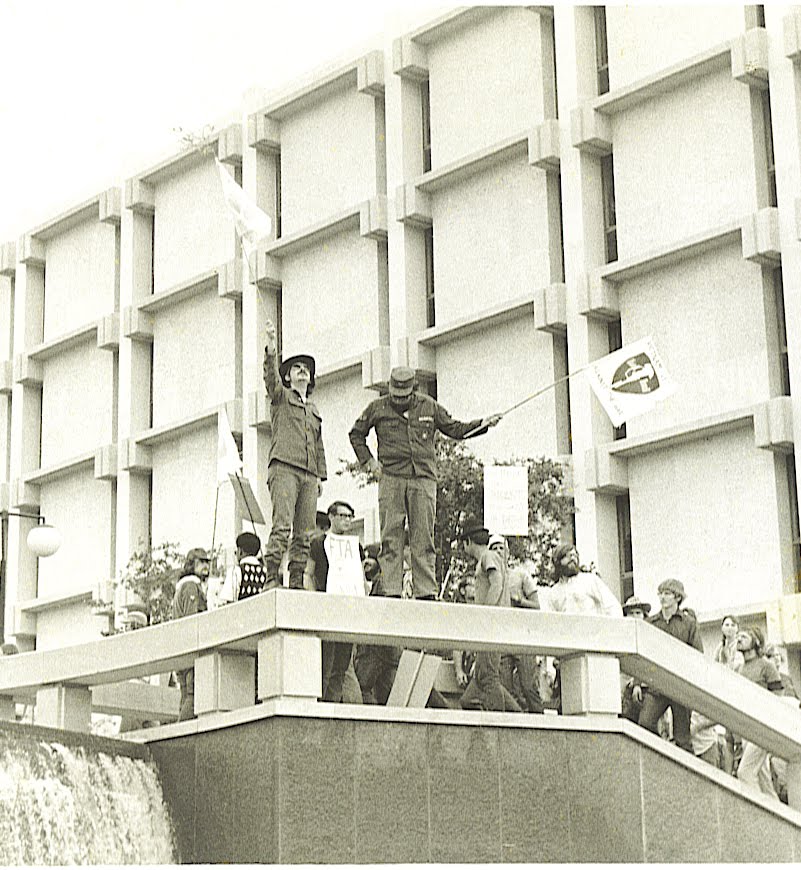
Some selections are rooted in Steve’s activism as part of Austin’s late 1960s-early 1970s anti-war movement. “Jailpoem 2,” from 1970, was clearly written following angry protests of the U.S. invasion of Cambodia and massacres of students at Kent State and Jackson State. Steve became a leader in the Austin chapter of Vietnam Veterans Against the War.

Steve Russell, front with VVAW flag, participates in a demonstration by Vietnam Veterans Against the War on the University of Texas Campus at Austin in the late Sixties. Photo from Mariann Wizard’s files.

“At the Vietnam Veterans Memorial” alternates flashbacks of a Southeast Asian village, a horse cavalry massacre in an Arapaho village, and tears for the fallen soldiers memorialized on the Wall. “Seeing Off the Troop Train” contrasts his youthful desire for heroic action with his grandmother’s wisdom and his own fears as a father:

Twenty-eight years later, my son is a volunteer soldier.
Nobody elected Bush or his crew of 20th century retreads.
Granma is not here to say ‘We got no business over there!’
But I hear her anyway.

Not everything is equally successful. “Not Juan Valdez,” a clever idea, is marred by Spanish spelling errors and the misplacement of Colombia’s iconic coffee grower to the Mexican state of Chiapas. Not Juan Valdez, indeed; this one confuses the reader and thus loses points.

A few poems with long, complex lines push against the borders of the printed page, seeming to demand spoken performance and perhaps hand drum punctuation, but add to the depth of the collection overall.

Wicked Dew charts a vision of optimism, traditional values, and endurance in selections such as “Indian Lawyer’s Creed” and “A Matter of Faith.” “To My Grandfather,” the initial poem in the collection, is perhaps the most revealing of these:


I told him I wanted to be like Mickey Mantle,
who escaped the poverty of rural Oklahoma,
and appeared to own New York,
a grand place located near Oz…

I left Oklahoma
and as the years accumulate
Oklahoma almost leaves me.
The road home is distant and dusty and even more unlikely
than the road here…

I have seen New York.
And Oz.
And College…


And although I still cannot tie a necktie, Grampa,
I have taken your name…

and I want you to know
I am still playing batter.


Retired from a first career as an Austin and then Travis County, Texas, trial judge, and a second as a professor of criminal justice in San Antonio and later at Indiana University, and with a book of essays also just out (Ceremonies of Innocence: Essays from the Indian Wars, 2012, Dog Iron Press), Steve Russell bats close to a thousand with this collection of verse.

[Mariann G. Wizard, a Sixties radical activist and contributor to The Rag, Austin’s underground newspaper from the 60s and 70s, is a poet, a professional science writer specializing in natural health therapies, and a regular contributor to The Rag Blog. Read more poetry and articles by Mariann G. Wizard on The Rag Blog.]

The Rag Blog

Posted in Rag Bloggers | Tagged , , , , , , , , | 3 Comments

Bill Fletcher, Jr. : ‘Flip the Script’: Jobs over Deficits

Image from The Fiscal Times.

The Republican lock on Congress
means a strategy for the cities

If we are to fight it out on the economy, this will not happen in the Republican Congressional Districts. It is a fight that we will have to take up in cities around the country. It means social protests which are disruptive.

By Bill Fletcher, Jr. | The Rag Blog | January 9, 2013

There is a strategic question that faces progressives, one that is receiving increased attention. Due to the 2010 elections and the Republican domination of state legislatures, Congressional Districts have been gerrymandered in order to guarantee a lack of any significant electoral challenges. In other words, these Districts have Republican Congresspeople who are not worried about opposition.

As we saw in the lead up to the “fiscal cliff” negotiations/resolution, most Republicans felt no internal pressure to compromise. It is quite likely that they will feel little pressure in their districts for at least 10 years. As a result the sort of pressure that they must feel must transcend their districts and actually be more at the societal level.

What this means is that while progressives absolutely need an independent electoral strategy that builds locally-based organizations capable of successfully running candidates for office — both inside and outside of the Democratic primary system — that is insufficient.

In fact, it is the Occupy Movement that pointed us in the direction of the other leg of such a movement. What the Occupy Movement accomplished, among other things, was to change the social discourse. Despite every effort by the mainstream media to dismiss the Occupy Movement, it not only grew but forced the country to start to address the question of economic inequality.

In the current context the implications should be clear. If, for instance, we are to fight it out on the economy and specifically on unemployment, this will not happen on the basis of fights in the Republican Congressional Districts. It will be a fight that we will have to take up in cities, including but not limited to state capitols, around the country. It means social protests which are disruptive.

In order for this to happen we must actually re-train many social movement activists and thinkers in the lessons of the 1930s labor movement, the 1950s-1960s freedom movements (including but not limited to the Civil Rights Movement), the movement against the Vietnam War, and the work of the early environmental movement.

Occupy, in that sense, was onto something. We must carry out a fight for space as part of the fight for power. Land occupations, eviction blockades, boycotts, as well as mass demonstrations, are all critical. [Note: in fact, we need, right now, a series of REALLY mass marches for jobs.] In other words, the sort of pressure that needs to be brought about must be something that Republicans AND Democrats feel, and in fact, becomes a serious source of concern.

Before we find ourselves wallowing in self-pity as we worry about the Republican “lock,” let’s rethink our strategy and tactics. We may be able to flip the script, and sooner rather than in the distant future.

This article was originally published at billfletcherjr.com and was distributed by Progressive America Rising.

[Bill Fletcher, Jr., is a racial justice, labor, and international writer and activist. He is a Senior Scholar with the Institute for Policy Studies, the immediate past president of TransAfrica Forum, an editorial board member of BlackCommentator.com, the co-author of Solidarity Divided, and the author of They’re Bankrupting Us: And Twenty other Myths about Unions. He can be reached at billfletcherjr@gmail.com. Read more articles by and about Bill Fletcher on The Rag Blog.]

The Rag Blog

Posted in Rag Bloggers | Tagged , , , , , | 1 Comment

Harry Targ : ‘The Untold History of the United States’

It’s not untold…
The Untold History of the United States

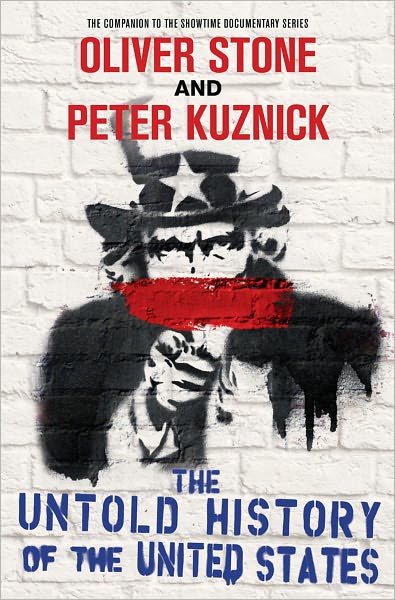
Stone and Kuznick’s 10-part series is a brilliant and entertaining narrative of the United States’ role in the world since the onset of World War II.

By Harry Targ | The Rag Blog | January 9, 2013

Oliver Stone has made an enormous contribution to discussions of the United States role in the world. His films have described the horrific consequences of United States foreign policy for the people of El Salvador and Vietnam, the American political system, and the U.S. soldiers victimized by wars not of their making. While his films, such as JFK, raise controversial claims, they have stimulated important public conversations.

This television season, Showtime, a cable channel, is showing a 10-part series written and produced by Stone and his academic collaborator, historian Peter Kuznick. The series, The Untold History of the United States, is a brilliant and entertaining narrative of the United States’ role in the world since the onset of World War II.

It warrants broad distribution within educational institutions and among communities of political activists. Because of our ahistorical culture people do not have a sense of the critical decisions that were made 50 or 100 years ago which have structured the political and economic life of the country ever since.

Critical moments in United States history have channeled the prospects for progressive social change today and tomorrow. From the arrival of colonial armies to the “new world,” to the introduction of slavery to the Western Hemisphere, to revolution against British imperialism, to the civil war and the defeat of post-war reconstruction, the American experience has been shaped by class and race in the context of burgeoning industrial and financial capitalism. The Spanish/Cuban/American war stimulated the rise of the United States as the preeminent empire from the Philippines to the Western Hemisphere.

Most of us have received a sanitized history of these earlier historical moments. In addition, our understanding of the rise of socialist movements in the 1930s in response to the Great Depression and the global fascist threat, the realities of World War II, and the emerging U.S. hegemony after the war which led to the “Cold War” between global capitalism and socialism have been limited as well.

Oliver Stone’s 10-part “untold history,” in collaboration with Professor Kuznick, fills in some of the void. Several themes about the onset of the Cold War are particularly important:

First, while the series overemphasizes the role of elites in shaping U.S. history Stone and Kuznick do point out that these elites always perceived the threat workers, radicals, and other rank-and-file activists meant to ruling class dominance. Much of foreign policy was designed to crush revolutionary ferment overseas and at home.

Second, in the first two episodes emphasis is placed on the lost opportunity for the left that resulted from the successful efforts of political elites, particularly in the Democratic Party, to force Henry Wallace, President Roosevelt’s third term vice president, and 1948 candidate for president on the Progressive Party ticket, from power. Wallace as Secretary of Agriculture during the New Deal was an economic populist, anti-racist, and pro-union sympathizer and after World War II an advocate for United States/Soviet Union collaboration.

Stone and Kuznick probably exaggerate Wallace as an alternative to the imperial, counter-revolutionary, and racist path the United States took after the war but correctly make it clear that CEOs from massive corporations and banks and political elites from both political parties were committed to crushing those left forces that flowered in the United States in the 1930s and grew in popularity all across the globe.

The Soviet Union was one manifestation of global resistance to capitalism that paralleled the spread of massive anti-colonial ferment in the Global South.

Third, the filmmakers provide overwhelming evidence to show that the defeat of fascism in Europe was largely the result of the massive Soviet military machine. Americans suffered about 290,000 wartime dead and the Soviet Union 27 million. And Stone, who narrated the documentary, suggests that while Joseph Stalin was a cruel dictator, his policies must be understood in the context of the rise of fascism in Europe and the refusal of western powers, particularly Great Britain, France, and the United State, to stand up against it.

He correctly portrays Stalin as a nationalist who was prepared to sacrifice all principles, in this case Communist ones, to prepare for and to defend the Soviet Union. This overriding commitment, Stone implies, carried over into Soviet diplomatic interaction with the rest of Europe and the United States after the war.

Fourth, in great detail Stone and Kuznick make it clear that the United States did not have to use two atomic bombs over Hiroshima and Nagasaki to force the Japanese to surrender in the summer of 1945. The Japanese leadership knew they were soon to be defeated. Many had advocated for surrender by the time of the Potsdam Conference of July, 1945 and American policymakers were aware of it.

President Truman’s advisors knew that if the Soviet Union declared war on Japan which the Soviets promised to do by August 8, the enemy would give up. But despite this, the filmmakers suggest, President Truman tried to use the powerful new weapon against the Japanese before the Soviet Union had a chance to enter the war, and thus be a diplomatic player in Asia after the war.

Also, and this was critical, the bomb was designed to send a message to the Soviet Union as well as Japan. The United States in the years ahead would be the dominant military power in the world.

Stone and Kuznick point out that the decisions to drop two atomic bombs on Japan signaled the dawn of a new age. Now weapons of mass destruction would be used to pursue global hegemony. There no longer would be any limits on the possibility of death and destruction derived from world affairs.

In other words, Stone and Kuznick are making the case that at least from the onset of the Cold War to today, U.S. foreign policy has been driven by economic and political interests to dominate the world and has responded violently to a multiplicity of forms of resistance. The locales of struggle changed as would the forms of resistance. But the structure that was put in place after World War II remains the albatross around the necks of those who seek change today and tomorrow.

The series is an indispensable lesson for peace and justice activists today. However, it should be added that the “untold” story has been told before. As a result of the threats of nuclear war in the 1950s, United States policies toward Cuba and Vietnam in the 1960s, and patterns of U.S. covert interventions and violence against peoples on every continent, progressive scholars began to use their methods to uncover this history 50 years ago.

Historians and activists were inspired by the classic text by William Appleman Williams, The Tragedy of American Diplomacy. Williams’ work, then called “historical revisionism,” inspired other groundbreaking studies of the onset and perpetuation of the Cold War by Joyce and Gabriel Kolko, Gar Alperovitz, Diane Clemens, Lloyd Gardner, Walter LaFeber, Thomas Patterson, and many more. The works on McCarthyism, repression of labor militancy, and mystification in popular culture could fill libraries.

While it is true that documentary films cannot provide footnotes, it is important for viewers to realize that progressive scholars during the depths of the Cold War used their skills to research, teach, and for some, engage in political activism based on their findings.

And finally, if the “untold” story has in fact been told many times, a question that becomes important is why we as a people, even the political activists among us, are not apprised of it. And this leads to analyses of how knowledge has been appropriated in the service of United States foreign and domestic policy.

[Harry Targ is a professor of political science at Purdue University who lives in West Lafayette, Indiana. He blogs at Diary of a Heartland Radical — and that’s also the name of his book from Changemaker Press which can be found at Lulu.com. Read more of Harry Targ’s articles on The Rag Blog.]

The Rag Blog

Posted in Rag Bloggers | Tagged , , , , , , , | 1 Comment

Lamar W. Hankins : The Failure of Religion-Based Public Grief

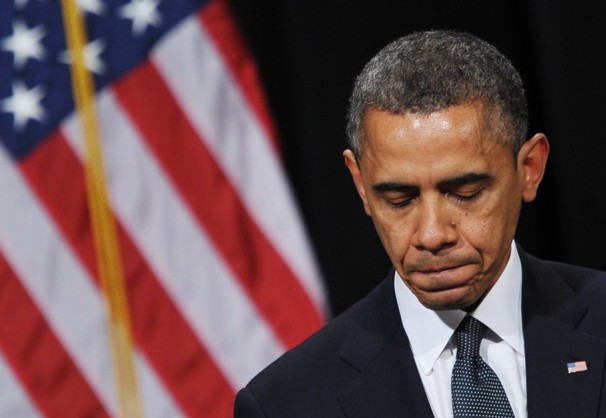
On Sunday night, December 16, President Obama spoke at a vigil for those who died at Sandy Hook elementary school in Newtown, Conn. Image from The Washington Post.

The failure of religion-based public grief

My dissonance came from the very words Obama spoke and quoted because for me they are empty and inconsequential in the face of such tragedy.

By Lamar W. Hankins | The Rag Blog | January 8, 2013

When President Obama spoke at the memorial service for the children, teachers, and administrators murdered in Newtown, Connecticut, I was overwhelmed by dissonance. His remarks assumed that a Christian perspective was applicable to everyone who mourned as he spoke about “eternal glory” and quoted bible verses: “For we know that if the earthly tent we live in is destroyed, we have a building from God, an eternal house in heaven not built by human hands.”

I empathize with Obama’s reliance on scripture and belief in a supernatural world with a heaven above and prayers heard by a god who presumably cares. With such tragedy, it is difficult to know what to say without relying on that which is familiar and may comfort the speaker and at least some of the listeners.

What to say confounds Christians and non-Christians alike. But my dissonance came from the very words Obama spoke and quoted because for me they are empty and inconsequential in the face of such tragedy.

If there were a god who cared, who answered prayers, the deaths of these 26 people and the killer’s mother would not have happened. We might disagree about the lives of the adults who were killed, but it is hard to ignore the essential innocence of the 20 children whose lives were snuffed out.

Unless a person believes in the Old Testament practice of child sacrifice, there can be no justification for a culture that makes it easy to end so many young lives so quickly.

I have no reason to doubt, as Obama said, that Newtown is a community “full of good and decent people.” And the survivors of December 16 were not alone in their grief, though it is hard to imagine that any of us felt grief in the same way those families did.

In spite of Obama’s best intentions, there is no way that any of us can fully comprehend the burdens felt and experienced by the families of those dead children and their public school caretakers. And Obama was right to point out the selflessness of those caretakers.

Obama’s acknowledgement of the importance of our care and support for one another was a fitting reminder that we are all in this together:

As a community, you’ve inspired us, Newtown. In the face of indescribable violence, in the face of unconscionable evil, you’ve looked out for each other. You’ve cared for one another. And you’ve loved one another. This is how Newtown will be remembered, and with time and God’s grace, that love will see you through.

But Obama’s reliance on his personal theology added nothing but dissonance to his valuable reminder of our togetherness and the need to find solutions to gun violence as communities and as a nation:

…[W]e come to realize that we bear responsibility for every child, because we’re counting on everybody else to help look after ours, that we’re all parents, that they are all our children… Can we honestly say that we’re doing enough to keep our children, all of them, safe from harm?… I’ve been reflecting on this the last few days, and if we’re honest with ourselves, the answer’s no. We’re not doing enough. And we will have to change.

Obama then recounted the four mass shootings that have occurred since he became president, as well as other recent mass killings and deadly shooting incidents: Tucson, Aurora, Oak Creek, Newtown, Columbine, Blacksburg. He continued:

We can’t tolerate this anymore. These tragedies must end. And to end them, we must change. We will be told that the causes of such violence are complex, and that is true. No single law, no set of laws can eliminate evil from the world or prevent every senseless act of violence in our society, but that can’t be an excuse for inaction. Surely we can do better than this… We can’t accept events like this as routine.

This appeal to political action to stop such senseless violence should have resonated with everyone. Especially so now that we know, thanks to Slate.com, that 18 people are killed each day in the U.S. by gun violence. Stated another way, every 36 hours, we experience the number of gun deaths that occurred in Newtown on December 16.

After making his appeal to find answers to the useless violence caused by people with powerful killing machines, and discussing the human condition briefly, Obama returned to his Christian message, quoting scripture which suggests that the deaths of these 27 people were a part of his God’s “heavenly plan,” as well as the plan of Jesus, which we will not be able to understand.

Even as Obama said that “God has called them all home,” he failed to explain why they had to suffer murder by Bushwacker in the process.

But Obama failed to note the contradiction in his call for political action for gun control. If the deaths of these 27 people in Connecticut were God’s plan, who are we to interfere in that plan? How can we interfere with an act of the Almighty? And making his “God’s will” argument is a strange comfort to those who lost their young children to the actions of a mentally unstable individual who had access to an assault rifle. It is a cold and callous god who would will the deaths of 20 young children, as well as the adults who tried to protect them.

And, of course, Obama felt the need to end his eulogy by once again invoking his religious views: “May God bless and keep those we’ve lost in His heavenly place. May He grace those we still have with His holy comfort, and may He bless and watch over this community and the United States of America.” By implication, God has not kept up His responsibility to watch over us all.

Newtown includes not just Christians of many stripes (mainly Catholic, but also Mormons, mainline Protestant Christians, Pentecostals, and others), along with Jews, Muslims, followers of Eastern religions, nonbelievers, and the religiously unaffiliated. Faced with speaking to such a diverse group, it is not appropriate to assume that they will all find comfort and blessings in any particular version of Christian theology and belief.

But those from the political class regularly mouth the platitudes and beliefs of Christianity because it is the dominant religion in the U.S. References to Christian doctrine are the politically safe route to curry favor with that majority, many of whom also believe in astrology, reincarnation, ghosts, witches, and other superstitions not consonant with Christian doctrine.

Even as a Christian, I did not believe in heaven, hell, miracles, the virgin birth, transubstantiation, and other mythologies that are clearly impossible or beyond reason.

As a humanist, I derive no comfort, holy or otherwise, in being told that the killing of these 27 people was all a part of God’s plan, that all the innocent children are with Jesus in Heaven, and that God has called them home. Their actual homes are bereft of their presence, missing their laughter, joy, and sorrow, and filled with people whose grief seems almost unbearable.

No Bible verses or supernatural ideas or superstitions can change that for most people. For those who are comforted by such beliefs, Obama’s words may have been appropriate, but for the rest, they likely seemed insensitive, unreasoning, and obsequious.

Obama’s task was daunting. Much of it he did well, but pushing his theology on others was unnecessary, unhelpful, and potentially offensive to those from other lifestances, as well as many Christians who don’t hold to such doctrine.

Christians in public life need to end their self-centeredness and realize that they represent only about one-third of the world’s people, though they are a majority in the U.S. And none of them know, any more than I do, what happens after we die. About death, as we have been reminded by the great 19th century orator Robert Ingersoll, ignorance is equal among all people.

No matter who is in the majority when it comes to religion or non-religion, we should all learn how to speak a common language of comfort, care, compassion, and grief without resorting to the shibboleths of personal religious belief.

[Lamar W. Hankins, a former San Marcos, Texas, city attorney, is also a columnist for the San Marcos Mercury. This article © Freethought San Marcos, Lamar W. Hankins. Read more articles by Lamar W. Hankins on The Rag Blog.]

The Rag Blog

Posted in Rag Bloggers | Tagged , , , , | Leave a comment

Howard Wooldridge : Rocky Mountain High / 3

Howard “Cowboy” Wooldridge in Washington, D.C.,  with his wife Karen..

Misty and me:
Fighting pot prohibition in Colorado, Part III

An analysis of the 2012 state initiatives on cannabis.

By Howard Wooldridge / The Rag Blog / January 8, 2013

Howard “Cowboy” Wooldridge, the founder and director of Citizens Opposing Prohibition (COP), is a Texan since 1994 and a former Michigan police officer and detective. Wooldridge has become one of the most effective advocates in Washington, D.C., for ending marijuana prohibition and the “war on drugs.” Howard — with his horse (and “partner in politics”) Misty — took part in the successful Colorado campaign in support of Amendment 64, to legalize cannabis for recreational and industrial purposes there.

This is the third in a three-part series written for The Rag Blog.

The vote this fall has been heard “around the world.” The voters of Colorado and Washington cracked a big hole in the world-wide “Berlin Wall” of marijuana prohibition. Even Holland with its system of cannabis coffeehouses does not measure up to the full legalization passed in these two states.

I just read an article in Der Spiegel (Germany’s Time magazine) pointing out all the policy difficulties this vote has generated for President Obama and leaders of South and Central America. The light is now shining brightly at the end of the tunnel.

And there is no going back. Even if federal agents crack down hard in Colorado and Washington state, try finding a jury to convict “offenders” of anything. While in Colorado I had a meeting with Boulder County District Attorney Stan Garnett. He reiterated to me what he’d said on 60 Minutes: seating a jury of 12 on a marijuana case would be impossible. Jury nullification is a fact in these two states and it won’t go away now.

Beyond our borders, the ripples from the Colorado and Washington waves are striking forcefully, especially in Mexico and Central America. Mexico’s new President Peña Nieto has already called for a review of policy. He asked, “Why should my government enforce marijuana prohibition, when, if that product reaches Colorado, it becomes legal?”

Guatemala’s President Perez Molina has openly called to legalize all drugs to reduce or end the violence and suffering in his drug-transit country. These and other voices are emboldened by the vote, even as the power of the “gringos” is still felt. However, the United States is NOT abandoning its prohibition position, no matter that President Obama was a stoner, not just a toker.

What is all the yelling and screaming about? In Colorado, effective December 10, 2012, anyone 21 and older may possess one ounce (28 grams) of marijuana and grow their own up to six plants (three seedlings and three mature plants). And you know some will grow eight or t10 plants (like doing five miles per hour over the speed limit, cops usually won’t stop you for less than 10 mph over).

Also, the state will set up, by July 1, 2013, a system to sell marijuana in designated, regulated stores. The issue of driving under the influence of marijuana was not addressed. Police officers will continue to employ existing law to arrest for DUI marijuana and other non-alcoholic drugs that impair driving. Amendment 64 is now part of the Colorado constitution. This is important because the legislature cannot mess with it. Taxing marijuana, and how much, are still up in the air.

In Washington, marijuana up to one ounce became legal for 21 and over on December 6, 2012. Cultivation for personal use remains illegal. The state Liquor Control Board will develop, by December 2013, a system to sell marijuana. The Chairman of the House Committee on Public Safety, Roger Goodman, will be in charge of this project. Goodman is a committed cannabis legalizer.

As part of Initiative 502, Washington declared that any driver with five or more nanograms of tetrahydrocannibinol (THC, one of cannabis’ active compounds) in their blood will be considered DUIM. Of interest, the experts credit the marijuana issue with getting an 81% voter turnout, the highest in the nation. The issue turned out voters for and against, and the side favoring an end to prohibition won.

Washington’s tax scheme is set. Count on a 75% tax on the final product. That translates (say Washington government officials) into $12 per gram, currently the illicit market price for quality bud. At that price the cartels can still make a healthy profit by undercutting the price of the legal product.

Both states have a heavy responsibility to set up production, processing, and retail selling correctly. Literally, the eyes of the world are upon them.

Both states’ initiatives also legalized the growing of cannabis hemp (for fiber, fuel, food, and thousands of other non-drug uses) but this will likely have zero impact. The federal Drug Enforcement Administration will still bust anyone growing on the large scale needed for industrial hemp.

Michigan also had five important city votes that demonstrate the will of the voters. The City of Detroit voted 3 to 1 to legalize marijuana. Even extremely conservative Grand Rapids (more churches per square mile than any city in the USA) made simple possession a civil infraction, like a parking ticket. All five votes ended in victory for the anti-prohibition side. Politicians have been put on notice of the will of the people. They ignore these votes at their peril.

What does that mean? In Texas, six-term congressman and former federal officer Sylvester Reyes LOST to legalizer Beto O’Rourke in El Paso this year. Reyes made legalization an issue and he lost. O’Rourke comes to the Congress in January as the first or second freshman elected who voters know favors legalization of marijuana. Jared Polis (D-CO) was probably the first.

The last of the good news came from the Commonwealth of Massachusetts. They voted YES to cannabis as medicine, an issue between doctor and patient. The Bay State makes 18 of the 50 states where God’s medicine is legal at the state level. One in three adult Americans now has legal access to medical cannabis.

Sadly, Arkansas just missed legalizing medicinal cannabis. The vote was about two percentage points shy of common sense and personal liberty. Still, since it was close, and it was the first time any easing of cannabis prohibition had appeared on a Southern state ballot, supporters are putting their shoulder to the wheel and preparing for another day, another election.

Oregon’s Measure 80 failed by three points as a blame game divided supporters. Did it fail because it was not properly funded? Or was it so badly written funders knew it would fail and thus did not waste their money? M80 would have legalized possession and growing marijuana for adults without regard to how much one could possess. The most controversial part was a commission to regulate growing and selling that would have five growers elected at large and two appointed by the government. In other words, growers would be regulating themselves. This may have been what doomed the initiative.

Anti-prohibition forces have realized the goal of the first states going legal. nationally; they are re-energized, knowing that it has become a question of “when,” not “if.” The Empire will strike back as hard and as long as it can.

The DEA and narcotics officers want the paychecks, overtime, and job security. They will continue to spew lies and try to make Americans afraid of a brave new world of regulated and taxed marijuana. But they will lose. As a retired detective, I will grieve for each colleague slain in this useless, senseless prohibition. Which officer, which grower, which dealer will be the last to die?

Howard Wooldridge was Thorne Dreyer’s guest on Rag Radio, Friday, November 30, 2012. You can listen to the podcast here:

[Harold Wooldridge, who was a Michigan police officer and detective for 18 years, co-founded Law Enforcement Against Prohibition (LEAP) and is executive director of Citizens Opposing Prohibition (COP).]

The Rag Blog

Posted in Rag Bloggers | Tagged , , , , , , , , | Leave a comment

MUSIC / Ron Jacobs : Punk, Politics, and the 1980s

Patti Smith, New York, circa 1976. Photo © Stephanie Chernikowski.

Punk, Politics, and the 1980s

Rock music historians and critics generally agree that punk was a reaction to the gaudiness of 1970s stadium rock and the creation of rock royalty like the Rolling Stones and Led Zeppelin.

By Ron Jacobs / The Rag Blog / January 7, 2013

My introduction to punk rock shows was less than auspicious. I did see the Clash on their first U.S. tour in 1977, yet the venue for that show was a rock festival in Monterey that attempted to bring together punk, reggae, and psychedelic music. The endeavor failed financially but did afford those who attended with the opportunity to hear plenty of great music: Country Joe and the Fish, Peter Tosh, The Clash, just to name a few.

It’s not that the festival was a bad idea. It was just ahead of its time.

Anyhow, back to that first genuine punk show experience. The Stranglers were playing at a UC Berkeley housing coop down the street from where I lived. I think The Mutants opened. During the opening set I somehow ended up in the mosh pit and got hit pretty hard. I moved away and my spot was taken over by a couple friends who had transitioned from hippie to punk a few months earlier. They beat the shit out of some guy they knew from previous mosh pits who hated hippies.

That was the consciousness back then. Hippies were supposed to hate punks and punks were supposed to hate hippies. Even though we got harassed by the same cops for different reasons (punks didn’t smoke much weed), we were supposed to hate each other.

For those of us who lived on the street — sharing seedy hotel rooms and couches, squatting in buildings, and just living in general — we couldn’t afford the same media-induced feud the suburban members of either subculture could.

Fortunately, that quarrel went the way of most media-induced music feuds; Beatles vs. the Stones, soul vs. rock, mod vs. rocker, etc. The result, at least in the Bay Area, was an understanding that the music was bigger than any particular person or subculture.

Punk could not have existed without what came before it in rock and roll. Likewise, anything that came later would be influenced by the attitude and the musical qualities that punk brought to the dance floor. This understanding came about in no small part because of two bands in particular. Those bands were the Patti Smith Group and The Clash.

Patti Smith was already a punk demigod by 1980 — and this in a culture that destroyed gods and goddesses. Her legend was greater than her music and her charisma outdid them both. Politically, she stood with the anarchism of the Yippies. Artistically, she wrote verses that brought to mind the Song of Solomon, Howl, The Mask of Anarchy and more.

All of that was matched to a three-chord progression, a voice that borrowed from Bob Dylan, Janis Joplin, and Robert Plant, and a swagger that put Mick Jagger to shame. In addition, she just plain emanated an attitude that said fuck you — an essential part of rock and crucial to the format known as punk.

I have to share a couple experiences involving Patti Smith. I was a college freshman in 1973 in New York City. Somehow — not because I was that hip — I ended up at a poetry reading in St. Mark’s Church. Patti Smith was one of the poets. She took the stage with a guitarist and a drummer in between a couple other poets and proceeded to blow my mind with a rendition of her song Piss Factory.

Once I saw that, I can honestly say my definition of rock expanded beyond the boundaries that had already been stretched innumerable times. I wanted a recording and I wanted to see and hear her more. Unfortunately, I would have to wait until 1975 when she released her first album on Arista. Titled Horses, it changed the meaning of rock.

Like Bob Dylan’s Highway 61 Revisited, Jimi Hendrix’s Electric Ladyland, or the Beatles’ Revolver (to name a mere three of rock’s boundary-expanding recordings), after one listened to Horses, everything else would be compared to that experience.

I saw her at Georgetown University’s McDonough Arena a few months later. She writhed onstage in a worn t-shirt and kept the crowd on its feet for the entire show. I don’t know if it was punk, but it was definitely rock and roll. (The Patti Smith Group would be one of those bands that, despite being originally labeled as punk, would transcend that label and, like The Clash, ultimately become a great rock band.)

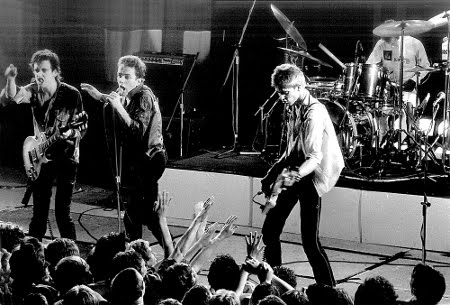
The Clash, Live at the Paladium, September 21, 1979. Image from The Soundboard.

Then there is The Clash. Their music was always overtly political. Their version of  “Police on Our Backs” was the theme song for those of us who hung out on Telegraph Avenue in Berkeley and drank beer in People’s Park. Their working class anger against the system that intentionally ignored youth without money and used the police to keep them on the run hit a chord with anyone the police harassed. Plus, just like Patti Smith, they knew how to create good rock and roll. I wrote in a piece published a year or two ago about the album London Calling:

A few days before Christmas, while the sounds of Pink Floyd’s The Wall reverberated in our apartment on Berkeley’s Dwight Way from the building next door a friend walked in the door with a double album from the Clash titled London Calling. This album was not only the best punk album of the year. It was the best album, period. From the first cut called “London Calling” to the final cut “Train In Vain,” this work had everything a rock album could hope to contain. Rebellion, reggae, and straight-out rock and roll. Armageddon, the street, and the essence of love. When our friends who didn’t really like punk took a listen to this album, it changed their minds.

In other words, The Clash kicked ass. They celebrated revolution and did what they could to foment one of their own. Their concerts were an anarchic celebration of the passion and power rock and roll can create.

Anyhow, back to San Francisco. The band that set the tone for all San Francisco punkers was the Dead Kennedys. In a town filled with great music and plenty of places to enjoy it in, DK shows were among the best. Raucous, political and crowded.

Their first single was called California Uber Alles. A satirical poke at the bullshit liberalism of then Governor Jerry Brown and his sophistry, the song laid bare the viciousness that lay behind the smiley face of California’s pseudo-hip establishment. In the remake of the song a year later, the title was changed to “We’ve Got a Bigger Problem Now.” This version revised the lyrics to fit the new political mood in the United States after Ronald Reagan’s election to the White House.

The transition from gentle smiley-face fascism to the great communicator channeling Josef Goebbel’s lessons in propaganda meant the shit was about to hit the fan, especially for those not with the program. The Dead Kennedys were definitely a necessary part of the soundtrack.

Indeed, 1984 brought the Democratic Party to San Francisco for their quadrennial convention. This was the year that Jesse Jackson made a serious run at the nomination, running on a fairly radical platform. His campaign was knocked off its pace when Zionists in the party leaked evidence that Jackson had once called New York “Hymietown.” The Zionists were afraid of Jackson’s Palestinian-friendly statements and wanted him out of the running. The ticket ended up being composed of the washed-up liberal Walter Mondale and the first female on a national ticket, Geraldine Ferraro.

This convention also saw the first use of “free speech zones” created for public protest. That’s where the Dead Kennedys came in. On the third or fourth day of the convention, a number of anti-authoritarian groups staged a series of sit-ins and street blockades to protest the complicity between banks, the war industry, the Democratic Party, and the ongoing low-intensity conflicts taking place in Central America, Afghanistan, and elsewhere around the world.

The San Francisco police and other law enforcement agencies, who had been hoping for some action all week long, let loose and busted a few hundred people. While the cops finished up their operation, the Dead Kennedys played a set in the free speech zone. Someone notified them about the arrests and they rallied the crowd to march to the city jail after the show.

Before that, however, a small number of Nazi skinheads jumped on the stage and tried to attack the band. Without missing a beat, Jello Biafra and the band jumped into their song “Nazi Punks Fuck Off.” Soon, the members of the mosh pit were onstage and dealing with the Nazi skinheads, who left rather quickly.

Dead Kennedys. Image from last.fm.

The best punk was political punk. Whether the lyrics themselves were political or the musicians involved made clear their political positions via statements they made or by rallies they played at. Some musicians actually formed organizations to promote certain agendas. Perhaps the best known of these was Rock Against Racism (RAR).

Originating in Britain as a reaction to the growth in racist Oi bands and other such elements in the punk scene, and various racist attacks and statements by some public figures attacking immigrants, this movement eventually came to the United States, which has its own well-documented problems with racism. In the U.S., RAR teamed up with the Yippies in some parts of the country (mostly urban) to put on shows and organize rallies. Mark Huddle describes it like this in the March 10, 2009, issue of Verbicide:

In the U.S., Rock Against Racism was always a decidedly local affair — a true grassroots “movement.” There were dozens of benefits across the country but no national organization. Anyone who hated the violence and mindless hatred evinced by too many young kids floating around the margins of punk could organize a show; shows which almost always became sites for political networking and community building. From Anti-Racist Action in Minneapolis to the Ska Against Racism tours in the ‘90s, the punk scene became a laboratory for those who understood that every once in a while you have to police your space.

By this time, the Yippies had moved far away from their hippie roots (although a number of them still liked to smoke weed and eat acid) and were well into showcasing politically charged punk bands and working with punk street kids. The first indication of this shift could be seen in the Smoke-Ins on July 4th in DC in the late 1970s and in the comparable Pot Parades in Manhattan.

Their newspaper, Yipster Times (later Overthrow), featured a manifesto for freedom and free speech written by Patti Smith and titled “you can’t say fuck in radio free America.” This was published after a New York FM radio station refused to air a concert of hers precisely because she wanted to say “fuck.”

Rock music historians and critics generally agree that punk was a reaction to the gaudiness of 1970s stadium rock and the creation of rock royalty like the Rolling Stones and Led Zeppelin. In San Francisco, it was also understood to be a reaction to the longhair drug culture represented by the Grateful Dead. This didn’t mean that punkers didn’t do drugs, but that their consumption was not a requirement.

Other musical reasons for punk would most certainly be the 1970s popularity of bands like Journey, Kansas, and Foreigner that played a particular inconsequential type of rock that strayed into schlock all too often. Then there was disco; an extension of the music known as funk (which had its own roots and street credibility), disco quickly became the equivalent to the 1960s music known as bubblegum.

In other words, it was easy to ignore but still catchy with about as much substance as the inside of a ping pong ball. From its roots in the urban black ghetto, disco became the symbol of the rich cocaine-fueled subculture symbolized best by Manhattan’s Studio 54. The BeeGees were the masters of this beat in its worst incarnations. Vapidity defined.

I like to see punk as a phenomenon as old as rock and roll and kind of like street basketball. Instead of the extravagant overpriced stages of the Rolling Stones or Pink Floyd, punks brought their instruments to whatever dive they could get into. There were no soaring scales up and down the fretboard like Jimmy Page and no special orders for green M&Ms in the dressing room.

Like the garage bands of yore, punk rockers were without frills. Even the music was stripped down; sometimes it wasn’t even music except in a John Cage sort of way. Just like low-income street kids could afford to shoot hoops even though they had no cash, so could street kids start up a punk band. Plus, it kept them out of trouble.

I was never a punk rocker. My subcultural roots went back to the days when hippies became yippies and freaks. In other words, I was too political and angry to be a hippie, but liked their styles and their music. Yet, as soon as I heard the first few bars of the Sex Pistols’ “Anarchy in the UK,” I knew the times were a changin’.

My eardrums were battered by many a punk band in the late 1970s and early 1980s. I had lots of fun and rarely stood still at those shows. Punkers were some of the most energetic organizers I knew when we fought against gentrification and racism in the Bay Area. They were also, along with various older street people, the fiercest fighters against the police when the shit did hit the fan. Plus, punk beat the hell out of the fucking Bee Gees.

A version of this article appeared in Red Wedge Magazine.

[Rag Blog contributor Ron Jacobs is the author of The Way The Wind Blew: A History of the Weather Underground. He recently released a collection of essays and musings titled Tripping Through the American Night. His latest novel, The Co-Conspirator’s Tale, is published by Fomite. His first novel, Short Order Frame Up, is published by Mainstay Press. Ron Jacobs can be reached at ronj1955@gmail.com. Find more articles by Ron Jacobs on The Rag Blog.]

The Rag Blog

Posted in Rag Bloggers | Tagged , , , , , , | 1 Comment

The Hemorrhaging of America:
From Charles Whitman in Austin to Adam Lanza in Newton

By Jonah Raskin / The Rag Blog /

Shortly after last Thanksgiving, I was asked to write a piece about 2012, the year just ending. I got as far as the title and the first sentence, then gave up because I thought I was wandering too far into the fields of metaphor for my own good and for the good of the essay itself.

The title I gave the unborn essay was “The Hemorrhaging of America.” I thought of it when I read the news that Adam Lanza, a gunman in Connecticut, opened fire and killed 20 elementary school children, plus eight adults including his mother, Nancy Lanza, who taught at Sandy Hook Elementary School. Lanza had killed his mother before he took her car and drove to the school, where according to reporters he choose his victims and killed them “with brutal efficiency.”

According to reports from rural Newton, Connecticut, Mrs. Lanza owned the weapons — semi-automatic pistols and semiautomatic rifles — that her son used to slaughter 28 people, most of them between the ages of five and ten. The school psychiatrist and the school principal, who buzzed Mr. Lanza into the building because she recognized him, were also killed. Many of the children were killed at point-blank range, “execution style.” The whole event reads like a symbolic tale for Christmas: a killer named Adam and a town named Newtown — how more American could any story be?

In the wake of the massacre it’s hard to know what to say that might be helpful, though I can think of a lot of things to say including, “I knew it was going to happen,” “I called it,” “A nation that lives by the gun dies by the gun,” and “America is as violent as cherry pie.”

It’s hard to avoid clichés such as that last one, attributed to H. Rap Brown, a black militant in the 1960s, now serving a life sentence for shooting two Fulton County, African-American sheriff’s deputies, one of whom died. For a time, Brown, who was born Hubert Gerold Brown and who wrote an autobiography entitled Die Nigger Die!, wanted a violent revolution in America.

Like many would-be violent revolutionaries, Brown found that the State was a lot more powerful than he realized.

The comments that I considered are, I know, clichés, but that doesn’t discount them. Clichés contain kernels of truth. I did sense intuitively than there would soon be another out-burst of violence. One doesn’t have to be a psychic or clairvoyant to know that a killer is capable of striking any day and anywhere. Guns do kill people, though loyal National Rifle Association (NRA) members insist, “Guns don’t kill people, people kill people.”

As long as Americans can buy guns legally and fairly easily over the counter, Americans will kill other Americans and kill themselves, too. Like many other assailants, Mr. Lanza turned a weapon on himself and pulled the trigger. News stories reported that he “committed suicide.” I would say that he added his own body to the pile of corpses. The same stories reported that the authorities had no idea what Mr. Lanza’s motives might have been.

Too bad the school psychiatrist isn’t alive and can’t help to identify the killer’s motives. I know that’s a cruel, sardonic comment but I couldn’t resist making it. In the wake of the tragedy, tears are appropriate, but so is the cold light of reason.

It seems to me that we don’t really need psychiatrists. We might need sociologists and historians who can illuminate the social and historical roots of the slaughter in Newtown, Connecticut, not far from the site where English colonists slaughtered hundreds of Indian men, women, and children in a bloodbath in 1637, almost 400 years ago. The American novelist, James Fenimore Cooper wrote in his 1827 novel The Last of the Mohicans that the “soil” itself was “fattened with human blood.”

American soil has been fattened with human blood from the very beginning. American playgrounds, classrooms, and college campuses have been fattened with blood, too. The first slaughter on a college campus that I know of, took place in and around the Tower at the University of Texas on August 1, 1966, when Charles Whitman, an engineering student there and a former U.S. Marine, opened fire, killing 13 people, including an unborn child, and wounding 32 others.

I went to the tower not long ago and surveyed the scene. It had been closed for years and was reopened to visitors such as myself and the woman who accompanied me and who had been a student at UT, where Whitman’s name is still remembered. The UT Tower still haunts me.

Whitman’s name was not mentioned in the news stories that I read about Adam Lanza, though Whitman and Lanza belong together in the violent annals of American history. I’m afraid that we don’t want to remember Whitman and others like him — all men, apparently, though not all white men. I’m also afraid that if we kill our own memories of our violent past we will also terminate our future, much as Whitman ended the future of the unborn child he murdered when he shot the mother.

Ending the 400-plus years of violence on American soil will not be easily achieved and it will not happen overnight. Americans are too devoted to violence and to guns to break those addictions in one sudden change of heart At the least, however, what we might now do, immediately, is act to abolish all weapons in every school, college, and university in the U.S., and to make it impossible to bring weapons to any campus or school.

Can we at least make schools safe grounds for students, parents, and teachers? Can we please take guns away from sons such as Adam Lanza and from mothers such as Nancy Lanza, and can we begin to see that violence is a deep-seated American family value that very much needs to be cleansed nonviolently and as humane possible.

[Jonah Raskin, a frequent contributor to The Rag Blog, is the author of For the Hell of It: The Life and Times of Abbie Hoffman, American Scream: Allen Ginsberg’s “Howl” and the Making of the Beat Generation, and the editor of The Radical Jack London. Read more articles by Jonah Raskin on The Rag Blog.]
Type rest of the post here

Source /

The Rag Blog

Posted in RagBlog | Leave a comment

Type your summary here

Type rest of the post here

Source /

The Rag Blog

Posted in RagBlog | Leave a comment

Alan Waldman: ‘Rumpole of the Bailey’ is Superior Legal Britcom

Waldman’s film and TV
treasures you may have missed:

Rumpole of the Bailey, a classic British TV legal series, delighted 95% of viewers.

By Alan Waldman | The Rag Blog | December 28, 2012


[In his weekly column, Alan Waldman reviews some of his favorite films and TV series that readers may have missed, including TV dramas, mysteries and comedies from Canada, England, Ireland and Scotland. Most are available on DVD and/or Netflix, and some episodes are on YouTube.]

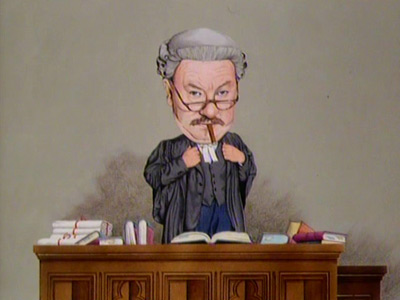
Rumpole of the Bailey was a much-beloved comic English legal drama, starring the superb Leo McKern and marvelously written by creator John Mortimer. It ran for 43 episodes in seven seasons, between 1978 and 1992 (although it is set between 1967 and 1992).

Horace Rumpole is a clever, cynical, larger-than-life barrister who defends all comers but refuses to plead guilty — or to prosecute — at central London’s legendary criminal court, the Old Bailey. He is dominated by his steamship of a wife, Hilda (played first by Peggy Thorpe-Bates and later by Marion Mathie), whom he refers to as “She Who Must Be Obeyed.” (Tee shirts bearing this logo are worn by some American wives.)

After work, Rumpole repairs to Pomeroy’s Wine Bar, where he quaffs a vin rouge he calls “Chateau Thames Embankment.”

Mortimer was an Old Bailey barrister for 36 years, defending accused criminals and often fighting against famous obscenity prosecutions. He was also an excellent screenwriter (1965’s Bunny Lake is Missing and 1999’s Tea With Mussolini) and playwright (whose touching, autobiographical A Voyage Round My Father, televised in 1984, starred a magnificent Laurence Olivier as Mortimer’s blind, opinionated father).

The series was widely acclaimed and was nominated for 10 top British and American Awards, including three “Best Actor” BAFTAs for McKern, an Edgar and a BAFTA for Mortimer, and two “Best Miniseries” Emmys. More than 94.5% of viewers rating it at imdb.com gave it thumbs-up, and 47.2% considered it 10 out of 10. Everyone I know who has ever seen Rumpole declares that they loved it, as my three wives and I did.

All seven Rumpole seasons are available on DVD and Netflix, and many episodes are on YouTube. Rumpole also stars in many charming novels and short stories by Mortimer and a great number of British radio programs.

[Oregon writer and Houston native Alan Waldman holds a B.A. in theater arts from Brandeis University and has worked as an editor at The Hollywood Reporter and Honolulu magazine. Read more of Alan Waldman’s articles on The Rag Blog.]

The Rag Blog

Posted in Rag Bloggers | Tagged , , , , , , | 1 Comment

Paul Krassner : My Tweets of 2012

Paul Krassner tweets @ZenBastard. Graphic by James Retherford / The Rag Blog.

Paul Krassner’s Tweets of 2012

By Paul Krassner | The Rag Blog | December 27, 2012

This is my first tweet. I have Writer’s Block. I mean Twitter’s Block. I’m waiting for a cure to be developed.

A minimalist summation of American culture in the Los Angeles Times on Conan O’Brien: “The Masturbating Bear will remain the intellectual property of NBC.”

Perhaps Toyota should borrow a slogan from McDonalds: “You deserve a brake today.”

Texting while having sex? Two thumbs up.

Double standard: Charles Rangel pays restitution for unpaid taxes; Wesley Snipes is sentenced to a few years behind bars for a similar response.

Excuse me, I have to take a Wiki-leak.

Join me in signing a letter to stop the inhumane detention of Private Bradley Manning.

I saw the movie The King’s Speech and was disappointed that it didn’t end with Porky Pig saying, “Th-th-the-that’s all, folks!”

Steve Jobs’ legacy is a form of alchemy — he transformed planned obsolescence into a virtue.

Poor Rick Santorum, he’s afraid that if Roe vs. Wade isn’t overturned by the Supreme Court, there will an epidemic of recreational abortions.

I stopped channeling Lenny Bruce the day he reminded me, “C’mon, Paul, you know you don’t believe in that shit.”

Today marks the 15th anniversary of Allen Ginsberg’s death; he once told me he smokes not to get high, but rather because he likes to cough.

I went to the dentist today, and the hygienist gave me a choice of X-rays or a pat-down.

Summing up the presidential campaign: It’a battle between “Keep the government out of my Medicare” and “Keep the government out of my vagina.”

I covered the Dan White trial and coined “the Twinkie defense.”

The world desperately needs a campaign beginning with Kickstarter to raise funds to build an Iron Dome for the Palestinians.

Plan B has been aborted.

I voted for Barack Obama again, and yet now, although he wept for the loss of 20 kids, he never wept for the 178 kids killed by U.S. drones in Yemen and Pakistan.

The digitally colored edition of the infamous Disneyland Memorial Orgy poster by Mad magazine artist Wally Wood is available only at paulkrassner.com.

Have a Merry War on Christmas and a Happy, Snappy and Fulfilling New Year.

[Paul Krassner edited The Realist, America’s premier satirical rag and was an original Yippie. Krassner’s latest book is an expanded and updated edition of his autobiography, Confessions of a Raving, Unconfined Nut: Misadventures in the Counterculture, available at paulkrassner.com. Read more articles by Paul Krassner on The Rag Blog.]

The Rag Blog

Posted in Rag Bloggers | Tagged , , , | Leave a comment

Bob Feldman : Race, Unions, and the Booming Texas Oil Business, 1920-1930

Burkburnett oil field, Burkburnett, Texas, circa 1920. Image from Texas in the 1920s.

The hidden history of Texas

Part 10: 1920-1930/2 — Race, exploitation of workers, and the booming oil business

By Bob Feldman | The Rag Blog | December 27, 2012

[This is the second section of Part 10 of Bob Feldman’s Rag Blog series on the hidden history of Texas.]

In 1920 over 741,000 African-Americans lived in Texas. But given the level of KKK influence in Texas and the limited political and economic opportunities that white supremacist and institutionally racist Texas society generally provided most African-Americans between 1920 and 1930, “a good many African-Americans,” not surprisingly, “left the state in the 1920s,” according to Randolph Campbell’s Gone To Texas.

But between 1920 and 1930 the number of Latinos in Texas of Mexican descent increased from over 251,000 to nearly 684,000, and by 1930, 10 percent of Austin’s population was now of Mexican descent.

Although the number of African-Americans who worked for wages as farm laborers in Texas decreased from 75,000 to 41,000 between 1910 and 1930 (due, in part, to the increasing mechanization of agricultural work), 20,000 African-Americans in Texas still owned their own farms (on which most grew cotton) in 1930.

Yet between 1900 and 1930, the number of African-Americans in Texas who were now just tenant farmers increased from 45,000 to 65,000; and 70 percent of all African-American farmers in Texas were just tenant farmers by 1930. In addition, about 64 percent of African-Americans who worked for wages were at this time employed in non-agricultural work in Texas, mostly as servants or unskilled laborers.

Most workers in Texas — whether white, African-American, or of Mexican descent — who attempted to organize themselves into unions were apparently exploited or repressed between 1920 and 1930 by the white corporate power structure in Texas. As F. Ray Marshall’s Labor in the South recalled:

The anti-union campaign was particularly vigorous in Texas. In San Antonio, for example, the chamber of commerce ran a free employment agency which placed over 2,000 non-union workers in 1920, by which time it had become almost impossible for union carpenters to get jobs. Mexican workers were brought in by the thousands, and special schools were set up to train non-union workers.

In San Antonio, the program defeated union electricians, carpenters, planning mill operators, butchers, printers and others. Beaumont, which had been a strong union town, became almost “open shop” after the anti-union attacks led by a member of the National Metal Trades Association. The anti-union forces in Dallas imported 1,500 strikebreakers, and even the printers were forced to accept non-union conditions. The Southwest Open Shop Association opened a trade school at Dallas to supply workers and persuaded the governor to send militia to Galveston to break the 1920 longshoremen’s strike.

But although “the ILA locals at Galveston surrendered their chapter in 1922, and company union was chartered in 1924” (and miners in Texas also “lost a 1926 strike against a 25 percent wage cut, and the United Mine Workers [then] disappeared” from Texas), “the open-shop movement” during the Roaring Twenties “was not completely successful, however, because the unions at Fort Worth and Houston were able to survive,” according to the same book.

Although most Texas farmers and workers in Texas did not enjoy much economic prosperity between 1920 and 1930, by 1928, “Texas for the first time led all other states in oil production with… nearly 20 percent of the total for the entire world,” according to Gone To Texas.

Besides producing super-profits for out-of-state, eastern corporate interests like the Mellon family and for some local Texas businessmen, politicians, and investors, Texas’s booming oil industry in the 1920s also began to produce super-profits for the “non-profit” University of Texas in Austin (a university that still discriminated against African-American people in the 1920s). As the same book observed:

Development of the Permian Basin… made the University of Texas… rich. The two million acres of land donated to the Permanent University Fund [PUF] in the 19th century had generated little income… But then in 1923 drillers brought in the Santa Rita wells on university lands in Reagan County…

According to David Humphrey’s Austin: An Illustrated History, “the income from the Permanent University Fund… in 1925… amounted to $225,000, gained largely from grazing leases on University of Texas’s 2 million acres in West Texas;” but “by 1927 revenues from oil leases on University of Texas’s West Texas lands poured into the Permanent University Fund at a rate of almost a quarter of a million dollars a month.”

Yet, although Austin’s “non-profit” University of Texas began to accumulate a lot of surplus wealth from its Texas oil industry property by 1927, in 1930 about 25 percent of Austin homes still had no indoor toilets, tubs, or showers, according to the same book.

[Bob Feldman is an East Coast-based writer-activist and a former member of the Columbia SDS Steering Committee of the late 1960s. Read more articles by Bob Feldman on The Rag Blog.]

The Rag Blog

Posted in Rag Bloggers | Tagged , , , , , | Leave a comment

Jack A. Smith : What’s Behind America’s Gun Violence?

Image from Black Youth Project.

Remember the children…
What’s behind America’s gun violence?

In recent decades — despite the fact that last year there were over 11,000 murders by firearms in the U.S. and another 20,000 gun deaths from accidents and suicide — the great majority of American politicians have been too gutless to fight for tougher laws.

By Jack A. Smith | The Rag Blog | December 20, 2012

There is more than the act of one individual involved in the mass gun killings that take place in America — the most recent being the massacre of 20 young children and seven school workers at the Sandy Hook Elementary School in Newtown, Conn., December 14.

The main culprit, of course, is the late killer, Adam Lanza, 20. But such events occur within a context of shared responsibility for the unparalleled number of mass and individual shooting deaths that take place in the United States every year. This includes the political system and politicians, the National Rifle Association and other gun lobbies, and federal, state and local governments. Each has played an indirect role in the latest and earlier slaughters.

Of these other responsible parties, one is our political system that refuses to strengthen absurdly deficient federal and state restrictions on the possession of various types of arms. Another is the irresponsible politicians who make it relatively easy for criminals, people with mental problems, and those who are unfit to possess weapons for other reasons to accumulate a private arsenal.

In recent decades — despite the fact that last year there were over 11,000 murders by firearms in the U.S. and another 20,000 gun deaths from accidents and suicide, not to mention many more injuries — the great majority of American politicians have been too gutless to fight for tougher laws.

President Obama was moved to tears in announcing the deaths of 6- and 7-year old children in Newtown, and said he might take “meaningful action” of an undefined nature. But Obama is risk averse and has shown a disinclination to tangle with the pro-gun lobbies throughout his first term — so there’s a chance all we’ll get is tears and rhetoric even though 80% of the American people want gun owners to secure police permits, and nearly 90% would require background checks on all gun sales.

On the other hand, the fact that 20 youngsters were massacred has shocked the nation to the extent that it may be politically advantageous for the White House and Congress to pass token legislation. Most conservative Republicans will do whatever is possible to block progress on gun control, but they may be less obstructive if a proposed law is weak and limited. No major changes are anticipated.

At one time, the Democratic presidents were willing to support gun control measures, in contrast to the recalcitrant rightists, but that’s changed in recent years. President Lyndon Johnson in the 1960s was a strong advocate, seeking passage of national legislation demanding that firearms owners obtain licenses registering all guns and rifles. It failed.

After a mass shooting in the early 1990s President Bill Clinton fought for and won two gun control laws. The Democrats were quiet during George W. Bush’s eight years and silent during the last four.

Next in responsibility for the murders is the National Rifle Association and other gun owner or industry lobbies such as the Gun Owners of America, which sports an executive director, Larry Pratt, who actually made this comment soon after the school killings:

Gun control supporters have the blood of little children on their hands. Federal and state laws combined to insure that no teacher, no administrator, no adult had a gun at the Newtown school where the children were murdered. This tragedy underscores the urgency of getting rid of gun bans in school zones.

The well-funded and fanatically supported gun lobbies greatly influence the politicians through payoffs and the threat of uncompromising electoral opposition. In order to fulfill its function as the propaganda instrument of the firearms owners and industry, the NRA argues disingenuously that the slightest regulation will eventually lead to banning of all guns for civilians, including those for home defense, hunting, and target shooting.

A large percentage of Americans appear to believe the lobby’s extremist propaganda and oppose efforts to strengthen gun laws. They seem to think a constitutional amendment provides them the right to convert society into a modern version of the Wild West, where we can “stand our ground” with bullets even against the innocent and unarmed if we claim to have been threatened.

In this regard, writes Zack Beauchamp Dec. 14 in AlterNet:

The Second Amendment prohibits strict gun control. While the Supreme Court ruled in D.C. v. Heller that bans on handgun ownership were unconstitutional, the ruling gives the state and federal governments a great deal of latitude to regulate that gun ownership as they choose. As the U.S. Second Court of Appeals put it in a recent ruling upholding a New York regulation, “The state’s ability to regulate firearms and, for that matter, conduct, is qualitatively different in public than in the home.” Heller reinforces this view. In striking D.C.’s handgun ban, the Court stressed that banning usable handguns in the home is a “policy choice” that is “off the table,” but that a variety of other regulatory options remain available, including categorical bans on firearm possession in certain public locations.

The federal government, too, must assume responsibility for creating a national culture of guns and violence that leads to continuing mass murders and individual killings. They averaged 30 a month last year. For every 100,000 residents, the U.S. averages five murders. In England it’s 1.2 murders; in Japan it’s 0.5.

The U.S., working with the arms industry, is the biggest seller of weapons worldwide, mostly to foreign militaries. It also entertains the greatest military arms budget in global history. And by its glorification of the military and of war Washington has contributed mightily to the sense that we are a gun-slinging people, at home as well as abroad, on Main Street USA as well as al Rasheed Street Baghdad.

America is the most violent country of all the advanced industrialized nations in the Organization for Economic Co-operation and Development (OECD). From slavery to the displacement and annihilation of the original peoples in order to seize the entire continent, to modern day wars, regime changes, and torture overseas, “violence is as American as cherry pie,” as H. Rap Brown once reminded us.

On July 30, Mother Jones magazine informed its readers that, in the U.S. during the last 30 years, there “have been at least 62 mass murders carried out with firearms across the country, with the killings unfolding in 30 states from Massachusetts to Hawaii.” This includes 2012’s “horrific mass murder at a movie theater in Colorado on July 20, another at a Sikh temple in Wisconsin on August 5, another at a manufacturer in Minneapolis on September 27 — and now the unthinkable nightmare at a Connecticut elementary school.”

State and local governments must assume responsibility as well for contributing toward a violent and gun-loving society. Considerable moves toward militarizing the police have taken place in recent decades as a result of the exaggerated drug wars and hyped-up terrorism wars. In the 20 years leading up to 2007 (the latest figures), special weapons and tactics teams (SWAT) have increased 1,500 percent.

Police brutality is a frequent reality — mostly but not exclusively in urban areas and at political, worker, or popular protests and occupations. We’ve handed our police departments a huge array of violent instruments that are, to say the least, disproportionate to most situations. Here is some of their equipment:

For elite SWAT teams in their Darth Vader uniforms: submachine guns, automatic carbines or rifles, semiautomatic combat shotguns, sniper rifles, gas, smoke and flashbang grenades. For regular police: handguns, concealable off-duty handguns, shotguns and/or semiautomatic rifles, tactical batons, nightsticks, electroshock guns (Tasers), mace pepper spray, tear-gas. beanbag shotgun rounds, body armor, and loud noise devices. Beginning to arrive: aerial surveillance drones, soon to be widespread and weaponized.

In combination — weak gun laws and a compliant political system fearful of powerful lobbies; a national history of violence, militarism, and frequent aggressive wars against smaller nations; and the gradual militarization of police — these are factors that have significantly helped create the gun culture in the United States.

It’s time to change all of this, but it’s not on the immediate horizon. Enhanced gun control, however, has a chance over the next several years. The great majority of Americans call for expanded gun control. Today, 40% of gun owners have not even been subjected to a background check. It should be everyone. Every gun owner should also have a license from whatever authority issues them. At present, trade shows and private sellers don’t need registration or license information. This must change. And it would be good if there was one overall national law instead of different state laws.

Obviously there should be a reduction in the number of guns in the U.S. The purchase of assault weapons, and automatics with large magazines should be banned, as should large private arsenals. There used to be a law regulating assault rifles but it expired. It was very weak with many loopholes and a new one should be much tougher. A number of people think assault rifles should be completely banned.

Some gun control advocates see no need for concealed handguns at all on the streets at all, much less efforts to allow them in schools, sporting events, bars and elsewhere.

The American people are not seeking to place impossible obstacles in the way of gun ownership. They want tighter regulation and licensing. Banning all guns except for those possessed by the military and the police will never pass, and shouldn’t for a number of reasons including the fact that political systems can and do go wrong. At times, an armed citizenry is most necessary.

There are a number of good gun control groups in the U.S., such as the well-known Brady Campaign to Prevent Gun Violence, but they are small with not much clout. It is time for the American people, especially the liberals, progressives, and the left, to unify in action on this issue and organize mass political and electoral activism for as long as it takes to vastly reduce gun violence in America.

Postscript: 

I’m sure we all agree with these lines from an editorial in The New York Times the day after the shooting in Newtown: “There is no crime greater than violence against children, no sorrow greater than that of a parent who has lost a child, especially in this horrible way.”

It is good to remember this in terms of all children, not just our own. According to the UN, a half-million children, many even younger than those at the Sandy Hook Elementary School, died as a result of Washington’s 1990-2003 sanctions against Iraq. We don’t have the child death figures from the wars in Afghanistan an Iraq but we do have some regarding Vietnam from various online sources:

  1. Ten percent of the child population of North Vietnam was killed, mainly by U.S. bombers. Another 400,000 suffered birth defects because of the U.S. Agent Orange defoliation campaign. Untold thousands continue to die to this day from accidentally detonating unexploded American land mines.
  2. According to American estimates (the Pepper Report) there have been 250,000 children killed, 750,000 wounded and invalided for life in a South Vietnam of 14,000,000 inhabitants. The great majority were killed by U.S. bombers, which decimated (allied) South Vietnam in efforts to destroy the liberation army and its many millions of southern supporters. More than 10,000 sorties by B-52s of the U.S. Strategic Air Command have been carried out over South and North Vietnam, each plane capable of dropping over 30 tons of bombs; that the number of bombs dropped monthly by American planes exceeds that dropped by U.S. planes in the European and Mediterranean theatres in the Second World War.
  3. On 27 September 1967 at 7:30 a.m., the day after classes reopened following the summer recess, while the children were happily bent over their first lessons, four U.S. jets, swooping in from the sea, fired rockets and dropped four CBUS (about 2,400 pellet bombs) on the first and second degree schools of Ha Fu (Ha Trung district of Thanh Hoa province) killing 33 pupils from eight to 12 years and wounding 30 more, including two teachers.

Remember the children — from Newtown to Vietnam!

[Jack A. Smith was editor of the Guardian — for decades the nation’s preeminent leftist newsweekly — that closed shop in 1992. Smith now edits the Hudson Valley Activist Newsletter. Read more articles by Jack A. Smith on The Rag Blog.]

The Rag Blog

Posted in Rag Bloggers | Tagged , , , , , , , | 2 Comments