BOOKS / Jonah Raskin : Medea Benjamin on ‘Killing by Remote Control’


Killing by Remote Control:
Medea Benjamin’s ‘Drone Warfare

By Jonah Raskin | The Rag Blog | June 20, 2012

“The drones were terrifying… the buzz of a distant propeller was a constant reminder of imminent death.” — Journalist David Rohde

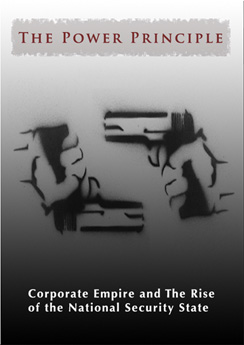
[Drone Warfare: Killing By Remote Control by Medea Benjamin. Foreword by Barbara Ehrenreich (2012: OR Books); Paperback; ISBN 978-1-935929-81-2; 262 pp.; $16. E-book ISBN 978-1-935928-82-9.]

President Obama makes jokes about them; Pakistanis — and others around the world — live in fear of them. They’re fast and efficient and they save the lives of Americans troops — their advocates insist. Drones — unmanned aerial vehicles (UAVs) — are here now bigger and bolder than ever before, spying on more people than ever before and killing more people than ever before by remote control and at the behest, more often than not, of the Central Intelligence Agency (CIA).

Medea Benjamin — the author of the new book, Drone Warfare, and the cofounder of CODEPINK and Global Exchange — isn’t buying any of the buzz about the UAV’s. She thinks they’re illegal and immoral and ought to be banned except for peaceful purposes — like fighting forest fires.

Drone Warfare is a useful guidebook for organizers and activists, whether they want to educate themselves and others, or join the global movement that is calling for an immediate end to killing by remote control, and an end to the unending reign of terror that has been imposed from above on innocent civilians — men, women and children– ever since 9/11. Imperfect drones have also killed Americans soldiers in Asia.

As in all previous wars, the drone war has led to “doublethink,” as George Orwell called it. Senior White House counterterrorism adviser, John Brennan, noted in April 2012 that “Unfortunately in war, there are casualties, including among the civilian population,” and that “sometimes you have to take life to saves lives.”

About a hundred years ago, General William Tecumseh Sherman said “war is hell” and led Union troops on a rampage through Georgia, burning, looting, and killing. He was no less deadly on the ground that the drones are in the air, but he seems to have been more honest than the White House and its advisers are today.

Benjamin has talked to the pro-drone technocrats and to the representatives from anti-drone organizations such as the American Civil Liberties Union, as well as to lawyers and their clients who have been arrested and gone on trial for demonstrating against UAVs.

She’s read the articles and the editorials about them, too, and she writes clearly and concisely about real people caught up in the machinations of war and with vivid quotations from them, some as recently as February 2012, which means that this book is as up-to-date on the subject as a book can be.

Some of the most powerful comments are by Americans who have experienced drone warfare while in Afghanistan. Perhaps the most electrifying is by David Rohde, a journalist who shared a Pulitzer Prize for his coverage of the wars in Afghanistan and Pakistan, and who was kidnapped by the Taliban. Like everyone else on the ground, he lived under the threat of death by remote control.

After his escape and return to the United States, he wrote an article entitled “The Drone War” in which he said that, “The drones were terrifying.” He added that “the buzz of a distant propeller was a constant reminder of imminent death,” and that “drones fire missiles that travel faster than the speed of sound.” The victims, he explained, never even hear the missiles that kill them.

Indeed, the main point of the drones seems to be to terrify human beings en masse in whole regions and across nations, whether Afghanistan, Pakistan, or Yemen. Granted, drones have killed thousands of people, including American citizens, such as Anwar al-Awlaki in Yemen in 2011. The body count is not insignificant and at times the killing of a single individual may be critical to a military campaign.

But the psychological impact is the hideous big bonus of the drones, much as the threat of nuclear annihilation was a big hideous bonus of nuclear warfare. For the moment, the use of the drone as a psychological weapon by the United States government seems to have tipped the balance of power in favor of American military forces and American spy agencies, though debates about the efficacy of the drones can be followed on the Internet and TV.

The drone is much in demand and highly praised, with thousands of them named the Predator and the Reaper coming off assembly lines and with no end in sight. Indeed, U.S. taxpayers are shelling out more than $3 billion a year for them, and even if they can’t see what they’re doing, they’re hurting American citizens financially.

Benjamin breaks the “sordid” drone saga down into its component parts, looking at its economic, legal, moral, and political aspects. She also puts all the pieces together and shows how drone warfare has led to spirited opposition from citizens in Asia, in Europe, and in the United States. She even works up sympathy for the drone operators who are, after all, no more than lowly workers in the immense, hierarchal hive of military activity.

“For up to twelve hours a day, they stare at 10 overhead television screens, monitoring a constant stream of images being relayed to them from the battlefield while communicating on headsets with drone pilots at other bases and instant messaging with commanders on the ground,” Benjamin writes.

Reading her description of a day in the life of a drone operator makes it obvious that the highly touted drones are greatly imperfect and hardly efficient or inexpensive killing machines. Right now, though, they’re making millions for the super-duper, high-tech weapons industry.

Outlawing drones seems to be not only a worthwhile goal but also achievable. It wasn’t that long ago that governments tested atom bombs and that airplanes loaded with cancer-causing DDT sprayed millions of acres of American farmlands, forests, and suburban backyards, too. The world woke up to the deadly reality of atomic bomb testing and DDT-spraying and put an end to them.

Benjamin offers useful suggestions for readers who want to put drones out of business. At the back of the book, she provides a list of organizations that can help activists and organizers from New York to Nevada. If you want to get started you could go to “Robot Wars” which can be found here.

[Jonah Raskin is a regular contributor to The Rag Blog and the author of Marijuanaland: Dispatches from an American War, For the Hell of It: The Life and Times of Abbie Hoffman, and The Radical Jack London: Writings on War and Revolution. Read more articles by Jonah Raskin on The Rag Blog.]

Also see “Drones Don’t Talk Back” by Danny Schechter / The Rag Blog / May 2, 2012

The Rag Blog

Posted in Rag Bloggers | Tagged , , , , , , | 1 Comment

Lamar W. Hankins : Suppressing Democracy 101

Graphic from Other Means.

Today’s Republicans find
new ways to suppress democracy

By Lamar W. Hankins | The Rag Blog | June 19, 2012

Registering the poor to vote ‘is like handing out burglary tools to criminals.’ — Conservative columnist Matthew Vadum

It was a moving moment when Rep. John Lewis (D-GA) learned that his great-great-grandfather, Tobias Carter, a slave until 1865, had registered to vote for the first time in 1867. Ninety-eight years later, the civil rights activist and ally of Martin Luther King, Jr., had celebrated the passage of the Voting Rights Act after a long struggle, not knowing that nearly 100 years earlier one of his ancestors had been allowed to register and vote without opposition or intimidation.

But in less than 10 years from that act of freedom, African-Americans throughout the South had largely lost the ability to vote because of Jim Crow laws and acts of intimidation and violence, including murder, inflicted on them by white supremacists.

John Lewis was a guest recently on Henry Louis Gates, Jr.‘s PBS program Finding Your Roots. Gates delves into the personal history of his guests, usually public personalities, to find how their forebears came to this country, who their ancestors were, what happened to them, and what their DNA shows about their origins.

It took a few moments for the information Gates gave John Lewis to sink in. Then, Lewis seemed to recognize the irony that nearly 100 years after his great-great-grandfather registered to vote, the nation would have to reinstate that right for African-Americans. Lewis tried to hold back his tears, but he could not.

In the last three decades of the 1800s, until the Voting Rights Act of 1965, it was mostly Democrats in the South who suppressed voting by minorities. That began to change during the presidency of Franklin Roosevelt as Democrats over a period of 25 years became more and more identified with the movement for civil rights for all Americans, and became a minority party throughout the South.

Republicans in the North worked to suppress voting, too — mostly to prevent immigrants, blue-collar workers, and the poor from voting — with tricky procedural rules, such as requiring voters to cancel their registration after moving before being allowed to re-register, or commanding some voters to have authenticated naturalization papers with them at the polls.

Now, throughout the country it is the Republican party that systematically devises ways, old and new, to reduce registration and suppress voting by people they deem unlikely to support Republican causes: minorities, elderly people, and college students. The virtual Tea Party takeover of the Republican Party during the past two years has provided a new impetus for Republican voter suppression.

I remember learning about voter suppression first in 1971, during the nomination hearings into the appointment of William Rehnquist to the U. S. Supreme Court. In the 1964 elections, Rehnquist served as a Republican poll watcher whose job was to delay every minority voter that he could based on the supposition that they would vote Democratic.

Reporter Dennis Roddy described Rehnquist’s actions:

He knew the law and applied it with the precision of a swordsman. He sat at the table at the Bethune School, a polling place brimming with black citizens, and quizzed voters ad nauseam about where they were from, how long they’d lived there — every question in the book. A passage of the Constitution was read and people who spoke broken English were ordered to interpret it to prove they had the language skills to vote.

Rehnquist succeeded in holding up a line four abreast and a block long before Democratic poll watchers arrived at the polling station in Phoenix. The voter suppression was so well organized that it had a name — “Operation Eagle Eye.”

While the suppression effort was legal at the time, it was nothing but bullying of the less well-educated by the elite. The voter suppression efforts of Rehnquist were described by several people, including Lito Pena, who went on to serve for 30 years in the Arizona Legislature, and by a person who later became a deputy U. S. Attorney, as well as several others. But Rehnquist’s efforts were minor compared to what has been happening recently.

The mostly Republican modern voter suppression efforts include requiring photo identification in order to register, reducing the time allowed for early voting, ending same-day registration where that has been available (in Texas, voter registration ends 30 days before the election), creating greater difficulties for eligible ex-felons who have paid for their crimes, requiring proof-of-citizenship documents in order to register, and discouraging voter registration drives through new regulations that penalize authorized registrars who can’t immediately file registration forms.

The imaginary “arc of justice” that many orators like to talk about has seemed to be moving toward greater inclusion when the whole of American history is considered. Women achieved the right to vote only during my mother’s lifetime, poll taxes were eliminated, literacy tests were overturned, English-language proficiency tests were abolished, and property ownership was invalidated as a requirement for voting.

But none of these notable expansions of the voting franchise have been absolute. There have been periods of progress followed by retrenchment. Thankfully, we have had mostly progress for women and, since 1965, for minorities and the poor, at least until recently.

Both major political parties have been guilty of voter suppression at various times in our history. What is unusual in recent history is that nearly all voter suppression is tied to the Republican Party and has been aimed at systematically disenfranchising people who are believed to favor the other major party. When this is done by passing laws, the justification given is that the laws are needed to prevent voter fraud — an unsupportable canard.

A favorite new voter law is to require state-issued photo IDs. Twenty states either have photo-ID law requirements for voter registration or are considering them. Low-income people and students have disproportionately fewer state-issued photo IDs. Students may have IDs issued by their colleges, but these are not acceptable under some of the new photo-ID registration laws. Many low-income people do not have checking accounts and don’t drive, so their need for photo IDs are limited.

They live in a cash-only economy. Requiring them to obtain a state-issued ID just to be allowed to register to vote is a step most of us don’t have to worry about, but they do.

In five states that have new photo-ID laws, including Texas, 3.2 million people of voting age don’t have state-issued photo IDs according to a report from the Brennan Center for Justice at the NYU Law School. Nationwide, 21 million Americans do not have state-issued photo IDs. Among African-Americans, 25% do not have state-issued photo IDs, as compared to only 11% of all Americans.

Obtaining photo IDs is not simple or cheap for many people. They need to get to the office that issues the IDs and then produce a variety of documents, such as a birth certificate, passport, marriage license, court record, or similar documents. If they don’t have such documents readily available, they will have to obtain them, which takes time — often several weeks.

All of these documents cost money — anywhere from $10 to $200 — not insignificant amounts for someone living on a limited income — such as $600 a month. In addition, the photo ID will cost from $10 to $30 in those states that require them for voter registration. This requirement sounds a lot like the notorious poll tax used to keep poor African-Americans from voting before 1965.

The nonpartisan League of Women Voters used to conduct voter registration drives, but new laws and regulations in Texas and Florida have made all such efforts difficult and risky. The laws impose tight schedules to turn in new registrations and significant fines if deadlines (such as within 48 hours of gathering voter registration information) are not met.

In the past year, same-day registration has been attacked by Republicans in two states, five states have reduced the length of early voting, executive orders in two states have revoked the right of ex-felons to vote, and three states have reduced the hours that state photo-ID offices are open or have closed some of the offices, making it more difficult to obtain the photo ID. In Texas, 34 counties do not have an office that issues photo IDs. Four of these counties have Hispanic populations over 75%.

If you think that changes to voting laws is just a happenstance, consider that in 2009 the American Legislative Exchange Council (ALEC) issued a model Voter ID law that prohibited certain forms of identification, such as student IDs. This model law has been acknowledged by Tea Party organizations and legislators (mostly Republican) as the source of their inspiration to make voter registration and voting more difficult.

ALEC was supported in 2009 by Wal-mart, the Koch brothers, Coca-Cola, Richard Mellon Scaife, the John M. Olin Foundation, Kraft, AT&T, GlaxoSmithKline, Johnson & Johnson, Exxon, Altria (formerly Phillip Morris tobacco), Kraft food, Pfizer, Reynolds American, State Farm Insurance, Wendy’s, Amazon.com, Pepsi, United Parcel Service, the U.S. Chamber of Commerce, and many other corporations and corporate associations, some of which have recently stopped their funding to protect their brands from public retribution. (For more information about ALEC and its funding sources go to SourceWatch.com.)

But Republicans don’t rely only on changing the laws to suppress voting. Florida’s Republican governor has ordered a purge of voter registration lists, much like what happened before the 2000 election that was contested all the way to the Supreme Court. In some places, voters are misled by mailings and circulars about when elections take place. In others, information distributed about voting locations is falsified.

In some minority communities, prospective voters have been intimidated by warnings that false voting will be prosecuted. And then there is the wide-spread use of systematic voter challenges by Tea Partiers in Wisconsin in 2010. Such efforts to disenfranchise voters, embarrass them, and intimidate them should be criminal, but the claim that changing laws is justified because of widespread voter fraud is merely false.

In a 2007 report on voter fraud, the Brennan Center concluded: “The type of individual voter fraud supposedly targeted by recent legislative efforts — especially efforts to require certain forms of voter ID — simply does not exist.” For five years during the George W. Bush presidency, the Justice Department conducted a “war on voter fraud,” which resulted in 86 convictions out of more than 196,000,000 votes cast.

This result was not unexpected. It is absurd to believe that there is a systematic effort by large numbers of people to cast a vote as another person. Such projects would be an enormous waste of time, yield few results, be easy to detect, and are adequately controlled by existing criminal laws with harsh penalties.

It is difficult to believe that the Republican effort at disenfranchisement results from anything other than ideology. Leading Republican supporters have acknowledged their disdain for all Americans to be allowed to vote.

Conservative columnist Matthew Vadum believes that registering the poor to vote “is like handing out burglary tools to criminals.” Heritage Foundation co-founder Paul Weyrich is even more blunt: “I don’t want everybody to vote.” And in the 2008 presidential election, 3 million Americans who tried to vote could not do so because of voter registration requirements. Vadum and Weyrich must be pleased.

Both major political parties have been guilty in the past of rejecting democratic values in order to give their party’s candidates an advantage. Now the right to vote is under attack mainly by Republicans who reject democratic values. They want to discard the right that John Lewis has fought for all of his life and that Lyndon B. Johnson called “the basic right, without which all others are meaningless.”

[Lamar W. Hankins, a former San Marcos, Texas, city attorney, is also a columnist for the San Marcos Mercury. This article © Freethought San Marcos, Lamar W. Hankins. Read more articles by Lamar W. Hankins on The Rag Blog.]

The Rag Blog

Posted in Rag Bloggers | Tagged , , , , , , | 4 Comments

Marilyn Katz : West Bank Diaries

Shuttered Palestinian shops along Shashuda Street in Hebron, West Bank. Photo by Marilyn Katz.

The separation is total:
West Bank Diaries

More than anything it appears that these fences are cages, locking people in, restricting their movement, and ultimately making them prisoners in their own land.

By Marilyn Katz | The Rag Blog | June 19, 2012

[In May, Marilyn Katz spent 10 days traveling around Israel, Palestine, and Jordan with the liberal pro-Israel advocacy organization J Street. What follows are excerpts from the journal she kept during her trip.]

Day 1: May 3, 2012

We leave Tel Aviv, a sun-drenched city filled with beaches, high rises, and casually-dressed Israelis, on the only road across the West Bank to Jerusalem. It’s a slick highway surrounded on all sides by a “fence” — in some places cement and in other places barbed wire, dotted with armed checkpoints.

On the side of the road, Palestinian men walk through a narrow barbed wire pathway, some carrying bags, others carrying furniture. The road, I’m told, is for Israeli citizens only — those Palestinians who have permission to work in Israel must park their vehicles elsewhere, pass through a check poin, and board buses that exit the road shortly thereafter.

What is the purpose of this fencing? The ostensible reason — security — is less than convincing. The fences are made of barbed wire; anyone wishing to damage a road or a village could easily shoot over or through it, or simply take the risk of being cut. My guides estimate that thousands of Palestinians “penetrate” these fences to reach Israel each day. More than anything it appears that these fences are cages, locking people in, restricting their movement, and ultimately making them prisoners in their own land.

On to Jerusalem. When I was here 10 years ago, I saw many Palestinians working throughout the city. Today, I am struck not only by the absence of Palestinians and Israeli Arabs, but by the massive numbers of Haredi and other Ultra-Orthodox Jews. With an average of eight children per family, the Haredi and other Ultra-Orthodox Jews are the fastest growing segment of the Israeli population, and they are a huge factor in Israeli politics and a huge drain on the economy and political life.

Some of the Ultra-Orthodox, particularly the Haredi men, do not work and have been exempted from military service so that they can “study.” They all receive a government stipend for each child born. Due to their growing numbers, they have a big influence in the parliament and in the military.

Impression: The separation is total. Despite the 3 million Palestinians living in the West Bank, it is totally possible for Israelis never to encounter Palestinians and for Palestinians never to encounter Israelis, except at checkpoints.

Day 2: May 4, 2012

Just returned from a day in the West Bank. Since the 1993 Oslo Accords (which were meant to be only an interim step), the West Bank has been divided into three areas: “Area A” (large cities under the full control of the Palestinian Authority), “Area B” (smaller cities and villages supposedly under Palestinian civil authority and Israel Defense Forces [IDF] military authority), and “Area C” (the rest of the West Bank, which includes farms, villages, and individual houses the Israelis claim to be uninhabited, and which is under the complete control of the IDF).

Today, visiting Kafr-a-Dik, a Palestinian village about 20 minutes from Tel Aviv, I got a pretty good sense of what occupation means. We had lunch in the hills outside the village at the site of a summer “tea house” that had been razed the week before by the IDF. The young children of the family who built the house, which they used for shelter and rest while tending their olive trees, told us they came here last week after school only to find their “shelter” gone. It turns out that while they were at school, hundreds of IDF soldiers descended on the spot with bulldozers, destroying the shelter and the 250-year-old well along with the walled terrace that had protected the olive trees for centuries.

Day 3: May 5, 2012

How to consider Israel? It is a land of more than one reality — particularly since the Second Intifada of 2000, after which Palestinians could no longer travel freely through the country, and after which Israelis did not even go to East Jerusalem, which is like living in the New York’s East Village and never visiting the West Village.

Life in Jerusalem is pretty much like life in any urban center, except for the ever-visible presence of the Haredim, and their reflection in the larger society — there are no billboards with women on them, many radio stations do not play songs in which women sing, and on some bus routes, women are relegated to the back of the bus, despite a Supreme Court ban on the practice.

What is different is the absolute absence of the Other. As Palestinians are barred from entry to Israel, people in general don’t have to think about them, and there is a generation of young Israelis who may have never seen or met one.

In some ways it is not so different from those who live in American suburbs or rural areas and who rarely see anyone who is not like themselves. The situation in Israel is more pronounced, and is true in the cities as well as the suburbs. Ironically, it is probably only the Jewish settlers in the West Bank who have any real continuous “contact” with Palestinians, and then only as occupier of the land or as employer of menial labor — since Palestinians cannot enter Israeli cities, their only work is either in their villages for the Palestinian Authority, or as gardeners, etc., in settlers’ villages (with special work and travel permits, of course).

Day 4: May 6, 2012

After a fascinating morning meeting with the son of assassinated Israeli leader Yitzhak Rabin and other leaders across the political spectrum (with as many views as there were people in the room), we took an afternoon walk to Jaffa, the original Arab port just north of Tel Aviv, where most Jews landed when they came in the 1880s. An ancient city, Jaffa was home to 100,000 Arabs in 1948, before the war. Today, only 6,000 remain.

Dinner was at the sumptuous Tel Aviv home of an Israeli businessman. We were joined by four other “progressive” Israeli businessmen, the heads of hedge and equity funds, all of whom do business with Palestinians and with Arab countries. Three of the four, including the son of a former prime minister, are virtually uninvolved in politics and think that the market, with its lack of borders and its commitment to “innovation,” will simply take care of the issue. The most loquacious of them thinks the wall separating Palestinians from Israelis has actually helped both communities and that in separation, each population is beginning to thrive.

When I returned to my room, I wanted to see whether the most articulate and powerful speaker among these men, the one who stated that the wall has helped both Palestinians and Israelis, could have a point. The bottom line: GDP in Israel is $31,000 per capita; in the West Bank it is $2,900.

That’s all for my Sunday report.


Day 5: May 7, 2012

Today we traveled to Jordan, a stunningly beautiful country. Our first meeting was with King Abdullah, who turned out to be an exceedingly smart, thoughtful, and engaging man. Needless to say, the palace was gorgeous. What could be bad about sipping tea from a gold-embossed glass in a room that makes the Metropolitan Museum of Art’s exhibit on Middle Eastern decorative arts look shabby?

We met with the king and the prime minister for about an hour. On Israel, the king was probably the most optimistic person we spoke to all day — and that wasn’t very optimistic. It is his opinion — and pretty much everyone’s we talked to — that the window for a possible two-state solution is closing fast, with Israel having totally rebuffed (to date) the Arab Peace Initiative, with Palestinians chaffing under accords that were meant to last two years, not two decades, and with the Arab Spring asserting itself as alternative mode of achieving change.

He thinks, as do others, that the growth of Jewish settlements in the occupied territories and of the Palestinian population under occupation is such that if we don’t reach a two-state solution by 2013, the only options will be a dual national state (untenable for the Israelis) or an apartheid state (simply untenable).

Then on to dinner at the home of a former Jordanian Ambassador, joined by 20 other ex-ambassadors, sitting senators and leaders of Jordanian society. It was a sobering conversation. Contrary to the happy talk of the Israeli businessmen about “joint endeavors with the Arab world,” these business and political leaders have pretty much given up on Israel (despite many years of investment in the prospects and endeavor to find peace).

They do not believe that the government in Israel is interested in peace, and they feel that the demographics of the West Bank settlements, which have brought more than 500,000 hard-line settlers to the occupied territories, will continue to give right-wingers the vote. They believe that the total separation of Israelis from Palestinians is breeding a new generation that could care less about peace, and that the Arab world and the Palestinians will just give up on Israel as a “member state of the region,” since it appears to them not to be interested in being one.

They are horrified by the occupation and actions of the Israelis, even while understanding Israel’s legitimate desire for a state. They also rue the retreat into fundamentalism and extremism in both the Jewish and Muslim communities.

Day 6: May 8, 2012

Started off with a gracious meeting at the Jordan Parliament with the Senate Foreign Relations Committee — a self-selected group (all men) who spent about two hours with us giving their prognostications on the situation of the Middle East. All are cautious about the Arab Spring (although remember they are all friends of the King) and worry about the rise of Islamist states.

Their main point was that the Arab Spring is a wave, demanding human dignity and full citizenship rights, and that this tide will also affect Israel. Like all others from whom we heard, they believe that the window for a two-state solution — which they all favor — is short, and they do not see a negotiating partner in Israel.

We spent the afternoon in the West Bank looking at Jewish settlements — all illegal, according to Article 49 of the Geneva Accords. Hundreds of thousands of settlers now live in the West Bank, and settlements and their “outposts” have been placed to totally surround Arab villages, confiscating Arab lands in the process and creating an internal colony.

(A note: I know when we think of settlements, we often think of the American West, where whole towns have grown. In the West Bank, settlements vary. In some cases they are huge, with thousands of residents, and resemble the gated communities of southern California or Florida. But in other places, settlements are one building on a street in East Jerusalem, or some cases whole blocks, where one or two lone Palestinian families remain.)

Day 7: May 9, 2012

Today was Israeli official politics day. We started off at the Knesset (the Israeli parliament) with a series of meetings with a variety of representatives of various parties — Labor, Meretz (the socialist party) and Kadima, which is a center-left (more center than left) break-away from Labor.

It is a very tumultuous time for the Knesset. Last week, Netanyahu declared that the Knesset would be dissolved and that elections for a new parliament would be held in September. Then, on Monday night, Kadima’s leader made a radical u-turn and decided to join the Likud (Netanyahu) coalition, giving Netanyahu a 94-vote majority — if the deal holds of course…

And there are reasons why it wouldn’t hold. Kadima, while not a strong party, represents the faction that in theory wants to freeze the settlements and pursue the peace process. Likud has shown little inclination to do so. There is much speculation among all about what will happen. All say they are committed to a two-state solution, and that there isn’t much time, but all doubt the political will of Netanyahu.

Day 8: May 10, 2012

We started our day off at Hebron, a large town in the Judean mountains. We were brought to Hebron by a group called Encounter, a Jewish organization that tries to expose Israelis, American Jews, and others to the realities of life in the West Bank, without commentary. Most of the Encounter members are rabbinical students, and quite lovely.

Some context: In 1929, during the Arab uprising against the British, 67 Jews in Hebron were killed by Palestinians (many, many more were sheltered and protected by their Palestinian neighbors). After that, Jews left Hebron, not to return until 1968 when they began to settle in an area just outside of the Old City’s downtown. The settlement they established grew into Kiryat Arba, which now has 7,500 residents. In 1979, a group of Hasidic families occupied an old, empty hospital in the Old City itself, creating another settlement.

After a 1994 shooting in which a settler killed 29 Palestinians (and injured dozens more), the government decided that Jews and Palestinians needed to be separated, and the barricading and death of the old Palestinian city began. Today, as you walk around the half-deserted streets of the Old City in which Palestinians still live and try to have shops, you see shuttered stores, their façades often graffitied with the Star of David.

Most disturbing is Shashuda Street, once a central street in the Palestinian community, where the vegetable and meat market stood. The remaining Palestinians’ homes are like hen’s teeth on the first blocks of the street, squeezed among the new settlements. Many Palestinians now put screening over their interior courtyards and over their stores to protect them from the feces and trash thrown down by settlers from their higher homes.

The next block is almost fully occupied by Israelis, and Palestinians are prohibited from driving on the street. Many are not allowed to exit their homes onto the street; rather, they must exit via the roof or an adjacent apartment onto the “Palestinian street” on the other side of the block.

Day 9: May 11, 2012

From the surreal experience of Hebron we went off to Ramallah, the seat of the Palestinian Authority (PA) and the Palestinian Liberation Organization (PLO), to meet with Salam Fayyad, the PA’s prime minister. Ramallah is a bustling, modern city, with cranes dotting the skyline and the same type of buildings that you see in Jerusalem. Israelis are not allowed to visit Ramallah or any other place in the West Bank designated an “Area A” without a special permit.

Fayyad, who got his degrees at the University of Texas at Austin, is responsible for the administration of the West Bank, while President Mahmoud Abbas is the political leader. A small, fairly quiet and compact man, he was engaged and engaging. He says that they are fully committed to a two-state solution, but feels a growing sense of despair due to the lack of response by the Israelis to the Arab Peace Initiative and the refusal of Israel to halt or freeze the settlements, which, if they continue, will make a contiguous Palestinian state impossible.

He talked with pride about the growth of Ramallah’s and the West Bank’s economy and the reduction of violence. But he fears that the delays in the peace process, the jailing of hundreds of Palestinians, the sense of hopelessness, the confiscation of Palestinian homes and lands, and the settler violence against Palestinians will once again lead to violence.

As for him, he is engaged in “constructive defiance.” For example, after the IDF bulldozed a road the Palestinian Authority had built in the West Bank to connect two villages, the PA rebuilt the road. After the IDF again bulldozed the road, the PA rebuilt it a third time, and for now, the road still stands.

Day 10: May 12, 2012

Lunch in Ramallah was hosted by the emerging young business and political leaders of Palestine. Among them were investment bankers, youth leaders and a number of entrepreneurs. All came back to Palestine — from Harvard, MIT, Stanford and the like — to nation-build, and all are frustrated, some only with the U.S., and others with the PLO and the Abbas leadership as well.

They speak of the degradation of being stopped at checkpoints on their way to business meetings in Israel (despite their permits). They speak about supplies and goods being held up by the Israelis for months at a time, and the impossibility of generating a real economy, as Israel controls the timing and the content of all imports and exports. While all believe in a two-state solution, they are really beyond that. Their demand, very simply, is that the occupation — it’s walls, its rules — be ended now.

The day ended with a trip to Neve Shalom, a community on a hilltop above the lush and fertile valley between the mountains and Tel Aviv, the green belt of Israel. Established more than 30 years ago, Neve Shalom is a “model village” where an equal number of Israeli Arabs and Israeli Jews have created a community committed to providing a model of integrated living.

We joined members of the Sulha Peace Project for an evening of “encounter” between Palestinians and Israelis. Founded by Palestinian and Jewish leaders, the organization regularly brings together Palestinians and Jews for song, talk, and sharing. Not exactly my cup of tea, yet I was moved and impressed nevertheless with this people-to-people grassroots attempt to envision a new way of being.

In the end, though, it isn’t enough. The two groups may break bread and sing together tonight, but their ability to even come together at all is dependent on the benevolence of more gracious occupiers who give out “get out of jail for a day” cards to the occupied. And at the end of the day, the occupied go back to their cages.

[An anti-war and civil rights organizer during the Vietnam War, Marilyn Katz helped organize security during the August 1968 protests at the Democratic National Convention. Katz has founded and led groups like the Chicago Women’s Union, Reproductive Rights National Network, and Chicago Women Organized for Reproductive Choice in the 1960s and 1970s, and Chicagoans Against War in Iraq in 2002. The founder and president of Chicago-based MK Communications, Katz can be contacted at mkatz@mkcpr.com. This article was also published at In These Times. Read more articles by Marilyn Katz on The Rag Blog.

The Rag Blog

Posted in Rag Bloggers | Tagged , , , , , | 3 Comments

RAG RADIO / Thorne Webb Dreyer : Texas Observer Founding Editor Ronnie Dugger

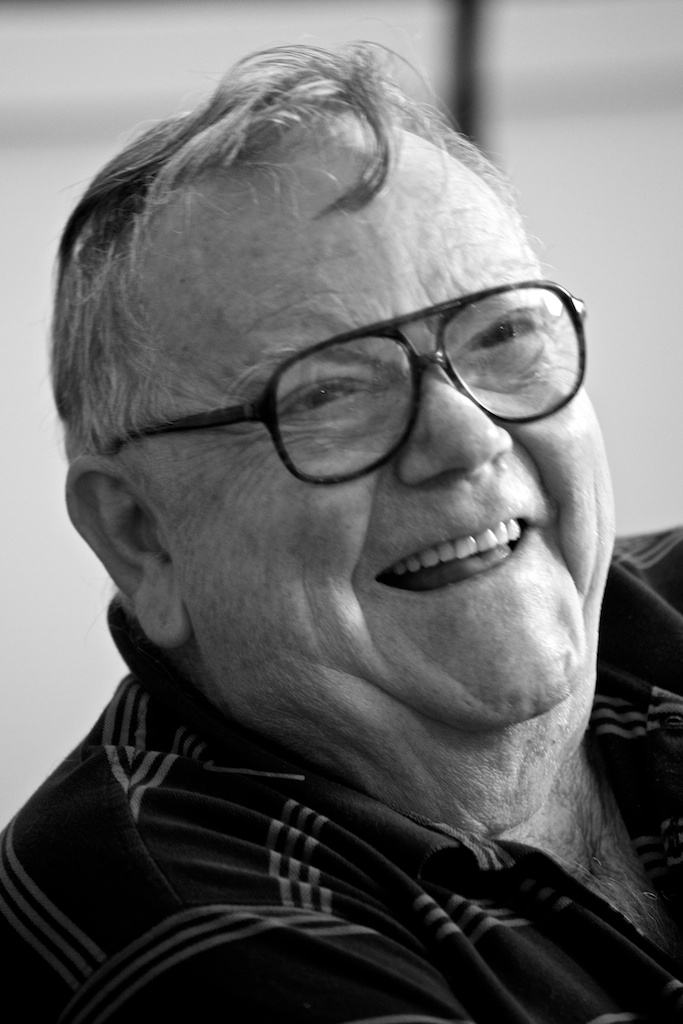
Pioneering Texas journalist Ronnie Dugger in the KOOP studios in Austin, Texas, Friday, June 8, 2012, during broadcast of Rag Radio. Photo by Alan Pogue / The Rag Blog.

Rag Radio:
Crusading journalist Ronnie Dugger,
founding editor of The Texas Observer

By Thorne Webb Dreyer | The Rag Blog | June 15, 2012

Legendary Texas journalist Ronnie Dugger, the founding editor of The Texas Observer, was our guest on Rag Radio, Friday, June 8, 2012, on KOOP-FM, Austin’s cooperatively-run all-volunteer community radio station; Rag Radio is also streamed live to a worldwide Internet audience and is rebroadcast Sunday mornings on WFTE-FM in Scranton and Mt. Cobb, PA.

You can listen to the show here:


Brad Buchholz of the Austin American-Statesman called Ronnie Dugger “the godfather of progressive journalism in Texas.” Dugger was the founding editor of The Texas Observer from 1954 to 1961, and later served as the Observer’s publisher, spending more than 40 years with the crusading Texas tabloid.

The Texas Observer is a muckraking journal that has broken stories on major scandals and played an influential role in Texas politics. Based in Austin, the Observer, in its own words, “specializes in investigative, political and social-justice reporting from the strangest state in the Union.” The New York Review of Books referred to the Observer as an “outpost of reason in the Southwest.”

In 1966, Dugger also proposed and co-founded the Alliance for Democracy, a national grassroots anti-big-corporate organization.

Ronnie Dugger, who won the 2011 George Polk Award for his career in journalism, has influenced and mentored such progressive Texas journalists as Willie Morris, Molly Ivins, Billy Lee Brammer, Lawrence Goodwyn, Kaye Northcott, and Jim Hightower. He recently moved back to Austin from Cambridge, Mass.

Dugger is the author of Dark Star, Hiroshima Reconsidered (World, 1967), Our Invaded Universities (W.W. Norton, 1973), The Politician: The Life and Times of Lyndon Johnson (W.W. Norton, 1982), and On Reagan (McGraw Hill, 1983), and edited Three Men in Texas: Bedichek, Webb, and Dobie for UT Press. He has also written for Harper’s, Atlantic, The Nation, The New Yorker, and The Progressive.

Dugger has taught at the University of Virginia, Hampshire College, and the University of Illinois, and has held fellowships from the Rockefeller Foundation, the National Endowment for the Humanities, the Woodrow Wilson International Center for Scholars, and the Shorenstein Center at the Kennedy School, Harvard.

Dugger shared with host Thorne Dreyer some of the rich history of the Observer and of Texas progressive politics and journalism, marked by such seminal — and colorful — figures as Frankie Carter Randolph, U.S. Rep. Bob Eckhardt, John Henry Faulk, Willie Morris, and Molly Ivins.

Once, when Molly Ivins — who would become widely recognized as a national treasure for her special brand of populist Texas wit — was editing the Observer, Dugger asked her, “Molly, when are you gonna get serious?” Ivins replied (“quick as a whip”): “When we have a chance to win.”

On the show, Dugger discussed the legacy of the McCarthy era, the looming (both then and now) threat of nuclear war — an issue that he has always considered preeminent — and the Johnson presidency, which, he points out, made history with its courageous progressive domestic agenda. “Of course,” Dugger says, “the Vietnam War not only ruined that, but killed two million people.”

We discussed the way Lyndon’s unique saga was variously treated by the erudite Willie Morris in his heralded memoir North Toward Home and by Billy Lee Brammer, whose pre-gonzo novel, The Gay Place, Dugger called “one of the best novels written by anybody in Texas.” Brammer was Dugger’s first associate editor at the Observer, and Morris would later edit the Observer and then gain more fame as the editor of Harper’s.

And Dugger recounted a remarkable incident in 1955 that he later wrote about in an article titled, “LBJ, The Texas Observer & Me.” Then-Senator Lyndon Johnson summoned Ronnie to the LBJ Ranch with an offer — “something of a quid pro quo.” After inquiring about the Observer‘s circulation (“Oh, about 6,000,” Dugger told him), Johnson made his proposal: “Stick with me and we’ll make it 60,000.”

“Johnson was trying to bribe me, basically,” Dugger remembers. “Sing my praises, and we’ll make the Observer a whamdinger.” Of course Dugger, who according to Willie Morris became “one of Johnson’s main public antagonists,” chose to decline the deal. According to Morris, Ronnie Dugger “distrusted the compromises of political power and saw his own role in Texas as that of the social critic, the journalistic conscience, the polemicist.”

Ronnie Dugger also shared with the Rag Radio audience his not-so-optimistic take on the current political scene. “I think both political parties have descended pretty low,” he said. And the Supreme Court “has opened huge corporate money vaults,” with “the scandalous idea that corporations have the same rights as persons.” Dugger fears that “we’re now an imitation democracy governed by a corporate oligarchy… and a bought Congress.”

“Congress, with honorable exceptions, is now a whorehouse,” he said.

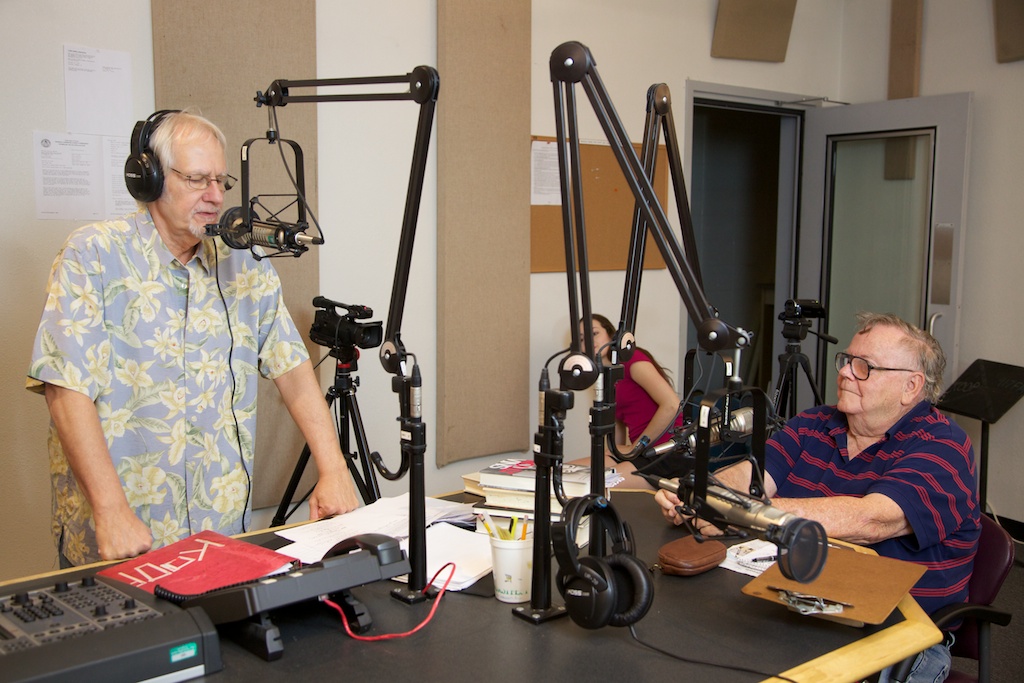
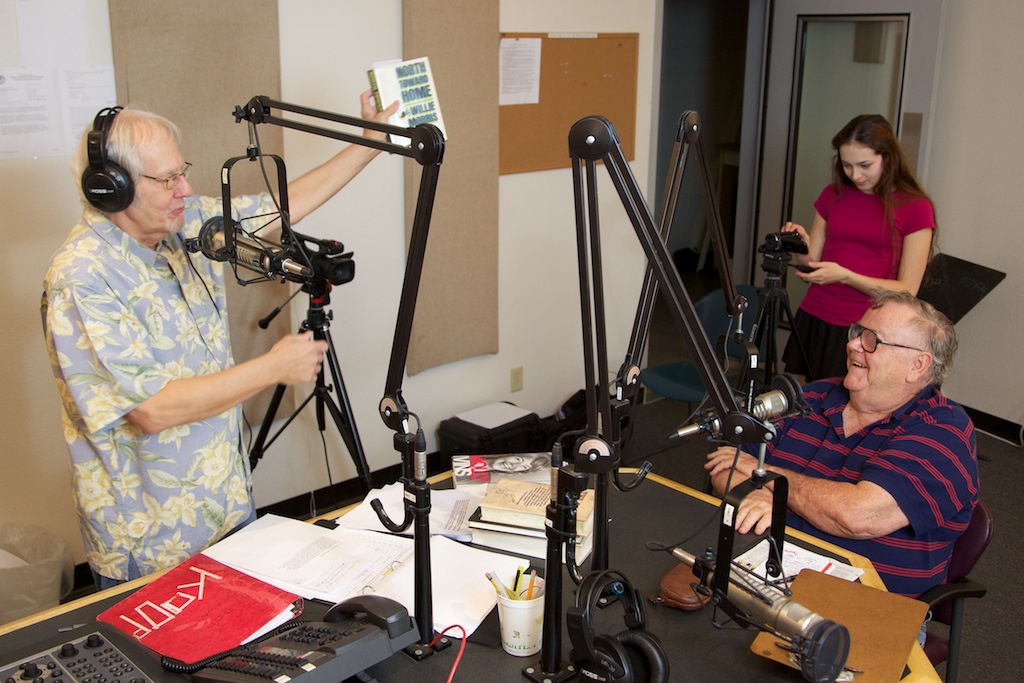
Above (and in inset photo): Thorne Dreyer, left, and Ronnie Dugger at the KOOP studios. Behind Dugger is Grace Alfar of ZGraphix. Photos by Alan Pogue / The Rag Blog.

Rag Radio, which has aired since September 2009 on KOOP 91.7-FM, a cooperatively-run all-volunteer community radio station in Austin, Texas, features hour-long in-depth interviews and discussion about issues of progressive politics, culture, and history.

Hosted and produced by Rag Blog editor and long-time alternative journalist Thorne Dreyer, a pioneer of the Sixties underground press movement, Rag Radio is broadcast every Friday from 2-3 p.m. (CST) on KOOP and streamed live on the web. Rag Radio is also rebroadcast on Sundays at 10 a.m. (EST) on WFTE, 90.3-FM in Mt. Cobb, PA, and 105.7-FM in Scranton, PA. After broadcast, all Rag Radio shows are posted as podcasts at the Internet Archive.

Rag Radio is produced in the KOOP studios, in association with The Rag Blog, a progressive internet newsmagazine, and the New Journalism Project, a Texas 501(c)(3) nonprofit corporation. Tracey Schulz is the show’s engineer and co-producer.

Coming up on Rag Radio:

THIS FRIDAY, June 15, 2012: American Botanical Council Director Mark Blumenthal on Herbal and Alternative Medicine.
June 22, 2012: Gay Marriage in America with Gail Leondar-Wright and Betsy Leondar-Wright.

The Rag Blog

Posted in Rag Bloggers | Tagged , , , , , , , , | 1 Comment

Bruce Melton : The Climate Change Drought Is Over / 3

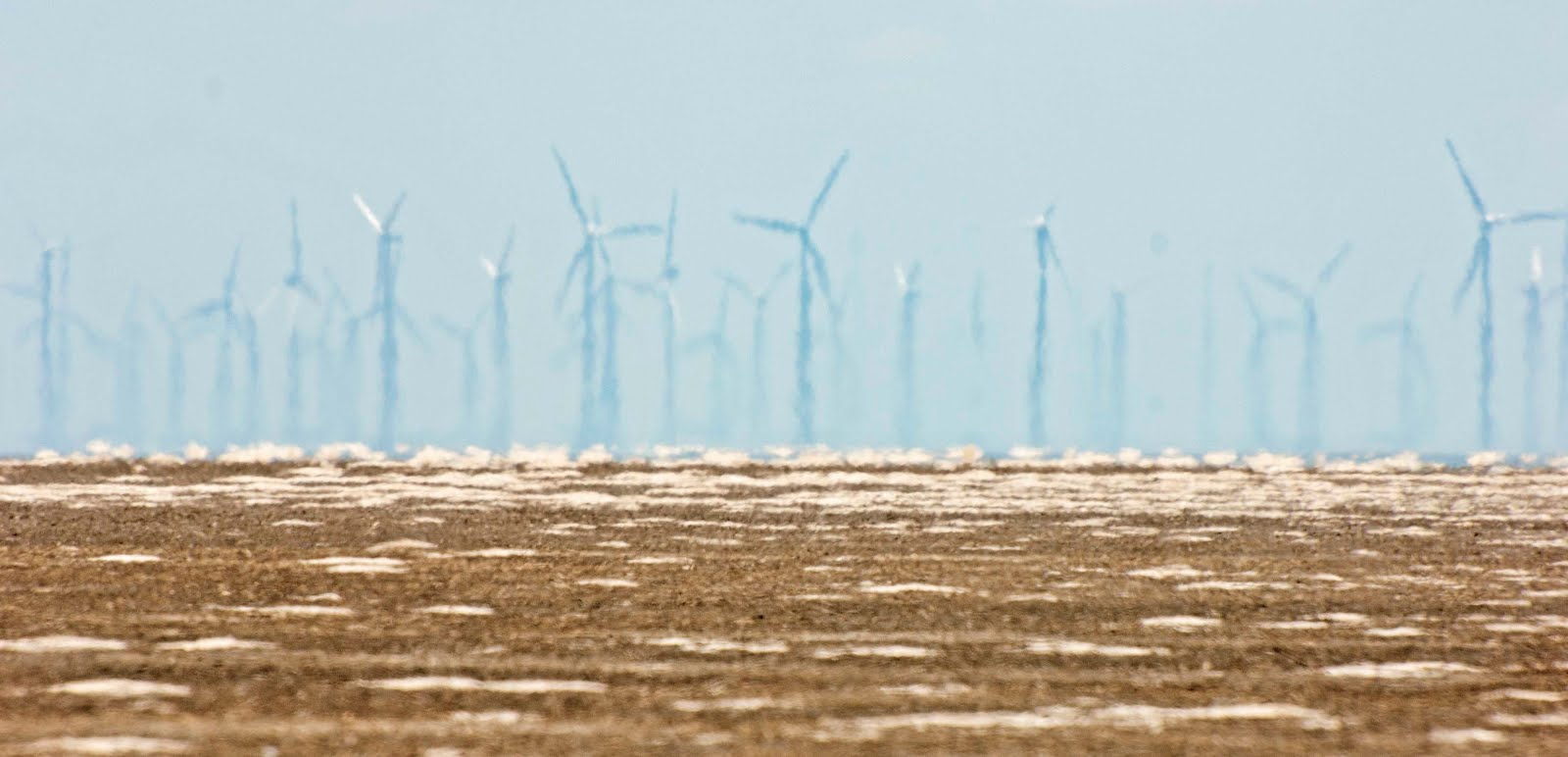
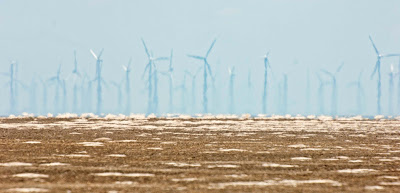
Wind turbines on the mainland as seen from the backside of Padre Island National Seashore, at mile 25 on the four wheel drive only beach. Photo © Bruce Melton, 2012.

The Climate Change awareness
drought is over
Part Three: It’s only pollution

For decades, the concept of installing privies in every house, business, and public building, and then piping human waste to a central treatment system, was perceived as lunacy that would bankrupt society.

By Bruce Melton | The Rag Blog | June 14, 2012

[This is the third of a three-part series exploring the recent change in public awareness of climate change issues, the causes behind the change, biases, the latest science showing how much our climate has already changed, and academic support for a vigorous change in messaging.]

AUSTIN, Texas — The shift in public opinion about climate change will likely only grow larger. This shift has been caused in a large way by an increase in unprecedented extreme weather caused by climate change, as climate scientists have been warning us about for 20 years.

Americans are beginning to disregard what the “voices” have been telling us about the great climate science conspiracy. Some of the most amazing evidence of how much our climate has already shifted has now been published. A vast majority of Americans have been highly supportive of our government acting on climate change, even before the shift in public awareness began.

Analysis of our leaders’ positions on “green” issues, vs. their success in 2008 and 2010, shows that vocal support for “green“ issues led to success more often than silence on the issue. It is time to change the climate tone to one of aggressive vocal advocacy for the consensus position.

I would like to begin this final part in the series by repeating a little from Part Two. Richard Alley, Evan Pugh Professor of Geosciences at Penn State University, one of the lead authors of the 2001 and 2007 IPCC Reports, member of the United States National Academy of Sciences and one of the pivotal international researchers in climate science, tells us in his book, Earth the Operators Manual, that about 100 reports have been published concerning the economic impacts of the solutions to climate change and they are focusing in on one thing.

The solutions to fixing our climate pollution problem will cost about one percent of global gross domestic product every year for 100 years. I’ve already told you that Alley says this astronomically sounding $540 billion a year is no more than we have invested in the cost of installing toilets and the infrastructure to collect, clean, and dispose of toilet water.

Here’s more. In the U.S. we need to spend about 0.75 percent of our average household income every year to maintain our sewer and water infrastructure ($375 per family considering the Census Bureau’s median household income of $50,000 per year in 2006). The Organization for Economic Cooperation and Development tells us most of the developed world spends 0.5 to 2.4 percent of household income on this task with the U.S. being the lowest.

Other things that show the simplicity of this challenge include: in 2011 we spent $494 billion on marketing across the globe according to eMarketer Digital Intelligence; the U.S. annual military budget (not including wars) is right at a half billion dollars; the Congressional Budget Office says the Bush tax cuts cost about $115 billion a year or approximately the United States share if we are divvying this thing up according to who emits what; an article in the Bulletin of the American Meteorological Society in June 2011 tells us that routine weather events such as rain and cooler-than-average days can add up to an annual economic impact of as much as $485 billion in the United States alone; and in 2009 we spent $2.5 trillion in the U.S. on health care.

This is five times what Alley tells us the economics scholars think the cost of worldwide climate pollution control will be.

One more very important thing to consider about what professor Alley tells us is that these economic analyses only considered the costs. Not considered were the profits from the construction of the climate change pollution prevention devices, profits from avoidance once a carbon pollution tax is finally implemented, and benefits from the jobs created to build and maintain this new infrastructure. Also not considered would be the benefits to society of a clean energy economy.

So why is the general public not aware of the relative simplicity of the task of simply cleaning up the largest form of pollution caused by a single species in the known universe? It’s “The Voices”… It’s the voices and their campaign of deceit, discreditation, and disinformation that is almost complete. Their money reigns supreme.

The widely popular Wisconsin gubernatorial recall election on Tuesday, expected to be a closely contested contest, was blown to smithereens as Citizens United allowed just a few moneyed interests to outspend the Democrats by eight to one or $30.5 million to $3.9 million, says CBS News.

At the same time in California, the state with the lowest smoking rate in the country, there was a proposition on the ballot for new anti-smoking dollar-a-pack tax on tobacco products to fund cancer research. Bolstered by $12 million in anti-smoking campaign, it reached a 67 percent support level in March. It was slaughtered by tobacco industry advertising of $47 million in the final weeks. They won by less than a percentage point. Big brother is here, and it ain’t the government.

Let’s return from this world of corporate control and look at the real science some more: The money required to clean up climate pollution considers existing off-the-shelf technologies to do the job. Billionaires around the globe are investing in new technologies to do the job at a fraction of the price and earn billions in profits.

Remember, half a trillion a year is at stake. One of the leading examples is Global Thermostat in California that has developed a prototype that they say, if ramped up, could solve our climate pollution problems in 30 years for only $2 trillion or $70 billion a year. This is an eighth what most of the economic evaluations are saying is needed to do the job with existing technologies.

To finish these optimistic thoughts, there is a lot of messaging around focused on geoengineering and the wrong-headedness of such ventures; that this message will give people permission to emit more greenhouse gases and not reduce emissions.

Atmospheric carbon capture and land-based storage cannot be compared to pumping carbon into space through a hose suspended in the sky, putting bazillions of tiny mirror-like particles in the upper atmosphere to reflect the sun or a sun shade umbrella in deep space or any of the other grand-but-dangerous schemes.

Removing CO2 pollution from our atmosphere is little different from picking up trash on the beach or the side of the road and putting it in a landfill. The scale may be larger, but the comparison cannot be made to geoengineering’s risks.

To think that this type of pollution cleanup is wrong-headed, that it will give people permission to emit more greenhouse gases, is no more wrong-headed than thinking that picking up trash on the side of the road will give people permission to litter even more.

As Lord Nicholas Stern tells us (once chief economic advisor to Prime Minister Tony Blair and author of one of the most complete economic evaluations to the solutions to climate pollution — the Stern Report), we have to do everything we can at the same time to solve this problem.

How valid is the trend?

To be certain that a change in tone can be beneficial we need to know that the trends in awareness and climate change are valid and likely to continue. Because a significant portion of the awareness shift has been created by climate changes that have already happened, it is logical to assume that because the weather is predicted to become more extreme with greater warming, the awareness shift will likely continue to grow.

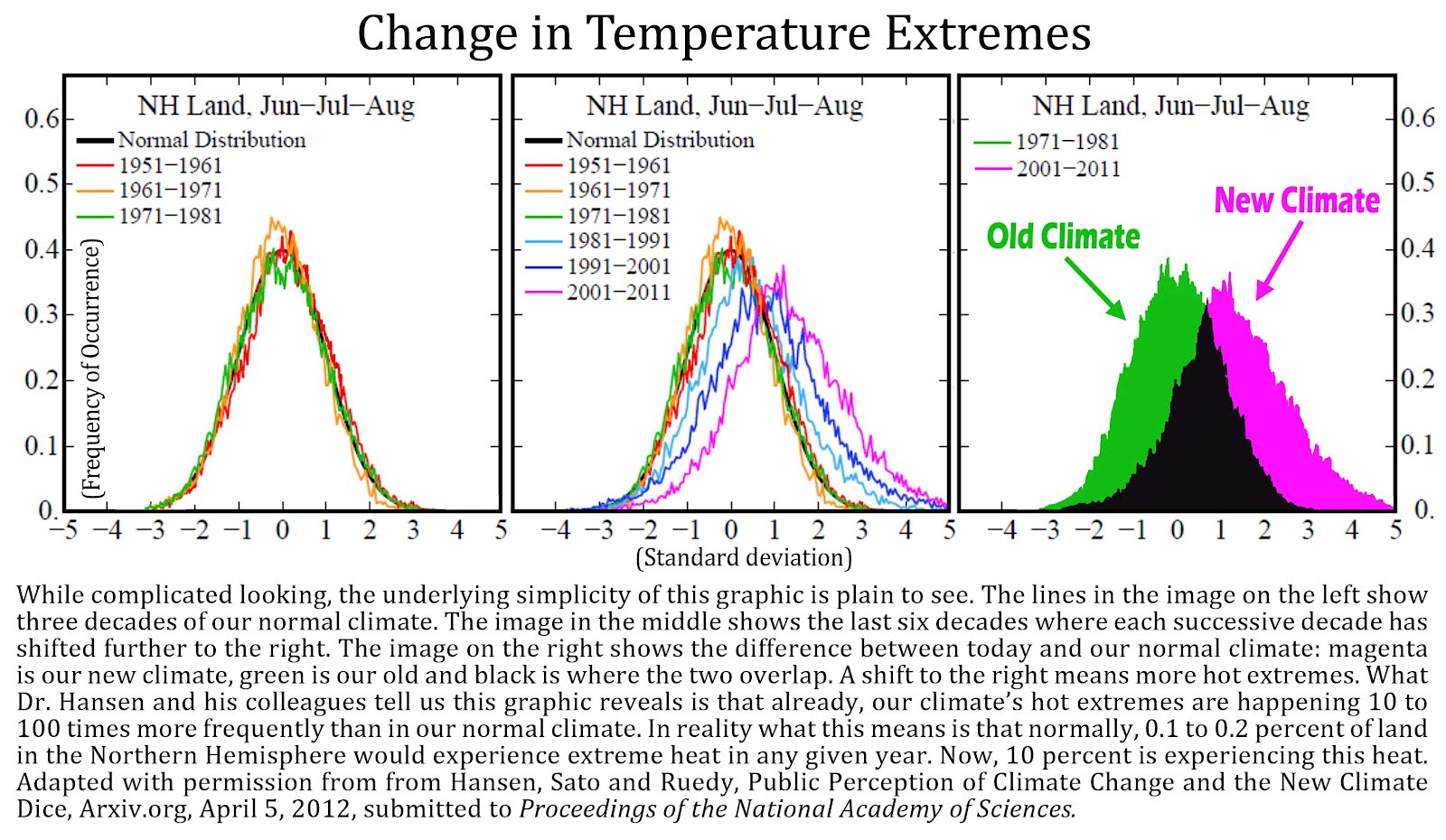
A really amazing piece of research that was recently published shows how much our climate has changed in the last 30 years. It shows that extreme temperature events are now occurring 10 to 100 times more frequently than during the period 1951 to 1981. This major piece of virtually unknown climate science comes from a paper in-press at the Proceedings of the National Academy of Sciences (PNAS) as submitted by scientists from NASA and Columbia’s Earth Institute.

This change in climate that we have already seen can be related to having a 100-year heat wave every one to 10 years. This is like having the drought of the century — the drought of record — every one to 10 years. In another 30 years if the rate stays the same we can expect to see something like the thousand-year heat wave or the 10-thousand year heat wave happening every 10 years.

The authors tell us: “because we can project with a high degree of confidence that the area covered by extremely hot heat waves will continue to increase during the next few decades, even greater extremes will occur.”

This is exactly what we have been warned about by climate scientists for over 20 years. The rate of change is expected to accelerate as we continue to delay emissions reductions. The graphic below from this study by NASA’s Goddard Institute for Space Studies and Columbia shows how markedly, persistently, and increasingly our climate has changed in the last 30 years.
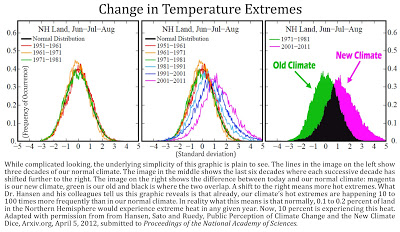
CLICK ON IMAGES TO ENLARGE.

To start with, this research evaluates Northern Hemisphere temperature. Northern Hemisphere temperatures have warmed more than the rest of the planet because there is more land in the northern half of our planet. The temperature increase over our oceans is smaller than over land because of what is called thermal inertia, or the ability of water to absorb more heat than land. This absorbed heat is transferred to deep cold water via sinking ocean currents and limits warming over oceans.

This means that the changes that you and I are likely to experience will be greater — two times more than the global average. This is something that is very important in climate science that rarely gets acknowledged in the media. Up to 9 to 11 degrees of average warming across the planet by 2100 means up to 18 to 22 degrees of warming across large parts of Earth’s land surfaces.

Our climate has not shifted uniformly. High temperature records outpace low temperature records 2 to 1. Extreme temperature events are happening much more often than if our climate had just shifted by the 1.4 degrees of average warming already seen across the globe. There are a lot of important things to be found in this reporting of our changed climate and the statistics are complicated so I will take some time and go through everything. (Or, just check out the caption under the image above and skip ahead to the subtitle “No Reason to Believe.”)

Starting with the image on the left, three decades of temperature extremes in the Northern Hemisphere are graphed (red, orange, and green lines). The similarity between decades is obvious and represents the stability of our climate during this period. The middle graphic adds data for the three most recent decades (cyan, blue and magenta).

Each one of these is shifted to the right (hotter) and if you look carefully you can see the shift increases with each decade. The graphic on the right (green, black and magenta) shows the difference between 1951-1981 and today. There has been a shift of three standard deviations in the extreme temperatures in the Northern Hemisphere. (I will get to standard deviations momentarily.)

The right hand side of each decade has shifted farther to the right than the left hand side of each decade which means that hot extremes are increasing more than cold extremes, which are staying about the same. (The graphs of the last two or three decades are cut off on the right as they extend much further than shown. This is the way they came in the paper and the quote below from the research describes three standard deviations, not two as shown. The shift is actually more than three standard deviations, but that’s even more complication that I will leave behind. Sorry for the confusion, this stuff is like rocket science.)

In total the research says the shift is three standard deviations. To simplify what this means, consider the quote below from the paper (I have omitted the extra wording about standard deviations):

A new category of hot summertime outliers has emerged… with the occurrence of these outliers having increased 1-2 orders of magnitude [10 to 100 times] in the past three decades. Thus we can state with a high degree of confidence that extreme summers, such as those in Texas and Oklahoma in 2011 and Moscow in 2010, are a consequence of global warming, because global warming has dramatically increased their likelihood of occurrence.

A further quote to help:

The perceptive person (old enough to remember the climate of 1951-1980) should recognize the existence of climate change. This is especially true in summer. Summers with [average] temperature in the category defined as “cold” in 1951-1980 . . . which occurred about one-third of the time in 1951-1980, now occur with a frequency about 10%, while those in the “hot” category have increased from about 33% to about 75%.

What we are seeing today is that the coldest summertime temperatures relative to “the normal period represented by 1951 to 1981” happen only one-tenth of the time today compared to one-third of the time back in the day. The “hot” temperatures, instead of happening one-third of the time like in 1951-1981, now happen more than two-thirds of the time (75%). One more quote:

These extreme [hot] temperatures were practically absent in the period of [1951 to 1981], covering only a few tenths of one percent of the land area, but they have occurred over about 10% of land area in recent years.

No reason to believe it will not continue

This work out of NASA is yet another very compelling description of how our climate has already changed and there is no reason, academically or logically, to believe it will not continue to change and that the changes will not continue their trend of acceleration.

Putting two and two together; considering the reason why public perception has changed because of the increase in extreme weather and the likelihood that the extremes will continue to become more extreme faster, there is no reason to believe that awareness will not continue to grow.

This assumption must also consider some decrease in awareness for relatively short periods from hyper press coverage of events/messages that are designed to discredit climate science or possibly support the election of a Republican as president in November. But for the last three years, political cues have changed and these cues have resulted in part of the change in public opinion about climate.

Also related to political cues are these two new movements called Tea Party and Occupy. These two groups are more similar than one might think. Their political and social messages are generally far (way far) apart, but their motivation is a different story. Both groups seem to be motivated by what they feel is a loss of control where government/politics and or big business/big money and their government/political relationships are concerned.

Big business, money and its corresponding political support among conservatives has vastly shaped the world of political “cues” related to American’s beliefs on climate change. As the country’s support of conservative leaders or institutions increases or decreases, awareness of climate change issues also increase or decrease as described by Lieserwitz 2012 (the Yale paper from Part One).

The important concept here is that both the Tea Party and Occupy believe that politics and/or big money have negatively influenced government. These folks do not trust politicians/government and big money. This is a widespread sentiment of the American public that can be seen in polling on banking, insurance, and U.S. lawmakers.

Not surprisingly, these movements are not just American. In Europe they have the Pirate Party, and very similar to both Occupy and the Tea Party, their goals are nebulous and as yet ill-defined. What the Pirate Party can decide on however is they want to see transparency in government and Internet freedom.

The views of conservative vs. liberal politics towards climate change are apparent all around us. Conservatives generally disagree with the climate consensus and liberals generally agree. But the widespread nature of this relationship tells even more of the story.
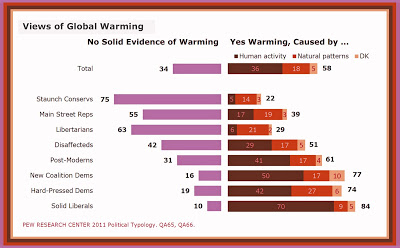

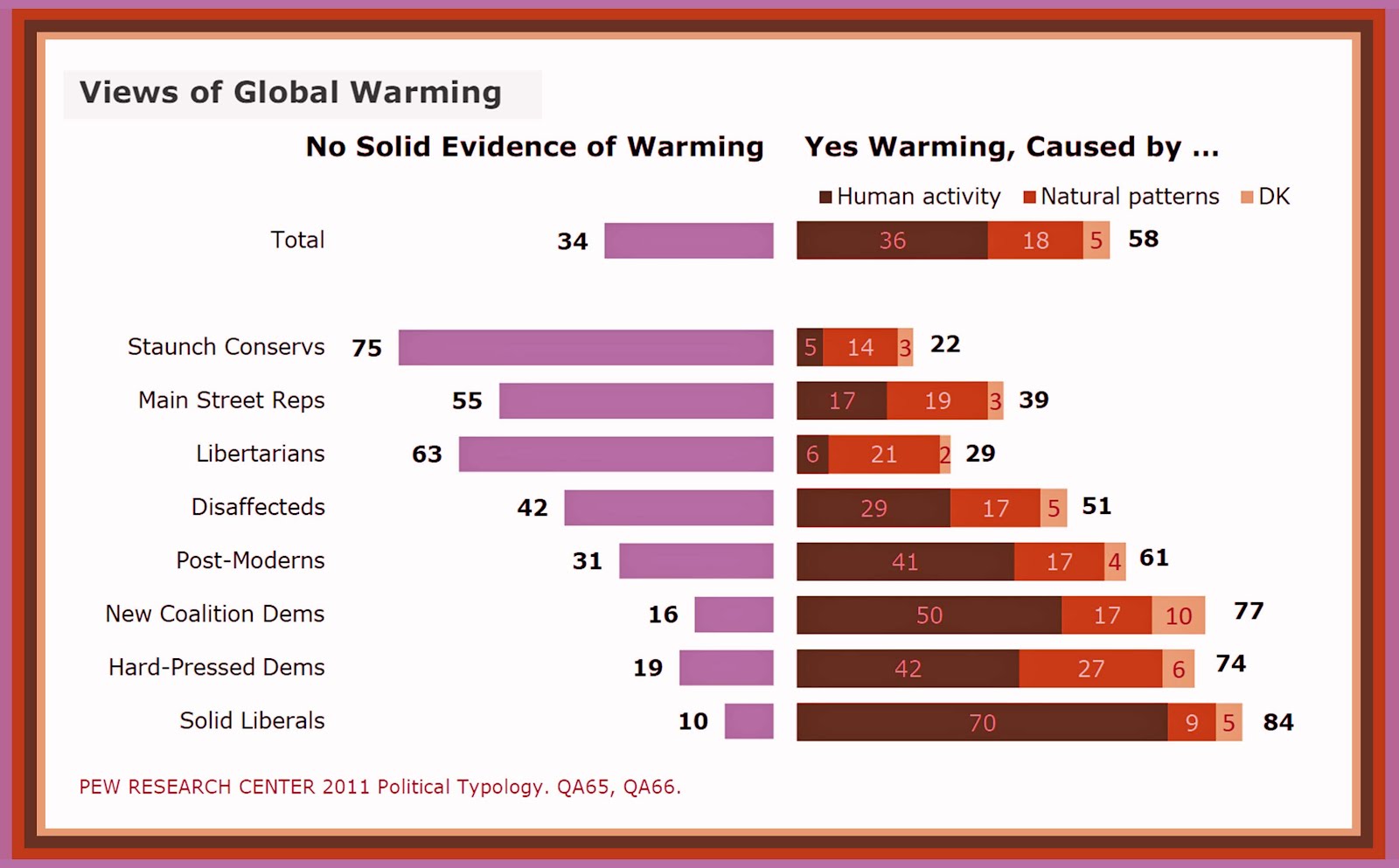
A Pew Center study of the climate change beliefs of different individuals has looked at eight classifications of conservatives and liberals (in the Graphic “Views of Global Warming,” staunch conservatives are “Tea Partiers”). A more in-depth description of the other types can be seen at the link in the references, but for the most part the rest are somewhat more easily identifiable.

This work shows very graphically that an increase in liberal politics means an increase in the belief of the scientific consensus.

A fall 2011 survey by the Brookings Institute tells us that 78 percent of Democrats believe there is solid evidence supporting the consensus on climate change where only 47 percent of Republicans believe there is solid evidence.

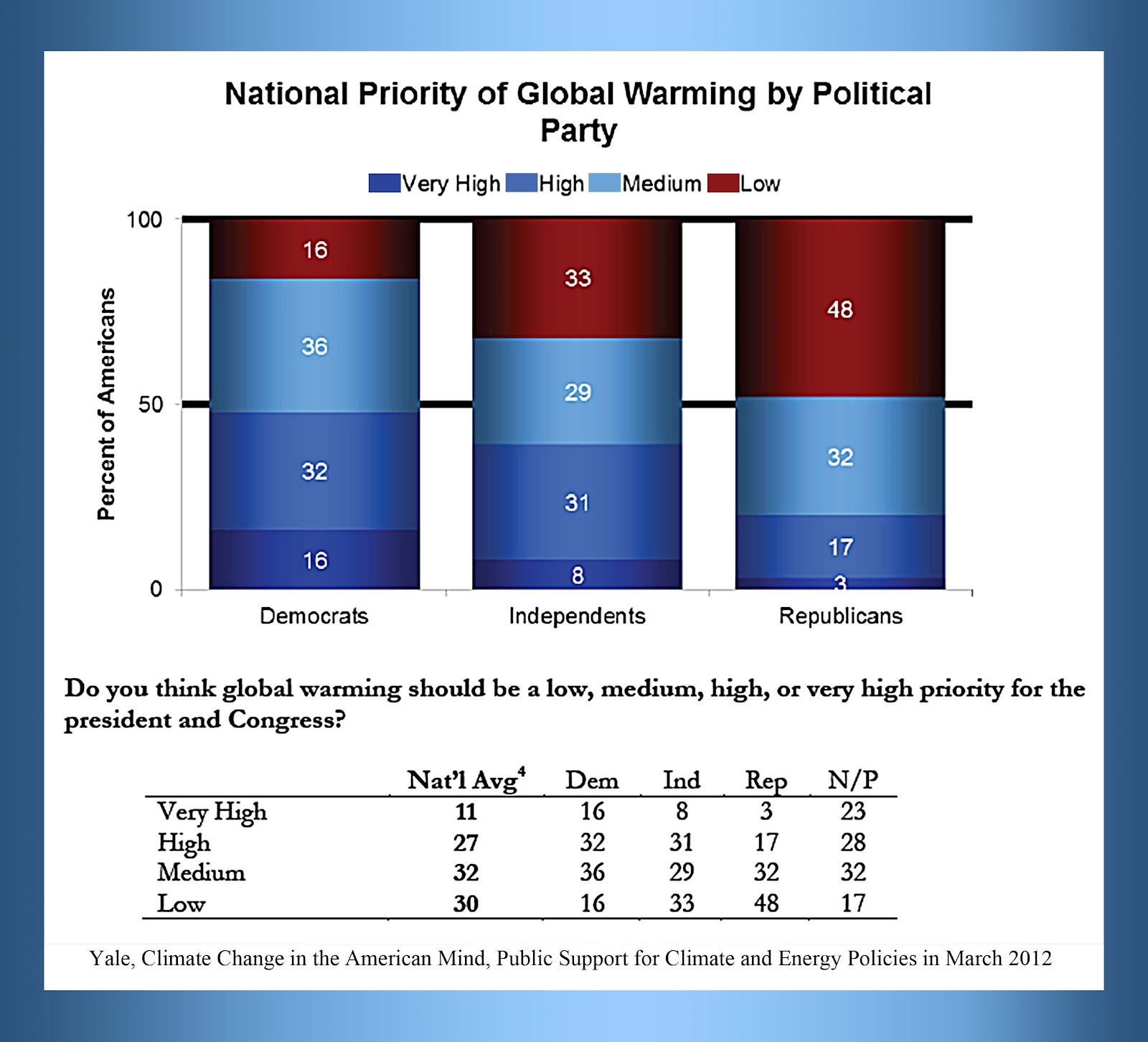
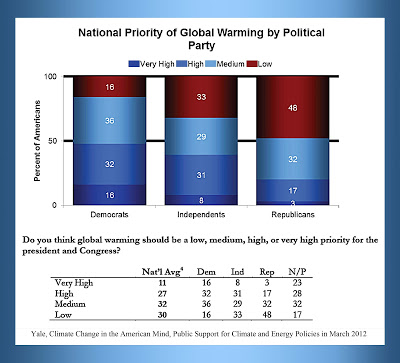
A study out of Yale and the George Mason Center for Climate Change Communication in March 2012 (in the graphic “Climate Change in the American Mind”) looks at the issue differently. It finds that nearly twice as many (38 percent) of Democratic respondents believe the national priority for global warming should be high to very high vs. Republicans (20 percent). Also of note in this study, 56 percent of Republicans in October 2011 believe global warming priorities should be low vs. 48 percent in March 2012.

A study in Sociological Quarterly from April 2011, carried out by McCright and Dunlap of Oklahoma State University and led by Michigan State, analyzed 10 years of data from Gallup’s environmental poll and found that the gap between Republicans and Democrats who believe global warming is happening widened by 30 percent from 2001 to 2010.

The Pew Center’s latest (March 2012) also tells us that 51 percent of Republicans and Independents say it is warmer but it is due to natural causes while 47 percent of Democrats say it is due to manmade global warming. From the March 2012 Gallup survey, 43 percent of Democrats believe warmer than normal temperatures are because of climate change, vs. 19 percent of Republicans.

On the topic of American’s beliefs about government action on climate change: CNN April 2011 tells us that 71 percent of Americans favor funding for the EPA to enforce regulations on greenhouse gases. Gallup says in June 2010 that 42 percent favor the Obama position on climate change vs. 33 percent that favor the Republican position. ABC News/Washington Post in June 2010 finds that 71 percent of Americans think the federal government should regulate the release of greenhouse gases from sources like power plants, cars, and factories in an effort to reduce global warming.

Virginia Commonwealth University 2010 reveals 51 percent of Americans feel that the federal government is doing too little to reduce global warming. Pew Center 2010 adds that 52 percent of Americans favor setting limits on carbon dioxide emissions and making companies pay for their emissions, even if it may mean higher energy prices. USA Today/Gallup 2009 said that 55 percent of Americans favored the U.S. signing a binding global treaty at the Copenhagen Summit that would require the U.S. to significantly reduce greenhouse gas emissions.

Finishing off these numbers, the MacInnis, Krosnick and Villar study from Stanford and Woods Institute in 2011 analyzed the 2008 presidential election and the 2010 Congressional/Senate election and found something surprising. Democrats who took “green” positions on climate change won much more often than Dems who remained silent and Republicans who took “not-green” positions on climate change won less often than Republicans who remained silent.

MacInnis tells us his research suggests that elected officials should take vigorous public positions on climate change because most Americans view this favorably.

  • Democrats won 69% of the races in which the Democrat took a green position and the Republican was silent/mixed.
  • Democrats won 68% of the races in which the Democrat took a green position and the Republican took a not-green position.
  • Democrats won 18% of the races in which the Democrat took a green position and the Republican also took a green position.
  • Democrats won 17% of the races in which both candidates were silent/mixed.
  • Democrats won 4% of the races in which the Democrat was silent/mixed and the Republican took a not-green position.
  • Democrats won 0% of the races in which the Democrat was silent/mixed and the Republican took a green position.

Summarizing these findings the paper tells us:

It is interesting to note that these findings have simple implications for Democratic campaign strategies but tricky ones for Republicans. It appears that Democrats enhanced their chances of victory by taking a green position, regardless of what their Republican opponents said on the issue. But the optimal strategy for Republicans appears to have hinged on what their opponents said. If a Republican could be confident that his/her Democratic opponent would remain silent on climate change, then the Republican would have gained by expressing a not green position. But once a Democrat expressed a green position, the Republican would have been wisest to remain silent/mixed, because expressing a not-green position appears to have hurt his/her chances of victory.

From the press release for the study Krosnick tells us: “Our studies show no decline in public belief in the existence and threat of climate change, and that politicians might benefit from taking a ‘green’ stance.”

The Yale study Climate Change in the American Mind, tells us that three Americans to one would be more likely to vote for a candidate that supports a “revenue neutral” shift in taxation increasing fossil fuels taxes and reducing federal income tax by the same amount. Breaking it down by party, Republican respondents would support such a shift by two to one, Independents three to one, Dems five to one (74 percent). In the presidential vote this year, 55 percent of Americans say that global warming will be one of several important issues they use to determine how to cast their vote (60 percent Dems, 41 percent Republicans and 59 percent Independents).

Conclusions:

Awareness about climate change issues is increasing because of political cues and unprecedented weather actually caused by our already changed climate. Republicans overwhelmingly disagree with the scientific consensus whereas Democrats agree. Only 60 percent of climate scientists believed that Earth was warming in 1991, compared to 97 precent today. Americans’ views on climate change are about 20 years behind those of the vast majority of climate scientists. Lawmakers voicing an opinion on “green” issues are much more likely to win than if they are silent and Democrats are much more likely to win if they voice a positive “green” opinion.

Climate change impacts happening now are making the case for us. Public opinion is changing directly because, in the backs of our minds, we have been listening all these years. Now we see the predictions coming true and are converting. The extremes are convincing people through messaging work that has already been performed. Not that we don’t need to do more. This article has been all about starting new campaigns with a different tone.

The conversions will continue as the extremes continue to ramp up. The majority to the vast majority of Americans already believe and already want our government to act. What needs to be done now is to convince those already convinced that things are bad enough and that the predictions are valid enough that they need to do something about it themselves, or that they and their children will face the balance of the predictions of dangerous climate change.

We can completely circumvent the dissenter’s campaigns. Disassociation is what is needed. Their message is not credible. This is about convincing our leaders that the time has come to do something. And how do we do that? We simply threaten them with un-election. Tried and proven, this tactic can change their votes in mere minutes. But we have to have enough warm bodies engaged. Enough voters need to own this issue to convince our leaders that it’s our way or the highway.

With even more dangerous climate changes still in the pipeline, the voting stance of our elected leaders will change organically like the change in public awareness that we have seen in the last several years. But this will take time that we may not have. If we help it along it will come faster.

Twenty-first century social media have had great impacts on politics recently in numerous issues and these include: Obama’s election in 2008, the Tea Party and Congressional elections in 2010, Iranian elections in 2010, Occupy Wall Street, Arab Spring, Stop Online Piracy Act (SOPA), Planned Parenthood and breast cancer screenings, Rush Limbaugh’s feminist comments blowback, KONY 2012. There are about 250 million Internet users, over 100 million smartphone users, 133 million Facebook users and over 24 million Twitter users.

This is no longer the 20th century. “Click” activism is here. What we did back then, and in the early part of this century, before we decided that climate change was a dirty word, is not going to work today. We need to rely on different strategies. The voting statistics tell us that Dems who speak up about green issues win more often than those who remain silent. Why are we not speaking up? Social media has obviously made a difference recently, so why are we not embracing this technology with our message?

The climate change denial tactics of the conservatives have obviously been successful. It is only when Mother Nature’s brute force exerts more influence on individuals that the tide has begun to turn. Why are we not using the tactics of the conservatives to help our citizenry understand what they should do? Why are our Democratic Party leaders not refusing to do one single thing conservative politicians want us to do instead of compromising beyond our principles?

Why are we not using emotional issues in aggressive ways, like the Conservatives’ messaging campaigns, to convince the undecided that they need to pay attention to what the climate scientists are saying about our children’s future? Why are our Democratic Party leaders not standing on top of the conservatives’ misrepresentations of climate change and repeatedly revealing them to the American public for what they are? Why are the vast majority of us “silently” supporting the climate science consensus when an aggressive vocal stance wins more often?

It’s time to come out of the climate closet and take a deliberate stance. The era of politically incorrect climate change messaging is over. Take a stand and urge your leaders to take a stand. We can vote the disbelievers off the climate island and win.

[Bruce Melton is a professional engineer, environmental researcher, filmmaker, and author in Austin, Texas. Information on Melton’s new book, Climate Discovery Chronicles, can be found at this link. More climate change writing, climate science outreach, and critical environmental issue documentary films can be found on his website. Read more articles by Bruce Melton on The Rag Blog. Images and photographs copyright © Bruce Melton 2012 unless otherwise referenced.]

References: 

For decades, the concept of installing privies in every house… was perceived as lunacy that would bankrupt society: Alley, Earth: The Operators’ Manual, W. W. Norton and Company, 2011, pp. 209-219. These 10 pages offer an excellent discussion of the transition from a toiletless society riddled with cholera to one that has successfully installed toilets and their infrastructure across the world and conquered the cholera challenge. Of the extensive references in Alley’s book, the UCLA website dedicated to John Snow may be the most useful: http://www.ph.ucla.edu/epi/snow.html
$485 in normal weather damage in the U.S. every year: Lazo et al., U. S. economic sensitivity to weather events, American Meteorological Society, June 2011. http://journals.ametsoc.org/doi/pdf/10.1175/2011BAMS2928.1
Why the Northern Hemisphere warms more than the Southern Hemisphere: Kang and Seager, Croll Revisited, Why is the Northern Hemisphere Warmer than the Southern Hemisphere? Lamont Dougherty at Columbia University, submitted Journal Climate, 2011. http://www.ldeo.columbia.edu/res/div/ocp/pub/seager/Kang_Seager_subm.pdf World Meteorological Organization’s Status of the global climate. http://www.wmo.int/pages/prog/wcp/wcdmp/statement/wmostatement_en.html
By 2050 (or even 2040) land temperature increases in the Northern Hemisphere will increase by 18 to 22 degrees F, more than double global average projections: Ganguly et al., Higher trends but larger uncertainty and geographic variability in 21st century temperature and heat waves, PNAS September 15, 2009. http://www.pnas.org/content/106/37/15555.full.pdf+html
High temperature records outpace low temperature records 2 to 1: Trenberth et al., Current Extreme, Climate Communication, Science and Outreach, September 2011.pdf http://climatecommunication.org/wp-content/uploads/2011/09/Extreme-Weather-and-Climate-Change.pdf
Moscow (2010) and European (2003) and Texas (2011) heat waves caused by climate change: Feudale and Shukla, Influence of sea surface temperature on the European heat wave of 2003 summer, Part I, an observational study, Climate Dynamics, 2010. http://www.iges.org/people/Shukla%27s%20Articles/2010/Part_II.pdf  Rhamstorf and Coumou, Increase of extreme events in a warming world, PNAS, October 24, 2011. http://www.pik-potsdam.de/~stefan/Publications/Nature/rahmstorf_coumou_2011.pdf Hansen et al., Public Perception of Climate Change and the New Climate Dice, PNAS in publication. http://arxiv.org/ftp/arxiv/papers/1204/1204.1286
Extremes are happening 10 to 100 times more frequently: Hansen, Sato and Ruedy, Public Perception of Climate Change and the New Climate Dice, (in-press) PNAS, 2012. http://arxiv.org/ftp/arxiv/papers/1204/1204.1286.pdf
The Bias of Fox News: Krosnick and MacInnis, Frequent Viewers of Fox News are Less Likely to Accept Scientists’ Views on Global Warming, NSF grant, Stanford, 2010. http://woods.stanford.edu/docs/surveys/Global-Warming-Fox-News.pdf Press Release: http://woods.stanford.edu/research/climate-views-elections.html Feldman et al., Climate on Cable, Nature and Impact of Global Warming Coverage on Fox News, CNN and MSNBC, International Journal of Press/Politics, XX, 2011. http://climateshiftproject.org/wp-content/uploads/2011/11/FeldmanStudy.pdf
Pew Center, Political Typology: Pew Center, Beyond Red vs. Blue, Political Typology, May 4, 2011. http://www.people-press.org/files/legacy-pdf/Beyond-Red-vs-Blue-The-Political-Typology.pdf
Winning more votes: MacInnis, Krosnick and Villar, The Impact of Candidates Statements about Climate Change on Electoral Success in 2008 and 2010, Stanford, August 2011. http://woods.stanford.edu/docs/surveys/Krosnick-Global-Warming-Voting-Statements.pdf
Revenue neutral tax shift: Yale, Climate Change in the American Mind, Public Support for Climate and Energy Policies in March 2012. http://environment.yale.edu/climate/files/Policy-Support-March-2012.pdf
American’s views on climate change are about 20 years behind those of the vast majority of climate scientists’: Climate Scientists Agree on Warming, Disagree on Dangers, and Don’t Trust the Media’s Coverage of Climate Change, George Mason University, STATS, 2008. http://stats.org/stories/2008/global_warming_survey_apr23_08.html

The Rag Blog

Posted in Rag Bloggers | Tagged , , , , , | 2 Comments

James McEnteer : On the Lean Streets of Quito

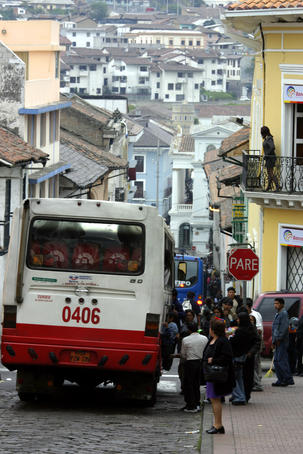
Lean streets of Quito. Image from Lonely Planet.

Sell on wheels:
Pitching and rolling on 
the lean streets of Quito

A man dressed as a circus clown boards a bus selling packs of magic candy, two for a dollar.

By James McEnteer | The Rag Blog | June 13, 2012

QUITO, Ecuador — In Quito you’re either on the bus or off the bus and many are on it. Ecuador’s long, narrow capital city lies between rows of volcanic Andean peaks. Though the urban area stretches nearly 50 kilometers from north to south, it’s possible to traverse most of that distance for 25 cents (12 cents for children and seniors), transferring from one city bus to another. Of course this cheap, reliable public transportation is very popular.

Quito bus riders are also captive audiences for all sorts of sales pitches. Hawkers may come on peddling medicines, for instance. They will make a brief introduction, apologizing for the intrusion, as they move swiftly down the aisle handing out samples of their wares to anyone who will accept them. They launch directly into the long list of benefits their miracle pill or powder can bestow, the many ailments it can cure or prevent.

Or someone might chant the praises of a cookbook full of many fabulous recipes. The salesperson may run through some or all of those recipes, a litany that sounds something like an auction, to entice customers to buy. This prodigious feat of memory may provoke hunger as the bus passengers listen to the long list of meat and fish dishes, or the many desserts one can learn to cook from the proffered volume.

More entertainingly, sales folk pitching CDs pass out their samples and then play excerpts on a small computer or a portable CD player they wear around their necks to keep their hands free to pass out their products or collect their payments.

Whether the products on offer are medicines, cookbooks or music, most passengers accept the chance to hold them in their hands while they listen to the pitch. Inevitably, no matter how much the salesperson claims their product is worth, they end up asking one dollar for it, just to keep things simple. The U.S. dollar is the largest common coin in circulation here.

A man dressed as a circus clown boards a bus selling packs of magic candy, two for a dollar. He says if you eat one, you’ll be able to speak English. Eat two, and you can speak French. Three, and you’ll be fluent in Quichua (a local indigenous language). But if you eat four you’ll turn mute.

As in any profession, some bus vendors excel at what they do, while others are hopeless, rattling on in a rote, unconvincing singsong. Or mumbling their inaudible spiel beneath the drone of the bus engine and the cacophony of city traffic. Some vendors are too shy for their chosen profession. They should probably stand passively with their wares on a street corner, as many do in this lemonade stand economy.

In some cases, a bus sales pitch has little to do with the product. One man who hawks packets of plastic garbage bags spends most of his time describing the community of orphans that stands to benefit from his sales. Of course, what can you say about a garbage bag? That it can hold all the stuff you could buy on a bus?

Blind and crippled vendors board the busses too, sometimes with children or other helpers, to throw themselves on the mercy of the passengers, urging them to buy candy or simply to give them donations. Handicapped vendors wear official government name tags which certify their afflictions as genuine. Considering the meager gleanings of the disabled bus vendors, it is a wonder that their helpers make enough to get by.

Two or three strapping young men may start rapping along with their recorded music and breaking out dance moves down the center aisle. I tend to donate to these guys, whether or not they’re any good, to encourage their show business aspirations, so they don’t have to fall back on crime, mugging pedestrians on the street if their bus performance gigs don’t pan out.

Performers especially, but all vendors, must time their bus sales to avoid the crush of standing riders during peak commuting hours. That makes for a short, intense work day, hopping on and off one bus after another, every 15 minutes or so after the early morning crowds ease off and before the late afternoon commute begins. Is there a training school for bus vendors? Maybe there should be.

Annoying, amusing, always on the go, Quito bus vendors offer random interactive diversion for passengers shuttling from here to there at bargain rates, whether or not you buy what they’re selling. They make online pop-up ads look slick and remote by comparison, and way two-dimensional.

[James McEnteer is the author of Shooting the Truth: the Rise of American Political Documentaries (Praeger). He lives in Quito, Ecuador. Read more of James McEnteer’s articles on The Rag Blog.]

The Rag Blog

Posted in Rag Bloggers | Tagged , , , , | 1 Comment

Shelley Seale : CultureMap Picks Austin’s Top Political Bloggers

CultureMap Austin‘s top political bloggers: Above, The Rag Blog‘s Thorne Dreyer, photo by James Retherford. Inset, below, from the top: Rachel Farris, photo by Wildhouse Photography; Harold Cook, courtesy of Harold Cook; and Katherine Haenschen, courtesy of BOR. All photos appeared at CultureMap Austin.

Election 2012:
Keep up with Austin’s top political bloggers

[The Rag Blog was honored to be featured in a CultureMap Austin article about Austin’s top political bloggers, originally published on June 2, 2012. CultureMap — a “daily digital magazine” designed to keep readers “plugged in, enlightened and entertained about culturally relevant news and information” — has become an increasingly influential Internet community resource for the Austin area. We thought we’d share Shelley Seale’s interesting piece with our readers.]

By Shelley Seale / CultureMap Austin / June 14, 2012

This month’s installment of Austin’s top bloggers highlights some of the best locals who dish on all things politics. After covering style, music, relationships, and food, this month I’m sharing my list of Austin’s top political bloggers.

Thorne Dreyer: The Rag Blog

Thorne Dreyer and The Rag Blog both came of age in the tumultuous sixties. In 1966, Dreyer was the original editor of The Rag — one of the first underground papers in the country.

“At the time, Austin was becoming a center for the fast-growing Sixties counterculture and psychedelic music scenes — and there was a big student power and anti-war movement on and around the UT campus,” says Dreyer, who currently edits the digital-age reincarnation, The Rag Blog. “The Rag pulled those groups together into a major political force.”

Thorne Dreyer and The Rag Blog both came of age in the tumultuous sixties.

The Rag Blog was born in 2005, when dozens of old staffers and local activists came together in a wildly successful reunion and started working together again. “It started as an online discussion group,” Dreyer says, “and many of the old underground press folks now write for us. We have a roster of prestigious contributors from all over the country and have developed an international following, and our writing is republished extensively on the internet.”

The Rag Blog features commentary on contemporary politics and culture and has been an original internet source on subjects like Occupy Wall Street , the environmental and sustainability movements, and other issues of social activism. “Though the times are very different, there are some similarities between the Sixties underground press and today’s progressive blogosphere — and we try to publish The Rag Blog with some of that same Sixties spirit.”

As far as the upcoming Presidential elections, Dreyer feels that people expected too much from Obama, and many are disillusioned with his leadership. “Obama was never really a progressive, and the political climate was such that he kept running into a (Republican) brick wall at every turn. But the Republicans are so scary that we have to support Obama’s reelection. All the pressure on Obama comes from the Right; we need to be more of a counterbalancing force.”

Rachel Farris: Mean Rachel

Blogging helped Rachel Farris deal with her own political grievances. Her first blog post in 2005 was about her frustration with the government’s response to Hurricane Katrina. Even so, she didn’t blog much about politics in those first couple of years — not until 2007, when her then-boyfriend was redeployed to Iraq and Farris began blogging about her dissatisfaction with the Bush administration.

“While the relationship didn’t work out, the blog definitely did. It helped me find my voice.”

Farris’s recent post on What a Rick Perry Presidency Would Look Like for Women got quite a bit of attention. “I think a lot of pundits were talking about what a Rick Perry presidency might look like for foreign policy or business, but no one had really addressed Perry’s record with women,” Farris says. And she is equal opportunity on the parties; she stirred up Democrats as well with The Crisis of Character in the Democratic Party , written right after the 2010 gubernatorial elections.

Farris is concerned about low voter turnout in the Presidential Race, and the way people are tired of the ineffectiveness of politics across party lines.

While many people vehemently disagreed with that post, a group of campaign staffers for Bill White asked her to read it at a backyard party.

“I thought their resilience was impressive and it gave me a lot of hope for the future of the Democratic Party in Texas. If they were willing to listen to some grumpy blogger yell at them, it meant that the next generation of political staffers care and they want to improve our state’s Democratic ticket.”

Farris is concerned about low voter turnout in the Presidential Race, and the way people are tired of the ineffectiveness of politics across party lines. She predicts a win for President Obama, and hopes it will help re-engage the electorate for 2016.

“With a name like Mean Rachel, I’ve found that people are more willing to listen once they’ve gotten to know me,” Farris says. “The most common thing I hear is ‘You’re not so mean!'”

Harold Cook: Letters From Texas

Cook’s blog came about simply because he was bored to tears. It was 2008 and he was on a business conference call. “While the call droned on and on, I just surfed over to blogger.com to see if I could get a blog going,” Cook says. “I didn’t tell anybody for a couple of weeks, because I didn’t think it would last.”

He wanted to do a political analysis blog because that’s where his expertise was — but he also wanted to do political satire and parody. “I think many participants in the political process take themselves way too seriously.” LettersFromTexas.com goes back and forth between serious and humorous pieces, something that Cook says might make the site seem a little schizophrenic to some. “They never know which writing they’ll get when they check in, and I like that.”

Plenty of his blog posts have generated a lot of controversy and commentary. “When Governor Perry first said he was thinking about running for President earlier this year, I wrote a piece highly critical of his candidacy which may well be the most-read piece over on the blog,” Cook says. “It just kept going for months and months. I also wrote Source at Reliant Stadium in Houston which also bent the needle on blog traffic.”

“I think many participants in the political process take themselves way too seriously.”

The most controversial post ever was Rodeo Clowns, in which Cook published the names and contact information of several people who had sent racist emails surrounding a controversy with the Houston Livestock Show and Rodeo. “The squirming by racists in the comments section was certainly an eye-opener to a lot of my readers, to say the least, and I finally shut down the comments on the piece.”

And what does Cook think about the upcoming Presidential election? “I think the struggles within the Republican Party between Tea Party activists and traditional establishment Republicans have taken Republicans so far to the right that it will be difficult for them to have a very good November election. Odds are at this point that Obama will be re-elected.”

Katherine Haenschen: Burnt Orange Report

It was 2003, and a group of UT students needed an outlet to chronicle the political goings-on at the State Capitol and around Austin. Thus was born the Burnt Orange Report. In nearly 10 years the site has garnered more than six million visitors, broken major statewide and national news stories and played a key role in supporting progressive/Democratic messaging, through the work of dozens of staff writers.

In fact, BOR is one of the most widely-read progressive state blogs and was credentialed at the ’06 and ’08 Democratic National Conventions, as well as the 2009 inauguration of President Obama. The blog has also won six “Best of Austin ” awards from Austin Chronicle readers.

In nearly 10 years the site has garnered more than six million visitors, broken major statewide and national news stories and played a key role in supporting progressive/Democratic messaging, through the work of dozens of staff writers.

“While we’re unabashedly Democratic, our readers come from both sides of the aisle,” says editor Katherine Haenschen. “We’re very open about our partisanship and support for Democratic candidates, but we’re also willing to criticize fellow members of our party too.”

In 2006, BOR broke the story about Kinky Friedman’s racist “comedy” routines, which became a big story in the 2006 Governor’s race. Amusingly, Haenschen says the blog is also still getting a steady stream of visits from people Googling “Can Texas secede?” and landing on this post by Karl-Thomas Musselman.” I guess we can thank Rick Perry for that one.”

It is probably obvious that BOR supports Obama in the upcoming elections. “We’re largely optimistic about our elections this year, since issues like public education funding, women’s health, and economic inequality are key this year,” says Haenschen. “Democrats have a more favorable — and let’s be honest, sane — stance on these issues. Plus, it helps that the Republicans can’t seem to stop arguing about the President’s birth certificate while railing against birth control. They’re doing a great job of showing why they shouldn’t be in charge of a bake sale, let alone government.”

[Shelley Seale is an Austin-based freelance journalist who writes about lifestyle, travel, health, education, business and nonprofit issues. She has written for National Geographic, USA Today, Andrew Harper Traveler Magazine, Yahoo, CNN, the Austin Business Journal, Austin Woman and many others.]

The Rag Blog

Posted in RagBlog | Tagged , , , , , , , , | Leave a comment

MUSIC / Gregg Barrios : Patti Smith’s ‘Banga’


The wait is over:
Patti Smith’s ‘Banga

The title cut is a meditation on Pontius Pilate’s dog Banga in Mikhail Bulgakov’s satirical novel, The Master and Margarita.

By Gregg Barrios | The Rag Blog | June 13, 2012

Patti Smith fans’ eight-year wait is over — Banga is a bold return to the musical style and lyricism that made earlier Smith efforts praiseworthy.

Banga opens with the cinematic voyage of “Amerigo” (Vespucci, from whom America gets its name) to an Edenic new world. On this cut, the richness and delivery of Smith’s incantatory voice shines brightly. The pop charm of “April Fools” will have you humming to Patti’s vocals and tapping to Tom Verlaine’s guitar work. “Come, be my April fool, we’ll break all the rules.” Eat your heart out, Jimmy Iovine.

The title cut is a meditation on Pontius Pilate’s dog Banga in Mikhail Bulgakov’s satirical novel, The Master and Margarita. It speaks of canine loyalty. “Night is a mongrel — believe or explode,” Smith howls, as son Jackson provides the barking. However, “This is the Girl,” written for Amy Winehouse, scores with its girl group doo-wop a la the Shangri-Las. Perfect.

The 10-minute epic “Constantine’s Dream,” perhaps the best art-rock composition by an American artist this year, evokes the narratives of Horses and Easter. In its dream within a dream, Smith, like a howling St. Joan of Arc on a steed, calls out, “All is art — all is future!”

The world doesn’t end with a bang on Banga but with a haunting and unfettered version of Neil Young’s elegiac “After the Gold Rush.” A perfect touch to the most satisfying comeback album of the year.

[Gregg Barrios is a journalist, playwright, and poet living in San Antonio. Gregg, who wrote for The Rag in Sixties Austin, is on the board of directors of the National Book Critics Circle. His play I-DJ premieres in July at Overtime’s Gregg Barrios Theater in San Antonio. This review was first published at the San Antonio Current. Contact Gregg at gregg.barrios@gmail.com. Read more articles by Gregg Barrios on The Rag Blog.]

The Rag Blog

Posted in Rag Bloggers | Tagged , , , , | Leave a comment

Kate Braun : Summer Solstice Marks the Midpoint

Summer Solstice fire. Image from Desert Green Goddess.

Between Beltane and the First Harvest…
Summer Solstice: Wednesday, June 20, 2012

By Kate Braun | The Rag Blog | June 13, 2012

“In the summertime when all the trees and leaves are green….”

Wednesday, June 20, 2012, is the Summer Solstice, also called Litha and Midsummer. The Summer Solstice marks the mid-point between Beltane and the first harvest festival, hence the term Midsummer. Lady Moon is in her first quarter, in the water sign Cancer. The Goddess is now a matron and ripely pregnant, foreshadowing the coming harvest. Wednesday is Odin’s day, implying that fathering, generative, paternal energies will also abound.

Midsummer lore says that any herbs gathered or harvested on this day are exceptionally potent. The general rule for harvesting herbs is to do so before 10 a.m., while the essential oils in the plants are more abundant.

Choose among the colors white, red, golden yellow, green, blue, and tan for your decorating. Serve your guests any yellow or orange food such as summer squash, carrots, sweet potatoes, bananas, peaches, oranges, lemons. Foods cooked over flames are also welcome: shish-kebab, grilled veggies, grilled salmon or other fish, grilled meats. Ale, mead, and fresh fruit juice are traditional libations, as are lemonade and sangria.

Plan your festivities to celebrate vitality, creativity, health, and abundance. Celebrate all things in your life, work and play equally. Make magick for love, healing, and prosperity. Rejoice in creation and creativity in all forms.

Include your animals in your festivities. Fairies and garden sprites will be pleased if you set out some food for them. You may also leave bits of mirror or crystal about to reflect light, which pleases these beings. Remember that part of this celebration is to not give away fire or food, and to not sleep away from home.

Make a fire if possible. Any fire will do, from a big bonfire to flames in a small cauldron. Any amulets that have lost their usefulness and/or fulfilled their purpose should be destroyed by casting them into the fire. When the ashes cool, strew them across your yard. This is said to bring blessings to the land.

First quarter moons are a good time to begin projects, to declare intentions to be completed by the full moon. It may be helpful to create a self-dedication ceremony to fix your intentions more firmly in your heart and mind. One way to do this is to speak your intention or define your project to the flickering flames, speaking across the flames to each of the equinox and solstice compass points, East, South, West, and North.

The balance shifts from the Waxing Year to the Waning Year. This cycle of abundance leads to “the time that is no time” when fields lie fallow and there is time to reflect and renew before the next movement of the Great Dance begins. The Summer Solstice marks mid-year as well as mid-summer.

On Saturday, July 21, 2012, I will be participating in a Feed Your Spirit event at the Holiday Inn in Round Rock, Texas. On Saturday and Sunday, July 28-29, 2012, I will be participating in a Spiritual Life Productions Metaphysical Fair at the Holiday Inn Midtown, in Austin. All the information about both these events as well as how to schedule an advance reading is posted on my website.

[Kate Braun‘s website is www.tarotbykatebraun.com. She can be reached at kate_braun2000@yahoo.com. Read more of Kate Braun’s writing on The Rag Blog.]

The Rag Blog

Posted in Rag Bloggers | Tagged , , , , , , | Leave a comment

By Kate Braun / The Rag Blog / July 13, 2012

“Happy Holiday, Happy Holiday, while the merry bells are ringing, may your every wish come true…”

Thursday, December 22, 2011 is Yule/Winter Solstice/Midwinter. Lady Moon is in her 4th quarter, waning towards the New Moon on Christmas Eve. Thursday is Thor’s day, but there will be no warring energies allowed on this day if Saturn’s rule is observed.

Saturn was a popular and powerful god. The ancient Romans celebrated him with Saturnalia, a twelve-day sun-worshipping celebration. They honored Saturn by decorating with holly branches and evergreen wreaths, giving and attending parties, and exchanging gifts each day (sweets were popular as were things made of silver). They sang holiday songs as they roamed naked through the streets bearing lighted candles. During Saturnalia, it was an offence to the God to punish a criminal or begin a war.

Saturn is the Roman version of the Greek God Kronos. The Greek word for “time” is “Khronos”; over time, Saturn became the God of Time. Time/Kronos/Saturn creates, destroys, but then recreates all things. The Greater Trump The Hermit was once called Time; Saturn is frequently depicted as carrying a sickle and a lantern or hour-glass and so does The Hermit.

It is said that when Saturn decided it was time to die, he went in secret to an island near Britain, where he lies deep in a magic sleep. Lore says that at some future time he will return to inaugurate another Golden Age. This myth may have influenced some of the stories about King Arthur (who was taken to the Isle of Avalon to be cured of his wounds and from which he will return when the time is right) and Merlyn (who lies asleep deep in a cave from which he will return when Arthur summons him). C. S. Lewis addressed the Arthur legend and the re-awakening of Merlyn in his sci-fi book That Hideous Strength.

Saturnalia was celebrated in December because at that time December was the 10th month on the calendar; the 10th month brings forth all things because a baby is carried in the womb for 9 months and then emerges. Many cultures observed Winter Solstice rituals: Persians deemed it the birthday of Mithras, another solar deity with a large following; for Egyptians it was the birthday of Osiris. Both Saturn and Mithras began to lose favor when, in the 4th century, December 25 was declared Jesus’ birthday. As John Chrysostom, a 4th Century Bishop wrote: “On this day also the Birthday of Christ was lately fixed at Rome in order that while the heathen were busy with their profane ceremonies, the Christians might perform their sacred rites undisturbed. They call this (December 25), the Birthday of the Invincible One (Mithras); but who is so invincible as the Lord?”

From Celtic tradition comes the duel of the Holly and Oak kings, twins whose twice-yearly ceremonial dance reflects the rebalancing of energies as days shorten or lengthen according to the season. “Yule” comes from the Celtic word “hioul”, which means “wheel”.

From Western European Pagan tradition comes the custom of decorating trees (Prince Albert brought this type of Christmas celebration to England when he married Queen Victoria; at the time it was quite a novelty) and burning the Yule log (symbolically the death of the old year and birth of the new)

One tradition of Yule celebrations is that the season begins on “Mother Night”, December 10 this year, and ends at Yule. This is the origin of “The Twelve Days of Christmas”, although many count those days as beginning with December 25 and ending on January 6, Epiphany.

However you choose to celebrate Lord Sun’s rebirth, use the colors red, green, and white in your decorations and serve your guests a hearty repast that includes nuts, apples, roast meat, Wassail, and cakes or cookies soaked in cider or port.

Give thanks at this celebration for the dark-time that provided balance and gave us time for introspection in our busy lives. Meditate on balance, peace, harmony at this time of year.

Reminders: (1) The first Metaphysical Fair of 2012 will be on January 7 & 8 at the Holiday Inn Midtown, 6000 Middle Fiskville Rd., Austin, TX. Saturday hours: 10 AM – 7 PM; Sunday hours: 11 AM – 6 PM. There will also be a Prediction Panel on Friday, 12/5 at 7 PM; several local psychics will share their insights for 2012.

(2) The first North Austin Holistic Living Fair of 2012 will be held on Saturday, 1/21, at the Holiday Inn Round Rock, 2370 Chisolm Trail, Round Rock, TX 78681 from 10 AM – 5 PM.

I will be participating in both these events; more information is available on the Out and About with Kate page of my website.

[Kate Braun’s website is www.tarotbykatebraun.com. She can be reached at kate_braun2000@yahoo.com. Read more of Kate Braun’s writing on The Rag Blog.]


Type rest of the post here

Source /

The Rag Blog

Posted in RagBlog | Leave a comment

FILM / Ron Jacobs : Scott Noble’s ‘The Power Principle’


Scott Noble’s ‘The Power Principle’
(American Empire: The Feature Film)

A remarkably detailed, clearheaded, and engrossing study of how the United States power elites created the mess we find ourselves in.

By Ron Jacobs | The Rag Blog | June 13, 2012

Discussing the nature of the U.S. Empire and how it got to where it is today with most U.S.  residents is always a challenge. Recommending books explaining it is equally so. This is especially true when one considers that most people who live in the United States have little or no concept of what an empire is and, when it is explained to them, are reluctant to believe that their nation is such a thing.

I have often thought that someone should make a film that might accomplish this educational goal. After all, film is simultaneously informative and entertaining, especially when it is well made. That is the case with radical documentarian Scott Noble’s (Rise Like Lions, Psywar, Lifting the Veil) latest effort, The Power Principle: Corporate Empire and the National Security State.

Made in three parts, with each one totaling about an hour and 15 minutes, The Power Principle is a history of the United States and the building of its empire. The emphasis is on the last 70 years of that history. It includes original footage from film and television news broadcasts, lectures and commentary from champions of the empire and its critics, and a pastiche of other images culled from cultural, technical, and propaganda efforts representative of the time and subject covered.

The result is a remarkably detailed, clearheaded, and engrossing study of how the United States power elites created the mess we find ourselves in. Furthermore, this film makes it clear that in the eyes of the elites, everyday citizens are little more than pawns to be manipulated in the elites’ drive to control the world.

There is a lot of history to be covered when discussing a topic as broad as the growth of the U.S. Empire. Even a film almost four hours long can only begin to explore that history. To his credit, Noble does a great job picking important moments of U.S. history to describe and analyze.

As a result, those historical moments bring forth more than the moments themselves; they exhume their motivations and effects, thereby creating a historical timeline that provides the viewer with a clear sense of how history is shaped by humans and how humans shape history. Noble’s highlighting of particular documents and individuals furthers that understanding.

Key to the hypothesis presented in The Power Principle is the relationship between the U.S. war industry, Wall Street, the U.S. military, and the government in Washington. The interlocking relationships between corporations like Lockheed and presidential appointees like Warren Christopher point to the connections between war and Wall Street in a very personal way. So do more personal relationships such as the marriage of Dwight Eisenhower’s personal secretary to an executive of the United Fruit Company.

Other graphic reminders of how few families and corporations run the United States are also discussed: Kermit Roosevelt’s role in overthrowing the popular Mohammed Mossadegh of Iran; the friendly relations between U.S. bankers like Prescott Bush and the German Nazi regime; the hiring of certain Nazis after World War II by the United States; the reinstallation of fascists into government in Italy after the war to prevent the rise of the communists; and so on.

The middle segment of the film is titled Propaganda. It is an interesting and unnerving look at how everyday people are manipulated by the powers that be. One of the key statements in this section is from Senator Arthur Vandenberg, a Republican from Michigan whose career prior to politics was in journalism. It was his resolution of June 1948 that is considered the foundation of NATO.

Vandenberg always understood that NATO’s purpose was to maintain and expand the growing U.S. empire. He also understood that the people of the United States were reluctant to become the world’s policeman, especially so soon after the carnage of World War II. With this in mind, he told colleagues that the only way to convince U.S. citizens to expand their military and become an imperial nation was “to scare the hell” out of them. That has been the essence of Washington’s line to its own citizens ever since.

The third segment provides a discussion of the U.S. Empire in the post-Soviet age. Key to this discussion are two things: nothing changed as far as the military-industrial complex was concerned and the agreement between the two political parties over empire is stronger than ever before. In other words, there is no difference in the way U.S. foreign policy is conducted no matter which major party’s candidate wins the White House.

Additionally, the presence of the U.S. military in civilian life has never been greater. A brief interview with Left editor and thinker Michael Albert concludes the film. He presents the possibility of a different world where the Empire is dissolved and the military-industrial complex is transformed into building things that benefit mankind. Unfortunately, the overriding conclusion of The Power Principle is that such a scenario is both necessary if we are to survive as a species and unlikely unless the current system is removed.

If I were a high school or postsecondary teacher hoping to get my students to consider U.S. history in a different light, I would show this film. Not only does it rearrange the common understanding of Washington’s role in the world, it also forces the viewers to reconsider how their understanding of that role is manipulated and misused.

Certain to provoke reactions both positive and negative, Scott Noble’s most recent film is meant to disturb the general complacency of the body politic. Help spread the word.

[Rag Blog contributor Ron Jacobs is the author of The Way The Wind Blew: A History of the Weather Underground. He recently released a collection of essays and musings titled Tripping Through the American Night. His latest novel, The Co-Conspirator’s Tale, is published by Fomite. His first novel, Short Order Frame Up, is published by Mainstay Press. Ron Jacobs can be reached at ronj1955@gmail.com. Find more articles by Ron Jacobs on The Rag Blog.]

The Rag Blog

Posted in Rag Bloggers | Tagged , , , , , , | Leave a comment

Thomas McKelvey Cleaver : Remembering Ray Bradbury

Ray Bradbury in 1982. Photo by Lennox McLendon / AP / Washington Post.

Ray Bradbury remembered:
The librarian told my dad
he was asking for trouble

“Ray Bradbury, a boundlessly imaginative novelist who wrote some of the most popular science-fiction books of all time, including Fahrenheit 451 and The Martian Chronicles, and who transformed the genre of flying saucers and little green men into literature exploring childhood terrors, colonialism and the erosion of individual thought, died June 5 in Los Angeles. He was 91.” — Becky Krystal, The Washington Post

“Bradbury was the perfect author for dreamy kids, kids who can spend hours finding the figures in clouds, or who get lost in reveries about desert islands or space colonies on parched planets… It was as though Bradbury was our secret ally, the first grown-up we ever ran into who broke with the party line and sided with us.” — Malcolm Jones, The Daily Beast

By Thomas McKelvey Cleaver | The Rag Blog | June 13, 2012

I remember well my dad picking out The Martian Chronicles from the paperback section of the Eugene Field Library in Denver’s Washington Park in response to my badgering him.

I had recently discovered that the world of science fiction lay just around the corner (literally!) from the boring “juvenile books,” and had already discovered Isaac Asimov. But only adults could check out the paperback books, so I convinced Dad to get it.

The librarian told him he was “asking for trouble” if he let me read such books at such an age (how right she was!). What fantastic stuff! And then a year later Dad brought home the new paperback — Fahrenheit 451. Reading that at age 10, in the midst of what was going on in America at that time, had a lasting effect. I don’t think there’s anything Ray Bradbury ever wrote that I didn’t read and like.

In 1967, while working on draft resistance here in Los Angeles, I was going through the file cards we had of people who had given us money, with the objective of calling them up and asking for more. I found one for an “R. Bradbury” who lived not that far away, over toward the 20th Century Fox lot in Rancho Park.

 I called him up and he said sure, he’d be happy to help some more. But he didn’t drive and could I come over and pick up the check? So I did. And when he answered the door I knew it was Him, and when he invited me in it was all I could do not to act like an idiot.

But after talking to him — and answering his questions about how and why someone who had already served would be working on draft resistance, telling him what I had learned in my service in Vietnam — I finally couldn’t stop myself, and I told him how I knew him, and that reading his books had a lot to do with why I was doing that work. He liked hearing that.

I also remember getting a nice note from him through the Science Fiction Writers of America upon my gaining membership in 1989 for having written The Terror Within, saying he had quite enjoyed the movie and that he remembered from where he knew my name.

Bradbury talked often about being a “graduate of libraries.” I am sure I am too (even though I did go to college).

He was one of the best of my teachers there in those libraries. A Professor of Humanity.

[Thomas McKelvey Cleaver is an accidental native Texan, a journalist, and a produced screenwriter. He has written successful horror movies and articles about Second World War aviation, was a major fundraiser for Obama in 2008, and has been an activist on anti-war,  political reform, and environmental issues for almost 50 years. Read more articles by Thomas Cleaver on The Rag Blog.]

The Rag Blog

Posted in Rag Bloggers | Tagged , , , , , , | 1 Comment