Lamar W. Hankins : Sweet Land of Liberty (for Some)

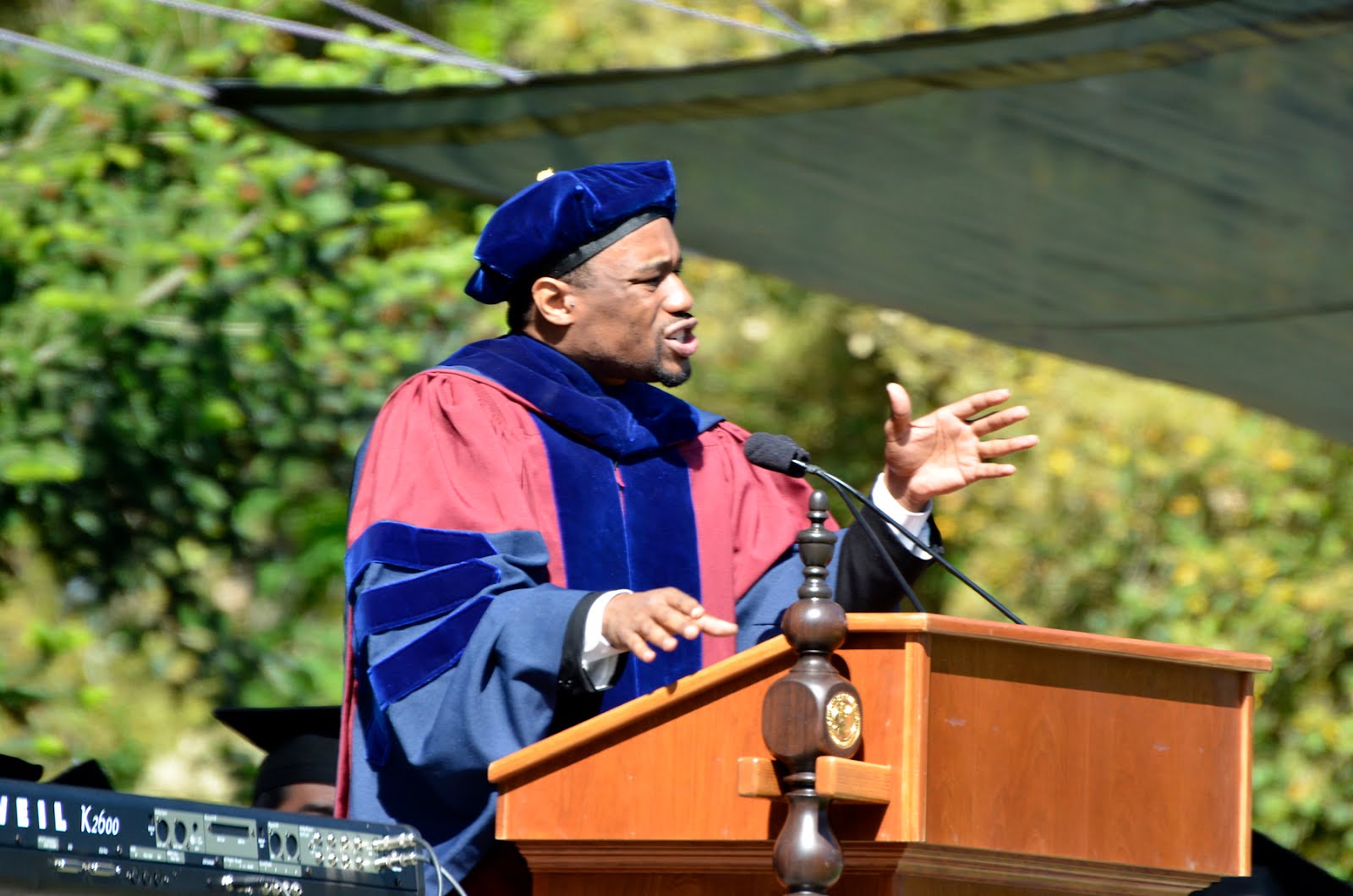
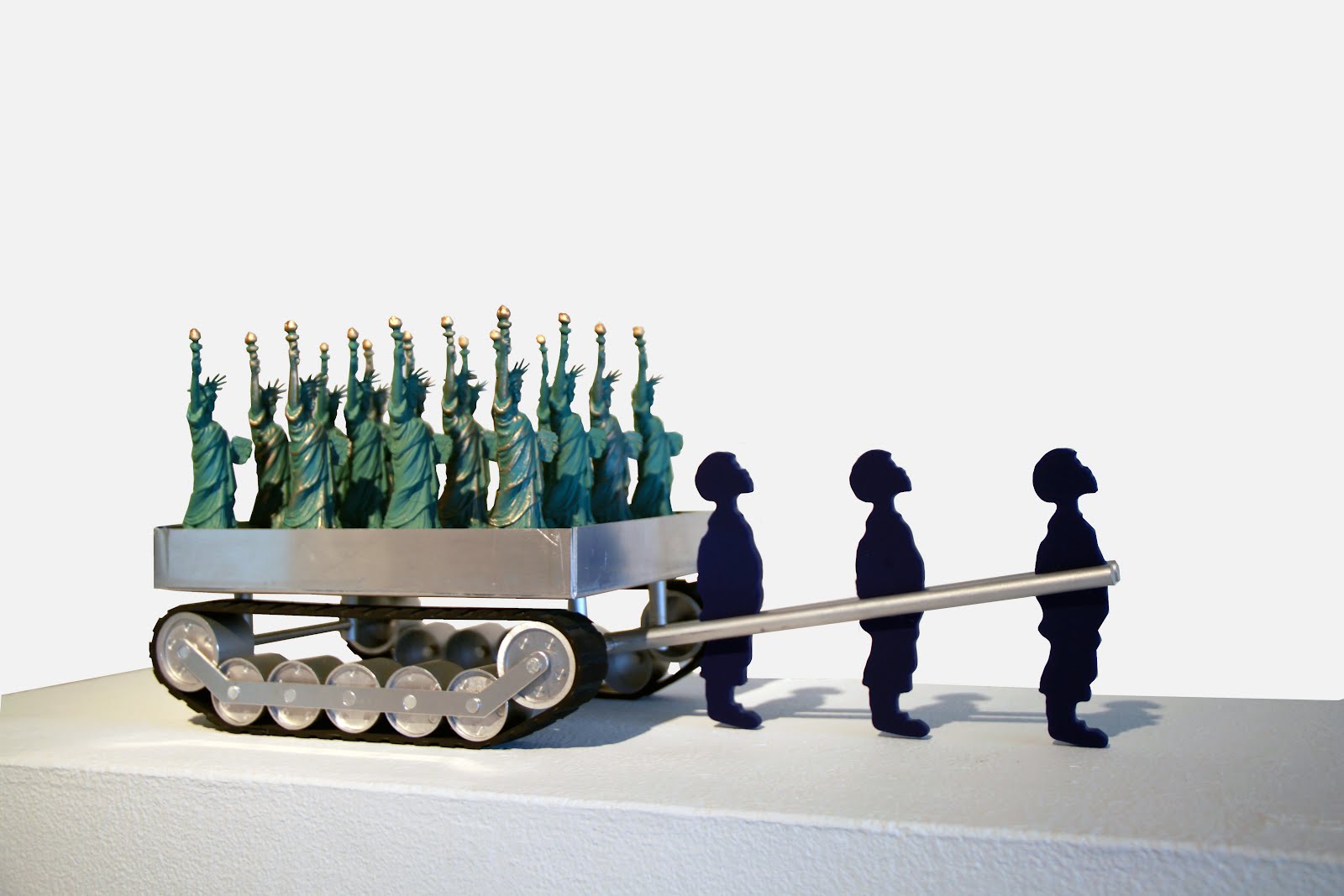
“The Weight of Liberty.” Sculpture by Juliana Murcia Ortiz.

Ah, irony:
Sweet Land of Liberty

When liberty serves the interest mainly of the plutocrats who are largely in control of this country, we no longer have a republic that is of, by, and for the people.

By Lamar W. Hankins | The Rag Blog | May 28, 2012

SAN MARCOS, Texas — Fifty years ago when I graduated from high school and began solidifying my political beliefs, I looked at the world I had grown up in and started deciding what mattered.

The first thing that mattered to me was equal rights for minorities — those folks who were not allowed by either law or custom to participate fully in American life. They were denied the liberties that I enjoyed. I could not square these circumstances with the values I had been raised to believe in — the same values that had been dishonored throughout our history while being espoused by everyone from our founders, to my church, to my high school government teachers.

The irony of these contradictions did not escape my notice.

I grew up in a world (the Beaumont-Port Arthur area) where many workers exercised their right to join together with other workers for their mutual betterment. They united together to get better wages, better working conditions, better benefits for themselves and their families, which also made their community better.

Because of their liberty to associate guaranteed by the First Amendment, they were able to form unions to create better lives. When I went away to college, I learned that not everyone thought that having such liberty was a good idea — not everyone supported the idea of freedom of association even if it was in our Constitution.

The year 1965 was a watershed year for me. I upset my Abnormal Psychology professor by writing my term paper arguing the proposition that homosexuals were not abnormal. That summer, I worked for the Texas prison system. There I learned that the common practice at the Ferguson Unit, 20 miles north of Huntsville, was to beat young prisoners with rough-hewn ax handles for minor transgressions. For reporting this abuse, I was threatened by the warden and assistant warden and kept away from inmates for the rest of the summer.

It should come as no surprise that I began questioning the bona fides of people in positions of authority.

After a weekend at home from my summer prison job, I was driving back to the prison through Huntsville. As I approached the courthouse square, I noticed that it was crowded with people. I stopped to see what had drawn so many people on a Sunday evening to downtown Huntsville. I gathered information from bystanders that a desegregation sit-in was occurring at a local cafe on the square.

As this information was sinking in, a man walked up to a reporter for the local newspaper and knocked him to the ground, shattering his glasses. A policeman was standing a few feet away and saw this incident, but he turned away, unconcerned. It seems that having a reporter there to tell the newspaper’s readers what was happening in their town made the man angry, so he took out his anger on the reporter.

Once again, a person in authority would not take appropriate action to, in this case, protect the freedom of the press.

Before the year was out, I participated in my first demonstration against the Vietnam War. While I had supported Lyndon Johnson’s election as President, largely because of his embrace of civil rights and the implicit promise that he would be less warlike than his opponent Barry Goldwater, I was dismayed that he would send Americans to a small southeast Asian country to forcefully compel the people to follow our views on how they should conduct their political and economic affairs. Our founders had envisioned a foreign policy that did not intrude itself into the affairs of other nations by means of armed force.

Once again, the irony of this situation did not escape my notice.

By the summer of 1965, I had finished my junior year in college and wanted some experience in the nonacademic world. The summer work in a prison had whetted my appetite for doing something positive for others less fortunate than I, and helping to change a system that does not live up to the American values I had learned growing up.

At the end of that summer, I went to Florida to join a group of other mostly young people to spend a year working in a project to help change the lives of migrant farm workers. How naive we all were.

The exploitation of migrant farm workers has been going on in this country since the 1850s, when immigrants from Europe joined African Americans to harvest crops in the eastern part of the country. In the west, people from China, Japan, and Mexico provided the farm labor needed to harvest crops. Later, freed slaves, poor whites, Native Americans, Cubans, Jamaicans, and Puerto Ricans were employed at slave wages to harvest crops, particularly in Florida and along the East Coast.

The project I participated in was part of Volunteers in Service to America (VISTA). We were assigned to local social service agencies to help create programs to make the lives of migrant farm workers better. We did touch a few lives in a positive way, but we learned that it would take more than a bunch of idealistic, well-meaning people to change a system that was more akin to slavery than to the work that my father did as a machinist protected from exploitation by a union contract.

The lesson that I drew from this experience is that the system needs to be changed. Making the lives of farm workers slightly more tolerable with preschool programs, nutrition programs, tutorial programs, and programs that provide better access to health services has its place, but it is no substitute for changing a system that denies these people any real chance at liberty.

These experiences that began 50 years ago continue to affect my world view and inform my politics.

When I read that people believe that a health insurance mandate interferes with their liberty, I am appalled. I remember all the migrant workers I met who had incredibly hard lives without the benefit of much health care at all, who developed gangrene in wounds, who were missing half of their teeth, who were often kept in prison-like conditions by growers, who were made sick by pesticides used in the fields where they picked tomatoes and in the groves where they harvested oranges and limes, and who had to live in filthy hovels, larger, but no better than the dog houses many of our pets enjoy.

And I have learned that our founders did not seem to believe that liberty was curtailed by mandating purchases by citizens, which they did at least three times in the early years of this country, including mandating the purchase of health insurance by sailors during the administration of John Adams.

Liberty is an essential part of a free society, but one irony of America’s values is how little liberty there is for a large segment of our society — a segment in which over 300 million people depend for the food they eat. From this perspective, the liberty interest involved with being required to purchase health insurance pales in comparison to the liberty to have decent jobs at decent pay and decent working conditions.

I continue to hear people argue for their right to to have the liberty to defraud others through the kind of schemes that led to the “great recession” we are still trying to get free of. For many people, it is fine for Wall Street and the big banks to continue to gamble with depositors’ money, knowing that the government, you and I, will bail them out to keep the entire economy from failing.

While the Dodd-Frank law was well-intended, it has been too little, too late. An expanded version of the law that served us well since the Great Depression (Glass-Steagall), but was repealed under Bill Clinton, needs to be adopted, but many Democrats and almost all Republicans will not pass such a law, mainly because they are all beholden to the very entities that created our present economic morass.

The bankers want to have the liberty to do what they want, unimpeded by laws and regulations that will serve the public interest rather than their pecuniary interests.

When liberty serves the interest mainly of the plutocrats who are largely in control of this country, we no longer have a republic that is of, by, and for the people. Under these conditions, most Americans live under the dictates of the few — what a modern day John Stuart Mill might call the “tyranny of the 1%.” And liberty and justice for all becomes less than a pipe dream.

Mill wrote a fitting ending to this essay, which leads me to question whether we have ceased to be civilized, if we ever were: “[T]he only purpose for which power can be rightfully exercised over any member of a civilized community, against his will, is to prevent harm to others.”

There is much harm overwhelming our society and I see no reason to expect that to change.

[Lamar W. Hankins, a former San Marcos, Texas, city attorney, is also a columnist for the San Marcos Mercury. This article © Freethought San Marcos, Lamar W. Hankins. Read more articles by Lamar W. Hankins on The Rag Blog.]

The Rag Blog

Posted in Rag Bloggers | Tagged , , , , , , | Leave a comment

Roger Baker : Oil Addiction Generates Denial

Political cartoon from the LA Progressive.

Oil addiction generates denial

The major sin of the big oil companies was to get their customers addicted, to set up lobbies to keep them addicted, and to deny the looming shortage problem, including the threat of global warming.

By Roger Baker | The Rag Blog | May 23, 2012

It’s easier to fool people than to convince them that they have been fooled. — Mark Twain

Denial is a basic symptom of addiction that involves hiding the truth, refusing to talk about the problem, rationalizing, or dismissing the situation — defensive patterns of behavior that the addicted employ to avoid facing reality. This same principle of denial holds true whether the addiction applies to an individual or to an entire nation.

It is certainly no exaggeration to say that the United States has been a nation addicted to a continuous supply of cheap imported oil for at least the last 35 years. This has been so ever since President Jimmy Carter promised to take a leadership role in breaking our oil habit in 1976. At that time he characterized the U.S. energy crisis as the “moral equivalent of war.” The USA has been in denial ever since.

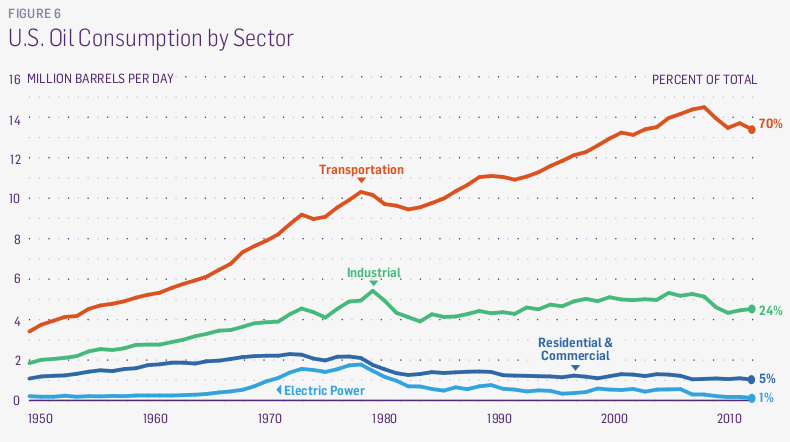
By 2006, our imported oil habit was still growing and caused about 35% of our trade deficit. (See Figure 1 in this link.) Since then, we have been able to produce more oil and cut back on our oil imports (see Figure 3), but now it has risen so much in price that it constitutes about 60% of the total U.S. trade deficit. Transportation, mostly driving, still accounts for about 70% of U.S. Oil consumption, despite the fact that driving has declined slightly after peaking in 2007.

Oilman and President George W Bush, who was in an excellent position to understand such things, openly declared our national addiction in his state of the union address in 2006:

Here we have a serious problem: America is addicted to oil, which is often imported from unstable parts of the world.

From President Carter to President Bush Jr., our imported oil habit became progressively less sustainable, as the cheap oil was used up. If the continuous stream of tankers that export oil from the Persian Gulf region should be interrupted now, the price would immediately rise to a level that would make fuel unaffordable to many U.S. drivers, and to a degree much more painful and disruptive than we experienced in 2008, or in recent months.

Our continuing addiction to Mideast oil accounts for the vast U.S. military force that we have stationed in the Persian Gulf, which region provides a large and growing portion of the world’s total oil supply. It is sometimes claimed that because the United States gets most of its oil from sources closer than the Gulf region, we are not highly dependent on this region. However, since the oil market is global, any oil supply interruption in the Gulf region would soon translate to high prices everywhere else. The Chinese would soon bid against the USA for the fuel produced from the Canadian tar sands, etc.

Europe, by comparison, has been been largely shielded from big fuel cost increases by its already much higher fuel taxes. These taxes have forced its drivers to adopt lifestyles that minimize their fuel consumption, and thus protect them more from a global oil price rise.

Whenever the U.S. supply of imported oil is threatened with interruption (or if the U.S. economy should recover much), the global marketplace bids up the oil price, and the politically sensitive price of gasoline will rise in step and depress consumer spending . Whenever the world oil price is high enough, it can cause an economic crisis. In this case global demand may contract sharply, as it did in 2009. The price can never rise for long above what the global oil market can bear.

In 2008 we found that limit as we approached $120 a barrel for oil and $4 a gallon for gasoline. Prices are once again beginning to kill demand in the U.S., but under a slightly lower ceiling, because the economy isn’t nearly as strong as it was in the first half of 2008. Now the ceiling is closer to $100 a barrel.

Young people are more inclined to kick their oil habit

The lower third of the U.S. population by income increasingly cannot afford to drive at all.

As a result, many young people in particular seem to be culturally rejecting car ownership as a lifestyle goal, and are arranging their lives so as not to require cars. According to a new report ,

The average annual number of vehicle miles traveled by young people (16 to 34-year-olds) in the U.S. decreased by 23 percent between 2001 and 2009, falling from 10,300 miles per capita to just 7,900 miles per capita in 2009. The share of 14 to 34-year-olds without a driver’s license increased by five percentage points, rising from 21 percent in 2000 to 26 percent in 2010, according to the Federal Highway Administration.

The road lobby, sprawl developers, and climate change denial lobbies all have a dog in the fight and are happy to support groups that help perpetuate oil addiction denial. The Antiplanner, funded by the Cato Institute, is one prominent voice of denial. This Libertarian think tank, founded by one of the Koch Brothers, is still a bit too independent and they are trying to regain control again.

In fact there is now a wealth of evidence for a deep shift in driving behavior.

America’s transportation policies have long been predicated on the assumption that driving will continue to increase. The changing transportation preferences of young people — and Americans overall — throw that assumption into doubt. Transportation decision-makers at all levels — federal, state and local — need to understand the trends that are leading to the reduction in driving among young people and engage in a thorough reconsideration of America’s transportation policy-making…

In accord with the nature of politics, unhappy voters tend to seek political scapegoats to blame for their pain at the gas pump. As a nation in denial of addiction, we seek external causes other than our own behavior, dependent as it is on this unsustainable resource. As a nation, we uniquely depend on private vehicles for commuting as an integral part of the U.S. lifestyle.

Given all the media attention it has attracted over the past few years, the public seems to understand that maintaining the U.S. oil supply is important. They also believe that their driving dependency is tied to political policy. This leads to the false hope that, by choosing the right president, their driving might remain more affordable.

Given this situation, it is easy to understand why the recent rapid rise in the cost of fuel has become a political issue. Likewise, the recent modest decline in fuel price might seem to indicate that some kind of mysterious factor other than a natural oil shortage is at play.

It is hard for the average driver to understand that the price of gasoline is closely tied to oil demand on a global scale; that the cost of domestic gasoline is closely linked to the global market price of crude oil, and that its price rises and falls accordingly. Here we can see that the average U.S. gasoline price closely tracks the price of Brent crude, the global benchmark standard, even more closely than it tracks the price of the WTI grade of crude oil still produced in the USA.

Other factors can be important too, like transportation and refining bottlenecks, but the cost of crude oil is primary. Global supply and demand, including our domestic demand that uses more than 20% of the world’s crude oil production, are the basic factors that determine what we will pay for our gasoline and diesel fuel. Because of our addiction , we seek scapegoats and seek to deny the need to change our own behavior.

Scapegoats for the right

Republicans make the absurd claim that the federal government and environmentalists have prevented the U.S. oil industry from producing enough oil to lower the price of gasoline. The attempt to portray any possible increase in domestic oil production as being sufficient to significantly lower the global price of oil is ridiculous but certainly attracts media attention.

The truth is that we are in the middle of an oil and gas “fracking” boom widely opposed by environmentalists. This drilling boom has indeed lowered our domestic natural gas price confined to areas within easy reach of gas pipelines, but it cannot much affect the price of oil, since oil is relatively cheaply transported by transoceanic tanker to the highest bidder.

The Republicans still contend that enough of an increase in petroleum could be obtained by increased domestic drilling so that it could lower the price of fuel, even down to the $2.50 a gallon gasoline that Gingrich was promising. Few in the oil industry seriously take these claims seriously, but it is the sort of talk that draws a lot of political attention. Mitt Romney has even called Obama to fire his three top energy advisors.

To be realistic about our current situation, the formerly cheap “conventional oil” that was produced by onshore drilling, which helped the USA win WWII, has nearly all been pumped up and is gone forever outside the Mideast. We now have to rely on much more expensive and hard to produce “unconventional oil” sources, like deepwater offshore wells — especially since 2005.

In the current global market, the reality is that the fruits of increased domestic production will be sold to the highest global bidder by the multinational corporations like Exxon.

The price of crude oil has increased globally by a factor of five from $20 to $100 in only about the last decade. In terms of the physical infrastructure appropriate to lubricating and growing a profitable world economy, this has had a profound and deep-seated economic effect, an global economic shock that has been felt everywhere as reduced profits throughout the global economy.

Scapegoats for the left

Democrats and critics of the business community naturally choose different scapegoats than Republicans, often on grounds that sometimes seem almost as far-fetched. These scapegoats tend to be the big oil companies, Wall Street oil speculators, and the oil refiners.

There is little that Exxon can now do to reverse the chronic oil dependence that they have done so much to help create and perpetuate. They are in effect the beneficiaries of a once-abundant, but now increasingly scarce resource in an era in which the production cost is steadily rising. As Exxon’s own reserves of cheap oil run short, they want to stay in business as middlemen, brokers, refiners, and producers of this increasingly scarce fluid vital to the continued functioning of the U.S. economy.

The major sin of the big oil companies like Exxon Mobil was actually, in large part, to get their customers addicted to their products in the first place, to set up lobbies to keep them addicted, and to deny the looming shortage problem, including the threat of global warming. This was recently detailed in the New Yorker. Obama’s response to being blamed for high oil prices has been more political than focused on informing the public of their addiction:

The President’s policies toward the oil industry are not easy to categorize. His actions — attacking oil-company profits while proposing more oil drilling — can best be understood as political responses to rising gasoline prices.

Obama is quite willing to take advantage of the unpopularity of speculators as scapegoats . The Democrats don’t have a coherent position on energy, but as politicians they still have to represent a public angry about fuel costs. What Democrat could resist blaming Wall Street and commodity speculators for driving up oil prices?

With gas prices continuing to soar, 70 members of Congress on Monday pushed federal regulators to stop excessive oil speculation. The House and Senate lawmakers — all Democrats — wrote to the Commodity Futures Trading Commission to urge the agency to immediately put in place limits on traders in crude oil markets and take whatever steps necessary to rein in prices at the pump.

“It is one of your primary duties — indeed, perhaps your most important — to ensure that the prices Americans pay for gasoline and heating oil are fair, and that the markets in which prices are discovered operate free from fraud, abuse, and manipulation,” the lawmakers wrote in a letter organized by Sen. Bernard Sanders…

The problem with blaming Wall Street speculators is that so much of the oil market is global, like the London exchange. In any case, price hedging is a legal and intrinsic part of a normal market involving buyers and sellers. Nailing down future delivery is the natural inclination of commodity dealers operating in a tight market.

The successful speculators tend to amplify price trends, rather than changing market direction. Speculation is a normal part of the business of airlines, for example, who do a service by anticipating and evaluating future fuel price risk. By anticipating future shortages, they make it hard to deny that there are looming oil supply problems that we urgently need to face.

“The fact is that there really are logistic challenges for Europe to replace Iran as a source of oil, and those challenges are going to translate into a higher price,” said James Hamilton, an economist at UC San Diego who has studied past oil-price spikes.

Reasonable voices are no match for addiction denial

Not everyone in Congress has been in denial of our precarious U.S. oil import position. Republican Senator Dick Lugar recently posted an article — “High gas prices threaten recovery” — which explained that there is practically no global spare reserve capacity left to cushion a sharp oil price rise, due to an inflexible and increasing global oil demand in conflict with a fixed global oil supply.

Price stability depends on a cushion of excess oil production capacity that could be brought online within 30 days or so if needed. A good rule of thumb is 5 percent of the market — now about 4.5 million barrels per day — is a sufficient cushion. Drop much below that, and the market cannot easily cope with planned or unplanned outages…

The cushion today is just 1.4 million barrels per day of spare capacity in a global market of approximately 89 million barrels, according to analyst Bob McNally, of the Rapidan Group. Some estimates are even lower. That thin margin already inflates prices, but it also puts global oil markets on the edge of massive upheaval.

Senator Lugar offered his “Practical energy Plan,” which amounts to taking a lot of simultaneous emergency measures to expand domestic fuel production, while reducing consumption. While this is good advice, it would certainly take more time and require more political will than we have available.

However even these kinds of sensible warnings by a moderate Republican Senator are apparently too much for the right-wing oil addiction deniers to tolerate. The Koch brothers, who became super-rich from petrochemicals, helped fund FreedomWorks, part of the opposition that successfully knocked Sen. Lugar out of the Republican primary, and thus removed a respected political moderate.

Little time left to deal with our addiction

Rising gasoline prices should ideally be welcomed as a warning of what is soon to come. One of the keenest observers of the geopolitics of oil and the precarious nature of our U.S. oil dependence is Michael Klare.

Because the American economy is so closely tied to oil, it is especially vulnerable to oil’s growing scarcity, price volatility, and the relative paucity of its suppliers. Consider this: at present, the United States obtains about 40% of its total energy supply from oil, far more than any other major economic power.

We will now have to prepare for major economic changes and high gas prices. Oil and politically sensitive gasoline prices have receded in price the last month, but this is in no way a sign that our lives can return to the cheap oil era of the past. We are busily preparing to fight Iran. The energy wars are heating up globally . The hour is getting late.

Klare now calls on Obama to be honest about the true gravity of our current situation.

President Obama has to be honest with the public. There is no solution to high prices, other than a change in the behavior of our energy use, because there is no cheap oil left on the planet. We have to begin a process of converting to alternative forms of energy or alternative forms of transportation. And he has to be honest.

Will we wake up and face our oil addiction denial in time? As they wisely say, you can evade reality, but you cannot evade the consequences of evading reality.

[Roger Baker is a long time transportation-oriented environmental activist, an amateur energy-oriented economist, an amateur scientist and science writer, and a founding member of and an advisor to the Association for the Study of Peak Oil-USA. He is active in the Green Party and the ACLU, and is a director of the Save Our Springs Association and the Save Barton Creek Association in Austin. Mostly he enjoys being an irreverent policy wonk and writing irreverent wonkish articles for The Rag Blog. Read more articles by Roger Baker on The Rag Blog.]

The Rag Blog

Posted in Rag Bloggers | Tagged , , , , , , | 9 Comments

Bruce Melton : The Climate Change Awareness Drought is Over / 1

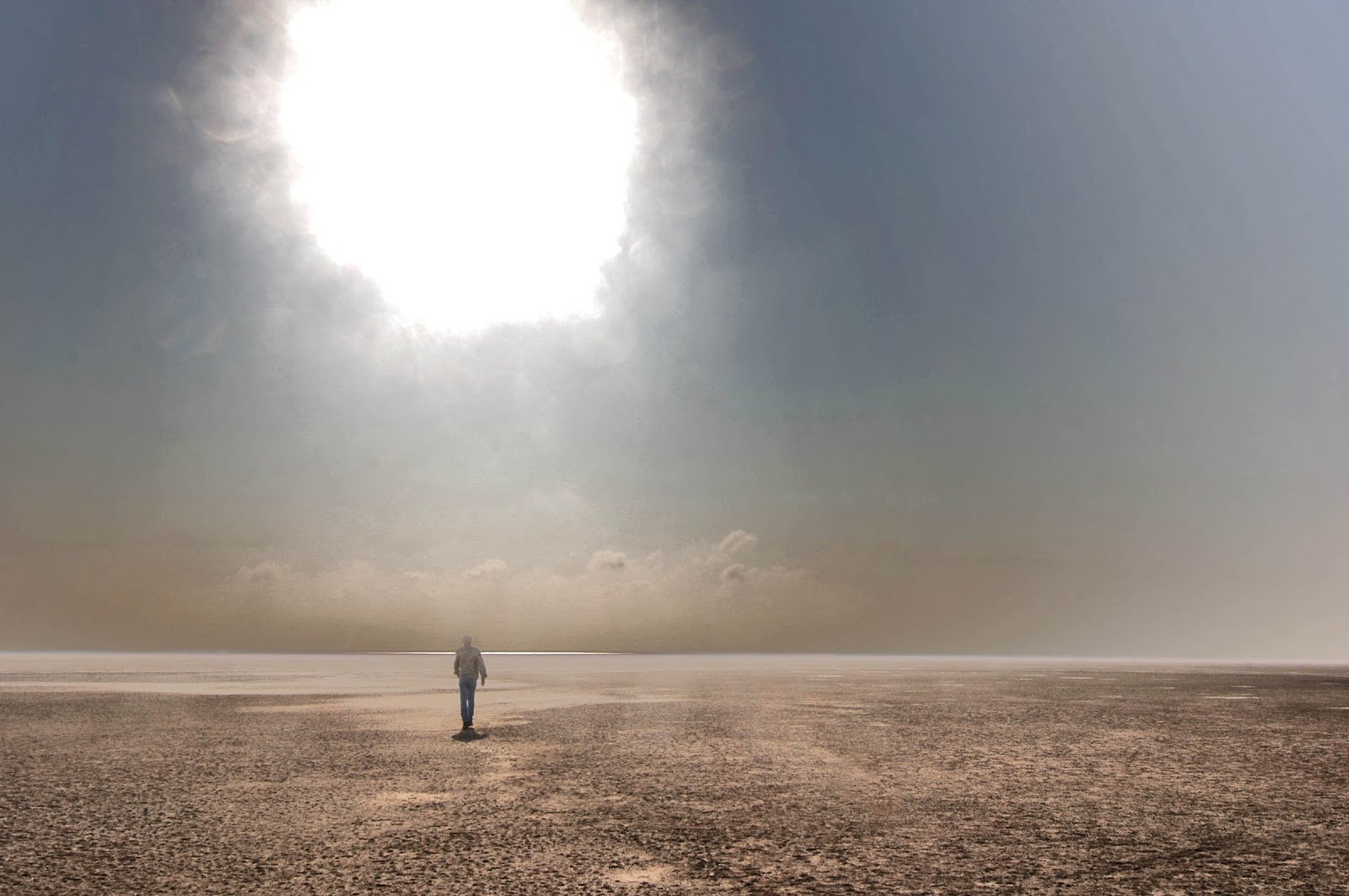
Photo © Bruce Melton, 2012.

The climate change
awareness drought is over
Part One: It’s time to change the tone

The shift in awareness is very encouraging and seems quite likely to be more or less permanent because the number of unprecedented weather events will very likely continue to increase.

By Bruce Melton | The Rag Blog | May 23, 2012

[This is the first of a three-part series exploring the recent change in public awareness of climate change issues, the causes behind the change, biases, the latest science showing how much our climate has already changed, and academic support for a vigorous change in messaging.]

AUSTIN, Texas — Polls, surveys and academic evaluations of public opinion are showing a shift in our collective understanding of climate change. Since the turn of the century, belief in the causes of and reality of climate change has fluctuated wildly at levels below those seen in the 1990s.

Some of this change has been caused by political cues. These are the messages that we get from our leaders and interest groups motivated to “advertise” their message. Change in awareness is also caused by actual climate extremes. Because the extremes are here to stay and there is a growing distrust of the “voices” that advertise the message being disproven by the extremes, the increasing change in awareness is grounds for a shift in advocacy policy towards how we urge for climate change action.

In a 2008 report, George Mason University says that only 60 percent of climate scientists believed that Earth was warming in 1991, compared to 97% today. Public understanding of climate issues was fair to poor until the Bush Administration came into office and awareness significantly declined. But President Clinton is not blameless because he first failed to do something about Senate Resolution 98 (in 1997) that refused to ratify the Kyoto Protocol, and for four more years did not sign.

Bush’s subsequent failure to sign and then his premeditated campaign to derail international climate change policy work gave Americans permission to deny. The United States was the only country in the world except for Afghanistan and South Sudan that did not sign Kyoto.

Beginning in 2005 we saw a string of unprecedented blizzards in the northeastern U.S. and northern Europe. The cold weather convinced many that climate change was indeed as the voices were saying, and that they could continue to disregard the message from scientists. In 2009 more political cues penetrated the media deeply with the theft of climate scientists’ emails and attention being drawn to a single error in the 2007 IPCC (Intergovernmental Panel on Climate Change) Report (Known as Himalayagate) — and a slanderous campaign discrediting the 2007 IPCC reporting on the Amazon was faulty (Amazongate).

The climate science community hoped things would change with Obama’s election in 2008. His message about climate change, although with muted action, was radically different from the Bush Administration’s message. Political cues had radically changed across the country and even the failed Copenhagen Summit kept climate change in the news and was laying the foundation for a change in awareness.

In 2010 it finally happened. The press was paying attention to scientific findings showing that blizzards and snowtastrophes were associated with an unprecedented weather pattern in the Arctic, caused by climate change, sending abnormally severe winter weather far south on a berserk jet stream.

Then unprecedented weather simply exploded in 2010 with the Russian heat wave and Pakistan floods and in 2011 the extremes went off the charts. A study led by Anthony Leiserowitz out of Yale released in February 2012 tells us:

A large majority of Americans believe that global warming made several high profile extreme weather events worse, including the unusually warm winter of December 2011 and January 2012 (72%), record high summer temperatures in the U.S. in 2011 (70%), the drought in Texas and Oklahoma in 2011 (69%), record snowfall in the U.S. in 2010 and 2011 (61%), the Mississippi River floods in the spring of 2011 (63%), and Hurricane Irene (59%).

For 20 years, the vast majority of climate scientists have been warning us that changes like these would happen if we did not reduce our emissions. We did not and they did. Now these same scientists (and more) are warning us that the extremes will continue to worsen even if we do stop all emissions, and a longer delay means more danger than otherwise. The message is getting through.

The Yale study tells us that over the past several years, Americans say the weather in the U.S. has been getting worse rather than better by a margin of over 2 to 1 (52% vs. 22%). The National Climatic Data Center tells us that 14 weather disasters costing more than a billion dollars each (inflation adjusted) happened in 2011. This is 56 percent more than the previous record of nine set in just 2005 and three times as many as the average of the last decade (4.8 per year, 3.8 in the 1990s).

Peer reviewed literature is now coming out that shows, in addition to the unprecedented blizzards, things like the Moscow heat wave in 2010, the Pakistan floods in 2010, the European heat wave of 2003, and the Texas heat wave of 2011 (in-press) were caused by climate change. The National Center for Atmospheric Research tells us that across the planet high temperature records are happening twice as often as low temperature records. In a stable climate this ratio should be one to one. The Yale study goes on:

About half of all Americans say that heat waves (53%), droughts (46%) and very heavy rain storms (43%) have become more common in their local area over the past few decades. People in the Northeast and Midwest are more likely to report that heavy rainstorms have become more frequent in their local area, while people in the South and West are more likely to report that droughts have increased.

Many Americans also say that extreme weather has increased the occurrence of other problems in their local area, including harm to crops (46%), floods (39%), problems with air quality (38%), forest fires (34%), problems with water quality (31%), and problems with transportation (23%). People in the Northeast and Midwest are more likely to report that local floods and harm to crops have become more frequent, while people in the South and West are more likely to report that forest fires in their local area have become more frequent.

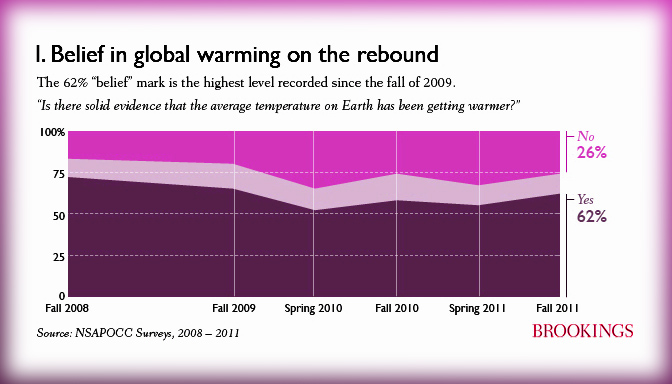
The shift in awareness is very encouraging and oddly, even more encouraging is the concept that the shift seems quite likely to be more or less permanent because the number of unprecedented weather events will very likely continue to increase. The Brookings Institute tells us the change in awareness began in the spring of 2010.

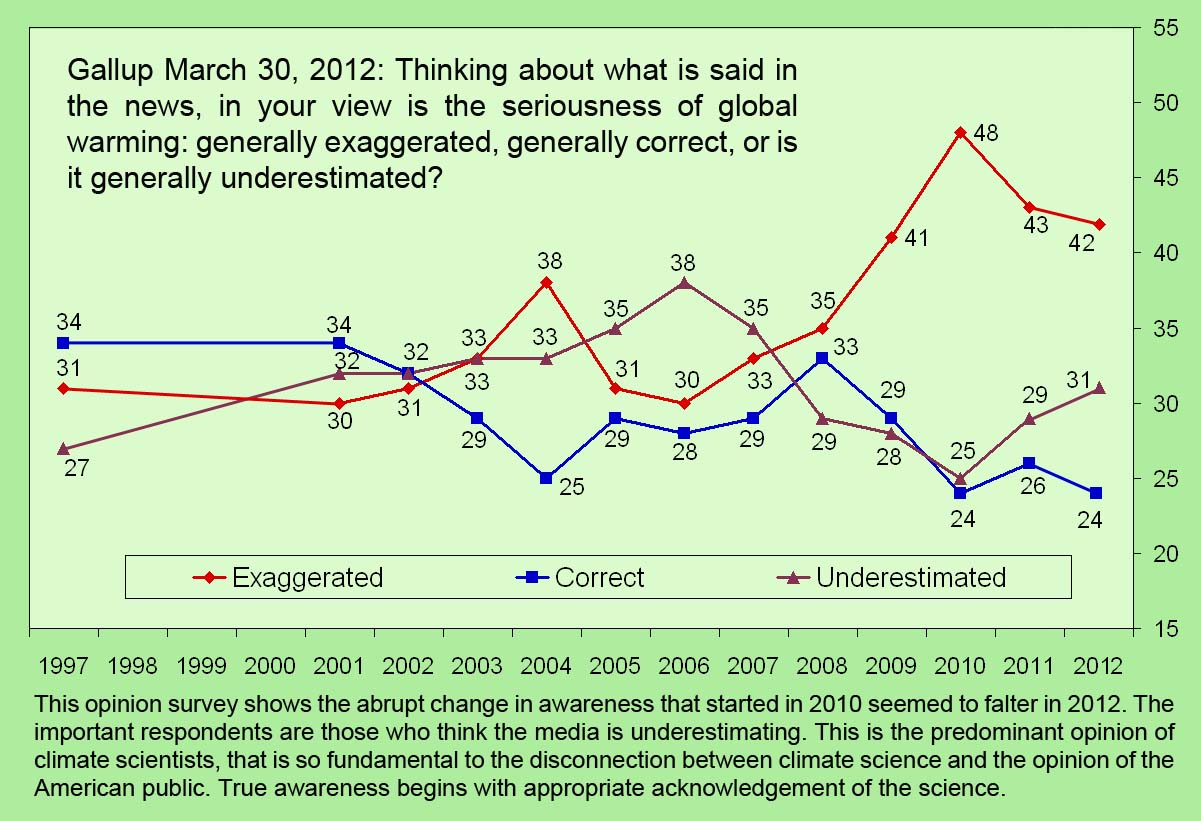
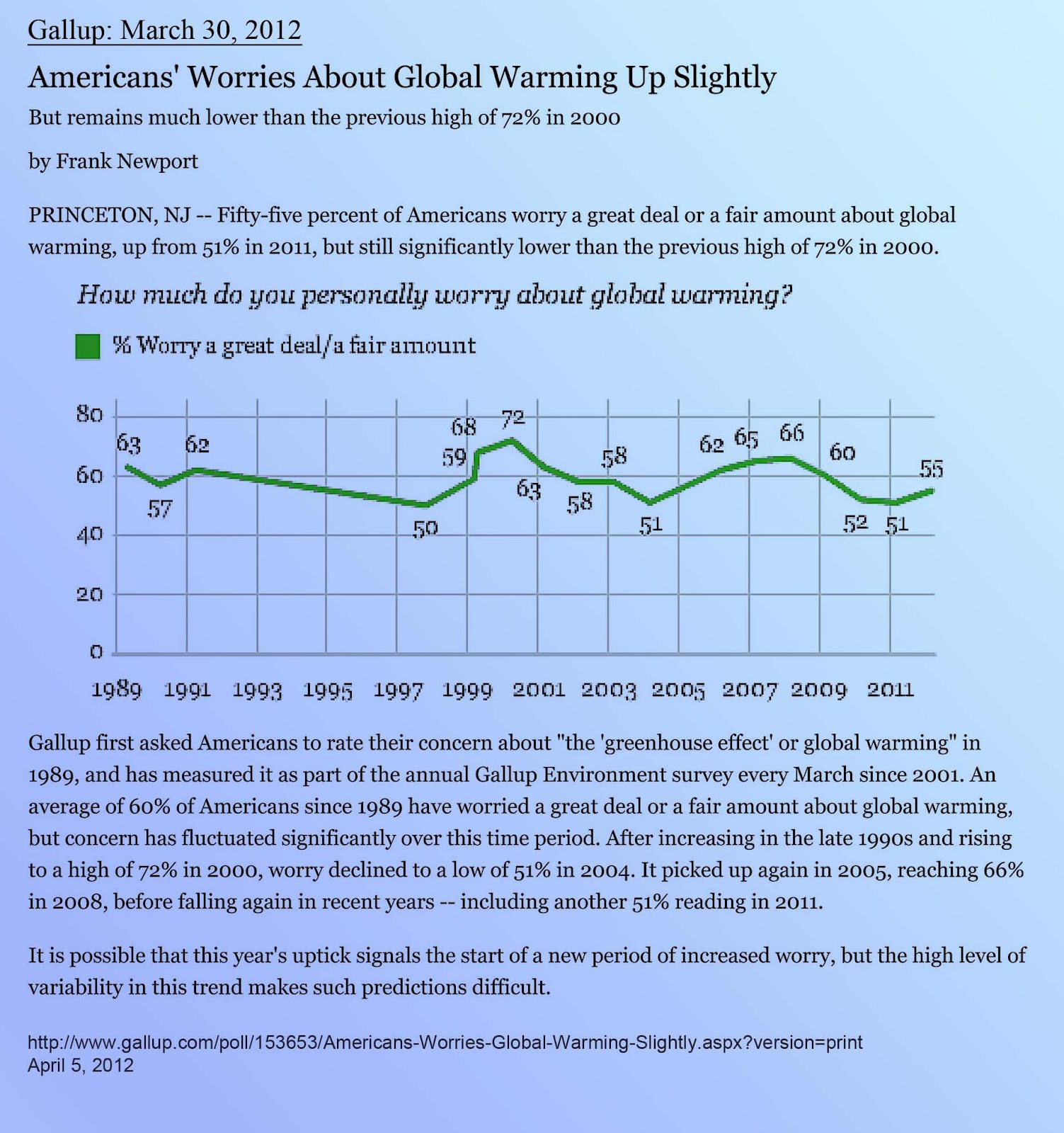
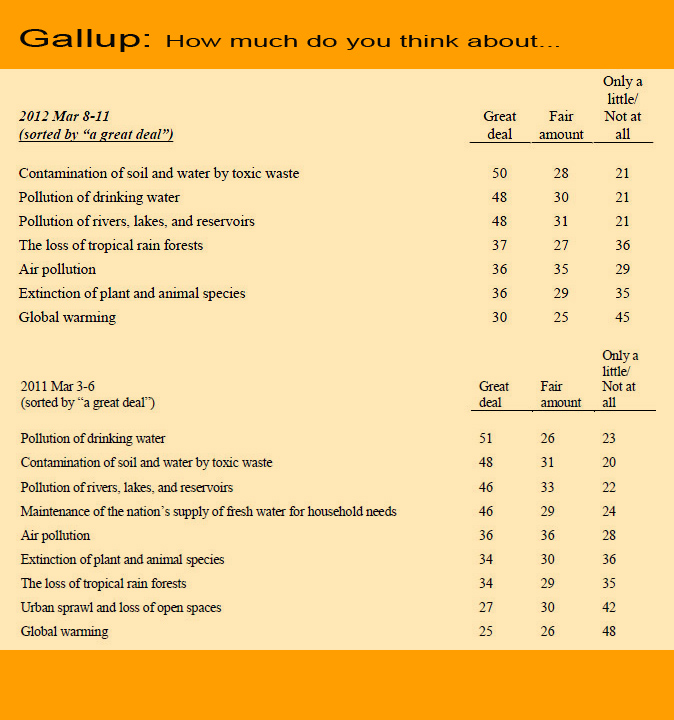
Americans’ environmental priorities have shown global warming at the very bottom since at least 2004. But it’s the relative position of the issue that counts, however (and of course the other issues being measured). When we compare March 2011 to March 2012 we see that those who “worry a great deal” about global warming have increased 5 percent to 30 percent. The lowest it has ever been in this record that dates back to 1989 is 24 percent in 1997.

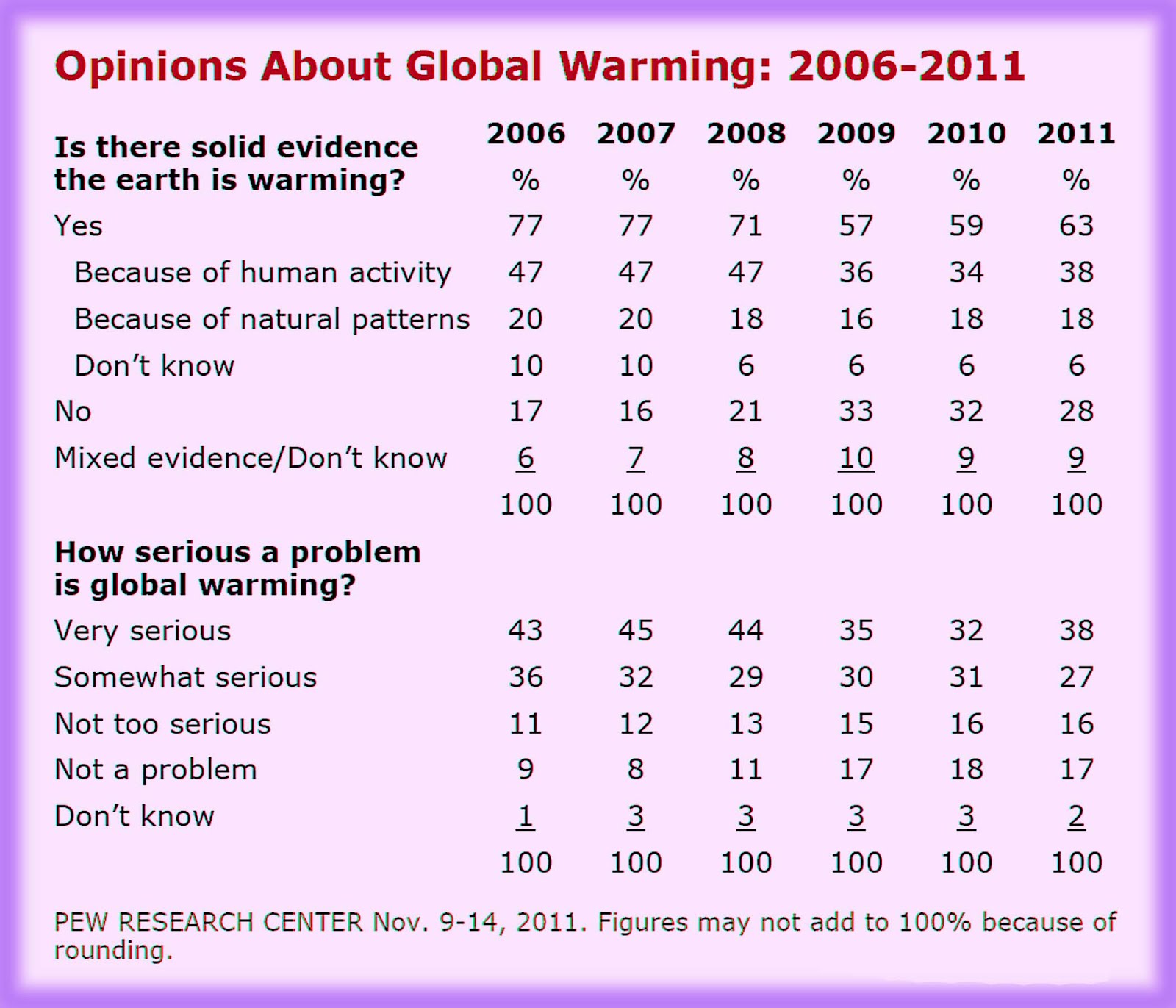
Gallup’s 1997 to 2011 poll about public belief in the seriousness of global warming shows a 4 percent increase from 2010 to 2011. Pew shows a 6 percent increase in the belief that evidence is ”solid” from 2010 to 2011. Rasmussen is up 4 to 6 percent since 2010. Another Gallup poll from 1989 to 2011, about how much individuals personally worry about climate change, is also up 4 percent in 2011.

The Brookings Institute shows a 10 percent increase in the belief of solid evidence showing Earth’s temperature has been getting warmer in the 18-month period between spring 2010 and fall 2011. And finally, once again looking at Gallup’s long-term list of Americans’ environmental concerns, global warming is still on the bottom but that five point increase from 25 to 30 percent is a 20 percent increase in one year.

Overall this is a solid 3 to 5 percent annual increase (or more), which is a very healthy change in overall public perception. Considering that this rate will likely increase, in just two or three years public sentiment could be at an all-time high.

Biased? (The science and/or the polls and petitions and “is this weather or climate we are talking about?”)

Nonbelievers out there would say my evaluation is one-sided or cherry-picked and that I should be looking at “other” sources of information and that public belief is a consequence of the climate scientists’ or government conspiracy. So looking at the three major treatises of the dissenter groups, the most astonishing is the Oregon Institute of Science and Medicine Global Warming Petition Project with signatures of more than 31,000 scientists.

The original petition in 1998 that collected 17,000 signatures included a 12-page peer review-like paper that looked exactly like a U.S. Proceedings of the National Academy of Sciences (PNAS) publication, complete with date, volume, and page numbers (it was not a published paper of any kind). The author of the petition, Frederick Seitz (founder of the Marshall Institute), is a former president of the National Academy of Sciences (NAS). The NAS has taken the extraordinary step of disassociating itself from the Oregon Petition in this statement:

The petition was mailed with an op-ed article from The Wall Street Journal and a manuscript in a format that is nearly identical to that of scientific articles published in the Proceedings of the National Academy of Sciences. The NAS Council would like to make it clear that this petition has nothing to do with the National Academy of Sciences and that the manuscript was not published in the Proceedings of the National Academy of Sciences or in any other peer-reviewed journal. [the NAS statement goes on]. The petition does not reflect the conclusions of expert reports of the Academy.

This “petition” contains signatures of over 13,000 medical doctors, engineers, and general science majors. Many, if not all, of these good folks could be qualified to say something about climate science, but are they? Generally, expert opinion in science is relegated to those with advanced degrees in specific disciplines. Engineers and medical doctors do not practice fundamental science, they apply fundamental science. There’s a big difference.

Out of all of the signatures that can even be identified, only an exceedingly small fraction are actual climate scientists. From the sidebar of Scientific American‘s “Climate of Uncertainty” in October 2001:

Scientific American took a random sample of 30 of the 1,400 signatories claiming to hold a Ph.D. [of the original 17,000] in a climate-related science. Of the 26 we were able to identify in various databases, 11 said they still agreed with the petition — one was an active climate researcher, two others had relevant expertise, and eight signed based on an informal evaluation. Six said they would not sign the petition today, three did not remember any such petition, one had died, and five did not answer repeated messages.

As an example of the lack of control in who signs this petition, there are 10,102 in the category of general engineering and general science broken down into I) Engineering (7,280), II) Electrical Engineering (2,169) and III) Metallurgy (384), and General Science (269). Not included in the engineering category are 223 nuclear engineers, 2,169 electrical engineers, 1,693 chemical engineers, and 2,637 mechanical engineers.

Over half (16,555) of the signatures are from engineers. Are engineers capable of understanding climate? Sure. I am an engineer. Are engineers represented in the academic literature publishing about climate? The answer is a resounding “no.” To finish with the Oregon Petition; it includes 81 food scientists and 384 metallurgical scientists.

Climate Change Reconsidered is an 880 page report prepared by the Marshall Institute and co-authored by Fred Singer. The opening remarks of the original video press conference of this 2009 report on their website primarily refers to the 31,000 “scientists” of the Oregon Institute Petition as their scientific support.

The header on their website tells us to “Learn the Benefits of Atmospheric CO2.” Singer is an 83-year-old physicist who made a name for himself studying clouds. Singer also made a name for himself fighting against the anti-smoking movement and he was outspoken against regulations to curb acid rain. Then he fought against global protection for the ozone layer.

Emailgate, Himalayagate, Amazongate, etc.: Theft of personal emails; a single error about Himalayan glacier among thousands of facts in the 2007 IPCC Report, and a Scribner’s citation error about the Amazon are resources that have been considered. The email scientists have been cleared of all charges by four separate independent investigations.

As for public opinion, there are certainly other sources of information on public opinion that I have not cited, and many of them say the same thing that I have reported, like the Public Religion Research Institute. But then there are those sources like The Heartland Institute or the George C. Marshall Institute that have carried out long and expensive campaigns to discredit.

When the Heartland Institute compares those who believe the consensus position on climate change to the Unabomber, a line must be drawn. Rush Limbaugh and the talking heads on Fox News use similar crude tools to frighten and attempt to discredit with their “message.” This is not something that happens in credible science.

Photo © Bruce Melton, 2012.

To conclude part one of this series, the relatively recent increase in unprecedented weather extremes has shaken up an increased public apathy towards climate change that has been prevalent since about the turn of the century. The opinions of the dissenters are well established, prominently advertised, and look enormously authoritative, but they lack hardly any credibility.

Climate scientists have been warning us that weather extremes would happen sooner if we did not reduce emissions. We did not and they did. The American public has broadly taken notice, blamed the unprecedented nature of these weather extremes on climate change, and this is represented by numerous public opinion polls, surveys, and recently published academic work.

It’s time to ramp up the discussion.

[In Part 2 (out of 3) of this series — titled “Voices Tell Us the Warmists are Dead” — we will explore academic work showing the lack of credentialed viewpoints in the scientific opinions of the dissenters, and the exceedingly small number of credentialed climate scientists that do not support the consensus.]

[Bruce Melton is a professional engineer, environmental researcher, filmmaker, and author in Austin, Texas. Information on Melton’s new book, Climate Discovery Chronicles, can be found at this link. More climate change writing, climate science outreach, and critical environmental issue documentary films can be found on his website. Read more articles by Bruce Melton on The Rag Blog. Photography © Bruce Melton, 2012]

References:

Gallup, March 30, 2012 In U.S., Global Warming Views Steady Despite Warm Winter: http://www.gallup.com/poll/153608/global-warming-views-steady-despite-warm-winter.aspx
Pew Center, Modest Rise in Number Saying There Is “Solid Evidence” of Global Warming, November 9-14, 2011 (Published December 1, 2011) : http://www.people-press.org/files/legacy-pdf/12-1-11%20Global%20warming%20release.pdf
Yale 2012: Weather extremes caused by climate change have changed public awareness: Leiserowitz et al., Extreme-Weather-Climate-Preparedness, Yale Project on Climate Change Communication, April 2012.pdf http://www.climateaccess.org/sites/default/files/Leiserowitz_Extreme%20Weather%20Climate%20Preparedness.pdf
Gallup, March 30, 2012 – Americans’ Worries About Global Warming Up Slightly: http://www.gallup.com/poll/153653/americans-worries-global-warming-slightly.aspx
Public belief that climate change is happening has only recently risen above 1991 beliefs of climate scientists: Climate Scientists Agree on Warming, Disagree on Dangers, and Don’t Trust the Media’s Coverage of Climate Change, George Mason University, STATS, 2008. http://stats.org/stories/2008/global_warming_survey_apr23_08.html
Climate Change Cues: Brulle et al., Shifting public opinion on climate change. An empirical assessment of factors influencing concern over climate change in the US 2002 to 2010, Climatic Change, Feb 2012. http://www.pages.drexel.edu/~brullerj/02-12ClimateChangeOpinion.Fulltext.pdf
Leaders and interest groups capable of advertising climate misinformation:
Cooper, Media Literacy as a Key Strategy Toward Improving Public Acceptance of Climate Change Science, Bioscience, March 2011. http://www.bioone.org/doi/abs/10.1525/bio.2011.61.3.8

Change in advocacy policy: Yale, Climate Change in the American Mind, Public Support for Climate and Energy Policies in March 2012. http://environment.yale.edu/climate/files/Policy-Support-March-2012.pdf
Weather Extremes Caused by Climate Change: Rhamstorf and Coumou, Increase of extreme events in a warming world, PNAS, October 24, 2011. http://www.pik-potsdam.de/~stefan/Publications/Nature/rahmstorf_coumou_2011.pdf
Prominent Dissenter Campaigns:Oregon Institute of Science and Medicine Petition Project: http://www.petitionproject.org/
Climate Change Reconsidered: http://www.nipccreport.org/index.html

Brookings Institute, Fall 2011, National Survey of American Public Opinion on Climate Change, Issues in Governance, Feb 2012. http://www.brookings.edu/research/papers/2012/02/climate-change-rabe-borick
Scientific American took a random sample of 30 of the 1,400 signatories claiming to hold a Ph.D.: http://www.physics.rutgers.edu/~kotliar/honors/honsem/somalwar/honsem/2002/articles/sciam_uncertainty.html

The Rag Blog

Posted in Rag Bloggers | Tagged , , , , , | Leave a comment

Tony Platt : Justice for the Living Dead

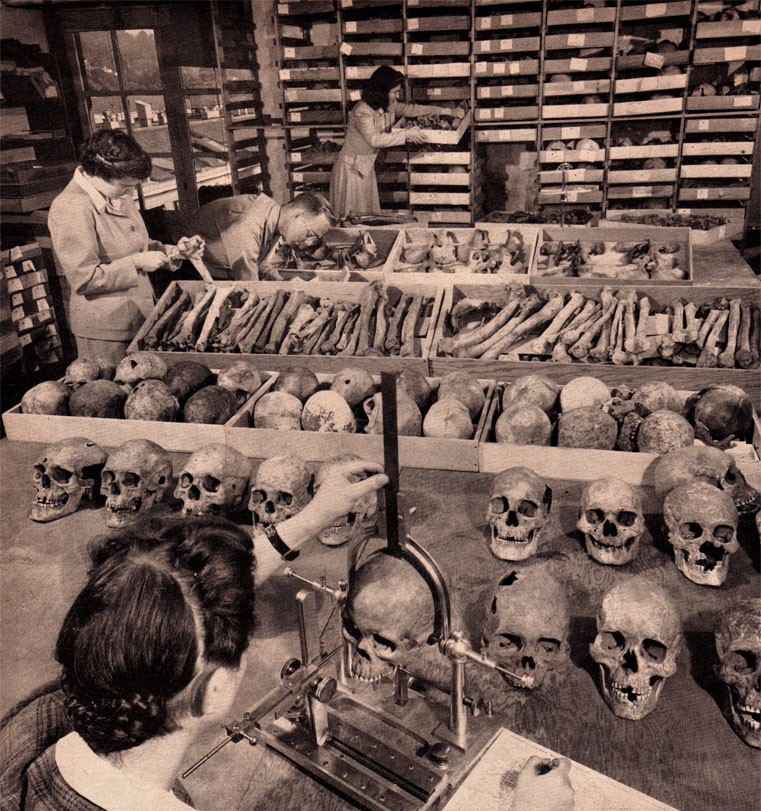
A graduate student at an anthropology museum at Berkeley uses a craniometer to measure an ancient Indian skull. This collection alone contained more than 10,000 Indian skeletons. Photo from Life magazine, October 25, 1948. Image from The Buffalo Post.

Death’s double standard:
Justice for the living dead

It’s not only the unauthorized digging up of ancestors that haunts the memory of native peoples, it’s also the blatant double standard that adds indignity to insult.

By Tony Platt | The Rag Blog | May 22, 2012

It’s good news that the United Nations has authorized University of Arizona professor James Anaya, Special Rapporteur on the Rights of Indigenous Peoples, to carry out its first investigation into the status of Native Americans in the United States, with a particular focus on American compliance with standards embodied in the UN Declaration on the Rights of Indigenous Peoples, to which the U.S. became a signatory in 2010.

The focus of Anaya’s scrutiny no doubt will be on today’s inequalities and injustices that deeply impact 2.7 million Native Americans throughout the country. But let’s not forget the inequities of death.

Despite popular images of tribal members getting rich from gaming pay-offs, the overwhelming majority of Native Americans remain mired in poverty, the victims of structural unemployment and racial exclusion, compounded by devastating rates of diabetes, suicide, infant mortality, and cardiovascular and alcohol-related diseases.

There is a long way to go before, in the words of the Declaration, “indigenous peoples are equal to all other peoples” entitled to the right to “self-determination” and to “be free from discrimination of any kind.”

Inequality is a problem for the dead as well as the living. According to Article 12 of the UN Declaration, native peoples have a right to “the use and control of their ceremonial objects, and the repatriation of their human remains.” Repatriation as a central demand of Native American movements in the United States speaks to the long history of plunder of native artifacts and bodies.

Over a period of some two hundred years, from Thomas Jefferson’s exploration of a Native American barrow near his home in Virginia, to passage of the federal Native American Graves Protection and Repatriation Act (NAGPRA) in 1990, several hundred thousand native grave sites — maybe as many as one million — were dug up in the name of science, recreation, and commerce.

There was a brisk trade in native body parts and funerary artifacts, propelled by the popularity of commercial and recreational “collecting,” scientific curiosity, and the heritage industry. The artifacts removed from graves ended up in private collections and public display cases around the world, including the Smithsonian, Royal Museum of Ethnology in Berlin, the British Museum in London, and museums in Prague, Zurich, Vienna, and Moscow.

During the 19th and early 20th centuries, scientists in universities and museums engaged in a frenzy of acquisition in the hope that native bodies would shed light on the origins of the species or on racial typologies of human difference. They were particularly interested in the bodies of Indians, who, it was believed, had been frozen in time since the Stone Age, and whose remains therefore were thought to hold the key to “secrets of human origins,” as well as provide physical evidence for claims about European superiority and native degeneracy.

This science made it easier to frame the near extermination of native peoples in the imagery of natural rather than social history, subject to inevitable processes of erosion and decline, rather than as the result of human intervention and — in the case of California — genocide.

In widely read treatises — such as Samuel Morton’s Crania America (1839), Ales Hrdlicka’s Directions for Collecting Information and Specimens for Physical Anthropology (1904), and Edward Gifford’s Californian Anthropometry (1926) — the measurement of brain cavities, nostrils, and degree of slope in foreheads generated all kinds of scientific quackery to justify the civilizational superiority of white Europeans and innate inferiority of native peoples.

Aside from the racist assumptions that guided research on native bodies, the science was also flawed because documentation of provenience of bones and artifacts found in graves was often nonexistent. Moreover, scientists harvested far more corpses than they could ever study. Tens of thousands of native dead were stashed in boxes, cellars, and personal collections, only to be resurrected for display in cabinets of curiosities, museums, schools, and international expositions.

A skull collected on Santa Rosa Island was included in the U.S. exhibition at the Columbian Historical Exposition in Madrid in 1892. In the 1920s and 1930s, a self-styled amateur archaeologist dug up hundreds of dead Tongva Indians and used their bones to decorate his Catalina Museum of Island Indians. To this day, the Favell Museum in Klamath Falls, Oregon, proudly displays native artifacts looted from graves.

With passage of the Native American Graves Protection and Repatriation Act in 1990, the practice of widespread grave looting was officially stopped. Moreover, NAGPRA requires federally funded institutions to publish their holdings of native body parts, as well as artifacts taken from graves, and to facilitate their return to tribes that are able to make a case for genealogical or cultural connection.

NAGPRA was as significant a piece of legislation for Native Americans as the Civil Rights Act was for African Americans. And, similarly, it represents an unfinished revolution. The pace of repatriating human remains is glacially slow: by 2009, less than five percent nationwide had been returned to tribes. By 2010, the University of California at Berkeley had repatriated only 179 of its 10,000 native body parts.

There is nothing inherently wrong with using the dead to reconstruct the past. With the help of new developments in chemistry, DNA analysis and dating methods, we can learn a great deal from human remains about how our ancestors lived, worked, and died. Respectful collaboration between community groups, advocacy organizations, politicians, and scientists in New York in the 1990s, for example, made it possible to excavate what had been the Negros Buriel Ground, resulting in a detailed portrait of the daily lives of Africans in colonial New Amsterdam in the seventeenth and eighteenth centuries.

A similar collaboration between the Muwekma Ohlone Tribe, archaeologists, and Pacific Gas and Electric Company — following the inadvertent exposure of native burials in Santa Clara, California, in 2008 — produced a great deal of information about the lives and deaths of Ohlone neophytes buried in the mission at the end of the 18th and beginning of the 19th centuries.

For most twentieth century archaeology, however, the decision to excavate and exhume native remains was typically made unilaterally and imposed by fiat. The problem is not with the search for knowledge, but rather the unequal relations of power between investigator and subject, collector and collected; the lack of consultation and permission, the arrogance run wild; and how the products of knowledge are misused.

It’s not only the unauthorized digging up of ancestors that haunts the memory of native peoples, it’s also the blatant double standard that adds indignity to insult. Remembrance and treatment of the dead is a highly selective political project. Some of our collective dead are respected, others humiliated. Consider some examples:

  • The priests who worked at Mission Carmel in California from 1771 to 1833 are buried in solid tombs and named in headstones. Junipero Serra, architect of the mission system, is interred in an ornate crypt. The thousands of Ohlones, whose slave labor built and ran the mission, are buried anonymously in mass pits. When I visited Mission Carmel in February with Louise J. Miranda Ramirez, tribal chairwoman of the Ohlone/Costanoan-Esselen Nation, she picked up several items from the ground. “Look,” she showed me, “these are human bones dug up by gophers. I’ve asked the authorities to bring in soil and cover the graves with some protection, but they don’t do anything.”
  • In the second half of the 19th century, while scientists and collectors raided native cemeteries for booty and bodies, the nation made amends for the Civil War by creating a system of national cemeteries and making a conscientious effort to preserve the names and identities of those killed. Today, a Defense Department unit with an annual budget of $55 million searches the world for unaccounted soldiers killed in the line of duty. No comparable effort is put into retrieving thousands of native remains unceremoniously stored in university, military, and museum basements.
  • An expensive effort, led by the FBI, is currently under way to find the remains of a six-year old boy killed in New York more than 30 years ago. Recently, a national scandal erupted when it was revealed that the mortuary at Dover Air Force Base in Delaware dumped in a landfill the body parts of some victims of the September 11, 2001, tragedy. Similarly, the Pentagon expressed strong condemnation of the Los Angeles Times for publishing photographs of American soldiers posing with the body parts of dead Afghan insurgents. No such objections were made when museums and newspapers throughout most of the 20th century displayed native skeletons as objects of curiosity and entertainment.
  • A debate is under way today about the propriety of excavating the wreck of the Titanic when it may contain corpses that, say Federal officials, should be accorded the respect of a graveyard and shielded from “looters and artifact hunters.” In contrast, the University of California, Berkeley, is closing the Hearst Museum for two years in order to “renovate and transform its public spaces.” There are no plans, apparently, to give 10,000 native remains stacked in a dank basement a respectful burial or commemorate their theft from native graveyards.

Federal policies of repatriation are a step in the right direction. But most native remains are unclaimed or unknown. What should be a national ritual of remembrance and mourning has become a technical, bureaucratic process. In addition to tribal claims for the return of their dead, there is also a need for public commemoration that speaks to a national tragedy.

Throughout much of the 20th century, while the government built memorials to the victims of world wars and now, as it continues to make efforts to account for every person missing from the Vietnam War, hundreds of thousands of native bones and skulls have been stored anonymously in basements and boxes, and their burial goods displayed as mementos of a “vanishing race” or as freak show curiosities.

However much we have tried to assiduously forget this sorrowful history, the past continues to reverberate in the here and now. It is time to do justice to our living dead.

[Tony Platt is the author of 10 books and 150 essays and articles dealing with issues of race, inequality, and social justice in American history. Platt taught at the University of Chicago, University of California (Berkeley), and California State University (Sacramento). He is a Visiting Professor in Department of Justice Studies, San José State University. His publications have been translated into German, Spanish, Italian, and Japanese. His latest book — Grave Matters: Excavating California’s Buried Past — was recently published by Heyday. He lives in Berkeley and Big Lagoon, California, and serves as secretary of the Coalition to Protect Yurok Cultural Legacies at O-pyuweg (Big Lagoon). He blogs on history and memory at GoodToGo. Find more articles by Tony Platt on The Rag Blog]

The Rag Blog

Posted in Rag Bloggers | Tagged , , , , , , | 5 Comments

BOOKS / Ron Jacobs : David Harvey’s ‘Rebel Cities’

Living for the city:
David Harvey’s ‘Rebel Cities

This is a radical book. Its discussion ranges from the workings of the monopoly rent system and the nature of neoliberal capitalism to a call to take back the city.

By Ron Jacobs | The Rag Blog | May 21, 2012

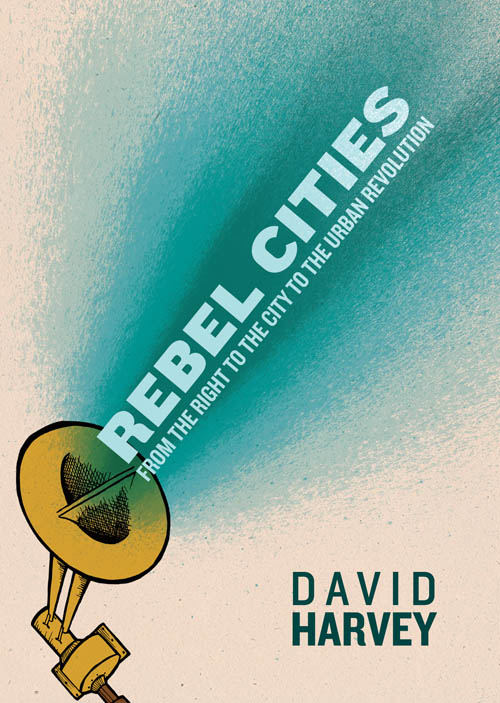
[Rebel Cities: From the Right to the City to the Urban Revolution by David Harvey (2112: Verso); Hardcover; 206 pp.; $19.95.]

I live in the small city of Burlington, Vermont, in the United States. Most every day I walk through the city’s main public square known by its street name, Church Street.

A public street that has been semi-privatized, the street is often the center of a struggle between citizens and private interests over the nature of the public square. Battles over the rights of street performers, political activists, panhandlers, and regular citizens who want to hang out without shopping are frequent.

Thanks to quick public reaction from these groups and others, most efforts by merchants and politicians to further privatize the street have been beaten back. Yet, the space is more tightly controlled than downtowns in other similar sized cities that I have visited. In what might seem a contradiction, it is also more vibrant than many cities both larger and smaller.

One might attribute this latter fact to the so-called nature of Vermont itself; a nature that considers democratic engagement a valued part of human existence. Alternatively, one could attribute the lesser vibrancy of other downtowns to the lack of such a democratic consciousness.

Many writers have exposed the role architecture plays in controlling public space. Mike Davis discusses how cities have installed public benches designed to discourage sleeping and fenced in public parks. Israeli architect Eyal Weizman has studied the nature of control implicit in Israel’s design of its cities, settlements, and highways. Fictionally, China Mieville’s The City and the City is a riveting tale of a future place strikingly reminiscent of today’s occupied Palestine.

Most recently, economist and critic David Harvey has contributed a refreshingly new look at the nature of the modern city and, more importantly, why it needs to be wrested back from the neoliberal corporate megalith currently trying to buy the world.

Harvey, who has lived in Baltimore, Maryland, for the past several decades, places the modern city’s economic role directly in the center of capital’s creation and consumption of surplus. He discusses the claim that cites are the product of the proletarianization of the rural peasantry, pointing to industrial revolutions of the past and the current movement of populations in nations such as China and India from the countryside to existing urban areas and new economic zones created by international capitalism.

Furthermore, his text, titled Rebel Cities, provides a look at the growth of so-called shantytowns on the outskirts of some of the world’s largest population centers. These shantytowns are often the focus of raids by military and police forces intent on making it easier for bulldozers behind them to destroy the structures found there. In certain instances, however, the authorities have conceded to the citizens of these shantytowns and given them rights to their homes.

It is from these shantytowns that we can gain inspiration. The people who live in such areas are considered surplus in the world of monopoly capitalism. They have no rights as far as the stock exchanges and bourses of the world are concerned.

Yet, because they refuse to accede to this characterization, they will struggle to maintain their shelter, their communities and their human dignity. Like their historical predecessors in the Paris Commune of 1871, these people are determined to make the city a popular and democratic human organism.

They are joined by those around the world who in the past couple of years have occupied city squares and parks and demanded a reconceptualization of the city, more democratic control of the urban space, and a reconsideration of who constitutes the working class and, subsequently, who will make the anti-capitalist revolution.

Harvey insists that the only genuine anti-capitalist struggle is one with the goal of destroying the existing class relationship. Such a struggle cannot be waged by separating workplace issues from those of the community.

Pointing to the classic film The Salt Of the Earth as an example of how the latter scenario might occur, Harvey suggests that the union must view the world of working people as an organic whole. Utility access and costs are workplace issues; childcare and education are too. Affordable housing and food costs are more than secondary concerns. Their role as a means for the capitalist system to take back wages describes their existence as a means for that system to maintain its control on working people.

Debt peonage, whether incurred via education and vehicle loans in the advanced capitalist world or incurred via a micro-loan program in the developing nations, is still debt peonage. The increasing cost of post-secondary education throughout the world and the mortgage crisis are both tools of the neoliberal regime to continue the upward motion of capital.

This is a radical book. Its discussion ranges from the workings of the monopoly rent system and the nature of neoliberal capitalism to a call to take back the city. History is combined with economics and a call for serious struggle.

With the Paris Commune as his inspiration, David Harvey discusses the positive and negative aspects of the Occupy movement, the squatters’ movements, and allied struggles. He presents their historical precedents and he warns against essentially conservative attempts to manipulate such movements into supporting the existing economic reality.

He further opines that cooptation by parliamentary elements is proof of these movements’ success, not their failure. Fundamental to all of this is Harvey’s radical definition of the city as the wellspring of capitalist oppression and also the foundation of resistance to that oppression.

[Rag Blog contributor Ron Jacobs is the author of The Way The Wind Blew: A History of the Weather Underground. He recently released a collection of essays and musings titled Tripping Through the American Night. His latest novel, The Co-Conspirator’s Tale, is published by Fomite. His first novel, Short Order Frame Up, is published by Mainstay Press. Ron Jacobs can be reached at ronj1955@gmail.com. Find more articles by Ron Jacobs on The Rag Blog.]
The Rag Blog

Posted in Rag Bloggers | Tagged , , , , , , , , , , | Leave a comment

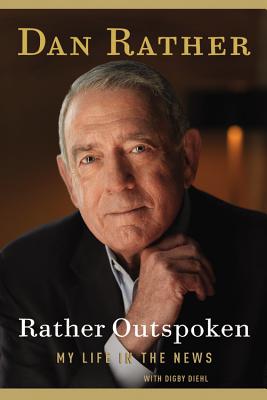
BOOKS / Leslie Griffith : Dan Rather’s ‘Rather Outspoken’


Dan Rather is Rather Outspoken

Reporters had best be careful when they set about the business of digging up news. Dan Rather’s unsettling ‘push under the bus’ is an instructive case in point.

By Leslie Griffith / Reader Supported News / May 21, 2012

[Rather Outspoken by Dan Rather (2012: Grand Central Publishing); Hardcover; 320 pp.; $27.99.]

In Rather Outspoken, one of broadcast journalism’s elder statesmen reflects on the state of the news business, and a career that spans from the glory days to what many of us see as the bitter end.
Soaking up his life’s worth of wisdom compels the reader to ask a familiar question posed to those in power during America’s infancy — a question just as pertinent today.

“What will be the old age of this government (including the fourth branch) if it’s so early decrepit?”

Sadly, Rather’s latest book reminds us that reporters had best be careful when they set about the business of digging up news. And they damn-well better make sure the media corporations for which they work are ready and willing to stand by them. Of course, Rather’s unsettling “push under the bus,” as he describes it, is an instructive case in point.

It’s hard to believe CBS was once the network of the “Murrow Boys” who exposed the fear-mongering of Joe McCarthy and Roy Cohn. The same network that sent a young Rather into the middle of firefights in Vietnam, and managed to make 60 Minutes the most successful news program in history.

Oh, how the mighty have fallen. And I don’t mean Dan Rather.

He has proven that he is and will always be a reporter… no matter the venue. Keep in mind, I am not saying he has always been right; however, in my humble opinion, he has always been earnest, tireless, and willing to put his life on the line if it meant delivering news and much-needed context to the American people.

While newsrooms have drastically (and dangerously) cut staff during this era of mega-media conglomerates, the mighty managers have fallen upwards. Upwards of $70 million is what CBS President Les Moonves made in 2011. That would be okay by me if most of that money were put back into the newsrooms, but it’s not. And Moonves is not likely sitting up at night worried about what the people of America are not being told.

Regarding property, privilege, and abuse of power, Thomas Jefferson wrote: “Let our countrymen know, that the people alone can protect us against these evils, and that the tax which will be paid for this purpose, is not more than the thousandth part of what will be paid to kings, priests and nobles, who will rise up among us if we leave the people in ignorance.”

Without saying it flat out, or even having to, Rather Outspoken reminds us that there are precious few reporters still working to fight the powerful and privileged who profit from harming our democracy, our planet, our food supply, our water, our air, our institutions of learning. (This list could go on for quite some time.) And Moonves’ stunning salary reminds us exactly what is valued by the few powerful corporations currently controlling the news.

Those blessed few reporters left standing are not naive. They can’t afford to be. We all know that the louder the warning to the American people, the stronger the “push-back.” Today, corporate media minders harbor an unimaginable ambition for wealth and power while maintaining meager ambitions when it comes to informing American citizens.

Mostly, they want to protect and keep those corporate commercial dollars flowing. Journalism, as it functions today, certainly is not designed to keep America honest, or democracy working as Thomas Jefferson intended.

In Rather Outspoken, we get a not-so-shining example of how this era of corporatized news works to the detriment of democracy.

The key story takes us back to the 2004 election. That’s when Dan Rather was first betrayed by Viacom/CBS. Just two months before the presidential election, Sumner Redstone — Viacom’s ultimate corporate master — was quoted as saying: “From a Viacom standpoint, the election of a Republican administration has stood for many things we believe in, deregulation and so on… I vote for Viacom. Viacom is my life, and I do believe that a Republican administration is better for media companies than a Democratic one.”

That statement reads like a warning to any and all of CBS’ reporters who might be digging into anything critical of George W. Bush or his administration. And, at the time, that was exactly what Mr. Rather and his ace producer Mary Mapes were doing. They had a story that reflected badly on George W. One that, if accepted by the American people, most certainly would have scuttled George W Bush’s disastrous second term.

In retrospect, the mind boggles to think what might have been different had Viacom/CBS backed Rather and Mapes instead of backing away from them.

The chronicle of Rather’s take-down reeks of Cassius cunning… so Shakespearean is the plot.

Rather and Mapes went running into a house on fire, only to turn around and find those carrying the fire hoses had deserted them. From Rather’s account, it is clear his beloved CBS network had, by the time they’d left him twisting in the wind, devolved into nothing more than a money-grubbing entertainment machine seeking favored status with the powerful. A recent Texas Monthly story backs him up .

Rather Outspoken is a cautionary tale on many levels. And it’s a story that finally explains why Rather and Mapes fought so hard to run their story. And why, in the end, the story ultimately fell flat after a strangely convenient information snafu.

To fully grasp the implications of this sordid tale, you have to put yourself into the “Black Op” line of thinking: If Cassius cannot discredit the story, then he must discredit the storyteller.

Think Valerie Plame and Joe Wilson. Luckily for the “Black Operator,” documents are malleable and always open to question and to opinion. Fame-seeking and often mediocre but ambitious “experts” are readily available to discredit them, too. Think Obama and the interminable birth certificate debate. If the Black Op works — the story gets thrown under the bus along with the reporter brave enough to tell it.

Oh, how convenient it must have been to have a former CIA chief watching over his presidential son. The CIA building in Langley is not named after Poppy Bush for nothing.

Like any reporter worth his or her salt, Rather has stepped on a lot of toes over the years. The list of people who wanted to see him blackballed and blacklisted stretched all the way from Pennsylvania Avenue to Langley, Virginia. And there were plenty of well-heeled spin-doctors and PR people ready and willing to aid and abet the process.

As Rather points out, and as many reporters know, there are now huge public relations firms regularly hiring Rovian characters who make their coin leaking false stories. By the time the spin-doctors get finished, the real story is as twisted as a pretzel, completely unrecognizable and, more times than not, the wagging finger gets pointed right back at the reporters. The messenger becomes the story, not the message. Oh, how Cassius smiles.

When Rather and Mapes were ready to wrap up and air their story of George W. going AWOL from the Texas Air National Guard — George W. was two months away from the 2004 election.

It’s important to note here that Rather and the Bushes had butted heads for years. The Bush-AWOL story was the culmination of a long, acrimonious history between Rather and the Bush clan. You see, reporters who hail from Texas, like Dan Rather, cut their teeth on the duplicitous-outrageous-red-dirt-throwing, go-for-the-jugular-style of politics that made Texas famous.

Lee Atwater, who worked for G.H.W. Bush, was the first to say out loud that in Texas politics… the end justifies the means. (Cheney and Rove both come from Texas politics too.)

Love it or hate it, Texas politics is unique in both its homespun punditry and slaughterhouse savagery. The late Texas governor Ann Richards, who was eventually unseated by George W., stood at the Democratic National convention in 1988 and said, “Poor George. He can’t help it — he was born with a silver foot in his mouth.” Jim Hightower, then-Texas agricultural commissioner, said of George W., “He was born on third base and thought he had hit a triple.”

These were the politics that helped define Rather’s bare-knuckle style. He knew the hidden secrets and where the skeletons were long buried. But he was not about to bury the story of George W. running away from a war while telling America’s young men and women to run toward one.

Rather quotes a “highly decorated retired Army colonel” who says soldiers who had risked their lives in Vietnam had long known about George W. Bush going AWOL. It was no secret. A solider who goes AWOL can be court-marshaled and tried for treason, particularly those unlucky enough to not have a former president and former CIA director as a father.

Rather writes,

For a journalist, the truth always matters and that should be reason enough [to do a story]. The arrogant hypocrisy of it makes this story much more disturbing. A young man born of privilege whose family secured him a spot in the National Guard to avoid military service in Vietnam, and who then walked away for more than a year from even that safe level of obligation, eventually became the commander in chief who ordered tens of thousands of our young men and women, including those in the National Guard, into harm’s way in Iraq and Afghanistan.

Rather continues,

This same young man who gamed the system to evade deployment to Vietnam became a president who did nothing to prevent, halt or disavow the distorted character assassination of his opponent, John Kerry, a decorated Vietnam Veteran.

Remember the Swift Boat controversy? It all follows the same CIA Black Op pattern. Instead of ignoring the lack of George W’s service in Vietnam, make the opponent appear to be what your candidate really is. Remember the Swift Boat controversy. It implied Kerry, a decorated Vietnam veteran, was a coward.

Back at CBS News, Rather and Mapes’ story was cut up and shortened without Rather’s permission. He felt crucial back-up information was eliminated. Then the story was relegated to “60 Minutes Wednesday.” An explosive, history-altering story like this one got no real promotion, no real back up and was relegated to the second-string broadcast. It is telling.

Plus, no one cared enough to push it beyond a bevy of entertainment lawyers and frightened middle-management ladder-climbers who put up roadblocks every which way.

Finally, the story aired. It got some traction. And then, as if according to a playbook, the documents were attacked. The same technique was used on Mr. Obama (the birth certificate was forged!?). After reading Rather’s book, it’s clear the proof of Bush W.’s AWOL was well established. Rather and Mapes didn’t even need the documents.

But the document began the undoing. First, the message was lost, and then came a full-blown attack on the messengers. In the middle of the black storm at Black Rock, Rather was directed to issue an on-air apology. And he did, basically saying he and Mapes could have always done more. Viacom/CBS followed-up with an “independent” investigation. Heading the “independent investigation” was a well-known Republican and long- time friend of Bush’s daddy. “Beware, yon Cassius has a mean and hungry look.”

This is how our politicized and corporate media works today. It has become so common to shoot the messenger, other reporters just fall in line and keep quiet. If Dan Rather can get set up… who are we to think we won’t be targeted too? Better to play it safe and avoid investigative reporting. Trouble is, as Thomas Jefferson pointed out, “ignorant citizens” cannot support a democracy.

It should also be pointed out that while living in the bubble of big media, it’s hard to see and understand how all this plays out. Now, that Rather is “outside” the mainstream, it has certainly made him wiser and more contemplative about what goes on “inside.”

He is now an elder statesman with much to teach. He’s seen all sides of the corporate-political news game and lived through its development. He knows how we got here. We need to listen to him about how best to get out.

Full Disclosure

Final note: Since “failure to disclose” has become an epidemic by reporters in this country… here is my disclosure.

I sent Dan Rather a book I’d written two years ago. He read it and endorsed it. I’d never met him, but he called to ask what he could do to help the book get published. “Forget that,” I said, “Would you just call my dad in Texas and tell him I’ve not been sitting here doing nothing?”

Rather asked for the number. But, truthfully, even though I’d heard from friends who interned at 60 Minutes that Rather was kind and generous… and still wrote his own stories! I never really expected him to phone home for me.

Sure enough, about 20 minutes later, my father called me.

“You little shit,” he said. “Next time you have Dan Rather call me, at least give me a heads up first.”

While writing Rather Outspoken and endlessly traveling for HDNet, Rather has done some fine reporting. His reports from Gaza come to mind. Nothing like a reporter who has actually been to the places he is talking about.

Stretched so thin with a weekly hour broadcast, traveling and doing most of his own interviews, Rather later asked if I could help with two outside projects. I did. It was an honor.

Hopefully, after reading his book, the skeptics who refused to see the set-ups and betrayals, finally will.

[Leslie Griffith has been a television anchor, foreign correspondent, and an investigative reporter in newspaper, radio and television for over 25 years. Among her many achievements are two Edward R Murrow Awards, nine Emmys, 37 Emmy Nominations, a national Emmy nomination for writing, and more than a dozen other awards for journalism. She is currently working on a documentary, giving speeches on “Reforming the Media,” and writing for many online publications, as well as writing a book called Shut Up and Read. To contact Leslie, go to lesliegriffithproductions.com. This article was first published at and was distributed by Reader Supported News.]

The Rag Blog

Posted in RagBlog | Tagged , , , , , , , , , | 2 Comments

IDEAS / Bill Meacham : How Evolution Works

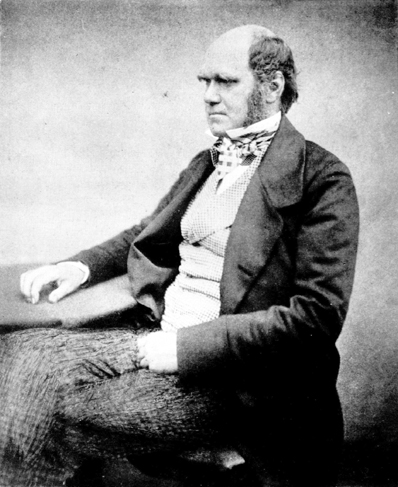
Charles Darwin: Blame it all on him. Image from Wikimedia Commons.

Evolution

Regardless of your opinion on the ultimate purpose of it all, it is important to understand how evolution works because the theory reflects reality, and basing your actions on reality works out much better than not.

By Bill Meacham | The Rag Blog | May 20, 2012

If we want to know what human nature is — and we do, as that will tell us how to live a fulfilling and happy life — then we have to understand evolution.

The theory of evolution describes how generations of living organisms change over time. Humans are living organisms. We are subject to and products of the same evolutionary pressures as all other living things. Understanding how we got to be as we are gives us insight into how we function. Knowing that, we can adjust our actions so as to function well.

It is called the theory of evolution, but “theory” does not mean conjecture, speculation, or mere opinion. The term in its scientific sense means a well-supported body of interconnected statements that explains observations and can be used to make testable predictions.

The theory of evolution has been confirmed over and over again.(1) No serious biologist takes it as anything but fully established. In the words of Theodosius Dobzhansky, author of a major work on evolution and genetics, “Nothing in biology makes sense except in the light of evolution… Seen in the light of evolution, biology is… the most satisfying and inspiring science. Without that light it becomes a pile of sundry facts, some of them interesting or curious but making no meaningful picture as a whole.”(2)

It is unfortunate that religious fundamentalists, misusing the term “theory,” regard evolution as unproven. Some go so far as to say that all the evidence that leads us to believe in the immense age of the universe and the proliferation of species over time, as opposed to instantaneous creation some 6,000 years ago, were planted by the creator merely to give the appearance of great antiquity.

Dobzhansky, a Christian, has this retort: “It is easy to see the fatal flaw in all such notions. They are blasphemies, accusing God of absurd deceitfulness. This is as revolting as it is uncalled for.”(3)

The religious believer may view evolution as God’s way of creating the world. The pantheist mystic may view evolution as the One Being’s way of unfolding and coming to know Itself over time. The secularist, the atheist or the merely agnostic may view evolution as the way living beings have propagated themselves, blindly and without foresight, in increasing diversity and complexity.

Regardless of your opinion on the ultimate purpose of it all, it is important to understand how evolution works because the theory reflects reality, and basing your actions on reality works out much better than not. So the rest of this essay is a summary of the theory of evolution.

The term “evolution” in a general sense means a process of change or growth, often taken as a process of continual change from a simpler to a more complex state. In biology, the term refers to two things:

  • The observed fact that the distribution of inherited traits in a population of organisms can change from generation to generation.
  • The theory that the various types of animals and plants we find around us, including ourselves, originated in earlier types and that their differences are due to modifications in successive generations.

The basic concept of biological evolution as we understand it today is surprisingly simple. Charles Darwin, its originator, called it “descent with modification.” The concept is this:

  • An organism’s offspring may vary slightly from the organism itself. Offspring may have slightly different traits from the parents or the same traits in different degrees.
  • Organisms typically produce more offspring than can survive and reproduce, given the resources available such as food, shelter, sexual mates, etc. Hence, there is competition for such resources.
  • In the competition for resources, some variations have an advantage over others. For example, one child’s beak may be slightly better at picking up small seeds than another’s, or one child may have slightly better eyesight than the other and hence be better able to find food and avoid predators.
  • The individuals with advantageous variations have more offspring than those without.
  • Since traits are heritable (are inherited from parent to child), this causes the population, over time, to contain more of the favorable variations and fewer of the unfavorable ones.

Darwin called this process “natural selection,” as opposed to artificial selection, the intentional breeding for certain traits that produces such differences in the same species as the Great Dane and the Chihuahua. The underlying mechanism is the same in both kinds of selection: certain individuals have more offspring than others, so their traits become more widespread in the population of that type of organism.

A subset of natural selection called “sexual selection” is a result of competition for mates. In order to have offspring, an individual must not only survive but reproduce. Competition for mates, most often among males for females, selects for traits that enable males to dominate other males, such as horns and antlers, and for traits that attract females, such as plumage and other adornments.

This process happens slowly but inexorably. The variation between parent and offspring is most often minuscule, but over enough generations large changes result. A series of small, incremental changes can, given enough time, produce the extraordinary variety of speciation we find around us.(4)

This process is not purposive.(5) No organism intends to produce a better beak or a better eye. It is merely a fact of life that those with favorable variations tend to have more offspring than those without, each of which in turn have the favorable variation. Among that generation’s offspring, those that further amplify the favorable variation have more offspring, and so on for generations. Conversely, unfavorable variations tend to die out over time. We should not take phrases such as “designed by natural selection” as implying a conscious, deliberate designer.

What is inherited is a trait, a feature of an organism such as eye color. Traits are passed from generation to generation as discrete units. Gregor Mendel conducted a famous study in which he mated pea plants, some of which had purple blossoms and some of which had white. The offspring did not have pale purple blossoms, but rather some had purple and some white, in distinct proportions.

What passes these discrete traits from generation to generation is the gene, the fundamental physical and functional unit of heredity. A gene is a segment of nucleic acid that, taken as a whole, specifies a trait. Genes are contained in chromosomes, which are composed of DNA (deoxyribonucleic acid), a polymeric molecule found in cells of the body. DNA governs the production, growth and reproduction of the cells of the body. The current understanding of biological evolution, developed since Darwin’s time, recognizes the gene as a fundamental, if not the fundamental, unit of natural selection.

Functionally, genes pass traits from generation to generation. They do this by replicating themselves from parent to child. Physiologically, the same chemical structure appears in the child as was found in the parent. In combination with other genes and triggered by environmental influences, the genes cause the parent’s traits to appear in the child.

The term “trait” includes physical forms, such as bone density or eye color, behaviors such as sounding mating calls in certain seasons, and mental abilities or talents such as stereoscopic vision, empathy, or language.

Genes are not the only replicators. Ideas, symbols, behaviors, and other elements of culture replicate as well. Genes replicate from generation to generation; their cultural analogues, dubbed “memes,” replicate from mind to mind through writing, speech, gestures, rituals and the like.(6) The principles of evolution apply the same: like a gene, a meme is a replicator, except memes replicate contemporaneously between minds rather than historically between bodies.

Just as genes are subject to competition — the ones that replicate to the next generation are those that help their host bodies to survive and reproduce — so also are memes: only those that are catchy enough to secure attention in human minds replicate from mind to mind. What makes a meme catchy can be something as trivial as a memorable tune or limerick, or something that has continuing usefulness, such as ideas that hold cultures together.

So there is an abbreviated account of evolution. What does it mean for understanding human nature? To know what we are we must understand where we have come from. It is not just in our physical form that we have evolved, but in our mental capacities and in our cultures as well.

Are we, then, merely products of our evolutionary heritage, unable to change? No, but in our attempts to change, it certainly helps to understand what we have to work with. Understanding that inherited traits are the result of natural selection can help put in context findings about how we humans actually function in the world, a topic to which I intend to turn in future essays.

[Bill Meacham is an independent scholar in philosophy. A former staffer at Austin’s 60s underground paper, The Rag, Bill received his Ph.D. in philosophy from the University of Texas at Austin. Meacham spent many years working as a computer programmer, systems analyst, and project manager. He posts at Philosophy for Real Life, where this article also appears. Read more articles by Bill Meacham on The Rag Blog.]

Notes

(1) See, for instance, the section titled “Predictive Power” in Wikipedia, “Evolution as fact and theory.”
(2) Dobzhansky, “Nothing in Biology Makes Sense Except in the Light of Evolution.”
(3) Idem.
(4) There are three sources of variation: mutation, gene flow and genetic shuffling through sexual reproduction. Mutation happens when environmental influences cause tiny changes in the chemical structure of genes, altering their functioning, or when cells divide and imperfectly replicate their DNA. By far the majority of mutations are destructive, degrading the gene’s ability to do its job of directing the growth of organs and characteristics, but some enhance that ability, or change it so that the result is advantageous. Gene flow refers to the transfer of genes between populations of an organism. Individuals from one population mate with individuals of another and transfer genes between them. Genetic shuffling through sexual reproduction causes the combination of genes in each child to differ from that of its parents. In species that reproduce sexually, each individual has two copies of every gene (specifically, each has two strands of DNA, each of which contains chromosomes, which contain genes). In sexual reproduction, the child gets some genes from the mother and some from the father, and the combinations vary with each child.
(5) Religious or mystical thinkers may postulate a divine purpose that guides the process of evolution, but the science of biological evolution does not need that hypothesis to explain the process.
(6) Dawkins, The Selfish Gene, chapter 11, pp. 189-201.

References

Dawkins, Richard. The Selfish Gene, New Edition. Oxford and New York: Oxford University Press, 1989.
Dobzhansky, Theodosius. “Nothing in Biology Makes Sense Except in the Light of Evolution.” American Biology Teacher vol. 35 (March 1973) reprinted in Evolution versus Creationism, J. Peter Zetterberg ed., ORYX Press, Phoenix AZ 1983. Available online at http://www.2think.org/dobzhansky.shtml as of 14 May 2012.
Wikipedia. “Evolution.” On-line publication, URL = http://en.wikipedia.org/wiki/Evolution as of 2 February 2009.
Wikipedia. “Evolution as fact and theory.” On-line publication, URL = http://en.wikipedia.org/wiki/Evolution_as_fact_and_theory as of 14 May 2012.
Wikipedia. “Meme.” On-line publication, URL = http://en.wikipedia.org/wiki/Meme as of 16 May 2012.

The Rag Blog

Posted in Rag Bloggers | Tagged , , , , , | Leave a comment

Jonah Raskin : Protest 101 at Sonoma State

Front page of the Sonoma State Star, May 14, 2012. Image from Shame on Sonoma State.
.
Protest 101:
A textbook case of campus unrest, 2012

Everyone in the crowd seemed relieved that no one had shouted, thrown a pie in Weill’s face, or staged a sit-in on stage.

By Jonah Raskin | The Rag Blog | May 20, 2012

ROHNERT PARK, California — Sometimes, as Chairman Mao Zedong observed, a single spark can start a prairie fire. And sometimes the spark fizzles and the prairie lies there peacefully without a blaze.

For a really effective protest, activists apparently need more than a single spark. It helps to have several essential ingredients: an obvious issue or cause; a slogan that resonates; a dynamic leader or spokesperson; and brave souls prepared to risk failure, arrest, or rebuke from more cautious citizens.

Indeed, the May 2012 commencement ceremony at the normally sleepy Sonoma State University (SSU), one of the 24 campuses in the gigantic California State University system, had the potential to turn into a rowdy protest.

Protest 101 at SSU gained momentum in part because it was fueled by the Occupy Wall Street movement. The protesters had an obvious villain in Sanford Weill, the Wall Street billionaire responsible for the big financial meltdown of 2008 who would be on hand to receive an honorary degree. Not one but three strikes were against him. Largely responsible for the repeal of the Glass-Steagall Act that made it possible for bankers like him to turn into modern-day pirates, he looted the economy, and ran Citigroup into the ground.

Veteran reporter, Robert Scheer, helped to ramp-up local discontent in a column in The Nation, in which he called the billionaire a “jolly good Scoundrel” and claimed that he was “laughing all the way to the bank.”

To the outraged organizers of the protest, it was clear that Weill had bought his honorary degree with a $12 million dollar check he’d written to the University. On the speaker’s platform, he’d have nowhere to hide, though, of course, he’d be surrounded by administrators and faculty members. A crowd composed of thousands of students, many of them in debt, along with their families, also in debt, would observe every move that he’d make.

The week of graduation, the student newspaper, The Star, primed readers for the protest with a banner headline that echoed the slogan coined by campus activists: “Day of Shame on Sonoma State University.” Just days before graduation, employees loyal to the university were observed gathering copies of the newspaper. They claimed to be “cleaning the campus.”

The protest quickly expanded into a First Amendment issue. SSU seemed on the verge of an explosion. The organizers wouldn’t have to do much at all, except sit back and watch the University self-destruct.

Then, reality kicked in. Graduating seniors insisted that commencement wasn’t a “day of shame” for them but rather a “day of pride.” Sandy Weill didn’t spark their ire. The university harnessed its public relations team and pointed out that Mr. and Mrs. Weill were generous philanthropists who gave millions of dollars to the arts and who earned their honorary degrees.

Then, too, the faculty divided among predictable lines, with old school radicals forming a small, core group and the majority of professors opting to remain seated while others stood and turned their backs to the podium.

Temperatures soared on the Saturday afternoon in May scheduled for commencement. Protesters distributed thousands of leaflets, and campus police, expecting the worst, were out in force. I was on hand to observe the drama. A professor emeritus at Sonoma State, where I taught for 30 years, I sat with the students, and stood out in the black cap-and-gown crowd because I wore a red shirt and a black baseball hat.

Four different police officers on four separate occasions approached me and asked for identification, though I didn’t have to produce papers. “He’s our professor,” students shouted. “He’s okay.”

When the critical moment arrived, Ruben Arminana, the president of the University, awarded the Weills their degrees. Half-a-dozen or so faculty members turned their backs on the podium and about 50 or so students did the same. Sandy Weill smiled, thanked the University, kissed his wife and sat down.

Marc Lamont Hill gives the commencement speech as Sonoma State. Inset below: Sandy Weill, Joan Weill and SSU President Arminana at commencement exercises. Photos by Sandy Destiny / The Rag Blog.

Everyone in the crowd seemed relieved that no one had shouted, thrown a pie in Weill’s face, or staged a sit-in on stage. Surprisingly, the best was yet to come. Marc Lamont Hill, the commencement speaker, took the podium and delivered an oration that in 1968 would have been described as “militant.”

By the standards of 2012, even by those of Occupy Wall Street protesters, it was as Maoist a talk as any heard on the campus. An African-American professor at Columbia University, and a regular commentator on CNN and MSNBC, Hill denounced Wall Street greed, the war in Afghanistan, and social injustice. With a big booming, impassioned voice, he invited graduating seniors not to conform, not to accept the big lies of the society, but rather to be brave and to oppose the political and economic system.

Students and faculty members stood and applauded him at the end of his speech. From where I sat and from what I saw and heard, Hill’s oration was the highlight of the day.

That evening at a party for faculty I talked to professors who had not taken part in the protest. “Every day is a day of shame in our capitalist society,” one woman told me. “Today was no different.” Another told me, “All universities give out honorary degrees to millionaires and billionaires these days.”

David Walls, a former dean at SSU, a veteran of the Free Speech movement at Berkeley in the 1960s, and an organizer with MoveOn.org, stayed away from the event. He said he was out-of-town. “Most of the commentary on Weill had little humor,” he told me. “The protest was mostly a venting of outrage, with no achievable goal in view. I imagine the issue of the honorary degree will disappear as quickly as it arose. Questions around campus finances will probably remain, but it is difficult to imagine that they will preoccupy Occupy.”

Shepherd Bliss, a former U.S. soldier who demonstrated against the war in Vietnam, was ecstatic about the protest against Weill. “We were highly successful for many reasons,” he explained. “We distributed thousands of flyers documenting Weill’s crimes. We mobilized students, faculty, alumna, and community members in a direct action against his criminal behavior.”

The role I chose for myself was to moderate the rhetoric of the radicals. One friend sent a letter to the local weekly in which he expressed his “extremely negative feelings toward robber baron Sandy Weill who never should have had his $12 million in green washing money accepted by Sonoma State University or anybody in this county.”

He went on to say, “If the powers-that-be were not above such temptation, they first should have exposed each county citizen to the fetid corpse and stench of the murder he perpetrated on Wall Street and our nation. As to Sonoma State University, ‘Shame, Shame, Shame'”

Phrases like “fetid corpse and stench of murder” didn’t help the cause. Shaming didn’t help, either. I also discovered that the simple act of wearing a red shirt in a crowd in which everyone else was wearing black made a strong statement and engendered discussion. Sometimes simple understatement works better than bravado.

I asked SSU’s president, Ruben Arminana, to answer a single multi-choice question. Do you feel, I asked, if you:
     a. came out smelling like roses
     b. dodged a bullet
     c. made the best of a bad situation
     d. all the above?
His answer was: “d. — all the above.”

As for the protests at SSU, I’d assign them a C. Marc Lamont Hill deserves an A+.

[Jonah Raskin is the author of For the Hell of It: The Life and Times of Abbie Hoffman. A former Yippie, he is a a regular contributor to The Rag Blog. Read more articles by Jonah Raskin on The Rag Blog.]

The Rag Blog

Posted in Rag Bloggers | Tagged , , | 1 Comment

Jay D. Jurie : Are We Colonized? A Response to Chris Hedges

Activist/journalist Chris Hedges speaks at Occupy Washington, DC, Freedom Plaza, Jan. 9, 2011. Photo by Scott Galindez / Occupy Washington, DC.

‘Colonized by Corporations’:
A Response to Chris Hedges

Hedges says that corporations play the same role in the U.S. today that British or French colonialism played in India or Indochina.

By Jay D. Jurie | The Rag Blog | May 18, 2012

According to Chris Hedges, we’re no different than Third World inhabitants subjugated by foreign colonialism.

In one of his most recent columns (“Colonized by Corporations,” Truthdig.com, May 14, 2012), Hedges relies on the book The Developing Nations by Robert E. Gamer, to tell us “we have been, like nations on the periphery of empire, colonized.”

This means, he goes on to say, that corporations play the same role in the U.S. today that British or French colonialism played in India or Indochina in the past. Part of how this works is through the construction of “patron-client” relations, whereby real power is concealed, and the oppressed deal only with client regimes who do the dirty work of the foreign oppressors.

This is among the latest in a series of books and essays Hedges has written about the economic and political crises affecting not only the U.S., but how these are related to crises on the global level, and how this contributes to the rise of resistance movements, such as Occupy here at home.

His column is produced regularly on Truthdig.com, and according to his biosketch on that site, he was a foreign correspondent for almost two decades in locales including Africa, the Balkans, Central America, and the Middle East.

He has worked for a variety of media sources, and as part of a New York Times team, once won a Pulitzer Prize for coverage on terrorism. He left the Times after being reprimanded for speaking out against the attack on Iraq launched by the George W. Bush regime.

Hedges has written for a number of publications, including The New York Review of Books and Adbusters. He holds a bachelor’s degree in English literature from Colgate, a master’s in divinity from Harvard, and speaks several languages, including Spanish and Arabic.

Over the past several years Hedges has become directly involved in the resistance he once wrote about, most specifically the Occupy movement that grew up around the U.S. in the wake of the Occupy Wall Street events this past September. He has been arrested at Occupy-related protests, including one on November 3, 2011, outside Goldman Sachs in New York City.

This past January, he was joined by several others in filing a federal lawsuit against the threats to civil liberties posed by the National Defense Authorization Act — which resulted this week in a federal judge enjoining enforcement of the controversial provisions.

In a RawReplay interview with Muriel Kane at The Raw Story on September 25, 2011, Hedges described Occupy Wall Street as “Where the Hope of America Lies.”

In this same interview, Hedges characterized the U.S. as in transition to a “neo-feudal corporate state, one in which there is a rapacious oligarchic class, a thin managerial elite, and two-thirds of this country live in conditions that increasingly push families to subsistence levels…[the corporate state] wants to reduce the working class to a status equivalent to serfdom.”

Hedges has since expanded on that theme, including in this present column. He brings up the work of Frantz Fanon, who described Algeria under French colonialism. Changing the on-scene managers won’t bring about any changes in the real situation, as colonial rule will continue regardless.

In the U.S., this means a vote for either Obama or Romney won’t make any real difference, the “neo-feudal corporate state” will remain unaffected. This “patron-client” facade must be destroyed and “new mechanisms of governance” put in place.

Yet, according to Hedges, it’s not the “serfs” who are the real threat to the colonial apparatus, it’s the “declasse individuals,” the professionals who are losing their foothold as the economy hollows out, or are denied advancement as the ranks of the managerial elite grow thinner.

It is when these elements join with the lower echelon and share their message with them, that the apparatus is threatened. Malcolm X understood these dynamics, which is why he was more of a direct threat to the system than Martin Luther King, Jr., who still worked within “patron-client” relations.

Eventually the corporate elite will become increasingly venal and corrupted. They will resort to violence to retain power, but will become increasingly unable to stabilize the situation. Violent revolutionary groups will arise to challenge the elite, as did the Black Panthers, the American Indian Movement (AIM), and others in the 1960s, but they will hold back, rather than advance desirable social transformation.

This is obviously a slap at the “Black Bloc,” a current tendency that Hedges identifies with the earlier groups.

Ultimately, the “neo-feudal corporate state” will collapse when it loses legitimacy among the last of those responsible for upholding it, when they defect, and when some cross over to the resistance.

Hedges advises people to go ahead and vote this coming November, but only for a third party candidate, as a way of registering protest, then get back into the streets where the real changes will take place.

In response to Hedges, it’s true that “unequal exchange” produces certain conditions that are functionally the same in developed as in underdeveloped countries. It’s also true that these conditions are in some respects becoming increasingly similar. Shanty towns under bridges in Miami look increasingly like favelas in Brazil. But there are some differences, and Hedges glosses over the processes by which these manifest.

Although Hedges makes passing reference to Karl Marx, he seems unfamiliar with either Marx, or more contemporary Marxist sources, such as Samir Amin, Antonio Negri and Michael Hardt, Ellen Meiksins Wood, David Harvey, and others, who for quite some time have addressed the conditions he seeks to describe.

Much of what Hedges describes in some ways fits well with Negri and Hardt’s “empire” theses, wherein they discuss the transnational character of the capitalist system, and how conditions from the developed countries are reproduced in underdeveloped countries.

It’s unclear why Hedges doesn’t employ such analysis. Maybe he’s trying to be careful and not alienate a predominantly liberal audience, maybe he doesn’t like or agree with this source material, or maybe he’s not conversant with it, and I suspect the latter.

In this column he makes direct reference to Alexander Herzen, a Russian who exerted some influence on the subsequent revolution in that country. Like Herzen as an earlier expression of the change process, Hedges seems to be feeling his way along, his perspective seems to be evolving, and he wants others to join in the voyage of exploration.

Following Garner, Hedges contends disaffected groups don’t attack the underlying sources of problems, instead they confront what some Marxists have termed as “compradors” or in other words, “intermediaries.” In this regard, Hedges misapplies Fanon, who was addressing a context dominated by an actual colonial power, where the French had put into place, and actively propped up, indigenous elites.

Though there are some similarities, the U.S. is not occupied by a foreign power, as was Algeria. If Hedges were to make this case regarding the U.S. in relation to Iraq or Afghanistan, he’d be much more on target.

As it is, the comparison has limitations. It is easier for subject populations to associate corporate domination with foreign rule. No doubt, the Iraqi people associated Blackwater with the U.S. occupation. It’s not quite the same, or as easy, for people in the U.S. to make that same association. Nor do they have to cut through two sets of “comprador classes” to get at the problem.

There are other issues as to the comparative composition of the class structures that have been oversimplified by Hedges, but they are beyond the scope of the present discussion.

In terms of minor critiques, it’s not news, at least not to many Rag Blog readers, that the election of either Obama or Romney will not dislodge, or do anything meaningful about, the underlying domination of corporate power. Hedges is basically correct in his assessment of “declasse intellectuals,” but again, that’s not news. Any serious scholar of revolutionary process would point out the same.

Though Hedges is correct that Malcolm X was much more forthright, it’s not certain that Martin Luther King, Jr., harbored any illusions about the nature of power in this country. His speech on Vietnam reflected comprehension of the dynamics that initiated the war as well as its likely domestic consequences.

Hedges’ assessment of “radical violent groups,” at least in the case of the Black Panthers and AIM, is not wholly on track. A more nuanced and sophisticated position is required, that takes into account the self-defensive nature of much of that history.

Finally, there are serious questions about the “futility of elections.” Hedges performs a service by raising this issue, but falls short in terms of a comprehensive assessment. Yet again, we full well understand that whether Obama or Romney is elected, we will not see fundamental change.

But that’s not the same as some who mistakenly argue that “there’s no difference between the two,” plus it leaves out other situations where there’s more of a difference to be made: for instance, it’s better to have Bernie Sanders in office than not.

We also should not throw out the possibility that serious change could result through the electoral process. This doesn’t mean the sort of phony examples represented in countries like France, Spain, or Portugal, where “socialists” keep getting elected and no basic social change transpires.

As exemplified by Mitterand, when he was president of France, this could be called “SINO,” or “socialism in name only.” No difference should be expected from Francois Hollande, who was just elected in France. He might modify French participation in the Eurozone, but will do virtually nothing to replace capitalism.

In actuality, the main European parties who call themselves “socialist” should be known as “social democratic,” which in modern parlance is what they are.

But we do have some better examples. There was Allende’s Popular Unity government in Chile, and the reason it was overthrown was that the government was genuinely moving Chile to socialism. It actively sought to free itself from both colonial and corporate domination. Today, we have Hugo Chavez in Venezuela, and his government is on the road to a similar underlying transformation. I

n other words, the prospect of an electoral transition to real social change shouldn’t be tossed out, but it’s an absolutely essential imperative that it be led by significant popular organizations and a vast grassroots movement, as in Chile, which must have the involvement of disaffected “declasse intellectuals,” as in Venezuela.

There has to be a strong and well-organized movement “outside” the electoral arena, most especially if any “inside” strategy is to be effective.

As to whether people should vote for third parties in November, as Hedges proposes, while I personally believe there may be some significant incremental differences, plus strategic advantages, to be gained through the reelection of Obama, I remain agnostic on the question of how anyone should vote.

There are good and valid reasons not to vote for Obama, and I’m not going to castigate anyone who should decide instead to vote for a “protest candidate” to his left.

[Jay D. Jurie, a veteran of SDS at the University of Colorado at Boulder, is a resident of Sanford, Florida, where he teaches public administration and urban planning. Read more articles by Jay D. Jurie on The Rag Blog.]

Sources:
Though I was aware of Negri and Hardt’s Empire, I thank Bruce Goldberg for bringing its importance to my attention. Any misinterpretation is my error, not theirs, or his.
Muriel Kane September 25, 2011 interview: www.rawstory.com/rawreplay/2011/09/chris-hedges-occupy-wall-street-is-where-the-hope-of-america-lies
/

The Rag Blog

Posted in Rag Bloggers | Tagged , , , , , , | 2 Comments

Patrick Youngblood : ‘Reform’ and Squeezing ‘Value’ Out of Students

Image from Chicago Now.

The school ‘reform’ movement:
Squeezing ‘value’ out of students

By Patrick Youngblood | The Rag Blog | May 18, 2012

As a public high school teacher and a parent I think often about the role of schools in our society and closely follow the current debate over school reform. Recently I read a concise, insightful letter to The New York Times that has stuck in my mind, almost haunted me, since:

To the Editor:

Standardized test scores can provide some evidence of what knowledge and skills students have learned. But lost in the debate is the fact that it’s possible to teach a subject well but to teach students to hate the subject in the process.

If one of the goals of schooling is to create lifelong learners, then high standardized test scores may be a Pyrrhic victory. That’s because long after the subject matter is forgotten, attitudes remain.

Walt Gardner, Los Angeles, April 22, 2012

The letter reminds us that debates over school quality and the so-called reform movement have the power to distract from more fundamental questions about the role of education in our society. Schools that we might consider successful — producing a lot of university bound students with high test scores — may fail completely to cultivate the curiosity and engagement that create lifelong learners.

The author of the letter, Walt Gardner, maintains a blog at Education Week called Reality Check. His May 2 post continues the theme with a critique of a recent Wall Street Journal op/ed by former George H. W. Bush Secretary of State George Schultz and economist Erik Hanushek, a prominent proponent of “value-added” measures of teacher performance.

Schultz and Hanushek, both fellows at Stanford University’s Hoover Institution, argue that the sluggish growth of the U.S. economy would change dramatically if we embraced school reform. High science and math scores lead to increased economic output, they write.

Schultz and Hanushek both are part of what has come to be known as the education reform movement. I don’t want to over-generalize the reform position, but it’s fair to say that they advocate using standardized testing as a key component for identifying schools that should be defunded and teachers who should be fired, believing that this would result in greater efficiencies at the school level.

To the reformers, a move toward charter schools is positive because they are less constrained by local districts and teachers’ unions.

In his blog post, Gardner questions the causal relationship Schultz and Hanushek make between test scores and economic growth, pointing out that Japan, high scoring yet mired in a slow economic growth since the 1990′s, doesn’t fit their model. He also raises the point that broader economic policies (e.g., spending cuts in a recession) and the realities of international competition cloud the test-score-to-economic-growth relationship even further.

Gardner’s criticisms are sound, but in the spirit of his letter to the Times, I’m inclined to point to a more fundamentally distressing aspect of this piece, and the reform movement in general.

Much of the proposed reforms are an attempt to squeeze more “value” out of teachers, as measured by tests that may work to some degree in areas like math and science, but resist easy standardization in almost everything else that is supposed to happen in a school — from history to literature to art, to even less measurable skills like critical thinking, maturity, and, as Gardner’s letter to the Times reminds us, hanging on to the curiosity and love of learning we all had as children.

When the education economists associated with the reform movement look at a school they see teachers creating measurable “learning gains” in their students. For example, students of a bad teacher might only gain .5 years of learning in a calendar year, while the students of a good teacher gain as much as 1.5 years in the same time span.

Hanushek’s emphasis is on the impact that this “value added” by a teacher will have on the lifetime earnings of students, and ultimately on the nation’s overall economic output. His policy proposal follows logically from there. He argues that by removing the worst 5 to 10 percent of teachers and replacing them with average teachers, the United States will, over time, achieve test scores as high as Finland’s (see graph).

To be fair, Hanushek says the identity of the bottom 5-10 percent of teachers wouldn’t be based on test scores because the “obviousness… would be revealed by virtually any sensible evaluation system.” He identifies teachers’ unions as the biggest obstacle to such a plan.

The issue of unions is a distraction. Many of the worst performing states are right-to-work, where unions are either nonexistent or weak. We strive for the test scores of Finland, a country where teachers are 100% unionized and the societal approach to education is radically different than in the United States.

Hanushek’s proposal is like a doctor prescribing liposuction to an out-of-shape patient when what is obviously needed is a healthy diet and active lifestyle. Why is it that marginal, misguided proposals like these have such traction in the education debate?

The reforms advocated by economists like Hanushek are well received in a political atmosphere where public institutions, and the people who work in them, are viewed with suspicion. It is difficult to imagine a national dialogue about building a public system based on professionalism, trust, and responsibility in today’s political climate.

Just as a prolonged recession and soaring debt have placed long-established social programs on the chopping block, in the hands of Hanushek and Schultz the economic crisis becomes an argument for their version of school reform.

What would successful reform bring to our society? A 40-point increase in math scores for U.S. students over the next 20 years, they claim, “would exceed a present value of $70 trillion. That’s equivalent to an average 20% boost in income for every U.S. worker each year over his or her entire career.”

This, to them, is what schools do.

And that brings me back to Walt Gardner’s wonderful, haunting letter. The economists of the reform movement tempt us into a debate that accepts the premise that schools are a place where teachers add value to students, boost their lifetime earnings, and in the aggregate raise the output of the national economy.

It isn’t enough to disagree with liposuction as the prescription for a troubled school system. We need to be animated by a vision of what we want schools to be like in our society — a place to develop the habit of learning that will last a lifetime.

Rather than wring our hands over how to remove teachers who shouldn’t be teaching (a problem that is always made out to be more difficult than it actually is), we ought to approach schools as an institution, and teaching as a profession, in a different way.

Schools ought to be rooted in, and accountable to, their own communities. Time in the school year should be provided for teachers to deepen their knowledge of the field they teach, to collaborate with peers in order to share ideas and skills, and to meet the individualized needs of students.

If we as a society understand that the majority of teachers enter the field because they want to be good at teaching, we ought to create institutions where they can thrive.

[Patrick Youngblood is a teacher in the Austin Independent School System and is a director of the Third Coast Activist Resource Center, where this article was first posted.]

The Rag Blog

Posted in Rag Bloggers | Tagged , , , | Leave a comment

Jerry Brown’s karma runs over his dogma

By Thomas McKelvey Cleaver / The Rag Blog / May 18, 2012

Back in January, California Governor Jerry Brown optimistically forecast that the state budget deficit would be $9.5 billion. To close the gap, he proposed massive cuts in funding for in-home care of the disabled, which would force people into expensive nursing homes; massive cuts to an already-battered state higher education system that already forces in-state students to pay over 52% of costs, accompanied by cuts in financial aid to students; cuts in eligibility for Medicare, which takes care of the poor; cuts in support for the Supplemental Nutrition Access Program (food stamps); further deep cuts to K-12 education; it was a previously-unimaginable Democratic budget in California history.

And the governor said it would only stay as bad as it was if California voters didn’t vote to raise taxes on upper incomes in the June primary. The governor’s attempt to get the tax measure on the primary ballot failed in the legislature; after a major effort to collect enough signatures to put it on the ballot for November, it will now come to a vote then.

On Monday, May 14, it was revealed that the actual budget deficit would be $16.5 billion, almost twice the governor’s prediction, which proved his critics right that he was guilty of excessive optimism in January. The next day, the Governor announced further increases in the previously-announced cuts. Left uncut were the several billion dollars scheduled to be spent in building a new Death Row at San Quentin, a project the governor is set on doing.

This is not the California I came to 45 years ago. In 1974, it wasn’t the state I looked forward to working in its politics to keep that dream growing. That California was willing to set priorities to improve itself by improving the lives of its citizens,and its citizens were willing to invest in that future through their taxes. That California worked.

I doubt I have ever seen anything so karmic as Jerry Brown being the governor forced to pay the piper now that the pigeons of Proposition 13 have come to roost. That’s because Jerry Brown is the governor who could have avoided all of this. One action by Jerry Brown in 1976 would have changed everything, but he was too busy presenting “new ideas” on how to change everything, to be bothered by focusing on some old-fashioned something like property tax reform.

As anyone of a certain age can remember, property values started skyrocketing nationwide in the mid-1970s as the leading edge of the Boomers graduated from college, got the jobs they’d trained for, got married, and started planning to raise families. I recall a house I bought in 1976 for what I thought was an inflated $38,000 for what was there, selling two years later for an eye-popping (to me anyway) $50,000, and it only went up from there.

California education, and most of California local government, was paid for by property taxes, and those taxes were going up faster than the inflation rate, which was bouncing toward double digits and scaring hell out of people. Homeowners were making major adjustments to their lifestyles to pay their taxes, and complaints were rising. Reform was in the air, one way or the other.

In the Democratic wave election of 1974 that swept Brown into the governor’s office the first time, a two-thirds Democratic majority was elected to both the State Senate and Assembly. This meant that tax reform as defined by Democrats could be enacted, since the state constitution required (and still does) a two-thirds super-majority to raise or reform taxes.

Willie Brown, the smartest politician I ever met in 50 years, was Speaker of the Assembly; he heard the cries of his constituents and devised a plan for such reform. Under his proposal, the tax rate on private homes would be lowered to provide relief and the rate would go up slower in the future. Business property would continue to be taxed at the market rate, and would rise as the market rose. Brown had the votes for this in the Assembly, and the Democrats in the Senate were close to having them. All that was needed was for the governor to embrace the idea and call for support from the conservative Central Valley Democrats in the Senate, giving them the protection of his popularity so they could do the right thing.

Jerry was too busy talking about “new ideas” and finding ways to demonstrate that “small is beautiful.” Those not on the governor’s staff soon learned that his eyes would glaze over whenever the subject of property tax reform came up.

Come the elections of 1976, the 2/3 Democratic majority in the Senate was lost, but only by a few votes, and this was in the day where there were still Republicans in California who could add 2 and 2 and get 4 on consecutive attempts, so there was still a 2/3 vote for such reform, if the governor would provide cover by taking ownership of the idea.

Following his first dalliance with Presidential politics, Jerry went off to tour Africa with Linda Ronstadt.

In the meantime, a far right whack job named Howard Jarvis was campaigning across the state to lower all property taxes radically for everyone, homeowners and businesses alike. Frustrated homeowners signed the petitions, and the accounting departments of every company that owned property in the state went to their CEOs and pointed out the windfall to come. The corporations began supporting Jarvis and the Great California Taxpayer’s Revolt was born.

Proposition 13 was voted into the state constitution in 1978 by a margin bigger than Brown’s re-election totals. Things have never been the same since.

The result, 34 years later, is that homeowners property taxes have gone up from those 1978 levels by many times. That’s because the average home in California is sold every five years, and on sale, the home is reassessed in value at the market rate. There is one set of property owners, however, who are still paying the 1978 rates on 1978 assessments of property value: corporations, the only property owners who hardly ever sell what they own.

Before Proposition 13, business paid the majority of property taxes. Today homeowners pay the majority of property taxes. Local government on all levels has been gutted. In the face of this and the loss of income taxes stemming from the Great Recession, and the drop in property taxes as homeowners seek reassessment of their now-less-valuable homes, California has finally arrived at the state we find ourselves in.

In the election of 2010, after seven years of the failed governorship of Arnold Schwarzenegger, anyone with any knowledge of the facts knew that someone with some good ideas of how to resolve the fiscal crisis, who would find a way around the grand canyon of the partisan divide between Democrats and the Party of No that now passes for the California Republican Party, would need to occupy the governor’s office and bring the leadership that had been lacking for over 30 years to solve the problem.

So who did we elect?

Jerry Brown. The guy whose failure to lead to begin with was the cause of the problem.

The irony of the situation is obvious to any Democrat who knows the facts. The problem is no Democrat in California wants to admit the facts are indeed facts. And so we all now circle the drain, while Brown flails away at the monster no one wants to remember he created.

Will the last person to leave this sinking ship please open the seacocks to put the poor old lady out of her misery?

[Thomas McKelvey Cleaver is an accidental native Texan, a journalist, and a produced screenwriter. He has written successful horror movies and articles about Second World War aviation, was a major fundraiser for Obama in 2008, and has been an activist on anti-war, political reform, and environmental issues for almost 50 years. Read more articles by Thomas Cleaver on The Rag Blog.]


Type rest of the post here

Source /

The Rag Blog

Posted in RagBlog | Leave a comment

David P. Hamilton : U.S. Presidential Election Is Bought and Paid For

Cartoon from Political Resources, Inc.

Bought and paid for:
The Left and the 2012 presidential election

By David P. Hamilton | The Rag Blog | May 17, 2012

“[No] serious candidate will rely on the public funding system during the primary phase of future presidential campaigns.”Politico, 2008.

“[A] sharp rise in the costs of elections… drove the political parties even deeper into the pockets of the corporate sector.” — Noam Chomsky, Occupy speech, published 5/8/12.

The Supreme Court’s “Citizens United” decision opened the floodgates for the capitalist ruling class to make the U.S. presidential election, in fact every federal election, more than ever, determined by finances.

This is a long proven winning strategy given that in over 90% of U.S. elections, the candidate with the most money wins. By making effective campaigning progressively more expensive, the capitalist class and their political minions strengthen the inherent disadvantages faced by their adversaries. They seek to further commodify political power and raise its price to the point that only they can afford it.

The more expensive the campaign, the more it is controlled by the capitalist class and the more democracy withers. In 2012 the democratic process in the U.S. is almost totally corrupted by corporate money. That is the most salient feature of the U.S. political landscape.

Total spending by presidential candidates:
1984 – $103.6 million.
1988 – 210.7 ”
1992 – 192.2 ”
1996 – 239.9 “
2000 – 343.1 ”
2004 – 717.9 “
2008 – 2.4 billion
2012 – 5+ billion projected
(Sources: US News & World Report, 10/21/08, and Wikipedia)

The cost of elections in the U.S. is now accelerating geometrically. The Democratic Party will necessarily and increasingly become more dependent on the capitalist class for campaign financing in order to remain competitive. There will be less political space between the U.S. presidential candidates on those issues basic to the economic privileges of the capitalist class. The strategy of this less than 1 percent is to increase campaign spending to the point that both major party candidates become entirely dependent on their financing.

The principal result of this process is that the candidates for the two major parties become increasingly similar in their support of fundamental capitalist class interests. Compare, for example, the ideological space on the issue of government financing between two finalists in the French presidential election compared to the two major party presidential candidates in the U.S.

Roughly similar ideologically to a moderate U.S. Republican like Mitt Romney, Nicolas Sarkozy argued that government debt was the primary issue and advocated reducing it by cutting government employment and spending on social services, while reducing taxes and regulations on corporations.

His opponent, Francois Hollande of the Socialist Party, ran on increasing taxes on the rich capitalists including a 75% tax bracket on income above a million euros a year, raising the existing top income tax bracket rate from 41 to 45%, a financial transactions tax, ending tax havens, cutting 29 billion euros in tax breaks for the wealthy, taxing investment income at the same rate as salaries and wages, capping executive compensation and separating investment banking from retail banking.

Thus, the economic platforms of the two leading candidates in the French election were almost diametrically opposed on issues that are basic to capitalist class interests. Hollande also favors gay marriage and adoption nationally, immediate French withdrawal from Afghanistan, international recognition of the Palestinian state and drug law reform. Try to imagine Barack Obama embracing such a platform.

Yet, Hollande is typically referred to as a “moderate” and a pragmatist among French socialists.

The French system offers this far more distinct choice because corporate donations to political campaigns in France are completely forbidden, the state tightly regulates and partially funds political campaigns and campaign costs are a tiny fraction of what they are in the U.S. The U.S. has a population roughly five times larger than France, but the amount spent in the U.S. presidential election in 2012 will be at least 50 times, possibly 100 times greater than the amount spent in the 2012 French presidential election.

Symptomatic of this corporate corruption of the political process are incidents such as a Las Vegas gambling tycoon forking up $15 million to inflate the campaign (and ego) of Newt Gingrich, the billionaire Koch brothers buying $6 million in air time to run negative attack ads against Obama (only the beginning) and Obama’s goal of raising a billion dollars to fight back, principally from wealthy donors, like the $15 million he raised at “an exclusive backyard soiree at George Clooney’s house.”

Your choice is to be governed by oil company executives and their financiers or film moguls and their financiers, who happen to be the same people as the other financiers.

When the Supreme Court legalized unlimited corporate campaign contributions and spending in January 2010, the already astronomical price of the presidency began escalating radically, making political decisions increasingly the sole prerogative of the plutocrats. Only they can pay to play on the level of expense that has been achieved.

The more unlimited and privatized campaign funding, the more expensive elections become and the more the political process is corrupted by obvious political bribery in the guise of campaign contributions and PAC funding.

In this context, neither major U.S. political party can effectively advocate for interests that are contrary to those of the capitalist ruling class. Government actions anathema to the capitalist class include steeper progressive taxation, taxing capital at the same rate as wages, inheritance taxes, wealth taxes, eliminating the income cap on social security tax liability, financial transaction taxes, and greater banking regulation.

Likewise anathema is higher government spending on the health, education, and welfare of the general population that would require greater government revenue. For the capitalist class, the state must be confined to approved roles, principally the privatization of profits and the socialization of costs.

Regarding the maintenance of capitalist privileges and benefits there is great class consciousness and unity. The essential prize for the capitalist ruling class is its control of the federal government, its expenditures and its monopoly of legal coercion.

It is no accident that half the richest counties in the U.S. border on Washington D.C. It is no accident that the majority of the members of Congress arrive as millionaires and retire to earn many millions more lobbying for major corporations.

Much of what the federal government does functions economically as transfer payments to further enrich the capitalist class. The principal beneficiaries of the annual trillion in “defense” spending are the major stockholders of the corporations that have been blessed by their political functionaries with bounteous largesse at the federal government trough in the form of procurement contracts with generous guaranteed profit margins. These minions also instigate the requisite wars to require the enormous purchases of these otherwise useless products.

Average citizens pay the taxes to finance this exercise in the provision of investment opportunities while our rulers automatically garner enormous wealth on an unprecedented scale and the political power that comes in its wake.

Because of this corruption of the democratic process, the focus of the left during the 2012 federal elections ought not be on candidates. With few exceptions, they don’t merit our attention. There are a plethora of wonderful hypothetical socialist candidates — Barbara Ehrenriech, Cornel West, Media Benjamin and many others. But on what basis would you want them competing in a rigged game?

The fix is in. Our responsibility is not to participate in a fraud perpetrated on the American people. It is instead to point out the dead body of democracy smelling up the room.

[David P. Hamilton, a graduate of the University of Texas at Austin in history and government was an activist in Sixties Austin and a contributor to the original Rag. David writes about France and politics (and French politics) for The Rag Blog. Read more articles by David P. Hamilton on The Rag BlogThe Rag Blog

Posted in Rag Bloggers | Tagged , , , , | Leave a comment