IDEAS / Bill Meacham : How Evolution Works

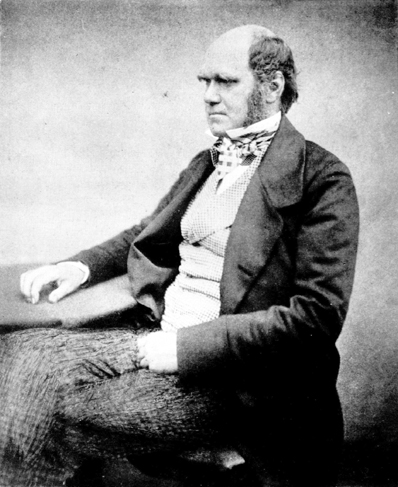
Charles Darwin: Blame it all on him. Image from Wikimedia Commons.

Evolution

Regardless of your opinion on the ultimate purpose of it all, it is important to understand how evolution works because the theory reflects reality, and basing your actions on reality works out much better than not.

By Bill Meacham | The Rag Blog | May 20, 2012

If we want to know what human nature is — and we do, as that will tell us how to live a fulfilling and happy life — then we have to understand evolution.

The theory of evolution describes how generations of living organisms change over time. Humans are living organisms. We are subject to and products of the same evolutionary pressures as all other living things. Understanding how we got to be as we are gives us insight into how we function. Knowing that, we can adjust our actions so as to function well.

It is called the theory of evolution, but “theory” does not mean conjecture, speculation, or mere opinion. The term in its scientific sense means a well-supported body of interconnected statements that explains observations and can be used to make testable predictions.

The theory of evolution has been confirmed over and over again.(1) No serious biologist takes it as anything but fully established. In the words of Theodosius Dobzhansky, author of a major work on evolution and genetics, “Nothing in biology makes sense except in the light of evolution… Seen in the light of evolution, biology is… the most satisfying and inspiring science. Without that light it becomes a pile of sundry facts, some of them interesting or curious but making no meaningful picture as a whole.”(2)

It is unfortunate that religious fundamentalists, misusing the term “theory,” regard evolution as unproven. Some go so far as to say that all the evidence that leads us to believe in the immense age of the universe and the proliferation of species over time, as opposed to instantaneous creation some 6,000 years ago, were planted by the creator merely to give the appearance of great antiquity.

Dobzhansky, a Christian, has this retort: “It is easy to see the fatal flaw in all such notions. They are blasphemies, accusing God of absurd deceitfulness. This is as revolting as it is uncalled for.”(3)

The religious believer may view evolution as God’s way of creating the world. The pantheist mystic may view evolution as the One Being’s way of unfolding and coming to know Itself over time. The secularist, the atheist or the merely agnostic may view evolution as the way living beings have propagated themselves, blindly and without foresight, in increasing diversity and complexity.

Regardless of your opinion on the ultimate purpose of it all, it is important to understand how evolution works because the theory reflects reality, and basing your actions on reality works out much better than not. So the rest of this essay is a summary of the theory of evolution.

The term “evolution” in a general sense means a process of change or growth, often taken as a process of continual change from a simpler to a more complex state. In biology, the term refers to two things:

  • The observed fact that the distribution of inherited traits in a population of organisms can change from generation to generation.
  • The theory that the various types of animals and plants we find around us, including ourselves, originated in earlier types and that their differences are due to modifications in successive generations.

The basic concept of biological evolution as we understand it today is surprisingly simple. Charles Darwin, its originator, called it “descent with modification.” The concept is this:

  • An organism’s offspring may vary slightly from the organism itself. Offspring may have slightly different traits from the parents or the same traits in different degrees.
  • Organisms typically produce more offspring than can survive and reproduce, given the resources available such as food, shelter, sexual mates, etc. Hence, there is competition for such resources.
  • In the competition for resources, some variations have an advantage over others. For example, one child’s beak may be slightly better at picking up small seeds than another’s, or one child may have slightly better eyesight than the other and hence be better able to find food and avoid predators.
  • The individuals with advantageous variations have more offspring than those without.
  • Since traits are heritable (are inherited from parent to child), this causes the population, over time, to contain more of the favorable variations and fewer of the unfavorable ones.

Darwin called this process “natural selection,” as opposed to artificial selection, the intentional breeding for certain traits that produces such differences in the same species as the Great Dane and the Chihuahua. The underlying mechanism is the same in both kinds of selection: certain individuals have more offspring than others, so their traits become more widespread in the population of that type of organism.

A subset of natural selection called “sexual selection” is a result of competition for mates. In order to have offspring, an individual must not only survive but reproduce. Competition for mates, most often among males for females, selects for traits that enable males to dominate other males, such as horns and antlers, and for traits that attract females, such as plumage and other adornments.

This process happens slowly but inexorably. The variation between parent and offspring is most often minuscule, but over enough generations large changes result. A series of small, incremental changes can, given enough time, produce the extraordinary variety of speciation we find around us.(4)

This process is not purposive.(5) No organism intends to produce a better beak or a better eye. It is merely a fact of life that those with favorable variations tend to have more offspring than those without, each of which in turn have the favorable variation. Among that generation’s offspring, those that further amplify the favorable variation have more offspring, and so on for generations. Conversely, unfavorable variations tend to die out over time. We should not take phrases such as “designed by natural selection” as implying a conscious, deliberate designer.

What is inherited is a trait, a feature of an organism such as eye color. Traits are passed from generation to generation as discrete units. Gregor Mendel conducted a famous study in which he mated pea plants, some of which had purple blossoms and some of which had white. The offspring did not have pale purple blossoms, but rather some had purple and some white, in distinct proportions.

What passes these discrete traits from generation to generation is the gene, the fundamental physical and functional unit of heredity. A gene is a segment of nucleic acid that, taken as a whole, specifies a trait. Genes are contained in chromosomes, which are composed of DNA (deoxyribonucleic acid), a polymeric molecule found in cells of the body. DNA governs the production, growth and reproduction of the cells of the body. The current understanding of biological evolution, developed since Darwin’s time, recognizes the gene as a fundamental, if not the fundamental, unit of natural selection.

Functionally, genes pass traits from generation to generation. They do this by replicating themselves from parent to child. Physiologically, the same chemical structure appears in the child as was found in the parent. In combination with other genes and triggered by environmental influences, the genes cause the parent’s traits to appear in the child.

The term “trait” includes physical forms, such as bone density or eye color, behaviors such as sounding mating calls in certain seasons, and mental abilities or talents such as stereoscopic vision, empathy, or language.

Genes are not the only replicators. Ideas, symbols, behaviors, and other elements of culture replicate as well. Genes replicate from generation to generation; their cultural analogues, dubbed “memes,” replicate from mind to mind through writing, speech, gestures, rituals and the like.(6) The principles of evolution apply the same: like a gene, a meme is a replicator, except memes replicate contemporaneously between minds rather than historically between bodies.

Just as genes are subject to competition — the ones that replicate to the next generation are those that help their host bodies to survive and reproduce — so also are memes: only those that are catchy enough to secure attention in human minds replicate from mind to mind. What makes a meme catchy can be something as trivial as a memorable tune or limerick, or something that has continuing usefulness, such as ideas that hold cultures together.

So there is an abbreviated account of evolution. What does it mean for understanding human nature? To know what we are we must understand where we have come from. It is not just in our physical form that we have evolved, but in our mental capacities and in our cultures as well.

Are we, then, merely products of our evolutionary heritage, unable to change? No, but in our attempts to change, it certainly helps to understand what we have to work with. Understanding that inherited traits are the result of natural selection can help put in context findings about how we humans actually function in the world, a topic to which I intend to turn in future essays.

[Bill Meacham is an independent scholar in philosophy. A former staffer at Austin’s 60s underground paper, The Rag, Bill received his Ph.D. in philosophy from the University of Texas at Austin. Meacham spent many years working as a computer programmer, systems analyst, and project manager. He posts at Philosophy for Real Life, where this article also appears. Read more articles by Bill Meacham on The Rag Blog.]

Notes

(1) See, for instance, the section titled “Predictive Power” in Wikipedia, “Evolution as fact and theory.”
(2) Dobzhansky, “Nothing in Biology Makes Sense Except in the Light of Evolution.”
(3) Idem.
(4) There are three sources of variation: mutation, gene flow and genetic shuffling through sexual reproduction. Mutation happens when environmental influences cause tiny changes in the chemical structure of genes, altering their functioning, or when cells divide and imperfectly replicate their DNA. By far the majority of mutations are destructive, degrading the gene’s ability to do its job of directing the growth of organs and characteristics, but some enhance that ability, or change it so that the result is advantageous. Gene flow refers to the transfer of genes between populations of an organism. Individuals from one population mate with individuals of another and transfer genes between them. Genetic shuffling through sexual reproduction causes the combination of genes in each child to differ from that of its parents. In species that reproduce sexually, each individual has two copies of every gene (specifically, each has two strands of DNA, each of which contains chromosomes, which contain genes). In sexual reproduction, the child gets some genes from the mother and some from the father, and the combinations vary with each child.
(5) Religious or mystical thinkers may postulate a divine purpose that guides the process of evolution, but the science of biological evolution does not need that hypothesis to explain the process.
(6) Dawkins, The Selfish Gene, chapter 11, pp. 189-201.

References

Dawkins, Richard. The Selfish Gene, New Edition. Oxford and New York: Oxford University Press, 1989.
Dobzhansky, Theodosius. “Nothing in Biology Makes Sense Except in the Light of Evolution.” American Biology Teacher vol. 35 (March 1973) reprinted in Evolution versus Creationism, J. Peter Zetterberg ed., ORYX Press, Phoenix AZ 1983. Available online at http://www.2think.org/dobzhansky.shtml as of 14 May 2012.
Wikipedia. “Evolution.” On-line publication, URL = http://en.wikipedia.org/wiki/Evolution as of 2 February 2009.
Wikipedia. “Evolution as fact and theory.” On-line publication, URL = http://en.wikipedia.org/wiki/Evolution_as_fact_and_theory as of 14 May 2012.
Wikipedia. “Meme.” On-line publication, URL = http://en.wikipedia.org/wiki/Meme as of 16 May 2012.

The Rag Blog

Posted in Rag Bloggers | Tagged , , , , , | Leave a comment

Jonah Raskin : Protest 101 at Sonoma State

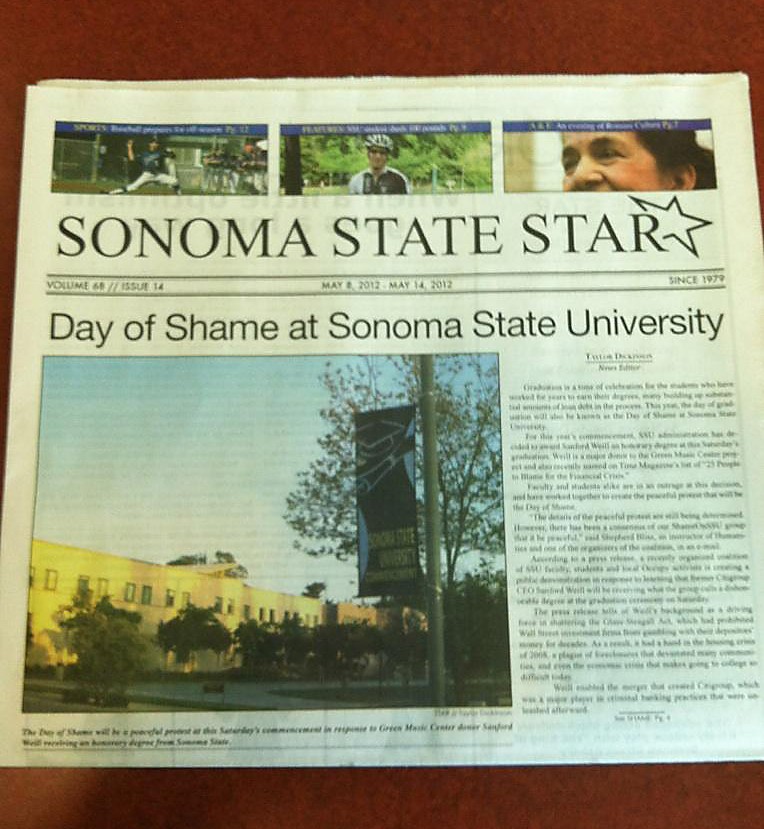
Front page of the Sonoma State Star, May 14, 2012. Image from Shame on Sonoma State.
.
Protest 101:
A textbook case of campus unrest, 2012

Everyone in the crowd seemed relieved that no one had shouted, thrown a pie in Weill’s face, or staged a sit-in on stage.

By Jonah Raskin | The Rag Blog | May 20, 2012

ROHNERT PARK, California — Sometimes, as Chairman Mao Zedong observed, a single spark can start a prairie fire. And sometimes the spark fizzles and the prairie lies there peacefully without a blaze.

For a really effective protest, activists apparently need more than a single spark. It helps to have several essential ingredients: an obvious issue or cause; a slogan that resonates; a dynamic leader or spokesperson; and brave souls prepared to risk failure, arrest, or rebuke from more cautious citizens.

Indeed, the May 2012 commencement ceremony at the normally sleepy Sonoma State University (SSU), one of the 24 campuses in the gigantic California State University system, had the potential to turn into a rowdy protest.

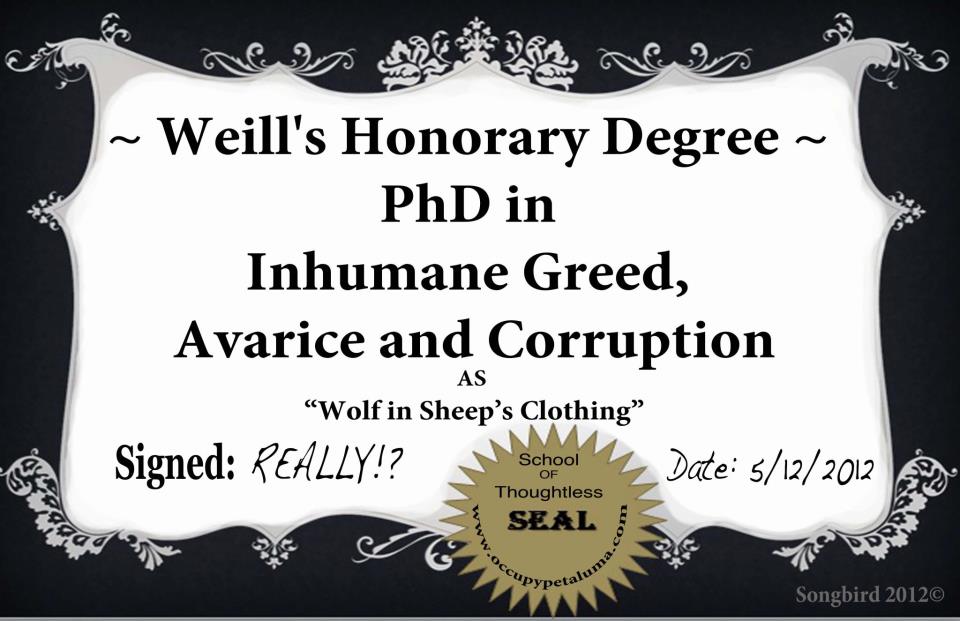
Protest 101 at SSU gained momentum in part because it was fueled by the Occupy Wall Street movement. The protesters had an obvious villain in Sanford Weill, the Wall Street billionaire responsible for the big financial meltdown of 2008 who would be on hand to receive an honorary degree. Not one but three strikes were against him. Largely responsible for the repeal of the Glass-Steagall Act that made it possible for bankers like him to turn into modern-day pirates, he looted the economy, and ran Citigroup into the ground.

Veteran reporter, Robert Scheer, helped to ramp-up local discontent in a column in The Nation, in which he called the billionaire a “jolly good Scoundrel” and claimed that he was “laughing all the way to the bank.”

To the outraged organizers of the protest, it was clear that Weill had bought his honorary degree with a $12 million dollar check he’d written to the University. On the speaker’s platform, he’d have nowhere to hide, though, of course, he’d be surrounded by administrators and faculty members. A crowd composed of thousands of students, many of them in debt, along with their families, also in debt, would observe every move that he’d make.

The week of graduation, the student newspaper, The Star, primed readers for the protest with a banner headline that echoed the slogan coined by campus activists: “Day of Shame on Sonoma State University.” Just days before graduation, employees loyal to the university were observed gathering copies of the newspaper. They claimed to be “cleaning the campus.”

The protest quickly expanded into a First Amendment issue. SSU seemed on the verge of an explosion. The organizers wouldn’t have to do much at all, except sit back and watch the University self-destruct.

Then, reality kicked in. Graduating seniors insisted that commencement wasn’t a “day of shame” for them but rather a “day of pride.” Sandy Weill didn’t spark their ire. The university harnessed its public relations team and pointed out that Mr. and Mrs. Weill were generous philanthropists who gave millions of dollars to the arts and who earned their honorary degrees.

Then, too, the faculty divided among predictable lines, with old school radicals forming a small, core group and the majority of professors opting to remain seated while others stood and turned their backs to the podium.

Temperatures soared on the Saturday afternoon in May scheduled for commencement. Protesters distributed thousands of leaflets, and campus police, expecting the worst, were out in force. I was on hand to observe the drama. A professor emeritus at Sonoma State, where I taught for 30 years, I sat with the students, and stood out in the black cap-and-gown crowd because I wore a red shirt and a black baseball hat.

Four different police officers on four separate occasions approached me and asked for identification, though I didn’t have to produce papers. “He’s our professor,” students shouted. “He’s okay.”

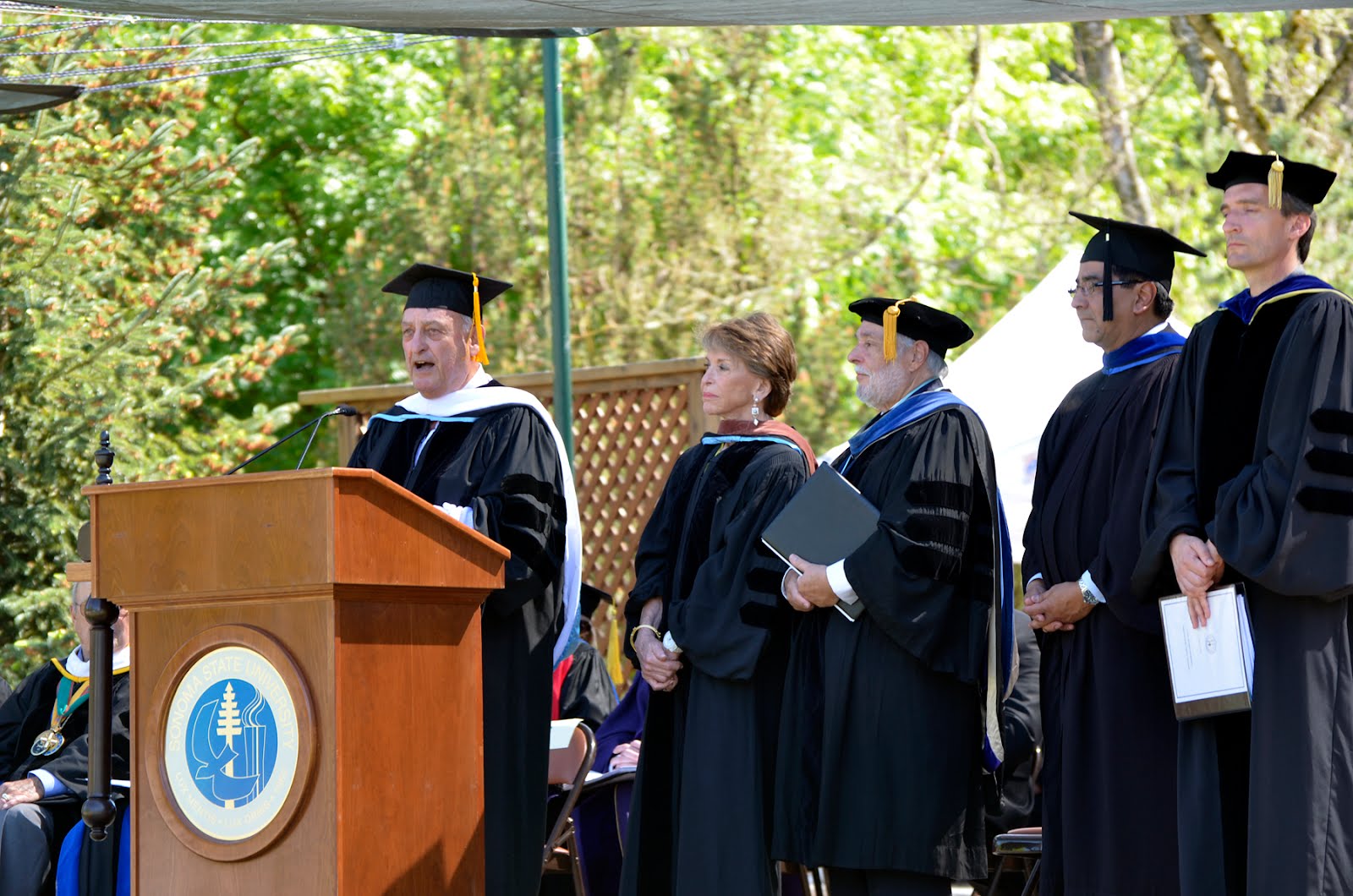
When the critical moment arrived, Ruben Arminana, the president of the University, awarded the Weills their degrees. Half-a-dozen or so faculty members turned their backs on the podium and about 50 or so students did the same. Sandy Weill smiled, thanked the University, kissed his wife and sat down.

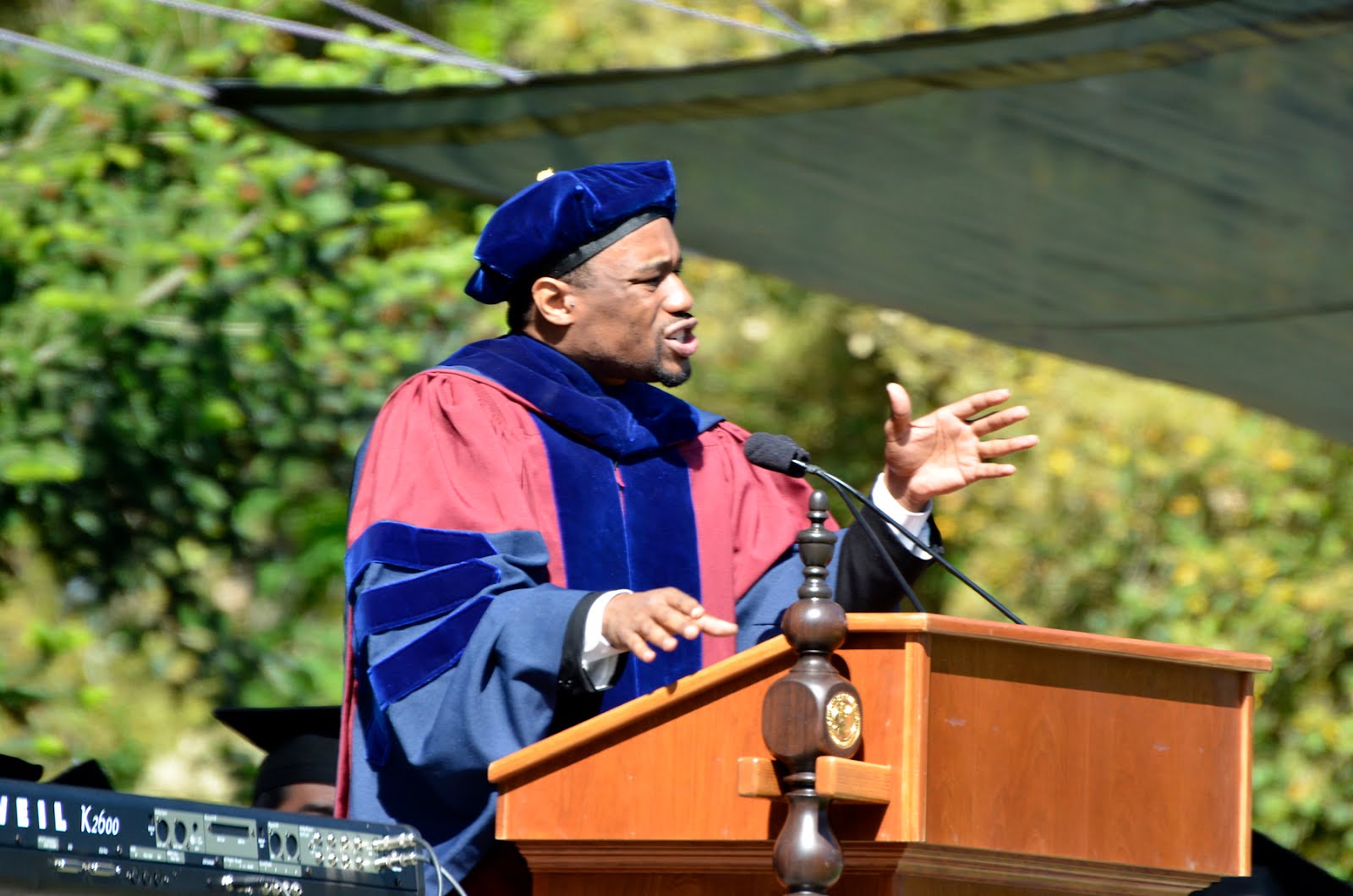
Marc Lamont Hill gives the commencement speech as Sonoma State. Inset below: Sandy Weill, Joan Weill and SSU President Arminana at commencement exercises. Photos by Sandy Destiny / The Rag Blog.

Everyone in the crowd seemed relieved that no one had shouted, thrown a pie in Weill’s face, or staged a sit-in on stage. Surprisingly, the best was yet to come. Marc Lamont Hill, the commencement speaker, took the podium and delivered an oration that in 1968 would have been described as “militant.”

By the standards of 2012, even by those of Occupy Wall Street protesters, it was as Maoist a talk as any heard on the campus. An African-American professor at Columbia University, and a regular commentator on CNN and MSNBC, Hill denounced Wall Street greed, the war in Afghanistan, and social injustice. With a big booming, impassioned voice, he invited graduating seniors not to conform, not to accept the big lies of the society, but rather to be brave and to oppose the political and economic system.

Students and faculty members stood and applauded him at the end of his speech. From where I sat and from what I saw and heard, Hill’s oration was the highlight of the day.

That evening at a party for faculty I talked to professors who had not taken part in the protest. “Every day is a day of shame in our capitalist society,” one woman told me. “Today was no different.” Another told me, “All universities give out honorary degrees to millionaires and billionaires these days.”

David Walls, a former dean at SSU, a veteran of the Free Speech movement at Berkeley in the 1960s, and an organizer with MoveOn.org, stayed away from the event. He said he was out-of-town. “Most of the commentary on Weill had little humor,” he told me. “The protest was mostly a venting of outrage, with no achievable goal in view. I imagine the issue of the honorary degree will disappear as quickly as it arose. Questions around campus finances will probably remain, but it is difficult to imagine that they will preoccupy Occupy.”

Shepherd Bliss, a former U.S. soldier who demonstrated against the war in Vietnam, was ecstatic about the protest against Weill. “We were highly successful for many reasons,” he explained. “We distributed thousands of flyers documenting Weill’s crimes. We mobilized students, faculty, alumna, and community members in a direct action against his criminal behavior.”

The role I chose for myself was to moderate the rhetoric of the radicals. One friend sent a letter to the local weekly in which he expressed his “extremely negative feelings toward robber baron Sandy Weill who never should have had his $12 million in green washing money accepted by Sonoma State University or anybody in this county.”

He went on to say, “If the powers-that-be were not above such temptation, they first should have exposed each county citizen to the fetid corpse and stench of the murder he perpetrated on Wall Street and our nation. As to Sonoma State University, ‘Shame, Shame, Shame'”

Phrases like “fetid corpse and stench of murder” didn’t help the cause. Shaming didn’t help, either. I also discovered that the simple act of wearing a red shirt in a crowd in which everyone else was wearing black made a strong statement and engendered discussion. Sometimes simple understatement works better than bravado.

I asked SSU’s president, Ruben Arminana, to answer a single multi-choice question. Do you feel, I asked, if you:
     a. came out smelling like roses
     b. dodged a bullet
     c. made the best of a bad situation
     d. all the above?
His answer was: “d. — all the above.”

As for the protests at SSU, I’d assign them a C. Marc Lamont Hill deserves an A+.

[Jonah Raskin is the author of For the Hell of It: The Life and Times of Abbie Hoffman. A former Yippie, he is a a regular contributor to The Rag Blog. Read more articles by Jonah Raskin on The Rag Blog.]

The Rag Blog

Posted in Rag Bloggers | Tagged , , | 1 Comment

Jay D. Jurie : Are We Colonized? A Response to Chris Hedges

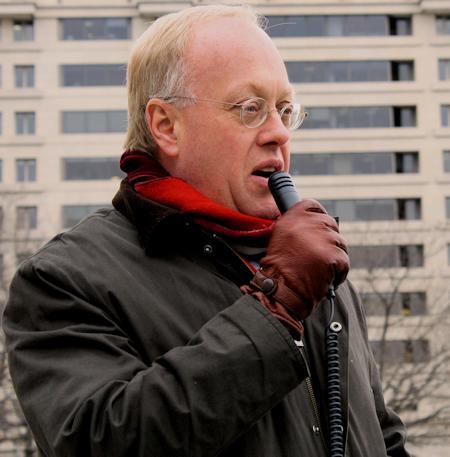
Activist/journalist Chris Hedges speaks at Occupy Washington, DC, Freedom Plaza, Jan. 9, 2011. Photo by Scott Galindez / Occupy Washington, DC.

‘Colonized by Corporations’:
A Response to Chris Hedges

Hedges says that corporations play the same role in the U.S. today that British or French colonialism played in India or Indochina.

By Jay D. Jurie | The Rag Blog | May 18, 2012

According to Chris Hedges, we’re no different than Third World inhabitants subjugated by foreign colonialism.

In one of his most recent columns (“Colonized by Corporations,” Truthdig.com, May 14, 2012), Hedges relies on the book The Developing Nations by Robert E. Gamer, to tell us “we have been, like nations on the periphery of empire, colonized.”

This means, he goes on to say, that corporations play the same role in the U.S. today that British or French colonialism played in India or Indochina in the past. Part of how this works is through the construction of “patron-client” relations, whereby real power is concealed, and the oppressed deal only with client regimes who do the dirty work of the foreign oppressors.

This is among the latest in a series of books and essays Hedges has written about the economic and political crises affecting not only the U.S., but how these are related to crises on the global level, and how this contributes to the rise of resistance movements, such as Occupy here at home.

His column is produced regularly on Truthdig.com, and according to his biosketch on that site, he was a foreign correspondent for almost two decades in locales including Africa, the Balkans, Central America, and the Middle East.

He has worked for a variety of media sources, and as part of a New York Times team, once won a Pulitzer Prize for coverage on terrorism. He left the Times after being reprimanded for speaking out against the attack on Iraq launched by the George W. Bush regime.

Hedges has written for a number of publications, including The New York Review of Books and Adbusters. He holds a bachelor’s degree in English literature from Colgate, a master’s in divinity from Harvard, and speaks several languages, including Spanish and Arabic.

Over the past several years Hedges has become directly involved in the resistance he once wrote about, most specifically the Occupy movement that grew up around the U.S. in the wake of the Occupy Wall Street events this past September. He has been arrested at Occupy-related protests, including one on November 3, 2011, outside Goldman Sachs in New York City.

This past January, he was joined by several others in filing a federal lawsuit against the threats to civil liberties posed by the National Defense Authorization Act — which resulted this week in a federal judge enjoining enforcement of the controversial provisions.

In a RawReplay interview with Muriel Kane at The Raw Story on September 25, 2011, Hedges described Occupy Wall Street as “Where the Hope of America Lies.”

In this same interview, Hedges characterized the U.S. as in transition to a “neo-feudal corporate state, one in which there is a rapacious oligarchic class, a thin managerial elite, and two-thirds of this country live in conditions that increasingly push families to subsistence levels…[the corporate state] wants to reduce the working class to a status equivalent to serfdom.”

Hedges has since expanded on that theme, including in this present column. He brings up the work of Frantz Fanon, who described Algeria under French colonialism. Changing the on-scene managers won’t bring about any changes in the real situation, as colonial rule will continue regardless.

In the U.S., this means a vote for either Obama or Romney won’t make any real difference, the “neo-feudal corporate state” will remain unaffected. This “patron-client” facade must be destroyed and “new mechanisms of governance” put in place.

Yet, according to Hedges, it’s not the “serfs” who are the real threat to the colonial apparatus, it’s the “declasse individuals,” the professionals who are losing their foothold as the economy hollows out, or are denied advancement as the ranks of the managerial elite grow thinner.

It is when these elements join with the lower echelon and share their message with them, that the apparatus is threatened. Malcolm X understood these dynamics, which is why he was more of a direct threat to the system than Martin Luther King, Jr., who still worked within “patron-client” relations.

Eventually the corporate elite will become increasingly venal and corrupted. They will resort to violence to retain power, but will become increasingly unable to stabilize the situation. Violent revolutionary groups will arise to challenge the elite, as did the Black Panthers, the American Indian Movement (AIM), and others in the 1960s, but they will hold back, rather than advance desirable social transformation.

This is obviously a slap at the “Black Bloc,” a current tendency that Hedges identifies with the earlier groups.

Ultimately, the “neo-feudal corporate state” will collapse when it loses legitimacy among the last of those responsible for upholding it, when they defect, and when some cross over to the resistance.

Hedges advises people to go ahead and vote this coming November, but only for a third party candidate, as a way of registering protest, then get back into the streets where the real changes will take place.

In response to Hedges, it’s true that “unequal exchange” produces certain conditions that are functionally the same in developed as in underdeveloped countries. It’s also true that these conditions are in some respects becoming increasingly similar. Shanty towns under bridges in Miami look increasingly like favelas in Brazil. But there are some differences, and Hedges glosses over the processes by which these manifest.

Although Hedges makes passing reference to Karl Marx, he seems unfamiliar with either Marx, or more contemporary Marxist sources, such as Samir Amin, Antonio Negri and Michael Hardt, Ellen Meiksins Wood, David Harvey, and others, who for quite some time have addressed the conditions he seeks to describe.

Much of what Hedges describes in some ways fits well with Negri and Hardt’s “empire” theses, wherein they discuss the transnational character of the capitalist system, and how conditions from the developed countries are reproduced in underdeveloped countries.

It’s unclear why Hedges doesn’t employ such analysis. Maybe he’s trying to be careful and not alienate a predominantly liberal audience, maybe he doesn’t like or agree with this source material, or maybe he’s not conversant with it, and I suspect the latter.

In this column he makes direct reference to Alexander Herzen, a Russian who exerted some influence on the subsequent revolution in that country. Like Herzen as an earlier expression of the change process, Hedges seems to be feeling his way along, his perspective seems to be evolving, and he wants others to join in the voyage of exploration.

Following Garner, Hedges contends disaffected groups don’t attack the underlying sources of problems, instead they confront what some Marxists have termed as “compradors” or in other words, “intermediaries.” In this regard, Hedges misapplies Fanon, who was addressing a context dominated by an actual colonial power, where the French had put into place, and actively propped up, indigenous elites.

Though there are some similarities, the U.S. is not occupied by a foreign power, as was Algeria. If Hedges were to make this case regarding the U.S. in relation to Iraq or Afghanistan, he’d be much more on target.

As it is, the comparison has limitations. It is easier for subject populations to associate corporate domination with foreign rule. No doubt, the Iraqi people associated Blackwater with the U.S. occupation. It’s not quite the same, or as easy, for people in the U.S. to make that same association. Nor do they have to cut through two sets of “comprador classes” to get at the problem.

There are other issues as to the comparative composition of the class structures that have been oversimplified by Hedges, but they are beyond the scope of the present discussion.

In terms of minor critiques, it’s not news, at least not to many Rag Blog readers, that the election of either Obama or Romney will not dislodge, or do anything meaningful about, the underlying domination of corporate power. Hedges is basically correct in his assessment of “declasse intellectuals,” but again, that’s not news. Any serious scholar of revolutionary process would point out the same.

Though Hedges is correct that Malcolm X was much more forthright, it’s not certain that Martin Luther King, Jr., harbored any illusions about the nature of power in this country. His speech on Vietnam reflected comprehension of the dynamics that initiated the war as well as its likely domestic consequences.

Hedges’ assessment of “radical violent groups,” at least in the case of the Black Panthers and AIM, is not wholly on track. A more nuanced and sophisticated position is required, that takes into account the self-defensive nature of much of that history.

Finally, there are serious questions about the “futility of elections.” Hedges performs a service by raising this issue, but falls short in terms of a comprehensive assessment. Yet again, we full well understand that whether Obama or Romney is elected, we will not see fundamental change.

But that’s not the same as some who mistakenly argue that “there’s no difference between the two,” plus it leaves out other situations where there’s more of a difference to be made: for instance, it’s better to have Bernie Sanders in office than not.

We also should not throw out the possibility that serious change could result through the electoral process. This doesn’t mean the sort of phony examples represented in countries like France, Spain, or Portugal, where “socialists” keep getting elected and no basic social change transpires.

As exemplified by Mitterand, when he was president of France, this could be called “SINO,” or “socialism in name only.” No difference should be expected from Francois Hollande, who was just elected in France. He might modify French participation in the Eurozone, but will do virtually nothing to replace capitalism.

In actuality, the main European parties who call themselves “socialist” should be known as “social democratic,” which in modern parlance is what they are.

But we do have some better examples. There was Allende’s Popular Unity government in Chile, and the reason it was overthrown was that the government was genuinely moving Chile to socialism. It actively sought to free itself from both colonial and corporate domination. Today, we have Hugo Chavez in Venezuela, and his government is on the road to a similar underlying transformation. I

n other words, the prospect of an electoral transition to real social change shouldn’t be tossed out, but it’s an absolutely essential imperative that it be led by significant popular organizations and a vast grassroots movement, as in Chile, which must have the involvement of disaffected “declasse intellectuals,” as in Venezuela.

There has to be a strong and well-organized movement “outside” the electoral arena, most especially if any “inside” strategy is to be effective.

As to whether people should vote for third parties in November, as Hedges proposes, while I personally believe there may be some significant incremental differences, plus strategic advantages, to be gained through the reelection of Obama, I remain agnostic on the question of how anyone should vote.

There are good and valid reasons not to vote for Obama, and I’m not going to castigate anyone who should decide instead to vote for a “protest candidate” to his left.

[Jay D. Jurie, a veteran of SDS at the University of Colorado at Boulder, is a resident of Sanford, Florida, where he teaches public administration and urban planning. Read more articles by Jay D. Jurie on The Rag Blog.]

Sources:
Though I was aware of Negri and Hardt’s Empire, I thank Bruce Goldberg for bringing its importance to my attention. Any misinterpretation is my error, not theirs, or his.
Muriel Kane September 25, 2011 interview: www.rawstory.com/rawreplay/2011/09/chris-hedges-occupy-wall-street-is-where-the-hope-of-america-lies
/

The Rag Blog

Posted in Rag Bloggers | Tagged , , , , , , | 2 Comments

Patrick Youngblood : ‘Reform’ and Squeezing ‘Value’ Out of Students

Image from Chicago Now.

The school ‘reform’ movement:
Squeezing ‘value’ out of students

By Patrick Youngblood | The Rag Blog | May 18, 2012

As a public high school teacher and a parent I think often about the role of schools in our society and closely follow the current debate over school reform. Recently I read a concise, insightful letter to The New York Times that has stuck in my mind, almost haunted me, since:

To the Editor:

Standardized test scores can provide some evidence of what knowledge and skills students have learned. But lost in the debate is the fact that it’s possible to teach a subject well but to teach students to hate the subject in the process.

If one of the goals of schooling is to create lifelong learners, then high standardized test scores may be a Pyrrhic victory. That’s because long after the subject matter is forgotten, attitudes remain.

Walt Gardner, Los Angeles, April 22, 2012

The letter reminds us that debates over school quality and the so-called reform movement have the power to distract from more fundamental questions about the role of education in our society. Schools that we might consider successful — producing a lot of university bound students with high test scores — may fail completely to cultivate the curiosity and engagement that create lifelong learners.

The author of the letter, Walt Gardner, maintains a blog at Education Week called Reality Check. His May 2 post continues the theme with a critique of a recent Wall Street Journal op/ed by former George H. W. Bush Secretary of State George Schultz and economist Erik Hanushek, a prominent proponent of “value-added” measures of teacher performance.

Schultz and Hanushek, both fellows at Stanford University’s Hoover Institution, argue that the sluggish growth of the U.S. economy would change dramatically if we embraced school reform. High science and math scores lead to increased economic output, they write.

Schultz and Hanushek both are part of what has come to be known as the education reform movement. I don’t want to over-generalize the reform position, but it’s fair to say that they advocate using standardized testing as a key component for identifying schools that should be defunded and teachers who should be fired, believing that this would result in greater efficiencies at the school level.

To the reformers, a move toward charter schools is positive because they are less constrained by local districts and teachers’ unions.

In his blog post, Gardner questions the causal relationship Schultz and Hanushek make between test scores and economic growth, pointing out that Japan, high scoring yet mired in a slow economic growth since the 1990′s, doesn’t fit their model. He also raises the point that broader economic policies (e.g., spending cuts in a recession) and the realities of international competition cloud the test-score-to-economic-growth relationship even further.

Gardner’s criticisms are sound, but in the spirit of his letter to the Times, I’m inclined to point to a more fundamentally distressing aspect of this piece, and the reform movement in general.

Much of the proposed reforms are an attempt to squeeze more “value” out of teachers, as measured by tests that may work to some degree in areas like math and science, but resist easy standardization in almost everything else that is supposed to happen in a school — from history to literature to art, to even less measurable skills like critical thinking, maturity, and, as Gardner’s letter to the Times reminds us, hanging on to the curiosity and love of learning we all had as children.

When the education economists associated with the reform movement look at a school they see teachers creating measurable “learning gains” in their students. For example, students of a bad teacher might only gain .5 years of learning in a calendar year, while the students of a good teacher gain as much as 1.5 years in the same time span.

Hanushek’s emphasis is on the impact that this “value added” by a teacher will have on the lifetime earnings of students, and ultimately on the nation’s overall economic output. His policy proposal follows logically from there. He argues that by removing the worst 5 to 10 percent of teachers and replacing them with average teachers, the United States will, over time, achieve test scores as high as Finland’s (see graph).

To be fair, Hanushek says the identity of the bottom 5-10 percent of teachers wouldn’t be based on test scores because the “obviousness… would be revealed by virtually any sensible evaluation system.” He identifies teachers’ unions as the biggest obstacle to such a plan.

The issue of unions is a distraction. Many of the worst performing states are right-to-work, where unions are either nonexistent or weak. We strive for the test scores of Finland, a country where teachers are 100% unionized and the societal approach to education is radically different than in the United States.

Hanushek’s proposal is like a doctor prescribing liposuction to an out-of-shape patient when what is obviously needed is a healthy diet and active lifestyle. Why is it that marginal, misguided proposals like these have such traction in the education debate?

The reforms advocated by economists like Hanushek are well received in a political atmosphere where public institutions, and the people who work in them, are viewed with suspicion. It is difficult to imagine a national dialogue about building a public system based on professionalism, trust, and responsibility in today’s political climate.

Just as a prolonged recession and soaring debt have placed long-established social programs on the chopping block, in the hands of Hanushek and Schultz the economic crisis becomes an argument for their version of school reform.

What would successful reform bring to our society? A 40-point increase in math scores for U.S. students over the next 20 years, they claim, “would exceed a present value of $70 trillion. That’s equivalent to an average 20% boost in income for every U.S. worker each year over his or her entire career.”

This, to them, is what schools do.

And that brings me back to Walt Gardner’s wonderful, haunting letter. The economists of the reform movement tempt us into a debate that accepts the premise that schools are a place where teachers add value to students, boost their lifetime earnings, and in the aggregate raise the output of the national economy.

It isn’t enough to disagree with liposuction as the prescription for a troubled school system. We need to be animated by a vision of what we want schools to be like in our society — a place to develop the habit of learning that will last a lifetime.

Rather than wring our hands over how to remove teachers who shouldn’t be teaching (a problem that is always made out to be more difficult than it actually is), we ought to approach schools as an institution, and teaching as a profession, in a different way.

Schools ought to be rooted in, and accountable to, their own communities. Time in the school year should be provided for teachers to deepen their knowledge of the field they teach, to collaborate with peers in order to share ideas and skills, and to meet the individualized needs of students.

If we as a society understand that the majority of teachers enter the field because they want to be good at teaching, we ought to create institutions where they can thrive.

[Patrick Youngblood is a teacher in the Austin Independent School System and is a director of the Third Coast Activist Resource Center, where this article was first posted.]

The Rag Blog

Posted in Rag Bloggers | Tagged , , , | Leave a comment

Jerry Brown’s karma runs over his dogma

By Thomas McKelvey Cleaver / The Rag Blog / May 18, 2012

Back in January, California Governor Jerry Brown optimistically forecast that the state budget deficit would be $9.5 billion. To close the gap, he proposed massive cuts in funding for in-home care of the disabled, which would force people into expensive nursing homes; massive cuts to an already-battered state higher education system that already forces in-state students to pay over 52% of costs, accompanied by cuts in financial aid to students; cuts in eligibility for Medicare, which takes care of the poor; cuts in support for the Supplemental Nutrition Access Program (food stamps); further deep cuts to K-12 education; it was a previously-unimaginable Democratic budget in California history.

And the governor said it would only stay as bad as it was if California voters didn’t vote to raise taxes on upper incomes in the June primary. The governor’s attempt to get the tax measure on the primary ballot failed in the legislature; after a major effort to collect enough signatures to put it on the ballot for November, it will now come to a vote then.

On Monday, May 14, it was revealed that the actual budget deficit would be $16.5 billion, almost twice the governor’s prediction, which proved his critics right that he was guilty of excessive optimism in January. The next day, the Governor announced further increases in the previously-announced cuts. Left uncut were the several billion dollars scheduled to be spent in building a new Death Row at San Quentin, a project the governor is set on doing.

This is not the California I came to 45 years ago. In 1974, it wasn’t the state I looked forward to working in its politics to keep that dream growing. That California was willing to set priorities to improve itself by improving the lives of its citizens,and its citizens were willing to invest in that future through their taxes. That California worked.

I doubt I have ever seen anything so karmic as Jerry Brown being the governor forced to pay the piper now that the pigeons of Proposition 13 have come to roost. That’s because Jerry Brown is the governor who could have avoided all of this. One action by Jerry Brown in 1976 would have changed everything, but he was too busy presenting “new ideas” on how to change everything, to be bothered by focusing on some old-fashioned something like property tax reform.

As anyone of a certain age can remember, property values started skyrocketing nationwide in the mid-1970s as the leading edge of the Boomers graduated from college, got the jobs they’d trained for, got married, and started planning to raise families. I recall a house I bought in 1976 for what I thought was an inflated $38,000 for what was there, selling two years later for an eye-popping (to me anyway) $50,000, and it only went up from there.

California education, and most of California local government, was paid for by property taxes, and those taxes were going up faster than the inflation rate, which was bouncing toward double digits and scaring hell out of people. Homeowners were making major adjustments to their lifestyles to pay their taxes, and complaints were rising. Reform was in the air, one way or the other.

In the Democratic wave election of 1974 that swept Brown into the governor’s office the first time, a two-thirds Democratic majority was elected to both the State Senate and Assembly. This meant that tax reform as defined by Democrats could be enacted, since the state constitution required (and still does) a two-thirds super-majority to raise or reform taxes.

Willie Brown, the smartest politician I ever met in 50 years, was Speaker of the Assembly; he heard the cries of his constituents and devised a plan for such reform. Under his proposal, the tax rate on private homes would be lowered to provide relief and the rate would go up slower in the future. Business property would continue to be taxed at the market rate, and would rise as the market rose. Brown had the votes for this in the Assembly, and the Democrats in the Senate were close to having them. All that was needed was for the governor to embrace the idea and call for support from the conservative Central Valley Democrats in the Senate, giving them the protection of his popularity so they could do the right thing.

Jerry was too busy talking about “new ideas” and finding ways to demonstrate that “small is beautiful.” Those not on the governor’s staff soon learned that his eyes would glaze over whenever the subject of property tax reform came up.

Come the elections of 1976, the 2/3 Democratic majority in the Senate was lost, but only by a few votes, and this was in the day where there were still Republicans in California who could add 2 and 2 and get 4 on consecutive attempts, so there was still a 2/3 vote for such reform, if the governor would provide cover by taking ownership of the idea.

Following his first dalliance with Presidential politics, Jerry went off to tour Africa with Linda Ronstadt.

In the meantime, a far right whack job named Howard Jarvis was campaigning across the state to lower all property taxes radically for everyone, homeowners and businesses alike. Frustrated homeowners signed the petitions, and the accounting departments of every company that owned property in the state went to their CEOs and pointed out the windfall to come. The corporations began supporting Jarvis and the Great California Taxpayer’s Revolt was born.

Proposition 13 was voted into the state constitution in 1978 by a margin bigger than Brown’s re-election totals. Things have never been the same since.

The result, 34 years later, is that homeowners property taxes have gone up from those 1978 levels by many times. That’s because the average home in California is sold every five years, and on sale, the home is reassessed in value at the market rate. There is one set of property owners, however, who are still paying the 1978 rates on 1978 assessments of property value: corporations, the only property owners who hardly ever sell what they own.

Before Proposition 13, business paid the majority of property taxes. Today homeowners pay the majority of property taxes. Local government on all levels has been gutted. In the face of this and the loss of income taxes stemming from the Great Recession, and the drop in property taxes as homeowners seek reassessment of their now-less-valuable homes, California has finally arrived at the state we find ourselves in.

In the election of 2010, after seven years of the failed governorship of Arnold Schwarzenegger, anyone with any knowledge of the facts knew that someone with some good ideas of how to resolve the fiscal crisis, who would find a way around the grand canyon of the partisan divide between Democrats and the Party of No that now passes for the California Republican Party, would need to occupy the governor’s office and bring the leadership that had been lacking for over 30 years to solve the problem.

So who did we elect?

Jerry Brown. The guy whose failure to lead to begin with was the cause of the problem.

The irony of the situation is obvious to any Democrat who knows the facts. The problem is no Democrat in California wants to admit the facts are indeed facts. And so we all now circle the drain, while Brown flails away at the monster no one wants to remember he created.

Will the last person to leave this sinking ship please open the seacocks to put the poor old lady out of her misery?

[Thomas McKelvey Cleaver is an accidental native Texan, a journalist, and a produced screenwriter. He has written successful horror movies and articles about Second World War aviation, was a major fundraiser for Obama in 2008, and has been an activist on anti-war, political reform, and environmental issues for almost 50 years. Read more articles by Thomas Cleaver on The Rag Blog.]


Type rest of the post here

Source /

The Rag Blog

Posted in RagBlog | Leave a comment

David P. Hamilton : U.S. Presidential Election Is Bought and Paid For

Cartoon from Political Resources, Inc.

Bought and paid for:
The Left and the 2012 presidential election

By David P. Hamilton | The Rag Blog | May 17, 2012

“[No] serious candidate will rely on the public funding system during the primary phase of future presidential campaigns.”Politico, 2008.

“[A] sharp rise in the costs of elections… drove the political parties even deeper into the pockets of the corporate sector.” — Noam Chomsky, Occupy speech, published 5/8/12.

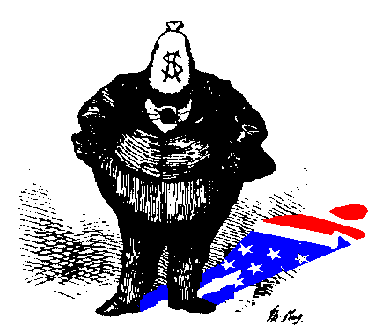
The Supreme Court’s “Citizens United” decision opened the floodgates for the capitalist ruling class to make the U.S. presidential election, in fact every federal election, more than ever, determined by finances.

This is a long proven winning strategy given that in over 90% of U.S. elections, the candidate with the most money wins. By making effective campaigning progressively more expensive, the capitalist class and their political minions strengthen the inherent disadvantages faced by their adversaries. They seek to further commodify political power and raise its price to the point that only they can afford it.

The more expensive the campaign, the more it is controlled by the capitalist class and the more democracy withers. In 2012 the democratic process in the U.S. is almost totally corrupted by corporate money. That is the most salient feature of the U.S. political landscape.

Total spending by presidential candidates:
1984 – $103.6 million.
1988 – 210.7 ”
1992 – 192.2 ”
1996 – 239.9 “
2000 – 343.1 ”
2004 – 717.9 “
2008 – 2.4 billion
2012 – 5+ billion projected
(Sources: US News & World Report, 10/21/08, and Wikipedia)

The cost of elections in the U.S. is now accelerating geometrically. The Democratic Party will necessarily and increasingly become more dependent on the capitalist class for campaign financing in order to remain competitive. There will be less political space between the U.S. presidential candidates on those issues basic to the economic privileges of the capitalist class. The strategy of this less than 1 percent is to increase campaign spending to the point that both major party candidates become entirely dependent on their financing.

The principal result of this process is that the candidates for the two major parties become increasingly similar in their support of fundamental capitalist class interests. Compare, for example, the ideological space on the issue of government financing between two finalists in the French presidential election compared to the two major party presidential candidates in the U.S.

Roughly similar ideologically to a moderate U.S. Republican like Mitt Romney, Nicolas Sarkozy argued that government debt was the primary issue and advocated reducing it by cutting government employment and spending on social services, while reducing taxes and regulations on corporations.

His opponent, Francois Hollande of the Socialist Party, ran on increasing taxes on the rich capitalists including a 75% tax bracket on income above a million euros a year, raising the existing top income tax bracket rate from 41 to 45%, a financial transactions tax, ending tax havens, cutting 29 billion euros in tax breaks for the wealthy, taxing investment income at the same rate as salaries and wages, capping executive compensation and separating investment banking from retail banking.

Thus, the economic platforms of the two leading candidates in the French election were almost diametrically opposed on issues that are basic to capitalist class interests. Hollande also favors gay marriage and adoption nationally, immediate French withdrawal from Afghanistan, international recognition of the Palestinian state and drug law reform. Try to imagine Barack Obama embracing such a platform.

Yet, Hollande is typically referred to as a “moderate” and a pragmatist among French socialists.

The French system offers this far more distinct choice because corporate donations to political campaigns in France are completely forbidden, the state tightly regulates and partially funds political campaigns and campaign costs are a tiny fraction of what they are in the U.S. The U.S. has a population roughly five times larger than France, but the amount spent in the U.S. presidential election in 2012 will be at least 50 times, possibly 100 times greater than the amount spent in the 2012 French presidential election.

Symptomatic of this corporate corruption of the political process are incidents such as a Las Vegas gambling tycoon forking up $15 million to inflate the campaign (and ego) of Newt Gingrich, the billionaire Koch brothers buying $6 million in air time to run negative attack ads against Obama (only the beginning) and Obama’s goal of raising a billion dollars to fight back, principally from wealthy donors, like the $15 million he raised at “an exclusive backyard soiree at George Clooney’s house.”

Your choice is to be governed by oil company executives and their financiers or film moguls and their financiers, who happen to be the same people as the other financiers.

When the Supreme Court legalized unlimited corporate campaign contributions and spending in January 2010, the already astronomical price of the presidency began escalating radically, making political decisions increasingly the sole prerogative of the plutocrats. Only they can pay to play on the level of expense that has been achieved.

The more unlimited and privatized campaign funding, the more expensive elections become and the more the political process is corrupted by obvious political bribery in the guise of campaign contributions and PAC funding.

In this context, neither major U.S. political party can effectively advocate for interests that are contrary to those of the capitalist ruling class. Government actions anathema to the capitalist class include steeper progressive taxation, taxing capital at the same rate as wages, inheritance taxes, wealth taxes, eliminating the income cap on social security tax liability, financial transaction taxes, and greater banking regulation.

Likewise anathema is higher government spending on the health, education, and welfare of the general population that would require greater government revenue. For the capitalist class, the state must be confined to approved roles, principally the privatization of profits and the socialization of costs.

Regarding the maintenance of capitalist privileges and benefits there is great class consciousness and unity. The essential prize for the capitalist ruling class is its control of the federal government, its expenditures and its monopoly of legal coercion.

It is no accident that half the richest counties in the U.S. border on Washington D.C. It is no accident that the majority of the members of Congress arrive as millionaires and retire to earn many millions more lobbying for major corporations.

Much of what the federal government does functions economically as transfer payments to further enrich the capitalist class. The principal beneficiaries of the annual trillion in “defense” spending are the major stockholders of the corporations that have been blessed by their political functionaries with bounteous largesse at the federal government trough in the form of procurement contracts with generous guaranteed profit margins. These minions also instigate the requisite wars to require the enormous purchases of these otherwise useless products.

Average citizens pay the taxes to finance this exercise in the provision of investment opportunities while our rulers automatically garner enormous wealth on an unprecedented scale and the political power that comes in its wake.

Because of this corruption of the democratic process, the focus of the left during the 2012 federal elections ought not be on candidates. With few exceptions, they don’t merit our attention. There are a plethora of wonderful hypothetical socialist candidates — Barbara Ehrenriech, Cornel West, Media Benjamin and many others. But on what basis would you want them competing in a rigged game?

The fix is in. Our responsibility is not to participate in a fraud perpetrated on the American people. It is instead to point out the dead body of democracy smelling up the room.

[David P. Hamilton, a graduate of the University of Texas at Austin in history and government was an activist in Sixties Austin and a contributor to the original Rag. David writes about France and politics (and French politics) for The Rag Blog. Read more articles by David P. Hamilton on The Rag BlogThe Rag Blog

Posted in Rag Bloggers | Tagged , , , , | Leave a comment

Harry Targ : NATO: From Fighting Socialism to Global Empire

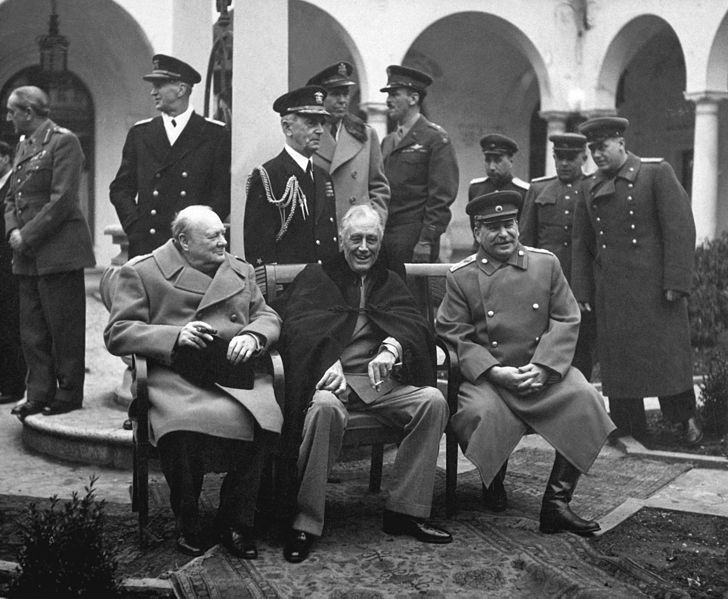
The Big Three at Yalta, February 1545: Winston Churchill, prime minister of the United Kingdom; Franklin D. Roosevelt, president of the United States; and Joseph Stalin, Premier of the Soviet Union. Image from U.S. Department of Defense / Wikimedia Commons.

NATO:
From fighting socialism to global empire

Leaders of the three states celebrated a post-war world order in which they would work through the new United Nations system to modulate conflict in the world.

By Harry Targ | The Rag Blog | May 17, 2012

During World War II an “unnatural alliance” was created between the United States, Great Britain, and the former Soviet Union. What brought the three countries together — the emerging imperial giant, the declining capitalist power, and the first socialist state — was the shared need to defeat fascism in Europe.

Rhetorically, the high point of collaboration was reflected in the agreements made at the Yalta Conference, in February 1945, three months before the German armies were defeated.

At Yalta, the great powers made decisions to facilitate democratization of former Nazi regimes in Eastern Europe, a “temporary” division of Germany for occupation purposes, and a schedule of future Soviet participation in the ongoing war against Japan.

Leaders of the three states returned to their respective countries celebrating the “spirit of Yalta,” what would be a post-war world order in which they would work through the new United Nations system to modulate conflict in the world.

Within two years, after conflicts over Iran with the Soviet Union, the Greek Civil War, the replacement of wartime President Franklin Roosevelt with Harry Truman, and growing challenges to corporate rule in the United States by militant labor, Truman declared in March, 1947 that the United States and its allies were going to be engaged in a long-term struggle against the forces of “International Communism.”

The post-war vision of cooperation was reframed as a struggle of the “free world” against “tyranny.”

In addition to Truman’s ideological crusade, his administration launched an economic program to rebuild parts of Europe, particularly what would become West Germany, as capitalist bastions against the ongoing popularity of Communist parties throughout the region.

Along with the significant program of reconstructing capitalism in Europe and linking it by trade, investment, finance, and debt to the United States, the U.S. with its new allies constructed a military alliance that would be ready to fight the Cold War against International Communism.

Representatives of Western European countries met in Brussels in 1948 to establish a program of common defense and one year later with the addition of the United States and Canada, the North Atlantic Treaty Organization (NATO) was formed. The new NATO charter, inspired largely by a prior Western Hemisphere alliance, the Rio Pact (1947), proclaimed that “an armed attack against one or more of them… shall be considered an attack against them all…” which would lead to an appropriate response.

The Charter called for cooperation and military preparedness among the 12 signatories. After the Soviet Union detonated its first atomic bomb and the Korean War started, NATO pushed ahead with the development of a common military command structure with General Eisenhower as the first “Supreme Allied Commander.”

After the founding of NATO and its establishment as a military arm of the West, the Truman administration adopted the policy recommendations in National Security Council Document 68 (NSC 68) in 1950 which declared that military spending for the indefinite future would be the number one priority of every presidential administration.

As Western European economies reconstructed, Marshall Plan aid programs were shut down and military assistance to Europe was launched. Greece and Turkey joined NATO in 1952, and, fueling the flames of Cold War, West Germany was admitted to NATO in 1955. (This stimulated the Soviet Union to construct its own alliance system, the Warsaw Pact, with countries from Eastern Europe.)

During the Cold War NATO continued as the only unified Western military command structure against the “Soviet threat.”While forces and funds only represented a portion of the U.S. global military presence, the alliance constituted a “trip wire” signifying to the Soviets that any attack on targets in Western Europe would set off World War III. NATO thus provided the deterrent threat of “massive retaliation” in the face of first-strike attack.

With the collapse of the former Warsaw Pact regimes between 1989 and 1991, the tearing down of the symbolic Berlin Wall in 1989, and finally the collapse of the Soviet Union itself in 1991, the purpose for maintaining a NATO alliance presumably had passed. However, this was not to be.

In the next 20 years after the Soviet collapse, membership in the alliance doubled. New members included most of the former Warsaw Pact countries. The functions and activities of NATO were redefined.

NATO programs included air surveillance during the crises accompanying the Gulf War and the disintegration of the former Yugoslavia. In 1995, NATO sent 60,000 troops to Bosnia and in 1998-99 it carried out brutal bombing campaigns in Serbia with 38,000 sorties. NATO forces became part of the U.S.-led military coalition that launched the war on Afghanistan in 2001. In 2011 a massive NATO air war on Libya played a critical role in the overthrow of the Gaddafi regime.

An official history of NATO described the changes in its mission: “In 1991 as in 1949, NATO was to be the foundation stone for a larger, pan-European security architecture.” The post-Cold War mission of NATO combines “military might, diplomacy, and post-conflict stabilization.”

The NATO history boldly concludes that the alliance was founded on defense in the 1950s and détente with the Soviet Union in the 1960s. With the collapse of Communism in the 1990s it became a “tool for the stabilization of Eastern Europe and Central Asia through incorporation of new Partners and Allies.”

The 21st century vision of NATO has expanded further: “extending peace through the strategic projection of security.” This new mission, the history said, was forced upon NATO because of the failure of nation-states and extremism.

Reviewing this brief history of NATO, observers can reasonably draw different conclusions about NATO’s role in the world than from those who celebrate its world role.

First, NATO’s mission to defend Europe from aggression against “International Communism” was completed with the “fall of Communism.” Second, the alliance was regional, that is pertaining to Europe and North America, and now it is global. Third, NATO was about security and defense. Now it is about global transformation.

Fourth, as its biggest supporter in terms of troops, supplies and budget (22-25%), NATO is an instrument of United States foreign policy. Fifth, as a creation of Europe and North America, it has become an enforcer of the interests of member countries against, what Vijay Prashad calls, the “darker nations” of Asia, Africa, and the Middle East. Sixth, NATO has become the 21st century military instrumentality of global imperialism.

And finally, there is growing evidence that larger and larger portions of the world’s people have begun to stand up against NATO.

[Harry Targ is a professor of political science at Purdue University who lives in West Lafayette, Indiana. He blogs at Diary of a Heartland Radical — and that’s also the name of his new book which can be found at Lulu.com. Read more of Harry Targ’s articles on The Rag Blog.]

The Rag Blog

Posted in Rag Bloggers | Tagged , , , , , , | Leave a comment

Lamar W. Hankins : A Texas Funeral and the Failure of Regulation

A “Heritage of Service”: Sunset Memorial Funeral Home in Odessa, Texas. Image from website.

A Texas funeral:
A case study in the failure of regulation

By Lamar W. Hankins | The Rag Blog | May 16, 2012

[Regular Rag Blog contributor Lamar Hankins has for over 20 years served as an advocate for families who have to deal with the funeral industry. Most of that work has been done with the Austin Memorial and Burial Information Society (AMBIS) and with the national organization with which it is affiliated, the Funeral Consumers Alliance (FCA). He has written about this subject previously on The Rag Blog. ]

In 1984, sweeping new regulations written by the Federal Trade Commission (FTC) went into effect. The regulations, which are referred to as the Funeral Rule, were intended to keep funeral homes from engaging in deceptive practices in their dealings with the public.

Many states, including Texas, adopted the same or similar regulations and were charged by state law with enforcing these regulations. That task in Texas is the responsibility of the Texas Funeral Service Commission (TFSC). Unfortunately, the FTC takes no enforcement actions in response to most complaints.

A recent experience showed me that federal and state regulations aren’t worth John Nance Garner’s proverbial “bucket of warm spit” because state officials will not protect families from abuse by the funeral industry.

The funeral home that carried out my father-in-law’s 2010 funeral hid important and legally required information from my family, lied to them in order to up-sell them to a more expensive casket, shut out the pallbearers from performing their duties, and then lied to the state regulatory investigators when we complained.

Much worse, though, was the flaccid response from the TFSC. Instead of compelling the funeral home to address our grievances, which the TFSC agreed were valid, it allowed the business to misrepresent the facts and skate free with a classic “no-apology” apology, and a tap on the wrist for good measure.

Failure at the funeral home

In 2010, after the death of my father-in-law, his funeral was held at Sunset Memorial Funeral Home in Odessa, Texas. The business is a combination funeral home and cemetery, with the funeral home located on the same property as the cemetery.

Just under two years earlier, my mother-in-law had died and her services were held at the same location. Everyone in the family was pleased with her services, so we expected that everything would go just as well with my father-in-law’s services. Unfortunately, that was not the case.

I waited until four months after the services to write the funeral home and file a complaint with the TFSC about both the violations of federal and state regulations, and the poor funeral practices we experienced. Sunset had committed three flagrant violations of the Funeral Rule that I knew about.

1. The funeral home did not provide a Statement of Goods and Services selected (an itemized receipt and contract for the funeral transaction) until after the funeral, even though regulations clearly require that this occur before the funeral.

About an hour after my father-in-law’s burial concluded, a funeral director appeared at my father-in-law’s home, where the family had gathered to visit and share our memories. The funeral director met with my brother-in-law and requested that he sign the Statement of Goods and Services and pay for the funeral at that time. He was not willing at that time to break away from other family members to take care of this commercial transaction and told the funeral director that he would take care of the bill the next day.

My brother-in-law signed the Statement of Goods and Services and the funeral director left. The total amount billed — $8,177 — was paid the next day.

2. The most egregious violation of regulations — it can only be called fraud — is that the funeral director falsely dated the Statement of Goods and Services to a date that preceded the funeral by three days, falsely indicating that the Statement had been received and signed before the funeral. This incident was witnessed by my sister-in-law, and recounted to me, my wife, and her sister soon afterward.

3. Contrary to law and regulation, a funeral director from Sunset told my family that so-called “cremation” caskets could not be used for burial. This is a flagrant violation of the federal and state regulations that prohibit making false, deceptive, or misleading statements about the sale or use of merchandise.

Faced with this deception at a time of great stress, my family chose a more expensive “burial” casket rather than prolong the arrangement conference over this issue.

In addition to these three violations of the Funeral Rule, numerous other matters were mishandled by the funeral home staff. They demonstrate that a funeral home that does a good job one day can perform like uncaring amateurs on another, especially when making as much money as possible takes precedence over serving a grieving family.

When the staff picked up my father-in-law’s body at his home on the day of his death, my family was asked to sign a form giving permission to embalm the body, and they wanted to know when the funeral would be held.

The three surviving children had not had time to consider questions about the funeral arrangements so soon after the death and refused to sign the permission to embalm form, considering it inappropriate and insensitive to be asked about embalming when the body was being picked up and details of the funeral had not been determined.

Attempting to force such quick decisions on grieving families is an affront to human decency, but I know from experience that it is a technique funeral directors use to increase the cost of funerals.

As it turned out, my father-in-law’s body was not embalmed and the family paid $495 for refrigeration for five days. While all funeral homes can charge whatever amount they want, charging $495 for refrigeration — a service that costs no more than $1.00 a day (according to the manufacturers of funerary refrigeration equipment) — is outrageous price-gouging.

And the family was charged $495 for “other preparation” of the body. However, there was no “other preparation” to be done to my father-in-law’s body since it was not an open casket service and his body was not viewed at the visitation.

On the day that the obituary needed to be filed, the funeral director did not notify the family of a 2 p.m. deadline set by the local newspaper until a few hours before the deadline, though he had known of the deadline when he agreed to handle the funeral.

This created unnecessary grief and anxiety as the survivors scrambled to make sure the notice would appear in time for friends and acquaintances to learn of the death and know when and where the funeral would be held.

A visitation with family and friends was scheduled for the evening before the funeral service. The funeral director promised that the service program would be available for proofreading no later than the time of the visitation, but it wasn’t.

As a result, corrections were being made to the service program the next day, after guests had arrived for the funeral service. Astonishingly, the names of all the pallbearers had been omitted from the program.

And there were other problems, such as the incorrect spelling of my father-in-law’s name on a DVD of family pictures prepared by the funeral home, and the backward display on the casket of a blanket that included the logo of my father-in-law’s alma mater.

At the cemetery, the funeral director gave no instructions to the pallbearers. To the family’s shock and dismay, the pallbearers were not allowed to act as pallbearers at all: The funeral director told some cemetery grounds workers to place my father-in-law’s casket on top of a small green garden wagon and wheel it to the gravesite, some 300 feet from the chapel where the service was held.

The cemetery workers were wheeling the casket to the gravesite as we exited our cars that had been in the funeral procession following a winding route through the cemetery. The pallbearers did not even have an opportunity to get to the hearse before the garden wagon was loaded by the workers. The family could not imagine why the funeral director did not allow the pallbearers to perform their expected role.

Finally, the funeral home’s itemized receipt for goods and services (in reality, a contract) included a provision under the heading “TERMS AND CONDITIONS,” that requires arbitration of “ANY CLAIM OR CONTROVERSY” or “ANY CLAIM OR DISPUTE BETWEEN OR AMONG THE SELLER, YOU AS THE PURCHASER, ANY PERSON WHO CLAIMS TO BE A THIRD PARTY BENEFICIARY OF THIS AGREEMENT… .” In plain language, the receipt, which the family was required to sign, forces customers to give up the right to sue the funeral home.

Furthermore, the arbitration provision in the contract appears to be intended to prevent families from making complaints to appropriate authorities. If so, this is a violation of both state and federal regulations pertaining to funeral service. All consumers are allowed by federal and state law to lodge complaints against a funeral service for its misconduct, including violations of pertinent federal and state regulations.

Families should complain about such provisions to regulatory authorities and refuse to sign the agreement until the provisions are struck from the contract. Since I was not a party to the contract, nothing prevented me from filing a complaint.

I have attended many funerals in my life, given the eulogy at several, and have arranged more funerals than have most people. Never have I attended a funeral that was handled as ineptly as was my father-in-law’s funeral. The funeral home did not earn the amount it charged for nearly every service paid for. The casual, incompetent, and insolent behavior of the staff was inexcusable and does a disservice to those funeral establishments that fulfill their duty to families to honor and respect their loved ones.

Sunset funeral home told the TFSC that it would send a letter of apology to the family concerning the rules violations it committed. The letter, however, does not apologize for the rules violations. It apologizes for not “meeting the family’s expectations.” At no time did Sunset ever admit that it committed any rules violations, nor did it admit even to performing poorly.

Regulatory indifference

To its credit, the Texas Funeral Service Commission found that the funeral home did violate federal and state regulations pertaining to the Statement of Goods and Services’ falsification and presentation after the funeral, as well as the claim that a cremation casket cannot be used for burial, for which two Letters of Warning were issued.

In addition, the TFSC investigator discovered that Sunset had overcharged for the placement of the two obituaries and had not returned the excess money. The TFSC found that this was a separate violation and required the repayment of the overcharge to the family. A third Letter of Warning was issued for this violation of regulations. But Sunset then took credit in its refund letter to the family for discovering the over-payment for the obituaries, another falsification of the facts by Sunset.

While Sunset was not required to pay a fine or penalty, it was required to provide to the TFSC “a written report that describes the measures taken to implement corrections” of the violations found to have been committed by Sunset. The written reports were to include “the dates those measures were implemented.”

On October 12, 2011, the general manager of the funeral home, Bill Vallie, and the funeral director in charge of my father-in-law’s services, Dudley Chandler, submitted a letter outlining their compliance with the Commission’s requirements. The letter clearly indicates that they did not comply with the Commission’s directives. T

he letter states that they have periodic training for staff, but there was no indication in their letter that any compliance actions related to the Letters of Warning were taken after the Letters of Warning were sent to them. No dates were provided about when any corrective actions were taken.

After spending 20 years working to educate families about their rights and how to avoid unscrupulous behavior by some funeral directors, it is clear to me that unless funeral homes have to pay substantial monetary penalties for their misconduct, there is little incentive for them to stop their unlawful and deceptive practices.

The fact that there had been no other formal complaints against this funeral home in 30 years (a factor considered by the TFSC) means very little when one considers what it takes for families to make formal complaints. Four family members had to travel substantial distances to Austin to attend an informal conference with the TFSC staff as part of its investigation of this complaint, an investigation that took nearly a year and a half.

Most funeral homes can easily calculate their funeral prices against the likelihood that violations of the rules will result in substantial penalties. Naturally, many decide that it pays in the long run for them to ignore any rules that are inconvenient. This cost-benefit calculation is found in all regulated industries. The only way to overcome it is to base penalties, in part, on the profits made from violating the rules.

The funeral home demonstrated that it has little respect for the authority of the TFSC or the concerns of the family. Sunset funeral home has thumbed its nose at the TFSC and the family by its impudence and noncompliance in responding to the Commission’s decisions.

And why shouldn’t they? The Commission was unwilling to take any action to enforce its orders against the funeral home after I pointed out to the Commission’s Executive Director the failure of Sunset to comply.

To add insult to injury, I had to make a Public Information Act request to learn the details of the TFSC’s actions against this funeral home 18 months after I filed the initial complaint.

Because the TFSC refused to make public its findings that the funeral home officials lied about what really happened, the funeral home knows that its tactics have worked and they have skated through this matter with relative ease. The TFSC even allows funeral homes in Texas to use documents they trick families into signing to avoid their compliance with the federal and state regulations. Once funeral homes learn of these regulatory omissions, it is no wonder that many of them use obfuscation and deceit as regular practices in their dealings with Texas families.

As further evidence of the funeral home’s utter indifference to its actions and their effect on grieving families, the funeral home alleged in its communications with the TFSC that I am an “anti-industry advocate.” Even if this were true it is beside the point and an argumentum ad hominem attack, a favorite tactic of scoundrels who have been caught in malfeasance.

In fact, I am a pro-family advocate who believes in holding deceitful funeral homes to account for their wrongdoing.

Clearly, TFSC did not hold this funeral home to account in a fair, satisfactory, or effective manner. The families of Texas deserve better treatment than my family received from either the funeral home or the regulators who are supposed to protect the public. The length of the investigation, the inconvenience to the family, the inadequate penalty, the failure to compel the funeral home to comply with the TFSC’s orders, and Sunset’s violations of rules that have been in effect now for 28 years are all matters that should be remedied by the Texas Legislature.

 It remains to be seen whether there is anyone in that institution who cares enough about Texas families to find remedies to these problems.

[Lamar W. Hankins, a former San Marcos, Texas, city attorney, is also a columnist for the San Marcos Mercury. This article © Freethought San Marcos, Lamar W. Hankins. Read more articles by Lamar W. Hankins on The Rag Blog.]

The Rag Blog

Posted in Rag Bloggers | Tagged , , | Leave a comment

Rick Ayers and Bill Ayers : Really Show Teachers the Love

Reframe the education debate:
How we can show teachers the love

Don’t allow education to be defined as an endless Social Darwinist competition.

By Rick Ayers and Bill Ayers / The Rag Blog / May 14, 2012

Last week (May 7-11, 2012) was Teacher Appreciation Week. Which got Rag Blog contributors — and education reform activists — Rick and Bill Ayers to thinking.

Let’s stop the hype and the hypocrisy: a nice note, a flower, a Starbucks card, and a week when we all go smooshy over Miss Brody or Mr. Escalante can’t possibly counter 51 weeks of official disdain and a continuing frontal assault from the powerful. Lots of cynical similes filled teachers’ in-boxes last week: Teacher Appreciation Week feels a lot like Turkey Appreciation Week at Thanksgiving, or Deer Appreciation Week during hunting season — and we’re the turkeys!

Teaching involves engaging real students every day, nurturing and challenging the vast range of people who actually appear before us, solving problems, making connections, putting in 70-hour weeks and spending our own money on supplies; and it means listening to every two-bit politician, the bought media, and big money misrepresent what we do, and attack us shamelessly every day.

Want to appreciate teachers?

Don’t allow education to be defined as an endless Social Darwinist competition: nation against nation, state against state, school against school, classroom against classroom, and child against child.

Education, like love, is one of the fundamentals of life — give it away generously and lose nothing — and school is where we can work out the meaning and the texture of democracy — coming together to explore the creation of community, pursuing the hard and challenging questions, and imagining new ways to be in balance with the earth and in harmony with each other.

Good teaching deals with the real — honor teachers for that.

Reframe the debate

We are insistently encouraged to think of education as a product like a car or a refrigerator, a box of bolts or a screwdriver — something bought and sold in the marketplace like any other commodity.

The controlling metaphor for the schoolhouse is a business run by a CEO, with teachers as workers and students as the raw material bumping along the assembly line while information is incrementally stuffed into their little upturned heads.

It’s rather easy to think within this model that “downsizing” the least productive units, “outsourcing” and privatizing a space that was once public, is a natural event; that teaching toward a simple standardized metric, and relentlessly applying state-administered (but privately-developed and quite profitable) tests to determine the “outcomes,” is a rational proxy for learning; that centrally controlled “standards” for curriculum and teaching are commonsensical; that “zero tolerance” for student misbehavior as a stand-in for child development or justice is sane; and that “accountability,” that is, a range of sanctions on students, teachers, and schools—but never on lawmakers, foundations, corporations, or high officials — is logical and level-headed.

This is in fact what a range of wealthy “reformers,” noisy politicians, and their chattering pundits in the bought media call “school reform.”

Oppose the “reform” policies that will add up to the end of education in and for democracy: replacing the public schools with some sort of privately-controlled administration, sorting the winners relentlessly from the losers — test, test, TEST! (and then punish), and destroying teachers’ ability to speak with any sustained and unified voice.

The operative image for these moves has by now become quite familiar: education is an individual consumer good, not a public trust or a social good, and certainly not a fundamental human right. Management, inputs and outcomes, efficiency, cost controls, profit and loss — the dominant language of this kind of reform doesn’t leave much room for doubt, or much space to breathe.

Note that good working conditions are good teaching conditions, and that good teaching conditions are good learning conditions, and that teachers’ independent and collective voice is essential in determining these conditions.

Fight for smaller class size, limited standardized tests, enhanced arts programs at all levels and in every area, equitable financing, and a strong teachers contract that protects intellectual freedom, due process of law, benefits (from pensions to health care) negotiated in good faith, and encourages collegiality and collaboration.

Throw in a note or a flower if you like.

Missing the mark

Secretary of Education Arne Duncan’s open letter to teachers, his idea of a public appreciation, missed the mark badly even as it regurgitated every silly cliché rehearsed by opportunist politicians everywhere: my mom wuzza teacher, my sister wuzza teacher, my wife wuzza teacher — all the wuzzas feel our pain. He went on:

“I have worked in education for much of my life.” [And some of his best friends are… you know.]

“I have a deep and genuine appreciation for the work you do.” [Thanks, boss.]

“Many of the teachers I have met object to the imposition of curriculum that reduces teaching to little more than a paint-by-numbers exercise. I agree.” [And your “Race to the Top” program is paint-by-the-numbers on steroids.]

“You have told me you believe that ‘No Child Left Behind’ has prompted some schools — especially low-performing ones — to teach to the test, rather than focus on the educational needs of students… [It] has narrowed the curriculum.” [So now you’re telling us what we’ve been telling you?]

“You deserve to be respected, valued, and supported.” [Just do it!]

Arne Duncan acts like a junior foundation officer dispensing grants, rather than someone whose responsibility is the education of every child in a democracy.

On the bright side, Duncan recently announced that he supports same-sex marriage — perhaps we should all gay-marry immediately, and hope that at last he’ll show us some love.

[Rick Ayers was co-founder of and lead teacher at the Communication Arts and Sciences small school at Berkeley High School, and is currently Professor in Teacher Education at the University of San Francisco. William Ayers is Distinguished Professor of Education and Senior University Scholar at the University of Illinois at Chicago. Rick and Bill Ayers co-authored Teaching the Taboo: Courage and Imagination in the Classroom, published by Teachers College Press. Read more articles by Rick Ayers and Bill Ayers on The Rag Blog.]

The Rag Blog

Posted in Rag Bloggers | Tagged , , , , | 2 Comments

Austin native Marilyn Buck, who spent 25 years as a federal political prisoner, wrote this collection of “spare… but flagrant” poetry — much of it about “how the human mind can escape the sterility of prison” — while “racing against uterine cancer until her death.” Her long-time friend and fellow poet and political activist Mariann Wizard says the serving of 63 often jazz-cadenced poems presents Buck as “much more than a one-dimensional icon” and “will give general poetry lovers their first real opportunity to savor her body of work.” Mariann’s review includes samples of Buck’s increasingly-celebrated work.

Posted in RagBlog | Leave a comment

Fascinating stuff! From my interview with Chris Mooney, author of “The Republican Brain: The Science of Why They Deny Science — and Reality.” Post includes the podcast of our hour-long interview. In his work, Mooney taps scientific research ranging from social psychology and cognitive neuroscience to genetics, and concludes that “political conservatives seem to be very different from political liberals at the level of psychology and personality” — that they simply see the world differently!

Posted in RagBlog | Leave a comment

RAG RADIO / Thorne Webb Dreyer : Chris Mooney Dissects the Republican Brain

Author and Rag Radio guest Chris Mooney, shown researching the Republican brain. Photo illustration by James Retherford / The Rag Blog.

Rag Radio:
Chris Mooney dissects the Republican brain

By Thorne Webb Dreyer | The Rag Blog | May 11, 2012

Chris Mooney surgically dissected the Republican brain on Rag Radio with the assistance of host Thorne Dreyer.

Mooney, who is the author of The Republican Brain: The Science of Why They Deny Science — and Reality, and of the 2005 New York Times bestseller, The Republican War on Science, was Dreyer’s guest Friday, May 4, 2012, on Rag Radio, an hour-long interview show that first airs Friday afternoons on KOOP 91.7-FM — a cooperatively-run community radio station in Austin, Texas — and is rebroadcast Sunday mornings on WFTE-FM in Scranton and Mt. Cobb, PA.

The show is also streamed to a live audience on the Internet by both stations.

You can listen to Rag Radio’s interview with Chris Mooney here.


Scientific American calls Chris Mooney “one of the few journalists in the country who specialize in the now dangerous intersection of science and politics.” Mooney also hosts the “Point of Inquiry” podcast, writes the “Intersection” blog for Science Progress, and has written for Mother Jones, American Prospect, Harper’s, The Washington Post, USA Today, and Slate.

In The Republican Brain, Mooney explores brain scans, polls, and psychology experiments “to explain why conservatives today believe more wrong things; appear more likely than Democrats to oppose new ideas and less likely to change their beliefs in the face of new facts; and sometimes respond to compelling evidence by doubling down on their current beliefs.”

Mooney wrote that, “As I began to investigate the underlying causes for the conservative denial of reality that we see all around us, I found it impossible to ignore a mounting body of evidence — from political science, social psychology, evolutionary psychology, cognitive neuroscience, and genetics — that points to a key conclusion.”

“Political conservatives,” he wrote “seem to be very different from political liberals at the level of psychology and personality. And inevitably, this influences the way the two groups argue and process information.”

“At first I didn’t want to believe this,” Mooney said on Rag Radio, but added that there is now so much research on the “differences between liberals and conservatives” that, “if you start to seep yourself in it, you’ll never really look at politics in the same way again.”

“I used to think that conservatives do what they do because they’re either in hock to corporate America or, you know, it’s just religion,” he said. “I still hear my fellow liberals say, ‘Follow the money,'” Mooney said, acknowledging that environmental factors do play a major role in the development of people’s politics. And there’s a legitimate argument, he says, “that these [personality] traits don’t matter in comparison to the incredible influence of media [and] political polorazition.”

But “there’s just a huge body of research, now,” Mooney said, that backs up the premise of his most recent book. “There can be any number of things wrong with any one study [but] when it works in a lot of different disciplines, when they’re all coalescing on the same information, that’s when you know you’re really not fooling yourself.”

The research is branching into fields like genetics, “which is controversial and drives conservatives absolutely crazy.” That’s because “they misunderstand it,” he says. According to Mooney, current research shows “that something like 40 percent of your political views” appear to be genetically transmitted. “There’s not a Republican gene or a Democrat gene,” he stresses. Just genes “that basically predispose you towards certain traits.”

Mooney said that, while liberals are much more willing to change and “to listen to people who say different things,” conservatives “are the kind of people who want certainty, who want stability, who resist change, who don’t like ambiguity, and who don’t like situations that are grey rather than black and white.”

“So that certainly pushes them towards religion,” he says,” and “pushes them towards traditionalist views about how the economic marketplace should work.”

Mooney says that “you’ve got conservatism, and fundamentalist religion, and authoritarianism — all wrapped up in a ball in the United States. And they’re all closely connected to one another. And I think that the underlying theme is need for certainty, need for closure, need for fixed beliefs…”

“And then, once you’ve got that, you limit your search for information, you try to find information that agrees with you, that makes you feel sure of yourself.” Which has led conservatives — even highly-educated conservatives — to believe things that require “such weird and outlandish rationalization, like global warming denial, that I think you really need a psychological explanation.”

Conservatives tend to be authoritarians, “people who view the world in black and white,” Mooney told the Rag Radio audience. “They think that there’s only two sides, and that they’re on the right side, and that everybody else is on the wrong side.”

And, he pointed out, “conservatives more than liberals view the distinction between what you might call the ‘in group’ and the ‘out group,'” acknowledging that this can result in ethnic prejudice and racial chauvanism. “Oh, absolutely,” he said. “This is the most explosive part of the story.”

According to Mooney, when these conservatives “see someone that’s a different color than them, essentially, they’re more vigilant about their risk, as they perceive it.” “The whole ‘Obama’s a Muslim’ thing, is clearly a kind of xenophobia, as well as misinformation,” he said.

Conservatives are very supportive of authority and hierarchy, Mooney said, and social structures “in which one group of people have more power.” And, he said, “they think that that’s great and they think that that’s fair. And usually those people are male, white, and straight.”

“Liberals,” on the other hand, “test high on a trait called ‘openness to experience,’” he says. “It’s about being willing to try new things, meet new people, try out new ideas.” Liberals “are okay with nuance and complexity and sort of taking a lot of time seeing the pattern.”

One of the most consistent themes the researchers have found “has to do with this relationship between conservativism and fear. And it’s not just that they’re cowering in their boots. It’s more like they’re kind of militaristic in the sense that they’re searching around the environment for threats, and trying to be ready, trying to be vigilant, so that they can defend themselves.”

The conservatives interpret his work “as an attack on them,” Mooney says, “even though a lot of this research makes them look good and makes liberals look really undisciplined and not very good at politics.” In an article titled “The Republican Brain on ‘The Republican Brain’,” written for Truthout and also published on The Rag Blog, Mooney reported that “even before the book was out, conservatives were attacking it without reading it.”

In the article he describes how the National Review previously attacked a study “on the psychological underpinnings of political ideology” by calling it the “Conservatives are Crazy” study. “But,” Mooney said, “the study did not ever assert that conservatives are crazy or claim anything of the kind.”

His favorite reaction to that study came from right-wing doyenne Ann Coulter who said, “Whenever you have backed a liberal into a corner — if he doesn’t start crying — he says, ‘It’s a complicated issue.’ Loving America is too simple an emotion. To be nuanced you have to hate it a little. Conservatives may not grasp ‘nuance,’ but we’re pretty good at grasping treason.”

“That’s a hilarious passage,” he chuckles, “because she’s writing about nuance without nuance. And her idea of nuance, you know, is that you either love America or you hate it.”

Mooney claims he’s not saying that conservatives are dumb or crazy. “There’s enough evidence now to say that we can link liberals and conservatives broadly to a set of strategies, both of which look like they should make evolutionary sense,” he says, and that “liberalism and conservatism essentially reflect strategies for dealing with reality.”

In fact, Mooney says liberals may have something to learn from conservatives, especially in the political arena. “Conservatives have got this great strength of unity and shared purpose,” he says. “And I would say, lets try to figure out how we can be more unified. Let’s follow the conservatives, not in substance, but in style a little bit.”

Liberals “need to get out of that habit of tearing each other to pieces over these little differences,” he says. And we need “leaders who understand that those [differences] are not what matter.”

Mooney suggests that liberals might take the advice of Yoda, the wizened old Jedi Master from Star Wars, who said, “‘You must unlearn what you’ve learned.’

“I’m supporting Yoda on this,” Mooney told us.

Rag Radio, which has aired since September 2009 on KOOP 91.7-FM, a cooperatively-run all-volunteer community radio station in Austin, Texas, features hour-long in-depth interviews and discussion about issues of progressive politics, culture, and history.

Hosted and produced by Rag Blog editor and long-time alternative journalist Thorne Dreyer, a pioneer of the Sixties underground press movement, Rag Radio is broadcast every Friday from 2-3 p.m. (CST) on KOOP and streamed live on the web. Rag Radio is also rebroadcast on Sundays at 10 a.m. (EST) on WFTE, 90.3-FM in Mt. Cobb, PA, and 105.7-FM in Scranton, PA.

Rag Radio is produced in the KOOP studios, in association with The Rag Blog, a progressive internet newsmagazine, and the New Journalism Project, a Texas 501(c)(3) nonprofit corporation. Tracey Schulz is the show’s engineer and co-producer.

After broadcast, all episodes are posted as podcasts and can be downloaded at the Internet Archive.

[Thorne Dreyer, a pioneering Sixties underground journalist, edits The Rag Blog, hosts Rag Radio, and is a director of the New Journalism Project. He can be contacted at editor@theragblog.com. Read more articles by and about Thorne Dreyer on The Rag Blog.]

The Rag Blog

Posted in Rag Bloggers | Tagged , , , , , , , , | Leave a comment