Bill Meacham : Mondragon: Reinventing Humanity

The Mondragon Corporation. “The present, however splendid it may be, bears the seeds of its own ruin if it becomes separated from the future.” — José María Arizmendiarrieta.

Mondragon: Reinventing humanity

It is a striking vision, and a welcome alternative to the dog-eat-dog competition that is rampant both within and between conventional enterprises.

By Bill Meacham / The Rag Blog / October 6, 2011

The human capacity for second-order mentation — the ability we have to consider in thought and imagination not just the world around us but ourselves as well — has led existentialists such as Jean-Paul Sartre and Simone deBeauvoir to say that the human being is always free to recreate himself or herself, that we have no fixed essence, but are what we make of ourselves.

There is certainly a germ of truth in this assertion. If you suffer from some behavioral or psychological problem, the first step in fixing it is to admit that you have a problem; that is, to be conscious enough of yourself to know that there is something you are doing or feeling or thinking that is causing trouble. Then you can mentally step back, reassess the situation, and start doing something different.

In practice, of course, this is often more easily said than done, and there is in fact quite a bit that is fixed about human nature. But within that fixity we have the freedom to reinvent ourselves. By virtue of second-order mentation, we are not fully constrained by the past.

In the individualistic West we tend to think of this freedom in purely personal terms. A young man asks whether he should leave his ailing mother to join the resistance or stay and take care of her, and Sarte’s answer is that the only answer is the young man’s freedom to choose: “You are free, therefore choose, that is to say, invent.”[1] But a more powerful form of self-invention is to be found in the social realm. Case in point: The Mondragon cooperatives.

The Mondragon cooperatives are a federation of worker-owned cooperatives based in the Basque region of Spain. Founded in 1956 through the efforts of a visionary Catholic priest, Father José María Arizmendiarrieta, Mondragon started as a small, worker-owned enterprise making kerosene stoves in 1956. It has since grown to become the seventh-largest business group in Spain, with annual sales of 14 billion Euros and over 100,000 workers. It comprises over 260 affiliated enterprises, including 120 core cooperatives, and has affiliates not just in Europe but around the globe.

The worker-owned cooperative is the core Mondragon social institution and the most ingenious reinvention of what it is to be human. In the cooperative, the workers themselves own the enterprise. There is no outside owner, unlike the capitalist corporation or the communist state-owned collective.

Each worker-owner has one vote, and decisions are made by democratic vote of all owners. Structurally, it is like a sole-proprietorship, except that there are many proprietors, the workers. Nobody gets a wage; instead each is paid a monthly advance on his or her share of the year’s projected profit.

The worker cooperative is a fundamental inversion of the corporate model we take for granted in the capitalist world. In a conventional company, the owners of capital have ultimate authority, and the laborers are subservient. In a worker-owned cooperative, labor has ultimate authority, and capital is subservient, a principle known as Sovereignty of Labor.

What it means in practice is that the workers, being the owners, run the enterprise for their own benefit, not for the benefit of a separate class of people who own it but do not do the work. No outside owner can shut down a factory, fire the workers, and move production somewhere else. No outside owner can mandate overtime, reduced pay, or hazardous working conditions.

The objective is not to make as much profit as possible for a few, but to make a good living for all. And in fact the worker-owners make, on average, 10 percent more than their counterparts in neighboring non-cooperative businesses.

Sovereignty of labor has several implications:

  • Democratic control: one worker, one share, one vote.
  • Distribution of profits only to workers, the cooperative, or the local community, not to outside investors.
  • Egalitarian income spread. On average, the highest-paid worker in a Mondragon enterprise makes four to five times as much as the lowest. The maximum is nine times as much. (Contrast this to many big corporations, whose ratio may be as much as several hundred to one.)
  • Participation in decision making. Each cooperative elects its own management team and has an annual meeting at which the worker-owners make strategic decisions about the enterprise. And there is a general council consisting of representatives from all the member cooperatives that makes decisions about the corporation as a whole.

Three things were of crucial importance from the very start: school, credit union, and factory. In 1943, well before the first manufacturing enterprise, Father Arizmendiarrieta started a trade school, so students would have necessary skills to make a living and to form and run a cooperative. He also started a credit union, so people could pool their savings to provide start-up capital. Only when these were in place did the first manufacturing operation begin. A factory alone would lack ongoing sources of credit and new innovative skills.

In addition, the Mondragon cooperatives correct a fatal flaw that has historically led to the demise of worker-owned enterprises. In the Mondragon co-ops, a retiring worker’s share cannot be sold to just anyone, not even another co-op member, but only to a new incoming worker or back to the co-op. This prevents external stock buyers, speculative capitalists, from taking over successful co-ops.

Many an ESOP (Employee Stock Ownership Plan) enterprise has collapsed because shares were sold to non-employees who, after acquiring enough of them, terminated or radically changed the business. In the Mondragon cooperatives, capital and ownership of the business stays with the workers.

Sovereignty of labor is only one of the 10 core principles of the enterprise. The complete list includes such things as a ban on discrimination for religious, political, ethnic, or sexual reasons; democratic and participatory management; cooperation among member co-ops and with other cooperative movements world-wide; and a commitment to social transformation and education.

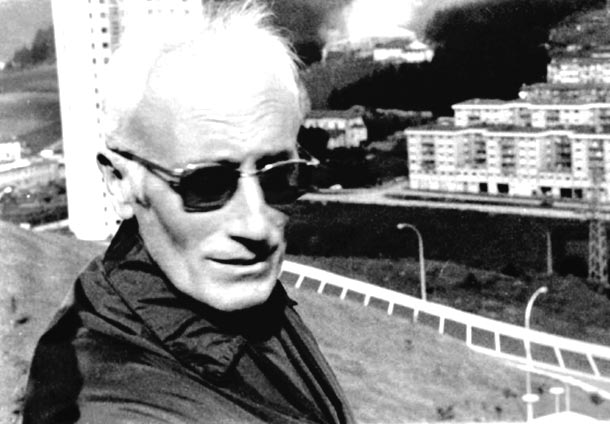
Visionary Catholic Priest José María Arizmendiarrieta, founder of Mondragon, at age 70.

It is a striking vision, and a welcome alternative to the dog-eat-dog competition that is rampant both within and between conventional enterprises.

Certainly the worker-owners think so. Even if offered more pay somewhere else, most would not leave. They like the job security and the fact that they have a vote. The cooperative meets fundamental human needs: not just the needs for sustenance and social contact, but for self-determination as well.

The cooperative model is promising for a sustainable future, because it is not driven to grow in the same way as the capitalist model and because it allows its worker-owners benefits other than increased material consumption.

Democratically-controlled firms do not have the same drive for growth as capitalist firms. Capitalist firms aim at maximizing total profit, while cooperative firms aim at maximizing profit per worker. If a capitalist firm grows, doubles its workforce and doubles its profit, the owners get richer. If a cooperative firm grows, doubles its workforce and doubles its profit, each worker-owner gets the same amount of money. There is no internal motivation to grow.[2]

There are external motivations to grow, of course. Growth can provide economies of scale, driving costs down. Growth can provide more share of the market, so the firm is more assured of continued operation. The Mondragon cooperatives are enterprises in a market economy, subject to the same constraints and imperatives of competition that capitalist enterprises are.

But there is an important difference. When innovation brings about a productivity gain, worker-owners are free, if they wish, to opt for more leisure or investment in other market opportunities instead of higher pay, which would lead to increased consumption. Reduced consumption makes for reduced environmental impact.

In a world of vast but limited resources, an expanding population and more and more pollution, it is crucial to find ways of satisfying human needs without degrading the environment. Over-consumption — buying stuff we don’t really need – is a threat to the environment because it uses up more resources and produces more waste than necessary.

A capitalist owner would be unlikely to allow workers to work less because they have become more productive. There’s no profit in that. But worker-owners, once they reach a certain level of income, might well opt for such a solution, preferring time with family and friends to the means to buy more goods.[3]

The success of the Mondragon co-ops is undeniable, so it is natural to want to replicate it elsewhere. One wonders how much that success is due to factors unique to the Basque country where it started. Perhaps there is something special about the Basque culture. Mondragon is the best known but not the only cooperative enterprise there. The area is rife with producer co-ops (where farm owners, but not their workers, are members), marketing co-ops, consumer co-ops, transport co-ops, housing co-ops and cooperative schools.[4]

The Basque people have a strong sense of ethnic, linguistic, and cultural identity, and they were an oppressed minority under Franco, leading to an even stronger internal cohesion. They have a tradition of equitable land distribution. The first business produced a much-needed product at a good price; and the area is strategically located, with easy access to large ports like Bilbao, and short distances to major export markets.[5]

Which of these factors is most important for a successful worker’s co-op? Beyond the ability to make and sell a product, which is essential to any economic enterprise, my guess is that in-group cooperation in the face of external hostility had a lot to do with it in the Basque country.

Cooperation, of course, is an inherent human ability and activity. We are most cooperative in the face of an external threat, but we have the ability, in common with our bonobo cousins, to cooperate among groups as well. If we want to replicate Mondragon’s success, we need to foster a sense of empathy, solidarity, and compassion among all humans, a sense that we are all members of one tribe, one family, the human family.

Can we do that? Can we emulate the vision and drive of Father Arizmendiarrieta, without whom the Mondragon co-ops would not have begun? A journalist once remarked that Arizmendiarrieta had created a progressive economic movement anchored in an educational institution. He replied “No, it is just the reverse. We are creating an educational movement for social change, but with anchors in economic institutions.”[6]

It is the whole of humanity that matters most. Perhaps we can form a more cooperative society if we take as our common enemy ignorance, rather than some other group of humans.

Notes

[1] Sarte, Existentialism is a Humanism.
[2] Schweickart, Is Sustainable Capitalism Possible? p. 112.
[3] Idem., p. 113.
[4] Davidson, New Paths to Socialism, p. 26.
[5] Long, The Mondragon Co-operative Federation.
[6] Davidson, New Paths to Socialism, p. 25.

References

Davidson, Carl. New Paths to Socialism: Essays on the Mondragon Cooperatives. Pittsburgh, PA: Changemaker Publications, 2011.
Long, Mike. The Mondragon Co-operative Federation: A Model for our Time? On-line publication, http://www.cooperativeindividualism.org/long_mondragon.html as of 18 September, 2011.
Mondragon Corporation. Corporate website. On-line publication, http://www.mcc.es/ENG.aspx as of 17 September 2011.
Sartre, Jean-Paul. Existentialism is a Humanism. On-line publication, http://www.marxists.org/reference/archive/sartre/works/exist/sartre.htm as of 17 September 2011.
Schweickart, David. Is Sustainable Capitalism Possible? In Davidson, New Paths to Socialism, pp. 103 – 126.
Wikipedia. “Mondragon Corporation.” On-line publication, http://en.wikipedia.org/wiki/Mondragon_Corporation as of 17 September 2011.

[Bill Meacham is an independent scholar in philosophy. A former staffer at Austin’s 60s underground paper, The Rag, Bill received his Ph.D. in philosophy from the University of Texas at Austin. Meacham spent many years working as a computer programmer, systems analyst, and project manager. He posts at BillMeacham.com, where this article also appears. Read more articles by Bill Meacham on The Rag Blog]

Also:

The Rag Blog

Posted in Rag Bloggers | Tagged , , , , , , | Leave a comment

Mark Naison : Wall Street and the Making of a Global Counterculture

Photo by Robert Johnson / Business Insider.

The Wall Street occupations and the
making of a global counterculture

By Mark Naison / The Rag Blog / October 6, 2011

NEW YORK — On Monday, October 3, I spent about an hour in Liberty Plaza, sitting, walking around, and talking to people before the event I had come for — a “Grade-In” organized by teacher activists — finally began, and was stunned by how different the occupation was from any demonstration I had attended recently.

First of all, in contrast to the last two protests I had participated in — a Wisconsin Solidarity rally at City Hall, and the Save Our Schools March on Washington — I saw few people my own age and no one I recognized at — least until the “Grade-In” started

When I arrived, at 11 a.m., most of the people in Liberty Plaza were the ones who had slept there overnight, and the vast majority were in their 20’s and 30’s — a half to a third my age. They were drumming, sweeping the sidewalk, talking to curious visitors — who were still few in number — eating or chilling with one another, and their relaxed demeanor blew me away given the tumultuous events of the day before when more than 700 protesters had been arrested by the NYPD after marching onto the Brooklyn Bridge.

They were also, to my surprise, thoroughly international. Many of the people I met at the information desk, or who spontaneously started conversations with me, had accents which indicated they had been born in, or had recently come from, countries outside the United States.

I felt like I was in Berlin or Barcelona, where you could always count on meeting young people from all over the world at any music performance or cultural event, only this was a political action in the heart of New York’s financial district. I felt like I was in the midst of a global youth community, one I had certainly seen emerging during my travels and teaching — after all, I had helped organize a “Bronx Berlin Youth Exchange” — but that I had not expected to see at this particular protest.

But it was there, no doubt. And definitely made the discipline, determination, and camaraderie of the protesters that more impressive. But, as much as the age cohort and global character of the occupation seemed strange, it also seemed oddly familiar, though it took a while for that familiarity to sink in.

The longer I stayed at Liberty Plaza, the more it felt like the countercultural communities I had spent time in during the late 60’s, from Maine to Madison to Portland, Oregon, where discontent with war and a corrupt social system had bred a communal spirit marked by incredible generosity and openness to strangers.

During the years when I traveled the country regularly as a political organizer and revolutionary — 1968 to 1971 — I never had to stay in a hotel or pay for a meal in the more than 20 cities I visited. Every one of these cities had a countercultural community and I was always able to “crash” with people I knew or with people whose names I had been given by friends.

And I did the same for people in NYC. My apartment on West 99th Street was a crash pad for people from around the country who had come to New York for demonstrations, or for revolutionaries from other countries who had somehow gotten my name. I still remember making huge pots of chili for anyone who showed up — with Goya chili beans, canned tomatoes, chop mean, bay leaves, and chili powder. And it was not unusual for 20 or 30 to show up.

I had feared those days would never return — erased by decades of consumerism, materialism, and cheap electronic devices — but when I visited Liberty Plaza, I realized that the global economic crisis had recreated something which I often thought of as an artifact of my own nostalgia. Because right here in New York were hundreds of representatives of a whole generation of educated young people from around the world, numbering tens if not hundreds of millions of young people, who might never land in the secure professional jobs they were promised or experience the cornucopia of material goods that come with them.

Described as a “lost generation” by economists, a critical mass of these young people, in cities throughout Europe and Latin America — and now right here in the United States — had decided to build community in the midst of scarcity, challenge consumerism and the profit motive, and call out the powerful financial interests whose speculation and greed had helped put them in the economic predicament they were in.

Serious questions remain about the long-term significance of this global movement. Would these middle class (or ex-middle class) protesters connect with the even larger group of people in their own countries — workers, immigrants, minorities — who had been living in poverty well before the current crash?

Would their community survive even a modest revival of the world economy, sending them back into a lifestyle of acquisitive individualism which the global consumer market depends on to yield profits? Could they connect with people in poor or working class neighborhoods who were already practicing communalism and mutual aid to create a truly multiracial, multi-class movement?

The jury is still out on all of those issues. But there are some promising signs. The chants of “We are all Troy Davis” during several of the movement’s marches. The increasing participation of labor unions in the protest. The involvement of more and more activists from the city’s Black and Latino neighborhoods in support of the Occupation.

And those who lived through the 60’s should remember this. Oppositional cultures of all kinds — ranging from hippie communities to the Black arts movement — represented the soil in which political protest flourished during those heady years.

And the same is true in this era. The emergence of a global youth counterculture should be be seen as a powerful complement to, if not an actual component of, a global movement for freedom, democracy, and economic justice.

[Mark Naison is Professor of History and African American Studies at Fordham University and is principal investigator of the Bronx African American History Project. Naison, who was active with CORE and SDS in the 1960s, is the author of Communists in Harlem During the Great Depression and White Boy: A Memoir, and is co-editor of The Tenant Movement in New York City, and has written over 100 articles on African American politics, social movements, and American culture and sports. This article was also posted at With a Brooklyn Accent and Progressive America Rising.]

The Rag Blog

Posted in Rag Bloggers | Tagged , , , , , , | Leave a comment

Bob Feldman : The Slave State of Texas, 1846-1860

Newspaper notice of runaway slave jailed in Bastrop County, Texas, 1855. Image from AfroTexan.com.

The hidden history of Texas

Part V: The Slave State of Texas, 1846-1860

By Bob Feldman / The Rag Blog / October 5, 2011

[This is Part 5 of Bob Feldman’s Rag Blog series on the hidden history of Texas.]

Within a few months after Texas became part of the United States, U.S. troops under General Zachary Taylor’s command were already establishing the disputed Rio Grande boundary line as the new southern border between Texas and Mexico; and some U.S. troops were being sent across the Rio Grande, even further south into Mexican territory, by late March 1846.

After a Mexican cavalry unit ambushed some of the U.S. troops that apparently had crossed the Rio Grande in a provocative way on April 25, 1846 (killing 11 U.S. troops, wounding six, and taking 63 more as prisoners), U.S. President Polk used the incident as a pretext to get the U.S. Congress to declare war on Mexico on May 13, 1846.

And after U.S. military troops occupied Mexico City on Sept. 14, 1847 (during a war in which 13,283 U.S. troops died and 4,152 were wounded), the Mexican government was eventually forced to agree to sign the Treaty of Guadalupe Hidalgo on February 2, 1848. As a result of this treaty, “Mexico gave up all claims to Texas,” “agreed to a new frontier with the United States,” and “lost two-fifths of her territory,” according to Robert R. Miller’s book, Mexico: A History.

In 1847, a year after Texas became a state within the USA, around 142,000 people — not counting its remaining Native Americans — were living in Texas. Of the 142,000 non-indigenous residents of Texas in 1847, nearly 39,000 were African-American slaves. Although around 3,000 slaves escaped into Mexico from Texas between 1836 and 1851 (and 1,000 more African-American slaves also escaped into Mexico from Texas between 1851 and 1855), the overall number of enslaved African-Americans who lived in Texas dramatically increased between 1847 and 1860. As Professor Alwyn Barr noted in his essay, “Black Texans During the Civil War”:

Further immigration of slaveholding settlers from the United States and the development of a slave trade by land and water from the southern states brought the slave population in Texas to 182,566 by 1860, along with a small group of free Blacks who numbered less than a thousand… African Americans formed 30 percent of the Texas population on the eve of the Civil War in the Anglo-dominated region that extended a little west of Fort Worth, Austin, and San Antonio…

At least 25 percent of Anglo families owned slaves in Texas. Over 2,000 Texans held 20 or more bondsmen… 60 families owned 100 or more slaves. By 1860 David and Robert Mills stood at the pinnacle of the planter class with 344 bondsmen. Slaves formed majorities of the population in 13 counties… The life span for slaves averaged about 50 years, some five years less than for whites…

Around 95 percent of Texas’s black slaves in 1860 worked without pay on either Texas farms or Texas plantations. According to Alwyn Barr’s Black Texans, “the vast majority of slaves in Texas lived in rural areas.” But “over a thousand” black slaves also “resided in both Galveston and Houston by 1860,” and African-American slaves who were owned mainly by white businessmen and upper-middleclass professionals also lived “in Austin, San Antonio, and other large towns,” according to the same book.

In Austin, for example, according to David Humphrey’s Austin: An Illustrated History:

Slavery was an integral part of the life of the town. Of Austin’s 3,500 inhabitants in 1860, about 1,000 were slaves. While free blacks numbered less than a dozen, enslaved blacks formed almost 30 percent of the population, a greater percentage than in such Texas cities as Houston and Galveston.

More than a third of Austin’s Anglo families owned slaves. Among the town’s prosperous lawyers, merchants, doctors, ministers, and high-government officials, slave-owning was the rule rather than the exception. A handful, such as Episcopal Bishop Alexander Gregg, postmaster William Rust, and physician John Alexander, owned more than 20 slaves…

Since most Spanish-speaking residents of Austin had been expelled by a vigilante committee of Anglo residents of Austin in October 1854, only a few Mexican-Americans still lived in Austin in 1860.

Between 1846 and 1860, the total number of people living in Texas — not counting the remaining Native American residents — increased by around 325 percent, to 604,215. Around 75 percent of the people who lived in Texas in 1860 were farmers; and about 75 percent of the 420,891 white people who lived in Texas in 1860 were headed by settlers from the Southern states.

But among the white residents who weren’t from the Southern states, about 20,000 were German-born, some of whom — like Adolph Douai — were political refugees from the suppressed 1848 revolutionary movement in Germany. Coincidentally, the politically radical Douai was one of the first known Marxists to live in Texas.

According to Herbert Aptheker’s 1989 book, Abolitionism: A Revolutionary Movement, in the early 1850s Douai began publishing the San Antonio Zeiutung — “which described itself as a social-democratic newspaper.” But “within one year of its existence, the Austin State Times (19 May 1854) was suggesting: `The contiguity of the San Antonio River to the Zeitung, we think suggests the suppression of that paper; pitch in.’” And “a year later, the paper closed and Douai fled for his life to Philadelphia,” according to Aptheker’s book.

With a population of 8,235, San Antonio was the largest city in Texas in 1860. The second-largest was Galveston, whose population was 7,307. Only 4,800 people lived in Houston, 3,500 in Austin, and 500 in Dallas.

Nothing much was manufactured inside Texas in 1860, but Texas was the 5th-largest cotton-producing state in the United States; and 90 percent of the cotton grown in Texas was produced by Texas farmers or Texas plantation owners who owned slaves.

About 75 percent of the African-American slaves in Texas then were owned by the wealthiest 15 percent of the people, while the poor whites of Texas — who composed about 25 percent of its white Anglo population by 1860 — only owned 1 percent of the property. So by 1860, not surprisingly, around 67 percent of all state and local political offices in Texas were occupied by Texas property owners who owned slaves.

But according to W.E.B. Du Bois’s Black Reconstruction in America 1860-1880, “the division of the planters and poor whites was less distinct” in Texas “than in many other Southern states” in 1860, and “there was plenty of rich land” where “the poorest white men could get a start.”

[Bob Feldman is an East Coast-based writer-activist and a former member of the Columbia SDS Steering Committee of the late 1960s. Read more articles by Bob Feldman on The Rag Blog.]

The Rag Blog

Posted in Rag Bloggers | Tagged , , , , | Leave a comment

Jonah Raskin : Pancake and Rye in ‘Marijuanaland’


Pancake and Rye in ‘Marijuanaland

By Jonah Raskin / The Rag Blog / September 5, 2011

Longtime Rag Blog contributor Jonah Raskin, author of Marijuanaland: Dispatches from an American War, will sign books at a Rag Blog Happy Hour, Friday, Oct. 7, 5-7 p.m., at Maria’s Taco Xpress, 2529 S. Lamar Blvd in Austin. Everyone is welcome. Raskin will also be signing books Saturday, Oct. 8, at Oat Willie’s, 617 W. 29th (2-4 p.m.), and Brave New Books, 1904 Guadalupe (5-7 p.m.).

Jonah Raskin will be Thorne Dreyer‘s guest on Rag Radio on KOOP 91.7-FM (and streamed live on the Internet), Friday, 2-3 p.m. Also, please see “Jonah Raskin’s Marijuanaland” by Mariann G. Wizard and other articles by and about Jonah Raskin on The Rag Blog.

[The following is an excerpt from Jonah Raskin’s Marijuanaland: Dispatches From an American War, published by High Times Books.]

I had met Pancake and Rye in February and followed Pancake around for about eight months. (His brother, Rye, had other matters to attend to.) Pancake showed me their indoor and outdoor operations and talked almost without stopping about politics, pot, his two favorite authors — Tom Robbins and Kurt Vonnegut — and his all-time favorite TV show, South Park, which had played, he felt, a crucial role in his development.

Pancake went to work for his dad after graduating high school and learned how to grow legal flowers such as roses and zinnias. “For a while, I hated roses,” Pancake told me. “I once planted 2,500 bare-root roses, thorns and all, and after a while I began to call them ‘bastards.’” For cannabis, on the other hand, he had a real affection; the pot plants were his “darlings.”

During his teens and early twenties, he was in full-blown rebellion, he told me, against his parents, his family, and whatever else came along. He and Rye were both arrested for possession by a cop they knew from their high-school days, and who had never liked their irreverent style. The arrest didn’t deter them from their newfound mission: to grow the best marijuana ever.

Their parents were worried about them, and for a time the family came apart. Then they decided to turn on Dad; he started to smoke marijuana and enjoyed it, and felt pride for his sons who grew such unconventional flowers. The old father-sons rivalry faded away, and the family that smoked together grew closer.

“I started to grow pot when I was a teenager,” Pancake told me one day when we were driving around town in his battered station wagon. “Most of my classmates smoked — the honor-roll students and the auto-shop guys. I didn’t like the idea of buying weed from someone else; I wanted to be able to smoke my own pot — and then, after that, I wanted to make enough money by growing it to support myself.”

Pancake parked the car, and we went into a garden-supply store where he bought bags of fertilizer and a pair of clippers. Then, back in the car, he continued his tale.

“At the start, I was a guerrilla grower because I didn’t have land of my own,” he said. “I grew it in a creek bed in direct sunlight; I had to walk a mile or so to get to the site. I pumped water out of the creek and visited the garden every three to four days. I made enough money my first season to move out of my dad’s house, rent my own place and buy a car.”

One day in August, Pancake picked me up at my house and we drove together for about two hours to reach his garden, 1,600 feet above sea level, and also above the highest level of fog that rolled in from the Pacific. Before we left my place, I had shown him my pot, but Pancake was unimpressed. True enough, it wasn’t exactly commercial-grade.

Pancake and his brother were growing on a 40-acre parcel that their father owned. When I arrived, I noticed the American flag at the gate and another flag with the words “Don’t tread on me.” Pancake explained: “We’re libertarians — we believe in states’ rights. We want the federal government off our land and out of our lives.”

For protection, they had a few guns, but mostly they relied on two ferocious watchdogs, Nightshade and Mugwort. The dogs never took a liking to me, and I did not mess with them.

All around the hills and valleys, their neighbors were growing marijuana; the two brothers knew about these nearby gardens because they routinely scanned the landscape with binoculars and the gardens popped up — especially at the end of the season, when they were the only green around. “I was relieved to know my neighbors were growing,” Pancake told me. “That meant they had their own and weren’t going to poach my plants.”

Outlaw grape growers existed side by side with the pot growers in these parts. The grape growers did not bother with permits from the county and did not follow county rules and regulations; it was too expensive. Even if the grape growers were caught and fined, it would be less expensive than paying the necessary fees for the vineyards.

In addition to marijuana, Pancake and Rye grew vegetables and fruits: tomatoes, basil, pumpkins, apples, blueberries, grapes and corn. They had a grove of olive trees for olive oil. They installed solar panels for electricity and pumped water from a spring down the hill to a large tank uphill; gravity then delivered that water to their plants.

Self-sufficiency was their goal, and they were getting there quickly thanks to marijuana. Before long, their enterprise would be sustainable.

[Jonah Raskin‘s latest book is Marijuanaland: Dispatches from an American War, published by High Times Books. A communications professor at Sonoma State University and a former Yippie activist, Raskin has written about cannabis politics and culture since the 1970s. Raskin has authored a dozen books, including biographies of Abbie Hoffman, Allen Ginsberg, and Jack London. Read more articles by Jonah Raskin on The Rag Blog.]

The Rag Blog

Posted in Rag Bloggers | Tagged , , , , , , | Leave a comment

Mondragon: Reinventing Humanity

by Bill Meacham on October 4th, 2011

The human capacity for second-order mentation – the ability we have to consider in thought and imagination not just the world around us but ourselves as well – has led existentialists such as Jean-Paul Sartre and Simone deBeauvoir to say that the human being is always free to recreate himself or herself, that we have no fixed essence, but are what we make of ourselves. There is certainly a germ of truth in this assertion. If you suffer from some behavioral or psychological problem, the first step in fixing it is to admit that you have a problem; that is, to be conscious enough of yourself to know that there is something you are doing or feeling or thinking that is causing trouble. Then you can mentally step back, reassess the situation and start doing something different. In practice, of course, this is often more easily said than done, and there is in fact quite a bit that is fixed about human nature. But within that fixity we have the freedom to reinvent ourselves. By virtue of second-order mentation, we are not fully constrained by the past.

In the individualistic West we tend to think of this freedom in purely personal terms. A young man asks whether he should leave his ailing mother to join the resistance or stay and take care of her, and Sarte’s answer is that the only answer is the young man’s freedom to choose: “You are free, therefore choose, that is to say, invent.”(1) But a more powerful form of self-invention is to be found in the social realm. Case in point: The Mondragon cooperatives.

The Mondragon cooperatives are a federation of worker-owned cooperatives based in the Basque region of Spain. Founded in 1956 through the efforts of a visionary Catholic priest, Father José María Arizmendiarrieta, it started as a small, worker-owned enterprise making kerosene stoves in 1956. It has since grown to become the seventh-largest business group in Spain, with annual sales of 14 billion Euros and over 100,000 workers. It comprises over 260 affiliated enterprises, including 120 core cooperatives, and has affiliates not just in Europe but around the globe.

The worker-owned cooperative is the core Mondragon social institution and the most ingenious reinvention of what it is to be human. In the cooperative, the workers themselves own the enterprise. There is no outside owner, unlike the capitalist corporation or the communist state-owned collective. Each worker-owner has one vote, and decisions are made by democratic vote of all owners. Structurally, it is like a sole-proprietorship, except that there are many proprietors, the workers. Nobody gets a wage; instead each is paid a monthly advance on his or her share of the year’s projected profit.

The worker cooperative is a fundamental inversion of the corporate model we take for granted in the capitalist world. In a conventional company, the owners of capital have ultimate authority, and the laborers are subservient. In a worker-owned cooperative, labor has ultimate authority, and capital is subservient, a principle known as Sovereignty of Labor. What it means in practice is that the workers, being the owners, run the enterprise for their own benefit, not for the benefit of a separate class of people who own it but do not do the work. No outside owner can shut down a factory, fire the workers, and move production somewhere else. No outside owner can mandate overtime, reduced pay or hazardous working conditions. The objective is not to make as much profit as possible for a few, but to make a good living for all. And in fact the worker-owners make, on average, ten percent more than their counterparts in neighboring non-cooperative businesses.

Sovereignty of labor has several implications:

Democratic control: one worker, one share, one vote.
Distribution of profits only to workers, the cooperative or the local community, not to outside investors.
Egalitarian income spread. On average, the highest-paid worker in a Mondragon enterprise makes four to five times as much as the lowest. The maximum is nine times as much. (Contrast this to many big corporations, whose ratio may be as much as several hundred to one.)
Participation in decision making. Each cooperative elects its own management team and has an annual meeting at which the worker-owners make strategic decisions about the enterprise. And there is a general council consisting of representatives from all the member cooperatives that makes decisions about the corporation as a whole.

Three things were of crucial importance from the very start: school, credit union and factory. In 1943, well before the first manufacturing enterprise, Father Arizmendiarrieta started a trade school, so students would have necessary skills to make a living and to form and run a cooperative. He also started a credit union, so people could pool their savings to provide start-up capital. Only when these were in place did the first manufacturing operation begin. A factory alone would lack ongoing sources of credit and new innovative skills.

In addition, the Mondragon cooperatives correct a fatal flaw that has historically led to the demise of worker-owned enterprises. In the Mondragon co-ops, a retiring worker’s share cannot be sold to just anyone, not even another co-op member, but only to a new incoming worker or back to the co-op. This prevents external stock buyers, speculative capitalists, from taking over successful co-ops. Many an ESOP (Employee Stock Ownership Plan) enterprise has collapsed because shares were sold to non-employees who, after acquiring enough of them, terminated or radically changed the business. In the Mondragon cooperatives, capital and ownership of the business stays with the workers.

Sovereignty of labor is only one of the ten core principles of the enterprise. The complete list includes such things as a ban on discrimination for religious, political, ethnic or sexual reasons; democratic and participatory management; cooperation among member co-ops and with other cooperative movements world-wide; and a commitment to social transformation and education. It is a striking vision, and a welcome alternative to the dog-eat-dog competition that is rampant both within and between conventional enterprises.

Certainly the worker-owners think so. Even if offered more pay somewhere else, most would not leave. They like the job security and the fact that they have a vote. The cooperative meets fundamental human needs: not just the needs for sustenance and social contact, but for self-determination as well.

The cooperative model is promising for a sustainable future, because it is not driven to grow in the same way as the capitalist model and because it allows its worker-owners benefits other than increased material consumption.

Democratically-controlled firms do not have the same drive for growth as capitalist firms. Capitalist firms aim at maximizing total profit, while cooperative firms aim at maximizing profit per worker. If a capitalist firm grows, doubles its workforce and doubles its profit, the owners get richer. If a cooperative firm grows, doubles its workforce and doubles its profit, each worker-owner gets the same amount of money. There is no internal motivation to grow.(2)

There are external motivations to grow, of course. Growth can provide economies of scale, driving costs down. Growth can provide more share of the market, so the firm is more assured of continued operation. The Mondragon cooperatives are enterprises in a market economy, subject to the same constraints and imperatives of competition that capitalist enterprises are. But there is an important difference. When innovation brings about a productivity gain, worker-owners are free, if they wish, to opt for more leisure or investment in other market opportunities instead of higher pay, which would lead to increased consumption. Reduced consumption makes for reduced environmental impact.

In a world of vast but limited resources, an expanding population and more and more pollution, it is crucial to find ways of satisfying human needs without degrading the environment. Over-consumption – buying stuff we don’t really need – is a threat to the environment because it uses up more resources and produces more waste than necessary. A capitalist owner would be unlikely to allow workers to work less because they have become more productive. There’s no profit in that. But worker-owners, once they reach a certain level of income, might well opt for such a solution, preferring time with family and friends to the means to buy more goods.(3)

The success of the Mondragon co-ops is undeniable, so it is natural to want to replicate it elsewhere. One wonders how much that success is due to factors unique to the Basque country where it started. Perhaps there is something special about the Basque culture. Mondragon is the best known but not the only cooperative enterprise there. The area is rife with producer co-ops (where farm owners, but not their workers, are members), marketing co-ops, consumer co-ops, transport co-ops, housing co-ops and cooperative schools.(4) The Basque people have a strong sense of ethnic, linguistic and cultural identity, and they were an oppressed minority under Franco, leading to an even stronger internal cohesion. They have a tradition of equitable land distribution. The first business produced a much-needed product at a good price; and the area is strategically located, with easy access to large ports like Bilbao, and short distances to major export markets.(5)

Which of these factors are most important for a successful worker’s co-op? Beyond the ability to make and sell a product, which is essential to any economic enterprise, my guess is that in-group cooperation in the face of external hostility had a lot to do with it in the Basque country.

Cooperation, of course, is an inherent human ability and activity. We are most cooperative in the face of an external threat, but we have the ability, in common with our bonobo cousins, to cooperate among groups as well. If we want to replicate Mondragon’s success, we need to foster a sense of empathy, solidarity and compassion among all humans, a sense that we are all members of one tribe, one family, the human family.

Can we do that? Can we emulate the vision and drive of Father Arizmendiarrieta, without whom the Mondragon co-ops would not have begun? A journalist once remarked that Arizmendiarrieta had created a progressive economic movement anchored in an educational institution. He replied “No, it is just the reverse. We are creating an educational movement for social change, but with anchors in economic institutions.”(6) It is the whole of humanity that matters most. Perhaps we can form a more cooperative society if we take as our common enemy ignorance, rather than some other group of humans.

————–

Notes

(1) Sarte, “Existentialism is a Humanism.”

(2) Schweickart, “Is Sustainable Capitalism Possible?” p. 112.

(3) Idem., p. 113.

(4) Davidson, New Paths to Socialism, p. 26.

(5) Long, “The Mondragon Co-operative Federation.”

(6) Davidson, New Paths to Socialism, p. 25.

References

Davidson, Carl. New Paths to Socialism: Essays on the Mondragon Cooperatives. Pittsburgh, PA: Changemaker Publications, 2011.

Long, Mike. “The Mondragon Co-operative Federation: A Model for our Time?” On-line publication, URL = http://www.cooperativeindividualism.org/long_mondragon.html as of 18 September, 2011.

Mondragon Corporation. Corporate website. On-line publication, URL = http://www.mcc.es/ENG.aspx as of 17 September 2011.

Sartre, Jean-Paul. “Existentialism is a Humanism.” On-line publication, URL = http://www.marxists.org/reference/archive/sartre/works/exist/sartre.htm as of 17 September 2011.

Schweickart, David. “Is Sustainable Capitalism Possible?” In Davidson, New Paths to Socialism, pp. 103 – 126.

Wikipedia. “Mondragon Corporation.” On-line publication, URL = http://en.wikipedia.org/wiki/Mondragon_Corporation as of 17 September 2011.


Type rest of the post here

Source /

The Rag Blog

Posted in RagBlog | Leave a comment

Lamar W. Hankins : Killing of Anwar al-Awlaki is Assault on the Constitution

Genghis Khan (R-Mongolia). How much progress have we made? Image from the genghis kahn.

An assault on the Constitution:
The killing of Anwar al-Awlaki

It is hard to see that we have made much progress beyond the world of Genghis Khan nine centuries ago.

By Lamar W. Hankins / The Rag Blog / October 4, 2011

If the killing of Anwar al-Awlaki (along with several other people in Yemen on September 30 by two air strikes from U.S. Predator drones) does not at least trouble you, there is probably no reason to read this essay.

I am searching for a rational explanation for al-Awlaki’s killing that will satisfy the values with which I grew up — values based on America’s laudable conduct dealing with Nazi war criminals after World War II and with the U.S. Constitution that I learned about in law school.

I’ve read the glib assurance from Robert M. Chesney, a law professor at the University of Texas who specializes in national security law, that he believes the killings were legal. His opinion is not comforting. The opinions of law professors and legal advisers are purchased, either literally or figuratively, as easily as are the opinions of a barber.

The Constitution seems to mean whatever any Humpty Dumpty legal scholar wants it to mean. (“When I use a word, it means just what I choose it to mean — neither more nor less.” — Humpty Dumpty in Through the Looking Glass.)

What we do know with reasonable certainty is that Obama Administration officials have confirmed that the Yemeni-American Islamic cleric Anwar al-Awlaki was killed by the U.S. government. The administration claims that al-Awlaki was a terrorist, though no evidence has been presented to prove that claim.

We do know that he was a U.S. citizen, born in New Mexico. As a citizen, al-Awlaki was entitled to the rights afforded by the First Amendment to the U.S. Constitution, which protects his right to abhorrent opinions. His apparent delight in the Ft. Hood killings two years ago expressed in email correspondence with the Major accused of those slayings makes al-Awlaki a terrorist sympathizer at the least. But that does not negate his citizenship, nor his rights to the protections of the Fifth and Sixth Amendments to the U.S. Constitution.

The Fifth Amendment provides:

No person shall be held to answer for a capital, or otherwise infamous crime, unless on a presentment or indictment of a Grand Jury, except in cases arising in the land or naval forces, or in the Militia, when in actual service in time of War or public danger; nor shall any person be subject for the same offence to be twice put in jeopardy of life or limb; nor shall be compelled in any criminal case to be a witness against himself, nor be deprived of life, liberty, or property, without due process of law; nor shall private property be taken for public use, without just compensation.

The exception found in the Fifth Amendment as quoted might be used to justify the killing of al-Awlaki if we assume that he was chargeable with a capital or infamous crime, but without such a formal charge, the exception applies only “in a time of War.”

We are not at war in Yemen, where al-Awlaki was living and working before he was killed. We have been presented with no evidence that al-Awlaki was creating a public danger, but if he were, he was not engaged in “actual service” in a military so far as anyone has claimed. And the U.S. government has not made any claim that his killing falls within an exception found in the Fifth Amendment.

In fact, the Administration seems to think it owes no explanation at all.

What our government was permitted to do under our system was to have al-Awlaki indicted for any alleged crimes he might have committed. The government chose not to do so. Had it done so, al-Awlaki, as a U.S. citizen, would have been entitled to the protections of the Sixth Amendment, which provides:

In all criminal prosecutions, the accused shall enjoy the right to a speedy and public trial, by an impartial jury of the State and district wherein the crime shall have been committed, which district shall have been previously ascertained by law, and to be informed of the nature and cause of the accusation; to be confronted with the witnesses against him; to have compulsory process for obtaining witnesses in his favor, and to have the Assistance of Counsel for his defence.

An effort was made by al-Awlaki’s father to prevent al-Awlaki’s killing after it became known a short while ago that al-Awlaki was on a U.S. government list of terrorists targeted to be killed or captured. This past summer, a federal court, based on procedural grounds, would not allow the father’s case to go forward.

In our post-9/11 world, not even the courts will protect citizens from being summarily executed by the government. Previously, the authority to kill American citizens has been restricted to clearly defined geographical boundaries of military conflict at a time when the U.S. was at war with a clearly identified enemy. This was not the case with al-Awlaki.

Glenn Greenwald, who is a constitutional law attorney and legal writer for several publications, had this to say about the killing of al-Awlaki:

Anwar al-Awlaki is a U.S. citizen. He was ordered assassinated by the President of the United States without presenting any evidence of any kind as to his guilt, without attempting to indict him in any way or comply with any of the requirements of the Constitution that say that you can’t deprive someone of life without due process of law.

The president ordered him killed wherever he was found, including far away from a battlefield, no matter what it was he was doing at the time. And if you’re somebody who believes that the president of the United States has the power to order your fellow citizens murdered, assassinated, killed without even a shred of due process, without having to have charged him with a crime or indict him and prove in a court he’s actually guilty, then you’re really declaring yourself to be as pure of an authoritarian as it gets.

To emphasize the extraordinary action of our government in killing al-Awlaki, Greenwald continued:

Remember that there was great controversy that George Bush asserted the power simply to detain American citizens without due process or simply to eavesdrop on their conversations without warrants. Here you have something much more severe. Not eavesdropping on American citizens, not detaining them without due process, but killing them without due process, and yet many Democrats and progressives, because it’s President Obama doing it, have no problem with it and are even in favor of it.

To say that the President has the right to kill citizens without due process is really to take the Constitution and to tear it up into as many little pieces as you can and then burn it and step on it.

Greenwald put the whole matter in even more stark relief when he said,

The problem is that American political culture is such that evidence doesn’t make a difference. Trials and due process are very pre-9/11. What we believe is that if the president stands up and says someone is a terrorist, that’s all we need to know; (he is) therefore guilty because the leader has accused him of being that, and as long as the Aides then go and leak to the media, which they have done, that he played a significant operational role and was a big Al Qaeda leader, we won’t need to see evidence. We’ll just stand up and blindly click our heels and accept it’s true, and then cheer the fact he’s been murdered based on unproven claims.

It is well-known that al-Awlaki was a fierce critic of U.S. policy in the Middle East. Of course, as a U.S. citizen, he had First amendment rights to speak his mind about U.S. policy. If anything he said could have been construed as treason, once again, he could have been indicted for such alleged treason, rather than being summarily executed.

But after the recent spectacles of Americans (all apparently Republicans) cheering the death of a medically uninsured man who “chose” not to have health insurance or could not afford it, cheering the execution of people who may have been innocent of any capital crime, and booing a gay serviceman who spoke out about an end to the “don’t ask, don’t tell” policy in the military, I don’t expect many Americans of either political party to be concerned about the extra-judicial killing of al-Awlaki and his unnamed companions.

Since 9/11, Americans have largely acquiesced in the curtailment of their constitutional rights with minimal push-back against the government. But with this action, President Obama has doubled down on the corruption of American values destroyed by the Bush-Cheney band of rogues.

The only just remedy for what Barack Obama has done is for impeachment charges to be introduced in the House of Representatives. If ever there was a high crime, killing an American citizen without even a veneer of due process is such an offense warranting impeachment.

That may be the only way for the American people to learn the whole truth about this reprehensible action of a U.S. president. If evidence of a stain on a dress was grounds for impeachment in 1998, evidence of a stain on the Constitution should be even more compelling grounds in 2011.

But impeachment will not be discussed because the House of Representatives is controlled by the Republicans once again and the Republican leadership, as much as or more than the Democratic leadership, favors an American government that can engage in such extrajudicial murder. It shows that we are strong and beyond the control of any law or treaty. It also appeals to the macho mentality of American culture.

Our constitutional system is failing, and that failure started long before 9/11, as we engaged in illegal and covert military actions wherever we pleased. Perhaps it has failed already to the point that it cannot be renewed or rejuvenated. If our civilization rests on such dishonoring of our constitutional foundation, the sooner we can be done with it and start anew, the better the world will be for it. It is hard to see that we have made much progress beyond the world of Genghis Khan nine centuries ago.

My greatest regret as I near the end of my life is that my generation and those that have followed have left such a dismal future for my granddaughter and the other children of our youngest generation. I fear that these children will live on a far worse “Desolation Row” than the one imagined by the songwriter.

When Americans refuse to stand up for what is right, and just, and moral, the decay of American civilization will produce a stench worse than any other cesspool known to humankind. Already it is not good to breathe too deeply.

[Lamar W. Hankins, a former San Marcos, Texas, city attorney, is also a columnist for the San Marcos Mercury. This article © Freethought San Marcos, Lamar W. Hankins. Read more articles by Lamar W. Hankins on The Rag Blog.]

The Rag Blog

Posted in Rag Bloggers | Tagged , , , , | 7 Comments

Dallas Darling : Austerity and the Bastrop Wildfires

Getting the larger picture. Wildfire in Bastrop, Texas, Sept. 5, 2011. Photo by Phil Ostroff / Truthout.

Another view:
Austerity and the Bastrop wildfires

By Dallas Darling / Truthout / October 4, 2011

BASTROP, Texas — I knew the economic and political situation in Texas was dire, but I was completely unprepared for just how appalling conditions have become. As an emergency medical technician (EMT) from a large city, I volunteered to go to rural Bastrop, Texas, to assist the residents who were fleeing from the wildfires raging there; many of them had been injured.

I was looking forward to working in a small community for a change. As an urban EMT, I have witnessed too many drug and alcohol overdoses, stabbings, beatings, and shootings, along with vehicular fatalities.

On the drive to Bastrop, I learned that the town was originally a small Spanish fort. It came under Texas’ control when Texas fought a secessionist war against Mexico. Overlooking Bastrop is the Lost Pines Forest, which contributed to the local economy by supplying Austin and San Antonio with large supplies of lumber.

A fire destroyed Bastrop during the Civil War, but the town was soon rebuilt. Bastrop has only 5,000 residents, while Bastrop County’s population is over 70,000. Many people commute to work in Austin, making Bastrop a wealthy county. Hollywood filmmakers shoot in Bastrop when they need to create historically accurate footage of the old frontier.

When I arrived in Bastrop, I encountered a second set of wildfires: angry, bitter citizens. At one meeting, residents — who had spent nearly a week wondering if their homes had been destroyed by the fire or remained standing — shouted questions at county officials. While some of the Bastrop homeowners demanded an immediate return to their properties (even making threats to state and federal authorities), others were paying “smugglers” to drive, undetected, into off-limits areas in order to retrieve their valuables and keepsakes.

Frustration rose again at the meeting after an announcement that, due to some type of administrative confusion, some of Bastrop’s evacuees would have to reapply for hotel vouchers.

Most Bastrop residents did not make the connection between Gov. Rick Perry’s deep budget cuts to local police and fire departments and the chaos they were facing, or criticize the Department of Homeland Security’s (DHS) stripping of the Federal Emergency Management Agency (FEMA) of funding and staff to address national disasters (nor did they mention the ongoing wars around the globe sucking money from domestic programs).

Meanwhile, dozens of impersonators traveled hundreds of miles to claim their moment of fame. Individuals dressed as firefighters, medical personnel, and police officers were eager to be interviewed by television crews.

Adding to this circus-like atmosphere were looters who drove into restricted and off-limits areas to pillage and plunder other people’s belongings. Fortunately, several of them, their vehicles filled with weapons, money, jewelry, big-screen television sets, small appliances, and other valuables and keepsakes, were stopped and arrested.

I was treating one man for burns on his arm when he heard about the looters. He had to be detained by police and was threatened with arrest if he attempted to return to his home. Still, other people had willingly set fire to their homes to avoid foreclosures or to collect homeowners’ insurance.

What happened in Bastrop is a microcosm of a national epidemic. When then-senator Barack Obama campaigned for the presidency in Texas, he quoted Dr. Martin Luther King Jr. and evoked the “fierce urgency of the now.” Obama stated — accurately — that, “Texas sent more troops to fight in foreign wars than any other state” and that, “the state’s economy was in shambles.”

He campaigned to end the wars and to “stop leaving military children behind” while properly funding public education. He promised to create millions of new jobs and reform banking institutions. Evidently, such goals were not that urgent.

Meanwhile, the ranks of the nation’s poor have swelled to 50 million. Texas is no exception. Perry’s Texas now lies near the bottom of the country when it comes to the well-being of its residents. Millions of adult Texans are uninsured, and millions of the state’s children lack adequate healthcare.

More people work for minimum wage in Texas than in any other state, and it has the highest infant mortality rate, as well. It was recently reported that, since January 1, and in the midst of a multibillion-dollar revenue shortfall, Perry billed Texas taxpayers $294,000 in security details for vacations to the Bahamas, Amsterdam, and Madrid, as well as for other out-of-state trips to promote his book.[1]

On my drive home, I wondered about these other wildfires that need to be extinguished — wildfires such as crime, dishonesty, the need for grandiose media attention, and a dysfunctional state and federal government. Perhaps one person I treated for burns was the most perceptive. He said, “I dreamed that our house was still standing, but it wasn’t. There was only smoke and ash everywhere.”

[1] Fikac, Peggy, San Antonio Express-News, Sunday, Sept. 18, 2011, p. 1.

[Dallas Darling is the author of Politics 501: An A-Z Reading on Conscientious Political Thought and Action, Some Nations Above God: 52 Weekly Reflections On Modern-Day Imperialism, Militarism and Consumerism in the Context of John’s Apocalyptic Vision and The Other Side Of Christianity: Reflections on Faith, Politics, Spirituality, History and Peace. He is a correspondent for www.worldnews.com. You can read more of Dallas’ writings at www.beverlydarling.com and wn.com//dallasdarling. This article was published at and distributed by Truthout.]

The Rag Blog

Posted in RagBlog | Tagged , , , | Leave a comment

Ted McLaughlin : Media Won’t Report the Real Wall Street Story

Members of the Occupy Wall Street media organization produced bails of newspapers chronicling the past three weeks of protests. Photo by John Minchillo / AP / Christian Science Monitor.

Occupy Wall Street:
The media won’t report the real story

By Ted McLaughlin / The Rag Blog / October 3, 2011

You’ve probably heard about the demonstrations being held in the financial district of New York City by now. The protests started as an attempt for ordinary citizens to occupy Wall Street, and that occupation is still going on days later.

But I’ll bet that all you’ve heard about this “occupation” is the ongoing interplay between the protesters and the police — especially the mistreatment and arrests of the demonstrators. That seems to be the only part of the story that interests the mainstream media.

But that is an old story — older even than this country. The powers that be have always used police/troops to try and suppress demonstrations against them — and if those police/troops needed to use violence to quell the dissent, then so be it. Police violence was used against the demonstrators in Chicago during the 1968 Democratic Convention, and troops fired on demonstrators at Kent State, killing four of them.

Violence by police against the civil rights demonstrators was common throughout the South for many years. And it was the Army that broke up the “Hooverville” camps and demonstrations during the Great Depression.

And this is not just a 20th century phenomenon. When workers were trying to unionize in the late 19th Century, it was the police and troops that helped company “goons” bust up strikes and club the union organizers. And in the 18th Century, before this country was even born, troops fired on a crowd of demonstrators in Boston (now commonly referred to as the “Boston Massacre”). Those are just a few examples — there are hundreds, if not thousands more. It has always been commonplace for authority to be misused by those in power to suppress dissent and prevent change. It’s an old, old story.

I’m not saying it’s not an important story, because it is. Police violence and the misuse of police to suppress dissent is wrong, and it should be exposed and stopped whenever it occurs. But covering only that, as the mainstream media seems to be doing, is missing the bigger story — the much more important story. And that is the story of why those demonstrators are there in the first place — the truth that they are trying to expose to the American public.

This used to be a country where real power rested in the hands of the citizens. They elected officials to represent them and make the rules for all the entities in this society. It was a system that worked fairly well, and when one segment got a little too much power those officials made regulations to bring things back into balance. This has always been a country that worked best when no one sector had too much power — whether that be the corporations, unions, churches, special interest groups, political organizations, social organizations, etc..

But currently things have gotten seriously out of balance, and it is destroying our economy and hurting many millions of Americans. Starting about 1980, the Republicans began removing regulations and instituting other practices that favored one segment of American society above all others — the giant corporations.

It was called “trickle-down” economics, and the theory was that if the corporations (controlled by the richest 1% in America) were given enough money they would eventually share it with the rest of us. Since that time these corporations have fared very well, amassing vast quantities of both money and power — at the expense of workers, the middle class, and small businesses. And nothing was shared — and nothing trickled down.

When George Bush was elected in 2000, this process was greatly accelerated. They didn’t just funnel more money and power to the corporations — they actually let corporate executives write the laws relating to the economy and economic regulations (and to no one’s surprise they removed many regulations, allowing Wall Street and the other giant corporations to go on a rampage of greed).

This has led to the greatest disparity of wealth and income between the richest Americans and the rest of America since before the Great Depression — and just like it did back then, it has led directly to the most serious economic disaster since the Great Depression (our current Great Recession).

In 2008, the people voted for change. They wanted to restore the balance that had been destroyed. But that didn’t happen. First, the Republicans have blocked any change to the status quo. They like the plutocracy they have created.

But the failure of the Democrats has been even sadder. Note that every economic advisor the president has appointed or sought advice from is from either Wall Street or a giant corporation. The same people that were running the economy in the last administration are still running it. The names may have changed, but they are still coming from the Wall Street/corporate power base.

It seems like no one in Washington from either party thinks anyone outside of Wall Street or the corporate sector could possibly understand economics. That is wrong, and it is just resulting in a deepening of corporate power and an institutionalization of plutocratic government. We used to have a government of the people, by the people, and for the people. That is no longer true. We now have a government of the corporations, by the corporations, and for the corporations. And it is killing this country.

That is the story the Wall Street demonstrators are trying to tell. And that is the story the mainstream media is ignoring. It is the biggest story going, and it is the biggest problem facing this country. But it is also a problem that the corporate-owned mainstream media is not going to cover. They won’t cover it because they are owned and controlled by those same corporations, and they are part of the problem.

So enjoy the stories about police and demonstrator clashes, because that’s all you’re going to get. The real story is too hot to handle.

[Ted McLaughlin also posts at jobsanger. Read more articles by Ted McLaughlin on The Rag Blog.]

The Rag Blog

Posted in Rag Bloggers | Tagged , , , , , , | 1 Comment

Kate Braun : Waxing Moon Offers Time for Growth

Waxing gibbous moon. Photo by Dan Bush.

Moon Musings:
Waxing Gibbous Moon
(October 6 – 9, 2011)

By Kate Braun / The Rag Blog / October 3, 2011

All phases of the waxing moon are times of growth and increase, times to set in motion short-term plans that will reach fruition by the next month’s full moon, times to make long-range plans. A waxing gibbous moon is a good time for receiving support and nurturance from Spirit. Honor all maiden goddesses; they are about fertility and growth.

Regardless of which day you choose to honor the waxing gibbous moon, the most auspicious time for ritualing at this phase is 10-11 p.m. Calming, nurturing incense such as rose, floral scents, and frankincense and myrrh will accentuate the positive energies, as will anointing yourself with rose water or a rose-scented perfume.

If you choose to celebrate on Thursday, October 6, you will need to invoke Jupiter-energy, which is not recommended as Jupiter is retrograde and the result of your efforts may be the reverse of what you intended.

If Thursday is the only day you can work your moon magick, however, I would recommend you be outside, be barefoot, be under moonlight; I also recommend using the color blue as much as possible, having many containers of water surrounding the area of your workings, repeating each incantation and movement four times, smiling and laughing a lot during your magickal work,

Friday, Venus’ day, is the optimum opportunity to honor the waxing gibbous moon. Venus energy focuses on attraction of all kinds: love, money, prosperity in general, friendships, networks, connections. Venus is in charge of the household checkbook as well as all aspects of money management, and could be invoked to help attract more positivity in those areas, not a bad thing to do with the state the economy’s in.

Honor Venus by wearing green and using that color lavishly in your decorations. Repeat each chant, incantation, or mantra seven times, being conscious of the energy flowing through all seven chakras up to Lady Moon and down into Mother Earth. Release your petition to the Spirit and let yourself be filled with the support that flows down from Lady Moon. Dance barefoot in the moonlight. Let the “music of the spheres” (the vibration of the planets) set your meter and guide your steps.

The continuing drought prompts us to view our water-usage differently, so dancing in fountains is not recommended; however, sprinkling the area of your outdoor celebration with water and sprinkling yourself and any guests with water would bring the water element into your ritualing without seriously depleting the water table. A plant mister would do the job nicely!

Saturday, Saturn’s day, is for self-discipline, hence improved money management and a better sense of self-control. If this is the day of you choose to honor this moon-phase, wear black, be barefoot to better feel the earth beneath your feet, and repeat each chant or mantra three times. Remember that the number three has significance for feminine energies as it can indicate the three stages of womanness: maiden, matron, and crone. Send your petition to Lady Moon on the wings of song and see what is revealed to you in dreams this night.

Sunday is the Sun’s day and is good for rituals concerning health, money, and friendship, but tapping into moon energy by using Sun-power can be tricky. You will need to use the color yellow, repeat each chant or mantra or petition six times, and surround your sacred space with lighted candles.

Protect your surroundings from sparks from the candles by making sure each candle is in a fire-proof container, is securely stabilized so it cannot tip over, and by extinguishing each candle promptly at the end of your ritualing.

Whichever day you choose, notice your dreams on that night. If you dream of a clear Moon, it is an indicator of success.

Conclude your ritual by saying aloud:

May I be at peace
May my heart be open
May I awaken to the light of my own true nature
May I be a source of healing for all beings

[Kate Braun‘s website is www.tarotbykatebraun.com. She can be reached at kate_braun2000@yahoo.com. Read more of Kate Braun’s writing on The Rag Blog.]

The Rag Blog

Posted in Rag Bloggers | Tagged , , , , , | Leave a comment

Wes Jackson of The Land Institute “has been pursuing the science and tweaking the strategy” of a sustainable agriculture movement for more than three decades. “Instead of a brittle industrial agriculture dependent on fossil fuels,” Jackson’s research team “is working to build a resilient agriculture modeled on natural ecosystems.” At the same time, according to Robert Jensen, Jackson also recognizes that science alone won’t solve the problem; serious changes are necessary in economic, political, and social systems.

Posted in RagBlog | Leave a comment

New York Times bestselling novelist David Lindsey, who lives in Austin, Texas, discusses his writing — and the booming contract espionage business that is the subject of his latest novel cycle — with Rag Radio’s Thorne Dreyer. (Go to post to listen to the interview.) Lindsey has written books in the mystery, suspense, and thriller genres, and his 1990 novel, Mercy, was a motion picture starring Ellen Barkin. In 2007, David Lindsey started researching the astonishing rise of post-9/11 government outsourcing of national intelligence. Privatized spying has become a multi-billion dollar industry and private contractors now command 70 percent of the national intelligence budget.

Posted in RagBlog | Leave a comment

Retired history prof Don Swift continues his Rag Blog series on the theocratic Christian movement known as Dominionism with a discussion of its “most vigorous branch,” the New Apostolic Reformation, and its connections to Texas Gov. Rick Perry. “Two years ago,” Swift reports, NAR ministers told Perry that Texas had been “anointed by God to bring America to Godly rule.”

Posted in RagBlog | Leave a comment